Why take Cambridge ESOL qualifications ? Every year more than 3 million people take Cambridge ESOL examinations.  They benefit from the extra advantages that come with these certificates.
Advantages that come with these certificates . Preparation Knowledge Higher Qualifications Recognition
Recognition Cambridge ESOL  is a part of the world-famous  University of Cambridge , and these certificates are recognised by thousands of employers, government agencies, and professional bodies in many countries.  They are also recognised by  educational institutions  and  immigration authorities.
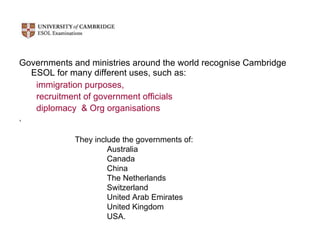
Governments and ministries around the world recognise Cambridge ESOL for many different uses, such as:  immigration purposes,  recruitment of government officials  diplomacy  & Org organisations  ,  They include the governments of: Australia  Canada  China  The Netherlands  Switzerland  United Arab Emirates  United Kingdom  USA.
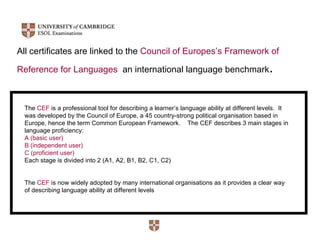
All certificates are linked to the  Council of Europes’s Framework of  Reference for Languages   an international language benchmark . The  CEF  is a professional tool for describing a learner’s language ability at different levels.  It was developed by the Council of Europe, a 45 country-strong political organisation based in Europe, hence the term Common European Framework.  The CEF describes 3 main stages in language proficiency:  A (basic user)  B (independent user)  C (proficient user) Each stage is divided into 2 (A1, A2, B1, B2, C1, C2) The  CEF  is now widely adopted by many international organisations as it provides a clear way of describing language ability at different levels
.
 
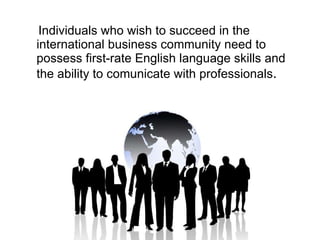
Individuals who wish to succeed in the international business community need to possess first-rate English language skills and the ability to comunicate with professionals .
If you can show you have an internationally recognised business qualification in English,  you will have    a  greater advantage  in the  jobs market ,  and much    greater flexibility  if you want to  work abroad.
. Top international companies such as   Sony Ericsson,  Shell,  Vodafone,  Bayer,  Coca-Cola  & HSBC   all have employees who have taken one or more of the BEC examinations .
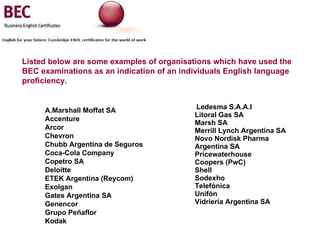
Ledesma S.A.A.I   Litoral Gas SA Marsh SA   Merrill Lynch Argentina SA   Novo Nordisk Pharma  Argentina SA   Pricewaterhouse Coopers (PwC)   Shell   Sodexho   Telefónica  Unifón   Vidriería Argentina SA   (VASA)     A.Marshall Moffat SA   Accenture   Arcor   Chevron   Chubb Argentina de Seguros   Coca-Cola Company  Copetro SA   Deloitte ETEK Argentina (Reycom)   Exolgan   Gates Argentina SA   Genencor   Grupo Peñaflor   Kodak    Listed below are some examples of organisations which have used the BEC examinations as an indication of an individuals English language proficiency.
So… why  BEC? Advantages of studying for the Business English Certificate:
Knowledge of practical business terms : Ability to  -  prepare an interview a CV arrange meetings  make travel plans talk to providers  write business letters and emails write reports and proposals etc
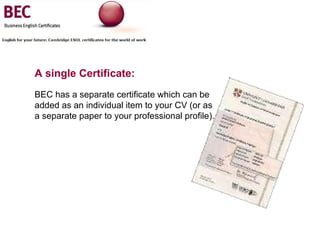
A single Certificate: BEC has a separate certificate which can be added as an individual item to your CV (or as a separate paper to your professional profile).
   BEC and other certificates can be used as  proof of your ability to use the language well enough in the university of your choice.  
Certificates are based on testing real language skills relevant for today's world of business, rather than learning lists of words and grammar from books. .
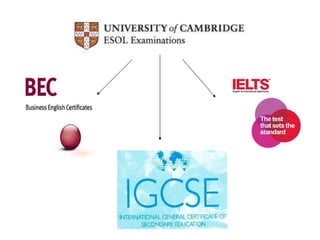
International General Certificate of  Secondary Education
Cambridge IGCSE  gives schools an  internationally   recognised  curriculum.  Over 300 independent schools in the UK offer it . Cambridge IGCSE is taken in over 100 countries worldwide.
Cambridge IGCSE is designed to be taught as a two year course for students aged 14 to 16 years. Each learner's performance is benchmarked using eight internationally recognised grades (A*-G). It is possible to study a free choice of IGCSE subjects.
In most subjects there is a choice between core and extended curricula. Students can enter for the level that is most appropriate for them. Students are encouraged to study a wide range of subjects at  IGCSE  level:  This can lead to the award    International Certificate of Education  .
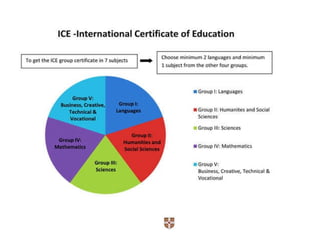
Cambridge ICE  is the group award of the  International General Certificate of Secondary Education (IGCSE). Cambridge ICE   (at least) seven subjects:  including two languages one subject from each subject groups  ICE - International Certificate of Education
 
.
IELTS  is the world’s proven English test .   Over 1.4 million candidates  take the test each year to start their journeys into international education and employment. IELTS  is recognised by more than  6000 institutions  in over  135 countries In the USA  the  IELTS  Test is now recognised by more than  1400 institutions . International English Language Testing System
. IELTS  is recognised for course admission by universities in many countries, including Australia, New Zealand, Canada, the USA and the UK. IELTS  is also required as proof of your language abilities for immigration to Australia, New Zealand, Canada and the United Kingdom.
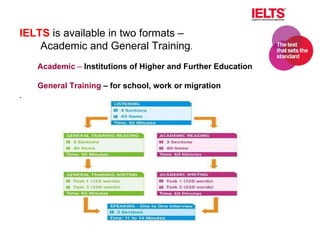
IELTS  is available in two formats –  Academic and General Training .   Academic  –  Institutions of Higher and Further Education General Training  – for school, work or migration .
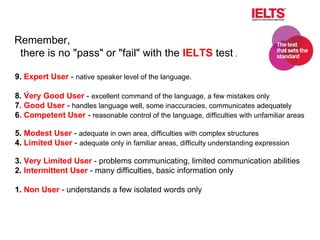
. 9.  Expert User  -  native speaker level of the language. 8.  Very Good User  -  excellent command of the language, a few mistakes only 7 . Good User -   handles language well, some inaccuracies, communicates adequately 6 . Competent User -   reasonable control of the language, difficulties with unfamiliar areas 5.  Modest User  -  adequate in own area, difficulties with complex structures 4.  Limited User  -  adequate only in familiar areas, difficulty understanding expression 3.  Very Limited User  - problems communicating, limited communication abilities 2.  Intermittent User  - many difficulties, basic information only 1.  Non User -  understands a few isolated words only   Remember, there is no "pass" or "fail" with the  IELTS  test  .
It assesses the language ability of those who need to study or work wherever English is used as the language of communication. It will ensure that you have the right level of English for your needs. It is used as proof of your language level, whether for work, to enter  University or to spend some time abroad. So …  Why IELTS?
Why International Exams? Preparation Knowledge Higher Qualifications Recognition
Preparation enabling you to study in English which will permit you masters, updates, innovations, etc in your field of choice. Knowledge In-depth knowledge of different subjects and the ability to  expand their contents. Higher Qualifications not only qualifications but also written proof of your level of ability in different areas. Recognition Everytime wider recognition by peers, educational institutions, jobs, governments, locally and internationally.
That is Thank you

Cambridge International exams

  • 1.
  • 2.
    Why take CambridgeESOL qualifications ? Every year more than 3 million people take Cambridge ESOL examinations. They benefit from the extra advantages that come with these certificates.
  • 3.
    Advantages that comewith these certificates . Preparation Knowledge Higher Qualifications Recognition
  • 4.
    Recognition Cambridge ESOL is a part of the world-famous University of Cambridge , and these certificates are recognised by thousands of employers, government agencies, and professional bodies in many countries. They are also recognised by educational institutions and immigration authorities.
  • 5.
    Governments and ministriesaround the world recognise Cambridge ESOL for many different uses, such as: immigration purposes, recruitment of government officials diplomacy & Org organisations , They include the governments of: Australia Canada China The Netherlands Switzerland United Arab Emirates United Kingdom USA.
  • 6.
    All certificates arelinked to the Council of Europes’s Framework of Reference for Languages an international language benchmark . The CEF is a professional tool for describing a learner’s language ability at different levels.  It was developed by the Council of Europe, a 45 country-strong political organisation based in Europe, hence the term Common European Framework. The CEF describes 3 main stages in language proficiency: A (basic user) B (independent user) C (proficient user) Each stage is divided into 2 (A1, A2, B1, B2, C1, C2) The CEF is now widely adopted by many international organisations as it provides a clear way of describing language ability at different levels
  • 7.
  • 8.
  • 9.
    Individuals who wishto succeed in the international business community need to possess first-rate English language skills and the ability to comunicate with professionals .
  • 10.
    If you canshow you have an internationally recognised business qualification in English, you will have a greater advantage in the jobs market , and much greater flexibility if you want to work abroad.
  • 11.
    . Top internationalcompanies such as Sony Ericsson, Shell, Vodafone, Bayer, Coca-Cola & HSBC all have employees who have taken one or more of the BEC examinations .
  • 12.
    Ledesma S.A.A.I   LitoralGas SA Marsh SA   Merrill Lynch Argentina SA   Novo Nordisk Pharma Argentina SA   Pricewaterhouse Coopers (PwC)   Shell   Sodexho   Telefónica Unifón   Vidriería Argentina SA (VASA)     A.Marshall Moffat SA   Accenture   Arcor   Chevron   Chubb Argentina de Seguros   Coca-Cola Company  Copetro SA   Deloitte ETEK Argentina (Reycom)   Exolgan   Gates Argentina SA   Genencor   Grupo Peñaflor   Kodak    Listed below are some examples of organisations which have used the BEC examinations as an indication of an individuals English language proficiency.
  • 13.
    So… why BEC? Advantages of studying for the Business English Certificate:
  • 14.
    Knowledge of practicalbusiness terms : Ability to - prepare an interview a CV arrange meetings make travel plans talk to providers write business letters and emails write reports and proposals etc
  • 15.
    A single Certificate:BEC has a separate certificate which can be added as an individual item to your CV (or as a separate paper to your professional profile).
  • 16.
       BEC andother certificates can be used as proof of your ability to use the language well enough in the university of your choice.  
  • 17.
    Certificates are basedon testing real language skills relevant for today's world of business, rather than learning lists of words and grammar from books. .
  • 18.
    International General Certificateof Secondary Education
  • 19.
    Cambridge IGCSE gives schools an internationally recognised curriculum. Over 300 independent schools in the UK offer it . Cambridge IGCSE is taken in over 100 countries worldwide.
  • 20.
    Cambridge IGCSE isdesigned to be taught as a two year course for students aged 14 to 16 years. Each learner's performance is benchmarked using eight internationally recognised grades (A*-G). It is possible to study a free choice of IGCSE subjects.
  • 21.
    In most subjectsthere is a choice between core and extended curricula. Students can enter for the level that is most appropriate for them. Students are encouraged to study a wide range of subjects at IGCSE level: This can lead to the award International Certificate of Education .
  • 22.
    Cambridge ICE is the group award of the International General Certificate of Secondary Education (IGCSE). Cambridge ICE (at least) seven subjects: including two languages one subject from each subject groups ICE - International Certificate of Education
  • 23.
  • 24.
  • 25.
    IELTS isthe world’s proven English test . Over 1.4 million candidates take the test each year to start their journeys into international education and employment. IELTS is recognised by more than 6000 institutions  in over  135 countries In the USA the IELTS Test is now recognised by more than 1400 institutions . International English Language Testing System
  • 26.
    . IELTS is recognised for course admission by universities in many countries, including Australia, New Zealand, Canada, the USA and the UK. IELTS is also required as proof of your language abilities for immigration to Australia, New Zealand, Canada and the United Kingdom.
  • 27.
    IELTS isavailable in two formats – Academic and General Training .   Academic – Institutions of Higher and Further Education General Training – for school, work or migration .
  • 28.
    . 9. Expert User - native speaker level of the language. 8. Very Good User - excellent command of the language, a few mistakes only 7 . Good User - handles language well, some inaccuracies, communicates adequately 6 . Competent User - reasonable control of the language, difficulties with unfamiliar areas 5. Modest User - adequate in own area, difficulties with complex structures 4. Limited User - adequate only in familiar areas, difficulty understanding expression 3. Very Limited User - problems communicating, limited communication abilities 2. Intermittent User - many difficulties, basic information only 1. Non User - understands a few isolated words only   Remember, there is no "pass" or "fail" with the IELTS test .
  • 29.
    It assesses thelanguage ability of those who need to study or work wherever English is used as the language of communication. It will ensure that you have the right level of English for your needs. It is used as proof of your language level, whether for work, to enter University or to spend some time abroad. So … Why IELTS?
  • 30.
    Why International Exams?Preparation Knowledge Higher Qualifications Recognition
  • 31.
    Preparation enabling youto study in English which will permit you masters, updates, innovations, etc in your field of choice. Knowledge In-depth knowledge of different subjects and the ability to expand their contents. Higher Qualifications not only qualifications but also written proof of your level of ability in different areas. Recognition Everytime wider recognition by peers, educational institutions, jobs, governments, locally and internationally.
  • 32.