ENERGY, ECONOMY AND ENVIRONMENT INTEGRATED LARGE SCALE
MODELING AND ANALYSIS
OF
!
“THE TURKISH ENERGY SYSTEM”
Thesis Proposal
Why?
What?
How?
When?
Presentation Agenda
Why?
2
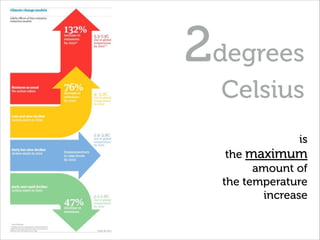
2degrees
Celsius
is
the maximum
amount of
the temperature
increase
2degrees
Celsius
is
the maximum
amount of
the temperature
increase
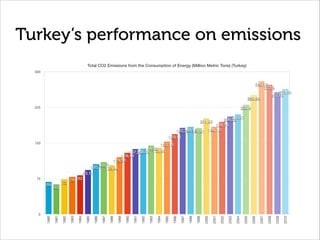
Turkey’s performance on emissions
Total CO2 Emissions from the Consumption of Energy (Million Metric Tons) (Turkey)
0
75
150
225
300
1980
1981
1982
1983
1984
1985
1986
1987
1988
1989
1990
1991
1992
1993
1994
1995
1996
1997
1998
1999
2000
2001
2002
2003
2004
2005
2006
2007
2008
2009
2010
263,54
257,03
272,9
280,19
250,96
230,9
210,47
206,03
194,53
184,18
201,93
181,61184,13182,28
169,11
153,19
139,95
144,58
138,06137,29
129,48
119,96
103,46
109,7105,7
93,11
8278
73
63
69
What?
What?
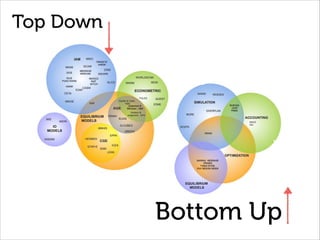
Researchers do up to now
Top Down
Bottom Up
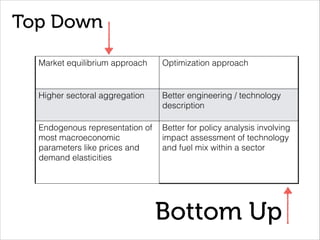
Market equilibrium approach Optimization approach
Higher sectoral aggregation Better engineering / technology
description
Endogenous representation of
most macroeconomic
parameters like prices and
demand elasticities
Better for policy analysis involving 
impact assessment of technology
and fuel mix within a sector
Top Down
Bottom Up
Top Down
Bottom Up
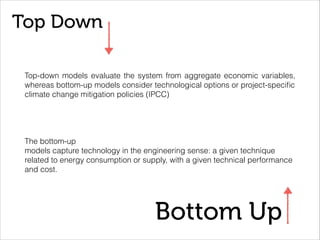
Top-down models evaluate the system from aggregate economic variables,
whereas bottom-up models consider technological options or project-specific
climate change mitigation policies (IPCC)
!
!
!
!
The bottom-up
models capture technology in the engineering sense: a given technique
related to energy consumption or supply, with a given technical performance
and cost.
!
!
Top-Down Models
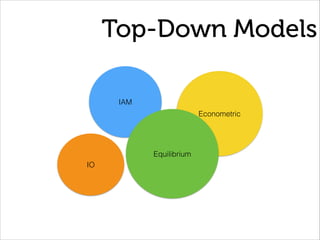
IAM
Econometric
Equilibrium
IO
Top-Down Models
IAM Econometric
Equilibrium
IO
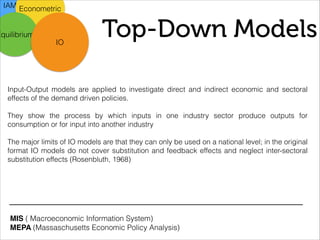
Input-Output models are applied to investigate direct and indirect economic and sectoral
effects of the demand driven policies.
!
They show the process by which inputs in one industry sector produce outputs for
consumption or for input into another industry
!
The major limits of IO models are that they can only be used on a national level; in the original
format IO models do not cover substitution and feedback effects and neglect inter-sectoral
substitution effects (Rosenbluth, 1968)
MIS ( Macroeconomic Information System)
MEPA (Massaschusetts Economic Policy Analysis)
Top-Down Models
IAM
Econometric
Equilibrium
IO
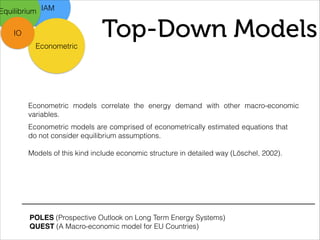
Econometric models correlate the energy demand with other macro-economic
variables.
Econometric models are comprised of econometrically estimated equations that
do not consider equilibrium assumptions.
!
Models of this kind include economic structure in detailed way (Löschel, 2002).
POLES (Prospective Outlook on Long Term Energy Systems)
QUEST (A Macro-economic model for EU Countries)
IO
Top-Down Modelsnometric
Equilibrium
IAM
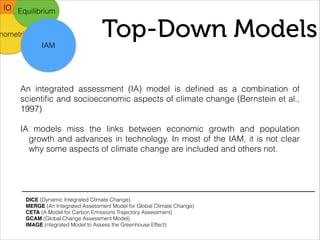
An integrated assessment (IA) model is defined as a combination of
scientific and socioeconomic aspects of climate change (Bernstein et al.,
1997)
!
IA models miss the links between economic growth and population
growth and advances in technology. In most of the IAM, it is not clear
why some aspects of climate change are included and others not.
DICE (Dynamic Integrated Climate Change)
MERGE (An Integrated Assessment Model for Global Climate Change)
CETA (A Model for Carbon Emissions Trajectory Assessment)
GCAM (Global Change Assessment Model)
IMAGE (ntegrated Model to Assess the Greenhouse Effect)
nometric
IO
Top-Down ModelsEquilibriumIAM
!
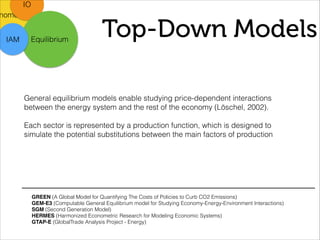
General equilibrium models enable studying price-dependent interactions
between the energy system and the rest of the economy (Löschel, 2002).
!
Each sector is represented by a production function, which is designed to
simulate the potential substitutions between the main factors of production
!
!
!
!
!
GREEN (A Global Model for Quantifying The Costs of Policies to Curb CO2 Emissions)
GEM-E3 (Computable General Equilibrium model for Studying Economy-Energy-Environment Interactions)
SGM (Second Generation Model)
HERMES (Harmonized Econometric Research for Modeling Economic Systems)
GTAP-E (GlobalTrade Analysis Project - Energy)
nometric
IO
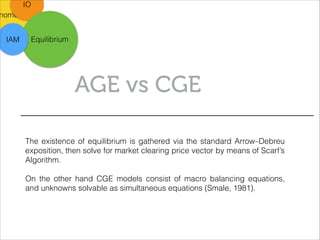
AGE vs CGE
EquilibriumIAM
The existence of equilibrium is gathered via the standard Arrow–Debreu
exposition, then solve for market clearing price vector by means of Scarf’s
Algorithm.
!
On the other hand CGE models consist of macro balancing equations,
and unknowns solvable as simultaneous equations (Smale, 1981).
Bottom Up
Bottom-up models represent the energy system with a technology rich
description and put the emphasis on the correct description of energy
sources and technologies
!
Such models often neglect the macroeconomic impacts of energy
policies.
EFOM (Energy Flow Optimization Model)
MARKAL (Market Allocation Model)
MESSAGE (Model for Energy Supply Systems and Their General Environment)
MIDAS (Multinational Integrated Demand and Supply Model)
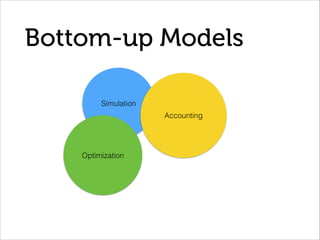
Bottom-up Models
Simulation
Accounting
Optimization
Bottom-up Models
imulation
imization
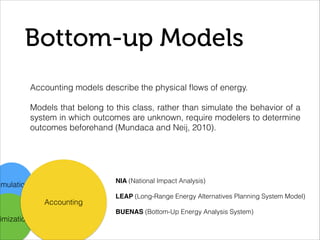
Accounting
Accounting models describe the physical flows of energy.
!
Models that belong to this class, rather than simulate the behavior of a
system in which outcomes are unknown, require modelers to determine
outcomes beforehand (Mundaca and Neij, 2010).
NIA (National Impact Analysis)
LEAP (Long-Range Energy Alternatives Planning System Model)!
BUENAS (Bottom-Up Energy Analysis System)
Simulation
Bottom-up Models
timization
Accounting
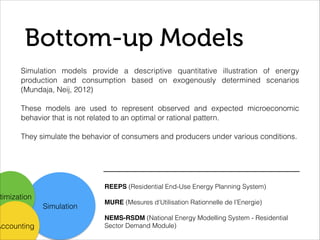
Simulation models provide a descriptive quantitative illustration of energy
production and consumption based on exogenously determined scenarios
(Mundaja, Neij, 2012)
!
These models are used to represent observed and expected microeconomic
behavior that is not related to an optimal or rational pattern.
!
They simulate the behavior of consumers and producers under various conditions.
!
REEPS (Residential End-Use Energy Planning System)
!
MURE (Mesures d‘Utilisation Rationnelle de l’Energie)
!
NEMS-RSDM (National Energy Modelling System - Residential
Sector Demand Module)
Bottom-up Models
Accounting
imulation
Optimization
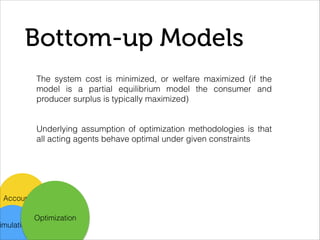
The system cost is minimized, or welfare maximized (if the
model is a partial equilibrium model the consumer and
producer surplus is typically maximized)
!
!
Underlying assumption of optimization methodologies is that
all acting agents behave optimal under given constraints
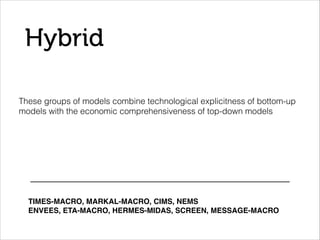
Hybrid
These groups of models combine technological explicitness of bottom-up
models with the economic comprehensiveness of top-down models
TIMES-MACRO, MARKAL-MACRO, CIMS, NEMS!
ENVEES, ETA-MACRO, HERMES-MIDAS, SCREEN, MESSAGE-MACRO!
How?
How?
to conduct a model
TIMES
TIMES is a dynamic, bottom-up, large-scale, linear optimization
modeling framework for energy systems
!
It is designed to be deployed on a multi-period horizon to
minimize the total discounted energy system cost.
!
Quantities and prices of various fuels and other necessary
commodities of the energy sector come to equilibrium in each
period
!
TIMES also considers new technologies that will be available in
the future
Reference case projections of end-use energy service demands (e.g.,
residential lighting, steel production and the like) are provided
by the user for each region.
!
The user provides estimates of the existing stock of energy related
equipment in all sectors in the base year, and the characteristics of
available future technologies, future sources of primary energy supply
and their potentials.
TIMES
Using these as inputs, the model aims to supply energy services at
minimum global cost by simultaneously making decisions on
equipment investment, equipment operation, primary energy supply,
and energy trade.
TIMES
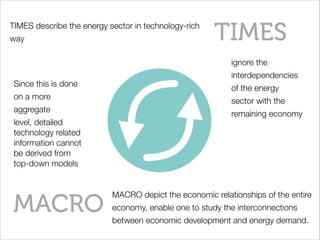
TIMES
MACRO
ignore the
interdependencies
of the energy
sector with the
remaining economy
MACRO depict the economic relationships of the entire
economy, enable one to study the interconnections
between economic development and energy demand.
Since this is done
on a more
aggregate
level, detailed
technology related
information cannot
be derived from
top-down models
TIMES describe the energy sector in technology-rich
way
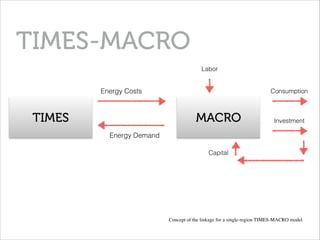
TIMES-MACRO
TIMES MACRO
Energy Demand
Energy Costs
Labor
Consumption
Investment
Capital
Concept of the linkage for a single-region TIMES-MACRO model
When?
Thanks…

Thesis proposal

  • 1.
    ENERGY, ECONOMY ANDENVIRONMENT INTEGRATED LARGE SCALE MODELING AND ANALYSIS OF ! “THE TURKISH ENERGY SYSTEM” Thesis Proposal
  • 2.
  • 3.
  • 5.
  • 6.
  • 8.
  • 10.
    Turkey’s performance onemissions Total CO2 Emissions from the Consumption of Energy (Million Metric Tons) (Turkey) 0 75 150 225 300 1980 1981 1982 1983 1984 1985 1986 1987 1988 1989 1990 1991 1992 1993 1994 1995 1996 1997 1998 1999 2000 2001 2002 2003 2004 2005 2006 2007 2008 2009 2010 263,54 257,03 272,9 280,19 250,96 230,9 210,47 206,03 194,53 184,18 201,93 181,61184,13182,28 169,11 153,19 139,95 144,58 138,06137,29 129,48 119,96 103,46 109,7105,7 93,11 8278 73 63 69
  • 11.
  • 12.
  • 13.
  • 14.
    Market equilibrium approachOptimization approach Higher sectoral aggregation Better engineering / technology description Endogenous representation of most macroeconomic parameters like prices and demand elasticities Better for policy analysis involving  impact assessment of technology and fuel mix within a sector Top Down Bottom Up
  • 15.
    Top Down Bottom Up Top-downmodels evaluate the system from aggregate economic variables, whereas bottom-up models consider technological options or project-specific climate change mitigation policies (IPCC) ! ! ! ! The bottom-up models capture technology in the engineering sense: a given technique related to energy consumption or supply, with a given technical performance and cost. ! !
  • 16.
  • 17.
    Top-Down Models IAM Econometric Equilibrium IO Input-Outputmodels are applied to investigate direct and indirect economic and sectoral effects of the demand driven policies. ! They show the process by which inputs in one industry sector produce outputs for consumption or for input into another industry ! The major limits of IO models are that they can only be used on a national level; in the original format IO models do not cover substitution and feedback effects and neglect inter-sectoral substitution effects (Rosenbluth, 1968) MIS ( Macroeconomic Information System) MEPA (Massaschusetts Economic Policy Analysis)
  • 18.
    Top-Down Models IAM Econometric Equilibrium IO Econometric modelscorrelate the energy demand with other macro-economic variables. Econometric models are comprised of econometrically estimated equations that do not consider equilibrium assumptions. ! Models of this kind include economic structure in detailed way (Löschel, 2002). POLES (Prospective Outlook on Long Term Energy Systems) QUEST (A Macro-economic model for EU Countries)
  • 19.
    IO Top-Down Modelsnometric Equilibrium IAM An integratedassessment (IA) model is defined as a combination of scientific and socioeconomic aspects of climate change (Bernstein et al., 1997) ! IA models miss the links between economic growth and population growth and advances in technology. In most of the IAM, it is not clear why some aspects of climate change are included and others not. DICE (Dynamic Integrated Climate Change) MERGE (An Integrated Assessment Model for Global Climate Change) CETA (A Model for Carbon Emissions Trajectory Assessment) GCAM (Global Change Assessment Model) IMAGE (ntegrated Model to Assess the Greenhouse Effect)
  • 20.
    nometric IO Top-Down ModelsEquilibriumIAM ! General equilibriummodels enable studying price-dependent interactions between the energy system and the rest of the economy (Löschel, 2002). ! Each sector is represented by a production function, which is designed to simulate the potential substitutions between the main factors of production ! ! ! ! ! GREEN (A Global Model for Quantifying The Costs of Policies to Curb CO2 Emissions) GEM-E3 (Computable General Equilibrium model for Studying Economy-Energy-Environment Interactions) SGM (Second Generation Model) HERMES (Harmonized Econometric Research for Modeling Economic Systems) GTAP-E (GlobalTrade Analysis Project - Energy)
  • 21.
    nometric IO AGE vs CGE EquilibriumIAM Theexistence of equilibrium is gathered via the standard Arrow–Debreu exposition, then solve for market clearing price vector by means of Scarf’s Algorithm. ! On the other hand CGE models consist of macro balancing equations, and unknowns solvable as simultaneous equations (Smale, 1981).
  • 22.
    Bottom Up Bottom-up modelsrepresent the energy system with a technology rich description and put the emphasis on the correct description of energy sources and technologies ! Such models often neglect the macroeconomic impacts of energy policies. EFOM (Energy Flow Optimization Model) MARKAL (Market Allocation Model) MESSAGE (Model for Energy Supply Systems and Their General Environment) MIDAS (Multinational Integrated Demand and Supply Model)
  • 23.
  • 24.
    Bottom-up Models imulation imization Accounting Accounting modelsdescribe the physical flows of energy. ! Models that belong to this class, rather than simulate the behavior of a system in which outcomes are unknown, require modelers to determine outcomes beforehand (Mundaca and Neij, 2010). NIA (National Impact Analysis) LEAP (Long-Range Energy Alternatives Planning System Model)! BUENAS (Bottom-Up Energy Analysis System)
  • 25.
    Simulation Bottom-up Models timization Accounting Simulation modelsprovide a descriptive quantitative illustration of energy production and consumption based on exogenously determined scenarios (Mundaja, Neij, 2012) ! These models are used to represent observed and expected microeconomic behavior that is not related to an optimal or rational pattern. ! They simulate the behavior of consumers and producers under various conditions. ! REEPS (Residential End-Use Energy Planning System) ! MURE (Mesures d‘Utilisation Rationnelle de l’Energie) ! NEMS-RSDM (National Energy Modelling System - Residential Sector Demand Module)
  • 26.
    Bottom-up Models Accounting imulation Optimization The systemcost is minimized, or welfare maximized (if the model is a partial equilibrium model the consumer and producer surplus is typically maximized) ! ! Underlying assumption of optimization methodologies is that all acting agents behave optimal under given constraints
  • 27.
    Hybrid These groups ofmodels combine technological explicitness of bottom-up models with the economic comprehensiveness of top-down models TIMES-MACRO, MARKAL-MACRO, CIMS, NEMS! ENVEES, ETA-MACRO, HERMES-MIDAS, SCREEN, MESSAGE-MACRO!
  • 28.
  • 29.
  • 30.
    TIMES TIMES is adynamic, bottom-up, large-scale, linear optimization modeling framework for energy systems ! It is designed to be deployed on a multi-period horizon to minimize the total discounted energy system cost. ! Quantities and prices of various fuels and other necessary commodities of the energy sector come to equilibrium in each period ! TIMES also considers new technologies that will be available in the future
  • 31.
    Reference case projectionsof end-use energy service demands (e.g., residential lighting, steel production and the like) are provided by the user for each region. ! The user provides estimates of the existing stock of energy related equipment in all sectors in the base year, and the characteristics of available future technologies, future sources of primary energy supply and their potentials. TIMES
  • 32.
    Using these asinputs, the model aims to supply energy services at minimum global cost by simultaneously making decisions on equipment investment, equipment operation, primary energy supply, and energy trade. TIMES
  • 33.
    TIMES MACRO ignore the interdependencies of theenergy sector with the remaining economy MACRO depict the economic relationships of the entire economy, enable one to study the interconnections between economic development and energy demand. Since this is done on a more aggregate level, detailed technology related information cannot be derived from top-down models TIMES describe the energy sector in technology-rich way
  • 34.
    TIMES-MACRO TIMES MACRO Energy Demand EnergyCosts Labor Consumption Investment Capital Concept of the linkage for a single-region TIMES-MACRO model
  • 35.
  • 37.