http://timeandquantummechanics.comTime Dispersion in Time of Arrival/John Ashmead IARD-2020
Time Dispersion in
Time-of-Arrival
John Ashmead
International Association for Relativistic Dynamics - 2020 Virtual
Can we prove that the Heisenberg uncertainty
principle does not apply along the energy/time
axis in the same way it applies along the space/
momentum axis?
http://timeandquantummechanics.comTime Dispersion in Time of Arrival/John Ashmead IARD-2020
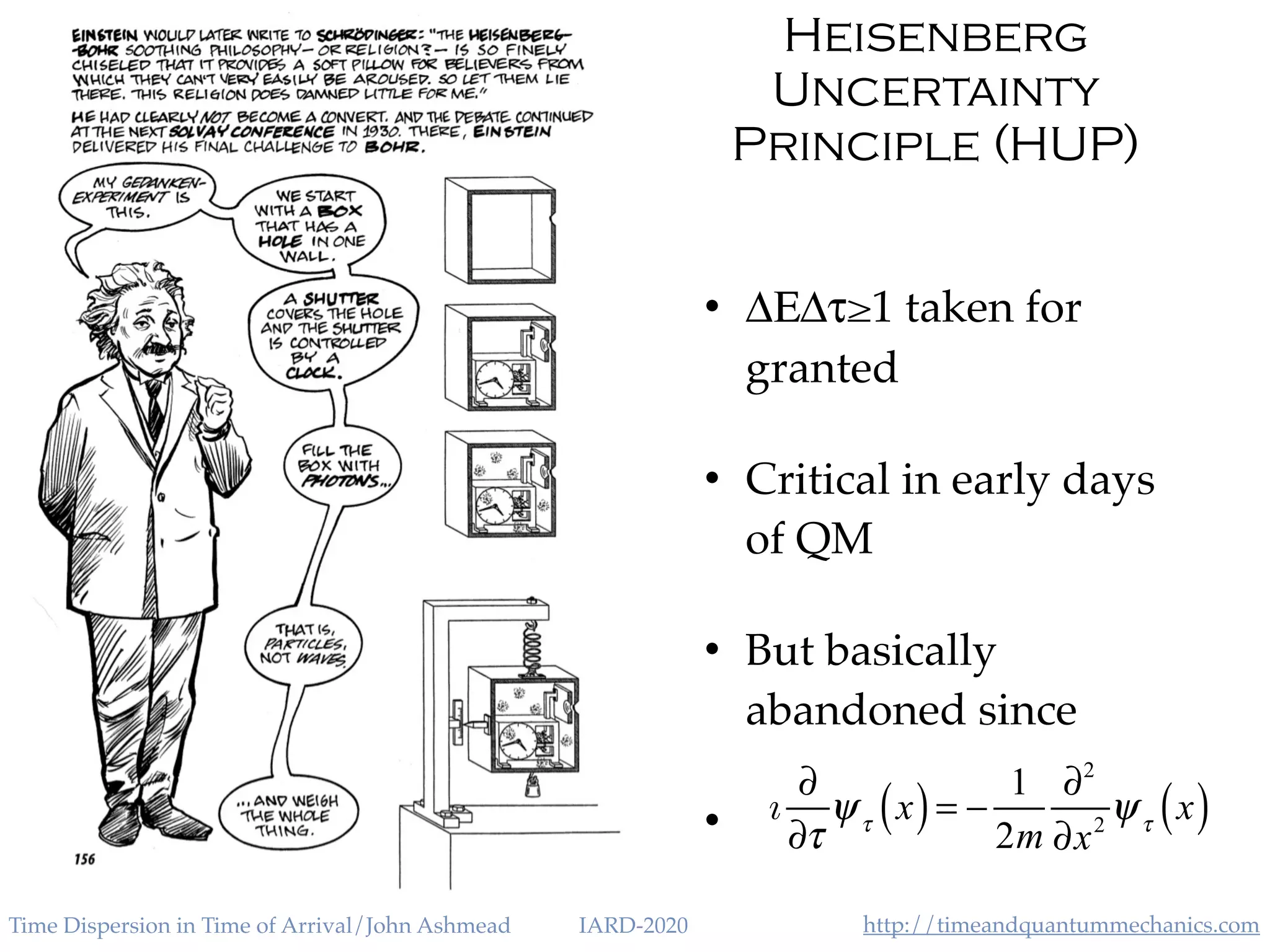
Heisenberg
Uncertainty
Principle (HUP)
• ΔΕΔτ≥1 taken for
granted
• Critical in early days
of QM
• But basically
abandoned since
• ı
∂
∂τ
ψτ
x( )= −
1
2m
∂2
∂x2
ψτ
x( )
http://timeandquantummechanics.comTime Dispersion in Time of Arrival/John Ashmead IARD-2020
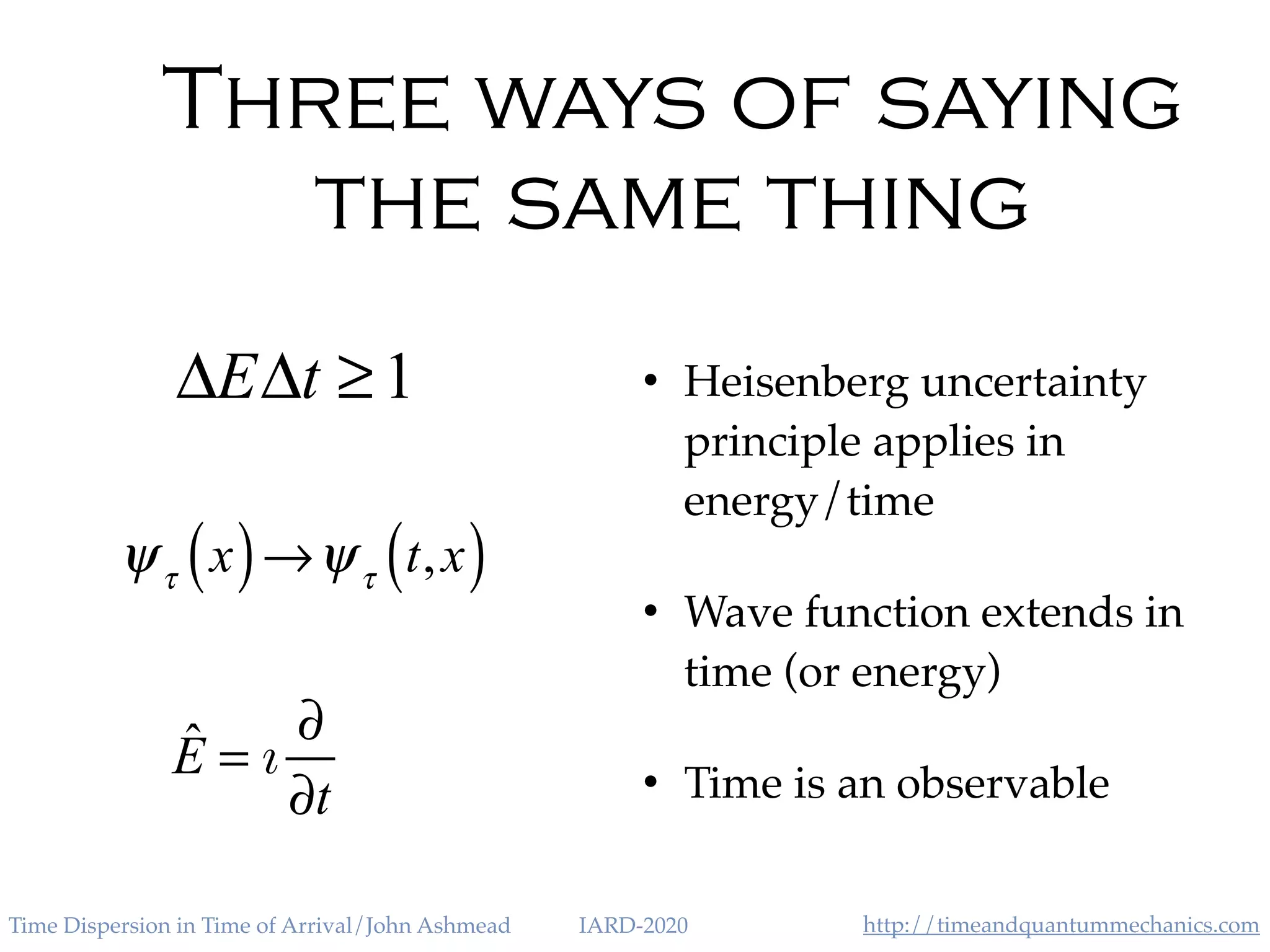
Three ways of saying
the same thing
• Heisenberg uncertainty
principle applies in
energy/time
• Wave function extends in
time (or energy)
• Time is an observable
ΔEΔt ≥1
ˆE = ı
∂
∂t
ψτ
x( )→ψτ
t,x( )
http://timeandquantummechanics.comTime Dispersion in Time of Arrival/John Ashmead IARD-2020
How to get to
Falsifiability?
• Look at the class of theories, not just
one particular theory
• Use the simplest possible approaches
• Look for order of magnitude
estimates
• Use covariance to eliminate need for
free parameters
http://timeandquantummechanics.comTime Dispersion in Time of Arrival/John Ashmead IARD-2020
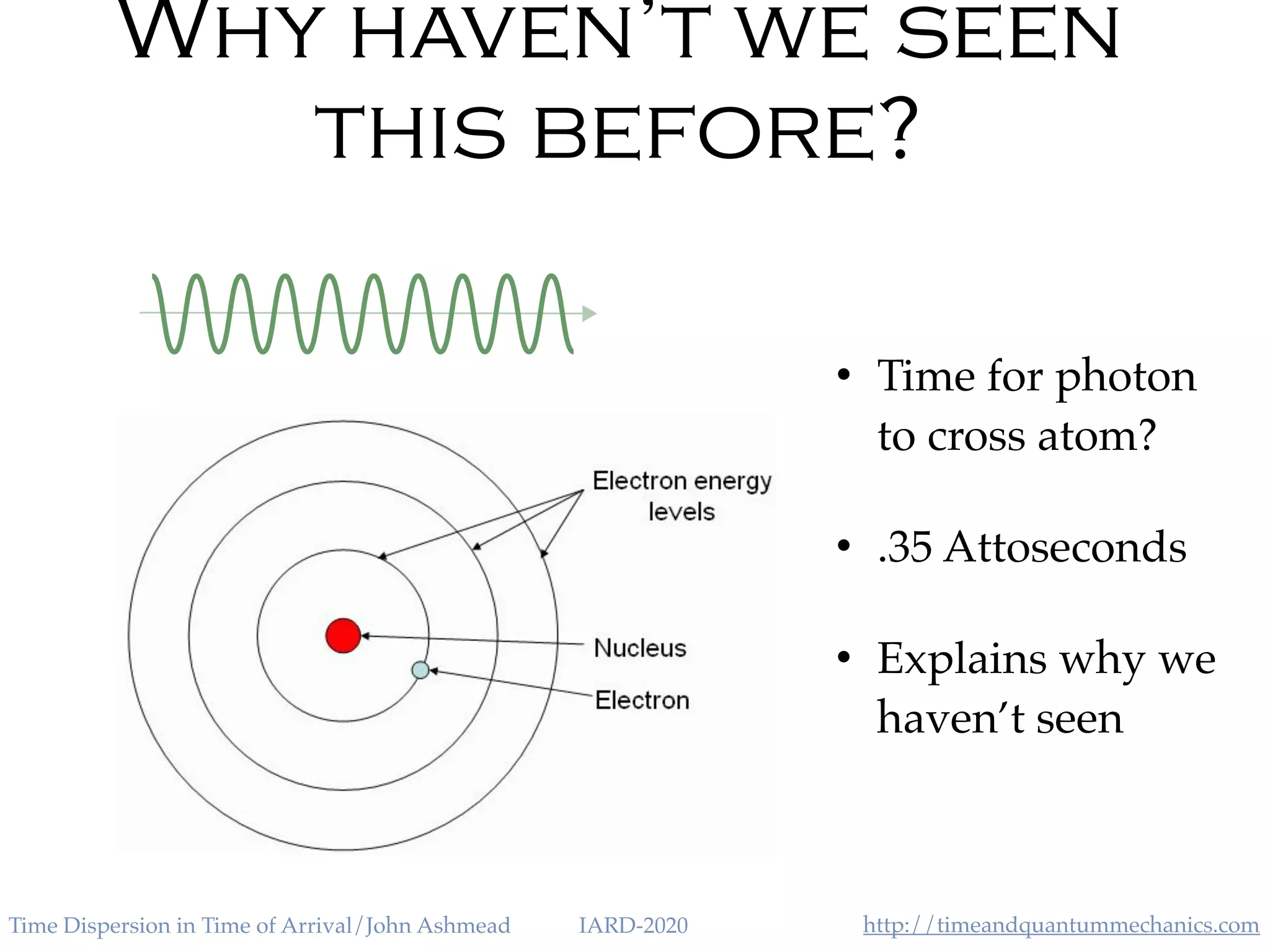
Why haven’t we seen
this before?
• Time for photon
to cross atom?
• .35 Attoseconds
• Explains why we
haven’t seen
http://timeandquantummechanics.comTime Dispersion in Time of Arrival/John Ashmead IARD-2020


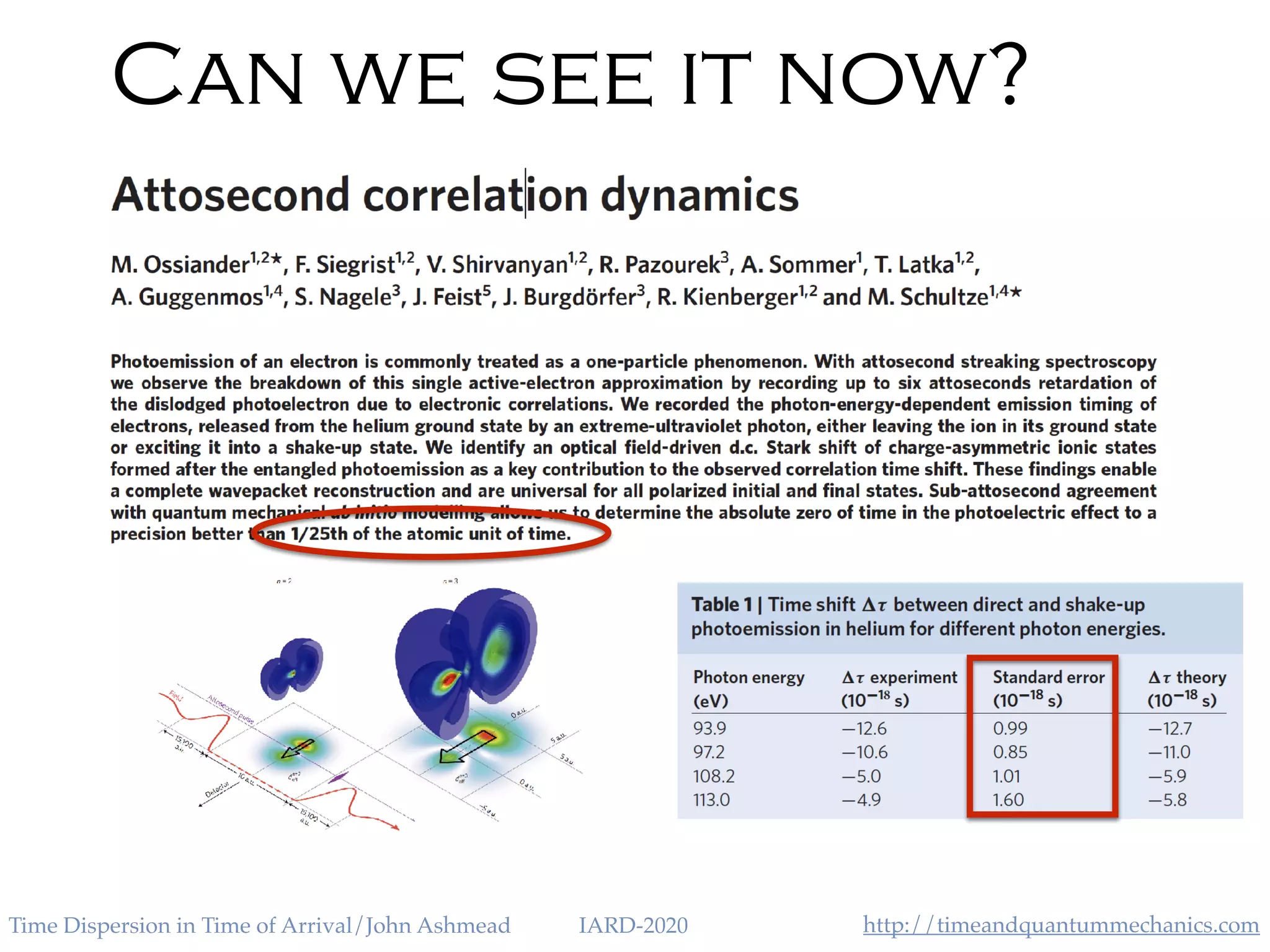
Can we see it now?
http://timeandquantummechanics.comTime Dispersion in Time of Arrival/John Ashmead IARD-2020
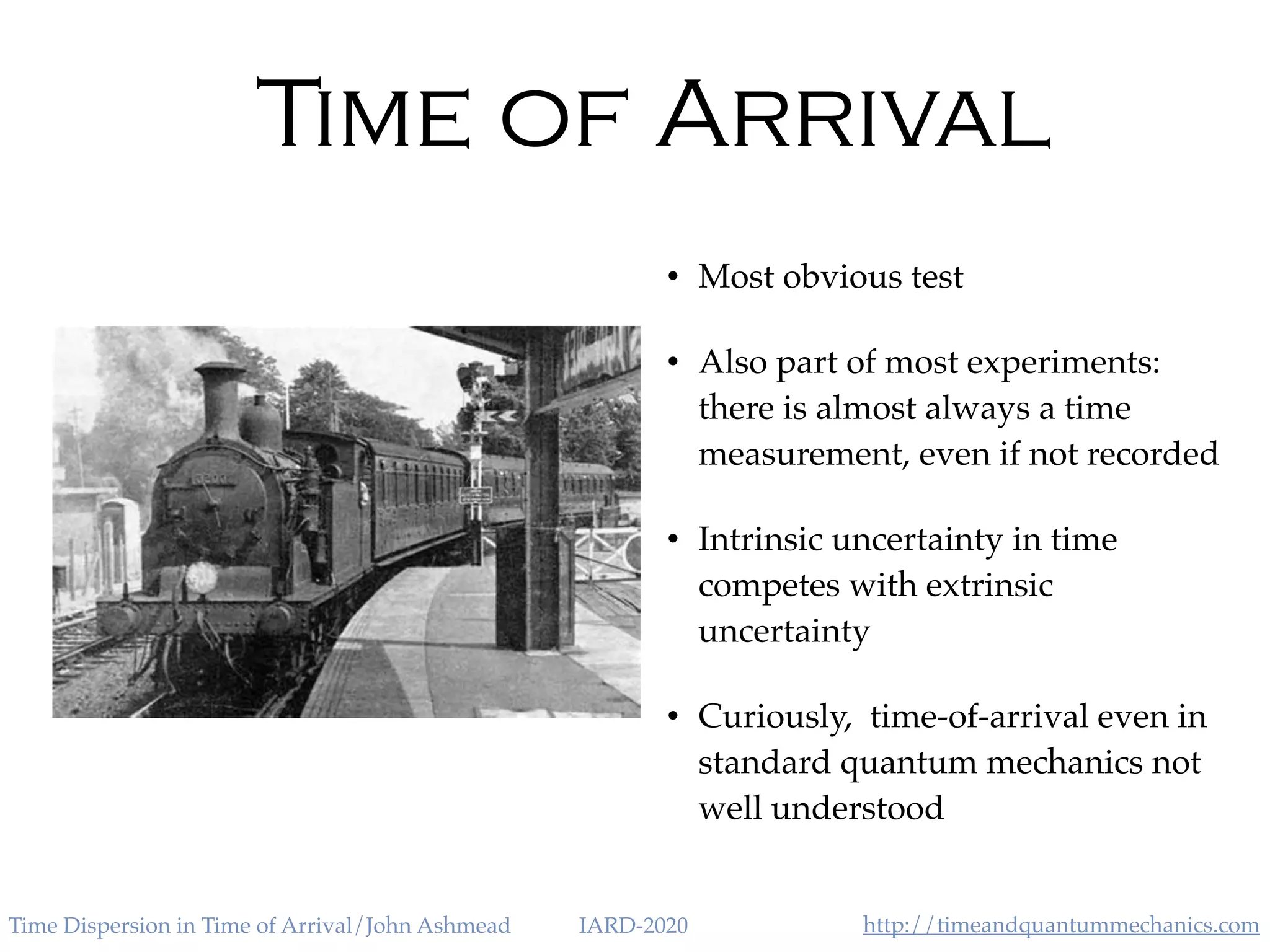
Time of Arrival
• Most obvious test
• Also part of most experiments:
there is almost always a time
measurement, even if not recorded
• Intrinsic uncertainty in time
competes with extrinsic
uncertainty
• Curiously, time-of-arrival even in
standard quantum mechanics not
well understood
http://timeandquantummechanics.comTime Dispersion in Time of Arrival/John Ashmead IARD-2020
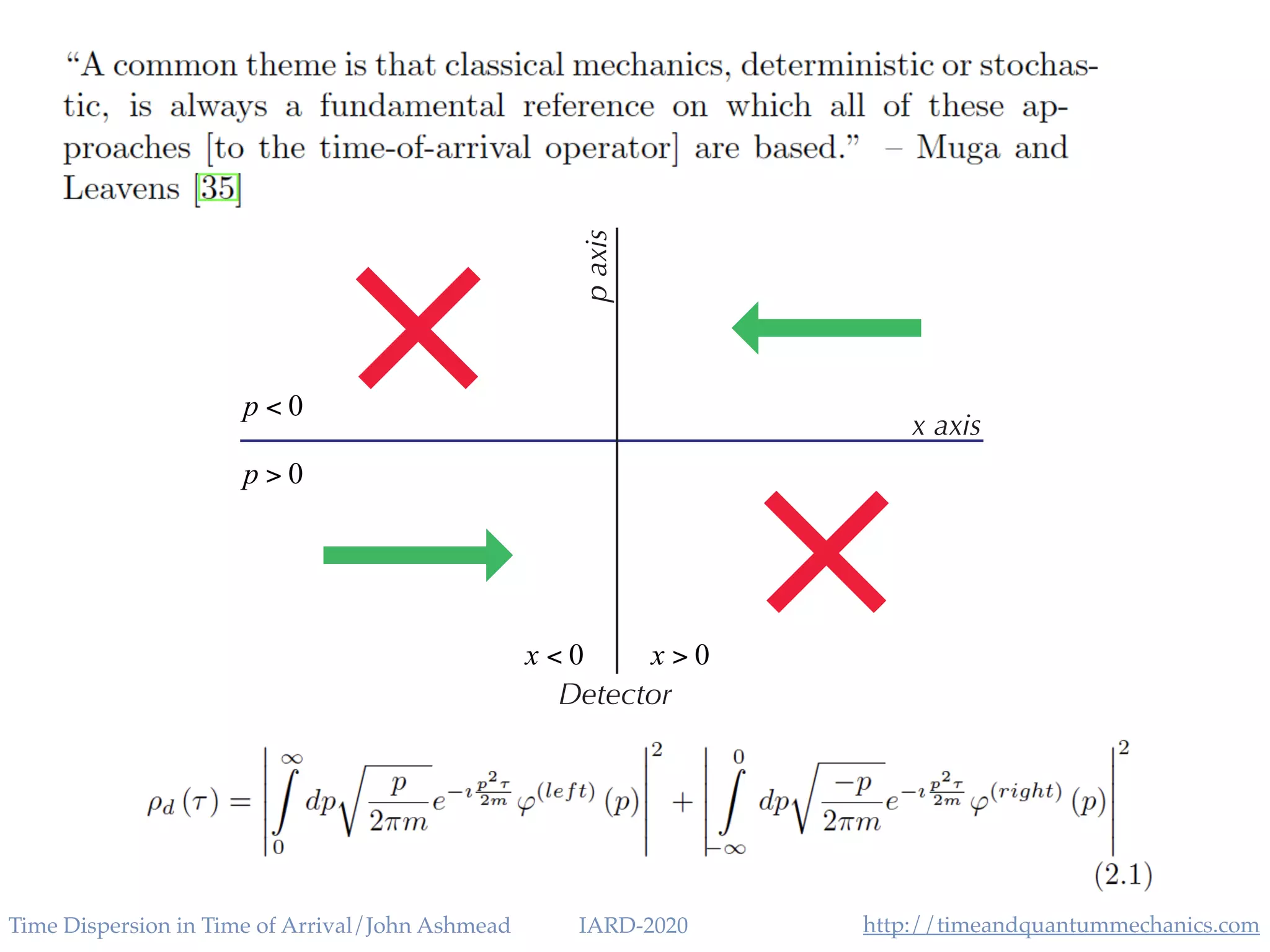
p > 0
p < 0
x > 0x < 0
paxis
x axis
Detector
http://timeandquantummechanics.comTime Dispersion in Time of Arrival/John Ashmead IARD-2020
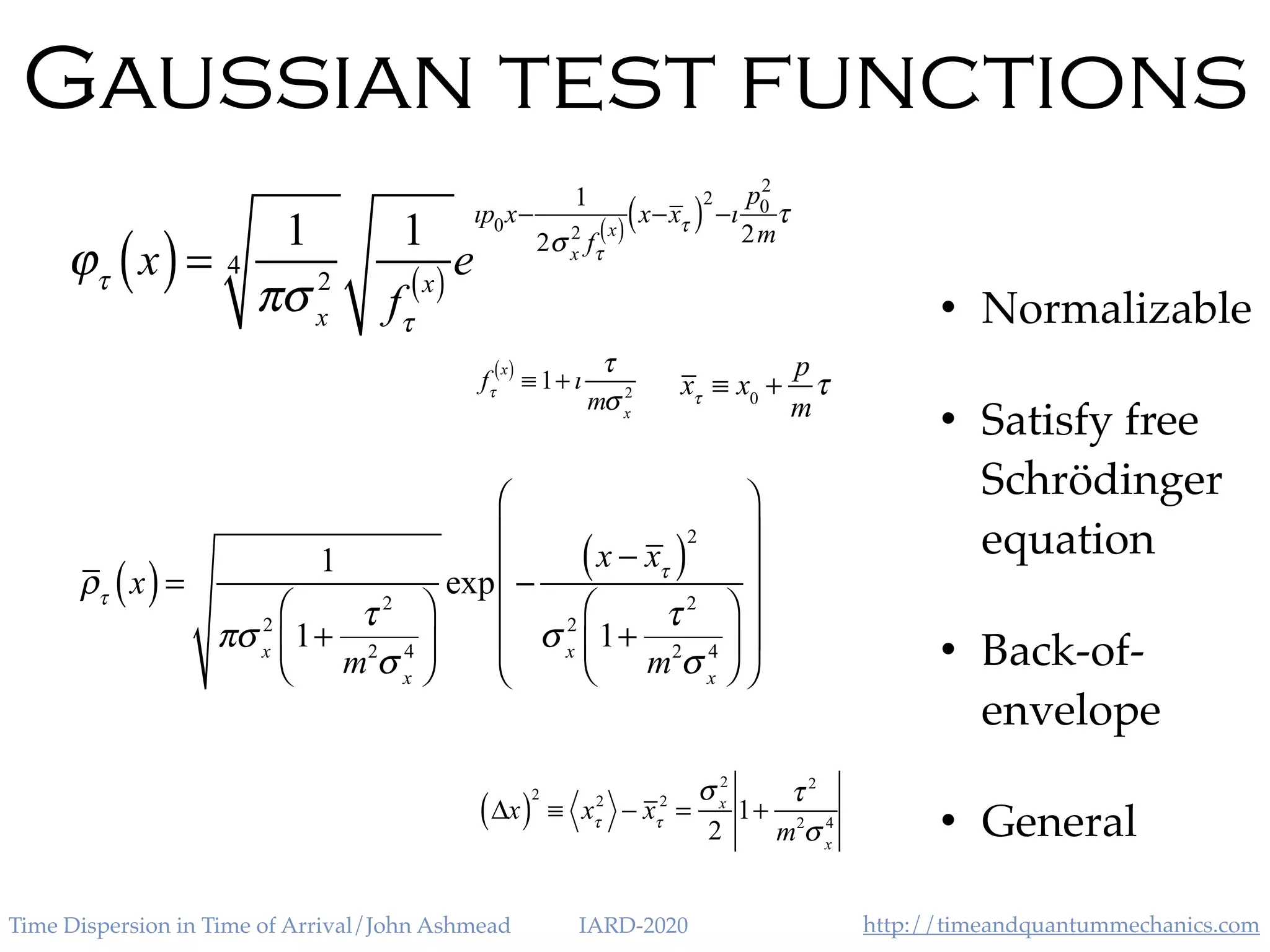
Gaussian test functions
• Normalizable
• Satisfy free
Schrödinger
equation
• Back-of-
envelope
• General
ϕτ
x( )=
1
πσ x
2
4
1
fτ
x( ) e
ıp0x−
1
2σ x
2
fτ
x( )
x−xτ( )2
−ı
p0
2
2m
τ
fτ
x( )
≡ 1+ ı
τ
mσ x
2 xτ
≡ x0
+
p
m
τ
ρτ
x( )=
1
πσ x
2
1+
τ 2
m2
σ x
4
⎛
⎝
⎜
⎞
⎠
⎟
exp −
x − xτ( )
2
σ x
2
1+
τ 2
m2
σ x
4
⎛
⎝
⎜
⎞
⎠
⎟
⎛
⎝
⎜
⎜
⎜
⎜
⎞
⎠
⎟
⎟
⎟
⎟
Δx( )
2
≡ xτ
2
− xτ
2
=
σ x
2
2
1+
τ 2
m2
σ x
4
http://timeandquantummechanics.comTime Dispersion in Time of Arrival/John Ashmead IARD-2020
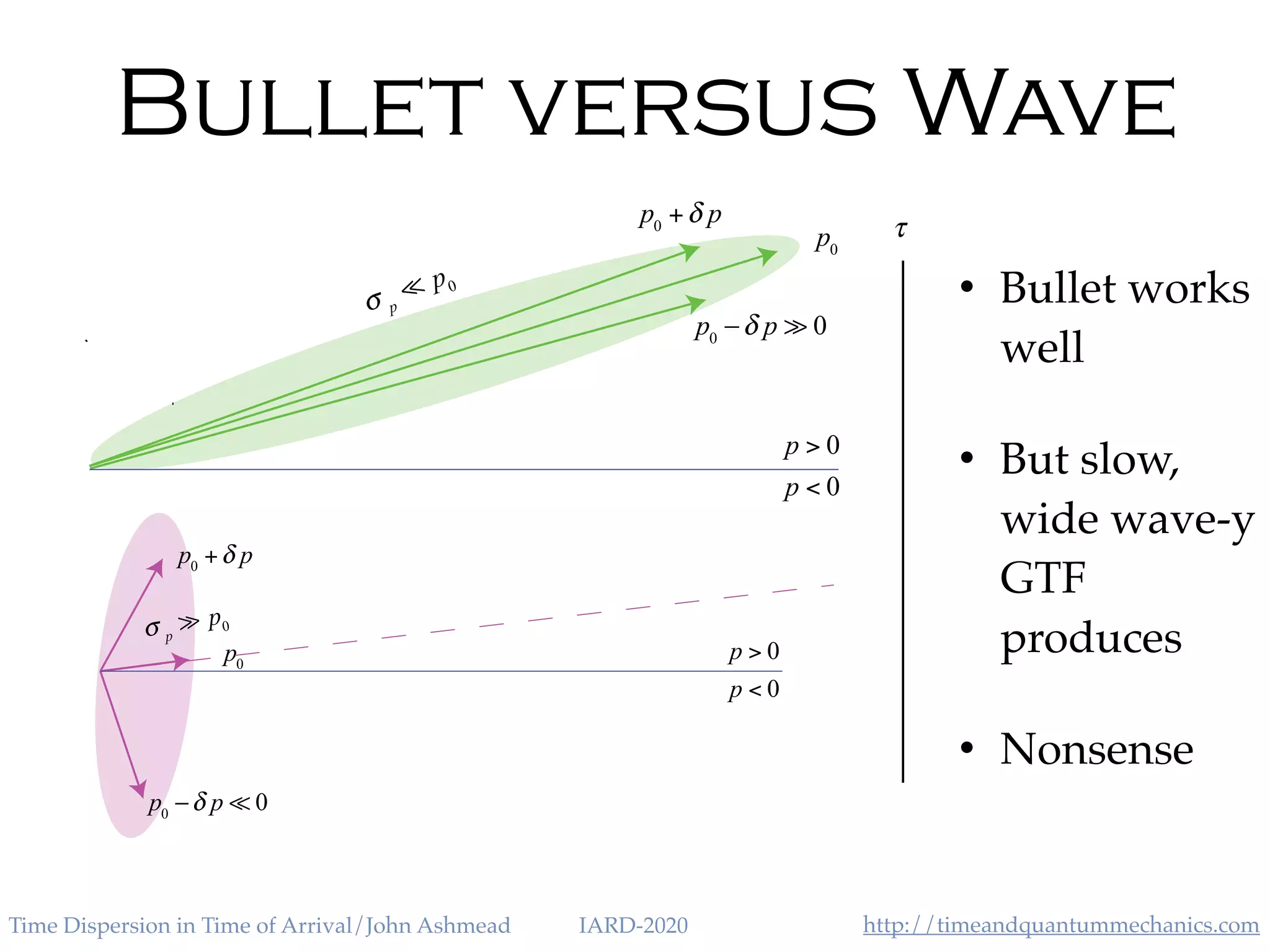
Bullet versus Wave
• Bullet works
well
• But slow,
wide wave-y
GTF
produces
• Nonsense
p0
p0
p 0
p
p0
p0
+ p
p > 0
p < 0
p0
p0
+ p
p0
p 0
p
p0
p > 0
p < 0
http://timeandquantummechanics.comTime Dispersion in Time of Arrival/John Ashmead IARD-2020
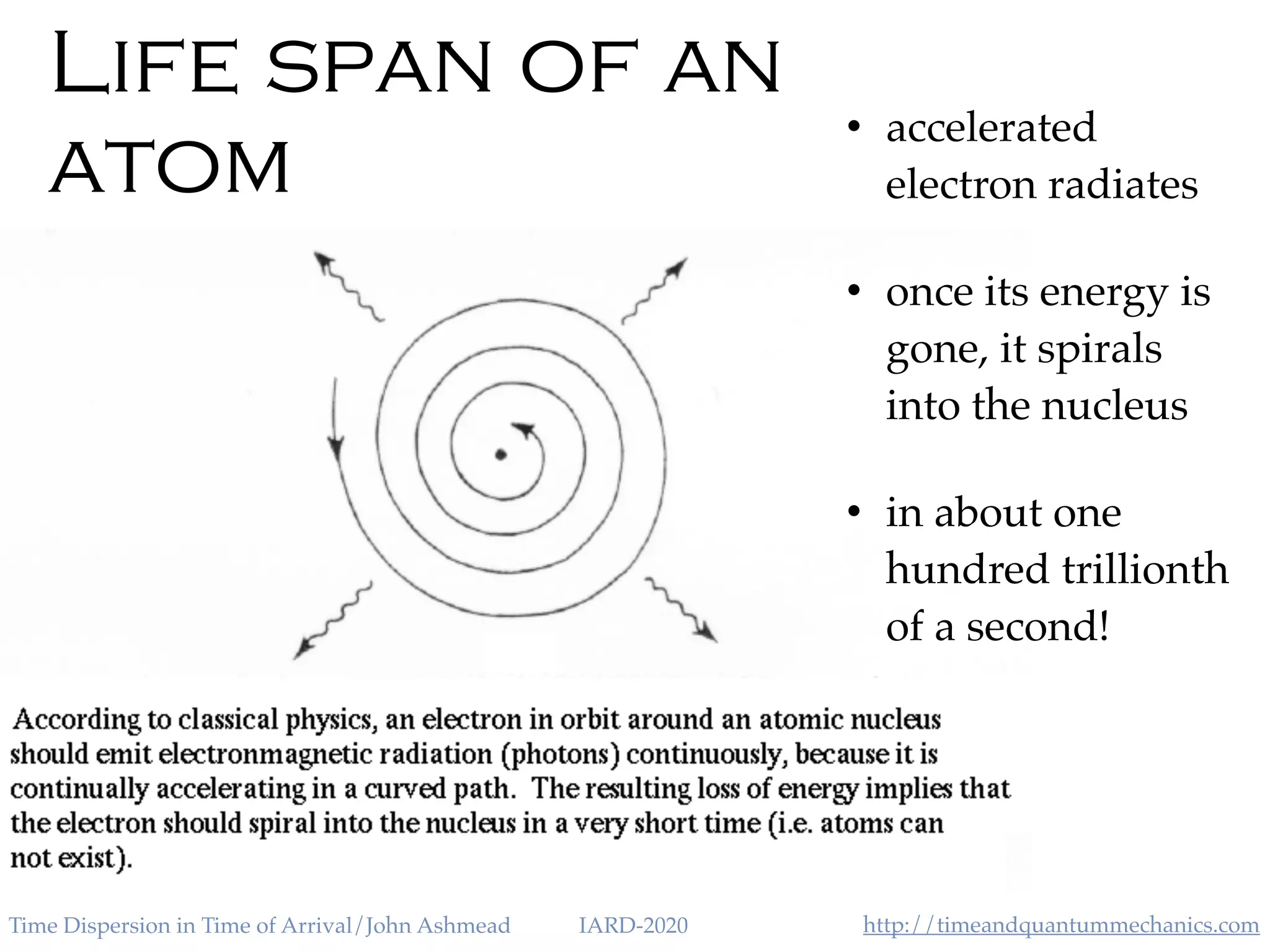
Life span of an
atom
• accelerated
electron radiates
• once its energy is
gone, it spirals
into the nucleus
• in about one
hundred trillionth
of a second!
http://timeandquantummechanics.comTime Dispersion in Time of Arrival/John Ashmead IARD-2020
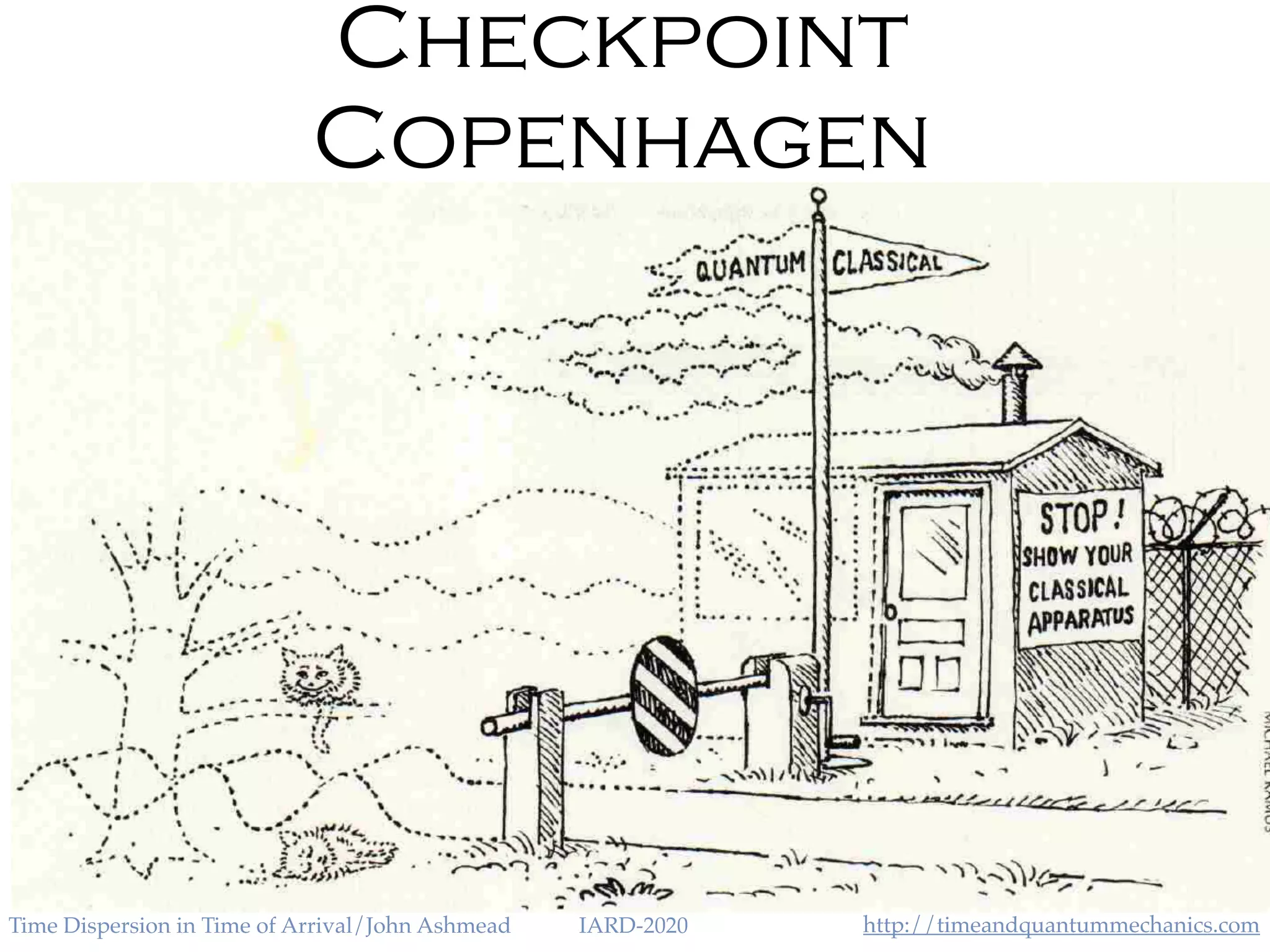
Checkpoint
Copenhagen
http://timeandquantummechanics.comTime Dispersion in Time of Arrival/John Ashmead IARD-2020
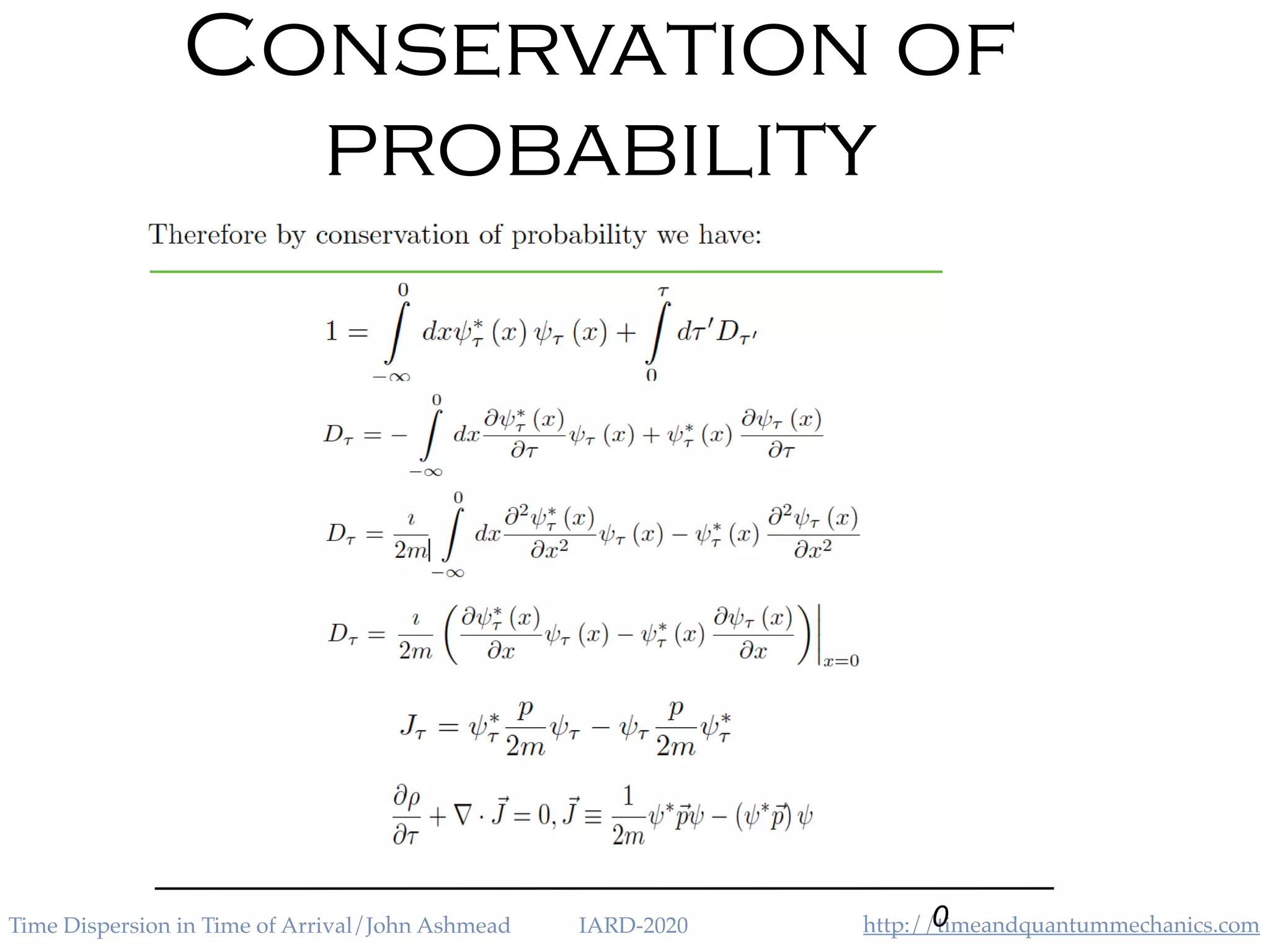
Conservation of
probability
0
http://timeandquantummechanics.comTime Dispersion in Time of Arrival/John Ashmead IARD-2020
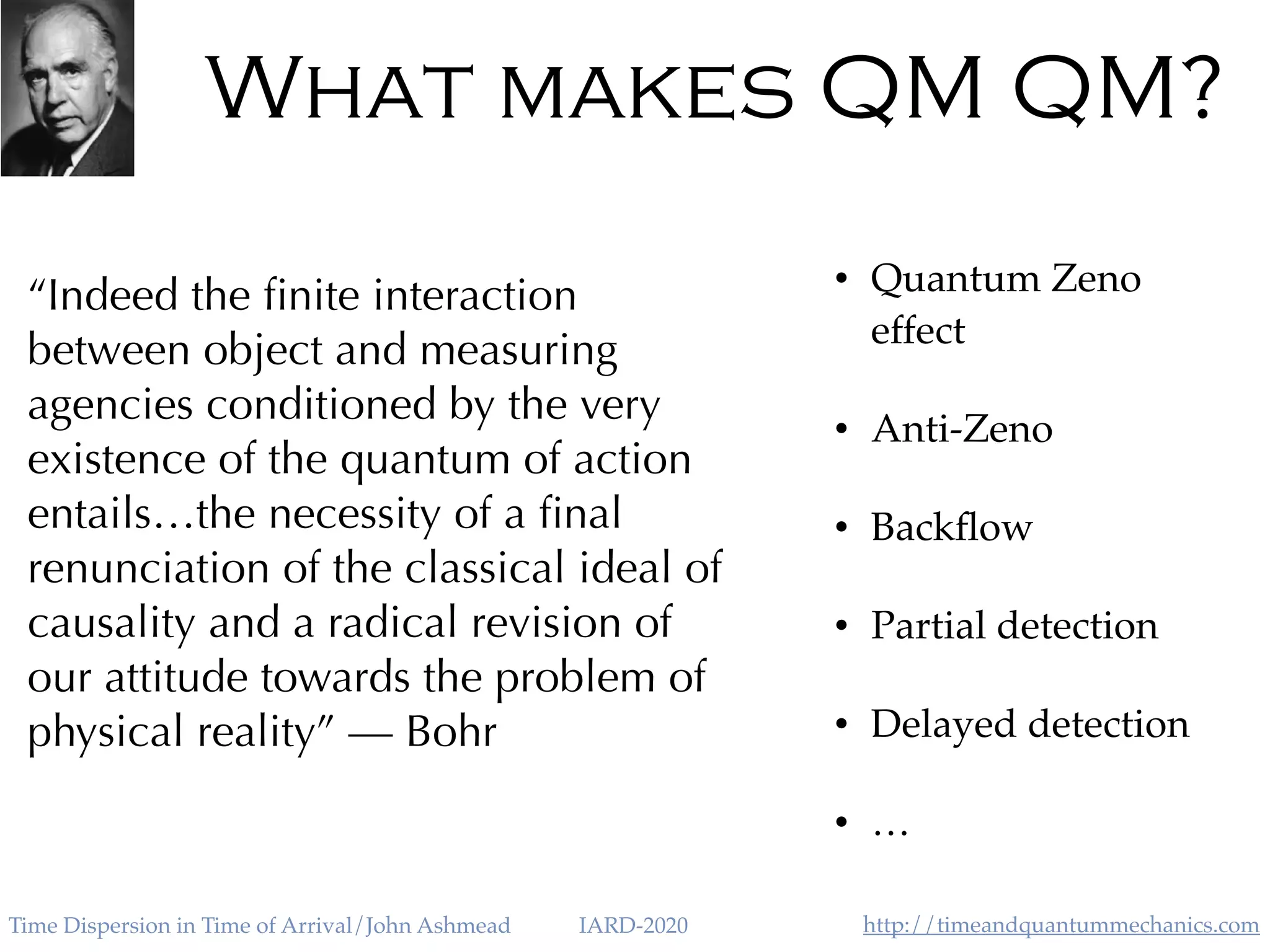
What makes QM QM?
• Quantum Zeno
effect
• Anti-Zeno
• Backflow
• Partial detection
• Delayed detection
• …
“Indeed the finite interaction
between object and measuring
agencies conditioned by the very
existence of the quantum of action
entails…the necessity of a final
renunciation of the classical ideal of
causality and a radical revision of
our attitude towards the problem of
physical reality” — Bohr
http://timeandquantummechanics.comTime Dispersion in Time of Arrival/John Ashmead IARD-2020
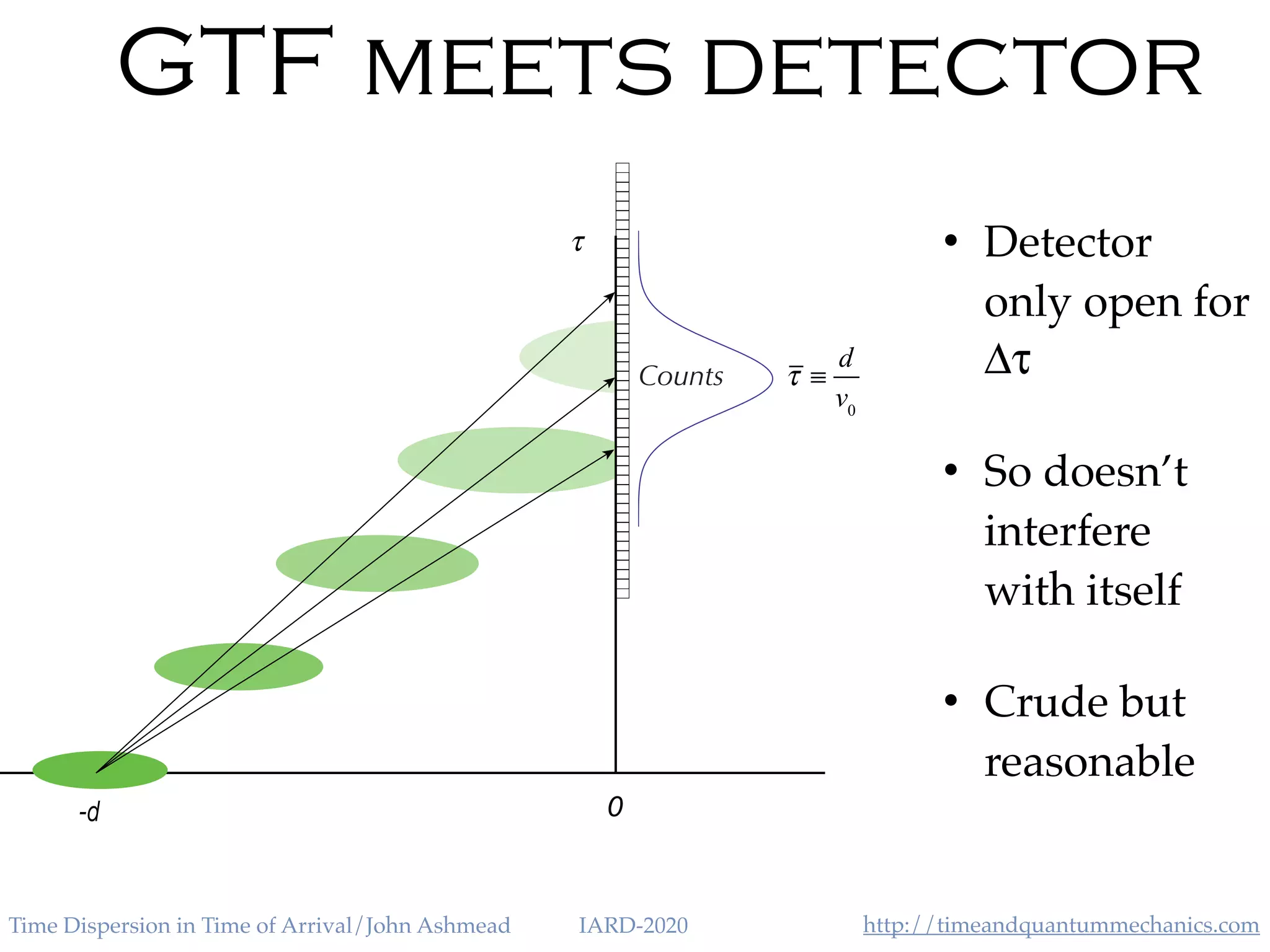
GTF meets detector
0-d
d
v0
Counts
• Detector
only open for
Δτ
• So doesn’t
interfere
with itself
• Crude but
reasonable
http://timeandquantummechanics.comTime Dispersion in Time of Arrival/John Ashmead IARD-2020
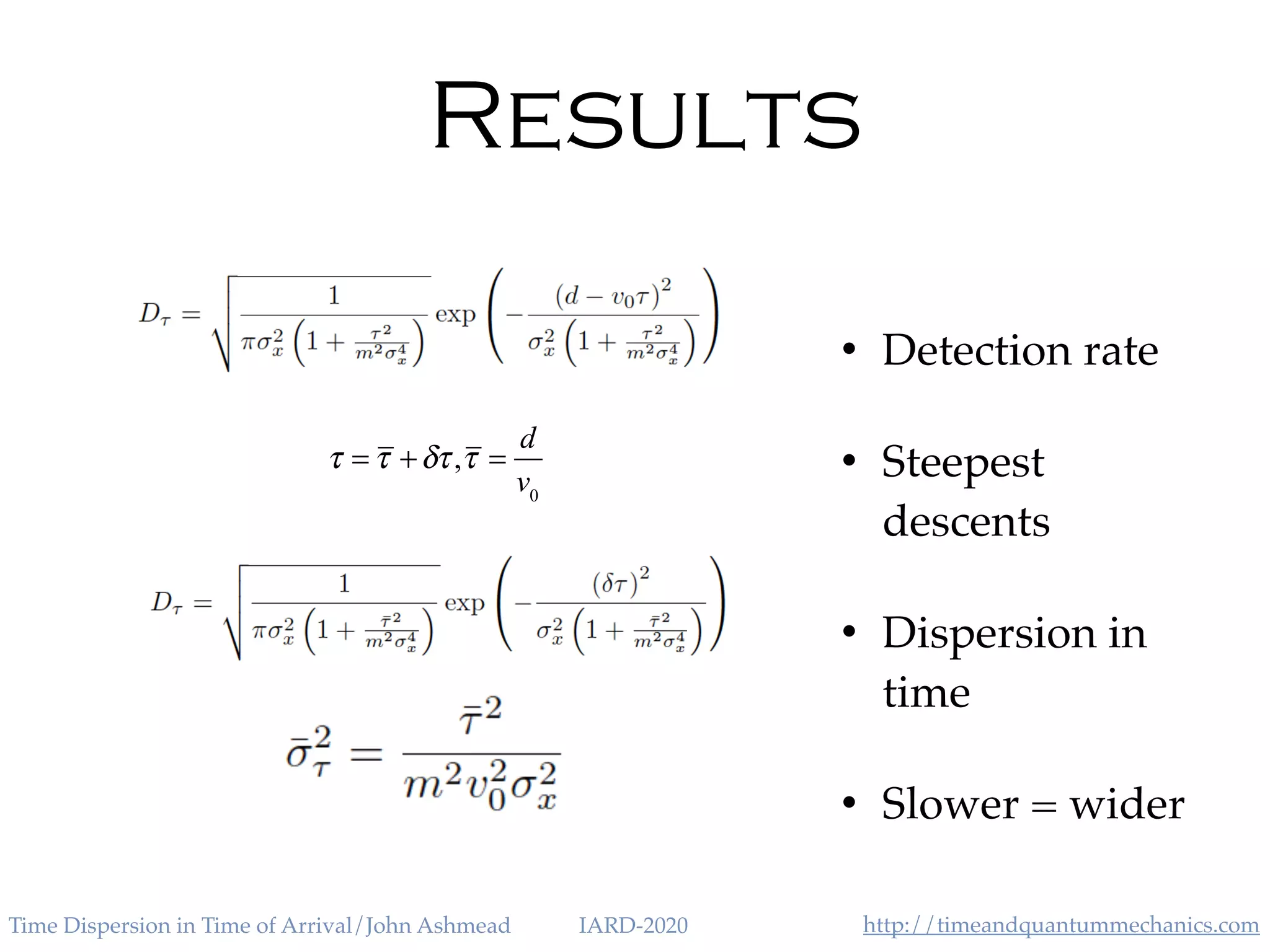
Results
• Detection rate
• Steepest
descents
• Dispersion in
time
• Slower = wider
τ = τ +δτ,τ =
d
v0
http://timeandquantummechanics.comTime Dispersion in Time of Arrival/John Ashmead IARD-2020
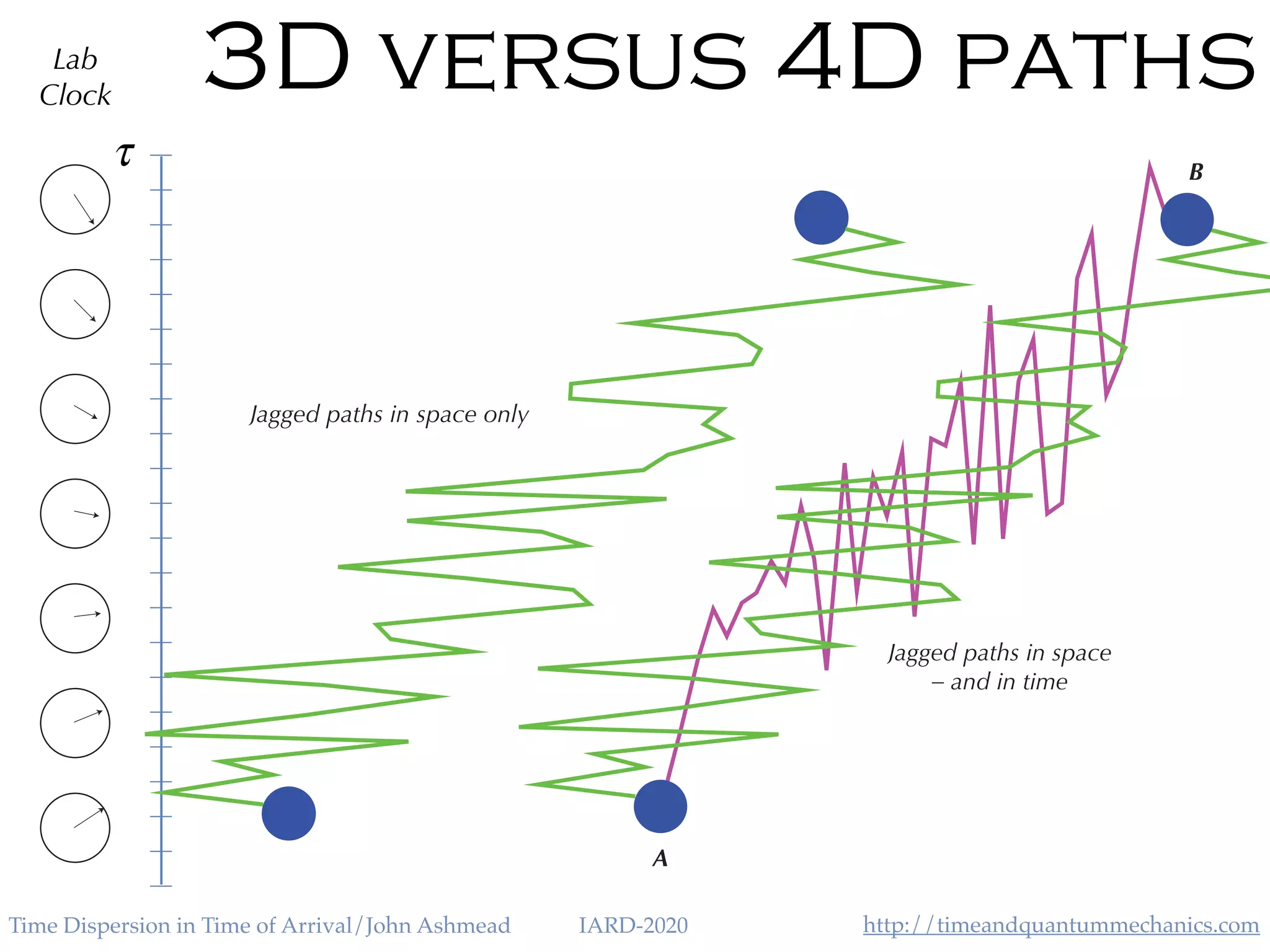
3D versus 4D pathsLab
Clock
Jagged paths in space only
A
Jagged paths in space
– and in time
B
http://timeandquantummechanics.comTime Dispersion in Time of Arrival/John Ashmead IARD-2020
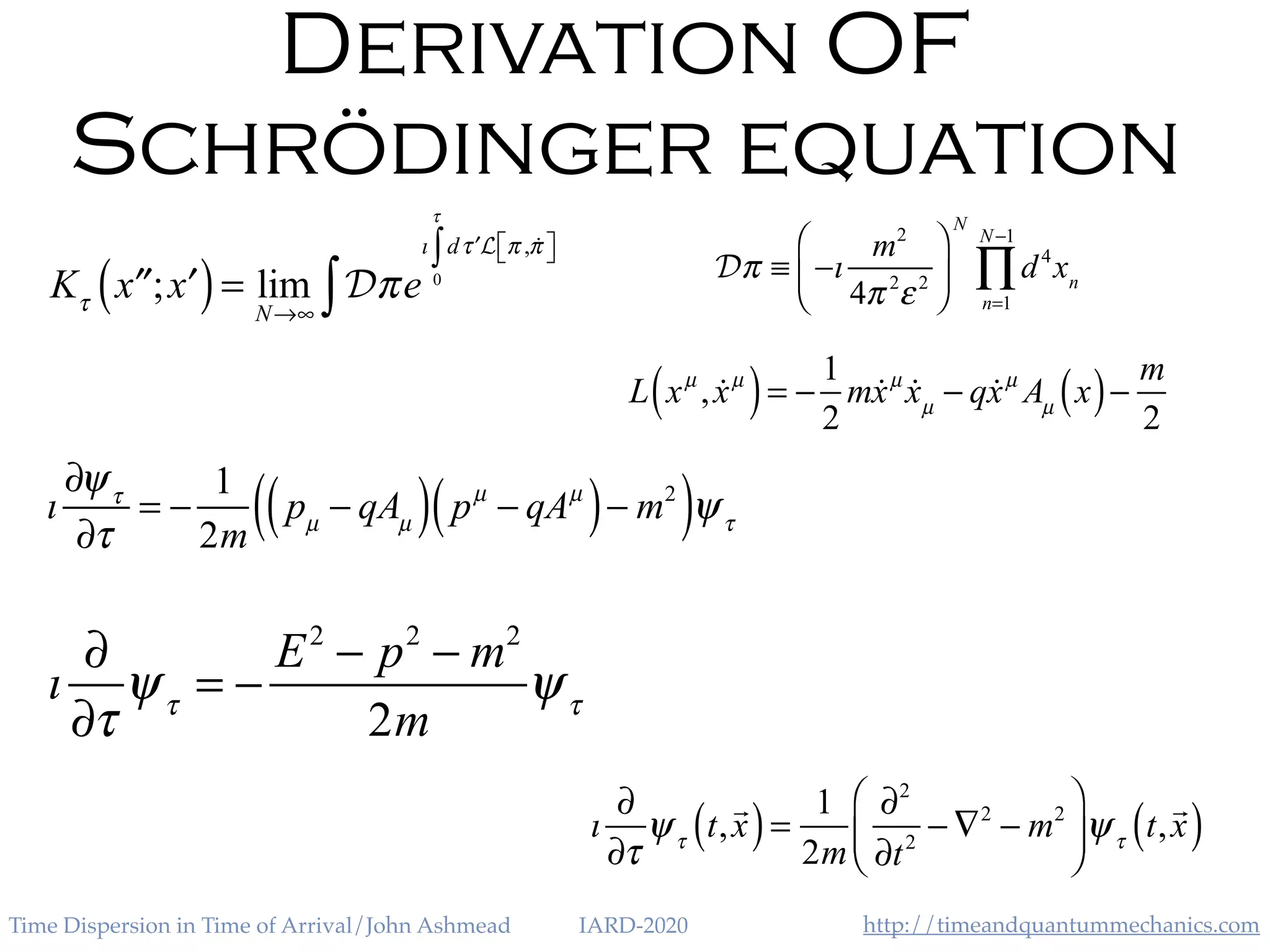
Derivation OF
Schrödinger equation
Kτ
′′x ; ′x( )= lim
N→∞
Dπe
ı d ′τ L π , !π⎡⎣ ⎤⎦
0
τ
∫
∫
Dπ ≡ −ı
m2
4π 2
ε2
⎛
⎝⎜
⎞
⎠⎟
N
d4
n=1
N−1
∏ xn
L xµ
, !xµ
( )= −
1
2
m!xµ
!xµ
− q!xµ
Aµ
x( )−
m
2
ı
∂ψτ
∂τ
= −
1
2m
pµ
− qAµ( ) pµ
− qAµ
( )− m2
( )ψτ
ı
∂
∂τ
ψτ
= −
E2
− p2
− m2
2m
ψτ
ı
∂
∂τ
ψτ
t,
!
x( )=
1
2m
∂2
∂t2
− ∇2
− m2
⎛
⎝⎜
⎞
⎠⎟ψτ
t,
!
x( )
http://timeandquantummechanics.comTime Dispersion in Time of Arrival/John Ashmead IARD-2020
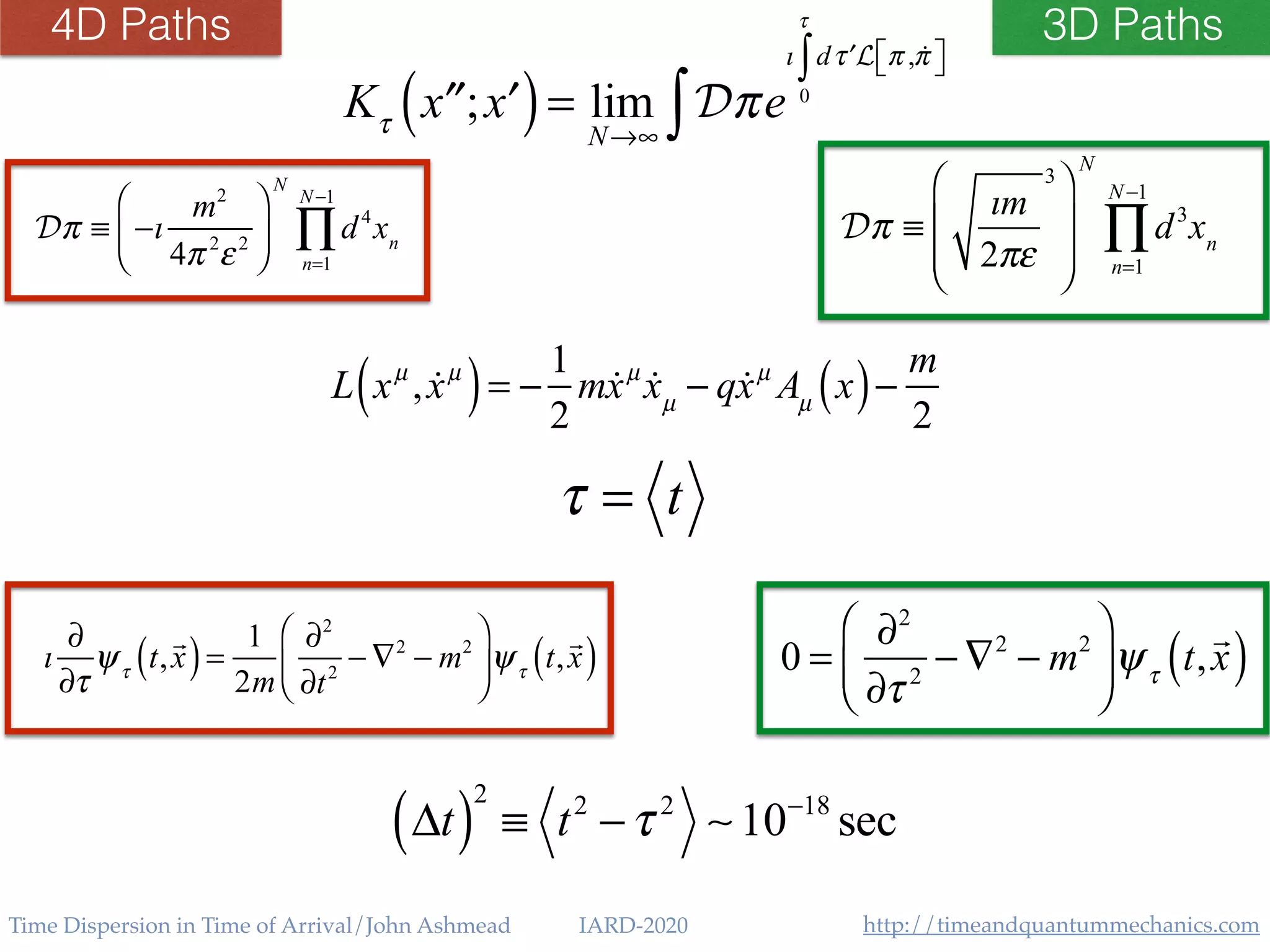
Kτ
′′x ; ′x( )= lim
N→∞
Dπe
ı d ′τ L π , !π⎡⎣ ⎤⎦
0
τ
∫
∫
L xµ
, !xµ
( )= −
1
2
m!xµ
!xµ
− q!xµ
Aµ
x( )−
m
2
τ = t
Δt( )
2
≡ t2
−τ 2
∼10−18
sec
ı
∂
∂τ
ψτ
t,
!
x( )=
1
2m
∂2
∂t2
− ∇2
− m2
⎛
⎝⎜
⎞
⎠⎟ψτ
t,
!
x( ) 0 =
∂2
∂τ 2
− ∇2
− m2
⎛
⎝⎜
⎞
⎠⎟ψτ
t,
!
x( )
Dπ ≡ −ı
m2
4π 2
ε2
⎛
⎝⎜
⎞
⎠⎟
N
d4
n=1
N−1
∏ xn
Dπ ≡
ım
2πε
3
⎛
⎝
⎜
⎜
⎞
⎠
⎟
⎟
N
d3
n=1
N−1
∏ xn
4D Paths 3D Paths
http://timeandquantummechanics.comTime Dispersion in Time of Arrival/John Ashmead IARD-2020
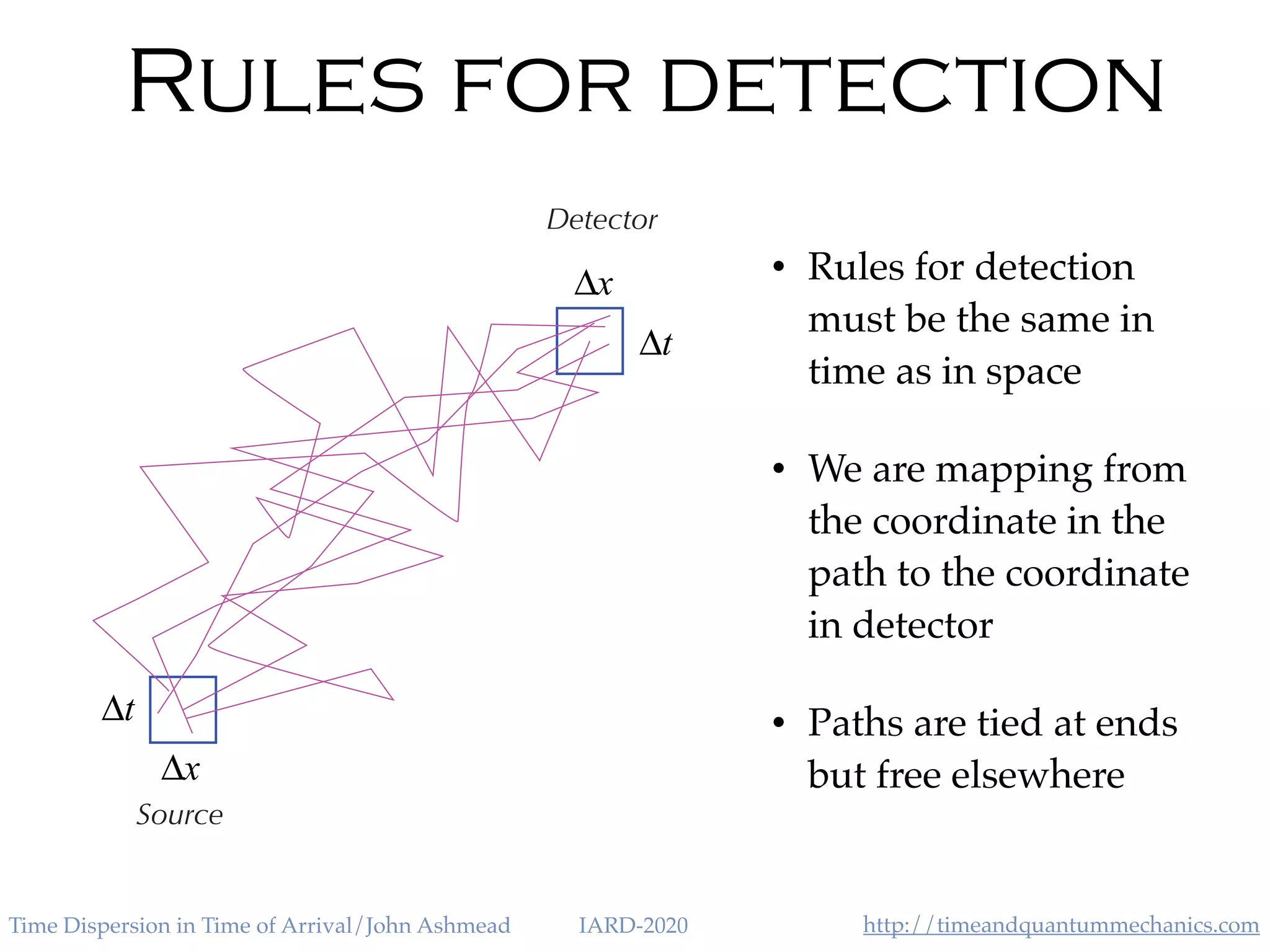
Rules for detection
• Rules for detection
must be the same in
time as in space
• We are mapping from
the coordinate in the
path to the coordinate
in detector
• Paths are tied at ends
but free elsewherex
x
t
t
Detector
Source
http://timeandquantummechanics.comTime Dispersion in Time of Arrival/John Ashmead IARD-2020
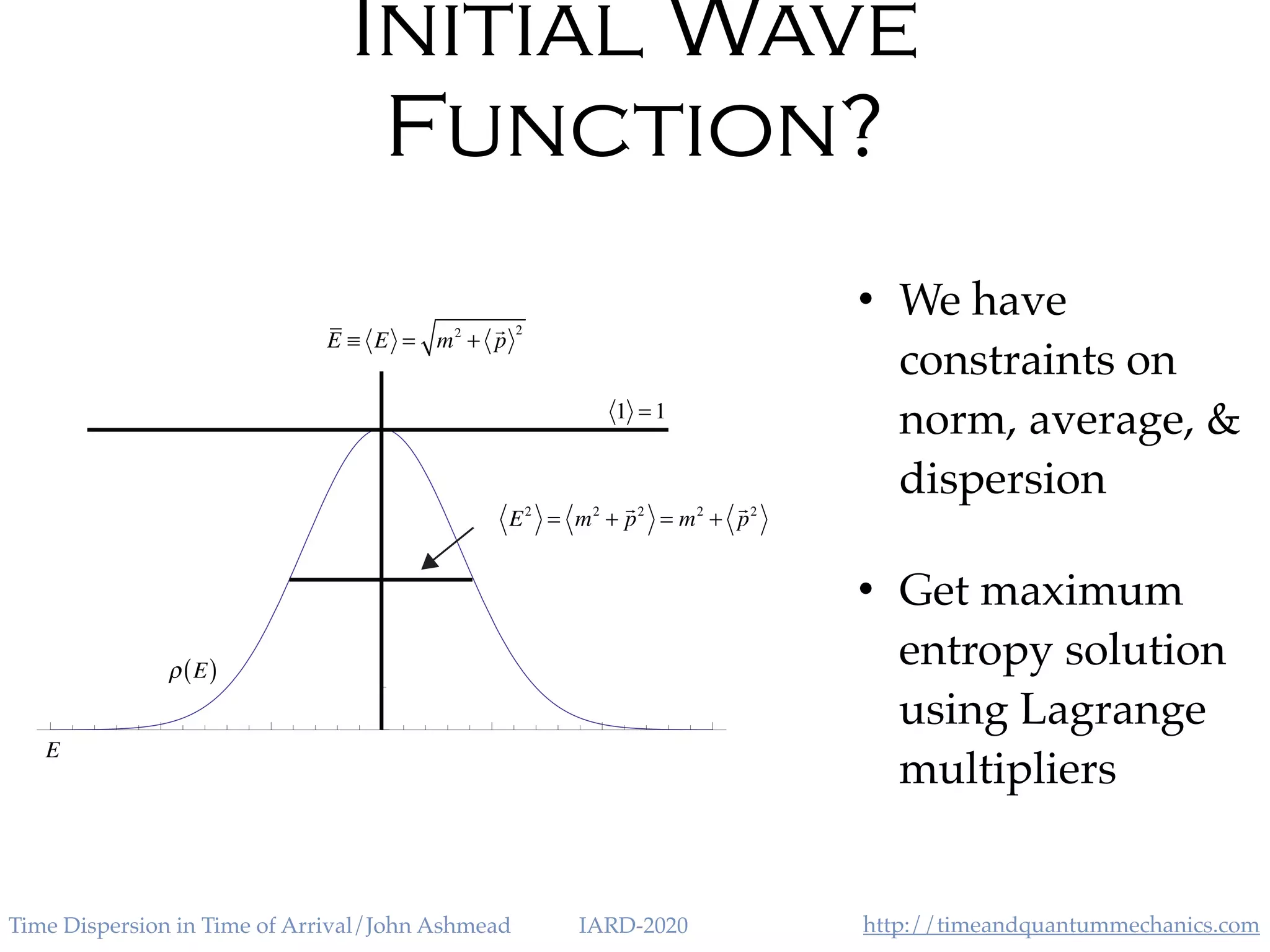
Initial Wave
Function?
E( )
E
1 = 1
E E = m2
+ p
2
E2
= m2
+ p2
= m2
+ p2
• We have
constraints on
norm, average, &
dispersion
• Get maximum
entropy solution
using Lagrange
multipliers
http://timeandquantummechanics.comTime Dispersion in Time of Arrival/John Ashmead IARD-2020
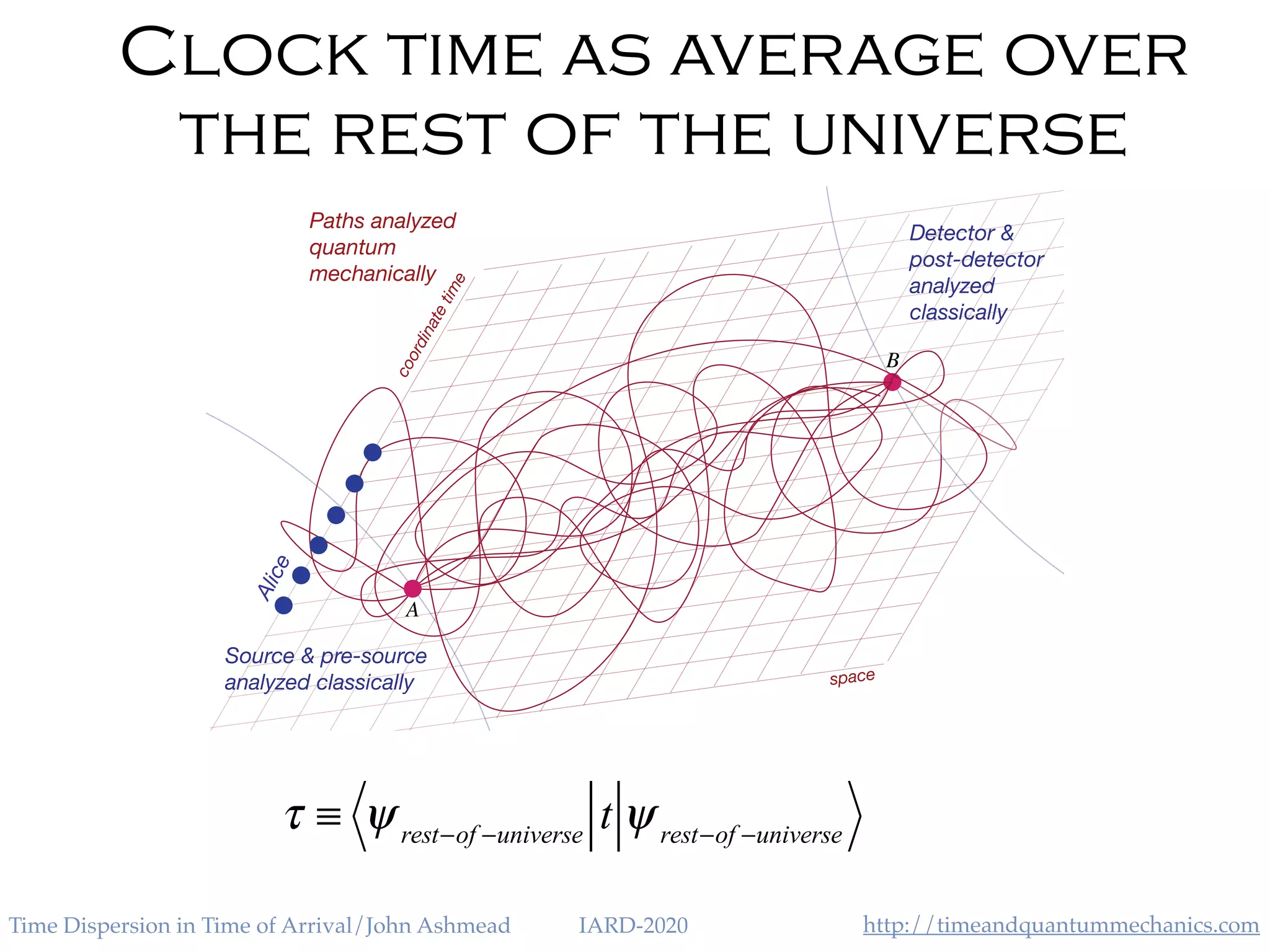
Clock time as average over
the rest of the universe
space
coordinatetime
Detector &
post-detector
analyzed
classically
Source & pre-source
analyzed classically
Paths analyzed
quantum
mechanically
Alice
A
B
τ ≡ ψ rest−of −universe
t ψ rest−of −universe
http://timeandquantummechanics.comTime Dispersion in Time of Arrival/John Ashmead IARD-2020
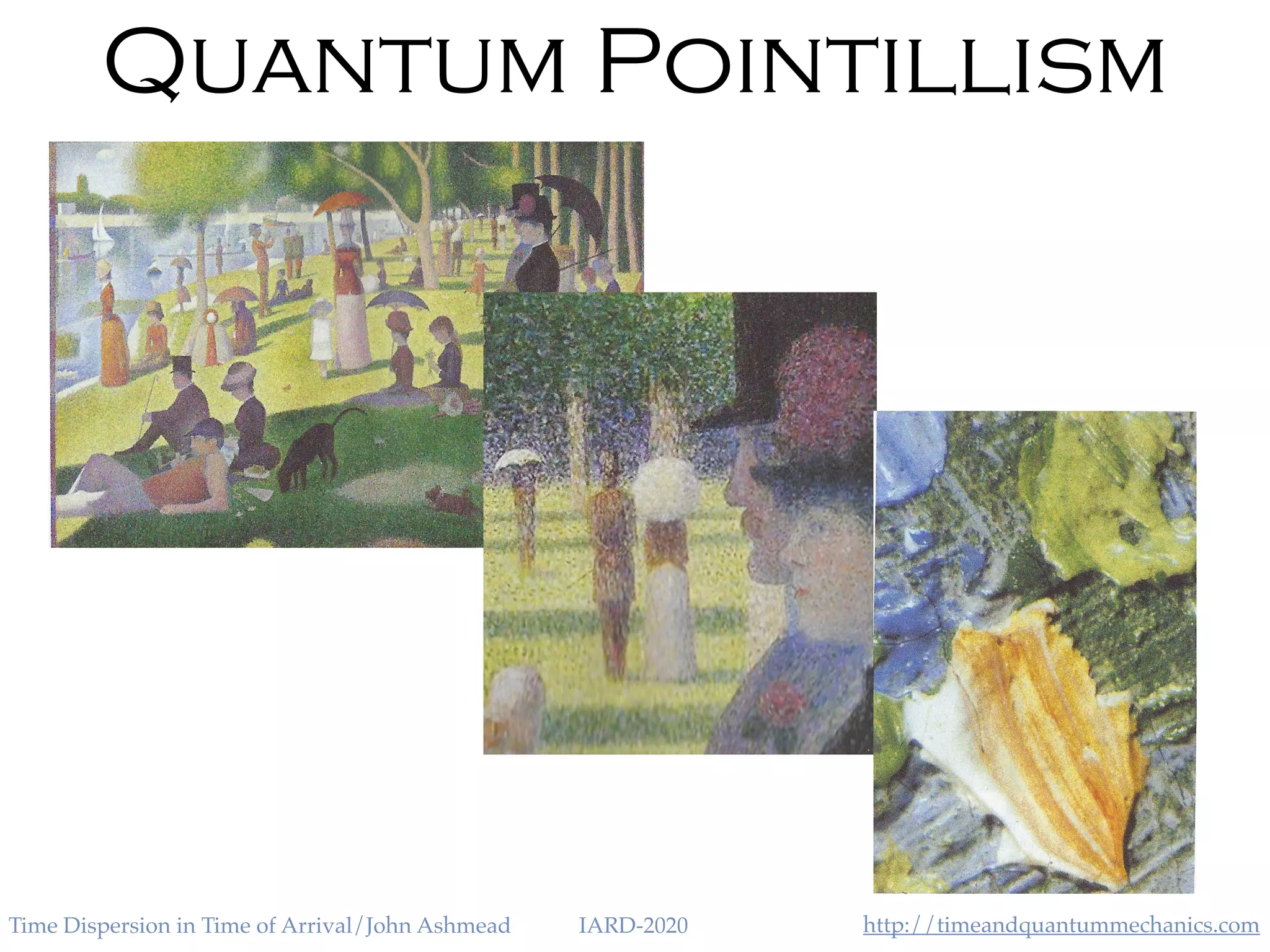
Quantum Pointillism
http://timeandquantummechanics.comTime Dispersion in Time of Arrival/John Ashmead IARD-2020
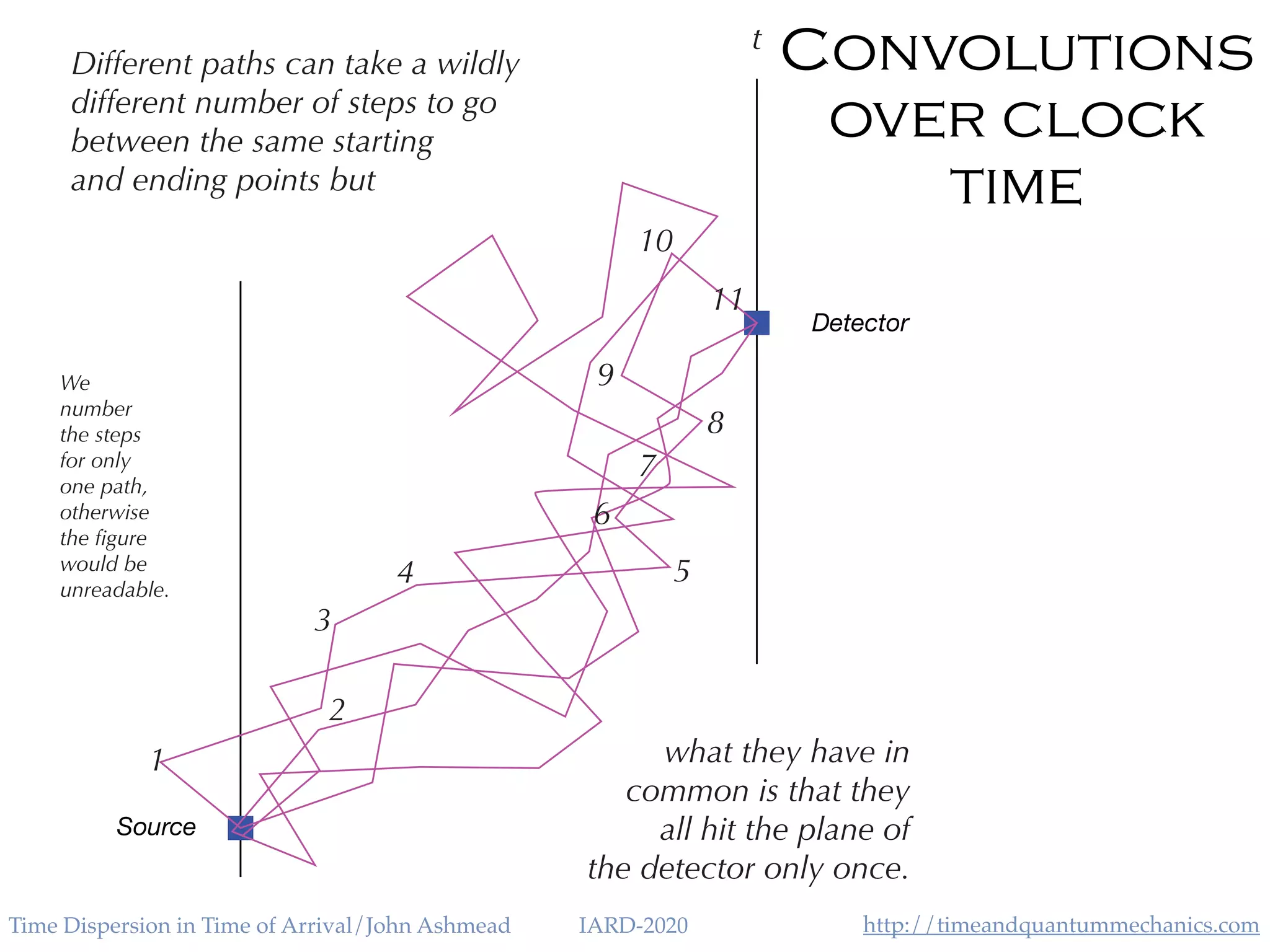
Convolutions
over clock
time
Source
Detector
t
1
2
3
4 5
6
7
8
9
10
11
Different paths can take a wildly
different number of steps to go
between the same starting
and ending points but
what they have in
common is that they
all hit the plane of
the detector only once.
We
number
the steps
for only
one path,
otherwise
the figure
would be
unreadable.
http://timeandquantummechanics.comTime Dispersion in Time of Arrival/John Ashmead IARD-2020
Definite but small
effects
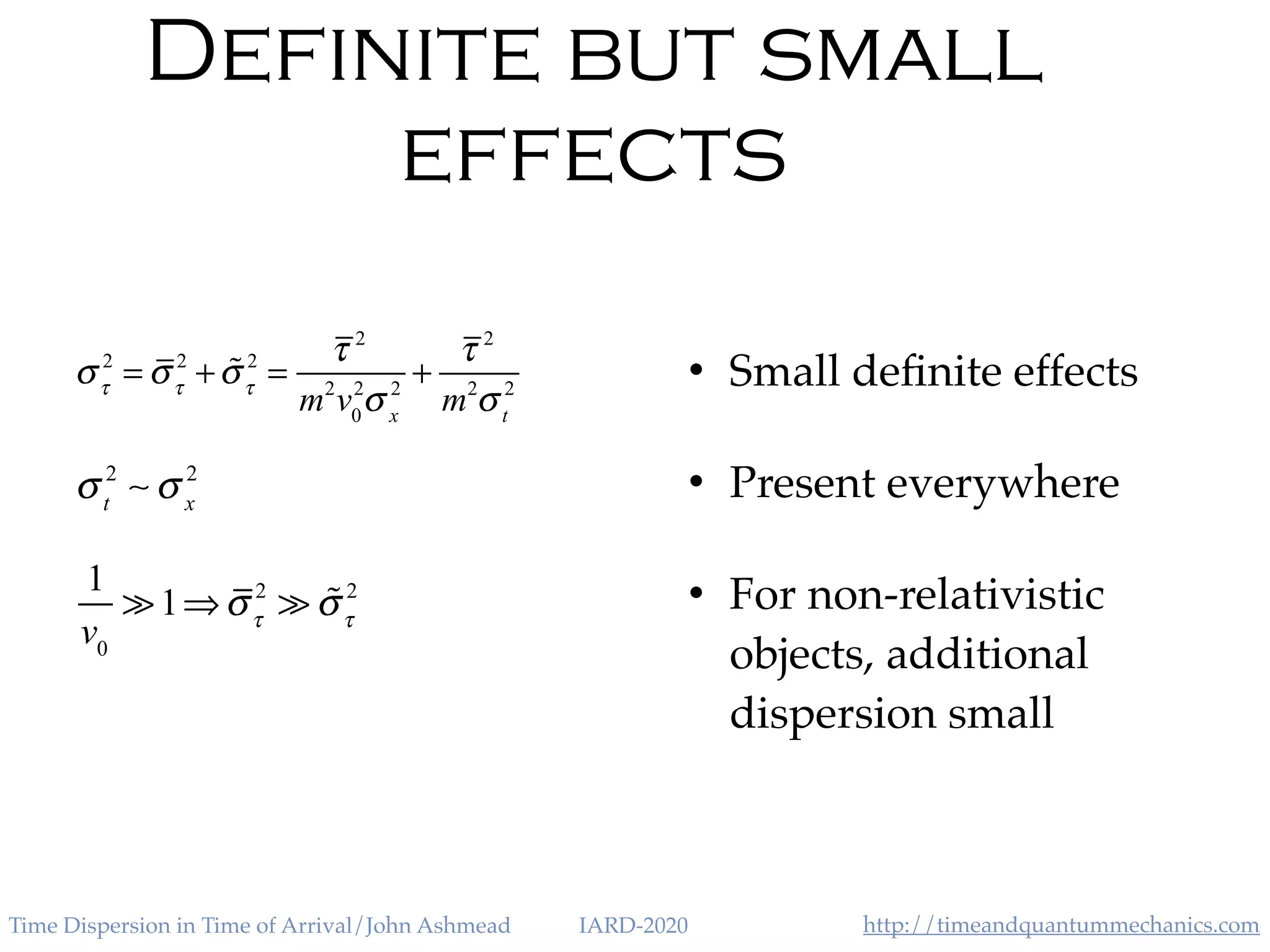
• Small definite effects
• Present everywhere
• For non-relativistic
objects, additional
dispersion small
σt
2
∼ σ x
2
1
v0
≫1⇒στ
2
≫ "στ
2
στ
2
= στ
2
+ !στ
2
=
τ 2
m2
v0
2
σ x
2
+
τ 2
m2
σt
2
http://timeandquantummechanics.comTime Dispersion in Time of Arrival/John Ashmead IARD-2020
Ultra fast camera
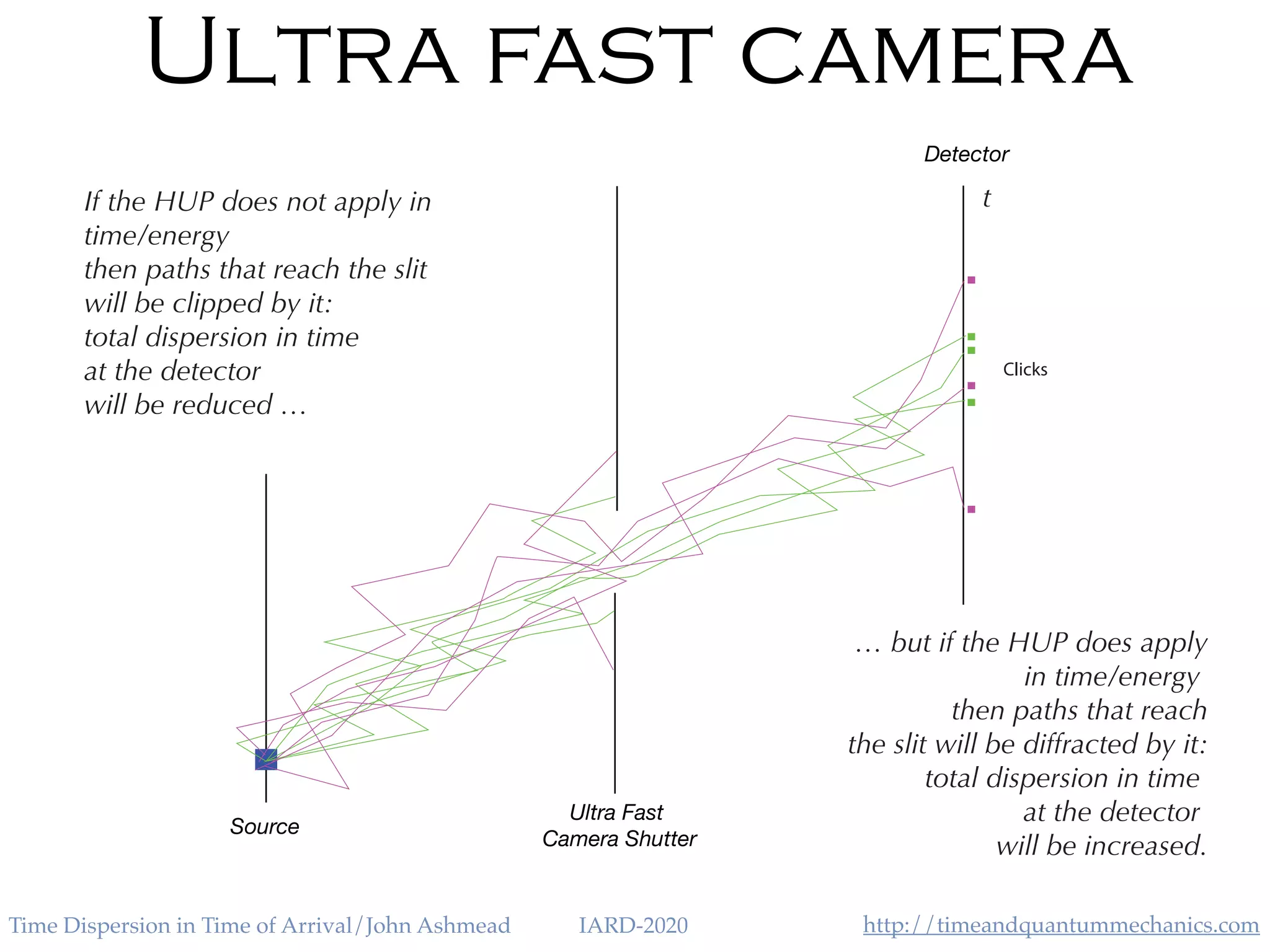
Source
Detector
t
Ultra Fast
Camera Shutter
Clicks
If the HUP does not apply in
time/energy
then paths that reach the slit
will be clipped by it:
total dispersion in time
at the detector
will be reduced …
… but if the HUP does apply
in time/energy
then paths that reach
the slit will be diffracted by it:
total dispersion in time
at the detector
will be increased.
http://timeandquantummechanics.comTime Dispersion in Time of Arrival/John Ashmead IARD-2020
Technically challenging
experiments
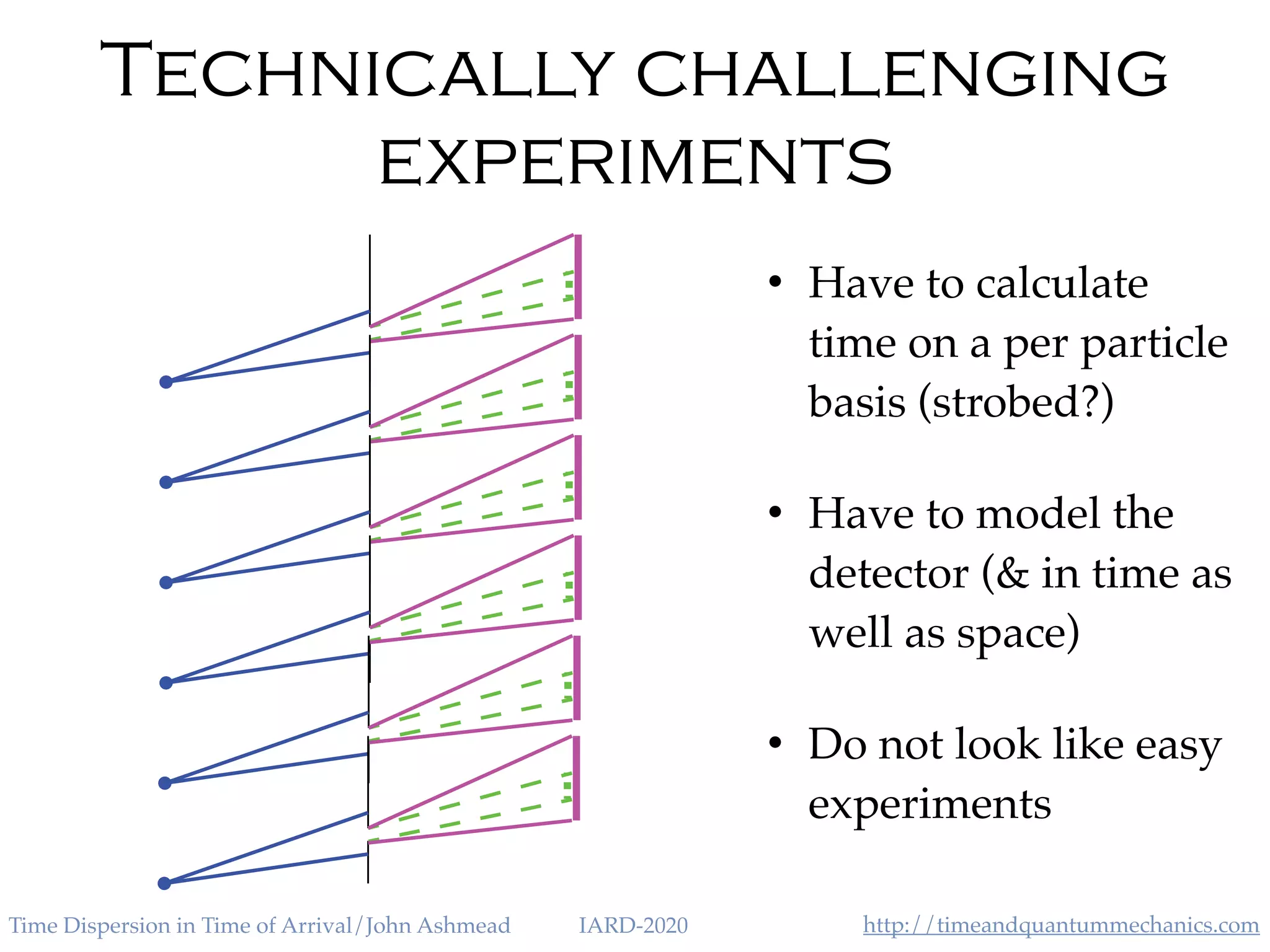
• Have to calculate
time on a per particle
basis (strobed?)
• Have to model the
detector (& in time as
well as space)
• Do not look like easy
experiments
http://timeandquantummechanics.comTime Dispersion in Time of Arrival/John Ashmead IARD-2020
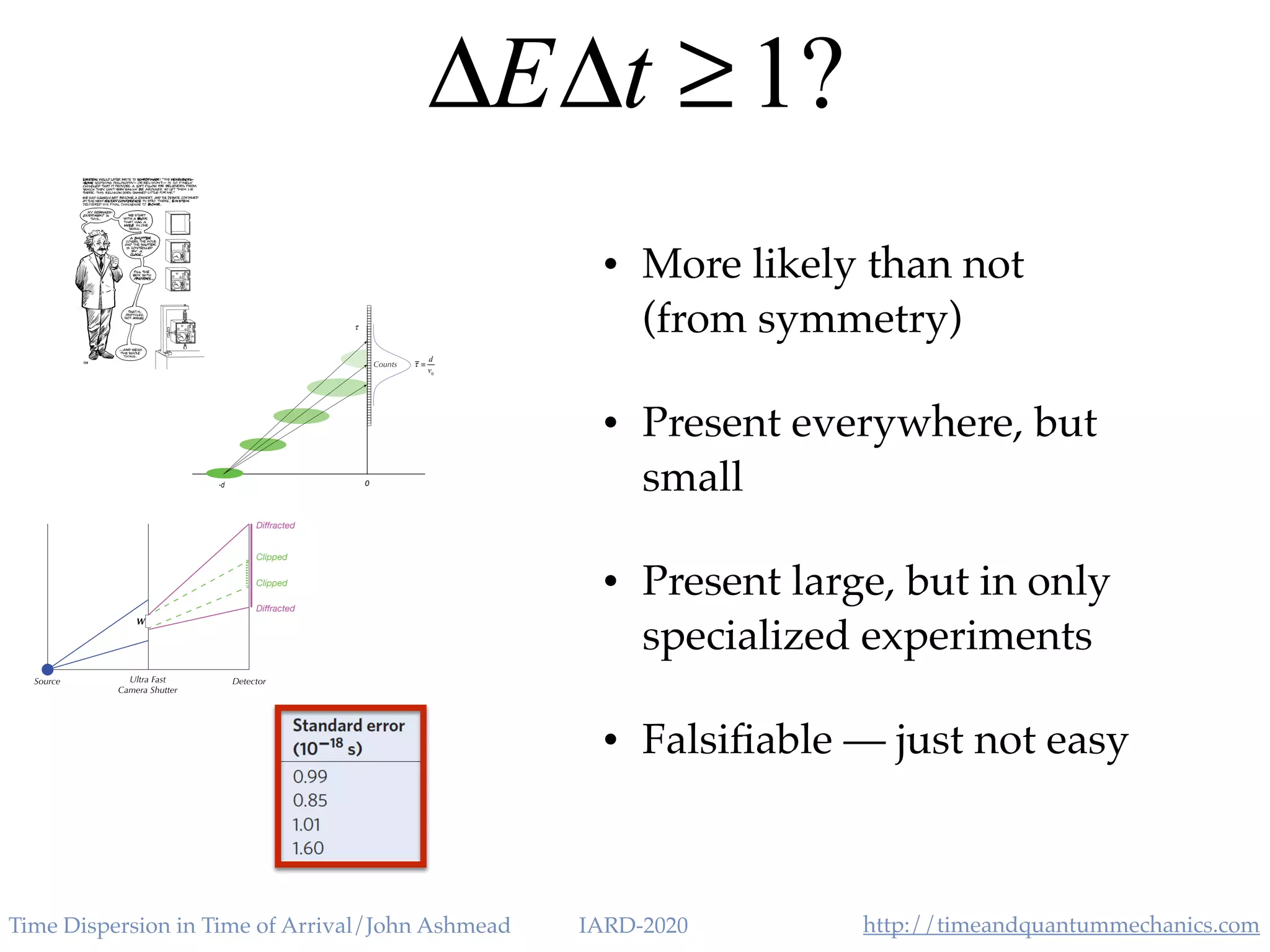
• More likely than not
(from symmetry)
• Present everywhere, but
small
• Present large, but in only
specialized experiments
• Falsifiable — just not easy
ΔEΔt ≥1?
0-d
d
v0
Counts
Clipped
Diffracted
Diffracted
Clipped
W
Source Ultra Fast
Camera Shutter
Detector
http://timeandquantummechanics.comTime Dispersion in Time of Arrival/John Ashmead IARD-2020
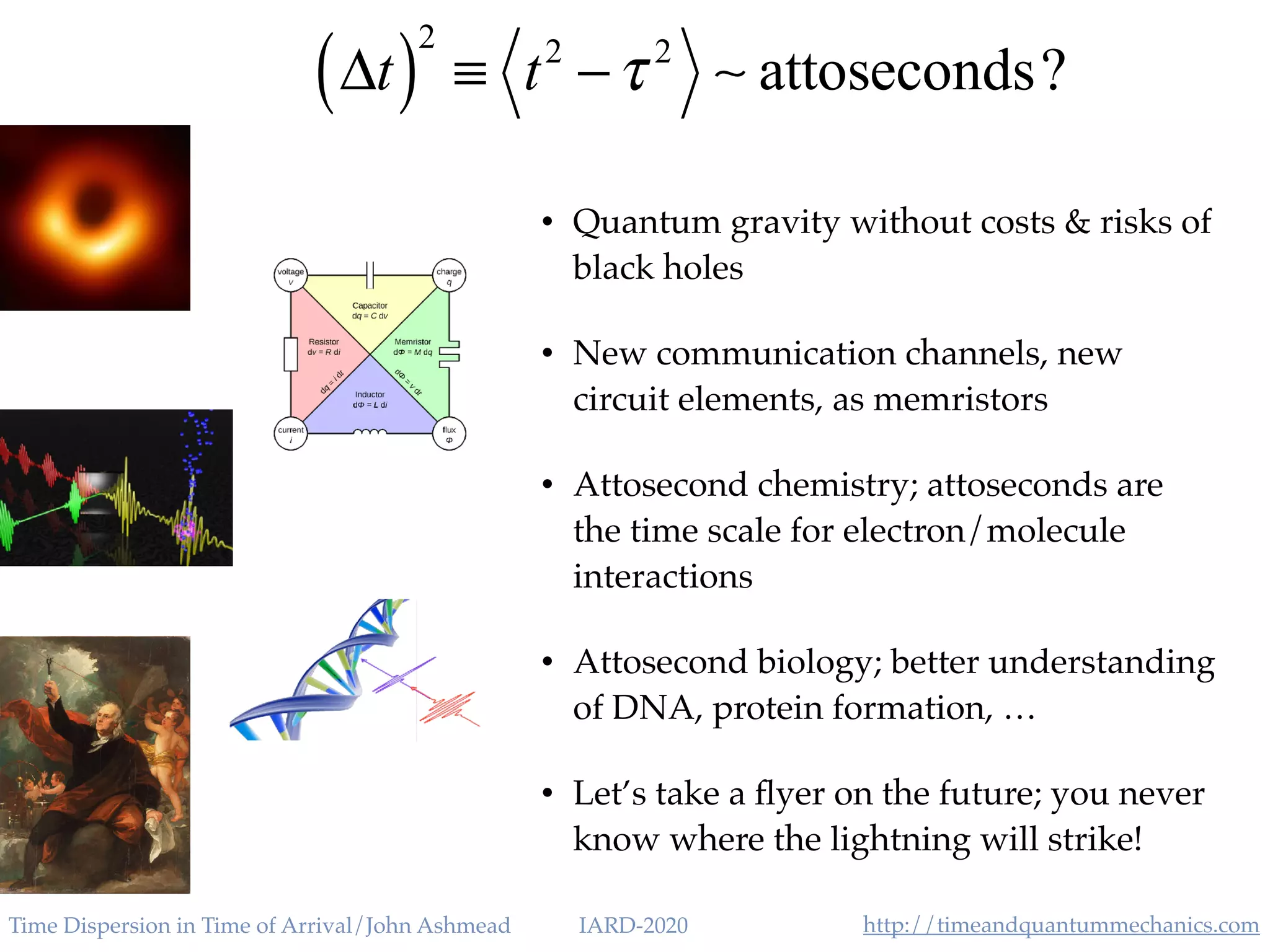
• Quantum gravity without costs & risks of
black holes
• New communication channels, new
circuit elements, as memristors
• Attosecond chemistry; attoseconds are
the time scale for electron/molecule
interactions
• Attosecond biology; better understanding
of DNA, protein formation, …
• Let’s take a flyer on the future; you never
know where the lightning will strike!
Δt( )
2
≡ t2
−τ 2
∼ attoseconds?

Time dispersion in time-of-arrival measurements

  • 1.
    http://timeandquantummechanics.comTime Dispersion inTime of Arrival/John Ashmead IARD-2020 Time Dispersion in Time-of-Arrival John Ashmead International Association for Relativistic Dynamics - 2020 Virtual Can we prove that the Heisenberg uncertainty principle does not apply along the energy/time axis in the same way it applies along the space/ momentum axis?
  • 2.
    http://timeandquantummechanics.comTime Dispersion inTime of Arrival/John Ashmead IARD-2020 Heisenberg Uncertainty Principle (HUP) • ΔΕΔτ≥1 taken for granted • Critical in early days of QM • But basically abandoned since • ı ∂ ∂τ ψτ x( )= − 1 2m ∂2 ∂x2 ψτ x( )
  • 3.
    http://timeandquantummechanics.comTime Dispersion inTime of Arrival/John Ashmead IARD-2020 Three ways of saying the same thing • Heisenberg uncertainty principle applies in energy/time • Wave function extends in time (or energy) • Time is an observable ΔEΔt ≥1 ˆE = ı ∂ ∂t ψτ x( )→ψτ t,x( )
  • 4.
    http://timeandquantummechanics.comTime Dispersion inTime of Arrival/John Ashmead IARD-2020 How to get to Falsifiability? • Look at the class of theories, not just one particular theory • Use the simplest possible approaches • Look for order of magnitude estimates • Use covariance to eliminate need for free parameters
  • 5.
    http://timeandquantummechanics.comTime Dispersion inTime of Arrival/John Ashmead IARD-2020 Why haven’t we seen this before? • Time for photon to cross atom? • .35 Attoseconds • Explains why we haven’t seen
  • 6.
    http://timeandquantummechanics.comTime Dispersion inTime of Arrival/John Ashmead IARD-2020 
 Can we see it now?
  • 7.
    http://timeandquantummechanics.comTime Dispersion inTime of Arrival/John Ashmead IARD-2020
  • 8.
    http://timeandquantummechanics.comTime Dispersion inTime of Arrival/John Ashmead IARD-2020 Time of Arrival • Most obvious test • Also part of most experiments: there is almost always a time measurement, even if not recorded • Intrinsic uncertainty in time competes with extrinsic uncertainty • Curiously, time-of-arrival even in standard quantum mechanics not well understood
  • 9.
    http://timeandquantummechanics.comTime Dispersion inTime of Arrival/John Ashmead IARD-2020 p > 0 p < 0 x > 0x < 0 paxis x axis Detector
  • 10.
    http://timeandquantummechanics.comTime Dispersion inTime of Arrival/John Ashmead IARD-2020 Gaussian test functions • Normalizable • Satisfy free Schrödinger equation • Back-of- envelope • General ϕτ x( )= 1 πσ x 2 4 1 fτ x( ) e ıp0x− 1 2σ x 2 fτ x( ) x−xτ( )2 −ı p0 2 2m τ fτ x( ) ≡ 1+ ı τ mσ x 2 xτ ≡ x0 + p m τ ρτ x( )= 1 πσ x 2 1+ τ 2 m2 σ x 4 ⎛ ⎝ ⎜ ⎞ ⎠ ⎟ exp − x − xτ( ) 2 σ x 2 1+ τ 2 m2 σ x 4 ⎛ ⎝ ⎜ ⎞ ⎠ ⎟ ⎛ ⎝ ⎜ ⎜ ⎜ ⎜ ⎞ ⎠ ⎟ ⎟ ⎟ ⎟ Δx( ) 2 ≡ xτ 2 − xτ 2 = σ x 2 2 1+ τ 2 m2 σ x 4
  • 11.
    http://timeandquantummechanics.comTime Dispersion inTime of Arrival/John Ashmead IARD-2020 Bullet versus Wave • Bullet works well • But slow, wide wave-y GTF produces • Nonsense p0 p0 p 0 p p0 p0 + p p > 0 p < 0 p0 p0 + p p0 p 0 p p0 p > 0 p < 0
  • 12.
    http://timeandquantummechanics.comTime Dispersion inTime of Arrival/John Ashmead IARD-2020 Life span of an atom • accelerated electron radiates • once its energy is gone, it spirals into the nucleus • in about one hundred trillionth of a second!
  • 13.
    http://timeandquantummechanics.comTime Dispersion inTime of Arrival/John Ashmead IARD-2020 Checkpoint Copenhagen
  • 14.
    http://timeandquantummechanics.comTime Dispersion inTime of Arrival/John Ashmead IARD-2020 Conservation of probability 0
  • 15.
    http://timeandquantummechanics.comTime Dispersion inTime of Arrival/John Ashmead IARD-2020 What makes QM QM? • Quantum Zeno effect • Anti-Zeno • Backflow • Partial detection • Delayed detection • … “Indeed the finite interaction between object and measuring agencies conditioned by the very existence of the quantum of action entails…the necessity of a final renunciation of the classical ideal of causality and a radical revision of our attitude towards the problem of physical reality” — Bohr
  • 16.
    http://timeandquantummechanics.comTime Dispersion inTime of Arrival/John Ashmead IARD-2020 GTF meets detector 0-d d v0 Counts • Detector only open for Δτ • So doesn’t interfere with itself • Crude but reasonable
  • 17.
    http://timeandquantummechanics.comTime Dispersion inTime of Arrival/John Ashmead IARD-2020 Results • Detection rate • Steepest descents • Dispersion in time • Slower = wider τ = τ +δτ,τ = d v0
  • 18.
    http://timeandquantummechanics.comTime Dispersion inTime of Arrival/John Ashmead IARD-2020 3D versus 4D pathsLab Clock Jagged paths in space only A Jagged paths in space – and in time B
  • 19.
    http://timeandquantummechanics.comTime Dispersion inTime of Arrival/John Ashmead IARD-2020 Derivation OF Schrödinger equation Kτ ′′x ; ′x( )= lim N→∞ Dπe ı d ′τ L π , !π⎡⎣ ⎤⎦ 0 τ ∫ ∫ Dπ ≡ −ı m2 4π 2 ε2 ⎛ ⎝⎜ ⎞ ⎠⎟ N d4 n=1 N−1 ∏ xn L xµ , !xµ ( )= − 1 2 m!xµ !xµ − q!xµ Aµ x( )− m 2 ı ∂ψτ ∂τ = − 1 2m pµ − qAµ( ) pµ − qAµ ( )− m2 ( )ψτ ı ∂ ∂τ ψτ = − E2 − p2 − m2 2m ψτ ı ∂ ∂τ ψτ t, ! x( )= 1 2m ∂2 ∂t2 − ∇2 − m2 ⎛ ⎝⎜ ⎞ ⎠⎟ψτ t, ! x( )
  • 20.
    http://timeandquantummechanics.comTime Dispersion inTime of Arrival/John Ashmead IARD-2020 Kτ ′′x ; ′x( )= lim N→∞ Dπe ı d ′τ L π , !π⎡⎣ ⎤⎦ 0 τ ∫ ∫ L xµ , !xµ ( )= − 1 2 m!xµ !xµ − q!xµ Aµ x( )− m 2 τ = t Δt( ) 2 ≡ t2 −τ 2 ∼10−18 sec ı ∂ ∂τ ψτ t, ! x( )= 1 2m ∂2 ∂t2 − ∇2 − m2 ⎛ ⎝⎜ ⎞ ⎠⎟ψτ t, ! x( ) 0 = ∂2 ∂τ 2 − ∇2 − m2 ⎛ ⎝⎜ ⎞ ⎠⎟ψτ t, ! x( ) Dπ ≡ −ı m2 4π 2 ε2 ⎛ ⎝⎜ ⎞ ⎠⎟ N d4 n=1 N−1 ∏ xn Dπ ≡ ım 2πε 3 ⎛ ⎝ ⎜ ⎜ ⎞ ⎠ ⎟ ⎟ N d3 n=1 N−1 ∏ xn 4D Paths 3D Paths
  • 21.
    http://timeandquantummechanics.comTime Dispersion inTime of Arrival/John Ashmead IARD-2020 Rules for detection • Rules for detection must be the same in time as in space • We are mapping from the coordinate in the path to the coordinate in detector • Paths are tied at ends but free elsewherex x t t Detector Source
  • 22.
    http://timeandquantummechanics.comTime Dispersion inTime of Arrival/John Ashmead IARD-2020 Initial Wave Function? E( ) E 1 = 1 E E = m2 + p 2 E2 = m2 + p2 = m2 + p2 • We have constraints on norm, average, & dispersion • Get maximum entropy solution using Lagrange multipliers
  • 23.
    http://timeandquantummechanics.comTime Dispersion inTime of Arrival/John Ashmead IARD-2020 Clock time as average over the rest of the universe space coordinatetime Detector & post-detector analyzed classically Source & pre-source analyzed classically Paths analyzed quantum mechanically Alice A B τ ≡ ψ rest−of −universe t ψ rest−of −universe
  • 24.
    http://timeandquantummechanics.comTime Dispersion inTime of Arrival/John Ashmead IARD-2020 Quantum Pointillism
  • 25.
    http://timeandquantummechanics.comTime Dispersion inTime of Arrival/John Ashmead IARD-2020 Convolutions over clock time Source Detector t 1 2 3 4 5 6 7 8 9 10 11 Different paths can take a wildly different number of steps to go between the same starting and ending points but what they have in common is that they all hit the plane of the detector only once. We number the steps for only one path, otherwise the figure would be unreadable.
  • 26.
    http://timeandquantummechanics.comTime Dispersion inTime of Arrival/John Ashmead IARD-2020 Definite but small effects • Small definite effects • Present everywhere • For non-relativistic objects, additional dispersion small σt 2 ∼ σ x 2 1 v0 ≫1⇒στ 2 ≫ "στ 2 στ 2 = στ 2 + !στ 2 = τ 2 m2 v0 2 σ x 2 + τ 2 m2 σt 2
  • 27.
    http://timeandquantummechanics.comTime Dispersion inTime of Arrival/John Ashmead IARD-2020 Ultra fast camera Source Detector t Ultra Fast Camera Shutter Clicks If the HUP does not apply in time/energy then paths that reach the slit will be clipped by it: total dispersion in time at the detector will be reduced … … but if the HUP does apply in time/energy then paths that reach the slit will be diffracted by it: total dispersion in time at the detector will be increased.
  • 28.
    http://timeandquantummechanics.comTime Dispersion inTime of Arrival/John Ashmead IARD-2020 Technically challenging experiments • Have to calculate time on a per particle basis (strobed?) • Have to model the detector (& in time as well as space) • Do not look like easy experiments
  • 29.
    http://timeandquantummechanics.comTime Dispersion inTime of Arrival/John Ashmead IARD-2020 • More likely than not (from symmetry) • Present everywhere, but small • Present large, but in only specialized experiments • Falsifiable — just not easy ΔEΔt ≥1? 0-d d v0 Counts Clipped Diffracted Diffracted Clipped W Source Ultra Fast Camera Shutter Detector
  • 30.
    http://timeandquantummechanics.comTime Dispersion inTime of Arrival/John Ashmead IARD-2020 • Quantum gravity without costs & risks of black holes • New communication channels, new circuit elements, as memristors • Attosecond chemistry; attoseconds are the time scale for electron/molecule interactions • Attosecond biology; better understanding of DNA, protein formation, … • Let’s take a flyer on the future; you never know where the lightning will strike! Δt( ) 2 ≡ t2 −τ 2 ∼ attoseconds?