Time and Frequency Domain
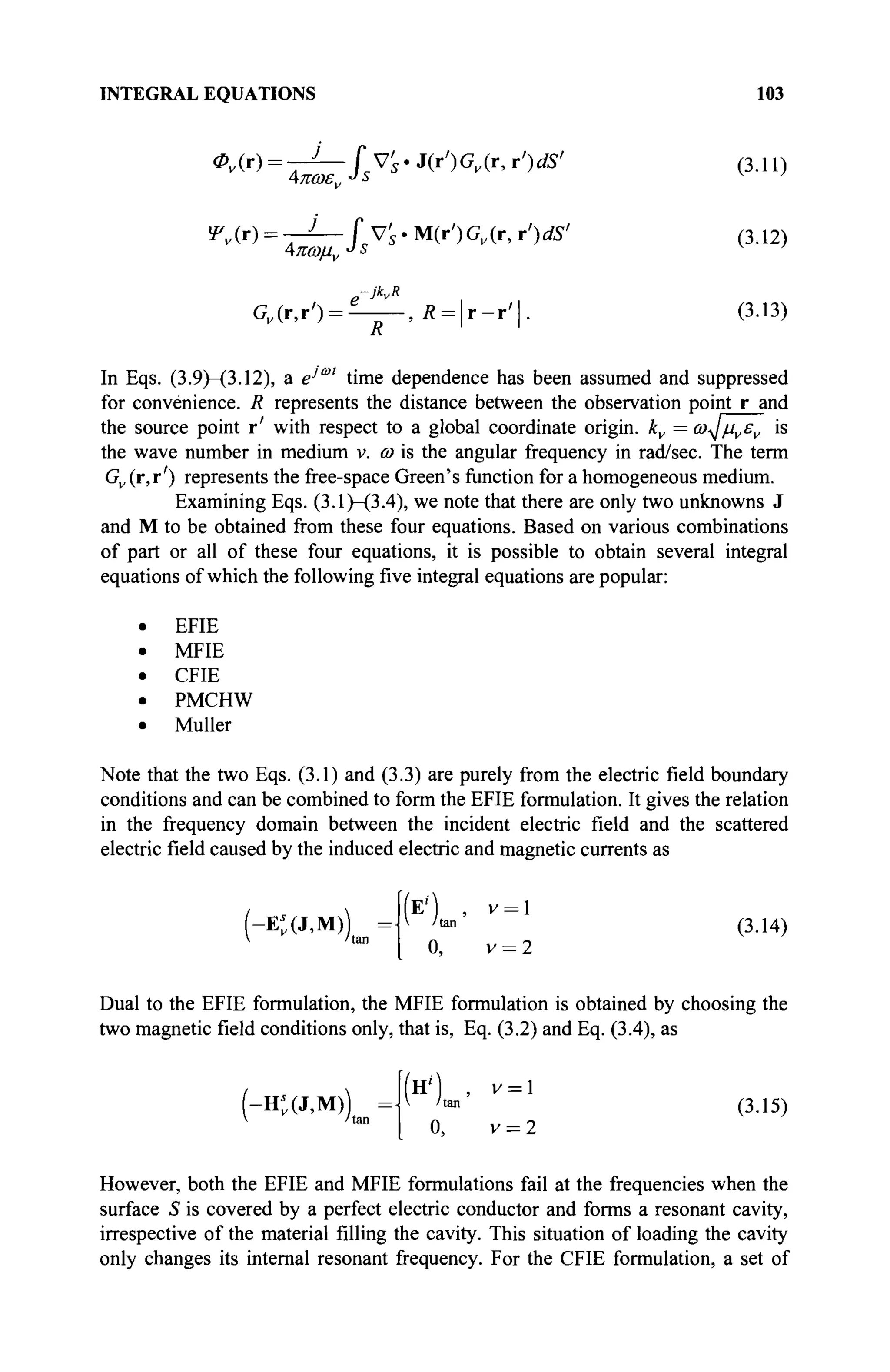
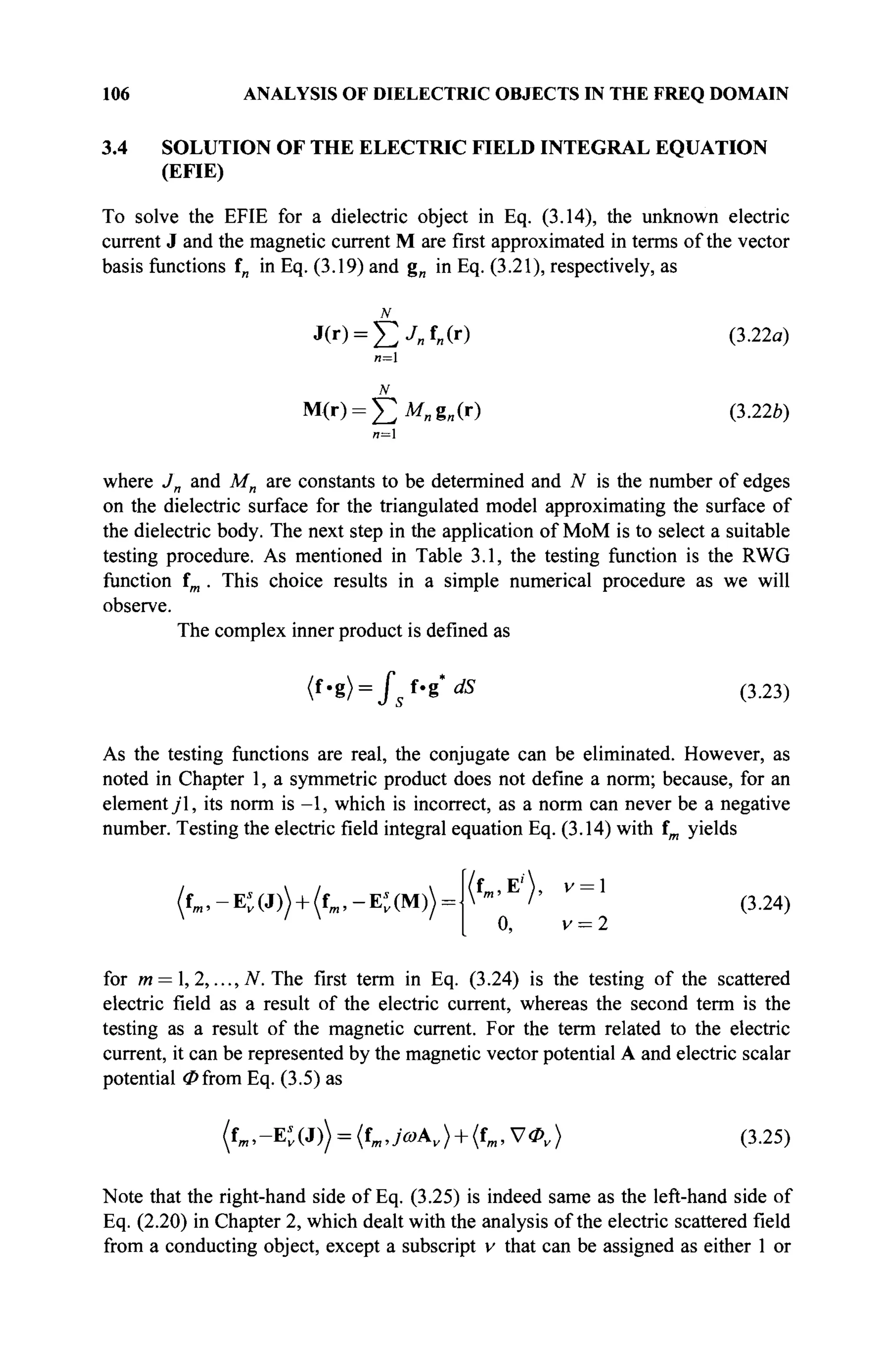
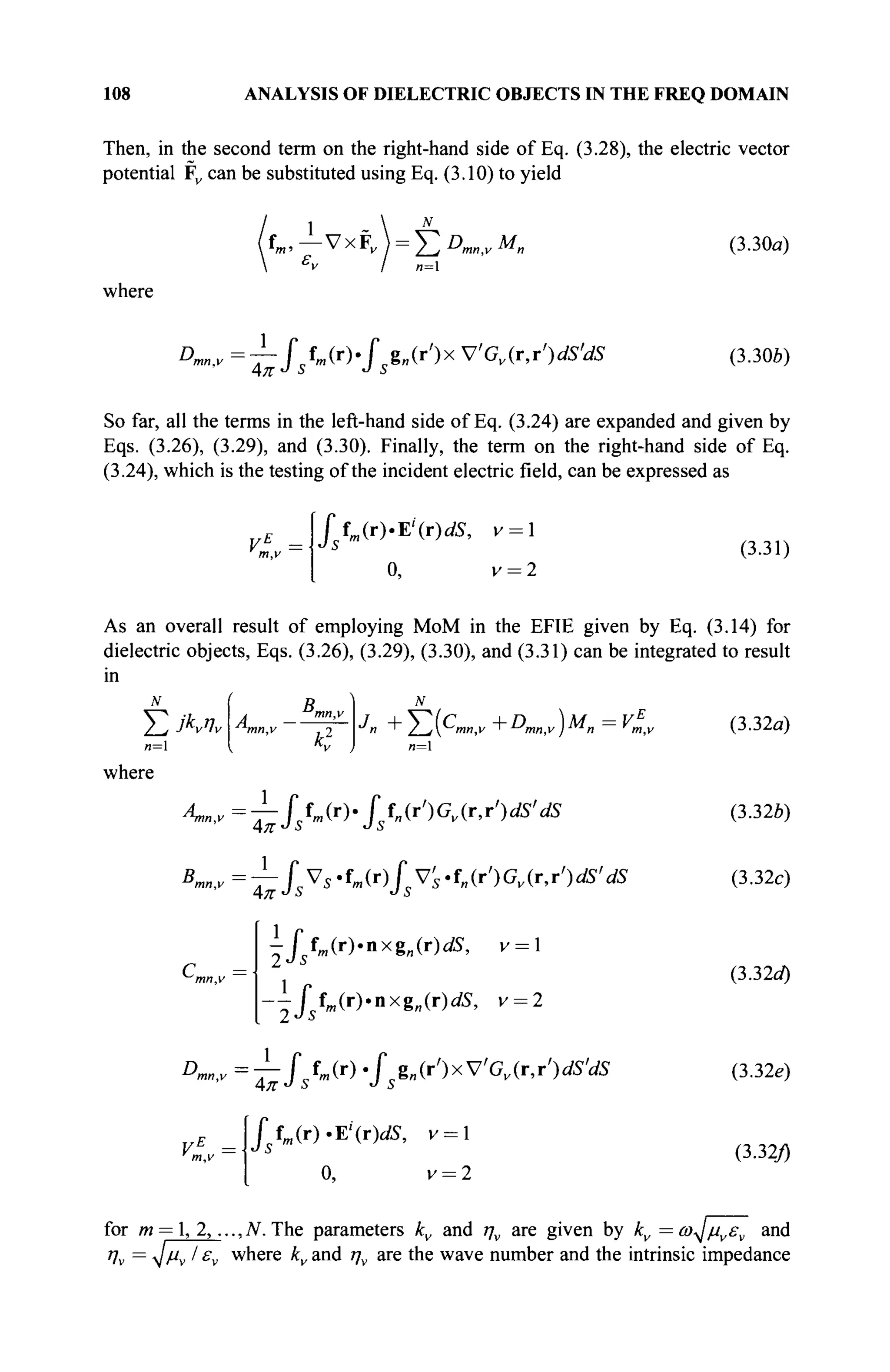
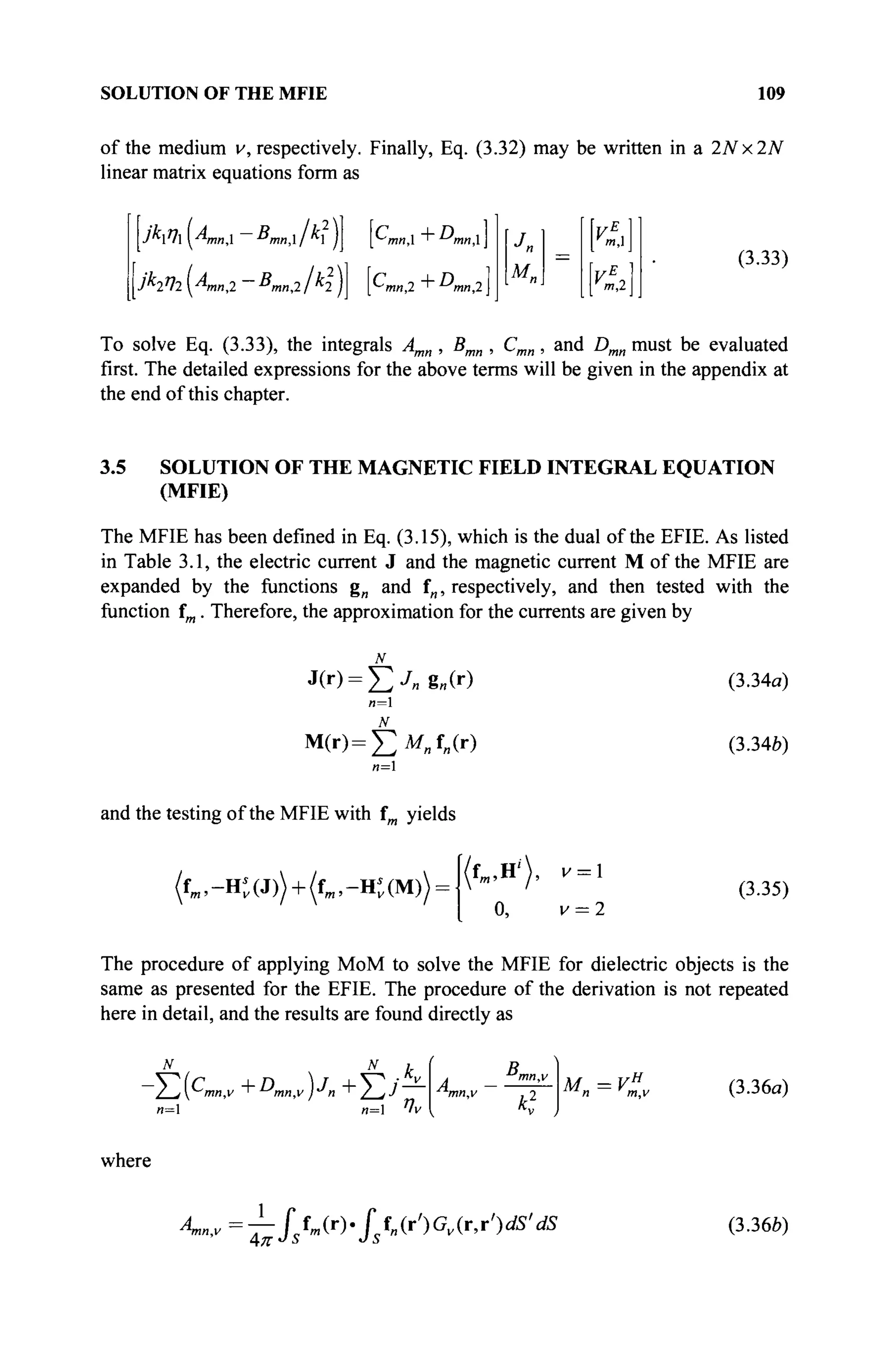
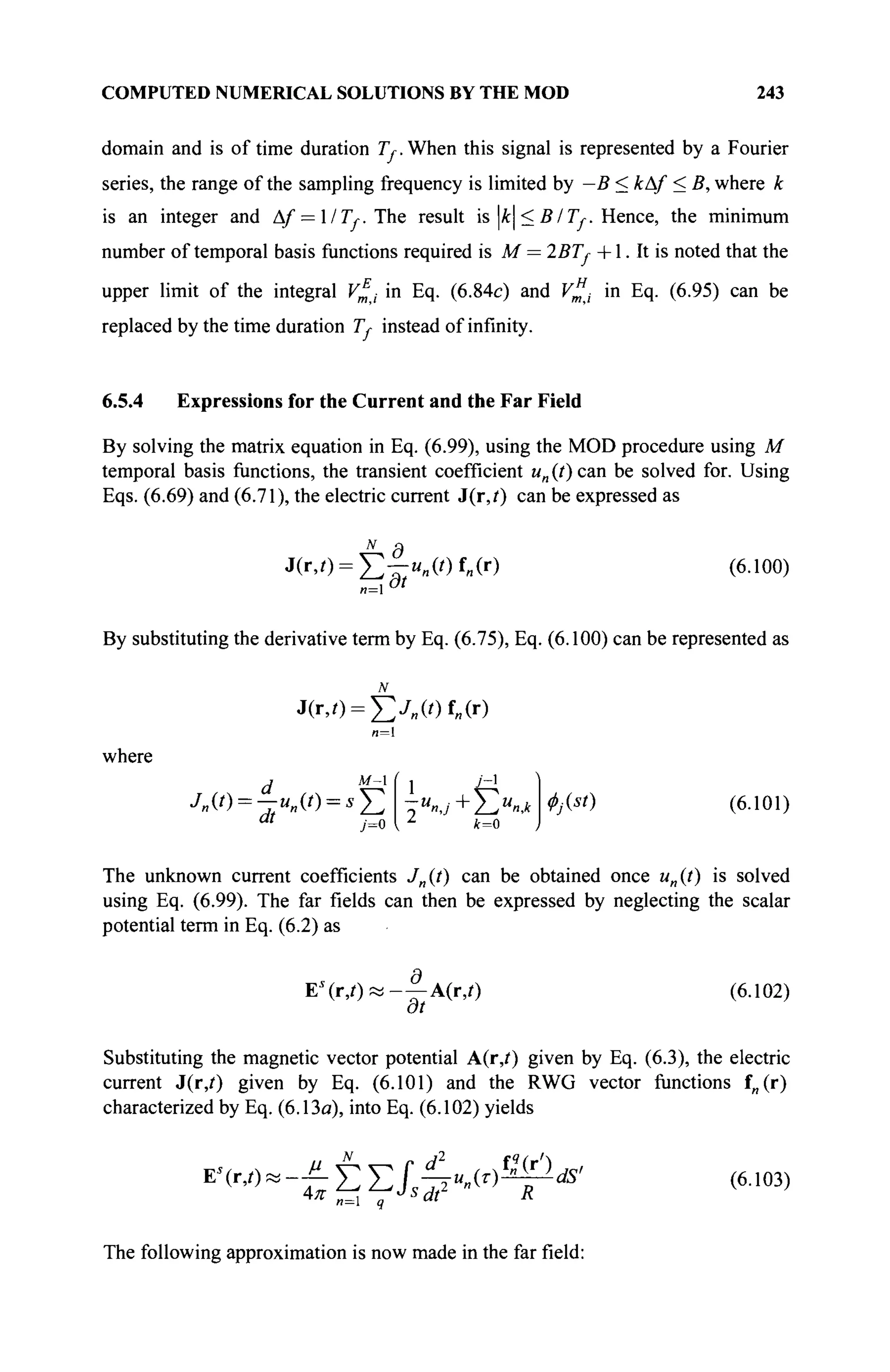
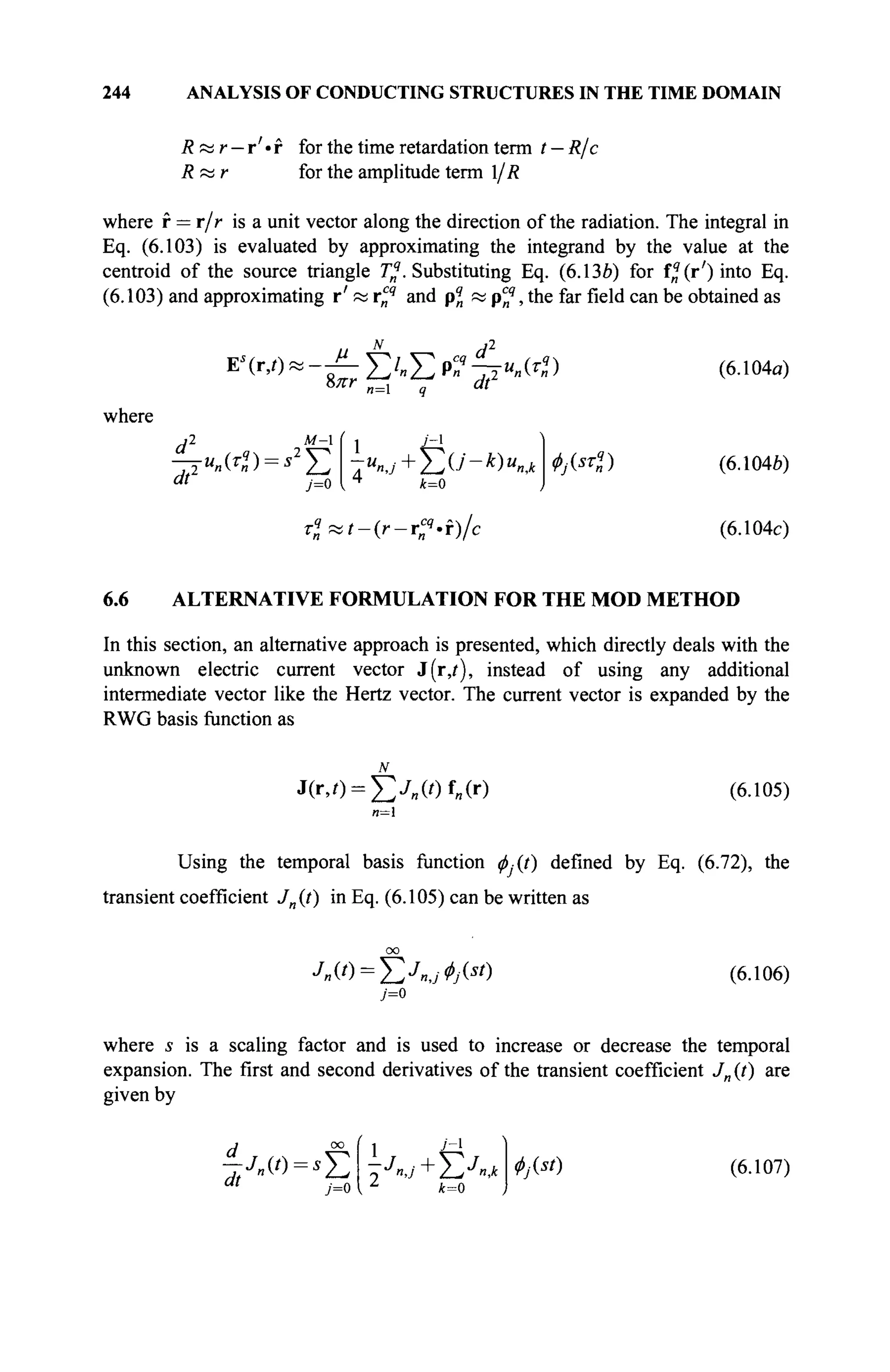
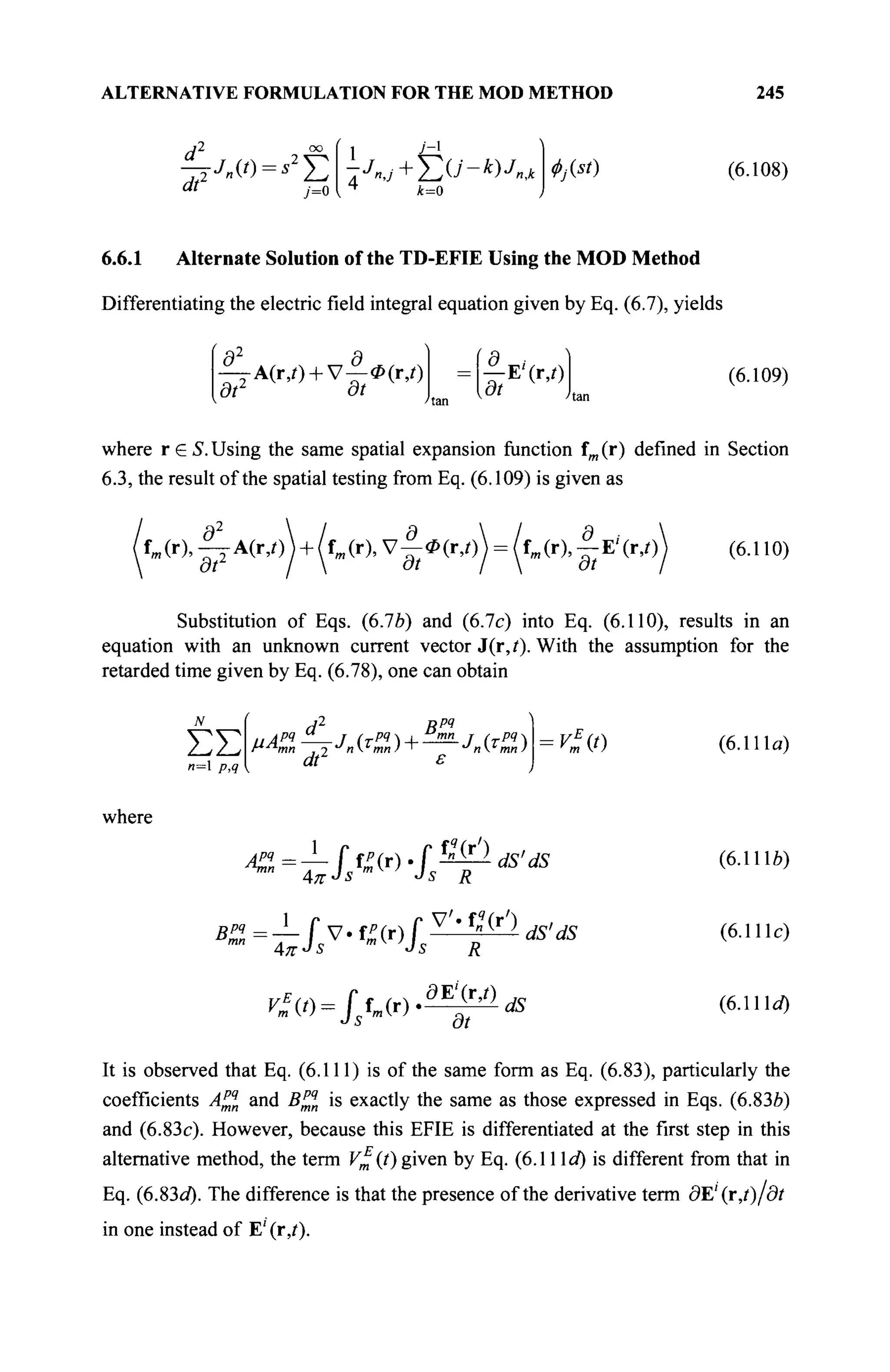
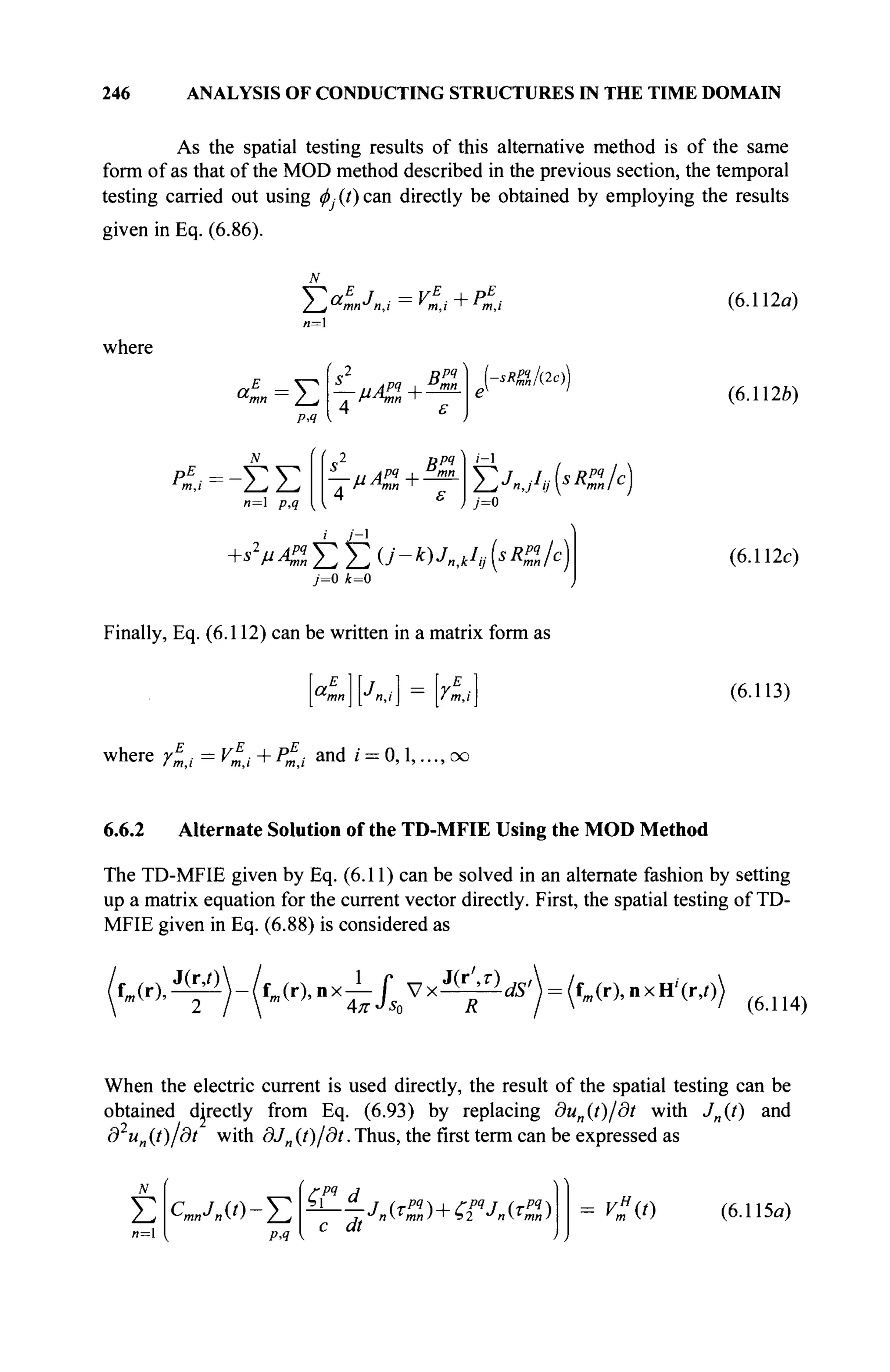
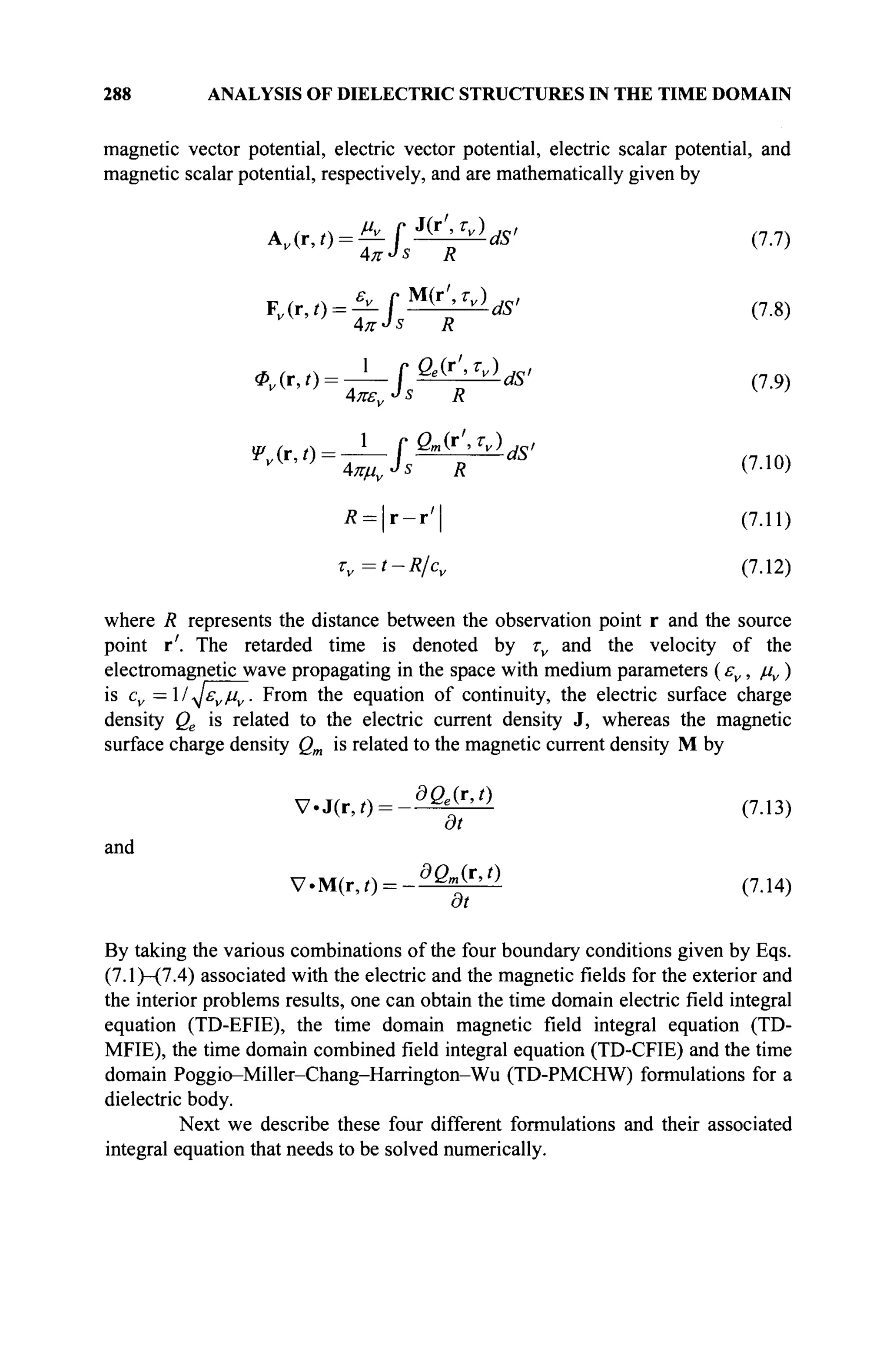
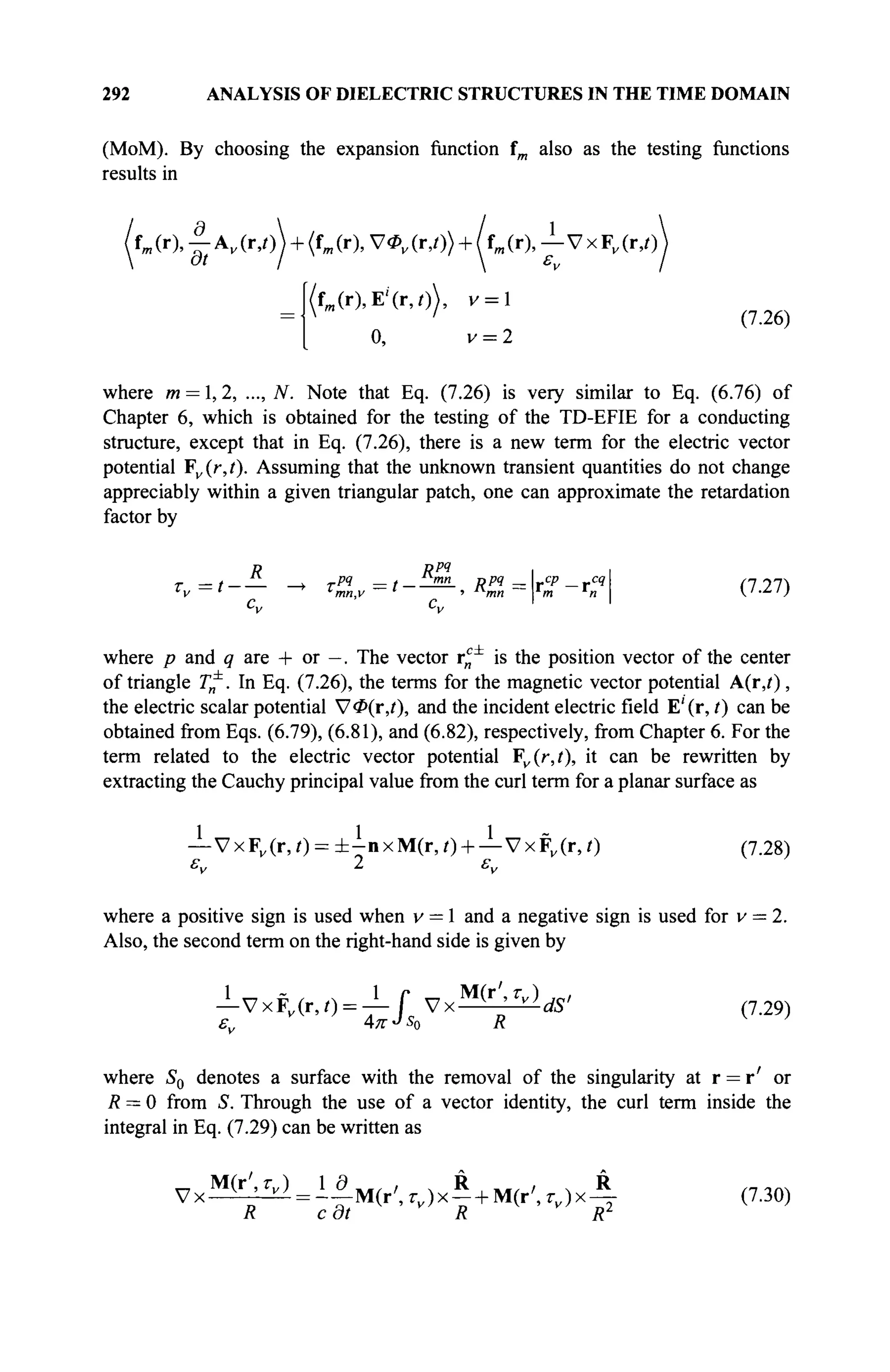
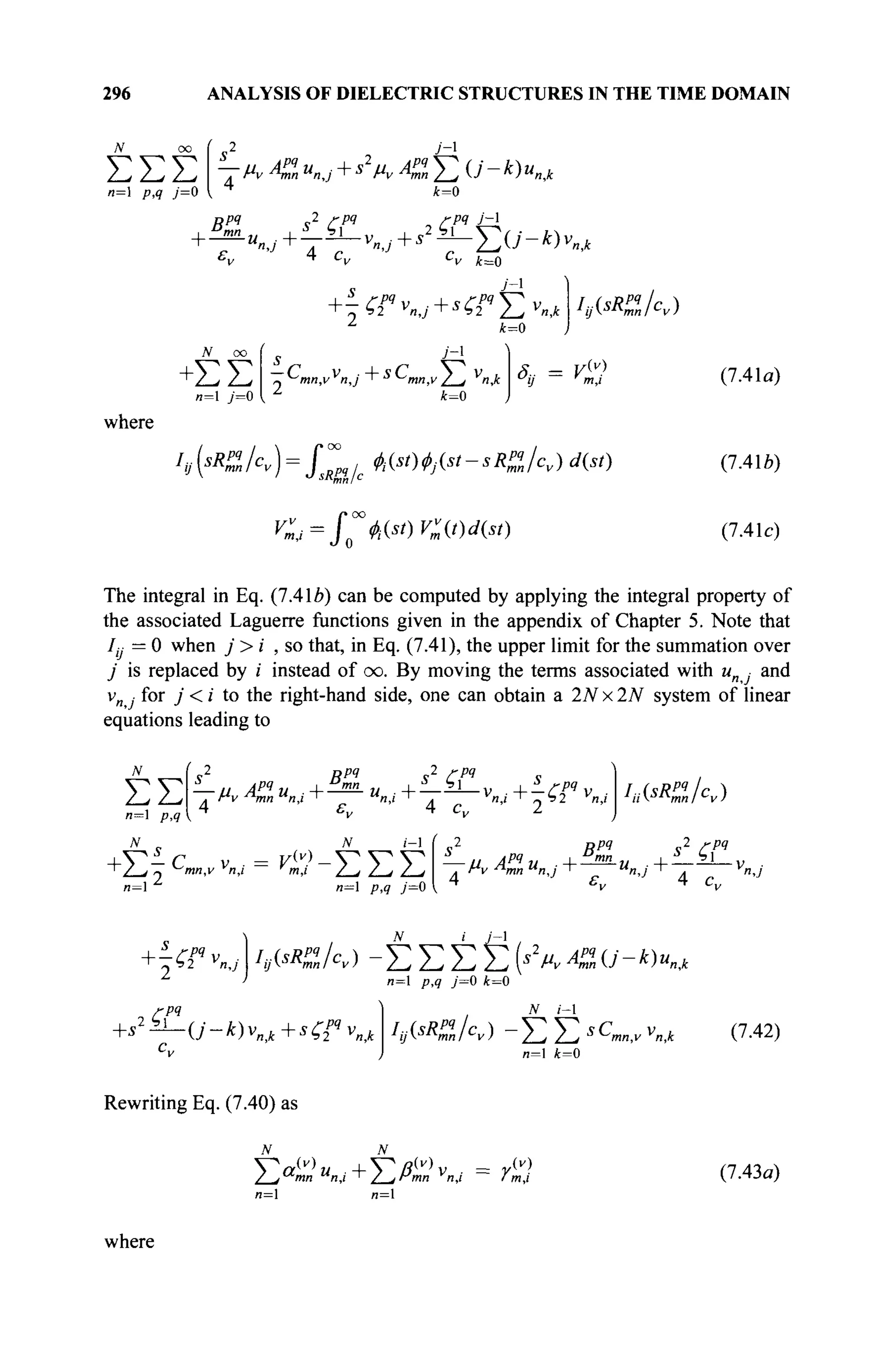
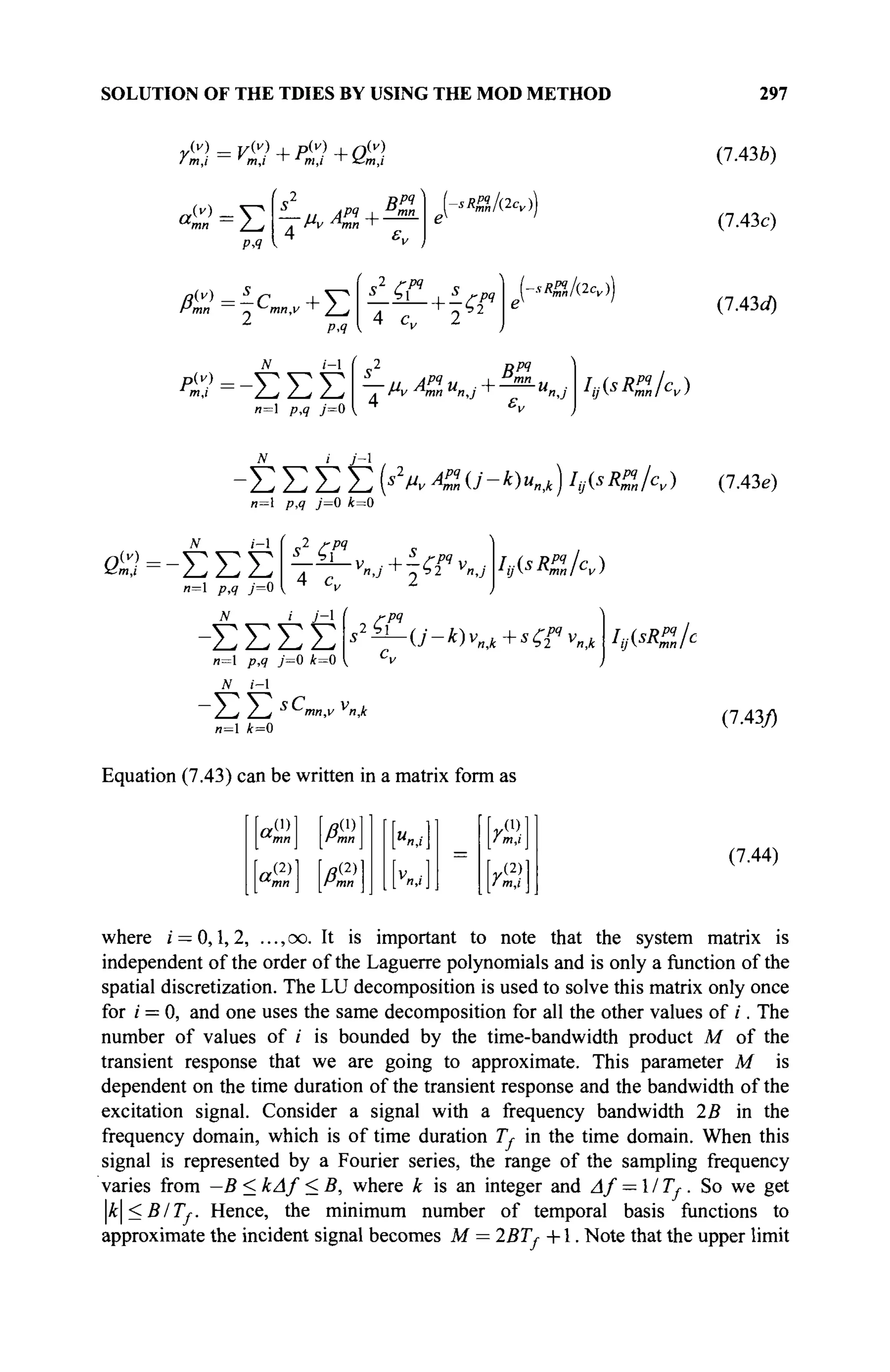
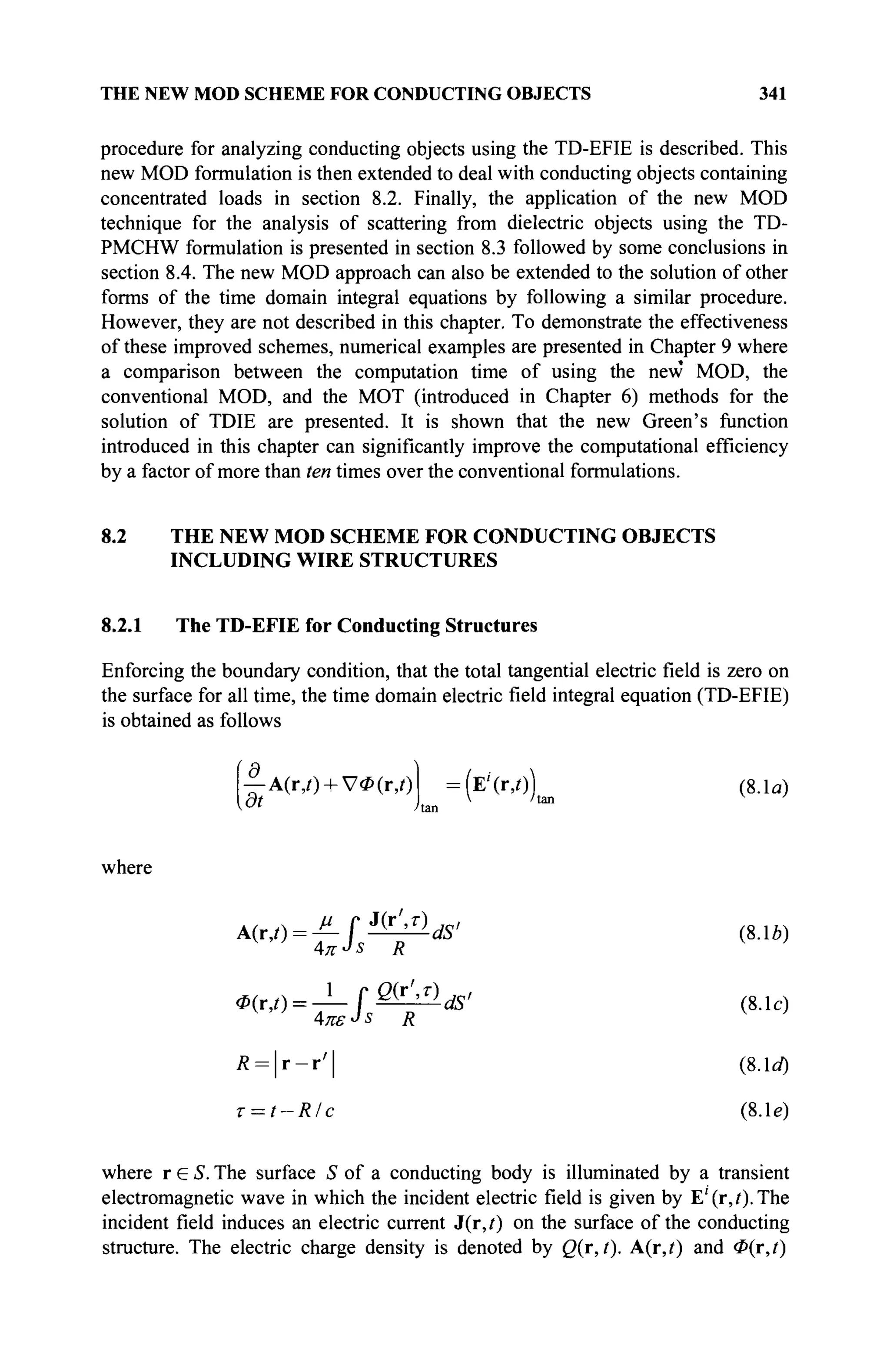
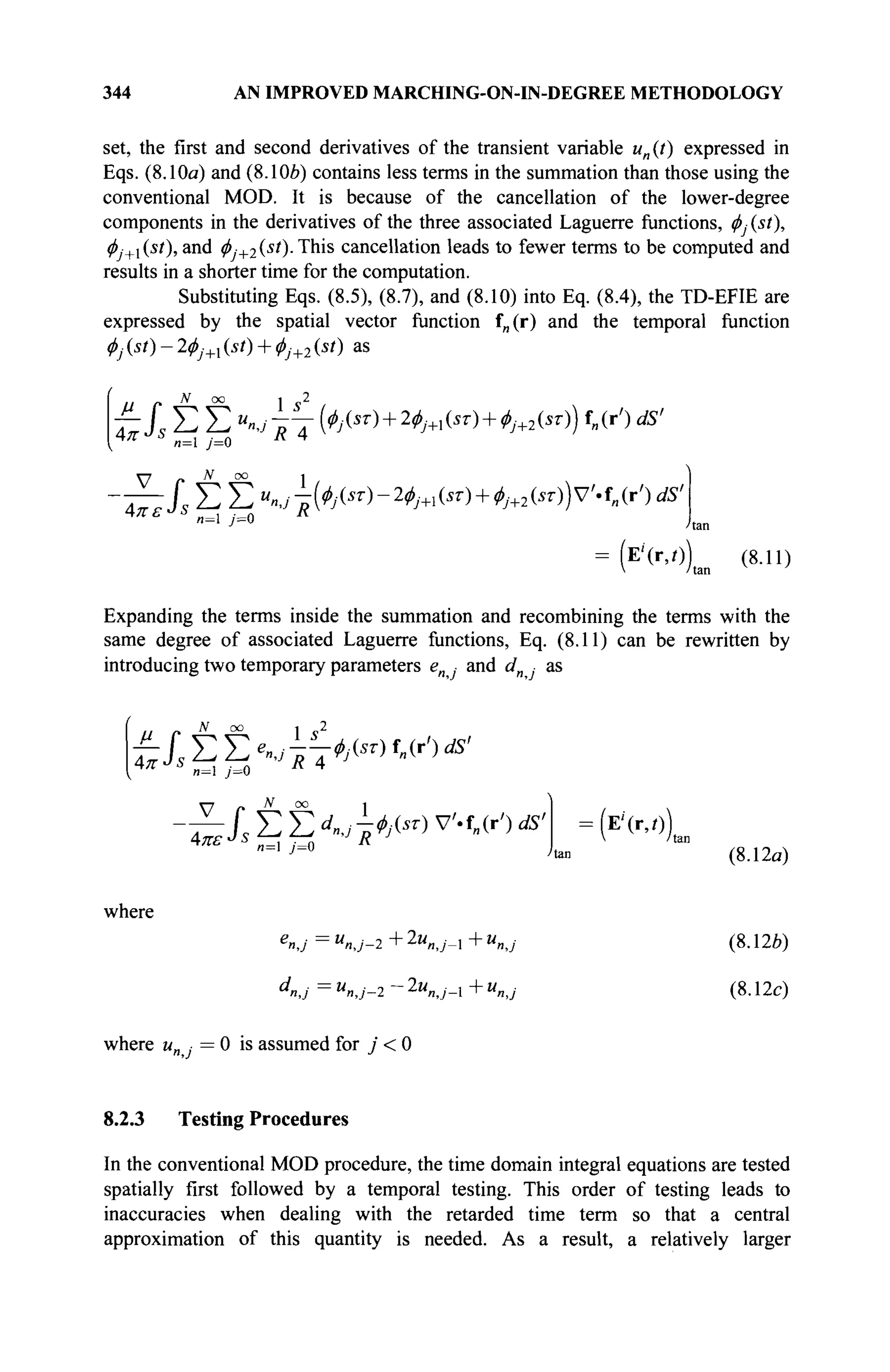
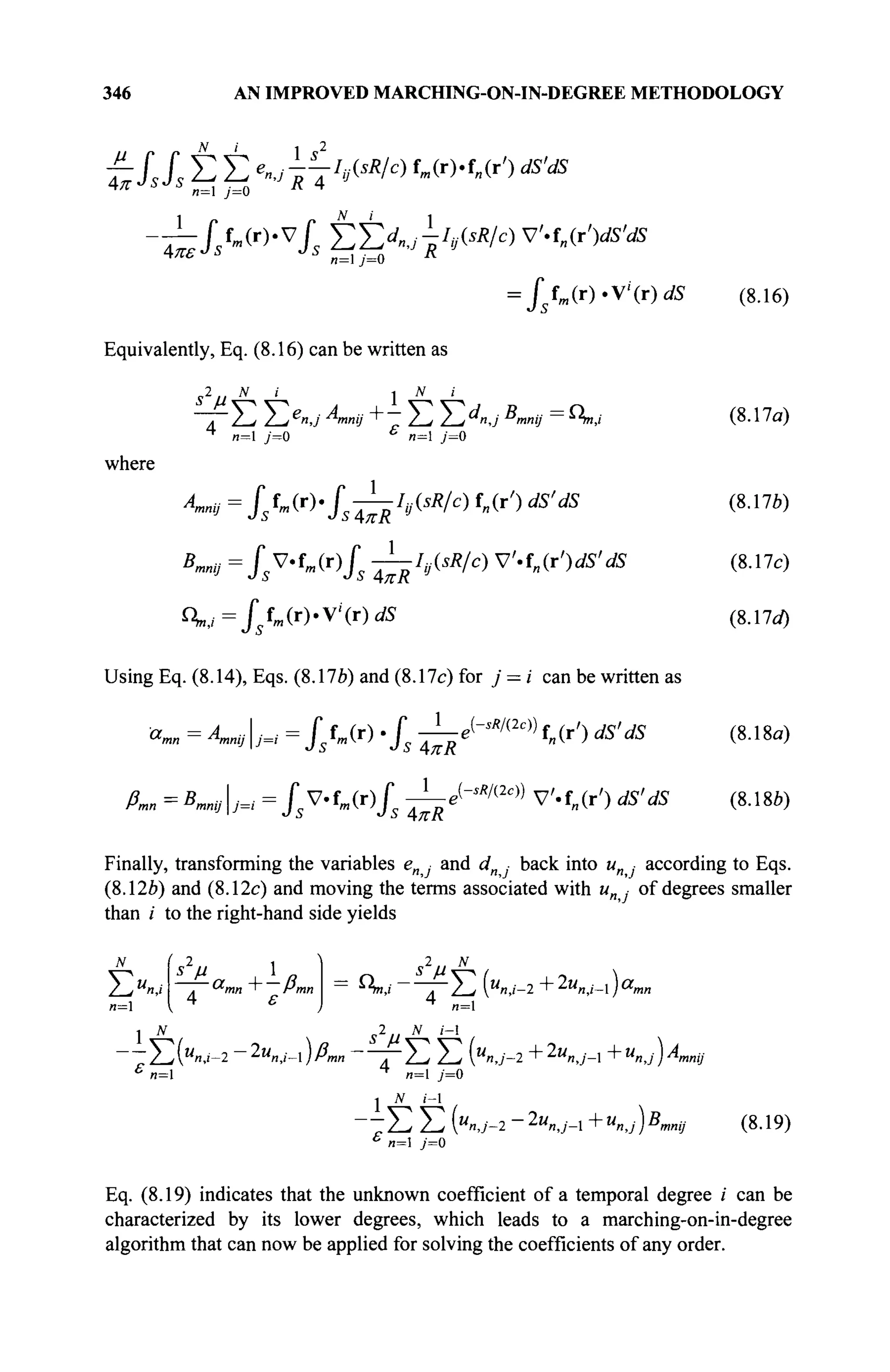
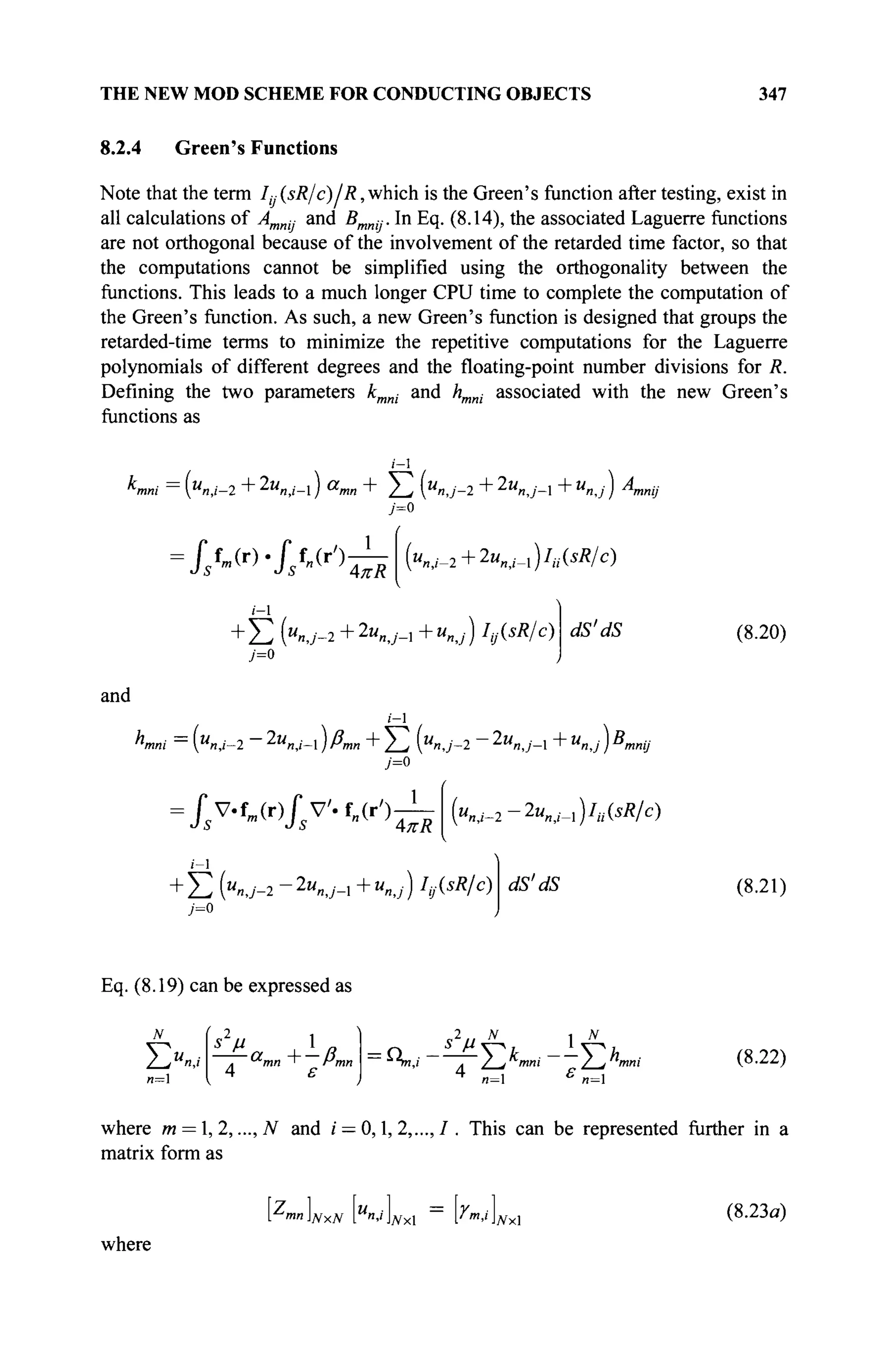
Solutions of EM Problems
Using Integral Equations and
a Hybrid Methodology
WILEY SERIES IN MICROWAVE AND OPTICAL ENGINEERING
KAI CHANG, Editor
Texas A&M University
A complete list of the titles in this series appears at the end of this volume.
Time and Frequency Domain
Solutions of EM Problems
Using Integral Equations and
a Hybrid Methodology
B. H. Jung, T. K. Sarkar, S. W. Ting, Y. Zhang, Z. Mei,
Z. Ji, M. Yuan, A. De, M. Salazar-Palma, and S. M. Rao
IEEE PRESS
WILEY
A JOHN WILEY & SONS, INC., PUBLICATION
Copyright © 2010 by John Wiley & Sons, Inc. All rights reserved.
Published by John Wiley & Sons, Inc., Hoboken, New Jersey.
Published simultaneously in Canada.
No part of this publication may be reproduced, stored in a retrieval system, or transmitted in any form or
by any means, electronic, mechanical, photocopying, recording, scanning, or otherwise, except as per-
mitted under Section 107 or 108 of the 1976 United States Copyright Act, without either the prior written
permission of the Publisher, or authorization through payment of the appropriate per-copy fee to the
Copyright Clearance Center, Inc., 222 Rosewood Drive, Danvers, MA 01923, (978) 750-8400, fax (978)
750-4470, or on the web at www.copyright.com. Requests to the Publisher for permission should be ad-
dressed to the Permissions Department, John Wiley & Sons, Inc., 111 River Street, Hoboken, NJ 07030,
(201) 748-6011, fax (201) 748-6008, or online at http://www.wiley.com/go/permission.
Limit of Liability/Disclaimer of Warranty: While the publisher and author have used their best efforts in
preparing this book, they make no representations or warranties with respect to the accuracy or com-
pleteness of the contents of this book and specifically disclaim any implied warranties of merchantabili-
ty or fitness for a particular purpose. No warranty may be created or extended by sales representatives or
written sales materials. The advice and strategies contained herein may not be suitable for your situation.
You should consult with a professional where appropriate. Neither the publisher nor author shall be li-
able for any loss of profit or any other commercial damages, including but not limited to special, inci-
dental, consequential, or other damages.
For general information on our other products and services or for technical support, please contact our
Customer Care Department within the United States at (800) 762-2974, outside the United States at
(317) 572-3993 or fax (317) 572-4002.
Wiley also publishes its books in a variety of electronic formats. Some content that appears in print may
not be available in electronic formats. For more information about Wiley products, visit our web site at
www.wiley.com.
Library of Congress Cataloging-in-Publication Data is available.
ISBN 978-0-470-48767-9
Printed in the United States of America.
10 9 8 7 6 5 4 3 2 1
CONTENTS
Preface xv
Acknowledgments xix
List of Symbols xxi
Acronyms xxiii
Chapter 1 Mathematical Basis of a Numerical Method 1
1.0 Summary 1
1.1 Element and Spaces 2
1.1.1 Elements 2
1.1.2 Set 3
1.1.3 Field 3
1.1.4 Space 4
1.2 Metric Space 5
1.3 Vector (Linear) Space 7
1.3.1 Dependence and Independence of Vectors 8
1.3.2 Dimension of a Linear Space 8
1.3.3 Subspaces and Linear Manifolds 8
1.3.4 Normed Linear Space 9
1.3.5 Inner Product Space 11
1.4 Problem of Best Approximation 14
1.4.1 Projections 14
1.5 Mapping/Transformation 17
1.5.1 Representation by Matrices 20
1.5.2 Linear Forms 21
1.5.3 Bilinear Forms 22
1.5.4 Quadratic Forms 23
1.6 The Adjoint Operator 23
1.7 Concept of Ill-Posed and Well-Posed Problems 26
1.7.1 Definition of a Well-Posed Problem 27
1.7.2 Regularization of an Ill-Posed Problem 29
1.8 Numerical Solution of Operator Equations 35
1.8.1 Classical Eigenfunction Approach 36
1.8.2 Method of Moments (MoM) 37
v
CONTENTS
1.8.2.1 On the Choice of Expansion Functions 39
1.8.2.2 On the Choice of Weighting Functions 40
Developments of the Variational Method (Rayleigh-Ritz),
Galerkin's Method, and the Method of Least Squares 42
1.9.1 Variational Method (Rayleigh-Ritz) 44
1.9.1.1 Does a Functional ψ(ζ) Always Exist? 45
1.9.1.2 Does Minimization of T(xN ) Lead to a
Monotonie Convergence of the
Approximate Solution xN to the Exact
One? 49
1.9.1.3 What Are the Restrictions on the
Expansion Functions u„? 50
1.9.1.4 Does Minimization of the Functional
f(xN) Guarantee the Convergence of the
Residuals? 51
1.9.1.5 Epilogue 51
1.9.2 Galerkin's Method 52
1.9.2.1 Is It AIways Possible to Find a Set of
Approximate Solutions that Guarantees
the Weak Convergence of the Residuals? 54
1.9.2.2 Does the Weak Convergence of the
Residuals Guarantee Its Strong
Convergence? 54
1.9.2.3 Does the Sequence of Solutions
Цхд, — x|| Converge to Zero as N —
> oo ? 55
1.9.2.4 Is Galerkin's Method Always Applicable?... 55
1.9.2.5 Epilogue 56
1.9.3 Method of Least Squares 57
1.9.3.1 What Are the Characteristics of the
Expansion Functions? 58
1.9.3.2 Do the Residuals Converge Monotonically
as N —
> oo ? 59
1.9.3.3 Does the Sequence of Approximate
Solutions Monotonically Converge to the
Exact Solution? 59
1.9.3.4 Epilogue 59
1.9.4 Comparison of the Rates of Convergence of the
Various Methods 59
A Theorem on the Moment Methods 60
1.10.1 Formulation of the Theorem 61
1.10.2 Discussion 62
Philosophy of Iterative Methods 63
1.11.1 Development of Conjugate Direction Methods 64
1.11.2 A Class of Conjugate Gradient Methods 67
CONTENTS vii
1.11.2.1 Minimization of the Residuals {Conjugate
Gradient Method A) 70
1.11.2.2 Minimization of Solution Error
{Conjugate Gradient Method B) 71
1.11.3 Numerical Examples 72
1.12 The Difference between Application of the Conjugate
Gradient Method (CGM) to Solve a Matrix Equation as
Opposed to Direct Application of CGM to Solution of an
Operator Equation 74
1.13 Conclusion 76
References 78
Chapter 2 Analysis of Conducting Structures in the Frequency
Domain 81
2.0 Summary 81
2.1 Introduction 81
2.2 Frequency Domain Electric Field Integral Equation
(FD-EFIE) 82
2.3 Triangular Surface Patch Modeling 84
2.4 Solution of the EFIE 86
2.5 Frequency Domain Magnetic Field Integral Equation
(FD-MFIE) 91
2.6 Solution of the MFIE 92
2.7 Frequency Domain Combined Field Integral Equation
(FD-CFIE) 95
2.8 Far Field Computation in the Frequency Domain 96
2.9 Conclusion 98
References 98
Chapter 3 Analysis of Dielectric Objects in the Frequency Domain 99
3.0 Summary 99
3.1 Introduction 99
3.2 Integral Equations 101
3.3 Expansion and Testing Functions 104
3.4 Solution of the Electric Field Integral Equation (EFIE) 106
3.5 Solution of the Magnetic Field Integral Equation (MFIE) 109
3.6 Solution of the Combined Field Integral Equation (CFIE) 110
3.7 Solution of the PMCHW Integral Equation 115
3.8 Solution of the Müller Integral Equation 117
3.9 Study of Various CFIE Formulations 118
3.10 Study of Different Müller Formulations 123
3.11 Numerical Examples 126
3.11.1 Dielectric Sphere 127
3.11.1.1 Analysis of a Sphere by PMCHW 127
3.11.1.2 Analysis of a Sphere by EFIE 128
CONTENTS
3.11.1.3 Analysis of a Sphere by MFIE 129
3.11.1.4 Analysis of a Sphere by TENE of CFIE 130
3.11.1.5 Analysis of a Sphere by THNHofCFIE 131
3.11.1.6 Analysis of a Sphere by TENE-THNH of
CFIE 132
3.11.1.7 Analysis of a Sphere by TENE-TH of
CFIE 133
3.11.1.8 Analysis of a Sphere by TENE-NHof
CFIE 134
3.11.1.9 Analysis of a Sphere by TE-THNH of
CFIE 135
3.11.1.10 Analysis of a Sphere by NE-THNH of
CFIE 136
3.11.2 Dielectric Cube 137
3.11.2.1 Analysis of a Cube byPMCHW. 138
3.11.2.2 Analysis of a Cube by EFIE 139
3.11.2.3 Analysis of a Cube by MFIE 140
3.11.2.4 Analysis of a Cube by TENE of CFIE 141
3.11.2.5 Analysis of a Cube by THNHofCFIE 142
3.11.2.6 Analysis of a Cube by TENE-THNH of
CFIE 143
3.11.2.7 Analysis of a Cube by TENE-TH of CFIE.. 144
3.11.2.8 Analysis of a Cube by TENE-NHof CFIE.. 145
3.11.2.9 Analysis of a Cube by TE-THNH of CFIE.. 146
3.11.2.10 Analysis of a Cube by NE-THNHofCFIE .147
3.11.3 Dielectric Cylinder 148
3.11.3.1 Analysis of a Cylinder by PMCHW 149
3.11.3.2 Analysis of a Cylinder by EFIE 150
3.11.3.3 Analysis of a Cylinder by MFIE 151
3.11.3.4 Analysis of a Cylinder by TENE ofCFIE. ..152
3.11.3.5 Analysis of a Cylinder by THNHofCFIE.. 153
3.11.3.6 Analysis of a Cylinder by TENE-THNH of
CFIE 154
3.11.3.7 Analysis of a Cylinder by TENE-TH of
CFIE 155
3.11.3.8 Analysis of a Cylinder by TENE-NH of
CFIE 156
3.11.3.9 Analysis of a Cylinder by TE-THNH of
CFIE 157
3.11.3.10 Analysis of a Cylinder by NE-THNH of
CFIE 158
3.11.4 Comparison among CFIE, PMCHW, and
Müller Equations 159
3.12 Conclusion 160
3.13 Appendix 160
CONTENTS ix
3.13.1 Evaluation of the Integrals Amn, A^n,and A^n 161
3.13.2 Evaluation of the Integrals Bmn , Β^ , and B^n 161
3.13.3 Evaluation of the Integrals Cmn , C^„,and СД„ 162
3.13.4 Evaluation of the Integrals Dmn, Df
mn , and D^„ 163
3.13.5 Evaluation of the Integrals V^„, V"n, V% , V" ,
С 'and
С 163
References 164
Chapter 4 Analysis of Composite Structures in the Frequency
Domain 167
4.0 Summary 167
4.1 Introduction 167
4.2 Integral Equations for Composite Structures 169
4.3 Numerical Examples for Composite Objects 176
4.4 Integral Equations for Coated Objects 180
4.5 Numerical Examples for Coated Objects 186
4.6 Conclusion 190
References 191
Chapter 5 Analysis of Conducting Wires in the Time Domain 193
5.0 Summary 193
5.1 Time Domain Electric Field Integral Equation (TD-EFIE)
for Conducting Wires 194
5.2 Solution of the TD-EFIE Using the Marching-on-in-Time
(MOT) Method 195
5.3 Solution of the TD-EFIE Using the Marching-on-in-Degree
(MOD) Method 198
5.3.1 Spatial Basis Functions 198
5.3.2 Temporal Basis Functions 199
5.3.3 Testing of the Integral Equation 201
5.3.4 Choice of Excitations 204
5.3.5 Treatment of Wire Junctions 205
5.4 Numerical Examples 206
5.4.1 Radiation from a Wire Antenna Solved by the MOT
and MOD Methods 206
5.4.2 Radiation from a Circular Loop Antenna 210
5.4.3 Radiation from a K-Shaped Antenna 210
5.4.4 Radiation from a Yagi Antenna 211
5.4.5 Radiation from an Equiangular Planar Tripole
Antenna 212
5.5 Conclusion 214
5.6 Appendix '. 214
x CONTENTS
References 216
Chapter 6 Analysis of Conducting Structures in the Time Domain ...219
6.0 Summary 219
6.1 Introduction 220
6.2 Time Domain Integral Equations (TDIEs) 221
6.2.1 Time Domain Electric Field Integral Equation
(TD-EFIE) 221
6.2.2 Time Domain Magnetic Field Integral Equation
(TD-MFIE) 223
6.2.3 Time Domain Combined Field Integral Equation
(TD-CFIE) 223
6.3 Triangular Patch (RWG) Vector Basis Functions 224
6.4 Computed Numerical Solutions Using the MOT 224
6.4.1 Solving the TD-EFIE by the MOT Method 225
6.4.2 Solving the TD-MFIE by the MOT Method 229
6.4.2.1 Explicit Solution 230
6.4.2.2 Implicit Solution 233
6.4.3 Solving the TD-CFIE by the MOT Method 234
6.5 Computed Numerical Solutions by the MOD 234
6.5.1 Solving the TD-EFIE by the MOD Method 236
6.5.2 Solving the TD-MFIE by the MOD Method 239
6.5.3 Solving the TD-CFIE by the MOD Method 242
6.5.4 Expressions for the Current and the Far Field 243
6.6 Alternative Formulation for the MOD Method 244
6.6.1 Alternate Solution of the TD-EFIE Using the
MOD Method 245
6.6.2 Alternate Solution of the TD-MFIE Using the
MOD Method 246
6.6.3 Alternate Solution of the TD-CFIE Using the
MOD Method 248
6.6.4 Expressions for the Current and the Far Field 248
6.7 Numerical Examples 249
6.7.1 Scattering Analysis by Solving the TD-EFIE Using
the MOT Method 249
6.7.2 Scattering Analysis by Solving the TD-MFIE Using
the MOT Method 253
6.7.3 Scattering Analysis by Solving the TD-CFIE Using
the MOT Method 258
6.7.4 Scattering Analysis by Solving the TDIEs Using the
MOD Method 264
6.7.5 Response in the Non-Resonance Region 265
6.7.6 Responses Resulting From a Wide-Band Incident
Waveform 273
6.8 Conclusion
References
283
283
CONTENTS xi
Chapter 7 Analysis of Dielectric Structures in the Time Domain 285
7.0 Summary 285
7.1 Introduction 285
7.2 Time Domain Integral Equations (TDIEs) for Dielectric
Structures 286
7.2.1 TD-EFIE 289
7.2.2 TD-MFIE 289
7.2.3 TD-CFIE 289
7.2.4 TD-PMCHW 289
7.3 Solution of the TDIEs by Using the MOD Method 290
7.3.1 Solving the TD-EFIE 290
73.1.1 Spatial Expansion and Testing 290
73.1.2 Temporal Expansion and Testing 294
73.1.3 Computation of the Scattered Far Field 298
7.3.2 Solving the TD-MFIE 300
73.2.1 Spatial Expansion and Testing 300
73.2.2 Temporal Expansion and Testing 304
7.3.2.3 Computation of the Scattered Far Field 306
7.3.3 Solving the TD-CFIE 307
7.3.3.1 Spatial Expansion and Testing 307
7.3.3.2 Temporal Expansion andTesting 308
7.3.3.3 Computation of the Scattered Far Field.... 310
7.3.4 Solving the TD-PMCHW 311
7.3.4.1 Spatial Expansion andTesting 311
7.3.4.2 Temporal Expansion and Testing 311
73.4.3 Computation of the Scattered Far Field 313
7.4 An Alternative MOD Approach 314
7.4.1 Alternate Solution to the TD-EFIE 314
7.4.2 Alternate Solution to the TD-MFIE 315
7.4.3 Alternate Solution to the TD-PMCHW 317
7.5 Numerical Examples 318
7.5.1 Using the TD-EFIE Formulations 318
7.5.1.1 Responsefrom a Sphere 320
7.5.1.2 Responsefrom a Cube 321
7.5.1.3 Responsefrom a Cylinder 322
7.5.2 Using the TD-MFIE Formulations 323
7.5.2.1 Response from a Sphere 324
7.5.2.2 Responsefrom a Cube 325
7.5.2.3 Responsefrom a Cone-Cylinder 326
7.5.3 Using the TD-PMCHW Formulations 327
7.5.4 Using the TD-CFIE Formulations 330
7.5.4.1 Responsefrom a Sphere 331
7.5.4.2 Responsefrom a Hemisphere-Cone and a
Double Cone 331
7.6 Conclusion 333
xii CONTENTS
7.7 Appendix 334
References 336
Chapter 8 An Improved Marching-on-in-Degree (MOD)
Methodology 339
8.0 Summary 339
8.1 Introduction 339
8.2 The New MOD Scheme for Conducting Objects Including
Wire Structures 341
8.2.1 The TD-EFIE for Conducting Structures 341
8.2.2 Expansion Functions in Space and Time 342
8.2.3 Testing Procedures 344
8.2.4 Green's Functions 347
8.2.5 Improvement of the Computation Time 348
8.3 The New MOD Method for Conducting Objects with Loads.349
8.3.1 TD-EFIE for Conducting Structures with Loads 349
8.3.2 Expansion Procedures 350
8.3.3 Testing Procedures 351
8.4 The New MOD Scheme for Dielectric Structures 352
8.4.1 The TD-PMCHW Integral Equation 352
8.4.2 Expansion Functions 354
8.4.3 Testing Functions 355
8.5 Conclusion 358
References 359
Chapter 9 Numerical Examples for the New and Improved
Marching-on-in-Degree (MOD) Method 361
9.0 Summary 361
9.1 Introduction 361
9.2 Use of Various Excitation Sources 362
9.3 Improved Performance of the New MOD Method in Terms
of Accuracy and Stability 364
Example 1: A Pair of Conducting Plates 364
9.4 Improvement in Computational Efficiency of the New
MOD Method 365
Example 2: A Dipole 365
Example 3: A Helix 366
Example 4: A Loop Antenna 367
Example 5: Far Field of a K-Shaped Antenna 369
9.5 Analysis of Conducting Structures 370
Example 6: A Conducting Cube 370
Example 7: A Conducting Sphere 371
Example 8: A Conducting Cylinder 373
Example 9: A Tank 374
Example 10: A Fokker Aircraft 375
CONTENTS xiii
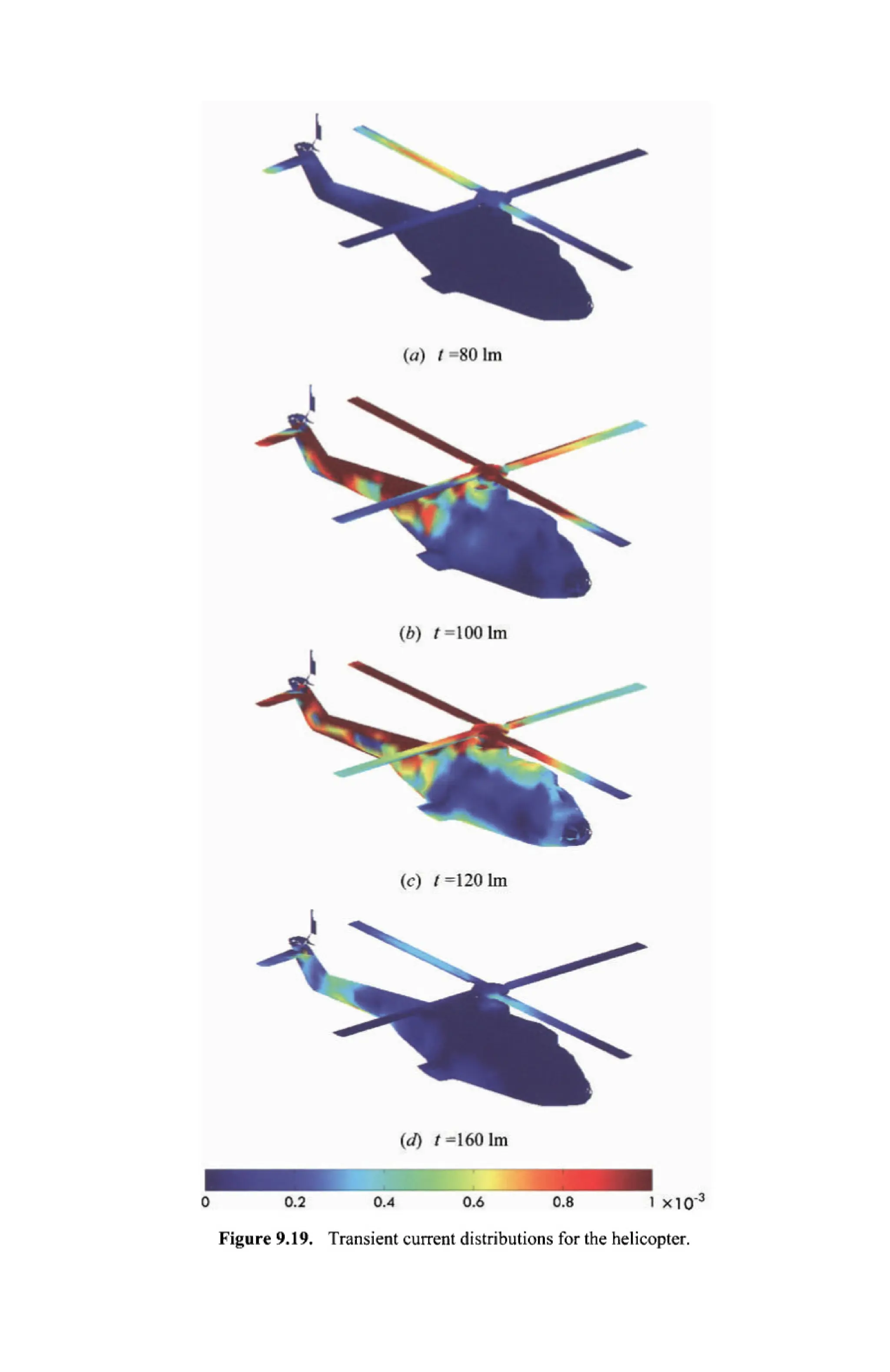
Example 11: An AS-322 Helicopter 376
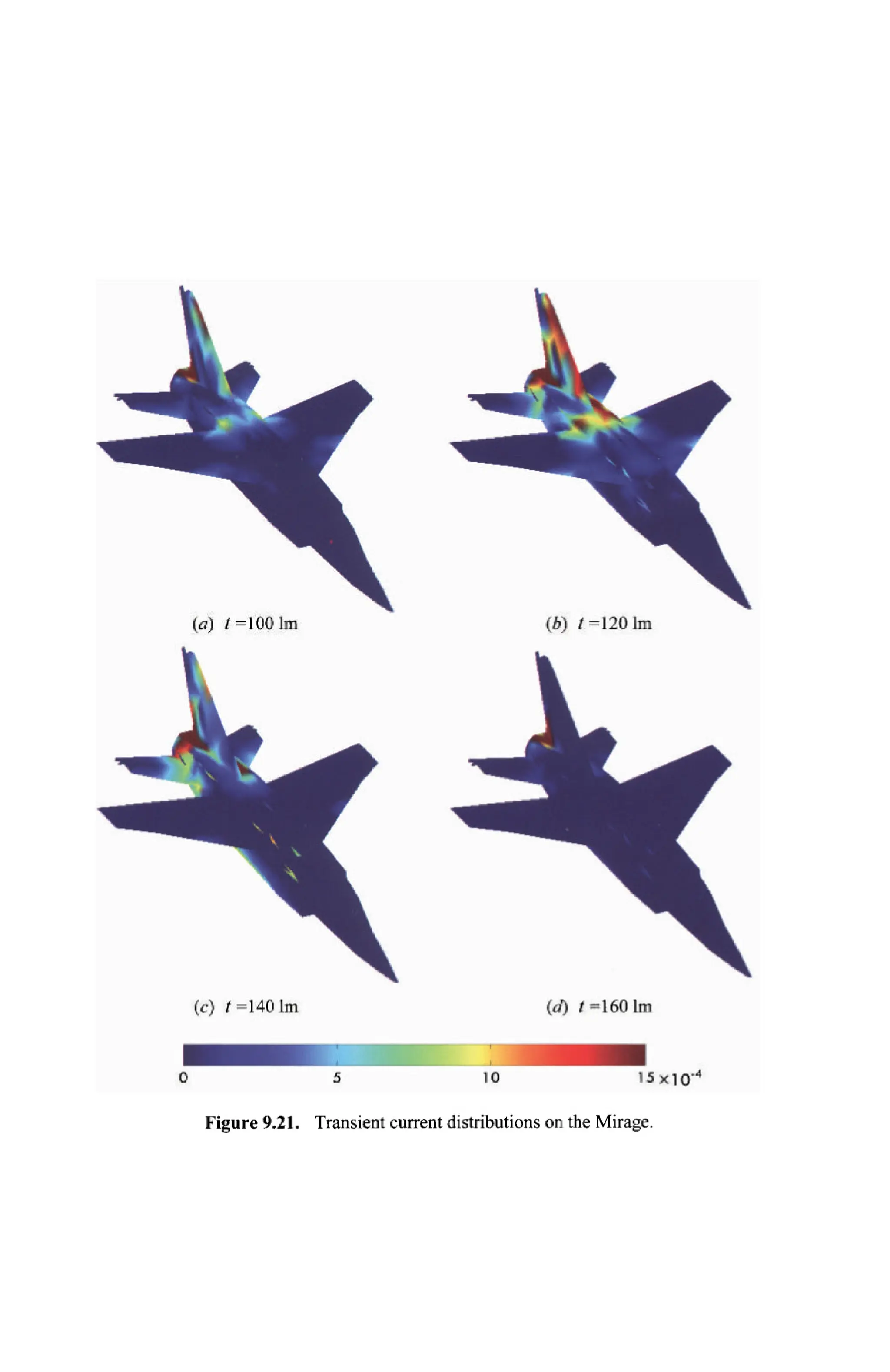
Example 12: A Mirage Aircraft 376
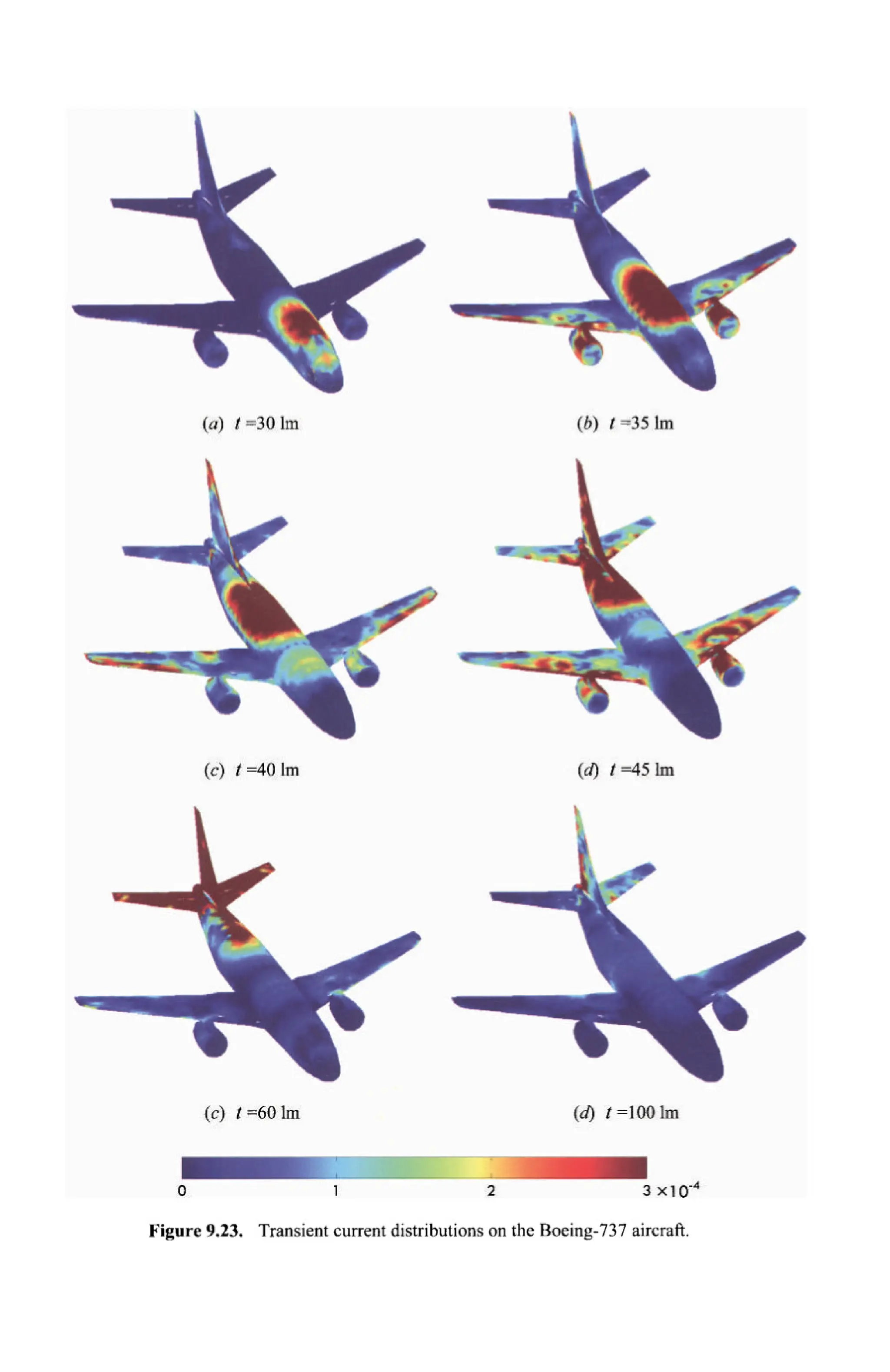
Example 13: A Boeing-737 Aircraft 376
9.6 Analysis of Conducting Structures with Loads 380
Example 14: Uniformly Distributed Load 380
Example 15: Skin Effect 382
Example 16: Concentrated Load 383
9.7 Applications of Different Types of Excitation Pulses 384
Example 17: Various Excitation Pulses 384
9.8 Analysis of Material Structures 387
Example 18: A Material Sphere 387
Example 19: A Dielectric Cylinder 387
Example 20: Structures with Different Relative
Permittivity 388
Example 21: Structures with Different Relative
Permeability 389
Example 22: Structures with Negative Relative Permittivity
and Permeability 390
9.9 Conclusion 391
References 391
Chapter 10 A Hybrid Method Using Early-Time and Low-Frequency
Information to Generate a Wideband Response 393
10.0 Summary 393
10.1 Introduction 394
10.2 A Parametric Hybrid Solution Methodology 397
10.2.1 Error Bound of the Parameters 403
10.2.1.1 Generation of the Data Resulting from a
Gaussian Input. 404
10.2.1.2 Three Different Choices of Basis
Functions and Their Numerical Stability
and Error Bounds 405
10.2.1.3 Numerical Examples 414
10.2.2 An Iterative Method to Find the Optimal Parameters.423
10.3 A Non-Parametric Hybrid Methodology 430
10.3.1 Formulation of the Problem 431
10.3.2 Integral Equation of the Second Kind 432
10.3.3 The Neumann Expansion 433
10.3.4 The Conjugate Gradient Method 436
10.3.5 Equivalent Matrix Formulations and Solution
Using the SVD 438
10.3.6 Numerical Implementation and Results 441
10.4 Conclusion 447
References 448
xiv CONTENTS
Appendix User Guide for the Time and Frequency Domain EM
Solver Using Integral Equations (TFDSIE) 451
A.O Summary 451
A.l Introduction 451
A.l.l What is TFDSIE? 452
A.1.2 Features of the Code 452
A.1.3 Scope of the Analysis 453
A. 1.4 Hardware and Software Requirements 453
A.1.5 Limitations of the Downloaded Version of TFDSIE..453
A.2 Getting Started 454
A.2.1 Program Installation 454
A.2.2 Start the Program 454
A.3 A Quick Tour 455
A.3.1 Create a Sphere Object 455
A.3.2 Save the Sphere Object as a Project 457
A.3.3 Simulation Setup 458
A.3.4 Start Simulation 459
A.3.5 View Simulation Results 460
A.4 A Tutorial Guide of the Code 462
A.4.1 Terminologies 462
A.4.2 Units 463
A.4.3 File Types 463
A.4.4 Functions 464
A.4.5 Load a Project 465
A.4.6 Build a Model in TFDSIE for a Structure 465
A.4.6.1 Add a Face 465
A.4.6.2 Delete a Face 467
A.4.6.3 Preview the Structure 467
A.4.6.4 Get Parametric Datafor the Structure 468
A.4.6.5 Checking the Data of the Structure 468
A.4.7 Simulation Options 469
A.4.8 View Simulation Results 471
A.4.8.1 List 471
A.4.8.2 Graph 471
A.4.8.3 Show 472
A.5 Examples 472
A.6 Getting Help 472
Index 475
About the Authors 479
Preface
Numerical solutions of electromagnetic field problems constitute an area of
paramount interest in academia, industry, and government. Many numerical
techniques exist based on the solutions of both the differential and integral forms
of Maxwell's equations. It is not recognized very often that for electromagnetic
analysis of both conducting and practical linear piecewise homogeneous isotropic
bodies, integral equations are still one of the most versatile techniques that one can
use in both efficiency and accuracy to solve challenging problems including
analysis of electrically large structures.
In this book, our emphasis is to deal primarily with the solution of time
domain integral equations. Time domain integral equations are generally not as
popular as frequency domain integral equations and there are very good reasons
for it. Frequency domain integral equations arise from the solution of the
unconditionally stable elliptic partial differential equations of boundary-value
problems. The time domain integral equations originate from the solution of the
hyperbolic partial differential equations, which are initial value problems. Hence,
they are conditionally stable. Even though many ways to fix this problem have
been proposed over the years, an unconditionally stable scheme still has been a
dream. However, the use of the Laguerre polynomials in the solution of time
domain integral equations makes it possible to numerically solve time domain
problems without the time variable, as it can be eliminated from the computations
associated with the final equations analytically. Of course, another way to
eliminate the time variable is to take the Fourier transform of the temporal
equations, which gives rise to the classical frequency domain methodology. The
computational problem with a frequency domain methodology is that at each
frequency, the computational complexity scales as 6{Ν*) [C(·) denotes of "the
order of, where N is the number of spatial discretizations]. Time domain methods
are often preferred for solving broadband large complex problems over frequency
domain methods as they do not involve the repeated solution of a large complex
matrix equation. The frequency domain solution requires the solution of a large
matrix equation at every frequency step, whereas in the solution of a time domain
integral equation using an implicit method, one only needs to solve a real large
dense matrix once and then use its inverse in the subsequent computations for each
timestep. So that, a time domain method requires only a vector-matrix product of
large dimension at each time step. Thus, in this case, at each timestep, the
computational complexity is 0{N2
). The use of the orthogonal associated Laguerre
functions for the approximation of the transient responses not only has the
advantage of an implicit transient solution technique as the computation time is
quite small, but also separates the space and the time variables, making it possible
to eliminate the time variable from the final computations analytically. Hence, the
numerical dispersion due to time discretizations does not exist for this
methodology. This methodology has been presented in this book. The
xv
xvi PREFACE
conventional marching-on-in-time method is also presented along with its various
modifications.
The frequency domain solution methodology is also included, so that one can
verify the time domain solutions by taking an inverse Fourier transform of the
frequency domain data. This will provide verification for the accuracy and
stability of the new Laguerre-based time domain methodology, which is called the
marching-on-in-degree/order technique.
Finally, a hybrid method based on the time and frequency domain techniques
is presented to illustrate that it is possible to go beyond the limitations of the
computing resources through intelligent processing. The goal of this hybrid
approach is to generate early-time information using a time domain code and low-
frequency information using a frequency domain code, which is not
computationally demanding. Then an orthogonal series is used to fit the data both
in the early-time and low-frequency domains, and then it is shown that one can use
the same coefficients to extrapolate the response simultaneously both for the late-
time and high-frequency regions. In this approach, one is not creating any new
information but is using the existing information to extrapolate the responses
simultaneously in the time and frequency domains. Three different orthogonal
polynomials have been presented, and it is illustrated how they can be utilized to
achieve the stated goal of combining low-frequency and early-time data to
generate a broadband solution. This forms the core of the parametric approach.
The fact that Fourier transforms of the presented polynomials are analytic
functions allows us to work simultaneously with time and frequency domain data.
A priori error bounds are also provided and a processing-based methodology is
outlined to know when the data record is sufficient for extrapolation. A
nonparametric approach is also possible using either a Neumann series
approximation or through the use of the Hubert transform implemented by the fast
Fourier transform. This hybrid methodology may make it possible to combine
measured vector network analyzer data with a time domain reflectometer
measurements in a seamless and accurate fashion without using any of the
approximate inaccurate methodologies to process the measured data that currently
are implemented in most commercial time domain reflectometer (TDR) and
network analyzer measurement systems.
This essentially provides the unique salient features of this book. To make this
book useful to practicing engineers and graduate students trying to validate their
own research, sample computer programs are presented at the end of this book.
For more sophisticated versions of the programs, an interested reader may contact
the authors.
Next we provide a detailed description of the contents of the book.
The introduction of Chapter 1 will provide a summary of the different types of
spaces including the concept of mapping and projections leading to the
PREFACE XVII
formulation of operator equations. The definition of an ill-posed and well-posed
problem is discussed, leading to the solution of an operator equation. Next the
various methods for the solution of an operator equation are presented, including
the method of moments, variational methods, Galerkin's method, and the method
of least squares followed by iterative methods, particularly the method of
conjugate directions, leading to the conjugate gradient method. The mathematical
subtleties of the various methods are also presented including the appropriate
scientific choice for the basis and testing functions.
Chapters 2^4 discuss the solution of frequency domain integral equations
using the popular triangular-shaped discretizations for the surface of the objects.
Chapter 2 describes the frequency domain integral equations for the analysis of
conducting objects, and Chapter 3 presents the corresponding methodology for the
dielectric objects, including the combined field integral equation along with its
various derivatives. Chapter 4 presents the analysis of composite structures,
consisting of both conducting and dielectric bodies in the frequency domain.
Chapters 5-9 describe time domain integral equations and illustrate how to
solve them using the classical marching-on-in-time and the new marching-on-in-
degree methodologies. This latter method has been very successful in solving
general dielectric body problems even though some specific-case-dependent fixes
are available for specific class of problems for the former scheme. Chapter 5
describes the transient scattering from wire objects. Chapter 6 presents the time
domain integral equations for conducting objects, and Chapter 7 presents a similar
methodology for the analysis of dielectric objects.
In Chapters 8 and 9, a new improved version of the marching-on-in-degree
(MOD) methodology is presented that can not only guarantee stability of the
solution but also can improve significantly the computational speed at least by an
order of magnitude. This is because in this MOD technique, in the final
computations, not only do the space and the time variables in the retardation time
expressions separate, but also the temporal variable and its associated derivatives
can be eliminated analytically from the final computations. This is achieved
through the use of the orthogonal associated Laguerre functions approximating the
functional temporal variations. Therefore, in this methodology, there is no need to
have a sampling criterion like the Courant-Friedrich-Levy condition linking the
spatial to the temporal sampling. Chapter 8 presents the theory of the new,
improved methodology substantiating the claims by numerical examples in
Chapter 9.
In Chapter 10, it is illustrated how to go beyond the limitations of the
hardware resources of a computer to solve challenging electrically large
electromagnetic field problems. This is accomplished by employing a hybrid
methodology by combining both the solutions generated for early-time using a
time domain code and low-frequency information using a frequency domain code.
The basic philosophy is that the early time provides the missing high-frequency
response, whereas the low-frequency provides the missing late-time response, and
xviii PREFACE
hence, through this hybrid methodology, one can stitch the two diverse domain
data. In this methodology, one is not extrapolating the data but simply extracting
the given information through intelligent processing. Because modest
computational resources are required to generate the early-time and the low-
frequency response, through this methodology, it is possible to address solutions
of electrically large electromagnetic field problems. Thus, it also provides a
technique to combine experimental data obtained with a vector network analyzer
along with a time domain reflectometer to generate data that can go beyond the
measurement capabilities of either.
Finally, user-oriented electromagnetic analysis computer codes in both time
and frequency domains for the analysis of conducting structures are presented in
the Appendix for researchers and graduate students to get some experience with
frequency and time domain codes.
Every attempt has been made to guarantee the accuracy of the materials in the
book. We, however would appreciate readers bringing to our attention any errors
that may have appeared in the final version. Errors and/or any comments may be
emailed to (On behalf of all the authors: tksarkar@syr.edu).
Acknowledgments
We gratefully acknowledge Carlos Hartmann (Syracuse University, Syracuse,
NY), Michael С Wicks, Darren M. Haddad, and Gerard J. Genello (Air Force
Research Laboratory, Rome, NY), John S. Asvestas, Saad Tabet and Oliver E.
Allen (NAVAIR, Patuxent River, MD), Eric Mokole (Naval Research Laboratory,
Washington, DC), Steven Best (Mitre Corporation, Bedford, MA) and Dev Palmer
(Army Research Office, Raleigh, NC) for their continued support in this endeavor.
Thanks also go to Yeoungseek Chung and Wonwoo Lee for their help with this
book. We gratefully acknowledge Raviraj Adve, Peter Vanden Berg, and Jinhwan
Koh, for their help and suggestions in preparing some of the materials of the book,
specifically those related to Chapter 10.
Thanks are also due to Ms. Robbin Mocarski, Ms. Brenda Flowers, and Ms.
Maureen Marano (Syracuse University), for their expert typing of the manuscript.
We would also like to express sincere thanks to Xiaopeng Yang, Hongsik Moon,
LaToya Brown, Woojin Lee, Mary Taylor, Daniel Garcia Donoro, Weixin Zhao,
and Walid Diab for their help with the book.
B. H. Jung, T. K. Sarkar, S. W. Ting, Y. Zhang, Z. Mei, Z. Ji, M. Yuan, A. De,
M. Salazar-Palma, and S. M. Rao
March 2010
XIX
List of Symbols
A
E
E'
Es
F
H
H'
И*
J
M
f , g
1
n
r
r'
U , V
P
G
I
J«
J«(t)
L{t)
К
M
Mn
M„(t)
N
Q
Qe
Qm
Qn(t)
R
S
Magnetic vector potential
Electric field
Incident electric field
Scattered electric field
Electric vector potential
Magnetic field
Incident magnetic field
Scattered magnetic field
Electric current density
Magnetic current density
Triangular patch vector functions
Position vector on wire
Unit normal
Observation point
Source point
Hertz vectors
Position vector on triangular patch
Green's function
Integral term
Expansion coefficient for electric current
Transient electric current coefficient
Laguerre polynomials
The «th wire segment
Integer
Expansion coefficient for magnetic current
Transient magnetic current coefficient
Integer
Electric charge density
Magnetic charge density
Transient coefficient for the charge density
Distance between field points; defined as R
Surface
LIST OF SYMBOLS
Surface without singularity
The nth triangular patch
Area of the nth triangular patch
Light Speed in free space
Wave velocity in a media v
Frequency
Iteration variable, / = l,2,...oo, j = ,2,...oo
Wave number; defined as к = ω^με
Length, e.g. length of an edge or a wire segment
Integer, e.g. the mth and nth edges
Positive or negative components (+ or -)
Magnitude of vector r
Scaling factor for temporal basis function
Time
Transient coefficient for Hertz vector u(r,i), v(r,/)
Expansion coefficient for transient coefficient un{t), vn(t)
Magnetic scalar potential
Electric scalar potential
Associated Laguerre function
Directions for the Spherical Coordinates
Permeability
Permittivity
Angular frequency
Wave impedance
Interior or exterior region (1 or 2 )
Radar Cross Section
(pi) = 3.1415
Linear combination coefficients, [0,1]
Order of M"
Acronyms
3D
СЕМ
CFIE
CG
CPU
EM
EFIE
FD
FFT
HOBBIES
Three dimensions
Computational electromagnetics
Combined field integral equation
Conjugate gradient
Central processing unit
Electromagnetics
Electrical field integral equation
Frequency domain
Fast Fourier transform
Higher Order Basis function Based Integral Equation
IDFT
MOD
MFIE
MoM
MOT
MSE
PEC
PMCHW
RCS
RWG
SVD
TDIE
TD
Inverse Discrete Fourier Transform
Marching-on-in-degree
Magnetic field integral equation
Method of moments
Marching-on-in-time (method)
Mean squared error
Perfect electric conductor
Poggio-Miller-Chang-Harrington-Wu
Radar cross section
Rao-Wilton-Glisson
Singular value decomposition (method)
Time domain integral equation
Time domain
xxiii
1
MATHEMATICAL BASIS OF A
NUMERICAL METHOD
1.0 SUMMARY
In this chapter, we discuss the mathematical basis of a numerical method. We first
start by defining the concepts of elements and spaces followed by the definitions
of a set, a field, and a space. Then different types of spaces are discussed, namely
metric and vector (linear) spaces. Associated with a vector space is a normed
space, an inner product space and various combinations of the two. A hierarchy of
the various vector spaces is also presented. The concept of mapping and
projections are introduced, leading to the definition of operator equations. The
definitions of an ill-posed and a well-posed problem are discussed, leading to the
solution of an operator equation. Next the various methods for the solution of an
operator equation are presented, including the method of moments, variational
methods, Galerkin's method, and the method of least squares followed by iterative
methods, particularly the method of conjugate directions leading to the conjugate
gradient. The mathematical subtleties of the various methods are also presented. It
is shown that if the inner products in the respective numerical method are
approximated by a quadrature rule, then the resulting numerical method
degenerates into a weighted point-matched solution irrespective of the technique
that one started with. Finally, it is demonstrated that the application of an iterative
method to the solution of a discretized operator equation is different from applying
an iterative method directly to solve an operator equation symbolically and then
discretizing the various expressions for numerically computing the expressions at
each step to reach the final solution. This difference is not visible in the solution of
an integral equation-based boundary value problem in the frequency domain but is
noticeable in the time domain formulation of a similar boundary value problem.
Because many new quantities are introduced in this chapter, a list of all
the various terminologies and symbols are also listed as follows:
1
Time and Frequency Domain Solutions of EM Problems
Using Integral Equations and a Hybrid Methodology
by B. H. Jung, T. K. Sarkar, S. W. Ting, Y. Zhang, Z. Mei, Z. Ji,
M. Yuan, A. De, M. Salazar-Palma, and S. M. Rao
Copyright © 2010 John Wiley & Sons, Inc.
2 MATHEMATICAL BASIS OF A NUMERICAL METHOD
Scalars:
Vectors:
Matrices:
Functions:
Set or Fields:
Spaces:
Functionals:
Operators:
Represented by lower case italicized quantities; a, b,
χ,γ,α,β,
Represented by bold roman letters: a, b, x, y, A, B,
Represented by italicized quantities placed inside
brackets; [a], [b], [A], [B],
Represented by italicized roman letters or bold
corresponding to scalar or vector, respectively; fix),
v(y), f(x), g(z), v(y),
Represented by letters in the capital'Euclid Fraktur
font; 21, 03Л , 9Я, С,
Represented by letters in the capital Euclid Math
Two font, §, 1, R, M, W,
Represented by letters in the Lucida Handwriting
font; F, ft P, p,
Represented by letters in the capital Lucida
Calligraphy font; Л,Ъ,С,£,
1.1 ELEMENT AND SPACES
1.1.1 Elements
An element [1,2] is a definable quantity. Some examples of elements are:
(a) Scalar—a number that can be either real or complex. We normally denote
scalars by italicized lowercase Greek or Roman letters, such as a, fi γ, ...
a, b, с
(b) n-tuple vectors—a group of scalars considered as a linear array. We
denote vectors either by boldface lower case letter, x, y, z ..., or by
uppercase letter, such as X, Y, Z. They can also be represented by
matrices, which are characterized by bracketed letters, such as [x], [y], [z],
... or as [X], [Y],[Z], ... Vectors can be represented either as columns
x = x = (1.1a)
or as rows xT
= [xf=[xux2,---,x„] (1.1b)
where the superscript T denotes transpose of a matrix, which is obtained
by interchanging rows and columns. The numbers X·, X2i · · ·ϊ %n аГС called
the components of a vector.
ELEMENT AND SPACES 3
(с) Matrix—a group of scalars considered as a rectangular array. We denote
matrices by bracketed letters [А], [В], [С], .... The scalar components of a
matrix [A] are labeled ay and are represented by
u
u "i«
3
22 " ' a
2n
*m u
m2
(1.2)
Column and row matrices generally will be considered as vectors. Other
matrices in this chapter will be represented by capital letters.
(d) Function—a rule whereby to each scalar x, there corresponds another
scalar f(x). A function can also be a vector with an argument, which
may be a scalar or a vector. In either case, a vector function will be
characterized as f(x) or f(x).
This hierarchy of elements can be extended indefinitely. For example, there are
matrices of vectors, matrices of functions, functions of vectors, and so on.
1.1.2 Set
A set [2] is a collection of elements considered as a whole. By a set 6 of elements
a, c, d, e, we mean a collection of well-defined entities. By a G Θ, we mean that a
is an element of the set 6, and b g в implies that b does not belong to Θ. We
usually denote sets by placing { } around the elements, (e.g., Θ = {a,c,d,e,...}or
{«.·})·
1.1.3 Field
A collection of elements of a set of # (scalars) are said to form afield $ [1] if they
possess two binary operations, referred to as the sum and the product, such that the
results of these operations on every two elements of £ lead to elements also in £
and the following axioms are satisfied. If a G # and ß G Ъ , then their sum will
be denoted by а + β and their product by αβ. The properties (α+β)£$ and
αβ £$ are referred to as closure under addition and multiplication, respectively.
So, the axioms are as follows:
1. A binary operation, referred to as addition, is defined for every two
elements of 5 and satisfies
(a) a + β = β + α (commutativity of addition)
(b) а + (β + γ) — (α + β) + γ (associativity of addition)
(c) An element Θ exists in # called additive identity (also called zero) if
α+θ=α.
4 MATHEMATICAL BASIS OF A NUMERICAL METHOD
(d) For each a e 5 , there is an element —a S # such that
a + (—a) = Θ. The element -a is called the additive inverse of a or
simply the negative of a.
2. A binary operation, referred to as the product, is defined for every two
elements of # and satisfies the following:
(a) aß= ßa (commutativity of multiplication)
(b) α{βγ) = {αβ)γ (associativity of multiplication)
(c) An element e exists called multiplicative identity and is denoted by e
such that as ae = a, e ^ Θ . When we deal with real or complex
numbers, e will be defined as 1.
(d) For each element a ^ Θ in #, an element (a~l
)£$ exists called
the multiplicative inverse of a such that a(a~ ) = e.
3. The binary operation referred to as the product is distributive with respect
to the addition operation so that α(β + γ) = aß + αγ.
Thus, a collection of objects forms a field when the concepts of addition,
multiplication, identity, and inverse elements are defined subject to the previous
axioms. It can be shown that $ contains a unique zero element called the additive
identity and a unique unity element called the multiplicative identity.
The two simplest examples of fields are the field of real numbers, which is
called the real field and is defined by ÎH and the field of complex numbers that is
called the complex field and is denoted by €. In these cases, the binary operations
are ordinary addition and multiplication, and the zero element and the identity
element are, respectively, the numbers 0 and 1. Generally, we will be dealing with
the field of real numbers <
K and complex numbers €. However, it is important to
remember that the previous definition is valid for any general field of scalars. For
example, the set of all rational numbers, real numbers, or complex numbers of the
form,c + yf-ld , where с and dare real numbers, also forms afield. However, the
set of integers does not form a field because the property 2(d) stated earlier is not
satisfied. In addition, any 2 x 2 matrices of the form:
a -b
b а
also form a field under usual matrix addition and multiplication when the numbers
a and b are real, but the existence of singular matrices reveals that not all sets of
2 x 2 matrices form a field.
1.1.4 Space
A space [1,2] is a set for which some mathematical structure is defined. We denote
spaces by the Euclid Math Two font as A, B, C, U, V,.... Some examples of
specific spaces are:
METRIC SPACE 5
(a) Space of the scalar field, denoted as F = {a, ß,/,...} where the elements
а, Д γ, ... are scalar. This space must also contain the sum, difference,
product, and quotient of any two scalars in the field (division by zero
excluded). In the space of scalar field, the only two fields that we need
are the real field ΪΚ and the complex field <£. When the field is <
H (real
numbers), we call F a linear space over the real field or a real linear
space. When the field is € (complex scalars), we call F a linear space
over the complex field, or a complex linear space.
(b) Space of real vectors of n components, denoted R" ={x,y,z,...} where
each vector is an array of the form of Eq. (1.1a) or (1.1 Z>).
(c) Space of complex vectors ofn components, C" = {x,y,z,...} where each
vector is an array, Eq. (1.1a), or (1.16) with the x as complex scalars.
(d) Space of functions continuous on the interval a<x<b , denoted by
[a,b] = {f,g,h,...} where the elements are functions. We use the
convention that closed intervals a<x<b are denoted by [a,b], open
intervals a<x <b by (a,b), and so on. If the functions are real, then we
call the space real R[a,b], and if they are complex, then we call it
complex C[a,b].
Let us now start with the general concept of a space.
1.2 METRIC SPACE
A nonempty set of elements (or points) X containing u, υ, w is said to be a metric
space [1-3], if to each pair of elements u, υ a real number uf(u,v) is associated,
of two arguments called distance between и and υ satisfying
uF(u, v) > 0 for u, v e X and are distinct
ü/T(u,v) — 0 if and only if и = v
&(u,v) = üF{v,u)
Of (и, w) < QF(u, v) + uf'(y, w) (triangle inequality)
This function &f is called the metric or distance function. Once a distance is
available, one can define the notion of a neighborhood for an element, and that
leads up to the concept of convergence. A sequence of points {uk} converges to и
if and only if the sequence of real numbers {(Ж"(и,ик)} converges to 0. We write
the following:
lim uk=u
k—>oo
or ик —> и and say that {щ} converges to и or that {щ} has the limit u, if for each
£ > 0, there exists an index N exists such that <Ж{и,ик )<ε whenever к > N . A
sequence {uk} is called a Cauchy sequence if for each ε > 0 there exists an N
such that (2fum,u )<ε whenever m,p>N . Therefore, a metric space X is
complete if every Cauchy sequence of points from X converges to a limit in X. As
an example, consider the sequence of rational numbers, и,·,
6 MATHEMATICAL BASIS OF A NUMERICAL METHOD
1 , 1 1 1
u, = 1; м,= 1 + —; ···; u„ = 1 + — + — + ... +
2
1! " 1! 2! (и-1)!
with the metric defined by ëfiu^u ·) = Ц— U: , it can be shown that [2] the
sequence и, converges to a real number q, which is not a rational number.
Therefore, the space of rational numbers is not complete. However, it can be made
complete by enlarging this space to include irrational numbers.
For example, the real line becomes a metric space of the distance between
two real numbers и and v defined as u — v|, and this space is complete [1].
The set of all complex numbers z, = xt + jyt where j = V—1, is a metric
space under the definition [1]
^>
ζλ,ζ2) = ζλ,ζ2 = ^{χλ-χ2)2
+{yx-y2f 0-3)
and the space is complete.
Consider the set of all real-valued continuous functions u(x) and v(x)
defined on the interval a < x < b with the distance function
uTao(u,v)= max u(x)-v(x) ,j 4)
a<x<b v
' '
So if the Cauchy sequence {un(x)} converges to a function u(x) that is necessarily
continuous, then the space Ща, b] is complete, and this is known as completeness
under the uniform metric.
However, if we consider the set of all real-valued continuous functions
u(x) and v(x) on the bounded interval a < x < b but now with the metric:
Щ {u,v) = ^Jb
au{x)-v{x)2
dx (1.5)
then it has been shown [1] that this formula generates a metric space. However,
this space is not complete, as functions with jump discontinuities can be
approximated in the mean-square sense (that is in metric <Ж2 ) by continuous
functions, like in a Fourier series expansion, which approximates a discontinuous
function in the mean.
Just as in the case of rational numbers, we saw that the metric space was
not complete, but it can be completed by including the irrational numbers. Here we
also employ the same methodology; the space of complex-valued functions on
a<x<b can be completed in the metric (Щ by generating the space ll2a,b] of
real-valued functions square integrable in the Lebesque sense [3, pp. 36-40].
VECTOR SPACE 7
1.3 VECTOR (LINEAR) SPACE
Any linear space can be called a vector space [1] but we usually use the term
"vector space" to imply that the elements are w-tuple vectors of the form as in Eq.
(1.1a) or (1.16). We use the term function space to imply elements that are
functions. The elements of a linear space also are calledpoints of the space.
To define a vector space V, it is necessary to have a set of objects {u}
(usually referred to as elements, vectors, or points), a field of scalars J, and two
binary operations defined on these scalars and vectors. These operations are called
vector additions and scalar multiplications (i.e., the multiplication of a vector by a
scalar).
In conformity with the mathematical literature, [1], with the terms
"vector" or "point", we mean an element of a vector space. This is not to be
confused with the concept of a vector as a directed line segment, commonly used
in engineering terminology.
Let u and v be vectors of V, and let a belong to a field #; then the sum of
u and v denoted by u Θ v and the product of а О u also must be elements of V.
This is called the closure property [1]. A collection of objects forms a vector space
V over a field 5 if the operations of vector addition and multiplication of a vector
by a scalar taken from $ satisfy the following conditions:
1. For any arbitrary vectors u, v, w elements of the space V and any
arbitrary scalars a, ß belonging to a field $, the following properties need
to be satisfied.
(a) u θ v = v 0 u (commutativity of addition)
(b) (u © v) © w = u © (v © w) (associativity of addition)
(c) There is a null vector 0 in this space such that for any u e V , we
have u Θ 0 = u
(d) To every vector u e V there corresponds an element (-u) e V such
that u © (-u) = 0
2. Let 1 denote the identity element of £, then:
(a) 10 u = u
(b) (aß)Ou = aO(ßOu)
It is important to note that a field must contain an identity element, but a
vector space does not need to have a unity element.
3. (a) (a + /?)Ou = (orOu)©(/?Ou) (distributiveproperty)
(b) а О (u 8 v) = (а О u) Θ (а О v)
Thus, any collection of objects whose elements satisfy these axioms with two
well-defined operations (addition of vectors and multiplication by scalars) forms a
vector space. For the sake of mathematical clarity, here we have used the notation
(+,·) for the operation of a field £ and the notation (Φ,Θ) for the operations of
the vector space. Such a distinction in these operations is essential for the proper
understanding of the concepts. Moreover, the operation of the addition of vector
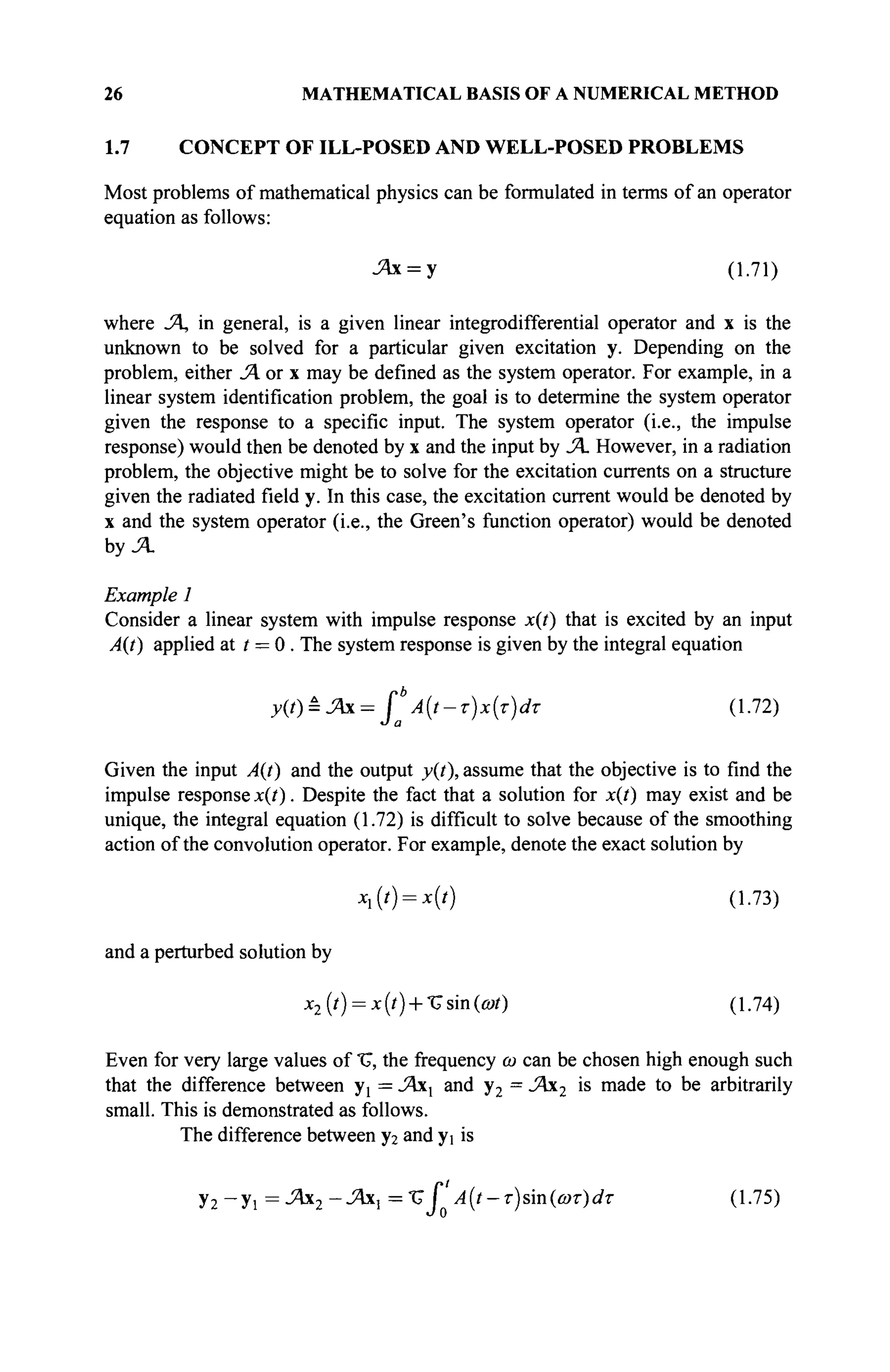
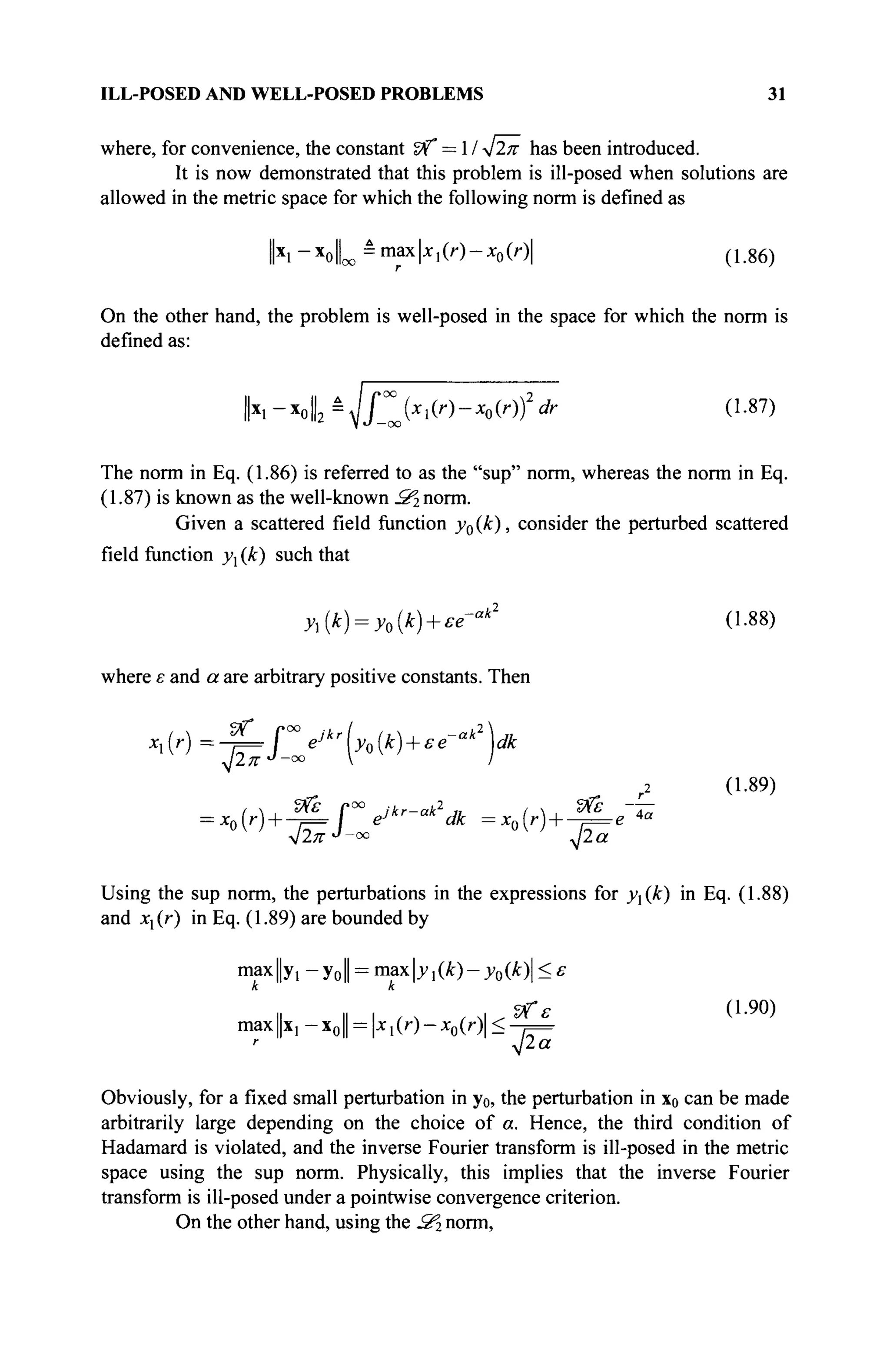
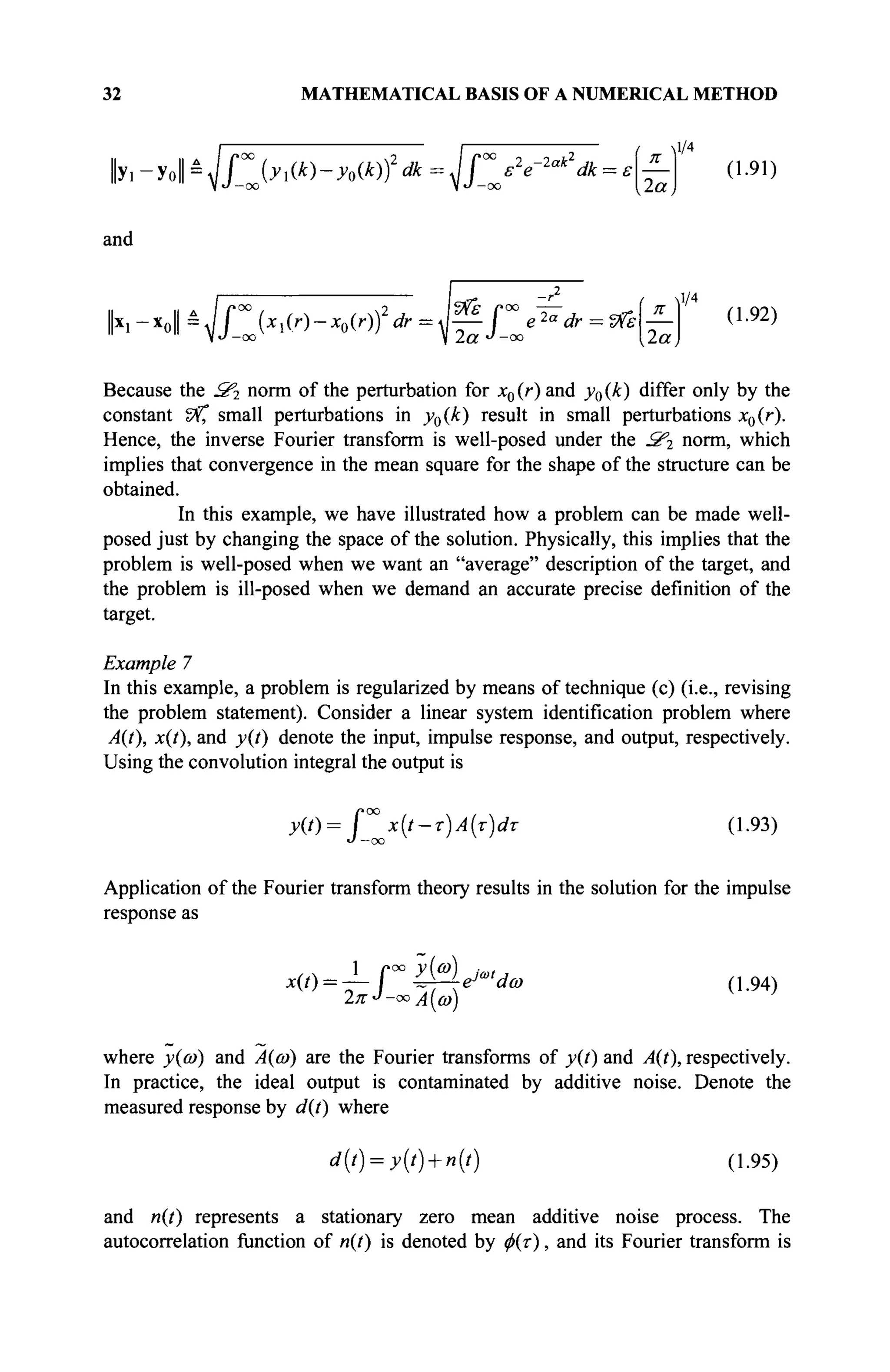
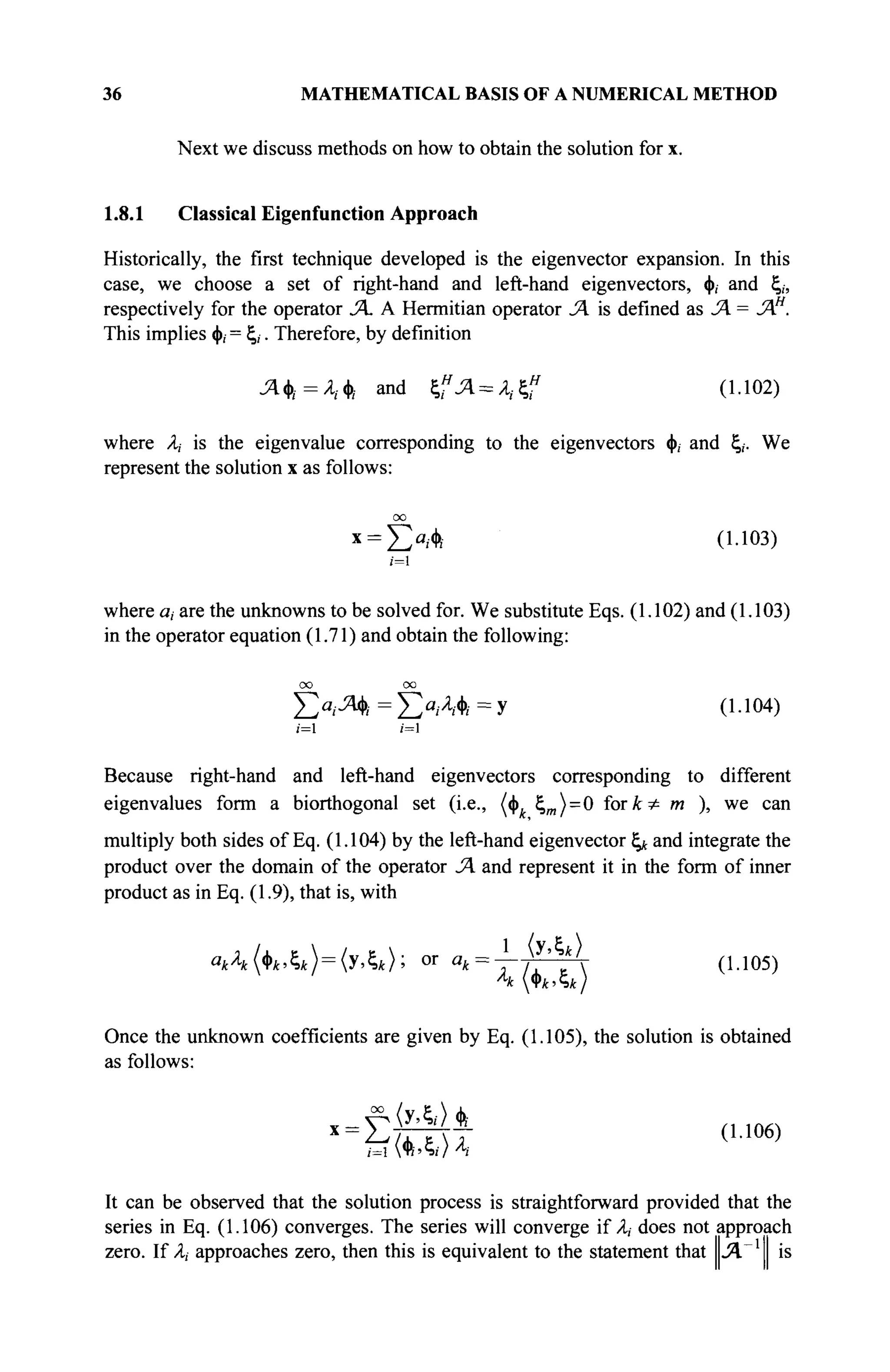
space generally coincides with the addition operation of the field of scalars. Thus,
8 MATHEMATICAL BASIS OF A NUMERICAL METHOD
from now on, we will replace the symbol ©by + and will drop О in favor of
juxtaposition to denote scalar multiplication.
As an example, the field € of complex numbers may be considered as a
vector space H over the field of real numbers 9Я. In addition, points of a two-
dimensional real space R2
form a vector space over the field of real numbers 9Я.
Also, the set of all functions that are at least twice differentiable and satisfy the
form of d2
x/dt2
+ dx/dt — ax = 0 for a is a constant and forms a linear vector
space L2
over С All real-valued functions /(/) of the real variable t that are
continuous in the interval [a,b] form a vector space under the ordinary definition
of addition and multiplication by a scalar. The null element of this space is a
function that is identically zero in the same interval. However, the set of all
polynomials of degree « (where и is a positive integer) does not form a vector
space under the familiar definition for addition and multiplication by numbers as
the sum of two polynomials of degree « and is not necessarily a polynomial of
degree «, where n is the exponent of the leading nonzero term. The set of all
polynomials of degree < « forms a vector space.
1.3.1 Dependence and Independence of Vectors
A set of vectors x, y, z, ..., w belonging to a vector space V defined over the field
$ are said to be linearly independent [1] if
a + ßy + /z- h//w = 0; with α,β,/,...,μ£ $ (1.6)
implies α = β = γ = ··· = μ = 0. If a nontrivial relation of the previous type
exists, where the coefficients do not vanish altogether, then the elements are said
to be dependent.
1.3.2 Dimension of a Linear Space
If a vector space contains n linearly independent vectors (« is a finite positive
integer) and if all n + 1 vectors ofthat space are linearly dependent, then the vector
space is said to be of dimension и [1].
Any set of и-linearly independent vectors of V is said to form a basis for
that space, if every vector of V can be expressed as a linear combination of
elements ofthat set. If a basis in a linear space contains и-elements, then the space
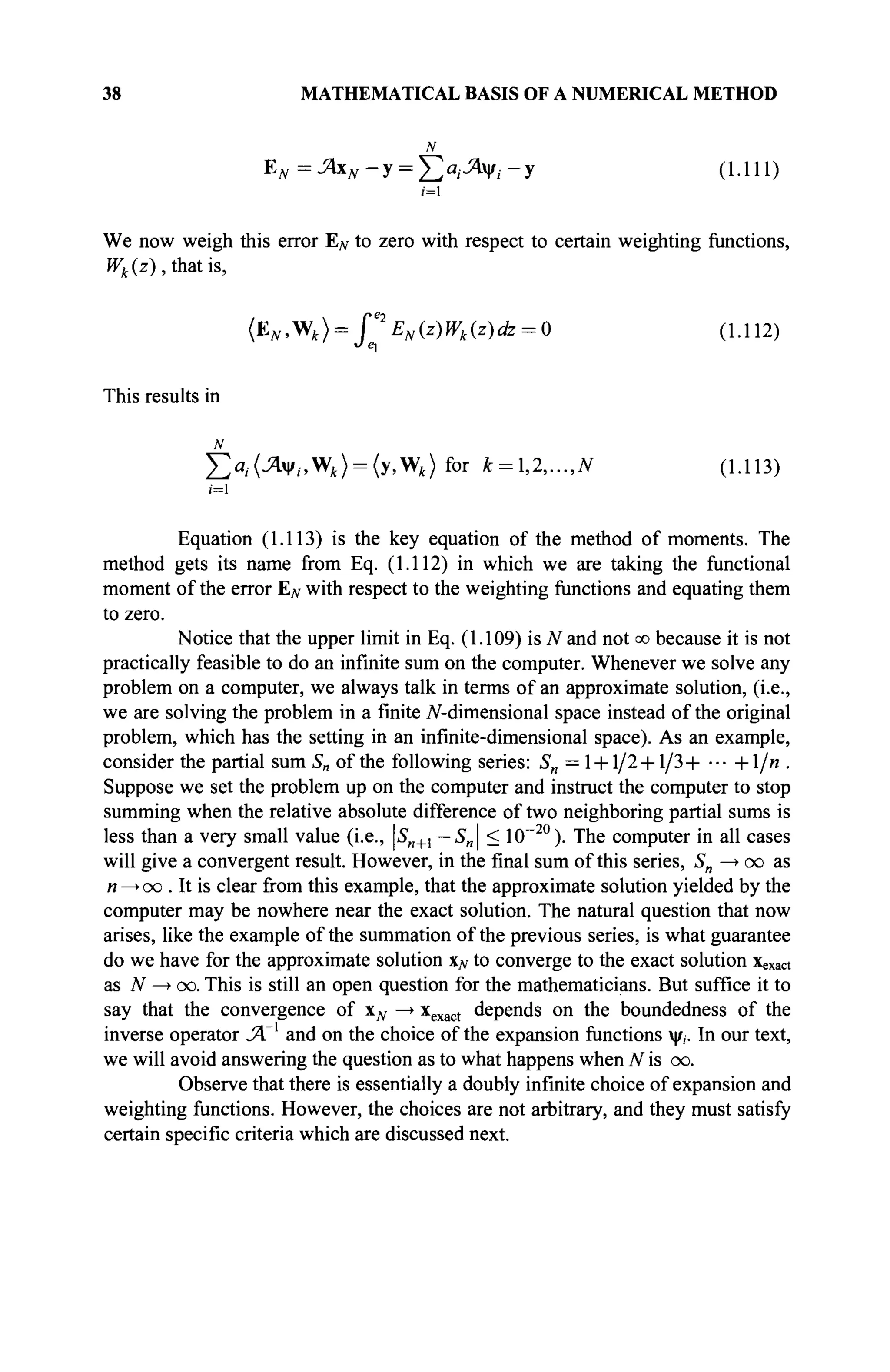
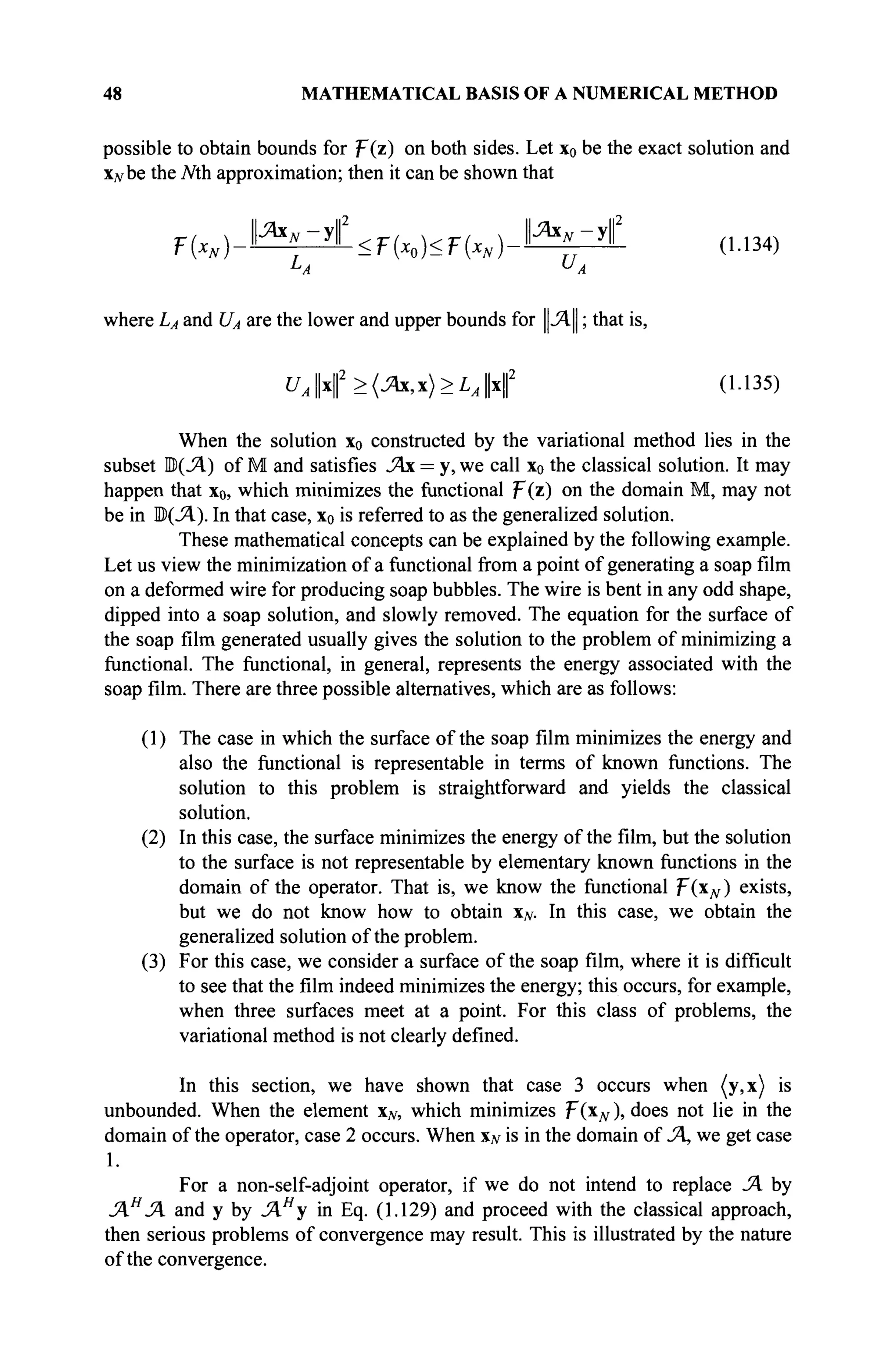
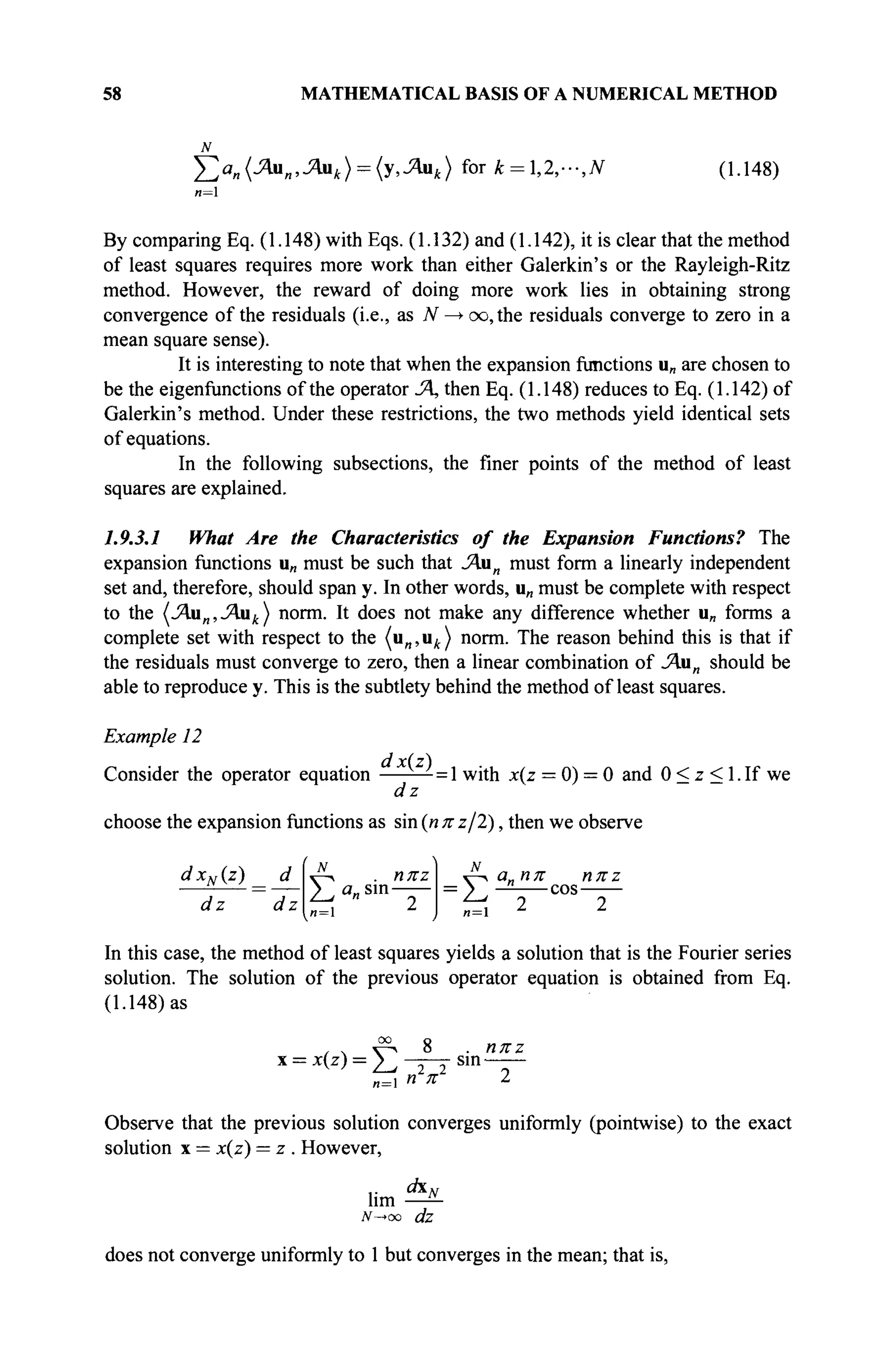
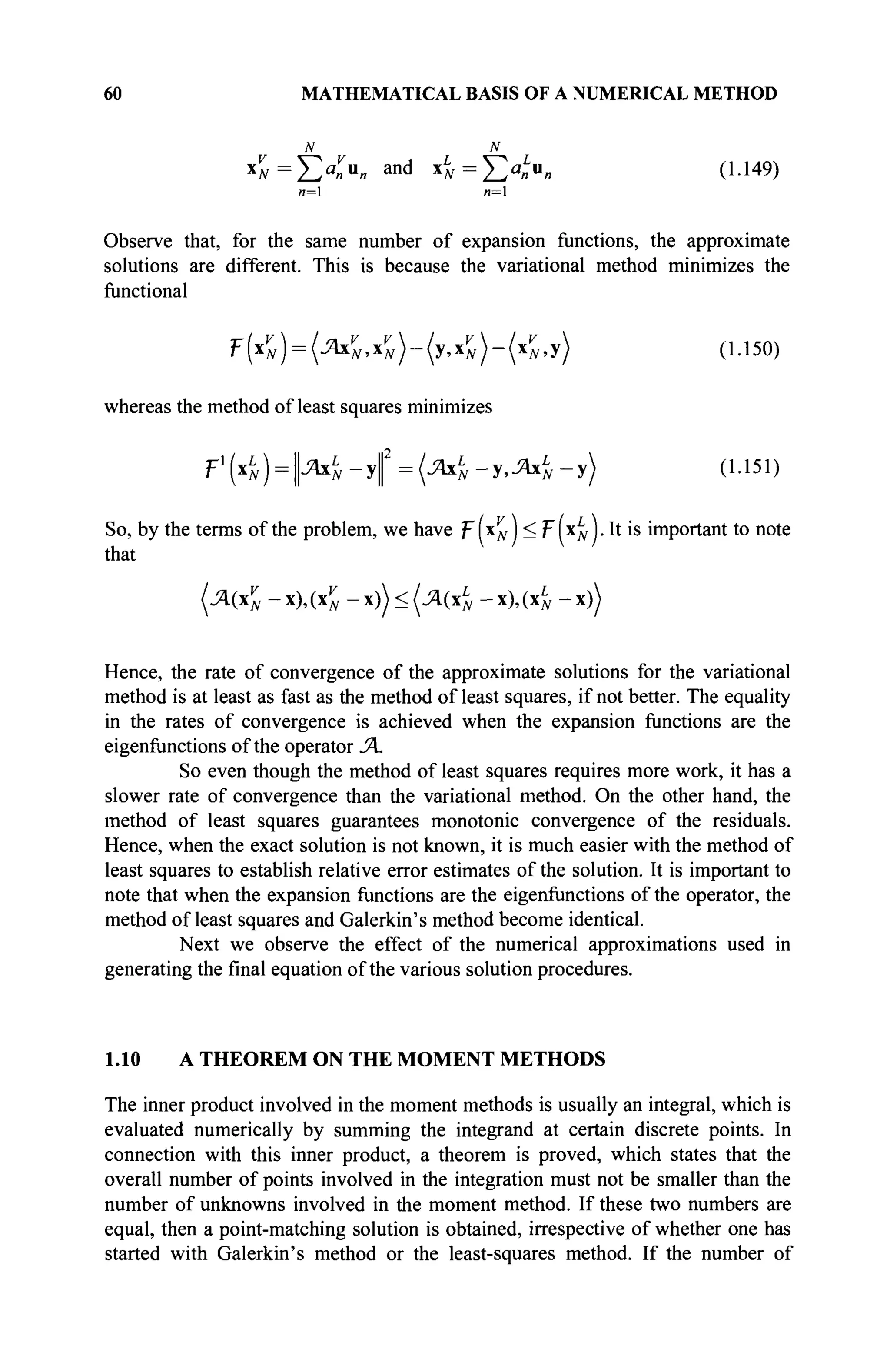
is called an и-dimensional space or simply an «-space [1].
1.3.3 Subspaces and Linear Manifolds
A subset of elements of a vector space V is said to form a subspace W of V if W
is a vector space under the same law of addition and scalar multiplication defined
for V, over the same field J [1]. So the null element is the smallest subspace of V,
and in a manner of speaking, V is the largest subspace of itself. Because any
VECTOR SPACE 9
subspace of a finite dimensional vector space is by itself a vector space, it has
some dimension, and the dimension of the subspace cannot exceed that of the
original space.
If x and y are specified elements of a linear vector space V and if a and ß
are arbitrary numbers of the field #, then the set of elements ax + ßy for all a
and ß in 5 forms a linear subspace. We say that this subspace is generated or
spanned by x and y. Similarly, if {x,y,z,..., w} is a set of vectors V, the
collection of elements of the type ax + ßy + уг H (- μ-w; with
α,β,γ,..., μ G $ forms a linear subspace W. This subspace is called the linear
manifold spanned by {x, y, z,..., w}. The linear manifold spanned by these
vectors is the linear subspace of the smallest dimension that contains them.
Once we are dealing with vectors, we can define it by its magnitude and
the rotation or angle between any two vectors. Associated with these properties,
one can define linear spaces based on these two unique properties of a vector.
1.3.4 Normed Linear Space
A normed linear space [2] (real or complex) in which a real valued function ||u)|
(known as the norm of u) is defined to have the following properties:
(a) ||u|| > 0 ; if u ^ 0 (positivity)
(b) ||u|| = 0 ; if and only if u = 0 (definiteness)
(c) ||«u|| = a x ||u|| (linear scaling)
(d) |u + v|| < ||u| + |v| (triangular inequality)
Here a denotes the absolute value for a. A space with a norm associated with
every element of u in V is called a normed space. It is important to note that a
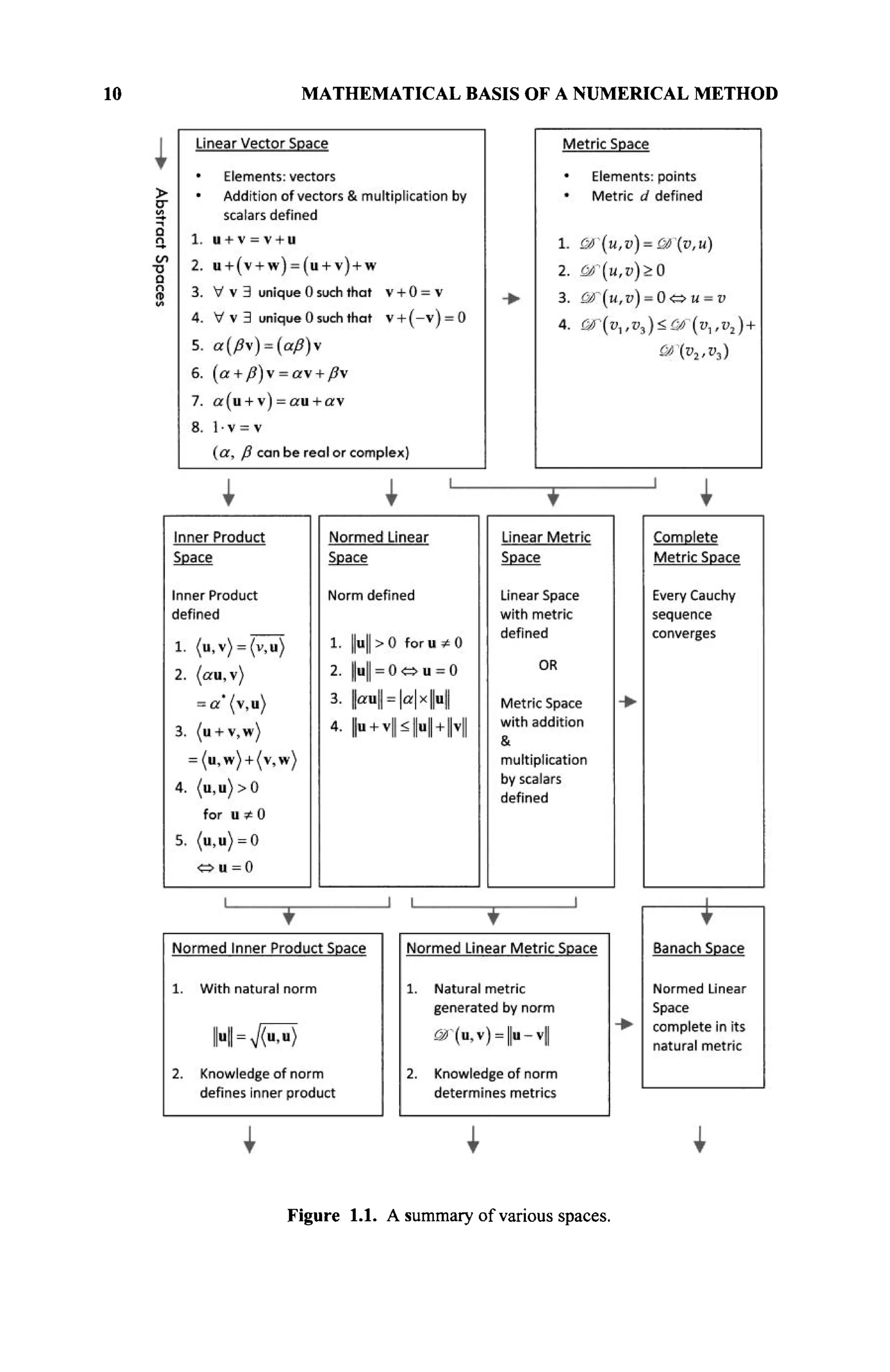
metric space, in general, is different from a normed space. The various hierarchies
of spaces are shown in Figure 1.1.
However, if the metric <Ж(и, v) is identified with the norm so that
<âr(u,v) = |u-v|| (1.7)
then one obtains a normed linear metric space as illustrated in Figure 1.1. So here,
u|| plays the same role as the length of u in an ordinary three-dimensional space.
A normed linear space that is complete in its natural metric, where every Cauchy
sequence converges is called a Banach space, as illustrated in Figure 1.1. The
space of real numbers form a Banach space, but the set of rational numbers does
not constitute a Banach space but a metric space. Similarly, the space of
continuous functions C[a,b] is a Banach space, but the space of square integrable
continuous functions C[a,b] does not form a Banach space.
10 MATHEMATICAL BASIS OF A NUMERICAL METHOD
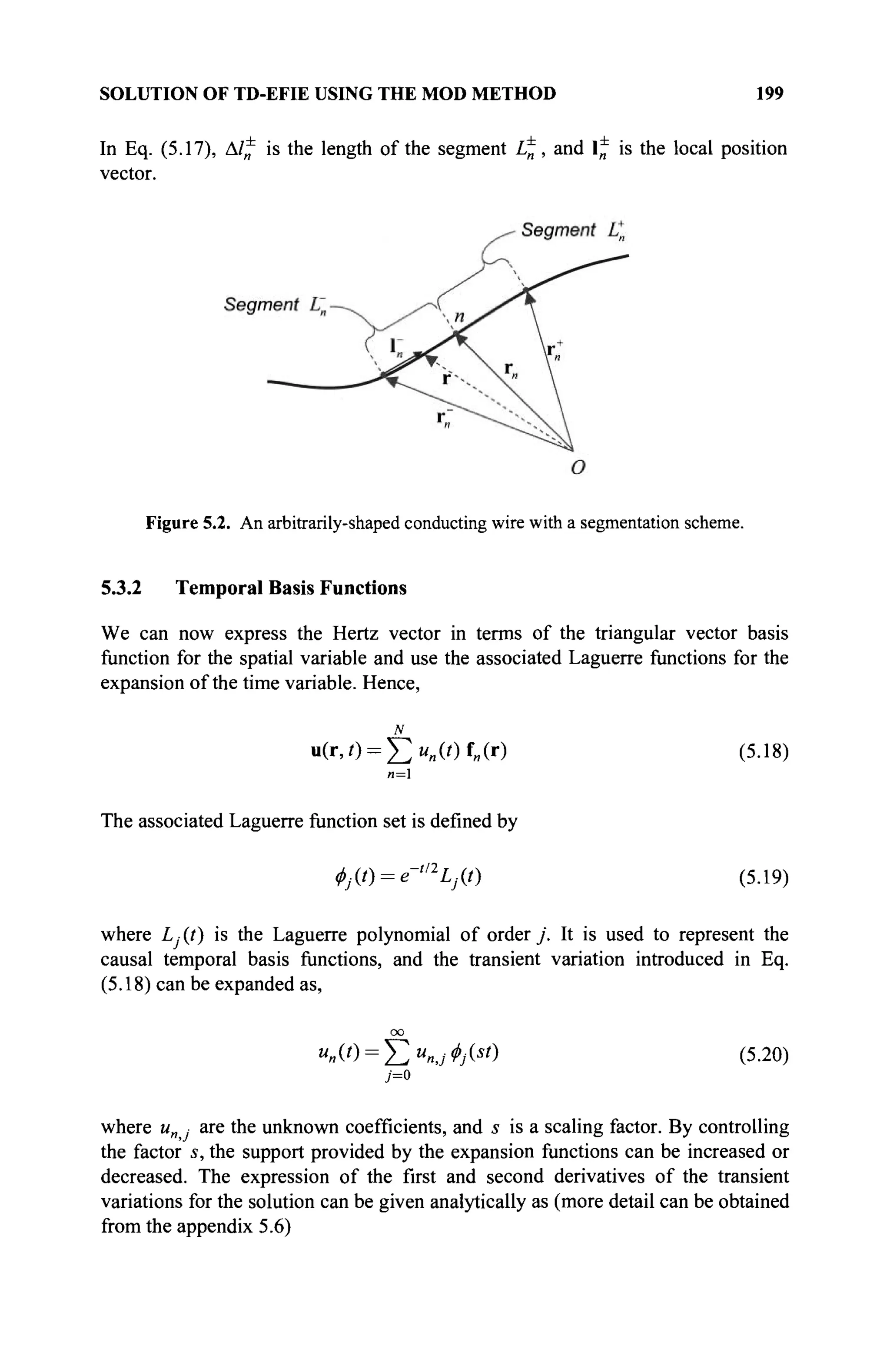
Figure 1.1. A summary of various spaces.
VECTOR SPACE 11
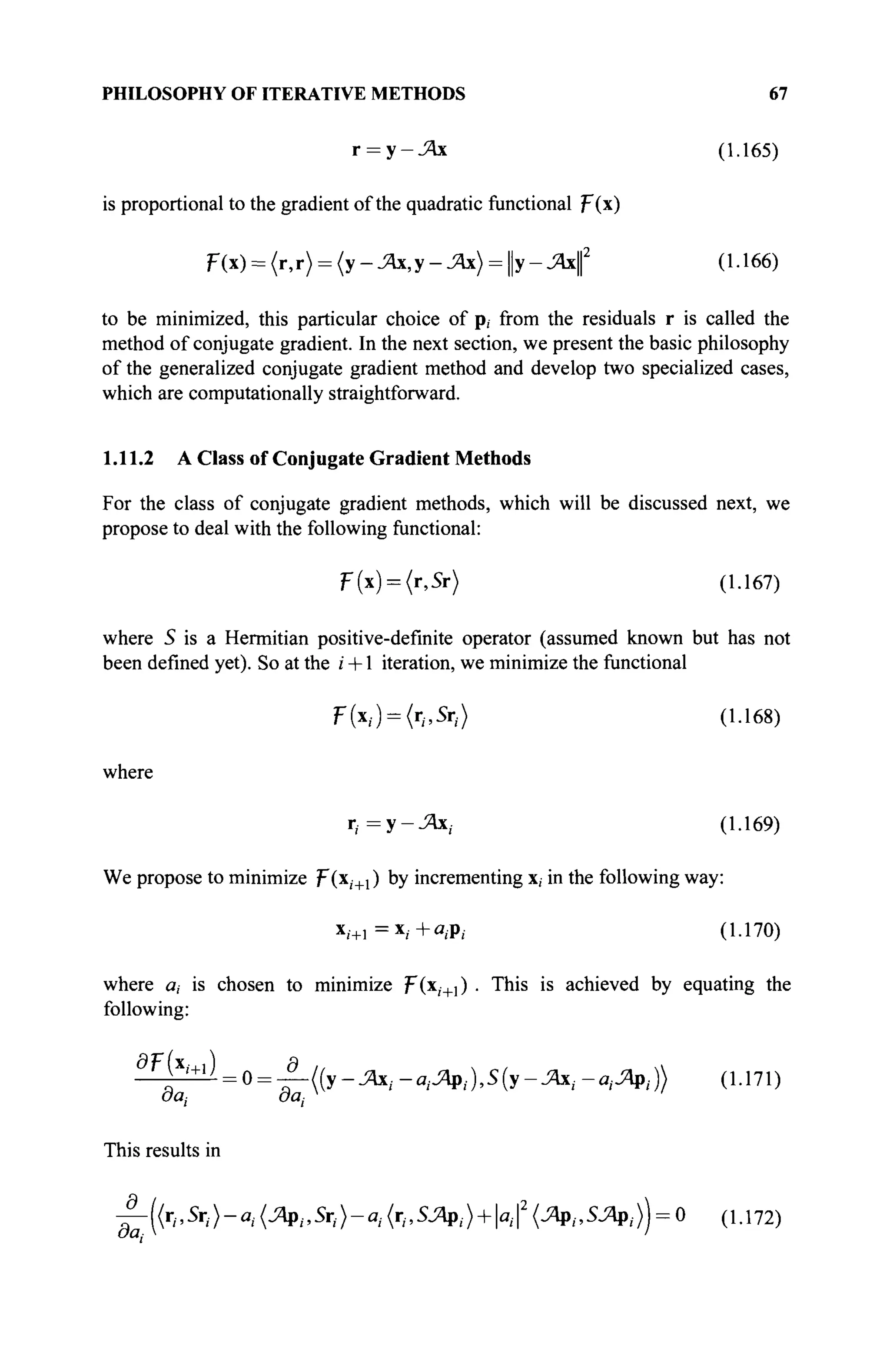
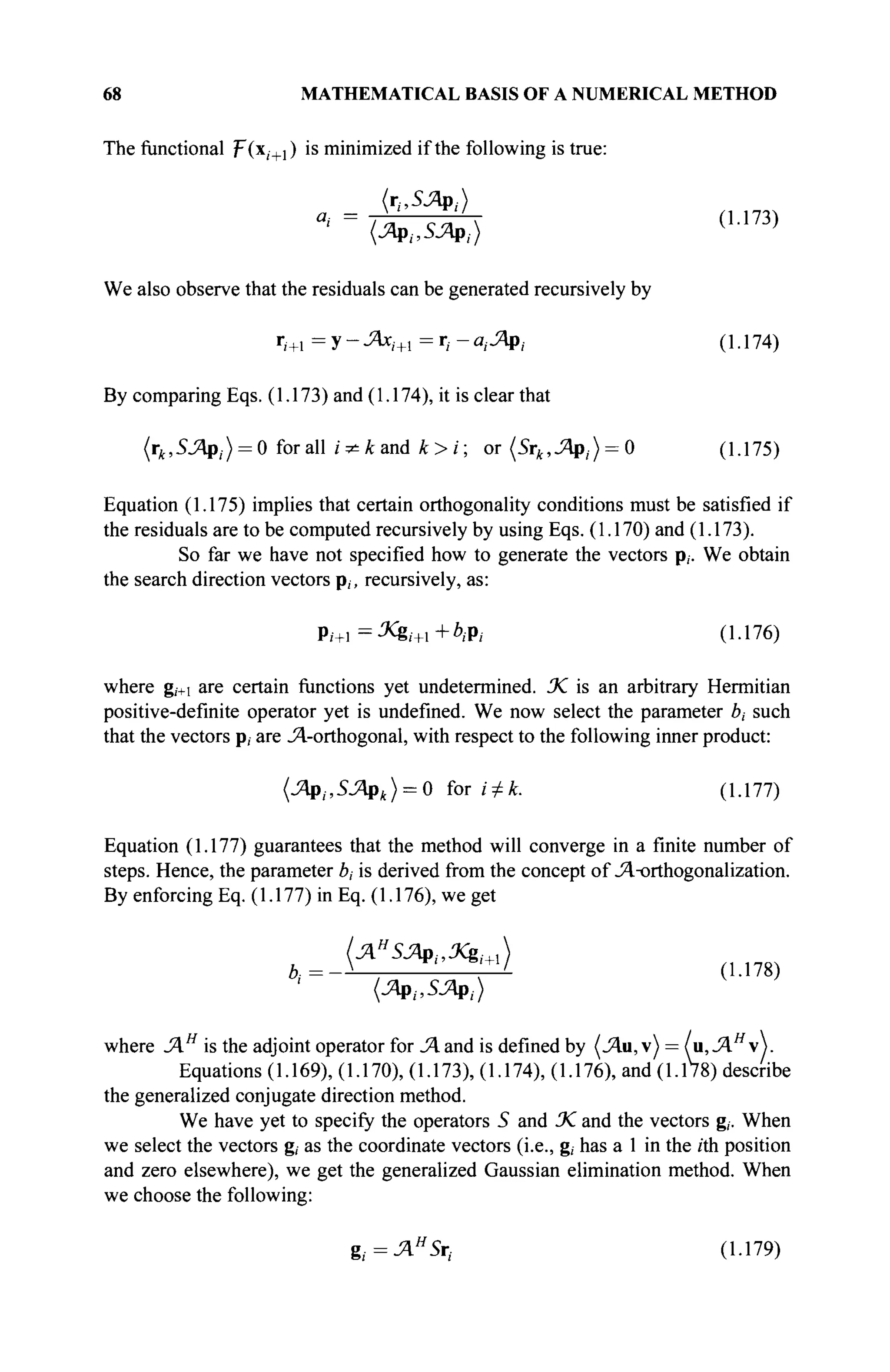
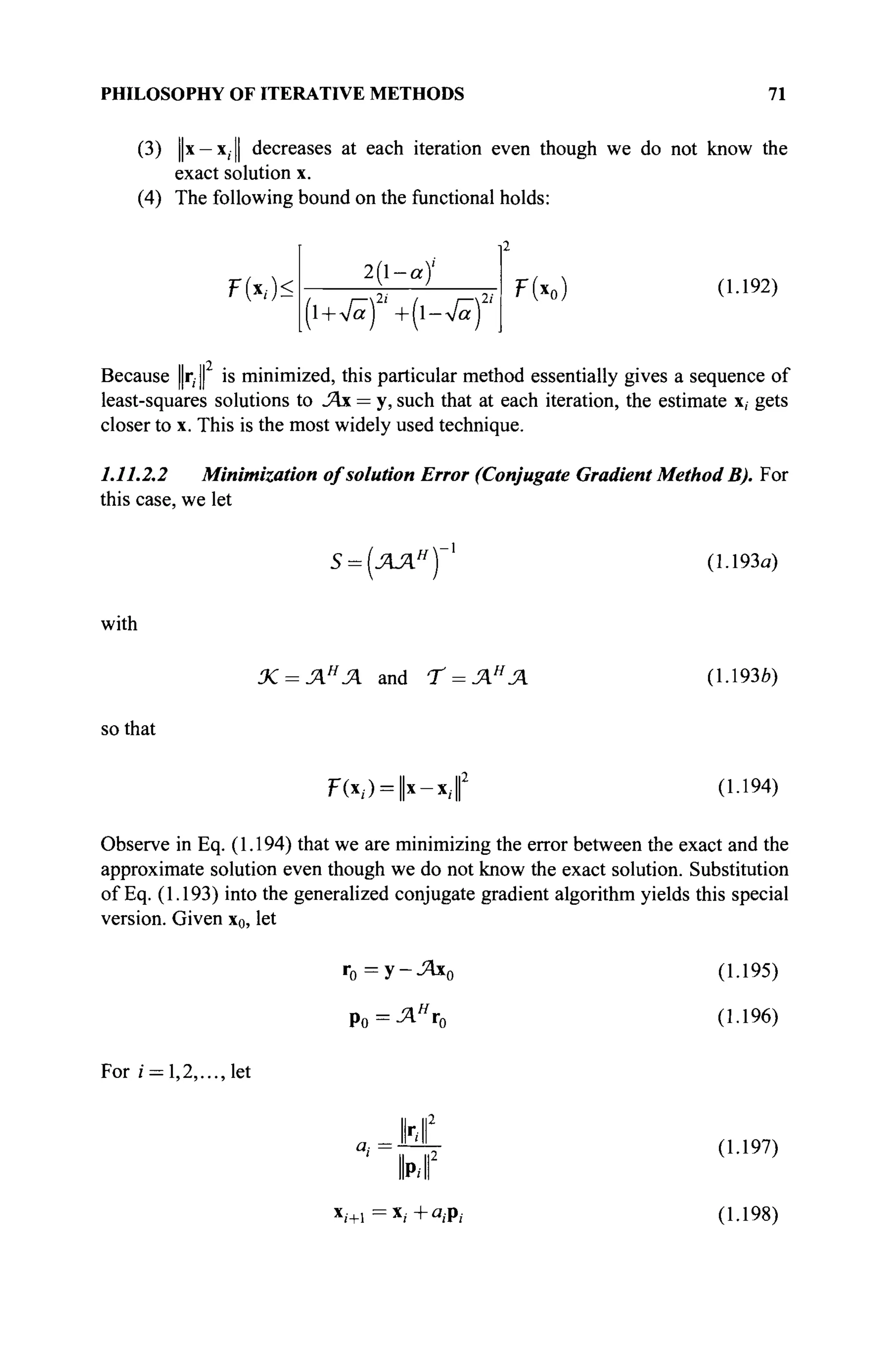
Note: Linear spaces may be finite or infinite dimensional.
1.3.5 Inner Product Space
In a normed linear space, a vector has length. We want to refine the structure
further so that the angle between two vectors is also defined. In particular, we want
a criterion for determining whether two vectors are orthogonal, and it is related to
the dotproduct between vectors.
An inner product (u,v) [2] on a complex linear space X<c>
is a
real/complex-valued function of an ordered pair of vectors u, v with the properties
(a) (u,v) = (v,u)
where the overbar denotes the complex conjugate of an expression.
12 MATHEMATICAL BASIS OF A NUMERICAL METHOD
(b) (au,v) = a(u,v) and (u,ß) = ß (u,v)
where * denotes a complex conjugate of a scalar.
(c) (u + v,w + y) = (u,w) + (v,y) + (v,w) + (u,y)
(d) (u, u) > 0 for u ^ 0 and is a real value,
(u, u) = 0 for u = 0 (the inner product is positive definite)
(e) |(u,v)| <(u,u)(v,v) (equality holds if and only if u and v are
linearly dependent)
Two vectors are orthogonal if their inner product is zero. Orthogonality is
an extension of the geometrical concept of perpendicularity in Ш2
or M3
space.
As an example, in a space with complex elements, the inner product is
given by
(u,v) = n,v*+ u2v*2 + ■■■ + u„v*„ (1.8)
if (u, v) = 0 , then u is geometrically perpendicular to v.
In the space of continuous functions, the inner product is defined in the
complex function space as
(f,g)= fb
f(z)gz)clz (1.9)
О а
So two complex functions are orthogonal if their average is zero; that is,
{i,%) = jj{z)gz)dz = 0 (1.10)
Sometimes it is convenient to define a weighted inner product as follows:
(f,g)= [b
w(z)f(z)gz)dz (1.11)
J a
where w(z) > 0 on [a, b] and is called the weight function. If g is real,
then g(z) will be used instead of g (z).
A space with an inner product associated with any two elements of u and
v in V is called an innerproduct space as shown in Figure 1.1.
One also could obtain a normed inner product space as shown in Figure
1.1 if we identify the norm with the inner product as;
I H ^ T ^ (1.12)
that is, the knowledge of the norm defines the inner product.
VECTOR SPACE 13
Finally, one could obtain a normed inner product space with its natural
metric as illustrated in Figure 1.1 if we relate the norm, inner product, and the
metric by
^r(u,v) = ||u-v|| = A / ( u - v , u - v ) (1.13)
With the metric defined, we now can use the concept of convergence, which is
repeated here for convenience: A sequence {мк} is said to converge to и if, for
each ε > 0, there exists an N > 0 such that uk - u|| < ε , with k> N .
An inner product space, which is complete in its natural metric, is called a
Hubert space as illustrated in Figure 1.1.
For complex-valued functions u(x) defined in a<x<b, for which the
Lebesque integral
J u(x) dx
a
exists and is finite, we can define
llu
ll2
f u(xfdx (1.14a)
JSÇ(U,V) = | U - V | | 2 = Jjb
u(x)-v(x)2
dx (1.14b)
and the norm is called the JS^ norm. The Cauchy-Schwartz inequality becomes
Г u(x)v*{x)dx < A I u(x)2
dx x Jj v(x) dx (1-15)
The space C[a,b] of continuous functions (real- or complex-valued) on a bounded
interval a<x<b is a normed space under the definition
u = max
1
1 llo
° a<x<b
l"W| (1.16)
This norm generates the natural metric
^ O ( u , v ) = ||u-v|o o = maxu(x)-v(x) ( U 7 )
and C[a,b] can be shown to be a Banach space — a complete normed space [2],
as this norm cannot be derived from an inner product. The reason that this space is
14 MATHEMATICAL BASIS OF A NUMERICAL METHOD
not a Hubert space but a Banach space is because the inner product cannot be
generated for this metric.
Let Ω be a bounded domain in 9t" with a boundary Γ. Consider the set 6
of real-valued functions that are continuous and have a continuous gradient on Ω.
The following bilinear form
( ρ , 4 > 6 = / η ( ν « . ν ν ) Λ (1.18)
is an admissible inner product on M. The completion of M in the norm generated
by this inner product is known as the Sobolev Space Η'(Ω). This is a subset of a
Hubert space [2]. The term "completion of space M" implies that the limit point of
some sequence of functions is not a member of that space and that these elements
need to be added so as to make the space complete. For example, if we take a
sequence of square integrable functions that are continuous and forms a space
Q, then the limit point of the sequence of continuous functions may result in a
discontinuous function. And these limit points, which are the discontinuous
functions, do not belong to Q. Hence, these extra elements that are the limit points
need to be added to the space Q to make it complete.
1.4 PROBLEM OF BEST APPROXIMATION
If we wish to approximate an element u by an arbitrary set {u,, u2,..., uk}, that
is, we wish to find the element
к
i = l
which is closest to u in the sense of the metric of the space Ш. Because the set of
linear combinations of {uj,u2, ••■,uyt} is a A:-dimensional linear space Mk, this
approximation leads to finding the projection of u in that ^-dimensional linear
space Шк. How to develop this procedure will be illustrated in the next section.
1.4.1 Projections
Consider a Euclidean space E of dimension n and a subspace G of dimension
m<n. The projection theorem then states that an arbitrary element f in E can be
expressed uniquely as
f = g + h (1.19)
where g is in G and h is orthogonal to G (orthogonal to every element of G).
Element g is called the projection (also called a perpendicular projection) of f on
G. The norm ||h|| is the minimum distance from f to any element of G, called the
distance from f to G. So g is the element of G closest to f [1,2].
PROBLEM OF BEST APPROXIMATION 15
Because
| f - a f = | h | | 2
+ | g - a | | 2
(1.20)
it is clear that ||f — a| is a minimum when g = a, and this distance is h.
Alternatively, if {f^fj,...,^} forms a basis that generates a in G, then h is
orthogonal to a. This implies,
(f,.,h) = (f,.,f-g) = 0 or (f,.,f) = (f,.,g), for each f, (1.21)
To calculate g, let
m
and substitute in Eq. (1.21) to obtain
m
(fl,t) = Y,a
k(f
i>{
k) f o r
'' = 1»2,...,m (1.22)
k=
Therefore, [a], the matrix of the coefficients or,, is given by
[«] = [<f
/.f
*>]"1
[(f
/.f
>] (1-23)
The matrix [(f;, fk) is called the gram matrix of the basis {f,}. Because the
determinant of this gram matrix is not zero, the coefficients a, can be obtained
from the solution of Eq. (1.23).
As an example, consider the function f(x) — sin(0.5 π χ) in £H[0, l] and
the subspace E, which is generated by /] (x) = 1 and /2 (x) = x . We wish to
calculate the projector of/on the subspace G. So we have
(f„f) = / s i n — A = 0.6366 (1-24)
о 2
(f2,f) = Jxsin—A = 0.4053 ( L 2 5 )
о 2
(f1,f1) = j ,
* = l ( L 2 6 )
16 MATHEMATICAL BASIS OF A NUMERICAL METHOD
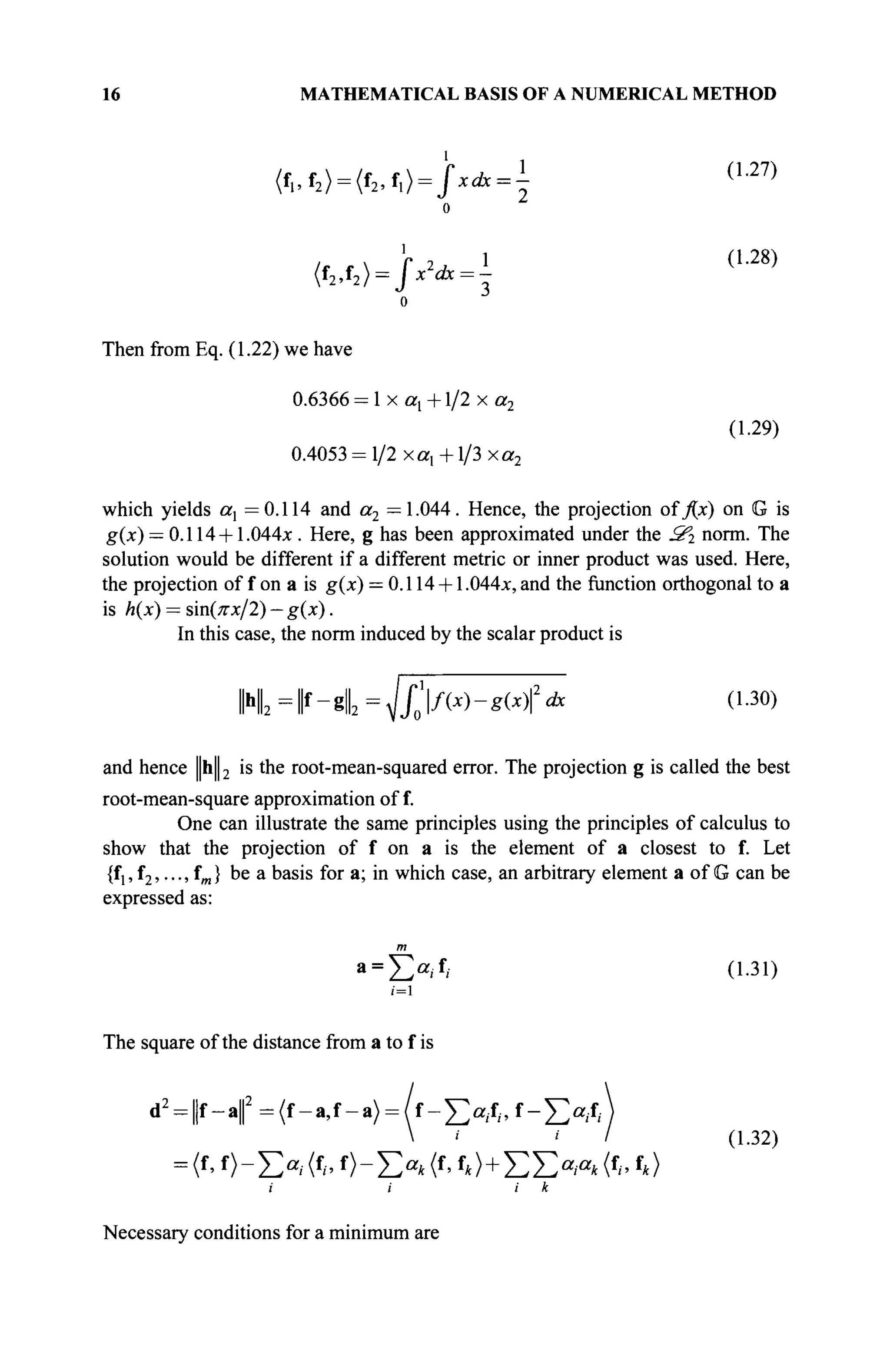
(f„f2) = (f2, ix) = fxdx =  ( L 2 7 )
1 ,
(f2,f2) = fx2
dx = -
1 (1.28)
Then from Eq. (1.22) we have
0.6366 = 1 x ax +1/2 x a2
(1.29)
0.4053 = 1/2 x a, +1/3 xa2
which yields ax =0.114 and a2 =1.044. Hence, the projection oï j(x) on G is
g(x) = 0.114 +1.044x . Here, g has been approximated under the З'г norm. The
solution would be different if a different metric or inner product was used. Here,
the projection of f on a is g(x) = 0.114 + 1.044л:, and the function orthogonal to a
is h(x) = sin(^x/2) — g(x).
In this case, the norm induced by the scalar product is
H fr-gl = <Jfof{x)-g(x)2
dx (1.30)
and hence ||h||2 is the root-mean-squared error. The projection g is called the best
root-mean-square approximation of f.
One can illustrate the same principles using the principles of calculus to
show that the projection of f on a is the element of a closest to f. Let
{fl5 f2,..., fm} be a basis for a; in which case, an arbitrary element a of G can be
expressed as:
а = Х > Д (1.31)
i=l
The square ofthe distance from a to fis
d2
= ||f-a||2
=(f-a,f-a}= f - ^ f , f - ^ f , ·
=(f, f)-E«;(f,·, f)-E«*(f
> f*>+EE»/»*(f
/.f
*)
i i i к
(1.32)
Necessary conditions for a minimum are
MAPPING/TRANSFORMATION 17
= 0 for г = 1,2,···, от (1.33)
out-
performing the required differentiation and rearranging the terms, we have
-({
i>î
) + J2a
k({
,>î
k) = Q
for г = 1,2,..., w ( 1 3 4 )
i
This is identical to Eq. (1.22), which we obtained before, and the problem has a
unique solution {ak}. That this solution provides a minimum value of the error
and is not a maximum is evident from the expression for d2
, which has no
maximum, and its second derivative with respect to a, is (f;, f;), which is
positive.
1.5 MAPPING/TRANSFORMATION
A mapping or transformation [2] from a linear space F to a linear space G is a rule
whereby to each element f in F, there corresponds an element g in G. This is
symbolized by
M:¥^G or equivalent^ by M(i) = g (1.35)
Some mappings of interest are
(a) Function, denoted by f(x) — y maps from the scalar space X with
element x to the scalar space Y with elements y
(b) Functional denoted by L(f) = y , maps from the vector or function
space P to the scalar space Y with elements y.
(c) Operator denoted by 3i(f) = g maps from a vector or function space
W with elements f into itself, and g are also elements of W.
The nomenclature is not uniform in all texts, some of which use the terms
mapping, function, and operator as synonymous.
The element g, corresponding to a particular f
/ in Eq. (1.35) is called the
image of f,. The space W to which the mapping applies is called the domain of JA.,
denoted by Ш)(JA). The set of g resulting from the mapping is called the range or
image of J4 and is defined by R(JA). If the range of JA is the whole W, then the
mapping is said to be onto W. If the range of JA is a proper subset of W, then the
mapping is said to be into W. If 3i(f ) = g maps distinct elements f, into distinct
elements g„ then the mapping is said to be one-to-one. lin elements f, map into the
element g„ then the mapping is said to be n-to-one, and if each element f, maps
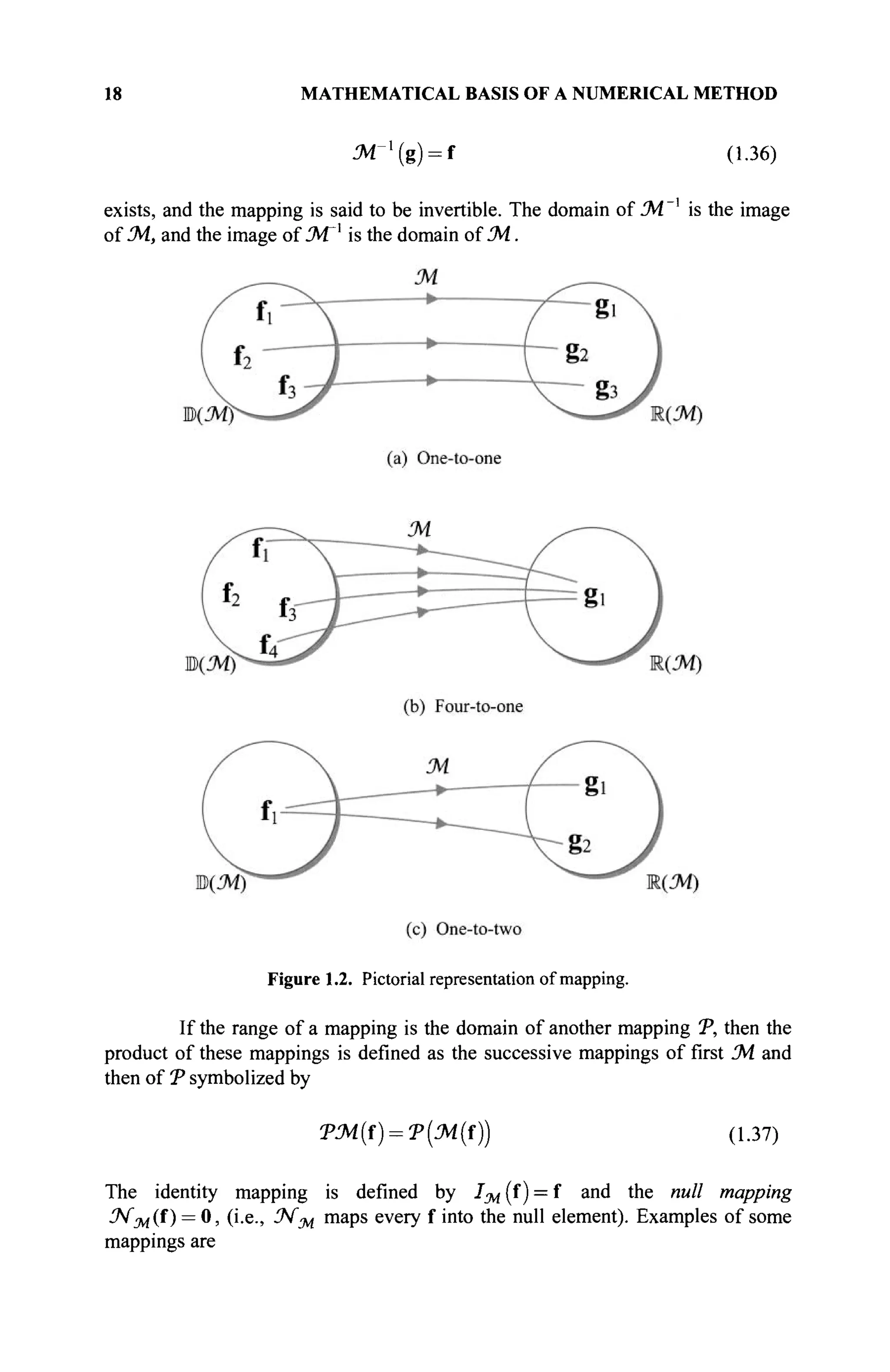
into n elements g„ then it is said to be one-to-n. These concepts are illustrated in
Figure 1.2.
If a mapping is one-to-one and onto W, then the inverse mapping
18 MATHEMATICAL BASIS OF A NUMERICAL METHOD
3i-1
(g) = f (1.36)
exists, and the mapping is said to be invertible. The domain of M "' is the image
of M, and the image of JVT1
is the domain of M.
Figure 1.2. Pictorial representation of mapping.
If the range of a mapping is the domain of another mapping T, then the
product of these mappings is defined as the successive mappings of first M and
then of T symbolized by
TM(i) = T(M(f)) (1.37)
The identity mapping is defined by IM (f ) = f and the null mapping
ΝΜ(ΐ) = 0, (i.e., NM maps every f into the null element). Examples of some
mappings are
MAPPING/TRANSFORMATION 19
function: f(x) = sinx —y (1.38)
functional: φ(ί)= I f(x)dx= I sm(x)dx = y (1-39)
M2
->R; M(x) = xl+2x2 =y (1.40)
; M{x) = X T ~T~ ^•X'i
X-2 Xl
= У2
(1.41)
A transformation Л is bounded on its domain, if for all u in Ш)(Л) there exists a
constant С such that [3]
И»И<с|Н1 (1.42)
Thus, the ratio of the "output" norm to the "input" norm is bounded. The smallest
number V that satisfies the inequality for all u in Ю(Л) is the norm of Л, written
as ||Λ||, and is defined as follows:
II „ II ΙΙ-ЯмЦ и „ ||
Л = sup V Î T = SU
P PH (1-43)
1-й HI I«H
The prefix "sup" implies supremum (i.e., the maximum value attained for any u).
Differential operators are not bounded, whereas the integral operators are bounded
[4, pp. 282-283].
A mapping L is linear if
£(af) = a£(f) and
(1 44)
£(f,+f2 ) = A + £ f 2
for all f and a. The null space, N^ of a mapping is the set {f,} such that
-£(f,) = 0. The null space of any linear mapping must contain the null element
f — 0. A linear mapping i o n a finite-dimensional linear space has an inverse if
and only if f = 0 is the only solution to £(f ) = 0.
An important property for differential operators is that they are usually
not invertible unless boundary conditions are specified. As an example, consider
the operator T) = d/dx and the space P" of polynomials of degree n — 1 or less. If
f is a constant a, then Of = da/dx = 0 and f is an element of the null space.
Therefore, T) is not of polynomials f(x) for which /(0) = 0 , and then D is
invertible. The procedure can be described in two equivalent ways:
(a) The boundary condition / ( 0 ) = 0 is a part of the definition of the
operator.
(b) The boundary condition / ( 0 ) = 0 restricts the domain of the operator.
20 MATHEMATICAL BASIS OF A NUMERICAL METHOD
Even if JA is bounded, the supremum may not be attained for any element u. If
||Λ|| = 0, then JA is the zero operator. If JA is continuous at the origin, then it is
continuous on all of B(JA), and 1A is continuous if it is bounded. A linear
transformation SA into itself is characterized completely by its values through a
fixed basis h,, h2, · · ■, h . Indeed if we can write
u = ^ a r h and v = JAa = У^а,-Ah,·
j= j=
then the knowledge of и vectors JAb}, JAb2,..., JAhn enables us to calculate JAa
or v.
1.5.1 Representation by Matrices
Consider a linear mapping £ from a space W with elements f to a space G
resulting in elements g, that is, £(f ) = g. Let {fj, f2,..., f„} be a basis for W and
express an arbitrary element f in W as
Substitute this equation into the linear mapping g = £(f ) and obtain
(1.45)
g = £ [ / ] = £ Î>/f
/
;=1
:
Σ«/Α- (1.46)
Because every element in G can be written in this form, {£f,} must span G.
However, the {£ft} may be linearly dependent and, hence, may not form a basis
for G. We can obtain a basis {gi,g2,---,g„} for G from the {£fj} and express
the g in this basis as
g = Agi + ßi%2 +
and express each £ft in this basis as
ßn&r, (1.47)
Α=ΰίΐΐ8ΐ+α
2ΐ82+ ■■■+a
mZm
£f2 = 0,2g! + «22g2 + · · · + am2g„
A = a
l„8l + «2«82 + · · · + amng„
(1.48)
In terms of these matrices, one can write that [£l] is the column matrix of £ft,
[g] is the column matrix of g,, and
MAPPING/TRANSFORMATION 21
[A]:
an au
a
2 a
22
a
m a
m2
*n
л
2п
(1.49)
Hence, one can write
[sT
ß]=[A]T
[g{[a] = [gT
[A[a (1.50)
This is valid for all [g]r
, and therefore, the coefficient vectors [a] and [ß] are
related by
[/>] = № ] (1.51)
Hence, for every linear mapping £(f) — g, we can find a matrix representation
[Λ][α] = [/?]. As there are infinitely many basis sets, hence, any linear mapping
£(f ) = g can be represented in infinite ways by the matrix equation [Λ][α] — [/?].
1.5.2 Linear Forms
A linear mapping from a space V to the scalar field ÎH or С is called a linear form
or linearfunctional. If V is the space of и-tuples 9Ί" or <£", then a linear iormjXx)
can be written as
_р(х) = сЛ+с2х2+-+спхп (1.52)
where cl,c2,...,cn are constants. In vector form, this can be written as follows:
J»(*) = [cfx (1.53)
[C]T
is the row vector of components c,.
If V is a space of function f(x) defined on the interval a < x < b, then a
commonly encountered linear form is
j>{f)= f"c(x)f{x)dx (1.54)
where c{x) is a fixed function.
More generally, a linear form can be written as
22 MATHEMATICAL BASIS OF A NUMERICAL METHOD
Xf) = f*c{x)£(f{x))dc (1.55)
where £ is a linear operator.
Let M be a linear manifold in the separable complex Hubert space H (a
space that contains an orthonormal spanning set, or in other words, a basis exists
for that space). If to each u in M there corresponds a complex number, denoted by
£(u), satisfying the condition.
£(au + ß) = a£(vt) + ߣ(x) for all u, vin M (1.56α)
and for all complex numbers a, β. We say that £ is a linear functional in M. A
linear mnctional satisfies £(0) = 0 and
£ Î2a
ia
J = Èa
A»j) (1-566)
У=1
A linear functional is bounded on its domain M if there exists a constant
"U such that for all u in M, |£(u)| < TJ|ju||. The smallest constant "U for which this
inequality holds for all u in M is known as the norm of £ and is denoted by ||£||.
A linear functional continuous at the origin is also continuous across its
entire domain of definition M. Boundedness and continuity are equivalent for
linear functionals. A functional whose value at u is ||u|| is not linear. It is also of
interest to note that to each continuous linear functional £ defined on the space H
corresponds an unambiguously defined vector f such that
£(u) = (u,f) for every u in M (1.57)
1.5.3 Bilinear Forms
A mapping involving two elements, x in V] and y in V2 (V and V2 may be the
same space), to the scalar field Ü
H or € is called a bilinear form or a bilinear
functional if it is linear in each element. In other words, Л(х,у) is a bilinear form
if
Л(а1х1+а2х2,у) = а1Л(х1,у) + а2Л(х2,у) and (1.58)
Л(х,а1у1+а2у2) = щЯ(х,у1) + а2Л(х,у2) (1.59)
for all x and y. If Vi and V2 are complex spaces of и-tuples, then a bilinear form
can be written as
THE ADJOINT OPERATOR 23
A(x,y) = [xf[A}[y} (1.60)
where [A] is a matrix and the superscript H denotes the conjugate transpose. Note
that if x is a constant, then JA(x, y) is a linear form in y, and if y is a constant,
then JA(x, у) is a linear form in x.
If Vi and V2 are function spaces, then a possible bilinear form in terms of
a single variable is
^(f,g) = fb
f{x)g{x)dx (1.61)
J a
More generally,/and g may be operated on by linear mappings. For example,
A(i,g) = fb
dxf{x)fb
g{x-y)dy (1.62)
О а О а
is a bilinear form. Again, note that if one function is kept constant, then the
bilinear form reduces to a linear form in the other function.
1.5.4 Quadratic Forms
If both arguments of a bilinear form A(x,y) are the same, then we obtain a
quadratic form or quadratic functional q(x) = JA(x, x). If x is an и-tuple, then the
general quadratic form is
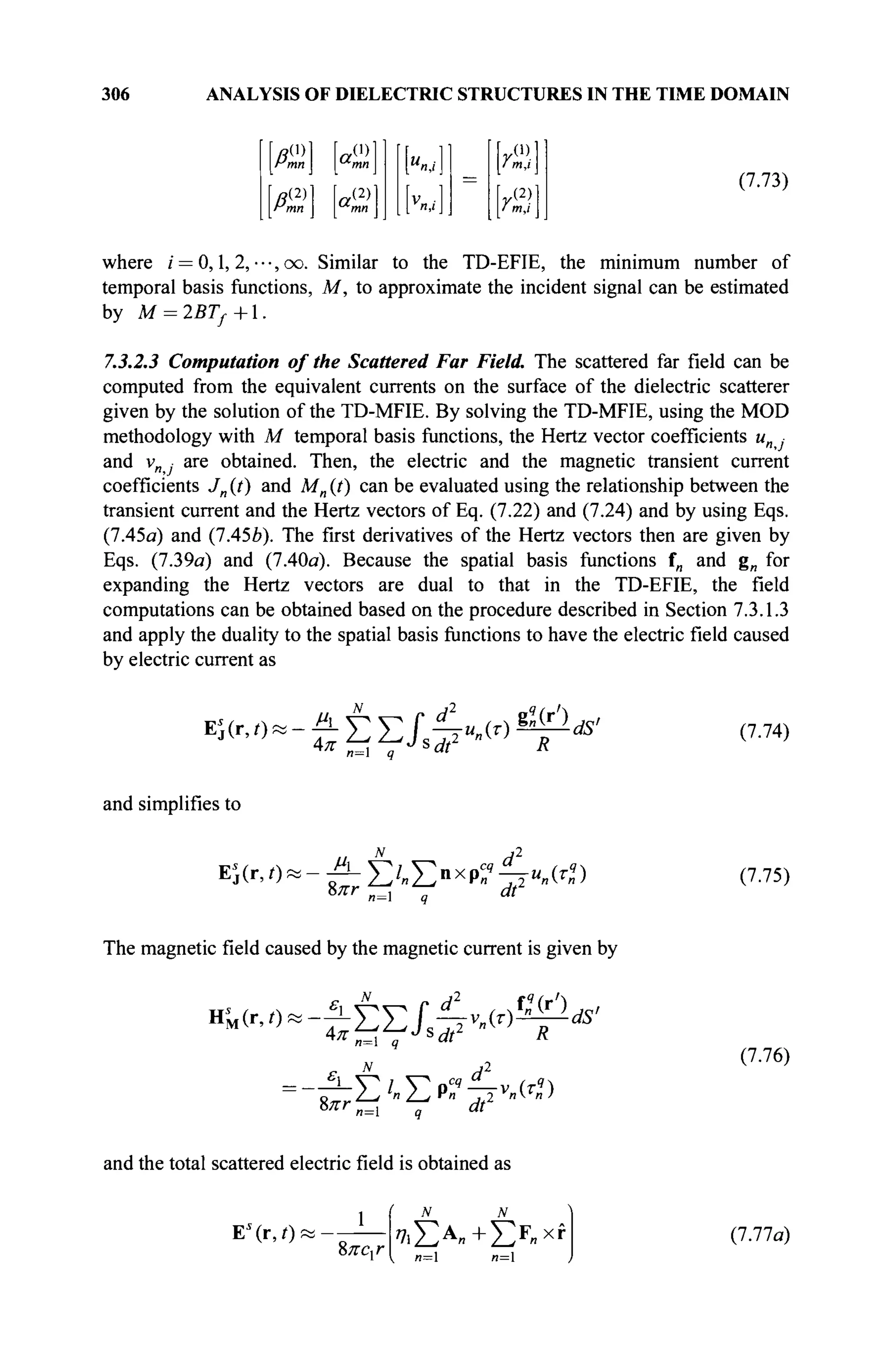
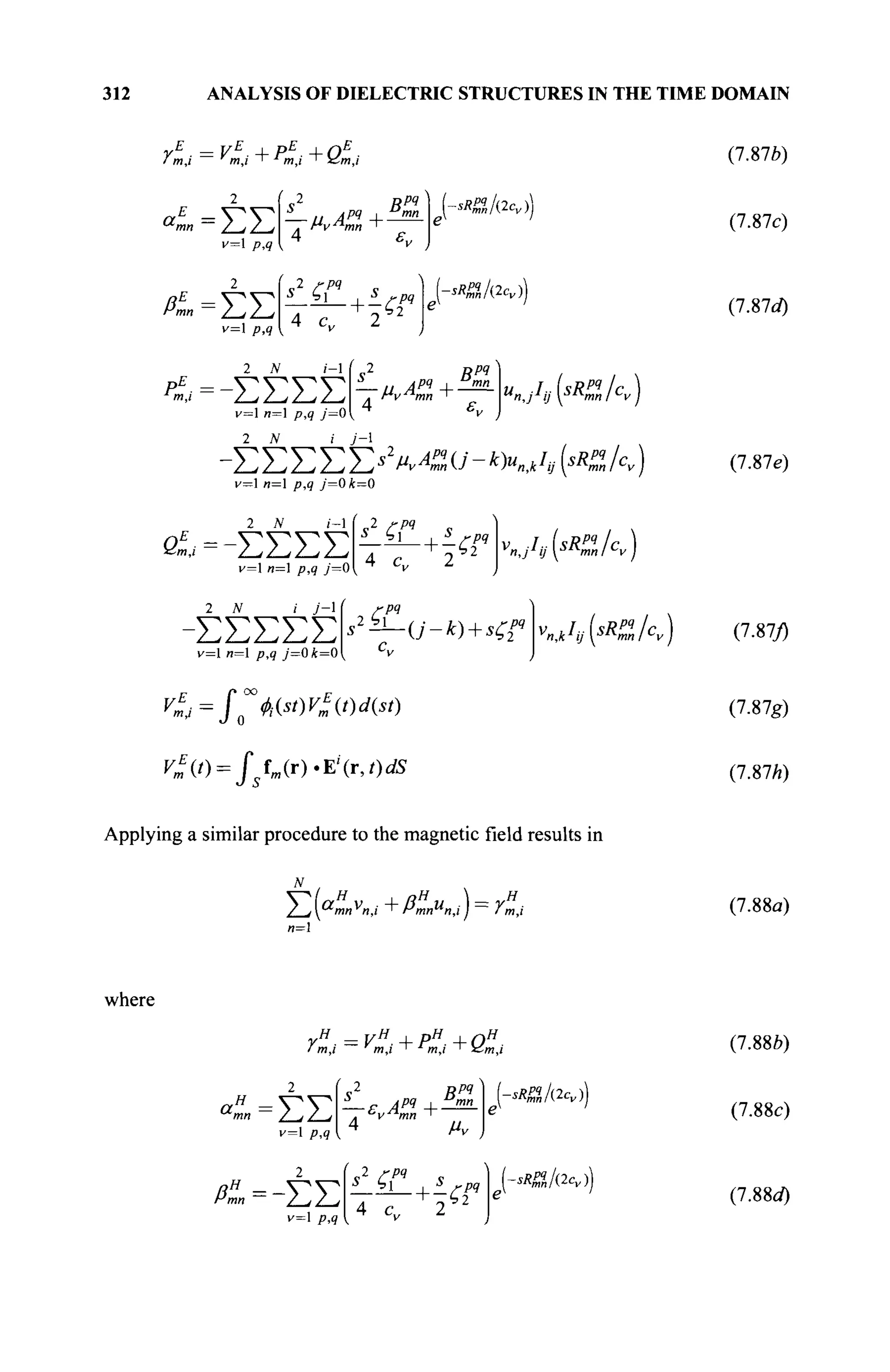
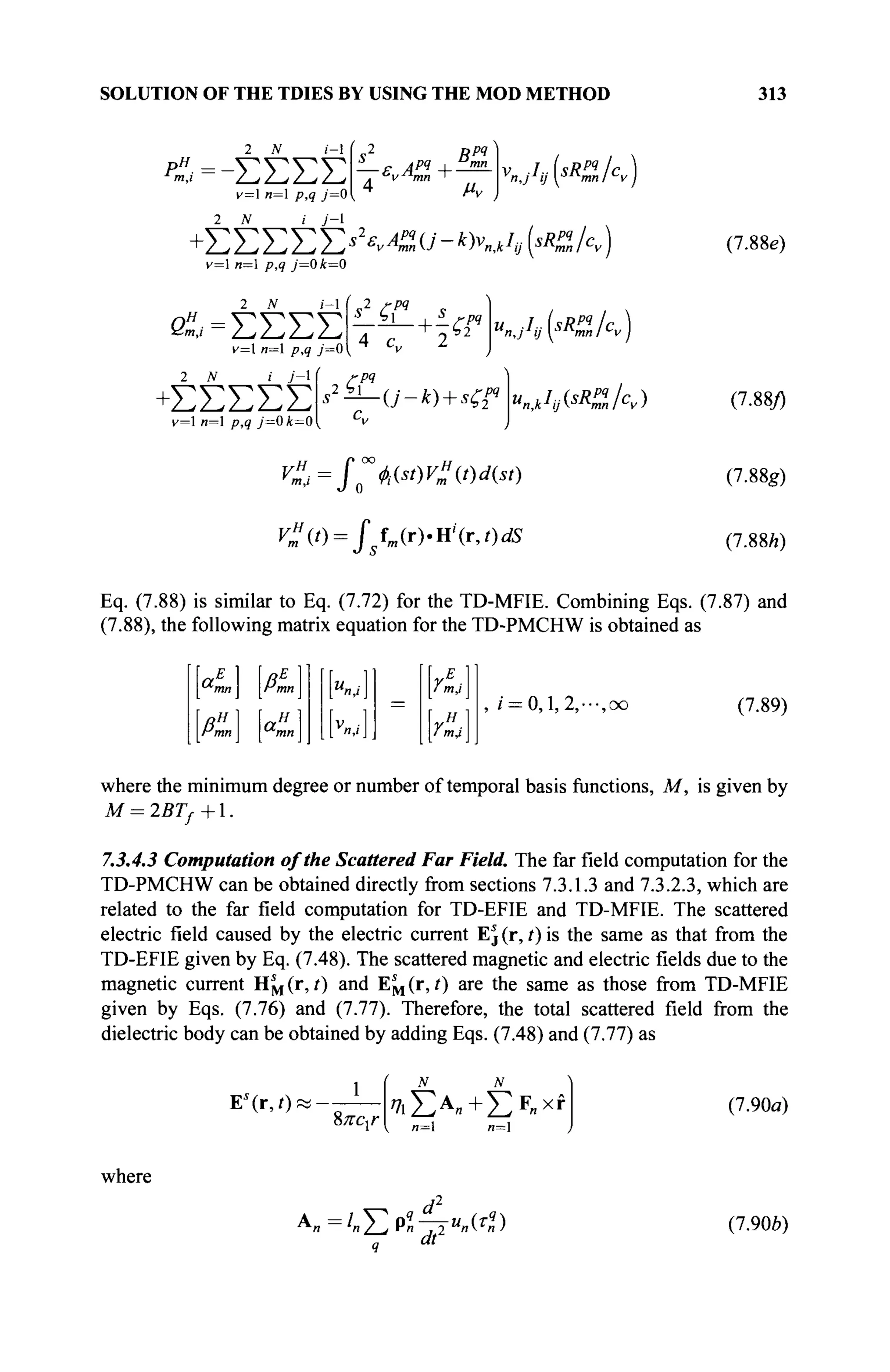
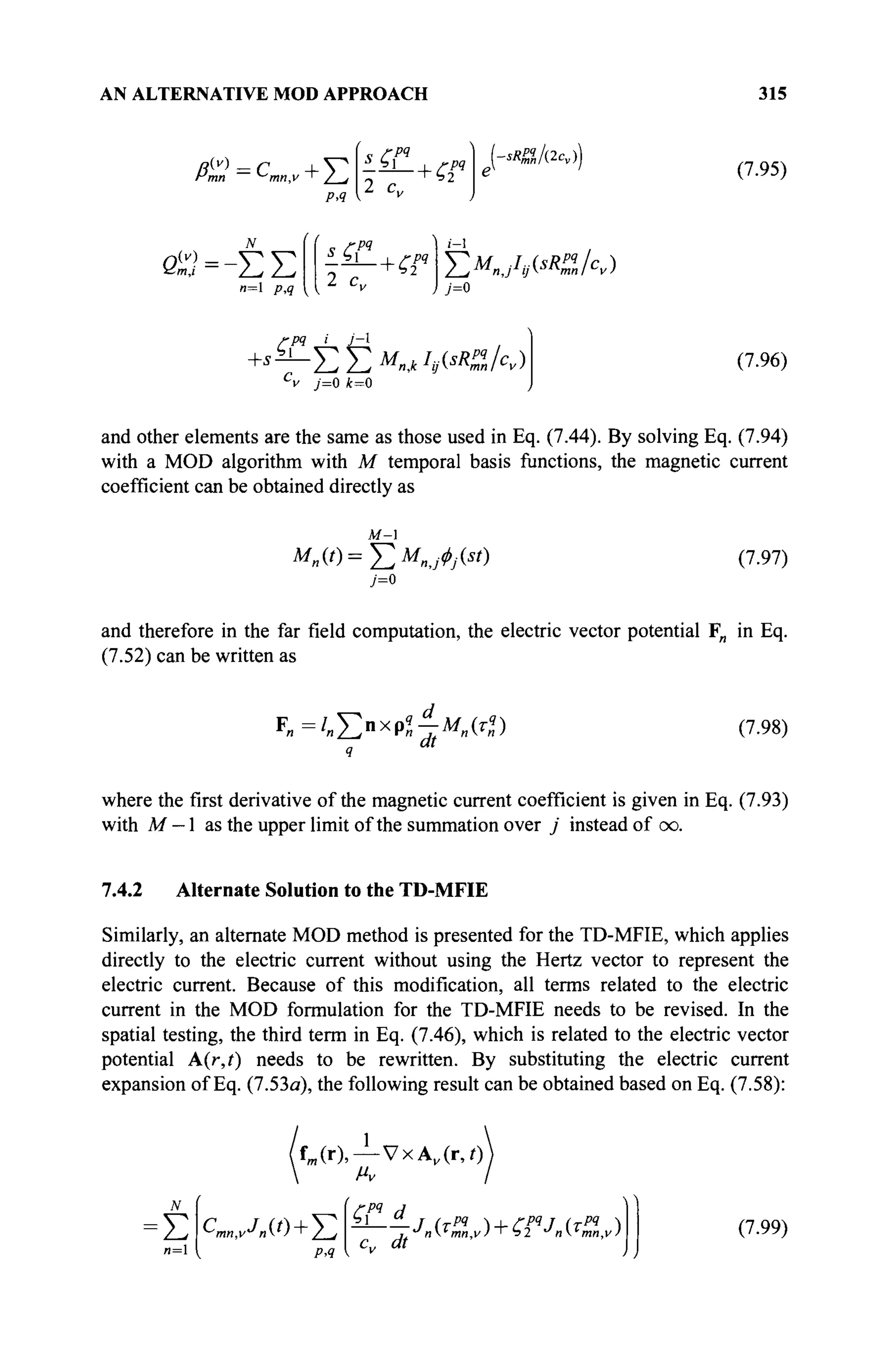
q(x) = A(x,x) = [xf[A][x] (1.63)
obtained by setting x = y. Note that A must now be an x n matrix [A]. There is
no loss of generality if we also assume [A] to be symmetric.
If the argument of a quadratic form is a function, then we can also
construct a symmetric bilinear form associated with it. In general, we have
q(f + g) = A{t + g,f + g) = A(f,f) + A(t,g) + A(g,t) + A(<g,g) (1.64)
If it is specified that A(î,%) = A(g, f), then
^(f,g) = | ( i ( f + g ) - q ( f ) - i ( g ) ) (1.65)
1.6 THE ADJOINT OPERATOR
The adjoint operator Ά is defined by [3,4]
24 MATHEMATICAL BASIS OF A NUMERICAL METHOD
(JZU,W) = ( W , ^ J ) (1.66)
for all ЗеШ(Л) and W e Ю(ЛЯ
). The operator Л is self-adjoint not only if
Я = JAH
but also requires ЩЛ) = ЩЛН
). If the two domains are not equal,
then the operator JA is called symmetric. The operator JA tells us how a system
will behave for a given external source. The adjoint operator, however, tells us
how the system responds to sources in general. Thus, the adjoint operator provides
physical insight into the system. An operator is said to be self-adjoint if
(Λχ,ζ) = (x,JAz) for all functions in the domain of JA. A self-adjoint operator is
said to be positive definite if (JAz, z) > 0 for z ^ 0.
For a differential operator, the adjoint boundary conditions are obtained
from the given operator and its given boundary conditions. For example, consider
the following second-order differential operator in the region between a and b [3,
4]:
JA= у with S,(M(x = a)) = a <ma Ъ1{и{х = Ъ)) = ß (1.67)
then we have from the definition of the adjoint operator
ь
f(wJAJ-JAH
w)dz = {'B(j,W)}b
a (1.68)
a
By equating the term (called the bilinear concomitant) [2?(J,W)]* = 0, one
obtains the adjoint boundary conditions for the given differential equation [3,4],
and the expression for the adjoint operator is given in terms of the expression
associated with JA .
For an integral operator, however, no adjoint boundary conditions are
required. For example, for the given integral operator
ь ь
x)u (x) dx
= Ju(x)dxJv(z)K(z,x)dx = (и,Лн
^
Hence, if the integral operator is a convolution operator (i.e., K(z,x) = z — x),
then the adjoint operator is the correlation operator. This subtle distinction is
significant as we will observe later on in Section 1.12 when one wishes to find the
convergence properties of a solution procedure.
THE ADJOINT OPERATOR 25
Next we illustrate the interesting relationship between the domain and the
range of the operator and its adjoint, in particular, from the orthogonal
decomposition theorem [4],
ЩЛ) = П(Л)^ш(Лн
); and Ш>(Лн
) = п(Лн
)^Ш{Л) (1.70)
The symbol ^ denotes that these direct sums are orthogonal, and the only
common element between the two spaces is the null element. The overbar over the
two subspaces Ш(Л.) and М(ЛЯ
) indicates the completion of these two linear
manifolds. The two properties in Eq. (1.70) are illustrated in an abstract fashion by
Figure 1.3. Here, for example, М(ЛЯ
) denotes the null space of SAH
, (i.e., if
JAH
W = 0, then W G N(J4.W
)). It is thus clear from (1.70) and Figure 1.3 that
К ( Л ) с В ( Л я
) ( 1 . е , ЩЛ) is contained in Ώ(ΆΗ
)). In practice, usually it is
easier to find Ш(ЛН
) rather тапМ(Л). ЩЛН
) has a direct impact on the
existence of a solution to an operator equation JAf = g,(i.e., the solution to this
equation does not exist if g^D(Jz
l/ /
) ). The implication of this also will be
illustrated by the conditions that the weighting functions need to satisfy in the
solution of an operator equation by the method of moments. Next, we will look at
the properties of the operator equation.
Figure 1.3 Orthogonal direct sum decomposition generated by the operator and its adjoint
[4]. The only common element between the two orthogonal spaces is the null element.
26 MATHEMATICAL BASIS OF A NUMERICAL METHOD
1.7 CONCEPT OF ILL-POSED AND WELL-POSED PROBLEMS
Most problems of mathematical physics can be formulated in terms of an operator
equation as follows:
-Ях = У (1.71)
where Л, in general, is a given linear integrodifferential operator and x is the
unknown to be solved for a particular given excitation y. Depending on the
problem, either JA or x may be defined as the system operator. For example, in a
linear system identification problem, the goal is to determine the system operator
given the response to a specific input. The system operator (i.e., the impulse
response) would then be denoted by x and the input by JA However, in a radiation
problem, the objective might be to solve for the excitation currents on a structure
given the radiated field y. In this case, the excitation current would be denoted by
x and the system operator (i.e., the Green's function operator) would be denoted
by .A
Example 1
Consider a linear system with impulse response x(t) that is excited by an input
A(t) applied at t = 0 . The system response is given by the integral equation
y(t) = JAx = f*' Α(ί-τ)χ(τ)ατ (1.72)
J a
Given the input A(t) and the output y(t), assume that the objective is to find the
impulse response x(t). Despite the fact that a solution for x(t) may exist and be
unique, the integral equation (1.72) is difficult to solve because of the smoothing
action of the convolution operator. For example, denote the exact solution by
*(') = *(') (1-73)
and a perturbed solution by
x2(t) = x(t) + %sm(cot) (1.74)
Even for very large values of "U, the frequency ω can be chosen high enough such
that the difference between У[ = JAxx and y2 = JAx2 is made to be arbitrarily
small. This is demonstrated as follows.
The difference between y2 and yi is
У2 -У! = JAx2-JAxl =ТГ Г A(t-T)sm(û)T)dT (1.75)
J 0
ILL-POSED AND WELL-POSED PROBLEMS 27
If the input J. is bounded, that is,
|Л(0|<<7Й° (a constant) (1.76)
it follows that
У2-У1 <ЪЖ  sin(i»r)i/r = l
- -—± (1.77)
Jo со
We conclude that
1
1 1
1 2х;
Ж
У2-У1 < (1-78)
ω
Obviously, by selecting ω to be sufficiently large, the difference y2 — yj can be
made arbitrarily small. The ill-posedness of this example is evidenced by the fact
that small differences in у can map into large differences in x. This issue poses a
serious problem because, in practice, measurement of у will be accompanied by a
nonzero measurement error (or representation error in a finite precision digital
system) δ. Use of the "noisy" data can yield a solution significantly different from
the desired solution.
When a problem is ill-posed, an attempt should be made to regularize the
problem. The solution to the regularized problem will be well-behaved and will
offer a reasonable approximation to the solution of the ill-posed problem.
The concepts of well-posed problems and the regularization of ill-posed
problems have been discussed in depth in the mathematical literature [5-12]. In
this section, we illustrate some of the significant concepts involved by means of
simple examples that arise in engineering applications.
1.7.1 Definition of a Well-Posed Problem
Hadamard [7,8] introduced the notion of a well-posed (correctly or properly
posed) problem in the early 1900s when he studied the Cauchy problem in
connection with the solution of Laplace's equation. He observed that the solution
x(t) did not depend continuously on the excitation y(t). Hadamard concluded
that something had to be wrong with the problem formulation because physical
solutions did not exhibit this type of discontinuous behavior. Other
mathematicians, such as Petrovsky, reached the same conclusion. As a result of
their investigations, a problem characterized by the equation J4x = у is defined to
be well-posed provided the following conditions are satisfied:
(1) The solution x exists for each element у in the range space Y; (this
implies that either К ( Л Я
) is empty or else any nontrivial solution of
JAH
 = 0 , with v e М(ЛЯ
) should ensure v be orthogonal to y.
28 MATHEMATICAL BASIS OF A NUMERICAL METHOD
(2) The solution x is unique; (This implies that Ν(Λ) is empty).
(3) Small perturbations in y result in small perturbations in the solution x
without the need to impose additional constraints.
If any of these conditions are violated, then the problem is said to be ill-posed.
Examples of ill-posed problems are now discussed. We first consider an example
in which condition (1) is violated.
Example 2
Suppose it is known that
y = x]tl+x2t2 (1.79)
In addition, assume that the observation y is contaminated by additive noise. The
observations and corresponding time instants are tabulated in Table 1.1.
TABLE 1.1. Data of Example 2
h 2 i i
h 1 2 3
Observation ofy(t) 3 3 5
Solution for x andx2 leads to the solution of the following matrix equation:
2 lj [3'
Л х = 1 2 ' = 3 (1.80)
Because Eq. (1.80) consists of three independent equations in two unknowns, a
solution does not exist. Condition (1) is violated, and the problem is ill-posed.
Example 3
Violation of condition (2) is illustrated by the following example. Observe
whether the operator SA in Eq. (1.71) is singular (i.e., the solutions of the equation
_Ях = 0 are nontrivial, and x * 0 ) , then Eq. (1.71) has multiple solutions. Such a
case occurs when one is interested in the analysis of electro-magnetic scattering
from a dielectric or conducting closed body at a particular frequency that
corresponds to one of the internal resonances of the body, using either only the
electric field or the magnetic field formulation.
The final example in this section illustrates a problem for which condition
(3) is violated.
Example 4
Consider the solution of the matrix equation [A][x] = [y] where [A] is
the 4 x 4 symmetric matrix of [13] as follows:
2 1
1 2
1 3
[x,
к =
3
3
5
ILL-POSED AND WELL-POSED PROBLEMS 29
and
Mr
36.86243 51.23934 53.50338 50.49425
51.23934 71.22350 74.37005 70.18714
53.50338 74.37005 77.66275 73.29752
50.49425 70.18714 73.29752 69.17882
[192.09940 267.02003 278.83370 263.15773]
Wr
=[i i i i]
(1.81)
(1.82)
However, it can be shown that [A] is an ill-conditioned matrix in the sense that the
ratio of its maximum to minimum eigenvalues is on the order of 1018
.
Let us study the effect on the solution x, when only one component of y-, is
changed in the fifth decimal place. Specifically, we obtain the results presented in
Table 1.2. Clearly, extremely small perturbations in [y] result in large variations
in [x]. Condition (3) is violated, and the problem is ill-posed.
TABLE 1.2. Data of Example 4
[yf
[xf
[xf
yf
[xf
[y]r
[xf
192.09939 267.02003 278.83370 263.15773
-6,401,472,429 3,866,312,299 1,607,634,613 -953,521,374
192.09940 267.02002 278.83370 263.15773
3,866,312,299 -2,335,145,694 -970,966,842 575,900,539
192.09940 267.02003 278.83369 263.15773
1,607,634,615 -970,966,842 -403,733,529 239,462,717
192.09940 267.02003 278.83370 263.15772
-953,521,374 574,900,539 239,462,717 -142,030,294
1.7.2 Regularization of an Ill-Posed Problem
Most inverse problems of mathematical physics are ill-posed under the three
conditions of Hadamard. In a humorous vein, Stakgold [3, p. 308] pointed out that
there would likely be a sharp drop in the employment of mathematicians if this
were not the case.
30 MATHEMATICAL BASIS OF A NUMERICAL METHOD
Given an ill-posed problem various schemes are available for defining an
associated problem that is well-posed. This approach is referred to as
regularization of the ill-posed problem. In particular, an ill-posed problem may be
regularized by
(a) Changing the definition of what is meant by an acceptable solution
(b) Changing the space to which the acceptable solution belongs
(c) Revising the problem statement
(d) Introducing regularizing operators
(e) Introducing probabilistic concepts so as to obtain a stochastic extension
of the original deterministic problem
These techniques now are illustrated by a series of examples. Technique (a) is
demonstrated in Example 5.
Example 5
Once again, consider the problem introduced in Example 2. This resulted in Eq.
(1.80) for which a solution did not exist. Nevertheless, an approximate solution is
possible. One of several possible approximate solutions for any over-determined
linear system is the Moore Penrose generalized inverse [14], which is a least-
squares solution to Eq. (1.80) and is given by
<иГи"ь 0.8
1.3142
(1.83)
where the superscript H denotes the transpose conjugate of a matrix. Note that [x]
does not exactly satisfy any of the three equations in Eq. (1.80). Yet, [x] is a
reasonable approximate solution. We see that the original problem, which was ill-
posed because a classical solution did not exist, has been regularized by redefining
what is meant by an acceptable solution. Technique (b) is illustrated in Example 6.
Example 6
Relative to Lewis-Bojarski inverse scattering [15-17], the relationship at all
frequencies and aspects between the backscattered fields y(k) to the size and
shape of the target x(r) is given by
>{k)= f°° x{r)e~jkr
dr (1.84)
J —oo
This relation is valid under the assumption that the target currents are obtained
using a physical optics approximation. In Eq. (1.84), SA is the Fourier transform
operator. The solution to Eq. (1.84) is given by the inverse Fourier transform
(Г
) = 4 = Г y(k
>+Jkr
dk (1.85)
ILL-POSED AND WELL-POSED PROBLEMS 31
where, for convenience, the constant Sf" = 1 / ^2π has been introduced.
It is now demonstrated that this problem is ill-posed when solutions are
allowed in the metric space for which the following norm is defined as
lx
i _x
olL -m a x
ki(r
)-x
o(0| (1.86)
On the other hand, the problem is well-posed in the space for which the norm is
defined as:
h-*o2
à
yjf™Jxl(r)-Xo(r)fdr (1.87)
The norm in Eq. (1.86) is referred to as the "sup" norm, whereas the norm in Eq.
(1.87) is known as the well-known S^ norm.
Given a scattered field function y0(k), consider the perturbed scattered
field function yx (k) such that
yx{k) = y0{k) + ee'ak
(1.88)
where ε and a are arbitrary positive constants. Then
Vf
^)=^Ге^[у0(к) +£е~ак
-Ш
. 2 л'1
'-0 0
V
(1.89)
= xn[r)-—ρ=· / eJ
-- -■ ακ =xn(r) + -;=e 4a
Using the sup norm, the perturbations in the expressions for y(k) in Eq. (1.88)
and xx{r) in Eq. (1.89) are bounded by
тахЦу, - y0|| = max|j>i(Â:)- y0(k) < ε
il i
l i n , л и ^ е ( L 9 0 )
max||x, —x0 = xl(r) — x0(r)<—j=
Obviously, for a fixed small perturbation in y0, the perturbation in x0 can be made
arbitrarily large depending on the choice of a. Hence, the third condition of
Hadamard is violated, and the inverse Fourier transform is ill-posed in the metric
space using the sup norm. Physically, this implies that the inverse Fourier
transform is ill-posed under a pointwise convergence criterion.
On the other hand, using the .S2 norm,
32 MATHEMATICAL BASIS OF A NUMERICAL METHOD
У. -Уо|| = Jf^Jy^-yoik))2
dk = Jf^s2
e-2ak
dk = e
2a
1/4
(1.91)
and
*-ъЧГЫ')-ЬЮ?*=№Г'2а
* = *'*
π
,2α,
1/4
(1.92)
Because the З'г norm of the perturbation for jc0(r) and y0(k) differ only by the
constant Z%°, small perturbations in y0(k) result in small perturbations x0(r).
Hence, the inverse Fourier transform is well-posed under the З'г norm, which
implies that convergence in the mean square for the shape of the structure can be
obtained.
In this example, we have illustrated how a problem can be made well-
posed just by changing the space of the solution. Physically, this implies that the
problem is well-posed when we want an "average" description of the target, and
the problem is ill-posed when we demand an accurate precise definition of the
target.
Example 7
In this example, a problem is regularized by means of technique (c) (i.e., revising
the problem statement). Consider a linear system identification problem where
A(t), x(t), and y(t) denote the input, impulse response, and output, respectively.
Using the convolution integral the output is
y(t) = f χίί-τ)Α(τ)άτ (1.93)
Application of the Fourier transform theory results in the solution for the impulse
response as
x(t)-.
1
rMeJ*<dco
J —<
2π >Α(ω)
(1.94)
where y{a>) and Α(ώ) are the Fourier transforms of y(t) and A(t), respectively.
In practice, the ideal output is contaminated by additive noise. Denote the
measured response by d(t) where
d(t) = y(t) + n(t) (1.95)
and n(t) represents a stationary zero mean additive noise process. The
autocorrelation function of n(t) is denoted by ф(т), and its Fourier transform is
ILL-POSED AND WELL-POSED PROBLEMS 33
denoted by φ(ω). When the measured noisy response d{t) is used in place of the
ideal output y(i), the solution x(t) becomes a random process. The variance of
x(t) is given by [18]
2 1 f00
~Φ{ω
) ,
This problem is considered to be well-posed only if σ is suitably small.
Typically, the noise is assumed to contain a background component of
white noise. With this assumption, the power spectral density φ{ώ) approaches a
nonzero constant K,, whereas ω approaches infinity. When σχ is infinite, the
problem becomes obviously ill-posed.
The problem can be made well-posed by revising the problem statement.
From a mathematical point of view, the input could be restricted to signals whose
Fourier transform Α{ώ) is a rational function with a numerator polynomial of a
higher degree than the denominator polynomial. Then, even with a white noise
background, σχ remains finite, and the problem becomes well-posed. However,
this regularization implies the presence in A(t) of singularity functions such as
impulses, doublets, and so on. Therefore, the regularization is achieved at the
expense of requiring A(t) to be an unrealizable signal having infinite energy.
A preferable approach is to remove the commonly used assumption of a
white noise background. Provided the power spectral density of the noise <j>{co)
falls off in frequency at a rate that is at least as fast as that of
р(й>)| ωχ+ε
(ε> 0, arbitrary)
σ will be finite. This demonstrates that the noise must be modeled carefully if the
problem is to be well-posed. This principle has direct implications in the solution
of time domain electromagnetic field problems.
Example 8
Technique (d), the application of regularizing operators, is discussed next. In
example 2, the three simultaneous equations were shown to be inconsistent, and
therefore, an exact solution did not exist. In example 5, an approximate solution
was obtained using the least-squares approach. The solution was given by Eq.
(1.83).
As the dimensionality of the problem is increased, there is a tendency for
the solution to oscillate and increase in magnitude. Therefore, the problem
becomes ill-posed as the dimensionality increases. This difficulty may be
overcome by introducing regularizing operators that impose additional constraints
34 MATHEMATICAL BASIS OF A NUMERICAL METHOD
on the solution. In particular, instead of solving the problem JAx = y directly,
attention is focused on the problem of minimizing ||Άχ — y|| under the constraint
|A|| =τ
where £ is a suitably chosen linear operator. Equivalently, one finds
min|||j4x-y|2
+/i2
|2x|2
|
where μ plays the role of a Lagrange multiplier. If £ is the identity operator, then
this approach will result in that solution x, which carries out the minimization of
||-Ях - y|| having a specified value of||x|| . If £ is the derivative operator, then
this approach will result in that solution x, which carries out the minimization of
||Лх —y|| with a priori degree of smoothness for the solution (i.e., a specified
value of dx I dt ).
The parameter μ is determined by the constraint (e.g., the specified value
of ||x| , or the specified degree of smoothness or a combination of both) [8, chs. II,
III]. Many choices of the operator £ are possible, and one may simultaneously
apply several constraints with different corresponding Lagrange multipliers [8,
chs. II, III].
The solution of the problem posed in Eq. (1.71) is equivalent to the
solution of the matrix equation
[Af [Α + μ2
[Lf [Ц [x] = [Af [y] (1.97)
and is given by
[x] = [lAf[A] + M2
[L]H
[L]]~Af[y] (1.98)
This approach is known as the Tykhonov regularizing scheme [8,18,19]. Note, if
£ is the null operator (i.e., if no constraint is imposed), then the solution in (1.97)
reduces to the classical least-squares solution of (1.83). The Tykhonov
regularizing scheme has been used to regularize the ill-posed antenna pattern
synthesis problem and the image-processing problem [5].
The last approach to be discussed for regularizing an ill-posed problem is
through the application of technique (e). In this approach, a stochastic extension of
an otherwise deterministic problem is obtained by introducing probabilistic
concepts. Once again, consider the solution of JAx — y, where JA and у are
NUMERICAL SOLUTION OF OPERATOR EQUATIONS 35
deterministic quantities. As mentioned previously, in some instances, perfect
measurement or observation of y is impossible. For those cases, the use of the
noisy measurements for y results in an ill-posed problem. With technique (e), the
problem is made well-posed by recognizing that uncertainty in the observation of
y causes uncertainty in the resulting solution for x. Consequently, the solution is
viewed as a random process. An error criterion is specified, and a stochastically
optimum solution is obtained. The solution is stochastically optimum in the sense
that repetition in measurements of y produces solutions for x, which on the
average, are optimum according to the specified error criterion. The details of this
approach are available in references [5,20,21].
1.8 NUMERICAL SOLUTION OF OPERATOR EQUATIONS
If it is assumed that the solution to (1.71) exists for the given excitation y, then
symbolically, the solution to (1.71) can be written as
х = Л_ 1
у (1.99)
Observe whether the operator Л is singular (i.e., the solutions of the equation
JAx = 0 are nontrivial, x ^ O ) because then (1.99) has multiple solutions. We
will assume, at the present moment, that such a situation does not develop. If one
is really interested in the analysis for the case when Άχ = 0 has a nontrivial
solution, then the present techniques can be modified to treat those special cases.
Finally, we assume JA.~l
is a bounded operator. This implies that small
perturbations of the excitation only produce a small perturbation of the solution as:
И^Цл^ЦЦуЦ (1.100)
where ||x|| defines either the Зг norm, 2C norm, or the S^ norm defined by;
jSf: | x | = rx(zfdz
2?. ||4= HUzidz (1.101)
_Sg: ||x|| = max x(z)
In the text, we will use only the mean square or the 2f2 norm because it is easy to
prove convergence of numerical techniques, even for discontinuous solutions.
In this section, we wish to solve the operator equation JAx - у = 0 . The
solution x is called a classical solution if (1.71) is satisfied everywhere in the
space § = В(Л). A generalized solution for x is the one that satisfies
(.Ях — у, φ) = 0 for all possible functions φ in a given class.
36 MATHEMATICAL BASIS OF A NUMERICAL METHOD
Next we discuss methods on how to obtain the solution for x.
1.8.1 Classical Eigenfunction Approach
Historically, the first technique developed is the eigenvector expansion. In this
case, we choose a set of right-hand and left-hand eigenvectors, φ, and ξ,,
respectively for the operator SA A Hermitian operator SA is defined as SA = SAH
.
This implies φ, = ξ,. Therefore, by definition
Лф,=А,ф. and ξ,"Λ=Λ,ξ^ (1.102)
where A,- is the eigenvalue corresponding to the eigenvectors φ, and ξ,. We
represent the solution x as follows:
Σα
/Ψί (1-103)
;=i
where a, are the unknowns to be solved for. We substitute Eqs. (1.102) and (1.103)
in the operator equation (1.71) and obtain the following:
OO 00
Σ ° / Λ
* =
Σ ί ,
Λ * = Χ (1-104)
/=1 /=1
Because right-hand and left-hand eigenvectors corresponding to different
eigenvalues form a biorthogonal set (i.e., (φ ξ„) = 0 forA:^ m ), we can
multiply both sides of Eq. (1.104) by the left-hand eigenvector ξ* and integrate the
product over the domain of the operator SA and represent it in the form of inner
product as in Eq. (1.9), that is, with
а
Л(Ьк>£,к)=(уАк); «г в
* = т 7 Г Т  (1Л05
)
л
к Φ*,ς*/
Once the unknown coefficients are given by Eq. (1.105), the solution is obtained
as follows:
έίΜ,Η (U06)
It can be observed that the solution process is straightforward provided that the
series in Eq. (1.106) converges. The series will converge if A, does not approach
zero. If A,- approaches zero, then this is equivalent to the statement that Л Ί is
NUMERICAL SOLUTION OF OPERATOR EQUATIONS 37
not bounded and the problem is ill-posed. This particular situation occurs when the
operator JA is an integral operator with a kernel К that is square integrable, that is,
P K(p,q)x(q)dq = y(p) ; with (1.107)
p dppK(p,qfdq< oo (1.108)
and p and q are variables of the kernel K. The major problem with Eq. (1.106) is
the determination of the eigenvectors. For simple geometries and other geometries
that conform to one of the separable coordinate systems, the eigenfunctions are
relatively easy to find. However, for arbitrary geometries, the determination of the
eigenvectors themselves is a formidable task. For this reason, we take recourse to
the computer for evaluating certain integrals and so on. Once we set the problem
up on a computer, we can no longer talk about an exact solution, as the computer
has only finite precision. The next generation of numerical techniques under the
generic name of method of moments (MoM) revolutionized the field of
computational electromagnetics. Problems that were difficult to solve by
eigenvector expansion and problems with arbitrary geometries now can be solved
with ease.
1.8.2 Method of Moments (MoM)
In the method of moments [22], we choose a set of expansion functions ψ,, which
need not be the eigenfunctions of JA We now expand the unknown solution x in
terms of these basis functions ψ, weighted by some unknown constants a, to be
solved for. So
N
χ « χ ^ = Σα,.ψ;. (1.109)
ι=1
The functions ψί need not be orthogonal. The only requirement on ψι is that we
know them precisely. By using the expression in Eq. (1.109), the solution to an
unknown functional equation of Eq. (1.71) is reduced to the solution of some
unknown constants in which the functional variations are known. This
significantly simplifies the problem from the solution of an unknown function to
the solution of a matrix equation with some unknown constants. The latter is a
much easier computational problem to handle in practice.
We now substitute Eq. (1.109) in Eq. (1.71) and obtain the following:
N
JAxKjAxN=Y^ciiJA?iKy (1.110)
/=i
This results in an equation error
38 MATHEMATICAL BASIS OF A NUMERICAL METHOD
N
EN=JAxN-y = J2"i^xVi-y (1.111)
i=l
We now weigh this error EN to zero with respect to certain weighting functions,
Wk{z), that is,
{EN,V/k) = f*EN {z)Wk{z)dz = 0 (1.112)
This results in
N
£>; .(^i|/,.,W,) = (y,W,)for k = ,2,...,N (1.113)
i = l
Equation (1.113) is the key equation of the method of moments. The
method gets its name from Eq. (1.112) in which we are taking the functional
moment of the error E^ with respect to the weighting functions and equating them
to zero.
Notice that the upper limit in Eq. (1.109) is Wand not oo because it is not
practically feasible to do an infinite sum on the computer. Whenever we solve any
problem on a computer, we always talk in terms of an approximate solution, (i.e.,
we are solving the problem in a finite iV-dimensional space instead of the original
problem, which has the setting in an infinite-dimensional space). As an example,
consider the partial sum S„ of the following series: Sn = 1 + 1/2 + 1/3+ ··■ +1/и .
Suppose we set the problem up on the computer and instruct the computer to stop
summing when the relative absolute difference of two neighboring partial sums is
less than a very small value (i.e., Sn+l — Sn < 10~20
). The computer in all cases
will give a convergent result. However, in the final sum of this series, Sn —> oo as
n —> oo . It is clear from this example, that the approximate solution yielded by the
computer may be nowhere near the exact solution. The natural question that now
arises, like the example of the summation of the previous series, is what guarantee
do we have for the approximate solution xN to converge to the exact solution xexact
as N —
> oo. This is still an open question for the mathematicians. But suffice it to
say that the convergence of Хд, —
► xexact depends on the boundedness of the
inverse operator JA'1
and on the choice of the expansion functions ψ,. In our text,
we will avoid answering the question as to what happens when N is oo.
Observe that there is essentially a doubly infinite choice of expansion and
weighting functions. However, the choices are not arbitrary, and they must satisfy
certain specific criteria which are discussed next.
NUMERICAL SOLUTION OF OPERATOR EQUATIONS 39
1.8.2.1 On the Choice of Expansion Functions. The expansion functions ψί
chosen for a particular problem have to satisfy the following criteria:
(1) The expansion functions should be in the domain of the operator Ρ(Λ) in
some sense, (i.e., they should satisfy the differentiability criterion and
must satisfy the boundary conditions for an integrodifferential operator
Л [23-28]). It is not at all necessary for each expansion function to
exactly satisfy the boundary conditions. What is required is that the total
solution must satisfy the boundary conditions at least in some
distributional sense. The same holds for the differentiability conditions.
When the boundary and the differentiability conditions are satisfied
exactly, we have a classical solution, and when the previous conditions
are satisfied in a distributional sense, we have a distributional solution.
(2) The expansion functions must be such that Λψ,, form a complete set for
i = 1,2,3,... for the range space К(_Я) of the operator. It really does not
matter whether the expansion functions are complete in the domain of the
operator; what is important is that Λψ; must be chosen in such a way
that Λψ, is complete, as is going to be shown later on. It is interesting to
note that when JA is a differential operator, ψ, have to be linearly
dependent for Λψ, to form a complete set. This is an absolute necessity,
as illustrated by the following example [23-28].
Example 9
Consider the solution to the following differential equation [23]:
- ■ ^ 4 ^ = 2 + sin(z) ΐοτΰ<ζ<2π (1.114)
dz1
with the boundary conditions: x(z = 0) = 0 = x(z = 2π). A normal choice for the
expansion functions would be to take sin(/z) for all i, that is,
*,<X> = ]Ta .sin(/z) (1.115)
/=1
These functions satisfy both the differentiability conditions and the boundary
conditions. Moreover, they are orthogonal. The previous choice of expansion
functions leads to the solution
x = x(z) = sin(z) (1.116)
It is clear that Eq. (1.116) does not satisfy Eq. (1.114), and, hence, is not the
solution. Where is the problem? Perhaps the problem may be that the functions
sin(z'z) do not form a complete set in Eq. (1.114) even though they are orthogonal
40 MATHEMATICAL BASIS OF A NUMERICAL METHOD
in the interval [0,2л·]. Therefore, in addition to the sin terms we add the constant
and the cos terms in Eq. (1.115). This results in the following:
oo
x = x (z) = a0 + Σ {a
icos
(iz
) + b
isin
(iz
)) (1-117)
/=i
where a, and bh are the unknown constants to be solved for. Now the total solution
given by Eq. (1.117) has to satisfy the boundary conditions of Eq. (1.114).
Observe that Eq. (1.117) is the classical Fourier series solution, and hence, it is
complete in the interval [0,2л-
]. Now if we solve the problem again and choose
the weighting functions to be same as the basis functions, then we find the solution
still to be given by Eq. (1.115), and we know that it is not the correct solution.
What exactly is still incorrect? The problem is that even though a0, a, cosz'z, and
bt sin iz form a complete set for x, Λψ, (the operator JA operating on the
expansion function ψ,) do not form a complete set. This is because Λψ,, for
/ = 1,2,3,... are merely c, cos iz and c/, sin iz, where c, and dt are certain
constants. Note that from the set Λψ,, the constant term is missing. Therefore, the
representation of x given by Eq. (1.117) is not complete and, hence, does not
provide the correct solution.
From the previous discussion, it becomes clear that we ought to have the
constant term in Λψ,, which implies that the representation of x must be of the
following form:
oo
x = x(z) = Y^[ai cos (iz) + bj sin (iz)] + a0 +cz + dz2
(1.118)
i=l
and the boundary conditions in Eq. (1.114) have to be enforced on the total
solution. Observe that the expansion functions {1, z, z, sin (iz), and cos (iz)} in
the interval [0,2л·] and in the limit N —
> oo form a linearly dependent set. This is
because the set 1, sin(iz), and cos(iz) can represent any function such as z and z2
in the interval [0,2л·]. The final solution when using the expansion of (1.118) is
obtained as:
χ = χ(ζ) = ζ(2π-ζ) + ήη(ζ) (1.119)
which turns out to be the exact solution. This simple example illustrates the
mathematical subtleties that exist with the choice of expansion functions in the
MoM and hence the satisfaction of condition (2) by the basis functions described
earlier is essential.
1.8.2.2 On the Choice of Weighting Functions. It is important to point out that
the weighting functions W, (z) in the MoM have to satisfy certain conditions also
NUMERICAL SOLUTION OF OPERATOR EQUATIONS 41
[23—28]. Because the weighting function weights the residual EN to zero, we have
the following:
(EN,VJ) = l^aiJ^l-y,y/J = (yN-y,yfj) = 0 (1.120)
As the difference уд, — у is made orthogonal to the weighting functions Wj(z), it
is clear that the weighting functions should be able to reproduce yN and to some
degree y.
From approximation theory [4,24—28], it can be shown using the
development of projection theory of section 1.4 that, for a unique minimum norm
representation, yN must be orthogonal to the error у — уд, as shown abstractly in
Figure 1.4. By Eq. (1.120), the weighting functions W, are also enforced to be
orthogonal to y - y w , and because they are not orthogonal to yN, it follows that
the weighting functions should be able to reproduce yN and to some degree y.
Figure 1.4. Best approximation of у by yN.
To recapitulate, in Eq. (1.71) the operator JA maps the elements x from
the domain of JA denoted by I$(JA) to the elements у in the range of JA, denoted
by R(J4.). This been depicted in Figure 1.3. Because the objective is to solve for
x, which is approximated by a linear combination of the expansion functions {ψ,}
for i = 1,2,..., N , it is clear that the expansion functions need to be in M(JA).
Only then can the expansion functions represent any element xN in M(JA). Then,
by definition
у*=Ёа
Л о·121
)
is in R(JA) because it is obtained by applying JA to xN, and the set Λψ, must
span Μ(Λ) , as any yN in R(J4.) can be written as a linear combination of
{.Αψ,}. It is the duty of the weighting functions W*to make the difference у - yN
small.
Also, as the weighting functions approximate yN, they must be in the
range of the operator. In other words, the weighting functions must form a basis in
the range of the operator, and in the limit N —
> oo must be able to represent any
42 MATHEMATICAL BASIS OF A NUMERICAL METHOD
excitation y. When the weighting functions W* cannot approximate y to a high
degree of accuracy, the solution x# obtained by the technique of minimizing the
residuals may not produce a solution that resembles the true solution. Any method
that enforces the inner product to zero in Eq. (1.120) must satisfy the previous
criterion. In short, it is seen by relating (yN — y, W^ ) = 0 in Eq. (1.120) to the
theory of functional approximations that
(a) The weighting function W* must be in the range of the operator or, more
generally, in the domain of the adjoint operator.
(b) Because the weighting functions are orthogonal to the error of the
approximation, the set {Wk} should span yN.
(c) As N —» oo, yN -» y. Therefore, the weighting function should be able to
represent the excitation y in the limit.
If the weighting functions do not satisfy all of these criterions, then a meaningful
solution may not be obtained by the method of moments. Hence, if the weighting
functions are not in ЩУ.Н
), then they cannot be in К(Л). Therefore, to have a
meaningful result, the weighting functions must necessarily be in M(JAH
). It is
also clear from Figure 1.3 that if у of Eq. (1.71) is not an element ЩЛ.Н
), then
Eq. (1.71) does not possess any classical mathematical solution whatsoever. This
also precludes the existence of even a least-squares solution because, in this case,
the equivalent problem of JAH
JAx = Лн
у is solved, and if у is not in
В(ЛЯ
), then J4H
y is not mathematically defined. However, one could still find
a solution numerically, in which the solution will diverge as shown from a
mathematical point of view in [4,24-28]. In numerical electromagnetics, this
situation occurs when one solves a radiation problem with a delta gap excitation.
In this case, the solution seems to converge initially, but as more and more
expansion (basis) functions are chosen, ultimately, the solution seems to diverge.
This type of convergence is known as asymptotic convergence [29].
There are three different variations of the method of moments depending
on the choice of the testing functions. When Wk (z) = Sk (z), a delta function, we
obtain the point matching method. When Wk(z) = iyk(z), we obtain the Galerkin's
method. And finally, when Wk (z) = ^Αψίί (ζ), we obtain the method of least
squares. They are special cases of the more general method of minimizing
residuals [22-28].
1.9 DEVELOPMENTS OF THE VARIATIONAL METHOD
(RAYLEIGH-RITZ), GALERKIN'S METHOD, AND THE
METHOD OF LEAST SQUARES
So, in the present discussions, we assume that the operator equation in Eq. (1.71)
is well posed. Next, we investigate the nature of the solution yielded by the three
techniques—variâtional method (Rayleigh-Ritz), Galerkin's method, and the
VARIATIONAL, GALERKIN'S AND LEAST SQUARE METHOD 43
method of least squares. We also present the conditions under which the three
techniques yield meaningful results and discuss their rates of convergence.
These three techniques proceed by assuming the nature of the solution a
priori in terms of known expansion functions. They start with the idea that the
approximate solution xN of x can be expressed in the following form:
N
x
*=EXu
» о·122
)
и=1
where a„ are certain unknown constants to be solved for. The expansion functions
u„ are a complete set of functions in an /V-dimensional space. In other words, the
sequence {u„} for n = 1, 2,..., N is a linearly independent set and thereby forms
a basis for the /V-dimensional space in which the approximate solution yN is
sought. It is not necessary that {u„} for n = ,2,...,N form an orthogonal set of
functions. The exact solution
oo
x
= Ea
«u
« (1123)
n=
lies in an infinite dimensional space. In summary, by the term convergence, then,
we imply convergence in the mean, Цхд, — x|| —
> 0 as N —> oo (i.e., in the limit N
approaches infinity), the mean-squared difference between х# and x approaches
zero. In the remaining sections, we discuss the restrictions that each of the three
methods impose on the expansion functions u„ and how an approximate solution
XJV is obtained. We also address the question of convergence of (Хд, — x) —
» 0 as
T
V —
» oo for the three methods. It is important to note that there are four different
types of convergence. They are [3]:
(1) Uniform convergence {pointwise convergence implies that, given a fixed
ε > 0, we can find a number N such that the absolute value
x(z)-xN(z)<£ for all z e [a,b] (1-124)
(2) Strong convergence (convergence in the norm or convergence in the
mean) implies
||x - Хд, || < £
■ ; thatis, Jj (x(z)-xN(z)f dz <ε (1.125)
(3) Convergence in energy requires that
(Ά(-χΝ),(χ-χΝ))<ε (1.126)
44 MATHEMATICAL BASIS OF A NUMERICAL METHOD
in some physical problems represents energy, hence the name
energy norm, whereas convergence in the mean implies that the
converging sequence XJV may not approach the limit function x at every
point in the domain of JA, but the region in which the converging
sequence xN differs from x becomes arbitrarily small, as N —> oo.
Convergence in energy implies similar things happen to the derivative of
the sequence as well. This convergence only can occur for a positive
definite operator JA.
(4) Weak convergence {convergence in a distributional sense) implies that yN
converges weakly to x if
lim (χ^,φ) = (χ,φ)
N—*oo
(1.127)
or all φ in the space. The method of moments often yields solutions
that converge weakly to a generalized solution.
Finally, a set of functions u, is said to be complete in a space if any
function x in that space can be expanded in terms of the set {u,}, so that
x
-£a
/u
i <ε
A set of functions is said to be complete in energy if
и ι=1 J I /=1
<ε
for a positive definite operator JA.
1.9.1 Variational Method (Rayleigh-Ritz)
In the variational method, the solution to Eq. (1.71) is attempted by minimizing
the functional F(z) defined by [23-25, 30-33]
F(z) = (^z,z)-(y,z)-(z,y) (1.128)
In Eq. (1.128), it is assumed that the operator Л is a self-adjoint operator {i.e.,
JA = JAH
(adjoint operator) and ЩЛ) = ЩЛН
) }. So, by definition, a self-
adjoint operator satisfies the following equality: (Jfo,z) = (x, JAz). For non-self-
adjoint operators, J^.and у in Eq. (1.128) may be replaced by JA JA and JAH
y ,
respectively, and the following discussion still holds. The technique then becomes
the method of least squares. Assume that z is the estimated solution and x is the
exact solution of JAx = y. Now observe that Eq. (1.128) can be rewritten as
VARIATIONAL, GALERKIN'S AND LEAST SQUARE METHOD 45
F(z) = (jzi(z-x),(z-x))-(y,x) (1.129)
Because (y, x) is a constant, minimization of ψ{τ) directly implies minimization
of ||z - x|| if and only if the operator JA is positive definite. It is thus clear that, for
an operator to be positive definite, it has to be self-adjoint first. This is because
| | ζ - χ | 2
< ( Λ ( ζ - χ ) , ( ζ - χ ) ) (1.130)
This is the philosophy behind solving Eq. (1.71) in a roundabout fashion by
minimizing the functional F(z) of Eq. (1.128).
We now replace z in Eq. (1.128) with xN (as defined in Eq. (1.122)) to
obtain
IN N  / N  / N 
F(x
w)=(Ea
«^u
«>Ew-(y>Ea
«u
«MEa
;u
/'y) 0-131)
We solve for the unknowns a„ by minimizing F(xN) of Eq. (1.131). This is
achieved by taking the partial derivatives for df:
(xN)/daj for i = ,2,...,N and
equating each of the partial derivatives to zero. This results in a set of equations
N
£>и (Ли„,и,)-(у,и,) for к = 1,2,..., N (1.132)
и=1
The unknowns a„ are solved from Eq. (1.132). In the following subsections, we
develop the finer structures and limitations of this technique.
1.9.1.1 Does a Functional F(z) Always Exist? According to [3,23,25], the
solution x of a boundary value problem can also be characterized as the element
for which a related functional F(z) is stationary. Such a stationary characterization
is a variational principle whose Euler-Lagrange equation is the differential
equation of the original boundary value problem. The variational problem may
also provide guidance to the existence of a solution for the boundary value
problem.
If JAx = у has a solution x0, then this solution minimizes the functional
F(z) (as defined in equation (1.128)). Conversely, if an element x0 e B(JA) exists
that minimizes the functional F(z), then x0 satisfies JAx = y. This method of
solving a boundary value problem that consists of replacing JAx = у with the
problem of minimizing a functional F(z) is also called the energy method (as it
minimizes the energy of the system). This implies that a variational method finds a
solution with finite energy, or mathematically (y,x0) or (_Ях0,х0) is bounded.
As a first example, consider the self-adjoint operator jA as
46 MATHEMATICAL BASIS OF A NUMERICAL METHOD
d2
x(z)
dz2
with x(z = 0) = 0 and x(z = 1) = 0 . It has been shown in reference [24] that this
operator is positive definite and, hence, has a bounded inverse. Moreover, the
homogeneous equation has the trivial solution. Now if we select
у = y(z) = —0.25z~3
' , then the exact solution is given by x = x(z) = z — y/z .
We observe ψ(ζ) —> oo as
<y,x> = /
о
Hence, the variational method is defined only for a class of problems in which
(y,x) and (у,Хдг) are bounded.
The discussion so far does not address the question of the existence of the
functional p(z) nor does it show how a solution x0 can be obtained. However,
such information may be obtained if the operator JA is positive/negative definite or
for a semi-definite operator if (x0,y) is bounded. In both cases, it is assumed that
у is square integrable. Thus, if (x0,y) is unbounded, then a variational method
cannot be set up for the solution of JAx = у , as the functional F(z) become
infinite. This is true for any self-adjoint operator.
As an analogy, consider the vector electric field E. Can this electric field
E always be derived from a scalar potential function V? If the curl of the vector is
zero (i.e., VxE = 0 ), then only the vector can be represented in terms of a
potential (i.e., E = W ). When the curl is zero, the integral of E along a path in
space Z is independent of the actual path taken and depends only on the end points
z and z2, that is,
ΓΖ2
Ε·ίώ = Κ,-Κ,
This provides an equivalent method of determining whether a vector field can be
derived from a scalar potential. So, from these elementary concepts of vector
calculus, it follows that if we regard the Euler equation in a variational method as
the gradient of a functional p(z) analogous to a potential, then we should not
expect every operator equation to be derivable from a potential independent of the
path integral.
Consider again the second-order differential operator given by the last
example. We know that the domain of the operator Ю(Л) consists of the space of
twice differentiable and square integrable functions that satisfy the boundary
conditions. Now if we consider the solution to JAx = y, in which JA is the second
order differential operator and у is a square integrable function, then our starting
point for solution is F(z), as given by Eq. (1.123). In this case, p(z) is bounded
below on B(JA) so that f(z) has a minimum, say p, on M(JA). If there is an
element x0 еЩЛ), for which f(x0) = p , then the infinimum is attained on
. - 1 - 5
(z — [z)dz —>oo .
VARIATIONAL, GALERKIN'S AND LEAST SQUARE METHOD 47
M(SA) so that the problem for minimizing F(z) on ЩЛ) has the solution x0.
There are two reasons for considering the minimum of F(z) on a larger domain
M (as yet unspecified). First, Т{г) may not have a minimum on ЩЛ). If у is
only piecewise continuous and if SA is defined by the second-order differential
operator of the last example, then the solution x0 to SAx = у may not be in the
space of square integrable, twice differentiable functions so that SAx = у has no
solution. Hence, p(z) does not have a minimum on ©(Л). The trouble here is
simply that M(SA) is not a suitable domain on which to analyze the boundary
value problem when у is not continuous. The second reason is more subtle. Even if
p(z) has a minimum on ЩЛ), it may be hard to prove the fact directly. It turns
out to be easier to prove the existence of a minimum on the larger domain M and
then to show that the minimizing element lies in Ш)(Л). Thus, we shall try to
enlarge H(SA) so that the minimum for p(z) can be guaranteed to be in the new
domain. It is reasonable to hope for such an existence because the expression for
F(z) involves only the first derivative of x(z), whereas an element of b{SA) has
a continuous derivative of order 2.
We now complete M(SA) to form the larger domain M. This is achieved by
completing B(SA) with respect to a new inner product (x, х)л = (SAx, x) with
x G M. The completion of ЩЛ) with respect to this inner product results in a
new domain N. Thus, all elements of M are with finite energy as (Λχ,χ) is
bounded. If the operator SA is positive definite, then all elements of M satisfy
(Λι,χ) > ΤΓ2
(χ,χ) = "G2
[|x| where "U is a predetermined positive constant.
Therefore, for a positive-definite operator, the following inequality holds:
„ l|2 , . (SAx,x) (x,x)„
II II  / ^ - 2 %2
and all elements of M are in ЩЛ). But in general, M is larger than Ώ(Ά). Now
we investigate the conditions for the existence of the functional F(z) on M. For a
positive-definite operator,
I
I II2
(x,y)2
< ||y||2
x|H|2
< И - ( Л х , ж ) for x e M (1.133)
holds for any square integrable function y, and (x,y) is always bounded on M.
Thus, the variational method exists for a positive-definite operator, and the
operator equation has a solution for any square integrable function.
However, when SA is semi-definite, inequalities like Eq. (1.133) do not
exist. Hence, for the variational method to exist, it is required that (x,y) be
bounded for a functional F(z) to exist.
Because (x,y) is now bounded, according to reference [3] a unique
element u0 e M exists such that (x,y) = (x,SAx0) for x e M . This element x0
also minimizes the functional F(z), and the minimum value is given by
Ί-(χ0) = —(x0,x0) = —(SAx0,x0). For a positive-definite operator, it is also
48 MATHEMATICAL BASIS OF A NUMERICAL METHOD
possible to obtain bounds for p(z) on both sides. Let x0 be the exact solution and
Xjvbe the Mh approximation; then it can be shown that
F ( x , ) - J ^ i < F ( x 0 ) < F ( x , ) - ^ i (U34)
L
A U
A
where LA and UA are the lower and upper bounds for ||Λ|| ; that is,
UAx(>(Ax,x)>LAx( (1.135)
When the solution x0 constructed by the variational method lies in the
subset B(JA) of M and satisfies JAx = у, we call x0 the classical solution. It may
happen that x0, which minimizes the functional ψ(ζ) on the domain M, may not
be in B(JA). In that case, x0 is referred to as the generalized solution.
These mathematical concepts can be explained by the following example.
Let us view the minimization of a functional from a point of generating a soap film
on a deformed wire for producing soap bubbles. The wire is bent in any odd shape,
dipped into a soap solution, and slowly removed. The equation for the surface of
the soap film generated usually gives the solution to the problem of minimizing a
functional. The functional, in general, represents the energy associated with the
soap film. There are three possible alternatives, which are as follows:
(1) The case in which the surface of the soap film minimizes the energy and
also the functional is representable in terms of known functions. The
solution to this problem is straightforward and yields the classical
solution.
(2) In this case, the surface minimizes the energy of the film, but the solution
to the surface is not representable by elementary known functions in the
domain of the operator. That is, we know the functional F(Xjv) exists,
but we do not know how to obtain xN. In this case, we obtain the
generalized solution of the problem.
(3) For this case, we consider a surface of the soap film, where it is difficult
to see that the film indeed minimizes the energy; this occurs, for example,
when three surfaces meet at a point. For this class of problems, the
variational method is not clearly defined.
In this section, we have shown that case 3 occurs when (y,x) is
unbounded. When the element xN, which minimizes F(xN), does not lie in the
domain of the operator, case 2 occurs. When xN is in the domain of JA, we get case
1.
For a non-self-adjoint operator, if we do not intend to replace JA by
JAH
JA and у by JAH
y in Eq. (1.129) and proceed with the classical approach,
then serious problems of convergence may result. This is illustrated by the nature
of the convergence.
VARIATIONAL, GALERKIN'S AND LEAST SQUARE METHOD 49
1.9.1.2 Does Minimization of T(N ) Lead to a Monotonie Convergence of the
Approximate Solution xN to the Exact One? The answer is yes, only if Л is a
positive/negative-definite operator. Otherwise, there is no guarantee that the error
in the solution Цхд, — x|| becomes smaller as the order of the approximation is
increased. We illustrate this by an example.
Example 10
Consider the solution of the following 3x3 matrix equation:
(1.136)
In this problem, JA is the 3x3 square matrix and у is the 3x1 column matrix. We
would like to obtain an approximate solution xN by the variational method. Of
course, when N = 3, we should get the exact solution of Eq. (1.136). In this
problem, we study the nature of the various orders of approximations to the
solution. By the terms of the problem, we form the functional
-4 2
3 6
6 2
X,
x2
X
3
=
1
5
10
T{x) = x X2 ^}]^'
X,
x2
x3
-2[xx x2 x3J
1
5
10
(1.137)
= 3xx — 8X[X2 + 3x2 + 4x]X3 + 12x2x3 + 2x3
2
— 2xj — 10x2 — 20x3
We now choose the expansion functions u„ (orthonormal) as
uf=[l 0 Of uf=[0 1 Of u [ = [ 0 0 if (1.138)
We now seek the first approximate solution to x as xf = axaT
x = ax 0 0] and
solve for X| by the variational method by using Eq. (1.132) to obtain
x,r
= [1/3 0 0] . Because the exact solution to the problem is x, = 1 for
/ = 1, 2,3 , the error in the solution is
X —X, 7(l-l/3)2
+(l-0)2
+(l-0)2
=1.56
We now solve for x2, which is the second-order approximation to x. So
x£=a,uf +a2uT
2=[ax 0 of + [0 a2 of = [ax a2 of (1.139)
50 MATHEMATICAL BASIS OF A NUMERICAL METHOD
and we obtain the solution for x2 by using Eq. (1.132) as
X2 = [-23/7 - 1 9 / 7 0]T
. Observe that the error in the solution for the second-
order approximation is
||x - x21 = 7(l-23/7)2
+(l-19/7)2
+(l-0)2
= 5.76
By comparing ||x — x21| with ||x — x;11|, it is clear that there is a 269% increase in the
value of the error as the order of the approximation has been increased from
N = 1 to N = 2. Also, note that the residuals JAxl - y|| = 11.28 and
|J4X] — У||=
32.86 do not decrease either as N increases. However, when N = 3,
we would obtain the exact solution.
The error in the solution increases as we increased the order of the
approximation because JA is not a positive-definite matrix even though Л | is
bounded. So, if in a problem, the operator JA is self-adjoint but not positive
definite, then the variational method will not yield a more accurate answer, as the
order of the approximation is increased. Only for the solution of a scalar problem
of charge distribution on a wire or a plate caused by a constant potential, is the
operator self-adjoint and semi-definite. In almost all other cases, JA is a complex
symmetric operator. Hence, unless we have an operator that is positive definite,
increasing the order of the approximation in a variational method may not yield a
more accurate solution.
It is important to point out that the symmetric inner product is a mere
mathematical artifact and does not give rise to a natural definition of the norm.
Also, one cannot comment on the eigenvalues of a complex symmetric operator.
The symmetric product is more akin to the definition of reciprocity, and the
normal inner product is related to the definition of power, which is a physical
quantity. Thus by using the symmetric product, it is very difficult to comment on
the properties of the operator, as a symmetric product naturally does not give rise
to a norm, and hence, one cannot talk about convergence.
1.9.1.3 What Are the Restrictions on the Expansion Functions u„? The
expansion functions need not be in the domain of the operator. However, it is
essential that the expansion functions form a complete set with respect to the
following inner product (jAu^u A At is totally immaterial whether the expansion
functions form a complete set with respect to the inner product (u(-,u -j.For a
positive-definite-second-order differential operator -Д physically the previous
requirements imply that the expansion functions must be capable of representing
the solution x, as well as its first derivative. Thus, the expansion functions need
not be required to approximate the second derivative of the solution x. This
principle has been illustrated with an example in the Section 1.9.1.2 on the choice
of expansion functions.
VARIATIONAL, GALERKIN'S AND LEAST SQUARE METHOD 51
1.9.1.4 Does Minimization of the Functional T(xN) Guarantee the
Convergence of the Residuals? The question can be restated mathematically as
follows: We know that when the operator Ά is positive definite and
F(x#+i) <F(XJV)» then we have ||x —хж+1|| <||х-Хд,| . Does this imply
И**+ 1 -У||<И**-У|?
The answer is that there is no guarantee whatsoever that the above
inequality would be satisfied. In fact, it is not even certain that the residuals will
decrease to zero as N increases. This is because in defining the expansion
functions u„, we have not specified that they belong to the domain of the operator.
If the expansion functions do not belong to the domain of the operator, then they
do not satisfy all the boundary conditions and the requisite number of
differentiability conditions for the problem. Hence, if u„ e В (Л), then J4.u„,and
hence, AuN lacks any meaning. So, in a variational method, it is not at all
necessary that
lim ILAu^-ylUO
N—>oc
If Л is a second-order differential operator, then what the variational method
guarantees is a solution such that the solution xN and its first derivative converge in
the mean to the exact solution x and its derivative x', respectively, as JV —
> oo.
II
However, the second derivative xN may not converge to x" in any sense.
However, if the sequences JAun are bounded, then it can be shown [24,25,30-32]
that the residual JAxN - у converges weakly to zero, in which the definition of
weak convergence is given by Eq. (1.127).
1.9.1.5 Epilogue Observe that, in the previous sections, we have talked of
convergence with respect to the norm defined by Eq. (1.125) (i.e., convergence in
the mean). Thus, the class of problems for which the convergence of a variational
method is mathematically justified is the class of problems that has a square
integrable solution x. The problems then for which the convergence of a
variational method cannot be physically or mathematically justified are the charge
distribution on a rectangular plate, the current distribution on an open-ended
cylinder irradiated by a plane wave, and so on. These are problems that do not
have a square integrable solution, as one component of the current has a square
root singularity.
However, a variational method may be extended to problems that do not
have a square integrable solution x by redefining the inner product in Eq. (1.9)
with Eq. (1.11) as
( u
; ' u
t ) w â
X w(z)M,(z)^(z)ufe
where w(z) is generally a nonnegative weight function. If we find a solution
xN(z) with the previously redefined inner product, then we know from the
previous discussions that we cannot guarantee that either of the two conditions,
52 MATHEMATICAL BASIS OF A NUMERICAL METHOD
lim I (iN(z) — x(z)) dz —>0and lim I (JAxN(z)-y{zj) dz —» 0
will be satisfied. So, the application of a variational method to a problem with
non-square integrable solutions with the redefined inner product may yield a
mathematical solution that may not have any correlation to the actual physical
problem.
The other important point to remember is that, in a variational method,
we minimize the functional T{z) in Eq. (1.128). Moreover, we have not chosen
the expansion functions to be in the domain of the operator (i.e., satisfy both the
differentiability conditions and the boundary conditions). So there may be a
possibility that the element Uo, which minimizes the functional F(z), may not even
be in the domain of the operator. This often happens [23]. Under those
circumstances, the solution obtained by a variational method is called the
generalized solution to the problem. (A generalized solution is one that obeys
(φ, ΛχΝ - y) = 0 for all possible φ in a given class.)
In summary, the crux of a variational method lies in setting up the
functional p(z), as it may not always exist. The proper selection of a complete set
of expansion functions u„ is very important. Because the expansion functions need
not be in the domain of the operator, there is no guarantee that
lim Ц-Ях« — yll —
*
· 0
JV-^co" "
If F(xN ) exists, then
lim Цхд, — xll—>0
if and only if (y,x) and (y,xN) are bounded for all N
1.9.2 Galerkin's Method
In Galerkin's method, we select a complete set of expansion functions {u„} that
are in the domain of the operator, to approximate xN in Eq. (1.122). This implies
that the set {un} satisfies not only all the boundary conditions but also the
differentiability conditions of the problem. We now substitute Eq. (1.122) in Eq.
(1.71) to form
N
£ ^ u , = y (1.140)
(=1
Now J^u, means u, e ©(J4.). Next the residual
VARIATIONAL, GALERKIN'S AND LEAST SQUARE METHOD 53
N
ι=1
is formed, and it is equated to zero with respect to the functions uk,
k = l,2,---,N. This yields a set of equations [23-31 ]
л £ а , . и ; , и Л = (у,иА), k = l,2,-,N (1.141)
Observe that, in Eq. (1.141), JA can even be nonlinear and non-self-adjoint. A
variational formulation for a nonlinear operator is complex. When JA is a linear
operator, Eq. (1.141) simplifies to
Σ Χ Λ Β , . , Ι Ι , Η Υ , Ι Ι * ) , k = l,2,-,N
/=i U-l4
A)
or [G][a] = [Y]
from which the unknowns a, are solved for. The only requirement in Eq. (1.142) is
that (y,ut ) be finite. Because in Eq. (1.142), we weigh the residuals to zero,
Galerkin's method is also known as the method of weighted residuals. Even
though Eq. (1.132) of the variational method is identical in form to Eq. (1.142),
there are significant differences in obtaining these expressions. For example, in
Eq. (1.132), JA needs to be a self-adjoint operator, whereas in Eq. (1.142), JAcm
be non-self-adjoint. Equation (1.132) is not applicable to non-self-adjoint
operators. For a non-self-adjoint operator, a variational principle has to be
formulated not only for the original operator, but also for its adjoint [23-25,29-
33]. A physical interpretation for the mathematical differences between the
variational method and the Galerkin method is given by Singer in [34].
If the expansion functions u„ for Galerkin's method are chosen such that
the boundary conditions are not satisfied, then additional constraints have to be
imposed on the solution procedure. For example, consider for the operator
equation JAx = y, we have the following boundary conditions, which are
x(z = g) = 0 and x(z = h) = 0. Now if we choose the approximation for x as
N
/=1
and the expansion functions u, do not satisfy the boundary conditions, then we
have to solve the following set of equations [30-32]
N
£>,· (Ли,., u, ) = (/,u,) (1.143)
/=1
54 MATHEMATICAL BASIS OF A NUMERICAL METHOD
Х>,.(и,.|2 = г ,и,) = 0 for k = l,2,...,N.
/=1
N
Y/ai(uiz=h,uk) = 0
i=l
1.9.2.1 Is it Always Possible to Find a Set of Approximate Solutions that
Guarantees the Weak Convergence of the Residuals? In general, Eq. (1.142) of
Galerkin's method guarantees weak convergence of the residuals in a finite
dimensional space (i.e., (JAxN — y,ut ) = 0 for all u^; k = ,2,...,N). The
question then is raised if JV —
> oo, whether this weak convergence of the residuals
still is guaranteed. It has been shown in [24,25,30,32,35] that, if
||-Ях NI — "^ where V is a constant independent of N for a particular choice of
expansion functions щ, then as N —»oo, weak convergence of the residuals is
guaranteed. These concepts will be illustrated later with examples.
1.9.2.2 Does the Weak Convergence of the Residuals Guarantee Its Strong
Convergence? In other words, does weak convergence of the residuals imply
strong convergence (i.e., convergence in the norm) of the residuals? Again, it is
shown in [24,25,30,32,35] that, if Л is a bounded operator, then strong
convergence of the residuals is always guaranteed. However, if JA is an
unbounded operator, then for the strong convergence of the residuals, either of the
following two conditions must be satisfied:
(1) The projection operator TN has to be bounded. The projection operator is
defined as
TN {Ax-y) = JAxN-TNy = f > u ; ,
1=1
It is the operator that projects the problem from an infinite dimensional
space to a finite dimensional space. Thus, the properties of the projection
operator depend on the choice of the expansion function u,. So the
boundedness of the projection operator implies TN || < V, where "U is a
constant for all N. It is easy to show that a projection operator is always
bounded if it is an orthogonal projection (i.e., ||2дг|| = 1 for all N).
However, if TN is not an orthogonal projection as for a
N
polynomial basis function (i.e., TN (Лх — у) = У]6,-x' ), then it can be
i=l
shown that the norm of the projection operator can be given by
[24,25,30,32] |3дг || < Vln(N). In this case, the projection operator is
unbounded.
VARIATIONAL, GALERKIN'S AND LEAST SQUARE METHOD 55
(2) If it is not possible to obtain a bounded projection operator, then select an
operator Ъ that is similar to the original operator JA with B(2?) = M(JA).
For example, if
JAx = a^fi- + b ^ ^ - + cx(z) withx(z = 0) = 0 = ;c(z = l) (1.144)
dz dz
and if Ъх — j — , with x(z = 0) = 0 = x(z — 1), then operators JA and
dz
Ъ are similar. We select the operator Ъ in such a way that Ъ has discrete
eigenvalues. If the eigenfunctions of Έ are chosen as the expansion
functions u„, then the residuals will converge to zero even though the
operator JA is unbounded. This implies that the expansion functions in
this case are with respect to (2?u(,u Ui.e., the expansion functions are
capable of representing not only the exact solution but also its first
derivative).
The example of Stephens [35] illustrates these principles [33].
1.9.2.3 Does the Sequence of Solutions ^N — x|| Converge to Zero as
N —
> oo ? We observe that
N - x|| < | л _ 1
| х | | Л х ^ -JAx < Ц-Дг'ЦхЦ.Яхд, - y||
So if for a particular problem JAxN — y|| goes to zero, and the inverse operator is
bounded, then the sequence of approximate solutions converges to the exact
solution. As is clear from this equation, if we have no guarantee about the
convergence of the residuals and we do not know the exact solution, then it is
extremely difficult, if not impossible, to comment on the accuracy of the
approximate solutions obtained by Galerkin's method [36-38].
1.9.2.4 Is Galerkin's Method Always Applicable? If the same expansion
functions do not form the basis of both the domain and the range of the operator,
then meaningful results may not be obtained by Galerkin's method. However, for
some self-adjoint operators, Galerkin's method reduces to the method of least
squares.
Example 11
Consider the solution of the following problem:
JAx = - d X
[2
^ = cosz = y with x(z = 0) = 0 = x(z = π) (1.145)
dz
56 MATHEMATICAL BASIS OF A NUMERICAL METHOD
We observe that Galerkin's method for this self-adjoint operator yields the least-
squares solution if we choose the expansion functions to be the eigenfunctions of
the operator.
A complete set of expansion functions for this problem would be
sin (иг). These expansion functions are the eigenfunctions for the operator and
satisfy the boundary conditions for this problem. If
N N
XN =^2ia
n S m
(WZ
) ' t n e n
-^N — Σ ^α
η S m
("Z
)
n= n=
Observe that the functions sin(«z) in the expression for ΆχΝ cannot span
cos(z). Indeed it does not, if we talk about pointwise (uniform) convergence.
Hence, one may jump to the conclusion that Galerkin's method may not be
applicable for this problem. However, the solution do converge in the mean. The
convergence in the mean is guaranteed by the discussions of this subsection, and
we will show that it does. In general, it is difficult, if not impossible, to know
whether a certain set of expansion functions will span the range of the operator.
By solving for the unknowns a„ by Galerkin's method, we get
2 Д , sin(«z) T , . . . . . . w , .
x», = — ) —. г. It can be shown that, in the limit as N —
► oo, both xN
я & k[Ak2
-)
d x d 
and — converge to x and uniformly in the region of 0 < z < π . However,
d z d z
||.Яхдг — у does not converge uniformly but converges in mean to zero as
N —> oo. This is clear from the following equation:
и n2
lim -Яхдг —у = lim
N—*oo N—*oc
π 32 Л к1
2 π
t=i
к-о
(1.146)
1.9.2.5 Epilogue. In summary, the convergence of the residuals is guaranteed
only if the expansion functions are chosen in a particular fashion. And because the
inverse operator is bounded, the convergence of the residuals also implies that the
sequence of solutions converges to the exact solution. In Galerkin's method, the
expansion functions must satisfy all boundary conditions and differentiability
conditions of the problem. This may not be easy for the case of differential
operators. So, variational methods are suitable for differential operators (as the
expansion functions do not have to satisfy any boundary conditions), and
Galerkin's method is suitable for integral operators, as the latter are often
bounded, and hence, strong convergence of the residuals is always guaranteed.
Finally, we discuss the numerical stability of the Galerkin's method.
Because, in this solution procedure of Eq. (1.142), we have to invert a matrix [G],
VARIATIONAL, GALERKIN'S AND LEAST SQUARE METHOD 57
the computational stability of this procedure is then dictated by Cond[G]. The
term Cond defines the condition number of a matrix. The condition number is the
ratio of the maximum eigenvalue to the minimum eigenvalue of a matrix, and it
specifies the number of significant digits that are required in performing any
functional evaluation of this matrix. It can be shown [29] that the condition
number of the Galerkin matrix [G] is bounded by:
Cond [G]< Cond [A] x Cond[E]
where
Cond[A] is the condition number of the of the operator JA in the finite
dimensional N space in which the problem is solved, and
Cond[E] is the condition number of the Gram matrix whose elements are defined
by the inner product between the various basis functions, so that its elements are
given by Ел={и„ик).
It is also important to note that the operator JA may not have any eigenvalues in an
infinite dimensional space, but it has at least an eigenvalue on a finite dimensional
space [3, p. 332].
1.9.3 Method of Least Squares
In the variational method (Rayleigh-Ritz) and Galerkin's method, the convergence
of the residuals lim (JAxN — y) —
> 0 is guaranteed only under special
N—>oo
circumstances. The method of least squares, however, always yields a strong
convergence of the residuals even when ||J4.|| is unbounded. However, the
expansion functions u„ are required to be in the domain of JA, and JAuk must span
the range of JA. So, for a second-order operator, the expansion functions must be
able to approximate second derivatives in the mean, whereas in the variational
method, it was only necessary to approximate first derivatives. However, if JA is
bounded, then any complete set of expansion functions will be adequate.
In the method of least squares, the solution of JAx = y is attempted by
trying to minimize the functional p1
(xN ), which is given by
rxN) = JAxN-y( =(JAxN-y,JAxN-y) (1.147)
We now substitute Eq. (1.122) in Eq. (1.147) and solve for the unknowns
a„ by equating the partial derivative of F1
(x# )w
't n
respect to a, equal to zero.
This results in a set of equations
58 MATHEMATICAL BASIS OF A NUMERICAL METHOD
£а„(Яяя,Лик) = {у,Яик) fork = l,2,-,N (1.148)
и=1
By comparing Eq. (1.148) with Eqs. (1.132) and (1.142), it is clear that the method
of least squares requires more work than either Galerkin's or the Rayleigh-Ritz
method. However, the reward of doing more work lies in obtaining strong
convergence of the residuals (i.e., as N —> oo,the residuals converge to zero in a
mean square sense).
It is interesting to note that when the expansion functions u„ are chosen to
be the eigenfunctions of the operator Л, then Eq. (1.148) reduces to Eq. (1.142) of
Galerkin's method. Under these restrictions, the two methods yield identical sets
of equations.
In the following subsections, the finer points of the method of least
squares are explained.
1.9.3.1 What Are the Characteristics of the Expansion Functions? The
expansion functions u„ must be such that JAun must form a linearly independent
set and, therefore, should span y. In other words, u„ must be complete with respect
to the (Лап,Лак) norm. It does not make any difference whether u„ forms a
complete set with respect to the (и„,ил) norm. The reason behind this is that if
the residuals must converge to zero, then a linear combination of JAan should be
able to reproduce y. This is the subtlety behind the method of least squares.
Example 12
Consider the operator equation = 1 with x(z = 0) = 0 and 0 < z < 1. If we
dz
choose the expansion functions as sin (n π ζ/2), then we observe
dxN(z) _ d
dz dz n = 
. ηπζ
sin
ν ^ α„ηπ ηπζ
■ > — cos
, 2 2
71 = 1
In this case, the method of least squares yields a solution that is the Fourier series
solution. The solution of the previous operator equation is obtained from Eq.
(1.148) as
: = χ(ζ) = Σ 2 2
. ηπζ
sin
Observe that the previous solution converges uniformly (pointwise) to the exact
solution x = x(z) = z . However,
l i m * "
iV-*oo dz
does not converge uniformly to 1 but converges in the mean; that is,
VARIATIONAL, GALERKIN'S AND LEAST SQUARE METHOD 59
ί&
Λ'(ζ
)_ ,· г1
ίι ^Μ2
)
= lim Г
lim w v
' = lim 1
N—>oo ßfe jV—>oo J o I i/z
<fe = 0 and lim ^ -
N—юо dz
So, even though ||Λ|| is unbounded, we have obtained strong convergence of the
residuals.
1.9.3.2 Do the Residuals Converge Monotonically as N —
> oo ? In the method
of least squares, it is always true that the residuals JAxN = у converge in the
mean to zero monotonically even when JA is unbounded. This is seen in Eq.
(1.148). As the order of the approximation N is increased, ψ^(χΝ) in Eq. (1.147)
will always decrease monotonically.
1.9.3.3 Does the Sequence of Approximate Solutions Monotonically Converge
to the Exact Solution? Because Цхд,—x|| < pi"1
x ЦЛхд, — y|| and because
.ЯГ1
is bounded, monotonie convergence of the residuals will always guarantee
monotonie convergence of the sequence of approximate solutions xN to the exact
solution. Therefore, it is always true that
lim Цхд, — xll —
► О
N—>oo
1.9.3.4 Epilogue. In summary, the method of least squares always generates
monotonie convergence of the residuals (in the mean) if the expansion functions
are in the domain of JA and if JAun span y. The disadvantage of this method is
that it requires more work than the other two methods. Finally, the sequence of
approximate solutions x^ monotonically approaches x as Л'-юо.
It is also important to note that if у ^ R(JA), then the sequence of
solution xN generated by the various methods provides asymptotic convergence. In
an asymptotic convergence, the solution tends to converge as more and more
expansion functions are chosen, but then the solution starts diverging [29]. This
situation occurs in the solution of electromagnetic problems in which the
excitation source is a delta function generator. As the delta function is not in the
range of the operator, the sequence of solutions provides asymptotic convergence.
The physics of it lies in the fact that one is trying to approximate the current at a
delta gap, which may have infinite capacitance.
1.9.4 Comparison of the Rates of Convergence of the Various Methods
To compare the rate of convergence [23,33] between the variational method
(Rayleigh-Ritz) and the method of least squares, we assume that we have used the
same expansion functions u„ in solving JAx — y. Let x^ and x^ be the
approximate solutions obtained by the variational method and the method of least
squares, respectively, so that
60 MATHEMATICAL BASIS OF A NUMERICAL METHOD
N N
ι£ = ΣΧ4 and
4 = Ea
«u
« (!·149
)
и=1 л=1
Observe that, for the same number of expansion functions, the approximate
solutions are different. This is because the variational method minimizes the
functional
f(^) = (^NyN)-(yyN)-(*r
N,y) (1.150)
whereas the method of least squares minimizes
Р ' ( 4 ) = | ^ - У | 2
= ( - Я 4 - У * ^ 4 - У ) 0-151)
So, by the terms of the problem, we have f [xv
N ) < ψ xL
N I. It is important to note
that
(Λ(χν
Ν - x), (xv
N - x)) < (Λ(χι
Ν - x),(xL
N - x))
Hence, the rate of convergence of the approximate solutions for the variational
method is at least as fast as the method of least squares, if not better. The equality
in the rates of convergence is achieved when the expansion functions are the
eigenfunctions of the operator Λ.
So even though the method of least squares requires more work, it has a
slower rate of convergence than the variational method. On the other hand, the
method of least squares guarantees monotonie convergence of the residuals.
Hence, when the exact solution is not known, it is much easier with the method of
least squares to establish relative error estimates of the solution. It is important to
note that when the expansion functions are the eigenfunctions of the operator, the
method of least squares and Galerkin's method become identical.
Next we observe the effect of the numerical approximations used in
generating the final equation of the various solution procedures.
1.10 A THEOREM ON THE MOMENT METHODS
The inner product involved in the moment methods is usually an integral, which is
evaluated numerically by summing the integrand at certain discrete points. In
connection with this inner product, a theorem is proved, which states that the
overall number of points involved in the integration must not be smaller than the
number of unknowns involved in the moment method. If these two numbers are
equal, then a point-matching solution is obtained, irrespective of whether one has
started with Galerkin's method or the least-squares method. If the number of
THEOREM ON THE MOMENT METHODS 61
points involved in the integration is larger than the number of the unknowns, then
a weighted point-matching solution is obtained [39—41].
1.10.1 Formulation of the Theorem
The inner products in Eq. (1.113) expressed in the functional form (f,g) are
usually in the form of integrals of the product of functions f(z) and g(z). In
very few cases, the inner products in Eq. (1.113) can be evaluated analytically, and
in most practical problems, it is evaluated numerically. This involves only samples
of the integrand at certain points. In other words, the numerical integration
formulas used to evaluate the inner product can be written in the general form as
M
JDP(Z)dD = J2bkp(zk) (1.152)
k=
where D is the domain over which the integration is performed, Z is a point in that
domain, bk are the weighting coefficients, and zk are the points at which the
samples of the function p(Z) are evaluated. The function p(Z), in our case,
equals f{z)g*(z).
If the same integration formula is applied to both the inner products of
Eq. (1.113), then we have
N M M
Σα
ίΣ^(ζ
*)*Λ(2
*) = Σ^(ζ
*)Μ**) for У = 1,2,...,7V (1.153)
;=1 k= k=
Let us introduce the following matrices:
FH-^MLM·' Μ=Κ(*4Χ*:
[*1=«М*к.-л#);
(1.154)
The system (1.153) can now be written in a compact form as
№ ] [ F f [ 4 = №][G] (1.155)
where the superscript T denotes the transpose. Let us also denote [V] = [W][B].
Now we have the following equation instead of Eq. (1.155):
[V}[Ff{A} = [V}[G] (1.156)
62 MATHEMATICAL BASIS OF A NUMERICAL METHOD
The matrix [V] can be considered as a weighting matrix, which multiplies the
system of linear equations [/7
]r
[^] = [G]
If M > N, then the system Eq. (1.156) is, generally, over determined.
Note that Eq. (1.156) are, essentially, point-matching equations, which are
obtained by postulating that the approximate Eq. (1.153) is satisfied at points
z = zk, k = , 2,..., M . The purpose of multiplying the system Eq. (1.156) by
[V] is to obtain a system of N equations in N unknowns. The solution to Eq.
(1.113) can be regarded as a weighted point-matching solution. Note that it is not
necessary that the same integration formula be used for each of equations (1.113)
[39-41].
Let us consider Eq. (1.156). For this equation to have a unique solution
for [A], the matrix [F][F]r
has to be regular, and the matrix [K][F]r
will be
regular if rank[F] = rank[F] = N . If this condition is violated, then a unique
solution does not exist (although a minimum-norm solution can be found, which
might be useful in certain cases [40]).
Thus, we have proved that if the integrals representing the inner product
in a moment method solution to a linear operator equation are evaluated
numerically, then the overall number of points involved in the integration must not
be smaller than the number of the unknown coefficients.
1.10.2 Discussion
As the first consequence of the previous theorem, let us consider the special case
when M = N. If the inverse matrix [V]~]
exists, then both sides of Eq. (1.156)
can be multiplied by [F]~',and an NxN system of linear equations is obtained.
This matrix system is, essentially, a system of point-matching equations, and
hence, the solution to Eq. (1.156) is identical to the point-matched solution. An
example, in which such a situation can occur, is illustrated by the following
construct. Let us adopt the expansion in Eq. (1.113) to be a piecewise-constant
approximation (usually referred to as a pulse approximation). In that case,
u; = ut(z) and is zero everywhere except over a small domain of z where it is a
constant (usually equal to unity). If the Galerkin method is used, then the
weighting functions are W,- = u,. The weighting functions being nonzero only
over a small domain, the inner products in Eq. (1.113) are sometimes evaluated by
using the midpoint rule (i.e., by using only one integration point per inner
product). Obviously, the final result is identical to a point-matched solution, for
which the matching points coincide with the integration points in the previous
Galerkin procedure. A similar result can be obtained if the least-squares technique
is used. In this case, we have W, = Ли,. If the pulse approximation is adopted,
then we have to evaluate the integrals representing the inner products over the
whole domain of z where the original Eq. (1.71) is to hold, unlike the Galerkin
procedure, in which the integration has to be performed only over the domain
where u, is nonzero. However, the overall number of the integration points must be
larger than N, unless we wish to obtain a point-matched solution (for M = N ). Of
course, this result is valid whatever weighting functions are used (triangular,
PHILOSOPHY OF ITERATIVE METHODS 63
piecewise-sinusoidal, etc.), as long as the inner products are evaluated by using a
numerical quadrature formula to evaluate the inner products.
The need for taking only a few integration points can result in not only
increasing the speed of the computations, but also because of certain problems
associated with the kind of the approximation adopted for the solution, which are
not always clearly recognized. For example, in solving a wire-antenna problem, a
piecewise-constant approximation of the current distribution can be used. If the
exact kernel is taken, then Ли, has a nonintegrable singularity at the edge of the
domain where u, is nonzero. This precludes the use of both the Galerkin and the
least-squares technique because the resulting inner products diverge! Yet, if the
integration in evaluation of an inner product is confined to the interior of the
domain where u, is nonzero, then acceptable results might be obtained, although
the accuracy of the results can be much worse than with a point-matching solution
(in addition to requiring a much longer CPU time), and the final result, obviously
is not a Galerkin or a least-squares solution because such a solution does not exist.
A singularity, though square integrable, also occurs if a piecewise-linear
approximation (i.e., triangular approximation) is adopted, which can have an
adverse effect especially to a least-squares solution.
In summary, an analogous theorem can be formulated in connection with
the moment method solution of any integral equation of the general form [39-41].
Namely, if the unknown function x is approximated according to Eq. (1.113), then
the overall number of points involved in the numerical integration must not be
smaller than N.
1.11 PHILOSOPHY OF ITERATIVE METHODS
For the method of moments, the expansion functions are selected a priori, and the
numerical procedure has to do with the solution for the unknown coefficients that
multiply the expansion functions. For the iterative methods, the form of the
solution is not selected a priori but evolves as the iteration progresses. This is very
important from a philosophical point of view. In the MoM, it is essential to choose
the expansion and the weighting functions in a particular fashion. If this is not
done carefully, then the method may not work. This was pointed out by Harrington
in his classic paper [42].
For the iterative methods, we do not have to worry about the proper
selection of the expansion and weighting functions. Because the solution evolves
as the iteration progresses, one need not worry about the proper choice of
expansion functions. Also, for the iterative methods, the weighting functions are
dictated by the expansion functions, and hence, if the iterative method is handled
properly, then convergence is guaranteed [43-51]. In addition to this philosophical
difference, there are two additional practical differences:
(a) In MoM, the maximum number of unknowns is limited by the largest size
of the matrix that one can handle on the computer. Therefore, we would
like to propose a solution procedure in which we arrive at the solution
64 MATHEMATICAL BASIS OF A NUMERICAL METHOD
without ever having to explicitly form the square matrix in Eq. (1.142).
One could also achieve this goal by computing each element of the square
matrix in Eq. (1.142) as needed, but this procedure may be inefficient.
(b) Once we have solved for the unknown in Eq. (1.142) by the conventional
techniques, we do not have any idea about the quality of the solution (i.e.,
we do not know the degree of accuracy with which the computed solution
satisfies Eq. (1.71) or how close it is to the exact solution). Moreover,
with the conventional techniques [33] when we increase the number of
unknowns in a non-self-adjoint problem from N to 2N, we are not
guaranteed to have a better solution.
It is primarily for these two reasons that we propose to use a class of
iterative methods in which some error criterion is minimized at each iteration, and
so we are guaranteed to have an improved result at each iteration. Moreover, with
the proposed methods, one is assured to have the exact solution in a finite number
of steps. In summary, we prefer to use the new class of finite step iterative
methods over the conventional matrix methods because the new techniques
address the three very fundamental questions of any numerical method, namely,
(a) the establishment of convergence of the solution
(b) the investigation of the rapidity of convergence
(c) an effective estimate of the error
to our satisfaction.
An attempt to answer these three questions was made in [43-51], in
which they tried to answer the questions in terms of the solution of a matrix
equation. They used Eq. (1.142), the discretized form of the original operator Eq.
(1.71) as the matrix equation.
In this section, we essentially follow the approaches of [43-51] and
present a class of iterative methods, which always theoretically converge to the
solution in the absence of round-off and truncation errors in a finite number of
steps, irrespective of what the initial guess is. These classes of iterative methods
are known as the method of conjugate directions. Both the conjugate gradient
method and the well-known Gaussian elimination techniques belong to this class.
In this section, we will confine our attention only to the class of conjugate gradient
methods.
1.11.1 Development of Conjugate Direction Methods
The method of conjugate directions is a class of iterative methods that always
converges to the solution at the rate of a geometric progression in a finite number
of steps, irrespective of the initial starting guess [43,44] barring round-off and
truncation errors in the computations. The fundamental principle of the method of
conjugate directions is to select a set of vectors p, such that they are Λ-conjugate
or Λ-orthogonal, that is,
PHILOSOPHY OF ITERATIVE METHODS 65
(Jîp,.,pt) = 0 for i^k (1.157)
The practical significance of Eq. (1.157) is explained as follows: Suppose we
want to approximate the solution x by XN so:
* = * № = £ « . · P. (1-158)
then
Άχ = ΆχΝ= £ α , Λ ρ , = У (1.159)
ί=1
The vectors p, span the finite dimensional space in which the approximate solution
is sought. By taking the inner product of both sides of Eq. (1.158) with respect to
p,, we obtain the following:
а,-(ЛР/.Р/> = (У.Р.->; or α
.· = Λ  (1-160)
as (.Яр, ,pA ) = 0 for i * к and, therefore
v^ <У.Р.->
X
= E / L ' NPi (1-161)
<=ι (^Φί.Ρί)
It is clear from Eq. (1.161) that if we could select a set of Л-orthogonal vectors p„
then the construction of the numerical solution would be straightforward. The
computational complexity of this algorithm then reduces to computing some inner
products and a scalar ratio.
Equation (1.161) actually represents the fundamental basis of the
conjugate direction methods. Now, so far, we have not said how to choose the
functions p,. When the functions p, are selected a priori from the unit coordinate
vectors, we get the direct methods like Gaussian elimination, and when the vectors
Pi, are determined iteratively, we get an iterative method. Before we present the
iterative version of the conjugate directions, we discuss a particular direct form of
the conjugate direction method, namely Gaussian elimination. In the next section,
we present the generalized version (applicable to arbitrary operator equations) of
Gaussian elimination and demonstrate where efficiency/accuracy in the solution
procedure can be achieved. We also point out the weak point of Gaussian
elimination and the reason why we would like to pursue an iterative method.
It is important to point out that when JA is a matrix, Eq. (1.161) actually
is the computational form of Gaussian elimination. For this case, the vectors p, are
66 MATHEMATICAL BASIS OF A NUMERICAL METHOD
selected as follows. We start with a set of coordinate column vectors q„ such that
q, has a 1 in location / and a 0 elsewhere. From the q, vectors, we get the JA-
orthogonal p, vectors by using the Gram-Schmidt decomposition procedure. So we
let:
[ A f = [ 9 l f = [ l 0 0 ·.· Of (1.162)
and obtain
[ Ä № ] - Щ ^ [A] 0-163)
V^Pi.Pi)
and so on. In general,
k . H i « ] - É ^ k ] (U64)
The vectors p„ thus generated are substituted in Eq. (1.161), and we
obtain the solution yielded by Gaussian elimination for matrices. This
development can be easily extended to the general operator equation by treating
q,'s as functions rather than as vectors. Even though this computation process is
straightforward, it has the following advantages/disadvantages:
(1) One can obtain any meaningful solution only after one has gone through
the computation of the N terms of the series prescribed by Eq. (1.161).
This can be very time consuming, particularly if N is large. However, this
method would be advantageous if N is small (e.g., N < 500).
(2) Second, even after all the terms have been computed to yield the solution,
we are not sure about the accuracy of the solution. When N is large, the
round-off error in the computation of p, in Eq. (1.164) can build up to
cause erroneous results. There is no way to rectify these round-off errors,
and they propagate as N gets large. However, one can partially rectify the
round-off errors if the vectors q„ are computed in an iterative fashion.
In short, for small N, the direct method is efficient (e.g., for N < 500 and
for well-conditioned matrix [Л], it is well known that Gaussian elimination is a
very efficient way to solve equation (1.142)). However, if JV is large, we would
prefer a method in which we know the error in the computed solution. That is why
we lean toward an iterative method, in which a suitable error criterion is
minimized at each iteration and so, if any truncation or round-off error is
generated in the computation of p„ then it is corrected.
An almost infinite number of ways exist to select p,. However, in our
approaches, we select p, from the residuals computed after each iteration. Because
the residual
PHILOSOPHY OF ITERATIVE METHODS 67
r = y-J4x (1.165)
is proportional to the gradient of the quadratic functional F(x)
Г(х) = (г,г) = {у-Ж,у-Ж) = у-Ях( (1.166)
to be minimized, this particular choice of p, from the residuals r is called the
method of conjugate gradient. In the next section, we present the basic philosophy
of the generalized conjugate gradient method and develop two specialized cases,
which are computationally straightforward.
1.11.2 A Class of Conjugate Gradient Methods
For the class of conjugate gradient methods, which will be discussed next, we
propose to deal with the following functional:
F(x) = (r,Sr) (1.167)
where S is a Hermitian positive-definite operator (assumed known but has not
been defined yet). So at the г +1 iteration, we minimize the functional
F(x;) = (r,,5r;) (1.168)
where
r,- =y-J4x,. (1.169)
We propose to minimize F(x,+i ) by incrementing x, in the following way:
x/+, =x/ +ei p| . (1.170)
where a, is chosen to minimize J-(xj+l) . This is achieved by equating the
following:
d r
^ = 0 = ^-((y-JAxi-aiJApi),S(y-JAxi-ai^pi)) (1.171)
This results in
£-((г„5г,)-а, (Jfy.Sr,)-^ (ι-^Λρ,.μμΐ2
(Λρ,,ΞΛρ,)) = 0 (1.172)
68 MATHEMATICAL BASIS OF A NUMERICAL METHOD
The functional F(x/+1) is minimized if the following is true:
(1.173)
We also observe that the residuals can be generated recursively by
r,+1 = у - JAxi+l = r, - α,Λρ, (1.174)
By comparing Eqs. (1.173) and (1.174), it is clear that
(rk,SJApi) = 0 for all i^kand k>i; or (Sr^,^p,) = 0 (1.175)
Equation (1.175) implies that certain orthogonality conditions must be satisfied if
the residuals are to be computed recursively by using Eqs. (1.170) and (1.173).
So far we have not specified how to generate the vectors p,. We obtain
the search direction vectors p,, recursively, as:
J
i+ ■Xgi+i+btfi (1.176)
where g,+i are certain functions yet undetermined. 3C is an arbitrary Hermitian
positive-definite operator yet is undefined. We now select the parameter ό, such
that the vectors p, are J^-orthogonal, with respect to the following inner product:
(Λρ,.,5Λρ4) = 0 for i + k. (1.177)
Equation (1.177) guarantees that the method will converge in a finite number of
steps. Hence, the parameter bt is derived from the concept of Jl-orthogonalization.
By enforcing Eq. (1.177) in Eq. (1.176), we get
' +
' (1.178)
(Лр,.,5Лр,.)
where JAH
is the adjoint operator for Л and is defined by (Λιι,ν) = (u,JAH
).
Equations (1.169), (1.170), (1.173), (1.174), (1.176), and (1.178) describe
the generalized conjugate direction method.
We have yet to specify the operators 5 and % and the vectors g,·. When
we select the vectors g, as the coordinate vectors (i.e., g, has a 1 in the /th position
and zero elsewhere), we get the generalized Gaussian elimination method. When
we choose the following:
ζί=ΆΗ
5η (1.179)
PHILOSOPHY OF ITERATIVE METHODS 69
we get the class of conjugate gradient methods.
The conjugate gradient methods described in Eqs. (1.169), (1.170),
(1.173), (1.174), (1.176), and (1.179) all converge to the solution in a finite
number of steps starting with any initial guess [43-50].
We see that, for the class of conjugate gradient methods, the functional
F(x) is minimized at each iteration. Using the definition of the functional F(x)
of Eq. (1.168) we observe that it gets reduced at each iteration as
F(x/)-F(xi+,) = >0 (1.180)
In Eq. (1.180), the right-hand side of the equation is always positive, as 5 is a
positive definite operator, so that the error is minimized at each iteration and the
sequence x, converges.
Of course, it is well and good to know that the sequence x, converges, but
it is much better to know how it converges. If we introduce an operator T^such that
T = ΧΆΗ
ΞΛ (1.181)
and let
q = infinimum [spectrum (1)] = smallest eigenvalue of operator "T, when T b
a positive-definite matrix
Q = supremum [spectrum (T)] = largest eigenvalue of operator % when T^is a
positive-definite matrix
then it can be shown that the functional F(x) is minimized at each iteration and
that the rate of convergence at rth iteration is given by [43^45]
F(x,)<
2(1-a/
(l +Vä) '+(l->/ä) '
F(xo) (1.182)
and that the sequence of solutions x, converges to the exact solution x so that
i—v
1-Va
x, —x tends to zero faster than ._ where a = q/Q.ln the next section,
,1 + VaJ
we present two versions (special cases) of the conjugate gradient method. Each
special case has certain advantages. The reason we chose these two special cases is
because these two versions in particular lead to the simplest algorithm. We also
derive the rate of convergence of each of these techniques. Other special cases are
also possible, and they are presented elsewhere [51].
70 MATHEMATICAL BASIS OF A NUMERICAL METHOD
1.11.2.1 Minimization of the Residuals (Conjugate Gradient Method A). For
this special case, we set
S = JC = I = Identity operator,
and so, from Eq. (1.181)
Τ = ΛΗ
Λ (1.183)
Also, one obtains
F(x,) = |h||2
(1.184)
The conjugate gradient method for this case starts with an initial guess x0 and
defines the following:
r0 =y-J2bc0 (1.185)
Р о = Л я
г 0 (1.186)
For / = 1,2,..., let:
P
a
i '-
X
/+l
r
i+i :
i+l =
b,=
11яя
г112
II ΊΙ
WM
= *ί+θ(Ρ/
= ri-aiJApi
AH
ri+]+biPi
II ΆΗ
Χ II2
II '+ΊΙ
|ля
г,.|2
(1.187)
(1.188)
(1.189)
(1.190)
(1.191)
By letting q and Q be the lower and upper spectral bounds for 'T = JAH
JA and by
setting a = q/Q, the characteristics of this method can be summarized as follows:
(1) The iterations described by Eqs. (1.185)—(1.191) is such that x, converges
to x for all initial guesses.
(2) ||r,|| is the least possible in / steps by using any iterative scheme of the
form Eq. (1.188).
PHILOSOPHY OF ITERATIVE METHODS 71
(3) j|x — x, || decreases at each iteration even though we do not know the
exact solution x.
(4) The following bound on the functional holds:
FW<
2 l - a )
(l+Vä)2
' +{-4af
ТЫ (1.192)
и ||2
Because r,· || is minimized, this particular method essentially gives a sequence of
least-squares solutions to JAx = y, such that at each iteration, the estimate x, gets
closer to x. This is the most widely used technique.
1.11.2.2 Minimization of solution Error (Conjugate Gradient Method B). For
this case, we let
Б = (ЛЛН
(1.193α)
with
Χ = ΛΗ
Ά and Т = ЛН
Л (1.193b)
so that
Ρ(χ/) = |χ-χ,·| (1.194)
Observe in Eq. (1.194) that we are minimizing the error between the exact and the
approximate solution even though we do not know the exact solution. Substitution
of Eq. (1.193) into the generalized conjugate gradient algorithm yields this special
version. Given x0, let
r0 = y-jzix0
Ро = Л я
г 0
(1.195)
(1.196)
For г = 1,2,..., let
INI
(1.197)
(1.198)
72 MATHEMATICAL BASIS OF A NUMERICAL METHOD
1/+1=г
/-«.-ЯР/ (1-199)
р,.+ 1 =Лн
гж +6,.р; (1.200)
Il II2
b
'=Yf (L201)
By defining q and Q to be the lower and upper spectral bounds of 'T = Л Я
Л
and a = q/Q,we get the following results:
(1) The iteration is such that x, converges to x for all i.
(2) ||x — x; I is the least possible in i steps for all possible iterative methods of
the form Eq. (1.198) even though we do not know the exact solution.
(3) ||r,| may not decrease; in fact, at each iteration, it may even increase.
Often, it oscillates and does not get reduced until the last few iterations.
(4) The functional at each iteration is minimized, and the bound given by Eq.
(1.192) still holds.
Other special cases are available elsewhere [51].
Examples of the two iterative schemes and the type of results they generate
are discussed in the next section.
1.11.3 Numerical Examples
As an example, we consider the analysis of electromagnetic scattering from a 0.5λ
long antenna of radius 0.001λ, irradiated by a plane wave of amplitude 1 V/m. The
antenna is subdivided into 30 segments. Methods A and В are now applied directly
to the solution of the Pocklington's equation for the thin wire antenna [46]. So, in
this formulation, we bypass the matrix formulation stage. Both methods A and В
have been applied to solve the problem. The numerical computations obtained
from the two techniques are presented in Table 1.3.
Observe that, for method A, the magnitude of the residuals decrease
monotonically. For method B, even though the absolute error between the true
solution and the solution at the end of each iteration decrease, the residuals
actually increase and do not go down until the very end. Even though, from a
theoretical point of view, method В is attractive but from a numerical standpoint, it
seems both methods perform equally well. However, from a psychological point of
view, method A is preferred, as at each iteration, a user can observe the monotonie
convergence of the residuals as the iterative method progresses. The CPU time
taken by both techniques is almost the same. Observe both the methods even
converged into a good solution in 15 iterations, starting from a null initial guess.
The reason, these methods converged in 15 iterations is because the current
distribution on the structure is symmetrical about the midpoint of the antenna.
PHILOSOPHY OF ITERATIVE METHODS 73
Hence, the operator would have two sets of eigenvalues that are equal. Because the
conjugate gradient method yields the solution in at most M steps, where M is the
number of independent eigenvalues of the operator (15 in this case), the method
converged in 15 iterations.
Table 1.3. Errors of the two versions of the conjugate gradient method (A and B)
Number of iterations Normalized error -
У
N
1
2
3
4
5
6
7
8
9
10
1
1
12
13
14
15
16
Method A
1.000
0.984
0.972
0.961
0.951
0.942
0.933
0.925
0.916
0.907
0.898
0.889
0.881
0.849
0.590
1.045 x 10⁴ 7
Method В
1.000
61.558
77.731
88.222
94.835
98.433
99.625
98.909
96.716
93.419
89.361
84.002
100.192
24.200
1.9308
1.013 x 10"
However, one disadvantage of the conjugate gradient method for a non-
self-adjoint operator is that, even though the method minimizes the quantity
Il H II2
ιι2
«Л rJ at each iteration, it does not guarantee that [|r( || , the residual is
minimized (i.e., how well the original equation Лх = у is satisfied). In fact, even
though ЛЯ
г, may be small at a particular iteration, ||r;|| could be very large.
Hence, the number of iterations taken by the iterative conjugate gradient method
|| ||2
for some problems can be large to minimize r,- to an acceptable level and,
therefore, can be less efficient than Gaussian elimination with pivoting. However,
when solving extremely large problems [52] in which one needs to have good
confidence on the final solution, it may be useful to follow the result obtained by
the Gaussian elimination with pivoting with a few steps of the conjugate gradient
method.
74 MATHEMATICAL BASIS OF A NUMERICAL METHOD
1.12 THE DIFFERENCE BETWEEN APPLICATION OF THE
CONJUGATE GRADIENT METHOD (CGM) TO SOLVE A
MATRIX EQUATION AS OPPOSED TO DIRECT APPLICATION
OF CGM TO SOLUTION OF AN OPERATOR EQUATION
From the previous sections, it is clear that there are fundamental philosophical
differences between applying the conjugate gradient method to solve the moment
matrix equation of Eq. (1.113), as opposed to applying it to minimize Eq. (1.71)
recursively [50]. The difference is that the latter guarantees a strong convergence
of the residuals and the solution (depending on case A or case В [46]), whereas the
former guarantees weak convergence. The question now arises: Does this
difference still exist when we look at the problem from a computational point of
view? The answer is YES, and it is demonstrated by a simple example.
To illustrate this point, we start with an operator equation,
Я3 = у (1.202)
and through discretization for computational purposes, we convert it to a matrix
equation using the method of moment principles as
[Амрм} = Ы (1.203)
where [AM], [JM], and [YM] are the matrix version of the continuous operator
equation. If we now solve the matrix version in Eq. (1.203) by the conjugate
gradient method, then we are essentially solving the following equations, known
as the normal equations:
[Au]H
[AMpM} = [AM}H
[YM] (1.204)
where [AM]H
is the adjoint matrix of [AM] (which is simply the conjugate
transpose). Now, if we apply the conjugate gradient method directly to the solution
of the operator equation, then we solve
ΛΗ
Ά3 = ΆΗ
Υ (1.205)
Here JAH
is the adjoint operator. For numerical computation, Eq. (1.205) has to
be discretized to a matrix equation and we obtain
AH
D]AD]JD} = AZ[YD] (1.206)
It is seen that [AD] = [AM], [JD] = [JM], a n d
IY
D] = IY
MI Therefore, during
numerical implementation, the basic difference between Eqs. (1.204) and (1.206)
will be in how the continuous adjoint operator ΆΗ
has been discretized to [A" ]
CONJUGATE GRADIENT APPLICATIONS 75
and whether the "matricized" adjoint operator [Ap ] is identical to the conjugate
transpose of the discretized original operator, [AM]H
. If the two matrices (namely
the discretized adjoint operator [A%] and the conjugate transpose of the
"matricized" operator [AM]H
)are not identical, then there will be a difference
between the applications of the conjugate gradient method to the solution of a
matrix equation, as opposed to the solution of the operator equation. For many
problems, Eqs. (1.204) and (1.206) are not identical.
For example, consider the convolution equation [3,50]
I x(t-u)v(u)du = y(t) for 0<f<oo (1.207)
where x(t) and y(t) are assumed to be known. We redefine Eq. (1.207) as
A = у . This operator equation can now be written in the matrix form, using the
method of moments concepts of pulse basis functions (piecewise-constant
functions) for the unknown v, and with impulse weighting, resulting in
[A/][VM] = [YM], or in a matrix form as
0
"•JV—1
0
0
X
N-M NxM
4
v2
V
M
=
Afxl
У
Уг
Уг
(1.208)
JVxl
If we now apply the conjugate gradient method to solve this matrix equation, we
will be solving [AMf[AM][VM]-.
case is
: [AMf[YM]. The adjoint matrix [AM]H
in this
Хл Х'у
0 je,
0 0
*JV-1
'■N-M
(1.209)
We get a solution for [V] (in this case) by solving Eq. (1.204) with the conjugate
gradient method. Now, let us apply the conjugate gradient method directly to the
operator equation as Eq. (1.207). We consider the adjoint operator for the integral
equation as Eq. (1.207). The adjoint operator, ΆΗ
, of JA, is defined by
(AV, Z) = (Y,AH
ZJ,OT equivalents, by
fz(t)dt fx(t-u)v(u)du = fv(u)du f z{t)x(t-u)dt (1.210)
76 MATHEMATICAL BASIS OF A NUMERICAL METHOD
which is not a convolution but a correlation operation. We have observed in
section 1.6 that the adjoint of the convolution operator is the correlation operator,
which is similar to an advance convolution operator. By comparing Eqs. (1.209)
and (1.210), it is apparent that [AM]H
is a restricted version of the actual adjoint
operator in Eq. (1.210). This is because the adjoint operator is given by
ΛΗ
ζ= fz(t)x(t-u)dt (1-211)
This continuous operator can only take the form of under the assumption that
z(n) is identically zero beyond n, and this may not be true, in general. Therefore,
[Ap ] and [AM]H
are not identical for this problem unless some additional
assumptions are made! In the signal processing literature, a clear distinction has
been made between Eqs. (1.204) and (1.206). In Eq. (1.204), [AM]H
[AM] is
called the covariance matrix of the data, whereas [A%][AD] in Eq. (1.206) is
called the autocorrelation matrix of the data. It is well known that Eqs. (1.204) and
(1.206) yield different results. In the electromagnetics literature, several
techniques have been developed to solve Eq. (1.206). These techniques depend on
the assumptions that need to be made regarding the behavior of x and z for t > n .
One possible assumption may be that the waveforms become almost zero for
/ > n. An alternative numerical implementation has been considered in [53], in
which instead of assuming the nature of decay for x and z for t > n, a weighted
inner product has been defined to minimize the error introduced in discretizing the
continuous adjoint operator. However, for non-equally sampled data, no
generalization can be made.
Thus, it is important to note that the distinction between correlation
(1.211) and a convolution (1.207) disappears when the kernel is symmetric.
Therefore, in the frequency domain, a distinction between correlation and
convolution in an integral equation setting cannot be made as the Green's function
contains terms that are the absolute value of the distance and, therefore, is
symmetric. Hence, this distinction does not exist for problems defined in the
frequency domain. However, this is not true for time domain problems in which
the convolution operator is not similar to its adjoint, which is a correlation
operator as shown in [47].
1.13 CONCLUSION
This chapter begins by describing some fundamental mathematical definitions
related to the concepts of various spaces and defining the concept of convergence.
Next, the concept of an ill-posed and a well-posed problem is described
to illustrate that the concept of a solution to a problem may not be clearly defined.
Then an attempt has been made to bring out the mathematical differences
between the variational method (Rayleigh-Ritz), Galerkin's method, and the
method of least squares. It is seen that, for a variational method, the expansion
CONCLUSION 77
functions need not be in the domain of the operator, whereas for Galerkin's and
the method of least squares, they are required to be in the domain of the operator.
Moreover, for Galerkin's method, the expansion functions have to span both the
domain and range of the operator, whereas for the method of least squares, the
operator operating on the expansion functions must span the range of the operator.
For a variational method, however, the expansion functions have to be complete
with respect to the inner product (Λιι,-,ιι Λ. Both Galerkin's method and the
method of least squares are applicable to non-self-adjoint operators, whereas for
the Rayleigh-Ritz method, one has to formulate the variational principle not only
for the original operator but also for its adjoint. For a non-self-adjoint operator,
either Galerkin's method or the variational method may not give monotonie
convergence for the solution.
Only the method of least squares guarantees the convergence of the
residuals as the order of the approximation gets higher. This advantage, is
however, offset by the fact that the method of least squares requires considerably
more computations than the other two methods. For Galerkin's method, the
convergence of the residual is guaranteed only under special circumstances. For a
variational method, the problem of setting up the functional f{y) is a very
tedious process, and often, the functional may not be defined. Finally, it is shown
that the variational method converges as fast as, if not better than, the method of
least squares.
It is important to note that all inner products in a numerical method need
to be evaluated numerically. In this respect, it is essential that one uses a larger
number of points to evaluate the integrals than the number of unknowns; otherwise
one will obtain a point-matched solution irrespective of which method one started
out with in solving the problem. However, from a purely computational point of
view, all techniques essentially yield a solution corresponding to a weighted point-
matched technique if the inner products are evaluated using a numerical
quadrature. If the inner products are evaluated analytically, then this criterion does
not hold.
The concept of iterative methods, particularly the conjugate direction
method, is introduced to illustrate how the round-off and truncation error can be
compensated in a computational procedure, and the choice of the basis functions
can even be implicit. Two versions of the conjugate gradient method are described
in which one can minimize at each iteration the error between the exact solution
and the estimated one, even though the exact solution is not known. In the second
version of the conjugate gradient method, the equation error is minimized at each
iteration.
Depending on the functional form of the Green's function, the application
of the conjugate gradient method to the solution of a matrix equation can yield
different results, as opposed to the application of the conjugate gradient method to
the direct solution of an operator equation. The difference becomes obvious for the
solution of integral equations in the time domain and for nonequally sampled
functionals. However in the frequency domain, there is no difference between the
application of an iterative method to the solution of the operator equation directly
and to a matrix equation as the kernel, namely the Green's function is symmetric
78 MATHEMATICAL BASIS OF A NUMERICAL METHOD
in this case. However, because the kernel is not symmetric in the solution of a time
domain integral equation, the results will be different when an iterative method is
applied directly to the solution of an operator equation than applying it to the
solution of a matricized version of the operator equation because the adjoint of a
convolutional operator is the correlation operator.
REFERENCES
[I] F. Reza, Linear Spaces In Engineering, Ginn and Company, Waltham, Mass., 1971.
[2] R. F. Harrington, Methods of System Analysis, Lecture Notes, Department of
Electrical and Computer Engineering, Syracuse University, Syracuse, N.Y., 1971.
[3] I. Stakgold, Green's Functions and Boundary Value Problems, John Wiley & Sons,
New York, 1979.
[4] C. Dorny, A Vector Space Approach to Models and Optimization, John Wiley &
Sons, New York, 1975.
[5] T. K. Sarkar, D. D. Wiener, and V. K. Jain, "Some mathematical considerations in
dealing with the inverse problem," IEEE Trans. Antennas Prop., Mar. 1981, pp. 373-
379.
[6] M. Z. Nashed, "Approximate regularized solutions to improperly posed linear
integral and operator equations," in D. Colton and R. Gilbert, (eds.), Constructive and
Computational Methodsfor Differential and Integral Equations, Springer, New York,
1974, pp. 289-332.
[7] M. M. Lavrentiev, "Some improperly posed problems of mathematical physics," in
Tracts in Natural Philosophy, Vol. II., Springer-Verlag, Berlin, Germany, 1967.
[8] A. N. Tykhonov and V. Y. Arsenin, Solutions of Ill-Posed Problems, Wiley, New
York, 1997.
[9] D. L. Phillips, "A technique for the numerical solution of certain integral equations of
the first kind," J. Assoc. Comput. Mach., Vol. 9, pp. 84-97, 1962.
[10] S. Twomey, "On numerical solution of Fredholm integral equations of the first kind
by the inversion of the linear system produced by quadrature," J. Assoc. Comput.
Mach., Vol. 10, pp. 97-101, 1963.
[II] S. Twomey, "The application of numerical filtering to the solution of integral
equations encountered in indirect sensing measurements," J. Franklin Inst., pp. 95-
109, 1965.
[12] W. L. Perry, "Approximate solution of inverse problems with piecewise continuous
solutions," Radio Sei., Vol. 12, pp. 637-642, 1977.
[13] A. E. Hoerl and R. W. Kennard, "Ridge regression—Past, present, and future," Int.
Symp. Ill-Posed Problems: Theory and Practice, University of Delaware, Newark,
Oct. 1979.
[14] M. Z. Nashed, Ed., Generalized Inverses and Applications, Academic, New York,
1976.
[15] R. M. Lewis, "Physical optics inverse diffraction," IEEE Trans. Antennas Prop., Vol.
AP-17,pp. 308-314, 1969.
[16] N. N. Bojarski, Three-Dimensional Electromagnetic Short Pulse Inverse Scattering,
Syracuse University Res. Corp., Syracuse, N.Y., 1967.
[17] W. L. Perry, "On the Bojarski-Lewis inverse scattering method," IEEE Trans.
Antennas Prop., Vol. AP-22, pp. 826-829, 1974.
[18] V. F. Turchin, V. P. Kozlov, and M. S. Malkevich, "The use of mathematical
statistics methods in the solution of incorrectly posed problems," Soviet Phys.
Uspekhi, Vol. 13, pp. 681-703, 1971.
REFERENCES 79
[i9;
[20
[21
[22
[23
[24;
[25;
[26;
[27;
[28
[29;
[30
[31
[32
[33
[34
[35
[36
[37
[38
[39
[40
[41
[42
J. H. Franklin, "On Tikhonov's method for ill-posed problems," Math. Comput., Vol.
28, pp. 889-907, 1974.
J. H. Franklin, "Well-posed stochastic extensions of ill-posed linear problems," J.
Math. Anal. Appl., Vol. 31, pp. 682-716, 1970.
O. N. Strand and E. R. Westwater, "Statistical estimation of the numerical solution of
a Fredholm integral equation of the first kind," J. Assoc. Comput. Mach., Vol. 15, pp.
100-114,1968.
R. F. Harrington, Field Computation by Moment Methods, Macmillan, London, U.K.
1968.
K. Rektorys, Variational Methods in Mathematical Sciences and Engineering, D.
Reidel, Hingham, Mass., 1972.
S. G. Mikhlin, Variational Methods in Mathematical Physics, Pergamon Press, New
York, 1964.
S. G. Mikhlin, The Problem of the Minimum of a Quadratic Functional, Holden-Day,
San Francisco, Calif, 1965.
M. A. Krasnoselskii, G. M. Vainikko, P. P. Zabreiko, Y. B. Rutitskii, and V. Y.
Stetwenko, Approximate Solution of Operator Equations, Walters-Noordhoff,
Leyden, Groningen, 1972.
Т. К. Sarkar, "A note on the choice of weighting functions in the method of
moments," IEEE Trans. Antennas Prop., Vol. AP-33, pp. 436^t41, 1985.
T. K. Sarkar, A. R. Djordjevic, and E. Arvas, "On the choice of expansion and
weighting functions in the method of moments," IEEE Trans. Antennas Prop., Vol.
AP-33, pp. 988-996, 1985.
T. K. Sarkar, "A study of the various methods for computing
electromagnetic field utilizing the thin wire integral equations," Radio Sei.,
Vol. 18, pp. 29-38, Jan. 1983.
S. G. Mikhlin, The Numerical Performance of Variational Methods, Watters-
Noordhoff, Leyden, Groningen, 1971.
В. A. Finlayson and L. E. Scriven, "The method of weighted residuals—A review,"
Appl. Mech. Rev., Vol. 19, pp. 735-748, 1966.
S. G. Mikhlin, "Stability of some computing processes," Sov. Math., Engl. Transi.,
Vol. 6, pp. 931-933, 1965.
T. K. Sarkar, "A note on the variational method (Rayleigh-Ritz), Galerkin's method,
and the method of least squares," Radio Sei., Vol. 18, pp. 1207-1224, 1983.
J. Singer, "On the equivalence of the Galerkin and the Rayleigh-Ritz methods," J. R.
Aeronaut. Soc, Vol. 66, p. 592, 1960.
A. B. Stephens, "The convergence of residuals for projective approximations," SIAM
J. Numer. Anal., Vol. 13, pp. 607-614, 1976.
P. Linz, Theoretical Numerical Analysis, Wiley, New York, 1979.
T. L. Phillips, "The use of collocation as a projection method for ends. This in turn
could be interpreted as a large excitation solving linear operator equations," SIAM J.
Numer. Anal, Vol. 9, pp. 14-28, 1972.
O. K. Bogarayan, "Convergence of the residual of the Bubnov-Galerkin and Ritz
methods," Sov. Math. 2, Engl. Transi., pp. 1413-1415, 1961.
A. R. Djordjevic and T. K. Sarkar, "A theorem on the moment methods," IEEE
Trans. Antennas and Prop., Vol. AP-35, pp. 353-355, 1987.
G. Golub and C. F. van Loan, Matrix Computations, Johns Hopkins Univ. Press,
Baltimore, Md., 1983.
B. Noble, "Error analysis of collocation methods for solving Fredholm integral
equations," in J. J. Miller, (ed.), Topics in Numerical Analysis, London: Academic,
New York, 1973, pp. 211-232.
R. F. Harrington, "Matrix methods for field problems," Proc. IEEE, Vol. 55, pp. 136—
149, 1967.
80 MATHEMATICAL BASIS OF A NUMERICAL METHOD
[43] M. K. Hestenes, "Applications of the theory of quadratic forms in Hubert space in the
calculus of variations," Pacific J. Math., Vol. 1, pp. 525-581, 1951.
[44] K. M. Hayes, "Iterative methods for solving linear problems in Hubert space," in O.
Taussky (ed.), Contributions to Solution of Systems of Linear Equations and
Determination of Eigenvalues, Vol. 39, Nat. Bur. Standards, Appl. Math., 1954, pp.
71-104.
[45] M. K. Hestenes and B. Steifel, "Method of conjugate gradients for solving linear
systems," J. Res. Nat. Bur. Standards, Vol. 49, pp. 409-436, 1952.
[46] T. K. Sarkar, "The application of the conjugate gradient method for the solution of
operator equations arising in electromagnetic scattering from wire antennas," Radio
SW.,Vol. 19, pp. 1156-1172, 1984.
[47] T. K. Sarkar, S. M. Rao, and S. A. Dianat, "The application of the conjugate gradient
method to the solution of transient electromagnetic scattering from thin wires," Radio
S«., Vol. 19, pp. 1319-1326, 1984.
[48] T. K. Sarkar and E. Arvas, "On a class of finite step iterative methods (conjugate
directions) for the solution of an operator equation arising in electromagnetics," IEEE
Trans. Antennas Prop., Vol. 33, pp. 1058-1066, 1985.
[49] T. K. Sarkar, E. Arvas, and S. M. Rao, "Application of FFT and the Conjugate
Gradient Method for the Solution of Electromagnetic Radiation from Electrically
Large and Small Conducting Bodies," IEEE Transactions on Antennas and
Propagation, Vol. 34, No. 5, pp. 635-640, May 1986.
[50] T. K. Sarkar (ed.), Application of the Conjugate Gradient Method in
Electromagnetics and Signal Processing, Elsevier, New York, 1991.
[51] M. Hestenes, Conjugate Direction Methods in Optimization, Springer Verlag, Berlin,
Germany, 1978.
[52] Y. Zhang and T. K. Sarkar, Parallel Solution of Integral Equation-Based EM
Problems in the Frequency Domain, John Wiley & Sons, Hoboken, N.J., 2009.
[53] F. I. Tseng and T. K. Sarkar, "Deconvolution of the impulse response of a conducting
sphere by the conjugate gradient method," IEEE Trans. Antennas Prop., Vol. 35, pp.
105-110,1987.
2
ANALYSIS OF CONDUCTING
STRUCTURES IN THE FREQUENCY
DOMAIN
2.0 SUMMARY
In this chapter, the numerical procedures for analyzing the electromagnetic
scattering from an arbitrarily-shaped conducting object in the frequency domain
are presented. Based on the boundary condition of the electric or the magnetic
fields, two different integral equations for analyzing the scattering problems for
conducting objects are derived and termed as the electric field integral equation
(EFIE) and the magnetic field integral equation (MFIE). In addition, these two
integral equations can be combined to form a more general formulation called the
combined field integral equation (CFIE). The EFIE can be used for objects with
both closed and open surfaces, whereas the MFIE and CFIE are suitable only for
closed structures. All these equations can be represented as a function of the
induced surface current density. The scattered field can be calculated using the
current density obtained by solving one of these equations. The integral equations
(i.e., EFIE, MFIE, and CFIE), can be solved numerically using the method of
moments through the triangular patch modeling scheme using the well-known
triangular patch or the Rao-Wilton-Glisson (RWG) basis functions. Once the
current distribution on the structure is obtained, the fields scattered from the
structure of interest can be evaluated.
2.1 INTRODUCTION
Research in electromagnetics (EM) has been pursued at a fast pace. The major
efforts have been placed in the development of the general purpose computational
methodology, yielding a good enough approximation for the exact solution. An
important breakthrough is that the solution to the intricate EM formulations can be
obtained more efficiently by taking full advantage of the fast digital computers
available today. The evolution of computer hardware and software further enables
the electromagnetic analysis for large or complicated targets to be completed in an
acceptable amount of time [1]. Analyzing electromagnetic radiation and scattering
81
Time and Frequency Domain Solutions of EM Problems
Using Integral Equations and a Hybrid Methodology
by B. H. Jung, T. K. Sarkar, S. W. Ting, Y. Zhang, Z. Mei, Z. Ji,
M. Yuan, A. De, M. Salazar-Palma, and S. M. Rao
Copyright © 2010 John Wiley & Sons, Inc.
82 ANALYSIS OF CONDUCTING STRUCTURES IN THE FREQ DOMAIN
problems based on the integral equations is one of the most efficient solution
procedures used in scientific research and commercial EM simulation software
packages. This chapter, as an introductory section, reviews several types of
integral equations to analyze the radiation or scattering problems, particularly for a
conducting object of arbitrary shape. (The formulations for dielectric and
conducting-dielectric composite objects will be given in the next two chapters).
These integral equations include the EFIE, MFIE, and the CFIE. Here they are
considered in the frequency domain, whereas the time domain formulations will be
addressed in the later chapters. The field integral equation contains integral
operators and transformed into a matrix equation that can be solved more easily by
some known matrix techniques. This method is called the method of moments
(MoM), as introduced in Chapter 1. Recall that in MoM, each unknown is
expanded in a series of well-defined functions, called the expansion functions or
basis functions. Then, by taking the inner product with a set of weighting functions
(also called testing functions), the integral equation can be transformed into a
matrix equation. The solution may be numerically accurate, depending on the
choice of the basis and testing functions. Furthermore, Galerkin's method can be
applied by choosing testing functions as the same as the basis functions. For
numerical purposes, the objects are modeled using planar surface patches with the
triangular shapes (i.e., many small triangular patches are used to approximately
form the shape of the object). Once the formulation for the surface current over
each patch is derived, the overall current as well as the scattered field from the
object can be calculated. A set of basis functions and testing functions for the
triangular patch model, which are called the RWG basis functions, has been
proposed and has been demonstrated to obtain a good approximate solution to the
integral equation. In this chapter, the procedures related to MoM, the triangular
surface patch modeling, and use of the RWG basis functions for the analysis of
scattering from conducting objects will be presented.
2.2 FREQUENCY DOMAIN ELECTRIC FIELD INTEGRAL
EQUATION (FD-EFIE)
In this section, the EFIE in the frequency domain is used to describe how induced
surface current is distributed on a conducting object when it is illuminated by an
electromagnetic plane wave. As shown in Figure 2.1, the surface of & perfectly-
electric-conducting (PEC) body is denoted by S, which may be either closed or
open. This incident wave induces a surface current density J on S. Because the
total tangential electric field must be zero on the conducting surface, it results in
(E'(r) + Es
(r))t a n =0 , r e 5 (2.1)
where E' and Es
, respectively, are the incident and the scattered electric fields.
The subscript 'tan' denotes the tangential component. The scattered electric field
Es
can be computed from the surface current as
FREQUENCY DOMAIN ELECTRIC FIELD INTEGRAL EQUATION 83
EI
(r) = -7û>A(r)-V<P(r) (2.2)
where A is the magnetic vector potential and Φ is the electric scalar potential
given by
A(r) = f f j ( O G ( r , r ' ) ( f i ' (2.3)
<P(r) = -^—i Q(r')G(r,r')dS' (2.4)
e-JkR
G(r,r') = - (2.5)
R
and R =|r — r'J represents the distance between the observation point r and the
source point r . The parameters μ and ε are the permeability and permittivity of
the space, respectively, and к is the wave number defined as к = ω^με . The term
G(r,r') is the Green's function for a homogenous medium. In the previous
equation, harmonic time dependence eJU
" is assumed and has been suppressed for
convenience.
Figure 2.1. A conducting body illuminated by an electromagnetic plane wave.
The surface charge density Q, related to the surface divergence of J by the
equation of continuity is given by
Vs · J(r) = -ja>Q(r) (2.6)
Substituting Eq. (2.6) into Eq. (2.4) yields the following expression for the electric
scalar potential:
84 ANALYSIS OF CONDUCTING STRUCTURES IN THE FREQ DOMAIN
0(T) = -^—fVs-J(T')G(r,r')dS' (2.7)
Then, substituting Eq. (2.2) into Eq. (2.1) and grouped with Eqs. (2.3) and (2.7),
the relation in the frequency domain can be obtained between the incident electric
field and the induced surface current density. It is generally known as the
frequency domain EFIE.
(>A(r) + V*(r))t B n =(Ei
(r))t o (2.8«)
A
^ = T~ U(r')G(r,r')dS' (2.8b)
0{t) = -J— fv'S'3(jr')G(r,r')dS' (2.8c)
where r e S. This EFIE cannot be solved exactly using analytical methods only
and thus a numerical solution is often used instead. One accurate and efficient
method to numerically solve the unknown surface current in the previous EFIE is
to apply the MoM along with the triangular surface patch model and the RWG
basis functions. The basic concept of MoM, which has been given in Chapter 1, is
to convert an operator equation into a matrix equation using a set of basis and
testing functions. To determine the current, the surface of the object is usually
modeled by the combination of many small triangular patches. The calculation
will be carried out patch by patch, and the overall surface current can be obtained
by summing up the contributions over all the patches. The accuracy of the MoM is
indeed dependent on the selection of basis and testing functions. One common
choice is the RWG function. The detailed procedures of the numerical method will
be presented in the following sections.
2.3 TRIANGULAR SURFACE PATCH MODELING
To model an arbitrarily shaped surface, planar triangular patch modeling is
particularly appropriate, as it is can accurately conform to any geometrical surface
or boundary [2]. This patching scheme is easily specified as a possible computer
input; a varying patch density can be used according to the resolution required in
the surface geometry or induced current, and mathematically simple basis
functions can be defined with no bothersome line charges along the boundary.
Detailed considerations for patch modeling of arbitrary surfaces may be seen in [3].
Assuming that the structure to be studied is approximated by many planar
triangular patches, consider a pair of triangles Γ„+
and T~ connected with the nth
nonboundary edge, as illustrated in Figure 2.2.
TRIANGULAR SURFACE PATCH MODELING 85
Figure 2.2. A pair of triangular patches associated with a nonboundary edge.
In Figure 2.2, /„ is the length of the nonboundary edge (edge common to both
triangles) and a^ and a~ are the areas of the triangles Γη
+
and T~, respectively.
Vectors p+ and p~ are the position vectors defined with respect to the free
vertices (vertices not connected to the common edge) of Γ„+
and T~ , respectively.
The position vector pjj" is oriented from the free vertex of Гя
+
to any point inside
the triangle. Similar remarks can be applied to the position vector p~, except its
direction is toward the free vertex from any point in T~. The plus or minus
designation of the triangles is defined based on the assumption that the positive
direction of the current flowing is from the triangle Г„+
to T~ . From the
properties of the RWG basis [2], the expansion function associated with the «th
edge is defined on the pair of adjacent triangular patches as
f„(r) = f„+
(r) + f„-(r)
^(••l·
- ^ - p ±
, г е Г е
О, г^Г±
(2.9a)
(2.9b)
Then the surface divergence of this basis function can be calculated [2] using
a/ ±f 
(zbl/p^ I —-—;—-, which results in
1 j
d9n
Vs -f„(r) = V5.f„+
(r) + V5.f„-(r) (2.10a)
Vs'tfir):
0, x<jLT± (2.106)
86 ANALYSIS OF CONDUCTING STRUCTURES IN THE FREQ DOMAIN
With the defined expansion function, the solution of the EFIE can be found by the
MoM.
2.4 SOLUTION OF THE EFIE
As has been introduced in Chapter 1, a general operator equation given by
-Cx = y (2.11)
can be solved by using the method of moment. In this section, the MoM steps are
outlined to provide a more complete description of this solution procedure. The
MoM starts with using a set of expansion functions or basis functions f„ to
represent the unknown
N
x=X>,f, (2.12)
/=1
The operator equation in Eq. (2.11) is then expressed by
£х = Х>,.Д.=у (2.13)
i=l
To weigh the approximation error to zero with respect to a certain set of weighting
functions or testing functions Wy,the inner product of Eq. (2.13) with W· results
in
J2a
i(£f
i>W
j) = (y>W
j) for j = l,2,...,N (2.14)
!=1
This set of equations can be represented in a matrix form as
Ы Ы = Ы (2-15)
In Eq. (2.15), [a] is the unknown to be solved for a given [y] and, thus, leads to
the solution of the original operator equation in Eq. (2.11). In the testing
procedure, the complex inner products are used. Some important properties of the
inner product are listed in section 1.3.5. From Eq. (1.9), the inner product for two
vector functions f and g is defined as
M = fsi-gdS (2.16)
SOLUTION OF THE EFIE 87
If both the functions f and g contain two parts (i.e., f = f +
+ f and
g+
= g+
+ g~ ), then their inner product can be represented by
< g , f > = ( g +
, f +
) + ( g +
, r ) + ( g - , f +
) + ( g ^ r )
=Σ(βν)
PA
(g,JZlf) = ( g +
, ^ f +
) + (g
+
,JZif-) + (g-,JV+
) + ( g ' , J V - )
(2.17a)
(2.170)
PA
where the superscripts p and q can be + or - . These definitions are useful to
express the inner products in a more compact form as demonstrated in the
following discussions.
Now consider solving the electric field integral equation of Eq. (2.8)
using the MoM. The induced surface current J may be approximated by a set of
expansion functions as
J(r) = £yBf»(r) (2.18)
where N represents the number of common edges. Substituting the current J in
Eq. (2.8) yields
(>А(г) + У<Р(г))аш=(Е'(г))(и
A
(r
> = Σ T- Lf
«(r
')G
<r
'r
')dS
'
Д. jr и S
J,
rrl Λπωε J
s
(2.19α)
(2.196)
(2.19c)
Next apply Galerkin's method in the MoM context by selecting the testing
function that is the same as the basis function. Applying the testing procedure,
with the testing function fm, we obtain
(fm ,>A(r)) + (fm, V<P(r)> = (fm,E'(r)> (2.20)
88 ANALYSIS OF CONDUCTING STRUCTURES IN THE FREQ DOMAIN
for m = 1, 2,..., N. The first term in Eq. (2.20) becomes
(fm ,>A(r)) = £ i£Ulftm(r)./ f„(r') G(r.r') dS' dS (2.21)
or equivalently
(fm, 7®A(r)) = y© / / £ Лт„ J„
л = 1
4™ = 7 " / * Л ( г )
' f' f„(r')G(r,r') dS'dS
Ц-7Г *J Ъ *J О
(2.22α)
(2.22e)
The second term in Eq. (2.20) contains the testing of the gradient of the electric
scalar potential. This task can be accomplished by using the vector identity
ν · ( Μ ) = Α·(ν^) + ^(ν·Α) or Α·(ν^) = ν·(φΑ)-φ(ν·Α).
(fm,S70(r)) = fsVs-{fm0(r)) dS-fs(Vs'fm) <P(r) dS (2.23)
The first term in Eq. (2.23) can be converted into a contour integral using the
Stoke's theorem. Because the normal component of the basis function is zero
along the contour [3], we have
/J V5 .(f„I <P(r))dS = 0 (2.24)
Therefore, the second term in Eq. (2.20) can be written as
(fm,V0(r)) = -fs(Vs· fm) <P(r) dS (2.25)
Now substitute the scalar potential Φ given by Eq. (2.19c) into Eq. (2.25)
(fm,V0(r)) = - £ ^ - / s V s . f m ( r ) J V s · f„(r')G(r,rVS'dS Jn (2.26)
resulting in
{fm,V0(r)) = -^L-f2BmnJn
ωε
(2.27a)
n = l
SOLUTION OF THE EFIE 89
Bmn =-^SsVs· fm(r)fsV's· f„(r')G(r,r') dS'dS (2.276)
Similarly, the term on the right side of Eq. (2.20), which relates to the testing of
the incident field, becomes
(fm,E'(r)) = Jstm(r)' E'(r) dS = Vm (2.28)
As a result of employing the MoM into the EFIE given in Eq. (2.8), we have
ίωνΣ^η J
n — ~ Σ Χ « J
n = V,.
ωε
(2.29α)
n = l
where
Α
™=τΙ5
ί
«Μ./ f„(r')G(r,r')flS'dS (2.29b)
Kn = J^f^s ' fm(r)fsV's ' fn(r')G(r,r')dS'dS (2.29c)
rm=fsfm<r)-E'(r)dS (2.29d)
When the triangular patch modeling is used, the basis function f„ and the testing
function fm have both the + and - components. Eq. (2.29) is simplified by using
the summation operator given in Eq. (2.17), resulting in
N
Σ
n=l
ίωμΣ A
mn Jn Σ B
mn J
n = К
ωε
(2.30a)
where
p, ч p>q
Amn =ΣΑΖ =J2—Js^(r) .fst2(r')G(r,r')dS'dS
Bmn=Y^BZ=^^Js^s-^(r)JsV's-fq
Ar') G(r,r') dS'dS
р,ч p,q
^=Σ^=Σ(Χ№·Ε
'(Γ))dS
(230b)
(2.30c)
(2.30c/)
90 ANALYSIS OF CONDUCTING STRUCTURES IN THE FREQ DOMAIN
Substituting the basis and testing functions on the triangular patches defined in Eq.
(2.9b) and their divergence given by Eq. (2.106) into Eq. (2.30) and approximating
the average charge density by the value of p at the centroid of the triangular patch
and, in addition, approximating the distance by r^ is equivalent to replacing the
integral over the testing triangle by its value at the centroid as seen in Figure 2.3
[2]. In addition, one obtains
(a:+a-)tr^ J t„dS = ^ ( Ρ Γ + Ρ Γ ) = ' « ( Γ Γ - Ι Γ )
resulting in
J1- | J-
(2.3 la)
Ja>vT^AmnJn-
n= ωε
/ ; "mn J
n ~ * m
n=l
(2.3 le)
where
A = S^ Apq
= V
mn / j mn / j
Ρ·4
и,
6π
mj_n_ cp %
rm -f 9"
«JTSVn
-JkRP
В =V5P
'=±V
P,4 P,4
4
а^тГ" RP
jkRg
dS'
IlL±r ^ _
π aï Jrg Ri
dS'
(2.3 le)
(2.3 d)
^=Σ^=Στρ
»'Ε
'(Γ
^)
p P
(2.3 le)
and RP =|r
mP — Γ
Ί· The sign in Eq. (2.3 la) is positive, when p and q are the
same and negative otherwise.
Figure 2.3. Centroid approximations on the triangular patches.
FREQUENCY DOMAIN MAGNETIC FIELD INTEGRAL EQUATION 91
The integrals in Eqs. (2.31c) and (2.3Id) may be evaluated by the method
described in [4]. Furthermore, Eq. (2.316) can be expressed as
Σ Z
mn Jn = v
m (2.32)
where
я = 1
Zmn = ΐωμΑ^, —J
—Bmn = jfy
ωε
D
A mn
(2.33)
In Eq. (2.33), the parameter к is the wave number and parameter η is the intrinsic
wave impedance defined as η = ^μΙ ε. Equation (2.32) is associated with each
common edge, for m = l,2,...,N, and it finally may be written in a matrix form
as
[Zmn][J
n = K (2.34)
where [Zmn] is a NxN matrix and [Jn] and [Vm] are column vectors of length
N. The solution of Eq. (2.34) is a column vector of the coefficients of current
expansion [./„], and thus, it can lead to the solution of current density as well as
the scattered electric field.
2.5 FREQUENCY DOMAIN MAGNETIC FIELD INTEGRAL
EQUATION (FD-MFIE)
Applying the boundary condition for the magnetic field, a MFIE for a closed
conducting body may be derived as follows. Let S represent the surface of a
closed conducting body that is illuminated by an electromagnetic wave. Also, let
H' represent the incident magnetic field and Hs
represent the scattered magnetic
field caused by the induced current J. Then we have,
n x (Нг
' (r) + HJ
(r)) = J(r), r e S (2.35)
where n represents an outward-directed unit vector normal to the surface S at a
field point r. Note that the body must be a closed body to define a unique outward
normal vector. The scattered field can be written in terms of the magnetic vector
potential function, given by
Н » = - У х А ( г ) (2.36)
92 ANALYSIS OF CONDUCTING STRUCTURES IN THE FREQ DOMAIN
It is noted that the magnetic vector potential A is the same as in Eq. (2.3).
Applying the Cauchy principal value to the curl term, Eq. (2.36) can be rewritten
as [5]
nxHs
(r) = - ^ + n x - V x À ( r ) (2.37)
2 μ
where
Ä
W = ΊΓ L J(r')G(r,r')«œ' (2.38)
In Eq. (2.38), S0 denotes the surface with the removal of the singularity at r = r'
(or R = 0 ) from the surface S. Note that Eq. (2.35) along with Eq. (2.37)
represents the magnetic field integral equation. Now substituting Eq. (2.37) into
Eq. (2.35), we obtain the relation between the incident magnetic field and the
induced surface current density, and it is generally called the frequency domain
MFIE. It is given by
- ^ - n x - V x Ä ( r ) = nxH'(r) (2.39)
2 μ
2.6 SOLUTION OF THE MFIE
Employing the testing procedure of the MoM to Eq. (2.39) results in the matrix
equation
J(r) / , 1
'm'
tm, n x - V x Â(r)  = (fm, n x H'' (r)) (2.40)
2 1  m '
I  t*
The surface current is approximated by the current expansion functions,
J(r) = £yBfe(r)
л = 1
as described in Eq. (2.9). The first term of the inner product in Eq. (2.40) yields
f
m
'Щ=
 έ 1/л(г)
·f
«(r) ds
)j
- <2
·41
)
or equivalently
ff^^WE^·7
« (2.42a)
n =
SOLUTION OF THE MFIE 93
Cmn =^/s fm (r).f„(r)dS = I(fm,f„> (2.42b)
The second term of Eq. (2.40) can be rewritten by substituting the magnetic vector
potential A(r) given in Eq. (2.396) as
nxVxA(r) 1 г # г V x (J ( r ,) G ( r y ) ) мм ( 2 4 3 )
μ I AKJ
S JS0
V
where the curl operator is taken inside the integral for the case r not equal to r'
only. Using a vector identity, the curl term inside the integral is given by
Vx(j(r') G(r,r')) = J(r')xV'G(r,r') (2.44)
Substituting Eq. (2.44) into Eq. (2.43) and using the expansion for the current, one
obtains
f^nxVxA(r) J2U-Jsfm(r).axfsfn(r')xV'G(r,r')dS'dS J
« (2.45)
which results in
, n x V x  ( r )  Λ η τ
*m> ^ - ^ ) = Σ Α - Λ (2.46α)
Dmn =-^fstm(r) - nx/s f„(r')xV'G(r,r')dS'dS . (2.46b)
Finally, the term on the right side of Eq. (2.40), which relates to the testing of the
incident field, yields
(fffl,nxH''(r)) = ^ f m ( r ) - n x H ' ( r ) ^ = Fm (2.47)
As a result of employing the MoM into the MFIE given in Eq. (2.40), we have
Σ C
™ J
n - Σ D
™ Л = Уm (2.48α)
n= и = 1
where
94 ANALYSIS OF CONDUCTING STRUCTURES IN THE FREQ DOMAIN
Cmn = J fm(r)'fn(r)dS = Utm,t„)
Dmn = — Г fm(r).nx Г f„(r')xV'G(r,rVS'
Д. IT *J à *J Л
dS
^ = / Μ Γ ) . Ι Ι Χ Η ' ( Γ ) dS
(2.48b)
(2.48c)
(2.48c/)
When the RWG modeling is used, the basis function f„ and testing function fm
have both + and - components. Thus, Eq. (2.48) results in
2^i mn^n 2-J m" " ~~ m
n= n=
where
cm„=Ec
^=E vkffi-n*
p,q р<я
Dmn = E D
™ = Σ T - / / » ( r )
' n x
/ / " ( r
' ) x V
' G ( r
' r
' ) i f f i
'
p,q p,q π
dS
^=Σ^=Σ(//^(Γ
)·ηχΗί
(Γ
) dS
(2.49a)
(2.49b)
(2.49c)
(2.49û0
Substituting the basis and testing functions on the triangular patches in Eq. (2.9Z>)
into Eq. (2.49) and approximating the average charge density by the value of p at
the centroid of the triangular patch, and in addition approximating the distance by
r^f, one obtains using the procedure described in [2]
/__,У-Ίηη J» / jmn J n ~ "m
n =  n = 
where
ppq I m ^η
8α?
3 I rn2
1 /l |2 i |2 i |2
4i m
I i ? v m l
l Im 2
l I m 3
i
~r
m ( r
m l + r
« l ) + r
mlr
nl
jkR
Dpq — U n [ pP.nx f plxR( + jkR)^r-dS'dS
V£=fp%-nxH'(rZ)
(2.50a)
(2.50b)
(2.50c)
(2.50d)
FREQUENCY DOMAIN COMBINED FIELD INTEGRAL EQUATION 95
where rml, rm2, and rm3 are the position vectors from the three vertices of the
triangle T%, and r^ is the centroid of triangle τ£. rml and rnl are position
vectors of the free vertex of triangle τ£ and Tfj, respectively. Note that if the field
point does not lie on the triangle T^ (i.e., r^Tn
9
)the result is C^n =0. In Eq.
(2.49), the sign is positive when p and q are the same and is negative otherwise.
The expression in Eq. (2.506) is zero if m and n do not share a common triangle,
and it is twice the value if m = п. The integral in Eq. (2.50c) may be computed
numerically using the Gaussian quadrature. In Eq. (2.50tf*), n is associated with the
source triangle. Furthermore, Eq. (2.50a) can be expressed as
N
T,ZmnJn=Vm (2.51)
/1 = 1
where
^mn =
^ш —
^mn (2-52)
Equation (2.51) is associated with each common edge, for m = ,2,...,N.
Finally, it may be written in a matrix form as
[Zmn}{J„} = K] (2.53)
where [Zmn] is a NxN matrix and [Jn] and [Vm] are column vectors of length
N. The solution of Eq. (2.53) is a column vector of the coefficients of the current
expansion[J„], and thus, it can provide a solution to the current density and leads
to the analysis of the scattered field. Comparing Eq. (2.53) with Eq. (2.34), it is
noted that both the MFIE and EFIE have a similar form.
2.7 FREQUENCY DOMAIN COMBINED FIELD INTEGRAL
EQUATION (FD-CFIE)
In the analysis of closed conducting bodies at the frequencies corresponding to the
internal resonance of the structure, spurious solutions may be produced when
either the EFIE or MFIE is used. This is because the operator is singular at an
internal resonant frequency of the closed structure. One possible way to obtain a
unique solution for closed bodies at this internal resonant frequency is to combine
the EFIE and MFIE in a linear fashion. This combination results in the CFIE. The
frequency domain CFIE is obtained by a linear combination of the EFIE with the
MFIE [5] through
(1-*г)(-Е'(г)) +Ki7(j(r)-nxH'(r))
= ( l - f f ) ( E ' ( r ) | t m + ^ ( n x H i
( r ) ) (2.54)
96 ANALYSIS OF CONDUCTING STRUCTURES IN THE FREQ DOMAIN
where
where к is the parameter of linear combination, which is between 0 (EFIE) and 1
(MFIE), and η is the wave impedance of the space.
The matrix equations of EFIE and MFIE, which are given by Eq. (2.34)
and Eq. (2.53), respectively, can be rewritten as
~ZE
mnJn) = [v* (2.55)
Z%n[Jn = [v% (2.56)
Thus, a matrix equation for the frequency domain CFIE can be obtained directly
from Eqs. (2.55) and (2.56) as
[Zmn}[J„] = K] (2.57a)
Zmn={-K)ZE
mn-rKnZH
mn (2.57e)
νη={-κ)ν*+κην£ (2.57c)
2.8 FAR FIELD COMPUTATION IN THE FREQUENCY DOMAIN
Once the current density induced on the scatterer J has been obtained the
scattered field at any point in space can easily be computed. However, to compute
the far field, the term with the gradient of the electric scalar potential Φ in Eq.
(2.2) is neglected, resulting in
E(r) « -jcoA = - в f 3(ji)^^dS> (2.58)
4π J
s R
Substituting the current expansion Eq. (2.18) into Eq. (2.58), one obtains
-jkR
E(r) = _ » V ff„(r')^—dS>
Jn (2.59)
In the far field, the following approximations are made:
Л = | Г - Г ' | А ; Г for the amplitude term MR
R = r — r' « r — f »r' for phase term e~J R
FAR FIELD COMPUTATION IN THE FREQUENCY DOMAIN 97
where f = r / r is a unit vector in the direction of observation given
f = xsin#cos^ + ysin<9sin^ + zcos#. Θ and φ are the angles of radiation in the
general spherical coordinates. With these approximations, we have
E(r) = -^^jr(fsfn(r'yki
'r
'dS>)jn (2.60)
Using the summation operator for f„ defined in Eq. (2.17), the integral in Eq.
(2.60) can be expressed as
f fn(r')ejki
'T
' Μ' = Σΐ Ç(iV*f
'r
' dS'
я
= T—f pyki
'r
'ds'
(2.61)
q ~"n
This integral in Eq. (2.61) is evaluated by approximating the integrand by the
value at the centroid of the source triangle Tq
. Approximating pq
n и pcq
and
r' « ri4
. One obtains
/urV*f
'r
'^'«tep^br
"* (2.62)
Substituting Eq. (2.62) into Eq. (2.60), results in
E(r) =
or equivalently
1
/„ЕР^Ь Г
«?
ч
V.M- >ωμβ
jkr N
Л
<>π r n=
w„=/„Ep>7
'ibr
"9
(2.63)
(2.64a)
(2.64b)
The normalized far field is defined as
r E ( r ) e/*'=-Ä
8л- Ew
»^
и = 1
(2.65)
98 ANALYSIS OF CONDUCTING STRUCTURES IN THE FREQ DOMAIN
where the parameter к is the wave number and the parameter η is the intrinsic
impedance of the medium surrounding the scatterer.
Numerical results using these formulations will be presented in Chapter
4.
2.9 CONCLUSION
Analysis of the electromagnetic scattering by arbitrarily shaped conducting objects
in the frequency domain is presented in this chapter Method of Moment,
triangular surface patch modeling and the RWG basis functions have been used to
solve the electric field integral equation, the magnetic field integral equation, and
the combined field integral equation. Of them, the EFIE can be used for both open
and closed objects, whereas the MFIE and the CFIE is used only for closed
surfaces. Numerical examples using these formulations for the analysis of
composite conducting and dielectric structures will be presented in Chapter 4.
REFERENCES
[1] Y. Zhang, and T. K. Sarkar, Parallel Solution of Integral Equation-based EM
Problems in the Frequency Domain, John Wiley & Sons, New York, 2009.
[2] S. M. Rao, D. R. Wilton, and A. W. Glisson, "Electromagnetic scattering by
surfaces of arbitrary shape," IEEE Trans. Antennas Prop., Vol. 30, pp. 409^18,
1982.
[3] S. M. Rao, Electromagnetic Scattering and Radiation of Arbitrarily-Shaped
Surfaces by Triangular Patch Modeling, PhD Dissertation, University Mississippi,
August, 1980.
[4] D. R. Wilton, S. M. Rao, A. W. Glisson, D. H. Schaubert, О. M. Al-Bundak, and С.
M. Butler, "Potential integrals for uniform and linear source distributions on
polygonal and polyhedral domains," IEEE Trans. Antennas Prop., Vol. 32, pp.
276-281, 1984.
[5] A. J. Poggio and E. K. Miller, "Integral equation solutions of three dimensional
scattering problems," Computer Techniquesfor Electromagnetics, Pergamon Press,
New York, 1973.
3
ANALYSIS OF DIELECTRIC OBJECTS
IN THE FREQUENCY DOMAIN
3.0 SUMMARY
In this chapter, numerical methods used to analyze the electromagnetic scattering
from three-dimensional (3-D) homogeneous dielectric bodies of arbitrary shapes in
the frequency domain are addressed. Five different integral equation formulations
are described here, viz. the electric field integral equation (EFIE), the magnetic
field integral equation (MFIE), the combined field integral equation (CFIE), the
Poggio-Miller-Chang-Harrington-Wu integral equation (PMCHW), and the
Müller integral equation. The EFIE and MFIE are derived using the boundary
conditions of the electric or the magnetic field, respectively, whereas the other
equations consider both boundary conditions. In addition, a thorough study on
different combinations of the testing functions in the CFIE and the Müller
equation are presented. It is demonstrated that not all CFIE formulations are
accurate enough in removing defects that occur at frequencies corresponding to an
internal resonance of the structure. At the end of this chapter, the equivalent
electric current, magnetic current, far scattered field, and radar cross-section
(RCS) are computed based on the described formulations for three dielectric
scatterers of different shapes, viz. a sphere, a cube, and a finite circular cylinder.
Through the comparison of these results, the effectiveness of different
formulations is illustrated.
3.1 INTRODUCTION
This section deals with the scattering from arbitrarily shaped 3-D homogeneous
dielectric bodies in the frequency domain. Furthermore, the simpler EFIE or MFIE
formulations fail at certain discrete frequencies that correspond to the internal
resonances of the structure. One possible way to obtain a unique solution at an
internal resonant frequency of the structure under analysis is to combine a
weighted linear sum of the EFIE with MFIE and thereby minimize the effects of
spurious solutions [1]. The CFIE, as the name implies, is a combination of EFIE
and MFIE. The use of a combined field formulation does not eliminate the
99
Time and Frequency Domain Solutions of EM Problems
Using Integral Equations and a Hybrid Methodology
by B. H. Jung, T. K. Sarkar, S. W. Ting, Y. Zhang, Z. Mei, Z. Ji,
M. Yuan, A. De, M. Salazar-Palma, and S. M. Rao
Copyright © 2010 John Wiley & Sons, Inc.
100 ANALYSIS OF DIELECTRIC OBJECTS IN THE FREQ DOMAIN
problem of the internal resonances; it merely pushes them off the real frequency
axis into the complex s-plane, thereby minimizing the effects of the spurious
modes when observed along the real frequency axis. Although an integral equation
formulation has been used for analyzing 3-D dielectric bodies in the frequency
domain, only a few researchers have applied it to the analysis of scattering by
arbitrarily shaped 3-D objects with triangular patch modeling [2-9].
The PMCHW formulation was proposed [2,5], in which Rao-Wilton-
Glisson (RWG) functions have been used as both the basis and the testing
functions, and also to approximate both the electric and the magnetic currents.
However, a similar scheme, when used to solve the EFIE or MFIE, yielded ill-
conditioned matrices and inaccurate results. To overcome these problems for the
EFIE formulation, the electric current is expanded using the RWG functions,
whereas the magnetic current is expanded using another set of basis functions
given by nxRWG, which are pointwise spatially orthogonal to the RWG set [3].
Here, n is the unit normal pointing outward from the surface. In addition, the
RWG basis functions are also used as the testing functions. Next, Rao and Wilton
proposed the CFIE along with EFIE and MFIE for the analysis of scattering by
arbitrarily shaped 3-D dielectric bodies for the first time [4]. In their work, RWG
functions are used to approximate the electric current, but the magnetic current is
approximated by nxRWG [3], and a line testing is used. In a recent paper [6],
Sheng et al. proposed a CFIE formulation for the same problem. In Sheng's work,
the RWG functions are used as basis functions to approximate both the electric and
magnetic currents, and a linear combination of RWG and n x RWG functions are
used as testing functions. This yields a well-conditioned matrix. Sheng also
presented a set of four CFIE formulations by dropping one of the testing terms in
(RWQ EFIE) + ( n x RWG EFIE) + (RWG MFIE) + ( n x RWG MFIE).
For the Müller's formulation, the equivalent currents are expanded using
the RWG functions, and a combination of the RWG functions and its orthogonal
component is used for testing. All possible cases of the testing procedure are
investigated using the four parameters in conjunction with the testing functions.
Further, a new set of pulse basis functions on triangular patches was used to solve
the EFIE, MFIE, and CFIE formulations [10]. In this chapter, various integral
formulations are investigated and several combinations of CFIE are proposed with
different choices of testing functions. The results illustrate that not all CFIE
formulations are stable.
This chapter is organized as follows. In section 3.2, the integral equations,
EFIE, MFIE, CFIE, PMCHW, and the Müller equation are introduced and the
different testing and basis functions are discussed in section 3.3. Numerical
procedures to solve them are given in sections 3.4-3.8. The evaluation of various
integrals appearing in these numerical solutions is given in the appendix at the end
of this chapter. Section 3.9 presents the accuracy comparison of using several
formulations of CFIE, and section 3.10 provides the Muller's formulations. In
section 3.11, more than 30 numerical results for the analysis of a dielectric sphere,
a cube, and a finite circular cylinder using different formulations are presented and
compared with the Mie series solution and the available software—HOBBIES
(higher order basis function based integral equation solver) [11]. Finally, some
conclusions are presented in section 3.12
INTEGRAL EQUATIONS 101
3.2 INTEGRAL EQUATIONS
In this section, the mathematical steps are described to obtain the integral
equations to analyze the electromagnetic scattering by arbitrarily-shaped 3-D
homogeneous dielectric bodies. To simplify the presentation, the formulations are
only presented for a single dielectric body, and it is possible to extend this
formulation for handling multiple dielectric bodies.
Consider a homogeneous dielectric body with permittivity ε2 and
permeability μ2 placed in an infinite homogeneous medium with permittivity εχ
and permeability μ1 as shown in Figure 3.1. A lossy material body can be handled
by considering ε2 , μ2 to be complex quantities. Throughout this chapter, the
subscripts 1 and 2 are used to represent the region outside and inside the dielectric
body to be studied, respectively. The structure is now illuminated by an incident
plane wave denoted by (Ε', Η' ). It may be noted that the incident field is defined
to exist if the structure were not present. By invoking the equivalence principle
[12], the following two relations corresponding to the exterior and interior regions
are formed in terms of the equivalent electric current J and the magnetic current M
on the surface S of the dielectric body.
Figure 3.1. Homogeneous dielectric body illuminated by an electromagnetic plane wave.
While applying the equivalence principle for the region external to the body, the
field in the interior region is set to zero and the entire interior space is filled by the
homogeneous medium (εχ, μχ) which was originally external to the body only.
As a result, the whole problem space is filled with a homogeneous medium
allowing us to use the free space Green's function to calculate the fields.
Equivalent electric and magnetic currents, J and M, are then placed on the surface
of the body to preserve the continuity of the fields across the dielectric boundary.
By enforcing the continuity of the tangential electric and magnetic field at S_,
where S_ is selected to be slightly interior to S, we obtain
(-Ef(J,M)) = ( E ' ) (3.1)
V /tan V /tan v
'
102 ANALYSIS OF DIELECTRIC OBJECTS IN THE FREQ DOMAIN
(-Hi(J.M)) =(№') (3.2)
V /tan  /tan v
'
where the subscript 1 indicates that the scattered field (Ef, Hj ) is computed in the
external region. Using similar procedures for the interior region, the fields in the
region external to the body are set to zero and thus, the external region is replaced
by the material ( ε2 , μ2) so that the currents are entirely located in a
homogeneous medium, which was originally inside the dielectric body only. By
enforcing the continuity of the tangential electric and magnetic fields at S+, where
S+ is the surface slightly exterior to S,the following equations are derived:
(-E5(J,M))t m =0 (3.3)
(-1ВДМ)) = 0 (3.4)
v /tan
where the subscript 2 indicates that the scattered field (E2, Hs
2 ) is computed in the
internal region. In Eqs. (3.1)—(3.4), the subscript 'tan' refers to the tangential
component of the fields only. Because both the internal and external problems are
formulated in terms of the electric current J and the magnetic current M radiating
in respective homogeneous mediums, the scattered electric and magnetic fields
caused by these currents can be expressed analytically as
Et(J) = -yû>A„-V<Pv (3.5)
E*(M) = - — VxFy (3.6)
H*(J) = — VxAv (3.7)
Ηΐ(Μ) = -]ω¥ν-νΨν (3.8)
In Eqs. (3.5)-(3.8), the symbol v is used to represent the region in which the
currents J or M are radiating and can be assigned as either 1 for the exterior region
or 2 for the interior region. The parameters Av , F„ , Φν, and Ψν are the magnetic
vector potential, electric vector potential, electric scalar potential and magnetic
scalar potential, respectively, which are explicitly given by
Av(r) = ^ f j ( r ' ) G v ( r , r V 5 ' (3.9)
ЕДг) = - ^ Г M(r')G„(r, r')dS' (3.10)
INTEGRAL EQUATIONS 103
Φν(τ) = τ2
— fVs'J(r')Gv(r,r')dS' (3.11)
Ψν{τ) = -1— [ys.M(r')Gv(r, r')dS' (3.12)
Λπωμν
J
s
G„(r,r') = ^ - , Ä = | r - r ' | . (3.13)
R
In Eqs. (3.9)—(3.12), a e'°" time dependence has been assumed and suppressed
for convenience. R represents the distance between the observation point r and
the source point r' with respect to a global coordinate origin. kv = ω^μνεν is
the wave number in medium v. ω is the angular frequency in rad/sec. The term
Gv (r,r') represents the free-space Green's function for a homogeneous medium.
Examining Eqs. (3.1)—(3.4), we note that there are only two unknowns J
and M to be obtained from these four equations. Based on various combinations
of part or all of these four equations, it is possible to obtain several integral
equations of which the following five integral equations are popular:
EFIE
MFIE
CFIE
PMCHW
Müller
Note that the two Eqs. (3.1) and (3.3) are purely from the electric field boundary
conditions and can be combined to form the EFIE formulation. It gives the relation
in the frequency domain between the incident electric field and the scattered
electric field caused by the induced electric and magnetic currents as
(-E*(J,M)) { /tan
(3.14)
0, v = 2
Dual to the EFIE formulation, the MFIE formulation is obtained by choosing the
two magnetic field conditions only, that is, Eq. (3.2) and Eq. (3.4), as
(-Ht(J,M))
(Η') , V = 
v /tan
(3.15)
0, v = 2
However, both the EFIE and MFIE formulations fail at the frequencies when the
surface S is covered by a perfect electric conductor and forms a resonant cavity,
irrespective of the material filling the cavity. This situation of loading the cavity
only changes its internal resonant frequency. For the CFIE formulation, a set of
104 ANALYSIS OF DIELECTRIC OBJECTS IN THE FREQ DOMAIN
two integral equations are formed from the linear combination of EFIE in Eq.
(3.14) and MFIE in Eq. (3.15) by using the following form:
к (-К (J, M)) + (1 - к) щ (-H* (J, M))
 /tan  /tan
кЫ + ( 1 - * W H ' ' ) , ν =  (3.16)
— V /tan V /tan
0, v = 2
where ηχ is the wave impedance of the exterior region and к is a scale factor
between 0 and 1. An alternative way to combine the four equations, Eq. (3.1) to
(3.4), is the PMCHW formulation. In this formulation, the set of four equations is
reduced to two by adding Eq. (3.1) to Eq. (3.3) and Eq. (3.2) to Eq. (3.4), giving
(-Щ(3,М)-Ц(ЗМ))ш=(*)ш (3.17α)
(-Hi(J,M)-Hs
2 (J,M)) = ( н ' ) (3.17b)
 /tan V /tan
In addition, the PMCHW equations can be extended in Eq. (3.17) by introducing
two more parameters a and β as
(-Ei(J,M)-aE'2 (J,M)) =(E'') (3.18a)
V /tan V /tan
(-HÎ(J,M)-^H5(J,M)) =(Н') (3.18i)
 /tan V /tan
where α = ει/ε2 and β = μλ/μ2. This is called the Müller formulation [1]. The
Müller equation is same as the PMCHW formulation when a = ß = 1.
3.3 EXPANSION AND TESTING FUNCTIONS
For any one of the integral equations mentioned previously, note that there are the
two unknowns, J and M, and they can be determined by using similar MoM
numerical procedures introduced in Chapter 2. First, the dielectric object is
assumed to be a closed body and modeled by the planar triangular patches. Next,
the unknown currents J and M need to be expanded with suitable basis functions,
and tested with the suitable testing functions. In the following, we define two sets
of functions that may be useful. The first is the RWG functions defined in Chapter
2. As noted earlier, the RWG vector function associated with the nth edge is given
by
f„(r) = f„+(r) + f;(r) (3.19a)
EXPANSION AND TESTING FUNCTIONS 105
UM-
l
" PÎ, r e î f
2a, (3.1%)
0, r?7?
and the surface divergence of Eq. (3.19) is
Vs .f„(r) = Vs.f„+
(r) + Vs.f„-(r)
Vs.f,f(r) =
±Α_ re г*
<3И
0, r ^
(3.20a)
(3.206)
In Eqs. (3.19) and (3.20), /„ is the length of the nonboundary edge and a+ and
a~are the areas of the triangles T^ and T~, respectively. Vectors p* and p~ are
the position vectors defined with respect to the free vertices of Γ„+
and T~.
Next, we define another vector basis function g„ that is point-wise
orthogonal to the RWG function fn in the same triangle pair, given by
g„(r) = nxf„(r) (3.21)
where n is the unit normal pointing outward from the surface [3]. These two sets
of functions are used in several different ways to solve five integral equations
defined earlier. The various choices of the expansion and testing functions for the
electric and magnetic currents in the five formulations, EFIE, MFIE, CFIE,
PMCHW, and the Müller equation, are summarized in Table 3.1. The reason for a
specific choice will be discussed in the following sections.
Table 3.1. Expansion and Testing Functions in Different Formulations
Formulation
EFIE
MFIE
CFIE
PMCHW
Müller
Testing function
f»
+ f„ + g„
tm
+ U + g„
Current
J
f„
%n
in
in
fn
expansion function
M
g«
f.
f„
f„
f„
Next, the numerical procedures to solve the various integral equations
using the method of moments (MoM) methodology are outlined.
106 ANALYSIS OF DIELECTRIC OBJECTS IN THE FREQ DOMAIN
3.4 SOLUTION OF THE ELECTRIC FIELD INTEGRAL EQUATION
(EFIE)
To solve the EFIE for a dielectric object in Eq. (3.14), the unknown electric
current J and the magnetic current M are first approximated in terms of the vector
basis functions f„ in Eq. (3.19) and g„ in Eq. (3.21), respectively, as
N
J(r) = ^ J „ f „ ( r )
n=l
M(r) = ^ M „ g „ ( r )
(3.22a)
(3.226)
и=1
where Jn and Mn are constants to be determined and N is the number of edges
on the dielectric surface for the triangulated model approximating the surface of
the dielectric body. The next step in the application of MoM is to select a suitable
testing procedure. As mentioned in Table 3.1, the testing function is the RWG
function im . This choice results in a simple numerical procedure as we will
observe.
The complex inner product is defined as
<f.g) = J" f.g* dS (3.23)
As the testing functions are real, the conjugate can be eliminated. However, as
noted in Chapter 1, a symmetric product does not define a norm; because, for an
element у"1, its norm is -1, which is incorrect, as a norm can never be a negative
number. Testing the electric field integral equation Eq. (3.14) with fm yields
(fm,-K(3))+(fm,-K(M)) =
(fm.E')' V = 
0, v = 2
(3.24)
for m = , 2, ...,N. The first term in Eq. (3.24) is the testing of the scattered
electric field as a result of the electric current, whereas the second term is the
testing as a result of the magnetic current. For the term related to the electric
current, it can be represented by the magnetic vector potential A and electric scalar
potential (Pfrom Eq. (3.5) as
(tm,-E'v(J)) = (tm,ja>Av) + (tm,V0v) (3.25)
Note that the right-hand side of Eq. (3.25) is indeed same as the left-hand side of
Eq. (2.20) in Chapter 2, which dealt with the analysis of the electric scattered field
from a conducting object, except a subscript v that can be assigned as either 1 or
SOLUTION OF THE EFIE 107
2 is added to indicate the region where the fields are considered. Meanwhile, the
unknown electric current J is expanded by the basis function in in both Eqs.
(3.25) and (2.20). The detailed steps of the derivation are available in [4,5]. When
the testing of Eq. (2.29) is applied, one obtains
 N
i N
f«. -Ev(J)> = m E V A - — Σ 5
™ , ' · 7
« (3.26α)
' „=l ωε
ν „=l
where
4,»,, =-^Jstm(r)'Jstn(r')Gv(r,r,
)dS,
dS (3.26b)
B
^v=~Î^S^m{r)jV's'i„{r')Gv{r,r')dS'dS (3.26c)
Now examine the second term in Eq. (3.24) that describes the scattered
electric field caused by the magnetic current. Extracting the Cauchy principal
value from the curl term on a planar surface in Eq. (3.6) and using Eq. (3.10), the
following can be written:
-Et(M) = — VxFK(r) = ± ^ n x M ( r ) +—VxF„(r) (3.27)
εν 2 εν
where Fv is defined by Eq. (3.10) with the removal of the singularity at r = r' (or
R = 0) from the integration. In Eq. (3.27), the positive sign is used when v = 1
and negative sign is used when v = 2. Therefore, by substituting Eq. (3.27), the
second term of Eq. (3.24) is now rewritten as
(fm ,-Et(M)) = ( f „ , ± ± n x M  + /fm,— VxFv (3.28)
The magnetic current M in the first term on the right-hand side of Eq. (3.28) can
be replaced by the expansion function defined in Eq. (3.22b)
1  N
f m , ± - n x M = Σ Χ „ ν Μ „ (3.29α)
n=l
where
iji fm (r).nxgl ,(r)dS> v = l
r f fm(r).nxg„(r)J5, v = 2
г (3.29b)
2Js
108 ANALYSIS OF DIELECTRIC OBJECTS IN THE FREQ DOMAIN
Then, in the second term on the right-hand side of Eq. (3.28), the electric vector
potential Fv can be substituted using Eq. (3.10) to yield
1
fm,— VxF, ) = Σθ„„ινΜη (3.30α)
where
Dmn,v =^fsfm(r).fsg„(r')x VGv(r,r')dS'dS (3.30b)
So far, all the terms in the left-hand side of Eq. (3.24) are expanded and given by
Eqs. (3.26), (3.29), and (3.30). Finally, the term on the right-hand side of Eq.
(3.24), which is the testing of the incident electric field, can be expressed as
VE
=·!
m,v
ftm(r)-E'(r)dS, v = 
o, v = 2
(3.31)
N
A
mn,v
D
mn,v
*ï J
AB,,y=-7-Jtm(r)-hn(r')Gv(r,T')dS'dS
1
As an overall result of employing MoM in the EFIE given by Eq. (3.14) for
dielectric objects, Eqs. (3.26), (3.29), (3.30), and (3.31) can be integrated to result
in
M (  N
J
n + E(C
««,v + * W )M
n = V
lv (3.32a)
(3.32e)
(3.32c)
(3.32tf)
(3.32e)
(3.32/)
Kn,v=— fsVs.fm(r)fVs.f„(r')Gv(ry)dS'dS
Cm
v = 
ysfm(r).nxgn(r)dS,
Jfm(r).nxg„(r)dS, v = 2
2Js
Dmn,v=^-fsfm(r) · / g„(r')xVGv(r,r')<fi'.dS
Jfm (r).E'"(r)dS, v = l
0, v = 2
for m = 1, 2,.,.,Ν. The parameters kv and ην are given by kv = ω^μνεν and
Vv =
Μν Iε
ν where kv and ην are the wave number and the intrinsic impedance
SOLUTION OF THE MFIE 109
of the medium v, respectively. Finally, Eq. (3.32) may be written in a 2Nx2N
linear matrix equations form as
jk2q2yAmn2 -ΒΜη>2ΐ^2 jj [CmB>2 + Dmn2
Un
[К
=
И,1
I m
'  (3.33)
To solve Eq. (3.33), the integrals Amn , Bmn , Cmn, and Dmn must be evaluated
first. The detailed expressions for the above terms will be given in the appendix at
the end of this chapter.
3.5 SOLUTION OF THE MAGNETIC FIELD INTEGRAL EQUATION
(MFIE)
The MFIE has been defined in Eq. (3.15), which is the dual of the EFIE. As listed
in Table 3.1, the electric current J and the magnetic current M of the MFIE are
expanded by the functions g„ and f„, respectively, and then tested with the
function fm. Therefore, the approximation for the currents are given by
n=l
M(r)=£M„f„(r)
n=
and the testing of the MFIE with fm yields
(fm ,-Ht(J)) + (fm ,-Ht(M)) =
(3.34a)
(3.34b)
(fm,H'), v = 
0, v = 2
(3.35)
The procedure of applying MoM to solve the MFIE for dielectric objects is the
same as presented for the EFIE. The procedure of the derivation is not repeated
here in detail, and the results are found directly as
и=1 п= 4v
B„
M=Vr
n m.v
(3.36a)
where
4
-»-"=
~hfstm (r)
*Isf
"(r,) Gv(r
'r,}ds
'dS (3.36Z>)
по ANALYSIS OF DIELECTRIC OBJECTS IN THE FREQ DOMAIN
B^v~fsVs-tm(r)fsVs-f„(r')Gv(r,r')dS'dS
1
fsfm(r).nxg„(r)dS, v = 
l
-ffm(r)4ixgn(r)dS, v = 2
г =
2Js
" f
Dm„,v =±-f sîm(r).f sg„(r')xVGv(ry)ciS' dS
'Jsfm(r).H''(r)dS, v = 
0, v = 2
VH
=
(3.36c)
(3.36a)
(3.36e)
(3.36/)
The integrals Amnv , Bmnv , Cmnv , and Dmnv are the same as those in Eq. (3.32).
Note that Eq. (3.36) can also be obtained directly from EFIE in Eq. (3.32) by using
the principle of duality [8]. Similarly, Eq. (3.36) is associated with each edge, and
it may be written in a matrix form for m = , 2,..., N as
-C — Г)
*-Ίηη,1 1J
mn
JKIT
lAmn, Bmn, A.2
)
M„]
m,
■ H
(3.37)
Eq. (3.37) is a 2Nx2N linear equations in matrix form. Solving the currents Jn
and Mn in this matrix equation can lead to the determination of the scattered field.
3.6 SOLUTION OF THE COMBINED FIELD INTEGRAL EQUATION
(CFIE)
For the CFIE formulation, we note that it is not possible to simply combine the
EFIE and the MFIE solutions described in the previous two sections. The primary
difficulty is the expansion functions for J and M are not the same in both
formulations. Hence, we adapt the following procedure.
Here, the basis function in is used to expand both J and M as
J(r) = £ j „ f „ ( r ) (3.38a)
n=
Μ(Γ)=£>Λ(Γ) (3.38b)
n=
SOLUTION OF THE CFIE 111
However, a combination of the RWG basis function f„ and its poinrwise
orthogonal function g„ is used for testing which converts the integral equation
into a matrix equation. We also note that this special choice of testing scheme is
required to make the numerical solution well conditioned and free of instabilities.
When fm +gm is used for testing the CFIE in Eq. (3.16), one obtains
* ( f » + 8 « . - E t ) + (!-*■)»л (f^+g^.-Ht)
k(f»+gm.E') + (l-*)ia(fm +gm ,H'), v =  (3-39)
1 0, v = 2
Next, we consider yet another situation. Note that the set of four boundary integral
equations in Eqs. (3.1)—(3.4) can also be represented as
-nxEi(J,M) = nxE'' (3.40)
-nxHi(J,M) = nxH'' (3.41)
-nxE2(J,M) = 0 (3.42)
-nxH2(J,M) = 0 (3.43)
Adding Eqs. (3.1)—(3.4) to Eqs. (3.40)-(3.43), respectively, another formulation of
CFIE is obtained, and it is similar to Eq. (3.16). Applying the testing procedure
with fm as testing functions, one finds that
(f^-E* - n x E t ) + 7, (tm,-K - п х Н ; )
= f(fm ,E'+nxE') + i7 l (fM ,H'+nxH,
)> v =  (3-44)
[ 0, v = 2
By using the vector identity A»BxC = C«AxB, the following relations are
obtained:
(fm,nxE) = (-nxfm ,E) = (-gm,E) (3.45a)
(fm,nxH) = (-nxfm ,H) = (-gm ,H) (3.45Й)
Using the equalities in Eq. (3.45), Eq. (3.44) can be written as
112 ANALYSIS OF DIELECTRIC OBJECTS IN THE FREQ DOMAIN
*(«'m-g».-Et)+(l-*)7i(fB ,-gB „-Ht)
>c(fm -gffl,E'') + ( l - ^ ) ^ (fm -g l B ,H'), к = 1
0, v = 2
(3.46)
It is important to note that the testing function is fm +gm in Eq. (3.39) and
fm —gm in Eq. (3.46) for the same CFIE. This implies that fm + gm or fm — gm
can be used to test either the part of EFIE or MFIE, and this may result in eight
different CFIE combinations as (fm ±gm ,E)±(fm ±gm ,H). For this, the
expression for CFIE is generalized by involving four parameters,
fE, gE, fH,andgH, in conjunction with the testing functions as
{l-K){fEtm+8ESm,-K) + nh(fHtm+gHim,-K)
(1 - *) (fEtm + «£gm.E
' ) + "Й {/HL + ёнЪт , H'' ), V = 1
0, ν = 2
(3.47)
where /с is a parameter for linear combination that can have any value between 0
and 1. The testing coefficients fE, gE, fH, and gH may be either +1 or — 1. If
/E = 8E =
/H =
8H =
1 ' ш е п
Eq· (3.47) is the same as Eq. (3.39), or it becomes
Eq. (3.46) when fE = fH = 1 and gE = gH = -1.
To transform Eq. (3.47) into a matrix equation, this equation is divided
into two parts: the electric field and the magnetic field parts. For the part related to
the electric field only, we have
(fEfm+gEgm,-K(*№)
(/£f»+Ä£g«»E'),
°.
v = l
v = 2
(3.48)
This equation is called the TENE formulation [6] in which ТЕ stands for the
testing of the electric field with the tangential function fm and NE denotes that
with the normal function gm.Thus, by using a similar procedure as in EFIE, we
have
N
ΣίΚΐν
n=
Bi I 
·*n T / j^mn.v "+" Umnv J Mn = Vmv
n=
(3.49a)
where
mn,v JE mn,v ' 6E-™mn,v
mn,v JE mn,v ' o£ mn,v
(3.49Ô)
(3.49c)
SOLUTION OF THE CFIE 113
CL J+ÎECL+SECL· " = 1
. ~JE^mn ~ SE^mn ' ^ = 2
fs{fEfm+gEëmH'M, V = l
o, v = 2
(3A9d)
(3.49e)
(3.49/)
In Eqs. (3.49Z?)-(3.49e), the elements with the superscript / indicate that these
elements take the inner products with fm, whereas those with superscript g denote
that the inner products are taken with gm. The elements are given by
4n,v=—Üm(r)-fUr')Gv(r,r')dS'dS
Λπ-Js
1
^=j-fsëm(r)-fsfn(r')Gv(ry)M' dS
BL,v=-T-Ss^s'tm(r)f^'S't„(r')Gv(jr,r')dS'dS
^ „ , v = ^ ^ s V 5 · g и ( r ) / 5 V ^ f ; ! ( r ' ) G Д r , r ' ) ^ ,
^
cL = -fszm (r)«n xf„(r)dS
DL,v~fstm(r>fstn(r')xV'Gv(ry)dS'
1
dS
DL,v=T-f gm(r).f f„(T')xVGv(r,r')dS' dS
(3.50a)
(3.50e)
(3.50c)
(3.5(W)
(3.50e)
(3.50/)
(3.50g)
(3.50/г)
Therefore, from Eq. (3.49), a matrix equation can be obtained for the testing
related only to the electric field as
jktfxyAmnX BmnXjkx jj [Cmn>i + Dmnl
jklll ^mn,2 ~ Bmn,2/k2 JJ pmn,2 + Аил,2 m,2
(3.51)
114 ANALYSIS OF DIELECTRIC OBJECTS IN THE FREQ DOMAIN
Next, we write the testing equation corresponding to the magnetic field only from
Eq. (3.47) as
(fHfm+gHgm,-Hs
v(J,M)
0, v = 2
(3.52)
This equation is called the THNH formulation [6] in which TH stands for the
testing to the magnetic field with the tangential function f„ and N H denotes that
with the normal function gm .Thus, by using a similar procedure as in the MFIE,
the following is obtained
и=1 n= ^v
.H D
mn,
mn,v 2
M = V (3.53α)
where
Ληη,ν — /нАпп,у +8нАпп,у
Β/ηη,ν =
JH^mn,v + SH^mn.v
Сн
=-!
+fHc
L+gHc
L· v= 1
—
/яЧл« ~ ёнСтп' V = 2
VH
m.v
/5 (//Л,+£я8т)-Н'<0, V = 
0, v = 2
(3.536)
(3.53c)
(3.53rf)
(3.53e)
(3.53/)
In Eqs. (3.536)-(3.53e), the elements with superscripts / and g are the same as
those in Eqs. (3.50). Note that Eq. (3.53) can be obtained directly from Eq. (3.49)
by using duality. The matrix equation corresponding to Eq. (3.53) is given by
(QM,I + DmnX )J jkx /ηχ ^AmnX BmnX I kx
A/%K„,2-^,2 A2
2
)]
~(Cm«,2 D"2)
m,
m,2
(3.54)
The matrix equations Eq. (3.51) and Eq. (3.54) are rewritten, respectively, as
K
zH
c 1
(3.55a)
(3.55b)
SOLUTION OF THE PMCHW INTEGRAL EQUATION 115
where C„ = J„ and С(ЛГ+и) = Mn for n = l,2,...,N. Finally, by combining
TENE and THNH, as given in Eqs. (3.55a) and (3.55è), a matrix equation is
formed for the general CFIE testing equation given by Eq. (3.47), which is termed
TENE-THNH, as
Kn][Cn] = [Vm] (3.56a)
where the matrix elements are given by
Ζιαα=(ΐ-κ)Ζ^+κηιΖ^, (3.56ft)
Ут={-кУ1+щхУ» (3.56с)
for m = 1, 2,..., 2N and n — 1, 2, ..., 2Ν. To solve the previous matrix
equation, it is required that the integrals Af
mn , Bf
mn , Cf
mn, Df
mn , Α*„ , Βξ,η , Cs
mn,
and D^n are determined first. The formulations of applying the RWG basis
function on the triangular patches for approximating these integrals is given in the
appendix at the end of this chapter.
3.7 SOLUTION OF THE PMCHW INTEGRAL EQUATION
For the PMCHW formulation of Eq. (3.17), the expansion functions for both the
electric current J and the magnetic current M are f„ as that in the CFIE given by
Eq. (3.38); and the testing function is fm. Applying the testing procedure to Eq.
(3.17) yields
(fm ,-Ei(J,M)) + (fm,-E^(J,M)) = (fm,E') (3.57a)
(fm ,-HKJ,M)) + (fm>-H*2(J,M))= (fm,H') (3.57ft)
Eq. (3.57) contains two testing equations in which Eq. (3.57a) is related only to
the electric field and Eq. (3.57ft) is for the magnetic field. First, let us look at Eq.
(3.57a) and compare it with the testing of EFIE in Eq. (3.24). It can be observed
that they have a similar form, except Eq. (3.57a) includes the testing of both the
scattered electric fields Ej and E2 . Therefore, the result from applying MoM can
be derived by adding the EFIE results in Eq. (3.33) for these two fields.
Furthermore, the expansion function for M is now f„ and is different from g„ in
the EFIE; thus, the formulation for the PMCHW has to be modified, mainly in the
integrals Cmnv and Dmnv. The integral Cmnv becomes zero in the PMCHW
formulation because, for regions 1 and 2, the terms are negative of each other and
when combined, yield zero value. Also, for the integral Dmn v , one needs to
replace the term g„ with fn . The result is given by
116 ANALYSIS OF DIELECTRIC OBJECTS IN THE FREQ DOMAIN
N 2
Σ Σ JKvv
n= v=
Bm
N 2
ΣΣ
Jn+Ï2Î2D
n».vM
x=V
m
Am„,v=—Jtm(T)'Jfn(r')Gv(T,r')dS'dS
B„
D.
1
fsVs-fm(r)fsVs'f„(r')Gv(r,r')dS'dS
^fsfm(r).fsfn(r')xV'Gv(r,r')dS'dS
V„ = / s f m ( r ) . E ' ( r ) ^
4π Js
1
(3.58a)
(3.58*)
(3.58c)
(3.58a)
(3.58e)
In Eq. (3.58), Amnv and Bmnv are the same as those used for the EFIE in Eq.
(3.32).
Consider the testing in Eq. (3.57b) and compare it with the testing of
MFIE in Eq. (3.35); one can find that they have the same form, except Eq. (3.576)
includes both the testing of the scattered magnetic fields Hj and Hs
2 . Therefore,
one can directly apply the result of MFIE in Eq. (3.36) for these two fields and
sum them together. Also the integral Cmnv becomes zero, and the vector function
g„ in the integral Dmnv has to be replaced by fn. The result can be expressed as
N2 N 2 t
Л Д
" " И
мп = v% (3.59a)
where
^ ' v =
Г ~ ] Л ( Г )
· is^')Gv(T,r')dS'dS
Bmn,v~fsVS-tm(r)fVs-fn(r')Gv(r,r')dS'dS
D„ -^fstm(r)'fsf„(r')xVGv{r,r')dS'dS
Vf = Jsfm(r)-n'{r)dS
(3.59b)
(3.59c)
(3.59o)
(3.59e)
The integrals Amnv , Bmnv , and Dmnv are the same as those in Eq. (3.58),
respectively. Note that Eq. (3.59) can be obtained directly from Eq. (3.58) by
using duality without any additional effort. Equation (3.58) and Eq. (3.59) are
associated with each edge, where m = 1, 2,..., N . Therefore, a matrix equation
can be obtained as
SOLUTION OF THE MULLER INTEGRAL EQUATION 117
Σ Λ ^
v=
4 _ B m
" · '
mn,v j 2
v=l
_2
i/~l
/ jmn.v
v= Ίν
B„
à - mn,v
mn2 t n
M„]
(3.60)
3.8 SOLUTION OF THE MÜLLER INTEGRAL EQUATION
The last formulation to be introduced is the Müller integral equation. It was first
introduced in Eq. (3.18). Note that it becomes the PMCHW formulation when
а = ß = 1. Similar to CFIE and PMCHW, the RWG function f„ is chosen as the
expansion functions for both the electric current J and the magnetic current M, as
given by Eq. (3.38). The testing function selection follows the same procedure as
CFIE. In the CFIE formulation, Eq. (3.47), a combination of RWG function fn and
its orthogonal component g„ = n x f„, is used as the testing function to convert the
integral equation into a matrix equation.
Now consider the testing procedure for the Müller equation. By
substituting Eqs. (3.5)-(3.8) into Eqs. (3.18) and extracting the Cauchy principal
value from the curl term, Eq. (3.18) can be rewritten as
7'ω(Α, +ccA2) + V(0l +αΦ2 ) + ( 1 - α ) - η χ Μ
+PV
1 „ „ 1 „ „
— V x F , + a — V x F 2
:(E<) (3.61a)
>(F, +β¥2) + V(f, + βΨ2)-{-ß)-nxi
-PV -VxA, +ß—VxA2
[Mi Mi
:(H<) (3.616)
where PV denotes the principal value. In the PMCHW formulation, when
а = ß = 1, the third terms in Eqs. (3.61a) and (3.6le) are dropped out. In this
PMCHW integral equation, an accurate and stable solution can be obtained by
using the RWG function fn as the testing functions [2,6,13]. To test the third
terms nxM and n x J in Eq. (3.61), the spatially orthogonal component gm is
applied to the Müller equation. Now, a general expression is presented for testing
the Müller equations using the following four parameters in conjunction with the
testing functions as:
118 ANALYSIS OF DIELECTRIC OBJECTS IN THE FREQ DOMAIN
( / A + gEgm, - Щ (J, M) - aE'2 (J, M)) = (fEfm + gEgm, E' ) (3.62«)
(/н*т +gHem,-Hs
l(J№)-ßns
2(J,M)) = (f„fm+g„gm,ni
) (3.62b)
where the testing coefficients, fE, gE, fH, and gH, may be +1 or - 1 . This
equation is referred to as the TENE-THNH formulation of the Müller equation
[13].
3.9 STUDY OF VARIOUS CFIE FORMULATIONS
In this section, the general CFIE formulation (TENE-THNH) is studied, which is
described by Eq. (3.47) and results in the matrix given by Eq. (3.56). As discussed
in Section 3.6, there are eight different formulations for the general CFIE
formulation by setting the testing coefficients fE — 1 and gE, fH, and gH to
either +1 or-1. All eight combinations are listed in Table 3.2, and they are simply
called CFIE-1 to CFIE-8. The value к = 0.5 is used for all cases.
TABLE 3.2. CFIE Formulations with Different Combinations of Testing Coefficients
and the Averaged Difference of Monostatic RCS Between the Mie Series and the CFIE
Solutions for the Dielectric Sphere in Figure 3.2
Formulation
CFIE-1
CFIE-2
CFIE-3
CFIE-4
CFIE-5
CFIE-6
CFIE-7
CFIE-8
Testing coefficients
fE gE fH gH
+1
+1
+1
+1
+1
+1
+1
+1
+1
+1
+1
+1
-1
-1
-1
-1
+1
+1
-1
-1
+1
+1
-1
-1
+1
-1
+1
-1
+1
-1
+1
-1
Testing
E-Field
(«m+gm.E)
( f m + g m , E )
( f m + g m , E )
(fm +gm >E)
(*т-ЪтЛ)
(Ъ-ЪтЛ)
( f m - g m , E )
(«m-gm.E)
method
H-Field
(*»+g».H>
(fm -gm>H
)
( - f m + g m , H >
( - f m - g m , H )
( Ъ + В т . Н )
(fm-gm»H
)
H,+gm!H)
(-fm-gm.H)
Ασ
(dBm2
)
1.02
4.61
0.40
0.73
0.41
0.85
1.10
4.61
To verify the efficacy of these formulations, scattering from a dielectric sphere is
computed. The sphere has a diameter of 1 m, a relative permittivity er — 2 and
centered at the origin, as shown in Figure 3.2. By selecting 12 and 24 divisions
along Θ and φ directions, the sphere is discretized by 528 patches and 792 edges.
In the numerical calculation, the sphere is illuminated from the top by an incident
x-polarized plane wave with the propagation vector к = —z . The analysis is to be
done over a frequency range of 0 < / < 400 MHz at an interval of 4 MHz with
STUDY OF VARIOUS CFIE FORMULATIONS 119
100 frequency samples. In addition, the numerical results are compared with the
analytical Mie series solution.
Figure 3.2. Triangle surface patch model of a dielectric sphere (diameter of 1 m and a
relative permittivity er = 2 ). Θ- and ^-directed arrows represent position and direction of
sampled currents J and M, respectively.
Figure 3.3 shows the monostatic RCS of the sphere obtained from the eight CFIE
formulations in Table 3.2 and the Mie solution, in which CFIE-1-CFIE-4 are
shown in Figure 3.3(a), whereas CFIE-5-CFIE-8 are given in Figure 3.3(e). As
shown in Figure 3.3(a), CFIE-3 agrees with the Mie solution well, whereas CFIE-
2 has an obvious discrepancy for the frequencies higher than 200MHz. CFIE-1 and
CFIE-4 have two breakpoints in the proximity of 262 MHz and 369 MHz that
should be the internal resonant frequencies of the sphere. In Figure 3.3(b), only
CFIE-5 shows good agreement with the Mie solution, but the others do not. The
CFIE-6 and CFIE-7 also suffer from the breakpoints near the internal resonant
frequencies.
(a) (b)
Figure 3.3. Monostatic RCS of the dielectric sphere in Figure 3.2 computed by different
CFIE formulations.
120 ANALYSIS OF DIELECTRIC OBJECTS IN THE FREQ DOMAIN
The discrepancy between the CFIE solutions and the Mie series solution in the
studied frequency range can be evaluated by defining an averaged difference of
the monostatic RCS as
Ασ =
M
Σ 'Mie numerical IM (3.63)
where σ denotes the RCS. M is the number of samples in the whole frequency
range, and it is equal to 100 in this example. These average differences Δσ for
the eight CFIE formulations are given also in Table 3.2. CFIE-3 and CFIE-5 have
the lowest errors as 0.40 and 0.41, respectively, which is much lower than all the
others.
In the previous CFIE formulation, it is termed TENE-THNH, as there are
four terms to form the CFIE (i.e., CFIE = EFIE + n x EFIE + MFIE + n x MFIE
with fm as the testing functions or CFIE = EFIE + MFIE with fm + gm as the
testing functions). One suggestion from [6] is to drop one of these four terms and
thus the CFIE formulations can further be extended to TENE-TH, TENE-NH, TE-
THNH, or NE-THNH, depending on which term is neglected. For example, by
setting gH to zero, the testing of the magnetic field contains only the tangential
function fm and thus is referred to as TENE-TH. Applying this scheme to the
eight different CFIE formulations of Table 3.2 results in 16 possible formulations
for the CFIE with different testing coefficients, which are listed in Table 3.3.
TABLE 3.3. CFIE Formulations with Different Combinations of Testing Coefficients
and the Averaged Difference of Far Field and Monostatic RCS between the Mie Series
and the CFIE Solution for the Dielectric Sphere depicted in Figure 3.2
Formulation
TENE-TH
TENE-NH
TE-THNH
NE-THNH
(1)
(2)
(3)
(4)
(1)
(2)
(3)
(4)
0)
(2)
(3)
(4)
(1)
(2)
(3)
(4)
fE
+1
+1
+1
+1
+1
+1
+1
+1
+1
+1
+1
+1
0
0
0
0
Testing coefficients
gE
+1
+1
-1
-1
+1
+1
-1
-1
0
0
0
0
+1
+1
+ 1
+1
fn
+1
-1
+1
-1
0
0
0
0
+1
+1
-1
-1
+1
+1
-1
-1
gH
0
0
0
0
+1
-1
+1
-1
+1
-1
+1
-1
+1
-1
+1
-1
Aee
(mV)
12.0
4.1
4.7
4.5
3.5
7.8
2.4
8.2
9.4
8.1
8.7
6.9
5.1
5.7
5.7
5.3
Ьеф
(mV)
16.7
6.4
6.0
24.0
12.9
32.1
20.3
21.4
5.5
9.8
7.2
16.4
12.9
16.4
21.5
15.6
Δσ
(dBm2
)
0.79
0.30
0.34
0.51
0.28
0.22
0.37
0.48
0.61
0.59
0.55
0.49
0.42
0.48
0.52
0.45
STUDY OF VARIOUS CFIE FORMULATIONS 121
The computation results of these 16 formulations for the dielectric sphere of
Figure 3.2 are shown in Figure 3.4. The results from TENE-TH, TENE-NH, TE-
THNH, and NE-THNH are given in Figure 3.4 (a), (b), (c), and (d), respectively,
along with the Mie series solution represented by the solid line.
Figure 3.4. Monostatic RCS of the dielectric sphere in Figure 3.2 computed by the 16
CFIE formulations of Table 3.3: (a) TENE-TH. (b) TENE-NH. (c) TE-THNH. (d) NE-
THNH.
It is noted that the internal resonance problem does not occur in all 16 CFIE
formulations. All the numerical solutions match with the Mie series solution well.
Only a small difference can be observed in the high-frequency region. The
discrepancies between the numerical and the Mie solution can be evaluated by
calculating the averaged difference in the monostatic RCS using Eq. (3.63). By
using the same definition as in Eq. (3.63), the averaged difference in the far field
Θ- and ^-components can also be computed. The average differences in the
monostatic RCS and the far field are summarized in Table 3.3. Among the 16
cases, the smallest averaged difference in the RCS is 0.22 dBm2
from the TENE-
NH(2) case, whereas TENE-TH(2) not only has a small difference in RCS as 0.30
122 ANALYSIS OF DIELECTRIC OBJECTS IN THE FREQ DOMAIN
dBm2
, but also it is the most accurate for both the Θ- and ^-components in the far
field(Aee = 4.1 and Аеф = 6.4). Figure 3.5 shows the far field for TENE-TH(2)
and TENE-NH(2) against the Mie solution. The TENE-TH(2) clearly shows a
better agreement to the Mie solution than the TENE-NH(2). It can be confirmed
that the TENE-TH(2) formulation, which is obtained by setting fE — ,gE = 1,
fH— — , and gH = 0 in Eq. (3.47), can offer a better approximation to the exact
solution in both the far field and the monostatic RCS computations.
(β) Φ)
Figure 3.5. Comparison of the farfieldfor the dielectric sphere computed by Mie and
CFIE solutions: (a) TENE-TH(2) (fE = 1, gE = 1, fH = -1, gH = 0).
(b) TENE-NH(2) (fE =l,gE= 1, fH=0,gH=-1).
In the CFIE formulation, there is a parameter к representing the linear
combination of the electric and the magnetic fields. Now the effect of the
combination parameter A: is investigated and is shown in Figure 3.6, where only
TENE-TH (2) formulation is considered.
Figure 3.6. Monostatic RCS of the dielectric sphere computed by TENE-TH(2)
(fE = 1, gE = 1, fH — — 1, gH = 0) as varying CFIE combining parameter к.
STUDY OF DIFFERENT MÜLLER FORMULATIONS 123
,(mV)
5.0
5.7
6.4
6.8
6.9
Δ σ (dBm2
)
0.41
0.34
0.30
0.29
0.31
The solutions of TENE-TH(2) are plotted against the Mie series solution in Figure
3.6 for different values 0.3, 0.4, 0.5, 0.6, or 0.7 of к. All the results show an
excellent agreement with the Mie solution at the lower frequency region and very
small discrepancies at the higher frequencies. Table 3.4 summarizes the averaged
difference in the far field and monostatic RCS. It is evident from Figure 3.6 and
Table 3.4 that the solution of CFIE is not so sensitive to the choice of the value of
к over a wide range.
Table 3.4. Average Difference of the Far field and Monostatic RCS for the Dielectric
Sphere Computed by Using TENE-TH(2) Formulation and Different Values of к
к Δβθ (mV)
~ÖL3 6~Ö
0.4 4.8
0.5 4.1
0.6 4.0
0.7 4.5
3.10 STUDY OF DIFFERENT MULLER FORMULATIONS
The testing of the Müller integral equation is given by Eq. (3.62). It contains the
four testing coefficients fE, gE, fH, and gH. Similar to the CFIE, we may set
these coefficients to +1 or -1 and obtain four different cases for the Müller
formulation: TENE-THNH(l) to TENE-THNH(4). Also, one of the terms can be
ignored, and thus, four additional types of formulations are obtained and termed as
TENE-TH ( gH = 0 ), TENE-NH ( fH = 0 ), TE-THNH ( gE = 0 ), and NE-
THNH ( fE = 0 ), depending on which term is neglected. By selecting different
signs of the testing coefficients, one may have a total of eight possible cases for
these four types. All 12 formulations are listed in Table 3.5.
To evaluate the validity of the 12 different formulations of the Müller
integral equation, the bistatic RCS of a dielectric sphere having a diameter of 1 m,
a relative permittivity of er = 4, and centered at the origin, as shown in Figure 3.7,
is computed and compared with the Mie series solution. Figure 3.8 shows the
bistatic RCS solution computed from the four cases of TENE-THNH formulations
against the Mie solution. All numerical results using the Müller TENE-THNH
formulations do not exhibit the spurious resonance and agree well with the Mie
solution. The average differences between the Müller formulations and the Mie
solution are calculated by using Eq. (3.63) and shown in Table 3.5. The values of
the average differences are from about 0.10 to 0.16. In fact, the error is smaller
than that of the PMCHW and CFIE formulations for the same example, which are
0.44 and 0.19, respectively. However, when using the two formulations of TENE-
THNH(2) and TENE-THNH(3) to solve for the equivalent currents, the results are
unstable in the low-frequency region (0-100 MHz).
124 ANALYSIS OF DIELECTRIC OBJECTS IN THE FREQ DOMAIN
The bistatic RCS computed using the scheme with dropping one of the
testing terms are shown in Figure 3.9 and compared with the Mie solution. It is
observed that the solutions from TENE-TH in Figure 3.9(a) and from TE-THNH
in Figure 3.9(c) match with the Mie solution, whereas the solutions from TENE-
NH in Figure 3.9(b) and the NE-THNH in Figure 3.9(d) are actually inaccurate,
when the Müller integral equation given by Eq. (3.18) is tested with gm only. The
average differences for the bistatic RCS between these formulations and the Mie
solution are also given in Table 3.5. Compared with the four cases of TENE-
THNH, the scheme with the removal of one of the testing terms causes a higher
discrepancy to the exact solution.
Table 3.5. Müller Formulation with Different Combinations of the Testing
Coefficients and the Average Difference of Bistatic RCS Between the Mie Series and
the Müller Solutions for the Dielectric Sphere
Formulation
TENE-THNH(l)
TENE-THNH(2)
TENE-THNH(3)
TENE-THNH(4)
TENE-TH(l)
TENE-TH(2)
TENE-NH(l)
TENE-NH(2)
TE-THNH(l)
TE-THNH(2)
NE-THNH(l)
NE-THNH(2)
Testing coefficients
/E gE /H gH
+1
+1
+1
+1
+1
+1
+1
+1
+1
+1
0
0
+1
+1
-1
-1
+1
-1
+ 1
-1
0
0
+1
+1
+1
+1
+1
+1
+1
+1
0
0
+1
+1
+1
+1
+1
-1
+ 1
-1
0
0
+1
+1
+1
-1
+1
-1
Testing
E-field
(Ь+8«>Е)
(f*+g».E)
<f»-g«.E)
<f«-e».E)
(fm+gm>E)
<f«-gm.E>
(fm +gm ,E)
( b - g m . E )
<f*>E)
<fm,E)
( g - E )
(gm,E)
method
H-field
(fm+gm,u)
(f
m-gm 'H)
(fm +gm ,H)
<f»-gm.H)
(f».H>
(Ъ.н)
(g«, H)
<g».H>
(fm+gm.H)
(fm-gm*H
)
(fm +gm ,H)
(f
m -gm .H)
Δ σ
(dBm2
)
0.12
0.14
0.10
0.16
0.31
0.34
2.38
2.15
0.14
0.19
1.62
2.07
STUDY OF DIFFERENT MÜLLER FORMULATIONS 125
Figure 3.7. Triangular surface patching of a dielectric sphere with diameter of 1 m and a
relative permittivity sr = 4. There are 1,224 patches and 1,836 edges.
(e) (*)
Figure 3.8. Bistatic RCS of the dielectric sphere computed by Muller formulations (TENE-
THNH): (a) ( f m + g m , E ) and (fm ±gm ,H). (b) ( f m - g m , E ) and ( f m ± g m , H ) .
(a) Ф)
126 ANALYSIS OF DIELECTRIC OBJECTS IN THE FREQ DOMAIN
16
14
_ 1 2
m
° Mie
. — Müller (1.0.1.1)
Muller (1.0.1,-1)
V
80 100 120
Θ(degree)
(с)
140 160 18
Mie
■ Muller (0.1.1.1)
Muller (0.1.1,-1)
100 120
Θ (degree)
140 160 180
(«0
Figure 3.9. Bistatic RCS of the dielectric sphere computed by Müller formulations:
(ß)TENE-TH, (fm ±gm ,E) and (fm, H), (b) TENE-NH, (fm ±gm ,E) and (gm,H).
(c)TE-THNH, (fm,E) and (fm ±gm,H),(d)NE-THNH, (gm,E)and (fm ±gm ,H).
3.11 NUMERICAL EXAMPLES
In this section, the numerical results using the following ten different formulations
1. PMCHW
2. EFIE
3. MFIE
4. CFIE: TENEwith/£ = 1, gE = 1 , / „ = 0, gH = 0
5. CFIE: THNH with/£ = 0, gE = 0 ,fH = - 1 , gH = 1
6. CFIE: TENE-THNH with fE = 1, gE = 1, fH = -1, gH = 1
7. CFIE: T E N E - T H w i t h / £ = l , g £ = l , / w = - l , g / / = 0
8. CFIE: TENE-NH with fE = 1, gE = 1, fH = 0, gH = 1
9. CFIE: TE-THNH with fE = 1, gE = 0 ,fH - - 1 , gH = 1
10. CFIE: NE-THNH with fE = 0 , gE = 1 ,fH = - 1 , gH = 1
for three differently shaped dielectric objects are presented. Different versions of
the CFIE are selected to compare with the EFIE, MFIE, and PMCHW methods.
The sixth method in the list is the general form of CFIE, called TENE-THNH,
which contains both the tangential and normal testing to the electric and magnetic
fields. As introduced in Section 3.9, peaks and discontinuities may be exhibited in
some TENE-THNH formulations. Here the testing coefficients are chosen as
fE = 1, gE = l, fH = - l , and gH = 1, which is the CFIE-3 in Table 3.2. It
offers the best approximation to the Mie solution and does not suffer from the
internal resonance problem among all TENE-THNH formulations for the example
in Section 3.9. Methods 7-10 can be referred to as the TENE-TH(2), TENE-NH(l),
TE-THNH(3), and NE-THNH(3) formulations of the CFIE in Table 3.3,
respectively. In each of them, one of the testing terms is removed. The TENE or
THNH methods consist of either an electric or magnetic field only; this is
considered to be a special case of CFIE, with к = 0 or к = 1 to differentiate from
NUMERICAL EXAMPLES 127
EFIE or MFIE as previously described in Sections 3.4 and 3.5. The value к = 0.5
is chosen for all CFIE formulations.
The object to be analyzed is a dielectric sphere, a cube, or a cylinder with
a relative permittivity er = 2. In the numerical calculation, the scatterers are
illuminated from the top by an incident x-polarized plane wave with a propagation
vector к = —z, as used in the previous section. The frequency range over which
the results are calculated is 0 < / < 400 MHz at an interval of 4 MHz. The
equivalent electric and magnetic currents, the far field, and the monostatic RCS
are computed. The equivalent currents computed by the PMCHW formulation are
used to compare with the results from the other formulations. In the analysis of the
sphere, the computed far fields and RCS are compared with the analytical Mie
series solution. Because the analytical solution of the far field or the monostatic
RCS for a cube or cylinder are not known, the commercially available higher order
basis-function-based integral equation solver (HOBBIES) [11] solution is used
instead. Both the Mie and HOBBIES solutions are calculated at the same
frequency interval of 4 MHz.
3.11.1 Dielectric Sphere
The first example is the dielectric sphere as shown in Figure 3.2. The ^-directed
electric current and the ^-directed magnetic current, as indicated by arrows in
Figure 3.2, are observed.
3.11.1.1 Analysis of a Sphere by PMCHW. Figure 3.10 shows the computed far
field and monostatic RCS using the PMCHW formulation. The far field and RCS
agree well with the Mie solution except for a small difference in the high-
frequency region. The currents are used to compare with other numerical results
and thus will be shown later.
liirtT i i i m r I -30 < < > > ^ ' > ' -'
0 50 100 150 200 250 300 350 400 0 50 100 150 200 250 300 350 400
f (MHz) f (MHz)
(a) (b)
Figure 3.10. PMCHW results for a dielectric sphere: (a) Farfield,(b) Monostatic RCS.
128 ANALYSIS OF DIELECTRIC OBJECTS IN THE FREQ DOMAIN
3.11.1.2 Analysis of a Sphere by EFIE. Figure 3.11 shows the electric and
magnetic currents, the far field, and the monostatic RCS computed by the EFIE
formulation in Eq. (3.33). The electric current of the EFIE as shown in Figure
3.11(a) exhibits a null at about 369 MHz whereas that of the PMCHW does not.
The basis function for the magnetic current in the EFIE is g„ and it is different
from fn in PMCHW. They cannot be compared so that only the result of EFIE is
shown in Figure 3.11(e). From Figure 3.11 (c) and (d), it is found that there are
peaks and discontinuities near the internal resonant frequencies at 262 MHz and
369 MHz in the far field and RCS results, although they match well with the
analytical Mie solutions in the low-frequency region.
Sphere Sphere
50 100 150 200 250 300
f(MHz)
(«) (b)
Sphere Sphere
0.2
> 0 , 5
1
in 01
1
e Mie
• e Mie
_ _ e EFIE
(c) (d)
Figure 3.11. EFIE results for a dielectric sphere: (a) Electric current, (b) Magnetic current.
(c) Far field, (d) Monostatic RCS.
NUMERICAL EXAMPLES 129
3.11.1.3 Analysis of a Sphere by MFIE. Figure 3.12 shows the results of MFIE
obtained using Eq. (3.37). Because the basis function for the electric current in the
MFIE is g„ and it is different from fn in the PMCHW, they are not compared in
Figure 3.12(a). The magnetic current in Figure 3.12(e) agrees well with those from
PMCHW except at the internal resonant frequencies. From Figure 3.12(c) and (d),
it is shown clearly that there are peaks and discontinuities near the resonant
frequencies of 262 MHz and 369 MHz in the far field and RCS results, despite the
good agreement with the Mie solution at the low-frequency region.
Sphere Sphere
1.4|-
f(MHz)
{a)
Sphere Sphere
100 150 200 250 300 350 400
f(MHz)
(c) id)
Figure 3.12. MFIE results for a dielectric sphere: (a) Electric current, (b) Magnetic
current, (c) Far field, (d) Monostatic RCS.
130 ANALYSIS OF DIELECTRIC OBJECTS IN THE FREQ DOMAIN
3.11.1.4 Analysis of a Sphere by TENE ofCFIE. Figure 3.13 shows the computed
numerical results using the TENE formulation. Similar to the EFIE, the results
from TENE is related only to the electric field. Because of this, peaks at the
internal resonant frequencies are observed in the currents, the far field, and the
RCS. In contrast to the EFIE results in Figure 3.11, the electric current in the EFIE
formulation shows a better agreement with the PMCHW solution than that from
TENE, even though gm is used in EFIE as the expansion function for the
magnetic current.
Sphere
PMCHW
TENE
' 2
'5
^
Sphere
: ' PMCHW
E 1.2r
0.6-
0.4 L
ol
/"n
0 50 100 150 200 250 300 350 400 0 50 100 150 200 250 300 350 400
f (MHz) f (MHz)
(«) (b)
Sphere
ΰ β Mie
• e Mie
— βθ TENE :
_ _ e TENE !
>o.v4
ï.,l A
|
:/ 4
■-; / I
i s
J
1
; m
(c) id)
Figure 3.13. TENE (fE = 1, gE = 1, fH = 0, gH = 0) results for a dielectric sphere:
(a) Electric current, (b) Magnetic current, (с) Far field, (d) Monostatic RCS.
NUMERICAL EXAMPLES 131
3.11.1.5 Analysis of a Sphere by THNH of CFIE. Figure 3.14 shows the
numerical results for THNH. Similar to the MFIE, the THNH formulation is based
on only the magnetic field. For this reason, peaks at the internal resonant
frequencies are observed in the figures. It is interesting to note that the magnetic
current in the MFIE formulation agrees better with the PMCHW solution than
those from THNH, even though gm is used in MFIE as the expansion function for
electric current.
Sphere
-«*·"".^-
f(MHz)
(a)
E l 2
Sphere
8
I
6r
4
- PMCHW
—- THNH
A /Λ
/.·
50 100 150 200 250 300 350 400
f(MHz)
(*)
>.0.15
Sphere
Л*ч
E
m
H--10
со
О ,5.
Sphere
0 50 100 150 200 250 300 350 400 0 50 100 150 200 250 300 350 400
f (MHz) f (MHz)
(c) (d)
Figure 3.14. THNH (fE = 0, gE = 0, fH =— 1, gH = 1) results for a dielectric
sphere: (a) Electric current, (b) Magnetic current, (с) Farfield,(d) Monostatic RCS.
132 ANALYSIS OF DIELECTRIC OBJECTS IN THE FREQ DOMAIN
3.11.1.6 Analysis of a Sphere by TENE-THNH of CFIE. Figure 3.15 gives the
results computed by the general form of CFIE, called TENE-THNH, which
combines the TENE and THNH formulations. In this version of CFIE, no resonant
peak or discontinuity is observed in the plots. As shown in Figure 3.15, the TENE-
THNH results agree well with the PMCHW for the equivalent currents and with
the Mie solution for the far fields and RCS, respectively.
Sphere Sphere
f (MHz)
(a)
f(MHz)
(b)
Sphere Sphere
(c) tf)
Figure 3.15. TENE-THNH (fE =,gE=,fH=-1, gH = 1) results for a dielectric
sphere: (a) Electric current, (b) Magnetic current, (c) Farfield,(d) Monostatic RCS.
NUMERICAL EXAMPLES 133
3.11.1.7 Analysis of a Sphere by TENE-TH of CFIE. The TENE-TH formulation
is obtained when the term (gm, H) is removed from the general form of CFIE, as
discussed in Section 3.9. The TENE-TH results are shown in Figure 3.16. All
numerical results given by TENE-TH do not show the internal resonant problem.
The results of the magnetic current, the far field, and RCS agree excellently with
the Mie solution, whereas the electric current exhibits a higher value than
PMCHW in the entire frequency range.
Sphere Sphere
0 50 100 150 200 250 300 350 400 0 50 100 150 200 250 300 350 400
f (MHz) f (MHz)
И (b)
Sphere Sphere
E
m
^.
w
о
ce
(с)
150 200 250 300 350 400
f (MHz)
TENE-TH
150 200 250 300
f (MHz)
(d)
Figure 3.16. TENE-TH (fE = 1, gE = 1, fH=-,gH= 0) results for a dielectric
sphere: (a) Electric current, (b) Magnetic current, (c) Farfield,(d) Monostatic RCS.
134 ANALYSIS OF DIELECTRIC OBJECTS IN THE FREQ DOMAIN
3.11.1.8 Analysis of a Sphere by TENE-NH of CFIE. The TENE-NH formulation
is obtained when the term(fm,H) is removed from the general form of CFIE, as
discussed in Section 3.9. The TENE-NH results are shown in Figure 3.17. All
numerical results do not show the internal resonant problem. The results of the
RCS agree well with the Mie solution, whereas the currents and the far field show
a little difference from the PMCHW and the Mie solutions.
Sphere Sphere
50 100 150 200 250 300 350 400
f(MHz)
(«)
50 100 150 200 250 300
f (MHz)
350 400
Φ)
Sphere Sphere
150 200 250 300 350
f(MHz)
50 100 150 200 250 300
f (MHz)
350 400
(c) W)
Figure 3.17. TENE-NH (fE = 1, gE = 1, fH = 0, gH - 1) results for a dielectric
sphere: (a) Electric current, (b) Magnetic current, (c) Farfield,(d) Monostatic RCS.
NUMERICAL EXAMPLES 135
3.11.1.9 Analysis of a Sphere by TE-THNH of CFIE. The TE-THNH formulation
is obtained when the term(gm,E) is removed from the general form of CFIE, as
discussed in Section 3.9. The TE-THNH results are shown in Figure 3.18. All
numerical results do not show the internal resonant problem. The results of the
electric and magnetic currents, the far field, and RCS generally agree with the
PMCHW and the Mie solutions but little errors appear in the high-frequency
region.
Sphere
PMCHW
TE-THNH
1
-> PMCHW
1.8- — TE-THNH
(«) (*)
Sphere Sphere
• β
ι
! -- 
'--%
Mie
Mie
TE-THNH
TE-THNH
50 100 150 200 250 300 350 400
f(MHz)
50 100 150 200 250 300
f(MHz)
(c) (d)
Figure 3.18. TE-THNH (fE = 1, gE = 0, fH = - 1 , gH = 1) results for a dielectric
sphere: (a) Electric current, (b) Magnetic current, (c) Far field, (d) Monostatic RCS.
136 ANALYSIS OF DIELECTRIC OBJECTS IN THE FREQ DOMAIN
3.11.1.10 Analysis of a Sphere by NE-THNH of CFIE. The NE-THNH
formulation is obtained when the term(fm,E) is removed from the general form of
CFIE, as discussed in Section 3.9. The NE-THNH results are shown in Figure 3.19.
All numerical results do not show the internal resonant problem. The results of the
electric and magnetic currents, the far field, and RCS agree generally with the
PMCHW and the Mie solutions, but little errors appear in the high-frequency
region.
Sphere Sphere
> PMCHW
NE-THNHJ
 > PMCHW
1.8-.' — NE-THNH
4 VA
'[
/·Ι 1Ί.2-
 /··
« * " * * ■ '
50 100 150 200 250 300 350 400
f(MHz)
100 150 200 250 300 350 400
f(MHz)
(a)
Sphere
(ft)
Sphere
. e i NE-THNH
^.0.15r
50 100 150 200 250 300 350 400
f(MHz)
(C) (d)
Figure 3.19. NE-THNH (fE = 0, gE = 1, fH = -1, gH = 1) results for a dielectric
sphere: (a) Electric current, (b) Magnetic current, (c) Far field, (d) Monostatic RCS.
To summarize these ten cases, the results given by the EFIE, MFIE, TENE, and
THNH exhibit peaks or discontinuities at the proximity of the internal resonant
frequencies. For those cases that do not exhibit the resonant problem, the averaged
differences of the far field and monostatic RCS are evaluated and summarized in
Table 3.6. It is found that the TENE-NH results has the smallest error in the Θ-
component of the far field and the RCS, but the difference in the ^-component of
the far field is relatively large.
NUMERICAL EXAMPLES 137
TABLE 3.6. The Averaged Difference of the Far Field and Monostatic RCS Between
Mie and the Numerical Solution for the Dielectric Sphere in Figure 3.2
Formulation
PMCHW
TENE-THNH
TENE-TH
TENE-NH
TE-THNH
NE-THNH
Aee
4.7
5.3
4.1
3.5
8.7
5.7
(mV) Аеф (mV)
0.8
16.1
6.4
12.9
7.2
21.5
Δ <7(dBm2
)
0.34
0.40
0.30
0.28
0.55
0.52
3.11.2 Dielectric Cube
As a second example, consider the dielectric cube with 1 m on each side
and centered at the origin as shown in Figure 3.20. There are eight divisions along
each direction, respectively. This results in a total of 768 patches and 1152 edges.
The z-directed electric current and the j-directed magnetic current, as indicated by
arrows on a side face of the cube in Figure 3.20, are observed.
y(m) x(m)
Figure 3.20. Triangle surface patching of a dielectric cube (side 1 m). z- and^-directed
arrows represent position and direction of sampled currents J and M, respectively.
The computed currents of the dielectric cube are compared with the PMCHW
solution. Because the Mie solution of the far field or the monostatic RCS for a
cube are not known, the commercial EM software HOBBIES is used as a
reference for comparison. To verify the validity of the HOBBIES solution, it is
compared with the Mie solution for the sphere example in the previous subsection.
The number of unknowns is 2400 in the computation using HOBBIES. More
unknowns are necessary in HOBBIES to guarantee numerical convergence of the
computations. Figure 3.21 compares the HOBBIES and Mie solutions for the
sphere, and a good agreement is shown in the whole frequency range. The average
138 ANALYSIS OF DIELECTRIC OBJECTS IN THE FREQ DOMAIN
difference between them is 0.42 for the RCS and 0.1 for either the Θ- or φ-
components of the far field.
Sphere Sphere
> 0.15
(«) (b)
Figure 3.21. HOBBIES results for a dielectric sphere: (a) Farfield,(b) Monostatic RCS.
3.11.2.1 Analysis of a Cube by PMCHW. Figure 3.22 shows the computed far
field and monostatic RCS for the cube defined in Figure 3.20 using the PMCHW
formulation. The far field and RCS agree well with the HOBBIES solution except
that a small difference in the high-frequency region is observed. The currents of
PMCHW will be shown later for comparing with those given by other
formulations.
Л
---
£
m
■о-и
со
(J-15
et
-20
-25
150 200 250 300 350 400
f (MHz)
100 150 200 250 300 350 400
f(MHz)
(a) (*)
Figure 3.22. PMCHW results for a dielectric cube: (a) Farfield,(b) Monostatic RCS.
NUMERICAL EXAMPLES 139
3.11.2.2 Analysis of a Cube by EFIE. Figure 3.23 shows the electric and the
magnetic currents, the far field, and the monostatic RCS computed by the EFIE
formulation in Eq. (3.33). The computed electric current from the EFIE as shown
in Figure 3.23(a) exhibits a null at about 335 MHz, whereas that from the
PMCHW does not. The basis function for the magnetic current in the EFIE is g„,
and it is different from f„ in PMCHW. They cannot be compared so that only the
result from the EFIE is shown in Figure 3.23(b). From Figure 3.23 (b), (c), and (d),
it is found that there are peaks and discontinuities near the internal resonant
frequencies at 212 MHz, 335 MHz, and 367 MHz in the far field and RCS results,
although they match with the HOBBIES solution at the low frequencies.
Cube Cube
f (MHz) f (MHz)
(a) (b)
Cube Cube
f (MHz) f (MHz)
(c) (d)
Figure 3.23. EFIE results for a dielectric cube: (a) Electric current, (b) Magnetic current.
(c) Farfield.(d) Monostatic RCS.
140 ANALYSIS OF DIELECTRIC OBJECTS IN THE FREQ DOMAIN
3.11.2.3 Analysis of a Cube by MFIE. Figure 3.24 shows the results of MFIE
obtained by using Eq. (3.37). Because the basis function for the electric current in
the MFIE is g„,and it is different from f„ in the PMCHW; they are not compared
in Figure 3.24(a). The magnetic current in Figure 3.24(b) agrees well with those of
PMCHW except that peaks are exhibited in the in the proximity of the internal
resonant frequencies 212 MHz and 367 MHz. From Figures 3.24(c) and (d), it is
clearly shown that there are peaks and discontinuities at the resonant frequencies
of 212 MHz, 335 MHz, and 367 MHz in the far field and RCS results, despite the
good agreement with the HOBBIES solution at the low-frequency region.
VJ,
„ 1 = = ^
f(MHz)
(«)
350 400
f (MHz)
50 100 150 200 250 300 350 400
f (MHz)
(c)
f (MHz)
(d)
Figure 3.24. MFIE results for a dielectric cube: (a) Electric current, (b) Magnetic current.
(c) Far field, (d) Monostatic RCS.
NUMERICAL EXAMPLES 141
3.11.2.4 Analysis of a Cube by TENE ofCFIE. Figure 3.25 shows the numerical
results from the TENE formulation. Similar to the EFIE, the formulation from
TENE is related to only the electric field. Because of this, peaks at the internal
resonant frequencies are observed in the currents, the far field, and the RCS. In
contrast to the EFIE results in Figure 3.23, spurious peaks in the TENE solution
are much larger and should lead to a larger average error.
50 100 150 200 250 300 350 400
f(MHz)
(a)
50 100 150 200 250 300 350 400
f(MHz)
(*)
50 100 150 200 250 300 350 400
f (MHz)
50 100 150 200 250 300 350 400
f (MHz)
(c) W)
Figure 3.25. TENE (fE = 1, gE = 1, fH = 0, gH — 0) results for a dielectric cube: (a)
Electric current, (b) Magnetic current, (c) Farfield,(d) Monostatic RCS.
142 ANALYSIS OF DIELECTRIC OBJECTS IN THE FREQ DOMAIN
3.11.2.5 Analysis of a Cube by THNHofCFIE. Figure 3.26 shows the numerical
results from THNH. Similar to the MFIE, the formulation from THNH is based on
only the magnetic field. For this reason, peaks at the internal resonant frequencies
are observed in the results of the currents, the far field, and the RCS.
50 100 150 200 250 300 350 400
f(MHz)
(«) (b)
e HOBBIES I
e HOBBIES
. e THNH
/
A
f /;
■* p
Ы
50 100 150 200 250
f (MHz)
(c)
ti
M g
- HOBBIES !
— THNH |
V
V
50 100 150 200 250 300 350 400
f (MHz)
(d)
Figure 3.26. THNH (fE = 0, gE = 0, fH = — 1, gH = 1) results for a dielectric cube:
(a) Electric current, (b) Magnetic current, (c) Farfield,(d) Monostatic RCS.
NUMERICAL EXAMPLES 143
3.11.2.6 Analysis of a Cube by TENE-THNH of CFIE. Figure 3.27 gives the
results computed by the general form of CFIE, called TENE-THNH, which
combines the TENE and THNH formulations. In this version of CFIE, no resonant
peak or discontinuity is observed in the plots. As shown in Figure 3.27, the TENE-
THNH results agree well with the PMCHW for the equivalent currents and with
the HOBBIES solution for the far fields and RCS, respectively, except for some
small error in the high-frequency region.
PMCHW
1ΈΝΕ-1ΉΝΗ
Ë 1 . 2 -
50 100 150 200 250 300 350
f (MHz)
(a)
f(MHz)
(b)
> 0 4
f
Li-
ra .
U- 0 2 L
Θ HOBBIES
6 HOBBIES
e TENE-THNH
Θ
6 TENE-THNH
/~ Î
I
[-
O r
J
101-
,5
[
■
> HOBBIES
TENE-THNH '
/ Ч
t
/
ОивС
V
50 100 150 200 250 300 350 400
f (MHz)
(c)
50 100 150 200 250 300 350 400
f (MHz)
(d)
Figure 3.27. TENE-THNH (fE = 1, gE = 1, fH = - 1 , gH = 1) results for a dielectric
cube: (a) Electric current, (b) Magnetic current, (c) Farfield,(d) Monostatic RCS.
144 ANALYSIS OF DIELECTRIC OBJECTS IN THE FREQ DOMAIN
3.11.2.7 Analysis of a Cube by TENE-TH of CFIE. The TENE-TH formulation is
obtained when the term(gm,H) is removed from the general form of CFIE, as
discussed in Section 3.9. The TENE-TH results for a dielectric cube are shown in
Figure 3.28. All numerical results given by TENE-TH do not show the internal
resonant problem. The results for the magnetic current, the far field, and RCS
agree well with the HOBBIES solution, whereas the electric current exhibits a
higher value than that of the PMCHW in the entire frequency range.
(«)
50 100 150 200 250 300 350 400
f(MHz)
(b)
г
0.5 | -
л 0 . 4 к
Ό
tu 0.31
r. e HOBBIES
Θ
* e HOBBIES
— βθ TENE-TH
· , TENE-TH

 /
(c)
E
m
■О -1°L
( О
О -15t
50 100 150 200 250 300 350 400
f (MHz)
HOBBIES :
- TENE-TH |
-30L_J _._._
V
100 150 200 250 300 350 400
f (MHz)
(d)
Figure 3.28. TENE-TH (fE = 1, gE - 1, fH — -1, gH = 0) results for a dielectric
cube: (a) Electric current, (b) Magnetic current, (c) Farfield,(d) Monostatic RCS.
NUMERICAL EXAMPLES 145
3.11.2.8 Analysis of a Cube by TENE-NH ofCFIE. The TENE-NH formulation
is obtained when the term(fm,H) is removed from the general form of CFIE, as
discussed in Section 3.9. The TENE-NH results for a dielectric cube are shown in
Figure 3.29. All numerical results do not show the internal resonant problem. The
results for the far field and RCS agree very well with the HOBBIES solutions,
whereas the currents show some differences from the PMCHW solutions.
И (b)
' β
θ
* e*
θ
*
HOBBIES {
HOBBIES
TENE-NH f
TENE-NH
• ^ 0.4 l·
> I
Ü) 0.3
Li-
ai
LL 0.2 г
50 100 150 200 250 300 350 400
f (MHz)
50 100 150 200 250 300 350 400
f (MHz)
(c) id)
Figure 3.29. TENE-NH (fE — 1, gE — 1, fH = 0, gH = 1) results for a dielectric cube:
(a) Electric current, (b) Magnetic current, (c) Farfield,(d) Monostatic RCS.
146 ANALYSIS OF DIELECTRIC OBJECTS IN THE FREQ DOMAIN
3.11.2.9 Analysis of a Cube by TE-THNH of CFIE. The TE-THNH formulation
is obtained when the term (gOT, E) is removed from the general form of CFIE, as
discussed in Section 3.9. The TE-THNH results for a dielectric cube are shown in
Figure 3.30. All numerical results do not show the internal resonant problem. The
results for the electric and magnetic currents, the far field, and RCS generally
agree with the PMCHW and the Mie solutions, but little errors are generated in the
solution corresponding to the high-frequency region.
(a)
E1.2
50 100 150 200 250 3O0 350 400
f(MHz)
У^^у/
V
0 50 100 150 200 250 3O0 350 400
f (MHz)
(*)
; о e HOBBIES ,
l . e HOBBIES
ll Φ i
0.5 I ! — % TE-THNH |
>
I-
л
f 
u
t
(c)
E
m
•a -io |
(Λ
υ -15
ce
50 1O0 150 200 250 300 350 400
f (MHz)
f V
50 100 150 200 250 300 350 40D
f (MHz)
(d)
Figure 3.30. TE-THNH (fE = 1, gE - 0, fH = - 1 , gH = 1) results for a dielectric
cube: (a) Electric current, (b) Magnetic current, (с) Farfield,(d) Monostatic RCS.
NUMERICAL EXAMPLES 147
3.11.2.10 Analysis of a Cube by NE-THNH of CFIE. The NE-THNH formulation
is obtained when the term (fm, E) is removed from the general form of CFIE, as
discussed in Section 3.9. The NE-THNH results for the dielectric cube are shown
in Figure 3.31. All numerical results do not show the internal resonant problem.
The results for the RCS agree well with the HOBBIES solutions, but little errors
appear for the far field in the high-frequency region. The computed electric and
magnetic currents are of similar shapes as the PMCHW current but obvious
discrepancies are observed particularly in the low-frequency region of the
magnetic current and in the high-frequency region of the electric current.
PMCHW
ΝΕ-ΤΉΝΗ
! » PMCHW
1.8 J - - ΝΕ.1ΉΝΗ
>
I-
.«5
E u -
0.4 И
150 200 250 300 350 400 0 50 100 150 200 250 300
f(MHz)
f(MHz)
(a)
Cube
0 . 6 ^ - -
0.5
Cube
>
HOBBIES |
HOBBIES
NE-THNH
NE-THNH
> HOBBIES
NE-THNH
t  À
A /  n
f
v 
/
E
8-»
Cd
50 100 150 200 250 300 350 400 0 50 100 150 200 250 300
f(MHz) f(MHz)
350 400
(c) (d)
Figure 3.31. NE-THNH (fE = 0, gE = 1, fH = -1, gH = 1) results for a dielectric
cube: (a) Electric current, (b) Magnetic current, (c) Far field, (d) Monostatic RCS.
148 ANALYSIS OF DIELECTRIC OBJECTS IN THE FREQ DOMAIN
To summarize the ten analyses for the cube, the results given by the EFIE, MFIE,
TENE, and THNH exhibit peaks or discontinuities at the proximity of the internal
resonant frequencies. For those cases that do not exhibit the resonant problem, the
averaged differences of the far field and monostatic RCS are evaluated and
summarized in Table 3.7. As in the analysis of the sphere, the TENE-NH offers the
best numerical approximation because it has the smallest error in the Θ- and
φ- components of the far field and the RCS.
TABLE 3.7. Averaged Difference of the Far Field and Monostatic RCS Between
HOBBIES and the Numerical Solution for the Dielectric Cube in Figure 3.18
Formulation
PMCHW
TENE-THNH
TENE-TH
TENE-NH
TE-THNH
NE-THNH
Aee (mV)
8.2
9.5
11.6
6.4
9.0
12.0
Аеф (mV)
10.9
23.7
16.3
9.5
20.1
18.1
Δ σ (dBm2
)
0.65
0.50
0.59
0.35
0.52
0.68
3.11.3 Dielectric Cylinder
As a final example, the numerical results are presented for a finite dielectric
cylinder with a radius of 0.5 m and a height of 1 m and centered at the origin, as
shown in Figure 3.32. The cylinder is subdivided into 4, 24, and 8 divisions along
г, ф, and z directions, respectively. This represents a total of 720 patches with
1080 edges. The z-directed electric current and the ^-directed magnetic current are
observed at a location indicated by the arrows in Figure 3.32. The computed
currents are compared with those of the PMCHW and the far fields, and the
monostatic RCS are compared with the HOBBIES solution. The number of
unknowns used is 2,688 in the computation using HOBBIES.
NUMERICAL EXAMPLES 149
Figure 3.32. Triangle surface patching of a dielectric cylinder (radius 0.5 m and height 1
m). z- and ^-directed arrows represent position and direction of sampled currents J and
M, respectively.
3.11.3.1 Analysis of a Cylinder by PMCHW. Figure 3.33 shows the results using
the PMCHW. The far field and RCS agree well with the HOBBIES solution in the
entire frequency region.
0.5,
0.45'
0.4 И
^ ^ 0 35 -
>
2 0 3
ί
ω I
Τ 0.25 i
0.05
0 -
Cylinder
0 e HOBBIES
. β HOBBIES
e PMCHW
6
e PMCHW
Φ
"V
/  I
V
j - HOBBIES
PMCHW
5 h1 J
E
m
ю
50 100 150 2D0 250 300 350 400
f (MHz)
V
50 100 150 200 250 300 35D 400
f (MHz)
(a) Ф)
Figure 3.33. PMCHW results for a dielectric cylinder: (a) Far field, (b) Monostatic RCS.
150 ANALYSIS OF DIELECTRIC OBJECTS IN THE FREQ DOMAIN
3.11.3.2 Analysis of a Cylinder by EFIE. Figure 3.34 shows the electric and
magnetic currents, the far field, and the monostatic RCS computed by the EFIE
formulation in Eq. (3.33). The electric current of the EFIE as shown in Figure
3.34(a) exhibits peaks at about 328 MHz and 366 MHz, whereas that of the
PMCHW does not. The basis function for the magnetic current in the EFIE is g„
and it is different from fn in PMCHW. They cannot be compared so that only the
result of EFIE is shown in Figures 3.34(e). From Figure 3.34 (b), (c), and (d), it is
found that there are peaks and discontinuities near the internal resonant
frequencies at 230 MHz, 328 MHz, and 366 MHz and 367 MHz in the far field
and RCS results, although they match with the HOBBIES solutions at the low
frequencies.
(c) id)
Figure 3.34. EFIE results for a dielectric cylinder: (a) Electric current, (b) Magnetic
current, (c) Far field, (d) Monostatic RCS.
NUMERICAL EXAMPLES 151
3.11.3.3 Analysis of a Cylinder by MFIE. Figure 3.35 shows the results of MFIE
obtained by using Eq. (3.37). Because the basis function for the electric current in
the MFIE is g„, and it is different from f„ in the PMCHW, they are not compared
in Figure 3.35(o). The magnetic current in Figure 3.35(6) agrees well with those of
PMCHW, except that peaks appear in the in the proximity of the internal resonant
frequencies 212 MHz and 367 MHz. From Figures 3.35(c) and (d), it is clear that
there are peaks and discontinuities at the resonant frequencies of 230 MHz, 328
MHz, and 366 MHz in the far field and RCS results, despite the good agreement
with the HOBBIES solution at the low-frequency region.
(c) id)
Figure 3.35. MFIE results for a dielectric cylinder: (a) Electric current, (b) Magnetic
current, (c) Far field, (d) Monostatic RCS.
152 ANALYSIS OF DIELECTRIC OBJECTS IN THE FREQ DOMAIN
3.11.3.4 Analysis of a Cylinder by TENE of CFIE. Figure 3.36 shows the
numerical results from the TENE formulation. Similar to the EFIE, the
formulation of TENE is related to only the electric field. Because of this, peaks at
the internal resonant frequencies are observed in the currents, the far field, and the
RCS. In contrast to the EFIE results in Figure 3.24, spurious peaks in the TENE
solution are relatively larger and should lead to a larger average error.
(c) id)
Figure 3.36. TENE (fE = 1, gE = 1, fH — 0, gH — 0) results for a dielectric cylinder:
(a) Electric current, (b) Magnetic current, (c) Far field, (d) Monostatic RCS.
NUMERICAL EXAMPLES 153
3.11.3.5 Analysis of a Cylinder by THNH of CFIE. Figure 3.37 shows the
numerical results for THNH. Similar to the MFIE, the formulation of THNH is
based on only the magnetic field. For this reason, peaks at the internal resonant
frequencies are observed in the results for the currents, the far field, and the RCS.
(c) {d)
Figure 3.37. THNH (fE = 0, gE = 0, fH = - 1 , gH = 1) results for a dielectric
cylinder: (a) Electric current, (b) Magnetic current, (c) Farfield,(d) Monostatic RCS.
154 ANALYSIS OF DIELECTRIC OBJECTS IN THE FREQ DOMAIN
3.11.3.6 Analysis of a Cylinder by TENE-THNH of CFIE. Figure 3.38 gives the
results computed for a cylinder by the general form of CFIE, called TENE-THNH,
which combines the TENE and THNH formulations. In this version of CFIE, no
resonant peak or discontinuity is observed in the plots. As shown in Figure 3.38,
the TENE-THNH results agree well with the PMCHW for the equivalent currents
and with the HOBBIES solution for the far fields and RCS, respectively, except
for some small error in the high-frequency region.
(c) W)
Figure 3.38. TENE-THNH (fE —,gE=,fH=-1, gH = 1) results for a dielectric
cylinder: (a) Electric current, (b) Magnetic current, (c) Farfield,(d) Monostatic RCS.
NUMERICAL EXAMPLES 155
3.11.3.7 Analysis of a Cylinder by TENE-TH of CFIE. The TENE-TH
formulation is obtained when the term(gm,H) is removed from the general form
of CFIE, as discussed in Section 3.9. The TENE-TH results for a dielectric
cylinder are shown in Figure 3.39. All numerical results given by TENE-TH do
not show the internal resonant problem. The results for the magnetic current, the
far field, and RCS agree well with the HOBBIES solution, whereas the electric
current exhibits a higher value than that of the PMCHW in the entire frequency
range.
(c) (d)
Figure 3.39. TENE-TH (fE = 1, gE = 1, fH = - 1 , gH = 0) results for a dielectric
cylinder: (a) Electric current, (b) Magnetic current, (c) Farfield,(d) Monostatic RCS.
156 ANALYSIS OF DIELECTRIC OBJECTS IN THE FREQ DOMAIN
3.11.3.8 Analysis of a Cylinder by TENE-NH of CFIE. The TENE-NH
formulation is obtained when the term(fm,H) is removed from the general form of
CFIE, as discussed in Section 3.9. The TENE-NH results for a dielectric cube are
shown in Figure 3.40. All numerical results do not show the internal resonant
problem. The results for the currents, far field, and RCS agree with the PMCHW
and HOBBIES solutions, whereas some differences are observed in the high-
frequency region.
(c) (d)
Figure 3.40. TENE-NH (fE = 1, gE = 1, fH = 0, gH — 1) results for a dielectric
cylinder: (a) Electric current, (b) Magnetic current, (c) Far field, (d) Monostatic RCS.
NUMERICAL EXAMPLES 157
3.11.3.9 Analysis of a Cylinder by TE-THNH of CFIE. The TE-THNH
formulation is obtained when the term(gm,E) is removed from the general form of
CFIE, as discussed in Section 3.9. The TE-THNH results for a dielectric cube are
shown in Figure 3.41. All numerical results do not show the internal resonant
problem. The results for the electric and magnetic currents, the far field, and RCS
generally agree with the PMCHW and the Mie solutions, but little errors are
shown in the high-frequency region.
(c) (d)
Figure 3.41. TE-THNH (fE = 1, gE = 0, fH = -1, gH = 1) results for a dielectric
cylinder: (a) Electric current, (b) Magnetic current, (c) Farfield,(d) Monostatic RCS.
158 ANALYSIS OF DIELECTRIC OBJECTS IN THE FREQ DOMAIN
3.11.3.10 Analysis of a Cylinder by NE-THNH of CFIE. The NE-THNH
formulation is obtained when the term(fm,E) is removed from the general form of
CFIE, as discussed in Section 3.9. The NE-THNH results for the dielectric cube
are shown in Figure 3.42. All numerical results do not show the internal resonant
problem. The results for the RCS agree well with the HOBBIES solutions, but
little errors are displayed for the far field in the high-frequency region. The
computed currents and far field match with the PMCHW and HOBBIES solutions
but with larger values in the entire frequency range.
(c) (d)
Figure 3.42. NE-THNH {fE = 0, gE = 1, fH = -1, gH = 1) results for a dielectric
cylinder: (a) Electric current, (b) Magnetic current, (c) Farfield,(d) Monostatic RCS.
From these ten analyses for the cylinder, similar observations are
obtained as that for a sphere and a cube. The results given by the EFIE, MFIE,
TENE, and THNH exhibit peaks or discontinuities at the proximity of the internal
resonant frequencies. For those cases that do not exhibit the resonant problem, the
averaged differences of the far field and monostatic RCS are evaluated and
summarized in Table 3.8. The PMCHW method offers the minimum error than the
other schemes. In addition, one can conclude that the TENE-THNH results
NUMERICAL EXAMPLES 159
produce a small difference in the ^-component of the far field, but the difference in
the ^-component of the far field is relatively large. When the averaged difference
for both the far field and RCS is considered, TENE-NH or TENE-TH formulations
can also be chosen.
TABLE 3.8. Averaged Difference of the Far Field and Monostatic RCS Between
HOBBIES and Numerical Solution for the Dielectric Cylinder in Figure 3.29
Formulation
PMCHW
TENE-THNH
TENE-TH
TENE-NH
TE-THNH
NE-THNH
Aeg (mV)
3.7
5.8
7.4
9.7
7.5
15.7
Аеф (mV)
1.5
16.9
10.6
11.5
13.0
18.5
Δ σ (dBm2
)
0.35
0.47
0.55
0.47
0.55
0.78
3.11.4 Comparison among CFIE, PMCHW, and Müller Equations
Based on the same example in Section 3.10, Figure 3.43 shows the
bistatic RCS solutions obtained from CFIE, PMCHW and Muller (TETH and
NENH) formulations compared with those from the Mie series solution. The CFIE
solution is computed by choosing the testing coefficients as
fE =1, gE = 1, fH = - 1 , and gH = 1 and the combination parameter к = 0.5.
From Figure 3.43, it is observed that there is an agreement between Müller
(TETH) and PMCHW solutions. The reason for this is that the RWG function does
not test the term nxM and nxJ in Eq. (3.61) well, resulting in a solution
similar to the PMCHW. All numerical results match with the Mie solution except
for the NENH of the Müller method, which exhibits spurious resonances.
Figure 3.43. Bistatic RCS of the dielectric sphere computed by CFIE, PMCHW, and
Muller (TETH and NENH) formulations.
160 ANALYSIS OF DIELECTRIC OBJECTS IN THE FREQ DOMAIN
3.12 CONCLUSION
A set of coupled integral equations is used to analyze the scattering from 3-D
dielectric objects. The integral equation formulations are derived using the
equivalence principle and using the continuity conditions of the fields. To obtain a
numerical solution, MoM is employed in conjunction with the planar triangular
patch basis function. The EFIE and MFIE formulations give relatively valid
solutions, except at frequencies that correspond to an internal resonant frequency
of the scatterer, when they are compared with the TENE and THNH, which also
exhibit resonance problems. To obtain the CFIE, four testing coefficients are
introduced in the combination of the TENE and THNH. As a result, there are eight
different cases of the CFIE formulation of which only two formulations are stable
and not affected by the presence of internal resonances. Also presented are 16
possible cases of the CFIE by dropping one of terms in the testing procedure and
verifying whether all 16 formulations give valid solutions. The important point to
note is that not all possible CFIE formulations eliminate the internal resonance
problem. When the CFIE is used with other formulations, for example, to analyze
the scattering from composite structures with conductors and dielectrics, TENE-
THNH, TENE-TH, or TENE-NH may be used.
Also, the numerical scheme for solving the Müller integral equation is
investigated to analyze scattering from 3-D arbitrarily shaped dielectric objects
using the triangular patch model. The MuUer formulation gives accurate and valid
solutions at an internal resonant frequency of the scatterer only when testing both
the electric and magnetic fields with the combination of the RWG function and its
orthogonal component at the same time. All solutions obtained using the TENE-
TH and TE-THNH formulations by dropping one of the testing terms are less
accurate. The NE-THNH and TENE-NH formulations, testing one of the Müller
equations with gm only, do not give valid solutions. Finally, two testing methods
are proposed for the Müller equation that are not affected by the internal resonance
problem and yield a stable solution even at the low frequency by choosing either
RWG +n x RWG or RWG - n x RWG for testing the electric and magnetic fields
at the same time.
3.13 APPENDIX
To solve the matrix equations of (3.33),(3.37),(3.54), and (3.60), the integrals
Amn, Bmn, Cmn, and Dmn are required to be computed first. In this section, the
formulations of applying the RWG basis function over the triangular patches for
approximating these integrals are shown. The subscript v represents the medium
only, so it can be ignored here for a simpler presentation. Note that while
computing the elements of the matrix, the appropriate material parameters should
be included in evaluating the integrals.
APPENDIX 161
3.13.1 Evaluation of the Integrals Amn, л£,,ап(1 Л|„
The EFIE and MFIE formulations are given by Eqs. (3.32) and (3.36). Considering
the term Amn and substituting f„ by the RWG basis function given by Eq. (3.19),
we obtain four terms. The summation operator is defined as
A — A++
4- A+
" 4- A~+
4- A— = V* Apq
л
тп — л
тп ' л
тп ' л
тп > Л я п —/LJ mn ( 3 . A 1 )
Р>Я
where
A%=^fsfZ(r).fsPn(r')G(r,r')dS'dS (3.A2)
and p and q can be either + or -. If the integral on the unprimed variable is
evaluated by approximating the integrand by their respective values at the centroid
of the testing triangle 7^, Eq. (3.A2) becomes
/ / 1 Г p-JkR
m
Am bnbLpcp.JLr p «£ ds> ( 3 A 3 )
16л- m
aï J
n Rl
where
K=r%-r' (3.A4)
and rm
p
is the position vector of the centroid of the triangle ^.Equation (3.50a)
is the same as Eq. (3.326) or Eq. (3.A1), and Eq. (3.506) may be evaluated by
replacing p^ with n x p% in Eq. (3.A3).
3.13.2 Evaluation of the Integrals Bmn, Bf
mn, and Βξ,η
By substituting Eq. (3.20) into Eq. (3.36c), one obtains
"mn=
"mn + "mn +' "mn + "mn = / , ° m (3.A5)
PA
where
B^ =^-JsVs-^(r) JsVs-Pn(r')G(r,r')dS' dS (3.A6)
Approximating the integrand by their respective values at the centroid of the
testing triangle T£, Eq. (3.A6) becomes
BP9=!mb__Lf ί dS> (3.A7)
m
" 4π al J
n Ri
162 ANALYSIS OF DIELECTRIC OBJECTS IN THE FREQ DOMAIN
where R% is given by Eq. (3.A4). Equation (3.50c) is the same as Eq. (3.36c) or
Eq. (3.A5). Equation (3.50d) is evaluated through
Rg
— V^ Rpq
-g
PA
where
BZ'g
~ Г nxf^(r) · fy's- Pn{r')VG{r,r')dS'dS (3.A9)
Approximating the integrand by the irrespective values at the centroid of the
testing triangle 7^,Eq. (3.A9) becomes
Bp4g =hnhLnxpp . J_ f y £ dS> (3.A10)
The evaluation of the potential integrals in Eqs. (3.A3), (3.A7), and (3.A10) may
be carried out by using the numerical methods specially developed for triangular
regions in [14-17].
3.13.3 Evaluation of the Integrals Cmn, c£,,and C^„
Using a vector identity [12], Eq. (332d) is given by
C m „ = ^ / / m ( r ) . n x ( n x f „ ( r ) ) ^ = - ^ i / 5 f ^ . f „ ^ 5 ( 3 .A 1 1 )
PA
The integral of Eq. (3.A11) can be computed analytically, and the result is given
by [18]
ifi-4*s
8a 4M +^иг
1Г+1г
2|2+
1г
зГ)~гС
'(г
'»+г
«)+г
'"'г
» (3.A12)
where r,, r2, and r3 are the position vectors for the three vertices of the triangle
T£ or T^, rc
is the centroid of the triangle T£ or Γ„?
, and A is the area of T£.
The vectors rm and r„ are the position vectors for the free vertex of the triangles
T£ and T%, respectively. Note that if the field point does not lie on the triangle
Γ„?
, (i.e. r ^ T4
), which results in C%j, =0. In Eq. (3.A12), the sign is positive
when p and q are same and negative otherwise.
Using the summation operator, Eq. (3.50e) is given by
APPENDIX 163
Cl = 4 / / » ( г ) « nxf„(r)dS = ^ / s ^ · nxf„V5 ( з . А 1 3 )
By evaluating the element of Eq. (3.A13) analytically, the result is given by
i / s f £ .nxf„V5 = i ^ n . ( ( r m - r „ ) x r c
- ( r „ x r „ ) ) (3.A14)
By using a vector identity [18], Eq. (3.50/) may be written as
CL =ysnxfm(r).nxfn(r)dS = ^fsfZ(r).f!(r)dS ( 3 .A 1 5 )
Р.Ч
where the integral is same as in Eq. (3.A12).
Note that, if m and n does not belong to the same triangle, then Cm„ = 0.
And it is double of whatever expression one uses for it when m = n.
3.13.4 Evaluation of the Integrals Dmn, Df
mn, and D^n
By using the summation operator, the terms of Eq. (3.32e) are written as
D
"=T- f, f » * f,У x С ( г ) х У ' б ( г , г У 5 ' Л (З.А16)
where η' denotes the unit vector normal to the triangle T%. Thus, substituting Eq.
(3.19ft) into Eq. (3.A16), obtains
This integral may be computed using a Gaussian quadrature scheme over the
unprimed and primed coordinates numerically. Other integrals of Eqs. (3.50g),
(3.50/г), (3.58<Д and (b.59d) may be evaluated in a similar fashion.
3.13.5 Evaluation of the Integrals V^„, v£„, v£, V%, V^v, and V%v
Consider Eq. (3.32/) for v = 1 and apply a centroid testing, yielding
/5 fm (r).Ei
(r)^=J5 f+(r).Ei
(r)û ?S + J s f - ( r ) . E 1
( r ) ^
164 ANALYSIS OF DIELECTRIC OBJECTS IN THE FREQ DOMAIN
= ^ ( ρ ^ . Ε 4 θ + ρΓ·Ε'(θ) (3.Α18)
Other integrals may be evaluated in a similar fashion.
REFERENCES
[I] R. F. Harrington, "Boundary integral formulations for homogeneous material
bodies," Jour. Electromagn. Waves Appl.,Vo. 3,pp. 1-15, 1989.
[2] K. Umashankar, A. Taflove, and S. M. Rao, "Electromagnetic scattering by
arbitrary shaped three-dimensional homogeneous lossy dielectric bodies," IEEE
Trans. Antennas Prop., Vol. 34, pp. 758-766, 1986.
[3] T. K. Sarkar, S. M. Rao, and A. R. Djordjevic, "Electromagnetic scattering and
radiation from finite microstrip structures," IEEE Trans. Microwave Theory Tech.,
Vol. 38, pp. 1568-1575, 1990.
[4] S. M. Rao and D. R. Wilton, "£-field, Я-field, and combined field solution for
arbitrarily shaped three-dimensional dielectric bodies," Electromagnetics, Vol. 10,
pp. 407-421, 1990.
[5] S. M. Rao, С. С. Cha, R. L. Cravey, and D. L. Wilkes, "Electromagnetic scattering
from arbitrary shaped conducting bodies coated with lossy materials of arbitrary
thickness," IEEE Trans. Antennas Prop., Vol. 39, pp. 627-631, 1991.
[6] X. Q. Sheng, J. M. Jin, J. M. Song, W. С Chew, and С. С. Lu, "Solution of
combined-field integral equation using multilevel fast multipole algorithm for
scattering by homogeneous bodies," IEEE Trans. Antennas Prop., Vol. 46, pp.
1718-1726, 1998.
[7] A. I. Mackenzie, S. M. Rao, and M. E. Baginski, "Electromagnetic scattering from
arbitrarily shaped dielectric bodies using paired pulse vector basis functions and
method of moments," IEEE Trans. Antennas Prop., Vol. 57, pp. 2076-2083, 1999.
[8] S. M. Rao, D. R. Wilton, and A. W. Glisson, "Electromagnetic scattering by
surfaces of arbitrary shape," IEEE Trans. Antennas Prop., Vol. 30, pp. 409^118,
1982.
[9] J. R. Mautz and R. F. Harrington, "Electromagnetic scattering from a homogeneous
material body of revolution," Arch. Elektron. Ubertragungstech., Vol. 33, pp. 71-
80, 1979.
[10] M. S. Yeung, "Single integral equation for electromagnetic scattering by three-
dimensional homogeneous dielectric objects," IEEE Trans. Antennas Prop., Vol.
47, pp. 1615-1622, 1999.
[II] Y. Zhang, and T. K. Sarkar, Parallel Solution of Integral Equation-based EM
Problems in the Frequency Domain, John Wiley & Sons, New York, 2009.
[12] R. F. Harrington, Time Harmonic Electromagnetics, McGraw-Hill, New York,
N.Y., 1961.
[13] B. H. Jung, T. K. Sarkar, and Y.-S. Chung, "A survey of various frequency domain
integral equations for the analysis of scattering from three-dimensional dielectric
objects,"/ Electromagn. Waves Appl, Vol. 16. pp. 1419-1421, 2002.
[14] D. R. Wilton, S. M. Rao, A. W. Glisson, D. H. Schaubert, О. M. Al-Bundak, and С.
M. Butler, "Potential integrals for uniform and linear source distributions on
polygonal and polyhedral domains," IEEE Trans. Antennas Prop., Vol. 32, pp.
276-281, 1984.
REFERENCES 165
[15] S. Caorsi, D. Moreno, and F. Sidoti, "Theoretical and numerical treatment of
surface integrals involving the free-space green's function," IEEE Trans. Antennas
Prop., Vol. 41, pp. 1296-1301, 1993.
[16] R. D. Graglia, "On the numerical integration of the linear shape functions times the
3-D green's function or its gradient on a plane triangle," IEEE Trans. Antennas
Prop., Vol. 41, pp. 1448-1455, 1993.
[17] T. F. Eibert and V. Hansen, "On the calculation of potential integrals for linear
source distributions on triangular domains," IEEE Trans. Antennas Prop., Vol. 43,
pp. 1499-1502, 1995.
[18] S. M. Rao, Electromagnetic Scattering and Radiation of Arbitrarily-Shaped
Surfaces by Triangular Patch Modeling, PhD Dissertation, University Mississippi,
August, 1980.
4
ANALYSIS OF COMPOSITE
STRUCTURES IN THE FREQUENCY
DOMAIN
4.0 SUMMARY
In this chapter, formulations are presented for the analysis of electromagnetic
scattering from an arbitrarily shaped three-dimensional (3-D) composite structure,
such as a perfectly conducting and piecewise homogeneous dielectric composite
body and the conducting object coated with dielectric material. The formulations
include the electric field integral equation (EFIE), the magnetic field integral
equation (MFIE), the combined field integral equation (CFIE), and the Poggio-
Miller-Chang- Harrington-Wu equation (PMCHW). To evaluate the efficacies of
different formulations, these integral equations are used to analyze four different
3-D composite scatterers, and their results are compared with each other as well as
a commercial software package, higher order basis function based integral
equations (HOBBIES). In the analysis, the equations are solved by using MoM
along with the triangular patch model and Rao-Wilton-Glisson (RWG) functions.
From the comparison, it is found that CFIE can approximate the HOBBIES
solution better than the EFIE and MFIE, particularly for preventing from spurious
solutions, which are found at the frequencies corresponding to internal resonances
of the structure.
4.1 INTRODUCTION
Many publications have reported the analysis of a composite structure that is a
combination of conducting and dielectric bodies. Some earlier techniques have
been used to solve two-dimensional problems and bodies of revolution [1-5]. In
addition, various methods using integral equations have been developed for 3-D
composite bodies [6-9]. There are four sets of coupled integral equations: the
EFIE, MFIE, CFIE, and the PMCHW equation. The EFIE, MFIE, and CFIE are
formed by considering only the electric fields, only the magnetic fields, or only the
electric and magnetic combined fields for the continuity conditions at both the
conducting and dielectric surface boundaries. In addition, different continuity
167
Time and Frequency Domain Solutions of EM Problems
Using Integral Equations and a Hybrid Methodology
by B. H. Jung, T. K. Sarkar, S. W. Ting, Y. Zhang, Z. Mei, Z. Ji,
M. Yuan, A. De, M. Salazar-Palma, and S. M. Rao
Copyright © 2010 John Wiley & Sons, Inc.
168 ANALYSIS OF COMPOSITE STRUCTURES IN THE FREQ DOMAIN
conditions for the conducting and dielectric surfaces can be mixed to extend into
other forms of integral equations; for example, choosing the CFIE equation for the
conducting surface and the PMCHW equation for the dielectric surface, another
formulation is obtained and is called C-PMCHW. By changing the equations for
the conducting surface from CFIE to EFIE or to MFIE, new formulations called E-
PMCHW or H-PMCHW can be obtained.
Similar to the analysis of the 3-D conducting or dielectric objects using
the surface integral equations in Chapter 2 and 3, the integral equations can be
solved numerically by using method of moments (MoM) with the triangular patch
modeling and the RWG basis function [6]. Sarkar et al. proposed the EFIE for the
analysis of scattering by arbitrarily shaped 3-D complex bodies for the first time
[7]. In their work, the electric current is expanded using the RWG functions,
whereas the magnetic current is expanded using its point-wise spatially orthogonal
function, n x RWG Here n is the unit normal pointing outward from the surface.
In the testing procedure, the same RWG function is used.
In the analysis of conducting-dielectric composite bodies, spurious
solutions at the frequencies corresponding to an internal resonance of the structure
are found when only the EFIE or the MFIE is used. One possible remedy is to use
the combined field formulations. A CFIE formulation has been proposed by Sheng
et al. for a homogeneous dielectric problem [10]. In this work, the RWG functions
are used as basis functions to approximate both the electric and magnetic currents,
and RWG and n x RWG functions are used as testing functions. Based on Sheng's
work, Jung et al. presented a set of CFIE formulations by choosing a combination
of testing functions and dropping one of the testing terms in CFIE [11]. Using
these testing techniques, very good approximation to the exact solution has been
achieved without any internal resonant problems for the analysis of 3-D arbitrarily
shaped composite structures.
The problem of electromagnetic scattering from a coated structure that
consists of conducting objects enclosed by the dielectric material has been studied
extensively. Some techniques were proposed to solve two-dimensional and three-
dimensional structures [2,4,5,12]. The formulation EFIE-PMCHW [9,13], which is
the combination of EFIE for conducting boundaries and PMCHW formulation for
dielectric bodies, was proposed for the analysis of an arbitrarily shaped 3-D coated
structures. In the numerical solution procedures, the RWG function has been used
for both the basis and testing functions.
In this chapter, some particular choices of expansion and testing functions
for CFIE and PMCHW are introduced. Section 4.2 describes various integral
equations for analyzing composite structure and the suitable basis and testing
functions for them. Some numerical examples are given in section 4.3 for
composite structures to demonstrate the efficacies of the introduced formulations.
Sections 4.4 and 4.5 provide the equations and numerical examples for the
analysis of the scattering from coated structures. All examples here are compared
with the solutions from a commercial software package—HOBBIES [12]. Finally,
some conclusions are drawn in section 4.6.
INTEGRAL EQUATION FOR COMPOSITE STRUCTURES 169
4.2 INTEGRAL EQUATIONS FOR COMPOSITE STRUCTURES
The integral equations for analyzing the composite structures are presented in this
section. The central idea of this analysis is to treat the composite object as many
individual conducting and dielectric bodies immersed in free space. To simplify
the presentation, it is assumed here that the composite structure consists of only
one conductor and one dielectric body, as shown in Fig. 4.1. The described
formulation for this case can be extended to apply for multiple complex structures.
Although the bodies shown in Figure 4.1 are separated, it generally is not
necessary to separate them. If the conducting and dielectric bodies are joined
together, then they are treated as two bodies with a zero-thickness layer of free
space separating them.
The composite structure in Figure 4.1 is illuminated by an incident plane
wave in which the electric and magnetic fields are denoted by E' and H'. The
incident field is defined as that would exist in space if the structure were not
present. The regions external and internal to the dielectric body are characterized
by the medium parameters (ε1,μι) and (^,/^λ respectively. The surfaces of the
conducting and dielectric scatterers are denoted by Sc and Sd. Furthermore, it is
assumed that the dielectric body is a closed body so that a unique outward normal
vector can be defined unambiguously.
Figure 4.1. A conducting-dielectric composite body illuminated by an electromagnetic
wave.
By using the equivalence principle [14], the conducting body is first
replaced by an equivalent surface current Jc radiating in the space (ελ,μχ). On
the conducting surface Sc, the total tangential electric field must approach zero.
The equivalent principle is employed next to split the original problem into two
parts, which are equivalent to the exterior and the interior region of the dielectric
body. In the equivalent problem for the exterior region, there is a restriction for the
fields external to the dielectric body that it should remain as the original, whereas
the fields inside the surface Sd can be chosen freely. For simplicity, the interior
fields are set to zero, and the entire interior region of the dielectric body is
170 ANALYSIS OF COMPOSITE STRUCTURES IN THE FREQ DOMAIN
assumed to be replaced by the material of the external region (i.e. the medium with
£-, and μλ ). Because the tangential components of the fields are not continuous
across the dielectric interface Sd , an equivalent electric current id and a magnetic
current Md on the surface Sd are required to make up for this discontinuity.
Because these currents now radiate in a homogenous unbounded medium, the
Maxwell's equation and free space Green's function ofthat medium can be used
for the computation of the scattered fields.
By enforcing the boundary conditions on the electric and magnetic fields
across the conducting and dielectric interfaces, a set of coupled integral equations
may be written in terms of the incident fields and the scattered fields given by the
equivalent electric current Jc on the conducting surface Sc, and electric current
J^ and magnetic current Md on the dielectric surface Sd, as
(Eic(Jc) + Eîc(Jd) + Eie(Mrf) + E;
) =0, forrëS, (4.1a)
V /tan
fa (JC ) + Es
ld (Jd ) + Щ„ (Md ) + E' )tan = 0, for r€Sd (4Ab)
J . - n x f H ^ C J ^ + H^CJJ + H^CM^^nxH'', forreSc (4.1c)
(HÎ</(Jc) + HÎrf(J(/) + HÎrf(Mrf) + H /
) t m = 0 , forreS^ (4.1a)
where E' and Es
are the incident and scattered electric fields, respectively, and
H' and H* are the incident and scattered magnetic fields, respectively. The
subscript "tan" denotes the tangential component of the fields. The subscript "1"
associated with the scattered fields represents the fields to be computed in the
region external to the dielectric body, and the subscripts "c " and "d" denote that
these boundary conditions are enforced at the boundary of the conducting and
dielectric surfaces, respectively.
In the equivalent problem for the interior region, the material parameters
inside the dielectric body must be kept as the original, whereas the exterior region
has no restrictions. The fields external to the surface Sd are set to zero for
convenience, and the entire exterior material parameters are replaced and set to be
the same as the interior material of the dielectric body (i.e., the medium with ε2
and μ2). Similar to the external equivalent situation, equivalent currents on the
surface Sd are required to satisfy the boundary continuity for the fields. It turns
out that the equivalent electric and magnetic currents on Sd are the negative of
those for the exterior equivalent problem (i.e., —Jd and —Md, which is from the
direction of the unit normal vector pointing into the external medium). Enforcing
the continuity of the tangential fields across the dielectric interface yields
(EL(-J«/) + EM(-Mrf)) =0, for г e S , (4.2α)
INTEGRAL EQUATION FOR COMPOSITE STRUCTURES 171
( н ^ ( - ^ ) + Н^(-М^))1 а п =0, forreSr f (4.2*)
where the subscript "2" associated with the scattered fields, represents thefieldsto
be computed in the region internal to the dielectric body
From Eqs. (4.1) and (4.2), when only the electric field boundary
conditions are considered, the electric field integral equation for the composite
object can be formed by combining Eqs (4.1a), (4.16), and (4.2a). This gives the
relation in the frequency domain between the incident and the scattered electric
fields for a conducting-dielectric composite body caused by the induced electric
and magnetic currents on the conducting and dielectric surfaces as
(-Eic(Jc,J</,Mrf))tiin=(E')tm forreSc (4.3a)
(-Ew(Jc ,J^Mi / ))t a n =(E')t a n forreS^ (43b)
(-Es
2d(Jd,Md)) = 0 forrGSd (4.3c)
V 'tan
Equation (4.3) is called EFIE because only the electric field relations are
introduced in the continuity conditions for both the conducting and the dielectric
surfaces.
Similarly, by combining Eqs. (4.1c), (4.1a), and (4.2b), the magnetic field
integral equation for the composite object can be formed. It describes the
relationship in the frequency domain between the incident and the scattered
magnetic fields for a conducting-dielectric composite body caused by the induced
electric and magnetic currents on the conducting and dielectric surfaces as
^-nxH^J^J^M^nxH'' forreS, (4.4a)
f - H U J c , J ^ M j ) = ( H ' ) for reSr f (4.4b)
 /tan V /tan
( - Щ Л ^ М Д ^ О f o r r e S , (4.4c)
Equation (4.4) is called MFIE because the continuity conditions are enforced on
the magnetic electric fields only.
In the analysis of composite structures at a certain frequency, which
corresponds to an internal resonance of the closed body, spurious solutions may be
obtained for either the EFIE or MFIE. One possible way of obtaining a unique
solution at an internal resonant frequency of the structures under analysis is to
combine the EFIE and MFIE through a linear summation. By linearly combining
Eq. (4.3a) with Eq. (4.4a), Eq. (43b) with Eq. (4.46), and Eq. (4.3c) with Eq.
(4.4c), results in the CFIE as
172 ANALYSIS OF COMPOSITE STRUCTURES IN THE FREQ DOMAIN
( l - a j ( - E U J c , J d , M ^ + a c 7 l ( j c - n x H ^ J c , J r f , M j )
= (l-ac)(E') +ae/71(nxH') forreS,
{l-ad)(-Es
]d(Jc,JdMd) + adVl(-Hs
ld(Jc,Jd,Mdj)
 'tan V /tan
= (1-аДЕг
) +ad7h(H') forrGS,
V 'tan V 'tan
(1-^)(-Е^(Л^,М,)) i ^ i - H ^ i J r f . M , ) )
 'tan V 'tan
= 0 for r 6 Sd
(4.5a)
(4.5b)
(4.5c)
where ηλ and /72 are the wave impedance of the exterior and interior region,
respectively. The parameters ac and ad are the usual combination parameters for
the boundary conditions enforced on the conducting and dielectric surfaces and
they can have any value between 0 and 1. When the conductor is open, the
parameter ac is set to zero and the formulation becomes EFIE.
An alternate formulation called C-PMCHW can be obtained by adding
Eq. (43b) to Eq. (4.3c) and Eq. (4.4b) to Eq. (4.4c), and using them in place of Eq.
(4.5Ä) and Eq. (4.5c), to yield
(4.6a)
(l-ac)(-KVc,*d,Md)^+acm(jc-nxnl(JcJd,Md))
= (1 - ac )(Ε' ) Ш + асщ (n x H' ) for r e Sc
(-Eirf(Jc.Jrf.M</)-E^(Ji,.Mrf))tBii=(E/
)taii f o r r e ^ (4.6Й)
(-Hfrf(Jc.J«/.Mrf)-Hi
M(Jrf,M(i))u|n=(H/
)tan f o r r e ^ (4.6c)
Note that Eq. (4.6a), which is obtained from the boundary condition on the
conducting surface Sc, is the same as Eq. (4.5a). Setting the combination
parameter ac in Eq. (4.6a) to extreme values leads to two special formulations
[5]:
• when ac = 0 , Eq. (4.6) is called E-PMCHW
• when ac=, Eq. (4.6) is calledH-PMCHW
To solve the described integral equations for composite objects, the
method of moment (MoM) along with a planar triangular patch model and RWG
functions are used, which have been applied for the pure conducting structure in
Chapter 2 and the pure dielectric structure in Chapter 3. To approximate the
electric or magnetic currents on the conducting and dielectric surfaces, the RWG
basis function f and its point-wise orthogonal vector basis function gn = n x fn
INTEGRAL EQUATION FOR COMPOSITE STRUCTURES 173
can be used on each triangular patch, where n is the vector normal to the surface.
The electric currents Jc and Jd and the magnetic current Md on the scatterers
may be approximated in terms of these two basis functions as
Jc(r) = ^JC i „f„(r) (4.7a)
n=]
«d
Jd(r) = J2J
dJn+Nc(r) (4.7Ô)
я=1
Nd
Mrf(r) = £ M „ g n ( r ) (4.7c)
n=
where Nc and Nd are the numbers of common edges on the conducting and
dielectric surfaces in the triangular patch model, respectively. By choosing the
basis functions for the currents as Eq. (4.7) and the RWG function fm as the
testing function, the EFIE given by Eqs. (4.3) yields
(«m.-Efc ( J c ( U ^ ( U M ^ g , , ) ) ) = (fm,E'> (4-8fl)
(tm,-¥,'ld (jc(f„), Jd(fn)MAS„))) - (fm,E') (4Щ
( f ^ - E ^ G M U M ^ g j ) ) ^ (4.8c)
for m = 1,2, ..., Nc + Nd. For the MFIE formulation, the electric current Jc on the
conductor and the magnetic current M^ on the dielectric structure are expanded by
the function fw, whereas the electric current id is approximated by g„ as
Nc
Jc(r) = £XBf„(r) (4.9a)
*d
и=1
Nd
Md(r) = Y^M„fn+Nc(r) (4.9c)
»=1
The expansions of the currents on the dielectric surface in Eq. (4.9) are
dual to those in Eq. (4.7) for the EFIE formulation. The MFIE given by Eq. (4.4) is
expanded by using Eq. (4.9) and is tested with the RWG function fm, yielding
(fm,Jc(fJ-nxHîc(Jc(fI,),J<,(gI,),Mi/(fII))> = (f)„,nxH') ( 4 Л 0 а )
174 ANALYSIS OF COMPOSITE STRUCTURES IN THE FREQ DOMAIN
(fm,-HL(Jc(fnX^(g«XMrf(f„))) = (fm,H'') (4Лое)
fc.-H^ (Jrf(8B),Mrf(f„))) = 0 (4.10c)
Now consider the CFIE formulation. All the currents Je , Jd, and M^ are
expanded by the RWG basis function f„ as
Nc
Jc(r) = £ X „ f „ ( r ) (4.11«)
n=
Nd
Jd(r) = 2ÏJdJn+Ne(r) (4Mb)
Nd
М,(г) = £ м Л ( г ) (4.11с)
«=i
In the CFIE formulation, Eq. (4.5a) is tested with fm, and a combination of fm and
gm are used as the testing functions for Eqs. (4.5Й) and (4.5c). By choosing the
testing functions for the electric field part as fm + gm and for the magnetic field part
as -fm + gm [11], we obtain
( l - « c ) ( f m , - E ^ J c ( f „ ) , J ^ U M ^ ( f „ ) )
+асП] (fm, Jc (f„ ) - n x Щс (je (f„ ), Jd (f„ ), Md (f„ )))
= «c?
7i(f
m>n
xH
'') + (1
-«c)(f
™,E'') (4.i2a)
(!-««/)('»+g,».-EÎ<i(Jc(f»).Jrf(f»).Mi/(f„)))
+««/7. ("f
m + gm> -Ηί Л Jc & ), J Л*„ ), Md (f„ )))
= «I /'7i(-fm +gm ,H/
) + (l-ad )(fm +gm ,E/
) ( 4 J 2 è )
(l-ar f )(fm +gB ,-E'M (Jr f (UMr f (i»))
+ а д 2 (-fm +gB,,-H,
2(/ (Jd(f„),Mrf(f„)))
= 0 (4.12c)
Note that it is also possible to choose the testing functions as fm — gm for the
electric field part and fm +gm for the magnetic field part [11]. Setting the
combination parameters ac and ad in Eq. (4.12) to extreme values leads to the
following special formulations [10,11]:
INTEGRAL EQUATION FOR COMPOSITE STRUCTURES 175
• When ad = 0, Eq. (4.12) is called TENE
• When ad = 1, Eq. (4.12) is called THNH
• When ac=ad= 0, Eq. (4.12) is called EFIE-TENE,
• When ac=ad= 1, Eq. (4.12) is called MFIE-THNH
The EFIE-TENE formulation is obtained when both ac and ad are zero. In this
case, the formulation only considers the electric field boundary conditions.
Similarly, when both ac and ad are one, the MFIE-THNH formulation only deals
with the magnetic field conditions. Note that even though EFIE-TENE and MFIE-
THNH consists of only equations for the electric and the magnetic fields,
respectively, they are the special cases of CFIE and should be differentiated from
the EFIE or MFIE, as described in Eqs. (4.8) and (4.10).
In the C-PMCHW formulation, the RWG functions f„ are used to expand
the currents Jc , J^and M^ as in Eq. (4.11) for the CFIE. Also, the function fm is
used as the testing function. Applying the testing procedure to Eq. (4.6), gives
{l-ac)(fm,-Es
lc{Jc(f„),Jd(fn)Md(O
+ac7l(fm,Je(f„)-nxHic(Je(f„),Ji/(f„)!Md(f„)))
= ae77l(fm,nxH'") + (l-ac )(fm ,E')
fm,-E^(Jc(f„XJrf(f„XMii(f„))-Ei
2i/(Ji/(f„XMrf(fj)> = (fm,Ei
>
(fm,-Hirf(Jc(ffI),J(/(fB),Mrf(fl,))-Hi
2i,(Jrf(fB).Mrf(fB))> = (f»1,E,
'>
(4.13a)
(4.13e)
(4.13c)
The expansion and testing functions used in the described four formulations, viz.,
EFIE, MFIE, CFIE, and C-PMCHW, are summarized in Table 4.1. The detailed
procedures for converting the integral equations into matrix equations for these
four formulations can be found in Chapter 2 and Chapter 3.
Table 4.1. Testing and Expansion Functions used in the Four Formulations
Formulations
Expansion functions
M„
Testing functions
PEC Dielectric
EFIE
MFIE
CFIE
C-PMCHW
f„
f„
f„
f„
f„
nxf„
f„
f„
nxf„
f„
f„
f„
fm
fm
fm
fm
fm
fm
±fm +nxf,
fm
176 ANALYSIS OF COMPOSITE STRUCTURES IN THE FREQ DOMAIN
To summarize this section, the EFIE, MFIE, CFIE, and C-PMCHW
(including E-PMCHW and H-PMCHW) formulations are given by Eqs. (4.3),
(4.4), (4.5), and (4.6), Using the testing functions as listed in Table 4.1, the testing
of these integral equations for these four cases result in Eqs. (4.8), (4.10), (4.12),
and (4.13), respectively.
4.3 NUMERICAL EXAMPLES FOR COMPOSITE OBJECTS
In this section, the numerical results obtained from the integral equations for
composite objects described in the previous section are presented and compared.
In the numerical computations, the scatterers are illuminated from the top (—z
direction) by an incident x-polarized plane wave. The frequency range, over which
the results are calculated, is between 0 MHz to 500 MHz at an interval of 4 MHz.
All computed results are compared with the solution obtained from a commercial
software package, HOBBIES [12], at the same interval of 4 MHz.
The first example is a composite sphere structure as shown in Figure 4.2,
which consists of a perfectly-electric-conducting (PEC) sphere and a dielectric
sphere. The conducting sphere has a diameter of 1 m and is centered at the origin
of the coordinates. The dielectric has a diameter of 0.8 m and a relative
permittivity of er =2. The separation between their centers is 1 m. The surface of
each sphere is modeled by 528 triangular patches, which results in 792 edges. The
total number of unknowns for the whole structure is N = Nc +2Nd = 2376. In
HOBBIES, a similarly number of unknowns, 2304, is used for computation.
Figure 4.2. A composite sphere structure consisting of a PEC sphere with a diameter of 1
m and a dielectric sphere with a diameter of 0.8 m and er=2.
Figure 4.3 shows the comparison of the radar cross-section (RCS)
solution obtained from the EFIE and MFIE, with the solution from HOBBIES.
The figure shows that there are several discontinuities in both the EFIE and MFIE
NUMERICAL EXAMPLES FOR COMPOSITE STRUCTURES 177
results, which exhibit at the internal resonant frequencies of the two spheres.
Besides these discontinuities, both the EFIE and MFIE agree with the HOBBIES
solution.
Figure 4.3. Comparison of monostatic RCS for the composite sphere structure computed
by the EFIE and MFIE formulations along with the HOBBIES solution.
Figure 4.4 compares the results from HOBBIES solution with the special
cases of the CFIE that relates only to either the electric or the magnetic field (i.e.,
EFIE-TENE [when ac = ad = 0] and MFIE-THNH [when ac = ad = 1]), in
comparison to the. For the latter formulations, discontinuities are still observed at
the internal resonant frequencies. At other frequencies, the results from EFIE-
TENE and MFIE-THNH are in good agreement with the HOBBIES solution.
Figure 4.4. Comparison of monostatic RCS for the composite sphere structure computed
by EFIE-TENE (CFIE with ac = ad = 0 ) and MFIE-THNH (CFIE with ac = ad = 1 )
formulations along with the HOBBIES solution.
178 ANALYSIS OF COMPOSITE STRUCTURES IN THE FREQ DOMAIN
From Figures 4.3 and 4.4, we observe that all the four formulations,
which only make use of either electric or magnetic field boundary conditions (i.e.,
EFIE, MFIE, EFIE-TENE, and MFIE-THNH), suffer from internal resonant
problems. In addition, more discontinuities are obtained in the results of the MFIE
and MFIE-THNH, which consider only the magnetic field, than in the results of
the EFIE and EFIE-TENE, which consider only the electric field.
Figure 4.5 shows the numerical results for C-PMCHW with ac = 0.5
and CFIE with ac=ad = 0.5 . All the numerical results do not exhibit any
spurious resonant peak and agree excellently with the HOBBIES solution.
However, when the formulations of E-PMCHW (whenac = 0 ) and H-PMCHW
(when ac = 1 ) are used, discontinuities resulting from the internal resonance are
displayed in the solutions and therefore are not presented.
Figure 4.5. Comparison of monostatic RCS for the composite sphere structure computed
by C-PMCHW ( ac = 0.5 ) and CFIE ( ac = ad — 0.5 ) formulations along with the
HOBBIES solution.
As a second example, consider the composite structure consisting of a
conducting and a dielectric cube, as shown in Figure 4.6. The conducting cube has
a length of 1 m for each side and is centered at the origin of the coordinates. The
dielectric cube has a length of 0.8 m and a relative permittivity of sr = 2. The
separation between their centers is 1 m. The surface of each cube is modeled by
768 triangular patches and results in 1152 edges. The total number of unknowns
for the whole structure is N=NC+ 2Nd = 3456 . In HOBBIES, 3600 unknowns
are used for computation.
Figure 4.7 shows the RCS computed using the EFIE and MFIE and
compares those with the HOBBIES solution. Figure 4.8 shows the results of EFIE-
TENE and MFIE-THNH. It is shown that there are several discontinuities near the
resonant frequencies for the two cubes in each figure. It can be observed from
Figures 4.7 and 4.8 that, except for the discontinuities at or near the resonant
frequencies, there is still good agreement with the HOBBIES solution. Meanwhile,
NUMERICAL EXAMPLES FOR COMPOSITE STRUCTURES 179
the formulations given by the magnetic boundary conditions (MFIE and MFIE-
THNH) have more discontinuities than those formulations using electric field
boundary conditions (EFIE and EFIE-TENE).
Figure 4.6. Composite cube structure consisting of a perfectly conducting cube with a
length of 1 m and a dielectric cube with a length of 0.8 m and er = 2 .
Figure 4.7. Comparison of monostatic RCS for the composite cube structure computed by
EFIE and MFIE formulations along with the HOBBIES result.
Figure 4.9 shows the numerical results of C-PMCHW with ac = 0.5 and
CFIE with ac—ad= 0.5 . All numerical results do not exhibit the spurious
resonant peaks and agree perfectly with the HOBBIES solution. It is difficult to
180 ANALYSIS OF COMPOSITE STRUCTURES IN THE FREQ DOMAIN
distinguish between the C-PMCHW and the CFIE solutions. When E-PMCHW
with ac = 0 or H-PMCHW with ac =1 is used, the results exhibit discontinuities.
Figure 4.8. Comparison of monostatic RCS for the composite cube structure computed by
EFIE-TENE (CFIE with ac = ad = 0 ) and MFIE-THNH (CFIE with ac = ad = 1 )
formulations along with the HOBBIES result.
Figure 4.9. Comparison of monostatic RCS for the composite cube structure computed by
C-PMCHW ( ac = 0.5 ) and CFIE ( ac = ad = 0.5 ) formulations along with the
HOBBIES result.
4.4 INTEGRAL EQUATIONS FOR COATED OBJECTS
In this section, several formulations are presented to analyze the coated composite
structures using surface integral equations. To simplify the presentation, it is
assumed that there is only one conducting body enclosed by a homogeneous
INTEGRAL EQUATION FOR COATED OBJECTS 181
dielectric material, as shown in Figure 4.10. The formulation derived for this case
can be extended to analysis of structures with multiple conducting objects. This
coated structure is illuminated by an incident plane wave with the electric and
magnetic fields denoted by E' and H'.The incident field is defined to exist in
space if the structure were not present. The regions external and internal to the
dielectric body are characterized by the medium parameters (εχ, μι ) and (ε2, μ2 ),
respectively. The surfaces of the conducting and dielectric bodies are denoted by
Sc and Sd.
Figure 4.10. A conducting body enclosed by dielectric material and illuminated by an
electromagnetic wave.
The equivalent principle is employed to split the original problem into
two parts, which are equivalent to the exterior and the interior region of the
dielectric body, respectively. In the equivalent problem for the exterior region, the
surface of the dielectric body Sd is replaced by a fictitious mathematical surface,
and the entire interior region of the dielectric body is assumed to be replaced by
the material of the external region (i.e. the medium with ελ and //^.Because the
equivalence is now for the exterior region, the field inside the surface Sd can be
set to zero for convenience. To ensure the continuity of the tangential electric and
magnetic fields, there must be equivalent electric and magnetic currents, 3d and
Md, flowing on the surface Sd. Since these currents radiate in a homogeneous
unbounded medium, the scattered fields can be computed by using the Maxwell's
equations. By enforcing the boundary conditions on the electric and magnetic
fields across the interface, a set of coupled equations are derived
(E'ld(Jd) + E'ld(Md) + r) = 0 for reSr f (4.Ua)
V /tan
(Hd(Jd) + H'ld(ld) + H') = 0 for reSr f (4.14Ô)
182 ANALYSIS OF COMPOSITE STRUCTURES IN THE FREQ DOMAIN
where E' and Es
are the incident and scattered electric fields, respectively, and
H' and Hs
are the incident and scattered magnetic fields. The subscript "tan"
denotes the tangential component. The subscript "1", associated with the scattered
fields, represents the fields to be computed in the region external to the dielectric
body, and "a"' denotes the equations that are enforced at the boundary of the
dielectric surface.
In the equivalent problem for the interior region, the material parameters
inside the dielectric body must be kept as the original, whereas the exterior region
has no restrictions. The fields external to the fictitious mathematical surface Sd are
set to zero and the corresponding exterior space is replaced by the original interior
material (i.e. the medium with ε2 and μ2). Moreover, the conducting surface,
which is located inside the dielectric body, is replaced by a fictitious mathematical
surface so that the present equivalent situation is again materially homogeneous.
As before, equivalent currents on the surface Sd are set up to satisfy the
continuity of the fields. It turns out that these equivalent currents are the negative
of the currents for the exterior equivalent problem (i.e., —Jd and - M , ) , which is
a result of the direction of the unit normal vector pointing into the external
medium. In addition, an equivalent electric current Jc is introduced on the
conducting surface Sc. Here, only the electric current is required because the
tangential electric field is zero on the conducting surface. By enforcing the
continuity of the tangential fields across both the conducting and dielectric
interfaces, we have
(Ei
2i/(Je) + Ei
2 r f (-JJ + Ei
2d(-M£/))tan=0 f o r r e S , (4.15α)
(us
2d(Jc) + Hs
2d(-Jd) + Hld(-Md)) = 0 for г e S , (4.156)
V 'tan
( E ^ J J + E ^ - J J + E ^ - M , ) ) = 0 forreSc (4.15c)
V /tan
J c - n x ( H 2 c ( J c ) + H;c (-Jr f ) + HL(-Mrf)) = 0 forreSc (4.15α)
where the subscript "2" associated with the scattered fields represents the fields to
be computed in the region internal to the dielectric body and "c" denotes the
equations that are enforced on the conducting surface.
When only the boundary conditions for the electric field in Eqs. (4.14)
and (4.15) are considered, the EFIE for the coated object can be formed by
grouping Eqs (4.14a), (4.15a), and (4.15c). It gives the relation in the frequency
domain between the incident and the scattered electric fields for a conducting body
enclosed by a homogeneous dielectric material. The fields from the induced
electric and magnetic currents on the conducting and dielectric surfaces are
(-Es
ld(3d,Md)) =(r) forreSd
V /tan  /tan
(4.16a)
INTEGRAL EQUATION FOR COATED OBJECTS 183
(Ei
M (Jc )-E^(J„,M£ ,))t i m =0 for reSr f {4Ш)
( Ε ^ - Ε ^ , Μ , ) ) ^ =0 for r e Sc ( 4 1 6 c )
In this section, Eq. (4.16) is called EFIE-EFIE because the continuity
conditions of the electric field are used for both conducting and dielectric surfaces.
Similarly, by grouping Eqs (4.146), (4.15b), and (4A5d), the magnetic
field integral equation for the coated object can be formed. It gives the relationship
in the frequency domain between the incident and the scattered magneticfieldsfor
a conducting body coated with homogeneous dielectric material from the induced
electric and magnetic currents on the conducting and dielectric surfaces as
1-Hs
ld(3d,yidj) =(Н') for r e S , (4.17a)
 /tan  'tan
(Hi
2 r f (Jc )-H^(Ji /.M( / ))t a n =0 f o r r e S , (4.17b)
jc-nx(us
2c(jc)-us
2c(jd,Md)) = o forresc (417c)
This formulation is called MFIE-MFIE, because the continuity conditions of the
magnetic field are used for both conducting and dielectric surfaces.
In the analysis of composite structures at or near the frequency that
corresponds to an internal resonance of the closed body, spurious solutions may be
obtained when using either the EFIE-EFIE or MFIE-MFIE. To overcome this
problem, the electric fields in EFIE-EFIE and magnetic fields in MFIE-MFIE for
the same region and the same boundary are added linearly to form the combined
field integral equation. Linearly combining Eq. (4.16a) with Eq. (4.17a), Eq.
(4.166) with Eq. (4.17a), and Eq. (4.16c) with Eq. (4.17c), gives
(l-ad)l--Eîd(Jd,MA +adTh(-Hd(Jd,Md)
 'tan  'tan
= ( 1
- ^ ) ( E /
) t a n + ö r
^ i ( H /
) t a n for r e S, (4.18α)
{l-ad)(E2d(Jc)-Es
2d(Jd,Md)
 'tan
+ W H ' M ( J C ) - H L ( J < / > M £ , ) ) = 0 f o r r e S , (4.18b)
 /tan
( 1 - а е ) ( Е ' 2 с ( Л с ) - Е ^ , М , ) ) ( а п
+acn2(jc-ax(Hs
2c(Jc)-ns
2c(Jd,Md))) = 0 forreSc (4 1 8 c
>
184 ANALYSIS OF COMPOSITE STRUCTURES IN THE FREQ DOMAIN
where 77, and η2 are the wave impedance of the exterior and interior regions. The
parameter ac and ad are the usual combination parameters that can be assigned
to any value between 0 and 1. This formulation is called CFIE-CFIE because the
continuity conditions of the combined electric and magnetic fields are used for
both the conducting and dielectric surfaces. For the open conducting structure, ac
needs to be set to zero and this results in EFIE-CFIE formulation.
An alternative way to combine the electric and magnetic field
formulations, the electric fields in EFIE-EFIE evaluated at the boundary of the
dielectric surface Sd are added linearly. Similar summation is also performed for
the magnetic fields in MFIE-MFIE. By linearly adding Eq. (4.16a) to Eq. (4.16Й)
and Eq. (4.17a) to Eq. (4.17*), the CFIE-PMCHW formulation is obtained
(-Ei,(J.,Mi / )-Ei
2 t / (Jt / ,M( i ) + Ei
2rf(Jc))tan=(E')tan for г e $ , (4.19α)
(-Uld(Jd,Md)-Hs
2d(Jd,Md) + ns
2d^c)m=(^Xn for r e S , (4.196)
{-ac)(E2c(Jc)-Es
2c(Jd,MA
 /tan
+«e % (jc -nx(H2 c (Jc )-H2 e (Ji / ,M( / ))) = 0 forreSc (4 Л 9 с
)
Note that Eq. (4.19c), which is derived at the boundary of the conducting surface
Sc, is kept the same as Eq. (4.18c). The formulation given by Eq. (4.19) is called
E-PMCHW when the parameter ac in Eq. (4.19c) is zero, or it is called H-
PMCHW when ac is equal to one [5].
To solve the resulting equations obtained for coated objects, the method
of moment along with the triangular surface patch model and the RWG basis
functions are used. The expansion and testing functions for these formulations are
chosen the same as those for the composite objects, and one can refer to Table 5.1
for more information.
Similar to the EFIE formulation for the composite objects, the electric
current Jc and Jd and the magnetic current M^ in EFIE-EFIE formulation given
by Eq. (4.16) are approximated by Eq. (4.7) and tested with fm and yield
(fm,"Ew (MUMrfte,))) = (fm,E'") (4.20a)
{L^IJ (Jc(fJ)-EL (-UUMd(g„))) = 0 (4.20b)
(f„,E*2c (Jc(fB))-E£c (.Μυ,Μ,(8„))) = 0 (4.20c)
For the MFIE-MFIE formulation given by Eq. (4.17), the equivalent electric
current Jc on the conductor, the electric current Jd, and the magnetic current M^
may be expanded by Eq. (4.9) and tested with fm, yielding
INTEGRAL EQUATION FOR COATED OBJECTS 185
( Ъ . - Η ί , (Jrf(8„).Mrf(f„))) = (fm,H') (4.21a)
(f».H^(Jc (f
»))-H
M(^(g»).M< / (fl ,))) = 0 (4.21b)
( ^ . J ^ f J - n x f H ^ ^ i f j J - H ^ ^ i g J . M ^ f j J ^ O (4.21c)
Consider the CFIE-CFIE formulation now. The equivalent currents Jc ,
Jd,and M^ are all approximated by the RWG basis function f„ as given by Eq.
(4.11 ). Two vector basis functions are used in the testing for the fields at the dielectric
surface. By choosing the testing functions for electric field part as fm + gm and for
the magnetic field part as —
f
m +gm [11], the CFIE-CFIE formulation given by Eq.
(4.18) results in
^-ccd){fm+gm,-Es
ld(Jd(t„)MAfJ))
+ W - f
» + 8 » > - H w ( J
r f ( U M < i ( f B ) ) )
' (4.22a)
= (l-arf)(fm+gm»E,
') + ar f 7,(-fm +gm ,Hi
)
(l-«</)(fB,+gm.Ej</(Jc(fn))-E,
2i,(Jrf(f»).Mrf(f„)))
+<V72(-fm +g„.HL(Jc(f»))-H^(Jrf(f»).Mrf(f„))) = 0 (4.22U)
(1 - ac )(fm,Es
2c (Jc (f„ )) - EL (j„ (f„ ),M„ (f„ )))
+acV2 (fm, Jc (f„)-nx(H2 c (Jc (f„))-Hk (Jrf(f„).Mrf(f„)))) = 0 (4
-22c
)
Note that Eq. (4.22c) is tested with only RWG function for the conducting surface.
In the CFIE-PMCHW formulation, the procedure is the same as CFIE-
CFIE; the RWG functions f„ are used to expand all the equivalent currents Jc
id, and Μ^, and fm is used as the testing function. Applying the testing procedure
to Eq. (4.19), we obtain
- E L {Jd(OMAO) + Kd (Jc(f„))) = (ί,,Ε') (4.23α)
(fm,-Hs
ld(jd(fn),MAO)
-ns
2d (J,(f„),M,(f„)) + HL (Je(f„))) = (fm,H<) (4.23Й)
186 ANALYSIS OF COMPOSITE STRUCTURES IN THE FREQ DOMAIN
(l-oc)(fw>EI
2c(Jc(fB))-EI
2c(ji/(fB),M(/(fII))> + aci72<f».Jc(f»)
-nx(Hs
2c {Jc(t„))-^'2c (Jd(f„XM,(f„)))) = 0 (4.23c)
Note that Eq. (4.23) can be converted into a matrix equation for the CFIE-
PMCHW formulation. A detail procedure to convert the integral equations into a
matrix equation can be found in [11]. In this section, the formulation for analyzing
the scattering of a coated structure was presented. The EFIE, MFIE, CFIE, and C-
PMCHW formulation are given by Eqs. (4.16), (4.17), (4.18), and (4.19),
respectively. Using the expansion and testing functions listed in Table 5.1, the
testing of the integral equations for these four cases result in Eqs. (4.20), (4.21),
(4.22), and (4.23), respectively.
4.5 NUMERICAL EXAMPLES FOR COATED OBJECTS
In this section, the numerical results obtained from the formulations for coated
objects described in the previous section are presented and compared. In the
numerical computations, the scatterers are illuminated from the top ( —z direction)
by an incident x -polarized plane wave. The frequency range, over which the RCS
is calculated, is between 0 MHz to 500 MHz at an interval of 4 MHz. All
computed results are compared with the solution obtained from a commercial
software package, HOBBIES [12], at the same interval of 4 MHz.
The first example is a conducting disk enclosed by a dielectric cylinder,
as shown in Figure 4.11. The conducting disk has a radius of 0.4 m and is centered
at the origin of the coordinates. The dielectric cylinder has a radius of 0.5 m and a
height of 0.5 m. The relative permittivity is er =2 . The surface of the conducting
disk is modeled with 160 triangular patches, which results in a total of 240
common edges. The outer surface of the dielectric cylinder is modeled with 528
triangular patches and has a total of 792 edges. The total number of unknowns for
the whole structure is N = Nc +2Nd =1824. The number of unknowns is 2134
in the computation using HOBBIES.
Figure 4.11. A conducting disk with a radius of 0.4 m enclosed by a dielectric cylinder
( er = 2 ) with a radius of 0.5 m and a height of 0.5 m.
NUMERCAL EXAMPLES FOR COATED OBJECTS 187
Figure 4.12 shows the comparison of the RCS obtained from EFIE-EFIE
and EFIE-CFIE (CFIE-CFIE with ac = 0 and ad = 0.5 ), and EFIE-PMCHW
(CFIE-PMCHW with ac = 0 ) formulations along with the HOBBIES solution. It
is shown that there are discontinuities in the solution of EFIE-EFIE formulation
because of the internal resonances of the structure. The numerical results of EFIE-
CFIE and EFIE-PMCHW do not exhibit spurious resonant peaks. Their results are
almost identical, and both of them agree well with the HOBBIES solution, except
for a little discrepancy of having lower RCS values at frequencies higher than 400
MHz.
Figure 4.12. Comparison of monostatic RCS for the coated structure in Figure 4.11
computed by EFIE-EFIE, EFIE-CFIE (CFIE-CFIE ac = 0 and ad = 0.5 ), and EFIE-
PMCHW (CFIE-PMCHW with ac = 0 ) along with the HOBBIES solution.
As a second example, consider a conducting sphere coated with a
dielectric material shown in Figure 4.13.
Figure 4.13. A conducting sphere coated with a dielectric material ( er = 2 ). The
conducting sphere has a radius of 0.45 m, and the coating thickness is 0.05 m.
188 ANALYSIS OF COMPOSITE STRUCTURES IN THE FREQ DOMAIN
The conducting sphere has a radius of 0.45 m and is centered at the origin
of the coordinates. The thickness of the dielectric material is 0.05 m, and its
relative permittivity is er = 2 . Both the surfaces of the conducting sphere and the
outer dielectric sphere are modeled with 528 triangular patches and each generates
792 edges. The total number of unknowns for this structure is N = 2376 . The
number of unknowns is 2304 in the computation using HOBBIES.
Figure 4.14 shows the RCS computed by using EFIE-EFIE and MFIE-
MFIE formulations against the analytical Mie series solution. It can be found that
there are many discontinuities resulting from the internal resonances of the
structure. Particularly, the discontinuities in the MFIE-MFIE result are more
serious than the EFIE-EFIE one. These two formulations can only provide good
approximations to the Mie solution in the band below the resonant frequencies.
Figure 4.14. Comparison of monostatic RCS for the coated sphere in Figure 4.13
computed by EFIE-EFIE and MFIE-MFIE formulations along with the Mie solution.
Figure 4.15 shows the numerical results of the CFIE-CFIE formulation
with ac=ad = 0.5 and CFIE-PMCHW formulation with ac = 0.5, against the
HOBBIES and the analytical Mie solutions. The numerical results from these two
formulations do not exhibit the spurious resonant peaks and agree excellently with
the HOBBIES solution. But it should be noted that there is a discrepancy between
these results and the Mie solution, as at high frequency, the structure was not
finely meshed. For the special cases of the CFIE-PMCHW formulation, both the
results from EFIE-PMCHW ( ac = 0 ) and MFIE-PMCHW (ac=l) had the
discontinuity problems, and their results are therefore not shown here.
As a third example, consider a conducting sphere enclosed by a dielectric
cube as shown in Figure 4.16. The conducting sphere has a radius of 0.4 m and is
centered at the origin of the coordinates. The dielectric cube has a side length of 1
m. The relative permittivity is sr = 2. The surface of the conducting sphere is
NUMERCAL EXAMPLES FOR COATED OBJECTS 189
modeled with 528 triangular patches and, thus, has 792 edges. The surface of the
dielectric cube is modeled with 768 triangular patches and has 1152 edges. The
total number of unknowns for the whole structure is N = 3096 . The number of
unknowns is 3168 in the computation using HOBBIES.
Figure 4.15. Comparison of monostatic RCS for the coated structure in Figure 4.13
computed by CFIE-CFIE (ac=ad= 0.5 ) and CFIE-PMCHW (ac = 0.5 ) formulations
with the exact solution and the HOBBIES result.
Figure 4.16. A perfectly conducting sphere enclosed by a dielectric cube ( sr = 2 ). The
conducting sphere has a radius of 0.4 m, and the dielectric cube has a side of 1 m.
190 ANALYSIS OF COMPOSITE STRUCTURES IN THE FREQ DOMAIN
Figure 4.17 shows the RCS computed using EFIE-EFIE and MFIE-MFIE
formulations, and compares with the HOBBIES solution. It is shown in the figure
that there are several discontinuities resulting from the internal resonances of the
structure, although there is good agreement between the solutions in the low
frequency region. The peaks in the MFIE-MFIE solution are more serious than
those in the EFIE-EFIE solution.
Figure 4.17. Comparison of monostatic RCS for the coated structure in Figure 4.16
computed by EFIE-EFIE and MFIE-MFIE formulations along with the HOBBIES result.
Figure 4.18 shows the comparison of the numerical results of the CFIE-
CFIE with ac=ad= 0.5, the CFIE-PMCHW formulation withac = 0.5 , and the
HOBBIES solution. All numerical results do not exhibit the spurious resonant
peaks and agree well. Again, there is some discrepancy in the results at high
frequencies, as more triangular patches are necessary to discretize the structure.
4.6 CONCLUSION
Various sets of coupled integral equations are considered to analyze the scattering
from 3-D arbitrarily shaped conducting-dielectric composite or conductor coated
with dielectric structures. The integral equations are derived using the equivalence
principle and using the continuity conditions for the fields at the boundary
surfaces. Numerical solutions for these equations are obtained through using MoM
in conjunction with the planar triangular patch basis function. To validate the
efficacies of the described formulations, the monostatic radar cross-sections of two
composite and three coated structures are computed and compared with a
commercial software package—HOBBIES. In the composite scatterer examples,
the EFIE and MFIE formulations cannot give valid solutions at the internal
resonant frequencies of the scatterers; particularly, the discontinuities in the MFIE
REFERENCES 191
results are relatively larger. Although stable solutions can be obtained by using the
CFIE and C-PMCHW formulations and they have excellent agreements with the
HOBBIES solutions. From the three examples of the coated structure, it is found
that EFIE-EFIE and MFIE-MFIE suffer from the discontinuities resulting from the
internal resonances of the structures. This internal resonance problem can be
solved by using either the CFIE-CFIE or CFIE-PMCHW formulation, and their
results match very well with the HOBBIES solutions except for small
discrepancies at the high frequency region because of an insufficient number of
triangular patches used to discretize the structure.
Figure 4.18. Comparison of monostatic radar cross-sections for the coated structure in
Fig. 4.16 computed by CFIE-CFIE ( ac = ad = 0.5 ) and CFIE-PMCHW ( ac = 0.5 )
formulations with the HOBBIES result.
REFERENCES
[1] S. M. Rao, E. Arvas, and T. K. Sarkar, "Combined field solution for TM scattering
from multiple conducting and dielectric cylinders of arbitrary cross section," IEEE
Trans. Antennas Prop., Vol. 35, pp. 447-451, 1987.
[2] E. Arvas and T. K. Sarkar, "RCS of two-dimensional structures consisting of both
dielectric and conductors of arbitrary cross section," IEEE Trans. Antennas Prop.,
Vol. 37, pp. 546-554, 1989.
[3] P. M. Goggans and T. H. Shumpert, "CFIE MM solution for TE and TM incidence
on a 2-D conducting body with dielectric filled cavity," IEEE Trans. Antennas
Prop., Vol. 38, pp. 1645-1649, 1990.
[4] J. M. Putman and L. N. Medgyesi-Mitschang, "Combined field integral equation
formulation for inhomogeneous two- and three-dimensional bodies: the junction
problem," IEEE Trans. Antennas Prop., Vol. 39, pp. 667-672, 1991.
192 ANALYSIS OF COMPOSITE STRUCTURES IN THE FREQ DOMAIN
[5] A. A. Kishk and L. Shafai, "Different formulations for numerical solution of single
or multibodies of revolution with mixed boundary conditions," IEEE Trans.
Antennas Prop., Vol. 34, pp. 666-673, 1986.
[6] S. M. Rao, D. R. Wilton, and A. W. Glisson, "Electromagnetic scattering by
surfaces of arbitrary shape," IEEE Trans. Antennas Prop., Vol. 30, pp. 409-418,
1982.
[7] T. K. Sarkar, S. M. Rao, and A. R. Djordjevic, "Electromagnetic scattering and
radiation from finite microstrip structures," IEEE Trans. Antennas Prop., Vol. 38,
pp. 1568-1575, 1990.
[8] S. M. Rao, T. K. Sarkar, and A. R. Djordevic, "Electromagnetic radiation and
scattering from finite conducting and dielectric structures: surface/surface
formulation," IEEE Trans. Antennas Prop., Vol. 39, pp. 1034-1037, 1991.
[9] S. M. Rao, С. С Cha, R. L. Cravey, and D. L. Wilkes, "Electromagnetic scattering
from arbitrary shaped conducting bodies coated with lossy materials of arbitrary
thickness," IEEE Trans. Antennas Prop., Vol. 39, pp. 627-631, 1991.
[10] X. Q. Sheng, J. M. Jin, J. M. Song, W. С Chew, and С. С. Lu, "Solution of
combined-field integral equation using multilevel fast multipole algorithm for
scattering by homogeneous bodies," IEEE Trans. Antennas Prop., Vol. 46, pp.
1718-1726, 1998.
[11] B. H. Jung, T. K. Sarkar, and Y.-S. Chung, "A survey of various frequency domain
integral equations for the analysis of scattering from three-dimensional dielectric
objects," Electromagn. Waves Appl, Vol. 16. pp. 1419-1421,2002.
[12] Y. Zhang and T. K. Sarkar, Parallel Solution of Integral Equation-based EM
Problems in the Frequency Domain, John Wiley & Sons, New York, 2009.
[13] A. A. Kishk, A. W. Glisson, and P. M. Goggans, "Scattering from conductors
coated with materials of arbitrary thickness," IEEE Trans. Antennas Prop., Vol. 40,
pp. 108-112, 1992.
[14] R. F. Harrington, Time Harmonic Electromagnetics, McGraw-Hill, New York,
1961.
5
ANALYSIS OF CONDUCTING WIRES
IN THE TIME DOMAIN
5.0 SUMMARY
In this chapter, the transient electromagnetic response from a conducting wire will
be developed using the marching-on-in-time (MOT) and the marching-on-in-
degree (MOD) methods. Here, we present an implicit MOT scheme with the
central finite-difference for the solution of the time-domain electric field integral
equation (TD-EFIE). Although the implicit scheme is accurate and stable for many
cases, the computational accuracy and stability are dependent on the choice of the
time step, which limits its applications to complex structures. Recently, the MOD
technique has been used instead of the conventional MOT technique. The
advantage of the MOD technique is that it does not have a Courant-Friedrich-
Levy sampling criteria relating the spatial to the temporal sampling. The procedure
for solving the integral equations using the MOD method is based on the
Galerkin's method, which involves separate spatial and temporal testing
procedures. Piecewise triangular basis functions are used for both spatial
expansion and testing. The time variation in the MOD scheme is approximated by
an orthogonal temporal basis function set—associated Laguerre functions, which
is derived from the Laguerre polynomials. These basis functions are also used for
temporal testing. Usually the temporal testing will be carried out after the spatial
testing is performed. However, a reverse of this testing sequence was recently
proposed to analytically handle the retarded-time term and thus to obtain more
stable results. In this chapter, only the MOD with this novel scheme is addressed.
Several numerical examples using MOT and MOD techniques are presented to
illustrate the validity of these methodologies. Another advantage of the MOD
technique is that one can use any type of incident wave including a rectangular
pulse as excitations.
In section 5.1 the time-domain integral equation for conducting wires
based on the electric field (TD-EFIE) is presented. Section 5.2 briefly describes
the marching-on-in-time (MOT) procedure for solving the TD-EFIE. The steps of
the solution only are outlined, as this technique will be described in detail in
section 6.4 for the general case of transient scattering from three-dimensional (3-
D) arbitrarily-shaped conducting objects. A new method called the MOD method
193
Time and Frequency Domain Solutions of EM Problems
Using Integral Equations and a Hybrid Methodology
by B. H. Jung, T. K. Sarkar, S. W. Ting, Y. Zhang, Z. Mei, Z. Ji,
M. Yuan, A. De, M. Salazar-Palma, and S. M. Rao
Copyright © 2010 John Wiley & Sons, Inc.
194 ANALYSIS OF CONDUCTING WIRES IN THE TIME DOMAIN
for solving the TD-EFIE is given in sections 5.3. (The MOD techniques for 3-D
conducting objects using two different testing sequences are given in Chapter 6
and Chapter 8, respectively). In section 5.4, numerical results obtained by these
two methods are shown for scattering and radiation from wire structures and
compared with the inverse discrete Fourier transform (IDFT) of the frequency
domain EFIE solution followed by some conclusions in section 5.5. The appendix
5.6 provides some properties of the Laguerre polynomials used here.
5.1 TIME DOMAIN ELECTRIC FIELD INTEGRAL EQUATION
(TD-EFIE) FOR CONDUCTING WIRES
The objective of this section is to obtain the current distribution on a thin wire as a
function of time when the wire is illuminated by an incident electromagnetic pulse
as shown in Figure 5.1. Thus, the induced currents on a conducting thin-wire
structure can be obtained by enforcing that the total tangential electric field is zero
on the surface of the wire structure. On an arbitrarily-shaped conducting wire
illuminated by a transient electromagnetic wave, the total tangential electric field
on the wire surface S is equated to zero for all times. Therefore, we have
(E'(r,0 + Es
(r,0) = 0 f o r r e S (5.1)
 'tan
where E' is the incident electric field defined in the absence of the scatterer and
Es
is the scattered electric field caused by the induced current J. The subscript
"tan" denotes the tangential component. The scattered electric field is expressed in
terms of the scalar and vector potentials as
Es
(r,/) = -|-A(r,/)-V<Z>(iV) (5.2)
at
where A and Φ are the magnetic vector and the electric scalar potential,
respectively. They are given by
A(r,t) = JLf*J±llds> (5.3)
4л--Ь R v
>
0ir,t) = -^-f^UdS' (5.4)
and /? = J | r - r ' | +a represents the distance between the observation point r
arbitrarily located on the surface of the wire, and the source point r' located along
the axis of the wire, a is the radius of the wire antenna. The retarded time τ is
defined as τ = t — RIс , where с is the velocity of the electromagnetic wave
propagation in that space. The parameters μ and ε are the permeability and
SOLUTION OF TD-EFIE USING THE MOT METHOD 195
permittivity of free space. The surface-charge density Q is related to the surface
divergence of J based on the equation of continuity, as
V-J(r,0 = - - O ( r , 0 (5.5)
dt
Substituting Eq. (5.5) into Eq. (5.4) gives the expression for the electric scalar
potential as
^^-T^ff^f^^' (5.6)
Απε-JsJa R v
>
Then, substituting Eq. (5.2) into Eq. (5.1) along with Eqs. (5.3) and (5.6)
constitutes the TD-EFIE
— A(r,0 + V<P(r,0 =(E''(r,0) (5.7α)
Ot I  'tan
* - " / r a n
A(r,t) = JLf^llds' (5.7*)
Φ
^ = -Τ-Ι Γ ^ ^ ^ ' (5.70
AKSJ
SJO R K
>
from which the unknown current J is to be determined.
Figure 5.1. A thin wire structure illuminated by an electromagnetic wave.
5.2 SOLUTION OF THE TD-EFIE USING THE MARCHING-ON-IN-
TIME (MOT) METHOD
Classically, the integral equation of Eq. (5.7) generally is solved by the MOT
procedure. For the transient analysis from wire antennas, the MOT solution
196 ANALYSIS OF CONDUCTING WIRES IN THE TIME DOMAIN
procedure first was applied by Sayre and Harrington [1]. However, the first
working computer program for transient analysis from wire antennas is contained
in the works of Bennett [2]. Other researchers [3-7] also have applied the MOT
method with much success. The MOT method will not be presented in detail in
this section, as it has been discussed at length for the solution of a general problem
of electromagnetic scattering by 3-D arbitrarily-shaped conducting objects in
section 6.4. In that section, it has been applied to obtain solutions from the TD-
EFIE, TD-MFIE, and TD-CFIE equations. However, we provide a short summary
in this section for completeness to illustrate the basic philosophy of this
methodology.
The solution procedure for MOT starts by factoring the unknown current
J in terms of the scalar temporal and vectorial spatial variables. This can be
written as
J(r,0 = fv„(0f„(r) (5.8)
n=
where N is the number of spatial unknown approximating the spatial variation of
the current on the conducting wire structure.
For finding the numerical solution of the TD-EFIE, the time axis is
divided into segments of equal interval At and a discrete time instant /, is defined
as ti = iAt, where At — /, — ?,_,. Next, assume that all current coefficients are
zero for / < 0, which implies that a causal solution is going to be sought. It is also
assumed that when calculating the unknown coefficients Jn (t) at / = tt, all
coefficients at previous time instants are known. To approximate the time
derivative in the TD-EFIE at the time instant t = ti using the backward finite
difference [8], Eq. (5.7a) can be rewritten as follows:
(A(r,/,)-A(r,// = 1 )+ V Ö ) ( r > / i )
At
:(Е'(г,,г.))(ап (5.9)
or it can be approximated by using the central finite difference [9] at time
t = /,._1/2 to obtain
fA(r,i,.)-A(r,?,·_,) , УФ(г,?,.) + УФ(г,/,_,)1
At
:(E'(r,/,_1/2)) (5.10)
 /tan
where central finite difference is used for the time-derivative of the vector
potential and time averaging is used for the scalar potential term.
Equations (5.9) and (5.10) are now solved by applying Galerkin's method
in the MoM context, and hence, the testing function is the same as the expansion
function. By choosing the expansion function fm also as the testing function and
defining the inner product between two functions by Eq. (1.9), Eq. (5.9) becomes
SOLUTION OF TD-EFIE USING THE MOT METHOD 197
^:(Гт,А(г,г,.)> + (^,УФ(г,0)=(гт ,Е/
(г,0) + ^:(^,А(г,^1 )) (5.11)
and Eq. (5.10) is rewritten as
^(fB1,A(r,//)) + i(fm,VÖ>(r,il.)> = (fm,E'(r,//_1/2))
+^(fm,A(r,?;._1))-^(fm,V0(r,/,_1)) (5.12)
The left-hand sides of Eqs. (5.11) and (5.12) contain the terms at t = tt,and the
right-hand side consists of known quantities, that is, potentials at t = i,_, and the
incident field. Note that both sides of Eq. (5.12) include the scalar potential terms,
and the incident field is considered at the center of the time step. Thus, from either
Eq. (5.11) or Eq. (5.12), a matrix equation can be obtained as follows:
[««»K ('/)] = [&. ft)] (5.13)
The detailed mathematical step to obtain a matrix equation will be described in
section 6.4. The matrix [amn ] is not a function of time, and hence, the inverse of
the matrix needs to be computed only once at the beginning of the computation
step. Finally, by solving Eq. (5.13) at each time step, the time-domain current
induced on the conducting surface may be obtained iteratively.
Some numerical simulations using this procedure will be presented in
section 5.4 and will be compared with results obtained using the MOD solution
and the inverse discrete Fourier transform (IDFT) of a frequency domain solution.
An important disadvantage with this procedure is the possible occurrence
of rapidly growing spurious oscillations at later instants, which is apparently a
result of the accumulation of errors during the calculations. These instabilities
have been touched on by several authors [3,5-7]. Although it may be possible to
eliminate these instabilities, in many cases by a smoothing procedure or by an
implicit implementation as discussed in section 6.4; the accumulation of errors
during calculation puts a limitation on the applicability of this technique [6].
Moreover, with the MOT procedure, the accuracy of the solution [6,7] cannot be
verified easily, and usually there is no error estimation. That is why other
researchers have discussed the use of alternate techniques [10-15], including
iterative methods [6,7] in which the accumulation of errors in time does not take
place. Also, for the iterative methods, the time and space discretizations are
independent of one another, and so one does not have to worry about the
connection between the space and the time discretizations because of Courant-
Friedrich-Levy criteria. There are two iterative methods that have been used,
namely the method of steepest descent [6,7] and the method of conjugate gradients
[7]. However for arbitrarily-shaped structures the iterative methods may be
difficult to apply.
198 ANALYSIS OF CONDUCTING WIRES IN THE TIME DOMAIN
In the next section, we describe a novel approach called the marching-on-
in-degree (MOD) that will eliminate the instabilities of an MOT technique.
5.3 SOLUTION OF THE TD-EFIE USING THE MARCHING-ON-IN-
DEGREE (MOD) METHOD
The electric current and the electric charge density described in Eq. (5.5) can be
expressed in terms of a Hertz vector u(r, /) defined by
J(r,0 = —u(r,/) (5.14)
at
ß(r,/) = -V-ii(r,0 (5.15)
Substitution of Eqs. (5.14) and (5.15) into Eq. (5.7a) results in
^ L r . ^ , _ J Z _ r v ^ ( r ^ , | =(E, )
4л-d?2
·^ R Απε-JL R  'hm V·10
)
To solve the TD-EFIE of Eq. (5.16) using a Galerkin's method, it is necessary to
first define the basis functions.
5.3.1 Spatial Basis Functions
The thin-wire structure to be analyzed is approximated by straight wire segments,
as illustrated in Figure 5.2. We consider the segment pair L·^, which is assigned to
the element from r„ to r*. The wire is divided into N segment pairs. The
piecewise triangular basis function associated with the Hertz potential at the nth
common node at rn is defined by
f„(r) = f„+
(r) + f„-(r) (5.17a)
where
tn(r)-
t
Δ/± (5.176)
0, r£L±
&£=Jr„-TtfW (5.17c)
l ± = r - r ±
(5
·17ί
0
SOLUTION OF TD-EFIE USING THE MOD METHOD 199
In Eq. (5.17), Δ/* is the length of the segment L^, and 1* is the local position
vector.
Figure 5.2. An arbitrarily-shaped conducting wire with a segmentation scheme.
5.3.2 Temporal Basis Functions
We can now express the Hertz vector in terms of the triangular vector basis
function for the spatial variable and use the associated Laguerre functions for the
expansion of the time variable. Hence,
N
Σ
u(r,0 = £ > „ W f „ ( r ) (5.18)
The associated Laguerre function set is defined by
4. (/) = *-'%(/) (5.19)
where L, (?) is the Laguerre polynomial of order j . It is used to represent the
causal temporal basis functions, and the transient variation introduced in Eq.
(5.18) can be expanded as,
"»(0 = $ > „ , ; */(«') (5.20)
j=o
where и · are the unknown coefficients, and s is a scaling factor. By controlling
the factor s, the support provided by the expansion functions can be increased or
decreased. The expression of the first and second derivatives of the transient
variations for the solution can be given analytically as (more detail can be obtained
from the appendix 5.6)
200 ANALYSIS OF CONDUCTING WIRES IN THE TIME DOMAIN
d °° { 1 J
~l
"' j=0  Δ
4=0
Φ/ist) (5.21α)
d2
7 °° ί 1 ; _ 1
-ju„(t)=s Σ ΤΜ
«,/+ΣΟ'-^ΚΛ
at j = 0 { ч k=0
4>j(st) (5.216)
This assumes that the functions un (0) = 0 and du„ (0)/dt = 0 as the time
response has not started at t = 0 because of causality.
In summary, the following five characteristic properties of the associated
Laguerre functions derived from Laguerre polynomials [16,17] have been used in
this new formulation:
1. Causality: The Laguerre polynomials are defined over 0 < / < + o o for
our applications. Therefore, they are suitable to represent any natural time
domain responses as they are always causal.
2. Recursive computation: The Laguerre polynomials of higher orders can
be generated recursively using the lower orders through a stable
computational process.
3. Orthogonality: With respect to a weighting function, the Laguerre
polynomials are orthogonal with respect to each other. One can construct
a set of orthonormal basis functions, which we call the weighted Laguerre
polynomials or associated Laguerre functions. Physical quantities that are
functions of time can be spanned in terms of these orthonormal basis
functions.
4. Convergence: The associated Laguerre functions decay to zero as time
goes to infinity and therefore the solution does not blow up for late times.
Also, because the associated Laguerre functions form an orthonormal set,
any arbitrary time function can be spanned by these basis functions and
the approximation converges.
5. Separability of the space and time variables: Because of the additivity
property of the weighted Laguerre functions, the spatial and the temporal
variables can be separated completely and the time variable can be
eliminated completely from all computations except the calculation of the
excitation coefficient, which is determined by the excitation waveform
only. This eliminates the interpolation that is necessary to estimate values
of the current or the charge at time instances that do not correspond to a
sampled time instance. Therefore, the values of the current can be
obtained at any time accurately.
Substituting Eqs. (5.18)—(5.21) into Eq. (5.16) results in
4π
2 К со
ΣΣ
1 J
~x
k=0
L
<t>j(sT) f„(r')
dl'
SOLUTION OF TD-EFIE USING THE MOD METHOD 201
N oo
i^E»..Jtv
^.(sr)V'.f„(r')'
R
dl' :
(E
'M„ (5.22)
и=1 y'=0
Next we employ the Galerkin's method to solve this integral equation.
5.3.3 Testing of the Integral Equation
Through the Galerkin's method and taking a temporal testing to Eq. (5.22) with
0(.(s/) (г' = 0, 1,2,..., M ) , where M is the maximum order of the Laguerre
functions to be evaluated from the time-bandwidth product of the waveform, we
have
/ ^ Λ ^ i
Απ и=1 у=0
N οο
" °° 1 J
 r 1
Σ Σ 7И
».У +Σθ'-*Κ,* Γ -Iv(sR/c)fn(r')dl'
■^ΣΣ^νίΙ,^,ν-.^'))
n=l y=0
аГ = ^.(г) (5.23α)
where
/>oo
Iv(sR/c)= fastest-sR/c)d(st)
J
О sR/c
e{-*m2c)) jц _ _(iÄ/c) _ ^ ( s Ä / c ) j ;.< ,.
J-^/(2e))
7 = '
^•(r)= I u(st)E'(r,t)d(st).
(5.23b)
(5.23c)
Because of this orthogonality condition, we can change the upper limit of the sum
in Eq. (5.23a) from oo to i. Then performing the spatial testing with fm (r)
(m = 1,2,..., TV), we obtain
Σ
n=
/AS 1 „
~. &mn i Pmn
4 S
N ί-1
"«, i-= Qni- V2
Σ Σ (' - V "».* a
m
n=l k-0
N /-I
JV i-1 У-1
■^ΣΣΣ^4
)"»,* л».*· -Σ Σ
(ΐ=1 7=0 *=0 и=1 7=0
, ^nnij ' mnij
(5.24α)
where
202 ANALYSIS OF CONDUCTING WIRES IN THE TIME DOMAIN
(sR/(2c))
« ™ = J / m ( r ) . J L , ^ ^ f „ ( r V / V / (5.24.)
(sR/(2c))
ßmn = Г V.fw(r)f' e
V'.fn(r')dl'dl (5.24c)
r r Itt(sR/c) , ,
A
^ij=JLUr>JL,JL
^-in(r')dl'dl (5.24J)
Кщ = JL V.fm(r)fLi^-^-V'-fn(r')dl'dl. (5.24e)
^=JLtm(r)-yt(r)dl. (5.24/)
To evaluate the integrals numerically, we use the vector equation of a
straight-line segment. Assuming the vectors of the two end-points of this segment
is represented by rn and r* (as seen in Fig. 5.2), then any point on the segment is
defined by
r = r„+aA/e„, ( 0 < α < 1 ) (5.25α)
where
r ±
- r 1
*- = — (Axe;t+Ayev+Azez) (5.25b)
A/ A/V r ;
where e„ is the unit vector associated with each segment, Δ/ is the length of the
segment. Ax, Ay, and Az represent the various coordinates between the two end
points of the segment. So, the spatial basis function and Eqs. (5.24b)-{5.24/) can
be expressed as,
tfW-
±cte„, r e i ^
" (5.26)
0, r£L±
, ι - i e-'*/W)
a
™ = Σ X XΔ/
£àl
>a
'e
R KOda'da (5.27)
4
^
-sR/(2c))
^"=^LIo^R-da>da (5
·28)
РЧ
A
mnij = Σ X X < Al
n aa'-JL-J—bP^da'da (5.29)
SOLUTION OF TD-EFIE USING THE MOD METHOD 203
B,mmj ΣΠ' 4πϋ
da'da (5.30)
°м = Σ / ο « ^ « е ^ . / ' ^ Д ^ Е Ч г , ? ) ^ ) ^ (5.31)
where p,q = ±. It should be noted that because the observation point is located on
the surface of the wire, and the current is assumed to be located along the wire axis;
the distance R is always greater than or equal to the radius of the wire, and there
is no singularity in the integrals that one needs to worry about.
Finally, Eq. (5.23a) can be written as
[z
™][«#,,i] = [rB,,i]. » = 1> 2
> 3
> - . M
where
(5.32a)
//S
. mn * Pmn
4 ε
N j - 
Ym, i = °гш - Ms2
Σ Σ (i - k) unjk am
n=l 4=0
N i-l j-l N i-l
v«2
]C Σ) Σ 0'-k)unJ[л,«» - Σ Σ
л=1 j=0 k=0 n=l j=0
^-A +-B
л mnij * mnij
(5.32b)
(5.32c)
The matrix element Zmn is not a function of the order of the temporal testing
functions. By solving the matrix equation Eq. (5.32) in a marching-on-in-degree
manner, the electric current is expressed using the relation Eqs. (5,14), (5,18), and
(5.20).
We need to know the finite value of the number of temporal basis
functions, m = , 2, ...,M needed in computing Eq. (5.32). Based on the time-
bandwidth product of the signals that we are trying to approximate, it is possible to
exactly reproduce any arbitrarily-shaped transient waveform of duration Ту and
with a total bandwidth 2B by a set of 2ВТ*+ associated Laguerre functions.
Thus, the minimum number M of the temporal basis functions required to
represent that function becomes [18]
M>2BTf+ (5.33)
Note that in Eq. (5.31), the upper limit of the integral in Ω^ ; can be replaced by
the time sTf instead of infinity.
For analysis of radiation problems, a spatial delta function generator at the
feed node is considered. The inner product given by Eq. (5.24/) w
i m m e
impressed
field and the associated Laguerre functions of order m will be given by
204 ANALYSIS OF CONDUCTING WIRES IN THE TIME DOMAIN
^=
S7φί{$ί) Vm(
°d{st)
■ (5
·34
)
where vm{t) is the time-dependent source voltage at the common node of the
segment pair m.
5.3.4 Choice of Excitations
Usually, a Gaussian pulse is the most popular excitation for calculating the
transient response of objects. It is considered to be of finite duration in time and
also to be practically band-limited in the frequency domain. A Gaussian pulse is
represented mathematically by
E(r,0 = E0 —π β~γ 2
(5.35α)
Тл]ж
where
r = j(ct-ct0-r.k) (535b)
The parameter с is the velocity of light, к is the unit vector along the direction of
the wave propagation, t is the time variable, T is the width of the pulse and ct0
is the time delay at which the pulse reaches its peak. We use T = 4 lm and ct0 = 6
lm. Both of these quantities are defined in light meters (lm), which is the time
taken by light to traverse 1 m, which is 3.33 ns. This is generally used as the
incident pulse in most time-domain methodologies, as the function needs to be
differentiable. In this chapter, we also consider other types of incident signals like
a triangular-shaped pulse or a rectangular pulse. In this way, response to different
waveshapes, can be evaluated without performing any deconvolution [19].
In this chapter, we use the following triangular pulse for excitation:
E(r,0 =
(t-5) + , 2<t<5
3 '
■i(f-5) + l, 5 < ? < 8 (5.36)
0, others
along with a rectangular pulse of the following shape:
1, 4 < ? < 1 0
E(r,/): (5-37)
0, others
Figure 5.3 presents all three types of signals in the time domain by Figure 5.3(a)
and in the frequency domain by Figure 5.3(b).
SOLUTION OF TD-EFIE USING THE MOD METHOD 205
(«) (b)
Figure 5.3. Different excitation signals in (a) time domain, and (b) frequency domain.
5.3.5 Treatment of Wire Junctions
Two conditions must be satisfied at a junction. The first one is the enforcement of
the Kirchhoff s current law, which states that the sum of all the currents entering a
junction equals the sum of the currents leaving the junction. The second condition
is that the tangential component of the electric field must be continuous across the
wire surfaces at the junction [19,20]. As shown in Figure 5.4, we replace the actual
junction with a pair of wire segments that are not connected electrically but are
overlapping with each other, as shown in Figure 5.4. Figure 5.4(a) displays the
actual junction of a wire. We treat this junction electromagnetically by considering
it to be two separate wires with overlapping segments, as shown in Figure 5.4(e),
and the total current at the junction will be the sum of all currents at that physical
location.
Next we present some numerical results.
(a) (b)
Figure 5.4. Treatment of a wire junction: (a) Actual junction, (b) Equivalent junction.
206 ANALYSIS OF CONDUCTING WIRES IN THE TIME DOMAIN
5.4 NUMERICAL EXAMPLES
Analysis of scattering and radiation from wire structures using the MOT and MOD
methods are now discussed. The numerical results obtained by these two methods
are compared with the inverse discrete Fourier transform (IDFT) of the frequency
domain EFIE solution using the same basis functions.
5.4.1 Radiation from a Wire Antenna Solved by the MOT and MOD
Methods
To evaluate the performance of the MOD method in contrast to the MOT
approach, a straight-wire antenna of length / = 1 m located along the z-axis is
considered. The straight-wire antenna is divided into 30 subsections. The radius of
the wire is a — 0.005 m. The excitation is applied at the center of the wire, and
thus, a dipole structure is formed. Figure 5.5 plots the input current at the dipole
antenna using both MOT and the IDFT of a frequency domain solution. An
implicit solution was generated using cAt = 2Rmin, where Λ^,, is the minimum
distance between any two distinct segment centers of the triangular patches. It is
important to note that the solution given by the MOT method using the backward
finite difference has a lower accuracy than when using the central finite
differencing scheme for early times but the latter suffers from late-time
oscillations. The MOT (backward) is based on [21,22] and the MOT (central) is
based on [19,23]. In addition, it is shown that the solution obtained from the MOD
method is stable and has good agreement with the IDFT of the frequency domain
solution.
Figure 5.5. Transient input current at the center of a dipole antenna with a length / = 1 m
and radius a = 0.005 m.
NUMERICAL EXAMPLES 207
Figure 5.6 presents the transient response using the MOD method against
the IDFT of the frequency domain solution for the radiated field from the dipole
along the broadside direction. A very good agreement is obtained between these
two responses.
Figure 5.6. Transient farfieldfrom a dipole antenna with a length / = 1 m and radius
a = 0.005 m.
When the straight wire is considered as a scatterer, an incident pulse of
width T = 2 lm and ct0 = 3 lm arriving from φ = 0° and Θ = 90° with к = —i
and Ep = z is considered. The pulse has a bandwidth of 500 MHz. Setting
5 = 10 and M = 140 is sufficient to obtain accurate solutions for the MOD
method. For comparison, the results obtained by taking the IDFT of the solution
from a frequency domain integral equation are presented. Figure 5.7 compares the
transient response of the MOD method with the IDFT solution for the far field
from the straight wire along the backward scattered direction. The two responses
are almost identical, and it implies that the MOD method offers a very good
approximation to the exact transient solution.
Figure 5.7. Transient farfieldfroma straight wire scatterer with a length / = 1 m and
radius a = 0.005 m.
208 ANALYSIS OF CONDUCTING WIRES IN THE TIME DOMAIN
For the same wire, the induced current at the center of the wire due to a
field incident along the x-axis, which is polarized along the z-axis is plotted.
Figure 5.8 shows the current at the center of the dipole with different space
discretizations when the incident wave is a Gaussian pulse ( T = 4 lm, ct0 = 6 lm).
In Figure 5.8,"irregular" means that the lengths of the segments have been chosen
at random. Because the time variable is not present in the final equation, one does
not have to worry about the Courant-Friedrich-Levy condition relating the spatial
discretizations to the time discretizations. Here, we choose the maximum order of
the Laguerre functions to be M — 80. From these results, we can see that the
MOD method can obtain good results with different types of space discretizations.
Figure 5.9 shows the current at the center of the wire when the incident wave is
either a triangular or a rectangular pulse, respectively. Figure 5.10 plots the
radiated far field when the excitation at the center of the dipoles is a Gaussian
pulse, triangular pulse, and rectangular pulse, respectively. All the results are
compared with the inverse discrete Fourier transform (IDFT) of the frequency
domain result. They all agree well.
Figure 5.8. Current at the center of the dipole for different types of space discretizations.
(«) (b)
Figure 5.9. Current at the center of the dipole when the incident wave is
(a) a triangular pulse and (b) a rectangular pulse.
NUMERICAL EXAMPLES 209
Figure 5.10. The radiated far field along Θ = 90° and φ = 0° when the excitation is a
(a) Gaussian pulse, (b) Triangular pulse, and (c) Rectangular pulse.
210 ANALYSIS OF CONDUCTING WIRES IN THE TIME DOMAIN
5.4.2 Radiation from a Circular Loop Antenna
Next, a loop antenna, whose radius is 0.5 m, is radiated by a Gaussian pulse
(T = 41m, ct0 =61m). We check the current at the point (0.5, 0). Figure 5.11
plots the current at the right side of the node using different orders of the weighted
Laguerre functions. If we choose M according to Eq. (5.31), then we can get
accurate results, and they all agree with the IDFT result obtained from a frequency
domain solution.
5.4.3 Radiation from a F-Shaped Antenna
We use a F-shaped antenna with length 0.5 m for each arm and the angle between
the two arms is 60°. One wire is along the z-axis. The feed point is at the vertex.
We again use a Gaussian pulse as an excitation. Figures 5.12 and 5.13 show the Θ
and φ components of the far field, respectively. It shows that the results for the
radiation problem can be obtained with the same accuracy as solving a scattering
problem.
Figure 5.11. Current at a point on the loop using different orders of Laguerre polynomials.
Figure 5.12. Farfieldof Εθ along the direction Θ = 90° and φ = 0°.
NUMERICAL EXAMPLES 211
Figure 5.13. Farfieldof Eà along the direction Θ = 90°and φ = 0°
5.4.4 Radiation from a Yagi Antenna
A Yagi antenna with six elements is shown in Figure 5.14. The incident wave is
applied from Θ = 90° and φ = 0°, and the polarization of the electric field is along
the φ direction. Figure 5.15 shows the current at the center of the driven element
(point O) when using a Gaussian pulse as an incident wave. The results agree well
with the IDFT of a frequency domain solution.
Figure 5.14. A Yagi antenna.
212 ANALYSIS OF CONDUCTING WIRES IN THE TIME DOMAIN
Figure 5.15. Current at the point О when the incident wave is a Gaussian pulse.
5.4.5 Radiation from an Equiangular Planar Tripole Antenna
Radiation from an equiangular planar tripole antenna with an arm length of 0.5 m
as shown in Figure 5.16 is also simulated. In this problem, there is a junction at the
origin. Figures 5.17, 5.18, and 5.19 show the current at the junction of the tripole
antenna when it is excited using a Gaussian pulse, a triangular shaped pulse, and a
rectangular pulse, respectively. All results are stable and agree well with the IDFT
results. In Figure 5.19, there is small difference between the IDFT and the time
domain results. This is because, in this case, the bandwidth of the rectangular
pulse is very wide, and even use of a large number of associated Laguerre
functions do not match the time-bandwidth product of the waveform.
Figure 5.16. An equiangular planar tripole antenna.
NUMERICAL EXAMPLES 213
Figure 5.17. Current at the point О when using the Gaussian pulse as an incident wave.
Figure 5.18. Current at the point О when using the triangular pulse as an incident wave.
Figure 5.19. Current at the point О when using the rectangular pulse as an incident wave.
214 ANALYSIS OF CONDUCTING WIRES IN THE TIME DOMAIN
5.5 CONCLUSION
In this chapter, the procedures to analyze a wire scatterer and antenna by using the
time-domain electric-field integral equation with the MOT and MOD methods
have been presented. For the MOT method, because the size of the time step can
be increased when the implicit scheme is used, the central finite difference
approximates well the derivative of the magnetic vector potential and gives a more
accurate result than the backward finite difference. As such, the marching-on-in-
degree method can be used for solving the time-domain electric field integral
equation for arbitrarily shaped conducting wire structures. The advantage of the
MOD method is to guarantee the late time stability. The temporal derivatives can
also be treated analytically.
This method eliminates the time variable completely from the computations,
and hence, it is a recursion in the order of the Laguerre polynomials. The solution
is thus independent of the time step, and a Courant condition is not necessary. In
addition, any arbitrary waveshape can be used as an excitation, including
discontinuous excitations like a rectangular pulse. Transient currents and far fields
obtained by this method are accurate and stable when compared with the inverse
Fourier transformed data of a frequency domain solution.
5.6 APPENDIX
The definition and properties of Laguerre polynomials are listed in this appendix.
Definition:
Consider the following set of functions [16]:
L
jW> =
^rrj{tlert
)> ° < ' < T O
> 7 = 0,1,2,... (5.A1)
These are the Laguerre polynomials of degree j . They are causal (i.e., they are
defined for t > 0). They can be computed through a stable recursive procedure and
obtained as
A>(0 = 1 (5.A2)
Ll(t) = l-t (5.A3)
Lj{t) = -({2j--t)Lj_x{t)-{j-)Lj_2{t)) j> (5.A4)
The main properties that will be used in the temporal procedures are described
briefly in the following paragraphs.
APPENDIX 215
Orthogonality:
The associated Laguerre functions are orthogonal as
[1, i = J
Jo°°e-%(/)Ly.(0* = ^ =
^
Laguerre Transform:
A causal time-dependent function f(t) for t > 0 can be expanded as
00
/ C ) = E M W (5.A6)
7=0
where ^.(/) is the associated Laguerre function defined in Eq. (5.19). Based on
the orthogonal property given by Eq. (5.A5), the multiplication of the function
f(t) with φ] (t) and integrating from zero to infinity yields
poo
I №At)dt = ft (5.A7)
The expression in Eq. (5.A7) is called the Laguerre transform.
Derivative:
Using the Laguerre transform, an analytic representation for the time derivative of
the function /(/) can be obtained as
jy^T,mdt
=b+
ΣΛ (5
·Α8
)
Jo dt 2
*=o
where /(0) = 0 is assumed, and $(oo) = 0 is used.
Using the relations (5.A6)-(5.A8), we can expand the derivative of the
function f(t) as
d_
dt j=0
1 ^
fj +
k=0
/ω=Σ 2 ^ + Σ Λ Ф]Ц) (5.А9)
Similarly, the result for the second derivative of the function f(t) is given as
216 ANALYSIS OF CONDUCTING WIRES IN THE TIME DOMAIN
dv -/ο=Σ
y=o
1л-+ёо"-*)л ФАО (5. A10)
Integral:
Consider an integral given as
J
»oo
0 Ф,{х)Ф](.х-У)ах (5.A11)
Through a change of variable z = x — y, and substituting the expression of φ^ (t)
given by Eq. (5.19), Eq. (5.A11) yields
Iij{y) = e-y,2
f™ e~Z
Li{z + y)Lj{z)dz (5.A12)
Using the properties of Laguerre polynomials [16; Eqs. (8.971) and (8.974)], we
obtain
m.z + y) = YiLk(z) (A-*O0-A-*-iO0)
k=0
(5.A13)
Substituting Eq. (5.A13) into Eq. (5.A12), one obtains
Iij(y) = e~y/2
Σ (A--*O0-A-*-iO0)£°° e~z
Lk(z)Lj(z)dz (5.A14)
k=0
Because the Laguerre polynomial is defined for z > 0, the lower limit of the
integral in Eq. (5.A14) may be changed from —y to zero. Moreover, Eq. (5.14)
can be computed by using the orthogonal property given by Eq. (5.A5) and yields
the integral of associated Laguerre functions as
J0 Ф-Ах)Ф](*-у)ах
e->/2
(llWO0-£>·_,■_, 00) j<i
0 j>i
(5.A15)
REFERENCES
[1] E. Sayre and R. F. Harrington, "Time domain radiation and scattering by thin
wires," Appl. Sei. Res., Vol. 26, pp. 413-444, 1972.
REFERENCES 217
[2] С. L. Bennett, A Technique for Computing Approximate Electromagnetic Pulse
Response of Conducting Bodies, Ph.D. Dissertation, Purdue University, Lafayette,
Ind., 1968.
[3] С. L. Bennett and W. L. Weeks, "Transient scattering from conducting cylinders,"
IEEE Tran. Antennas Prop., Vol. 18, pp. 621-633, 1970.
[4] A. M. Auckenthaler and C. L Bennett, "Computer solution of transient time domain
thin-wire antenna problems," IEEE Trans.Micro. Theory and Tech., Vol. 19, pp. 892-
893, 1971.
[5] E. K. Miller and J. A. Landt, "Direct time domain techniques for transient radiation
and scattering from wires," Proc. IEEE, Vol. 68, pp. 1396-1423, 1980.
[6] G. C. Herman, Scattering of Transient Acoustic Waves in Fluids and Solids, Ph.D.
Dissertation, Delft Inst. of Technology, Delft, The Netherlands, 1981.
[7] S. M. Rao, T. K. Sarkar and S. A. Dianat, "The application of the conjugate
gradient method to the solution of transient electromagnetic scattering from thin
wires" Radio Sei., Vol. 19, pp. 1319-1326, 1984.
[8] S. M. Rao and T. K. Sarkar, "Transient analysis of electromagnetic scattering from
wire structures utilizing an implicit time-domain integral-equation technique,"
Micro. Opt. Tech. Lett., Vol. 17, pp. 66-69, 1998.
[9] B. H. Jung and T. K. Sarkar, "Time-domain electric-field integral equation with
central finite difference," Micro .Opt. Tech. Lett, Vol. 31, pp. 429^35, 2001.
[10] S. M. Booker, "Calculation of surface impedance effects on transient antenna
radiation," Radio Sei., Vol. 31, pp. 1663-1669, 1996.
[11] J. F. Callejon, A. R. Bretones, and R. G. Martin, "On the application of parametric
models to the transient analysis of resonant and multiband antennas," IEEE Trans.
Antennas Prop., Vol. 46, pp. 312-317, 1998.
[12] K. Aygun, S. E. Fisher, A. A. Ergin, B. Shanker, and E. Michielssen, "Transient
analysis of multi-element wire antennas mounted on arbitrarily shaped perfectly
conducting bodies," Radio Sei., Vol. 34, pp. 781-796, 1999.
[13] B. H. Jung, T. K. Sarkar, Y. S. Chung, and Z. Ji, "An accurate and stable implicit
solution for transient scattering and radiation from wire structures," Microw. Opt.
Tech. Lett., Vol. 34, pp. 354-359, 2002.
[14] A. G. Tijhuis, P. Zhongqiu, and A. B. Bretones, "Transient excitation of a straight
thin-wire segment: a new look at an old problem," IEEE Trans. Antennas Prop.,
Vol. 40, pp. 1132-1146, 1992.
[15] F. Bost L. Nicolas, and G. Rojat, "A time-domain integral formulation for the
scattering by thin wires," IEEE Trans. Magn., Vol. 36, pp. 868-871, 2000.
[16] A. D. Poularikas, The Transforms and Applications Handbook, IEEE Press, New
York, 1996.
[17] I. S. Gradshteyn and I. M. Ryzhik, Table of Integrals, Series, and Products,
Academic Press, New York, 1980.
[18] Y. S. Chung, T. K. Sarkar, and B. H. Jung, "Solution of a time-domain magnetic-
field integral equation for arbitrarily closed conducting bodies using an
unconditionally stable methodology," Microw. Opti. Tech. Lett., Vol. 35, pp. 493-
499, 2002,
[19] M. R. Zunoubi, N. H. Younan, J. H. Beggs, and С D. Taylor, "FDTD analysis of
linear antennas driven from a discrete impulse excitation," IEEE Trans.
Electromag. Compat., Vol. 39, pp. 247-250, 1997.
[20] T. T. Wu, and R.W. P. King, "The tapered antenna and its application to the
junction problem for thin wires," IEEE Trans. Antennas Prop., Vol. 24, pp. 42^45,
1976.
[21] S. M. Rao and Т. К. Sarkar, "Transient analysis of electromagnetic scattering from
wire structures utilizing an implicit time-domain integral equation technique,"
Micro. Opt. Tech. Lett., Vol. 17, pp. 66-69, 1998.
218 ANALYSIS OF CONDUCTING WIRES IN THE TIME DOMAIN
[22] S. M. Rao and T. K. Sarkar, "An efficient method to evaluate the time-domain
scattering from arbitrarily shaped conducting bodies," Micro. Opt. Tech. Lett., Vol.
17, pp. 321-325, 1998.
[23] B. H. Jung and T. K. Sarkar, "Time-domain electric-field integral equation with
central finite difference," Micro. Optical Tech. Lett., Vol. 31, pp. 429-435, 2001.
6
ANALYSIS OF CONDUCTING
STRUCTURES IN THE TIME DOMAIN
6.0 SUMMARY
In this chapter, the time-domain integral equations (TDIEs) are used to analyze
transient electromagnetic responses from three-dimensional (3-D) arbitrarily
shaped conducting bodies. They include the time-domain electric field integral
equation (TD-EFIE), the time-domain magnetic field integral equation (TD-
MFIE), and the time-domain combined field integral equation (TD-CFIE). Two
solution methods, which are called marching-on-in-time (MOT) and marching-on-
in-degree (MOD) are presented for solving these integral equations.
In the MOT method, the TD-EFIE is solved based on an implicit scheme
that approximates the time derivative of the magnetic vector potential by a central
finite difference scheme and the value of the scalar potential by its time average.
Both the explicit and the implicit solution methods are described for the solution
of the TD-MFIE. The solution to the TD-CFIE can then be obtained as a linear
combination of the TD-EFIE and the TD-MFIE. When solving the TD-CFIE, it is
recognized that the spectrum of the incident field may contain frequencies that
may correspond to the internal resonances of the structure.
The MOD technique is based on the implementation of Galerkin's
method that involves separate spatial and temporal testing. The triangular patch
vector functions often called the RWG functions are used for spatial expansion
and testing in the analysis of conducting structures. The temporal variables are
approximated by using an orthonormal set of basis functions called the associated
Laguerre functions, which are derived from the Laguerre polynomials. These basis
functions are also used for temporal testing. Using these associated Laguerre
functions, it is possible to evaluate the time derivatives in the various expressions
in an analytic fashion. An alternative set of formulations for the MOD technique is
also presented to solve the TDIEs. Numerical examples related to the TD-EFIE,
TD-MFIE, and TD-CFIE when using the MOT, MOD, and the alternative MOD
methods are presented, and the results are compared with those obtained from the
inverse discrete Fourier transform (IDFT) of the frequency domain solutions to
demonstrate the accuracy of the methods.
219
Time and Frequency Domain Solutions of EM Problems
Using Integral Equations and a Hybrid Methodology
by B. H. Jung, T. K. Sarkar, S. W. Ting, Y. Zhang, Z. Mei, Z. Ji,
M. Yuan, A. De, M. Salazar-Palma, and S. M. Rao
Copyright © 2010 John Wiley & Sons, Inc.
220 ANALYSIS OF CONDUCTING STRUCTURES IN THE TIME DOMAIN
6.1 INTRODUCTION
The analysis of electromagnetic scattering from arbitrarily shaped conducting
bodies in the time domain has been of considerable interest recently, and many
approaches have been reported in the published literature. Among them, several
approaches have been presented in solving the TDIEs using the triangular patch
RWG basis functions to represent the spatial variations [1-5]. In the expression of
the TD-EFIE, there is a time derivative of the magnetic vector potential. An
explicit solution has been presented by differentiating the TD-EFIE and using
second-order finite difference approximation involving the derivative [1]. But the
computed results become unstable for late times. The late-time oscillations could
be eliminated by taking the average value for the current [2]. However, as the
incident field is also differentiated, this method cannot deal with excitations that
may involve an impulse or a step function. To overcome this problem of the
explicit technique, a backward finite difference scheme is used to approximate the
derivative on the magnetic vector potential [4]. Also, many numerical results using
the explicit method with forward and backward difference schemes to approximate
the derivative have been reported [4-7]. Recently, an implicit scheme has been
proposed to solve two- and three-dimensional scattering problems with improved
late-time stability [8-12]. When the explicit method is used, the time step becomes
very small, and the computed transient response becomes unstable because of the
accumulation of numerical errors at each step, and the overall computation time is
long. When the implicit method is used, a larger time step can be used. But the
numerical error in the approximation for the time derivative using a finite
difference is increased. This implies that the stability and accuracy of a solution
procedure are dependent on the choice of the time step. A central finite difference
methodology has also been used for approximating the time derivative of the TD-
EFIE to improve the stability and the accuracy [13,14]. In addition, numerical
methods based on the TD-MFIE have also been presented for calculating the
transient response from three-dimensional closed conducting bodies [9,15]. It has
been observed that the numerical results obtained using the TD-MFIE is more
stable than those obtained using the TD-EFIE.
It is well known that the numerical solutions obtained using either EFIE
or MFIE for the analysis of closed conducting structures in the frequency domain,
do not provide a unique result when the incident field contains frequencies at
which the structure is resonant. Similar problems are encountered in the time
domain. The methods based on the TD-EFIE and TD-MFIE may produce spurious
solutions in the analysis of closed conducting bodies at frequencies that
correspond to the internal resonance of the structure. One possible way of
obtaining a unique solution is to use the TD-CFIE by linearly combining the TD-
EFIE with TD-MFIE. The TD-CFIE has been applied to the analysis of transient
scattering by two- and three-dimensional bodies [16-18]. This formulation
eliminates the resonance problem and sometimes also the late-time oscillation
encountered in the TD-EFIE and slow varying oscillation of the solution in the
TD-MFIE. However, solutions obtained using the TD-CFIE scheme still may have
an instability problem, and its accuracy is dependent on the size of the time step.
TIME DOMAIN INTEGRAL EQUATIONS 221
To solve TDIEs, the MOT method has been widely used [5] for many
years. However, a serious drawback of this procedure is that late-time instabilities
occur in the solution in the form of high-frequency oscillations. In Chapter 5, a
method using the Laguerre polynomials as temporal basis functions has been
introduced. The associated Laguerre functions derived from the Laguerre
polynomials are defined only over the interval from zero to infinity and, hence, are
considered to be more suited for the analysis of transient problems, as they
naturally enforce causality [19]. Using the associated Laguerre functions, a set of
orthonormal basis functions is constructed. Transient quantities that are functions
of time can be spanned in terms of these orthogonal basis functions. Because these
temporal basis functions are convergent to zero as time increases to infinity, the
transient response spanned by these basis functions is also expected to be
convergent to zero as time progresses. Using the Galerkin's method, a temporal
testing procedure is introduced. By applying the temporal testing procedure to the
TDIEs, the numerical instabilities can be improved on in contrast to the MOT
method. Another advantage of the MOD procedure over the MOT technique is that
the connection between the spatial and the temporal discretizations related by the
Courant-Friedrich-Levy criteria can be relaxed. In the MOD method, the solution
progresses by increasing the degree of the polynomial involved in the temporal
testing functions. Therefore, the unknown coefficients can be obtained by solving
a matrix equation recursively with a finite number of basis functions. The
minimum number of basis functions is dependent on the product of the time
duration and the frequency bandwidth of the incident wave. In this chapter,
alternative formulations of the MOD method are also presented to solve the TD-
EFIE, TD-MFIE, and TD-CFIE.
In section 6.2, the TD-EFIE, TD-MFIE, and TD-CFIE for analyzing
transient electromagnetic responses from three-dimensional arbitrarily shaped
conducting bodies are presented. Section 6.3 will briefly review the triangular
patch vector function (i.e., the RWG vector functions [20-23]), which will be used
in both the MOT and the MOD methods. The details of generating the matrix
equation using the MOT method will be given in section 6.4, whereas that for the
MOD method and its alternative formulations will be presented in sections 6.5 and
6.6, respectively. Numerical examples illustrating the application of the different
methods are given in section 6.7 followed by some conclusions in section 6.8.
6.2 TIME DOMAIN INTEGRAL EQUATIONS (TDIEs)
6.2.1 Time Domain Electric Field Integral Equation (TD-EFIE)
In this section, the TD-EFIE for the analysis of conducting structures is presented.
Let S denote the surface of a closed or open conducting body illuminated by a
transient electromagnetic wave. Enforcing the boundary condition that the total
tangential electric field is zero on the surface for all time leads to
222 ANALYSIS OF CONDUCTING STRUCTURES IN THE TIME DOMAIN
(E'' (r,/) + Es
(г,/)) = 0, for r e S (6.1)
where E' is the incident field and Es
is the scattered field because of the induced
current J on the conducting structure. The subscript 'tan' denotes the tangential
component. The scattered field is given by
Ei
(r,0 = - | - A ( r > i ) - V * ( r , 0 (6.2)
at
The expressions for A and Φ, which represent the magnetic vector and electric
scalar potentials, respectively, can be written as
A(r,0 = ^ f ^ W (6.3)
AKJS R V
'
ф(г,/) = — f ®&ldS' (6.4)
In Eqs. (6.3) and (6.4), R = | r - r'| represents the distance between the arbitrarily
located observation point r and the source point r'. r = t — R/с is the retarded
time, μ and ε are the permeability and the permittivity of the medium, and с is
the velocity of the propagation of the electromagnetic wave in that space. The
surface charge density Q is related to the surface current density J by the
equation of continuity
V.J(r,0 = - - 0 ( r , 0 (6.5)
at
Substituting Eq. (6.5) into Eq. (6.4) expresses the electric scalar potential as
- V ' . J O · ' / ) , , J C /
Ф
ATUSJSJO R V ;
In summary, the TD-EFIE can be written as
— A(r,0 + V<P(r,0 =(E'(r,/)) (6.7α)
dt L K ltan
A(rj) = JL [ ÏÇLlljs' (6.7Ь)
i ( r i ( ) = irrW)Ä ' (6.7c)
TIME DOMAIN INTEGRAL EQUATIONS 223
The unknown current J can be obtained from the solution of Eq. (6.7).
6.2.2 Time Domain Magnetic Field Integral Equation (TD-MFIE)
Using the boundary condition for the magnetic field, the TD-MFIE can be
obtained. Let S represent the surface of a closed conducting body illuminated by
a transient electromagnetic plane wave. The TD-MFIE is given by
n x (Η' (r,0 + HJ
(г,/)) = J(r,/), r € S (6.8)
where n represents an outward-directed unit vector normal to the surface S at a
field point. H' is the incident field, and Hs
is the scattered magnetic field caused
by the induced current J. The scattered magnetic field can be written in terms of
the magnetic vector potential as
Hs
(r,i) = - V x A ( r , 0 (6.9)
μ
where A is the magnetic vector potential given by Eq. (6.3). Extracting the
Cauchy principal value from the curl term in Eq. (6.9) yields
n x H s
( r , 0 = ^ + n x - Г V x ^ Ä ' (6.10)
2 4KJS0 R V
'
where S0 denotes the surface S with the singularity at r = r' or R = 0 removed.
Now, by substituting Eq. (6.10) into Eq. (6.8), one obtains
M _ n x l f V x ^ ^ ' - n x H ' f r / ) (6.11)
2 4тг-4 R '
Equation (6.11) is the TD-MFIE, and the unknown current J is to be determined.
6.2.3 Time Domain Combined Field Integral Equation (TD-CFIE)
The time domain CFIE is obtained through a linear combination of the EFIE with
the MFIE [23] through
(1-к-)(-Е*(г,0) +Ä77(j-nxHs
(r,/))
= (l-O(E'(r,0) +m7(nxH'(r,/)) (6.12)
224 ANALYSIS OF CONDUCTING STRUCTURES IN THE TIME DOMAIN
where к is the parameter of the linear combination, which is between 0 (EFIE)
and 1 (MFIE), and η is the wave impedance of the space. The advantage of the
TD-CFIE over the TD-EFIE and TD-MFIE are that both of the latter equations fail
to give a unique solution when the frequency spectrum of the incident wave
includes internal resonant frequencies of the object. By obtaining a linear
combination of the TD-EFIE and TD-MFIE, the real poles on the frequency axis
are pushed in to the complex frequency plane, thereby eliminating the internal
resonant poles on the cu-axis.
6.3 TRIANGULAR PATCH (RWG) VECTOR BASIS FUNCTION
To numerically solve the TDIEs either by using the MOT or MOD techniques, the
structure of interest is modeled by triangular patches, and the unknown surface
current is approximated by the RWG basis function over the patch, which has been
introduced in the previous chapters [20]. In summary, on the nth edge, the RWG
vector basis function is given by
f„(r) = f„+
(r) + f„-(r) (6.13a)
f,Î(r) = -
- ^ p ±
г е Г е
2a„
0, r ^
(6.136)
where /„ is the length of the edge and a^ is the area of the triangle T*, and p*
is the position vector defined with respect to the free vertex of T^,
6.4 COMPUTED NUMERICAL SOLUTIONS USING THE MOT
The electric current J on the surface of the scatterer may be approximated by
J(r,/) = £y„(0f„(r) (6.14)
«=i
where N represents the number of common edges. By applying the Galerkin's
method and using the same RWG functions as both expansion and the testing, the
operator equation can be transformed into a matrix equation. This matrix equation
is a function of time and can be solved iteratively as the time progresses.
COMPUTED NUMERICAL SOLUTIONS USING THE MOT 225
6.4.1 Solving the TD-EFIE by the MOT Method
To numerically solve the TD-EFIE given by Eq. (6.7) using the MOT technique,
the time derivative terms are first approximated by finite differences. The time
axis is divided into segments of equal intervals of duration Δ/ with the discrete
time instant defined as i, = iAt, where At = tt — tt_x. The time derivative in Eq.
(6.7) can be approximated by the forward finite difference at t — tt_x as
fA(r,f,.)-A(r, ?,·_,)
At
+ Vi-(r,iM ) :
(ЕЧг,?г_,)) (6.15)
The time derivative in Eq. (6.7) can also be approximated by the backward finite
difference at t = t, as
A(r,i,.)-A(r,i,._,)
At
УФ(г,?,.) = (Ε'(Γ,0) (6.16)
or by using the central finite difference at time / = ti_y2 as
(А(г,/,)-А(г,/м ) , V ^ O + V^r,/,,,))
At
: (E'(IV,_1 / 2 )) (6.17)
 'tan
The forward finite difference scheme is usually used in the explicit method for
solving the TD-EFIE [1] whereas the backward finite difference is used for the
explicit and implicit solution procedures [4,8]. The central finite difference was
proposed to improve the accuracy and stability for the implicit solution. In this
scheme, the time averaging is also applied for the scalar potential term when the
central finite difference is used for computing the time derivative associated with
the vector potential. Equations (6.15)—(6.17) can be combined into a unified form
so that a single formulation can implement all these three schemes by
Afc^-Afc/,.,)
At
+ (1 - v)V <Z>(r, ί,. ) + vV Ф(г, ί,._! )
= ( Е ' ( г , ^ ) )
V 'tan
(6.18)
where v — 1 is for the forward, v = 0 for the backward, and v = 1 / 2 for the
central finite difference approximation.
Equation (6.18) is now solved by applying the Galerkin's method. By
choosing the expansion functions fm as the testing functions and defining the
inner product by Eq. (1.9), one obtains
226 ANALYSIS OF CONDUCTING STRUCTURES IN THE TIME DOMAIN
A„(t,) + At (1-v) &,(/,-) = Δ/ ^(/,._„) +Л,(/,-_,)-Δ/ ν фт{(^) (6.19α)
where
Am(ti) = {ïm,A(r,ti)) (6.19Ô)
Ä,a) = (f)B,V<P(r,rI.)) (6.19c)
^ f t ) = (fm.E'(r,iI·)) (6.19rf)
In Eq. (6.19), both sides include the vector and the scalar potential terms and the
left-hand side contains all the terms at t = /,-.The next step in the procedure is to
substitute the current expansion functions defined by Eqs. (6.13) and (6.14) into
Eqs. (6.19b) and (6.19c), and this yields
N
An (*i ) =
/__, /__, Arm^n (jm„ )
n=l p,q
where
Σ (A::J„ {T+
J )+A+
m-njn (τΐ~ )+A~:J„ ^ )+A~J„ (Γ~ >) (6.2<»
Σ (<Со««п ) + t a (4; )+сГ a (С )+era (^;)) (6.21)
л=1
f
»Vbc,
mw
4π №v-LJ
irds
'ds (6
·22)
V'«f?
(r') ,
^ ^ tels^^-l^ldS'dS (6.23)
J»<?Z) = Utt-R%lc) (6
-24
)
fi.tf2)=/0"4cv (6
·25
)
ί , . - ^ / c (6.26)
mn
mn m n
(6.27)
where p and ^ are + or -, and r^f is the position vector of the centroid of the
triangle T£. In deriving Eqs. (6.20) and (6.21), the simplified retarded time
COMPUTED NUMERICAL SOLUTIONS USING THE MOT 227
ti: — RI c « t,,— R^l I c is assumed and R™n represents the distance between the
centers of testing triangle T£ and source triangle Tq
. This assumption implies that
the current distribution on a triangular patch does not vary appreciably with time.
If the integrals involving the unprimed variables in Eqs. (6.22) and (6.23)
are evaluated by approximating the integrand by their respective values at the
centroids of the testing triangle, Eqs. (6.22) and (6.23) become
4*-L f A-as'
кРЧ lml
-
rmn
tea? JT
* Rt
(6.28)
(6.29)
where R% = r^f — r ' , /„ is the length of the nonboundary edge and aq
n is the area
of the source triangle Tq
. Vectors p4
n are the position vector defined with respect
to the free vertices of Г/. lm is the length of the edge and αζ is the area of the
testing triangle T%. The average charge density is given by the value of p at the
centroid of the triangular patch r^f (i.e., ρ^ = ρ ^ / « „ ) · The integrals in Eqs.
(6.28) and (6.29) may be computed by the methods described in [21].
Finally, Eq. (6.19c/) can be computed by approximating the testing
integral by the value at the centroid of the testing triangle as
ymifi) = TiV^tt)=V+(ti) + V-{ti) ( 6 3 0 )
P
V^(ti) = Jsf^r).Ei
(r,ti)dS^^'Ei
(C,ti) (6.31)
where p can be either + or -. Furthermore, when R^n > сAt or
O-i < r
™ ^ 0 ' w n e r e
0 — *'-i ' ш е c u r r e n t
coefficients Jn (т^ч
„ ) in Eq. (6.24) and
the integration of the current coefficient Qn(T^q
n) in Eq. (6.25) can be rewritten as
Jn^Z) = ( ΐ - ^ μ „ ( 0 - ι ) + ^ « ( 0 ) (6-32)
Qn(T^) = At^2jll(tk) + ^ l + 2ô-S2
)J„(tj_i) + ^-S2
Jl,(tJ) (6.33)
k=o l z
where
228 ANALYSIS OF CONDUCTING STRUCTURES IN THE TIME DOMAIN
δ =
тРЯ _ t
mn j — 
At
(6.34)
Using Eqs. (6.32) and (6.33), Eq. (6.19) for testing of TD-EFIE can be computed
at the time step t — ti except for the terms for which R^n < сAt. Those terms for
which R^n < cAt or tt_x < τζ?η < tt, Eqs. (6.24) and (6.25) can be expressed as
Λ № = ^Λ(',-ι)+(ι-$£)Λ(',·) (6.35)
At At,
Qn{TPJ>) = AtY^Jn{tk) + -(2-SU2
)jn{t^) + -(-S2) Jn(h) (6.36)
k=0
where
Rpq
cAt
(6.37)
Using Eqs. (6.36) and (6.37), Eqs. (6.20) and (6.21) can be decomposed into the
terms for which REÎ > сAt or Rll < сAt as
4» ('/ ) = Σ X«mJ« ('/ ) +Pm ('/-i ) + 4» ('/ )
л=1
N
Фш ('/ ) = Σ YmnJn ('/ ) + К (/,·_, ) + Dm (t,_2 ) + фя (/,. )
(6.38)
(6.39)
n=
where
Xmn = A+: (l - C +
) + Кш (l - C~ ) + A~: (l - S~: ) + A~ (l - S~ ) (6.40)
N
i —
Pm Vi- ) =
Z_i 4™ Smn + Amn Smn + Amn Smn + Amn Smn J Jn (?,_! ) (6.41)
n=l
^,+
(i-5i+
)2
+^-(i-5i-)2
(6.42)
4(',-/)=TEta+
(2-sr2
)+ÄLr(2-sr2
)
Z
/1=1
+ < C (2 - S~:2
) + C„" (2 - 5-„"2
)) J„ (/,._, ) (6.43)
COMPUTED NUMERICAL SOLUTIONS USING THE MOT 229
Dm ('/-2 ) = Δ ' Σ ( < C + Φ™ + Φ™ + Фшп ) Σ J
n ('* ) (6.44)
In Eqs. (6.38)-(6.44), the symbol _ on top of the elements is used to indicate the
elements for which R^n < сAt and the symbol „ is for elements when
R™ >cAt. The terms Дд/,·) and фт(^) in Eqs. (6.38) and (6.39) for which
R™n > сAt, are of the same form as in Eqs. (6.22) and (6.23). A matrix çquation is
obtained by substituting Eqs. (6.38) and (6.39) into Eq. (6.19) as
[«1][лс,·: (6.45α)
where
E
<n=^mn+^t{-v)Ymn (6.45b)
?E
ßmn = ^tVm (/,_„ ) + A„ (/,_, ) - А1уфт (/,_, )
-(Â^ + PJt^-Atil-v^l^ + B^t^ + D^t^)) (6
-45c
)
Note that when v = 1 for the forward difference case, the terms related to the
scalar potential Ymn in Eq. (6.45b) and фт{!,) + ВтЦ,_{) + Ё>тЦ,_2) in Eq. (6.45c)
vanish and do not contribute to a^n and ß%, respectively. When v = 0 for the
backward difference approximation, the scalar potential term in Eq. (6.45c),
фт (/,·_! ), does not contribute to β^. However, when v = 1 / 2 for the central
difference case, the scalar potential contributes to both the matrices a^n and
ßm· And the incident field is considered at the midpoint of each time step.
Matrix a^n is not a function of time, and hence, the inverse of the matrix needs
to be computed only once at the beginning of the computation.
6.4.2 Solving the TD-MFIE by the MOT Method
In this section, the procedures for solving the TD-MFIE given by Eq. (6.11) using
explicit or implicit schemes are presented. The TD-MFIE is valid only for closed
scatterers. The surface of the closed structure to be analyzed is modeled by planar
triangular patches, and the unknown surface current J is approximated by Eq.
(6.14) in terms of the RWG basis function given by Eq. (6.13).
By applying Galerkin's method, the expansion functions fm are also
chosen to be the testing functions. Applying the testing procedure to Eq. (6.11)
results in
230 ANALYSIS OF CONDUCTING STRUCTURES IN THE TIME DOMAIN
Cm(t) = rm(t) + Bm(t) (6.46a)
where
Cm(t) = (im,^^j (6.46ft)
^ ( 0 = (fm ,nxH4r,0) (6.46c)
Bm(0 = ( f . . - x ^ / 5 b V x i ^ ^ (6A6ä)
6.4.2.1 Explicit Solution. For solving Eq. (6.46) using the explicit scheme, the
RWG basis functions defined in Eq. (6.17) is substituted into Eq. (6.46ft), and then
Cm(t) becomes
JV
Ст(0 = £С
™Л(0 (6-47«)
n=
where
^■mn =
2-j ^mn =
^mn + ^ ш ' ^mn + ^mn (6 Alb)
PA
СР
1={КЛ1) (6.47с)
where p and q are + or — . Applying Eq. (6.17ft), the inner product integral C^n
defined in Eq. (6.47c) can be further expanded analytically, and the result is given
by [22]
m n
mn
8 a?
3 | CP2
1 ,, ,- ,
rP -I r -4- r
4I m
I I?'' ' ' '
-C-(r
ml+r
„l) +r
ml·»·«! J (6.48)
where rml, rm2, and rm3 are the position vectors of the three vertices of the
triangle T£, and r^f is the centroid of triangle Τζ. rml and гя1 are the position
vectors of the free vertex of the triangle T£ and Τ^, respectively. Note that if the
field point does not lie on the triangle, Tq
( i.e. r ^ 7jf ) then the result is
C£l = 0. This is evident from the definition of the expansion functions in Eq.
(6.17ft).
Next, performing a similar expansion procedure for the term /m(t)
involving an inner product in Eq. (6.46c) results in
COMPUTED NUMERICAL SOLUTIONS USING THE MOT 231
where
Ут(*) = ^2Гт=Г^+Гт
2a*L J
T&
(6.49a)
(6.49Й)
In Eq. (6.496), the integral is evaluated by approximating the integrand by the
value at the centroid of the testing triangle T£.
Finally, consider the inner product term Bm(t) in Eq. (6A6d). Using a
vector identity, the curl term inside the integral is given by [3]
VxJ(r',T) = ldJ(r',T)yR J(r',r)xR
R с дт R R2
where R is a unit vector along the direction of r - r'. Thus,
(6.50)
,J(r',r)
AKJ
S0 R 4π
1 , 8^г)хК^ г J M x R ^
cJs0 дт R Js0 R2
(6.51)
Now, by substituting Eq. (6.51) into Eq. (6.46a*), one obtains
ß
^=iJ>nx
cJ
s0 дт R Js0 R2 dS (6.52)
Substituting the current expansion given by Eq. (6.14) into Eq. (6.52) and
approximating the value of the retarded time as
T = t-
R Rpq
С С
where R^n = r^" — r^4
is the distance between the centroids of triangle T£ and
T%, one obtains
Kit)=ΣΣΒ
%=ΣΚ«+
+в
™ +в
™ +Кп)
п= p,q и=1
(6.53а)
where
232 ANALYSIS OF CONDUCTING STRUCTURES IN THE TIME DOMAIN
BP4 U,
'—f
Χβπαί,αΐ JT
£
Р ш - П Х
t Г P«x
с^П R
i г р«хкй,а/,й)
дтрч
(6.53b)
It can be shown that B™ = 0 if г е Г„?
, because n x pq
n x R = 0. So the non-self
term of the integral in Eq. (6.536) may be evaluated by using a numerical
integration. The term dJnldx™n is approximated at t — ti by a first-order
backward difference as
а/я(г£) „ лft-*%lc)-Uti-x-*üfo
дтрч
At
(6.54)
where Δί is the time interval. Substituting Eq. (6.54) into Eq. (6.536) results in
Bm
rpq
cAt
where
LI
rpq
cAt
-Kile) (6.55a)
^w=
iAm
P 4L<'nx
L^ds
'ds
> for
"= l o r 2
<6
·556
>
This integral may be computed using the centroid testing for the unprimed
coordinates and numerically using the Gaussian quadrature formula for the primed
coordinates.
Using Eq. (6.47a), Eq. (6.46) is written in a matrix form at time t = /(. as
(6.56a)
(6.566)
(6.56c)
[«™|[Л(оЦдЭД
where the matrix a%n is a sparse matrix with
aH
=C
ß"(.ti) = r»,«>)+Bmih)
Note that if R^n > сAt for the non-self term (R™*0 ), then Eq. (6.56) can be
solved for at the time step / = ti■. This is the explicit form of the solution of Eq.
(6.46).
COMPUTED NUMERICAL SOLUTIONS USING THE MOT 233
6.4.2.2 Implicit Solution. Now the implicit scheme for the TD-MFIE is presented
for solving Eq. (6.46). Assume that the currents are linearly interpolated. When
R^„ > сAt or tj_x < τ^Ι < tj where tj < ί,·_, , the current coefficient Jn is
approximated as
Jn «I ) = О - Wn (O-i ) + SJ
n «j) (6.57a)
where
rPi -1. .
(6.57b)
ТРЧ _f
' mn j — 
At
when Я™ < cAt or /|._1 < τ™η < /,· (i.e., the retarded time is just before the
current time step ί,) then for the non-self term, the current is approximated by
Ut%) = S%Jn(ti-ù + [l-Su)jn(ti) (6.58α)
where
Rpq
S%=^- (6.58b)
cAt
With Eqs. (6.57) and (6.58), Eq. (6.53a) may be expressed by a sum of the known
and the unknown terms as:
*«('/) = I X A C , · ) + P m ( t i - ù + B m ( h ) - D m i h - x ) (6
·59
)
where
* m n = к : (i - s:: ) + ^ (1- ^- )+A-J (I- sm: )+A-- (I- s - ) (б.бо)
N _
^m('i-l) =
2-/(4»M ^ти + Amn Smn +AmnSmn + Amn Smn yn(tj_) (6.61)
Α™=^- + ζϊ4
(6-62)
*m ft ) = Σ K«+
+ 5
™ + ß
™+
+ B
mn ) (6.63)
n=l
Kl=Ap
mlJn{ti-RP
jJc) (6.64)
234 ANALYSIS OF CONDUCTING STRUCTURES IN THE TIME DOMAIN
t
"1
D
m (',-ι ) = Σ (D
™ +D
™ +D
™ +D
™ ) (6.65)
DZ=^-Jn{t^-R%c). (6.66)
In Eqs. (6.59)-(6.64), Jfmn and Pm, which are marked with the symbol ^ on the
top, are obtained by collecting the terms that satisfy the condition Rj* < сAt and
Bm, which is marked with the symbol _ on the top, are obtained by collecting the
terms that satisfy the condition R™n > с At.
Finally, by substituting Eqs. (6.47) and (6.59) into Eq. (6.46), a matrix
equation is obtained as
[«™][Л(',·)] = [/&(',)] (6.67«)
where
aH
mn=Cmn-Xmn (6.67Ô)
ßm (t,) = Ym ift) + К C^-l ) + Кft) + Dm (?,_, ) (6.67c)
Eq. (6.67) constitutes the implicit solution of the TD-MFIE.
6.4.3 Solving the TD-CFIE by the MOT Method
Because the TD-CFIE is obtained by a linear combination of the EFIE and MFIE,
the solution of the CFIE can thus be obtained directly by a combination of the
solutions for the EFIE of Eq. (6.45) and the explicit solution of MFIE of Eq. (6.56)
or the implicit solution of MFIE of Eq. (6.57). A matrix equation can be obtained
directly by combining Eqs. (6.56) and (6.67) as
[«1][Л ('/)] = [/&(',)] (6.68α)
where
«™ = 0 - « « I + κηαί, (6-68Й)
ßm ft ) = (1 - K)ßE
mft) + κηβ» ft ) (6.68c)
6.5 COMPUTED NUMERICAL SOLUTIONS BY THE MOD
The TDIEs obtained for arbitrarily shaped 3-D conducting structures can
alternatively be solved by using the MOD method, which has been outlined in
COMPUTED NUMERICAL SOLUTIONS BY THE MOD 235
Chapter 5 for the analysis of a conducting wire. The computational procedure for
analysis of 3-D conducting objects is similar to that for a conducting wire. In this
section, the procedures for solving the TD-EFIE, TD-MFIE, and TD-CFIE using
the MOD method will be described. The first step in the MOD and the MOT
methods are similar. The surface of the structure to be analyzed is modeled by
planar triangular patches. The MOD procedures are based on the Galerkin's
method which involves separate spatial and temporal testing procedures.
Piecewise triangle basis functions are used for spatial expansion and testing,
whereas the time-domain variation is approximated and tested by a temporal basis
function set derived from the associated Laguerre functions. Also, a new Hertz
vector u(r, t) is introduced in the MOD method for operational convenience; in
particular it is good for handling the time integral in the TD-EFIE analytically.
The current is related to the Hertz vector by
J(r,0 = -J-u(iy) (6.69)
at
and the relation between this Hertz vector and the electric charge density Q(r, t)
is given through
ß(r,0 = - V - u ( r , 0 (6.70)
Using the RWG basis functions of Eq. (6.13), the Hertz vector is spatially
expanded as
N
u(r,/) = £>«(') W (6.71)
n=l
Next, the TDIEs are tested with the same RWG function. Then, the temporal
variation of the Hertz vector is expanded in terms of an orthonormal associated
Laguerre functions set <j)Àt), which is derived from the Laguerre polynomials
through the representation [19]
ф^) = е-,
%«) (6.72)
where Lj (t) is the Laguerre polynomial of degree j . By using this basis function,
the transient coefficient for the Hertz vector introduced in Eq. (6.71) is expanded
as
oo
"»(0 = Е % ^ Й
) (6.73)
236 ANALYSIS OF CONDUCTING STRUCTURES IN THE TIME DOMAIN
where 5 is a scaling factor. By controlling this factor s, the support provided by
the expansion can be increased or decreased. Applying the derivative property for
the associated Laguerre functions given in the appendix of Chapter 5, the first and
second derivatives of the transient coefficient un(t) are obtained as
d °° ί 1 ■/_1
" ' j=0 { Z
k=0
ФМ) (6.74)
df 7=0
y-i
—jun(t) = s2
^2 -ип]+^и-к)ипк
k=0
Ф№) (6.75)
The TDIEs are then tested with the temporal basis function ф} (t). By substituting
Eqs. (6.73), (6.74), and (6.75) in the temporal testing of the TDIEs, the unknown is
expressed in terms of a matrix equation that can be solved iteratively as the degree
of the polynomial increases from a small to a large value.
6.5.1 Solving the TD-EFIE by the MOD Method
The TD-EFIE of Eq. (6.7) can be solved by applying the Galerkin's method. Using
the RWG vector functions fm (r) for both spatial expansion and testing, Eq. (6.7)
yields
(r), |-A(r,0) + (fm(r), УФ(г,0) = (fm(r), E'(r,0) (6.76)
Substitute Eqs. (6.69), (6.70), and (6.71) into the first term of Eq. (6.76). Also, use
Eq. (6.3) for the magnetic vector potential A to yield
Θ f
> ' ) M,.
fm(r), - A(r,0) = Σ ^ J > r ) ' / ^ ω ψ dS'dS (6.77)
By assuming that the unknown transient quantity does not change appreciably
within a triangle, one can obtain
r = t-
R
τη
=t-
Rpq
mn npq _ _cp _ r < 4
' mn m n
(6.78)
where p and q are + or -, and rc
m is the position vector for the centroid of the
triangle T^. Eq. (6.77) can be rewritten as
COMPUTED NUMERICAL SOLUTIONS BY THE MOD 237
where
&=±№ν·ί?ψ<Β·<*
(6.79α)
(6.79*)
Next, consider the testing of the gradient of the scalar potential <Z>(r,i)in the
second term of Eq. (6.76). Using the vector identity V*^A = А· Уф + фУ»А and
the property of the spatial basis function [20], this term can be written as
(fm (г), УФ (r, 0} = -Js V · f
m (г) Ф (r,0 dS
dS
(6.80)
Based on the assumption defined in Eq. (6.78), Eq. (6.80) can be written as
N opq
(fm(r), УФ(г,;)) = Σ Σ - «-(О
n=l PA
where
V'«f?
(r')
B% = — f V- f£(r) Г V Л ;
«fi"dS
Similarly, the term in the right side of Eq. (6.76) can be expressed as
(fm (r),E''(iy))=^(0
rçf(/) = /fw(r).E'(r,0dS
(6.81α)
(6.816)
where
(6.82α)
(6.826)
Finally, substituting Eqs. (6.79), (6.81), and (6.82) into Eq. (6.76) one finally
obtains the result as
ΣΣ
n=l p,q
where
dt ε
ASi^Ifi^.fß^dS'dS
v*{t)
s R
(6.83α)
(6.836)
238 ANALYSIS OF CONDUCTING STRUCTURES IN THE TIME DOMAIN
BZ = — Г ν · f^(r) Г v / , f
"( r / )
ds'ds
m
" 4KJs m
'Js R
V*(t) = ffm(r).Ei
(r,t)dS
(6.83c)
(6.83</)
The detailed evaluations of these integrals are described in [20] and [21]. Then the
temporal expansion and testing procedures are now carried out using the
associated Laguerre functions. The terms ип(трч
„) and d2
un(Tpq
n)/dt2
in Eq.
(6.83a) are substituted by Eqs. (6.73) and (6.75) and the temporal testing with
Φι (st) is taken, resulting in
ΣΣΣ
w—1 p,q j=Q
7РЯ
' 2
. Mл
тп +
4 ε
У-1
 / + S V C E ( J 4
) ^
k=0
hj^Kilc)
(6.84a)
where
In
yisRZ/c) = Г , fast) ф№-5Я%/с) d(st) (6.846)
(6.84c)
The integral in Eq. (6.84b) can be computed by applying the integral property of
the associated Laguerre functions given in the appendix of Chapter 5. Note that 1ц
= 0 when j > i. Therefore, the upper limit of the third summation symbol in Eq.
(6.84a) can be written as i instead of oo. Moving those terms including и for
j < i, which are known, to the right-hand side of Eq. (6.84a) can result in
ΣΣ
n=l PA
(
s2
Bpq
4 ε
«nJ^R^/c)
N i-l (
s2
Bpq
4 ε
UnjhjWZlc)
<*-ΣΣΣ
n= p,q j—0
-Σ Σ E*V4£ Σ O"-*)«*,* ¥<«A)
л=1 p,q j=0 k=0
(6.85)
When Eq. (6.85), is rewritten, we obtain
COMPUTED NUMERICAL SOLUTIONS BY THE MOD 239
f a
£
„ . = vE
.+pE
.
where
a„ =Σ
/>.<?
-μΑΖ^—
Bpq
ε
**%,/&))
(6.86a)
(6.86b)
n= p,q
s Врч
s
μΑη+Ën»
4 ε
i-
Y^u^I^sRM/c)
j=o
7=0 *=0
(6.86c)
In deriving Eq. (6.86), the property of the integral related to the temporal basis
function given by Eq. (5.A15) is used. The term Iä(sRpq
n/c) can be represented by
an exponential term because of /,·,· (>>) = e~yl2
for j = i. Finally, Eq. (6.86) can
be written into a matrix form as
^mn u
n,i rE
] (6.87)
where γΕ
,· =VE
i+PE
i and / = 0,1, ...,oo. It is important to note that [aE
n] is
not a function of the degree of the temporal testing function. After the temporal
testing procedure, the unknown coefficients un (J) can be obtained by solving Eq.
(6.87) by increasing the degree of the temporal testing functions.
6.5.2 Solving the TD-MFIE by the MOD Method
For solving the TD-MFIE given by Eq. (6.11), the spatial testing procedure is first
applied resulting in
f m ( r ) , ^  - / f m ( r ) , n x ^ / ^ V x ^ ^ d S '  = ( f m ( r ) , n x H ' ( r , 0 (6.88)
Substituting the electric current J and the Hertz vector u(iy) given by Eqs.
(6.69) and (6.71) into Eq. (6.88), the first term of Eq. (6.88) becomes
J(r,/) A d
2
I n= dt
(6.89a)
where
240 ANALYSIS OF CONDUCTING STRUCTURES IN THE TIME DOMAIN
с =VcM
=c++
+c+
~ +c~+
+ r~
РЛ
c%=^ffZ(r).f!(r)ds
(6.89*)
(6.89c)
In the second term of Eq. (6.88), the curl operator inside the integral can
be expressed as [24]
π J(r',r) 1 д т / , ч R T/ , , R
V x ^ = - - J ( r ' , r x - + J(r',z-)x —
R cdt R R2
where R is a unit vector along the direction r —r'. Therefore,
J(r',r) w
(6.90)
f j r ) , n x l f V x ^
4л-J
s0 R
dS'
-ΣτΙ,Μ'*!*
1 d2
/л R
-7r"„Wf„(i-)x-
c # R
W • ч я • /ч Л
+ ^-«„(0f„(r')x-y dS'ciS (6.91)
Assume that the retarded time factor can be written as in Eq. (6.78) to obtain
1
f m ( r ) , n x — f V x ^
4* «bo R
* г ' , г ) А ,
ΣΣ
и=1 />,4 с <ΛΖ
Л
where
^=i//>>nx
/s
f
"(r
')x
F^5
' ν=1
'2
(6.92α)
(6.92b)
Substituting Eqs. (6.89) and (6.92) into Eq. (6.88), one obtains for the spatial
testing as
N
Σ { at
ΡΛ
ζΡΊ d2
с dtlU
where
СРЧ - 1
Г
un«l)+C2
pq
jt^2) С « (6.93α)
(6.936)
COMPUTED NUMERICAL SOLUTIONS BY THE MOD 241
^ ? =
I L
/ / - ( r ) , n x
/ / " ( r , ) x
^ ^ / i / 5
' v = 1
'2 (6
-93c)
C ( / ) = J*fm(r).nxH'(r,OdS (6.93d)
The integral in Eq. (6.93b) can be computed analytically, and the result is given in
[22]. The integrals in Eqs. (6.93c) and (6.93d) may be evaluated numerically using
the Gaussian quadrature for the unprimed and primed coordinates. Then, the
temporal expansion and testing procedures for the TD-MFIE are applied in which
the basis function φ, (t) defined in Eq. (6.72) and the expansion of the coefficient
un(t) given by Eq. (6.73) are used. By substituting the first and second derivatives
of un(t) given by Eqs. (6.74) and (6.75) into Eq. (6.93) and performing a temporal
testing with $ (si), one obtains
Σ
n= j=0
U
nJ+Y^U
n,k
k=0
S
iJ
-Σ
PA
dpq oo
y=o
* 2 i L
E τ"«,,+Σθ'-*Κα h<sR
%fo
k=0
00
U ■ izi
j=0 { Z
k=0
hj^KlIc) (6.94)
where /, is given by Eq. (6.84b), and
y".,=^^tW"it)d(st) (6.95)
Because Iy = 0 when j > i from Eq. (5.A15), the upper limit in the summation
of Eq. (6.94) can be written as /' instead of oo. In this expression, moving those
terms including un , for j < i, which are known, to the right-hand side of the
equation, one obtains
Σ ~^mnu
n,i /—I
(s2
ζΓ
PA
- ΣsC
mn2~lU
^k-Y,
k=0 PA
4 с
i j - 
ΣΣ
{j=0 k=0
ГРЧ
,Ь2
er
"„/,v(<«/c
)
с
РЯ u^I^sRMjc)
242 ANALYSIS OF CONDUCTING STRUCTURES IN THE TIME DOMAIN
i - l
Σ
s2
ÇC
4 с
<2P
" «n,jIv{sR
%lc) (6.96)
Rewrite Eq. (6.96) to yield
Ta«u . = vH
.+P".
n=
where
aH
=-C - V
1
PA
(s2
СГ , s
4 с 2
+^rr
*&/&))
m,i / J
n=
i - l
S
^mn Z - / U
n,k ~ 2-*i
k=0 p,q
is2
ζ?« , s
4 с 2
+ ~ζ?4 Y^u^I^sRZ/c)
pq i j - 
У=0
i j - 
+*2
^Σ Σ 0'-*)«лл(</с
)+^"ЕЕи
.^*(</с
)
c
j=0 k=0 y=0 /fc=0
Equation (6.97) can be written in a matrix form as
ан 1= я
"mn I и,M ' m,i
(6.97a)
(6.97b)
(6.97c)
(6.98)
where r„j = V£, + P£, and i = 0,1,..., oo
6.5.3 Solving the TD-CFIE by the MOD Method
A matrix equation for the TD-CFIE based on the MOD method can be obtained
directly from the linear combination of Eqs. (6.87) and (6.98) as
where
["™] ["»,,'] = [rm,i]
amn = καΙη+η{-κ)αΙη
Гт,1=к
Ут,1+^1
-к
)Гт,1
(6.99a)
(6.99b)
(6.99c)
where / = 0,1,..., oo . In computing Eq. (6.99), the minimum number of temporal
basis functions M needs to be known. This parameter is dependent on the time
duration of the transient response and the bandwidth of the excitation signal. The
excitation waveform is considered to have a bandwidth В in the frequency
COMPUTED NUMERICAL SOLUTIONS BY THE MOD 243
domain and is of time duration Tj. When this signal is represented by a Fourier
series, the range of the sampling frequency is limited by —B < kAf < B, where к
is an integer and Af = l/Tj-. The result is |A;| < BIT.. Hence, the minimum
number of temporal basis functions required is M = 2BTf + 1 . It is noted that the
upper limit of the integral V^i in Eq. (6.84c) and V"t in Eq. (6.95) can be
replaced by the time duration Tf instead of infinity.
6.5.4 Expressions for the Current and the Far Field
By solving the matrix equation in Eq. (6.99), using the MOD procedure using M
temporal basis functions, the transient coefficient un (/) can be solved for. Using
Eqs. (6.69) and (6.71), the electric current J(r,i) can be expressed as
N Q
3{ν,ί) = Σ—Μη{ί)ΐη(τ) (6.100)
n= Öt
By substituting the derivative term by Eq. (6.75), Eq. (6.100) can be represented as
J(r,/) = fj„(0f»(r)
where
j M~ i J-
k=0
<t>j(st) (6.101)
The unknown current coefficients J„{t) can be obtained once un(t) is solved
using Eq. (6.99). The far fields can then be expressed by neglecting the scalar
potential term in Eq. (6.2) as
E5
(r,i)w-|-A(r,0 (6.102)
at
Substituting the magnetic vector potential A(r,i) given by Eq. (6.3), the electric
current J(r,i) given by Eq. (6.101) and the RWG vector functions f„(r)
characterized by Eq. (6.13a), into Eq. (6.102) yields
^('Λ-έΣΣ^Η,Μ^ (6.103)
The following approximation is now made in the far field:
244 ANALYSIS OF CONDUCTING STRUCTURES IN THE TIME DOMAIN
Rttr — r'-r for the time retardation term t — R/c
Rœr for the amplitude term l/R
where r = r/r is a unit vector along the direction of the radiation. The integral in
Eq. (6.103) is evaluated by approximating the integrand by the value at the
centroid of the source triangle ^.Substituting Eq. (6.13b) for f^(r')into Eq.
(6.103) and approximating r' « rcq
and pq
n « pcq
, the far field can be obtained as
Е'(гД*-£Е'.ЕР?1Т«»Ю
8лт n=l dt'
where
d* _ 2^f ( i t±
dt
u
n(rq
n) = s2
J2 7u
nj + Y^U-k)unJc
k=0
y=o
Т*П1-(Г-Т?'Г)/С
Φ№ϊ)
(6.104α)
(6.104Й)
(6.104c)
6.6 ALTERNATIVE FORMULATION FOR THE MOD METHOD
In this section, an alternative approach is presented, which directly deals with the
unknown electric current vector J(r,t), instead of using any additional
intermediate vector like the Hertz vector. The current vector is expanded by the
RWG basis function as
j(r,o=£./„(') ад (6.105)
n=
Using the temporal basis function φ.(ί) defined by Eq. (6.72), the
transient coefficient J„(t) in Eq. (6.105) can be written as
(6.106)
where s is a scaling factor and is used to increase or decrease the temporal
expansion. The first and second derivatives of the transient coefficient Jn (t) are
given by
d °° f 1 j l
</>j{st) (6.107)
ALTERNATIVE FORMULATION FOR THE MOD METHOD 245
dl
, . . . 2-
dt'
-Jn{t) = s2
YJ
j=0
-A
J
nj + T,U-k)Jntk
4
k=0
<f>j(st) (6.108)
6.6.1 Alternate Solution of the TD-EFIE Using the MOD Method
Differentiating the electric field integral equation given by Eq. (6.7), yields
r2. r
— A(r,/) + V—Ф(г,0
dt dt
|-Е'(г,0
at
(6.109)
where r G S. Using the same spatial expansion function fm (r) defined in Section
6.3, the result of the spatial testing from Eq. (6.109) is given as
dz
д d r „
f (r), —A(rj)) + {tm(r),V-<P(r,/)^ = ^fm (r),^E'(r,0) (6.110)
Substitution of Eqs. (6.76) and (6.7c) into Eq. (6.110), results in an
equation with an unknown current vector J(r,i). With the assumption for the
retarded time given by Eq. (6.78), one can obtain
ΣΣ
n= p,q
J ВРЧ
d
i
dt2
V*{t)
where
ôE'(r,/)
Vfit) = fstmtT).™£»dS
(6.111α)
(6.1 lié)
(6.111c)
(6.111α)
It is observed that Eq. (6.111) is of the same form as Eq. (6.83), particularly the
coefficients A^q
n and B™n is exactly the same as those expressed in Eqs. (6.836)
and (6.83c). However, because this EFIE is differentiated at the first step in this
alternative method, the term v£(t) given by Eq. (6.11 Id) is different from that in
Eq. (6.83d). The difference is that the presence of the derivative term dE'(r,t)/dt
in one instead of E' (r,i).
246 ANALYSIS OF CONDUCTING STRUCTURES IN THE TIME DOMAIN
As the spatial testing results of this alternative method is of the same
form of as that of the MOD method described in the previous section, the temporal
testing carried out using φy(?)can directly be obtained by employing the results
given in Eq. (6.86).
Σ αΕ
I = VE
+ PE
■
mn η,ι m,i ' m,i (6.112a)
where
a
L=J2
p,q
(
s2
Bpq
4 ε
sR&fac))
(6.112b)
-ΣΣ
n= p,q
s2
Bpq
— и API I mn
4 ε
Y^JnJ^sRulc)
j=0
+82
μΑ%ΣΣ U - к)Jn,kIv (sKq
„/с)
j=0 k=0
(6.112c)
Finally, Eq. (6.112) can be written in a matrix form as
aE j 1 [ E
(6.113)
where r
E
mi = VE
j + PE
t and / = 0,1,..., oo
6.6.2 Alternate Solution of the TD-MFIE Using the MOD Method
The TD-MFIE given by Eq. (6.11) can be solved in an alternate fashion by setting
up a matrix equation for the current vector directly. First, the spatial testing of TD-
MFIE given in Eq. (6.88) is considered as
f J O , ^ ) - ( f J r ) , „ x ^ / S o V x ^ ^ '  = (fm (r),nxH4r,o)
(6.114)
When the electric current is used directly, the result of the spatial testing can be
obtained directly from Eq. (6.93) by replacing dun(t)/dt with J„(t) and
д un (t)/dt with dJn (t)/dt. Thus, the first term can be expressed as
N
Σ
и=1
ст„л«-Е
Р,Ч
ζ? d
с dt
•Λι (r
mn ) +'■Гг JnT
mn) = v"(t) (6.115α)
ALTERNATIVE FORMULATION FOR THE MOD METHOD 247
where
C ^ = - / s f ^ ( r ) . f « ( r ) d S (6.115ft)
^Pq
=^-fj^'nx
if
n(r')x^dS'dS, v = ,2 (6.115c)
Кт
я
(/) = j s fm (r). n x H' (r, t)dS (6.11 Sd)
Substituting Eqs. (6.106) and (6.107) into Eq. (6.115) and performing the temporal
testing with φι (st), one obtains
Σ C
mnY^J
n,j S
ij ~ΣΣ
7=0 p,q 7=0
£РЯ Я
-РЧ
ч Г1
2 с
+ ^ Σ Χ * Iy(sR%/c)
к=0
w
m,ι (6.116)
Because /„ = 0 when j> i, the upper limit for the summation can be replaced by
i instead of oo in Eq. (6.116). In this result, moving the terms including J -,
which is known for j < i, to the right-hand side, one can obtain
Σ PA
s_g«
2 с
„ ГРЧ
2 с
u(sRZlc)
/,, / — V
η,ι m,ι
-ΣΣ
и=1 p,q
1
- + ζ2
Ρ4
ГРЧ ί У-1
Σ Λ Α Κ ^ ) + Σ Σ * — ΣΣΛΛΚ^Α)
7=0 и=1 p,q C
j=0k=0
(6.117)
Rewriting Eq. (6.117) as
N
Σ αΗ
J — VH
4- PH
"■mnu
η,ι ' m,i ' J
m,i
и=1
where
aH
=C - V
mn mn / j
PA
„ ГРЧ
2 с
РЧ **%/&))
и=1 p,q 2 с
1-1
£jnj/,(<«/c)
7=0
(6.118α)
(6.118ft)
248 ANALYSIS OF CONDUCTING STRUCTURES IN THE TIME DOMAIN
+s
rpq J_ Jzl
ΣΣ^,ΛΚ-Α)
c
j=o k=0
(6.118c)
Furthermore, Eq. (6.118) can be written into a matrix form as
Κ „ ] [ Λ ν ] = r",t (6.119)
where r"i = V"i + P"i and i = 0,1,..., oo
6.6.3 Alternate Solution of the TD-CFIE Using the MOD Method
The matrix equation of the alternative TD-CFIE is obtained by combining Eqs.
(6.113) and (6.119), which results in
where
К«][Л,,-] = [гт,/] (6.120a)
a
mn = Ka
L + VQ - K
)a
mn (6
· ! 2 0 Й
)
Ym,i = 4l,i + 7(1 - ic)r"j (6.120c)
where the expressions of amn and /m · are of the same form as Eqs. (6.99b) and
(6.99c).
6.6.4 Expressions for the Current and the Far Field
By solving Eq. (6.120) by a MOD algorithm with M temporal basis
functions, the transient current coefficient J„(t) can be obtained approximately
fromEq. (6.106) as
M-l
Jn(t
)=J2J
«J0j(st
y (6.121)
The far field expression is obtained using a similar procedure described in Section
6.5. Neglect the scalar potential term in Eq. (6.2) and obtain the far field as
E s
( r , 0 « - — A(r,0 (6.122)
at
NUMERICAL EXAMPLES 249
Substituting the magnetic vector potential A(r,i) given by Eqs. (6.3), the electric
current J(r,?) given by Eq. (6.105) and the RWG vector function f„ (r) given by
Eq. (6.13a) into Eq. (6.122) yields
Ь7ГГ
«=1 q M
where
d 1 У-1
Σ·
k=0
* , · « ) (6.1230)
^-Λ(^)=*Σ^+ΣΛα
6.7 NUMERICAL EXAMPLES
6.7.1 Scattering Analysis by Solving the TD-EFIE Using the MOT Method
In this section, we present some numerical results for transient scattering from
objects using the TD-EFIE solved by the MOT method. Specifically, the problems
chosen are for the solution of the currents induced on a flat plate, cube, and sphere
using backward (v = 0) and central difference (v = 1 / 2) schemes. We do not
show the result for the forward difference formula (v — 1) because of the
instability in the results from its early time oscillations.
As a first example, consider a flat, 2 m x 2 m square plate, located in the
xy plane as shown in Figure 6.1. Eight subsections are made along the x direction
and seven along the y direction, resulting in 112 triangular patches with 153
common edges. The value for Rmin is 12.65 cm, where Rm{n represents the
minimum distance between any two patches. The plate is illuminated by a
sinusoidal plane wave given by
E'(r,/) = E0 sinu>(/-— ) (6.124)
с
with E0 = x, ω = 2π/, and / = 50 MHz. к is the unit propagation vector. The
field is incident from ф — 0° and Θ = 0°. The time step is chosen so that
cAt = 2Rmin to generate an implicit solution. Figure 6.2 plots the transient
response for an x-directed current located at the center of the conducting plate of
Figure 6.1 illuminated by a sinusoidal wave. The problem is solved using the
backward and central difference scheme until 100 lm (light meter). We can
observe that the transient current obtained by EFIE using the central difference is
very stable. But the current computed by the backward scheme develops spurious
oscillations in the solution after only one period. When steady state is reached in
the time domain, the amplitude of the current should correspond to the phasor
value obtained in a frequency domain solution when the same plate is excited in
the frequency domain by a plane wave of amplitude 1 V/m excited with a
250 ANALYSIS OF CONDUCTING STRUCTURES IN THE TIME DOMAIN
frequency of 50 MHz. From Figure 6.2 we can know that the amplitude of the
fourth positive peak is 9.365 mA. When a plane wave excitation is chosen for the
solution of the current on the plate using a frequency domain EFIE solution
procedure, one obtains a value of 9.374 mA/m at the same edge. It therefore
validates the TD-EFIE formulation using the central difference along with the
frequency domain EFIE.
0.2
1 0
-0.2
-0.4
-0.6
-0.6
-1 -0.8 -0.6 -0.4 -0.2 0 0.2 0.4 0.6 0.6 1
x(m)
Figure 6.1. Triangle patching of a conducting plate (2 m x 2 m) resulting in 112 patches
and 153 common edges.
E
0 10 20 30 40 50 60 70 00 90 100
ct(lm)
Figure 6.2. Transient response of ax-directed current located at the center of a conducting
plate (Figure 6.1) illuminated by a sinusoidal wave with a frequency of 50 MHz.
Next, we present numerical results for the currents induced on conducting objects
when illuminated by a Gaussian plane wave of the form
E,
'(r,0 = E 0 - ^ e " r 2
and γ = -(ct-ct0-vk) (6.127)
with E0 = x, T = 4 lm, and ct0 = 6 lm. The field is incident from φ = 0° and
Θ = 0°. For comparison, we present the results obtained by the inverse discrete
Fourier transform (IDFT) of the frequency domain solution. We first consider the
NUMERICAL EXAMPLES 251
same plate of Figure 6.1. Figure 6.3 shows the transient response from an x-
directed current induced at the center of the plate as a function of time obtained by
using double-and single-precision computations. It is evident from the figures that
the result from the TD-EFIE with central difference is accurate and stable. Note
the absence of any late time instability in the result even for single precision.
However, for the backward difference scheme, use of double precision only delays
the start on time for the spurious oscillations.
(a) (b)
Figure 6.3. Transient response for a jc-directed current located at the center of a conducting
plate (Figure 6.1). The results have been computed using (a) double-precision and (b)
single-precision arithmetic.
The second structure chosen is a conducting cube as shown in Figure 6.4.
It is 1 m on a side and is centered at the origin. There are four, five, and four
subdivisions of the structure along the x, y, and z directions, respectively. This
represents a total of 224 patches and 336 common edges. The time step has been
chosen as cAt = 2Rmin,where Rm{n= 10.67 cm. The x-directed current at the
center of the top face and the z-directed current at the center of the side face of the
cube are seen Figures 6.5 and 6.6, respectively. Here the agreement with the
frequency domain data is very good. Even though we are using single precision,
the transient response for the current is accurate.
As a third geometry, Figure 6.7 shows a conducting sphere of radius 0.5
m centered at the origin. There are eight subdivisions along the Θ directions and
12 subdivisions along the φ direction. This results in a total of 168 patches and
152 common edges. The time step is chosen as сAt = 4Rmin, where Лт;п= 6.37
cm. Figure. 6.8 plots the Θ and ф components of the currents as indicated by the
arrows in Figure 6.7. The agreement between the results from EFIE with central
difference using single precision computation and IDFT is very good, but the
result from EFIE with backward difference has late time oscillations, irrespective
of whether single or double precision arithmetic is used in the computation.
252 ANALYSIS OF CONDUCTING STRUCTURES IN THE TIME DOMAIN
y(m)
Figure 6.4. Triangle patching scheme for a conducting cube (1 m x 1 m x lm) with 224
patches having 336 common edges.
IDFT
Backward
Central
. IDFT
! - - Backward
Central
16 18 20
ct(lm)
{a)
et (Im)
(b)
Figure 6.5. Transient response for a x-directed current at the center (0,0,0.5) of the top face
of a conducting cube (Figure 6.4). The results have been computed using (a) single
precision and (b) double precision.
IDFT
Backward
Central
Ct(tm)
(à)
25 30 35 40
(*)
Figure 6.6. Transient response for a z-directed current located at the center (0.5,0,0) of a
side face of a conducting cube (Figure 6.4). The results have been computed using (a)
single precision and (b) double precision.
NUMERICAL EXAMPLES 253
Figure 6.7. Triangle patching of a conducting sphere with a radius 0.5 m resulting in If
patches and 252 common edges.
(«) Ф)
Figure 6.8. Transient response of the current on a conducting sphere (Figure 6.7). (ά) Θ-
component of current at Θ = 90°, φ = 15°. (b) ^-component of current at Θ = 78.75°,
φ = 90°.
6.7.2 Scattering Analysis by Solving the TD-MFIE Using the MOT Method
In this section, we present the numerical results for three-dimensional closed
scatterers, viz. a cube, a sphere, and a cylinder. The scatterers are illuminated by a
Gaussian plane wave in which the magnetic field is given by
1 „ 4 2 4 / «
H'(r,/) = - k x E 0 - = - e r
and y = —ct-ct0 - f k ] (6.128)
with E0 = x, T = A lm, and ct0 = 6 lm. к is the unit propagation vector. The
field is incident from ф = 0° and Θ — 0°. For comparison, we present the results
obtained by TD-EFIE and the IDFT of the frequency domain solution calculated in
the 0-500 MHz interval using 128 samples. There are several methods to deal with
a magnetic vector potential term in the EFIE formulation [1—4]. We use EFIE with
254 ANALYSIS OF CONDUCTING STRUCTURES IN THE TIME DOMAIN
a central finite difference scheme, which gives stable results when using an
implicit solution. All results in this section have been obtained using single-
precision computation.
As a first example, consider a conducting cube, 1 m on a side, centered
about the origin as shown in Figure 6.4. The cube has a total of 224 patches and
336 common edges, and Rmin= 10.67 cm, where Rmin represents the minimum
distance between any two patches.
The x-directed current at the center of the top face is indicated by an
arrow in Figure 6.4. Figure 6.9(a) plots the transient response using an explicit
solution as the time step is chosen such that cAt = 0.5Rmin. Here, the agreement in
the result between the TD-MFIE and the IDFT of the frequency domain solution
calculated using EFIE and MFIE in the frequency domain are very good. It is
important to note that both the explicit solutions of the TD-EFIE and TD-MFIE
display instability. However, the TD-MFIE breaks down in later time than for the
TD-EFIE. Figure 6.9(b) and Figure 6.10(a) show the transient response obtained
by choosing сAt = /?„,)„ and сAt = 2.Kmin, which correspond to an implicit
solution. With the increase of the time step, the results of TD-EFIE become more
stable, but still display late-time oscillations. We can see that the solutions of TD-
MFIE are very stable and agree with IDFT well. The results for TD-MFIE in
Figure 6.10 are stable until 80 lm. However, it is important to point out that as we
increase ct, the TD-MFIE eventually becomes unstable.
ia) (b)
Figure 6.9. Transient response for a x-directed current located at the center of the top face
on a conducting cube: (a) cAt = 0.5Лт|п. (b) cAt = Ämin.
NUMERICAL EXAMPLES 255
(я) (Ь)
Figure 6.10. Transient response for a x-directed current located at the center of
the top face on a conducting cube with cAt = 2Rmin . (a) Simulation upto 40 lm.
(b) Simulation upto 80 lm.
As a second example, we consider a conducting sphere of radius 0.5 m
centered at the origin as shown in Figure 6.7. There are 10 divisions in Θ and ф
directions with equal intervals. We divide the sphere by using 6, 10, and 14
subdivisions to investigate the response with the refinement of the mesh. Six
divisions result in a total of 60 patches, 90 common edges, and Λ ^ = 13.95 cm,
10 divisions result in a total of 180 patches, 270 common edges, and Rmin =
6.055 cm, and 14 divisions result in a total of 364 patches, 546 common edges,
and Rmin =3.218 cm. The time step was selected as сAt = 2/^^. Figure 6.11
shows the Θ -component of the current at Θ = 90° and ф = 30° on the sphere with
N = 90 edges. Figure 6.12 shows the ^-component of the current at Θ = 90° and
ф = 18° on the sphere with N = 270 edges. Figure 6.13 shows the #-component
of current at 0 = 90° and ^ = 13° on the sphere with iV = 546 edges. The
agreement with the result from the IDFT solution calculated using both EFIE and
MFIE in the frequency domain is also presented. It is shown that refinement of the
mesh produces oscillations in early time for the TD-EFIE, whereas the TD-MFIE
remains stable. We note that there is a difference between the peak amplitudes of
the current between EFIE and MFIE. It is evident that this difference in the
solutions is smaller with the increase of the number of patches. But the interesting
point is that the time domain solution and the inverse Fourier transform of the
frequency domain solution coincide with each other.
256 ANALYSIS OF CONDUCTING STRUCTURES IN THE TIME DOMAIN
Figure 6.11. Transient response of a ö-directed current located at Θ = 90°, φ = 30° on a
conducting sphere, cat = 2Rmin. Rmin = 13.95 cm., 90 common edges.
Figure 6.12. Transient response of a 0-directed current located at Θ = 90°, φ = 18° on a
conducting sphere, сAt = 2#min. Rmin = 6.055 cm., 270 common edges.
Figure 6.13. Transient response of ^-directed current at Θ = 90°, ф = 13° on a conducting
sphere. cAi = 2RBaa. Rmin = 3.218 cm., 546 common edges.
NUMERICAL EXAMPLES 257
As a final example, we plot the transient response for a conducting
cylinder as shown in Figure 6.14 with a radius of 0.5 m and a height of 1 m,
centered at the origin. We subdivide the cylinder into 2, 12, and 4 divisions along
г, ф, and z directions, respectively. This represents a total of 168 patches with
252 common edges, and /?„,;„ = 8.33 cm. Figure 6.15 plots the transient response
of the x- and z-directed current at a point indicated by an arrow in Figure 6.14. The
time step has been chosen as сAt = 2Rmin. The agreement of the result between
the IDFT solution calculated using both the EFIE and MFIE in the frequency
domain, with the time domain EFIE, and the MFIE solution is good. The only
difference observed is in the peak value of the currents for TD-EFIE and TD-
MFIE, and this difference becomes smaller when the patch size decreases.
Figure 6.14. Triangular patching of a conducting cylinder (radius = 0.5 m, height = 1 m)
with 168 patches and 252 common edges. Rmjn = 8.33 cm.
(a) (b)
Figure 6.15. Transient response of the current on a conducting cylinder withcAi = 2Rm
(a) ^-directed current at the top face, (b) z-directed current at the side.
258 ANALYSIS OF CONDUCTING STRUCTURES IN THE TIME DOMAIN
6.7.3 Scattering Analysis by Solving the TD-CFIE Using the MOT Method
In this section, we present the numerical results for representative 3-D closed
scatterers, viz. a cube and a sphere. The scatterers are illuminated by a Gaussian
plane wave in which the electric and the magnetic fields are given by Eqs. (6.127)
and (6.128).
For the examples of this section, the incident field is arriving from
φ = 0° and 0 = 0" with к = —z and E0 = x. We use two different types of pulse
excitation, pulses of widths T = 8 lm with ct0 — 12 lm and 2 lm with ct0 = 3 lm,
respectively. The first one has a frequency spectrum of 125 MHz, and the second
one contains a frequency spectrum of 500 MHz. When the explicit solution is
used, the stability of the transient response is dependent on the parameter к. The
parameter к is varied from 0 (EFIE) to 1 (MFIE) at intervals of 0.1. It is
important to note that the explicit solutions are most stable for к = 0.8. For the
implicit case, the acceptable range of re is relatively wider, and we choose
к = 0.5 . For comparison, we present the results obtained from the IDFT solution
calculated from the frequency domain CFIE with к = 0.5 in the 0-500 MHz
interval with 128 samples. All results have been obtained using single-precision
computation.
As a first example, consider a conducting cube, 1 m on a side, centered
about the origin as shown in Figure 6.16. The first three internal resonant
frequencies of this cube are 212, 260, and 335 MHz. There are 8, 9, and 8
divisions along the x, y, and z directions, respectively. This represents a total of
832 patches and 1248 common edges, and R^m= 5.57 cm, where Rmin represents
the minimum distance between any two distinct patch centers. The average area of
the patches is 72 cm2
. The x- and z-directed currents at the center of the top and
side faces of the cube are indicated by arrows in Figure 6.16. Figure 6.17(a) plots
the transient response for the x-directed current at the center of the top face when
T = 8 lm. The time step is chosen as cAt = 0.57?min to generate the explicit
solution. Here the agreement between the results from the MFIE and CFIE is very
good even for late times. It is important to note that all three explicit solutions
show instability. However, the MFIE breaks down later in time than for the EFIE
and the CFIE breaks down much later in time than the MFIE. Figure 6.17(e)
shows the transient response obtained by choosing сAt = 2Ληώι, which
corresponds to an implicit solution. The result of EFIE becomes more stable than
that of the explicit case, but has still late-time oscillations with the increase of the
time step. We can see that solutions of the MFIE and CFIE are very stable and that
the agreement between them is good.
Figure 6.18 plots the explicit and the implicit solutions when a Gaussian
plane wave with T = 2 lm is incident on the cube. This incident pulse contains
several resonant frequencies of the cube. The explicit solutions in Figure 6.18(a)
are similar to those of Figure 6.17(a) (T— 8 lm) except that a very small
oscillation is observed in the MFIE solution. A small oscillation exists for the
implicit solution of the MFIE in Figure 6.18(6). We can observe this slowly
varying oscillation in the MFIE solution clearly in Figure 6.19.
NUMERICAL EXAMPLES 259
Figure 6.16. Triangular patching of a conducting cube (side 1 m) with 832 patches and
1248 common edges.
Figure 6.17. Transient response of a x-directed current located at the center of the top face
on a conducting cube using (a) explicit method and (b) implicit method.
(a) (b)
Figure 6.18. Transient response of a x-directed current located at the center of the top face
on a conducting cube using (a) explicit method, and (b) implicit method.
260 ANALYSIS OF CONDUCTING STRUCTURES IN THE TIME DOMAIN
Figure 6.20 shows similar results for the z-directed current at the center of
the side face on a cube using an implicit method when T = 2 lm. Also, we note
that the results of EFIE and CFIE agree well. As expected, the results using CFIE
are better than those from EFIE and MFIE because the incident wave with T = 2
lm includes several resonant frequencies of the object. Figure 6.21(a) compares
the explicit and implicit solutions along with the IDFT of the frequency domain
CFIE solution for the transient current at the center of the top face. Also, Figure
6.21(b) shows the z-directed current on the side face. All three solutions—explicit,
implicit, and IDFT—agree reasonably well as is evident from the figures. It is
important to notice that the explicit solution is in better agreement with the IDFT
solution.
Figure 6.19. Solutions displayed in Figure 6.20(e) are plotted until 20 lm.
Figure 6.20. Transient response of a z-directed current located at the center of the side face
of a conducting cube using an implicit method excited with a 2-lm-wide pulse.
As a second example, we consider a conducting sphere of radius 0.5 m
centered at the origin as shown in Figure 6.22. The first three internal resonant
frequencies of this sphere are located at 262, 369, and 429 MHz. There are 12 and
NUMERICAL EXAMPLES 261
24 divisions along the Θ and φ directions with equal intervals. This results in a
total of 528 patches and 792 common edges, and Rmjn = 2.23 cm. The average
patch area is 59 cm2
. The ^-directed current at Θ = 90° and φ —1.5°, and φ-
directed current at Θ = 7.5° and φ = 90° on the sphere are indicated by arrows in
Figure 6.22. Figure 6.23(a) shows the transient response for the ^-directed current
when T = 8 lm. The time step is chosen such that cAt = 0.5/?„,ίη to generate the
explicit solution. It is important to note that all three explicit solutions show
instability. However, the MFIE formulation breaks down later in time than the
EFIE and CFIE breaks down still much later in time than MFIE. Figure 6.23(e)
shows the transient response for the ^-directed current obtained by choosing
сAt = 4Rmin, which corresponds to an implicit solution. The result of the EFIE
becomes more stable than that of the explicit case, but it still has the late-time
oscillations even for the implicit case. We can see that the solutions of the MFIE
and CFIE are very stable and that the agreement between them is good.
(a) (b)
Figure 6.21. Comparison of time-domain and IDFT solution of CFIE for the current on a
conducting cube: (a) x-directed at the center of top face, (b) z-directed at the center of side
face.
Figure 6.22. Triangle patching of a conducting sphere (radius = 0.5 m) with 528 patches
and 792 common edges.
262 ANALYSIS OF CONDUCTING STRUCTURES IN THE TIME DOMAIN
(a) (b)
Figure 6.23. Transient response of a ^-directed current located at 0 = 7.5° and 0 = 90° on
a conducting sphere using (a) explicit method, and (b) implicit method.
Figure 6.24 plots the explicit and the implicit solutions when a Gaussian
plane wave with T = 2 lm is incident on the sphere. This incident pulse contains
several internal resonant frequencies of the sphere. The explicit solutions in Figure
6.24(a) are similar to those in Figure 6.23(a) ( T = 8 lm). But we can see that there
are some small oscillations in the implicit solution of the MFIE in Figure 6.24(b).
We can observe this clearly in Figure 6.25, which is plotted until 20 lm along the
time axis using the same parameters as in Figure 6.24(e).
Figure 6.26 plots the results for a ^-directed current on the sphere using
an implicit method when T = 2 lm. Also, the solutions for the EFIE and CFIE
agree well. As expected, the results using the CFIE are better than those of the
EFIE and MFIE in this case because the incident wave with T = 2 lm includes
several internal resonant frequencies of the sphere. Figure 6.27(a) compares the
explicit and implicit solutions with the IDFT of the frequency-domain CFIE
solution for the ^-directed current on the sphere. Also, Figure 6.27(b) compares
the result for the 0-directed current on the sphere obtained by the different
methods. All three solutions—explicit, implicit, and IDFT—agree reasonably
well, as is evident from the figures, except for the late-time oscillation obtained for
the explicit solutions. It is important to note that the explicit solution is in better
agreement with the IDFT solution.
NUMERICAL EXAMPLES 263
(a) (b)
Figure 6.24. Transient response of a ^-directed current located at Θ = 7.5° and φ = 90° on
a conducting sphere using (a) explicit method and (b) implicit method.
Figure 6.25. Solutions of Figure 6.24(b) are plotted until 20 lm.
Figure 6.26. Transient response of a ö-directed current located at 0 = 90° and φ = 7.5° on
a conducting sphere using an implicit method.
264 ANALYSIS OF CONDUCTING STRUCTURES IN THE TIME DOMAIN
(a) (b)
Figure 6.27. Comparison of time-domain and IDFT solution of CFIE for the current on a
conducting sphere (a) ^-directed, at Θ = 7.5° and φ = 90°. (b) 0-directed, at θ = 90°, and
ftf = 7.5°
6.7.4 Scattering Analysis by Solving the TDIEs Using the MOD Method
In this section, numerical results from three representative 3-D closed conducting
scatterers, viz. a sphere, a cube, and a cylinder, are presented. The scatterers are
illuminated by a Gaussian plane wave in which the electric and magnetic fields are
given by Eqs. (6.127) and (6.128). The incident field is arriving from φ = 0° and
θ = 0° and E0 = x. First, in the numerical computation, we use a Gaussian pulse
of T = 8 lm and ctQ = 12 lm. This pulse has a frequency spectrum of 125 MHz, so
the internal resonance effects are excluded for the structures. Next, a Gaussian
pulse with T = 2 lm and ct0 = 3 lm is used. This pulse has a frequency spectrum
of 500 MHz, which encompasses several internal resonant frequencies of the
structures. The numerical results to be plotted are the transient currents on the
surface and Θ- (or x-) components of the normalized far fields computed by EFIE,
MFIE, and CFIE formulations. These far scattered fields from the structures are
obtained along the backward direction and, hence, represent the back-scattered
fields. We also present the monostatic radar cross section (RCS) by considering
both Θ- and (^components of the far fields. All numerical solutions have been
computed using the methods presented and are compared with IDFT of the
solutions obtained in the frequency-domain as well as the transient currents using
the MOT method [18]. In addition, the far field solutions for the sphere are
compared with the Mie series solutions. We set s = 109
and M = 80, which is
sufficient to get accurate solutions. In all legends of the figures to be shown, the
numbers 'Г and '2' denote results computed using the MOD formulation of
Section 6.5 and the alternative MOD formulation of section 6.6, respectively.
NUMERICAL EXAMPLES 265
6.7.5 Response in the Non-resonance Region
When the spectrum of the incident field excludes the internal resonant frequencies
of the structure, an incident Gaussian pulse of T = 8 lm is used. The purpose of
this computation is to check the accuracy and validity of the TD-EFIE and TD-
MFIE formulations when the resonance effects are not taken into account.
As a first example, we consider the sphere of Figure 6.22. Figure 6.28
plots the transient ^-directed current on the sphere computed by the TD-EFIE and
compares it with the IDFT solution of the frequency FD-EFIE. The solutions of
the two described TD-EFIE methods are stable and the agreement with the IDFT
solution is very good. Figure 6.29 compares the transient field response of the two
presented TD-EFIE methods along with the Mie series solution and the IDFT of
the FD-EFIE solution for the normalized far scattered field and the monostatic
RCS. All four solutions agree well, as is evident from the figures.
Figure 6.28. Transient current induced on the sphere computed by EFIE.
(a) (b)
Figure 6.29. Transientfieldfrom the sphere computed by EFIE: (a) Farfield,(b) RCS.
266 ANALYSIS OF CONDUCTING STRUCTURES IN THE TIME DOMAIN
Figure 6.30 plots the transient response for the ö-directed current on the
sphere computed by TD-MFIE and compared with the IDFT solution of the FD-
MFIE. The solutions from the two presented TD-MFIE methods are stable, and the
agreement with the IDFT solution is good.
Figure 6.30. Transient current induced on the sphere computed by MFIE.
Figure 6.31 compares the transient response computed by two TD-MFIE
methods along with the Mie series solution and the IDFT of the FD-MFIE solution
for the normalized far scattered field and the monostatic RCS of the sphere. All
four solutions agree well, as is evident from the figures.
(a) (b)
Figure 6.31. Transientfieldfrom the sphere computed by MFIE: (a) Farfield,(b) RCS.
Figure 6.32 plots the transient ^-directed current on the sphere computed
by the TD-CFIE and compares it with the IDFT of the FD-CFIE. The solutions
obtained from the two TD-CFIE methods are stable and the agreement with the
IDFT solution is good.
NUMERICAL EXAMPLES 267
Figure 6.32. Transient current on the sphere computed by CFIE.
Figure 6.33 compares the transient field from the two TD-CFIE methods
along with the Mie series solution and the IDFT of the FD-CFIE solution for the
normalized far scattered field and the monostatic RCS from the sphere. All four
solutions agree well, as is evident from the figure.
{a) (b)
Figure 6.33. Transientfieldfromthe sphere computed by CFIE: (a) Farfield,(b) RCS.
As a second example, consider the cube of Figure 6.16. Figure 6.34 plots
the z-directed current on the cube computed by TD-EFIE and compares it with the
IDFT solution of the FD-EFIE. It is shown that the solutions for the two TD-EFIE
methods are stable and are in agreement with the IDFT solution. Figure 6.35
compares the transient field computed by the two TD-EFIE methods along with
the IDFT of the FD-EFIE solution for the normalized far scattered field and the
monostatic RCS from the cube. All three solutions agree well, as is evident from
this figure. Figure 6.36 displays the z-directed current on the cube computed by the
TD-MFIE and compares the IDFT solution of the FD-MFIE. The solutions of the
two TD-MFIE methods are stable and the agreement with the IDFT solution is
good. Figure 6.37 compares the response from the two TD-MFIE methods with
268 ANALYSIS OF CONDUCTING STRUCTURES IN THE TIME DOMAIN
the IDFT of the FD-MFIE solution for the normalized far scattered field and the
monostatic RCS from the cube. All three solutions agree well.
Figure 6.34. Transient current on the cube computed by EFIE.
(a) (b)
Figure 6.35. Transientfieldfrom the cube computed by EFIE: (a) Farfield,(b) RCS.
Figure 6.36. Transient current on the cube computed by MFIE.
NUMERICAL EXAMPLES 269
(a) (b)
Figure 6.37. Transient field from the cube computed by MFIE: (a) Farfield,(b) RCS.
Figure 6.38 displays the z-directed current on the cube computed by the
TD-CFIE and compares it with the IDFT solution of the FD-CFIE. The solutions
obtained from the two TD-CFIE methods are stable and the agreement with the
IDFT solution is good. Figure 6.39 compares the transient field computed by the
two TD-CFIE methods along with the IDFT of the FD-CFIE solution for the
normalized far scattered field and the monostatic RCS from the cube. All three
solutions agree well, as is evident from the figure.
As a third example, consider the cylinder of Figure 6.40 with a radius of
0.5 m and height of 1 m, centered at the origin. The first resonant frequency of this
cylinder is at 230 MHz. The cylinder is subdivided into 4, 24, and 8 divisions
along r, φ, and z directions, respectively. This represents a total of 720 patches
with 1080 common edges. Figure 6.41 plots the transient z-directed current on the
cylinder computed by the TD-EFIE and compares it with the IDFT solution of the
FD-EFIE. The solutions of the two TD-EFIE methods are stable and the agreement
with the IDFT solution is good. Figure 6.42 compares the transient fields
computed by the two TD-EFIE methods with the IDFT of the FD-EFIE solution
for the normalized far scattered field and monostatic RCS from the cylinder. All
three solutions agree well. Figure 6.43 displays the transient z-directed current on
the cylinder computed by the TD-MFIE and compares it with the IDFT solution of
the FD-MFIE. The solutions of the two TD-MFIE methods are stable and the
agreement with the IDFT solution is good. Figure 6.44 compares the transient field
computed by the two TD-MFIE methods with the IDFT of the FD-MFIE solution
for the normalized far scattered field and the monostatic RCS from the cylinder.
All three solutions agree well, as is evident from the figure.
Figure 6.45 plots the transient z-directed current on the cylinder
computed by the TD-CFIE and compares it with the IDFT of the FD-CFIE. The
solutions of the two TD-CFIE methods are stable and the agreement with the IDFT
solution is good. Figure 6.46 compares the transient response of the two TD-CFIE
methods with the IDFT of the FD-CFIE solution for the normalized far scattered
field and the monostatic RCS from the cylinder. All three solutions agree well, as
is evident from the figure.
270 ANALYSIS OF CONDUCTING STRUCTURES IN THE TIME DOMAIN
Figure 6.38. Transient current on the cube computed by CFIE.
(a) (b)
Figure 6.39. Transient field from the cube computed by CFIE: (a) Far field, (b) RCS.
720 patches, 1,080 edges
Figure 6.40. Triangular patch modeling of a cylinder.
NUMERICAL EXAMPLES 271
Figure 6.41. Transient current on the cylinder computed by EFIE.
(a) (b)
Figure 6.42. Transient field from the cylinder computed by EFIE: (a) Far field, (b) RCS.
Figure 6.43. Transient current on the cylinder computed by MFIE.
272 ANALYSIS OF CONDUCTING STRUCTURES IN THE TIME DOMAIN
(в) Ф)
Figure 6.44. Transient field from the cylinder computed by MFIE: (a) Far field, (b) RCS.
Figure 6.45. Transient current on the cylinder computed by CFIE.
(a) (b)
Figure 6.46. Transient field from the cylinder computed by CFIE: (a) Far field, (b) RCS.
NUMERICAL EXAMPLES 273
6.7.6 Responses Resulting From a Wide-Band Incident Waveform
When the bandwidth of the incident signal is large, it can excite numerical internal
resonances for the structures to be analyzed. In this case, a Gaussian pulse with
T = 2 lm is used as an excitation, whose spectrum overlaps over several internal
resonant frequencies of the structures.
As a first example, consider the sphere of Figure 6.22. The time step in
the MOT computation is chosen such that cAt = 4/?min to generate an implicit
solution where Rmin represents the minimum distance between any two distinct
patch centers and R^^ is 2.23 cm in the sphere model. Figure 6.47 plots the
transient ^-directed current on the sphere computed by the TD-EFIE and compares
it with the IDFT solution of the FD-EFIE and the MOT solution of the TD-EFIE.
The solutions for TD-EFIE using the two MOD methods are stable and are in
agreement with the IDFT and MOT solutions. The agreement is very good, except
a late-time oscillation for the MOT solution appears.
Figure 6.47. Transient current on the sphere computed by EFIE.
Figure 6.48 compares the transient response from the two TD-EFIE
methods along with the Mie series solution and the IDFT of the FD-EFIE solution
for the normalized far scattered field and the monostatic RCS of the sphere. All
four solutions agree well, as is evident from the figure. Figure 6.49 plots the
transient ^-directed current on the sphere computed by the TD-MFIE and
compares it with the IDFT of the FD-MFIE and the MOT solution of the TD-
MFIE. The solutions of the two TD-MFIE methods are stable and the agreement
with the IDFT is very good, whereas the MOT solution is not as accurate as it
displays slowly varying oscillations. Figure 6.50 compares the transient field from
the two TD-MFIE methods along with the Mie series solution and the IDFT of the
FD-MFIE solution for the normalized far scattered field and the monostatic RCS
from the sphere. All four solutions show a good agreement for the far field in
Figure 6.50(a). In Figure 6.50(0), however, it is noted that the IDFT solution of the
FD-MFIE is different from the Mie series solution for smaller values of the RCS.
274 ANALYSIS OF CONDUCTING STRUCTURES IN THE TIME DOMAIN
(a) (b)
Figure 6.48. Transient field from the sphere computed by EFIE: (a) Far field, (b) RCS.
Figure 6.49. Transient current on the sphere computed by MFIE.
(a) (b)
Figure 6.50. Transient field from the sphere computed by MFIE: (a) Far field, (b) RCS.
NUMERICAL EXAMPLES 275
Figure 6.51 plots the transient ^-directed current on the sphere computed
by the TD-CFIE and compares it with the IDFT solution of the FD-CFIE and the
MOT solution of the TD-CFIE. The solutions for the two TD-CFIE methods are
stable and the agreement with the IDFT and MOT solutions is good. Figure 6.52
compares the transient field from the two TD-CFIE methods along with the Mie
series solution and the IDFT of the FD-CFIE solution for the normalized far
scattered field and the monostatic RCS from the sphere. All four solutions agree
well as is evident from the figure. It is important to note that the TD-CFIE
solutions are more accurate than those of the TD-EFIE and the TD-MFIE for the
smaller values for the RCS.
Figure 6.51. Transient current on the sphere computed by CFIE.
(«) Φ)
Figure 6.52. Transient field from the sphere computed by CFIE: (a) Farfield,(b) RCS.
As a second example, consider the cube of Figure 6.16. The time step in
the MOT computation is chosen such that cAt = 2Rmin to generate the implicit
solution where R^ is 5.57 cm in the cube model. Figure 6.53 plots the transient
z-directed current on the cube computed by the TD-EFIE and compares it with the
276 ANALYSIS OF CONDUCTING STRUCTURES IN THE TIME DOMAIN
IDFT solution of the FD-EFIE and the MOT solution of the TD-EFIE. The
solutions for the two TD-EFIE methods are stable and the agreement with the
IDFT and MOT solutions is very good, except for the late-time oscillations
displayed by the MOT solution. Figure 6.54 compares the transient response
computed by the two TD-EFIE methods along with the IDFT of the FD-EFIE
solution for the normalized far scattered field and the monostatic RCS from the
cube. All three solutions agree well as is evident from the figure. Figure 6.55 plots
the transient z-directed current on the cube computed by the TD-MFIE and
compares it with the IDFT solution of the FD-MFIE and the MOT solution of the
TD-MFIE. The solutions computed by the two TD-MFIE methods are stable and
the agreement with the IDFT is good, whereas the MOT solution is not accurate,
as it contains some slowly varying oscillations.
Figure 6.53. Transient current on the cube computed by EFIE.
(a) (b)
Figure 6.54. Transientfieldfrom the cube computed by EFIE: (a) Far field, (b) RCS.
NUMERICAL EXAMPLES 277
Figure 6.55. Transient current on the cube computed by MFIE.
Figure 6.56 compares the transient response computed by the two TD-
MFIE methods along with the IDFT of the FD-MFIE solution for the normalized
far scattered field and the monostatic RCS from the cube. All three solutions show
a good agreement for the far field, although there is a small fluctuation of the
IDFT solution as shown in Figure 6.56(a). However, we note that there is a
difference between the TD-MFIE solutions and the IDFT solution of FD-MFIE for
the small values of the RCS as shown in Figure 6.56(e).
(a) (b)
Figure 6.56. Transientfieldfrom the cube computed by MFIE: (a) Farfield,(b) RCS.
Figure 6.57 plots the transient z-directed current on the cube computed by
the TD-CFIE and compares it with the IDFT solution of the FD-CFIE and the
MOT solution of the TD-CFIE. The solutions computed by the two TD-CFIE
methods are stable and the agreement with the IDFT solution is very good,
whereas the MOT solution is stable but not accurate. The MOT solution has small
differences from the other solutions in the second and third peaks as seen in Figure
6.57. This is a result of the instabilities of the TD-MFIE. When using the explicit
278 ANALYSIS OF CONDUCTING STRUCTURES IN THE TIME DOMAIN
MOT scheme along with the TD-CFIE, the solution become more accurate, which
has been pointed out in [2]. Figure 6.58 compares the transient field computed by
the two TD-CFIE methods along with the IDFT of the FD-CFIE solution for the
normalized far scattered field and the monostatic RCS for the cube. All three
solutions show a good agreement for the far field as observed in Figure 6.58(a). It
is important to note that solutions for the TD-CFIE show better agreement with the
IDFT solution than those from the TD-EFIE and TD-MFIE for small values of the
RCS.
Figure 6.57. Transient current on the cube computed by CFIE.
(a) (b)
Figure 6.58. Transientfieldfrom the cube computed by CFIE: (a) Farfield,(b) RCS.
As a third example, consider the cylinder of Figure 6.40. The time step in
the MOT computation is chosen such that cat = 4Rmin to generate the implicit
solution where R^,^ is 2.15 cm for the cylinder model. Figure 6.59 plots the
transient response for the z-directed current on the cylinder computed by the TD-
NUMERICAL EXAMPLES 279
EFIE and compares it with the IDFT solution of the FD-EFIE and the MOT
solution of the TD-EFIE. The solutions computed by the two TD-EFIE methods
are stable and the agreement with the IDFT and MOT solutions is very good,
except for the late-time oscillations displayed by the MOT solution.
Figure 6.59. Transient current on the cylinder computed by EFIE.
Figure 6.60 compares the transient field computed by the two TD-EFIE
methods along with the IDFT of the FD-EFIE solution for the normalized far
scattered field and the monostatic RCS of the cylinder. All three solutions agree
well as is evident from the figure. Figure 6.61 displays the transient response for
the z-directed current on the cylinder computed by the TD-MFIE and compares it
with the IDFT solution of the FD-MFIE and the MOT solution of the TD-MFIE.
The solutions computed by the two TD-MFIE methods are stable and the
agreement with IDFT is very good, whereas the MOT solution is not accurate as it
contains some slowly varying oscillations.
(a) (*)
Figure 6.60. Transient field from the cylinder computed by EFIE: (a) Farfield,(b) RCS.
280 ANALYSIS OF CONDUCTING STRUCTURES IN THE TIME DOMAIN
Figure 6.61. Transient current on the cylinder computed by MFIE.
Figure 6.62 compares the transient response computed by the two TD-
MFIE methods along with the IDFT of the FD-MFIE solution for the normalized
far scattered field and the monostatic RCS from the cylinder. All three solutions
show a good agreement for the far field with a small fluctuation of the IDFT
solution as seen in Figure 6.62(a). Also, it is noted that there is a difference
between the TD-MFIE solutions and the IDFT solution of FD-MFIE for small
values of the RCS, as shown in Figure 6.62(b). Figure 6.63 plots the transient
response for the z-directed current on the cylinder computed by the TD-CFIE and
compares it with the IDFT solution of the FD-CFIE and the MOT solution of the
TD-CFIE. The solutions computed by the two TD-CFIE methods are stable and
the agreement with the IDFT solution is very good, whereas the MOT solution is
stable but has a small difference in the plots related to the second and third peaks
as seen in Figure 6.63.
(a) (b)
Figure 6.62. Transientfieldfromthe cylinder computed by MFIE: (a) Farfield,(b) RCS.
NUMERICAL EXAMPLES 281
Figure 6.63. Transient current on the cylinder computed by CFIE.
Figure 6.64 compares the transient field computed by the two TD-CFIE
methods with the IDFT of the FD-CFIE solution for the normalized far scattered
field and the monostatic RCS from the cylinder. All three solutions show a good
agreement for the far field as seen in Figure 6.64(a). However, it is noted that the
solutions computed by the two TD-CFIE methods show better agreement with the
IDFT solution than those computed using the TD-EFIE and TD-MFIE, particularly
for the small values of the RCS.
(a) (b)
Figure 6.64. Transient field from the cylinder computed by CFIE: (a) Farfield,(b) RCS.
Finally, the far field computed by the TD-EFIE, TD-MFIE, and TD-CFIE
for the sphere is compared, as this problem has an analytic solution. The three
computed results are then compared with the analytic solution to assess the
accuracy of this time domain methodology. Figure 6.65 plots the results for the far
field and the RCS when the sphere is illuminated with a Gaussian pulse of width
T = 8 lm. In this example, because of the exclusion of the internal resonant
282 ANALYSIS OF CONDUCTING STRUCTURES IN THE TIME DOMAIN
frequencies in the excitation, the agreement between the solutions is excellent. The
results for the RCS also show good agreement with the Mie series solution as
shown in Figure 6.65(b).
(a) (b)
Figure 6.65. Comparison of the farfieldcomputed by the EFIE, MFIE, and CFIE for the
sphere: (a) Farfield,(b) RCS.
Figure 6.66 plots the results when the width of the incident exciting
Gaussian pulse is small (i.e., T = 2 lm). So the incident waveform has a wider
bandwidth. Even though this excitation covers the internal resonant frequencies of
the sphere, solutions of the TD-EFIE and the TD-MFIE agree well with the TD-
CFIE in Figure 6.66(a). All three solutions agree well with the Mie series solution
except for the extremely low values of the RCS as shown in Figure 6.66(e).
Figure 6.66. Comparison of the solutions computed by the EFIE, MFIE, and CFIE for the
sphere when the excitation pulse has a wider bandwidth: (a) Farfield,(b) RCS.
REFERENCES 283
6.8 CONCLUSION
Two different time domain techniques (the marching-on-in-time and marching-on-
in-degree) have been presented to solve the time domain integral equations for
arbitrarily shaped 3-D conducting structures. In the application of the MoM
procedure, the triangular patch functions have been used as both spatial basis and
testing functions. A temporal basis function set derived from the Laguerre
polynomials has been introduced in the marching-on-in-degree method. The
advantage of this new method is to guarantee the late time stability of the
computed solutions. With the representation of the derivative of the transient
coefficient in an analytic form, the temporal derivatives in the integral equations
can be treated analytically when using the associated Laguerre functions as both
temporal testing and basis functions. In this way, one can do away with the
Courant-Friedrich-Levy criteria relating the spatial discretizations with the
temporal ones. Transient electric current and the far field computed by the two
methods have been accurate and stable. The agreement between the solutions
obtained using the two presented methods with the IDFT of the frequency domain
solution are very good.
REFERENCES
[1] S. M. Rao and D. R. Wilton, "Transient scattering by conducting surfaces of arbitrary
shape,"IEEE Trans. Antennas Prop., Vol. 39, pp. 56-61,1991.
[2] D. A. Vechinski and S. M. Rao, "A stable procedure to calculate the transient
scattering by conducting surfaces of arbitrary shape," IEEE Trans. Antennas Prop.,
Vol. 40, pp. 661-665, 1992.
[3] D. A. Vechinski, Direct Time Domain Analysis of Arbitrarily Shaped Conducting
or Dielectric Structures Using Patch Modeling Techniques. PhD Dissertation,
Auburn, Ala., 1992.
[4] S. M. Rao and T. K. Sarkar, "An alternative version of the time-domain electric field
integral equation for arbitrarily shaped conductors," IEEE Trans. Antennas Prop.,
Vol. 41, pp. 831-834, 1993.
[5] S. M. Rao, Time Domain Electromagnetics. Academic Press, New York, 1999.
[6] A. Sadigh and E. Arvas, "Treating the instabilities in marching-on-in-time method
from a different perspective," IEEE Trans. Antennas Prop., Vol. 41, pp. 1695-1702,
1993.
[7] P. J. Davies, "On the stability of time-marching schemes for the general surface
electric-field integral equation," IEEE Trans. Antennas Prop., Vol. 44, pp. 1467—
1473, 1996.
[8] S. M. Rao and T. K. Sarkar, "An efficient method to evaluate the time-domain
scattering from arbitrarily shaped conducting bodies," Microw. Opt. Tech. Lett,
Vol. 17, pp. 321-325, 1998.
[9] S. M. Rao, D. A. Vechinski, and T. K. Sarkar, "Transient scattering by conducting
cylinders-implicit solution for the transverse electric case," Microw. Opt. Tech.
Lett, Vol. 21, pp. 129-134, 1999.
[10] T. K. Sarkar, W. Lee, and S. M. Rao, "Analysis of transient scattering from
composite arbitrarily shaped complex structures," IEEE Trans. Antennas Prop., Vol.
48, pp. 1625-1634,2000.
284 ANALYSIS OF CONDUCTING STRUCTURES IN THE TIME DOMAIN
[11] S. M. Rao and T. K. Sarkar, "Time-domain modeling of two-dimensional
conducting cylinders utilizing an implicit scheme-TM incidence," Microw. Opt.
Tech. Lett, Vol. 15, pp. 342-347, 1997.
[12] S. M. Rao and T. K. Sarkar, "Transient analysis of electromagnetic scattering from
wire structures utilizing an implicit time-domain integral-equation technique,"
Microw. Opt. Tech. Lett, Vol. 17, pp. 66-69, 1998.
[13] B. H. Jung and T. K. Sarkar, "Time-domain electric-field integral equation with
central finite difference," Microw. Opt. Tech. Lett., Vol. 31, pp. 429^135, 2001.
[14] B. H. Jung, T. K. Sarkar, Y.-S. Chung, and Z. Ji, "An accurate and stable implicit
solution for transient scattering and radiation from wire structures," Microw. Opt.
Tech. Lett, Vol. 34, pp. 354-359, 2002.
[15] B. H. Jung and T. K. Sarkar, "Transient scattering from three-dimensional
conducting bodies by using magnetic field integral equation," J. Electromagn.
Waves Appl, Vol. 16, pp. 111-128, 2002.
[16] D. A. Vechinski and S. M. Rao, "Transient scattering by dielectric cylinders: e-
field, h-field, and combined field solutions," Radio Sei., Vol. 27, pp. 611-622,
1992.
[17] B. Shankar, A. A. Ergin, K. Aygun, and E. Michielssen, "Analysis of transient
electromagnetic scattering from closed surfaces using a combined field integral
equation," IEEE Trans. Antennas Prop., Vol. 48, pp. 1064-1074,2000.
[18] B. H. Jung and T. K. Sarkar, "Time-domain CFIE for the analysis of transient
scattering from arbitrarily shaped 3D conducting objects," Microw. Opt Tech.
Lett, Vol. 34, pp. 289-296, 2002.
[19] T. K. Sarkar and J. Koh, "Generation of a wide-band electromagnetic response
through a Laguerre expansion using early-time and low-frequency data," IEEE
Trans. Antennas Prop., Vol. 50, pp. 1408-1416, 2002.
[20] S. M. Rao, D. R. Wilton and A. W. Glisson, "Electromagnetic scattering by surfaces
of arbitrary shape," IEEE Trans. Antennas Prop., Vol. 30, pp. 409^*18, 1982.
[21] D. R. Wilton, S. M. Rao, A. W. Glisson, D. H. Schaubert, О. M. Al-Bundak, and
С. M. Butler, "Potential integrals for uniform and linear source distributions on
polygonal and polyhedral domains," IEEE Trans. Antennas Prop., Vol. 32, pp.
276-281, 1984.
[22] S. M. Rao, Electromagnetic Scattering and Radiation of Arbitrarily-Shaped
Surfaces by Triangular Patch Modeling. PhD Dissertation, Univ. Mississippi,
Aug. 1980.
[23] A. J. Poggio and E. K. Miller, "Integral equation solutions of three dimensional
scattering problems," in Computer Techniques for Electromagnetics. Pergamon
Press, New York, 1973.
[24] J. Van Bladel, Electromagnetic Fields. Hemisphere Publishing Corporation, New
York, 1985.
7
ANALYSIS OF DIELECTRIC
STRUCTURES IN THE TIME DOMAIN
7.0 SUMMARY
For the analysis of transient scattering, the marching-on-in-time (MOT) and the
marching-on-in-degree (MOD) techniques have been introduced in the previous
chapters. From the numerical examples presented in Chapters 5 and 6, it can be
observed that the MOD approach provides better late-time stability than the MOT
technique. Hence, this chapter will focus on the application of the MOD method
for the analysis of transient scattering from arbitrary shaped three-dimensional (3-
D) dielectric structures. Formulations for solving the various time domain integral
equations (TDIEs) including the time domain electric field integral equation (TD-
EFIE), the time domain magnetic field integral equation (TD-MFIE), the time
domain combined field integral equation (TD-CFIE) and the time domain Poggio-
Miller-Chang-Harrington-Wu integral equation (TD-PMCHW) are presented. In
the solution procedures for all integral equations, two sets of point-wise
orthogonal triangular patch RWG vector functions (RWG and n x RWG) are used
for spatial expansions and testings of the unknown electric and magnetic currents.
The temporal variables are approximated by using a set of orthonormal basis
functions called the associated Laguerre functions that is derived from the
Laguerre polynomials. These basis functions also are used for the temporal testing.
Alternative solution procedures for the TD-EFIE, the TD-MFIE, and the TD-
PMCHW also are described. Numerical results involving the equivalent currents
and the far fields computed with the various integral equations are presented and
compared with the results obtained from the inverse discrete Fourier transform
(IDFT) of the respective frequency domain solutions to demonstrate the accuracy
of these methods.
7.1 INTRODUCTION
The MOT method has been used widely for solving TDIEs developed for the
analysis of electromagnetic scattering from arbitrarily shaped 3-D dielectric
structures [1-7]. The solution computed by this method suffers from late-time
285
Time and Frequency Domain Solutions of EM Problems
Using Integral Equations and a Hybrid Methodology
by B. H. Jung, T. K. Sarkar, S. W. Ting, Y. Zhang, Z. Mei, Z. Ji,
M. Yuan, A. De, M. Salazar-Palma, and S. M. Rao
Copyright © 2010 John Wiley & Sons, Inc.
286 ANALYSIS OF DIELECTRIC STRUCTURES IN THE TIME DOMAIN
instabilities that manifest in the form of high-frequency oscillations. To improve
the late-time stability, many schemes have been investigated. Two popular
methods are the use of the backward finite difference approximation for the
magnetic vector potential term using an implicit technique [8,9] and the central
finite difference approximation for the time derivative term operating on the
magnetic vector potential in a TD-EFIE [10]. However, none of these schemes
acceptably can solve the numerical instability problem, and thus, it leads to a
search for better methodologies. Recently, a method called the MOD, which uses
the Laguerre polynomials as temporal basis functions [11], has been introduced. In
the MOD, the unknown temporal coefficients are obtained by solving the final
matrix equation recursively using a finite number of basis functions. Because of its
intrinsic causality and convergence to zero for late times, the use of the associated
Laguerre functions in the MOD technique presents the potential for a promising
solution for stable analysis of transient scattering.
In this chapter, the procedures for analyzing arbitrarily shaped 3-D
dielectric structures are presented using the TD-EFIE, the TD-MFIE, the TD-CFIE
[12,13], and the TD-PMCHW formulations. Two sets of point-wise orthogonal
RWG vector functions (RWG and n x RWG) are used for spatial expansions of the
electric and the magnetic currents induced on the surface of the dielectric
structures. The RWG function is used to perform the spatial testing for the TD-
EFIE, the TD-MFIE, and the TD-PMCHW formulations, whereas a combination
of RWG and nxRWG functions is used in the TD-CFIE formulation [14,15]. The
temporal variable is characterized by a set of orthogonal basis functions that are
derived from the Laguerre polynomials. Using the Galerkin's method, a temporal
testing procedure also is introduced, which is similar to the spatial testing
procedure used in the MoM. The advantage of using the associated Laguerre
functions is that the spatial and the temporal variables can be decoupled, and
hence, there is no need for the Courant-Friedrich-Levy sampling criteria to be
employed in this solution procedure
In section 7.2, the TD-EFIE, the TD-MFIE, the TD-PMCHW, and the TD-
CFIE formulations for the analysis of 3-D arbitrarily shaped dielectric bodies are
presented. The details on how to obtain the matrix equations from the integral
equations will be given in section 7.3, whereas alternative approaches based on
different expansion functions or use of the differential form of the integral
equation will be presented in section 7.4. Finally, numerical examples obtained
from the different integral equation formulations are presented in section 7.5,
followed by some conclusions in section 7.6.
7.2 TIME DOMAIN INTEGRAL EQUATIONS (TDIES) FOR
DIELECTRIC STRUCTURES
Consider a homogeneous dielectric body with a permittivity ε2 and a permeability
μ2 placed in an infinite homogeneous medium with permittivity £
■
, and
permeability μλ (refer to Figure 3.1). Similar to the scattering analysis of the
dielectric structure in the frequency domain as mentioned in Chapter 3, two sets of
TDIES FOR DIELECTRIC STRUCTURES 287
integral equations related to the fields using the equivalent electric current J and
the magnetic current M on the surface S of the dielectric body can be obtained
by invoking the equivalence principle. Applying the equivalence principle to the
exterior region of the dielectric body, equivalent electric current J and magnetic
current M are required on the surface S of the dielectric body to preserve the
continuity of the tangential electric and magnetic fields across the boundary.
Therefore,
(-ΕΪ(Γ,θ) =(E'(r,0) (7.1)
V /tan V /tan v
'
(-Ηί(Γ,θ) =(H'(r,0) (7.2)
 /tan V /tan v
'
for r e S , where E' and H' are the incident electric and magnetic fields and E5
and Hs
are the scattered electric and magnetic fields caused by the equivalent
currents J and M. The subscript "1" denotes that the scattered field (Ef,Hî)is
for the external region, and "tan" refers to the tangential component. Using similar
procedures for the equivalence to the interior region and enforcing the continuity
of the tangential electric and magnetic fields at the surface S , yields
(-Ej(r,0) = 0 (7.3)
 'tan
(-H$(r, 0 ) ^ = 0 (7.4)
forreS, where the subscript "2" indicates that the scattered fields (E^H^are
for the internal regions.
In Eqs. (7.1)—(7.4), the scattered electric field on the surfaces of the
internal and external boundaries can be expressed analytically in terms of the
electric current J and the magnetic current M from
E*(r,0 = - | - A v ( r , 0 - V < P v ( r , 0 - — VxFv (r,r) (7.5)
at εν
and the scattered magnetic field is given by
H*(r,/) = - ! - Fv ( r , / ) - V ! P v ( r , 0 + — V x A v ( r , 0 (7.6)
at μν
In Eqs. (7.5) and (7.6), the symbol v is used to represent the region where the
currents J or M are radiating and can be assigned as either 1 for the exterior
region or 2 for the interior region. The parameters A , F , Φν, and Ψ are the
288 ANALYSIS OF DIELECTRIC STRUCTURES IN THE TIME DOMAIN
magnetic vector potential, electric vector potential, electric scalar potential, and
magnetic scalar potential, respectively, and are mathematically given by
w-tl.^·*" <7
·7)
^•<>=з=г£
1 Г Qm(r',Tv) ds,
4πμν->ϊ R (7.10)
Л = | г - г ' | (7.11)
Tv=t-R/cv (7.12)
where R represents the distance between the observation point r and the source
point r'. The retarded time is denoted by τν and the velocity of the
electromagnetic wave propagating in the space with medium parameters (εν, μν)
is cv = 1 / ^£vjuv. From the equation of continuity, the electric surface charge
density Qe is related to the electric current density J, whereas the magnetic
surface charge density Qm is related to the magnetic current density M by
and
V.J(r,/) = - ^ > (7.13)
at
V'M(r,t) = -dQm
^r,t)
(7.14)
By taking the various combinations of the four boundary conditions given by Eqs.
(7.1)-(7.4) associated with the electric and the magnetic fields for the exterior and
the interior problems results, one can obtain the time domain electric field integral
equation (TD-EFIE), the time domain magnetic field integral equation (TD-
MFIE), the time domain combined field integral equation (TD-CFIE) and the time
domain Poggio-Miller-Chang-Harrington-Wu (TD-PMCHW) formulations for a
dielectric body.
Next we describe these four different formulations and their associated
integral equation that needs to be solved numerically.
TDIES FOR DIELECTRIC STRUCTURES 289
7.2.1 TD-EFIE
When combining the two boundary conditions of Eqs. (7.1) and (7.3) that are
related only to the electric field, the TD-EFIE is formed. It gives the relation in the
time domain between the incident electric field and the scattered electric field as a
result of the induced electric and magnetic currents. Further substituting the
expression for the scattered electric field given by Eq. (7.5), one obtains the TD-
EFIE as
Л 1
— Av(r,t) + V<Pv(r,t) + — VxF„(r,0
at ε„
ÎE'(r,0) , v = l
 'tan
o, v = 2
(7.15)
7.2.2 TD-MFIE
Dual to the TD-EFIE formulation, the MFIE formulation is obtained by selecting
the two boundary conditions on the magnetic field only (i.e., using Eq. (7.2) and
Eq. (7.4)). Substituting the expression for the scattered magnetic field given by Eq.
(7.6), one obtains the TD-MFIE as
-f-F„(r, O + ViPUr, 0 - — Vx А„(г, О
(H''(r,0) , v = l
V Man
0, v = 2
(7.16)
7.2.3 TD-CFIE
By linearly combining the TD-EFIE of Eq. (7.15) and the TD-MFIE of Eq. (7.16),
the combined field integral equation is obtained as follows[15]:
(l-/r)(-Et(r,0) +JO7v(-Hj(r,0)
 'tan  'tan
(l-*-)(E'(r,/)) +*77„(H'(r,0) , V =  (7.17)
=  'tan  'tan
o, v = 2
where к is the usual combination parameter that can have any value between 0
and 1, and ην is the wave impedance of region v.
7.2.4 TD-PMCHW
An alternative way to combine the four equations given by Eqs. (7.1)—(7.4) yields
the PMCHW formulation. In this formulation, the set of four equations is reduced
to two by adding Eq. (7.1) to Eq. (7.3) and Eq. (7.2) to Eq. (7.4) to yield
290 ANALYSIS OF DIELECTRIC STRUCTURES IN THE TIME DOMAIN
2
Σ
v = l
2
Σ
r 1
— A„(r,0 + V*„(r,/) + —VxF„(r,/)
at ε,,
| . F v ( r , 0 + V!P„(r,0-—VxAv (r,i)
(Е'(Г,О)
V /tai
(н'(г,о)
(7.18α)
(7.186)
7.3 SOLUTION OF THE TDIES BY USING THE MOD METHOD
Next, the solution of the TDIEs described in the previous section for a dielectric
structure is obtained by using the MOD method that has been introduced in
Chapters 5 and 6. In the MOD method, the surface of the dielectric structure is
approximated by planar triangular patches, and the triangular vector functions
called the RWG functions are used as the spatial basis and testing functions. The
triangular vector function f„ associated with the nth common edge is defined by
[16]
f„(r) = f„+
(r) + f„-(r)
tf(0
—— o^ r e r è
± P „ . rein
(7.19a)
(7.19è)
0, riit
where ln and An are the length of the edge n and the area of the triangle T*,
respectively. The position vector, p*, is defined with respect to the free vertex of
T^. For a dielectric body, another set of vector basis function g„ is required, and
it is defined by
where
g„(r) = nxf„(r)
g„(r) = g^(r) + g«(r)
g±(r) = nxfB
±
(r)
(7.20a)
(7.206)
(7.20c)
where n is the unit normal pointing outward from the surface at r. The functions
f„ and g„ are pointwise orthogonal within a pair of triangular patches.
7.3.1 Solving the TD-EFIE
7.3.1.1 Spatial Expansion and Testing. To solve the TD-EFIE for dielectric
structures given by Eq. (7.15), the electric current J and the magnetic current M
SOLUTION OF THE TDIES BY USING THE MOD METHOD 291
on the dielectric structure first are approximated by the two spatial basis functions
as
N
J(r,0 = Xy„(0f„(r) (7.21α)
n=
N
M(r,0 = X)Ml l (0gB (r) (7.21ft)
n=
where Jn (t) and Mn (t) are the unknown coefficients to be determined and N is
the number of edges on the triangular patches approximating the surface of the
dielectric body. These basis functions also have been used in the frequency
domain formulation [17,18].
To handle the time derivative of the magnetic vector potential A(r,f) in
Eq. (7.15) analytically, the Hertz vector u(r, t) is introduced for the electric
current and is defined by
J(r,,) = ^ (7.22)
at
And the relation between the Hertz vector and the electric charge density is given
by
ße (r,0 = -V«u(r,0 (7.23)
Similarly, another Hertz vector related to the magnetic current is defined by
M(r,0 = ^ (7.24)
at
Using the basis function defined by Eq. (7.21), the Hertz vectors for the electric
and the magnetic currents are expressed as
u(r,0 = J>„(Of„(r) (7.25a)
и=1
N
v(r,i) = ^v„(Og„(r) (7.25b)
л=1
Therefore, the solution for the unknown current coefficients J„{t) and M„(t)
implies that one needs to determine un{t) and v„(f). The next step in the
numerical implementation is to develop a testing procedure to transform the
operator equation of Eq. (7.15) into a matrix equation using the method of moment
292 ANALYSIS OF DIELECTRIC STRUCTURES IN THE TIME DOMAIN
(MoM). By choosing the expansion function fm also as the testing functions
results in
'i (r), - | Av (r,θ + (fm(r), V0V (r,/)) + /fm (r), j - V x Fv (r,t)
(f„(r),E'(r,/)), v = l
0, v = 2
where m = 1,2, ..., iV. Note that Eq. (7.26) is very similar to Eq. (6.76) of
Chapter 6, which is obtained for the testing of the TD-EFIE for a conducting
structure, except that in Eq. (7.26), there is a new term for the electric vector
potential Fv(r,t). Assuming that the unknown transient quantities do not change
appreciably within a given triangular patch, one can approximate the retardation
factor by
R Rpq
i i
τ =t-— -> τη
= t--ZS- Rpq
=rcp
-rcq
 (127"»
where p and <
? are + or —. The vector r ^ is the position vector of the center
of triangle T^. In Eq. (7.26), the terms for the magnetic vector potential A(iy),
the electric scalar potential V$(r,(), and the incident electric field E'(r, t) can be
obtained from Eqs. (6.79), (6.81), and (6.82), respectively, from Chapter 6. For the
term related to the electric vector potential ¥v{r,t), it can be rewritten by
extracting the Cauchy principal value from the curl term for a planar surface as
— VxF„(r,0 = ± - n x M ( r , 0 + — V x F v ( r , 0 (7.28)
εν 2 εν
where a positive sign is used when v = 1 and a negative sign is used for v = 2.
Also, the second term on the right-hand side is given by
—VxFv(r,0 = — Г VxM ( r
', Z V )
</S' (7.29)
where S0 denotes a surface with the removal of the singularity at r = r' or
R = 0 from S. Through the use of a vector identity, the curl term inside the
integral in Eq. (7.29) can be written as
^ = - - М ( г ' , ^ ) х _ + М ( г ' , ^ ) х -
v x ^ = ^ M ( r ' , g x ^ + M ( r ' , g x ^ (7.30)
SOLUTION OF THE TDIES BY USING THE MOD METHOD 293
where R is a unit vector along the direction r —r'. Thus, using Eq. (7.28), the
third term in Eq. (7.26) becomes
X ( r ) A v x F ^ r , o  = /fm (r),±inxM(r,o + /fm (r),^-VxFF (r,i) ( ? 3 1 )
Substituting the magnetic current M(r,/) given by Eqs. (7.24) and the Hertz
vector v(r,i) given by (7.25b) into Eq. (7.31), the first term of the right-hand side
in Eq. (7.31) becomes
where
fm(r), ± i n x M ( r , 0 ) = Σ ς ^ ^-v„(t)
2
I „=i dt
r =.
mn,v
+Cmn, v = 
~Cmn, v = 2
С = Υ^ Cpq
= C++
+ C+
+ C~+
4- С
Р.Ч
CZ=is^{r)-nxgl(r)dS
(7.32a)
(7.326)
(7.32c)
(7.32a)
where p and q can be either + or —. The integral of Eq. (7.32a) can be
computed analytically [19]. Using Eq. (7.29), the second term of the right-hand
side in Eq. (7.31) can be written as
fm (r),—VxFv (r,0) = E T - 1 Л « " Г
-^TV„(r„)gZ(r')x£
cv dt R
+ 4v„(r„)g2(r')x^-
dt Rz dS'dS (7.33)
By defining the retarded time by Eq. (7.27), one obtains
fm(r),— VxFv (r,0 (7.34α)
ΣΣ
л=1 p,q
where
Cm
И2
И
Су dt1
dt
^=i//^( r )
-/s8
«( r
') x
F^ (7.346)
294 ANALYSIS OF DIELECTRIC STRUCTURES IN THE TIME DOMAIN
The integral in Eq. (7.346) may be evaluated using the Gaussian quadrature for the
unprimed and the primed coordinates numerically. Substituting Eqs. (7.32) and
(7.34) into Eq. (7.31), one obtains
fm(r), — VxF„(r,0
=Σ at
PA
£pq
d2
rl
Z J _ Ü _ V (ТРЧ  + ГРЧ _ v (ТРЧ 
cv dt dt
(7.35)
Lastly, substituting Eq (7.33) into Eq. (7.24) along with Eqs. (6.79), (6.81), and
(6.82) of Chapter 6, one obtains
Σ Σ
n= p,q
и ,pq
ti (трч
 I "mn
v (rpq
Л
dtL
BP4
£„ л=1 " '
+ΣΣ
«=1 PA
where
Д
( ГРЧ ^ fj
2 J _ _ V (rpq
4-rpq
—v (rpq

,2 v
nT
mn,v)^h2 .v
nT
mn,v)
Cv dt dt
AZ=— f£(r). f ^^-dS'dS
УЧУ) v
= K(0 (7.36a)
РЧ
--.-fr-wlr^1
*
4π·
dS
CZ=lfX(r)-nxgq
„{r)dS
vv
m{t).
fsfm(r).Ei
(r,t)dS, v = 
0, v = 2
(736b)
(7.36c)
(7.3&0
(7.36e)
(7.36/)
7.3.1.2 Temporal Expansion and Testing. Now, consider the choice of the
temporal basis function and the temporal testing function. An orthonormal basis
function set derived from the Laguerre polynomials called the associated Laguerre
functions can be written as [11]
0,(0 = *"'%(') (7.37)
SOLUTION OF THE TDIES BY USING THE MOD METHOD 295
The coefficients for the temporal expansion functions un{t) and vn{t) introduced
in Eqs. (7.25a) and (7.25b), which are assumed to be causal responses (i.e., exist
only for t > 0 ) can be expanded using Eq. (7.37) as
"я(0 = ХХу^(аО
7=0
(7.38α)
v
»(0 = Ëv
»J*/(s
') (7.38b)
where un ■ and v · are the fixed coefficients to be determined, and 5 is a scaling
factor. Applying the derivative property of the associated Laguerre functions given
in the appendix of Chapter 5 [20-22], the first and second derivatives of un(t) can
be written explicitly in terms of the time domain coefficient и · as [20]
d °° ί 1 •/
'~1
dt 7=0
Φ^ί)
dtz
7=0
У-1
-jun(t) = s2
Y^ -unj+^2(j-k)unk
*=0
Φ^ή
Similarly, the first and the second derivatives of vn (t) are given as
"' 7=0 I Z
k=0
dt'
oo < j 7-1
7=0
^y(s/)
(7.39a)
(7.396)
(7.40a)
(7.40b)
In deriving these expressions, it has been assumed that both the function and its
first derivative are zero at / = 0 because of causality. Substituting Eqs. (7.38)-
(7.40) into the spatial testing of Eq. (7.36) and performing a temporal testing,
which means multiplying by $(sf) and integrating from zero to infinity, one
obtains
296 ANALYSIS OF DIELECTRIC STRUCTURES IN THE TIME DOMAIN
's2 j-i
Σ Σ Σ "гt*y ^»u
"J+*2
^ ^ Σ 0'- *)«„,*
и=1 p,9 y=0 I 4
*=0
„2 /-/>? "P? У-1
«J
4 c„ -у /t=o
У-1
+- #* V„,y + ί #* Σ V
n* hjisKlIc,)
1
k=0
N со
и=1 у=0
У-1
/ у / > « ^mn,vv
n,j ~l~S
^mn,v2—/ V
n,l
к=0
(У)
δ = V
V т
,1
where
h{sKlk)= Грч, MstWst-sRZ/cy) d(st)
/
■ oo
o 6(st)VZ(t)d(st)
(7.41a)
(7.4 Щ
(7.41c)
The integral in Eq. (7.41/?) can be computed by applying the integral property of
the associated Laguerre functions given in the appendix of Chapter 5. Note that
Ijj = 0 when j> i , so that, in Eq. (7.41), the upper limit for the summation over
j is replaced by i instead of oo. By moving the terms associated with и · and
v for j < i to the right-hand side, one can obtain a 2YV x 2TV system of linear
equations leading to
ΣΣ
я=1 p,q
( „2 opq 2 rpq
4 ε,, 4 c„ * 2
N i-l
+У-С v . = F M
- V V V
1
/ ^ « ^τηη,ν ν
η,ι ' m,i / J / J / J
n— n— p,q j—0
z
( „2 D W „2 >-pq
4 f„ 4 c„
2 " "J iy{sR%lcv) - Σ Σ Σ £ (j
4Ό;-*κ,,
n= p,q j=0 k=0
/-РЧ N /-1
h<sR
%/c
v) - Σ Σ J
< Wν
«Λ (7-42)
n=l /t=0
Rewriting Eq. (7.40) as
(7.43a)
n=l /i=l
where
SOLUTION OF THE TDIES BY USING THE MOD METHOD 297
I m,i m,i ' m,i ' zZm,i
a,
(v) .
Σ
ΡΛ
1
s2
Bpq
— и APq
4- mn
. Mv л
тп i
4 ε,,
sRffJ(2cv))
Hmn ~ ^Ίηη,ν ' / j
1
p.q
N (-1
ΐ'=-ΣΣΣ
"=1 />>? 7=0
4 c„
■ + T ^
/(2<v))
С s
2
#/*?
~T~Mv Ann u
n,i "I M
n,j
4 £„
h(sR
uk)
(7.43b)
(7.43c)
(7.43c/)
i y-i
ΣΣ
и=1 p,<? У=0 i = 0
Σ Σ Σ Σ (*4 ^ 0 ' - * ) « M ) hjisR'Jnk) (7.43e)
ЛГ i - l
βίΰ=-ΣΣΣ
n—1 /7,9 y=0
2 /-P?
^ ι
4 c,
Iy(sRj?n/cv)
Σ Σ Σ Σ
и=1 ρ,? y=0 i = 0
J
V i-l
/ j 2-/ S
mn,v v
n
n= k=0
ГРЧ
WsR
%lc
(7.43/)
Equation (7.43) can be written in a matrix form as
(1) /3d)
mn Итп
ayi,
 0
~-mn Hi
a,(2)1 i«(2)l
mn rmn
Ym

I m,i I
[y(2)l
(7.44)
where ι = 0,1,2, ..., oo. It is important to note that the system matrix is
independent of the order of the Laguerre polynomials and is only a function of the
spatial discretization. The LU decomposition is used to solve this matrix only once
for i = 0, and one uses the same decomposition for all the other values of /. The
number of values of / is bounded by the time-bandwidth product M of the
transient response that we are going to approximate. This parameter M is
dependent on the time duration of the transient response and the bandwidth of the
excitation signal. Consider a signal with a frequency bandwidth 25 in the
frequency domain, which is of time duration 7Λ in the time domain. When this
signal is represented by a Fourier series, the range of the sampling frequency
varies from —B < kAf < B, where к is an integer and Af — ITj-. So we get
k<BITf. Hence, the minimum number of temporal basis functions to
approximate the incident signal becomes M = 257Λ + 1 . Note that the upper limit
298 ANALYSIS OF DIELECTRIC STRUCTURES IN THE TIME DOMAIN
of the integral V„j in Eq. (7.41c) can be replaced by the time duration sTj- instead
of infinity.
An implicit MOT method also will have similar computational
operations. However, at stage / = 0 for the implicit MOT method, one will be
solving a sparse matrix instead of a dense one. In addition to the number of
timesteps at which the implicit MOT scheme solves the problem, at each timestep
either is related to the rise time of the pulse or related to the spatial discretizations
determined by the Courant condition. Typically, the spatial discretization requires
at least 10 subsections per wavelength. The timestep is determined by this spatial
discretization divided by the velocity of light. The Courant condition instead of the
rise time of the incident pulse will dictate the value for the timestep. For the MOD
method, however, the solution needs to be computed at a total number of M steps,
which is determined by the time bandwidth product of the waveform, which is
generally much smaller than the number of timesteps for an implicit MOT scheme.
7.3.1.3 Computation of the Scattered Far Field. By solving Eq. (7.44), using a
LU decomposition, in a marching-on-in-degree manner with M temporal basis
functions, the Hertz vector coefficients unj- and vn · are obtained. Then, the
electric and magnetic current coefficients Jn (?) and Mn (t) can be expressed using
Eqs. (7.22) and (7.24), Eqs. (7.25a) and (7.25Z>) with Eqs. (7.39a) and (7.40a),
respectively, resulting in
Q M-
л(о=-^-и|1(о =SJ2
0 t
y=0
1 J
~]
Z
k=0
g м- j j - 
a t
j=0 { L
k=0
</>j{st)
ΦΜ).
(7.45a)
(7.45b)
Once the equivalent currents on the dielectric structure have been determined, the
far scattered fields can be computed. These fields may be thought as the
superposition of the fields separately produced by only the electric and the
magnetic currents. The analytical form of the far fields can be derived directly
from the transient coefficients un (t) and vn (t), which can be obtained by solving
Eq. (7.44) with Eq. (7.38). The scattered field caused by the electric currents alone
at a point r is given by
Ei(r,0<
ЭА(г,р
dt
(7.46)
where the subscript J refers to the electric current. Substituting Eqs. (7.7), (7.22),
and (7.25a) into Eq. (7.46) along with Eq. (7.19a) results in
SOLUTION OF THE TDIES BY USING THE MOD METHOD 299
The following approximations are made in the far field calculations:
R « r — r'· f for the time retardation term t — Rlcx
Якг for the amplitude term 1 / R
where f = r / r is a unit vector along the direction of the radiation. The integral in
Eq. (7.47) is evaluated by approximating the integrand by the value at the center of
the source triangle Tq
. Substituting Eq. (7.19b) into Eq. (7.47) and approximating
г' и vcq
and pq
n « pcq
, one obtains
EKr,0«-^£/„EP«9
4^«) (7-48)
b7rr
n=i q at
where rq
« t — (r — r^q
· f) / c,. The scattered magnetic field is given by
H ' M ( r , 0 « - ^ (7-49)
at
where the subscript M refers to the magnetic current. By following a similar
procedure as performed for the electric currents or applying the duality theorem to
Eq. (7.47), the magnetic far field is given by
*™~^Ш£^
= -ίΐΣ'-Σ»χ
Ρ?4ν
-«) (7.50)
8лт и=1 q dt
where n is the unit normal pointing outward from the triangle Tq
. Using Eq.
(7.50), the electric field is given by
E^(r,0 = 77iHs
M(r,/)xf (7.51)
where ηχ is the wave impedance in the medium surrounding the scatterer. Finally,
the total field scattered from the dielectric body may be obtained by adding Eqs.
(7.48) and (7.51) as
300 ANALYSIS OF DIELECTRIC STRUCTURES IN THE TIME DOMAIN
1 N
The second derivative of the time domain coefficient is obtained from Eq. (7.39b)
with M — 1 as the upper limit for the summation over j instead of oo.
7.3.2 Solving the TD-MFIE
7.3.2.1 Spatial Expansion and Testing. The analysis of the dielectric structure in
the time domain also can be performed using the TD-MFIE given by Eq. (7.16).
The surface of the dielectric structure to be analyzed is approximated by planar
triangular patches. The pointwise orthogonal vector functions f„ and g„ defined
by Eqs. (7.19) and (7.20) are used as the spatial basis function for approximating
the electric current J and the magnetic current M over the patch as
N
J(r,t) = ^2j„(t)g„(x) (7·53β)
n=l
M(r,0 = £ > „ ( / ) f„(r) (7.536)
и=1
where J„{t) and M„{t) are unknown constants to be determined, and N is the
number of edges related to the triangulated model approximating the surface of the
dielectric body. These expansions are dual to Eq. (7.21) for the spatial expansion
oftheTD-EFIE.
The two Hertz vectors u(r, /) and v(r, t) given by Eqs. (7.22) and (7.24),
respectively, also are used to represent the electric current J(r, t) and the magnetic
current M(r, t) in the TD-MFIE, and the relation between the Hertz vector and
the magnetic charge density is given by
ßM (r,0 = - V . v ( r , 0 (7.54)
These electric and the magnetic Hertz vectors are rewritten as
N
u(r,/) = ^ « „ ( 0 g „ ( r ) (7.55α)
n=l
N
v(r,0 = £>„(/) fe(r) (7.556)
и=1
d d
h m p« -TTM
«(T
« ) + l
nn x
p« -JÏ v
n(r» ) x f
dr dt
(7.52)
SOLUTION OF THE TDIES BY USING THE MOD METHOD 301
By choosing the expansion function fm also as a testing function, the testing of the
TD-MFIE yields
/fm (r),^Fv (r,/)J + (fm(r), V!P„(r,/))-ltm (r), — Vx A,(r, t)
(fm (r),H4r,0), v = l
0, v = 2 (7
·56
)
where m = 1, 2, ..., N. The next step in the MoM procedure is to substitute the
expansion functions of the Hertz vectors defined in Eqs. (7.55) into Eq. (7.56).
First consider the testing of the integral related to the electric vector potential
F(r, /). Using Eqs. (7.8), (7.53Й), and (7.55b), results in
(ur),ftK(r,t)) = t f~JsW .f^rj-ψ dS'dS (7.57)
Assuming that the unknown transient quantity does not change appreciably within
the triangular patch as in Eq. (7.27), Eq. (7.57) can be written as
fm (r),|;F,(M)) = Σ Σ evAZ~vnitZy) (7.58a)
0 t
I B=l p,q "t
where
^—JfiV.f^ds'ds (7.58*)
Next consider the testing of the gradient of the scalar potential Ψ(τ, t) in Eq.
(7.57). Using the vector identity V-УА = A - V f + f V - A and the property of
the spatial basis function [16], one can write
<fm (r), V Ψν (r, 0} = -fs V · f
m (r) ψν (r, 0 dS
= Στ^JУ-WJ(Tv)^^-dS>dS (7.59)
With the assumption for the retarded time given by Eq. (7.27), Eq. (7.59) can be
written as
N fypq
{ fm(r), V!P„(r, 0 > = Σ Σ —ν
Λ<1,ν) (7.60α)
n= p,q f*v
302 ANALYSIS OF DIELECTRIC STRUCTURES IN THE TIME DOMAIN
where
B%=±fsV-fr(r)fs^^ldS'dS (7.60b)
The integrals in Eqs. (7.58Й) and (7.60b) may be evaluated by the method
described in Ref. [16]. Extracting the Cauchy principal value from the curl term
for a planar surface, the third term of Eq. (7.56) for the testing of magnetic vector
potential A(r, t) may be written as
—VxAv (r,i) = ± - n x J + — VxA„(r,0 (7.61)
where the positive sign is used when v = 1 and the negative sign is used for
v = 2. The second term of the right-hand side in Eq. (7.61) is given by
-VxÀv (r,0 = - î - f V x ^ b d d S ' (7.62)
4nJs0 R v
'
where S0 denotes the surface with the removal of the contribution due to the
singularity at r = r' or R — 0 from the surface S. Using a vector identity [23],
the curl term inside the integral in Eq. (7.62) is given by
J(r',rv) 1 9 ¥ / , ч R л, , ч R
Vx ; r -i
^ = -—J(r',î-V )x —+ J(r',r„)x— (7.63)
where R is a unit vector along the direction r —r'. Thus, using Eq. (7.61), the
third term in Eq. (7.56) becomes
/fm (r),— V x A , ( r , / )  = / f m ( r ) , ± ^ n x j  + /fm (r),— Vx„(r,/) (7.64)
Now, consider the first term in the right-hand side of Eq. (7.64). Substituting the
Hertz vector u(r,i) in terms of the electric current J(r,/) of Eqs. (7.22) and
expanding the Hertz vector u(r,i) using (7.55a) yields
1  N
d
f « ( r ) , ± - n x J ) = YtCmntV—un{t) (7.65a)
where
B=i dt
C
m„,v - 1 r , (7.65b)
SOLUTION OF THE TDIES BY USING THE MOD METHOD 303
с = V c w
= c++
+c+
~ + c-+
+ c~ (7.65c)
(7.65a)
The integral of Eq. (1.65d) can be computed analytically [19]. Using Eq. (7.63),
the second term on the right-hand side in Eq. (7.64) becomes
fm (r),—VхАДг,/)) = £ - L J fm(r). f
So
 d „ / R
ju„{Tv)gq
„{r)x —
cv dt R
d R
—"„(^)g«(r
')x-j
ai R
dS'dS (7.66)
By approximating the retarded time as in Eq. (7.27), one obtains
fm (r),—νχΑ,(ιν)) = έ Σ
 f*v I n= p,q
£pq
d2
d
cv dt1
dt
(7.67a)
where
^ = ^ / / ™ ( r )
- / s g
« ( r
' ) x
F ^ (7.67*)
The integral in Eq. {1.61b) may be evaluated using the Gaussian quadrature
numerically for the unprimed and the primed coordinates. Substituting Eqs. (7.65)
and (7.67) into Eq. (7.64), one obtains
U r ) , - j - V x A v ( r , 0 = Y^C^ jua(t)
л=1
+ΣΣ
n= p,q
ГРЧ j 2
^ ' ,, (TPI Л-1_/-РЧ^_,. (Tpq 
d_
dt
cv dt
Finally, substituting Eqs. (7.58), (7.60), and (7.68) into Eq. (7.56), one obtains
(7.68)
ΣΣ
и=1 p,q
F ЛРЧ ϋ _ υ (ТРЧ  | "mn / pq 
c
v ^τηη ,2 v
nL
mn,v>~ __ v
ni
mn,v)
ВРЧ
dt μν
N ( ζ η d2
Y^C
mn*-Zu
n(f)
^ί dt
-ΣΣ
и=1 p,q
cv dt1
u
n(T
mn,v) + hl , u
nT
mn,v) Vv
m(t) (1.69a)
304 ANALYSIS OF DIELECTRIC STRUCTURES IN THE TIME DOMAIN
where
O'l·
îm(r).X(x,t)dS, v = 
0, v = 2
(7.69b)
7.3.2.2 Temporal Expansion and Testing. Next, the temporal basis and the testing
functions are described. The orthonormal functions defined by Eq. (7.37) are used
for temporal expansion and testing functions. The transient coefficients un (t) and
vn(t) then are expanded using this function as shown in Eq. (7.38). The first and
second derivatives of the coefficients are given by Eqs. (7.39) and (7.40),
respectively. Substituting Eqs. (7.38)-(7.40) into the spatial testing result in Eq.
(7.69) and then performing a temporal testing with the testing function φί (st), one
obtains
ΣΣΣ
n~ p,q j=0
<s2
Д j'-i
Sv *& y„j + — Vnj + *  A2 Σ U - к) v„j
lrpq
s%
μν k=0 4c„
^ Γ ^ , , ,... *ζ:
where
pq v'-i
Σ О'- *)«n* - ^j~ U
n,j - S
£ί* Σ U
n,k
C
v £=0 λ
k=0
lAsRZlcv)
N oo U ■ J~l
">J , V ^
k=0
δ- = V(v)
v
ij m,i
o 4i(st)Vv
m(t)d(st)
(7.70a)
(7.706)
(7.70c)
Note that the integrals 1ц in Eq. (7.70e) and V^t in Eq. (7.70c) are the same as in
Eqs. (7.41Й) and (7.41c). /„ can be computed by applying the integral property of
the associated Laguerre functions and observe that It, = 0 when j > i. Therefore,
in Eq. (7.71), the upper limit for the summation over j is replaced by i instead of
oo. By moving the terms associated with u„ and v„ , which is known for j < i,
to the right-hand side, one obtains a 2Nx2N system of linear equations as
follows:
SOLUTION OF THE TDIES BY USING THE MOD METHOD 305
Σ Σ — F Apq
v
°v ™mn n,j
*2
cr
Вщп J
Ь1 J l
3 2
—! 2 £ L
v ■ — — и ■ — — и
"·■> 4c n
'J
Ί
n j
sC2
pq
My V
h^Rp
ilcv)
N u N i-1
w=l л=1 />,g 7=0
( v
2
С И „2 >-,
— F Apq
v i m
" y _ i _ k J
, ° v mn л,/' ' n, i ,
4 μν 4c,
<f «/ο-ΣΣΣΣ
n=l p,e j=0 k=0
s2
evAZ{J-k)v„yk
2rpq
*'Я -0'-^)t-sif"»,ü
N i-l
Iу (SIC lcv ) + Σ Σ 5 C
n,n,y"n,k ( 7 . 7 1 )
n=l i = 0
Rewriting Eq. (7.71) in a compact form results in
N N
/ jrmn "n.l ' / j^mn v
n.i Im,i
n= n=
where
y(v) = v(v) , p(y) . n(v)
i m,i m,i ' m,i ' xZ-mj
a(v)
= V
"ли Z_/
/>,?
^ 2
S M
_ £ - 4P? I »in
. с
ул
тп *
4
Mv
Α?=-Σ
CsVlW
<2W
P.?
4c„
-sRP%l(2cv)
-SRM/(2CV) S
- - C L
^s2
S w
My
IMR%/cv)
*?=-ΣΣΣ
я=1 />,? y=0
-Σ Σ Σ Σ (*Ч«у-*кд)/,м/о
я=1 p,q j=0 k=0
δ ί Ν Σ Σ Σ
и=1 p,q j
N i j - 
+ΣΣΣΣ
N i-l
* ' H H / + - ^ - H - ,·
4 » j 2 « j
4«Av)
(
s^r 0"-*)«»Jt+<2 "я,,
(7.72a)
(7.72b)
(7.72c)
(7.72aT)
(7.72e)
L(sR%/cv)
(7.72/)
+ / y 7 , S
Οιη,ν Μ
«,ί
n=l k=0
Eq. (7.72) now can be written in a matrix form as
306 ANALYSIS OF DIELECTRIC STRUCTURES IN THE TIME DOMAIN
P,
(i)
mn
fl,
a,
(i)
(2)
mn a,
(2) V
n,i
γθ)
i m,i
[y(2)|
(7.73)
where / = 0,1, 2, ■ · ·, oo. Similar to the TD-EFIE, the minimum number of
temporal basis functions, M, to approximate the incident signal can be estimated
by M = 2BTf+l.
7.3.2.3 Computation of the Scattered Far Field. The scattered far field can be
computed from the equivalent currents on the surface of the dielectric scatterer
given by the solution of the TD-MFIE. By solving the TD-MFIE, using the MOD
methodology with M temporal basis functions, the Hertz vector coefficients un ■
and v are obtained. Then, the electric and the magnetic transient current
coefficients Jn (t) and Mn (?) can be evaluated using the relationship between the
transient current and the Hertz vectors of Eq. (7.22) and (7.24) and by using Eqs.
(7.45a) and (7A5b). The first derivatives of the Hertz vectors then are given by
Eqs. (7.39a) and (7.40a). Because the spatial basis functions f„ and gn for
expanding the Hertz vectors are dual to that in the TD-EFIE, the field
computations can be obtained based on the procedure described in Section 7.3.1.3
and apply the duality to the spatial basis functions to have the electric field caused
by electric current as
Λ. V^ V Г ^ Ι , . м ÉQlds'
4fr.o-£EEJ,^Mr)
n= q *dt R
(7.74)
and simplifies to
Е;(Г,О»-^-Е/
»ЕПХ
Р^4ГИ
-(Г
») (7.75)
The magnetic field caused by the magnetic current is given by
d2
.X(*')M,
ъ™~-ЬШ&-мЬ
1 -dS'
n= q
N
—ÏL-Yl Yo^—v (Tq
)
%πτn= q dtL
(7.76)
and the total scattered electric field is obtained as
E'(r,0'
%лсхг 7i£A
»+£F
"xf
n= n=
(7.77a)
SOLUTION OF THE TDIES BY USING THE MOD METHOD 307
.2
" "^ Vn
dt2
(7.776)
.2
Ρ « = ^ Σ Ρ " Τ Τ ν
» ( Γ
« ) (7.77c)
7.3.3 Solving the TD-CFIE
7.3.3.1 Spatial Expansion and Testing. To solve TD-CFIE of Eq. (7.15), the
electric and the magnetic currents are approximated by the functions f„ defined in
Eq. (7.17), resulting in
j(r,o=E^wf„(r) (778a)
M(r,/) = f i i , ( / ) f , ( r ) (7.786)
и=1
The Hertz vectors u(r,t) and v(r,i) defined in Eqs. (7.22) and (7.24) are used and
are given by
u(r,/) = £)i/e (0f„(r) (7.79α)
4.
"i
N
v(r,r) = £ > „ ( / ) f„(r) (7.796)
/ 7 = 1
Similar to the testing of the CFIE in the frequency domain presented in section 3.6
[15], the spatial testing of TD-CFIE formulation uses a combination of f„ and its
orthogonal vector g„ as the testing functions to convert the TD-CFIE into a
matrix equation. A general expression for the spatial testing of TD-CFIE using the
four parameters, fE, gE, fH, and gH, in conjunction with the testing functions
f„ and g„ may be written as
(l-K)(fEtm+gEgm,-Es
v(r,t)) + wv(fHfm+gHgm,-lls
v(r,t)) =
(l-K)(fEfm+gEgm,Ei
(r,t)) + >c^(fHL+gHem,'ai
(r,t)) for v = 
0 v = 2 (7
-8
°)
308 ANALYSIS OF DIELECTRIC STRUCTURES IN THE TIME DOMAIN
where m = ,2,---,N and the testing coefficients fE, gE, fH, and gH, may be
+ 1 or — 1. This equation is termed as the TENE-THNH formulation as in Ref.
[14]. To simplify the transformation of Eq. (7.80) into a matrix equation, the
testing procedure is separated into two steps that are valid only for those terms
related to either the electric field or the magnetic field.
First, the portion related to only the electric field is tested with the testing
function fEîm + gEgm, and assuming that the transient quantities do not change
appreciably within a given triangular patch as in Eq. (7.27), result in
ΣΣ
и=1 p,q
,, Apq
— и (rpq
~>-
Hv^hnn , 2 n mn.v)
at
ррч
„ (τΡ4  +
Gpq
d
cvsv dt
и (трч
)
Dpq
d2
d
+ ^mn " ( Pq  , F p q ^ _ v (Tpq 
cv dr dt
+i2CmnAvn{t) = V^t)
„=i dt
(7.81)
Equation (7.81) is called the TENE formulation [14]. The expressions for the
coefficients A%, Fpq
, GZ, Cmn<v, DP
Z, and £ « , and V?v
t) are given by
Eqs. (7.A1)-(7.A6) and (7.A24) in the appendix at the end of this chapter.
7.3.3.2 Temporal Expansion and Testing. For the temporal testing of the TENE
formulation, the functions ^-(/) given by Eq. (7.37) are used. Using Eqs. (7.38)-
(7.40) in Eq. (7.81) and performing a temporal testing with the testing function
<f>i{st), one obtains
л
тп
1ССГ'I ß,
a,
£(2)
mn
QE(2)
mn
γΕ(λ)

i m,i |
rE(2)
]
/ m,i
(7.82a)
where
E(y) _ yE(v) , pE(y) , nE(v)
m,i m,i ' m,i ~ z£m,i
a,
E(v).
Έ
Р.Я
1
s2
u A?4
Fpq
sGpq
J
Hv^hnn , * mn , äKJ
mn
2c„s„
-sRffJ(2cv)
(7.82b)
(7.82c)
/e^^+E
! 42
npq
ч Fpq
л
^mn i л
^тп
4c„
sRffJdcA
V%v)
=f"WW?v
t)d(st)
(7.82c/)
(7.82e)
SOLUTION OF THE TDIES BY USING THE MOD METHOD 309
n— p,q j—0
su Apq
Fpq
s G
^ ν -^^-^^v
JV / y'-l
+ΣΣΣΣ
n=l p,9 7=0 *=0
s2
MvApq
n(j-k)-
sGH
K,k hj(sR
mllc
v) (7.82/)
i - l
n—1 /7,^ у—О
tf i У-1
-ΣΣΣΣ
n=l p,9 y=0 i = 0
f с2
П И с f W
4c„
fi2
AÏÏ
VnjhjisRZhv)
t i - ^ V + ^ m » ^ hAsR
Zlcv)
и=1 A=0
'(, « A, ) = Φ,-j « к ) - й-y-i « /с, ), У < i
(7.82g)
(7.82A)
Following a similar procedure for the testing of the part only related to
the magnetic field in the TD-CFIE, a matrix equation can be written in which
/н^т+Вн%т is u s e
d as the spatial testing function and ^(/)is the temporal
basis function. This equation is termed the THNH formulation [14], where
,Я(2) Я(2)
mn mn
YH(X)

*m,i I
YH(2)

ί m,i
,H{v) _ yH{v) , pH{v) ,nH(v)
m,i m,i ' тл ' -&m,/
a,
H(v) _
Σ
PA
( 92
P / i w
F « чПРЧ
J с
у я
/ и л , J
mn ι и
ш
Pmn _ / J
z
p,q
ß v 1ενμν
S
Pmn i S
^mn
4c„
-sRff„klcv))
sRff„/(2cv))
C=-EEE
n=l p,q j=0
N i j - 
-ΣΣΣΣ
n=l p,q j=0 k=0
VZP=$~b{st)V?v
t)d{st)
'njhjisRZhy)
v^IijisRZhy)
(7.83a)
(7.83è)
(7.83c)
(7.83rf)
(7.83e)
i_1
is2
e Apq
Fpq
sGpq
•*v -"-mn i ' mn
4 /"и 2ονμν
s'£vA%(j-k) +
>Gm„
С
УМУ )
(7.83/)
310 ANALYSIS OF DIELECTRIC STRUCTURES IN THE TIME DOMAIN
β,Τ=ΣΣΣ
n=1
P.? У=0
N i j - 
+ΣΣΣΣ
n= p,q j=0 k=0
4c„ 2
D,РЧ
N i - l
-{j-k) + sE% (7.83g)
+ Z-i i-j S
Cmn,v u
n,k
n= i=0
In Eq. (7.83), the elements A%, F%, G%, Cmn,v, D%, E%, and ^ ' ( 0 are
given by Eqs. (7.A7)-(7.A12) and (7.A25) as described in the appendix. The
matrix equations of Eqs. (7.82) and (7.83) can be written as
"LI W
«J] im.i
«mJ K i l = УтЛ
(7.84a)
(7.84b)
where wni =uni for n=, 2, ...,N and w„ ■ —vnj for n=N + ], 2, ...,2N.
Finally, a general matrix equation for the TD-CFIE can be obtained by
combining the TENE and THNH formulations given by Eqs. (7.84a) and (7.846)
as
a
mn ] [%,/ ] = Ут4 ]> i = 0, 1, 2, · · ·, OO (7.85α)
where
a„ Α-κ)αξ,„+κηνα%η
rm,i=(}-K)Yi,i+KlvYm,i
(7.85ft)
(7.85c)
By solving the matrix equations Eq. (7.85) using MOD with M temporal basis
functions, one obtains first the coefficients un, and v„,. Then the electric and the
magnetic current coefficients are derived using the relations in Eqs. (7.78)-(7.79)
and Eq. (7.38) [13].
7.3.3.3 Computation of the Scattered Far Field. Once the equivalent currents on
the dielectric scatterer have been determined using the TD-CFIE, the far scattered
fields can be computed. These fields may be thought of as the superposition of the
fields caused by the electric and magnetic currents obtained from the solutions of
TD-EFIE and TD-MFIE of Eqs. (7.44) and (7.73). Also, when we consider a
signal with time duration 7V in the time domain, we note that the upper limit of
the integral in Eqs. (7.82e) and (7.83e) can be replaced by the time duration sT,
instead of infinity.
SOLUTION OF THE TDIES BY USING THE MOD METHOD 311
7.3.4 Solving the TD-PMCHW
7.3.4.1 Spatial Expansion and Testing. To solve the TD-PMCHW given by Eq.
(7.18), the electric and the magnetic currents are expanded by the triangular vector
function fn as shown in Eq. (7.78). The Hertz vectors u(r,t) and v(r,t) defined
in Eqs. (7.22) and (7.24) are used to substitute the electric current J(r, t) and the
magnetic currents M(r, t), and they are expanded by the spatial basis function f„
as in Eq. (7.79).
Consider the first equation Eq. (7.18a) of the TD-PMCHW formulation,
which relates to the electric field only. Substituting the expression of the electric
and magnetic Hertz vectors into Eq. (7.18a) and testing with the spatial functions
f
m results in
2 N
ΣΣΣ
v= n= p,q k
d2
Bpq
и API-—и irPI  I mn
и (τΡΊ Λ
dt1
ε,,
Cpq
d2
d
.Ь] if_„ (ТРЯ ГРЧ л
cv dr dt
V*(t),m = ,2,-Jf (7.86α)
where
A»=±fst>ir).fsW£ldS'dS (7.86b)
B% ~fsV«?)fs ^''^dS'dS (7.86c)
# " = 7 - fjm(r> fX(r')x^dS'dS,k = l,2 (7.86a)
V*{t) = jsim{r).¥l(r,t)dS (7Me)
Note that Eq. (7.86) is very similar to the spatial testing result obtained for the TD-
EFIEofEq. (7.36).
7.3.4.2 Temporal Expansion and Testing. Using the temporal basis function
φj(st) defined by Eq. (7.37) to approximate the transient coefficients of Eq. (7.86)
and performing a temporal testing with the testing function $(ίί), one obtains
T(aE
и +ßE
v ) = rE
. (7.87α)
where
312 ANALYSIS OF DIELECTRIC STRUCTURES IN THE TIME DOMAIN
vE
. = VE
.+PE
.+OE
■
i m,i ' m,i ' m,i ' *Zm,t
«1=ΣΣ
r=l p,q
Α=ΣΣ
v= p,q
РЧ
pq | ^mn
B,
_ / , ЛРЯ I mn
ч2
Ст
ç
— ^ — + - ζ ξ 4
4 c„ 2Ь2
sR%>J(2cv)
sRg%l(2cv)
Bil
4 ε,,
кЛ{^ч
пк)
2 N i-
-ΣΣΣΣ
ν=1 η= p,q j—0 ,
-ΣΣΣΣΣ^^^ο'-λκ,,/,^/^)
ν= η= p,q j=0k=0
2 N ί-1
β^ = -ΣΣΣΣ
ν= η= p,q 7=0
*2
er . *
4 c„ 2
т£Г
2 J
V / J-
-ΣΣΣΣΣ
κ=1 и=1 р , ? у=0 4=0
/-РЧ
Л Ь1
ί - ^ - ( . / - * ) + ί #
'«.У '
У S
mnlc
v)
vn,khj(sRZlcv)
V*(t) = fsfm(r).Ei
(r,t)dS
Applying a similar procedure to the magnetic field results in
T(aH
v +ßH
u ) = yH
.
/ j*mnv
n.i ' Hmn"n.i I I m,i
(7.87b)
(7.87c)
(7.87c/)
(7.87e)
(7.87/)
(7.87g)
(7.87/J)
(7.88a)
where
уя
. = к я
+ Р Я
+ О я
.
v=l p,g
/£ = -ΣΣ
v=l p,?
52
S w
4 μν
^ 2
<г,и
. ί
4 c„ 2
~ Ь 2
-*А£»/(2С„))
sRP,l/(2cv))
(7.88ο)
(7.88с)
(7.88rf)
SOLUTION OF THE TDIES BY USING THE MOD METHOD 313
2 N i- s2
Bpq
— p ЛРЧ I "mn
. ^v^hnn ~
4 μν
v„jIa(sRSS,/cv)
# = -ΣΣΣΣ
v—1 n— p,q _/=0 ,
+ΣΣΣΣΣΑ^σ-*κ^(<ζ/<ν)
v=l и=1 р,9 y=01=0
2 J
V i-l
<
& = Σ Σ Σ Σ
v= n=l p,9 y'=0
2 JV / y'-l
+ Σ Σ Σ Σ Σ
v=l n=l ρ,? /=0«r=0
2 /-/>?
• ' ί
7 Ί Γ +
^
/>?
, 2 b j _
И„,А(<„А)
C ( 0 = /fM(r).H'(r,0dS
(7.88e)
(7.88/)
(7.88g)
(7.88/0
Eq. (7.88) is similar to Eq. (7.72) for the TD-MFIE. Combining Eqs. (7.87) and
(7.88), the following matrix equation for the TD-PMCHW is obtained as
a„
Hm
A
E
mn
a„.
i m,i I
, i = 0,1,2,···,oo (7.89)
where the minimum degree or number of temporal basis functions, M, is given by
M = 2BTf+.
7.3.4.3 Computation of the Scattered Far Field. The far field computation for the
TD-PMCHW can be obtained directly from sections 7.3.1.3 and 7.3.2.3, which are
related to the far field computation for TD-EFIE and TD-MFIE. The scattered
electric field caused by the electric current Ej (r, t) is the same as that from the
TD-EFIE given by Eq. (7.48). The scattered magnetic and electric fields due to the
magnetic current Hj^(r, /) and E^(r, t) are the same as those from TD-MFIE
given by Eqs. (7.76) and (7.77). Therefore, the total scattered field from the
dielectric body can be obtained by adding Eqs. (7.48) and (7.77) as
Ea
(r,0! 1
%ncxr
?
7ιΣΑ
»+ΣΡ
«χί
я=1 и=1
(7.90α)
where
: /
« Σ Ρ Π 7 Τ Μ
> « )
q dt
(7.90b)
314 ANALYSIS OF DIELECTRIC STRUCTURES IN THE TIME DOMAIN
F =/ Γ η ' — v (τ4
)
q M
(7.90c)
7
.
4 AN ALTERNATIVE MOD APPROACH
7.4.1 Alternate Solution to the TD-EFIE
In this section, an alternate MOD method is presented for solution of the TD-EFIE
without using the Hertz vector to represent the magnetic current. With this
modification, all terms related to the magnetic current in the MOD formulation for
TD-EFIE needs to be revised. In the spatial testing, the third term in Eq. (7.26),
which is related to the electric vector potential F(r,t) is rewritten. By substituting
the magnetic current expansion described in Eq. (7.2le) into this term, the
following result can be obtained based on Eq. (7.35) as:
fm (r),—VxFv (r,0>
N
Σ
я=1
Cm„,vMn(t) + ^2
р,ч
c„ dt ^(C)KfM„(C) (7.91)
In the temporal testing, similar to Eq. (7.38Й) and (7.40a), the time domain
magnetic current coefficient and its derivative can be expanded as
d °° ( 1 ^-1
;=o k=0
Φ№
(7.92)
(7.93)
Following a similar procedure as in section 7.3.1, and replacing Eqs. (7.35),
(7.386), and (7.40a) with Eqs. (7.91)-(7-93) results in a matrix equation
r0> ?(D
a--1 IÄ-.
(2)1 I «(2)
rmn
a,
К ] =
ym

у m,i
f/2)]
1/ m,i 1
(7.94)
where the elements related to the magnetic current are recomputed as
AN ALTERNATIVE MOD APPROACH 315
РД
2 c„
РЧ
-sRP%l(2cv)
(7.95)
00=-ΣΣ
и=1 ρ,ςτ
2 c„
i-l
Y;M„JI9(SR%/CV)
7=0
/-P9 _i_ izl
+>-ЕЕ^^Я)
"v 7=0 /t=0
(7.96)
and other elements are the same as those used in Eq. (7.44). By solving Eq. (7.94)
with a MOD algorithm with M temporal basis functions, the magnetic current
coefficient can be obtained directly as
м-
7=0
(7.97)
and therefore in the far field computation, the electric vector potential F„ in Eq.
(7.52) can be written as
F „ = / ^ n x p ^ - M „ « ) (7.98)
where the first derivative of the magnetic current coefficient is given in Eq. (7.93)
with M — 1 as the upper limit of the summation over j instead of сю.
7.4.2 Alternate Solution to the TD-MFIE
Similarly, an alternate MOD method is presented for the TD-MFIE, which applies
directly to the electric current without using the Hertz vector to represent the
electric current. Because of this modification, all terms related to the electric
current in the MOD formulation for the TD-MFIE needs to be revised. In the
spatial testing, the third term in Eq. (7.46), which is related to the electric vector
potential A(r,t) needs to be rewritten. By substituting the electric current
expansion of Eq. (7.53a), the following result can be obtained based on Eq. (7.58):
fm (r),— VxA„(r,0
Έ cmn,vjnu)+J2
РЛ
СГ d
dt
^nT
mn,v)'~r>2 J
ητ
πιη,ν) (7.99)
316 ANALYSIS OF DIELECTRIC STRUCTURES IN THE TIME DOMAIN
For the temporal testing, the time domain electric current coefficient and its
derivative are expanded as
Л,(0 = £Л,,Ч(*0
A °° ί 1 J~l
" ' j=0 { Δ
*=0
ΦΜ)
(7.100)
(7.101)
Following a similar procedure as in section 7.3.2 to arrive at the matrix
formulation and replacing Eqs. (7.58), (7.38a), and (7.39a) with Eqs. (7.99)-
(7.101) results in a matrix equation
(1)
a(1)
mn ^mn
(2) (2)
mn ^mn
M
r(2)

f m.i
(7.102)
where the elements related to the electric current are modified as
A(v)
mn -c,
mn,v 7 j
PA
2 c„
-sRffJdcA
(7.103)
n=l PA
2 c„
РЧ
7-1
T,MnjIy(sR%lcv)
j=0
'РЧ i У-1
^ y=o k=0
(7.104)
and other elements are same to those used in Eq. (7.63). Solving Eq. (7.102) with a
MOD procedure with M temporal basis functions, one can obtain the electric
current coefficient directly as
M-
j=0
(7.105)
The far field computed by this alternative MOD method can use Eq. (7.77),
described in section 7.3.2.3, except Eq. (7.77c) needs to be modified as
A„=/„X>xpZ_/„(tf) (7.106)
AN ALTERNATIVE MOD APPROACH 317
where the first derivative of the electric current coefficient is given in Eq. (7.101)
with M — 1 as the upper limit of the summation over j instead of oo.
7.4.3 Alternate Solution to the TD-PMCHW
In this section, an alternative MOD method for TD-PMCHW is presented that uses
the expansion for the equivalent currents i{r,t) and M(r,t) directly instead of
using the two Hertz vectors u(r,t) and v(r,/). Taking a derivative with respect to
time, the following integral equations are derived from Eqs. (7.18):
Σ
v=l
2
Σ
v=
|lAv (r,O + v|-0F (r,/) + -Lvx|-FK(r,O
at dt εν at
^ ^ ( Γ , Ο + ν - Ι ^ ί Γ , Ο - — Vx^AK (r,0
dt dt μν dt
|"E'(r,0
ßt
' | н - ( г . О
(7.107α)
(7.1076)
The time domain electric and magnetic current coefficients J„(t) and Mn(t)
defined in Eqs. (7.21) are written as
7=0
(7.108)
7=0
(7.109)
where Jn · and Mn ■ are the coefficients to be determined. Following a similar
procedure as outlined in section 7.3.4 and using the new boundary conditions
given by Eq. (7.107) and the new current coefficient expansions given by Eqs.
(7.108H7.109), a new matrix equation for the TD-PMCHW is obtained
mn I
>tf 1
A
OL„
mn I
H 1
/ m,i
YH

lm,l
i = 0,1, 2,..., oo (7.110)
where the matrix elements on the left-hand side are the same as those used in Eq.
(7.89) of section 7.3.4 and the elements related to the right-hand side are obtained
by replacing J and Mn · instead of и ■ and v , respectively. Also
r»W= f UO
dE'(r,Q
dt
dS (7.111)
318 ANALYSIS OF DIELECTRIC STRUCTURES IN THE TIME DOMAIN
V"(t) = fsfm(r).^^-dS (7.112)
By solving Eq. (7.110) with a MOD algorithm with M temporal basis functions,
the electric and magnetic current coefficients can be obtained directly from Eqs.
(7.108) and (7.109) by using an upper limit of M — 1 instead of oo. The far field
is obtained by using the same expression as Eq. (7.90), where
А„=/„^>«-гЛЮ (7
·113
)
q Ш
K=lnEPq
nJt
M
n(rD (7.114)
The first derivative of the equivalent current coefficients has the same form as Eq.
(7.39a) or (7.40a) with M — 1 as the upper limit of the summation over j instead
of oo.
7.5 NUMERICAL EXAMPLES
7.5.1 Using the TD-EFIE Formulations
In this section, numerical results are presented for three representative dielectric
scatterers, viz: a sphere, a cube, and a cylinder with a relative permittivity er = 2,
placed in free space, as shown in Figure 7.1. Figure 7.1(a) shows a dielectric
sphere having a radius of 0.5 m centered at the origin. It has a total of 528 patches
and 792 common edges. The dielectric cube with a 1 m length on each side
centered at the origin is shown in Figure 7.1(й). It has a total of 768 patches and
1152 common edges. Figure 7.1(c) shows a dielectric cylinder with a radius of 0.5
m and a height of 1 m centered at the origin. It has a total of 720 patches with
1080 common edges. The shaded patches in Figure 7.1 reflect where the current is
to be observed on that structure. Each of the three scatterers are illuminated by a
Gaussian plane wave in which the electric field is given by
4 _ 2 4
E'(r,i) = E 0 - ^ e r
and r = - ( c f - c f 0 - r « k ) (7.115)
л/ягГ Т
where к is the unit vector along the direction of the wave propagation. T is the
pulse width of the Gaussian impulse, and t0 is a time delay that represents the
time at which the pulse peaks at the origin. The field is incident from ф = 0° and
θ = 0° with к = —z and E0 = x. In the numerical computation, a Gaussian pulse
with T — 8 lm and ct0 =12 lm is used to eliminate the internal resonances of the
structure. This pulse has a bandwidth of 125 MHz, which excludes any internal
NUMERICAL EXAMPLES 319
resonant frequencies of the structures. The transient electric and magnetic currents
on the dielectric surface and Θ- (or x-) components of the normalized far fields
along the backward direction is plotted. All solutions computed by the present
method are compared with the inverse discrete Fourier transform (IDFT) of the
frequency domain solutions of the FD-EFIE [15]. In addition, the far field for the
sphere is compared with the Mie series solution. Setting s = 109
and M = 80 is
sufficient to get accurate solutions. In all figures, a label with "(1)" and "(2)" mean
results computed by the formulation in section 7.3 and the alternative formulation
of section 7.4, respectively.
Figure 7.1. Triangle patching of three dielectric objects: (a) Sphere, (b) Cube, and (c)
Cylinder.
320 ANALYSIS OF DIELECTRIC STRUCTURES IN THE TIME DOMAIN
7.5.1.1 Response from a Sphere. The sphere in Figure 7.1(a) is analyzed using the
TD-EFIE formulations given by Eqs. (7.44) and (7.94). Figure 7.2 plots the
transient responses for the ^-directed electric and the ^-directed magnetic currents
on the surface of the sphere computed by these two TD-EFIE formulations, and
their results are compared with the IDFT solution. The solutions for the two
methods are stable and are in agreement with the IDFT of the solution obtained by
the frequency domain electric field integral equation (FD-EFIE). Figure 7.3 plots
the transient response for the far field computed by the two TD-EFIE techniques
and is plotted against the Mie series solution and the IDFT solution. All four
solutions agree well.
(a) (*)
Figure 7.2. Transient currents on the dielectric sphere: (a) ^-directed electric current.
(b) ^-directed magnetic current.
Figure 7.3. Scattered far field from the dielectric sphere along the backward direction.
NUMERICAL EXAMPLES 321
7.5.1.2 Response from a Cube. The dielectric cube of Figure 7.1(b) is analyzed
using the two TD-EFIE formulations. The transient response for the z-directed
electric and the ^-directed magnetic currents on the cube are computed and
compared with the IDFT solution in Figure 7.4. The solutions for the two TD-
EFIE formulations are stable and are in good agreement with the IDFT solution.
Figure 7.5 compares the transient response of the two TD-EFIE solutions along
with the IDFT solution for the normalized far scattered field from the cube. All
three solutions show a good agreement.
(e) (*)
Figure 7.4. Transient currents on the dielectric cube: (a) z-directed electric current.
(b) ^»-directed magnetic current.
Figure 7.5. Scattered far field from the dielectric cube along the backward direction.
322 ANALYSIS OF DIELECTRIC STRUCTURES IN THE TIME DOMAIN
7.5.1.3 Response from a Cylinder. The transient response for the z-directed
electric and the ^-directed magnetic currents are computed for the cylinder shown
in Figure 7.3(c). The currents computed by the two TD-EFIE methods are shown
in Figure 7.6 and compare them with the IDFT solution. The solutions for the two
methods are stable and are in good agreement with the IDFT solution. Figure 7.7
plots the transient response of the two TD-EFIE formulations against the IDFT
solution for the normalized scattered far field from the cylinder. All three solutions
show a good agreement.
(a) (ft)
Figure 7.6. Transient currents on the dielectric cylinder: (a) z-directed electric current.
(b) ^-directed magnetic current.
Figure 7.7. Scattered far field from the dielectric cylinder along the backward direction.
NUMERICAL EXAMPLES 323
7.5.2 Using the TD-MFIE Formulations
In this section, the numerical results for three 3-D dielectric scatterers are
presented. They include a sphere and a cube as shown in Figure 7.1(a) and (b) and
a cone-cylinder shown in Figure 7.8. The three dielectric scatterers have a relative
permittivity er =2 and are placed in the free space. The results are computed
using the two TD-MFIE formulations of Eqs. (7.73) and (7.102). The surface of
the dielectric structures is modeled using planar triangular patches. The
discretizations for the dielectric sphere and the cube are the same as stated in
section 7.5.1. The dielectric cone-cylinder has a radius of 0.5 m, a height of 0.5 m
for both the cone and the cylinder. It has a total of 576 patches with 864 edges.
Figure 7.8. Triangle patching of a cone-cylinder.
All scatterers are illuminated by a Gaussian plane wave in which the
magnetic field is given by
1 - 4 ^ 2 4
H'(r,i) = - k x E 0 - = ^ g r
and χ = —(ct-ct0-r-k) (7.116)
η 4πΤ Τ
where к is the unit vector along the direction of the wave propagation. T is the
pulse width of the Gaussian impulse, and t0 is a time delay that represents the
time at which the pulse peaks at the origin. The field is incident from ф = 0° and
θ = 0° with к = —z , so that E0 = x. In the numerical computation, T = 8 lm
and ctQ =12 lm is used. This bandwidth of the pulse is then 125 MHz, so it does
not include any internal resonant frequencies of the structures. The numerical
results to be shown are the transient electric and magnetic currents on the
dielectric surface, Θ- (or x-) components of the normalized far field in the
backward direction, and the radar cross section (RCS). All solutions computed by
the TD-MFIE formulations are compared with the IDFT of the frequency domain
solutions given by the frequency domain magnetic field integral equation (FD-
MFIE) [15]. In addition, the far field solution for the sphere is compared with the
Mie series solution. Setting s = 109
and M = 80 is sufficient to obtain accurate
324 ANALYSIS OF DIELECTRIC STRUCTURES IN THE TIME DOMAIN
solutions. In addition "(1)" and "(2)" imply results computed by the formulation in
section 7.3 and the alternative formulation of section 7.4, respectively, in all
legends.
7.5.2.1 Response from a Sphere. Figure 7.9 plots the transient responses for the Θ-
directed electric and magnetic currents on the surface of the dielectric sphere of
Figure 7.1(a) computed by the two TD-MFIE formulations of Eqs. (7.73) and
(7.102) and compares them with the IDFT result from the frequency domain
solution. The transient solutions for both the currents are stable and are in good
agreement with the IDFT of the FD-MFIE solution. Figure 7.10 plots the far field
and the RCS and compares them with the Mie series and the IDFT solution. All
solutions agree well with each other.
(«) Φ)
Figure 7.9. Transient currents on the dielectric sphere: (a) ^-directed electric current.
(b) ^-directed magnetic current.
(a) (b)
Figure 7.10. (a) Scattered far field from the dielectric sphere along the backward direction.
(b) Monostatic radar cross section from the dielectric sphere.
NUMERICAL EXAMPLES 325
7.5.2.2 Response from a Cube. Figure 7.11 plots the transient response for the z-
directed electric and magnetic currents on the cube of Figure 7.1(6) and compares
them with the IDFT solution obtained from the FD-MFIE. Time domain solutions
for both currents are stable and in good agreement with the IDFT solution. Figure
7.12 plots the transient scattered far field and the monostatic RCS of the dielectric
cube and compares them with the IDFT solution obtained from the FD-MFIE. All
three solutions agree well with each other.
et (Im) et (Im)
( β ) ( * )
Figure 7.11. Transient currents on the dielectric cube: (a) z-directed electric current.
(b) z-directed magnetic current.
(a) (b)
Figure 7.12. (a) Scattered far field from the dielectric cube along the backward direction.
(b) Monostatic radar cross section from the dielectric cube.
326 ANALYSIS OF DIELECTRIC STRUCTURES IN THE TIME DOMAIN
7.5.2.3 Response from a Cone-Cylinder. Figure 7.13 plots the transient responses
for the z-directed electric and magnetic current on the dielectric cone-cylinder
shown in Figure 7.8. The time domain solutions for both the currents are compared
with the IDFT solution from the FD-MFIE. The time domain solutions for both the
currents are stable and agree well with the IDFT solution. Figure 7.14 plots the
transient scattered field and the monostatic RCS for the cone-cylinder computed
using the two TD-MFIE formulations and compares them with the IDFT solutions.
All the solutions agree well except a little discrepancy in the RCS is observed for
the two TD-MFIE formulations at about ct = 1 lm.
(«) (b)
Figure 7.13. Transient currents on the dielectric cone-cylinder, (a) z-directed electric
current, (b) z-directed magnetic current.
Figure 7.14. (a) Scattered far field from the dielectric cone-cylinder along the backward
direction, (b) Monostatic radar cross section from the dielectric cone-cylinder.
NUMERICAL EXAMPLES 327
7.5.3 Using the TD-PMCHW Formulations
In this section, the numerical results for various 3-D dielectric scatterers are
presented using the two TD-PMCHW formulations given by Eqs. (7.89) and
(7.110). All scatterers have a relative permittivity £r=2 and are placed in free
space. They are illuminated by a Gaussian plane wave defined by Eqs. (7.115) and
(7.116). The field is incident from φ = 0° and # = 0° with к = —z, and E0 = x.
A pulse width of T = 2 lm and a delay of ct0 = 4 lm are chosen for the
numerical computation. This pulse has a bandwidth of 500 MHz, which include
several internal resonant frequencies of the structures to be analyze'd. Setting
5 = 2xl09
and M = 80 is sufficient to get accurate solutions. All solutions are
computed using the TD-PMCHW, and the results are compared with the IDFT of
the frequency domain solutions obtained by the PMCHW formulation [15]. The
frequency domain solution is generated in the range of 0+
-500 MHz with 128
samples. The far field is Θ- (or x-) component of the electric field and are
computed along the backward direction ( +z axis) of the scatterers. The figure
legends, "(I)" and "(II)" imply that the results are computed using the PMCHW
formulation described in section 7.3 and the alternative formulation of section 7.4,
respectively.
First, consider a dielectric sphere as shown in Figure 7.1(a) using the
same number of patches and edges used for generating the results of sections 7.5.1
and 7.5.2. Figure 7.15 plots the transient response for the ^-directed electric and
magnetic currents on the sphere at Θ = 90° and are computed using the two TD-
PMCHW formulations and compared with the IDFT results using the FD-
PMCHW solutions. The locations and the directions of the currents on the
structure are depicted in the insets of the figures. It can be found that the solutions
from the TD-PMCHW formulations are stable and are in good agreement with the
IDFT solutions.
(«) (b)
Figure 7.15. Transient currents on the dielectric sphere at Θ = 90°: (a) Electric current at
ф = 7.5°. (b) Magnetic current at ф = 172.5°.
328 ANALYSIS OF DIELECTRIC STRUCTURES IN THE TIME DOMAIN
The transient response for the back-scattered far field from the sphere is presented
in Figure 7.16(a). They are compared with the Mie series solution and the IDFT of
the frequency domain solution and match with very well each other.
Next, the transient far field response from various dielectric structures are
plotted in Figure 7.16 for further verification of the accuracy and stability of the
MOD methods for the TD-PMCHW formulation. The various dielectric structures
to be analyzed include the following:
• A hemisphere with a radius of 0.5 m, modeled by 432 triangular patches
and 648 edges, (shown in the inset of Figure 7.16b).
• A cone with a base radius of 0.5 m and has a height of 1 m along the z-
direction is modeled using 624 triangular patches and 936 edges, (as
shown in the inset of Figure 7.16c).
• A double cone with a height of 1 m along z-direction and a radius of 0.5
m along the z = 0 plane, modeled by 528 triangular patches and 792 edges
(as shown in the inset of Figure 7A6d).
• A hemisphere-cone with a radius of 0.5 m and a height along the z-
direction of 0.5 m, modeled by 528 triangular patches and 792 edges (as
shown in the inset of Figure 7.16e).
• A cylinder with a radius of 0.5 m and a height along the z-direction of 1
m, modeled by 720 triangular patches and 1080 edges (as shown in the
inset of Figure 7.16/).
• A hemisphere-cylinder with a radius of 0.5 m and the height of the
cylinder along the z-direction is 0.5 m, modeled by 624 triangular patches
and 936 edges (as shown in the inset of Figure 7.16g).
• A cone-cylinder with a radius of 0.5 m and the heights of the cylinder
and the cone along the z-direction is 0.5 m, modeled by 576 triangular
patches and 864 edges (as shown in the inset of Figure 7.16/г).
The transient backward scattered fields for all dielectric scatterers presented are
computed using the two TD-PMCHW formulations and plotted in the Figures
(7.166)—(7.16/г). All computed results are stable and they all agree very well with
the FD-PMCHW solutions. In fact, no obvious discrepancy between the three
solutions can be observed for all the examples.
NUMERICAL EXAMPLES 329
330 ANALYSIS OF DIELECTRIC STRUCTURES IN THE TIME DOMAIN
(g) (h)
Figure 7.16. Backward scatteredfieldalong the +z direction from the dielectric
structures: (a) Sphere, (b) Hemisphere, (c) Cone, (d) Double cones, (e) Hemisphere-cone
(/) Cylinder, (g) Hemisphere-cylinder, (h) Cone-cylinder.
7.5.4 Using the TD-CFIE Formulation
The numerical results for 3-D dielectric scatterers computed using the TD-CFIE
formulation given by Eq. (7.85) now are presented. The scatterers are illuminated
by a Gaussian plane wave defined by Eq. (7.115) and (7.116). The field is incident
from φ = 0° and θ = 0° with к = —г, and E0 = x. A pulse width of T = 4 lm
and a time delay ct0 = 6 lm is chosen for the numerical computation. Setting
s = 0.9xl09
and M = 40 is sufficient to get accurate solutions. All solutions
computed by the TD-CFIE formulation are compared with the IDFT of the FD-
CFIE solutions [15] in the bandwidth of 0+
-500 MHz with 128 samples. All
dielectric structures have a relative permittivity εr = 2 and are placed in free
space. The shaded patches on the structure shown in the inset of the figures
indicate the location of the current to be observed associated with the common
edge. The far field solutions are Θ- (or x-) components of the electric field
computed along the backward direction ( +z axis) from the scatterers. The
following two combinations of the spatial testing functions for the TD-CFIE are
considered [15]:
(tm + gm, EFIE) + (-fm + gm, MFIE) or
(fm-gm,EFIE) + (fm+gm,MFIE)
A general form of the testing can be represented by involving the coefficients fE,
gE, fH, and fH, which can be set as either + 1 or — 1.
fE {fm, EFIE) + gE (gm, EFIE) + fH (fm, MFIE) + gH {gm, MFIE)
NUMERICAL EXAMPLES 331
Similar to the FD-CFIE formulation introduced in Chapter 3 [15], it is possible to
drop one of the testing terms to generate 16 different formulations (i.e., setting one
of the coefficients to zero with the coefficients that can be either+1 or —1 [14]).
These formulations include TENE-TH for gH = 0, TENE-NH for fH = 0, TE-
THNH for gE = 0, and NE-THNH for fE = 0. However, for TD-CFIE, none of
the 16 formulations provides valid transient solutions. In this section, numerical
results using only the testing coefficients fE =1, gE = 1, fH = — 1, and gH = 1
and the combination parameter of к = 0.5 are presented.
7.5.4.1 Response from a Sphere. Consider the dielectric sphere shown in'Figure
7.1(a). Figure 7.17 plots the transient response of the ^-directed electric current
density at the shaded patch on the sphere (Θ = 90° and ф = 7.5°) computed by the
TD-CFIE formulation and it is compared with the IDFT of the frequency domain
solutions. In Figure 7.17, it is found that the solutions computed using the MOD
method using the TD-CFIE are stable and agree well with the IDFT solution.
Figure 7.18 depicts the transient response for the backward scattered far field
obtained by the TD-CFIE formulation along with the Mie series solution and the
IDFT solution. All three solutions show very good agreement.
7.5.4.2 Response from a Hemisphere—Cone and a Double Cone. The next
example deals with a hemisphere terminated by a cone. The radius of the
hemisphere is 0.5 m and the height of the cone along the z-direction is 0.5 m. This
structure is divided into 480 triangular patches with a total number of 720 edges.
Figure 7.19 plots the transient response for the ^-directed electric and magnetic
currents at the shaded patch on the sphere (Θ = Ί5° and φ = 7.5°) computed by
the TD-CFIE formulation and compares with the IDFT solution. In Figure 7.19, it
is shown that the solutions obtained by the MOD method along with the TD-CFIE
are stable and agree well with the IDFT solution. Figure 7.20 presents the transient
response for the backward scattered far field from the dielectric hemisphere-cone
obtained by the TD-CFIE along with the IDFT of the FD-CFIE solution. Two
solutions agree well as is evident from the figure.
Finally, a double cone dielectric structure is considered, which is shown
in Figure 7.21. The height of the cones along the z-direction is 1 m and the radius
at z = 0 is 0.5 m. This structure is divided into 432 triangular patches with a total
of 648 edges. In this figure, the backward scattered field computed using the TD-
CFIE formulation is compared with the IDFT of the frequency domain result. The
agreement of the solution computed using the TD-CFIE and the IDFT of the FD-
CFIE solution is excellent.
332 ANALYSIS OF DIELECTRIC STRUCTURES IN THE TIME DOMAIN
(я) Ф)
Figure 7.17. Transient currents on the dielectric sphere:
(a) Electric current, (b) Magnetic current.
Figure 7.18. Backward scattered fields from the dielectric sphere along the + z direction.
(o) Φ)
Figure 7.19. Transient currents on the hemisphere-cone: (a) Electric current, (b) Magnetic
current.
CONCLUSION 333
Figure 7.20. Backward scattered fields from the dielectric hemisphere-cone along the
direction.
Figure 7.21. Backward scatteredfieldfrom the double cone along the +z direction.
7.6 CONCLUSION
The MOD approach has been presented to solve the time domain electric field,
magnetic field, PMCHW, and the combined field integral equations to analyze the
scattering from three-dimensional arbitrarily shaped dielectric structures. To apply
a MoM procedure, triangular patch functions have been used as spatial basis and
testing functions. A temporal basis function set derived from the Laguerre
polynomials has been introduced. The advantage of the proposed method is to
guarantee late-time stability. With the representation of the derivative of the
transient coefficient in an analytic form, the temporal derivative in the integral
equation can be treated analytically. In addition, the time variable can be
334 ANALYSIS OF DIELECTRIC STRUCTURES IN THE TIME DOMAIN
integrated out completely, and one now solves the problem only in space. This
way, one can do away with the Courant-Friedrich-Levy sampling criteria relating
the spatial discretizations to the temporal one. Transient equivalent currents and
far fields obtained by the two MOD methods presented in this chapter are accurate
and stable. However, many formulations that neglect one of the testing terms do
not yield a valid solution for the TD-CFIE. The agreement between the solutions
obtained using the two proposed methods and the IDFT of the frequency domain
solution is excellent.
7.7 APPENDIX
Elements in Eqs. (7.81) and (7.82) for the TENE formulation are given as
лрч — f „PI _|_ „ npq
л
тп — JEa
mn,f '&Ea
mn,g
ррч _ f ирч i „ „pq
mn JEu
mn,f ' &E5tnn,g
Qpq — „ fpq
mn SEJn
mn,g
с =
mn,v
+E(fE<l,f+gEcZg)> *
PA
-Σ(/ι ГРЧ i „ rpq
Ec
mn,f T SEc
mn,g
). v = 2
PA
Dmn — JE"mn,f + 8E"mn,g
ppq — f ppq i „ ppq
n
mn — JEe
mn,f ' &Ec
mn,g
(7.A1)
(7.A2)
(7.A3)
(7.A4)
(7.A5)
(7.A6)
Elements in Eq. (7.83) for the THNH formulation are given as
Ann = /на
тп,/ +ëHa
mn,g
Fmn — JH^mnJ ^SHSmn.g
Gpq
— Q fpq
mn oHJmn,g
с =
PA
^(fH<q
n,f+8„c%,g), v = 2
PA
Dmn — /н^тп,/ ^~SH^mn,g
(7.A7)
(7.A8)
(7.A9)
(7.A10)
(7.A11)
APPENDIX 335
ppq — f ppq , „ ppq
mn,g (7.A12)
And the integrals in Eq. (7.A1)-(7.A12) are given by
/^=^/sg^(r)./5V'.f^(r')f^
cP
mlg=jsëP
m(r>nx^(r)dS
epq
, :
mn,j
mn,g
(7.A13)
(7.A14)
(7.A15)
(7.A16)
(7.A17)
(7.A18)
(7.A19)
(7.A20)
(7.A21)
(7.A22)
(7.A23)
where R is a unit vector along the direction r —r'. The evaluations of Eqs.
(7.A13)-(7.A23) have been presented in [24-30]. The integral associated with the
incident fields are expressed as
V?v
t)-
Js fEfm (r) + g£gm (r) · E' (r, t)dS, v = 1
0, v = 2
(7.A24)
rH(v)
(0-
fsfHW + BHim(W(r, t)dS, v = 1
0, v = 2
(7.A25)
336 ANALYSIS OF DIELECTRIC STRUCTURES IN THE TIME DOMAIN
REFERENCES
[I] S. M. Rao, Time Domain Electromagnetics, Academic Press, New York, 1999.
[2] H. Mieras and С L. Bennet, "Space-time integral equation approach to dielectric
targets," IEEE Trans. Antennas Prop., Vol. 30, pp. 2-9, 1982.
[3] D. A. Vechinski, S. M. Rao, and T. K. Sarkar, "Transient scattering from three-
dimensional arbitrary shaped dielectric bodies," J. Opt. Soc. Amer., Vol. 11, pp.
1458-1470, 1994.
[4] B. P. Rynne, "Time domain scattering from dielectric bodies," Electromagnetics,
Vol. 14, pp. 181-193,1994.
[5] E. Marx, "Integral equation for scattering by a dieleotric," IEEE Trans. Antennas
Prop., Vol. 32, pp. 166-172, 1984.
[6] M. D. Pocock, M. J. Bluck and S. P. Walker, "Electromagnetic scattering from 3-
D curved dielectric bodies using time domain integral equations," IEEE Trans.
Antennas Prop., Vol. 46, pp. 1212-1219, 1998.
[7] N. T. Gres, A. A. Ergin, E. Michielssen and B. Shanker, "Volume-integral-
equation based analysis of transient electromagnetic scattering from three-
dimensional inhomogeneous dielectric objects," Radio Sei., Vol. 36, pp. 379-386,
2001.
[8] T. K. Sarkar, W. Lee, and S. M. Rao, "Analysis of transient scattering from
composite arbitrarily shaped complex structures," IEEE Trans. Antennas Prop.,
Vol. 48, pp. 1625-1634, 2000.
[9] S. M. Rao and T. K. Sarkar, "Implicit Solution of time-domain integral equations
for arbitrarily shaped dielectric bodies," Microw. Opt. Tech. Lett, Vol. 21, pp.
201-205, 1999.
[10] B. H. Jung and T. K. Sarkar, "Time-domain electric-field integral equation with
central finite difference," Microw. Opt. Tech. Lett, Vol. 31, pp. 429-435, 2001.
[II] T. K. Sarkar and J. Koh, "Generation of a wide-band electromagnetic response
through a Laguerre expansion using early-time and low-frequency data," IEEE
Trans. Microwave Theory Tech., Vol. 50, pp. 1408-1416, 2002.
[12] B. H. Jung, T. K. Sarkar, Y.-S. Chung, Z. Ji, and M. Salazar-Palma, "Analysis of
transient electromagnetic scattering from dielectric objects using a combined-field
integral equation," Microw. Opt. Tech. Lett, Vol. 40, pp. 476^481, 2004.
[13] B. H. Jung, Y.-S. Chung, and T. K. Sarkar, "Time-domain EFIE, MFIE, and CFIE
formulations using Laguerre polynomials as temporal basis functions for the
analysis of transient scattering from arbitrary shaped conducting structures," J.
Electromagn. Waves Appl., Vol. 17. pp. 737-739, 2003.
[14] X. Q. Sheng, J. M. Jin, J. M. Song, W. С Chew, and С. С. Lu, "Solution of
combined-field integral equation using multilevel fast multipole algorithm for
scattering by homogeneous bodies," IEEE Trans. Antennas Prop., Vol. 46, pp.
1718-1726, 1998.
[15] B. H. Jung, T. K. Sarkar, and Y.-S. Chung, "A survey of various frequency
domain integral equations for the analysis of scattering from three-dimensional
dielectric objects," J. Electromagn. Waves Appl., Vol. 16. pp. 1419-1421, 2002.
[16] S. M. Rao, D. R. Wilton, and A. W. Glisson, "Electromagnetic scattering by
surfaces of arbitrary shape," IEEE Trans. Antennas Prop., Vol. 30, pp. 409-418,
1982.
[17] T. K. Sarkar, S. M. Rao, and A. R. Djordjevic, "Electromagnetic Scattering and
Radiation from Finite Microstrip Structures," IEEE Transactions on Microwave
Theory and Techniques, Vol. 38, No. 11, pp. 1568-1575, Nov. 1990.
[18] S. M. Rao and D. R. Wilton, "£-field, Я-field, and combined field solution for
arbitrarily shaped three-dimensional dielectric bodies," Electromagnetics, Vol.
10, pp. 407^121, 1990.
REFERENCES 337
[19] S. M. Rao, Electromagnetic Scattering and Radiation of Arbitrarily-Shaped
Surfaces by Triangular Patch Modeling, PhD Dissertation, University of
Mississippi, Miss. 1980.
[20] L. Debnath, Integral Transforms and Their Applications, CRC Press, Boca Raton,
FL., 1995.
[21] A. D. Poularikas, The Transforms and Applications Handbook, IEEE Press, New
York, 1996.
[22] I. S. Gradshteyn and I. M. Ryzhik, Table of Integrals, Series, and
Products, Academic Press, New York, 1980.
[23] J. Van Bladel, Electromagnetic Fields, Hemisphere Publishing Corporation, New
York, 1985.
[24] D. R. Wilton, S. M. Rao, A. W. Glisson, D. H. Schaubert, О. M. Al-Bundak, and
С. M. Butler, "Potential integrals for uniform and linear source distributions on
polygonal and polyhedral domains," IEEE Trans. Antennas Prop., Vol. 32, pp.
276-281, 1984.
[25] R. D. Graglia, "Static and dynamic potential integrals for linearly varying source
distributions in two- and three-dimensional problems," IEEE Trans. Antennas
Prop., Vol. 35, pp. 662-669, 1987.
[26] S. Caorsi, D. Moreno, and F. Sidoti, "Theoretical and numerical treatment of
surface integrals involving the free-space Green's function," IEEE Trans.
Antennas Prop., Vol. 41, pp. 1296-1301, 1993.
[27] R. D. Graglia, "On the numerical integration of the linear shape functions times
the 3-D Green's function or its gradient on a plane triangle," IEEE Trans.
Antennas Prop., Vol. 41, pp. 1448-1455, 1993.
[28] T. F. Eibert and V. Hansen, "On the Calculation of potential integrals for linear
source distributions on triangular domains," IEEE Trans. Antennas Prop., Vol.
43, pp. 1499-1502, 1995.
[29] R. E. Hodges and Y. Rahmat-Samii, "The evaluation of MFIE integrals with the
use of vector triangle basis functions," Microw. Opt. Tech. Lett., Vol. 14, pp. 9-
14, 1997.
[30] P. Yla-Oijala and M. Taskinen, "Calculation of CFIE impedance matrix elements
with RWG and nx RWG functions," IEEE Trans. Antennas Prop., Vol. 51, pp.
1837-1846,2003.
8
AN IMPROVED MARCHING-ON-IN-
DEGREE (MOD) METHODOLOGY
8.0 SUMMARY
In Chapters 5-7, the marching-on-in-degree (MOD) algorithm has been illustrated
for the solution of the time domain integral equation in lieu of the marching-on-in-
time (MOT) method to improve the accuracy and the numerical stability of the
solution procedures. In the previous implementations of the MOD algorithms, two
shortcomings have been observed. First an approximation has been used in the
evaluation of the retarded time at the centroid of the testing functions that may
sometimes cause numerical inaccuracies of the time domain solution. The second
problem is that the formulation presented for the MOD has some summations over
all orders of the basis functions that need to be carried out at each computational
instances, which is very time consuming.
In this chapter, an alternative formulation for the MOD methodology is
presented that can address these two shortcomings outlined in the previous section
resulting in a superior stable accurate time domain integral equation code for the
solution of scattering from arbitrary shaped wire, conducting, and dielectric
structures. The first shortcoming is removed by performing a method-of-moment
(MoM) based time testing first followed by spatial testing. In this way, the time
variable along with its derivatives can be completely eliminated from the final
computations. This also helps us separate the coupled space-time terms into
separate space and time variables, making the final computations to be carried out
only over the space variables. Second, by rearranging the summation of the
temporal associated Laguerre basis functions in a different computational form,
the time for the evaluation of the Green's function can be reduced by an order of
magnitude. Illustrative examples are provided to illustrate these two points.
Challenging numerical problems are analyzed in the next Chapter 9 to illustrate
the potential of this new methodology.
8.1 INTRODUCTION
The MOD method introduced in Chapters 5-7 has demonstrated the fact that the
MOD is one of the most accurate and stable computational methodologies for
339
Time and Frequency Domain Solutions of EM Problems
Using Integral Equations and a Hybrid Methodology
by B. H. Jung, T. K. Sarkar, S. W. Ting, Y. Zhang, Z. Mei, Z. Ji,
M. Yuan, A. De, M. Salazar-Palma, and S. M. Rao
Copyright © 2010 John Wiley & Sons, Inc.
340 AN IMPROVED MARCHING-ON-IN-DEGREE METHODOLOGY
solution of time domain integral equations. The objective of this chapter is to
provide the theoretical foundation of a different mathematical form of the MOD
solution procedure, which is not only computationally accurate and stable but also
takes less time for computation than the previous version. The improvements
occur in the following areas:
• Testing Functions:
In the conventional MOD, the spatial testing is usually carried out before the
temporal testing. This testing sequence makes the retarded time term difficult to
handle. So a central approximation for the spatial integral over the patches is
required to evaluate the terms that can result in numerical instabilities. In this
chapter, a new testing sequence that performs first the temporal testing and
followed by the spatial testing is introduced. This modification helps to handle the
retarded time analytically; thus, no more central approximation is needed, and
more stable results can be obtained.
• New Combinational Form of the Temporal Basis Functions:
The use of associated Laguerre functions helps one to do away with the
Courant-Friedrich-Levy sampling criteria, which relate the spatial to the temporal
sampling by the velocity of propagation. This is possible as a result of the
decoupling of the spatial and temporal variables. However, the center processing
unit (CPU) time required to compute the summation of the temporal basis
functions is still significant. In this chapter, a new temporal basis function that is
formed by a linear combination of three associated Laguerre functions with
successive degrees is used to expand the temporal variables. Using this new basis
function, the first and second derivatives of the temporal variables can be
represented by simpler expressions, as will be outlined in this chapter. This
simplification makes the overall computation to the solution of the integral
equation more efficient.
• Green's Function
Another improvement in the computational efficiency of the new MOD
method is the application of a new form of the Green's function. The time-domain
Green's function couples many terms of the matrix equation obtained by the
application of the Galerkin's method. In the Green's function, the associated
Laguerre functions are not orthogonal for different degrees because of the
involvement of the retarded time, so that the computation cannot be simplified
using their orthogonality criteria. This leads to a much longer time to complete the
computation of the Green's function. By developing a new form of the Green's
function that groups the retarded-time terms, the repetitive computations for the
Laguerre polynomials of different orders can be minimized to significantly shorten
the total computation time.
In this chapter, the new MOD formulation is developed for solving the time
domain electric field integral equation (TD-EFIE) for conducting objects including
wires and the time domain Poggio-Miller-Chang-Harrington-Wu integral
equation (TD-PMCHW) for dielectric objects. In Section 8.1, the new MOD
THE NEW MOD SCHEME FOR CONDUCTING OBJECTS 341
procedure for analyzing conducting objects using the TD-EFIE is described. This
new MOD formulation is then extended to deal with conducting objects containing
concentrated loads in section 8.2. Finally, the application of the new MOD
technique for the analysis of scattering from dielectric objects using the TD-
PMCHW formulation is presented in section 8.3 followed by some conclusions in
section 8.4. The new MOD approach can also be extended to the solution of other
forms of the time domain integral equations by following a similar procedure.
However, they are not described in this chapter. To demonstrate the effectiveness
of these improved schemes, numerical examples are presented in Chapter 9 where
a comparison between the computation time of using the new MOD, the
conventional MOD, and the MOT (introduced in Chapter 6) methods for the
solution of TDIE are presented. It is shown that the new Green's function
introduced in this chapter can significantly improve the computational efficiency
by a factor of more than ten times over the conventional formulations.
8.2 THE NEW MOD SCHEME FOR CONDUCTING OBJECTS
INCLUDING WIRE STRUCTURES
8.2.1 The TD-EFIE for Conducting Structures
Enforcing the boundary condition, that the total tangential electric field is zero on
the surface for all time, the time domain electric field integral equation (TD-EFIE)
is obtained as follows
|-A(r,f) + V4»(r,0
[dt
:
(E'(r.O) (8.1α)
V /tan
where
M Г J
( r
' > r
) jo/
A(r,t) = ^-f^^-dS' (8.1b)
Απ-Js R v
'
ф(г,0 = — f ®&ldS' (8.1c)
Απε-Js R
Ä = | r - r ' | (8.1c/)
T = t-R/c (8. le)
where r ε S. The surface S of a conducting body is illuminated by a transient
electromagnetic wave in which the incident electric field is given by E'(r,?).The
incident field induces an electric current J(r,t) on the surface of the conducting
structure. The electric charge density is denoted by Q(r, t). A(r,f) and <P(r,t)
342 AN IMPROVED MARCHING-ON-IN-DEGREE METHODOLOGY
represent the magnetic vector and electric scalar potentials, respectively. The
symbol R represents the distance between the observation point r and the source
point r'. τ is the retarded time resulting from the delay for the transmission of the
field from the source point to the field point, μ and ε are the permeability and
the permittivity of the medium, and с is the velocity of the propagation of the
electromagnetic wave in that space. The subscript "tan" denotes the tangential
components. Note that the integrals over the surface S in Eqs. (8.1Л) and (8.1c)
are transformed into line integrals over the wire length L when the scatterer is a
conducting wire.
To simplify the time integral in the TD-EFIE analytically, the Hertz
vector u(r, t) is introduced in the MOD method and it is defined as [1]
J(r,0 = —n(r,/) (8.2)
at
and the relation between the Hertz vector and the electric charge density Q(r, t) is
given by
g(r,0 = - V - u ( r , 0 (8.3)
Substituting Eqs. (8.2) and (8.3) into Eq. (8.1), the TD-EFIE can be expressed in
terms of the Hertz vector as
=ИГ
'С (8
·4
)
v 'tan
8.2.2 Expansion Functions in Space and Time
The Hertz vector in Eq. (8.4) is now expanded using the RWG vector functions,
which have been introduced in Eq. (6.13) of Section 6.3, as the spatial basis
functions. This result in
N
u(r,0 = ^>„(0f„(r) (8.5)
и=1
Note that in Eq. (8.5), the spatial and temporal variables are separated. It is
important to note that the spatial basis functions do not need to be limited by the
choice of the RWG vector functions [2,3]. In fact, it is possible to choose instead
the higher-order basis functions [4] or of some other type.
In the conventional MOD method introduced in Chapters 5-7, the
temporal basis functions chosen are the associated Laguerre functions
<f>j(st), which have been described by Eq. (6.72) in section 6.5. Mathematically,
they are written as
AKdt2J
s R AnsJs R
THE NEW MOD SCHEME FOR CONDUCTING OBJECTS 343
4>j{st) -
e-s
"2
L,(st) / > 0
yV
' - (8.6)
0 ? < 0
where £ (t) is the Laguerre polynomial of degree j and 5 is a scaling factor.
The associated Laguerre function is causal (i.e., defined over the domain
[0,+oo))and convergent to zero as time goes to infinity [5,6]. To improve the
computational efficiency, the temporal basis function is represented by a
combination of three associated Laguerre functions with successive degrees
multiplied by some unknown constants for the transient coefficient un (t) as [7]
00
«η(0 = Σ ип,Д^(*О-2^+1(*О + 0у+2(*О) (8.7)
j=0
Referring to the property of the Laguerre polynomials presented in the appendix of
Chapter 5, the derivative of the Laguerre polynomials can be expressed as a sum
of its lower-order components as
^Lj(st) = -L%(st) = -f^Lpist) (8.8)
"' p=0
From Eq. (8.8), the derivative of the associated Laguerre function is written as
d s J
~l
—éj (st) = --<t>j (st) -sY,(l>p (st) (8.9)
Using the property given by Eq. (8.9), the first and second derivatives of the
transient coefficient un(t) of Eq. (8.7) can be derived and represented as a
combination of associated Laguerre functions of different degrees by the
following:
-rMO = Σ 7 « 4 , ( ^ ( Î / ) - ^ + 2 ( J 0 ) (8.10α)
"' j=o l
rP" oo ç 2
at J=0 4
In contrast to the conventional MOD method [2, 3] in which the transient
variable is expanded by a single associated Laguerre function set </>Asi) as
depicted by Eq. (6.73), the new temporal basis function presented here is formed
by a combination of three associated Laguerre functions, ^y(.sO> $j+(^t), and
φ,+2 (si
), f°r e a c n
degree j . By using this combinational temporal basis function
344 AN IMPROVED MARCHING-ON-IN-DEGREE METHODOLOGY
set, the first and second derivatives of the transient variable un (t) expressed in
Eqs. (8.10ο) and (8.106) contains less terms in the summation than those using the
conventional MOD. It is because of the cancellation of the lower-degree
components in the derivatives of the three associated Laguerre functions, φ^ (st),
<j)j+x(st), and </>j+2(st). This cancellation leads to fewer terms to be computed and
results in a shorter time for the computation.
Substituting Eqs. (8.5), (8.7), and (8.10) into Eq. (8.4), the TD-EFIE are
expressed by the spatial vector function f„(r) and the temporal function
</>j(st)-2<l>j+x{st) + (l>j+2{st) as
ί Σ Σ M
«J1TT (Ф^т) + 2фт(зт) + ф^2(зт)) f„(r') dS'
JS
„=l y=o R 4
Г7 N ao i
—Js Σ Σ ».,^(^")-4·+ιΗ+^2Η)ν·ί»(Γ') ds1
/tan
= (E'(r,0L (в·")
teeJs^p, "4R
Expanding the terms inside the summation and recombining the terms with the
same degree of associated Laguerre functions, Eq. (8.11) can be rewritten by
introducing two temporary parameters e · and dn ■ as
// r· N
°° 1 c 2
— Г Y T en ί-—Φ№) f„(r') dS'
^Js^p, "'J
R 4ΨΛ
"У
'
N 00 1
fs Σ Σ <J ΊΦΜ) v'.f„(r') ds> = (E'(r,o)tan
4 я г - - я=1 j=0
(8.12α)
where
e
nj =u
nj-2+ 2u„j- + Kj (8.126)
d
nj = M
«,;-2 - 2м
„,у-1 + u
nj (8.12c)
where un ■ = 0 is assumed for j < 0
8.2.3 Testing Procedures
In the conventional MOD procedure, the time domain integral equations are tested
spatially first followed by a temporal testing. This order of testing leads to
inaccuracies when dealing with the retarded time term so that a central
approximation of this quantity is needed. As a result, a relatively larger
THE NEW MOD SCHEME FOR CONDUCTING OBJECTS 345
approximation error is induced. To overcome this problem, the testing sequence is
revised to have the temporal testing before the spatial one. Also, through this
procedure, the time variable can be completely eliminated from the final
computations. Applying the temporal testing with a testing function φί (st) yields
Απ
N oo
Jl Σ Σ ^ΐΊ,τΠ, №Mj&)d(st)f„(r')ds!
~IS t £ > i C *<">w<*>v
'-f
«^ds
'
/ ^(i/)E'(r,/)rf(iO
*J 0
(8.13)
It is important to note that the basis functions contain a combination of three
associated Laguerre functions, whereas only one is used for testing.
Based on the integral property of the associated Laguerre functions given
in the appendix of Chapter 5, the integrals in I^^sR/c) can be evaluated as
J
»oo
φί(8ί)φ]{$ί-3Κΐθ)ά{8ί)
sR с J
IsR/c
e{
-sR/(2c))
(А_,(**/С)-А-_;-,(*А/С)) j < i
lsRI(2c))
(8.14)
Substituting Eq. (8.14) into Eq. (8.13) yields
itt^ÇhAsR/c)^')^'
JS
—i ;=o R 4
JSÎ2 ΣΧ; ^VsÄ
/c
>v
4o·')dS
' = (v
>))
4π·
4πε· n=l j=0
where
V ' ( r ) = / №0Г(г, t)d{st)
J 0
tan (8.15<3)
(8.156)
In Eq. (8.15a), the upper limit of the summation over j is replaced by i instead
of oo because the integral Iу (sR/c) equals to 0 when j> i . Furthermore,
applying spatial testing to Eq. (8.15) with a testing function fm(r) yields
346 AN IMPROVED MARCHING-ON-IN-DEGREE METHODOLOGY
JJ_
4π ·
SsSs Σ Σ *nj^I9(sW fm(r)-f„(r') dS'dS
n=l j=0
N i
J 5 f m ( r ) . v / s Y^d^-IyisR/c) V'.i„(r')dS'dS
и=1 y=0
Equivalently, Eq. (8.16) can be written as
„ 2 , , N ι 1 Λί i
= / f (г).У<(г)<й> (8.16)
" Τ Ε Σ e
n J Amnij + - Σ Σ < y B
mnij = 4v (8.1 la)
n=l y=0 n=l у=0
where
Amnij = /s ff f l (r)./5 -—/# .(5/?/c) f„(r') dS'dS
1
BmnV=fV'tm(T)fs -^hisR/c) V-tn(r')dS'
4 , , = J f m ( r ) . V ' ( r ) ^
dS
(8.17b)
(8.17c)
(8.17*0
Using Eq. (8.14), Eqs. (8.176) and (8.17c) for j = i can be written as
amn = Α^ίΜ = J* Г„(г) .J -i-e(-^2
«)) f„(r') dS'
s AKR
1
dS (8.18a)
ßmn = Bmnyj=i = JsV-fm(r)/ — ^ M )
V'.f„(r') dS'dS (8.18b)
Finally, transforming the variables en ■ and c/n back into и ■ according to Eqs.
(8.126) and (8.12c) and moving the terms associated with и ■ of degrees smaller
than / to the right-hand side yields
ΣΧ< . ^mn ' Pmn
4 ε
s2
и N
= ^ ν ' 2 ~ Σ (M
«,i-2 + 2u
n,i~ ) a
n,
4
и=1
2 ,, N i-
Σ ( « ^ - 2 - 2 « ^ _ I ) Ä ™ Γ Σ Σ К У - 2 + 2
" « J - 1 +«»j)4mnij
n=
N i-1
" - Σ Σ (U
»J-1 ~2u
nj-l + U
n,j)B
,mnij (8.19)
n= j=0
Eq. (8.19) indicates that the unknown coefficient of a temporal degree i can be
characterized by its lower degrees, which leads to a marching-on-in-degree
algorithm that can now be applied for solving the coefficients of any order.
THE NEW MOD SCHEME FOR CONDUCTING OBJECTS 347
8.2.4 Green's Functions
Note that the term I( (sR/c)/R, which is the Green's function after testing, exist in
all calculations of Amnij and Bmnij. In Eq. (8.14), the associated Laguerre functions
are not orthogonal because of the involvement of the retarded time factor, so that
the computations cannot be simplified using the orthogonality between the
functions. This leads to a much longer CPU time to complete the computation of
the Green's function. As such, a new Green's function is designed that groups the
retarded-time terms to minimize the repetitive computations for the Laguerre
polynomials of different degrees and the floating-point number divisions for R.
Defining the two parameters kmni and hmni associated with the new Green's
functions as
i-l
Kni = {u
n,i-2+2u
n,i-) Vmn + Σ Κ / - 2 + 2u
nJ- +U
n,j) A
n
У=0
IsW.Jsfn(r') AKR
i-l
("«,/-2+2
"n,,-l)7
,','(^/c)
dS'dS
Σ (u
nJ-2+l"nJ-+u
nj) ^R/c)
j=o
(8.20)
and
i-l
Kni = ("«,/-2 - 2W„,,--1 ) ßm„ + Σ (M
«,/-2 - 2u
nJ- +u
nJ )B
>
7=0
mnij
/s V.fm (r)/s V'· f „ ( 0 ~ {«nj-2-2«nj-i)h№/c)
'S
i-l
" Σ (u
nj-2-2u
n,j- +u
nj) hMRlc) dS'dS (8.21)
Eq. (8.19) can be expressed as
ΣΧ,;
и=1
(
Ùi I/?
4 ε
2 ,. N
1
—
^ η , ' л Ζ-ί Kni / > "m
4
n= £
H
(8.22)
where m = l,2,...,N and / = 0,1,2,...,/. This can be represented further in a
matrix form as
[ mnlNxN Γ"·'ΝΧΙ ^m
·'ΪΝΧ (8.23α)
where
348 AN IMPROVED MARCHING-ON-IN-DEGREE METHODOLOGY
Zmn~amn+-ßmn (8.236)
4 ε
Un,i=un; (8.23c)
rm,t = П»; -"-γ-Σ *»»■ - - Σ A
™
.
" (8
·23β
0
4
„=i £
„=i
For any temporal degree /0, the coefficients uni can be computed by a MOD
procedure using Eq. (8.23), providing that all lower-degree coefficients for
i = 0,1,2,..., i0 - 1 has already been computed. Using the computational scheme
outlined, the computation time can be significantly reduced by a factor of more
than ten times for most applications when contrasted against the use of the
conventional MOD.
8.2.5 Improvement of the Computation Time
To quantize the improvement of the computation time for solving the TD-EFIE
with the new MOD scheme outlined in sections 8.1.2-8.1.4, the computational
efficiency can be approximated in terms of the order of magnitude 6 (called big
О notation) of the total number of operations, which is mainly dependent on the
maximum number of spatial unknowns ./V and the maximum temporal degree /.
From the TD-EFIE formulations given by Eq. (6.86) and Eq. (8.22), the number of
operations needed for the floating-point divisions and the calculations of the
Laguerre polynomials using the conventional MOD and the new MOD are counted
and listed in Table 8.1.
Table 8.1 The number of operations for the conventional and the new MOD methods
The conventional MOD The new MOD
Floatingpoint m/üT2 m(ß
divisions
δ(Νζ
ΙΔ
) 0{ΝΔ
1)
Laguerre polynomial MN2
I3
) MN2
I2
)
computations *
■ ' ^ '
These two computation tasks are the most time-consuming in the MOD solution
procedures as the number of floating-point divisions take a lot of instruction cycles
and the calculation of the Laguerre polynomials require a recursive algorithm.
From Table 8.1, it can be observed that the number of operations needed for these
two computation tasks in the new MOD is relatively much less than those using
the conventional MOD. A significant reduction in time for solving the TD-EFIE is
THE NEW MOD METHOD FOR CONDUCTING OBJECTS WITH LOADS 349
achieved. To better illustrate the improvement in the efficiency of the new MOD,
numerical examples are shown in Chapter 9 to compare the computation time for
these two MOD methods.
8.3 THE NEW MOD METHOD FOR CONDUCTING OBJECTS WITH
LOADS
8.3.1 TD-EFIE for Conducting Structures with Loads
In this section, the new MOD method is applied for the analysis of conducting
scatterers with loads. The loads to be considered include both distributed and
concentrated loads. The distributed load is characterized by an additional
impedance distributing throughout the conducting surface; for example, skin effect
is one kind of distributed load, whereas the concentrated load refers to the
impedances, such as lumped elements connected at a point of the structure. In fact,
the concentrated load can be considered as a special case of the distributed load in
which the load manifests as a Dirac delta function in space. In the frequency
domain, the load is described by a function Ζ{ω), and it can be characterized by
the transient response Z(t). For conducting objects with a load, the TD-EFIE can
be obtained from the boundary conditions of the tangential electric fields as
outlined in Section 8.1.1 and generalized as
(E'(r,/))
V If,
d_
ßt
A(r,i) + V0(r,i) Z(r,t)*J(r,t) (8.24)
where * denotes the convolution. The Hertz vector u(r,i) is substituted into the
TD-EFIE in Eq. (8.24) and yields
4π ditJs
R Απε-Js R
8
+ Z(r,r) * -u(r,i) = (E'(r,0)
Ht v hi (8.25)
The load Z(r,t) in the time-domain is often described by a set of discrete values
on a finite sampling time, which can be approximately represented by a
rectangular piecewise basis function set T7(t) as
к
Z(r,t)^Zk(r)n(t-kAt)
k=0
where
350 AN IMPROVED MARCHING-ON-IN-DEGREE METHODOLOGY
/7(0 =
1 0 < t < Δί
0 others
(8.26)
If At is chosen small enough, then the convolution of the load Z(r,t) with the
current J(r,/) is given by
Z(iy) * -f- u(r, г) = Σ Zk (r) | - u(r, t - кAt)
3t f^0 dt
(8.27)
8.3.2 Expansion Procedures
Following the similar procedures described in Section 8.1.2, the TD-EFIE in Eq.
(8.25) can be expanded by the spatial basis function set f„(r) and the temporal
basis function set ф} (st) — 2^ ·+1 (st) + φ^+2 (st), respectively, and yields
N 00
4 π A
и=1 7=0 K Щ
™ „ N oo i
L Σ Σ,^-(φ^)-2φ^τ) + φ]+2(5τ)) V'.f„(r') dS'
4πε
κ
=1 7=0
N OO
-Σ ζ,(ν)Σ Σ -иПг](Ф№-*ш)-ф]+2&-8Ш)) f„(r)
4=0 п= 7=0
(Е''(г,/)) (8.28)
Using the parameters e„ ■ and dnj defined in Eqs. (8.12Й) and (8.12c) and
assuming that м · = 0 for j < 0, Eq. (8.28) is written as
/; n N
°° 1 e2
— f У УЧ /-—*/(«■) f„(r') ds'
4л· ε
r λ
XEÇ^,7^(^)V'-f„(rV5'
/1=1 7=0
Л IS OO
/1=0 n=l 7=0"
tan (8.29)
THE NEW MOD METHOD FOR CONDUCTING OBJECTS WITH LOADS 351
8.3.3 Testing Procedures
Applying the new scheme in the testing sequence, which performs the temporal
testing with φ( (st) before the spatial testing, results in
n= j=0
— fVTe„: --IJsR/c) f„(r') dS'
^Jst^j^ "'J
R 4 1J
' "
J-Js Σ Σ dnjjW/c) V'· f„(r')dS'
Απ t
к N i
n= j=0
+ ^ Σ Σ Σ Z
*(r) («nj-Unj-i) h<skA
0 f„(r) = (V(r)) (8.30)
z
4=0 n= j=0
where V!
(r) is given by Eq. (8.15e). Next, applying the spatial testing with
fm(r) gives
2.. N i
1 N i
~Γ Σ Y.e
nJA
mnij+- Σ T,d
«JB
>
4
n= j=a ь
«=i / = o
К N
mmj
where
+ ϊ Σ Σ Σ (U
»J - U
n,j-1 )L
4(skAt
) Z
mnk = 4,,,
1
/t=0 и=1 у=0
АтпЦ = / s f m ( r ) . / s — ^ ( Î A / C ) f„(r') dS'dS
B
^=Js
V
-f
m(r)fs-^IvisR/c) V.fn(r')dS'dS
nh,J=fsfa(r).Vi
(r)dS
Zmlr=$Zk(r)tm(T)'tn{r)dS
~'mnk
(8.31a)
(8.31*)
(8.31c)
(8.31rf)
(8.3 le)
In Eq. (8.31), the parameters Amnij, BmnjJ,and Г^;аге the same as Eqs. (8.17*),
(8.17c), and (8.17a). Transforming the coefficients e„ ■ and </ · back into и ■
according to Eqs. (8.12*) and (8.12c) and moving the terms associated with и ■
of degrees smaller than i to the right-hand side yields
ΣΧ/
л=1
s2
ß 1 „ а Л ■
— amn+-ßmn+-}^e
4 ε z
k=o
2 ., N
skAl
^mnk Cn,i
s μ
~ Γ Σ (Μ
«,/-2 +2
"n,/-l) a
mn Y, {"n,i-2 -2Kn,/_l) /?m
и=1 «=1
352 AN IMPROVED MARCHING-ON-IN-DEGREE METHODOLOGY
s2 N i-l
■ " Τ Σ Σ K J - 2 +2u
n,j-l +U
n,j) An,
4
n= j=0
- ~ Σ Σ (U
n,j-2 ~2u
nJ-l +"nj)B,
mij
n= j=0
К N i-l
mmj
N К sk
&'
^ Σ Σ Σ 7
^ * Δ /
) («nJ-UnJ-l) Z
mnk + Σ - Σ e 2 M
",i-2 Z
> m«A
t = 0 и=1 y=0 „=1 ^ 4=0
(8.32)
Eq. (8.32) can be solved with a marching-on-in-degree procedure as the unknown
coefficient of a temporal degree i is expressed in terms of only its lower degrees.
In addition, the new Green's function given by Eqs. (8.20) and (8.21) are also used
to handle the retarded time to improve the computational efficiency as
ΣΧ' *2
M 1
skAt
. a
mn + Pmn "+" » y_je
^mnk
4 ε 2
k=0
s2
u N
~ τη,/ ~7~ / jtnni
4
n=l
-УХ* ~ Σ Σ Σ h^^Kj-Unj-i) 2,mnk
n= 4=0 n=l j=0
N К
+Σ§Σ*
и=1 z
4=0
ΐ4Δ<
M,
η,ι-2 '-'mnk (8.33)
When there is no loading associated with the conducting structure (i.e.,
Zmnk = 0), Eq. (8.33) is exactly the same as Eq. (8.22).
8.4 THE NEW MOD SCHEME FOR DIELECTRIC STRUCTURES
8.4.1 The TD-PMCHW Integral Equations
The TD-PMCHW integral equations are widely used for analyzing dielectric
structures and have been introduced in Section 7.2. Some steps in that formulation
are repeated here for completeness in the description of the new MOD scheme for
dielectric structures. Consider a homogeneous dielectric body with a permittivity
ε2 and a permeability μ2 placed in an infinite homogeneous medium with
permittivity £·, and permeability μχ (refer to Figure 3.1); the TD-PMCHW integral
equations are given by
Σ
v=
C -a
—A„(r,/) + V4>v(r,0 +—VxF„(r,/)
at ε,,
(E'(r,/)) (8.34α)
THE NEW MOD SCHEME FOR DIELECTRIC STRUCTURES 353
v=
Σ ^Fv(r,t) + VWv(r,i)-—VxA,(r,/) = (н''(г,/)) (8.34b)
^—: m il  'tan
In Eqs. (8.34a) and (8.346), the symbol v is used to represent the region where
the currents J or M are radiating and can be assigned as either 1 for the exterior
region or 2 for the interior region. The parameters A„, F„, Φν, and Ψν are the
magnetic vector potential, electric vector potentials, electric scalar potential, and
magnetic scalar potential, respectively, which are further given by
^•'^ΪΓΊΓ'*'
<S35)
' ■ " • ' ' ^ / ^ ' ( 8 J 6
>
^'^Γ^ψ1
*' (8.38,
Tv=t-R/cv (8.39)
where R represents the distance between the observation point r and the source
point r', the retarded time is denoted by τν and the velocity of the electromagnetic
wave propagated in the space with medium parameters ( εν, μν ) is
cv=l ^ενμν.
To handle the time derivative of the magnetic vector potential A(r,i) in
Eq. (8.34) analytically, Hertz vectors u(r, t) and v(r, t) are introduced for the
electric and magnetic currents and defined by
J(r,/) = | - u ( r , 0 (8.40)
at
M(r,0 = -f-v(r,0 (8.41)
at
and the relation between the Hertz vectors and the electric and magnetic charge
densities are given by
ße(r,/) = -V.ii(r,0 (8.42)
gm (r,0 = -V.v(r,/) (8.43)
354 AN IMPROVED MARCHING-ON-IN-DEGREE METHODOLOGY
Substituting Eq. (8.35H8.43) into Eq. (8.34), the TD-PMCHW is rewritten as
μν д2
r u(r',0 ,c, V r V'.u(r',/) ,_,
2
Σ
v=
■I. -dS' —
/
V «u(r
s R
dS'
4π dt2 J s
R 4πελ
1 С „ r
Vx
Απ r)t J S
Απδί Js R
έ ί 4πδί2
^ R 4πμν
= (E''(r,r))
ν=1
г, ô2
r v(r',/) w V
Г V'.v(r',0 w
-dS r V «v(r
s,
-dS'
4л· ö/ J 5 Л
-ctf' (Η'(Γ,Ο)
(8.44)
(8.45)
8.4.2 Expansion Functions
These unknown Hertz vectors u(r, t) and v(r, t) are spatially expanded by the
RWG vector function set f„ (r) as
N
u(iv) = I > „ W f „ ( r )
v(r,i) = t v „ ( i ) f „ ( r )
(8.46)
(8.47)
n=l
and the transient coefficients in Eqs. (8.46) and (8.47) are further expanded by
using the new temporal basis function φ, (st) — 2φ,+λ (st) + φ:+2 (st). One obtains
oo
M O = Σ Μ (Φ№)-2φι+χ^ί) + φ]+2^ί)) (8.48)
oo
К (0 = Σ v
«J К (*') - 2
^'+i (*') + ^'+2 (*')) (8.49)
Substituting Eqs. (8.46H8.48) into Eqs. (8.44) and (8.45) results in
Σ 4π
N 1 oo 2
Σίΐτ £".j7^w+^i(i(
)H+2M)i,(r') «я'
n=l iv
y=0
Л I 00
V
Σί -E«»,;feH-2^M +^Hv'.f„(r')Ä'
4я»„ ^ J s R
U
THE NEW MOD SCHEME FOR DIELECTRIC STRUCTURES 355
i ΛΓ -I oo
+^ν χ
Σ/5 - Σ ^ Λ ^ ο - ^ Η ^ ο ^ '
( Ε
' ' Μ . η (8
·50)
and
2
Σ
v=l
[τΣ Jl ^ Σ ν Α Κ ^ + ^+.^ + ^ Η f„(r') dS'
i iV . 1 oo
" 1 — V
Σ L -Σνη^{3ί)-2φ]+λ{*ί) + φ]+2{*ί)) V'.f„(r') dS'
■V и=1 y=o
i л i oo
л=1 JV
y=0
8.4.3 Testing Functions
(Η'(Γ,Ο)
V /ti
(8.51)
Following the testing procedures described in Section 8.1.3, Eq. (8.51) is tested in
time with φί (st) first and then, defining td = sR/c, yields
2
Σ
v=l
4πε,
I· 14 Г ] V
Τ " Σ L 7E«n.;T (^ar f ) + 2Vi(/r f ) +V2(^))fH(r') ^ '
1 N „ ι oo
V V
Σ / , ^ I X j ( W - 4 y + i ( ^ + W ' ' ) ) V
4 ( r ' ) ^ '
ι ΛΡ I oo
+^νχ
Σ/5 ^ vy(№)-wo))f„(r')л'
j~° /tan
= (V
'<r
>L (8
·52
«)
Vf(r)= Г 4(*/)Е'(г,0</(*0 (8.52ft)
*/ О
where
and
Σ
f N
p 1 °° o2
n=l Jv
y=0
1 /V 1 00
- ^ - V
Σ £ ^ Σ ν
« Λ ¥ ^ - 2 / , V + 1 ( ^ + W ' , ) ) V'.f„(r') dS'
=1 " 7·=0
356 AN IMPROVED MARCHING-ON-IN-DEGREE METHODOLOGY
π
where
νχ
ΣΓτΣ7«»,7(/
«^)-/
.ν+2(^)Κ(Γ·)^'
= (V
»L
f(r) = I ^(i0H'(r,0i/(i/)
ι/ 0
Ό
Then, performing spatial testing with the testing functions im (r) yields
Л N
Σ /v 7 j 7 j U
nJ y^mnij "T" ^Лпш',у'+1 "+" AnniJ+2 j
^ n=y=0
1 iV I
7 , 7 ,М
и,у ^mniy 2Bmnjj+l + Bmnij+2 j
'v л=1у=0
, 2 ^ LJ V
nJ Cmnij CmniJ+2 )
Δ
«=1 j=0
and
Σ £„s
2 N
~/_^Z-iV
n,j [Ami/ ^^AnniJ+l + Anni,j+2)
n=l y=0
/V л=1у=0
/V i
-yZ-^/Xj U
n,j y-mnij ^mniJ+2 j = < /
' n=l y=0
The coefficients in Eqs. (8.54) and (8.55) are given by
Anna = SsW'isT-ïhUd.v) f
«(r
W
1
'dS
Кщ = fv-tm(r)f—-IyitdtV)V'tn(r')dSdS
С ■■
mmj
J* fm(r) .fvx-L-l9(tdiV) f„(r') dS'dS
<n =ALaJ=i = Jf„{r)-J j-e^^tn(r')dS'dS
(8.53a)
(8.536)
(8.54)
(8.55)
(8.56)
(8.57)
(8.58)
(8.59)
THE NEW MOD SCHEME FOR DIELECTRIC STRUCTURES 357
PL =BLvJ=i = i v.f„(r) f -Le(-'^/V.f„(rV5'.
dS
'L-cLvL =fs№ fs vx-i-^"/2
)f„(rV5'«dS
^j=Jsfm(r)'t
E
(r)dS
< ; = / 5 f m ( r ) < ( r ) d î
0,v = ^ / c
v
(8.60)
(8.61)
(8.62)
(8.63)
(8.64)
Transforming Eqs. (8.54) and (8.55) into a matrix form, the TD-PMCHW
formulations are expressed into a matrix form as
7El 7H
mn mn
rE2 7 Й 2
where
л
ш / >
z"1
= V
v=l
2
тя /w«
4 ε„
vH
-
' m,i 
v=
zW2
=V
r=l 4 μν
(8.65)
(8.66)
(8.67)
(8.68)
(8.69)
=<&-Σ Hvs 2 N i v
'/ j / j u
n,J Amnii + ^AnniJ+l + Anni,j+2 j
j JV ;
1 / 
"I /_^ Z_^U
n,j [Bmnij ~^mni,j+ + ^ m n i j + l )
'v и=1 / = 0
N ;
" - / , 7 , у
я . Л Ч я т / ^mnij+l)
n= y=0
( 8 . 7 0 )
358 AN IMPROVED MARCHING-ON-IN-DEGREE METHODOLOGY
C=<,-E
2 N i
, Z-/ Z_/ V
"J ™mmj + ^AtmiJ+l + Anni,j+2 )
n= j=0
N i
~ Z^Z^V
n,j [Bmnij IBmniJ+X + ^mniJ+2}
f*v и=1 у=0
I 
/ J / J U
n,j y^mnij ~ ^mni,j+2)
n=l /=0
(8.71)
Finally, the computational efficiency can be improved further by using the new
formulations. Eqs. (8.70) and (8.71) are written as
v=l и=1
2 N
v= n=
where
/=o
■^/ии/ —
Z_/ . и
л,у Amnij "г ^^mmJ+ ' ■/
*mmJ+2)
M
"J  >"»y mni'J+l + "mni,j+2 j ~ v
nJ y^mnij ^mni,j+2 j
(8.72)
(8.73)
(8.74)
y=0
7+2
' v
n,j"mnij ^"mni,j+ ' "mni,j+2 j ~u
n,jy~'mnij ^mniJ+2) (8.75)
8.5 CONCLUSION
A new MOD method is described in this chapter for improving the accuracy and
efficiency of the conventional MOD technique. By interchanging the sequence of
spatial and temporal testing, in the new MOD method, the time variable can be
eliminated analytically to improve the stability, and there is no need to introduce
the central approximation, which can cause problems. In addition, a new temporal
basis function that is formed by three associated Laguerre functions of successive
degrees as well as a new time domain Green's function that groups the retarded-
time terms are proposed to shorten the computational time, and thus lead to a
better efficiency. Marching-on-in-degree formulations based on this new MOD
method for analyzing conducting wires or objects with or without loads by TD-
REFERENCES 359
EFIE and dielectric objects by TD-PMCHW are presented. Numerical examples
will be given in Chapter 9 to demonstrate the effectiveness of these improvements.
REFERENCES
[1] E. A. Essex, "Hertz vector potentials of electromagnetic theory," Am. J. Phys.,
Vol. 45, pp. 1099-1101,1977.
[2] Z. Ji, T. K. Sarkar, B. H. Jung, Y.-S. Chung, M. Salazar-Palma, and M. Yuan, "A
stable solution of time domain electric field integral equation for thin-wire
antennas using the Laguerre polynomials, " IEEE Trans. Antennas Prop., Vol. 52,
pp. 2641-2649, 2004.
[3] Z. Ji, T. K. Sarkar, B. H. Jung, M. Yuan, and M. Salazar-Palma, "Solving time
domain electric field integral equation without the time variable," IEEE Trans.
Antennas Prop., Vol. 54, pp. 258-262, 2006.
[4] Z. Mei, Y. Zhang, T. K. Sarkar, "Solving time domain EFIE using higher order
basis functions and marching-on-in-degree method," Anten. Prop. Society Int.
Sym., 2009, 2009.
[5] D. Poularikas, The Transforms and Applications Handbook, IEEE Press,
Piscataway, N.J., 1996.
[6] N. N. Lebedev, Special Functions and Their Applications, Prentice-Hall,
Englewood Cliffs, N.J., 1963.
[7] B. G. Mikhailenko, "Spectral Laguerre method for the approximate
solution of time dependent problems," Appl. Math. Lett., Vol. 12, pp.
105-110,1999.
9
NUMERICAL EXAMPLES FOR THE
NEW AND IMPROVED MARCHING-
ON-IN-DEGREE (MOD) METHOD
9.0 SUMMARY
A new and improved marching-on-in-degree (MOD) method was introduced in
Chapter 8. Using these new formulations, various conducting and dielectric
structures will be analyzed in this chapter. The computed solutions are compared
with the results obtained from the conventional MOD, the marching-on-in-time
(MOT) method, as well as the inverse discrete Fourier transform (IDFT) of the
frequency domain method of moment (MoM) solutions. It will be evident from the
results that this new MOD algorithm analyzes the time domain scatterings from
arbitrary-shaped conducting and dielectric structures in an accurate, stable, and
efficient way. Specifically, the new improved MOD scheme takes at least an order
of magnitude less CPU time as the conventional MOD scheme to solve the same
problem. It also will be evident that this method takes about the same amount of
time as the MOT algorithm even though the latter does not necessarily provide a
stable solution. Also, this method can handle discontinuous excitation waveforms
and can deal with structures that have both concentrated and distributed impedance
loading.
9.1 INTRODUCTION
The MOD algorithm has been introduced in Chapters 5-7 to tackle the instability
problems of the MOT method in solving the time domain integral equation (TDIE).
As described in Chapter 8, the conventional MOD algorithm is modified to
eliminate the intrinsic shortcoming of insufficient accuracy and low computational
efficiency. This is achieved by introducing three new schemes that significantly
improved its performance. The schemes include the order of implementation of the
spatial and temporal testing procedure, a new temporal basis function set, which is
a combination of three associated Laguerre functions with successive degrees, and
a new form of the Green's function, which is computationally very fast.
361
Time and Frequency Domain Solutions of EM Problems
Using Integral Equations and a Hybrid Methodology
by B. H. Jung, T. K. Sarkar, S. W. Ting, Y. Zhang, Z. Mei, Z. Ji,
M. Yuan, A. De, M. Salazar-Palma, and S. M. Rao
Copyright © 2010 John Wiley & Sons, Inc.
362 NUMERICAL EXAMPLES FOR THE NEW IMPROVED MOD METHOD
In this chapter, the new, improved MOD methodology is employed to
analyze scattering from various types of conducting and dielectric structures and is
compared with the solutions obtained from the conventional MOD method. The
examples related to the conducting structures are analyzed using the time domain
electric field integral equation (TD-EFIE), whereas the dielectric structures are
analyzed using the time domain Poggio-Miller-Chang-Harrington-Wu (TD-
PMCHW) formulations. The results obtained in the time domain then are
compared with the IDFT of the frequency domain solutions to validate the
accuracy of the results obtained using this new approach. In addition, the results
also are compared with the MOT method to assess the performance of these
numerical methods in terms of accuracy, stability, and computational efficiency.
To make the comparisons realistic, the same integral equation along with its
appropriate surface discretization used in the MOD approach will be used for the
frequency domain and the MOT methods for the analysis of the conducting and
dielectric structures, respectively.
In section 9.2, a Gaussian pulse and the Γ-pulse will be discussed that have
been used to illuminate the various scatterers described in this chapter. Sections
9.3 and 9.4 demonstrate the advantages of the improved MOD method over the
conventional one in terms of accuracy and computational efficiency. Analyses for
various kinds of conducting structures are described in sections 9.5 and 9.6, which
include not only simple-shaped conducting objects, such as a sphere, a cube, and a
cylinder but also analyses of large complicated structures, such as an aircraft and a
tank, as well as scattering from conducting objects loaded with impedances.
Section 9.7 illustrates that in this new MOD method various types of excitation
pulses can be used, including discontinuous waveforms, like pulses. The analysis
of dielectric structures is given in section 9.8 where results using different values
of permittivity and permeability for a dielectric object also are presented. Finally,
some conclusions are drawn in section 9.9.
9.2 USE OF VARIOUS EXCITATION SOURCES
Two types of transient plane waves used to illuminate the scatterers are presented
in this chapter. They are the Gaussian and Г-pulse. The temporal electric field
shaped by a Gaussian pulse is given by
ΈΪ(τ,ί) = Έ0-ρ-ε-γ2
(9.1)
where
Г = - ( с / - с / 0 - г . к ) (9.2)
The parameter к is the unit vector along the direction of wave propagation, T is
the pulse width of the Gaussian pulse, and t0 is the time delay what represents the
time from the origin at which the pulse reaches its peak.
USE OF VARIOUS EXCITATION SOURCES 363
The Г-pulse is a discrete time signal with most of its prescribed energy
focused in a given bandwidth [1]. It is a strictly time-limited pulse with the added
stipulation that 99% of its signal energy be concentrated in a narrow band. Hence,
effectively, the pulse is also approximately band limited. In addition, the pulse can
be designed to be orthogonal with its shifted version as well and can have a zero
DC bias if required. By interpolating this discrete pulse, a continuous pulse can be
generated while its bandwidth remains approximately the same. The mathematical
generation of a Г-pulse is described in [2]. Figure 9.1 shows the transient and
frequency responses of a Г-pulse, which is 6 light-meters (lm) in duration. Most of
its energy is concentrated in the band from 0 to 200 MHz, and only less than
0.008% of the energy is out of this band so this time-limited pulse is also
practically band limited and, thus, is very convenient in system applications.
Next, responses of the system to these pulses are discussed.
2 3
Time (Im)
(«)
100 150 200
Frequency (MHz)
Figure 9.1. The Г-pulse. (a) Temporal response, (b) Spectrum.
364 NUMERICAL EXAMPLES FOR THE NEW IMPROVED MOD METHOD
9.3 IMPROVED PERFORMANCE OF THE NEW MOD METHOD IN
TERMS OF ACCURACY AND STABILITY
Example 1: A Pair of Conducting Plates
The first example deals with a pair of perfectly conducting (PEC) plates forming a
narrow angle (5°) as shown in Figure 9.2. The objective is to demonstrate that the
shortcomings of the conventional MOD in accuracy and stability are alleviated in
this new MOD formulation. The surfaces of the two plates are discretized into
triangular patches as shown in Figure 9.2. There are 274 patches and 435 edges.
Some patches along the connected edge of the two metal plates are in very close
proximity to each other, and this result in strong coupling between them. Hence, a
highly accurate computation for the spatial integrals over the patches is required.
The incident wave is a ^-polarized Gaussian wave arriving from
φ = 0° and θ = 0° with a pulse width of 8 lm and delayed by 12 lm. Here, 1 lm is
3.33 nanoseconds. It has an approximate bandwidth of 120 MHz. The induced
current on this conducting structure are calculated by the frequency domain MoM,
the new MOD, and the conventional MOD method. The current across the edge
connecting the nodes (0, 0, 0) and (0.0375, 0, 0) are plotted in Figure 9.3 and the
three plots are marked as IDFT, improved MOD, and conventional MOD,
respectively. Obviously, in Figure 9.3, the conventional MOD is completely
unstable, whereas the new, improved MOD method is stable and its results agree
with the IDFT of the frequency domain solution.
When the conventional MOD method is used to analyze this structure, the
spatial integrals over the patch are tested at the center of the patch only. This leads
to an error that may result in an unstable solution. By employing first the temporal
testing followed by the spatial testing, the retarded time terms can be handled
analytically in the new MOD scheme as opposed to the conventional one. This
example illustrates that because of the approximations used in the conventional
MOD, the method may fail for some types of scatterers. However, this
shortcoming can be eliminated by using the new MOD methodology.
Figure 9.2. Triangular patch model for a pair of 0.6 m x 0.6 m conducting plates connected
at an angle of 5°.
IMPROVEMENT IN COMPUTATIONAL EFFICIENCY 365
Figure 9.3. Current on the conducting plates computed by the improved MOD method
plotted against the results from the conventional MOD and the IDFT of the frequency
domain MoM solution.
9.4 IMPROVEMENT IN COMPUTATIONAL EFFICIENCY OF THE
NEW MOD METHOD
The utilization of a combination of associated Laguerre functions as temporal
basis functions as well as the introduction of a new mathematical form of the
Green's functions, leads to a simplified formulation in the new MOD method. This
also significantly reduces the computation time by at least a factor of 10, which
makes this new method as competitive as the MOT algorithm. We illustrate these
claims through some examples.
Example 2: A Dipole
Consider a 1-m long dipole placed along the x-axis that is illuminated by a Γ-pulse
of width 6 lm and starting at 8 lm. The pulse has an approximate bandwidth of 200
MHz. It is incident from the z-axis and is polarized along the x-axis. Figure 9.4
plots the current at the central point of the dipole calculated using the conventional
MOD, the new MOD described in Chapter 8, and the IDFT of the frequency
domain solution. The highest temporal order of the Laguerre polynomial selected
is 50 in the two MOD calculations. The computation time needed for all time
domain methods are listed in Table. 9.1. From Figure 9.4, it can be observed that
the results of the conventional MOD and the new MOD completely overlap, and
366 NUMERICAL EXAMPLES FOR THE NEW IMPROVED MOD METHOD
they agree well with the IDFT of the frequency domain solution. However, the
computation time for the new MOD method over the conventional one is less by a
factor of 18 (46.3 s as opposed to 2.45 s). Also, as shown in Figure 9.4, the
conventional MOT method becomes unstable for late-time (after 15 lm), although
it takes the least amount of computation time.
Figure 9.4. Transient response at the central point of the dipole caused by an incident T-
pulse.
Table 9.1. Comparison of the computation time for the analysis of the dipole using
different time domain methods
Methods Total calculation time (s)
The conventional MOD 46.30
The new MOD 2.45
The MOT 2.04
Example 3: A Helix
Next, consider the analysis of a helix with a height of 8.8 meters and a radius of
2 m, which contains 100 spatial unknowns. Its axis is oriented along the z-axis. A
plane wave consisting of a 0-polarized Г-pulse is incident from φ = 0° and
9 = 0°. The Г-pulse has a pulse width of 6 lm and starts at 8 lm. It has a
bandwidth of 200 MHz. The transient current near the end of the structure is
computed using the improved MOD method. It is plotted in Figure 9.5 along with
IMPROVEMENT IN COMPUTATIONAL EFFICIENCY 367
the results from the IDFT of a frequency domain MoM solution, the conventional
MOD, and the MOT techniques. The computational time required by all methods
is listed in Table 9.2 for comparison. Figure 9.5 shows that a very good agreement
can be observed among the solutions obtained by the conventional MOD, the new
MOD, and the IDFT of the frequency domain solution. The computational time
required by the conventional MOD is 22 times more than that of the new MOD
(326.2 s and 14.23 s). Although the MOT can solve the problem much faster, its
result starts oscillating at an early time as shown in Figure 9.5.
Figure 9.5. Transient response at a point near the end of the helix
caused by an incident Γ-pulse.
Table 9.2. Comparison of computation time for the analysis of the helix using
different time domain methods
Methods Total calculation time (min)
The conventional MOD 326.20
The new MOD 14.23
The MOT 6.66
Example 4: A Loop Antenna
A loop antenna with a diameter of 0.5 m is placed in the xoy plane. A y-polarized
T-pulse of duration 10 lm and delayed by 8 lm is incident from the x-axis. It has a
bandwidth of 120 MHz. The highest temporal order of the Laguerre polynomials
used is 100. In this example, the solution obtained by the conventional and the
368 NUMERICAL EXAMPLES FOR THE NEW IMPROVED MOD METHOD
improved MOD are transformed into the frequency domain, and compared with
the frequency-domain MoM solution. Figure 9.6 plots the currents on the loop at a
point (0.25, 0, 0) m in the frequency domain. The results from the two MOD
methods agree very well along with the frequency domain MoM solution in both
magnitude and phase. The computation time to obtain the time domain solutions
using the two MOD and the MOT methods are listed in Table 9.3. The improved
MOD method requires a much shorter computation time than the conventional
MOD method by a factor of 25. For this structure, the new MOD technique is
faster than the MOT method, whose results are not shown because it is highly
oscillatory.
Figure 9.6. Current response in the frequency domain at a point on the loop antenna
illuminated by a Г-Pulse: (a) Magnitude, {b) Phase.
IMPROVEMENT IN COMPUTATIONAL EFFICIENCY 369
Table 9.3. Comparison of computation time for the analysis of the loop antenna using
different time domain methods
Methods
The conventional MOD
The new MOD
The MOT
Total calculation time (s)
155.56
6.20
6.90
Example 5: Far Field of a F-Shaped Antenna
In this example, the far field of a K-shaped wire antenna with two arms of
0.5 m is computed. The angle between the two arms is 60°. The feed point is
located at the center of the antenna. A Г-pulse with a width of 10 lm is fed at this
point at t = 8 lm. The pulse has a bandwidth of 120 MHz. The antenna is placed
horizontally, and the far field along Θ = 0° and φ = 0° is calculated. In this
example, the highest temporal order of the Laguerre polynomials chosen is 100.
The IDFT result and the solutions from the conventional and the improved MOD
methods are plotted in Figure 9.7 against the solution obtained using the MOT. It
is observed that the MOT method fails to get a stable result, whereas both the
MOD methods show very good agreement with the IDFT results of the frequency
domain MoM solution. The computational time taken by the various methods to
analyze this structure is shown in Table 9.4. In this example, the improved MOD
requires only 2.43 s in contrast to 33.23 s needed by the conventional MOD,
demonstrating a 13-time improvement in the computational efficiency.
Figure 9.7. The far field Εφ of a F-shaped antenna along the direction of Θ = 0 and
370 NUMERICAL EXAMPLES FOR THE NEW IMPROVED MOD METHOD
Table 9.4. Comparison of computation time for the analysis of the F-shaped antenna
using different time domain methods
Methods
The conventional MOD
The new MOD
The MOT
Total calculation time (s)
33.23
2.43
2.40
In summary, for the analysis of the four wire structures discussed, the
computed results using the new MOD method is not only accurate and stable, but
the computation time has been reduced at least by an order of magnitude over the
conventional MOD method.
9.5 ANALYSIS OF CONDUCTING STRUCTURES
In this section, results of scattering from various shapes and sizes of conducting
structures are presented to demonstrate the improved performance of this new time
domain MOD algorithm.
Example 6: A Conducting Cube
The scattering from a conducting cube with each side of 1.0 m, is shown
in Figure 9.8. A total of 852 patches and 1374 edges are used for the triangular
patch model of this structure. The transient current is computed at the edge
connecting the nodes (0.391, 0.187, -0.5) and (0.375, 0.366, -0.5) when the cube
is illuminated by a ^-polarized Gaussian wave incident from φ = 0° and Θ = 90°.
The transient current computed by the improved MOD method is plotted in Figure
9.9 against the IDFT of the frequency domain MoM solution. Figure 9.9(a) is for a
Gaussian incident wave with a pulse width T — 2 lm and a delay time ct0 = 3 lm
and Figure 9.9(b) is for T = 8 lm and ct0 — 12 lm. These two Gaussian pulses
correspond to a bandwidth of 480 MHz and 120 MHz, respectively. In both
situations, the solutions given by the MOD solution match well with the IDFT
results.
Figure 9.8. Triangular patch model for a PEC cube with a length of 1.0 m.
ANALYSIS OF CONDUCTING STRUCTURES 371
Figure 9.9. Transient current response for a conducting cube with a length of 1.0 m. The
plot is due to Gaussian pulse excitations with parameters (a) T = 2 lm and ct0 = 3 lm; (b)
T = 8 lm and ct0 = 12 lm.
Example 7: A Conducting Sphere
A conducting sphere with a radius of 0.5 m is shown in Figure 9.10. The triangular
patch model consists of 528 patches and 792 edges. It is illuminated by a Θ-
polarized Gaussian pulse incident from φ = 0° and Θ = 90°. The transient current
is computed at the edge connecting the nodes (0.0, -0.25, -0.433) and (0.0, -0.191,
-0.461). For two different ^-polarized incident Gaussian pulses, the current given
by the improved MOD method is plotted in Figures 9.11(a) and 9.11(e) along with
372 NUMERICAL EXAMPLES FOR THE NEW IMPROVED MOD METHOD
the IDFT results of the frequency domain MoM solution. In Figure 9.11(a), the
current is induced by a pulse of width T = 2 lm and a delay time of ct0 = 3 lm. In
Figure 9.11(e), the plotted induced current is due to an incident pulse of width
T = 8 lm and with a delay of ct0 =12 lm. The two Gaussian pulses correspond to
bandwidths of 480 MHz and 120 MHz, respectively. For both these cases, the
solutions given by the improved MOD formulation are very accurate and have a
good agreement with the IDFT of the frequency domain solution.
Figure 9.10. Triangular patch model for a PEC sphere with a radius of 0.5 m.
ANALYSIS OF CONDUCTING STRUCTURES 373
Figure 9.11. Transient current response for a PEC sphere with radius of 0.5 m:
(a) 7 = 2 lm and ct0 = 3 lm. (b) T = 8 lm and ct0 = 12 lm.
Example 8: A Conducting Cylinder
The next example deals with a conducting cylinder of radius 0.5 m with a height
of 1.0 m, as shown in Figure 9.12. There are 982 patches and 1473 edges in this
triangular patch model. The transient current is computed at the edge connecting
the nodes (-0.498, -0.004, 0.818) and (-0.499, 0.003, 0.926) when the cylinder is
illuminated by a ^-polarized Gaussian pulse incident from φ = 0° and Θ = 90°.
The transient current computed by the new MOD method is plotted against the
IDFT results of the frequency domain MoM solution for two different types of
pulses with a pulse width T = 2 lm and a delay time ct0 = 3 lm and for T = 8 lm
and ci0 =12 1m as shown in Figures 9.13(a) and 9.13(e), respectively. The
bandwidth of the first Gaussian pulse is 480 MHz and the second one is 120 MHz.
Good agreements are obtained between the MOD solutions and the IDFT of the
frequency domain MoM solution, validating the efficiency and accuracy of the
new MOD method.
Figure 9.12. Triangular patch model for a PEC cylinder with radius of 0.5 m and a height
of 1.0 m.
374 NUMERICAL EXAMPLES FOR THE NEW IMPROVED MOD METHOD
Figure 9.13. Transient current response for a PEC cylinder with a radius of 0.5 m and a
height of 1.0 m: (a) T = 2 lm, ct0 = 3 lm. (b) Г = 8 lm, ct0 = 12 lm.
Example 9: A Tank
The improved MOD algorithm now is used to analyze complicated conducting
structures. Figure 9.14 shows a tank with a dimension of 9.5 m x 3.4 m x 2.3 m.
The surface is discretized using a triangular patch model that contains 2,737
patches and 4306 edges, resulting in 3905 unknowns to be solved for. The incident
field is a ^-polarized triangular plane wave coming from the front (φ — 0° and
Θ = 90°). It has a pulse width of 60 lm and reaches its peak at 90 lm. It has a
bandwidth of 50 MHz. The current induced at the edge between the nodes (2.17,
-1.7, 1.48) and (2.12, -1.49, 1.48) on the surface of the tank is computed using the
new MOD and is plotted in Figure 9.15 along with the IDFT of the frequency
ANALYSIS OF CONDUCTING STRUCTURES 375
domain MoM solution. As shown in Figures 9.15, the two computed currents
agree well.
Figure 9.14. Triangular patch model for a tank of size 9.5 mx 3.4 mx 2.3 m.
Figure 9.15. Transient current response for the tank.
Example 10: A Fokker Aircraft
In this example, the current distribution on a Fokker aircraft with a dimension of
21.0 m x 15.6 m x 4.7 m as shown in Figure 9.16, is computed using the new
MOD technique. The surface is discretized using 2184 triangular patches that have
3424 edges. A ^-polarized Gaussian pulse is incident head on from φ = 0° and
Θ = 90° . The excitation pulse has a width T = 20 lm, a delay time ct0 = 30 lm,
and a bandwidth of 48 MHz. Figure 9.17 plots the current distribution on the
surface of the aircraft from t = 20 lm to t = 72 lm. To display the color contrast,
the values of the current for all time instants have been scaled. The darkest (blue)
376 NUMERICAL EXAMPLES FOR THE NEW IMPROVED MOD METHOD
color is referred to as 0 mA/m whereas the lightest (red) color is for all currents
larger than 7.5 mA/m. For all the Figures 9.17(a) - 9.17(a), the current increases
from the front to the rear as the time varies from / = 20 lm to / — 32 lm. Then, the
current increases from the rear to the wings as time progresses from t = 32 lm to
/ = 72 lm, as shown in Figures 9.17(d) to 9.17(/).
Example 11: An AS-322 Helicopter
Next, a helicopter with a size of 19.1 m x 15.3 m x 4.7 m is analyzed. The surface
is discretized using 1958 triangular patches with 2937 edges as shown in Figure
9.18. The structure is excited by a ^-polarized triangular pulse with a width
T = 80 lm and a time delay of ct0 = 120 lm. The pulse has a bandwidth of 37.5
MHz and is incident from φ = 0° and θ — 0°. The transient current distribution on
the structure from t = 80 lm to / = 160 lm is computed using the new MOD
method and is plotted in Figure 9.19. To display the color contrast in the plots, the
values of the current for all time instants have been scaled. The darkest (blue)
color is defined to be 0 mA/m, whereas the lightest (red) color is used for all
currents larger than 1.0 mA/m.
Example 12: A Mirage Aircraft
The next example to be analyzed is a Mirage with a dimension of 11.6 m x 7.0 m
x 2.9 m. The triangular patch model of the structure is shown in Figure 9.19. It has
1782 patches and 2673 edges. A ^-polarized triangular pulse with a width T = 80
lm, a time delay of ct0 = 1201m, and a bandwidth of 37.5 MHz; it is incident from
φ = 0° and Θ = 90°. The transient current distributions on the structure is plotted
in Figure 9.20 from t = 100 lm to t = 160 lm using the new MOD method. The
values of the current for all time instants are scaled (Figure 9.21). The darkest
(blue) color is referred to as 0 mA/m, whereas the lightest (red) color is used for
all currents larger than 1.5 mA/m.
Example 13: A Boeing-737 Aircraft
In this section, a Boeing-737 aircraft with a size of 26 m x 26 m x 11 m is
analyzed. The surface is discretized using 4721 triangular patches with 7327 edges
as shown in Figure 9.22. The structure is excited by a Γ-pulse coming from the
head of the plane ( 9= 90° and φ= 0°). The pulse has a pulse-width of 25 lm, a
time delay of ct0 — 17.5 lm, and a bandwidth of 50 MHz. The transient current
distribution on the structure from / = 30 lm to t —100 lm is computed using the
new MOD method and is plotted in Figure 9.23. The values of the current for all
time instants have been scaled. The darkest (blue) color is defined to be 0 mA/m,
whereas the lightest (red) color is used for all currents larger than 0.3 mA/m.
ANALYSIS OF CONDUCTING STRUCTURES 377
Figure 9.16. Triangular patch model for an aircraft with a size of 21.0 m x 15.6 m x 4.7 m.
Figure 9.17. Transient current distributions on the Fokker aircraft (See color insert).
378 NUMERICAL EXAMPLES FOR THE NEW IMPROVED MOD METHOD
Figure9.18. Triangular patch model for a AS 322 helicopter of size 19.1mx 15.3mx
4.7m.
Figure 9.19. Transient current distributions for the helicopter (See color insert).
ANALYSIS OF CONDUCTING STRUCTURES 379
Figure 9.20. Triangular patch model for a Mirage with a size of 11.6m x 7.0m x 2.9m.
Figure 9.21. Transient current distributions on the Mirage (See color insert).
380 NUMERICAL EXAMPLES FOR THE NEW IMPROVED MOD METHOD
Figure 9.22. Triangular patch model for a Boeing-737 Aircraft with a size of
26 m x 26 m xll m.
9.6 ANALYSIS OF CONDUCTING STRUCTURES WITH LOADS
In Chapter 8, the TD-EFIE formulation for analysis of conducting structures with
loads was presented. The loads may include distributed loads like the skin effect
losses or can have a concentrated load. Some examples are presented to illustrate
this methodology.
Example 14: Uniformly Distributed Load
First, consider a dipole of length 1 m that is not PEC but is loaded with a constant
surface resistance distributed uniformly. The surface resistance has a value of 100
Ω/m. The structure is illuminated by a ^-polarized Γ-pulse incident form the y-
axis and starting at 8 lm. The Γ-pulse has a pulse width of 10 lm and a bandwidth
of 120 MHz. Figure 9.24 plots the current computed by the new MOD method
along with the IDFT of the frequency domain MoM solution. These two results
have good agreement.
ANALYSIS OF CONDUCTING STRUCTURES WITH LOADS 381
Figure 9.23. Transient current distributions on the Boeing-737 aircraft (See color insert).
382 NUMERICAL EXAMPLES FOR THE NEW IMPROVED MOD METHOD
0.15
0.1
0.05
0
<
-E -0.05
g -ci
и
-0.15
-0.2
-0.25
-0.3
10 15 20 25 30
Time (Im)
Figure 9.24. Transient current response on a dipole with a uniformly distributed resistance.
Example 15: Skin Effect
Skin effect is a physical phenomenon that is a result of the distribution of an
alternating electric current (AC) inside a conductor. Therefore, the cross-sectional
resistance is no longer the same like that for the direct current (DC). Particularly,
at high frequencies, most of the current is located only within a small depth h on
the skin of a conducting structure, called skin depth, which is given by
ωμσ
(9.3)
where μ is the permeability and σ is the conductivity. So the equivalent
resistance can be obtained by
Я = -^— = ±.]Л-а (9.4)
where D is the diameter of the wire.
For example, consider a 1-m dipole with a conductivity of σ — 1000 S/m.
The excitation is the same Г-pulse described in Example 14. It is x-polarized, and
ANALYSIS OF CONDUCTING STRUCTURES WITH LOADS 383
is incident from the _y-axis and starting at 8 lm. Its width is 10 lm, which
corresponds to a bandwidth of 120 MHz. The current at the center of the dipole is
computed by using the new, improved MOD method. It is plotted in Figure 9.25
along with the IDFT of the frequency domain solution. The two solutions agree
well.
0.6
0.4
0.2
<
4 -
C
υ
t -0.2
э
U
-0.4
-0.6
-0.8
0 5 10 15 20 25 30
Time (lm)
Figure 9.25. Transient current response on a dipole with a developed skin effect.
Example 16: Concentrated Load
A concentrated load represents an impedance connected at a point or at a very
small area of a conductor. It can be viewed as the special case of a distributed load
with a Dirac delta distribution. This example analyzes a 1-m long dipole with a
concentrated load located at its central point. The load is assumed to be resistive
/ 8
and is expressed asZ(» = 500e~(ω
'10
' Ω. The dipole is excited by a 120 MHz
bandwidth Г-pulse with a pulse width of 10 lm starting at 8 lm. Figure 9.26 plots
the current at the center of the dipole, and it matches very well with the IDFT of
the frequency domain MoM solution.
384 NUMERICAL EXAMPLES FOR THE NEW IMPROVED MOD METHOD
0.7
0.5
0.3
0.1
0.1
-0.3
5 10 15 20 25 30
Time (Im)
Transient current response on a dipole with a concentrated load.
9.7 APPLICATIONS OF DIFFERENT TYPES OF EXCITATION
PULSES
The new MOD algorithm also can be used with different types of incident pulse
shapes. One novel features of this technique is that the incident pulse could be
discontinuous and does not need to be differentiable. In this section, a sphere is
illuminated by six types of pulses, including a Gaussian pulse, Γ-pulse, trapezoidal
pulse, triangular pulse, sinusoidal pulse, and a raised sinusoidal pulse.
Example 17: Various Excitation Pulses
A PEC sphere with a diameter of 0.7 m is analyzed using different types of
excitation pulses. The sphere is modeled by triangular patches, and the structure
contains 192 edges and 128 patches. The transient current is computed at the edge
connecting the nodes (0.0, -0.108, -0.333) and (0.0, -0.206, -0.283). Figure 9.27
plots the results computed by the new, improved MOD method and all the
computed results agree well with the frequency domain solutions. The excitations
used are a Gaussian pulse, Γ-pulse, trapezoidal pulse, triangular pulse, sinusoidal
pulse, and raised sinusoidal pulse. The incident pulses are all 0-polarized and come
from φ — 0° and θ = 0°. The pulse widths of the various pulses are 8 lm, 6 lm, 20
lm, 20 lm, 20 lm, and 20 lm, whereas the center of the pulse is located at 12 lm, 8
lm, 30 lm, 30 lm, 30 lm, and 30 lm. The bandwidths of the pulses are 120 MHz,
200 MHz, 170 MHz, 150 MHz, 140 MHz, and 90 MHz, respectively.
<
E
с
U
-0.5
0
Figure 9.26.
APPLICATIONS OF DIFFERENT TYPES OF EXCITATION PULSES 385
386 NUMERICAL EXAMPLES FOR THE NEW IMPROVED MOD METHOD
Figure 9.27. Transient current on a PEC sphere due to various incident pulses: (a)
Gaussian, (b) Г-pulse. (c) Trapezoidal, (d) Triangular, (e) Sinusoidal, if) Raised sinusoidal.
ANALYSIS OF MATERIAL STRUCTURES 387
9.8 ANALYSIS OF MATERIAL STRUCTURES
The TD-PMCHW formulation for analyzing dielectric structures has been
presented in Chapter 8. This formulation now is used to analyze a dielectric sphere
and a cylinder.
Example 18: A Material Sphere
A dielectric sphere with a radius of 0.1 m, relative permittivity er = 1 and relative
permeability μΓ = 0.5 is modeled by triangular patches containing 84 edges and
56 patches. The incident wave exciting the structure is a ^-polarized Γ-pulse with a
duration of 10 lm, starting at 4 lm and is arriving from the direction of Θ — 0° and
φ = 0°. It has a bandwidth of 120 MHz. Figure 9.28 plots the scattered far field
along the direction of Θ = 180° and φ = 0° computed by the new MOD method.
The computed result agrees well with the frequency domain solution.
Figure 9.28. Transient scattered farfieldfrom a material sphere of er = 1 and μ, = 0.5.
Example 19: A Dielectric Cylinder
A dielectric cylinder with a radius of 0.1 m and a height of 0.2 m is radiated with a
^-polarized Γ-pulse with a duration of 10 lm, starting at 4 lm, and coming from the
direction of 9=0° and φ = 0°. It has a relative permittivity sr = 2 and
permeability μκ = 1. It has a bandwidth of 120 MHz. The structure is discretized
388 NUMERICAL EXAMPLES FOR THE NEW IMPROVED MOD METHOD
by triangular patches containing 246 edges and 164 patches. The scattered far field
along the direction Θ = 180° and φ = 0° is computed using the new MOD
method. The results are plotted in Figure 9.29 along with the IDFT of the
frequency domain solution. The two results agree well with each other.
Figure 9.29. Transient scattered farfieldfrom a dielectric cylinder of sr = 2 and ßr = 1.
Example 20: Structures with Different Relative Permittivity
The dielectric sphere of Example 18 is studied further using different materials
with a relative permeability of μτ = 1 and relative permittivity of вг = 0.5 or 10.
The structure is excited with a ^-polarized Γ-pulse starting at 4 lm and is incident
from 6
> = 0° and φ = 0°. Two versions of the Γ-pulse are considered with pulse
durations of 10 lm and 20 lm. These correspond to a bandwidth of 120 MHz and
60 MHz, respectively. Figure 9.30 plots the scattered far field along the direction
Θ = 180° and φ = 0° using the new MOD method. Both results for er = 0.5 and
er = 10 agree well with the frequency domain solutions.
Example 21: Structures with Different Relative Permeability
The same dielectric sphere of the previous example is considered with different
material parameters. The sphere has a relative permittivity sr=2 but can have a
different relative permeability of μν = 1 or 2. The structure is excited with a T-
ANALYSIS OF MATERIAL STRUCTURES 389
pulse with the same parameters as in Example 17. Figure 9.31 plots the scattered
far field along the direction of Θ = 180° and φ = 0° computed by the improved
MOD method. Both results for μγ = 1 and μ?=2 agree well with the frequency
domain solutions.
Figure 9.30. Transient scattered farfieldfrom a dielectric sphere with μΓ = 1 :
(a) £r=0.5.(b) £,. = 10.
390 NUMERICAL EXAMPLES FOR THE NEW IMPROVED MOD METHOD
Figure 9.31. Transient scattered far field for a material sphere with sr = 2:
(a) Mr=l.(b)Mr=2.
Example 22: Structures with Negative Relative Permittivity and Permeability
The same dielectric sphere of the previous example is considered with a negative
relative permittivity and permeability material. The sphere has a relative
permittivity sr = -4 and μν = -4. The structure is excited with a T-pulse with the
same parameters as in Example 17. Figure 9.32 plots the scattered far field along
REFERENCES 391
the direction of θ = 180° and φ = 0° computed by the improved MOD method.
The result for agrees well with the frequency domain solutions.
Figure 9.32. Transient scattered farfieldfor a material sphere with
9.9 CONCLUSION
In this chapter, the effectiveness of the new improved MOD formulations for
conducting and dielectric objects has been verified using various examples. It is
evident that the new, improved MOD method provides better stability and
efficiency than the conventional time domain MOD method. It also demonstrates
that the method can analyze a broad variety of complex conducting and dielectric
structures, both with or without loads, and material bodies with different
permittivity and permeability. The structures also can be excited using different
types of incident pulses, which do not need to be continuous.
REFERENCES
[1] Y. Hua and T. K. Sarkar, "Design of optimum discrete finite duration orthogonal
Nyquist signals," IEEE Trans, on Acoust, Speech Signal Process., Vol. 36, pp. 606-
608, 1988.
[2] T. K. Sarkar, M. Salazar-Palma, and M. C. Wicks, Wavelet Applications in
Engineering Electromagnetics, Artech House, Norwood, Mass. 2002.
10
A HYBRID METHOD USING EARLY-
TIME AND LOW-FREQUENCY
INFORMATION TO GENERATE A
WIDEBAND RESPONSE
10.0 SUMMARY
The objective of this chapter is to present a hybrid methodology for the analysis of
electrically large electromagnetic systems irradiated by an ultra-short, ultra-
wideband electromagnetic pulse. This is accomplished through the use of a hybrid
method that involves simultaneous generation of early-time and low-frequency
information. These two data sets, namely early-time and low-frequency, in the
original and transform domains are not only easy to generate using an appropriate
numerical electromagnetics code but also contain all necessary, mutually,
complementary, information to characterize the system completely
electromagnetically. The same philosophy also can be applied in measurements by
using data from a vector network analyzer and a time domain reflectometer to
generate the low frequency and early time data, respectively. This assumes that a
sufficient record length is available in both domains. A criterion is provided to
assess whether the record lengths are sufficiently long. Two different algorithms
are proposed to carry out the required extrapolation using data in the
complementary domains, because the given low-frequency data provides the
missing late-time information, whereas the early-time data provides the missing
high-frequency information of the system. Hence, this procedure is not really data
extrapolation but intelligent processing, exploiting all characteristics of the given
data sets. Two different algorithms are presented to illustrate how this can be
achieved and the respective error bounds for each of the methodologies.
The first hybrid algorithm introduced in this chapter is parametric. An
orthogonal series along with its Fourier transform using the same unknown
coefficients linearly combining the various functions is used to fit the data both in
the time and frequency domains and then solve for the unknown coefficients.
These coefficients are then used to extrapolate the responses both for late-time and
high frequency. The orthogonal functions generated from the three polynomials
(Hermite polynomial, Bessel-Chebyshev polynomial, and Laguerre polynomials)
393
Time and Frequency Domain Solutions of EM Problems
Using Integral Equations and a Hybrid Methodology
by B. H. Jung, T. K. Sarkar, S. W. Ting, Y. Zhang, Z. Mei, Z. Ji,
M. Yuan, A. De, M. Salazar-Palma, and S. M. Rao
Copyright © 2010 John Wiley & Sons, Inc.
394 HYBRID METHOD USING EARLY-TIME AND LOW-FREQUENCY
in the continuous domain are presented to illustrate how the extrapolation is
carried out. This method is referred to as parametric because the performance of
the extrapolation is dependent on the choice of the parameters of the polynomials,
which include the scaling factor and the order. By analyzing the properties of the
polynomials and their transforms, the converging range of parameters can be
determined analytically a priori, and some error bounds can be defined. In addition,
an iterative method to generate the solution also is described.
The second hybrid algorithm described is nonparametric. It will be shown
that a particular realization of this iterative hybrid method is equivalent to a
Neumann-series solution of an integral equation of the second kind. It is shown
further that this iterative Neumann expansion is an error-reducing method. Hence,
this integral equation can be solved efficiently by employing a conjugate gradient
iterative scheme. The convergence of this scheme also is demonstrated. The matrix
equations that generate these methodologies are developed, and the equivalence to
the integral equations is shown. Also, the method of singular value decomposition
(SVD), used for solving the matrix equation, provides accurate and stable results.
Error bounds also are provided to assess the accuracy of this methodology.
The computational load for the electromagnetic analysis for this
method is modest compared with solving the electromagnetic analysis problem
exclusively in either time or frequency domain. Numerical examples are
presented to illustrate the principles of each of these methodologies.
10.1 INTRODUCTION
Current trends in computational electromagnetics primarily are confined to the
analysis of systems in only one domain. Either one analyzes the electromagnetic
system in the frequency domain by using the method of moments (MoM), finite
element, or finite difference techniques or solves the Maxwell equations in the
time domain using a similar set of methodologies. The strategy then of solving for
the electromagnetic response from an electrically large scatterer is to use a bigger
and faster supercomputer. Therefore, the response that one can solve for
essentially is limited by the hardware of the supercomputer. However, the desired
solution may not necessarily be ultra-wideband, but still, one may need to compute
the response from an electrically large structure. Hence, we need to look at
alternative methodologies, as the traditional tools are inadequate to address this
problem because they take a long time to generate a solution.
In electromagnetic analysis, field quantities usually are assumed to be
time harmonic. This suggests that the solution lies in the frequency domain. The
MoM, which uses an integral equation formulation, can be used to perform the
frequency domain analysis as outlined in the first four chapters. However, for
broadband analysis, this approach can get very computationally intensive, as the
MoM program [1] needs to be executed for each frequency of interest, and for
high frequencies, the size of the matrix that needs to be solved for can be very
large. So for a given computer system, how large a problem one can analyze is
dictated by the memory (both real and virtual) of the computer and assumes that
the computer system does not fail during the numerical solution of the problem of
INTRODUCTION 395
interest. To speed up the computations in the frequency domain, Cauchy's method
[2,3] was introduced so that one could interpolate/extrapolate the response without
the need to solve the problem at each single frequency of interest. The Hubert
transform [4-6] concept also was used to attain the same goal. As opposed to
Cauchy's method, which is a model-based parametric methodology and therefore
only works adequately for conducting structures, the non-parametric Hubert
transform-based methods are more general in nature, but their applicability is
limited as to how far one can extrapolate the response. The time domain [7,8]
approach is generally the preferred technique for broadband analysis. Other
advantages of a time domain formulation include easier modeling of nonlinear and
time-varying media and use of time gating to eliminate unwanted reflections. For a
time domain integral equation formulation, the marching-on-in-time (MOT)
usually is employed to solve it. A serious drawback of this algorithm is the
occurrence of late time instabilities in the form of high-frequency oscillations. To
remove this difficulty, generally an implicit technique is proposed as outlined in
the Chapters 5 and 6. One way to reduce the numerical instability in the MOT
scheme is to use the marching-on-in-order (MOD) methodology as described in
Chapters 5-9. An ultra-wideband analysis of an electromagnetic system is limited
by the execution times and not so much by the memory as for a direct MOT/MOD
solution, a matrix inversion is required only once and not for each instances when
new results need to be generated. The time domain computational techniques have
been speeded up by using the matrix pencil method [9,10]. The matrix pencil
method approximates the late-time domain response (in an interval that occurs
after the incident pulse has passed the object) by a sum of complex exponentials
and then extrapolates the response for very late times reducing the execution time.
The problem with this methodology is to determine what exactly is late time. In
finding the response from a deep cavity, the incident pulse simply bounces back
and forth inside the structure and it is not clear when the resonances are set up,
thereby defining the late-time condition. In addition, this model of extrapolating
the electromagnetic responses by fitting the late-time domain data by a sum of
complex exponentials may not be a good approach if the data are from lossy
dielectric bodies. In that case, the extrapolation does not work as the
electromagnetic response may have a different functional model other than from a
pole singularity!
In this chapter, we present a hybrid methodology that overcomes the
limitations of solving the electromagnetic problem exclusively in one domain. The
term hybrid technique is used because we do not solve the problem exclusively
only in one domain. We use a frequency domain code and generate the
low/resonant frequency response, which requires modest computational resources.
Next, we take a time domain code and generate the early-time response from the
system, which is also easy to carry out. The claim here is that the early-time and
the low-frequency information completely determines the entire response in either
domain, as these two pieces of information are complementary. The low/resonant
frequency data provides the very late-time response, which is missing and the
early-time data provides the high-frequency response, which is not in the given
data. Therefore, this new hybrid methodology is not an extrapolation scheme as
we are not creating any new information but processing the given sets of data in
396 HYBRID METHOD USING EARLY-TIME AND LOW-FREQUENCY
different domains, which contain all the necessary information, in an intelligent
fashion. Using early-time and low-frequency data, we obtain stable late-time and
broadband information. The overall analysis is thus computationally very efficient.
The time and frequency domain responses of three-dimensional (3D)
material bodies are considered in this chapter. It is assumed that a band-limited
ultra-wideband pulse excites the material body. The band-limited assumption is
not only necessary but also mandatory. The reason for this is that for numerical
analysis we need to discretize the structure spatially. To obtain accurate results,
the triangular patches modeling the surface of the material body should be at least
a tenth of a wavelength (the wavelength is defined in terms of the path length
inside the material body) at the highest frequency of interest or smaller. Otherwise,
there would be aliasing errors in the response. This spatial discretization of the
material body puts a hard limit on the highest frequency that can excite the
structure. Therefore, the frequency domain response is strictly band limited and let
this be 25, as the response in frequency stretches from —B to +B. However, that
bandwidth В could be very large. On the other hand, the time domain response is
not strictly limited in time, but for practical reasons, in a numerical experiment, we
want to extrapolate the response up to some time Го, such that both the time and
frequency domain responses are of finite support for all practical purposes. Two
methods are described in this chapter to carry out this extrapolation procedure.
They are termed parametric and nonparametric.
The first hybrid algorithm introduced in this chapter in section 10.2 is
parametric [11-17]. An orthogonal series along with its Fourier transform using
the same unknown coefficients linearly combining the various functions is used to
fit the data both in the time and frequency domain. One then solves for these
unknown coefficients by matching the various polynomials and its transforms
using early-time and low-frequency data. These coefficients then are used to
extrapolate the response both for late-time and high-frequency. Orthogonal
functions based on the three polynomials (namely the Hermite, Bessel-Chebyshev,
and Laguerre) in the continuous domain have been presented to achieve this goal
of extrapolation [15,16]. The hybrid method in the discrete domain using a
discrete Laguerre polynomial has been introduced in Ref. [17]. Fourier Transforms
of the presented polynomials are analytic functions. This allows work to be
performed simultaneously with time and frequency domain data. This method is
referred to as parametric because the performance of the extrapolation is
dependent on the choice of the scaling factor and the order of the polynomials. By
analyzing the properties of the polynomials and their transforms the region of
convergence of the parameters can be determined analytically a priori [15] and
some error bounds can be defined. In addition an iterative method to generate the
solution also is described.
The second hybrid algorithm described in section 10.3 is nonparametric
[18]. This implies that no parameters are optimized to get the appropriate solution.
The total solution, however is calculated based on the physics of the problem. It
will be shown that a particular realization of this iterative hybrid method is
equivalent to a Neumann-series solution of an integral equation of the second kind.
It also is shown that this iterative Neumann expansion is an error-reducing method.
This integral equation can be solved efficiently by employing a conjugate gradient
A PARAMETRIC HYBRID SOLUTION METHODOLOGY 397
iterative scheme. The convergence of this scheme also is demonstrated. The matrix
equations that generate these methodologies are developed and the equivalence to
the integral equations is shown. Also, the method of singular value decomposition
(SVD) [19], used for solving the matrix equation, provides accurate and stable
results. Error bounds also are provided to assess the accuracy of this methodology.
Computational load for the electromagnetic analysis for this hybrid
method using either the parametric or the nonparametric methodology is modest
compared with solving the electromagnetic analysis problem exclusively in either
time or frequency domain. Numerical examples are presented to illustrate the
principles of each of these methodologies. Section 10.4 provides some conclusions
followed by some selected references where additional materials can be obtained.
10.2 A PARAMETRIC HYBRID SOLUTION METHODOLOGY
The objective is to generate a broadband electromagnetic (EM) response at various
spatial locations on the structures of interest in either time or in the frequency
domain. This broadband response is generated using a time-frequency hybrid
methodology. This hybrid methodology is a combination of the data generated
using early-time and low-frequency information. In summary, we are fitting a
given data set along with its transform using a set of orthogonal polynomials along
with their transforms containing the same coefficients. Because we fit the data in
these two complementary domains by using a set of orthogonal polynomials along
with their respective transforms, it is termed a parametric hybrid solution
methodology. The philosophy here is that the given data in both the domains time
and frequency, will be parameterized by some known quantities with some
unknown constants. The various orthogonal polynomials and how they can be
used effectively along with the error estimates involved in the approximation are
discussed next.
The early-time response generated by a time domain code provides Ml
samples with the sampling step of At. This time domain data set is designated by
x,. The low-frequency response at the same spatial location is evaluated at M2
points with the sampling step of A/. This frequency domain data set is designated
by X[. The missing late-time and high-frequency data sets are similarly designated
by x2 and X2, respectively. The complete time and frequency domain responses
are given by the functions x(t) and X(f), respectively. The total number of
samples that characterize x(t) is Mh and the total number of samples that
characterize X{f) is Mf. These relationships are given by
398 HYBRID METHOD USING EARLY-TIME AND LOW-FREQUENCY
*1 = {*('о)>*('1)>"-»*('л/,-1)}
x
2 = {х0м1)>х(*М1+)>->х
(*м,-1)}
Xl = {X(f0),X(fl),...,X(fM2.])f
Χ2={Χ(/Μ2ΙΧ(/Μ2+Ι),-,Χ(/Μ/-1)}Γ
(10.1)
In Eq. (10.1), tj=(i — l)At and f-=(j — l)Af. The complete data set then is
characterized by concatenating the given and the missing data sets as
x = X = (10.2)
The basic philosophy of the parametric hybrid method is to fit x(t) and X(f) by
a series of orthogonal polynomials and their transforms, respectively, using the
same parameters. Suppose the time domain response is fitted by the expression
x{t) = Y,aMt'h) = Σ«Λ('>4) (10.3)
n=0 л=0
where φη(ί) is the orthogonal basis function of degree n and  is a scaling
factor. The objective of the scaling factor is to scale the axis of the data, be it in
picoseconds, microseconds, and so on. Therefore, the frequency domain response
automatically is fitted with the transform of Eq. (10.3) as
л=0 я=0
(10.4)
where фп (t) and Фп (/) are related by the Fourier transform and the two scaling
factors /j and /2 are related by
/2 =l/(2*/,) (10.5)
To solve for the unknown coefficients a„, only the early-time and the low-
frequency information is used. For a numerical solution of the coefficients a„, the
infinite upper limit in Eqs. (10.3) and (10.4) are replaced by a finite number ./V
resulting in the following matrix equation:
A PARAMETRIC HYBRID SOLUTION METHODOLOGY 399
Re
Im
Фо^м^Л) Ф('мх-А)
Α ( / ο Λ ) <Ρι(/ο./2)
*ο(/ι./2) <Ρι(/ι,/2)
[Φο(ίο^) ΦΛ/oJi)
Φ0(/,Λ) <Pi(/i,/2)
Φο(Λί2-ι./2) <Ρι(Λί2-ι.'2)
^v-iiWi)
$ν-ι(Ί>Ί)
^Λ'-ιί'Ά/,-ιΆ)
<Pjv-i(/o>'2)
<Ρ*-ι(/ι.ί2)
ΦΝΜΜ2-ΊΙ),
ΦΝ-ΑίΜ
ΦΝΜΜ
ΦΝΜΜ,^Ι)
Re
Im
JC(/0)
χ(Γ,)
ί*(/ο)
Α-(/,)
*(Λ,2_,)
И/о) '
X(fù
XUu2-x)
(10.6)
where Re(·) and Im(·) stands for the real and imaginary parts of the transfer
function. Then, once the N coefficients {«„}, have been solved for, they can be
used in Eq. (10.3) to extrapolate the late-time response and in Eq. (10.4) to
extrapolate the missing high-frequency response. The values x2 and X2 are
designated as the corresponding extrapolated data, (i.e., the estimation for x2 and
X2 ). Eq. (10.6) shows that N<Ml + 2M2. The question now is how many
functions T
V are required in Eqs. (10.3) and (10.4) instead of oo.
It is assumed that the response that we are interested in is strictly band-
limited up to a frequency B. This is justified, as explained before, because one
needs to discretize the structure spatially for computational reasons. Typically, one
uses about 10 expansion functions per wavelength in the material body (of course
this depends on the numerical method; a value of 10 is chosen for illustrative
purposes), and therefore, the spatial discretization of the structure limits the high-
frequency response (and let us say it is up to B). If we now are interested in
representing the same waveform in the time domain, then it is of infinite duration.
However, for a numerical method, we cannot go to infinity and the record is
assumed to be limited to a time of duration T0. Then the question is how many
parameters are necessary to represent mathematically that waveform, which is also
band limited by В (the frequency goes from -B to +B). We now demonstrate that
(22?7o + 1) pieces of information are sufficient to describe that waveform from a
strictly mathematical point of view. To prove this, we represent the real-time
domain function x(t) by a Fourier series. This is permissible because the waveform
is strictly band limited, so that [20,21] x(i) = ^ C p exp(ipco0t) where ω0=—.
P T
0
Because x(t) is real, С = С where * represents the complex conjugate. If x(t) is
band limited to В Hz, then the range of the summation index p is fixed by -B <pf0
400 HYBRID METHOD USING EARLY-TIME AND LOW-FREQUENCY
ВТ
< В, and becausef0 = 1/T0, we obtain x(t)= ^ С exp(ipw01). Hence, there
P=-BT0
are exactly 2BT0 + 1 terms in this expansion of x{t). Therefore, the dimensionality
N in Eq. (10.6) reflects 7^= 2BT0 + 1. From a strictly mathematical standpoint, one
needs a total of 2BT0+l samples to characterize the ultra-wideband waveform of
bandwidth 2B and of time duration T0. These 2BT0 + 1 samples can be entirely in
the time domain or in the frequency domain or a combination, being partially in of
both the domains. These samples are then sufficient from a strict mathematical
perspective to represent any waveform. However, from a numerical perspective, if
these samples are too close to each other, then the solution of Eq. (10.6) would be
very ill conditioned and the extrapolation may fail. One way to know whether the
samples are spaced adequately and whether their numbers are adequate from a
strictly numerical perspective (even though it may be sufficient from a strictly
mathematical point of view) is to carry out a total least-squares solution [2,19] of
Eq. (10.6) instead of using an iterative method such as the conjugate gradient to
solve for the coefficients. The distribution of the singular values in the total least-
squares solution [2,19] will provide an automatic methodology to know whether
the data lengths are adequate. This point will be illustrated later on. We find that
taking samples simultaneously in both domains provides a much more stable
solution than just taking them in one domain exclusively. Therefore, we must have
the total number of samples Mj in the time and M2 in frequency equal to M +M2 >
N=2BT0+l.
Finally, what is the optimum sampling rate in time and frequency is still
an open question.
To evaluate the performance of this hybrid method, the following
normalized mean-squared errors (MSE) are used in the time and frequency domain
as
II » II V Y
_ II x
2 *21|2 p _ II 2 2
lb n o 74
' ~ ~hT— f
~ " 1 x 1 —
II x
2 lb IIA
2 lb
where || · || is the З'г norm of a vector. If x2 and X2 are equal to 0 (trivial
results), then Et and Ej- will be equal to 1. Therefore, the hybrid method does not
converge when Et > 1 or Ej>. The goal of this section is to demonstrate
through numerical examples that it is possible to carry out such a hybrid solution
with good accuracy. In this way, the computational time can be reduced
significantly.
The success of this procedure depends on the choices of the parameters
Δ/, Af, Mx, M2, l, /2,and N. The choice of At and Af is restricted by the
Nyquist's theory of sampling, which states that Δί>ΐ/(2^) andA/>l/7 The
variables T and W discussed in this chapter are the time support and the
bandwidth for the electromagnetic responses x(t) and X(f), respectively. For
the choice of Mx and M2, it is clear that {Mx + 2M2) should be greater than N,
whatever that value is.
A PARAMETRIC HYBRID SOLUTION METHODOLOGY 401
Notice that the matrix of Eq. (10.6) need not be a square matrix, and it
may be ill-conditioned if the time and frequency samples of the response are close
to each other. That is why we advocate the use of the singular value decomposition
(SVD) method [19] to solve Eq. (10.6). There are two reasons of doing that. First,
it can tell us whether we have sufficient data to begin with in both the domains to
carry out the extrapolation in the two domains, and second, even if the data sets
given are sampled closely, it does not influence the final result, as the SVD still
can provide a solution for {an} in a least-square sense. Hence, the solution, when
it exists, has a minimum norm for x2 and X2. This feature is in accordance with
the assumption that the early-time data complements the high-frequency
information and the low-frequency data complements the late-time information.
Another advantage of using SVD is that the distribution of the singular values can
be analyzed. SVD will "provide an automatic methodology to know whether the
data lengths are adequate" [10]. A tolerance {toi) of the singular values can be
chosen to be of the same level as the numerical error and the noise of the original
data. If the smallest singular value of the matrix is larger than the toi, it means Mx
or M2 is not large enough, and the time domain or the frequency domain codes
has to be executed to obtain more data and the extrapolation cannot proceed.
However, when the value of the smallest singular value is less than the value of
toi, which implies that that there is sufficient data and a solution can be obtained.
In computing that solution using the singular vectors, the information related to the
singular values smaller than toi is discarded. Therefore, in this procedure, what is
early-time and low-frequency is not defined clearly. However, using Mx and M2
samples of the data, along with the SVD, one can determine a priori whether the
data sets given are sufficient or not. If the data sets are not sufficient by observing
the magnitude of the various singular values, then additional data must be
generated in either domain.
Next, we choose the value of N, which is required to approximate any
time-domain function of duration T and bandwidth 2W and is determined by the
time-bandwidth product of the signal or by the dimensionality theorem, also called
the 2NW theorem [20,21]. It is also a different statement for the sampling
theorem. Consider a Fourier transform pair
h(t)^H(f) (10.8)
and # ( / ) is approximately band-limited and so |/| < W. The energy outside W
is small and has an upper bound of ε.
fH(f)2
df<£
f>w
Consider G to be the set of finite energy sequences. In addition, h and M is the
dimension of the smallest linear space of sequences that approximate G on the
402 HYBRID METHOD USING EARLY-TIME AND LOW-FREQUENCY
index set (0, N — Ï), with energy less than ε', and N is the number of time
samples or the dimension of G. Then
N-
Σ
и=0
M
Sn-J2a
jSn
7=1
U) <ε' (10.10)
where gn is a sequence such that {g} e G and a, are the coefficients of
approximation. Then, the 2NW theorem can be stated as follows: For
1/2 > W > 0 , the sampling time needs to be less than the Nyquist sampling
interval, and when ε' > ε > 0, we obtain
lim — = 2W (10.11)
The fact can be summarized succinctly as follows: For a large value of N, the set
of sequences of bandwidth W that are confined to an index set of length about M
has dimensions approximately equal to the time-bandwidth product of the
waveform, which is equal to 2NW. Here, the sampling interval in time domain is
assumed to be unity. If AT is the sampling interval in time domain, then the order
or the degrees of freedom of the expansion is approximately 2NWAT, as stated
by the sampling theorem.
In summary, as long as the total number of the orthonormal basis
functions exceeds the time-bandwidth product of the EM response, they are
sufficient to approximate any function in the ^-norm. The choice of the values
of the remaining parameters, /, and l2,is a little involved, as it depends on the
type of orthogonal polynomial chosen to approximate the functions. Also, note
that it is necessary to choose only one of the scaling factors, as the scaling factor in
one domain is related to the other through Eq. (10.5). It is important to note that
the expansion given by Eqs. (10.3) and (10.4) only converge for certain values of
the parameters and not for all values. Therefore, it is important to reflect on how to
arrive at the optimum values of these parameters. Ref. [22] seeks the optimal value
for lx analytically in synthesis of systems using Laguerre polynomials. The
optimal scaling factor should be one of the roots of the following equations:
cL(b) = 0
cL+l(b) = 0
(10.12)
(10.13)
where b is a value relative to the scaling factor and cL (b) is a polynomial given
by
. N min(/',L)
cL(b) = ^bI
j2 Σ (-DL
L — s + i
i
а,Ь(i+L-2s)
(10.14)
A PARAMETRIC HYBRID SOLUTION METHODOLOGY 403
where L is the highest order of the Laguerre polynomial and N is the order of the
system. The value a, is the sequence related to the response of the system. The
optimal value b can be solved easily under the following assumptions. First, the
order of the polynomial is not very high. Also Eq. (10.14) is an L + N order
equation. Typically, L + N may be of the order of hundreds. It is very difficult, if
not impossible, to solve for the roots of an equation of so high an order even with
double or quad precision. Even if it can be solved, it is possible to obtain hundreds
of values for the root. Each root has to be put through the solution process, and the
errors have to be computed and plotted. The computational load will be very large
and unnecessary. The bottom line is that the whole range of the system response
needs to be known in this case, which means that the entire time domain response
for the problem must be known. If the data for the whole time-span is known, then
it is not required to carry out any extrapolation at all. Hence, this method is useful
in system synthesis but not suitable for our methods.
The optimal value /, is determined by all the data in the whole range of
the time interval. If only the early-time and low-frequency data is known, it may
be difficult or impossible to find the optimal value for lx analytically. In addition,
a numerical search for the optimal values of N, lx, and /2 analytically in this
application of EM computation is a nonlinear problem, and in most practical cases,
it is not feasible. However, there are useful properties of the EM response as well
as the polynomials themselves, which can be used to determine this value. We
illustrate next how that can be accomplished.
In most situations, the bandwidth W and the time support T of the EM
response is known. In addition, the a priori choice of the polynomials used for the
extrapolation tells us what their properties are. In section 10.2.1, an a priori choice
is proposed for the upper and lower bounds of the parameters which is easy to
obtain. The details of the choice of three selected polynomials also will be
introduced in this section along with their properties.
As the low-frequency data contains the late-time information as well as
the early-time data, a numerical method is needed to obtain the optimum value for
the parameters. By knowing the theoretical bound of the parameters of interest to
obtain convergent results, the optimal parameters can be obtained iteratively by
comparing the error for the approximation of the early-time and low-frequency
data. The details of this numerical method will be introduced in section 10.2.2.
10.2.1 Error Bound of the Parameters
In this section, a priori error bound using the properties of both the given data and
the set of polynomials is introduced. The given data is assumed to be generated by
exciting the EM system with a Gaussian pulse and is discussed in section 10.2.1.1.
The three types of polynomials, Hermite, Bessel-Chebyshev, and Laguerre, are
introduced in section 10.2.1.2. and their properties are discussed. Error bounds of
the parameters are derived and numerical examples are used in section 10.2.1.3 to
validate the error bounds.
404 HYBRID METHOD USING EARLY-TIME AND LOW-FREQUENCY
10.2.1.1 Generation of the Data Resulting From a Gaussian Input Typically, in
solving time domain problems the electromagnetic structure is usually excited by a
Gaussian pulse, which is described in the time domain as
iziof
g W = * t/oe~UJ 00.15)
σ^ΐπ
where σ is proportional to the width of the pulse. t0 is the delay to make g(t) яа О
for t < 0, and U0 is the scalar amplitude. In frequency domain, the pulse has a
form
G(f) = U0e
4 (10.16)
Note that G(f) is approximately band limited by l/σ. Hence, a Gaussian pulse is
practically both time and band-limited. However, note that a waveform cannot be
simultaneously strictly limited in time and frequency. A waveform is defined to be
time limited to T and frequency limited to fFwith the understanding that
|JC(0|
L-^1
< ε, for / > T,
max {|x(i)|}
x{f)
max {IW>|}
<ε, iorf>W (10.17)
where ε is a small positive number. For our discussions, we assume that ε is
approximately 10~3
. The EM response observed in the real world has finite
energy. It is therefore reasonable to consider wave shapes that are practically time
and band limited. Because EM systems are linear systems, W is restricted by the
bandwidth of the input (l/σ), and W can be known a priori as W«l/σ. For a
pulse input, the EM response will die down after some time. This duration of T
can be estimated by using the inverse Fourier transform directly on the known
low-frequency data. This estimation is based on the fact that the late-time damping
rate should be determined by the low-frequency data. The result of the inverse
Fourier transform is equivalent to applying a rectangular window to the original
data in the frequency domain and convolving the impulse response of the system
with a sine function. The value T can be estimated by comparing the damping
rate of the sine function and from the result of the inverse Fourier transform. The
value W is determined from the spatial discretization of the structure because
typically for subsectional basis, one needs to discretize the structure to at least 10
subsections at the highest frequency of interest.
A PARAMETRIC HYBRID SOLUTION METHODOLOGY 405
The response x(t) of a system as a result of the Gaussian pulse will be
the induced surface currents. The radiation pattern, near field, or admittance
parameters related to the structure are derived from the currents.
10.2.1.2 Three Different Choices of Basis Functions and Their Numerical
Stability and Error Bounds. Three different basis functions now are used for the
approximation. They are the orthogonal functions generated from the Hermite,
Bessel-Chebyshev, and Laguerre polynomials. The three have different properties,
which will be discussed separately. The expansions using these basis functions
must satisfy the following two criteria:
1. If the functions are of compact support, then the basis functions must
approximate the temporal function of interest up to time TN, which
must be larger than T, the duration of the waveform of interest Its
Fourier transform, which approximates the frequency domain
waveform, must provide support up to bandwidth WN, which must
be larger than the desired bandwidth W of the original function. If
the basis function does not have compact time support, then its
variations (first and second derivatives) must be larger than the
variations of the original waveform at T. Accordingly in frequency
domain, the derivative of the phase of the basis functions at / = W
must be larger than that of the original waveform, that is,
Arg{<ZV(/)}'
f=w
> Arg {*(/)}'
f=w
(10.18a)
where Arg{X(/)} implies that it is the angle of the complex X(f).
2. The second criterion is straightforward when the waveform is a
shifted Gaussian pulse. A time shift will cause a phase change of
2πβ0 in the frequency domain, and the derivative of this phase
change is a constant. This criterion then has the following form
Arg{X(/)}'
f=w
> Cw =2πί0 (10.186)
By combining Eqs. (10.18a) and (10.18&), one obtains
Arg{<ZV(/)}'
f=w
> Arg {*(/)}'
f=w
> Cw =2πί,
w — i. л i 0
(10.18c)
Next the various bounds of interest for the three different choices of the basis
functions are outlined.
406 HYBRID METHOD USING EARLY-TIME AND LOW-FREQUENCY
10,2.1.2.1. Hermite Basis Functions. First, choose the orthogonal basis function as
<p„(t,ll) = h„(t,ll) where h„(t,lx) are the associated Hermite polynomials. They
can be expressed as
H
KM
t
[A)
4Тп~ /1Л/7Г
(10.19)
, л = 0,1, 2,...
where Hn(t) is the Hermite polynomial. The Hermite polynomial can be
computed recursively through [23]
H0(t) = l, #,(0 = 2/ (10.20)
H„{t) = 2/Яи _,(0-2(«-1)Яя „2 (0; п = 2,3,4,...
Thus the associated Hermite polynomials are calculated recursively by
Ηη{ί) = ^=(42ί hn_x{t)-4n~^hn_2{t), « = 2,3,4,... (10.21)
V«
Because the associated Hermite polynomials are the eigenfunctions of the Fourier
transform operator, their Fourier transforms are given by
hn{t, /,) â hn{tllx) ^ (-if hn(fll2) â (-/)"*„(/, /2) (10.22)
So, if the function x(t) can be expanded by the orthogonal basis «„ (t, l{ ), its
Fourier transform X(f) can be obtained by adding up the terms
{-i)"hn(f, /2) with the same coefficients. It is observed that the associated
Hermite polynomials are not necessarily causal, and in addition, its two properties
in the time domain are:
1. The time support of the basis function Tn increases as the order n
increases, assuming the scaling factor /, is fixed. This property is because
of the following relation:
l i m - ^ - = 0; « = 0,1,... (10.23)
<-oo«„+1(0
2. More oscillations occur for the functions as the order « increases.
Because of Eqs. (10.22) and (10.23), it can be observed that the basis
function with a higher order has more high frequency components.
A PARAMETRIC HYBRID SOLUTION METHODOLOGY 407
The time support of these basis functions, Tn as defined in Eq. (10.17) (when the
functions have decayed to a level ε = 10~3
) for order n (for lx = 1 ) is plotted in
Figure 10.1 (dashed). From this figure, it is shown that the length of the time
support can be approximated by the following empirical formula:
T„ «л/л-и/1.7 +1.8 (10.24)
which is also shown by the solid line in Figure 10.1.
25
20
&15
Q .
w
Ф
ЕЮ
/
Real values
Empirical formula
"^
0 50 100 150 200
Order
Figure 10.1. The time support of the Hermite basis functions with respect to the order n.
Because the functional forms of these functions are identical in the time and
frequency domains, it can be shown that the support of these functions in the time
and frequency domains can be given by
Τηπ21{(^πηΙ.Ί + .%)
W„
;«/2 (>/^и/1.7+1.8):
Уятг/1.7+1.8
2я7,
(10.25α)
(10.25e)
Because TN >T and WN > W, one obtains
T
2(Vtf/V/1.7 + 1.8)
</;<
Ул-7У/1.7 + 1.8
2nW
(10.26)
Eq. (10.26) gives the upper and lower bound of the scaling factor with respect to
N for the approximation of x(t) (with time support T and bandwidth W ) by the
associated Hermite polynomials. The minimum value of T
V required for the
408 HYBRID METHOD USING EARLY-TIME AND LOW-FREQUENCY
extrapolation is relative to WT. Because only two conditions are considered,
TN>T and WN >W, the implicit lower bound of N in Eq. (10.26) is more
relaxed than the value given by the "2WT theorem" [20,21]. The 2WT theorem
states that the "approximate dimension of the signal" is N = 2WT, resulting in a
lower bound on N as
N>2WT (10.27)
Eq. (10.27) is used as the lower bound for N when employing the Hermite basis
functions. Although N has a lower bound only, it cannot be arbitrarily large
because the magnitude of the coefficients an will have oscillations for large
values of N because of computational error.
10.2.1.2.2. Bessel-Chebyshev Functions. Another choice for the orthogonal basis
function is<pn(t,lx) = (t/ll)~i
Jn[t/l]) where ./„(///,) is a Bessel function of the
first kind of degree n. A waveform with a compact time support can be expanded
as
χ(/)»£;α|Ι(///,Γ,
Λ('/Α)Ε
Σα
»(///
ιΓ1
Λ(ί.Α)
и=0 л=0
The Fourier transform of Eq. (10.28) can be evaluated as [15]
(10.28)
X{f)-
N
,2l>^.
Σ«--Η)"ι-(//'2Γ2
^-.(//'2);|/|<'2
„=0 n L J
0 >f>h
(10.29)
where l2 = 1/(2πΙ{) and U„(f) is the Chebyshev polynomial of the second kind
defined by [23]
un(fY
sin[(« + l)cos / ]
( i - / 2
) X
(10.30)
In Eqs. (10.28) and (10.29), the causality in time is not forced, whereas the
waveforms being used are causal. The relationship between the first and second
kind of Chebyshev polynomials is given by the Hubert transform that is,
j-fZ^w^^w
y-x
(10.31)
where T£(x) is the Chebyshev polynomial of the first kind defined by
A PARAMETRIC HYBRID SOLUTION METHODOLOGY 409
r„c
(/) = cos[/icos-,
(/) (10.32)
Therefore, a causal time domain waveform and its Fourier transform can be
written as
N
Φ ) = ! > „ ( / / / , ) ■/„(///,);*><> (10.33)
* ( / ) =
N_
= 0
0;
X
A
u,n-
I I ■; f<h
>f>h
(10.34)
Unlike the associated Hermite functions, which have the same form in time and
frequency domains with the decay rate of e~* n
or e~^ /2
for large t or f, the
Bessel-Chebyshev basis functions are strictly band limited, (i.e., |/| < /2 ). The
fact that they are strictly band limited results in infinite time support, or Tn —
► oo.
The time decay rate l/t of the functions as in Eq. (10.33) is not sufficient to make
the basis functions limited in time.
The upper bound of /] is determined from the bandwidth of the functions
obtained from the condition WN > W. Because Wn —12 for all n,
/, <Ι{2πΨ) (10.35)
Because, Tn —
► oo , the lower bound of /, cannot be decided simply by the
condition TN > T. The second criterion then is used as stated in the beginning of
this section. Bessel functions have the following asymptotic forms:
·/„(')<
1
Ди + 1)
(//2)", t « 
Jn{t)?i^2l{Kt)cos(t-nKl2-KlA), t » 
(10.36)
(10.37)
For large values of ? (t » 1), Jn (t) approximates a sinusoidal function with an
attenuation 1/V?. Jn (t) displays a delayed peak with an oscillating tail with the
same frequency ω = 1 for each n. This oscillation is strictly band limited by ω = 1
( /2 = 1/2л" if /] = 1 ) in the frequency domain. The tails of the basis cannot be
used to approximate an arbitrary function because all tails have only a single
frequency component. Mathematically speaking, the dimension of the set
{J„(t)n = 0, 1, 2, ..., N} is limited and cannot form a complete basis set for
t » 1, if N is not large enough. We calculate the effective time support Γ' as the
410 HYBRID METHOD USING EARLY-TIME AND LOW-FREQUENCY
second root of each basis function and impose T^>T to obtain the lower bound
of /j. The second root for the Bessel functions can be obtained numerically and
can be approximated by the empirical formula
Ги'» 1.08л+ 9 (10.38)
as it is illustrated by the solid line in Figure 10.2.
Figure 10.2. The effective time support Tn of the Bessel functions with respect to order n.
By adding the scaling factor and imposing T^ > T, one obtains
/,> (10.39)
1
1.08W + 9
Thus, the upper and lower bounds of lx is given by
T
</!<—!— (10.40)
1.08Л/Ч-9 2πΨ
and from Eq. (10.40), one obtains a bound for N as
2Л-ИТ-9
N> (10.41)
1.08
Eq. (10.41) shows that when both T and W are large, the number of Bessel
functions required for the approximation of the data x(t) is larger than the
A PARAMETRIC HYBRID SOLUTION METHODOLOGY 411
dimension of 2WT as dictated by the " 2WT theorem". The value of 2WT, the
lower bound of N only can be reached in the limit T —> oo or W —> oo. The
range of /, for the Bessel-Chebyshev basis functions is smaller than that for the
Hermite basis functions as defined in Eq. (10.26).
10.2.1.2.3. Laguerre Basis Functions. Next, the Laguerre polynomials of order n
are defined by
1 d"(rn
p~x

I (x) = — ex K
', и = 0,1,2, ....;for JC>0 (Ю.42)
V
* n dx"
These functions are causal, and they can be computed recursively using
L0(t) = , Ц{1) = 1~1
A . ( 0 = 2
" ~ 1
~ i
' V i W - — W ) ; « = 2,з,4,... (10.43)
n n
The Laguerre polynomials are orthogonal with respect to a weighting function as
1 ; m = n
(10.44)
0 ; otherwise
fe-<L„(t)Lm(t)dt = ôm
An orthonormal basis function called the associated Laguerre functions now can
be derived from the Laguerre polynomials through the representation
Α(/,/,)=(ι/>/η^Α.('//.) (ιο
·45
)
where /, is a scaling factor. A causal electromagnetic response x(t) at a particular
location in space for t > 0 can be expanded by a Laguerre series as
00 _ t/
x(0 = £>„(l/VÂ)e /2h
Ln{tllx) (10.46)
Therefore, the greatest advantage of this representation is that they naturally
enforce causality. Also, their modality (number of local maxima and minima)
increases with the increase of the order. So a waveform with compact time support
can be approximated by
χ ( 0 « έ α „ ( ΐ / ^ ) β " ^ 4 (///,) (10.47)
и=0
412 HYBRID METHOD USING EARLY-TIME AND LOW-FREQUENCY
The Fourier transform of Eq. (10.47) can be evaluated as [22]
A a„ (-0.5 + j fll2)"
Μ*Σ Λ ' . , *  η + 1 (10.48)
η=ο^2π12 [0.5 +jf/l2)
where l2 = /{2πΙγ ). The time support for these functions can be approximated by
T„ (when the functions have decayed to a level ε = 10~~3
) as
Г„=4.1и + 25 (10.49)
This is a good approximation, as shown by the dotted line in Figure 10.3.
Figure 10.3. The time support of the associated Laguerre functions with respect to order n.
When TN > T, the lower bound for /, is given by
/,> (10.50)
1
4.LV + 25
The Fourier transform of the Laguerre functions has a rational form in the
frequency domain as
0n(f,l2) = A{f)ei[a(f)
-"l2)
, where (10.51)
a ( / ) = (2n + l)tan-1
(/2 /(2/)) (10.52)
A PARAMETRIC HYBRID SOLUTION METHODOLOGY 413
The amplitude of Φη{/,12) is independent of n. Now we use the second criterion
to obtain the upper bound of /], which is given by
da{f)
df f=w
>Ca (10.54)
This results in
(2N + l)2l2_ 4M2 ? c
4W2
+l2
2
~4W2
+l2
2 W (10.55)
By solving the inequality in Eq. (10.55), one obtains
/ , < ■
Cu
^IN-<JN2
-W2
C, 2 ^ 2
w
(10.56)
Together with Eq. (10.50), the upper and lower bounds of lx is given by
T , Cw
</, <
4.LV + 25 4^N-JN2
-W2
CW
2 (10.57)
and the lower bound of the number of basis functions can be found easily from Eq.
(10.57) as
'~~^ ~ (10.58)
N>.2<Jw2
Tcl, + 6-3
10.2.1.2.4. Summary. Properties of all three basis functions are summarized in
Table 10.1. The upper and lower bounds for /, along with the lower bound of N
also are given in Table 10.1. Given an EM response with a time support T and
one-sided bandwidth W, and for a fixed number N of these basis functions, the
Laguerre basis functions have the widest range of lx for an accurate
approximation of the desired response. The Bessel-Chebyshev basis functions
have the narrowest range of /,. From the bounds on /b the lower bounds on N
(except for Hermite functions) can be obtained, which also are shown in Table
10.1. Because the lower bound of Ιλ is determined by the properties of the basis
functions in the time domain, and the upper bound of lx is determined from the
properties in the frequency domain, the optimal scaling factor is expected to be
somewhere in the middle of the two bounds.
An approximate value can be obtained from the point where the lower
and upper bounds are equal. In this case, it is easier to obtain the optimal scaling
factor for the Bessel-Chebyshev functions, simply as /2πΨ, which is its upper
bounds.
414 HYBRID METHOD USING EARLY-TIME AND LOW-FREQUENCY
The bounds shown in Table 10.1 now are validated through numerical examples
presented in the next section.
Table 10.1 The basis functions and the bounds for /,
Hermite Basis functions
Bounds for /i
Bounds for N
л/я-ЛГ/1.7+1.8
2 (V/riV/1.7+1.8)
N > 2WT
< /, <
2πΨ
Bessel- Basis functions
Chebyshev
ΦΜ) = {t/ilyl
j„(t,il)
<W,'2) = -
-{/ιι2)ψυη_γ{/ιι2
+ тп
с
{//12
Bounds for /
Bounds for N
T , 1
1.08JV + 9 2πΨ
2πΨΤ-9
N>-
1.08
Laguerre Basis functions
Φη(ί,ι]) = (ι/^)β~/2
4„{ί/ιι
H "
■Jfih
Bounds for /i
Bounds for N
-^2π12
<lx<-
+ jf'h
Cix
я+1
4.LV + 25 4„[N-JN*-W2
C
N> 1.2 JW2
TC^+ 6-3
10.2.1.3 Numerical Examples.
Example 1. In this example, a microstrip band-pass filter is chosen as the structure
of interest. It is shown in Figure 10.4. We want to obtain its broadband response
A PARAMETRIC HYBRID SOLUTION METHODOLOGY 415
by using early time and low frequency data for the S-parameter. The microstrip
band-pass filter is designed at a center frequency of 4.0 GHz with an 8%
bandwidth and is fabricated on a substrate with relative dielectric constant of 3.38.
The height of the substrate is 1.5 mm. The other relevant dimensions of the filter
are L, = 14.5 mm, L2/L, = 1.3, Zg/L, = 1.16, W3 =20 mm, W2/Wl = 1.15, and
Gapx/Gap2 = 3.2.
Figure 10.4. A microstrip band-pass filter.
The S parameters for the ports are extrapolated using early-time and low-
frequency data and compared with the results obtained from using the MoM [1]
solution in the frequency domain and fast Fourier transform (FFT) of the
marching-on-in-time solution in the time domain. The extrapolated time domain
response is compared with the results obtained using the MOT method [23] and
IDFT of the complete frequency domain data. In all the figures displaying the S
parameters, the solid lines represent the actual data, and the dots represent the
extrapolated data. A vertical line partition the data. The left side of the vertical line
shows the original data and the extrapolated data on the right side. The tolerance
level is set to toi — 10~3
when Eq. (10.6) is solved by using the SVD. When /, is
larger than the upper bound, more errors will occur in the frequency domain, and
when /, is smaller than the lower bound, more errors will occur in the time
domain. The average of the time and frequency domain errors are defined as
Ef+E.
E = -J- (10.59)
to express the ultimate performance of the extrapolation.
416 HYBRID METHOD USING EARLY-TIME AND LOW-FREQUENCY
Each port of the filter is excited by a voltage with the shape of a Gaussian
pulse. The parameter of the Gaussian pulse used in this example is σ = 0.4 ns and
t0 = 0.6 ns. The parameter Su is shown by the solid line in Figure 10.5 in the
time domain, and the real and imaginary parts of the frequency domain data are
shown in Figure 10.6.
From the figures, it is shown that the time support and the bandwidth of
the original data are Г « 3.5 ns, and W » 9 GHz. The sampling time is
At = 0.024 ns and the frequency step is Δ/ = 40 MHz. The first 60 time domain
points are taken as the early-time data, and the first 110 frequency domain points
as the low-frequency data. They are extrapolated up to 200 points (5 ns) in time
domain and 250 points (10 GHz) in the frequency domain. The performance of the
extrapolation with respect to lx and N is shown in Figures 10.7-10.9 in terms of
log of £ defined by Eq. (10.59).
To delineate the range of convergence more clearly, all errors larger than
1 are restricted to 1 and are indicated by the lightly shaded areas. The dashed lines
on top of the shaded area in the plots are for the upper bounds, and the solid lines
correspond to the lower bounds of the scale factors. The optimal values of lx and
N are used. They are obtained through the plots of Figures 10.7-10.9. These
optimal values are listed in Table 10.2.
Figure 10.5. Sn of the filter in the time domain.
A PARAMETRIC HYBRID SOLUTION METHODOLOGY 417
Figure 10.6. Su of the filter in the frequency domain, for (a) real and (b) imaginary parts.
Figure 10.7. The range of/, when employing the associated Hermite polynomials. This
range can be estimated by the upper (dashed) and the lower (solid) lines.
418 HYBRID METHOD USING EARLY-TIME AND LOW-FREQUENCY
Figure 10.8. The range oflt when employing the Bessel-Chebyshev functions. This range
can be estimated by the upper (dashed) and the lower (solid) lines.
Figure 10.9. The range of/[ when employing the associated Laguerre functions. This range
can be estimated by the upper (dashed) and the lower (solid) lines.
From the three figures the following conclusions can be drawn:
1. The Laguerre basis function has the widest range of convergence,
whereas the Bessel-Chebyshev has the narrowest one.
2. The lower and the upper bounds calculated from Table 10.1 are
accurate in estimating the range of convergence.
3. The optimal scaling factor is close to the point of intersection of
these two bounds.
The estimated optimum values of the parameters for the three basis functions are
shown in Table 10.2.
Figure 10.10 plots the coefficients for the three basis functions. It shows
that the coefficients display an oscillatory behavior for the lower orders of the
Hermite and Laguerre basis functions and approach zero for higher orders. The
coefficients for the Bessel-Chebyshev basis functions shown in Figure 10.10 have
similar shape as the time domain data of Figure 10.5. To obtain the best
A PARAMETRIC HYBRID SOLUTION METHODOLOGY 419
performance, we use a large value of N for the Bessel-Chebyshev basis
functions, whereas the Laguerre basis functions require smaller values of N. The
extrapolated data obtained by the three choices of basis functions also are shown
in Figure 10.5 in the time domain and in Figure 10.6 for frequency domain, using
the optimal parameters listed in Table 10.2. These plots show that the extrapolated
data match the original data well. The simulation of Su provides similar results,
which are not shown.
Table 10.2 Optimal values for /, and T
V used in the extrapolation
Hermite Bessel Laguerre
/, 3xl07
6xl06
4.7 x 10⁶
N 150 200 120
Figure 10.10. Value of the coefficients for the three basis functions using the optimal
scaling factors.
Example 2. In this example, we consider the S,, parameter of a planar dipole
antenna, which is shown in Figure 10.11.
Figure 10.11 A planar dipole antenna with a frequency range of operation between 20 MHz
and 10 GHz.
420 HYBRID METHOD USING EARLY-TIME AND LOW-FREQUENCY
The antenna is made up of two hexagonal elements of sides 1.43 cm, which are
connected by the feed wire of length 1 mm and diameter of 0.01 mm at the base
edge. The antenna is placed on either side of the dielectric of 3.36 and has a
thickness of 1 mm. The parameter of the Gaussian pulse used in this example is
σ = 0.4 ns and /0 = 1.2 ns. The Sx, parameter is shown by the solid line in Figure
10.12 in the time domain, and the real and imaginary parts in the frequency
domain are shown in Figure 10.13. From the figures it can be observed that the
time support and the bandwidth of the original data are T « 4 ns and W « 10
GHz. The sampling time is At = 0.024 ns, and the frequency step is Af = 20
MHz. The first 65 time domain points are taken as the early-time data, and the first
100 frequency domain points are taken as the low-frequency data. They are
extrapolated up to 200 points (5 ns) in the time domain and 500 points (10 GHz) in
the frequency domain. The performance of the extrapolation with respect to /, and
N is shown in Figures 10.14-10.16 in terms of log of E defined in Eq. (10.59).
One can draw similar conclusions for Example 2 as in Example 1.
Figure 10.12. 5ц of the planar dipole in the time domain.
A PARAMETRIC HYBRID SOLUTION METHODOLOGY 421
Figure 10.13. 5ц of the planar dipole in the frequency domain, for the
(a) real and (b) imaginary parts.
Figure 10.14. The range of/, when employing the associated Hermite polynomials. This
range can be estimated by the upper (dashed) and the lower (solid) lines.
422 HYBRID METHOD USING EARLY-TIME AND LOW-FREQUENCY
Figure 10.15. The range of l when employing the Bessel-Chebyshev functions. This range
can be estimated by the upper (dashed) and the lower (solid) lines.
Figure 10.16. The range oîlx when employing the associated Laguerre functions. This
range can be estimated by the upper (dashed) and the lower (solid) lines.
From this example, one can discuss the memory usage and the CPU time
gain that can be achieved by using the hybrid method across a purely time domain
or a frequency domain computational methodology. The dominant computational
load in the hybrid method is in the computation of the SVD of the matrix in Eq.
(10.6). It is a real matrix with dimension(Mj +2M2)xN. Because M,, M2, and
N are not large (usually around several hundreds), the CPU time for the
extrapolation is several seconds, which is negligible compared with the solution
time required for only the time domain or the frequency domain methods. For
MoM in the frequency domain, the number of unknowns, Un, is proportional to
the frequency of operation. The memory usage and the CPU time are proportional
to U2
n and U respectively. In this example, U„ =515 when generating the data
using the commercial EM software HOBBIES [1] upto 2 GHz, which is
considered to be the low-frequency data. The impedance matrix will occupy 4.2
Mb memory, and the problem will be finished in 3 seconds for one frequency. To
simulate the structure at the highest frequency (10 GHz), set Un = 2500, which
will occupy 100 Mb memory. The problem will execute for 60 seconds per
A PARAMETRIC HYBRID SOLUTION METHODOLOGY 423
frequency, which is 20 times slower than analyzing the same problem at a low
frequency. If a large array of this antenna is simulated, the CPU time gain can be
up to 300 times. The memory usage gain is not obvious in the time domain
because a fine mesh is used at the highest frequency to obtain the early-time data.
However, this matrix can be saved to the hard disk, and the out-of-core solver can
be used [1]. In addition, the explicit MOT can be used to achieve the CPU time
gain because it does not require matrix inversion. The most important issue in time
domain is the instability in late time, and the hybrid method sometimes can
address this problem successfully. However, to obtain an accurate solution under
all circumstances, the MOD method is preferred over the MOT technique [25].
10.2.2 An Iterative Method to Find the Optimal Parameters
The objective of the hybrid method is to obtain the data for late-time and high-
frequency from the known early-time and low-frequency information. This
objective can be achieved as the data in early-time and low-frequency contain all
the necessary mutually complimentary information to characterize the system
electromagnetically, assuming a sufficient record length is available in both
domains. In that case, the error of the extrapolated data is computed only in early-
time and low-frequency, as the error of the extrapolation across the whole ranges
in both domains, and finds the minimum error to get the best performance. The
error is computed as follows. Take the Fourier transform of the data in the time
domain (both given and extrapolated) to obtain another set of data in the frequency
domain. Now compute the difference between the computed low-frequency data
from the time domain response and the given low-frequency data as follows:
Ef(li,N)-- ^[XexV'h'-T* Jwholespan Jjovvfrequency S i v e n
^ 'Ilow
frequency
2
(10.60)
where xex(t, Ιχ, Ν) is the given plus extrapolated data in the time domain and
^given(/) >s m e
giv e n
data in the frequency domain. Э is the Fourier transform
operator. This error is computed in terms of the S't norm from only the low-
frequency information. The error associated with the frequency domain data to
predict the early-time response is computed in a similar fashion. This is obtained
by extrapolating the frequency domain data and inverse Fourier transforming both
the given low-frequency and the extrapolated high-frequency information to the
time domain and computing the difference between this response and the given
early-time response. The error in the time domain is expressed as follows:
EtL->N)— M [ «(/''2'-^)wholespan Jearl time
x
given(0| early time (10.61)
where X^it, /]; N) is the extrapolated data in the frequency domain plus the
given low-frequency data, and xgven(t) is the given early-time data. Either Eqs.
424 HYBRID METHOD USING EARLY-TIME AND LOW-FREQUENCY
(10.60) or (10.61) can be used to find the optimal value for /, and N when the
lowest error is achieved. This is accomplished by carrying out the computations
for all possible set is of parameters and then computing the following sum:
£'(/,, # ) = £}(/„ N) + E't{lu N) (10.62)
as the two errors in the time and frequency domains are complementary. It is
important to note, however, that the error given by Eq. (10.62) also can be
computed using either the S or the S^ norm. From a computational standpoint,
the matrix containing the unknown coefficients in Eq. (10.6) can be computed at
the highest value of N once, for every lx, to avoid repeated computations. Each
iteration will undertake only one matrix inversion. The whole search procedure
takes only a fraction of the time as compared with the solution of the original
electromagnetics problem caused by MoM or MOT/MOD, especially for
evaluating ultra-wide band responses of very complicated structures. Using Eq.
(10.62), one can estimate /] and N, which can yield values very close to the
optimal ones. Simulation results presented later in section 10.5 will validate the
concept of this method.
In summary, the optimal choice of the scaling parameter /, and N can
be obtained using the following recipe:
1. Determine the minimum degree Nmin as specified in Table 10.1.
There is no need to know the exact value of T and W of the data. A
range of the values of N from Nmin can be chosen for the
numerical search.
2. Use the error bound as given in Table 10.1 to determine the range of
/j in which the hybrid method will converge.
3. Search for the optimal values of /, and N by minimizing the error
in Eq. (10.62), by using the range of values of lx obtained at step 2
(and the range of N obtained in step 1).
Each of these three steps can be programmed easily and automatically, and the
computational cost is a minimum, as a small-dimensioned matrix equation of Eq.
(10.6) is solved. Here, the input required is the data specified in the early-time and
low-frequency, the sampling interval in time and frequency, AT and AF,
respectively, and the approximate time span T and the bandwidth W of the data.
Finally, these principles are illustrated using some numerical results.
Scattering from a dielectric hemisphere of 0.2 m diameter with er = 10 is
considered. The configuration of interest along with the discretization is shown in
Figure 10.17. The excitation arrives from the direction θ = 0, 0 = 0 (i.e., along
the negative z direction). The incident electric field is a Gaussian pulse, and it is
polarized along the x-axis. A frequency domain MoM EFIE formulation [1] is
used to compute the response in the low-frequency region. Also used is a MOT
time domain EFIE code [25] to obtain the early-time response. The time step used
in the MOT program is 266.7 ps. In this example, σ = 2 ns and t0 = 20 ns. E0 is
A PARAMETRIC HYBRID SOLUTION METHODOLOGY 425
chosen to be 377 V/m. The time step ( At ) is dictated by the discretization used in
modeling of the geometry. The conjugate gradient method (CGM) has been used
to solve the matrix in Eq. (10.6) until the residue goes below ΙθΛ The
extrapolated time domain response is compared with the output of the time domain
response obtained from the MOT program [25], and the frequency domain
response is compared with that of the MoM code [1] and the discrete Fourier
transform of the time domain results. In all plots, the extrapolated signal refers to
the extrapolated response using all polynomial expansions, whereas the original
signal refers to the data obtained from the MOT or MoM codes. Also, the vertical
dotted lines in all figures indicate beyond which extrapolations have been
performed. The normalized error for the time and frequency domain data is
defined by Eq. (10.7).
Fig. 10.17 Discretization of a dielectric hemisphere.
Using the MOT algorithm, the time domain data for the electric and the
magnetic currents is obtained from t = 0 to / = 21.33 ns (80 data points). And the
frequency domain data is obtained from DC to / = 900.0 MHz (143 data points).
The results for only the electric current are plotted, as the result for the magnetic
current is similar. Assume that only the first 32 time-data points (up to t = 8.533
ns) and first 42 frequency-data points (up to / = 264.3 MHz) are available.
Solving the matrix equation, Eq. (10.6), using the available data, the time domain
response is extrapolated to 80 points (21.33 ns) and the frequency domain
response is extrapolated to 143 points (900.0 MHz).
Using the dimensionality theorem, choose N for this data set to be 42.
To examine how the error scales as a function of T
V
, change N from 5 to 200 with
an increment of 5. Hence, for a fixed scale factor, /,, simulations using 40
different values of N are carried out The values of the scale factor are set as
follows. The range of lx for the Laguerre and Bessel polynomials are varied from
1.5ΔΓχ10{0
·1_1>
~1.5АГх10!20хОЛ
"1}
.ТЬе range of /, for Hermite polynomials
are varied from 1.5ΔΓχ1001
~1.5Δ7:χ10{20χ01}
, as for the Hermite polynomials
it is larger than that of the other two polynomials. This implies that the scale factor
/, chosen at each step is incremented by the factor 10° '.
426 HYBRID METHOD USING EARLY-TIME AND LOW-FREQUENCY
Figures 10.18, 10.19, and 10.20 plot the log of the total error as a function
of the scale parameter /[ and the order of the expansion N for the three different
types of polynomials. The corresponding coefficients associated with the various
polynomials, given by the sequence {an} is plotted in Figure 10.21 for the
Hermite, Figure 10.22 for the Laguerre, and Figure 10.23 for the Bessel. Using
these coefficients, the extrapolation is made for late times and high frequencies for
the electric current at the location shown by the arrow in Figure 10.17.
Figure 10.18. Log of the total error in the combined time and frequency domains
(Hermite).
Figure 10.19. Log of the total error in the combined time and frequency domains
(Laguerre).
A PARAMETRIC HYBRID SOLUTION METHODOLOGY 427
Figure 10.20. Log of the total error in the combined time and frequency domains (Bessel).
3 . T
20 25
Figure 10.21. Value of the coefficients generated using the estimated l and N (Hermite).
5
Ъ "OS -
ни i; 'I
50 60
Order of the polynomial
Figure 10.22. Value of the coefficients generated using the estimated l and N (Laguerre).
428 HYBRID METHOD USING EARLY-TIME AND LOW-FREQUENCY
10
-10
-30 Y
-40l- -j
! ''..·'
-50' L
- ' ' '
0 10 20 30 40 50 60 70 80 90 100
Figure 10.23. Value of the coefficients generated using the estimated lt and JV (Bessel).
Figure 10.24 in the time domain and Figures 10.25(a) and 10.25(b) for
the real and imaginary parts of the current in the frequency domain display the
result of the extrapolation using the various polynomials. Because the results of
the extrapolation for all three methods are virtually indistinguishable to the naked
eye, only one has been plotted for illustration purposes. As is shown the
extrapolated response shown by dots is virtually indistinguishable from the actual
response in either domain.
Figures 10.26(a) and 10.26(e) plot the error associated with the
extrapolation as a function of the choice of the order of the number of expansion
functions N at the optimum scaling /, in both time and frequency domains,
respectively, for all three polynomials. From a numerical point of view, it seems
that the optimum Laguerre set shows the best performance compared with the
other two.
Figure 10.24. Both given and extrapolated response in the time domain using the three
orthogonal functions generated from the polynomials (computed using a numerical
electromagnetic code: solid line, extrapolated response: dots).
A PARAMETRIC HYBRID SOLUTION METHODOLOGY 429
Figure 10.25. Both given and extrapolated response for (a) real and (b) imaginary part in
the frequency domain using the three orthogonal functions generated from the polynomials
(computed using a numerical electromagnetic code: solid line, extrapolated response: dots).
(«)
430 HYBRID METHOD USING EARLY-TIME AND LOW-FREQUENCY
(*)
Figure 10.26. Error in the (a) time and (b) frequency domain plotted against the order of
the polynomial N for the optimum scale factor lx.
10.3 A NON-PARAMETRIC HYBRID METHODOLOGY
In this section, we look at nonparametric methods to carry out the simultaneous
extrapolation in the time and frequency domains using other mathematical
principles that need not be specified by certain parameters. For example, Adve and
Sarkar [4] developed an alternating projection method that enables a simultaneous
extrapolation of the early-time response in the time domain and the low-frequency
response in the frequency domain. The late-time domain solution may be
extrapolated further using the Matrix Pencil technique or the Hubert transform. In
the present section, it is observed that the alternating iterative method provided by
Adve and Sarkar is identical to the Neumann series solution of a second-kind
integral equation. Here it is demonstrated that this Neumann series solution is an
iterative error-reducing method.
It is anticipated that a more efficient iterative method is the conjugate
gradient method. For this procedure, it is shown that the governing operator is self-
adjoint and positive. The operator can be implemented by using the FFT and the
IFFT to improve the computational efficiency as will be illustrated.
The integral equations to be developed in this nonparametric solution
procedure are equivalent to the solution of a set of matrix equations. The
extrapolation then can be achieved by directly solving the matrix equation.
Although this matrix is ill-conditioned and rank deficient, good performance can
be achieved by using the SVD because of the special properties of the
extrapolation. Because small matrices are dealt with in this extrapolation
procedure, extraction of the early-time and low-frequency data by using the SVD
is also computationally efficient.
The problem formulation is provided in section 10.3.1, and then the
integral equation of the second kind is derived in section 10.3.2. The three direct
methods, Neumann iteration, conjugate gradient, and SVD are discussed
separately in sections 10.3.3-10.3.5. Finally, three more examples related to EM
A NON-PARAMETRIC HYBRID METHODOLOGY 431
scattering are presented to validate the methods, and the performances of the three
methods are compared in section 10.3.6.
10.3.1 Formulation of the Problem
Assume that the Fourier transform of a causal function f(t), t G 5R+
, is given by
/(й>) = Э{/}(о))= Г +exp(-iû»/)/(0d/, ®eSR (ю.63)
The causal function f(t), is easily found from the inverse Fourier transform,
Д О = 9Г1
{/}(/) = - R e f T„+exp(ia*)/(û»)dû>, / € Ш +
(Ю.64)
where Re[·] denotes real part of. Furthermore, from Parseval's relation for causal
functions, the following is obtained:
Г m+ fit) g*(t)dt = -Re f , До) g » άω (10.65)
which will be used extensively in this section. The asterisk denotes the complex
conjugate. Now consider when f{a>) is known only in a bounded domain Ω, a
subdomain of 5ft+
. Denote the known functional values in Ω as /Ω{ύ)). This
results in,
ДЙ>) = /Д (Й»), о) еП (10.66)
Furthermore, assume that
Д 0 = /г(0, ' е Г (10.67)
where / r (t) is a known function in the bounded subdomain T of $R+
. Adve and
Sarkar [4] have developed an iterative scheme to determine /(/) for all t e 3î+
,
or f((o) for all <a € 9ft+
· To show that this iterative scheme is nothing but a
Neumann expansion of an integral equation of the second kind, the reconstruction
problem is formulated through an integral equation of the first kind as,
ft +exp(-ieot)f(t)dt = f Ω(ω), ω&Ω (10.68)
Because f(t) = fT(t) is known for t£T, Eq. (10.68) is rewritten as
fte Ш+Тexp(-iû*)/(0d/ = ΗΩ(ω), ω€Ω (10.69)
432 HYBRID METHOD USING EARLY-TIME AND LOW-FREQUENCY
with
Ад(®) = /я (<»)-Э{^7 -/г (0}, » е й (10.70)
The characteristic function of the set T is introduced as
ZT(t) = {,±,0), t€{T,dT,T'} (10.71)
where dT denotes the boundary of the domain T, and T' denotes the
complement of the union of T and dT. Similarly, the characteristic function of
the set Ω is defined as
χΩ{ω) = {1,1,0}, ω&{Ω,8Ω,Ω'} (10.72)
where ΘΩ denotes the boundary of the domain Ω and Ω' denotes the
complement of the union of Ω and 3Ω. Eq. (10.69) is an integral equation of the
first kind with the known function ϊιΩ{ω), the kernel exp(—ίωί), and the
unknown function /(f). This integral equation is ill-posed. (In section 10.3.5, it
will be shown that the SVD provides a good way to solve the discrete version of
Eq. (10.69).) Therefore, it is transferred to an integral equation of the second kind
for the values of /(f) e SR+
 T.
For convenience, the inner products and the norms of two functions are
introduced, both in f - space and in ω - space, through
(f>8)teT=fl€TfVg'Wd
'' Wfter =(/Лет (10.73)
(f,g) = - R e f J(a>)gXa>)da>, ll/f = ( / , / ) n (10.74)
 I ω£Ω д- J ωβΩ I
I »ω£Ω  I ω£Ω
Note that using Parseval's relation, Eq. (10.65) may be written as
(/>g),e S R += {f>s)a€fft+ (10.75)
10.3.2 Integral Equation of the Second Kind
The integral equation of the first kind given by Eq. (10.69) is written in operator
formas
4f = ha, ο>£Ω
(10.76)
where the operator Af = Af(co) is given by
A NON-PARAMETRIC HYBRID METHODOLOGY 433
4f = *{Q-zT)n (10.77)
The conversion of the first kind integral equation to that of the second kind is
similar to the conversion used by Van den Berg and Kleinman [26], Fokkema and
Van den Berg ([27], section 2.7) for convolution type operators, and Rhebergen et
al. [28]. First note that the operator Eq. (10.76) only holds for ω£Ω. Therefore
the equation is rewritten to one that holds for all ω G SR+
, viz.
4f = Zaha + 0--ZaW, « е Э ? +
(10.78)
Using Eq. (10.77), one can obtain
»{(Hfr)/} = ΖΩ&α + 0^ΖΩ)*{(^Ζτ)/}, о) G sft+ (10.79)
Because, this equation holds for all ω G sft+
, the inverse Fourier transformation is
taken on both sides to arrive at
(1-*г)/= Ъ-х
{Хпьп} + Ъ-х
{{-хп)Ъ{{-хт)Л}, /G5R+ (10.80)
By considering t G$t+
T only, this equation becomes an integral equation of
the second kind, and in operator notation, it is written as
f = g + Kf, t G SR+
V (10.81)
where
g = *~l
{Zaha) (10.82)
is the known function and
Κ/ = %-ι
{(1-χΩ)Ζ{(-χτ)/}} (10.83)
is the kernel operator.
10.3.3 The Neumann Expansion
First, observe that the integral equation of the second kind, Eq. (10.71), and can be
solved iteratively using the Neumann iterative solution as
/ o = 0 , f„=g + Kf„-i, 1
1 = 1,2,- (10.84)
At the «th step, the residual error is defined as
434 HYBRID METHOD USING EARLY-TIME AND LOW-FREQUENCY
r„=g + Kf„-f„, t£K+
T (10.85)
and the residual errors in two subsequent iterations are related to each other by
ra = Kr„_u te^+T (10.86)
To prove that the iterative Neumann solution leads to an error reduction at each
iteration, one observes that
1Ы1ге^+Г =l^-ilLeSR+
r ^ II&
«-IILSR+ (10.87)
and using the definition of Kf, Parseval's relation, and Eq. (10.75), one can
obtain
l|2
ж
(10.88)
=||э{(1-^к_1}||2
а)€й+ЧчД
Again, using Parseval's relation, it is observed that
lrVifieR+V =ll(1
-^K-iliesR+ = ΗίΟ-^Κ-ι}!^^ (10.89)
Hence,
hL^T JW^ZT)r„-^„zX+-*W-XT>n-i}Lea
■*■ . ~ „ . , „a
h-ileft+T ||Э{(1-ЛГ7-)гв_,}||
(10.90)
«e5R+
The second quantity in the numerator of Eq. (10.90) is always nonzero (i.e., the
energy in any bandwidth in the spectrum of a truncated function is always
nonzero), and it can be directly observed that
IMfieH+V < M C e R + V (10
·91
)
This proves that the Neumann iterative scheme reduces the З'г residual norm in
each step. From the operator expression, Eq. (10.83), directly observe that the
Neumann scheme converges faster when Ω tends to SR+
and/or T tends to !R+
.
For these cases, Kf —
> 0.
A schematic representation of the Neumann iteration is given in Table
10.3 on how to update for fn , te?R+
T. The down arrows in Table 10.3 are
operations in the same domain. The right and left arrows represent the Fourier and
A NON-PARAMETRIC HYBRID METHODOLOGY 435
inverse Fourier transforms. The Fourier transform is performed on the late-time
data /„, and add the high-frequency component of the transform with the known
low-frequency component. The scheme can be modified to compute updates for
/„ , t € SR+, by observing that hn=fü-F {χτ/τ } and
ίη={^Χτ)ί«+Χτίτ, 'esR+ (10.92)
This scheme is presented in Table 10.4. Obviously, this latter scheme is identical
to the one described in Ref. [2].
Table 10.3 Neumann iterative scheme for fn, t G $l+
T
t -domain ω -domain
/и-1
I
x ( l - ^ r )
fn
* ( l - * o )
I
+Zn>b
Table 10.4 Iterative scheme for fn,t£ 5J+
t -domain ω -domain
fn-
I
* ( ! - ; & ■ )
I
+XTJT
fn
x ( l - 2 n )
I
+Xnki
It is also observed that the Neumann iterative solution can be written as
f=EK
"s
л=0
(10.93)
which is a representation in the Kjylov subspace spanned by
{K"g, n = 0, 1, 2, ...}. If the error reduction of the Neumann iteration is very
slow, then it can be speeded up by using more advanced Krylov-subspace methods
436 HYBRID METHOD USING EARLY-TIME AND LOW-FREQUENCY
(e.g., over-relaxation and successive over-relaxation methods [29]). Experience
has taught that a conjugate gradient method can be used advantageously.
10.3.4 The Conjugate Gradient Method
Before the conjugate gradient (CG) method is discussed, the integral equation of
Eq. (10.81) can be rewritten as
Lf = g, t£ft+
T (10.94)
with L = I — K , where / is the identity operator. Now, observe
Lf = ^{Zn%{V-Zr)f}} (10.95)
This operator is equivalent to
Lf = J,^C(t-t')f(t')dt' (10.96)
where
C(t)--
0, t<0
(10.97)
For the CG method to be discussed, the adjoint operator LH
of L is defined
through
Using Eq. (10.95) in Eq. (10.98) and the Parseval's relation results in
= <3 Ю-Ζτ )/}, Zn 3 W-Ζτ )g})w e JJ+
= (V-ZT)A 3 _ 1
{Zo Щ1-Хт)8)}) ю +
= (f>L
g)l€%+T (10.99)
which shows that L is self-adjoint (L = L). Subsequently, it will be proven that
the operator L is positive by showing that the inner product
A NON-PARAMETRIC HYBRID METHODOLOGY 437
= {Zn 9f{(l-^)/}, *{(^Ζτ)/})α€χ+
= Ρ{(1-Ζτ)/}ω£Ω>0 (10.100)
for / ^ 0 everywhere in sft"t
"J'. Convergence of the conjugate gradient method
(CG) for positive operators has been established in Ref. [30]. The conjugate
gradient iterative scheme to solve Eq. (10.94) is given subsequently. It minimizes
the inner product ( / — /„, L(f — /„ )) «л+ г · The initial estimate is started with
/ 0 = 0 , r0=h = F-l
{Xnfn}
1 Ы , е й +  г =
I N L s R +  r (10.101)
Next the scheme chooses
H - ' o
II Il2
/ < v
i > L v
i > , f
/ i = / o + « i v
i
η rrro-α,Ζ,ν, (10.102)
and computes successively for n = 2, 3, ..
1,едг+Г/1Г«-2|1геЭг+Г
r
n-1,p so+Г /lk-2 ,p «>+T)v
«-i
«и - lk-iII,e sß+r/(v
»'i v
»),e sß+r
»·Λ =';,-ι-α^νΙ Ι (10.103)
in which
I*Vn=S*~l
{Za%{Q-zM} (10-104)
In this CG scheme, the operator Lvn only consists of the forward and inverse
Fourier transforms of causal functions, defined in Eqs. (10.63)—(10.64). In
computer simulations, the FFT and IFFT [31] can be used to implement the
Fourier transform. Because it is not possible to deal with FFT or IFFT of the data
/ which has infinite length, it is assumed that / has a finite support Wt. For
t > Wt, it is assumed that f(t) « 0. It is reasonable to assume that this is true for
438 HYBRID METHOD USING EARLY-TIME AND LOW-FREQUENCY
most EM analysis [13]. Similarly, it also is assumed that/has finite bandwidth so
that Wf (f(a>) « 0 for ω < Wf ). The latter is always true, as the structures are
discretized spatially based on the highest frequency of interest.
10.3.5 Equivalent Matrix Formulations and Solution Using the SVD
It is assumed that discrete samples of the data are available. Apply the discrete
Fourier transform (DFT) to the sampled data. The sampling time At is assumed to
be sufficiently small. Suppose the sampled data sequence of / in the time domain
is x, with the length Mt, and the sequence in the frequency domain is X, with
the length Mf. The early-time data x, is obtained up to Mx data points. The next
step is to extrapolate the late-time data x2 with the length of Mt — Mx. Similarly,
extrapolate the high-frequency data X2 (with the length M{ — M, ) using the low-
frequency data X] (with the length Μγ ). Ref. [4] discussed how to choose M,
and M2 to obtain good performance. Experience shows that a high quality of
extrapolation usually can be obtained if we choose the early-time to contain
response later in time than the peak in the excitation, and the low-frequency data
should be larger in size containing at least the first resonant frequency of the
structure. However this restriction is flexible because we can reduce M, by
increasing M2 ■ We now define the data sequences as
* = {/(0), /(Δ/), - , / P r 1)Δ0, f{MxM), - , f((M, - 1)Δ0}Γ
X = {/(0), / ( A/),. · -, Л(М2 -1)ДО, f(M2Af),-,f((Mf-)Af)}T
(10.105)
where Af is the sampling interval in the frequency domain, and the superscript
T denotes the transpose of a vector or matrix. Performing the DFT to a vector x is
equivalent to multiplication of x with the DFT matrix KDFT. The vectors X and
x are related by
X = KDFTx (10.106)
where the DFT matrix KDFT can be defined and partitioned as
1 1 ·■· 1
-J2n,
M-fM2- -βπΙ
Μχ/Μ2- ... ~ί'1πί
Μ,-ίΜ2-
-;'2π/Μι_ι/Μ2 -j2ntMxfMl ^ -Jlnt
M,-fM2
-Jl"tM~fMf~ -J^'M^fUf-X ~J2
'ri
Ml-fMf-l
К DFT
A NON-PARAMETRIC HYBRID METHODOLOGY 439
В А
D С
(10.107)
Eq. (10.106) can be rewritten as
В
D
A
С
X
x
l
x2
x.
X2
(10.108)
To reduce the number of unknowns, retain the upper part of Eq. (10.108) and, after
some manipulation, obtain
Ax2 = X[ — BX[ (10.109)
It is a matrix equation for the unknown x2. It is interesting to note that Eq. (10.109)
is just the discrete version of the integral equation of the first kind in Eq. (10.76).
Similarly, the IDFT matrix can be defined as
КIDFT
1 ··
1 ··
1 ··
1 1
J2nt
Mt-fM2- J2nt
M,-lfM2
1
J27ct
M~fUf-
г J
j1ntM.fMf_
о J
J2nt
Mt-fM(-
В А
D С
(10.110)
where the overbar marks the matrix and denotes it as a part of the IDFT matrix.
Multiplying both sides of Eq. (10.109) with D, results in
DAx2 =DX1 -DBx1 (10.111)
It is the discrete version of Eq. (10.94), and the matrix DA is exactly the operator
L for the discrete sense. Notice that A has the dimension of M2 x(M, — МЛ, D
has the dimension of (M, — M, ) x M2, so that DA is a square matrix in С 2
*M2
.
From Eqs. (10.107) and (10.110) we find that D_=A*. It follows that DA is a
Hermitian matrix, which means that the operator DA is self-adjoint. This already
has been shown to be so in section 10.3.4. The eigenvalues of DA are positive,
which follows that the matrix DA is positive definite. The applicability of the
440 HYBRID METHOD USING EARLY-TIME AND LOW-FREQUENCY
conjugate gradient method thus is established. Furthermore, by looking at any
element of the matrix DA, which is given by
it is clear that it is only dependent on (m — n). Hence, DA is a Toeplitz matrix.
Therefore, the CGM-FFT method can be implemented to reduce the computational
load. The recipe is similar to that outlined in section 10.3.4, and the result should
be exactly the same. Instead of solving Eq. (10.111), in this section, the feasibility
of solving Eq. (10.109) is discussed directly.
Matrix A contains integer powers of the phasor β~^2πΑιί
^. It is an ill-
conditioned matrix. Furthermore, M2 necessarily is not equal to (M, — M{), so
that A may be rank-deficient. SVD is a stable method for solving ill-conditioned
matrix equations in a least-square sense [32]. Among the solutions of Eq. (10.109),
SVD will provide the solution of x2
w
i m a s
small a norm as possible. This
property is important for the extrapolation. The feasibility of the extrapolation is
based on the assumption that the low-frequency data consists of the late-time
information and vice versa. Using SVD, the norm or the energy of x2 will be
minimized under the condition of Eq. (10.109). Eq. (10.109) guarantees that x2
contains the information of the low-frequency data, and SVD makes sure that x2
does not contain any information about the high-frequency (SVD minimizes the
energy of x2 )· Hence, the solution of Eq. (10.109) by SVD should be what we
want in an extrapolation. Simulation results in section 10.3.6 will validate this
explanation.
Another advantage of using SVD is that we can decide when we have
sufficient data by analyzing the distribution of the singular values. If the smallest
singular value is not of the same order in magnitude as the noise in the data then
there is not enough data to carry out the extrapolation. More data must be
generated either in the time domain or in the frequency domain, which means
either M, or M2 need to be increased.
Although the computational load of a SVD is of the order of 0{mn2
) for
an /и x« matrix, it will not be much for the extrapolation problem; M2 and
M, - Mx is of the order of 102
. The CPU times used for SVD and the CG method
are similar. If the data ( Xj and X] ) that is obtained from an EM computation are
not accurate (e.g., there are some perturbations in X! ), then stable solutions still
can be obtained if some threshold is set for the singular values of A. To avoid
computational errors, Eq. (10.109) is separated into real and imaginary parts, and
one solves the following real matrix equation:
Re (A)
Im(A)
Re(X1 -Bx1 )
I m ^ - B x , )
(10.113)
A NON-PARAMETRIC HYBRID METHODOLOGY 441
10.3.6 Numerical Implementation and Results
In this section, three representative scattering structures are considered to validate
the formulations. They are a sphere, an electrically large cube, and a dipole
mounted on the top of a car. The goal is to extrapolate the induced surface current
or the scattered field by the structure using early-time and low-frequency data and
compare it with the results obtained using a MoM [1] solution in the frequency
domain and DFT of the MOT solution in the time domain. The extrapolated time-
domain response is compared with the results obtained using the MOT [7] and
inverse discrete Fourier transform (IDFT) of the complete frequency-domain data.
Note that when MOT is used to calculate the early-time data, the mesh size of the
structure should be determined at the highest frequency considered in the analysis.
The highest frequency is determined by the spatial discretization of the structure
and vice versa. In all the figures showing the current or the field data, the vertical
line represents the partition to the left of which is the data given and to the right is
the extrapolated data.
A Gaussian pulse is used as the incident plane wave in the time domain.
It has the following form:
1 -M*
s(t) = -^=U0e^"> (10.114)
where σ is proportional to the width of the pulse. The time t0 is the delay to make
s(t) к 0 for t < 0. U0 is a scalar amplitude. In frequency domain, the pulse has a
spectrum
s(/) = t V [ 4
+JWO (10.115)
Note that S(f) is approximately band limited to 1/σ.
To evaluate the performance of the extrapolation, we use the following
normalized mean square error (MSE):
MSE = ^ ~ * 2
^ 2
(10.116)
Ык
where || · || is the S^ norm of a vector. For the Neumann iteration, up to n = 1000
steps was used in Eq. (10.84). For the CG method, the iteration is repeated until
the normalized error
ErJls-γΊί (ШЛИ,
hi
442 HYBRID METHOD USING EARLY-TIME AND LOW-FREQUENCY
becomes less than 10 .
Example 3. A conducting sphere: In this example, a conducting sphere with
diameter 0.2 m is positioned at the origin as shown in Figure 10.27. An excitation
plane wave is incident along the -x direction and is polarized along the y direction.
The parameter of the incident Gaussian pulse used in this example is σ — 1.7 ns
and t0 =3.4 ns. Observe that the induced current in the middle of the shaded plate
is considered to be the data of interest. The current is shown in Figure 10.28 in the
time domain and in Figure 10.29 for the frequency domain. The sampling time At
= 0.0293 lm (1 lm = 3.33 ns), and the frequency step Af = 20 MHz. The first 35
time domain points are taken (up to 0.996 lm) as the early-time data and the first
35 frequency domain points (up to 0.68 GHz) as the low-frequency data, and we
extrapolate them up to 128 points (3.72 lm) in the time domain and 128 points
(2.54 GHz) in the frequency domain. It takes 163 iterations for the CG method to
converge. Figure 10.28 also illustrates that the extrapolated data agrees well with
the original data for all the three methods. The SVD has the minimum MSE and
the performance of the Neumann iteration is the worst. The MSEs for the three
methods are shown in the legend. The performance by SVD (MSE is of the order
of 10~ ) is similar to the extrapolation by the orthonormal functions with the
optimal scaling factor and optimal number of basis functions [15-17]. The
extrapolated data also can be obtained from the FFT of the total data in the time
domain.
Example 4. An electrically large cube: In this example, a 1 m x 1 m x 1 m
conducting cube is positioned at the origin as shown in Figure 10.30. The incident
plane wave is arriving along -x direction and is polarized along the y direction.
The parameter of the incident Gaussian pulse used in this example is σ = 0.1335
ns and t0 = 1.068 ns. Its bandwidth is approximately 1/σ= 7.5 GHz. The
wavelength λ in air at 7.5 GHz is 0.04 m. Hence, the cube is approximately 25Д
long at the highest frequency. Consider the reflected field along +x direction as the
original data. The scattered field (the dominant polarization is in the z direction) is
shown in Figure 10.31 in the time domain and in Figure 10.32 for the frequency
domain. The sampling time At = 0.0073 lm (1 lm = 3.33 ns), and the frequency
step Af = 20 MHz. Because the structure is large compared with the wavelength,
most of the energy exciting the cube is reflected back from the front plate. The
effect is equivalent to taking a time derivative, which dominates the early-time
response. However, the resonance effect from the late time data can be observed
way out along the time axis. A change from positive to negative "DC" field occurs
around 4.43 ns. The delay between this change and t0 is the round trip time for the
surface current from the center to the edge of the front plate (1 m). This is the
signature of a conducting plate. A small late pulse appears at 7.76 ns, the delay of
which from t0 is 6.69 ns. During this delay, the wave travels 2 m, which is the
round trip time taken to travel from the front to the rear plate. This is the signature
of the cube. In the frequency domain, the higher order resonances are small ripples
in Figure 10.32. The first 40 time domain samples (up to 0.293 lm) are taken as the
A NON-PARAMETRIC HYBRID METHODOLOGY 443
early-time data, and the first 120 frequency domain points (up to 2.4 GHz) are
taken as the low-frequency data, and we extrapolate them up to 800 points (5.86
lm) in the time domain and to 600 points (12 GHz) in the frequency domain. It
takes 277 iterations to make the CG method converge. To validate the extrapolated
results, the complete solution has been generated by taking two planes of
symmetry, which were not used in the low-frequency and the early-time data.
Figure 10.31 shows that the extrapolated data agrees well with the original data for
all the three methods. The SVD produces the minimum MSE and the performance
of the Neumann iteration is the worst. The frequency domain data is shown in
Figure 10.32.
Figure 10.27. The discretization of a sphere.
Figure 10.28. The extrapolated results in the time domain.
444 HYBRID METHOD USING EARLY-TIME AND LOW-FREQUENCY
Figure 10.29. The extrapolated results in the frequency domain.
Figure 10.30. The structure of a cube.
Figure 10.31. The extrapolated results in time domain.
A NON-PARAMETRIC HYBRID METHODOLOGY 445
Figure 10.32. The extrapolated data in the frequency domain.
Example 5. A dipole mounted on the top of a car. In this example, an FM wire
antenna is mounted on the top of a car. The main dimensions of the car are shown
in Figure 10.33. The plane wave is incident along the —y direction and is polarized
along the z direction. The parameters of the incident Gaussian pulse used in this
example are σ = 10 ns and t0 = 15 ns. The induced current at the bottom of the
antenna is shown in Figure 10.34 in the time domain and in Figure 10.35 in
frequency domain. The sampling time At = 0.293 lm, and the frequency step
Δ/ = 2 MHz. The first 30 time domain points (up to 8.496 lm) are taken as the
early-time data, and the first 45 frequency domain points (up to 0.088 GHz) are
taken as the low-frequency data, and we extrapolate them up to 256 points (74.7
lm) in the time domain and to 256 points (0.51 GHz) in the frequency domain. It
takes 348 iterations to make the CG method converge. Figure 10.34 shows that the
SVD has the minimum MSE and the performance of the Neumann iteration is the
worst. In this example, the extrapolated range is 5~10 times larger than the range
over which the data is known. Moreover, the given low-frequency data, as shown
in Figure 10.35, does not cover even up to the first resonant frequency of the
structure, but using this extrapolation method, one still can recover the high-
frequency data, including the resonant frequency accurately, as the early-time data
contain the missing high-frequency information.
446 HYBRID METHOD USING EARLY-TIME AND LOW-FREQUENCY
Figure 10.33. The schematic of a dipole on a car.
Figure 10.34. The extrapolated data in time domain.
Figure 10.35. The extrapolated data in the frequency domain.
CONCLUSION 447
10.4 CONCLUSION
In this chapter, a hybrid method that deals with the problem of simultaneous
extrapolation in the time and frequency domains using only early-time and low-
frequency data and the ways to obtain the best performance for the extrapolation
are presented. It is important to note that the early-time domain data and low-
frequency domain data are complementary. This time-frequency domain hybrid
methodology extrapolates the missing late-time and high-frequency information.
This procedure interestingly does not create any new information. The early-time
data provides the missing high-frequency information, and the low-frequency data
provides the late-time information. Both parametric and nonparametric methods
have been presented to carry out this extrapolation.
Factors influencing the performance of the parametric method are
studied, and a practical search method using only the available data to find the
optimal parameters is outlined. Finally, a comparison of the performances using
Hermite, Laguerre, and Bessel-Chebyshev polynomials is discussed. The
performance of the extrapolation is sensitive to two parameters — the scaling
factor and the order of polynomials. Hermite functions show the advantage of
having the same functional form both in the time domain (TD) and the frequency
domain (FD). The upper bound and the optimal choice for the scaling factor is
easiest to locate for Bessel-Chebyshev basis functions. The Laguerre basis
functions have the widest range of convergence. The computational load of this
method is not large because we only deal with the solution of small matrix
equations and the computation of the DFT/IDFT of a data set. This procedure is
easy to program in practice. The range of convergence of this method mainly is
dependent on the time support and bandwidth of the given data. Three kinds of
basis functions have been analyzed. Use of this hybrid technique may reduce the
computational cost of solving electrically large problems that may be difficult to
solve by exclusive use of either the TD or the FD codes, and it also solves the
problem of late-time instability in the TD. Typically, for good reconstruction it
seems that one needs a time-bandwidth product of the order of 1.5-3.0. However,
this factor is dependent on the quality of the time and frequency domain data.
Because two smaller problems are solved, the computer resources required are
modest. Even though the starting information is obtained from techniques that
have the potential to become unstable in late times, the extrapolation scheme does
not exhibit such behavior.
In addition, three direct methods to solve the extrapolation problem using
early-time and low-frequency data also are discussed and presented in the form of
a nonparametric scheme. The process of extrapolation can be derived by the
solution of integral equations of the second kind. The Neumann iteration and the
conjugate gradient method can be used to solve the equations. However, the
integral equations used to set up the problem are equivalent to a set of matrix
equations in a discrete sense. The feasibility and efficiency of the SVD are
discussed for solving the integral equation of the first kind directly.
Electromagnetic scattering examples are presented to validate these procedures,
and the performances of the three methods are compared. Direct methods are more
straight forward, and we do not need to worry about the effect of the scaling
factor. They perform very well even for complex electrically large problems that
448 HYBRID METHOD USING EARLY-TIME AND LOW-FREQUENCY
cannot be solved exclusively in either the time or in the frequency domain, even
when using a supercomputer.
REFERENCES
[I] Y. Zhang and T. K. Sarkar, Parallel Solution of Integral Equation-Based EM
Problems in the Frequency Domain, John Wiley and Sons, New York, 2009.
[2] R. S. Adve, T. K. Sarkar, S. M. Rao, E. K. Miller, and D. Pflug, "Application of the
Cauchy method for extrapolating/interpolating narrowband system responses,"
IEEE Trans, on Microwave Theory Tech. Vol. 45, pp. 837-845, 1997.
[3] E. K. Miller and T. K. Sarkar, "an introduction to the use of model-based parameter
estimation in electromagnetics," in W. R. Stone (ed.) Review of Radio Science
1996-1999, Oxford University Press, N.Y., pp. 139-174. 1999.
[4] R. S. Adve and T. K. Sarkar, "Simultaneous time and frequency domain
extrapolation," IEEE Trans, on Antennas Prop., Vol. 46, pp. 484-493, 1998.
[5] S. Narayana, S. M. Rao, R. S. Adve, T. K. Sarkar, V. Vannicola, M. Wicks, and S.
Scott, "Interpolation/Extrapolation of frequency responses using the Hubert
transform," IEEE Trans, on Microwave Theory Tech., Vol. 44, pp. 1621-1627,
1996.
[6] S. Narayana, T. K. Sarkar and R. S. Adve, "A comparison of two techniques for the
interpolation/extrapolation of frequency domain responses," Digit. Signal Procès.,
Vol. 6, pp. 51-67, 1996.
[7] T. K. Sarkar, W. Lee, and S. M. Rao, "Analysis of transient scattering from
composite arbitrarily shaped complex structures," IEEE Trans, on Antennas and
Prop., Vol. 48, pp. 1625-1634, 2000.
[8] S. M. Rao and T. K. Sarkar, "Implicit solution of time domain integral equations for
arbitrarily shaped dielectric bodies," Microwave Opt. Techno. Let., Vol. 21, pp.
201-205, 1999.
[9] R. S. Adve, T. K. Sarkar, O. M. Pereira-Filho, and S. M. Rao, "Extrapolation of
time domain responses from three dimensional conducting objects utilizing the
matrix pencil technique," IEEE Trans, on Antennas Prop., Vol. 45, pp. 147-156,
1997.
[10] T. K. Sarkar and O. M. Pereira-Filho, "Using the matrix pencil method to estimate
the parameters of a sum of complex exponentials," IEEE Trans, on Antennas Prop.,
Vol. 37, pp. 48-55, 1995.
[II] M. M. Rao, T. K. Sarkar, T. Anjali, and R. S. Adve, "Simultaneous extrapolation in
time and frequency domains using Hermite expansions," IEEE Trans, on Antennas
Prop., Vol. 47, pp. 1108-1115, 1999.
[12] M. M. Rao, T. K. Sarkar, R. S. Adve, T. Anjali, and J. F. Callejon, "Extrapolation
of Electromagnetic responses from conducting objects in time and frequency
domains," IEEE Trans, on Microwave Theory Tech., Vol. 47, pp. 1964-1974, 1999.
[13] T. K. Sarkar, J. Koh, W. Lee, and M. Salazar-Palma, "Analysis of electromagnetic
systems irradiated by ultra-short ultra-wideband pulse," Meas. Sei. & Tech., Vol.
12, pp. 1757-1768,2001.
[14] T. K. Sarkar and J. Koh, "Generation of a wide-band electromagnetic response
through a Laguerre expansion using early-time and low-frequency data," IEEE
Trans. Microwave Theory Tech., Vol. 50, pp. 1408-1416, 2002.
[15] M. Yuan, A. De, T. К. Sarkar, J. Koh, and В. Н. Jung, "Conditions for generation
of stable and accurate hybrid TD-FD MoM solutions," IEEE Trans. Microwave
Theory Tech., Vol. 54, pp. 2552-2563, 2006.
REFERENCES 449
[16] M. Yuan, J. Koh, T. K. Sarkar, W. Lee, and M. Salazar-Palma, "A comparison of
performance of three orthogonal polynomials in extraction of wide-band response
using early time and low frequency data," IEEE Trans. Antennas and Prop., Vol.
53, pp. 785-792, 2005.
[17] M. Yuan, T. K. Sarkar, B. H. Jung, Z. Ji, and M. Salazar-Palma, "Use of discrete
Laguerre sequences to extrapolate wide-band response from early time and low
frequency data," IEEE Trans, on Microwave Theory Tech., Vol. 52, pp. 1740-1750,
2004.
[18] M. Yuan, P. M. van den Berg, and T. K. Sarkar, "Direct extrapolation of a causal
signal using low-frequency and early-time data," IEEE Trans, on Antennas Prop.,
Vol. 53, pp. 2290-2298, 2005.
[19] G. H. Golub and С F. Van Loan, Matrix Computations, Johns Hopkins University
Press, Baltimore, M.D., 1991.
[20] D. Slepian, "Prolate spheroidal wave functions, Fourier analysis, and uncertainty-V:
The discrete case," Bell Sys. Tech. J., Vol. 57, pp. 1371-1430, 1978.
[21] D. Slepian, "On bandwidth," Proc. IEEE, Vol. 64, pp. 292-300, 1976.
[22] M. A. Masnadi-Shirazi and N. Ahmed, "Optimum Laguerre networks for a class of
discrete-time systems," IEEE Trans. Signal Processing, Vol. 39, pp. 2104-2108,
1991
[23] A. D. Poularikas, The Transforms and Applications Handbook, IEEE Press,
Washing, D.C., 1996.
[24] B. H. Jung and T. K. Sarkar, "Transient scattering from three-dimensional
conducting bodies by using magnetic field integral equation," J. Electromagn.
Waves Appi, Vol. 16, pp. 111-128,2002.
[25] B. H. Jung, Y. S. Chung, and T. K. Sarkar, "Time-domain EFIE, MFIE, and CFIE
formulations using Laguerre Polynomials as temporal basis functions for the
analysis of transient scattering from arbitrarily shaped conducting structures,"
Progress in Electromagnetics Research, Vol. 39, pp. 1-45, 2003.
[26] P. M. van den Berg and R. E. Kleinman, "The Conjugate gradient spectral iterative
technique for planar structures," IEEE Trans. Antennas and Prop., Vol. 36, pp.
1418-1423,1988.
[27] J. T. Fokkema and P. M van den Berg, Seismic Applications of Acoustic
Reciprocity, Elsevier, Amsterdam, The Netherland, 1973.
[28] J. B. Rhebergen, P. M. van den Berg and T. M. Habashy, "Iterative reconstruction
of images from incomplete spectral data," Inverse Probl, Vol. 13, pp. 829-842,
1997.
[29] R. E. Kleinman and P. M. van den Berg, "Iterative methods for solving integral
equations," Radio Sei, Vol. 26, pp. 175-181, 1991.
[30] T. K. Sarkar (ed.), Application of Conjugate Gradient Method to Electromagnetics
and Signal Analysis, Elsevier, New York, 1991, pp. 67-102.
[31] E. O. Brigham, The Fast Fourier Transform, Prentice-Hall, Englewood Cliffs N.J.,
1974.
[32] L. N. Trefethen and D. Bau III, Numerical Linear Algebra, SIAM, Philadelphia,
P.A., 1997.
APPENDIX
USER GUIDE FOR THE TIME AND
FREQUENCY DOMAIN EM SOLVER
USING INTEGRAL EQUATIONS
(TFDSIE)
A.O SUMMARY
In this appendix, the user manual for the Time and Frequency Domain EM Solver
using Integral Equations (TFDSIE) is presented. How to download the code to
one's personal computer and then execute it, is described in this section. The user-
oriented computer code has a Matlab-based graphical user interface for both the
input and the output parameters.
A.l INTRODUCTION
The beginning of the twenty-first century has witnessed a rapid expansion both in
computer capabilities and in the availability of efficient and highly stable
numerical techniques for solving electromagnetic (EM) problems. Naturally, this
growth has resulted in an increased interest in developing general purpose
software codes for computing electromagnetic responses from arbitrarily shaped
structures. One of the most notable achievements in this direction is the
implementation based on integral equations in both the time and frequency
domains.
Since the beginning of the development of computational
electromagnetics from the early 1960s, most researchers have focused their
attention in the frequency domain because it was analytically more manageable
than the time domain techniques. Recently, the transient analysis of
electromagnetic scattering has received a great deal of attentions. There are
various reasons as to why one should be interested in calculating and predicting
transient electromagnetic behavior from arbitrarily shaped structures. First, many
systems including short-pulse radar systems, which are being used for target
identification, high-range resolution and wide-band digital communications, are
451
Time and Frequency Domain Solutions of EM Problems
Using Integral Equations and a Hybrid Methodology
by B. H. Jung, T. K. Sarkar, S. W. Ting, Y. Zhang, Z. Mei, Z. Ji,
M. Yuan, A. De, M. Salazar-Palma, and S. M. Rao
Copyright © 2010 John Wiley & Sons, Inc.
452 USER GUIDE FOR TFDSIE
becoming popular. Also, there is a great interest in determining and correcting the
vulnerability and susceptibility of electronic systems to lightning and
electromagnetic pulses caused by nuclear explosions. Basically there are two
approaches to obtain the transient response from an arbitrarily shaped structure.
They are: (1) obtaining the frequency response of the structure excited by time-
harmonic sources and using the inverse Fourier transform techniques to calculate
the required transient response and (2) formulating the problem directly in the time
domain and then numerically solving it. In this book, both formulations in the
frequency and time domains are included, which are based on the integral
equations so that the validity of the solutions can be checked by using these two
different approaches.
To help the reader to better understand the contents of this book, a self-
contained EM solver, called TFDSIE, is presented and aimed to provide the reader
with a tool to analyze some examples in this book or their own scattering and
radiation problems. The primary objective is to make the reader familiar with time
domain integral equation solvers. However, a frequency domain code using the
same discretizations for the structure also is provided so that one can check the
time domain results with the inverse Fourier transform of a frequency domain
integral equation solution or vice versa. Accuracy of the solution is of course the
primary objective followed by computational efficiency. A free version of
TFDSIE can be downloaded from http://lcs.syr.edu/faculty/sarkar
/softw.asp, which is for the analysis of arbitrarily shaped conducting bodies. Any
questions or comments about TFDSIE are welcome and can be sent to the authors.
For a more sophisticated version of the EM tools, please contact the authors. In
this appendix, a simple introduction to this program and its applications are
described.
A.1.1 What is TFDSIE?
TFDSIE, which stands for time and frequency domain EM solver using integral
equations, is a self-contained program to analyze electromagnetic problems in both
time and frequency domain for arbitrarily shaped conducting bodies. The core of
the program is implemented from the formulations introduced in Chapters 2 and 8
for the frequency and the time domain techniques. These formulations are
developed in FORTRAN, which is a common programming language in the area
of computational electromagnetics, and embedded into a Matlab graphical user
interface. Users can build their structure of interest using the built-in components
and then select the required types of analyses and outputs. TFDSIE can provide
the simulation results related to the surface currents or far-field distributions either
in a text format or through animated graphs.
A.1.2 Features of the Code
The features of TFDSIE can be summarized as follows:
INTRODUCTION 453
Analyze conducting structures in both the time and frequency domains
Flexible geometrical model for arbitrarily shaped structures
Analyze a closed or open structure
The density of patches can be controlled by the user
The incident wave can be a Gaussian-shaped pulse or its derivative
The output can be represented by a graph or by a text-based data file for
post-processing
A.1.3 Scope of the Analysis
TFDSIE can be used to compute the following:
• Scattering and radiating from arbitrarily shaped conducting structures in
the frequency domain
• Scattering and radiating from arbitrarily shaped conducting structures in
the time domain for an incident Gaussian or the derivative of a Gaussian
pulse
• Input impedance of arbitrarily shaped conducting structures
• Far field response from arbitrarily shaped conducting structures
A.1.4 Hardware and Software Requirements
TFDSIE is developed and tested on Intel 32-bit x86 machines with Windows 9X
or XP operation systems and Matlab V5.3 or later versions. Computers equipped
with at least 100 MB free space and 64 MB memory, operating a suitable version
of Windows operation system and Matlab can execute TFDSIE. For analysis of
larger structures, computers with more memories are required.
A.1.5 Limitations of the Downloaded Version of TFDSIE
TFDSIE is an EM solver based on the techniques introduced in the previous
chapters, and this small version of TFDSIE is limited the following:
• Patch size: The patch dimension should not be larger than 1/10 of the
wavelength; otherwise it may lead to an inaccurate or unstable result.
Particularly in time domain, users should consider the bandwidth of the
incident Gaussian pulse to discretize the structure at the highest frequency
of interest.
• Number of variables: The upper limit of the number of nodes, edges, and
patches is 3500. The upper limit for the number of sampling points in the
far field is 3000. These limits are set to avoid computer memory
overflow.
• Junctions: This code cannot handle any junction of more than two metal
plates or three triangular patches belonging to the same edge.
454 USER GUIDE FOR TFDSIE
A.2 GETTING STARTED
Before starting to use TFDSIE, users are recommended to check the hardware and
software requirements mentioned in section A. 1.4 and to download TFDSIE from
the website. The file is compressed, and it can be unzipped by any common
available file compression/decompression tools.
A.2.1 Program Installation
No complicated installation procedure is needed for TFDSIE. Users only need to
extract the files into a destination folder where you would like to execute TFDSIE,
for example, c :  t f d s i e  . Please note that no blank is allowed in the path
because FORTRAN will not recognize the blank in many platforms. For
illustration purposes in this chapter, it is assumed that the code TFDSIE is located
in the folder c :  t f d s i e  .
A.2.2 Start the Program
The interface of the TFDSIE program is developed in Matlab, so it must be run
under a Matlab environment to use that interface to create the model of the
structure and input all related parameters for the analysis.
1. Run Matlab
2. Type cd с :  t f d s i e  in Matlab command window to go to the folder
where the program TFDSIE is installed
3. Type t f d s i e in the Matlab command window to execute TFDSIE, then
a welcome window will pop up as shown in Figure A. 1
4. Click the button, and the main window as shown in Figure A.2
will appear
Figure A.l. Welcome window of TFDSIE.
A QUICK TOUR 455
Figure A.2. Main window of TFDSIE.
Any EM problem to be analyzed by TFDSIE is organized into a project. For the
general case, a project contains both the input and output data. The input data
defines the problem to be analyzed. For example, it may contain the structure of
the objects, whereas the output data defines the types of output desired, which can
be the current or the far field distribution. All available functions of TFDSIE can
be accessed by selecting the commands in the pull-down menu of the main
window. The menu consists of five categories: File, Edit, Run, Output, and Help
and is used for project file management, generation of the structure related to the
model, setup and execution of the analysis, resultant output, and help, respectively.
A.3 A QUICK TOUR
In this part, we will go through some main functions of TFDSIE using an example.
Here, the TFDSIE is used to create a project for analyzing the scattering from a
conducting sphere in the time domain.
A.3.1 Create a Sphere Object
Follow the steps as outlined to create a model for a conducting sphere using the
triangular patches:
1. In TFDSIE Main Window, click "Edit" menu in the main menu bar and
choose the "Sphere" option under the "Add Face" function, as shown in
Figure A.3. It is important to point out that we are using the word
face to represent an object.
456 USER GUIDE FOR TFDSIE
Figure A.3. The built-in sphere model.
2. A dialog box as illustrated by Figure A.4(a) will pop up for defining the
dimensions of the conducting sphere. In this example, a sphere with a
radius of 1 m, located at the origin (0, 0, 0) is to be analyzed. The
dimensions of the sphere can be input according to the data shown in
Figure A.4(a). At the top of the dialog box, the number of the subsections
along theta ( Θ ) or phi ( φ ) direction can be chosen freely. In this
example, eight subdivisions are used in both the directions.
3. Click the button, and the sphere is generated accordingly. Note
that the dialog box then is updated. It also activates the other buttons and
changes the number in blue displayed at the upper right corner to 1. The
newly activated button is used to preview or delete this sphere
component, and the number at the upper right corner is used to indicate
the total number of complete faces existing in the structure.
4. Click the button to view the graphical patch model of the
sphere, as shown in Figure А.5(я).
5. Click the button to show the data for all the patches, as shown
in Figure A.5(b).
6. Up to this step, a triangular patch model of a sphere has been generated.
Return to the main window and close the "Display Patches of Face"
window and the "Sphere" window.
A QUICK TOUR 457
(a) (b)
Figure A.4 Setting of a sphere: (a) Before the sphere is created.
(b) After the sphere is created.
(fl) (b)
Figure A.5. Triangular patch model of the sphere: (a) A 3-Dfigure,(b) A list of the data.
A.3.2 Save the Sphere Object as a Project
You may notice that the title of the main window is still "TFDSIE-New," which is
the same as when the program started. The default project name is "New," and it
can be changed to any other name by saving the project. A project can be saved
using the following steps:
458 USER GUIDE FOR TFDSIE
Go to "File" menu and choose "Save" or "Save as" option, a "Save as"
dialog box will pop up (Figure A.6)
Choose the directory and type a project name. Here, this sphere project is
named as "test.prj," and you may observe that the title of TFDSIE
changes into "TFDSIE-test"
Figure A.6. Save the structure into a project.
A.3.3 Simulation Setup
The next step is to set up the type of analysis one needs. In this example, we intend
to calculate the transient electromagnetic scattering from the sphere.
1. As shown in Figure A.7, go to the "Run" menu in the main menu bar and
choose the "Run Setup" function. A dialog box as shown in Fig. A.8 will
pop up, (Note: All projects should be set up first before initiating the
computations)
2. In "Running setup" dialog, select the options "Scattering" and "Time-
domain." (To simplify the presentation, the far field calculation is not
included in this example)
3. Select the incident field as a "Gaussian pulse," and set all pulse
parameters as shown in Figure A.8. (Note: The time domain solver makes
use of the MOD algorithm, "Sample time" and "Stop time" only are used
to generate output results in a predefined time scale, but they are not used
in this computation)
Figure A.7 The "Run" menu.
A QUICK TOUR 459
Figure A.8 The "Running setup"
dialog box.
A.3.4 Start Simulation
1. Go to the "Run" menu again and choose the "Run" option; a dialog box,
as shown in Figure A.9, will pop up. Click the button, and the
input data will be checked for consistency, and the results then will be
displayed. This checking procedure will determine whether there is any
common node or edge, the structure is open or closed, and so on. For a
structure to be analyzed in the frequency domain if it is an open structure
then the EFIE solution method will be applied; otherwise, the CFIE will
be used. Also, it is shown in Figure A.9 that the sphere model has 58
nodes, 168 edges, and 112 patches.
Figure A.9 An active window in
the execution mode.
460 USER GUIDE FOR TFDSIE
After checking, the button will be activated. Click the
button, and TFDSIE will execute the corresponding algorithm. The
intermediate computational steps are displayed in Figure A. 10. After it is
finished, close the active window and return to the main window.
Figure A.10. An active window in the execution mode.
A.3.5 View Simulation Results
After executing the computation, the simulation results are stored in the
appropriate project folder. The currents flowing across each edge can be viewed
either in a static or dynamic display. To view the current statically, follow the
steps as outlined.
1. Go to the "Output" menu in the main menu bar and choose the "Graph"
function and then the "Current" option, as shown in Figure A. 11.
2. After loading the data, a window with a plot of the current will pop up.
As shown in Figure A. 12, the current on the eighteenth edge is presented.
Figure A.ll. The "Outpuf'menu.
A QUICK TOUR 461
Figure A.12. The plot of the current.
To view the current in a dynamic way, apply the following steps:
1. Go to the "Output" menu and choose the "Show" option. A window
called "Output Viewer," as shown in Figure A. 13 will pop up.
2. In the "Output Viewer" windows, go to the "File" menu and choose
"Open structure ..." to load the results of the project.
3. Go to the "File" menu again and choose "Open currents ...," and select
the file named "testNl .cur" to be opened.
4. Then click the button, and the current distribution on the sphere
is displayed animatedly as time progresses.
5. The current on the surface of the sphere has been computed, and the
analysis of this project is completed. Users can return to the main window
for other simulations.
Figure A.13. Displaying the currents on the surface by an animated figure.
462 USER GUIDE FOR TFDSIE
A.4 A TUTORIAL GUIDE OF THE CODE
The basic steps, from creating a structure to the viewing of the computational
results have been illustrated by an example in the previous section. This section
will complement the functions of the code that not yet have been described in the
previous example, as well as provide more details about the basic principles and
commands for using this software.
A.4.1 Terminologies
• Node: A node is defined in the Cartesian coordinates using three variables
x, y, and z.
• Edge: An edge is a link connecting two adjacent nodes, node(l) and
node(2), represented by a vector in the program. Each edge will be
assigned an edge number.
• Patch: A patch is a triangle that is described by three nodes: node(l),
node(2), and node(3). Each patch will be assigned a patch number.
• Face: A face is the surface comprising the patches. It can be the surface
of a cylinder, sphere, or a combination of planar triangular patches
approximating the actual surface. TFDSIE can deal with any arbitrary
shaped conducting surfaces, and they can be constructed by a
combination of the six types of built-in surfaces: cylinder, sphere, cone,
quadrilateral, disk, and triangle. Users can use them to define their own
structure of interest.
• Common nodes and edges: When a face is connected to another face,
there may exist some common nodes and edges. They should be removed
before running the code by using the "Check" function under the "Edit"
menu.
• Structure: A structure consists of faces. It is the object to be analyzed. A
structure may be open or closed. If in the specification of all faces for this
structure, every edge has a pair of triangles attached to it, then the
structure is said to be closed, and the corresponding edge is called a
closed edge. Otherwise, the structure is open if there is an edge only
belonging to one triangular patch, and the edge is called an open edge. A
current flowing across a closed edge whereas an open edge is a boundary
edge and has no currents associated with it.
• Current: Current is the induced electric current density on the surface of
the structure.
• Farfield: Farfield is the electric field in the far zone of the structure. It is
described by the angular directions. When a particular value of Θ and φ
are specified, TFDSIE provides the far field result along that angular
direction.
A TUTORIAL GUIDE OF THE CODE 463
A.4.2 Units
The units used in the TFDSIE are described in Table 4.1.
Table A.1 Units in TFDSIE
Name Unit
Coordinate ( x , y , z ) or distance
Angle
Current density
Electric field
Frequency
Time
meter (m)
degree
A/m
V/m
MHz
lm (light meter = l/з x 108
sec)
A.4.3 File Types
The file types in the TFDSIE software are listed in Table 4.2. Most of these files
are text files so that it is convenient to export the computation results to other
software for post-processing. Assuming the project is saved with a name "demo,"
all related files associated with this project are as follows:
Table A.2 Files related to the project "demo"
File Name
demo.prj
demo.fac
demo.par
demo.cem
demo,cut
demo.fat
demo.ndd
demo.cuf
demo.faf
demo IE.cur
demo IN.cur
demolN.avi
Type
Text
Text
Text
Text
Text
Text
Text
Text
Text
Text
Text
Video
Use
Main project file
Structure data file
Parameters for running
Structure data for showing results
Time-domain current
Time-domain far field
Data of nodes and edges
Frequency domain current
Frequency domain far field
Current across edge for showing results
Number of node for showing results
Recorded movie file
464 USER GUIDE FOR TFDSIE
A.4.4 Functions
Some of the functions in TFDSIE have been introduced in the previous example.
In Table 4.3, all functions in the menu bar are listed.
Table A.3. Menu Structure
Main menu Submenu Sub-options Function
File
Edit
Run
Output
Help
New project
Open project
Save
No
No
No
Save as
Summary
Check
No
Set path
Exit
Add a face
Delete a face
Preview
No
No
Cylinder,
Sphere,
Quadrate,
Cone, Disk,
and Triangle
No
No
No
No
Run setup
Run
List
Graph
Show
Help tips
About...
No
No
Current,
farfield
Current,
farfield
No
No
No
Create new project
Open an existing project
Save current project
Save current project using a name to
be specified
Set the file path for running the code
Exit the program
Add an additional component of the
specified surface to the structure
Delete a face from the structure
Visualize the structure
Summarize information of the
structure
Check whether the structure is open
or closed and eliminate redundant
(common) nodes and edges
Set up the analysis parameters
Run the simulation
Show the result as a list of data
Show the result graphically
Show the transient current by
animation
The items of help
Information about the software
A TUTORIAL GUIDE OF THE CODE 465
A.4.5 Load a Project
The functions of making a new project and saving a project have been introduced
in section A3. To open a project that already exists, the project can be loaded into
the TFDSIE environment using the following steps:
• As shown in Figure A. 14, go to "File" menu in the main menu bar and
choose "Open Project" function, and a dialog box for selecting the
project to be opened will appear. Once the project is opened, the project
name will be displayed in the title of the main window.
Figure A.14. Open an existing project.
A.4.6 Build a Model in TFDSIE for a Structure
A structure may consist of several faces. In TFDSIE, a structure can be built by
adding or deleting the faces given by the six types of built-in components, e.g.,
cylinder, sphere, quadrilateral, cone, disk, and triangle.
A.4.6.1 Add a Face
• In section A.3, a simple structure with a sphere object only is created; and
now we consider adding a cylinder with this sphere object. First, we load
the project "test.prj" according to the steps in section A.4.5. To avoid the
simulation results of the sphere from being rewritten, users can save the
project with another name.
• Then go to the "Edit" Menu and choose the "Cylinder" option under the
function of "Add a Face," a dialog box for inputting the parameter of a
cylinder, which is shown in Figure A. 15 will appear.
• Set the dimension of the cylinder according to the parameters of Fig.
A. 15, and click the button to create the cylinder and add to the
original structure. Note that the right upper corner shows the total number
of faces in the structure and is now equal to 2. Obviously, one is for the
original sphere and the other is for the cylinder. The structure now can be
viewed by clicking the button, and both the sphere and the
cylinder are displayed as in Figure A. 16.
466 USER GUIDE FOR TFDSIE
Figure A.15. Parameters related to the new structure to be added.
Figure A.16. Display of both the sphere and the cylinder.
A TUTORIAL GUIDE OF THE CODE 467
A.4.6.2 Delete a Face. In contrast to adding a face, a face can also be deleted. Go
to the "Edit" menu and choose the "Delete a Face" function, and a dialog box
lists the information of all the faces, as shown in Fig. A. 17. Choose a face and
click the button, the corresponding face will be deleted. As shown in
Figure A. 17; there are two faces, the first face contains 58 nodes, 168 edges, and
112 patches and is corresponding to the sphere that has been constructed in section
A.3.1, whereas the second one has 60 nodes, 160 edges, and 100 patches and is the
cylinder that is just created. Here, when selecting the first item in the list and
clicking the button, the sphere will be deleted. It is important to point
out that we are using the wordface to represent an object.
Figure A.17. Dialog box for deleting a face.
A.4.6.3 Preview the Structure. The updated structure can be viewed by the
preview function at any time. Go to the "Edit" menu in the main menu bar and
choose the "Preview" function. A three-dimensional figure of the updated
structure pops up as shown in Figure A. 18. It is shown that there is only one
cylinder, as the sphere has been deleted.
The structure displayed in the "Display Patches of Face" window can
zoom in, zoom out, or rotate. In addition,
• Click the button, and all the edge numbers are
displayed.
• Input an edge number in the "edge number" box and click the
button, and the corresponding edge and connected patches
will be highlighted.
468 USER GUIDE FOR TFDSIE
Figure A.18. Dialog box for previewing the structure.
A.4.6.4 Get Parametric Data for the Structure. The structure information, such
as the number of nodes, edges, and patches of each face, can be obtained by going
to the "Edit" menu and choosing the "Summary" function. Then a dialog box
pops up, and a summary of the whole structure is presented as shown in Figure
A. 19. In this example, the summary shows that there is only one face containing
the current structure with 60 nodes, 160 edges, and 100 patches.
Figure A.19. Parametric data (summary) of the structure.
A.4.6.5 Checking the Data of the Structure. When the model of the structure is
generated, a checking function can be performed. Go to the "Edit" menu in the
main menu bar and choose the "Check" function, and a dialog box pops up. Click
A TUTORIAL GUIDE OF THE CODE 469
the button, and the checking process starts, and the information is
presented as shown in Figure A.20.
Figure A.20. Performing checking of the input data.
The main functions in the check procedures contain the following:
• Removal of redundant/common nodes. When one face is connected to
another face, there may be some nodes that may have the same
coordinates. The duplicate nodes are deleted.
• Removal of an edge that may be specified twice.
• Regeneration of the nonredundant patches. Because the total number of
nodes and edges has been changed as a result of the removal of
duplicated nodes and edges, a recalculation for the patches is required.
• Checking whether the structure is open or closed and the total number of
open edges. For an open structure, only the EFIE can be applied because
the MFIE and the CFIE can only be applied to closed structures.
A.4.7 Simulation Options
After the structure has been created, the analyses can be performed in both the
time and the frequency domains. Before running, some parameters should be set
up. Go to the "Run" menu in the main menu bar and choose the "Run Setup"
function, and a dialog box about the analysis parameters pops up. In this dialog,
the following setting can be manipulated:
• Select the computation for either in the time or in the frequency domain
• Include or exclude the far field calculations in the computation process
• For frequency domain problems, the incident wave is always a plane
wave. You can set the direction of arrival in terms of theta (Θ) and phi
470 USER GUIDE FOR TFDSIE
For time domain computations, the incident wave can be a pulse with a
Gaussian shape or its derivative, which does not have a DC component.
The incident Gaussian pulse can be represented mathematically by
E(r,/) = E0
Τ4π
(A.l)
where
y = -{ct-ct0 r k ) (A.2)
The parameter T is the width of the pulse, and t0 is the time delay at
which the pulse reaches its peak. Both these quantities are defined in light
meters (lm). The parameter с is the velocity of the wave, к is the unit
vector along the direction of wave propagation, t is the time variable.
The amplitude of the incident electric field E0 is assumed to be unity.
The derivative of the Gaussian pulse is given by
E(r,0 = E0(-
32/
T2
^
)e~ (A.3)
The polarization of the incident field is defined relative to the incident
direction. All appropriate directions are defined in Figure A.21. For far
field calculation, you can choose the angle of observation by inputting the
angles of observation theta (Θ) and phi (ф).
k
/
ffnc
/
„ /
•
*
line " -4
Ф
< .
>
У
Et
E"
Figure A.21 The direction of the incident wave and its polarizations.
A TUTORIAL GUIDE OF THE CODE 471
A.4.8 View Simulation Results
TFDSIE provides three ways to view the results: list of text data, static figure, and
animated figure. After the computation is completed, you can choose one of the
following ways to view the simulation results.
A.4.8.1 List
• Go to the "Output" menu and choose the "List" function, then you can
choose "Current Data" or "Farfield Data". Some examples for the data
of the current and the far field are shown in Figures A.22(a) and A.22(e).
Note that the far field contains two components of the field, namely the
theta component ( Εθ ) and the phi component ( Εφ ), and the radar cross
section (RCS) is defined by
*CS = I E J 2
+ | E J 2
(A.4)
Figure A.22. Computation of the result shown as a list of data: (a) Current, (b) Far field.
A.4.8.2 Graph
• Go to the "Output" menu and choose the "Graph" function, and you can
select either "Current" or "Farfield" to be displayed by a figure.
Examples for the plots of far field are shown in Figures A.23(a) and
А.23(й). The plots for different angles can be selected in the "Run
Setup" menu. Note that you also can observe the far field at a specific
time or frequency in three dimensions as in Figure A.23(Z>) by providing
the number of the time or frequency step.
472 USER GUIDE FOR TFDSIE
Figure A.23. Far Field plots: (a) Time-domain, (b) Theta component at a specific time
instant.
A.4.8.3 Show
An animated figure of the current only can be displayed for time domain
computations, as mentioned before. Follow the steps as presented in section A.3.5,
to display the current on the surface as a sequence of time steps.
A.5 EXAMPLES
Two examples are included in this version of TFDSIE, One of the examples,
called demol.prj, is a simple cylinder, and the other, called, demo2.prj, is an
aircraft as shown in Figures A.24 and A.25. These two examples are presented to
make a user familiar with the code.
A.6 GETTING HELP
Finally, there are some helping tips under the "Help" menu to assist the users. Go
to the "Help" menu, as shown in Figure A.26. Select "Help Tips", and a help
screen will appear, as shown in Figure A.27, which provides the explanation of the
terms used in TFDSIE.
Also, in most windows or dialog boxes there is a button. Some
information about the corresponding function is explained by clicking this button.
Moreover, an illustrative message will be displayed by pointing the mouse over an
item in the TFDSIE windows.
GETTING HELP 473
Figure A.24 Demo related to the analysis of a cylinder.
Figure A.25. Demo related to the analysis of an aircraft.
Figure A.26. Help menu.
474 USER GUIDE FOR TFDSIE
Figure A.27. Screen shot dealing with Help.
ABOUT THE AUTHORS
BAEK HO JUNG received B.S., M.S., and Ph.D. degrees in
electronic and electrical engineering from the Kyungpook National
University, Taegu, Korea in 1986, 1989, and 1997, respectively.
From 1989 to 1994, he was a researcher with the Agency for
Defense Development in Korea. Since 1997, he has been a lecturer
and is currently a professor with the Department of Information
and Communication Engineering, Hoseo University, Asan,
Chungnam, Korea, He was a visiting scholar with Syracuse
University, Syracuse, NY from 2001 to 2003. His current research
interests are computational electromagnetics and wave
propagation.
TAPAN K. SARKAR is a professor in the Department of
Electrical and Computer Engineering at Syracuse University, NY.
USA. His current research interests deal with numerical solutions
of operator equations arising in electromagnetics and signal
processing with applications in system design. He has authored or
coauthored more than 300 journal articles, numerous conference
papers, and 32 book chapters. He is the author of 15 books,
including Smart Antennas, History of Wireless, and Physics of
Multi-Antenna Systems and Broadband Processing (all published
by Wiley).
SIO-WENG TING received B.Sc, M.Sc, and Ph.D. degrees in
electrical and electronics engineering from the University of
Macau, Macau, China in 1993, 1997, and 2008, respectively. From
2009 to 2010, he was a postdoctorate research associate at
Syracuse University, Syracuse, NY. He is now an assistant
professor in the Department of Electrical and Electronics
Engineering at University of Macau. His current research interests
are computational electromagnetics and passive microwave
circuits.
YU ZHANG is with Xidian University and currently is a visiting
scholar at Syracuse University. He authored two books, namely
Parallel Compuation in Electromagnetics and Parallel Solution of
Integral Equation-Based EM Problems in the Frequency Domain,
as well as more than 100 journal articles and 40 conference papers.
Time and Frequency Domain Solutions of EM Problems
Using Integral Equations and a Hybrid Methodology
by B. H. Jung, T. K. Sarkar, S. W. Ting, Y. Zhang, Z. Mei, Z. Ji,
M. Yuan, A. De, M. Salazar-Palma, and S. M. Rao
Copyright © 2010 John Wiley & Sons, Inc.
480 ABOUT THE AUTHORS
ZICONG MEI received a B.S. degree from the Department of
Electronic Engineering and Information Science at the University
of Science and Technology of China in 2008. He currently is
working toward a Ph.D. degree in the Department of Electrical
Engineering and Computer Science at Syracuse University.
ZHONG JI received both B.S. and M.S. degrees in electronic
engineering from Shandong University, China, in 1988 and 1991,
respectively. He received a Ph.D degree from Shanghai Jiao Tong
University, China in 2000. He is currently an antenna engineering
designer with Research In Motion, Irving, TX. His research
interests are in the areas of antenna design for smart phone
and time domain analysis of electromagnetic fields.
MENGTAO YUAN received his B.S. degree in information and
electronic engineering and his M.S. degree in information and
communication systems from the Zhejiang University, China in
1999 and 2002, respectively, and the Ph.D. degree in electrical
engineering from Syracuse University, NY in 2006. From 2002 to
2006, he was a research assistant with the Electromagnetic and
Signal Processing Research Lab at Syracuse University. From
2006 to 2008, he was with Cadence Design Systems, Inc. Tempe,
AZ. Since 2008, he has been a principal engineer at Apache
Design Solutions. His current research interests include the
electromagnetic simulation on power/signal integrity and
RF/mixed-signal circuits.
ARIJIT DE received a B.Tech, degree (with honors) in
electronics and electrical communication engineering and a minor
in computer science and engineering, from the Indian Institute of
Technology, Kharagpur, India in 2004. He currently is working
towards a Ph.D. degree in the Department of Electrical
Engineering at Syracuse University, Syracuse, NY. He is a
National Talent Scholar of India. His research interests are in the
areas of electromagnetic field theory and computational methods
arising in electromagnetics and signal processing.
ABOUT THE AUTHORS
MAGDALENA SALAZAR-PALMA is a professor in the
Department of Signal Theory and Communications at Universidad
Carlos III de Madrid, Spain. Her research interests, among others,
deal with numerical methods in electromagnetics and advanced
network and filter design for communications systems. She has
authored or coauthored more than 60 journal articles, more than
220 conference papers, more than 20 book chapters, and 5 books,
among them are Smart Antennas, History of Wireless, and Physics
of Multi-Antenna Systems and Broadband Processing (all
published by Wiley).
SADASIVA M. RAO is, at present, working as a research
scientist at Naval Research Laboratory, Washington DC.
Previously, he was a professor in the Department of Electrical and
Computer Engineering at Auburn University. His research
interests include acoustic and electromagnetic scattering, antenna
analysis, numerical methods and other related areas. Dr. Rao is a
fellow of the IEEE. He has published/presented around 150 papers
in international journals/conferences.
Time and Frequency Domain Solutions of EM Problems
Using Integral Equations and a Hybrid Methodology
by B. H. Jung, T. K. Sarkar, S. W. Ting, Y. Zhang, Z. Mei, Z. Ji,
M. Yuan, A. De, M. Salazar-Palma, and S. M. Rao
Copyright © 2010 John Wiley & Sons, Inc.
WILEY SERIES IN MICROWAVE AND OPTICAL ENGINEERING
KAI C H A N G , Editor
Texas A&M University
FIBER-OPTIC COMMUNICATION SYSTEMS, Fourth Edition · Covind P. Agrawal
ASYMMETRIC PASSIVE COMPONENTS IN MICROWAVE INTEGRATED CIRCUITS ·
Hee-Ran Ahn
COHERENT OPTICAL COMMUNICATIONS SYSTEMS · Silvello ßetti, Giancarlo De Marchis, and
Eugenio lannone
PHASED ARRAY ANTENNAS: FLOQUET ANALYSIS, SYNTHESIS, BFNs, AND ACTIVE ARRAY
SYSTEMS · Arun K. Bhattacharyya
HIGH-FREQUENCY ELECTROMAGNETIC TECHNIQUES: RECENT ADVANCES AND
APPLICATIONS · Asoke K. Bhattacharyya
RADIO PROPAGATION AND ADAPTIVE ANTENNAS FOR WIRELESS COMMUNICATION
LINKS: TERRESTRIAL, ATMOSPHERIC, AND IONOSPHERIC · Nathan Blaunstein and Christos G.
Christodoulou
COMPUTATIONAL METHODS FOR ELECTROMAGNETICS AND MICROWAVES ·
Richard C. Booton, jr.
ELECTROMAGNETIC SHIELDING · Salvatore Celozzi, Rodolfo Araneo, and Giampiero Lovat
MICROWAVE RING CIRCUITS AND ANTENNAS · Kai Chang
MICROWAVE SOLID-STATE CIRCUITS AND APPLICATIONS · Kai Chang
RF AND MICROWAVE WIRELESS SYSTEMS · Kai Chang
RF AND MICROWAVE CIRCUIT AND COMPONENT DESIGN FOR WIRELESS SYSTEMS ·
Kai Chang, Inder Bahl, and Vijay Nair
MICROWAVE RING CIRCUITS AND RELATED STRUCTURES, Second Edition · Kai Chang and
Lung-Hwa Hsieh
MULTIRESOLUTION TIME DOMAIN SCHEME FOR ELECTROMAGNETIC ENGINEERING ·
Yinchao Chen, Qunsheng Cao, and Raj Mittra
DIODE LASERS AND PHOTONIC INTEGRATED CIRCUITS · Larry Coldren and Scott Corzine
EM DETECTION OF CONCEALED TARGETS · David). Daniels
RADIO FREQUENCY CIRCUIT DESIGN · W. Alan Davis and Krishna Agarwal
MULTICONDUCTOR TRANSMISSION-LINE STRUCTURES: MODAL ANALYSIS TECHNIQUES ·
/. A. Brandâo Paria
PHASED ARRAY-BASED SYSTEMS AND APPLICATIONS · Nick Fourikis
SOLAR CELLS AND THEIR APPLICATIONS, Second Edition · Lewis M. Fraas and Larry D. Partain
FUNDAMENTALS OF MICROWAVE TRANSMISSION LINES · Jon С Freeman
OPTICAL SEMICONDUCTOR DEVICES · Mitsuo Fukuda
MICROSTRIP CIRCUITS · Fred Gardiol
HIGH-SPEED VLSI INTERCONNECTIONS, Second Edition · Ashok К. Сое/
FUNDAMENTALS OF WAVELETS: THEORY, ALGORITHMS, AND APPLICATIONS ·
laideva С Goswami and Andrew K. Chan
Time and Frequency Domain Solutions of EM Problems
Using Integral Equations and a Hybrid Methodology
by B. H. Jung, T. K. Sarkar, S. W. Ting, Y. Zhang, Z. Mei, Z. Ji,
M. Yuan, A. De, M. Salazar-Palma, and S. M. Rao
Copyright © 2010 John Wiley & Sons, Inc.
HIGH-FREQUENCY ANALOG INTEGRATED CIRCUIT DESIGN · Ravender Coyal (ed.)
ANALYSIS AND DESIGN OF INTEGRATED CIRCUIT ANTENNA MODULES ·
К. С Gupta and Peter 5. Hall
PHASED ARRAY ANTENNAS, Second Edition · R. С Hansen
STRIPLINE CIRCULATORS · Joseph Helszajn
THE STRIPLINE CIRCULATOR: THEORY AND PRACTICE · Joseph Helszajn
LOCALIZED WAVES · Hugo E. Hernândez-Figueroa, Michel Zamboni-Rached, and
Erasmo Recami (eds.)
MICROSTRIP FILTERS FOR RF/MICROWAVE APPLICATIONS · jia-Sheng Hong and
M. ). Lancaster
MICROWAVE APPROACH TO HIGHLY IRREGULAR FIBER OPTICS · Huang Hung-Chia
NONLINEAR OPTICAL COMMUNICATION NETWORKS · Eugenio lannone, Francesco Matera,
Antonio Mecozzi, and Marina Settembre
FINITE ELEMENT SOFTWARE FOR MICROWAVE ENGINEERING · Tatsuo Itoh, Giuseppe Pelosi,
and Peter P. Silvester (eds.)
INFRARED TECHNOLOGY: APPLICATIONS TO ELECTROOPTICS, PHOTONIC DEVICES, AND
SENSORS · A. R. )ha
SUPERCONDUCTOR TECHNOLOGY: APPLICATIONS TO MICROWAVE, ELECTRO-OPTICS,
ELECTRICAL MACHINES, AND PROPULSION SYSTEMS · A. R. /ha
TIME AND FREQUENCY DOMAIN SOLUTIONS OF EM PROBLEMS USING INTEGTRAL
EQUATIONS AND A HYBRID METHODOLOGY · B. H. lung, T. K. Sarkar, S. W. Ting, Y Zhang,
Z. Mei, Z. ji, M. Yuan, A. De, M. Salazar-Palma, and 5. M. Rao
OPTICAL COMPUTING: AN INTRODUCTION · M. A. Karim and A. S. 5. Awwal
INTRODUCTION TO ELECTROMAGNETIC AND MICROWAVE ENGINEERING · Paul R. Karmel,
Gabriel D. Colef, and Raymond L. Camisa
MILLIMETER WAVE OPTICAL DIELECTRIC INTEGRATED GUIDES AND CIRCUITS ·
Shiban K. Koul
ADVANCED INTEGRATED COMMUNICATION MICROSYSTEMS · joy Laskar, Sudipto
Chakraborty, Manos Tentzeris, Franklin Bien, and Anh-Vu Pham
MICROWAVE DEVICES, CIRCUITS AND THEIR INTERACTION · Charles A. Lee and
G. Conrad Dalman
ADVANCES IN MICROSTRIP AND PRINTED ANTENNAS · Kai-Fong Lee and Wei Chen (eds.)
SPHEROIDAL WAVE FUNCTIONS IN ELECTROMAGNETIC THEORY · Le-Wei Li, Xiao-Kang Kang,
and Mook-Seng Leong
ARITHMETIC AND LOGIC IN COMPUTER SYSTEMS · Mi Lu
OPTICAL FILTER DESIGN AND ANALYSIS: A SIGNAL PROCESSING APPROACH ·
Christi К. Madsen and //an H. Zhao
THEORY AND PRACTICE OF INFRARED TECHNOLOGY FOR NONDESTRUCTIVE TESTING ·
Xavier P. V. Maldague
METAMATERIALS WITH NEGATIVE PARAMETERS: THEORY, DESIGN, AND MICROWAVE
APPLICATIONS · Ricardo Marqués, Ferran Martin, and Mario Sorolla
OPTOELECTRONIC PACKAGING · A. R. Mickelson, N. R. Basavanhally, and Y С. Lee (eds.)
OPTICAL CHARACTER RECOGNITION · Shunji Mori, Hirobumi Nishida, and Hiromitsu Yamada
ANTENNAS FOR RADAR AND COMMUNICATIONS: A POLARIMETRIC APPROACH ·
Harold Mott
INTEGRATED ACTIVE ANTENNAS AND SPATIAL POWER COMBINING · Julio A. Navarro and
Kai Chang
ANALYSIS METHODS FOR RF, MICROWAVE, AND MILLIMETER-WAVE PLANAR TRANSMIS-
SION LINE STRUCTURES · Cam Nguyen
LASER DIODES AND THEIR APPLICATIONS TO COMMUNICATIONS AND INFORMATION
PROCESSING · Takahiro Numai
FREQUENCY CONTROL OF SEMICONDUCTOR LASERS · Motoichi Ohtsu (ed)
WAVELETS IN ELECTROMAGNETICS AND DEVICE MODELING · George W. Pan
OPTICAL SWITCHING · Georgios Papadimitriou, Chrisoula Papazoglou, and
Andreas S. Pomportsis
MICROWAVE IMAGING · Matteo Pastorino
ANALYSIS OF MULTICONDUCTOR TRANSMISSION LINES · Clayton R. Paul
INTRODUCTION TO ELECTROMAGNETIC COMPATIBILITY, Second Edition · Clayton R. Paul
ADAPTIVE OPTICS FOR VISION SCIENCE: PRINCIPLES, PRACTICES, DESIGN AND
APPLICATIONS · ason Porter, Hope Queener, lulianna Lin, Karen Thorn, and Abdul Awwal (eds.)
ELECTROMAGNETIC OPTIMIZATION BY GENETIC ALGORITHMS · Vahya Rahmat-Samii and
Eric Michielssen (eds.)
INTRODUCTION TO HIGH-SPEED ELECTRONICS AND OPTOELECTRONICS ·
Leonard M. Riaziat
NEW FRONTIERS IN MEDICAL DEVICE TECHNOLOGY · Arye Rosen and Harel Rosen (eds.)
ELECTROMAGNETIC PROPAGATION IN MULTI-MODE RANDOM MEDIA · Harrison E. Rowe
ELECTROMAGNETIC PROPAGATION IN ONE-DIMENSIONAL RANDOM MEDIA ·
Harrison E. Rowe
HISTORY OF WIRELESS · Tapan K. Sarkar, Robert). Mailloux, Arthur A. Oliner, Magdalena
Salazar-Palma, and Dipak L. Sengupta
PHYSICS OF MULTIANTENNA SYSTEMS AND BROADBAND PROCESSING · Tapan K. Sarkar,
Magdalena Salazar-Palma, and Eric L. Mokole
SMART ANTENNAS · Tapan K. Sarkar, Michael С Wicks, Magdalena Salazar-Palma,
and Robert j. Bonneau
NONLINEAR OPTICS · £. G. Sauter
APPLIED ELECTROMAGNETICS AND ELECTROMAGNETIC COMPATIBILITY · Dipak L Sengupta
and Valdis V. Liepa
COPLANAR WAVEGUIDE CIRCUITS, COMPONENTS, AND SYSTEMS · Rainée N. Simons
ELECTROMAGNETIC FIELDS IN UNCONVENTIONAL MATERIALS AND STRUCTURES ·
Onkar N. Singh and Akhlesh Lakhtakia (eds.)
ANALYSIS AND DESIGN OF AUTONOMOUS MICROWAVE CIRCUITS · Almudena Suârez
ELECTRON BEAMS AND MICROWAVE VACUUM ELECTRONICS · Shulim E. Tsimring
FUNDAMENTALS OF GLOBAL POSITIONING SYSTEM RECEIVERS: A SOFTWARE
APPROACH, Second Edition · lames Bao-yen Tsui
RF/MICROWAVE INTERACTION WITH BIOLOGICAL TISSUES · André Vander Vorst, Arye Rosen,
and Youji Kotsuka
InP-BASED MATERIALS AND DEVICES: PHYSICS AND TECHNOLOGY · Osamu Wada
and Hideki Hasegawa (eds.)
COMPACT AND BROADBAND MICROSTRIP ANTENNAS · Kin-Lu Wong
DESIGN OF NONPLANAR MICROSTRIP ANTENNAS AND TRANSMISSION LINES ·
Kin-Lu Wong
PLANAR ANTENNAS FOR WIRELESS COMMUNICATIONS · Kin-Lu Wong
FREQUENCY SELECTIVE SURFACE AND GRID ARRAY · T. K. Wu (ed.)
ACTIVE AND QUASI-OPTICAL ARRAYS FOR SOLID-STATE POWER COMBINING ·
Robert A. York and Zoya B. Popovic (eds.)
OPTICAL SIGNAL PROCESSING, COMPUTING AND NEURAL NETWORKS · Francis T. S. Yu and
Suganda Jutamulia
ELECTROMAGNETIC SIMULATION TECHNIQUES BASED ON THE FDTD METHOD ·
Wenhua Yu, Xiaoling Yang, Yongjun Liu, and Raj Mittra
SiGe, GaAs, AND InP HETEROJUNCTION BIPOLAR TRANSISTORS · Jiann Yuan
PARALLEL SOLUTION OF INTEGRAL EQUATION-BASED EM PROBLEMS · Yu Zhang and
Japan K. Sarkar
ELECTRODYNAMICS OF SOLIDS AND MICROWAVE SUPERCONDUCTIVITY · Shu-Ang Zhou

Time and Frequency Domain Solutions of EM Problems Using Integral Equations and a Hybrid Methodology B. H. Jung.pdf

  • 1.
    Time and FrequencyDomain Solutions of EM Problems Using Integral Equations and a Hybrid Methodology
  • 2.
    WILEY SERIES INMICROWAVE AND OPTICAL ENGINEERING KAI CHANG, Editor Texas A&M University A complete list of the titles in this series appears at the end of this volume.
  • 3.
    Time and FrequencyDomain Solutions of EM Problems Using Integral Equations and a Hybrid Methodology B. H. Jung, T. K. Sarkar, S. W. Ting, Y. Zhang, Z. Mei, Z. Ji, M. Yuan, A. De, M. Salazar-Palma, and S. M. Rao IEEE PRESS WILEY A JOHN WILEY & SONS, INC., PUBLICATION
  • 4.
    Copyright © 2010by John Wiley & Sons, Inc. All rights reserved. Published by John Wiley & Sons, Inc., Hoboken, New Jersey. Published simultaneously in Canada. No part of this publication may be reproduced, stored in a retrieval system, or transmitted in any form or by any means, electronic, mechanical, photocopying, recording, scanning, or otherwise, except as per- mitted under Section 107 or 108 of the 1976 United States Copyright Act, without either the prior written permission of the Publisher, or authorization through payment of the appropriate per-copy fee to the Copyright Clearance Center, Inc., 222 Rosewood Drive, Danvers, MA 01923, (978) 750-8400, fax (978) 750-4470, or on the web at www.copyright.com. Requests to the Publisher for permission should be ad- dressed to the Permissions Department, John Wiley & Sons, Inc., 111 River Street, Hoboken, NJ 07030, (201) 748-6011, fax (201) 748-6008, or online at http://www.wiley.com/go/permission. Limit of Liability/Disclaimer of Warranty: While the publisher and author have used their best efforts in preparing this book, they make no representations or warranties with respect to the accuracy or com- pleteness of the contents of this book and specifically disclaim any implied warranties of merchantabili- ty or fitness for a particular purpose. No warranty may be created or extended by sales representatives or written sales materials. The advice and strategies contained herein may not be suitable for your situation. You should consult with a professional where appropriate. Neither the publisher nor author shall be li- able for any loss of profit or any other commercial damages, including but not limited to special, inci- dental, consequential, or other damages. For general information on our other products and services or for technical support, please contact our Customer Care Department within the United States at (800) 762-2974, outside the United States at (317) 572-3993 or fax (317) 572-4002. Wiley also publishes its books in a variety of electronic formats. Some content that appears in print may not be available in electronic formats. For more information about Wiley products, visit our web site at www.wiley.com. Library of Congress Cataloging-in-Publication Data is available. ISBN 978-0-470-48767-9 Printed in the United States of America. 10 9 8 7 6 5 4 3 2 1
  • 5.
    CONTENTS Preface xv Acknowledgments xix Listof Symbols xxi Acronyms xxiii Chapter 1 Mathematical Basis of a Numerical Method 1 1.0 Summary 1 1.1 Element and Spaces 2 1.1.1 Elements 2 1.1.2 Set 3 1.1.3 Field 3 1.1.4 Space 4 1.2 Metric Space 5 1.3 Vector (Linear) Space 7 1.3.1 Dependence and Independence of Vectors 8 1.3.2 Dimension of a Linear Space 8 1.3.3 Subspaces and Linear Manifolds 8 1.3.4 Normed Linear Space 9 1.3.5 Inner Product Space 11 1.4 Problem of Best Approximation 14 1.4.1 Projections 14 1.5 Mapping/Transformation 17 1.5.1 Representation by Matrices 20 1.5.2 Linear Forms 21 1.5.3 Bilinear Forms 22 1.5.4 Quadratic Forms 23 1.6 The Adjoint Operator 23 1.7 Concept of Ill-Posed and Well-Posed Problems 26 1.7.1 Definition of a Well-Posed Problem 27 1.7.2 Regularization of an Ill-Posed Problem 29 1.8 Numerical Solution of Operator Equations 35 1.8.1 Classical Eigenfunction Approach 36 1.8.2 Method of Moments (MoM) 37 v
  • 6.
    CONTENTS 1.8.2.1 On theChoice of Expansion Functions 39 1.8.2.2 On the Choice of Weighting Functions 40 Developments of the Variational Method (Rayleigh-Ritz), Galerkin's Method, and the Method of Least Squares 42 1.9.1 Variational Method (Rayleigh-Ritz) 44 1.9.1.1 Does a Functional ψ(ζ) Always Exist? 45 1.9.1.2 Does Minimization of T(xN ) Lead to a Monotonie Convergence of the Approximate Solution xN to the Exact One? 49 1.9.1.3 What Are the Restrictions on the Expansion Functions u„? 50 1.9.1.4 Does Minimization of the Functional f(xN) Guarantee the Convergence of the Residuals? 51 1.9.1.5 Epilogue 51 1.9.2 Galerkin's Method 52 1.9.2.1 Is It AIways Possible to Find a Set of Approximate Solutions that Guarantees the Weak Convergence of the Residuals? 54 1.9.2.2 Does the Weak Convergence of the Residuals Guarantee Its Strong Convergence? 54 1.9.2.3 Does the Sequence of Solutions Цхд, — x|| Converge to Zero as N — > oo ? 55 1.9.2.4 Is Galerkin's Method Always Applicable?... 55 1.9.2.5 Epilogue 56 1.9.3 Method of Least Squares 57 1.9.3.1 What Are the Characteristics of the Expansion Functions? 58 1.9.3.2 Do the Residuals Converge Monotonically as N — > oo ? 59 1.9.3.3 Does the Sequence of Approximate Solutions Monotonically Converge to the Exact Solution? 59 1.9.3.4 Epilogue 59 1.9.4 Comparison of the Rates of Convergence of the Various Methods 59 A Theorem on the Moment Methods 60 1.10.1 Formulation of the Theorem 61 1.10.2 Discussion 62 Philosophy of Iterative Methods 63 1.11.1 Development of Conjugate Direction Methods 64 1.11.2 A Class of Conjugate Gradient Methods 67
  • 7.
    CONTENTS vii 1.11.2.1 Minimizationof the Residuals {Conjugate Gradient Method A) 70 1.11.2.2 Minimization of Solution Error {Conjugate Gradient Method B) 71 1.11.3 Numerical Examples 72 1.12 The Difference between Application of the Conjugate Gradient Method (CGM) to Solve a Matrix Equation as Opposed to Direct Application of CGM to Solution of an Operator Equation 74 1.13 Conclusion 76 References 78 Chapter 2 Analysis of Conducting Structures in the Frequency Domain 81 2.0 Summary 81 2.1 Introduction 81 2.2 Frequency Domain Electric Field Integral Equation (FD-EFIE) 82 2.3 Triangular Surface Patch Modeling 84 2.4 Solution of the EFIE 86 2.5 Frequency Domain Magnetic Field Integral Equation (FD-MFIE) 91 2.6 Solution of the MFIE 92 2.7 Frequency Domain Combined Field Integral Equation (FD-CFIE) 95 2.8 Far Field Computation in the Frequency Domain 96 2.9 Conclusion 98 References 98 Chapter 3 Analysis of Dielectric Objects in the Frequency Domain 99 3.0 Summary 99 3.1 Introduction 99 3.2 Integral Equations 101 3.3 Expansion and Testing Functions 104 3.4 Solution of the Electric Field Integral Equation (EFIE) 106 3.5 Solution of the Magnetic Field Integral Equation (MFIE) 109 3.6 Solution of the Combined Field Integral Equation (CFIE) 110 3.7 Solution of the PMCHW Integral Equation 115 3.8 Solution of the Müller Integral Equation 117 3.9 Study of Various CFIE Formulations 118 3.10 Study of Different Müller Formulations 123 3.11 Numerical Examples 126 3.11.1 Dielectric Sphere 127 3.11.1.1 Analysis of a Sphere by PMCHW 127 3.11.1.2 Analysis of a Sphere by EFIE 128
  • 8.
    CONTENTS 3.11.1.3 Analysis ofa Sphere by MFIE 129 3.11.1.4 Analysis of a Sphere by TENE of CFIE 130 3.11.1.5 Analysis of a Sphere by THNHofCFIE 131 3.11.1.6 Analysis of a Sphere by TENE-THNH of CFIE 132 3.11.1.7 Analysis of a Sphere by TENE-TH of CFIE 133 3.11.1.8 Analysis of a Sphere by TENE-NHof CFIE 134 3.11.1.9 Analysis of a Sphere by TE-THNH of CFIE 135 3.11.1.10 Analysis of a Sphere by NE-THNH of CFIE 136 3.11.2 Dielectric Cube 137 3.11.2.1 Analysis of a Cube byPMCHW. 138 3.11.2.2 Analysis of a Cube by EFIE 139 3.11.2.3 Analysis of a Cube by MFIE 140 3.11.2.4 Analysis of a Cube by TENE of CFIE 141 3.11.2.5 Analysis of a Cube by THNHofCFIE 142 3.11.2.6 Analysis of a Cube by TENE-THNH of CFIE 143 3.11.2.7 Analysis of a Cube by TENE-TH of CFIE.. 144 3.11.2.8 Analysis of a Cube by TENE-NHof CFIE.. 145 3.11.2.9 Analysis of a Cube by TE-THNH of CFIE.. 146 3.11.2.10 Analysis of a Cube by NE-THNHofCFIE .147 3.11.3 Dielectric Cylinder 148 3.11.3.1 Analysis of a Cylinder by PMCHW 149 3.11.3.2 Analysis of a Cylinder by EFIE 150 3.11.3.3 Analysis of a Cylinder by MFIE 151 3.11.3.4 Analysis of a Cylinder by TENE ofCFIE. ..152 3.11.3.5 Analysis of a Cylinder by THNHofCFIE.. 153 3.11.3.6 Analysis of a Cylinder by TENE-THNH of CFIE 154 3.11.3.7 Analysis of a Cylinder by TENE-TH of CFIE 155 3.11.3.8 Analysis of a Cylinder by TENE-NH of CFIE 156 3.11.3.9 Analysis of a Cylinder by TE-THNH of CFIE 157 3.11.3.10 Analysis of a Cylinder by NE-THNH of CFIE 158 3.11.4 Comparison among CFIE, PMCHW, and Müller Equations 159 3.12 Conclusion 160 3.13 Appendix 160
  • 9.
    CONTENTS ix 3.13.1 Evaluationof the Integrals Amn, A^n,and A^n 161 3.13.2 Evaluation of the Integrals Bmn , Β^ , and B^n 161 3.13.3 Evaluation of the Integrals Cmn , C^„,and СД„ 162 3.13.4 Evaluation of the Integrals Dmn, Df mn , and D^„ 163 3.13.5 Evaluation of the Integrals V^„, V"n, V% , V" , С 'and С 163 References 164 Chapter 4 Analysis of Composite Structures in the Frequency Domain 167 4.0 Summary 167 4.1 Introduction 167 4.2 Integral Equations for Composite Structures 169 4.3 Numerical Examples for Composite Objects 176 4.4 Integral Equations for Coated Objects 180 4.5 Numerical Examples for Coated Objects 186 4.6 Conclusion 190 References 191 Chapter 5 Analysis of Conducting Wires in the Time Domain 193 5.0 Summary 193 5.1 Time Domain Electric Field Integral Equation (TD-EFIE) for Conducting Wires 194 5.2 Solution of the TD-EFIE Using the Marching-on-in-Time (MOT) Method 195 5.3 Solution of the TD-EFIE Using the Marching-on-in-Degree (MOD) Method 198 5.3.1 Spatial Basis Functions 198 5.3.2 Temporal Basis Functions 199 5.3.3 Testing of the Integral Equation 201 5.3.4 Choice of Excitations 204 5.3.5 Treatment of Wire Junctions 205 5.4 Numerical Examples 206 5.4.1 Radiation from a Wire Antenna Solved by the MOT and MOD Methods 206 5.4.2 Radiation from a Circular Loop Antenna 210 5.4.3 Radiation from a K-Shaped Antenna 210 5.4.4 Radiation from a Yagi Antenna 211 5.4.5 Radiation from an Equiangular Planar Tripole Antenna 212 5.5 Conclusion 214 5.6 Appendix '. 214
  • 10.
    x CONTENTS References 216 Chapter6 Analysis of Conducting Structures in the Time Domain ...219 6.0 Summary 219 6.1 Introduction 220 6.2 Time Domain Integral Equations (TDIEs) 221 6.2.1 Time Domain Electric Field Integral Equation (TD-EFIE) 221 6.2.2 Time Domain Magnetic Field Integral Equation (TD-MFIE) 223 6.2.3 Time Domain Combined Field Integral Equation (TD-CFIE) 223 6.3 Triangular Patch (RWG) Vector Basis Functions 224 6.4 Computed Numerical Solutions Using the MOT 224 6.4.1 Solving the TD-EFIE by the MOT Method 225 6.4.2 Solving the TD-MFIE by the MOT Method 229 6.4.2.1 Explicit Solution 230 6.4.2.2 Implicit Solution 233 6.4.3 Solving the TD-CFIE by the MOT Method 234 6.5 Computed Numerical Solutions by the MOD 234 6.5.1 Solving the TD-EFIE by the MOD Method 236 6.5.2 Solving the TD-MFIE by the MOD Method 239 6.5.3 Solving the TD-CFIE by the MOD Method 242 6.5.4 Expressions for the Current and the Far Field 243 6.6 Alternative Formulation for the MOD Method 244 6.6.1 Alternate Solution of the TD-EFIE Using the MOD Method 245 6.6.2 Alternate Solution of the TD-MFIE Using the MOD Method 246 6.6.3 Alternate Solution of the TD-CFIE Using the MOD Method 248 6.6.4 Expressions for the Current and the Far Field 248 6.7 Numerical Examples 249 6.7.1 Scattering Analysis by Solving the TD-EFIE Using the MOT Method 249 6.7.2 Scattering Analysis by Solving the TD-MFIE Using the MOT Method 253 6.7.3 Scattering Analysis by Solving the TD-CFIE Using the MOT Method 258 6.7.4 Scattering Analysis by Solving the TDIEs Using the MOD Method 264 6.7.5 Response in the Non-Resonance Region 265 6.7.6 Responses Resulting From a Wide-Band Incident Waveform 273 6.8 Conclusion References 283 283
  • 11.
    CONTENTS xi Chapter 7Analysis of Dielectric Structures in the Time Domain 285 7.0 Summary 285 7.1 Introduction 285 7.2 Time Domain Integral Equations (TDIEs) for Dielectric Structures 286 7.2.1 TD-EFIE 289 7.2.2 TD-MFIE 289 7.2.3 TD-CFIE 289 7.2.4 TD-PMCHW 289 7.3 Solution of the TDIEs by Using the MOD Method 290 7.3.1 Solving the TD-EFIE 290 73.1.1 Spatial Expansion and Testing 290 73.1.2 Temporal Expansion and Testing 294 73.1.3 Computation of the Scattered Far Field 298 7.3.2 Solving the TD-MFIE 300 73.2.1 Spatial Expansion and Testing 300 73.2.2 Temporal Expansion and Testing 304 7.3.2.3 Computation of the Scattered Far Field 306 7.3.3 Solving the TD-CFIE 307 7.3.3.1 Spatial Expansion and Testing 307 7.3.3.2 Temporal Expansion andTesting 308 7.3.3.3 Computation of the Scattered Far Field.... 310 7.3.4 Solving the TD-PMCHW 311 7.3.4.1 Spatial Expansion andTesting 311 7.3.4.2 Temporal Expansion and Testing 311 73.4.3 Computation of the Scattered Far Field 313 7.4 An Alternative MOD Approach 314 7.4.1 Alternate Solution to the TD-EFIE 314 7.4.2 Alternate Solution to the TD-MFIE 315 7.4.3 Alternate Solution to the TD-PMCHW 317 7.5 Numerical Examples 318 7.5.1 Using the TD-EFIE Formulations 318 7.5.1.1 Responsefrom a Sphere 320 7.5.1.2 Responsefrom a Cube 321 7.5.1.3 Responsefrom a Cylinder 322 7.5.2 Using the TD-MFIE Formulations 323 7.5.2.1 Response from a Sphere 324 7.5.2.2 Responsefrom a Cube 325 7.5.2.3 Responsefrom a Cone-Cylinder 326 7.5.3 Using the TD-PMCHW Formulations 327 7.5.4 Using the TD-CFIE Formulations 330 7.5.4.1 Responsefrom a Sphere 331 7.5.4.2 Responsefrom a Hemisphere-Cone and a Double Cone 331 7.6 Conclusion 333
  • 12.
    xii CONTENTS 7.7 Appendix334 References 336 Chapter 8 An Improved Marching-on-in-Degree (MOD) Methodology 339 8.0 Summary 339 8.1 Introduction 339 8.2 The New MOD Scheme for Conducting Objects Including Wire Structures 341 8.2.1 The TD-EFIE for Conducting Structures 341 8.2.2 Expansion Functions in Space and Time 342 8.2.3 Testing Procedures 344 8.2.4 Green's Functions 347 8.2.5 Improvement of the Computation Time 348 8.3 The New MOD Method for Conducting Objects with Loads.349 8.3.1 TD-EFIE for Conducting Structures with Loads 349 8.3.2 Expansion Procedures 350 8.3.3 Testing Procedures 351 8.4 The New MOD Scheme for Dielectric Structures 352 8.4.1 The TD-PMCHW Integral Equation 352 8.4.2 Expansion Functions 354 8.4.3 Testing Functions 355 8.5 Conclusion 358 References 359 Chapter 9 Numerical Examples for the New and Improved Marching-on-in-Degree (MOD) Method 361 9.0 Summary 361 9.1 Introduction 361 9.2 Use of Various Excitation Sources 362 9.3 Improved Performance of the New MOD Method in Terms of Accuracy and Stability 364 Example 1: A Pair of Conducting Plates 364 9.4 Improvement in Computational Efficiency of the New MOD Method 365 Example 2: A Dipole 365 Example 3: A Helix 366 Example 4: A Loop Antenna 367 Example 5: Far Field of a K-Shaped Antenna 369 9.5 Analysis of Conducting Structures 370 Example 6: A Conducting Cube 370 Example 7: A Conducting Sphere 371 Example 8: A Conducting Cylinder 373 Example 9: A Tank 374 Example 10: A Fokker Aircraft 375
  • 13.
    CONTENTS xiii Example 11:An AS-322 Helicopter 376 Example 12: A Mirage Aircraft 376 Example 13: A Boeing-737 Aircraft 376 9.6 Analysis of Conducting Structures with Loads 380 Example 14: Uniformly Distributed Load 380 Example 15: Skin Effect 382 Example 16: Concentrated Load 383 9.7 Applications of Different Types of Excitation Pulses 384 Example 17: Various Excitation Pulses 384 9.8 Analysis of Material Structures 387 Example 18: A Material Sphere 387 Example 19: A Dielectric Cylinder 387 Example 20: Structures with Different Relative Permittivity 388 Example 21: Structures with Different Relative Permeability 389 Example 22: Structures with Negative Relative Permittivity and Permeability 390 9.9 Conclusion 391 References 391 Chapter 10 A Hybrid Method Using Early-Time and Low-Frequency Information to Generate a Wideband Response 393 10.0 Summary 393 10.1 Introduction 394 10.2 A Parametric Hybrid Solution Methodology 397 10.2.1 Error Bound of the Parameters 403 10.2.1.1 Generation of the Data Resulting from a Gaussian Input. 404 10.2.1.2 Three Different Choices of Basis Functions and Their Numerical Stability and Error Bounds 405 10.2.1.3 Numerical Examples 414 10.2.2 An Iterative Method to Find the Optimal Parameters.423 10.3 A Non-Parametric Hybrid Methodology 430 10.3.1 Formulation of the Problem 431 10.3.2 Integral Equation of the Second Kind 432 10.3.3 The Neumann Expansion 433 10.3.4 The Conjugate Gradient Method 436 10.3.5 Equivalent Matrix Formulations and Solution Using the SVD 438 10.3.6 Numerical Implementation and Results 441 10.4 Conclusion 447 References 448
  • 14.
    xiv CONTENTS Appendix UserGuide for the Time and Frequency Domain EM Solver Using Integral Equations (TFDSIE) 451 A.O Summary 451 A.l Introduction 451 A.l.l What is TFDSIE? 452 A.1.2 Features of the Code 452 A.1.3 Scope of the Analysis 453 A. 1.4 Hardware and Software Requirements 453 A.1.5 Limitations of the Downloaded Version of TFDSIE..453 A.2 Getting Started 454 A.2.1 Program Installation 454 A.2.2 Start the Program 454 A.3 A Quick Tour 455 A.3.1 Create a Sphere Object 455 A.3.2 Save the Sphere Object as a Project 457 A.3.3 Simulation Setup 458 A.3.4 Start Simulation 459 A.3.5 View Simulation Results 460 A.4 A Tutorial Guide of the Code 462 A.4.1 Terminologies 462 A.4.2 Units 463 A.4.3 File Types 463 A.4.4 Functions 464 A.4.5 Load a Project 465 A.4.6 Build a Model in TFDSIE for a Structure 465 A.4.6.1 Add a Face 465 A.4.6.2 Delete a Face 467 A.4.6.3 Preview the Structure 467 A.4.6.4 Get Parametric Datafor the Structure 468 A.4.6.5 Checking the Data of the Structure 468 A.4.7 Simulation Options 469 A.4.8 View Simulation Results 471 A.4.8.1 List 471 A.4.8.2 Graph 471 A.4.8.3 Show 472 A.5 Examples 472 A.6 Getting Help 472 Index 475 About the Authors 479
  • 15.
    Preface Numerical solutions ofelectromagnetic field problems constitute an area of paramount interest in academia, industry, and government. Many numerical techniques exist based on the solutions of both the differential and integral forms of Maxwell's equations. It is not recognized very often that for electromagnetic analysis of both conducting and practical linear piecewise homogeneous isotropic bodies, integral equations are still one of the most versatile techniques that one can use in both efficiency and accuracy to solve challenging problems including analysis of electrically large structures. In this book, our emphasis is to deal primarily with the solution of time domain integral equations. Time domain integral equations are generally not as popular as frequency domain integral equations and there are very good reasons for it. Frequency domain integral equations arise from the solution of the unconditionally stable elliptic partial differential equations of boundary-value problems. The time domain integral equations originate from the solution of the hyperbolic partial differential equations, which are initial value problems. Hence, they are conditionally stable. Even though many ways to fix this problem have been proposed over the years, an unconditionally stable scheme still has been a dream. However, the use of the Laguerre polynomials in the solution of time domain integral equations makes it possible to numerically solve time domain problems without the time variable, as it can be eliminated from the computations associated with the final equations analytically. Of course, another way to eliminate the time variable is to take the Fourier transform of the temporal equations, which gives rise to the classical frequency domain methodology. The computational problem with a frequency domain methodology is that at each frequency, the computational complexity scales as 6{Ν*) [C(·) denotes of "the order of, where N is the number of spatial discretizations]. Time domain methods are often preferred for solving broadband large complex problems over frequency domain methods as they do not involve the repeated solution of a large complex matrix equation. The frequency domain solution requires the solution of a large matrix equation at every frequency step, whereas in the solution of a time domain integral equation using an implicit method, one only needs to solve a real large dense matrix once and then use its inverse in the subsequent computations for each timestep. So that, a time domain method requires only a vector-matrix product of large dimension at each time step. Thus, in this case, at each timestep, the computational complexity is 0{N2 ). The use of the orthogonal associated Laguerre functions for the approximation of the transient responses not only has the advantage of an implicit transient solution technique as the computation time is quite small, but also separates the space and the time variables, making it possible to eliminate the time variable from the final computations analytically. Hence, the numerical dispersion due to time discretizations does not exist for this methodology. This methodology has been presented in this book. The xv
  • 16.
    xvi PREFACE conventional marching-on-in-timemethod is also presented along with its various modifications. The frequency domain solution methodology is also included, so that one can verify the time domain solutions by taking an inverse Fourier transform of the frequency domain data. This will provide verification for the accuracy and stability of the new Laguerre-based time domain methodology, which is called the marching-on-in-degree/order technique. Finally, a hybrid method based on the time and frequency domain techniques is presented to illustrate that it is possible to go beyond the limitations of the computing resources through intelligent processing. The goal of this hybrid approach is to generate early-time information using a time domain code and low- frequency information using a frequency domain code, which is not computationally demanding. Then an orthogonal series is used to fit the data both in the early-time and low-frequency domains, and then it is shown that one can use the same coefficients to extrapolate the response simultaneously both for the late- time and high-frequency regions. In this approach, one is not creating any new information but is using the existing information to extrapolate the responses simultaneously in the time and frequency domains. Three different orthogonal polynomials have been presented, and it is illustrated how they can be utilized to achieve the stated goal of combining low-frequency and early-time data to generate a broadband solution. This forms the core of the parametric approach. The fact that Fourier transforms of the presented polynomials are analytic functions allows us to work simultaneously with time and frequency domain data. A priori error bounds are also provided and a processing-based methodology is outlined to know when the data record is sufficient for extrapolation. A nonparametric approach is also possible using either a Neumann series approximation or through the use of the Hubert transform implemented by the fast Fourier transform. This hybrid methodology may make it possible to combine measured vector network analyzer data with a time domain reflectometer measurements in a seamless and accurate fashion without using any of the approximate inaccurate methodologies to process the measured data that currently are implemented in most commercial time domain reflectometer (TDR) and network analyzer measurement systems. This essentially provides the unique salient features of this book. To make this book useful to practicing engineers and graduate students trying to validate their own research, sample computer programs are presented at the end of this book. For more sophisticated versions of the programs, an interested reader may contact the authors. Next we provide a detailed description of the contents of the book. The introduction of Chapter 1 will provide a summary of the different types of spaces including the concept of mapping and projections leading to the
  • 17.
    PREFACE XVII formulation ofoperator equations. The definition of an ill-posed and well-posed problem is discussed, leading to the solution of an operator equation. Next the various methods for the solution of an operator equation are presented, including the method of moments, variational methods, Galerkin's method, and the method of least squares followed by iterative methods, particularly the method of conjugate directions, leading to the conjugate gradient method. The mathematical subtleties of the various methods are also presented including the appropriate scientific choice for the basis and testing functions. Chapters 2^4 discuss the solution of frequency domain integral equations using the popular triangular-shaped discretizations for the surface of the objects. Chapter 2 describes the frequency domain integral equations for the analysis of conducting objects, and Chapter 3 presents the corresponding methodology for the dielectric objects, including the combined field integral equation along with its various derivatives. Chapter 4 presents the analysis of composite structures, consisting of both conducting and dielectric bodies in the frequency domain. Chapters 5-9 describe time domain integral equations and illustrate how to solve them using the classical marching-on-in-time and the new marching-on-in- degree methodologies. This latter method has been very successful in solving general dielectric body problems even though some specific-case-dependent fixes are available for specific class of problems for the former scheme. Chapter 5 describes the transient scattering from wire objects. Chapter 6 presents the time domain integral equations for conducting objects, and Chapter 7 presents a similar methodology for the analysis of dielectric objects. In Chapters 8 and 9, a new improved version of the marching-on-in-degree (MOD) methodology is presented that can not only guarantee stability of the solution but also can improve significantly the computational speed at least by an order of magnitude. This is because in this MOD technique, in the final computations, not only do the space and the time variables in the retardation time expressions separate, but also the temporal variable and its associated derivatives can be eliminated analytically from the final computations. This is achieved through the use of the orthogonal associated Laguerre functions approximating the functional temporal variations. Therefore, in this methodology, there is no need to have a sampling criterion like the Courant-Friedrich-Levy condition linking the spatial to the temporal sampling. Chapter 8 presents the theory of the new, improved methodology substantiating the claims by numerical examples in Chapter 9. In Chapter 10, it is illustrated how to go beyond the limitations of the hardware resources of a computer to solve challenging electrically large electromagnetic field problems. This is accomplished by employing a hybrid methodology by combining both the solutions generated for early-time using a time domain code and low-frequency information using a frequency domain code. The basic philosophy is that the early time provides the missing high-frequency response, whereas the low-frequency provides the missing late-time response, and
  • 18.
    xviii PREFACE hence, throughthis hybrid methodology, one can stitch the two diverse domain data. In this methodology, one is not extrapolating the data but simply extracting the given information through intelligent processing. Because modest computational resources are required to generate the early-time and the low- frequency response, through this methodology, it is possible to address solutions of electrically large electromagnetic field problems. Thus, it also provides a technique to combine experimental data obtained with a vector network analyzer along with a time domain reflectometer to generate data that can go beyond the measurement capabilities of either. Finally, user-oriented electromagnetic analysis computer codes in both time and frequency domains for the analysis of conducting structures are presented in the Appendix for researchers and graduate students to get some experience with frequency and time domain codes. Every attempt has been made to guarantee the accuracy of the materials in the book. We, however would appreciate readers bringing to our attention any errors that may have appeared in the final version. Errors and/or any comments may be emailed to (On behalf of all the authors: tksarkar@syr.edu).
  • 19.
    Acknowledgments We gratefully acknowledgeCarlos Hartmann (Syracuse University, Syracuse, NY), Michael С Wicks, Darren M. Haddad, and Gerard J. Genello (Air Force Research Laboratory, Rome, NY), John S. Asvestas, Saad Tabet and Oliver E. Allen (NAVAIR, Patuxent River, MD), Eric Mokole (Naval Research Laboratory, Washington, DC), Steven Best (Mitre Corporation, Bedford, MA) and Dev Palmer (Army Research Office, Raleigh, NC) for their continued support in this endeavor. Thanks also go to Yeoungseek Chung and Wonwoo Lee for their help with this book. We gratefully acknowledge Raviraj Adve, Peter Vanden Berg, and Jinhwan Koh, for their help and suggestions in preparing some of the materials of the book, specifically those related to Chapter 10. Thanks are also due to Ms. Robbin Mocarski, Ms. Brenda Flowers, and Ms. Maureen Marano (Syracuse University), for their expert typing of the manuscript. We would also like to express sincere thanks to Xiaopeng Yang, Hongsik Moon, LaToya Brown, Woojin Lee, Mary Taylor, Daniel Garcia Donoro, Weixin Zhao, and Walid Diab for their help with the book. B. H. Jung, T. K. Sarkar, S. W. Ting, Y. Zhang, Z. Mei, Z. Ji, M. Yuan, A. De, M. Salazar-Palma, and S. M. Rao March 2010 XIX
  • 20.
    List of Symbols A E E' Es F H H' И* J M f, g 1 n r r' U , V P G I J« J«(t) L{t) К M Mn M„(t) N Q Qe Qm Qn(t) R S Magnetic vector potential Electric field Incident electric field Scattered electric field Electric vector potential Magnetic field Incident magnetic field Scattered magnetic field Electric current density Magnetic current density Triangular patch vector functions Position vector on wire Unit normal Observation point Source point Hertz vectors Position vector on triangular patch Green's function Integral term Expansion coefficient for electric current Transient electric current coefficient Laguerre polynomials The «th wire segment Integer Expansion coefficient for magnetic current Transient magnetic current coefficient Integer Electric charge density Electric charge density Magnetic charge density Transient coefficient for the charge density Distance between field points; defined as R Surface
  • 21.
    LIST OF SYMBOLS Surfacewithout singularity The nth triangular patch Area of the nth triangular patch Light Speed in free space Wave velocity in a media v Frequency Iteration variable, / = l,2,...oo, j = ,2,...oo Wave number; defined as к = ω^με Length, e.g. length of an edge or a wire segment Integer, e.g. the mth and nth edges Positive or negative components (+ or -) Magnitude of vector r Scaling factor for temporal basis function Time Transient coefficient for Hertz vector u(r,i), v(r,/) Expansion coefficient for transient coefficient un{t), vn(t) Magnetic scalar potential Electric scalar potential Associated Laguerre function Directions for the Spherical Coordinates Permeability Permittivity Angular frequency Wave impedance Interior or exterior region (1 or 2 ) Radar Cross Section (pi) = 3.1415 Linear combination coefficients, [0,1] Order of M"
  • 22.
    Acronyms 3D СЕМ CFIE CG CPU EM EFIE FD FFT HOBBIES Three dimensions Computational electromagnetics Combinedfield integral equation Conjugate gradient Central processing unit Electromagnetics Electrical field integral equation Frequency domain Fast Fourier transform Higher Order Basis function Based Integral Equation IDFT MOD MFIE MoM MOT MSE PEC PMCHW RCS RWG SVD TDIE TD Inverse Discrete Fourier Transform Marching-on-in-degree Magnetic field integral equation Method of moments Marching-on-in-time (method) Mean squared error Perfect electric conductor Poggio-Miller-Chang-Harrington-Wu Radar cross section Rao-Wilton-Glisson Singular value decomposition (method) Time domain integral equation Time domain xxiii
  • 23.
    1 MATHEMATICAL BASIS OFA NUMERICAL METHOD 1.0 SUMMARY In this chapter, we discuss the mathematical basis of a numerical method. We first start by defining the concepts of elements and spaces followed by the definitions of a set, a field, and a space. Then different types of spaces are discussed, namely metric and vector (linear) spaces. Associated with a vector space is a normed space, an inner product space and various combinations of the two. A hierarchy of the various vector spaces is also presented. The concept of mapping and projections are introduced, leading to the definition of operator equations. The definitions of an ill-posed and a well-posed problem are discussed, leading to the solution of an operator equation. Next the various methods for the solution of an operator equation are presented, including the method of moments, variational methods, Galerkin's method, and the method of least squares followed by iterative methods, particularly the method of conjugate directions leading to the conjugate gradient. The mathematical subtleties of the various methods are also presented. It is shown that if the inner products in the respective numerical method are approximated by a quadrature rule, then the resulting numerical method degenerates into a weighted point-matched solution irrespective of the technique that one started with. Finally, it is demonstrated that the application of an iterative method to the solution of a discretized operator equation is different from applying an iterative method directly to solve an operator equation symbolically and then discretizing the various expressions for numerically computing the expressions at each step to reach the final solution. This difference is not visible in the solution of an integral equation-based boundary value problem in the frequency domain but is noticeable in the time domain formulation of a similar boundary value problem. Because many new quantities are introduced in this chapter, a list of all the various terminologies and symbols are also listed as follows: 1 Time and Frequency Domain Solutions of EM Problems Using Integral Equations and a Hybrid Methodology by B. H. Jung, T. K. Sarkar, S. W. Ting, Y. Zhang, Z. Mei, Z. Ji, M. Yuan, A. De, M. Salazar-Palma, and S. M. Rao Copyright © 2010 John Wiley & Sons, Inc.
  • 24.
    2 MATHEMATICAL BASISOF A NUMERICAL METHOD Scalars: Vectors: Matrices: Functions: Set or Fields: Spaces: Functionals: Operators: Represented by lower case italicized quantities; a, b, χ,γ,α,β, Represented by bold roman letters: a, b, x, y, A, B, Represented by italicized quantities placed inside brackets; [a], [b], [A], [B], Represented by italicized roman letters or bold corresponding to scalar or vector, respectively; fix), v(y), f(x), g(z), v(y), Represented by letters in the capital'Euclid Fraktur font; 21, 03Л , 9Я, С, Represented by letters in the capital Euclid Math Two font, §, 1, R, M, W, Represented by letters in the Lucida Handwriting font; F, ft P, p, Represented by letters in the capital Lucida Calligraphy font; Л,Ъ,С,£, 1.1 ELEMENT AND SPACES 1.1.1 Elements An element [1,2] is a definable quantity. Some examples of elements are: (a) Scalar—a number that can be either real or complex. We normally denote scalars by italicized lowercase Greek or Roman letters, such as a, fi γ, ... a, b, с (b) n-tuple vectors—a group of scalars considered as a linear array. We denote vectors either by boldface lower case letter, x, y, z ..., or by uppercase letter, such as X, Y, Z. They can also be represented by matrices, which are characterized by bracketed letters, such as [x], [y], [z], ... or as [X], [Y],[Z], ... Vectors can be represented either as columns x = x = (1.1a) or as rows xT = [xf=[xux2,---,x„] (1.1b) where the superscript T denotes transpose of a matrix, which is obtained by interchanging rows and columns. The numbers X·, X2i · · ·ϊ %n аГС called the components of a vector.
  • 25.
    ELEMENT AND SPACES3 (с) Matrix—a group of scalars considered as a rectangular array. We denote matrices by bracketed letters [А], [В], [С], .... The scalar components of a matrix [A] are labeled ay and are represented by u u "i« 3 22 " ' a 2n *m u m2 (1.2) Column and row matrices generally will be considered as vectors. Other matrices in this chapter will be represented by capital letters. (d) Function—a rule whereby to each scalar x, there corresponds another scalar f(x). A function can also be a vector with an argument, which may be a scalar or a vector. In either case, a vector function will be characterized as f(x) or f(x). This hierarchy of elements can be extended indefinitely. For example, there are matrices of vectors, matrices of functions, functions of vectors, and so on. 1.1.2 Set A set [2] is a collection of elements considered as a whole. By a set 6 of elements a, c, d, e, we mean a collection of well-defined entities. By a G Θ, we mean that a is an element of the set 6, and b g в implies that b does not belong to Θ. We usually denote sets by placing { } around the elements, (e.g., Θ = {a,c,d,e,...}or {«.·})· 1.1.3 Field A collection of elements of a set of # (scalars) are said to form afield $ [1] if they possess two binary operations, referred to as the sum and the product, such that the results of these operations on every two elements of £ lead to elements also in £ and the following axioms are satisfied. If a G # and ß G Ъ , then their sum will be denoted by а + β and their product by αβ. The properties (α+β)£$ and αβ £$ are referred to as closure under addition and multiplication, respectively. So, the axioms are as follows: 1. A binary operation, referred to as addition, is defined for every two elements of 5 and satisfies (a) a + β = β + α (commutativity of addition) (b) а + (β + γ) — (α + β) + γ (associativity of addition) (c) An element Θ exists in # called additive identity (also called zero) if α+θ=α.
  • 26.
    4 MATHEMATICAL BASISOF A NUMERICAL METHOD (d) For each a e 5 , there is an element —a S # such that a + (—a) = Θ. The element -a is called the additive inverse of a or simply the negative of a. 2. A binary operation, referred to as the product, is defined for every two elements of # and satisfies the following: (a) aß= ßa (commutativity of multiplication) (b) α{βγ) = {αβ)γ (associativity of multiplication) (c) An element e exists called multiplicative identity and is denoted by e such that as ae = a, e ^ Θ . When we deal with real or complex numbers, e will be defined as 1. (d) For each element a ^ Θ in #, an element (a~l )£$ exists called the multiplicative inverse of a such that a(a~ ) = e. 3. The binary operation referred to as the product is distributive with respect to the addition operation so that α(β + γ) = aß + αγ. Thus, a collection of objects forms a field when the concepts of addition, multiplication, identity, and inverse elements are defined subject to the previous axioms. It can be shown that $ contains a unique zero element called the additive identity and a unique unity element called the multiplicative identity. The two simplest examples of fields are the field of real numbers, which is called the real field and is defined by ÎH and the field of complex numbers that is called the complex field and is denoted by €. In these cases, the binary operations are ordinary addition and multiplication, and the zero element and the identity element are, respectively, the numbers 0 and 1. Generally, we will be dealing with the field of real numbers < K and complex numbers €. However, it is important to remember that the previous definition is valid for any general field of scalars. For example, the set of all rational numbers, real numbers, or complex numbers of the form,c + yf-ld , where с and dare real numbers, also forms afield. However, the set of integers does not form a field because the property 2(d) stated earlier is not satisfied. In addition, any 2 x 2 matrices of the form: a -b b а also form a field under usual matrix addition and multiplication when the numbers a and b are real, but the existence of singular matrices reveals that not all sets of 2 x 2 matrices form a field. 1.1.4 Space A space [1,2] is a set for which some mathematical structure is defined. We denote spaces by the Euclid Math Two font as A, B, C, U, V,.... Some examples of specific spaces are:
  • 27.
    METRIC SPACE 5 (a)Space of the scalar field, denoted as F = {a, ß,/,...} where the elements а, Д γ, ... are scalar. This space must also contain the sum, difference, product, and quotient of any two scalars in the field (division by zero excluded). In the space of scalar field, the only two fields that we need are the real field ΪΚ and the complex field <£. When the field is < H (real numbers), we call F a linear space over the real field or a real linear space. When the field is € (complex scalars), we call F a linear space over the complex field, or a complex linear space. (b) Space of real vectors of n components, denoted R" ={x,y,z,...} where each vector is an array of the form of Eq. (1.1a) or (1.1 Z>). (c) Space of complex vectors ofn components, C" = {x,y,z,...} where each vector is an array, Eq. (1.1a), or (1.16) with the x as complex scalars. (d) Space of functions continuous on the interval a<x<b , denoted by [a,b] = {f,g,h,...} where the elements are functions. We use the convention that closed intervals a<x<b are denoted by [a,b], open intervals a<x <b by (a,b), and so on. If the functions are real, then we call the space real R[a,b], and if they are complex, then we call it complex C[a,b]. Let us now start with the general concept of a space. 1.2 METRIC SPACE A nonempty set of elements (or points) X containing u, υ, w is said to be a metric space [1-3], if to each pair of elements u, υ a real number uf(u,v) is associated, of two arguments called distance between и and υ satisfying uF(u, v) > 0 for u, v e X and are distinct ü/T(u,v) — 0 if and only if и = v &(u,v) = üF{v,u) Of (и, w) < QF(u, v) + uf'(y, w) (triangle inequality) This function &f is called the metric or distance function. Once a distance is available, one can define the notion of a neighborhood for an element, and that leads up to the concept of convergence. A sequence of points {uk} converges to и if and only if the sequence of real numbers {(Ж"(и,ик)} converges to 0. We write the following: lim uk=u k—>oo or ик —> и and say that {щ} converges to и or that {щ} has the limit u, if for each £ > 0, there exists an index N exists such that <Ж{и,ик )<ε whenever к > N . A sequence {uk} is called a Cauchy sequence if for each ε > 0 there exists an N such that (2fum,u )<ε whenever m,p>N . Therefore, a metric space X is complete if every Cauchy sequence of points from X converges to a limit in X. As an example, consider the sequence of rational numbers, и,·,
  • 28.
    6 MATHEMATICAL BASISOF A NUMERICAL METHOD 1 , 1 1 1 u, = 1; м,= 1 + —; ···; u„ = 1 + — + — + ... + 2 1! " 1! 2! (и-1)! with the metric defined by ëfiu^u ·) = Ц— U: , it can be shown that [2] the sequence и, converges to a real number q, which is not a rational number. Therefore, the space of rational numbers is not complete. However, it can be made complete by enlarging this space to include irrational numbers. For example, the real line becomes a metric space of the distance between two real numbers и and v defined as u — v|, and this space is complete [1]. The set of all complex numbers z, = xt + jyt where j = V—1, is a metric space under the definition [1] ^> ζλ,ζ2) = ζλ,ζ2 = ^{χλ-χ2)2 +{yx-y2f 0-3) and the space is complete. Consider the set of all real-valued continuous functions u(x) and v(x) defined on the interval a < x < b with the distance function uTao(u,v)= max u(x)-v(x) ,j 4) a<x<b v ' ' So if the Cauchy sequence {un(x)} converges to a function u(x) that is necessarily continuous, then the space Ща, b] is complete, and this is known as completeness under the uniform metric. However, if we consider the set of all real-valued continuous functions u(x) and v(x) on the bounded interval a < x < b but now with the metric: Щ {u,v) = ^Jb au{x)-v{x)2 dx (1.5) then it has been shown [1] that this formula generates a metric space. However, this space is not complete, as functions with jump discontinuities can be approximated in the mean-square sense (that is in metric <Ж2 ) by continuous functions, like in a Fourier series expansion, which approximates a discontinuous function in the mean. Just as in the case of rational numbers, we saw that the metric space was not complete, but it can be completed by including the irrational numbers. Here we also employ the same methodology; the space of complex-valued functions on a<x<b can be completed in the metric (Щ by generating the space ll2a,b] of real-valued functions square integrable in the Lebesque sense [3, pp. 36-40].
  • 29.
    VECTOR SPACE 7 1.3VECTOR (LINEAR) SPACE Any linear space can be called a vector space [1] but we usually use the term "vector space" to imply that the elements are w-tuple vectors of the form as in Eq. (1.1a) or (1.16). We use the term function space to imply elements that are functions. The elements of a linear space also are calledpoints of the space. To define a vector space V, it is necessary to have a set of objects {u} (usually referred to as elements, vectors, or points), a field of scalars J, and two binary operations defined on these scalars and vectors. These operations are called vector additions and scalar multiplications (i.e., the multiplication of a vector by a scalar). In conformity with the mathematical literature, [1], with the terms "vector" or "point", we mean an element of a vector space. This is not to be confused with the concept of a vector as a directed line segment, commonly used in engineering terminology. Let u and v be vectors of V, and let a belong to a field #; then the sum of u and v denoted by u Θ v and the product of а О u also must be elements of V. This is called the closure property [1]. A collection of objects forms a vector space V over a field 5 if the operations of vector addition and multiplication of a vector by a scalar taken from $ satisfy the following conditions: 1. For any arbitrary vectors u, v, w elements of the space V and any arbitrary scalars a, ß belonging to a field $, the following properties need to be satisfied. (a) u θ v = v 0 u (commutativity of addition) (b) (u © v) © w = u © (v © w) (associativity of addition) (c) There is a null vector 0 in this space such that for any u e V , we have u Θ 0 = u (d) To every vector u e V there corresponds an element (-u) e V such that u © (-u) = 0 2. Let 1 denote the identity element of £, then: (a) 10 u = u (b) (aß)Ou = aO(ßOu) It is important to note that a field must contain an identity element, but a vector space does not need to have a unity element. 3. (a) (a + /?)Ou = (orOu)©(/?Ou) (distributiveproperty) (b) а О (u 8 v) = (а О u) Θ (а О v) Thus, any collection of objects whose elements satisfy these axioms with two well-defined operations (addition of vectors and multiplication by scalars) forms a vector space. For the sake of mathematical clarity, here we have used the notation (+,·) for the operation of a field £ and the notation (Φ,Θ) for the operations of the vector space. Such a distinction in these operations is essential for the proper understanding of the concepts. Moreover, the operation of the addition of vector space generally coincides with the addition operation of the field of scalars. Thus,
  • 30.
    8 MATHEMATICAL BASISOF A NUMERICAL METHOD from now on, we will replace the symbol ©by + and will drop О in favor of juxtaposition to denote scalar multiplication. As an example, the field € of complex numbers may be considered as a vector space H over the field of real numbers 9Я. In addition, points of a two- dimensional real space R2 form a vector space over the field of real numbers 9Я. Also, the set of all functions that are at least twice differentiable and satisfy the form of d2 x/dt2 + dx/dt — ax = 0 for a is a constant and forms a linear vector space L2 over С All real-valued functions /(/) of the real variable t that are continuous in the interval [a,b] form a vector space under the ordinary definition of addition and multiplication by a scalar. The null element of this space is a function that is identically zero in the same interval. However, the set of all polynomials of degree « (where и is a positive integer) does not form a vector space under the familiar definition for addition and multiplication by numbers as the sum of two polynomials of degree « and is not necessarily a polynomial of degree «, where n is the exponent of the leading nonzero term. The set of all polynomials of degree < « forms a vector space. 1.3.1 Dependence and Independence of Vectors A set of vectors x, y, z, ..., w belonging to a vector space V defined over the field $ are said to be linearly independent [1] if a + ßy + /z- h//w = 0; with α,β,/,...,μ£ $ (1.6) implies α = β = γ = ··· = μ = 0. If a nontrivial relation of the previous type exists, where the coefficients do not vanish altogether, then the elements are said to be dependent. 1.3.2 Dimension of a Linear Space If a vector space contains n linearly independent vectors (« is a finite positive integer) and if all n + 1 vectors ofthat space are linearly dependent, then the vector space is said to be of dimension и [1]. Any set of и-linearly independent vectors of V is said to form a basis for that space, if every vector of V can be expressed as a linear combination of elements ofthat set. If a basis in a linear space contains и-elements, then the space is called an и-dimensional space or simply an «-space [1]. 1.3.3 Subspaces and Linear Manifolds A subset of elements of a vector space V is said to form a subspace W of V if W is a vector space under the same law of addition and scalar multiplication defined for V, over the same field J [1]. So the null element is the smallest subspace of V, and in a manner of speaking, V is the largest subspace of itself. Because any
  • 31.
    VECTOR SPACE 9 subspaceof a finite dimensional vector space is by itself a vector space, it has some dimension, and the dimension of the subspace cannot exceed that of the original space. If x and y are specified elements of a linear vector space V and if a and ß are arbitrary numbers of the field #, then the set of elements ax + ßy for all a and ß in 5 forms a linear subspace. We say that this subspace is generated or spanned by x and y. Similarly, if {x,y,z,..., w} is a set of vectors V, the collection of elements of the type ax + ßy + уг H (- μ-w; with α,β,γ,..., μ G $ forms a linear subspace W. This subspace is called the linear manifold spanned by {x, y, z,..., w}. The linear manifold spanned by these vectors is the linear subspace of the smallest dimension that contains them. Once we are dealing with vectors, we can define it by its magnitude and the rotation or angle between any two vectors. Associated with these properties, one can define linear spaces based on these two unique properties of a vector. 1.3.4 Normed Linear Space A normed linear space [2] (real or complex) in which a real valued function ||u)| (known as the norm of u) is defined to have the following properties: (a) ||u|| > 0 ; if u ^ 0 (positivity) (b) ||u|| = 0 ; if and only if u = 0 (definiteness) (c) ||«u|| = a x ||u|| (linear scaling) (d) |u + v|| < ||u| + |v| (triangular inequality) Here a denotes the absolute value for a. A space with a norm associated with every element of u in V is called a normed space. It is important to note that a metric space, in general, is different from a normed space. The various hierarchies of spaces are shown in Figure 1.1. However, if the metric <Ж(и, v) is identified with the norm so that <âr(u,v) = |u-v|| (1.7) then one obtains a normed linear metric space as illustrated in Figure 1.1. So here, u|| plays the same role as the length of u in an ordinary three-dimensional space. A normed linear space that is complete in its natural metric, where every Cauchy sequence converges is called a Banach space, as illustrated in Figure 1.1. The space of real numbers form a Banach space, but the set of rational numbers does not constitute a Banach space but a metric space. Similarly, the space of continuous functions C[a,b] is a Banach space, but the space of square integrable continuous functions C[a,b] does not form a Banach space.
  • 32.
    10 MATHEMATICAL BASISOF A NUMERICAL METHOD Figure 1.1. A summary of various spaces.
  • 33.
    VECTOR SPACE 11 Note:Linear spaces may be finite or infinite dimensional. 1.3.5 Inner Product Space In a normed linear space, a vector has length. We want to refine the structure further so that the angle between two vectors is also defined. In particular, we want a criterion for determining whether two vectors are orthogonal, and it is related to the dotproduct between vectors. An inner product (u,v) [2] on a complex linear space X<c> is a real/complex-valued function of an ordered pair of vectors u, v with the properties (a) (u,v) = (v,u) where the overbar denotes the complex conjugate of an expression.
  • 34.
    12 MATHEMATICAL BASISOF A NUMERICAL METHOD (b) (au,v) = a(u,v) and (u,ß) = ß (u,v) where * denotes a complex conjugate of a scalar. (c) (u + v,w + y) = (u,w) + (v,y) + (v,w) + (u,y) (d) (u, u) > 0 for u ^ 0 and is a real value, (u, u) = 0 for u = 0 (the inner product is positive definite) (e) |(u,v)| <(u,u)(v,v) (equality holds if and only if u and v are linearly dependent) Two vectors are orthogonal if their inner product is zero. Orthogonality is an extension of the geometrical concept of perpendicularity in Ш2 or M3 space. As an example, in a space with complex elements, the inner product is given by (u,v) = n,v*+ u2v*2 + ■■■ + u„v*„ (1.8) if (u, v) = 0 , then u is geometrically perpendicular to v. In the space of continuous functions, the inner product is defined in the complex function space as (f,g)= fb f(z)gz)clz (1.9) О а So two complex functions are orthogonal if their average is zero; that is, {i,%) = jj{z)gz)dz = 0 (1.10) Sometimes it is convenient to define a weighted inner product as follows: (f,g)= [b w(z)f(z)gz)dz (1.11) J a where w(z) > 0 on [a, b] and is called the weight function. If g is real, then g(z) will be used instead of g (z). A space with an inner product associated with any two elements of u and v in V is called an innerproduct space as shown in Figure 1.1. One also could obtain a normed inner product space as shown in Figure 1.1 if we identify the norm with the inner product as; I H ^ T ^ (1.12) that is, the knowledge of the norm defines the inner product.
  • 35.
    VECTOR SPACE 13 Finally,one could obtain a normed inner product space with its natural metric as illustrated in Figure 1.1 if we relate the norm, inner product, and the metric by ^r(u,v) = ||u-v|| = A / ( u - v , u - v ) (1.13) With the metric defined, we now can use the concept of convergence, which is repeated here for convenience: A sequence {мк} is said to converge to и if, for each ε > 0, there exists an N > 0 such that uk - u|| < ε , with k> N . An inner product space, which is complete in its natural metric, is called a Hubert space as illustrated in Figure 1.1. For complex-valued functions u(x) defined in a<x<b, for which the Lebesque integral J u(x) dx a exists and is finite, we can define llu ll2 f u(xfdx (1.14a) JSÇ(U,V) = | U - V | | 2 = Jjb u(x)-v(x)2 dx (1.14b) and the norm is called the JS^ norm. The Cauchy-Schwartz inequality becomes Г u(x)v*{x)dx < A I u(x)2 dx x Jj v(x) dx (1-15) The space C[a,b] of continuous functions (real- or complex-valued) on a bounded interval a<x<b is a normed space under the definition u = max 1 1 llo ° a<x<b l"W| (1.16) This norm generates the natural metric ^ O ( u , v ) = ||u-v|o o = maxu(x)-v(x) ( U 7 ) and C[a,b] can be shown to be a Banach space — a complete normed space [2], as this norm cannot be derived from an inner product. The reason that this space is
  • 36.
    14 MATHEMATICAL BASISOF A NUMERICAL METHOD not a Hubert space but a Banach space is because the inner product cannot be generated for this metric. Let Ω be a bounded domain in 9t" with a boundary Γ. Consider the set 6 of real-valued functions that are continuous and have a continuous gradient on Ω. The following bilinear form ( ρ , 4 > 6 = / η ( ν « . ν ν ) Λ (1.18) is an admissible inner product on M. The completion of M in the norm generated by this inner product is known as the Sobolev Space Η'(Ω). This is a subset of a Hubert space [2]. The term "completion of space M" implies that the limit point of some sequence of functions is not a member of that space and that these elements need to be added so as to make the space complete. For example, if we take a sequence of square integrable functions that are continuous and forms a space Q, then the limit point of the sequence of continuous functions may result in a discontinuous function. And these limit points, which are the discontinuous functions, do not belong to Q. Hence, these extra elements that are the limit points need to be added to the space Q to make it complete. 1.4 PROBLEM OF BEST APPROXIMATION If we wish to approximate an element u by an arbitrary set {u,, u2,..., uk}, that is, we wish to find the element к i = l which is closest to u in the sense of the metric of the space Ш. Because the set of linear combinations of {uj,u2, ••■,uyt} is a A:-dimensional linear space Mk, this approximation leads to finding the projection of u in that ^-dimensional linear space Шк. How to develop this procedure will be illustrated in the next section. 1.4.1 Projections Consider a Euclidean space E of dimension n and a subspace G of dimension m<n. The projection theorem then states that an arbitrary element f in E can be expressed uniquely as f = g + h (1.19) where g is in G and h is orthogonal to G (orthogonal to every element of G). Element g is called the projection (also called a perpendicular projection) of f on G. The norm ||h|| is the minimum distance from f to any element of G, called the distance from f to G. So g is the element of G closest to f [1,2].
  • 37.
    PROBLEM OF BESTAPPROXIMATION 15 Because | f - a f = | h | | 2 + | g - a | | 2 (1.20) it is clear that ||f — a| is a minimum when g = a, and this distance is h. Alternatively, if {f^fj,...,^} forms a basis that generates a in G, then h is orthogonal to a. This implies, (f,.,h) = (f,.,f-g) = 0 or (f,.,f) = (f,.,g), for each f, (1.21) To calculate g, let m and substitute in Eq. (1.21) to obtain m (fl,t) = Y,a k(f i>{ k) f o r '' = 1»2,...,m (1.22) k= Therefore, [a], the matrix of the coefficients or,, is given by [«] = [<f /.f *>]"1 [(f /.f >] (1-23) The matrix [(f;, fk) is called the gram matrix of the basis {f,}. Because the determinant of this gram matrix is not zero, the coefficients a, can be obtained from the solution of Eq. (1.23). As an example, consider the function f(x) — sin(0.5 π χ) in £H[0, l] and the subspace E, which is generated by /] (x) = 1 and /2 (x) = x . We wish to calculate the projector of/on the subspace G. So we have (f„f) = / s i n — A = 0.6366 (1-24) о 2 (f2,f) = Jxsin—A = 0.4053 ( L 2 5 ) о 2 (f1,f1) = j , * = l ( L 2 6 )
  • 38.
    16 MATHEMATICAL BASISOF A NUMERICAL METHOD (f„f2) = (f2, ix) = fxdx = ( L 2 7 ) 1 , (f2,f2) = fx2 dx = - 1 (1.28) Then from Eq. (1.22) we have 0.6366 = 1 x ax +1/2 x a2 (1.29) 0.4053 = 1/2 x a, +1/3 xa2 which yields ax =0.114 and a2 =1.044. Hence, the projection oï j(x) on G is g(x) = 0.114 +1.044x . Here, g has been approximated under the З'г norm. The solution would be different if a different metric or inner product was used. Here, the projection of f on a is g(x) = 0.114 + 1.044л:, and the function orthogonal to a is h(x) = sin(^x/2) — g(x). In this case, the norm induced by the scalar product is H fr-gl = <Jfof{x)-g(x)2 dx (1.30) and hence ||h||2 is the root-mean-squared error. The projection g is called the best root-mean-square approximation of f. One can illustrate the same principles using the principles of calculus to show that the projection of f on a is the element of a closest to f. Let {fl5 f2,..., fm} be a basis for a; in which case, an arbitrary element a of G can be expressed as: а = Х > Д (1.31) i=l The square ofthe distance from a to fis d2 = ||f-a||2 =(f-a,f-a}= f - ^ f , f - ^ f , · =(f, f)-E«;(f,·, f)-E«*(f > f*>+EE»/»*(f /.f *) i i i к (1.32) Necessary conditions for a minimum are
  • 39.
    MAPPING/TRANSFORMATION 17 = 0for г = 1,2,···, от (1.33) out- performing the required differentiation and rearranging the terms, we have -({ i>î ) + J2a k({ ,>î k) = Q for г = 1,2,..., w ( 1 3 4 ) i This is identical to Eq. (1.22), which we obtained before, and the problem has a unique solution {ak}. That this solution provides a minimum value of the error and is not a maximum is evident from the expression for d2 , which has no maximum, and its second derivative with respect to a, is (f;, f;), which is positive. 1.5 MAPPING/TRANSFORMATION A mapping or transformation [2] from a linear space F to a linear space G is a rule whereby to each element f in F, there corresponds an element g in G. This is symbolized by M:¥^G or equivalent^ by M(i) = g (1.35) Some mappings of interest are (a) Function, denoted by f(x) — y maps from the scalar space X with element x to the scalar space Y with elements y (b) Functional denoted by L(f) = y , maps from the vector or function space P to the scalar space Y with elements y. (c) Operator denoted by 3i(f) = g maps from a vector or function space W with elements f into itself, and g are also elements of W. The nomenclature is not uniform in all texts, some of which use the terms mapping, function, and operator as synonymous. The element g, corresponding to a particular f / in Eq. (1.35) is called the image of f,. The space W to which the mapping applies is called the domain of JA., denoted by Ш)(JA). The set of g resulting from the mapping is called the range or image of J4 and is defined by R(JA). If the range of JA is the whole W, then the mapping is said to be onto W. If the range of JA is a proper subset of W, then the mapping is said to be into W. If 3i(f ) = g maps distinct elements f, into distinct elements g„ then the mapping is said to be one-to-one. lin elements f, map into the element g„ then the mapping is said to be n-to-one, and if each element f, maps into n elements g„ then it is said to be one-to-n. These concepts are illustrated in Figure 1.2. If a mapping is one-to-one and onto W, then the inverse mapping
  • 40.
    18 MATHEMATICAL BASISOF A NUMERICAL METHOD 3i-1 (g) = f (1.36) exists, and the mapping is said to be invertible. The domain of M "' is the image of M, and the image of JVT1 is the domain of M. Figure 1.2. Pictorial representation of mapping. If the range of a mapping is the domain of another mapping T, then the product of these mappings is defined as the successive mappings of first M and then of T symbolized by TM(i) = T(M(f)) (1.37) The identity mapping is defined by IM (f ) = f and the null mapping ΝΜ(ΐ) = 0, (i.e., NM maps every f into the null element). Examples of some mappings are
  • 41.
    MAPPING/TRANSFORMATION 19 function: f(x)= sinx —y (1.38) functional: φ(ί)= I f(x)dx= I sm(x)dx = y (1-39) M2 ->R; M(x) = xl+2x2 =y (1.40) ; M{x) = X T ~T~ ^•X'i X-2 Xl = У2 (1.41) A transformation Л is bounded on its domain, if for all u in Ш)(Л) there exists a constant С such that [3] И»И<с|Н1 (1.42) Thus, the ratio of the "output" norm to the "input" norm is bounded. The smallest number V that satisfies the inequality for all u in Ю(Л) is the norm of Л, written as ||Λ||, and is defined as follows: II „ II ΙΙ-ЯмЦ и „ || Л = sup V Î T = SU P PH (1-43) 1-й HI I«H The prefix "sup" implies supremum (i.e., the maximum value attained for any u). Differential operators are not bounded, whereas the integral operators are bounded [4, pp. 282-283]. A mapping L is linear if £(af) = a£(f) and (1 44) £(f,+f2 ) = A + £ f 2 for all f and a. The null space, N^ of a mapping is the set {f,} such that -£(f,) = 0. The null space of any linear mapping must contain the null element f — 0. A linear mapping i o n a finite-dimensional linear space has an inverse if and only if f = 0 is the only solution to £(f ) = 0. An important property for differential operators is that they are usually not invertible unless boundary conditions are specified. As an example, consider the operator T) = d/dx and the space P" of polynomials of degree n — 1 or less. If f is a constant a, then Of = da/dx = 0 and f is an element of the null space. Therefore, T) is not of polynomials f(x) for which /(0) = 0 , and then D is invertible. The procedure can be described in two equivalent ways: (a) The boundary condition / ( 0 ) = 0 is a part of the definition of the operator. (b) The boundary condition / ( 0 ) = 0 restricts the domain of the operator.
  • 42.
    20 MATHEMATICAL BASISOF A NUMERICAL METHOD Even if JA is bounded, the supremum may not be attained for any element u. If ||Λ|| = 0, then JA is the zero operator. If JA is continuous at the origin, then it is continuous on all of B(JA), and 1A is continuous if it is bounded. A linear transformation SA into itself is characterized completely by its values through a fixed basis h,, h2, · · ■, h . Indeed if we can write u = ^ a r h and v = JAa = У^а,-Ah,· j= j= then the knowledge of и vectors JAb}, JAb2,..., JAhn enables us to calculate JAa or v. 1.5.1 Representation by Matrices Consider a linear mapping £ from a space W with elements f to a space G resulting in elements g, that is, £(f ) = g. Let {fj, f2,..., f„} be a basis for W and express an arbitrary element f in W as Substitute this equation into the linear mapping g = £(f ) and obtain (1.45) g = £ [ / ] = £ Î>/f / ;=1 : Σ«/Α- (1.46) Because every element in G can be written in this form, {£f,} must span G. However, the {£ft} may be linearly dependent and, hence, may not form a basis for G. We can obtain a basis {gi,g2,---,g„} for G from the {£fj} and express the g in this basis as g = Agi + ßi%2 + and express each £ft in this basis as ßn&r, (1.47) Α=ΰίΐΐ8ΐ+α 2ΐ82+ ■■■+a mZm £f2 = 0,2g! + «22g2 + · · · + am2g„ A = a l„8l + «2«82 + · · · + amng„ (1.48) In terms of these matrices, one can write that [£l] is the column matrix of £ft, [g] is the column matrix of g,, and
  • 43.
    MAPPING/TRANSFORMATION 21 [A]: an au a 2a 22 a m a m2 *n л 2п (1.49) Hence, one can write [sT ß]=[A]T [g{[a] = [gT [A[a (1.50) This is valid for all [g]r , and therefore, the coefficient vectors [a] and [ß] are related by [/>] = № ] (1.51) Hence, for every linear mapping £(f) — g, we can find a matrix representation [Λ][α] = [/?]. As there are infinitely many basis sets, hence, any linear mapping £(f ) = g can be represented in infinite ways by the matrix equation [Λ][α] — [/?]. 1.5.2 Linear Forms A linear mapping from a space V to the scalar field ÎH or С is called a linear form or linearfunctional. If V is the space of и-tuples 9Ί" or <£", then a linear iormjXx) can be written as _р(х) = сЛ+с2х2+-+спхп (1.52) where cl,c2,...,cn are constants. In vector form, this can be written as follows: J»(*) = [cfx (1.53) [C]T is the row vector of components c,. If V is a space of function f(x) defined on the interval a < x < b, then a commonly encountered linear form is j>{f)= f"c(x)f{x)dx (1.54) where c{x) is a fixed function. More generally, a linear form can be written as
  • 44.
    22 MATHEMATICAL BASISOF A NUMERICAL METHOD Xf) = f*c{x)£(f{x))dc (1.55) where £ is a linear operator. Let M be a linear manifold in the separable complex Hubert space H (a space that contains an orthonormal spanning set, or in other words, a basis exists for that space). If to each u in M there corresponds a complex number, denoted by £(u), satisfying the condition. £(au + ß) = a£(vt) + ߣ(x) for all u, vin M (1.56α) and for all complex numbers a, β. We say that £ is a linear functional in M. A linear mnctional satisfies £(0) = 0 and £ Î2a ia J = Èa A»j) (1-566) У=1 A linear functional is bounded on its domain M if there exists a constant "U such that for all u in M, |£(u)| < TJ|ju||. The smallest constant "U for which this inequality holds for all u in M is known as the norm of £ and is denoted by ||£||. A linear functional continuous at the origin is also continuous across its entire domain of definition M. Boundedness and continuity are equivalent for linear functionals. A functional whose value at u is ||u|| is not linear. It is also of interest to note that to each continuous linear functional £ defined on the space H corresponds an unambiguously defined vector f such that £(u) = (u,f) for every u in M (1.57) 1.5.3 Bilinear Forms A mapping involving two elements, x in V] and y in V2 (V and V2 may be the same space), to the scalar field Ü H or € is called a bilinear form or a bilinear functional if it is linear in each element. In other words, Л(х,у) is a bilinear form if Л(а1х1+а2х2,у) = а1Л(х1,у) + а2Л(х2,у) and (1.58) Л(х,а1у1+а2у2) = щЯ(х,у1) + а2Л(х,у2) (1.59) for all x and y. If Vi and V2 are complex spaces of и-tuples, then a bilinear form can be written as
  • 45.
    THE ADJOINT OPERATOR23 A(x,y) = [xf[A}[y} (1.60) where [A] is a matrix and the superscript H denotes the conjugate transpose. Note that if x is a constant, then JA(x, y) is a linear form in y, and if y is a constant, then JA(x, у) is a linear form in x. If Vi and V2 are function spaces, then a possible bilinear form in terms of a single variable is ^(f,g) = fb f{x)g{x)dx (1.61) J a More generally,/and g may be operated on by linear mappings. For example, A(i,g) = fb dxf{x)fb g{x-y)dy (1.62) О а О а is a bilinear form. Again, note that if one function is kept constant, then the bilinear form reduces to a linear form in the other function. 1.5.4 Quadratic Forms If both arguments of a bilinear form A(x,y) are the same, then we obtain a quadratic form or quadratic functional q(x) = JA(x, x). If x is an и-tuple, then the general quadratic form is q(x) = A(x,x) = [xf[A][x] (1.63) obtained by setting x = y. Note that A must now be an x n matrix [A]. There is no loss of generality if we also assume [A] to be symmetric. If the argument of a quadratic form is a function, then we can also construct a symmetric bilinear form associated with it. In general, we have q(f + g) = A{t + g,f + g) = A(f,f) + A(t,g) + A(g,t) + A(<g,g) (1.64) If it is specified that A(î,%) = A(g, f), then ^(f,g) = | ( i ( f + g ) - q ( f ) - i ( g ) ) (1.65) 1.6 THE ADJOINT OPERATOR The adjoint operator Ά is defined by [3,4]
  • 46.
    24 MATHEMATICAL BASISOF A NUMERICAL METHOD (JZU,W) = ( W , ^ J ) (1.66) for all ЗеШ(Л) and W e Ю(ЛЯ ). The operator Л is self-adjoint not only if Я = JAH but also requires ЩЛ) = ЩЛН ). If the two domains are not equal, then the operator JA is called symmetric. The operator JA tells us how a system will behave for a given external source. The adjoint operator, however, tells us how the system responds to sources in general. Thus, the adjoint operator provides physical insight into the system. An operator is said to be self-adjoint if (Λχ,ζ) = (x,JAz) for all functions in the domain of JA. A self-adjoint operator is said to be positive definite if (JAz, z) > 0 for z ^ 0. For a differential operator, the adjoint boundary conditions are obtained from the given operator and its given boundary conditions. For example, consider the following second-order differential operator in the region between a and b [3, 4]: JA= у with S,(M(x = a)) = a <ma Ъ1{и{х = Ъ)) = ß (1.67) then we have from the definition of the adjoint operator ь f(wJAJ-JAH w)dz = {'B(j,W)}b a (1.68) a By equating the term (called the bilinear concomitant) [2?(J,W)]* = 0, one obtains the adjoint boundary conditions for the given differential equation [3,4], and the expression for the adjoint operator is given in terms of the expression associated with JA . For an integral operator, however, no adjoint boundary conditions are required. For example, for the given integral operator ь ь x)u (x) dx = Ju(x)dxJv(z)K(z,x)dx = (и,Лн ^ Hence, if the integral operator is a convolution operator (i.e., K(z,x) = z — x), then the adjoint operator is the correlation operator. This subtle distinction is significant as we will observe later on in Section 1.12 when one wishes to find the convergence properties of a solution procedure.
  • 47.
    THE ADJOINT OPERATOR25 Next we illustrate the interesting relationship between the domain and the range of the operator and its adjoint, in particular, from the orthogonal decomposition theorem [4], ЩЛ) = П(Л)^ш(Лн ); and Ш>(Лн ) = п(Лн )^Ш{Л) (1.70) The symbol ^ denotes that these direct sums are orthogonal, and the only common element between the two spaces is the null element. The overbar over the two subspaces Ш(Л.) and М(ЛЯ ) indicates the completion of these two linear manifolds. The two properties in Eq. (1.70) are illustrated in an abstract fashion by Figure 1.3. Here, for example, М(ЛЯ ) denotes the null space of SAH , (i.e., if JAH W = 0, then W G N(J4.W )). It is thus clear from (1.70) and Figure 1.3 that К ( Л ) с В ( Л я ) ( 1 . е , ЩЛ) is contained in Ώ(ΆΗ )). In practice, usually it is easier to find Ш(ЛН ) rather тапМ(Л). ЩЛН ) has a direct impact on the existence of a solution to an operator equation JAf = g,(i.e., the solution to this equation does not exist if g^D(Jz l/ / ) ). The implication of this also will be illustrated by the conditions that the weighting functions need to satisfy in the solution of an operator equation by the method of moments. Next, we will look at the properties of the operator equation. Figure 1.3 Orthogonal direct sum decomposition generated by the operator and its adjoint [4]. The only common element between the two orthogonal spaces is the null element.
  • 48.
    26 MATHEMATICAL BASISOF A NUMERICAL METHOD 1.7 CONCEPT OF ILL-POSED AND WELL-POSED PROBLEMS Most problems of mathematical physics can be formulated in terms of an operator equation as follows: -Ях = У (1.71) where Л, in general, is a given linear integrodifferential operator and x is the unknown to be solved for a particular given excitation y. Depending on the problem, either JA or x may be defined as the system operator. For example, in a linear system identification problem, the goal is to determine the system operator given the response to a specific input. The system operator (i.e., the impulse response) would then be denoted by x and the input by JA However, in a radiation problem, the objective might be to solve for the excitation currents on a structure given the radiated field y. In this case, the excitation current would be denoted by x and the system operator (i.e., the Green's function operator) would be denoted by .A Example 1 Consider a linear system with impulse response x(t) that is excited by an input A(t) applied at t = 0 . The system response is given by the integral equation y(t) = JAx = f*' Α(ί-τ)χ(τ)ατ (1.72) J a Given the input A(t) and the output y(t), assume that the objective is to find the impulse response x(t). Despite the fact that a solution for x(t) may exist and be unique, the integral equation (1.72) is difficult to solve because of the smoothing action of the convolution operator. For example, denote the exact solution by *(') = *(') (1-73) and a perturbed solution by x2(t) = x(t) + %sm(cot) (1.74) Even for very large values of "U, the frequency ω can be chosen high enough such that the difference between У[ = JAxx and y2 = JAx2 is made to be arbitrarily small. This is demonstrated as follows. The difference between y2 and yi is У2 -У! = JAx2-JAxl =ТГ Г A(t-T)sm(û)T)dT (1.75) J 0
  • 49.
    ILL-POSED AND WELL-POSEDPROBLEMS 27 If the input J. is bounded, that is, |Л(0|<<7Й° (a constant) (1.76) it follows that У2-У1 <ЪЖ sin(i»r)i/r = l - -—± (1.77) Jo со We conclude that 1 1 1 1 2х; Ж У2-У1 < (1-78) ω Obviously, by selecting ω to be sufficiently large, the difference y2 — yj can be made arbitrarily small. The ill-posedness of this example is evidenced by the fact that small differences in у can map into large differences in x. This issue poses a serious problem because, in practice, measurement of у will be accompanied by a nonzero measurement error (or representation error in a finite precision digital system) δ. Use of the "noisy" data can yield a solution significantly different from the desired solution. When a problem is ill-posed, an attempt should be made to regularize the problem. The solution to the regularized problem will be well-behaved and will offer a reasonable approximation to the solution of the ill-posed problem. The concepts of well-posed problems and the regularization of ill-posed problems have been discussed in depth in the mathematical literature [5-12]. In this section, we illustrate some of the significant concepts involved by means of simple examples that arise in engineering applications. 1.7.1 Definition of a Well-Posed Problem Hadamard [7,8] introduced the notion of a well-posed (correctly or properly posed) problem in the early 1900s when he studied the Cauchy problem in connection with the solution of Laplace's equation. He observed that the solution x(t) did not depend continuously on the excitation y(t). Hadamard concluded that something had to be wrong with the problem formulation because physical solutions did not exhibit this type of discontinuous behavior. Other mathematicians, such as Petrovsky, reached the same conclusion. As a result of their investigations, a problem characterized by the equation J4x = у is defined to be well-posed provided the following conditions are satisfied: (1) The solution x exists for each element у in the range space Y; (this implies that either К ( Л Я ) is empty or else any nontrivial solution of JAH = 0 , with v e М(ЛЯ ) should ensure v be orthogonal to y.
  • 50.
    28 MATHEMATICAL BASISOF A NUMERICAL METHOD (2) The solution x is unique; (This implies that Ν(Λ) is empty). (3) Small perturbations in y result in small perturbations in the solution x without the need to impose additional constraints. If any of these conditions are violated, then the problem is said to be ill-posed. Examples of ill-posed problems are now discussed. We first consider an example in which condition (1) is violated. Example 2 Suppose it is known that y = x]tl+x2t2 (1.79) In addition, assume that the observation y is contaminated by additive noise. The observations and corresponding time instants are tabulated in Table 1.1. TABLE 1.1. Data of Example 2 h 2 i i h 1 2 3 Observation ofy(t) 3 3 5 Solution for x andx2 leads to the solution of the following matrix equation: 2 lj [3' Л х = 1 2 ' = 3 (1.80) Because Eq. (1.80) consists of three independent equations in two unknowns, a solution does not exist. Condition (1) is violated, and the problem is ill-posed. Example 3 Violation of condition (2) is illustrated by the following example. Observe whether the operator SA in Eq. (1.71) is singular (i.e., the solutions of the equation _Ях = 0 are nontrivial, and x * 0 ) , then Eq. (1.71) has multiple solutions. Such a case occurs when one is interested in the analysis of electro-magnetic scattering from a dielectric or conducting closed body at a particular frequency that corresponds to one of the internal resonances of the body, using either only the electric field or the magnetic field formulation. The final example in this section illustrates a problem for which condition (3) is violated. Example 4 Consider the solution of the matrix equation [A][x] = [y] where [A] is the 4 x 4 symmetric matrix of [13] as follows: 2 1 1 2 1 3 [x, к = 3 3 5
  • 51.
    ILL-POSED AND WELL-POSEDPROBLEMS 29 and Mr 36.86243 51.23934 53.50338 50.49425 51.23934 71.22350 74.37005 70.18714 53.50338 74.37005 77.66275 73.29752 50.49425 70.18714 73.29752 69.17882 [192.09940 267.02003 278.83370 263.15773] Wr =[i i i i] (1.81) (1.82) However, it can be shown that [A] is an ill-conditioned matrix in the sense that the ratio of its maximum to minimum eigenvalues is on the order of 1018 . Let us study the effect on the solution x, when only one component of y-, is changed in the fifth decimal place. Specifically, we obtain the results presented in Table 1.2. Clearly, extremely small perturbations in [y] result in large variations in [x]. Condition (3) is violated, and the problem is ill-posed. TABLE 1.2. Data of Example 4 [yf [xf [xf yf [xf [y]r [xf 192.09939 267.02003 278.83370 263.15773 -6,401,472,429 3,866,312,299 1,607,634,613 -953,521,374 192.09940 267.02002 278.83370 263.15773 3,866,312,299 -2,335,145,694 -970,966,842 575,900,539 192.09940 267.02003 278.83369 263.15773 1,607,634,615 -970,966,842 -403,733,529 239,462,717 192.09940 267.02003 278.83370 263.15772 -953,521,374 574,900,539 239,462,717 -142,030,294 1.7.2 Regularization of an Ill-Posed Problem Most inverse problems of mathematical physics are ill-posed under the three conditions of Hadamard. In a humorous vein, Stakgold [3, p. 308] pointed out that there would likely be a sharp drop in the employment of mathematicians if this were not the case.
  • 52.
    30 MATHEMATICAL BASISOF A NUMERICAL METHOD Given an ill-posed problem various schemes are available for defining an associated problem that is well-posed. This approach is referred to as regularization of the ill-posed problem. In particular, an ill-posed problem may be regularized by (a) Changing the definition of what is meant by an acceptable solution (b) Changing the space to which the acceptable solution belongs (c) Revising the problem statement (d) Introducing regularizing operators (e) Introducing probabilistic concepts so as to obtain a stochastic extension of the original deterministic problem These techniques now are illustrated by a series of examples. Technique (a) is demonstrated in Example 5. Example 5 Once again, consider the problem introduced in Example 2. This resulted in Eq. (1.80) for which a solution did not exist. Nevertheless, an approximate solution is possible. One of several possible approximate solutions for any over-determined linear system is the Moore Penrose generalized inverse [14], which is a least- squares solution to Eq. (1.80) and is given by <иГи"ь 0.8 1.3142 (1.83) where the superscript H denotes the transpose conjugate of a matrix. Note that [x] does not exactly satisfy any of the three equations in Eq. (1.80). Yet, [x] is a reasonable approximate solution. We see that the original problem, which was ill- posed because a classical solution did not exist, has been regularized by redefining what is meant by an acceptable solution. Technique (b) is illustrated in Example 6. Example 6 Relative to Lewis-Bojarski inverse scattering [15-17], the relationship at all frequencies and aspects between the backscattered fields y(k) to the size and shape of the target x(r) is given by >{k)= f°° x{r)e~jkr dr (1.84) J —oo This relation is valid under the assumption that the target currents are obtained using a physical optics approximation. In Eq. (1.84), SA is the Fourier transform operator. The solution to Eq. (1.84) is given by the inverse Fourier transform (Г ) = 4 = Г y(k >+Jkr dk (1.85)
  • 53.
    ILL-POSED AND WELL-POSEDPROBLEMS 31 where, for convenience, the constant Sf" = 1 / ^2π has been introduced. It is now demonstrated that this problem is ill-posed when solutions are allowed in the metric space for which the following norm is defined as lx i _x olL -m a x ki(r )-x o(0| (1.86) On the other hand, the problem is well-posed in the space for which the norm is defined as: h-*o2 à yjf™Jxl(r)-Xo(r)fdr (1.87) The norm in Eq. (1.86) is referred to as the "sup" norm, whereas the norm in Eq. (1.87) is known as the well-known S^ norm. Given a scattered field function y0(k), consider the perturbed scattered field function yx (k) such that yx{k) = y0{k) + ee'ak (1.88) where ε and a are arbitrary positive constants. Then Vf ^)=^Ге^[у0(к) +£е~ак -Ш . 2 л'1 '-0 0 V (1.89) = xn[r)-—ρ=· / eJ -- -■ ακ =xn(r) + -;=e 4a Using the sup norm, the perturbations in the expressions for y(k) in Eq. (1.88) and xx{r) in Eq. (1.89) are bounded by тахЦу, - y0|| = max|j>i(Â:)- y0(k) < ε il i l i n , л и ^ е ( L 9 0 ) max||x, —x0 = xl(r) — x0(r)<—j= Obviously, for a fixed small perturbation in y0, the perturbation in x0 can be made arbitrarily large depending on the choice of a. Hence, the third condition of Hadamard is violated, and the inverse Fourier transform is ill-posed in the metric space using the sup norm. Physically, this implies that the inverse Fourier transform is ill-posed under a pointwise convergence criterion. On the other hand, using the .S2 norm,
  • 54.
    32 MATHEMATICAL BASISOF A NUMERICAL METHOD У. -Уо|| = Jf^Jy^-yoik))2 dk = Jf^s2 e-2ak dk = e 2a 1/4 (1.91) and *-ъЧГЫ')-ЬЮ?*=№Г'2а * = *'* π ,2α, 1/4 (1.92) Because the З'г norm of the perturbation for jc0(r) and y0(k) differ only by the constant Z%°, small perturbations in y0(k) result in small perturbations x0(r). Hence, the inverse Fourier transform is well-posed under the З'г norm, which implies that convergence in the mean square for the shape of the structure can be obtained. In this example, we have illustrated how a problem can be made well- posed just by changing the space of the solution. Physically, this implies that the problem is well-posed when we want an "average" description of the target, and the problem is ill-posed when we demand an accurate precise definition of the target. Example 7 In this example, a problem is regularized by means of technique (c) (i.e., revising the problem statement). Consider a linear system identification problem where A(t), x(t), and y(t) denote the input, impulse response, and output, respectively. Using the convolution integral the output is y(t) = f χίί-τ)Α(τ)άτ (1.93) Application of the Fourier transform theory results in the solution for the impulse response as x(t)-. 1 rMeJ*<dco J —< 2π >Α(ω) (1.94) where y{a>) and Α(ώ) are the Fourier transforms of y(t) and A(t), respectively. In practice, the ideal output is contaminated by additive noise. Denote the measured response by d(t) where d(t) = y(t) + n(t) (1.95) and n(t) represents a stationary zero mean additive noise process. The autocorrelation function of n(t) is denoted by ф(т), and its Fourier transform is
  • 55.
    ILL-POSED AND WELL-POSEDPROBLEMS 33 denoted by φ(ω). When the measured noisy response d{t) is used in place of the ideal output y(i), the solution x(t) becomes a random process. The variance of x(t) is given by [18] 2 1 f00 ~Φ{ω ) , This problem is considered to be well-posed only if σ is suitably small. Typically, the noise is assumed to contain a background component of white noise. With this assumption, the power spectral density φ{ώ) approaches a nonzero constant K,, whereas ω approaches infinity. When σχ is infinite, the problem becomes obviously ill-posed. The problem can be made well-posed by revising the problem statement. From a mathematical point of view, the input could be restricted to signals whose Fourier transform Α{ώ) is a rational function with a numerator polynomial of a higher degree than the denominator polynomial. Then, even with a white noise background, σχ remains finite, and the problem becomes well-posed. However, this regularization implies the presence in A(t) of singularity functions such as impulses, doublets, and so on. Therefore, the regularization is achieved at the expense of requiring A(t) to be an unrealizable signal having infinite energy. A preferable approach is to remove the commonly used assumption of a white noise background. Provided the power spectral density of the noise <j>{co) falls off in frequency at a rate that is at least as fast as that of р(й>)| ωχ+ε (ε> 0, arbitrary) σ will be finite. This demonstrates that the noise must be modeled carefully if the problem is to be well-posed. This principle has direct implications in the solution of time domain electromagnetic field problems. Example 8 Technique (d), the application of regularizing operators, is discussed next. In example 2, the three simultaneous equations were shown to be inconsistent, and therefore, an exact solution did not exist. In example 5, an approximate solution was obtained using the least-squares approach. The solution was given by Eq. (1.83). As the dimensionality of the problem is increased, there is a tendency for the solution to oscillate and increase in magnitude. Therefore, the problem becomes ill-posed as the dimensionality increases. This difficulty may be overcome by introducing regularizing operators that impose additional constraints
  • 56.
    34 MATHEMATICAL BASISOF A NUMERICAL METHOD on the solution. In particular, instead of solving the problem JAx = y directly, attention is focused on the problem of minimizing ||Άχ — y|| under the constraint |A|| =τ where £ is a suitably chosen linear operator. Equivalently, one finds min|||j4x-y|2 +/i2 |2x|2 | where μ plays the role of a Lagrange multiplier. If £ is the identity operator, then this approach will result in that solution x, which carries out the minimization of ||-Ях - y|| having a specified value of||x|| . If £ is the derivative operator, then this approach will result in that solution x, which carries out the minimization of ||Лх —y|| with a priori degree of smoothness for the solution (i.e., a specified value of dx I dt ). The parameter μ is determined by the constraint (e.g., the specified value of ||x| , or the specified degree of smoothness or a combination of both) [8, chs. II, III]. Many choices of the operator £ are possible, and one may simultaneously apply several constraints with different corresponding Lagrange multipliers [8, chs. II, III]. The solution of the problem posed in Eq. (1.71) is equivalent to the solution of the matrix equation [Af [Α + μ2 [Lf [Ц [x] = [Af [y] (1.97) and is given by [x] = [lAf[A] + M2 [L]H [L]]~Af[y] (1.98) This approach is known as the Tykhonov regularizing scheme [8,18,19]. Note, if £ is the null operator (i.e., if no constraint is imposed), then the solution in (1.97) reduces to the classical least-squares solution of (1.83). The Tykhonov regularizing scheme has been used to regularize the ill-posed antenna pattern synthesis problem and the image-processing problem [5]. The last approach to be discussed for regularizing an ill-posed problem is through the application of technique (e). In this approach, a stochastic extension of an otherwise deterministic problem is obtained by introducing probabilistic concepts. Once again, consider the solution of JAx — y, where JA and у are
  • 57.
    NUMERICAL SOLUTION OFOPERATOR EQUATIONS 35 deterministic quantities. As mentioned previously, in some instances, perfect measurement or observation of y is impossible. For those cases, the use of the noisy measurements for y results in an ill-posed problem. With technique (e), the problem is made well-posed by recognizing that uncertainty in the observation of y causes uncertainty in the resulting solution for x. Consequently, the solution is viewed as a random process. An error criterion is specified, and a stochastically optimum solution is obtained. The solution is stochastically optimum in the sense that repetition in measurements of y produces solutions for x, which on the average, are optimum according to the specified error criterion. The details of this approach are available in references [5,20,21]. 1.8 NUMERICAL SOLUTION OF OPERATOR EQUATIONS If it is assumed that the solution to (1.71) exists for the given excitation y, then symbolically, the solution to (1.71) can be written as х = Л_ 1 у (1.99) Observe whether the operator Л is singular (i.e., the solutions of the equation JAx = 0 are nontrivial, x ^ O ) because then (1.99) has multiple solutions. We will assume, at the present moment, that such a situation does not develop. If one is really interested in the analysis for the case when Άχ = 0 has a nontrivial solution, then the present techniques can be modified to treat those special cases. Finally, we assume JA.~l is a bounded operator. This implies that small perturbations of the excitation only produce a small perturbation of the solution as: И^Цл^ЦЦуЦ (1.100) where ||x|| defines either the Зг norm, 2C norm, or the S^ norm defined by; jSf: | x | = rx(zfdz 2?. ||4= HUzidz (1.101) _Sg: ||x|| = max x(z) In the text, we will use only the mean square or the 2f2 norm because it is easy to prove convergence of numerical techniques, even for discontinuous solutions. In this section, we wish to solve the operator equation JAx - у = 0 . The solution x is called a classical solution if (1.71) is satisfied everywhere in the space § = В(Л). A generalized solution for x is the one that satisfies (.Ях — у, φ) = 0 for all possible functions φ in a given class.
  • 58.
    36 MATHEMATICAL BASISOF A NUMERICAL METHOD Next we discuss methods on how to obtain the solution for x. 1.8.1 Classical Eigenfunction Approach Historically, the first technique developed is the eigenvector expansion. In this case, we choose a set of right-hand and left-hand eigenvectors, φ, and ξ,, respectively for the operator SA A Hermitian operator SA is defined as SA = SAH . This implies φ, = ξ,. Therefore, by definition Лф,=А,ф. and ξ,"Λ=Λ,ξ^ (1.102) where A,- is the eigenvalue corresponding to the eigenvectors φ, and ξ,. We represent the solution x as follows: Σα /Ψί (1-103) ;=i where a, are the unknowns to be solved for. We substitute Eqs. (1.102) and (1.103) in the operator equation (1.71) and obtain the following: OO 00 Σ ° / Λ * = Σ ί , Λ * = Χ (1-104) /=1 /=1 Because right-hand and left-hand eigenvectors corresponding to different eigenvalues form a biorthogonal set (i.e., (φ ξ„) = 0 forA:^ m ), we can multiply both sides of Eq. (1.104) by the left-hand eigenvector ξ* and integrate the product over the domain of the operator SA and represent it in the form of inner product as in Eq. (1.9), that is, with а Л(Ьк>£,к)=(уАк); «г в * = т 7 Г Т (1Л05 ) л к Φ*,ς*/ Once the unknown coefficients are given by Eq. (1.105), the solution is obtained as follows: έίΜ,Η (U06) It can be observed that the solution process is straightforward provided that the series in Eq. (1.106) converges. The series will converge if A, does not approach zero. If A,- approaches zero, then this is equivalent to the statement that Л Ί is
  • 59.
    NUMERICAL SOLUTION OFOPERATOR EQUATIONS 37 not bounded and the problem is ill-posed. This particular situation occurs when the operator JA is an integral operator with a kernel К that is square integrable, that is, P K(p,q)x(q)dq = y(p) ; with (1.107) p dppK(p,qfdq< oo (1.108) and p and q are variables of the kernel K. The major problem with Eq. (1.106) is the determination of the eigenvectors. For simple geometries and other geometries that conform to one of the separable coordinate systems, the eigenfunctions are relatively easy to find. However, for arbitrary geometries, the determination of the eigenvectors themselves is a formidable task. For this reason, we take recourse to the computer for evaluating certain integrals and so on. Once we set the problem up on a computer, we can no longer talk about an exact solution, as the computer has only finite precision. The next generation of numerical techniques under the generic name of method of moments (MoM) revolutionized the field of computational electromagnetics. Problems that were difficult to solve by eigenvector expansion and problems with arbitrary geometries now can be solved with ease. 1.8.2 Method of Moments (MoM) In the method of moments [22], we choose a set of expansion functions ψ,, which need not be the eigenfunctions of JA We now expand the unknown solution x in terms of these basis functions ψ, weighted by some unknown constants a, to be solved for. So N χ « χ ^ = Σα,.ψ;. (1.109) ι=1 The functions ψί need not be orthogonal. The only requirement on ψι is that we know them precisely. By using the expression in Eq. (1.109), the solution to an unknown functional equation of Eq. (1.71) is reduced to the solution of some unknown constants in which the functional variations are known. This significantly simplifies the problem from the solution of an unknown function to the solution of a matrix equation with some unknown constants. The latter is a much easier computational problem to handle in practice. We now substitute Eq. (1.109) in Eq. (1.71) and obtain the following: N JAxKjAxN=Y^ciiJA?iKy (1.110) /=i This results in an equation error
  • 60.
    38 MATHEMATICAL BASISOF A NUMERICAL METHOD N EN=JAxN-y = J2"i^xVi-y (1.111) i=l We now weigh this error EN to zero with respect to certain weighting functions, Wk{z), that is, {EN,V/k) = f*EN {z)Wk{z)dz = 0 (1.112) This results in N £>; .(^i|/,.,W,) = (y,W,)for k = ,2,...,N (1.113) i = l Equation (1.113) is the key equation of the method of moments. The method gets its name from Eq. (1.112) in which we are taking the functional moment of the error E^ with respect to the weighting functions and equating them to zero. Notice that the upper limit in Eq. (1.109) is Wand not oo because it is not practically feasible to do an infinite sum on the computer. Whenever we solve any problem on a computer, we always talk in terms of an approximate solution, (i.e., we are solving the problem in a finite iV-dimensional space instead of the original problem, which has the setting in an infinite-dimensional space). As an example, consider the partial sum S„ of the following series: Sn = 1 + 1/2 + 1/3+ ··■ +1/и . Suppose we set the problem up on the computer and instruct the computer to stop summing when the relative absolute difference of two neighboring partial sums is less than a very small value (i.e., Sn+l — Sn < 10~20 ). The computer in all cases will give a convergent result. However, in the final sum of this series, Sn —> oo as n —> oo . It is clear from this example, that the approximate solution yielded by the computer may be nowhere near the exact solution. The natural question that now arises, like the example of the summation of the previous series, is what guarantee do we have for the approximate solution xN to converge to the exact solution xexact as N — > oo. This is still an open question for the mathematicians. But suffice it to say that the convergence of Хд, — ► xexact depends on the boundedness of the inverse operator JA'1 and on the choice of the expansion functions ψ,. In our text, we will avoid answering the question as to what happens when N is oo. Observe that there is essentially a doubly infinite choice of expansion and weighting functions. However, the choices are not arbitrary, and they must satisfy certain specific criteria which are discussed next.
  • 61.
    NUMERICAL SOLUTION OFOPERATOR EQUATIONS 39 1.8.2.1 On the Choice of Expansion Functions. The expansion functions ψί chosen for a particular problem have to satisfy the following criteria: (1) The expansion functions should be in the domain of the operator Ρ(Λ) in some sense, (i.e., they should satisfy the differentiability criterion and must satisfy the boundary conditions for an integrodifferential operator Л [23-28]). It is not at all necessary for each expansion function to exactly satisfy the boundary conditions. What is required is that the total solution must satisfy the boundary conditions at least in some distributional sense. The same holds for the differentiability conditions. When the boundary and the differentiability conditions are satisfied exactly, we have a classical solution, and when the previous conditions are satisfied in a distributional sense, we have a distributional solution. (2) The expansion functions must be such that Λψ,, form a complete set for i = 1,2,3,... for the range space К(_Я) of the operator. It really does not matter whether the expansion functions are complete in the domain of the operator; what is important is that Λψ; must be chosen in such a way that Λψ, is complete, as is going to be shown later on. It is interesting to note that when JA is a differential operator, ψ, have to be linearly dependent for Λψ, to form a complete set. This is an absolute necessity, as illustrated by the following example [23-28]. Example 9 Consider the solution to the following differential equation [23]: - ■ ^ 4 ^ = 2 + sin(z) ΐοτΰ<ζ<2π (1.114) dz1 with the boundary conditions: x(z = 0) = 0 = x(z = 2π). A normal choice for the expansion functions would be to take sin(/z) for all i, that is, *,<X> = ]Ta .sin(/z) (1.115) /=1 These functions satisfy both the differentiability conditions and the boundary conditions. Moreover, they are orthogonal. The previous choice of expansion functions leads to the solution x = x(z) = sin(z) (1.116) It is clear that Eq. (1.116) does not satisfy Eq. (1.114), and, hence, is not the solution. Where is the problem? Perhaps the problem may be that the functions sin(z'z) do not form a complete set in Eq. (1.114) even though they are orthogonal
  • 62.
    40 MATHEMATICAL BASISOF A NUMERICAL METHOD in the interval [0,2л·]. Therefore, in addition to the sin terms we add the constant and the cos terms in Eq. (1.115). This results in the following: oo x = x (z) = a0 + Σ {a icos (iz ) + b isin (iz )) (1-117) /=i where a, and bh are the unknown constants to be solved for. Now the total solution given by Eq. (1.117) has to satisfy the boundary conditions of Eq. (1.114). Observe that Eq. (1.117) is the classical Fourier series solution, and hence, it is complete in the interval [0,2л- ]. Now if we solve the problem again and choose the weighting functions to be same as the basis functions, then we find the solution still to be given by Eq. (1.115), and we know that it is not the correct solution. What exactly is still incorrect? The problem is that even though a0, a, cosz'z, and bt sin iz form a complete set for x, Λψ, (the operator JA operating on the expansion function ψ,) do not form a complete set. This is because Λψ,, for / = 1,2,3,... are merely c, cos iz and c/, sin iz, where c, and dt are certain constants. Note that from the set Λψ,, the constant term is missing. Therefore, the representation of x given by Eq. (1.117) is not complete and, hence, does not provide the correct solution. From the previous discussion, it becomes clear that we ought to have the constant term in Λψ,, which implies that the representation of x must be of the following form: oo x = x(z) = Y^[ai cos (iz) + bj sin (iz)] + a0 +cz + dz2 (1.118) i=l and the boundary conditions in Eq. (1.114) have to be enforced on the total solution. Observe that the expansion functions {1, z, z, sin (iz), and cos (iz)} in the interval [0,2л·] and in the limit N — > oo form a linearly dependent set. This is because the set 1, sin(iz), and cos(iz) can represent any function such as z and z2 in the interval [0,2л·]. The final solution when using the expansion of (1.118) is obtained as: χ = χ(ζ) = ζ(2π-ζ) + ήη(ζ) (1.119) which turns out to be the exact solution. This simple example illustrates the mathematical subtleties that exist with the choice of expansion functions in the MoM and hence the satisfaction of condition (2) by the basis functions described earlier is essential. 1.8.2.2 On the Choice of Weighting Functions. It is important to point out that the weighting functions W, (z) in the MoM have to satisfy certain conditions also
  • 63.
    NUMERICAL SOLUTION OFOPERATOR EQUATIONS 41 [23—28]. Because the weighting function weights the residual EN to zero, we have the following: (EN,VJ) = l^aiJ^l-y,y/J = (yN-y,yfj) = 0 (1.120) As the difference уд, — у is made orthogonal to the weighting functions Wj(z), it is clear that the weighting functions should be able to reproduce yN and to some degree y. From approximation theory [4,24—28], it can be shown using the development of projection theory of section 1.4 that, for a unique minimum norm representation, yN must be orthogonal to the error у — уд, as shown abstractly in Figure 1.4. By Eq. (1.120), the weighting functions W, are also enforced to be orthogonal to y - y w , and because they are not orthogonal to yN, it follows that the weighting functions should be able to reproduce yN and to some degree y. Figure 1.4. Best approximation of у by yN. To recapitulate, in Eq. (1.71) the operator JA maps the elements x from the domain of JA denoted by I$(JA) to the elements у in the range of JA, denoted by R(J4.). This been depicted in Figure 1.3. Because the objective is to solve for x, which is approximated by a linear combination of the expansion functions {ψ,} for i = 1,2,..., N , it is clear that the expansion functions need to be in M(JA). Only then can the expansion functions represent any element xN in M(JA). Then, by definition у*=Ёа Л о·121 ) is in R(JA) because it is obtained by applying JA to xN, and the set Λψ, must span Μ(Λ) , as any yN in R(J4.) can be written as a linear combination of {.Αψ,}. It is the duty of the weighting functions W*to make the difference у - yN small. Also, as the weighting functions approximate yN, they must be in the range of the operator. In other words, the weighting functions must form a basis in the range of the operator, and in the limit N — > oo must be able to represent any
  • 64.
    42 MATHEMATICAL BASISOF A NUMERICAL METHOD excitation y. When the weighting functions W* cannot approximate y to a high degree of accuracy, the solution x# obtained by the technique of minimizing the residuals may not produce a solution that resembles the true solution. Any method that enforces the inner product to zero in Eq. (1.120) must satisfy the previous criterion. In short, it is seen by relating (yN — y, W^ ) = 0 in Eq. (1.120) to the theory of functional approximations that (a) The weighting function W* must be in the range of the operator or, more generally, in the domain of the adjoint operator. (b) Because the weighting functions are orthogonal to the error of the approximation, the set {Wk} should span yN. (c) As N —» oo, yN -» y. Therefore, the weighting function should be able to represent the excitation y in the limit. If the weighting functions do not satisfy all of these criterions, then a meaningful solution may not be obtained by the method of moments. Hence, if the weighting functions are not in ЩУ.Н ), then they cannot be in К(Л). Therefore, to have a meaningful result, the weighting functions must necessarily be in M(JAH ). It is also clear from Figure 1.3 that if у of Eq. (1.71) is not an element ЩЛ.Н ), then Eq. (1.71) does not possess any classical mathematical solution whatsoever. This also precludes the existence of even a least-squares solution because, in this case, the equivalent problem of JAH JAx = Лн у is solved, and if у is not in В(ЛЯ ), then J4H y is not mathematically defined. However, one could still find a solution numerically, in which the solution will diverge as shown from a mathematical point of view in [4,24-28]. In numerical electromagnetics, this situation occurs when one solves a radiation problem with a delta gap excitation. In this case, the solution seems to converge initially, but as more and more expansion (basis) functions are chosen, ultimately, the solution seems to diverge. This type of convergence is known as asymptotic convergence [29]. There are three different variations of the method of moments depending on the choice of the testing functions. When Wk (z) = Sk (z), a delta function, we obtain the point matching method. When Wk(z) = iyk(z), we obtain the Galerkin's method. And finally, when Wk (z) = ^Αψίί (ζ), we obtain the method of least squares. They are special cases of the more general method of minimizing residuals [22-28]. 1.9 DEVELOPMENTS OF THE VARIATIONAL METHOD (RAYLEIGH-RITZ), GALERKIN'S METHOD, AND THE METHOD OF LEAST SQUARES So, in the present discussions, we assume that the operator equation in Eq. (1.71) is well posed. Next, we investigate the nature of the solution yielded by the three techniques—variâtional method (Rayleigh-Ritz), Galerkin's method, and the
  • 65.
    VARIATIONAL, GALERKIN'S ANDLEAST SQUARE METHOD 43 method of least squares. We also present the conditions under which the three techniques yield meaningful results and discuss their rates of convergence. These three techniques proceed by assuming the nature of the solution a priori in terms of known expansion functions. They start with the idea that the approximate solution xN of x can be expressed in the following form: N x *=EXu » о·122 ) и=1 where a„ are certain unknown constants to be solved for. The expansion functions u„ are a complete set of functions in an /V-dimensional space. In other words, the sequence {u„} for n = 1, 2,..., N is a linearly independent set and thereby forms a basis for the /V-dimensional space in which the approximate solution yN is sought. It is not necessary that {u„} for n = ,2,...,N form an orthogonal set of functions. The exact solution oo x = Ea «u « (1123) n= lies in an infinite dimensional space. In summary, by the term convergence, then, we imply convergence in the mean, Цхд, — x|| — > 0 as N —> oo (i.e., in the limit N approaches infinity), the mean-squared difference between х# and x approaches zero. In the remaining sections, we discuss the restrictions that each of the three methods impose on the expansion functions u„ and how an approximate solution XJV is obtained. We also address the question of convergence of (Хд, — x) — » 0 as T V — » oo for the three methods. It is important to note that there are four different types of convergence. They are [3]: (1) Uniform convergence {pointwise convergence implies that, given a fixed ε > 0, we can find a number N such that the absolute value x(z)-xN(z)<£ for all z e [a,b] (1-124) (2) Strong convergence (convergence in the norm or convergence in the mean) implies ||x - Хд, || < £ ■ ; thatis, Jj (x(z)-xN(z)f dz <ε (1.125) (3) Convergence in energy requires that (Ά(-χΝ),(χ-χΝ))<ε (1.126)
  • 66.
    44 MATHEMATICAL BASISOF A NUMERICAL METHOD in some physical problems represents energy, hence the name energy norm, whereas convergence in the mean implies that the converging sequence XJV may not approach the limit function x at every point in the domain of JA, but the region in which the converging sequence xN differs from x becomes arbitrarily small, as N —> oo. Convergence in energy implies similar things happen to the derivative of the sequence as well. This convergence only can occur for a positive definite operator JA. (4) Weak convergence {convergence in a distributional sense) implies that yN converges weakly to x if lim (χ^,φ) = (χ,φ) N—*oo (1.127) or all φ in the space. The method of moments often yields solutions that converge weakly to a generalized solution. Finally, a set of functions u, is said to be complete in a space if any function x in that space can be expanded in terms of the set {u,}, so that x -£a /u i <ε A set of functions is said to be complete in energy if и ι=1 J I /=1 <ε for a positive definite operator JA. 1.9.1 Variational Method (Rayleigh-Ritz) In the variational method, the solution to Eq. (1.71) is attempted by minimizing the functional F(z) defined by [23-25, 30-33] F(z) = (^z,z)-(y,z)-(z,y) (1.128) In Eq. (1.128), it is assumed that the operator Л is a self-adjoint operator {i.e., JA = JAH (adjoint operator) and ЩЛ) = ЩЛН ) }. So, by definition, a self- adjoint operator satisfies the following equality: (Jfo,z) = (x, JAz). For non-self- adjoint operators, J^.and у in Eq. (1.128) may be replaced by JA JA and JAH y , respectively, and the following discussion still holds. The technique then becomes the method of least squares. Assume that z is the estimated solution and x is the exact solution of JAx = y. Now observe that Eq. (1.128) can be rewritten as
  • 67.
    VARIATIONAL, GALERKIN'S ANDLEAST SQUARE METHOD 45 F(z) = (jzi(z-x),(z-x))-(y,x) (1.129) Because (y, x) is a constant, minimization of ψ{τ) directly implies minimization of ||z - x|| if and only if the operator JA is positive definite. It is thus clear that, for an operator to be positive definite, it has to be self-adjoint first. This is because | | ζ - χ | 2 < ( Λ ( ζ - χ ) , ( ζ - χ ) ) (1.130) This is the philosophy behind solving Eq. (1.71) in a roundabout fashion by minimizing the functional F(z) of Eq. (1.128). We now replace z in Eq. (1.128) with xN (as defined in Eq. (1.122)) to obtain IN N / N / N F(x w)=(Ea «^u «>Ew-(y>Ea «u «MEa ;u /'y) 0-131) We solve for the unknowns a„ by minimizing F(xN) of Eq. (1.131). This is achieved by taking the partial derivatives for df: (xN)/daj for i = ,2,...,N and equating each of the partial derivatives to zero. This results in a set of equations N £>и (Ли„,и,)-(у,и,) for к = 1,2,..., N (1.132) и=1 The unknowns a„ are solved from Eq. (1.132). In the following subsections, we develop the finer structures and limitations of this technique. 1.9.1.1 Does a Functional F(z) Always Exist? According to [3,23,25], the solution x of a boundary value problem can also be characterized as the element for which a related functional F(z) is stationary. Such a stationary characterization is a variational principle whose Euler-Lagrange equation is the differential equation of the original boundary value problem. The variational problem may also provide guidance to the existence of a solution for the boundary value problem. If JAx = у has a solution x0, then this solution minimizes the functional F(z) (as defined in equation (1.128)). Conversely, if an element x0 e B(JA) exists that minimizes the functional F(z), then x0 satisfies JAx = y. This method of solving a boundary value problem that consists of replacing JAx = у with the problem of minimizing a functional F(z) is also called the energy method (as it minimizes the energy of the system). This implies that a variational method finds a solution with finite energy, or mathematically (y,x0) or (_Ях0,х0) is bounded. As a first example, consider the self-adjoint operator jA as
  • 68.
    46 MATHEMATICAL BASISOF A NUMERICAL METHOD d2 x(z) dz2 with x(z = 0) = 0 and x(z = 1) = 0 . It has been shown in reference [24] that this operator is positive definite and, hence, has a bounded inverse. Moreover, the homogeneous equation has the trivial solution. Now if we select у = y(z) = —0.25z~3 ' , then the exact solution is given by x = x(z) = z — y/z . We observe ψ(ζ) —> oo as <y,x> = / о Hence, the variational method is defined only for a class of problems in which (y,x) and (у,Хдг) are bounded. The discussion so far does not address the question of the existence of the functional p(z) nor does it show how a solution x0 can be obtained. However, such information may be obtained if the operator JA is positive/negative definite or for a semi-definite operator if (x0,y) is bounded. In both cases, it is assumed that у is square integrable. Thus, if (x0,y) is unbounded, then a variational method cannot be set up for the solution of JAx = у , as the functional F(z) become infinite. This is true for any self-adjoint operator. As an analogy, consider the vector electric field E. Can this electric field E always be derived from a scalar potential function V? If the curl of the vector is zero (i.e., VxE = 0 ), then only the vector can be represented in terms of a potential (i.e., E = W ). When the curl is zero, the integral of E along a path in space Z is independent of the actual path taken and depends only on the end points z and z2, that is, ΓΖ2 Ε·ίώ = Κ,-Κ, This provides an equivalent method of determining whether a vector field can be derived from a scalar potential. So, from these elementary concepts of vector calculus, it follows that if we regard the Euler equation in a variational method as the gradient of a functional p(z) analogous to a potential, then we should not expect every operator equation to be derivable from a potential independent of the path integral. Consider again the second-order differential operator given by the last example. We know that the domain of the operator Ю(Л) consists of the space of twice differentiable and square integrable functions that satisfy the boundary conditions. Now if we consider the solution to JAx = y, in which JA is the second order differential operator and у is a square integrable function, then our starting point for solution is F(z), as given by Eq. (1.123). In this case, p(z) is bounded below on B(JA) so that f(z) has a minimum, say p, on M(JA). If there is an element x0 еЩЛ), for which f(x0) = p , then the infinimum is attained on . - 1 - 5 (z — [z)dz —>oo .
  • 69.
    VARIATIONAL, GALERKIN'S ANDLEAST SQUARE METHOD 47 M(SA) so that the problem for minimizing F(z) on ЩЛ) has the solution x0. There are two reasons for considering the minimum of F(z) on a larger domain M (as yet unspecified). First, Т{г) may not have a minimum on ЩЛ). If у is only piecewise continuous and if SA is defined by the second-order differential operator of the last example, then the solution x0 to SAx = у may not be in the space of square integrable, twice differentiable functions so that SAx = у has no solution. Hence, p(z) does not have a minimum on ©(Л). The trouble here is simply that M(SA) is not a suitable domain on which to analyze the boundary value problem when у is not continuous. The second reason is more subtle. Even if p(z) has a minimum on ЩЛ), it may be hard to prove the fact directly. It turns out to be easier to prove the existence of a minimum on the larger domain M and then to show that the minimizing element lies in Ш)(Л). Thus, we shall try to enlarge H(SA) so that the minimum for p(z) can be guaranteed to be in the new domain. It is reasonable to hope for such an existence because the expression for F(z) involves only the first derivative of x(z), whereas an element of b{SA) has a continuous derivative of order 2. We now complete M(SA) to form the larger domain M. This is achieved by completing B(SA) with respect to a new inner product (x, х)л = (SAx, x) with x G M. The completion of ЩЛ) with respect to this inner product results in a new domain N. Thus, all elements of M are with finite energy as (Λχ,χ) is bounded. If the operator SA is positive definite, then all elements of M satisfy (Λι,χ) > ΤΓ2 (χ,χ) = "G2 [|x| where "U is a predetermined positive constant. Therefore, for a positive-definite operator, the following inequality holds: „ l|2 , . (SAx,x) (x,x)„ II II / ^ - 2 %2 and all elements of M are in ЩЛ). But in general, M is larger than Ώ(Ά). Now we investigate the conditions for the existence of the functional F(z) on M. For a positive-definite operator, I I II2 (x,y)2 < ||y||2 x|H|2 < И - ( Л х , ж ) for x e M (1.133) holds for any square integrable function y, and (x,y) is always bounded on M. Thus, the variational method exists for a positive-definite operator, and the operator equation has a solution for any square integrable function. However, when SA is semi-definite, inequalities like Eq. (1.133) do not exist. Hence, for the variational method to exist, it is required that (x,y) be bounded for a functional F(z) to exist. Because (x,y) is now bounded, according to reference [3] a unique element u0 e M exists such that (x,y) = (x,SAx0) for x e M . This element x0 also minimizes the functional F(z), and the minimum value is given by Ί-(χ0) = —(x0,x0) = —(SAx0,x0). For a positive-definite operator, it is also
  • 70.
    48 MATHEMATICAL BASISOF A NUMERICAL METHOD possible to obtain bounds for p(z) on both sides. Let x0 be the exact solution and Xjvbe the Mh approximation; then it can be shown that F ( x , ) - J ^ i < F ( x 0 ) < F ( x , ) - ^ i (U34) L A U A where LA and UA are the lower and upper bounds for ||Λ|| ; that is, UAx(>(Ax,x)>LAx( (1.135) When the solution x0 constructed by the variational method lies in the subset B(JA) of M and satisfies JAx = у, we call x0 the classical solution. It may happen that x0, which minimizes the functional ψ(ζ) on the domain M, may not be in B(JA). In that case, x0 is referred to as the generalized solution. These mathematical concepts can be explained by the following example. Let us view the minimization of a functional from a point of generating a soap film on a deformed wire for producing soap bubbles. The wire is bent in any odd shape, dipped into a soap solution, and slowly removed. The equation for the surface of the soap film generated usually gives the solution to the problem of minimizing a functional. The functional, in general, represents the energy associated with the soap film. There are three possible alternatives, which are as follows: (1) The case in which the surface of the soap film minimizes the energy and also the functional is representable in terms of known functions. The solution to this problem is straightforward and yields the classical solution. (2) In this case, the surface minimizes the energy of the film, but the solution to the surface is not representable by elementary known functions in the domain of the operator. That is, we know the functional F(Xjv) exists, but we do not know how to obtain xN. In this case, we obtain the generalized solution of the problem. (3) For this case, we consider a surface of the soap film, where it is difficult to see that the film indeed minimizes the energy; this occurs, for example, when three surfaces meet at a point. For this class of problems, the variational method is not clearly defined. In this section, we have shown that case 3 occurs when (y,x) is unbounded. When the element xN, which minimizes F(xN), does not lie in the domain of the operator, case 2 occurs. When xN is in the domain of JA, we get case 1. For a non-self-adjoint operator, if we do not intend to replace JA by JAH JA and у by JAH y in Eq. (1.129) and proceed with the classical approach, then serious problems of convergence may result. This is illustrated by the nature of the convergence.
  • 71.
    VARIATIONAL, GALERKIN'S ANDLEAST SQUARE METHOD 49 1.9.1.2 Does Minimization of T(N ) Lead to a Monotonie Convergence of the Approximate Solution xN to the Exact One? The answer is yes, only if Л is a positive/negative-definite operator. Otherwise, there is no guarantee that the error in the solution Цхд, — x|| becomes smaller as the order of the approximation is increased. We illustrate this by an example. Example 10 Consider the solution of the following 3x3 matrix equation: (1.136) In this problem, JA is the 3x3 square matrix and у is the 3x1 column matrix. We would like to obtain an approximate solution xN by the variational method. Of course, when N = 3, we should get the exact solution of Eq. (1.136). In this problem, we study the nature of the various orders of approximations to the solution. By the terms of the problem, we form the functional -4 2 3 6 6 2 X, x2 X 3 = 1 5 10 T{x) = x X2 ^}]^' X, x2 x3 -2[xx x2 x3J 1 5 10 (1.137) = 3xx — 8X[X2 + 3x2 + 4x]X3 + 12x2x3 + 2x3 2 — 2xj — 10x2 — 20x3 We now choose the expansion functions u„ (orthonormal) as uf=[l 0 Of uf=[0 1 Of u [ = [ 0 0 if (1.138) We now seek the first approximate solution to x as xf = axaT x = ax 0 0] and solve for X| by the variational method by using Eq. (1.132) to obtain x,r = [1/3 0 0] . Because the exact solution to the problem is x, = 1 for / = 1, 2,3 , the error in the solution is X —X, 7(l-l/3)2 +(l-0)2 +(l-0)2 =1.56 We now solve for x2, which is the second-order approximation to x. So x£=a,uf +a2uT 2=[ax 0 of + [0 a2 of = [ax a2 of (1.139)
  • 72.
    50 MATHEMATICAL BASISOF A NUMERICAL METHOD and we obtain the solution for x2 by using Eq. (1.132) as X2 = [-23/7 - 1 9 / 7 0]T . Observe that the error in the solution for the second- order approximation is ||x - x21 = 7(l-23/7)2 +(l-19/7)2 +(l-0)2 = 5.76 By comparing ||x — x21| with ||x — x;11|, it is clear that there is a 269% increase in the value of the error as the order of the approximation has been increased from N = 1 to N = 2. Also, note that the residuals JAxl - y|| = 11.28 and |J4X] — У||= 32.86 do not decrease either as N increases. However, when N = 3, we would obtain the exact solution. The error in the solution increases as we increased the order of the approximation because JA is not a positive-definite matrix even though Л | is bounded. So, if in a problem, the operator JA is self-adjoint but not positive definite, then the variational method will not yield a more accurate answer, as the order of the approximation is increased. Only for the solution of a scalar problem of charge distribution on a wire or a plate caused by a constant potential, is the operator self-adjoint and semi-definite. In almost all other cases, JA is a complex symmetric operator. Hence, unless we have an operator that is positive definite, increasing the order of the approximation in a variational method may not yield a more accurate solution. It is important to point out that the symmetric inner product is a mere mathematical artifact and does not give rise to a natural definition of the norm. Also, one cannot comment on the eigenvalues of a complex symmetric operator. The symmetric product is more akin to the definition of reciprocity, and the normal inner product is related to the definition of power, which is a physical quantity. Thus by using the symmetric product, it is very difficult to comment on the properties of the operator, as a symmetric product naturally does not give rise to a norm, and hence, one cannot talk about convergence. 1.9.1.3 What Are the Restrictions on the Expansion Functions u„? The expansion functions need not be in the domain of the operator. However, it is essential that the expansion functions form a complete set with respect to the following inner product (jAu^u A At is totally immaterial whether the expansion functions form a complete set with respect to the inner product (u(-,u -j.For a positive-definite-second-order differential operator -Д physically the previous requirements imply that the expansion functions must be capable of representing the solution x, as well as its first derivative. Thus, the expansion functions need not be required to approximate the second derivative of the solution x. This principle has been illustrated with an example in the Section 1.9.1.2 on the choice of expansion functions.
  • 73.
    VARIATIONAL, GALERKIN'S ANDLEAST SQUARE METHOD 51 1.9.1.4 Does Minimization of the Functional T(xN) Guarantee the Convergence of the Residuals? The question can be restated mathematically as follows: We know that when the operator Ά is positive definite and F(x#+i) <F(XJV)» then we have ||x —хж+1|| <||х-Хд,| . Does this imply И**+ 1 -У||<И**-У|? The answer is that there is no guarantee whatsoever that the above inequality would be satisfied. In fact, it is not even certain that the residuals will decrease to zero as N increases. This is because in defining the expansion functions u„, we have not specified that they belong to the domain of the operator. If the expansion functions do not belong to the domain of the operator, then they do not satisfy all the boundary conditions and the requisite number of differentiability conditions for the problem. Hence, if u„ e В (Л), then J4.u„,and hence, AuN lacks any meaning. So, in a variational method, it is not at all necessary that lim ILAu^-ylUO N—>oc If Л is a second-order differential operator, then what the variational method guarantees is a solution such that the solution xN and its first derivative converge in the mean to the exact solution x and its derivative x', respectively, as JV — > oo. II However, the second derivative xN may not converge to x" in any sense. However, if the sequences JAun are bounded, then it can be shown [24,25,30-32] that the residual JAxN - у converges weakly to zero, in which the definition of weak convergence is given by Eq. (1.127). 1.9.1.5 Epilogue Observe that, in the previous sections, we have talked of convergence with respect to the norm defined by Eq. (1.125) (i.e., convergence in the mean). Thus, the class of problems for which the convergence of a variational method is mathematically justified is the class of problems that has a square integrable solution x. The problems then for which the convergence of a variational method cannot be physically or mathematically justified are the charge distribution on a rectangular plate, the current distribution on an open-ended cylinder irradiated by a plane wave, and so on. These are problems that do not have a square integrable solution, as one component of the current has a square root singularity. However, a variational method may be extended to problems that do not have a square integrable solution x by redefining the inner product in Eq. (1.9) with Eq. (1.11) as ( u ; ' u t ) w â X w(z)M,(z)^(z)ufe where w(z) is generally a nonnegative weight function. If we find a solution xN(z) with the previously redefined inner product, then we know from the previous discussions that we cannot guarantee that either of the two conditions,
  • 74.
    52 MATHEMATICAL BASISOF A NUMERICAL METHOD lim I (iN(z) — x(z)) dz —>0and lim I (JAxN(z)-y{zj) dz —» 0 will be satisfied. So, the application of a variational method to a problem with non-square integrable solutions with the redefined inner product may yield a mathematical solution that may not have any correlation to the actual physical problem. The other important point to remember is that, in a variational method, we minimize the functional T{z) in Eq. (1.128). Moreover, we have not chosen the expansion functions to be in the domain of the operator (i.e., satisfy both the differentiability conditions and the boundary conditions). So there may be a possibility that the element Uo, which minimizes the functional F(z), may not even be in the domain of the operator. This often happens [23]. Under those circumstances, the solution obtained by a variational method is called the generalized solution to the problem. (A generalized solution is one that obeys (φ, ΛχΝ - y) = 0 for all possible φ in a given class.) In summary, the crux of a variational method lies in setting up the functional p(z), as it may not always exist. The proper selection of a complete set of expansion functions u„ is very important. Because the expansion functions need not be in the domain of the operator, there is no guarantee that lim Ц-Ях« — yll — * · 0 JV-^co" " If F(xN ) exists, then lim Цхд, — xll—>0 if and only if (y,x) and (y,xN) are bounded for all N 1.9.2 Galerkin's Method In Galerkin's method, we select a complete set of expansion functions {u„} that are in the domain of the operator, to approximate xN in Eq. (1.122). This implies that the set {un} satisfies not only all the boundary conditions but also the differentiability conditions of the problem. We now substitute Eq. (1.122) in Eq. (1.71) to form N £ ^ u , = y (1.140) (=1 Now J^u, means u, e ©(J4.). Next the residual
  • 75.
    VARIATIONAL, GALERKIN'S ANDLEAST SQUARE METHOD 53 N ι=1 is formed, and it is equated to zero with respect to the functions uk, k = l,2,---,N. This yields a set of equations [23-31 ] л £ а , . и ; , и Л = (у,иА), k = l,2,-,N (1.141) Observe that, in Eq. (1.141), JA can even be nonlinear and non-self-adjoint. A variational formulation for a nonlinear operator is complex. When JA is a linear operator, Eq. (1.141) simplifies to Σ Χ Λ Β , . , Ι Ι , Η Υ , Ι Ι * ) , k = l,2,-,N /=i U-l4 A) or [G][a] = [Y] from which the unknowns a, are solved for. The only requirement in Eq. (1.142) is that (y,ut ) be finite. Because in Eq. (1.142), we weigh the residuals to zero, Galerkin's method is also known as the method of weighted residuals. Even though Eq. (1.132) of the variational method is identical in form to Eq. (1.142), there are significant differences in obtaining these expressions. For example, in Eq. (1.132), JA needs to be a self-adjoint operator, whereas in Eq. (1.142), JAcm be non-self-adjoint. Equation (1.132) is not applicable to non-self-adjoint operators. For a non-self-adjoint operator, a variational principle has to be formulated not only for the original operator, but also for its adjoint [23-25,29- 33]. A physical interpretation for the mathematical differences between the variational method and the Galerkin method is given by Singer in [34]. If the expansion functions u„ for Galerkin's method are chosen such that the boundary conditions are not satisfied, then additional constraints have to be imposed on the solution procedure. For example, consider for the operator equation JAx = y, we have the following boundary conditions, which are x(z = g) = 0 and x(z = h) = 0. Now if we choose the approximation for x as N /=1 and the expansion functions u, do not satisfy the boundary conditions, then we have to solve the following set of equations [30-32] N £>,· (Ли,., u, ) = (/,u,) (1.143) /=1
  • 76.
    54 MATHEMATICAL BASISOF A NUMERICAL METHOD Х>,.(и,.|2 = г ,и,) = 0 for k = l,2,...,N. /=1 N Y/ai(uiz=h,uk) = 0 i=l 1.9.2.1 Is it Always Possible to Find a Set of Approximate Solutions that Guarantees the Weak Convergence of the Residuals? In general, Eq. (1.142) of Galerkin's method guarantees weak convergence of the residuals in a finite dimensional space (i.e., (JAxN — y,ut ) = 0 for all u^; k = ,2,...,N). The question then is raised if JV — > oo, whether this weak convergence of the residuals still is guaranteed. It has been shown in [24,25,30,32,35] that, if ||-Ях NI — "^ where V is a constant independent of N for a particular choice of expansion functions щ, then as N —»oo, weak convergence of the residuals is guaranteed. These concepts will be illustrated later with examples. 1.9.2.2 Does the Weak Convergence of the Residuals Guarantee Its Strong Convergence? In other words, does weak convergence of the residuals imply strong convergence (i.e., convergence in the norm) of the residuals? Again, it is shown in [24,25,30,32,35] that, if Л is a bounded operator, then strong convergence of the residuals is always guaranteed. However, if JA is an unbounded operator, then for the strong convergence of the residuals, either of the following two conditions must be satisfied: (1) The projection operator TN has to be bounded. The projection operator is defined as TN {Ax-y) = JAxN-TNy = f > u ; , 1=1 It is the operator that projects the problem from an infinite dimensional space to a finite dimensional space. Thus, the properties of the projection operator depend on the choice of the expansion function u,. So the boundedness of the projection operator implies TN || < V, where "U is a constant for all N. It is easy to show that a projection operator is always bounded if it is an orthogonal projection (i.e., ||2дг|| = 1 for all N). However, if TN is not an orthogonal projection as for a N polynomial basis function (i.e., TN (Лх — у) = У]6,-x' ), then it can be i=l shown that the norm of the projection operator can be given by [24,25,30,32] |3дг || < Vln(N). In this case, the projection operator is unbounded.
  • 77.
    VARIATIONAL, GALERKIN'S ANDLEAST SQUARE METHOD 55 (2) If it is not possible to obtain a bounded projection operator, then select an operator Ъ that is similar to the original operator JA with B(2?) = M(JA). For example, if JAx = a^fi- + b ^ ^ - + cx(z) withx(z = 0) = 0 = ;c(z = l) (1.144) dz dz and if Ъх — j — , with x(z = 0) = 0 = x(z — 1), then operators JA and dz Ъ are similar. We select the operator Ъ in such a way that Ъ has discrete eigenvalues. If the eigenfunctions of Έ are chosen as the expansion functions u„, then the residuals will converge to zero even though the operator JA is unbounded. This implies that the expansion functions in this case are with respect to (2?u(,u Ui.e., the expansion functions are capable of representing not only the exact solution but also its first derivative). The example of Stephens [35] illustrates these principles [33]. 1.9.2.3 Does the Sequence of Solutions ^N — x|| Converge to Zero as N — > oo ? We observe that N - x|| < | л _ 1 | х | | Л х ^ -JAx < Ц-Дг'ЦхЦ.Яхд, - y|| So if for a particular problem JAxN — y|| goes to zero, and the inverse operator is bounded, then the sequence of approximate solutions converges to the exact solution. As is clear from this equation, if we have no guarantee about the convergence of the residuals and we do not know the exact solution, then it is extremely difficult, if not impossible, to comment on the accuracy of the approximate solutions obtained by Galerkin's method [36-38]. 1.9.2.4 Is Galerkin's Method Always Applicable? If the same expansion functions do not form the basis of both the domain and the range of the operator, then meaningful results may not be obtained by Galerkin's method. However, for some self-adjoint operators, Galerkin's method reduces to the method of least squares. Example 11 Consider the solution of the following problem: JAx = - d X [2 ^ = cosz = y with x(z = 0) = 0 = x(z = π) (1.145) dz
  • 78.
    56 MATHEMATICAL BASISOF A NUMERICAL METHOD We observe that Galerkin's method for this self-adjoint operator yields the least- squares solution if we choose the expansion functions to be the eigenfunctions of the operator. A complete set of expansion functions for this problem would be sin (иг). These expansion functions are the eigenfunctions for the operator and satisfy the boundary conditions for this problem. If N N XN =^2ia n S m (WZ ) ' t n e n -^N — Σ ^α η S m ("Z ) n= n= Observe that the functions sin(«z) in the expression for ΆχΝ cannot span cos(z). Indeed it does not, if we talk about pointwise (uniform) convergence. Hence, one may jump to the conclusion that Galerkin's method may not be applicable for this problem. However, the solution do converge in the mean. The convergence in the mean is guaranteed by the discussions of this subsection, and we will show that it does. In general, it is difficult, if not impossible, to know whether a certain set of expansion functions will span the range of the operator. By solving for the unknowns a„ by Galerkin's method, we get 2 Д , sin(«z) T , . . . . . . w , . x», = — ) —. г. It can be shown that, in the limit as N — ► oo, both xN я & k[Ak2 -) d x d and — converge to x and uniformly in the region of 0 < z < π . However, d z d z ||.Яхдг — у does not converge uniformly but converges in mean to zero as N —> oo. This is clear from the following equation: и n2 lim -Яхдг —у = lim N—*oo N—*oc π 32 Л к1 2 π t=i к-о (1.146) 1.9.2.5 Epilogue. In summary, the convergence of the residuals is guaranteed only if the expansion functions are chosen in a particular fashion. And because the inverse operator is bounded, the convergence of the residuals also implies that the sequence of solutions converges to the exact solution. In Galerkin's method, the expansion functions must satisfy all boundary conditions and differentiability conditions of the problem. This may not be easy for the case of differential operators. So, variational methods are suitable for differential operators (as the expansion functions do not have to satisfy any boundary conditions), and Galerkin's method is suitable for integral operators, as the latter are often bounded, and hence, strong convergence of the residuals is always guaranteed. Finally, we discuss the numerical stability of the Galerkin's method. Because, in this solution procedure of Eq. (1.142), we have to invert a matrix [G],
  • 79.
    VARIATIONAL, GALERKIN'S ANDLEAST SQUARE METHOD 57 the computational stability of this procedure is then dictated by Cond[G]. The term Cond defines the condition number of a matrix. The condition number is the ratio of the maximum eigenvalue to the minimum eigenvalue of a matrix, and it specifies the number of significant digits that are required in performing any functional evaluation of this matrix. It can be shown [29] that the condition number of the Galerkin matrix [G] is bounded by: Cond [G]< Cond [A] x Cond[E] where Cond[A] is the condition number of the of the operator JA in the finite dimensional N space in which the problem is solved, and Cond[E] is the condition number of the Gram matrix whose elements are defined by the inner product between the various basis functions, so that its elements are given by Ел={и„ик). It is also important to note that the operator JA may not have any eigenvalues in an infinite dimensional space, but it has at least an eigenvalue on a finite dimensional space [3, p. 332]. 1.9.3 Method of Least Squares In the variational method (Rayleigh-Ritz) and Galerkin's method, the convergence of the residuals lim (JAxN — y) — > 0 is guaranteed only under special N—>oo circumstances. The method of least squares, however, always yields a strong convergence of the residuals even when ||J4.|| is unbounded. However, the expansion functions u„ are required to be in the domain of JA, and JAuk must span the range of JA. So, for a second-order operator, the expansion functions must be able to approximate second derivatives in the mean, whereas in the variational method, it was only necessary to approximate first derivatives. However, if JA is bounded, then any complete set of expansion functions will be adequate. In the method of least squares, the solution of JAx = y is attempted by trying to minimize the functional p1 (xN ), which is given by rxN) = JAxN-y( =(JAxN-y,JAxN-y) (1.147) We now substitute Eq. (1.122) in Eq. (1.147) and solve for the unknowns a„ by equating the partial derivative of F1 (x# )w 't n respect to a, equal to zero. This results in a set of equations
  • 80.
    58 MATHEMATICAL BASISOF A NUMERICAL METHOD £а„(Яяя,Лик) = {у,Яик) fork = l,2,-,N (1.148) и=1 By comparing Eq. (1.148) with Eqs. (1.132) and (1.142), it is clear that the method of least squares requires more work than either Galerkin's or the Rayleigh-Ritz method. However, the reward of doing more work lies in obtaining strong convergence of the residuals (i.e., as N —> oo,the residuals converge to zero in a mean square sense). It is interesting to note that when the expansion functions u„ are chosen to be the eigenfunctions of the operator Л, then Eq. (1.148) reduces to Eq. (1.142) of Galerkin's method. Under these restrictions, the two methods yield identical sets of equations. In the following subsections, the finer points of the method of least squares are explained. 1.9.3.1 What Are the Characteristics of the Expansion Functions? The expansion functions u„ must be such that JAun must form a linearly independent set and, therefore, should span y. In other words, u„ must be complete with respect to the (Лап,Лак) norm. It does not make any difference whether u„ forms a complete set with respect to the (и„,ил) norm. The reason behind this is that if the residuals must converge to zero, then a linear combination of JAan should be able to reproduce y. This is the subtlety behind the method of least squares. Example 12 Consider the operator equation = 1 with x(z = 0) = 0 and 0 < z < 1. If we dz choose the expansion functions as sin (n π ζ/2), then we observe dxN(z) _ d dz dz n = . ηπζ sin ν ^ α„ηπ ηπζ ■ > — cos , 2 2 71 = 1 In this case, the method of least squares yields a solution that is the Fourier series solution. The solution of the previous operator equation is obtained from Eq. (1.148) as : = χ(ζ) = Σ 2 2 . ηπζ sin Observe that the previous solution converges uniformly (pointwise) to the exact solution x = x(z) = z . However, l i m * " iV-*oo dz does not converge uniformly to 1 but converges in the mean; that is,
  • 81.
    VARIATIONAL, GALERKIN'S ANDLEAST SQUARE METHOD 59 ί& Λ'(ζ )_ ,· г1 ίι ^Μ2 ) = lim Г lim w v ' = lim 1 N—>oo ßfe jV—>oo J o I i/z <fe = 0 and lim ^ - N—юо dz So, even though ||Λ|| is unbounded, we have obtained strong convergence of the residuals. 1.9.3.2 Do the Residuals Converge Monotonically as N — > oo ? In the method of least squares, it is always true that the residuals JAxN = у converge in the mean to zero monotonically even when JA is unbounded. This is seen in Eq. (1.148). As the order of the approximation N is increased, ψ^(χΝ) in Eq. (1.147) will always decrease monotonically. 1.9.3.3 Does the Sequence of Approximate Solutions Monotonically Converge to the Exact Solution? Because Цхд,—x|| < pi"1 x ЦЛхд, — y|| and because .ЯГ1 is bounded, monotonie convergence of the residuals will always guarantee monotonie convergence of the sequence of approximate solutions xN to the exact solution. Therefore, it is always true that lim Цхд, — xll — ► О N—>oo 1.9.3.4 Epilogue. In summary, the method of least squares always generates monotonie convergence of the residuals (in the mean) if the expansion functions are in the domain of JA and if JAun span y. The disadvantage of this method is that it requires more work than the other two methods. Finally, the sequence of approximate solutions x^ monotonically approaches x as Л'-юо. It is also important to note that if у ^ R(JA), then the sequence of solution xN generated by the various methods provides asymptotic convergence. In an asymptotic convergence, the solution tends to converge as more and more expansion functions are chosen, but then the solution starts diverging [29]. This situation occurs in the solution of electromagnetic problems in which the excitation source is a delta function generator. As the delta function is not in the range of the operator, the sequence of solutions provides asymptotic convergence. The physics of it lies in the fact that one is trying to approximate the current at a delta gap, which may have infinite capacitance. 1.9.4 Comparison of the Rates of Convergence of the Various Methods To compare the rate of convergence [23,33] between the variational method (Rayleigh-Ritz) and the method of least squares, we assume that we have used the same expansion functions u„ in solving JAx — y. Let x^ and x^ be the approximate solutions obtained by the variational method and the method of least squares, respectively, so that
  • 82.
    60 MATHEMATICAL BASISOF A NUMERICAL METHOD N N ι£ = ΣΧ4 and 4 = Ea «u « (!·149 ) и=1 л=1 Observe that, for the same number of expansion functions, the approximate solutions are different. This is because the variational method minimizes the functional f(^) = (^NyN)-(yyN)-(*r N,y) (1.150) whereas the method of least squares minimizes Р ' ( 4 ) = | ^ - У | 2 = ( - Я 4 - У * ^ 4 - У ) 0-151) So, by the terms of the problem, we have f [xv N ) < ψ xL N I. It is important to note that (Λ(χν Ν - x), (xv N - x)) < (Λ(χι Ν - x),(xL N - x)) Hence, the rate of convergence of the approximate solutions for the variational method is at least as fast as the method of least squares, if not better. The equality in the rates of convergence is achieved when the expansion functions are the eigenfunctions of the operator Λ. So even though the method of least squares requires more work, it has a slower rate of convergence than the variational method. On the other hand, the method of least squares guarantees monotonie convergence of the residuals. Hence, when the exact solution is not known, it is much easier with the method of least squares to establish relative error estimates of the solution. It is important to note that when the expansion functions are the eigenfunctions of the operator, the method of least squares and Galerkin's method become identical. Next we observe the effect of the numerical approximations used in generating the final equation of the various solution procedures. 1.10 A THEOREM ON THE MOMENT METHODS The inner product involved in the moment methods is usually an integral, which is evaluated numerically by summing the integrand at certain discrete points. In connection with this inner product, a theorem is proved, which states that the overall number of points involved in the integration must not be smaller than the number of unknowns involved in the moment method. If these two numbers are equal, then a point-matching solution is obtained, irrespective of whether one has started with Galerkin's method or the least-squares method. If the number of
  • 83.
    THEOREM ON THEMOMENT METHODS 61 points involved in the integration is larger than the number of the unknowns, then a weighted point-matching solution is obtained [39—41]. 1.10.1 Formulation of the Theorem The inner products in Eq. (1.113) expressed in the functional form (f,g) are usually in the form of integrals of the product of functions f(z) and g(z). In very few cases, the inner products in Eq. (1.113) can be evaluated analytically, and in most practical problems, it is evaluated numerically. This involves only samples of the integrand at certain points. In other words, the numerical integration formulas used to evaluate the inner product can be written in the general form as M JDP(Z)dD = J2bkp(zk) (1.152) k= where D is the domain over which the integration is performed, Z is a point in that domain, bk are the weighting coefficients, and zk are the points at which the samples of the function p(Z) are evaluated. The function p(Z), in our case, equals f{z)g*(z). If the same integration formula is applied to both the inner products of Eq. (1.113), then we have N M M Σα ίΣ^(ζ *)*Λ(2 *) = Σ^(ζ *)Μ**) for У = 1,2,...,7V (1.153) ;=1 k= k= Let us introduce the following matrices: FH-^MLM·' Μ=Κ(*4Χ*: [*1=«М*к.-л#); (1.154) The system (1.153) can now be written in a compact form as № ] [ F f [ 4 = №][G] (1.155) where the superscript T denotes the transpose. Let us also denote [V] = [W][B]. Now we have the following equation instead of Eq. (1.155): [V}[Ff{A} = [V}[G] (1.156)
  • 84.
    62 MATHEMATICAL BASISOF A NUMERICAL METHOD The matrix [V] can be considered as a weighting matrix, which multiplies the system of linear equations [/7 ]r [^] = [G] If M > N, then the system Eq. (1.156) is, generally, over determined. Note that Eq. (1.156) are, essentially, point-matching equations, which are obtained by postulating that the approximate Eq. (1.153) is satisfied at points z = zk, k = , 2,..., M . The purpose of multiplying the system Eq. (1.156) by [V] is to obtain a system of N equations in N unknowns. The solution to Eq. (1.113) can be regarded as a weighted point-matching solution. Note that it is not necessary that the same integration formula be used for each of equations (1.113) [39-41]. Let us consider Eq. (1.156). For this equation to have a unique solution for [A], the matrix [F][F]r has to be regular, and the matrix [K][F]r will be regular if rank[F] = rank[F] = N . If this condition is violated, then a unique solution does not exist (although a minimum-norm solution can be found, which might be useful in certain cases [40]). Thus, we have proved that if the integrals representing the inner product in a moment method solution to a linear operator equation are evaluated numerically, then the overall number of points involved in the integration must not be smaller than the number of the unknown coefficients. 1.10.2 Discussion As the first consequence of the previous theorem, let us consider the special case when M = N. If the inverse matrix [V]~] exists, then both sides of Eq. (1.156) can be multiplied by [F]~',and an NxN system of linear equations is obtained. This matrix system is, essentially, a system of point-matching equations, and hence, the solution to Eq. (1.156) is identical to the point-matched solution. An example, in which such a situation can occur, is illustrated by the following construct. Let us adopt the expansion in Eq. (1.113) to be a piecewise-constant approximation (usually referred to as a pulse approximation). In that case, u; = ut(z) and is zero everywhere except over a small domain of z where it is a constant (usually equal to unity). If the Galerkin method is used, then the weighting functions are W,- = u,. The weighting functions being nonzero only over a small domain, the inner products in Eq. (1.113) are sometimes evaluated by using the midpoint rule (i.e., by using only one integration point per inner product). Obviously, the final result is identical to a point-matched solution, for which the matching points coincide with the integration points in the previous Galerkin procedure. A similar result can be obtained if the least-squares technique is used. In this case, we have W, = Ли,. If the pulse approximation is adopted, then we have to evaluate the integrals representing the inner products over the whole domain of z where the original Eq. (1.71) is to hold, unlike the Galerkin procedure, in which the integration has to be performed only over the domain where u, is nonzero. However, the overall number of the integration points must be larger than N, unless we wish to obtain a point-matched solution (for M = N ). Of course, this result is valid whatever weighting functions are used (triangular,
  • 85.
    PHILOSOPHY OF ITERATIVEMETHODS 63 piecewise-sinusoidal, etc.), as long as the inner products are evaluated by using a numerical quadrature formula to evaluate the inner products. The need for taking only a few integration points can result in not only increasing the speed of the computations, but also because of certain problems associated with the kind of the approximation adopted for the solution, which are not always clearly recognized. For example, in solving a wire-antenna problem, a piecewise-constant approximation of the current distribution can be used. If the exact kernel is taken, then Ли, has a nonintegrable singularity at the edge of the domain where u, is nonzero. This precludes the use of both the Galerkin and the least-squares technique because the resulting inner products diverge! Yet, if the integration in evaluation of an inner product is confined to the interior of the domain where u, is nonzero, then acceptable results might be obtained, although the accuracy of the results can be much worse than with a point-matching solution (in addition to requiring a much longer CPU time), and the final result, obviously is not a Galerkin or a least-squares solution because such a solution does not exist. A singularity, though square integrable, also occurs if a piecewise-linear approximation (i.e., triangular approximation) is adopted, which can have an adverse effect especially to a least-squares solution. In summary, an analogous theorem can be formulated in connection with the moment method solution of any integral equation of the general form [39-41]. Namely, if the unknown function x is approximated according to Eq. (1.113), then the overall number of points involved in the numerical integration must not be smaller than N. 1.11 PHILOSOPHY OF ITERATIVE METHODS For the method of moments, the expansion functions are selected a priori, and the numerical procedure has to do with the solution for the unknown coefficients that multiply the expansion functions. For the iterative methods, the form of the solution is not selected a priori but evolves as the iteration progresses. This is very important from a philosophical point of view. In the MoM, it is essential to choose the expansion and the weighting functions in a particular fashion. If this is not done carefully, then the method may not work. This was pointed out by Harrington in his classic paper [42]. For the iterative methods, we do not have to worry about the proper selection of the expansion and weighting functions. Because the solution evolves as the iteration progresses, one need not worry about the proper choice of expansion functions. Also, for the iterative methods, the weighting functions are dictated by the expansion functions, and hence, if the iterative method is handled properly, then convergence is guaranteed [43-51]. In addition to this philosophical difference, there are two additional practical differences: (a) In MoM, the maximum number of unknowns is limited by the largest size of the matrix that one can handle on the computer. Therefore, we would like to propose a solution procedure in which we arrive at the solution
  • 86.
    64 MATHEMATICAL BASISOF A NUMERICAL METHOD without ever having to explicitly form the square matrix in Eq. (1.142). One could also achieve this goal by computing each element of the square matrix in Eq. (1.142) as needed, but this procedure may be inefficient. (b) Once we have solved for the unknown in Eq. (1.142) by the conventional techniques, we do not have any idea about the quality of the solution (i.e., we do not know the degree of accuracy with which the computed solution satisfies Eq. (1.71) or how close it is to the exact solution). Moreover, with the conventional techniques [33] when we increase the number of unknowns in a non-self-adjoint problem from N to 2N, we are not guaranteed to have a better solution. It is primarily for these two reasons that we propose to use a class of iterative methods in which some error criterion is minimized at each iteration, and so we are guaranteed to have an improved result at each iteration. Moreover, with the proposed methods, one is assured to have the exact solution in a finite number of steps. In summary, we prefer to use the new class of finite step iterative methods over the conventional matrix methods because the new techniques address the three very fundamental questions of any numerical method, namely, (a) the establishment of convergence of the solution (b) the investigation of the rapidity of convergence (c) an effective estimate of the error to our satisfaction. An attempt to answer these three questions was made in [43-51], in which they tried to answer the questions in terms of the solution of a matrix equation. They used Eq. (1.142), the discretized form of the original operator Eq. (1.71) as the matrix equation. In this section, we essentially follow the approaches of [43-51] and present a class of iterative methods, which always theoretically converge to the solution in the absence of round-off and truncation errors in a finite number of steps, irrespective of what the initial guess is. These classes of iterative methods are known as the method of conjugate directions. Both the conjugate gradient method and the well-known Gaussian elimination techniques belong to this class. In this section, we will confine our attention only to the class of conjugate gradient methods. 1.11.1 Development of Conjugate Direction Methods The method of conjugate directions is a class of iterative methods that always converges to the solution at the rate of a geometric progression in a finite number of steps, irrespective of the initial starting guess [43,44] barring round-off and truncation errors in the computations. The fundamental principle of the method of conjugate directions is to select a set of vectors p, such that they are Λ-conjugate or Λ-orthogonal, that is,
  • 87.
    PHILOSOPHY OF ITERATIVEMETHODS 65 (Jîp,.,pt) = 0 for i^k (1.157) The practical significance of Eq. (1.157) is explained as follows: Suppose we want to approximate the solution x by XN so: * = * № = £ « . · P. (1-158) then Άχ = ΆχΝ= £ α , Λ ρ , = У (1.159) ί=1 The vectors p, span the finite dimensional space in which the approximate solution is sought. By taking the inner product of both sides of Eq. (1.158) with respect to p,, we obtain the following: а,-(ЛР/.Р/> = (У.Р.->; or α .· = Λ (1-160) as (.Яр, ,pA ) = 0 for i * к and, therefore v^ <У.Р.-> X = E / L ' NPi (1-161) <=ι (^Φί.Ρί) It is clear from Eq. (1.161) that if we could select a set of Л-orthogonal vectors p„ then the construction of the numerical solution would be straightforward. The computational complexity of this algorithm then reduces to computing some inner products and a scalar ratio. Equation (1.161) actually represents the fundamental basis of the conjugate direction methods. Now, so far, we have not said how to choose the functions p,. When the functions p, are selected a priori from the unit coordinate vectors, we get the direct methods like Gaussian elimination, and when the vectors Pi, are determined iteratively, we get an iterative method. Before we present the iterative version of the conjugate directions, we discuss a particular direct form of the conjugate direction method, namely Gaussian elimination. In the next section, we present the generalized version (applicable to arbitrary operator equations) of Gaussian elimination and demonstrate where efficiency/accuracy in the solution procedure can be achieved. We also point out the weak point of Gaussian elimination and the reason why we would like to pursue an iterative method. It is important to point out that when JA is a matrix, Eq. (1.161) actually is the computational form of Gaussian elimination. For this case, the vectors p, are
  • 88.
    66 MATHEMATICAL BASISOF A NUMERICAL METHOD selected as follows. We start with a set of coordinate column vectors q„ such that q, has a 1 in location / and a 0 elsewhere. From the q, vectors, we get the JA- orthogonal p, vectors by using the Gram-Schmidt decomposition procedure. So we let: [ A f = [ 9 l f = [ l 0 0 ·.· Of (1.162) and obtain [ Ä № ] - Щ ^ [A] 0-163) V^Pi.Pi) and so on. In general, k . H i « ] - É ^ k ] (U64) The vectors p„ thus generated are substituted in Eq. (1.161), and we obtain the solution yielded by Gaussian elimination for matrices. This development can be easily extended to the general operator equation by treating q,'s as functions rather than as vectors. Even though this computation process is straightforward, it has the following advantages/disadvantages: (1) One can obtain any meaningful solution only after one has gone through the computation of the N terms of the series prescribed by Eq. (1.161). This can be very time consuming, particularly if N is large. However, this method would be advantageous if N is small (e.g., N < 500). (2) Second, even after all the terms have been computed to yield the solution, we are not sure about the accuracy of the solution. When N is large, the round-off error in the computation of p, in Eq. (1.164) can build up to cause erroneous results. There is no way to rectify these round-off errors, and they propagate as N gets large. However, one can partially rectify the round-off errors if the vectors q„ are computed in an iterative fashion. In short, for small N, the direct method is efficient (e.g., for N < 500 and for well-conditioned matrix [Л], it is well known that Gaussian elimination is a very efficient way to solve equation (1.142)). However, if JV is large, we would prefer a method in which we know the error in the computed solution. That is why we lean toward an iterative method, in which a suitable error criterion is minimized at each iteration and so, if any truncation or round-off error is generated in the computation of p„ then it is corrected. An almost infinite number of ways exist to select p,. However, in our approaches, we select p, from the residuals computed after each iteration. Because the residual
  • 89.
    PHILOSOPHY OF ITERATIVEMETHODS 67 r = y-J4x (1.165) is proportional to the gradient of the quadratic functional F(x) Г(х) = (г,г) = {у-Ж,у-Ж) = у-Ях( (1.166) to be minimized, this particular choice of p, from the residuals r is called the method of conjugate gradient. In the next section, we present the basic philosophy of the generalized conjugate gradient method and develop two specialized cases, which are computationally straightforward. 1.11.2 A Class of Conjugate Gradient Methods For the class of conjugate gradient methods, which will be discussed next, we propose to deal with the following functional: F(x) = (r,Sr) (1.167) where S is a Hermitian positive-definite operator (assumed known but has not been defined yet). So at the г +1 iteration, we minimize the functional F(x;) = (r,,5r;) (1.168) where r,- =y-J4x,. (1.169) We propose to minimize F(x,+i ) by incrementing x, in the following way: x/+, =x/ +ei p| . (1.170) where a, is chosen to minimize J-(xj+l) . This is achieved by equating the following: d r ^ = 0 = ^-((y-JAxi-aiJApi),S(y-JAxi-ai^pi)) (1.171) This results in £-((г„5г,)-а, (Jfy.Sr,)-^ (ι-^Λρ,.μμΐ2 (Λρ,,ΞΛρ,)) = 0 (1.172)
  • 90.
    68 MATHEMATICAL BASISOF A NUMERICAL METHOD The functional F(x/+1) is minimized if the following is true: (1.173) We also observe that the residuals can be generated recursively by r,+1 = у - JAxi+l = r, - α,Λρ, (1.174) By comparing Eqs. (1.173) and (1.174), it is clear that (rk,SJApi) = 0 for all i^kand k>i; or (Sr^,^p,) = 0 (1.175) Equation (1.175) implies that certain orthogonality conditions must be satisfied if the residuals are to be computed recursively by using Eqs. (1.170) and (1.173). So far we have not specified how to generate the vectors p,. We obtain the search direction vectors p,, recursively, as: J i+ ■Xgi+i+btfi (1.176) where g,+i are certain functions yet undetermined. 3C is an arbitrary Hermitian positive-definite operator yet is undefined. We now select the parameter ό, such that the vectors p, are J^-orthogonal, with respect to the following inner product: (Λρ,.,5Λρ4) = 0 for i + k. (1.177) Equation (1.177) guarantees that the method will converge in a finite number of steps. Hence, the parameter bt is derived from the concept of Jl-orthogonalization. By enforcing Eq. (1.177) in Eq. (1.176), we get ' + ' (1.178) (Лр,.,5Лр,.) where JAH is the adjoint operator for Л and is defined by (Λιι,ν) = (u,JAH ). Equations (1.169), (1.170), (1.173), (1.174), (1.176), and (1.178) describe the generalized conjugate direction method. We have yet to specify the operators 5 and % and the vectors g,·. When we select the vectors g, as the coordinate vectors (i.e., g, has a 1 in the /th position and zero elsewhere), we get the generalized Gaussian elimination method. When we choose the following: ζί=ΆΗ 5η (1.179)
  • 91.
    PHILOSOPHY OF ITERATIVEMETHODS 69 we get the class of conjugate gradient methods. The conjugate gradient methods described in Eqs. (1.169), (1.170), (1.173), (1.174), (1.176), and (1.179) all converge to the solution in a finite number of steps starting with any initial guess [43-50]. We see that, for the class of conjugate gradient methods, the functional F(x) is minimized at each iteration. Using the definition of the functional F(x) of Eq. (1.168) we observe that it gets reduced at each iteration as F(x/)-F(xi+,) = >0 (1.180) In Eq. (1.180), the right-hand side of the equation is always positive, as 5 is a positive definite operator, so that the error is minimized at each iteration and the sequence x, converges. Of course, it is well and good to know that the sequence x, converges, but it is much better to know how it converges. If we introduce an operator T^such that T = ΧΆΗ ΞΛ (1.181) and let q = infinimum [spectrum (1)] = smallest eigenvalue of operator "T, when T b a positive-definite matrix Q = supremum [spectrum (T)] = largest eigenvalue of operator % when T^is a positive-definite matrix then it can be shown that the functional F(x) is minimized at each iteration and that the rate of convergence at rth iteration is given by [43^45] F(x,)< 2(1-a/ (l +Vä) '+(l->/ä) ' F(xo) (1.182) and that the sequence of solutions x, converges to the exact solution x so that i—v 1-Va x, —x tends to zero faster than ._ where a = q/Q.ln the next section, ,1 + VaJ we present two versions (special cases) of the conjugate gradient method. Each special case has certain advantages. The reason we chose these two special cases is because these two versions in particular lead to the simplest algorithm. We also derive the rate of convergence of each of these techniques. Other special cases are also possible, and they are presented elsewhere [51].
  • 92.
    70 MATHEMATICAL BASISOF A NUMERICAL METHOD 1.11.2.1 Minimization of the Residuals (Conjugate Gradient Method A). For this special case, we set S = JC = I = Identity operator, and so, from Eq. (1.181) Τ = ΛΗ Λ (1.183) Also, one obtains F(x,) = |h||2 (1.184) The conjugate gradient method for this case starts with an initial guess x0 and defines the following: r0 =y-J2bc0 (1.185) Р о = Л я г 0 (1.186) For / = 1,2,..., let: P a i '- X /+l r i+i : i+l = b,= 11яя г112 II ΊΙ WM = *ί+θ(Ρ/ = ri-aiJApi AH ri+]+biPi II ΆΗ Χ II2 II '+ΊΙ |ля г,.|2 (1.187) (1.188) (1.189) (1.190) (1.191) By letting q and Q be the lower and upper spectral bounds for 'T = JAH JA and by setting a = q/Q, the characteristics of this method can be summarized as follows: (1) The iterations described by Eqs. (1.185)—(1.191) is such that x, converges to x for all initial guesses. (2) ||r,|| is the least possible in / steps by using any iterative scheme of the form Eq. (1.188).
  • 93.
    PHILOSOPHY OF ITERATIVEMETHODS 71 (3) j|x — x, || decreases at each iteration even though we do not know the exact solution x. (4) The following bound on the functional holds: FW< 2 l - a ) (l+Vä)2 ' +{-4af ТЫ (1.192) и ||2 Because r,· || is minimized, this particular method essentially gives a sequence of least-squares solutions to JAx = y, such that at each iteration, the estimate x, gets closer to x. This is the most widely used technique. 1.11.2.2 Minimization of solution Error (Conjugate Gradient Method B). For this case, we let Б = (ЛЛН (1.193α) with Χ = ΛΗ Ά and Т = ЛН Л (1.193b) so that Ρ(χ/) = |χ-χ,·| (1.194) Observe in Eq. (1.194) that we are minimizing the error between the exact and the approximate solution even though we do not know the exact solution. Substitution of Eq. (1.193) into the generalized conjugate gradient algorithm yields this special version. Given x0, let r0 = y-jzix0 Ро = Л я г 0 (1.195) (1.196) For г = 1,2,..., let INI (1.197) (1.198)
  • 94.
    72 MATHEMATICAL BASISOF A NUMERICAL METHOD 1/+1=г /-«.-ЯР/ (1-199) р,.+ 1 =Лн гж +6,.р; (1.200) Il II2 b '=Yf (L201) By defining q and Q to be the lower and upper spectral bounds of 'T = Л Я Л and a = q/Q,we get the following results: (1) The iteration is such that x, converges to x for all i. (2) ||x — x; I is the least possible in i steps for all possible iterative methods of the form Eq. (1.198) even though we do not know the exact solution. (3) ||r,| may not decrease; in fact, at each iteration, it may even increase. Often, it oscillates and does not get reduced until the last few iterations. (4) The functional at each iteration is minimized, and the bound given by Eq. (1.192) still holds. Other special cases are available elsewhere [51]. Examples of the two iterative schemes and the type of results they generate are discussed in the next section. 1.11.3 Numerical Examples As an example, we consider the analysis of electromagnetic scattering from a 0.5λ long antenna of radius 0.001λ, irradiated by a plane wave of amplitude 1 V/m. The antenna is subdivided into 30 segments. Methods A and В are now applied directly to the solution of the Pocklington's equation for the thin wire antenna [46]. So, in this formulation, we bypass the matrix formulation stage. Both methods A and В have been applied to solve the problem. The numerical computations obtained from the two techniques are presented in Table 1.3. Observe that, for method A, the magnitude of the residuals decrease monotonically. For method B, even though the absolute error between the true solution and the solution at the end of each iteration decrease, the residuals actually increase and do not go down until the very end. Even though, from a theoretical point of view, method В is attractive but from a numerical standpoint, it seems both methods perform equally well. However, from a psychological point of view, method A is preferred, as at each iteration, a user can observe the monotonie convergence of the residuals as the iterative method progresses. The CPU time taken by both techniques is almost the same. Observe both the methods even converged into a good solution in 15 iterations, starting from a null initial guess. The reason, these methods converged in 15 iterations is because the current distribution on the structure is symmetrical about the midpoint of the antenna.
  • 95.
    PHILOSOPHY OF ITERATIVEMETHODS 73 Hence, the operator would have two sets of eigenvalues that are equal. Because the conjugate gradient method yields the solution in at most M steps, where M is the number of independent eigenvalues of the operator (15 in this case), the method converged in 15 iterations. Table 1.3. Errors of the two versions of the conjugate gradient method (A and B) Number of iterations Normalized error - У N 1 2 3 4 5 6 7 8 9 10 1 1 12 13 14 15 16 Method A 1.000 0.984 0.972 0.961 0.951 0.942 0.933 0.925 0.916 0.907 0.898 0.889 0.881 0.849 0.590 1.045 x 10⁴ 7 Method В 1.000 61.558 77.731 88.222 94.835 98.433 99.625 98.909 96.716 93.419 89.361 84.002 100.192 24.200 1.9308 1.013 x 10" However, one disadvantage of the conjugate gradient method for a non- self-adjoint operator is that, even though the method minimizes the quantity Il H II2 ιι2 «Л rJ at each iteration, it does not guarantee that [|r( || , the residual is minimized (i.e., how well the original equation Лх = у is satisfied). In fact, even though ЛЯ г, may be small at a particular iteration, ||r;|| could be very large. Hence, the number of iterations taken by the iterative conjugate gradient method || ||2 for some problems can be large to minimize r,- to an acceptable level and, therefore, can be less efficient than Gaussian elimination with pivoting. However, when solving extremely large problems [52] in which one needs to have good confidence on the final solution, it may be useful to follow the result obtained by the Gaussian elimination with pivoting with a few steps of the conjugate gradient method.
  • 96.
    74 MATHEMATICAL BASISOF A NUMERICAL METHOD 1.12 THE DIFFERENCE BETWEEN APPLICATION OF THE CONJUGATE GRADIENT METHOD (CGM) TO SOLVE A MATRIX EQUATION AS OPPOSED TO DIRECT APPLICATION OF CGM TO SOLUTION OF AN OPERATOR EQUATION From the previous sections, it is clear that there are fundamental philosophical differences between applying the conjugate gradient method to solve the moment matrix equation of Eq. (1.113), as opposed to applying it to minimize Eq. (1.71) recursively [50]. The difference is that the latter guarantees a strong convergence of the residuals and the solution (depending on case A or case В [46]), whereas the former guarantees weak convergence. The question now arises: Does this difference still exist when we look at the problem from a computational point of view? The answer is YES, and it is demonstrated by a simple example. To illustrate this point, we start with an operator equation, Я3 = у (1.202) and through discretization for computational purposes, we convert it to a matrix equation using the method of moment principles as [Амрм} = Ы (1.203) where [AM], [JM], and [YM] are the matrix version of the continuous operator equation. If we now solve the matrix version in Eq. (1.203) by the conjugate gradient method, then we are essentially solving the following equations, known as the normal equations: [Au]H [AMpM} = [AM}H [YM] (1.204) where [AM]H is the adjoint matrix of [AM] (which is simply the conjugate transpose). Now, if we apply the conjugate gradient method directly to the solution of the operator equation, then we solve ΛΗ Ά3 = ΆΗ Υ (1.205) Here JAH is the adjoint operator. For numerical computation, Eq. (1.205) has to be discretized to a matrix equation and we obtain AH D]AD]JD} = AZ[YD] (1.206) It is seen that [AD] = [AM], [JD] = [JM], a n d IY D] = IY MI Therefore, during numerical implementation, the basic difference between Eqs. (1.204) and (1.206) will be in how the continuous adjoint operator ΆΗ has been discretized to [A" ]
  • 97.
    CONJUGATE GRADIENT APPLICATIONS75 and whether the "matricized" adjoint operator [Ap ] is identical to the conjugate transpose of the discretized original operator, [AM]H . If the two matrices (namely the discretized adjoint operator [A%] and the conjugate transpose of the "matricized" operator [AM]H )are not identical, then there will be a difference between the applications of the conjugate gradient method to the solution of a matrix equation, as opposed to the solution of the operator equation. For many problems, Eqs. (1.204) and (1.206) are not identical. For example, consider the convolution equation [3,50] I x(t-u)v(u)du = y(t) for 0<f<oo (1.207) where x(t) and y(t) are assumed to be known. We redefine Eq. (1.207) as A = у . This operator equation can now be written in the matrix form, using the method of moments concepts of pulse basis functions (piecewise-constant functions) for the unknown v, and with impulse weighting, resulting in [A/][VM] = [YM], or in a matrix form as 0 "•JV—1 0 0 X N-M NxM 4 v2 V M = Afxl У Уг Уг (1.208) JVxl If we now apply the conjugate gradient method to solve this matrix equation, we will be solving [AMf[AM][VM]-. case is : [AMf[YM]. The adjoint matrix [AM]H in this Хл Х'у 0 je, 0 0 *JV-1 '■N-M (1.209) We get a solution for [V] (in this case) by solving Eq. (1.204) with the conjugate gradient method. Now, let us apply the conjugate gradient method directly to the operator equation as Eq. (1.207). We consider the adjoint operator for the integral equation as Eq. (1.207). The adjoint operator, ΆΗ , of JA, is defined by (AV, Z) = (Y,AH ZJ,OT equivalents, by fz(t)dt fx(t-u)v(u)du = fv(u)du f z{t)x(t-u)dt (1.210)
  • 98.
    76 MATHEMATICAL BASISOF A NUMERICAL METHOD which is not a convolution but a correlation operation. We have observed in section 1.6 that the adjoint of the convolution operator is the correlation operator, which is similar to an advance convolution operator. By comparing Eqs. (1.209) and (1.210), it is apparent that [AM]H is a restricted version of the actual adjoint operator in Eq. (1.210). This is because the adjoint operator is given by ΛΗ ζ= fz(t)x(t-u)dt (1-211) This continuous operator can only take the form of under the assumption that z(n) is identically zero beyond n, and this may not be true, in general. Therefore, [Ap ] and [AM]H are not identical for this problem unless some additional assumptions are made! In the signal processing literature, a clear distinction has been made between Eqs. (1.204) and (1.206). In Eq. (1.204), [AM]H [AM] is called the covariance matrix of the data, whereas [A%][AD] in Eq. (1.206) is called the autocorrelation matrix of the data. It is well known that Eqs. (1.204) and (1.206) yield different results. In the electromagnetics literature, several techniques have been developed to solve Eq. (1.206). These techniques depend on the assumptions that need to be made regarding the behavior of x and z for t > n . One possible assumption may be that the waveforms become almost zero for / > n. An alternative numerical implementation has been considered in [53], in which instead of assuming the nature of decay for x and z for t > n, a weighted inner product has been defined to minimize the error introduced in discretizing the continuous adjoint operator. However, for non-equally sampled data, no generalization can be made. Thus, it is important to note that the distinction between correlation (1.211) and a convolution (1.207) disappears when the kernel is symmetric. Therefore, in the frequency domain, a distinction between correlation and convolution in an integral equation setting cannot be made as the Green's function contains terms that are the absolute value of the distance and, therefore, is symmetric. Hence, this distinction does not exist for problems defined in the frequency domain. However, this is not true for time domain problems in which the convolution operator is not similar to its adjoint, which is a correlation operator as shown in [47]. 1.13 CONCLUSION This chapter begins by describing some fundamental mathematical definitions related to the concepts of various spaces and defining the concept of convergence. Next, the concept of an ill-posed and a well-posed problem is described to illustrate that the concept of a solution to a problem may not be clearly defined. Then an attempt has been made to bring out the mathematical differences between the variational method (Rayleigh-Ritz), Galerkin's method, and the method of least squares. It is seen that, for a variational method, the expansion
  • 99.
    CONCLUSION 77 functions neednot be in the domain of the operator, whereas for Galerkin's and the method of least squares, they are required to be in the domain of the operator. Moreover, for Galerkin's method, the expansion functions have to span both the domain and range of the operator, whereas for the method of least squares, the operator operating on the expansion functions must span the range of the operator. For a variational method, however, the expansion functions have to be complete with respect to the inner product (Λιι,-,ιι Λ. Both Galerkin's method and the method of least squares are applicable to non-self-adjoint operators, whereas for the Rayleigh-Ritz method, one has to formulate the variational principle not only for the original operator but also for its adjoint. For a non-self-adjoint operator, either Galerkin's method or the variational method may not give monotonie convergence for the solution. Only the method of least squares guarantees the convergence of the residuals as the order of the approximation gets higher. This advantage, is however, offset by the fact that the method of least squares requires considerably more computations than the other two methods. For Galerkin's method, the convergence of the residual is guaranteed only under special circumstances. For a variational method, the problem of setting up the functional f{y) is a very tedious process, and often, the functional may not be defined. Finally, it is shown that the variational method converges as fast as, if not better than, the method of least squares. It is important to note that all inner products in a numerical method need to be evaluated numerically. In this respect, it is essential that one uses a larger number of points to evaluate the integrals than the number of unknowns; otherwise one will obtain a point-matched solution irrespective of which method one started out with in solving the problem. However, from a purely computational point of view, all techniques essentially yield a solution corresponding to a weighted point- matched technique if the inner products are evaluated using a numerical quadrature. If the inner products are evaluated analytically, then this criterion does not hold. The concept of iterative methods, particularly the conjugate direction method, is introduced to illustrate how the round-off and truncation error can be compensated in a computational procedure, and the choice of the basis functions can even be implicit. Two versions of the conjugate gradient method are described in which one can minimize at each iteration the error between the exact solution and the estimated one, even though the exact solution is not known. In the second version of the conjugate gradient method, the equation error is minimized at each iteration. Depending on the functional form of the Green's function, the application of the conjugate gradient method to the solution of a matrix equation can yield different results, as opposed to the application of the conjugate gradient method to the direct solution of an operator equation. The difference becomes obvious for the solution of integral equations in the time domain and for nonequally sampled functionals. However in the frequency domain, there is no difference between the application of an iterative method to the solution of the operator equation directly and to a matrix equation as the kernel, namely the Green's function is symmetric
  • 100.
    78 MATHEMATICAL BASISOF A NUMERICAL METHOD in this case. However, because the kernel is not symmetric in the solution of a time domain integral equation, the results will be different when an iterative method is applied directly to the solution of an operator equation than applying it to the solution of a matricized version of the operator equation because the adjoint of a convolutional operator is the correlation operator. REFERENCES [I] F. Reza, Linear Spaces In Engineering, Ginn and Company, Waltham, Mass., 1971. [2] R. F. Harrington, Methods of System Analysis, Lecture Notes, Department of Electrical and Computer Engineering, Syracuse University, Syracuse, N.Y., 1971. [3] I. Stakgold, Green's Functions and Boundary Value Problems, John Wiley & Sons, New York, 1979. [4] C. Dorny, A Vector Space Approach to Models and Optimization, John Wiley & Sons, New York, 1975. [5] T. K. Sarkar, D. D. Wiener, and V. K. Jain, "Some mathematical considerations in dealing with the inverse problem," IEEE Trans. Antennas Prop., Mar. 1981, pp. 373- 379. [6] M. Z. Nashed, "Approximate regularized solutions to improperly posed linear integral and operator equations," in D. Colton and R. Gilbert, (eds.), Constructive and Computational Methodsfor Differential and Integral Equations, Springer, New York, 1974, pp. 289-332. [7] M. M. Lavrentiev, "Some improperly posed problems of mathematical physics," in Tracts in Natural Philosophy, Vol. II., Springer-Verlag, Berlin, Germany, 1967. [8] A. N. Tykhonov and V. Y. Arsenin, Solutions of Ill-Posed Problems, Wiley, New York, 1997. [9] D. L. Phillips, "A technique for the numerical solution of certain integral equations of the first kind," J. Assoc. Comput. Mach., Vol. 9, pp. 84-97, 1962. [10] S. Twomey, "On numerical solution of Fredholm integral equations of the first kind by the inversion of the linear system produced by quadrature," J. Assoc. Comput. Mach., Vol. 10, pp. 97-101, 1963. [II] S. Twomey, "The application of numerical filtering to the solution of integral equations encountered in indirect sensing measurements," J. Franklin Inst., pp. 95- 109, 1965. [12] W. L. Perry, "Approximate solution of inverse problems with piecewise continuous solutions," Radio Sei., Vol. 12, pp. 637-642, 1977. [13] A. E. Hoerl and R. W. Kennard, "Ridge regression—Past, present, and future," Int. Symp. Ill-Posed Problems: Theory and Practice, University of Delaware, Newark, Oct. 1979. [14] M. Z. Nashed, Ed., Generalized Inverses and Applications, Academic, New York, 1976. [15] R. M. Lewis, "Physical optics inverse diffraction," IEEE Trans. Antennas Prop., Vol. AP-17,pp. 308-314, 1969. [16] N. N. Bojarski, Three-Dimensional Electromagnetic Short Pulse Inverse Scattering, Syracuse University Res. Corp., Syracuse, N.Y., 1967. [17] W. L. Perry, "On the Bojarski-Lewis inverse scattering method," IEEE Trans. Antennas Prop., Vol. AP-22, pp. 826-829, 1974. [18] V. F. Turchin, V. P. Kozlov, and M. S. Malkevich, "The use of mathematical statistics methods in the solution of incorrectly posed problems," Soviet Phys. Uspekhi, Vol. 13, pp. 681-703, 1971.
  • 101.
    REFERENCES 79 [i9; [20 [21 [22 [23 [24; [25; [26; [27; [28 [29; [30 [31 [32 [33 [34 [35 [36 [37 [38 [39 [40 [41 [42 J. H.Franklin, "On Tikhonov's method for ill-posed problems," Math. Comput., Vol. 28, pp. 889-907, 1974. J. H. Franklin, "Well-posed stochastic extensions of ill-posed linear problems," J. Math. Anal. Appl., Vol. 31, pp. 682-716, 1970. O. N. Strand and E. R. Westwater, "Statistical estimation of the numerical solution of a Fredholm integral equation of the first kind," J. Assoc. Comput. Mach., Vol. 15, pp. 100-114,1968. R. F. Harrington, Field Computation by Moment Methods, Macmillan, London, U.K. 1968. K. Rektorys, Variational Methods in Mathematical Sciences and Engineering, D. Reidel, Hingham, Mass., 1972. S. G. Mikhlin, Variational Methods in Mathematical Physics, Pergamon Press, New York, 1964. S. G. Mikhlin, The Problem of the Minimum of a Quadratic Functional, Holden-Day, San Francisco, Calif, 1965. M. A. Krasnoselskii, G. M. Vainikko, P. P. Zabreiko, Y. B. Rutitskii, and V. Y. Stetwenko, Approximate Solution of Operator Equations, Walters-Noordhoff, Leyden, Groningen, 1972. Т. К. Sarkar, "A note on the choice of weighting functions in the method of moments," IEEE Trans. Antennas Prop., Vol. AP-33, pp. 436^t41, 1985. T. K. Sarkar, A. R. Djordjevic, and E. Arvas, "On the choice of expansion and weighting functions in the method of moments," IEEE Trans. Antennas Prop., Vol. AP-33, pp. 988-996, 1985. T. K. Sarkar, "A study of the various methods for computing electromagnetic field utilizing the thin wire integral equations," Radio Sei., Vol. 18, pp. 29-38, Jan. 1983. S. G. Mikhlin, The Numerical Performance of Variational Methods, Watters- Noordhoff, Leyden, Groningen, 1971. В. A. Finlayson and L. E. Scriven, "The method of weighted residuals—A review," Appl. Mech. Rev., Vol. 19, pp. 735-748, 1966. S. G. Mikhlin, "Stability of some computing processes," Sov. Math., Engl. Transi., Vol. 6, pp. 931-933, 1965. T. K. Sarkar, "A note on the variational method (Rayleigh-Ritz), Galerkin's method, and the method of least squares," Radio Sei., Vol. 18, pp. 1207-1224, 1983. J. Singer, "On the equivalence of the Galerkin and the Rayleigh-Ritz methods," J. R. Aeronaut. Soc, Vol. 66, p. 592, 1960. A. B. Stephens, "The convergence of residuals for projective approximations," SIAM J. Numer. Anal., Vol. 13, pp. 607-614, 1976. P. Linz, Theoretical Numerical Analysis, Wiley, New York, 1979. T. L. Phillips, "The use of collocation as a projection method for ends. This in turn could be interpreted as a large excitation solving linear operator equations," SIAM J. Numer. Anal, Vol. 9, pp. 14-28, 1972. O. K. Bogarayan, "Convergence of the residual of the Bubnov-Galerkin and Ritz methods," Sov. Math. 2, Engl. Transi., pp. 1413-1415, 1961. A. R. Djordjevic and T. K. Sarkar, "A theorem on the moment methods," IEEE Trans. Antennas and Prop., Vol. AP-35, pp. 353-355, 1987. G. Golub and C. F. van Loan, Matrix Computations, Johns Hopkins Univ. Press, Baltimore, Md., 1983. B. Noble, "Error analysis of collocation methods for solving Fredholm integral equations," in J. J. Miller, (ed.), Topics in Numerical Analysis, London: Academic, New York, 1973, pp. 211-232. R. F. Harrington, "Matrix methods for field problems," Proc. IEEE, Vol. 55, pp. 136— 149, 1967.
  • 102.
    80 MATHEMATICAL BASISOF A NUMERICAL METHOD [43] M. K. Hestenes, "Applications of the theory of quadratic forms in Hubert space in the calculus of variations," Pacific J. Math., Vol. 1, pp. 525-581, 1951. [44] K. M. Hayes, "Iterative methods for solving linear problems in Hubert space," in O. Taussky (ed.), Contributions to Solution of Systems of Linear Equations and Determination of Eigenvalues, Vol. 39, Nat. Bur. Standards, Appl. Math., 1954, pp. 71-104. [45] M. K. Hestenes and B. Steifel, "Method of conjugate gradients for solving linear systems," J. Res. Nat. Bur. Standards, Vol. 49, pp. 409-436, 1952. [46] T. K. Sarkar, "The application of the conjugate gradient method for the solution of operator equations arising in electromagnetic scattering from wire antennas," Radio SW.,Vol. 19, pp. 1156-1172, 1984. [47] T. K. Sarkar, S. M. Rao, and S. A. Dianat, "The application of the conjugate gradient method to the solution of transient electromagnetic scattering from thin wires," Radio S«., Vol. 19, pp. 1319-1326, 1984. [48] T. K. Sarkar and E. Arvas, "On a class of finite step iterative methods (conjugate directions) for the solution of an operator equation arising in electromagnetics," IEEE Trans. Antennas Prop., Vol. 33, pp. 1058-1066, 1985. [49] T. K. Sarkar, E. Arvas, and S. M. Rao, "Application of FFT and the Conjugate Gradient Method for the Solution of Electromagnetic Radiation from Electrically Large and Small Conducting Bodies," IEEE Transactions on Antennas and Propagation, Vol. 34, No. 5, pp. 635-640, May 1986. [50] T. K. Sarkar (ed.), Application of the Conjugate Gradient Method in Electromagnetics and Signal Processing, Elsevier, New York, 1991. [51] M. Hestenes, Conjugate Direction Methods in Optimization, Springer Verlag, Berlin, Germany, 1978. [52] Y. Zhang and T. K. Sarkar, Parallel Solution of Integral Equation-Based EM Problems in the Frequency Domain, John Wiley & Sons, Hoboken, N.J., 2009. [53] F. I. Tseng and T. K. Sarkar, "Deconvolution of the impulse response of a conducting sphere by the conjugate gradient method," IEEE Trans. Antennas Prop., Vol. 35, pp. 105-110,1987.
  • 103.
    2 ANALYSIS OF CONDUCTING STRUCTURESIN THE FREQUENCY DOMAIN 2.0 SUMMARY In this chapter, the numerical procedures for analyzing the electromagnetic scattering from an arbitrarily-shaped conducting object in the frequency domain are presented. Based on the boundary condition of the electric or the magnetic fields, two different integral equations for analyzing the scattering problems for conducting objects are derived and termed as the electric field integral equation (EFIE) and the magnetic field integral equation (MFIE). In addition, these two integral equations can be combined to form a more general formulation called the combined field integral equation (CFIE). The EFIE can be used for objects with both closed and open surfaces, whereas the MFIE and CFIE are suitable only for closed structures. All these equations can be represented as a function of the induced surface current density. The scattered field can be calculated using the current density obtained by solving one of these equations. The integral equations (i.e., EFIE, MFIE, and CFIE), can be solved numerically using the method of moments through the triangular patch modeling scheme using the well-known triangular patch or the Rao-Wilton-Glisson (RWG) basis functions. Once the current distribution on the structure is obtained, the fields scattered from the structure of interest can be evaluated. 2.1 INTRODUCTION Research in electromagnetics (EM) has been pursued at a fast pace. The major efforts have been placed in the development of the general purpose computational methodology, yielding a good enough approximation for the exact solution. An important breakthrough is that the solution to the intricate EM formulations can be obtained more efficiently by taking full advantage of the fast digital computers available today. The evolution of computer hardware and software further enables the electromagnetic analysis for large or complicated targets to be completed in an acceptable amount of time [1]. Analyzing electromagnetic radiation and scattering 81 Time and Frequency Domain Solutions of EM Problems Using Integral Equations and a Hybrid Methodology by B. H. Jung, T. K. Sarkar, S. W. Ting, Y. Zhang, Z. Mei, Z. Ji, M. Yuan, A. De, M. Salazar-Palma, and S. M. Rao Copyright © 2010 John Wiley & Sons, Inc.
  • 104.
    82 ANALYSIS OFCONDUCTING STRUCTURES IN THE FREQ DOMAIN problems based on the integral equations is one of the most efficient solution procedures used in scientific research and commercial EM simulation software packages. This chapter, as an introductory section, reviews several types of integral equations to analyze the radiation or scattering problems, particularly for a conducting object of arbitrary shape. (The formulations for dielectric and conducting-dielectric composite objects will be given in the next two chapters). These integral equations include the EFIE, MFIE, and the CFIE. Here they are considered in the frequency domain, whereas the time domain formulations will be addressed in the later chapters. The field integral equation contains integral operators and transformed into a matrix equation that can be solved more easily by some known matrix techniques. This method is called the method of moments (MoM), as introduced in Chapter 1. Recall that in MoM, each unknown is expanded in a series of well-defined functions, called the expansion functions or basis functions. Then, by taking the inner product with a set of weighting functions (also called testing functions), the integral equation can be transformed into a matrix equation. The solution may be numerically accurate, depending on the choice of the basis and testing functions. Furthermore, Galerkin's method can be applied by choosing testing functions as the same as the basis functions. For numerical purposes, the objects are modeled using planar surface patches with the triangular shapes (i.e., many small triangular patches are used to approximately form the shape of the object). Once the formulation for the surface current over each patch is derived, the overall current as well as the scattered field from the object can be calculated. A set of basis functions and testing functions for the triangular patch model, which are called the RWG basis functions, has been proposed and has been demonstrated to obtain a good approximate solution to the integral equation. In this chapter, the procedures related to MoM, the triangular surface patch modeling, and use of the RWG basis functions for the analysis of scattering from conducting objects will be presented. 2.2 FREQUENCY DOMAIN ELECTRIC FIELD INTEGRAL EQUATION (FD-EFIE) In this section, the EFIE in the frequency domain is used to describe how induced surface current is distributed on a conducting object when it is illuminated by an electromagnetic plane wave. As shown in Figure 2.1, the surface of & perfectly- electric-conducting (PEC) body is denoted by S, which may be either closed or open. This incident wave induces a surface current density J on S. Because the total tangential electric field must be zero on the conducting surface, it results in (E'(r) + Es (r))t a n =0 , r e 5 (2.1) where E' and Es , respectively, are the incident and the scattered electric fields. The subscript 'tan' denotes the tangential component. The scattered electric field Es can be computed from the surface current as
  • 105.
    FREQUENCY DOMAIN ELECTRICFIELD INTEGRAL EQUATION 83 EI (r) = -7û>A(r)-V<P(r) (2.2) where A is the magnetic vector potential and Φ is the electric scalar potential given by A(r) = f f j ( O G ( r , r ' ) ( f i ' (2.3) <P(r) = -^—i Q(r')G(r,r')dS' (2.4) e-JkR G(r,r') = - (2.5) R and R =|r — r'J represents the distance between the observation point r and the source point r . The parameters μ and ε are the permeability and permittivity of the space, respectively, and к is the wave number defined as к = ω^με . The term G(r,r') is the Green's function for a homogenous medium. In the previous equation, harmonic time dependence eJU " is assumed and has been suppressed for convenience. Figure 2.1. A conducting body illuminated by an electromagnetic plane wave. The surface charge density Q, related to the surface divergence of J by the equation of continuity is given by Vs · J(r) = -ja>Q(r) (2.6) Substituting Eq. (2.6) into Eq. (2.4) yields the following expression for the electric scalar potential:
  • 106.
    84 ANALYSIS OFCONDUCTING STRUCTURES IN THE FREQ DOMAIN 0(T) = -^—fVs-J(T')G(r,r')dS' (2.7) Then, substituting Eq. (2.2) into Eq. (2.1) and grouped with Eqs. (2.3) and (2.7), the relation in the frequency domain can be obtained between the incident electric field and the induced surface current density. It is generally known as the frequency domain EFIE. (>A(r) + V*(r))t B n =(Ei (r))t o (2.8«) A ^ = T~ U(r')G(r,r')dS' (2.8b) 0{t) = -J— fv'S'3(jr')G(r,r')dS' (2.8c) where r e S. This EFIE cannot be solved exactly using analytical methods only and thus a numerical solution is often used instead. One accurate and efficient method to numerically solve the unknown surface current in the previous EFIE is to apply the MoM along with the triangular surface patch model and the RWG basis functions. The basic concept of MoM, which has been given in Chapter 1, is to convert an operator equation into a matrix equation using a set of basis and testing functions. To determine the current, the surface of the object is usually modeled by the combination of many small triangular patches. The calculation will be carried out patch by patch, and the overall surface current can be obtained by summing up the contributions over all the patches. The accuracy of the MoM is indeed dependent on the selection of basis and testing functions. One common choice is the RWG function. The detailed procedures of the numerical method will be presented in the following sections. 2.3 TRIANGULAR SURFACE PATCH MODELING To model an arbitrarily shaped surface, planar triangular patch modeling is particularly appropriate, as it is can accurately conform to any geometrical surface or boundary [2]. This patching scheme is easily specified as a possible computer input; a varying patch density can be used according to the resolution required in the surface geometry or induced current, and mathematically simple basis functions can be defined with no bothersome line charges along the boundary. Detailed considerations for patch modeling of arbitrary surfaces may be seen in [3]. Assuming that the structure to be studied is approximated by many planar triangular patches, consider a pair of triangles Γ„+ and T~ connected with the nth nonboundary edge, as illustrated in Figure 2.2.
  • 107.
    TRIANGULAR SURFACE PATCHMODELING 85 Figure 2.2. A pair of triangular patches associated with a nonboundary edge. In Figure 2.2, /„ is the length of the nonboundary edge (edge common to both triangles) and a^ and a~ are the areas of the triangles Γη + and T~, respectively. Vectors p+ and p~ are the position vectors defined with respect to the free vertices (vertices not connected to the common edge) of Γ„+ and T~ , respectively. The position vector pjj" is oriented from the free vertex of Гя + to any point inside the triangle. Similar remarks can be applied to the position vector p~, except its direction is toward the free vertex from any point in T~. The plus or minus designation of the triangles is defined based on the assumption that the positive direction of the current flowing is from the triangle Г„+ to T~ . From the properties of the RWG basis [2], the expansion function associated with the «th edge is defined on the pair of adjacent triangular patches as f„(r) = f„+ (r) + f„-(r) ^(••l· - ^ - p ± , г е Г е О, г^Г± (2.9a) (2.9b) Then the surface divergence of this basis function can be calculated [2] using a/ ±f (zbl/p^ I —-—;—-, which results in 1 j d9n Vs -f„(r) = V5.f„+ (r) + V5.f„-(r) (2.10a) Vs'tfir): 0, x<jLT± (2.106)
  • 108.
    86 ANALYSIS OFCONDUCTING STRUCTURES IN THE FREQ DOMAIN With the defined expansion function, the solution of the EFIE can be found by the MoM. 2.4 SOLUTION OF THE EFIE As has been introduced in Chapter 1, a general operator equation given by -Cx = y (2.11) can be solved by using the method of moment. In this section, the MoM steps are outlined to provide a more complete description of this solution procedure. The MoM starts with using a set of expansion functions or basis functions f„ to represent the unknown N x=X>,f, (2.12) /=1 The operator equation in Eq. (2.11) is then expressed by £х = Х>,.Д.=у (2.13) i=l To weigh the approximation error to zero with respect to a certain set of weighting functions or testing functions Wy,the inner product of Eq. (2.13) with W· results in J2a i(£f i>W j) = (y>W j) for j = l,2,...,N (2.14) !=1 This set of equations can be represented in a matrix form as Ы Ы = Ы (2-15) In Eq. (2.15), [a] is the unknown to be solved for a given [y] and, thus, leads to the solution of the original operator equation in Eq. (2.11). In the testing procedure, the complex inner products are used. Some important properties of the inner product are listed in section 1.3.5. From Eq. (1.9), the inner product for two vector functions f and g is defined as M = fsi-gdS (2.16)
  • 109.
    SOLUTION OF THEEFIE 87 If both the functions f and g contain two parts (i.e., f = f + + f and g+ = g+ + g~ ), then their inner product can be represented by < g , f > = ( g + , f + ) + ( g + , r ) + ( g - , f + ) + ( g ^ r ) =Σ(βν) PA (g,JZlf) = ( g + , ^ f + ) + (g + ,JZif-) + (g-,JV+ ) + ( g ' , J V - ) (2.17a) (2.170) PA where the superscripts p and q can be + or - . These definitions are useful to express the inner products in a more compact form as demonstrated in the following discussions. Now consider solving the electric field integral equation of Eq. (2.8) using the MoM. The induced surface current J may be approximated by a set of expansion functions as J(r) = £yBf»(r) (2.18) where N represents the number of common edges. Substituting the current J in Eq. (2.8) yields (>А(г) + У<Р(г))аш=(Е'(г))(и A (r > = Σ T- Lf «(r ')G <r 'r ')dS ' Д. jr и S J, rrl Λπωε J s (2.19α) (2.196) (2.19c) Next apply Galerkin's method in the MoM context by selecting the testing function that is the same as the basis function. Applying the testing procedure, with the testing function fm, we obtain (fm ,>A(r)) + (fm, V<P(r)> = (fm,E'(r)> (2.20)
  • 110.
    88 ANALYSIS OFCONDUCTING STRUCTURES IN THE FREQ DOMAIN for m = 1, 2,..., N. The first term in Eq. (2.20) becomes (fm ,>A(r)) = £ i£Ulftm(r)./ f„(r') G(r.r') dS' dS (2.21) or equivalently (fm, 7®A(r)) = y© / / £ Лт„ J„ л = 1 4™ = 7 " / * Л ( г ) ' f' f„(r')G(r,r') dS'dS Ц-7Г *J Ъ *J О (2.22α) (2.22e) The second term in Eq. (2.20) contains the testing of the gradient of the electric scalar potential. This task can be accomplished by using the vector identity ν · ( Μ ) = Α·(ν^) + ^(ν·Α) or Α·(ν^) = ν·(φΑ)-φ(ν·Α). (fm,S70(r)) = fsVs-{fm0(r)) dS-fs(Vs'fm) <P(r) dS (2.23) The first term in Eq. (2.23) can be converted into a contour integral using the Stoke's theorem. Because the normal component of the basis function is zero along the contour [3], we have /J V5 .(f„I <P(r))dS = 0 (2.24) Therefore, the second term in Eq. (2.20) can be written as (fm,V0(r)) = -fs(Vs· fm) <P(r) dS (2.25) Now substitute the scalar potential Φ given by Eq. (2.19c) into Eq. (2.25) (fm,V0(r)) = - £ ^ - / s V s . f m ( r ) J V s · f„(r')G(r,rVS'dS Jn (2.26) resulting in {fm,V0(r)) = -^L-f2BmnJn ωε (2.27a) n = l
  • 111.
    SOLUTION OF THEEFIE 89 Bmn =-^SsVs· fm(r)fsV's· f„(r')G(r,r') dS'dS (2.276) Similarly, the term on the right side of Eq. (2.20), which relates to the testing of the incident field, becomes (fm,E'(r)) = Jstm(r)' E'(r) dS = Vm (2.28) As a result of employing the MoM into the EFIE given in Eq. (2.8), we have ίωνΣ^η J n — ~ Σ Χ « J n = V,. ωε (2.29α) n = l where Α ™=τΙ5 ί «Μ./ f„(r')G(r,r')flS'dS (2.29b) Kn = J^f^s ' fm(r)fsV's ' fn(r')G(r,r')dS'dS (2.29c) rm=fsfm<r)-E'(r)dS (2.29d) When the triangular patch modeling is used, the basis function f„ and the testing function fm have both the + and - components. Eq. (2.29) is simplified by using the summation operator given in Eq. (2.17), resulting in N Σ n=l ίωμΣ A mn Jn Σ B mn J n = К ωε (2.30a) where p, ч p>q Amn =ΣΑΖ =J2—Js^(r) .fst2(r')G(r,r')dS'dS Bmn=Y^BZ=^^Js^s-^(r)JsV's-fq Ar') G(r,r') dS'dS р,ч p,q ^=Σ^=Σ(Χ№·Ε '(Γ))dS (230b) (2.30c) (2.30c/)
  • 112.
    90 ANALYSIS OFCONDUCTING STRUCTURES IN THE FREQ DOMAIN Substituting the basis and testing functions on the triangular patches defined in Eq. (2.9b) and their divergence given by Eq. (2.106) into Eq. (2.30) and approximating the average charge density by the value of p at the centroid of the triangular patch and, in addition, approximating the distance by r^ is equivalent to replacing the integral over the testing triangle by its value at the centroid as seen in Figure 2.3 [2]. In addition, one obtains (a:+a-)tr^ J t„dS = ^ ( Ρ Γ + Ρ Γ ) = ' « ( Γ Γ - Ι Γ ) resulting in J1- | J- (2.3 la) Ja>vT^AmnJn- n= ωε / ; "mn J n ~ * m n=l (2.3 le) where A = S^ Apq = V mn / j mn / j Ρ·4 и, 6π mj_n_ cp % rm -f 9" «JTSVn -JkRP В =V5P '=±V P,4 P,4 4 а^тГ" RP jkRg dS' IlL±r ^ _ π aï Jrg Ri dS' (2.3 le) (2.3 d) ^=Σ^=Στρ »'Ε '(Γ ^) p P (2.3 le) and RP =|r mP — Γ Ί· The sign in Eq. (2.3 la) is positive, when p and q are the same and negative otherwise. Figure 2.3. Centroid approximations on the triangular patches.
  • 113.
    FREQUENCY DOMAIN MAGNETICFIELD INTEGRAL EQUATION 91 The integrals in Eqs. (2.31c) and (2.3Id) may be evaluated by the method described in [4]. Furthermore, Eq. (2.316) can be expressed as Σ Z mn Jn = v m (2.32) where я = 1 Zmn = ΐωμΑ^, —J —Bmn = jfy ωε D A mn (2.33) In Eq. (2.33), the parameter к is the wave number and parameter η is the intrinsic wave impedance defined as η = ^μΙ ε. Equation (2.32) is associated with each common edge, for m = l,2,...,N, and it finally may be written in a matrix form as [Zmn][J n = K (2.34) where [Zmn] is a NxN matrix and [Jn] and [Vm] are column vectors of length N. The solution of Eq. (2.34) is a column vector of the coefficients of current expansion [./„], and thus, it can lead to the solution of current density as well as the scattered electric field. 2.5 FREQUENCY DOMAIN MAGNETIC FIELD INTEGRAL EQUATION (FD-MFIE) Applying the boundary condition for the magnetic field, a MFIE for a closed conducting body may be derived as follows. Let S represent the surface of a closed conducting body that is illuminated by an electromagnetic wave. Also, let H' represent the incident magnetic field and Hs represent the scattered magnetic field caused by the induced current J. Then we have, n x (Нг ' (r) + HJ (r)) = J(r), r e S (2.35) where n represents an outward-directed unit vector normal to the surface S at a field point r. Note that the body must be a closed body to define a unique outward normal vector. The scattered field can be written in terms of the magnetic vector potential function, given by Н » = - У х А ( г ) (2.36)
  • 114.
    92 ANALYSIS OFCONDUCTING STRUCTURES IN THE FREQ DOMAIN It is noted that the magnetic vector potential A is the same as in Eq. (2.3). Applying the Cauchy principal value to the curl term, Eq. (2.36) can be rewritten as [5] nxHs (r) = - ^ + n x - V x À ( r ) (2.37) 2 μ where Ä W = ΊΓ L J(r')G(r,r')«œ' (2.38) In Eq. (2.38), S0 denotes the surface with the removal of the singularity at r = r' (or R = 0 ) from the surface S. Note that Eq. (2.35) along with Eq. (2.37) represents the magnetic field integral equation. Now substituting Eq. (2.37) into Eq. (2.35), we obtain the relation between the incident magnetic field and the induced surface current density, and it is generally called the frequency domain MFIE. It is given by - ^ - n x - V x Ä ( r ) = nxH'(r) (2.39) 2 μ 2.6 SOLUTION OF THE MFIE Employing the testing procedure of the MoM to Eq. (2.39) results in the matrix equation J(r) / , 1 'm' tm, n x - V x Â(r) = (fm, n x H'' (r)) (2.40) 2 1 m ' I t* The surface current is approximated by the current expansion functions, J(r) = £yBfe(r) л = 1 as described in Eq. (2.9). The first term of the inner product in Eq. (2.40) yields f m 'Щ= έ 1/л(г) ·f «(r) ds )j - <2 ·41 ) or equivalently ff^^WE^·7 « (2.42a) n =
  • 115.
    SOLUTION OF THEMFIE 93 Cmn =^/s fm (r).f„(r)dS = I(fm,f„> (2.42b) The second term of Eq. (2.40) can be rewritten by substituting the magnetic vector potential A(r) given in Eq. (2.396) as nxVxA(r) 1 г # г V x (J ( r ,) G ( r y ) ) мм ( 2 4 3 ) μ I AKJ S JS0 V where the curl operator is taken inside the integral for the case r not equal to r' only. Using a vector identity, the curl term inside the integral is given by Vx(j(r') G(r,r')) = J(r')xV'G(r,r') (2.44) Substituting Eq. (2.44) into Eq. (2.43) and using the expansion for the current, one obtains f^nxVxA(r) J2U-Jsfm(r).axfsfn(r')xV'G(r,r')dS'dS J « (2.45) which results in , n x V x  ( r ) Λ η τ *m> ^ - ^ ) = Σ Α - Λ (2.46α) Dmn =-^fstm(r) - nx/s f„(r')xV'G(r,r')dS'dS . (2.46b) Finally, the term on the right side of Eq. (2.40), which relates to the testing of the incident field, yields (fffl,nxH''(r)) = ^ f m ( r ) - n x H ' ( r ) ^ = Fm (2.47) As a result of employing the MoM into the MFIE given in Eq. (2.40), we have Σ C ™ J n - Σ D ™ Л = Уm (2.48α) n= и = 1 where
  • 116.
    94 ANALYSIS OFCONDUCTING STRUCTURES IN THE FREQ DOMAIN Cmn = J fm(r)'fn(r)dS = Utm,t„) Dmn = — Г fm(r).nx Г f„(r')xV'G(r,rVS' Д. IT *J à *J Л dS ^ = / Μ Γ ) . Ι Ι Χ Η ' ( Γ ) dS (2.48b) (2.48c) (2.48c/) When the RWG modeling is used, the basis function f„ and testing function fm have both + and - components. Thus, Eq. (2.48) results in 2^i mn^n 2-J m" " ~~ m n= n= where cm„=Ec ^=E vkffi-n* p,q р<я Dmn = E D ™ = Σ T - / / » ( r ) ' n x / / " ( r ' ) x V ' G ( r ' r ' ) i f f i ' p,q p,q π dS ^=Σ^=Σ(//^(Γ )·ηχΗί (Γ ) dS (2.49a) (2.49b) (2.49c) (2.49û0 Substituting the basis and testing functions on the triangular patches in Eq. (2.9Z>) into Eq. (2.49) and approximating the average charge density by the value of p at the centroid of the triangular patch, and in addition approximating the distance by r^f, one obtains using the procedure described in [2] /__,У-Ίηη J» / jmn J n ~ "m n = n = where ppq I m ^η 8α? 3 I rn2 1 /l |2 i |2 i |2 4i m I i ? v m l l Im 2 l I m 3 i ~r m ( r m l + r « l ) + r mlr nl jkR Dpq — U n [ pP.nx f plxR( + jkR)^r-dS'dS V£=fp%-nxH'(rZ) (2.50a) (2.50b) (2.50c) (2.50d)
  • 117.
    FREQUENCY DOMAIN COMBINEDFIELD INTEGRAL EQUATION 95 where rml, rm2, and rm3 are the position vectors from the three vertices of the triangle T%, and r^ is the centroid of triangle τ£. rml and rnl are position vectors of the free vertex of triangle τ£ and Tfj, respectively. Note that if the field point does not lie on the triangle T^ (i.e., r^Tn 9 )the result is C^n =0. In Eq. (2.49), the sign is positive when p and q are the same and is negative otherwise. The expression in Eq. (2.506) is zero if m and n do not share a common triangle, and it is twice the value if m = п. The integral in Eq. (2.50c) may be computed numerically using the Gaussian quadrature. In Eq. (2.50tf*), n is associated with the source triangle. Furthermore, Eq. (2.50a) can be expressed as N T,ZmnJn=Vm (2.51) /1 = 1 where ^mn = ^ш — ^mn (2-52) Equation (2.51) is associated with each common edge, for m = ,2,...,N. Finally, it may be written in a matrix form as [Zmn}{J„} = K] (2.53) where [Zmn] is a NxN matrix and [Jn] and [Vm] are column vectors of length N. The solution of Eq. (2.53) is a column vector of the coefficients of the current expansion[J„], and thus, it can provide a solution to the current density and leads to the analysis of the scattered field. Comparing Eq. (2.53) with Eq. (2.34), it is noted that both the MFIE and EFIE have a similar form. 2.7 FREQUENCY DOMAIN COMBINED FIELD INTEGRAL EQUATION (FD-CFIE) In the analysis of closed conducting bodies at the frequencies corresponding to the internal resonance of the structure, spurious solutions may be produced when either the EFIE or MFIE is used. This is because the operator is singular at an internal resonant frequency of the closed structure. One possible way to obtain a unique solution for closed bodies at this internal resonant frequency is to combine the EFIE and MFIE in a linear fashion. This combination results in the CFIE. The frequency domain CFIE is obtained by a linear combination of the EFIE with the MFIE [5] through (1-*г)(-Е'(г)) +Ki7(j(r)-nxH'(r)) = ( l - f f ) ( E ' ( r ) | t m + ^ ( n x H i ( r ) ) (2.54)
  • 118.
    96 ANALYSIS OFCONDUCTING STRUCTURES IN THE FREQ DOMAIN where where к is the parameter of linear combination, which is between 0 (EFIE) and 1 (MFIE), and η is the wave impedance of the space. The matrix equations of EFIE and MFIE, which are given by Eq. (2.34) and Eq. (2.53), respectively, can be rewritten as ~ZE mnJn) = [v* (2.55) Z%n[Jn = [v% (2.56) Thus, a matrix equation for the frequency domain CFIE can be obtained directly from Eqs. (2.55) and (2.56) as [Zmn}[J„] = K] (2.57a) Zmn={-K)ZE mn-rKnZH mn (2.57e) νη={-κ)ν*+κην£ (2.57c) 2.8 FAR FIELD COMPUTATION IN THE FREQUENCY DOMAIN Once the current density induced on the scatterer J has been obtained the scattered field at any point in space can easily be computed. However, to compute the far field, the term with the gradient of the electric scalar potential Φ in Eq. (2.2) is neglected, resulting in E(r) « -jcoA = - в f 3(ji)^^dS> (2.58) 4π J s R Substituting the current expansion Eq. (2.18) into Eq. (2.58), one obtains -jkR E(r) = _ » V ff„(r')^—dS> Jn (2.59) In the far field, the following approximations are made: Л = | Г - Г ' | А ; Г for the amplitude term MR R = r — r' « r — f »r' for phase term e~J R
  • 119.
    FAR FIELD COMPUTATIONIN THE FREQUENCY DOMAIN 97 where f = r / r is a unit vector in the direction of observation given f = xsin#cos^ + ysin<9sin^ + zcos#. Θ and φ are the angles of radiation in the general spherical coordinates. With these approximations, we have E(r) = -^^jr(fsfn(r'yki 'r 'dS>)jn (2.60) Using the summation operator for f„ defined in Eq. (2.17), the integral in Eq. (2.60) can be expressed as f fn(r')ejki 'T ' Μ' = Σΐ Ç(iV*f 'r ' dS' я = T—f pyki 'r 'ds' (2.61) q ~"n This integral in Eq. (2.61) is evaluated by approximating the integrand by the value at the centroid of the source triangle Tq . Approximating pq n и pcq and r' « ri4 . One obtains /urV*f 'r '^'«tep^br "* (2.62) Substituting Eq. (2.62) into Eq. (2.60), results in E(r) = or equivalently 1 /„ЕР^Ь Г «? ч V.M- >ωμβ jkr N Л <>π r n= w„=/„Ep>7 'ibr "9 (2.63) (2.64a) (2.64b) The normalized far field is defined as r E ( r ) e/*'=-Ä 8л- Ew »^ и = 1 (2.65)
  • 120.
    98 ANALYSIS OFCONDUCTING STRUCTURES IN THE FREQ DOMAIN where the parameter к is the wave number and the parameter η is the intrinsic impedance of the medium surrounding the scatterer. Numerical results using these formulations will be presented in Chapter 4. 2.9 CONCLUSION Analysis of the electromagnetic scattering by arbitrarily shaped conducting objects in the frequency domain is presented in this chapter Method of Moment, triangular surface patch modeling and the RWG basis functions have been used to solve the electric field integral equation, the magnetic field integral equation, and the combined field integral equation. Of them, the EFIE can be used for both open and closed objects, whereas the MFIE and the CFIE is used only for closed surfaces. Numerical examples using these formulations for the analysis of composite conducting and dielectric structures will be presented in Chapter 4. REFERENCES [1] Y. Zhang, and T. K. Sarkar, Parallel Solution of Integral Equation-based EM Problems in the Frequency Domain, John Wiley & Sons, New York, 2009. [2] S. M. Rao, D. R. Wilton, and A. W. Glisson, "Electromagnetic scattering by surfaces of arbitrary shape," IEEE Trans. Antennas Prop., Vol. 30, pp. 409^18, 1982. [3] S. M. Rao, Electromagnetic Scattering and Radiation of Arbitrarily-Shaped Surfaces by Triangular Patch Modeling, PhD Dissertation, University Mississippi, August, 1980. [4] D. R. Wilton, S. M. Rao, A. W. Glisson, D. H. Schaubert, О. M. Al-Bundak, and С. M. Butler, "Potential integrals for uniform and linear source distributions on polygonal and polyhedral domains," IEEE Trans. Antennas Prop., Vol. 32, pp. 276-281, 1984. [5] A. J. Poggio and E. K. Miller, "Integral equation solutions of three dimensional scattering problems," Computer Techniquesfor Electromagnetics, Pergamon Press, New York, 1973.
  • 121.
    3 ANALYSIS OF DIELECTRICOBJECTS IN THE FREQUENCY DOMAIN 3.0 SUMMARY In this chapter, numerical methods used to analyze the electromagnetic scattering from three-dimensional (3-D) homogeneous dielectric bodies of arbitrary shapes in the frequency domain are addressed. Five different integral equation formulations are described here, viz. the electric field integral equation (EFIE), the magnetic field integral equation (MFIE), the combined field integral equation (CFIE), the Poggio-Miller-Chang-Harrington-Wu integral equation (PMCHW), and the Müller integral equation. The EFIE and MFIE are derived using the boundary conditions of the electric or the magnetic field, respectively, whereas the other equations consider both boundary conditions. In addition, a thorough study on different combinations of the testing functions in the CFIE and the Müller equation are presented. It is demonstrated that not all CFIE formulations are accurate enough in removing defects that occur at frequencies corresponding to an internal resonance of the structure. At the end of this chapter, the equivalent electric current, magnetic current, far scattered field, and radar cross-section (RCS) are computed based on the described formulations for three dielectric scatterers of different shapes, viz. a sphere, a cube, and a finite circular cylinder. Through the comparison of these results, the effectiveness of different formulations is illustrated. 3.1 INTRODUCTION This section deals with the scattering from arbitrarily shaped 3-D homogeneous dielectric bodies in the frequency domain. Furthermore, the simpler EFIE or MFIE formulations fail at certain discrete frequencies that correspond to the internal resonances of the structure. One possible way to obtain a unique solution at an internal resonant frequency of the structure under analysis is to combine a weighted linear sum of the EFIE with MFIE and thereby minimize the effects of spurious solutions [1]. The CFIE, as the name implies, is a combination of EFIE and MFIE. The use of a combined field formulation does not eliminate the 99 Time and Frequency Domain Solutions of EM Problems Using Integral Equations and a Hybrid Methodology by B. H. Jung, T. K. Sarkar, S. W. Ting, Y. Zhang, Z. Mei, Z. Ji, M. Yuan, A. De, M. Salazar-Palma, and S. M. Rao Copyright © 2010 John Wiley & Sons, Inc.
  • 122.
    100 ANALYSIS OFDIELECTRIC OBJECTS IN THE FREQ DOMAIN problem of the internal resonances; it merely pushes them off the real frequency axis into the complex s-plane, thereby minimizing the effects of the spurious modes when observed along the real frequency axis. Although an integral equation formulation has been used for analyzing 3-D dielectric bodies in the frequency domain, only a few researchers have applied it to the analysis of scattering by arbitrarily shaped 3-D objects with triangular patch modeling [2-9]. The PMCHW formulation was proposed [2,5], in which Rao-Wilton- Glisson (RWG) functions have been used as both the basis and the testing functions, and also to approximate both the electric and the magnetic currents. However, a similar scheme, when used to solve the EFIE or MFIE, yielded ill- conditioned matrices and inaccurate results. To overcome these problems for the EFIE formulation, the electric current is expanded using the RWG functions, whereas the magnetic current is expanded using another set of basis functions given by nxRWG, which are pointwise spatially orthogonal to the RWG set [3]. Here, n is the unit normal pointing outward from the surface. In addition, the RWG basis functions are also used as the testing functions. Next, Rao and Wilton proposed the CFIE along with EFIE and MFIE for the analysis of scattering by arbitrarily shaped 3-D dielectric bodies for the first time [4]. In their work, RWG functions are used to approximate the electric current, but the magnetic current is approximated by nxRWG [3], and a line testing is used. In a recent paper [6], Sheng et al. proposed a CFIE formulation for the same problem. In Sheng's work, the RWG functions are used as basis functions to approximate both the electric and magnetic currents, and a linear combination of RWG and n x RWG functions are used as testing functions. This yields a well-conditioned matrix. Sheng also presented a set of four CFIE formulations by dropping one of the testing terms in (RWQ EFIE) + ( n x RWG EFIE) + (RWG MFIE) + ( n x RWG MFIE). For the Müller's formulation, the equivalent currents are expanded using the RWG functions, and a combination of the RWG functions and its orthogonal component is used for testing. All possible cases of the testing procedure are investigated using the four parameters in conjunction with the testing functions. Further, a new set of pulse basis functions on triangular patches was used to solve the EFIE, MFIE, and CFIE formulations [10]. In this chapter, various integral formulations are investigated and several combinations of CFIE are proposed with different choices of testing functions. The results illustrate that not all CFIE formulations are stable. This chapter is organized as follows. In section 3.2, the integral equations, EFIE, MFIE, CFIE, PMCHW, and the Müller equation are introduced and the different testing and basis functions are discussed in section 3.3. Numerical procedures to solve them are given in sections 3.4-3.8. The evaluation of various integrals appearing in these numerical solutions is given in the appendix at the end of this chapter. Section 3.9 presents the accuracy comparison of using several formulations of CFIE, and section 3.10 provides the Muller's formulations. In section 3.11, more than 30 numerical results for the analysis of a dielectric sphere, a cube, and a finite circular cylinder using different formulations are presented and compared with the Mie series solution and the available software—HOBBIES (higher order basis function based integral equation solver) [11]. Finally, some conclusions are presented in section 3.12
  • 123.
    INTEGRAL EQUATIONS 101 3.2INTEGRAL EQUATIONS In this section, the mathematical steps are described to obtain the integral equations to analyze the electromagnetic scattering by arbitrarily-shaped 3-D homogeneous dielectric bodies. To simplify the presentation, the formulations are only presented for a single dielectric body, and it is possible to extend this formulation for handling multiple dielectric bodies. Consider a homogeneous dielectric body with permittivity ε2 and permeability μ2 placed in an infinite homogeneous medium with permittivity εχ and permeability μ1 as shown in Figure 3.1. A lossy material body can be handled by considering ε2 , μ2 to be complex quantities. Throughout this chapter, the subscripts 1 and 2 are used to represent the region outside and inside the dielectric body to be studied, respectively. The structure is now illuminated by an incident plane wave denoted by (Ε', Η' ). It may be noted that the incident field is defined to exist if the structure were not present. By invoking the equivalence principle [12], the following two relations corresponding to the exterior and interior regions are formed in terms of the equivalent electric current J and the magnetic current M on the surface S of the dielectric body. Figure 3.1. Homogeneous dielectric body illuminated by an electromagnetic plane wave. While applying the equivalence principle for the region external to the body, the field in the interior region is set to zero and the entire interior space is filled by the homogeneous medium (εχ, μχ) which was originally external to the body only. As a result, the whole problem space is filled with a homogeneous medium allowing us to use the free space Green's function to calculate the fields. Equivalent electric and magnetic currents, J and M, are then placed on the surface of the body to preserve the continuity of the fields across the dielectric boundary. By enforcing the continuity of the tangential electric and magnetic field at S_, where S_ is selected to be slightly interior to S, we obtain (-Ef(J,M)) = ( E ' ) (3.1) V /tan V /tan v '
  • 124.
    102 ANALYSIS OFDIELECTRIC OBJECTS IN THE FREQ DOMAIN (-Hi(J.M)) =(№') (3.2) V /tan /tan v ' where the subscript 1 indicates that the scattered field (Ef, Hj ) is computed in the external region. Using similar procedures for the interior region, the fields in the region external to the body are set to zero and thus, the external region is replaced by the material ( ε2 , μ2) so that the currents are entirely located in a homogeneous medium, which was originally inside the dielectric body only. By enforcing the continuity of the tangential electric and magnetic fields at S+, where S+ is the surface slightly exterior to S,the following equations are derived: (-E5(J,M))t m =0 (3.3) (-1ВДМ)) = 0 (3.4) v /tan where the subscript 2 indicates that the scattered field (E2, Hs 2 ) is computed in the internal region. In Eqs. (3.1)—(3.4), the subscript 'tan' refers to the tangential component of the fields only. Because both the internal and external problems are formulated in terms of the electric current J and the magnetic current M radiating in respective homogeneous mediums, the scattered electric and magnetic fields caused by these currents can be expressed analytically as Et(J) = -yû>A„-V<Pv (3.5) E*(M) = - — VxFy (3.6) H*(J) = — VxAv (3.7) Ηΐ(Μ) = -]ω¥ν-νΨν (3.8) In Eqs. (3.5)-(3.8), the symbol v is used to represent the region in which the currents J or M are radiating and can be assigned as either 1 for the exterior region or 2 for the interior region. The parameters Av , F„ , Φν, and Ψν are the magnetic vector potential, electric vector potential, electric scalar potential and magnetic scalar potential, respectively, which are explicitly given by Av(r) = ^ f j ( r ' ) G v ( r , r V 5 ' (3.9) ЕДг) = - ^ Г M(r')G„(r, r')dS' (3.10)
  • 125.
    INTEGRAL EQUATIONS 103 Φν(τ)= τ2 — fVs'J(r')Gv(r,r')dS' (3.11) Ψν{τ) = -1— [ys.M(r')Gv(r, r')dS' (3.12) Λπωμν J s G„(r,r') = ^ - , Ä = | r - r ' | . (3.13) R In Eqs. (3.9)—(3.12), a e'°" time dependence has been assumed and suppressed for convenience. R represents the distance between the observation point r and the source point r' with respect to a global coordinate origin. kv = ω^μνεν is the wave number in medium v. ω is the angular frequency in rad/sec. The term Gv (r,r') represents the free-space Green's function for a homogeneous medium. Examining Eqs. (3.1)—(3.4), we note that there are only two unknowns J and M to be obtained from these four equations. Based on various combinations of part or all of these four equations, it is possible to obtain several integral equations of which the following five integral equations are popular: EFIE MFIE CFIE PMCHW Müller Note that the two Eqs. (3.1) and (3.3) are purely from the electric field boundary conditions and can be combined to form the EFIE formulation. It gives the relation in the frequency domain between the incident electric field and the scattered electric field caused by the induced electric and magnetic currents as (-E*(J,M)) { /tan (3.14) 0, v = 2 Dual to the EFIE formulation, the MFIE formulation is obtained by choosing the two magnetic field conditions only, that is, Eq. (3.2) and Eq. (3.4), as (-Ht(J,M)) (Η') , V = v /tan (3.15) 0, v = 2 However, both the EFIE and MFIE formulations fail at the frequencies when the surface S is covered by a perfect electric conductor and forms a resonant cavity, irrespective of the material filling the cavity. This situation of loading the cavity only changes its internal resonant frequency. For the CFIE formulation, a set of
  • 126.
    104 ANALYSIS OFDIELECTRIC OBJECTS IN THE FREQ DOMAIN two integral equations are formed from the linear combination of EFIE in Eq. (3.14) and MFIE in Eq. (3.15) by using the following form: к (-К (J, M)) + (1 - к) щ (-H* (J, M)) /tan /tan кЫ + ( 1 - * W H ' ' ) , ν = (3.16) — V /tan V /tan 0, v = 2 where ηχ is the wave impedance of the exterior region and к is a scale factor between 0 and 1. An alternative way to combine the four equations, Eq. (3.1) to (3.4), is the PMCHW formulation. In this formulation, the set of four equations is reduced to two by adding Eq. (3.1) to Eq. (3.3) and Eq. (3.2) to Eq. (3.4), giving (-Щ(3,М)-Ц(ЗМ))ш=(*)ш (3.17α) (-Hi(J,M)-Hs 2 (J,M)) = ( н ' ) (3.17b) /tan V /tan In addition, the PMCHW equations can be extended in Eq. (3.17) by introducing two more parameters a and β as (-Ei(J,M)-aE'2 (J,M)) =(E'') (3.18a) V /tan V /tan (-HÎ(J,M)-^H5(J,M)) =(Н') (3.18i) /tan V /tan where α = ει/ε2 and β = μλ/μ2. This is called the Müller formulation [1]. The Müller equation is same as the PMCHW formulation when a = ß = 1. 3.3 EXPANSION AND TESTING FUNCTIONS For any one of the integral equations mentioned previously, note that there are the two unknowns, J and M, and they can be determined by using similar MoM numerical procedures introduced in Chapter 2. First, the dielectric object is assumed to be a closed body and modeled by the planar triangular patches. Next, the unknown currents J and M need to be expanded with suitable basis functions, and tested with the suitable testing functions. In the following, we define two sets of functions that may be useful. The first is the RWG functions defined in Chapter 2. As noted earlier, the RWG vector function associated with the nth edge is given by f„(r) = f„+(r) + f;(r) (3.19a)
  • 127.
    EXPANSION AND TESTINGFUNCTIONS 105 UM- l " PÎ, r e î f 2a, (3.1%) 0, r?7? and the surface divergence of Eq. (3.19) is Vs .f„(r) = Vs.f„+ (r) + Vs.f„-(r) Vs.f,f(r) = ±Α_ re г* <3И 0, r ^ (3.20a) (3.206) In Eqs. (3.19) and (3.20), /„ is the length of the nonboundary edge and a+ and a~are the areas of the triangles T^ and T~, respectively. Vectors p* and p~ are the position vectors defined with respect to the free vertices of Γ„+ and T~. Next, we define another vector basis function g„ that is point-wise orthogonal to the RWG function fn in the same triangle pair, given by g„(r) = nxf„(r) (3.21) where n is the unit normal pointing outward from the surface [3]. These two sets of functions are used in several different ways to solve five integral equations defined earlier. The various choices of the expansion and testing functions for the electric and magnetic currents in the five formulations, EFIE, MFIE, CFIE, PMCHW, and the Müller equation, are summarized in Table 3.1. The reason for a specific choice will be discussed in the following sections. Table 3.1. Expansion and Testing Functions in Different Formulations Formulation EFIE MFIE CFIE PMCHW Müller Testing function f» + f„ + g„ tm + U + g„ Current J f„ %n in in fn expansion function M g« f. f„ f„ f„ Next, the numerical procedures to solve the various integral equations using the method of moments (MoM) methodology are outlined.
  • 128.
    106 ANALYSIS OFDIELECTRIC OBJECTS IN THE FREQ DOMAIN 3.4 SOLUTION OF THE ELECTRIC FIELD INTEGRAL EQUATION (EFIE) To solve the EFIE for a dielectric object in Eq. (3.14), the unknown electric current J and the magnetic current M are first approximated in terms of the vector basis functions f„ in Eq. (3.19) and g„ in Eq. (3.21), respectively, as N J(r) = ^ J „ f „ ( r ) n=l M(r) = ^ M „ g „ ( r ) (3.22a) (3.226) и=1 where Jn and Mn are constants to be determined and N is the number of edges on the dielectric surface for the triangulated model approximating the surface of the dielectric body. The next step in the application of MoM is to select a suitable testing procedure. As mentioned in Table 3.1, the testing function is the RWG function im . This choice results in a simple numerical procedure as we will observe. The complex inner product is defined as <f.g) = J" f.g* dS (3.23) As the testing functions are real, the conjugate can be eliminated. However, as noted in Chapter 1, a symmetric product does not define a norm; because, for an element у"1, its norm is -1, which is incorrect, as a norm can never be a negative number. Testing the electric field integral equation Eq. (3.14) with fm yields (fm,-K(3))+(fm,-K(M)) = (fm.E')' V = 0, v = 2 (3.24) for m = , 2, ...,N. The first term in Eq. (3.24) is the testing of the scattered electric field as a result of the electric current, whereas the second term is the testing as a result of the magnetic current. For the term related to the electric current, it can be represented by the magnetic vector potential A and electric scalar potential (Pfrom Eq. (3.5) as (tm,-E'v(J)) = (tm,ja>Av) + (tm,V0v) (3.25) Note that the right-hand side of Eq. (3.25) is indeed same as the left-hand side of Eq. (2.20) in Chapter 2, which dealt with the analysis of the electric scattered field from a conducting object, except a subscript v that can be assigned as either 1 or
  • 129.
    SOLUTION OF THEEFIE 107 2 is added to indicate the region where the fields are considered. Meanwhile, the unknown electric current J is expanded by the basis function in in both Eqs. (3.25) and (2.20). The detailed steps of the derivation are available in [4,5]. When the testing of Eq. (2.29) is applied, one obtains N i N f«. -Ev(J)> = m E V A - — Σ 5 ™ , ' · 7 « (3.26α) ' „=l ωε ν „=l where 4,»,, =-^Jstm(r)'Jstn(r')Gv(r,r, )dS, dS (3.26b) B ^v=~Î^S^m{r)jV's'i„{r')Gv{r,r')dS'dS (3.26c) Now examine the second term in Eq. (3.24) that describes the scattered electric field caused by the magnetic current. Extracting the Cauchy principal value from the curl term on a planar surface in Eq. (3.6) and using Eq. (3.10), the following can be written: -Et(M) = — VxFK(r) = ± ^ n x M ( r ) +—VxF„(r) (3.27) εν 2 εν where Fv is defined by Eq. (3.10) with the removal of the singularity at r = r' (or R = 0) from the integration. In Eq. (3.27), the positive sign is used when v = 1 and negative sign is used when v = 2. Therefore, by substituting Eq. (3.27), the second term of Eq. (3.24) is now rewritten as (fm ,-Et(M)) = ( f „ , ± ± n x M + /fm,— VxFv (3.28) The magnetic current M in the first term on the right-hand side of Eq. (3.28) can be replaced by the expansion function defined in Eq. (3.22b) 1 N f m , ± - n x M = Σ Χ „ ν Μ „ (3.29α) n=l where iji fm (r).nxgl ,(r)dS> v = l r f fm(r).nxg„(r)J5, v = 2 г (3.29b) 2Js
  • 130.
    108 ANALYSIS OFDIELECTRIC OBJECTS IN THE FREQ DOMAIN Then, in the second term on the right-hand side of Eq. (3.28), the electric vector potential Fv can be substituted using Eq. (3.10) to yield 1 fm,— VxF, ) = Σθ„„ινΜη (3.30α) where Dmn,v =^fsfm(r).fsg„(r')x VGv(r,r')dS'dS (3.30b) So far, all the terms in the left-hand side of Eq. (3.24) are expanded and given by Eqs. (3.26), (3.29), and (3.30). Finally, the term on the right-hand side of Eq. (3.24), which is the testing of the incident electric field, can be expressed as VE =·! m,v ftm(r)-E'(r)dS, v = o, v = 2 (3.31) N A mn,v D mn,v *ï J AB,,y=-7-Jtm(r)-hn(r')Gv(r,T')dS'dS 1 As an overall result of employing MoM in the EFIE given by Eq. (3.14) for dielectric objects, Eqs. (3.26), (3.29), (3.30), and (3.31) can be integrated to result in M ( N J n + E(C ««,v + * W )M n = V lv (3.32a) (3.32e) (3.32c) (3.32tf) (3.32e) (3.32/) Kn,v=— fsVs.fm(r)fVs.f„(r')Gv(ry)dS'dS Cm v = ysfm(r).nxgn(r)dS, Jfm(r).nxg„(r)dS, v = 2 2Js Dmn,v=^-fsfm(r) · / g„(r')xVGv(r,r')<fi'.dS Jfm (r).E'"(r)dS, v = l 0, v = 2 for m = 1, 2,.,.,Ν. The parameters kv and ην are given by kv = ω^μνεν and Vv = Μν Iε ν where kv and ην are the wave number and the intrinsic impedance
  • 131.
    SOLUTION OF THEMFIE 109 of the medium v, respectively. Finally, Eq. (3.32) may be written in a 2Nx2N linear matrix equations form as jk2q2yAmn2 -ΒΜη>2ΐ^2 jj [CmB>2 + Dmn2 Un [К = И,1 I m ' (3.33) To solve Eq. (3.33), the integrals Amn , Bmn , Cmn, and Dmn must be evaluated first. The detailed expressions for the above terms will be given in the appendix at the end of this chapter. 3.5 SOLUTION OF THE MAGNETIC FIELD INTEGRAL EQUATION (MFIE) The MFIE has been defined in Eq. (3.15), which is the dual of the EFIE. As listed in Table 3.1, the electric current J and the magnetic current M of the MFIE are expanded by the functions g„ and f„, respectively, and then tested with the function fm. Therefore, the approximation for the currents are given by n=l M(r)=£M„f„(r) n= and the testing of the MFIE with fm yields (fm ,-Ht(J)) + (fm ,-Ht(M)) = (3.34a) (3.34b) (fm,H'), v = 0, v = 2 (3.35) The procedure of applying MoM to solve the MFIE for dielectric objects is the same as presented for the EFIE. The procedure of the derivation is not repeated here in detail, and the results are found directly as и=1 п= 4v B„ M=Vr n m.v (3.36a) where 4 -»-"= ~hfstm (r) *Isf "(r,) Gv(r 'r,}ds 'dS (3.36Z>)
  • 132.
    по ANALYSIS OFDIELECTRIC OBJECTS IN THE FREQ DOMAIN B^v~fsVs-tm(r)fsVs-f„(r')Gv(r,r')dS'dS 1 fsfm(r).nxg„(r)dS, v = l -ffm(r)4ixgn(r)dS, v = 2 г = 2Js " f Dm„,v =±-f sîm(r).f sg„(r')xVGv(ry)ciS' dS 'Jsfm(r).H''(r)dS, v = 0, v = 2 VH = (3.36c) (3.36a) (3.36e) (3.36/) The integrals Amnv , Bmnv , Cmnv , and Dmnv are the same as those in Eq. (3.32). Note that Eq. (3.36) can also be obtained directly from EFIE in Eq. (3.32) by using the principle of duality [8]. Similarly, Eq. (3.36) is associated with each edge, and it may be written in a matrix form for m = , 2,..., N as -C — Г) *-Ίηη,1 1J mn JKIT lAmn, Bmn, A.2 ) M„] m, ■ H (3.37) Eq. (3.37) is a 2Nx2N linear equations in matrix form. Solving the currents Jn and Mn in this matrix equation can lead to the determination of the scattered field. 3.6 SOLUTION OF THE COMBINED FIELD INTEGRAL EQUATION (CFIE) For the CFIE formulation, we note that it is not possible to simply combine the EFIE and the MFIE solutions described in the previous two sections. The primary difficulty is the expansion functions for J and M are not the same in both formulations. Hence, we adapt the following procedure. Here, the basis function in is used to expand both J and M as J(r) = £ j „ f „ ( r ) (3.38a) n= Μ(Γ)=£>Λ(Γ) (3.38b) n=
  • 133.
    SOLUTION OF THECFIE 111 However, a combination of the RWG basis function f„ and its poinrwise orthogonal function g„ is used for testing which converts the integral equation into a matrix equation. We also note that this special choice of testing scheme is required to make the numerical solution well conditioned and free of instabilities. When fm +gm is used for testing the CFIE in Eq. (3.16), one obtains * ( f » + 8 « . - E t ) + (!-*■)»л (f^+g^.-Ht) k(f»+gm.E') + (l-*)ia(fm +gm ,H'), v = (3-39) 1 0, v = 2 Next, we consider yet another situation. Note that the set of four boundary integral equations in Eqs. (3.1)—(3.4) can also be represented as -nxEi(J,M) = nxE'' (3.40) -nxHi(J,M) = nxH'' (3.41) -nxE2(J,M) = 0 (3.42) -nxH2(J,M) = 0 (3.43) Adding Eqs. (3.1)—(3.4) to Eqs. (3.40)-(3.43), respectively, another formulation of CFIE is obtained, and it is similar to Eq. (3.16). Applying the testing procedure with fm as testing functions, one finds that (f^-E* - n x E t ) + 7, (tm,-K - п х Н ; ) = f(fm ,E'+nxE') + i7 l (fM ,H'+nxH, )> v = (3-44) [ 0, v = 2 By using the vector identity A»BxC = C«AxB, the following relations are obtained: (fm,nxE) = (-nxfm ,E) = (-gm,E) (3.45a) (fm,nxH) = (-nxfm ,H) = (-gm ,H) (3.45Й) Using the equalities in Eq. (3.45), Eq. (3.44) can be written as
  • 134.
    112 ANALYSIS OFDIELECTRIC OBJECTS IN THE FREQ DOMAIN *(«'m-g».-Et)+(l-*)7i(fB ,-gB „-Ht) >c(fm -gffl,E'') + ( l - ^ ) ^ (fm -g l B ,H'), к = 1 0, v = 2 (3.46) It is important to note that the testing function is fm +gm in Eq. (3.39) and fm —gm in Eq. (3.46) for the same CFIE. This implies that fm + gm or fm — gm can be used to test either the part of EFIE or MFIE, and this may result in eight different CFIE combinations as (fm ±gm ,E)±(fm ±gm ,H). For this, the expression for CFIE is generalized by involving four parameters, fE, gE, fH,andgH, in conjunction with the testing functions as {l-K){fEtm+8ESm,-K) + nh(fHtm+gHim,-K) (1 - *) (fEtm + «£gm.E ' ) + "Й {/HL + ёнЪт , H'' ), V = 1 0, ν = 2 (3.47) where /с is a parameter for linear combination that can have any value between 0 and 1. The testing coefficients fE, gE, fH, and gH may be either +1 or — 1. If /E = 8E = /H = 8H = 1 ' ш е п Eq· (3.47) is the same as Eq. (3.39), or it becomes Eq. (3.46) when fE = fH = 1 and gE = gH = -1. To transform Eq. (3.47) into a matrix equation, this equation is divided into two parts: the electric field and the magnetic field parts. For the part related to the electric field only, we have (fEfm+gEgm,-K(*№) (/£f»+Ä£g«»E'), °. v = l v = 2 (3.48) This equation is called the TENE formulation [6] in which ТЕ stands for the testing of the electric field with the tangential function fm and NE denotes that with the normal function gm.Thus, by using a similar procedure as in EFIE, we have N ΣίΚΐν n= Bi I ·*n T / j^mn.v "+" Umnv J Mn = Vmv n= (3.49a) where mn,v JE mn,v ' 6E-™mn,v mn,v JE mn,v ' o£ mn,v (3.49Ô) (3.49c)
  • 135.
    SOLUTION OF THECFIE 113 CL J+ÎECL+SECL· " = 1 . ~JE^mn ~ SE^mn ' ^ = 2 fs{fEfm+gEëmH'M, V = l o, v = 2 (3A9d) (3.49e) (3.49/) In Eqs. (3.49Z?)-(3.49e), the elements with the superscript / indicate that these elements take the inner products with fm, whereas those with superscript g denote that the inner products are taken with gm. The elements are given by 4n,v=—Üm(r)-fUr')Gv(r,r')dS'dS Λπ-Js 1 ^=j-fsëm(r)-fsfn(r')Gv(ry)M' dS BL,v=-T-Ss^s'tm(r)f^'S't„(r')Gv(jr,r')dS'dS ^ „ , v = ^ ^ s V 5 · g и ( r ) / 5 V ^ f ; ! ( r ' ) G Д r , r ' ) ^ , ^ cL = -fszm (r)«n xf„(r)dS DL,v~fstm(r>fstn(r')xV'Gv(ry)dS' 1 dS DL,v=T-f gm(r).f f„(T')xVGv(r,r')dS' dS (3.50a) (3.50e) (3.50c) (3.5(W) (3.50e) (3.50/) (3.50g) (3.50/г) Therefore, from Eq. (3.49), a matrix equation can be obtained for the testing related only to the electric field as jktfxyAmnX BmnXjkx jj [Cmn>i + Dmnl jklll ^mn,2 ~ Bmn,2/k2 JJ pmn,2 + Аил,2 m,2 (3.51)
  • 136.
    114 ANALYSIS OFDIELECTRIC OBJECTS IN THE FREQ DOMAIN Next, we write the testing equation corresponding to the magnetic field only from Eq. (3.47) as (fHfm+gHgm,-Hs v(J,M) 0, v = 2 (3.52) This equation is called the THNH formulation [6] in which TH stands for the testing to the magnetic field with the tangential function f„ and N H denotes that with the normal function gm .Thus, by using a similar procedure as in the MFIE, the following is obtained и=1 n= ^v .H D mn, mn,v 2 M = V (3.53α) where Ληη,ν — /нАпп,у +8нАпп,у Β/ηη,ν = JH^mn,v + SH^mn.v Сн =-! +fHc L+gHc L· v= 1 — /яЧл« ~ ёнСтп' V = 2 VH m.v /5 (//Л,+£я8т)-Н'<0, V = 0, v = 2 (3.536) (3.53c) (3.53rf) (3.53e) (3.53/) In Eqs. (3.536)-(3.53e), the elements with superscripts / and g are the same as those in Eqs. (3.50). Note that Eq. (3.53) can be obtained directly from Eq. (3.49) by using duality. The matrix equation corresponding to Eq. (3.53) is given by (QM,I + DmnX )J jkx /ηχ ^AmnX BmnX I kx A/%K„,2-^,2 A2 2 )] ~(Cm«,2 D"2) m, m,2 (3.54) The matrix equations Eq. (3.51) and Eq. (3.54) are rewritten, respectively, as K zH c 1 (3.55a) (3.55b)
  • 137.
    SOLUTION OF THEPMCHW INTEGRAL EQUATION 115 where C„ = J„ and С(ЛГ+и) = Mn for n = l,2,...,N. Finally, by combining TENE and THNH, as given in Eqs. (3.55a) and (3.55è), a matrix equation is formed for the general CFIE testing equation given by Eq. (3.47), which is termed TENE-THNH, as Kn][Cn] = [Vm] (3.56a) where the matrix elements are given by Ζιαα=(ΐ-κ)Ζ^+κηιΖ^, (3.56ft) Ут={-кУ1+щхУ» (3.56с) for m = 1, 2,..., 2N and n — 1, 2, ..., 2Ν. To solve the previous matrix equation, it is required that the integrals Af mn , Bf mn , Cf mn, Df mn , Α*„ , Βξ,η , Cs mn, and D^n are determined first. The formulations of applying the RWG basis function on the triangular patches for approximating these integrals is given in the appendix at the end of this chapter. 3.7 SOLUTION OF THE PMCHW INTEGRAL EQUATION For the PMCHW formulation of Eq. (3.17), the expansion functions for both the electric current J and the magnetic current M are f„ as that in the CFIE given by Eq. (3.38); and the testing function is fm. Applying the testing procedure to Eq. (3.17) yields (fm ,-Ei(J,M)) + (fm,-E^(J,M)) = (fm,E') (3.57a) (fm ,-HKJ,M)) + (fm>-H*2(J,M))= (fm,H') (3.57ft) Eq. (3.57) contains two testing equations in which Eq. (3.57a) is related only to the electric field and Eq. (3.57ft) is for the magnetic field. First, let us look at Eq. (3.57a) and compare it with the testing of EFIE in Eq. (3.24). It can be observed that they have a similar form, except Eq. (3.57a) includes the testing of both the scattered electric fields Ej and E2 . Therefore, the result from applying MoM can be derived by adding the EFIE results in Eq. (3.33) for these two fields. Furthermore, the expansion function for M is now f„ and is different from g„ in the EFIE; thus, the formulation for the PMCHW has to be modified, mainly in the integrals Cmnv and Dmnv. The integral Cmnv becomes zero in the PMCHW formulation because, for regions 1 and 2, the terms are negative of each other and when combined, yield zero value. Also, for the integral Dmn v , one needs to replace the term g„ with fn . The result is given by
  • 138.
    116 ANALYSIS OFDIELECTRIC OBJECTS IN THE FREQ DOMAIN N 2 Σ Σ JKvv n= v= Bm N 2 ΣΣ Jn+Ï2Î2D n».vM x=V m Am„,v=—Jtm(T)'Jfn(r')Gv(T,r')dS'dS B„ D. 1 fsVs-fm(r)fsVs'f„(r')Gv(r,r')dS'dS ^fsfm(r).fsfn(r')xV'Gv(r,r')dS'dS V„ = / s f m ( r ) . E ' ( r ) ^ 4π Js 1 (3.58a) (3.58*) (3.58c) (3.58a) (3.58e) In Eq. (3.58), Amnv and Bmnv are the same as those used for the EFIE in Eq. (3.32). Consider the testing in Eq. (3.57b) and compare it with the testing of MFIE in Eq. (3.35); one can find that they have the same form, except Eq. (3.576) includes both the testing of the scattered magnetic fields Hj and Hs 2 . Therefore, one can directly apply the result of MFIE in Eq. (3.36) for these two fields and sum them together. Also the integral Cmnv becomes zero, and the vector function g„ in the integral Dmnv has to be replaced by fn. The result can be expressed as N2 N 2 t Л Д " " И мп = v% (3.59a) where ^ ' v = Г ~ ] Л ( Г ) · is^')Gv(T,r')dS'dS Bmn,v~fsVS-tm(r)fVs-fn(r')Gv(r,r')dS'dS D„ -^fstm(r)'fsf„(r')xVGv{r,r')dS'dS Vf = Jsfm(r)-n'{r)dS (3.59b) (3.59c) (3.59o) (3.59e) The integrals Amnv , Bmnv , and Dmnv are the same as those in Eq. (3.58), respectively. Note that Eq. (3.59) can be obtained directly from Eq. (3.58) by using duality without any additional effort. Equation (3.58) and Eq. (3.59) are associated with each edge, where m = 1, 2,..., N . Therefore, a matrix equation can be obtained as
  • 139.
    SOLUTION OF THEMULLER INTEGRAL EQUATION 117 Σ Λ ^ v= 4 _ B m " · ' mn,v j 2 v=l _2 i/~l / jmn.v v= Ίν B„ à - mn,v mn2 t n M„] (3.60) 3.8 SOLUTION OF THE MÜLLER INTEGRAL EQUATION The last formulation to be introduced is the Müller integral equation. It was first introduced in Eq. (3.18). Note that it becomes the PMCHW formulation when а = ß = 1. Similar to CFIE and PMCHW, the RWG function f„ is chosen as the expansion functions for both the electric current J and the magnetic current M, as given by Eq. (3.38). The testing function selection follows the same procedure as CFIE. In the CFIE formulation, Eq. (3.47), a combination of RWG function fn and its orthogonal component g„ = n x f„, is used as the testing function to convert the integral equation into a matrix equation. Now consider the testing procedure for the Müller equation. By substituting Eqs. (3.5)-(3.8) into Eqs. (3.18) and extracting the Cauchy principal value from the curl term, Eq. (3.18) can be rewritten as 7'ω(Α, +ccA2) + V(0l +αΦ2 ) + ( 1 - α ) - η χ Μ +PV 1 „ „ 1 „ „ — V x F , + a — V x F 2 :(E<) (3.61a) >(F, +β¥2) + V(f, + βΨ2)-{-ß)-nxi -PV -VxA, +ß—VxA2 [Mi Mi :(H<) (3.616) where PV denotes the principal value. In the PMCHW formulation, when а = ß = 1, the third terms in Eqs. (3.61a) and (3.6le) are dropped out. In this PMCHW integral equation, an accurate and stable solution can be obtained by using the RWG function fn as the testing functions [2,6,13]. To test the third terms nxM and n x J in Eq. (3.61), the spatially orthogonal component gm is applied to the Müller equation. Now, a general expression is presented for testing the Müller equations using the following four parameters in conjunction with the testing functions as:
  • 140.
    118 ANALYSIS OFDIELECTRIC OBJECTS IN THE FREQ DOMAIN ( / A + gEgm, - Щ (J, M) - aE'2 (J, M)) = (fEfm + gEgm, E' ) (3.62«) (/н*т +gHem,-Hs l(J№)-ßns 2(J,M)) = (f„fm+g„gm,ni ) (3.62b) where the testing coefficients, fE, gE, fH, and gH, may be +1 or - 1 . This equation is referred to as the TENE-THNH formulation of the Müller equation [13]. 3.9 STUDY OF VARIOUS CFIE FORMULATIONS In this section, the general CFIE formulation (TENE-THNH) is studied, which is described by Eq. (3.47) and results in the matrix given by Eq. (3.56). As discussed in Section 3.6, there are eight different formulations for the general CFIE formulation by setting the testing coefficients fE — 1 and gE, fH, and gH to either +1 or-1. All eight combinations are listed in Table 3.2, and they are simply called CFIE-1 to CFIE-8. The value к = 0.5 is used for all cases. TABLE 3.2. CFIE Formulations with Different Combinations of Testing Coefficients and the Averaged Difference of Monostatic RCS Between the Mie Series and the CFIE Solutions for the Dielectric Sphere in Figure 3.2 Formulation CFIE-1 CFIE-2 CFIE-3 CFIE-4 CFIE-5 CFIE-6 CFIE-7 CFIE-8 Testing coefficients fE gE fH gH +1 +1 +1 +1 +1 +1 +1 +1 +1 +1 +1 +1 -1 -1 -1 -1 +1 +1 -1 -1 +1 +1 -1 -1 +1 -1 +1 -1 +1 -1 +1 -1 Testing E-Field («m+gm.E) ( f m + g m , E ) ( f m + g m , E ) (fm +gm >E) (*т-ЪтЛ) (Ъ-ЪтЛ) ( f m - g m , E ) («m-gm.E) method H-Field (*»+g».H> (fm -gm>H ) ( - f m + g m , H > ( - f m - g m , H ) ( Ъ + В т . Н ) (fm-gm»H ) H,+gm!H) (-fm-gm.H) Ασ (dBm2 ) 1.02 4.61 0.40 0.73 0.41 0.85 1.10 4.61 To verify the efficacy of these formulations, scattering from a dielectric sphere is computed. The sphere has a diameter of 1 m, a relative permittivity er — 2 and centered at the origin, as shown in Figure 3.2. By selecting 12 and 24 divisions along Θ and φ directions, the sphere is discretized by 528 patches and 792 edges. In the numerical calculation, the sphere is illuminated from the top by an incident x-polarized plane wave with the propagation vector к = —z . The analysis is to be done over a frequency range of 0 < / < 400 MHz at an interval of 4 MHz with
  • 141.
    STUDY OF VARIOUSCFIE FORMULATIONS 119 100 frequency samples. In addition, the numerical results are compared with the analytical Mie series solution. Figure 3.2. Triangle surface patch model of a dielectric sphere (diameter of 1 m and a relative permittivity er = 2 ). Θ- and ^-directed arrows represent position and direction of sampled currents J and M, respectively. Figure 3.3 shows the monostatic RCS of the sphere obtained from the eight CFIE formulations in Table 3.2 and the Mie solution, in which CFIE-1-CFIE-4 are shown in Figure 3.3(a), whereas CFIE-5-CFIE-8 are given in Figure 3.3(e). As shown in Figure 3.3(a), CFIE-3 agrees with the Mie solution well, whereas CFIE- 2 has an obvious discrepancy for the frequencies higher than 200MHz. CFIE-1 and CFIE-4 have two breakpoints in the proximity of 262 MHz and 369 MHz that should be the internal resonant frequencies of the sphere. In Figure 3.3(b), only CFIE-5 shows good agreement with the Mie solution, but the others do not. The CFIE-6 and CFIE-7 also suffer from the breakpoints near the internal resonant frequencies. (a) (b) Figure 3.3. Monostatic RCS of the dielectric sphere in Figure 3.2 computed by different CFIE formulations.
  • 142.
    120 ANALYSIS OFDIELECTRIC OBJECTS IN THE FREQ DOMAIN The discrepancy between the CFIE solutions and the Mie series solution in the studied frequency range can be evaluated by defining an averaged difference of the monostatic RCS as Ασ = M Σ 'Mie numerical IM (3.63) where σ denotes the RCS. M is the number of samples in the whole frequency range, and it is equal to 100 in this example. These average differences Δσ for the eight CFIE formulations are given also in Table 3.2. CFIE-3 and CFIE-5 have the lowest errors as 0.40 and 0.41, respectively, which is much lower than all the others. In the previous CFIE formulation, it is termed TENE-THNH, as there are four terms to form the CFIE (i.e., CFIE = EFIE + n x EFIE + MFIE + n x MFIE with fm as the testing functions or CFIE = EFIE + MFIE with fm + gm as the testing functions). One suggestion from [6] is to drop one of these four terms and thus the CFIE formulations can further be extended to TENE-TH, TENE-NH, TE- THNH, or NE-THNH, depending on which term is neglected. For example, by setting gH to zero, the testing of the magnetic field contains only the tangential function fm and thus is referred to as TENE-TH. Applying this scheme to the eight different CFIE formulations of Table 3.2 results in 16 possible formulations for the CFIE with different testing coefficients, which are listed in Table 3.3. TABLE 3.3. CFIE Formulations with Different Combinations of Testing Coefficients and the Averaged Difference of Far Field and Monostatic RCS between the Mie Series and the CFIE Solution for the Dielectric Sphere depicted in Figure 3.2 Formulation TENE-TH TENE-NH TE-THNH NE-THNH (1) (2) (3) (4) (1) (2) (3) (4) 0) (2) (3) (4) (1) (2) (3) (4) fE +1 +1 +1 +1 +1 +1 +1 +1 +1 +1 +1 +1 0 0 0 0 Testing coefficients gE +1 +1 -1 -1 +1 +1 -1 -1 0 0 0 0 +1 +1 + 1 +1 fn +1 -1 +1 -1 0 0 0 0 +1 +1 -1 -1 +1 +1 -1 -1 gH 0 0 0 0 +1 -1 +1 -1 +1 -1 +1 -1 +1 -1 +1 -1 Aee (mV) 12.0 4.1 4.7 4.5 3.5 7.8 2.4 8.2 9.4 8.1 8.7 6.9 5.1 5.7 5.7 5.3 Ьеф (mV) 16.7 6.4 6.0 24.0 12.9 32.1 20.3 21.4 5.5 9.8 7.2 16.4 12.9 16.4 21.5 15.6 Δσ (dBm2 ) 0.79 0.30 0.34 0.51 0.28 0.22 0.37 0.48 0.61 0.59 0.55 0.49 0.42 0.48 0.52 0.45
  • 143.
    STUDY OF VARIOUSCFIE FORMULATIONS 121 The computation results of these 16 formulations for the dielectric sphere of Figure 3.2 are shown in Figure 3.4. The results from TENE-TH, TENE-NH, TE- THNH, and NE-THNH are given in Figure 3.4 (a), (b), (c), and (d), respectively, along with the Mie series solution represented by the solid line. Figure 3.4. Monostatic RCS of the dielectric sphere in Figure 3.2 computed by the 16 CFIE formulations of Table 3.3: (a) TENE-TH. (b) TENE-NH. (c) TE-THNH. (d) NE- THNH. It is noted that the internal resonance problem does not occur in all 16 CFIE formulations. All the numerical solutions match with the Mie series solution well. Only a small difference can be observed in the high-frequency region. The discrepancies between the numerical and the Mie solution can be evaluated by calculating the averaged difference in the monostatic RCS using Eq. (3.63). By using the same definition as in Eq. (3.63), the averaged difference in the far field Θ- and ^-components can also be computed. The average differences in the monostatic RCS and the far field are summarized in Table 3.3. Among the 16 cases, the smallest averaged difference in the RCS is 0.22 dBm2 from the TENE- NH(2) case, whereas TENE-TH(2) not only has a small difference in RCS as 0.30
  • 144.
    122 ANALYSIS OFDIELECTRIC OBJECTS IN THE FREQ DOMAIN dBm2 , but also it is the most accurate for both the Θ- and ^-components in the far field(Aee = 4.1 and Аеф = 6.4). Figure 3.5 shows the far field for TENE-TH(2) and TENE-NH(2) against the Mie solution. The TENE-TH(2) clearly shows a better agreement to the Mie solution than the TENE-NH(2). It can be confirmed that the TENE-TH(2) formulation, which is obtained by setting fE — ,gE = 1, fH— — , and gH = 0 in Eq. (3.47), can offer a better approximation to the exact solution in both the far field and the monostatic RCS computations. (β) Φ) Figure 3.5. Comparison of the farfieldfor the dielectric sphere computed by Mie and CFIE solutions: (a) TENE-TH(2) (fE = 1, gE = 1, fH = -1, gH = 0). (b) TENE-NH(2) (fE =l,gE= 1, fH=0,gH=-1). In the CFIE formulation, there is a parameter к representing the linear combination of the electric and the magnetic fields. Now the effect of the combination parameter A: is investigated and is shown in Figure 3.6, where only TENE-TH (2) formulation is considered. Figure 3.6. Monostatic RCS of the dielectric sphere computed by TENE-TH(2) (fE = 1, gE = 1, fH — — 1, gH = 0) as varying CFIE combining parameter к.
  • 145.
    STUDY OF DIFFERENTMÜLLER FORMULATIONS 123 ,(mV) 5.0 5.7 6.4 6.8 6.9 Δ σ (dBm2 ) 0.41 0.34 0.30 0.29 0.31 The solutions of TENE-TH(2) are plotted against the Mie series solution in Figure 3.6 for different values 0.3, 0.4, 0.5, 0.6, or 0.7 of к. All the results show an excellent agreement with the Mie solution at the lower frequency region and very small discrepancies at the higher frequencies. Table 3.4 summarizes the averaged difference in the far field and monostatic RCS. It is evident from Figure 3.6 and Table 3.4 that the solution of CFIE is not so sensitive to the choice of the value of к over a wide range. Table 3.4. Average Difference of the Far field and Monostatic RCS for the Dielectric Sphere Computed by Using TENE-TH(2) Formulation and Different Values of к к Δβθ (mV) ~ÖL3 6~Ö 0.4 4.8 0.5 4.1 0.6 4.0 0.7 4.5 3.10 STUDY OF DIFFERENT MULLER FORMULATIONS The testing of the Müller integral equation is given by Eq. (3.62). It contains the four testing coefficients fE, gE, fH, and gH. Similar to the CFIE, we may set these coefficients to +1 or -1 and obtain four different cases for the Müller formulation: TENE-THNH(l) to TENE-THNH(4). Also, one of the terms can be ignored, and thus, four additional types of formulations are obtained and termed as TENE-TH ( gH = 0 ), TENE-NH ( fH = 0 ), TE-THNH ( gE = 0 ), and NE- THNH ( fE = 0 ), depending on which term is neglected. By selecting different signs of the testing coefficients, one may have a total of eight possible cases for these four types. All 12 formulations are listed in Table 3.5. To evaluate the validity of the 12 different formulations of the Müller integral equation, the bistatic RCS of a dielectric sphere having a diameter of 1 m, a relative permittivity of er = 4, and centered at the origin, as shown in Figure 3.7, is computed and compared with the Mie series solution. Figure 3.8 shows the bistatic RCS solution computed from the four cases of TENE-THNH formulations against the Mie solution. All numerical results using the Müller TENE-THNH formulations do not exhibit the spurious resonance and agree well with the Mie solution. The average differences between the Müller formulations and the Mie solution are calculated by using Eq. (3.63) and shown in Table 3.5. The values of the average differences are from about 0.10 to 0.16. In fact, the error is smaller than that of the PMCHW and CFIE formulations for the same example, which are 0.44 and 0.19, respectively. However, when using the two formulations of TENE- THNH(2) and TENE-THNH(3) to solve for the equivalent currents, the results are unstable in the low-frequency region (0-100 MHz).
  • 146.
    124 ANALYSIS OFDIELECTRIC OBJECTS IN THE FREQ DOMAIN The bistatic RCS computed using the scheme with dropping one of the testing terms are shown in Figure 3.9 and compared with the Mie solution. It is observed that the solutions from TENE-TH in Figure 3.9(a) and from TE-THNH in Figure 3.9(c) match with the Mie solution, whereas the solutions from TENE- NH in Figure 3.9(b) and the NE-THNH in Figure 3.9(d) are actually inaccurate, when the Müller integral equation given by Eq. (3.18) is tested with gm only. The average differences for the bistatic RCS between these formulations and the Mie solution are also given in Table 3.5. Compared with the four cases of TENE- THNH, the scheme with the removal of one of the testing terms causes a higher discrepancy to the exact solution. Table 3.5. Müller Formulation with Different Combinations of the Testing Coefficients and the Average Difference of Bistatic RCS Between the Mie Series and the Müller Solutions for the Dielectric Sphere Formulation TENE-THNH(l) TENE-THNH(2) TENE-THNH(3) TENE-THNH(4) TENE-TH(l) TENE-TH(2) TENE-NH(l) TENE-NH(2) TE-THNH(l) TE-THNH(2) NE-THNH(l) NE-THNH(2) Testing coefficients /E gE /H gH +1 +1 +1 +1 +1 +1 +1 +1 +1 +1 0 0 +1 +1 -1 -1 +1 -1 + 1 -1 0 0 +1 +1 +1 +1 +1 +1 +1 +1 0 0 +1 +1 +1 +1 +1 -1 + 1 -1 0 0 +1 +1 +1 -1 +1 -1 Testing E-field (Ь+8«>Е) (f*+g».E) <f»-g«.E) <f«-e».E) (fm+gm>E) <f«-gm.E> (fm +gm ,E) ( b - g m . E ) <f*>E) <fm,E) ( g - E ) (gm,E) method H-field (fm+gm,u) (f m-gm 'H) (fm +gm ,H) <f»-gm.H) (f».H> (Ъ.н) (g«, H) <g».H> (fm+gm.H) (fm-gm*H ) (fm +gm ,H) (f m -gm .H) Δ σ (dBm2 ) 0.12 0.14 0.10 0.16 0.31 0.34 2.38 2.15 0.14 0.19 1.62 2.07
  • 147.
    STUDY OF DIFFERENTMÜLLER FORMULATIONS 125 Figure 3.7. Triangular surface patching of a dielectric sphere with diameter of 1 m and a relative permittivity sr = 4. There are 1,224 patches and 1,836 edges. (e) (*) Figure 3.8. Bistatic RCS of the dielectric sphere computed by Muller formulations (TENE- THNH): (a) ( f m + g m , E ) and (fm ±gm ,H). (b) ( f m - g m , E ) and ( f m ± g m , H ) . (a) Ф)
  • 148.
    126 ANALYSIS OFDIELECTRIC OBJECTS IN THE FREQ DOMAIN 16 14 _ 1 2 m ° Mie . — Müller (1.0.1.1) Muller (1.0.1,-1) V 80 100 120 Θ(degree) (с) 140 160 18 Mie ■ Muller (0.1.1.1) Muller (0.1.1,-1) 100 120 Θ (degree) 140 160 180 («0 Figure 3.9. Bistatic RCS of the dielectric sphere computed by Müller formulations: (ß)TENE-TH, (fm ±gm ,E) and (fm, H), (b) TENE-NH, (fm ±gm ,E) and (gm,H). (c)TE-THNH, (fm,E) and (fm ±gm,H),(d)NE-THNH, (gm,E)and (fm ±gm ,H). 3.11 NUMERICAL EXAMPLES In this section, the numerical results using the following ten different formulations 1. PMCHW 2. EFIE 3. MFIE 4. CFIE: TENEwith/£ = 1, gE = 1 , / „ = 0, gH = 0 5. CFIE: THNH with/£ = 0, gE = 0 ,fH = - 1 , gH = 1 6. CFIE: TENE-THNH with fE = 1, gE = 1, fH = -1, gH = 1 7. CFIE: T E N E - T H w i t h / £ = l , g £ = l , / w = - l , g / / = 0 8. CFIE: TENE-NH with fE = 1, gE = 1, fH = 0, gH = 1 9. CFIE: TE-THNH with fE = 1, gE = 0 ,fH - - 1 , gH = 1 10. CFIE: NE-THNH with fE = 0 , gE = 1 ,fH = - 1 , gH = 1 for three differently shaped dielectric objects are presented. Different versions of the CFIE are selected to compare with the EFIE, MFIE, and PMCHW methods. The sixth method in the list is the general form of CFIE, called TENE-THNH, which contains both the tangential and normal testing to the electric and magnetic fields. As introduced in Section 3.9, peaks and discontinuities may be exhibited in some TENE-THNH formulations. Here the testing coefficients are chosen as fE = 1, gE = l, fH = - l , and gH = 1, which is the CFIE-3 in Table 3.2. It offers the best approximation to the Mie solution and does not suffer from the internal resonance problem among all TENE-THNH formulations for the example in Section 3.9. Methods 7-10 can be referred to as the TENE-TH(2), TENE-NH(l), TE-THNH(3), and NE-THNH(3) formulations of the CFIE in Table 3.3, respectively. In each of them, one of the testing terms is removed. The TENE or THNH methods consist of either an electric or magnetic field only; this is considered to be a special case of CFIE, with к = 0 or к = 1 to differentiate from
  • 149.
    NUMERICAL EXAMPLES 127 EFIEor MFIE as previously described in Sections 3.4 and 3.5. The value к = 0.5 is chosen for all CFIE formulations. The object to be analyzed is a dielectric sphere, a cube, or a cylinder with a relative permittivity er = 2. In the numerical calculation, the scatterers are illuminated from the top by an incident x-polarized plane wave with a propagation vector к = —z, as used in the previous section. The frequency range over which the results are calculated is 0 < / < 400 MHz at an interval of 4 MHz. The equivalent electric and magnetic currents, the far field, and the monostatic RCS are computed. The equivalent currents computed by the PMCHW formulation are used to compare with the results from the other formulations. In the analysis of the sphere, the computed far fields and RCS are compared with the analytical Mie series solution. Because the analytical solution of the far field or the monostatic RCS for a cube or cylinder are not known, the commercially available higher order basis-function-based integral equation solver (HOBBIES) [11] solution is used instead. Both the Mie and HOBBIES solutions are calculated at the same frequency interval of 4 MHz. 3.11.1 Dielectric Sphere The first example is the dielectric sphere as shown in Figure 3.2. The ^-directed electric current and the ^-directed magnetic current, as indicated by arrows in Figure 3.2, are observed. 3.11.1.1 Analysis of a Sphere by PMCHW. Figure 3.10 shows the computed far field and monostatic RCS using the PMCHW formulation. The far field and RCS agree well with the Mie solution except for a small difference in the high- frequency region. The currents are used to compare with other numerical results and thus will be shown later. liirtT i i i m r I -30 < < > > ^ ' > ' -' 0 50 100 150 200 250 300 350 400 0 50 100 150 200 250 300 350 400 f (MHz) f (MHz) (a) (b) Figure 3.10. PMCHW results for a dielectric sphere: (a) Farfield,(b) Monostatic RCS.
  • 150.
    128 ANALYSIS OFDIELECTRIC OBJECTS IN THE FREQ DOMAIN 3.11.1.2 Analysis of a Sphere by EFIE. Figure 3.11 shows the electric and magnetic currents, the far field, and the monostatic RCS computed by the EFIE formulation in Eq. (3.33). The electric current of the EFIE as shown in Figure 3.11(a) exhibits a null at about 369 MHz whereas that of the PMCHW does not. The basis function for the magnetic current in the EFIE is g„ and it is different from fn in PMCHW. They cannot be compared so that only the result of EFIE is shown in Figure 3.11(e). From Figure 3.11 (c) and (d), it is found that there are peaks and discontinuities near the internal resonant frequencies at 262 MHz and 369 MHz in the far field and RCS results, although they match well with the analytical Mie solutions in the low-frequency region. Sphere Sphere 50 100 150 200 250 300 f(MHz) («) (b) Sphere Sphere 0.2 > 0 , 5 1 in 01 1 e Mie • e Mie _ _ e EFIE (c) (d) Figure 3.11. EFIE results for a dielectric sphere: (a) Electric current, (b) Magnetic current. (c) Far field, (d) Monostatic RCS.
  • 151.
    NUMERICAL EXAMPLES 129 3.11.1.3Analysis of a Sphere by MFIE. Figure 3.12 shows the results of MFIE obtained using Eq. (3.37). Because the basis function for the electric current in the MFIE is g„ and it is different from fn in the PMCHW, they are not compared in Figure 3.12(a). The magnetic current in Figure 3.12(e) agrees well with those from PMCHW except at the internal resonant frequencies. From Figure 3.12(c) and (d), it is shown clearly that there are peaks and discontinuities near the resonant frequencies of 262 MHz and 369 MHz in the far field and RCS results, despite the good agreement with the Mie solution at the low-frequency region. Sphere Sphere 1.4|- f(MHz) {a) Sphere Sphere 100 150 200 250 300 350 400 f(MHz) (c) id) Figure 3.12. MFIE results for a dielectric sphere: (a) Electric current, (b) Magnetic current, (c) Far field, (d) Monostatic RCS.
  • 152.
    130 ANALYSIS OFDIELECTRIC OBJECTS IN THE FREQ DOMAIN 3.11.1.4 Analysis of a Sphere by TENE ofCFIE. Figure 3.13 shows the computed numerical results using the TENE formulation. Similar to the EFIE, the results from TENE is related only to the electric field. Because of this, peaks at the internal resonant frequencies are observed in the currents, the far field, and the RCS. In contrast to the EFIE results in Figure 3.11, the electric current in the EFIE formulation shows a better agreement with the PMCHW solution than that from TENE, even though gm is used in EFIE as the expansion function for the magnetic current. Sphere PMCHW TENE ' 2 '5 ^ Sphere : ' PMCHW E 1.2r 0.6- 0.4 L ol /"n 0 50 100 150 200 250 300 350 400 0 50 100 150 200 250 300 350 400 f (MHz) f (MHz) («) (b) Sphere ΰ β Mie • e Mie — βθ TENE : _ _ e TENE ! >o.v4 ï.,l A | :/ 4 ■-; / I i s J 1 ; m (c) id) Figure 3.13. TENE (fE = 1, gE = 1, fH = 0, gH = 0) results for a dielectric sphere: (a) Electric current, (b) Magnetic current, (с) Far field, (d) Monostatic RCS.
  • 153.
    NUMERICAL EXAMPLES 131 3.11.1.5Analysis of a Sphere by THNH of CFIE. Figure 3.14 shows the numerical results for THNH. Similar to the MFIE, the THNH formulation is based on only the magnetic field. For this reason, peaks at the internal resonant frequencies are observed in the figures. It is interesting to note that the magnetic current in the MFIE formulation agrees better with the PMCHW solution than those from THNH, even though gm is used in MFIE as the expansion function for electric current. Sphere -«*·"".^- f(MHz) (a) E l 2 Sphere 8 I 6r 4 - PMCHW —- THNH A /Λ /.· 50 100 150 200 250 300 350 400 f(MHz) (*) >.0.15 Sphere Л*ч E m H--10 со О ,5. Sphere 0 50 100 150 200 250 300 350 400 0 50 100 150 200 250 300 350 400 f (MHz) f (MHz) (c) (d) Figure 3.14. THNH (fE = 0, gE = 0, fH =— 1, gH = 1) results for a dielectric sphere: (a) Electric current, (b) Magnetic current, (с) Farfield,(d) Monostatic RCS.
  • 154.
    132 ANALYSIS OFDIELECTRIC OBJECTS IN THE FREQ DOMAIN 3.11.1.6 Analysis of a Sphere by TENE-THNH of CFIE. Figure 3.15 gives the results computed by the general form of CFIE, called TENE-THNH, which combines the TENE and THNH formulations. In this version of CFIE, no resonant peak or discontinuity is observed in the plots. As shown in Figure 3.15, the TENE- THNH results agree well with the PMCHW for the equivalent currents and with the Mie solution for the far fields and RCS, respectively. Sphere Sphere f (MHz) (a) f(MHz) (b) Sphere Sphere (c) tf) Figure 3.15. TENE-THNH (fE =,gE=,fH=-1, gH = 1) results for a dielectric sphere: (a) Electric current, (b) Magnetic current, (c) Farfield,(d) Monostatic RCS.
  • 155.
    NUMERICAL EXAMPLES 133 3.11.1.7Analysis of a Sphere by TENE-TH of CFIE. The TENE-TH formulation is obtained when the term (gm, H) is removed from the general form of CFIE, as discussed in Section 3.9. The TENE-TH results are shown in Figure 3.16. All numerical results given by TENE-TH do not show the internal resonant problem. The results of the magnetic current, the far field, and RCS agree excellently with the Mie solution, whereas the electric current exhibits a higher value than PMCHW in the entire frequency range. Sphere Sphere 0 50 100 150 200 250 300 350 400 0 50 100 150 200 250 300 350 400 f (MHz) f (MHz) И (b) Sphere Sphere E m ^. w о ce (с) 150 200 250 300 350 400 f (MHz) TENE-TH 150 200 250 300 f (MHz) (d) Figure 3.16. TENE-TH (fE = 1, gE = 1, fH=-,gH= 0) results for a dielectric sphere: (a) Electric current, (b) Magnetic current, (c) Farfield,(d) Monostatic RCS.
  • 156.
    134 ANALYSIS OFDIELECTRIC OBJECTS IN THE FREQ DOMAIN 3.11.1.8 Analysis of a Sphere by TENE-NH of CFIE. The TENE-NH formulation is obtained when the term(fm,H) is removed from the general form of CFIE, as discussed in Section 3.9. The TENE-NH results are shown in Figure 3.17. All numerical results do not show the internal resonant problem. The results of the RCS agree well with the Mie solution, whereas the currents and the far field show a little difference from the PMCHW and the Mie solutions. Sphere Sphere 50 100 150 200 250 300 350 400 f(MHz) («) 50 100 150 200 250 300 f (MHz) 350 400 Φ) Sphere Sphere 150 200 250 300 350 f(MHz) 50 100 150 200 250 300 f (MHz) 350 400 (c) W) Figure 3.17. TENE-NH (fE = 1, gE = 1, fH = 0, gH - 1) results for a dielectric sphere: (a) Electric current, (b) Magnetic current, (c) Farfield,(d) Monostatic RCS.
  • 157.
    NUMERICAL EXAMPLES 135 3.11.1.9Analysis of a Sphere by TE-THNH of CFIE. The TE-THNH formulation is obtained when the term(gm,E) is removed from the general form of CFIE, as discussed in Section 3.9. The TE-THNH results are shown in Figure 3.18. All numerical results do not show the internal resonant problem. The results of the electric and magnetic currents, the far field, and RCS generally agree with the PMCHW and the Mie solutions but little errors appear in the high-frequency region. Sphere PMCHW TE-THNH 1 -> PMCHW 1.8- — TE-THNH («) (*) Sphere Sphere • β ι ! -- '--% Mie Mie TE-THNH TE-THNH 50 100 150 200 250 300 350 400 f(MHz) 50 100 150 200 250 300 f(MHz) (c) (d) Figure 3.18. TE-THNH (fE = 1, gE = 0, fH = - 1 , gH = 1) results for a dielectric sphere: (a) Electric current, (b) Magnetic current, (c) Far field, (d) Monostatic RCS.
  • 158.
    136 ANALYSIS OFDIELECTRIC OBJECTS IN THE FREQ DOMAIN 3.11.1.10 Analysis of a Sphere by NE-THNH of CFIE. The NE-THNH formulation is obtained when the term(fm,E) is removed from the general form of CFIE, as discussed in Section 3.9. The NE-THNH results are shown in Figure 3.19. All numerical results do not show the internal resonant problem. The results of the electric and magnetic currents, the far field, and RCS agree generally with the PMCHW and the Mie solutions, but little errors appear in the high-frequency region. Sphere Sphere > PMCHW NE-THNHJ > PMCHW 1.8-.' — NE-THNH 4 VA '[ /·Ι 1Ί.2- /·· « * " * * ■ ' 50 100 150 200 250 300 350 400 f(MHz) 100 150 200 250 300 350 400 f(MHz) (a) Sphere (ft) Sphere . e i NE-THNH ^.0.15r 50 100 150 200 250 300 350 400 f(MHz) (C) (d) Figure 3.19. NE-THNH (fE = 0, gE = 1, fH = -1, gH = 1) results for a dielectric sphere: (a) Electric current, (b) Magnetic current, (c) Far field, (d) Monostatic RCS. To summarize these ten cases, the results given by the EFIE, MFIE, TENE, and THNH exhibit peaks or discontinuities at the proximity of the internal resonant frequencies. For those cases that do not exhibit the resonant problem, the averaged differences of the far field and monostatic RCS are evaluated and summarized in Table 3.6. It is found that the TENE-NH results has the smallest error in the Θ- component of the far field and the RCS, but the difference in the ^-component of the far field is relatively large.
  • 159.
    NUMERICAL EXAMPLES 137 TABLE3.6. The Averaged Difference of the Far Field and Monostatic RCS Between Mie and the Numerical Solution for the Dielectric Sphere in Figure 3.2 Formulation PMCHW TENE-THNH TENE-TH TENE-NH TE-THNH NE-THNH Aee 4.7 5.3 4.1 3.5 8.7 5.7 (mV) Аеф (mV) 0.8 16.1 6.4 12.9 7.2 21.5 Δ <7(dBm2 ) 0.34 0.40 0.30 0.28 0.55 0.52 3.11.2 Dielectric Cube As a second example, consider the dielectric cube with 1 m on each side and centered at the origin as shown in Figure 3.20. There are eight divisions along each direction, respectively. This results in a total of 768 patches and 1152 edges. The z-directed electric current and the j-directed magnetic current, as indicated by arrows on a side face of the cube in Figure 3.20, are observed. y(m) x(m) Figure 3.20. Triangle surface patching of a dielectric cube (side 1 m). z- and^-directed arrows represent position and direction of sampled currents J and M, respectively. The computed currents of the dielectric cube are compared with the PMCHW solution. Because the Mie solution of the far field or the monostatic RCS for a cube are not known, the commercial EM software HOBBIES is used as a reference for comparison. To verify the validity of the HOBBIES solution, it is compared with the Mie solution for the sphere example in the previous subsection. The number of unknowns is 2400 in the computation using HOBBIES. More unknowns are necessary in HOBBIES to guarantee numerical convergence of the computations. Figure 3.21 compares the HOBBIES and Mie solutions for the sphere, and a good agreement is shown in the whole frequency range. The average
  • 160.
    138 ANALYSIS OFDIELECTRIC OBJECTS IN THE FREQ DOMAIN difference between them is 0.42 for the RCS and 0.1 for either the Θ- or φ- components of the far field. Sphere Sphere > 0.15 («) (b) Figure 3.21. HOBBIES results for a dielectric sphere: (a) Farfield,(b) Monostatic RCS. 3.11.2.1 Analysis of a Cube by PMCHW. Figure 3.22 shows the computed far field and monostatic RCS for the cube defined in Figure 3.20 using the PMCHW formulation. The far field and RCS agree well with the HOBBIES solution except that a small difference in the high-frequency region is observed. The currents of PMCHW will be shown later for comparing with those given by other formulations. Л --- £ m ■о-и со (J-15 et -20 -25 150 200 250 300 350 400 f (MHz) 100 150 200 250 300 350 400 f(MHz) (a) (*) Figure 3.22. PMCHW results for a dielectric cube: (a) Farfield,(b) Monostatic RCS.
  • 161.
    NUMERICAL EXAMPLES 139 3.11.2.2Analysis of a Cube by EFIE. Figure 3.23 shows the electric and the magnetic currents, the far field, and the monostatic RCS computed by the EFIE formulation in Eq. (3.33). The computed electric current from the EFIE as shown in Figure 3.23(a) exhibits a null at about 335 MHz, whereas that from the PMCHW does not. The basis function for the magnetic current in the EFIE is g„, and it is different from f„ in PMCHW. They cannot be compared so that only the result from the EFIE is shown in Figure 3.23(b). From Figure 3.23 (b), (c), and (d), it is found that there are peaks and discontinuities near the internal resonant frequencies at 212 MHz, 335 MHz, and 367 MHz in the far field and RCS results, although they match with the HOBBIES solution at the low frequencies. Cube Cube f (MHz) f (MHz) (a) (b) Cube Cube f (MHz) f (MHz) (c) (d) Figure 3.23. EFIE results for a dielectric cube: (a) Electric current, (b) Magnetic current. (c) Farfield.(d) Monostatic RCS.
  • 162.
    140 ANALYSIS OFDIELECTRIC OBJECTS IN THE FREQ DOMAIN 3.11.2.3 Analysis of a Cube by MFIE. Figure 3.24 shows the results of MFIE obtained by using Eq. (3.37). Because the basis function for the electric current in the MFIE is g„,and it is different from f„ in the PMCHW; they are not compared in Figure 3.24(a). The magnetic current in Figure 3.24(b) agrees well with those of PMCHW except that peaks are exhibited in the in the proximity of the internal resonant frequencies 212 MHz and 367 MHz. From Figures 3.24(c) and (d), it is clearly shown that there are peaks and discontinuities at the resonant frequencies of 212 MHz, 335 MHz, and 367 MHz in the far field and RCS results, despite the good agreement with the HOBBIES solution at the low-frequency region. VJ, „ 1 = = ^ f(MHz) («) 350 400 f (MHz) 50 100 150 200 250 300 350 400 f (MHz) (c) f (MHz) (d) Figure 3.24. MFIE results for a dielectric cube: (a) Electric current, (b) Magnetic current. (c) Far field, (d) Monostatic RCS.
  • 163.
    NUMERICAL EXAMPLES 141 3.11.2.4Analysis of a Cube by TENE ofCFIE. Figure 3.25 shows the numerical results from the TENE formulation. Similar to the EFIE, the formulation from TENE is related to only the electric field. Because of this, peaks at the internal resonant frequencies are observed in the currents, the far field, and the RCS. In contrast to the EFIE results in Figure 3.23, spurious peaks in the TENE solution are much larger and should lead to a larger average error. 50 100 150 200 250 300 350 400 f(MHz) (a) 50 100 150 200 250 300 350 400 f(MHz) (*) 50 100 150 200 250 300 350 400 f (MHz) 50 100 150 200 250 300 350 400 f (MHz) (c) W) Figure 3.25. TENE (fE = 1, gE = 1, fH = 0, gH — 0) results for a dielectric cube: (a) Electric current, (b) Magnetic current, (c) Farfield,(d) Monostatic RCS.
  • 164.
    142 ANALYSIS OFDIELECTRIC OBJECTS IN THE FREQ DOMAIN 3.11.2.5 Analysis of a Cube by THNHofCFIE. Figure 3.26 shows the numerical results from THNH. Similar to the MFIE, the formulation from THNH is based on only the magnetic field. For this reason, peaks at the internal resonant frequencies are observed in the results of the currents, the far field, and the RCS. 50 100 150 200 250 300 350 400 f(MHz) («) (b) e HOBBIES I e HOBBIES . e THNH / A f /; ■* p Ы 50 100 150 200 250 f (MHz) (c) ti M g - HOBBIES ! — THNH | V V 50 100 150 200 250 300 350 400 f (MHz) (d) Figure 3.26. THNH (fE = 0, gE = 0, fH = — 1, gH = 1) results for a dielectric cube: (a) Electric current, (b) Magnetic current, (c) Farfield,(d) Monostatic RCS.
  • 165.
    NUMERICAL EXAMPLES 143 3.11.2.6Analysis of a Cube by TENE-THNH of CFIE. Figure 3.27 gives the results computed by the general form of CFIE, called TENE-THNH, which combines the TENE and THNH formulations. In this version of CFIE, no resonant peak or discontinuity is observed in the plots. As shown in Figure 3.27, the TENE- THNH results agree well with the PMCHW for the equivalent currents and with the HOBBIES solution for the far fields and RCS, respectively, except for some small error in the high-frequency region. PMCHW 1ΈΝΕ-1ΉΝΗ Ë 1 . 2 - 50 100 150 200 250 300 350 f (MHz) (a) f(MHz) (b) > 0 4 f Li- ra . U- 0 2 L Θ HOBBIES 6 HOBBIES e TENE-THNH Θ 6 TENE-THNH /~ Î I [- O r J 101- ,5 [ ■ > HOBBIES TENE-THNH ' / Ч t / ОивС V 50 100 150 200 250 300 350 400 f (MHz) (c) 50 100 150 200 250 300 350 400 f (MHz) (d) Figure 3.27. TENE-THNH (fE = 1, gE = 1, fH = - 1 , gH = 1) results for a dielectric cube: (a) Electric current, (b) Magnetic current, (c) Farfield,(d) Monostatic RCS.
  • 166.
    144 ANALYSIS OFDIELECTRIC OBJECTS IN THE FREQ DOMAIN 3.11.2.7 Analysis of a Cube by TENE-TH of CFIE. The TENE-TH formulation is obtained when the term(gm,H) is removed from the general form of CFIE, as discussed in Section 3.9. The TENE-TH results for a dielectric cube are shown in Figure 3.28. All numerical results given by TENE-TH do not show the internal resonant problem. The results for the magnetic current, the far field, and RCS agree well with the HOBBIES solution, whereas the electric current exhibits a higher value than that of the PMCHW in the entire frequency range. («) 50 100 150 200 250 300 350 400 f(MHz) (b) г 0.5 | - л 0 . 4 к Ό tu 0.31 r. e HOBBIES Θ * e HOBBIES — βθ TENE-TH · , TENE-TH / (c) E m ■О -1°L ( О О -15t 50 100 150 200 250 300 350 400 f (MHz) HOBBIES : - TENE-TH | -30L_J _._._ V 100 150 200 250 300 350 400 f (MHz) (d) Figure 3.28. TENE-TH (fE = 1, gE - 1, fH — -1, gH = 0) results for a dielectric cube: (a) Electric current, (b) Magnetic current, (c) Farfield,(d) Monostatic RCS.
  • 167.
    NUMERICAL EXAMPLES 145 3.11.2.8Analysis of a Cube by TENE-NH ofCFIE. The TENE-NH formulation is obtained when the term(fm,H) is removed from the general form of CFIE, as discussed in Section 3.9. The TENE-NH results for a dielectric cube are shown in Figure 3.29. All numerical results do not show the internal resonant problem. The results for the far field and RCS agree very well with the HOBBIES solutions, whereas the currents show some differences from the PMCHW solutions. И (b) ' β θ * e* θ * HOBBIES { HOBBIES TENE-NH f TENE-NH • ^ 0.4 l· > I Ü) 0.3 Li- ai LL 0.2 г 50 100 150 200 250 300 350 400 f (MHz) 50 100 150 200 250 300 350 400 f (MHz) (c) id) Figure 3.29. TENE-NH (fE — 1, gE — 1, fH = 0, gH = 1) results for a dielectric cube: (a) Electric current, (b) Magnetic current, (c) Farfield,(d) Monostatic RCS.
  • 168.
    146 ANALYSIS OFDIELECTRIC OBJECTS IN THE FREQ DOMAIN 3.11.2.9 Analysis of a Cube by TE-THNH of CFIE. The TE-THNH formulation is obtained when the term (gOT, E) is removed from the general form of CFIE, as discussed in Section 3.9. The TE-THNH results for a dielectric cube are shown in Figure 3.30. All numerical results do not show the internal resonant problem. The results for the electric and magnetic currents, the far field, and RCS generally agree with the PMCHW and the Mie solutions, but little errors are generated in the solution corresponding to the high-frequency region. (a) E1.2 50 100 150 200 250 3O0 350 400 f(MHz) У^^у/ V 0 50 100 150 200 250 3O0 350 400 f (MHz) (*) ; о e HOBBIES , l . e HOBBIES ll Φ i 0.5 I ! — % TE-THNH | > I- л f u t (c) E m •a -io | (Λ υ -15 ce 50 1O0 150 200 250 300 350 400 f (MHz) f V 50 100 150 200 250 300 350 40D f (MHz) (d) Figure 3.30. TE-THNH (fE = 1, gE - 0, fH = - 1 , gH = 1) results for a dielectric cube: (a) Electric current, (b) Magnetic current, (с) Farfield,(d) Monostatic RCS.
  • 169.
    NUMERICAL EXAMPLES 147 3.11.2.10Analysis of a Cube by NE-THNH of CFIE. The NE-THNH formulation is obtained when the term (fm, E) is removed from the general form of CFIE, as discussed in Section 3.9. The NE-THNH results for the dielectric cube are shown in Figure 3.31. All numerical results do not show the internal resonant problem. The results for the RCS agree well with the HOBBIES solutions, but little errors appear for the far field in the high-frequency region. The computed electric and magnetic currents are of similar shapes as the PMCHW current but obvious discrepancies are observed particularly in the low-frequency region of the magnetic current and in the high-frequency region of the electric current. PMCHW ΝΕ-ΤΉΝΗ ! » PMCHW 1.8 J - - ΝΕ.1ΉΝΗ > I- .«5 E u - 0.4 И 150 200 250 300 350 400 0 50 100 150 200 250 300 f(MHz) f(MHz) (a) Cube 0 . 6 ^ - - 0.5 Cube > HOBBIES | HOBBIES NE-THNH NE-THNH > HOBBIES NE-THNH t À A / n f v / E 8-» Cd 50 100 150 200 250 300 350 400 0 50 100 150 200 250 300 f(MHz) f(MHz) 350 400 (c) (d) Figure 3.31. NE-THNH (fE = 0, gE = 1, fH = -1, gH = 1) results for a dielectric cube: (a) Electric current, (b) Magnetic current, (c) Far field, (d) Monostatic RCS.
  • 170.
    148 ANALYSIS OFDIELECTRIC OBJECTS IN THE FREQ DOMAIN To summarize the ten analyses for the cube, the results given by the EFIE, MFIE, TENE, and THNH exhibit peaks or discontinuities at the proximity of the internal resonant frequencies. For those cases that do not exhibit the resonant problem, the averaged differences of the far field and monostatic RCS are evaluated and summarized in Table 3.7. As in the analysis of the sphere, the TENE-NH offers the best numerical approximation because it has the smallest error in the Θ- and φ- components of the far field and the RCS. TABLE 3.7. Averaged Difference of the Far Field and Monostatic RCS Between HOBBIES and the Numerical Solution for the Dielectric Cube in Figure 3.18 Formulation PMCHW TENE-THNH TENE-TH TENE-NH TE-THNH NE-THNH Aee (mV) 8.2 9.5 11.6 6.4 9.0 12.0 Аеф (mV) 10.9 23.7 16.3 9.5 20.1 18.1 Δ σ (dBm2 ) 0.65 0.50 0.59 0.35 0.52 0.68 3.11.3 Dielectric Cylinder As a final example, the numerical results are presented for a finite dielectric cylinder with a radius of 0.5 m and a height of 1 m and centered at the origin, as shown in Figure 3.32. The cylinder is subdivided into 4, 24, and 8 divisions along г, ф, and z directions, respectively. This represents a total of 720 patches with 1080 edges. The z-directed electric current and the ^-directed magnetic current are observed at a location indicated by the arrows in Figure 3.32. The computed currents are compared with those of the PMCHW and the far fields, and the monostatic RCS are compared with the HOBBIES solution. The number of unknowns used is 2,688 in the computation using HOBBIES.
  • 171.
    NUMERICAL EXAMPLES 149 Figure3.32. Triangle surface patching of a dielectric cylinder (radius 0.5 m and height 1 m). z- and ^-directed arrows represent position and direction of sampled currents J and M, respectively. 3.11.3.1 Analysis of a Cylinder by PMCHW. Figure 3.33 shows the results using the PMCHW. The far field and RCS agree well with the HOBBIES solution in the entire frequency region. 0.5, 0.45' 0.4 И ^ ^ 0 35 - > 2 0 3 ί ω I Τ 0.25 i 0.05 0 - Cylinder 0 e HOBBIES . β HOBBIES e PMCHW 6 e PMCHW Φ "V / I V j - HOBBIES PMCHW 5 h1 J E m ю 50 100 150 2D0 250 300 350 400 f (MHz) V 50 100 150 200 250 300 35D 400 f (MHz) (a) Ф) Figure 3.33. PMCHW results for a dielectric cylinder: (a) Far field, (b) Monostatic RCS.
  • 172.
    150 ANALYSIS OFDIELECTRIC OBJECTS IN THE FREQ DOMAIN 3.11.3.2 Analysis of a Cylinder by EFIE. Figure 3.34 shows the electric and magnetic currents, the far field, and the monostatic RCS computed by the EFIE formulation in Eq. (3.33). The electric current of the EFIE as shown in Figure 3.34(a) exhibits peaks at about 328 MHz and 366 MHz, whereas that of the PMCHW does not. The basis function for the magnetic current in the EFIE is g„ and it is different from fn in PMCHW. They cannot be compared so that only the result of EFIE is shown in Figures 3.34(e). From Figure 3.34 (b), (c), and (d), it is found that there are peaks and discontinuities near the internal resonant frequencies at 230 MHz, 328 MHz, and 366 MHz and 367 MHz in the far field and RCS results, although they match with the HOBBIES solutions at the low frequencies. (c) id) Figure 3.34. EFIE results for a dielectric cylinder: (a) Electric current, (b) Magnetic current, (c) Far field, (d) Monostatic RCS.
  • 173.
    NUMERICAL EXAMPLES 151 3.11.3.3Analysis of a Cylinder by MFIE. Figure 3.35 shows the results of MFIE obtained by using Eq. (3.37). Because the basis function for the electric current in the MFIE is g„, and it is different from f„ in the PMCHW, they are not compared in Figure 3.35(o). The magnetic current in Figure 3.35(6) agrees well with those of PMCHW, except that peaks appear in the in the proximity of the internal resonant frequencies 212 MHz and 367 MHz. From Figures 3.35(c) and (d), it is clear that there are peaks and discontinuities at the resonant frequencies of 230 MHz, 328 MHz, and 366 MHz in the far field and RCS results, despite the good agreement with the HOBBIES solution at the low-frequency region. (c) id) Figure 3.35. MFIE results for a dielectric cylinder: (a) Electric current, (b) Magnetic current, (c) Far field, (d) Monostatic RCS.
  • 174.
    152 ANALYSIS OFDIELECTRIC OBJECTS IN THE FREQ DOMAIN 3.11.3.4 Analysis of a Cylinder by TENE of CFIE. Figure 3.36 shows the numerical results from the TENE formulation. Similar to the EFIE, the formulation of TENE is related to only the electric field. Because of this, peaks at the internal resonant frequencies are observed in the currents, the far field, and the RCS. In contrast to the EFIE results in Figure 3.24, spurious peaks in the TENE solution are relatively larger and should lead to a larger average error. (c) id) Figure 3.36. TENE (fE = 1, gE = 1, fH — 0, gH — 0) results for a dielectric cylinder: (a) Electric current, (b) Magnetic current, (c) Far field, (d) Monostatic RCS.
  • 175.
    NUMERICAL EXAMPLES 153 3.11.3.5Analysis of a Cylinder by THNH of CFIE. Figure 3.37 shows the numerical results for THNH. Similar to the MFIE, the formulation of THNH is based on only the magnetic field. For this reason, peaks at the internal resonant frequencies are observed in the results for the currents, the far field, and the RCS. (c) {d) Figure 3.37. THNH (fE = 0, gE = 0, fH = - 1 , gH = 1) results for a dielectric cylinder: (a) Electric current, (b) Magnetic current, (c) Farfield,(d) Monostatic RCS.
  • 176.
    154 ANALYSIS OFDIELECTRIC OBJECTS IN THE FREQ DOMAIN 3.11.3.6 Analysis of a Cylinder by TENE-THNH of CFIE. Figure 3.38 gives the results computed for a cylinder by the general form of CFIE, called TENE-THNH, which combines the TENE and THNH formulations. In this version of CFIE, no resonant peak or discontinuity is observed in the plots. As shown in Figure 3.38, the TENE-THNH results agree well with the PMCHW for the equivalent currents and with the HOBBIES solution for the far fields and RCS, respectively, except for some small error in the high-frequency region. (c) W) Figure 3.38. TENE-THNH (fE —,gE=,fH=-1, gH = 1) results for a dielectric cylinder: (a) Electric current, (b) Magnetic current, (c) Farfield,(d) Monostatic RCS.
  • 177.
    NUMERICAL EXAMPLES 155 3.11.3.7Analysis of a Cylinder by TENE-TH of CFIE. The TENE-TH formulation is obtained when the term(gm,H) is removed from the general form of CFIE, as discussed in Section 3.9. The TENE-TH results for a dielectric cylinder are shown in Figure 3.39. All numerical results given by TENE-TH do not show the internal resonant problem. The results for the magnetic current, the far field, and RCS agree well with the HOBBIES solution, whereas the electric current exhibits a higher value than that of the PMCHW in the entire frequency range. (c) (d) Figure 3.39. TENE-TH (fE = 1, gE = 1, fH = - 1 , gH = 0) results for a dielectric cylinder: (a) Electric current, (b) Magnetic current, (c) Farfield,(d) Monostatic RCS.
  • 178.
    156 ANALYSIS OFDIELECTRIC OBJECTS IN THE FREQ DOMAIN 3.11.3.8 Analysis of a Cylinder by TENE-NH of CFIE. The TENE-NH formulation is obtained when the term(fm,H) is removed from the general form of CFIE, as discussed in Section 3.9. The TENE-NH results for a dielectric cube are shown in Figure 3.40. All numerical results do not show the internal resonant problem. The results for the currents, far field, and RCS agree with the PMCHW and HOBBIES solutions, whereas some differences are observed in the high- frequency region. (c) (d) Figure 3.40. TENE-NH (fE = 1, gE = 1, fH = 0, gH — 1) results for a dielectric cylinder: (a) Electric current, (b) Magnetic current, (c) Far field, (d) Monostatic RCS.
  • 179.
    NUMERICAL EXAMPLES 157 3.11.3.9Analysis of a Cylinder by TE-THNH of CFIE. The TE-THNH formulation is obtained when the term(gm,E) is removed from the general form of CFIE, as discussed in Section 3.9. The TE-THNH results for a dielectric cube are shown in Figure 3.41. All numerical results do not show the internal resonant problem. The results for the electric and magnetic currents, the far field, and RCS generally agree with the PMCHW and the Mie solutions, but little errors are shown in the high-frequency region. (c) (d) Figure 3.41. TE-THNH (fE = 1, gE = 0, fH = -1, gH = 1) results for a dielectric cylinder: (a) Electric current, (b) Magnetic current, (c) Farfield,(d) Monostatic RCS.
  • 180.
    158 ANALYSIS OFDIELECTRIC OBJECTS IN THE FREQ DOMAIN 3.11.3.10 Analysis of a Cylinder by NE-THNH of CFIE. The NE-THNH formulation is obtained when the term(fm,E) is removed from the general form of CFIE, as discussed in Section 3.9. The NE-THNH results for the dielectric cube are shown in Figure 3.42. All numerical results do not show the internal resonant problem. The results for the RCS agree well with the HOBBIES solutions, but little errors are displayed for the far field in the high-frequency region. The computed currents and far field match with the PMCHW and HOBBIES solutions but with larger values in the entire frequency range. (c) (d) Figure 3.42. NE-THNH {fE = 0, gE = 1, fH = -1, gH = 1) results for a dielectric cylinder: (a) Electric current, (b) Magnetic current, (c) Farfield,(d) Monostatic RCS. From these ten analyses for the cylinder, similar observations are obtained as that for a sphere and a cube. The results given by the EFIE, MFIE, TENE, and THNH exhibit peaks or discontinuities at the proximity of the internal resonant frequencies. For those cases that do not exhibit the resonant problem, the averaged differences of the far field and monostatic RCS are evaluated and summarized in Table 3.8. The PMCHW method offers the minimum error than the other schemes. In addition, one can conclude that the TENE-THNH results
  • 181.
    NUMERICAL EXAMPLES 159 producea small difference in the ^-component of the far field, but the difference in the ^-component of the far field is relatively large. When the averaged difference for both the far field and RCS is considered, TENE-NH or TENE-TH formulations can also be chosen. TABLE 3.8. Averaged Difference of the Far Field and Monostatic RCS Between HOBBIES and Numerical Solution for the Dielectric Cylinder in Figure 3.29 Formulation PMCHW TENE-THNH TENE-TH TENE-NH TE-THNH NE-THNH Aeg (mV) 3.7 5.8 7.4 9.7 7.5 15.7 Аеф (mV) 1.5 16.9 10.6 11.5 13.0 18.5 Δ σ (dBm2 ) 0.35 0.47 0.55 0.47 0.55 0.78 3.11.4 Comparison among CFIE, PMCHW, and Müller Equations Based on the same example in Section 3.10, Figure 3.43 shows the bistatic RCS solutions obtained from CFIE, PMCHW and Muller (TETH and NENH) formulations compared with those from the Mie series solution. The CFIE solution is computed by choosing the testing coefficients as fE =1, gE = 1, fH = - 1 , and gH = 1 and the combination parameter к = 0.5. From Figure 3.43, it is observed that there is an agreement between Müller (TETH) and PMCHW solutions. The reason for this is that the RWG function does not test the term nxM and nxJ in Eq. (3.61) well, resulting in a solution similar to the PMCHW. All numerical results match with the Mie solution except for the NENH of the Müller method, which exhibits spurious resonances. Figure 3.43. Bistatic RCS of the dielectric sphere computed by CFIE, PMCHW, and Muller (TETH and NENH) formulations.
  • 182.
    160 ANALYSIS OFDIELECTRIC OBJECTS IN THE FREQ DOMAIN 3.12 CONCLUSION A set of coupled integral equations is used to analyze the scattering from 3-D dielectric objects. The integral equation formulations are derived using the equivalence principle and using the continuity conditions of the fields. To obtain a numerical solution, MoM is employed in conjunction with the planar triangular patch basis function. The EFIE and MFIE formulations give relatively valid solutions, except at frequencies that correspond to an internal resonant frequency of the scatterer, when they are compared with the TENE and THNH, which also exhibit resonance problems. To obtain the CFIE, four testing coefficients are introduced in the combination of the TENE and THNH. As a result, there are eight different cases of the CFIE formulation of which only two formulations are stable and not affected by the presence of internal resonances. Also presented are 16 possible cases of the CFIE by dropping one of terms in the testing procedure and verifying whether all 16 formulations give valid solutions. The important point to note is that not all possible CFIE formulations eliminate the internal resonance problem. When the CFIE is used with other formulations, for example, to analyze the scattering from composite structures with conductors and dielectrics, TENE- THNH, TENE-TH, or TENE-NH may be used. Also, the numerical scheme for solving the Müller integral equation is investigated to analyze scattering from 3-D arbitrarily shaped dielectric objects using the triangular patch model. The MuUer formulation gives accurate and valid solutions at an internal resonant frequency of the scatterer only when testing both the electric and magnetic fields with the combination of the RWG function and its orthogonal component at the same time. All solutions obtained using the TENE- TH and TE-THNH formulations by dropping one of the testing terms are less accurate. The NE-THNH and TENE-NH formulations, testing one of the Müller equations with gm only, do not give valid solutions. Finally, two testing methods are proposed for the Müller equation that are not affected by the internal resonance problem and yield a stable solution even at the low frequency by choosing either RWG +n x RWG or RWG - n x RWG for testing the electric and magnetic fields at the same time. 3.13 APPENDIX To solve the matrix equations of (3.33),(3.37),(3.54), and (3.60), the integrals Amn, Bmn, Cmn, and Dmn are required to be computed first. In this section, the formulations of applying the RWG basis function over the triangular patches for approximating these integrals are shown. The subscript v represents the medium only, so it can be ignored here for a simpler presentation. Note that while computing the elements of the matrix, the appropriate material parameters should be included in evaluating the integrals.
  • 183.
    APPENDIX 161 3.13.1 Evaluationof the Integrals Amn, л£,,ап(1 Л|„ The EFIE and MFIE formulations are given by Eqs. (3.32) and (3.36). Considering the term Amn and substituting f„ by the RWG basis function given by Eq. (3.19), we obtain four terms. The summation operator is defined as A — A++ 4- A+ " 4- A~+ 4- A— = V* Apq л тп — л тп ' л тп ' л тп > Л я п —/LJ mn ( 3 . A 1 ) Р>Я where A%=^fsfZ(r).fsPn(r')G(r,r')dS'dS (3.A2) and p and q can be either + or -. If the integral on the unprimed variable is evaluated by approximating the integrand by their respective values at the centroid of the testing triangle 7^, Eq. (3.A2) becomes / / 1 Г p-JkR m Am bnbLpcp.JLr p «£ ds> ( 3 A 3 ) 16л- m aï J n Rl where K=r%-r' (3.A4) and rm p is the position vector of the centroid of the triangle ^.Equation (3.50a) is the same as Eq. (3.326) or Eq. (3.A1), and Eq. (3.506) may be evaluated by replacing p^ with n x p% in Eq. (3.A3). 3.13.2 Evaluation of the Integrals Bmn, Bf mn, and Βξ,η By substituting Eq. (3.20) into Eq. (3.36c), one obtains "mn= "mn + "mn +' "mn + "mn = / , ° m (3.A5) PA where B^ =^-JsVs-^(r) JsVs-Pn(r')G(r,r')dS' dS (3.A6) Approximating the integrand by their respective values at the centroid of the testing triangle T£, Eq. (3.A6) becomes BP9=!mb__Lf ί dS> (3.A7) m " 4π al J n Ri
  • 184.
    162 ANALYSIS OFDIELECTRIC OBJECTS IN THE FREQ DOMAIN where R% is given by Eq. (3.A4). Equation (3.50c) is the same as Eq. (3.36c) or Eq. (3.A5). Equation (3.50d) is evaluated through Rg — V^ Rpq -g PA where BZ'g ~ Г nxf^(r) · fy's- Pn{r')VG{r,r')dS'dS (3.A9) Approximating the integrand by the irrespective values at the centroid of the testing triangle 7^,Eq. (3.A9) becomes Bp4g =hnhLnxpp . J_ f y £ dS> (3.A10) The evaluation of the potential integrals in Eqs. (3.A3), (3.A7), and (3.A10) may be carried out by using the numerical methods specially developed for triangular regions in [14-17]. 3.13.3 Evaluation of the Integrals Cmn, c£,,and C^„ Using a vector identity [12], Eq. (332d) is given by C m „ = ^ / / m ( r ) . n x ( n x f „ ( r ) ) ^ = - ^ i / 5 f ^ . f „ ^ 5 ( 3 .A 1 1 ) PA The integral of Eq. (3.A11) can be computed analytically, and the result is given by [18] ifi-4*s 8a 4M +^иг 1Г+1г 2|2+ 1г зГ)~гС '(г '»+г «)+г '"'г » (3.A12) where r,, r2, and r3 are the position vectors for the three vertices of the triangle T£ or T^, rc is the centroid of the triangle T£ or Γ„? , and A is the area of T£. The vectors rm and r„ are the position vectors for the free vertex of the triangles T£ and T%, respectively. Note that if the field point does not lie on the triangle Γ„? , (i.e. r ^ T4 ), which results in C%j, =0. In Eq. (3.A12), the sign is positive when p and q are same and negative otherwise. Using the summation operator, Eq. (3.50e) is given by
  • 185.
    APPENDIX 163 Cl =4 / / » ( г ) « nxf„(r)dS = ^ / s ^ · nxf„V5 ( з . А 1 3 ) By evaluating the element of Eq. (3.A13) analytically, the result is given by i / s f £ .nxf„V5 = i ^ n . ( ( r m - r „ ) x r c - ( r „ x r „ ) ) (3.A14) By using a vector identity [18], Eq. (3.50/) may be written as CL =ysnxfm(r).nxfn(r)dS = ^fsfZ(r).f!(r)dS ( 3 .A 1 5 ) Р.Ч where the integral is same as in Eq. (3.A12). Note that, if m and n does not belong to the same triangle, then Cm„ = 0. And it is double of whatever expression one uses for it when m = n. 3.13.4 Evaluation of the Integrals Dmn, Df mn, and D^n By using the summation operator, the terms of Eq. (3.32e) are written as D "=T- f, f » * f,У x С ( г ) х У ' б ( г , г У 5 ' Л (З.А16) where η' denotes the unit vector normal to the triangle T%. Thus, substituting Eq. (3.19ft) into Eq. (3.A16), obtains This integral may be computed using a Gaussian quadrature scheme over the unprimed and primed coordinates numerically. Other integrals of Eqs. (3.50g), (3.50/г), (3.58<Д and (b.59d) may be evaluated in a similar fashion. 3.13.5 Evaluation of the Integrals V^„, v£„, v£, V%, V^v, and V%v Consider Eq. (3.32/) for v = 1 and apply a centroid testing, yielding /5 fm (r).Ei (r)^=J5 f+(r).Ei (r)û ?S + J s f - ( r ) . E 1 ( r ) ^
  • 186.
    164 ANALYSIS OFDIELECTRIC OBJECTS IN THE FREQ DOMAIN = ^ ( ρ ^ . Ε 4 θ + ρΓ·Ε'(θ) (3.Α18) Other integrals may be evaluated in a similar fashion. REFERENCES [I] R. F. Harrington, "Boundary integral formulations for homogeneous material bodies," Jour. Electromagn. Waves Appl.,Vo. 3,pp. 1-15, 1989. [2] K. Umashankar, A. Taflove, and S. M. Rao, "Electromagnetic scattering by arbitrary shaped three-dimensional homogeneous lossy dielectric bodies," IEEE Trans. Antennas Prop., Vol. 34, pp. 758-766, 1986. [3] T. K. Sarkar, S. M. Rao, and A. R. Djordjevic, "Electromagnetic scattering and radiation from finite microstrip structures," IEEE Trans. Microwave Theory Tech., Vol. 38, pp. 1568-1575, 1990. [4] S. M. Rao and D. R. Wilton, "£-field, Я-field, and combined field solution for arbitrarily shaped three-dimensional dielectric bodies," Electromagnetics, Vol. 10, pp. 407-421, 1990. [5] S. M. Rao, С. С. Cha, R. L. Cravey, and D. L. Wilkes, "Electromagnetic scattering from arbitrary shaped conducting bodies coated with lossy materials of arbitrary thickness," IEEE Trans. Antennas Prop., Vol. 39, pp. 627-631, 1991. [6] X. Q. Sheng, J. M. Jin, J. M. Song, W. С Chew, and С. С. Lu, "Solution of combined-field integral equation using multilevel fast multipole algorithm for scattering by homogeneous bodies," IEEE Trans. Antennas Prop., Vol. 46, pp. 1718-1726, 1998. [7] A. I. Mackenzie, S. M. Rao, and M. E. Baginski, "Electromagnetic scattering from arbitrarily shaped dielectric bodies using paired pulse vector basis functions and method of moments," IEEE Trans. Antennas Prop., Vol. 57, pp. 2076-2083, 1999. [8] S. M. Rao, D. R. Wilton, and A. W. Glisson, "Electromagnetic scattering by surfaces of arbitrary shape," IEEE Trans. Antennas Prop., Vol. 30, pp. 409^118, 1982. [9] J. R. Mautz and R. F. Harrington, "Electromagnetic scattering from a homogeneous material body of revolution," Arch. Elektron. Ubertragungstech., Vol. 33, pp. 71- 80, 1979. [10] M. S. Yeung, "Single integral equation for electromagnetic scattering by three- dimensional homogeneous dielectric objects," IEEE Trans. Antennas Prop., Vol. 47, pp. 1615-1622, 1999. [II] Y. Zhang, and T. K. Sarkar, Parallel Solution of Integral Equation-based EM Problems in the Frequency Domain, John Wiley & Sons, New York, 2009. [12] R. F. Harrington, Time Harmonic Electromagnetics, McGraw-Hill, New York, N.Y., 1961. [13] B. H. Jung, T. K. Sarkar, and Y.-S. Chung, "A survey of various frequency domain integral equations for the analysis of scattering from three-dimensional dielectric objects,"/ Electromagn. Waves Appl, Vol. 16. pp. 1419-1421, 2002. [14] D. R. Wilton, S. M. Rao, A. W. Glisson, D. H. Schaubert, О. M. Al-Bundak, and С. M. Butler, "Potential integrals for uniform and linear source distributions on polygonal and polyhedral domains," IEEE Trans. Antennas Prop., Vol. 32, pp. 276-281, 1984.
  • 187.
    REFERENCES 165 [15] S.Caorsi, D. Moreno, and F. Sidoti, "Theoretical and numerical treatment of surface integrals involving the free-space green's function," IEEE Trans. Antennas Prop., Vol. 41, pp. 1296-1301, 1993. [16] R. D. Graglia, "On the numerical integration of the linear shape functions times the 3-D green's function or its gradient on a plane triangle," IEEE Trans. Antennas Prop., Vol. 41, pp. 1448-1455, 1993. [17] T. F. Eibert and V. Hansen, "On the calculation of potential integrals for linear source distributions on triangular domains," IEEE Trans. Antennas Prop., Vol. 43, pp. 1499-1502, 1995. [18] S. M. Rao, Electromagnetic Scattering and Radiation of Arbitrarily-Shaped Surfaces by Triangular Patch Modeling, PhD Dissertation, University Mississippi, August, 1980.
  • 188.
    4 ANALYSIS OF COMPOSITE STRUCTURESIN THE FREQUENCY DOMAIN 4.0 SUMMARY In this chapter, formulations are presented for the analysis of electromagnetic scattering from an arbitrarily shaped three-dimensional (3-D) composite structure, such as a perfectly conducting and piecewise homogeneous dielectric composite body and the conducting object coated with dielectric material. The formulations include the electric field integral equation (EFIE), the magnetic field integral equation (MFIE), the combined field integral equation (CFIE), and the Poggio- Miller-Chang- Harrington-Wu equation (PMCHW). To evaluate the efficacies of different formulations, these integral equations are used to analyze four different 3-D composite scatterers, and their results are compared with each other as well as a commercial software package, higher order basis function based integral equations (HOBBIES). In the analysis, the equations are solved by using MoM along with the triangular patch model and Rao-Wilton-Glisson (RWG) functions. From the comparison, it is found that CFIE can approximate the HOBBIES solution better than the EFIE and MFIE, particularly for preventing from spurious solutions, which are found at the frequencies corresponding to internal resonances of the structure. 4.1 INTRODUCTION Many publications have reported the analysis of a composite structure that is a combination of conducting and dielectric bodies. Some earlier techniques have been used to solve two-dimensional problems and bodies of revolution [1-5]. In addition, various methods using integral equations have been developed for 3-D composite bodies [6-9]. There are four sets of coupled integral equations: the EFIE, MFIE, CFIE, and the PMCHW equation. The EFIE, MFIE, and CFIE are formed by considering only the electric fields, only the magnetic fields, or only the electric and magnetic combined fields for the continuity conditions at both the conducting and dielectric surface boundaries. In addition, different continuity 167 Time and Frequency Domain Solutions of EM Problems Using Integral Equations and a Hybrid Methodology by B. H. Jung, T. K. Sarkar, S. W. Ting, Y. Zhang, Z. Mei, Z. Ji, M. Yuan, A. De, M. Salazar-Palma, and S. M. Rao Copyright © 2010 John Wiley & Sons, Inc.
  • 189.
    168 ANALYSIS OFCOMPOSITE STRUCTURES IN THE FREQ DOMAIN conditions for the conducting and dielectric surfaces can be mixed to extend into other forms of integral equations; for example, choosing the CFIE equation for the conducting surface and the PMCHW equation for the dielectric surface, another formulation is obtained and is called C-PMCHW. By changing the equations for the conducting surface from CFIE to EFIE or to MFIE, new formulations called E- PMCHW or H-PMCHW can be obtained. Similar to the analysis of the 3-D conducting or dielectric objects using the surface integral equations in Chapter 2 and 3, the integral equations can be solved numerically by using method of moments (MoM) with the triangular patch modeling and the RWG basis function [6]. Sarkar et al. proposed the EFIE for the analysis of scattering by arbitrarily shaped 3-D complex bodies for the first time [7]. In their work, the electric current is expanded using the RWG functions, whereas the magnetic current is expanded using its point-wise spatially orthogonal function, n x RWG Here n is the unit normal pointing outward from the surface. In the testing procedure, the same RWG function is used. In the analysis of conducting-dielectric composite bodies, spurious solutions at the frequencies corresponding to an internal resonance of the structure are found when only the EFIE or the MFIE is used. One possible remedy is to use the combined field formulations. A CFIE formulation has been proposed by Sheng et al. for a homogeneous dielectric problem [10]. In this work, the RWG functions are used as basis functions to approximate both the electric and magnetic currents, and RWG and n x RWG functions are used as testing functions. Based on Sheng's work, Jung et al. presented a set of CFIE formulations by choosing a combination of testing functions and dropping one of the testing terms in CFIE [11]. Using these testing techniques, very good approximation to the exact solution has been achieved without any internal resonant problems for the analysis of 3-D arbitrarily shaped composite structures. The problem of electromagnetic scattering from a coated structure that consists of conducting objects enclosed by the dielectric material has been studied extensively. Some techniques were proposed to solve two-dimensional and three- dimensional structures [2,4,5,12]. The formulation EFIE-PMCHW [9,13], which is the combination of EFIE for conducting boundaries and PMCHW formulation for dielectric bodies, was proposed for the analysis of an arbitrarily shaped 3-D coated structures. In the numerical solution procedures, the RWG function has been used for both the basis and testing functions. In this chapter, some particular choices of expansion and testing functions for CFIE and PMCHW are introduced. Section 4.2 describes various integral equations for analyzing composite structure and the suitable basis and testing functions for them. Some numerical examples are given in section 4.3 for composite structures to demonstrate the efficacies of the introduced formulations. Sections 4.4 and 4.5 provide the equations and numerical examples for the analysis of the scattering from coated structures. All examples here are compared with the solutions from a commercial software package—HOBBIES [12]. Finally, some conclusions are drawn in section 4.6.
  • 190.
    INTEGRAL EQUATION FORCOMPOSITE STRUCTURES 169 4.2 INTEGRAL EQUATIONS FOR COMPOSITE STRUCTURES The integral equations for analyzing the composite structures are presented in this section. The central idea of this analysis is to treat the composite object as many individual conducting and dielectric bodies immersed in free space. To simplify the presentation, it is assumed here that the composite structure consists of only one conductor and one dielectric body, as shown in Fig. 4.1. The described formulation for this case can be extended to apply for multiple complex structures. Although the bodies shown in Figure 4.1 are separated, it generally is not necessary to separate them. If the conducting and dielectric bodies are joined together, then they are treated as two bodies with a zero-thickness layer of free space separating them. The composite structure in Figure 4.1 is illuminated by an incident plane wave in which the electric and magnetic fields are denoted by E' and H'. The incident field is defined as that would exist in space if the structure were not present. The regions external and internal to the dielectric body are characterized by the medium parameters (ε1,μι) and (^,/^λ respectively. The surfaces of the conducting and dielectric scatterers are denoted by Sc and Sd. Furthermore, it is assumed that the dielectric body is a closed body so that a unique outward normal vector can be defined unambiguously. Figure 4.1. A conducting-dielectric composite body illuminated by an electromagnetic wave. By using the equivalence principle [14], the conducting body is first replaced by an equivalent surface current Jc radiating in the space (ελ,μχ). On the conducting surface Sc, the total tangential electric field must approach zero. The equivalent principle is employed next to split the original problem into two parts, which are equivalent to the exterior and the interior region of the dielectric body. In the equivalent problem for the exterior region, there is a restriction for the fields external to the dielectric body that it should remain as the original, whereas the fields inside the surface Sd can be chosen freely. For simplicity, the interior fields are set to zero, and the entire interior region of the dielectric body is
  • 191.
    170 ANALYSIS OFCOMPOSITE STRUCTURES IN THE FREQ DOMAIN assumed to be replaced by the material of the external region (i.e. the medium with £-, and μλ ). Because the tangential components of the fields are not continuous across the dielectric interface Sd , an equivalent electric current id and a magnetic current Md on the surface Sd are required to make up for this discontinuity. Because these currents now radiate in a homogenous unbounded medium, the Maxwell's equation and free space Green's function ofthat medium can be used for the computation of the scattered fields. By enforcing the boundary conditions on the electric and magnetic fields across the conducting and dielectric interfaces, a set of coupled integral equations may be written in terms of the incident fields and the scattered fields given by the equivalent electric current Jc on the conducting surface Sc, and electric current J^ and magnetic current Md on the dielectric surface Sd, as (Eic(Jc) + Eîc(Jd) + Eie(Mrf) + E; ) =0, forrëS, (4.1a) V /tan fa (JC ) + Es ld (Jd ) + Щ„ (Md ) + E' )tan = 0, for r€Sd (4Ab) J . - n x f H ^ C J ^ + H^CJJ + H^CM^^nxH'', forreSc (4.1c) (HÎ</(Jc) + HÎrf(J(/) + HÎrf(Mrf) + H / ) t m = 0 , forreS^ (4.1a) where E' and Es are the incident and scattered electric fields, respectively, and H' and H* are the incident and scattered magnetic fields, respectively. The subscript "tan" denotes the tangential component of the fields. The subscript "1" associated with the scattered fields represents the fields to be computed in the region external to the dielectric body, and the subscripts "c " and "d" denote that these boundary conditions are enforced at the boundary of the conducting and dielectric surfaces, respectively. In the equivalent problem for the interior region, the material parameters inside the dielectric body must be kept as the original, whereas the exterior region has no restrictions. The fields external to the surface Sd are set to zero for convenience, and the entire exterior material parameters are replaced and set to be the same as the interior material of the dielectric body (i.e., the medium with ε2 and μ2). Similar to the external equivalent situation, equivalent currents on the surface Sd are required to satisfy the boundary continuity for the fields. It turns out that the equivalent electric and magnetic currents on Sd are the negative of those for the exterior equivalent problem (i.e., —Jd and —Md, which is from the direction of the unit normal vector pointing into the external medium). Enforcing the continuity of the tangential fields across the dielectric interface yields (EL(-J«/) + EM(-Mrf)) =0, for г e S , (4.2α)
  • 192.
    INTEGRAL EQUATION FORCOMPOSITE STRUCTURES 171 ( н ^ ( - ^ ) + Н^(-М^))1 а п =0, forreSr f (4.2*) where the subscript "2" associated with the scattered fields, represents thefieldsto be computed in the region internal to the dielectric body From Eqs. (4.1) and (4.2), when only the electric field boundary conditions are considered, the electric field integral equation for the composite object can be formed by combining Eqs (4.1a), (4.16), and (4.2a). This gives the relation in the frequency domain between the incident and the scattered electric fields for a conducting-dielectric composite body caused by the induced electric and magnetic currents on the conducting and dielectric surfaces as (-Eic(Jc,J</,Mrf))tiin=(E')tm forreSc (4.3a) (-Ew(Jc ,J^Mi / ))t a n =(E')t a n forreS^ (43b) (-Es 2d(Jd,Md)) = 0 forrGSd (4.3c) V 'tan Equation (4.3) is called EFIE because only the electric field relations are introduced in the continuity conditions for both the conducting and the dielectric surfaces. Similarly, by combining Eqs. (4.1c), (4.1a), and (4.2b), the magnetic field integral equation for the composite object can be formed. It describes the relationship in the frequency domain between the incident and the scattered magnetic fields for a conducting-dielectric composite body caused by the induced electric and magnetic currents on the conducting and dielectric surfaces as ^-nxH^J^J^M^nxH'' forreS, (4.4a) f - H U J c , J ^ M j ) = ( H ' ) for reSr f (4.4b) /tan V /tan ( - Щ Л ^ М Д ^ О f o r r e S , (4.4c) Equation (4.4) is called MFIE because the continuity conditions are enforced on the magnetic electric fields only. In the analysis of composite structures at a certain frequency, which corresponds to an internal resonance of the closed body, spurious solutions may be obtained for either the EFIE or MFIE. One possible way of obtaining a unique solution at an internal resonant frequency of the structures under analysis is to combine the EFIE and MFIE through a linear summation. By linearly combining Eq. (4.3a) with Eq. (4.4a), Eq. (43b) with Eq. (4.46), and Eq. (4.3c) with Eq. (4.4c), results in the CFIE as
  • 193.
    172 ANALYSIS OFCOMPOSITE STRUCTURES IN THE FREQ DOMAIN ( l - a j ( - E U J c , J d , M ^ + a c 7 l ( j c - n x H ^ J c , J r f , M j ) = (l-ac)(E') +ae/71(nxH') forreS, {l-ad)(-Es ]d(Jc,JdMd) + adVl(-Hs ld(Jc,Jd,Mdj) 'tan V /tan = (1-аДЕг ) +ad7h(H') forrGS, V 'tan V 'tan (1-^)(-Е^(Л^,М,)) i ^ i - H ^ i J r f . M , ) ) 'tan V 'tan = 0 for r 6 Sd (4.5a) (4.5b) (4.5c) where ηλ and /72 are the wave impedance of the exterior and interior region, respectively. The parameters ac and ad are the usual combination parameters for the boundary conditions enforced on the conducting and dielectric surfaces and they can have any value between 0 and 1. When the conductor is open, the parameter ac is set to zero and the formulation becomes EFIE. An alternate formulation called C-PMCHW can be obtained by adding Eq. (43b) to Eq. (4.3c) and Eq. (4.4b) to Eq. (4.4c), and using them in place of Eq. (4.5Ä) and Eq. (4.5c), to yield (4.6a) (l-ac)(-KVc,*d,Md)^+acm(jc-nxnl(JcJd,Md)) = (1 - ac )(Ε' ) Ш + асщ (n x H' ) for r e Sc (-Eirf(Jc.Jrf.M</)-E^(Ji,.Mrf))tBii=(E/ )taii f o r r e ^ (4.6Й) (-Hfrf(Jc.J«/.Mrf)-Hi M(Jrf,M(i))u|n=(H/ )tan f o r r e ^ (4.6c) Note that Eq. (4.6a), which is obtained from the boundary condition on the conducting surface Sc, is the same as Eq. (4.5a). Setting the combination parameter ac in Eq. (4.6a) to extreme values leads to two special formulations [5]: • when ac = 0 , Eq. (4.6) is called E-PMCHW • when ac=, Eq. (4.6) is calledH-PMCHW To solve the described integral equations for composite objects, the method of moment (MoM) along with a planar triangular patch model and RWG functions are used, which have been applied for the pure conducting structure in Chapter 2 and the pure dielectric structure in Chapter 3. To approximate the electric or magnetic currents on the conducting and dielectric surfaces, the RWG basis function f and its point-wise orthogonal vector basis function gn = n x fn
  • 194.
    INTEGRAL EQUATION FORCOMPOSITE STRUCTURES 173 can be used on each triangular patch, where n is the vector normal to the surface. The electric currents Jc and Jd and the magnetic current Md on the scatterers may be approximated in terms of these two basis functions as Jc(r) = ^JC i „f„(r) (4.7a) n=] «d Jd(r) = J2J dJn+Nc(r) (4.7Ô) я=1 Nd Mrf(r) = £ M „ g n ( r ) (4.7c) n= where Nc and Nd are the numbers of common edges on the conducting and dielectric surfaces in the triangular patch model, respectively. By choosing the basis functions for the currents as Eq. (4.7) and the RWG function fm as the testing function, the EFIE given by Eqs. (4.3) yields («m.-Efc ( J c ( U ^ ( U M ^ g , , ) ) ) = (fm,E'> (4-8fl) (tm,-¥,'ld (jc(f„), Jd(fn)MAS„))) - (fm,E') (4Щ ( f ^ - E ^ G M U M ^ g j ) ) ^ (4.8c) for m = 1,2, ..., Nc + Nd. For the MFIE formulation, the electric current Jc on the conductor and the magnetic current M^ on the dielectric structure are expanded by the function fw, whereas the electric current id is approximated by g„ as Nc Jc(r) = £XBf„(r) (4.9a) *d и=1 Nd Md(r) = Y^M„fn+Nc(r) (4.9c) »=1 The expansions of the currents on the dielectric surface in Eq. (4.9) are dual to those in Eq. (4.7) for the EFIE formulation. The MFIE given by Eq. (4.4) is expanded by using Eq. (4.9) and is tested with the RWG function fm, yielding (fm,Jc(fJ-nxHîc(Jc(fI,),J<,(gI,),Mi/(fII))> = (f)„,nxH') ( 4 Л 0 а )
  • 195.
    174 ANALYSIS OFCOMPOSITE STRUCTURES IN THE FREQ DOMAIN (fm,-HL(Jc(fnX^(g«XMrf(f„))) = (fm,H'') (4Лое) fc.-H^ (Jrf(8B),Mrf(f„))) = 0 (4.10c) Now consider the CFIE formulation. All the currents Je , Jd, and M^ are expanded by the RWG basis function f„ as Nc Jc(r) = £ X „ f „ ( r ) (4.11«) n= Nd Jd(r) = 2ÏJdJn+Ne(r) (4Mb) Nd М,(г) = £ м Л ( г ) (4.11с) «=i In the CFIE formulation, Eq. (4.5a) is tested with fm, and a combination of fm and gm are used as the testing functions for Eqs. (4.5Й) and (4.5c). By choosing the testing functions for the electric field part as fm + gm and for the magnetic field part as -fm + gm [11], we obtain ( l - « c ) ( f m , - E ^ J c ( f „ ) , J ^ U M ^ ( f „ ) ) +асП] (fm, Jc (f„ ) - n x Щс (je (f„ ), Jd (f„ ), Md (f„ ))) = «c? 7i(f m>n xH '') + (1 -«c)(f ™,E'') (4.i2a) (!-««/)('»+g,».-EÎ<i(Jc(f»).Jrf(f»).Mi/(f„))) +««/7. ("f m + gm> -Ηί Л Jc & ), J Л*„ ), Md (f„ ))) = «I /'7i(-fm +gm ,H/ ) + (l-ad )(fm +gm ,E/ ) ( 4 J 2 è ) (l-ar f )(fm +gB ,-E'M (Jr f (UMr f (i»)) + а д 2 (-fm +gB,,-H, 2(/ (Jd(f„),Mrf(f„))) = 0 (4.12c) Note that it is also possible to choose the testing functions as fm — gm for the electric field part and fm +gm for the magnetic field part [11]. Setting the combination parameters ac and ad in Eq. (4.12) to extreme values leads to the following special formulations [10,11]:
  • 196.
    INTEGRAL EQUATION FORCOMPOSITE STRUCTURES 175 • When ad = 0, Eq. (4.12) is called TENE • When ad = 1, Eq. (4.12) is called THNH • When ac=ad= 0, Eq. (4.12) is called EFIE-TENE, • When ac=ad= 1, Eq. (4.12) is called MFIE-THNH The EFIE-TENE formulation is obtained when both ac and ad are zero. In this case, the formulation only considers the electric field boundary conditions. Similarly, when both ac and ad are one, the MFIE-THNH formulation only deals with the magnetic field conditions. Note that even though EFIE-TENE and MFIE- THNH consists of only equations for the electric and the magnetic fields, respectively, they are the special cases of CFIE and should be differentiated from the EFIE or MFIE, as described in Eqs. (4.8) and (4.10). In the C-PMCHW formulation, the RWG functions f„ are used to expand the currents Jc , J^and M^ as in Eq. (4.11) for the CFIE. Also, the function fm is used as the testing function. Applying the testing procedure to Eq. (4.6), gives {l-ac)(fm,-Es lc{Jc(f„),Jd(fn)Md(O +ac7l(fm,Je(f„)-nxHic(Je(f„),Ji/(f„)!Md(f„))) = ae77l(fm,nxH'") + (l-ac )(fm ,E') fm,-E^(Jc(f„XJrf(f„XMii(f„))-Ei 2i/(Ji/(f„XMrf(fj)> = (fm,Ei > (fm,-Hirf(Jc(ffI),J(/(fB),Mrf(fl,))-Hi 2i,(Jrf(fB).Mrf(fB))> = (f»1,E, '> (4.13a) (4.13e) (4.13c) The expansion and testing functions used in the described four formulations, viz., EFIE, MFIE, CFIE, and C-PMCHW, are summarized in Table 4.1. The detailed procedures for converting the integral equations into matrix equations for these four formulations can be found in Chapter 2 and Chapter 3. Table 4.1. Testing and Expansion Functions used in the Four Formulations Formulations Expansion functions M„ Testing functions PEC Dielectric EFIE MFIE CFIE C-PMCHW f„ f„ f„ f„ f„ nxf„ f„ f„ nxf„ f„ f„ f„ fm fm fm fm fm fm ±fm +nxf, fm
  • 197.
    176 ANALYSIS OFCOMPOSITE STRUCTURES IN THE FREQ DOMAIN To summarize this section, the EFIE, MFIE, CFIE, and C-PMCHW (including E-PMCHW and H-PMCHW) formulations are given by Eqs. (4.3), (4.4), (4.5), and (4.6), Using the testing functions as listed in Table 4.1, the testing of these integral equations for these four cases result in Eqs. (4.8), (4.10), (4.12), and (4.13), respectively. 4.3 NUMERICAL EXAMPLES FOR COMPOSITE OBJECTS In this section, the numerical results obtained from the integral equations for composite objects described in the previous section are presented and compared. In the numerical computations, the scatterers are illuminated from the top (—z direction) by an incident x-polarized plane wave. The frequency range, over which the results are calculated, is between 0 MHz to 500 MHz at an interval of 4 MHz. All computed results are compared with the solution obtained from a commercial software package, HOBBIES [12], at the same interval of 4 MHz. The first example is a composite sphere structure as shown in Figure 4.2, which consists of a perfectly-electric-conducting (PEC) sphere and a dielectric sphere. The conducting sphere has a diameter of 1 m and is centered at the origin of the coordinates. The dielectric has a diameter of 0.8 m and a relative permittivity of er =2. The separation between their centers is 1 m. The surface of each sphere is modeled by 528 triangular patches, which results in 792 edges. The total number of unknowns for the whole structure is N = Nc +2Nd = 2376. In HOBBIES, a similarly number of unknowns, 2304, is used for computation. Figure 4.2. A composite sphere structure consisting of a PEC sphere with a diameter of 1 m and a dielectric sphere with a diameter of 0.8 m and er=2. Figure 4.3 shows the comparison of the radar cross-section (RCS) solution obtained from the EFIE and MFIE, with the solution from HOBBIES. The figure shows that there are several discontinuities in both the EFIE and MFIE
  • 198.
    NUMERICAL EXAMPLES FORCOMPOSITE STRUCTURES 177 results, which exhibit at the internal resonant frequencies of the two spheres. Besides these discontinuities, both the EFIE and MFIE agree with the HOBBIES solution. Figure 4.3. Comparison of monostatic RCS for the composite sphere structure computed by the EFIE and MFIE formulations along with the HOBBIES solution. Figure 4.4 compares the results from HOBBIES solution with the special cases of the CFIE that relates only to either the electric or the magnetic field (i.e., EFIE-TENE [when ac = ad = 0] and MFIE-THNH [when ac = ad = 1]), in comparison to the. For the latter formulations, discontinuities are still observed at the internal resonant frequencies. At other frequencies, the results from EFIE- TENE and MFIE-THNH are in good agreement with the HOBBIES solution. Figure 4.4. Comparison of monostatic RCS for the composite sphere structure computed by EFIE-TENE (CFIE with ac = ad = 0 ) and MFIE-THNH (CFIE with ac = ad = 1 ) formulations along with the HOBBIES solution.
  • 199.
    178 ANALYSIS OFCOMPOSITE STRUCTURES IN THE FREQ DOMAIN From Figures 4.3 and 4.4, we observe that all the four formulations, which only make use of either electric or magnetic field boundary conditions (i.e., EFIE, MFIE, EFIE-TENE, and MFIE-THNH), suffer from internal resonant problems. In addition, more discontinuities are obtained in the results of the MFIE and MFIE-THNH, which consider only the magnetic field, than in the results of the EFIE and EFIE-TENE, which consider only the electric field. Figure 4.5 shows the numerical results for C-PMCHW with ac = 0.5 and CFIE with ac=ad = 0.5 . All the numerical results do not exhibit any spurious resonant peak and agree excellently with the HOBBIES solution. However, when the formulations of E-PMCHW (whenac = 0 ) and H-PMCHW (when ac = 1 ) are used, discontinuities resulting from the internal resonance are displayed in the solutions and therefore are not presented. Figure 4.5. Comparison of monostatic RCS for the composite sphere structure computed by C-PMCHW ( ac = 0.5 ) and CFIE ( ac = ad — 0.5 ) formulations along with the HOBBIES solution. As a second example, consider the composite structure consisting of a conducting and a dielectric cube, as shown in Figure 4.6. The conducting cube has a length of 1 m for each side and is centered at the origin of the coordinates. The dielectric cube has a length of 0.8 m and a relative permittivity of sr = 2. The separation between their centers is 1 m. The surface of each cube is modeled by 768 triangular patches and results in 1152 edges. The total number of unknowns for the whole structure is N=NC+ 2Nd = 3456 . In HOBBIES, 3600 unknowns are used for computation. Figure 4.7 shows the RCS computed using the EFIE and MFIE and compares those with the HOBBIES solution. Figure 4.8 shows the results of EFIE- TENE and MFIE-THNH. It is shown that there are several discontinuities near the resonant frequencies for the two cubes in each figure. It can be observed from Figures 4.7 and 4.8 that, except for the discontinuities at or near the resonant frequencies, there is still good agreement with the HOBBIES solution. Meanwhile,
  • 200.
    NUMERICAL EXAMPLES FORCOMPOSITE STRUCTURES 179 the formulations given by the magnetic boundary conditions (MFIE and MFIE- THNH) have more discontinuities than those formulations using electric field boundary conditions (EFIE and EFIE-TENE). Figure 4.6. Composite cube structure consisting of a perfectly conducting cube with a length of 1 m and a dielectric cube with a length of 0.8 m and er = 2 . Figure 4.7. Comparison of monostatic RCS for the composite cube structure computed by EFIE and MFIE formulations along with the HOBBIES result. Figure 4.9 shows the numerical results of C-PMCHW with ac = 0.5 and CFIE with ac—ad= 0.5 . All numerical results do not exhibit the spurious resonant peaks and agree perfectly with the HOBBIES solution. It is difficult to
  • 201.
    180 ANALYSIS OFCOMPOSITE STRUCTURES IN THE FREQ DOMAIN distinguish between the C-PMCHW and the CFIE solutions. When E-PMCHW with ac = 0 or H-PMCHW with ac =1 is used, the results exhibit discontinuities. Figure 4.8. Comparison of monostatic RCS for the composite cube structure computed by EFIE-TENE (CFIE with ac = ad = 0 ) and MFIE-THNH (CFIE with ac = ad = 1 ) formulations along with the HOBBIES result. Figure 4.9. Comparison of monostatic RCS for the composite cube structure computed by C-PMCHW ( ac = 0.5 ) and CFIE ( ac = ad = 0.5 ) formulations along with the HOBBIES result. 4.4 INTEGRAL EQUATIONS FOR COATED OBJECTS In this section, several formulations are presented to analyze the coated composite structures using surface integral equations. To simplify the presentation, it is assumed that there is only one conducting body enclosed by a homogeneous
  • 202.
    INTEGRAL EQUATION FORCOATED OBJECTS 181 dielectric material, as shown in Figure 4.10. The formulation derived for this case can be extended to analysis of structures with multiple conducting objects. This coated structure is illuminated by an incident plane wave with the electric and magnetic fields denoted by E' and H'.The incident field is defined to exist in space if the structure were not present. The regions external and internal to the dielectric body are characterized by the medium parameters (εχ, μι ) and (ε2, μ2 ), respectively. The surfaces of the conducting and dielectric bodies are denoted by Sc and Sd. Figure 4.10. A conducting body enclosed by dielectric material and illuminated by an electromagnetic wave. The equivalent principle is employed to split the original problem into two parts, which are equivalent to the exterior and the interior region of the dielectric body, respectively. In the equivalent problem for the exterior region, the surface of the dielectric body Sd is replaced by a fictitious mathematical surface, and the entire interior region of the dielectric body is assumed to be replaced by the material of the external region (i.e. the medium with ελ and //^.Because the equivalence is now for the exterior region, the field inside the surface Sd can be set to zero for convenience. To ensure the continuity of the tangential electric and magnetic fields, there must be equivalent electric and magnetic currents, 3d and Md, flowing on the surface Sd. Since these currents radiate in a homogeneous unbounded medium, the scattered fields can be computed by using the Maxwell's equations. By enforcing the boundary conditions on the electric and magnetic fields across the interface, a set of coupled equations are derived (E'ld(Jd) + E'ld(Md) + r) = 0 for reSr f (4.Ua) V /tan (Hd(Jd) + H'ld(ld) + H') = 0 for reSr f (4.14Ô)
  • 203.
    182 ANALYSIS OFCOMPOSITE STRUCTURES IN THE FREQ DOMAIN where E' and Es are the incident and scattered electric fields, respectively, and H' and Hs are the incident and scattered magnetic fields. The subscript "tan" denotes the tangential component. The subscript "1", associated with the scattered fields, represents the fields to be computed in the region external to the dielectric body, and "a"' denotes the equations that are enforced at the boundary of the dielectric surface. In the equivalent problem for the interior region, the material parameters inside the dielectric body must be kept as the original, whereas the exterior region has no restrictions. The fields external to the fictitious mathematical surface Sd are set to zero and the corresponding exterior space is replaced by the original interior material (i.e. the medium with ε2 and μ2). Moreover, the conducting surface, which is located inside the dielectric body, is replaced by a fictitious mathematical surface so that the present equivalent situation is again materially homogeneous. As before, equivalent currents on the surface Sd are set up to satisfy the continuity of the fields. It turns out that these equivalent currents are the negative of the currents for the exterior equivalent problem (i.e., —Jd and - M , ) , which is a result of the direction of the unit normal vector pointing into the external medium. In addition, an equivalent electric current Jc is introduced on the conducting surface Sc. Here, only the electric current is required because the tangential electric field is zero on the conducting surface. By enforcing the continuity of the tangential fields across both the conducting and dielectric interfaces, we have (Ei 2i/(Je) + Ei 2 r f (-JJ + Ei 2d(-M£/))tan=0 f o r r e S , (4.15α) (us 2d(Jc) + Hs 2d(-Jd) + Hld(-Md)) = 0 for г e S , (4.156) V 'tan ( E ^ J J + E ^ - J J + E ^ - M , ) ) = 0 forreSc (4.15c) V /tan J c - n x ( H 2 c ( J c ) + H;c (-Jr f ) + HL(-Mrf)) = 0 forreSc (4.15α) where the subscript "2" associated with the scattered fields represents the fields to be computed in the region internal to the dielectric body and "c" denotes the equations that are enforced on the conducting surface. When only the boundary conditions for the electric field in Eqs. (4.14) and (4.15) are considered, the EFIE for the coated object can be formed by grouping Eqs (4.14a), (4.15a), and (4.15c). It gives the relation in the frequency domain between the incident and the scattered electric fields for a conducting body enclosed by a homogeneous dielectric material. The fields from the induced electric and magnetic currents on the conducting and dielectric surfaces are (-Es ld(3d,Md)) =(r) forreSd V /tan /tan (4.16a)
  • 204.
    INTEGRAL EQUATION FORCOATED OBJECTS 183 (Ei M (Jc )-E^(J„,M£ ,))t i m =0 for reSr f {4Ш) ( Ε ^ - Ε ^ , Μ , ) ) ^ =0 for r e Sc ( 4 1 6 c ) In this section, Eq. (4.16) is called EFIE-EFIE because the continuity conditions of the electric field are used for both conducting and dielectric surfaces. Similarly, by grouping Eqs (4.146), (4.15b), and (4A5d), the magnetic field integral equation for the coated object can be formed. It gives the relationship in the frequency domain between the incident and the scattered magneticfieldsfor a conducting body coated with homogeneous dielectric material from the induced electric and magnetic currents on the conducting and dielectric surfaces as 1-Hs ld(3d,yidj) =(Н') for r e S , (4.17a) /tan 'tan (Hi 2 r f (Jc )-H^(Ji /.M( / ))t a n =0 f o r r e S , (4.17b) jc-nx(us 2c(jc)-us 2c(jd,Md)) = o forresc (417c) This formulation is called MFIE-MFIE, because the continuity conditions of the magnetic field are used for both conducting and dielectric surfaces. In the analysis of composite structures at or near the frequency that corresponds to an internal resonance of the closed body, spurious solutions may be obtained when using either the EFIE-EFIE or MFIE-MFIE. To overcome this problem, the electric fields in EFIE-EFIE and magnetic fields in MFIE-MFIE for the same region and the same boundary are added linearly to form the combined field integral equation. Linearly combining Eq. (4.16a) with Eq. (4.17a), Eq. (4.166) with Eq. (4.17a), and Eq. (4.16c) with Eq. (4.17c), gives (l-ad)l--Eîd(Jd,MA +adTh(-Hd(Jd,Md) 'tan 'tan = ( 1 - ^ ) ( E / ) t a n + ö r ^ i ( H / ) t a n for r e S, (4.18α) {l-ad)(E2d(Jc)-Es 2d(Jd,Md) 'tan + W H ' M ( J C ) - H L ( J < / > M £ , ) ) = 0 f o r r e S , (4.18b) /tan ( 1 - а е ) ( Е ' 2 с ( Л с ) - Е ^ , М , ) ) ( а п +acn2(jc-ax(Hs 2c(Jc)-ns 2c(Jd,Md))) = 0 forreSc (4 1 8 c >
  • 205.
    184 ANALYSIS OFCOMPOSITE STRUCTURES IN THE FREQ DOMAIN where 77, and η2 are the wave impedance of the exterior and interior regions. The parameter ac and ad are the usual combination parameters that can be assigned to any value between 0 and 1. This formulation is called CFIE-CFIE because the continuity conditions of the combined electric and magnetic fields are used for both the conducting and dielectric surfaces. For the open conducting structure, ac needs to be set to zero and this results in EFIE-CFIE formulation. An alternative way to combine the electric and magnetic field formulations, the electric fields in EFIE-EFIE evaluated at the boundary of the dielectric surface Sd are added linearly. Similar summation is also performed for the magnetic fields in MFIE-MFIE. By linearly adding Eq. (4.16a) to Eq. (4.16Й) and Eq. (4.17a) to Eq. (4.17*), the CFIE-PMCHW formulation is obtained (-Ei,(J.,Mi / )-Ei 2 t / (Jt / ,M( i ) + Ei 2rf(Jc))tan=(E')tan for г e $ , (4.19α) (-Uld(Jd,Md)-Hs 2d(Jd,Md) + ns 2d^c)m=(^Xn for r e S , (4.196) {-ac)(E2c(Jc)-Es 2c(Jd,MA /tan +«e % (jc -nx(H2 c (Jc )-H2 e (Ji / ,M( / ))) = 0 forreSc (4 Л 9 с ) Note that Eq. (4.19c), which is derived at the boundary of the conducting surface Sc, is kept the same as Eq. (4.18c). The formulation given by Eq. (4.19) is called E-PMCHW when the parameter ac in Eq. (4.19c) is zero, or it is called H- PMCHW when ac is equal to one [5]. To solve the resulting equations obtained for coated objects, the method of moment along with the triangular surface patch model and the RWG basis functions are used. The expansion and testing functions for these formulations are chosen the same as those for the composite objects, and one can refer to Table 5.1 for more information. Similar to the EFIE formulation for the composite objects, the electric current Jc and Jd and the magnetic current M^ in EFIE-EFIE formulation given by Eq. (4.16) are approximated by Eq. (4.7) and tested with fm and yield (fm,"Ew (MUMrfte,))) = (fm,E'") (4.20a) {L^IJ (Jc(fJ)-EL (-UUMd(g„))) = 0 (4.20b) (f„,E*2c (Jc(fB))-E£c (.Μυ,Μ,(8„))) = 0 (4.20c) For the MFIE-MFIE formulation given by Eq. (4.17), the equivalent electric current Jc on the conductor, the electric current Jd, and the magnetic current M^ may be expanded by Eq. (4.9) and tested with fm, yielding
  • 206.
    INTEGRAL EQUATION FORCOATED OBJECTS 185 ( Ъ . - Η ί , (Jrf(8„).Mrf(f„))) = (fm,H') (4.21a) (f».H^(Jc (f »))-H M(^(g»).M< / (fl ,))) = 0 (4.21b) ( ^ . J ^ f J - n x f H ^ ^ i f j J - H ^ ^ i g J . M ^ f j J ^ O (4.21c) Consider the CFIE-CFIE formulation now. The equivalent currents Jc , Jd,and M^ are all approximated by the RWG basis function f„ as given by Eq. (4.11 ). Two vector basis functions are used in the testing for the fields at the dielectric surface. By choosing the testing functions for electric field part as fm + gm and for the magnetic field part as — f m +gm [11], the CFIE-CFIE formulation given by Eq. (4.18) results in ^-ccd){fm+gm,-Es ld(Jd(t„)MAfJ)) + W - f » + 8 » > - H w ( J r f ( U M < i ( f B ) ) ) ' (4.22a) = (l-arf)(fm+gm»E, ') + ar f 7,(-fm +gm ,Hi ) (l-«</)(fB,+gm.Ej</(Jc(fn))-E, 2i,(Jrf(f»).Mrf(f„))) +<V72(-fm +g„.HL(Jc(f»))-H^(Jrf(f»).Mrf(f„))) = 0 (4.22U) (1 - ac )(fm,Es 2c (Jc (f„ )) - EL (j„ (f„ ),M„ (f„ ))) +acV2 (fm, Jc (f„)-nx(H2 c (Jc (f„))-Hk (Jrf(f„).Mrf(f„)))) = 0 (4 -22c ) Note that Eq. (4.22c) is tested with only RWG function for the conducting surface. In the CFIE-PMCHW formulation, the procedure is the same as CFIE- CFIE; the RWG functions f„ are used to expand all the equivalent currents Jc id, and Μ^, and fm is used as the testing function. Applying the testing procedure to Eq. (4.19), we obtain - E L {Jd(OMAO) + Kd (Jc(f„))) = (ί,,Ε') (4.23α) (fm,-Hs ld(jd(fn),MAO) -ns 2d (J,(f„),M,(f„)) + HL (Je(f„))) = (fm,H<) (4.23Й)
  • 207.
    186 ANALYSIS OFCOMPOSITE STRUCTURES IN THE FREQ DOMAIN (l-oc)(fw>EI 2c(Jc(fB))-EI 2c(ji/(fB),M(/(fII))> + aci72<f».Jc(f») -nx(Hs 2c {Jc(t„))-^'2c (Jd(f„XM,(f„)))) = 0 (4.23c) Note that Eq. (4.23) can be converted into a matrix equation for the CFIE- PMCHW formulation. A detail procedure to convert the integral equations into a matrix equation can be found in [11]. In this section, the formulation for analyzing the scattering of a coated structure was presented. The EFIE, MFIE, CFIE, and C- PMCHW formulation are given by Eqs. (4.16), (4.17), (4.18), and (4.19), respectively. Using the expansion and testing functions listed in Table 5.1, the testing of the integral equations for these four cases result in Eqs. (4.20), (4.21), (4.22), and (4.23), respectively. 4.5 NUMERICAL EXAMPLES FOR COATED OBJECTS In this section, the numerical results obtained from the formulations for coated objects described in the previous section are presented and compared. In the numerical computations, the scatterers are illuminated from the top ( —z direction) by an incident x -polarized plane wave. The frequency range, over which the RCS is calculated, is between 0 MHz to 500 MHz at an interval of 4 MHz. All computed results are compared with the solution obtained from a commercial software package, HOBBIES [12], at the same interval of 4 MHz. The first example is a conducting disk enclosed by a dielectric cylinder, as shown in Figure 4.11. The conducting disk has a radius of 0.4 m and is centered at the origin of the coordinates. The dielectric cylinder has a radius of 0.5 m and a height of 0.5 m. The relative permittivity is er =2 . The surface of the conducting disk is modeled with 160 triangular patches, which results in a total of 240 common edges. The outer surface of the dielectric cylinder is modeled with 528 triangular patches and has a total of 792 edges. The total number of unknowns for the whole structure is N = Nc +2Nd =1824. The number of unknowns is 2134 in the computation using HOBBIES. Figure 4.11. A conducting disk with a radius of 0.4 m enclosed by a dielectric cylinder ( er = 2 ) with a radius of 0.5 m and a height of 0.5 m.
  • 208.
    NUMERCAL EXAMPLES FORCOATED OBJECTS 187 Figure 4.12 shows the comparison of the RCS obtained from EFIE-EFIE and EFIE-CFIE (CFIE-CFIE with ac = 0 and ad = 0.5 ), and EFIE-PMCHW (CFIE-PMCHW with ac = 0 ) formulations along with the HOBBIES solution. It is shown that there are discontinuities in the solution of EFIE-EFIE formulation because of the internal resonances of the structure. The numerical results of EFIE- CFIE and EFIE-PMCHW do not exhibit spurious resonant peaks. Their results are almost identical, and both of them agree well with the HOBBIES solution, except for a little discrepancy of having lower RCS values at frequencies higher than 400 MHz. Figure 4.12. Comparison of monostatic RCS for the coated structure in Figure 4.11 computed by EFIE-EFIE, EFIE-CFIE (CFIE-CFIE ac = 0 and ad = 0.5 ), and EFIE- PMCHW (CFIE-PMCHW with ac = 0 ) along with the HOBBIES solution. As a second example, consider a conducting sphere coated with a dielectric material shown in Figure 4.13. Figure 4.13. A conducting sphere coated with a dielectric material ( er = 2 ). The conducting sphere has a radius of 0.45 m, and the coating thickness is 0.05 m.
  • 209.
    188 ANALYSIS OFCOMPOSITE STRUCTURES IN THE FREQ DOMAIN The conducting sphere has a radius of 0.45 m and is centered at the origin of the coordinates. The thickness of the dielectric material is 0.05 m, and its relative permittivity is er = 2 . Both the surfaces of the conducting sphere and the outer dielectric sphere are modeled with 528 triangular patches and each generates 792 edges. The total number of unknowns for this structure is N = 2376 . The number of unknowns is 2304 in the computation using HOBBIES. Figure 4.14 shows the RCS computed by using EFIE-EFIE and MFIE- MFIE formulations against the analytical Mie series solution. It can be found that there are many discontinuities resulting from the internal resonances of the structure. Particularly, the discontinuities in the MFIE-MFIE result are more serious than the EFIE-EFIE one. These two formulations can only provide good approximations to the Mie solution in the band below the resonant frequencies. Figure 4.14. Comparison of monostatic RCS for the coated sphere in Figure 4.13 computed by EFIE-EFIE and MFIE-MFIE formulations along with the Mie solution. Figure 4.15 shows the numerical results of the CFIE-CFIE formulation with ac=ad = 0.5 and CFIE-PMCHW formulation with ac = 0.5, against the HOBBIES and the analytical Mie solutions. The numerical results from these two formulations do not exhibit the spurious resonant peaks and agree excellently with the HOBBIES solution. But it should be noted that there is a discrepancy between these results and the Mie solution, as at high frequency, the structure was not finely meshed. For the special cases of the CFIE-PMCHW formulation, both the results from EFIE-PMCHW ( ac = 0 ) and MFIE-PMCHW (ac=l) had the discontinuity problems, and their results are therefore not shown here. As a third example, consider a conducting sphere enclosed by a dielectric cube as shown in Figure 4.16. The conducting sphere has a radius of 0.4 m and is centered at the origin of the coordinates. The dielectric cube has a side length of 1 m. The relative permittivity is sr = 2. The surface of the conducting sphere is
  • 210.
    NUMERCAL EXAMPLES FORCOATED OBJECTS 189 modeled with 528 triangular patches and, thus, has 792 edges. The surface of the dielectric cube is modeled with 768 triangular patches and has 1152 edges. The total number of unknowns for the whole structure is N = 3096 . The number of unknowns is 3168 in the computation using HOBBIES. Figure 4.15. Comparison of monostatic RCS for the coated structure in Figure 4.13 computed by CFIE-CFIE (ac=ad= 0.5 ) and CFIE-PMCHW (ac = 0.5 ) formulations with the exact solution and the HOBBIES result. Figure 4.16. A perfectly conducting sphere enclosed by a dielectric cube ( sr = 2 ). The conducting sphere has a radius of 0.4 m, and the dielectric cube has a side of 1 m.
  • 211.
    190 ANALYSIS OFCOMPOSITE STRUCTURES IN THE FREQ DOMAIN Figure 4.17 shows the RCS computed using EFIE-EFIE and MFIE-MFIE formulations, and compares with the HOBBIES solution. It is shown in the figure that there are several discontinuities resulting from the internal resonances of the structure, although there is good agreement between the solutions in the low frequency region. The peaks in the MFIE-MFIE solution are more serious than those in the EFIE-EFIE solution. Figure 4.17. Comparison of monostatic RCS for the coated structure in Figure 4.16 computed by EFIE-EFIE and MFIE-MFIE formulations along with the HOBBIES result. Figure 4.18 shows the comparison of the numerical results of the CFIE- CFIE with ac=ad= 0.5, the CFIE-PMCHW formulation withac = 0.5 , and the HOBBIES solution. All numerical results do not exhibit the spurious resonant peaks and agree well. Again, there is some discrepancy in the results at high frequencies, as more triangular patches are necessary to discretize the structure. 4.6 CONCLUSION Various sets of coupled integral equations are considered to analyze the scattering from 3-D arbitrarily shaped conducting-dielectric composite or conductor coated with dielectric structures. The integral equations are derived using the equivalence principle and using the continuity conditions for the fields at the boundary surfaces. Numerical solutions for these equations are obtained through using MoM in conjunction with the planar triangular patch basis function. To validate the efficacies of the described formulations, the monostatic radar cross-sections of two composite and three coated structures are computed and compared with a commercial software package—HOBBIES. In the composite scatterer examples, the EFIE and MFIE formulations cannot give valid solutions at the internal resonant frequencies of the scatterers; particularly, the discontinuities in the MFIE
  • 212.
    REFERENCES 191 results arerelatively larger. Although stable solutions can be obtained by using the CFIE and C-PMCHW formulations and they have excellent agreements with the HOBBIES solutions. From the three examples of the coated structure, it is found that EFIE-EFIE and MFIE-MFIE suffer from the discontinuities resulting from the internal resonances of the structures. This internal resonance problem can be solved by using either the CFIE-CFIE or CFIE-PMCHW formulation, and their results match very well with the HOBBIES solutions except for small discrepancies at the high frequency region because of an insufficient number of triangular patches used to discretize the structure. Figure 4.18. Comparison of monostatic radar cross-sections for the coated structure in Fig. 4.16 computed by CFIE-CFIE ( ac = ad = 0.5 ) and CFIE-PMCHW ( ac = 0.5 ) formulations with the HOBBIES result. REFERENCES [1] S. M. Rao, E. Arvas, and T. K. Sarkar, "Combined field solution for TM scattering from multiple conducting and dielectric cylinders of arbitrary cross section," IEEE Trans. Antennas Prop., Vol. 35, pp. 447-451, 1987. [2] E. Arvas and T. K. Sarkar, "RCS of two-dimensional structures consisting of both dielectric and conductors of arbitrary cross section," IEEE Trans. Antennas Prop., Vol. 37, pp. 546-554, 1989. [3] P. M. Goggans and T. H. Shumpert, "CFIE MM solution for TE and TM incidence on a 2-D conducting body with dielectric filled cavity," IEEE Trans. Antennas Prop., Vol. 38, pp. 1645-1649, 1990. [4] J. M. Putman and L. N. Medgyesi-Mitschang, "Combined field integral equation formulation for inhomogeneous two- and three-dimensional bodies: the junction problem," IEEE Trans. Antennas Prop., Vol. 39, pp. 667-672, 1991.
  • 213.
    192 ANALYSIS OFCOMPOSITE STRUCTURES IN THE FREQ DOMAIN [5] A. A. Kishk and L. Shafai, "Different formulations for numerical solution of single or multibodies of revolution with mixed boundary conditions," IEEE Trans. Antennas Prop., Vol. 34, pp. 666-673, 1986. [6] S. M. Rao, D. R. Wilton, and A. W. Glisson, "Electromagnetic scattering by surfaces of arbitrary shape," IEEE Trans. Antennas Prop., Vol. 30, pp. 409-418, 1982. [7] T. K. Sarkar, S. M. Rao, and A. R. Djordjevic, "Electromagnetic scattering and radiation from finite microstrip structures," IEEE Trans. Antennas Prop., Vol. 38, pp. 1568-1575, 1990. [8] S. M. Rao, T. K. Sarkar, and A. R. Djordevic, "Electromagnetic radiation and scattering from finite conducting and dielectric structures: surface/surface formulation," IEEE Trans. Antennas Prop., Vol. 39, pp. 1034-1037, 1991. [9] S. M. Rao, С. С Cha, R. L. Cravey, and D. L. Wilkes, "Electromagnetic scattering from arbitrary shaped conducting bodies coated with lossy materials of arbitrary thickness," IEEE Trans. Antennas Prop., Vol. 39, pp. 627-631, 1991. [10] X. Q. Sheng, J. M. Jin, J. M. Song, W. С Chew, and С. С. Lu, "Solution of combined-field integral equation using multilevel fast multipole algorithm for scattering by homogeneous bodies," IEEE Trans. Antennas Prop., Vol. 46, pp. 1718-1726, 1998. [11] B. H. Jung, T. K. Sarkar, and Y.-S. Chung, "A survey of various frequency domain integral equations for the analysis of scattering from three-dimensional dielectric objects," Electromagn. Waves Appl, Vol. 16. pp. 1419-1421,2002. [12] Y. Zhang and T. K. Sarkar, Parallel Solution of Integral Equation-based EM Problems in the Frequency Domain, John Wiley & Sons, New York, 2009. [13] A. A. Kishk, A. W. Glisson, and P. M. Goggans, "Scattering from conductors coated with materials of arbitrary thickness," IEEE Trans. Antennas Prop., Vol. 40, pp. 108-112, 1992. [14] R. F. Harrington, Time Harmonic Electromagnetics, McGraw-Hill, New York, 1961.
  • 214.
    5 ANALYSIS OF CONDUCTINGWIRES IN THE TIME DOMAIN 5.0 SUMMARY In this chapter, the transient electromagnetic response from a conducting wire will be developed using the marching-on-in-time (MOT) and the marching-on-in- degree (MOD) methods. Here, we present an implicit MOT scheme with the central finite-difference for the solution of the time-domain electric field integral equation (TD-EFIE). Although the implicit scheme is accurate and stable for many cases, the computational accuracy and stability are dependent on the choice of the time step, which limits its applications to complex structures. Recently, the MOD technique has been used instead of the conventional MOT technique. The advantage of the MOD technique is that it does not have a Courant-Friedrich- Levy sampling criteria relating the spatial to the temporal sampling. The procedure for solving the integral equations using the MOD method is based on the Galerkin's method, which involves separate spatial and temporal testing procedures. Piecewise triangular basis functions are used for both spatial expansion and testing. The time variation in the MOD scheme is approximated by an orthogonal temporal basis function set—associated Laguerre functions, which is derived from the Laguerre polynomials. These basis functions are also used for temporal testing. Usually the temporal testing will be carried out after the spatial testing is performed. However, a reverse of this testing sequence was recently proposed to analytically handle the retarded-time term and thus to obtain more stable results. In this chapter, only the MOD with this novel scheme is addressed. Several numerical examples using MOT and MOD techniques are presented to illustrate the validity of these methodologies. Another advantage of the MOD technique is that one can use any type of incident wave including a rectangular pulse as excitations. In section 5.1 the time-domain integral equation for conducting wires based on the electric field (TD-EFIE) is presented. Section 5.2 briefly describes the marching-on-in-time (MOT) procedure for solving the TD-EFIE. The steps of the solution only are outlined, as this technique will be described in detail in section 6.4 for the general case of transient scattering from three-dimensional (3- D) arbitrarily-shaped conducting objects. A new method called the MOD method 193 Time and Frequency Domain Solutions of EM Problems Using Integral Equations and a Hybrid Methodology by B. H. Jung, T. K. Sarkar, S. W. Ting, Y. Zhang, Z. Mei, Z. Ji, M. Yuan, A. De, M. Salazar-Palma, and S. M. Rao Copyright © 2010 John Wiley & Sons, Inc.
  • 215.
    194 ANALYSIS OFCONDUCTING WIRES IN THE TIME DOMAIN for solving the TD-EFIE is given in sections 5.3. (The MOD techniques for 3-D conducting objects using two different testing sequences are given in Chapter 6 and Chapter 8, respectively). In section 5.4, numerical results obtained by these two methods are shown for scattering and radiation from wire structures and compared with the inverse discrete Fourier transform (IDFT) of the frequency domain EFIE solution followed by some conclusions in section 5.5. The appendix 5.6 provides some properties of the Laguerre polynomials used here. 5.1 TIME DOMAIN ELECTRIC FIELD INTEGRAL EQUATION (TD-EFIE) FOR CONDUCTING WIRES The objective of this section is to obtain the current distribution on a thin wire as a function of time when the wire is illuminated by an incident electromagnetic pulse as shown in Figure 5.1. Thus, the induced currents on a conducting thin-wire structure can be obtained by enforcing that the total tangential electric field is zero on the surface of the wire structure. On an arbitrarily-shaped conducting wire illuminated by a transient electromagnetic wave, the total tangential electric field on the wire surface S is equated to zero for all times. Therefore, we have (E'(r,0 + Es (r,0) = 0 f o r r e S (5.1) 'tan where E' is the incident electric field defined in the absence of the scatterer and Es is the scattered electric field caused by the induced current J. The subscript "tan" denotes the tangential component. The scattered electric field is expressed in terms of the scalar and vector potentials as Es (r,/) = -|-A(r,/)-V<Z>(iV) (5.2) at where A and Φ are the magnetic vector and the electric scalar potential, respectively. They are given by A(r,t) = JLf*J±llds> (5.3) 4л--Ь R v > 0ir,t) = -^-f^UdS' (5.4) and /? = J | r - r ' | +a represents the distance between the observation point r arbitrarily located on the surface of the wire, and the source point r' located along the axis of the wire, a is the radius of the wire antenna. The retarded time τ is defined as τ = t — RIс , where с is the velocity of the electromagnetic wave propagation in that space. The parameters μ and ε are the permeability and
  • 216.
    SOLUTION OF TD-EFIEUSING THE MOT METHOD 195 permittivity of free space. The surface-charge density Q is related to the surface divergence of J based on the equation of continuity, as V-J(r,0 = - - O ( r , 0 (5.5) dt Substituting Eq. (5.5) into Eq. (5.4) gives the expression for the electric scalar potential as ^^-T^ff^f^^' (5.6) Απε-JsJa R v > Then, substituting Eq. (5.2) into Eq. (5.1) along with Eqs. (5.3) and (5.6) constitutes the TD-EFIE — A(r,0 + V<P(r,0 =(E''(r,0) (5.7α) Ot I 'tan * - " / r a n A(r,t) = JLf^llds' (5.7*) Φ ^ = -Τ-Ι Γ ^ ^ ^ ' (5.70 AKSJ SJO R K > from which the unknown current J is to be determined. Figure 5.1. A thin wire structure illuminated by an electromagnetic wave. 5.2 SOLUTION OF THE TD-EFIE USING THE MARCHING-ON-IN- TIME (MOT) METHOD Classically, the integral equation of Eq. (5.7) generally is solved by the MOT procedure. For the transient analysis from wire antennas, the MOT solution
  • 217.
    196 ANALYSIS OFCONDUCTING WIRES IN THE TIME DOMAIN procedure first was applied by Sayre and Harrington [1]. However, the first working computer program for transient analysis from wire antennas is contained in the works of Bennett [2]. Other researchers [3-7] also have applied the MOT method with much success. The MOT method will not be presented in detail in this section, as it has been discussed at length for the solution of a general problem of electromagnetic scattering by 3-D arbitrarily-shaped conducting objects in section 6.4. In that section, it has been applied to obtain solutions from the TD- EFIE, TD-MFIE, and TD-CFIE equations. However, we provide a short summary in this section for completeness to illustrate the basic philosophy of this methodology. The solution procedure for MOT starts by factoring the unknown current J in terms of the scalar temporal and vectorial spatial variables. This can be written as J(r,0 = fv„(0f„(r) (5.8) n= where N is the number of spatial unknown approximating the spatial variation of the current on the conducting wire structure. For finding the numerical solution of the TD-EFIE, the time axis is divided into segments of equal interval At and a discrete time instant /, is defined as ti = iAt, where At — /, — ?,_,. Next, assume that all current coefficients are zero for / < 0, which implies that a causal solution is going to be sought. It is also assumed that when calculating the unknown coefficients Jn (t) at / = tt, all coefficients at previous time instants are known. To approximate the time derivative in the TD-EFIE at the time instant t = ti using the backward finite difference [8], Eq. (5.7a) can be rewritten as follows: (A(r,/,)-A(r,// = 1 )+ V Ö ) ( r > / i ) At :(Е'(г,,г.))(ап (5.9) or it can be approximated by using the central finite difference [9] at time t = /,._1/2 to obtain fA(r,i,.)-A(r,?,·_,) , УФ(г,?,.) + УФ(г,/,_,)1 At :(E'(r,/,_1/2)) (5.10) /tan where central finite difference is used for the time-derivative of the vector potential and time averaging is used for the scalar potential term. Equations (5.9) and (5.10) are now solved by applying Galerkin's method in the MoM context, and hence, the testing function is the same as the expansion function. By choosing the expansion function fm also as the testing function and defining the inner product between two functions by Eq. (1.9), Eq. (5.9) becomes
  • 218.
    SOLUTION OF TD-EFIEUSING THE MOT METHOD 197 ^:(Гт,А(г,г,.)> + (^,УФ(г,0)=(гт ,Е/ (г,0) + ^:(^,А(г,^1 )) (5.11) and Eq. (5.10) is rewritten as ^(fB1,A(r,//)) + i(fm,VÖ>(r,il.)> = (fm,E'(r,//_1/2)) +^(fm,A(r,?;._1))-^(fm,V0(r,/,_1)) (5.12) The left-hand sides of Eqs. (5.11) and (5.12) contain the terms at t = tt,and the right-hand side consists of known quantities, that is, potentials at t = i,_, and the incident field. Note that both sides of Eq. (5.12) include the scalar potential terms, and the incident field is considered at the center of the time step. Thus, from either Eq. (5.11) or Eq. (5.12), a matrix equation can be obtained as follows: [««»K ('/)] = [&. ft)] (5.13) The detailed mathematical step to obtain a matrix equation will be described in section 6.4. The matrix [amn ] is not a function of time, and hence, the inverse of the matrix needs to be computed only once at the beginning of the computation step. Finally, by solving Eq. (5.13) at each time step, the time-domain current induced on the conducting surface may be obtained iteratively. Some numerical simulations using this procedure will be presented in section 5.4 and will be compared with results obtained using the MOD solution and the inverse discrete Fourier transform (IDFT) of a frequency domain solution. An important disadvantage with this procedure is the possible occurrence of rapidly growing spurious oscillations at later instants, which is apparently a result of the accumulation of errors during the calculations. These instabilities have been touched on by several authors [3,5-7]. Although it may be possible to eliminate these instabilities, in many cases by a smoothing procedure or by an implicit implementation as discussed in section 6.4; the accumulation of errors during calculation puts a limitation on the applicability of this technique [6]. Moreover, with the MOT procedure, the accuracy of the solution [6,7] cannot be verified easily, and usually there is no error estimation. That is why other researchers have discussed the use of alternate techniques [10-15], including iterative methods [6,7] in which the accumulation of errors in time does not take place. Also, for the iterative methods, the time and space discretizations are independent of one another, and so one does not have to worry about the connection between the space and the time discretizations because of Courant- Friedrich-Levy criteria. There are two iterative methods that have been used, namely the method of steepest descent [6,7] and the method of conjugate gradients [7]. However for arbitrarily-shaped structures the iterative methods may be difficult to apply.
  • 219.
    198 ANALYSIS OFCONDUCTING WIRES IN THE TIME DOMAIN In the next section, we describe a novel approach called the marching-on- in-degree (MOD) that will eliminate the instabilities of an MOT technique. 5.3 SOLUTION OF THE TD-EFIE USING THE MARCHING-ON-IN- DEGREE (MOD) METHOD The electric current and the electric charge density described in Eq. (5.5) can be expressed in terms of a Hertz vector u(r, /) defined by J(r,0 = —u(r,/) (5.14) at ß(r,/) = -V-ii(r,0 (5.15) Substitution of Eqs. (5.14) and (5.15) into Eq. (5.7a) results in ^ L r . ^ , _ J Z _ r v ^ ( r ^ , | =(E, ) 4л-d?2 ·^ R Απε-JL R 'hm V·10 ) To solve the TD-EFIE of Eq. (5.16) using a Galerkin's method, it is necessary to first define the basis functions. 5.3.1 Spatial Basis Functions The thin-wire structure to be analyzed is approximated by straight wire segments, as illustrated in Figure 5.2. We consider the segment pair L·^, which is assigned to the element from r„ to r*. The wire is divided into N segment pairs. The piecewise triangular basis function associated with the Hertz potential at the nth common node at rn is defined by f„(r) = f„+ (r) + f„-(r) (5.17a) where tn(r)- t Δ/± (5.176) 0, r£L± &£=Jr„-TtfW (5.17c) l ± = r - r ± (5 ·17ί 0
  • 220.
    SOLUTION OF TD-EFIEUSING THE MOD METHOD 199 In Eq. (5.17), Δ/* is the length of the segment L^, and 1* is the local position vector. Figure 5.2. An arbitrarily-shaped conducting wire with a segmentation scheme. 5.3.2 Temporal Basis Functions We can now express the Hertz vector in terms of the triangular vector basis function for the spatial variable and use the associated Laguerre functions for the expansion of the time variable. Hence, N Σ u(r,0 = £ > „ W f „ ( r ) (5.18) The associated Laguerre function set is defined by 4. (/) = *-'%(/) (5.19) where L, (?) is the Laguerre polynomial of order j . It is used to represent the causal temporal basis functions, and the transient variation introduced in Eq. (5.18) can be expanded as, "»(0 = $ > „ , ; */(«') (5.20) j=o where и · are the unknown coefficients, and s is a scaling factor. By controlling the factor s, the support provided by the expansion functions can be increased or decreased. The expression of the first and second derivatives of the transient variations for the solution can be given analytically as (more detail can be obtained from the appendix 5.6)
  • 221.
    200 ANALYSIS OFCONDUCTING WIRES IN THE TIME DOMAIN d °° { 1 J ~l "' j=0 Δ 4=0 Φ/ist) (5.21α) d2 7 °° ί 1 ; _ 1 -ju„(t)=s Σ ΤΜ «,/+ΣΟ'-^ΚΛ at j = 0 { ч k=0 4>j(st) (5.216) This assumes that the functions un (0) = 0 and du„ (0)/dt = 0 as the time response has not started at t = 0 because of causality. In summary, the following five characteristic properties of the associated Laguerre functions derived from Laguerre polynomials [16,17] have been used in this new formulation: 1. Causality: The Laguerre polynomials are defined over 0 < / < + o o for our applications. Therefore, they are suitable to represent any natural time domain responses as they are always causal. 2. Recursive computation: The Laguerre polynomials of higher orders can be generated recursively using the lower orders through a stable computational process. 3. Orthogonality: With respect to a weighting function, the Laguerre polynomials are orthogonal with respect to each other. One can construct a set of orthonormal basis functions, which we call the weighted Laguerre polynomials or associated Laguerre functions. Physical quantities that are functions of time can be spanned in terms of these orthonormal basis functions. 4. Convergence: The associated Laguerre functions decay to zero as time goes to infinity and therefore the solution does not blow up for late times. Also, because the associated Laguerre functions form an orthonormal set, any arbitrary time function can be spanned by these basis functions and the approximation converges. 5. Separability of the space and time variables: Because of the additivity property of the weighted Laguerre functions, the spatial and the temporal variables can be separated completely and the time variable can be eliminated completely from all computations except the calculation of the excitation coefficient, which is determined by the excitation waveform only. This eliminates the interpolation that is necessary to estimate values of the current or the charge at time instances that do not correspond to a sampled time instance. Therefore, the values of the current can be obtained at any time accurately. Substituting Eqs. (5.18)—(5.21) into Eq. (5.16) results in 4π 2 К со ΣΣ 1 J ~x k=0 L <t>j(sT) f„(r') dl'
  • 222.
    SOLUTION OF TD-EFIEUSING THE MOD METHOD 201 N oo i^E»..Jtv ^.(sr)V'.f„(r')' R dl' : (E 'M„ (5.22) и=1 y'=0 Next we employ the Galerkin's method to solve this integral equation. 5.3.3 Testing of the Integral Equation Through the Galerkin's method and taking a temporal testing to Eq. (5.22) with 0(.(s/) (г' = 0, 1,2,..., M ) , where M is the maximum order of the Laguerre functions to be evaluated from the time-bandwidth product of the waveform, we have / ^ Λ ^ i Απ и=1 у=0 N οο " °° 1 J r 1 Σ Σ 7И ».У +Σθ'-*Κ,* Γ -Iv(sR/c)fn(r')dl' ■^ΣΣ^νίΙ,^,ν-.^')) n=l y=0 аГ = ^.(г) (5.23α) where />oo Iv(sR/c)= fastest-sR/c)d(st) J О sR/c e{-*m2c)) jц _ _(iÄ/c) _ ^ ( s Ä / c ) j ;.< ,. J-^/(2e)) 7 = ' ^•(r)= I u(st)E'(r,t)d(st). (5.23b) (5.23c) Because of this orthogonality condition, we can change the upper limit of the sum in Eq. (5.23a) from oo to i. Then performing the spatial testing with fm (r) (m = 1,2,..., TV), we obtain Σ n= /AS 1 „ ~. &mn i Pmn 4 S N ί-1 "«, i-= Qni- V2 Σ Σ (' - V "».* a m n=l k-0 N /-I JV i-1 У-1 ■^ΣΣΣ^4 )"»,* л».*· -Σ Σ (ΐ=1 7=0 *=0 и=1 7=0 , ^nnij ' mnij (5.24α) where
  • 223.
    202 ANALYSIS OFCONDUCTING WIRES IN THE TIME DOMAIN (sR/(2c)) « ™ = J / m ( r ) . J L , ^ ^ f „ ( r V / V / (5.24.) (sR/(2c)) ßmn = Г V.fw(r)f' e V'.fn(r')dl'dl (5.24c) r r Itt(sR/c) , , A ^ij=JLUr>JL,JL ^-in(r')dl'dl (5.24J) Кщ = JL V.fm(r)fLi^-^-V'-fn(r')dl'dl. (5.24e) ^=JLtm(r)-yt(r)dl. (5.24/) To evaluate the integrals numerically, we use the vector equation of a straight-line segment. Assuming the vectors of the two end-points of this segment is represented by rn and r* (as seen in Fig. 5.2), then any point on the segment is defined by r = r„+aA/e„, ( 0 < α < 1 ) (5.25α) where r ± - r 1 *- = — (Axe;t+Ayev+Azez) (5.25b) A/ A/V r ; where e„ is the unit vector associated with each segment, Δ/ is the length of the segment. Ax, Ay, and Az represent the various coordinates between the two end points of the segment. So, the spatial basis function and Eqs. (5.24b)-{5.24/) can be expressed as, tfW- ±cte„, r e i ^ " (5.26) 0, r£L± , ι - i e-'*/W) a ™ = Σ X XΔ/ £àl >a 'e R KOda'da (5.27) 4 ^ -sR/(2c)) ^"=^LIo^R-da>da (5 ·28) РЧ A mnij = Σ X X < Al n aa'-JL-J—bP^da'da (5.29)
  • 224.
    SOLUTION OF TD-EFIEUSING THE MOD METHOD 203 B,mmj ΣΠ' 4πϋ da'da (5.30) °м = Σ / ο « ^ « е ^ . / ' ^ Д ^ Е Ч г , ? ) ^ ) ^ (5.31) where p,q = ±. It should be noted that because the observation point is located on the surface of the wire, and the current is assumed to be located along the wire axis; the distance R is always greater than or equal to the radius of the wire, and there is no singularity in the integrals that one needs to worry about. Finally, Eq. (5.23a) can be written as [z ™][«#,,i] = [rB,,i]. » = 1> 2 > 3 > - . M where (5.32a) //S . mn * Pmn 4 ε N j - Ym, i = °гш - Ms2 Σ Σ (i - k) unjk am n=l 4=0 N i-l j-l N i-l v«2 ]C Σ) Σ 0'-k)unJ[л,«» - Σ Σ л=1 j=0 k=0 n=l j=0 ^-A +-B л mnij * mnij (5.32b) (5.32c) The matrix element Zmn is not a function of the order of the temporal testing functions. By solving the matrix equation Eq. (5.32) in a marching-on-in-degree manner, the electric current is expressed using the relation Eqs. (5,14), (5,18), and (5.20). We need to know the finite value of the number of temporal basis functions, m = , 2, ...,M needed in computing Eq. (5.32). Based on the time- bandwidth product of the signals that we are trying to approximate, it is possible to exactly reproduce any arbitrarily-shaped transient waveform of duration Ту and with a total bandwidth 2B by a set of 2ВТ*+ associated Laguerre functions. Thus, the minimum number M of the temporal basis functions required to represent that function becomes [18] M>2BTf+ (5.33) Note that in Eq. (5.31), the upper limit of the integral in Ω^ ; can be replaced by the time sTf instead of infinity. For analysis of radiation problems, a spatial delta function generator at the feed node is considered. The inner product given by Eq. (5.24/) w i m m e impressed field and the associated Laguerre functions of order m will be given by
  • 225.
    204 ANALYSIS OFCONDUCTING WIRES IN THE TIME DOMAIN ^= S7φί{$ί) Vm( °d{st) ■ (5 ·34 ) where vm{t) is the time-dependent source voltage at the common node of the segment pair m. 5.3.4 Choice of Excitations Usually, a Gaussian pulse is the most popular excitation for calculating the transient response of objects. It is considered to be of finite duration in time and also to be practically band-limited in the frequency domain. A Gaussian pulse is represented mathematically by E(r,0 = E0 —π β~γ 2 (5.35α) Тл]ж where r = j(ct-ct0-r.k) (535b) The parameter с is the velocity of light, к is the unit vector along the direction of the wave propagation, t is the time variable, T is the width of the pulse and ct0 is the time delay at which the pulse reaches its peak. We use T = 4 lm and ct0 = 6 lm. Both of these quantities are defined in light meters (lm), which is the time taken by light to traverse 1 m, which is 3.33 ns. This is generally used as the incident pulse in most time-domain methodologies, as the function needs to be differentiable. In this chapter, we also consider other types of incident signals like a triangular-shaped pulse or a rectangular pulse. In this way, response to different waveshapes, can be evaluated without performing any deconvolution [19]. In this chapter, we use the following triangular pulse for excitation: E(r,0 = (t-5) + , 2<t<5 3 ' ■i(f-5) + l, 5 < ? < 8 (5.36) 0, others along with a rectangular pulse of the following shape: 1, 4 < ? < 1 0 E(r,/): (5-37) 0, others Figure 5.3 presents all three types of signals in the time domain by Figure 5.3(a) and in the frequency domain by Figure 5.3(b).
  • 226.
    SOLUTION OF TD-EFIEUSING THE MOD METHOD 205 («) (b) Figure 5.3. Different excitation signals in (a) time domain, and (b) frequency domain. 5.3.5 Treatment of Wire Junctions Two conditions must be satisfied at a junction. The first one is the enforcement of the Kirchhoff s current law, which states that the sum of all the currents entering a junction equals the sum of the currents leaving the junction. The second condition is that the tangential component of the electric field must be continuous across the wire surfaces at the junction [19,20]. As shown in Figure 5.4, we replace the actual junction with a pair of wire segments that are not connected electrically but are overlapping with each other, as shown in Figure 5.4. Figure 5.4(a) displays the actual junction of a wire. We treat this junction electromagnetically by considering it to be two separate wires with overlapping segments, as shown in Figure 5.4(e), and the total current at the junction will be the sum of all currents at that physical location. Next we present some numerical results. (a) (b) Figure 5.4. Treatment of a wire junction: (a) Actual junction, (b) Equivalent junction.
  • 227.
    206 ANALYSIS OFCONDUCTING WIRES IN THE TIME DOMAIN 5.4 NUMERICAL EXAMPLES Analysis of scattering and radiation from wire structures using the MOT and MOD methods are now discussed. The numerical results obtained by these two methods are compared with the inverse discrete Fourier transform (IDFT) of the frequency domain EFIE solution using the same basis functions. 5.4.1 Radiation from a Wire Antenna Solved by the MOT and MOD Methods To evaluate the performance of the MOD method in contrast to the MOT approach, a straight-wire antenna of length / = 1 m located along the z-axis is considered. The straight-wire antenna is divided into 30 subsections. The radius of the wire is a — 0.005 m. The excitation is applied at the center of the wire, and thus, a dipole structure is formed. Figure 5.5 plots the input current at the dipole antenna using both MOT and the IDFT of a frequency domain solution. An implicit solution was generated using cAt = 2Rmin, where Λ^,, is the minimum distance between any two distinct segment centers of the triangular patches. It is important to note that the solution given by the MOT method using the backward finite difference has a lower accuracy than when using the central finite differencing scheme for early times but the latter suffers from late-time oscillations. The MOT (backward) is based on [21,22] and the MOT (central) is based on [19,23]. In addition, it is shown that the solution obtained from the MOD method is stable and has good agreement with the IDFT of the frequency domain solution. Figure 5.5. Transient input current at the center of a dipole antenna with a length / = 1 m and radius a = 0.005 m.
  • 228.
    NUMERICAL EXAMPLES 207 Figure5.6 presents the transient response using the MOD method against the IDFT of the frequency domain solution for the radiated field from the dipole along the broadside direction. A very good agreement is obtained between these two responses. Figure 5.6. Transient farfieldfrom a dipole antenna with a length / = 1 m and radius a = 0.005 m. When the straight wire is considered as a scatterer, an incident pulse of width T = 2 lm and ct0 = 3 lm arriving from φ = 0° and Θ = 90° with к = —i and Ep = z is considered. The pulse has a bandwidth of 500 MHz. Setting 5 = 10 and M = 140 is sufficient to obtain accurate solutions for the MOD method. For comparison, the results obtained by taking the IDFT of the solution from a frequency domain integral equation are presented. Figure 5.7 compares the transient response of the MOD method with the IDFT solution for the far field from the straight wire along the backward scattered direction. The two responses are almost identical, and it implies that the MOD method offers a very good approximation to the exact transient solution. Figure 5.7. Transient farfieldfroma straight wire scatterer with a length / = 1 m and radius a = 0.005 m.
  • 229.
    208 ANALYSIS OFCONDUCTING WIRES IN THE TIME DOMAIN For the same wire, the induced current at the center of the wire due to a field incident along the x-axis, which is polarized along the z-axis is plotted. Figure 5.8 shows the current at the center of the dipole with different space discretizations when the incident wave is a Gaussian pulse ( T = 4 lm, ct0 = 6 lm). In Figure 5.8,"irregular" means that the lengths of the segments have been chosen at random. Because the time variable is not present in the final equation, one does not have to worry about the Courant-Friedrich-Levy condition relating the spatial discretizations to the time discretizations. Here, we choose the maximum order of the Laguerre functions to be M — 80. From these results, we can see that the MOD method can obtain good results with different types of space discretizations. Figure 5.9 shows the current at the center of the wire when the incident wave is either a triangular or a rectangular pulse, respectively. Figure 5.10 plots the radiated far field when the excitation at the center of the dipoles is a Gaussian pulse, triangular pulse, and rectangular pulse, respectively. All the results are compared with the inverse discrete Fourier transform (IDFT) of the frequency domain result. They all agree well. Figure 5.8. Current at the center of the dipole for different types of space discretizations. («) (b) Figure 5.9. Current at the center of the dipole when the incident wave is (a) a triangular pulse and (b) a rectangular pulse.
  • 230.
    NUMERICAL EXAMPLES 209 Figure5.10. The radiated far field along Θ = 90° and φ = 0° when the excitation is a (a) Gaussian pulse, (b) Triangular pulse, and (c) Rectangular pulse.
  • 231.
    210 ANALYSIS OFCONDUCTING WIRES IN THE TIME DOMAIN 5.4.2 Radiation from a Circular Loop Antenna Next, a loop antenna, whose radius is 0.5 m, is radiated by a Gaussian pulse (T = 41m, ct0 =61m). We check the current at the point (0.5, 0). Figure 5.11 plots the current at the right side of the node using different orders of the weighted Laguerre functions. If we choose M according to Eq. (5.31), then we can get accurate results, and they all agree with the IDFT result obtained from a frequency domain solution. 5.4.3 Radiation from a F-Shaped Antenna We use a F-shaped antenna with length 0.5 m for each arm and the angle between the two arms is 60°. One wire is along the z-axis. The feed point is at the vertex. We again use a Gaussian pulse as an excitation. Figures 5.12 and 5.13 show the Θ and φ components of the far field, respectively. It shows that the results for the radiation problem can be obtained with the same accuracy as solving a scattering problem. Figure 5.11. Current at a point on the loop using different orders of Laguerre polynomials. Figure 5.12. Farfieldof Εθ along the direction Θ = 90° and φ = 0°.
  • 232.
    NUMERICAL EXAMPLES 211 Figure5.13. Farfieldof Eà along the direction Θ = 90°and φ = 0° 5.4.4 Radiation from a Yagi Antenna A Yagi antenna with six elements is shown in Figure 5.14. The incident wave is applied from Θ = 90° and φ = 0°, and the polarization of the electric field is along the φ direction. Figure 5.15 shows the current at the center of the driven element (point O) when using a Gaussian pulse as an incident wave. The results agree well with the IDFT of a frequency domain solution. Figure 5.14. A Yagi antenna.
  • 233.
    212 ANALYSIS OFCONDUCTING WIRES IN THE TIME DOMAIN Figure 5.15. Current at the point О when the incident wave is a Gaussian pulse. 5.4.5 Radiation from an Equiangular Planar Tripole Antenna Radiation from an equiangular planar tripole antenna with an arm length of 0.5 m as shown in Figure 5.16 is also simulated. In this problem, there is a junction at the origin. Figures 5.17, 5.18, and 5.19 show the current at the junction of the tripole antenna when it is excited using a Gaussian pulse, a triangular shaped pulse, and a rectangular pulse, respectively. All results are stable and agree well with the IDFT results. In Figure 5.19, there is small difference between the IDFT and the time domain results. This is because, in this case, the bandwidth of the rectangular pulse is very wide, and even use of a large number of associated Laguerre functions do not match the time-bandwidth product of the waveform. Figure 5.16. An equiangular planar tripole antenna.
  • 234.
    NUMERICAL EXAMPLES 213 Figure5.17. Current at the point О when using the Gaussian pulse as an incident wave. Figure 5.18. Current at the point О when using the triangular pulse as an incident wave. Figure 5.19. Current at the point О when using the rectangular pulse as an incident wave.
  • 235.
    214 ANALYSIS OFCONDUCTING WIRES IN THE TIME DOMAIN 5.5 CONCLUSION In this chapter, the procedures to analyze a wire scatterer and antenna by using the time-domain electric-field integral equation with the MOT and MOD methods have been presented. For the MOT method, because the size of the time step can be increased when the implicit scheme is used, the central finite difference approximates well the derivative of the magnetic vector potential and gives a more accurate result than the backward finite difference. As such, the marching-on-in- degree method can be used for solving the time-domain electric field integral equation for arbitrarily shaped conducting wire structures. The advantage of the MOD method is to guarantee the late time stability. The temporal derivatives can also be treated analytically. This method eliminates the time variable completely from the computations, and hence, it is a recursion in the order of the Laguerre polynomials. The solution is thus independent of the time step, and a Courant condition is not necessary. In addition, any arbitrary waveshape can be used as an excitation, including discontinuous excitations like a rectangular pulse. Transient currents and far fields obtained by this method are accurate and stable when compared with the inverse Fourier transformed data of a frequency domain solution. 5.6 APPENDIX The definition and properties of Laguerre polynomials are listed in this appendix. Definition: Consider the following set of functions [16]: L jW> = ^rrj{tlert )> ° < ' < T O > 7 = 0,1,2,... (5.A1) These are the Laguerre polynomials of degree j . They are causal (i.e., they are defined for t > 0). They can be computed through a stable recursive procedure and obtained as A>(0 = 1 (5.A2) Ll(t) = l-t (5.A3) Lj{t) = -({2j--t)Lj_x{t)-{j-)Lj_2{t)) j> (5.A4) The main properties that will be used in the temporal procedures are described briefly in the following paragraphs.
  • 236.
    APPENDIX 215 Orthogonality: The associatedLaguerre functions are orthogonal as [1, i = J Jo°°e-%(/)Ly.(0* = ^ = ^ Laguerre Transform: A causal time-dependent function f(t) for t > 0 can be expanded as 00 / C ) = E M W (5.A6) 7=0 where ^.(/) is the associated Laguerre function defined in Eq. (5.19). Based on the orthogonal property given by Eq. (5.A5), the multiplication of the function f(t) with φ] (t) and integrating from zero to infinity yields poo I №At)dt = ft (5.A7) The expression in Eq. (5.A7) is called the Laguerre transform. Derivative: Using the Laguerre transform, an analytic representation for the time derivative of the function /(/) can be obtained as jy^T,mdt =b+ ΣΛ (5 ·Α8 ) Jo dt 2 *=o where /(0) = 0 is assumed, and $(oo) = 0 is used. Using the relations (5.A6)-(5.A8), we can expand the derivative of the function f(t) as d_ dt j=0 1 ^ fj + k=0 /ω=Σ 2 ^ + Σ Λ Ф]Ц) (5.А9) Similarly, the result for the second derivative of the function f(t) is given as
  • 237.
    216 ANALYSIS OFCONDUCTING WIRES IN THE TIME DOMAIN dv -/ο=Σ y=o 1л-+ёо"-*)л ФАО (5. A10) Integral: Consider an integral given as J »oo 0 Ф,{х)Ф](.х-У)ах (5.A11) Through a change of variable z = x — y, and substituting the expression of φ^ (t) given by Eq. (5.19), Eq. (5.A11) yields Iij{y) = e-y,2 f™ e~Z Li{z + y)Lj{z)dz (5.A12) Using the properties of Laguerre polynomials [16; Eqs. (8.971) and (8.974)], we obtain m.z + y) = YiLk(z) (A-*O0-A-*-iO0) k=0 (5.A13) Substituting Eq. (5.A13) into Eq. (5.A12), one obtains Iij(y) = e~y/2 Σ (A--*O0-A-*-iO0)£°° e~z Lk(z)Lj(z)dz (5.A14) k=0 Because the Laguerre polynomial is defined for z > 0, the lower limit of the integral in Eq. (5.A14) may be changed from —y to zero. Moreover, Eq. (5.14) can be computed by using the orthogonal property given by Eq. (5.A5) and yields the integral of associated Laguerre functions as J0 Ф-Ах)Ф](*-у)ах e->/2 (llWO0-£>·_,■_, 00) j<i 0 j>i (5.A15) REFERENCES [1] E. Sayre and R. F. Harrington, "Time domain radiation and scattering by thin wires," Appl. Sei. Res., Vol. 26, pp. 413-444, 1972.
  • 238.
    REFERENCES 217 [2] С.L. Bennett, A Technique for Computing Approximate Electromagnetic Pulse Response of Conducting Bodies, Ph.D. Dissertation, Purdue University, Lafayette, Ind., 1968. [3] С. L. Bennett and W. L. Weeks, "Transient scattering from conducting cylinders," IEEE Tran. Antennas Prop., Vol. 18, pp. 621-633, 1970. [4] A. M. Auckenthaler and C. L Bennett, "Computer solution of transient time domain thin-wire antenna problems," IEEE Trans.Micro. Theory and Tech., Vol. 19, pp. 892- 893, 1971. [5] E. K. Miller and J. A. Landt, "Direct time domain techniques for transient radiation and scattering from wires," Proc. IEEE, Vol. 68, pp. 1396-1423, 1980. [6] G. C. Herman, Scattering of Transient Acoustic Waves in Fluids and Solids, Ph.D. Dissertation, Delft Inst. of Technology, Delft, The Netherlands, 1981. [7] S. M. Rao, T. K. Sarkar and S. A. Dianat, "The application of the conjugate gradient method to the solution of transient electromagnetic scattering from thin wires" Radio Sei., Vol. 19, pp. 1319-1326, 1984. [8] S. M. Rao and T. K. Sarkar, "Transient analysis of electromagnetic scattering from wire structures utilizing an implicit time-domain integral-equation technique," Micro. Opt. Tech. Lett., Vol. 17, pp. 66-69, 1998. [9] B. H. Jung and T. K. Sarkar, "Time-domain electric-field integral equation with central finite difference," Micro .Opt. Tech. Lett, Vol. 31, pp. 429^35, 2001. [10] S. M. Booker, "Calculation of surface impedance effects on transient antenna radiation," Radio Sei., Vol. 31, pp. 1663-1669, 1996. [11] J. F. Callejon, A. R. Bretones, and R. G. Martin, "On the application of parametric models to the transient analysis of resonant and multiband antennas," IEEE Trans. Antennas Prop., Vol. 46, pp. 312-317, 1998. [12] K. Aygun, S. E. Fisher, A. A. Ergin, B. Shanker, and E. Michielssen, "Transient analysis of multi-element wire antennas mounted on arbitrarily shaped perfectly conducting bodies," Radio Sei., Vol. 34, pp. 781-796, 1999. [13] B. H. Jung, T. K. Sarkar, Y. S. Chung, and Z. Ji, "An accurate and stable implicit solution for transient scattering and radiation from wire structures," Microw. Opt. Tech. Lett., Vol. 34, pp. 354-359, 2002. [14] A. G. Tijhuis, P. Zhongqiu, and A. B. Bretones, "Transient excitation of a straight thin-wire segment: a new look at an old problem," IEEE Trans. Antennas Prop., Vol. 40, pp. 1132-1146, 1992. [15] F. Bost L. Nicolas, and G. Rojat, "A time-domain integral formulation for the scattering by thin wires," IEEE Trans. Magn., Vol. 36, pp. 868-871, 2000. [16] A. D. Poularikas, The Transforms and Applications Handbook, IEEE Press, New York, 1996. [17] I. S. Gradshteyn and I. M. Ryzhik, Table of Integrals, Series, and Products, Academic Press, New York, 1980. [18] Y. S. Chung, T. K. Sarkar, and B. H. Jung, "Solution of a time-domain magnetic- field integral equation for arbitrarily closed conducting bodies using an unconditionally stable methodology," Microw. Opti. Tech. Lett., Vol. 35, pp. 493- 499, 2002, [19] M. R. Zunoubi, N. H. Younan, J. H. Beggs, and С D. Taylor, "FDTD analysis of linear antennas driven from a discrete impulse excitation," IEEE Trans. Electromag. Compat., Vol. 39, pp. 247-250, 1997. [20] T. T. Wu, and R.W. P. King, "The tapered antenna and its application to the junction problem for thin wires," IEEE Trans. Antennas Prop., Vol. 24, pp. 42^45, 1976. [21] S. M. Rao and Т. К. Sarkar, "Transient analysis of electromagnetic scattering from wire structures utilizing an implicit time-domain integral equation technique," Micro. Opt. Tech. Lett., Vol. 17, pp. 66-69, 1998.
  • 239.
    218 ANALYSIS OFCONDUCTING WIRES IN THE TIME DOMAIN [22] S. M. Rao and T. K. Sarkar, "An efficient method to evaluate the time-domain scattering from arbitrarily shaped conducting bodies," Micro. Opt. Tech. Lett., Vol. 17, pp. 321-325, 1998. [23] B. H. Jung and T. K. Sarkar, "Time-domain electric-field integral equation with central finite difference," Micro. Optical Tech. Lett., Vol. 31, pp. 429-435, 2001.
  • 240.
    6 ANALYSIS OF CONDUCTING STRUCTURESIN THE TIME DOMAIN 6.0 SUMMARY In this chapter, the time-domain integral equations (TDIEs) are used to analyze transient electromagnetic responses from three-dimensional (3-D) arbitrarily shaped conducting bodies. They include the time-domain electric field integral equation (TD-EFIE), the time-domain magnetic field integral equation (TD- MFIE), and the time-domain combined field integral equation (TD-CFIE). Two solution methods, which are called marching-on-in-time (MOT) and marching-on- in-degree (MOD) are presented for solving these integral equations. In the MOT method, the TD-EFIE is solved based on an implicit scheme that approximates the time derivative of the magnetic vector potential by a central finite difference scheme and the value of the scalar potential by its time average. Both the explicit and the implicit solution methods are described for the solution of the TD-MFIE. The solution to the TD-CFIE can then be obtained as a linear combination of the TD-EFIE and the TD-MFIE. When solving the TD-CFIE, it is recognized that the spectrum of the incident field may contain frequencies that may correspond to the internal resonances of the structure. The MOD technique is based on the implementation of Galerkin's method that involves separate spatial and temporal testing. The triangular patch vector functions often called the RWG functions are used for spatial expansion and testing in the analysis of conducting structures. The temporal variables are approximated by using an orthonormal set of basis functions called the associated Laguerre functions, which are derived from the Laguerre polynomials. These basis functions are also used for temporal testing. Using these associated Laguerre functions, it is possible to evaluate the time derivatives in the various expressions in an analytic fashion. An alternative set of formulations for the MOD technique is also presented to solve the TDIEs. Numerical examples related to the TD-EFIE, TD-MFIE, and TD-CFIE when using the MOT, MOD, and the alternative MOD methods are presented, and the results are compared with those obtained from the inverse discrete Fourier transform (IDFT) of the frequency domain solutions to demonstrate the accuracy of the methods. 219 Time and Frequency Domain Solutions of EM Problems Using Integral Equations and a Hybrid Methodology by B. H. Jung, T. K. Sarkar, S. W. Ting, Y. Zhang, Z. Mei, Z. Ji, M. Yuan, A. De, M. Salazar-Palma, and S. M. Rao Copyright © 2010 John Wiley & Sons, Inc.
  • 241.
    220 ANALYSIS OFCONDUCTING STRUCTURES IN THE TIME DOMAIN 6.1 INTRODUCTION The analysis of electromagnetic scattering from arbitrarily shaped conducting bodies in the time domain has been of considerable interest recently, and many approaches have been reported in the published literature. Among them, several approaches have been presented in solving the TDIEs using the triangular patch RWG basis functions to represent the spatial variations [1-5]. In the expression of the TD-EFIE, there is a time derivative of the magnetic vector potential. An explicit solution has been presented by differentiating the TD-EFIE and using second-order finite difference approximation involving the derivative [1]. But the computed results become unstable for late times. The late-time oscillations could be eliminated by taking the average value for the current [2]. However, as the incident field is also differentiated, this method cannot deal with excitations that may involve an impulse or a step function. To overcome this problem of the explicit technique, a backward finite difference scheme is used to approximate the derivative on the magnetic vector potential [4]. Also, many numerical results using the explicit method with forward and backward difference schemes to approximate the derivative have been reported [4-7]. Recently, an implicit scheme has been proposed to solve two- and three-dimensional scattering problems with improved late-time stability [8-12]. When the explicit method is used, the time step becomes very small, and the computed transient response becomes unstable because of the accumulation of numerical errors at each step, and the overall computation time is long. When the implicit method is used, a larger time step can be used. But the numerical error in the approximation for the time derivative using a finite difference is increased. This implies that the stability and accuracy of a solution procedure are dependent on the choice of the time step. A central finite difference methodology has also been used for approximating the time derivative of the TD- EFIE to improve the stability and the accuracy [13,14]. In addition, numerical methods based on the TD-MFIE have also been presented for calculating the transient response from three-dimensional closed conducting bodies [9,15]. It has been observed that the numerical results obtained using the TD-MFIE is more stable than those obtained using the TD-EFIE. It is well known that the numerical solutions obtained using either EFIE or MFIE for the analysis of closed conducting structures in the frequency domain, do not provide a unique result when the incident field contains frequencies at which the structure is resonant. Similar problems are encountered in the time domain. The methods based on the TD-EFIE and TD-MFIE may produce spurious solutions in the analysis of closed conducting bodies at frequencies that correspond to the internal resonance of the structure. One possible way of obtaining a unique solution is to use the TD-CFIE by linearly combining the TD- EFIE with TD-MFIE. The TD-CFIE has been applied to the analysis of transient scattering by two- and three-dimensional bodies [16-18]. This formulation eliminates the resonance problem and sometimes also the late-time oscillation encountered in the TD-EFIE and slow varying oscillation of the solution in the TD-MFIE. However, solutions obtained using the TD-CFIE scheme still may have an instability problem, and its accuracy is dependent on the size of the time step.
  • 242.
    TIME DOMAIN INTEGRALEQUATIONS 221 To solve TDIEs, the MOT method has been widely used [5] for many years. However, a serious drawback of this procedure is that late-time instabilities occur in the solution in the form of high-frequency oscillations. In Chapter 5, a method using the Laguerre polynomials as temporal basis functions has been introduced. The associated Laguerre functions derived from the Laguerre polynomials are defined only over the interval from zero to infinity and, hence, are considered to be more suited for the analysis of transient problems, as they naturally enforce causality [19]. Using the associated Laguerre functions, a set of orthonormal basis functions is constructed. Transient quantities that are functions of time can be spanned in terms of these orthogonal basis functions. Because these temporal basis functions are convergent to zero as time increases to infinity, the transient response spanned by these basis functions is also expected to be convergent to zero as time progresses. Using the Galerkin's method, a temporal testing procedure is introduced. By applying the temporal testing procedure to the TDIEs, the numerical instabilities can be improved on in contrast to the MOT method. Another advantage of the MOD procedure over the MOT technique is that the connection between the spatial and the temporal discretizations related by the Courant-Friedrich-Levy criteria can be relaxed. In the MOD method, the solution progresses by increasing the degree of the polynomial involved in the temporal testing functions. Therefore, the unknown coefficients can be obtained by solving a matrix equation recursively with a finite number of basis functions. The minimum number of basis functions is dependent on the product of the time duration and the frequency bandwidth of the incident wave. In this chapter, alternative formulations of the MOD method are also presented to solve the TD- EFIE, TD-MFIE, and TD-CFIE. In section 6.2, the TD-EFIE, TD-MFIE, and TD-CFIE for analyzing transient electromagnetic responses from three-dimensional arbitrarily shaped conducting bodies are presented. Section 6.3 will briefly review the triangular patch vector function (i.e., the RWG vector functions [20-23]), which will be used in both the MOT and the MOD methods. The details of generating the matrix equation using the MOT method will be given in section 6.4, whereas that for the MOD method and its alternative formulations will be presented in sections 6.5 and 6.6, respectively. Numerical examples illustrating the application of the different methods are given in section 6.7 followed by some conclusions in section 6.8. 6.2 TIME DOMAIN INTEGRAL EQUATIONS (TDIEs) 6.2.1 Time Domain Electric Field Integral Equation (TD-EFIE) In this section, the TD-EFIE for the analysis of conducting structures is presented. Let S denote the surface of a closed or open conducting body illuminated by a transient electromagnetic wave. Enforcing the boundary condition that the total tangential electric field is zero on the surface for all time leads to
  • 243.
    222 ANALYSIS OFCONDUCTING STRUCTURES IN THE TIME DOMAIN (E'' (r,/) + Es (г,/)) = 0, for r e S (6.1) where E' is the incident field and Es is the scattered field because of the induced current J on the conducting structure. The subscript 'tan' denotes the tangential component. The scattered field is given by Ei (r,0 = - | - A ( r > i ) - V * ( r , 0 (6.2) at The expressions for A and Φ, which represent the magnetic vector and electric scalar potentials, respectively, can be written as A(r,0 = ^ f ^ W (6.3) AKJS R V ' ф(г,/) = — f ®&ldS' (6.4) In Eqs. (6.3) and (6.4), R = | r - r'| represents the distance between the arbitrarily located observation point r and the source point r'. r = t — R/с is the retarded time, μ and ε are the permeability and the permittivity of the medium, and с is the velocity of the propagation of the electromagnetic wave in that space. The surface charge density Q is related to the surface current density J by the equation of continuity V.J(r,0 = - - 0 ( r , 0 (6.5) at Substituting Eq. (6.5) into Eq. (6.4) expresses the electric scalar potential as - V ' . J O · ' / ) , , J C / Ф ATUSJSJO R V ; In summary, the TD-EFIE can be written as — A(r,0 + V<P(r,0 =(E'(r,/)) (6.7α) dt L K ltan A(rj) = JL [ ÏÇLlljs' (6.7Ь) i ( r i ( ) = irrW)Ä ' (6.7c)
  • 244.
    TIME DOMAIN INTEGRALEQUATIONS 223 The unknown current J can be obtained from the solution of Eq. (6.7). 6.2.2 Time Domain Magnetic Field Integral Equation (TD-MFIE) Using the boundary condition for the magnetic field, the TD-MFIE can be obtained. Let S represent the surface of a closed conducting body illuminated by a transient electromagnetic plane wave. The TD-MFIE is given by n x (Η' (r,0 + HJ (г,/)) = J(r,/), r € S (6.8) where n represents an outward-directed unit vector normal to the surface S at a field point. H' is the incident field, and Hs is the scattered magnetic field caused by the induced current J. The scattered magnetic field can be written in terms of the magnetic vector potential as Hs (r,i) = - V x A ( r , 0 (6.9) μ where A is the magnetic vector potential given by Eq. (6.3). Extracting the Cauchy principal value from the curl term in Eq. (6.9) yields n x H s ( r , 0 = ^ + n x - Г V x ^ Ä ' (6.10) 2 4KJS0 R V ' where S0 denotes the surface S with the singularity at r = r' or R = 0 removed. Now, by substituting Eq. (6.10) into Eq. (6.8), one obtains M _ n x l f V x ^ ^ ' - n x H ' f r / ) (6.11) 2 4тг-4 R ' Equation (6.11) is the TD-MFIE, and the unknown current J is to be determined. 6.2.3 Time Domain Combined Field Integral Equation (TD-CFIE) The time domain CFIE is obtained through a linear combination of the EFIE with the MFIE [23] through (1-к-)(-Е*(г,0) +Ä77(j-nxHs (r,/)) = (l-O(E'(r,0) +m7(nxH'(r,/)) (6.12)
  • 245.
    224 ANALYSIS OFCONDUCTING STRUCTURES IN THE TIME DOMAIN where к is the parameter of the linear combination, which is between 0 (EFIE) and 1 (MFIE), and η is the wave impedance of the space. The advantage of the TD-CFIE over the TD-EFIE and TD-MFIE are that both of the latter equations fail to give a unique solution when the frequency spectrum of the incident wave includes internal resonant frequencies of the object. By obtaining a linear combination of the TD-EFIE and TD-MFIE, the real poles on the frequency axis are pushed in to the complex frequency plane, thereby eliminating the internal resonant poles on the cu-axis. 6.3 TRIANGULAR PATCH (RWG) VECTOR BASIS FUNCTION To numerically solve the TDIEs either by using the MOT or MOD techniques, the structure of interest is modeled by triangular patches, and the unknown surface current is approximated by the RWG basis function over the patch, which has been introduced in the previous chapters [20]. In summary, on the nth edge, the RWG vector basis function is given by f„(r) = f„+ (r) + f„-(r) (6.13a) f,Î(r) = - - ^ p ± г е Г е 2a„ 0, r ^ (6.136) where /„ is the length of the edge and a^ is the area of the triangle T*, and p* is the position vector defined with respect to the free vertex of T^, 6.4 COMPUTED NUMERICAL SOLUTIONS USING THE MOT The electric current J on the surface of the scatterer may be approximated by J(r,/) = £y„(0f„(r) (6.14) «=i where N represents the number of common edges. By applying the Galerkin's method and using the same RWG functions as both expansion and the testing, the operator equation can be transformed into a matrix equation. This matrix equation is a function of time and can be solved iteratively as the time progresses.
  • 246.
    COMPUTED NUMERICAL SOLUTIONSUSING THE MOT 225 6.4.1 Solving the TD-EFIE by the MOT Method To numerically solve the TD-EFIE given by Eq. (6.7) using the MOT technique, the time derivative terms are first approximated by finite differences. The time axis is divided into segments of equal intervals of duration Δ/ with the discrete time instant defined as i, = iAt, where At = tt — tt_x. The time derivative in Eq. (6.7) can be approximated by the forward finite difference at t — tt_x as fA(r,f,.)-A(r, ?,·_,) At + Vi-(r,iM ) : (ЕЧг,?г_,)) (6.15) The time derivative in Eq. (6.7) can also be approximated by the backward finite difference at t = t, as A(r,i,.)-A(r,i,._,) At УФ(г,?,.) = (Ε'(Γ,0) (6.16) or by using the central finite difference at time / = ti_y2 as (А(г,/,)-А(г,/м ) , V ^ O + V^r,/,,,)) At : (E'(IV,_1 / 2 )) (6.17) 'tan The forward finite difference scheme is usually used in the explicit method for solving the TD-EFIE [1] whereas the backward finite difference is used for the explicit and implicit solution procedures [4,8]. The central finite difference was proposed to improve the accuracy and stability for the implicit solution. In this scheme, the time averaging is also applied for the scalar potential term when the central finite difference is used for computing the time derivative associated with the vector potential. Equations (6.15)—(6.17) can be combined into a unified form so that a single formulation can implement all these three schemes by Afc^-Afc/,.,) At + (1 - v)V <Z>(r, ί,. ) + vV Ф(г, ί,._! ) = ( Е ' ( г , ^ ) ) V 'tan (6.18) where v — 1 is for the forward, v = 0 for the backward, and v = 1 / 2 for the central finite difference approximation. Equation (6.18) is now solved by applying the Galerkin's method. By choosing the expansion functions fm as the testing functions and defining the inner product by Eq. (1.9), one obtains
  • 247.
    226 ANALYSIS OFCONDUCTING STRUCTURES IN THE TIME DOMAIN A„(t,) + At (1-v) &,(/,-) = Δ/ ^(/,._„) +Л,(/,-_,)-Δ/ ν фт{(^) (6.19α) where Am(ti) = {ïm,A(r,ti)) (6.19Ô) Ä,a) = (f)B,V<P(r,rI.)) (6.19c) ^ f t ) = (fm.E'(r,iI·)) (6.19rf) In Eq. (6.19), both sides include the vector and the scalar potential terms and the left-hand side contains all the terms at t = /,-.The next step in the procedure is to substitute the current expansion functions defined by Eqs. (6.13) and (6.14) into Eqs. (6.19b) and (6.19c), and this yields N An (*i ) = /__, /__, Arm^n (jm„ ) n=l p,q where Σ (A::J„ {T+ J )+A+ m-njn (τΐ~ )+A~:J„ ^ )+A~J„ (Γ~ >) (6.2<» Σ (<Со««п ) + t a (4; )+сГ a (С )+era (^;)) (6.21) л=1 f »Vbc, mw 4π №v-LJ irds 'ds (6 ·22) V'«f? (r') , ^ ^ tels^^-l^ldS'dS (6.23) J»<?Z) = Utt-R%lc) (6 -24 ) fi.tf2)=/0"4cv (6 ·25 ) ί , . - ^ / c (6.26) mn mn m n (6.27) where p and ^ are + or -, and r^f is the position vector of the centroid of the triangle T£. In deriving Eqs. (6.20) and (6.21), the simplified retarded time
  • 248.
    COMPUTED NUMERICAL SOLUTIONSUSING THE MOT 227 ti: — RI c « t,,— R^l I c is assumed and R™n represents the distance between the centers of testing triangle T£ and source triangle Tq . This assumption implies that the current distribution on a triangular patch does not vary appreciably with time. If the integrals involving the unprimed variables in Eqs. (6.22) and (6.23) are evaluated by approximating the integrand by their respective values at the centroids of the testing triangle, Eqs. (6.22) and (6.23) become 4*-L f A-as' кРЧ lml - rmn tea? JT * Rt (6.28) (6.29) where R% = r^f — r ' , /„ is the length of the nonboundary edge and aq n is the area of the source triangle Tq . Vectors p4 n are the position vector defined with respect to the free vertices of Г/. lm is the length of the edge and αζ is the area of the testing triangle T%. The average charge density is given by the value of p at the centroid of the triangular patch r^f (i.e., ρ^ = ρ ^ / « „ ) · The integrals in Eqs. (6.28) and (6.29) may be computed by the methods described in [21]. Finally, Eq. (6.19c/) can be computed by approximating the testing integral by the value at the centroid of the testing triangle as ymifi) = TiV^tt)=V+(ti) + V-{ti) ( 6 3 0 ) P V^(ti) = Jsf^r).Ei (r,ti)dS^^'Ei (C,ti) (6.31) where p can be either + or -. Furthermore, when R^n > сAt or O-i < r ™ ^ 0 ' w n e r e 0 — *'-i ' ш е c u r r e n t coefficients Jn (т^ч „ ) in Eq. (6.24) and the integration of the current coefficient Qn(T^q n) in Eq. (6.25) can be rewritten as Jn^Z) = ( ΐ - ^ μ „ ( 0 - ι ) + ^ « ( 0 ) (6-32) Qn(T^) = At^2jll(tk) + ^ l + 2ô-S2 )J„(tj_i) + ^-S2 Jl,(tJ) (6.33) k=o l z where
  • 249.
    228 ANALYSIS OFCONDUCTING STRUCTURES IN THE TIME DOMAIN δ = тРЯ _ t mn j — At (6.34) Using Eqs. (6.32) and (6.33), Eq. (6.19) for testing of TD-EFIE can be computed at the time step t — ti except for the terms for which R^n < сAt. Those terms for which R^n < cAt or tt_x < τζ?η < tt, Eqs. (6.24) and (6.25) can be expressed as Λ № = ^Λ(',-ι)+(ι-$£)Λ(',·) (6.35) At At, Qn{TPJ>) = AtY^Jn{tk) + -(2-SU2 )jn{t^) + -(-S2) Jn(h) (6.36) k=0 where Rpq cAt (6.37) Using Eqs. (6.36) and (6.37), Eqs. (6.20) and (6.21) can be decomposed into the terms for which REÎ > сAt or Rll < сAt as 4» ('/ ) = Σ X«mJ« ('/ ) +Pm ('/-i ) + 4» ('/ ) л=1 N Фш ('/ ) = Σ YmnJn ('/ ) + К (/,·_, ) + Dm (t,_2 ) + фя (/,. ) (6.38) (6.39) n= where Xmn = A+: (l - C + ) + Кш (l - C~ ) + A~: (l - S~: ) + A~ (l - S~ ) (6.40) N i — Pm Vi- ) = Z_i 4™ Smn + Amn Smn + Amn Smn + Amn Smn J Jn (?,_! ) (6.41) n=l ^,+ (i-5i+ )2 +^-(i-5i-)2 (6.42) 4(',-/)=TEta+ (2-sr2 )+ÄLr(2-sr2 ) Z /1=1 + < C (2 - S~:2 ) + C„" (2 - 5-„"2 )) J„ (/,._, ) (6.43)
  • 250.
    COMPUTED NUMERICAL SOLUTIONSUSING THE MOT 229 Dm ('/-2 ) = Δ ' Σ ( < C + Φ™ + Φ™ + Фшп ) Σ J n ('* ) (6.44) In Eqs. (6.38)-(6.44), the symbol _ on top of the elements is used to indicate the elements for which R^n < сAt and the symbol „ is for elements when R™ >cAt. The terms Дд/,·) and фт(^) in Eqs. (6.38) and (6.39) for which R™n > сAt, are of the same form as in Eqs. (6.22) and (6.23). A matrix çquation is obtained by substituting Eqs. (6.38) and (6.39) into Eq. (6.19) as [«1][лс,·: (6.45α) where E <n=^mn+^t{-v)Ymn (6.45b) ?E ßmn = ^tVm (/,_„ ) + A„ (/,_, ) - А1уфт (/,_, ) -(Â^ + PJt^-Atil-v^l^ + B^t^ + D^t^)) (6 -45c ) Note that when v = 1 for the forward difference case, the terms related to the scalar potential Ymn in Eq. (6.45b) and фт{!,) + ВтЦ,_{) + Ё>тЦ,_2) in Eq. (6.45c) vanish and do not contribute to a^n and ß%, respectively. When v = 0 for the backward difference approximation, the scalar potential term in Eq. (6.45c), фт (/,·_! ), does not contribute to β^. However, when v = 1 / 2 for the central difference case, the scalar potential contributes to both the matrices a^n and ßm· And the incident field is considered at the midpoint of each time step. Matrix a^n is not a function of time, and hence, the inverse of the matrix needs to be computed only once at the beginning of the computation. 6.4.2 Solving the TD-MFIE by the MOT Method In this section, the procedures for solving the TD-MFIE given by Eq. (6.11) using explicit or implicit schemes are presented. The TD-MFIE is valid only for closed scatterers. The surface of the closed structure to be analyzed is modeled by planar triangular patches, and the unknown surface current J is approximated by Eq. (6.14) in terms of the RWG basis function given by Eq. (6.13). By applying Galerkin's method, the expansion functions fm are also chosen to be the testing functions. Applying the testing procedure to Eq. (6.11) results in
  • 251.
    230 ANALYSIS OFCONDUCTING STRUCTURES IN THE TIME DOMAIN Cm(t) = rm(t) + Bm(t) (6.46a) where Cm(t) = (im,^^j (6.46ft) ^ ( 0 = (fm ,nxH4r,0) (6.46c) Bm(0 = ( f . . - x ^ / 5 b V x i ^ ^ (6A6ä) 6.4.2.1 Explicit Solution. For solving Eq. (6.46) using the explicit scheme, the RWG basis functions defined in Eq. (6.17) is substituted into Eq. (6.46ft), and then Cm(t) becomes JV Ст(0 = £С ™Л(0 (6-47«) n= where ^■mn = 2-j ^mn = ^mn + ^ ш ' ^mn + ^mn (6 Alb) PA СР 1={КЛ1) (6.47с) where p and q are + or — . Applying Eq. (6.17ft), the inner product integral C^n defined in Eq. (6.47c) can be further expanded analytically, and the result is given by [22] m n mn 8 a? 3 | CP2 1 ,, ,- , rP -I r -4- r 4I m I I?'' ' ' ' -C-(r ml+r „l) +r ml·»·«! J (6.48) where rml, rm2, and rm3 are the position vectors of the three vertices of the triangle T£, and r^f is the centroid of triangle Τζ. rml and гя1 are the position vectors of the free vertex of the triangle T£ and Τ^, respectively. Note that if the field point does not lie on the triangle, Tq ( i.e. r ^ 7jf ) then the result is C£l = 0. This is evident from the definition of the expansion functions in Eq. (6.17ft). Next, performing a similar expansion procedure for the term /m(t) involving an inner product in Eq. (6.46c) results in
  • 252.
    COMPUTED NUMERICAL SOLUTIONSUSING THE MOT 231 where Ут(*) = ^2Гт=Г^+Гт 2a*L J T& (6.49a) (6.49Й) In Eq. (6.496), the integral is evaluated by approximating the integrand by the value at the centroid of the testing triangle T£. Finally, consider the inner product term Bm(t) in Eq. (6A6d). Using a vector identity, the curl term inside the integral is given by [3] VxJ(r',T) = ldJ(r',T)yR J(r',r)xR R с дт R R2 where R is a unit vector along the direction of r - r'. Thus, (6.50) ,J(r',r) AKJ S0 R 4π 1 , 8^г)хК^ г J M x R ^ cJs0 дт R Js0 R2 (6.51) Now, by substituting Eq. (6.51) into Eq. (6.46a*), one obtains ß ^=iJ>nx cJ s0 дт R Js0 R2 dS (6.52) Substituting the current expansion given by Eq. (6.14) into Eq. (6.52) and approximating the value of the retarded time as T = t- R Rpq С С where R^n = r^" — r^4 is the distance between the centroids of triangle T£ and T%, one obtains Kit)=ΣΣΒ %=ΣΚ«+ +в ™ +в ™ +Кп) п= p,q и=1 (6.53а) where
  • 253.
    232 ANALYSIS OFCONDUCTING STRUCTURES IN THE TIME DOMAIN BP4 U, '—f Χβπαί,αΐ JT £ Р ш - П Х t Г P«x с^П R i г р«хкй,а/,й) дтрч (6.53b) It can be shown that B™ = 0 if г е Г„? , because n x pq n x R = 0. So the non-self term of the integral in Eq. (6.536) may be evaluated by using a numerical integration. The term dJnldx™n is approximated at t — ti by a first-order backward difference as а/я(г£) „ лft-*%lc)-Uti-x-*üfo дтрч At (6.54) where Δί is the time interval. Substituting Eq. (6.54) into Eq. (6.536) results in Bm rpq cAt where LI rpq cAt -Kile) (6.55a) ^w= iAm P 4L<'nx L^ds 'ds > for "= l o r 2 <6 ·556 > This integral may be computed using the centroid testing for the unprimed coordinates and numerically using the Gaussian quadrature formula for the primed coordinates. Using Eq. (6.47a), Eq. (6.46) is written in a matrix form at time t = /(. as (6.56a) (6.566) (6.56c) [«™|[Л(оЦдЭД where the matrix a%n is a sparse matrix with aH =C ß"(.ti) = r»,«>)+Bmih) Note that if R^n > сAt for the non-self term (R™*0 ), then Eq. (6.56) can be solved for at the time step / = ti■. This is the explicit form of the solution of Eq. (6.46).
  • 254.
    COMPUTED NUMERICAL SOLUTIONSUSING THE MOT 233 6.4.2.2 Implicit Solution. Now the implicit scheme for the TD-MFIE is presented for solving Eq. (6.46). Assume that the currents are linearly interpolated. When R^„ > сAt or tj_x < τ^Ι < tj where tj < ί,·_, , the current coefficient Jn is approximated as Jn «I ) = О - Wn (O-i ) + SJ n «j) (6.57a) where rPi -1. . (6.57b) ТРЧ _f ' mn j — At when Я™ < cAt or /|._1 < τ™η < /,· (i.e., the retarded time is just before the current time step ί,) then for the non-self term, the current is approximated by Ut%) = S%Jn(ti-ù + [l-Su)jn(ti) (6.58α) where Rpq S%=^- (6.58b) cAt With Eqs. (6.57) and (6.58), Eq. (6.53a) may be expressed by a sum of the known and the unknown terms as: *«('/) = I X A C , · ) + P m ( t i - ù + B m ( h ) - D m i h - x ) (6 ·59 ) where * m n = к : (i - s:: ) + ^ (1- ^- )+A-J (I- sm: )+A-- (I- s - ) (б.бо) N _ ^m('i-l) = 2-/(4»M ^ти + Amn Smn +AmnSmn + Amn Smn yn(tj_) (6.61) Α™=^- + ζϊ4 (6-62) *m ft ) = Σ K«+ + 5 ™ + ß ™+ + B mn ) (6.63) n=l Kl=Ap mlJn{ti-RP jJc) (6.64)
  • 255.
    234 ANALYSIS OFCONDUCTING STRUCTURES IN THE TIME DOMAIN t "1 D m (',-ι ) = Σ (D ™ +D ™ +D ™ +D ™ ) (6.65) DZ=^-Jn{t^-R%c). (6.66) In Eqs. (6.59)-(6.64), Jfmn and Pm, which are marked with the symbol ^ on the top, are obtained by collecting the terms that satisfy the condition Rj* < сAt and Bm, which is marked with the symbol _ on the top, are obtained by collecting the terms that satisfy the condition R™n > с At. Finally, by substituting Eqs. (6.47) and (6.59) into Eq. (6.46), a matrix equation is obtained as [«™][Л(',·)] = [/&(',)] (6.67«) where aH mn=Cmn-Xmn (6.67Ô) ßm (t,) = Ym ift) + К C^-l ) + Кft) + Dm (?,_, ) (6.67c) Eq. (6.67) constitutes the implicit solution of the TD-MFIE. 6.4.3 Solving the TD-CFIE by the MOT Method Because the TD-CFIE is obtained by a linear combination of the EFIE and MFIE, the solution of the CFIE can thus be obtained directly by a combination of the solutions for the EFIE of Eq. (6.45) and the explicit solution of MFIE of Eq. (6.56) or the implicit solution of MFIE of Eq. (6.57). A matrix equation can be obtained directly by combining Eqs. (6.56) and (6.67) as [«1][Л ('/)] = [/&(',)] (6.68α) where «™ = 0 - « « I + κηαί, (6-68Й) ßm ft ) = (1 - K)ßE mft) + κηβ» ft ) (6.68c) 6.5 COMPUTED NUMERICAL SOLUTIONS BY THE MOD The TDIEs obtained for arbitrarily shaped 3-D conducting structures can alternatively be solved by using the MOD method, which has been outlined in
  • 256.
    COMPUTED NUMERICAL SOLUTIONSBY THE MOD 235 Chapter 5 for the analysis of a conducting wire. The computational procedure for analysis of 3-D conducting objects is similar to that for a conducting wire. In this section, the procedures for solving the TD-EFIE, TD-MFIE, and TD-CFIE using the MOD method will be described. The first step in the MOD and the MOT methods are similar. The surface of the structure to be analyzed is modeled by planar triangular patches. The MOD procedures are based on the Galerkin's method which involves separate spatial and temporal testing procedures. Piecewise triangle basis functions are used for spatial expansion and testing, whereas the time-domain variation is approximated and tested by a temporal basis function set derived from the associated Laguerre functions. Also, a new Hertz vector u(r, t) is introduced in the MOD method for operational convenience; in particular it is good for handling the time integral in the TD-EFIE analytically. The current is related to the Hertz vector by J(r,0 = -J-u(iy) (6.69) at and the relation between this Hertz vector and the electric charge density Q(r, t) is given through ß(r,0 = - V - u ( r , 0 (6.70) Using the RWG basis functions of Eq. (6.13), the Hertz vector is spatially expanded as N u(r,/) = £>«(') W (6.71) n=l Next, the TDIEs are tested with the same RWG function. Then, the temporal variation of the Hertz vector is expanded in terms of an orthonormal associated Laguerre functions set <j)Àt), which is derived from the Laguerre polynomials through the representation [19] ф^) = е-, %«) (6.72) where Lj (t) is the Laguerre polynomial of degree j . By using this basis function, the transient coefficient for the Hertz vector introduced in Eq. (6.71) is expanded as oo "»(0 = Е % ^ Й ) (6.73)
  • 257.
    236 ANALYSIS OFCONDUCTING STRUCTURES IN THE TIME DOMAIN where 5 is a scaling factor. By controlling this factor s, the support provided by the expansion can be increased or decreased. Applying the derivative property for the associated Laguerre functions given in the appendix of Chapter 5, the first and second derivatives of the transient coefficient un(t) are obtained as d °° ί 1 ■/_1 " ' j=0 { Z k=0 ФМ) (6.74) df 7=0 y-i —jun(t) = s2 ^2 -ип]+^и-к)ипк k=0 Ф№) (6.75) The TDIEs are then tested with the temporal basis function ф} (t). By substituting Eqs. (6.73), (6.74), and (6.75) in the temporal testing of the TDIEs, the unknown is expressed in terms of a matrix equation that can be solved iteratively as the degree of the polynomial increases from a small to a large value. 6.5.1 Solving the TD-EFIE by the MOD Method The TD-EFIE of Eq. (6.7) can be solved by applying the Galerkin's method. Using the RWG vector functions fm (r) for both spatial expansion and testing, Eq. (6.7) yields (r), |-A(r,0) + (fm(r), УФ(г,0) = (fm(r), E'(r,0) (6.76) Substitute Eqs. (6.69), (6.70), and (6.71) into the first term of Eq. (6.76). Also, use Eq. (6.3) for the magnetic vector potential A to yield Θ f > ' ) M,. fm(r), - A(r,0) = Σ ^ J > r ) ' / ^ ω ψ dS'dS (6.77) By assuming that the unknown transient quantity does not change appreciably within a triangle, one can obtain r = t- R τη =t- Rpq mn npq _ _cp _ r < 4 ' mn m n (6.78) where p and q are + or -, and rc m is the position vector for the centroid of the triangle T^. Eq. (6.77) can be rewritten as
  • 258.
    COMPUTED NUMERICAL SOLUTIONSBY THE MOD 237 where &=±№ν·ί?ψ<Β·<* (6.79α) (6.79*) Next, consider the testing of the gradient of the scalar potential <Z>(r,i)in the second term of Eq. (6.76). Using the vector identity V*^A = А· Уф + фУ»А and the property of the spatial basis function [20], this term can be written as (fm (г), УФ (r, 0} = -Js V · f m (г) Ф (r,0 dS dS (6.80) Based on the assumption defined in Eq. (6.78), Eq. (6.80) can be written as N opq (fm(r), УФ(г,;)) = Σ Σ - «-(О n=l PA where V'«f? (r') B% = — f V- f£(r) Г V Л ; «fi"dS Similarly, the term in the right side of Eq. (6.76) can be expressed as (fm (r),E''(iy))=^(0 rçf(/) = /fw(r).E'(r,0dS (6.81α) (6.816) where (6.82α) (6.826) Finally, substituting Eqs. (6.79), (6.81), and (6.82) into Eq. (6.76) one finally obtains the result as ΣΣ n=l p,q where dt ε ASi^Ifi^.fß^dS'dS v*{t) s R (6.83α) (6.836)
  • 259.
    238 ANALYSIS OFCONDUCTING STRUCTURES IN THE TIME DOMAIN BZ = — Г ν · f^(r) Г v / , f "( r / ) ds'ds m " 4KJs m 'Js R V*(t) = ffm(r).Ei (r,t)dS (6.83c) (6.83</) The detailed evaluations of these integrals are described in [20] and [21]. Then the temporal expansion and testing procedures are now carried out using the associated Laguerre functions. The terms ип(трч „) and d2 un(Tpq n)/dt2 in Eq. (6.83a) are substituted by Eqs. (6.73) and (6.75) and the temporal testing with Φι (st) is taken, resulting in ΣΣΣ w—1 p,q j=Q 7РЯ ' 2 . Mл тп + 4 ε У-1 / + S V C E ( J 4 ) ^ k=0 hj^Kilc) (6.84a) where In yisRZ/c) = Г , fast) ф№-5Я%/с) d(st) (6.846) (6.84c) The integral in Eq. (6.84b) can be computed by applying the integral property of the associated Laguerre functions given in the appendix of Chapter 5. Note that 1ц = 0 when j > i. Therefore, the upper limit of the third summation symbol in Eq. (6.84a) can be written as i instead of oo. Moving those terms including и for j < i, which are known, to the right-hand side of Eq. (6.84a) can result in ΣΣ n=l PA ( s2 Bpq 4 ε «nJ^R^/c) N i-l ( s2 Bpq 4 ε UnjhjWZlc) <*-ΣΣΣ n= p,q j—0 -Σ Σ E*V4£ Σ O"-*)«*,* ¥<«A) л=1 p,q j=0 k=0 (6.85) When Eq. (6.85), is rewritten, we obtain
  • 260.
    COMPUTED NUMERICAL SOLUTIONSBY THE MOD 239 f a £ „ . = vE .+pE . where a„ =Σ />.<? -μΑΖ^— Bpq ε **%,/&)) (6.86a) (6.86b) n= p,q s Врч s μΑη+Ën» 4 ε i- Y^u^I^sRM/c) j=o 7=0 *=0 (6.86c) In deriving Eq. (6.86), the property of the integral related to the temporal basis function given by Eq. (5.A15) is used. The term Iä(sRpq n/c) can be represented by an exponential term because of /,·,· (>>) = e~yl2 for j = i. Finally, Eq. (6.86) can be written into a matrix form as ^mn u n,i rE ] (6.87) where γΕ ,· =VE i+PE i and / = 0,1, ...,oo. It is important to note that [aE n] is not a function of the degree of the temporal testing function. After the temporal testing procedure, the unknown coefficients un (J) can be obtained by solving Eq. (6.87) by increasing the degree of the temporal testing functions. 6.5.2 Solving the TD-MFIE by the MOD Method For solving the TD-MFIE given by Eq. (6.11), the spatial testing procedure is first applied resulting in f m ( r ) , ^ - / f m ( r ) , n x ^ / ^ V x ^ ^ d S ' = ( f m ( r ) , n x H ' ( r , 0 (6.88) Substituting the electric current J and the Hertz vector u(iy) given by Eqs. (6.69) and (6.71) into Eq. (6.88), the first term of Eq. (6.88) becomes J(r,/) A d 2 I n= dt (6.89a) where
  • 261.
    240 ANALYSIS OFCONDUCTING STRUCTURES IN THE TIME DOMAIN с =VcM =c++ +c+ ~ +c~+ + r~ РЛ c%=^ffZ(r).f!(r)ds (6.89*) (6.89c) In the second term of Eq. (6.88), the curl operator inside the integral can be expressed as [24] π J(r',r) 1 д т / , ч R T/ , , R V x ^ = - - J ( r ' , r x - + J(r',z-)x — R cdt R R2 where R is a unit vector along the direction r —r'. Therefore, J(r',r) w (6.90) f j r ) , n x l f V x ^ 4л-J s0 R dS' -ΣτΙ,Μ'*!* 1 d2 /л R -7r"„Wf„(i-)x- c # R W • ч я • /ч Л + ^-«„(0f„(r')x-y dS'ciS (6.91) Assume that the retarded time factor can be written as in Eq. (6.78) to obtain 1 f m ( r ) , n x — f V x ^ 4* «bo R * г ' , г ) А , ΣΣ и=1 />,4 с <ΛΖ Л where ^=i//>>nx /s f "(r ')x F^5 ' ν=1 '2 (6.92α) (6.92b) Substituting Eqs. (6.89) and (6.92) into Eq. (6.88), one obtains for the spatial testing as N Σ { at ΡΛ ζΡΊ d2 с dtlU where СРЧ - 1 Г un«l)+C2 pq jt^2) С « (6.93α) (6.936)
  • 262.
    COMPUTED NUMERICAL SOLUTIONSBY THE MOD 241 ^ ? = I L / / - ( r ) , n x / / " ( r , ) x ^ ^ / i / 5 ' v = 1 '2 (6 -93c) C ( / ) = J*fm(r).nxH'(r,OdS (6.93d) The integral in Eq. (6.93b) can be computed analytically, and the result is given in [22]. The integrals in Eqs. (6.93c) and (6.93d) may be evaluated numerically using the Gaussian quadrature for the unprimed and primed coordinates. Then, the temporal expansion and testing procedures for the TD-MFIE are applied in which the basis function φ, (t) defined in Eq. (6.72) and the expansion of the coefficient un(t) given by Eq. (6.73) are used. By substituting the first and second derivatives of un(t) given by Eqs. (6.74) and (6.75) into Eq. (6.93) and performing a temporal testing with $ (si), one obtains Σ n= j=0 U nJ+Y^U n,k k=0 S iJ -Σ PA dpq oo y=o * 2 i L E τ"«,,+Σθ'-*Κα h<sR %fo k=0 00 U ■ izi j=0 { Z k=0 hj^KlIc) (6.94) where /, is given by Eq. (6.84b), and y".,=^^tW"it)d(st) (6.95) Because Iy = 0 when j > i from Eq. (5.A15), the upper limit in the summation of Eq. (6.94) can be written as /' instead of oo. In this expression, moving those terms including un , for j < i, which are known, to the right-hand side of the equation, one obtains Σ ~^mnu n,i /—I (s2 ζΓ PA - ΣsC mn2~lU ^k-Y, k=0 PA 4 с i j - ΣΣ {j=0 k=0 ГРЧ ,Ь2 er "„/,v(<«/c ) с РЯ u^I^sRMjc)
  • 263.
    242 ANALYSIS OFCONDUCTING STRUCTURES IN THE TIME DOMAIN i - l Σ s2 ÇC 4 с <2P " «n,jIv{sR %lc) (6.96) Rewrite Eq. (6.96) to yield Ta«u . = vH .+P". n= where aH =-C - V 1 PA (s2 СГ , s 4 с 2 +^rr *&/&)) m,i / J n= i - l S ^mn Z - / U n,k ~ 2-*i k=0 p,q is2 ζ?« , s 4 с 2 + ~ζ?4 Y^u^I^sRZ/c) pq i j - У=0 i j - +*2 ^Σ Σ 0'-*)«лл(</с )+^"ЕЕи .^*(</с ) c j=0 k=0 y=0 /fc=0 Equation (6.97) can be written in a matrix form as ан 1= я "mn I и,M ' m,i (6.97a) (6.97b) (6.97c) (6.98) where r„j = V£, + P£, and i = 0,1,..., oo 6.5.3 Solving the TD-CFIE by the MOD Method A matrix equation for the TD-CFIE based on the MOD method can be obtained directly from the linear combination of Eqs. (6.87) and (6.98) as where ["™] ["»,,'] = [rm,i] amn = καΙη+η{-κ)αΙη Гт,1=к Ут,1+^1 -к )Гт,1 (6.99a) (6.99b) (6.99c) where / = 0,1,..., oo . In computing Eq. (6.99), the minimum number of temporal basis functions M needs to be known. This parameter is dependent on the time duration of the transient response and the bandwidth of the excitation signal. The excitation waveform is considered to have a bandwidth В in the frequency
  • 264.
    COMPUTED NUMERICAL SOLUTIONSBY THE MOD 243 domain and is of time duration Tj. When this signal is represented by a Fourier series, the range of the sampling frequency is limited by —B < kAf < B, where к is an integer and Af = l/Tj-. The result is |A;| < BIT.. Hence, the minimum number of temporal basis functions required is M = 2BTf + 1 . It is noted that the upper limit of the integral V^i in Eq. (6.84c) and V"t in Eq. (6.95) can be replaced by the time duration Tf instead of infinity. 6.5.4 Expressions for the Current and the Far Field By solving the matrix equation in Eq. (6.99), using the MOD procedure using M temporal basis functions, the transient coefficient un (/) can be solved for. Using Eqs. (6.69) and (6.71), the electric current J(r,i) can be expressed as N Q 3{ν,ί) = Σ—Μη{ί)ΐη(τ) (6.100) n= Öt By substituting the derivative term by Eq. (6.75), Eq. (6.100) can be represented as J(r,/) = fj„(0f»(r) where j M~ i J- k=0 <t>j(st) (6.101) The unknown current coefficients J„{t) can be obtained once un(t) is solved using Eq. (6.99). The far fields can then be expressed by neglecting the scalar potential term in Eq. (6.2) as E5 (r,i)w-|-A(r,0 (6.102) at Substituting the magnetic vector potential A(r,i) given by Eq. (6.3), the electric current J(r,i) given by Eq. (6.101) and the RWG vector functions f„(r) characterized by Eq. (6.13a), into Eq. (6.102) yields ^('Λ-έΣΣ^Η,Μ^ (6.103) The following approximation is now made in the far field:
  • 265.
    244 ANALYSIS OFCONDUCTING STRUCTURES IN THE TIME DOMAIN Rttr — r'-r for the time retardation term t — R/c Rœr for the amplitude term l/R where r = r/r is a unit vector along the direction of the radiation. The integral in Eq. (6.103) is evaluated by approximating the integrand by the value at the centroid of the source triangle ^.Substituting Eq. (6.13b) for f^(r')into Eq. (6.103) and approximating r' « rcq and pq n « pcq , the far field can be obtained as Е'(гД*-£Е'.ЕР?1Т«»Ю 8лт n=l dt' where d* _ 2^f ( i t± dt u n(rq n) = s2 J2 7u nj + Y^U-k)unJc k=0 y=o Т*П1-(Г-Т?'Г)/С Φ№ϊ) (6.104α) (6.104Й) (6.104c) 6.6 ALTERNATIVE FORMULATION FOR THE MOD METHOD In this section, an alternative approach is presented, which directly deals with the unknown electric current vector J(r,t), instead of using any additional intermediate vector like the Hertz vector. The current vector is expanded by the RWG basis function as j(r,o=£./„(') ад (6.105) n= Using the temporal basis function φ.(ί) defined by Eq. (6.72), the transient coefficient J„(t) in Eq. (6.105) can be written as (6.106) where s is a scaling factor and is used to increase or decrease the temporal expansion. The first and second derivatives of the transient coefficient Jn (t) are given by d °° f 1 j l </>j{st) (6.107)
  • 266.
    ALTERNATIVE FORMULATION FORTHE MOD METHOD 245 dl , . . . 2- dt' -Jn{t) = s2 YJ j=0 -A J nj + T,U-k)Jntk 4 k=0 <f>j(st) (6.108) 6.6.1 Alternate Solution of the TD-EFIE Using the MOD Method Differentiating the electric field integral equation given by Eq. (6.7), yields r2. r — A(r,/) + V—Ф(г,0 dt dt |-Е'(г,0 at (6.109) where r G S. Using the same spatial expansion function fm (r) defined in Section 6.3, the result of the spatial testing from Eq. (6.109) is given as dz д d r „ f (r), —A(rj)) + {tm(r),V-<P(r,/)^ = ^fm (r),^E'(r,0) (6.110) Substitution of Eqs. (6.76) and (6.7c) into Eq. (6.110), results in an equation with an unknown current vector J(r,i). With the assumption for the retarded time given by Eq. (6.78), one can obtain ΣΣ n= p,q J ВРЧ d i dt2 V*{t) where ôE'(r,/) Vfit) = fstmtT).™£»dS (6.111α) (6.1 lié) (6.111c) (6.111α) It is observed that Eq. (6.111) is of the same form as Eq. (6.83), particularly the coefficients A^q n and B™n is exactly the same as those expressed in Eqs. (6.836) and (6.83c). However, because this EFIE is differentiated at the first step in this alternative method, the term v£(t) given by Eq. (6.11 Id) is different from that in Eq. (6.83d). The difference is that the presence of the derivative term dE'(r,t)/dt in one instead of E' (r,i).
  • 267.
    246 ANALYSIS OFCONDUCTING STRUCTURES IN THE TIME DOMAIN As the spatial testing results of this alternative method is of the same form of as that of the MOD method described in the previous section, the temporal testing carried out using φy(?)can directly be obtained by employing the results given in Eq. (6.86). Σ αΕ I = VE + PE ■ mn η,ι m,i ' m,i (6.112a) where a L=J2 p,q ( s2 Bpq 4 ε sR&fac)) (6.112b) -ΣΣ n= p,q s2 Bpq — и API I mn 4 ε Y^JnJ^sRulc) j=0 +82 μΑ%ΣΣ U - к)Jn,kIv (sKq „/с) j=0 k=0 (6.112c) Finally, Eq. (6.112) can be written in a matrix form as aE j 1 [ E (6.113) where r E mi = VE j + PE t and / = 0,1,..., oo 6.6.2 Alternate Solution of the TD-MFIE Using the MOD Method The TD-MFIE given by Eq. (6.11) can be solved in an alternate fashion by setting up a matrix equation for the current vector directly. First, the spatial testing of TD- MFIE given in Eq. (6.88) is considered as f J O , ^ ) - ( f J r ) , „ x ^ / S o V x ^ ^ ' = (fm (r),nxH4r,o) (6.114) When the electric current is used directly, the result of the spatial testing can be obtained directly from Eq. (6.93) by replacing dun(t)/dt with J„(t) and д un (t)/dt with dJn (t)/dt. Thus, the first term can be expressed as N Σ и=1 ст„л«-Е Р,Ч ζ? d с dt •Λι (r mn ) +'■Гг JnT mn) = v"(t) (6.115α)
  • 268.
    ALTERNATIVE FORMULATION FORTHE MOD METHOD 247 where C ^ = - / s f ^ ( r ) . f « ( r ) d S (6.115ft) ^Pq =^-fj^'nx if n(r')x^dS'dS, v = ,2 (6.115c) Кт я (/) = j s fm (r). n x H' (r, t)dS (6.11 Sd) Substituting Eqs. (6.106) and (6.107) into Eq. (6.115) and performing the temporal testing with φι (st), one obtains Σ C mnY^J n,j S ij ~ΣΣ 7=0 p,q 7=0 £РЯ Я -РЧ ч Г1 2 с + ^ Σ Χ * Iy(sR%/c) к=0 w m,ι (6.116) Because /„ = 0 when j> i, the upper limit for the summation can be replaced by i instead of oo in Eq. (6.116). In this result, moving the terms including J -, which is known for j < i, to the right-hand side, one can obtain Σ PA s_g« 2 с „ ГРЧ 2 с u(sRZlc) /,, / — V η,ι m,ι -ΣΣ и=1 p,q 1 - + ζ2 Ρ4 ГРЧ ί У-1 Σ Λ Α Κ ^ ) + Σ Σ * — ΣΣΛΛΚ^Α) 7=0 и=1 p,q C j=0k=0 (6.117) Rewriting Eq. (6.117) as N Σ αΗ J — VH 4- PH "■mnu η,ι ' m,i ' J m,i и=1 where aH =C - V mn mn / j PA „ ГРЧ 2 с РЧ **%/&)) и=1 p,q 2 с 1-1 £jnj/,(<«/c) 7=0 (6.118α) (6.118ft)
  • 269.
    248 ANALYSIS OFCONDUCTING STRUCTURES IN THE TIME DOMAIN +s rpq J_ Jzl ΣΣ^,ΛΚ-Α) c j=o k=0 (6.118c) Furthermore, Eq. (6.118) can be written into a matrix form as Κ „ ] [ Λ ν ] = r",t (6.119) where r"i = V"i + P"i and i = 0,1,..., oo 6.6.3 Alternate Solution of the TD-CFIE Using the MOD Method The matrix equation of the alternative TD-CFIE is obtained by combining Eqs. (6.113) and (6.119), which results in where К«][Л,,-] = [гт,/] (6.120a) a mn = Ka L + VQ - K )a mn (6 · ! 2 0 Й ) Ym,i = 4l,i + 7(1 - ic)r"j (6.120c) where the expressions of amn and /m · are of the same form as Eqs. (6.99b) and (6.99c). 6.6.4 Expressions for the Current and the Far Field By solving Eq. (6.120) by a MOD algorithm with M temporal basis functions, the transient current coefficient J„(t) can be obtained approximately fromEq. (6.106) as M-l Jn(t )=J2J «J0j(st y (6.121) The far field expression is obtained using a similar procedure described in Section 6.5. Neglect the scalar potential term in Eq. (6.2) and obtain the far field as E s ( r , 0 « - — A(r,0 (6.122) at
  • 270.
    NUMERICAL EXAMPLES 249 Substitutingthe magnetic vector potential A(r,i) given by Eqs. (6.3), the electric current J(r,?) given by Eq. (6.105) and the RWG vector function f„ (r) given by Eq. (6.13a) into Eq. (6.122) yields Ь7ГГ «=1 q M where d 1 У-1 Σ· k=0 * , · « ) (6.1230) ^-Λ(^)=*Σ^+ΣΛα 6.7 NUMERICAL EXAMPLES 6.7.1 Scattering Analysis by Solving the TD-EFIE Using the MOT Method In this section, we present some numerical results for transient scattering from objects using the TD-EFIE solved by the MOT method. Specifically, the problems chosen are for the solution of the currents induced on a flat plate, cube, and sphere using backward (v = 0) and central difference (v = 1 / 2) schemes. We do not show the result for the forward difference formula (v — 1) because of the instability in the results from its early time oscillations. As a first example, consider a flat, 2 m x 2 m square plate, located in the xy plane as shown in Figure 6.1. Eight subsections are made along the x direction and seven along the y direction, resulting in 112 triangular patches with 153 common edges. The value for Rmin is 12.65 cm, where Rm{n represents the minimum distance between any two patches. The plate is illuminated by a sinusoidal plane wave given by E'(r,/) = E0 sinu>(/-— ) (6.124) с with E0 = x, ω = 2π/, and / = 50 MHz. к is the unit propagation vector. The field is incident from ф — 0° and Θ = 0°. The time step is chosen so that cAt = 2Rmin to generate an implicit solution. Figure 6.2 plots the transient response for an x-directed current located at the center of the conducting plate of Figure 6.1 illuminated by a sinusoidal wave. The problem is solved using the backward and central difference scheme until 100 lm (light meter). We can observe that the transient current obtained by EFIE using the central difference is very stable. But the current computed by the backward scheme develops spurious oscillations in the solution after only one period. When steady state is reached in the time domain, the amplitude of the current should correspond to the phasor value obtained in a frequency domain solution when the same plate is excited in the frequency domain by a plane wave of amplitude 1 V/m excited with a
  • 271.
    250 ANALYSIS OFCONDUCTING STRUCTURES IN THE TIME DOMAIN frequency of 50 MHz. From Figure 6.2 we can know that the amplitude of the fourth positive peak is 9.365 mA. When a plane wave excitation is chosen for the solution of the current on the plate using a frequency domain EFIE solution procedure, one obtains a value of 9.374 mA/m at the same edge. It therefore validates the TD-EFIE formulation using the central difference along with the frequency domain EFIE. 0.2 1 0 -0.2 -0.4 -0.6 -0.6 -1 -0.8 -0.6 -0.4 -0.2 0 0.2 0.4 0.6 0.6 1 x(m) Figure 6.1. Triangle patching of a conducting plate (2 m x 2 m) resulting in 112 patches and 153 common edges. E 0 10 20 30 40 50 60 70 00 90 100 ct(lm) Figure 6.2. Transient response of ax-directed current located at the center of a conducting plate (Figure 6.1) illuminated by a sinusoidal wave with a frequency of 50 MHz. Next, we present numerical results for the currents induced on conducting objects when illuminated by a Gaussian plane wave of the form E, '(r,0 = E 0 - ^ e " r 2 and γ = -(ct-ct0-vk) (6.127) with E0 = x, T = 4 lm, and ct0 = 6 lm. The field is incident from φ = 0° and Θ = 0°. For comparison, we present the results obtained by the inverse discrete Fourier transform (IDFT) of the frequency domain solution. We first consider the
  • 272.
    NUMERICAL EXAMPLES 251 sameplate of Figure 6.1. Figure 6.3 shows the transient response from an x- directed current induced at the center of the plate as a function of time obtained by using double-and single-precision computations. It is evident from the figures that the result from the TD-EFIE with central difference is accurate and stable. Note the absence of any late time instability in the result even for single precision. However, for the backward difference scheme, use of double precision only delays the start on time for the spurious oscillations. (a) (b) Figure 6.3. Transient response for a jc-directed current located at the center of a conducting plate (Figure 6.1). The results have been computed using (a) double-precision and (b) single-precision arithmetic. The second structure chosen is a conducting cube as shown in Figure 6.4. It is 1 m on a side and is centered at the origin. There are four, five, and four subdivisions of the structure along the x, y, and z directions, respectively. This represents a total of 224 patches and 336 common edges. The time step has been chosen as cAt = 2Rmin,where Rm{n= 10.67 cm. The x-directed current at the center of the top face and the z-directed current at the center of the side face of the cube are seen Figures 6.5 and 6.6, respectively. Here the agreement with the frequency domain data is very good. Even though we are using single precision, the transient response for the current is accurate. As a third geometry, Figure 6.7 shows a conducting sphere of radius 0.5 m centered at the origin. There are eight subdivisions along the Θ directions and 12 subdivisions along the φ direction. This results in a total of 168 patches and 152 common edges. The time step is chosen as сAt = 4Rmin, where Лт;п= 6.37 cm. Figure. 6.8 plots the Θ and ф components of the currents as indicated by the arrows in Figure 6.7. The agreement between the results from EFIE with central difference using single precision computation and IDFT is very good, but the result from EFIE with backward difference has late time oscillations, irrespective of whether single or double precision arithmetic is used in the computation.
  • 273.
    252 ANALYSIS OFCONDUCTING STRUCTURES IN THE TIME DOMAIN y(m) Figure 6.4. Triangle patching scheme for a conducting cube (1 m x 1 m x lm) with 224 patches having 336 common edges. IDFT Backward Central . IDFT ! - - Backward Central 16 18 20 ct(lm) {a) et (Im) (b) Figure 6.5. Transient response for a x-directed current at the center (0,0,0.5) of the top face of a conducting cube (Figure 6.4). The results have been computed using (a) single precision and (b) double precision. IDFT Backward Central Ct(tm) (à) 25 30 35 40 (*) Figure 6.6. Transient response for a z-directed current located at the center (0.5,0,0) of a side face of a conducting cube (Figure 6.4). The results have been computed using (a) single precision and (b) double precision.
  • 274.
    NUMERICAL EXAMPLES 253 Figure6.7. Triangle patching of a conducting sphere with a radius 0.5 m resulting in If patches and 252 common edges. («) Ф) Figure 6.8. Transient response of the current on a conducting sphere (Figure 6.7). (ά) Θ- component of current at Θ = 90°, φ = 15°. (b) ^-component of current at Θ = 78.75°, φ = 90°. 6.7.2 Scattering Analysis by Solving the TD-MFIE Using the MOT Method In this section, we present the numerical results for three-dimensional closed scatterers, viz. a cube, a sphere, and a cylinder. The scatterers are illuminated by a Gaussian plane wave in which the magnetic field is given by 1 „ 4 2 4 / « H'(r,/) = - k x E 0 - = - e r and y = —ct-ct0 - f k ] (6.128) with E0 = x, T = A lm, and ct0 = 6 lm. к is the unit propagation vector. The field is incident from ф = 0° and Θ — 0°. For comparison, we present the results obtained by TD-EFIE and the IDFT of the frequency domain solution calculated in the 0-500 MHz interval using 128 samples. There are several methods to deal with a magnetic vector potential term in the EFIE formulation [1—4]. We use EFIE with
  • 275.
    254 ANALYSIS OFCONDUCTING STRUCTURES IN THE TIME DOMAIN a central finite difference scheme, which gives stable results when using an implicit solution. All results in this section have been obtained using single- precision computation. As a first example, consider a conducting cube, 1 m on a side, centered about the origin as shown in Figure 6.4. The cube has a total of 224 patches and 336 common edges, and Rmin= 10.67 cm, where Rmin represents the minimum distance between any two patches. The x-directed current at the center of the top face is indicated by an arrow in Figure 6.4. Figure 6.9(a) plots the transient response using an explicit solution as the time step is chosen such that cAt = 0.5Rmin. Here, the agreement in the result between the TD-MFIE and the IDFT of the frequency domain solution calculated using EFIE and MFIE in the frequency domain are very good. It is important to note that both the explicit solutions of the TD-EFIE and TD-MFIE display instability. However, the TD-MFIE breaks down in later time than for the TD-EFIE. Figure 6.9(b) and Figure 6.10(a) show the transient response obtained by choosing сAt = /?„,)„ and сAt = 2.Kmin, which correspond to an implicit solution. With the increase of the time step, the results of TD-EFIE become more stable, but still display late-time oscillations. We can see that the solutions of TD- MFIE are very stable and agree with IDFT well. The results for TD-MFIE in Figure 6.10 are stable until 80 lm. However, it is important to point out that as we increase ct, the TD-MFIE eventually becomes unstable. ia) (b) Figure 6.9. Transient response for a x-directed current located at the center of the top face on a conducting cube: (a) cAt = 0.5Лт|п. (b) cAt = Ämin.
  • 276.
    NUMERICAL EXAMPLES 255 (я)(Ь) Figure 6.10. Transient response for a x-directed current located at the center of the top face on a conducting cube with cAt = 2Rmin . (a) Simulation upto 40 lm. (b) Simulation upto 80 lm. As a second example, we consider a conducting sphere of radius 0.5 m centered at the origin as shown in Figure 6.7. There are 10 divisions in Θ and ф directions with equal intervals. We divide the sphere by using 6, 10, and 14 subdivisions to investigate the response with the refinement of the mesh. Six divisions result in a total of 60 patches, 90 common edges, and Λ ^ = 13.95 cm, 10 divisions result in a total of 180 patches, 270 common edges, and Rmin = 6.055 cm, and 14 divisions result in a total of 364 patches, 546 common edges, and Rmin =3.218 cm. The time step was selected as сAt = 2/^^. Figure 6.11 shows the Θ -component of the current at Θ = 90° and ф = 30° on the sphere with N = 90 edges. Figure 6.12 shows the ^-component of the current at Θ = 90° and ф = 18° on the sphere with N = 270 edges. Figure 6.13 shows the #-component of current at 0 = 90° and ^ = 13° on the sphere with iV = 546 edges. The agreement with the result from the IDFT solution calculated using both EFIE and MFIE in the frequency domain is also presented. It is shown that refinement of the mesh produces oscillations in early time for the TD-EFIE, whereas the TD-MFIE remains stable. We note that there is a difference between the peak amplitudes of the current between EFIE and MFIE. It is evident that this difference in the solutions is smaller with the increase of the number of patches. But the interesting point is that the time domain solution and the inverse Fourier transform of the frequency domain solution coincide with each other.
  • 277.
    256 ANALYSIS OFCONDUCTING STRUCTURES IN THE TIME DOMAIN Figure 6.11. Transient response of a ö-directed current located at Θ = 90°, φ = 30° on a conducting sphere, cat = 2Rmin. Rmin = 13.95 cm., 90 common edges. Figure 6.12. Transient response of a 0-directed current located at Θ = 90°, φ = 18° on a conducting sphere, сAt = 2#min. Rmin = 6.055 cm., 270 common edges. Figure 6.13. Transient response of ^-directed current at Θ = 90°, ф = 13° on a conducting sphere. cAi = 2RBaa. Rmin = 3.218 cm., 546 common edges.
  • 278.
    NUMERICAL EXAMPLES 257 Asa final example, we plot the transient response for a conducting cylinder as shown in Figure 6.14 with a radius of 0.5 m and a height of 1 m, centered at the origin. We subdivide the cylinder into 2, 12, and 4 divisions along г, ф, and z directions, respectively. This represents a total of 168 patches with 252 common edges, and /?„,;„ = 8.33 cm. Figure 6.15 plots the transient response of the x- and z-directed current at a point indicated by an arrow in Figure 6.14. The time step has been chosen as сAt = 2Rmin. The agreement of the result between the IDFT solution calculated using both the EFIE and MFIE in the frequency domain, with the time domain EFIE, and the MFIE solution is good. The only difference observed is in the peak value of the currents for TD-EFIE and TD- MFIE, and this difference becomes smaller when the patch size decreases. Figure 6.14. Triangular patching of a conducting cylinder (radius = 0.5 m, height = 1 m) with 168 patches and 252 common edges. Rmjn = 8.33 cm. (a) (b) Figure 6.15. Transient response of the current on a conducting cylinder withcAi = 2Rm (a) ^-directed current at the top face, (b) z-directed current at the side.
  • 279.
    258 ANALYSIS OFCONDUCTING STRUCTURES IN THE TIME DOMAIN 6.7.3 Scattering Analysis by Solving the TD-CFIE Using the MOT Method In this section, we present the numerical results for representative 3-D closed scatterers, viz. a cube and a sphere. The scatterers are illuminated by a Gaussian plane wave in which the electric and the magnetic fields are given by Eqs. (6.127) and (6.128). For the examples of this section, the incident field is arriving from φ = 0° and 0 = 0" with к = —z and E0 = x. We use two different types of pulse excitation, pulses of widths T = 8 lm with ct0 — 12 lm and 2 lm with ct0 = 3 lm, respectively. The first one has a frequency spectrum of 125 MHz, and the second one contains a frequency spectrum of 500 MHz. When the explicit solution is used, the stability of the transient response is dependent on the parameter к. The parameter к is varied from 0 (EFIE) to 1 (MFIE) at intervals of 0.1. It is important to note that the explicit solutions are most stable for к = 0.8. For the implicit case, the acceptable range of re is relatively wider, and we choose к = 0.5 . For comparison, we present the results obtained from the IDFT solution calculated from the frequency domain CFIE with к = 0.5 in the 0-500 MHz interval with 128 samples. All results have been obtained using single-precision computation. As a first example, consider a conducting cube, 1 m on a side, centered about the origin as shown in Figure 6.16. The first three internal resonant frequencies of this cube are 212, 260, and 335 MHz. There are 8, 9, and 8 divisions along the x, y, and z directions, respectively. This represents a total of 832 patches and 1248 common edges, and R^m= 5.57 cm, where Rmin represents the minimum distance between any two distinct patch centers. The average area of the patches is 72 cm2 . The x- and z-directed currents at the center of the top and side faces of the cube are indicated by arrows in Figure 6.16. Figure 6.17(a) plots the transient response for the x-directed current at the center of the top face when T = 8 lm. The time step is chosen as cAt = 0.57?min to generate the explicit solution. Here the agreement between the results from the MFIE and CFIE is very good even for late times. It is important to note that all three explicit solutions show instability. However, the MFIE breaks down later in time than for the EFIE and the CFIE breaks down much later in time than the MFIE. Figure 6.17(e) shows the transient response obtained by choosing сAt = 2Ληώι, which corresponds to an implicit solution. The result of EFIE becomes more stable than that of the explicit case, but has still late-time oscillations with the increase of the time step. We can see that solutions of the MFIE and CFIE are very stable and that the agreement between them is good. Figure 6.18 plots the explicit and the implicit solutions when a Gaussian plane wave with T = 2 lm is incident on the cube. This incident pulse contains several resonant frequencies of the cube. The explicit solutions in Figure 6.18(a) are similar to those of Figure 6.17(a) (T— 8 lm) except that a very small oscillation is observed in the MFIE solution. A small oscillation exists for the implicit solution of the MFIE in Figure 6.18(6). We can observe this slowly varying oscillation in the MFIE solution clearly in Figure 6.19.
  • 280.
    NUMERICAL EXAMPLES 259 Figure6.16. Triangular patching of a conducting cube (side 1 m) with 832 patches and 1248 common edges. Figure 6.17. Transient response of a x-directed current located at the center of the top face on a conducting cube using (a) explicit method and (b) implicit method. (a) (b) Figure 6.18. Transient response of a x-directed current located at the center of the top face on a conducting cube using (a) explicit method, and (b) implicit method.
  • 281.
    260 ANALYSIS OFCONDUCTING STRUCTURES IN THE TIME DOMAIN Figure 6.20 shows similar results for the z-directed current at the center of the side face on a cube using an implicit method when T = 2 lm. Also, we note that the results of EFIE and CFIE agree well. As expected, the results using CFIE are better than those from EFIE and MFIE because the incident wave with T = 2 lm includes several resonant frequencies of the object. Figure 6.21(a) compares the explicit and implicit solutions along with the IDFT of the frequency domain CFIE solution for the transient current at the center of the top face. Also, Figure 6.21(b) shows the z-directed current on the side face. All three solutions—explicit, implicit, and IDFT—agree reasonably well as is evident from the figures. It is important to notice that the explicit solution is in better agreement with the IDFT solution. Figure 6.19. Solutions displayed in Figure 6.20(e) are plotted until 20 lm. Figure 6.20. Transient response of a z-directed current located at the center of the side face of a conducting cube using an implicit method excited with a 2-lm-wide pulse. As a second example, we consider a conducting sphere of radius 0.5 m centered at the origin as shown in Figure 6.22. The first three internal resonant frequencies of this sphere are located at 262, 369, and 429 MHz. There are 12 and
  • 282.
    NUMERICAL EXAMPLES 261 24divisions along the Θ and φ directions with equal intervals. This results in a total of 528 patches and 792 common edges, and Rmjn = 2.23 cm. The average patch area is 59 cm2 . The ^-directed current at Θ = 90° and φ —1.5°, and φ- directed current at Θ = 7.5° and φ = 90° on the sphere are indicated by arrows in Figure 6.22. Figure 6.23(a) shows the transient response for the ^-directed current when T = 8 lm. The time step is chosen such that cAt = 0.5/?„,ίη to generate the explicit solution. It is important to note that all three explicit solutions show instability. However, the MFIE formulation breaks down later in time than the EFIE and CFIE breaks down still much later in time than MFIE. Figure 6.23(e) shows the transient response for the ^-directed current obtained by choosing сAt = 4Rmin, which corresponds to an implicit solution. The result of the EFIE becomes more stable than that of the explicit case, but it still has the late-time oscillations even for the implicit case. We can see that the solutions of the MFIE and CFIE are very stable and that the agreement between them is good. (a) (b) Figure 6.21. Comparison of time-domain and IDFT solution of CFIE for the current on a conducting cube: (a) x-directed at the center of top face, (b) z-directed at the center of side face. Figure 6.22. Triangle patching of a conducting sphere (radius = 0.5 m) with 528 patches and 792 common edges.
  • 283.
    262 ANALYSIS OFCONDUCTING STRUCTURES IN THE TIME DOMAIN (a) (b) Figure 6.23. Transient response of a ^-directed current located at 0 = 7.5° and 0 = 90° on a conducting sphere using (a) explicit method, and (b) implicit method. Figure 6.24 plots the explicit and the implicit solutions when a Gaussian plane wave with T = 2 lm is incident on the sphere. This incident pulse contains several internal resonant frequencies of the sphere. The explicit solutions in Figure 6.24(a) are similar to those in Figure 6.23(a) ( T = 8 lm). But we can see that there are some small oscillations in the implicit solution of the MFIE in Figure 6.24(b). We can observe this clearly in Figure 6.25, which is plotted until 20 lm along the time axis using the same parameters as in Figure 6.24(e). Figure 6.26 plots the results for a ^-directed current on the sphere using an implicit method when T = 2 lm. Also, the solutions for the EFIE and CFIE agree well. As expected, the results using the CFIE are better than those of the EFIE and MFIE in this case because the incident wave with T = 2 lm includes several internal resonant frequencies of the sphere. Figure 6.27(a) compares the explicit and implicit solutions with the IDFT of the frequency-domain CFIE solution for the ^-directed current on the sphere. Also, Figure 6.27(b) compares the result for the 0-directed current on the sphere obtained by the different methods. All three solutions—explicit, implicit, and IDFT—agree reasonably well, as is evident from the figures, except for the late-time oscillation obtained for the explicit solutions. It is important to note that the explicit solution is in better agreement with the IDFT solution.
  • 284.
    NUMERICAL EXAMPLES 263 (a)(b) Figure 6.24. Transient response of a ^-directed current located at Θ = 7.5° and φ = 90° on a conducting sphere using (a) explicit method and (b) implicit method. Figure 6.25. Solutions of Figure 6.24(b) are plotted until 20 lm. Figure 6.26. Transient response of a ö-directed current located at 0 = 90° and φ = 7.5° on a conducting sphere using an implicit method.
  • 285.
    264 ANALYSIS OFCONDUCTING STRUCTURES IN THE TIME DOMAIN (a) (b) Figure 6.27. Comparison of time-domain and IDFT solution of CFIE for the current on a conducting sphere (a) ^-directed, at Θ = 7.5° and φ = 90°. (b) 0-directed, at θ = 90°, and ftf = 7.5° 6.7.4 Scattering Analysis by Solving the TDIEs Using the MOD Method In this section, numerical results from three representative 3-D closed conducting scatterers, viz. a sphere, a cube, and a cylinder, are presented. The scatterers are illuminated by a Gaussian plane wave in which the electric and magnetic fields are given by Eqs. (6.127) and (6.128). The incident field is arriving from φ = 0° and θ = 0° and E0 = x. First, in the numerical computation, we use a Gaussian pulse of T = 8 lm and ctQ = 12 lm. This pulse has a frequency spectrum of 125 MHz, so the internal resonance effects are excluded for the structures. Next, a Gaussian pulse with T = 2 lm and ct0 = 3 lm is used. This pulse has a frequency spectrum of 500 MHz, which encompasses several internal resonant frequencies of the structures. The numerical results to be plotted are the transient currents on the surface and Θ- (or x-) components of the normalized far fields computed by EFIE, MFIE, and CFIE formulations. These far scattered fields from the structures are obtained along the backward direction and, hence, represent the back-scattered fields. We also present the monostatic radar cross section (RCS) by considering both Θ- and (^components of the far fields. All numerical solutions have been computed using the methods presented and are compared with IDFT of the solutions obtained in the frequency-domain as well as the transient currents using the MOT method [18]. In addition, the far field solutions for the sphere are compared with the Mie series solutions. We set s = 109 and M = 80, which is sufficient to get accurate solutions. In all legends of the figures to be shown, the numbers 'Г and '2' denote results computed using the MOD formulation of Section 6.5 and the alternative MOD formulation of section 6.6, respectively.
  • 286.
    NUMERICAL EXAMPLES 265 6.7.5Response in the Non-resonance Region When the spectrum of the incident field excludes the internal resonant frequencies of the structure, an incident Gaussian pulse of T = 8 lm is used. The purpose of this computation is to check the accuracy and validity of the TD-EFIE and TD- MFIE formulations when the resonance effects are not taken into account. As a first example, we consider the sphere of Figure 6.22. Figure 6.28 plots the transient ^-directed current on the sphere computed by the TD-EFIE and compares it with the IDFT solution of the frequency FD-EFIE. The solutions of the two described TD-EFIE methods are stable and the agreement with the IDFT solution is very good. Figure 6.29 compares the transient field response of the two presented TD-EFIE methods along with the Mie series solution and the IDFT of the FD-EFIE solution for the normalized far scattered field and the monostatic RCS. All four solutions agree well, as is evident from the figures. Figure 6.28. Transient current induced on the sphere computed by EFIE. (a) (b) Figure 6.29. Transientfieldfrom the sphere computed by EFIE: (a) Farfield,(b) RCS.
  • 287.
    266 ANALYSIS OFCONDUCTING STRUCTURES IN THE TIME DOMAIN Figure 6.30 plots the transient response for the ö-directed current on the sphere computed by TD-MFIE and compared with the IDFT solution of the FD- MFIE. The solutions from the two presented TD-MFIE methods are stable, and the agreement with the IDFT solution is good. Figure 6.30. Transient current induced on the sphere computed by MFIE. Figure 6.31 compares the transient response computed by two TD-MFIE methods along with the Mie series solution and the IDFT of the FD-MFIE solution for the normalized far scattered field and the monostatic RCS of the sphere. All four solutions agree well, as is evident from the figures. (a) (b) Figure 6.31. Transientfieldfrom the sphere computed by MFIE: (a) Farfield,(b) RCS. Figure 6.32 plots the transient ^-directed current on the sphere computed by the TD-CFIE and compares it with the IDFT of the FD-CFIE. The solutions obtained from the two TD-CFIE methods are stable and the agreement with the IDFT solution is good.
  • 288.
    NUMERICAL EXAMPLES 267 Figure6.32. Transient current on the sphere computed by CFIE. Figure 6.33 compares the transient field from the two TD-CFIE methods along with the Mie series solution and the IDFT of the FD-CFIE solution for the normalized far scattered field and the monostatic RCS from the sphere. All four solutions agree well, as is evident from the figure. {a) (b) Figure 6.33. Transientfieldfromthe sphere computed by CFIE: (a) Farfield,(b) RCS. As a second example, consider the cube of Figure 6.16. Figure 6.34 plots the z-directed current on the cube computed by TD-EFIE and compares it with the IDFT solution of the FD-EFIE. It is shown that the solutions for the two TD-EFIE methods are stable and are in agreement with the IDFT solution. Figure 6.35 compares the transient field computed by the two TD-EFIE methods along with the IDFT of the FD-EFIE solution for the normalized far scattered field and the monostatic RCS from the cube. All three solutions agree well, as is evident from this figure. Figure 6.36 displays the z-directed current on the cube computed by the TD-MFIE and compares the IDFT solution of the FD-MFIE. The solutions of the two TD-MFIE methods are stable and the agreement with the IDFT solution is good. Figure 6.37 compares the response from the two TD-MFIE methods with
  • 289.
    268 ANALYSIS OFCONDUCTING STRUCTURES IN THE TIME DOMAIN the IDFT of the FD-MFIE solution for the normalized far scattered field and the monostatic RCS from the cube. All three solutions agree well. Figure 6.34. Transient current on the cube computed by EFIE. (a) (b) Figure 6.35. Transientfieldfrom the cube computed by EFIE: (a) Farfield,(b) RCS. Figure 6.36. Transient current on the cube computed by MFIE.
  • 290.
    NUMERICAL EXAMPLES 269 (a)(b) Figure 6.37. Transient field from the cube computed by MFIE: (a) Farfield,(b) RCS. Figure 6.38 displays the z-directed current on the cube computed by the TD-CFIE and compares it with the IDFT solution of the FD-CFIE. The solutions obtained from the two TD-CFIE methods are stable and the agreement with the IDFT solution is good. Figure 6.39 compares the transient field computed by the two TD-CFIE methods along with the IDFT of the FD-CFIE solution for the normalized far scattered field and the monostatic RCS from the cube. All three solutions agree well, as is evident from the figure. As a third example, consider the cylinder of Figure 6.40 with a radius of 0.5 m and height of 1 m, centered at the origin. The first resonant frequency of this cylinder is at 230 MHz. The cylinder is subdivided into 4, 24, and 8 divisions along r, φ, and z directions, respectively. This represents a total of 720 patches with 1080 common edges. Figure 6.41 plots the transient z-directed current on the cylinder computed by the TD-EFIE and compares it with the IDFT solution of the FD-EFIE. The solutions of the two TD-EFIE methods are stable and the agreement with the IDFT solution is good. Figure 6.42 compares the transient fields computed by the two TD-EFIE methods with the IDFT of the FD-EFIE solution for the normalized far scattered field and monostatic RCS from the cylinder. All three solutions agree well. Figure 6.43 displays the transient z-directed current on the cylinder computed by the TD-MFIE and compares it with the IDFT solution of the FD-MFIE. The solutions of the two TD-MFIE methods are stable and the agreement with the IDFT solution is good. Figure 6.44 compares the transient field computed by the two TD-MFIE methods with the IDFT of the FD-MFIE solution for the normalized far scattered field and the monostatic RCS from the cylinder. All three solutions agree well, as is evident from the figure. Figure 6.45 plots the transient z-directed current on the cylinder computed by the TD-CFIE and compares it with the IDFT of the FD-CFIE. The solutions of the two TD-CFIE methods are stable and the agreement with the IDFT solution is good. Figure 6.46 compares the transient response of the two TD-CFIE methods with the IDFT of the FD-CFIE solution for the normalized far scattered field and the monostatic RCS from the cylinder. All three solutions agree well, as is evident from the figure.
  • 291.
    270 ANALYSIS OFCONDUCTING STRUCTURES IN THE TIME DOMAIN Figure 6.38. Transient current on the cube computed by CFIE. (a) (b) Figure 6.39. Transient field from the cube computed by CFIE: (a) Far field, (b) RCS. 720 patches, 1,080 edges Figure 6.40. Triangular patch modeling of a cylinder.
  • 292.
    NUMERICAL EXAMPLES 271 Figure6.41. Transient current on the cylinder computed by EFIE. (a) (b) Figure 6.42. Transient field from the cylinder computed by EFIE: (a) Far field, (b) RCS. Figure 6.43. Transient current on the cylinder computed by MFIE.
  • 293.
    272 ANALYSIS OFCONDUCTING STRUCTURES IN THE TIME DOMAIN (в) Ф) Figure 6.44. Transient field from the cylinder computed by MFIE: (a) Far field, (b) RCS. Figure 6.45. Transient current on the cylinder computed by CFIE. (a) (b) Figure 6.46. Transient field from the cylinder computed by CFIE: (a) Far field, (b) RCS.
  • 294.
    NUMERICAL EXAMPLES 273 6.7.6Responses Resulting From a Wide-Band Incident Waveform When the bandwidth of the incident signal is large, it can excite numerical internal resonances for the structures to be analyzed. In this case, a Gaussian pulse with T = 2 lm is used as an excitation, whose spectrum overlaps over several internal resonant frequencies of the structures. As a first example, consider the sphere of Figure 6.22. The time step in the MOT computation is chosen such that cAt = 4/?min to generate an implicit solution where Rmin represents the minimum distance between any two distinct patch centers and R^^ is 2.23 cm in the sphere model. Figure 6.47 plots the transient ^-directed current on the sphere computed by the TD-EFIE and compares it with the IDFT solution of the FD-EFIE and the MOT solution of the TD-EFIE. The solutions for TD-EFIE using the two MOD methods are stable and are in agreement with the IDFT and MOT solutions. The agreement is very good, except a late-time oscillation for the MOT solution appears. Figure 6.47. Transient current on the sphere computed by EFIE. Figure 6.48 compares the transient response from the two TD-EFIE methods along with the Mie series solution and the IDFT of the FD-EFIE solution for the normalized far scattered field and the monostatic RCS of the sphere. All four solutions agree well, as is evident from the figure. Figure 6.49 plots the transient ^-directed current on the sphere computed by the TD-MFIE and compares it with the IDFT of the FD-MFIE and the MOT solution of the TD- MFIE. The solutions of the two TD-MFIE methods are stable and the agreement with the IDFT is very good, whereas the MOT solution is not as accurate as it displays slowly varying oscillations. Figure 6.50 compares the transient field from the two TD-MFIE methods along with the Mie series solution and the IDFT of the FD-MFIE solution for the normalized far scattered field and the monostatic RCS from the sphere. All four solutions show a good agreement for the far field in Figure 6.50(a). In Figure 6.50(0), however, it is noted that the IDFT solution of the FD-MFIE is different from the Mie series solution for smaller values of the RCS.
  • 295.
    274 ANALYSIS OFCONDUCTING STRUCTURES IN THE TIME DOMAIN (a) (b) Figure 6.48. Transient field from the sphere computed by EFIE: (a) Far field, (b) RCS. Figure 6.49. Transient current on the sphere computed by MFIE. (a) (b) Figure 6.50. Transient field from the sphere computed by MFIE: (a) Far field, (b) RCS.
  • 296.
    NUMERICAL EXAMPLES 275 Figure6.51 plots the transient ^-directed current on the sphere computed by the TD-CFIE and compares it with the IDFT solution of the FD-CFIE and the MOT solution of the TD-CFIE. The solutions for the two TD-CFIE methods are stable and the agreement with the IDFT and MOT solutions is good. Figure 6.52 compares the transient field from the two TD-CFIE methods along with the Mie series solution and the IDFT of the FD-CFIE solution for the normalized far scattered field and the monostatic RCS from the sphere. All four solutions agree well as is evident from the figure. It is important to note that the TD-CFIE solutions are more accurate than those of the TD-EFIE and the TD-MFIE for the smaller values for the RCS. Figure 6.51. Transient current on the sphere computed by CFIE. («) Φ) Figure 6.52. Transient field from the sphere computed by CFIE: (a) Farfield,(b) RCS. As a second example, consider the cube of Figure 6.16. The time step in the MOT computation is chosen such that cAt = 2Rmin to generate the implicit solution where R^ is 5.57 cm in the cube model. Figure 6.53 plots the transient z-directed current on the cube computed by the TD-EFIE and compares it with the
  • 297.
    276 ANALYSIS OFCONDUCTING STRUCTURES IN THE TIME DOMAIN IDFT solution of the FD-EFIE and the MOT solution of the TD-EFIE. The solutions for the two TD-EFIE methods are stable and the agreement with the IDFT and MOT solutions is very good, except for the late-time oscillations displayed by the MOT solution. Figure 6.54 compares the transient response computed by the two TD-EFIE methods along with the IDFT of the FD-EFIE solution for the normalized far scattered field and the monostatic RCS from the cube. All three solutions agree well as is evident from the figure. Figure 6.55 plots the transient z-directed current on the cube computed by the TD-MFIE and compares it with the IDFT solution of the FD-MFIE and the MOT solution of the TD-MFIE. The solutions computed by the two TD-MFIE methods are stable and the agreement with the IDFT is good, whereas the MOT solution is not accurate, as it contains some slowly varying oscillations. Figure 6.53. Transient current on the cube computed by EFIE. (a) (b) Figure 6.54. Transientfieldfrom the cube computed by EFIE: (a) Far field, (b) RCS.
  • 298.
    NUMERICAL EXAMPLES 277 Figure6.55. Transient current on the cube computed by MFIE. Figure 6.56 compares the transient response computed by the two TD- MFIE methods along with the IDFT of the FD-MFIE solution for the normalized far scattered field and the monostatic RCS from the cube. All three solutions show a good agreement for the far field, although there is a small fluctuation of the IDFT solution as shown in Figure 6.56(a). However, we note that there is a difference between the TD-MFIE solutions and the IDFT solution of FD-MFIE for the small values of the RCS as shown in Figure 6.56(e). (a) (b) Figure 6.56. Transientfieldfrom the cube computed by MFIE: (a) Farfield,(b) RCS. Figure 6.57 plots the transient z-directed current on the cube computed by the TD-CFIE and compares it with the IDFT solution of the FD-CFIE and the MOT solution of the TD-CFIE. The solutions computed by the two TD-CFIE methods are stable and the agreement with the IDFT solution is very good, whereas the MOT solution is stable but not accurate. The MOT solution has small differences from the other solutions in the second and third peaks as seen in Figure 6.57. This is a result of the instabilities of the TD-MFIE. When using the explicit
  • 299.
    278 ANALYSIS OFCONDUCTING STRUCTURES IN THE TIME DOMAIN MOT scheme along with the TD-CFIE, the solution become more accurate, which has been pointed out in [2]. Figure 6.58 compares the transient field computed by the two TD-CFIE methods along with the IDFT of the FD-CFIE solution for the normalized far scattered field and the monostatic RCS for the cube. All three solutions show a good agreement for the far field as observed in Figure 6.58(a). It is important to note that solutions for the TD-CFIE show better agreement with the IDFT solution than those from the TD-EFIE and TD-MFIE for small values of the RCS. Figure 6.57. Transient current on the cube computed by CFIE. (a) (b) Figure 6.58. Transientfieldfrom the cube computed by CFIE: (a) Farfield,(b) RCS. As a third example, consider the cylinder of Figure 6.40. The time step in the MOT computation is chosen such that cat = 4Rmin to generate the implicit solution where R^,^ is 2.15 cm for the cylinder model. Figure 6.59 plots the transient response for the z-directed current on the cylinder computed by the TD-
  • 300.
    NUMERICAL EXAMPLES 279 EFIEand compares it with the IDFT solution of the FD-EFIE and the MOT solution of the TD-EFIE. The solutions computed by the two TD-EFIE methods are stable and the agreement with the IDFT and MOT solutions is very good, except for the late-time oscillations displayed by the MOT solution. Figure 6.59. Transient current on the cylinder computed by EFIE. Figure 6.60 compares the transient field computed by the two TD-EFIE methods along with the IDFT of the FD-EFIE solution for the normalized far scattered field and the monostatic RCS of the cylinder. All three solutions agree well as is evident from the figure. Figure 6.61 displays the transient response for the z-directed current on the cylinder computed by the TD-MFIE and compares it with the IDFT solution of the FD-MFIE and the MOT solution of the TD-MFIE. The solutions computed by the two TD-MFIE methods are stable and the agreement with IDFT is very good, whereas the MOT solution is not accurate as it contains some slowly varying oscillations. (a) (*) Figure 6.60. Transient field from the cylinder computed by EFIE: (a) Farfield,(b) RCS.
  • 301.
    280 ANALYSIS OFCONDUCTING STRUCTURES IN THE TIME DOMAIN Figure 6.61. Transient current on the cylinder computed by MFIE. Figure 6.62 compares the transient response computed by the two TD- MFIE methods along with the IDFT of the FD-MFIE solution for the normalized far scattered field and the monostatic RCS from the cylinder. All three solutions show a good agreement for the far field with a small fluctuation of the IDFT solution as seen in Figure 6.62(a). Also, it is noted that there is a difference between the TD-MFIE solutions and the IDFT solution of FD-MFIE for small values of the RCS, as shown in Figure 6.62(b). Figure 6.63 plots the transient response for the z-directed current on the cylinder computed by the TD-CFIE and compares it with the IDFT solution of the FD-CFIE and the MOT solution of the TD-CFIE. The solutions computed by the two TD-CFIE methods are stable and the agreement with the IDFT solution is very good, whereas the MOT solution is stable but has a small difference in the plots related to the second and third peaks as seen in Figure 6.63. (a) (b) Figure 6.62. Transientfieldfromthe cylinder computed by MFIE: (a) Farfield,(b) RCS.
  • 302.
    NUMERICAL EXAMPLES 281 Figure6.63. Transient current on the cylinder computed by CFIE. Figure 6.64 compares the transient field computed by the two TD-CFIE methods with the IDFT of the FD-CFIE solution for the normalized far scattered field and the monostatic RCS from the cylinder. All three solutions show a good agreement for the far field as seen in Figure 6.64(a). However, it is noted that the solutions computed by the two TD-CFIE methods show better agreement with the IDFT solution than those computed using the TD-EFIE and TD-MFIE, particularly for the small values of the RCS. (a) (b) Figure 6.64. Transient field from the cylinder computed by CFIE: (a) Farfield,(b) RCS. Finally, the far field computed by the TD-EFIE, TD-MFIE, and TD-CFIE for the sphere is compared, as this problem has an analytic solution. The three computed results are then compared with the analytic solution to assess the accuracy of this time domain methodology. Figure 6.65 plots the results for the far field and the RCS when the sphere is illuminated with a Gaussian pulse of width T = 8 lm. In this example, because of the exclusion of the internal resonant
  • 303.
    282 ANALYSIS OFCONDUCTING STRUCTURES IN THE TIME DOMAIN frequencies in the excitation, the agreement between the solutions is excellent. The results for the RCS also show good agreement with the Mie series solution as shown in Figure 6.65(b). (a) (b) Figure 6.65. Comparison of the farfieldcomputed by the EFIE, MFIE, and CFIE for the sphere: (a) Farfield,(b) RCS. Figure 6.66 plots the results when the width of the incident exciting Gaussian pulse is small (i.e., T = 2 lm). So the incident waveform has a wider bandwidth. Even though this excitation covers the internal resonant frequencies of the sphere, solutions of the TD-EFIE and the TD-MFIE agree well with the TD- CFIE in Figure 6.66(a). All three solutions agree well with the Mie series solution except for the extremely low values of the RCS as shown in Figure 6.66(e). Figure 6.66. Comparison of the solutions computed by the EFIE, MFIE, and CFIE for the sphere when the excitation pulse has a wider bandwidth: (a) Farfield,(b) RCS.
  • 304.
    REFERENCES 283 6.8 CONCLUSION Twodifferent time domain techniques (the marching-on-in-time and marching-on- in-degree) have been presented to solve the time domain integral equations for arbitrarily shaped 3-D conducting structures. In the application of the MoM procedure, the triangular patch functions have been used as both spatial basis and testing functions. A temporal basis function set derived from the Laguerre polynomials has been introduced in the marching-on-in-degree method. The advantage of this new method is to guarantee the late time stability of the computed solutions. With the representation of the derivative of the transient coefficient in an analytic form, the temporal derivatives in the integral equations can be treated analytically when using the associated Laguerre functions as both temporal testing and basis functions. In this way, one can do away with the Courant-Friedrich-Levy criteria relating the spatial discretizations with the temporal ones. Transient electric current and the far field computed by the two methods have been accurate and stable. The agreement between the solutions obtained using the two presented methods with the IDFT of the frequency domain solution are very good. REFERENCES [1] S. M. Rao and D. R. Wilton, "Transient scattering by conducting surfaces of arbitrary shape,"IEEE Trans. Antennas Prop., Vol. 39, pp. 56-61,1991. [2] D. A. Vechinski and S. M. Rao, "A stable procedure to calculate the transient scattering by conducting surfaces of arbitrary shape," IEEE Trans. Antennas Prop., Vol. 40, pp. 661-665, 1992. [3] D. A. Vechinski, Direct Time Domain Analysis of Arbitrarily Shaped Conducting or Dielectric Structures Using Patch Modeling Techniques. PhD Dissertation, Auburn, Ala., 1992. [4] S. M. Rao and T. K. Sarkar, "An alternative version of the time-domain electric field integral equation for arbitrarily shaped conductors," IEEE Trans. Antennas Prop., Vol. 41, pp. 831-834, 1993. [5] S. M. Rao, Time Domain Electromagnetics. Academic Press, New York, 1999. [6] A. Sadigh and E. Arvas, "Treating the instabilities in marching-on-in-time method from a different perspective," IEEE Trans. Antennas Prop., Vol. 41, pp. 1695-1702, 1993. [7] P. J. Davies, "On the stability of time-marching schemes for the general surface electric-field integral equation," IEEE Trans. Antennas Prop., Vol. 44, pp. 1467— 1473, 1996. [8] S. M. Rao and T. K. Sarkar, "An efficient method to evaluate the time-domain scattering from arbitrarily shaped conducting bodies," Microw. Opt. Tech. Lett, Vol. 17, pp. 321-325, 1998. [9] S. M. Rao, D. A. Vechinski, and T. K. Sarkar, "Transient scattering by conducting cylinders-implicit solution for the transverse electric case," Microw. Opt. Tech. Lett, Vol. 21, pp. 129-134, 1999. [10] T. K. Sarkar, W. Lee, and S. M. Rao, "Analysis of transient scattering from composite arbitrarily shaped complex structures," IEEE Trans. Antennas Prop., Vol. 48, pp. 1625-1634,2000.
  • 305.
    284 ANALYSIS OFCONDUCTING STRUCTURES IN THE TIME DOMAIN [11] S. M. Rao and T. K. Sarkar, "Time-domain modeling of two-dimensional conducting cylinders utilizing an implicit scheme-TM incidence," Microw. Opt. Tech. Lett, Vol. 15, pp. 342-347, 1997. [12] S. M. Rao and T. K. Sarkar, "Transient analysis of electromagnetic scattering from wire structures utilizing an implicit time-domain integral-equation technique," Microw. Opt. Tech. Lett, Vol. 17, pp. 66-69, 1998. [13] B. H. Jung and T. K. Sarkar, "Time-domain electric-field integral equation with central finite difference," Microw. Opt. Tech. Lett., Vol. 31, pp. 429^135, 2001. [14] B. H. Jung, T. K. Sarkar, Y.-S. Chung, and Z. Ji, "An accurate and stable implicit solution for transient scattering and radiation from wire structures," Microw. Opt. Tech. Lett, Vol. 34, pp. 354-359, 2002. [15] B. H. Jung and T. K. Sarkar, "Transient scattering from three-dimensional conducting bodies by using magnetic field integral equation," J. Electromagn. Waves Appl, Vol. 16, pp. 111-128, 2002. [16] D. A. Vechinski and S. M. Rao, "Transient scattering by dielectric cylinders: e- field, h-field, and combined field solutions," Radio Sei., Vol. 27, pp. 611-622, 1992. [17] B. Shankar, A. A. Ergin, K. Aygun, and E. Michielssen, "Analysis of transient electromagnetic scattering from closed surfaces using a combined field integral equation," IEEE Trans. Antennas Prop., Vol. 48, pp. 1064-1074,2000. [18] B. H. Jung and T. K. Sarkar, "Time-domain CFIE for the analysis of transient scattering from arbitrarily shaped 3D conducting objects," Microw. Opt Tech. Lett, Vol. 34, pp. 289-296, 2002. [19] T. K. Sarkar and J. Koh, "Generation of a wide-band electromagnetic response through a Laguerre expansion using early-time and low-frequency data," IEEE Trans. Antennas Prop., Vol. 50, pp. 1408-1416, 2002. [20] S. M. Rao, D. R. Wilton and A. W. Glisson, "Electromagnetic scattering by surfaces of arbitrary shape," IEEE Trans. Antennas Prop., Vol. 30, pp. 409^*18, 1982. [21] D. R. Wilton, S. M. Rao, A. W. Glisson, D. H. Schaubert, О. M. Al-Bundak, and С. M. Butler, "Potential integrals for uniform and linear source distributions on polygonal and polyhedral domains," IEEE Trans. Antennas Prop., Vol. 32, pp. 276-281, 1984. [22] S. M. Rao, Electromagnetic Scattering and Radiation of Arbitrarily-Shaped Surfaces by Triangular Patch Modeling. PhD Dissertation, Univ. Mississippi, Aug. 1980. [23] A. J. Poggio and E. K. Miller, "Integral equation solutions of three dimensional scattering problems," in Computer Techniques for Electromagnetics. Pergamon Press, New York, 1973. [24] J. Van Bladel, Electromagnetic Fields. Hemisphere Publishing Corporation, New York, 1985.
  • 306.
    7 ANALYSIS OF DIELECTRIC STRUCTURESIN THE TIME DOMAIN 7.0 SUMMARY For the analysis of transient scattering, the marching-on-in-time (MOT) and the marching-on-in-degree (MOD) techniques have been introduced in the previous chapters. From the numerical examples presented in Chapters 5 and 6, it can be observed that the MOD approach provides better late-time stability than the MOT technique. Hence, this chapter will focus on the application of the MOD method for the analysis of transient scattering from arbitrary shaped three-dimensional (3- D) dielectric structures. Formulations for solving the various time domain integral equations (TDIEs) including the time domain electric field integral equation (TD- EFIE), the time domain magnetic field integral equation (TD-MFIE), the time domain combined field integral equation (TD-CFIE) and the time domain Poggio- Miller-Chang-Harrington-Wu integral equation (TD-PMCHW) are presented. In the solution procedures for all integral equations, two sets of point-wise orthogonal triangular patch RWG vector functions (RWG and n x RWG) are used for spatial expansions and testings of the unknown electric and magnetic currents. The temporal variables are approximated by using a set of orthonormal basis functions called the associated Laguerre functions that is derived from the Laguerre polynomials. These basis functions also are used for the temporal testing. Alternative solution procedures for the TD-EFIE, the TD-MFIE, and the TD- PMCHW also are described. Numerical results involving the equivalent currents and the far fields computed with the various integral equations are presented and compared with the results obtained from the inverse discrete Fourier transform (IDFT) of the respective frequency domain solutions to demonstrate the accuracy of these methods. 7.1 INTRODUCTION The MOT method has been used widely for solving TDIEs developed for the analysis of electromagnetic scattering from arbitrarily shaped 3-D dielectric structures [1-7]. The solution computed by this method suffers from late-time 285 Time and Frequency Domain Solutions of EM Problems Using Integral Equations and a Hybrid Methodology by B. H. Jung, T. K. Sarkar, S. W. Ting, Y. Zhang, Z. Mei, Z. Ji, M. Yuan, A. De, M. Salazar-Palma, and S. M. Rao Copyright © 2010 John Wiley & Sons, Inc.
  • 307.
    286 ANALYSIS OFDIELECTRIC STRUCTURES IN THE TIME DOMAIN instabilities that manifest in the form of high-frequency oscillations. To improve the late-time stability, many schemes have been investigated. Two popular methods are the use of the backward finite difference approximation for the magnetic vector potential term using an implicit technique [8,9] and the central finite difference approximation for the time derivative term operating on the magnetic vector potential in a TD-EFIE [10]. However, none of these schemes acceptably can solve the numerical instability problem, and thus, it leads to a search for better methodologies. Recently, a method called the MOD, which uses the Laguerre polynomials as temporal basis functions [11], has been introduced. In the MOD, the unknown temporal coefficients are obtained by solving the final matrix equation recursively using a finite number of basis functions. Because of its intrinsic causality and convergence to zero for late times, the use of the associated Laguerre functions in the MOD technique presents the potential for a promising solution for stable analysis of transient scattering. In this chapter, the procedures for analyzing arbitrarily shaped 3-D dielectric structures are presented using the TD-EFIE, the TD-MFIE, the TD-CFIE [12,13], and the TD-PMCHW formulations. Two sets of point-wise orthogonal RWG vector functions (RWG and n x RWG) are used for spatial expansions of the electric and the magnetic currents induced on the surface of the dielectric structures. The RWG function is used to perform the spatial testing for the TD- EFIE, the TD-MFIE, and the TD-PMCHW formulations, whereas a combination of RWG and nxRWG functions is used in the TD-CFIE formulation [14,15]. The temporal variable is characterized by a set of orthogonal basis functions that are derived from the Laguerre polynomials. Using the Galerkin's method, a temporal testing procedure also is introduced, which is similar to the spatial testing procedure used in the MoM. The advantage of using the associated Laguerre functions is that the spatial and the temporal variables can be decoupled, and hence, there is no need for the Courant-Friedrich-Levy sampling criteria to be employed in this solution procedure In section 7.2, the TD-EFIE, the TD-MFIE, the TD-PMCHW, and the TD- CFIE formulations for the analysis of 3-D arbitrarily shaped dielectric bodies are presented. The details on how to obtain the matrix equations from the integral equations will be given in section 7.3, whereas alternative approaches based on different expansion functions or use of the differential form of the integral equation will be presented in section 7.4. Finally, numerical examples obtained from the different integral equation formulations are presented in section 7.5, followed by some conclusions in section 7.6. 7.2 TIME DOMAIN INTEGRAL EQUATIONS (TDIES) FOR DIELECTRIC STRUCTURES Consider a homogeneous dielectric body with a permittivity ε2 and a permeability μ2 placed in an infinite homogeneous medium with permittivity £ ■ , and permeability μλ (refer to Figure 3.1). Similar to the scattering analysis of the dielectric structure in the frequency domain as mentioned in Chapter 3, two sets of
  • 308.
    TDIES FOR DIELECTRICSTRUCTURES 287 integral equations related to the fields using the equivalent electric current J and the magnetic current M on the surface S of the dielectric body can be obtained by invoking the equivalence principle. Applying the equivalence principle to the exterior region of the dielectric body, equivalent electric current J and magnetic current M are required on the surface S of the dielectric body to preserve the continuity of the tangential electric and magnetic fields across the boundary. Therefore, (-ΕΪ(Γ,θ) =(E'(r,0) (7.1) V /tan V /tan v ' (-Ηί(Γ,θ) =(H'(r,0) (7.2) /tan V /tan v ' for r e S , where E' and H' are the incident electric and magnetic fields and E5 and Hs are the scattered electric and magnetic fields caused by the equivalent currents J and M. The subscript "1" denotes that the scattered field (Ef,Hî)is for the external region, and "tan" refers to the tangential component. Using similar procedures for the equivalence to the interior region and enforcing the continuity of the tangential electric and magnetic fields at the surface S , yields (-Ej(r,0) = 0 (7.3) 'tan (-H$(r, 0 ) ^ = 0 (7.4) forreS, where the subscript "2" indicates that the scattered fields (E^H^are for the internal regions. In Eqs. (7.1)—(7.4), the scattered electric field on the surfaces of the internal and external boundaries can be expressed analytically in terms of the electric current J and the magnetic current M from E*(r,0 = - | - A v ( r , 0 - V < P v ( r , 0 - — VxFv (r,r) (7.5) at εν and the scattered magnetic field is given by H*(r,/) = - ! - Fv ( r , / ) - V ! P v ( r , 0 + — V x A v ( r , 0 (7.6) at μν In Eqs. (7.5) and (7.6), the symbol v is used to represent the region where the currents J or M are radiating and can be assigned as either 1 for the exterior region or 2 for the interior region. The parameters A , F , Φν, and Ψ are the
  • 309.
    288 ANALYSIS OFDIELECTRIC STRUCTURES IN THE TIME DOMAIN magnetic vector potential, electric vector potential, electric scalar potential, and magnetic scalar potential, respectively, and are mathematically given by w-tl.^·*" <7 ·7) ^•<>=з=г£ 1 Г Qm(r',Tv) ds, 4πμν->ϊ R (7.10) Л = | г - г ' | (7.11) Tv=t-R/cv (7.12) where R represents the distance between the observation point r and the source point r'. The retarded time is denoted by τν and the velocity of the electromagnetic wave propagating in the space with medium parameters (εν, μν) is cv = 1 / ^£vjuv. From the equation of continuity, the electric surface charge density Qe is related to the electric current density J, whereas the magnetic surface charge density Qm is related to the magnetic current density M by and V.J(r,/) = - ^ > (7.13) at V'M(r,t) = -dQm ^r,t) (7.14) By taking the various combinations of the four boundary conditions given by Eqs. (7.1)-(7.4) associated with the electric and the magnetic fields for the exterior and the interior problems results, one can obtain the time domain electric field integral equation (TD-EFIE), the time domain magnetic field integral equation (TD- MFIE), the time domain combined field integral equation (TD-CFIE) and the time domain Poggio-Miller-Chang-Harrington-Wu (TD-PMCHW) formulations for a dielectric body. Next we describe these four different formulations and their associated integral equation that needs to be solved numerically.
  • 310.
    TDIES FOR DIELECTRICSTRUCTURES 289 7.2.1 TD-EFIE When combining the two boundary conditions of Eqs. (7.1) and (7.3) that are related only to the electric field, the TD-EFIE is formed. It gives the relation in the time domain between the incident electric field and the scattered electric field as a result of the induced electric and magnetic currents. Further substituting the expression for the scattered electric field given by Eq. (7.5), one obtains the TD- EFIE as Л 1 — Av(r,t) + V<Pv(r,t) + — VxF„(r,0 at ε„ ÎE'(r,0) , v = l 'tan o, v = 2 (7.15) 7.2.2 TD-MFIE Dual to the TD-EFIE formulation, the MFIE formulation is obtained by selecting the two boundary conditions on the magnetic field only (i.e., using Eq. (7.2) and Eq. (7.4)). Substituting the expression for the scattered magnetic field given by Eq. (7.6), one obtains the TD-MFIE as -f-F„(r, O + ViPUr, 0 - — Vx А„(г, О (H''(r,0) , v = l V Man 0, v = 2 (7.16) 7.2.3 TD-CFIE By linearly combining the TD-EFIE of Eq. (7.15) and the TD-MFIE of Eq. (7.16), the combined field integral equation is obtained as follows[15]: (l-/r)(-Et(r,0) +JO7v(-Hj(r,0) 'tan 'tan (l-*-)(E'(r,/)) +*77„(H'(r,0) , V = (7.17) = 'tan 'tan o, v = 2 where к is the usual combination parameter that can have any value between 0 and 1, and ην is the wave impedance of region v. 7.2.4 TD-PMCHW An alternative way to combine the four equations given by Eqs. (7.1)—(7.4) yields the PMCHW formulation. In this formulation, the set of four equations is reduced to two by adding Eq. (7.1) to Eq. (7.3) and Eq. (7.2) to Eq. (7.4) to yield
  • 311.
    290 ANALYSIS OFDIELECTRIC STRUCTURES IN THE TIME DOMAIN 2 Σ v = l 2 Σ r 1 — A„(r,0 + V*„(r,/) + —VxF„(r,/) at ε,, | . F v ( r , 0 + V!P„(r,0-—VxAv (r,i) (Е'(Г,О) V /tai (н'(г,о) (7.18α) (7.186) 7.3 SOLUTION OF THE TDIES BY USING THE MOD METHOD Next, the solution of the TDIEs described in the previous section for a dielectric structure is obtained by using the MOD method that has been introduced in Chapters 5 and 6. In the MOD method, the surface of the dielectric structure is approximated by planar triangular patches, and the triangular vector functions called the RWG functions are used as the spatial basis and testing functions. The triangular vector function f„ associated with the nth common edge is defined by [16] f„(r) = f„+ (r) + f„-(r) tf(0 —— o^ r e r è ± P „ . rein (7.19a) (7.19è) 0, riit where ln and An are the length of the edge n and the area of the triangle T*, respectively. The position vector, p*, is defined with respect to the free vertex of T^. For a dielectric body, another set of vector basis function g„ is required, and it is defined by where g„(r) = nxf„(r) g„(r) = g^(r) + g«(r) g±(r) = nxfB ± (r) (7.20a) (7.206) (7.20c) where n is the unit normal pointing outward from the surface at r. The functions f„ and g„ are pointwise orthogonal within a pair of triangular patches. 7.3.1 Solving the TD-EFIE 7.3.1.1 Spatial Expansion and Testing. To solve the TD-EFIE for dielectric structures given by Eq. (7.15), the electric current J and the magnetic current M
  • 312.
    SOLUTION OF THETDIES BY USING THE MOD METHOD 291 on the dielectric structure first are approximated by the two spatial basis functions as N J(r,0 = Xy„(0f„(r) (7.21α) n= N M(r,0 = X)Ml l (0gB (r) (7.21ft) n= where Jn (t) and Mn (t) are the unknown coefficients to be determined and N is the number of edges on the triangular patches approximating the surface of the dielectric body. These basis functions also have been used in the frequency domain formulation [17,18]. To handle the time derivative of the magnetic vector potential A(r,f) in Eq. (7.15) analytically, the Hertz vector u(r, t) is introduced for the electric current and is defined by J(r,,) = ^ (7.22) at And the relation between the Hertz vector and the electric charge density is given by ße (r,0 = -V«u(r,0 (7.23) Similarly, another Hertz vector related to the magnetic current is defined by M(r,0 = ^ (7.24) at Using the basis function defined by Eq. (7.21), the Hertz vectors for the electric and the magnetic currents are expressed as u(r,0 = J>„(Of„(r) (7.25a) и=1 N v(r,i) = ^v„(Og„(r) (7.25b) л=1 Therefore, the solution for the unknown current coefficients J„{t) and M„(t) implies that one needs to determine un{t) and v„(f). The next step in the numerical implementation is to develop a testing procedure to transform the operator equation of Eq. (7.15) into a matrix equation using the method of moment
  • 313.
    292 ANALYSIS OFDIELECTRIC STRUCTURES IN THE TIME DOMAIN (MoM). By choosing the expansion function fm also as the testing functions results in 'i (r), - | Av (r,θ + (fm(r), V0V (r,/)) + /fm (r), j - V x Fv (r,t) (f„(r),E'(r,/)), v = l 0, v = 2 where m = 1,2, ..., iV. Note that Eq. (7.26) is very similar to Eq. (6.76) of Chapter 6, which is obtained for the testing of the TD-EFIE for a conducting structure, except that in Eq. (7.26), there is a new term for the electric vector potential Fv(r,t). Assuming that the unknown transient quantities do not change appreciably within a given triangular patch, one can approximate the retardation factor by R Rpq i i τ =t-— -> τη = t--ZS- Rpq =rcp -rcq (127"» where p and < ? are + or —. The vector r ^ is the position vector of the center of triangle T^. In Eq. (7.26), the terms for the magnetic vector potential A(iy), the electric scalar potential V$(r,(), and the incident electric field E'(r, t) can be obtained from Eqs. (6.79), (6.81), and (6.82), respectively, from Chapter 6. For the term related to the electric vector potential ¥v{r,t), it can be rewritten by extracting the Cauchy principal value from the curl term for a planar surface as — VxF„(r,0 = ± - n x M ( r , 0 + — V x F v ( r , 0 (7.28) εν 2 εν where a positive sign is used when v = 1 and a negative sign is used for v = 2. Also, the second term on the right-hand side is given by —VxFv(r,0 = — Г VxM ( r ', Z V ) </S' (7.29) where S0 denotes a surface with the removal of the singularity at r = r' or R = 0 from S. Through the use of a vector identity, the curl term inside the integral in Eq. (7.29) can be written as ^ = - - М ( г ' , ^ ) х _ + М ( г ' , ^ ) х - v x ^ = ^ M ( r ' , g x ^ + M ( r ' , g x ^ (7.30)
  • 314.
    SOLUTION OF THETDIES BY USING THE MOD METHOD 293 where R is a unit vector along the direction r —r'. Thus, using Eq. (7.28), the third term in Eq. (7.26) becomes X ( r ) A v x F ^ r , o = /fm (r),±inxM(r,o + /fm (r),^-VxFF (r,i) ( ? 3 1 ) Substituting the magnetic current M(r,/) given by Eqs. (7.24) and the Hertz vector v(r,i) given by (7.25b) into Eq. (7.31), the first term of the right-hand side in Eq. (7.31) becomes where fm(r), ± i n x M ( r , 0 ) = Σ ς ^ ^-v„(t) 2 I „=i dt r =. mn,v +Cmn, v = ~Cmn, v = 2 С = Υ^ Cpq = C++ + C+ + C~+ 4- С Р.Ч CZ=is^{r)-nxgl(r)dS (7.32a) (7.326) (7.32c) (7.32a) where p and q can be either + or —. The integral of Eq. (7.32a) can be computed analytically [19]. Using Eq. (7.29), the second term of the right-hand side in Eq. (7.31) can be written as fm (r),—VxFv (r,0) = E T - 1 Л « " Г -^TV„(r„)gZ(r')x£ cv dt R + 4v„(r„)g2(r')x^- dt Rz dS'dS (7.33) By defining the retarded time by Eq. (7.27), one obtains fm(r),— VxFv (r,0 (7.34α) ΣΣ л=1 p,q where Cm И2 И Су dt1 dt ^=i//^( r ) -/s8 «( r ') x F^ (7.346)
  • 315.
    294 ANALYSIS OFDIELECTRIC STRUCTURES IN THE TIME DOMAIN The integral in Eq. (7.346) may be evaluated using the Gaussian quadrature for the unprimed and the primed coordinates numerically. Substituting Eqs. (7.32) and (7.34) into Eq. (7.31), one obtains fm(r), — VxF„(r,0 =Σ at PA £pq d2 rl Z J _ Ü _ V (ТРЧ + ГРЧ _ v (ТРЧ cv dt dt (7.35) Lastly, substituting Eq (7.33) into Eq. (7.24) along with Eqs. (6.79), (6.81), and (6.82) of Chapter 6, one obtains Σ Σ n= p,q и ,pq ti (трч I "mn v (rpq Л dtL BP4 £„ л=1 " ' +ΣΣ «=1 PA where Д ( ГРЧ ^ fj 2 J _ _ V (rpq 4-rpq —v (rpq ,2 v nT mn,v)^h2 .v nT mn,v) Cv dt dt AZ=— f£(r). f ^^-dS'dS УЧУ) v = K(0 (7.36a) РЧ --.-fr-wlr^1 * 4π· dS CZ=lfX(r)-nxgq „{r)dS vv m{t). fsfm(r).Ei (r,t)dS, v = 0, v = 2 (736b) (7.36c) (7.3&0 (7.36e) (7.36/) 7.3.1.2 Temporal Expansion and Testing. Now, consider the choice of the temporal basis function and the temporal testing function. An orthonormal basis function set derived from the Laguerre polynomials called the associated Laguerre functions can be written as [11] 0,(0 = *"'%(') (7.37)
  • 316.
    SOLUTION OF THETDIES BY USING THE MOD METHOD 295 The coefficients for the temporal expansion functions un{t) and vn{t) introduced in Eqs. (7.25a) and (7.25b), which are assumed to be causal responses (i.e., exist only for t > 0 ) can be expanded using Eq. (7.37) as "я(0 = ХХу^(аО 7=0 (7.38α) v »(0 = Ëv »J*/(s ') (7.38b) where un ■ and v · are the fixed coefficients to be determined, and 5 is a scaling factor. Applying the derivative property of the associated Laguerre functions given in the appendix of Chapter 5 [20-22], the first and second derivatives of un(t) can be written explicitly in terms of the time domain coefficient и · as [20] d °° ί 1 •/ '~1 dt 7=0 Φ^ί) dtz 7=0 У-1 -jun(t) = s2 Y^ -unj+^2(j-k)unk *=0 Φ^ή Similarly, the first and the second derivatives of vn (t) are given as "' 7=0 I Z k=0 dt' oo < j 7-1 7=0 ^y(s/) (7.39a) (7.396) (7.40a) (7.40b) In deriving these expressions, it has been assumed that both the function and its first derivative are zero at / = 0 because of causality. Substituting Eqs. (7.38)- (7.40) into the spatial testing of Eq. (7.36) and performing a temporal testing, which means multiplying by $(sf) and integrating from zero to infinity, one obtains
  • 317.
    296 ANALYSIS OFDIELECTRIC STRUCTURES IN THE TIME DOMAIN 's2 j-i Σ Σ Σ "гt*y ^»u "J+*2 ^ ^ Σ 0'- *)«„,* и=1 p,9 y=0 I 4 *=0 „2 /-/>? "P? У-1 «J 4 c„ -у /t=o У-1 +- #* V„,y + ί #* Σ V n* hjisKlIc,) 1 k=0 N со и=1 у=0 У-1 / у / > « ^mn,vv n,j ~l~S ^mn,v2—/ V n,l к=0 (У) δ = V V т ,1 where h{sKlk)= Грч, MstWst-sRZ/cy) d(st) / ■ oo o 6(st)VZ(t)d(st) (7.41a) (7.4 Щ (7.41c) The integral in Eq. (7.41/?) can be computed by applying the integral property of the associated Laguerre functions given in the appendix of Chapter 5. Note that Ijj = 0 when j> i , so that, in Eq. (7.41), the upper limit for the summation over j is replaced by i instead of oo. By moving the terms associated with и · and v for j < i to the right-hand side, one can obtain a 2YV x 2TV system of linear equations leading to ΣΣ я=1 p,q ( „2 opq 2 rpq 4 ε,, 4 c„ * 2 N i-l +У-С v . = F M - V V V 1 / ^ « ^τηη,ν ν η,ι ' m,i / J / J / J n— n— p,q j—0 z ( „2 D W „2 >-pq 4 f„ 4 c„ 2 " "J iy{sR%lcv) - Σ Σ Σ £ (j 4Ό;-*κ,, n= p,q j=0 k=0 /-РЧ N /-1 h<sR %/c v) - Σ Σ J < Wν «Λ (7-42) n=l /t=0 Rewriting Eq. (7.40) as (7.43a) n=l /i=l where
  • 318.
    SOLUTION OF THETDIES BY USING THE MOD METHOD 297 I m,i m,i ' m,i ' zZm,i a, (v) . Σ ΡΛ 1 s2 Bpq — и APq 4- mn . Mv л тп i 4 ε,, sRffJ(2cv)) Hmn ~ ^Ίηη,ν ' / j 1 p.q N (-1 ΐ'=-ΣΣΣ "=1 />>? 7=0 4 c„ ■ + T ^ /(2<v)) С s 2 #/*? ~T~Mv Ann u n,i "I M n,j 4 £„ h(sR uk) (7.43b) (7.43c) (7.43c/) i y-i ΣΣ и=1 p,<? У=0 i = 0 Σ Σ Σ Σ (*4 ^ 0 ' - * ) « M ) hjisR'Jnk) (7.43e) ЛГ i - l βίΰ=-ΣΣΣ n—1 /7,9 y=0 2 /-P? ^ ι 4 c, Iy(sRj?n/cv) Σ Σ Σ Σ и=1 ρ,? y=0 i = 0 J V i-l / j 2-/ S mn,v v n n= k=0 ГРЧ WsR %lc (7.43/) Equation (7.43) can be written in a matrix form as (1) /3d) mn Итп ayi, 0 ~-mn Hi a,(2)1 i«(2)l mn rmn Ym I m,i I [y(2)l (7.44) where ι = 0,1,2, ..., oo. It is important to note that the system matrix is independent of the order of the Laguerre polynomials and is only a function of the spatial discretization. The LU decomposition is used to solve this matrix only once for i = 0, and one uses the same decomposition for all the other values of /. The number of values of / is bounded by the time-bandwidth product M of the transient response that we are going to approximate. This parameter M is dependent on the time duration of the transient response and the bandwidth of the excitation signal. Consider a signal with a frequency bandwidth 25 in the frequency domain, which is of time duration 7Λ in the time domain. When this signal is represented by a Fourier series, the range of the sampling frequency varies from —B < kAf < B, where к is an integer and Af — ITj-. So we get k<BITf. Hence, the minimum number of temporal basis functions to approximate the incident signal becomes M = 257Λ + 1 . Note that the upper limit
  • 319.
    298 ANALYSIS OFDIELECTRIC STRUCTURES IN THE TIME DOMAIN of the integral V„j in Eq. (7.41c) can be replaced by the time duration sTj- instead of infinity. An implicit MOT method also will have similar computational operations. However, at stage / = 0 for the implicit MOT method, one will be solving a sparse matrix instead of a dense one. In addition to the number of timesteps at which the implicit MOT scheme solves the problem, at each timestep either is related to the rise time of the pulse or related to the spatial discretizations determined by the Courant condition. Typically, the spatial discretization requires at least 10 subsections per wavelength. The timestep is determined by this spatial discretization divided by the velocity of light. The Courant condition instead of the rise time of the incident pulse will dictate the value for the timestep. For the MOD method, however, the solution needs to be computed at a total number of M steps, which is determined by the time bandwidth product of the waveform, which is generally much smaller than the number of timesteps for an implicit MOT scheme. 7.3.1.3 Computation of the Scattered Far Field. By solving Eq. (7.44), using a LU decomposition, in a marching-on-in-degree manner with M temporal basis functions, the Hertz vector coefficients unj- and vn · are obtained. Then, the electric and magnetic current coefficients Jn (?) and Mn (t) can be expressed using Eqs. (7.22) and (7.24), Eqs. (7.25a) and (7.25Z>) with Eqs. (7.39a) and (7.40a), respectively, resulting in Q M- л(о=-^-и|1(о =SJ2 0 t y=0 1 J ~] Z k=0 g м- j j - a t j=0 { L k=0 </>j{st) ΦΜ). (7.45a) (7.45b) Once the equivalent currents on the dielectric structure have been determined, the far scattered fields can be computed. These fields may be thought as the superposition of the fields separately produced by only the electric and the magnetic currents. The analytical form of the far fields can be derived directly from the transient coefficients un (t) and vn (t), which can be obtained by solving Eq. (7.44) with Eq. (7.38). The scattered field caused by the electric currents alone at a point r is given by Ei(r,0< ЭА(г,р dt (7.46) where the subscript J refers to the electric current. Substituting Eqs. (7.7), (7.22), and (7.25a) into Eq. (7.46) along with Eq. (7.19a) results in
  • 320.
    SOLUTION OF THETDIES BY USING THE MOD METHOD 299 The following approximations are made in the far field calculations: R « r — r'· f for the time retardation term t — Rlcx Якг for the amplitude term 1 / R where f = r / r is a unit vector along the direction of the radiation. The integral in Eq. (7.47) is evaluated by approximating the integrand by the value at the center of the source triangle Tq . Substituting Eq. (7.19b) into Eq. (7.47) and approximating г' и vcq and pq n « pcq , one obtains EKr,0«-^£/„EP«9 4^«) (7-48) b7rr n=i q at where rq « t — (r — r^q · f) / c,. The scattered magnetic field is given by H ' M ( r , 0 « - ^ (7-49) at where the subscript M refers to the magnetic current. By following a similar procedure as performed for the electric currents or applying the duality theorem to Eq. (7.47), the magnetic far field is given by *™~^Ш£^ = -ίΐΣ'-Σ»χ Ρ?4ν -«) (7.50) 8лт и=1 q dt where n is the unit normal pointing outward from the triangle Tq . Using Eq. (7.50), the electric field is given by E^(r,0 = 77iHs M(r,/)xf (7.51) where ηχ is the wave impedance in the medium surrounding the scatterer. Finally, the total field scattered from the dielectric body may be obtained by adding Eqs. (7.48) and (7.51) as
  • 321.
    300 ANALYSIS OFDIELECTRIC STRUCTURES IN THE TIME DOMAIN 1 N The second derivative of the time domain coefficient is obtained from Eq. (7.39b) with M — 1 as the upper limit for the summation over j instead of oo. 7.3.2 Solving the TD-MFIE 7.3.2.1 Spatial Expansion and Testing. The analysis of the dielectric structure in the time domain also can be performed using the TD-MFIE given by Eq. (7.16). The surface of the dielectric structure to be analyzed is approximated by planar triangular patches. The pointwise orthogonal vector functions f„ and g„ defined by Eqs. (7.19) and (7.20) are used as the spatial basis function for approximating the electric current J and the magnetic current M over the patch as N J(r,t) = ^2j„(t)g„(x) (7·53β) n=l M(r,0 = £ > „ ( / ) f„(r) (7.536) и=1 where J„{t) and M„{t) are unknown constants to be determined, and N is the number of edges related to the triangulated model approximating the surface of the dielectric body. These expansions are dual to Eq. (7.21) for the spatial expansion oftheTD-EFIE. The two Hertz vectors u(r, /) and v(r, t) given by Eqs. (7.22) and (7.24), respectively, also are used to represent the electric current J(r, t) and the magnetic current M(r, t) in the TD-MFIE, and the relation between the Hertz vector and the magnetic charge density is given by ßM (r,0 = - V . v ( r , 0 (7.54) These electric and the magnetic Hertz vectors are rewritten as N u(r,/) = ^ « „ ( 0 g „ ( r ) (7.55α) n=l N v(r,0 = £>„(/) fe(r) (7.556) и=1 d d h m p« -TTM «(T « ) + l nn x p« -JÏ v n(r» ) x f dr dt (7.52)
  • 322.
    SOLUTION OF THETDIES BY USING THE MOD METHOD 301 By choosing the expansion function fm also as a testing function, the testing of the TD-MFIE yields /fm (r),^Fv (r,/)J + (fm(r), V!P„(r,/))-ltm (r), — Vx A,(r, t) (fm (r),H4r,0), v = l 0, v = 2 (7 ·56 ) where m = 1, 2, ..., N. The next step in the MoM procedure is to substitute the expansion functions of the Hertz vectors defined in Eqs. (7.55) into Eq. (7.56). First consider the testing of the integral related to the electric vector potential F(r, /). Using Eqs. (7.8), (7.53Й), and (7.55b), results in (ur),ftK(r,t)) = t f~JsW .f^rj-ψ dS'dS (7.57) Assuming that the unknown transient quantity does not change appreciably within the triangular patch as in Eq. (7.27), Eq. (7.57) can be written as fm (r),|;F,(M)) = Σ Σ evAZ~vnitZy) (7.58a) 0 t I B=l p,q "t where ^—JfiV.f^ds'ds (7.58*) Next consider the testing of the gradient of the scalar potential Ψ(τ, t) in Eq. (7.57). Using the vector identity V-УА = A - V f + f V - A and the property of the spatial basis function [16], one can write <fm (r), V Ψν (r, 0} = -fs V · f m (r) ψν (r, 0 dS = Στ^JУ-WJ(Tv)^^-dS>dS (7.59) With the assumption for the retarded time given by Eq. (7.27), Eq. (7.59) can be written as N fypq { fm(r), V!P„(r, 0 > = Σ Σ —ν Λ<1,ν) (7.60α) n= p,q f*v
  • 323.
    302 ANALYSIS OFDIELECTRIC STRUCTURES IN THE TIME DOMAIN where B%=±fsV-fr(r)fs^^ldS'dS (7.60b) The integrals in Eqs. (7.58Й) and (7.60b) may be evaluated by the method described in Ref. [16]. Extracting the Cauchy principal value from the curl term for a planar surface, the third term of Eq. (7.56) for the testing of magnetic vector potential A(r, t) may be written as —VxAv (r,i) = ± - n x J + — VxA„(r,0 (7.61) where the positive sign is used when v = 1 and the negative sign is used for v = 2. The second term of the right-hand side in Eq. (7.61) is given by -VxÀv (r,0 = - î - f V x ^ b d d S ' (7.62) 4nJs0 R v ' where S0 denotes the surface with the removal of the contribution due to the singularity at r = r' or R — 0 from the surface S. Using a vector identity [23], the curl term inside the integral in Eq. (7.62) is given by J(r',rv) 1 9 ¥ / , ч R л, , ч R Vx ; r -i ^ = -—J(r',î-V )x —+ J(r',r„)x— (7.63) where R is a unit vector along the direction r —r'. Thus, using Eq. (7.61), the third term in Eq. (7.56) becomes /fm (r),— V x A , ( r , / ) = / f m ( r ) , ± ^ n x j + /fm (r),— Vx„(r,/) (7.64) Now, consider the first term in the right-hand side of Eq. (7.64). Substituting the Hertz vector u(r,i) in terms of the electric current J(r,/) of Eqs. (7.22) and expanding the Hertz vector u(r,i) using (7.55a) yields 1 N d f « ( r ) , ± - n x J ) = YtCmntV—un{t) (7.65a) where B=i dt C m„,v - 1 r , (7.65b)
  • 324.
    SOLUTION OF THETDIES BY USING THE MOD METHOD 303 с = V c w = c++ +c+ ~ + c-+ + c~ (7.65c) (7.65a) The integral of Eq. (1.65d) can be computed analytically [19]. Using Eq. (7.63), the second term on the right-hand side in Eq. (7.64) becomes fm (r),—VхАДг,/)) = £ - L J fm(r). f So d „ / R ju„{Tv)gq „{r)x — cv dt R d R —"„(^)g«(r ')x-j ai R dS'dS (7.66) By approximating the retarded time as in Eq. (7.27), one obtains fm (r),—νχΑ,(ιν)) = έ Σ f*v I n= p,q £pq d2 d cv dt1 dt (7.67a) where ^ = ^ / / ™ ( r ) - / s g « ( r ' ) x F ^ (7.67*) The integral in Eq. {1.61b) may be evaluated using the Gaussian quadrature numerically for the unprimed and the primed coordinates. Substituting Eqs. (7.65) and (7.67) into Eq. (7.64), one obtains U r ) , - j - V x A v ( r , 0 = Y^C^ jua(t) л=1 +ΣΣ n= p,q ГРЧ j 2 ^ ' ,, (TPI Л-1_/-РЧ^_,. (Tpq d_ dt cv dt Finally, substituting Eqs. (7.58), (7.60), and (7.68) into Eq. (7.56), one obtains (7.68) ΣΣ и=1 p,q F ЛРЧ ϋ _ υ (ТРЧ | "mn / pq c v ^τηη ,2 v nL mn,v>~ __ v ni mn,v) ВРЧ dt μν N ( ζ η d2 Y^C mn*-Zu n(f) ^ί dt -ΣΣ и=1 p,q cv dt1 u n(T mn,v) + hl , u nT mn,v) Vv m(t) (1.69a)
  • 325.
    304 ANALYSIS OFDIELECTRIC STRUCTURES IN THE TIME DOMAIN where O'l· îm(r).X(x,t)dS, v = 0, v = 2 (7.69b) 7.3.2.2 Temporal Expansion and Testing. Next, the temporal basis and the testing functions are described. The orthonormal functions defined by Eq. (7.37) are used for temporal expansion and testing functions. The transient coefficients un (t) and vn(t) then are expanded using this function as shown in Eq. (7.38). The first and second derivatives of the coefficients are given by Eqs. (7.39) and (7.40), respectively. Substituting Eqs. (7.38)-(7.40) into the spatial testing result in Eq. (7.69) and then performing a temporal testing with the testing function φί (st), one obtains ΣΣΣ n~ p,q j=0 <s2 Д j'-i Sv *& y„j + — Vnj + * A2 Σ U - к) v„j lrpq s% μν k=0 4c„ ^ Γ ^ , , ,... *ζ: where pq v'-i Σ О'- *)«n* - ^j~ U n,j - S £ί* Σ U n,k C v £=0 λ k=0 lAsRZlcv) N oo U ■ J~l ">J , V ^ k=0 δ- = V(v) v ij m,i o 4i(st)Vv m(t)d(st) (7.70a) (7.706) (7.70c) Note that the integrals 1ц in Eq. (7.70e) and V^t in Eq. (7.70c) are the same as in Eqs. (7.41Й) and (7.41c). /„ can be computed by applying the integral property of the associated Laguerre functions and observe that It, = 0 when j > i. Therefore, in Eq. (7.71), the upper limit for the summation over j is replaced by i instead of oo. By moving the terms associated with u„ and v„ , which is known for j < i, to the right-hand side, one obtains a 2Nx2N system of linear equations as follows:
  • 326.
    SOLUTION OF THETDIES BY USING THE MOD METHOD 305 Σ Σ — F Apq v °v ™mn n,j *2 cr Вщп J Ь1 J l 3 2 —! 2 £ L v ■ — — и ■ — — и "·■> 4c n 'J Ί n j sC2 pq My V h^Rp ilcv) N u N i-1 w=l л=1 />,g 7=0 ( v 2 С И „2 >-, — F Apq v i m " y _ i _ k J , ° v mn л,/' ' n, i , 4 μν 4c, <f «/ο-ΣΣΣΣ n=l p,e j=0 k=0 s2 evAZ{J-k)v„yk 2rpq *'Я -0'-^)t-sif"»,ü N i-l Iу (SIC lcv ) + Σ Σ 5 C n,n,y"n,k ( 7 . 7 1 ) n=l i = 0 Rewriting Eq. (7.71) in a compact form results in N N / jrmn "n.l ' / j^mn v n.i Im,i n= n= where y(v) = v(v) , p(y) . n(v) i m,i m,i ' m,i ' xZ-mj a(v) = V "ли Z_/ />,? ^ 2 S M _ £ - 4P? I »in . с ул тп * 4 Mv Α?=-Σ CsVlW <2W P.? 4c„ -sRP%l(2cv) -SRM/(2CV) S - - C L ^s2 S w My IMR%/cv) *?=-ΣΣΣ я=1 />,? y=0 -Σ Σ Σ Σ (*Ч«у-*кд)/,м/о я=1 p,q j=0 k=0 δ ί Ν Σ Σ Σ и=1 p,q j N i j - +ΣΣΣΣ N i-l * ' H H / + - ^ - H - ,· 4 » j 2 « j 4«Av) ( s^r 0"-*)«»Jt+<2 "я,, (7.72a) (7.72b) (7.72c) (7.72aT) (7.72e) L(sR%/cv) (7.72/) + / y 7 , S Οιη,ν Μ «,ί n=l k=0 Eq. (7.72) now can be written in a matrix form as
  • 327.
    306 ANALYSIS OFDIELECTRIC STRUCTURES IN THE TIME DOMAIN P, (i) mn fl, a, (i) (2) mn a, (2) V n,i γθ) i m,i [y(2)| (7.73) where / = 0,1, 2, ■ · ·, oo. Similar to the TD-EFIE, the minimum number of temporal basis functions, M, to approximate the incident signal can be estimated by M = 2BTf+l. 7.3.2.3 Computation of the Scattered Far Field. The scattered far field can be computed from the equivalent currents on the surface of the dielectric scatterer given by the solution of the TD-MFIE. By solving the TD-MFIE, using the MOD methodology with M temporal basis functions, the Hertz vector coefficients un ■ and v are obtained. Then, the electric and the magnetic transient current coefficients Jn (t) and Mn (?) can be evaluated using the relationship between the transient current and the Hertz vectors of Eq. (7.22) and (7.24) and by using Eqs. (7.45a) and (7A5b). The first derivatives of the Hertz vectors then are given by Eqs. (7.39a) and (7.40a). Because the spatial basis functions f„ and gn for expanding the Hertz vectors are dual to that in the TD-EFIE, the field computations can be obtained based on the procedure described in Section 7.3.1.3 and apply the duality to the spatial basis functions to have the electric field caused by electric current as Λ. V^ V Г ^ Ι , . м ÉQlds' 4fr.o-£EEJ,^Mr) n= q *dt R (7.74) and simplifies to Е;(Г,О»-^-Е/ »ЕПХ Р^4ГИ -(Г ») (7.75) The magnetic field caused by the magnetic current is given by d2 .X(*')M, ъ™~-ЬШ&-мЬ 1 -dS' n= q N —ÏL-Yl Yo^—v (Tq ) %πτn= q dtL (7.76) and the total scattered electric field is obtained as E'(r,0' %лсхг 7i£A »+£F "xf n= n= (7.77a)
  • 328.
    SOLUTION OF THETDIES BY USING THE MOD METHOD 307 .2 " "^ Vn dt2 (7.776) .2 Ρ « = ^ Σ Ρ " Τ Τ ν » ( Γ « ) (7.77c) 7.3.3 Solving the TD-CFIE 7.3.3.1 Spatial Expansion and Testing. To solve TD-CFIE of Eq. (7.15), the electric and the magnetic currents are approximated by the functions f„ defined in Eq. (7.17), resulting in j(r,o=E^wf„(r) (778a) M(r,/) = f i i , ( / ) f , ( r ) (7.786) и=1 The Hertz vectors u(r,t) and v(r,i) defined in Eqs. (7.22) and (7.24) are used and are given by u(r,/) = £)i/e (0f„(r) (7.79α) 4. "i N v(r,r) = £ > „ ( / ) f„(r) (7.796) / 7 = 1 Similar to the testing of the CFIE in the frequency domain presented in section 3.6 [15], the spatial testing of TD-CFIE formulation uses a combination of f„ and its orthogonal vector g„ as the testing functions to convert the TD-CFIE into a matrix equation. A general expression for the spatial testing of TD-CFIE using the four parameters, fE, gE, fH, and gH, in conjunction with the testing functions f„ and g„ may be written as (l-K)(fEtm+gEgm,-Es v(r,t)) + wv(fHfm+gHgm,-lls v(r,t)) = (l-K)(fEfm+gEgm,Ei (r,t)) + >c^(fHL+gHem,'ai (r,t)) for v = 0 v = 2 (7 -8 °)
  • 329.
    308 ANALYSIS OFDIELECTRIC STRUCTURES IN THE TIME DOMAIN where m = ,2,---,N and the testing coefficients fE, gE, fH, and gH, may be + 1 or — 1. This equation is termed as the TENE-THNH formulation as in Ref. [14]. To simplify the transformation of Eq. (7.80) into a matrix equation, the testing procedure is separated into two steps that are valid only for those terms related to either the electric field or the magnetic field. First, the portion related to only the electric field is tested with the testing function fEîm + gEgm, and assuming that the transient quantities do not change appreciably within a given triangular patch as in Eq. (7.27), result in ΣΣ и=1 p,q ,, Apq — и (rpq ~>- Hv^hnn , 2 n mn.v) at ррч „ (τΡ4 + Gpq d cvsv dt и (трч ) Dpq d2 d + ^mn " ( Pq , F p q ^ _ v (Tpq cv dr dt +i2CmnAvn{t) = V^t) „=i dt (7.81) Equation (7.81) is called the TENE formulation [14]. The expressions for the coefficients A%, Fpq , GZ, Cmn<v, DP Z, and £ « , and V?v t) are given by Eqs. (7.A1)-(7.A6) and (7.A24) in the appendix at the end of this chapter. 7.3.3.2 Temporal Expansion and Testing. For the temporal testing of the TENE formulation, the functions ^-(/) given by Eq. (7.37) are used. Using Eqs. (7.38)- (7.40) in Eq. (7.81) and performing a temporal testing with the testing function <f>i{st), one obtains л тп 1ССГ'I ß, a, £(2) mn QE(2) mn γΕ(λ) i m,i | rE(2) ] / m,i (7.82a) where E(y) _ yE(v) , pE(y) , nE(v) m,i m,i ' m,i ~ z£m,i a, E(v). Έ Р.Я 1 s2 u A?4 Fpq sGpq J Hv^hnn , * mn , äKJ mn 2c„s„ -sRffJ(2cv) (7.82b) (7.82c) /e^^+E ! 42 npq ч Fpq л ^mn i л ^тп 4c„ sRffJdcA V%v) =f"WW?v t)d(st) (7.82c/) (7.82e)
  • 330.
    SOLUTION OF THETDIES BY USING THE MOD METHOD 309 n— p,q j—0 su Apq Fpq s G ^ ν -^^-^^v JV / y'-l +ΣΣΣΣ n=l p,9 7=0 *=0 s2 MvApq n(j-k)- sGH K,k hj(sR mllc v) (7.82/) i - l n—1 /7,^ у—О tf i У-1 -ΣΣΣΣ n=l p,9 y=0 i = 0 f с2 П И с f W 4c„ fi2 AÏÏ VnjhjisRZhv) t i - ^ V + ^ m » ^ hAsR Zlcv) и=1 A=0 '(, « A, ) = Φ,-j « к ) - й-y-i « /с, ), У < i (7.82g) (7.82A) Following a similar procedure for the testing of the part only related to the magnetic field in the TD-CFIE, a matrix equation can be written in which /н^т+Вн%т is u s e d as the spatial testing function and ^(/)is the temporal basis function. This equation is termed the THNH formulation [14], where ,Я(2) Я(2) mn mn YH(X) *m,i I YH(2) ί m,i ,H{v) _ yH{v) , pH{v) ,nH(v) m,i m,i ' тл ' -&m,/ a, H(v) _ Σ PA ( 92 P / i w F « чПРЧ J с у я / и л , J mn ι и ш Pmn _ / J z p,q ß v 1ενμν S Pmn i S ^mn 4c„ -sRff„klcv)) sRff„/(2cv)) C=-EEE n=l p,q j=0 N i j - -ΣΣΣΣ n=l p,q j=0 k=0 VZP=$~b{st)V?v t)d{st) 'njhjisRZhy) v^IijisRZhy) (7.83a) (7.83è) (7.83c) (7.83rf) (7.83e) i_1 is2 e Apq Fpq sGpq •*v -"-mn i ' mn 4 /"и 2ονμν s'£vA%(j-k) + >Gm„ С УМУ ) (7.83/)
  • 331.
    310 ANALYSIS OFDIELECTRIC STRUCTURES IN THE TIME DOMAIN β,Τ=ΣΣΣ n=1 P.? У=0 N i j - +ΣΣΣΣ n= p,q j=0 k=0 4c„ 2 D,РЧ N i - l -{j-k) + sE% (7.83g) + Z-i i-j S Cmn,v u n,k n= i=0 In Eq. (7.83), the elements A%, F%, G%, Cmn,v, D%, E%, and ^ ' ( 0 are given by Eqs. (7.A7)-(7.A12) and (7.A25) as described in the appendix. The matrix equations of Eqs. (7.82) and (7.83) can be written as "LI W «J] im.i «mJ K i l = УтЛ (7.84a) (7.84b) where wni =uni for n=, 2, ...,N and w„ ■ —vnj for n=N + ], 2, ...,2N. Finally, a general matrix equation for the TD-CFIE can be obtained by combining the TENE and THNH formulations given by Eqs. (7.84a) and (7.846) as a mn ] [%,/ ] = Ут4 ]> i = 0, 1, 2, · · ·, OO (7.85α) where a„ Α-κ)αξ,„+κηνα%η rm,i=(}-K)Yi,i+KlvYm,i (7.85ft) (7.85c) By solving the matrix equations Eq. (7.85) using MOD with M temporal basis functions, one obtains first the coefficients un, and v„,. Then the electric and the magnetic current coefficients are derived using the relations in Eqs. (7.78)-(7.79) and Eq. (7.38) [13]. 7.3.3.3 Computation of the Scattered Far Field. Once the equivalent currents on the dielectric scatterer have been determined using the TD-CFIE, the far scattered fields can be computed. These fields may be thought of as the superposition of the fields caused by the electric and magnetic currents obtained from the solutions of TD-EFIE and TD-MFIE of Eqs. (7.44) and (7.73). Also, when we consider a signal with time duration 7V in the time domain, we note that the upper limit of the integral in Eqs. (7.82e) and (7.83e) can be replaced by the time duration sT, instead of infinity.
  • 332.
    SOLUTION OF THETDIES BY USING THE MOD METHOD 311 7.3.4 Solving the TD-PMCHW 7.3.4.1 Spatial Expansion and Testing. To solve the TD-PMCHW given by Eq. (7.18), the electric and the magnetic currents are expanded by the triangular vector function fn as shown in Eq. (7.78). The Hertz vectors u(r,t) and v(r,t) defined in Eqs. (7.22) and (7.24) are used to substitute the electric current J(r, t) and the magnetic currents M(r, t), and they are expanded by the spatial basis function f„ as in Eq. (7.79). Consider the first equation Eq. (7.18a) of the TD-PMCHW formulation, which relates to the electric field only. Substituting the expression of the electric and magnetic Hertz vectors into Eq. (7.18a) and testing with the spatial functions f m results in 2 N ΣΣΣ v= n= p,q k d2 Bpq и API-—и irPI I mn и (τΡΊ Λ dt1 ε,, Cpq d2 d .Ь] if_„ (ТРЯ ГРЧ л cv dr dt V*(t),m = ,2,-Jf (7.86α) where A»=±fst>ir).fsW£ldS'dS (7.86b) B% ~fsV«?)fs ^''^dS'dS (7.86c) # " = 7 - fjm(r> fX(r')x^dS'dS,k = l,2 (7.86a) V*{t) = jsim{r).¥l(r,t)dS (7Me) Note that Eq. (7.86) is very similar to the spatial testing result obtained for the TD- EFIEofEq. (7.36). 7.3.4.2 Temporal Expansion and Testing. Using the temporal basis function φj(st) defined by Eq. (7.37) to approximate the transient coefficients of Eq. (7.86) and performing a temporal testing with the testing function $(ίί), one obtains T(aE и +ßE v ) = rE . (7.87α) where
  • 333.
    312 ANALYSIS OFDIELECTRIC STRUCTURES IN THE TIME DOMAIN vE . = VE .+PE .+OE ■ i m,i ' m,i ' m,i ' *Zm,t «1=ΣΣ r=l p,q Α=ΣΣ v= p,q РЧ pq | ^mn B, _ / , ЛРЯ I mn ч2 Ст ç — ^ — + - ζ ξ 4 4 c„ 2Ь2 sR%>J(2cv) sRg%l(2cv) Bil 4 ε,, кЛ{^ч пк) 2 N i- -ΣΣΣΣ ν=1 η= p,q j—0 , -ΣΣΣΣΣ^^^ο'-λκ,,/,^/^) ν= η= p,q j=0k=0 2 N ί-1 β^ = -ΣΣΣΣ ν= η= p,q 7=0 *2 er . * 4 c„ 2 т£Г 2 J V / J- -ΣΣΣΣΣ κ=1 и=1 р , ? у=0 4=0 /-РЧ Л Ь1 ί - ^ - ( . / - * ) + ί # '«.У ' У S mnlc v) vn,khj(sRZlcv) V*(t) = fsfm(r).Ei (r,t)dS Applying a similar procedure to the magnetic field results in T(aH v +ßH u ) = yH . / j*mnv n.i ' Hmn"n.i I I m,i (7.87b) (7.87c) (7.87c/) (7.87e) (7.87/) (7.87g) (7.87/J) (7.88a) where уя . = к я + Р Я + О я . v=l p,g /£ = -ΣΣ v=l p,? 52 S w 4 μν ^ 2 <г,и . ί 4 c„ 2 ~ Ь 2 -*А£»/(2С„)) sRP,l/(2cv)) (7.88ο) (7.88с) (7.88rf)
  • 334.
    SOLUTION OF THETDIES BY USING THE MOD METHOD 313 2 N i- s2 Bpq — p ЛРЧ I "mn . ^v^hnn ~ 4 μν v„jIa(sRSS,/cv) # = -ΣΣΣΣ v—1 n— p,q _/=0 , +ΣΣΣΣΣΑ^σ-*κ^(<ζ/<ν) v=l и=1 р,9 y=01=0 2 J V i-l < & = Σ Σ Σ Σ v= n=l p,9 y'=0 2 JV / y'-l + Σ Σ Σ Σ Σ v=l n=l ρ,? /=0«r=0 2 /-/>? • ' ί 7 Ί Γ + ^ />? , 2 b j _ И„,А(<„А) C ( 0 = /fM(r).H'(r,0dS (7.88e) (7.88/) (7.88g) (7.88/0 Eq. (7.88) is similar to Eq. (7.72) for the TD-MFIE. Combining Eqs. (7.87) and (7.88), the following matrix equation for the TD-PMCHW is obtained as a„ Hm A E mn a„. i m,i I , i = 0,1,2,···,oo (7.89) where the minimum degree or number of temporal basis functions, M, is given by M = 2BTf+. 7.3.4.3 Computation of the Scattered Far Field. The far field computation for the TD-PMCHW can be obtained directly from sections 7.3.1.3 and 7.3.2.3, which are related to the far field computation for TD-EFIE and TD-MFIE. The scattered electric field caused by the electric current Ej (r, t) is the same as that from the TD-EFIE given by Eq. (7.48). The scattered magnetic and electric fields due to the magnetic current Hj^(r, /) and E^(r, t) are the same as those from TD-MFIE given by Eqs. (7.76) and (7.77). Therefore, the total scattered field from the dielectric body can be obtained by adding Eqs. (7.48) and (7.77) as Ea (r,0! 1 %ncxr ? 7ιΣΑ »+ΣΡ «χί я=1 и=1 (7.90α) where : / « Σ Ρ Π 7 Τ Μ > « ) q dt (7.90b)
  • 335.
    314 ANALYSIS OFDIELECTRIC STRUCTURES IN THE TIME DOMAIN F =/ Γ η ' — v (τ4 ) q M (7.90c) 7 . 4 AN ALTERNATIVE MOD APPROACH 7.4.1 Alternate Solution to the TD-EFIE In this section, an alternate MOD method is presented for solution of the TD-EFIE without using the Hertz vector to represent the magnetic current. With this modification, all terms related to the magnetic current in the MOD formulation for TD-EFIE needs to be revised. In the spatial testing, the third term in Eq. (7.26), which is related to the electric vector potential F(r,t) is rewritten. By substituting the magnetic current expansion described in Eq. (7.2le) into this term, the following result can be obtained based on Eq. (7.35) as: fm (r),—VxFv (r,0> N Σ я=1 Cm„,vMn(t) + ^2 р,ч c„ dt ^(C)KfM„(C) (7.91) In the temporal testing, similar to Eq. (7.38Й) and (7.40a), the time domain magnetic current coefficient and its derivative can be expanded as d °° ( 1 ^-1 ;=o k=0 Φ№ (7.92) (7.93) Following a similar procedure as in section 7.3.1, and replacing Eqs. (7.35), (7.386), and (7.40a) with Eqs. (7.91)-(7-93) results in a matrix equation r0> ?(D a--1 IÄ-. (2)1 I «(2) rmn a, К ] = ym у m,i f/2)] 1/ m,i 1 (7.94) where the elements related to the magnetic current are recomputed as
  • 336.
    AN ALTERNATIVE MODAPPROACH 315 РД 2 c„ РЧ -sRP%l(2cv) (7.95) 00=-ΣΣ и=1 ρ,ςτ 2 c„ i-l Y;M„JI9(SR%/CV) 7=0 /-P9 _i_ izl +>-ЕЕ^^Я) "v 7=0 /t=0 (7.96) and other elements are the same as those used in Eq. (7.44). By solving Eq. (7.94) with a MOD algorithm with M temporal basis functions, the magnetic current coefficient can be obtained directly as м- 7=0 (7.97) and therefore in the far field computation, the electric vector potential F„ in Eq. (7.52) can be written as F „ = / ^ n x p ^ - M „ « ) (7.98) where the first derivative of the magnetic current coefficient is given in Eq. (7.93) with M — 1 as the upper limit of the summation over j instead of сю. 7.4.2 Alternate Solution to the TD-MFIE Similarly, an alternate MOD method is presented for the TD-MFIE, which applies directly to the electric current without using the Hertz vector to represent the electric current. Because of this modification, all terms related to the electric current in the MOD formulation for the TD-MFIE needs to be revised. In the spatial testing, the third term in Eq. (7.46), which is related to the electric vector potential A(r,t) needs to be rewritten. By substituting the electric current expansion of Eq. (7.53a), the following result can be obtained based on Eq. (7.58): fm (r),— VxA„(r,0 Έ cmn,vjnu)+J2 РЛ СГ d dt ^nT mn,v)'~r>2 J ητ πιη,ν) (7.99)
  • 337.
    316 ANALYSIS OFDIELECTRIC STRUCTURES IN THE TIME DOMAIN For the temporal testing, the time domain electric current coefficient and its derivative are expanded as Л,(0 = £Л,,Ч(*0 A °° ί 1 J~l " ' j=0 { Δ *=0 ΦΜ) (7.100) (7.101) Following a similar procedure as in section 7.3.2 to arrive at the matrix formulation and replacing Eqs. (7.58), (7.38a), and (7.39a) with Eqs. (7.99)- (7.101) results in a matrix equation (1) a(1) mn ^mn (2) (2) mn ^mn M r(2) f m.i (7.102) where the elements related to the electric current are modified as A(v) mn -c, mn,v 7 j PA 2 c„ -sRffJdcA (7.103) n=l PA 2 c„ РЧ 7-1 T,MnjIy(sR%lcv) j=0 'РЧ i У-1 ^ y=o k=0 (7.104) and other elements are same to those used in Eq. (7.63). Solving Eq. (7.102) with a MOD procedure with M temporal basis functions, one can obtain the electric current coefficient directly as M- j=0 (7.105) The far field computed by this alternative MOD method can use Eq. (7.77), described in section 7.3.2.3, except Eq. (7.77c) needs to be modified as A„=/„X>xpZ_/„(tf) (7.106)
  • 338.
    AN ALTERNATIVE MODAPPROACH 317 where the first derivative of the electric current coefficient is given in Eq. (7.101) with M — 1 as the upper limit of the summation over j instead of oo. 7.4.3 Alternate Solution to the TD-PMCHW In this section, an alternative MOD method for TD-PMCHW is presented that uses the expansion for the equivalent currents i{r,t) and M(r,t) directly instead of using the two Hertz vectors u(r,t) and v(r,/). Taking a derivative with respect to time, the following integral equations are derived from Eqs. (7.18): Σ v=l 2 Σ v= |lAv (r,O + v|-0F (r,/) + -Lvx|-FK(r,O at dt εν at ^ ^ ( Γ , Ο + ν - Ι ^ ί Γ , Ο - — Vx^AK (r,0 dt dt μν dt |"E'(r,0 ßt ' | н - ( г . О (7.107α) (7.1076) The time domain electric and magnetic current coefficients J„(t) and Mn(t) defined in Eqs. (7.21) are written as 7=0 (7.108) 7=0 (7.109) where Jn · and Mn ■ are the coefficients to be determined. Following a similar procedure as outlined in section 7.3.4 and using the new boundary conditions given by Eq. (7.107) and the new current coefficient expansions given by Eqs. (7.108H7.109), a new matrix equation for the TD-PMCHW is obtained mn I >tf 1 A OL„ mn I H 1 / m,i YH lm,l i = 0,1, 2,..., oo (7.110) where the matrix elements on the left-hand side are the same as those used in Eq. (7.89) of section 7.3.4 and the elements related to the right-hand side are obtained by replacing J and Mn · instead of и ■ and v , respectively. Also r»W= f UO dE'(r,Q dt dS (7.111)
  • 339.
    318 ANALYSIS OFDIELECTRIC STRUCTURES IN THE TIME DOMAIN V"(t) = fsfm(r).^^-dS (7.112) By solving Eq. (7.110) with a MOD algorithm with M temporal basis functions, the electric and magnetic current coefficients can be obtained directly from Eqs. (7.108) and (7.109) by using an upper limit of M — 1 instead of oo. The far field is obtained by using the same expression as Eq. (7.90), where А„=/„^>«-гЛЮ (7 ·113 ) q Ш K=lnEPq nJt M n(rD (7.114) The first derivative of the equivalent current coefficients has the same form as Eq. (7.39a) or (7.40a) with M — 1 as the upper limit of the summation over j instead of oo. 7.5 NUMERICAL EXAMPLES 7.5.1 Using the TD-EFIE Formulations In this section, numerical results are presented for three representative dielectric scatterers, viz: a sphere, a cube, and a cylinder with a relative permittivity er = 2, placed in free space, as shown in Figure 7.1. Figure 7.1(a) shows a dielectric sphere having a radius of 0.5 m centered at the origin. It has a total of 528 patches and 792 common edges. The dielectric cube with a 1 m length on each side centered at the origin is shown in Figure 7.1(й). It has a total of 768 patches and 1152 common edges. Figure 7.1(c) shows a dielectric cylinder with a radius of 0.5 m and a height of 1 m centered at the origin. It has a total of 720 patches with 1080 common edges. The shaded patches in Figure 7.1 reflect where the current is to be observed on that structure. Each of the three scatterers are illuminated by a Gaussian plane wave in which the electric field is given by 4 _ 2 4 E'(r,i) = E 0 - ^ e r and r = - ( c f - c f 0 - r « k ) (7.115) л/ягГ Т where к is the unit vector along the direction of the wave propagation. T is the pulse width of the Gaussian impulse, and t0 is a time delay that represents the time at which the pulse peaks at the origin. The field is incident from ф = 0° and θ = 0° with к = —z and E0 = x. In the numerical computation, a Gaussian pulse with T — 8 lm and ct0 =12 lm is used to eliminate the internal resonances of the structure. This pulse has a bandwidth of 125 MHz, which excludes any internal
  • 340.
    NUMERICAL EXAMPLES 319 resonantfrequencies of the structures. The transient electric and magnetic currents on the dielectric surface and Θ- (or x-) components of the normalized far fields along the backward direction is plotted. All solutions computed by the present method are compared with the inverse discrete Fourier transform (IDFT) of the frequency domain solutions of the FD-EFIE [15]. In addition, the far field for the sphere is compared with the Mie series solution. Setting s = 109 and M = 80 is sufficient to get accurate solutions. In all figures, a label with "(1)" and "(2)" mean results computed by the formulation in section 7.3 and the alternative formulation of section 7.4, respectively. Figure 7.1. Triangle patching of three dielectric objects: (a) Sphere, (b) Cube, and (c) Cylinder.
  • 341.
    320 ANALYSIS OFDIELECTRIC STRUCTURES IN THE TIME DOMAIN 7.5.1.1 Response from a Sphere. The sphere in Figure 7.1(a) is analyzed using the TD-EFIE formulations given by Eqs. (7.44) and (7.94). Figure 7.2 plots the transient responses for the ^-directed electric and the ^-directed magnetic currents on the surface of the sphere computed by these two TD-EFIE formulations, and their results are compared with the IDFT solution. The solutions for the two methods are stable and are in agreement with the IDFT of the solution obtained by the frequency domain electric field integral equation (FD-EFIE). Figure 7.3 plots the transient response for the far field computed by the two TD-EFIE techniques and is plotted against the Mie series solution and the IDFT solution. All four solutions agree well. (a) (*) Figure 7.2. Transient currents on the dielectric sphere: (a) ^-directed electric current. (b) ^-directed magnetic current. Figure 7.3. Scattered far field from the dielectric sphere along the backward direction.
  • 342.
    NUMERICAL EXAMPLES 321 7.5.1.2Response from a Cube. The dielectric cube of Figure 7.1(b) is analyzed using the two TD-EFIE formulations. The transient response for the z-directed electric and the ^-directed magnetic currents on the cube are computed and compared with the IDFT solution in Figure 7.4. The solutions for the two TD- EFIE formulations are stable and are in good agreement with the IDFT solution. Figure 7.5 compares the transient response of the two TD-EFIE solutions along with the IDFT solution for the normalized far scattered field from the cube. All three solutions show a good agreement. (e) (*) Figure 7.4. Transient currents on the dielectric cube: (a) z-directed electric current. (b) ^»-directed magnetic current. Figure 7.5. Scattered far field from the dielectric cube along the backward direction.
  • 343.
    322 ANALYSIS OFDIELECTRIC STRUCTURES IN THE TIME DOMAIN 7.5.1.3 Response from a Cylinder. The transient response for the z-directed electric and the ^-directed magnetic currents are computed for the cylinder shown in Figure 7.3(c). The currents computed by the two TD-EFIE methods are shown in Figure 7.6 and compare them with the IDFT solution. The solutions for the two methods are stable and are in good agreement with the IDFT solution. Figure 7.7 plots the transient response of the two TD-EFIE formulations against the IDFT solution for the normalized scattered far field from the cylinder. All three solutions show a good agreement. (a) (ft) Figure 7.6. Transient currents on the dielectric cylinder: (a) z-directed electric current. (b) ^-directed magnetic current. Figure 7.7. Scattered far field from the dielectric cylinder along the backward direction.
  • 344.
    NUMERICAL EXAMPLES 323 7.5.2Using the TD-MFIE Formulations In this section, the numerical results for three 3-D dielectric scatterers are presented. They include a sphere and a cube as shown in Figure 7.1(a) and (b) and a cone-cylinder shown in Figure 7.8. The three dielectric scatterers have a relative permittivity er =2 and are placed in the free space. The results are computed using the two TD-MFIE formulations of Eqs. (7.73) and (7.102). The surface of the dielectric structures is modeled using planar triangular patches. The discretizations for the dielectric sphere and the cube are the same as stated in section 7.5.1. The dielectric cone-cylinder has a radius of 0.5 m, a height of 0.5 m for both the cone and the cylinder. It has a total of 576 patches with 864 edges. Figure 7.8. Triangle patching of a cone-cylinder. All scatterers are illuminated by a Gaussian plane wave in which the magnetic field is given by 1 - 4 ^ 2 4 H'(r,i) = - k x E 0 - = ^ g r and χ = —(ct-ct0-r-k) (7.116) η 4πΤ Τ where к is the unit vector along the direction of the wave propagation. T is the pulse width of the Gaussian impulse, and t0 is a time delay that represents the time at which the pulse peaks at the origin. The field is incident from ф = 0° and θ = 0° with к = —z , so that E0 = x. In the numerical computation, T = 8 lm and ctQ =12 lm is used. This bandwidth of the pulse is then 125 MHz, so it does not include any internal resonant frequencies of the structures. The numerical results to be shown are the transient electric and magnetic currents on the dielectric surface, Θ- (or x-) components of the normalized far field in the backward direction, and the radar cross section (RCS). All solutions computed by the TD-MFIE formulations are compared with the IDFT of the frequency domain solutions given by the frequency domain magnetic field integral equation (FD- MFIE) [15]. In addition, the far field solution for the sphere is compared with the Mie series solution. Setting s = 109 and M = 80 is sufficient to obtain accurate
  • 345.
    324 ANALYSIS OFDIELECTRIC STRUCTURES IN THE TIME DOMAIN solutions. In addition "(1)" and "(2)" imply results computed by the formulation in section 7.3 and the alternative formulation of section 7.4, respectively, in all legends. 7.5.2.1 Response from a Sphere. Figure 7.9 plots the transient responses for the Θ- directed electric and magnetic currents on the surface of the dielectric sphere of Figure 7.1(a) computed by the two TD-MFIE formulations of Eqs. (7.73) and (7.102) and compares them with the IDFT result from the frequency domain solution. The transient solutions for both the currents are stable and are in good agreement with the IDFT of the FD-MFIE solution. Figure 7.10 plots the far field and the RCS and compares them with the Mie series and the IDFT solution. All solutions agree well with each other. («) Φ) Figure 7.9. Transient currents on the dielectric sphere: (a) ^-directed electric current. (b) ^-directed magnetic current. (a) (b) Figure 7.10. (a) Scattered far field from the dielectric sphere along the backward direction. (b) Monostatic radar cross section from the dielectric sphere.
  • 346.
    NUMERICAL EXAMPLES 325 7.5.2.2Response from a Cube. Figure 7.11 plots the transient response for the z- directed electric and magnetic currents on the cube of Figure 7.1(6) and compares them with the IDFT solution obtained from the FD-MFIE. Time domain solutions for both currents are stable and in good agreement with the IDFT solution. Figure 7.12 plots the transient scattered far field and the monostatic RCS of the dielectric cube and compares them with the IDFT solution obtained from the FD-MFIE. All three solutions agree well with each other. et (Im) et (Im) ( β ) ( * ) Figure 7.11. Transient currents on the dielectric cube: (a) z-directed electric current. (b) z-directed magnetic current. (a) (b) Figure 7.12. (a) Scattered far field from the dielectric cube along the backward direction. (b) Monostatic radar cross section from the dielectric cube.
  • 347.
    326 ANALYSIS OFDIELECTRIC STRUCTURES IN THE TIME DOMAIN 7.5.2.3 Response from a Cone-Cylinder. Figure 7.13 plots the transient responses for the z-directed electric and magnetic current on the dielectric cone-cylinder shown in Figure 7.8. The time domain solutions for both the currents are compared with the IDFT solution from the FD-MFIE. The time domain solutions for both the currents are stable and agree well with the IDFT solution. Figure 7.14 plots the transient scattered field and the monostatic RCS for the cone-cylinder computed using the two TD-MFIE formulations and compares them with the IDFT solutions. All the solutions agree well except a little discrepancy in the RCS is observed for the two TD-MFIE formulations at about ct = 1 lm. («) (b) Figure 7.13. Transient currents on the dielectric cone-cylinder, (a) z-directed electric current, (b) z-directed magnetic current. Figure 7.14. (a) Scattered far field from the dielectric cone-cylinder along the backward direction, (b) Monostatic radar cross section from the dielectric cone-cylinder.
  • 348.
    NUMERICAL EXAMPLES 327 7.5.3Using the TD-PMCHW Formulations In this section, the numerical results for various 3-D dielectric scatterers are presented using the two TD-PMCHW formulations given by Eqs. (7.89) and (7.110). All scatterers have a relative permittivity £r=2 and are placed in free space. They are illuminated by a Gaussian plane wave defined by Eqs. (7.115) and (7.116). The field is incident from φ = 0° and # = 0° with к = —z, and E0 = x. A pulse width of T = 2 lm and a delay of ct0 = 4 lm are chosen for the numerical computation. This pulse has a bandwidth of 500 MHz, which include several internal resonant frequencies of the structures to be analyze'd. Setting 5 = 2xl09 and M = 80 is sufficient to get accurate solutions. All solutions are computed using the TD-PMCHW, and the results are compared with the IDFT of the frequency domain solutions obtained by the PMCHW formulation [15]. The frequency domain solution is generated in the range of 0+ -500 MHz with 128 samples. The far field is Θ- (or x-) component of the electric field and are computed along the backward direction ( +z axis) of the scatterers. The figure legends, "(I)" and "(II)" imply that the results are computed using the PMCHW formulation described in section 7.3 and the alternative formulation of section 7.4, respectively. First, consider a dielectric sphere as shown in Figure 7.1(a) using the same number of patches and edges used for generating the results of sections 7.5.1 and 7.5.2. Figure 7.15 plots the transient response for the ^-directed electric and magnetic currents on the sphere at Θ = 90° and are computed using the two TD- PMCHW formulations and compared with the IDFT results using the FD- PMCHW solutions. The locations and the directions of the currents on the structure are depicted in the insets of the figures. It can be found that the solutions from the TD-PMCHW formulations are stable and are in good agreement with the IDFT solutions. («) (b) Figure 7.15. Transient currents on the dielectric sphere at Θ = 90°: (a) Electric current at ф = 7.5°. (b) Magnetic current at ф = 172.5°.
  • 349.
    328 ANALYSIS OFDIELECTRIC STRUCTURES IN THE TIME DOMAIN The transient response for the back-scattered far field from the sphere is presented in Figure 7.16(a). They are compared with the Mie series solution and the IDFT of the frequency domain solution and match with very well each other. Next, the transient far field response from various dielectric structures are plotted in Figure 7.16 for further verification of the accuracy and stability of the MOD methods for the TD-PMCHW formulation. The various dielectric structures to be analyzed include the following: • A hemisphere with a radius of 0.5 m, modeled by 432 triangular patches and 648 edges, (shown in the inset of Figure 7.16b). • A cone with a base radius of 0.5 m and has a height of 1 m along the z- direction is modeled using 624 triangular patches and 936 edges, (as shown in the inset of Figure 7.16c). • A double cone with a height of 1 m along z-direction and a radius of 0.5 m along the z = 0 plane, modeled by 528 triangular patches and 792 edges (as shown in the inset of Figure 7A6d). • A hemisphere-cone with a radius of 0.5 m and a height along the z- direction of 0.5 m, modeled by 528 triangular patches and 792 edges (as shown in the inset of Figure 7.16e). • A cylinder with a radius of 0.5 m and a height along the z-direction of 1 m, modeled by 720 triangular patches and 1080 edges (as shown in the inset of Figure 7.16/). • A hemisphere-cylinder with a radius of 0.5 m and the height of the cylinder along the z-direction is 0.5 m, modeled by 624 triangular patches and 936 edges (as shown in the inset of Figure 7.16g). • A cone-cylinder with a radius of 0.5 m and the heights of the cylinder and the cone along the z-direction is 0.5 m, modeled by 576 triangular patches and 864 edges (as shown in the inset of Figure 7.16/г). The transient backward scattered fields for all dielectric scatterers presented are computed using the two TD-PMCHW formulations and plotted in the Figures (7.166)—(7.16/г). All computed results are stable and they all agree very well with the FD-PMCHW solutions. In fact, no obvious discrepancy between the three solutions can be observed for all the examples.
  • 350.
  • 351.
    330 ANALYSIS OFDIELECTRIC STRUCTURES IN THE TIME DOMAIN (g) (h) Figure 7.16. Backward scatteredfieldalong the +z direction from the dielectric structures: (a) Sphere, (b) Hemisphere, (c) Cone, (d) Double cones, (e) Hemisphere-cone (/) Cylinder, (g) Hemisphere-cylinder, (h) Cone-cylinder. 7.5.4 Using the TD-CFIE Formulation The numerical results for 3-D dielectric scatterers computed using the TD-CFIE formulation given by Eq. (7.85) now are presented. The scatterers are illuminated by a Gaussian plane wave defined by Eq. (7.115) and (7.116). The field is incident from φ = 0° and θ = 0° with к = —г, and E0 = x. A pulse width of T = 4 lm and a time delay ct0 = 6 lm is chosen for the numerical computation. Setting s = 0.9xl09 and M = 40 is sufficient to get accurate solutions. All solutions computed by the TD-CFIE formulation are compared with the IDFT of the FD- CFIE solutions [15] in the bandwidth of 0+ -500 MHz with 128 samples. All dielectric structures have a relative permittivity εr = 2 and are placed in free space. The shaded patches on the structure shown in the inset of the figures indicate the location of the current to be observed associated with the common edge. The far field solutions are Θ- (or x-) components of the electric field computed along the backward direction ( +z axis) from the scatterers. The following two combinations of the spatial testing functions for the TD-CFIE are considered [15]: (tm + gm, EFIE) + (-fm + gm, MFIE) or (fm-gm,EFIE) + (fm+gm,MFIE) A general form of the testing can be represented by involving the coefficients fE, gE, fH, and fH, which can be set as either + 1 or — 1. fE {fm, EFIE) + gE (gm, EFIE) + fH (fm, MFIE) + gH {gm, MFIE)
  • 352.
    NUMERICAL EXAMPLES 331 Similarto the FD-CFIE formulation introduced in Chapter 3 [15], it is possible to drop one of the testing terms to generate 16 different formulations (i.e., setting one of the coefficients to zero with the coefficients that can be either+1 or —1 [14]). These formulations include TENE-TH for gH = 0, TENE-NH for fH = 0, TE- THNH for gE = 0, and NE-THNH for fE = 0. However, for TD-CFIE, none of the 16 formulations provides valid transient solutions. In this section, numerical results using only the testing coefficients fE =1, gE = 1, fH = — 1, and gH = 1 and the combination parameter of к = 0.5 are presented. 7.5.4.1 Response from a Sphere. Consider the dielectric sphere shown in'Figure 7.1(a). Figure 7.17 plots the transient response of the ^-directed electric current density at the shaded patch on the sphere (Θ = 90° and ф = 7.5°) computed by the TD-CFIE formulation and it is compared with the IDFT of the frequency domain solutions. In Figure 7.17, it is found that the solutions computed using the MOD method using the TD-CFIE are stable and agree well with the IDFT solution. Figure 7.18 depicts the transient response for the backward scattered far field obtained by the TD-CFIE formulation along with the Mie series solution and the IDFT solution. All three solutions show very good agreement. 7.5.4.2 Response from a Hemisphere—Cone and a Double Cone. The next example deals with a hemisphere terminated by a cone. The radius of the hemisphere is 0.5 m and the height of the cone along the z-direction is 0.5 m. This structure is divided into 480 triangular patches with a total number of 720 edges. Figure 7.19 plots the transient response for the ^-directed electric and magnetic currents at the shaded patch on the sphere (Θ = Ί5° and φ = 7.5°) computed by the TD-CFIE formulation and compares with the IDFT solution. In Figure 7.19, it is shown that the solutions obtained by the MOD method along with the TD-CFIE are stable and agree well with the IDFT solution. Figure 7.20 presents the transient response for the backward scattered far field from the dielectric hemisphere-cone obtained by the TD-CFIE along with the IDFT of the FD-CFIE solution. Two solutions agree well as is evident from the figure. Finally, a double cone dielectric structure is considered, which is shown in Figure 7.21. The height of the cones along the z-direction is 1 m and the radius at z = 0 is 0.5 m. This structure is divided into 432 triangular patches with a total of 648 edges. In this figure, the backward scattered field computed using the TD- CFIE formulation is compared with the IDFT of the frequency domain result. The agreement of the solution computed using the TD-CFIE and the IDFT of the FD- CFIE solution is excellent.
  • 353.
    332 ANALYSIS OFDIELECTRIC STRUCTURES IN THE TIME DOMAIN (я) Ф) Figure 7.17. Transient currents on the dielectric sphere: (a) Electric current, (b) Magnetic current. Figure 7.18. Backward scattered fields from the dielectric sphere along the + z direction. (o) Φ) Figure 7.19. Transient currents on the hemisphere-cone: (a) Electric current, (b) Magnetic current.
  • 354.
    CONCLUSION 333 Figure 7.20.Backward scattered fields from the dielectric hemisphere-cone along the direction. Figure 7.21. Backward scatteredfieldfrom the double cone along the +z direction. 7.6 CONCLUSION The MOD approach has been presented to solve the time domain electric field, magnetic field, PMCHW, and the combined field integral equations to analyze the scattering from three-dimensional arbitrarily shaped dielectric structures. To apply a MoM procedure, triangular patch functions have been used as spatial basis and testing functions. A temporal basis function set derived from the Laguerre polynomials has been introduced. The advantage of the proposed method is to guarantee late-time stability. With the representation of the derivative of the transient coefficient in an analytic form, the temporal derivative in the integral equation can be treated analytically. In addition, the time variable can be
  • 355.
    334 ANALYSIS OFDIELECTRIC STRUCTURES IN THE TIME DOMAIN integrated out completely, and one now solves the problem only in space. This way, one can do away with the Courant-Friedrich-Levy sampling criteria relating the spatial discretizations to the temporal one. Transient equivalent currents and far fields obtained by the two MOD methods presented in this chapter are accurate and stable. However, many formulations that neglect one of the testing terms do not yield a valid solution for the TD-CFIE. The agreement between the solutions obtained using the two proposed methods and the IDFT of the frequency domain solution is excellent. 7.7 APPENDIX Elements in Eqs. (7.81) and (7.82) for the TENE formulation are given as лрч — f „PI _|_ „ npq л тп — JEa mn,f '&Ea mn,g ррч _ f ирч i „ „pq mn JEu mn,f ' &E5tnn,g Qpq — „ fpq mn SEJn mn,g с = mn,v +E(fE<l,f+gEcZg)> * PA -Σ(/ι ГРЧ i „ rpq Ec mn,f T SEc mn,g ). v = 2 PA Dmn — JE"mn,f + 8E"mn,g ppq — f ppq i „ ppq n mn — JEe mn,f ' &Ec mn,g (7.A1) (7.A2) (7.A3) (7.A4) (7.A5) (7.A6) Elements in Eq. (7.83) for the THNH formulation are given as Ann = /на тп,/ +ëHa mn,g Fmn — JH^mnJ ^SHSmn.g Gpq — Q fpq mn oHJmn,g с = PA ^(fH<q n,f+8„c%,g), v = 2 PA Dmn — /н^тп,/ ^~SH^mn,g (7.A7) (7.A8) (7.A9) (7.A10) (7.A11)
  • 356.
    APPENDIX 335 ppq —f ppq , „ ppq mn,g (7.A12) And the integrals in Eq. (7.A1)-(7.A12) are given by /^=^/sg^(r)./5V'.f^(r')f^ cP mlg=jsëP m(r>nx^(r)dS epq , : mn,j mn,g (7.A13) (7.A14) (7.A15) (7.A16) (7.A17) (7.A18) (7.A19) (7.A20) (7.A21) (7.A22) (7.A23) where R is a unit vector along the direction r —r'. The evaluations of Eqs. (7.A13)-(7.A23) have been presented in [24-30]. The integral associated with the incident fields are expressed as V?v t)- Js fEfm (r) + g£gm (r) · E' (r, t)dS, v = 1 0, v = 2 (7.A24) rH(v) (0- fsfHW + BHim(W(r, t)dS, v = 1 0, v = 2 (7.A25)
  • 357.
    336 ANALYSIS OFDIELECTRIC STRUCTURES IN THE TIME DOMAIN REFERENCES [I] S. M. Rao, Time Domain Electromagnetics, Academic Press, New York, 1999. [2] H. Mieras and С L. Bennet, "Space-time integral equation approach to dielectric targets," IEEE Trans. Antennas Prop., Vol. 30, pp. 2-9, 1982. [3] D. A. Vechinski, S. M. Rao, and T. K. Sarkar, "Transient scattering from three- dimensional arbitrary shaped dielectric bodies," J. Opt. Soc. Amer., Vol. 11, pp. 1458-1470, 1994. [4] B. P. Rynne, "Time domain scattering from dielectric bodies," Electromagnetics, Vol. 14, pp. 181-193,1994. [5] E. Marx, "Integral equation for scattering by a dieleotric," IEEE Trans. Antennas Prop., Vol. 32, pp. 166-172, 1984. [6] M. D. Pocock, M. J. Bluck and S. P. Walker, "Electromagnetic scattering from 3- D curved dielectric bodies using time domain integral equations," IEEE Trans. Antennas Prop., Vol. 46, pp. 1212-1219, 1998. [7] N. T. Gres, A. A. Ergin, E. Michielssen and B. Shanker, "Volume-integral- equation based analysis of transient electromagnetic scattering from three- dimensional inhomogeneous dielectric objects," Radio Sei., Vol. 36, pp. 379-386, 2001. [8] T. K. Sarkar, W. Lee, and S. M. Rao, "Analysis of transient scattering from composite arbitrarily shaped complex structures," IEEE Trans. Antennas Prop., Vol. 48, pp. 1625-1634, 2000. [9] S. M. Rao and T. K. Sarkar, "Implicit Solution of time-domain integral equations for arbitrarily shaped dielectric bodies," Microw. Opt. Tech. Lett, Vol. 21, pp. 201-205, 1999. [10] B. H. Jung and T. K. Sarkar, "Time-domain electric-field integral equation with central finite difference," Microw. Opt. Tech. Lett, Vol. 31, pp. 429-435, 2001. [II] T. K. Sarkar and J. Koh, "Generation of a wide-band electromagnetic response through a Laguerre expansion using early-time and low-frequency data," IEEE Trans. Microwave Theory Tech., Vol. 50, pp. 1408-1416, 2002. [12] B. H. Jung, T. K. Sarkar, Y.-S. Chung, Z. Ji, and M. Salazar-Palma, "Analysis of transient electromagnetic scattering from dielectric objects using a combined-field integral equation," Microw. Opt. Tech. Lett, Vol. 40, pp. 476^481, 2004. [13] B. H. Jung, Y.-S. Chung, and T. K. Sarkar, "Time-domain EFIE, MFIE, and CFIE formulations using Laguerre polynomials as temporal basis functions for the analysis of transient scattering from arbitrary shaped conducting structures," J. Electromagn. Waves Appl., Vol. 17. pp. 737-739, 2003. [14] X. Q. Sheng, J. M. Jin, J. M. Song, W. С Chew, and С. С. Lu, "Solution of combined-field integral equation using multilevel fast multipole algorithm for scattering by homogeneous bodies," IEEE Trans. Antennas Prop., Vol. 46, pp. 1718-1726, 1998. [15] B. H. Jung, T. K. Sarkar, and Y.-S. Chung, "A survey of various frequency domain integral equations for the analysis of scattering from three-dimensional dielectric objects," J. Electromagn. Waves Appl., Vol. 16. pp. 1419-1421, 2002. [16] S. M. Rao, D. R. Wilton, and A. W. Glisson, "Electromagnetic scattering by surfaces of arbitrary shape," IEEE Trans. Antennas Prop., Vol. 30, pp. 409-418, 1982. [17] T. K. Sarkar, S. M. Rao, and A. R. Djordjevic, "Electromagnetic Scattering and Radiation from Finite Microstrip Structures," IEEE Transactions on Microwave Theory and Techniques, Vol. 38, No. 11, pp. 1568-1575, Nov. 1990. [18] S. M. Rao and D. R. Wilton, "£-field, Я-field, and combined field solution for arbitrarily shaped three-dimensional dielectric bodies," Electromagnetics, Vol. 10, pp. 407^121, 1990.
  • 358.
    REFERENCES 337 [19] S.M. Rao, Electromagnetic Scattering and Radiation of Arbitrarily-Shaped Surfaces by Triangular Patch Modeling, PhD Dissertation, University of Mississippi, Miss. 1980. [20] L. Debnath, Integral Transforms and Their Applications, CRC Press, Boca Raton, FL., 1995. [21] A. D. Poularikas, The Transforms and Applications Handbook, IEEE Press, New York, 1996. [22] I. S. Gradshteyn and I. M. Ryzhik, Table of Integrals, Series, and Products, Academic Press, New York, 1980. [23] J. Van Bladel, Electromagnetic Fields, Hemisphere Publishing Corporation, New York, 1985. [24] D. R. Wilton, S. M. Rao, A. W. Glisson, D. H. Schaubert, О. M. Al-Bundak, and С. M. Butler, "Potential integrals for uniform and linear source distributions on polygonal and polyhedral domains," IEEE Trans. Antennas Prop., Vol. 32, pp. 276-281, 1984. [25] R. D. Graglia, "Static and dynamic potential integrals for linearly varying source distributions in two- and three-dimensional problems," IEEE Trans. Antennas Prop., Vol. 35, pp. 662-669, 1987. [26] S. Caorsi, D. Moreno, and F. Sidoti, "Theoretical and numerical treatment of surface integrals involving the free-space Green's function," IEEE Trans. Antennas Prop., Vol. 41, pp. 1296-1301, 1993. [27] R. D. Graglia, "On the numerical integration of the linear shape functions times the 3-D Green's function or its gradient on a plane triangle," IEEE Trans. Antennas Prop., Vol. 41, pp. 1448-1455, 1993. [28] T. F. Eibert and V. Hansen, "On the Calculation of potential integrals for linear source distributions on triangular domains," IEEE Trans. Antennas Prop., Vol. 43, pp. 1499-1502, 1995. [29] R. E. Hodges and Y. Rahmat-Samii, "The evaluation of MFIE integrals with the use of vector triangle basis functions," Microw. Opt. Tech. Lett., Vol. 14, pp. 9- 14, 1997. [30] P. Yla-Oijala and M. Taskinen, "Calculation of CFIE impedance matrix elements with RWG and nx RWG functions," IEEE Trans. Antennas Prop., Vol. 51, pp. 1837-1846,2003.
  • 359.
    8 AN IMPROVED MARCHING-ON-IN- DEGREE(MOD) METHODOLOGY 8.0 SUMMARY In Chapters 5-7, the marching-on-in-degree (MOD) algorithm has been illustrated for the solution of the time domain integral equation in lieu of the marching-on-in- time (MOT) method to improve the accuracy and the numerical stability of the solution procedures. In the previous implementations of the MOD algorithms, two shortcomings have been observed. First an approximation has been used in the evaluation of the retarded time at the centroid of the testing functions that may sometimes cause numerical inaccuracies of the time domain solution. The second problem is that the formulation presented for the MOD has some summations over all orders of the basis functions that need to be carried out at each computational instances, which is very time consuming. In this chapter, an alternative formulation for the MOD methodology is presented that can address these two shortcomings outlined in the previous section resulting in a superior stable accurate time domain integral equation code for the solution of scattering from arbitrary shaped wire, conducting, and dielectric structures. The first shortcoming is removed by performing a method-of-moment (MoM) based time testing first followed by spatial testing. In this way, the time variable along with its derivatives can be completely eliminated from the final computations. This also helps us separate the coupled space-time terms into separate space and time variables, making the final computations to be carried out only over the space variables. Second, by rearranging the summation of the temporal associated Laguerre basis functions in a different computational form, the time for the evaluation of the Green's function can be reduced by an order of magnitude. Illustrative examples are provided to illustrate these two points. Challenging numerical problems are analyzed in the next Chapter 9 to illustrate the potential of this new methodology. 8.1 INTRODUCTION The MOD method introduced in Chapters 5-7 has demonstrated the fact that the MOD is one of the most accurate and stable computational methodologies for 339 Time and Frequency Domain Solutions of EM Problems Using Integral Equations and a Hybrid Methodology by B. H. Jung, T. K. Sarkar, S. W. Ting, Y. Zhang, Z. Mei, Z. Ji, M. Yuan, A. De, M. Salazar-Palma, and S. M. Rao Copyright © 2010 John Wiley & Sons, Inc.
  • 360.
    340 AN IMPROVEDMARCHING-ON-IN-DEGREE METHODOLOGY solution of time domain integral equations. The objective of this chapter is to provide the theoretical foundation of a different mathematical form of the MOD solution procedure, which is not only computationally accurate and stable but also takes less time for computation than the previous version. The improvements occur in the following areas: • Testing Functions: In the conventional MOD, the spatial testing is usually carried out before the temporal testing. This testing sequence makes the retarded time term difficult to handle. So a central approximation for the spatial integral over the patches is required to evaluate the terms that can result in numerical instabilities. In this chapter, a new testing sequence that performs first the temporal testing and followed by the spatial testing is introduced. This modification helps to handle the retarded time analytically; thus, no more central approximation is needed, and more stable results can be obtained. • New Combinational Form of the Temporal Basis Functions: The use of associated Laguerre functions helps one to do away with the Courant-Friedrich-Levy sampling criteria, which relate the spatial to the temporal sampling by the velocity of propagation. This is possible as a result of the decoupling of the spatial and temporal variables. However, the center processing unit (CPU) time required to compute the summation of the temporal basis functions is still significant. In this chapter, a new temporal basis function that is formed by a linear combination of three associated Laguerre functions with successive degrees is used to expand the temporal variables. Using this new basis function, the first and second derivatives of the temporal variables can be represented by simpler expressions, as will be outlined in this chapter. This simplification makes the overall computation to the solution of the integral equation more efficient. • Green's Function Another improvement in the computational efficiency of the new MOD method is the application of a new form of the Green's function. The time-domain Green's function couples many terms of the matrix equation obtained by the application of the Galerkin's method. In the Green's function, the associated Laguerre functions are not orthogonal for different degrees because of the involvement of the retarded time, so that the computation cannot be simplified using their orthogonality criteria. This leads to a much longer time to complete the computation of the Green's function. By developing a new form of the Green's function that groups the retarded-time terms, the repetitive computations for the Laguerre polynomials of different orders can be minimized to significantly shorten the total computation time. In this chapter, the new MOD formulation is developed for solving the time domain electric field integral equation (TD-EFIE) for conducting objects including wires and the time domain Poggio-Miller-Chang-Harrington-Wu integral equation (TD-PMCHW) for dielectric objects. In Section 8.1, the new MOD
  • 361.
    THE NEW MODSCHEME FOR CONDUCTING OBJECTS 341 procedure for analyzing conducting objects using the TD-EFIE is described. This new MOD formulation is then extended to deal with conducting objects containing concentrated loads in section 8.2. Finally, the application of the new MOD technique for the analysis of scattering from dielectric objects using the TD- PMCHW formulation is presented in section 8.3 followed by some conclusions in section 8.4. The new MOD approach can also be extended to the solution of other forms of the time domain integral equations by following a similar procedure. However, they are not described in this chapter. To demonstrate the effectiveness of these improved schemes, numerical examples are presented in Chapter 9 where a comparison between the computation time of using the new MOD, the conventional MOD, and the MOT (introduced in Chapter 6) methods for the solution of TDIE are presented. It is shown that the new Green's function introduced in this chapter can significantly improve the computational efficiency by a factor of more than ten times over the conventional formulations. 8.2 THE NEW MOD SCHEME FOR CONDUCTING OBJECTS INCLUDING WIRE STRUCTURES 8.2.1 The TD-EFIE for Conducting Structures Enforcing the boundary condition, that the total tangential electric field is zero on the surface for all time, the time domain electric field integral equation (TD-EFIE) is obtained as follows |-A(r,f) + V4»(r,0 [dt : (E'(r.O) (8.1α) V /tan where M Г J ( r ' > r ) jo/ A(r,t) = ^-f^^-dS' (8.1b) Απ-Js R v ' ф(г,0 = — f ®&ldS' (8.1c) Απε-Js R Ä = | r - r ' | (8.1c/) T = t-R/c (8. le) where r ε S. The surface S of a conducting body is illuminated by a transient electromagnetic wave in which the incident electric field is given by E'(r,?).The incident field induces an electric current J(r,t) on the surface of the conducting structure. The electric charge density is denoted by Q(r, t). A(r,f) and <P(r,t)
  • 362.
    342 AN IMPROVEDMARCHING-ON-IN-DEGREE METHODOLOGY represent the magnetic vector and electric scalar potentials, respectively. The symbol R represents the distance between the observation point r and the source point r'. τ is the retarded time resulting from the delay for the transmission of the field from the source point to the field point, μ and ε are the permeability and the permittivity of the medium, and с is the velocity of the propagation of the electromagnetic wave in that space. The subscript "tan" denotes the tangential components. Note that the integrals over the surface S in Eqs. (8.1Л) and (8.1c) are transformed into line integrals over the wire length L when the scatterer is a conducting wire. To simplify the time integral in the TD-EFIE analytically, the Hertz vector u(r, t) is introduced in the MOD method and it is defined as [1] J(r,0 = —n(r,/) (8.2) at and the relation between the Hertz vector and the electric charge density Q(r, t) is given by g(r,0 = - V - u ( r , 0 (8.3) Substituting Eqs. (8.2) and (8.3) into Eq. (8.1), the TD-EFIE can be expressed in terms of the Hertz vector as =ИГ 'С (8 ·4 ) v 'tan 8.2.2 Expansion Functions in Space and Time The Hertz vector in Eq. (8.4) is now expanded using the RWG vector functions, which have been introduced in Eq. (6.13) of Section 6.3, as the spatial basis functions. This result in N u(r,0 = ^>„(0f„(r) (8.5) и=1 Note that in Eq. (8.5), the spatial and temporal variables are separated. It is important to note that the spatial basis functions do not need to be limited by the choice of the RWG vector functions [2,3]. In fact, it is possible to choose instead the higher-order basis functions [4] or of some other type. In the conventional MOD method introduced in Chapters 5-7, the temporal basis functions chosen are the associated Laguerre functions <f>j(st), which have been described by Eq. (6.72) in section 6.5. Mathematically, they are written as AKdt2J s R AnsJs R
  • 363.
    THE NEW MODSCHEME FOR CONDUCTING OBJECTS 343 4>j{st) - e-s "2 L,(st) / > 0 yV ' - (8.6) 0 ? < 0 where £ (t) is the Laguerre polynomial of degree j and 5 is a scaling factor. The associated Laguerre function is causal (i.e., defined over the domain [0,+oo))and convergent to zero as time goes to infinity [5,6]. To improve the computational efficiency, the temporal basis function is represented by a combination of three associated Laguerre functions with successive degrees multiplied by some unknown constants for the transient coefficient un (t) as [7] 00 «η(0 = Σ ип,Д^(*О-2^+1(*О + 0у+2(*О) (8.7) j=0 Referring to the property of the Laguerre polynomials presented in the appendix of Chapter 5, the derivative of the Laguerre polynomials can be expressed as a sum of its lower-order components as ^Lj(st) = -L%(st) = -f^Lpist) (8.8) "' p=0 From Eq. (8.8), the derivative of the associated Laguerre function is written as d s J ~l —éj (st) = --<t>j (st) -sY,(l>p (st) (8.9) Using the property given by Eq. (8.9), the first and second derivatives of the transient coefficient un(t) of Eq. (8.7) can be derived and represented as a combination of associated Laguerre functions of different degrees by the following: -rMO = Σ 7 « 4 , ( ^ ( Î / ) - ^ + 2 ( J 0 ) (8.10α) "' j=o l rP" oo ç 2 at J=0 4 In contrast to the conventional MOD method [2, 3] in which the transient variable is expanded by a single associated Laguerre function set </>Asi) as depicted by Eq. (6.73), the new temporal basis function presented here is formed by a combination of three associated Laguerre functions, ^y(.sO> $j+(^t), and φ,+2 (si ), f°r e a c n degree j . By using this combinational temporal basis function
  • 364.
    344 AN IMPROVEDMARCHING-ON-IN-DEGREE METHODOLOGY set, the first and second derivatives of the transient variable un (t) expressed in Eqs. (8.10ο) and (8.106) contains less terms in the summation than those using the conventional MOD. It is because of the cancellation of the lower-degree components in the derivatives of the three associated Laguerre functions, φ^ (st), <j)j+x(st), and </>j+2(st). This cancellation leads to fewer terms to be computed and results in a shorter time for the computation. Substituting Eqs. (8.5), (8.7), and (8.10) into Eq. (8.4), the TD-EFIE are expressed by the spatial vector function f„(r) and the temporal function </>j(st)-2<l>j+x{st) + (l>j+2{st) as ί Σ Σ M «J1TT (Ф^т) + 2фт(зт) + ф^2(зт)) f„(r') dS' JS „=l y=o R 4 Г7 N ao i —Js Σ Σ ».,^(^")-4·+ιΗ+^2Η)ν·ί»(Γ') ds1 /tan = (E'(r,0L (в·") teeJs^p, "4R Expanding the terms inside the summation and recombining the terms with the same degree of associated Laguerre functions, Eq. (8.11) can be rewritten by introducing two temporary parameters e · and dn ■ as // r· N °° 1 c 2 — Г Y T en ί-—Φ№) f„(r') dS' ^Js^p, "'J R 4ΨΛ "У ' N 00 1 fs Σ Σ <J ΊΦΜ) v'.f„(r') ds> = (E'(r,o)tan 4 я г - - я=1 j=0 (8.12α) where e nj =u nj-2+ 2u„j- + Kj (8.126) d nj = M «,;-2 - 2м „,у-1 + u nj (8.12c) where un ■ = 0 is assumed for j < 0 8.2.3 Testing Procedures In the conventional MOD procedure, the time domain integral equations are tested spatially first followed by a temporal testing. This order of testing leads to inaccuracies when dealing with the retarded time term so that a central approximation of this quantity is needed. As a result, a relatively larger
  • 365.
    THE NEW MODSCHEME FOR CONDUCTING OBJECTS 345 approximation error is induced. To overcome this problem, the testing sequence is revised to have the temporal testing before the spatial one. Also, through this procedure, the time variable can be completely eliminated from the final computations. Applying the temporal testing with a testing function φί (st) yields Απ N oo Jl Σ Σ ^ΐΊ,τΠ, №Mj&)d(st)f„(r')ds! ~IS t £ > i C *<">w<*>v '-f «^ds ' / ^(i/)E'(r,/)rf(iO *J 0 (8.13) It is important to note that the basis functions contain a combination of three associated Laguerre functions, whereas only one is used for testing. Based on the integral property of the associated Laguerre functions given in the appendix of Chapter 5, the integrals in I^^sR/c) can be evaluated as J »oo φί(8ί)φ]{$ί-3Κΐθ)ά{8ί) sR с J IsR/c e{ -sR/(2c)) (А_,(**/С)-А-_;-,(*А/С)) j < i lsRI(2c)) (8.14) Substituting Eq. (8.14) into Eq. (8.13) yields itt^ÇhAsR/c)^')^' JS —i ;=o R 4 JSÎ2 ΣΧ; ^VsÄ /c >v 4o·')dS ' = (v >)) 4π· 4πε· n=l j=0 where V ' ( r ) = / №0Г(г, t)d{st) J 0 tan (8.15<3) (8.156) In Eq. (8.15a), the upper limit of the summation over j is replaced by i instead of oo because the integral Iу (sR/c) equals to 0 when j> i . Furthermore, applying spatial testing to Eq. (8.15) with a testing function fm(r) yields
  • 366.
    346 AN IMPROVEDMARCHING-ON-IN-DEGREE METHODOLOGY JJ_ 4π · SsSs Σ Σ *nj^I9(sW fm(r)-f„(r') dS'dS n=l j=0 N i J 5 f m ( r ) . v / s Y^d^-IyisR/c) V'.i„(r')dS'dS и=1 y=0 Equivalently, Eq. (8.16) can be written as „ 2 , , N ι 1 Λί i = / f (г).У<(г)<й> (8.16) " Τ Ε Σ e n J Amnij + - Σ Σ < y B mnij = 4v (8.1 la) n=l y=0 n=l у=0 where Amnij = /s ff f l (r)./5 -—/# .(5/?/c) f„(r') dS'dS 1 BmnV=fV'tm(T)fs -^hisR/c) V-tn(r')dS' 4 , , = J f m ( r ) . V ' ( r ) ^ dS (8.17b) (8.17c) (8.17*0 Using Eq. (8.14), Eqs. (8.176) and (8.17c) for j = i can be written as amn = Α^ίΜ = J* Г„(г) .J -i-e(-^2 «)) f„(r') dS' s AKR 1 dS (8.18a) ßmn = Bmnyj=i = JsV-fm(r)/ — ^ M ) V'.f„(r') dS'dS (8.18b) Finally, transforming the variables en ■ and c/n back into и ■ according to Eqs. (8.126) and (8.12c) and moving the terms associated with и ■ of degrees smaller than / to the right-hand side yields ΣΧ< . ^mn ' Pmn 4 ε s2 и N = ^ ν ' 2 ~ Σ (M «,i-2 + 2u n,i~ ) a n, 4 и=1 2 ,, N i- Σ ( « ^ - 2 - 2 « ^ _ I ) Ä ™ Γ Σ Σ К У - 2 + 2 " « J - 1 +«»j)4mnij n= N i-1 " - Σ Σ (U »J-1 ~2u nj-l + U n,j)B ,mnij (8.19) n= j=0 Eq. (8.19) indicates that the unknown coefficient of a temporal degree i can be characterized by its lower degrees, which leads to a marching-on-in-degree algorithm that can now be applied for solving the coefficients of any order.
  • 367.
    THE NEW MODSCHEME FOR CONDUCTING OBJECTS 347 8.2.4 Green's Functions Note that the term I( (sR/c)/R, which is the Green's function after testing, exist in all calculations of Amnij and Bmnij. In Eq. (8.14), the associated Laguerre functions are not orthogonal because of the involvement of the retarded time factor, so that the computations cannot be simplified using the orthogonality between the functions. This leads to a much longer CPU time to complete the computation of the Green's function. As such, a new Green's function is designed that groups the retarded-time terms to minimize the repetitive computations for the Laguerre polynomials of different degrees and the floating-point number divisions for R. Defining the two parameters kmni and hmni associated with the new Green's functions as i-l Kni = {u n,i-2+2u n,i-) Vmn + Σ Κ / - 2 + 2u nJ- +U n,j) A n У=0 IsW.Jsfn(r') AKR i-l ("«,/-2+2 "n,,-l)7 ,','(^/c) dS'dS Σ (u nJ-2+l"nJ-+u nj) ^R/c) j=o (8.20) and i-l Kni = ("«,/-2 - 2W„,,--1 ) ßm„ + Σ (M «,/-2 - 2u nJ- +u nJ )B > 7=0 mnij /s V.fm (r)/s V'· f „ ( 0 ~ {«nj-2-2«nj-i)h№/c) 'S i-l " Σ (u nj-2-2u n,j- +u nj) hMRlc) dS'dS (8.21) Eq. (8.19) can be expressed as ΣΧ,; и=1 ( Ùi I/? 4 ε 2 ,. N 1 — ^ η , ' л Ζ-ί Kni / > "m 4 n= £ H (8.22) where m = l,2,...,N and / = 0,1,2,...,/. This can be represented further in a matrix form as [ mnlNxN Γ"·'ΝΧΙ ^m ·'ΪΝΧ (8.23α) where
  • 368.
    348 AN IMPROVEDMARCHING-ON-IN-DEGREE METHODOLOGY Zmn~amn+-ßmn (8.236) 4 ε Un,i=un; (8.23c) rm,t = П»; -"-γ-Σ *»»■ - - Σ A ™ . " (8 ·23β 0 4 „=i £ „=i For any temporal degree /0, the coefficients uni can be computed by a MOD procedure using Eq. (8.23), providing that all lower-degree coefficients for i = 0,1,2,..., i0 - 1 has already been computed. Using the computational scheme outlined, the computation time can be significantly reduced by a factor of more than ten times for most applications when contrasted against the use of the conventional MOD. 8.2.5 Improvement of the Computation Time To quantize the improvement of the computation time for solving the TD-EFIE with the new MOD scheme outlined in sections 8.1.2-8.1.4, the computational efficiency can be approximated in terms of the order of magnitude 6 (called big О notation) of the total number of operations, which is mainly dependent on the maximum number of spatial unknowns ./V and the maximum temporal degree /. From the TD-EFIE formulations given by Eq. (6.86) and Eq. (8.22), the number of operations needed for the floating-point divisions and the calculations of the Laguerre polynomials using the conventional MOD and the new MOD are counted and listed in Table 8.1. Table 8.1 The number of operations for the conventional and the new MOD methods The conventional MOD The new MOD Floatingpoint m/üT2 m(ß divisions δ(Νζ ΙΔ ) 0{ΝΔ 1) Laguerre polynomial MN2 I3 ) MN2 I2 ) computations * ■ ' ^ ' These two computation tasks are the most time-consuming in the MOD solution procedures as the number of floating-point divisions take a lot of instruction cycles and the calculation of the Laguerre polynomials require a recursive algorithm. From Table 8.1, it can be observed that the number of operations needed for these two computation tasks in the new MOD is relatively much less than those using the conventional MOD. A significant reduction in time for solving the TD-EFIE is
  • 369.
    THE NEW MODMETHOD FOR CONDUCTING OBJECTS WITH LOADS 349 achieved. To better illustrate the improvement in the efficiency of the new MOD, numerical examples are shown in Chapter 9 to compare the computation time for these two MOD methods. 8.3 THE NEW MOD METHOD FOR CONDUCTING OBJECTS WITH LOADS 8.3.1 TD-EFIE for Conducting Structures with Loads In this section, the new MOD method is applied for the analysis of conducting scatterers with loads. The loads to be considered include both distributed and concentrated loads. The distributed load is characterized by an additional impedance distributing throughout the conducting surface; for example, skin effect is one kind of distributed load, whereas the concentrated load refers to the impedances, such as lumped elements connected at a point of the structure. In fact, the concentrated load can be considered as a special case of the distributed load in which the load manifests as a Dirac delta function in space. In the frequency domain, the load is described by a function Ζ{ω), and it can be characterized by the transient response Z(t). For conducting objects with a load, the TD-EFIE can be obtained from the boundary conditions of the tangential electric fields as outlined in Section 8.1.1 and generalized as (E'(r,/)) V If, d_ ßt A(r,i) + V0(r,i) Z(r,t)*J(r,t) (8.24) where * denotes the convolution. The Hertz vector u(r,i) is substituted into the TD-EFIE in Eq. (8.24) and yields 4π ditJs R Απε-Js R 8 + Z(r,r) * -u(r,i) = (E'(r,0) Ht v hi (8.25) The load Z(r,t) in the time-domain is often described by a set of discrete values on a finite sampling time, which can be approximately represented by a rectangular piecewise basis function set T7(t) as к Z(r,t)^Zk(r)n(t-kAt) k=0 where
  • 370.
    350 AN IMPROVEDMARCHING-ON-IN-DEGREE METHODOLOGY /7(0 = 1 0 < t < Δί 0 others (8.26) If At is chosen small enough, then the convolution of the load Z(r,t) with the current J(r,/) is given by Z(iy) * -f- u(r, г) = Σ Zk (r) | - u(r, t - кAt) 3t f^0 dt (8.27) 8.3.2 Expansion Procedures Following the similar procedures described in Section 8.1.2, the TD-EFIE in Eq. (8.25) can be expanded by the spatial basis function set f„(r) and the temporal basis function set ф} (st) — 2^ ·+1 (st) + φ^+2 (st), respectively, and yields N 00 4 π A и=1 7=0 K Щ ™ „ N oo i L Σ Σ,^-(φ^)-2φ^τ) + φ]+2(5τ)) V'.f„(r') dS' 4πε κ =1 7=0 N OO -Σ ζ,(ν)Σ Σ -иПг](Ф№-*ш)-ф]+2&-8Ш)) f„(r) 4=0 п= 7=0 (Е''(г,/)) (8.28) Using the parameters e„ ■ and dnj defined in Eqs. (8.12Й) and (8.12c) and assuming that м · = 0 for j < 0, Eq. (8.28) is written as /; n N °° 1 e2 — f У УЧ /-—*/(«■) f„(r') ds' 4л· ε r λ XEÇ^,7^(^)V'-f„(rV5' /1=1 7=0 Л IS OO /1=0 n=l 7=0" tan (8.29)
  • 371.
    THE NEW MODMETHOD FOR CONDUCTING OBJECTS WITH LOADS 351 8.3.3 Testing Procedures Applying the new scheme in the testing sequence, which performs the temporal testing with φ( (st) before the spatial testing, results in n= j=0 — fVTe„: --IJsR/c) f„(r') dS' ^Jst^j^ "'J R 4 1J ' " J-Js Σ Σ dnjjW/c) V'· f„(r')dS' Απ t к N i n= j=0 + ^ Σ Σ Σ Z *(r) («nj-Unj-i) h<skA 0 f„(r) = (V(r)) (8.30) z 4=0 n= j=0 where V! (r) is given by Eq. (8.15e). Next, applying the spatial testing with fm(r) gives 2.. N i 1 N i ~Γ Σ Y.e nJA mnij+- Σ T,d «JB > 4 n= j=a ь «=i / = o К N mmj where + ϊ Σ Σ Σ (U »J - U n,j-1 )L 4(skAt ) Z mnk = 4,,, 1 /t=0 и=1 у=0 АтпЦ = / s f m ( r ) . / s — ^ ( Î A / C ) f„(r') dS'dS B ^=Js V -f m(r)fs-^IvisR/c) V.fn(r')dS'dS nh,J=fsfa(r).Vi (r)dS Zmlr=$Zk(r)tm(T)'tn{r)dS ~'mnk (8.31a) (8.31*) (8.31c) (8.31rf) (8.3 le) In Eq. (8.31), the parameters Amnij, BmnjJ,and Г^;аге the same as Eqs. (8.17*), (8.17c), and (8.17a). Transforming the coefficients e„ ■ and </ · back into и ■ according to Eqs. (8.12*) and (8.12c) and moving the terms associated with и ■ of degrees smaller than i to the right-hand side yields ΣΧ/ л=1 s2 ß 1 „ а Л ■ — amn+-ßmn+-}^e 4 ε z k=o 2 ., N skAl ^mnk Cn,i s μ ~ Γ Σ (Μ «,/-2 +2 "n,/-l) a mn Y, {"n,i-2 -2Kn,/_l) /?m и=1 «=1
  • 372.
    352 AN IMPROVEDMARCHING-ON-IN-DEGREE METHODOLOGY s2 N i-l ■ " Τ Σ Σ K J - 2 +2u n,j-l +U n,j) An, 4 n= j=0 - ~ Σ Σ (U n,j-2 ~2u nJ-l +"nj)B, mij n= j=0 К N i-l mmj N К sk &' ^ Σ Σ Σ 7 ^ * Δ / ) («nJ-UnJ-l) Z mnk + Σ - Σ e 2 M ",i-2 Z > m«A t = 0 и=1 y=0 „=1 ^ 4=0 (8.32) Eq. (8.32) can be solved with a marching-on-in-degree procedure as the unknown coefficient of a temporal degree i is expressed in terms of only its lower degrees. In addition, the new Green's function given by Eqs. (8.20) and (8.21) are also used to handle the retarded time to improve the computational efficiency as ΣΧ' *2 M 1 skAt . a mn + Pmn "+" » y_je ^mnk 4 ε 2 k=0 s2 u N ~ τη,/ ~7~ / jtnni 4 n=l -УХ* ~ Σ Σ Σ h^^Kj-Unj-i) 2,mnk n= 4=0 n=l j=0 N К +Σ§Σ* и=1 z 4=0 ΐ4Δ< M, η,ι-2 '-'mnk (8.33) When there is no loading associated with the conducting structure (i.e., Zmnk = 0), Eq. (8.33) is exactly the same as Eq. (8.22). 8.4 THE NEW MOD SCHEME FOR DIELECTRIC STRUCTURES 8.4.1 The TD-PMCHW Integral Equations The TD-PMCHW integral equations are widely used for analyzing dielectric structures and have been introduced in Section 7.2. Some steps in that formulation are repeated here for completeness in the description of the new MOD scheme for dielectric structures. Consider a homogeneous dielectric body with a permittivity ε2 and a permeability μ2 placed in an infinite homogeneous medium with permittivity £·, and permeability μχ (refer to Figure 3.1); the TD-PMCHW integral equations are given by Σ v= C -a —A„(r,/) + V4>v(r,0 +—VxF„(r,/) at ε,, (E'(r,/)) (8.34α)
  • 373.
    THE NEW MODSCHEME FOR DIELECTRIC STRUCTURES 353 v= Σ ^Fv(r,t) + VWv(r,i)-—VxA,(r,/) = (н''(г,/)) (8.34b) ^—: m il 'tan In Eqs. (8.34a) and (8.346), the symbol v is used to represent the region where the currents J or M are radiating and can be assigned as either 1 for the exterior region or 2 for the interior region. The parameters A„, F„, Φν, and Ψν are the magnetic vector potential, electric vector potentials, electric scalar potential, and magnetic scalar potential, respectively, which are further given by ^•'^ΪΓΊΓ'*' <S35) ' ■ " • ' ' ^ / ^ ' ( 8 J 6 > ^'^Γ^ψ1 *' (8.38, Tv=t-R/cv (8.39) where R represents the distance between the observation point r and the source point r', the retarded time is denoted by τν and the velocity of the electromagnetic wave propagated in the space with medium parameters ( εν, μν ) is cv=l ^ενμν. To handle the time derivative of the magnetic vector potential A(r,i) in Eq. (8.34) analytically, Hertz vectors u(r, t) and v(r, t) are introduced for the electric and magnetic currents and defined by J(r,/) = | - u ( r , 0 (8.40) at M(r,0 = -f-v(r,0 (8.41) at and the relation between the Hertz vectors and the electric and magnetic charge densities are given by ße(r,/) = -V.ii(r,0 (8.42) gm (r,0 = -V.v(r,/) (8.43)
  • 374.
    354 AN IMPROVEDMARCHING-ON-IN-DEGREE METHODOLOGY Substituting Eq. (8.35H8.43) into Eq. (8.34), the TD-PMCHW is rewritten as μν д2 r u(r',0 ,c, V r V'.u(r',/) ,_, 2 Σ v= ■I. -dS' — / V «u(r s R dS' 4π dt2 J s R 4πελ 1 С „ r Vx Απ r)t J S Απδί Js R έ ί 4πδί2 ^ R 4πμν = (E''(r,r)) ν=1 г, ô2 r v(r',/) w V Г V'.v(r',0 w -dS r V «v(r s, -dS' 4л· ö/ J 5 Л -ctf' (Η'(Γ,Ο) (8.44) (8.45) 8.4.2 Expansion Functions These unknown Hertz vectors u(r, t) and v(r, t) are spatially expanded by the RWG vector function set f„ (r) as N u(iv) = I > „ W f „ ( r ) v(r,i) = t v „ ( i ) f „ ( r ) (8.46) (8.47) n=l and the transient coefficients in Eqs. (8.46) and (8.47) are further expanded by using the new temporal basis function φ, (st) — 2φ,+λ (st) + φ:+2 (st). One obtains oo M O = Σ Μ (Φ№)-2φι+χ^ί) + φ]+2^ί)) (8.48) oo К (0 = Σ v «J К (*') - 2 ^'+i (*') + ^'+2 (*')) (8.49) Substituting Eqs. (8.46H8.48) into Eqs. (8.44) and (8.45) results in Σ 4π N 1 oo 2 Σίΐτ £".j7^w+^i(i( )H+2M)i,(r') «я' n=l iv y=0 Л I 00 V Σί -E«»,;feH-2^M +^Hv'.f„(r')Ä' 4я»„ ^ J s R U
  • 375.
    THE NEW MODSCHEME FOR DIELECTRIC STRUCTURES 355 i ΛΓ -I oo +^ν χ Σ/5 - Σ ^ Λ ^ ο - ^ Η ^ ο ^ ' ( Ε ' ' Μ . η (8 ·50) and 2 Σ v=l [τΣ Jl ^ Σ ν Α Κ ^ + ^+.^ + ^ Η f„(r') dS' i iV . 1 oo " 1 — V Σ L -Σνη^{3ί)-2φ]+λ{*ί) + φ]+2{*ί)) V'.f„(r') dS' ■V и=1 y=o i л i oo л=1 JV y=0 8.4.3 Testing Functions (Η'(Γ,Ο) V /ti (8.51) Following the testing procedures described in Section 8.1.3, Eq. (8.51) is tested in time with φί (st) first and then, defining td = sR/c, yields 2 Σ v=l 4πε, I· 14 Г ] V Τ " Σ L 7E«n.;T (^ar f ) + 2Vi(/r f ) +V2(^))fH(r') ^ ' 1 N „ ι oo V V Σ / , ^ I X j ( W - 4 y + i ( ^ + W ' ' ) ) V 4 ( r ' ) ^ ' ι ΛΡ I oo +^νχ Σ/5 ^ vy(№)-wo))f„(r')л' j~° /tan = (V '<r >L (8 ·52 «) Vf(r)= Г 4(*/)Е'(г,0</(*0 (8.52ft) */ О where and Σ f N p 1 °° o2 n=l Jv y=0 1 /V 1 00 - ^ - V Σ £ ^ Σ ν « Λ ¥ ^ - 2 / , V + 1 ( ^ + W ' , ) ) V'.f„(r') dS' =1 " 7·=0
  • 376.
    356 AN IMPROVEDMARCHING-ON-IN-DEGREE METHODOLOGY π where νχ ΣΓτΣ7«»,7(/ «^)-/ .ν+2(^)Κ(Γ·)^' = (V »L f(r) = I ^(i0H'(r,0i/(i/) ι/ 0 Ό Then, performing spatial testing with the testing functions im (r) yields Л N Σ /v 7 j 7 j U nJ y^mnij "T" ^Лпш',у'+1 "+" AnniJ+2 j ^ n=y=0 1 iV I 7 , 7 ,М и,у ^mniy 2Bmnjj+l + Bmnij+2 j 'v л=1у=0 , 2 ^ LJ V nJ Cmnij CmniJ+2 ) Δ «=1 j=0 and Σ £„s 2 N ~/_^Z-iV n,j [Ami/ ^^AnniJ+l + Anni,j+2) n=l y=0 /V л=1у=0 /V i -yZ-^/Xj U n,j y-mnij ^mniJ+2 j = < / ' n=l y=0 The coefficients in Eqs. (8.54) and (8.55) are given by Anna = SsW'isT-ïhUd.v) f «(r W 1 'dS Кщ = fv-tm(r)f—-IyitdtV)V'tn(r')dSdS С ■■ mmj J* fm(r) .fvx-L-l9(tdiV) f„(r') dS'dS <n =ALaJ=i = Jf„{r)-J j-e^^tn(r')dS'dS (8.53a) (8.536) (8.54) (8.55) (8.56) (8.57) (8.58) (8.59)
  • 377.
    THE NEW MODSCHEME FOR DIELECTRIC STRUCTURES 357 PL =BLvJ=i = i v.f„(r) f -Le(-'^/V.f„(rV5'. dS 'L-cLvL =fs№ fs vx-i-^"/2 )f„(rV5'«dS ^j=Jsfm(r)'t E (r)dS < ; = / 5 f m ( r ) < ( r ) d î 0,v = ^ / c v (8.60) (8.61) (8.62) (8.63) (8.64) Transforming Eqs. (8.54) and (8.55) into a matrix form, the TD-PMCHW formulations are expressed into a matrix form as 7El 7H mn mn rE2 7 Й 2 where л ш / > z"1 = V v=l 2 тя /w« 4 ε„ vH - ' m,i v= zW2 =V r=l 4 μν (8.65) (8.66) (8.67) (8.68) (8.69) =<&-Σ Hvs 2 N i v '/ j / j u n,J Amnii + ^AnniJ+l + Anni,j+2 j j JV ; 1 / "I /_^ Z_^U n,j [Bmnij ~^mni,j+ + ^ m n i j + l ) 'v и=1 / = 0 N ; " - / , 7 , у я . Л Ч я т / ^mnij+l) n= y=0 ( 8 . 7 0 )
  • 378.
    358 AN IMPROVEDMARCHING-ON-IN-DEGREE METHODOLOGY C=<,-E 2 N i , Z-/ Z_/ V "J ™mmj + ^AtmiJ+l + Anni,j+2 ) n= j=0 N i ~ Z^Z^V n,j [Bmnij IBmniJ+X + ^mniJ+2} f*v и=1 у=0 I / J / J U n,j y^mnij ~ ^mni,j+2) n=l /=0 (8.71) Finally, the computational efficiency can be improved further by using the new formulations. Eqs. (8.70) and (8.71) are written as v=l и=1 2 N v= n= where /=o ■^/ии/ — Z_/ . и л,у Amnij "г ^^mmJ+ ' ■/ *mmJ+2) M "J >"»y mni'J+l + "mni,j+2 j ~ v nJ y^mnij ^mni,j+2 j (8.72) (8.73) (8.74) y=0 7+2 ' v n,j"mnij ^"mni,j+ ' "mni,j+2 j ~u n,jy~'mnij ^mniJ+2) (8.75) 8.5 CONCLUSION A new MOD method is described in this chapter for improving the accuracy and efficiency of the conventional MOD technique. By interchanging the sequence of spatial and temporal testing, in the new MOD method, the time variable can be eliminated analytically to improve the stability, and there is no need to introduce the central approximation, which can cause problems. In addition, a new temporal basis function that is formed by three associated Laguerre functions of successive degrees as well as a new time domain Green's function that groups the retarded- time terms are proposed to shorten the computational time, and thus lead to a better efficiency. Marching-on-in-degree formulations based on this new MOD method for analyzing conducting wires or objects with or without loads by TD-
  • 379.
    REFERENCES 359 EFIE anddielectric objects by TD-PMCHW are presented. Numerical examples will be given in Chapter 9 to demonstrate the effectiveness of these improvements. REFERENCES [1] E. A. Essex, "Hertz vector potentials of electromagnetic theory," Am. J. Phys., Vol. 45, pp. 1099-1101,1977. [2] Z. Ji, T. K. Sarkar, B. H. Jung, Y.-S. Chung, M. Salazar-Palma, and M. Yuan, "A stable solution of time domain electric field integral equation for thin-wire antennas using the Laguerre polynomials, " IEEE Trans. Antennas Prop., Vol. 52, pp. 2641-2649, 2004. [3] Z. Ji, T. K. Sarkar, B. H. Jung, M. Yuan, and M. Salazar-Palma, "Solving time domain electric field integral equation without the time variable," IEEE Trans. Antennas Prop., Vol. 54, pp. 258-262, 2006. [4] Z. Mei, Y. Zhang, T. K. Sarkar, "Solving time domain EFIE using higher order basis functions and marching-on-in-degree method," Anten. Prop. Society Int. Sym., 2009, 2009. [5] D. Poularikas, The Transforms and Applications Handbook, IEEE Press, Piscataway, N.J., 1996. [6] N. N. Lebedev, Special Functions and Their Applications, Prentice-Hall, Englewood Cliffs, N.J., 1963. [7] B. G. Mikhailenko, "Spectral Laguerre method for the approximate solution of time dependent problems," Appl. Math. Lett., Vol. 12, pp. 105-110,1999.
  • 380.
    9 NUMERICAL EXAMPLES FORTHE NEW AND IMPROVED MARCHING- ON-IN-DEGREE (MOD) METHOD 9.0 SUMMARY A new and improved marching-on-in-degree (MOD) method was introduced in Chapter 8. Using these new formulations, various conducting and dielectric structures will be analyzed in this chapter. The computed solutions are compared with the results obtained from the conventional MOD, the marching-on-in-time (MOT) method, as well as the inverse discrete Fourier transform (IDFT) of the frequency domain method of moment (MoM) solutions. It will be evident from the results that this new MOD algorithm analyzes the time domain scatterings from arbitrary-shaped conducting and dielectric structures in an accurate, stable, and efficient way. Specifically, the new improved MOD scheme takes at least an order of magnitude less CPU time as the conventional MOD scheme to solve the same problem. It also will be evident that this method takes about the same amount of time as the MOT algorithm even though the latter does not necessarily provide a stable solution. Also, this method can handle discontinuous excitation waveforms and can deal with structures that have both concentrated and distributed impedance loading. 9.1 INTRODUCTION The MOD algorithm has been introduced in Chapters 5-7 to tackle the instability problems of the MOT method in solving the time domain integral equation (TDIE). As described in Chapter 8, the conventional MOD algorithm is modified to eliminate the intrinsic shortcoming of insufficient accuracy and low computational efficiency. This is achieved by introducing three new schemes that significantly improved its performance. The schemes include the order of implementation of the spatial and temporal testing procedure, a new temporal basis function set, which is a combination of three associated Laguerre functions with successive degrees, and a new form of the Green's function, which is computationally very fast. 361 Time and Frequency Domain Solutions of EM Problems Using Integral Equations and a Hybrid Methodology by B. H. Jung, T. K. Sarkar, S. W. Ting, Y. Zhang, Z. Mei, Z. Ji, M. Yuan, A. De, M. Salazar-Palma, and S. M. Rao Copyright © 2010 John Wiley & Sons, Inc.
  • 381.
    362 NUMERICAL EXAMPLESFOR THE NEW IMPROVED MOD METHOD In this chapter, the new, improved MOD methodology is employed to analyze scattering from various types of conducting and dielectric structures and is compared with the solutions obtained from the conventional MOD method. The examples related to the conducting structures are analyzed using the time domain electric field integral equation (TD-EFIE), whereas the dielectric structures are analyzed using the time domain Poggio-Miller-Chang-Harrington-Wu (TD- PMCHW) formulations. The results obtained in the time domain then are compared with the IDFT of the frequency domain solutions to validate the accuracy of the results obtained using this new approach. In addition, the results also are compared with the MOT method to assess the performance of these numerical methods in terms of accuracy, stability, and computational efficiency. To make the comparisons realistic, the same integral equation along with its appropriate surface discretization used in the MOD approach will be used for the frequency domain and the MOT methods for the analysis of the conducting and dielectric structures, respectively. In section 9.2, a Gaussian pulse and the Γ-pulse will be discussed that have been used to illuminate the various scatterers described in this chapter. Sections 9.3 and 9.4 demonstrate the advantages of the improved MOD method over the conventional one in terms of accuracy and computational efficiency. Analyses for various kinds of conducting structures are described in sections 9.5 and 9.6, which include not only simple-shaped conducting objects, such as a sphere, a cube, and a cylinder but also analyses of large complicated structures, such as an aircraft and a tank, as well as scattering from conducting objects loaded with impedances. Section 9.7 illustrates that in this new MOD method various types of excitation pulses can be used, including discontinuous waveforms, like pulses. The analysis of dielectric structures is given in section 9.8 where results using different values of permittivity and permeability for a dielectric object also are presented. Finally, some conclusions are drawn in section 9.9. 9.2 USE OF VARIOUS EXCITATION SOURCES Two types of transient plane waves used to illuminate the scatterers are presented in this chapter. They are the Gaussian and Г-pulse. The temporal electric field shaped by a Gaussian pulse is given by ΈΪ(τ,ί) = Έ0-ρ-ε-γ2 (9.1) where Г = - ( с / - с / 0 - г . к ) (9.2) The parameter к is the unit vector along the direction of wave propagation, T is the pulse width of the Gaussian pulse, and t0 is the time delay what represents the time from the origin at which the pulse reaches its peak.
  • 382.
    USE OF VARIOUSEXCITATION SOURCES 363 The Г-pulse is a discrete time signal with most of its prescribed energy focused in a given bandwidth [1]. It is a strictly time-limited pulse with the added stipulation that 99% of its signal energy be concentrated in a narrow band. Hence, effectively, the pulse is also approximately band limited. In addition, the pulse can be designed to be orthogonal with its shifted version as well and can have a zero DC bias if required. By interpolating this discrete pulse, a continuous pulse can be generated while its bandwidth remains approximately the same. The mathematical generation of a Г-pulse is described in [2]. Figure 9.1 shows the transient and frequency responses of a Г-pulse, which is 6 light-meters (lm) in duration. Most of its energy is concentrated in the band from 0 to 200 MHz, and only less than 0.008% of the energy is out of this band so this time-limited pulse is also practically band limited and, thus, is very convenient in system applications. Next, responses of the system to these pulses are discussed. 2 3 Time (Im) («) 100 150 200 Frequency (MHz) Figure 9.1. The Г-pulse. (a) Temporal response, (b) Spectrum.
  • 383.
    364 NUMERICAL EXAMPLESFOR THE NEW IMPROVED MOD METHOD 9.3 IMPROVED PERFORMANCE OF THE NEW MOD METHOD IN TERMS OF ACCURACY AND STABILITY Example 1: A Pair of Conducting Plates The first example deals with a pair of perfectly conducting (PEC) plates forming a narrow angle (5°) as shown in Figure 9.2. The objective is to demonstrate that the shortcomings of the conventional MOD in accuracy and stability are alleviated in this new MOD formulation. The surfaces of the two plates are discretized into triangular patches as shown in Figure 9.2. There are 274 patches and 435 edges. Some patches along the connected edge of the two metal plates are in very close proximity to each other, and this result in strong coupling between them. Hence, a highly accurate computation for the spatial integrals over the patches is required. The incident wave is a ^-polarized Gaussian wave arriving from φ = 0° and θ = 0° with a pulse width of 8 lm and delayed by 12 lm. Here, 1 lm is 3.33 nanoseconds. It has an approximate bandwidth of 120 MHz. The induced current on this conducting structure are calculated by the frequency domain MoM, the new MOD, and the conventional MOD method. The current across the edge connecting the nodes (0, 0, 0) and (0.0375, 0, 0) are plotted in Figure 9.3 and the three plots are marked as IDFT, improved MOD, and conventional MOD, respectively. Obviously, in Figure 9.3, the conventional MOD is completely unstable, whereas the new, improved MOD method is stable and its results agree with the IDFT of the frequency domain solution. When the conventional MOD method is used to analyze this structure, the spatial integrals over the patch are tested at the center of the patch only. This leads to an error that may result in an unstable solution. By employing first the temporal testing followed by the spatial testing, the retarded time terms can be handled analytically in the new MOD scheme as opposed to the conventional one. This example illustrates that because of the approximations used in the conventional MOD, the method may fail for some types of scatterers. However, this shortcoming can be eliminated by using the new MOD methodology. Figure 9.2. Triangular patch model for a pair of 0.6 m x 0.6 m conducting plates connected at an angle of 5°.
  • 384.
    IMPROVEMENT IN COMPUTATIONALEFFICIENCY 365 Figure 9.3. Current on the conducting plates computed by the improved MOD method plotted against the results from the conventional MOD and the IDFT of the frequency domain MoM solution. 9.4 IMPROVEMENT IN COMPUTATIONAL EFFICIENCY OF THE NEW MOD METHOD The utilization of a combination of associated Laguerre functions as temporal basis functions as well as the introduction of a new mathematical form of the Green's functions, leads to a simplified formulation in the new MOD method. This also significantly reduces the computation time by at least a factor of 10, which makes this new method as competitive as the MOT algorithm. We illustrate these claims through some examples. Example 2: A Dipole Consider a 1-m long dipole placed along the x-axis that is illuminated by a Γ-pulse of width 6 lm and starting at 8 lm. The pulse has an approximate bandwidth of 200 MHz. It is incident from the z-axis and is polarized along the x-axis. Figure 9.4 plots the current at the central point of the dipole calculated using the conventional MOD, the new MOD described in Chapter 8, and the IDFT of the frequency domain solution. The highest temporal order of the Laguerre polynomial selected is 50 in the two MOD calculations. The computation time needed for all time domain methods are listed in Table. 9.1. From Figure 9.4, it can be observed that the results of the conventional MOD and the new MOD completely overlap, and
  • 385.
    366 NUMERICAL EXAMPLESFOR THE NEW IMPROVED MOD METHOD they agree well with the IDFT of the frequency domain solution. However, the computation time for the new MOD method over the conventional one is less by a factor of 18 (46.3 s as opposed to 2.45 s). Also, as shown in Figure 9.4, the conventional MOT method becomes unstable for late-time (after 15 lm), although it takes the least amount of computation time. Figure 9.4. Transient response at the central point of the dipole caused by an incident T- pulse. Table 9.1. Comparison of the computation time for the analysis of the dipole using different time domain methods Methods Total calculation time (s) The conventional MOD 46.30 The new MOD 2.45 The MOT 2.04 Example 3: A Helix Next, consider the analysis of a helix with a height of 8.8 meters and a radius of 2 m, which contains 100 spatial unknowns. Its axis is oriented along the z-axis. A plane wave consisting of a 0-polarized Г-pulse is incident from φ = 0° and 9 = 0°. The Г-pulse has a pulse width of 6 lm and starts at 8 lm. It has a bandwidth of 200 MHz. The transient current near the end of the structure is computed using the improved MOD method. It is plotted in Figure 9.5 along with
  • 386.
    IMPROVEMENT IN COMPUTATIONALEFFICIENCY 367 the results from the IDFT of a frequency domain MoM solution, the conventional MOD, and the MOT techniques. The computational time required by all methods is listed in Table 9.2 for comparison. Figure 9.5 shows that a very good agreement can be observed among the solutions obtained by the conventional MOD, the new MOD, and the IDFT of the frequency domain solution. The computational time required by the conventional MOD is 22 times more than that of the new MOD (326.2 s and 14.23 s). Although the MOT can solve the problem much faster, its result starts oscillating at an early time as shown in Figure 9.5. Figure 9.5. Transient response at a point near the end of the helix caused by an incident Γ-pulse. Table 9.2. Comparison of computation time for the analysis of the helix using different time domain methods Methods Total calculation time (min) The conventional MOD 326.20 The new MOD 14.23 The MOT 6.66 Example 4: A Loop Antenna A loop antenna with a diameter of 0.5 m is placed in the xoy plane. A y-polarized T-pulse of duration 10 lm and delayed by 8 lm is incident from the x-axis. It has a bandwidth of 120 MHz. The highest temporal order of the Laguerre polynomials used is 100. In this example, the solution obtained by the conventional and the
  • 387.
    368 NUMERICAL EXAMPLESFOR THE NEW IMPROVED MOD METHOD improved MOD are transformed into the frequency domain, and compared with the frequency-domain MoM solution. Figure 9.6 plots the currents on the loop at a point (0.25, 0, 0) m in the frequency domain. The results from the two MOD methods agree very well along with the frequency domain MoM solution in both magnitude and phase. The computation time to obtain the time domain solutions using the two MOD and the MOT methods are listed in Table 9.3. The improved MOD method requires a much shorter computation time than the conventional MOD method by a factor of 25. For this structure, the new MOD technique is faster than the MOT method, whose results are not shown because it is highly oscillatory. Figure 9.6. Current response in the frequency domain at a point on the loop antenna illuminated by a Г-Pulse: (a) Magnitude, {b) Phase.
  • 388.
    IMPROVEMENT IN COMPUTATIONALEFFICIENCY 369 Table 9.3. Comparison of computation time for the analysis of the loop antenna using different time domain methods Methods The conventional MOD The new MOD The MOT Total calculation time (s) 155.56 6.20 6.90 Example 5: Far Field of a F-Shaped Antenna In this example, the far field of a K-shaped wire antenna with two arms of 0.5 m is computed. The angle between the two arms is 60°. The feed point is located at the center of the antenna. A Г-pulse with a width of 10 lm is fed at this point at t = 8 lm. The pulse has a bandwidth of 120 MHz. The antenna is placed horizontally, and the far field along Θ = 0° and φ = 0° is calculated. In this example, the highest temporal order of the Laguerre polynomials chosen is 100. The IDFT result and the solutions from the conventional and the improved MOD methods are plotted in Figure 9.7 against the solution obtained using the MOT. It is observed that the MOT method fails to get a stable result, whereas both the MOD methods show very good agreement with the IDFT results of the frequency domain MoM solution. The computational time taken by the various methods to analyze this structure is shown in Table 9.4. In this example, the improved MOD requires only 2.43 s in contrast to 33.23 s needed by the conventional MOD, demonstrating a 13-time improvement in the computational efficiency. Figure 9.7. The far field Εφ of a F-shaped antenna along the direction of Θ = 0 and
  • 389.
    370 NUMERICAL EXAMPLESFOR THE NEW IMPROVED MOD METHOD Table 9.4. Comparison of computation time for the analysis of the F-shaped antenna using different time domain methods Methods The conventional MOD The new MOD The MOT Total calculation time (s) 33.23 2.43 2.40 In summary, for the analysis of the four wire structures discussed, the computed results using the new MOD method is not only accurate and stable, but the computation time has been reduced at least by an order of magnitude over the conventional MOD method. 9.5 ANALYSIS OF CONDUCTING STRUCTURES In this section, results of scattering from various shapes and sizes of conducting structures are presented to demonstrate the improved performance of this new time domain MOD algorithm. Example 6: A Conducting Cube The scattering from a conducting cube with each side of 1.0 m, is shown in Figure 9.8. A total of 852 patches and 1374 edges are used for the triangular patch model of this structure. The transient current is computed at the edge connecting the nodes (0.391, 0.187, -0.5) and (0.375, 0.366, -0.5) when the cube is illuminated by a ^-polarized Gaussian wave incident from φ = 0° and Θ = 90°. The transient current computed by the improved MOD method is plotted in Figure 9.9 against the IDFT of the frequency domain MoM solution. Figure 9.9(a) is for a Gaussian incident wave with a pulse width T — 2 lm and a delay time ct0 = 3 lm and Figure 9.9(b) is for T = 8 lm and ct0 — 12 lm. These two Gaussian pulses correspond to a bandwidth of 480 MHz and 120 MHz, respectively. In both situations, the solutions given by the MOD solution match well with the IDFT results. Figure 9.8. Triangular patch model for a PEC cube with a length of 1.0 m.
  • 390.
    ANALYSIS OF CONDUCTINGSTRUCTURES 371 Figure 9.9. Transient current response for a conducting cube with a length of 1.0 m. The plot is due to Gaussian pulse excitations with parameters (a) T = 2 lm and ct0 = 3 lm; (b) T = 8 lm and ct0 = 12 lm. Example 7: A Conducting Sphere A conducting sphere with a radius of 0.5 m is shown in Figure 9.10. The triangular patch model consists of 528 patches and 792 edges. It is illuminated by a Θ- polarized Gaussian pulse incident from φ = 0° and Θ = 90°. The transient current is computed at the edge connecting the nodes (0.0, -0.25, -0.433) and (0.0, -0.191, -0.461). For two different ^-polarized incident Gaussian pulses, the current given by the improved MOD method is plotted in Figures 9.11(a) and 9.11(e) along with
  • 391.
    372 NUMERICAL EXAMPLESFOR THE NEW IMPROVED MOD METHOD the IDFT results of the frequency domain MoM solution. In Figure 9.11(a), the current is induced by a pulse of width T = 2 lm and a delay time of ct0 = 3 lm. In Figure 9.11(e), the plotted induced current is due to an incident pulse of width T = 8 lm and with a delay of ct0 =12 lm. The two Gaussian pulses correspond to bandwidths of 480 MHz and 120 MHz, respectively. For both these cases, the solutions given by the improved MOD formulation are very accurate and have a good agreement with the IDFT of the frequency domain solution. Figure 9.10. Triangular patch model for a PEC sphere with a radius of 0.5 m.
  • 392.
    ANALYSIS OF CONDUCTINGSTRUCTURES 373 Figure 9.11. Transient current response for a PEC sphere with radius of 0.5 m: (a) 7 = 2 lm and ct0 = 3 lm. (b) T = 8 lm and ct0 = 12 lm. Example 8: A Conducting Cylinder The next example deals with a conducting cylinder of radius 0.5 m with a height of 1.0 m, as shown in Figure 9.12. There are 982 patches and 1473 edges in this triangular patch model. The transient current is computed at the edge connecting the nodes (-0.498, -0.004, 0.818) and (-0.499, 0.003, 0.926) when the cylinder is illuminated by a ^-polarized Gaussian pulse incident from φ = 0° and Θ = 90°. The transient current computed by the new MOD method is plotted against the IDFT results of the frequency domain MoM solution for two different types of pulses with a pulse width T = 2 lm and a delay time ct0 = 3 lm and for T = 8 lm and ci0 =12 1m as shown in Figures 9.13(a) and 9.13(e), respectively. The bandwidth of the first Gaussian pulse is 480 MHz and the second one is 120 MHz. Good agreements are obtained between the MOD solutions and the IDFT of the frequency domain MoM solution, validating the efficiency and accuracy of the new MOD method. Figure 9.12. Triangular patch model for a PEC cylinder with radius of 0.5 m and a height of 1.0 m.
  • 393.
    374 NUMERICAL EXAMPLESFOR THE NEW IMPROVED MOD METHOD Figure 9.13. Transient current response for a PEC cylinder with a radius of 0.5 m and a height of 1.0 m: (a) T = 2 lm, ct0 = 3 lm. (b) Г = 8 lm, ct0 = 12 lm. Example 9: A Tank The improved MOD algorithm now is used to analyze complicated conducting structures. Figure 9.14 shows a tank with a dimension of 9.5 m x 3.4 m x 2.3 m. The surface is discretized using a triangular patch model that contains 2,737 patches and 4306 edges, resulting in 3905 unknowns to be solved for. The incident field is a ^-polarized triangular plane wave coming from the front (φ — 0° and Θ = 90°). It has a pulse width of 60 lm and reaches its peak at 90 lm. It has a bandwidth of 50 MHz. The current induced at the edge between the nodes (2.17, -1.7, 1.48) and (2.12, -1.49, 1.48) on the surface of the tank is computed using the new MOD and is plotted in Figure 9.15 along with the IDFT of the frequency
  • 394.
    ANALYSIS OF CONDUCTINGSTRUCTURES 375 domain MoM solution. As shown in Figures 9.15, the two computed currents agree well. Figure 9.14. Triangular patch model for a tank of size 9.5 mx 3.4 mx 2.3 m. Figure 9.15. Transient current response for the tank. Example 10: A Fokker Aircraft In this example, the current distribution on a Fokker aircraft with a dimension of 21.0 m x 15.6 m x 4.7 m as shown in Figure 9.16, is computed using the new MOD technique. The surface is discretized using 2184 triangular patches that have 3424 edges. A ^-polarized Gaussian pulse is incident head on from φ = 0° and Θ = 90° . The excitation pulse has a width T = 20 lm, a delay time ct0 = 30 lm, and a bandwidth of 48 MHz. Figure 9.17 plots the current distribution on the surface of the aircraft from t = 20 lm to t = 72 lm. To display the color contrast, the values of the current for all time instants have been scaled. The darkest (blue)
  • 395.
    376 NUMERICAL EXAMPLESFOR THE NEW IMPROVED MOD METHOD color is referred to as 0 mA/m whereas the lightest (red) color is for all currents larger than 7.5 mA/m. For all the Figures 9.17(a) - 9.17(a), the current increases from the front to the rear as the time varies from / = 20 lm to / — 32 lm. Then, the current increases from the rear to the wings as time progresses from t = 32 lm to / = 72 lm, as shown in Figures 9.17(d) to 9.17(/). Example 11: An AS-322 Helicopter Next, a helicopter with a size of 19.1 m x 15.3 m x 4.7 m is analyzed. The surface is discretized using 1958 triangular patches with 2937 edges as shown in Figure 9.18. The structure is excited by a ^-polarized triangular pulse with a width T = 80 lm and a time delay of ct0 = 120 lm. The pulse has a bandwidth of 37.5 MHz and is incident from φ = 0° and θ — 0°. The transient current distribution on the structure from t = 80 lm to / = 160 lm is computed using the new MOD method and is plotted in Figure 9.19. To display the color contrast in the plots, the values of the current for all time instants have been scaled. The darkest (blue) color is defined to be 0 mA/m, whereas the lightest (red) color is used for all currents larger than 1.0 mA/m. Example 12: A Mirage Aircraft The next example to be analyzed is a Mirage with a dimension of 11.6 m x 7.0 m x 2.9 m. The triangular patch model of the structure is shown in Figure 9.19. It has 1782 patches and 2673 edges. A ^-polarized triangular pulse with a width T = 80 lm, a time delay of ct0 = 1201m, and a bandwidth of 37.5 MHz; it is incident from φ = 0° and Θ = 90°. The transient current distributions on the structure is plotted in Figure 9.20 from t = 100 lm to t = 160 lm using the new MOD method. The values of the current for all time instants are scaled (Figure 9.21). The darkest (blue) color is referred to as 0 mA/m, whereas the lightest (red) color is used for all currents larger than 1.5 mA/m. Example 13: A Boeing-737 Aircraft In this section, a Boeing-737 aircraft with a size of 26 m x 26 m x 11 m is analyzed. The surface is discretized using 4721 triangular patches with 7327 edges as shown in Figure 9.22. The structure is excited by a Γ-pulse coming from the head of the plane ( 9= 90° and φ= 0°). The pulse has a pulse-width of 25 lm, a time delay of ct0 — 17.5 lm, and a bandwidth of 50 MHz. The transient current distribution on the structure from / = 30 lm to t —100 lm is computed using the new MOD method and is plotted in Figure 9.23. The values of the current for all time instants have been scaled. The darkest (blue) color is defined to be 0 mA/m, whereas the lightest (red) color is used for all currents larger than 0.3 mA/m.
  • 396.
    ANALYSIS OF CONDUCTINGSTRUCTURES 377 Figure 9.16. Triangular patch model for an aircraft with a size of 21.0 m x 15.6 m x 4.7 m. Figure 9.17. Transient current distributions on the Fokker aircraft (See color insert).
  • 397.
    378 NUMERICAL EXAMPLESFOR THE NEW IMPROVED MOD METHOD Figure9.18. Triangular patch model for a AS 322 helicopter of size 19.1mx 15.3mx 4.7m. Figure 9.19. Transient current distributions for the helicopter (See color insert).
  • 398.
    ANALYSIS OF CONDUCTINGSTRUCTURES 379 Figure 9.20. Triangular patch model for a Mirage with a size of 11.6m x 7.0m x 2.9m. Figure 9.21. Transient current distributions on the Mirage (See color insert).
  • 399.
    380 NUMERICAL EXAMPLESFOR THE NEW IMPROVED MOD METHOD Figure 9.22. Triangular patch model for a Boeing-737 Aircraft with a size of 26 m x 26 m xll m. 9.6 ANALYSIS OF CONDUCTING STRUCTURES WITH LOADS In Chapter 8, the TD-EFIE formulation for analysis of conducting structures with loads was presented. The loads may include distributed loads like the skin effect losses or can have a concentrated load. Some examples are presented to illustrate this methodology. Example 14: Uniformly Distributed Load First, consider a dipole of length 1 m that is not PEC but is loaded with a constant surface resistance distributed uniformly. The surface resistance has a value of 100 Ω/m. The structure is illuminated by a ^-polarized Γ-pulse incident form the y- axis and starting at 8 lm. The Γ-pulse has a pulse width of 10 lm and a bandwidth of 120 MHz. Figure 9.24 plots the current computed by the new MOD method along with the IDFT of the frequency domain MoM solution. These two results have good agreement.
  • 400.
    ANALYSIS OF CONDUCTINGSTRUCTURES WITH LOADS 381 Figure 9.23. Transient current distributions on the Boeing-737 aircraft (See color insert).
  • 401.
    382 NUMERICAL EXAMPLESFOR THE NEW IMPROVED MOD METHOD 0.15 0.1 0.05 0 < -E -0.05 g -ci и -0.15 -0.2 -0.25 -0.3 10 15 20 25 30 Time (Im) Figure 9.24. Transient current response on a dipole with a uniformly distributed resistance. Example 15: Skin Effect Skin effect is a physical phenomenon that is a result of the distribution of an alternating electric current (AC) inside a conductor. Therefore, the cross-sectional resistance is no longer the same like that for the direct current (DC). Particularly, at high frequencies, most of the current is located only within a small depth h on the skin of a conducting structure, called skin depth, which is given by ωμσ (9.3) where μ is the permeability and σ is the conductivity. So the equivalent resistance can be obtained by Я = -^— = ±.]Л-а (9.4) where D is the diameter of the wire. For example, consider a 1-m dipole with a conductivity of σ — 1000 S/m. The excitation is the same Г-pulse described in Example 14. It is x-polarized, and
  • 402.
    ANALYSIS OF CONDUCTINGSTRUCTURES WITH LOADS 383 is incident from the _y-axis and starting at 8 lm. Its width is 10 lm, which corresponds to a bandwidth of 120 MHz. The current at the center of the dipole is computed by using the new, improved MOD method. It is plotted in Figure 9.25 along with the IDFT of the frequency domain solution. The two solutions agree well. 0.6 0.4 0.2 < 4 - C υ t -0.2 э U -0.4 -0.6 -0.8 0 5 10 15 20 25 30 Time (lm) Figure 9.25. Transient current response on a dipole with a developed skin effect. Example 16: Concentrated Load A concentrated load represents an impedance connected at a point or at a very small area of a conductor. It can be viewed as the special case of a distributed load with a Dirac delta distribution. This example analyzes a 1-m long dipole with a concentrated load located at its central point. The load is assumed to be resistive / 8 and is expressed asZ(» = 500e~(ω '10 ' Ω. The dipole is excited by a 120 MHz bandwidth Г-pulse with a pulse width of 10 lm starting at 8 lm. Figure 9.26 plots the current at the center of the dipole, and it matches very well with the IDFT of the frequency domain MoM solution.
  • 403.
    384 NUMERICAL EXAMPLESFOR THE NEW IMPROVED MOD METHOD 0.7 0.5 0.3 0.1 0.1 -0.3 5 10 15 20 25 30 Time (Im) Transient current response on a dipole with a concentrated load. 9.7 APPLICATIONS OF DIFFERENT TYPES OF EXCITATION PULSES The new MOD algorithm also can be used with different types of incident pulse shapes. One novel features of this technique is that the incident pulse could be discontinuous and does not need to be differentiable. In this section, a sphere is illuminated by six types of pulses, including a Gaussian pulse, Γ-pulse, trapezoidal pulse, triangular pulse, sinusoidal pulse, and a raised sinusoidal pulse. Example 17: Various Excitation Pulses A PEC sphere with a diameter of 0.7 m is analyzed using different types of excitation pulses. The sphere is modeled by triangular patches, and the structure contains 192 edges and 128 patches. The transient current is computed at the edge connecting the nodes (0.0, -0.108, -0.333) and (0.0, -0.206, -0.283). Figure 9.27 plots the results computed by the new, improved MOD method and all the computed results agree well with the frequency domain solutions. The excitations used are a Gaussian pulse, Γ-pulse, trapezoidal pulse, triangular pulse, sinusoidal pulse, and raised sinusoidal pulse. The incident pulses are all 0-polarized and come from φ — 0° and θ = 0°. The pulse widths of the various pulses are 8 lm, 6 lm, 20 lm, 20 lm, 20 lm, and 20 lm, whereas the center of the pulse is located at 12 lm, 8 lm, 30 lm, 30 lm, 30 lm, and 30 lm. The bandwidths of the pulses are 120 MHz, 200 MHz, 170 MHz, 150 MHz, 140 MHz, and 90 MHz, respectively. < E с U -0.5 0 Figure 9.26.
  • 404.
    APPLICATIONS OF DIFFERENTTYPES OF EXCITATION PULSES 385
  • 405.
    386 NUMERICAL EXAMPLESFOR THE NEW IMPROVED MOD METHOD Figure 9.27. Transient current on a PEC sphere due to various incident pulses: (a) Gaussian, (b) Г-pulse. (c) Trapezoidal, (d) Triangular, (e) Sinusoidal, if) Raised sinusoidal.
  • 406.
    ANALYSIS OF MATERIALSTRUCTURES 387 9.8 ANALYSIS OF MATERIAL STRUCTURES The TD-PMCHW formulation for analyzing dielectric structures has been presented in Chapter 8. This formulation now is used to analyze a dielectric sphere and a cylinder. Example 18: A Material Sphere A dielectric sphere with a radius of 0.1 m, relative permittivity er = 1 and relative permeability μΓ = 0.5 is modeled by triangular patches containing 84 edges and 56 patches. The incident wave exciting the structure is a ^-polarized Γ-pulse with a duration of 10 lm, starting at 4 lm and is arriving from the direction of Θ — 0° and φ = 0°. It has a bandwidth of 120 MHz. Figure 9.28 plots the scattered far field along the direction of Θ = 180° and φ = 0° computed by the new MOD method. The computed result agrees well with the frequency domain solution. Figure 9.28. Transient scattered farfieldfrom a material sphere of er = 1 and μ, = 0.5. Example 19: A Dielectric Cylinder A dielectric cylinder with a radius of 0.1 m and a height of 0.2 m is radiated with a ^-polarized Γ-pulse with a duration of 10 lm, starting at 4 lm, and coming from the direction of 9=0° and φ = 0°. It has a relative permittivity sr = 2 and permeability μκ = 1. It has a bandwidth of 120 MHz. The structure is discretized
  • 407.
    388 NUMERICAL EXAMPLESFOR THE NEW IMPROVED MOD METHOD by triangular patches containing 246 edges and 164 patches. The scattered far field along the direction Θ = 180° and φ = 0° is computed using the new MOD method. The results are plotted in Figure 9.29 along with the IDFT of the frequency domain solution. The two results agree well with each other. Figure 9.29. Transient scattered farfieldfrom a dielectric cylinder of sr = 2 and ßr = 1. Example 20: Structures with Different Relative Permittivity The dielectric sphere of Example 18 is studied further using different materials with a relative permeability of μτ = 1 and relative permittivity of вг = 0.5 or 10. The structure is excited with a ^-polarized Γ-pulse starting at 4 lm and is incident from 6 > = 0° and φ = 0°. Two versions of the Γ-pulse are considered with pulse durations of 10 lm and 20 lm. These correspond to a bandwidth of 120 MHz and 60 MHz, respectively. Figure 9.30 plots the scattered far field along the direction Θ = 180° and φ = 0° using the new MOD method. Both results for er = 0.5 and er = 10 agree well with the frequency domain solutions. Example 21: Structures with Different Relative Permeability The same dielectric sphere of the previous example is considered with different material parameters. The sphere has a relative permittivity sr=2 but can have a different relative permeability of μν = 1 or 2. The structure is excited with a T-
  • 408.
    ANALYSIS OF MATERIALSTRUCTURES 389 pulse with the same parameters as in Example 17. Figure 9.31 plots the scattered far field along the direction of Θ = 180° and φ = 0° computed by the improved MOD method. Both results for μγ = 1 and μ?=2 agree well with the frequency domain solutions. Figure 9.30. Transient scattered farfieldfrom a dielectric sphere with μΓ = 1 : (a) £r=0.5.(b) £,. = 10.
  • 409.
    390 NUMERICAL EXAMPLESFOR THE NEW IMPROVED MOD METHOD Figure 9.31. Transient scattered far field for a material sphere with sr = 2: (a) Mr=l.(b)Mr=2. Example 22: Structures with Negative Relative Permittivity and Permeability The same dielectric sphere of the previous example is considered with a negative relative permittivity and permeability material. The sphere has a relative permittivity sr = -4 and μν = -4. The structure is excited with a T-pulse with the same parameters as in Example 17. Figure 9.32 plots the scattered far field along
  • 410.
    REFERENCES 391 the directionof θ = 180° and φ = 0° computed by the improved MOD method. The result for agrees well with the frequency domain solutions. Figure 9.32. Transient scattered farfieldfor a material sphere with 9.9 CONCLUSION In this chapter, the effectiveness of the new improved MOD formulations for conducting and dielectric objects has been verified using various examples. It is evident that the new, improved MOD method provides better stability and efficiency than the conventional time domain MOD method. It also demonstrates that the method can analyze a broad variety of complex conducting and dielectric structures, both with or without loads, and material bodies with different permittivity and permeability. The structures also can be excited using different types of incident pulses, which do not need to be continuous. REFERENCES [1] Y. Hua and T. K. Sarkar, "Design of optimum discrete finite duration orthogonal Nyquist signals," IEEE Trans, on Acoust, Speech Signal Process., Vol. 36, pp. 606- 608, 1988. [2] T. K. Sarkar, M. Salazar-Palma, and M. C. Wicks, Wavelet Applications in Engineering Electromagnetics, Artech House, Norwood, Mass. 2002.
  • 411.
    10 A HYBRID METHODUSING EARLY- TIME AND LOW-FREQUENCY INFORMATION TO GENERATE A WIDEBAND RESPONSE 10.0 SUMMARY The objective of this chapter is to present a hybrid methodology for the analysis of electrically large electromagnetic systems irradiated by an ultra-short, ultra- wideband electromagnetic pulse. This is accomplished through the use of a hybrid method that involves simultaneous generation of early-time and low-frequency information. These two data sets, namely early-time and low-frequency, in the original and transform domains are not only easy to generate using an appropriate numerical electromagnetics code but also contain all necessary, mutually, complementary, information to characterize the system completely electromagnetically. The same philosophy also can be applied in measurements by using data from a vector network analyzer and a time domain reflectometer to generate the low frequency and early time data, respectively. This assumes that a sufficient record length is available in both domains. A criterion is provided to assess whether the record lengths are sufficiently long. Two different algorithms are proposed to carry out the required extrapolation using data in the complementary domains, because the given low-frequency data provides the missing late-time information, whereas the early-time data provides the missing high-frequency information of the system. Hence, this procedure is not really data extrapolation but intelligent processing, exploiting all characteristics of the given data sets. Two different algorithms are presented to illustrate how this can be achieved and the respective error bounds for each of the methodologies. The first hybrid algorithm introduced in this chapter is parametric. An orthogonal series along with its Fourier transform using the same unknown coefficients linearly combining the various functions is used to fit the data both in the time and frequency domains and then solve for the unknown coefficients. These coefficients are then used to extrapolate the responses both for late-time and high frequency. The orthogonal functions generated from the three polynomials (Hermite polynomial, Bessel-Chebyshev polynomial, and Laguerre polynomials) 393 Time and Frequency Domain Solutions of EM Problems Using Integral Equations and a Hybrid Methodology by B. H. Jung, T. K. Sarkar, S. W. Ting, Y. Zhang, Z. Mei, Z. Ji, M. Yuan, A. De, M. Salazar-Palma, and S. M. Rao Copyright © 2010 John Wiley & Sons, Inc.
  • 412.
    394 HYBRID METHODUSING EARLY-TIME AND LOW-FREQUENCY in the continuous domain are presented to illustrate how the extrapolation is carried out. This method is referred to as parametric because the performance of the extrapolation is dependent on the choice of the parameters of the polynomials, which include the scaling factor and the order. By analyzing the properties of the polynomials and their transforms, the converging range of parameters can be determined analytically a priori, and some error bounds can be defined. In addition, an iterative method to generate the solution also is described. The second hybrid algorithm described is nonparametric. It will be shown that a particular realization of this iterative hybrid method is equivalent to a Neumann-series solution of an integral equation of the second kind. It is shown further that this iterative Neumann expansion is an error-reducing method. Hence, this integral equation can be solved efficiently by employing a conjugate gradient iterative scheme. The convergence of this scheme also is demonstrated. The matrix equations that generate these methodologies are developed, and the equivalence to the integral equations is shown. Also, the method of singular value decomposition (SVD), used for solving the matrix equation, provides accurate and stable results. Error bounds also are provided to assess the accuracy of this methodology. The computational load for the electromagnetic analysis for this method is modest compared with solving the electromagnetic analysis problem exclusively in either time or frequency domain. Numerical examples are presented to illustrate the principles of each of these methodologies. 10.1 INTRODUCTION Current trends in computational electromagnetics primarily are confined to the analysis of systems in only one domain. Either one analyzes the electromagnetic system in the frequency domain by using the method of moments (MoM), finite element, or finite difference techniques or solves the Maxwell equations in the time domain using a similar set of methodologies. The strategy then of solving for the electromagnetic response from an electrically large scatterer is to use a bigger and faster supercomputer. Therefore, the response that one can solve for essentially is limited by the hardware of the supercomputer. However, the desired solution may not necessarily be ultra-wideband, but still, one may need to compute the response from an electrically large structure. Hence, we need to look at alternative methodologies, as the traditional tools are inadequate to address this problem because they take a long time to generate a solution. In electromagnetic analysis, field quantities usually are assumed to be time harmonic. This suggests that the solution lies in the frequency domain. The MoM, which uses an integral equation formulation, can be used to perform the frequency domain analysis as outlined in the first four chapters. However, for broadband analysis, this approach can get very computationally intensive, as the MoM program [1] needs to be executed for each frequency of interest, and for high frequencies, the size of the matrix that needs to be solved for can be very large. So for a given computer system, how large a problem one can analyze is dictated by the memory (both real and virtual) of the computer and assumes that the computer system does not fail during the numerical solution of the problem of
  • 413.
    INTRODUCTION 395 interest. Tospeed up the computations in the frequency domain, Cauchy's method [2,3] was introduced so that one could interpolate/extrapolate the response without the need to solve the problem at each single frequency of interest. The Hubert transform [4-6] concept also was used to attain the same goal. As opposed to Cauchy's method, which is a model-based parametric methodology and therefore only works adequately for conducting structures, the non-parametric Hubert transform-based methods are more general in nature, but their applicability is limited as to how far one can extrapolate the response. The time domain [7,8] approach is generally the preferred technique for broadband analysis. Other advantages of a time domain formulation include easier modeling of nonlinear and time-varying media and use of time gating to eliminate unwanted reflections. For a time domain integral equation formulation, the marching-on-in-time (MOT) usually is employed to solve it. A serious drawback of this algorithm is the occurrence of late time instabilities in the form of high-frequency oscillations. To remove this difficulty, generally an implicit technique is proposed as outlined in the Chapters 5 and 6. One way to reduce the numerical instability in the MOT scheme is to use the marching-on-in-order (MOD) methodology as described in Chapters 5-9. An ultra-wideband analysis of an electromagnetic system is limited by the execution times and not so much by the memory as for a direct MOT/MOD solution, a matrix inversion is required only once and not for each instances when new results need to be generated. The time domain computational techniques have been speeded up by using the matrix pencil method [9,10]. The matrix pencil method approximates the late-time domain response (in an interval that occurs after the incident pulse has passed the object) by a sum of complex exponentials and then extrapolates the response for very late times reducing the execution time. The problem with this methodology is to determine what exactly is late time. In finding the response from a deep cavity, the incident pulse simply bounces back and forth inside the structure and it is not clear when the resonances are set up, thereby defining the late-time condition. In addition, this model of extrapolating the electromagnetic responses by fitting the late-time domain data by a sum of complex exponentials may not be a good approach if the data are from lossy dielectric bodies. In that case, the extrapolation does not work as the electromagnetic response may have a different functional model other than from a pole singularity! In this chapter, we present a hybrid methodology that overcomes the limitations of solving the electromagnetic problem exclusively in one domain. The term hybrid technique is used because we do not solve the problem exclusively only in one domain. We use a frequency domain code and generate the low/resonant frequency response, which requires modest computational resources. Next, we take a time domain code and generate the early-time response from the system, which is also easy to carry out. The claim here is that the early-time and the low-frequency information completely determines the entire response in either domain, as these two pieces of information are complementary. The low/resonant frequency data provides the very late-time response, which is missing and the early-time data provides the high-frequency response, which is not in the given data. Therefore, this new hybrid methodology is not an extrapolation scheme as we are not creating any new information but processing the given sets of data in
  • 414.
    396 HYBRID METHODUSING EARLY-TIME AND LOW-FREQUENCY different domains, which contain all the necessary information, in an intelligent fashion. Using early-time and low-frequency data, we obtain stable late-time and broadband information. The overall analysis is thus computationally very efficient. The time and frequency domain responses of three-dimensional (3D) material bodies are considered in this chapter. It is assumed that a band-limited ultra-wideband pulse excites the material body. The band-limited assumption is not only necessary but also mandatory. The reason for this is that for numerical analysis we need to discretize the structure spatially. To obtain accurate results, the triangular patches modeling the surface of the material body should be at least a tenth of a wavelength (the wavelength is defined in terms of the path length inside the material body) at the highest frequency of interest or smaller. Otherwise, there would be aliasing errors in the response. This spatial discretization of the material body puts a hard limit on the highest frequency that can excite the structure. Therefore, the frequency domain response is strictly band limited and let this be 25, as the response in frequency stretches from —B to +B. However, that bandwidth В could be very large. On the other hand, the time domain response is not strictly limited in time, but for practical reasons, in a numerical experiment, we want to extrapolate the response up to some time Го, such that both the time and frequency domain responses are of finite support for all practical purposes. Two methods are described in this chapter to carry out this extrapolation procedure. They are termed parametric and nonparametric. The first hybrid algorithm introduced in this chapter in section 10.2 is parametric [11-17]. An orthogonal series along with its Fourier transform using the same unknown coefficients linearly combining the various functions is used to fit the data both in the time and frequency domain. One then solves for these unknown coefficients by matching the various polynomials and its transforms using early-time and low-frequency data. These coefficients then are used to extrapolate the response both for late-time and high-frequency. Orthogonal functions based on the three polynomials (namely the Hermite, Bessel-Chebyshev, and Laguerre) in the continuous domain have been presented to achieve this goal of extrapolation [15,16]. The hybrid method in the discrete domain using a discrete Laguerre polynomial has been introduced in Ref. [17]. Fourier Transforms of the presented polynomials are analytic functions. This allows work to be performed simultaneously with time and frequency domain data. This method is referred to as parametric because the performance of the extrapolation is dependent on the choice of the scaling factor and the order of the polynomials. By analyzing the properties of the polynomials and their transforms the region of convergence of the parameters can be determined analytically a priori [15] and some error bounds can be defined. In addition an iterative method to generate the solution also is described. The second hybrid algorithm described in section 10.3 is nonparametric [18]. This implies that no parameters are optimized to get the appropriate solution. The total solution, however is calculated based on the physics of the problem. It will be shown that a particular realization of this iterative hybrid method is equivalent to a Neumann-series solution of an integral equation of the second kind. It also is shown that this iterative Neumann expansion is an error-reducing method. This integral equation can be solved efficiently by employing a conjugate gradient
  • 415.
    A PARAMETRIC HYBRIDSOLUTION METHODOLOGY 397 iterative scheme. The convergence of this scheme also is demonstrated. The matrix equations that generate these methodologies are developed and the equivalence to the integral equations is shown. Also, the method of singular value decomposition (SVD) [19], used for solving the matrix equation, provides accurate and stable results. Error bounds also are provided to assess the accuracy of this methodology. Computational load for the electromagnetic analysis for this hybrid method using either the parametric or the nonparametric methodology is modest compared with solving the electromagnetic analysis problem exclusively in either time or frequency domain. Numerical examples are presented to illustrate the principles of each of these methodologies. Section 10.4 provides some conclusions followed by some selected references where additional materials can be obtained. 10.2 A PARAMETRIC HYBRID SOLUTION METHODOLOGY The objective is to generate a broadband electromagnetic (EM) response at various spatial locations on the structures of interest in either time or in the frequency domain. This broadband response is generated using a time-frequency hybrid methodology. This hybrid methodology is a combination of the data generated using early-time and low-frequency information. In summary, we are fitting a given data set along with its transform using a set of orthogonal polynomials along with their transforms containing the same coefficients. Because we fit the data in these two complementary domains by using a set of orthogonal polynomials along with their respective transforms, it is termed a parametric hybrid solution methodology. The philosophy here is that the given data in both the domains time and frequency, will be parameterized by some known quantities with some unknown constants. The various orthogonal polynomials and how they can be used effectively along with the error estimates involved in the approximation are discussed next. The early-time response generated by a time domain code provides Ml samples with the sampling step of At. This time domain data set is designated by x,. The low-frequency response at the same spatial location is evaluated at M2 points with the sampling step of A/. This frequency domain data set is designated by X[. The missing late-time and high-frequency data sets are similarly designated by x2 and X2, respectively. The complete time and frequency domain responses are given by the functions x(t) and X(f), respectively. The total number of samples that characterize x(t) is Mh and the total number of samples that characterize X{f) is Mf. These relationships are given by
  • 416.
    398 HYBRID METHODUSING EARLY-TIME AND LOW-FREQUENCY *1 = {*('о)>*('1)>"-»*('л/,-1)} x 2 = {х0м1)>х(*М1+)>->х (*м,-1)} Xl = {X(f0),X(fl),...,X(fM2.])f Χ2={Χ(/Μ2ΙΧ(/Μ2+Ι),-,Χ(/Μ/-1)}Γ (10.1) In Eq. (10.1), tj=(i — l)At and f-=(j — l)Af. The complete data set then is characterized by concatenating the given and the missing data sets as x = X = (10.2) The basic philosophy of the parametric hybrid method is to fit x(t) and X(f) by a series of orthogonal polynomials and their transforms, respectively, using the same parameters. Suppose the time domain response is fitted by the expression x{t) = Y,aMt'h) = Σ«Λ('>4) (10.3) n=0 л=0 where φη(ί) is the orthogonal basis function of degree n and is a scaling factor. The objective of the scaling factor is to scale the axis of the data, be it in picoseconds, microseconds, and so on. Therefore, the frequency domain response automatically is fitted with the transform of Eq. (10.3) as л=0 я=0 (10.4) where фп (t) and Фп (/) are related by the Fourier transform and the two scaling factors /j and /2 are related by /2 =l/(2*/,) (10.5) To solve for the unknown coefficients a„, only the early-time and the low- frequency information is used. For a numerical solution of the coefficients a„, the infinite upper limit in Eqs. (10.3) and (10.4) are replaced by a finite number ./V resulting in the following matrix equation:
  • 417.
    A PARAMETRIC HYBRIDSOLUTION METHODOLOGY 399 Re Im Фо^м^Л) Ф('мх-А) Α ( / ο Λ ) <Ρι(/ο./2) *ο(/ι./2) <Ρι(/ι,/2) [Φο(ίο^) ΦΛ/oJi) Φ0(/,Λ) <Pi(/i,/2) Φο(Λί2-ι./2) <Ρι(Λί2-ι.'2) ^v-iiWi) $ν-ι(Ί>Ί) ^Λ'-ιί'Ά/,-ιΆ) <Pjv-i(/o>'2) <Ρ*-ι(/ι.ί2) ΦΝΜΜ2-ΊΙ), ΦΝ-ΑίΜ ΦΝΜΜ ΦΝΜΜ,^Ι) Re Im JC(/0) χ(Γ,) ί*(/ο) Α-(/,) *(Λ,2_,) И/о) ' X(fù XUu2-x) (10.6) where Re(·) and Im(·) stands for the real and imaginary parts of the transfer function. Then, once the N coefficients {«„}, have been solved for, they can be used in Eq. (10.3) to extrapolate the late-time response and in Eq. (10.4) to extrapolate the missing high-frequency response. The values x2 and X2 are designated as the corresponding extrapolated data, (i.e., the estimation for x2 and X2 ). Eq. (10.6) shows that N<Ml + 2M2. The question now is how many functions T V are required in Eqs. (10.3) and (10.4) instead of oo. It is assumed that the response that we are interested in is strictly band- limited up to a frequency B. This is justified, as explained before, because one needs to discretize the structure spatially for computational reasons. Typically, one uses about 10 expansion functions per wavelength in the material body (of course this depends on the numerical method; a value of 10 is chosen for illustrative purposes), and therefore, the spatial discretization of the structure limits the high- frequency response (and let us say it is up to B). If we now are interested in representing the same waveform in the time domain, then it is of infinite duration. However, for a numerical method, we cannot go to infinity and the record is assumed to be limited to a time of duration T0. Then the question is how many parameters are necessary to represent mathematically that waveform, which is also band limited by В (the frequency goes from -B to +B). We now demonstrate that (22?7o + 1) pieces of information are sufficient to describe that waveform from a strictly mathematical point of view. To prove this, we represent the real-time domain function x(t) by a Fourier series. This is permissible because the waveform is strictly band limited, so that [20,21] x(i) = ^ C p exp(ipco0t) where ω0=—. P T 0 Because x(t) is real, С = С where * represents the complex conjugate. If x(t) is band limited to В Hz, then the range of the summation index p is fixed by -B <pf0
  • 418.
    400 HYBRID METHODUSING EARLY-TIME AND LOW-FREQUENCY ВТ < В, and becausef0 = 1/T0, we obtain x(t)= ^ С exp(ipw01). Hence, there P=-BT0 are exactly 2BT0 + 1 terms in this expansion of x{t). Therefore, the dimensionality N in Eq. (10.6) reflects 7^= 2BT0 + 1. From a strictly mathematical standpoint, one needs a total of 2BT0+l samples to characterize the ultra-wideband waveform of bandwidth 2B and of time duration T0. These 2BT0 + 1 samples can be entirely in the time domain or in the frequency domain or a combination, being partially in of both the domains. These samples are then sufficient from a strict mathematical perspective to represent any waveform. However, from a numerical perspective, if these samples are too close to each other, then the solution of Eq. (10.6) would be very ill conditioned and the extrapolation may fail. One way to know whether the samples are spaced adequately and whether their numbers are adequate from a strictly numerical perspective (even though it may be sufficient from a strictly mathematical point of view) is to carry out a total least-squares solution [2,19] of Eq. (10.6) instead of using an iterative method such as the conjugate gradient to solve for the coefficients. The distribution of the singular values in the total least- squares solution [2,19] will provide an automatic methodology to know whether the data lengths are adequate. This point will be illustrated later on. We find that taking samples simultaneously in both domains provides a much more stable solution than just taking them in one domain exclusively. Therefore, we must have the total number of samples Mj in the time and M2 in frequency equal to M +M2 > N=2BT0+l. Finally, what is the optimum sampling rate in time and frequency is still an open question. To evaluate the performance of this hybrid method, the following normalized mean-squared errors (MSE) are used in the time and frequency domain as II » II V Y _ II x 2 *21|2 p _ II 2 2 lb n o 74 ' ~ ~hT— f ~ " 1 x 1 — II x 2 lb IIA 2 lb where || · || is the З'г norm of a vector. If x2 and X2 are equal to 0 (trivial results), then Et and Ej- will be equal to 1. Therefore, the hybrid method does not converge when Et > 1 or Ej>. The goal of this section is to demonstrate through numerical examples that it is possible to carry out such a hybrid solution with good accuracy. In this way, the computational time can be reduced significantly. The success of this procedure depends on the choices of the parameters Δ/, Af, Mx, M2, l, /2,and N. The choice of At and Af is restricted by the Nyquist's theory of sampling, which states that Δί>ΐ/(2^) andA/>l/7 The variables T and W discussed in this chapter are the time support and the bandwidth for the electromagnetic responses x(t) and X(f), respectively. For the choice of Mx and M2, it is clear that {Mx + 2M2) should be greater than N, whatever that value is.
  • 419.
    A PARAMETRIC HYBRIDSOLUTION METHODOLOGY 401 Notice that the matrix of Eq. (10.6) need not be a square matrix, and it may be ill-conditioned if the time and frequency samples of the response are close to each other. That is why we advocate the use of the singular value decomposition (SVD) method [19] to solve Eq. (10.6). There are two reasons of doing that. First, it can tell us whether we have sufficient data to begin with in both the domains to carry out the extrapolation in the two domains, and second, even if the data sets given are sampled closely, it does not influence the final result, as the SVD still can provide a solution for {an} in a least-square sense. Hence, the solution, when it exists, has a minimum norm for x2 and X2. This feature is in accordance with the assumption that the early-time data complements the high-frequency information and the low-frequency data complements the late-time information. Another advantage of using SVD is that the distribution of the singular values can be analyzed. SVD will "provide an automatic methodology to know whether the data lengths are adequate" [10]. A tolerance {toi) of the singular values can be chosen to be of the same level as the numerical error and the noise of the original data. If the smallest singular value of the matrix is larger than the toi, it means Mx or M2 is not large enough, and the time domain or the frequency domain codes has to be executed to obtain more data and the extrapolation cannot proceed. However, when the value of the smallest singular value is less than the value of toi, which implies that that there is sufficient data and a solution can be obtained. In computing that solution using the singular vectors, the information related to the singular values smaller than toi is discarded. Therefore, in this procedure, what is early-time and low-frequency is not defined clearly. However, using Mx and M2 samples of the data, along with the SVD, one can determine a priori whether the data sets given are sufficient or not. If the data sets are not sufficient by observing the magnitude of the various singular values, then additional data must be generated in either domain. Next, we choose the value of N, which is required to approximate any time-domain function of duration T and bandwidth 2W and is determined by the time-bandwidth product of the signal or by the dimensionality theorem, also called the 2NW theorem [20,21]. It is also a different statement for the sampling theorem. Consider a Fourier transform pair h(t)^H(f) (10.8) and # ( / ) is approximately band-limited and so |/| < W. The energy outside W is small and has an upper bound of ε. fH(f)2 df<£ f>w Consider G to be the set of finite energy sequences. In addition, h and M is the dimension of the smallest linear space of sequences that approximate G on the
  • 420.
    402 HYBRID METHODUSING EARLY-TIME AND LOW-FREQUENCY index set (0, N — Ï), with energy less than ε', and N is the number of time samples or the dimension of G. Then N- Σ и=0 M Sn-J2a jSn 7=1 U) <ε' (10.10) where gn is a sequence such that {g} e G and a, are the coefficients of approximation. Then, the 2NW theorem can be stated as follows: For 1/2 > W > 0 , the sampling time needs to be less than the Nyquist sampling interval, and when ε' > ε > 0, we obtain lim — = 2W (10.11) The fact can be summarized succinctly as follows: For a large value of N, the set of sequences of bandwidth W that are confined to an index set of length about M has dimensions approximately equal to the time-bandwidth product of the waveform, which is equal to 2NW. Here, the sampling interval in time domain is assumed to be unity. If AT is the sampling interval in time domain, then the order or the degrees of freedom of the expansion is approximately 2NWAT, as stated by the sampling theorem. In summary, as long as the total number of the orthonormal basis functions exceeds the time-bandwidth product of the EM response, they are sufficient to approximate any function in the ^-norm. The choice of the values of the remaining parameters, /, and l2,is a little involved, as it depends on the type of orthogonal polynomial chosen to approximate the functions. Also, note that it is necessary to choose only one of the scaling factors, as the scaling factor in one domain is related to the other through Eq. (10.5). It is important to note that the expansion given by Eqs. (10.3) and (10.4) only converge for certain values of the parameters and not for all values. Therefore, it is important to reflect on how to arrive at the optimum values of these parameters. Ref. [22] seeks the optimal value for lx analytically in synthesis of systems using Laguerre polynomials. The optimal scaling factor should be one of the roots of the following equations: cL(b) = 0 cL+l(b) = 0 (10.12) (10.13) where b is a value relative to the scaling factor and cL (b) is a polynomial given by . N min(/',L) cL(b) = ^bI j2 Σ (-DL L — s + i i а,Ь(i+L-2s) (10.14)
  • 421.
    A PARAMETRIC HYBRIDSOLUTION METHODOLOGY 403 where L is the highest order of the Laguerre polynomial and N is the order of the system. The value a, is the sequence related to the response of the system. The optimal value b can be solved easily under the following assumptions. First, the order of the polynomial is not very high. Also Eq. (10.14) is an L + N order equation. Typically, L + N may be of the order of hundreds. It is very difficult, if not impossible, to solve for the roots of an equation of so high an order even with double or quad precision. Even if it can be solved, it is possible to obtain hundreds of values for the root. Each root has to be put through the solution process, and the errors have to be computed and plotted. The computational load will be very large and unnecessary. The bottom line is that the whole range of the system response needs to be known in this case, which means that the entire time domain response for the problem must be known. If the data for the whole time-span is known, then it is not required to carry out any extrapolation at all. Hence, this method is useful in system synthesis but not suitable for our methods. The optimal value /, is determined by all the data in the whole range of the time interval. If only the early-time and low-frequency data is known, it may be difficult or impossible to find the optimal value for lx analytically. In addition, a numerical search for the optimal values of N, lx, and /2 analytically in this application of EM computation is a nonlinear problem, and in most practical cases, it is not feasible. However, there are useful properties of the EM response as well as the polynomials themselves, which can be used to determine this value. We illustrate next how that can be accomplished. In most situations, the bandwidth W and the time support T of the EM response is known. In addition, the a priori choice of the polynomials used for the extrapolation tells us what their properties are. In section 10.2.1, an a priori choice is proposed for the upper and lower bounds of the parameters which is easy to obtain. The details of the choice of three selected polynomials also will be introduced in this section along with their properties. As the low-frequency data contains the late-time information as well as the early-time data, a numerical method is needed to obtain the optimum value for the parameters. By knowing the theoretical bound of the parameters of interest to obtain convergent results, the optimal parameters can be obtained iteratively by comparing the error for the approximation of the early-time and low-frequency data. The details of this numerical method will be introduced in section 10.2.2. 10.2.1 Error Bound of the Parameters In this section, a priori error bound using the properties of both the given data and the set of polynomials is introduced. The given data is assumed to be generated by exciting the EM system with a Gaussian pulse and is discussed in section 10.2.1.1. The three types of polynomials, Hermite, Bessel-Chebyshev, and Laguerre, are introduced in section 10.2.1.2. and their properties are discussed. Error bounds of the parameters are derived and numerical examples are used in section 10.2.1.3 to validate the error bounds.
  • 422.
    404 HYBRID METHODUSING EARLY-TIME AND LOW-FREQUENCY 10.2.1.1 Generation of the Data Resulting From a Gaussian Input Typically, in solving time domain problems the electromagnetic structure is usually excited by a Gaussian pulse, which is described in the time domain as iziof g W = * t/oe~UJ 00.15) σ^ΐπ where σ is proportional to the width of the pulse. t0 is the delay to make g(t) яа О for t < 0, and U0 is the scalar amplitude. In frequency domain, the pulse has a form G(f) = U0e 4 (10.16) Note that G(f) is approximately band limited by l/σ. Hence, a Gaussian pulse is practically both time and band-limited. However, note that a waveform cannot be simultaneously strictly limited in time and frequency. A waveform is defined to be time limited to T and frequency limited to fFwith the understanding that |JC(0| L-^1 < ε, for / > T, max {|x(i)|} x{f) max {IW>|} <ε, iorf>W (10.17) where ε is a small positive number. For our discussions, we assume that ε is approximately 10~3 . The EM response observed in the real world has finite energy. It is therefore reasonable to consider wave shapes that are practically time and band limited. Because EM systems are linear systems, W is restricted by the bandwidth of the input (l/σ), and W can be known a priori as W«l/σ. For a pulse input, the EM response will die down after some time. This duration of T can be estimated by using the inverse Fourier transform directly on the known low-frequency data. This estimation is based on the fact that the late-time damping rate should be determined by the low-frequency data. The result of the inverse Fourier transform is equivalent to applying a rectangular window to the original data in the frequency domain and convolving the impulse response of the system with a sine function. The value T can be estimated by comparing the damping rate of the sine function and from the result of the inverse Fourier transform. The value W is determined from the spatial discretization of the structure because typically for subsectional basis, one needs to discretize the structure to at least 10 subsections at the highest frequency of interest.
  • 423.
    A PARAMETRIC HYBRIDSOLUTION METHODOLOGY 405 The response x(t) of a system as a result of the Gaussian pulse will be the induced surface currents. The radiation pattern, near field, or admittance parameters related to the structure are derived from the currents. 10.2.1.2 Three Different Choices of Basis Functions and Their Numerical Stability and Error Bounds. Three different basis functions now are used for the approximation. They are the orthogonal functions generated from the Hermite, Bessel-Chebyshev, and Laguerre polynomials. The three have different properties, which will be discussed separately. The expansions using these basis functions must satisfy the following two criteria: 1. If the functions are of compact support, then the basis functions must approximate the temporal function of interest up to time TN, which must be larger than T, the duration of the waveform of interest Its Fourier transform, which approximates the frequency domain waveform, must provide support up to bandwidth WN, which must be larger than the desired bandwidth W of the original function. If the basis function does not have compact time support, then its variations (first and second derivatives) must be larger than the variations of the original waveform at T. Accordingly in frequency domain, the derivative of the phase of the basis functions at / = W must be larger than that of the original waveform, that is, Arg{<ZV(/)}' f=w > Arg {*(/)}' f=w (10.18a) where Arg{X(/)} implies that it is the angle of the complex X(f). 2. The second criterion is straightforward when the waveform is a shifted Gaussian pulse. A time shift will cause a phase change of 2πβ0 in the frequency domain, and the derivative of this phase change is a constant. This criterion then has the following form Arg{X(/)}' f=w > Cw =2πί0 (10.186) By combining Eqs. (10.18a) and (10.18&), one obtains Arg{<ZV(/)}' f=w > Arg {*(/)}' f=w > Cw =2πί, w — i. л i 0 (10.18c) Next the various bounds of interest for the three different choices of the basis functions are outlined.
  • 424.
    406 HYBRID METHODUSING EARLY-TIME AND LOW-FREQUENCY 10,2.1.2.1. Hermite Basis Functions. First, choose the orthogonal basis function as <p„(t,ll) = h„(t,ll) where h„(t,lx) are the associated Hermite polynomials. They can be expressed as H KM t [A) 4Тп~ /1Л/7Г (10.19) , л = 0,1, 2,... where Hn(t) is the Hermite polynomial. The Hermite polynomial can be computed recursively through [23] H0(t) = l, #,(0 = 2/ (10.20) H„{t) = 2/Яи _,(0-2(«-1)Яя „2 (0; п = 2,3,4,... Thus the associated Hermite polynomials are calculated recursively by Ηη{ί) = ^=(42ί hn_x{t)-4n~^hn_2{t), « = 2,3,4,... (10.21) V« Because the associated Hermite polynomials are the eigenfunctions of the Fourier transform operator, their Fourier transforms are given by hn{t, /,) â hn{tllx) ^ (-if hn(fll2) â (-/)"*„(/, /2) (10.22) So, if the function x(t) can be expanded by the orthogonal basis «„ (t, l{ ), its Fourier transform X(f) can be obtained by adding up the terms {-i)"hn(f, /2) with the same coefficients. It is observed that the associated Hermite polynomials are not necessarily causal, and in addition, its two properties in the time domain are: 1. The time support of the basis function Tn increases as the order n increases, assuming the scaling factor /, is fixed. This property is because of the following relation: l i m - ^ - = 0; « = 0,1,... (10.23) <-oo«„+1(0 2. More oscillations occur for the functions as the order « increases. Because of Eqs. (10.22) and (10.23), it can be observed that the basis function with a higher order has more high frequency components.
  • 425.
    A PARAMETRIC HYBRIDSOLUTION METHODOLOGY 407 The time support of these basis functions, Tn as defined in Eq. (10.17) (when the functions have decayed to a level ε = 10~3 ) for order n (for lx = 1 ) is plotted in Figure 10.1 (dashed). From this figure, it is shown that the length of the time support can be approximated by the following empirical formula: T„ «л/л-и/1.7 +1.8 (10.24) which is also shown by the solid line in Figure 10.1. 25 20 &15 Q . w Ф ЕЮ / Real values Empirical formula "^ 0 50 100 150 200 Order Figure 10.1. The time support of the Hermite basis functions with respect to the order n. Because the functional forms of these functions are identical in the time and frequency domains, it can be shown that the support of these functions in the time and frequency domains can be given by Τηπ21{(^πηΙ.Ί + .%) W„ ;«/2 (>/^и/1.7+1.8): Уятг/1.7+1.8 2я7, (10.25α) (10.25e) Because TN >T and WN > W, one obtains T 2(Vtf/V/1.7 + 1.8) </;< Ул-7У/1.7 + 1.8 2nW (10.26) Eq. (10.26) gives the upper and lower bound of the scaling factor with respect to N for the approximation of x(t) (with time support T and bandwidth W ) by the associated Hermite polynomials. The minimum value of T V required for the
  • 426.
    408 HYBRID METHODUSING EARLY-TIME AND LOW-FREQUENCY extrapolation is relative to WT. Because only two conditions are considered, TN>T and WN >W, the implicit lower bound of N in Eq. (10.26) is more relaxed than the value given by the "2WT theorem" [20,21]. The 2WT theorem states that the "approximate dimension of the signal" is N = 2WT, resulting in a lower bound on N as N>2WT (10.27) Eq. (10.27) is used as the lower bound for N when employing the Hermite basis functions. Although N has a lower bound only, it cannot be arbitrarily large because the magnitude of the coefficients an will have oscillations for large values of N because of computational error. 10.2.1.2.2. Bessel-Chebyshev Functions. Another choice for the orthogonal basis function is<pn(t,lx) = (t/ll)~i Jn[t/l]) where ./„(///,) is a Bessel function of the first kind of degree n. A waveform with a compact time support can be expanded as χ(/)»£;α|Ι(///,Γ, Λ('/Α)Ε Σα »(/// ιΓ1 Λ(ί.Α) и=0 л=0 The Fourier transform of Eq. (10.28) can be evaluated as [15] (10.28) X{f)- N ,2l>^. Σ«--Η)"ι-(//'2Γ2 ^-.(//'2);|/|<'2 „=0 n L J 0 >f>h (10.29) where l2 = 1/(2πΙ{) and U„(f) is the Chebyshev polynomial of the second kind defined by [23] un(fY sin[(« + l)cos / ] ( i - / 2 ) X (10.30) In Eqs. (10.28) and (10.29), the causality in time is not forced, whereas the waveforms being used are causal. The relationship between the first and second kind of Chebyshev polynomials is given by the Hubert transform that is, j-fZ^w^^w y-x (10.31) where T£(x) is the Chebyshev polynomial of the first kind defined by
  • 427.
    A PARAMETRIC HYBRIDSOLUTION METHODOLOGY 409 r„c (/) = cos[/icos-, (/) (10.32) Therefore, a causal time domain waveform and its Fourier transform can be written as N Φ ) = ! > „ ( / / / , ) ■/„(///,);*><> (10.33) * ( / ) = N_ = 0 0; X A u,n- I I ■; f<h >f>h (10.34) Unlike the associated Hermite functions, which have the same form in time and frequency domains with the decay rate of e~* n or e~^ /2 for large t or f, the Bessel-Chebyshev basis functions are strictly band limited, (i.e., |/| < /2 ). The fact that they are strictly band limited results in infinite time support, or Tn — ► oo. The time decay rate l/t of the functions as in Eq. (10.33) is not sufficient to make the basis functions limited in time. The upper bound of /] is determined from the bandwidth of the functions obtained from the condition WN > W. Because Wn —12 for all n, /, <Ι{2πΨ) (10.35) Because, Tn — ► oo , the lower bound of /, cannot be decided simply by the condition TN > T. The second criterion then is used as stated in the beginning of this section. Bessel functions have the following asymptotic forms: ·/„(')< 1 Ди + 1) (//2)", t « Jn{t)?i^2l{Kt)cos(t-nKl2-KlA), t » (10.36) (10.37) For large values of ? (t » 1), Jn (t) approximates a sinusoidal function with an attenuation 1/V?. Jn (t) displays a delayed peak with an oscillating tail with the same frequency ω = 1 for each n. This oscillation is strictly band limited by ω = 1 ( /2 = 1/2л" if /] = 1 ) in the frequency domain. The tails of the basis cannot be used to approximate an arbitrary function because all tails have only a single frequency component. Mathematically speaking, the dimension of the set {J„(t)n = 0, 1, 2, ..., N} is limited and cannot form a complete basis set for t » 1, if N is not large enough. We calculate the effective time support Γ' as the
  • 428.
    410 HYBRID METHODUSING EARLY-TIME AND LOW-FREQUENCY second root of each basis function and impose T^>T to obtain the lower bound of /j. The second root for the Bessel functions can be obtained numerically and can be approximated by the empirical formula Ги'» 1.08л+ 9 (10.38) as it is illustrated by the solid line in Figure 10.2. Figure 10.2. The effective time support Tn of the Bessel functions with respect to order n. By adding the scaling factor and imposing T^ > T, one obtains /,> (10.39) 1 1.08W + 9 Thus, the upper and lower bounds of lx is given by T </!<—!— (10.40) 1.08Л/Ч-9 2πΨ and from Eq. (10.40), one obtains a bound for N as 2Л-ИТ-9 N> (10.41) 1.08 Eq. (10.41) shows that when both T and W are large, the number of Bessel functions required for the approximation of the data x(t) is larger than the
  • 429.
    A PARAMETRIC HYBRIDSOLUTION METHODOLOGY 411 dimension of 2WT as dictated by the " 2WT theorem". The value of 2WT, the lower bound of N only can be reached in the limit T —> oo or W —> oo. The range of /, for the Bessel-Chebyshev basis functions is smaller than that for the Hermite basis functions as defined in Eq. (10.26). 10.2.1.2.3. Laguerre Basis Functions. Next, the Laguerre polynomials of order n are defined by 1 d"(rn p~x I (x) = — ex K ', и = 0,1,2, ....;for JC>0 (Ю.42) V * n dx" These functions are causal, and they can be computed recursively using L0(t) = , Ц{1) = 1~1 A . ( 0 = 2 " ~ 1 ~ i ' V i W - — W ) ; « = 2,з,4,... (10.43) n n The Laguerre polynomials are orthogonal with respect to a weighting function as 1 ; m = n (10.44) 0 ; otherwise fe-<L„(t)Lm(t)dt = ôm An orthonormal basis function called the associated Laguerre functions now can be derived from the Laguerre polynomials through the representation Α(/,/,)=(ι/>/η^Α.('//.) (ιο ·45 ) where /, is a scaling factor. A causal electromagnetic response x(t) at a particular location in space for t > 0 can be expanded by a Laguerre series as 00 _ t/ x(0 = £>„(l/VÂ)e /2h Ln{tllx) (10.46) Therefore, the greatest advantage of this representation is that they naturally enforce causality. Also, their modality (number of local maxima and minima) increases with the increase of the order. So a waveform with compact time support can be approximated by χ ( 0 « έ α „ ( ΐ / ^ ) β " ^ 4 (///,) (10.47) и=0
  • 430.
    412 HYBRID METHODUSING EARLY-TIME AND LOW-FREQUENCY The Fourier transform of Eq. (10.47) can be evaluated as [22] A a„ (-0.5 + j fll2)" Μ*Σ Λ ' . , * η + 1 (10.48) η=ο^2π12 [0.5 +jf/l2) where l2 = /{2πΙγ ). The time support for these functions can be approximated by T„ (when the functions have decayed to a level ε = 10~~3 ) as Г„=4.1и + 25 (10.49) This is a good approximation, as shown by the dotted line in Figure 10.3. Figure 10.3. The time support of the associated Laguerre functions with respect to order n. When TN > T, the lower bound for /, is given by /,> (10.50) 1 4.LV + 25 The Fourier transform of the Laguerre functions has a rational form in the frequency domain as 0n(f,l2) = A{f)ei[a(f) -"l2) , where (10.51) a ( / ) = (2n + l)tan-1 (/2 /(2/)) (10.52)
  • 431.
    A PARAMETRIC HYBRIDSOLUTION METHODOLOGY 413 The amplitude of Φη{/,12) is independent of n. Now we use the second criterion to obtain the upper bound of /], which is given by da{f) df f=w >Ca (10.54) This results in (2N + l)2l2_ 4M2 ? c 4W2 +l2 2 ~4W2 +l2 2 W (10.55) By solving the inequality in Eq. (10.55), one obtains / , < ■ Cu ^IN-<JN2 -W2 C, 2 ^ 2 w (10.56) Together with Eq. (10.50), the upper and lower bounds of lx is given by T , Cw </, < 4.LV + 25 4^N-JN2 -W2 CW 2 (10.57) and the lower bound of the number of basis functions can be found easily from Eq. (10.57) as '~~^ ~ (10.58) N>.2<Jw2 Tcl, + 6-3 10.2.1.2.4. Summary. Properties of all three basis functions are summarized in Table 10.1. The upper and lower bounds for /, along with the lower bound of N also are given in Table 10.1. Given an EM response with a time support T and one-sided bandwidth W, and for a fixed number N of these basis functions, the Laguerre basis functions have the widest range of lx for an accurate approximation of the desired response. The Bessel-Chebyshev basis functions have the narrowest range of /,. From the bounds on /b the lower bounds on N (except for Hermite functions) can be obtained, which also are shown in Table 10.1. Because the lower bound of Ιλ is determined by the properties of the basis functions in the time domain, and the upper bound of lx is determined from the properties in the frequency domain, the optimal scaling factor is expected to be somewhere in the middle of the two bounds. An approximate value can be obtained from the point where the lower and upper bounds are equal. In this case, it is easier to obtain the optimal scaling factor for the Bessel-Chebyshev functions, simply as /2πΨ, which is its upper bounds.
  • 432.
    414 HYBRID METHODUSING EARLY-TIME AND LOW-FREQUENCY The bounds shown in Table 10.1 now are validated through numerical examples presented in the next section. Table 10.1 The basis functions and the bounds for /, Hermite Basis functions Bounds for /i Bounds for N л/я-ЛГ/1.7+1.8 2 (V/riV/1.7+1.8) N > 2WT < /, < 2πΨ Bessel- Basis functions Chebyshev ΦΜ) = {t/ilyl j„(t,il) <W,'2) = - -{/ιι2)ψυη_γ{/ιι2 + тп с {//12 Bounds for / Bounds for N T , 1 1.08JV + 9 2πΨ 2πΨΤ-9 N>- 1.08 Laguerre Basis functions Φη(ί,ι]) = (ι/^)β~/2 4„{ί/ιι H " ■Jfih Bounds for /i Bounds for N -^2π12 <lx<- + jf'h Cix я+1 4.LV + 25 4„[N-JN*-W2 C N> 1.2 JW2 TC^+ 6-3 10.2.1.3 Numerical Examples. Example 1. In this example, a microstrip band-pass filter is chosen as the structure of interest. It is shown in Figure 10.4. We want to obtain its broadband response
  • 433.
    A PARAMETRIC HYBRIDSOLUTION METHODOLOGY 415 by using early time and low frequency data for the S-parameter. The microstrip band-pass filter is designed at a center frequency of 4.0 GHz with an 8% bandwidth and is fabricated on a substrate with relative dielectric constant of 3.38. The height of the substrate is 1.5 mm. The other relevant dimensions of the filter are L, = 14.5 mm, L2/L, = 1.3, Zg/L, = 1.16, W3 =20 mm, W2/Wl = 1.15, and Gapx/Gap2 = 3.2. Figure 10.4. A microstrip band-pass filter. The S parameters for the ports are extrapolated using early-time and low- frequency data and compared with the results obtained from using the MoM [1] solution in the frequency domain and fast Fourier transform (FFT) of the marching-on-in-time solution in the time domain. The extrapolated time domain response is compared with the results obtained using the MOT method [23] and IDFT of the complete frequency domain data. In all the figures displaying the S parameters, the solid lines represent the actual data, and the dots represent the extrapolated data. A vertical line partition the data. The left side of the vertical line shows the original data and the extrapolated data on the right side. The tolerance level is set to toi — 10~3 when Eq. (10.6) is solved by using the SVD. When /, is larger than the upper bound, more errors will occur in the frequency domain, and when /, is smaller than the lower bound, more errors will occur in the time domain. The average of the time and frequency domain errors are defined as Ef+E. E = -J- (10.59) to express the ultimate performance of the extrapolation.
  • 434.
    416 HYBRID METHODUSING EARLY-TIME AND LOW-FREQUENCY Each port of the filter is excited by a voltage with the shape of a Gaussian pulse. The parameter of the Gaussian pulse used in this example is σ = 0.4 ns and t0 = 0.6 ns. The parameter Su is shown by the solid line in Figure 10.5 in the time domain, and the real and imaginary parts of the frequency domain data are shown in Figure 10.6. From the figures, it is shown that the time support and the bandwidth of the original data are Г « 3.5 ns, and W » 9 GHz. The sampling time is At = 0.024 ns and the frequency step is Δ/ = 40 MHz. The first 60 time domain points are taken as the early-time data, and the first 110 frequency domain points as the low-frequency data. They are extrapolated up to 200 points (5 ns) in time domain and 250 points (10 GHz) in the frequency domain. The performance of the extrapolation with respect to lx and N is shown in Figures 10.7-10.9 in terms of log of £ defined by Eq. (10.59). To delineate the range of convergence more clearly, all errors larger than 1 are restricted to 1 and are indicated by the lightly shaded areas. The dashed lines on top of the shaded area in the plots are for the upper bounds, and the solid lines correspond to the lower bounds of the scale factors. The optimal values of lx and N are used. They are obtained through the plots of Figures 10.7-10.9. These optimal values are listed in Table 10.2. Figure 10.5. Sn of the filter in the time domain.
  • 435.
    A PARAMETRIC HYBRIDSOLUTION METHODOLOGY 417 Figure 10.6. Su of the filter in the frequency domain, for (a) real and (b) imaginary parts. Figure 10.7. The range of/, when employing the associated Hermite polynomials. This range can be estimated by the upper (dashed) and the lower (solid) lines.
  • 436.
    418 HYBRID METHODUSING EARLY-TIME AND LOW-FREQUENCY Figure 10.8. The range oflt when employing the Bessel-Chebyshev functions. This range can be estimated by the upper (dashed) and the lower (solid) lines. Figure 10.9. The range of/[ when employing the associated Laguerre functions. This range can be estimated by the upper (dashed) and the lower (solid) lines. From the three figures the following conclusions can be drawn: 1. The Laguerre basis function has the widest range of convergence, whereas the Bessel-Chebyshev has the narrowest one. 2. The lower and the upper bounds calculated from Table 10.1 are accurate in estimating the range of convergence. 3. The optimal scaling factor is close to the point of intersection of these two bounds. The estimated optimum values of the parameters for the three basis functions are shown in Table 10.2. Figure 10.10 plots the coefficients for the three basis functions. It shows that the coefficients display an oscillatory behavior for the lower orders of the Hermite and Laguerre basis functions and approach zero for higher orders. The coefficients for the Bessel-Chebyshev basis functions shown in Figure 10.10 have similar shape as the time domain data of Figure 10.5. To obtain the best
  • 437.
    A PARAMETRIC HYBRIDSOLUTION METHODOLOGY 419 performance, we use a large value of N for the Bessel-Chebyshev basis functions, whereas the Laguerre basis functions require smaller values of N. The extrapolated data obtained by the three choices of basis functions also are shown in Figure 10.5 in the time domain and in Figure 10.6 for frequency domain, using the optimal parameters listed in Table 10.2. These plots show that the extrapolated data match the original data well. The simulation of Su provides similar results, which are not shown. Table 10.2 Optimal values for /, and T V used in the extrapolation Hermite Bessel Laguerre /, 3xl07 6xl06 4.7 x 10⁶ N 150 200 120 Figure 10.10. Value of the coefficients for the three basis functions using the optimal scaling factors. Example 2. In this example, we consider the S,, parameter of a planar dipole antenna, which is shown in Figure 10.11. Figure 10.11 A planar dipole antenna with a frequency range of operation between 20 MHz and 10 GHz.
  • 438.
    420 HYBRID METHODUSING EARLY-TIME AND LOW-FREQUENCY The antenna is made up of two hexagonal elements of sides 1.43 cm, which are connected by the feed wire of length 1 mm and diameter of 0.01 mm at the base edge. The antenna is placed on either side of the dielectric of 3.36 and has a thickness of 1 mm. The parameter of the Gaussian pulse used in this example is σ = 0.4 ns and /0 = 1.2 ns. The Sx, parameter is shown by the solid line in Figure 10.12 in the time domain, and the real and imaginary parts in the frequency domain are shown in Figure 10.13. From the figures it can be observed that the time support and the bandwidth of the original data are T « 4 ns and W « 10 GHz. The sampling time is At = 0.024 ns, and the frequency step is Af = 20 MHz. The first 65 time domain points are taken as the early-time data, and the first 100 frequency domain points are taken as the low-frequency data. They are extrapolated up to 200 points (5 ns) in the time domain and 500 points (10 GHz) in the frequency domain. The performance of the extrapolation with respect to /, and N is shown in Figures 10.14-10.16 in terms of log of E defined in Eq. (10.59). One can draw similar conclusions for Example 2 as in Example 1. Figure 10.12. 5ц of the planar dipole in the time domain.
  • 439.
    A PARAMETRIC HYBRIDSOLUTION METHODOLOGY 421 Figure 10.13. 5ц of the planar dipole in the frequency domain, for the (a) real and (b) imaginary parts. Figure 10.14. The range of/, when employing the associated Hermite polynomials. This range can be estimated by the upper (dashed) and the lower (solid) lines.
  • 440.
    422 HYBRID METHODUSING EARLY-TIME AND LOW-FREQUENCY Figure 10.15. The range of l when employing the Bessel-Chebyshev functions. This range can be estimated by the upper (dashed) and the lower (solid) lines. Figure 10.16. The range oîlx when employing the associated Laguerre functions. This range can be estimated by the upper (dashed) and the lower (solid) lines. From this example, one can discuss the memory usage and the CPU time gain that can be achieved by using the hybrid method across a purely time domain or a frequency domain computational methodology. The dominant computational load in the hybrid method is in the computation of the SVD of the matrix in Eq. (10.6). It is a real matrix with dimension(Mj +2M2)xN. Because M,, M2, and N are not large (usually around several hundreds), the CPU time for the extrapolation is several seconds, which is negligible compared with the solution time required for only the time domain or the frequency domain methods. For MoM in the frequency domain, the number of unknowns, Un, is proportional to the frequency of operation. The memory usage and the CPU time are proportional to U2 n and U respectively. In this example, U„ =515 when generating the data using the commercial EM software HOBBIES [1] upto 2 GHz, which is considered to be the low-frequency data. The impedance matrix will occupy 4.2 Mb memory, and the problem will be finished in 3 seconds for one frequency. To simulate the structure at the highest frequency (10 GHz), set Un = 2500, which will occupy 100 Mb memory. The problem will execute for 60 seconds per
  • 441.
    A PARAMETRIC HYBRIDSOLUTION METHODOLOGY 423 frequency, which is 20 times slower than analyzing the same problem at a low frequency. If a large array of this antenna is simulated, the CPU time gain can be up to 300 times. The memory usage gain is not obvious in the time domain because a fine mesh is used at the highest frequency to obtain the early-time data. However, this matrix can be saved to the hard disk, and the out-of-core solver can be used [1]. In addition, the explicit MOT can be used to achieve the CPU time gain because it does not require matrix inversion. The most important issue in time domain is the instability in late time, and the hybrid method sometimes can address this problem successfully. However, to obtain an accurate solution under all circumstances, the MOD method is preferred over the MOT technique [25]. 10.2.2 An Iterative Method to Find the Optimal Parameters The objective of the hybrid method is to obtain the data for late-time and high- frequency from the known early-time and low-frequency information. This objective can be achieved as the data in early-time and low-frequency contain all the necessary mutually complimentary information to characterize the system electromagnetically, assuming a sufficient record length is available in both domains. In that case, the error of the extrapolated data is computed only in early- time and low-frequency, as the error of the extrapolation across the whole ranges in both domains, and finds the minimum error to get the best performance. The error is computed as follows. Take the Fourier transform of the data in the time domain (both given and extrapolated) to obtain another set of data in the frequency domain. Now compute the difference between the computed low-frequency data from the time domain response and the given low-frequency data as follows: Ef(li,N)-- ^[XexV'h'-T* Jwholespan Jjovvfrequency S i v e n ^ 'Ilow frequency 2 (10.60) where xex(t, Ιχ, Ν) is the given plus extrapolated data in the time domain and ^given(/) >s m e giv e n data in the frequency domain. Э is the Fourier transform operator. This error is computed in terms of the S't norm from only the low- frequency information. The error associated with the frequency domain data to predict the early-time response is computed in a similar fashion. This is obtained by extrapolating the frequency domain data and inverse Fourier transforming both the given low-frequency and the extrapolated high-frequency information to the time domain and computing the difference between this response and the given early-time response. The error in the time domain is expressed as follows: EtL->N)— M [ «(/''2'-^)wholespan Jearl time x given(0| early time (10.61) where X^it, /]; N) is the extrapolated data in the frequency domain plus the given low-frequency data, and xgven(t) is the given early-time data. Either Eqs.
  • 442.
    424 HYBRID METHODUSING EARLY-TIME AND LOW-FREQUENCY (10.60) or (10.61) can be used to find the optimal value for /, and N when the lowest error is achieved. This is accomplished by carrying out the computations for all possible set is of parameters and then computing the following sum: £'(/,, # ) = £}(/„ N) + E't{lu N) (10.62) as the two errors in the time and frequency domains are complementary. It is important to note, however, that the error given by Eq. (10.62) also can be computed using either the S or the S^ norm. From a computational standpoint, the matrix containing the unknown coefficients in Eq. (10.6) can be computed at the highest value of N once, for every lx, to avoid repeated computations. Each iteration will undertake only one matrix inversion. The whole search procedure takes only a fraction of the time as compared with the solution of the original electromagnetics problem caused by MoM or MOT/MOD, especially for evaluating ultra-wide band responses of very complicated structures. Using Eq. (10.62), one can estimate /] and N, which can yield values very close to the optimal ones. Simulation results presented later in section 10.5 will validate the concept of this method. In summary, the optimal choice of the scaling parameter /, and N can be obtained using the following recipe: 1. Determine the minimum degree Nmin as specified in Table 10.1. There is no need to know the exact value of T and W of the data. A range of the values of N from Nmin can be chosen for the numerical search. 2. Use the error bound as given in Table 10.1 to determine the range of /j in which the hybrid method will converge. 3. Search for the optimal values of /, and N by minimizing the error in Eq. (10.62), by using the range of values of lx obtained at step 2 (and the range of N obtained in step 1). Each of these three steps can be programmed easily and automatically, and the computational cost is a minimum, as a small-dimensioned matrix equation of Eq. (10.6) is solved. Here, the input required is the data specified in the early-time and low-frequency, the sampling interval in time and frequency, AT and AF, respectively, and the approximate time span T and the bandwidth W of the data. Finally, these principles are illustrated using some numerical results. Scattering from a dielectric hemisphere of 0.2 m diameter with er = 10 is considered. The configuration of interest along with the discretization is shown in Figure 10.17. The excitation arrives from the direction θ = 0, 0 = 0 (i.e., along the negative z direction). The incident electric field is a Gaussian pulse, and it is polarized along the x-axis. A frequency domain MoM EFIE formulation [1] is used to compute the response in the low-frequency region. Also used is a MOT time domain EFIE code [25] to obtain the early-time response. The time step used in the MOT program is 266.7 ps. In this example, σ = 2 ns and t0 = 20 ns. E0 is
  • 443.
    A PARAMETRIC HYBRIDSOLUTION METHODOLOGY 425 chosen to be 377 V/m. The time step ( At ) is dictated by the discretization used in modeling of the geometry. The conjugate gradient method (CGM) has been used to solve the matrix in Eq. (10.6) until the residue goes below ΙθΛ The extrapolated time domain response is compared with the output of the time domain response obtained from the MOT program [25], and the frequency domain response is compared with that of the MoM code [1] and the discrete Fourier transform of the time domain results. In all plots, the extrapolated signal refers to the extrapolated response using all polynomial expansions, whereas the original signal refers to the data obtained from the MOT or MoM codes. Also, the vertical dotted lines in all figures indicate beyond which extrapolations have been performed. The normalized error for the time and frequency domain data is defined by Eq. (10.7). Fig. 10.17 Discretization of a dielectric hemisphere. Using the MOT algorithm, the time domain data for the electric and the magnetic currents is obtained from t = 0 to / = 21.33 ns (80 data points). And the frequency domain data is obtained from DC to / = 900.0 MHz (143 data points). The results for only the electric current are plotted, as the result for the magnetic current is similar. Assume that only the first 32 time-data points (up to t = 8.533 ns) and first 42 frequency-data points (up to / = 264.3 MHz) are available. Solving the matrix equation, Eq. (10.6), using the available data, the time domain response is extrapolated to 80 points (21.33 ns) and the frequency domain response is extrapolated to 143 points (900.0 MHz). Using the dimensionality theorem, choose N for this data set to be 42. To examine how the error scales as a function of T V , change N from 5 to 200 with an increment of 5. Hence, for a fixed scale factor, /,, simulations using 40 different values of N are carried out The values of the scale factor are set as follows. The range of lx for the Laguerre and Bessel polynomials are varied from 1.5ΔΓχ10{0 ·1_1> ~1.5АГх10!20хОЛ "1} .ТЬе range of /, for Hermite polynomials are varied from 1.5ΔΓχ1001 ~1.5Δ7:χ10{20χ01} , as for the Hermite polynomials it is larger than that of the other two polynomials. This implies that the scale factor /, chosen at each step is incremented by the factor 10° '.
  • 444.
    426 HYBRID METHODUSING EARLY-TIME AND LOW-FREQUENCY Figures 10.18, 10.19, and 10.20 plot the log of the total error as a function of the scale parameter /[ and the order of the expansion N for the three different types of polynomials. The corresponding coefficients associated with the various polynomials, given by the sequence {an} is plotted in Figure 10.21 for the Hermite, Figure 10.22 for the Laguerre, and Figure 10.23 for the Bessel. Using these coefficients, the extrapolation is made for late times and high frequencies for the electric current at the location shown by the arrow in Figure 10.17. Figure 10.18. Log of the total error in the combined time and frequency domains (Hermite). Figure 10.19. Log of the total error in the combined time and frequency domains (Laguerre).
  • 445.
    A PARAMETRIC HYBRIDSOLUTION METHODOLOGY 427 Figure 10.20. Log of the total error in the combined time and frequency domains (Bessel). 3 . T 20 25 Figure 10.21. Value of the coefficients generated using the estimated l and N (Hermite). 5 Ъ "OS - ни i; 'I 50 60 Order of the polynomial Figure 10.22. Value of the coefficients generated using the estimated l and N (Laguerre).
  • 446.
    428 HYBRID METHODUSING EARLY-TIME AND LOW-FREQUENCY 10 -10 -30 Y -40l- -j ! ''..·' -50' L - ' ' ' 0 10 20 30 40 50 60 70 80 90 100 Figure 10.23. Value of the coefficients generated using the estimated lt and JV (Bessel). Figure 10.24 in the time domain and Figures 10.25(a) and 10.25(b) for the real and imaginary parts of the current in the frequency domain display the result of the extrapolation using the various polynomials. Because the results of the extrapolation for all three methods are virtually indistinguishable to the naked eye, only one has been plotted for illustration purposes. As is shown the extrapolated response shown by dots is virtually indistinguishable from the actual response in either domain. Figures 10.26(a) and 10.26(e) plot the error associated with the extrapolation as a function of the choice of the order of the number of expansion functions N at the optimum scaling /, in both time and frequency domains, respectively, for all three polynomials. From a numerical point of view, it seems that the optimum Laguerre set shows the best performance compared with the other two. Figure 10.24. Both given and extrapolated response in the time domain using the three orthogonal functions generated from the polynomials (computed using a numerical electromagnetic code: solid line, extrapolated response: dots).
  • 447.
    A PARAMETRIC HYBRIDSOLUTION METHODOLOGY 429 Figure 10.25. Both given and extrapolated response for (a) real and (b) imaginary part in the frequency domain using the three orthogonal functions generated from the polynomials (computed using a numerical electromagnetic code: solid line, extrapolated response: dots). («)
  • 448.
    430 HYBRID METHODUSING EARLY-TIME AND LOW-FREQUENCY (*) Figure 10.26. Error in the (a) time and (b) frequency domain plotted against the order of the polynomial N for the optimum scale factor lx. 10.3 A NON-PARAMETRIC HYBRID METHODOLOGY In this section, we look at nonparametric methods to carry out the simultaneous extrapolation in the time and frequency domains using other mathematical principles that need not be specified by certain parameters. For example, Adve and Sarkar [4] developed an alternating projection method that enables a simultaneous extrapolation of the early-time response in the time domain and the low-frequency response in the frequency domain. The late-time domain solution may be extrapolated further using the Matrix Pencil technique or the Hubert transform. In the present section, it is observed that the alternating iterative method provided by Adve and Sarkar is identical to the Neumann series solution of a second-kind integral equation. Here it is demonstrated that this Neumann series solution is an iterative error-reducing method. It is anticipated that a more efficient iterative method is the conjugate gradient method. For this procedure, it is shown that the governing operator is self- adjoint and positive. The operator can be implemented by using the FFT and the IFFT to improve the computational efficiency as will be illustrated. The integral equations to be developed in this nonparametric solution procedure are equivalent to the solution of a set of matrix equations. The extrapolation then can be achieved by directly solving the matrix equation. Although this matrix is ill-conditioned and rank deficient, good performance can be achieved by using the SVD because of the special properties of the extrapolation. Because small matrices are dealt with in this extrapolation procedure, extraction of the early-time and low-frequency data by using the SVD is also computationally efficient. The problem formulation is provided in section 10.3.1, and then the integral equation of the second kind is derived in section 10.3.2. The three direct methods, Neumann iteration, conjugate gradient, and SVD are discussed separately in sections 10.3.3-10.3.5. Finally, three more examples related to EM
  • 449.
    A NON-PARAMETRIC HYBRIDMETHODOLOGY 431 scattering are presented to validate the methods, and the performances of the three methods are compared in section 10.3.6. 10.3.1 Formulation of the Problem Assume that the Fourier transform of a causal function f(t), t G 5R+ , is given by /(й>) = Э{/}(о))= Г +exp(-iû»/)/(0d/, ®eSR (ю.63) The causal function f(t), is easily found from the inverse Fourier transform, Д О = 9Г1 {/}(/) = - R e f T„+exp(ia*)/(û»)dû>, / € Ш + (Ю.64) where Re[·] denotes real part of. Furthermore, from Parseval's relation for causal functions, the following is obtained: Г m+ fit) g*(t)dt = -Re f , До) g » άω (10.65) which will be used extensively in this section. The asterisk denotes the complex conjugate. Now consider when f{a>) is known only in a bounded domain Ω, a subdomain of 5ft+ . Denote the known functional values in Ω as /Ω{ύ)). This results in, ДЙ>) = /Д (Й»), о) еП (10.66) Furthermore, assume that Д 0 = /г(0, ' е Г (10.67) where / r (t) is a known function in the bounded subdomain T of $R+ . Adve and Sarkar [4] have developed an iterative scheme to determine /(/) for all t e 3î+ , or f((o) for all <a € 9ft+ · To show that this iterative scheme is nothing but a Neumann expansion of an integral equation of the second kind, the reconstruction problem is formulated through an integral equation of the first kind as, ft +exp(-ieot)f(t)dt = f Ω(ω), ω&Ω (10.68) Because f(t) = fT(t) is known for t£T, Eq. (10.68) is rewritten as fte Ш+Тexp(-iû*)/(0d/ = ΗΩ(ω), ω€Ω (10.69)
  • 450.
    432 HYBRID METHODUSING EARLY-TIME AND LOW-FREQUENCY with Ад(®) = /я (<»)-Э{^7 -/г (0}, » е й (10.70) The characteristic function of the set T is introduced as ZT(t) = {,±,0), t€{T,dT,T'} (10.71) where dT denotes the boundary of the domain T, and T' denotes the complement of the union of T and dT. Similarly, the characteristic function of the set Ω is defined as χΩ{ω) = {1,1,0}, ω&{Ω,8Ω,Ω'} (10.72) where ΘΩ denotes the boundary of the domain Ω and Ω' denotes the complement of the union of Ω and 3Ω. Eq. (10.69) is an integral equation of the first kind with the known function ϊιΩ{ω), the kernel exp(—ίωί), and the unknown function /(f). This integral equation is ill-posed. (In section 10.3.5, it will be shown that the SVD provides a good way to solve the discrete version of Eq. (10.69).) Therefore, it is transferred to an integral equation of the second kind for the values of /(f) e SR+ T. For convenience, the inner products and the norms of two functions are introduced, both in f - space and in ω - space, through (f>8)teT=fl€TfVg'Wd '' Wfter =(/Лет (10.73) (f,g) = - R e f J(a>)gXa>)da>, ll/f = ( / , / ) n (10.74) I ω£Ω д- J ωβΩ I I »ω£Ω I ω£Ω Note that using Parseval's relation, Eq. (10.65) may be written as (/>g),e S R += {f>s)a€fft+ (10.75) 10.3.2 Integral Equation of the Second Kind The integral equation of the first kind given by Eq. (10.69) is written in operator formas 4f = ha, ο>£Ω (10.76) where the operator Af = Af(co) is given by
  • 451.
    A NON-PARAMETRIC HYBRIDMETHODOLOGY 433 4f = *{Q-zT)n (10.77) The conversion of the first kind integral equation to that of the second kind is similar to the conversion used by Van den Berg and Kleinman [26], Fokkema and Van den Berg ([27], section 2.7) for convolution type operators, and Rhebergen et al. [28]. First note that the operator Eq. (10.76) only holds for ω£Ω. Therefore the equation is rewritten to one that holds for all ω G SR+ , viz. 4f = Zaha + 0--ZaW, « е Э ? + (10.78) Using Eq. (10.77), one can obtain »{(Hfr)/} = ΖΩ&α + 0^ΖΩ)*{(^Ζτ)/}, о) G sft+ (10.79) Because, this equation holds for all ω G sft+ , the inverse Fourier transformation is taken on both sides to arrive at (1-*г)/= Ъ-х {Хпьп} + Ъ-х {{-хп)Ъ{{-хт)Л}, /G5R+ (10.80) By considering t G$t+ T only, this equation becomes an integral equation of the second kind, and in operator notation, it is written as f = g + Kf, t G SR+ V (10.81) where g = *~l {Zaha) (10.82) is the known function and Κ/ = %-ι {(1-χΩ)Ζ{(-χτ)/}} (10.83) is the kernel operator. 10.3.3 The Neumann Expansion First, observe that the integral equation of the second kind, Eq. (10.71), and can be solved iteratively using the Neumann iterative solution as / o = 0 , f„=g + Kf„-i, 1 1 = 1,2,- (10.84) At the «th step, the residual error is defined as
  • 452.
    434 HYBRID METHODUSING EARLY-TIME AND LOW-FREQUENCY r„=g + Kf„-f„, t£K+ T (10.85) and the residual errors in two subsequent iterations are related to each other by ra = Kr„_u te^+T (10.86) To prove that the iterative Neumann solution leads to an error reduction at each iteration, one observes that 1Ы1ге^+Г =l^-ilLeSR+ r ^ II& «-IILSR+ (10.87) and using the definition of Kf, Parseval's relation, and Eq. (10.75), one can obtain l|2 ж (10.88) =||э{(1-^к_1}||2 а)€й+ЧчД Again, using Parseval's relation, it is observed that lrVifieR+V =ll(1 -^K-iliesR+ = ΗίΟ-^Κ-ι}!^^ (10.89) Hence, hL^T JW^ZT)r„-^„zX+-*W-XT>n-i}Lea ■*■ . ~ „ . , „a h-ileft+T ||Э{(1-ЛГ7-)гв_,}|| (10.90) «e5R+ The second quantity in the numerator of Eq. (10.90) is always nonzero (i.e., the energy in any bandwidth in the spectrum of a truncated function is always nonzero), and it can be directly observed that IMfieH+V < M C e R + V (10 ·91 ) This proves that the Neumann iterative scheme reduces the З'г residual norm in each step. From the operator expression, Eq. (10.83), directly observe that the Neumann scheme converges faster when Ω tends to SR+ and/or T tends to !R+ . For these cases, Kf — > 0. A schematic representation of the Neumann iteration is given in Table 10.3 on how to update for fn , te?R+ T. The down arrows in Table 10.3 are operations in the same domain. The right and left arrows represent the Fourier and
  • 453.
    A NON-PARAMETRIC HYBRIDMETHODOLOGY 435 inverse Fourier transforms. The Fourier transform is performed on the late-time data /„, and add the high-frequency component of the transform with the known low-frequency component. The scheme can be modified to compute updates for /„ , t € SR+, by observing that hn=fü-F {χτ/τ } and ίη={^Χτ)ί«+Χτίτ, 'esR+ (10.92) This scheme is presented in Table 10.4. Obviously, this latter scheme is identical to the one described in Ref. [2]. Table 10.3 Neumann iterative scheme for fn, t G $l+ T t -domain ω -domain /и-1 I x ( l - ^ r ) fn * ( l - * o ) I +Zn>b Table 10.4 Iterative scheme for fn,t£ 5J+ t -domain ω -domain fn- I * ( ! - ; & ■ ) I +XTJT fn x ( l - 2 n ) I +Xnki It is also observed that the Neumann iterative solution can be written as f=EK "s л=0 (10.93) which is a representation in the Kjylov subspace spanned by {K"g, n = 0, 1, 2, ...}. If the error reduction of the Neumann iteration is very slow, then it can be speeded up by using more advanced Krylov-subspace methods
  • 454.
    436 HYBRID METHODUSING EARLY-TIME AND LOW-FREQUENCY (e.g., over-relaxation and successive over-relaxation methods [29]). Experience has taught that a conjugate gradient method can be used advantageously. 10.3.4 The Conjugate Gradient Method Before the conjugate gradient (CG) method is discussed, the integral equation of Eq. (10.81) can be rewritten as Lf = g, t£ft+ T (10.94) with L = I — K , where / is the identity operator. Now, observe Lf = ^{Zn%{V-Zr)f}} (10.95) This operator is equivalent to Lf = J,^C(t-t')f(t')dt' (10.96) where C(t)-- 0, t<0 (10.97) For the CG method to be discussed, the adjoint operator LH of L is defined through Using Eq. (10.95) in Eq. (10.98) and the Parseval's relation results in = <3 Ю-Ζτ )/}, Zn 3 W-Ζτ )g})w e JJ+ = (V-ZT)A 3 _ 1 {Zo Щ1-Хт)8)}) ю + = (f>L g)l€%+T (10.99) which shows that L is self-adjoint (L = L). Subsequently, it will be proven that the operator L is positive by showing that the inner product
  • 455.
    A NON-PARAMETRIC HYBRIDMETHODOLOGY 437 = {Zn 9f{(l-^)/}, *{(^Ζτ)/})α€χ+ = Ρ{(1-Ζτ)/}ω£Ω>0 (10.100) for / ^ 0 everywhere in sft"t "J'. Convergence of the conjugate gradient method (CG) for positive operators has been established in Ref. [30]. The conjugate gradient iterative scheme to solve Eq. (10.94) is given subsequently. It minimizes the inner product ( / — /„, L(f — /„ )) «л+ г · The initial estimate is started with / 0 = 0 , r0=h = F-l {Xnfn} 1 Ы , е й + г = I N L s R + r (10.101) Next the scheme chooses H - ' o II Il2 / < v i > L v i > , f / i = / o + « i v i η rrro-α,Ζ,ν, (10.102) and computes successively for n = 2, 3, .. 1,едг+Г/1Г«-2|1геЭг+Г r n-1,p so+Г /lk-2 ,p «>+T)v «-i «и - lk-iII,e sß+r/(v »'i v »),e sß+r »·Λ =';,-ι-α^νΙ Ι (10.103) in which I*Vn=S*~l {Za%{Q-zM} (10-104) In this CG scheme, the operator Lvn only consists of the forward and inverse Fourier transforms of causal functions, defined in Eqs. (10.63)—(10.64). In computer simulations, the FFT and IFFT [31] can be used to implement the Fourier transform. Because it is not possible to deal with FFT or IFFT of the data / which has infinite length, it is assumed that / has a finite support Wt. For t > Wt, it is assumed that f(t) « 0. It is reasonable to assume that this is true for
  • 456.
    438 HYBRID METHODUSING EARLY-TIME AND LOW-FREQUENCY most EM analysis [13]. Similarly, it also is assumed that/has finite bandwidth so that Wf (f(a>) « 0 for ω < Wf ). The latter is always true, as the structures are discretized spatially based on the highest frequency of interest. 10.3.5 Equivalent Matrix Formulations and Solution Using the SVD It is assumed that discrete samples of the data are available. Apply the discrete Fourier transform (DFT) to the sampled data. The sampling time At is assumed to be sufficiently small. Suppose the sampled data sequence of / in the time domain is x, with the length Mt, and the sequence in the frequency domain is X, with the length Mf. The early-time data x, is obtained up to Mx data points. The next step is to extrapolate the late-time data x2 with the length of Mt — Mx. Similarly, extrapolate the high-frequency data X2 (with the length M{ — M, ) using the low- frequency data X] (with the length Μγ ). Ref. [4] discussed how to choose M, and M2 to obtain good performance. Experience shows that a high quality of extrapolation usually can be obtained if we choose the early-time to contain response later in time than the peak in the excitation, and the low-frequency data should be larger in size containing at least the first resonant frequency of the structure. However this restriction is flexible because we can reduce M, by increasing M2 ■ We now define the data sequences as * = {/(0), /(Δ/), - , / P r 1)Δ0, f{MxM), - , f((M, - 1)Δ0}Γ X = {/(0), / ( A/),. · -, Л(М2 -1)ДО, f(M2Af),-,f((Mf-)Af)}T (10.105) where Af is the sampling interval in the frequency domain, and the superscript T denotes the transpose of a vector or matrix. Performing the DFT to a vector x is equivalent to multiplication of x with the DFT matrix KDFT. The vectors X and x are related by X = KDFTx (10.106) where the DFT matrix KDFT can be defined and partitioned as 1 1 ·■· 1 -J2n, M-fM2- -βπΙ Μχ/Μ2- ... ~ί'1πί Μ,-ίΜ2- -;'2π/Μι_ι/Μ2 -j2ntMxfMl ^ -Jlnt M,-fM2 -Jl"tM~fMf~ -J^'M^fUf-X ~J2 'ri Ml-fMf-l К DFT
  • 457.
    A NON-PARAMETRIC HYBRIDMETHODOLOGY 439 В А D С (10.107) Eq. (10.106) can be rewritten as В D A С X x l x2 x. X2 (10.108) To reduce the number of unknowns, retain the upper part of Eq. (10.108) and, after some manipulation, obtain Ax2 = X[ — BX[ (10.109) It is a matrix equation for the unknown x2. It is interesting to note that Eq. (10.109) is just the discrete version of the integral equation of the first kind in Eq. (10.76). Similarly, the IDFT matrix can be defined as КIDFT 1 ·· 1 ·· 1 ·· 1 1 J2nt Mt-fM2- J2nt M,-lfM2 1 J27ct M~fUf- г J j1ntM.fMf_ о J J2nt Mt-fM(- В А D С (10.110) where the overbar marks the matrix and denotes it as a part of the IDFT matrix. Multiplying both sides of Eq. (10.109) with D, results in DAx2 =DX1 -DBx1 (10.111) It is the discrete version of Eq. (10.94), and the matrix DA is exactly the operator L for the discrete sense. Notice that A has the dimension of M2 x(M, — МЛ, D has the dimension of (M, — M, ) x M2, so that DA is a square matrix in С 2 *M2 . From Eqs. (10.107) and (10.110) we find that D_=A*. It follows that DA is a Hermitian matrix, which means that the operator DA is self-adjoint. This already has been shown to be so in section 10.3.4. The eigenvalues of DA are positive, which follows that the matrix DA is positive definite. The applicability of the
  • 458.
    440 HYBRID METHODUSING EARLY-TIME AND LOW-FREQUENCY conjugate gradient method thus is established. Furthermore, by looking at any element of the matrix DA, which is given by it is clear that it is only dependent on (m — n). Hence, DA is a Toeplitz matrix. Therefore, the CGM-FFT method can be implemented to reduce the computational load. The recipe is similar to that outlined in section 10.3.4, and the result should be exactly the same. Instead of solving Eq. (10.111), in this section, the feasibility of solving Eq. (10.109) is discussed directly. Matrix A contains integer powers of the phasor β~^2πΑιί ^. It is an ill- conditioned matrix. Furthermore, M2 necessarily is not equal to (M, — M{), so that A may be rank-deficient. SVD is a stable method for solving ill-conditioned matrix equations in a least-square sense [32]. Among the solutions of Eq. (10.109), SVD will provide the solution of x2 w i m a s small a norm as possible. This property is important for the extrapolation. The feasibility of the extrapolation is based on the assumption that the low-frequency data consists of the late-time information and vice versa. Using SVD, the norm or the energy of x2 will be minimized under the condition of Eq. (10.109). Eq. (10.109) guarantees that x2 contains the information of the low-frequency data, and SVD makes sure that x2 does not contain any information about the high-frequency (SVD minimizes the energy of x2 )· Hence, the solution of Eq. (10.109) by SVD should be what we want in an extrapolation. Simulation results in section 10.3.6 will validate this explanation. Another advantage of using SVD is that we can decide when we have sufficient data by analyzing the distribution of the singular values. If the smallest singular value is not of the same order in magnitude as the noise in the data then there is not enough data to carry out the extrapolation. More data must be generated either in the time domain or in the frequency domain, which means either M, or M2 need to be increased. Although the computational load of a SVD is of the order of 0{mn2 ) for an /и x« matrix, it will not be much for the extrapolation problem; M2 and M, - Mx is of the order of 102 . The CPU times used for SVD and the CG method are similar. If the data ( Xj and X] ) that is obtained from an EM computation are not accurate (e.g., there are some perturbations in X! ), then stable solutions still can be obtained if some threshold is set for the singular values of A. To avoid computational errors, Eq. (10.109) is separated into real and imaginary parts, and one solves the following real matrix equation: Re (A) Im(A) Re(X1 -Bx1 ) I m ^ - B x , ) (10.113)
  • 459.
    A NON-PARAMETRIC HYBRIDMETHODOLOGY 441 10.3.6 Numerical Implementation and Results In this section, three representative scattering structures are considered to validate the formulations. They are a sphere, an electrically large cube, and a dipole mounted on the top of a car. The goal is to extrapolate the induced surface current or the scattered field by the structure using early-time and low-frequency data and compare it with the results obtained using a MoM [1] solution in the frequency domain and DFT of the MOT solution in the time domain. The extrapolated time- domain response is compared with the results obtained using the MOT [7] and inverse discrete Fourier transform (IDFT) of the complete frequency-domain data. Note that when MOT is used to calculate the early-time data, the mesh size of the structure should be determined at the highest frequency considered in the analysis. The highest frequency is determined by the spatial discretization of the structure and vice versa. In all the figures showing the current or the field data, the vertical line represents the partition to the left of which is the data given and to the right is the extrapolated data. A Gaussian pulse is used as the incident plane wave in the time domain. It has the following form: 1 -M* s(t) = -^=U0e^"> (10.114) where σ is proportional to the width of the pulse. The time t0 is the delay to make s(t) к 0 for t < 0. U0 is a scalar amplitude. In frequency domain, the pulse has a spectrum s(/) = t V [ 4 +JWO (10.115) Note that S(f) is approximately band limited to 1/σ. To evaluate the performance of the extrapolation, we use the following normalized mean square error (MSE): MSE = ^ ~ * 2 ^ 2 (10.116) Ык where || · || is the S^ norm of a vector. For the Neumann iteration, up to n = 1000 steps was used in Eq. (10.84). For the CG method, the iteration is repeated until the normalized error ErJls-γΊί (ШЛИ, hi
  • 460.
    442 HYBRID METHODUSING EARLY-TIME AND LOW-FREQUENCY becomes less than 10 . Example 3. A conducting sphere: In this example, a conducting sphere with diameter 0.2 m is positioned at the origin as shown in Figure 10.27. An excitation plane wave is incident along the -x direction and is polarized along the y direction. The parameter of the incident Gaussian pulse used in this example is σ — 1.7 ns and t0 =3.4 ns. Observe that the induced current in the middle of the shaded plate is considered to be the data of interest. The current is shown in Figure 10.28 in the time domain and in Figure 10.29 for the frequency domain. The sampling time At = 0.0293 lm (1 lm = 3.33 ns), and the frequency step Af = 20 MHz. The first 35 time domain points are taken (up to 0.996 lm) as the early-time data and the first 35 frequency domain points (up to 0.68 GHz) as the low-frequency data, and we extrapolate them up to 128 points (3.72 lm) in the time domain and 128 points (2.54 GHz) in the frequency domain. It takes 163 iterations for the CG method to converge. Figure 10.28 also illustrates that the extrapolated data agrees well with the original data for all the three methods. The SVD has the minimum MSE and the performance of the Neumann iteration is the worst. The MSEs for the three methods are shown in the legend. The performance by SVD (MSE is of the order of 10~ ) is similar to the extrapolation by the orthonormal functions with the optimal scaling factor and optimal number of basis functions [15-17]. The extrapolated data also can be obtained from the FFT of the total data in the time domain. Example 4. An electrically large cube: In this example, a 1 m x 1 m x 1 m conducting cube is positioned at the origin as shown in Figure 10.30. The incident plane wave is arriving along -x direction and is polarized along the y direction. The parameter of the incident Gaussian pulse used in this example is σ = 0.1335 ns and t0 = 1.068 ns. Its bandwidth is approximately 1/σ= 7.5 GHz. The wavelength λ in air at 7.5 GHz is 0.04 m. Hence, the cube is approximately 25Д long at the highest frequency. Consider the reflected field along +x direction as the original data. The scattered field (the dominant polarization is in the z direction) is shown in Figure 10.31 in the time domain and in Figure 10.32 for the frequency domain. The sampling time At = 0.0073 lm (1 lm = 3.33 ns), and the frequency step Af = 20 MHz. Because the structure is large compared with the wavelength, most of the energy exciting the cube is reflected back from the front plate. The effect is equivalent to taking a time derivative, which dominates the early-time response. However, the resonance effect from the late time data can be observed way out along the time axis. A change from positive to negative "DC" field occurs around 4.43 ns. The delay between this change and t0 is the round trip time for the surface current from the center to the edge of the front plate (1 m). This is the signature of a conducting plate. A small late pulse appears at 7.76 ns, the delay of which from t0 is 6.69 ns. During this delay, the wave travels 2 m, which is the round trip time taken to travel from the front to the rear plate. This is the signature of the cube. In the frequency domain, the higher order resonances are small ripples in Figure 10.32. The first 40 time domain samples (up to 0.293 lm) are taken as the
  • 461.
    A NON-PARAMETRIC HYBRIDMETHODOLOGY 443 early-time data, and the first 120 frequency domain points (up to 2.4 GHz) are taken as the low-frequency data, and we extrapolate them up to 800 points (5.86 lm) in the time domain and to 600 points (12 GHz) in the frequency domain. It takes 277 iterations to make the CG method converge. To validate the extrapolated results, the complete solution has been generated by taking two planes of symmetry, which were not used in the low-frequency and the early-time data. Figure 10.31 shows that the extrapolated data agrees well with the original data for all the three methods. The SVD produces the minimum MSE and the performance of the Neumann iteration is the worst. The frequency domain data is shown in Figure 10.32. Figure 10.27. The discretization of a sphere. Figure 10.28. The extrapolated results in the time domain.
  • 462.
    444 HYBRID METHODUSING EARLY-TIME AND LOW-FREQUENCY Figure 10.29. The extrapolated results in the frequency domain. Figure 10.30. The structure of a cube. Figure 10.31. The extrapolated results in time domain.
  • 463.
    A NON-PARAMETRIC HYBRIDMETHODOLOGY 445 Figure 10.32. The extrapolated data in the frequency domain. Example 5. A dipole mounted on the top of a car. In this example, an FM wire antenna is mounted on the top of a car. The main dimensions of the car are shown in Figure 10.33. The plane wave is incident along the —y direction and is polarized along the z direction. The parameters of the incident Gaussian pulse used in this example are σ = 10 ns and t0 = 15 ns. The induced current at the bottom of the antenna is shown in Figure 10.34 in the time domain and in Figure 10.35 in frequency domain. The sampling time At = 0.293 lm, and the frequency step Δ/ = 2 MHz. The first 30 time domain points (up to 8.496 lm) are taken as the early-time data, and the first 45 frequency domain points (up to 0.088 GHz) are taken as the low-frequency data, and we extrapolate them up to 256 points (74.7 lm) in the time domain and to 256 points (0.51 GHz) in the frequency domain. It takes 348 iterations to make the CG method converge. Figure 10.34 shows that the SVD has the minimum MSE and the performance of the Neumann iteration is the worst. In this example, the extrapolated range is 5~10 times larger than the range over which the data is known. Moreover, the given low-frequency data, as shown in Figure 10.35, does not cover even up to the first resonant frequency of the structure, but using this extrapolation method, one still can recover the high- frequency data, including the resonant frequency accurately, as the early-time data contain the missing high-frequency information.
  • 464.
    446 HYBRID METHODUSING EARLY-TIME AND LOW-FREQUENCY Figure 10.33. The schematic of a dipole on a car. Figure 10.34. The extrapolated data in time domain. Figure 10.35. The extrapolated data in the frequency domain.
  • 465.
    CONCLUSION 447 10.4 CONCLUSION Inthis chapter, a hybrid method that deals with the problem of simultaneous extrapolation in the time and frequency domains using only early-time and low- frequency data and the ways to obtain the best performance for the extrapolation are presented. It is important to note that the early-time domain data and low- frequency domain data are complementary. This time-frequency domain hybrid methodology extrapolates the missing late-time and high-frequency information. This procedure interestingly does not create any new information. The early-time data provides the missing high-frequency information, and the low-frequency data provides the late-time information. Both parametric and nonparametric methods have been presented to carry out this extrapolation. Factors influencing the performance of the parametric method are studied, and a practical search method using only the available data to find the optimal parameters is outlined. Finally, a comparison of the performances using Hermite, Laguerre, and Bessel-Chebyshev polynomials is discussed. The performance of the extrapolation is sensitive to two parameters — the scaling factor and the order of polynomials. Hermite functions show the advantage of having the same functional form both in the time domain (TD) and the frequency domain (FD). The upper bound and the optimal choice for the scaling factor is easiest to locate for Bessel-Chebyshev basis functions. The Laguerre basis functions have the widest range of convergence. The computational load of this method is not large because we only deal with the solution of small matrix equations and the computation of the DFT/IDFT of a data set. This procedure is easy to program in practice. The range of convergence of this method mainly is dependent on the time support and bandwidth of the given data. Three kinds of basis functions have been analyzed. Use of this hybrid technique may reduce the computational cost of solving electrically large problems that may be difficult to solve by exclusive use of either the TD or the FD codes, and it also solves the problem of late-time instability in the TD. Typically, for good reconstruction it seems that one needs a time-bandwidth product of the order of 1.5-3.0. However, this factor is dependent on the quality of the time and frequency domain data. Because two smaller problems are solved, the computer resources required are modest. Even though the starting information is obtained from techniques that have the potential to become unstable in late times, the extrapolation scheme does not exhibit such behavior. In addition, three direct methods to solve the extrapolation problem using early-time and low-frequency data also are discussed and presented in the form of a nonparametric scheme. The process of extrapolation can be derived by the solution of integral equations of the second kind. The Neumann iteration and the conjugate gradient method can be used to solve the equations. However, the integral equations used to set up the problem are equivalent to a set of matrix equations in a discrete sense. The feasibility and efficiency of the SVD are discussed for solving the integral equation of the first kind directly. Electromagnetic scattering examples are presented to validate these procedures, and the performances of the three methods are compared. Direct methods are more straight forward, and we do not need to worry about the effect of the scaling factor. They perform very well even for complex electrically large problems that
  • 466.
    448 HYBRID METHODUSING EARLY-TIME AND LOW-FREQUENCY cannot be solved exclusively in either the time or in the frequency domain, even when using a supercomputer. REFERENCES [I] Y. Zhang and T. K. Sarkar, Parallel Solution of Integral Equation-Based EM Problems in the Frequency Domain, John Wiley and Sons, New York, 2009. [2] R. S. Adve, T. K. Sarkar, S. M. Rao, E. K. Miller, and D. Pflug, "Application of the Cauchy method for extrapolating/interpolating narrowband system responses," IEEE Trans, on Microwave Theory Tech. Vol. 45, pp. 837-845, 1997. [3] E. K. Miller and T. K. Sarkar, "an introduction to the use of model-based parameter estimation in electromagnetics," in W. R. Stone (ed.) Review of Radio Science 1996-1999, Oxford University Press, N.Y., pp. 139-174. 1999. [4] R. S. Adve and T. K. Sarkar, "Simultaneous time and frequency domain extrapolation," IEEE Trans, on Antennas Prop., Vol. 46, pp. 484-493, 1998. [5] S. Narayana, S. M. Rao, R. S. Adve, T. K. Sarkar, V. Vannicola, M. Wicks, and S. Scott, "Interpolation/Extrapolation of frequency responses using the Hubert transform," IEEE Trans, on Microwave Theory Tech., Vol. 44, pp. 1621-1627, 1996. [6] S. Narayana, T. K. Sarkar and R. S. Adve, "A comparison of two techniques for the interpolation/extrapolation of frequency domain responses," Digit. Signal Procès., Vol. 6, pp. 51-67, 1996. [7] T. K. Sarkar, W. Lee, and S. M. Rao, "Analysis of transient scattering from composite arbitrarily shaped complex structures," IEEE Trans, on Antennas and Prop., Vol. 48, pp. 1625-1634, 2000. [8] S. M. Rao and T. K. Sarkar, "Implicit solution of time domain integral equations for arbitrarily shaped dielectric bodies," Microwave Opt. Techno. Let., Vol. 21, pp. 201-205, 1999. [9] R. S. Adve, T. K. Sarkar, O. M. Pereira-Filho, and S. M. Rao, "Extrapolation of time domain responses from three dimensional conducting objects utilizing the matrix pencil technique," IEEE Trans, on Antennas Prop., Vol. 45, pp. 147-156, 1997. [10] T. K. Sarkar and O. M. Pereira-Filho, "Using the matrix pencil method to estimate the parameters of a sum of complex exponentials," IEEE Trans, on Antennas Prop., Vol. 37, pp. 48-55, 1995. [II] M. M. Rao, T. K. Sarkar, T. Anjali, and R. S. Adve, "Simultaneous extrapolation in time and frequency domains using Hermite expansions," IEEE Trans, on Antennas Prop., Vol. 47, pp. 1108-1115, 1999. [12] M. M. Rao, T. K. Sarkar, R. S. Adve, T. Anjali, and J. F. Callejon, "Extrapolation of Electromagnetic responses from conducting objects in time and frequency domains," IEEE Trans, on Microwave Theory Tech., Vol. 47, pp. 1964-1974, 1999. [13] T. K. Sarkar, J. Koh, W. Lee, and M. Salazar-Palma, "Analysis of electromagnetic systems irradiated by ultra-short ultra-wideband pulse," Meas. Sei. & Tech., Vol. 12, pp. 1757-1768,2001. [14] T. K. Sarkar and J. Koh, "Generation of a wide-band electromagnetic response through a Laguerre expansion using early-time and low-frequency data," IEEE Trans. Microwave Theory Tech., Vol. 50, pp. 1408-1416, 2002. [15] M. Yuan, A. De, T. К. Sarkar, J. Koh, and В. Н. Jung, "Conditions for generation of stable and accurate hybrid TD-FD MoM solutions," IEEE Trans. Microwave Theory Tech., Vol. 54, pp. 2552-2563, 2006.
  • 467.
    REFERENCES 449 [16] M.Yuan, J. Koh, T. K. Sarkar, W. Lee, and M. Salazar-Palma, "A comparison of performance of three orthogonal polynomials in extraction of wide-band response using early time and low frequency data," IEEE Trans. Antennas and Prop., Vol. 53, pp. 785-792, 2005. [17] M. Yuan, T. K. Sarkar, B. H. Jung, Z. Ji, and M. Salazar-Palma, "Use of discrete Laguerre sequences to extrapolate wide-band response from early time and low frequency data," IEEE Trans, on Microwave Theory Tech., Vol. 52, pp. 1740-1750, 2004. [18] M. Yuan, P. M. van den Berg, and T. K. Sarkar, "Direct extrapolation of a causal signal using low-frequency and early-time data," IEEE Trans, on Antennas Prop., Vol. 53, pp. 2290-2298, 2005. [19] G. H. Golub and С F. Van Loan, Matrix Computations, Johns Hopkins University Press, Baltimore, M.D., 1991. [20] D. Slepian, "Prolate spheroidal wave functions, Fourier analysis, and uncertainty-V: The discrete case," Bell Sys. Tech. J., Vol. 57, pp. 1371-1430, 1978. [21] D. Slepian, "On bandwidth," Proc. IEEE, Vol. 64, pp. 292-300, 1976. [22] M. A. Masnadi-Shirazi and N. Ahmed, "Optimum Laguerre networks for a class of discrete-time systems," IEEE Trans. Signal Processing, Vol. 39, pp. 2104-2108, 1991 [23] A. D. Poularikas, The Transforms and Applications Handbook, IEEE Press, Washing, D.C., 1996. [24] B. H. Jung and T. K. Sarkar, "Transient scattering from three-dimensional conducting bodies by using magnetic field integral equation," J. Electromagn. Waves Appi, Vol. 16, pp. 111-128,2002. [25] B. H. Jung, Y. S. Chung, and T. K. Sarkar, "Time-domain EFIE, MFIE, and CFIE formulations using Laguerre Polynomials as temporal basis functions for the analysis of transient scattering from arbitrarily shaped conducting structures," Progress in Electromagnetics Research, Vol. 39, pp. 1-45, 2003. [26] P. M. van den Berg and R. E. Kleinman, "The Conjugate gradient spectral iterative technique for planar structures," IEEE Trans. Antennas and Prop., Vol. 36, pp. 1418-1423,1988. [27] J. T. Fokkema and P. M van den Berg, Seismic Applications of Acoustic Reciprocity, Elsevier, Amsterdam, The Netherland, 1973. [28] J. B. Rhebergen, P. M. van den Berg and T. M. Habashy, "Iterative reconstruction of images from incomplete spectral data," Inverse Probl, Vol. 13, pp. 829-842, 1997. [29] R. E. Kleinman and P. M. van den Berg, "Iterative methods for solving integral equations," Radio Sei, Vol. 26, pp. 175-181, 1991. [30] T. K. Sarkar (ed.), Application of Conjugate Gradient Method to Electromagnetics and Signal Analysis, Elsevier, New York, 1991, pp. 67-102. [31] E. O. Brigham, The Fast Fourier Transform, Prentice-Hall, Englewood Cliffs N.J., 1974. [32] L. N. Trefethen and D. Bau III, Numerical Linear Algebra, SIAM, Philadelphia, P.A., 1997.
  • 468.
    APPENDIX USER GUIDE FORTHE TIME AND FREQUENCY DOMAIN EM SOLVER USING INTEGRAL EQUATIONS (TFDSIE) A.O SUMMARY In this appendix, the user manual for the Time and Frequency Domain EM Solver using Integral Equations (TFDSIE) is presented. How to download the code to one's personal computer and then execute it, is described in this section. The user- oriented computer code has a Matlab-based graphical user interface for both the input and the output parameters. A.l INTRODUCTION The beginning of the twenty-first century has witnessed a rapid expansion both in computer capabilities and in the availability of efficient and highly stable numerical techniques for solving electromagnetic (EM) problems. Naturally, this growth has resulted in an increased interest in developing general purpose software codes for computing electromagnetic responses from arbitrarily shaped structures. One of the most notable achievements in this direction is the implementation based on integral equations in both the time and frequency domains. Since the beginning of the development of computational electromagnetics from the early 1960s, most researchers have focused their attention in the frequency domain because it was analytically more manageable than the time domain techniques. Recently, the transient analysis of electromagnetic scattering has received a great deal of attentions. There are various reasons as to why one should be interested in calculating and predicting transient electromagnetic behavior from arbitrarily shaped structures. First, many systems including short-pulse radar systems, which are being used for target identification, high-range resolution and wide-band digital communications, are 451 Time and Frequency Domain Solutions of EM Problems Using Integral Equations and a Hybrid Methodology by B. H. Jung, T. K. Sarkar, S. W. Ting, Y. Zhang, Z. Mei, Z. Ji, M. Yuan, A. De, M. Salazar-Palma, and S. M. Rao Copyright © 2010 John Wiley & Sons, Inc.
  • 469.
    452 USER GUIDEFOR TFDSIE becoming popular. Also, there is a great interest in determining and correcting the vulnerability and susceptibility of electronic systems to lightning and electromagnetic pulses caused by nuclear explosions. Basically there are two approaches to obtain the transient response from an arbitrarily shaped structure. They are: (1) obtaining the frequency response of the structure excited by time- harmonic sources and using the inverse Fourier transform techniques to calculate the required transient response and (2) formulating the problem directly in the time domain and then numerically solving it. In this book, both formulations in the frequency and time domains are included, which are based on the integral equations so that the validity of the solutions can be checked by using these two different approaches. To help the reader to better understand the contents of this book, a self- contained EM solver, called TFDSIE, is presented and aimed to provide the reader with a tool to analyze some examples in this book or their own scattering and radiation problems. The primary objective is to make the reader familiar with time domain integral equation solvers. However, a frequency domain code using the same discretizations for the structure also is provided so that one can check the time domain results with the inverse Fourier transform of a frequency domain integral equation solution or vice versa. Accuracy of the solution is of course the primary objective followed by computational efficiency. A free version of TFDSIE can be downloaded from http://lcs.syr.edu/faculty/sarkar /softw.asp, which is for the analysis of arbitrarily shaped conducting bodies. Any questions or comments about TFDSIE are welcome and can be sent to the authors. For a more sophisticated version of the EM tools, please contact the authors. In this appendix, a simple introduction to this program and its applications are described. A.1.1 What is TFDSIE? TFDSIE, which stands for time and frequency domain EM solver using integral equations, is a self-contained program to analyze electromagnetic problems in both time and frequency domain for arbitrarily shaped conducting bodies. The core of the program is implemented from the formulations introduced in Chapters 2 and 8 for the frequency and the time domain techniques. These formulations are developed in FORTRAN, which is a common programming language in the area of computational electromagnetics, and embedded into a Matlab graphical user interface. Users can build their structure of interest using the built-in components and then select the required types of analyses and outputs. TFDSIE can provide the simulation results related to the surface currents or far-field distributions either in a text format or through animated graphs. A.1.2 Features of the Code The features of TFDSIE can be summarized as follows:
  • 470.
    INTRODUCTION 453 Analyze conductingstructures in both the time and frequency domains Flexible geometrical model for arbitrarily shaped structures Analyze a closed or open structure The density of patches can be controlled by the user The incident wave can be a Gaussian-shaped pulse or its derivative The output can be represented by a graph or by a text-based data file for post-processing A.1.3 Scope of the Analysis TFDSIE can be used to compute the following: • Scattering and radiating from arbitrarily shaped conducting structures in the frequency domain • Scattering and radiating from arbitrarily shaped conducting structures in the time domain for an incident Gaussian or the derivative of a Gaussian pulse • Input impedance of arbitrarily shaped conducting structures • Far field response from arbitrarily shaped conducting structures A.1.4 Hardware and Software Requirements TFDSIE is developed and tested on Intel 32-bit x86 machines with Windows 9X or XP operation systems and Matlab V5.3 or later versions. Computers equipped with at least 100 MB free space and 64 MB memory, operating a suitable version of Windows operation system and Matlab can execute TFDSIE. For analysis of larger structures, computers with more memories are required. A.1.5 Limitations of the Downloaded Version of TFDSIE TFDSIE is an EM solver based on the techniques introduced in the previous chapters, and this small version of TFDSIE is limited the following: • Patch size: The patch dimension should not be larger than 1/10 of the wavelength; otherwise it may lead to an inaccurate or unstable result. Particularly in time domain, users should consider the bandwidth of the incident Gaussian pulse to discretize the structure at the highest frequency of interest. • Number of variables: The upper limit of the number of nodes, edges, and patches is 3500. The upper limit for the number of sampling points in the far field is 3000. These limits are set to avoid computer memory overflow. • Junctions: This code cannot handle any junction of more than two metal plates or three triangular patches belonging to the same edge.
  • 471.
    454 USER GUIDEFOR TFDSIE A.2 GETTING STARTED Before starting to use TFDSIE, users are recommended to check the hardware and software requirements mentioned in section A. 1.4 and to download TFDSIE from the website. The file is compressed, and it can be unzipped by any common available file compression/decompression tools. A.2.1 Program Installation No complicated installation procedure is needed for TFDSIE. Users only need to extract the files into a destination folder where you would like to execute TFDSIE, for example, c : t f d s i e . Please note that no blank is allowed in the path because FORTRAN will not recognize the blank in many platforms. For illustration purposes in this chapter, it is assumed that the code TFDSIE is located in the folder c : t f d s i e . A.2.2 Start the Program The interface of the TFDSIE program is developed in Matlab, so it must be run under a Matlab environment to use that interface to create the model of the structure and input all related parameters for the analysis. 1. Run Matlab 2. Type cd с : t f d s i e in Matlab command window to go to the folder where the program TFDSIE is installed 3. Type t f d s i e in the Matlab command window to execute TFDSIE, then a welcome window will pop up as shown in Figure A. 1 4. Click the button, and the main window as shown in Figure A.2 will appear Figure A.l. Welcome window of TFDSIE.
  • 472.
    A QUICK TOUR455 Figure A.2. Main window of TFDSIE. Any EM problem to be analyzed by TFDSIE is organized into a project. For the general case, a project contains both the input and output data. The input data defines the problem to be analyzed. For example, it may contain the structure of the objects, whereas the output data defines the types of output desired, which can be the current or the far field distribution. All available functions of TFDSIE can be accessed by selecting the commands in the pull-down menu of the main window. The menu consists of five categories: File, Edit, Run, Output, and Help and is used for project file management, generation of the structure related to the model, setup and execution of the analysis, resultant output, and help, respectively. A.3 A QUICK TOUR In this part, we will go through some main functions of TFDSIE using an example. Here, the TFDSIE is used to create a project for analyzing the scattering from a conducting sphere in the time domain. A.3.1 Create a Sphere Object Follow the steps as outlined to create a model for a conducting sphere using the triangular patches: 1. In TFDSIE Main Window, click "Edit" menu in the main menu bar and choose the "Sphere" option under the "Add Face" function, as shown in Figure A.3. It is important to point out that we are using the word face to represent an object.
  • 473.
    456 USER GUIDEFOR TFDSIE Figure A.3. The built-in sphere model. 2. A dialog box as illustrated by Figure A.4(a) will pop up for defining the dimensions of the conducting sphere. In this example, a sphere with a radius of 1 m, located at the origin (0, 0, 0) is to be analyzed. The dimensions of the sphere can be input according to the data shown in Figure A.4(a). At the top of the dialog box, the number of the subsections along theta ( Θ ) or phi ( φ ) direction can be chosen freely. In this example, eight subdivisions are used in both the directions. 3. Click the button, and the sphere is generated accordingly. Note that the dialog box then is updated. It also activates the other buttons and changes the number in blue displayed at the upper right corner to 1. The newly activated button is used to preview or delete this sphere component, and the number at the upper right corner is used to indicate the total number of complete faces existing in the structure. 4. Click the button to view the graphical patch model of the sphere, as shown in Figure А.5(я). 5. Click the button to show the data for all the patches, as shown in Figure A.5(b). 6. Up to this step, a triangular patch model of a sphere has been generated. Return to the main window and close the "Display Patches of Face" window and the "Sphere" window.
  • 474.
    A QUICK TOUR457 (a) (b) Figure A.4 Setting of a sphere: (a) Before the sphere is created. (b) After the sphere is created. (fl) (b) Figure A.5. Triangular patch model of the sphere: (a) A 3-Dfigure,(b) A list of the data. A.3.2 Save the Sphere Object as a Project You may notice that the title of the main window is still "TFDSIE-New," which is the same as when the program started. The default project name is "New," and it can be changed to any other name by saving the project. A project can be saved using the following steps:
  • 475.
    458 USER GUIDEFOR TFDSIE Go to "File" menu and choose "Save" or "Save as" option, a "Save as" dialog box will pop up (Figure A.6) Choose the directory and type a project name. Here, this sphere project is named as "test.prj," and you may observe that the title of TFDSIE changes into "TFDSIE-test" Figure A.6. Save the structure into a project. A.3.3 Simulation Setup The next step is to set up the type of analysis one needs. In this example, we intend to calculate the transient electromagnetic scattering from the sphere. 1. As shown in Figure A.7, go to the "Run" menu in the main menu bar and choose the "Run Setup" function. A dialog box as shown in Fig. A.8 will pop up, (Note: All projects should be set up first before initiating the computations) 2. In "Running setup" dialog, select the options "Scattering" and "Time- domain." (To simplify the presentation, the far field calculation is not included in this example) 3. Select the incident field as a "Gaussian pulse," and set all pulse parameters as shown in Figure A.8. (Note: The time domain solver makes use of the MOD algorithm, "Sample time" and "Stop time" only are used to generate output results in a predefined time scale, but they are not used in this computation) Figure A.7 The "Run" menu.
  • 476.
    A QUICK TOUR459 Figure A.8 The "Running setup" dialog box. A.3.4 Start Simulation 1. Go to the "Run" menu again and choose the "Run" option; a dialog box, as shown in Figure A.9, will pop up. Click the button, and the input data will be checked for consistency, and the results then will be displayed. This checking procedure will determine whether there is any common node or edge, the structure is open or closed, and so on. For a structure to be analyzed in the frequency domain if it is an open structure then the EFIE solution method will be applied; otherwise, the CFIE will be used. Also, it is shown in Figure A.9 that the sphere model has 58 nodes, 168 edges, and 112 patches. Figure A.9 An active window in the execution mode.
  • 477.
    460 USER GUIDEFOR TFDSIE After checking, the button will be activated. Click the button, and TFDSIE will execute the corresponding algorithm. The intermediate computational steps are displayed in Figure A. 10. After it is finished, close the active window and return to the main window. Figure A.10. An active window in the execution mode. A.3.5 View Simulation Results After executing the computation, the simulation results are stored in the appropriate project folder. The currents flowing across each edge can be viewed either in a static or dynamic display. To view the current statically, follow the steps as outlined. 1. Go to the "Output" menu in the main menu bar and choose the "Graph" function and then the "Current" option, as shown in Figure A. 11. 2. After loading the data, a window with a plot of the current will pop up. As shown in Figure A. 12, the current on the eighteenth edge is presented. Figure A.ll. The "Outpuf'menu.
  • 478.
    A QUICK TOUR461 Figure A.12. The plot of the current. To view the current in a dynamic way, apply the following steps: 1. Go to the "Output" menu and choose the "Show" option. A window called "Output Viewer," as shown in Figure A. 13 will pop up. 2. In the "Output Viewer" windows, go to the "File" menu and choose "Open structure ..." to load the results of the project. 3. Go to the "File" menu again and choose "Open currents ...," and select the file named "testNl .cur" to be opened. 4. Then click the button, and the current distribution on the sphere is displayed animatedly as time progresses. 5. The current on the surface of the sphere has been computed, and the analysis of this project is completed. Users can return to the main window for other simulations. Figure A.13. Displaying the currents on the surface by an animated figure.
  • 479.
    462 USER GUIDEFOR TFDSIE A.4 A TUTORIAL GUIDE OF THE CODE The basic steps, from creating a structure to the viewing of the computational results have been illustrated by an example in the previous section. This section will complement the functions of the code that not yet have been described in the previous example, as well as provide more details about the basic principles and commands for using this software. A.4.1 Terminologies • Node: A node is defined in the Cartesian coordinates using three variables x, y, and z. • Edge: An edge is a link connecting two adjacent nodes, node(l) and node(2), represented by a vector in the program. Each edge will be assigned an edge number. • Patch: A patch is a triangle that is described by three nodes: node(l), node(2), and node(3). Each patch will be assigned a patch number. • Face: A face is the surface comprising the patches. It can be the surface of a cylinder, sphere, or a combination of planar triangular patches approximating the actual surface. TFDSIE can deal with any arbitrary shaped conducting surfaces, and they can be constructed by a combination of the six types of built-in surfaces: cylinder, sphere, cone, quadrilateral, disk, and triangle. Users can use them to define their own structure of interest. • Common nodes and edges: When a face is connected to another face, there may exist some common nodes and edges. They should be removed before running the code by using the "Check" function under the "Edit" menu. • Structure: A structure consists of faces. It is the object to be analyzed. A structure may be open or closed. If in the specification of all faces for this structure, every edge has a pair of triangles attached to it, then the structure is said to be closed, and the corresponding edge is called a closed edge. Otherwise, the structure is open if there is an edge only belonging to one triangular patch, and the edge is called an open edge. A current flowing across a closed edge whereas an open edge is a boundary edge and has no currents associated with it. • Current: Current is the induced electric current density on the surface of the structure. • Farfield: Farfield is the electric field in the far zone of the structure. It is described by the angular directions. When a particular value of Θ and φ are specified, TFDSIE provides the far field result along that angular direction.
  • 480.
    A TUTORIAL GUIDEOF THE CODE 463 A.4.2 Units The units used in the TFDSIE are described in Table 4.1. Table A.1 Units in TFDSIE Name Unit Coordinate ( x , y , z ) or distance Angle Current density Electric field Frequency Time meter (m) degree A/m V/m MHz lm (light meter = l/з x 108 sec) A.4.3 File Types The file types in the TFDSIE software are listed in Table 4.2. Most of these files are text files so that it is convenient to export the computation results to other software for post-processing. Assuming the project is saved with a name "demo," all related files associated with this project are as follows: Table A.2 Files related to the project "demo" File Name demo.prj demo.fac demo.par demo.cem demo,cut demo.fat demo.ndd demo.cuf demo.faf demo IE.cur demo IN.cur demolN.avi Type Text Text Text Text Text Text Text Text Text Text Text Video Use Main project file Structure data file Parameters for running Structure data for showing results Time-domain current Time-domain far field Data of nodes and edges Frequency domain current Frequency domain far field Current across edge for showing results Number of node for showing results Recorded movie file
  • 481.
    464 USER GUIDEFOR TFDSIE A.4.4 Functions Some of the functions in TFDSIE have been introduced in the previous example. In Table 4.3, all functions in the menu bar are listed. Table A.3. Menu Structure Main menu Submenu Sub-options Function File Edit Run Output Help New project Open project Save No No No Save as Summary Check No Set path Exit Add a face Delete a face Preview No No Cylinder, Sphere, Quadrate, Cone, Disk, and Triangle No No No No Run setup Run List Graph Show Help tips About... No No Current, farfield Current, farfield No No No Create new project Open an existing project Save current project Save current project using a name to be specified Set the file path for running the code Exit the program Add an additional component of the specified surface to the structure Delete a face from the structure Visualize the structure Summarize information of the structure Check whether the structure is open or closed and eliminate redundant (common) nodes and edges Set up the analysis parameters Run the simulation Show the result as a list of data Show the result graphically Show the transient current by animation The items of help Information about the software
  • 482.
    A TUTORIAL GUIDEOF THE CODE 465 A.4.5 Load a Project The functions of making a new project and saving a project have been introduced in section A3. To open a project that already exists, the project can be loaded into the TFDSIE environment using the following steps: • As shown in Figure A. 14, go to "File" menu in the main menu bar and choose "Open Project" function, and a dialog box for selecting the project to be opened will appear. Once the project is opened, the project name will be displayed in the title of the main window. Figure A.14. Open an existing project. A.4.6 Build a Model in TFDSIE for a Structure A structure may consist of several faces. In TFDSIE, a structure can be built by adding or deleting the faces given by the six types of built-in components, e.g., cylinder, sphere, quadrilateral, cone, disk, and triangle. A.4.6.1 Add a Face • In section A.3, a simple structure with a sphere object only is created; and now we consider adding a cylinder with this sphere object. First, we load the project "test.prj" according to the steps in section A.4.5. To avoid the simulation results of the sphere from being rewritten, users can save the project with another name. • Then go to the "Edit" Menu and choose the "Cylinder" option under the function of "Add a Face," a dialog box for inputting the parameter of a cylinder, which is shown in Figure A. 15 will appear. • Set the dimension of the cylinder according to the parameters of Fig. A. 15, and click the button to create the cylinder and add to the original structure. Note that the right upper corner shows the total number of faces in the structure and is now equal to 2. Obviously, one is for the original sphere and the other is for the cylinder. The structure now can be viewed by clicking the button, and both the sphere and the cylinder are displayed as in Figure A. 16.
  • 483.
    466 USER GUIDEFOR TFDSIE Figure A.15. Parameters related to the new structure to be added. Figure A.16. Display of both the sphere and the cylinder.
  • 484.
    A TUTORIAL GUIDEOF THE CODE 467 A.4.6.2 Delete a Face. In contrast to adding a face, a face can also be deleted. Go to the "Edit" menu and choose the "Delete a Face" function, and a dialog box lists the information of all the faces, as shown in Fig. A. 17. Choose a face and click the button, the corresponding face will be deleted. As shown in Figure A. 17; there are two faces, the first face contains 58 nodes, 168 edges, and 112 patches and is corresponding to the sphere that has been constructed in section A.3.1, whereas the second one has 60 nodes, 160 edges, and 100 patches and is the cylinder that is just created. Here, when selecting the first item in the list and clicking the button, the sphere will be deleted. It is important to point out that we are using the wordface to represent an object. Figure A.17. Dialog box for deleting a face. A.4.6.3 Preview the Structure. The updated structure can be viewed by the preview function at any time. Go to the "Edit" menu in the main menu bar and choose the "Preview" function. A three-dimensional figure of the updated structure pops up as shown in Figure A. 18. It is shown that there is only one cylinder, as the sphere has been deleted. The structure displayed in the "Display Patches of Face" window can zoom in, zoom out, or rotate. In addition, • Click the button, and all the edge numbers are displayed. • Input an edge number in the "edge number" box and click the button, and the corresponding edge and connected patches will be highlighted.
  • 485.
    468 USER GUIDEFOR TFDSIE Figure A.18. Dialog box for previewing the structure. A.4.6.4 Get Parametric Data for the Structure. The structure information, such as the number of nodes, edges, and patches of each face, can be obtained by going to the "Edit" menu and choosing the "Summary" function. Then a dialog box pops up, and a summary of the whole structure is presented as shown in Figure A. 19. In this example, the summary shows that there is only one face containing the current structure with 60 nodes, 160 edges, and 100 patches. Figure A.19. Parametric data (summary) of the structure. A.4.6.5 Checking the Data of the Structure. When the model of the structure is generated, a checking function can be performed. Go to the "Edit" menu in the main menu bar and choose the "Check" function, and a dialog box pops up. Click
  • 486.
    A TUTORIAL GUIDEOF THE CODE 469 the button, and the checking process starts, and the information is presented as shown in Figure A.20. Figure A.20. Performing checking of the input data. The main functions in the check procedures contain the following: • Removal of redundant/common nodes. When one face is connected to another face, there may be some nodes that may have the same coordinates. The duplicate nodes are deleted. • Removal of an edge that may be specified twice. • Regeneration of the nonredundant patches. Because the total number of nodes and edges has been changed as a result of the removal of duplicated nodes and edges, a recalculation for the patches is required. • Checking whether the structure is open or closed and the total number of open edges. For an open structure, only the EFIE can be applied because the MFIE and the CFIE can only be applied to closed structures. A.4.7 Simulation Options After the structure has been created, the analyses can be performed in both the time and the frequency domains. Before running, some parameters should be set up. Go to the "Run" menu in the main menu bar and choose the "Run Setup" function, and a dialog box about the analysis parameters pops up. In this dialog, the following setting can be manipulated: • Select the computation for either in the time or in the frequency domain • Include or exclude the far field calculations in the computation process • For frequency domain problems, the incident wave is always a plane wave. You can set the direction of arrival in terms of theta (Θ) and phi
  • 487.
    470 USER GUIDEFOR TFDSIE For time domain computations, the incident wave can be a pulse with a Gaussian shape or its derivative, which does not have a DC component. The incident Gaussian pulse can be represented mathematically by E(r,/) = E0 Τ4π (A.l) where y = -{ct-ct0 r k ) (A.2) The parameter T is the width of the pulse, and t0 is the time delay at which the pulse reaches its peak. Both these quantities are defined in light meters (lm). The parameter с is the velocity of the wave, к is the unit vector along the direction of wave propagation, t is the time variable. The amplitude of the incident electric field E0 is assumed to be unity. The derivative of the Gaussian pulse is given by E(r,0 = E0(- 32/ T2 ^ )e~ (A.3) The polarization of the incident field is defined relative to the incident direction. All appropriate directions are defined in Figure A.21. For far field calculation, you can choose the angle of observation by inputting the angles of observation theta (Θ) and phi (ф). k / ffnc / „ / • * line " -4 Ф < . > У Et E" Figure A.21 The direction of the incident wave and its polarizations.
  • 488.
    A TUTORIAL GUIDEOF THE CODE 471 A.4.8 View Simulation Results TFDSIE provides three ways to view the results: list of text data, static figure, and animated figure. After the computation is completed, you can choose one of the following ways to view the simulation results. A.4.8.1 List • Go to the "Output" menu and choose the "List" function, then you can choose "Current Data" or "Farfield Data". Some examples for the data of the current and the far field are shown in Figures A.22(a) and A.22(e). Note that the far field contains two components of the field, namely the theta component ( Εθ ) and the phi component ( Εφ ), and the radar cross section (RCS) is defined by *CS = I E J 2 + | E J 2 (A.4) Figure A.22. Computation of the result shown as a list of data: (a) Current, (b) Far field. A.4.8.2 Graph • Go to the "Output" menu and choose the "Graph" function, and you can select either "Current" or "Farfield" to be displayed by a figure. Examples for the plots of far field are shown in Figures A.23(a) and А.23(й). The plots for different angles can be selected in the "Run Setup" menu. Note that you also can observe the far field at a specific time or frequency in three dimensions as in Figure A.23(Z>) by providing the number of the time or frequency step.
  • 489.
    472 USER GUIDEFOR TFDSIE Figure A.23. Far Field plots: (a) Time-domain, (b) Theta component at a specific time instant. A.4.8.3 Show An animated figure of the current only can be displayed for time domain computations, as mentioned before. Follow the steps as presented in section A.3.5, to display the current on the surface as a sequence of time steps. A.5 EXAMPLES Two examples are included in this version of TFDSIE, One of the examples, called demol.prj, is a simple cylinder, and the other, called, demo2.prj, is an aircraft as shown in Figures A.24 and A.25. These two examples are presented to make a user familiar with the code. A.6 GETTING HELP Finally, there are some helping tips under the "Help" menu to assist the users. Go to the "Help" menu, as shown in Figure A.26. Select "Help Tips", and a help screen will appear, as shown in Figure A.27, which provides the explanation of the terms used in TFDSIE. Also, in most windows or dialog boxes there is a button. Some information about the corresponding function is explained by clicking this button. Moreover, an illustrative message will be displayed by pointing the mouse over an item in the TFDSIE windows.
  • 490.
    GETTING HELP 473 FigureA.24 Demo related to the analysis of a cylinder. Figure A.25. Demo related to the analysis of an aircraft. Figure A.26. Help menu.
  • 491.
    474 USER GUIDEFOR TFDSIE Figure A.27. Screen shot dealing with Help.
  • 492.
    ABOUT THE AUTHORS BAEKHO JUNG received B.S., M.S., and Ph.D. degrees in electronic and electrical engineering from the Kyungpook National University, Taegu, Korea in 1986, 1989, and 1997, respectively. From 1989 to 1994, he was a researcher with the Agency for Defense Development in Korea. Since 1997, he has been a lecturer and is currently a professor with the Department of Information and Communication Engineering, Hoseo University, Asan, Chungnam, Korea, He was a visiting scholar with Syracuse University, Syracuse, NY from 2001 to 2003. His current research interests are computational electromagnetics and wave propagation. TAPAN K. SARKAR is a professor in the Department of Electrical and Computer Engineering at Syracuse University, NY. USA. His current research interests deal with numerical solutions of operator equations arising in electromagnetics and signal processing with applications in system design. He has authored or coauthored more than 300 journal articles, numerous conference papers, and 32 book chapters. He is the author of 15 books, including Smart Antennas, History of Wireless, and Physics of Multi-Antenna Systems and Broadband Processing (all published by Wiley). SIO-WENG TING received B.Sc, M.Sc, and Ph.D. degrees in electrical and electronics engineering from the University of Macau, Macau, China in 1993, 1997, and 2008, respectively. From 2009 to 2010, he was a postdoctorate research associate at Syracuse University, Syracuse, NY. He is now an assistant professor in the Department of Electrical and Electronics Engineering at University of Macau. His current research interests are computational electromagnetics and passive microwave circuits. YU ZHANG is with Xidian University and currently is a visiting scholar at Syracuse University. He authored two books, namely Parallel Compuation in Electromagnetics and Parallel Solution of Integral Equation-Based EM Problems in the Frequency Domain, as well as more than 100 journal articles and 40 conference papers. Time and Frequency Domain Solutions of EM Problems Using Integral Equations and a Hybrid Methodology by B. H. Jung, T. K. Sarkar, S. W. Ting, Y. Zhang, Z. Mei, Z. Ji, M. Yuan, A. De, M. Salazar-Palma, and S. M. Rao Copyright © 2010 John Wiley & Sons, Inc.
  • 493.
    480 ABOUT THEAUTHORS ZICONG MEI received a B.S. degree from the Department of Electronic Engineering and Information Science at the University of Science and Technology of China in 2008. He currently is working toward a Ph.D. degree in the Department of Electrical Engineering and Computer Science at Syracuse University. ZHONG JI received both B.S. and M.S. degrees in electronic engineering from Shandong University, China, in 1988 and 1991, respectively. He received a Ph.D degree from Shanghai Jiao Tong University, China in 2000. He is currently an antenna engineering designer with Research In Motion, Irving, TX. His research interests are in the areas of antenna design for smart phone and time domain analysis of electromagnetic fields. MENGTAO YUAN received his B.S. degree in information and electronic engineering and his M.S. degree in information and communication systems from the Zhejiang University, China in 1999 and 2002, respectively, and the Ph.D. degree in electrical engineering from Syracuse University, NY in 2006. From 2002 to 2006, he was a research assistant with the Electromagnetic and Signal Processing Research Lab at Syracuse University. From 2006 to 2008, he was with Cadence Design Systems, Inc. Tempe, AZ. Since 2008, he has been a principal engineer at Apache Design Solutions. His current research interests include the electromagnetic simulation on power/signal integrity and RF/mixed-signal circuits. ARIJIT DE received a B.Tech, degree (with honors) in electronics and electrical communication engineering and a minor in computer science and engineering, from the Indian Institute of Technology, Kharagpur, India in 2004. He currently is working towards a Ph.D. degree in the Department of Electrical Engineering at Syracuse University, Syracuse, NY. He is a National Talent Scholar of India. His research interests are in the areas of electromagnetic field theory and computational methods arising in electromagnetics and signal processing.
  • 494.
    ABOUT THE AUTHORS MAGDALENASALAZAR-PALMA is a professor in the Department of Signal Theory and Communications at Universidad Carlos III de Madrid, Spain. Her research interests, among others, deal with numerical methods in electromagnetics and advanced network and filter design for communications systems. She has authored or coauthored more than 60 journal articles, more than 220 conference papers, more than 20 book chapters, and 5 books, among them are Smart Antennas, History of Wireless, and Physics of Multi-Antenna Systems and Broadband Processing (all published by Wiley). SADASIVA M. RAO is, at present, working as a research scientist at Naval Research Laboratory, Washington DC. Previously, he was a professor in the Department of Electrical and Computer Engineering at Auburn University. His research interests include acoustic and electromagnetic scattering, antenna analysis, numerical methods and other related areas. Dr. Rao is a fellow of the IEEE. He has published/presented around 150 papers in international journals/conferences.
  • 495.
    Time and FrequencyDomain Solutions of EM Problems Using Integral Equations and a Hybrid Methodology by B. H. Jung, T. K. Sarkar, S. W. Ting, Y. Zhang, Z. Mei, Z. Ji, M. Yuan, A. De, M. Salazar-Palma, and S. M. Rao Copyright © 2010 John Wiley & Sons, Inc.
  • 499.
    WILEY SERIES INMICROWAVE AND OPTICAL ENGINEERING KAI C H A N G , Editor Texas A&M University FIBER-OPTIC COMMUNICATION SYSTEMS, Fourth Edition · Covind P. Agrawal ASYMMETRIC PASSIVE COMPONENTS IN MICROWAVE INTEGRATED CIRCUITS · Hee-Ran Ahn COHERENT OPTICAL COMMUNICATIONS SYSTEMS · Silvello ßetti, Giancarlo De Marchis, and Eugenio lannone PHASED ARRAY ANTENNAS: FLOQUET ANALYSIS, SYNTHESIS, BFNs, AND ACTIVE ARRAY SYSTEMS · Arun K. Bhattacharyya HIGH-FREQUENCY ELECTROMAGNETIC TECHNIQUES: RECENT ADVANCES AND APPLICATIONS · Asoke K. Bhattacharyya RADIO PROPAGATION AND ADAPTIVE ANTENNAS FOR WIRELESS COMMUNICATION LINKS: TERRESTRIAL, ATMOSPHERIC, AND IONOSPHERIC · Nathan Blaunstein and Christos G. Christodoulou COMPUTATIONAL METHODS FOR ELECTROMAGNETICS AND MICROWAVES · Richard C. Booton, jr. ELECTROMAGNETIC SHIELDING · Salvatore Celozzi, Rodolfo Araneo, and Giampiero Lovat MICROWAVE RING CIRCUITS AND ANTENNAS · Kai Chang MICROWAVE SOLID-STATE CIRCUITS AND APPLICATIONS · Kai Chang RF AND MICROWAVE WIRELESS SYSTEMS · Kai Chang RF AND MICROWAVE CIRCUIT AND COMPONENT DESIGN FOR WIRELESS SYSTEMS · Kai Chang, Inder Bahl, and Vijay Nair MICROWAVE RING CIRCUITS AND RELATED STRUCTURES, Second Edition · Kai Chang and Lung-Hwa Hsieh MULTIRESOLUTION TIME DOMAIN SCHEME FOR ELECTROMAGNETIC ENGINEERING · Yinchao Chen, Qunsheng Cao, and Raj Mittra DIODE LASERS AND PHOTONIC INTEGRATED CIRCUITS · Larry Coldren and Scott Corzine EM DETECTION OF CONCEALED TARGETS · David). Daniels RADIO FREQUENCY CIRCUIT DESIGN · W. Alan Davis and Krishna Agarwal MULTICONDUCTOR TRANSMISSION-LINE STRUCTURES: MODAL ANALYSIS TECHNIQUES · /. A. Brandâo Paria PHASED ARRAY-BASED SYSTEMS AND APPLICATIONS · Nick Fourikis SOLAR CELLS AND THEIR APPLICATIONS, Second Edition · Lewis M. Fraas and Larry D. Partain FUNDAMENTALS OF MICROWAVE TRANSMISSION LINES · Jon С Freeman OPTICAL SEMICONDUCTOR DEVICES · Mitsuo Fukuda MICROSTRIP CIRCUITS · Fred Gardiol HIGH-SPEED VLSI INTERCONNECTIONS, Second Edition · Ashok К. Сое/ FUNDAMENTALS OF WAVELETS: THEORY, ALGORITHMS, AND APPLICATIONS · laideva С Goswami and Andrew K. Chan Time and Frequency Domain Solutions of EM Problems Using Integral Equations and a Hybrid Methodology by B. H. Jung, T. K. Sarkar, S. W. Ting, Y. Zhang, Z. Mei, Z. Ji, M. Yuan, A. De, M. Salazar-Palma, and S. M. Rao Copyright © 2010 John Wiley & Sons, Inc.
  • 500.
    HIGH-FREQUENCY ANALOG INTEGRATEDCIRCUIT DESIGN · Ravender Coyal (ed.) ANALYSIS AND DESIGN OF INTEGRATED CIRCUIT ANTENNA MODULES · К. С Gupta and Peter 5. Hall PHASED ARRAY ANTENNAS, Second Edition · R. С Hansen STRIPLINE CIRCULATORS · Joseph Helszajn THE STRIPLINE CIRCULATOR: THEORY AND PRACTICE · Joseph Helszajn LOCALIZED WAVES · Hugo E. Hernândez-Figueroa, Michel Zamboni-Rached, and Erasmo Recami (eds.) MICROSTRIP FILTERS FOR RF/MICROWAVE APPLICATIONS · jia-Sheng Hong and M. ). Lancaster MICROWAVE APPROACH TO HIGHLY IRREGULAR FIBER OPTICS · Huang Hung-Chia NONLINEAR OPTICAL COMMUNICATION NETWORKS · Eugenio lannone, Francesco Matera, Antonio Mecozzi, and Marina Settembre FINITE ELEMENT SOFTWARE FOR MICROWAVE ENGINEERING · Tatsuo Itoh, Giuseppe Pelosi, and Peter P. Silvester (eds.) INFRARED TECHNOLOGY: APPLICATIONS TO ELECTROOPTICS, PHOTONIC DEVICES, AND SENSORS · A. R. )ha SUPERCONDUCTOR TECHNOLOGY: APPLICATIONS TO MICROWAVE, ELECTRO-OPTICS, ELECTRICAL MACHINES, AND PROPULSION SYSTEMS · A. R. /ha TIME AND FREQUENCY DOMAIN SOLUTIONS OF EM PROBLEMS USING INTEGTRAL EQUATIONS AND A HYBRID METHODOLOGY · B. H. lung, T. K. Sarkar, S. W. Ting, Y Zhang, Z. Mei, Z. ji, M. Yuan, A. De, M. Salazar-Palma, and 5. M. Rao OPTICAL COMPUTING: AN INTRODUCTION · M. A. Karim and A. S. 5. Awwal INTRODUCTION TO ELECTROMAGNETIC AND MICROWAVE ENGINEERING · Paul R. Karmel, Gabriel D. Colef, and Raymond L. Camisa MILLIMETER WAVE OPTICAL DIELECTRIC INTEGRATED GUIDES AND CIRCUITS · Shiban K. Koul ADVANCED INTEGRATED COMMUNICATION MICROSYSTEMS · joy Laskar, Sudipto Chakraborty, Manos Tentzeris, Franklin Bien, and Anh-Vu Pham MICROWAVE DEVICES, CIRCUITS AND THEIR INTERACTION · Charles A. Lee and G. Conrad Dalman ADVANCES IN MICROSTRIP AND PRINTED ANTENNAS · Kai-Fong Lee and Wei Chen (eds.) SPHEROIDAL WAVE FUNCTIONS IN ELECTROMAGNETIC THEORY · Le-Wei Li, Xiao-Kang Kang, and Mook-Seng Leong ARITHMETIC AND LOGIC IN COMPUTER SYSTEMS · Mi Lu OPTICAL FILTER DESIGN AND ANALYSIS: A SIGNAL PROCESSING APPROACH · Christi К. Madsen and //an H. Zhao THEORY AND PRACTICE OF INFRARED TECHNOLOGY FOR NONDESTRUCTIVE TESTING · Xavier P. V. Maldague METAMATERIALS WITH NEGATIVE PARAMETERS: THEORY, DESIGN, AND MICROWAVE APPLICATIONS · Ricardo Marqués, Ferran Martin, and Mario Sorolla OPTOELECTRONIC PACKAGING · A. R. Mickelson, N. R. Basavanhally, and Y С. Lee (eds.) OPTICAL CHARACTER RECOGNITION · Shunji Mori, Hirobumi Nishida, and Hiromitsu Yamada ANTENNAS FOR RADAR AND COMMUNICATIONS: A POLARIMETRIC APPROACH · Harold Mott INTEGRATED ACTIVE ANTENNAS AND SPATIAL POWER COMBINING · Julio A. Navarro and Kai Chang
  • 501.
    ANALYSIS METHODS FORRF, MICROWAVE, AND MILLIMETER-WAVE PLANAR TRANSMIS- SION LINE STRUCTURES · Cam Nguyen LASER DIODES AND THEIR APPLICATIONS TO COMMUNICATIONS AND INFORMATION PROCESSING · Takahiro Numai FREQUENCY CONTROL OF SEMICONDUCTOR LASERS · Motoichi Ohtsu (ed) WAVELETS IN ELECTROMAGNETICS AND DEVICE MODELING · George W. Pan OPTICAL SWITCHING · Georgios Papadimitriou, Chrisoula Papazoglou, and Andreas S. Pomportsis MICROWAVE IMAGING · Matteo Pastorino ANALYSIS OF MULTICONDUCTOR TRANSMISSION LINES · Clayton R. Paul INTRODUCTION TO ELECTROMAGNETIC COMPATIBILITY, Second Edition · Clayton R. Paul ADAPTIVE OPTICS FOR VISION SCIENCE: PRINCIPLES, PRACTICES, DESIGN AND APPLICATIONS · ason Porter, Hope Queener, lulianna Lin, Karen Thorn, and Abdul Awwal (eds.) ELECTROMAGNETIC OPTIMIZATION BY GENETIC ALGORITHMS · Vahya Rahmat-Samii and Eric Michielssen (eds.) INTRODUCTION TO HIGH-SPEED ELECTRONICS AND OPTOELECTRONICS · Leonard M. Riaziat NEW FRONTIERS IN MEDICAL DEVICE TECHNOLOGY · Arye Rosen and Harel Rosen (eds.) ELECTROMAGNETIC PROPAGATION IN MULTI-MODE RANDOM MEDIA · Harrison E. Rowe ELECTROMAGNETIC PROPAGATION IN ONE-DIMENSIONAL RANDOM MEDIA · Harrison E. Rowe HISTORY OF WIRELESS · Tapan K. Sarkar, Robert). Mailloux, Arthur A. Oliner, Magdalena Salazar-Palma, and Dipak L. Sengupta PHYSICS OF MULTIANTENNA SYSTEMS AND BROADBAND PROCESSING · Tapan K. Sarkar, Magdalena Salazar-Palma, and Eric L. Mokole SMART ANTENNAS · Tapan K. Sarkar, Michael С Wicks, Magdalena Salazar-Palma, and Robert j. Bonneau NONLINEAR OPTICS · £. G. Sauter APPLIED ELECTROMAGNETICS AND ELECTROMAGNETIC COMPATIBILITY · Dipak L Sengupta and Valdis V. Liepa COPLANAR WAVEGUIDE CIRCUITS, COMPONENTS, AND SYSTEMS · Rainée N. Simons ELECTROMAGNETIC FIELDS IN UNCONVENTIONAL MATERIALS AND STRUCTURES · Onkar N. Singh and Akhlesh Lakhtakia (eds.) ANALYSIS AND DESIGN OF AUTONOMOUS MICROWAVE CIRCUITS · Almudena Suârez ELECTRON BEAMS AND MICROWAVE VACUUM ELECTRONICS · Shulim E. Tsimring FUNDAMENTALS OF GLOBAL POSITIONING SYSTEM RECEIVERS: A SOFTWARE APPROACH, Second Edition · lames Bao-yen Tsui RF/MICROWAVE INTERACTION WITH BIOLOGICAL TISSUES · André Vander Vorst, Arye Rosen, and Youji Kotsuka InP-BASED MATERIALS AND DEVICES: PHYSICS AND TECHNOLOGY · Osamu Wada and Hideki Hasegawa (eds.) COMPACT AND BROADBAND MICROSTRIP ANTENNAS · Kin-Lu Wong DESIGN OF NONPLANAR MICROSTRIP ANTENNAS AND TRANSMISSION LINES · Kin-Lu Wong PLANAR ANTENNAS FOR WIRELESS COMMUNICATIONS · Kin-Lu Wong FREQUENCY SELECTIVE SURFACE AND GRID ARRAY · T. K. Wu (ed.)
  • 502.
    ACTIVE AND QUASI-OPTICALARRAYS FOR SOLID-STATE POWER COMBINING · Robert A. York and Zoya B. Popovic (eds.) OPTICAL SIGNAL PROCESSING, COMPUTING AND NEURAL NETWORKS · Francis T. S. Yu and Suganda Jutamulia ELECTROMAGNETIC SIMULATION TECHNIQUES BASED ON THE FDTD METHOD · Wenhua Yu, Xiaoling Yang, Yongjun Liu, and Raj Mittra SiGe, GaAs, AND InP HETEROJUNCTION BIPOLAR TRANSISTORS · Jiann Yuan PARALLEL SOLUTION OF INTEGRAL EQUATION-BASED EM PROBLEMS · Yu Zhang and Japan K. Sarkar ELECTRODYNAMICS OF SOLIDS AND MICROWAVE SUPERCONDUCTIVITY · Shu-Ang Zhou