The finite element method for elliptic problems 2nd Edition Philippe G. Ciarlet
The finite element method for elliptic problems 2nd Edition Philippe G. Ciarlet
The finite element method for elliptic problems 2nd Edition Philippe G. Ciarlet
The finite element method for elliptic problems 2nd Edition Philippe G. Ciarlet
The finite element method for elliptic problems 2nd Edition Philippe G. Ciarlet
1.
The finite elementmethod for elliptic problems
2nd Edition Philippe G. Ciarlet download
https://ebookultra.com/download/the-finite-element-method-for-
elliptic-problems-2nd-edition-philippe-g-ciarlet/
Explore and download more ebooks or textbooks
at ebookultra.com
2.
Here are somerecommended products for you. Click the link to
download, or explore more at ebookultra.com
The Finite Element Method for Electromagnetic Modeling 1st
Edition Gerard Meunier
https://ebookultra.com/download/the-finite-element-method-for-
electromagnetic-modeling-1st-edition-gerard-meunier/
The finite element method basic concepts and applications
2nd ed Edition Pepper
https://ebookultra.com/download/the-finite-element-method-basic-
concepts-and-applications-2nd-ed-edition-pepper/
The Finite Element Method for Fluid Dynamics Sixth Edition
O. C. Zienkiewicz
https://ebookultra.com/download/the-finite-element-method-for-fluid-
dynamics-sixth-edition-o-c-zienkiewicz/
Introductory Finite Element Method 1st Edition Chandrakant
S. Desai
https://ebookultra.com/download/introductory-finite-element-
method-1st-edition-chandrakant-s-desai/
3.
Essentials of thefinite element method for mechanical and
structural engineers 1st Edition Pavlou
https://ebookultra.com/download/essentials-of-the-finite-element-
method-for-mechanical-and-structural-engineers-1st-edition-pavlou/
Extended Finite Element Method for Fracture Analysis of
Structures 1st Edition Soheil Mohammadi
https://ebookultra.com/download/extended-finite-element-method-for-
fracture-analysis-of-structures-1st-edition-soheil-mohammadi/
An Introduction to the Finite Element Method FEM for
Differential Equations 1st Edition Mohammad Asadzadeh
https://ebookultra.com/download/an-introduction-to-the-finite-element-
method-fem-for-differential-equations-1st-edition-mohammad-asadzadeh/
A First Course in the Finite Element Method 6th Edition
Daryl L. Logan
https://ebookultra.com/download/a-first-course-in-the-finite-element-
method-6th-edition-daryl-l-logan/
Finite element analysis Method Verification and Validation
Second Edition Barna A. Szabó
https://ebookultra.com/download/finite-element-analysis-method-
verification-and-validation-second-edition-barna-a-szabo/
5.
The finite elementmethod for elliptic problems 2nd
Edition Philippe G. Ciarlet Digital Instant Download
Author(s): Philippe G. Ciarlet
ISBN(s): 9780898715149, 0898715148
Edition: 2nd
File Details: PDF, 45.61 MB
Year: 2002
Language: english
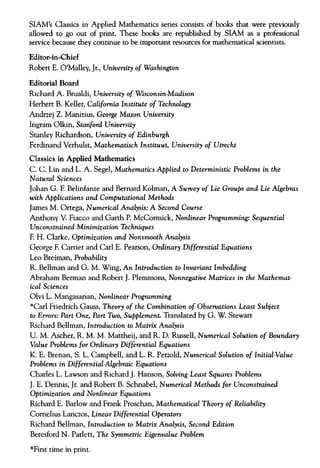
SIAM's Classics inApplied Mathematics series consists of books that were previously
allowed to go out of print. These books are republished by SIAM as a professional
service because they continue to be important resources for mathematical scientists.
Editor-in-Chief
Robert E. O'Malley, Jr., University of Washington
Editorial Board
Richard A. Brualdi, University of Wisconsin-Madison
Herbert B. Keller, California Institute of Technology
Andrzej Z. Manitius, George Mason University
Ingram Olkin, Stanford University
Stanley Richardson, University of Edinburgh
Ferdinand Verhulst, Mathematisch Instituut, University of Utrecht
Classics in Applied Mathematics
C. C. Lin and L. A. Segel, Mathematics Applied to Deterministic Problems in the
Natural Sciences
Johan G. F. Belinfante and Bernard Kolman, A Survey of Lie Groups and Lie Algebras
with Applications and Computational Methods
James M. Ortega, Numerical Analysis: A Second Course
Anthony V. Fiacco and Garth P. McCormick, Nonlinear Programming: Sequential
Unconstrained Minimization Techniques
F. H. Clarke, Optimization and Nonsmooth Analysis
George F.Carrier and Carl E. Pearson, Ordinary Differential Equations
Leo Breiman, Probability
R. Bellman and G. M. Wing, An Introduction to Invariant Imbedding
Abraham Berman and Robert J. Plemmons, Nonnegative Matrices in the Mathemat-
ical Sciences
Olvi L. Mangasarian, Nonlinear Programming
*Carl Friedrich Gauss, Theory of the Combination of Observations Least Subject
to Errors: Part One, Part Two, Supplement. Translated by G. W. Stewart
Richard Bellman, Introduction to Matrix Analysis
U. M. Ascher, R. M. M. Mattheij, and R. D. Russell, Numerical Solution of Boundary
Value Problems for Ordinary Differential Equations
K. E. Brenan, S. L. Campbell, and L. R. Petzold, Numerical Solution of Initial-Value
Problems in Differential-Algebraic Equations
Charles L. Lawson and Richard J. Hanson, Solving Least Squares Problems
J. E. Dennis, Jr. and Robert B. Schnabel, Numerical Methods for Unconstrained
Optimization and Nonlinear Equations
Richard E. Barlow and Frank Proschan, Mathematical Theory of Reliability
Cornelius Lanczos, Linear Differential Operators
Richard Bellman, Introduction to Matrix Analysis, Second Edition
Beresford N. Parlett, The Symmetric Eigenvalue Problem
*First time in print.
9.
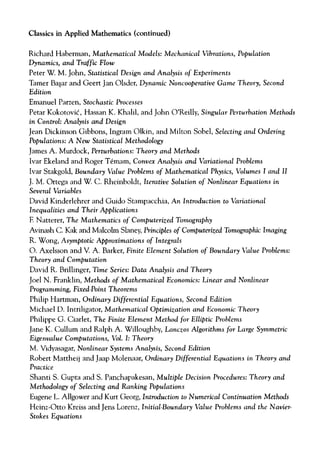
Classics in AppliedMathematics (continued)
Richard Haberman, Mathematical Models: Mechanical Vibrations, Population
Dynamics, and Traffic Flow
Peter W. M. John, Statistical Design and Analysis of Experiments
Tamer Ba§ar and Geert Jan Olsder, Dynamic Noncooperative Game Theory, Second
Edition
Emanuel Parzen, Stochastic Processes
Petar Kokotovic, Hassan K. Khalil, and John O'Reilly, Singular Perturbation Methods
in Control: Analysis and Design
Jean Dickinson Gibbons, Ingram Olkin, and Milton Sobel, Selecting and Ordering
Populations: A New Statistical Methodology
James A. Murdock, Perturbations: Theory and Methods
Ivar Ekeland and Roger Temam, Convex Analysis and Variational Problems
Ivar Stakgold, Boundary Value Problems of Mathematical Physics, Volumes I and II
J. M. Ortega and W. C. Rheinboldt, Iterative Solution of Nonlinear Equations in
Several Variables
David Kinderlehrer and Guido Stampacchia, An Introduction to Variational
Inequalities and Their Applications
F. Natterer, The Mathematics of Computerised Tomography
Avinash C. Kak and Malcolm Slaney, Principles of Computerised Tomographic Imaging
R. Wong, Asymptotic Approximations of Integrals
O. Axelsson and V. A. Barker, Finite Element Solution of Boundary Value Problems:
Theory and Computation
David R. Brillinger, Time Series: Data Analysis and Theory
Joel N. Franklin, Methods of Mathematical Economics: Linear and Nonlinear
Programming, Fixed-Point Theorems
Philip Hartman, Ordinary Differential Equations, Second Edition
Michael D. Intriligator, Mathematical Optimisation and Economic Theory
Philippe G. Ciarlet, The Finite Element Method for Elliptic Problems
Jane K. Cullum and Ralph A. Willoughby, Lancsos Algorithms for Large Symmetric
Eigenvalue Computations, Vol. I: Theory
M. Vidyasagar, Nonlinear Systems Analysis, Second Edition
Robert Mattheij and Jaap Molenaar, Ordinary Differential Equations in Theory and
Practice
Shanti S. Gupta and S. Panchapakesan, Multiple Decision Procedures: Theory and
Methodology of Selecting and Ranking Populations
Eugene L. Allgower and Kurt Georg, Introduction to Numerical Continuation Methods
Heinz-Otto Kreiss and Jens Lorenz, Initial-Boundary Value Problems and the Navier-
Stokes Equations
Philippe G. Ciarlet
UniversitePierre et Marie Curie
Paris, France
Society for Industrial and Applied Mathematics
Philadelphia
The Finite Element
Method for
Elliptic Problems
Siam
TABLE OF CONTENTS
PREFACETO THE CLASSICS EDITION xv
PREFACE xix
GENERAL PLAN ANDINTERDEPENDENCE TABLE xxvi
1. ELLIPTIC BOUNDARY VALUE PROBLEMS 1
Introduction 1
1.1. Abstract problems 2
The symmetric case. Variational inequalities 2
The nonsymmetric case. The Lax-Milgram lemma 7
Exercises 9
1.2. Examples of elliptic boundary value problems 10
The Sobolev spaces Hm
(l3). Green's formulas 10
First examples of second-order boundary value problems . . . . 15
The elasticity problem 23
Examples of fourth-order problems: The biharmonic problem, the plate
problem 28
Exercises 32
Bibliography and Comments 35
2. INTRODUCTION TO THE FINITE ELEMENT METHOD 36
Introduction 36
2.1. Basic aspects of the finite element method 37
The Galerkin and Ritz methods 37
The three basic aspects of the finite element method. Conforming finite
element methods 38
Exercises 43
2.2. Examples of finite elements and finite element spaces 43
Requirements for finite element spaces 43
First examples of finite elements for second order problems: n-
Simplices of type (k), (3') 44
Assembly in triangulations. The associated finite element spaces 51
n-Rectangles of type (k). Rectangles of type (2'), (3')- Assembly in
triangulations 55
First examples of finite elements with derivatives as degrees of
freedom: Hermite n-simplices of type (3), (3'). Assembly in
triangulations 64
First examples of finite elements for fourth-order problems: the
ix
16.
X CONTENTS
Argyris andBell triangles, the Bogner-Fox-Schmit rectangle. Assem-
bly in triangulations 69
Exercises 77
2.3. General properties of finite elements and finite element spaces ... 78
Finite elements as triples (K, P, £). Basic definitions. The P-inter-
polation operator 78
Affine families of finite elements 82
Construction of finite element spaces Xh. Basic definitions. The Xh-
interpolation operator 88
Finite elements of class <#° and <#' 95
Taking into account boundary conditions. The spaces Xoh and X00h 96
Final comments 99
Exercises 101
2.4. General considerations on convergence 103
Convergent family of discrete problems 103
Cea's lemma. First consequences. Orders of convergence 104
Bibliography and comments 106
3. CONFORMING FINITE ELEMENT METHODS FOR SECOND ORDER PROBLEMS 110
Introduction 110
3.1. Interpolation theory in Sobolev spaces 112
The Sobolev spaces Wm.p
(Q). The quotient space Wk+1p
(/3)/Pt() 112
Error estimates for polynomial preserving operators 116
Estimates of the interpolation errors v-IIKvm,q,K for affine families
of finite elements 122
Exercisesses
3.2. Application to second-order problems over polygonal domains 131
Estimate of the error ||u-u 131
Sufficient conditions for Hnifc.JlH - «J|10 = 0 134
Estimate of theerror u- Mj0,n. TheAubin-Nitsche lemma . . . . 136
Concluding remarks. Inverse inequalities 139
Exercises 143
3.3. Uniform convergence 147
A model problem. Weighted semi-norms |-|(>;m>u 147
Uniform boundedness of the mapping u -» uk with respect to
appropriate weighted norms 155
Estimates of the errors u - Mjo.»,n a
°d |« —"hli,ocjj- Nitsche's method of
weighted norms 163
Exercises 167
Bibliography and comments 168
4. OTHER FINITE ELEMENT METHODS FORSECOND-ORDER PROBLEMS 174
Introduction 174
4.1. The effect of numerical integration 178
Taking into account numerical integration. Description of the resulting
discrete problem 178
Abstract error estimate: The first Strang lemma 185
oh
e
126
s
n//.a
s
17.
CONTENTS xi
Sufficient conditionsfor uniform Vh-ellipticity 187
Consistency error estimates. The Bramble-Hilbert lemma 190
Estimate of theerror ||u - unlin 99
Exercises 201
4.2. A nonconforming method 207
Nonconforming methods for second-order problems. Description of
the resulting discrete problem 207
Abstract error estimate: The second Strang lemma 209
An example of a nonconforming finite element: Wilson's brick 211
Consistency error estimate. The bilinear lemma 217
Estimate of the error (2K6TjH-«,,H.K)I/2
220
Exercises 223
4.3. Isoparametric finite elements 224
Isoparametric families of finite elements 224
Examples of isoparametric finite elements 227
Estimates of the interpolation errors v - fJK vm q K 230
Exercises 243
4.4. Application to second order problems over curved domains 248
Approximation of a curved boundary with isoparametric finite elements 248
Taking into account isoparametric numerical integration. Description
of the resulting discrete problem 252
Abstract error estimate 255
Sufficient conditions for uniform Vh-ellipticity 257
Interpolation error and consistency error estimates 260
Estimate of the error jju - «Ji./D, 266
Exercises 270
Bibliography and comments 272
Additional bibliography and comments 276
Problems on unbounded domains 276
The Stokes problem 280
Eigenvalue problems 283
5. APPLICATION OF THE FINITE ELEMENT METHOD TO SOME NONLINEAR
PROBLEMS 287
Introduction 287
5.1. The obstacle problem 289
Variational formulation of the obstacle problem 289
An abstract error estimate for variational inequalities 291
Finite element approximation with triangles of type (1). Estimate of
the error u - wj, „ 294
Exercises 297
5.2. The minimal surface problem 301
A formulation of the minimal surface problem 301
Finite element approximation with triangles of type (1). Estimate of
the error ||u- MA||,A 302
Exercises 310
5.3. Nonlinear problems of monotone type 312
18.
xii CONTENTS
A minimizationproblem over the space Wo"((l), 2<p, and its finite
element approximation with n-simplices of type (1) 312
Sufficient condition for HmA_J|ii - uktptj =0 317
The equivalent problem Au =f. Two properties of the operator A . 318
Strongly monotone operators. Abstract error estimate 321
Estimate of the error ||u-uk||,pft 324
Exercises 324
Bibliography and comments 325
Additional bibliography and comments 330
Other nonlinear problems 330
The Navier-Stokes problem 331
6. FlNFTE ELEMENTMETHODS FOR THE PLATE PROBLEM 333
Introduction 333
6.1. Conforming methods 334
Conforming methods for fourth-order problems 334
Almost-affine families of finite elements 335
A "polynomial" finite element of class *£': The Argyris triangle 336
A composite finite element of class "#': The Hsieh-Clough-Tocher
triangle 340
A singular finite element of class C
6I
:The singular Zienkiewicz triangle 347
Estimate of the error u- «J2.n 352
Sufficient conditions for limfc_J|« - Mh||2n = 0 354
Conclusions 354
Exercises 356
6.2. Nonconforming methods 362
Nonconforming methods for the plate problem 362
An example of a nonconforming finite element: Adini's rectangle . 364
Consistency error estimate. Estimate of the error (2Kefklu - uhlK)m
367
Further results 373
Exercises 374
Bibliography and comments 376
7. A MIXED FINITE ELEMENTMETHOD 381
Introduction 381
7.1. A mixedfiniteelement method for the biharmonic problem 383
Another variational formulation of the biharmonic problem 383
The corresponding discrete problem. Abstract error estimate 386
Estimate of the error (|M-«,,|, ,j-f-|4u+0Jo,n) 390
Concluding remarks 391
Exercise 392
7.2. Solution of the discrete problem by duality techniques 395
Replacement of the constrained minimizationproblem by a saddle-
point problem 395
Use of Uzawa's method. Reduction to a sequence of discrete Dirichlet
problems for the operator - A 399
em
e
19.
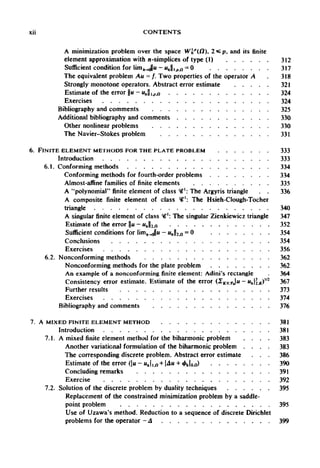
CONTENTS xiii
Convergence ofUzawa's method 402
Concluding remarks 403
Exercises 404
Bibliography and comments 406
Additional bibliography and comments 407
Primal, dual and primal-dual formulations 407
Displacement and equilibrium methods 412
Mixed methods 414
Hybrid methods 417
An attempt of general classification offiniteelement methods 421
8. FINITE ELEMENT METHODS FOR SHELLS 425
Introduction 425
8.1. The shell problem 426
Geometrical preliminaries. Koiter's model 426
Existence of a solution. Proof for the arch problem 431
Exercises 437
8.2. Conforming methods 439
The discrete problem. Approximation of the geometry. Approximation
of the displacement 439
Finite element methods conforming for the displacements 440
Consistency error estimates 443
Abstract error estimate 447
Estimate of the error (2; = i||Ma-«afc|H./}+||«3-W3*l|2.n)"2
448
Finite element methods conforming for the geometry 450
Conforming finite element methods for shells 450
8.3. A nonconforming method for the arch problem 451
The circular arch problem 451
A natural finite element approximation 452
Finite element methods conforming for the geometry 453
A finite element method which is not conforming for the geometry.
Definition of the discrete problem 453
Consistency error estimates 461
Estimate of the error (|u, - u l h ] , + u2 - u2hlj)tl2
465
Exercise 466
Bibliography and comments 466
EPILOGUE: Some "real-life" finite element model examples 469
BIBLIOGRAPHY 481
GLOSSARY OF SYMBOLS 512
INDEX 521
When affliction comes,it is useful to trace the chain, and ascertain, if
we can, wherefore the Lord is contending with us. 2. It is sometimes
corrective. He deals with us as men deal with their children (Heb.
xii. 5–11). It is not that He may vent His anger, but recall them to their
better selves. He means it as the refiner means the fire into which he
casts the gold (Ps. cxix. 67). 3. It is sometimes auxiliary. The means to
an end. The dark way into light. It is necessary to some advantage
which could not be reached without it. Joseph’s slavery and
imprisonment were the steps to his subsequent greatness. Jesus
reached the crown by the cross. Perhaps you can illustrate from your
own experience.
Meantime, here is
II. An antidote promised.
Their teachers had been removed. The prophets were persecuted
(verses 9, 10). Jeremiah, Zedekiah, under Jezebel’s persecution.
Obadiah had hid a hundred in caves. Persecution usually fastens on
the teachers as most prominent. Thus Apostles. Thus the
Nonconforming clergy in England. Thus the missionaries were driven
from Madagascar. But the promise here in that they shall regain their
liberty. And this will be not only a relief to themselves, but an antidote
to the people’s calamities. It will secure: 1. Instruction. “Thy teachers.”
Truth is the basis of everything in experience or practice. It is their
business carefully to unfold and apply the truth.[3] 2. Consolation.
Christian ordinances are consolatory. There are truths that bear on
troubles. The views of the Divine character and of the course of
Providence exhibited in the Gospel sustain and comfort. 3. Direction.
There is danger of turning to right or left. So many allurements, from
ignorance, misguidance, temptation. By the ministry you hear the
voice which points out the way, invites steadfastness, warns against
divergence.
God provides guidance in the journey to the better land. Value the
ministry of the Word. Attend it. Follow its teaching.—J. Rawlinson.
23.
FOOTNOTES:
[1] The AuthorisedVersion, upon which these outlines are founded,
is supported by Mr. Cheyne, who translates: “And though the Lord
give you bread in short measure and water in scant quantity,” &c. But
Delitzsch, Kay, and Birks render the first clause: “And the Lord will
give you bread in your adversity and water in your affliction.” Mr.
Birks adds: “These words form part of a promise, not its limitation.
Here they are assured that, although besieged, they will not be given
over to famine. The path of duty will be made plain by God’s
prophets, and speedy deliverance be given.”
[2] H. E. I., 56–115.
[3] The Christian Church requires a teaching ministry. Not only
must the Gospel be proclaimed to the world, the Church must be
trained into knowledge, experience, holiness, activity. Individual
study of Scripture is largely useful. But regularly recurring religious
services, of which careful instruction is a part, are universally
necessary. Godly men must be released from secular business,
trained, set apart to the study and ministry of the Word. The living
voice of the preacher helps, guides, confirms, and gives greater
practical influence to the private reading of Christians. Even under
the old dispensation, large use was made of this method. There
were schools of the prophets. A few were so eminent that they have
left their words behind them. But there were many whose names
have not survived their time. Jesus trained His disciples for their
future work. After His Ascension, He gave various gifts to men for
the work of the ministry. He continues them. While one could wish
that all the Lord’s people were prophets, and that He would put His
Spirit upon them, so that they would work to the full extent of their
ability for the world’s salvation, it remains true that the strength of
the Church is an able, well-instructed, godly, and earnest ministry.
Among the blessings here promised to the ancient Church is the
restoration of the silenced teachers to their work after its period of
discipline.—Rawlinson.
24.
The Guiding Voice.
xxx.21. And thou shalt hear a voice behind thee, &c.
This may be a promise to God’s people of the continuance of the
services of the ministry, or of the additional blessings of spiritual
suggestions to guide them in the path of duty.
I. It may be continuance of the promise in the preceding verse: “Thy
teachers shall not be removed into a corner any more, but thine eyes
shall see thy teachers, and thine ears shall hear a word behind thee.”
The Word of God proclaimed by faithful ministers follows men.
Sometimes, as they listen to it, they reject it, but it pursues them, and
gives them no rest until they obey it. When they are bent on a wrong
course, it haunts them until they are recalled to duty. Or it stimulates
them to the performance of duties they are neglecting or performing
sluggishly. Thus understood, we may see that in this promise God
compares Himself as it were to a shepherd, who puts his sheep before
him; or to a schoolmaster who will have his scholars in sight, that so he
may the better keep them in order.
Thus understood, we see our duty. It is to give reverent heed to the
Word of God as proclaimed to us by His ministers. Food, however
choice, is no blessing to us unless it be eaten and digested; and the
Word of God is no blessing to us, except there be an ear to hearken to
it, a spiritual taste to relish it, and a heart to close and comply with it.
Well is it with those who imitate Lydia (Acts xvi. 14). But neglect of
God’s Word shuts against us even the throne of grace (Prov. xxviii. 9).
To those who disregard what they know to be the voice of God, there
comes a time when they discover that the greatest of all calamities is to
have their voice disregarded by Him (Prov. i. 24–26).
II. But the promise may be that of an additional blessing, the inward
motions and suggestions of the Holy Spirit. His voice may be called “a
word behind us,” because—1. Of its secresy (Job iv. 12). 2. Because it
follows us always, as constantly as our shadow. Parallels to this promise
we find in 1 John ii. 20, 27; John xiv. 26, xvi. 13.
25.
III. This voiceHis people hear when they are about to wander, or have
wandered from the way of righteousness. From that way it is easy to
depart; but God loves His people, and cannot abide to see them
miscarry, and therefore He counsels them. “This is the way, walk ye in
it,” is sometimes a word of correction and reformation, in case of error;
sometimes a word of instruction and direction, in case of ignorance;
sometimes a word of strengthening and confirmation, in case of
unsettledness.
In all these respects God’s people hear the “word behind them,”
sometimes giving them very gracious hints concerning the affairs of
this present life, but more frequently concerning the spiritual life.
Those who wait upon God shall not lack counsels concerning the
manner in which they are to serve Him. He answers the prayers of His
people (Ps. xxv. 4, 5; lxxxvi. 11; cxliii. 8).
What a great comfort and encouragement we have here! If we really
desire to serve God amid all the labyrinths and uncertainties of this
present life, we shall be safe, for He will guide us.
IV. But how may we know whether the word behind us is the voice of
God, and not merely one of our own fancies, or a suggestion of Satan’s?
There are several touchstones by which every “word” may and should
be tested. 1. The word within is to be compared with the Word without.
Every suggestion is to be examined by the rule of Scripture. God never
speaks in the conscience contrary to what He speaks there, for He is
unchangeable and cannot contradict Himself (Isa. viii. 20). 2. God’s
“words” are orderly and regular; they keep men within the compass of
their callings, and the place in which God has set them. They incite us
not to forsake our duty, but to be faithful in it. 3. They are ordinarily
mild, gentle, seasonable; they are not ordinarily raptures, but such as
leave a man in a right apprehension of what he does, and capable of
reflection upon it. 4. They are discernible also from their effects, and
the ends to which they tend. All the hints and motions of God’s Spirit
tend to make us better, and to carry us nearer to Himself in one way or
another. Honestly using these tests, we shall learn promptly and surely
26.
to discern thevoice of God’s Spirit when He says to us, “This is the way,
walk ye in it.”
V. From all this two duties plainly arise. 1. Thankfulness. A faithful
monitor is a very great advantage; it is so betwixt man and man, and we
should bless God that He condescends to be this to us. 2. Obedience. To
His infallible, loving counsel we should give prompt heed, especially as
He not only points out the way, but is always ready to help us to walk in
it; and the way in which He would have us go is the only one that leads
to true happiness and lasting peace. Disobedience exposes us to
manifold dangers, such as (1.) God’s future silence; when His counsels
are repeatedly rejected, He will cease to speak. What a terrible calamity
(1 Sam. xxviii. 5). (2.) Those who hearken not to the voice of God in
them are often given up to Satan, and their own corruptions bear away
within them (Ps. lxxxi. 11, 12).—Thomas Horton, D.D.: 100 Select
Sermons, pp. 298–304.
I. Our need of the guidance here promised. We are ignorant of the
way to true happiness, and we have not always daylight. The path is
narrow, and is sometimes very intricate. It lies through an enemy’s
country. Many as wise as we have lost their way, and, after years of
sorrow, have perished miserably. We need this guidance in youth, in
manhood, in old age, even unto death (P. D., 952, 2388).
II. Some of the means by which God guides His people. The
promise in our text suggests a traveller in doubt as to the course he
should take, pausing perplexed at cross roads, and in danger of
choosing a wrong one, when a friendly voice behind him is heard,
saying, “This is the way, walk ye in it.” God thus speaks to His people.
1. By His providences. Afflictions are often monitions and instructions
(H. E. I., 66–70). 2. By His Word. It clearly marks the path to heaven.
3. By our conscience (H. E. I., 1291, 1304, 1308–1312). 4. By His Spirit; by
Whom conscience is quickened, our understanding cleared of
delusions, our attention fixed on the happy career of the righteous, and
the disastrous end of the wicked.
27.
III. What isneeded to enable us to profit by this promise. 1. A
prayerful spirit (ver. 19). 2. A studious eye that will look for the
waymarks, especially for the footprints of Jesus. 3. A listening ear. 4. An
obedient habit of mind (1 Sam. xv. 22; P. D., 1656). Disregard of the
Guiding Voice will involve us in present disaster and misery, and in
eternal woe. Heedfulness of it will ensure for us present safety and
peace, and eternal blessedness.—Samuel Thodey.
Rivers of Waters.
xxx. 25, 26. And there shall be upon every high mountain,
&c.
These are symbolic of the blessings God will confer upon His people
when He returns to them in mercy. These are vivid presentations of
two characteristics of these blessings, their copiousness and their
universality. 1. To express their copiousness the prophet speaks not of
streams merely, but of rivers; “rivers and streams of water;” and
declares that they shall be poured forth, not merely as the light from
the sun, but as if the light of seven days were concentrated in one.[1]
2. To express at once their copiousness and their universality, He
declares that the rivers and streams shall run on the hills and
mountains, yea, upon every hill and mountain.[2] The idea of
universality is involved also in the future of sunlight.[3]
Have these promises been fulfilled? Yes. 1. When the Gospel was given
to the world. Its messengers were sent forth into every land, and it is a
small thing to say that the light it gave was sevenfold that which the
most enlightened of the heathen had possessed. 2. In the experience of
every believing soul. The Gospel reaches many who seem utterly
beyond any saving influence; and when it does really reach a man, is
received into his heart. It gives him a light of more than sevenfold
brightness and value as compared with the best of the lights he before
28.
professed—reason and conscience.[4]3. It is fulfilled in our own day by
the remarkable increase of religious knowledge. God’s Word is being
carried into every land, and the children in our daily and Sabbath
schools have a fuller acquaintance with Scripture than many men and
women of the last generation. There is to be a yet more complete
fulfilment of these promises in that glorious era of which we speak as
the Millennium.[5]
It rests with ourselves to determine whether the fulfilment of these
promises shall be to us a blessing.[6]—John Packer: Warnings and
Consolations, pp. 256–271.
FOOTNOTES:
[1] We can conceive of nothing more bright, pervading, and
universal than the light of the sun. At its rising the whole face of
nature is displayed, every object is brought out to view; the grandest
or loveliest features of the scene are presented to us in all their
extent and magnificence, while the most delicate tints of the
smallest flower are seen in all their softest shades and richest hues.
Still the glorious object in its full splendour, the sun itself is too
dim, too dull, too feeble to represent the grace and love of our God;
it must be multiplied sevenfold. And even then it but indistinctly
shadows forth the unspeakable mercy of the everlasting God.—
Packer.
[2] “Rivers and streams of waters.” But where is their current? Upon
every high mountain and upon every high hill. Now, there can be no
rivers and streams on the summit of the mountain range, nor upon
the high hill top. Rivers and streams are fed from these lofty
elevations; they take their rise amid these towering heights, but
they do not find a channel there. Thus you see that to typify the
effluence of the Holy Spirit, these flowing waters of the text are
described as being in unusual localities, to intimate that the
blessings will be in such abundance and profusion as to outrun
expectation and surpass all experience. And this not in some highly
favoured regions only, but the blessing shall be universal, even upon
every high mountain and upon every high hill.—Packer.
29.
[3] This, likethe air, cannot be excluded; it penetrates the gloomiest
caverns, can enter even through a cranny. So there is no soul out of
reach of the all-pervading Spirit. Those that are inaccessible to man
can be reached, and enriched, and blessed by the mighty energy of
the Holy Ghost.—Packer.
[4] When we attempt to compare the boasted light of natural reason
with the light which the Spirit alone can impart, it is not simply that
the former is as the light of the moon, and the latter as the light of
the sun; but the one is as Egyptian darkness, and the other as the
splendour of the meridian sun, without even one small fleecy cloud
intervening. Jesus Christ is the light of life (2 Cor. iv. 6). All that we
can know of God, of His attributes and perfections, of His plans and
purposes, He has revealed unto us by His Son. To those who are in
Christ all is light, and harmony, and peace; to those who are without
Christ all is gloom, and confusion, and terror. By faith in Him we see
that all God’s dealings wear an aspect of mercy, love, and wisdom.
Corrections are inflicted for our profit; disappointments are sent to
wean us from the unsatisfying, perishing things of time and sense.
Surely, in this respect, the promise in the text is made good to the
believer; he enjoys sevenfold light in his soul compared to that
which he had in the days when he knew not the true God and Jesus
Christ, whom He had sent.—Packer.
[5] But these mercies will be preceded by the convulsions of the
moral earthquake. The very terms in which the promise is couched
convey the idea of trial and suffering. There is a breach which the
Lord binds up, and there is the stroke of a wound to be healed,
implying previous violence.—Packer.
[6] What shall the universality and copiousness of the “rivers and
streams of water” profit us, if we will not drink of them? In the
natural world a man would be nothing benefited, though the light
of the sun was augmented sevenfold, if he studiously closed and
sealed every opening by which it entered his dwelling, or if he
placed an impervious bandage tightly over his eyes whenever he
went abroad (John xii. 36).—Packer.
[See also Outlines, Rivers of Water in a Dry Place, xxxii. 2, and
Enriching Rivers, xxxiii. 21.]
30.
The Earthly Songand the Heavenly Voice.
xxx. 29–33. Ye shall have a song . . . and the Lord shall
cause His glorious voice to be heard, &c.
The fulfilment of this prophecy is recorded in Isa. xxxvii. 36. The
Assyrian power, hitherto unopposed in its march of conquest,
sustained a severe check when it assailed Jerusalem. The great
deliverance is here foretold. Inside the walls there would be song and
gladness; outside, swift destruction. “The holy solemnity” was probably
the Passover which Hezekiah and his people observed; and the “song”
in that case would be the Paschal Hymn, comprising Ps. cxiii.–cxviii.
There is a tradition that Sennacherib’s army was destroyed on the night
of the Passover; and thus while the people were recalling their great
national deliverance, a further and somewhat similar Divine
interposition was about to be made in their behalf. Mark how grandly,
as if in response to the songs and gladness of the Passover night, the
voice of Jehovah comes in. It is impossible not to see the connection
between the two voices. Songs of praise and gladness have still an echo
in heaven, and call forth a Divine response to quell the church’s foes.
Look, then, at the two voices, the human and the Divine, in relation to
each other.
1. A voice of confidence on man’s part responded to by a voice of power
on God’s part. It showed no small faith in Hezekiah and his people to
observe the Passover in the circumstances. How could the little
kingdom of Judah oppose the mighty conqueror? How could Jerusalem
standout against the assailants encamped in such numbers around its
walls? God was their defence. To Him in this emergency they raised
their songs of confidence. Nothing could more appropriately express
their faith than the Passover hymn. That night reminded them of the
rescue from Egypt, and would inspire them with confidence in God.
They were on the eve of another great deliverance, and their song was
well fitted to prepare them for it, containing such passages as these, Ps.
cxv. 1–11, cxviii. 6–13. Nor was their confidence disappointed. Without
any human help, God overthrew their besiegers, but it was the song of
31.
faith that calledforth the powerful voice of God. When faith appeals to
God, the appeal is heard on high (Exod. xiv. 13; Ps. xlvi. 10). Two
prisoners once prayed and sang praises to God at midnight. Their
testimony for Christ had been silenced, but from the dark dungeon the
song of confidence rose to heaven. “And the Lord caused His glorious
voice to be heard,” an earthquake shook the foundations of the prison,
and God gave His two witnesses an opportunity of bringing the Gospel
to bear upon hardened hearts. Do you wish to see the arm of the Lord
revealed? then sing your song of faith. Does the Church in these days
sit powerless, sad, and despairing through the gloomy night of unbelief
and prevailing ungodliness? Let her know that man’s extremity is God’s
opportunity. In the darkest night of seeming failure she has her God-
given song, and if only she can sing it in spite of all that is black and
threatening in her prospects, “the Lord shall cause His glorious voice to
be heard, and shall show the lighting down of His arm” in rebuking
scepticism and indifference, in softening hard hearts, and in making
friends of foes.
2. A song of gladness and joy in God responded to by a voice of
complacent affection. All the Jewish feasts were occasions of gladness,
and the Passover must have been so, when we consider the event it
commemorated, the communion with God to which it invited, and the
future salvation it foreshadowed. The Paschal Hymn resounds with
notes of gladness, e.g., Ps. cxviii. 14, 15, 24. If our song of joy in God is
hearty and sincere, we may expect a corresponding response. If we
rejoice in God, He will rejoice over us (Zeph. iii. 17; Isa. xxxi. 4, 5).
3. A song of self-dedication answered by a voice of recognition. The song
breathes the spirit of consecration to God’s service (Ps. cxvi. 12–19). Do
we thus consciously and spontaneously lay ourselves on the altar as
living sacrifices? If we own God, God will own us. The destruction of
Sennacherib’s hosts was a proof to all the world that God owned Israel
as His peculiar people. You, too, will have the token of Divine
ownership. For your sake God will rebuke the devourer. In response to
your song of dedication, “the Lord shall cause His glorious voice to be
32.
heard,” giving successto your efforts and enterprises, blessing you and
making you a blessing.
4. A song of security calling forth a voice of preservation. Within the
walls the people marched in procession “to the mountain of the Lord,
to the rock of Israel.” That rock of ages was their defence. They felt
secure in God’s faithful keeping (Ps. cxv. 17, 18, cxviii. 16–18). Have you
entered into this element of the Paschal song? You shall hear God’s
protecting voice, and see the acts of His preserving care. However
strong the foes that muster against you, they shall not prevail, for all
the Divine resources are engaged for your support (Col. iii. 3).
5. A song of thanksgiving for past mercies answered by a voice that
commanded new mercies. This element was very prominent in the
Passover observance, and it enters largely into the Lord’s Supper, called
on this account the Eucharist. How can we remember Christ without
thankfulness and praise? When He took the bread and the cup He
“gave thanks,” and He and His disciples sang the Paschal Hymn. What
strains of high thanksgiving it contains! It begins with praise (Ps. cxii. 1,
2). It retells the Exodus (Ps. cxiv.) It rises to grateful recognition of
God’s goodness (Ps. cxvi. 7, 8, 17). When such a song rises from human
lips, God will give fresh occasions for thankfulness.
Let the subject teach us the importance of sacred song. Prayer and
preaching are Divinely appointed means of grace and instruction, but
we cannot dispense with song. God fights for His people, but it is with
the accompaniment of tabrets and harps (ver. 32).—William Guthrie,
M.A.
Tophet Ordained of Old.
xxx. 33. For Tophet is ordained of old, &c.
Some of us have often admired the expression, “Knowing the terrors of
the Lord, we persuade men;” implying that the law of persuasion
33.
should be thelaw of the Christian pulpit. Some would alarm men,
some would bitterly rail, and others thunder at them; as though the
human heart could never be prevailed upon to capitulate, but must
always be taken by storm. Paul shows us the more excellent way. When
he proclaims “the terrors of the Lord,” it is “to persuade men;” to
persuade them to escape the ruin and to accept the remedy. Observe,
he does not hide them, for the truth must be told, sin must be
condemned, the wicked must be warned.
I. Let us examine the local allusion and literal meaning of this
verse. “This allusion to Tophet is the earliest which appears in the
Scriptures. Additional particulars appear in the history of Josiah’s
reformation (2 Kings xxiii. 10; Jer. vii. 31). The prophet Isaiah here
represents Tophet as a place prepared for the burning of the Assyrian
king. Made deep and large, with fire and wood in abundance, prepared
for the king, and he being thrown into it, the breath of the Lord
kindles it into fearful conflagration. This is, of course, a figurative
description, Tophet being made the central point in the figure because
it was a well-known place, a valley just outside the city, the valley of
Hinnom, used for burning all the offal and filth of the city of
Jerusalem.” Isaiah was commissioned to utter this prophecy of the
overthrow and consuming of the Assyrian army, in order to inspirit
Hezekiah and the people against the threatened invasion. “Tophet is
ordained of old” as that fiery place which would consume the dead
bodies of these unjust invaders. Hence the Chaldee paraphrase says, “It
was called the valley of the carcases and of the ashes or of the dead
bodies for this reason, because the dead bodies of the camp of the
Assyrians fell there;” to which Josephus gives testimony when he
relates that the place was called the Assyrian camp. What force these
recollections would give to our Lord’s threatenings of hell to the Jews
who saw the smoke of this valley always rising before their eyes
(compare Isa. lxvi. 24 with Mark ix. 43–48).
II. Note some of those solemn and awakening truths suggested
by this verse. 1. The same record which provides for the security of the
Church, provides for the final overthrow of its enemies. This was the
34.
time of Jacob’sextremity; he was saved and his enemies consumed.
2. In the enjoyment of our highest privileges, we are surrounded by the
most solemn terrors. Tophet lay not only near, but at the very foot of
Mount Zion. From the heights of Zion might be seen the smoke, the
fire, and the worm in the valley of Tophet! A dreadful thought this!
Hell is set full in our view when worshipping in Zion (1 Pet. iv. 17, 18).
Bunyan says, “So I saw a man may go by profession to heaven’s gate and
yet be cast away.” Our Lord (Luke xiii. 25). 3. While no combination of
power can shield the wicked, the believer has always a source of safety
and a song of joy.—Samuel Thodey.
The Only Counsellor.
xxxi. 1–3. Woe to the rebellious children, &c.
These words were spoken by the prophet at a time when the Jewish
nation was in great and imminent danger. They were addrest to the
rulers of the nation, who were endeavouring to ward off the danger:
and their purpose is to rebuke those rulers for the measures they were
taking with that view, by entering into alliance with Pharaoh, king of
Egypt, in the hope that he would deliver them out of it. But we should
make a great mistake if we imagine that there is nothing in them that
concerns our duty as individuals. God’s reproofs of nations are such as
we may all take home to our hearts, ponder, and learn from; for they
contain principles of righteousness which, like the sun which shines at
once on half the world and ourselves, are intended for the guidance
both of nations and of individuals. Of this truth a striking example is
afforded by our text. Its object is to rebuke the Jewish rulers for the line
of policy which they were taking with the view of defending their
country from her enemies. Sennacherib, king of Assyria, was marching
against Judah, with the intent of conquering it, and reducing the
people to slavery, as Israel had already been conquered and enslaved a
few years before by Shalmaneser. The danger was very great. What was
King Hezekiah to do? How was Judah to stand against Assyria? If you
35.
were to askany of the politicians who are wise in the wisdom of this
world, they would all say, there could be no question about the matter;
that the only way of saving Judah was to obtain the alliance and aid of
some powerful nation, whose succour might render her more nearly a
match for the armies of the invader. This is exactly what the rulers of
Judah set about doing. They entered into an alliance with the king of
Egypt, with the view of gaining assistance from him, which might
enable them to cope with Sennacherib in the field. This is just what a
statesman, who plumed himself on his wisdom in these days, would
do. Yet it is for doing this very thing that the prophet Isaiah in the text
reproves and denounced woe against them. Their conduct, therefore,
must have been sinful. Let us try to discover in what their sin lay.
1. They were making use of human means alone, to ward off the danger
which threatened. It is not sinful to use such means; the sin lies in
fancying they can help us without the blessing of God, and in not
seeking that. This was what Isaiah denounced, and what we do. When
any danger threatens us, we forthwith take counsel—of ourselves, of
our friends, forgetting that all our counsel in the first instance ought to
be taken of God, by searching His law with the purpose of discerning
what He wills us to do, and by praying Him to enlighten our
understandings, that we may be enabled to discern His will. So too we
are ever seeking to cover ourselves with a covering, to find some
protection or other whereby we may be preserved from danger: only
the covering we should cover ourselves with is the covering of the Spirit
of God. We should make Him our shield and buckler; and then we
need not fear what man can do unto us.
Our unwillingness to take counsel of God can only proceed from an
evil heart of unbelief,[1] and it is as unwise as it is undutiful. None but
God’s counsel is infallible, and only His covering is sure. But we choose
to have a covering of our own making, and send up mists and clouds to
hide the covering of God’s Spirit from us, thus “adding sin to sin.”
2. Observe, the princes of Judah were not merely taking counsel of
man, instead of God, and covering with a covering which was not of
36.
the Spirit ofGod: but the arm they were trusting to was the arm of
Egypt. Now Egypt had from the first been the deadly enemy of the
Israelites, and of their God. Egypt was the source from which all
manner of idolatrous abominations flowed in upon them: out of Egypt
they had been called; and they were no longer to hold intercourse with
it. Therefore the prophet goes on to forbid their seeking help from
Egypt, and to predict that the help of Egypt would end in their
confusion. If we are guilty of their sin, we shall not escape their woe.
When trials come upon men to-day, they are apt to listen to Satan’s
assurance that in that particular emergency he can help them better
than God can. They listen; they sin, and the one sin leads to other sins;
and ere long they are ruined (H. E. I., 173–175).
Still it is woe to those who take counsel of anything earthly! In times of
difficulty it is of God alone that we must seek and take counsel. He
alone can give us such counsel as will never fail us even in this life: and
the wisdom of His counsel, which we now see only through a glass
darkly, will become brighter than the sun at noon, when the veil of this
world is drawn away from before it.—Julius Charles Hare, M.A.:
Sermons Preacht in Herstmonceaux Church, pp. 305–323.
FOOTNOTES:
[1] From that unbelief which loses sight of and forgets the Ruler and
Lawgiver of the world, and which is prone to worship whatever
dazzles the senses and flatters our carnal nature. What should we
say if a child, in a time of doubt or danger, would not run to ask its
parents what to do, but were to run away from its parents and ask a
stranger, or were to ask its own ignorance, or its own whims, or the
ignorance of its playfellows—yea, were to ask its toys? Surely such
conduct would bespeak a loveless, undutiful heart and a silliness
such as could only be excused during the faint early dawn of the
mind. So is it a proof of a loveless, undutiful heart not to seek
counsel of God; nor is such conduct less unwise than undutiful. For
what do we want in a counsellor except wisdom and foresight—
wisdom to know the principles and laws of things, and foresight to
discern their consequences? Now, neither of these faculties can we
37.
find in anyearthly counsellor, except in a very low degree. For, not
to speak of the numberless accidents which warp and bias our own
judgments and those of our fellow-men, and lead them awry, even
at best man’s understanding, unless so far as it is enlightened from
above by a knowledge of heavenly laws, can only reckon up what is
wont to be, without any insight into what must be; and his eyes are
ever so hoodwinkt by the present that he cannot even look forward
into to-morrow. Whereas everything that God ordains must be right
and true, and must stand fast for ever, even after heaven and earth
have past away. He knows what we ought to do, and He will bear us
through in doing it. Yet we choose rather to be led by the blind than
by the Seeing. . . . Herein the very heathens condemn us. For they,
though they know not the true God, yet believed there were powers
in the heavens far wiser and longer-sighted than man; and so
believing, they acted accordingly. Rightfully distrusting themselves,
they sought to ascertain the will and purpose of those powers by
searching it out according to the means whereby they imagined it
would be revealed.—J. C. Hare.
The Spirituality of the Divine Nature.
xxxi. 3. The Egyptians are men, and not God; and their
horses flesh, and not spirit.
Among the sins to which the ancient Israelites were addicted, one of
the most prevailing was a disposition, in seasons of invasion or
calamity, to place confidence in the power of surrounding nations, and
to seek the assistance of their sovereigns, instead of trusting in the
living God. Egypt, being the largest monarchy in their immediate
neighbourhood, was frequently their refuge in times of distress and
difficulty. Remonstrance (vers. 1, 2).
In the text an important and infinite disparity between God and man,
which rendered the Egyptian monarch infinitely inferior to Him in the
qualities which entitle to confidence and trust. The spirituality of the
Supreme Being is the contrast.
38.
I. The spiritualityof the Deity is intimately connected with the
possession of that infinite, unlimited power which renders Him the
proper object of entire confidence.
There is a prejudice in favour of matter and against spirit, as if the
former were possessed of greater force than the latter. It arises from our
mistaking secondary and remote effects for causes, instead of
ascending to God the supreme cause. Thus we think of the elements of
nature and of mechanical forces. We have no power of operating on the
objects immediately around us but by means of our bodies. But it is
mind alone which is the seat of power. The power by which all changes
are effected through the instrumentality of the body resides
immediately in the mind. It is that mysterious principle called Will.
Whatever motions the mind wills instantly take place. This is an
illustration of the control which the Deity exercises over the universe.
The Divine Being has only to will the most important changes and they
are instantly accomplished. It is impossible to give any account of
innumerable changes continually taking place in the visible world,
without tracing them up to mind.
II. The spirituality of God stands in close and intimate connection with
His Invisibility.
1 Tim. vi. 15, 16. Were He the object of sight, He must be limited. He
cannot, therefore, be figured out by any art or skill of man (Acts
xvii. 24–29; Deut. iv. 15; Ex. xx. 4, 5). Hence the great impiety of those
who have attempted to paint and figure out the persons of the Trinity.
The necessary effect of any attempt to represent the Deity to the
human senses, by pictures or images, must be to degrade, to an
incalculable degree, our conception of Him. Hence images of angels,
the Virgin Mary, and saints of inferior character.
III. The spirituality of God is inseparably connected with His Immensity
and Omnipresence (Jer. xxiii. 23, 24; Ps. cxxxix. 7–12).
1. It is necessary that matter should have some figure. But figure is
circumscribed within a certain outline. To conceive of the Divine Being
39.
as material wouldinvolve absurdity. 2. If matter were unlimited there
would be no possibility of motion. 3. If the Divine Being were material,
He would render impossible the co-existence of created beings. Two
portions of matter cannot occupy the same space. But the infinite
Spirit is present with every part of His creation.
IV. The spirituality of God enables His infinite Wisdom.
This seems a necessary property of that Being who is present to all His
creatures at all times. His infinite acquaintance with His creatures is a
necessary consequence of His presence. Every one is as much within
His survey at one moment as at another. We judge of men’s character
by their actions, He by their motives. And His judgment is always
according to truth.
V. The spirituality of God establishes an intimate relation between Him
and all His intelligent creatures.
Their dependence on Him is absolute; their subjection to Him constant
and incessant; but in a special manner is He the Father of spirits. The
body has a tendency to separate us from God, by the dissimilarity of its
nature; the soul unites us to Him by those principles and faculties
which are congenial to His own. To estrange ourselves from God is to
be guilty of a most enormous kind of offence: it is forgetting our proper
parent, the author of our existence. To love him, to seek union with
Him, is to return to our proper original.
VI. The spirituality of God renders Him capable of being the satisfying
Portion, the Supreme Good, of all intelligent beings.
He is the source and spring of all happiness (Lam. iii. 24, 25; Ps.
lxxiii. 25, 26). 1. That which constitutes the felicity of the mind must be
something out of it. Whoever retires into his own mind for happiness
will be miserable. God is qualified to be the everlasting and
inexhaustible spring of happiness. 2. He who can always confer
happiness on another being must be superior to that being. To be the
source of happiness is the prerogative of God. 3. That in which the
happiness of a rational and mental creature consists, must be
40.
congenial to thenature of that creature. 4. That which forms the
principle of our felicity must be something that is capable of
communicating itself to us. God, as He is a Spirit, is capable of
communicating Himself to the spirits of His rational creatures. These
communications will constitute the felicity of heaven. Even while they
continue on earth, it is the privilege of the faithful to enjoy union with
the Father of spirits through His Son.
Improvement. 1. Let us raise ourselves, in contemplating the Divine
Being, above what is sensible, visible, and corporeal. 2. Since God is a
Spirit, there must be an everlasting connection established between
Him and us, on which will depend our destiny for ever. Hence Jesus
Christ has come. What movements are in your minds toward this great
object?—Robert Hall: Works, vol. vi., pages 1–32.
A Call to the Revolted.
xxxi. 6. Turn ye unto Him from whom the children of
Israel have deeply revolted.
Had mankind adhered to the Divine idea, no such word as this would
have been necessary. Divine communications would have consisted
probably of counsels, directions, predictions, progressive revelations of
truth. The demand that man turn shows that he has gone astray. All
Divine communications suppose the existence of sin and the need of
salvation. Happily for us, they show the way in which salvation may be
obtained. The parts of the human race are as the whole. The people
God distinguished by separating them from the nations, with special
connection to Himself, followed the universal tendency to wander
from Him. They forsook His law. When trouble came, they sought help
anywhere. At the time of this prophecy they were looking to Egypt
instead of to the Lord. The prophet remonstrates, and invites them to
make a friend of God against Assyria. The text may be addressed to
sinners now. Here is—
41.
I. A seriousaccusation.
God was the King of Israel. Departure from His laws was a national
revolt. Man’s revolt from God consists in—1. Disaffection. When love
to the sovereign departs, the way is prepared for any act of hostility
circumstances may favour. The disaffection of man to God is inbred.
From the original fall man derives a mysterious tendency to depart
from God (H. E. I., 3390–3397). Human nature dislikes the Divine
holiness; dislike of the Divine holiness is the root from which grow
men’s evil deeds. So deep is the revolt that man has no desire to return.
2. Disobedience. You may say it is natural to sin, and we cannot be
held responsible for it. Do you judge of, and deal with your fellow-man
in that way as to their conduct to you? If they injure, defraud you, do
you say they have a natural inclination to fraud and wrongdoing, and
therefore are not responsible? When a son who has been carefully
trained develops tendencies and inclinations to evil, attaches himself
to bad companions, &c., do you exonerate him from blame because it is
his nature? You say he ought to have resisted the evil inclinations and
cultivated such as were good. You are right. But why should there be a
difference when the object of the wrongdoing is God? The dislike of
God’s holiness inherent in human nature develops itself in the
indulgence of sinful passions and disobedience to God’s commands.
Does the fact that it was your nature free you from responsibility? Are
you not possessed of reason and conscience? Do not these constitute
responsibility? Is not the fact that you decline the help God offers for
the subjugation of evil sufficient to throw on you the entire blame of
your continued revolt? 3. Distrust. A large part of the revolt of ancient
Israel from God consisted in distrust. When man withdraws his love
from God and abandons himself to disobedience, he is sure to lose
faith. You will soon cease to trust the friend whom you persistently
wrong and disregard. Is not this the explanation of much of the
unbelief among men? They are unhappy in their severance from God,
yet unwilling to return. Then they expunge from their beliefs His
declarations concerning sin and its punishment. Truth after truth
disappears. Then He disappears. They persuade themselves that there
is no need of Him, then that He does not exist. The wish is father to
42.
Welcome to ourwebsite – the ideal destination for book lovers and
knowledge seekers. With a mission to inspire endlessly, we offer a
vast collection of books, ranging from classic literary works to
specialized publications, self-development books, and children's
literature. Each book is a new journey of discovery, expanding
knowledge and enriching the soul of the reade
Our website is not just a platform for buying books, but a bridge
connecting readers to the timeless values of culture and wisdom. With
an elegant, user-friendly interface and an intelligent search system,
we are committed to providing a quick and convenient shopping
experience. Additionally, our special promotions and home delivery
services ensure that you save time and fully enjoy the joy of reading.
Let us accompany you on the journey of exploring knowledge and
personal growth!
ebookultra.com







![CONTENTS xiii
Convergence of Uzawa's method 402
Concluding remarks 403
Exercises 404
Bibliography and comments 406
Additional bibliography and comments 407
Primal, dual and primal-dual formulations 407
Displacement and equilibrium methods 412
Mixed methods 414
Hybrid methods 417
An attempt of general classification offiniteelement methods 421
8. FINITE ELEMENT METHODS FOR SHELLS 425
Introduction 425
8.1. The shell problem 426
Geometrical preliminaries. Koiter's model 426
Existence of a solution. Proof for the arch problem 431
Exercises 437
8.2. Conforming methods 439
The discrete problem. Approximation of the geometry. Approximation
of the displacement 439
Finite element methods conforming for the displacements 440
Consistency error estimates 443
Abstract error estimate 447
Estimate of the error (2; = i||Ma-«afc|H./}+||«3-W3*l|2.n)"2
448
Finite element methods conforming for the geometry 450
Conforming finite element methods for shells 450
8.3. A nonconforming method for the arch problem 451
The circular arch problem 451
A natural finite element approximation 452
Finite element methods conforming for the geometry 453
A finite element method which is not conforming for the geometry.
Definition of the discrete problem 453
Consistency error estimates 461
Estimate of the error (|u, - u l h ] , + u2 - u2hlj)tl2
465
Exercise 466
Bibliography and comments 466
EPILOGUE: Some "real-life" finite element model examples 469
BIBLIOGRAPHY 481
GLOSSARY OF SYMBOLS 512
INDEX 521](https://image.slidesharecdn.com/75432-250506085203-b71ae536/85/The-finite-element-method-for-elliptic-problems-2nd-Edition-Philippe-G-Ciarlet-19-320.jpg)


![When affliction comes, it is useful to trace the chain, and ascertain, if
we can, wherefore the Lord is contending with us. 2. It is sometimes
corrective. He deals with us as men deal with their children (Heb.
xii. 5–11). It is not that He may vent His anger, but recall them to their
better selves. He means it as the refiner means the fire into which he
casts the gold (Ps. cxix. 67). 3. It is sometimes auxiliary. The means to
an end. The dark way into light. It is necessary to some advantage
which could not be reached without it. Joseph’s slavery and
imprisonment were the steps to his subsequent greatness. Jesus
reached the crown by the cross. Perhaps you can illustrate from your
own experience.
Meantime, here is
II. An antidote promised.
Their teachers had been removed. The prophets were persecuted
(verses 9, 10). Jeremiah, Zedekiah, under Jezebel’s persecution.
Obadiah had hid a hundred in caves. Persecution usually fastens on
the teachers as most prominent. Thus Apostles. Thus the
Nonconforming clergy in England. Thus the missionaries were driven
from Madagascar. But the promise here in that they shall regain their
liberty. And this will be not only a relief to themselves, but an antidote
to the people’s calamities. It will secure: 1. Instruction. “Thy teachers.”
Truth is the basis of everything in experience or practice. It is their
business carefully to unfold and apply the truth.[3] 2. Consolation.
Christian ordinances are consolatory. There are truths that bear on
troubles. The views of the Divine character and of the course of
Providence exhibited in the Gospel sustain and comfort. 3. Direction.
There is danger of turning to right or left. So many allurements, from
ignorance, misguidance, temptation. By the ministry you hear the
voice which points out the way, invites steadfastness, warns against
divergence.
God provides guidance in the journey to the better land. Value the
ministry of the Word. Attend it. Follow its teaching.—J. Rawlinson.](https://image.slidesharecdn.com/75432-250506085203-b71ae536/85/The-finite-element-method-for-elliptic-problems-2nd-Edition-Philippe-G-Ciarlet-22-320.jpg)
![FOOTNOTES:
[1] The Authorised Version, upon which these outlines are founded,
is supported by Mr. Cheyne, who translates: “And though the Lord
give you bread in short measure and water in scant quantity,” &c. But
Delitzsch, Kay, and Birks render the first clause: “And the Lord will
give you bread in your adversity and water in your affliction.” Mr.
Birks adds: “These words form part of a promise, not its limitation.
Here they are assured that, although besieged, they will not be given
over to famine. The path of duty will be made plain by God’s
prophets, and speedy deliverance be given.”
[2] H. E. I., 56–115.
[3] The Christian Church requires a teaching ministry. Not only
must the Gospel be proclaimed to the world, the Church must be
trained into knowledge, experience, holiness, activity. Individual
study of Scripture is largely useful. But regularly recurring religious
services, of which careful instruction is a part, are universally
necessary. Godly men must be released from secular business,
trained, set apart to the study and ministry of the Word. The living
voice of the preacher helps, guides, confirms, and gives greater
practical influence to the private reading of Christians. Even under
the old dispensation, large use was made of this method. There
were schools of the prophets. A few were so eminent that they have
left their words behind them. But there were many whose names
have not survived their time. Jesus trained His disciples for their
future work. After His Ascension, He gave various gifts to men for
the work of the ministry. He continues them. While one could wish
that all the Lord’s people were prophets, and that He would put His
Spirit upon them, so that they would work to the full extent of their
ability for the world’s salvation, it remains true that the strength of
the Church is an able, well-instructed, godly, and earnest ministry.
Among the blessings here promised to the ancient Church is the
restoration of the silenced teachers to their work after its period of
discipline.—Rawlinson.](https://image.slidesharecdn.com/75432-250506085203-b71ae536/85/The-finite-element-method-for-elliptic-problems-2nd-Edition-Philippe-G-Ciarlet-23-320.jpg)
![III. What is needed to enable us to profit by this promise. 1. A
prayerful spirit (ver. 19). 2. A studious eye that will look for the
waymarks, especially for the footprints of Jesus. 3. A listening ear. 4. An
obedient habit of mind (1 Sam. xv. 22; P. D., 1656). Disregard of the
Guiding Voice will involve us in present disaster and misery, and in
eternal woe. Heedfulness of it will ensure for us present safety and
peace, and eternal blessedness.—Samuel Thodey.
Rivers of Waters.
xxx. 25, 26. And there shall be upon every high mountain,
&c.
These are symbolic of the blessings God will confer upon His people
when He returns to them in mercy. These are vivid presentations of
two characteristics of these blessings, their copiousness and their
universality. 1. To express their copiousness the prophet speaks not of
streams merely, but of rivers; “rivers and streams of water;” and
declares that they shall be poured forth, not merely as the light from
the sun, but as if the light of seven days were concentrated in one.[1]
2. To express at once their copiousness and their universality, He
declares that the rivers and streams shall run on the hills and
mountains, yea, upon every hill and mountain.[2] The idea of
universality is involved also in the future of sunlight.[3]
Have these promises been fulfilled? Yes. 1. When the Gospel was given
to the world. Its messengers were sent forth into every land, and it is a
small thing to say that the light it gave was sevenfold that which the
most enlightened of the heathen had possessed. 2. In the experience of
every believing soul. The Gospel reaches many who seem utterly
beyond any saving influence; and when it does really reach a man, is
received into his heart. It gives him a light of more than sevenfold
brightness and value as compared with the best of the lights he before](https://image.slidesharecdn.com/75432-250506085203-b71ae536/85/The-finite-element-method-for-elliptic-problems-2nd-Edition-Philippe-G-Ciarlet-27-320.jpg)
![professed—reason and conscience.[4] 3. It is fulfilled in our own day by
the remarkable increase of religious knowledge. God’s Word is being
carried into every land, and the children in our daily and Sabbath
schools have a fuller acquaintance with Scripture than many men and
women of the last generation. There is to be a yet more complete
fulfilment of these promises in that glorious era of which we speak as
the Millennium.[5]
It rests with ourselves to determine whether the fulfilment of these
promises shall be to us a blessing.[6]—John Packer: Warnings and
Consolations, pp. 256–271.
FOOTNOTES:
[1] We can conceive of nothing more bright, pervading, and
universal than the light of the sun. At its rising the whole face of
nature is displayed, every object is brought out to view; the grandest
or loveliest features of the scene are presented to us in all their
extent and magnificence, while the most delicate tints of the
smallest flower are seen in all their softest shades and richest hues.
Still the glorious object in its full splendour, the sun itself is too
dim, too dull, too feeble to represent the grace and love of our God;
it must be multiplied sevenfold. And even then it but indistinctly
shadows forth the unspeakable mercy of the everlasting God.—
Packer.
[2] “Rivers and streams of waters.” But where is their current? Upon
every high mountain and upon every high hill. Now, there can be no
rivers and streams on the summit of the mountain range, nor upon
the high hill top. Rivers and streams are fed from these lofty
elevations; they take their rise amid these towering heights, but
they do not find a channel there. Thus you see that to typify the
effluence of the Holy Spirit, these flowing waters of the text are
described as being in unusual localities, to intimate that the
blessings will be in such abundance and profusion as to outrun
expectation and surpass all experience. And this not in some highly
favoured regions only, but the blessing shall be universal, even upon
every high mountain and upon every high hill.—Packer.](https://image.slidesharecdn.com/75432-250506085203-b71ae536/85/The-finite-element-method-for-elliptic-problems-2nd-Edition-Philippe-G-Ciarlet-28-320.jpg)
![[3] This, like the air, cannot be excluded; it penetrates the gloomiest
caverns, can enter even through a cranny. So there is no soul out of
reach of the all-pervading Spirit. Those that are inaccessible to man
can be reached, and enriched, and blessed by the mighty energy of
the Holy Ghost.—Packer.
[4] When we attempt to compare the boasted light of natural reason
with the light which the Spirit alone can impart, it is not simply that
the former is as the light of the moon, and the latter as the light of
the sun; but the one is as Egyptian darkness, and the other as the
splendour of the meridian sun, without even one small fleecy cloud
intervening. Jesus Christ is the light of life (2 Cor. iv. 6). All that we
can know of God, of His attributes and perfections, of His plans and
purposes, He has revealed unto us by His Son. To those who are in
Christ all is light, and harmony, and peace; to those who are without
Christ all is gloom, and confusion, and terror. By faith in Him we see
that all God’s dealings wear an aspect of mercy, love, and wisdom.
Corrections are inflicted for our profit; disappointments are sent to
wean us from the unsatisfying, perishing things of time and sense.
Surely, in this respect, the promise in the text is made good to the
believer; he enjoys sevenfold light in his soul compared to that
which he had in the days when he knew not the true God and Jesus
Christ, whom He had sent.—Packer.
[5] But these mercies will be preceded by the convulsions of the
moral earthquake. The very terms in which the promise is couched
convey the idea of trial and suffering. There is a breach which the
Lord binds up, and there is the stroke of a wound to be healed,
implying previous violence.—Packer.
[6] What shall the universality and copiousness of the “rivers and
streams of water” profit us, if we will not drink of them? In the
natural world a man would be nothing benefited, though the light
of the sun was augmented sevenfold, if he studiously closed and
sealed every opening by which it entered his dwelling, or if he
placed an impervious bandage tightly over his eyes whenever he
went abroad (John xii. 36).—Packer.
[See also Outlines, Rivers of Water in a Dry Place, xxxii. 2, and
Enriching Rivers, xxxiii. 21.]](https://image.slidesharecdn.com/75432-250506085203-b71ae536/85/The-finite-element-method-for-elliptic-problems-2nd-Edition-Philippe-G-Ciarlet-29-320.jpg)
![were to ask any of the politicians who are wise in the wisdom of this
world, they would all say, there could be no question about the matter;
that the only way of saving Judah was to obtain the alliance and aid of
some powerful nation, whose succour might render her more nearly a
match for the armies of the invader. This is exactly what the rulers of
Judah set about doing. They entered into an alliance with the king of
Egypt, with the view of gaining assistance from him, which might
enable them to cope with Sennacherib in the field. This is just what a
statesman, who plumed himself on his wisdom in these days, would
do. Yet it is for doing this very thing that the prophet Isaiah in the text
reproves and denounced woe against them. Their conduct, therefore,
must have been sinful. Let us try to discover in what their sin lay.
1. They were making use of human means alone, to ward off the danger
which threatened. It is not sinful to use such means; the sin lies in
fancying they can help us without the blessing of God, and in not
seeking that. This was what Isaiah denounced, and what we do. When
any danger threatens us, we forthwith take counsel—of ourselves, of
our friends, forgetting that all our counsel in the first instance ought to
be taken of God, by searching His law with the purpose of discerning
what He wills us to do, and by praying Him to enlighten our
understandings, that we may be enabled to discern His will. So too we
are ever seeking to cover ourselves with a covering, to find some
protection or other whereby we may be preserved from danger: only
the covering we should cover ourselves with is the covering of the Spirit
of God. We should make Him our shield and buckler; and then we
need not fear what man can do unto us.
Our unwillingness to take counsel of God can only proceed from an
evil heart of unbelief,[1] and it is as unwise as it is undutiful. None but
God’s counsel is infallible, and only His covering is sure. But we choose
to have a covering of our own making, and send up mists and clouds to
hide the covering of God’s Spirit from us, thus “adding sin to sin.”
2. Observe, the princes of Judah were not merely taking counsel of
man, instead of God, and covering with a covering which was not of](https://image.slidesharecdn.com/75432-250506085203-b71ae536/85/The-finite-element-method-for-elliptic-problems-2nd-Edition-Philippe-G-Ciarlet-35-320.jpg)
![the Spirit of God: but the arm they were trusting to was the arm of
Egypt. Now Egypt had from the first been the deadly enemy of the
Israelites, and of their God. Egypt was the source from which all
manner of idolatrous abominations flowed in upon them: out of Egypt
they had been called; and they were no longer to hold intercourse with
it. Therefore the prophet goes on to forbid their seeking help from
Egypt, and to predict that the help of Egypt would end in their
confusion. If we are guilty of their sin, we shall not escape their woe.
When trials come upon men to-day, they are apt to listen to Satan’s
assurance that in that particular emergency he can help them better
than God can. They listen; they sin, and the one sin leads to other sins;
and ere long they are ruined (H. E. I., 173–175).
Still it is woe to those who take counsel of anything earthly! In times of
difficulty it is of God alone that we must seek and take counsel. He
alone can give us such counsel as will never fail us even in this life: and
the wisdom of His counsel, which we now see only through a glass
darkly, will become brighter than the sun at noon, when the veil of this
world is drawn away from before it.—Julius Charles Hare, M.A.:
Sermons Preacht in Herstmonceaux Church, pp. 305–323.
FOOTNOTES:
[1] From that unbelief which loses sight of and forgets the Ruler and
Lawgiver of the world, and which is prone to worship whatever
dazzles the senses and flatters our carnal nature. What should we
say if a child, in a time of doubt or danger, would not run to ask its
parents what to do, but were to run away from its parents and ask a
stranger, or were to ask its own ignorance, or its own whims, or the
ignorance of its playfellows—yea, were to ask its toys? Surely such
conduct would bespeak a loveless, undutiful heart and a silliness
such as could only be excused during the faint early dawn of the
mind. So is it a proof of a loveless, undutiful heart not to seek
counsel of God; nor is such conduct less unwise than undutiful. For
what do we want in a counsellor except wisdom and foresight—
wisdom to know the principles and laws of things, and foresight to
discern their consequences? Now, neither of these faculties can we](https://image.slidesharecdn.com/75432-250506085203-b71ae536/85/The-finite-element-method-for-elliptic-problems-2nd-Edition-Philippe-G-Ciarlet-36-320.jpg)