The finite element method for elliptic problems 2nd Edition Philippe G. Ciarlet
The finite element method for elliptic problems 2nd Edition Philippe G. Ciarlet
The finite element method for elliptic problems 2nd Edition Philippe G. Ciarlet
The finite element method for elliptic problems 2nd Edition Philippe G. Ciarlet
The finite element method for elliptic problems 2nd Edition Philippe G. Ciarlet
1.
Visit https://ebookultra.com todownload the full version and
explore more ebooks
The finite element method for elliptic problems
2nd Edition Philippe G. Ciarlet
_____ Click the link below to download _____
https://ebookultra.com/download/the-finite-element-
method-for-elliptic-problems-2nd-edition-philippe-g-
ciarlet/
Explore and download more ebooks at ebookultra.com
2.
Here are somesuggested products you might be interested in.
Click the link to download
The Finite Element Method for Electromagnetic Modeling 1st
Edition Gerard Meunier
https://ebookultra.com/download/the-finite-element-method-for-
electromagnetic-modeling-1st-edition-gerard-meunier/
The finite element method basic concepts and applications
2nd ed Edition Pepper
https://ebookultra.com/download/the-finite-element-method-basic-
concepts-and-applications-2nd-ed-edition-pepper/
The Finite Element Method for Fluid Dynamics Sixth Edition
O. C. Zienkiewicz
https://ebookultra.com/download/the-finite-element-method-for-fluid-
dynamics-sixth-edition-o-c-zienkiewicz/
Introductory Finite Element Method 1st Edition Chandrakant
S. Desai
https://ebookultra.com/download/introductory-finite-element-
method-1st-edition-chandrakant-s-desai/
3.
Essentials of thefinite element method for mechanical and
structural engineers 1st Edition Pavlou
https://ebookultra.com/download/essentials-of-the-finite-element-
method-for-mechanical-and-structural-engineers-1st-edition-pavlou/
Extended Finite Element Method for Fracture Analysis of
Structures 1st Edition Soheil Mohammadi
https://ebookultra.com/download/extended-finite-element-method-for-
fracture-analysis-of-structures-1st-edition-soheil-mohammadi/
An Introduction to the Finite Element Method FEM for
Differential Equations 1st Edition Mohammad Asadzadeh
https://ebookultra.com/download/an-introduction-to-the-finite-element-
method-fem-for-differential-equations-1st-edition-mohammad-asadzadeh/
A First Course in the Finite Element Method 6th Edition
Daryl L. Logan
https://ebookultra.com/download/a-first-course-in-the-finite-element-
method-6th-edition-daryl-l-logan/
Finite element analysis Method Verification and Validation
Second Edition Barna A. Szabó
https://ebookultra.com/download/finite-element-analysis-method-
verification-and-validation-second-edition-barna-a-szabo/
5.
The finite elementmethod for elliptic problems 2nd
Edition Philippe G. Ciarlet Digital Instant Download
Author(s): Philippe G. Ciarlet
ISBN(s): 9780898715149, 0898715148
Edition: 2nd
File Details: PDF, 45.61 MB
Year: 2002
Language: english
SIAM's Classics inApplied Mathematics series consists of books that were previously
allowed to go out of print. These books are republished by SIAM as a professional
service because they continue to be important resources for mathematical scientists.
Editor-in-Chief
Robert E. O'Malley, Jr., University of Washington
Editorial Board
Richard A. Brualdi, University of Wisconsin-Madison
Herbert B. Keller, California Institute of Technology
Andrzej Z. Manitius, George Mason University
Ingram Olkin, Stanford University
Stanley Richardson, University of Edinburgh
Ferdinand Verhulst, Mathematisch Instituut, University of Utrecht
Classics in Applied Mathematics
C. C. Lin and L. A. Segel, Mathematics Applied to Deterministic Problems in the
Natural Sciences
Johan G. F. Belinfante and Bernard Kolman, A Survey of Lie Groups and Lie Algebras
with Applications and Computational Methods
James M. Ortega, Numerical Analysis: A Second Course
Anthony V. Fiacco and Garth P. McCormick, Nonlinear Programming: Sequential
Unconstrained Minimization Techniques
F. H. Clarke, Optimization and Nonsmooth Analysis
George F.Carrier and Carl E. Pearson, Ordinary Differential Equations
Leo Breiman, Probability
R. Bellman and G. M. Wing, An Introduction to Invariant Imbedding
Abraham Berman and Robert J. Plemmons, Nonnegative Matrices in the Mathemat-
ical Sciences
Olvi L. Mangasarian, Nonlinear Programming
*Carl Friedrich Gauss, Theory of the Combination of Observations Least Subject
to Errors: Part One, Part Two, Supplement. Translated by G. W. Stewart
Richard Bellman, Introduction to Matrix Analysis
U. M. Ascher, R. M. M. Mattheij, and R. D. Russell, Numerical Solution of Boundary
Value Problems for Ordinary Differential Equations
K. E. Brenan, S. L. Campbell, and L. R. Petzold, Numerical Solution of Initial-Value
Problems in Differential-Algebraic Equations
Charles L. Lawson and Richard J. Hanson, Solving Least Squares Problems
J. E. Dennis, Jr. and Robert B. Schnabel, Numerical Methods for Unconstrained
Optimization and Nonlinear Equations
Richard E. Barlow and Frank Proschan, Mathematical Theory of Reliability
Cornelius Lanczos, Linear Differential Operators
Richard Bellman, Introduction to Matrix Analysis, Second Edition
Beresford N. Parlett, The Symmetric Eigenvalue Problem
*First time in print.
9.
Classics in AppliedMathematics (continued)
Richard Haberman, Mathematical Models: Mechanical Vibrations, Population
Dynamics, and Traffic Flow
Peter W. M. John, Statistical Design and Analysis of Experiments
Tamer Ba§ar and Geert Jan Olsder, Dynamic Noncooperative Game Theory, Second
Edition
Emanuel Parzen, Stochastic Processes
Petar Kokotovic, Hassan K. Khalil, and John O'Reilly, Singular Perturbation Methods
in Control: Analysis and Design
Jean Dickinson Gibbons, Ingram Olkin, and Milton Sobel, Selecting and Ordering
Populations: A New Statistical Methodology
James A. Murdock, Perturbations: Theory and Methods
Ivar Ekeland and Roger Temam, Convex Analysis and Variational Problems
Ivar Stakgold, Boundary Value Problems of Mathematical Physics, Volumes I and II
J. M. Ortega and W. C. Rheinboldt, Iterative Solution of Nonlinear Equations in
Several Variables
David Kinderlehrer and Guido Stampacchia, An Introduction to Variational
Inequalities and Their Applications
F. Natterer, The Mathematics of Computerised Tomography
Avinash C. Kak and Malcolm Slaney, Principles of Computerised Tomographic Imaging
R. Wong, Asymptotic Approximations of Integrals
O. Axelsson and V. A. Barker, Finite Element Solution of Boundary Value Problems:
Theory and Computation
David R. Brillinger, Time Series: Data Analysis and Theory
Joel N. Franklin, Methods of Mathematical Economics: Linear and Nonlinear
Programming, Fixed-Point Theorems
Philip Hartman, Ordinary Differential Equations, Second Edition
Michael D. Intriligator, Mathematical Optimisation and Economic Theory
Philippe G. Ciarlet, The Finite Element Method for Elliptic Problems
Jane K. Cullum and Ralph A. Willoughby, Lancsos Algorithms for Large Symmetric
Eigenvalue Computations, Vol. I: Theory
M. Vidyasagar, Nonlinear Systems Analysis, Second Edition
Robert Mattheij and Jaap Molenaar, Ordinary Differential Equations in Theory and
Practice
Shanti S. Gupta and S. Panchapakesan, Multiple Decision Procedures: Theory and
Methodology of Selecting and Ranking Populations
Eugene L. Allgower and Kurt Georg, Introduction to Numerical Continuation Methods
Heinz-Otto Kreiss and Jens Lorenz, Initial-Boundary Value Problems and the Navier-
Stokes Equations
Philippe G. Ciarlet
UniversitePierre et Marie Curie
Paris, France
Society for Industrial and Applied Mathematics
Philadelphia
The Finite Element
Method for
Elliptic Problems
Siam
TABLE OF CONTENTS
PREFACETO THE CLASSICS EDITION xv
PREFACE xix
GENERAL PLAN ANDINTERDEPENDENCE TABLE xxvi
1. ELLIPTIC BOUNDARY VALUE PROBLEMS 1
Introduction 1
1.1. Abstract problems 2
The symmetric case. Variational inequalities 2
The nonsymmetric case. The Lax-Milgram lemma 7
Exercises 9
1.2. Examples of elliptic boundary value problems 10
The Sobolev spaces Hm
(l3). Green's formulas 10
First examples of second-order boundary value problems . . . . 15
The elasticity problem 23
Examples of fourth-order problems: The biharmonic problem, the plate
problem 28
Exercises 32
Bibliography and Comments 35
2. INTRODUCTION TO THE FINITE ELEMENT METHOD 36
Introduction 36
2.1. Basic aspects of the finite element method 37
The Galerkin and Ritz methods 37
The three basic aspects of the finite element method. Conforming finite
element methods 38
Exercises 43
2.2. Examples of finite elements and finite element spaces 43
Requirements for finite element spaces 43
First examples of finite elements for second order problems: n-
Simplices of type (k), (3') 44
Assembly in triangulations. The associated finite element spaces 51
n-Rectangles of type (k). Rectangles of type (2'), (3')- Assembly in
triangulations 55
First examples of finite elements with derivatives as degrees of
freedom: Hermite n-simplices of type (3), (3'). Assembly in
triangulations 64
First examples of finite elements for fourth-order problems: the
ix
16.
X CONTENTS
Argyris andBell triangles, the Bogner-Fox-Schmit rectangle. Assem-
bly in triangulations 69
Exercises 77
2.3. General properties of finite elements and finite element spaces ... 78
Finite elements as triples (K, P, £). Basic definitions. The P-inter-
polation operator 78
Affine families of finite elements 82
Construction of finite element spaces Xh. Basic definitions. The Xh-
interpolation operator 88
Finite elements of class <#° and <#' 95
Taking into account boundary conditions. The spaces Xoh and X00h 96
Final comments 99
Exercises 101
2.4. General considerations on convergence 103
Convergent family of discrete problems 103
Cea's lemma. First consequences. Orders of convergence 104
Bibliography and comments 106
3. CONFORMING FINITE ELEMENT METHODS FOR SECOND ORDER PROBLEMS 110
Introduction 110
3.1. Interpolation theory in Sobolev spaces 112
The Sobolev spaces Wm.p
(Q). The quotient space Wk+1p
(/3)/Pt() 112
Error estimates for polynomial preserving operators 116
Estimates of the interpolation errors v-IIKvm,q,K for affine families
of finite elements 122
Exercisesses
3.2. Application to second-order problems over polygonal domains 131
Estimate of the error ||u-u 131
Sufficient conditions for Hnifc.JlH - «J|10 = 0 134
Estimate of theerror u- Mj0,n. TheAubin-Nitsche lemma . . . . 136
Concluding remarks. Inverse inequalities 139
Exercises 143
3.3. Uniform convergence 147
A model problem. Weighted semi-norms |-|(>;m>u 147
Uniform boundedness of the mapping u -» uk with respect to
appropriate weighted norms 155
Estimates of the errors u - Mjo.»,n a
°d |« —"hli,ocjj- Nitsche's method of
weighted norms 163
Exercises 167
Bibliography and comments 168
4. OTHER FINITE ELEMENT METHODS FORSECOND-ORDER PROBLEMS 174
Introduction 174
4.1. The effect of numerical integration 178
Taking into account numerical integration. Description of the resulting
discrete problem 178
Abstract error estimate: The first Strang lemma 185
oh
e
126
s
n//.a
s
17.
CONTENTS xi
Sufficient conditionsfor uniform Vh-ellipticity 187
Consistency error estimates. The Bramble-Hilbert lemma 190
Estimate of theerror ||u - unlin 99
Exercises 201
4.2. A nonconforming method 207
Nonconforming methods for second-order problems. Description of
the resulting discrete problem 207
Abstract error estimate: The second Strang lemma 209
An example of a nonconforming finite element: Wilson's brick 211
Consistency error estimate. The bilinear lemma 217
Estimate of the error (2K6TjH-«,,H.K)I/2
220
Exercises 223
4.3. Isoparametric finite elements 224
Isoparametric families of finite elements 224
Examples of isoparametric finite elements 227
Estimates of the interpolation errors v - fJK vm q K 230
Exercises 243
4.4. Application to second order problems over curved domains 248
Approximation of a curved boundary with isoparametric finite elements 248
Taking into account isoparametric numerical integration. Description
of the resulting discrete problem 252
Abstract error estimate 255
Sufficient conditions for uniform Vh-ellipticity 257
Interpolation error and consistency error estimates 260
Estimate of the error jju - «Ji./D, 266
Exercises 270
Bibliography and comments 272
Additional bibliography and comments 276
Problems on unbounded domains 276
The Stokes problem 280
Eigenvalue problems 283
5. APPLICATION OF THE FINITE ELEMENT METHOD TO SOME NONLINEAR
PROBLEMS 287
Introduction 287
5.1. The obstacle problem 289
Variational formulation of the obstacle problem 289
An abstract error estimate for variational inequalities 291
Finite element approximation with triangles of type (1). Estimate of
the error u - wj, „ 294
Exercises 297
5.2. The minimal surface problem 301
A formulation of the minimal surface problem 301
Finite element approximation with triangles of type (1). Estimate of
the error ||u- MA||,A 302
Exercises 310
5.3. Nonlinear problems of monotone type 312
18.
xii CONTENTS
A minimizationproblem over the space Wo"((l), 2<p, and its finite
element approximation with n-simplices of type (1) 312
Sufficient condition for HmA_J|ii - uktptj =0 317
The equivalent problem Au =f. Two properties of the operator A . 318
Strongly monotone operators. Abstract error estimate 321
Estimate of the error ||u-uk||,pft 324
Exercises 324
Bibliography and comments 325
Additional bibliography and comments 330
Other nonlinear problems 330
The Navier-Stokes problem 331
6. FlNFTE ELEMENTMETHODS FOR THE PLATE PROBLEM 333
Introduction 333
6.1. Conforming methods 334
Conforming methods for fourth-order problems 334
Almost-affine families of finite elements 335
A "polynomial" finite element of class *£': The Argyris triangle 336
A composite finite element of class "#': The Hsieh-Clough-Tocher
triangle 340
A singular finite element of class C
6I
:The singular Zienkiewicz triangle 347
Estimate of the error u- «J2.n 352
Sufficient conditions for limfc_J|« - Mh||2n = 0 354
Conclusions 354
Exercises 356
6.2. Nonconforming methods 362
Nonconforming methods for the plate problem 362
An example of a nonconforming finite element: Adini's rectangle . 364
Consistency error estimate. Estimate of the error (2Kefklu - uhlK)m
367
Further results 373
Exercises 374
Bibliography and comments 376
7. A MIXED FINITE ELEMENTMETHOD 381
Introduction 381
7.1. A mixedfiniteelement method for the biharmonic problem 383
Another variational formulation of the biharmonic problem 383
The corresponding discrete problem. Abstract error estimate 386
Estimate of the error (|M-«,,|, ,j-f-|4u+0Jo,n) 390
Concluding remarks 391
Exercise 392
7.2. Solution of the discrete problem by duality techniques 395
Replacement of the constrained minimizationproblem by a saddle-
point problem 395
Use of Uzawa's method. Reduction to a sequence of discrete Dirichlet
problems for the operator - A 399
em
e
19.
CONTENTS xiii
Convergence ofUzawa's method 402
Concluding remarks 403
Exercises 404
Bibliography and comments 406
Additional bibliography and comments 407
Primal, dual and primal-dual formulations 407
Displacement and equilibrium methods 412
Mixed methods 414
Hybrid methods 417
An attempt of general classification offiniteelement methods 421
8. FINITE ELEMENT METHODS FOR SHELLS 425
Introduction 425
8.1. The shell problem 426
Geometrical preliminaries. Koiter's model 426
Existence of a solution. Proof for the arch problem 431
Exercises 437
8.2. Conforming methods 439
The discrete problem. Approximation of the geometry. Approximation
of the displacement 439
Finite element methods conforming for the displacements 440
Consistency error estimates 443
Abstract error estimate 447
Estimate of the error (2; = i||Ma-«afc|H./}+||«3-W3*l|2.n)"2
448
Finite element methods conforming for the geometry 450
Conforming finite element methods for shells 450
8.3. A nonconforming method for the arch problem 451
The circular arch problem 451
A natural finite element approximation 452
Finite element methods conforming for the geometry 453
A finite element method which is not conforming for the geometry.
Definition of the discrete problem 453
Consistency error estimates 461
Estimate of the error (|u, - u l h ] , + u2 - u2hlj)tl2
465
Exercise 466
Bibliography and comments 466
EPILOGUE: Some "real-life" finite element model examples 469
BIBLIOGRAPHY 481
GLOSSARY OF SYMBOLS 512
INDEX 521
PREFACE TO THECLASSICSEDITION
Although almost 25 years have elapsed since the manuscript of this book
was completed, it is somewhat comforting to see that the content of Chapters
1 to 6, which together could be summarized under the title "The Basic Error
Estimates for Elliptic Problems," is still essentially up-to-date. More specif-
ically, the topics covered in these chapters are the following:
• description and mathematical analysis of various problems found in
linearized elasticity, such as the membrane and plate equations, the
equations of three-dimensional elasticity, and the obstacle problem;
• description of conforming finite elements used for approximating
second-order and fourth-order problems, including composite and
singular elements;
• derivation of the fundamental error estimates, including those in
maximum norm, for conforming finite element methods applied to
second-order problems;
• derivation of error estimates for the obstacle problem;
• description of finite element methods with numerical integration for
second-order problems and derivation of the corresponding error esti-
mates;
• description of nonconforming finite element methods for second-order
and fourth-order problems and derivation of the corresponding error
estimates;
• description of the combined use of isoparametric finite elements and
isoparametric numerical integration for second-order problems posed
over domains with curved boundaries and derivation of the correspon-
ding error estimates;
• derivation of the error estimates for polynomial, composite, and singular
finite elements used for solving fourth-order problems.
XV
22.
xvi PREFACE TOTHE CLASSICS EDITION
Otherwise, the topics considered in Chapters 7 and 8 have since undergone
considerable progress. Additionally,new topics have emerged that often
address the essential issue of the actual implementation of the finite
element method. The interested reader may thus wish to consult the
following more recent books, the list of which is by no means intended
to be exhaustive:
• for further types of error estimates, a posteriori error estimates, locking
phenomena, and numerical implementation: Brenner and Scott (1994),
Wahlbin (1991, 1995), Lucquin and Pironneau (1998), Apel (1999),
Ainsworth and Oden (2000), Bramble and Zhang (2000), Frey and
George (2000), Zienkiewicz and Taylor (2000), Babuska and
Strouboulis (2001), Braess (2001);
• for mixed and hybrid finite element methods: Girault and Raviart
(1986), Brezzi and Fortin (1991), Robert and Thomas (1991);
• for finite element approximations of eigenvalue problems: Babuska and
Osborn (1991);
• for finite element approximations of variational inequalities: Glowinski
(1984);
• for finite element approximations of shell problems: Bernadou (1995),
Bathe (1996);
• for finite element approximations of time-dependent problems: Raviart
and Thomas (1983), Thomee (1984), Hughes (1987), Fujita and Suzuki
(1991).
Last but not least, it is my pleasure to express my sincere thanks to Sara J.
Triller, Arjen Sevenster, and Gilbert Strang, whose friendly cooperation
made this reprinting possible.
Philippe G. Ciarlet
October 2001
23.
BIBLIOGRAPHY
AINSWORTH, M.; ODEN,J.T. (2000): A Posteriori Error Estimation in Finite Element Analysis,
John Wiley, New York.
APEL, T. (1999): Anisotropic Finite Elements: Local Estimates and Applications, Teubner,
Leipzig.
BABUSKA, I.; OSBORN, J. (1991): Eigenvalue problems, in Handbook of Numerical Analysis,
Volume II (P.O. Ciarlet & J.L. Lions, Editors), pp. 641-787, North-Holland,Amsterdam.
BABUSKA, I.; STROUBOULIS, T. (2001): The Finite Element Method and Its Reliability, Oxford
University Press.
BATHE, K.J. (1996): Finite Element Procedures, Prentice-Hall, Englewood Cliffs, NJ.
BERNADOU, M. (1995): Finite Element Methods for Thin Shell Problems, John Wiley, New
York.
BRAMBLE, J.H.; ZHANG, X. (2000): The analysis of multigrid methods, in Handbook of Numer-
ical Analysis, Volume VII (P.G. Ciarlet & J.L. Lions, Editors), pp. 173-415,
North-Holland, Amsterdam.
BRAESS, D. (2001): Finite Elements: Theory, Fast Solvers, and Applications in Solid
Mechanics, Second Edition, Cambridge University Press.
BRENNER, S.C.; SCOTT, L.R. (1994): The Mathematical Theory of Finite Element Methods,
Springer-Verlag, Berlin.
BREZZI, F.; FORTIN, M. (1991): Mixed and Hybrid Finite Element Methods, Springer-Verlag,
Berlin.
FREY, P.J.; GEORGE, P.L. (2000): Mesh Generation: Application to Finite Elements, Hermes
Science Publishing, Oxford.
FUJITA, H.; SUZUKI, T. (1991): Evolution problems, in Handbook of Numerical Analysis, Volume II
(P.G. Ciarlet & J.L. Lions, Editors), pp. 789-928, North-Holland, Amsterdam.
GIRAULT, V; RAVIART, P.A. (1986): Finite Element Methods for Navier-Stokes Equations, Springer-
Verlag, Berlin.
GLOWJNSKI, R. (1984): Numerical Methods for Nonlinear Variational Problems, Springer-Verlag,
Berlin.
HUGHES, T.J.R. (1987): The Finite Element Method: Linear Static and Dynamic FiniteElement
Analysis, Prentice-Hall, Englewood Cliffs, NJ.
LUCQUIN, B.; PIRONNEAU, O. (1998): Introduction to Scientific Computing, John Wiley, New York.
RAVIART, P.A.; THOMAS, J.M. (1983): Introduction a I'Analyse Numerique des Equationsawe
Derivees Partielles,Masson, Paris (since 1998: Dunod, Paris).
ROBERT, J.E.; THOMAS, J.M. (1991): Mixed and hybrid methods, in Handbook of Numerical
Analysis, Volume II (P.G. Ciarlet and J.L. Lions, Editors), pp. 523-639, North-Holland,
Amsterdam.
THOMEE, V. (1984): GalertanFinite Element Methods for ParabolicProblems, Lecture Notes in
Mathematics, Vol. 1054, Springer-Verlag, Berlin.
xvii
24.
BIBLIOGRAPHY
WAHLBIN, L.B. (1991):Local behavior in finite element methods, in Handbook of Numerical
Analysis, Volume II (P.O. Ciarlet & J.L. Lions, Editors), pp. 353-522, North-Holland,
Amsterdam.
WAHLBIN, L.B. (1995): Superconvergence in Galerldn finite Element Methods, Lecture Notes in
Mathematics, Vol. 1605, Springer-Verlag, Berlin.
ZIENKIEWICZ, O.C.; TAYLOR, R.L. (2000): The FiniteElementMethod, Volume I: The Basis, 5th
edition, John Wiley,NewYork.
xviii
25.
PREFACE
The objective ofthis book is to analyze within reasonable limits (it is
not a treatise) the basic mathematical aspects of the finite element
method. The book should also serve as an introduction to current
research on this subject.
On the one hand, it is also intended to be a working textbook for
advanced courses in Numerical Analysis, as typically taught in graduate
courses in American and French universities. For example, it is the
author's experience that a one-semester course (on a three-hour per
week basis) can be taught from Chapters 1, 2 and 3 (with the exception
of Section 3.3), while another one-semester course can be taught from
Chapters 4 and 6.
On the other hand, it is hoped that this book will prove to be useful
for researchers interested in advanced aspects of the numerical analysis
of the finite element method. In this respect, Section 3.3, Chapters 5, 7
and 8, and the sections on "Additional Bibliography and Comments"
should provide many suggestions for conducting seminars.
Although the emphasis is mathematical, it is one of the author's
wishes that some parts of the book will be of some value to engineers,
whose familiar objects are perhaps seen from a different viewpoint.
Indeed, in the selection of topics, we have been careful in considering
only actual problems and we have likewise restricted ourselves to finite
element methods which are actually used in contemporary engineering
applications.
The prerequisites consist essentially in a good knowledge of Analysis
and Functional Analysis, notably: Hilbert spaces, Sobolev spaces, and
Differential Calculus in normed vector spaces. Apart from these preli-
minaries and some results on elliptic boundary value problems (re-
gularity properties of the solutions, for example), the book is mathema-
tically self-contained.
The main topics covered are the following:
Description and mathematical analysis of linear second- and fourth-
xix
26.
xx PREFACE
order boundaryvalue problems which are typically found in elasticity
theory: System of equations of two-dimensional and three-dimensional
elasticity, problems in the theory of membranes, thin plates, arches, thin
shells (Chapters 1 and 8).
Description and mathematical analysis of some nonlinear second-
order boundary value problems, such as the obstacle problem (and more
generally problems modeled by variational inequalities), the minimal
surface problem, problems of monotone type (Chapter 5).
Description of conforming finite element methods for solving second-
order or fourth-order problems (Chapter 2).
Analysis of the convergence properties of such methods for second-
order problems, including the uniform convergence (Chapter 3), and
fourth-order problems (Section 6.1).
Description and convergence analysis of finite element methods with
numerical integration (Section 4.1).
Description and convergence analysis of nonconformingfiniteelement
methods for second-order problems (Section 4.2) and fourth-order prob-
lems (Section 6.2).
Description and interpolation theory for isoparametric finite elements
(Section 4.3).
Description and convergence analysis of the combined use of iso-
parametric finite elements and numerical integration for solving second-
order problems over domains with curved boundaries (Section 4.4).
Convergence analysis of finite element approximations of some non-
linear problems (Chapter 5).
Description and convergence analysis of a mixed finite element
method for solving the biharmonic problem, with an emphasis on duality
theory, especially as regards the solution of the associated discrete
problem (Chapter 7).
Description and convergence analysis of finite element methods for
arches and shells, including an analysis of the approximation of the
geometry by curved and flat elements (Chapter 8).
For more detailed information, the reader should consult the In-
troductions of the Chapters.
It is also appropriate to comment on some of the omitted topics. As
suggested by the title, we have restricted ourselves to elliptic problems,
and this restriction is obviously responsible for the omission of finite
element methods for time-dependent problems, a subject which would
require another volume. In fact, for such problems, the content of this
27.
PREFACE xxi
book shouldamply suffice for those aspects of the theory which are
directly related to the finite element method. The additional analysis, due
to the change in the nature of the partial differential equation, requires
functional analytic tools of a different nature.
The main omissions within the realm of elliptic boundary value
problems concern the so-called hybrid and equilibrium finite element
methods, and also mixed methods other than that described in Chapter 7.
There are basically two reasons behind these omissions: First, the basic
theory for such methods was not yet in a final form by the time this book
was completed. Secondly, these methods form such wide and expandinga
topic that their inclusion would have required several additional chapters.
Other notable omissions are finite element methods for approximatingthe
solution of particular problems, such as problems on unbounded domains,
Stokes and Navier-Stokes problems and eigenvalue problems.
Nevertheless, introductions to, and references for, the topics men-
tioned in the above paragraph are given in the sections titled "Additional
Bibliography and Comments".
As a rule, all topics which would have required further analytic tools
(such as nonintegral Sobolev spaces for instance) have been deliberately
omitted.
Many results are left as exercises, which is not to say that they should
be systematically considered less important than those proved in the text
(their inclusion in the text would have meant a much longer book).
The book comprises eight chapters. Chapter n, 1«£n =s8, contains an
introduction, several sections numbered Section n.l, Section n.2, etc...,
and a section "Bibliography and Comments", sometimes followed by a
section "Additional Bibliography and Comments". Theorems, remarks,
formulas, figures, and exercises, found in each section are numbered with a
three-number system. Thus the second theorem of Section 3.2 is "Theorem
3.3.3", the fourth remark in Section 4.4 is "Remark 4.4.4", the twelfth
formula of Section 8.3 is numbered (8.3.12) etc... .The end of a theorem or
of a remark is indicated by the symbol D.
Since the sections (which correspond to a logical subdivision of the
text) may vary considerably in length, unnumbered subtitles have been
added in each section to help the reader (they appear in the table of
contents).
The theorems are intended to represent important results. Their num-
ber have been kept to a minimum, and there are no lemmas, pro-
positions, or corollaries. This is why the proofs of the theorems are
28.
xxii PREFACE
sometimes fairlylong. In principle, one can skip the remarks during a
first reading. When a term is defined, it is set in italics. Terms which are
only given a loose or intuitive meaning are put between quotation marks.
There are very few references in the body of the text. All relevant
bibliographical material is instead indicated in the sections "Bibliog-
raphy and Comments" and "Additional Bibliography and Comments".
Underlying the writing of this book, there has been a deliberate
attempt to put an emphasis on pedagogy. In particular:
All pertinent prerequisite material is clearly delineated and kept to a
minimum. It is introduced only when needed.
Complete proofs are generally given. However, some technical results
or proofs which resemble previous proofs are occasionally left to the
reader.
The chapters are written in such a way that it should not prove too
hard for a reader already reasonably familiar with the finite element
method to read a given chapter almost independently of the previous
chapters. Of course, this is at the expense of some redundancies, which are
purposefully included. For the same reason, the index, the glossary of
symbols and the interdependence table should be useful.
It is in particular with an eye towards classroom use and self-study
that exercises of varying difficulty are included at the end of the
sections. Some exercises are easy and are simply intended to help the
reader in getting a better understanding of the text. More challenging
problems (which are generally provided with hints and/or references)
often concern significant extensions of the material of the text (they
generally comprise several questions, numbered (i), (ii),...).
In most sections, a significant amount of material (generally at the
beginning) is devoted to the introductive and descriptive aspects of the
topic under consideration.
Many figures are included, which hopefully will help the reader.
Indeed, it is the author's opinion that one of the most fascinating as-
pects of the finite element method is that it entails a rehabilitation of
old-fashioned "classical" geometry (considered as completely obso-
lete, it has almost disappeared in the curriculae of French secondary
schools).
There was no systematic attempt to compile an exhaustive bibliog-
raphy. In particular, most references before 1970 and/or from the
engineering literature and/or from Eastern Europe are not quoted. The
interested reader is referred to the bibliographyof Whiteman (1975). An
29.
PREFACE xxiii
effort wasmade, however, to include the most recent references
(published or unpublished) of which the author was aware, as of October,
1976.
In attributing proper names to some finite elements and theorems, we
have generally simply followed the common usages in French uni-
versities, and we hope that these choices will not stir up controver-
sies. Our purpose was not to take issues but rather to give due credit
to some of those who are clearly responsible for the invention, or
the mathematical justification of, some aspects of the finite element
method.
For providing a very stimulating and challenging scientific at-
mosphere, I wish to thank all my colleagues of the Laboratoire
d'Analyse Numerique at the Universite Pierre et Marie Curie, parti-
cularly Pierre-Arnaud Raviart and Roland Glowinski. Above all, it is my
pleasure to express my very deep gratitude to Jacques-Louis Lions, who
is responsible for the creation of this atmosphere, and to whom I
personally owe so much.
For their respective invitations to Bangalore and Montreal, I express
my sincere gratitude to Professor K.G. Ramanathan and to Professor A.
Daigneault. Indeed, this book is an outgrowth of Lectures which I was
privileged to give in Bangalore as part of the "Applied Mathematics
Programme" of the Tata Institute of Fundamental Research, Bombay,
and at the University of Montreal, as part of the "Seminaire de Mathem-
atiques Superieures".
For various improvements, such as shorter proofs and better ex-
position at various places, I am especially indebted to J. Tinsley Oden,
Vidar Thomee, Annie Puech-Raoult and Michel Bernadou, who have
been kind enough to entirely read the manuscript.
For kindly providing me with computer graphics and drawings of
actual triangulations, I am indebted to Professors J. H. Argyris, C.
Felippa, R. Glowinski and O. C. Zienkiewicz, and to the Publishers who
authorized the reprinting of these figures.
For their understanding and kind assistance as regards the material
realization of this book, sincere thanks are due to Mrs. Damperat, Mrs.
Theis and Mr. Riguet.
For their expert, diligent, and especially fast, typing of the entire
manuscript, I very sincerely thank Mrs. Bugler and Mrs. Guille.
For a considerable help in proofreading and in the general elaboration of
the manuscript,and for a permanent comprehension in spite of a finite, but
30.
xxiv PREFACE
large, numberof lost week-ends and holidays, I deeply thank the one to
whom this book is dedicated.
The author welcomes in advance all comments, suggestions, criti-
cisms, etc.
December 1976 Philippe G. Ciarlet
CHAPTER 1
ELLIPTIC BOUNDARYVALUEPROBLEMS
Introduction
Many problems in elasticity are mathematically represented by the fol-
lowing minimization problem: The unknown u, which is the displace-
ment of a mechanical system, satisfies
where a(.,.) is a symmetric bilinear form and / is a linear form, both
defined and continuous over the space V. In Section 1.1, we first prove a
general existence result (Theorem 1.1.1), the main assumptions being the
completeness of the space V and the V-ellipticity of the bilinear form.
We also describe other formulations of the same problem (Theorem
1.1.2), known as its variational formulations, which, in the absence of
the assumption of symmetry for the bilinear form, make up variational
problems on their own. For such problems, we give an existence
theorem when U = V (Theorem 1.1.3), which is the well-known lLax-
Milgram lemma.
All these problems are called abstract problems inasmuch as they
represent an "abstract" formulation which is common to many exam-
ples, such as those which are examined in Section 1.2.
From the analysis made in Section 1.1, a candidate for the space V
must have the following properties: It must be complete on the one
hand, and it must be such that the expression J ( u ) is well-defined for all
functions v E V on the other hand (V is a "space of finite energy"). The
Sobolev spaces fulfill these requirements. After briefly mentioning some
of their properties (other properties will be introduced in later sections,
1
where the set U of admissible displacements is a closed convex subset
of a Hilbert space V, and the energy J of the system takes the form
L
36.
2 ELLIPTIC BOUNDARYVALUE PROBLEMS [Ch. 1, §1.1.
as needed), we examine in Section 1.2 specific examples of the abstract
problems of Section 1.1, such as the membrane problem, the clamped
plate problem, and the system of equations of linear elasticity, which is
by far the most significant example. Indeed, even though throughout this
book we will often find it convenient to work with the simpler looking
problems described at the beginning of Section 1.2, it must not be
forgotten that these are essentially convenient model problems for the
system of linear elasticity.
Using various Green's formulas in Sobolev spaces, we show that
when solving these problems, one solves, at least formally, elliptic
boundary value problems of the second and fourth order posed in the
classical way.
1.1. Abstract problems
The symmetric case. Variational inequalities
All functions and vector spaces considered in this book are real.
Let there be given a normed vector space V with norm ||-||, a
continuous bilinear form a(-, •): V x
V-»R, a continuous linear form
/: V-»R and a non empty subset U of the space V. With these data we
associate an abstract minimization problem: Find an element u such that
where the functional /: V-»R is defined by
As regards existence and uniqueness properties of the solution of this
problem, the following result is essential.
Theorem 1.1.1. Assume in addition that
(i) the space V is complete,
(ii) U is a closed convex subset of V,
(iii) the bilinear form a(-, •) is symmetric and V-elliptic, in the sense
that
37.
Ch. 1 ,§ 1.1.] ABSTRACT PROBLEMS 3
Then the abstract minimization problem (1.1.1) has one and only one
solution.
Proof. The bilinear form a(-, •) is an inner product over the space V,
and the associated norm is equivalent to the given norm ||-||. Thus the
space V is a Hilbert space when it is equipped with this inner product.
By the Riesz representation theorem, there exists an element ai E V such
that
so that, taking into account the symmetry of the bilinear form, we may
rewrite the functional as
Hence solving the abstract minimization problem amounts to mini-
mizing the distance between the element ai and the set U, with respect
to the norm Va(-, •)•Consequently, the solution is simply the projection
of the element erf onto the set U, with respect to the inner product a(-,•)•
By the projection theorem, such a projection exists and is unique, since
U is a closed convex subset of the space V. D
Next, we give equivalent formulations of this problem.
Theorem 1.1.2. An element u is the solution of the abstract minimiza-
tion problem (1.1.1) // and only if it satisfies the relations
in the general case, or
if U is a closed convex cone with vertex 0, or
if U is a closed subspace.
Proof. The projection u is completely characterized by the relations
38.
ELLIPTIC BOUNDARY VALUEPROBLEMS [Ch. 1,8 1.1.
Fig. 1.1.1
the geometrical interpretation of the last inequalities being that the angle
between the vectors (erf - u) and (v - u) is obtuse (Fig. 1.1.1) for all
v E U. These inequalities may be written as
4
which proves relations (1.1.4).
Assume next U is a closed convex cone with vertex"0. Then the point
(u + v) belongs to the set U whenever the point v belongs to the set U
(Fig. 1.1.2).
Fig. 1.1.2
39.
so that, inparticular, a ( u , u ) ^ f ( u ) . Letting v = 0 in (1.1.4), we obtain
a ( u , u ) ^ f ( u ) , and thus relations (1.1.5) are proved. The converse is
clear.
If V is a subspace (Fig. 1.1.3), then inequalities (1.1.5) written with v
and - v yield a ( u , v ) ^ f ( v ) and a(u, v ) ^ f ( v ) for all v £ 17, from which
relations (1.1.6) follow. Again the converse is clear. Q
Fig. 1.1.3
The characterizations (1.1.4), (1.1.5) and (1.1.6) are called variational
formulations of the original minimization problem, the equations (1.1.6)
are called variational equations, and the inequalities of (1.1.4) and (1.1.5)
are referred to as variational inequalities. The terminology "variational"
will be justified in Remark 1.1.2.
Remark 1.1.1. Since the projection mapping is linear if and only if the
subset U is a subspace, it follows that problems associated with varia-
tional inequalities are generally non linear, the linearity or non linearity
being that of the mapping / E V'-» u E V, where V is the dual space of
V, all other data being fixed. One should not forget, however, that if the
resulting problem is linear when one minimizes over a subspace this is
also because the functional is quadratic i.e., it is of the form (1.1.2). The
Ch. 1 , § 1.1.] ABSTRACT PROBLEMS 5
Therefore, upon replacing v by (u + v) in inequalities (1.1.4), we obtain
the inequalities
40.
6 ELLIPTIC BOUNDARYVALUE PROBLEMS [Ch. 1, § 1.
minimization of more general functionals over a subspace would cor-
respond to nonlinear problems (cf. Section 5.3).
Remark 1.1.2. The vocational formulations of Theorem 1.1.2 may be
also interpreted from the point of view of Differential Calculus, as
follows. We first observe that the functional / is differentiate at every
point u E V, its (Frechet) derivative /'(«) E V being such that
Let then u be the solution of the minimization problem (1.1.1), and let
v = u + w be any point of the convex set U. Since the points (u + 0w)
belong to the set U for all 6 E. [0,1] (Fig. 1.1.4), we have, by definition of
the derivative /'(«),
for all 0 E [0,1], with lime_^c(0) = 0. As a consequence, we necessarily
have
since otherwise the difference J(u + dw)-J(u) would be strictly ne-
gative for 6 small enough. Using (1.1.8), inequality (1.1.9) may be
rewritten as
which is precisely (1.1.4). Conversely, assume we have found an element
uGU such that
al
Fig. 1.1.4
41.
when U isa subspace. Notice that relations (1.1.13) coincide with
relations (1.1.5), while (1.1.14) coincide with (1.1.6).
When U - V, relations (1.1.14) reduce to the familiar condition that
the first variation of the functional /, i.e.,the first order term J'(u)w in
the Taylor expansion (1.1.12), vanishes for all w E V when the point u is
a minimum of the function /: V-^R, this condition being also sufficient
if the function J is convex, as is the case here. Therefore the various
relations (1.1.4), (1.1.5) and (1.1.6), through the equivalent relations
(1.1.10), (1.1.13) and (1.1.14), appear as generalizations of the previous
condition, the expression a(u,v-u)-f(v-u) =J'(u)(v-u), v E (/,
playing in the present situation the role of the first variation of the
functional / relative to the convex set U. It is in this sense that the
formulations of Theorem 1.1.2 are called "variationaF.
The nonsymmetric case. The Lax-Milgram lemma
Without making explicit reference to the functional /, we now define
an abstract variational problem: Find an element u such that
when U is a convex cone with vertex 0, alternately,
which shows that u is a solution of problem (1.1.1). We have J(v)- J(u)
> 0 unless v = u so that we see once again the solution is unique.
Arguing as in the proof of Theorem 1.1.2, it is an easy matter to verify
that inequalities (1.1.10) are equivalent to the relations
Therefore, an application of Taylor's formula for any point v = u + w
belonging to the set U yields
Ch. 1 , § 1 . 1 . ] ABSTRACT PROBLEMS 7
The second derivative J"(u)£3?2(V;R) of the functional / is in-
dependent of u E. V and it is given by
42.
if U isa subspace. By Theorem 1.1.1, each such problem has one and
only one solution if the space V is complete, the subset U of V is closed
and convex, and the bilinear form is V-elliptic, continuous, and sym-
metric. If the assumption of symmetry of the bilinear form is dropped,
the above variational problem still has one and only one solution (LIONS
&STAMPACCHIA (1967)) if the space V is a Hilbert space, but there is no
longer an associated minimization problem. Here we shall confine our-
selves to the case where U — V.
Theorem 1.1.3 (Lax-Milgram lemma). Let V be a Hilbert space, let
a(-, •): V x V-*R be a continuous V-elliptic bilinear form, and let f: V -*
R be a continuous linear form.
Then the abstract variational problem: Find an element u such that
8 ELLIPTIC BOUNDARY VALUE PROBLEMS [Ch. 1, § I.I.
or, find an element u such that
if U is a cone with vertex 0, or, finally, find an element u such that
has one and only one solution.
Proof. Let M be a constant such that
For each u G V, the linear form v £ V->a(u, v) is continuous and thus
there exists a unique element Au E V (V is the dual space of V) such
that
Denoting by ||-||* the norm in the space V, we have
Consequently, the linear mapping A: V-» V is continuous, with
Let T: V'-» V denote the Riesz mapping which is such that, by
43.
Therefore the variationalproblem (1.1.18) is well-posed in the sense
that its solution exists, is unique, and depends continuously on the data f
(all other data being fixed).
Exercises
1.1.1. Show that if M,, / = 1,2, are the solutions of minimization prob-
lems (1.1.1) corresponding to linear form /, G V, i = 1, 2, then
Ch. 1 , § 1 . 1 . ) ABSTRACT PROBLEMS 9
definition,
((-,-)) denoting the inner product in the space V. Then solving the
variational problem (1.1.18) is equivalent to solving the equation rAu -
rf. We will show that this equation has one and only one solution by
showing that, for appropriate values of a parameter p > 0, the affine
mapping
is a contraction. To see this, we observe that
since, using inequalities (1.1.3) and (1.1.21),
Therefore the mapping defined in (1.1.23) is a contraction whenever
the number p belongs to the interval ]0,2a/M2
[ and the proof is
complete. D
Remark 1.1.3. It follows from the previous proof that the mapping
A: V-> V is onto. Since
the mapping A has a continuous inverse A"', with
44.
10 ELLIPTIC BOUNDARYVALUE PROBLEMS [Ch. 1, § 1.2.
(i) Give a proof which uses the norm reducing property of the
projection operator.
(ii) Give another proof which also applies to the variationalproblem
(1.1.15).
1.1.2. The purpose of this exercise is to give an alternate proof of the
Lax-Milgram lemma (Theorem 1.1.3). As in the proof given in the text,
one first establishes that the mapping stf = T • A: V-+V is continuous
with d *s M, and that a|H|«= stv for all v G V. It remains to show that
d(V)= V.
(i) Show that s&(V) is a closed subspace of V.
(ii) Show that the orthogonal complement of s#(V) in the space V is
reduced to {0}.
1.2. Examples of elliptic boundary valueproblems
The Sobolev spaces Hm
(fl). Green's formulas
Let us first briefly recall some results from Differential Calculus. Let
there be given two normed vector spaces X and Y and a function
v: A-* Y, where A is a subset of X. If the function is k times differen-
tiate at a point a G A, we shall denote Dk
v(a), or simply Dv(a) if k = 1,
its fc-th (Frechet) derivative. It is a symmetric element of the space
J£fc(X; Y), whose norm is given by
We shall also use the alternate notations Dv(a) = v'(a) and D2
v(a) -
v"(a).
In the special case where X —R" and Y = R, let eh l^i^n, denote
the canonical basis vectors of R". Then the usual partial derivatives will
be denoted by, and are given by, the following:
Occasionally, we shalluse the notation Vt>(a), or grad v(a), to denote the
gradient of the function v at the point a, i.e., the vector in R" whose
components are the partial derivatives diV(a), l^i^n.
45.
Ch. 1, §1.2.] EXAMPLES 11
We shall also use the multi-index notation: Given a multi-index
a = (a,, a2, •••, ««) £ N", we let |a| = 2?=i a,. Then the partial derivative
da
v(a) is the result of the application of the |aj-th derivative DM
v(a) to
any |a[-vector of (R")1
"1
where each vector e± occurs a, times, 1«s / ^ n.
For instance, if n = 3, we have div(a) = d"M}
v(a), dmv(a)= d<1<U)
t>(a),
dmv(a) = d(
™M
v(a), etc...
There exist constants C(m, n) such that for any partial derivative
d a
v ( a ) with |a| = m and any function v,
where it is understood that the space R" is equipped with the Euclidean
norm.
As a rule, we shall represent by symbols such as Dk
v, v", dtv, da
v,
etc. . . , the functions associated with any derivative or partial derivative.
When h ~ h2 = • • •- hk - h, we shall simply write
Thus, given a real-valued function u, Taylor's formula of order k is
written as
for some 6 £ ]0,1[ (whenever such a formula applies).
Given a bounded open subset fl in R", the space 3)(fi) consists of all
indefinitely differentiate functions v: /2-»R with compact support.
For each integer m 5*0, the Sobolev space Hm
(fi) consists of those
functions v G L2
(H) for which all partial derivatives da
v (in the dis-
tribution sense), with |cr|*sra, belong to the space L2
(/2), i.e., for each
multi-index a with |a|*£w, there exists a function d"v G L2
(fl) which
satisfies
Equipped with the norm
the space Hm
(fl) is a Hilbert space. We shall also make frequent use of the
semi-norm
46.
where xr
= (jc2
r
,...,x£), and xr
< a stands for |x/j < a, 2 «£ i «s n. Notice
in passing that an open sef w/f/i a Lipschitz-continuous boundary is
bounded.
Occasionally, we shall also need the following definitions: A boundary
is of class tH? if the functions ar: xr
^ a -*R are of class % (such as (
€m
or <
#m
'°), and a boundary is said to be sufficiently smooth if it is of class
<
6m
, or C
6m
'a
, for sufficient high values of m, or m and a (for a given
problem).
In the remaining part of this section, it will be always understood that
n is an open subset in R" with a Lipschitz-continuous boundary. This
being the case, a superficial measure, which we shall denote dy, can be
12 ELLIPTIC BOUNDARY VALUE PROBLEMS [Ch. 1, § 1.2.
We define the Sobolev space
the closure being understood in the sense of the norm ||-||m>/j.
When the set ft is bounded, there exists a constant C(fl) such that
this inequality being known as the Poincare-Friedrichs inequality.
Therefore, when the set fl is bounded, the semi-norm -m,n is a norm
over the space H0
m
(/2), equivalent to the norm ~m,n (another way of
reaching the same conclusion is indicated in the proof of Theorem 1.2.1
below).
The next definition will be sufficient for most subsequent purposes
whenever some smoothness of the boundary is needed. It allows the
consideration of all commonly encountered shapes without cusps. Fol-
lowing NECAS (1967), we say that an open set (I has a Lipschitz-
continuous boundary F if the following conditions are fulfilled: There
exist constants a > 0 and (3 > 0, and a finite number of local coordinate
systems and local maps ar, l^r^R, which are Lipschitz-continuous on
their respective domains of definitions {xr
GR"~'; |jcr
|s£a}, such that
(Fig. 1.2.1):
47.
Ch. 1,§ 1.2.]EXAMPLES 13
Fig. 1.2.1
defined along the boundary, so that it makes sense to consider the
spaces L2
(f), whose norm shall be denoted ||-|U2
(/>
Then it can be proved that there exists a constant C(/2) such that
Since in this case (^°°(I7)) = H'(/2), the closure being understood in the
sense of the norm ||-||i,u, there exists a continuous linear mapping
tr: v G H'(/2)-»tr v E L2
(F), which is called the trace operator. However
when no confusion should arise, we shall simply write tr v —v. The
following characterization holds:
Since the unit outer normal v = (v},..., vn) (Fig. 1.2.1) exists almost
48.
14 ELLIPTIC BOUNDARYVALUE PROBLEMS [Ch. 1, § 1.2.
everywhere along /", the (outer) normal derivative operator:
is defined almost everywhere along F for smooth functions. Extending
its definition to dv = ^1= i>,trd, for functions in the space H2
(fi), the
following characterization holds:
Given two functions u, v E Hfl), the following fundamental Green's
formula
holds for any i E [1, n]. From this formula, other Green's formulas may
be easily deduced. For example, replacing u by d,u and taking the sum
from 1 to n, we get
for all u G. H2
(O), v E H'(/2). As a consequence, we obtain by subtrac-
tion:
for all u, v E H2
(fl). Replacing u by Au in formula (1.2.6), we obtain
for all u E Hfl), v E H2
(O). As another application of formula (1.2.4),
let us prove the relation
which implies that, over the space H0
2
(/2), the semi-norm v-^Av9<fi is a
norm, equivalent to the norm -2,a'' We have, by definition,
49.
as two applicationsof Green's formula (1.2.4) show, and thus (1.2.8) is
proved.
For n - 2, let T= (TI, T2) denote the unit tangential vector along the
boundary T, oriented in the usual way. In addition to the normal
derivative operator dv, we introduce the differential operators <9T, d^, dn
defined by
Ch. 1, §1.2.] EXAMPLES 15
Clearly, it suffices to prove relations (1.2.8) for all functions v E Q)(fl).
For these functions we have
This relation holds for all functions u E Hfl), v e H2
(/2).
First examples of second-order boundary value problems
We next proceed to examine several examples of minimization and
variational problems. According to the analysis made in Section 1.1, we
need to specify for each example the space V, a subset U of the space
V, a bilinear form a(-, -): V x V-»R, and a linear form /: V-+R. In fact,
the examples given in this section correspond to the case where 17 = V,
i.e., they all correspond to linear problems (Remark 1.1.1). A non linear
problem is considered in Exercise 1.2.5, and another one will be con-
sidered in Section 5.1.
Then we shall make use of the following Green's formula, whose
proof is left as an exercise (Exercise 1.2.1):
50.
16 ELLIPTIC BOUNDARYVALUE PROBLEMS [Ch. 1, § 1.2.
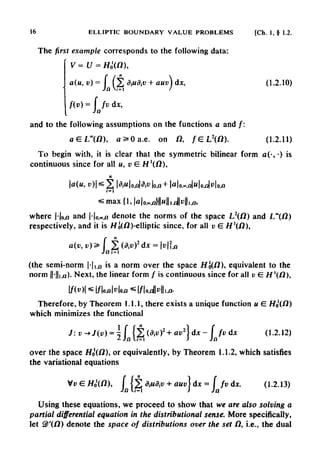
The first example corresponds to the following data:
and to the following assumptions on the functions a and /:
To begin with, it is clear that the symmetric bilinear form a(-,-) is
continuous since for all M, v E H '(/2),
(the semi-norm |-|,,fl is a norm over the space Ho(/2), equivalent to the
norm |(-||i,u). Next, the linear form / is continuous since for all v E. //'(/2),
Therefore, by Theorem 1.1.1, there exists a unique function u E. /f0'(/2)
which minimizes the functional
over the space Ho(O), or equivalently, by Theorem 1.1.2, which satisfies
the variational equations
Using these equations, we proceed to show that we are also solving a
partial differential equation in the distributional sense. More specifically,
let 3>'(f2) denote the space of distributions over the set (I, i.e., the dual
where |-|on and |-|o,0,n denote the norms of the space L2(N) and L0(N)
respectively, and t is H10(N)-elliptic since, for all v E H1(N),
discussed much asa good-looking actor’s, and by the same sort of
people, looks, at close quarters, more of a bruiser than does Wells.
Punch chose to be amusing on this subject not long before the war,
satirising the old and new methods of the manner in which
celebrities of the ring were photographed. In one drawing you see
the old bruiser, a doughty ruffian, stripped to the waist, with a
flattened nose, beetle-browed, with a long aggressive chin, piggy
eyes and short-cropped hair; in the other you have a smiling young
man dressed in the last palpitating extremity of fashion, with longish
hair brushed back from a somewhat noble brow, whilst beside him a
beautiful young woman smiles into a baby’s cot. The source of Mr.
Punch’s inspiration was not far to seek.
In the old days a boxer was portrayed at his job just as actors and
actresses were, because his job it was that interested people. And
like actors and actresses he is still photographed at his job. But to-
day just as you will see in the illustrated papers photographs of
theatrical people playing quite irrelevant games of golf or making
hay which has nothing to do with the point, so you will see
photographs of feather-weight champions dandling purely inapposite
infants. It is an age when people like to assure themselves (for some
inscrutable reason) that show-people are just exactly like people
who are not on show.
For good or for ill, boxing has become more and more a matter of
exact science in which the quick use of brains has, to some extent,
superseded purely physical qualities. And a new type of professional
boxer has therefore been evolved. Nevertheless, it is worth
observing here that the most important quality of all for success in
the ring remains unchanged from the very dawn of fist-fighting, a
quality possessed by Tom Johnson, by Jem Belcher, by Tom Spring,
Sayers, Fitzsimmons, Carpentier—what we call “character.”
Now Joe Beckett (to continue for a moment this unseemly discussion
of other men’s personal appearance) is in the old tradition of English
53.
champions. He “looksa bruiser.” This is largely due, no doubt, to
much rough and tumble fighting in his youth, when he travelled with
a booth, which is still (as it has been in the past) a first-rate school
for a hardy young bruiser. In this way he won a great many
contests, which have never been recorded, and then began a regular
career of no particular distinction in 1914. In the following year he
retired after fighting Pat O’Keefe for eight rounds. In 1917 he was
knocked out also in eight rounds by Frank Goddard, on whom,
however, he had his revenge in two rounds two years later. He lost
on points to Dick Smith, who was once a policeman and amateur
champion, after a contest of twenty rounds. Indeed the people who
beat Beckett were better known and better boxers than the people
whom he beat. But all this time he was improving as a boxer and
getting fitter and stronger.
When he entered the ring at the Holborn Stadium with Bombardier
Wells he was, as they say, a picture. He was in perfect, buoyant
health; a mass of loose, easy, supple muscle slid and rolled under his
bronzed and shining skin, he was obviously eager and ready for a
good fight.
Wells led off with his academic straight left, and landed lightly. Joe
Beckett dodged the next blow, came close in and sent in a hot right-
hander with a bent and vigorous arm to the body. Wells doubled up
and went down. On his rising Beckett went for him again, put
another right on the body and followed it quickly with a severe
punch rather high on the jaw which knocked Wells down again for a
count of nine. Beckett ought to have beaten him then, but Wells
boxed with great pluck and covered himself with care. During the
rest of that round he never took another blow, and, after a rest,
came up for the second fully recovered. Beckett rushed at him
clumsily, trying to get close, and Wells used his long reach with
much skill and promptitude, propping him off, hitting him with his
clean and sure straight left, moving quickly on his feet, so that, try
as he would, Beckett failed to come to close quarters. Just at the
end of the round Wells gave his man a really hard blow on the chin
54.
which made Beckettexceedingly glad to hear the bell which
announced time. And in the third round, too, Wells kept his
opponent at a distance, boxing brilliantly, and adding up points in his
own favour. In the fourth Wells was really happy. He had suppressed
Beckett, he thought; and sent a hard right-hander to the jaw which
would have staggered less hard a man. But Beckett is very strong,
and replied with a couple of body-blows, without, however, doing
any damage to speak of. Again it was Wells’s round. He had quite
forgotten the beginning of the fight and how nearly he had been
beaten then. He was acutely conscious of being the better boxer,
and consequently underrated Beckett’s strength and persistence. At
the start of the fifth round he was not prepared for the rush with
which his antagonist came for him, so that Beckett got quite close to
him before he could think about propping him away. Right and left
came Beckett’s gloves with a will into Wells’s slim body, and then a
short jolting blow went upwards to his jaw, and Wells went down.
He was up again very quickly, not seriously hurt, and Beckett darted
in again. This time Wells was ready and did his utmost to use his
long reach. But Beckett’s greater strength and his willingness to run
a little risk told in his favour. He was fighting hard, but not wildly or
foolishly; he ducked under the long arm and began to punish Wells
severely about the body. Another blow on the head sent Wells to the
ground for nine seconds. Wells rose feeling dazed and helpless, he
tried to cover his jaw, but Beckett darted in and sent in a hard right
over his shoulder to the point, and Wells was knocked out. And the
Championship of England again changed hands.
55.
Photo: “Sport andGeneral.”
Bombardier Wells.
A return match was arranged a year later, and on May 20th, 1920,
this pair fought again for the Championship at Olympia. Beckett in
the meantime had been summarily knocked out by Carpentier, but
had himself knocked out Frank Goddard in two rounds, Eddie
McGoorty in seventeen, and Dick Smith in five. He had become more
confident, more adept. He was not a great boxer, is not now, and is
never likely to be. But he had improved. Nor had Wells been idle. He
had knocked out Jack Curphey in two rounds, Harry Reeves in four,
Paul Journee, the Frenchman, in thirteen, and Eddie McGoorty in
56.
sixteen. This lastwas a terrific fight, but McGoorty was quite out of
training. Wells had also beaten Arthur Townley, who retired at the
end of the ninth round.
What I might call the cochranisation of boxing has now for some
time past enabled vast crowds of people to watch, in comfort,
altogether too great a number of championship fights. The popular
excitement about these contests, or the majority of them, is largely
artificial—almost as artificial as the reputations of the “champions”
themselves, the result, that is to say, of purely commercial
advertisement. Of course, the case of Bombardier Wells is singular.
Long ago, before the war, he had his hold upon the popular
imagination (if such a thing exists), because he was tall, and good-
looking, and “temperamental.”
As for his methods, a friend of mine who used to judge Army
Competitions in India, and who saw the All India Championship of
1909, used to say that he never knew a boxer who so persistently
stuck to the plan of campaign that he had previously thought out as
did Bombardier Wells. Perhaps that is the secret of his mercurial
career: perhaps he always has a plan of campaign and sticks to it—
successfully or not, according to the plan of his antagonist. Wells’s
antagonists have a disconcerting way of doing something fresh and
unexpected, and the plan is liable to be a hindrance. The most crafty
boxer may have a plan which he prefers, but he is able at an
instant’s notice to substitute an alternative scheme suited especially
to the caprice of the man he desires to beat. Carpentier does that.
Wells, as already said, likes scientific boxing just as other people like
golf, and he is apt to be disconcerted by fierce sloggers just as a
golfer would be disconcerted (I imagine) by some one who invented
and employed some explosive device for driving little white balls
much farther away than can be done with the implements at present
in use. Circumstances or the advice of friends pushed Wells—in the
first instance possibly without any special desire of his own—into the
professional ring. And people still flock to see him there, or at all
57.
events they didso in 1920, chiefly because the ring was, for him, so
strikingly inappropriate a setting.
Beckett, on the other hand, takes naturally to fighting. He is not
nearly such a “good boxer,” his style is not so finished as Wells’s, his
footwork, though variable, is not so adept. But he knows how to
smash people, and I should say (intending no libel upon a gallant as
well as a successful bruiser) likes doing it.
The majority of people who came to Olympia to watch the second
fight between those men probably wanted Wells to win, for the
inadequate reason that he looked so much less like a boxer than his
adversary. They were disappointed. Wells began better than usual,
for he seemed ready to fight: but his own science was at fault in
that he accepted Beckett’s invitation to bouts of in-fighting, when he
ought to have done his utmost to keep his man at long range.
Beckett accepted the situation comfortably, and sent in some hard
punches to the body and a left swing to the head. During the last
minute of the round Wells did succeed in keeping him away and
landed a succession of fine straight lefts; but these were not hard
blows, nor did Wells attempt to follow them up. Joe Beckett was
imperturbable and dogged, but very cautious too. He kept his left
shoulder well up to protect his jaw from Wells’s right, and when he
did hit he hit hard. There was no sting, no spring, no potency in
Wells’s hitting. And he was careless. He gave Beckett an excellent
opening in the second round, which the new champion used
admirably with a hooked left, sending Wells down for seven seconds.
And he kept on pushing his way in for the rest of that round, once
leaving himself unguarded in his turn and inviting the blow with
which Wells, if he had put his weight into it, might well have
knocked him out. But the blow was too high and not hard enough.
The third round was the last. Beckett gave his man a hard left, and
Wells broke ground, somewhat staggered. They came together and
for half a minute or more there was a really fine rally, Beckett hit the
harder all the time, and presently with a swinging left to the body
58.
and a beautifullyclean and true right hook to the jaw he knocked
Wells out.
59.
CHAPTER X
GEORGES CARPENTIERAND JEFF SMITH
If an unnecessary fuss has been made about those affairs of other
boxers which have nothing whatever to do with boxing, there is
some excuse in Carpentier’s case, if only because he is the first
Frenchman to achieve real distinction in the sport.
Georges Carpentier was born at Lens, in the Pas de Calais, in
January of 1894. His father was a collier, and the boy, directly he
was old enough (which probably meant long before he was old
enough), followed his father underground and worked as a pit-boy,
earning his five francs a week. At about this time a jovial little man
whose face is now as familiar as Carpentier’s, François Descamps by
name, was managing a gymnasium in the town. It was at this time
that a wave of athleticism was passing over Northern France, and
the boys of Lens, Carpentier amongst them, used to regard this
gymnasium as their chief amusement after work hours. Amongst
other exercises, Descamps encouraged a certain amount of boxing
—“English” boxing. La Savate had practically died out, and the days
when “Charlemagne” the Frenchman, “kicked out” Jerry Driscoll, the
ex-sailor (amongst whose pupils have been some of the best of the
English amateurs) were unlikely to return. Still, though boxing was
at this time a popular enough show in Paris, few Frenchmen
themselves actually boxed, and Descamps was, in providing gloves
at his gymnasium, rather in advance of his time.
60.
Descamps forbade theuse of these gloves by boys whom he had not
yet taught, and when one evening he caught young Carpentier
thrashing a much bigger boy with them and by the light of nature,
he rated him soundly: but he kept an eye on him. He was a natural
fighter. It soon became apparent that he must fight; the inward
urging was there, insistent and never for long to be denied. And the
boy, all untaught, could defend himself.
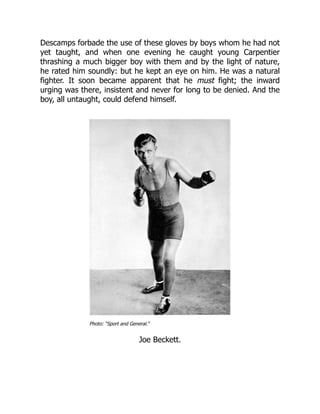
Photo: “Sport and General.”
Joe Beckett.
61.
Before very longDescamps, who interviewed the child’s parents,
overcame their natural scepticism by paying them the weekly five
francs the lad had been earning at the mine, and undertook his
training as an athlete, sending him out into the fresh air instead of
into the pit, teaching him all he himself knew about the science of
fisticuffs. Mr. F. H. Lucas, the author of From Pit-Boy to Champion
Boxer, makes it plain that if ever there was an authentic instance of
a fairy godfather stepping into a boy’s life and changing it in a day
from gloom to unalloyed delight, it is the instance of Descamps and
Carpentier. The young Frenchman had an unique opportunity of
succeeding well, for he was by Descamps’s interference enabled to
follow the pursuit he liked best from his boyhood onwards; and
underwent, owing to that fact, a unique training, adapted as it was
to that end and to that end alone.
It is unnecessary to trace Carpentier’s career from the time he won
his first success against an American boxer in a travelling booth and
became “Champion” of France at 7 stone 2 lb., and at the age of
fourteen, until he beat the Heavy-weight Champion of England,
when he was but nineteen and no more than a middle-weight.
Carpentier’s success was by no means uniform. He got some severe
thrashings both from English boxers and Frenchmen—generally
owing to the fact that he gave away weight and especially years at
an age when youth is on the windward side of achievement. It is a
wonder that the boy was not discouraged, but his pluck was
unconquerable, and Descamps a sympathetic and astute manager.
Again and again when it became apparent in a contest that nothing
could save Carpentier from a knock-out, Descamps would give in for
him, directing one of the seconds to throw a towel into the ring. His
avoidance of the actual fact of a knock-out no doubt saved the boy
much discouragement, and it looked better, and still looks better, in a
formal printed record of what he has done. Of course, Descamps
was not always able to gauge the right moment for surrender, and it
happened at least once in those early days that Carpentier was
62.
knocked out justlike any other boxer with no fairy godfather to
supervise his defeats.
In 1912 he had a very hard fight with Frank Klaus the American,
who at that time claimed the World’s Middle-weight Championship.
This encounter took place at Dieppe, and the American was nearly
beaten early in the fight, falling from a terrific blow on the jaw. But
he recovered, and his much longer experience came to his aid. In
the end he gave Carpentier a severe drubbing for several rounds
until, to save him, Descamps entered the ring: whereupon the
referee gave Klaus the verdict. But throughout this contest the
Frenchman was working hard, fighting all the time, never
discouraged by punishment, showing what he had always shown, a
perfectly unalterable, irreducible courage.
The same sort of thing happened in his fight with another American,
Papke. This time Carpentier had to reduce his weight, which is the
worst possible thing a boy, still growing and with no superfluous
flesh, can do. He began the fight weak, was severely hammered and
finally had an eye closed. Again Descamps intervened, this time in
the eighteenth round, to save him the technical knock-out.
Regarded dispassionately, this sort of thing is excellent “business,”
and does not, as far as one can see, do much harm to sport. If
Tommy Burns was the first man who made boxing a matter of sound
commerce, one may call Carpentier, or more strictly his manager and
mentor, Descamps, the first Boxing Business Magnate. Between
them they had made a literally large fortune before Carpentier was
twenty.
One of his hardest, longest, and best fights was with Jeff Smith, a
hardy American who was a shade lighter, shorter, and with less reach
than Carpentier. This combat took place at the end of 1913, not a
month after the Frenchman had beaten Wells, for the second time,
at the National Sporting Club.
63.
On this occasionCarpentier boxed indifferently in the early rounds,
and seemed not to take the occasion seriously. His was the first
blow, and it was a good one, which drew blood from the American’s
nose. Smith grunted and shook his head, and put in a left in reply. It
was clear that he wanted the Frenchman at close quarters, and he
kept coming in close and hammering away at the body. Carpentier
made a perfunctory effort to keep him at arm’s length, but seemed
after a while to be willing to fight Smith on his own terms. He
caught the American a very hard smack on the eye, which swelled
up so that he was thenceforward half-blinded. Smith even in the
third round was a good deal marked, and not one of the spectators
imagined for a moment that he could possibly last out the full twenty
rounds. In the next round Carpentier boxed very much as he
pleased. They exchanged body-blow and upper-cut on the head, but
the latter was the more severe, and it was the Frenchman’s. Smith
kept on trying to “bring the right across” at close quarters, but
Carpentier always protected himself. He seemed to be waiting for a
safe opportunity for knocking his opponent out, and did little in the
fourth round. Smith kept on leading, though without much effect,
but scored more points nevertheless.
After a while Smith began to get into serious trouble, and he held to
avoid punishment. This is against the strict rules, and should be
regarded as such; but, humanly speaking, when you are getting a
very bad time, the instinct to hold your man’s arms to prevent him
from hitting you is very strong. If you have the strength it is, of
course, much more efficacious to hit him and stop the punishment in
that way: but when your strength is going, as Smith’s was, you are
prone to follow blind instinct, rules or no rules. Just after this he
managed to put in a good upper-cut, but got a hard “one-two” in
return—a left instantly followed by right, straight, taking him in the
middle of the face. And then Smith woke up, having got what is
called his second wind. Throughout the seventh round he gave
Carpentier a really bad time. Two fierce blows, left and right, made
the Frenchman rock where he stood, and his counters were well
guarded or avoided altogether. Carpentier boxed better in the eighth
64.
round, but therewas no power in his blows, and the French
onlookers began to look very glum. For his part, Carpentier wished
that he had trained better. He was not himself: the fire seemed to be
dead in him. He was feeling desperate: there was no pleasure in this
fight. Smith kept on getting under his long arms and hitting him hard
at close quarters, hammering away at his stomach. And Carpentier
grew weaker and more wild, and wasted his remaining strength on
futile swings which clove the empty air. Another hard blow on the
jaw and Carpentier staggered. It was all he could do to hold up. He
replied with one of his vain and foolish swings, sent with all his
remaining power whizzing through the air and missing Jeff Smith by
feet. This effort sent Carpentier hard to the floor by the momentum
of its own wasted force. It is true that Smith failed to follow up his
advantage when the Frenchman rose, but even so the round was
decisively in his favour.
The tenth round found Smith strong and hearty, boxing with sturdy
vigour if not remarkable skill. Carpentier had recovered a little by
now, and, exasperated by Smith’s coolness, rallied vigorously and
rained left-handers on his opponent, so that the American was
forced to “cover up” with his gloves on either side of his face and his
elbows tucked in. Carpentier’s round, but no serious damage done.
And the next was much the same, and Smith clinched a good deal,
though Carpentier’s hitting was far from strong. Smith’s defence was
admirable when he was not holding, but his vigour of attack had
been in abeyance for a little while. In the twelfth round he woke up,
and drove his right to the Frenchman’s mouth, drawing much blood,
and went on attacking. In the fourteenth round Carpentier seemed
quite done. He tried once or twice to swing in the hope of knocking
his man out, but his blows were weak and Smith was cautious. The
American was still the more marked and obviously damaged of the
two; but Carpentier looked woebegone and ill. He, too, had a split lip
which bled profusely. Just at the end of the round Carpentier did at
last manage to put in a right cross-counter which had some strength
in it, but before he could follow it up time was called, and Smith had
his minute in which to recover.
65.
It was aboutthis time that Descamps declared that Carpentier had
smashed his hand at the very beginning of the fight. It may be taken
as a fairly safe rule that when a man’s backers make this type of
observation during the progress of a contest, they think he is going
to lose it. When he has actually lost, they invariably say something
of the kind. A smashed hand—a family trouble—an acute attack of
indigestion—these excuses and all their manifold variations serve
their dear old turn, and are promptly disbelieved at large as soon as
they are uttered. It is possible that Carpentier may have sprained a
thumb slightly, but it could not have been more than that. The
vigour that his hitting lacked was, on that occasion, constitutional.
He was not in first-rate condition.
Both men were sorry for themselves. Smith’s eye was quite closed,
his opponent was bleeding severely from his cut lip. For a time their
efforts were about equal. Carpentier kept trying to knock his man
out, Smith defended himself. The spectators could not understand
the Frenchman. All the time or almost all the time, he had fought
like a man both weak and desperate. And then, quite suddenly, in
the sixteenth round there was a change.
I have said that Carpentier is a real fighter: he has the spirit and
instinct for bashing, for going on against odds. He was weak, and for
a long time he had plainly shown it. And yet somewhere in him there
was a reserve of power and an unconquerable will.
To the utter astonishment of the onlookers and of Jeff Smith himself,
Carpentier sprang out of his corner for the sixteenth round as
though he were beginning a fresh contest. He positively hurled
himself across the ring at his antagonist. He landed at once, with a
half-arm blow on the head, and blow after blow, mainly with the left,
pounded the unfortunate American. Smith was completely taken
aback and could only clinch to save himself. It was all that he could
do to withstand this slaughtering attack and remain upright.
66.
There was agreat uproar amongst the crowd. Yells of delight
greeted this great awakening of the Frenchman: and when the next
round began every one thought that Smith must soon fall.
Carpentier went for him again with animal ferocity. He leapt about
the ring after him, sending in blow after murderous blow. Smith
reeled and gasped and staggered and backed away after each
shattering, smashing right had landed, but he still stood up and
fought him like a man. It was a fine show of pluck. The man was
badly hurt. Plenty of boxers would have dropped for a rest and even
would have allowed themselves to be counted out, but not Jeff
Smith. He was, as they say, “for it,” and he knew that he was “for it.”
But he would go through with it.
The uproar increased. The spectators wanted to have the fight
stopped, but without avail. The fight went on. Smith staggered in,
and more by good luck than any sort of management, contrived to
land two pitiful blows. His legs were hopelessly weak—he could
hardly see, and yet he managed to cover his jaw, and, try as he
would, with all his renewal of vigour, Carpentier could do everything
he liked with his man save knock him out. It is necessary to make
this quite plain. Smith looked as though he must at any moment
drop down and stay down from sheer exhaustion.
A minute’s rest. The last round.
Men are oddly and wonderfully made. Smith leapt from his chair just
as his opponent had done a quarter of an hour before, strong, eager,
ferocious. He tore across the ring at Carpentier, flung amazing blows
at him, made desperate and frantic efforts to knock him out at the
last minute. Carpentier was completely flabbergasted. He had never
known anything like this to be possible. Smith’s recovery was
marvellous, not less wonderful than that. And indeed Jeff Smith was
within sight of victory throughout that desperate last round. He
landed a right-hander with all his diminished strength, and the
Frenchman crumpled up and fell forward to the boards. A little more
might behind the blow, a shade more elasticity in the arm that sent
67.
the blow, andCarpentier must have been counted out. But that was
the end. Carpentier rose just as the bell rang for time. And the
referee gave the fight to him. The decision was not popular even
among Frenchmen—which is surprising, but strengthening to one’s
faith in human nature.
68.
CHAPTER XI
JACK DEMPSEYAND GEORGES CARPENTIER
Carpentier served in the French Flying Corps during the war, but
though four years or more were taken from the best of his boxing
life, he did not forget how to box. During the “gap” he engaged in
no recorded contests, but no doubt did a certain amount of sparring.
He had gained weight and lost no ground when the war ended.
During 1919 and 1920, he fought five times, knocking out five men,
including Dick Smith, Joe Beckett, and Battling Levinsky. Meanwhile,
in July, 1919, Jack Dempsey had knocked out Jess Willard in three
rounds for the World’s Championship, and Carpentier challenged
him.
“Jack Dempsey” is a nom de guerre, presumably taken (since there
is as yet no copyright in names) from that older Jack Dempsey who
began boxing in the early eighties, and lost the World’s Middle-
weight title to Bob Fitzsimmons, who knocked him out in fifteen
rounds in 1891.
The new Jack Dempsey was born in 1895, and his record shows that
until the end of 1920 he had fought upwards of sixty contests, fifty-
eight of which he won, mainly by knocking his opponents out in the
first or second rounds. He weighs 13½ stone, and stands just a
shade under 6 feet. That is to say, he was a stone and a half heavier
than Carpentier; much longer in reach. Dempsey is a very miracle of
strength and hardness.
69.
It seemed anabsurd match. If an animal analogy may be allowed, it
was like a young leopard against a gorilla. There are, of course,
innumerable accidents in boxing, chance blows and slight injuries
which turn the tide of battle, an “off” day, a fault in training; but it
may be laid down as a general rule that when character and
strength are equal the man with the more skill wins, when skill and
strength are equal, character wins, when character and skill are
equal, strength wins. So it was now. Both Carpentier and Dempsey
were natural fighters, both were scientific boxers, though Carpentier
was more skilled than his opponent, both wanted to win, but
Dempsey was immensely stronger than the Frenchman.
The contest took place at New Jersey, U.S.A., on July 2, 1921. A very
small ring was used, no more than eighteen feet square. The
number of rounds was limited to twelve, but it was recognised
beyond the possibility of doubt that so many as twelve would not be
required to settle the matter.
The moving pictures of the event show Carpentier sitting in his
corner, nodding and smiling while his gloves are being put on. His
grin is wide. Then with the suddenness of the camera’s own shutter,
it ceases. For an instant the whole face is still, the mouth closes in
thin-lipped anxiety, the eyes are set, and when you see the smile
break out again you know that it is deliberate, not spontaneous. In
fact Georges Carpentier was acutely nervous. Who, of his size and in
his shoes, would not have been? You have but to glance at the man
in the opposite corner, and you shake at the very thought of being in
Carpentier’s shoes at that moment. Thirteen and a half stone may
mean very little; it may mean a hulking fellow who can’t hit, let
alone take punishment: it may mean a hulking fellow who can hit
hard, but who can do nothing else. But the thirteen and a half stone
of Dempsey meant a man in perfect condition, who could hit as few
men can, who was extraordinarily hard and strong and almost
impossible to hurt. Thirteen and a half stone of bone and muscle,
not bone and muscle and fat. No fat at all. All hard stuff; not easy
70.
rippling muscle likeCarpentier’s, but very solid and tough and
extremely serviceable.
Dempsey had left himself unshaven for several days, so that the skin
of his face should not be tender, thereby gaining, besides, a horribly
malign appearance. And he scowled, and when the two of them
stood up he made Carpentier look a little man. Dempsey was not
popular in America owing to his avoidance of military service during
the war. Seeing him in the ring, unless the photographic films have
lied, he looked the very incarnation of sullen rage and brute force. In
private life he is an amiable man, fresh-faced and modest. He had
much more than brute force: he was a skilled and terrific basher.
Strength for strength, Dempsey could, as you might say, “eat”
Carpentier.
And they gave rather the appearance of the child and the ogre in the
ring. Carpentier seemed unable to defend himself against the
shattering onslaught of the American, and there was much clinching
in the first round. The smaller man greatly surprised the spectators
by going in and fighting at once, instead of trying to keep away and
let Dempsey tire himself, which seemed to be the obvious course to
pursue. He had not the strength to stop the majority of Dempsey’s
blows, especially the upper-cuts which came crashing through his
guard. He tried the trick of boxing with his chin on the big man’s
chest, but even so his body suffered the more. It was, as a matter of
irrelevant fact, Carpentier who scored the first hits, a left on the face
and an upper-cut with the right, neither of which had any effect at
all. During a clinch the champion gave his opponent a dig in the
stomach which reduced his strength immediately. This he followed
by a hard, very short blow on the back of the head, given whilst
Carpentier was holding close. From the position in which two men
stand in a clinch, such a blow cannot be given with the whole weight
of the body. The glove can travel only five or six inches, and the
body’s weight cannot in that attitude be swung behind the arm. I
have seen in clumsy boxing a man knocked clean out by a blow on
the back of the head or neck by an ordinary full swing, aimed for the
71.
jaw, which thevictim has protected by bringing his head forward,
but not far enough forward. But a man of Dempsey’s strength can
make the short blow a very serious one when frequently repeated:
and he repeated it many times on Carpentier.
Next he landed on the Frenchman’s body with both hands. Emerging
from a clinch Carpentier was seen to be bleeding from the nose.
Then he swung hard at Dempsey’s jaw and missed it. He had done
no damage at all yet.
The second round was the most interesting in a very short fight.
Carpentier crouched and jumped in with a left and right which
landed on the head, but did not hurt the American. Carpentier hit
again and missed. They clinched, and Dempsey sent in some more
body-blows, pulling his man about the ring as he pleased, so long as
he held. Then Carpentier backed away, and for an instant Dempsey’s
guard was down. The Frenchman halted in his retreat and shot a left
hook in at the jaw. It was beautifully timed, a fine seizing of a small
opportunity, a test of courage. And for Carpentier it was a great
moment, a triumph of presence of mind: thought and action were
wellnigh simultaneous. The blow seemed to shake Dempsey, and the
huge crowd yelled with delight for the Frenchman, who immediately
followed up his advantage. He had been hurt: he was weak, but he
had taken his opportunity. That left was a hard blow, almost as hard
as any he had ever struck. It was a wonderful chance: he had never
thought he would be able to get in a blow like that, not after that
first round. And now he would hit again, and he swung his right
hand to Dempsey’s jaw with all his might. But there was just a shade
of flurry about that blow, and Carpentier did a thing he had not done
for years: he swung his hand in its natural position, instead of
twisting it over a little in its passage so that the finger knuckles
struck the jaw: and the natural position made the impact fall upon
the thumb. It was a beginner’s mistake, but a frequent one when
hot haste makes a man a little wild. Carpentier felt a sharp and
agonising pain, but he struck again with his right, and this time he
missed. Dempsey came forward and this time it was he who
72.
clinched, before attackingthe French man’s body again with his half-
arm blows. And so the round ended.
What had happened was this: the full weight of Carpentier’s blow
falling on his thumb broke it and sprained his wrist. Dempsey shook
his head and retired a step or two, and declared afterwards that he
could not remember the blow. This is unlikely. He added that he
might possibly have been caught when he was off his balance and
so appeared to stagger. We may say for certain that the two blows,
left and right combined, would have knocked any other man out.
Certainly their effect upon the champion was trivial; though it is said
that some one in his corner stretched out his hand for the smelling-
salts, so as to be ready in case Dempsey came to his corner dazed.
The third round began, and Carpentier retreated as his opponent
advanced on him. He knew too much now to attempt to “mix it,” he
would keep away. His only chance lay in Dempsey’s tiring himself. He
said afterwards that those two blows in the second were the best he
could strike, and when he saw that they had failed he lost heart.
“Dempsey gave me a blow, just afterwards, on the neck which
seemed to daze me,” he said.
Well, there are various degrees of losing heart. Carpentier may have
realised that his task was hopeless, but he meant to go on. He
landed a right at very long range with no power behind it to speak
of, and Dempsey clinched, before sending home several of his rib-
shattering half-arm blows. Carpentier’s strength was going. These
body-blows had hurt him severely, and their effect was sickening and
lasting. Then Dempsey hit him a little higher, just under the heart,
and the Frenchman’s knees gave. He was nearly down, but managed
to keep on his legs until the end of the round. But he was looking ill
as he went to his corner.
Directly the fourth round began the sullen giant crouched and
attacked Carpentier with all his strength, driving him fast before him
round the ring until he had him in a corner. Dempsey swung his right
73.
and Carpentier duckedinside it. They were close together, and he
had to submit to a bout of in-fighting, trying to force his way out of
the corner. But Dempsey got him close up against the ropes and
sent in a very hot right to the jaw. Carpentier collapsed upon hands
and knees. The ring, his antagonist, the faces peering at him from
the level of the stage, were misty and vague. There was only one
idea in his mind, only one thing that he could hear. He must get up
somehow before the referee counted ten.... Four—five—(he was not
done yet)—six—seven—(he must stay down as long as possible)—
eight—nine. And at that Carpentier jumped up quickly and flung up
his arms to guard against the inevitable rush. It was no good. He did
not know his own weakness. Dempsey just pushed his arms aside,
feinted with his left, and sent his right crashing to the heart. Again
Carpentier fell, and this time he was counted out.
74.
CHAPTER XII
GEORGES CARPENTIERAND GEORGE COOK
After his defeat by Dempsey, Carpentier did not fight again until he
met George Cook, the Australian, at the Albert Hall, on January 12th,
1922. In the World’s Championship contest he had been badly hurt:
and a beating such as he had then might well have produced a
lasting effect. It was, then, interesting to watch him to see if his
previous downfall would manifestly alter his demeanour in the ring.
But though it is not to be doubted that some of his behaviour arose
from motives of policy, there was, genuinely, no sign of worry upon
his boyish and almost preposterously unpugilistic face. Coming into
the ring there was an elaborate nonchalance in the Frenchman’s
mien which was intended to impress his opponent. With genial
gravity Carpentier himself wound his bandages about his hands
before drawing on his black gloves: and instead of remaining in his
corner he moved his stool to a position in the ring more generally
commanded by the spectators.
Cook is a man without any particular record in this country, though
he was Heavy-weight Champion of Australia. By beating Carpentier
he would have become Champion of Europe, and would, of course,
have bounded into considerable fame. Wise after the event, large
numbers of a critical public have observed that the result was for
ever certain. But that is unfair to Cook, who showed himself to be a
boxer by no means despicable, and who most emphatically had the
better of one round out of the four. He was a stone heavier than his
75.
man, though thisconsiderable difference was not plainly observable
when they stripped. Cook was just a shade “beefy,” but he was
strong and well. He looked across the ring with astonishment at the
form of his antagonist: for Carpentier is—a Greek bronze, dark-
skinned, beautifully proportioned, covered with easy, flowing muscle,
a sight to stir the hearts of older athletes with vain regret.
The huge hall was full. Large numbers of women were present, both
English and French, and these called to mind the amusing
discussions in and out of newspapers, before the war, as to the
propriety of admitting female spectators to “Gladiatorial displays.”
Indeed in one Correspondence Column under the title, “Should
Ladies Watch Boxing Contests?” an irascible old sportsman declared
that the question did not arise, as no lady would do such a thing.
Without entering at length into a question which is not widely
interesting, I would ask what hope there was for a gentility which
depends upon obedience to a perfectly trivial convention, involving
no question of right or wrong, manners, or even what we usually
mean by “decorum”? In those days of 1914, before war broke out,
and when the “boxing boom” was at its height, a woman whom it is
unnecessary to call a “lady,” old enough also to have recognised for
what they were and to despise many transient correctitudes of
fashion, observed: “If my daughter likes to go and see two nasty
men with hairy chests knocking each other about, why shouldn’t
she?” And, really, that is all there is to be said on the subject.
To return to what the ladies watched, rather than exploring the
“quite niceness” of their watching it—a very desperate encounter
was not expected: but, provided that he doesn’t knock his man out
in the first fifty or sixty seconds, Carpentier is always worth seeing.
The first round was level. Cook boxed well, particularly at close
quarters, and the Frenchman appeared hesitating and tentative in all
his movements. Early in the next round Cook sent out a quick and
tremendous swing which, with greater quickness, Carpentier
avoided, dancing right away from it. Then, a little later, the same
76.
Welcome to ourwebsite – the ideal destination for book lovers and
knowledge seekers. With a mission to inspire endlessly, we offer a
vast collection of books, ranging from classic literary works to
specialized publications, self-development books, and children's
literature. Each book is a new journey of discovery, expanding
knowledge and enriching the soul of the reade
Our website is not just a platform for buying books, but a bridge
connecting readers to the timeless values of culture and wisdom. With
an elegant, user-friendly interface and an intelligent search system,
we are committed to providing a quick and convenient shopping
experience. Additionally, our special promotions and home delivery
services ensure that you save time and fully enjoy the joy of reading.
Let us accompany you on the journey of exploring knowledge and
personal growth!
ebookultra.com





![CONTENTS xiii
Convergence of Uzawa's method 402
Concluding remarks 403
Exercises 404
Bibliography and comments 406
Additional bibliography and comments 407
Primal, dual and primal-dual formulations 407
Displacement and equilibrium methods 412
Mixed methods 414
Hybrid methods 417
An attempt of general classification offiniteelement methods 421
8. FINITE ELEMENT METHODS FOR SHELLS 425
Introduction 425
8.1. The shell problem 426
Geometrical preliminaries. Koiter's model 426
Existence of a solution. Proof for the arch problem 431
Exercises 437
8.2. Conforming methods 439
The discrete problem. Approximation of the geometry. Approximation
of the displacement 439
Finite element methods conforming for the displacements 440
Consistency error estimates 443
Abstract error estimate 447
Estimate of the error (2; = i||Ma-«afc|H./}+||«3-W3*l|2.n)"2
448
Finite element methods conforming for the geometry 450
Conforming finite element methods for shells 450
8.3. A nonconforming method for the arch problem 451
The circular arch problem 451
A natural finite element approximation 452
Finite element methods conforming for the geometry 453
A finite element method which is not conforming for the geometry.
Definition of the discrete problem 453
Consistency error estimates 461
Estimate of the error (|u, - u l h ] , + u2 - u2hlj)tl2
465
Exercise 466
Bibliography and comments 466
EPILOGUE: Some "real-life" finite element model examples 469
BIBLIOGRAPHY 481
GLOSSARY OF SYMBOLS 512
INDEX 521](https://image.slidesharecdn.com/75432-250228145447-32f04da6/85/The-finite-element-method-for-elliptic-problems-2nd-Edition-Philippe-G-Ciarlet-19-320.jpg)



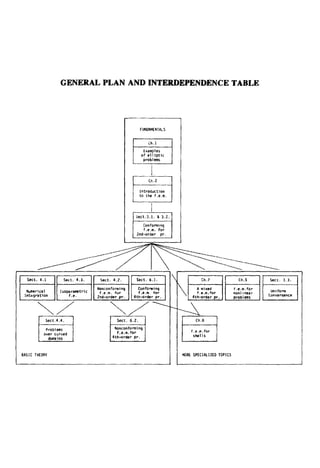

![Ch. 1 , § 1.1.] ABSTRACT PROBLEMS 3
Then the abstract minimization problem (1.1.1) has one and only one
solution.
Proof. The bilinear form a(-, •) is an inner product over the space V,
and the associated norm is equivalent to the given norm ||-||. Thus the
space V is a Hilbert space when it is equipped with this inner product.
By the Riesz representation theorem, there exists an element ai E V such
that
so that, taking into account the symmetry of the bilinear form, we may
rewrite the functional as
Hence solving the abstract minimization problem amounts to mini-
mizing the distance between the element ai and the set U, with respect
to the norm Va(-, •)•Consequently, the solution is simply the projection
of the element erf onto the set U, with respect to the inner product a(-,•)•
By the projection theorem, such a projection exists and is unique, since
U is a closed convex subset of the space V. D
Next, we give equivalent formulations of this problem.
Theorem 1.1.2. An element u is the solution of the abstract minimiza-
tion problem (1.1.1) // and only if it satisfies the relations
in the general case, or
if U is a closed convex cone with vertex 0, or
if U is a closed subspace.
Proof. The projection u is completely characterized by the relations](https://image.slidesharecdn.com/75432-250228145447-32f04da6/85/The-finite-element-method-for-elliptic-problems-2nd-Edition-Philippe-G-Ciarlet-37-320.jpg)
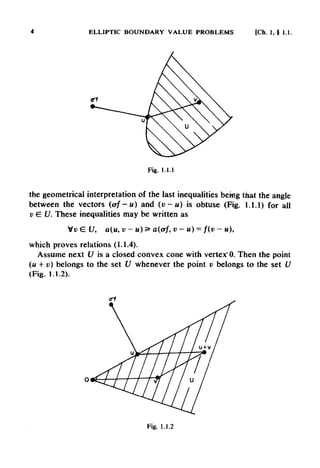
![so that, in particular, a ( u , u ) ^ f ( u ) . Letting v = 0 in (1.1.4), we obtain
a ( u , u ) ^ f ( u ) , and thus relations (1.1.5) are proved. The converse is
clear.
If V is a subspace (Fig. 1.1.3), then inequalities (1.1.5) written with v
and - v yield a ( u , v ) ^ f ( v ) and a(u, v ) ^ f ( v ) for all v £ 17, from which
relations (1.1.6) follow. Again the converse is clear. Q
Fig. 1.1.3
The characterizations (1.1.4), (1.1.5) and (1.1.6) are called variational
formulations of the original minimization problem, the equations (1.1.6)
are called variational equations, and the inequalities of (1.1.4) and (1.1.5)
are referred to as variational inequalities. The terminology "variational"
will be justified in Remark 1.1.2.
Remark 1.1.1. Since the projection mapping is linear if and only if the
subset U is a subspace, it follows that problems associated with varia-
tional inequalities are generally non linear, the linearity or non linearity
being that of the mapping / E V'-» u E V, where V is the dual space of
V, all other data being fixed. One should not forget, however, that if the
resulting problem is linear when one minimizes over a subspace this is
also because the functional is quadratic i.e., it is of the form (1.1.2). The
Ch. 1 , § 1.1.] ABSTRACT PROBLEMS 5
Therefore, upon replacing v by (u + v) in inequalities (1.1.4), we obtain
the inequalities](https://image.slidesharecdn.com/75432-250228145447-32f04da6/85/The-finite-element-method-for-elliptic-problems-2nd-Edition-Philippe-G-Ciarlet-39-320.jpg)
![6 ELLIPTIC BOUNDARY VALUE PROBLEMS [Ch. 1, § 1.
minimization of more general functionals over a subspace would cor-
respond to nonlinear problems (cf. Section 5.3).
Remark 1.1.2. The vocational formulations of Theorem 1.1.2 may be
also interpreted from the point of view of Differential Calculus, as
follows. We first observe that the functional / is differentiate at every
point u E V, its (Frechet) derivative /'(«) E V being such that
Let then u be the solution of the minimization problem (1.1.1), and let
v = u + w be any point of the convex set U. Since the points (u + 0w)
belong to the set U for all 6 E. [0,1] (Fig. 1.1.4), we have, by definition of
the derivative /'(«),
for all 0 E [0,1], with lime_^c(0) = 0. As a consequence, we necessarily
have
since otherwise the difference J(u + dw)-J(u) would be strictly ne-
gative for 6 small enough. Using (1.1.8), inequality (1.1.9) may be
rewritten as
which is precisely (1.1.4). Conversely, assume we have found an element
uGU such that
al
Fig. 1.1.4](https://image.slidesharecdn.com/75432-250228145447-32f04da6/85/The-finite-element-method-for-elliptic-problems-2nd-Edition-Philippe-G-Ciarlet-40-320.jpg)
![when U is a subspace. Notice that relations (1.1.13) coincide with
relations (1.1.5), while (1.1.14) coincide with (1.1.6).
When U - V, relations (1.1.14) reduce to the familiar condition that
the first variation of the functional /, i.e.,the first order term J'(u)w in
the Taylor expansion (1.1.12), vanishes for all w E V when the point u is
a minimum of the function /: V-^R, this condition being also sufficient
if the function J is convex, as is the case here. Therefore the various
relations (1.1.4), (1.1.5) and (1.1.6), through the equivalent relations
(1.1.10), (1.1.13) and (1.1.14), appear as generalizations of the previous
condition, the expression a(u,v-u)-f(v-u) =J'(u)(v-u), v E (/,
playing in the present situation the role of the first variation of the
functional / relative to the convex set U. It is in this sense that the
formulations of Theorem 1.1.2 are called "variationaF.
The nonsymmetric case. The Lax-Milgram lemma
Without making explicit reference to the functional /, we now define
an abstract variational problem: Find an element u such that
when U is a convex cone with vertex 0, alternately,
which shows that u is a solution of problem (1.1.1). We have J(v)- J(u)
> 0 unless v = u so that we see once again the solution is unique.
Arguing as in the proof of Theorem 1.1.2, it is an easy matter to verify
that inequalities (1.1.10) are equivalent to the relations
Therefore, an application of Taylor's formula for any point v = u + w
belonging to the set U yields
Ch. 1 , § 1 . 1 . ] ABSTRACT PROBLEMS 7
The second derivative J"(u)£3?2(V;R) of the functional / is in-
dependent of u E. V and it is given by](https://image.slidesharecdn.com/75432-250228145447-32f04da6/85/The-finite-element-method-for-elliptic-problems-2nd-Edition-Philippe-G-Ciarlet-41-320.jpg)
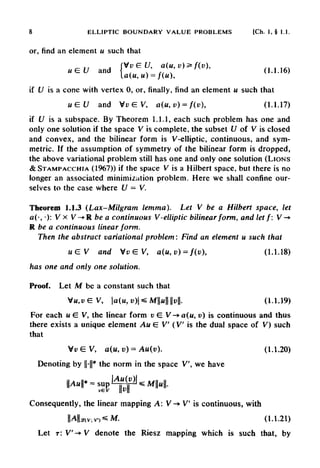
![Therefore the variational problem (1.1.18) is well-posed in the sense
that its solution exists, is unique, and depends continuously on the data f
(all other data being fixed).
Exercises
1.1.1. Show that if M,, / = 1,2, are the solutions of minimization prob-
lems (1.1.1) corresponding to linear form /, G V, i = 1, 2, then
Ch. 1 , § 1 . 1 . ) ABSTRACT PROBLEMS 9
definition,
((-,-)) denoting the inner product in the space V. Then solving the
variational problem (1.1.18) is equivalent to solving the equation rAu -
rf. We will show that this equation has one and only one solution by
showing that, for appropriate values of a parameter p > 0, the affine
mapping
is a contraction. To see this, we observe that
since, using inequalities (1.1.3) and (1.1.21),
Therefore the mapping defined in (1.1.23) is a contraction whenever
the number p belongs to the interval ]0,2a/M2
[ and the proof is
complete. D
Remark 1.1.3. It follows from the previous proof that the mapping
A: V-> V is onto. Since
the mapping A has a continuous inverse A"', with](https://image.slidesharecdn.com/75432-250228145447-32f04da6/85/The-finite-element-method-for-elliptic-problems-2nd-Edition-Philippe-G-Ciarlet-43-320.jpg)
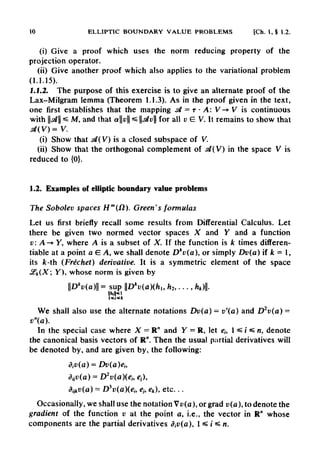
![Ch. 1, § 1.2.] EXAMPLES 11
We shall also use the multi-index notation: Given a multi-index
a = (a,, a2, •••, ««) £ N", we let |a| = 2?=i a,. Then the partial derivative
da
v(a) is the result of the application of the |aj-th derivative DM
v(a) to
any |a[-vector of (R")1
"1
where each vector e± occurs a, times, 1«s / ^ n.
For instance, if n = 3, we have div(a) = d"M}
v(a), dmv(a)= d<1<U)
t>(a),
dmv(a) = d(
™M
v(a), etc...
There exist constants C(m, n) such that for any partial derivative
d a
v ( a ) with |a| = m and any function v,
where it is understood that the space R" is equipped with the Euclidean
norm.
As a rule, we shall represent by symbols such as Dk
v, v", dtv, da
v,
etc. . . , the functions associated with any derivative or partial derivative.
When h ~ h2 = • • •- hk - h, we shall simply write
Thus, given a real-valued function u, Taylor's formula of order k is
written as
for some 6 £ ]0,1[ (whenever such a formula applies).
Given a bounded open subset fl in R", the space 3)(fi) consists of all
indefinitely differentiate functions v: /2-»R with compact support.
For each integer m 5*0, the Sobolev space Hm
(fi) consists of those
functions v G L2
(H) for which all partial derivatives da
v (in the dis-
tribution sense), with |cr|*sra, belong to the space L2
(/2), i.e., for each
multi-index a with |a|*£w, there exists a function d"v G L2
(fl) which
satisfies
Equipped with the norm
the space Hm
(fl) is a Hilbert space. We shall also make frequent use of the
semi-norm](https://image.slidesharecdn.com/75432-250228145447-32f04da6/85/The-finite-element-method-for-elliptic-problems-2nd-Edition-Philippe-G-Ciarlet-45-320.jpg)
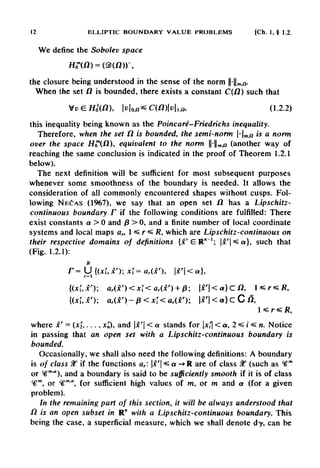
![Ch. 1,§ 1.2.] EXAMPLES 13
Fig. 1.2.1
defined along the boundary, so that it makes sense to consider the
spaces L2
(f), whose norm shall be denoted ||-|U2
(/>
Then it can be proved that there exists a constant C(/2) such that
Since in this case (^°°(I7)) = H'(/2), the closure being understood in the
sense of the norm ||-||i,u, there exists a continuous linear mapping
tr: v G H'(/2)-»tr v E L2
(F), which is called the trace operator. However
when no confusion should arise, we shall simply write tr v —v. The
following characterization holds:
Since the unit outer normal v = (v},..., vn) (Fig. 1.2.1) exists almost](https://image.slidesharecdn.com/75432-250228145447-32f04da6/85/The-finite-element-method-for-elliptic-problems-2nd-Edition-Philippe-G-Ciarlet-47-320.jpg)
![14 ELLIPTIC BOUNDARY VALUE PROBLEMS [Ch. 1, § 1.2.
everywhere along /", the (outer) normal derivative operator:
is defined almost everywhere along F for smooth functions. Extending
its definition to dv = ^1= i>,trd, for functions in the space H2
(fi), the
following characterization holds:
Given two functions u, v E Hfl), the following fundamental Green's
formula
holds for any i E [1, n]. From this formula, other Green's formulas may
be easily deduced. For example, replacing u by d,u and taking the sum
from 1 to n, we get
for all u G. H2
(O), v E H'(/2). As a consequence, we obtain by subtrac-
tion:
for all u, v E H2
(fl). Replacing u by Au in formula (1.2.6), we obtain
for all u E Hfl), v E H2
(O). As another application of formula (1.2.4),
let us prove the relation
which implies that, over the space H0
2
(/2), the semi-norm v-^Av9<fi is a
norm, equivalent to the norm -2,a'' We have, by definition,](https://image.slidesharecdn.com/75432-250228145447-32f04da6/85/The-finite-element-method-for-elliptic-problems-2nd-Edition-Philippe-G-Ciarlet-48-320.jpg)
![as two applications of Green's formula (1.2.4) show, and thus (1.2.8) is
proved.
For n - 2, let T= (TI, T2) denote the unit tangential vector along the
boundary T, oriented in the usual way. In addition to the normal
derivative operator dv, we introduce the differential operators <9T, d^, dn
defined by
Ch. 1, §1.2.] EXAMPLES 15
Clearly, it suffices to prove relations (1.2.8) for all functions v E Q)(fl).
For these functions we have
This relation holds for all functions u E Hfl), v e H2
(/2).
First examples of second-order boundary value problems
We next proceed to examine several examples of minimization and
variational problems. According to the analysis made in Section 1.1, we
need to specify for each example the space V, a subset U of the space
V, a bilinear form a(-, -): V x V-»R, and a linear form /: V-+R. In fact,
the examples given in this section correspond to the case where 17 = V,
i.e., they all correspond to linear problems (Remark 1.1.1). A non linear
problem is considered in Exercise 1.2.5, and another one will be con-
sidered in Section 5.1.
Then we shall make use of the following Green's formula, whose
proof is left as an exercise (Exercise 1.2.1):](https://image.slidesharecdn.com/75432-250228145447-32f04da6/85/The-finite-element-method-for-elliptic-problems-2nd-Edition-Philippe-G-Ciarlet-49-320.jpg)