WMS in The Cloud 
Ready for Prime Time
2 
The information contained in this document is proprietary. Copyright © 2014 Capgemini. All rights reserved. 
Agenda 
What is The Cloud? 
Cloud Benefits 
Tier 1 WMS Vendors in the Cloud 
The Cloud Decision 
How to get started
3 
The information contained in this document is proprietary. Copyright © 2014 Capgemini. All rights reserved. 
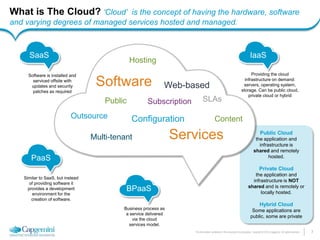
Software is installed and serviced offsite with updates and security patches as required 
Similar to SaaS, but instead of providing software it provides a development environment for the creation of software. 
Providing the cloud infrastructure on demand: servers, operating system, storage. Can be public cloud, private cloud or hybrid 
What is The Cloud? ‘Cloud’ is the concept of having the hardware, software and varying degrees of managed services hosted and managed. 
Business process as a service delivered via the cloud services model. 
IaaS 
BPaaS 
PaaS 
SaaS 
Public Cloud the application and infrastructure is shared and remotely hosted. Private Cloud the application and infrastructure is NOT shared and is remotely or locally hosted. Hybrid Cloud Some applications are public, some are private 
Hosting 
SLAs 
Multi-tenant 
Web-based 
Public 
Subscription 
Configuration 
Outsource 
Services 
Software 
Content
4 
The information contained in this document is proprietary. Copyright © 2014 Capgemini. All rights reserved. 
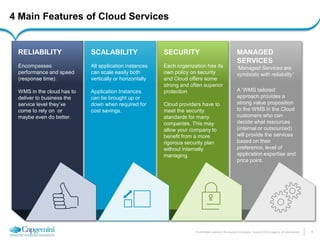
4 Main Features of Cloud Services 
MANAGED SERVICES 
‘Managed Services are symbiotic with reliability’ 
A ‘WMS tailored’ approach provides a strong value proposition to the WMS in the Cloud customers who can decide what resources (internal or outsourced) will provide the services based on their preference, level of application expertise and price point. 
SECURITY 
Each organization has its own policy on security and Cloud offers some strong and often superior protection 
Cloud providers have to meet the security standards for many companies. This may allow your company to benefit from a more rigorous security plan without internally managing. 
SCALABILITY 
All application instances can scale easily both vertically or horizontally 
Application Instances can be brought up or down when required for cost savings. 
RELIABILITY 
Encompasses performance and speed (response time). 
WMS in the cloud has to deliver to business the service level they’ve come to rely on or maybe even do better.
5 
The information contained in this document is proprietary. Copyright © 2014 Capgemini. All rights reserved. 
Agenda 
What is The Cloud? 
Cloud Benefits 
Tier 1 WMS Vendors in the Cloud 
The Cloud Decision 
How to get started
6 
The information contained in this document is proprietary. Copyright © 2014 Capgemini. All rights reserved. 
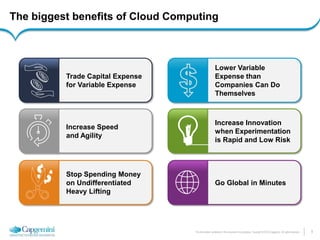
The biggest benefits of Cloud Computing 
Trade Capital Expense for Variable Expense 
Lower Variable Expense than Companies Can Do Themselves 
Increase Speed 
and Agility 
Increase Innovation when Experimentation is Rapid and Low Risk 
Stop Spending Money on Undifferentiated Heavy Lifting 
Go Global in Minutes
7 
The information contained in this document is proprietary. Copyright © 2014 Capgemini. All rights reserved. 
Agenda 
What is The Cloud? 
Cloud Benefits 
Tier 1 WMS Vendors in the Cloud 
The Cloud Decision 
How to get started
8 
The information contained in this document is proprietary. Copyright © 2014 Capgemini. All rights reserved. 
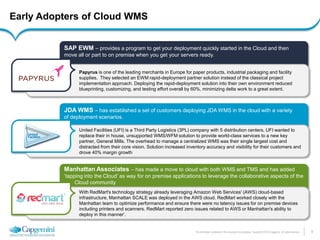
Early Adopters of Cloud WMS 
JDA WMS – has established a set of customers deploying JDA WMS in the cloud with a variety of deployment scenarios. 
United Facilities (UFI) is a Third Party Logistics (3PL) company with 5 distribution centers. UFI wanted to replace their in house, unsupported WMS/WFM solution to provide world-class services to a new key partner, General Mills. The overhead to manage a centralized WMS was their single largest cost and distracted from their core vision. Solution increased inventory accuracy and visibility for their customers and drove 40% margin growth 
Manhattan Associates – has made a move to cloud with both WMS and TMS and has added ‘tapping into the Cloud’ as way for on premise applications to leverage the collaborative aspects of the Cloud community 
With RedMart's technology strategy already leveraging Amazon Web Services' (AWS) cloud-based infrastructure, Manhattan SCALE was deployed in the AWS cloud. RedMart worked closely with the Manhattan team to optimize performance and ensure there were no latency issues for on premise devices including printers and scanners. RedMart reported zero issues related to AWS or Manhattan's ability to deploy in this manner’. 
SAP EWM – provides a program to get your deployment quickly started in the Cloud and then move all or part to on premise when you get your servers ready. 
Papyrus is one of the leading merchants in Europe for paper products, industrial packaging and facility supplies. They selected an EWM rapid-deployment partner solution instead of the classical project implementation approach. Deploying the rapid-deployment solution into their own environment reduced blueprinting, customizing, and testing effort overall by 60%, minimizing delta work to a great extent.
9 
The information contained in this document is proprietary. Copyright © 2014 Capgemini. All rights reserved. 
Agenda 
What is The Cloud? 
Cloud Benefits 
Tier 1 WMS Vendors in the Cloud 
The Cloud Decision 
How to get started
10 
The information contained in this document is proprietary. Copyright © 2014 Capgemini. All rights reserved. 
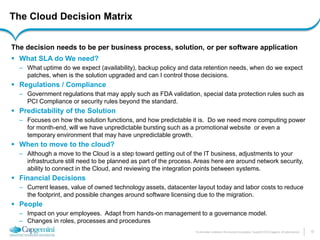
The Cloud Decision Matrix 
The decision needs to be per business process, solution, or per software application 
What SLA do We need? 
–What uptime do we expect (availability), backup policy and data retention needs, when do we expect patches, when is the solution upgraded and can I control those decisions. 
Regulations / Compliance 
–Government regulations that may apply such as FDA validation, special data protection rules such as PCI Compliance or security rules beyond the standard. 
Predictability of the Solution 
–Focuses on how the solution functions, and how predictable it is. Do we need more computing power for month-end, will we have unpredictable bursting such as a promotional website or even a temporary environment that may have unpredictable growth. 
When to move to the cloud? 
–Although a move to the Cloud is a step toward getting out of the IT business, adjustments to your infrastructure still need to be planned as part of the process. Areas here are around network security, ability to connect in the Cloud, and reviewing the integration points between systems. 
Financial Decisions 
–Current leases, value of owned technology assets, datacenter layout today and labor costs to reduce the footprint, and possible changes around software licensing due to the migration. 
People 
–Impact on your employees. Adapt from hands-on management to a governance model. 
–Changes in roles, processes and procedures
11 
The information contained in this document is proprietary. Copyright © 2014 Capgemini. All rights reserved. 
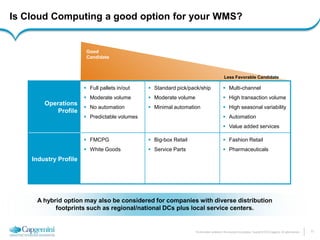
Is Cloud Computing a good option for your WMS? 
Operations Profile 
Full pallets in/out 
Moderate volume 
No automation 
Predictable volumes 
Standard pick/pack/ship 
Moderate volume 
Minimal automation 
Multi-channel 
High transaction volume 
High seasonal variability 
Automation 
Value added services 
Industry Profile 
FMCPG 
White Goods 
Big-box Retail 
Service Parts 
Fashion Retail 
Pharmaceuticals 
Good Candidate 
Less Favorable Candidate 
A hybrid option may also be considered for companies with diverse distribution footprints such as regional/national DCs plus local service centers.
12 
The information contained in this document is proprietary. Copyright © 2014 Capgemini. All rights reserved. 
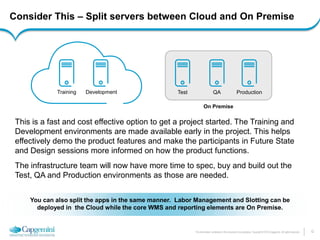
Consider This – Split servers between Cloud and On Premise 
This is a fast and cost effective option to get a project started. The Training and Development environments are made available early in the project. This helps effectively demo the product features and make the participants in Future State and Design sessions more informed on how the product functions. 
The infrastructure team will now have more time to spec, buy and build out the Test, QA and Production environments as those are needed. 
Training 
Development 
Test 
On Premise 
QA 
You can also split the apps in the same manner. Labor Management and Slotting can be deployed in the Cloud while the core WMS and reporting elements are On Premise. 
Production
13 
The information contained in this document is proprietary. Copyright © 2014 Capgemini. All rights reserved. 
Cloud hosting of servers for WMS implementations is a viable option for companies to consider 
Tier 1 WMS vendors are continuing to build out their Cloud offerings 
Amazon Web Services offers any WMS vendor the opportunity to host in a Cloud environment 
Companies can transition their current environment over to the Cloud Any business performing a new implementation of WMS or an upgrade should consider Cloud hosting. 
Conclusion
14 
The information contained in this document is proprietary. Copyright © 2014 Capgemini. All rights reserved. 
Contacts 
Rishi Raina 
rishi.raina@capgemini.com 
Joe Vernon 
joe.vernon@capgemini.com 
Bob Hood 
robert.hood@capgemini.com 
http://www.capgemini.com/experts/supply-chain/joe-vernon
The information contained in this presentation is proprietary. 
© 2012 Capgemini. All rights reserved. 
www.capgemini.com 
About Capgemini 
With almost 140,000 people in over 40 countries, 
Capgemini is one of the world's foremost providers of 
consulting, technology and outsourcing services. The Group 
reported 2013 global revenues of EUR 10.1 billion (more 
than $13 billion USD). 
Together with its clients, Capgemini creates and delivers 
business and technology solutions that fit their needs and 
drive the results they want. A deeply multicultural 
organization, Capgemini has developed its own way of 
working, the Collaborative Business ExperienceTM, and 
draws on Rightshore ®, its worldwide delivery model. 
Rightshore® is a trademark belonging to Capgemini

Tier 1 WMS in the Cloud

  • 1.
    WMS in TheCloud Ready for Prime Time
  • 2.
    2 The informationcontained in this document is proprietary. Copyright © 2014 Capgemini. All rights reserved. Agenda What is The Cloud? Cloud Benefits Tier 1 WMS Vendors in the Cloud The Cloud Decision How to get started
  • 3.
    3 The informationcontained in this document is proprietary. Copyright © 2014 Capgemini. All rights reserved. Software is installed and serviced offsite with updates and security patches as required Similar to SaaS, but instead of providing software it provides a development environment for the creation of software. Providing the cloud infrastructure on demand: servers, operating system, storage. Can be public cloud, private cloud or hybrid What is The Cloud? ‘Cloud’ is the concept of having the hardware, software and varying degrees of managed services hosted and managed. Business process as a service delivered via the cloud services model. IaaS BPaaS PaaS SaaS Public Cloud the application and infrastructure is shared and remotely hosted. Private Cloud the application and infrastructure is NOT shared and is remotely or locally hosted. Hybrid Cloud Some applications are public, some are private Hosting SLAs Multi-tenant Web-based Public Subscription Configuration Outsource Services Software Content
  • 4.
    4 The informationcontained in this document is proprietary. Copyright © 2014 Capgemini. All rights reserved. 4 Main Features of Cloud Services MANAGED SERVICES ‘Managed Services are symbiotic with reliability’ A ‘WMS tailored’ approach provides a strong value proposition to the WMS in the Cloud customers who can decide what resources (internal or outsourced) will provide the services based on their preference, level of application expertise and price point. SECURITY Each organization has its own policy on security and Cloud offers some strong and often superior protection Cloud providers have to meet the security standards for many companies. This may allow your company to benefit from a more rigorous security plan without internally managing. SCALABILITY All application instances can scale easily both vertically or horizontally Application Instances can be brought up or down when required for cost savings. RELIABILITY Encompasses performance and speed (response time). WMS in the cloud has to deliver to business the service level they’ve come to rely on or maybe even do better.
  • 5.
    5 The informationcontained in this document is proprietary. Copyright © 2014 Capgemini. All rights reserved. Agenda What is The Cloud? Cloud Benefits Tier 1 WMS Vendors in the Cloud The Cloud Decision How to get started
  • 6.
    6 The informationcontained in this document is proprietary. Copyright © 2014 Capgemini. All rights reserved. The biggest benefits of Cloud Computing Trade Capital Expense for Variable Expense Lower Variable Expense than Companies Can Do Themselves Increase Speed and Agility Increase Innovation when Experimentation is Rapid and Low Risk Stop Spending Money on Undifferentiated Heavy Lifting Go Global in Minutes
  • 7.
    7 The informationcontained in this document is proprietary. Copyright © 2014 Capgemini. All rights reserved. Agenda What is The Cloud? Cloud Benefits Tier 1 WMS Vendors in the Cloud The Cloud Decision How to get started
  • 8.
    8 The informationcontained in this document is proprietary. Copyright © 2014 Capgemini. All rights reserved. Early Adopters of Cloud WMS JDA WMS – has established a set of customers deploying JDA WMS in the cloud with a variety of deployment scenarios. United Facilities (UFI) is a Third Party Logistics (3PL) company with 5 distribution centers. UFI wanted to replace their in house, unsupported WMS/WFM solution to provide world-class services to a new key partner, General Mills. The overhead to manage a centralized WMS was their single largest cost and distracted from their core vision. Solution increased inventory accuracy and visibility for their customers and drove 40% margin growth Manhattan Associates – has made a move to cloud with both WMS and TMS and has added ‘tapping into the Cloud’ as way for on premise applications to leverage the collaborative aspects of the Cloud community With RedMart's technology strategy already leveraging Amazon Web Services' (AWS) cloud-based infrastructure, Manhattan SCALE was deployed in the AWS cloud. RedMart worked closely with the Manhattan team to optimize performance and ensure there were no latency issues for on premise devices including printers and scanners. RedMart reported zero issues related to AWS or Manhattan's ability to deploy in this manner’. SAP EWM – provides a program to get your deployment quickly started in the Cloud and then move all or part to on premise when you get your servers ready. Papyrus is one of the leading merchants in Europe for paper products, industrial packaging and facility supplies. They selected an EWM rapid-deployment partner solution instead of the classical project implementation approach. Deploying the rapid-deployment solution into their own environment reduced blueprinting, customizing, and testing effort overall by 60%, minimizing delta work to a great extent.
  • 9.
    9 The informationcontained in this document is proprietary. Copyright © 2014 Capgemini. All rights reserved. Agenda What is The Cloud? Cloud Benefits Tier 1 WMS Vendors in the Cloud The Cloud Decision How to get started
  • 10.
    10 The informationcontained in this document is proprietary. Copyright © 2014 Capgemini. All rights reserved. The Cloud Decision Matrix The decision needs to be per business process, solution, or per software application What SLA do We need? –What uptime do we expect (availability), backup policy and data retention needs, when do we expect patches, when is the solution upgraded and can I control those decisions. Regulations / Compliance –Government regulations that may apply such as FDA validation, special data protection rules such as PCI Compliance or security rules beyond the standard. Predictability of the Solution –Focuses on how the solution functions, and how predictable it is. Do we need more computing power for month-end, will we have unpredictable bursting such as a promotional website or even a temporary environment that may have unpredictable growth. When to move to the cloud? –Although a move to the Cloud is a step toward getting out of the IT business, adjustments to your infrastructure still need to be planned as part of the process. Areas here are around network security, ability to connect in the Cloud, and reviewing the integration points between systems. Financial Decisions –Current leases, value of owned technology assets, datacenter layout today and labor costs to reduce the footprint, and possible changes around software licensing due to the migration. People –Impact on your employees. Adapt from hands-on management to a governance model. –Changes in roles, processes and procedures
  • 11.
    11 The informationcontained in this document is proprietary. Copyright © 2014 Capgemini. All rights reserved. Is Cloud Computing a good option for your WMS? Operations Profile Full pallets in/out Moderate volume No automation Predictable volumes Standard pick/pack/ship Moderate volume Minimal automation Multi-channel High transaction volume High seasonal variability Automation Value added services Industry Profile FMCPG White Goods Big-box Retail Service Parts Fashion Retail Pharmaceuticals Good Candidate Less Favorable Candidate A hybrid option may also be considered for companies with diverse distribution footprints such as regional/national DCs plus local service centers.
  • 12.
    12 The informationcontained in this document is proprietary. Copyright © 2014 Capgemini. All rights reserved. Consider This – Split servers between Cloud and On Premise This is a fast and cost effective option to get a project started. The Training and Development environments are made available early in the project. This helps effectively demo the product features and make the participants in Future State and Design sessions more informed on how the product functions. The infrastructure team will now have more time to spec, buy and build out the Test, QA and Production environments as those are needed. Training Development Test On Premise QA You can also split the apps in the same manner. Labor Management and Slotting can be deployed in the Cloud while the core WMS and reporting elements are On Premise. Production
  • 13.
    13 The informationcontained in this document is proprietary. Copyright © 2014 Capgemini. All rights reserved. Cloud hosting of servers for WMS implementations is a viable option for companies to consider Tier 1 WMS vendors are continuing to build out their Cloud offerings Amazon Web Services offers any WMS vendor the opportunity to host in a Cloud environment Companies can transition their current environment over to the Cloud Any business performing a new implementation of WMS or an upgrade should consider Cloud hosting. Conclusion
  • 14.
    14 The informationcontained in this document is proprietary. Copyright © 2014 Capgemini. All rights reserved. Contacts Rishi Raina rishi.raina@capgemini.com Joe Vernon joe.vernon@capgemini.com Bob Hood robert.hood@capgemini.com http://www.capgemini.com/experts/supply-chain/joe-vernon
  • 15.
    The information containedin this presentation is proprietary. © 2012 Capgemini. All rights reserved. www.capgemini.com About Capgemini With almost 140,000 people in over 40 countries, Capgemini is one of the world's foremost providers of consulting, technology and outsourcing services. The Group reported 2013 global revenues of EUR 10.1 billion (more than $13 billion USD). Together with its clients, Capgemini creates and delivers business and technology solutions that fit their needs and drive the results they want. A deeply multicultural organization, Capgemini has developed its own way of working, the Collaborative Business ExperienceTM, and draws on Rightshore ®, its worldwide delivery model. Rightshore® is a trademark belonging to Capgemini