 Thumb sucking Thumb sucking is defined as
placement of the thumb or one or more fingers in
varying depths into the mouth. Thumb and digit
sucking is one of the commonly seen habits that most
children indulge in.
 Recent studies have shown that thumb sucking may be
practiced even during intra uterine life. The presence
of this habit is considered quite normal till the age of
3-4 years. Persistence of the habit beyond this age can
lead to various malocclusions.
Etiology
 Etiology A number of theories have been put forward
to explain why thumb sucking occurs. The following
are some of the more accepted ones:
 Freudian theory: This theory was proposed by
Sigmond Freud in the early part of this century. He
suggested that a child passes through various distinct
phases of psychological development of which the oral
and the anal phases are seen in the first three year of
life. In the oral phase, the mouth is believed to be an
oro-erotic & zone.
 The child has the tendency to place his fingers or any
other object into the oral cavity. Prevention of such an
act is believed to result in emotional insecurity and
poses the risk of the child diversifying into other
habits.
 Oral drive theory of Sears and wise: Sears and wise in
1950 proposed that prolonged suckling can lead to
thumb sucking .
 Benjamin’s theory: Benjamin has suggested that
thumb sucking arises from the rooting or placing
reflex seen in all mammalin infant. Rooting reflex is
the movement of the infant’s head and tongue towards
an object touching his cheek. The object is usually the
mother’s breast but may also be a finger or a pacifier.
This rooting reflex disappears in normal infants
around 7 - 8 months of age.
 Psychological aspects: Children deprived of parental
love, care and affection are believed to resort to this
habit due to a feeling of insecurity. Learned pattern:
According to some authors, thumb sucking is merely a
learned pattern with no underlying cause or
psychological bearing.
Effects of thumb sucking
 Effects of thumb sucking Thumb and digit sucking are
believed to cause a number of changes in the dental
arch and the supporting structures. The severity of the
malocclusion caused by thumb sucking depends on
the trident of factors. They are:
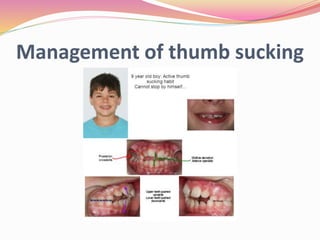
Management of thumb sucking
 Management of thumb sucking Psychological
approach: It is usually said that children lacking
parental care, love and affection resort to this habit.
Thus the parents should be counseled to provide the
child with adequate love and affection. The parents
should also be advised to divert the child’s attention to
other things such as play and toys.
 The success of any habit interception procedure largely
depends upon the subject’s co-operation and
willingness to be helped to discontinue his thumb
sucking habit. Thus the parents and the dentist should
seek to motivate the child.
HOW TO STOP THUMB SUCKING
 Parents usually start to worry too early, about how to
stop thumb sucking habit of their children. It is
advised that you do not try to make a child to stop
thumb sucking before the age of four (unless you
notice a problem to teeth due to vigorous
thumbsucking) because it might have the opposite
results. Usually children stop the habit on their own,
by that age. If they don't,
 here are some easy ways to get kids to stop
thumbsucking : HOW TO STOP THUMB SUCKING
Easy ways to get kids to stop sucking their thumb
 Keep the child's hands occupied with a toy, puzzle or
other activity. Carefully remove your child's thumb
from his or her mouth during sleep Give the example
of his friends that have managed to stop
thumbsucking.
 Don't put the child in a state of anxiety or fear. If the
child has any emotional problems, or is under stress
and needs comforting, you may need to resolve those
issues first before your child can succesfully stop
thumb-sucking. Talk about the 'bad' germs that are on
our hands and how the child puts them in his or her
mouth while thumb sucking.
 Avoid punishing or shaming the child. Reward the
child for not thumbsucking for a progressively
increasing time period. Ask the advice of a pediatric
dentist. He will explain to your kid what will happen to
the teeth if the child does not stop sucking its thumb.
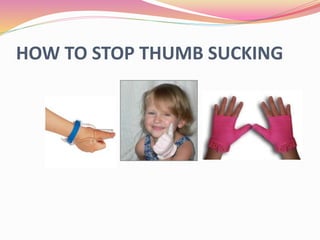
 Use a thumb sucking guard. - In difficult cases, your
dentist might suggest the use of special devices to stop
thumb sucking, called thumb guards. A thumb guard
is a device with a plastic cover of the thumb that is
attached to a child's wrist.
 The thumb sucking guard interrupts the process by
breaking the vacuum created by sucking, thus
removing the child's pleasure. Treatment with thumb
guards usually lasts four weeks and helps children to
stop thumb sucking succesfully.

Thumb Sucking

  • 2.
     Thumb suckingThumb sucking is defined as placement of the thumb or one or more fingers in varying depths into the mouth. Thumb and digit sucking is one of the commonly seen habits that most children indulge in.
  • 3.
     Recent studieshave shown that thumb sucking may be practiced even during intra uterine life. The presence of this habit is considered quite normal till the age of 3-4 years. Persistence of the habit beyond this age can lead to various malocclusions.
  • 4.
    Etiology  Etiology Anumber of theories have been put forward to explain why thumb sucking occurs. The following are some of the more accepted ones:
  • 5.
     Freudian theory:This theory was proposed by Sigmond Freud in the early part of this century. He suggested that a child passes through various distinct phases of psychological development of which the oral and the anal phases are seen in the first three year of life. In the oral phase, the mouth is believed to be an oro-erotic & zone.
  • 6.
     The childhas the tendency to place his fingers or any other object into the oral cavity. Prevention of such an act is believed to result in emotional insecurity and poses the risk of the child diversifying into other habits.
  • 7.
     Oral drivetheory of Sears and wise: Sears and wise in 1950 proposed that prolonged suckling can lead to thumb sucking .
  • 8.
     Benjamin’s theory:Benjamin has suggested that thumb sucking arises from the rooting or placing reflex seen in all mammalin infant. Rooting reflex is the movement of the infant’s head and tongue towards an object touching his cheek. The object is usually the mother’s breast but may also be a finger or a pacifier. This rooting reflex disappears in normal infants around 7 - 8 months of age.
  • 9.
     Psychological aspects:Children deprived of parental love, care and affection are believed to resort to this habit due to a feeling of insecurity. Learned pattern: According to some authors, thumb sucking is merely a learned pattern with no underlying cause or psychological bearing.
  • 10.
    Effects of thumbsucking  Effects of thumb sucking Thumb and digit sucking are believed to cause a number of changes in the dental arch and the supporting structures. The severity of the malocclusion caused by thumb sucking depends on the trident of factors. They are:
  • 11.
  • 12.
     Management ofthumb sucking Psychological approach: It is usually said that children lacking parental care, love and affection resort to this habit. Thus the parents should be counseled to provide the child with adequate love and affection. The parents should also be advised to divert the child’s attention to other things such as play and toys.
  • 13.
     The successof any habit interception procedure largely depends upon the subject’s co-operation and willingness to be helped to discontinue his thumb sucking habit. Thus the parents and the dentist should seek to motivate the child.
  • 14.
    HOW TO STOPTHUMB SUCKING
  • 15.
     Parents usuallystart to worry too early, about how to stop thumb sucking habit of their children. It is advised that you do not try to make a child to stop thumb sucking before the age of four (unless you notice a problem to teeth due to vigorous thumbsucking) because it might have the opposite results. Usually children stop the habit on their own, by that age. If they don't,
  • 16.
     here aresome easy ways to get kids to stop thumbsucking : HOW TO STOP THUMB SUCKING Easy ways to get kids to stop sucking their thumb
  • 17.
     Keep thechild's hands occupied with a toy, puzzle or other activity. Carefully remove your child's thumb from his or her mouth during sleep Give the example of his friends that have managed to stop thumbsucking.
  • 18.
     Don't putthe child in a state of anxiety or fear. If the child has any emotional problems, or is under stress and needs comforting, you may need to resolve those issues first before your child can succesfully stop thumb-sucking. Talk about the 'bad' germs that are on our hands and how the child puts them in his or her mouth while thumb sucking.
  • 19.
     Avoid punishingor shaming the child. Reward the child for not thumbsucking for a progressively increasing time period. Ask the advice of a pediatric dentist. He will explain to your kid what will happen to the teeth if the child does not stop sucking its thumb.
  • 20.
     Use athumb sucking guard. - In difficult cases, your dentist might suggest the use of special devices to stop thumb sucking, called thumb guards. A thumb guard is a device with a plastic cover of the thumb that is attached to a child's wrist.
  • 21.
     The thumbsucking guard interrupts the process by breaking the vacuum created by sucking, thus removing the child's pleasure. Treatment with thumb guards usually lasts four weeks and helps children to stop thumb sucking succesfully.