-BY
B.KESHAVA RAMANUJAN
B.A,LL.B (Hons), III YEAR “B”
SCHOOL OF LAW, VISTAS
INSURANCE AGAINST THIRD
PARTY RIGHT
 Third-party insurance is compulsory for all
vehicle-owners as per the Motor Vehicles Act.
 It covers only your legal liability for the
damage you may cause to a third party –
bodily injury, death and damage to third party
property – while using your vehicle.
 Third Party cover does not pay for repair of
damage to your vehicle. It is, therefore,
important to understand its scope in detail.
 A third party insurance policy is a policy under
which the insurance company agrees to
indemnify the insured person, if he is sued or
held legally liable for injuries or damage done
to a third party.
 The insurance company and the insured are
first and second parties, and any other who
suffered death, injury or the person who claims
damages against you is the third party.
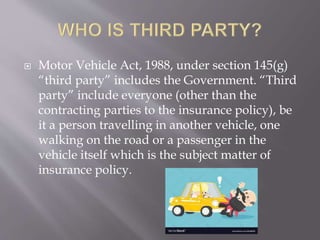
 Motor Vehicle Act, 1988, under section 145(g)
“third party” includes the Government. “Third
party” include everyone (other than the
contracting parties to the insurance policy), be
it a person travelling in another vehicle, one
walking on the road or a passenger in the
vehicle itself which is the subject matter of
insurance policy.
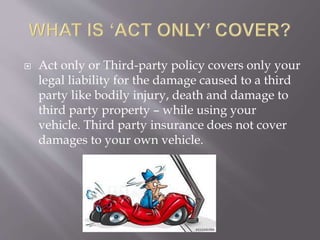
 Act only or Third-party policy covers only your
legal liability for the damage caused to a third
party like bodily injury, death and damage to
third party property – while using your
vehicle. Third party insurance does not cover
damages to your own vehicle.
 Third party or Act Only policy also includes
Personal accident risk of an owner-cum driver
in the event of permanent disablement or death
in an accident.
 An inbuilt coverage of Rs. 1 lakh in two-
wheelers and Rs. 2 lakhs in all other vehicles
for the owner-cum-driver while traveling,
mounting, or dismounting from the vehicle is
available. Accidental cover for co-passengers is
optional.
 Motor third-party insurance or the ‘act only’ cover, is a
statutory requirement under the Motor Vehicles Act. It
is referred to as a ‘third-party’ cover since the
beneficiary of the policy is someone other than the two
parties involved in the contract i.e. the insured and the
insurance company. The policy covers the insured’s
legal liability for death/disability of third party loss or
damage to third party property.
 The victim can claim for compensation under ‘no fault
liability’ or ‘fault liability’ of the Motor Vehicles Act
1988. However, unlimited compensation is available
only for bodily injury or loss of life. In case of damage
to a property, the insurer’s liability is limited to
maximum Rs.7.5 lakh.
 In third party policies the premiums do not vary with the
value of what is being insured because what is insured is the
‘legal liability’ and it is not possible to know in advance that
what liability will be in case of accident. The compensation
to the accident victim is decided by the WC Court or MACT.
IRDAI has done away with tariffs. Now the premium on the
third party liability cover only is fixed by IRDAI.
 Mandatory by law, Third party cover protects you against
the legal liability of accidents. It also covers damage caused
to any surrounding property. The compulsory nature of
third party insurance is justifiable as it makes the process
easier for the injured person to recover money from the
insured/Insurer. Motor Vehicle Act, 1988 mandate the Third
Party insurance for every vehicle used at public place.
 As required by law, drivers must carry at least a
minimal amount of bodily injury liability and property
damage liability coverage. A few states do not require
both or have other limitations. Each state sets its
minimum requirement for each type of coverage.
 Even in “no-fault” states, liability coverage is all but
essential. No-fault laws were established to reduce or
eliminate ordinary injury lawsuits affixed with low-
dollar price tags and an overwhelming number of
claims for pain and suffering. Still, no-fault laws do not
protect the insured from million-dollar injury lawsuits
stemming from seriously injured third parties.
 Both types of third-party insurance are important,
specifically for individuals, such as homeowners, with
substantial assets to protect. The more money and
assets an insured has, the higher the limit should be for
each type of liability coverage.
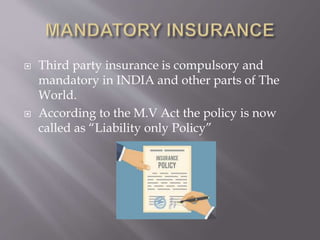
 Third party insurance is compulsory and
mandatory in INDIA and other parts of The
World.
 According to the M.V Act the policy is now
called as “Liability only Policy”
 The Indian Insurance Industry cannot avoid the liability except
on the grounds and not any other ground, which have been
provided in Section 149(2). In recent time, Supreme Court
while dealing with the provisions of third party motor has held
that even if the defense has been pleaded and proved by the
Insurance Industry, they are not absolve from liability to make
payment to the third party but can receive such amount from
the owner insured.
 The courts one after one have held that the burden of proving
availability of defense is on Insurance Industry and Insurance
Industry has not only to lead evidence as to breach of condition
of policy or violation of provisions of Section 149(2) but has to
prove also that such act happens with the connivance or
knowledge of the owner. If knowledge or connivance has not
been proved, the Insurance Industry shall remain liable even if
defense is available.
 Claim form duly signed by the insured
 Police FIR copy
 Driving license copy
 Policy copy
 RC copy of the vehicle
 Stamp required in case of company registered
vehicle’s original documents
 Oriental Insurance Co. v. Inderjit Kaur
 If the insurer has issued a policy to cover the bus without
receiving the premium therefore, he has to indemnify third
parties in respect of the liability covered by the policy. He
cannot avoid the liability arguing that he was entitled to
avoid or cancel the contract.

Liability for injury to certain persons or class of persons
(other than gratuitous passengers and pillion riders)
The policy under the Act covers only third party
risks.Insurer is not liable for any harm suffered by a
passenger traveling in a private car neither for hire nor for
reward. Similar is the position of a pillion rider on a scooter.
 K. Gopal Krishnan v. Sankara Narayanan[8]
 In this case Madras High Court observed that a
scooter-owner is not bound to take out a third party
risk policy to cover the claim of the pillion rider that is
carried gratuitously. If he is injured , the insurance
company would not be liable unless policy covering
such risk is obtained by the scooter-owner. A private
carrier registered as such with R.T.O. and also in
insurance policy , cannot be used for carrying any
passenger or goods for hire or reward. However if it is
so used and the employees of a party hiring the private
vehicle belonging to the insured are injured in an
accident the insurance company will not be liable.
 S.Sudhakaran v. A.K.Francis,[10]
 There was an agreement for sale of a vehicle.
The owner did not comply with the statutory
provisions regarding transfer of a vehicle.He,
however ,allowed the vehicle to be used by the
transferee .The owner had retained the
insurance policy with him.
Held— The insurance company was not liable
to indemnify the owner.
third party Insurance

third party Insurance

  • 1.
    -BY B.KESHAVA RAMANUJAN B.A,LL.B (Hons),III YEAR “B” SCHOOL OF LAW, VISTAS INSURANCE AGAINST THIRD PARTY RIGHT
  • 2.
     Third-party insuranceis compulsory for all vehicle-owners as per the Motor Vehicles Act.  It covers only your legal liability for the damage you may cause to a third party – bodily injury, death and damage to third party property – while using your vehicle.  Third Party cover does not pay for repair of damage to your vehicle. It is, therefore, important to understand its scope in detail.
  • 3.
     A thirdparty insurance policy is a policy under which the insurance company agrees to indemnify the insured person, if he is sued or held legally liable for injuries or damage done to a third party.  The insurance company and the insured are first and second parties, and any other who suffered death, injury or the person who claims damages against you is the third party.
  • 5.
     Motor VehicleAct, 1988, under section 145(g) “third party” includes the Government. “Third party” include everyone (other than the contracting parties to the insurance policy), be it a person travelling in another vehicle, one walking on the road or a passenger in the vehicle itself which is the subject matter of insurance policy.
  • 6.
     Act onlyor Third-party policy covers only your legal liability for the damage caused to a third party like bodily injury, death and damage to third party property – while using your vehicle. Third party insurance does not cover damages to your own vehicle.
  • 7.
     Third partyor Act Only policy also includes Personal accident risk of an owner-cum driver in the event of permanent disablement or death in an accident.  An inbuilt coverage of Rs. 1 lakh in two- wheelers and Rs. 2 lakhs in all other vehicles for the owner-cum-driver while traveling, mounting, or dismounting from the vehicle is available. Accidental cover for co-passengers is optional.
  • 8.
     Motor third-partyinsurance or the ‘act only’ cover, is a statutory requirement under the Motor Vehicles Act. It is referred to as a ‘third-party’ cover since the beneficiary of the policy is someone other than the two parties involved in the contract i.e. the insured and the insurance company. The policy covers the insured’s legal liability for death/disability of third party loss or damage to third party property.  The victim can claim for compensation under ‘no fault liability’ or ‘fault liability’ of the Motor Vehicles Act 1988. However, unlimited compensation is available only for bodily injury or loss of life. In case of damage to a property, the insurer’s liability is limited to maximum Rs.7.5 lakh.
  • 9.
     In thirdparty policies the premiums do not vary with the value of what is being insured because what is insured is the ‘legal liability’ and it is not possible to know in advance that what liability will be in case of accident. The compensation to the accident victim is decided by the WC Court or MACT. IRDAI has done away with tariffs. Now the premium on the third party liability cover only is fixed by IRDAI.  Mandatory by law, Third party cover protects you against the legal liability of accidents. It also covers damage caused to any surrounding property. The compulsory nature of third party insurance is justifiable as it makes the process easier for the injured person to recover money from the insured/Insurer. Motor Vehicle Act, 1988 mandate the Third Party insurance for every vehicle used at public place.
  • 10.
     As requiredby law, drivers must carry at least a minimal amount of bodily injury liability and property damage liability coverage. A few states do not require both or have other limitations. Each state sets its minimum requirement for each type of coverage.  Even in “no-fault” states, liability coverage is all but essential. No-fault laws were established to reduce or eliminate ordinary injury lawsuits affixed with low- dollar price tags and an overwhelming number of claims for pain and suffering. Still, no-fault laws do not protect the insured from million-dollar injury lawsuits stemming from seriously injured third parties.  Both types of third-party insurance are important, specifically for individuals, such as homeowners, with substantial assets to protect. The more money and assets an insured has, the higher the limit should be for each type of liability coverage.
  • 11.
     Third partyinsurance is compulsory and mandatory in INDIA and other parts of The World.  According to the M.V Act the policy is now called as “Liability only Policy”
  • 12.
     The IndianInsurance Industry cannot avoid the liability except on the grounds and not any other ground, which have been provided in Section 149(2). In recent time, Supreme Court while dealing with the provisions of third party motor has held that even if the defense has been pleaded and proved by the Insurance Industry, they are not absolve from liability to make payment to the third party but can receive such amount from the owner insured.  The courts one after one have held that the burden of proving availability of defense is on Insurance Industry and Insurance Industry has not only to lead evidence as to breach of condition of policy or violation of provisions of Section 149(2) but has to prove also that such act happens with the connivance or knowledge of the owner. If knowledge or connivance has not been proved, the Insurance Industry shall remain liable even if defense is available.
  • 13.
     Claim formduly signed by the insured  Police FIR copy  Driving license copy  Policy copy  RC copy of the vehicle  Stamp required in case of company registered vehicle’s original documents
  • 14.
     Oriental InsuranceCo. v. Inderjit Kaur  If the insurer has issued a policy to cover the bus without receiving the premium therefore, he has to indemnify third parties in respect of the liability covered by the policy. He cannot avoid the liability arguing that he was entitled to avoid or cancel the contract.  Liability for injury to certain persons or class of persons (other than gratuitous passengers and pillion riders) The policy under the Act covers only third party risks.Insurer is not liable for any harm suffered by a passenger traveling in a private car neither for hire nor for reward. Similar is the position of a pillion rider on a scooter.
  • 15.
     K. GopalKrishnan v. Sankara Narayanan[8]  In this case Madras High Court observed that a scooter-owner is not bound to take out a third party risk policy to cover the claim of the pillion rider that is carried gratuitously. If he is injured , the insurance company would not be liable unless policy covering such risk is obtained by the scooter-owner. A private carrier registered as such with R.T.O. and also in insurance policy , cannot be used for carrying any passenger or goods for hire or reward. However if it is so used and the employees of a party hiring the private vehicle belonging to the insured are injured in an accident the insurance company will not be liable.
  • 16.
     S.Sudhakaran v.A.K.Francis,[10]  There was an agreement for sale of a vehicle. The owner did not comply with the statutory provisions regarding transfer of a vehicle.He, however ,allowed the vehicle to be used by the transferee .The owner had retained the insurance policy with him. Held— The insurance company was not liable to indemnify the owner.