ADDITION TO MULTIPLE
BONDS
Mahesh waran M
I M.Sc Chemistry
S.B.K College.
STEREO CHEMICAL FACTORS IN ADDITON REACTIONS
 Addition of Hydrogen
 Addition of Halogen
 Hydroboration
 Hydroxylation
 Epoxidation
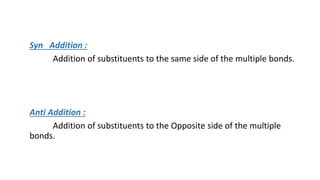
Syn Addition :
Addition of substituents to the same side of the multiple bonds.
Anti Addition :
Addition of substituents to the Opposite side of the multiple
bonds.
Additon of Hydrogen - catalytic Hydrogenation
 Hydrogenation of olefin in presence of catalyst Ni,Pt,Pd under
varying conditions of heat and pressure.
 Catalyst provide to form complex with olefin and promote the
activation of adsorbed hydrogen molecule.
 Molecular hydrogen splits up into two hydrogen molecule and form
new C-H bonds on the same side.
 In this type of Addition is called Syn Addition.
 Double Bond is Reduced more readily then triple bond. Exception of nitro
groups and acid chlorides.
 Selective Reduction of carbon-carbon Double bond.
 Addition of Hydrogen to alkene only two of the stereoisomers formed
since only Syn Addition.
 Purely depend upon the geometry of the reacting alkene.
 Cis alkene – syn addition – erythro pair of enantiomers.
 Trans alkene – syn addition – threo enantiomers.
 If double bond Isomerization occurs more rapidly than
hydrogenation. In this case , isomerization occurs before reduction.
 Palladium – prone to catalyze double bond isomerization
 Pt, Rh, Ir – there is some problem.
 Catalytic hydrogenation in Alkynes leads to Syn Addition. It can be
Stopped at alekene stage by using less reactive poisoned catalyst.
Example – Lindlar’s Catalyst ( poisoned Pd catalyst using BaSO4
Poisoned with Quinolene )
 Sodium metal in liquid Ammonia reduce alkynes with Anti
stereochemistry. Electrons transferred more readily to actylenes than
alkenes.
 The vinyl radical formed in course of reaction is more stable in trans
configuration.
Diimide Reduction
 Non Mettalic compound used to hydrogenation of C-C multiple bonds.
 Diimide – Oxidation of Hydrazine. Anti and Syn forms are generated.
 In presence of alkene – reduction occurs more rapidly.
 Only Syn form reduces the double bonds by cyclic mechanism. So the
Addition is , stereichmeically Syn Addition.
 Highly selective to reduce readily for symmetrical double bonds.
 The Unsymmetrical bonds and more polar bonds are not be reduced.
Homogeneous Hydrogenation – Wiliknson’s Catalyst
 Hydrogen by its incorporation sphere around the metal atom of the VIII group
elements. Ex. Rh,Ru
 Hydrogenation involved in two phases.
solid phase – catalyst containing adsorbed hydrogen
liquid phase – solution has the unsaturated reactant
 Transition metal complex – Rh[(C6H5)3P3Cl ( Wilkinson catalyst )
 Hydrogenation occurs in single phase in solution.
 This catalyst in solution exchanges reversibly on Ph3P group loosely held sovent
molecule.
 Catalyst reacts with hydrogen form metal hydride .
 H-H bond is cleaved and each hydrogen separately bonded to Rhodium. Then one
of its electron pairs used to oxidized to Rhodium (III) State.
 Alkene reacts with complex and replace solvent molecule.
 Alkene metal bond formation result in overlap of empty orbital of the metal with
pi cloud of th alkene.
 Then two hydrogen atoms are transferred to alkene on the same side result in Syn
Addition.
 Wilkinson catalyst – only alkenes and alkynes are reduced . C=O,
C=N, NO2 remain intact.
 Mono and Disubstituted alkenes are far more reactive than tri and
tetra substituted double bonds.
Birch Reduction
 Catalytic methods fully reduce aromatic rings .
 Electron transfer methods is highy selective and reduction in the
presence of alcohol.
 Sodium in liquid ammonia is the reducing agent . Alcohol used to trap
the anion radical rapidly.
 1,4 addition takes place to yield to Non Conjucated cyclohexadiens.
 Structure of the product determined by the site of first protonation.
Addition of Halogens
 Addition of electrophilic reagents in two step process.
1. formation of organic cation ( bridged cation )
2. react with Nu.
 Three membered ring was formed by the donation of Br lone pairs of the vacant P
orbital of the neighbouring carbocation.
 bromonium ion formed by the reaction of the alkene with bromine molecule and push
out the bromide ion.
 When an alkene reacts with bromine Anti Addition occurs.
 Bromonium ion formed and then attacked by the bromide ion by SN2 reaction
mechanism of the opposite side of the bromonium ion.
 Addition of Chlorine , chloronium ion is to be less strongly bridged.
 The attack of sulphur and selenium electrophiles have strong bridging
features.
 Its also leads to Anti stereochemistry.
Halohydrin formation – Markonikov’s Regiochemistry
 In the ionic addition of unsymmetrical reagent an electrophile adds to
pi bond to form bond with carbon that allows the formation of most
stable carbocation.
 In formation of bromohydrins ,
bromine – adds to least substituted carbon
hydroxyl group – adds to more substituted carbon
Epoxydation
 Alkenes react with peroxyacids give Epoxides.
 MCPBA – commonly used per acid . It being shock sensitive.
 Recently , MMPP as a safer substitute.
 Epoxidation is an Stereospecific. The configuration of the alkene to be
retained.
 The bond making and breaking steps are concerted-epoxidation, single step
transfer of the peroxy oxygen to the double bond.
 Epoxidation is an regioselective reaction. More electron rich double bond
reacts when more then one is present.
Hydroxylation
 Alkene converted into 1,2 diols on react with OsO4 , KMnO4.
 Formation of Osmate ester and then hydrolysed with Sodium Sulphite give Addition
product.
 The addition of two hydroxyl groups an the same side of the alkene. Syn
Stereochemistry to be occurs.
 Py complexes with Os atom as a catalyst.
 The reaction is stereospecific. E- alkenes give Syn 1,2 diols. Z- Alkenes give Anti 1,2
diols.
 OsO4 reagent together with Co-Oxidant.
 ex. NMO, Me3NO,H2O , t- BuOOH.
Woodward - Hydroxylation
Provost - Hydroxylation
Hydroboration
 Organo borane formed initially and further react with alkene gives
trialkyl borane R3B.
 All three hydrogens of B atom replaced by alkyl groups.
 Tri alkylboranes oxidized with basic H2O2 to give alcohols.
 The net result is Hydroboration-Oxidation.
 Sterically hindered alkenes reaction can be controlled and monoalkyl and
dialkyl boranes can be obtained.
 ex. 9BBN-H, Sia2BH very strongly regioslective due to steric bulk of the
reagent. Catecholborane is another one.
 9BBN-H IS Highly regioselective. The boron atom adds to less bulky of the
two substituents.
 The B-H bond is much less readily accessible than the B-H bond in BH3.
 On heating organoborane at 150oC an isomerization occurs.
 Internal alkene converted into primary alcohol.
Questions ?
Reference :
 “ stereochemistry mechanism and conformation “ P.S KALSI.
THANK YOU FOR YOUR KIND ATTENTION

Addition to multiple bonds

  • 1.
    ADDITION TO MULTIPLE BONDS Maheshwaran M I M.Sc Chemistry S.B.K College.
  • 2.
    STEREO CHEMICAL FACTORSIN ADDITON REACTIONS  Addition of Hydrogen  Addition of Halogen  Hydroboration  Hydroxylation  Epoxidation
  • 3.
    Syn Addition : Additionof substituents to the same side of the multiple bonds. Anti Addition : Addition of substituents to the Opposite side of the multiple bonds.
  • 4.
    Additon of Hydrogen- catalytic Hydrogenation  Hydrogenation of olefin in presence of catalyst Ni,Pt,Pd under varying conditions of heat and pressure.  Catalyst provide to form complex with olefin and promote the activation of adsorbed hydrogen molecule.  Molecular hydrogen splits up into two hydrogen molecule and form new C-H bonds on the same side.  In this type of Addition is called Syn Addition.
  • 6.
     Double Bondis Reduced more readily then triple bond. Exception of nitro groups and acid chlorides.  Selective Reduction of carbon-carbon Double bond.  Addition of Hydrogen to alkene only two of the stereoisomers formed since only Syn Addition.  Purely depend upon the geometry of the reacting alkene.  Cis alkene – syn addition – erythro pair of enantiomers.  Trans alkene – syn addition – threo enantiomers.
  • 9.
     If doublebond Isomerization occurs more rapidly than hydrogenation. In this case , isomerization occurs before reduction.  Palladium – prone to catalyze double bond isomerization  Pt, Rh, Ir – there is some problem.
  • 10.
     Catalytic hydrogenationin Alkynes leads to Syn Addition. It can be Stopped at alekene stage by using less reactive poisoned catalyst. Example – Lindlar’s Catalyst ( poisoned Pd catalyst using BaSO4 Poisoned with Quinolene )
  • 11.
     Sodium metalin liquid Ammonia reduce alkynes with Anti stereochemistry. Electrons transferred more readily to actylenes than alkenes.  The vinyl radical formed in course of reaction is more stable in trans configuration.
  • 13.
    Diimide Reduction  NonMettalic compound used to hydrogenation of C-C multiple bonds.  Diimide – Oxidation of Hydrazine. Anti and Syn forms are generated.  In presence of alkene – reduction occurs more rapidly.  Only Syn form reduces the double bonds by cyclic mechanism. So the Addition is , stereichmeically Syn Addition.  Highly selective to reduce readily for symmetrical double bonds.  The Unsymmetrical bonds and more polar bonds are not be reduced.
  • 15.
    Homogeneous Hydrogenation –Wiliknson’s Catalyst  Hydrogen by its incorporation sphere around the metal atom of the VIII group elements. Ex. Rh,Ru  Hydrogenation involved in two phases. solid phase – catalyst containing adsorbed hydrogen liquid phase – solution has the unsaturated reactant  Transition metal complex – Rh[(C6H5)3P3Cl ( Wilkinson catalyst )  Hydrogenation occurs in single phase in solution.  This catalyst in solution exchanges reversibly on Ph3P group loosely held sovent molecule.
  • 16.
     Catalyst reactswith hydrogen form metal hydride .  H-H bond is cleaved and each hydrogen separately bonded to Rhodium. Then one of its electron pairs used to oxidized to Rhodium (III) State.  Alkene reacts with complex and replace solvent molecule.  Alkene metal bond formation result in overlap of empty orbital of the metal with pi cloud of th alkene.  Then two hydrogen atoms are transferred to alkene on the same side result in Syn Addition.
  • 19.
     Wilkinson catalyst– only alkenes and alkynes are reduced . C=O, C=N, NO2 remain intact.  Mono and Disubstituted alkenes are far more reactive than tri and tetra substituted double bonds.
  • 20.
    Birch Reduction  Catalyticmethods fully reduce aromatic rings .  Electron transfer methods is highy selective and reduction in the presence of alcohol.  Sodium in liquid ammonia is the reducing agent . Alcohol used to trap the anion radical rapidly.  1,4 addition takes place to yield to Non Conjucated cyclohexadiens.  Structure of the product determined by the site of first protonation.
  • 22.
    Addition of Halogens Addition of electrophilic reagents in two step process. 1. formation of organic cation ( bridged cation ) 2. react with Nu.  Three membered ring was formed by the donation of Br lone pairs of the vacant P orbital of the neighbouring carbocation.  bromonium ion formed by the reaction of the alkene with bromine molecule and push out the bromide ion.  When an alkene reacts with bromine Anti Addition occurs.  Bromonium ion formed and then attacked by the bromide ion by SN2 reaction mechanism of the opposite side of the bromonium ion.
  • 24.
     Addition ofChlorine , chloronium ion is to be less strongly bridged.  The attack of sulphur and selenium electrophiles have strong bridging features.  Its also leads to Anti stereochemistry.
  • 25.
    Halohydrin formation –Markonikov’s Regiochemistry  In the ionic addition of unsymmetrical reagent an electrophile adds to pi bond to form bond with carbon that allows the formation of most stable carbocation.  In formation of bromohydrins , bromine – adds to least substituted carbon hydroxyl group – adds to more substituted carbon
  • 27.
    Epoxydation  Alkenes reactwith peroxyacids give Epoxides.  MCPBA – commonly used per acid . It being shock sensitive.  Recently , MMPP as a safer substitute.
  • 28.
     Epoxidation isan Stereospecific. The configuration of the alkene to be retained.  The bond making and breaking steps are concerted-epoxidation, single step transfer of the peroxy oxygen to the double bond.  Epoxidation is an regioselective reaction. More electron rich double bond reacts when more then one is present.
  • 31.
    Hydroxylation  Alkene convertedinto 1,2 diols on react with OsO4 , KMnO4.  Formation of Osmate ester and then hydrolysed with Sodium Sulphite give Addition product.  The addition of two hydroxyl groups an the same side of the alkene. Syn Stereochemistry to be occurs.  Py complexes with Os atom as a catalyst.  The reaction is stereospecific. E- alkenes give Syn 1,2 diols. Z- Alkenes give Anti 1,2 diols.  OsO4 reagent together with Co-Oxidant.  ex. NMO, Me3NO,H2O , t- BuOOH.
  • 34.
  • 35.
  • 36.
    Hydroboration  Organo boraneformed initially and further react with alkene gives trialkyl borane R3B.  All three hydrogens of B atom replaced by alkyl groups.  Tri alkylboranes oxidized with basic H2O2 to give alcohols.  The net result is Hydroboration-Oxidation.
  • 38.
     Sterically hinderedalkenes reaction can be controlled and monoalkyl and dialkyl boranes can be obtained.  ex. 9BBN-H, Sia2BH very strongly regioslective due to steric bulk of the reagent. Catecholborane is another one.  9BBN-H IS Highly regioselective. The boron atom adds to less bulky of the two substituents.  The B-H bond is much less readily accessible than the B-H bond in BH3.
  • 41.
     On heatingorganoborane at 150oC an isomerization occurs.  Internal alkene converted into primary alcohol.
  • 42.
  • 44.
    Reference :  “stereochemistry mechanism and conformation “ P.S KALSI.
  • 45.
    THANK YOU FORYOUR KIND ATTENTION