The Four Functions
 of Management:


 1. Planning
 2. Organising
 3. Leading
 4. Controlling


MORNÉ SCHUTTE
                     1
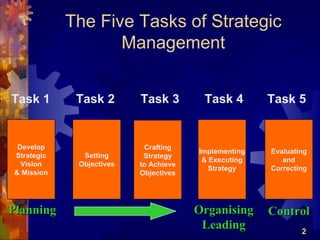
The Five Tasks of Strategic
                   Management


Task 1       Task 2       Task 3        Task 4        Task 5


 Develop                   Crafting
                                       Implementing   Evaluating
Strategic     Setting      Strategy
                                        & Executing      and
  Vision     Objectives   to Achieve
                                          Strategy    Correcting
& Mission                 Objectives


Planning                               Organising     Control
                                        Leading               2
Management Functions


                       3
Planning

           4
Planning is the process used by
managers to identify and select
goals and courses of action for the
organisation.


                                  5
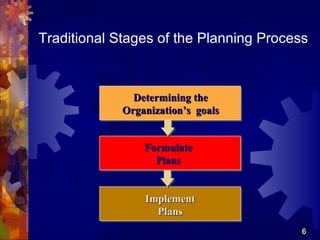
Traditional Stages of the Planning Process


               Determining the
             Organization’s goals


                 Formulate
                   Plans


                 Implement
                   Plans
                                         6
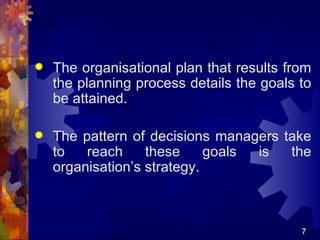
   The organisational plan that results from
    the planning process details the goals to
    be attained.

   The pattern of decisions managers take
    to   reach     these     goals is  the
    organisation’s strategy.


                                           7
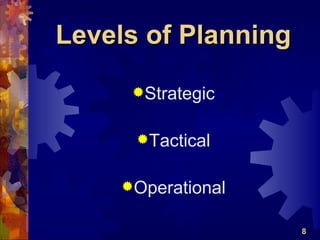
Levels of Planning

     Strategic


      Tactical


    Operational


                     8
Strategic Plans

 Detailedaction steps mapped out to
 achieve strategic goals

 Generally  developed by senior
 management and usually have a
 time horizon of 3 - 5 years.


                                   9
Tactical Plans

 More  specific and concrete, aimed at
 supporting     the  implementation  of
 strategic plans.

 Time   horizon of 1 - 3 years.

 Outline   major   steps   to   achieve
 objectives, and are developed by middle
 management
                                      10
Operational Plans


   Set out specifically what, and how, must be
    achieved to achieve organisational
    objectives.

   Time horizon of no more than 1 year.

   Success of strategic and operational
    objectives are reliant on success of
    operational plans.


                                                  11
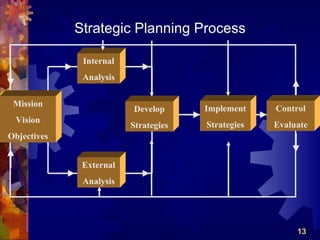
Strategic Planning is the process
of determining the company’s
objectives, the courses of action
needed to achieve them and the
allocation of resources to enable
them to be implemented


                                    12
Strategic Planning Process

              Internal
              Analysis

 Mission
                         Develop      Implement    Control
 Vision
                         Strategies   Strategies   Evaluate
Objectives


              External
              Analysis


                                                        13
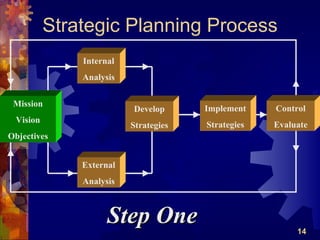
Strategic Planning Process
              Internal
              Analysis

 Mission
                         Develop      Implement    Control
 Vision
                         Strategies   Strategies   Evaluate
Objectives


              External
              Analysis


                    Step One                            14
Step One
Mission, Vision & Objectives

It is necessary for the organisation
to determine it’s mission, vision
and objectives before it begins to
make plans for it’s future.


                                   15
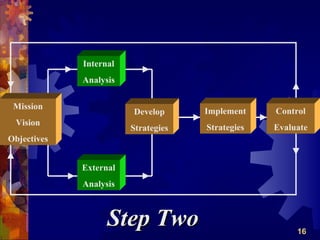
Internal
             Analysis

 Mission
                        Develop      Implement    Control
 Vision
                        Strategies   Strategies   Evaluate
Objectives


             External
             Analysis


                   Step Two                            16
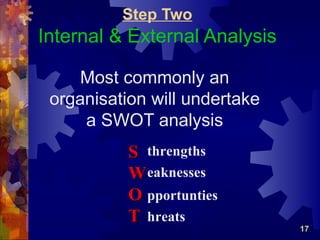
Step Two
Internal & External Analysis

     Most commonly an
 organisation will undertake
     a SWOT analysis
           S threngths
           W eaknesses
           O pportunties
           T hreats
                               17
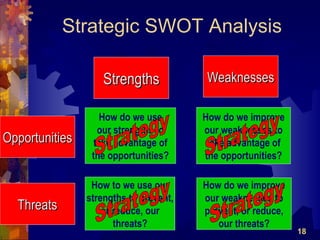
Strategic SWOT Analysis

                    Strengths            Weaknesses

                   How do we use        How do we improve
                   our strengths to     our weaknesses to
Opportunities     take advantage of      take advantage of
                 the opportunities?     the opportunities?

                 How to we use our      How do we improve
                strengths to prevent,   our weaknesses to
  Threats           or reduce, our      prevent, or reduce,
                       threats?            our threats?
                                                              18
Step Two
  External Analysis

      Often an
 organisation will
  utilise Porter’s
competitive forces
   analysis tool      19
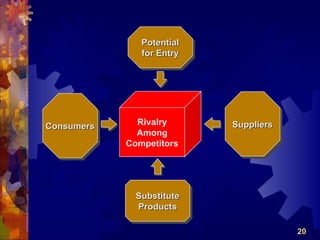
Potential
               for Entry


Consumers     Rivalry      Suppliers
              Among
            Competitors


              Substitute
              Products

                                       20
Porters’ Five Competitive Forces

•   Level of Rivalry in an industry: how intense is the
    current competition with competitors? Increased
    competition results in lower profits.

2. Potential for entry: how easy is it for new firms to enter
    the industry? Easy entry leads to lower prices and
    profits.

3. Power of Suppliers: If there are only a few suppliers of
    important items, supply costs rise.

4. Power of Consumers: If there are only a few, large
    buyers, they can bargain down prices.

5. Substitutes: More available substitutes tend to drive
    down prices and profits.
                                                                21
Strategic Planning Process


                Internal
                Analysis

 Mission
                            Develop     Implement    Control
 Vision
                           Strategies   Strategies   Evaluate
Objectives


                External
                Analysis


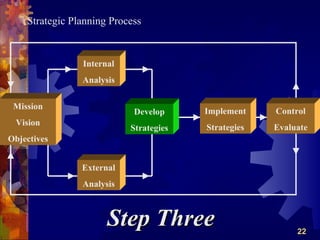
                      Step Three                          22
Step Three
  Identifying Strategies

Once the organisation is fully
informed about it’s environment
(internal, operating and macro), it
can then begin to develop
strategies.
Remember, a strategy is a pattern
of actions employed to achieve an
organisations’ objectives.
                                      23
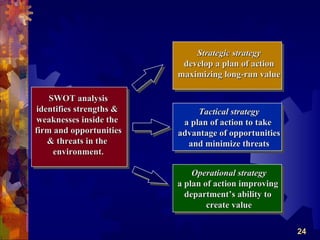
Strategic strategy
                          develop a plan of action
                         maximizing long-run value

    SWOT analysis
identifies strengths &        Tactical strategy
weaknesses inside the     a plan of action to take
firm and opportunities   advantage of opportunities
   & threats in the        and minimize threats
     environment.

                             Operational strategy
                         a plan of action improving
                           department’s ability to
                                 create value

                                                      24
Strategic Planning Process


                Internal
                Analysis

 Mission
                            Develop     Implement    Control
 Vision
                           Strategies   Strategies   Evaluate
Objectives


                External
                Analysis


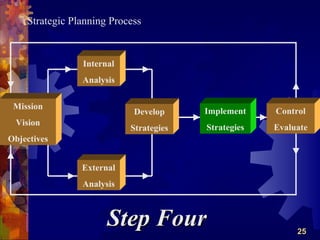
                      Step Four                           25
Step Four
      Implementing Strategy


After identifying appropriate
strategies, managers confront
the challenge of putting those
     strategies into action

                                 26
Implementing Strategy

Strategy Implementation is a five step process.

  •   Allocating responsibility for implantation to the appropriate
      individuals or groups
  •   Drafting detailed action plans that specify how a strategy is to
      be implemented
  •   Establishing a timetable for implementation that includes
      precise, measurable goals linked to the attainment of the action
      plan.
  •   Allocating appropriate resources to the responsible individuals
      or groups.
  •   Holding Specific individuals or groups responsible for the
      attainment of corporate, divisional, and functional goals.

                                                                    27
Strategic Planning Process


             Internal
             Analysis

 Mission
                         Develop         Implement    Control
 Vision
                        Strategies       Strategies   Evaluate
Objectives


             External
             Analysis


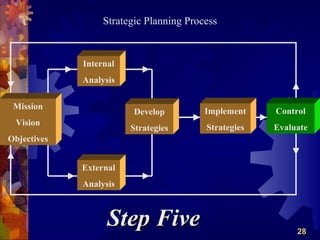
                   Step Five                               28
Step Five
         Control
Controlling is not the last
function of management. This
is because it is the function
that monitors all other
functions. Only through
controlling can efficiency and
effectiveness be maintained.

                                 29
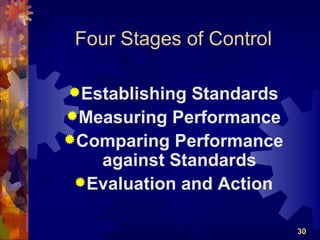
Four Stages of Control

Establishing Standards
Measuring Performance
Comparing Performance
   against Standards
 Evaluation and Action


                          30
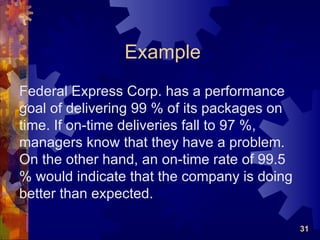
Example
Federal Express Corp. has a performance
goal of delivering 99 % of its packages on
time. If on-time deliveries fall to 97 %,
managers know that they have a problem.
On the other hand, an on-time rate of 99.5
% would indicate that the company is doing
better than expected.

                                             31
Organising

Structure within the Organisation


                                    32
Leading
    or
Leadership
             33
What should a Manager be?


  A Leader

                            34
Leadership
Think of a person who you consider
a leader

What traits (attributes,
characteristics) can you identify as
central to their leadership?

                                       35
Leadership
         Drive
 Leadership Motivation
      Integrity
   Self-confidence
  Knowledge of the
      Business            36
Central to effective leadership
      is ………………..


INFLUENCE
…….. that is, the ability to influence other people

                                                      37
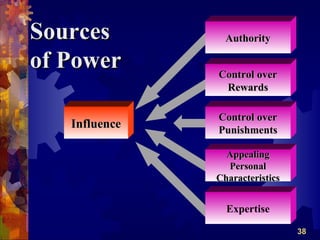
Sources          Authority

of Power       Control over
                Rewards

               Control over
   Influence   Punishments

                 Appealing
                 Personal
               Characteristics


                 Expertise

                                 38
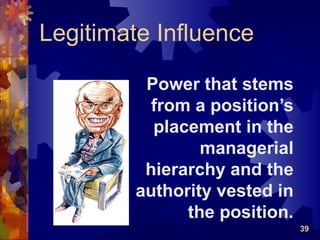
Legitimate Influence

         Power that stems
          from a position’s
          placement in the
                managerial
         hierarchy and the
        authority vested in
              the position.
                              39
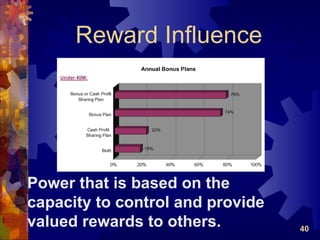
Reward Influence


Power that is based on the
capacity to control and provide
valued rewards to others.         40
Coercive Influence
              Power that
         depends on the
        ability to punish
       others when they
       do not engage in
                  desired
               behaviour.
                            41
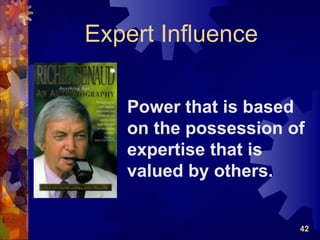
Expert Influence

   Power that is based
   on the possession of
   expertise that is
   valued by others.


                      42
Information Influence
         Power that results
        from access to and
           control over the
             distribution of
      important information
       about organisational
      operations and future
                     plans.    43
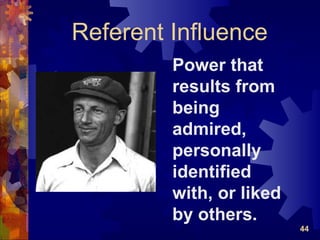
Referent Influence
         Power that
         results from
         being
         admired,
         personally
         identified
         with, or liked
         by others.
                          44
Management Styles
The type of power, and the
way it is used, by a
manager will be greatly
influenced the the type of
management style he/she
chooses to use.
                             45

Passion+Leadership=Thriving Manager.

  • 1.
    The Four Functions of Management: 1. Planning 2. Organising 3. Leading 4. Controlling MORNÉ SCHUTTE 1
  • 2.
    The Five Tasksof Strategic Management Task 1 Task 2 Task 3 Task 4 Task 5 Develop Crafting Implementing Evaluating Strategic Setting Strategy & Executing and Vision Objectives to Achieve Strategy Correcting & Mission Objectives Planning Organising Control Leading 2
  • 3.
  • 4.
  • 5.
    Planning is theprocess used by managers to identify and select goals and courses of action for the organisation. 5
  • 6.
    Traditional Stages ofthe Planning Process Determining the Organization’s goals Formulate Plans Implement Plans 6
  • 7.
    The organisational plan that results from the planning process details the goals to be attained.  The pattern of decisions managers take to reach these goals is the organisation’s strategy. 7
  • 8.
    Levels of Planning Strategic Tactical Operational 8
  • 9.
    Strategic Plans  Detailedactionsteps mapped out to achieve strategic goals  Generally developed by senior management and usually have a time horizon of 3 - 5 years. 9
  • 10.
    Tactical Plans  More specific and concrete, aimed at supporting the implementation of strategic plans.  Time horizon of 1 - 3 years.  Outline major steps to achieve objectives, and are developed by middle management 10
  • 11.
    Operational Plans  Set out specifically what, and how, must be achieved to achieve organisational objectives.  Time horizon of no more than 1 year.  Success of strategic and operational objectives are reliant on success of operational plans. 11
  • 12.
    Strategic Planning isthe process of determining the company’s objectives, the courses of action needed to achieve them and the allocation of resources to enable them to be implemented 12
  • 13.
    Strategic Planning Process Internal Analysis Mission Develop Implement Control Vision Strategies Strategies Evaluate Objectives External Analysis 13
  • 14.
    Strategic Planning Process Internal Analysis Mission Develop Implement Control Vision Strategies Strategies Evaluate Objectives External Analysis Step One 14
  • 15.
    Step One Mission, Vision& Objectives It is necessary for the organisation to determine it’s mission, vision and objectives before it begins to make plans for it’s future. 15
  • 16.
    Internal Analysis Mission Develop Implement Control Vision Strategies Strategies Evaluate Objectives External Analysis Step Two 16
  • 17.
    Step Two Internal &External Analysis Most commonly an organisation will undertake a SWOT analysis S threngths W eaknesses O pportunties T hreats 17
  • 18.
    Strategic SWOT Analysis Strengths Weaknesses How do we use How do we improve our strengths to our weaknesses to Opportunities take advantage of take advantage of the opportunities? the opportunities? How to we use our How do we improve strengths to prevent, our weaknesses to Threats or reduce, our prevent, or reduce, threats? our threats? 18
  • 19.
    Step Two External Analysis Often an organisation will utilise Porter’s competitive forces analysis tool 19
  • 20.
    Potential for Entry Consumers Rivalry Suppliers Among Competitors Substitute Products 20
  • 21.
    Porters’ Five CompetitiveForces • Level of Rivalry in an industry: how intense is the current competition with competitors? Increased competition results in lower profits. 2. Potential for entry: how easy is it for new firms to enter the industry? Easy entry leads to lower prices and profits. 3. Power of Suppliers: If there are only a few suppliers of important items, supply costs rise. 4. Power of Consumers: If there are only a few, large buyers, they can bargain down prices. 5. Substitutes: More available substitutes tend to drive down prices and profits. 21
  • 22.
    Strategic Planning Process Internal Analysis Mission Develop Implement Control Vision Strategies Strategies Evaluate Objectives External Analysis Step Three 22
  • 23.
    Step Three Identifying Strategies Once the organisation is fully informed about it’s environment (internal, operating and macro), it can then begin to develop strategies. Remember, a strategy is a pattern of actions employed to achieve an organisations’ objectives. 23
  • 24.
    Strategic strategy develop a plan of action maximizing long-run value SWOT analysis identifies strengths & Tactical strategy weaknesses inside the a plan of action to take firm and opportunities advantage of opportunities & threats in the and minimize threats environment. Operational strategy a plan of action improving department’s ability to create value 24
  • 25.
    Strategic Planning Process Internal Analysis Mission Develop Implement Control Vision Strategies Strategies Evaluate Objectives External Analysis Step Four 25
  • 26.
    Step Four Implementing Strategy After identifying appropriate strategies, managers confront the challenge of putting those strategies into action 26
  • 27.
    Implementing Strategy Strategy Implementationis a five step process. • Allocating responsibility for implantation to the appropriate individuals or groups • Drafting detailed action plans that specify how a strategy is to be implemented • Establishing a timetable for implementation that includes precise, measurable goals linked to the attainment of the action plan. • Allocating appropriate resources to the responsible individuals or groups. • Holding Specific individuals or groups responsible for the attainment of corporate, divisional, and functional goals. 27
  • 28.
    Strategic Planning Process Internal Analysis Mission Develop Implement Control Vision Strategies Strategies Evaluate Objectives External Analysis Step Five 28
  • 29.
    Step Five Control Controlling is not the last function of management. This is because it is the function that monitors all other functions. Only through controlling can efficiency and effectiveness be maintained. 29
  • 30.
    Four Stages ofControl Establishing Standards Measuring Performance Comparing Performance against Standards Evaluation and Action 30
  • 31.
    Example Federal Express Corp.has a performance goal of delivering 99 % of its packages on time. If on-time deliveries fall to 97 %, managers know that they have a problem. On the other hand, an on-time rate of 99.5 % would indicate that the company is doing better than expected. 31
  • 32.
  • 33.
    Leading or Leadership 33
  • 34.
    What should aManager be? A Leader 34
  • 35.
    Leadership Think of aperson who you consider a leader What traits (attributes, characteristics) can you identify as central to their leadership? 35
  • 36.
    Leadership  Drive  Leadership Motivation Integrity Self-confidence Knowledge of the Business 36
  • 37.
    Central to effectiveleadership is ……………….. INFLUENCE …….. that is, the ability to influence other people 37
  • 38.
    Sources Authority of Power Control over Rewards Control over Influence Punishments Appealing Personal Characteristics Expertise 38
  • 39.
    Legitimate Influence Power that stems from a position’s placement in the managerial hierarchy and the authority vested in the position. 39
  • 40.
    Reward Influence Power thatis based on the capacity to control and provide valued rewards to others. 40
  • 41.
    Coercive Influence Power that depends on the ability to punish others when they do not engage in desired behaviour. 41
  • 42.
    Expert Influence Power that is based on the possession of expertise that is valued by others. 42
  • 43.
    Information Influence Power that results from access to and control over the distribution of important information about organisational operations and future plans. 43
  • 44.
    Referent Influence Power that results from being admired, personally identified with, or liked by others. 44
  • 45.
    Management Styles The typeof power, and the way it is used, by a manager will be greatly influenced the the type of management style he/she chooses to use. 45