Thinking outside the Box,
learning a little about a lot


  Mark Broadbent
  SQL Server DBA


  http://tenbulls.co.uk
  @retracement

                      
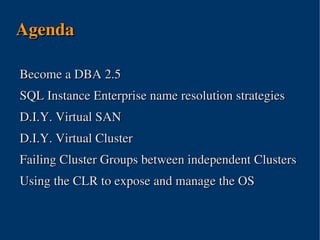
Agenda

Become a DBA 2.5
SQL Instance Enterprise name resolution strategies
D.I.Y. Virtual SAN
D.I.Y. Virtual Cluster
Failing Cluster Groups between independent Clusters
Using the CLR to expose and manage the OS


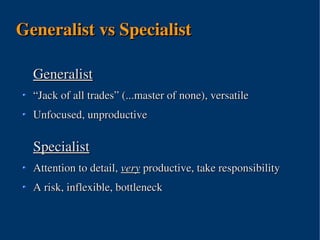
Generalist vs Specialist

  Generalist
  “Jack of all trades” (...master of none), versatile
  Unfocused, unproductive

  Specialist
  Attention to detail, very productive, take responsibility
  A risk, inflexible, bottleneck


Generalist (the reality)


Specialist (the reality)


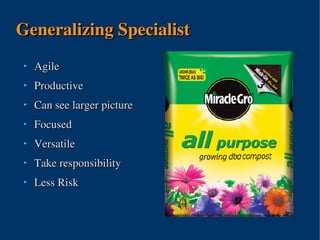
Generalizing Specialist
  Agile
  Productive
  Can see larger picture
  Focused
  Versatile
  Take responsibility
  Less Risk


Generalizing Specialist (the reality)


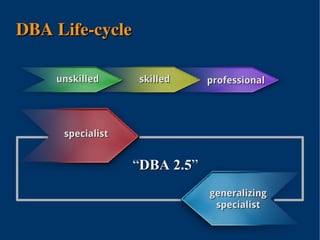
DBA Life­cycle

    unskilled            skilled     professional


        specialist


                         “DBA 2.5”
                              2.5
                                     generalizing
                                      specialist


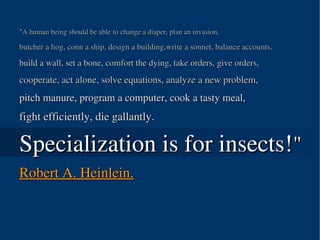
"A human being should be able to change a diaper, plan an invasion, 

butcher a hog, conn a ship, design a building,write a sonnet, balance accounts, 

build a wall, set a bone, comfort the dying, take orders, give orders, 
cooperate, act alone, solve equations, analyze a new problem, 
pitch manure, program a computer, cook a tasty meal, 
fight efficiently, die gallantly. 

Specialization is for insects!"
Robert A. Heinlein.


How to become a DBA 2.5 part I

  Understand your the environment
  Get out of your comfort zone
  Visit the server room!!!
  Talk to people!
  Research
  Talk some more
  Get involved and take an interest


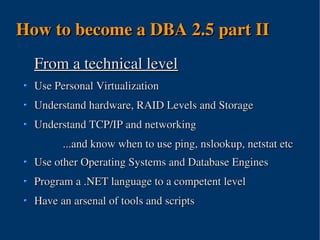
How to become a DBA 2.5 part II
  From a technical level
  Use Personal Virtualization
  Understand hardware, RAID Levels and Storage 
  Understand TCP/IP and networking
          ...and know when to use ping, nslookup, netstat etc
  Use other Operating Systems and Database Engines
  Program a .NET language to a competent level
  Have an arsenal of tools and scripts


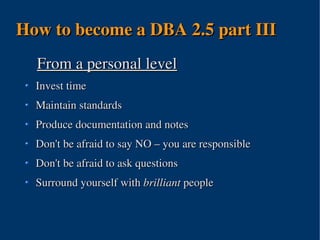
How to become a DBA 2.5 part III
  From a personal level
  Invest time
  Maintain standards
  Produce documentation and notes
  Don't be afraid to say NO – you are responsible
  Don't be afraid to ask questions
  Surround yourself with brilliant people


Demo


       Virtualization – the basics


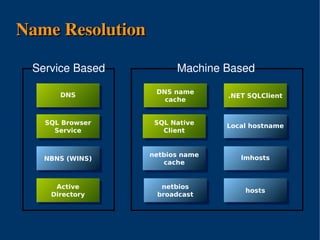
Name Resolution

 Service Based             Machine Based

         DNS          DNS name
                                    .NET SQLClient
                        cache


   SQL Browser        SQL Native    Local hostname
     Service            Client


                     netbios name      lmhosts
   NBNS (WINS)
                        cache


     Active            netbios
                                        hosts
    Directory         broadcast


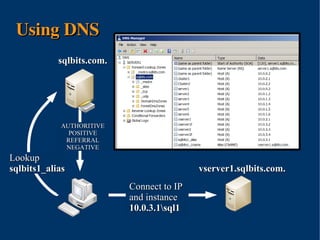
Using DNS
               sqlbits.com.


               AUTHORITIVE
                 POSITIVE
                REFERRAL
                NEGATIVE
Lookup
sqlbits1_alias                                vserver1.sqlbits.com.
                              Connect to IP
                              and instance
                              10.0.3.1sql1

                               
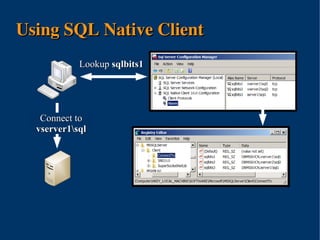
Using SQL Native Client
            Lookup sqlbits1


   Connect to
  vserver1sql


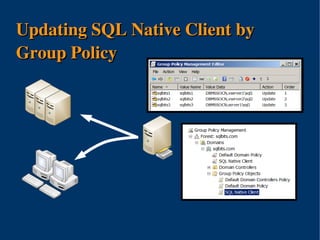
Updating SQL Native Client by 
Group Policy


Demo


       Redirecting an instance 
       using SQL Native Client
          and Group Policy


Using application based redirection

  DBMirroring Failover partner in connection string
          .NET 2.0 upwards
  Application based error handling
          Inline
          Configuration files
  Virtualization?


What is a SAN?
 ..Storage Area Network
 Works at the block level
 Scalable
 Highly available
 Remote
 Highly Accessible (Universal Storage Connectivity)
 High performance


Preparing for our Virtual SAN
  Virtual Hardware
  Disk/s for Operating System and iSCSI targets
  Network Card

  Installation Media
  FreeNAS ISO or CD (alternatives such as Openfiler)

  Configuration Considerations
  IP address, subnet mask, g/w, memory
  Active Directory

                       
Demo


       Setup our Virtual SAN
        and Virtual Cluster


Clustering solution version 1
   cluster1                                           cluster2

  server2   server3                                server4   server5


     vserver1                     virtual server      vserver1
     vserver2                     names shared        vserver2
     vserver3                                         vserver3
     vserver4                                         vserver4


      LUNS                                              LUNS
                      SAN based mirroring


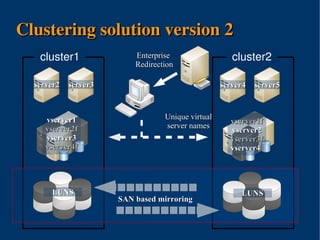
Clustering solution version 2
   cluster1                 Enterprise                  cluster2
                            Redirection

  server2   server3                                  server4   server5


     vserver1                       Unique virtual
                                                       vserver1f
     vserver2f                      server names
                                                       vserver2
     vserver3                                          vserver3f
     vserver4f                                         vserver4


      LUNS                                                LUNS
                      SAN based mirroring


Demo


       Failing Groups across 
              Clusters


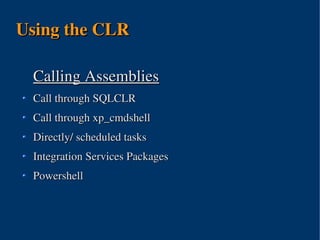
Using the CLR

 Calling Assemblies
 Call through SQLCLR
 Call through xp_cmdshell
 Directly/ scheduled tasks
 Integration Services Packages
 Powershell


Using the CLR
using sql = Microsoft.SqlServer.Server;
using io = System.IO;

public class IO {
    [sql.SqlFunction()]
    public static sqltype.SqlInt64 DriveFree(sqltype.SqlString drive){
        io.DriveInfo di;
            try {
            di = new System.IO.DriveInfo(drive.ToString());
            return di.TotalFreeSpace;
        }
        catch { return -1; }
    }
    .......
}


Using the CLR
using sql = Microsoft.SqlServer.Server;
using io ASSEMBLY SQLCallAssembly
  CREATE = System.IO;
       FROM 'H:SQLCallAssembly.DLL'
       WITH PERMISSION_SET = EXTERNAL_ACCESS
public class IO {
  GO [sql.SqlFunction()]
     public static sqltype.SqlInt64 DriveFree(sqltype.SqlString drive){
  CREATE io.DriveInfo di;
          FUNCTION dbo.udf_drivefree(@drive NVARCHAR(1))
       RETURNS BIGINT
              try {
       EXTERNAL NAME SQLCallAssembly.IO.DriveFree;
              di = new System.IO.DriveInfo(drive.ToString());
  GO          return di.TotalFreeSpace;
  CREATE }FUNCTION dbo.udf_driveused(@drive NVARCHAR(1))
  ...     catch { return -1; }
  CREATE FUNCTION dbo.udf_drivesize(@drive NVARCHAR(1))
     }
  ..........
} CREATE FUNCTION dbo.udf_drivefreepercent(@drive NVARCHAR(1))
  ...
  CREATE FUNCTION dbo.udf_driveusedpercent(@drive NVARCHAR(1))
  ...
  GO


Using the CLR
using sql = Microsoft.SqlServer.Server;
using io ASSEMBLY SQLCallAssembly
  CREATE = System.IO;
    CREATE 'H:SQLCallAssembly.DLL'
       FROM VIEW vw_drivespace AS
public SELECTIO {
         class 1 as 'seq',
       WITH PERMISSION_SET = EXTERNAL_ACCESS
  GO [sql.SqlFunction()] drive,
             'system' as
     public 'C' as sqltype.SqlInt64 DriveFree(sqltype.SqlString drive){
             static 'letter',
             [dbo].[udf_drivefreepercent]('c') AS [%free],
  CREATE io.DriveInfo di;
          FUNCTION dbo.udf_drivefree(@drive NVARCHAR(1))
       RETURNS BIGINT
             [dbo].[udf_driveusedpercent]('c')as [%used],
              try {
       EXTERNAL NAME SQLCallAssembly.IO.DriveFree;AS [capacity(MB)],
             [dbo].[udf_drivesize]('c')/1048576
              di = new System.IO.DriveInfo(drive.ToString());
  GO         [dbo].[udf_drivefree]('c')/1048576 AS [free(MB)],
              return di.TotalFreeSpace;
  CREATE } [dbo].[udf_driveused]('c')/1048576 as [used(MB)]
          FUNCTION dbo.udf_driveused(@drive NVARCHAR(1))
  ...    UNION { return -1; }
          catch
  CREATE FUNCTION dbo.udf_drivesize(@drive NVARCHAR(1))
     }
  ..........
         .....
} CREATE FUNCTION dbo.udf_drivefreepercent(@drive NVARCHAR(1))
  ...
         SELECT .....
  CREATE FUNCTION dbo.udf_driveusedpercent(@drive NVARCHAR(1))
  ...
  GOGO


Using the CLR
using sql = Microsoft.SqlServer.Server;
using io ASSEMBLY SQLCallAssembly
  CREATE = System.IO;
    CREATE 'H:SQLCallAssembly.DLL'
       FROM VIEW vw_drivespace AS
public SELECTIO {
         class 1 as 'seq',
       WITH PERMISSION_SET = EXTERNAL_ACCESS
  GO [sql.SqlFunction()] drive,
             'system' as
     public 'C' as sqltype.SqlInt64 DriveFree(sqltype.SqlString drive){
             static 'letter',
             [dbo].[udf_drivefreepercent]('c') AS [%free],
  CREATE io.DriveInfo di;
          FUNCTION dbo.udf_drivefree(@drive NVARCHAR(1))
       RETURNS BIGINT
             [dbo].[udf_driveusedpercent]('c')as [%used],
              try {
       EXTERNAL NAME SQLCallAssembly.IO.DriveFree;AS [capacity(MB)],
             [dbo].[udf_drivesize]('c')/1048576
              di = new System.IO.DriveInfo(drive.ToString());
  GO         [dbo].[udf_drivefree]('c')/1048576 AS [free(MB)],
              return di.TotalFreeSpace;
  CREATE } [dbo].[udf_driveused]('c')/1048576 as [used(MB)]
          FUNCTION dbo.udf_driveused(@drive NVARCHAR(1))
  ...    UNION { return -1; }
          catch
  CREATE FUNCTION dbo.udf_drivesize(@drive NVARCHAR(1))
     }
  ..........
         .....
} CREATE FUNCTION dbo.udf_drivefreepercent(@drive NVARCHAR(1))
  ...
         SELECT .....
  CREATE FUNCTION dbo.udf_driveusedpercent(@drive NVARCHAR(1))
  ...
  GOGO


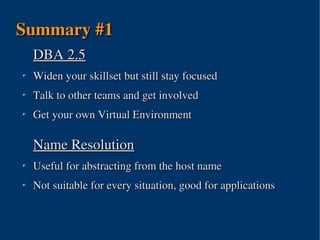
Summary #1
 DBA 2.5
 Widen your skillset but still stay focused 
 Talk to other teams and get involved
 Get your own Virtual Environment

 Name Resolution
 Useful for abstracting from the host name
 Not suitable for every situation, good for applications


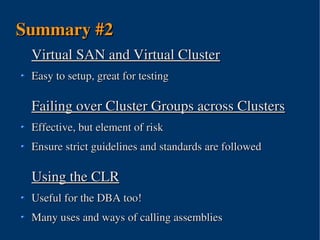
Summary #2
 Virtual SAN and Virtual Cluster
 Easy to setup, great for testing

 Failing over Cluster Groups across Clusters
 Effective, but element of risk
 Ensure strict guidelines and standards are followed

 Using the CLR
 Useful for the DBA too!
 Many uses and ways of calling assemblies
                        
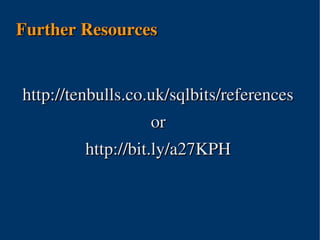
Further Resources


http://tenbulls.co.uk/sqlbits/references
                   or
         http://bit.ly/a27KPH


Questions


Thinking outside the Box,
learning a little about a lot


  Mark Broadbent
  SQL Server DBA


  http://tenbulls.co.uk
  @retracement


Thinking outside the box, learning a little about a lot