Dealing with Residual Contamination
One Oversight Agency’s Attempt
CUPA Conference 2013 TH-F2
Charles Ice, P.G.
Groundwater Protection Program
San Mateo County
Environmental Health
Outline
• Methodology for providing notification of
residual contamination
• Responses to potentially encountering
residual contamination
• Site specific examples
Notification of Residual Contamination
• Quarterly letter and list of all of our sites to all
building/planning/redevelopment agencies
• Building department notification letters at
time of case closure
• Commercial deed restrictions
• Geotracker and Envirostor
Quarterly letter and list
• Send a list to all building/planning/redevelopment
agencies within our geographic jurisdiction as part of
our Public Participation Program
• List only includes county lead sites, does not include RB
or DTSC sites
• Regularly contact all of the building/planning/
redevelopment agencies to get correct contact
information and offer to host or attend a meeting with
each of the agencies to explain the list among other
contamination issues
• List also publically posted in county courthouse and
letter asks other agencies to post in public location
Building Department Notification
Letter
• Sent at time of case closure when known residual
contamination left in place at concentrations above
either generic or site-specific screening levels
• Identifies all impacted properties but also mention a
potential concern for properties in the vicinity
particularly regarding groundwater extraction
• At current location (i.e. depth) not a threat but should
it be encountered and potentially moved then could be
• Can be entered, but public can not see it, in Geotracker
under Closure/NFA Letter activity as Site Management
Requirements – Notify Prior to Development and
Subsurface Work, No Excavation without Approval
Commercial Deed Restriction
• Voluntarily done by property owner (may or may
not be responsible party) to get closure (usually
quicker and with less remediation) under
commercial rather than residential land use
• Modeled (i.e. plagiarized) from DTSC (2006),
double check any citations for relevance to you
versus DTSC only
• Language is 100% negotiable but must have key
elements (described on next slide)
• Cosigned by agency and property owner and
recorded with the Assessor by responsible party
Commercial Deed Restriction
• Statement of Facts
– Description of Site and Contamination, Health Effects, Surrounding
Land Use, Finding
• General Provisions
– To Run with the Land, Binding Upon Owners/Occupants, Incorporation
into Deeds and Leases, Conveyance of Property, Cost of Administering
the Covenant to be Paid by Owner
• Definitions
• Restrictions and Requirements
– No residences, schools, day cares, hospitals, hospices, or similar
– No drilling or groundwater extraction except construction dewatering
with appropriate notification
– No disturbing the soil without approval
– Access for department and enforcement
• Variance, Termination, and Term
Geotracker and Envirostor
• GeoTracker is maintained by State Water Resources
Control Board
– 9/01 analytical data reports, depth to water
measurements, and latitude, longitude, and elevation of
permanent sampling points for LUST sites only submitted
by responsible party
– 7/05 regulatory requested reports, boring logs, and maps
of sampling points for all types of sites submitted by
responsible party
– 1/08 Regulatory letters submitted by regulatory agency
• Envirostor is maintained by Department of Toxic
Substances Control
Responses to Notification
• Notified by either agency official or the project proponent
representatives of development or other work on site
• Ask for plans and compare known historical location of residual
contamination to area (including depths) of proposed activity
• Ask agency that will be issuing the permit for the project to add as a
condition that a Soil and Groundwater Management Plan be
submitted to and accepted by Environmental Health (i.e. mitigation
measure)
• Can also ask for a site specific risk assessment if conditions warrant
(grading or construction causes residual contamination to be closer
to surface or building [i.e. less attenuation zone])
• Proponent pays for all oversight costs
Soil and Groundwater Management
Plan
• Plan describes how waste will be identified,
segregated from clean soil and water, handled
and stored, characterized and eventually
disposed (potentially even reused onsite)
• Subsurface garages, basements, piers,
elevators, and even wine cellars
• Dewatering even if only temporary
– What about this on neighboring sites, notification
provided?
Industrial to Residential, Menlo Park
• Formerly a construction equipment repair yard, lots of
surface spills particularly around storage sheds
• Excavated diesel contamination to commercial ESLs,
obtained deed restriction, and closed case
• City of Menlo Park sued for not having enough
housing, lost the lawsuit, designated several industrial
areas for residential conversion
• New owner trying to remove deed restriction now
– Use old data to develop remediation plan to residential ESL
– Recharacterize the contaminants to see if either a smaller
area still needs to be remediated or deed restriction is
even needed any more (i.e. attenuation)
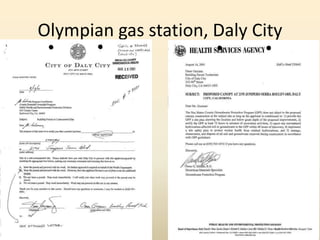
Olympian gas station, Daly City
• 1996 site was going to be completely
demolished and rebuilt, borings discover
contamination, site opened
• USTs removed with some additional
overexcavation, confirmation samples show
only minor amount of contamination left
• Closed in 2000 with building department
letter
Olympian gas station, Daly City
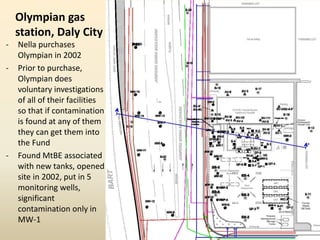
Olympian gas
station, Daly City
- Nella purchases
Olympian in 2002
- Prior to purchase,
Olympian does
voluntary investigations
of all of their facilities
so that if contamination
is found at any of them
they can get them into
the Fund
- Found MtBE associated
with new tanks, opened
site in 2002, put in 5
monitoring wells,
significant
contamination only in
MW-1
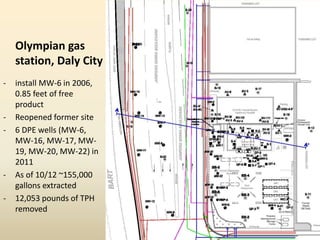
Olympian gas
station, Daly City
- install MW-6 in 2006,
0.85 feet of free
product
- Reopened former site
- 6 DPE wells (MW-6,
MW-16, MW-17, MW-
19, MW-20, MW-22) in
2011
- As of 10/12 ~155,000
gallons extracted
- 12,053 pounds of TPH
removed
Safeway remodel, Millbrae
• Safeway directly adjacent, but cross-gradient, to a
recently closed Chevron station case and directly
downgradient from an open dry cleaner site
• Based on the building department letter for the
closed Chevron case, planner contacts county
environmental health during CEQA
• PCE plume found to have no vapor intrusion
impact on Safeway
• Subsurface construction not encountering
groundwater, so no Soil and Groundwater
Management Plan required
Safeway remodel, Millbrae
• A few months later, receive a call from an
elevator contractor regarding potentially
encountering contaminated groundwater during
construction of elevator
• A change in the construction of the elevator had
occurred after the original plans were submitted
• Safeway says it was a coordination issue between
the structural engineer and the architect
• Moral of the story – make sure you are dealing
with the final version of the plans

TH-F2 Dealing With Residual Contamination- ICE

  • 1.
    Dealing with ResidualContamination One Oversight Agency’s Attempt CUPA Conference 2013 TH-F2 Charles Ice, P.G. Groundwater Protection Program San Mateo County Environmental Health
  • 2.
    Outline • Methodology forproviding notification of residual contamination • Responses to potentially encountering residual contamination • Site specific examples
  • 3.
    Notification of ResidualContamination • Quarterly letter and list of all of our sites to all building/planning/redevelopment agencies • Building department notification letters at time of case closure • Commercial deed restrictions • Geotracker and Envirostor
  • 4.
    Quarterly letter andlist • Send a list to all building/planning/redevelopment agencies within our geographic jurisdiction as part of our Public Participation Program • List only includes county lead sites, does not include RB or DTSC sites • Regularly contact all of the building/planning/ redevelopment agencies to get correct contact information and offer to host or attend a meeting with each of the agencies to explain the list among other contamination issues • List also publically posted in county courthouse and letter asks other agencies to post in public location
  • 5.
    Building Department Notification Letter •Sent at time of case closure when known residual contamination left in place at concentrations above either generic or site-specific screening levels • Identifies all impacted properties but also mention a potential concern for properties in the vicinity particularly regarding groundwater extraction • At current location (i.e. depth) not a threat but should it be encountered and potentially moved then could be • Can be entered, but public can not see it, in Geotracker under Closure/NFA Letter activity as Site Management Requirements – Notify Prior to Development and Subsurface Work, No Excavation without Approval
  • 6.
    Commercial Deed Restriction •Voluntarily done by property owner (may or may not be responsible party) to get closure (usually quicker and with less remediation) under commercial rather than residential land use • Modeled (i.e. plagiarized) from DTSC (2006), double check any citations for relevance to you versus DTSC only • Language is 100% negotiable but must have key elements (described on next slide) • Cosigned by agency and property owner and recorded with the Assessor by responsible party
  • 7.
    Commercial Deed Restriction •Statement of Facts – Description of Site and Contamination, Health Effects, Surrounding Land Use, Finding • General Provisions – To Run with the Land, Binding Upon Owners/Occupants, Incorporation into Deeds and Leases, Conveyance of Property, Cost of Administering the Covenant to be Paid by Owner • Definitions • Restrictions and Requirements – No residences, schools, day cares, hospitals, hospices, or similar – No drilling or groundwater extraction except construction dewatering with appropriate notification – No disturbing the soil without approval – Access for department and enforcement • Variance, Termination, and Term
  • 8.
    Geotracker and Envirostor •GeoTracker is maintained by State Water Resources Control Board – 9/01 analytical data reports, depth to water measurements, and latitude, longitude, and elevation of permanent sampling points for LUST sites only submitted by responsible party – 7/05 regulatory requested reports, boring logs, and maps of sampling points for all types of sites submitted by responsible party – 1/08 Regulatory letters submitted by regulatory agency • Envirostor is maintained by Department of Toxic Substances Control
  • 9.
    Responses to Notification •Notified by either agency official or the project proponent representatives of development or other work on site • Ask for plans and compare known historical location of residual contamination to area (including depths) of proposed activity • Ask agency that will be issuing the permit for the project to add as a condition that a Soil and Groundwater Management Plan be submitted to and accepted by Environmental Health (i.e. mitigation measure) • Can also ask for a site specific risk assessment if conditions warrant (grading or construction causes residual contamination to be closer to surface or building [i.e. less attenuation zone]) • Proponent pays for all oversight costs
  • 10.
    Soil and GroundwaterManagement Plan • Plan describes how waste will be identified, segregated from clean soil and water, handled and stored, characterized and eventually disposed (potentially even reused onsite) • Subsurface garages, basements, piers, elevators, and even wine cellars • Dewatering even if only temporary – What about this on neighboring sites, notification provided?
  • 11.
    Industrial to Residential,Menlo Park • Formerly a construction equipment repair yard, lots of surface spills particularly around storage sheds • Excavated diesel contamination to commercial ESLs, obtained deed restriction, and closed case • City of Menlo Park sued for not having enough housing, lost the lawsuit, designated several industrial areas for residential conversion • New owner trying to remove deed restriction now – Use old data to develop remediation plan to residential ESL – Recharacterize the contaminants to see if either a smaller area still needs to be remediated or deed restriction is even needed any more (i.e. attenuation)
  • 12.
    Olympian gas station,Daly City • 1996 site was going to be completely demolished and rebuilt, borings discover contamination, site opened • USTs removed with some additional overexcavation, confirmation samples show only minor amount of contamination left • Closed in 2000 with building department letter
  • 13.
  • 14.
    Olympian gas station, DalyCity - Nella purchases Olympian in 2002 - Prior to purchase, Olympian does voluntary investigations of all of their facilities so that if contamination is found at any of them they can get them into the Fund - Found MtBE associated with new tanks, opened site in 2002, put in 5 monitoring wells, significant contamination only in MW-1
  • 15.
    Olympian gas station, DalyCity - install MW-6 in 2006, 0.85 feet of free product - Reopened former site - 6 DPE wells (MW-6, MW-16, MW-17, MW- 19, MW-20, MW-22) in 2011 - As of 10/12 ~155,000 gallons extracted - 12,053 pounds of TPH removed
  • 16.
    Safeway remodel, Millbrae •Safeway directly adjacent, but cross-gradient, to a recently closed Chevron station case and directly downgradient from an open dry cleaner site • Based on the building department letter for the closed Chevron case, planner contacts county environmental health during CEQA • PCE plume found to have no vapor intrusion impact on Safeway • Subsurface construction not encountering groundwater, so no Soil and Groundwater Management Plan required
  • 17.
    Safeway remodel, Millbrae •A few months later, receive a call from an elevator contractor regarding potentially encountering contaminated groundwater during construction of elevator • A change in the construction of the elevator had occurred after the original plans were submitted • Safeway says it was a coordination issue between the structural engineer and the architect • Moral of the story – make sure you are dealing with the final version of the plans