1


     Control relevant modeling and
    nonlinear state estimation applied
      to SOFC-GT power systems

             Rambabu Kandepu
                04-12-2007
2


                 Contents
    • Motivation
    • Modeling and control of SOFC-GT
      power system
    • Nonlinear state estimation
    • Conclusions
3


                  Motivation
    • Increase in energy demand
      – Population growth
      – Industrialization
    • Dependency on oil and gas
    • Global warming
4


                        Motivation
    • Solution to energy demand increase
       – Efficient of energy conversion
       – Technology with low emissions
       – Using renewable energy sources
    • Distributed generation
       – Avoid transmission and distribution losses
       – Wind turbines, biomass, small scale hydro, fuel cells etc
5


    Fuel cells
          •   Electrochemical device
          •   Advantages
               – High efficiency
               – Low emissions
               – No moving parts
          •   Different types
               – Electrolyte
               – Temperature
          •   SOFC
               – Solid components
               – High operating temperature
               – More fuel flexibility
               – Internal reforming
6


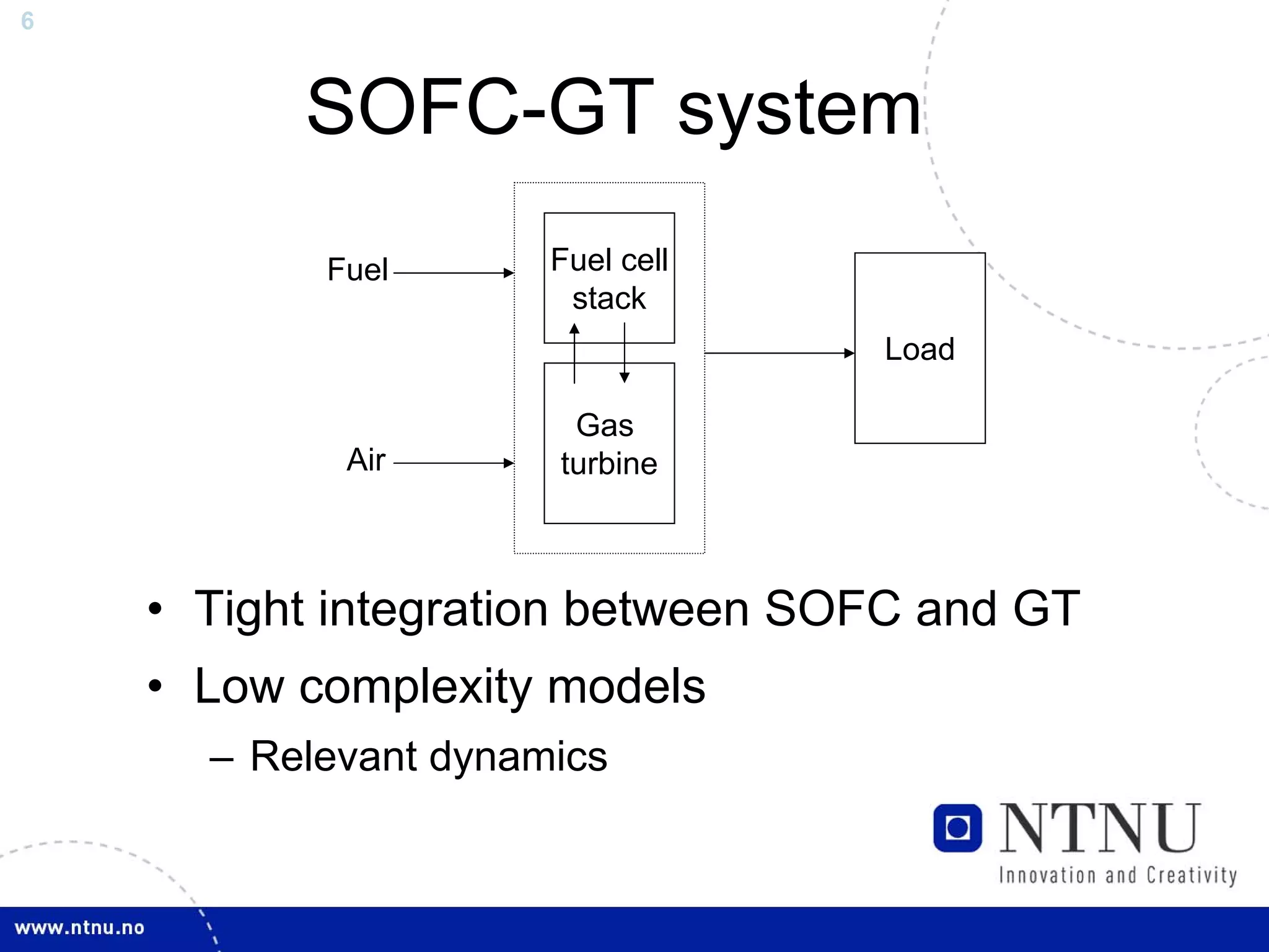
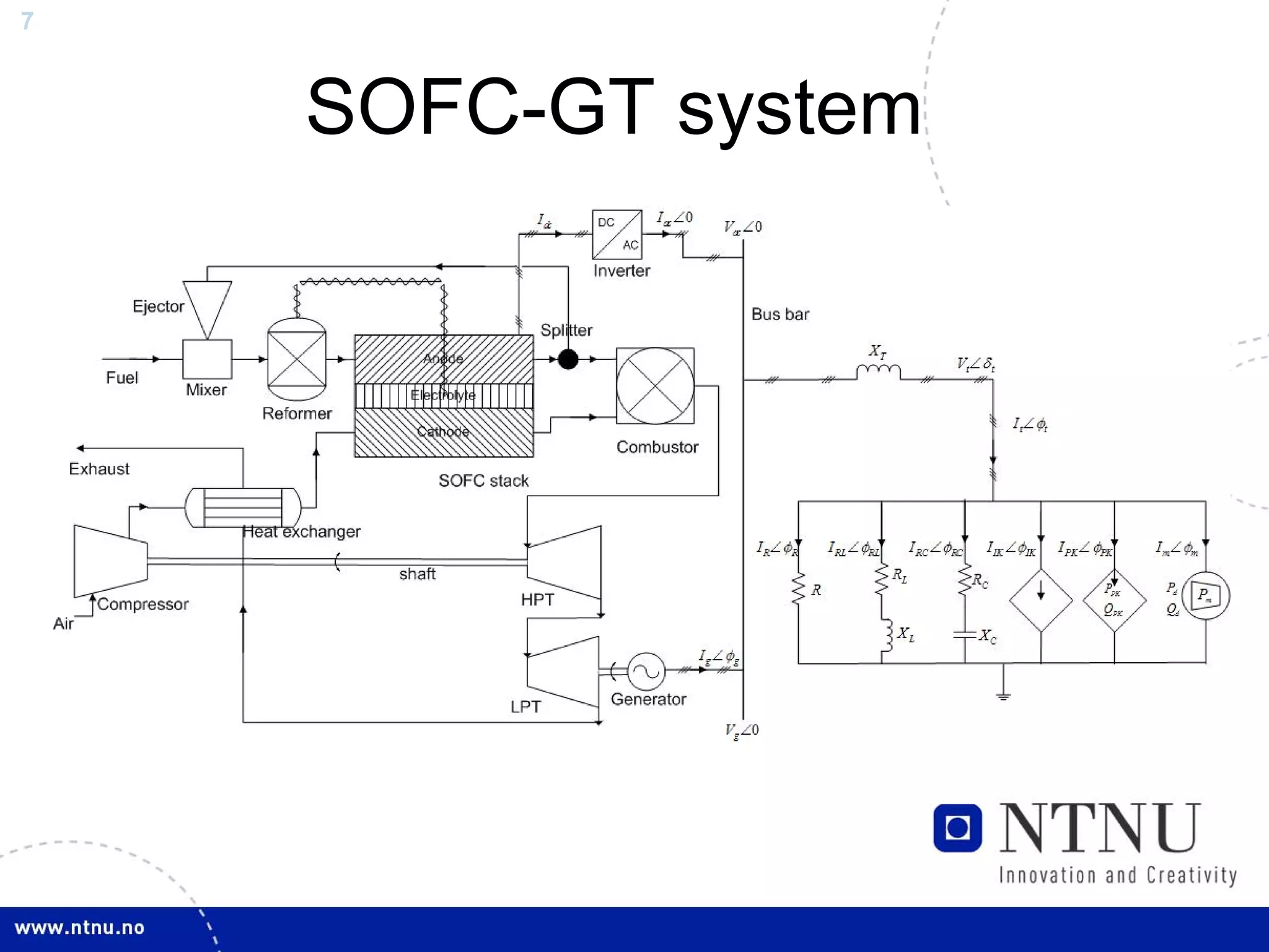
          SOFC-GT system
           Fuel       Fuel cell
                       stack
                                  Load

                       Gas
            Air       turbine


    • Tight integration between SOFC and GT
    • Low complexity models
      – Relevant dynamics
7


    SOFC-GT system
8


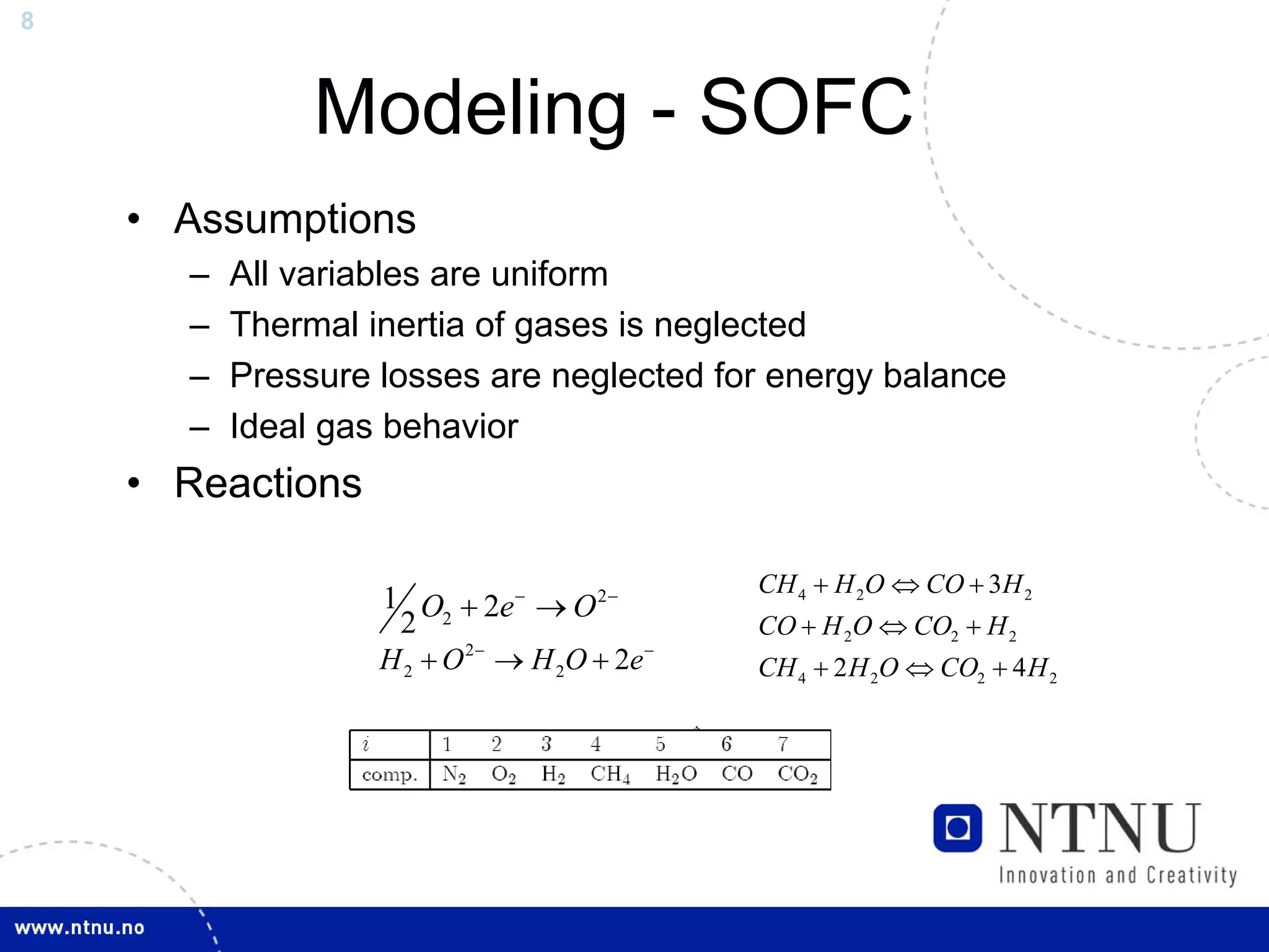
               Modeling - SOFC
    • Assumptions
      –   All variables are uniform
      –   Thermal inertia of gases is neglected
      –   Pressure losses are neglected for energy balance
      –   Ideal gas behavior
    • Reactions

                                                    CH 4 + H 2O ⇔ CO + 3H 2
                   1 O + 2e − → O 2 −
                    2 2                             CO + H 2O ⇔ CO2 + H 2
                            2−                  −
                   H2 + O        → H 2 O + 2e       CH 4 + 2 H 2O ⇔ CO2 + 4 H 2
9


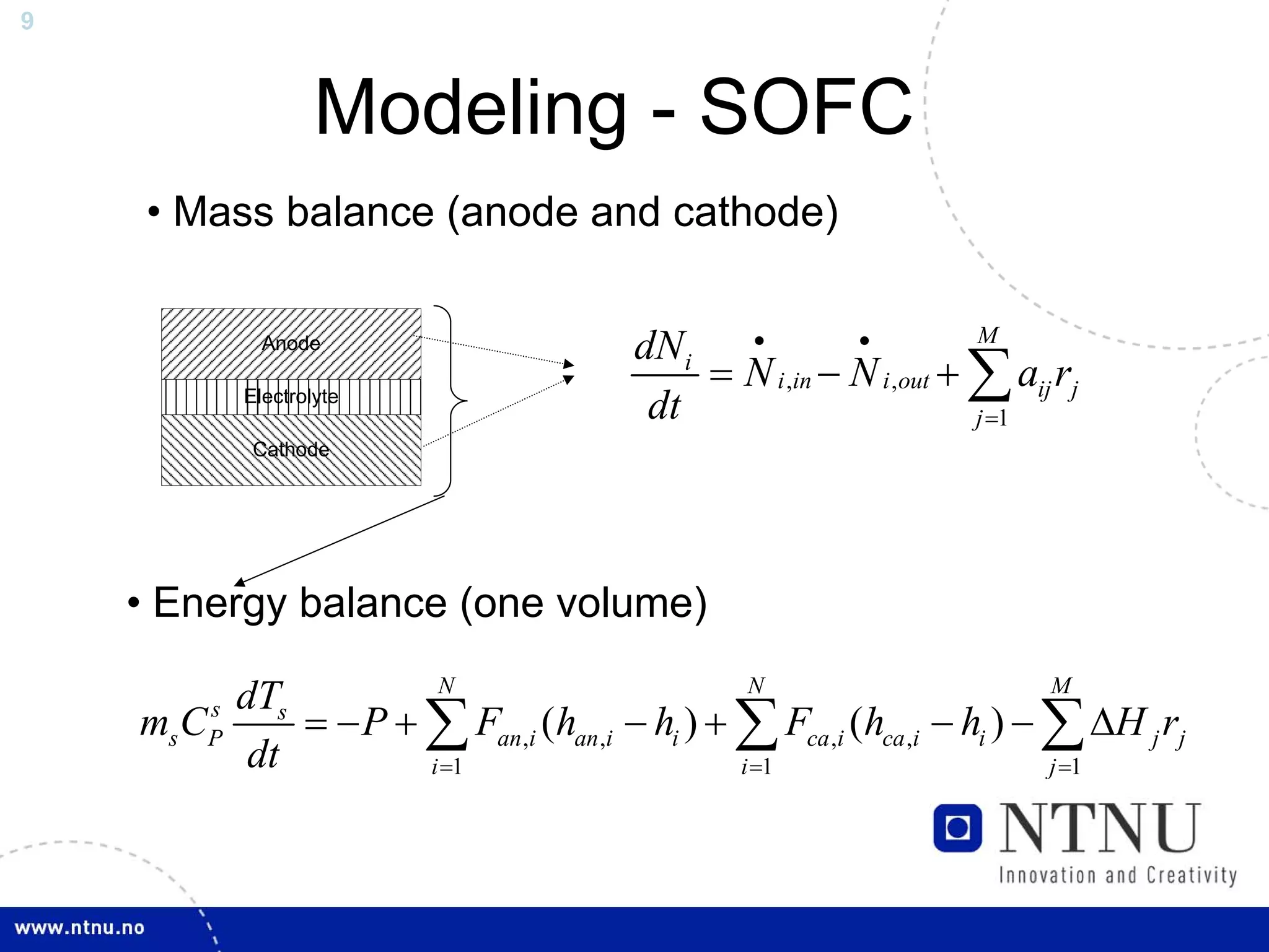
                     Modeling - SOFC
     • Mass balance (anode and cathode)


                                        dN i •          •          M
                                            = N i ,in − N i ,out + ∑ aij rj
               Anode

             Electrolyte
                                         dt                        j =1
              Cathode


    • Energy balance (one volume)
                      N                         N                        M
         dTs
    ms C s
         P   = − P + ∑ Fan ,i (han ,i − hi ) + ∑ Fca ,i (hca ,i − hi ) − ∑ ΔH j rj
          dt         i =1                      i =1                      j =1
10


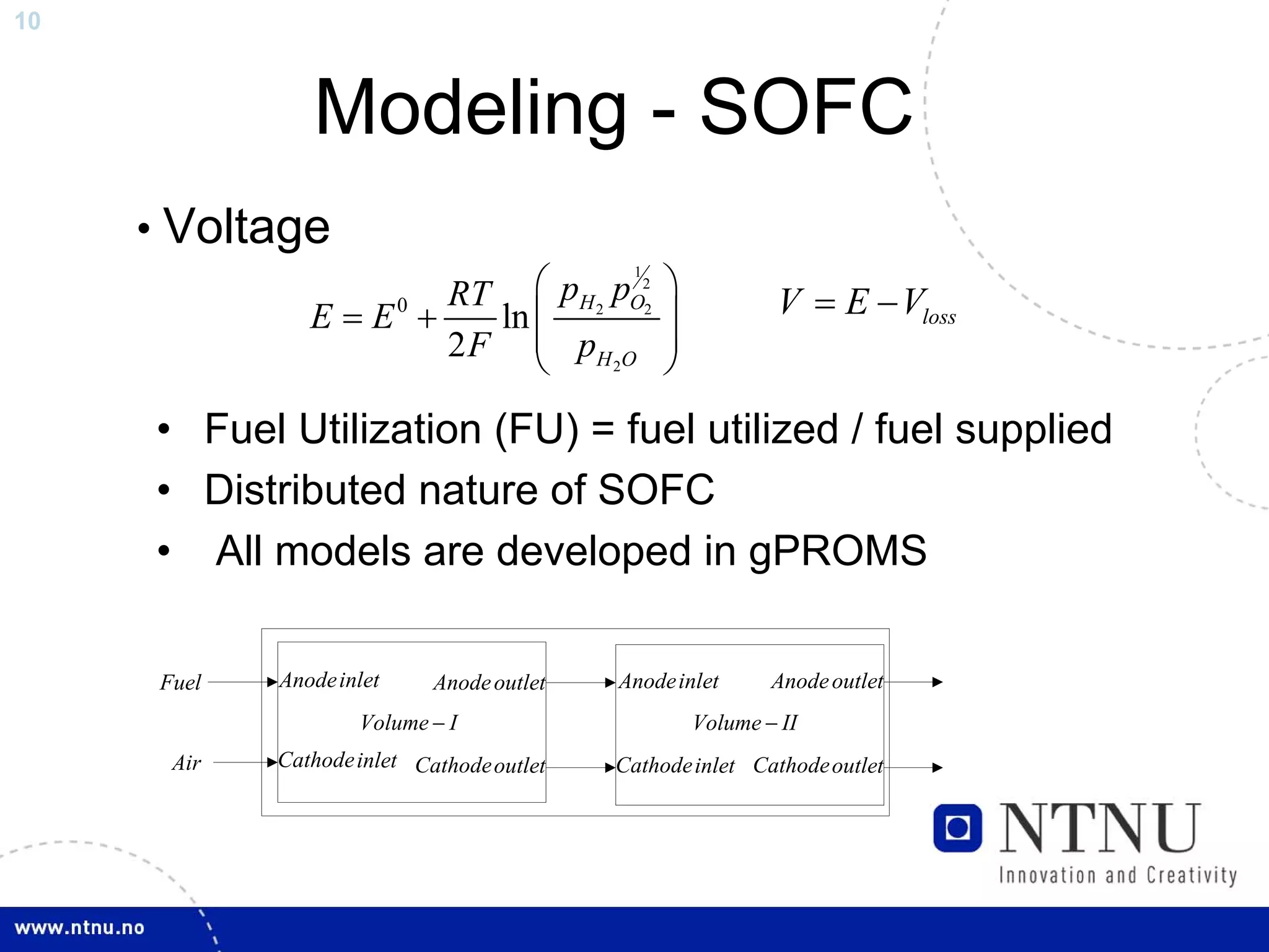
                Modeling - SOFC
     • Voltage
                         RT ⎛ pH 2 pO22          ⎞
                                             1


                E = E0 +    ln ⎜                 ⎟           V = E − Vloss
                         2 F ⎜ pH 2O
                               ⎝
                                                 ⎟
                                                 ⎠
     • Fuel Utilization (FU) = fuel utilized / fuel supplied
     • Distributed nature of SOFC
     • All models are developed in gPROMS

      Fuel   Anode inlet     Anode outlet   Anode inlet      Anode outlet
                     Volume − I                      Volume − II
       Air   Cathode inlet Cathode outlet   Cathode inlet Cathode outlet
11


         SOFC model evaluation
     • Evaluated against a detailed model
                           1200
                                               Detailed model
                                               Simple model with one volume
                           1150                Simple model with two volumes
         Temperature (K)


                           1100

                           1050

                           1000

                            950
                               0   100   200   300    400   500    600     700
                                               Time (min)
12


         Control structure design
     • Dynamic load operation is necessary
     • Manipulated variable (1)
       – Fuel flow rate
     • Controlled variables (2)
       – Fuel utilization (FU)
       – SOFC temperature
     • Load as a disturbance
     • Need for a process redesign
13


          Control structure design
     • Three possible options
        – Air blow-off
        – Extra fuel source
        – Air by-pass

     • Control structure
                                                   Load disturbance


           FU ref
                                    Fuel                     FU
                    Controller 1
                                    flow
           Tref                             Hybrid system    T
                    Controller 2
                                   Air blow-off
               -
14


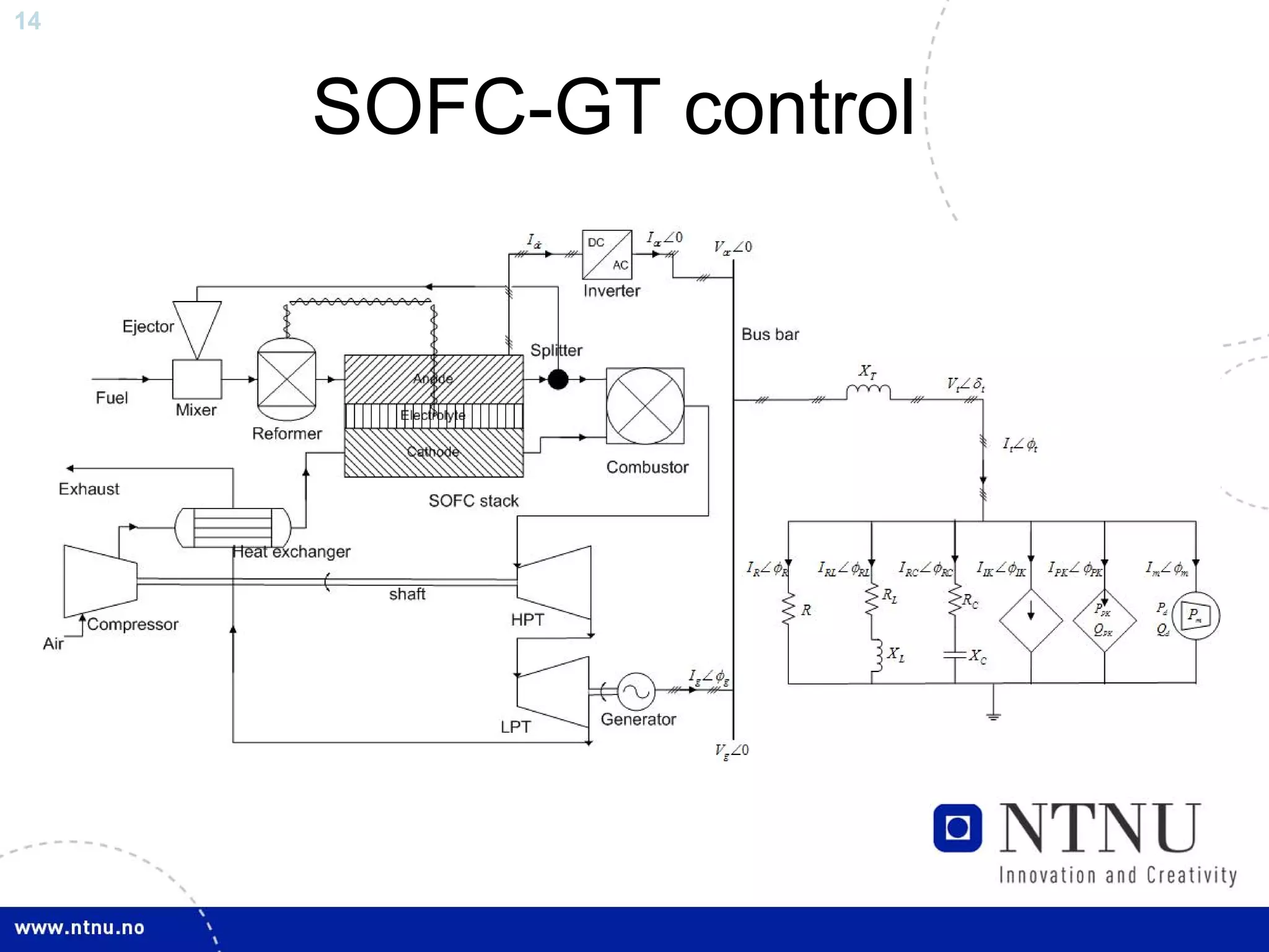
     SOFC-GT control
15


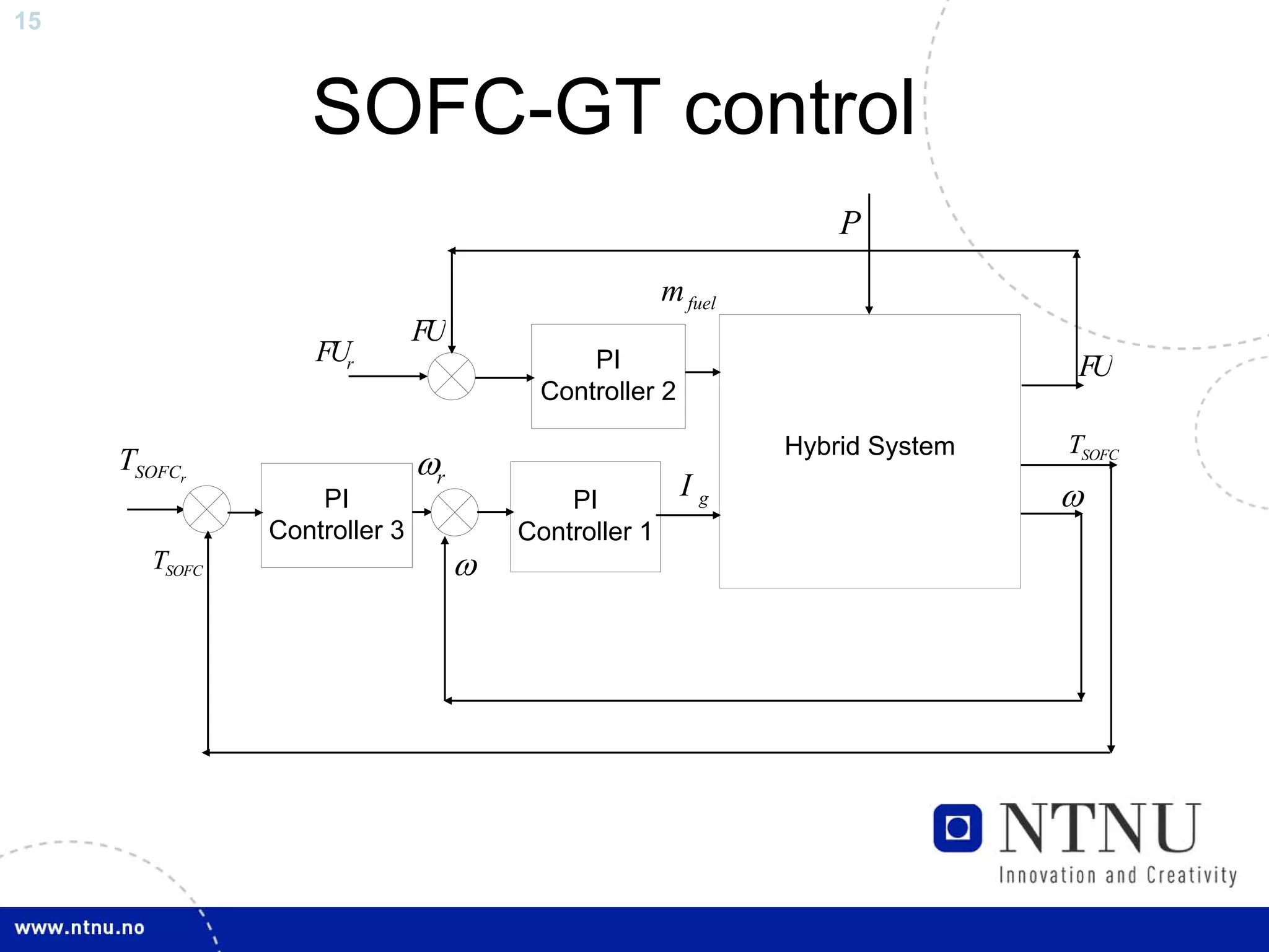
                   SOFC-GT control
                                                                    P
                                                       m fuel
                               FU
                    FUr                       PI                                 FU
                                          Controller 2

                                                                Hybrid System   TSOFC
     TSOFCr                    ωr
                    PI                      PI           Ig                     ω
                Controller 3            Controller 1
        TSOFC                       ω
16


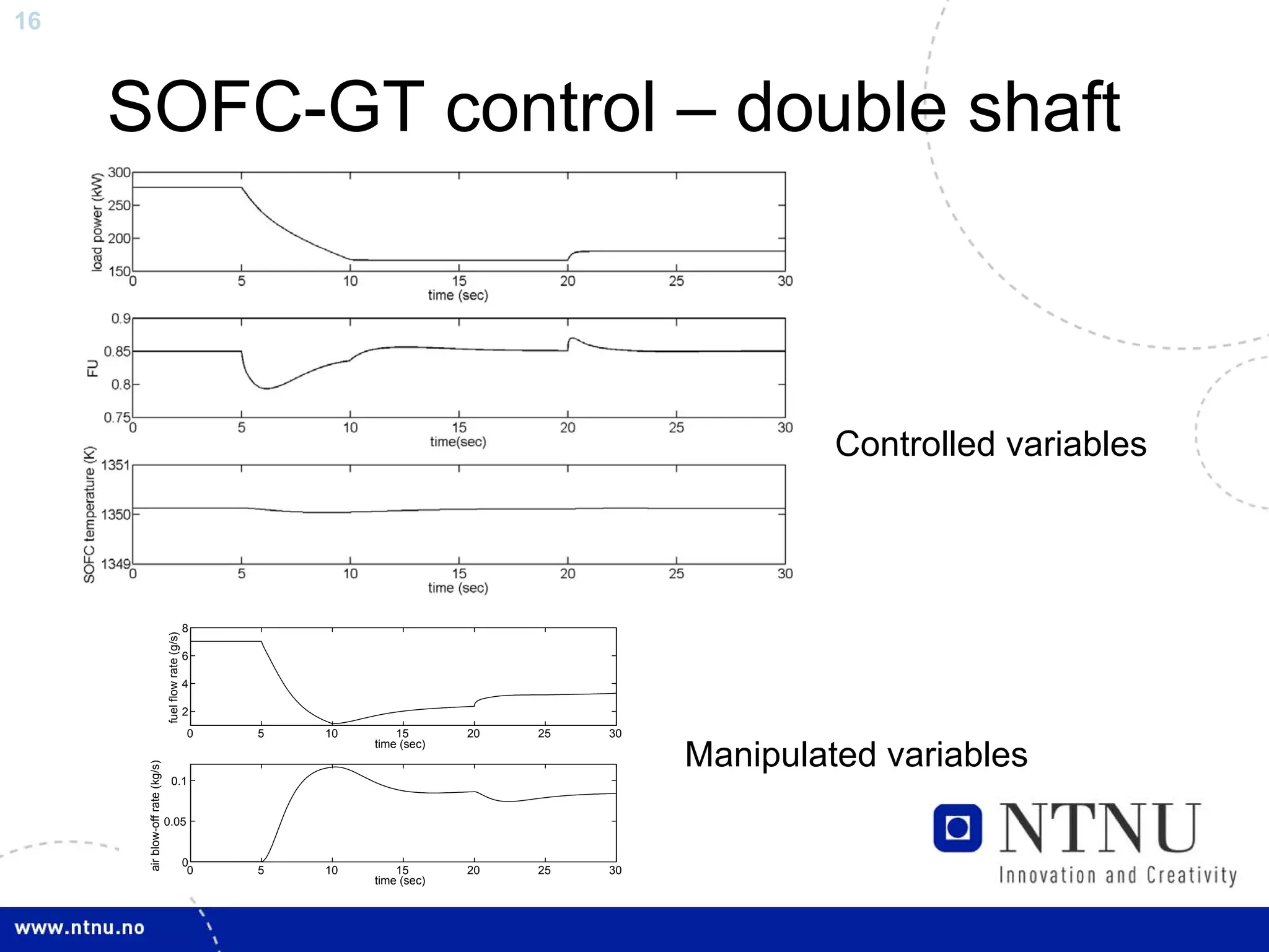
     SOFC-GT control – double shaft


                                                                                                           Controlled variables


                                                        8
                                 fuel flow rate (g/s)


                                                        6

                                                        4

                                                        2
                                                        0    5   10       15       20   25   30
                                                                      time (sec)
                                                                                                  Manipulated variables
      air blow-off rate (kg/s)


                                     0.1


                                 0.05


                                                        0
                                                         0   5   10       15       20   25   30
                                                                      time (sec)
17


            SOFC-GT control

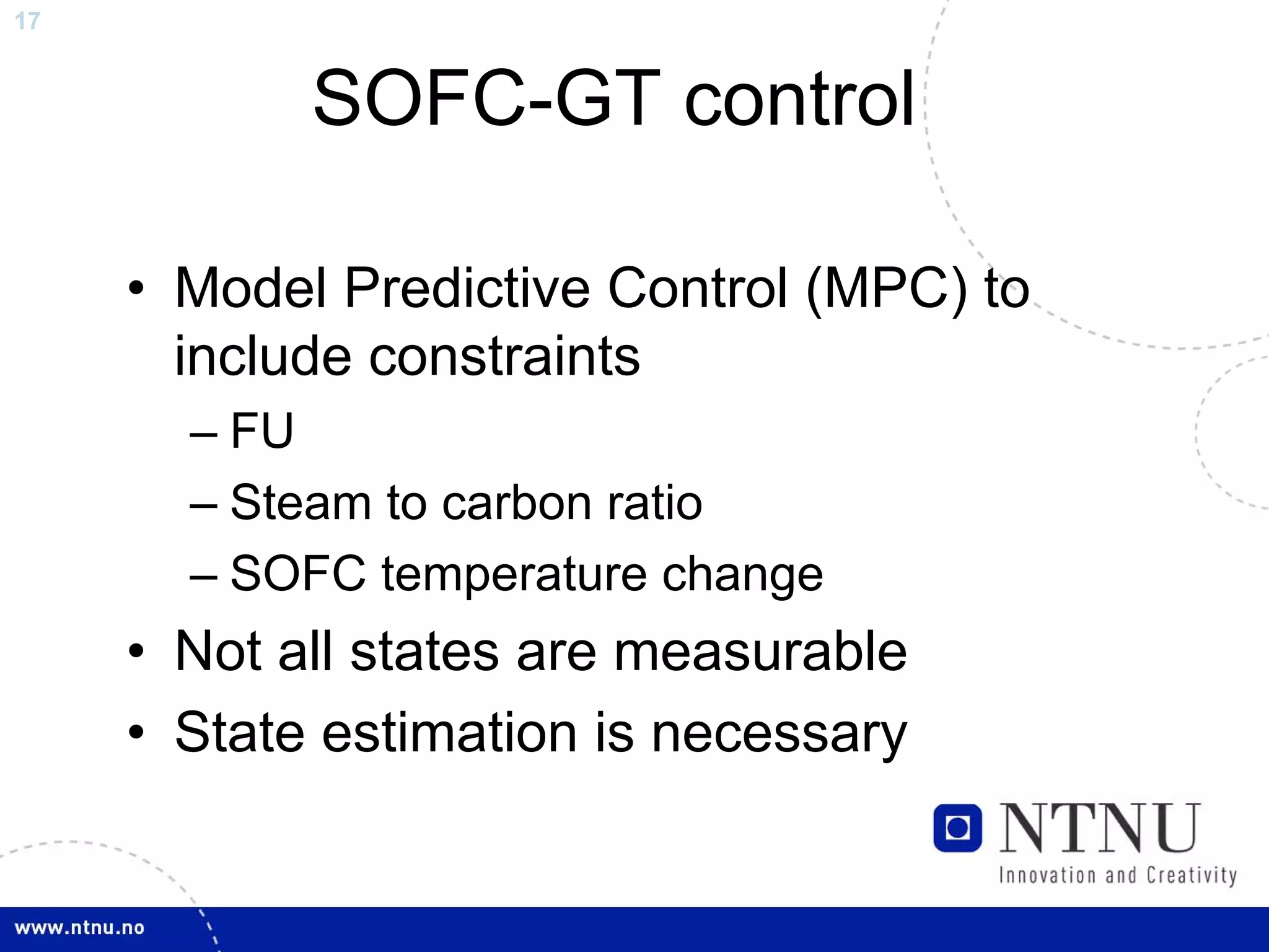
     • Model Predictive Control (MPC) to
       include constraints
       – FU
       – Steam to carbon ratio
       – SOFC temperature change
     • Not all states are measurable
     • State estimation is necessary
18


              State estimation
     • Need for state estimation
     • Nonlinear state estimation
       – Extended Kalman Filter (EKF)
       – Unscented Kalman Filter (UKF)
       – Comparison
       – Constraint handling
       – Results
     • Conclusions
19


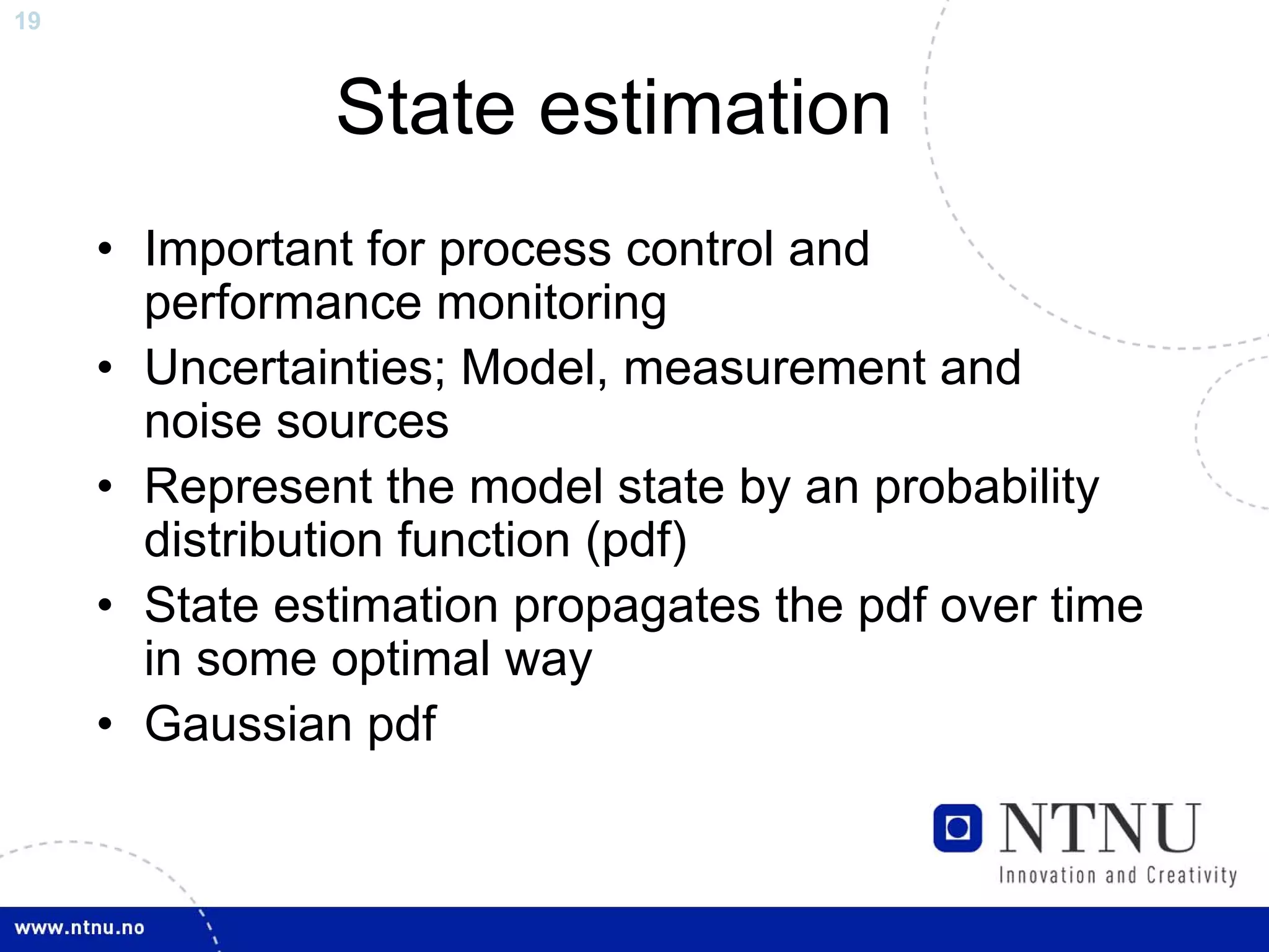
               State estimation
     • Important for process control and
       performance monitoring
     • Uncertainties; Model, measurement and
       noise sources
     • Represent the model state by an probability
       distribution function (pdf)
     • State estimation propagates the pdf over time
       in some optimal way
     • Gaussian pdf
20


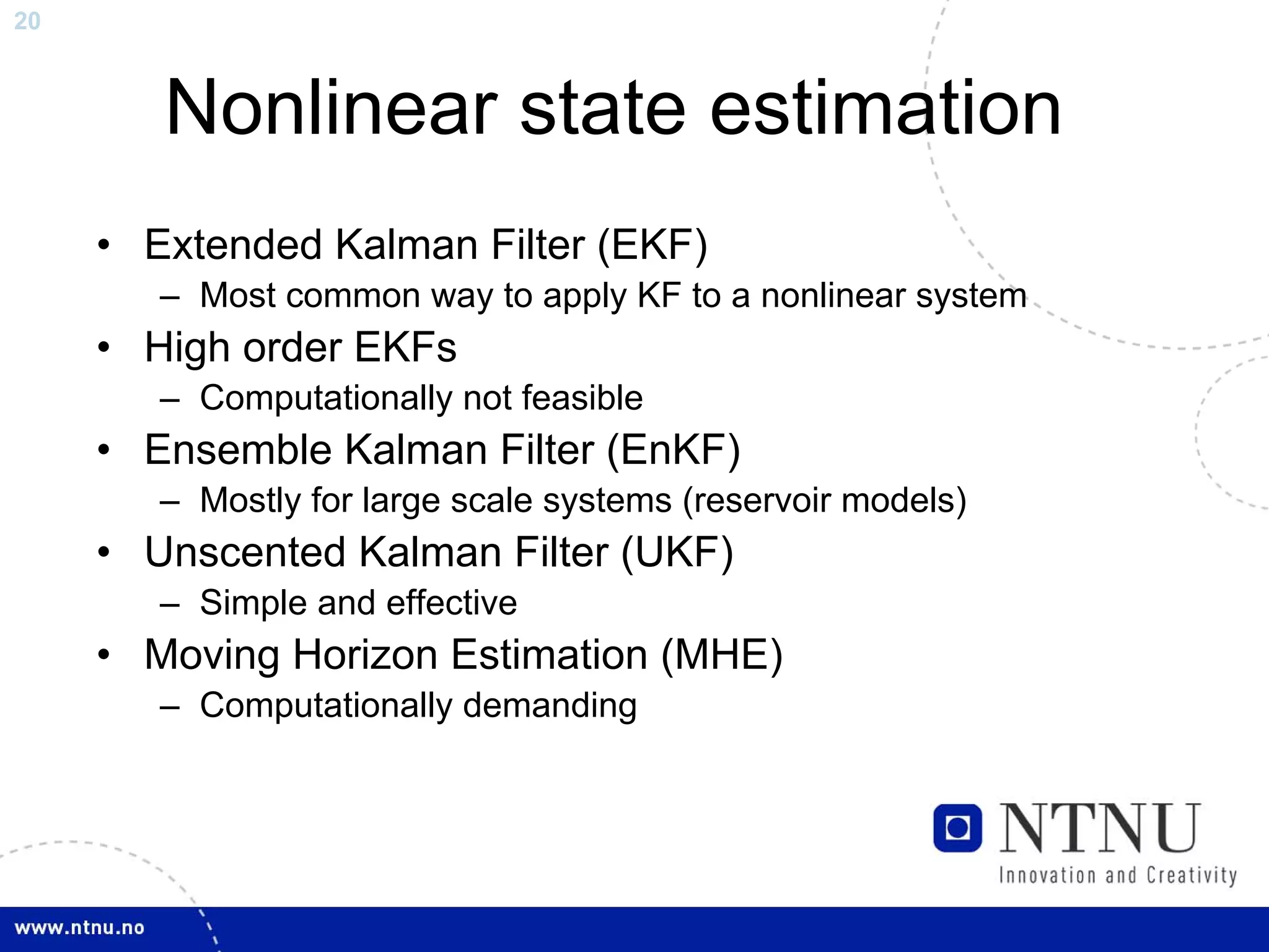
        Nonlinear state estimation
     • Extended Kalman Filter (EKF)
        – Most common way to apply KF to a nonlinear system
     • High order EKFs
        – Computationally not feasible
     • Ensemble Kalman Filter (EnKF)
        – Mostly for large scale systems (reservoir models)
     • Unscented Kalman Filter (UKF)
        – Simple and effective
     • Moving Horizon Estimation (MHE)
        – Computationally demanding
21


                          EKF principle

                      y = g ( x); x ∈      n
                                               a random vector
                     g:      n
                                 →   m
                                         , nonlinear function


                                                                 (
     How to compute the pdf of y, given the Gaussian pdf x, Px of x ?)
                    EKF
                y         = g ( x)
               PyEKF = ( ∇g ) Px ( ∇g )
                                               T


               where ( ∇g ) is the Jacobian of g ( x) at x
22


                     UKF principle
     • UKF principle

                    y = g ( x); x ∈    n
                                           a random vector
                    g:   n
                             →   m
                                     , nonlinear function

                                                             (   )
      How to compute the pdf of y, given the Gaussian pdf x, Px of x ?


           UKF approximates the pdf.
           It uses true nonlinear process and observation models.
23


                UKF principle
     • UKF principle
24


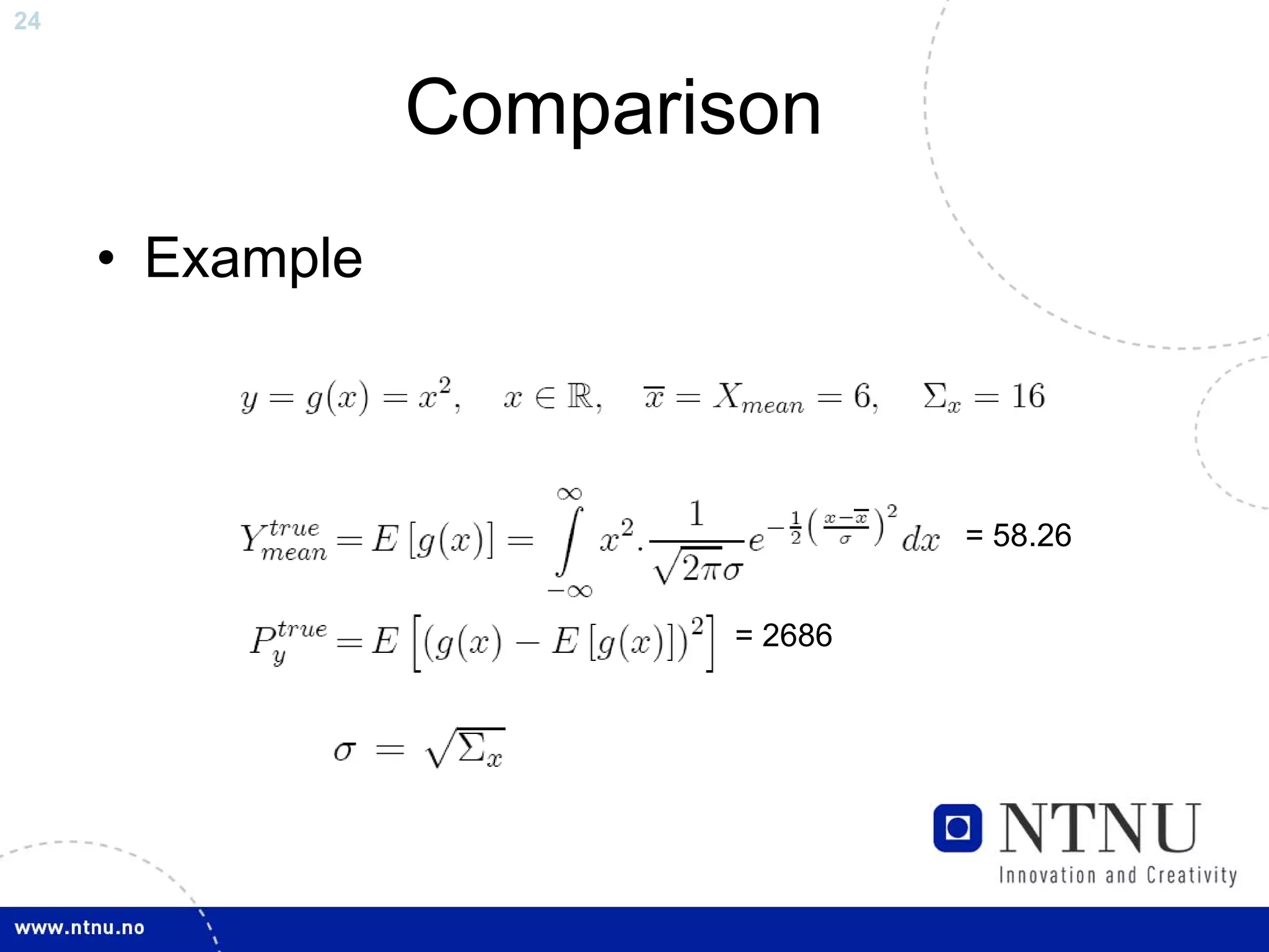
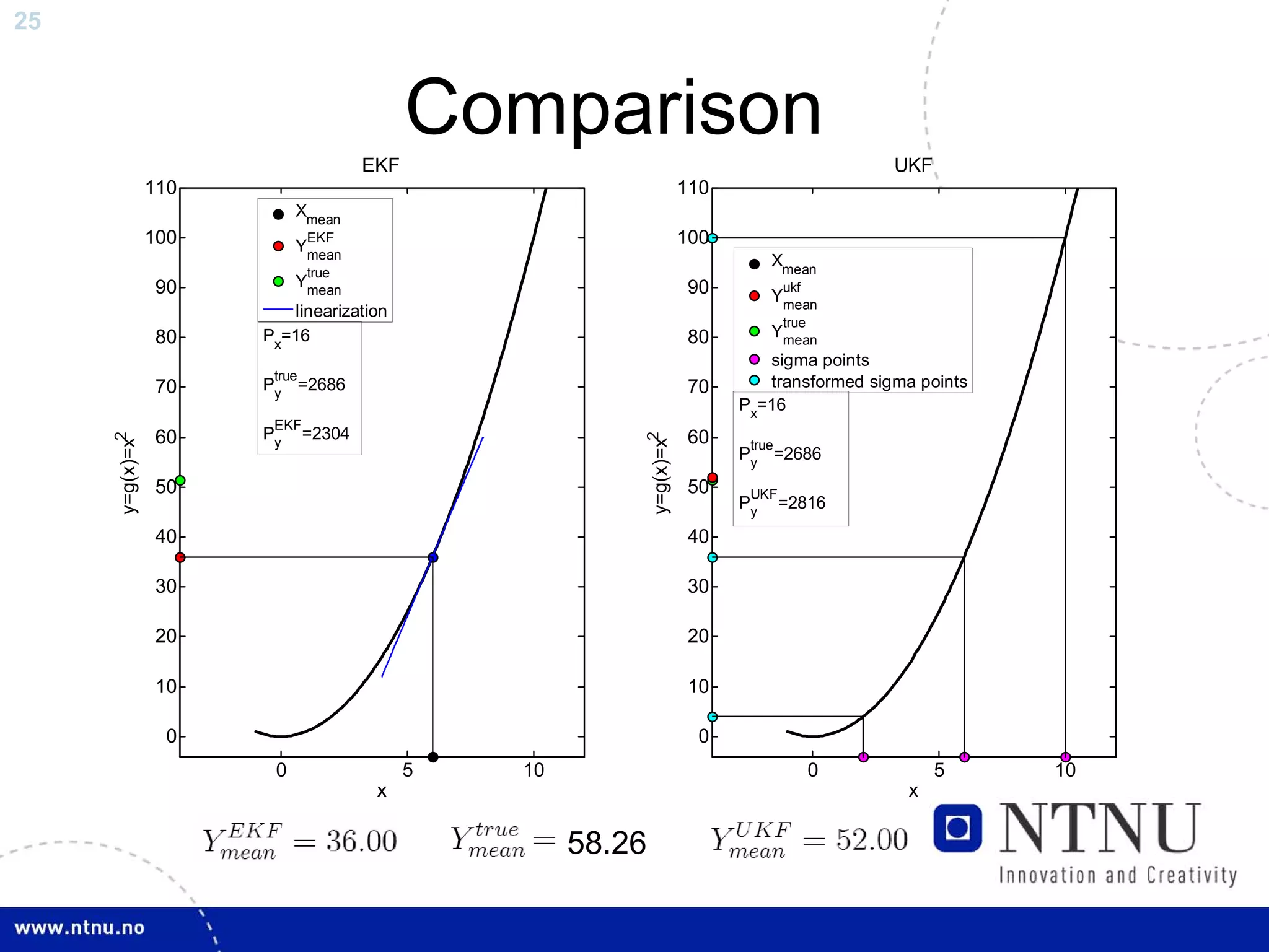
                 Comparison
     • Example


                                 = 58.26


                        = 2686
25


                                      EKF
                                            Comparison                                            UKF
                 110                                                     110
                            Xmean
                 100          EKF
                            Ymean                                        100
                                                                                    Xmean
                              true
                 90         Ymean                                        90            ukf
                                                                                    Ymean
                          linearization
                                                                                       true
                 80    Px=16                                             80         Ymean
                                                                                  sigma points
                        true                                                      transformed sigma points
                 70    Py =2686                                          70
                                                                               Px=16
                        EKF
                 60    Py     =2304                                      60
     y=g(x)=x2


                                                             y=g(x)=x2
                                                                                true
                                                                               Py =2686
                 50                                                      50     UKF
                                                                               Py      =2816
                 40                                                      40

                 30                                                      30

                 20                                                      20

                 10                                                      10

                   0                                                      0
                        0                   5   10                                            0         5    10
                                       x                                                           x

                                                     58.26
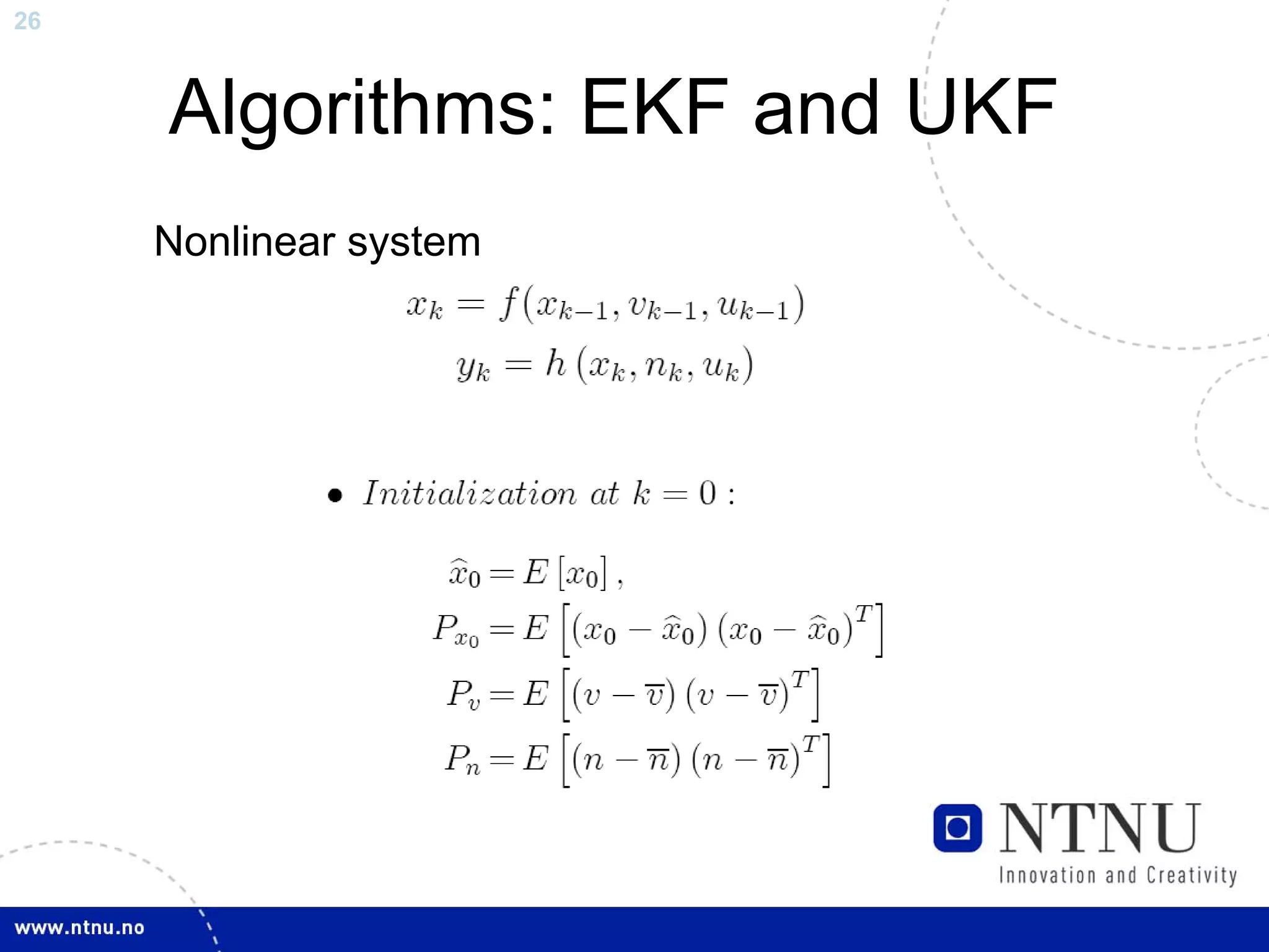
26


     Algorithms: EKF and UKF
     Nonlinear system
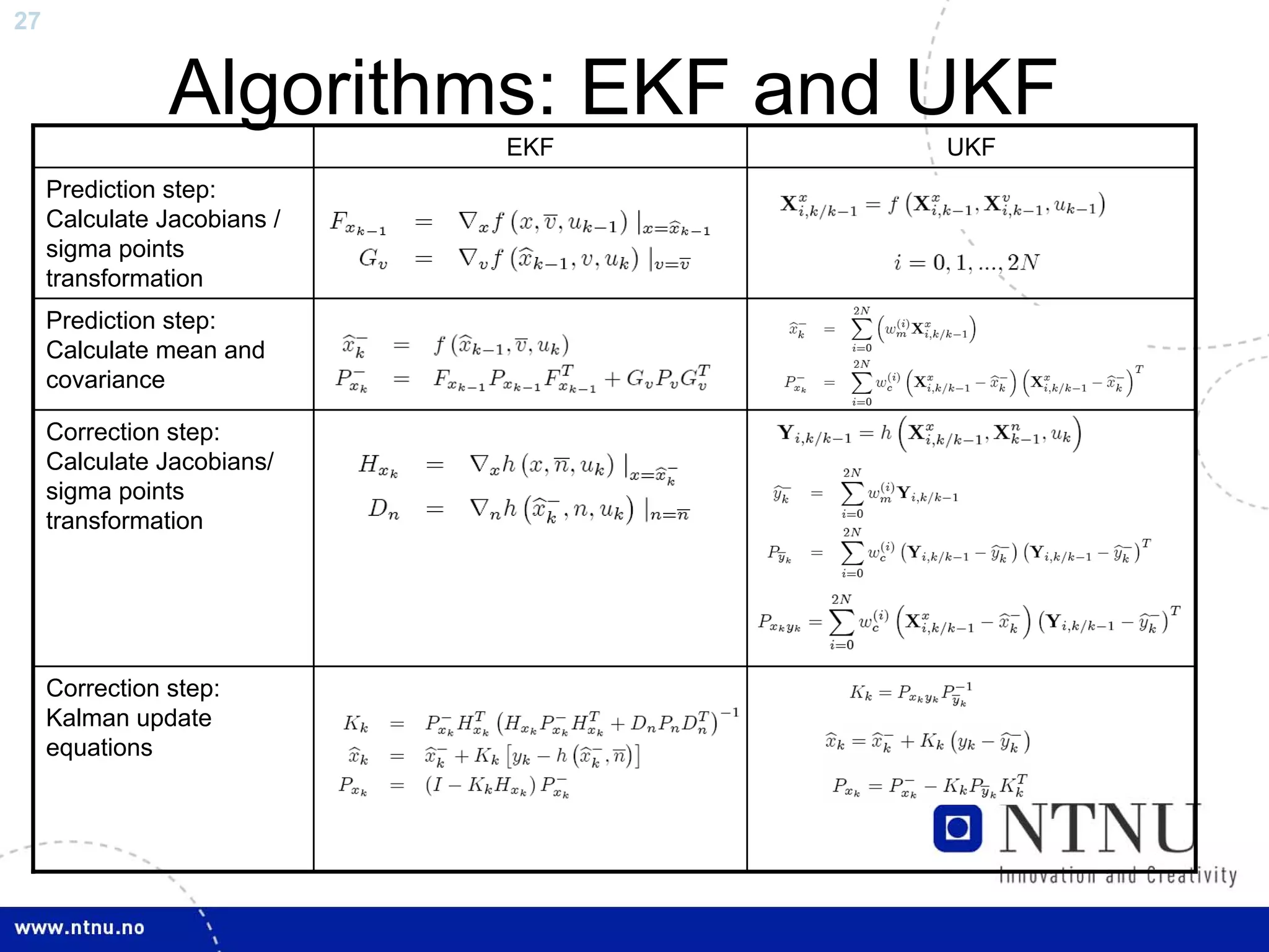
27


                Algorithms: EKF and UKF
                             EKF    UKF
     Prediction step:
     Calculate Jacobians /
     sigma points
     transformation
     Prediction step:
     Calculate mean and
     covariance

     Correction step:
     Calculate Jacobians/
     sigma points
     transformation


     Correction step:
     Kalman update
     equations
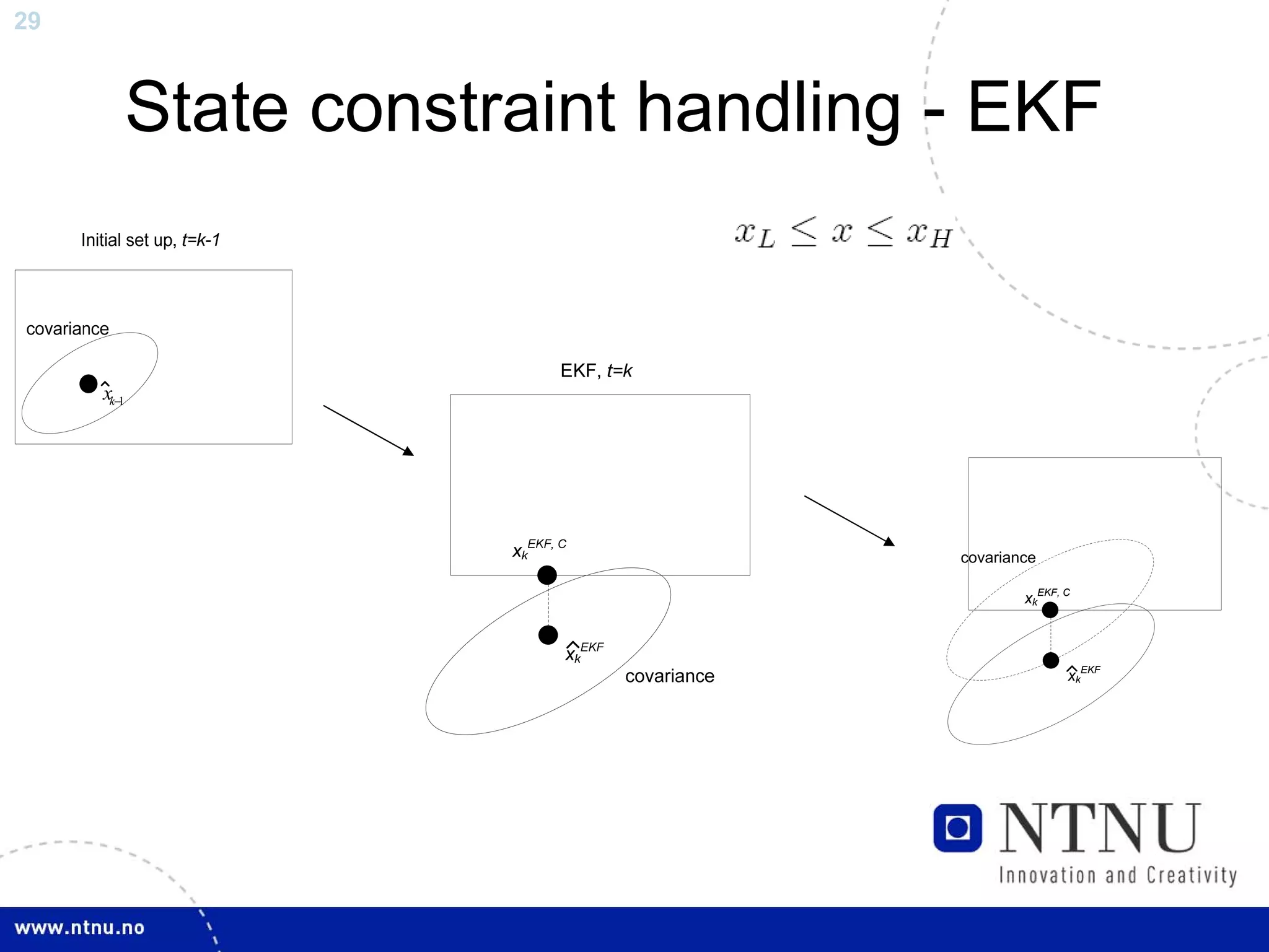
28


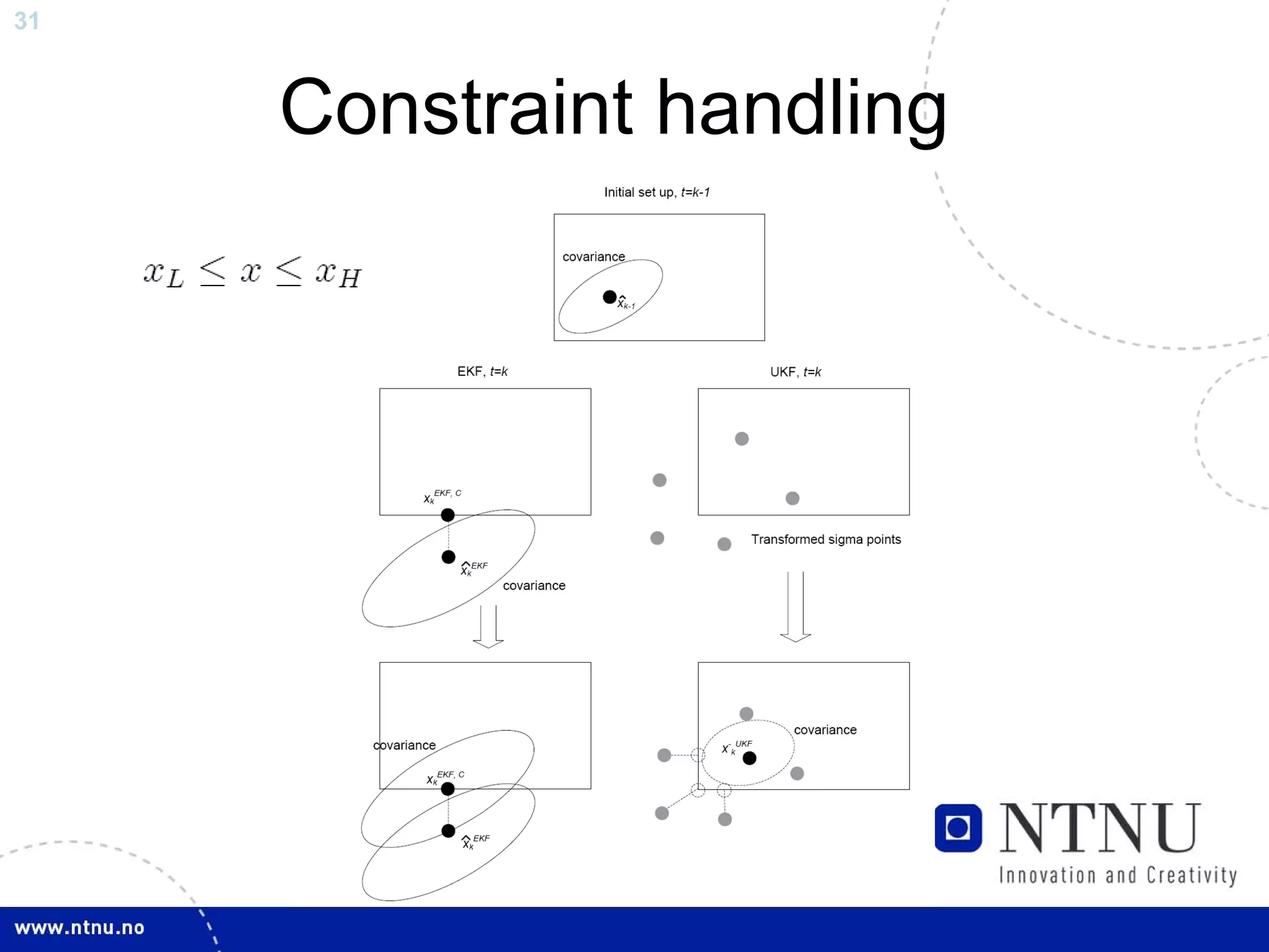
        State constraint handling
     • No general way in KF theory
       – Projecting unconstrained state estimate
         onto boundary
     • Systematic approach in MHE
       – Solving a nonlinear problem at each time
         step
     • A simple method is introduced in UKF
29


            State constraint handling - EKF


     xk−1


                                      covariance

                                              xkEKF, C


                                                     xkEKF
30


     State constraint handling - UKF

                     UKF, t=k
     xk−1


                  Transformed sigma points

                                                      covariance
                                             x-kUKF
31


     Constraint handling
32


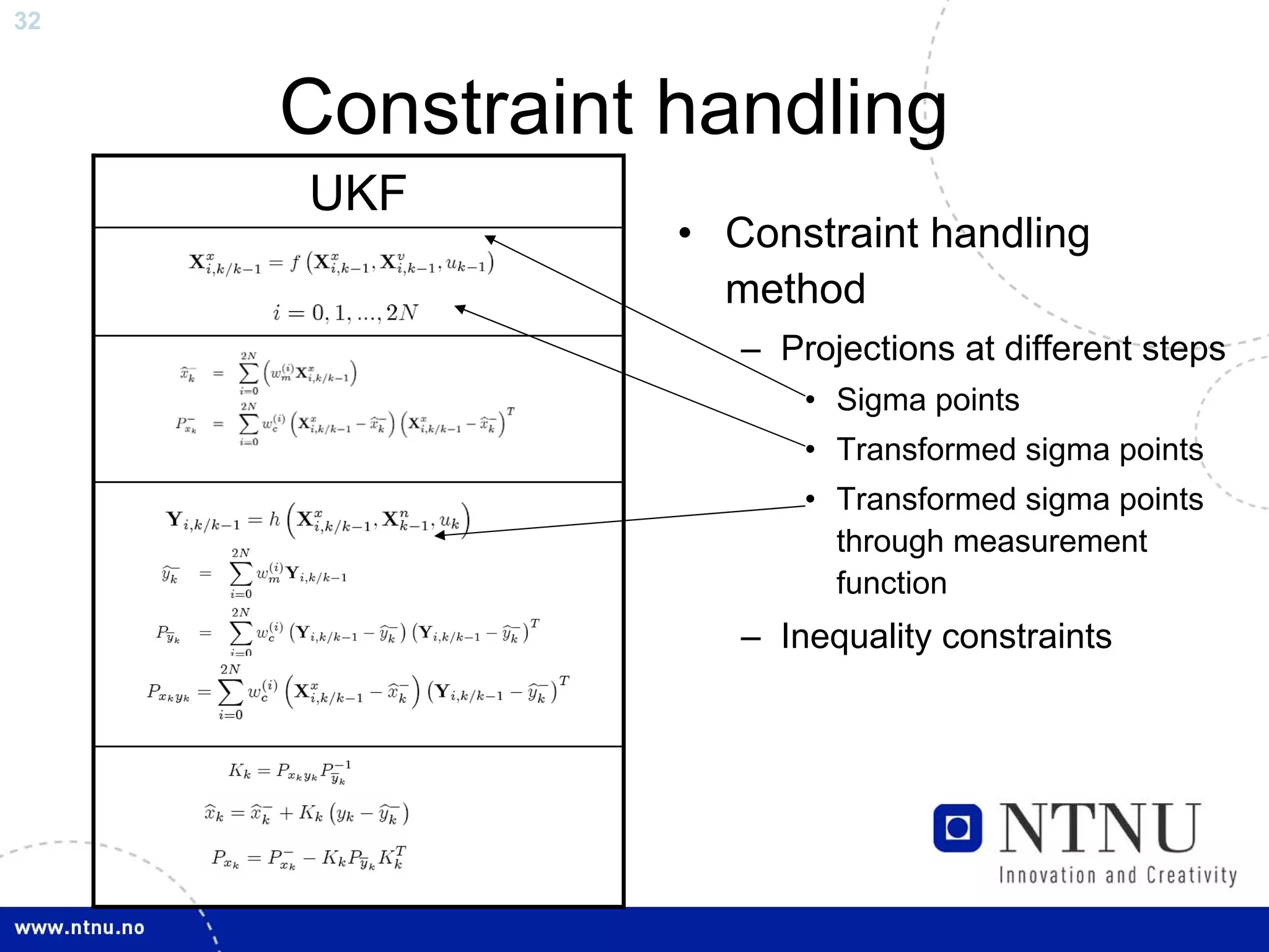
     Constraint handling
     UKF
                • Constraint handling
                  method
                   – Projections at different steps
                       • Sigma points
                       • Transformed sigma points
                       • Transformed sigma points
                         through measurement
                         function
                   – Inequality constraints
33


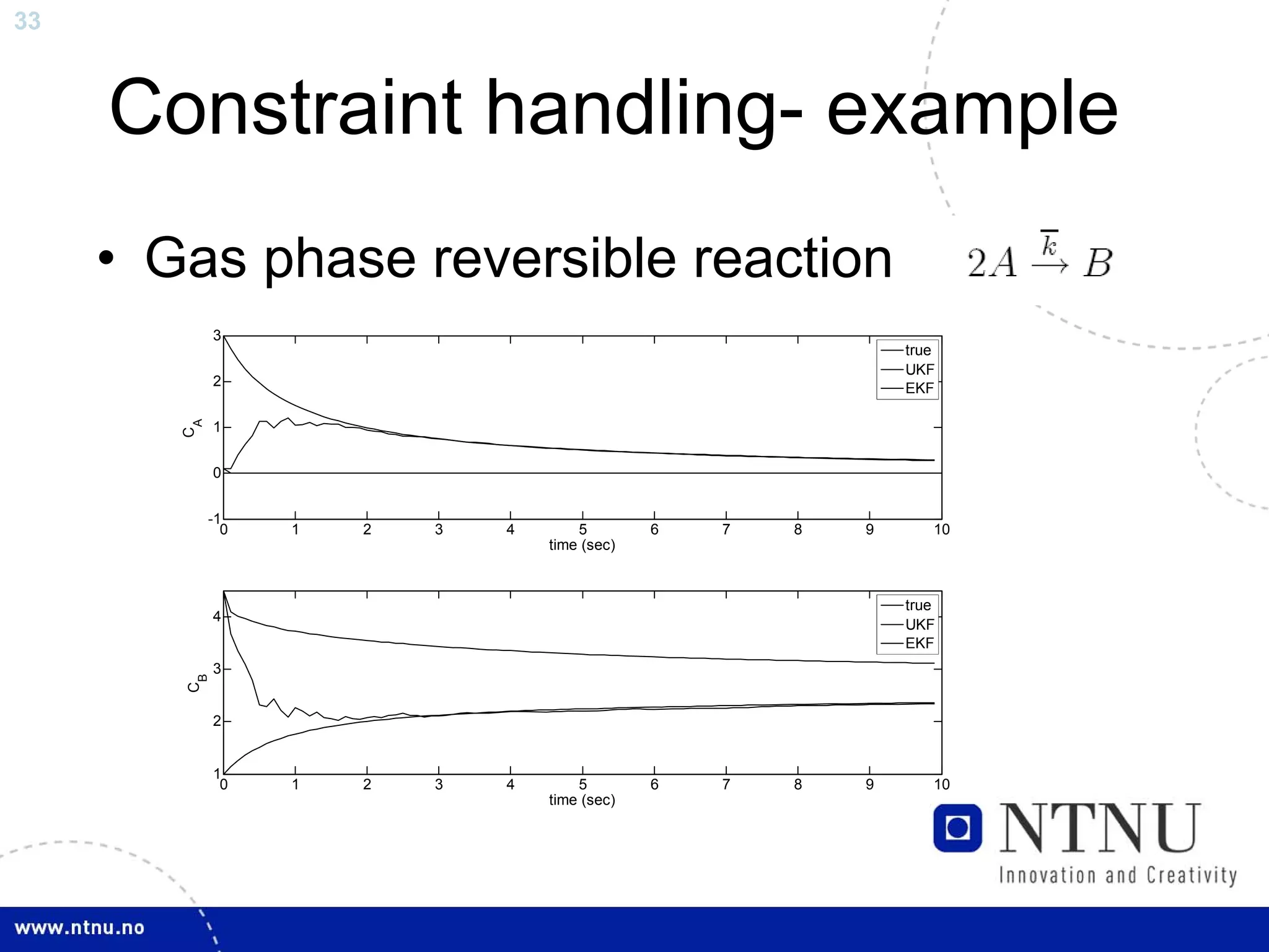
     Constraint handling- example
     • Gas phase reversible reaction
                3
                                                                  true
                                                                  UKF
                2                                                 EKF
        A


                1
        C


                0


            -1
              0      1   2   3   4       5        6   7   8   9      10
                                     time (sec)


                                                                  true
                4
                                                                  UKF
                                                                  EKF
                3
            B
        C


                2


                1
                 0   1   2   3   4       5        6   7   8   9      10
                                     time (sec)
34


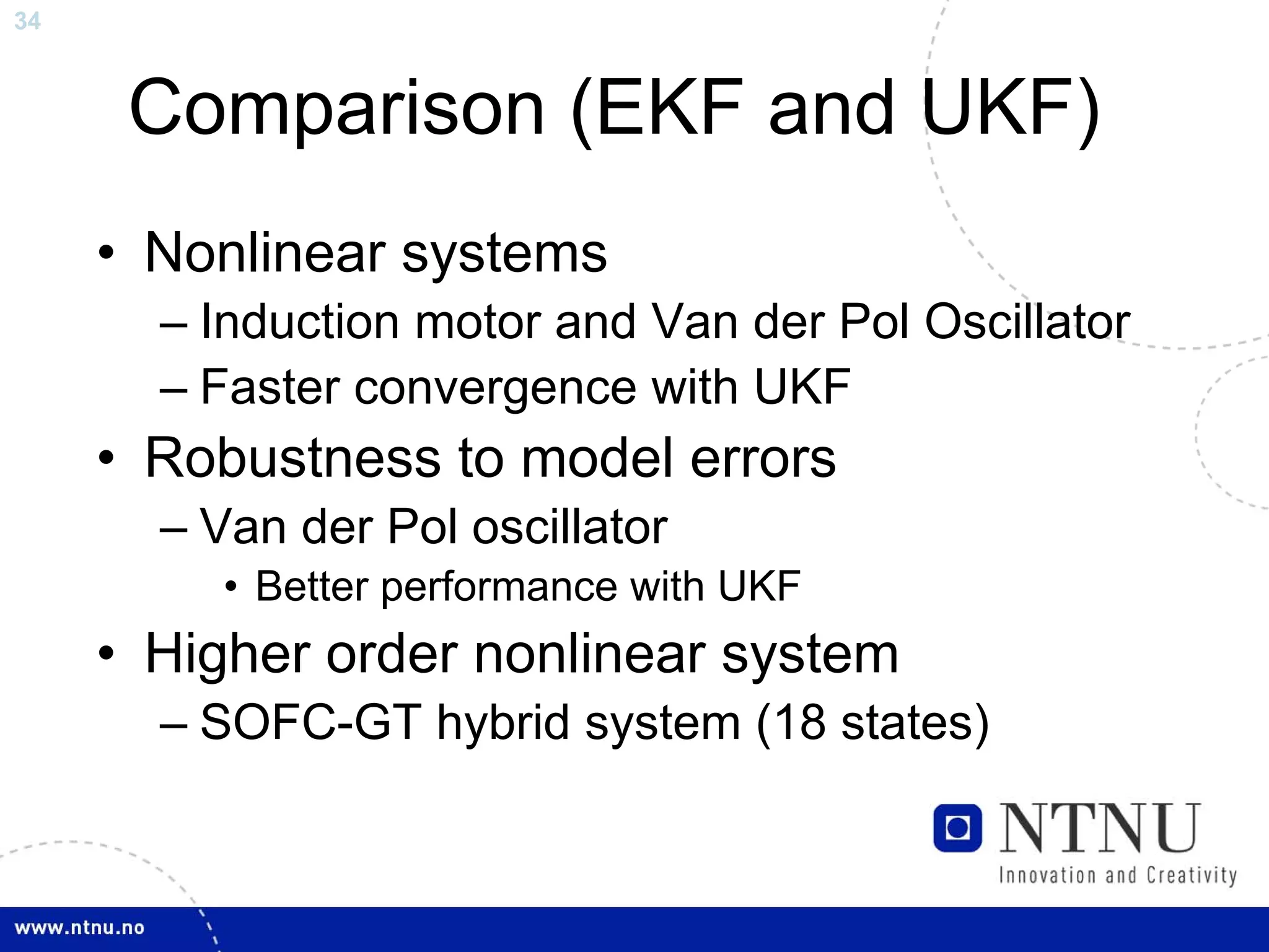
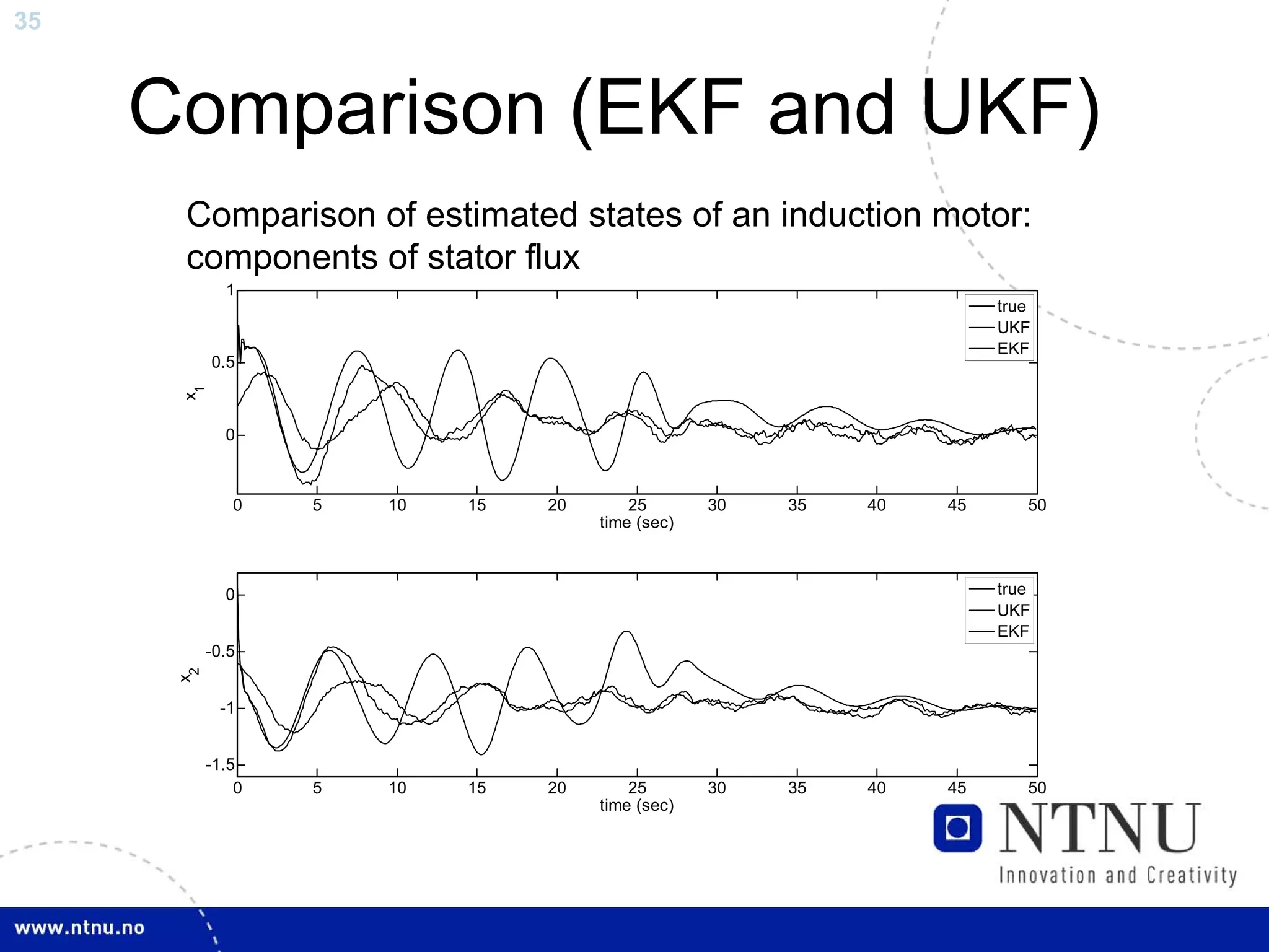
      Comparison (EKF and UKF)
     • Nonlinear systems
       – Induction motor and Van der Pol Oscillator
       – Faster convergence with UKF
     • Robustness to model errors
       – Van der Pol oscillator
          • Better performance with UKF
     • Higher order nonlinear system
       – SOFC-GT hybrid system (18 states)
35


     Comparison (EKF and UKF)
      Comparison of estimated states of an induction motor:
      components of stator flux
               1
                                                                        true
                                                                        UKF
                                                                        EKF
              0.5
          1
      x


               0


                0   5   10   15   20       25       30   35   40   45      50
                                       time (sec)


               0                                                        true
                                                                        UKF
                                                                        EKF
          -0.5
      2
      x


               -1


          -1.5
              0     5   10   15   20       25       30   35   40   45      50
                                       time (sec)
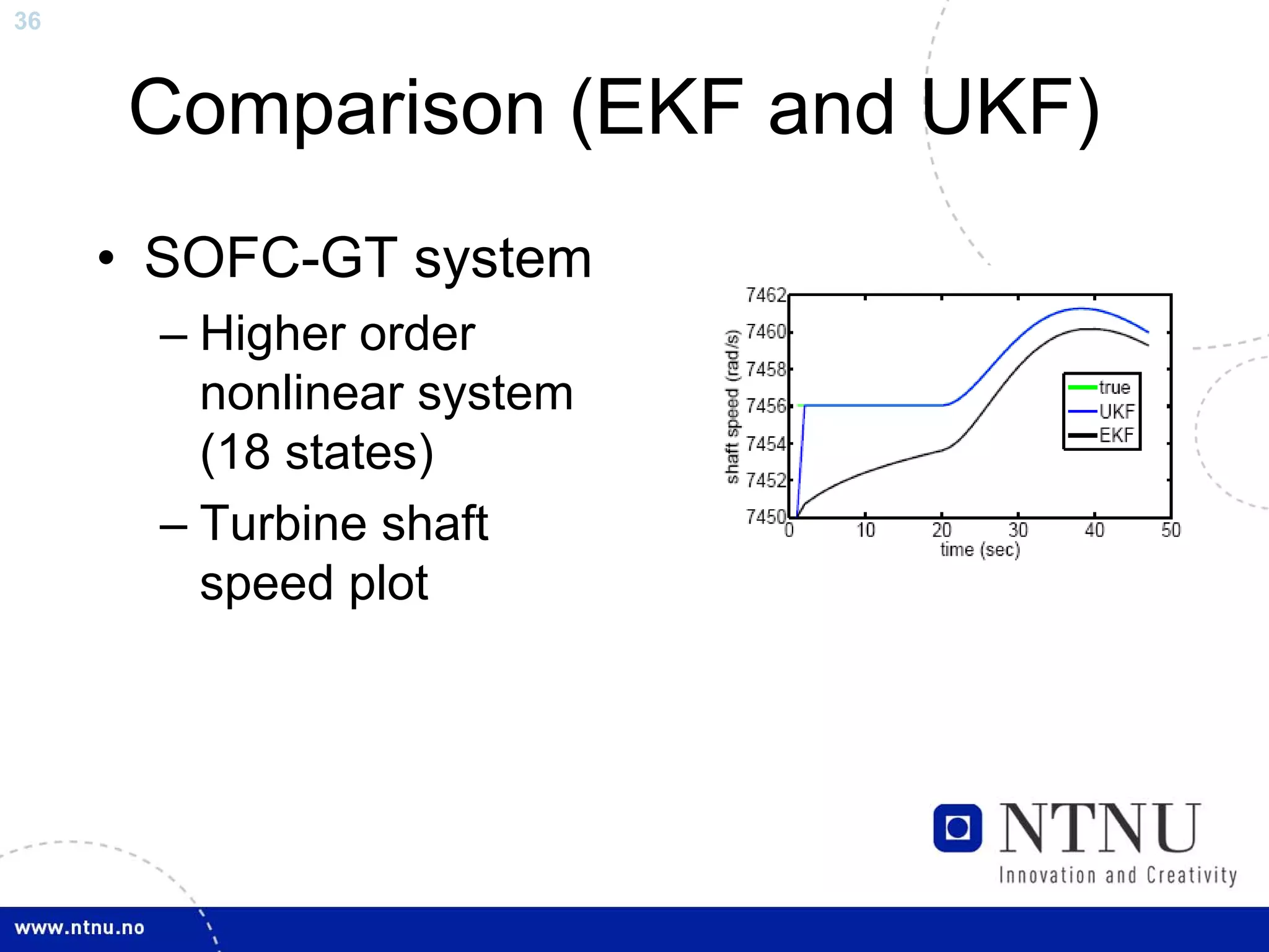
36


      Comparison (EKF and UKF)
     • SOFC-GT system
       – Higher order
         nonlinear system
         (18 states)
       – Turbine shaft
         speed plot
37


     Conclusions – state estimation
     • The UKF is a promising option
       – Simple and easy to implement
       – No need for Jacobians
       – Computational load is comparable to EKF
       – Improved performance
         • Faster convergence
         • Robustness to model errors and initial choices
         • Simple constraint handling method works
38


     Thank you
         for
        your
      attention
          ☺

Thesis Presentation

  • 1.
    1 Control relevant modeling and nonlinear state estimation applied to SOFC-GT power systems Rambabu Kandepu 04-12-2007
  • 2.
    2 Contents • Motivation • Modeling and control of SOFC-GT power system • Nonlinear state estimation • Conclusions
  • 3.
    3 Motivation • Increase in energy demand – Population growth – Industrialization • Dependency on oil and gas • Global warming
  • 4.
    4 Motivation • Solution to energy demand increase – Efficient of energy conversion – Technology with low emissions – Using renewable energy sources • Distributed generation – Avoid transmission and distribution losses – Wind turbines, biomass, small scale hydro, fuel cells etc
  • 5.
    5 Fuel cells • Electrochemical device • Advantages – High efficiency – Low emissions – No moving parts • Different types – Electrolyte – Temperature • SOFC – Solid components – High operating temperature – More fuel flexibility – Internal reforming
  • 6.
    6 SOFC-GT system Fuel Fuel cell stack Load Gas Air turbine • Tight integration between SOFC and GT • Low complexity models – Relevant dynamics
  • 7.
    7 SOFC-GT system
  • 8.
    8 Modeling - SOFC • Assumptions – All variables are uniform – Thermal inertia of gases is neglected – Pressure losses are neglected for energy balance – Ideal gas behavior • Reactions CH 4 + H 2O ⇔ CO + 3H 2 1 O + 2e − → O 2 − 2 2 CO + H 2O ⇔ CO2 + H 2 2− − H2 + O → H 2 O + 2e CH 4 + 2 H 2O ⇔ CO2 + 4 H 2
  • 9.
    9 Modeling - SOFC • Mass balance (anode and cathode) dN i • • M = N i ,in − N i ,out + ∑ aij rj Anode Electrolyte dt j =1 Cathode • Energy balance (one volume) N N M dTs ms C s P = − P + ∑ Fan ,i (han ,i − hi ) + ∑ Fca ,i (hca ,i − hi ) − ∑ ΔH j rj dt i =1 i =1 j =1
  • 10.
    10 Modeling - SOFC • Voltage RT ⎛ pH 2 pO22 ⎞ 1 E = E0 + ln ⎜ ⎟ V = E − Vloss 2 F ⎜ pH 2O ⎝ ⎟ ⎠ • Fuel Utilization (FU) = fuel utilized / fuel supplied • Distributed nature of SOFC • All models are developed in gPROMS Fuel Anode inlet Anode outlet Anode inlet Anode outlet Volume − I Volume − II Air Cathode inlet Cathode outlet Cathode inlet Cathode outlet
  • 11.
    11 SOFC model evaluation • Evaluated against a detailed model 1200 Detailed model Simple model with one volume 1150 Simple model with two volumes Temperature (K) 1100 1050 1000 950 0 100 200 300 400 500 600 700 Time (min)
  • 12.
    12 Control structure design • Dynamic load operation is necessary • Manipulated variable (1) – Fuel flow rate • Controlled variables (2) – Fuel utilization (FU) – SOFC temperature • Load as a disturbance • Need for a process redesign
  • 13.
    13 Control structure design • Three possible options – Air blow-off – Extra fuel source – Air by-pass • Control structure Load disturbance FU ref Fuel FU Controller 1 flow Tref Hybrid system T Controller 2 Air blow-off -
  • 14.
    14 SOFC-GT control
  • 15.
    15 SOFC-GT control P m fuel FU FUr PI FU Controller 2 Hybrid System TSOFC TSOFCr ωr PI PI Ig ω Controller 3 Controller 1 TSOFC ω
  • 16.
    16 SOFC-GT control – double shaft Controlled variables 8 fuel flow rate (g/s) 6 4 2 0 5 10 15 20 25 30 time (sec) Manipulated variables air blow-off rate (kg/s) 0.1 0.05 0 0 5 10 15 20 25 30 time (sec)
  • 17.
    17 SOFC-GT control • Model Predictive Control (MPC) to include constraints – FU – Steam to carbon ratio – SOFC temperature change • Not all states are measurable • State estimation is necessary
  • 18.
    18 State estimation • Need for state estimation • Nonlinear state estimation – Extended Kalman Filter (EKF) – Unscented Kalman Filter (UKF) – Comparison – Constraint handling – Results • Conclusions
  • 19.
    19 State estimation • Important for process control and performance monitoring • Uncertainties; Model, measurement and noise sources • Represent the model state by an probability distribution function (pdf) • State estimation propagates the pdf over time in some optimal way • Gaussian pdf
  • 20.
    20 Nonlinear state estimation • Extended Kalman Filter (EKF) – Most common way to apply KF to a nonlinear system • High order EKFs – Computationally not feasible • Ensemble Kalman Filter (EnKF) – Mostly for large scale systems (reservoir models) • Unscented Kalman Filter (UKF) – Simple and effective • Moving Horizon Estimation (MHE) – Computationally demanding
  • 21.
    21 EKF principle y = g ( x); x ∈ n a random vector g: n → m , nonlinear function ( How to compute the pdf of y, given the Gaussian pdf x, Px of x ?) EKF y = g ( x) PyEKF = ( ∇g ) Px ( ∇g ) T where ( ∇g ) is the Jacobian of g ( x) at x
  • 22.
    22 UKF principle • UKF principle y = g ( x); x ∈ n a random vector g: n → m , nonlinear function ( ) How to compute the pdf of y, given the Gaussian pdf x, Px of x ? UKF approximates the pdf. It uses true nonlinear process and observation models.
  • 23.
    23 UKF principle • UKF principle
  • 24.
    24 Comparison • Example = 58.26 = 2686
  • 25.
    25 EKF Comparison UKF 110 110 Xmean 100 EKF Ymean 100 Xmean true 90 Ymean 90 ukf Ymean linearization true 80 Px=16 80 Ymean sigma points true transformed sigma points 70 Py =2686 70 Px=16 EKF 60 Py =2304 60 y=g(x)=x2 y=g(x)=x2 true Py =2686 50 50 UKF Py =2816 40 40 30 30 20 20 10 10 0 0 0 5 10 0 5 10 x x 58.26
  • 26.
    26 Algorithms: EKF and UKF Nonlinear system
  • 27.
    27 Algorithms: EKF and UKF EKF UKF Prediction step: Calculate Jacobians / sigma points transformation Prediction step: Calculate mean and covariance Correction step: Calculate Jacobians/ sigma points transformation Correction step: Kalman update equations
  • 28.
    28 State constraint handling • No general way in KF theory – Projecting unconstrained state estimate onto boundary • Systematic approach in MHE – Solving a nonlinear problem at each time step • A simple method is introduced in UKF
  • 29.
    29 State constraint handling - EKF xk−1 covariance xkEKF, C xkEKF
  • 30.
    30 State constraint handling - UKF UKF, t=k xk−1 Transformed sigma points covariance x-kUKF
  • 31.
    31 Constraint handling
  • 32.
    32 Constraint handling UKF • Constraint handling method – Projections at different steps • Sigma points • Transformed sigma points • Transformed sigma points through measurement function – Inequality constraints
  • 33.
    33 Constraint handling- example • Gas phase reversible reaction 3 true UKF 2 EKF A 1 C 0 -1 0 1 2 3 4 5 6 7 8 9 10 time (sec) true 4 UKF EKF 3 B C 2 1 0 1 2 3 4 5 6 7 8 9 10 time (sec)
  • 34.
    34 Comparison (EKF and UKF) • Nonlinear systems – Induction motor and Van der Pol Oscillator – Faster convergence with UKF • Robustness to model errors – Van der Pol oscillator • Better performance with UKF • Higher order nonlinear system – SOFC-GT hybrid system (18 states)
  • 35.
    35 Comparison (EKF and UKF) Comparison of estimated states of an induction motor: components of stator flux 1 true UKF EKF 0.5 1 x 0 0 5 10 15 20 25 30 35 40 45 50 time (sec) 0 true UKF EKF -0.5 2 x -1 -1.5 0 5 10 15 20 25 30 35 40 45 50 time (sec)
  • 36.
    36 Comparison (EKF and UKF) • SOFC-GT system – Higher order nonlinear system (18 states) – Turbine shaft speed plot
  • 37.
    37 Conclusions – state estimation • The UKF is a promising option – Simple and easy to implement – No need for Jacobians – Computational load is comparable to EKF – Improved performance • Faster convergence • Robustness to model errors and initial choices • Simple constraint handling method works
  • 38.
    38 Thank you for your attention ☺