1/50
Fehmi JaafarFehmi Jaafar
On the Analysis ofOn the Analysis of
Artifact Evolution:Artifact Evolution:
An Aggregated View andAn Aggregated View and
Lessons LearnedLessons Learned
2/50
ContentContent
3/50
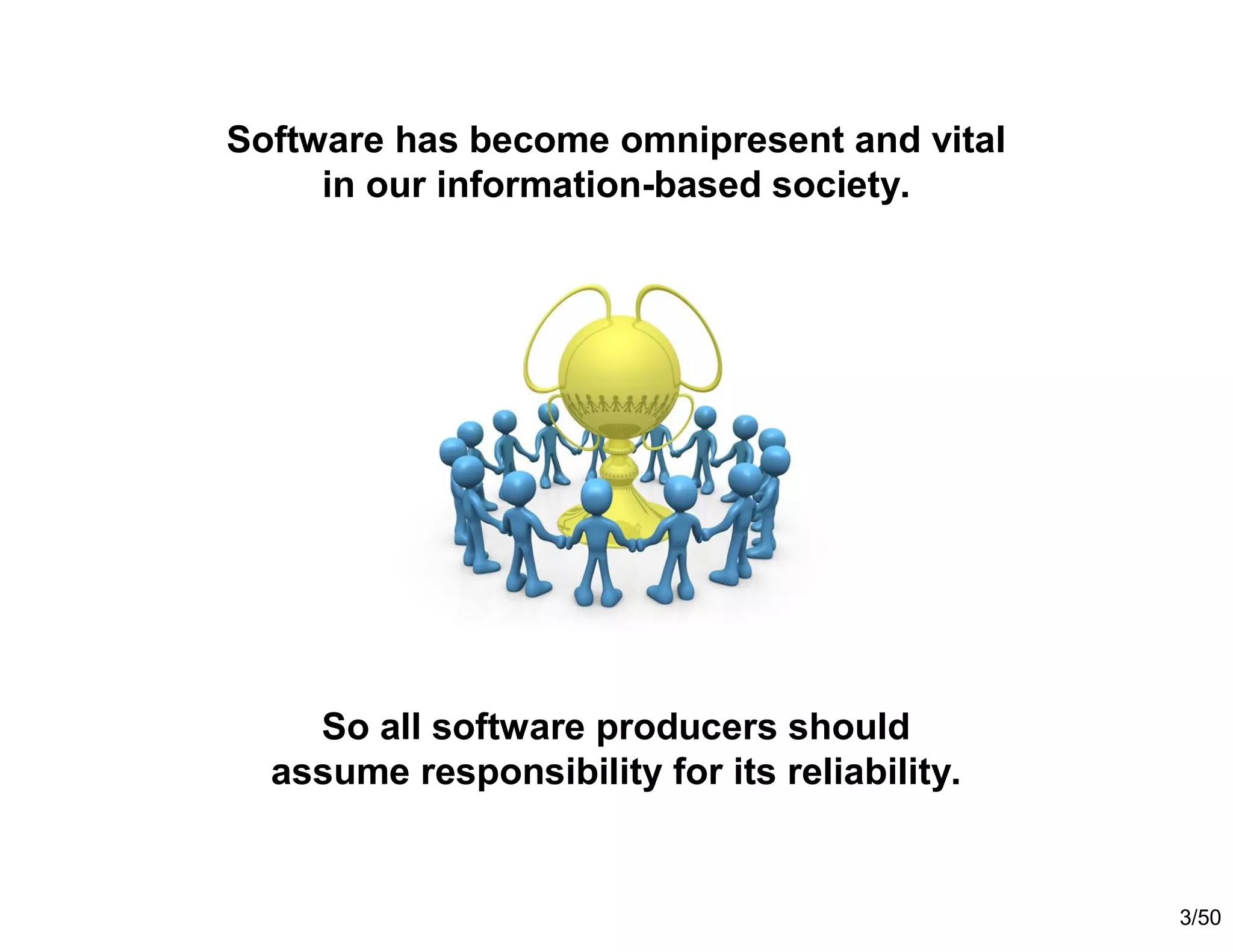
Software has become omnipresent and vital
in our information-based society.
So all software producers should
assume responsibility for its reliability.
4/50
Maintenance and EvolutionMaintenance and Evolution
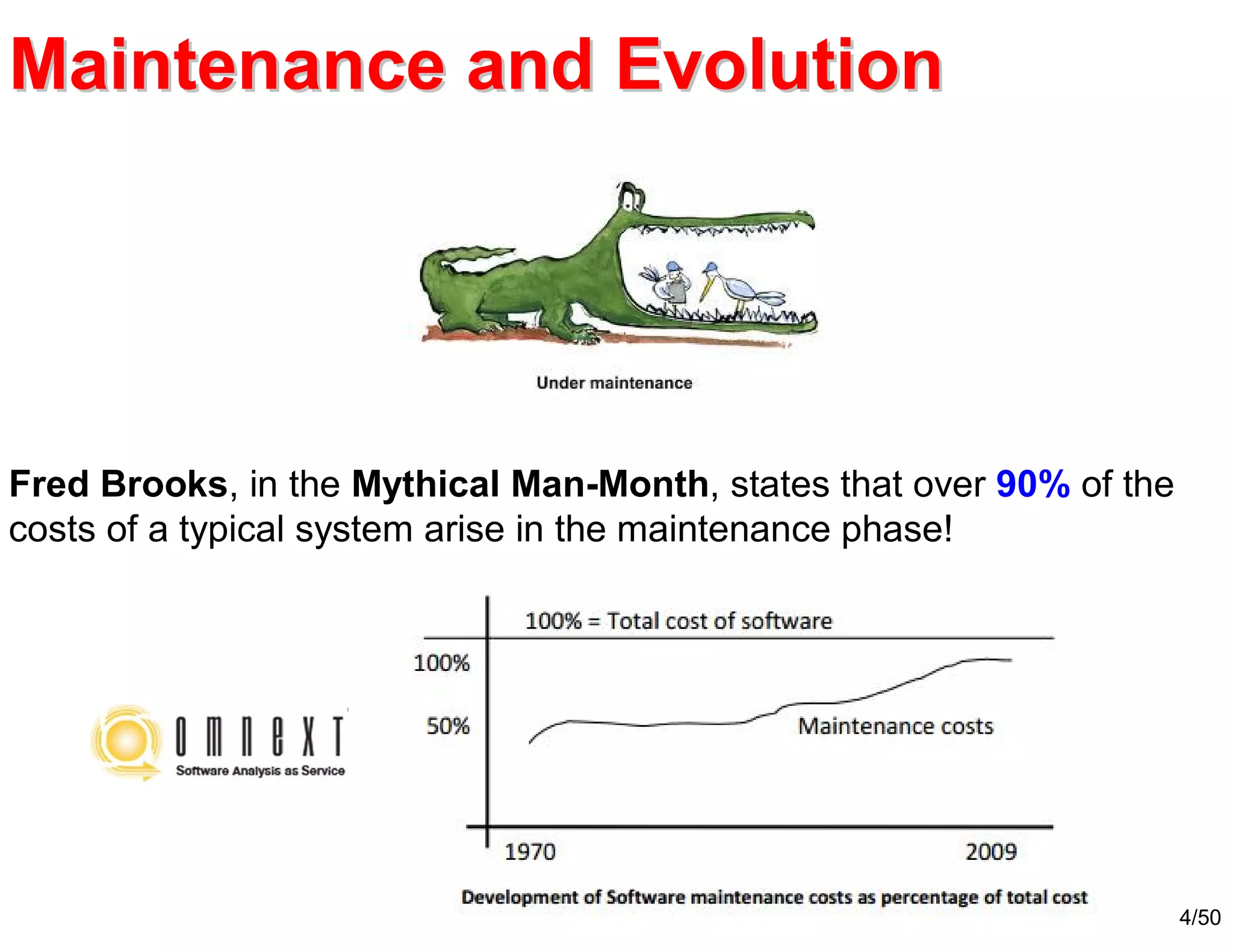
Fred Brooks, in the Mythical Man-Month, states that over 90% of the
costs of a typical system arise in the maintenance phase!
5/50
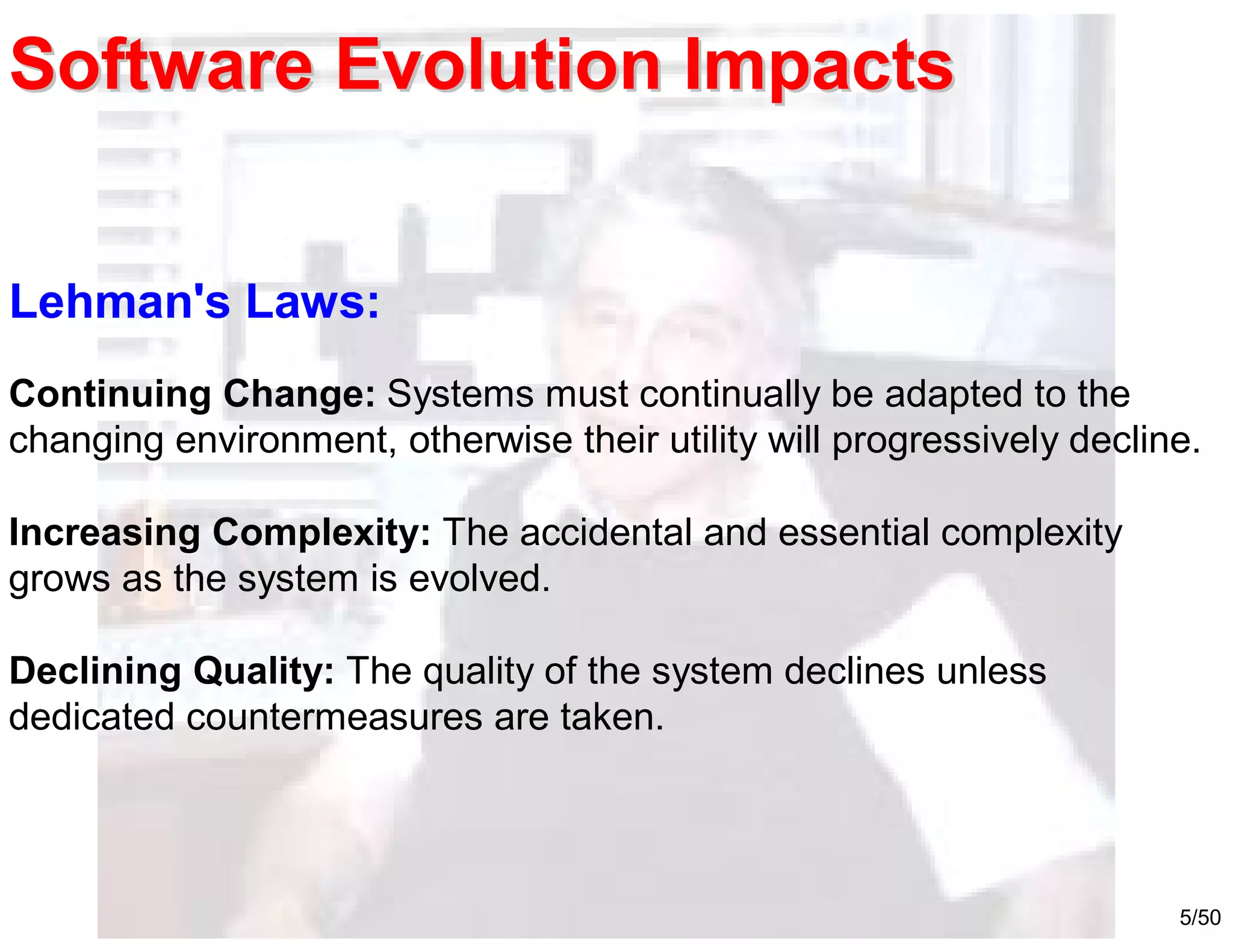
Lehman's Laws:
Continuing Change: Systems must continually be adapted to the
changing environment, otherwise their utility will progressively decline.
Increasing Complexity: The accidental and essential complexity
grows as the system is evolved.
Declining Quality: The quality of the system declines unless
dedicated countermeasures are taken.
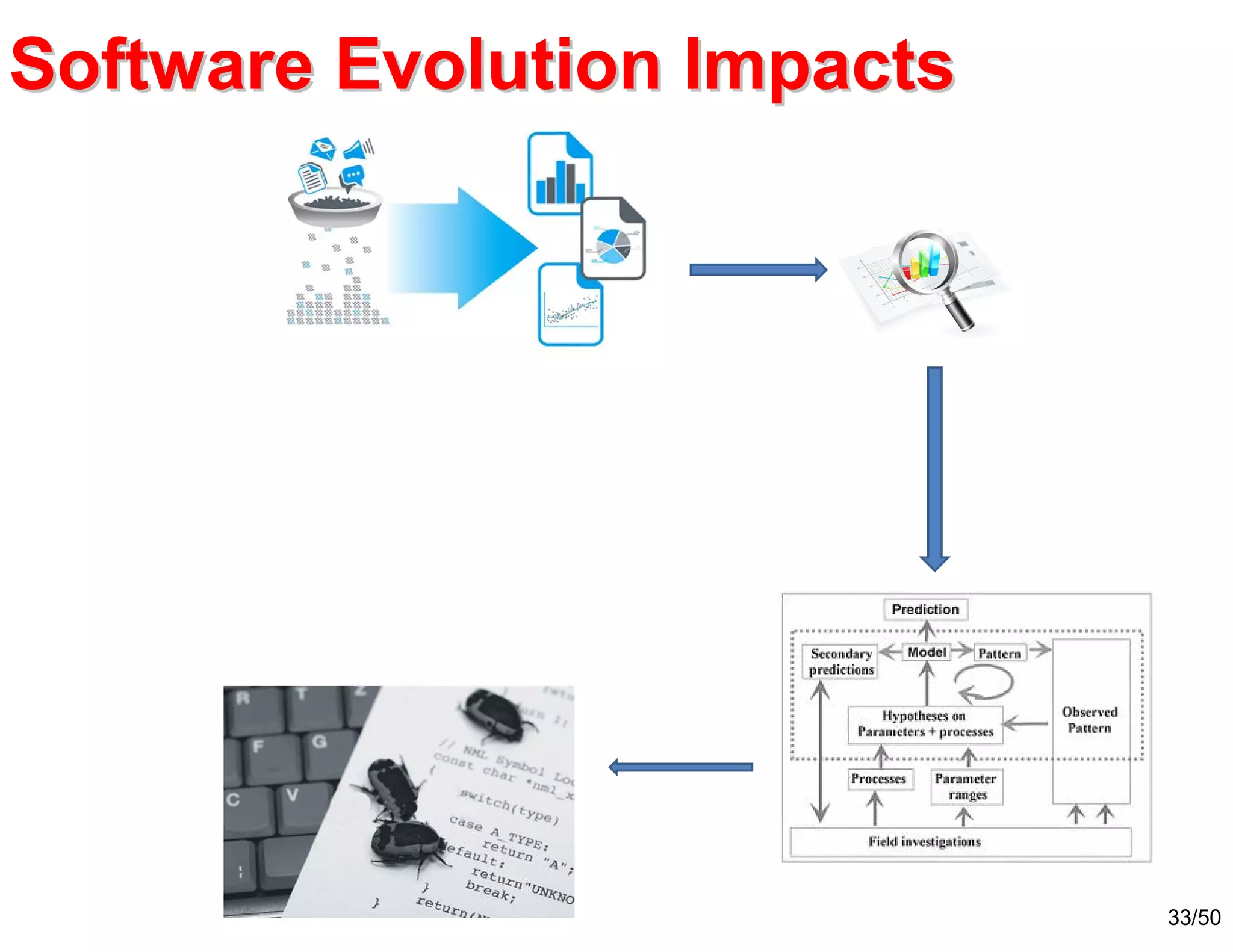
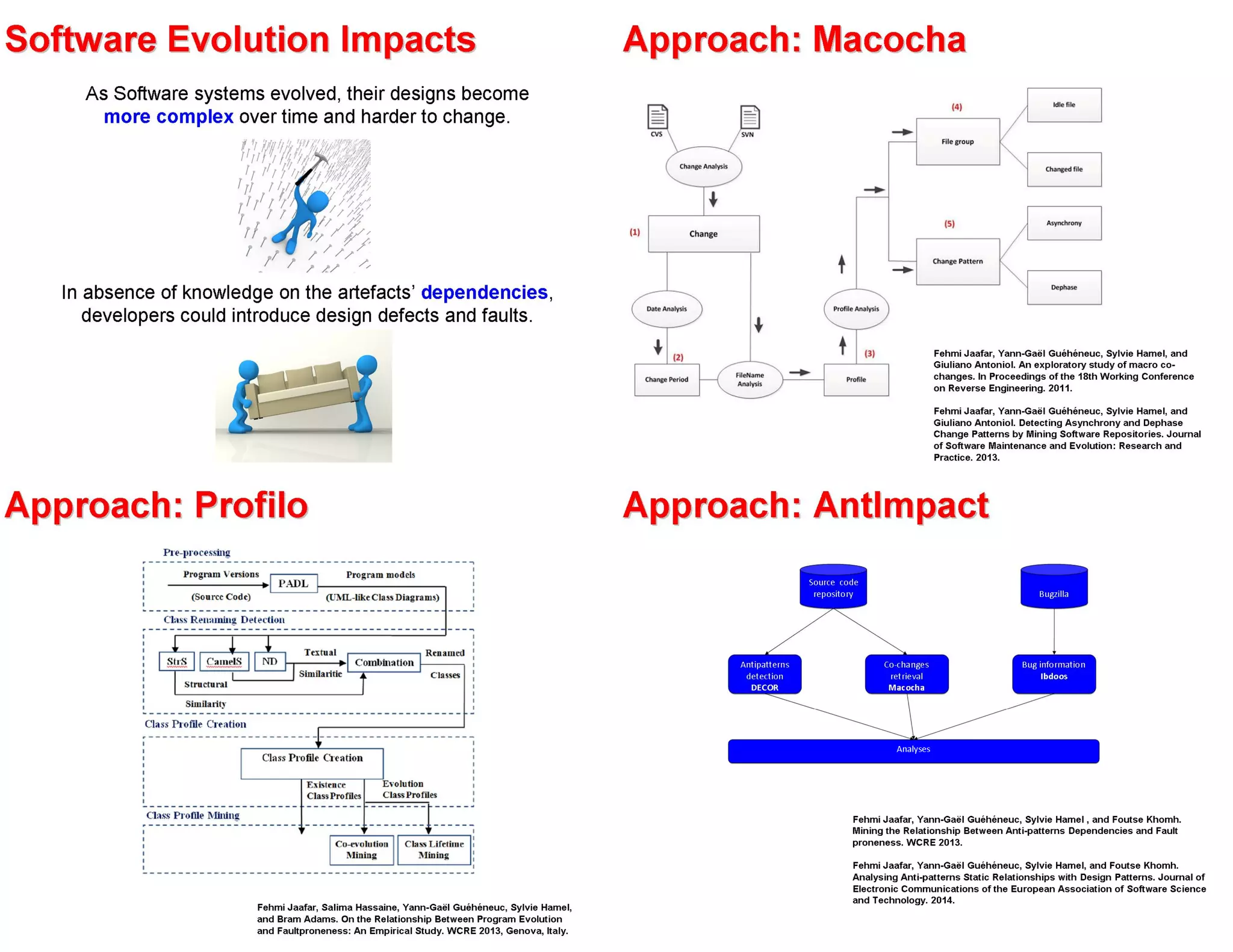
Software Evolution ImpactsSoftware Evolution Impacts
6/50
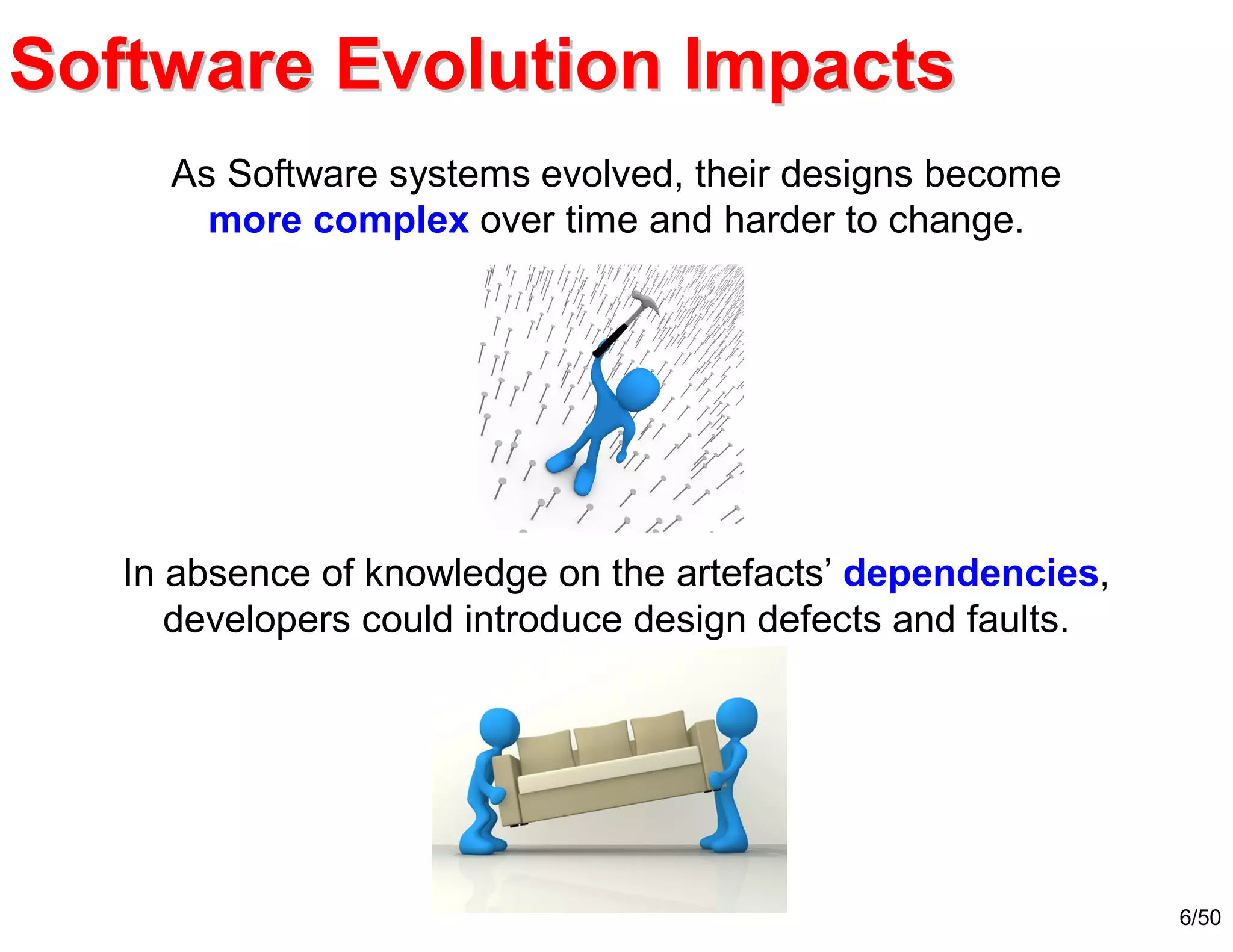
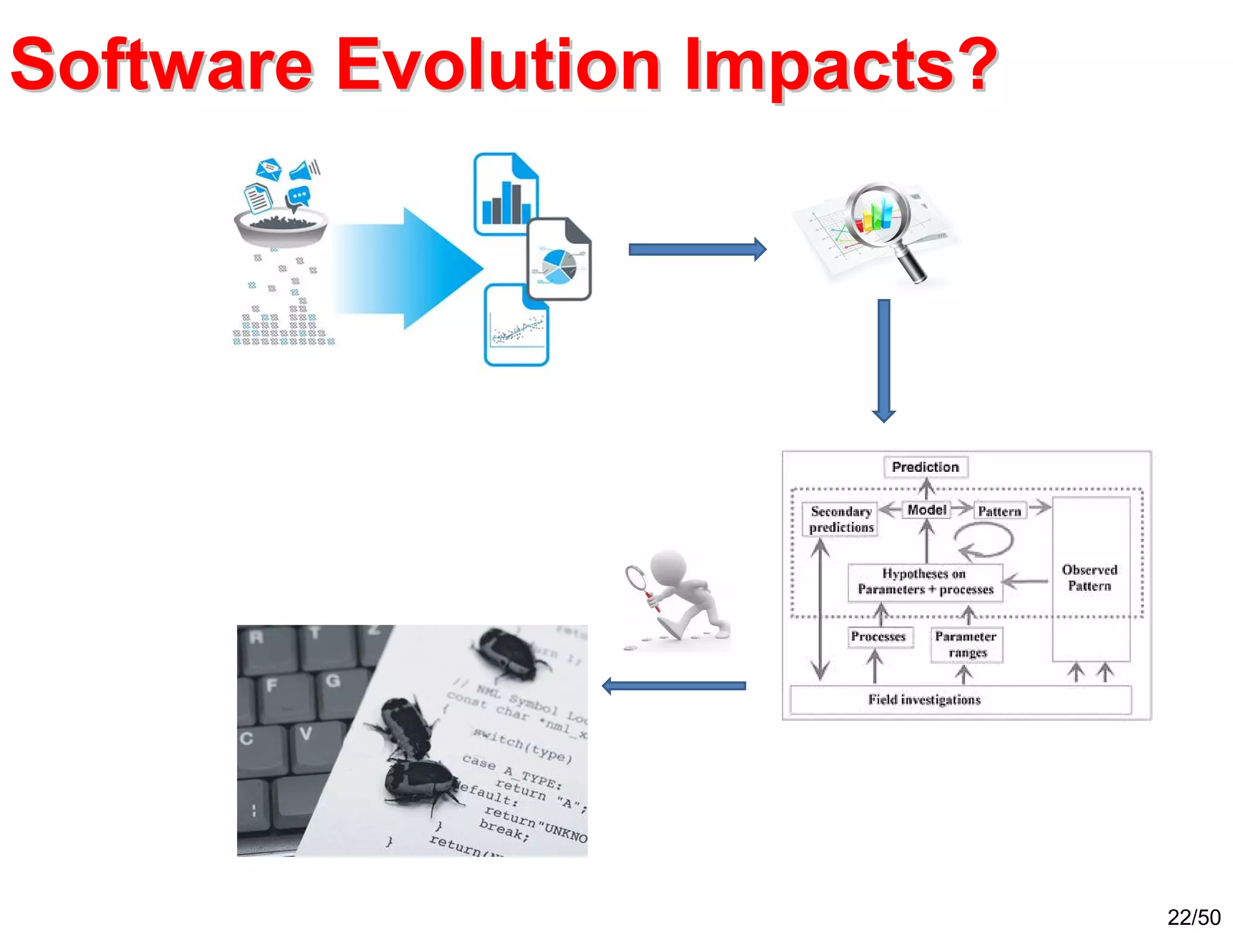
As Software systems evolved, their designs become
more complex over time and harder to change.
In absence of knowledge on the artefacts’ dependencies,
developers could introduce design defects and faults.
Software Evolution ImpactsSoftware Evolution Impacts
7/50
MotivationMotivation
 Quality
 Speed
 Efficiency
 Cost
8/50
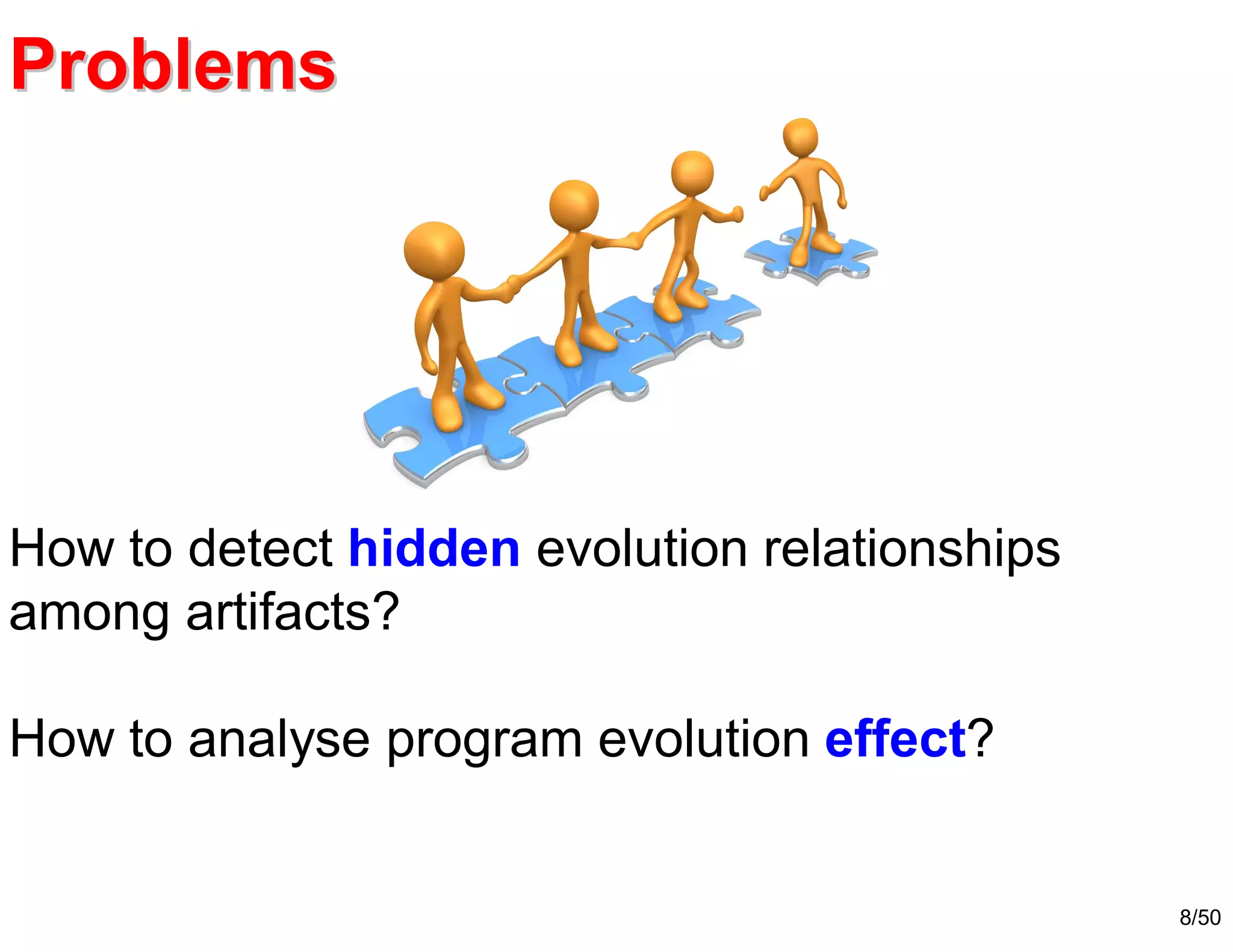
How to detect hidden evolution relationships
among artifacts?
How to analyse program evolution effect?
ProblemProblemss
9/50
1 - Co-change Pattern
2 - Co-evolution Pattern
Previous WorkPrevious Work
10/50
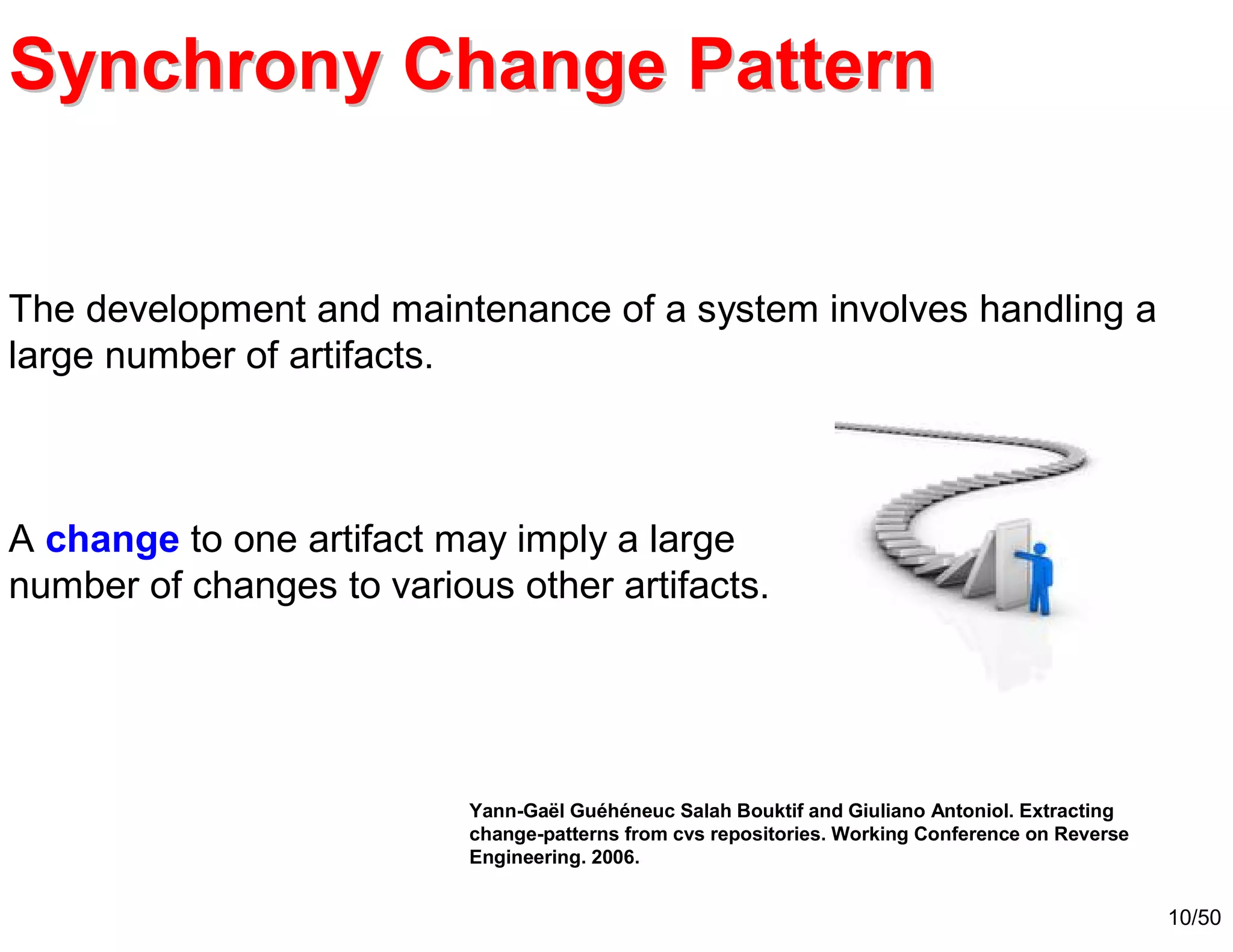
The development and maintenance of a system involves handling a
large number of artifacts.
A change to one artifact may imply a large
number of changes to various other artifacts.
Synchrony Change PatternSynchrony Change Pattern
Yann-Gaël Guéhéneuc Salah Bouktif and Giuliano Antoniol. Extracting
change-patterns from cvs repositories. Working Conference on Reverse
Engineering. 2006.
11/50
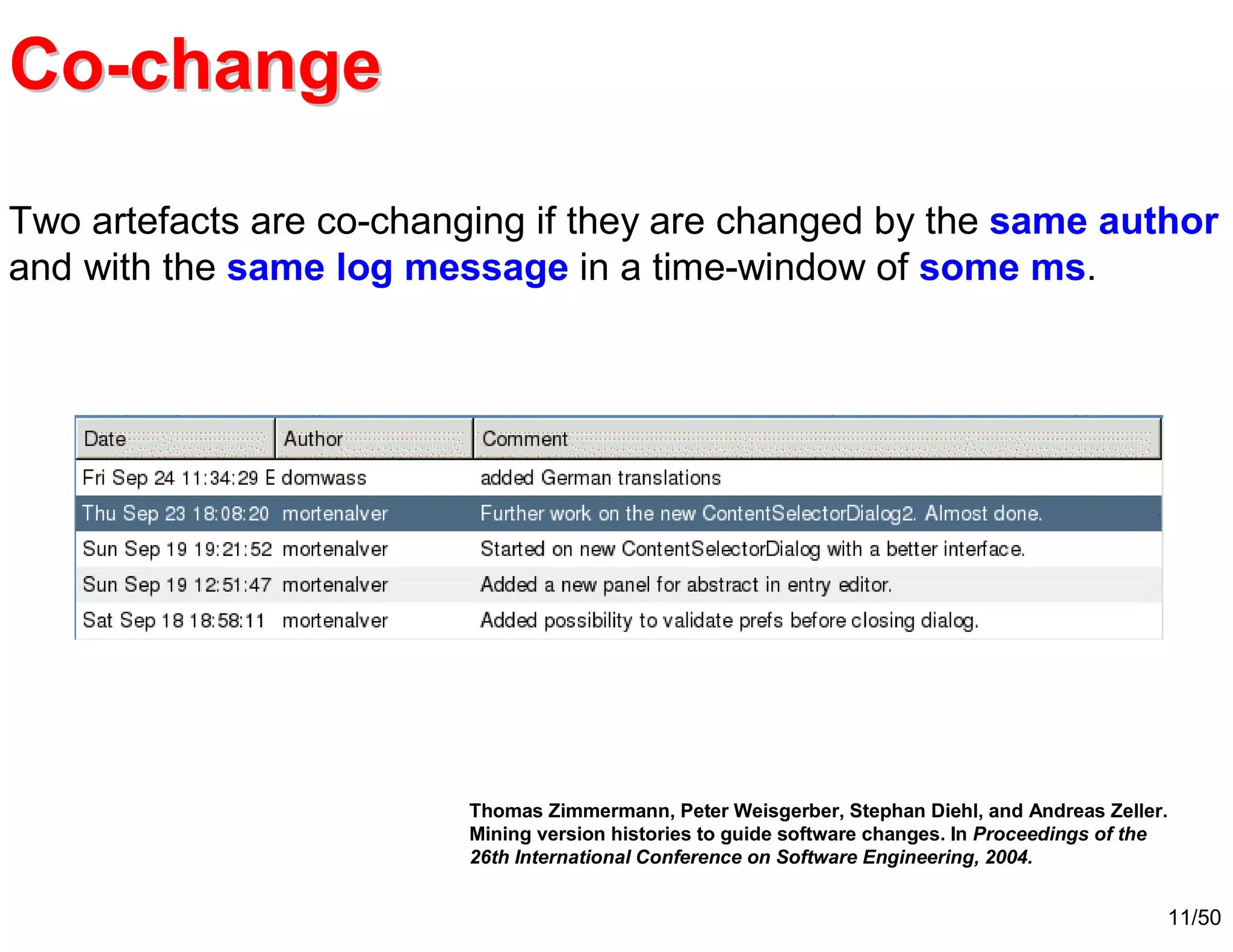
Two artefacts are co-changing if they are changed by the same author
and with the same log message in a time-window of some ms.
Thomas Zimmermann, Peter Weisgerber, Stephan Diehl, and Andreas Zeller.
Mining version histories to guide software changes. In Proceedings of the
26th International Conference on Software Engineering, 2004.
CoCo--changechange
12/50
ExampleExample
In ArgoUML, developers maintained in the same time
NotationUtilityJava and ModelElementNameNotationUml.
The bug ID 29265 confirms that the two files have dependencies.
In the Bugzilla of ArgoUML, the bug ID 53783 relates ArgoDiagram
with ModeCreateAssociationClass.
Their changes were committed by the same developer but always
separated by a few hours.
13/50
Missing DependenciesMissing Dependencies
14/50
Goal 1: AGoal 1: A NewNew Model of CoModel of Co--changechange
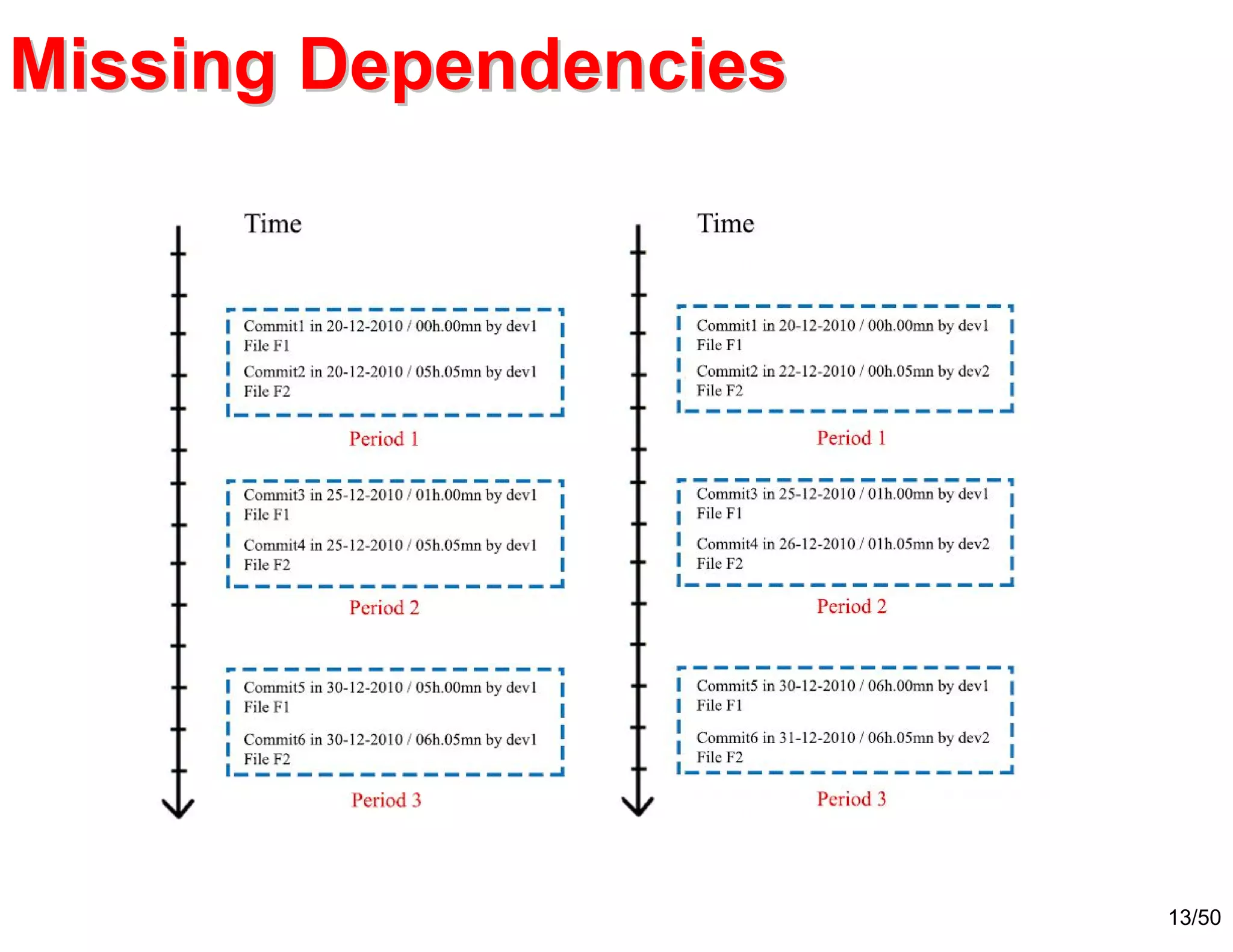
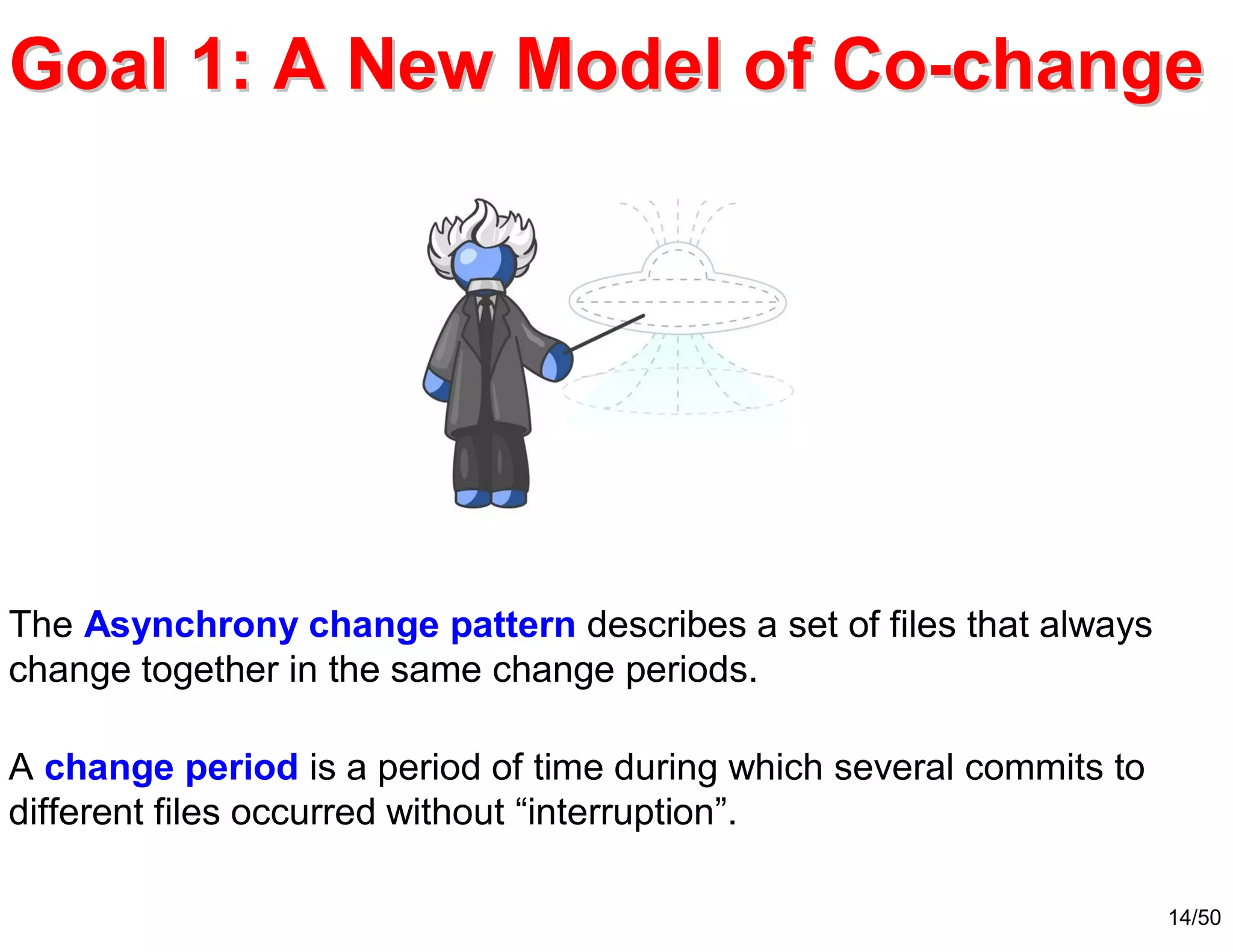
The Asynchrony change pattern describes a set of files that always
change together in the same change periods.
A change period is a period of time during which several commits to
different files occurred without “interruption”.
15/50
Approach: MacochaApproach: Macocha
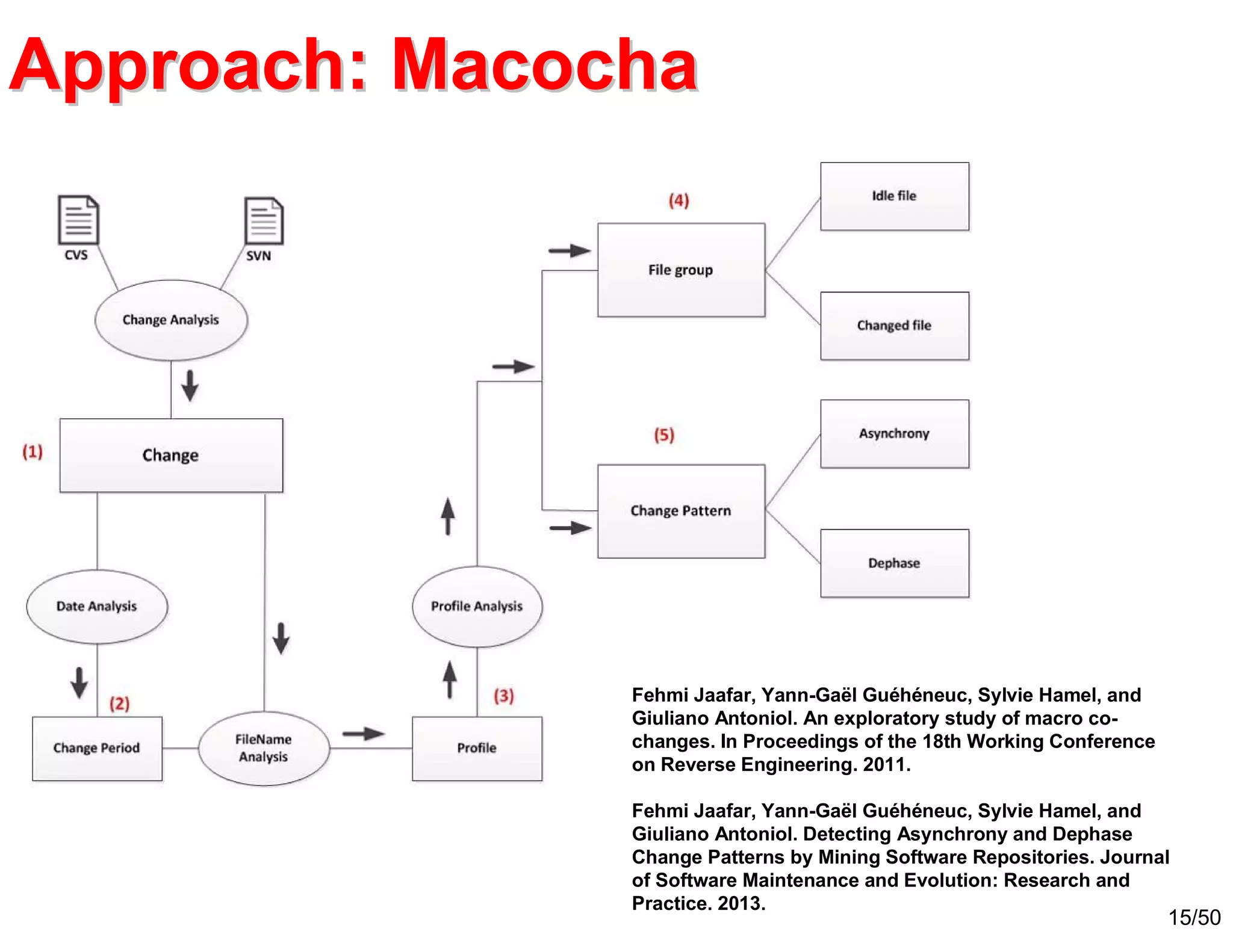
Fehmi Jaafar, Yann-Gaël Guéhéneuc, Sylvie Hamel, and
Giuliano Antoniol. An exploratory study of macro co-
changes. In Proceedings of the 18th Working Conference
on Reverse Engineering. 2011.
Fehmi Jaafar, Yann-Gaël Guéhéneuc, Sylvie Hamel, and
Giuliano Antoniol. Detecting Asynchrony and Dephase
Change Patterns by Mining Software Repositories. Journal
of Software Maintenance and Evolution: Research and
Practice. 2013.
16/50
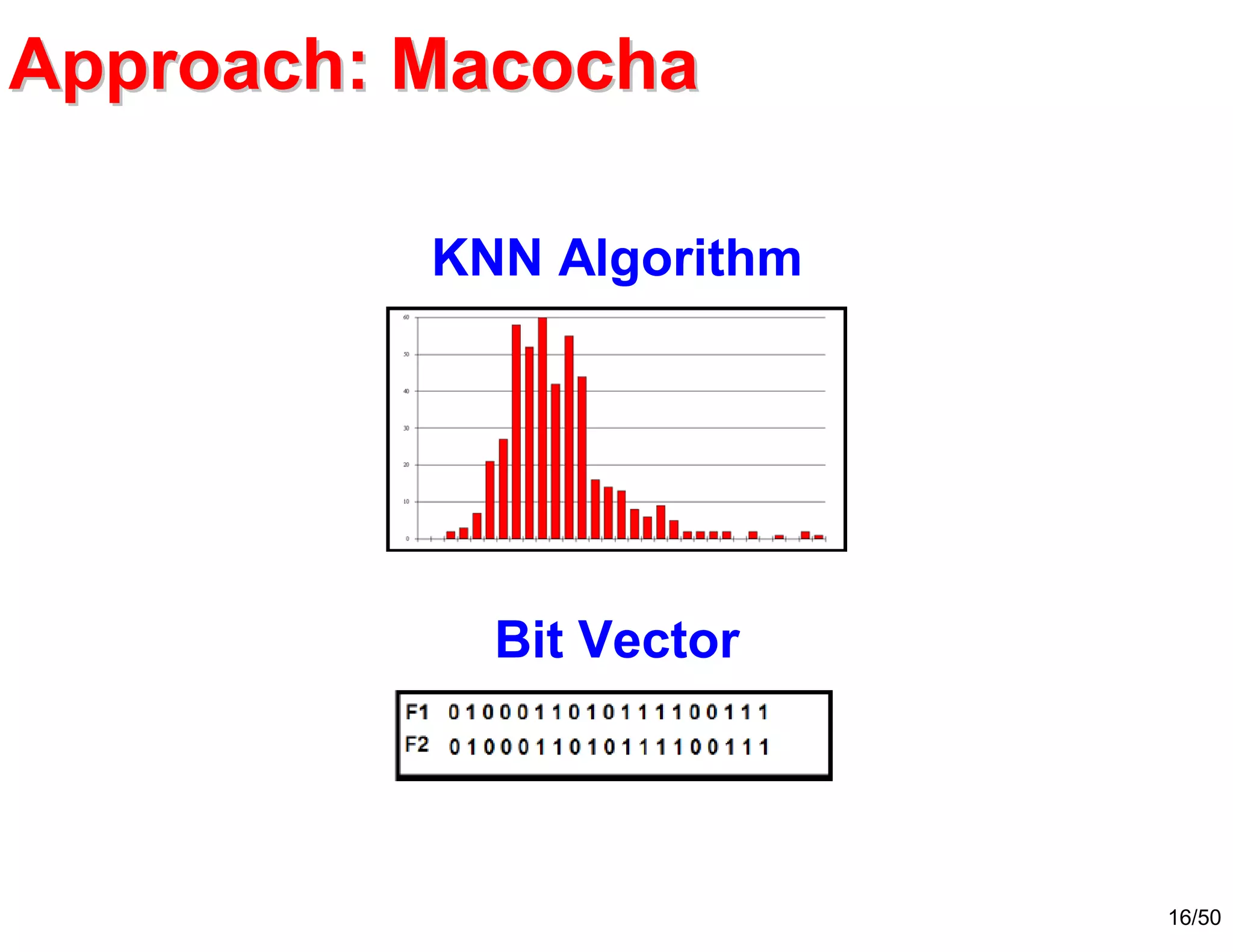
KNN Algorithm
Bit Vector
Approach: MacochaApproach: Macocha
17/50
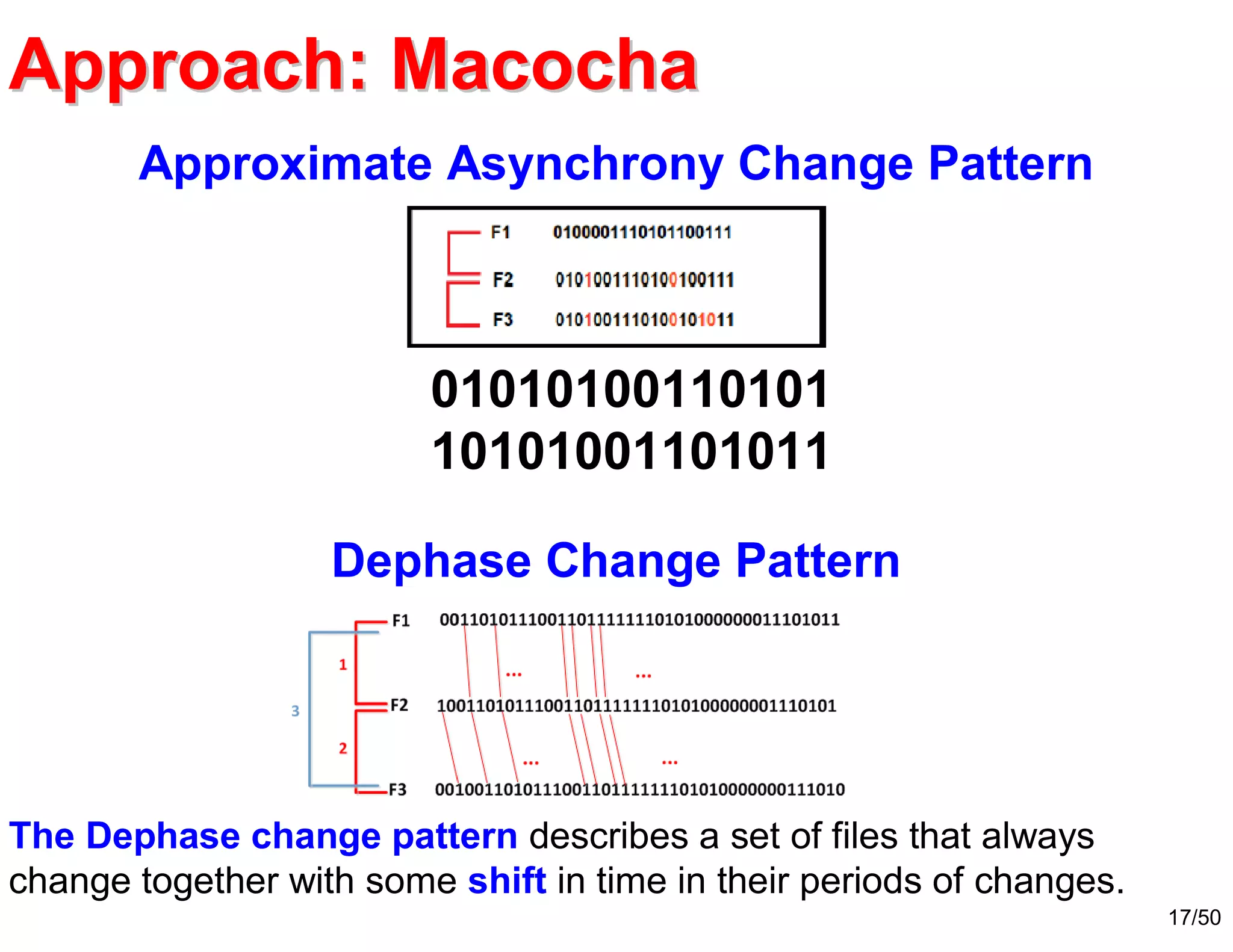
Approximate Asynchrony Change Pattern
Dephase Change Pattern
The Dephase change pattern describes a set of files that always
change together with some shift in time in their periods of changes.
01010100110101
10101001101011
Approach: MacochaApproach: Macocha
18/50
Research QuestionsResearch Questions
RQ1: Does Asynchrony and Dephase change
patterns really exist in practice?
RQ2: How can they be useful?
19/50
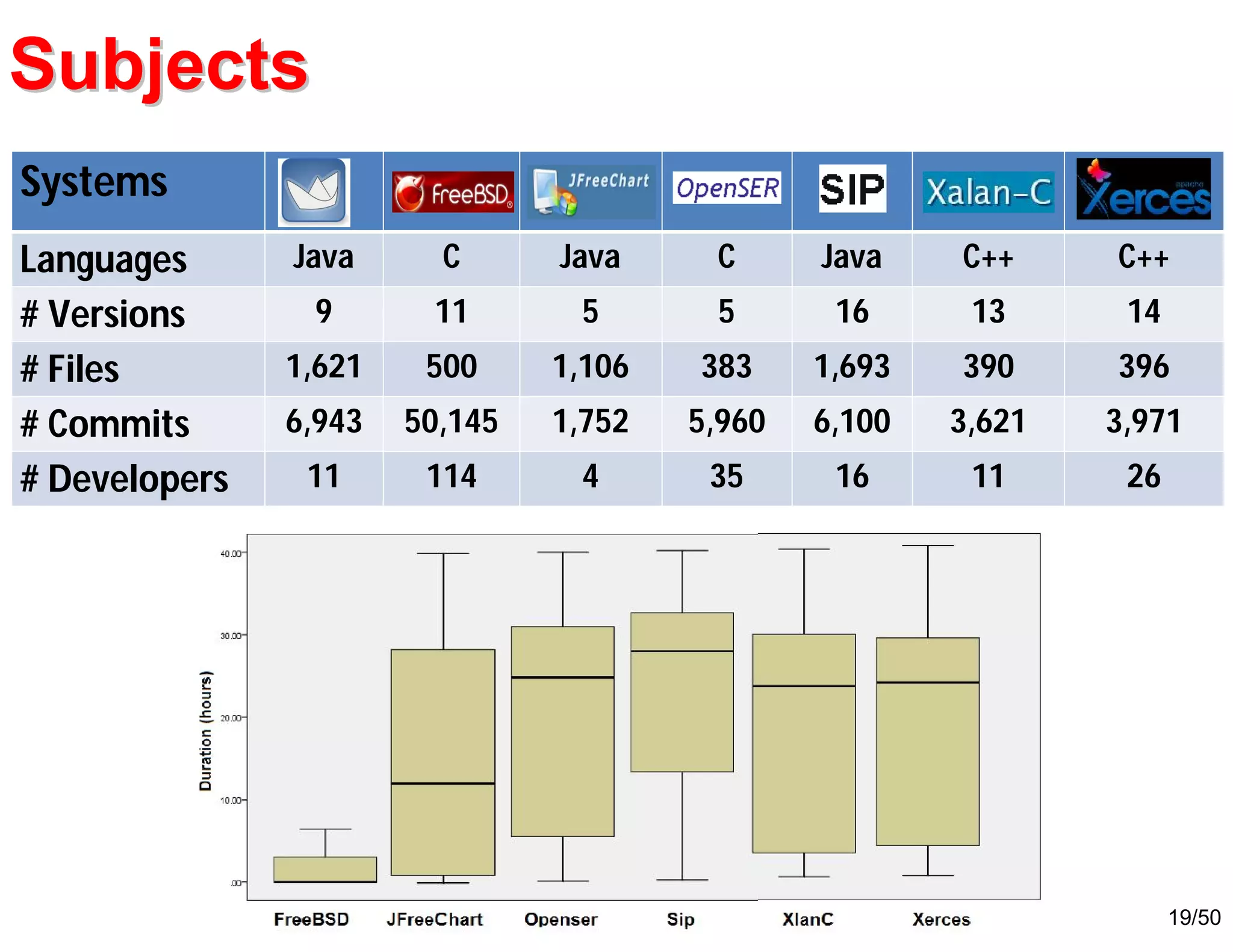
SubjectsSubjects
Systems
Languages Java C Java C Java C++ C++
# Versions 9 11 5 5 16 13 14
# Files 1,621 500 1,106 383 1,693 390 396
# Commits 6,943 50,145 1,752 5,960 6,100 3,621 3,971
# Developers 11 114 4 35 16 11 26
20/50
Quantitatively, we compare the findings of Macocha with that
of the previous co-change analysis.
Qualitatively, we use external information provided by bugs
reports, mailing lists, and requirement descriptions to
validate the novel change patterns.
Analysis MethodsAnalysis Methods
Fehmi Jaafar, Yann-Gaël Guéhéneuc, Sylvie Hamel, and Giuliano Antoniol. An
exploratory study of macro co-changes. In Proceedings of the 18th Working
Conference on Reverse Engineering. 2011.
Fehmi Jaafar, Yann-Gaël Guéhéneuc, Sylvie Hamel, and Giuliano Antoniol.
Detecting Asynchrony and Dephase Change Patterns by Mining Software
Repositories. Journal of Software Maintenance and Evolution: Research and
Practice. 2013.
21/50
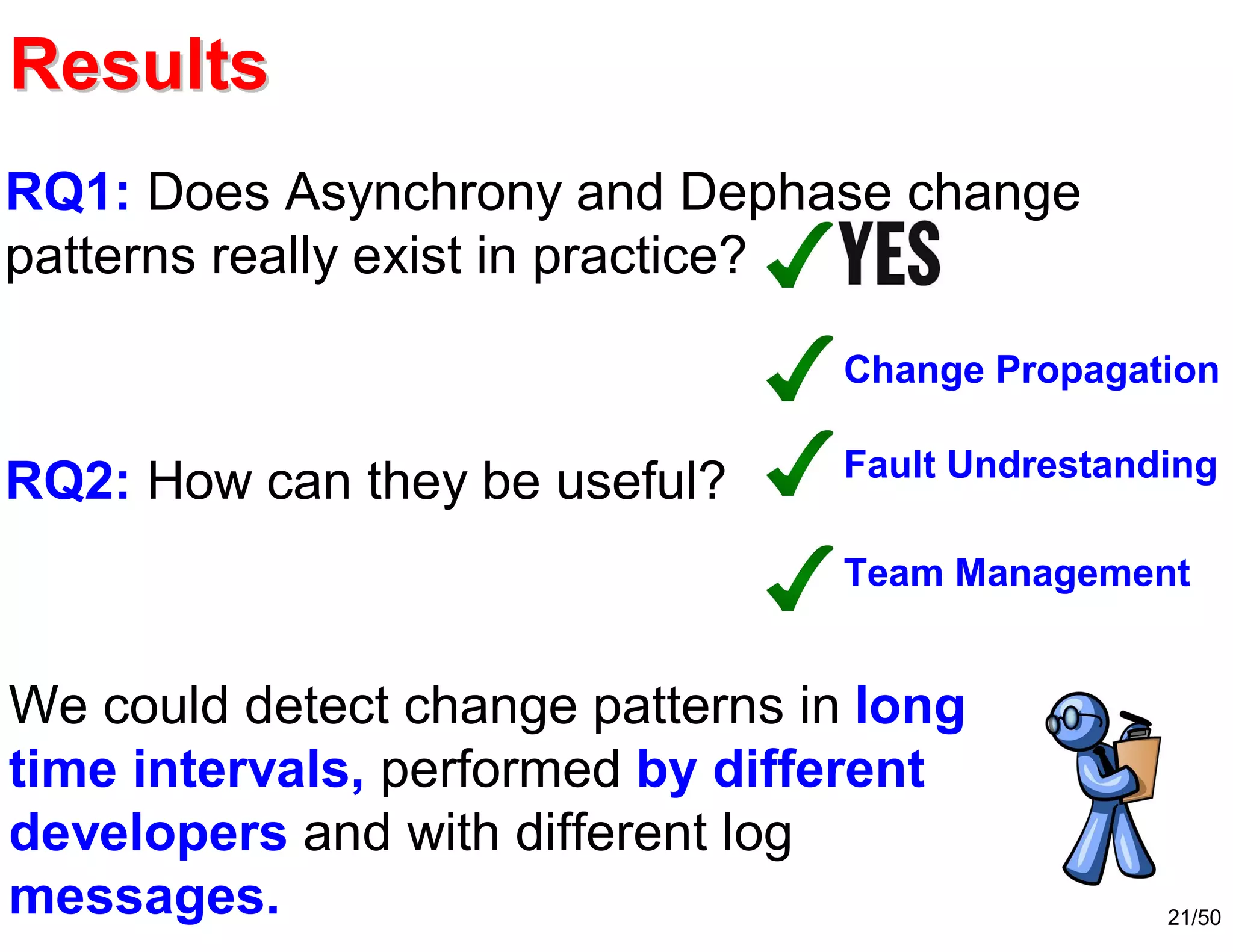
We could detect change patterns in long
time intervals, performed by different
developers and with different log
messages.
RQ1: Does Asynchrony and Dephase change
patterns really exist in practice?
RQ2: How can they be useful?
Change Propagation
Team Management
Fault Undrestanding
ResultsResults
22/50
Software Evolution Impacts?Software Evolution Impacts?
23/50
Ostrand et al. found that 20% of classes contains 80% of faults.
Not all classes are there to last forever, some are meant for
experimentation, so it could be expected that they have more faults.
Change-Log Approaches use process metrics extracted from the
versioning system: recently or frequently changed classes are the
most probable source of faults.
Code-Metrics approaches use source code metrics: complex or larger
classes are more fault-prone.
Assuming that all classes are considered
to have the same likelihood for fault-
proneness is not realistic!
MotivationMotivation
24/50
Classes that exhibit similar evolution profiles may have
interdependencies among them.
However, it is not clear how classes with similar evolution behavior are
linked with faults.
How we can relate the evolution of classes in object-oriented
programs with fault-proneness?
Goal 2: Relating SoftwareGoal 2: Relating Software
Evolution and FaultEvolution and Fault--pronenessproneness
25/50
ExampleExample
In JFreeChart, we find that ChartPanel and
CombinedDomainXYPlot were introduced, changed, and renamed in
the same versions but in different periods and by different developers.
The bug ID 195003710 reported “a bug either in ChartPanel or
CombinedDomainXYPlot when trying to zoom in/out on the range
axis”.
26/50
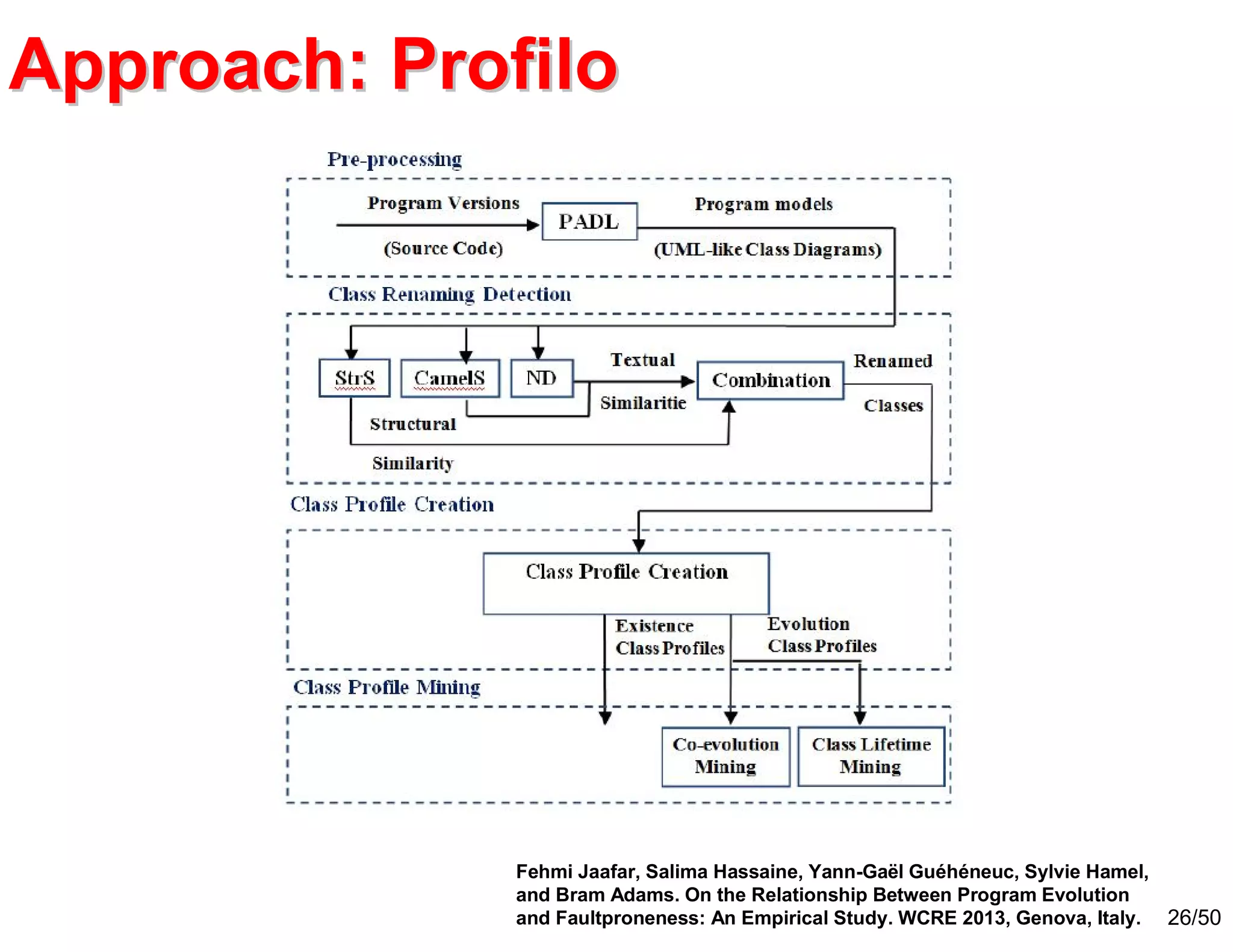
Approach: ProfiloApproach: Profilo
Fehmi Jaafar, Salima Hassaine, Yann-Gaël Guéhéneuc, Sylvie Hamel,
and Bram Adams. On the Relationship Between Program Evolution
and Faultproneness: An Empirical Study. WCRE 2013, Genova, Italy.
27/50
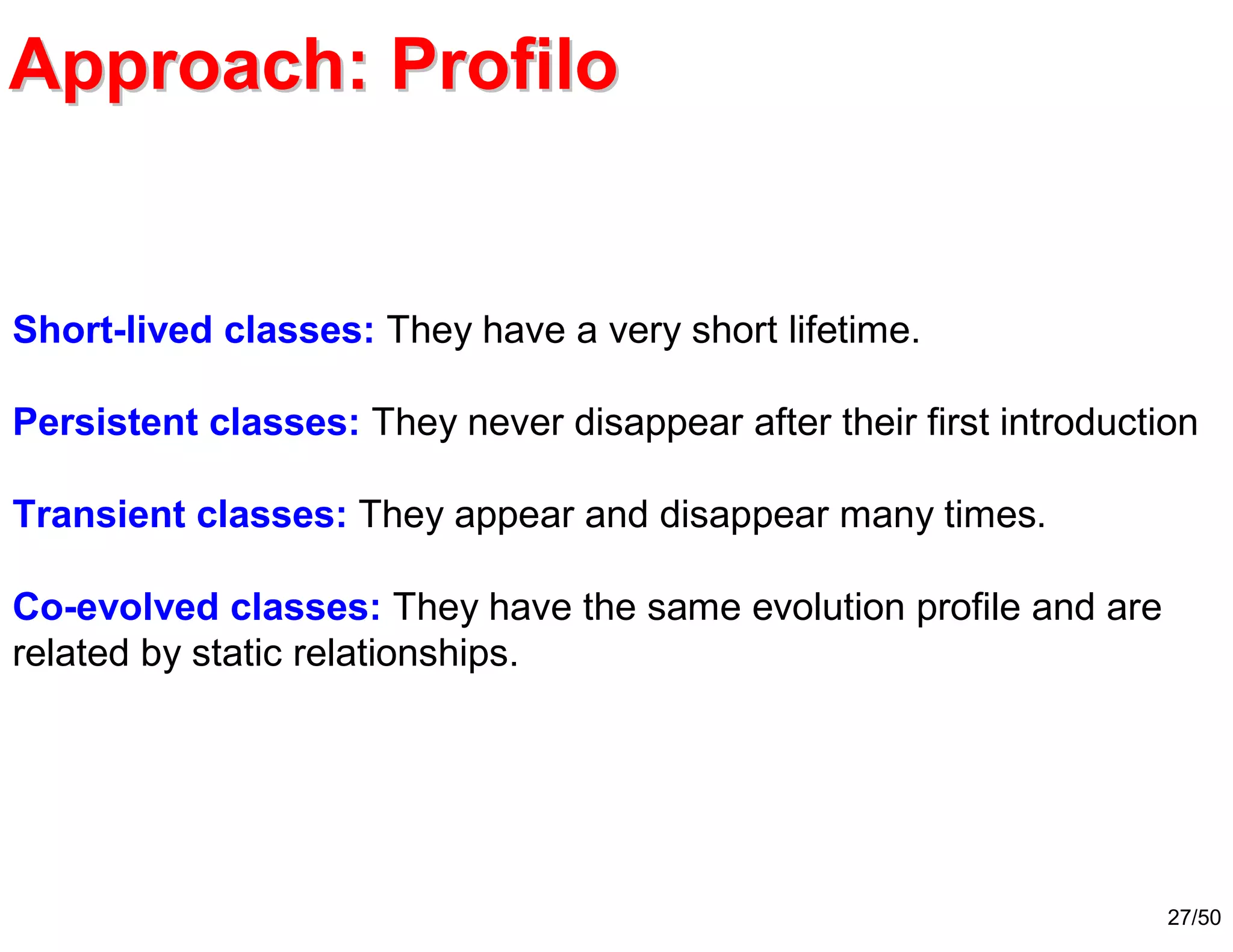
Approach: ProfiloApproach: Profilo
Short-lived classes: They have a very short lifetime.
Persistent classes: They never disappear after their first introduction
Transient classes: They appear and disappear many times.
Co-evolved classes: They have the same evolution profile and are
related by static relationships.
28/50
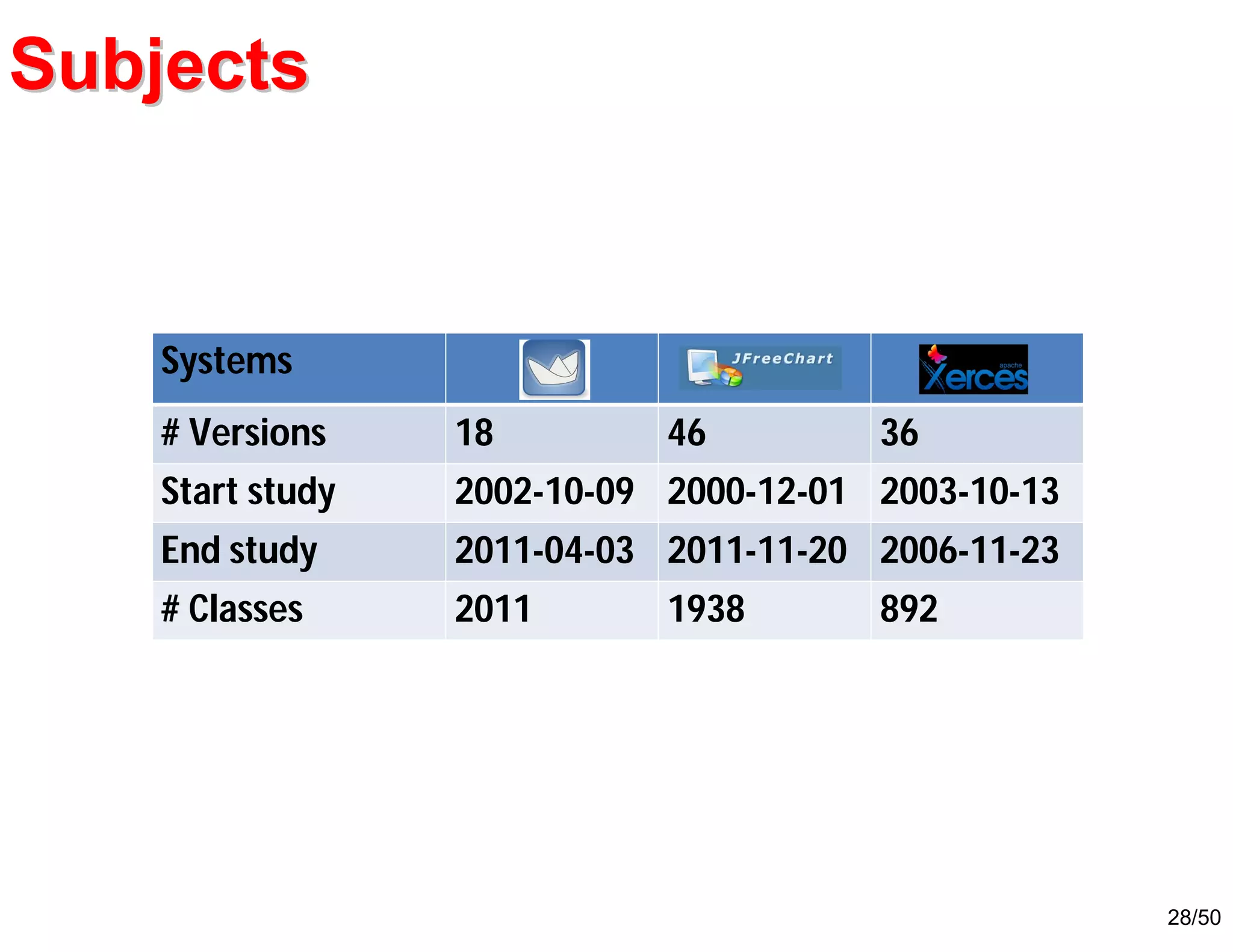
SubjectsSubjects
Systems
# Versions 18 46 36
Start study 2002-10-09 2000-12-01 2003-10-13
End study 2011-04-03 2011-11-20 2006-11-23
# Classes 2011 1938 892
29/50
Research QuestionsResearch Questions
RQ1: What is the relation between class lifetime
and fault-proneness?
RQ2: What is the relation between class co-
evolution and fault-proneness?
30/50
HRQ2: There is no statistically significant difference between
proportions of faults involving co-evolved classes or not co-
evolved classes.
HRQ1: There is no statistically significant difference between
proportions of faults carried by Persistent, Shortlived, and
Transient classes in systems.
We use Fisher’s exact test and the Chi-
Square test to check two hypothesis.
Analysis MethodsAnalysis Methods
31/50
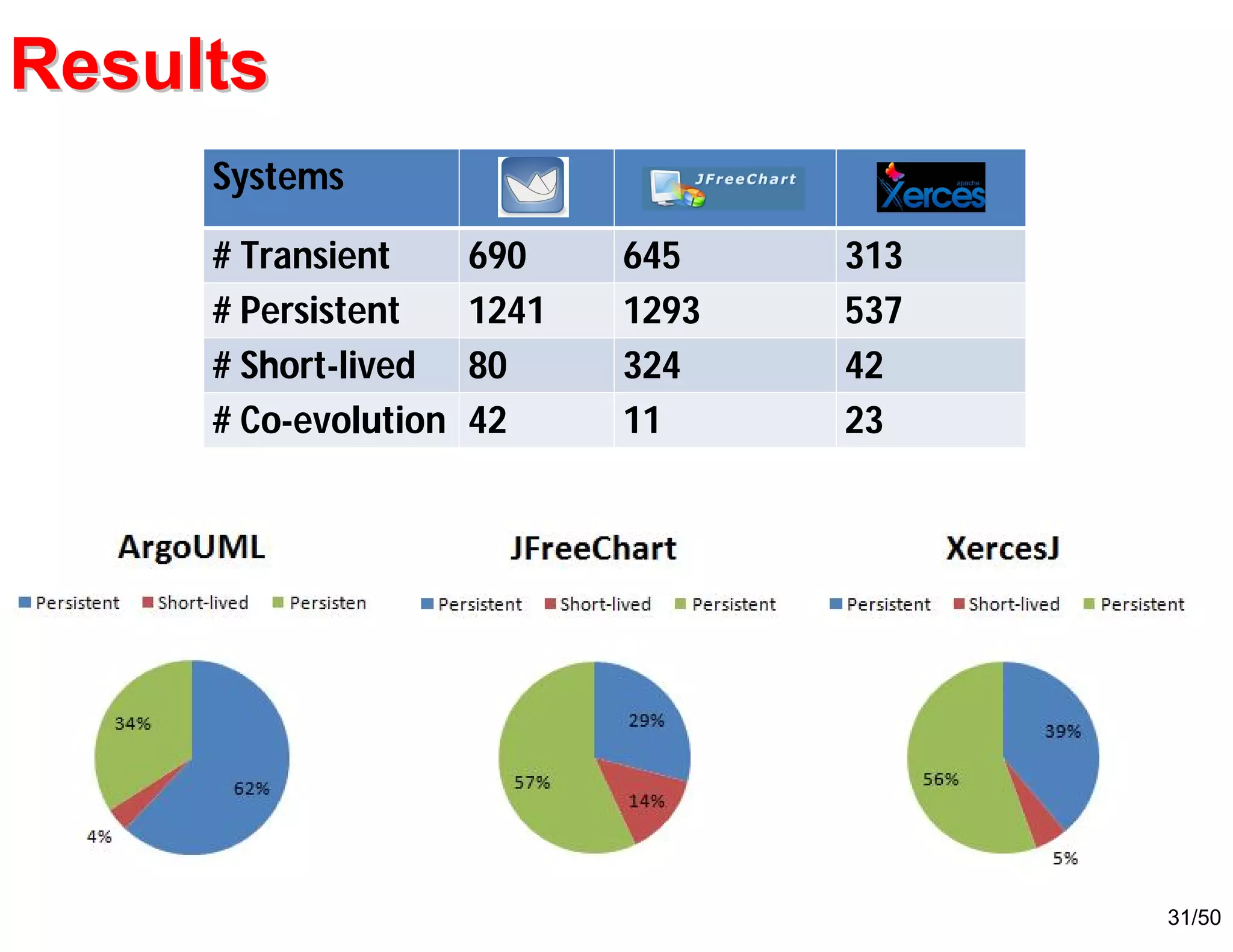
ResultsResults
Systems
# Transient 690 645 313
# Persistent 1241 1293 537
# Short-lived 80 324 42
# Co-evolution 42 11 23
32/50
ResultsResults
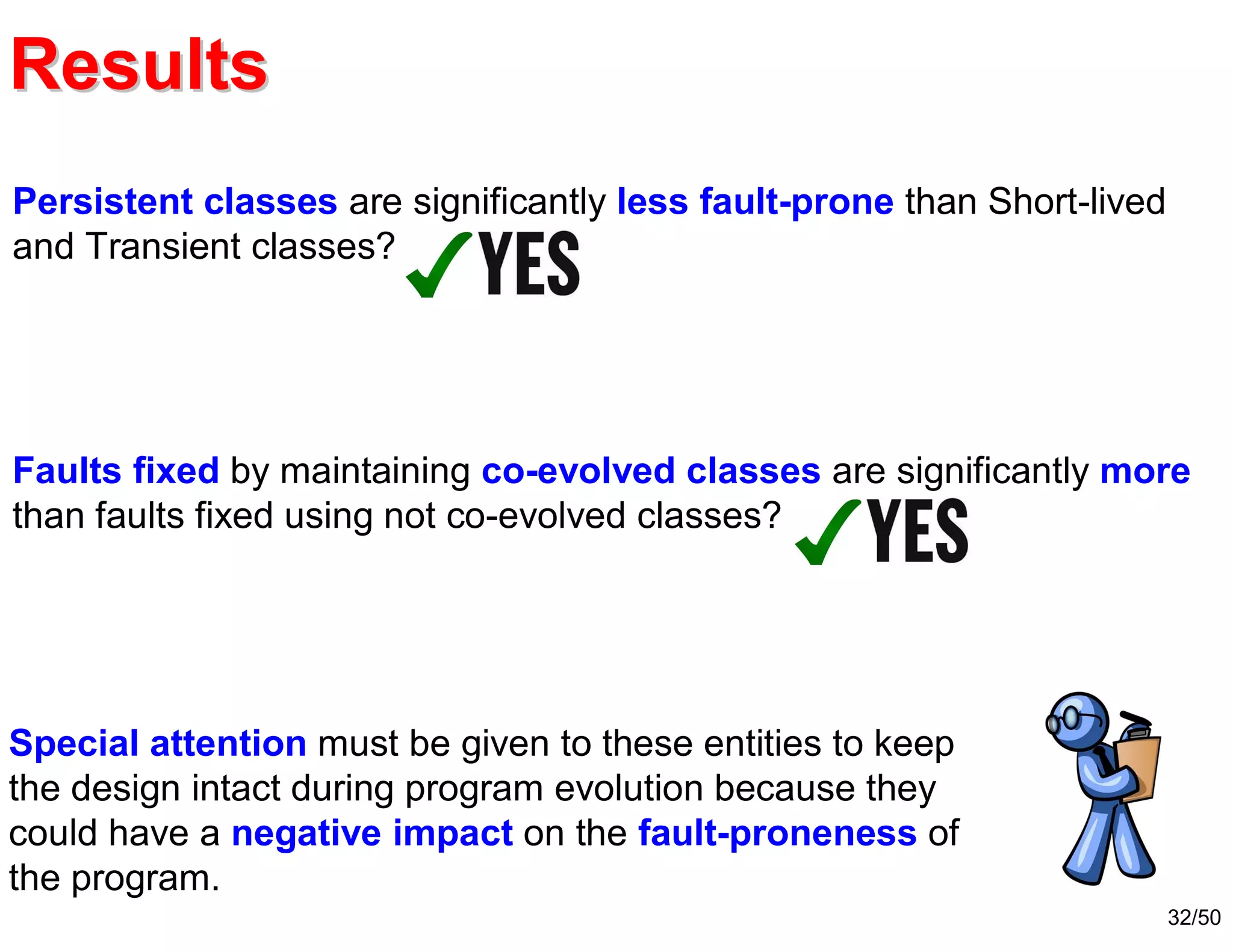
Persistent classes are significantly less fault-prone than Short-lived
and Transient classes?
Faults fixed by maintaining co-evolved classes are significantly more
than faults fixed using not co-evolved classes?
Special attention must be given to these entities to keep
the design intact during program evolution because they
could have a negative impact on the fault-proneness of
the program.
33/50
Software Evolution ImpactsSoftware Evolution Impacts
34/50
Anti-patterns describe poor solutions to design and implementation
problems…
Instead, they indicate weaknesses in design that may be slowing down
development or increasing the risk of bugs or failures in the future.
Design Defects: AntiDesign Defects: Anti--patternspatterns
35/50
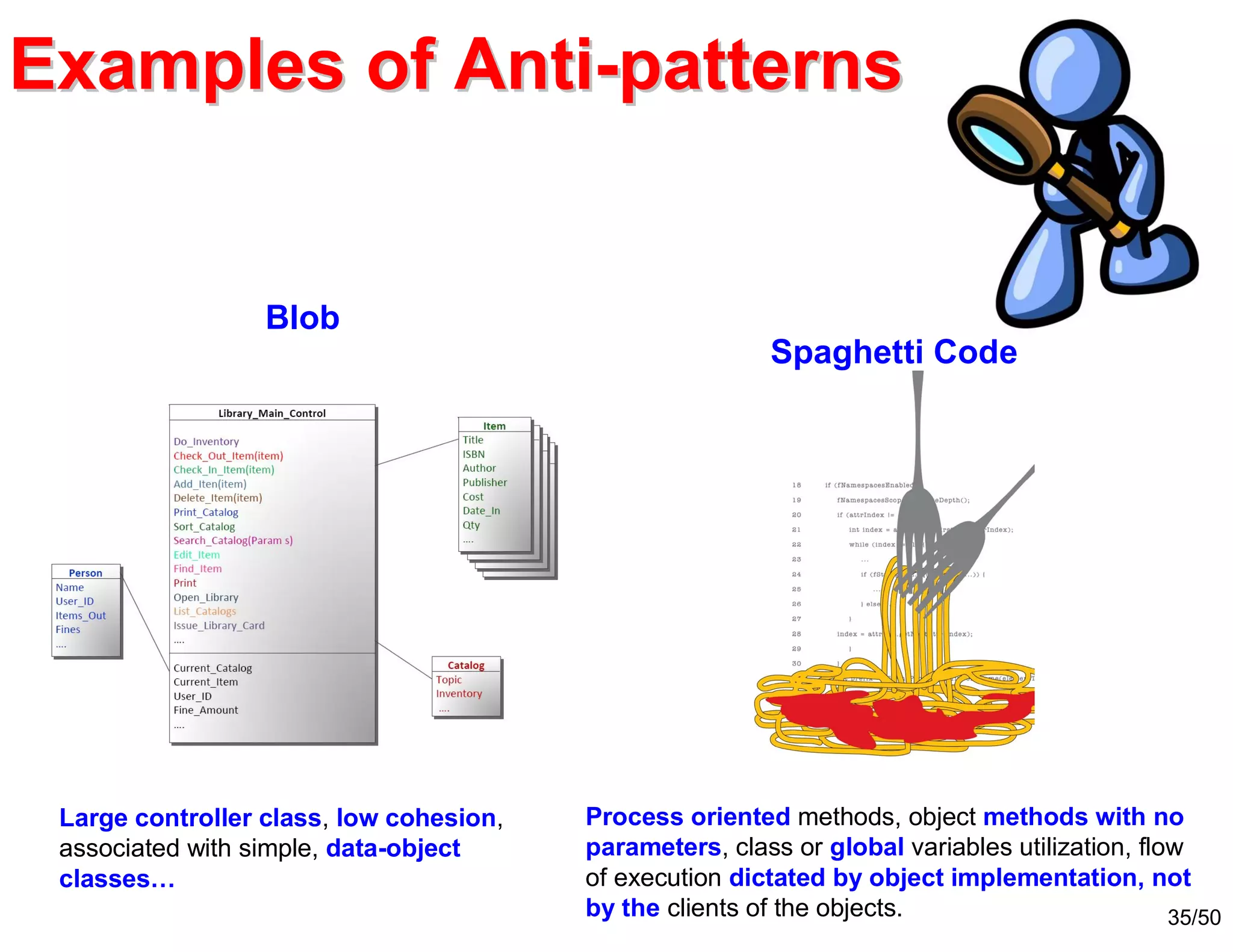
Examples of AntiExamples of Anti--patternspatterns
Large controller class, low cohesion,
associated with simple, data-object
classes…
Blob
Spaghetti Code
Process oriented methods, object methods with no
parameters, class or global variables utilization, flow
of execution dictated by object implementation, not
by the clients of the objects.
36/50
Related WorkRelated Work
Many studies have investigated the impact of anti-patterns on
• Maintenance [Yamashita, 2013]
• Fault-proneness [Khomh, 2012]
• Change-proneness [Romano, 2012]
• …
37/50
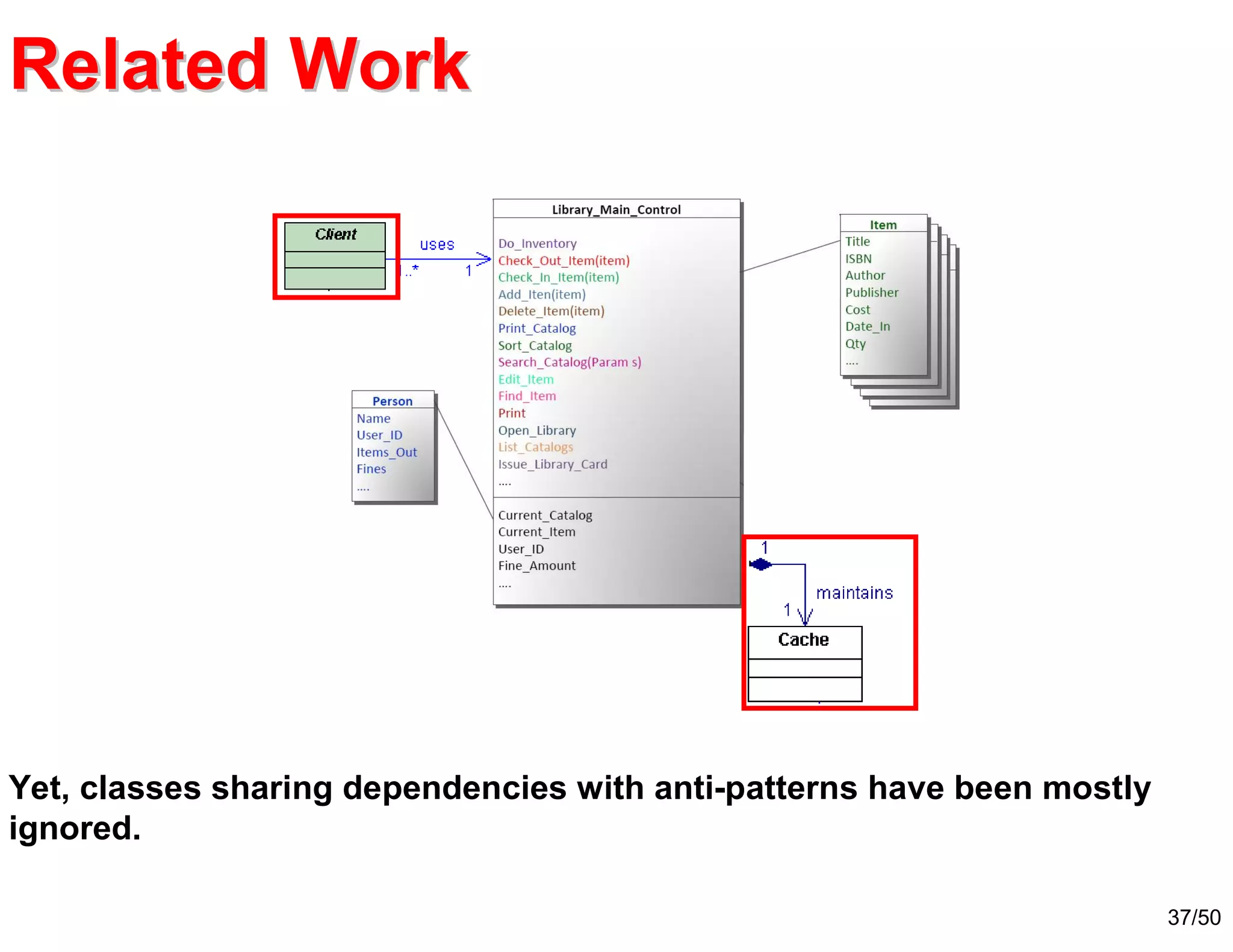
Related WorkRelated Work
Yet, classes sharing dependencies with anti-patterns have been mostly
ignored.
38/50
Goal 3: Relating Evolution,Goal 3: Relating Evolution,
Dependencies, and AntiDependencies, and Anti--patternspatterns
Static and evolution dependencies with anti-patterns can
impact the fault-proneness of classes without anti-
patterns.
39/50
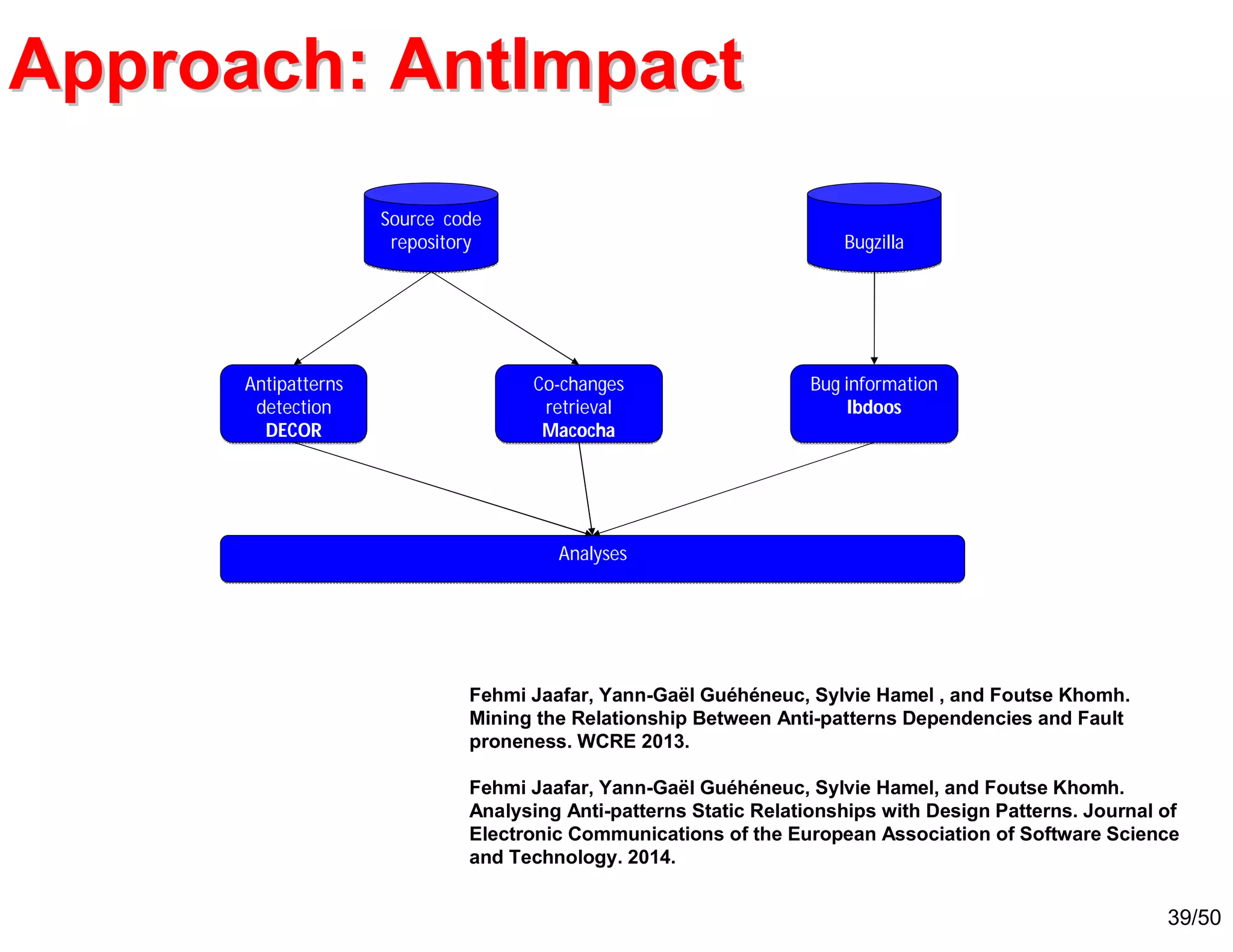
Source code
repository
Source code
repository
Antipatterns
detection
DECOR
Antipatterns
detection
DECOR
Co-changes
retrieval
Macocha
Co-changes
retrieval
Macocha
AnalysesAnalyses
BugzillaBugzilla
Bug information
Ibdoos
Bug information
Ibdoos
Approach: AntImpactApproach: AntImpact
Fehmi Jaafar, Yann-Gaël Guéhéneuc, Sylvie Hamel , and Foutse Khomh.
Mining the Relationship Between Anti-patterns Dependencies and Fault
proneness. WCRE 2013.
Fehmi Jaafar, Yann-Gaël Guéhéneuc, Sylvie Hamel, and Foutse Khomh.
Analysing Anti-patterns Static Relationships with Design Patterns. Journal of
Electronic Communications of the European Association of Software Science
and Technology. 2014.
40/50
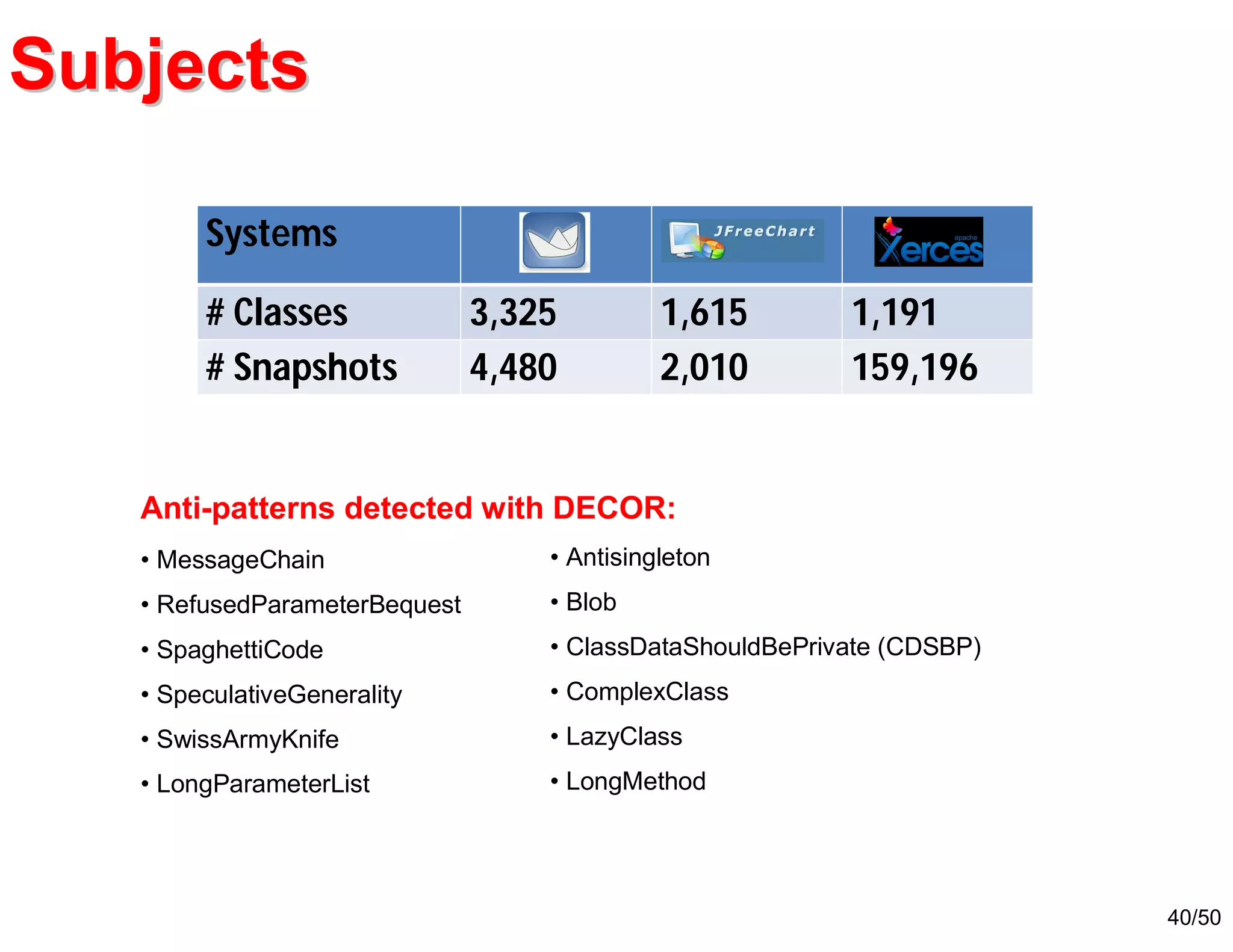
Systems
# Classes 3,325 1,615 1,191
# Snapshots 4,480 2,010 159,196
• Antisingleton
• Blob
• ClassDataShouldBePrivate (CDSBP)
• ComplexClass
• LazyClass
• LongMethod
• MessageChain
• RefusedParameterBequest
• SpaghettiCode
• SpeculativeGenerality
• SwissArmyKnife
• LongParameterList
Anti-patterns detected with DECOR:
SubjectsSubjects
41/50
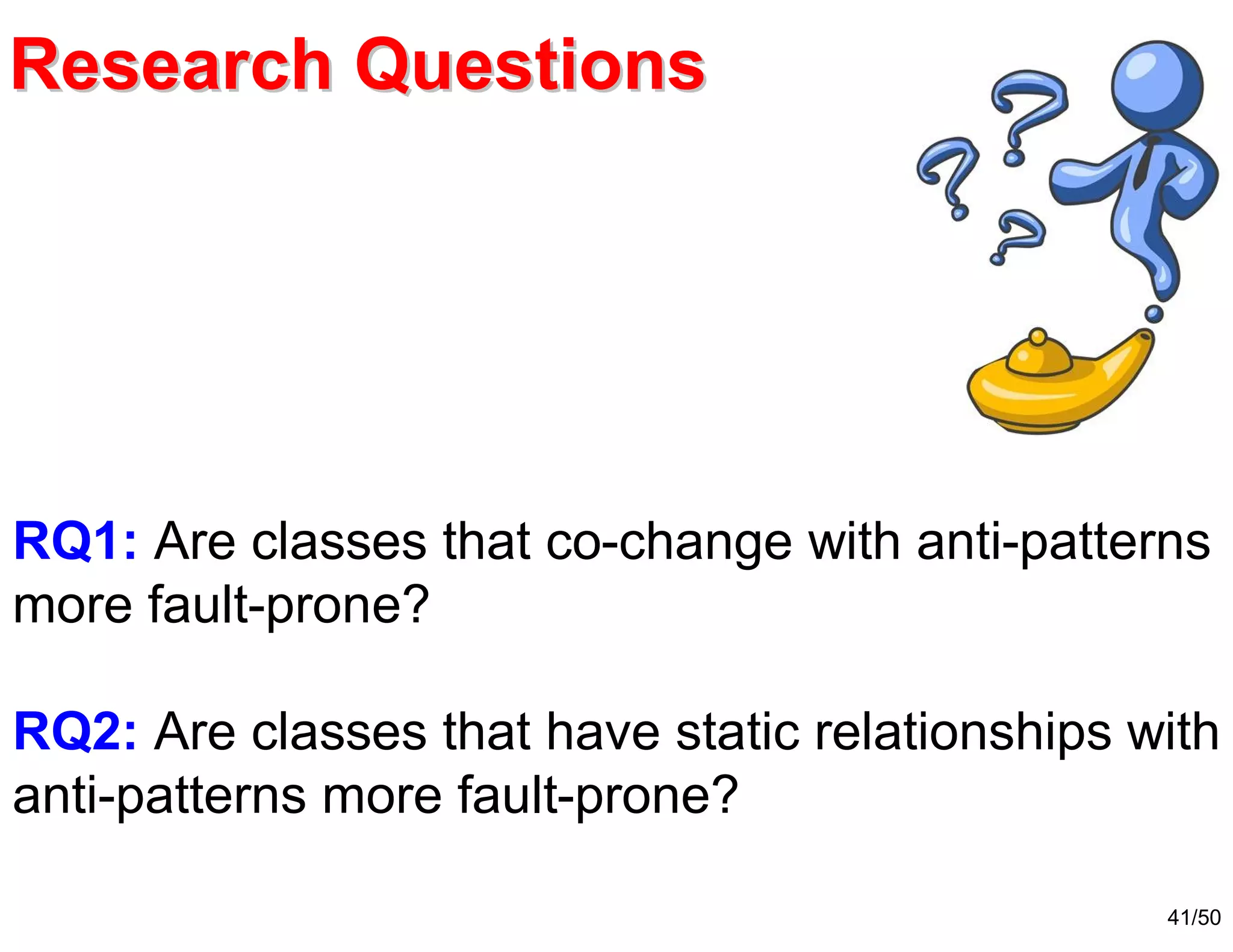
RQ1: Are classes that co-change with anti-patterns
more fault-prone?
RQ2: Are classes that have static relationships with
anti-patterns more fault-prone?
Research QuestionsResearch Questions
42/50
Analysis MethodsAnalysis Methods
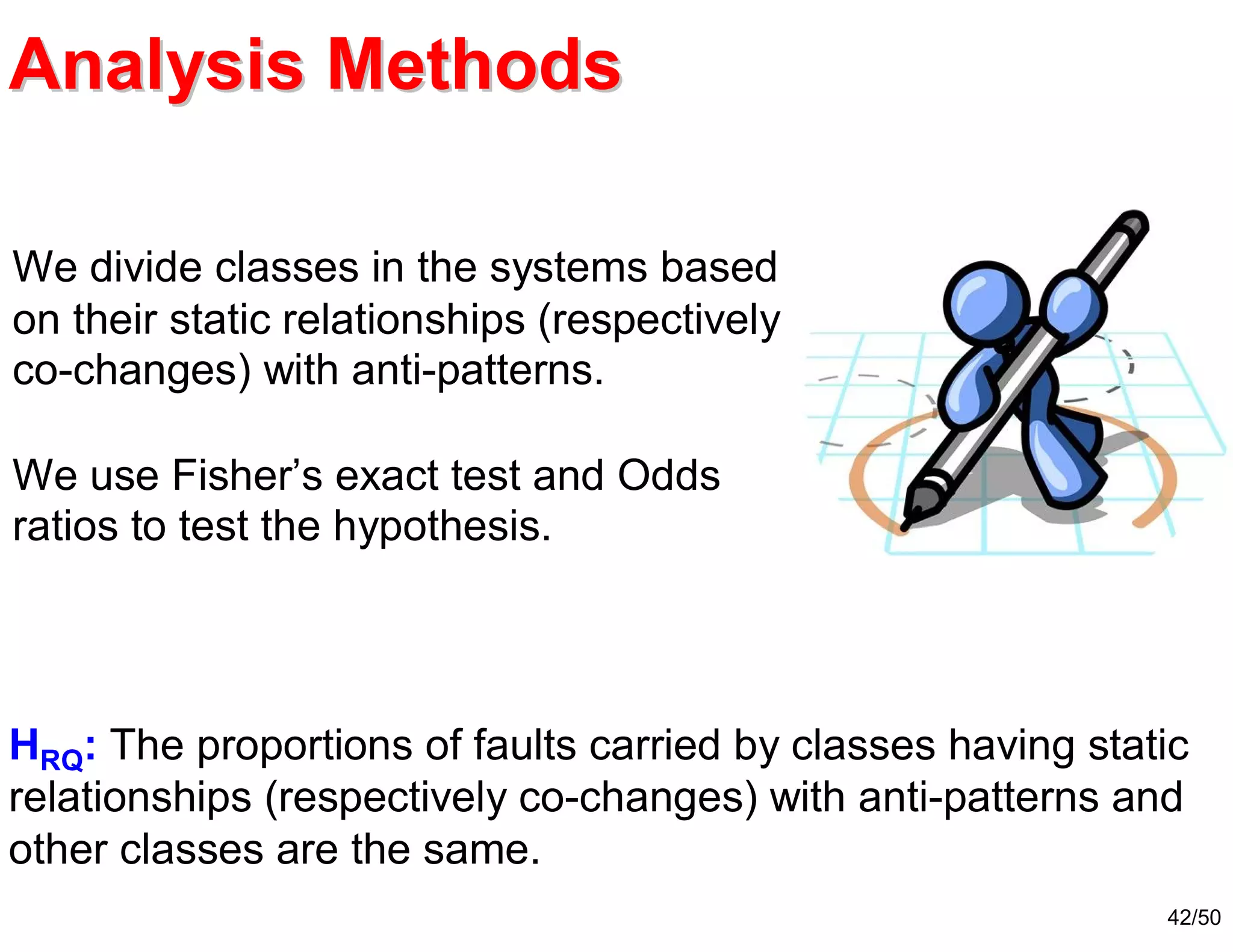
HRQ: The proportions of faults carried by classes having static
relationships (respectively co-changes) with anti-patterns and
other classes are the same.
We divide classes in the systems based
on their static relationships (respectively
co-changes) with anti-patterns.
We use Fisher’s exact test and Odds
ratios to test the hypothesis.
43/50
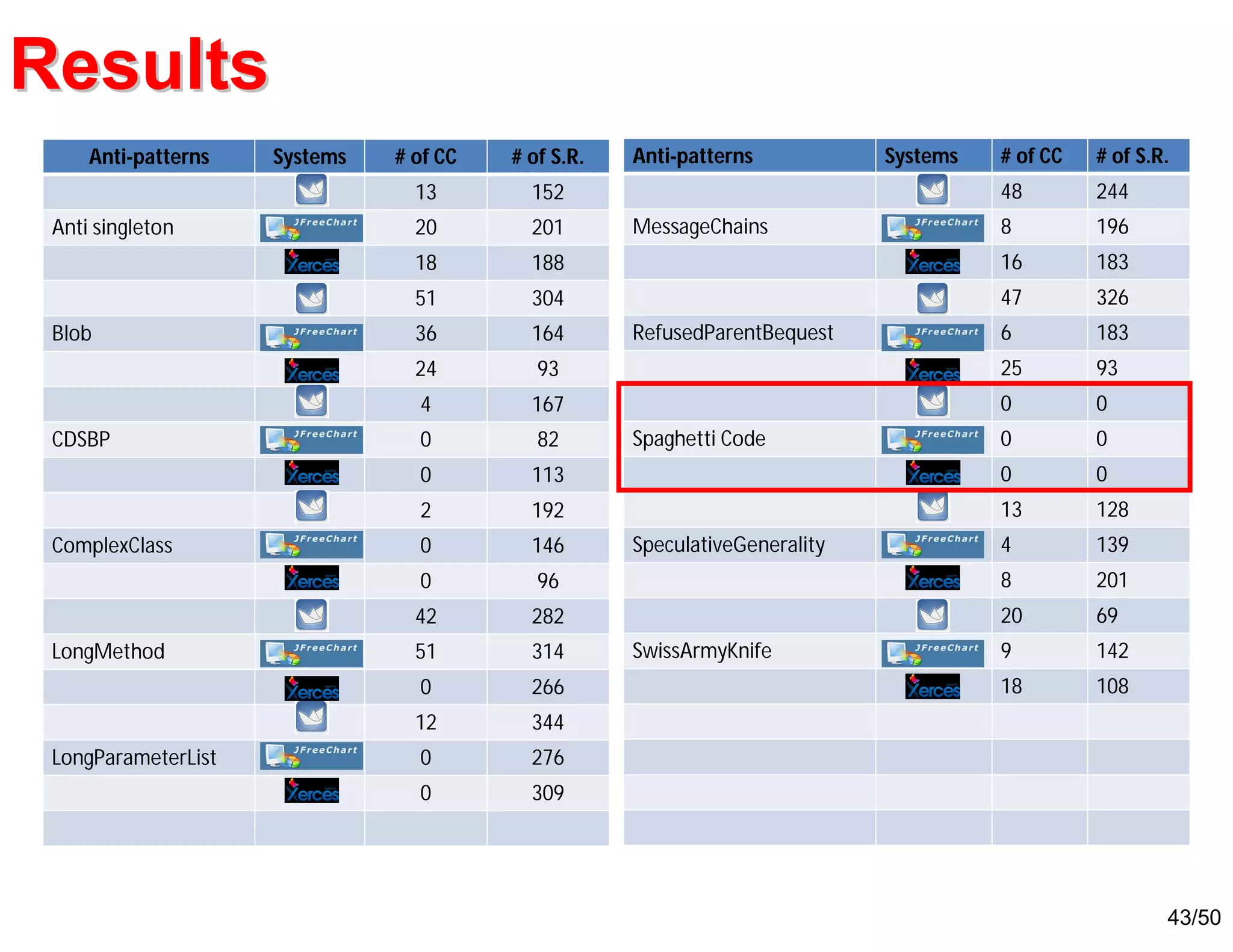
Anti-patterns Systems # of CC # of S.R.
13 152
Anti singleton 20 201
18 188
51 304
Blob 36 164
24 93
4 167
CDSBP 0 82
0 113
2 192
ComplexClass 0 146
0 96
42 282
LongMethod 51 314
0 266
12 344
LongParameterList 0 276
0 309
Anti-patterns Systems # of CC # of S.R.
48 244
MessageChains 8 196
16 183
47 326
RefusedParentBequest 6 183
25 93
0 0
Spaghetti Code 0 0
0 0
13 128
SpeculativeGenerality 4 139
8 201
20 69
SwissArmyKnife 9 142
18 108
ResultsResults
44/50
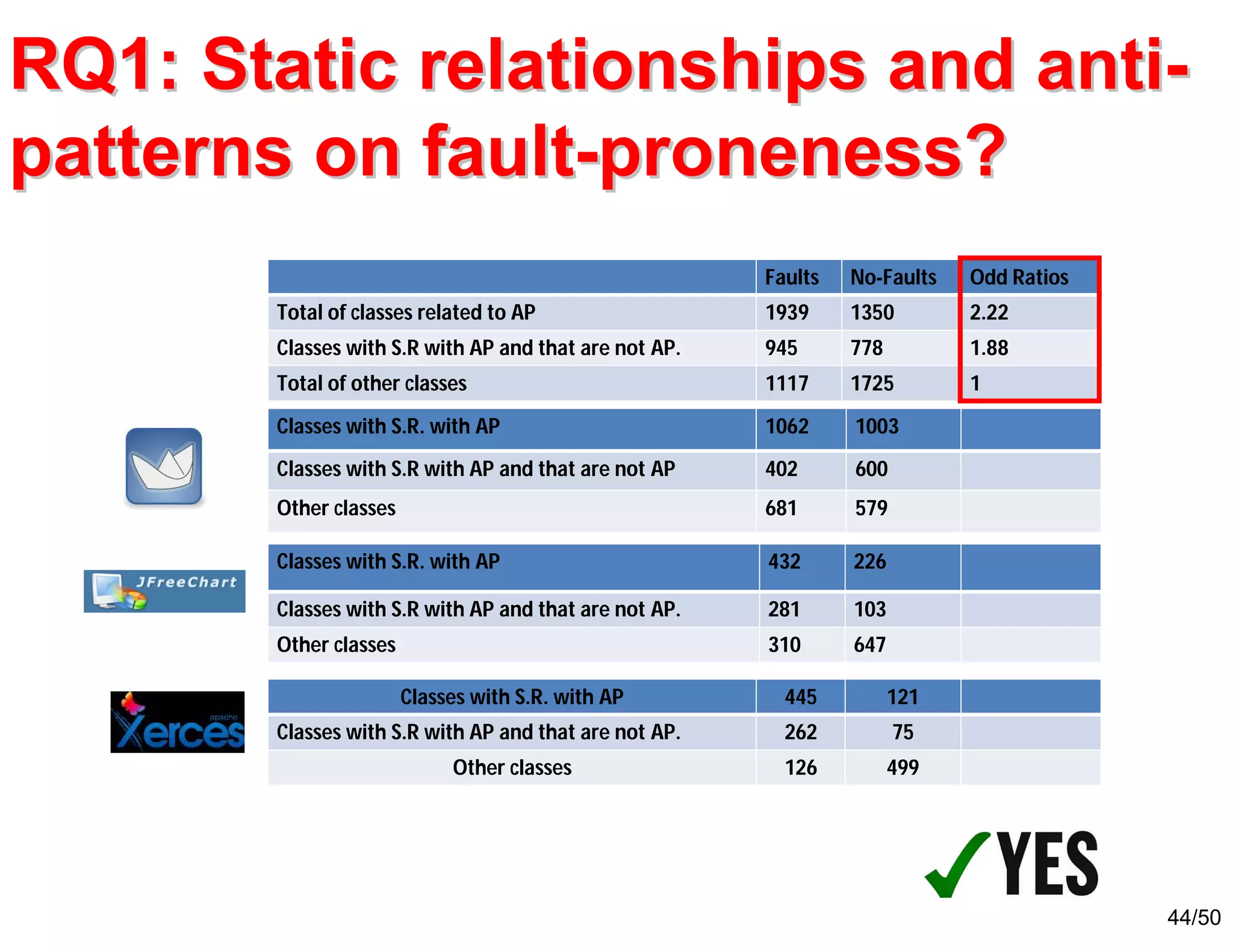
RQ1: Static relationships and antiRQ1: Static relationships and anti--
patterns on faultpatterns on fault--proneness?proneness?
Classes with S.R. with AP 1062 1003
Classes with S.R with AP and that are not AP 402 600
Other classes 681 579
Classes with S.R. with AP 432 226
Classes with S.R with AP and that are not AP. 281 103
Other classes 310 647
Classes with S.R. with AP 445 121
Classes with S.R with AP and that are not AP. 262 75
Other classes 126 499
Faults No-Faults Odd Ratios
Total of classes related to AP 1939 1350 2.22
Classes with S.R with AP and that are not AP. 945 778 1.88
Total of other classes 1117 1725 1
45/50
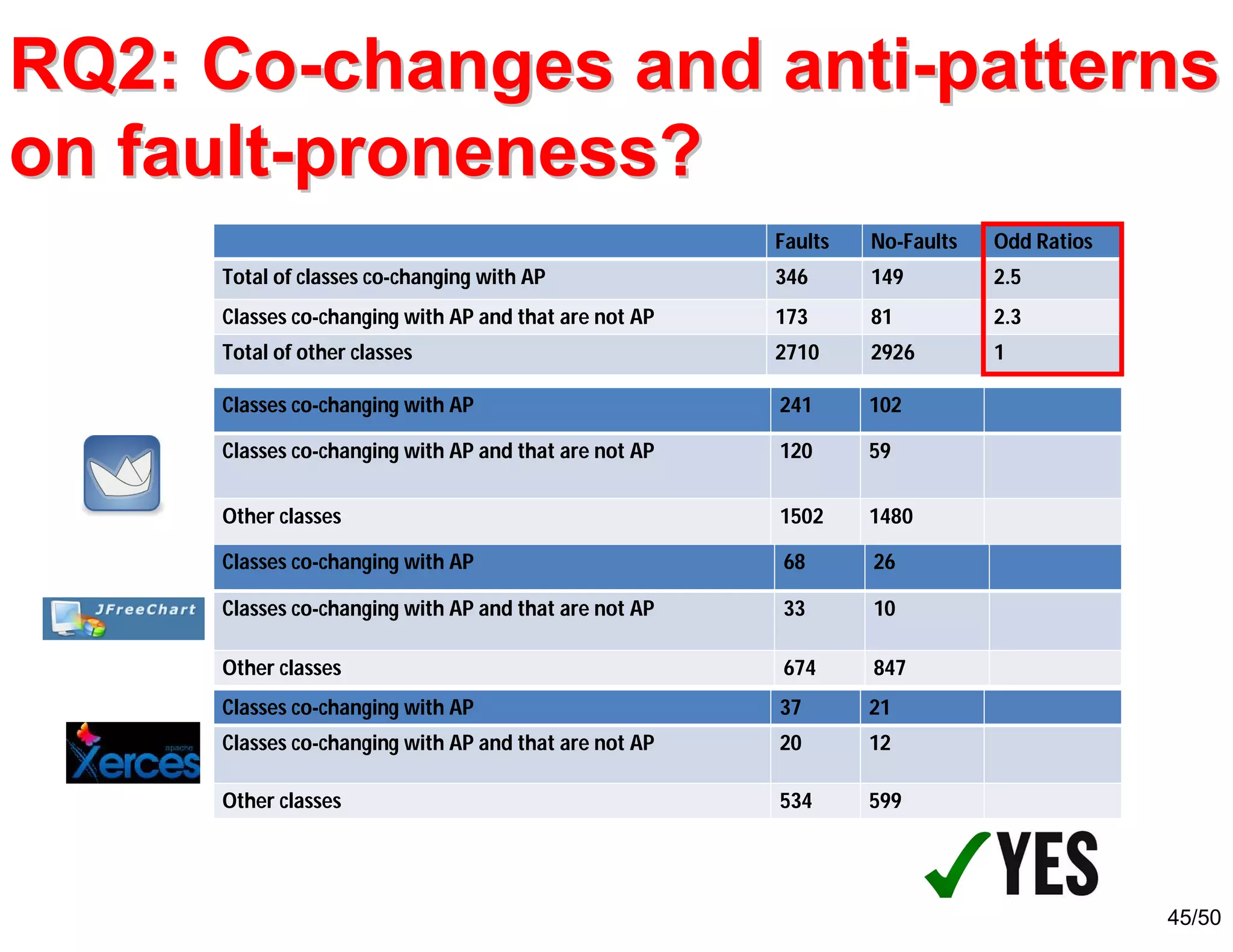
RQ2: CoRQ2: Co--changes and antichanges and anti--patternspatterns
on faulton fault--proneness?proneness?
Classes co-changing with AP 241 102
Classes co-changing with AP and that are not AP 120 59
Other classes 1502 1480
Classes co-changing with AP 68 26
Classes co-changing with AP and that are not AP 33 10
Other classes 674 847
Classes co-changing with AP 37 21
Classes co-changing with AP and that are not AP 20 12
Other classes 534 599
Faults No-Faults Odd Ratios
Total of classes co-changing with AP 346 149 2.5
Classes co-changing with AP and that are not AP 173 81 2.3
Total of other classes 2710 2926 1
46/50
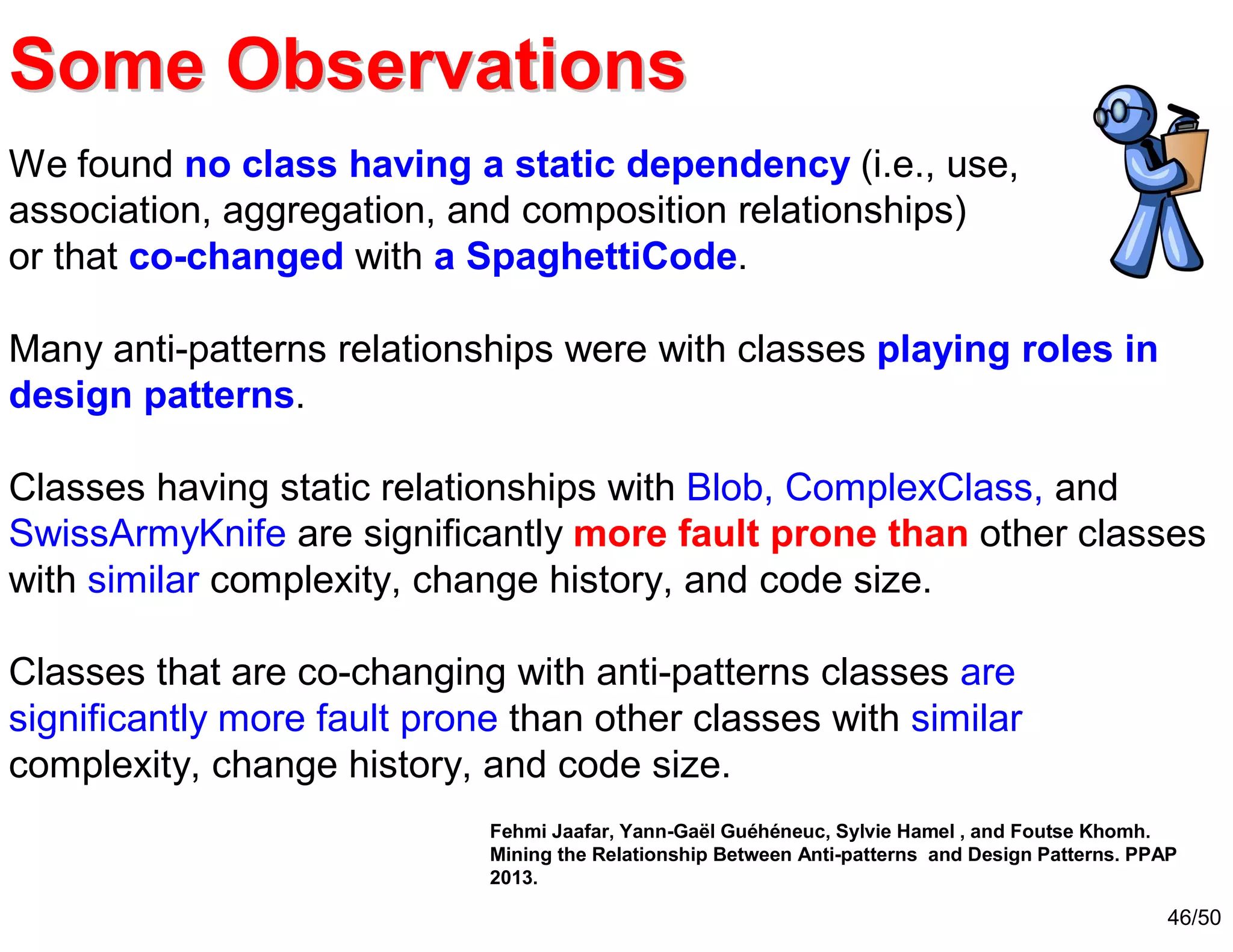
We found no class having a static dependency (i.e., use,
association, aggregation, and composition relationships)
or that co-changed with a SpaghettiCode.
Many anti-patterns relationships were with classes playing roles in
design patterns.
Classes having static relationships with Blob, ComplexClass, and
SwissArmyKnife are significantly more fault prone than other classes
with similar complexity, change history, and code size.
Classes that are co-changing with anti-patterns classes are
significantly more fault prone than other classes with similar
complexity, change history, and code size.
Some ObservationsSome Observations
Fehmi Jaafar, Yann-Gaël Guéhéneuc, Sylvie Hamel , and Foutse Khomh.
Mining the Relationship Between Anti-patterns and Design Patterns. PPAP
2013.
47/50
48/50
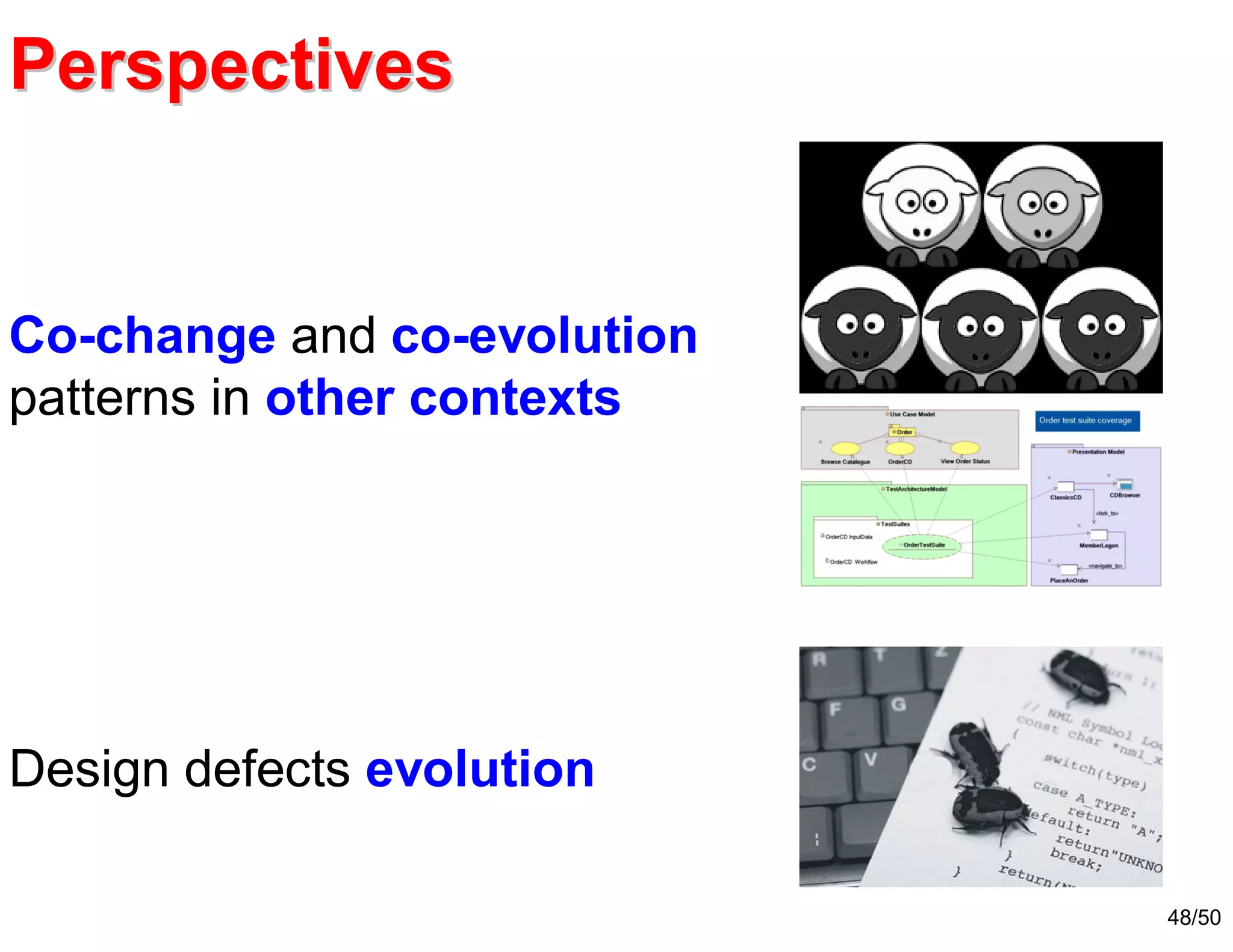
PerspectivesPerspectives
Co-change and co-evolution
patterns in other contexts
Design defects evolution

Thesis+of+fehmi+jaafar.ppt

  • 1.
    1/50 Fehmi JaafarFehmi Jaafar Onthe Analysis ofOn the Analysis of Artifact Evolution:Artifact Evolution: An Aggregated View andAn Aggregated View and Lessons LearnedLessons Learned
  • 2.
  • 3.
    3/50 Software has becomeomnipresent and vital in our information-based society. So all software producers should assume responsibility for its reliability.
  • 4.
    4/50 Maintenance and EvolutionMaintenanceand Evolution Fred Brooks, in the Mythical Man-Month, states that over 90% of the costs of a typical system arise in the maintenance phase!
  • 5.
    5/50 Lehman's Laws: Continuing Change:Systems must continually be adapted to the changing environment, otherwise their utility will progressively decline. Increasing Complexity: The accidental and essential complexity grows as the system is evolved. Declining Quality: The quality of the system declines unless dedicated countermeasures are taken. Software Evolution ImpactsSoftware Evolution Impacts
  • 6.
    6/50 As Software systemsevolved, their designs become more complex over time and harder to change. In absence of knowledge on the artefacts’ dependencies, developers could introduce design defects and faults. Software Evolution ImpactsSoftware Evolution Impacts
  • 7.
  • 8.
    8/50 How to detecthidden evolution relationships among artifacts? How to analyse program evolution effect? ProblemProblemss
  • 9.
    9/50 1 - Co-changePattern 2 - Co-evolution Pattern Previous WorkPrevious Work
  • 10.
    10/50 The development andmaintenance of a system involves handling a large number of artifacts. A change to one artifact may imply a large number of changes to various other artifacts. Synchrony Change PatternSynchrony Change Pattern Yann-Gaël Guéhéneuc Salah Bouktif and Giuliano Antoniol. Extracting change-patterns from cvs repositories. Working Conference on Reverse Engineering. 2006.
  • 11.
    11/50 Two artefacts areco-changing if they are changed by the same author and with the same log message in a time-window of some ms. Thomas Zimmermann, Peter Weisgerber, Stephan Diehl, and Andreas Zeller. Mining version histories to guide software changes. In Proceedings of the 26th International Conference on Software Engineering, 2004. CoCo--changechange
  • 12.
    12/50 ExampleExample In ArgoUML, developersmaintained in the same time NotationUtilityJava and ModelElementNameNotationUml. The bug ID 29265 confirms that the two files have dependencies. In the Bugzilla of ArgoUML, the bug ID 53783 relates ArgoDiagram with ModeCreateAssociationClass. Their changes were committed by the same developer but always separated by a few hours.
  • 13.
  • 14.
    14/50 Goal 1: AGoal1: A NewNew Model of CoModel of Co--changechange The Asynchrony change pattern describes a set of files that always change together in the same change periods. A change period is a period of time during which several commits to different files occurred without “interruption”.
  • 15.
    15/50 Approach: MacochaApproach: Macocha FehmiJaafar, Yann-Gaël Guéhéneuc, Sylvie Hamel, and Giuliano Antoniol. An exploratory study of macro co- changes. In Proceedings of the 18th Working Conference on Reverse Engineering. 2011. Fehmi Jaafar, Yann-Gaël Guéhéneuc, Sylvie Hamel, and Giuliano Antoniol. Detecting Asynchrony and Dephase Change Patterns by Mining Software Repositories. Journal of Software Maintenance and Evolution: Research and Practice. 2013.
  • 16.
  • 17.
    17/50 Approximate Asynchrony ChangePattern Dephase Change Pattern The Dephase change pattern describes a set of files that always change together with some shift in time in their periods of changes. 01010100110101 10101001101011 Approach: MacochaApproach: Macocha
  • 18.
    18/50 Research QuestionsResearch Questions RQ1:Does Asynchrony and Dephase change patterns really exist in practice? RQ2: How can they be useful?
  • 19.
    19/50 SubjectsSubjects Systems Languages Java CJava C Java C++ C++ # Versions 9 11 5 5 16 13 14 # Files 1,621 500 1,106 383 1,693 390 396 # Commits 6,943 50,145 1,752 5,960 6,100 3,621 3,971 # Developers 11 114 4 35 16 11 26
  • 20.
    20/50 Quantitatively, we comparethe findings of Macocha with that of the previous co-change analysis. Qualitatively, we use external information provided by bugs reports, mailing lists, and requirement descriptions to validate the novel change patterns. Analysis MethodsAnalysis Methods Fehmi Jaafar, Yann-Gaël Guéhéneuc, Sylvie Hamel, and Giuliano Antoniol. An exploratory study of macro co-changes. In Proceedings of the 18th Working Conference on Reverse Engineering. 2011. Fehmi Jaafar, Yann-Gaël Guéhéneuc, Sylvie Hamel, and Giuliano Antoniol. Detecting Asynchrony and Dephase Change Patterns by Mining Software Repositories. Journal of Software Maintenance and Evolution: Research and Practice. 2013.
  • 21.
    21/50 We could detectchange patterns in long time intervals, performed by different developers and with different log messages. RQ1: Does Asynchrony and Dephase change patterns really exist in practice? RQ2: How can they be useful? Change Propagation Team Management Fault Undrestanding ResultsResults
  • 22.
  • 23.
    23/50 Ostrand et al.found that 20% of classes contains 80% of faults. Not all classes are there to last forever, some are meant for experimentation, so it could be expected that they have more faults. Change-Log Approaches use process metrics extracted from the versioning system: recently or frequently changed classes are the most probable source of faults. Code-Metrics approaches use source code metrics: complex or larger classes are more fault-prone. Assuming that all classes are considered to have the same likelihood for fault- proneness is not realistic! MotivationMotivation
  • 24.
    24/50 Classes that exhibitsimilar evolution profiles may have interdependencies among them. However, it is not clear how classes with similar evolution behavior are linked with faults. How we can relate the evolution of classes in object-oriented programs with fault-proneness? Goal 2: Relating SoftwareGoal 2: Relating Software Evolution and FaultEvolution and Fault--pronenessproneness
  • 25.
    25/50 ExampleExample In JFreeChart, wefind that ChartPanel and CombinedDomainXYPlot were introduced, changed, and renamed in the same versions but in different periods and by different developers. The bug ID 195003710 reported “a bug either in ChartPanel or CombinedDomainXYPlot when trying to zoom in/out on the range axis”.
  • 26.
    26/50 Approach: ProfiloApproach: Profilo FehmiJaafar, Salima Hassaine, Yann-Gaël Guéhéneuc, Sylvie Hamel, and Bram Adams. On the Relationship Between Program Evolution and Faultproneness: An Empirical Study. WCRE 2013, Genova, Italy.
  • 27.
    27/50 Approach: ProfiloApproach: Profilo Short-livedclasses: They have a very short lifetime. Persistent classes: They never disappear after their first introduction Transient classes: They appear and disappear many times. Co-evolved classes: They have the same evolution profile and are related by static relationships.
  • 28.
    28/50 SubjectsSubjects Systems # Versions 1846 36 Start study 2002-10-09 2000-12-01 2003-10-13 End study 2011-04-03 2011-11-20 2006-11-23 # Classes 2011 1938 892
  • 29.
    29/50 Research QuestionsResearch Questions RQ1:What is the relation between class lifetime and fault-proneness? RQ2: What is the relation between class co- evolution and fault-proneness?
  • 30.
    30/50 HRQ2: There isno statistically significant difference between proportions of faults involving co-evolved classes or not co- evolved classes. HRQ1: There is no statistically significant difference between proportions of faults carried by Persistent, Shortlived, and Transient classes in systems. We use Fisher’s exact test and the Chi- Square test to check two hypothesis. Analysis MethodsAnalysis Methods
  • 31.
    31/50 ResultsResults Systems # Transient 690645 313 # Persistent 1241 1293 537 # Short-lived 80 324 42 # Co-evolution 42 11 23
  • 32.
    32/50 ResultsResults Persistent classes aresignificantly less fault-prone than Short-lived and Transient classes? Faults fixed by maintaining co-evolved classes are significantly more than faults fixed using not co-evolved classes? Special attention must be given to these entities to keep the design intact during program evolution because they could have a negative impact on the fault-proneness of the program.
  • 33.
  • 34.
    34/50 Anti-patterns describe poorsolutions to design and implementation problems… Instead, they indicate weaknesses in design that may be slowing down development or increasing the risk of bugs or failures in the future. Design Defects: AntiDesign Defects: Anti--patternspatterns
  • 35.
    35/50 Examples of AntiExamplesof Anti--patternspatterns Large controller class, low cohesion, associated with simple, data-object classes… Blob Spaghetti Code Process oriented methods, object methods with no parameters, class or global variables utilization, flow of execution dictated by object implementation, not by the clients of the objects.
  • 36.
    36/50 Related WorkRelated Work Manystudies have investigated the impact of anti-patterns on • Maintenance [Yamashita, 2013] • Fault-proneness [Khomh, 2012] • Change-proneness [Romano, 2012] • …
  • 37.
    37/50 Related WorkRelated Work Yet,classes sharing dependencies with anti-patterns have been mostly ignored.
  • 38.
    38/50 Goal 3: RelatingEvolution,Goal 3: Relating Evolution, Dependencies, and AntiDependencies, and Anti--patternspatterns Static and evolution dependencies with anti-patterns can impact the fault-proneness of classes without anti- patterns.
  • 39.
    39/50 Source code repository Source code repository Antipatterns detection DECOR Antipatterns detection DECOR Co-changes retrieval Macocha Co-changes retrieval Macocha AnalysesAnalyses BugzillaBugzilla Buginformation Ibdoos Bug information Ibdoos Approach: AntImpactApproach: AntImpact Fehmi Jaafar, Yann-Gaël Guéhéneuc, Sylvie Hamel , and Foutse Khomh. Mining the Relationship Between Anti-patterns Dependencies and Fault proneness. WCRE 2013. Fehmi Jaafar, Yann-Gaël Guéhéneuc, Sylvie Hamel, and Foutse Khomh. Analysing Anti-patterns Static Relationships with Design Patterns. Journal of Electronic Communications of the European Association of Software Science and Technology. 2014.
  • 40.
    40/50 Systems # Classes 3,3251,615 1,191 # Snapshots 4,480 2,010 159,196 • Antisingleton • Blob • ClassDataShouldBePrivate (CDSBP) • ComplexClass • LazyClass • LongMethod • MessageChain • RefusedParameterBequest • SpaghettiCode • SpeculativeGenerality • SwissArmyKnife • LongParameterList Anti-patterns detected with DECOR: SubjectsSubjects
  • 41.
    41/50 RQ1: Are classesthat co-change with anti-patterns more fault-prone? RQ2: Are classes that have static relationships with anti-patterns more fault-prone? Research QuestionsResearch Questions
  • 42.
    42/50 Analysis MethodsAnalysis Methods HRQ:The proportions of faults carried by classes having static relationships (respectively co-changes) with anti-patterns and other classes are the same. We divide classes in the systems based on their static relationships (respectively co-changes) with anti-patterns. We use Fisher’s exact test and Odds ratios to test the hypothesis.
  • 43.
    43/50 Anti-patterns Systems #of CC # of S.R. 13 152 Anti singleton 20 201 18 188 51 304 Blob 36 164 24 93 4 167 CDSBP 0 82 0 113 2 192 ComplexClass 0 146 0 96 42 282 LongMethod 51 314 0 266 12 344 LongParameterList 0 276 0 309 Anti-patterns Systems # of CC # of S.R. 48 244 MessageChains 8 196 16 183 47 326 RefusedParentBequest 6 183 25 93 0 0 Spaghetti Code 0 0 0 0 13 128 SpeculativeGenerality 4 139 8 201 20 69 SwissArmyKnife 9 142 18 108 ResultsResults
  • 44.
    44/50 RQ1: Static relationshipsand antiRQ1: Static relationships and anti-- patterns on faultpatterns on fault--proneness?proneness? Classes with S.R. with AP 1062 1003 Classes with S.R with AP and that are not AP 402 600 Other classes 681 579 Classes with S.R. with AP 432 226 Classes with S.R with AP and that are not AP. 281 103 Other classes 310 647 Classes with S.R. with AP 445 121 Classes with S.R with AP and that are not AP. 262 75 Other classes 126 499 Faults No-Faults Odd Ratios Total of classes related to AP 1939 1350 2.22 Classes with S.R with AP and that are not AP. 945 778 1.88 Total of other classes 1117 1725 1
  • 45.
    45/50 RQ2: CoRQ2: Co--changesand antichanges and anti--patternspatterns on faulton fault--proneness?proneness? Classes co-changing with AP 241 102 Classes co-changing with AP and that are not AP 120 59 Other classes 1502 1480 Classes co-changing with AP 68 26 Classes co-changing with AP and that are not AP 33 10 Other classes 674 847 Classes co-changing with AP 37 21 Classes co-changing with AP and that are not AP 20 12 Other classes 534 599 Faults No-Faults Odd Ratios Total of classes co-changing with AP 346 149 2.5 Classes co-changing with AP and that are not AP 173 81 2.3 Total of other classes 2710 2926 1
  • 46.
    46/50 We found noclass having a static dependency (i.e., use, association, aggregation, and composition relationships) or that co-changed with a SpaghettiCode. Many anti-patterns relationships were with classes playing roles in design patterns. Classes having static relationships with Blob, ComplexClass, and SwissArmyKnife are significantly more fault prone than other classes with similar complexity, change history, and code size. Classes that are co-changing with anti-patterns classes are significantly more fault prone than other classes with similar complexity, change history, and code size. Some ObservationsSome Observations Fehmi Jaafar, Yann-Gaël Guéhéneuc, Sylvie Hamel , and Foutse Khomh. Mining the Relationship Between Anti-patterns and Design Patterns. PPAP 2013.
  • 47.
  • 48.