Software Evolution
         Nicolas Anquetil
         RMod team
         rmod.lille.inria.fr
●   Why this course?
    –   Soft. Maint. is important
    –   Soft. Maint. is poorly understood
    –   Soft. Maint. is poorly performed
●   Goals
    –   You like maintenance
    –   You understand
        ●   Why it exists
        ●   Why you did not like it
        ●   Why you should like it
What is it?
Definition

        Software maintenance is the
   modification of a software product after
    delivery to correct faults, to improve
      performance or other attributes.
              ISO/IEC 14764:2006 Software Engineering —
             Software Life Cycle Processes — Maintenance
Definition
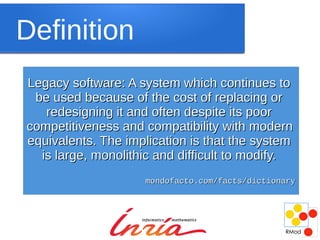
Legacy software: A system which continues to
 be used because of the cost of replacing or
   redesigning it and often despite its poor
competitiveness and compatibility with modern
equivalents. The implication is that the system
  is large, monolithic and difficult to modify.
                    mondofacto.com/facts/dictionary
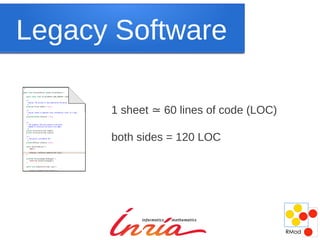
Legacy Software

      1 sheet ≃ 60 lines of code (LOC)

      both sides = 120 LOC
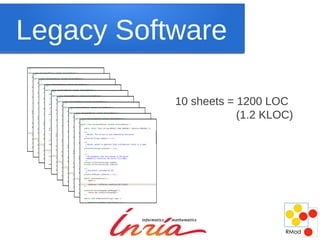
Legacy Software

           10 sheets = 1200 LOC
                       (1.2 KLOC)
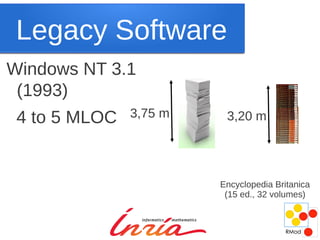
Legacy Software
Windows NT 3.1
 (1993)
 4 to 5 MLOC   3,75 m    3,20 m


                        Encyclopedia Britanica
                         (15 ed., 32 volumes)
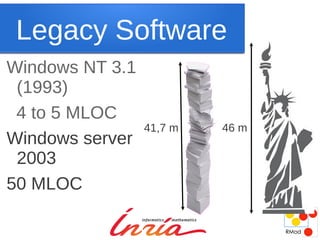
Legacy Software
Windows NT 3.1
 (1993)
 4 to 5 MLOC
                 41,7 m   46 m
Windows server
 2003
50 MLOC
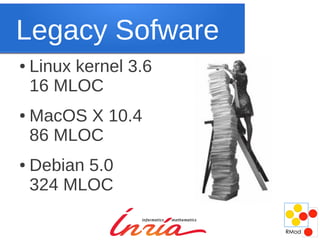
Legacy Sofware
●   Linux kernel 3.6
    16 MLOC
●   MacOS X 10.4
    86 MLOC
●   Debian 5.0
    324 MLOC
Relevance?
●   Estimations:
    –   120 billion LOC maintained in 1990
        (Ulrich, 1990)
    –   200 billion in 2000 (Sommerville, 2000)
Relevance?
●   Annual cost in USA > $70 billion
    (Sutherland, 1995; Edelstein,
    1993)
●   Nokia spent $90 million on Y2K
●   US government spent > $8 billion
Relevance?
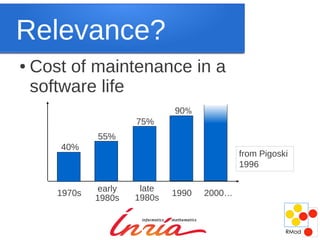
●   Cost of maintenance in a
    software life
                               90%
                       75%
               55%
       40%
                                              from Pigoski
                                              1996

               early    late
       1970s                   1990   2000…
               1980s   1980s
●
    Dominant activity in software
    engineering
●
    Yet, still poorly understood and
    despised
    –   Punishment, probation
    –   No career advancement
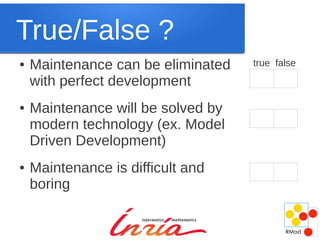
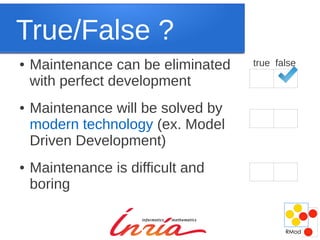
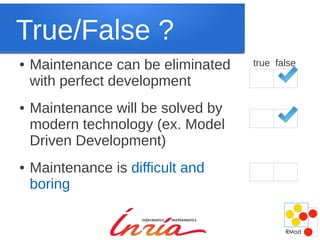
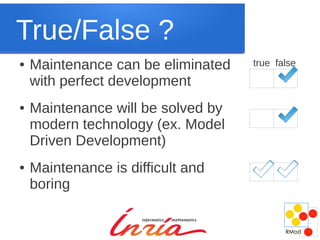
True/False ?
●   Maintenance can be eliminated   true false

    with perfect development
●   Maintenance will be solved by
    modern technology (ex. Model
    Driven Development)
●   Maintenance is difficult and
    boring
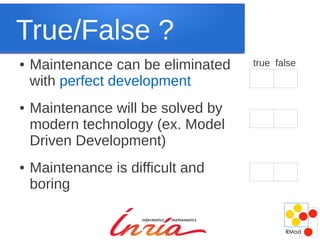
True/False ?
●   Maintenance can be eliminated   true false

    with perfect development
●   Maintenance will be solved by
    modern technology (ex. Model
    Driven Development)
●   Maintenance is difficult and
    boring
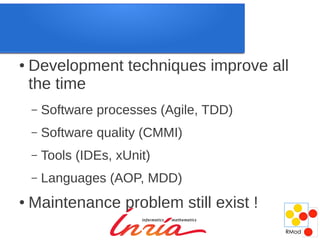
●   Development techniques improve all
    the time
    –   Software processes (Agile, TDD)
    –   Software quality (CMMI)
    –   Tools (IDEs, xUnit)
    –   Languages (AOP, MDD)
●   Maintenance problem still exist !
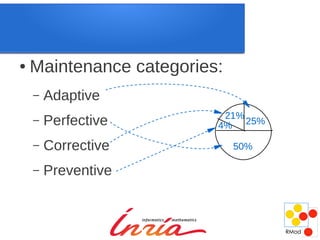
●   Maintenance categories:
    –   Adaptive
                           21%
    –   Perfective        4% 25%

    –   Corrective            50%

    –   Preventive
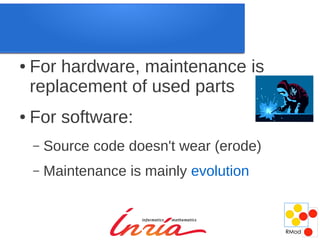
●   For hardware, maintenance is
    replacement of used parts
●   For software:
    –   Source code doesn't wear (erode)
    –   Maintenance is mainly evolution
Software systems must be
continually adapted or they become
  progressively less satisfactory
               First law of software evolution
                              [Lehman, 1974]
●   A system works within the real world
●   The world change:
    –   New business opportunities
    –   Growing user expectations
    –   New laws
    –   …
●   Software systems must evolve or
    die (not useful)
●   Maintenance is mainly due to
    external causes
●   Maintenance (evolution) is
    inevitable
●   Better (or perfect) software
    development cannot change that
Maintenance is a sign of success !
 The system is used and useful,
      the users want more
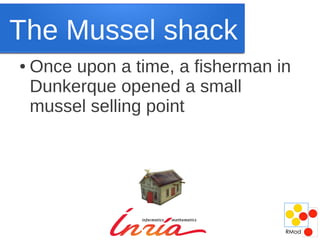
The Mussel shack
●   Once upon a time, a fisherman in
    Dunkerque opened a small
    mussel selling point
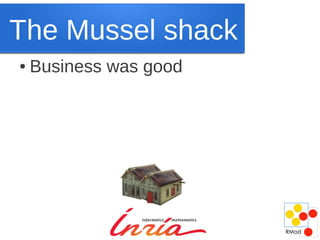
The Mussel shack
●   Business was good
The Mussel shack
●   Business was very good
The Mussel shack
●   Employees asked for a cafeteria
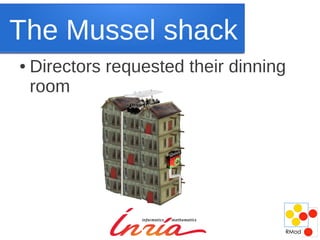
The Mussel shack
●   Directors requested their dinning
    room
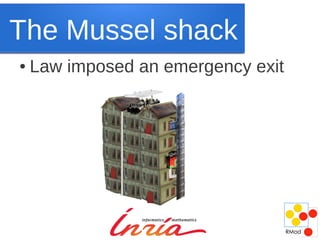
The Mussel shack
●   Law imposed an emergency exit
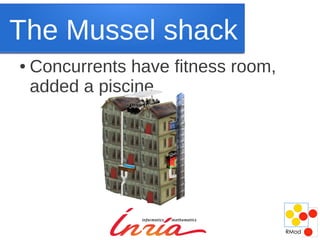
The Mussel shack
●   Concurrents have fitness room,
    added a piscine
The Mussel shack
●   and they lived happily ever after
    …
Moral

   The better the system, the more
       maintenance (evolution)
            it will require !
True/False ?
●   Maintenance can be eliminated   true false

    with perfect development
●   Maintenance will be solved by
    modern technology (ex. Model
    Driven Development)
●   Maintenance is difficult and
    boring
New techniques
●   Cobol > 60% of all code in the
    world [eWeeks, 2001]
●   180 GLOC in use, + 1GLOC/year
    [Gartner, 2006]
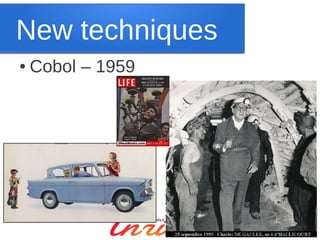
New techniques
●   Cobol – 1959
New techniques
●   New techniques do not target
    Cobol programs/programmers
    (We can safely ignore:
    –   Object Cobol
    –   Aspect Cobol)
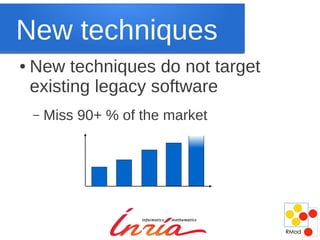
New techniques
●   New techniques do not target
    existing legacy software
    –   Miss 90+ % of the market
New techniques
●   New techniques (models) are still
    programs
    –   Programs are models of the world
●   They will need to be maintained
True/False ?
●   Maintenance can be eliminated   true false

    with perfect development
●   Maintenance will be solved by
    modern technology (ex. Model
    Driven Development)
●   Maintenance is difficult and
    boring
More difficult?
●   Intrinsically more difficult than
    development
    –   Information missing on existing system
    –   Must preserve some backward compatibility
        (existing data, user habits, …)
    –   More chaotic (reaction to external events)
    –   Less resources
    –   …
Boring?
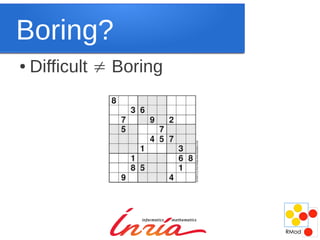
●   Difficult ≠ Boring
Boring?
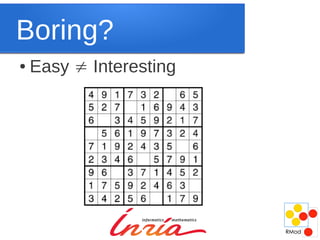
●   Easy ≠ Interesting
Boring?
●   The problem is cultural first
    –   Maintenance is not taught (implies it is
        not important?
    –   Computer science evolves fast (“newer
        is better”)
    –   Seen as punishment/probation
Boring?
●   Maintenance is difficult
●   Can be seen as an interesting
    challenge
●   A good way to learn many things
    (e.g. programming tricks)
Boring?
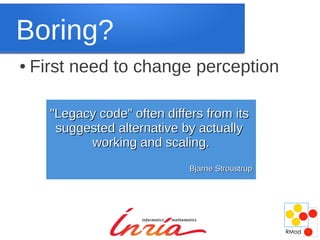
●   First need to change perception

      "Legacy code" often differs from its
       suggested alternative by actually
            working and scaling.
                               Bjarne Stroustrup
Boring?
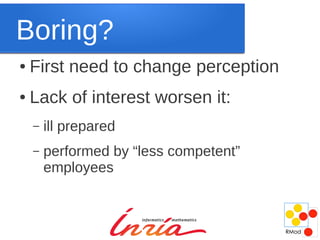
●   First need to change perception
●   Lack of interest worsen it:
    –   ill prepared
    –   performed by “less competent”
        employees
Boring?
●   First need to change perception
●   There is lots of money to make
    and interesting things to do in
    software evolution
True/False ?
●   Maintenance can be eliminated   true false

    with perfect development
●   Maintenance will be solved by
    modern technology (ex. Model
    Driven Development)
●   Maintenance is difficult and
    boring
Closing remarks
●   Software evolution is very
    important
●   Typically ill-perceived
●   There is an important cultural
    problem (misunderstanding)

Software evolution evangelisation

  • 1.
    Software Evolution Nicolas Anquetil RMod team rmod.lille.inria.fr
  • 2.
    Why this course? – Soft. Maint. is important – Soft. Maint. is poorly understood – Soft. Maint. is poorly performed
  • 3.
    Goals – You like maintenance – You understand ● Why it exists ● Why you did not like it ● Why you should like it
  • 4.
    What is it? Definition Software maintenance is the modification of a software product after delivery to correct faults, to improve performance or other attributes. ISO/IEC 14764:2006 Software Engineering — Software Life Cycle Processes — Maintenance
  • 5.
    Definition Legacy software: Asystem which continues to be used because of the cost of replacing or redesigning it and often despite its poor competitiveness and compatibility with modern equivalents. The implication is that the system is large, monolithic and difficult to modify. mondofacto.com/facts/dictionary
  • 6.
    Legacy Software 1 sheet ≃ 60 lines of code (LOC) both sides = 120 LOC
  • 7.
    Legacy Software 10 sheets = 1200 LOC (1.2 KLOC)
  • 8.
    Legacy Software Windows NT3.1 (1993) 4 to 5 MLOC 3,75 m 3,20 m Encyclopedia Britanica (15 ed., 32 volumes)
  • 9.
    Legacy Software Windows NT3.1 (1993) 4 to 5 MLOC 41,7 m 46 m Windows server 2003 50 MLOC
  • 10.
    Legacy Sofware ● Linux kernel 3.6 16 MLOC ● MacOS X 10.4 86 MLOC ● Debian 5.0 324 MLOC
  • 11.
    Relevance? ● Estimations: – 120 billion LOC maintained in 1990 (Ulrich, 1990) – 200 billion in 2000 (Sommerville, 2000)
  • 12.
    Relevance? ● Annual cost in USA > $70 billion (Sutherland, 1995; Edelstein, 1993) ● Nokia spent $90 million on Y2K ● US government spent > $8 billion
  • 13.
    Relevance? ● Cost of maintenance in a software life 90% 75% 55% 40% from Pigoski 1996 early late 1970s 1990 2000… 1980s 1980s
  • 14.
    Dominant activity in software engineering ● Yet, still poorly understood and despised – Punishment, probation – No career advancement
  • 15.
    True/False ? ● Maintenance can be eliminated true false with perfect development ● Maintenance will be solved by modern technology (ex. Model Driven Development) ● Maintenance is difficult and boring
  • 16.
    True/False ? ● Maintenance can be eliminated true false with perfect development ● Maintenance will be solved by modern technology (ex. Model Driven Development) ● Maintenance is difficult and boring
  • 17.
    Development techniques improve all the time – Software processes (Agile, TDD) – Software quality (CMMI) – Tools (IDEs, xUnit) – Languages (AOP, MDD) ● Maintenance problem still exist !
  • 18.
    Maintenance categories: – Adaptive 21% – Perfective 4% 25% – Corrective 50% – Preventive
  • 19.
    For hardware, maintenance is replacement of used parts ● For software: – Source code doesn't wear (erode) – Maintenance is mainly evolution
  • 20.
    Software systems mustbe continually adapted or they become progressively less satisfactory First law of software evolution [Lehman, 1974]
  • 21.
    A system works within the real world ● The world change: – New business opportunities – Growing user expectations – New laws – …
  • 22.
    Software systems must evolve or die (not useful) ● Maintenance is mainly due to external causes
  • 23.
    Maintenance (evolution) is inevitable ● Better (or perfect) software development cannot change that
  • 24.
    Maintenance is asign of success ! The system is used and useful, the users want more
  • 25.
    The Mussel shack ● Once upon a time, a fisherman in Dunkerque opened a small mussel selling point
  • 26.
    The Mussel shack ● Business was good
  • 27.
    The Mussel shack ● Business was very good
  • 28.
    The Mussel shack ● Employees asked for a cafeteria
  • 29.
    The Mussel shack ● Directors requested their dinning room
  • 30.
    The Mussel shack ● Law imposed an emergency exit
  • 31.
    The Mussel shack ● Concurrents have fitness room, added a piscine
  • 32.
    The Mussel shack ● and they lived happily ever after …
  • 33.
    Moral The better the system, the more maintenance (evolution) it will require !
  • 34.
    True/False ? ● Maintenance can be eliminated true false with perfect development ● Maintenance will be solved by modern technology (ex. Model Driven Development) ● Maintenance is difficult and boring
  • 35.
    New techniques ● Cobol > 60% of all code in the world [eWeeks, 2001] ● 180 GLOC in use, + 1GLOC/year [Gartner, 2006]
  • 36.
    New techniques ● Cobol – 1959
  • 37.
    New techniques ● New techniques do not target Cobol programs/programmers (We can safely ignore: – Object Cobol – Aspect Cobol)
  • 38.
    New techniques ● New techniques do not target existing legacy software – Miss 90+ % of the market
  • 39.
    New techniques ● New techniques (models) are still programs – Programs are models of the world ● They will need to be maintained
  • 40.
    True/False ? ● Maintenance can be eliminated true false with perfect development ● Maintenance will be solved by modern technology (ex. Model Driven Development) ● Maintenance is difficult and boring
  • 41.
    More difficult? ● Intrinsically more difficult than development – Information missing on existing system – Must preserve some backward compatibility (existing data, user habits, …) – More chaotic (reaction to external events) – Less resources – …
  • 42.
    Boring? ● Difficult ≠ Boring
  • 43.
    Boring? ● Easy ≠ Interesting
  • 44.
    Boring? ● The problem is cultural first – Maintenance is not taught (implies it is not important? – Computer science evolves fast (“newer is better”) – Seen as punishment/probation
  • 45.
    Boring? ● Maintenance is difficult ● Can be seen as an interesting challenge ● A good way to learn many things (e.g. programming tricks)
  • 46.
    Boring? ● First need to change perception "Legacy code" often differs from its suggested alternative by actually working and scaling. Bjarne Stroustrup
  • 47.
    Boring? ● First need to change perception ● Lack of interest worsen it: – ill prepared – performed by “less competent” employees
  • 48.
    Boring? ● First need to change perception ● There is lots of money to make and interesting things to do in software evolution
  • 49.
    True/False ? ● Maintenance can be eliminated true false with perfect development ● Maintenance will be solved by modern technology (ex. Model Driven Development) ● Maintenance is difficult and boring
  • 50.
  • 51.
    Software evolution is very important ● Typically ill-perceived ● There is an important cultural problem (misunderstanding)