OVERVIEW OF
RESEARCH PARTS
Thesis is part and parcel of the master’s and doctoral
program in almost every academic institution. In
some institutions, even the bachelor students are
expected to submit their brief report on project.
RECALLING THE PARTS OF A THESIS
•Preliminaries
•Body
•Back Matter
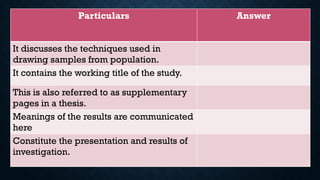
Particulars Answer
It discusses the techniques used in
drawing samples from population.
It contains the working title of the study.
This is also referred to as supplementary
pages in a thesis.
Meanings of the results are communicated
here
Constitute the presentation and results of
investigation.
COMMON COMPONENTS OF
THE THESIS
TITLE
• It should be clear, concise and specific
• It should denote the central ideas of your thesis
• It must imply what your argument will reveal about your topic.
• Abbreviations should be avoided in titles unless a scientific
community is better aware by its acronym Ideally, length should not
exceed twenty (20) words
ACKNOWLEDGEMENT
• Genuine technical, financial and educational contribution of
the academic institutions, technical experts, funding agencies,
facility providers and research aide should be acknowledged.
• Acknowledgement should not be confused with the
‘dedication’
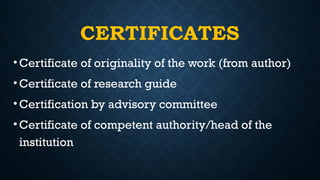
CERTIFICATES
•Certificate of originality of the work (from author)
•Certificate of research guide
•Certification by advisory committee
•Certificate of competent authority/head of the
institution
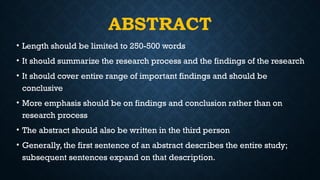
ABSTRACT
• Length should be limited to 250-500 words
• It should summarize the research process and the findings of the research
• It should cover entire range of important findings and should be
conclusive
• More emphasis should be on findings and conclusion rather than on
research process
• The abstract should also be written in the third person
• Generally, the first sentence of an abstract describes the entire study;
subsequent sentences expand on that description.
TABLE OF CONTENTS
• Enlist the entire list of headings and subheadings along with
the with their respective page numbers
• The table of contents may be followed by List of tables, List of
figures, List of illustrations, List of symbols and list of
abbreviations wherever necessary
INTRODUCTION
It should include brief details about:
 Research problem
 Problem statement
 Statement of purpose
 Rationale and significance
 Overview of methodology
 Expected outcomes
 Assumptions of the study
 Limitations of study
REVIEW OF LITERATURE
• Opening remarks should state the content and organization of the
literature reviewed as well as the strategy used in the literature search
• It should analyze and synthesize the relevant studies across discipline
and compare & contrast different research approaches, outcomes,
interpretations and conclusions
• Review the primary and secondary source that are recently published
empirical studies in scholarly journals and publications
• Use archival records if the nature of research demands for it; for
example case studies
•Content should be logically organized by
theme or subtopic, from broad to narrow
•Provides section summaries
•Describe the Conceptual framework at the
end of review of literature
METHODOLOGY
Introduction to the research problem:
 Rationale of research approach
 Define population and entail the sampling procedure
 Data collection methods
 Data analysis methods
 Limitations and delimitations
RESULTS AND DISCUSSION
• Findings should be presented in clear narrative form using
plentiful verbatim quotes, and detailed description
• Findings should be supported by the previous studies
• Deviants findings should be justified with alternative explanations
• Findings should be logically arranged in the form the research
proceeded
• Discussion part should provide an in-depth analysis of the
findings
SUMMARY AND CONCLUSION
This chapter reflects upon the findings of the study, interrelates the
findings if necessary and provides meaning to the entire set of
findings.
• Draw conclusions on research problem based on the findings of
the study
• Set the stage for the further study by describing what was outcome
of study and what further needs to be done for the advancement of
science
BIBLIOGRAPHY
•Enlists the citation for the reviewed literature, which
appears all along the entire content of the thesis.
•Citation should be written in the format prescribed
by the university/institution.
•Citation should appear in alphabetical order.
VITAE
•Briefs the authors information,
educational background, area of
expertise, contact information etc.
REFERENCES
Almeida, A.B., Gaerlan, A.A. and Manly,N.E.(2016).Research
Fundamentals: From Concepts to Output.Adriana Publishing
Co.,Inc.Quezon City
Patil,S. and Aditya (2020).Research Methodology in Social
Sciences.New India Publishing Agency.New Delhi.(retrieved
from SLSU Library-EBSCOHOST on September 18,2024)

Lecture-1-EDUC503-GSC303 (1) presentation.pptx

  • 1.
  • 2.
    Thesis is partand parcel of the master’s and doctoral program in almost every academic institution. In some institutions, even the bachelor students are expected to submit their brief report on project.
  • 3.
    RECALLING THE PARTSOF A THESIS •Preliminaries •Body •Back Matter
  • 4.
    Particulars Answer It discussesthe techniques used in drawing samples from population. It contains the working title of the study. This is also referred to as supplementary pages in a thesis. Meanings of the results are communicated here Constitute the presentation and results of investigation.
  • 5.
  • 6.
    TITLE • It shouldbe clear, concise and specific • It should denote the central ideas of your thesis • It must imply what your argument will reveal about your topic. • Abbreviations should be avoided in titles unless a scientific community is better aware by its acronym Ideally, length should not exceed twenty (20) words
  • 7.
    ACKNOWLEDGEMENT • Genuine technical,financial and educational contribution of the academic institutions, technical experts, funding agencies, facility providers and research aide should be acknowledged. • Acknowledgement should not be confused with the ‘dedication’
  • 8.
    CERTIFICATES •Certificate of originalityof the work (from author) •Certificate of research guide •Certification by advisory committee •Certificate of competent authority/head of the institution
  • 9.
    ABSTRACT • Length shouldbe limited to 250-500 words • It should summarize the research process and the findings of the research • It should cover entire range of important findings and should be conclusive • More emphasis should be on findings and conclusion rather than on research process • The abstract should also be written in the third person • Generally, the first sentence of an abstract describes the entire study; subsequent sentences expand on that description.
  • 10.
    TABLE OF CONTENTS •Enlist the entire list of headings and subheadings along with the with their respective page numbers • The table of contents may be followed by List of tables, List of figures, List of illustrations, List of symbols and list of abbreviations wherever necessary
  • 11.
    INTRODUCTION It should includebrief details about:  Research problem  Problem statement  Statement of purpose  Rationale and significance  Overview of methodology  Expected outcomes  Assumptions of the study  Limitations of study
  • 12.
    REVIEW OF LITERATURE •Opening remarks should state the content and organization of the literature reviewed as well as the strategy used in the literature search • It should analyze and synthesize the relevant studies across discipline and compare & contrast different research approaches, outcomes, interpretations and conclusions • Review the primary and secondary source that are recently published empirical studies in scholarly journals and publications • Use archival records if the nature of research demands for it; for example case studies
  • 13.
    •Content should belogically organized by theme or subtopic, from broad to narrow •Provides section summaries •Describe the Conceptual framework at the end of review of literature
  • 14.
    METHODOLOGY Introduction to theresearch problem:  Rationale of research approach  Define population and entail the sampling procedure  Data collection methods  Data analysis methods  Limitations and delimitations
  • 15.
    RESULTS AND DISCUSSION •Findings should be presented in clear narrative form using plentiful verbatim quotes, and detailed description • Findings should be supported by the previous studies • Deviants findings should be justified with alternative explanations • Findings should be logically arranged in the form the research proceeded • Discussion part should provide an in-depth analysis of the findings
  • 16.
    SUMMARY AND CONCLUSION Thischapter reflects upon the findings of the study, interrelates the findings if necessary and provides meaning to the entire set of findings. • Draw conclusions on research problem based on the findings of the study • Set the stage for the further study by describing what was outcome of study and what further needs to be done for the advancement of science
  • 17.
    BIBLIOGRAPHY •Enlists the citationfor the reviewed literature, which appears all along the entire content of the thesis. •Citation should be written in the format prescribed by the university/institution. •Citation should appear in alphabetical order.
  • 18.
    VITAE •Briefs the authorsinformation, educational background, area of expertise, contact information etc.
  • 19.
    REFERENCES Almeida, A.B., Gaerlan,A.A. and Manly,N.E.(2016).Research Fundamentals: From Concepts to Output.Adriana Publishing Co.,Inc.Quezon City Patil,S. and Aditya (2020).Research Methodology in Social Sciences.New India Publishing Agency.New Delhi.(retrieved from SLSU Library-EBSCOHOST on September 18,2024)