SEASONAL EVOLUTION OF HYDROLOGIC CONNECTIVITY
IN A TILE-DRAINED AGRICULTURAL CATCHMENT:
AN ENVIRONMENTAL TRACER STUDY
By:
Bryan Donaldson
Purpose of Study
Site Description
• Location: Cook Agronomy Farm (CAF) is
approximately 8 km NE of Pullman, WA
• Extent: Tile-drained part of the CAF is
approximately 12 hectares (ha)
• Samples were collected at 12 piezometers and
11 lysimeters throughout the site.
• Discharge samples were collected at a tile
drain on site.
Site Map
Cross-section
Study Goals
• Evaluate how groundwater composition
evolves as the water year progresses and soil
saturation levels fluctuate,
• Determine the contributions of seasonal
precipitation and snow-melt, shallow soil
water, and deep soil water to tile drainage
• Understand vertical mixing processes of
shallow groundwater over the course of a
water year.
Hypotheses
• At the beginning of the water year the deep
and shallow groundwater system should be
isolated from one another
• This isolation is due to the loss of
interconnection of flow paths while wetting
up of the soil profile is taking place.
Hypotheses
• The values of δ18O in the shallow groundwater
early in the season should be reflective of
“new water” from depleted events early in the
winter season.
• The values for δ18O in the deeper system are
more reflective an averaging effect of winter
precipitation and snow, as it is being
recharged by these waters once the soil
profile is wetted up.
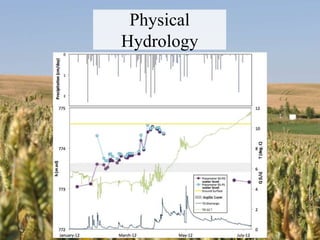
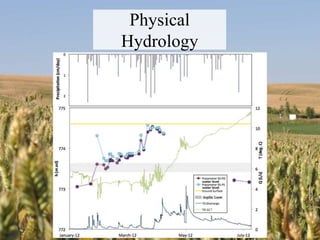
Physical
Hydrology
Stable Isotopes
Stable Isotopes
Electrical
Conductivity
Low-Flow
Season
Early High-flow
Season
Late High-flow
Season
Physical
Hydrology
Findings
• Primary source of water at tile drain discharge
appears to be from the deep water system.
• Water hydrogeochemistry values converge in
the deep, shallow and TD-12 outlet as the
high-flow season progresses.
• Tile drain δ18O, EC, and Temperature all
appear to react rapidly to large melt-water
and precipitation events. Macro-pore flow?
Rapid response to melt water events
Special Thanks
Thanks to the field crew that
Helped make this happen including
Christopher Kelley, Erin Brooks,
Todd Anderson, William Payne,
Ryan Boylan, and Rebecca Martin
Special Thanks
My Wife Christy Donaldson

Thesis Presentation

  • 1.
    SEASONAL EVOLUTION OFHYDROLOGIC CONNECTIVITY IN A TILE-DRAINED AGRICULTURAL CATCHMENT: AN ENVIRONMENTAL TRACER STUDY By: Bryan Donaldson
  • 2.
  • 3.
    Site Description • Location:Cook Agronomy Farm (CAF) is approximately 8 km NE of Pullman, WA • Extent: Tile-drained part of the CAF is approximately 12 hectares (ha) • Samples were collected at 12 piezometers and 11 lysimeters throughout the site. • Discharge samples were collected at a tile drain on site.
  • 4.
  • 5.
  • 6.
    Study Goals • Evaluatehow groundwater composition evolves as the water year progresses and soil saturation levels fluctuate, • Determine the contributions of seasonal precipitation and snow-melt, shallow soil water, and deep soil water to tile drainage • Understand vertical mixing processes of shallow groundwater over the course of a water year.
  • 7.
    Hypotheses • At thebeginning of the water year the deep and shallow groundwater system should be isolated from one another • This isolation is due to the loss of interconnection of flow paths while wetting up of the soil profile is taking place.
  • 8.
    Hypotheses • The valuesof δ18O in the shallow groundwater early in the season should be reflective of “new water” from depleted events early in the winter season. • The values for δ18O in the deeper system are more reflective an averaging effect of winter precipitation and snow, as it is being recharged by these waters once the soil profile is wetted up.
  • 9.
  • 10.
  • 11.
  • 12.
  • 13.
  • 14.
  • 15.
  • 16.
  • 17.
    Findings • Primary sourceof water at tile drain discharge appears to be from the deep water system. • Water hydrogeochemistry values converge in the deep, shallow and TD-12 outlet as the high-flow season progresses. • Tile drain δ18O, EC, and Temperature all appear to react rapidly to large melt-water and precipitation events. Macro-pore flow?
  • 18.
    Rapid response tomelt water events
  • 19.
    Special Thanks Thanks tothe field crew that Helped make this happen including Christopher Kelley, Erin Brooks, Todd Anderson, William Payne, Ryan Boylan, and Rebecca Martin
  • 20.
    Special Thanks My WifeChristy Donaldson