Answer Selection and Validation for 
Arabic Questions 
Ahmed Magdy Ezzeldin, Yasser El-Sonbaty, Mohamed Hamed Kholief 
College of Computing and Information Technology, AASTMT 
Alexandria, Egypt
Outline 
● Arabic QA and its significance 
● QA pipeline 
● Importance of answer selection to QA 
● QA4MRE (Question Answering for Machine Reading Evaluation) 
● Motivation 
● Objectives 
● Test-set & Evaluation metrics 
● Related Works 
● Tools and resources 
● ALQASIM 1.0 
● ALQASIM 2.0 
● Evaluation and discussion 
● Future work
Arabic QA and its significance 
● Question Answering (QA) : automatically 
providing an answer for a question posed by a 
human in a natural language 
● Significance of Arabic QA 
– Arabic has more than 350 million native speakers 
– A lot of Arabic content on the Internet 
– High need for fast precise information 
– IR based approaches do not satisfy this need
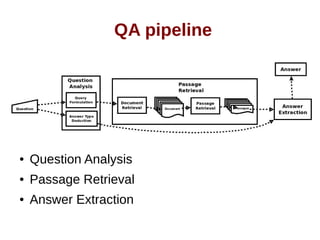
QA pipeline 
● Question Analysis 
● Passage Retrieval 
● Answer Extraction
Importance of Answer Selection to QA 
● Error propagation in QA pipeline makes 
systems hit an upper bound of 60% 
● Most QA systems provide 5 answer choices 
for each question and most of the time the 
answer is not in the first choice 
● Systems should be certain about the questions 
they answer
QA4MRE 
● Question Answering for Machine Reading Evaluation 
● Skips the answer generation tasks of QA (Passage 
Retrieval) 
● Focuses only on the answer selection and 
validation subtasks 
● A typical QA4MRE system chooses 1 answer form 5 
choices supported with 1 document that contains 
the answer 
● QA4MRE is used interchangeably with Answer 
Selection and Validation
Motivation 
● Create an efficient answer selection and 
validation module to: 
– Improve the performance of any Arabic QA 
system 
– Reduce the effect of error that propagates 
through the QA pipeline by selecting the correct 
answers only 
– Enhance the certainty of Arabic QA systems
Objectives 
● Mimic the human behavior by analyzing the 
reading test document instead of just 
analyzing the question 
● Apply syntactic & semantic analysis and 
expansion to the reading test document and 
the question 
● Make use of background knowledge to gain 
more contextual knowledge about the test 
document and question keywords
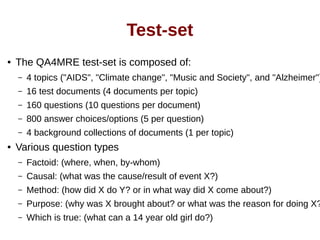
Test-set 
● The QA4MRE test-set is composed of: 
– 4 topics ("AIDS", "Climate change", "Music and Society", and "Alzheimer") 
– 16 test documents (4 documents per topic) 
– 160 questions (10 questions per document) 
– 800 answer choices/options (5 per question) 
– 4 background collections of documents (1 per topic) 
● Various question types 
– Factoid: (where, when, by-whom) 
– Causal: (what was the cause/result of event X?) 
– Method: (how did X do Y? or in what way did X come about?) 
– Purpose: (why was X brought about? or what was the reason for doing X?) 
– Which is true: (what can a 14 year old girl do?)
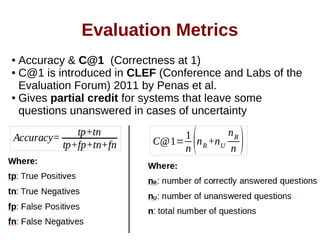
Evaluation Metrics 
● Accuracy & C@1 (Correctness at 1) 
● C@1 is introduced in CLEF (Conference and Labs of the 
Evaluation Forum) 2011 by Penas et al. 
● Gives partial credit for systems that leave some 
questions unanswered in cases of uncertainty
Related Works 
● The 2 Arabic QA4MRE systems in CLEF 2012 
- Trigui et al. 2012 
- Abouenour et al. 2012 (IDRAAQ) 
● Best performing QA4MRE system on the same 
test-set uses the English test-set 
- Bhaskar et al. 2012 (English QA4MRE)
Related Works [continued] 
● Abouenour et al. 2012 (IDRAAQ) 
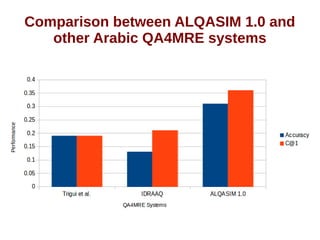
– Accuracy : 0.13 
– C@1 : 0.21 
● Used JIRS (Java Information Retrieval System) for 
passage retrieval (Distance Density N-gram Model) 
● Semantic expansion using Arabic WordNet (AWN) 
● Did not use the CLEF background collections
Related Works [continued] 
● Trigui et al. 2012: 
– Accuracy : 0.19 
– C@1 : 0.19 
● Has not marked any questions as unanswered 
● Retrieves the passages that have the question keywords and 
aligns them with the answer choices 
● Finds the best answer choice in the retrieved passages 
● Expands the answer choices that could not be found in the 
retrieved passages using some inference rules on the 
background collection 
● Depends on the background collection as it offers enough 
redundancy for the passage retrieval module
Related Works [continued] 
● Bhaskar et al. 2012 (on the English test-set) 
– Accuracy : 0.53 
– C@1 : 0.65 
● Combines each answer choice with the question in 
a hypothesis 
● Searches for the hypothesis keywords in the 
document 
● Uses textual entailment to rank the retrieved 
passages
Related Works [continued] 
● The 2 Arabic QA4MRE systems 
– Use the typical QA pipeline that depend mainly on 
passage retrieval 
– Do not analyze the reading test document 
● The English system (Bhaskar et al.) 
– Analyzes the reading test document 
– Uses many English specific NLP tools that are not 
found in Arabic (at least in the public domain) like: 
● semantic parsing 
● semantic role labeling 
● dependency analysis
●Tools and resources 
● MADA+TOKAN (Morphological Analyzer) 
– PoS tags, gender, number & light stem 
● Arabic WordNet (AWN) 
– Semantic expansion by (synonyms) 
● Root Stemmers 
– Khoja 
– ISRI 
– Tashaphyne
ALQASIM 1.0 
● Ezzeldin, A. M., Kholief, M. H., & El-Sonbaty, Y. 
(September 2013). ALQASIM: Arabic language 
question answer selection in machines. In 
Information Access Evaluation. Multilinguality, 
Multimodality, and Visualization (pp. 100-103). 
Springer Berlin Heidelberg.
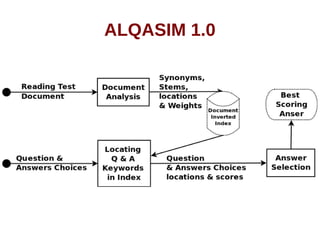
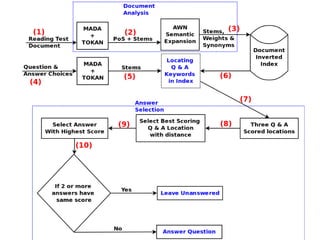
ALQASIM 1.0
Comparison between ALQASIM 1.0 and 
other Arabic QA4MRE systems
ALQASIM 1.0 Pros & Cons 
● Pros 
- Analyzing the reading test document provides a 
better context for the morphological analyzer 
- Distance between the keywords and between 
Q & A found snippets. 
- Weights according to PoS tags 
● Cons 
- Does not consider the natural boundary of 
sentences 
- Prefer distance over keyword weights 
- Has many manually adjusted weights and 
thresholds that may make the system over-fit for 
the test-set.
ALQASIM 1.0 Pros & Cons [continued] 
● ALQASIM 1.0 could not identify the question snippet 
because its keywords are a bit far from each other.
ALQASIM 2.0 
● Ezzeldin, A. M., El-Sonbaty, Y., & Kholief, M. H. 
(October 2014). Exploring the Effects of Root 
Expansion, Sentence Splitting and Ontology 
on Arabic Answer Selection. In Proceedings of 
the 11th International Workshop on Natural 
Language Processing and Cognitive Science 
(NLPCS 2014), Venice, Italy.
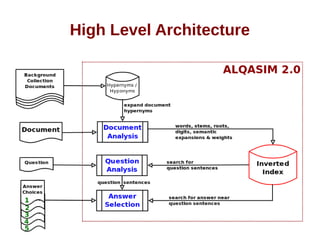
High Level Architecture
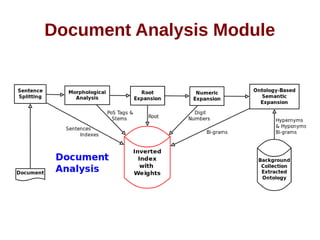
Document Analysis Module
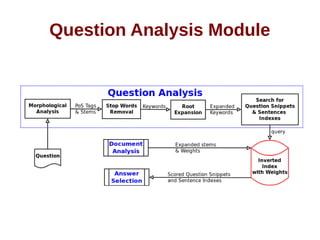
Question Analysis Module
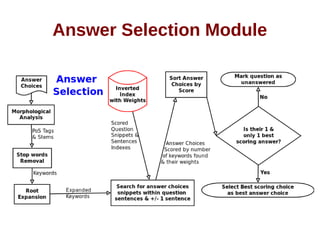
Answer Selection Module
ALQASIM 2.0 [continued] 
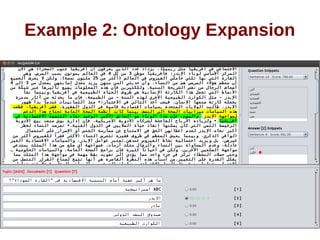
A basic ontology of hypernyms and their hyponyms 
generated automatically from the background 
collection
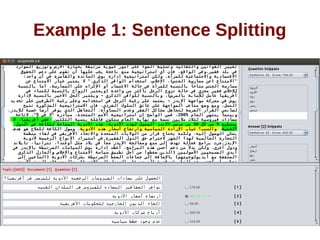
Example 1: Sentence Splitting
Example 2: Ontology Expansion
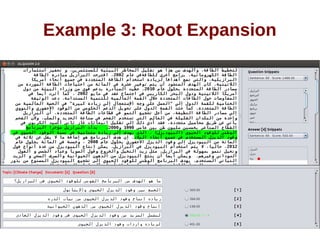
Example 3: Root Expansion
Evaluation 
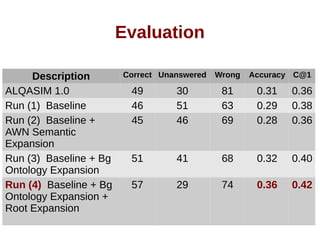
Description Correct Unanswered Wrong Accuracy C@1 
ALQASIM 1.0 49 30 81 0.31 0.36 
Run (1) Baseline 46 51 63 0.29 0.38 
Run (2) Baseline + 
45 46 69 0.28 0.36 
AWN Semantic 
Expansion 
Run (3) Baseline + Bg 
Ontology Expansion 
51 41 68 0.32 0.40 
Run (4) Baseline + Bg 
Ontology Expansion + 
Root Expansion 
57 29 74 0.36 0.42
Evaluation [continued]
Evaluation [continued] 
Root Stemmer Accuracy C@1 
ALQASIM 2.0 without root expansion 0.32 0.4 
ISRI 0.36 0.42 
Khoja 0.32 0.4 
Tashaphyne 0.31 0.36
Discussion 
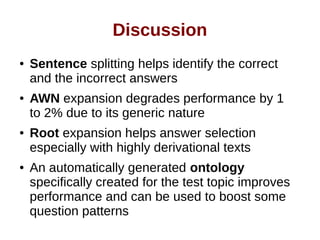
● Sentence splitting helps identify the correct 
and the incorrect answers 
● AWN expansion degrades performance by 1 
to 2% due to its generic nature 
● Root expansion helps answer selection 
especially with highly derivational texts 
● An automatically generated ontology 
specifically created for the test topic improves 
performance and can be used to boost some 
question patterns
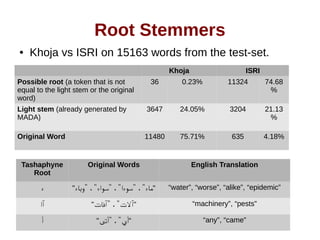
Root Stemmers 
● Khoja vs ISRI on 15163 words from the test-set. 
Khoja ISRI 
Possible root (a token that is not 
equal to the light stem or the original 
word) 
36 0.23% 11324 74.68 
% 
Light stem (already generated by 
MADA) 
3647 24.05% 3204 21.13 
% 
Original Word 11480 75.71% 635 4.18% 
Tashaphyne 
Root 
Original Words English Translation 
ماء" ، "سوءا" ، "سواء" ، "وباء" ء " “water”, “worse”, “alike”, “epidemic” 
آلت" ، "آفات" آا " “machinery”, “pests” 
أي" ، "أتى" أ " “any”, “came”
Future Work 
● Automatically building better ontologies 
● Anaphora resolution 
● Semantic parsing and semantic role labeling 
● Applying Arabic specific rule-based 
techniques
Published Papers 
● Ezzeldin, A. M., Kholief, M. H., & El-Sonbaty, Y. (September 2013). 
ALQASIM: Arabic language question answer selection in machines. In 
Information Access Evaluation. Multilinguality, Multimodality, and 
Visualization (pp. 100-103). Springer Berlin Heidelberg. 
● Ezzeldin, A. M., El-Sonbaty, Y., & Kholief, M. H. (October 2014). 
Exploring the Effects of Root Expansion, Sentence Splitting and 
Ontology on Arabic Answer Selection. In Proceedings of the 11th 
International Workshop on Natural Language Processing and Cognitive 
Science (NLPCS 2014), Venice, Italy.

Answer Selection and Validation for Arabic Questions

  • 1.
    Answer Selection andValidation for Arabic Questions Ahmed Magdy Ezzeldin, Yasser El-Sonbaty, Mohamed Hamed Kholief College of Computing and Information Technology, AASTMT Alexandria, Egypt
  • 2.
    Outline ● ArabicQA and its significance ● QA pipeline ● Importance of answer selection to QA ● QA4MRE (Question Answering for Machine Reading Evaluation) ● Motivation ● Objectives ● Test-set & Evaluation metrics ● Related Works ● Tools and resources ● ALQASIM 1.0 ● ALQASIM 2.0 ● Evaluation and discussion ● Future work
  • 3.
    Arabic QA andits significance ● Question Answering (QA) : automatically providing an answer for a question posed by a human in a natural language ● Significance of Arabic QA – Arabic has more than 350 million native speakers – A lot of Arabic content on the Internet – High need for fast precise information – IR based approaches do not satisfy this need
  • 4.
    QA pipeline ●Question Analysis ● Passage Retrieval ● Answer Extraction
  • 5.
    Importance of AnswerSelection to QA ● Error propagation in QA pipeline makes systems hit an upper bound of 60% ● Most QA systems provide 5 answer choices for each question and most of the time the answer is not in the first choice ● Systems should be certain about the questions they answer
  • 6.
    QA4MRE ● QuestionAnswering for Machine Reading Evaluation ● Skips the answer generation tasks of QA (Passage Retrieval) ● Focuses only on the answer selection and validation subtasks ● A typical QA4MRE system chooses 1 answer form 5 choices supported with 1 document that contains the answer ● QA4MRE is used interchangeably with Answer Selection and Validation
  • 7.
    Motivation ● Createan efficient answer selection and validation module to: – Improve the performance of any Arabic QA system – Reduce the effect of error that propagates through the QA pipeline by selecting the correct answers only – Enhance the certainty of Arabic QA systems
  • 8.
    Objectives ● Mimicthe human behavior by analyzing the reading test document instead of just analyzing the question ● Apply syntactic & semantic analysis and expansion to the reading test document and the question ● Make use of background knowledge to gain more contextual knowledge about the test document and question keywords
  • 9.
    Test-set ● TheQA4MRE test-set is composed of: – 4 topics ("AIDS", "Climate change", "Music and Society", and "Alzheimer") – 16 test documents (4 documents per topic) – 160 questions (10 questions per document) – 800 answer choices/options (5 per question) – 4 background collections of documents (1 per topic) ● Various question types – Factoid: (where, when, by-whom) – Causal: (what was the cause/result of event X?) – Method: (how did X do Y? or in what way did X come about?) – Purpose: (why was X brought about? or what was the reason for doing X?) – Which is true: (what can a 14 year old girl do?)
  • 10.
    Evaluation Metrics ●Accuracy & C@1 (Correctness at 1) ● C@1 is introduced in CLEF (Conference and Labs of the Evaluation Forum) 2011 by Penas et al. ● Gives partial credit for systems that leave some questions unanswered in cases of uncertainty
  • 11.
    Related Works ●The 2 Arabic QA4MRE systems in CLEF 2012 - Trigui et al. 2012 - Abouenour et al. 2012 (IDRAAQ) ● Best performing QA4MRE system on the same test-set uses the English test-set - Bhaskar et al. 2012 (English QA4MRE)
  • 12.
    Related Works [continued] ● Abouenour et al. 2012 (IDRAAQ) – Accuracy : 0.13 – C@1 : 0.21 ● Used JIRS (Java Information Retrieval System) for passage retrieval (Distance Density N-gram Model) ● Semantic expansion using Arabic WordNet (AWN) ● Did not use the CLEF background collections
  • 13.
    Related Works [continued] ● Trigui et al. 2012: – Accuracy : 0.19 – C@1 : 0.19 ● Has not marked any questions as unanswered ● Retrieves the passages that have the question keywords and aligns them with the answer choices ● Finds the best answer choice in the retrieved passages ● Expands the answer choices that could not be found in the retrieved passages using some inference rules on the background collection ● Depends on the background collection as it offers enough redundancy for the passage retrieval module
  • 14.
    Related Works [continued] ● Bhaskar et al. 2012 (on the English test-set) – Accuracy : 0.53 – C@1 : 0.65 ● Combines each answer choice with the question in a hypothesis ● Searches for the hypothesis keywords in the document ● Uses textual entailment to rank the retrieved passages
  • 15.
    Related Works [continued] ● The 2 Arabic QA4MRE systems – Use the typical QA pipeline that depend mainly on passage retrieval – Do not analyze the reading test document ● The English system (Bhaskar et al.) – Analyzes the reading test document – Uses many English specific NLP tools that are not found in Arabic (at least in the public domain) like: ● semantic parsing ● semantic role labeling ● dependency analysis
  • 16.
    ●Tools and resources ● MADA+TOKAN (Morphological Analyzer) – PoS tags, gender, number & light stem ● Arabic WordNet (AWN) – Semantic expansion by (synonyms) ● Root Stemmers – Khoja – ISRI – Tashaphyne
  • 17.
    ALQASIM 1.0 ●Ezzeldin, A. M., Kholief, M. H., & El-Sonbaty, Y. (September 2013). ALQASIM: Arabic language question answer selection in machines. In Information Access Evaluation. Multilinguality, Multimodality, and Visualization (pp. 100-103). Springer Berlin Heidelberg.
  • 18.
  • 20.
    Comparison between ALQASIM1.0 and other Arabic QA4MRE systems
  • 21.
    ALQASIM 1.0 Pros& Cons ● Pros - Analyzing the reading test document provides a better context for the morphological analyzer - Distance between the keywords and between Q & A found snippets. - Weights according to PoS tags ● Cons - Does not consider the natural boundary of sentences - Prefer distance over keyword weights - Has many manually adjusted weights and thresholds that may make the system over-fit for the test-set.
  • 22.
    ALQASIM 1.0 Pros& Cons [continued] ● ALQASIM 1.0 could not identify the question snippet because its keywords are a bit far from each other.
  • 23.
    ALQASIM 2.0 ●Ezzeldin, A. M., El-Sonbaty, Y., & Kholief, M. H. (October 2014). Exploring the Effects of Root Expansion, Sentence Splitting and Ontology on Arabic Answer Selection. In Proceedings of the 11th International Workshop on Natural Language Processing and Cognitive Science (NLPCS 2014), Venice, Italy.
  • 24.
  • 25.
  • 26.
  • 27.
  • 28.
    ALQASIM 2.0 [continued] A basic ontology of hypernyms and their hyponyms generated automatically from the background collection
  • 29.
  • 30.
  • 31.
    Example 3: RootExpansion
  • 32.
    Evaluation Description CorrectUnanswered Wrong Accuracy C@1 ALQASIM 1.0 49 30 81 0.31 0.36 Run (1) Baseline 46 51 63 0.29 0.38 Run (2) Baseline + 45 46 69 0.28 0.36 AWN Semantic Expansion Run (3) Baseline + Bg Ontology Expansion 51 41 68 0.32 0.40 Run (4) Baseline + Bg Ontology Expansion + Root Expansion 57 29 74 0.36 0.42
  • 33.
  • 34.
    Evaluation [continued] RootStemmer Accuracy C@1 ALQASIM 2.0 without root expansion 0.32 0.4 ISRI 0.36 0.42 Khoja 0.32 0.4 Tashaphyne 0.31 0.36
  • 35.
    Discussion ● Sentencesplitting helps identify the correct and the incorrect answers ● AWN expansion degrades performance by 1 to 2% due to its generic nature ● Root expansion helps answer selection especially with highly derivational texts ● An automatically generated ontology specifically created for the test topic improves performance and can be used to boost some question patterns
  • 36.
    Root Stemmers ●Khoja vs ISRI on 15163 words from the test-set. Khoja ISRI Possible root (a token that is not equal to the light stem or the original word) 36 0.23% 11324 74.68 % Light stem (already generated by MADA) 3647 24.05% 3204 21.13 % Original Word 11480 75.71% 635 4.18% Tashaphyne Root Original Words English Translation ماء" ، "سوءا" ، "سواء" ، "وباء" ء " “water”, “worse”, “alike”, “epidemic” آلت" ، "آفات" آا " “machinery”, “pests” أي" ، "أتى" أ " “any”, “came”
  • 37.
    Future Work ●Automatically building better ontologies ● Anaphora resolution ● Semantic parsing and semantic role labeling ● Applying Arabic specific rule-based techniques
  • 38.
    Published Papers ●Ezzeldin, A. M., Kholief, M. H., & El-Sonbaty, Y. (September 2013). ALQASIM: Arabic language question answer selection in machines. In Information Access Evaluation. Multilinguality, Multimodality, and Visualization (pp. 100-103). Springer Berlin Heidelberg. ● Ezzeldin, A. M., El-Sonbaty, Y., & Kholief, M. H. (October 2014). Exploring the Effects of Root Expansion, Sentence Splitting and Ontology on Arabic Answer Selection. In Proceedings of the 11th International Workshop on Natural Language Processing and Cognitive Science (NLPCS 2014), Venice, Italy.