Project Oriented Dissertation
ON
FACIES CHARACTERIZATION OF CLASTIC RESERVOIR OF LOWER GORU
AND PARIWAR FORMATIONS, JAISALMER BASIN, RAJASTHAN, INDIA
AT
KDMIPE, ONGC, Dehradun
Submitted for partial fulfillment of the requirement for the degree of
MASTER OF SCIENCE
IN
PETROLEUM GEOSCIENCES
Under The Supervisions of
Shri.H.Upadhyay Prof. M.P.Singh
GM (GEOLOGY) & Support Manager Department of Geology
KDMIPE BHU, Varanasi
ONGC, DEHRADUN
Submitted By
SAMIUR RAHMAN KHAN
M.Sc. PTROLEUM GEOSCIENCES
Semester –IVth
BHU, Varanasi
Session: 2011-2012
DEPARTMENT OF GEOLOGY
CENTER OF ADVANCED STUDY
FACULTY OF SCIENCE
BANARAS HINDU UNIVERSITY
VARANASI-221005
Enrollment No.-321581 Roll No.-10479SC003
Date: 2nd
, July, 2012
i
CERTIFICATE
I hereby declare that the work which is being presented in this thesis entitled
“Facies Characterization Of Clastic Reservoir Of Lower Goru And
Pariwar Formations, Jaisalmer Basin, Rajasthan, India” was carried out
in Sedimentology Division, KDMIPE , ONGC, DEHRADUN.
This dissertation is submitted for partial fulfillment of the requirement for the
award of degree of Master of Science in Petroleum Geosciences.
The work in this report was carried out by me under the supervision of Shri
H.Upadhyay, GM (GEOLOGY) at KDMIPE, ONGC, DEHRADUN.
Date: 2nd
July, 2012 Samiur Rahman Khan
Place: Dehradun M.Sc. (Petroleum Geosciences)
BHU, Varanasi
This is to certify that the above statements made by the candidate are correct to
the best of my knowledge and believe.
Supervisor
Shri H. Upadhyay
GM (Geology).
KDMIPE, ONGC
Dehradun
ii
Department of Geology
(Centre of Advanced Study)
Banaras Hindu University
Varanasi – 221 005
Certificate
This is to certify that Mr. Samiur Rahman Khan has completed his project
oriented dissertation as a compulsory activity in the course of completing his
Master of Science degree in Petroleum Geosciences under my supervision. His
dissertation work entitled as “Facies Characterization of Clastic Reservoir
of Lower Goru and Pariwar Formations, Jaisalmer Basin, Rajasthan,
India” embodies the result of the work carried out during the period of
dissertation. His work was carefully reviewed and corrected and thus he is
entitled to submit his work in partial fulfillment for the award of the concerned
degree for the session 2010-2012.
I wish him best of fortune in his career and a fruitful life.
Prof. M.P. Singh
Supervisor
iii
ACKNOWLEDGMENT
To carry out project in KDMIPE, ONGC, DEHRADUN is one of the biggest achievements for me to
which I am extremely thankful to the organization & heartfelt gratitude to Shri P.K. Bhowmick,
ED-HOI, KDMIPE for allowing at that time to complete my project in India’s one of the largest oil and
gas producing company.
It is a matter of great pleasure for me to offer my sincere gratitude and thanks to my supervisors
Shri H.Upadhyay, GM (Geology), KDMIPE, ONGC Dehradun & Prof. M. P. Singh, Department of
Geology, BHU, Varanasi, for his guidance, untiring cooperation, supervision and help that was rendered
to me not only for this manuscript but also for all that I gained from him during the entire period of my
dissertation.
I would like to express my sincere thanks to Prof. H.B.Srivastava, Head of Department,
Prof. A. K. Jaitly, course co-coordinator (Petroleum Geosciences) & Prof. Jokhan Ram, KD
Malaviya Chair ONGC, Department of Geology, Banaras Hindu University, which has provided
opportunity to work in KDMIPE, a Premier Institute of ONGC.
I would also express special thanks to Dr.G.D.Gupta DGM,(Geol.) Head sedimentology
division, Shri Madan Mohan DGM,(Geol.) sedimentology division, Shri Yashpal,Ssenior Geologist
(SEM lab.), Shri L.M.Pandey, Senior Geologist(core lib), Shri J. Nanda(Geologist), Shri Jagdish
Arya(Geologist), Shri Sandeep Verma(Geologist) and all the executive members of sedimentology
division for their support in completion of my work by providing the schedule for my training for his
help and concern in every aspect of my work.
Last but not the least I would like to thanks, S. S. Tomar (Technical Assistant, XRD Lab.), all
the staff members of sedimentology division & colleagues for their great support in completion of the
dissertation and all those who have directly or indirectly helped me in this endeavor.
SAMIUR RAHMAN KHAN
BHU, VARANASI
iv
Table of Contents
Topic Page No.
(1) Literature survey 1-34
1.1- Introduction 2-3
1.2- Evolution & Structural style of the Jaisalmer Basin 4-10
1.3- Litho-stratigraphy of Jaisalmer Basin 11-15
1.4- Study Area 16-19
1.5- Methodology and Objectives 20-34
(2)Study of Conventional Core 36-78
2.1- Megascopic Study and Preparation Of Core Log 36-52
2.2- Identification of cyclicity
&
Interpretation of Depositional Environment
53
2.3- Selection of Samples for Various Studies
2.3.1- Petrography
2.3.2- XRD
2.3.3- SEM
54-56
2.4-Petrographic analysis 57-66
2.5-X-ray Diffraction analysis 67-73
2.6-Scanning Electron Microscopy 74-78
(3) Petroleum System Analysis 79-82
(4) Conclusions 83-84
(5) References 85
v
List of Figures
Fig. No.
Particular
Page No.
1.1
Paleo-tectonic reconstruction of the Madagascar-Seychelles – India during the Mesozoic
4
1.2 Tectonics Zones Map of Western Rajasthan Basin 5
1.3 Three Depressions of Jaisalmer Sub-basin 6
1.4 Stratigraphy of the Barmer, Bikaner-Nagaur and Jaisalmer Basins 7
1.5 New Discoveries in Barmer-Sanchor Basin 10
1.6 The sandstone shows cross-bedding feature 17
1.7 Showing various grades of sphericity & roundness
23
1.8 Showing five degree of sorting
24
1.9 Procedure Steps in Scanning electron
33
2.1 Core showing glauconite and brachiopod shell.
38
2.2 Core Showing reaction with HCL10%
39
2.3 Finer clastics present within the sandstone showing flaser bedding
40
2.4 Core showing alternation of shale and sandstone
43
2..5 Point of the pencil showing X-beds
44
2.6 Core showing erosional contact
45
2.7 Core showing alternation of sand and shale
47
2.8 Core showing high iron content 50
2.9 to 2.26 Photographs of thin sections of Well Rajasthan-A (CC-1 ,CC-2, CC-3, CC-4) 57 to 66
2.27 to 2.32 Measurement Profile for clay mineral &Bulk sample Analysis(XRD analysis peaks) 67 to73
2.33 to 2.42 Scanning Electron Microscopy(SEM) photographs 74to 78
vi
List of Tables
Table
Particular
Page No.
1.1
Relationship between sedimentry process and response
3
1.2 Generalized stratigraphy of Jaisalmer basin(After Mishra et al.1993) 15
1.3 Went-worth scale of Grain size 22
2.1 Details of Conventional Cores 37
2.2 Core Log of cc-1(RJ-A) 42
2.3 Core Log of cc-2(RJ-A) 46
2.4 Core Log of cc-3(RJ-A)
49
2.5 Core Log of cc-4(RJ-A)
51
2.6 Core Log of cc-4(RJ-B)
52
2.7 Details of Thin Section
54
2.8
Details of sample for X-ray diffraction 55
2.9
Details of sample for SEM analysis 56
1 | P a g e
CHAPTER-1
LITERATURE
SURVEY
2 | P a g e
1.1-INTRODUCTION
As a part of partial fulfillment of M Sc. Petroleum Geosciences, a project work has been carried
out in KDMIPE ,ONGC, DEHRADUN for 6 months from January to June 2012. The topic
of the project is “Facies Characterization of Lower Goru and Pariwar formations, Jaisalmer
Basin, Rajasthan,India”. The facies Characterization of reservoir is quite complex subject. It is
essential for Geologist to understand these processes for better characterization. A sedimentary
facies is a stratigraphic unit characterized by distinctive physical, chemical and biological
attributes owing to deposition in a particular environment. The physical characteristics include
colour, texture, lithology and sedimentary structures, chemical attributes include the
mineralogical composition of the rock body, major elements, trace elements, composition of
cementing material, and even the isotopic composition. The biological characteristics basically
deal with the paleontological aspect, both body and trace fossils including plant remains.
Following are some of the definitions of the facies given by different workers.
Facies(Bates and Jackson,1987): The aspect, appearance, and characteristics of a rock
unit,usually reflecting the conditions of its origin ;esp. as differentiating the unit from adjacent
or associated units.
Facies(Walker, 1992): A particular combination of lithology, structural and textural attributes
that defines features different from other rock bodies.
Facies characterization is embraced by sedimentologist world over as the most dependable
methodology to unravel paleogeography or past depositional scenario. It is a fundamental
sedimentological method of characterizing bodies of rocks with unique lithological, physical
and biological attributes relative to all adjacent deposits. The goal is to evaluate the nature and
association of sedimentary rocks in terms of sedimentation processes and to interpret the
depositional setting there from. It is to classify a rock assemblage in a way that unravels the
spatio-temporal shift in the palaeography as best as possible therefore of paramount importance
for any basin analysis as it provides critical clues for paleogeographic and paleoenvironmental
reconstructions.
Sedimentary process and Response:
The basis of the environmental interpretation rests on the assumption that a particular
depositional environment generates deposits that bear the impression of the environmental
processes and conditions to a degree sufficient to allow discrimination of the environment. This
3 | P a g e
linkup between the environments and the facies is referred to as Process and Response
(Table.1).
Table.1.1- Relationship between seimentry process and response
Of course we do not see the process while doing the facies analysis, what we see is only the
product or say the response component from which to deduce the paleodepositional scenario.
So the observations of modern depositional environment is very useful to draw the analogy
from, where the process and the response both can be observed or the laboratory experiments
(esp. flume tests) can be equally important to simulate a particular type of depositional
environment and observe the generated product. Geologist thus attempts to work the process-
response model backward and infer the conditions of the ancient depositional environment.
There is always some amount of subjectivity, for example we recognise a turbidite facies not
because it was deposited from turbidity current, but because we think it did on the basis of
observed evidences.
Sandstones are very important as reservoirs for oil and gas; about 50% of the world’s
petroleum reserve is estimated to occur in sandstones (Berg, 1986). The purpose of studying the
sedimentological characteristics, of sandstones from lower Goru and Pariwar formations,
Jaisalmer basin, Rajsthan, India is to investigate and determine the rock and reservoir
properties of different types
4 | P a g e
1.2:- EVOLUTION AND STRUCTURAL STYLE OF THE
JAISALMER BASIN:-
Rajasthan basin is situated along the western margin of India. Two important phases of basin
evolution are recorded along the western continental margin. There is an initial record of the
Mesozoic basins in Jaisalmer, Bikaner-Nagaur, Barmer (Rajasthan Basins), Kutch, and Cambay
that could be traced to the Mesozoic basins occurring along the western margin of Madagascar.
(Fig.-1.1). The first stage of separation of the Western Gondwanaland (South America and
Africa) from the Eastern Gondwanaland (Madagascar, India- Seychelles, Antarctica and
Australia) is recorded during Late Triassic/Jurassic (~196-203Ma) and is closely associated
with Karoo volcanism in South Africa, the conjugate of which is seen in Antarctica. The
second stage was the separation of Seychelles-India from Madagascar in Late Cretaceous
(~93Ma), associated with minor volcanism found on conjugate margins of southwestern India
and southeast Madagascar. The final breakup of Seychelles at KTB (~65Ma) contiguous with
the Deccan volcanism is associated with a series of rift basins along the western continental
margins in which the Cenozoic basins evolved viz. Barmer basin, Cambay Basin and its
southern continuation in Mumbai Offshore. A description of these basins is given from the
north to the south.
Fig-1 .1: Paleo-tectonic reconstruction of the Madagascar-Seychelles – India during the Mesozoic,
showing the structural trends, the Jurassic outcrops (in grey) and the Mesozoic rifts (in red)
5 | P a g e
1.2.1-Basins in Rajasthan:-
The western Rajasthan shelf located to the west of Aravalli ranges, possesses three important
basins viz., Jaisalmer, Bikaner-Nagaur and Barmer, stretching over an area of about 1,20,000
sq. km.
The Jaisalmer Basin:- This is the westernmost is separated from the Bikaner- Nagaur
basin (Fig.1.2) by the Pokaran-Nachana high to the northwest and from the Barmer basin by the
Barmer-Devikot- Nachana high in the south.
Fig-1.2:-Tectonics Zones Map of Western Rajasthan Basin (Source-www.dghindia.com)
6 | P a g e
A pronounced NW-SE-trending regional step-faulted Jaisalmer-Mari high zone, marked by the
Kanoi and Ramgarh faults that traverse the centre of the basin and divides it into the Shahgarh
sub-basin, the Miajalar sub-basin and the Kishangarh sub-basin(Fig-1.3). This basin in the
northwestern Indian shield extends as far as the Mari region of Pakistan, and is tectonically
related to the Indus Basin from the beginning of the Triassic. The aerial extent is over 30,000
km2.This basin is controlled by wrench-fault tectonics.
Fig-1.3:-Three Depressions of Jaisalmer Sub-basin(Source-www.dghindia.com)
7 | P a g e
The outcrop and the well-data indicate sedimentation from the Cambrian to the Tertiary (Fig.
4). Three distinct sequences are identified, based on the basin forming tectonic events namely,
the Proterozoic to early Cambrian rift sequence comprising mainly the thickly bedded
sandstone with shale intercalations in the lower part and dolomitic and cherty limestone with
shale and sandstone interbeds in the upper part, Permian to Eocene shelf–sag, and Pleistocene
to Recent sequences. The Proterozoic early Cambrian succession unconformably overlies the
Precambrian basement rocks, while the unconformable upper contact of the sequence with
Permian, has a hiatus span of about 190 Ma.
Fig-1.4:- Stratigraphy of the Barmer, Bikaner-Nagaur and Jaisalmer Basins
Modified after Das Gupta et al.1973 and Dhar et al. 1982
8 | P a g e
Exploration by ONGC & OIL in Jaisalmer basin has resulted in discoveries of several gas
fields, namely Mahera Tibba from the Cenozoic and Cinnewala Tibba from Cenozoic and
Cretaceous reservoirs, respectively. The gas from these fields is methane-rich and
commercially viable. Gas from the other fields viz. Ghotaru, Bankia, Bhakari Tibba, Khartar
and Sadewala is nitrogen-rich and is commercially not viable. Oil shows have also been
reported in wells Chinnawala Tibba-1 and Ghotaru-2 from early-late Cretaceous sequence,
though as of now there is no commercially viable discovery of liquid hydrocarbons. The
potential source-rock layers are from Late Jurassic and early Cretaceous. Genetic correlation of
known accumulation of gases in Cenozoic and Cretaceous reservoir suggests that they have
been generated from sediments at higher maturity and have been trapped at their present locale
after long distance migration.
Bikaner-Nagaur Basin:- The Bikaner-Nagaur Basin is mostly a Paleozoic basin with
a considerable thickness of Paleozoic sediments, overlain by a thin veneer of Tertiary/Mesozoic
sediments. The Paleozoic sediments include evaporites and carbonates, and are similar to more
NW Pakistan. Potential source and reservoir rocks have been identified in the Paleozoic
sediments. The Cenozoic sedimentation in the Bikaner- Nagaur basin began with the coal-
bearing Palana Formation that was deposited during the Paleocene in subtropical swampy
conditions on the continental part. Marine sedimentation indicates encroachment of the sea
during the Upper Paleocene to Lower Eocene. The exploration drilling by ONGC, Oil India and
a Joint Venture Private Company has indicated presence of heavy oil in haline/carbonates.
Baghewala, Nanuwala and Binjybala areas have indicated hydrocarbon occurrences.
Barmer Basin:- The Barmer Basin is interpreted as a narrow, N-Strending graben, a
northern extension of Cambay rift. The faults exposed at Fatehgarh, on Barmer Hill near
Barmer and at Sarnu constitute the peripheries of the Barmer Basin. The pre-rift sediments
deposited on the Late Proterozoic Malani Igneous Suite, represented by Randha, and Birmania
Formations (a siliceous facies-shales, sandstone, orthoquartzite) and calcareous facies-
limestone, phosphorites and dolo-mudstone) respectively, are exposed on the western margin of
the basin. The Sarnu Formation (co-relatable with the sandstones of Jodhpur Group) exposed
on the eastern margin of the basin, comprises thin and fining-upward sand bodies with
intervening red siltstone. The Lathi Formation exposed at the northern periphery the basin,
comprises medium to coarse, fining upward fluvial sands with fossils.
9 | P a g e
The syn-rift sediments:- Barmer Hill and Fatehgarh Formations are exposed at Barmer and
Fatehgarh. The Barmer Hill Formation comprises sandstone and clast supported conglomerates,
exposed along the western boundary of the basin and rest unconformably on the basement.
These represent rapid deposition in an alluvial fan environment with source from Malani
Rhyolite. The Fatehgarh Formation exposed at the northern boundary of the basin shows a
mixed sand and mud tidal-flat environment. It comprises conglomerate at the base, overlain by
sandstone. This in turn, is overlain by ferruginous phosphatic sandstone. Seismic data reveals
that in subsurface Fatehgarh Formation continues as Barmer Hill Formation. The Fatehgarh
Formation is overlain by siliceous earth of Bariyara Member (base of Mataji-ka-Dunger
Formation). The post-rift sediments are constituted by the Mataji-ka- Dunger and Akli
Formations. The Mataji-ka-Dunger Formation is exposed at the northern and western margins
of the basin and consists of cyclically arranged claystone, siltstone, sandstone, and is
interpreted as a shallowingupwards fluvio-deltaic complex. The sandstone shows 15% visible
porosity with no secondary infill except authigenic quartz overgrowth, signifying itself to be a
good reservoir rock. The base of the sequence exposed at the south of Fatehgarh comprises
sand-poor claystone. This is interpreted as pro-deltaic, delta-slope/delta-mouth deposition. The
Akli Formation exposed at the central part of the basin, overlying the Mataji-ka-Dunger
Formation comprises bentonitic claystone, grey bituminous clay-stone, lignites and light yellow
claystone. Widespread exploration work by various oil companies notably Shell and then Cairn
Energy, have resulted in a number of oil and gas discoveries mainly within the Paleocene
sediments. These are given in Figure 1.5.
10 | P a g e
Fig-1.5:- New Discoveries in Barmer-Sanchor Basin.( Source-www.dghindia.com)
11 | P a g e
1.3LITHOSTRATIGRAPHY OF JAISALMER BASIN:-
Jaislamer basin representing eastern flank of Indus shelf comprise Mesozoic and Tertiary
formations which are exposed at the eastern extremity of Jaisalmer district. Those formations
go beneath the sand mantle in western and south western part of the basin.A thick sedimentary
sequence consisting of different litho-unit have been penetrated through in several deep wells
drilled in the area under ONGC’S
exploration programme. In basinward Lang area a well has
been drilled more than 5000m but the basement has not been reached. However,in shallower
part of th basin the basement of phyllite and schist is encountered.The sequence immediately
overlying the basement is designated as Bhuana formation which is palynologically dated as
Permo-Triassic sequence..Subsequently, Mesozoic formation including Lathi, Jaisalmer,
Baisakhi-Bhadsar , Pariwar, Habur, Goru and Parh have been encountered.This is followed by
Tertiary sequence which is represented by Sanu,Khuiala and Bandah formations.These are
finally overlain by Quaternary sediments of Shumar formation.Formation wise description in
short are given below,
GRANITE AND ACID VOLCANIC ROCK:-
The basement complex from the floor to the sediments deposited in the west Rajasthan
basin.The basement rocks in genral are represented by granites and acid volcanics insurface
exposures.The granites are grey to pinkish,hard and coarse grained in nature and are best
exposed in the vicinity of Lakha.The main constituents of granites observed in outcrops are
coarse crystal of feldspar,hornblend and carse booklets of biotite(Naranyan,etal.,1961).The
outcrop of acid volcanics known as Malani rhyolites, are exposed over large areas in
Pokaran,Jodhpur and Barmer.These comprise layer of ryolite and ash beds,some of them
ignimbrites with subordinate porphyries and felsites.The rhyolites are reddish brown in color.
The basement has also been encountered in subsurface in Bhuana area which includes phyllites
and schist and shows unconformable contacts with overlying Bhuana formation(Permo-
Triassic).
RANDHA FORMATION (Proterozoi to Lower Cambrian):-
Authors: Misra, .J.S. and B.P.Srivastava(1960)
It is dominantly a fine to coarse grained well indurated ,thickly bedded,qurtzitic sandstone with
shale intercalations.Maximum thickness is around 200m in type locality Randha where it
overlies Malani igneous suite.The upper contact is confirmable with Birmania formation.
BIRMANIA FORMATION(Proterozoic to Lower Cambrian):-
Author:-Naraynan, K.(1959)
It is mainly a carbonate sequence of grey cherty and dolomitic limestone with interbeds of
shale and calcareous sandstone.The lower boundry is confirmable while upper one
unconfirmable with Lathi formation .Thickness is about 2000m in type locality Birmania.
12 | P a g e
BHUANA FORMATION(Permo-Triassic):-
Authors:-Misra, P.C., N.P.Singh, D.C.Sharma, A.K.Kakroo, H.Upadhyay and
M.L.Saini(1993).
The formation has been recorded only in the subsurface and has newly been designated by
‘Task Force’ in place of karampur and Shumarwali formations which are inseparable
lithologically. The formation is named after bhuana area and mainly comprise dirty white ,
pinkish grey colored medium to fine ,occasionally coarse grained and girty sandstone with
intercalations of grey to greenish grey splintery shale,at places pyritic with ferruginous
claystone.Carbonaceous matter and lignite bands are also common.It rests schists and phyllites
of Precambrian age and is overlain unconfirmably by Lathi formation.It’s maximum thickness
is 707m.The assigned age is based on palynoflora.
LATHI FORMATION(Lias to Bathonian):-
Authors:-Swaminath,J.,J.G.Krishnamurthy,K.K.Verma and G.J.Chandak(1959)
The formation is well exposed near Lathi ,Thaiyat,Odania and Akal.It is mainly an aranaceous
sequence of medium to coarse sandstone with interbeds of shale,claystone occasional
lignite.The formation is 600+ m thick in the subsurface and Jaisalmer Mari high area area
which gradually increases towards west and north-west. The lower boundary with underlying
Bhuana formation is unconformable while it’s upper contact is confirmable.
JAISALMER FORMATION(Callovo-Oxfordian):-
Author:- Swaminath, J, J.G.Krishnamurthy, K.K.Verma and G.J. Chandak(1959)
The formation has two litho-units in subsurface.The uppere carbonate unit is mainly
characterized by grey to buff and compact limestones which are oolitic near top.Thin
interclations of shale and oolitic layer are frequent within this section. The lower unit mainly
comprises calcareous sandstone and shale with intercalations of limestone. The lower and
upper boundaries are confirmable. The maximum thickness recorded is 1138 m.The formation
is well exposed in southeastern part of Jaisalmer-Mari High around Jaisalmer town and it is
divisible in to Hamira,Joyan, Fort, Badabag and Kuldhar members.
BAISAKHI-BHADASAR FORMATION(Kimmeridgian to Tihonian):-
Author:- Swaminath, J, J.G.Krishnamurthy, K.K.Verma and G.J. Chandak(1959)
The formation is represented in the subsurface as a single unit.It comprises alternation of
sandstone and shale.The sandstone is mainly medium to fine grained and occasionally coarse
grained pyritic and calcareous.The shales are carbonaceous , micaceous and silty.L2 and L5 are
good sandstone reservoirs in this formation.The maximum thickness is 730m.The lower and
upper boundaries of the formation are confirmable.
PARIWAR FORMATION(Neocomian):-
Author:- Swaminath, J, J.G.Krishnamurthy, K.K.Verma and G.J. Chandak(1959)
It is mainly an arenaceous unit comprising sandstone with thin shale intercalations. In the upper
part occasional presence of glauconite within sand stone is noticed.Clayey oolites are also
commonly present.H2 and H4 are well knon sandstone reservoirs. The former is located at the
13 | P a g e
top , is gas bearing at some structure. The formation’s lower and upper boundaries are
confirmable.Maximum thickness in subsurface is 679m.In the outcrop, it’s lower boundry is
disconfirmable with Bhadasar Fm and the upper one exhibits unconfimable relationship with
Habur Fm –a typical basin margin phenomena.The formation is well exposed in Pariwar hills
and in Kuchri nala section.There is is a conspicuous development of arenaceous foraminiferal
assemblage near top of the formation.
HABUR FORMATION(Aptian):-
Author:- Swaminath, J, J.G.Krishnamurthy, K.K.Verma and G.J. Chandak(1959)
The formation is well exposed around village Habur and comprises yellowish arenaceous
limestone, sandy and marl with intrfringing coquina beds having ammonite shells.The
maximum thickness in the outcrops is about 200m.In subsurface it has been only encountered
in Bhuana and Lunar wells where it is represented by calcareous sandstone and thin arenaceous
limestone beds.It’s lower and upper boundaries are unconfirmable.
GORU FORMATION(Aptian to cenomanian)
Author:-Verdier, A.C., C.Willm and J.Brajon(1967)
This formation is present only in subsurface.It is dominantly greenish grey shale in the upper
part, and shales intercalated with sandstone and siltstone layers in it’s lower part.The formation
has thus been subdivided in to two members :lower Goru and upper Goru.The former is marked
by G2 sandstone reservoir at its top. The lower and upper boundaries are confirmable.
Maximum thickness is around 565m.
PARH FORMATION(Turonian to Coniacian):-
Author:- Verdier, A.C., C.Willm and J.Brajon(1967)
The formation is present only in subsurface and is represented by argillaceous limestone,
calcareous clay and marl.The maximum thickness is 350m.The lower contact is confirmable
while the upper boundary is unconformable with Sanu Fm.
SANU FORMATION(Paleocene):-
Author:-Dasgupta S.K.,C.L. Dhar, V.K. Mehta.
The formation , exposed in the west of Sanu village,rests unconformably over Mesozoics.The
upper boundary has confirmable contact in the subsurface whereas in surface section it
disconformable with Khuiala Fm. It is divisible in to two members in subsurface
namely,Mohmad Dhani and Khiratar. The Khairatar member is absent in the outcrops where
the formation comprises nonmarine,friable,currenr beded sands.In subsurface, in addition to
non-marine sandstone which is occasionally glauconitic with clay bed at its base,marl,shale and
limestone are present towards top. The well known reservoirs are D2 and D6 sandstones and
D4 limestone. The exposed thickness varies from 8 to 75m and is 670m in the subsurface
towards Shagarh depression. Khairatar Member is fossiliferous.
14 | P a g e
KHUIALA FORMATION(Paleocene to lower Eocene):-
Author:-Naraynan K.(1995)
The type locality is Te-Takkar escarpment.Other such locality is escarpment west of Habur
village.It overlies Sanu Fm with a disconformable contact in exposed section.However in
subsurface no disconformity is noted although a short break is noticed at its upper contact with
Bandha Fm in shallower part which disappears down the basinIt is divisible in to four members
:Te-takkar,Lower Khinsar,Sirhera,and Upper Khinsa. and shale interbeded interbeded with thin
argillaceous limestone is dominant lithology. Presence of C2-C4 (Te-takkar member) and B4
limestone reservoirs characterize this formation.Exposed thickness varies from 25 to 50 and in
subsurface it ranges from 90 to 400m.The Fm is rich in fossils.
BANDAH FORMATION(Middle to Upper Eocene):-
Author:-Narayanan, K.(1959)
It is present both in surface and subsurface.Typical exposures are near village Bandah.It has a
disconformable contact with the underlying Kuiala Fm at basin margin and isconformable
towards west. A pronounced unconformity marks the upper contact.The Fm is divisible in to
two members:Batrewala and Bakhri-Tibba. It is mainly bioclastic limestone rock unit with
minor shale. Well known reservoirs are B2 and A4 limestone. In outcrops maximum thickness
is 50m while in subsurface it is 200m.The formation is richly fossiliferous.
SUMAR FORMATION(QUATERNARY):-
Author:-Naraynan, K., M.Subarmanyan, S. Srinivasan,(1961)
The formation is named after it’ s type locality Sumarwali Talai.With underlying Bandah Fm it
is separated by a pronounced unconformity. It is also covered at some places by recent desert
sand dunes. Lithologically it is mainly conglomerate, ferruginous sandstone and silty clays in
exposed section. In the subsurface it comprises mostly loose sand, calcareous sandstone and
variegated clays and gravel. Occasional development of limestone bands is also seen. Exposed
thickness of the formation ranges between 10 and 30m which attains a thickness of 730m in the
western part of Shahgarh sub-basin.
15 | P a g e
Table-1.2- : Generalized stratigraphy of Jaisalmer basin(After Mishra et al.1993)
PRECAMBRIAN
CARBONIFEROUS-
ORDOVICIAN
PERMIANP A L-
EOZ-
OIC
RANDHA
FORMATION
BIRMANIA
FORMATION
M
E
S
O
Z
O
I
C
QTR
NRY
AGE
RECENT
PLEIST.SUB.RE
C.
SHUMAR
FORMATION
SUB-SURFACE FORMATION
TER
TIA -
RY
TRIASSIC
BHUANA
NEOGENE
SEISMIC HORIZON
(Deepest Correlatable
Reflector : DCR)
EO
CE
NE
UPPER
MIDDLE
LOWER
PALEOCENE
BANDAH
KHUIALA
FORMATION
C
R
E
T
A
C
E
O
U
S
J
U
R
A
S
S
I
C
MAEST. TO
SANTONIAN
CONIACIAN
TURONIAN
CENOMANIAN
ALBIAN
APTIAN
NEOCOMIAN
SANU
FORMATION SEISMIC HORIZON
PARH
GORU
SEISMIC HORIZON
SEISMIC HORIZONHABUR
PARIWAR
TITHONIAN
KIMMERDIAN.
OXFORDIAN
CALLOVIAN
BATHONIAN-LIAS
BHADASAR-
BAISAKHI
SEISMIC HORIZON
(J)
JAISALMER
LATHI
PHYLLITE AND
SCHIST
Cambrian
16 | P a g e
1.4 AREA OF STUDY:-
PARIWAR FORMATION:-
AUTHORS: Swaminat, J.J.G. Krishnamurthy,K.K.Verma and G.J.Chandak
NOMENCLATURE:- Oldham(1886) first described the formation as “Parihar beds”, which
include the entire arenaceous sequence from lower cretaceous to lower Paleocene. Later on ,
Swaminath et al.(1959) however , dropped the word beds and designated it as “Parihar
formation”. Dasgupta(1958) suggested informally two subdivisions of this formation as lower
and upper members, based primarily on lithology.Subsequently, it was adopted by Naraynan et
al (1961) who equated it with Umia beds of Kutch.Willm (1964) spelled it as “Pariwar
formation”.D asgupta et al.(1973) redefined it’s limit by restricting it to his earlier defined
lower member, which is rich in plant fossils and leaf impressions.
BOUNDARIES:-
Lower boundary:-
In outcrops the base is not seen at type locality .However, lower boundary has disconfirmable
relationship with the underlying Bhadasar Formation. The contact has been marked between
coarse, pebbly to conglomeratic sandstone of Pariwar formation and brownish black sandstone
of Bhadasar formation.In subsurface this contact is cofirmable.
Upper boundary:-
Upper boundary in outcrops is unconfirmable with overlying Habur formation. The contact is
marked between arenaceous limestone of Habur formation and brown current bedded sandstone
of Priwar formation.In subsurface it has confirmable relationship with overlying Goru
formation.
LITHOLOGICAL DESCRIPTION:-
The lithology as described in the scarp section by Dasgupta et al.(1973).The lower part of the
formation is chiefly represented by yellow to brown interbedded sandy siltstone and calcareous
sandstone.The sandstone at places,Shows cross-bedding feature (Fig-7). Sandstone at places is
greyish white to yellow and feldspathic.The middle part of the sequence consists of yellow
arenaceous clay with embedded huge fossil tree trunk. The upper part of the formation
comprises medium grained to pebbly sandstone and siltstone with fossil wood at its base, which
is followed by grayish white fine to coarse grained sandstone interbedded with yellow to brown
sandy siltstone containing fossil tree trunks and leaf impressions.
17 | P a g e
Fig:-1.6- The sandstone shows cross-bedding feature
INFORMAL UNITS:-
Pariwar formation possesses four informal units : H2,H4,H6 and H8.The H4 and H4 reservoir
are dirty white, fine to medium grained sandstone.H6 is dirty white ,medium to fine grained
sandstone whereas H8 is medium to coarse grained ,clean sandstone. The H2 reservoir is
hydrocarbon bearing in some wells..
DEPOSITIONAL ENVIRONMENT
The formation has been deposited in an overall regressive phase with intermittent marine
incursions. Presence of glauconitic sandstones and shales are indicative of shallow marine
conditions ,whereas ,ferruginous sandstone, grey shales with fossil leaf impressions , tree
trunks, current bedding and lignite streaks are suggestive of continental to parallic environment.
Dasgupta (1958) suggested that the formation could be either shallow water marine or
extensive alluvial plain eustarine deposits where both wind and water had their role to
play.Naraynan(1975) and Swaminath et al. (1959) preferred a continental environment of
deposition. Dasgupta(1975) suggested continental to deltaic environment of deposition.
However, Lukose(1977) interpreted as shallow marine-brackish and continental environment
based on palynofossils.
18 | P a g e
GORU FORMATION:-
Authors:- Verdier, A.C., C.Willm and J.Brajon(1967)
Nomenclature:-
The first exploratory well Kharatar-1 was drilled in Jaisalmer basin between 1964 and 1965
under joint venture of ONGC-IFP,(France).Verdier et al.(1967) designated Goru Formation to
sequence of shales, sandstones and siltstone overlying pariwar Formation in subsurface.This
formation is confined to subsurface and is not exposed.The nomenclature of this formation
seems to have been drawn from Pakistan where the formation with same name exists and was
and was originally designated by William(1959). Dasgupta subdivided this formation into
lower Goru and upper Goru members.In the present work nomenclature of the formation by
Verdier et al. and subdivisions by Dasupta et al. have been followed.
BOUNDARIES:-
Lower Boundary:-
The lower boundary is confirmable with underlying Pariwar Formation
Upper Boundary:-
The upper contact is also confirmable with argillaceous limestone of Parh Formation
LITHOLOGICAL DESCRIPTION:-
Lithological Succession:-
The lithology is grey to greenish grey, moderately hard, feebly calcareous occasionally pyritic
shale along with calcareous siltstone and fine grained argillaceous, micaceous sandstone. The
formation is capped by a marl bed. The formation is divisible into two members (Dasgupta,
1975). These are:-
Lower Goru member :-
Greenish grey shale, feebly calcareous micaceous, occasionally pyritic at places silty
constitutes this member. The shales are interbeded with light grey to greenish grey, fine grained
, calcareous, argillaceous glauconitic sandstone. The base of the member is marked by the
presence of glauconitic greenish grey silty clays.
Upper Goru member:-
It is mainly argillaceous unit composed of shale, siltstone and marl. The shales are grey to
green, fissile, slightly calcareous and silty with dissemination of pyrite. Siltstone interclations
are are light grey, compact and calcareous. Grey to dark grey, greenish grey, silty and pyritic
marl beds constitute the upper part.
19 | P a g e
INFORMAL UNITS:-
Two main informal units have been identified in this formation viz. G2 and G4. G2 reservoir is
sub divided in to G2-2 and G2-3 and G4 reservoir in to four subunits G4-1, G4-2, G4-3 and
G4-4. Reservoir, G2-2 and G2-3 are fine grained, moderately well sorted sandstones with
siltstone.G4 reservoir is also fine grained, well sorted sandy siltstone. The G2 reservoir sand is
hydrocarbon bearing in most of the wells.
DEPOSITIONAL ENVIRONMENT:-
Presence of argillaceous limestone, mal and calcareous clay/shales along with rich assemblage
of microplanktons like, Marginotruncana Helvetica, Marginotruncana schneegansi and
Marginotruncana sigali etc are suggestive of an open marine environment ranging from middle
to outer shelf margin.
20 | P a g e
1.5-METHODOLOGY AND OBJECTIVE:-
Accurate sample description is basic geologic work in petroleum industry- the foundation upon
which the entire structure of subsurface investigation rests. The source, transporting medium,
environment of deposition, and post depositional history of the sediments all can be determined
by sample examination. Two elements are involved e.g. logging to represent what is present in
the samples and interpretation of geological history from the material which is logged. The
accuracy of a study is dependent upon the quality of the samples and the skill of the observer.
The geologist depends on rock samples for this basic information such as
 To identify the physical, chemical and biological conditions prevalent at the time of
deposition
 To describe the transformations that the sedimentary series has undergone since
deposition.
On the surface, these are cut from rock outcrops. Their point of origin is, obviously, precisely
known, and in principle a sample of any desired size can be taken, or repeated. Sampling from
the subsurface is rather more problematic. Rock samples are obtained as
1- Conventional Core
2- Side Wall Core
3- Cuttings
Conventional Core (CC):- Cores obtained while drilling (using a core-barrel), by virtue of
their size and continuous nature, permit a thorough geological analysis over a chosen interval.
Unfortunately, for economical and technical reasons, this form of coring is not common
practice, and is restricted to certain drilling conditions and types of formation.
Side Wall Core (SWC):- “Sidewall-cores”, extracted with a core-gun, sample- taker or core-
cutter from the wall of the hole after drilling, present fewer practical difficulties. They are
smaller samples, and, being taken at discrete depths, they do not provide continuous
information. However, they frequently replace drill-coring, and are invaluable in zones of lost-
circulation
Cuttings: - The fragments of rock flushed to surface during drilling. These are the principle
source of subsurface sampling.
During this present course of work my aim is to facies analysis of clastic reservoir . The area
under study to which I am concerned is Lower Goru & Pariwar formation of Jaisalmer basin of
Rajasthan is a clastic reservoir. The data which is available to me for studying these formations
is conventional core. I will analyze these conventional cores through following methods
21 | P a g e
1- Megascopic study
2- Petrography or Thin section study
3- X-ray diffraction
4-Scanning Electron Microscopy
MEGASCOPIC STUDY OF CONVENTIONAL CORES:-
Rock Type:-
A proper recording of rock type consists of two fundamental parts: the basic rock name: e g,
dolomite, limestone, sandstones, and the proper compositional or textural classification term:
e.g., lithic, oolitic, grainstone, etc.
Color:-
Color of rocks may be a mass effect of the colors of the constituents grins ,or result from the
grain or matrix or staining of these .Colors may occur in combinations and patterns, e.g.,
mottled banded , spotted, variegated. it is recommended that colors be described on wet
samples under ten-power magnification. General terms such as dark grey ,medium brown etc.
Ferruginous, carbonaceous, siliceous, and calcareous are the most important coloring agents.
 From limonite or hematite come yellow red or brown shades.
 Gray to black color can result from the presence of carbonaceous or phosphatic
material, iron sulfide, or manganese.
 GLAUCONITE, FERROUS IRON, SERPENTINE, CHLORITE, AND EPIDOTE
impart green coloring.
 Red or ORANGE mottling are derived from surface weathering or subsurface oxidation
by the action of circulating water
The colors of the cores may be altered, after samples are caught ,by
oxidation caused by storage in damp places ,insufficient drying after washing ,or by
overheating.
Texture:-
Texture is a function of the size, shape, arrangements of the component elements of a rock.
1)Grain or crystal sizes:-
Size grades and sorting of sediments are important attributes. They have a direct bearing on
porosity and permeability and may be reflection of the environment in which a sediment was
deposited .classification based on modified Wentworth scale are shown in (Table-2). The
Udden–Wentworth grain-size scale for clastic sediments: the clast diameter in millimeters is
used to define the different sizes on the scale, and the phi values are
_log2 of the grain diameter.
22 | P a g e
Table-1.3:- Went-worth scale of Grain size
φ scale Size range Aggregate name
φ = − log2 (grain size in mm) (metric) (Wentworth Class)
< −8 > 256 mm Boulder
−6 to −8 64–256 mm Cobble
−5 to −6 32–64 mm Very coarse granule
−4 to −5 16–32 mm Coarse granule
−3 to −4 8–16 mm Medium granule
−2 to −3 4–8 mm Fine granule
−1 to −2 2–4 mm Very fine granule
0 to −1 1–2 mm Very coarse sand
1 to 0 ½–1 mm Coarse sand
2 to 1 ¼–½ mm Medium sand
3 to 2 125–250 µm Fine sand
4 to 3 62.5–125 µm Very fine sand
8 to 4 3.90625–62.5 µm Silt
> 8 < 3.90625 µm Clay
>10 < 1 µm Colloid
23 | P a g e
2) Shape of grains:-
Shape of grains has long been used to decipher history of a deposit of which the grains are a
part. Shape involves both sphericity and roundness.
A)SPHERICITY:-
It refer to a comparison of the surface area of a sphere of the same volume as the grain , with
the surface area of the grain itself.
B)Roundness:-
It refers to the sharpness of the edges and corners of a fragment , is an important characteristics
that deserves careful attention in detail logging. Five degree of roundness are shown in figure
Fig:-1.7- Showing various grades of sphericity & roundness
Sorting (Grain Size Distribution )
Sorting is a measure of dispersion of the size frequency distribution of grains in a sediment or
rock. It involves shape, roundness, specific gravity, and mineral composition as well as size.
Good: 90% in 1 or 2 size classes
Fair: - 90% in 3 or 4 size classes
Poor: - 90% in 5 or more size classes
Most fragmental deposits of sediment are comprised of material which displays a range of grain
sizes. Sedimentary deposits whose grains are of an approximately uniform size are formed
under special conditions and are said to be well sorted, for example, a clean (sand and mud
free) beach gravel whose grains are all the same size (say 5 + 1 cm in diameter). More
commonly, however, sediments are a mixture of two or more of the four grain size grades
(gravel, sand, silt, & clay). Depending on the degree to which these grades are mixed we term
the sediment sample to be:
24 | P a g e
I) Very well sorted: - A very uniform grain size distribution with no variation about the mod.
11) Well sorted - A very uniform grain size distribution with a very distinct mode and little
variation about that mode, (such a distribution has a very narrow and tall "bell curve" or
histogram). Samples which are well sorted are discerned visually with great ease.
I1I)Moderately sorted – A more varied grain size distribution with a definite mode but quite a
deal of variation about that mode, (such a distribution has a fairly broad but definitely peaked
"bell curve" or histogram). Samples which are moderately sorted are discernible visually as
they possess an obvious mode but you may have to take care in detecting the mode.
IV) Poorly sorted – A varied grain size distribution with no obvious mode
V) Unsorted - An extreme case in which all the size grades of sediment are discernibly
represented i.e. gravelly-sandy-muddy sediment (note that clay and silt cannot be discriminated
from each other by eye)
unsorted poorly sorted moderately sorted well sorted Very well sorted
Fig:-1.8- Showing five degree of sorting
CEMENT & MATRIX:-
Cement is a chemical precipitate deposited around the grains and in the interstices of sediment
as aggregate of crystals or as growth on grains of the same composition. Matrix consists of
small individual grains that fill interstices between the larger grains. Cement is deposited
chemically and matrix is deposited mechanically.
The order of precipitation of cement depends upon the type of solution, number of ions in
solution and the general geochemical environment. Several different cements or generation of
cement or, may occur in a given rock, separately or overgrown on or replacing one another.
Chemical cement is uncommon in sandstone which has a clay matrix. The most common
cementing materials are silica and calcite.
Silica cement is common in nearly all quartz sandstones. This cement is generally occurs as
secondary crystal overgrowths deposited in optical continuity with detrital quartz grains. Opal
chalcedony, and chert or other form of siliceous cement. Dolomite and calcite are deposited as
crystals in the interstices and as aggregate in the voids. Dolomite and calcite may be indigenous
25 | P a g e
to the sandstone, the sands having been a mixture of quartz or dolomite or crystal grains , or
the carbonate may have been precipitated as a coating around the sand grains before they were
lithified. Calcite in the form of clear spar may be present as vugs, or other void filling in
carbonate rocks. Anhydrite and gypsum cements, are more commonly associated with dolomite
and silica than with calcite. Additional cementing materials usually of minor importance
include pyrite, generally as small crystals, siderite, hematite, limonite, zeolites, and phosphatic
materials.
Silt acts as a matrix, hastening cementation by filling interstices, thus decreasing the size of
interstitial spaces. Clay is a common matrix material which may cause loss of porosity either by
compaction or by swelling when water is introduced in the formation. Argillaceous material
can be evenly distributed in siliciclastic or carbonate rocks, or have laminated lenticular detrital
or nodular form.
Compaction and the presence of varying amount of secondary quartz, secondary carbonate ,
and the interstitial clay are the main factors affecting pore space in siliciclastic rock.. While
there is general reduction of porosity with depth due to secondary cementation and compaction,
ranges of porosity vary considerably due primarily extreme variations in amounts of secondary
cement. For instance coarse grained sandstone have greater permeability than finer ones when
the same amount of cementing material is available to both. However, the same thickness of
cement will form around the grains regardless of their size, therefore the smaller interstices ,
which occur in fine grained sandstones will be cemented earliest.
Fossils-
Microfossils and some small macrofossils or even fragments of fossils are used for correlation
and may also be environmental indicators..
Accessory constituent:-
Although constituting only the minor percentage of the bulk of a rock, may be significant
indicators of environment of deposition, as well as clues to correlation. The most common
accessories are glauconite, pyrite, feldspar, mica, siderite carbonized plant remains, heavy
minerals, chert, and sand sized rock fragments.
Sedimentary structures:
- Most sedimentary structures are not discernible in cuttings. On the other hand , one or more of
them can always be found in any core , and they should be reported in description thereof.
Structures involve the relationship of masses or aggregate of rock components. They are
conditioned by time and space change; e.g. stratification may results from discrete vertical
(time) change in composition , as well as changes in grain sizes or of of fabric. In time of
origin, they are formed either contemporaneously with deposition (syngenetic), or after
26 | P a g e
deposition and burial (epigenetic). Syngenetic structures are often very important indicators of
the environment of deposition of sediments.
Porosity and permeability:-
Among the most important observations made in the course of sample examination are those
relating to porosity and permeability.
Hydrocarbon shows:-
The recognition and evaluation of hydrocarbons present in well samples is another of the more
important responsibilities of the geologist. He should be familiar with the various methods of
testing for and detecting hydrocarbons, and should use them in the course of routine sample
examination .Cuttings with good porosity should always be tested for hydrocarbons.
SOME CRITERIA AND PROCEEDURES FOR ROCK AND MINERAL
IDENTIFICATION:-
Testing methods:-
Test with dilute HCL(10%):-
There are at least four types of observations to be made on the results of treatment with acid:
1)Degree of effervescence :-
Limestone (calcite) reacts immediately and rapidly, dolomite slowly, unless in finely divided
form, (e.g.-along a newly made scratch).
2) Nature of residue:-
Carbonate rocks may contain significant percentages of chert, anhydrite, sand, silt or
argillaceous material that are not readily detected in untreated rock fragment . Not all
argillaceous material is dark colored, and unless an insoluble residue is obtained, light colored
argillaceous material is generally missed. During the course of normal sample examination in
carbonate sequences, determine the fraction of non calcareous fraction digesting one or more
rock fragments in acid and estimate the percentage of insoluble residue. These residues may
reveal the presence of significant accessory minerals that might otherwise be masked.
3)Oil reaction:-
If oil is present in a cuttings, large bubbles will form on a fragment when it is immersed in
dilute acids
27 | P a g e
4) Etching:-
Etching a carbonate rock surface with acids yields valuable information concerning texture ,
grain size, distribution and nature of non carbonate minerals, and other lithologic feature of the
rock.
HARDNESS:-
Scratching the rock fragment surface is often an adequate way of distinguishing different lithic
types. Silicates and silicified materials, for example, cannot be scratched, but instead will take a
streak of metal from the point of a probe. Limestone and dolomite can be scratched readily;
gypsum and anhydrite will be grooved, as will shale or bentonite. Weathered chert is often soft
enough to be readily scratched and its lack of reaction with acids will distinguish it from
carbonates. Caution must be taken with this test in determining whether the scratched material
is actually the framework constituent or the cementing or matrix constituents. For example,
silts will often scratch or groove, but examination under high magnification will usually show
that the quartz grains have been pushed aside and are unscratched, and the groove was made in
the softer material.
PARTING:-
Shaly parting, although not a test, is an important rock character. The sample logger should
always distinguish between shale which exhibit parting or fissility, and mudstone, which yields
fragments which do not have parallel plane faces.
SLACKING AND SWELLING:- Marked slacking and swelling in water is
characteristic of montmorillonites (a major constitute of betonies) and distinguish them from
kaolinites and illites.
PETROGRAPHY OR THIN SECTION STUDY
Certain features of rocks may not be distinguishable even under the most favorable conditions
without the aid of thin sections.Thin sections adequate for routine examination can be prepared
without the use of refinds techniques necessary to produce slides suitable for petrographic
study.
Some of the questions of interpretation which might be clarified by the use of thin sections
include the following
 Mineral identification
 Grain matrix relationship
 Grain cement relationship
 Pore space relationship and distribution
 Grain sizes
 Source rock quality
28 | P a g e
Although wetting the surface of a carbonate rock with water , or mineral oil, permits “in depth”
observation of the rock , some particles, or particle-matrix relationship still remain obscure
until the rock is examined by transmitted light , plane and/or polarized. Once these features
have been recognized in thin sections, they are frequently detectable in whole fragments, and
only a few section may needed in the course of logging a particular interval. It is important to
have polarized equipment available for use in thin section examination-many features of rock
texture, and some minerals, are most readily recognized by the use polarized light.
HEAVY MINERAL STUDIES:-
Heavy mineral studies are used today primarily when a geologist seeking information
concerning the source areas and distribution patterns of silica-clastic sediments.
X-RAY DIFFRACTION
X-Ray diffraction study is an important tool in identification of different minerals. In some
cases minerals are not identified under microscope because of their very fine grained nature or
lack crystallinity. In this case x-ray diffractrometer plays an important role in investigation of
minerals, both quantitatively and as well as qualitatively.
Diffraction and Bragg’s Law:-
Diffraction occurs as waves interact with a regular structure (ATOMS) whose repeat distance is
about the same as the wavelength. The X-rays have wavelengths on the order of a few
angstroms, the same as typical interatomic distances in crystalline solids. That means X-rays
can be diffracted from minerals which are crystalline and have regularly repeating atomic
structures.
When certain geometric requirements are met, the X-rays scattered from a crystalline solid can
constructively interfere, producing a diffracted beam. In 1912, W. L. Bragg recognized a
predictable relationship among several factors.
1. The distance between similar atomic planes in a mineral (the interatomic spacing) which we
call the d-spacing and measure in angstroms.
2. The angle of diffraction which we call the theta angle and measure in degrees. For practical
reasons the diffract meter measures an angle twice that of the theta angle. We call the measured
angle '2-theta'.
3. The wavelength of the incident X-radiation, symbolized by the Greek letter lambda and,
which is equal to 1.54 angstroms.
29 | P a g e
The Diffractometer
A diffractometer can be used to make a diffraction pattern of any crystalline solid. With a
diffraction pattern an investigator can identify an unknown mineral, or characterize the atomic-
scale structure of an already identified mineral.
The diffractometer consists of several parts.
A. The chiller provides a source of clean water to cool the X-ray tube.
B. The regulator smoothes our building current to provide a steady and dependable source of
electricity to the diffractometer and its peripherals.
C. The computer sends commands to the diffractometer and records the output from an
analysis.
D. Strip-chart recorder.
E. The tube provides an X-ray source. Inside X –Ray tube there is a 40,000 volt difference
between a tungsten filament and copper target. Electrons from the filament are accelerated by
this voltage difference and hit the copper target with enough energy to produce the
characteristic X-rays of copper (1.54 angstrom) to make the diffraction pattern. The radiation is
monochromatized by a graphite crystal mounted just ahead of the scintillation counter.
F. The theta compensating slit collimates the X-rays before they reach the sample.
G. The sample chamber holds the specimen .We grind our samples to a fine powder before
mounting them in the diffractometer, and then close the chamber to allow the collimated X-rays
to enter from the left. The X-rays hit and scatter from the sample. The diffracted beams leave
the chamber to the right where they can be detected by the;
H. Scintillation counter which measures the X-ray intensity. It is mounted on the;
I. Goniometry which are angle-measuring device. The goniometry is motorized and moves
through a range of 2-theta angles. Because the scintillation counter is connected to the
30 | P a g e
goniometry we can measure the X-ray intensity at any angle to the specimen. That's how we
determine the 2-theta angles for Braggs's Law.
Diffraction Patterns :-A diffraction pattern records the X-ray intensity as a function of 2-
theta angle. The vertical axis records X-ray intensity. The horizontal axis records angles in
degrees 2-theta.
The Process for Preparation of slide for Diffractometer is:
1. Powder Raw samples 100g approximately (with the help of mortar and Pestle).
2. Disaggregate in distilled water.
3. Stir the samples with help of Glass rod (If the samples does not give suspension and is
calcareous, the carbonate content is removed by using 0.1M Acetic Acid).
4. Remove the salts by repeated washing and allow standing it in cylinders containing distilled
water for sufficient time.
5. Siphon off clay fraction in suspension and concentrate into slurry.
6. Put the slurry evenly on a glass slide, drop with a pipette and allow to dry at room
temperature, when dry identification of clay minerals X- Ray diffraction method.
Application of X – Ray in sedimentological study
X-ray diffraction study is an important tool in identification of different minerals. In some
cases minerals are not identifiable under microscope because of their very fine grained nature
or lack of crystallanity. In that case X-Ray Diffractometer play an important role in
investigation of minerals, both qualitative as well as qualitative and then we can interpreted as
1. Interpretation of Environment of sedimentation
2. Stratigraphic correlation
3. Diagenetic change in clay minerals in relation to oil migration and accumulation.
4. Reservoir Characteristics
In the present study, both clay mineral identification and bulk mineral identification were
carried out by using Model Optima-IV of Rigaku make having Copper target. For clay
mineralogy, only the clay fraction of the samples was separated and clay minerals were
identified. For bulk mineralogy the samples were powered and analyzed.
31 | P a g e
SCANNING ELECTRON MICROSCOPY(SEM)
A scanning electron microscope (SEM) is a type of electron microscope that images a sample
by scanning it with a high-energy beam of electrons in a raster scan pattern. The electrons
interact with the atoms that make up the sample producing signals that contain information
about the sample's surface topography, composition, and other properties such as electrical
conductivity
Advantages Over Traditional Microscopes:-
The scanning electron microscope has many advantages over traditional microscopes. The
SEM has a large depth of field, which allows more of a specimen to be in focus at one time.
The SEM also has much higher resolution, so closely spaced specimens can be magnified at
much higher levels. Because the SEM uses electromagnets rather than lenses, the researcher
has much more control in the degree of magnification. All of these advantages, as well as the
actual strikingly clear images, make the scanning electron microscope one of the most useful
instruments in research today.
Application of SEM in Sedimentological Study:-
 Very high resolution (Even < 1 nm).
 Screen display in 3-D view, by which depth of pores can be studied.
 Pore connectivity also can be seen and pores can be classified.
 Different types of clay minerals can be identified by their structure.
 Microfossils identification.
Procedure For SEM:-
The Scanning Electron Microscope is revealing new levels of detail and complexity in the
amazing world of micro-organisms and miniature structures. The types of signals produced by
an SEM include secondary electrons, back-scattered electrons (BSE), characteristic X-rays.
Secondary electron detectors are common in all SEM. The signals result from interactions of
the electron beam with atoms at or near the surface of the sample. In the most common or
standard detection mode, secondary electron imaging or SEI, the SEM can produce very high-
resolution images of a sample surface structure . A wide range of magnifications is possible,
from about 10 times (about equivalent to that of a powerful hand-lens) to more than 500,000
times.
Back-scattered electrons (BSE) are beam electrons that are reflected from the sample by elastic
scattering. BSE are often used in analytical SEM along with the spectra made from the
characteristic X-rays. Because the intensity of the BSE signal is strongly related to the atomic
number (Z) of the specimen, BSE images can provide information about the distribution of
different elements in the sample.
32 | P a g e
X-ray generation is produced by inelastic collisions of the incident electrons with electrons in
discrete ortitals (shells) of atoms in the sample. As the excited electrons return to lower energy
states, they yield X-rays that are of a fixed wavelength (that is related to the difference in
energy levels of electrons in different shells for a given element). Thus, characteristic X-rays
are produced for each element in a mineral that is "excited" by the electron beam.
Secondary electrons and backscattered electrons are commonly used for imaging samples:
secondary electrons are most valuable for showing morphology and topography on samples and
backscattered electrons are most valuable for illustrating contrasts in composition in multiphase
samples (i.e. for rapid phase discrimination).
Scanning Process and Image Formation
In a typical SEM, an electron beam is thermionically emitted from an electron gun fitted with a
tungsten filament cathode. Tungsten is normally used in thermionic electron guns because it
has the highest melting point and lowest vapor pressure of all metals, thereby allowing it to be
heated for electron emission, and because of its low cost.
The electron beam, which typically has an energy ranging from 0.5 keV to 40 keV, is focused
by one or two condenser lenses to a spot about 0.4 nm to 5 nm in diameter. The beam passes
through pairs of scanning coils or pairs of deflector plates in the electron column, typically in
the final lens, which deflect the beam in the x and y axes so that it scans in a raster fashion over
a rectangular area of the sample surface.
Sample preparation
All samples must also be of an appropriate size to fit in the specimen chamber and are
generally mounted rigidly on a specimen holder called a specimen stub. Several models of
SEM can examine any part of a specimen, and some can tilt an object of that size to 45°.For
conventional imaging in the SEM, specimens must be electrically conductive, at least at the
surface, and electrically grounded to prevent the accumulation of electrostatic charge at the
surface. Metal objects require little special preparation for SEM except for cleaning and
mounting on a specimen stub. Nonconductive specimens tend to charge when scanned by the
electron beam, and especially in secondary electron imaging mode, this causes scanning faults
and other image artifacts. They are therefore usually coated with an ultrathin coating of
electrically-conducting material, commonly gold, deposited on the sample either by low
vacuum sputter coating or by high vacuum evaporation. Conductive materials in current use for
specimen coating include gold, gold/palladium alloy, platinum, osmium iridium, tungsten,
chromium and graphite. Coating prevents the accumulation of static electric charge on the
specimen during electron irradiation.
The reasons for coating also even when there is enough specimen conductivity to prevent
charging are to increase signal and surface resolution, especially with samples of low atomic
number (Z). The improvement in resolution arises because backscattering and secondary
electron emission near the surface are enhanced and thus an image of the surface is formed.
33 | P a g e
Specimens are dried in a special
manner that prevents them from
shrinking. SEM samples are
coated with a very thin layer of
gold by a machine called a
sputter coater.
The sample is placed inside the
microscope's vacuum column through an
air-tight door.
After the air is pumped out of the column, an
electron gun [at the top] emits a beam of high
energy electrons. This beam travels downward
through a series of magnetic lenses designed to
focus the electrons to a very fine spot.
As the electron beam hits each spot on the sample,
secondary electrons are knocked loose from its
surface. A detector counts these electrons and sends
the signals to an amplifier.
The final image is built up from the
number of electrons emitted from each
spot on the sample
Fig1.9:- Procedure Steps in SEM
34 | P a g e
OBJECTIVE OF THE PRESENT STUDY:-
This study is applied to understand detailed information about the sedimentary
rock type, mineralogy, texture, sedimentary structures and the variation of rock
property of Lower Cretaceous Clastic section of Jaisalmer Basin, Rajasthan. The
data generated thus was taken to interpret the subsurface lithological
variations, depositional environment and reservoir characteristics.
The Lower Cretaceous sedimentary rocks of the study area covers two
Stratigraphic units namely Pariwar and Lower Goru formations of Jaisalmer
Basin. The area under study lies in northwest part of Jaisalmer Basin, Rajasthan.
“This project work pertains to the study of only Mesozoic section in the
subsurface as a number of hydrocarbon occurrences have been reported in
the area especially in Pariwar and Goru formations.”
35 | P a g e
CHAPTER-2
STUDY
OF
CONVENTIONAL CORE
36 | P a g e
2.1:- MEGASCOPIC STUDY AND PREPARATION OF CORE LOG
In this present course of work, megascopic study I am concerned with the cores
particularly associated with Lower Goru & Pariwar formation of Jaisalmer basin
of Rajasthan. Analysis of core is done for obtaining optimum recovery in the
exploration of reserves. It should be noted that some properties such as
permeability can be really determined by means of core measurements. In case of
an exploratory well core analysis make it possible to recognize the lithology,
sedimentary structure, sorting, grain packing, grain size and shape to determine
physical properties and estimates production possibilities etc. Sedimentological
studies were carried out on conventional cores of well Rajasthan-A. Standard
laboratory techniques were used in the study. The study includes: Megascopy by
using binocular stereo zoom microscope. . The conventional cores were first
cleaned and their segments were measured box wise from top to bottom and
recorded in the core sketch giving box no., segment no., segment length,
cumulative length, lithology and finally sedimentary structures. After identifying
these rock properties core logs are prepared. Finally the data have been compiled
with suitable diagram/photographs and used for interpretation. The well
Rajasthan-A was drilled to assess the hydrocarbon prospects in Mesozoic and
Tertiary sequence. In well Rajasthan-A four conventional core(CC-1, CC-2, CC-
3, CC-4,) were taken ,in which three cores belong to Lower Goru Member and
one of Pariwar Formation. The details of each core are given in Table 1
37 | P a g e
Table-2.1:--Details of Conventional Cores
Well Name: - Rajasthan-A
Conventional
cores (CC)
Intervals
(meter) Reservoir Recovery
CC-1 1418-1427 Lower Goru Member
100%
CC-2 1513-1519 Lower Goru Member 75%
CC-3 1600.5-1606.8 Lower Goru Member 91.42%
CC-4 1690.5-1693.5 Pariwar Formation 94.16%
Well Name: - Rajasthan-B
CC-1 911-918.35 Pariwar Formation 70%
38 | P a g e
Conventional Core-1:-
Megascopic Examination:-
Box no- 1/10-
The length of the core box is 1m. In this box the core is of sandstone which is fine to very
fine grained, hard and compact, dark grey color up to 55 cm and there is a change in color from
dark to light grey up to the bottom, calcareous matter is present in very minor amount at at 69
cm from top, green color mineral(glauconite) is increasing continuously frm top to bottom and
is present in excess from 56 cm to the bottom of the core. Brachiopod shell is present at 56 cm
segment of the box. (Fig-2.1)
Fig-2.1- core showing glauconite and brachiopod shell.
Glauconite
Glauconite
Brachiopod
shell
39 | P a g e
Box no-2/10-
The sandstone of this box is very fine grained, light grey color, white color mineral present,
calcareous matter is continuously increasing from top up to 45 cm and then decreasing
bottomward. Glauconite is present at some places.
Fig2.2:-showing reaction with HCL10%
Box no-3/10-
In this box the sandstone is very fine grained, quartz rich and matrix is less than 15% light
grey color, hard and compact, calcareous matter present(Fig-2.2) & glauconite present in
excess. Due to to the presence of glauconite in excess this sandstone named as glauconitic
sandstone.
Box no-4/10-
In this box the sandstone is very fine grained, color of the rock sample is light grey from top
up to the 43cm and then there is a change in color from light grey to dark grey. Due to the
40 | P a g e
presence of biotite blackish appearance at some places. As the induration is concerned it is hard
and compact. Mineral glauconitic is present. As ample is observed under binocular stereo zoom
microscope it is quartz rich and cement is present less than 15%.As a whole this sandstone can
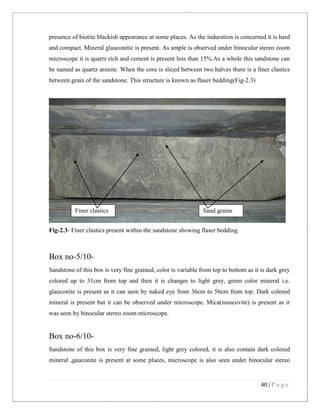
be named as quartz arenite. When the core is sliced between two halves there is a finer clastics
between grain of the sandstone. This structure is known as flaser bedding(Fig-2.3)
Fig-2.3- Finer clastics present within the sandstone showing flaser bedding.
Box no-5/10-
Sandstone of this box is very fine grained, color is variable from top to bottom as it is dark grey
colored up to 31cm from top and then it is changes to light grey, green color mineral i.e.
glauconite is present as it can seen by naked eye from 36cm to 56cm from top. Dark colored
mineral is present but it can be observed under microscope. Mica(muscovite) is present as it
was seen by binocular stereo zoom microscope.
Box no-6/10-
Sandstone of this box is very fine grained, light grey colored, it is also contain dark colored
mineral ,gauconite is present at some places, microscope is also seen under binocular stereo
Finer clastics Sand grains
41 | P a g e
zoom microscope. Most of the grain of this sandstone is quartz with less than 10% matrix. On
this basis it can be classified as quartz arenite.
Box no-7/10-
It is very fine grained sandstone, color is light grey, matrix in this sandstone is greater than in
comparison to sandstone of its previous box at 46cm in 6/10. Glauconite, mica & dark color
mineral present as in the case of box 6/10.
Box no-8/10-
In this box the sandstone contain some larger clasts present in very fine grained groundmass.
Color of this sandstone is light grey. Matrix greater than 10%.Mica and dark colored minerals
are present but glauconite are rarely seen. As the indurations of this sand are concerned it is
hard and compact.
Box no-9/10-
Sandstone of this box is very fine grained, dark grey colored, dark colored mineral i.e. pyrite is
present. There is a very few reddish spot indicating oxidation. It is less compact than above said
sandstone.
Box no-10/10-
It s very fine grained sandstone, dark grey colored, dark color mineral i.e. pyrite is present,
glauconitic present at some places.
42 | P a g e
Table-2.2-Core Log of cc-1
43 | P a g e
Conventional Core-2-:-
Box no. 1/6:-
The core of this box is alternation of shale and sandstone.Shale is dark brown color and it
contains muscovite mica.The sandstone is a clean sandstone and it is quartz arenite because it
contains greater than 90% quartz.The shale unit is more thick than sandstone unit.(fig2.4)
fig2.4-Core showing alternation of shale and sandstone.
Box no.2/6-
This box contanin core which is alternation of dark brown silty shale and clean sandstone.Shale
contain mica & there is a very thin lenses of sands.Sandstone contain quartz more than 90% so
it is quartz arenite.At some places within the silty shale there is a presence of ferruginous
material.Sandstone are light grey color and it is well sorted.At 13 cm from top cross has been
clearly seen.(fig-2.5)
44 | P a g e
Fig-2.5-Point of the pencil showing X-beds
Box no.3/6-
This box contain sandstone up to 31cm which is fine grained, light grey massive, clean
sandstone and it is quart arenite.From 31 cm to 57 silty shale which contain ferruginous
material. After 57 cm up to the bottom of the box there is a alternation of dark color silty shale
and light colored very fine grained sandstone.Shale is ferruginous at some places.
Box no.4/6-
From top up to 34 cm ferruginous shale in which mica is also present.From 34 to 51 cm light
grey very fine grained clean sandstone.There is an erosional contact at 34 cm (fig-2.6).From 51
to 57 cm silty sandstone with lamination of ferruginous shale.From 57 to 67 cm light colored
very fine grained clean sandstone.From 67 up to the bottom of the box dark brown colored
ferruginous shale with lenses of fine sand.
Box no.5/6-In this box from top up to 20 cm light colored very fine grained clean sandstone
which is quartz arenite with fine lamination of shale at some places.From 20 to 59 cm dark
brown color silty shale with ferruginous material and few sand lenses at some places.From 59
45 | P a g e
cm up to the bottom of the box ferruginous sandstone with large content of biotite and
muscovite mica present with very thin lamination of shale.Larger clasts of sand also preaent.
Fig-2.6- Core showing erosional contact
Box no.6/6:-
Very few recovery,few sandstone & shale lenses are present in this box.
46 | P a g e
Table-2.3-Core Log of cc-2
47 | P a g e
Conventional Core-3:-
Box no.1/7:-
In this box very few core samples are present in which black colored silty shale in which
muscovite mica is present. Very fine lamination of reddish colored sand seen in this silty shale.
Box no.2/7:-
In this box from top up to 46 cm shale with 2 to 4 cm lamination of sandstone. Shale is black
colored and sandstone is very fine grained & it show reddish appearance due to presence of
iron oxide. From 46 cm up to the bottom of the box there is alternation of sandstone and shale
in which at some places in sandstone calcareous matter is present and it was seen by the
reaction with 10% HCL.(Fig-2.7)
Fig-2.7-Showing alternation of sand and shale
Box no.3/7:-
In this the alternation of sandstone and shale and the character of both sandstone and shale is
same as described previous box. The thickness of shale layer is greater than sandstone layer
Box no.4/7:
In this box also there is alternation of sandstone and shale but the thickness of sandstone layer
is continuously increasing in comparison to shale as in the case of previous box.
Reddish
color sand
stone layer
Black
color shale
48 | P a g e
Box no.5/7:-
In this box alternation of sandstone and shale but at 62 cm an erosional contact have been
observed after which shale layer is more thicker than sandstone layer.The property of sandstone
and shale is same as described above.
Box no.6/7:-
In this box from top up to 34 cm shale is present in which very thin lenses of sand are present.
From 34 cm there is an increase in thickness of sandstone layer up to bottom of the box. The
property of sandstone and shale is same as described above.
Box no.7/7:-
In this box very few recoveries containing dark colored shale with few thin lenses of sand is
present.
49 | P a g e
Table-2.4-Core Log of cc-3
50 | P a g e
Conventional Core-4:-
Box no.1/4-
In this box core is basically, loose, weathered sandstone. Light brown to dark brown and due to
the presence of ferruginous material reddish appearance. Grain size is fine grained. This
sandstone is of deep seated condition due to which it is highly weathered. Several spots of
yellow color due the chemical weathering
Box no.2/4-
In this box dark brown color very fine grained sandstone.Pebble size clasts present. The
sandstone of this box compact in nature in comparison to previously described .Iron content is
very high.(Fig-2.8)
Fig-2.8- Core showing high iron content
Box no.3/4-
In this box also very high iron content. There are so many spots of yellow color indicating
chemical weathering. Sandstone are very fine grained & dark brown colored.
Box no.4/4- Tha sandstone of this box is very fine grained with high content of dark brown
colored fine grained matter Effects of chemical weathering have been observed due to the
presence pale yellow color spots
51 | P a g e
Table-2.5-Core Log of cc-4
52 | P a g e
WELL RAJASTHAN-B
Conventional Core-1:-
INTERVAL: - 911 - 918.35 m
DESCRIPTION:-
Dirty white color, medium to coarse grain, moderate sorting, and sub angular to sub rounded,
feebly calcareous, glauconite is distributed everywhere, moderate porosity.
Table-2.6-Core Log of cc-1
53 | P a g e
2.2-Identification of cyclicity and interpretation of depositional
environment:-
PARIWAR FORMATION:-
The formation has been deposited in an overall regressive phase with intermittent marine
incursions. Presence of glauconitic sandstones and shales are indicative of shallow marine
conditions ,whereas ,ferruginous sandstone, grey shales with brachiopod shell, current bedding
and lignite streaks are suggestive of continental to parallic environment. The formation could
be either shallow water marine or extensive alluvial plain eustarine deposits where both wind
and water had their role to play, preferred a continental environment of deposition
GORU FORMATIONS:
Presence of argillaceous limestone, marl and calcareous clay/shales are suggestive of an open
marine environment ranging from middle to outer shelf margin.
-
54 | P a g e
2.3- Selection of Samples for Various Studies
2.3.1.-Petrography or thin section study:-
There is some property of sedimentary rocks which is very difficult to identify megascopically.
To avoid these difficulties thin section of the core sample of the zone of interest analyze under
microscope. The property which is mainly examined under microscope is relationship between
the framework grains, cement and matrix and also to view the microscopic sedimentological
structures and the type of porosity of the rock. Thin section study is one of the important
methods for Reservoir characterization. Thin sections of interesting zones shown in Table-7
Table:-2.7- DETAILS OF Thin Section
SI.
NO.
INTERVAL(M) FORMATION SAMPLE
DEPTH(M)
cc-1
1 1418-1427 Lower Goru 1418.45
2 DO DO 1419.40
3 DO DO 1421.45
4 DO DO 1422.95
5 DO DO 1422.97
6 DO DO 1423.40
7 DO DO 1425.40
cc-2
1513-1519 Lower Goru 1513.42
8 DO DO 1514.47
9 DO DO 1515.62
10 DO DO 1516.40
11 DO DO 1516.89
12 1600.5-1606.5 Lower Goru 1600.55
13 DO DO 1601.40
14 DO DO 1603.70
15 DO DO 1604.40
16 1690.0-1693.5 Priwar 1691.28
55 | P a g e
2.3.2- X-Ray diffraction
X-Ray diffraction study is an important tool in identification of different minerals. In some
cases minerals are not identified under microscope because of their very fine grained nature or
lack crystallinity. In this case x-ray diffractometer plays an important role in investigation of
minerals, both quantitatively and as well as qualitatively. The details of the sample for X-Ray
diffraction study is listed in Table-8
Table-2.8- DETAILS OF SAMPLE FOR X-RAY DIFFRACTION
SI.
NO.
Core no. INTERVAL(M) FORMATION SAMPLE
DEPTH(M)
1 cc-1 1418-1427 Lower Goru 1418.45
2 cc-2 1513-1519 Lower Goru 1514.47
3 cc-2 1513-1519 Lower Goru 1513.42
4 cc-2 1513-1519 Lower Goru 1516.40
5 cc-3 1600.5-1606.5 Lower Goru 1601.40
6 cc-3 1600.5-1606.5 Lower Goru 1603.70
7 cc-4 1690.0-1693.5 Pariwar 1691.05
56 | P a g e
2.3.3-Scanning Electron Microscopy(SEM)
A scanning electron microscope (SEM) is a type of electron microscope that images a sample
by scanning it with a high-energy beam of electrons in a raster scan pattern. The electrons
interact with the atoms that make up the sample producing signals that contain information
about the sample's surface topography, composition, and other properties such as electrical
conductivity. The details of the sample for SEM analysis is listed in Table-9
Table-2.9- DETAILS OF SAMPLE FOR SEM ANALYSIS
SI.
NO.
Core no. INTERVAL(M) FORMATION SAMPLE
DEPTH(M)
1 cc-1 1418-1427 Lower Goru 1422.95m
2 cc-2 1513-1519 Lower Goru 1516.70m
3 cc-3 1600.5-1606.5 Lower Goru 1691.28m
4 cc-4 1690.0-1693.5 Pariwar 1693.40
57 | P a g e
2.4-Petrographic analysis:-
WELL –RJ-A ,CC-1, (INTERVAL-:1418-1427)
Sample Depth-1418.45m,
This is QUARTZ ARENITE in PPl and CROSS NICOL, Fine grained,
subangular to subrounded ,moderate sorting,quartz is an about 65%,Glauconite is
abundant in green colour15%to 20%, clay clast,ocassionally feldspar, mica in
minute,Iron oxide minerals seen,Fe rich Calcitic cement(micritic)(10%) and
ferruginous clay minerals(brown) (5%) as matrix. .Overgrowth2-4%(Fig-2.9)
Fig-2.9
Sample Depth-1419.40m
This is QUARTZ ARENITE in PPL and CROSS NICOL, Fine grained ,
subangular to subrounded ,well sorting,Quartz is an about 60-70%,Glauconite is
abundant in green colour10-15% , mica in minute,Iron oxide is seen,Calcitic
cement(15%) and ferruginous clay minerals(5%) as matrix.,overgrowth 4-6%
(Fig-2.10)
58 | P a g e
Fig-2.11
Sample Depth-1421.45m
This is QUARTZ ARENITE in PPL and XN .fine grained ocassionally medium
,subangular to subruonded,Quartz 60-70%, glauconite 10-15%, pyrite
ocassionally, Calcitic cement 15% and ferruginous clay minerals 5% as
groundmass,Feldspar grain is partially replaced by early diagenitic kaolinite and
calcitic cements.(fig2.12)
Fig-2.12
59 | P a g e
Sample Depth-1422.95m:-
This is QUARTZ ARENITE in PPL and XN .fine grained, moderately sorted
,subangular to subruonded,Quartz 70%, glauconite 7 -10%, pyrite seen.,Mica
fragments seen, Calcitic cement15% and ferruginous clay minerals 5% as matrix
,but calcitic cement dominants,Feldspar grain is partially replaced by early
diagenitic kaolinite and calcitic cements,Overgrowth-5-7%. (fig-2.13)
Fig-2.13
Sample Depth-1422.97m:-
This is QUARTZ ARENITE in PPL and XN .fine grained,subangular to
subruonded,Quartz 60%, glauconite 7 -10%, pyrite seen.,Mica fragments seen, Calcitic
cement 20% and clay minerals5-7% as matrix but calcitic cement dominants,ocassionaly
felspar seen, ,Overgrowth-5-8%.(fig-2.14)
60 | P a g e
Fig-2.14
Sample Depth- 1423.40m:-
This is QUARTZ ARENITE in PPL and XN .fine grained ocassionally v.fine,
subangular to subruonded,Quartz 70-75%, glauconite 5-7%, pyrite and iron oxide
minerals seen.,Mica fragments seen, ocassionally chert, Calcitic cement15% and
ferruginous clay minerals 5% as groundmass,ocassionaly felspar seen,
Overgrowth-5-8%.(fig2.15)
Fig2.15
61 | P a g e
Sample Depth-1425.40m:-
This is QUARTZ ARENITE in PPL and XN .fine grained,subangular to
subruonded,Quartz 65%, glauconite 5-7%, pyrite seen.,Mica fragments seen
which get oxidised , Calcitic patches 10% and clay minerals10% as
groundmass ,Feldspar grain and muscovite is partially replaced by early
diagenetic kaolinite and calcitic cements,Overgrowth-5-7%.(fig2.16)
Fig2.16
62 | P a g e
Well –RJ-A,CC-2, (INTERVAL-1513-1519)
Sample Depth-1513.42m:-
This is CLAYSTONE in PPL and XN .,Silt size /very fine grained ,Quartz 20-30
%, Rock fragments like mica 5-7%, pyrite in black along with iron oxide
minerals ,ferruginous and micaceous groundmass where quartz floats.(Fig-2.17)
Fig-2.17
Sample Depth-1514.47m-
This is QUARTZ ARENITE in PPL and XN .Siltstone /Veryfine grained,
subangular to subruonded,Quartz 60-70%, Rock fragments like mica 10-15%,
pyrite seen along with iron oxide minerals , ,some chloritic patches,mica present
in orientation,Ocassionally glauconite. , Calcitic patches7-10% and clay
minerals5% as matrix .(Fig-2.18)
Fig-2.18
63 | P a g e
Sample Depth-1515.62m-
This is QUARTZ ARENITE in PPL and XN .Siltstone ,subangular to
subruonded,Quartz 70-75%, Rock fragments like mica 3-5%, pyrite seen ,
Calcitic patches10% and clay minerals5% as matrix, Ocassionally glauconite
(Fig-2.19)
Fig-2.20
Sample Depth--1516.40cm-
T his is QUARTZ ARENITE in PPL and XN .Siltstone/Very fine grained
,subangular to subruonded,Quartz 60-70%, Rock fragments like mica 3-5% and
some fragments get weathered, pyrite seen ,sideritic clay clasts, Calcitic cemennt
5%and clay minerals 5-10%as matrix.ocassionally glauconite seen.(Fig-2.21)
Fig-2.21
64 | P a g e
Well–RJ-A,CC-3, INTERVAL-1600.5-1606.8 m
Sample Depth-1600.55 m:- This is SILTY CLAYSTONE in PPL and
XN.Quartz 20-30%, pyrite seen,Sideritic clay clasts.Some iron oxide minerals
get oxidised, mica seen. calcitic patches and ferruginous clayey matrix as
groundmass.(Fig-2.22)
Fig-2.22
Sample Depth-1601.40m
This is QUARTZ WACKE in PPL and XN.Very fine grained,Quartz 40-50%,
pyrite seen, Microsparitic cement30% along with few sideritic clay clast,
ferruginous clayey matrix 10-15%,some iron oxide and mica minerals get
oxidised,ocassionally glauconite seen.(Fig-2.23)
Fig-2.23
65 | P a g e
Sample Depth- 1603.70m:-
This is QUARTZ WACKE in PPL and XN.Very fine grained,Quartz 30-40%,
pyrite abundant, Microsparitic cement 20-25% along with ferruginous clayey
matrix 10-15%,some iron oxide and mica minerals get oxidised,ocassionally
glauconite seen.(fig-2.24)
Fig-2.24
Sample Depth-1604.40m
This is CLAYSTONE in PPL and XN.Quartz 15-20%, pyrite abundant,calcitic
patches , ferruginous clayey as groundmass where quartx grain floats.,some iron
oxide minerals get oxidised, mica seen.(fig-2.25)
Fig-2.25
66 | P a g e
Well –RJ-A,CC-4, (INTERVAL-1690-1693.5 m),
Sample Depth- 1691.28m
This is QUARTZ WACKE in PPL and XN.Fine/medium grained ,Quartz 60-
65%, calcitic patches along with sideritic clay 25-30%,some iron oxide and mica
minerals get oxidised seen.ccassionally rock fragments and glauconite are
seen.(Fig-2.26)
Fig-2.26
67 | P a g e
10 20 30 40
0
1000
2000
3000
4000
5000
6000
7000
8000
9000
10000
11000
12000
10 20 30 40
-2013
-1013
-13
987
1987
Intensity(cps)
2-theta (deg)
Intensity(cps)
2.5-X-ray Diffraction analysis:-
Well Rajasthan-A ,CONVENTIONAL CORE-1
Sample Depth-1418.45m
Peak List
General information
Analysis date 4/17/2012 11:02:32 AM
Sample name 1418.45M Measured time 4/17/2012 10:12:48 AM
File name SRK.raw Operator administrator
Comment
Measurement profile
2-theta (degree)
Fig-2.27- Measurment Profile for Clay Mineral
I-ILLITE, G- GLAUCONITIC, K-KAOLINITE
INTENSITY I+G
K
I
K
I
68 | P a g e
10 20 30 40
0
2000
4000
6000
8000
10000
12000
14000
16000
18000
20000
22000
24000
10 20 30 40
-4188
-2188
-188
1812
3812
Intensity(cps)
2-theta (deg)
Intensity(cps)
CONVENTIONAL CORE-2
Sample Depth-1514.47 m
Clay Mineral Analysis
2-theta (degree)
Fig-2.28- Measurment Profile for Clay Mineral
K - KAOLINITE, I - ILLITE, G - GLAUCONITE
INTENSITY
I+G
K
K
I
I
69 | P a g e
CONVENTIONAL CORE-2
Sample Depth-1514.47 m
Bulk sample analysis
2-theta (degree)
Fig-2.29- Measurment Profile for Bulk sample Analysis
Q –QUARTZ, S – SIDERITE, I – ILLITE, G - GLAUCONITIC ,K - KAOLINITE
INTENSITY
I+G
K KQ
Q
S
70 | P a g e
10 20 30 40
0
500
1000
1500
2000
2500
3000
3500
4000
4500
5000
10 20 30 40
-876
-376
124
624
Intensity(cps)
2-theta (deg)
Intensity(cps)
Sample Depth -1513.42m:-
Bulk sample analysis
Measurement profile
2-theta (degree)
Fig-2.29- Measurment Profile for Bulk sample Analysis
Q –QUARTZ I – ILLITE, G - GLAUCONITIC, K - KAOLINITE
I
K
Q
K
Q
INTENSITY
71 | P a g e
10 20 30 40
0
200
400
600
800
1000
1200
1400
1600
1800
10 20 30 40
-320
-120
80
280
Intensity(cps)
2-theta (deg)
Intensity(cps)
Conventional Core-3
Sample Depth-1601.40 m
Bulk sample analysis
Measurement profile
2-theta (degree)
Fig-2.30- Measurment Profile for Bulk sample Analysis
SM – SMECTITE, C - CALCITE, I -ILLITE, D – DOLOMIT, K - KAOLINITE,
Q – QUARTZ
INTENSITY
SM+I
K
K
Q
C D
72 | P a g e
10 20 30 40
0
200
400
600
800
1000
1200
1400
1600
1800
2000
2200
d=10.19(2)
d=7.183(3)
d=4.492(10)
d=4.272(3)
d=3.588(2)
d=3.3516(12)
d=3.248(4)
d=3.031(2)
d=7.21(4)
10 20 30 40
-381
-181
19
219
Intensity(cps)
2-theta (deg)
Intensity(cps)
Sample Depth-1603.70 m
Bulk sample analysis
Measurement profile
2-theta (degree)
Fig-2.31- Measurment Profile for Bulk sample Analysis
I – ILLITE, K – KAOLINITE, Q – QUARTZ, C - CALCITE
INTENSITY
I
K
K
Q
Q C
73 | P a g e
10 20 30 40
0
1000
2000
3000
4000
5000
6000
7000
8000
10 20 30 40
-1410
-410
590
Intensity(cps)
2-theta (deg)
Intensity(cps)
Conventional Core-4
Sample Depth-1691.05 m
Bulk sample analysis
Measurement profile
2-theta (degree)
Fig-2.32- Measurment Profile for Bulk sample Analysis
K –KAOLINITE, Q – QUARTZ, S – SIDERITE
INTENSITY
K
K+S
Q
Q
S
74 | P a g e
2.6-Scanning Electron Microscopy:-
Well Rajasthan-A ,CONVENTIONAL CORE-1
Sample Depth:-1418.45
Fig-2.33-General view showing pore filled authigenic Kaolinite
& it is also showing poor intergranular porosity
Fig-2.34-Sample showing Brachiopoda shell & quartz overgrowth
Q
K
P
Q –Quartz
P- Pores
K-Kaolinite
B
QO
B- Brachiopod shell
QO-Quartz overgrowth
75 | P a g e
Fig-2.35- Sample showing mica
Fig-2.36- Sample showing Dolomite
76 | P a g e
Conventional Core-2
Sample Depth:- 1516.70m
Fig-2.37- Showing miderate to good Intergranular Porosity
Fig-2.38- Showing quartz overgrowth and Authigenic Kaolinite
P
QO
K
77 | P a g e
Conventional Core-3
Sample Depth:- 1691.28m
Fig-2.39- Sandstone with poor intergranular porosity and Pyrite scatter on Smectite and clay rich
grains which reduces porosity.
Fig-2.40- Framboidal Pyrites( FP ) and Pyritehedron (PH) as pore filling.
FP
PH
78 | P a g e
Conventional Core-4
Sample Depth:- 1693.40m
Fig-2.41- sandstone with poor intergranular porosity
2.42-weathered feldspar (WF) filling the intergranular por
79 | P a g e
CHAPTER-3
PETROLEUM
SYSTEM ANALYSIS
80 | P a g e
Jaisalmer basin has no commercial discovery of liquid hydrocarbons, as yet only some show in
Chinnawala Tibba and Ghotaru has been reported. The liquid hydrocarbon show in these wells
is from early-late cretaceous. Gas has been found in seven structures but only Manhera
Tibba(from Cenozoic) and Cinnewala Tibba(from cretaceous) is commercially viable.The
genetic correlation of known accumulation of gases in Cenozoic and Cretaceous reservoir
suggests that they have been generated from sediments at higher maturity and have been
trapped after long distance migration. The source rock evaluation suggests that source rock
development is poor in the deeper part of the basin in the west. In the northwest, good
development of source rock is observed and the maturity of the source rock is not enough to
generate the gases of this maturity. Two potential source rock layers, that are more or less,
laterally extend across the basin wherever source rock development is significant, have been
identified. These layer occur at late Jurassic and early cretaceous. The source rock layer at late
Jurassic and early Cretaceous are well developed in Manhera Tibba- Kharatar –Sadewala area
in Jaisalmer –Mari High and the quality and maturity progressively increases as move towards
Sadewala area. The source rock development continued up to the top of the middle Jurassic and
is early maturation level. The source rock development in Sahagarh sub basin is very poor at
late Jurassic and poor to marginal at early cretaceous, whereas in Maijalar sub basin the
development of fair to good source rock has taken place at late Jurassic level only, but it is at
shallower depth and has not yet reached the top of oil window maturity. The gas pool has found
to be mainly in Paleocene, early Eocene, and late cretaceous reservoirs.
PETROLEUM SYSTEMS ELEMENTS
Source Rocks
Mature potential source rocks with wet gas prone and subordinate oil prone Type III + II
organic matter have been identified in Pariwar Formation, Lower Cretaceous age. Goru and
Parh Formations of Upper Cretaceous age show the presence of gas condensate prone fair type
III organic matter.
Geochemical data indicates that the organic matter may be derived from humic kerogen,
deposited under peat swamp environment. Gases of Ghotaru and Manhera Tibba fields might
have been sourced by marginally mature Pariwar Formation. Maturity increases towards the
81 | P a g e
western part of the basin and the hydrocarbon kitchen may be in the main depressions of
Shahgarh Sub-basin and western part of Miajalar sub basin. Significant amount of petroleum
might have been generated from Bilara source rocks.
Source
Jaisalmer
 Lower Goru, Pariwar, Sembar / Bedesir - Baisakhi Shales
, Karampur/Badhaura Formation Shales, Bilara Shales
and Dolomites
Reservoir Rocks:-
In Jaisalmer basin, the main reservoir rocks are sandstones in Goru and Pariwar Formations of
Lr. Cretaceous age. The sandstones of Goru Formation in Kharotar and Ghotaru area are 15-20
m thick, porosity ranges from 15-20%. The sandstones of Pariwar Formation have average
thickness of 20m and porosity 15%. The Carbonate reservoirs, better developed over Jaisalmer-
Mari platform, become argillaceous towards deeper parts of Shahgarh area. The reservoirs
attain a thickness of 10 -30 m with porosity of 12-27 %. The limestone reservoir of Bandah
Formation (Mid. Eocene) are 6-43 m thick and have porosity upto 25%. The carbonate
reservoir in Paleocene rocks are 5-18 m thick with about 18% porosity. The sandstone
reservoirs in Sanu Formation (Paleocene) are upto 60 m thick.
Reservoir
Jaisalmer
 Clastic: Baisakhi-Bedesir, Pariwar, Goru, Sanu and Khuiala
formation sandstones
Carbonate: Fractured limestones of the Jaisalmer Formation,
Lower Bandah Limestones / Khuiala Limestones
82 | P a g e
Cap Rock:-
In Jaisalmer basin, argillaceous sequence in upper part of Cretaceous and thick limestone
sequence in the Middle Jurassic serve as good principal cap rocks. In addition, most of the
reservoirs have overlying shales acting as local cap rocks..
Trap:-
The structures in Jaisalmer basin are controlled by long through going master faults from the
western edge of the outcropping belt to Dangewala-Lang areas to the north west and to the
south of Lunar-Miajlar area. The coeval, enechelon flanking structures occurring as relay folds
and faults, narrow fault slices and folds, parallel and oblique to master fault constitute the
Traps.
Trap
Jaisalmer
 Anticlinal closures, Fault related closure/traps, Unconfirmity related traps viz.,
Wedge outs, Lithostratigraphic traps.
Timing Aspect:-
Paleo-structural analysis suggests that most of the structures were well defined by the end of
Cretaceous and took final shape by end of Eocene times in Jaisalmer basin. Migration of
hydrocarbon might have been initiated by end of Cretaceous and completed by Middle Eocene.
This suggests that the structures were in position during migration of hydrocarbons
Petroleum plays in Jaisalmer basin:-
Paleocene extensional fault blocks with Cretaceous age reservoirs
Early Tertiary stratigraphic subcrop closure of Sanu clastics beneath the shales of the
lower Kuiala formation
 Mesozoic subcrop of either Cretaceous age sediments below Base Tertiary or early-mid
Jurassic Lathi Formation beneath Jaisalmer Limestone.
 Lowstand Fan mounds at the base-of-slope (intra Baisakhi Formation)
Relative sea-level fall, forced regression sands at shelf break.
83 | P a g e
.
CHAPTER-4
CONCLUSION
84 | P a g e
Based on the studies carried out for the facies characterization, the following conclusions has
been carried out.
In Jaisalmer Basins Cretaceous Sediments are represented by Pariwar ,Goru ,and Parh
formations. Since the Reservoir are developed in the Pariwar Formation and Lower Goru
Member , therefore the investigations are pertaining to these two sequences .
The Pariwar Formation underlies Lower Goru Member of Goru Formation. The contact is
marked by the lithological change from glauconitic siltstone and shale to sandstone.Pariwar
Formation is predominantly an arenaceous sequence with occasional thin to thick interbeds of
shale.
The Pariwar Formation belongs to Neocomian (Lower Cretaceous) and mostly comprised
moderately sorted sandstone having good reservoir characteristics.
The Lower Cretaceous (Neocomian) Pariwar Formation deposited in regressive phase
accommodating thick pile of arenaceous facies in coastal regimes. Shallow marine and brackish
condition exists towards the lower part and complete regression of sea with setting in of
continental conditions towards the top.
The overlying Lower Goru Member is dominantly shale having very thin interlayer’s of
calcareous sandstone and siltstone beds having Glauconite and range in age from Aptian to
Albian (Lower Cretaceous).
The Depositional environment is Overall transgressive shallow marine with short regressive
cycle. The sedimentation has mostly taken place in inner shelf environment, often interrupted
by inter tidal feebly calcareous sandstone and siltstone.
Petrographically observation shows that in Lower Goru Member there is Quartz Arenite in
upper, however Quartz wacke in lower member. But in Pariwar formation mostly Quartz
Arenite and also Quartz wacke.
Through Petrographic observations ,it is noted that the porosity has been deteriorated due to
occlusion of Ferron Calcite cement as well as siderite in the intergranular spaces of
sandstone .This in turn reduces the permeability. In some instances Quartz overgrowth is also
noted which has adverse effect on Petrophysical character of Reservoir.
X-Ray Diffraction analysis of matrix of the sandstone revealed the presence of Clay minerals
like Kaolinites, illite and smectite as detrital clay.
SEM studies has brought out intergranular porosity clearly seen on the images ,however at
places due to presence of framboidal pyrite and pyritehedron , Smectite and Illite along with
altered mica and altered feldspar the reservoir quality of sandstone is deteriorated.
85 | P a g e
(5) References:-
Book reference:-
 Dasgupta, S.K., 1975, Revision of Mesozoic-Tertiary stratigraphy of the Jaisalmer
Basin, Rajasthan: Indian Journal of Earth Science, v. 2 (1) p. 77-94.
 Datta, A.K., Singh, N.P., Raju, P.A.N., 1983, Geological evolution and
hydrocarbon prospects of Rajasthan basin: Petroleum Asia Jour, Nov.,1983.
 Indian Journal on Jaisalmer basins.
 Mishra, P.C., 1986,Structural style and sedimentation pattern ; a new tectonic
model and its exploration significance ,Jaisalmer basin ,Rajasthan ;
 Pierre Eliet, Richard Heaton, and Mike Watts., The Barmer Basin, Rajasthan,
India, the Ingredients Which Led to Exploration Success, Cairn Energy PLC,
Edinburgh, United Kingdom.
 Richard Selly : Applied Sedimentology
 Sam Bogg’s, Jr (University of Oregon)Principles of Sedimentology &Straitigraphy
 Swanson, R.P. AAPG, Sample examination Manual
Websites
 www.dghindia.com
 www.geosci.ipfw.edu
 www.aapg.org

Thesis BHU_Samiur Rahman Khan_Geologist

  • 1.
    Project Oriented Dissertation ON FACIESCHARACTERIZATION OF CLASTIC RESERVOIR OF LOWER GORU AND PARIWAR FORMATIONS, JAISALMER BASIN, RAJASTHAN, INDIA AT KDMIPE, ONGC, Dehradun Submitted for partial fulfillment of the requirement for the degree of MASTER OF SCIENCE IN PETROLEUM GEOSCIENCES Under The Supervisions of Shri.H.Upadhyay Prof. M.P.Singh GM (GEOLOGY) & Support Manager Department of Geology KDMIPE BHU, Varanasi ONGC, DEHRADUN Submitted By SAMIUR RAHMAN KHAN M.Sc. PTROLEUM GEOSCIENCES Semester –IVth BHU, Varanasi Session: 2011-2012 DEPARTMENT OF GEOLOGY CENTER OF ADVANCED STUDY FACULTY OF SCIENCE BANARAS HINDU UNIVERSITY VARANASI-221005 Enrollment No.-321581 Roll No.-10479SC003 Date: 2nd , July, 2012
  • 2.
    i CERTIFICATE I hereby declarethat the work which is being presented in this thesis entitled “Facies Characterization Of Clastic Reservoir Of Lower Goru And Pariwar Formations, Jaisalmer Basin, Rajasthan, India” was carried out in Sedimentology Division, KDMIPE , ONGC, DEHRADUN. This dissertation is submitted for partial fulfillment of the requirement for the award of degree of Master of Science in Petroleum Geosciences. The work in this report was carried out by me under the supervision of Shri H.Upadhyay, GM (GEOLOGY) at KDMIPE, ONGC, DEHRADUN. Date: 2nd July, 2012 Samiur Rahman Khan Place: Dehradun M.Sc. (Petroleum Geosciences) BHU, Varanasi This is to certify that the above statements made by the candidate are correct to the best of my knowledge and believe. Supervisor Shri H. Upadhyay GM (Geology). KDMIPE, ONGC Dehradun
  • 3.
    ii Department of Geology (Centreof Advanced Study) Banaras Hindu University Varanasi – 221 005 Certificate This is to certify that Mr. Samiur Rahman Khan has completed his project oriented dissertation as a compulsory activity in the course of completing his Master of Science degree in Petroleum Geosciences under my supervision. His dissertation work entitled as “Facies Characterization of Clastic Reservoir of Lower Goru and Pariwar Formations, Jaisalmer Basin, Rajasthan, India” embodies the result of the work carried out during the period of dissertation. His work was carefully reviewed and corrected and thus he is entitled to submit his work in partial fulfillment for the award of the concerned degree for the session 2010-2012. I wish him best of fortune in his career and a fruitful life. Prof. M.P. Singh Supervisor
  • 4.
    iii ACKNOWLEDGMENT To carry outproject in KDMIPE, ONGC, DEHRADUN is one of the biggest achievements for me to which I am extremely thankful to the organization & heartfelt gratitude to Shri P.K. Bhowmick, ED-HOI, KDMIPE for allowing at that time to complete my project in India’s one of the largest oil and gas producing company. It is a matter of great pleasure for me to offer my sincere gratitude and thanks to my supervisors Shri H.Upadhyay, GM (Geology), KDMIPE, ONGC Dehradun & Prof. M. P. Singh, Department of Geology, BHU, Varanasi, for his guidance, untiring cooperation, supervision and help that was rendered to me not only for this manuscript but also for all that I gained from him during the entire period of my dissertation. I would like to express my sincere thanks to Prof. H.B.Srivastava, Head of Department, Prof. A. K. Jaitly, course co-coordinator (Petroleum Geosciences) & Prof. Jokhan Ram, KD Malaviya Chair ONGC, Department of Geology, Banaras Hindu University, which has provided opportunity to work in KDMIPE, a Premier Institute of ONGC. I would also express special thanks to Dr.G.D.Gupta DGM,(Geol.) Head sedimentology division, Shri Madan Mohan DGM,(Geol.) sedimentology division, Shri Yashpal,Ssenior Geologist (SEM lab.), Shri L.M.Pandey, Senior Geologist(core lib), Shri J. Nanda(Geologist), Shri Jagdish Arya(Geologist), Shri Sandeep Verma(Geologist) and all the executive members of sedimentology division for their support in completion of my work by providing the schedule for my training for his help and concern in every aspect of my work. Last but not the least I would like to thanks, S. S. Tomar (Technical Assistant, XRD Lab.), all the staff members of sedimentology division & colleagues for their great support in completion of the dissertation and all those who have directly or indirectly helped me in this endeavor. SAMIUR RAHMAN KHAN BHU, VARANASI
  • 5.
    iv Table of Contents TopicPage No. (1) Literature survey 1-34 1.1- Introduction 2-3 1.2- Evolution & Structural style of the Jaisalmer Basin 4-10 1.3- Litho-stratigraphy of Jaisalmer Basin 11-15 1.4- Study Area 16-19 1.5- Methodology and Objectives 20-34 (2)Study of Conventional Core 36-78 2.1- Megascopic Study and Preparation Of Core Log 36-52 2.2- Identification of cyclicity & Interpretation of Depositional Environment 53 2.3- Selection of Samples for Various Studies 2.3.1- Petrography 2.3.2- XRD 2.3.3- SEM 54-56 2.4-Petrographic analysis 57-66 2.5-X-ray Diffraction analysis 67-73 2.6-Scanning Electron Microscopy 74-78 (3) Petroleum System Analysis 79-82 (4) Conclusions 83-84 (5) References 85
  • 6.
    v List of Figures Fig.No. Particular Page No. 1.1 Paleo-tectonic reconstruction of the Madagascar-Seychelles – India during the Mesozoic 4 1.2 Tectonics Zones Map of Western Rajasthan Basin 5 1.3 Three Depressions of Jaisalmer Sub-basin 6 1.4 Stratigraphy of the Barmer, Bikaner-Nagaur and Jaisalmer Basins 7 1.5 New Discoveries in Barmer-Sanchor Basin 10 1.6 The sandstone shows cross-bedding feature 17 1.7 Showing various grades of sphericity & roundness 23 1.8 Showing five degree of sorting 24 1.9 Procedure Steps in Scanning electron 33 2.1 Core showing glauconite and brachiopod shell. 38 2.2 Core Showing reaction with HCL10% 39 2.3 Finer clastics present within the sandstone showing flaser bedding 40 2.4 Core showing alternation of shale and sandstone 43 2..5 Point of the pencil showing X-beds 44 2.6 Core showing erosional contact 45 2.7 Core showing alternation of sand and shale 47 2.8 Core showing high iron content 50 2.9 to 2.26 Photographs of thin sections of Well Rajasthan-A (CC-1 ,CC-2, CC-3, CC-4) 57 to 66 2.27 to 2.32 Measurement Profile for clay mineral &Bulk sample Analysis(XRD analysis peaks) 67 to73 2.33 to 2.42 Scanning Electron Microscopy(SEM) photographs 74to 78
  • 7.
    vi List of Tables Table Particular PageNo. 1.1 Relationship between sedimentry process and response 3 1.2 Generalized stratigraphy of Jaisalmer basin(After Mishra et al.1993) 15 1.3 Went-worth scale of Grain size 22 2.1 Details of Conventional Cores 37 2.2 Core Log of cc-1(RJ-A) 42 2.3 Core Log of cc-2(RJ-A) 46 2.4 Core Log of cc-3(RJ-A) 49 2.5 Core Log of cc-4(RJ-A) 51 2.6 Core Log of cc-4(RJ-B) 52 2.7 Details of Thin Section 54 2.8 Details of sample for X-ray diffraction 55 2.9 Details of sample for SEM analysis 56
  • 8.
    1 | Pa g e CHAPTER-1 LITERATURE SURVEY
  • 9.
    2 | Pa g e 1.1-INTRODUCTION As a part of partial fulfillment of M Sc. Petroleum Geosciences, a project work has been carried out in KDMIPE ,ONGC, DEHRADUN for 6 months from January to June 2012. The topic of the project is “Facies Characterization of Lower Goru and Pariwar formations, Jaisalmer Basin, Rajasthan,India”. The facies Characterization of reservoir is quite complex subject. It is essential for Geologist to understand these processes for better characterization. A sedimentary facies is a stratigraphic unit characterized by distinctive physical, chemical and biological attributes owing to deposition in a particular environment. The physical characteristics include colour, texture, lithology and sedimentary structures, chemical attributes include the mineralogical composition of the rock body, major elements, trace elements, composition of cementing material, and even the isotopic composition. The biological characteristics basically deal with the paleontological aspect, both body and trace fossils including plant remains. Following are some of the definitions of the facies given by different workers. Facies(Bates and Jackson,1987): The aspect, appearance, and characteristics of a rock unit,usually reflecting the conditions of its origin ;esp. as differentiating the unit from adjacent or associated units. Facies(Walker, 1992): A particular combination of lithology, structural and textural attributes that defines features different from other rock bodies. Facies characterization is embraced by sedimentologist world over as the most dependable methodology to unravel paleogeography or past depositional scenario. It is a fundamental sedimentological method of characterizing bodies of rocks with unique lithological, physical and biological attributes relative to all adjacent deposits. The goal is to evaluate the nature and association of sedimentary rocks in terms of sedimentation processes and to interpret the depositional setting there from. It is to classify a rock assemblage in a way that unravels the spatio-temporal shift in the palaeography as best as possible therefore of paramount importance for any basin analysis as it provides critical clues for paleogeographic and paleoenvironmental reconstructions. Sedimentary process and Response: The basis of the environmental interpretation rests on the assumption that a particular depositional environment generates deposits that bear the impression of the environmental processes and conditions to a degree sufficient to allow discrimination of the environment. This
  • 10.
    3 | Pa g e linkup between the environments and the facies is referred to as Process and Response (Table.1). Table.1.1- Relationship between seimentry process and response Of course we do not see the process while doing the facies analysis, what we see is only the product or say the response component from which to deduce the paleodepositional scenario. So the observations of modern depositional environment is very useful to draw the analogy from, where the process and the response both can be observed or the laboratory experiments (esp. flume tests) can be equally important to simulate a particular type of depositional environment and observe the generated product. Geologist thus attempts to work the process- response model backward and infer the conditions of the ancient depositional environment. There is always some amount of subjectivity, for example we recognise a turbidite facies not because it was deposited from turbidity current, but because we think it did on the basis of observed evidences. Sandstones are very important as reservoirs for oil and gas; about 50% of the world’s petroleum reserve is estimated to occur in sandstones (Berg, 1986). The purpose of studying the sedimentological characteristics, of sandstones from lower Goru and Pariwar formations, Jaisalmer basin, Rajsthan, India is to investigate and determine the rock and reservoir properties of different types
  • 11.
    4 | Pa g e 1.2:- EVOLUTION AND STRUCTURAL STYLE OF THE JAISALMER BASIN:- Rajasthan basin is situated along the western margin of India. Two important phases of basin evolution are recorded along the western continental margin. There is an initial record of the Mesozoic basins in Jaisalmer, Bikaner-Nagaur, Barmer (Rajasthan Basins), Kutch, and Cambay that could be traced to the Mesozoic basins occurring along the western margin of Madagascar. (Fig.-1.1). The first stage of separation of the Western Gondwanaland (South America and Africa) from the Eastern Gondwanaland (Madagascar, India- Seychelles, Antarctica and Australia) is recorded during Late Triassic/Jurassic (~196-203Ma) and is closely associated with Karoo volcanism in South Africa, the conjugate of which is seen in Antarctica. The second stage was the separation of Seychelles-India from Madagascar in Late Cretaceous (~93Ma), associated with minor volcanism found on conjugate margins of southwestern India and southeast Madagascar. The final breakup of Seychelles at KTB (~65Ma) contiguous with the Deccan volcanism is associated with a series of rift basins along the western continental margins in which the Cenozoic basins evolved viz. Barmer basin, Cambay Basin and its southern continuation in Mumbai Offshore. A description of these basins is given from the north to the south. Fig-1 .1: Paleo-tectonic reconstruction of the Madagascar-Seychelles – India during the Mesozoic, showing the structural trends, the Jurassic outcrops (in grey) and the Mesozoic rifts (in red)
  • 12.
    5 | Pa g e 1.2.1-Basins in Rajasthan:- The western Rajasthan shelf located to the west of Aravalli ranges, possesses three important basins viz., Jaisalmer, Bikaner-Nagaur and Barmer, stretching over an area of about 1,20,000 sq. km. The Jaisalmer Basin:- This is the westernmost is separated from the Bikaner- Nagaur basin (Fig.1.2) by the Pokaran-Nachana high to the northwest and from the Barmer basin by the Barmer-Devikot- Nachana high in the south. Fig-1.2:-Tectonics Zones Map of Western Rajasthan Basin (Source-www.dghindia.com)
  • 13.
    6 | Pa g e A pronounced NW-SE-trending regional step-faulted Jaisalmer-Mari high zone, marked by the Kanoi and Ramgarh faults that traverse the centre of the basin and divides it into the Shahgarh sub-basin, the Miajalar sub-basin and the Kishangarh sub-basin(Fig-1.3). This basin in the northwestern Indian shield extends as far as the Mari region of Pakistan, and is tectonically related to the Indus Basin from the beginning of the Triassic. The aerial extent is over 30,000 km2.This basin is controlled by wrench-fault tectonics. Fig-1.3:-Three Depressions of Jaisalmer Sub-basin(Source-www.dghindia.com)
  • 14.
    7 | Pa g e The outcrop and the well-data indicate sedimentation from the Cambrian to the Tertiary (Fig. 4). Three distinct sequences are identified, based on the basin forming tectonic events namely, the Proterozoic to early Cambrian rift sequence comprising mainly the thickly bedded sandstone with shale intercalations in the lower part and dolomitic and cherty limestone with shale and sandstone interbeds in the upper part, Permian to Eocene shelf–sag, and Pleistocene to Recent sequences. The Proterozoic early Cambrian succession unconformably overlies the Precambrian basement rocks, while the unconformable upper contact of the sequence with Permian, has a hiatus span of about 190 Ma. Fig-1.4:- Stratigraphy of the Barmer, Bikaner-Nagaur and Jaisalmer Basins Modified after Das Gupta et al.1973 and Dhar et al. 1982
  • 15.
    8 | Pa g e Exploration by ONGC & OIL in Jaisalmer basin has resulted in discoveries of several gas fields, namely Mahera Tibba from the Cenozoic and Cinnewala Tibba from Cenozoic and Cretaceous reservoirs, respectively. The gas from these fields is methane-rich and commercially viable. Gas from the other fields viz. Ghotaru, Bankia, Bhakari Tibba, Khartar and Sadewala is nitrogen-rich and is commercially not viable. Oil shows have also been reported in wells Chinnawala Tibba-1 and Ghotaru-2 from early-late Cretaceous sequence, though as of now there is no commercially viable discovery of liquid hydrocarbons. The potential source-rock layers are from Late Jurassic and early Cretaceous. Genetic correlation of known accumulation of gases in Cenozoic and Cretaceous reservoir suggests that they have been generated from sediments at higher maturity and have been trapped at their present locale after long distance migration. Bikaner-Nagaur Basin:- The Bikaner-Nagaur Basin is mostly a Paleozoic basin with a considerable thickness of Paleozoic sediments, overlain by a thin veneer of Tertiary/Mesozoic sediments. The Paleozoic sediments include evaporites and carbonates, and are similar to more NW Pakistan. Potential source and reservoir rocks have been identified in the Paleozoic sediments. The Cenozoic sedimentation in the Bikaner- Nagaur basin began with the coal- bearing Palana Formation that was deposited during the Paleocene in subtropical swampy conditions on the continental part. Marine sedimentation indicates encroachment of the sea during the Upper Paleocene to Lower Eocene. The exploration drilling by ONGC, Oil India and a Joint Venture Private Company has indicated presence of heavy oil in haline/carbonates. Baghewala, Nanuwala and Binjybala areas have indicated hydrocarbon occurrences. Barmer Basin:- The Barmer Basin is interpreted as a narrow, N-Strending graben, a northern extension of Cambay rift. The faults exposed at Fatehgarh, on Barmer Hill near Barmer and at Sarnu constitute the peripheries of the Barmer Basin. The pre-rift sediments deposited on the Late Proterozoic Malani Igneous Suite, represented by Randha, and Birmania Formations (a siliceous facies-shales, sandstone, orthoquartzite) and calcareous facies- limestone, phosphorites and dolo-mudstone) respectively, are exposed on the western margin of the basin. The Sarnu Formation (co-relatable with the sandstones of Jodhpur Group) exposed on the eastern margin of the basin, comprises thin and fining-upward sand bodies with intervening red siltstone. The Lathi Formation exposed at the northern periphery the basin, comprises medium to coarse, fining upward fluvial sands with fossils.
  • 16.
    9 | Pa g e The syn-rift sediments:- Barmer Hill and Fatehgarh Formations are exposed at Barmer and Fatehgarh. The Barmer Hill Formation comprises sandstone and clast supported conglomerates, exposed along the western boundary of the basin and rest unconformably on the basement. These represent rapid deposition in an alluvial fan environment with source from Malani Rhyolite. The Fatehgarh Formation exposed at the northern boundary of the basin shows a mixed sand and mud tidal-flat environment. It comprises conglomerate at the base, overlain by sandstone. This in turn, is overlain by ferruginous phosphatic sandstone. Seismic data reveals that in subsurface Fatehgarh Formation continues as Barmer Hill Formation. The Fatehgarh Formation is overlain by siliceous earth of Bariyara Member (base of Mataji-ka-Dunger Formation). The post-rift sediments are constituted by the Mataji-ka- Dunger and Akli Formations. The Mataji-ka-Dunger Formation is exposed at the northern and western margins of the basin and consists of cyclically arranged claystone, siltstone, sandstone, and is interpreted as a shallowingupwards fluvio-deltaic complex. The sandstone shows 15% visible porosity with no secondary infill except authigenic quartz overgrowth, signifying itself to be a good reservoir rock. The base of the sequence exposed at the south of Fatehgarh comprises sand-poor claystone. This is interpreted as pro-deltaic, delta-slope/delta-mouth deposition. The Akli Formation exposed at the central part of the basin, overlying the Mataji-ka-Dunger Formation comprises bentonitic claystone, grey bituminous clay-stone, lignites and light yellow claystone. Widespread exploration work by various oil companies notably Shell and then Cairn Energy, have resulted in a number of oil and gas discoveries mainly within the Paleocene sediments. These are given in Figure 1.5.
  • 17.
    10 | Pa g e Fig-1.5:- New Discoveries in Barmer-Sanchor Basin.( Source-www.dghindia.com)
  • 18.
    11 | Pa g e 1.3LITHOSTRATIGRAPHY OF JAISALMER BASIN:- Jaislamer basin representing eastern flank of Indus shelf comprise Mesozoic and Tertiary formations which are exposed at the eastern extremity of Jaisalmer district. Those formations go beneath the sand mantle in western and south western part of the basin.A thick sedimentary sequence consisting of different litho-unit have been penetrated through in several deep wells drilled in the area under ONGC’S exploration programme. In basinward Lang area a well has been drilled more than 5000m but the basement has not been reached. However,in shallower part of th basin the basement of phyllite and schist is encountered.The sequence immediately overlying the basement is designated as Bhuana formation which is palynologically dated as Permo-Triassic sequence..Subsequently, Mesozoic formation including Lathi, Jaisalmer, Baisakhi-Bhadsar , Pariwar, Habur, Goru and Parh have been encountered.This is followed by Tertiary sequence which is represented by Sanu,Khuiala and Bandah formations.These are finally overlain by Quaternary sediments of Shumar formation.Formation wise description in short are given below, GRANITE AND ACID VOLCANIC ROCK:- The basement complex from the floor to the sediments deposited in the west Rajasthan basin.The basement rocks in genral are represented by granites and acid volcanics insurface exposures.The granites are grey to pinkish,hard and coarse grained in nature and are best exposed in the vicinity of Lakha.The main constituents of granites observed in outcrops are coarse crystal of feldspar,hornblend and carse booklets of biotite(Naranyan,etal.,1961).The outcrop of acid volcanics known as Malani rhyolites, are exposed over large areas in Pokaran,Jodhpur and Barmer.These comprise layer of ryolite and ash beds,some of them ignimbrites with subordinate porphyries and felsites.The rhyolites are reddish brown in color. The basement has also been encountered in subsurface in Bhuana area which includes phyllites and schist and shows unconformable contacts with overlying Bhuana formation(Permo- Triassic). RANDHA FORMATION (Proterozoi to Lower Cambrian):- Authors: Misra, .J.S. and B.P.Srivastava(1960) It is dominantly a fine to coarse grained well indurated ,thickly bedded,qurtzitic sandstone with shale intercalations.Maximum thickness is around 200m in type locality Randha where it overlies Malani igneous suite.The upper contact is confirmable with Birmania formation. BIRMANIA FORMATION(Proterozoic to Lower Cambrian):- Author:-Naraynan, K.(1959) It is mainly a carbonate sequence of grey cherty and dolomitic limestone with interbeds of shale and calcareous sandstone.The lower boundry is confirmable while upper one unconfirmable with Lathi formation .Thickness is about 2000m in type locality Birmania.
  • 19.
    12 | Pa g e BHUANA FORMATION(Permo-Triassic):- Authors:-Misra, P.C., N.P.Singh, D.C.Sharma, A.K.Kakroo, H.Upadhyay and M.L.Saini(1993). The formation has been recorded only in the subsurface and has newly been designated by ‘Task Force’ in place of karampur and Shumarwali formations which are inseparable lithologically. The formation is named after bhuana area and mainly comprise dirty white , pinkish grey colored medium to fine ,occasionally coarse grained and girty sandstone with intercalations of grey to greenish grey splintery shale,at places pyritic with ferruginous claystone.Carbonaceous matter and lignite bands are also common.It rests schists and phyllites of Precambrian age and is overlain unconfirmably by Lathi formation.It’s maximum thickness is 707m.The assigned age is based on palynoflora. LATHI FORMATION(Lias to Bathonian):- Authors:-Swaminath,J.,J.G.Krishnamurthy,K.K.Verma and G.J.Chandak(1959) The formation is well exposed near Lathi ,Thaiyat,Odania and Akal.It is mainly an aranaceous sequence of medium to coarse sandstone with interbeds of shale,claystone occasional lignite.The formation is 600+ m thick in the subsurface and Jaisalmer Mari high area area which gradually increases towards west and north-west. The lower boundary with underlying Bhuana formation is unconformable while it’s upper contact is confirmable. JAISALMER FORMATION(Callovo-Oxfordian):- Author:- Swaminath, J, J.G.Krishnamurthy, K.K.Verma and G.J. Chandak(1959) The formation has two litho-units in subsurface.The uppere carbonate unit is mainly characterized by grey to buff and compact limestones which are oolitic near top.Thin interclations of shale and oolitic layer are frequent within this section. The lower unit mainly comprises calcareous sandstone and shale with intercalations of limestone. The lower and upper boundaries are confirmable. The maximum thickness recorded is 1138 m.The formation is well exposed in southeastern part of Jaisalmer-Mari High around Jaisalmer town and it is divisible in to Hamira,Joyan, Fort, Badabag and Kuldhar members. BAISAKHI-BHADASAR FORMATION(Kimmeridgian to Tihonian):- Author:- Swaminath, J, J.G.Krishnamurthy, K.K.Verma and G.J. Chandak(1959) The formation is represented in the subsurface as a single unit.It comprises alternation of sandstone and shale.The sandstone is mainly medium to fine grained and occasionally coarse grained pyritic and calcareous.The shales are carbonaceous , micaceous and silty.L2 and L5 are good sandstone reservoirs in this formation.The maximum thickness is 730m.The lower and upper boundaries of the formation are confirmable. PARIWAR FORMATION(Neocomian):- Author:- Swaminath, J, J.G.Krishnamurthy, K.K.Verma and G.J. Chandak(1959) It is mainly an arenaceous unit comprising sandstone with thin shale intercalations. In the upper part occasional presence of glauconite within sand stone is noticed.Clayey oolites are also commonly present.H2 and H4 are well knon sandstone reservoirs. The former is located at the
  • 20.
    13 | Pa g e top , is gas bearing at some structure. The formation’s lower and upper boundaries are confirmable.Maximum thickness in subsurface is 679m.In the outcrop, it’s lower boundry is disconfirmable with Bhadasar Fm and the upper one exhibits unconfimable relationship with Habur Fm –a typical basin margin phenomena.The formation is well exposed in Pariwar hills and in Kuchri nala section.There is is a conspicuous development of arenaceous foraminiferal assemblage near top of the formation. HABUR FORMATION(Aptian):- Author:- Swaminath, J, J.G.Krishnamurthy, K.K.Verma and G.J. Chandak(1959) The formation is well exposed around village Habur and comprises yellowish arenaceous limestone, sandy and marl with intrfringing coquina beds having ammonite shells.The maximum thickness in the outcrops is about 200m.In subsurface it has been only encountered in Bhuana and Lunar wells where it is represented by calcareous sandstone and thin arenaceous limestone beds.It’s lower and upper boundaries are unconfirmable. GORU FORMATION(Aptian to cenomanian) Author:-Verdier, A.C., C.Willm and J.Brajon(1967) This formation is present only in subsurface.It is dominantly greenish grey shale in the upper part, and shales intercalated with sandstone and siltstone layers in it’s lower part.The formation has thus been subdivided in to two members :lower Goru and upper Goru.The former is marked by G2 sandstone reservoir at its top. The lower and upper boundaries are confirmable. Maximum thickness is around 565m. PARH FORMATION(Turonian to Coniacian):- Author:- Verdier, A.C., C.Willm and J.Brajon(1967) The formation is present only in subsurface and is represented by argillaceous limestone, calcareous clay and marl.The maximum thickness is 350m.The lower contact is confirmable while the upper boundary is unconformable with Sanu Fm. SANU FORMATION(Paleocene):- Author:-Dasgupta S.K.,C.L. Dhar, V.K. Mehta. The formation , exposed in the west of Sanu village,rests unconformably over Mesozoics.The upper boundary has confirmable contact in the subsurface whereas in surface section it disconformable with Khuiala Fm. It is divisible in to two members in subsurface namely,Mohmad Dhani and Khiratar. The Khairatar member is absent in the outcrops where the formation comprises nonmarine,friable,currenr beded sands.In subsurface, in addition to non-marine sandstone which is occasionally glauconitic with clay bed at its base,marl,shale and limestone are present towards top. The well known reservoirs are D2 and D6 sandstones and D4 limestone. The exposed thickness varies from 8 to 75m and is 670m in the subsurface towards Shagarh depression. Khairatar Member is fossiliferous.
  • 21.
    14 | Pa g e KHUIALA FORMATION(Paleocene to lower Eocene):- Author:-Naraynan K.(1995) The type locality is Te-Takkar escarpment.Other such locality is escarpment west of Habur village.It overlies Sanu Fm with a disconformable contact in exposed section.However in subsurface no disconformity is noted although a short break is noticed at its upper contact with Bandha Fm in shallower part which disappears down the basinIt is divisible in to four members :Te-takkar,Lower Khinsar,Sirhera,and Upper Khinsa. and shale interbeded interbeded with thin argillaceous limestone is dominant lithology. Presence of C2-C4 (Te-takkar member) and B4 limestone reservoirs characterize this formation.Exposed thickness varies from 25 to 50 and in subsurface it ranges from 90 to 400m.The Fm is rich in fossils. BANDAH FORMATION(Middle to Upper Eocene):- Author:-Narayanan, K.(1959) It is present both in surface and subsurface.Typical exposures are near village Bandah.It has a disconformable contact with the underlying Kuiala Fm at basin margin and isconformable towards west. A pronounced unconformity marks the upper contact.The Fm is divisible in to two members:Batrewala and Bakhri-Tibba. It is mainly bioclastic limestone rock unit with minor shale. Well known reservoirs are B2 and A4 limestone. In outcrops maximum thickness is 50m while in subsurface it is 200m.The formation is richly fossiliferous. SUMAR FORMATION(QUATERNARY):- Author:-Naraynan, K., M.Subarmanyan, S. Srinivasan,(1961) The formation is named after it’ s type locality Sumarwali Talai.With underlying Bandah Fm it is separated by a pronounced unconformity. It is also covered at some places by recent desert sand dunes. Lithologically it is mainly conglomerate, ferruginous sandstone and silty clays in exposed section. In the subsurface it comprises mostly loose sand, calcareous sandstone and variegated clays and gravel. Occasional development of limestone bands is also seen. Exposed thickness of the formation ranges between 10 and 30m which attains a thickness of 730m in the western part of Shahgarh sub-basin.
  • 22.
    15 | Pa g e Table-1.2- : Generalized stratigraphy of Jaisalmer basin(After Mishra et al.1993) PRECAMBRIAN CARBONIFEROUS- ORDOVICIAN PERMIANP A L- EOZ- OIC RANDHA FORMATION BIRMANIA FORMATION M E S O Z O I C QTR NRY AGE RECENT PLEIST.SUB.RE C. SHUMAR FORMATION SUB-SURFACE FORMATION TER TIA - RY TRIASSIC BHUANA NEOGENE SEISMIC HORIZON (Deepest Correlatable Reflector : DCR) EO CE NE UPPER MIDDLE LOWER PALEOCENE BANDAH KHUIALA FORMATION C R E T A C E O U S J U R A S S I C MAEST. TO SANTONIAN CONIACIAN TURONIAN CENOMANIAN ALBIAN APTIAN NEOCOMIAN SANU FORMATION SEISMIC HORIZON PARH GORU SEISMIC HORIZON SEISMIC HORIZONHABUR PARIWAR TITHONIAN KIMMERDIAN. OXFORDIAN CALLOVIAN BATHONIAN-LIAS BHADASAR- BAISAKHI SEISMIC HORIZON (J) JAISALMER LATHI PHYLLITE AND SCHIST Cambrian
  • 23.
    16 | Pa g e 1.4 AREA OF STUDY:- PARIWAR FORMATION:- AUTHORS: Swaminat, J.J.G. Krishnamurthy,K.K.Verma and G.J.Chandak NOMENCLATURE:- Oldham(1886) first described the formation as “Parihar beds”, which include the entire arenaceous sequence from lower cretaceous to lower Paleocene. Later on , Swaminath et al.(1959) however , dropped the word beds and designated it as “Parihar formation”. Dasgupta(1958) suggested informally two subdivisions of this formation as lower and upper members, based primarily on lithology.Subsequently, it was adopted by Naraynan et al (1961) who equated it with Umia beds of Kutch.Willm (1964) spelled it as “Pariwar formation”.D asgupta et al.(1973) redefined it’s limit by restricting it to his earlier defined lower member, which is rich in plant fossils and leaf impressions. BOUNDARIES:- Lower boundary:- In outcrops the base is not seen at type locality .However, lower boundary has disconfirmable relationship with the underlying Bhadasar Formation. The contact has been marked between coarse, pebbly to conglomeratic sandstone of Pariwar formation and brownish black sandstone of Bhadasar formation.In subsurface this contact is cofirmable. Upper boundary:- Upper boundary in outcrops is unconfirmable with overlying Habur formation. The contact is marked between arenaceous limestone of Habur formation and brown current bedded sandstone of Priwar formation.In subsurface it has confirmable relationship with overlying Goru formation. LITHOLOGICAL DESCRIPTION:- The lithology as described in the scarp section by Dasgupta et al.(1973).The lower part of the formation is chiefly represented by yellow to brown interbedded sandy siltstone and calcareous sandstone.The sandstone at places,Shows cross-bedding feature (Fig-7). Sandstone at places is greyish white to yellow and feldspathic.The middle part of the sequence consists of yellow arenaceous clay with embedded huge fossil tree trunk. The upper part of the formation comprises medium grained to pebbly sandstone and siltstone with fossil wood at its base, which is followed by grayish white fine to coarse grained sandstone interbedded with yellow to brown sandy siltstone containing fossil tree trunks and leaf impressions.
  • 24.
    17 | Pa g e Fig:-1.6- The sandstone shows cross-bedding feature INFORMAL UNITS:- Pariwar formation possesses four informal units : H2,H4,H6 and H8.The H4 and H4 reservoir are dirty white, fine to medium grained sandstone.H6 is dirty white ,medium to fine grained sandstone whereas H8 is medium to coarse grained ,clean sandstone. The H2 reservoir is hydrocarbon bearing in some wells.. DEPOSITIONAL ENVIRONMENT The formation has been deposited in an overall regressive phase with intermittent marine incursions. Presence of glauconitic sandstones and shales are indicative of shallow marine conditions ,whereas ,ferruginous sandstone, grey shales with fossil leaf impressions , tree trunks, current bedding and lignite streaks are suggestive of continental to parallic environment. Dasgupta (1958) suggested that the formation could be either shallow water marine or extensive alluvial plain eustarine deposits where both wind and water had their role to play.Naraynan(1975) and Swaminath et al. (1959) preferred a continental environment of deposition. Dasgupta(1975) suggested continental to deltaic environment of deposition. However, Lukose(1977) interpreted as shallow marine-brackish and continental environment based on palynofossils.
  • 25.
    18 | Pa g e GORU FORMATION:- Authors:- Verdier, A.C., C.Willm and J.Brajon(1967) Nomenclature:- The first exploratory well Kharatar-1 was drilled in Jaisalmer basin between 1964 and 1965 under joint venture of ONGC-IFP,(France).Verdier et al.(1967) designated Goru Formation to sequence of shales, sandstones and siltstone overlying pariwar Formation in subsurface.This formation is confined to subsurface and is not exposed.The nomenclature of this formation seems to have been drawn from Pakistan where the formation with same name exists and was and was originally designated by William(1959). Dasgupta subdivided this formation into lower Goru and upper Goru members.In the present work nomenclature of the formation by Verdier et al. and subdivisions by Dasupta et al. have been followed. BOUNDARIES:- Lower Boundary:- The lower boundary is confirmable with underlying Pariwar Formation Upper Boundary:- The upper contact is also confirmable with argillaceous limestone of Parh Formation LITHOLOGICAL DESCRIPTION:- Lithological Succession:- The lithology is grey to greenish grey, moderately hard, feebly calcareous occasionally pyritic shale along with calcareous siltstone and fine grained argillaceous, micaceous sandstone. The formation is capped by a marl bed. The formation is divisible into two members (Dasgupta, 1975). These are:- Lower Goru member :- Greenish grey shale, feebly calcareous micaceous, occasionally pyritic at places silty constitutes this member. The shales are interbeded with light grey to greenish grey, fine grained , calcareous, argillaceous glauconitic sandstone. The base of the member is marked by the presence of glauconitic greenish grey silty clays. Upper Goru member:- It is mainly argillaceous unit composed of shale, siltstone and marl. The shales are grey to green, fissile, slightly calcareous and silty with dissemination of pyrite. Siltstone interclations are are light grey, compact and calcareous. Grey to dark grey, greenish grey, silty and pyritic marl beds constitute the upper part.
  • 26.
    19 | Pa g e INFORMAL UNITS:- Two main informal units have been identified in this formation viz. G2 and G4. G2 reservoir is sub divided in to G2-2 and G2-3 and G4 reservoir in to four subunits G4-1, G4-2, G4-3 and G4-4. Reservoir, G2-2 and G2-3 are fine grained, moderately well sorted sandstones with siltstone.G4 reservoir is also fine grained, well sorted sandy siltstone. The G2 reservoir sand is hydrocarbon bearing in most of the wells. DEPOSITIONAL ENVIRONMENT:- Presence of argillaceous limestone, mal and calcareous clay/shales along with rich assemblage of microplanktons like, Marginotruncana Helvetica, Marginotruncana schneegansi and Marginotruncana sigali etc are suggestive of an open marine environment ranging from middle to outer shelf margin.
  • 27.
    20 | Pa g e 1.5-METHODOLOGY AND OBJECTIVE:- Accurate sample description is basic geologic work in petroleum industry- the foundation upon which the entire structure of subsurface investigation rests. The source, transporting medium, environment of deposition, and post depositional history of the sediments all can be determined by sample examination. Two elements are involved e.g. logging to represent what is present in the samples and interpretation of geological history from the material which is logged. The accuracy of a study is dependent upon the quality of the samples and the skill of the observer. The geologist depends on rock samples for this basic information such as  To identify the physical, chemical and biological conditions prevalent at the time of deposition  To describe the transformations that the sedimentary series has undergone since deposition. On the surface, these are cut from rock outcrops. Their point of origin is, obviously, precisely known, and in principle a sample of any desired size can be taken, or repeated. Sampling from the subsurface is rather more problematic. Rock samples are obtained as 1- Conventional Core 2- Side Wall Core 3- Cuttings Conventional Core (CC):- Cores obtained while drilling (using a core-barrel), by virtue of their size and continuous nature, permit a thorough geological analysis over a chosen interval. Unfortunately, for economical and technical reasons, this form of coring is not common practice, and is restricted to certain drilling conditions and types of formation. Side Wall Core (SWC):- “Sidewall-cores”, extracted with a core-gun, sample- taker or core- cutter from the wall of the hole after drilling, present fewer practical difficulties. They are smaller samples, and, being taken at discrete depths, they do not provide continuous information. However, they frequently replace drill-coring, and are invaluable in zones of lost- circulation Cuttings: - The fragments of rock flushed to surface during drilling. These are the principle source of subsurface sampling. During this present course of work my aim is to facies analysis of clastic reservoir . The area under study to which I am concerned is Lower Goru & Pariwar formation of Jaisalmer basin of Rajasthan is a clastic reservoir. The data which is available to me for studying these formations is conventional core. I will analyze these conventional cores through following methods
  • 28.
    21 | Pa g e 1- Megascopic study 2- Petrography or Thin section study 3- X-ray diffraction 4-Scanning Electron Microscopy MEGASCOPIC STUDY OF CONVENTIONAL CORES:- Rock Type:- A proper recording of rock type consists of two fundamental parts: the basic rock name: e g, dolomite, limestone, sandstones, and the proper compositional or textural classification term: e.g., lithic, oolitic, grainstone, etc. Color:- Color of rocks may be a mass effect of the colors of the constituents grins ,or result from the grain or matrix or staining of these .Colors may occur in combinations and patterns, e.g., mottled banded , spotted, variegated. it is recommended that colors be described on wet samples under ten-power magnification. General terms such as dark grey ,medium brown etc. Ferruginous, carbonaceous, siliceous, and calcareous are the most important coloring agents.  From limonite or hematite come yellow red or brown shades.  Gray to black color can result from the presence of carbonaceous or phosphatic material, iron sulfide, or manganese.  GLAUCONITE, FERROUS IRON, SERPENTINE, CHLORITE, AND EPIDOTE impart green coloring.  Red or ORANGE mottling are derived from surface weathering or subsurface oxidation by the action of circulating water The colors of the cores may be altered, after samples are caught ,by oxidation caused by storage in damp places ,insufficient drying after washing ,or by overheating. Texture:- Texture is a function of the size, shape, arrangements of the component elements of a rock. 1)Grain or crystal sizes:- Size grades and sorting of sediments are important attributes. They have a direct bearing on porosity and permeability and may be reflection of the environment in which a sediment was deposited .classification based on modified Wentworth scale are shown in (Table-2). The Udden–Wentworth grain-size scale for clastic sediments: the clast diameter in millimeters is used to define the different sizes on the scale, and the phi values are _log2 of the grain diameter.
  • 29.
    22 | Pa g e Table-1.3:- Went-worth scale of Grain size φ scale Size range Aggregate name φ = − log2 (grain size in mm) (metric) (Wentworth Class) < −8 > 256 mm Boulder −6 to −8 64–256 mm Cobble −5 to −6 32–64 mm Very coarse granule −4 to −5 16–32 mm Coarse granule −3 to −4 8–16 mm Medium granule −2 to −3 4–8 mm Fine granule −1 to −2 2–4 mm Very fine granule 0 to −1 1–2 mm Very coarse sand 1 to 0 ½–1 mm Coarse sand 2 to 1 ¼–½ mm Medium sand 3 to 2 125–250 µm Fine sand 4 to 3 62.5–125 µm Very fine sand 8 to 4 3.90625–62.5 µm Silt > 8 < 3.90625 µm Clay >10 < 1 µm Colloid
  • 30.
    23 | Pa g e 2) Shape of grains:- Shape of grains has long been used to decipher history of a deposit of which the grains are a part. Shape involves both sphericity and roundness. A)SPHERICITY:- It refer to a comparison of the surface area of a sphere of the same volume as the grain , with the surface area of the grain itself. B)Roundness:- It refers to the sharpness of the edges and corners of a fragment , is an important characteristics that deserves careful attention in detail logging. Five degree of roundness are shown in figure Fig:-1.7- Showing various grades of sphericity & roundness Sorting (Grain Size Distribution ) Sorting is a measure of dispersion of the size frequency distribution of grains in a sediment or rock. It involves shape, roundness, specific gravity, and mineral composition as well as size. Good: 90% in 1 or 2 size classes Fair: - 90% in 3 or 4 size classes Poor: - 90% in 5 or more size classes Most fragmental deposits of sediment are comprised of material which displays a range of grain sizes. Sedimentary deposits whose grains are of an approximately uniform size are formed under special conditions and are said to be well sorted, for example, a clean (sand and mud free) beach gravel whose grains are all the same size (say 5 + 1 cm in diameter). More commonly, however, sediments are a mixture of two or more of the four grain size grades (gravel, sand, silt, & clay). Depending on the degree to which these grades are mixed we term the sediment sample to be:
  • 31.
    24 | Pa g e I) Very well sorted: - A very uniform grain size distribution with no variation about the mod. 11) Well sorted - A very uniform grain size distribution with a very distinct mode and little variation about that mode, (such a distribution has a very narrow and tall "bell curve" or histogram). Samples which are well sorted are discerned visually with great ease. I1I)Moderately sorted – A more varied grain size distribution with a definite mode but quite a deal of variation about that mode, (such a distribution has a fairly broad but definitely peaked "bell curve" or histogram). Samples which are moderately sorted are discernible visually as they possess an obvious mode but you may have to take care in detecting the mode. IV) Poorly sorted – A varied grain size distribution with no obvious mode V) Unsorted - An extreme case in which all the size grades of sediment are discernibly represented i.e. gravelly-sandy-muddy sediment (note that clay and silt cannot be discriminated from each other by eye) unsorted poorly sorted moderately sorted well sorted Very well sorted Fig:-1.8- Showing five degree of sorting CEMENT & MATRIX:- Cement is a chemical precipitate deposited around the grains and in the interstices of sediment as aggregate of crystals or as growth on grains of the same composition. Matrix consists of small individual grains that fill interstices between the larger grains. Cement is deposited chemically and matrix is deposited mechanically. The order of precipitation of cement depends upon the type of solution, number of ions in solution and the general geochemical environment. Several different cements or generation of cement or, may occur in a given rock, separately or overgrown on or replacing one another. Chemical cement is uncommon in sandstone which has a clay matrix. The most common cementing materials are silica and calcite. Silica cement is common in nearly all quartz sandstones. This cement is generally occurs as secondary crystal overgrowths deposited in optical continuity with detrital quartz grains. Opal chalcedony, and chert or other form of siliceous cement. Dolomite and calcite are deposited as crystals in the interstices and as aggregate in the voids. Dolomite and calcite may be indigenous
  • 32.
    25 | Pa g e to the sandstone, the sands having been a mixture of quartz or dolomite or crystal grains , or the carbonate may have been precipitated as a coating around the sand grains before they were lithified. Calcite in the form of clear spar may be present as vugs, or other void filling in carbonate rocks. Anhydrite and gypsum cements, are more commonly associated with dolomite and silica than with calcite. Additional cementing materials usually of minor importance include pyrite, generally as small crystals, siderite, hematite, limonite, zeolites, and phosphatic materials. Silt acts as a matrix, hastening cementation by filling interstices, thus decreasing the size of interstitial spaces. Clay is a common matrix material which may cause loss of porosity either by compaction or by swelling when water is introduced in the formation. Argillaceous material can be evenly distributed in siliciclastic or carbonate rocks, or have laminated lenticular detrital or nodular form. Compaction and the presence of varying amount of secondary quartz, secondary carbonate , and the interstitial clay are the main factors affecting pore space in siliciclastic rock.. While there is general reduction of porosity with depth due to secondary cementation and compaction, ranges of porosity vary considerably due primarily extreme variations in amounts of secondary cement. For instance coarse grained sandstone have greater permeability than finer ones when the same amount of cementing material is available to both. However, the same thickness of cement will form around the grains regardless of their size, therefore the smaller interstices , which occur in fine grained sandstones will be cemented earliest. Fossils- Microfossils and some small macrofossils or even fragments of fossils are used for correlation and may also be environmental indicators.. Accessory constituent:- Although constituting only the minor percentage of the bulk of a rock, may be significant indicators of environment of deposition, as well as clues to correlation. The most common accessories are glauconite, pyrite, feldspar, mica, siderite carbonized plant remains, heavy minerals, chert, and sand sized rock fragments. Sedimentary structures: - Most sedimentary structures are not discernible in cuttings. On the other hand , one or more of them can always be found in any core , and they should be reported in description thereof. Structures involve the relationship of masses or aggregate of rock components. They are conditioned by time and space change; e.g. stratification may results from discrete vertical (time) change in composition , as well as changes in grain sizes or of of fabric. In time of origin, they are formed either contemporaneously with deposition (syngenetic), or after
  • 33.
    26 | Pa g e deposition and burial (epigenetic). Syngenetic structures are often very important indicators of the environment of deposition of sediments. Porosity and permeability:- Among the most important observations made in the course of sample examination are those relating to porosity and permeability. Hydrocarbon shows:- The recognition and evaluation of hydrocarbons present in well samples is another of the more important responsibilities of the geologist. He should be familiar with the various methods of testing for and detecting hydrocarbons, and should use them in the course of routine sample examination .Cuttings with good porosity should always be tested for hydrocarbons. SOME CRITERIA AND PROCEEDURES FOR ROCK AND MINERAL IDENTIFICATION:- Testing methods:- Test with dilute HCL(10%):- There are at least four types of observations to be made on the results of treatment with acid: 1)Degree of effervescence :- Limestone (calcite) reacts immediately and rapidly, dolomite slowly, unless in finely divided form, (e.g.-along a newly made scratch). 2) Nature of residue:- Carbonate rocks may contain significant percentages of chert, anhydrite, sand, silt or argillaceous material that are not readily detected in untreated rock fragment . Not all argillaceous material is dark colored, and unless an insoluble residue is obtained, light colored argillaceous material is generally missed. During the course of normal sample examination in carbonate sequences, determine the fraction of non calcareous fraction digesting one or more rock fragments in acid and estimate the percentage of insoluble residue. These residues may reveal the presence of significant accessory minerals that might otherwise be masked. 3)Oil reaction:- If oil is present in a cuttings, large bubbles will form on a fragment when it is immersed in dilute acids
  • 34.
    27 | Pa g e 4) Etching:- Etching a carbonate rock surface with acids yields valuable information concerning texture , grain size, distribution and nature of non carbonate minerals, and other lithologic feature of the rock. HARDNESS:- Scratching the rock fragment surface is often an adequate way of distinguishing different lithic types. Silicates and silicified materials, for example, cannot be scratched, but instead will take a streak of metal from the point of a probe. Limestone and dolomite can be scratched readily; gypsum and anhydrite will be grooved, as will shale or bentonite. Weathered chert is often soft enough to be readily scratched and its lack of reaction with acids will distinguish it from carbonates. Caution must be taken with this test in determining whether the scratched material is actually the framework constituent or the cementing or matrix constituents. For example, silts will often scratch or groove, but examination under high magnification will usually show that the quartz grains have been pushed aside and are unscratched, and the groove was made in the softer material. PARTING:- Shaly parting, although not a test, is an important rock character. The sample logger should always distinguish between shale which exhibit parting or fissility, and mudstone, which yields fragments which do not have parallel plane faces. SLACKING AND SWELLING:- Marked slacking and swelling in water is characteristic of montmorillonites (a major constitute of betonies) and distinguish them from kaolinites and illites. PETROGRAPHY OR THIN SECTION STUDY Certain features of rocks may not be distinguishable even under the most favorable conditions without the aid of thin sections.Thin sections adequate for routine examination can be prepared without the use of refinds techniques necessary to produce slides suitable for petrographic study. Some of the questions of interpretation which might be clarified by the use of thin sections include the following  Mineral identification  Grain matrix relationship  Grain cement relationship  Pore space relationship and distribution  Grain sizes  Source rock quality
  • 35.
    28 | Pa g e Although wetting the surface of a carbonate rock with water , or mineral oil, permits “in depth” observation of the rock , some particles, or particle-matrix relationship still remain obscure until the rock is examined by transmitted light , plane and/or polarized. Once these features have been recognized in thin sections, they are frequently detectable in whole fragments, and only a few section may needed in the course of logging a particular interval. It is important to have polarized equipment available for use in thin section examination-many features of rock texture, and some minerals, are most readily recognized by the use polarized light. HEAVY MINERAL STUDIES:- Heavy mineral studies are used today primarily when a geologist seeking information concerning the source areas and distribution patterns of silica-clastic sediments. X-RAY DIFFRACTION X-Ray diffraction study is an important tool in identification of different minerals. In some cases minerals are not identified under microscope because of their very fine grained nature or lack crystallinity. In this case x-ray diffractrometer plays an important role in investigation of minerals, both quantitatively and as well as qualitatively. Diffraction and Bragg’s Law:- Diffraction occurs as waves interact with a regular structure (ATOMS) whose repeat distance is about the same as the wavelength. The X-rays have wavelengths on the order of a few angstroms, the same as typical interatomic distances in crystalline solids. That means X-rays can be diffracted from minerals which are crystalline and have regularly repeating atomic structures. When certain geometric requirements are met, the X-rays scattered from a crystalline solid can constructively interfere, producing a diffracted beam. In 1912, W. L. Bragg recognized a predictable relationship among several factors. 1. The distance between similar atomic planes in a mineral (the interatomic spacing) which we call the d-spacing and measure in angstroms. 2. The angle of diffraction which we call the theta angle and measure in degrees. For practical reasons the diffract meter measures an angle twice that of the theta angle. We call the measured angle '2-theta'. 3. The wavelength of the incident X-radiation, symbolized by the Greek letter lambda and, which is equal to 1.54 angstroms.
  • 36.
    29 | Pa g e The Diffractometer A diffractometer can be used to make a diffraction pattern of any crystalline solid. With a diffraction pattern an investigator can identify an unknown mineral, or characterize the atomic- scale structure of an already identified mineral. The diffractometer consists of several parts. A. The chiller provides a source of clean water to cool the X-ray tube. B. The regulator smoothes our building current to provide a steady and dependable source of electricity to the diffractometer and its peripherals. C. The computer sends commands to the diffractometer and records the output from an analysis. D. Strip-chart recorder. E. The tube provides an X-ray source. Inside X –Ray tube there is a 40,000 volt difference between a tungsten filament and copper target. Electrons from the filament are accelerated by this voltage difference and hit the copper target with enough energy to produce the characteristic X-rays of copper (1.54 angstrom) to make the diffraction pattern. The radiation is monochromatized by a graphite crystal mounted just ahead of the scintillation counter. F. The theta compensating slit collimates the X-rays before they reach the sample. G. The sample chamber holds the specimen .We grind our samples to a fine powder before mounting them in the diffractometer, and then close the chamber to allow the collimated X-rays to enter from the left. The X-rays hit and scatter from the sample. The diffracted beams leave the chamber to the right where they can be detected by the; H. Scintillation counter which measures the X-ray intensity. It is mounted on the; I. Goniometry which are angle-measuring device. The goniometry is motorized and moves through a range of 2-theta angles. Because the scintillation counter is connected to the
  • 37.
    30 | Pa g e goniometry we can measure the X-ray intensity at any angle to the specimen. That's how we determine the 2-theta angles for Braggs's Law. Diffraction Patterns :-A diffraction pattern records the X-ray intensity as a function of 2- theta angle. The vertical axis records X-ray intensity. The horizontal axis records angles in degrees 2-theta. The Process for Preparation of slide for Diffractometer is: 1. Powder Raw samples 100g approximately (with the help of mortar and Pestle). 2. Disaggregate in distilled water. 3. Stir the samples with help of Glass rod (If the samples does not give suspension and is calcareous, the carbonate content is removed by using 0.1M Acetic Acid). 4. Remove the salts by repeated washing and allow standing it in cylinders containing distilled water for sufficient time. 5. Siphon off clay fraction in suspension and concentrate into slurry. 6. Put the slurry evenly on a glass slide, drop with a pipette and allow to dry at room temperature, when dry identification of clay minerals X- Ray diffraction method. Application of X – Ray in sedimentological study X-ray diffraction study is an important tool in identification of different minerals. In some cases minerals are not identifiable under microscope because of their very fine grained nature or lack of crystallanity. In that case X-Ray Diffractometer play an important role in investigation of minerals, both qualitative as well as qualitative and then we can interpreted as 1. Interpretation of Environment of sedimentation 2. Stratigraphic correlation 3. Diagenetic change in clay minerals in relation to oil migration and accumulation. 4. Reservoir Characteristics In the present study, both clay mineral identification and bulk mineral identification were carried out by using Model Optima-IV of Rigaku make having Copper target. For clay mineralogy, only the clay fraction of the samples was separated and clay minerals were identified. For bulk mineralogy the samples were powered and analyzed.
  • 38.
    31 | Pa g e SCANNING ELECTRON MICROSCOPY(SEM) A scanning electron microscope (SEM) is a type of electron microscope that images a sample by scanning it with a high-energy beam of electrons in a raster scan pattern. The electrons interact with the atoms that make up the sample producing signals that contain information about the sample's surface topography, composition, and other properties such as electrical conductivity Advantages Over Traditional Microscopes:- The scanning electron microscope has many advantages over traditional microscopes. The SEM has a large depth of field, which allows more of a specimen to be in focus at one time. The SEM also has much higher resolution, so closely spaced specimens can be magnified at much higher levels. Because the SEM uses electromagnets rather than lenses, the researcher has much more control in the degree of magnification. All of these advantages, as well as the actual strikingly clear images, make the scanning electron microscope one of the most useful instruments in research today. Application of SEM in Sedimentological Study:-  Very high resolution (Even < 1 nm).  Screen display in 3-D view, by which depth of pores can be studied.  Pore connectivity also can be seen and pores can be classified.  Different types of clay minerals can be identified by their structure.  Microfossils identification. Procedure For SEM:- The Scanning Electron Microscope is revealing new levels of detail and complexity in the amazing world of micro-organisms and miniature structures. The types of signals produced by an SEM include secondary electrons, back-scattered electrons (BSE), characteristic X-rays. Secondary electron detectors are common in all SEM. The signals result from interactions of the electron beam with atoms at or near the surface of the sample. In the most common or standard detection mode, secondary electron imaging or SEI, the SEM can produce very high- resolution images of a sample surface structure . A wide range of magnifications is possible, from about 10 times (about equivalent to that of a powerful hand-lens) to more than 500,000 times. Back-scattered electrons (BSE) are beam electrons that are reflected from the sample by elastic scattering. BSE are often used in analytical SEM along with the spectra made from the characteristic X-rays. Because the intensity of the BSE signal is strongly related to the atomic number (Z) of the specimen, BSE images can provide information about the distribution of different elements in the sample.
  • 39.
    32 | Pa g e X-ray generation is produced by inelastic collisions of the incident electrons with electrons in discrete ortitals (shells) of atoms in the sample. As the excited electrons return to lower energy states, they yield X-rays that are of a fixed wavelength (that is related to the difference in energy levels of electrons in different shells for a given element). Thus, characteristic X-rays are produced for each element in a mineral that is "excited" by the electron beam. Secondary electrons and backscattered electrons are commonly used for imaging samples: secondary electrons are most valuable for showing morphology and topography on samples and backscattered electrons are most valuable for illustrating contrasts in composition in multiphase samples (i.e. for rapid phase discrimination). Scanning Process and Image Formation In a typical SEM, an electron beam is thermionically emitted from an electron gun fitted with a tungsten filament cathode. Tungsten is normally used in thermionic electron guns because it has the highest melting point and lowest vapor pressure of all metals, thereby allowing it to be heated for electron emission, and because of its low cost. The electron beam, which typically has an energy ranging from 0.5 keV to 40 keV, is focused by one or two condenser lenses to a spot about 0.4 nm to 5 nm in diameter. The beam passes through pairs of scanning coils or pairs of deflector plates in the electron column, typically in the final lens, which deflect the beam in the x and y axes so that it scans in a raster fashion over a rectangular area of the sample surface. Sample preparation All samples must also be of an appropriate size to fit in the specimen chamber and are generally mounted rigidly on a specimen holder called a specimen stub. Several models of SEM can examine any part of a specimen, and some can tilt an object of that size to 45°.For conventional imaging in the SEM, specimens must be electrically conductive, at least at the surface, and electrically grounded to prevent the accumulation of electrostatic charge at the surface. Metal objects require little special preparation for SEM except for cleaning and mounting on a specimen stub. Nonconductive specimens tend to charge when scanned by the electron beam, and especially in secondary electron imaging mode, this causes scanning faults and other image artifacts. They are therefore usually coated with an ultrathin coating of electrically-conducting material, commonly gold, deposited on the sample either by low vacuum sputter coating or by high vacuum evaporation. Conductive materials in current use for specimen coating include gold, gold/palladium alloy, platinum, osmium iridium, tungsten, chromium and graphite. Coating prevents the accumulation of static electric charge on the specimen during electron irradiation. The reasons for coating also even when there is enough specimen conductivity to prevent charging are to increase signal and surface resolution, especially with samples of low atomic number (Z). The improvement in resolution arises because backscattering and secondary electron emission near the surface are enhanced and thus an image of the surface is formed.
  • 40.
    33 | Pa g e Specimens are dried in a special manner that prevents them from shrinking. SEM samples are coated with a very thin layer of gold by a machine called a sputter coater. The sample is placed inside the microscope's vacuum column through an air-tight door. After the air is pumped out of the column, an electron gun [at the top] emits a beam of high energy electrons. This beam travels downward through a series of magnetic lenses designed to focus the electrons to a very fine spot. As the electron beam hits each spot on the sample, secondary electrons are knocked loose from its surface. A detector counts these electrons and sends the signals to an amplifier. The final image is built up from the number of electrons emitted from each spot on the sample Fig1.9:- Procedure Steps in SEM
  • 41.
    34 | Pa g e OBJECTIVE OF THE PRESENT STUDY:- This study is applied to understand detailed information about the sedimentary rock type, mineralogy, texture, sedimentary structures and the variation of rock property of Lower Cretaceous Clastic section of Jaisalmer Basin, Rajasthan. The data generated thus was taken to interpret the subsurface lithological variations, depositional environment and reservoir characteristics. The Lower Cretaceous sedimentary rocks of the study area covers two Stratigraphic units namely Pariwar and Lower Goru formations of Jaisalmer Basin. The area under study lies in northwest part of Jaisalmer Basin, Rajasthan. “This project work pertains to the study of only Mesozoic section in the subsurface as a number of hydrocarbon occurrences have been reported in the area especially in Pariwar and Goru formations.”
  • 42.
    35 | Pa g e CHAPTER-2 STUDY OF CONVENTIONAL CORE
  • 43.
    36 | Pa g e 2.1:- MEGASCOPIC STUDY AND PREPARATION OF CORE LOG In this present course of work, megascopic study I am concerned with the cores particularly associated with Lower Goru & Pariwar formation of Jaisalmer basin of Rajasthan. Analysis of core is done for obtaining optimum recovery in the exploration of reserves. It should be noted that some properties such as permeability can be really determined by means of core measurements. In case of an exploratory well core analysis make it possible to recognize the lithology, sedimentary structure, sorting, grain packing, grain size and shape to determine physical properties and estimates production possibilities etc. Sedimentological studies were carried out on conventional cores of well Rajasthan-A. Standard laboratory techniques were used in the study. The study includes: Megascopy by using binocular stereo zoom microscope. . The conventional cores were first cleaned and their segments were measured box wise from top to bottom and recorded in the core sketch giving box no., segment no., segment length, cumulative length, lithology and finally sedimentary structures. After identifying these rock properties core logs are prepared. Finally the data have been compiled with suitable diagram/photographs and used for interpretation. The well Rajasthan-A was drilled to assess the hydrocarbon prospects in Mesozoic and Tertiary sequence. In well Rajasthan-A four conventional core(CC-1, CC-2, CC- 3, CC-4,) were taken ,in which three cores belong to Lower Goru Member and one of Pariwar Formation. The details of each core are given in Table 1
  • 44.
    37 | Pa g e Table-2.1:--Details of Conventional Cores Well Name: - Rajasthan-A Conventional cores (CC) Intervals (meter) Reservoir Recovery CC-1 1418-1427 Lower Goru Member 100% CC-2 1513-1519 Lower Goru Member 75% CC-3 1600.5-1606.8 Lower Goru Member 91.42% CC-4 1690.5-1693.5 Pariwar Formation 94.16% Well Name: - Rajasthan-B CC-1 911-918.35 Pariwar Formation 70%
  • 45.
    38 | Pa g e Conventional Core-1:- Megascopic Examination:- Box no- 1/10- The length of the core box is 1m. In this box the core is of sandstone which is fine to very fine grained, hard and compact, dark grey color up to 55 cm and there is a change in color from dark to light grey up to the bottom, calcareous matter is present in very minor amount at at 69 cm from top, green color mineral(glauconite) is increasing continuously frm top to bottom and is present in excess from 56 cm to the bottom of the core. Brachiopod shell is present at 56 cm segment of the box. (Fig-2.1) Fig-2.1- core showing glauconite and brachiopod shell. Glauconite Glauconite Brachiopod shell
  • 46.
    39 | Pa g e Box no-2/10- The sandstone of this box is very fine grained, light grey color, white color mineral present, calcareous matter is continuously increasing from top up to 45 cm and then decreasing bottomward. Glauconite is present at some places. Fig2.2:-showing reaction with HCL10% Box no-3/10- In this box the sandstone is very fine grained, quartz rich and matrix is less than 15% light grey color, hard and compact, calcareous matter present(Fig-2.2) & glauconite present in excess. Due to to the presence of glauconite in excess this sandstone named as glauconitic sandstone. Box no-4/10- In this box the sandstone is very fine grained, color of the rock sample is light grey from top up to the 43cm and then there is a change in color from light grey to dark grey. Due to the
  • 47.
    40 | Pa g e presence of biotite blackish appearance at some places. As the induration is concerned it is hard and compact. Mineral glauconitic is present. As ample is observed under binocular stereo zoom microscope it is quartz rich and cement is present less than 15%.As a whole this sandstone can be named as quartz arenite. When the core is sliced between two halves there is a finer clastics between grain of the sandstone. This structure is known as flaser bedding(Fig-2.3) Fig-2.3- Finer clastics present within the sandstone showing flaser bedding. Box no-5/10- Sandstone of this box is very fine grained, color is variable from top to bottom as it is dark grey colored up to 31cm from top and then it is changes to light grey, green color mineral i.e. glauconite is present as it can seen by naked eye from 36cm to 56cm from top. Dark colored mineral is present but it can be observed under microscope. Mica(muscovite) is present as it was seen by binocular stereo zoom microscope. Box no-6/10- Sandstone of this box is very fine grained, light grey colored, it is also contain dark colored mineral ,gauconite is present at some places, microscope is also seen under binocular stereo Finer clastics Sand grains
  • 48.
    41 | Pa g e zoom microscope. Most of the grain of this sandstone is quartz with less than 10% matrix. On this basis it can be classified as quartz arenite. Box no-7/10- It is very fine grained sandstone, color is light grey, matrix in this sandstone is greater than in comparison to sandstone of its previous box at 46cm in 6/10. Glauconite, mica & dark color mineral present as in the case of box 6/10. Box no-8/10- In this box the sandstone contain some larger clasts present in very fine grained groundmass. Color of this sandstone is light grey. Matrix greater than 10%.Mica and dark colored minerals are present but glauconite are rarely seen. As the indurations of this sand are concerned it is hard and compact. Box no-9/10- Sandstone of this box is very fine grained, dark grey colored, dark colored mineral i.e. pyrite is present. There is a very few reddish spot indicating oxidation. It is less compact than above said sandstone. Box no-10/10- It s very fine grained sandstone, dark grey colored, dark color mineral i.e. pyrite is present, glauconitic present at some places.
  • 49.
    42 | Pa g e Table-2.2-Core Log of cc-1
  • 50.
    43 | Pa g e Conventional Core-2-:- Box no. 1/6:- The core of this box is alternation of shale and sandstone.Shale is dark brown color and it contains muscovite mica.The sandstone is a clean sandstone and it is quartz arenite because it contains greater than 90% quartz.The shale unit is more thick than sandstone unit.(fig2.4) fig2.4-Core showing alternation of shale and sandstone. Box no.2/6- This box contanin core which is alternation of dark brown silty shale and clean sandstone.Shale contain mica & there is a very thin lenses of sands.Sandstone contain quartz more than 90% so it is quartz arenite.At some places within the silty shale there is a presence of ferruginous material.Sandstone are light grey color and it is well sorted.At 13 cm from top cross has been clearly seen.(fig-2.5)
  • 51.
    44 | Pa g e Fig-2.5-Point of the pencil showing X-beds Box no.3/6- This box contain sandstone up to 31cm which is fine grained, light grey massive, clean sandstone and it is quart arenite.From 31 cm to 57 silty shale which contain ferruginous material. After 57 cm up to the bottom of the box there is a alternation of dark color silty shale and light colored very fine grained sandstone.Shale is ferruginous at some places. Box no.4/6- From top up to 34 cm ferruginous shale in which mica is also present.From 34 to 51 cm light grey very fine grained clean sandstone.There is an erosional contact at 34 cm (fig-2.6).From 51 to 57 cm silty sandstone with lamination of ferruginous shale.From 57 to 67 cm light colored very fine grained clean sandstone.From 67 up to the bottom of the box dark brown colored ferruginous shale with lenses of fine sand. Box no.5/6-In this box from top up to 20 cm light colored very fine grained clean sandstone which is quartz arenite with fine lamination of shale at some places.From 20 to 59 cm dark brown color silty shale with ferruginous material and few sand lenses at some places.From 59
  • 52.
    45 | Pa g e cm up to the bottom of the box ferruginous sandstone with large content of biotite and muscovite mica present with very thin lamination of shale.Larger clasts of sand also preaent. Fig-2.6- Core showing erosional contact Box no.6/6:- Very few recovery,few sandstone & shale lenses are present in this box.
  • 53.
    46 | Pa g e Table-2.3-Core Log of cc-2
  • 54.
    47 | Pa g e Conventional Core-3:- Box no.1/7:- In this box very few core samples are present in which black colored silty shale in which muscovite mica is present. Very fine lamination of reddish colored sand seen in this silty shale. Box no.2/7:- In this box from top up to 46 cm shale with 2 to 4 cm lamination of sandstone. Shale is black colored and sandstone is very fine grained & it show reddish appearance due to presence of iron oxide. From 46 cm up to the bottom of the box there is alternation of sandstone and shale in which at some places in sandstone calcareous matter is present and it was seen by the reaction with 10% HCL.(Fig-2.7) Fig-2.7-Showing alternation of sand and shale Box no.3/7:- In this the alternation of sandstone and shale and the character of both sandstone and shale is same as described previous box. The thickness of shale layer is greater than sandstone layer Box no.4/7: In this box also there is alternation of sandstone and shale but the thickness of sandstone layer is continuously increasing in comparison to shale as in the case of previous box. Reddish color sand stone layer Black color shale
  • 55.
    48 | Pa g e Box no.5/7:- In this box alternation of sandstone and shale but at 62 cm an erosional contact have been observed after which shale layer is more thicker than sandstone layer.The property of sandstone and shale is same as described above. Box no.6/7:- In this box from top up to 34 cm shale is present in which very thin lenses of sand are present. From 34 cm there is an increase in thickness of sandstone layer up to bottom of the box. The property of sandstone and shale is same as described above. Box no.7/7:- In this box very few recoveries containing dark colored shale with few thin lenses of sand is present.
  • 56.
    49 | Pa g e Table-2.4-Core Log of cc-3
  • 57.
    50 | Pa g e Conventional Core-4:- Box no.1/4- In this box core is basically, loose, weathered sandstone. Light brown to dark brown and due to the presence of ferruginous material reddish appearance. Grain size is fine grained. This sandstone is of deep seated condition due to which it is highly weathered. Several spots of yellow color due the chemical weathering Box no.2/4- In this box dark brown color very fine grained sandstone.Pebble size clasts present. The sandstone of this box compact in nature in comparison to previously described .Iron content is very high.(Fig-2.8) Fig-2.8- Core showing high iron content Box no.3/4- In this box also very high iron content. There are so many spots of yellow color indicating chemical weathering. Sandstone are very fine grained & dark brown colored. Box no.4/4- Tha sandstone of this box is very fine grained with high content of dark brown colored fine grained matter Effects of chemical weathering have been observed due to the presence pale yellow color spots
  • 58.
    51 | Pa g e Table-2.5-Core Log of cc-4
  • 59.
    52 | Pa g e WELL RAJASTHAN-B Conventional Core-1:- INTERVAL: - 911 - 918.35 m DESCRIPTION:- Dirty white color, medium to coarse grain, moderate sorting, and sub angular to sub rounded, feebly calcareous, glauconite is distributed everywhere, moderate porosity. Table-2.6-Core Log of cc-1
  • 60.
    53 | Pa g e 2.2-Identification of cyclicity and interpretation of depositional environment:- PARIWAR FORMATION:- The formation has been deposited in an overall regressive phase with intermittent marine incursions. Presence of glauconitic sandstones and shales are indicative of shallow marine conditions ,whereas ,ferruginous sandstone, grey shales with brachiopod shell, current bedding and lignite streaks are suggestive of continental to parallic environment. The formation could be either shallow water marine or extensive alluvial plain eustarine deposits where both wind and water had their role to play, preferred a continental environment of deposition GORU FORMATIONS: Presence of argillaceous limestone, marl and calcareous clay/shales are suggestive of an open marine environment ranging from middle to outer shelf margin. -
  • 61.
    54 | Pa g e 2.3- Selection of Samples for Various Studies 2.3.1.-Petrography or thin section study:- There is some property of sedimentary rocks which is very difficult to identify megascopically. To avoid these difficulties thin section of the core sample of the zone of interest analyze under microscope. The property which is mainly examined under microscope is relationship between the framework grains, cement and matrix and also to view the microscopic sedimentological structures and the type of porosity of the rock. Thin section study is one of the important methods for Reservoir characterization. Thin sections of interesting zones shown in Table-7 Table:-2.7- DETAILS OF Thin Section SI. NO. INTERVAL(M) FORMATION SAMPLE DEPTH(M) cc-1 1 1418-1427 Lower Goru 1418.45 2 DO DO 1419.40 3 DO DO 1421.45 4 DO DO 1422.95 5 DO DO 1422.97 6 DO DO 1423.40 7 DO DO 1425.40 cc-2 1513-1519 Lower Goru 1513.42 8 DO DO 1514.47 9 DO DO 1515.62 10 DO DO 1516.40 11 DO DO 1516.89 12 1600.5-1606.5 Lower Goru 1600.55 13 DO DO 1601.40 14 DO DO 1603.70 15 DO DO 1604.40 16 1690.0-1693.5 Priwar 1691.28
  • 62.
    55 | Pa g e 2.3.2- X-Ray diffraction X-Ray diffraction study is an important tool in identification of different minerals. In some cases minerals are not identified under microscope because of their very fine grained nature or lack crystallinity. In this case x-ray diffractometer plays an important role in investigation of minerals, both quantitatively and as well as qualitatively. The details of the sample for X-Ray diffraction study is listed in Table-8 Table-2.8- DETAILS OF SAMPLE FOR X-RAY DIFFRACTION SI. NO. Core no. INTERVAL(M) FORMATION SAMPLE DEPTH(M) 1 cc-1 1418-1427 Lower Goru 1418.45 2 cc-2 1513-1519 Lower Goru 1514.47 3 cc-2 1513-1519 Lower Goru 1513.42 4 cc-2 1513-1519 Lower Goru 1516.40 5 cc-3 1600.5-1606.5 Lower Goru 1601.40 6 cc-3 1600.5-1606.5 Lower Goru 1603.70 7 cc-4 1690.0-1693.5 Pariwar 1691.05
  • 63.
    56 | Pa g e 2.3.3-Scanning Electron Microscopy(SEM) A scanning electron microscope (SEM) is a type of electron microscope that images a sample by scanning it with a high-energy beam of electrons in a raster scan pattern. The electrons interact with the atoms that make up the sample producing signals that contain information about the sample's surface topography, composition, and other properties such as electrical conductivity. The details of the sample for SEM analysis is listed in Table-9 Table-2.9- DETAILS OF SAMPLE FOR SEM ANALYSIS SI. NO. Core no. INTERVAL(M) FORMATION SAMPLE DEPTH(M) 1 cc-1 1418-1427 Lower Goru 1422.95m 2 cc-2 1513-1519 Lower Goru 1516.70m 3 cc-3 1600.5-1606.5 Lower Goru 1691.28m 4 cc-4 1690.0-1693.5 Pariwar 1693.40
  • 64.
    57 | Pa g e 2.4-Petrographic analysis:- WELL –RJ-A ,CC-1, (INTERVAL-:1418-1427) Sample Depth-1418.45m, This is QUARTZ ARENITE in PPl and CROSS NICOL, Fine grained, subangular to subrounded ,moderate sorting,quartz is an about 65%,Glauconite is abundant in green colour15%to 20%, clay clast,ocassionally feldspar, mica in minute,Iron oxide minerals seen,Fe rich Calcitic cement(micritic)(10%) and ferruginous clay minerals(brown) (5%) as matrix. .Overgrowth2-4%(Fig-2.9) Fig-2.9 Sample Depth-1419.40m This is QUARTZ ARENITE in PPL and CROSS NICOL, Fine grained , subangular to subrounded ,well sorting,Quartz is an about 60-70%,Glauconite is abundant in green colour10-15% , mica in minute,Iron oxide is seen,Calcitic cement(15%) and ferruginous clay minerals(5%) as matrix.,overgrowth 4-6% (Fig-2.10)
  • 65.
    58 | Pa g e Fig-2.11 Sample Depth-1421.45m This is QUARTZ ARENITE in PPL and XN .fine grained ocassionally medium ,subangular to subruonded,Quartz 60-70%, glauconite 10-15%, pyrite ocassionally, Calcitic cement 15% and ferruginous clay minerals 5% as groundmass,Feldspar grain is partially replaced by early diagenitic kaolinite and calcitic cements.(fig2.12) Fig-2.12
  • 66.
    59 | Pa g e Sample Depth-1422.95m:- This is QUARTZ ARENITE in PPL and XN .fine grained, moderately sorted ,subangular to subruonded,Quartz 70%, glauconite 7 -10%, pyrite seen.,Mica fragments seen, Calcitic cement15% and ferruginous clay minerals 5% as matrix ,but calcitic cement dominants,Feldspar grain is partially replaced by early diagenitic kaolinite and calcitic cements,Overgrowth-5-7%. (fig-2.13) Fig-2.13 Sample Depth-1422.97m:- This is QUARTZ ARENITE in PPL and XN .fine grained,subangular to subruonded,Quartz 60%, glauconite 7 -10%, pyrite seen.,Mica fragments seen, Calcitic cement 20% and clay minerals5-7% as matrix but calcitic cement dominants,ocassionaly felspar seen, ,Overgrowth-5-8%.(fig-2.14)
  • 67.
    60 | Pa g e Fig-2.14 Sample Depth- 1423.40m:- This is QUARTZ ARENITE in PPL and XN .fine grained ocassionally v.fine, subangular to subruonded,Quartz 70-75%, glauconite 5-7%, pyrite and iron oxide minerals seen.,Mica fragments seen, ocassionally chert, Calcitic cement15% and ferruginous clay minerals 5% as groundmass,ocassionaly felspar seen, Overgrowth-5-8%.(fig2.15) Fig2.15
  • 68.
    61 | Pa g e Sample Depth-1425.40m:- This is QUARTZ ARENITE in PPL and XN .fine grained,subangular to subruonded,Quartz 65%, glauconite 5-7%, pyrite seen.,Mica fragments seen which get oxidised , Calcitic patches 10% and clay minerals10% as groundmass ,Feldspar grain and muscovite is partially replaced by early diagenetic kaolinite and calcitic cements,Overgrowth-5-7%.(fig2.16) Fig2.16
  • 69.
    62 | Pa g e Well –RJ-A,CC-2, (INTERVAL-1513-1519) Sample Depth-1513.42m:- This is CLAYSTONE in PPL and XN .,Silt size /very fine grained ,Quartz 20-30 %, Rock fragments like mica 5-7%, pyrite in black along with iron oxide minerals ,ferruginous and micaceous groundmass where quartz floats.(Fig-2.17) Fig-2.17 Sample Depth-1514.47m- This is QUARTZ ARENITE in PPL and XN .Siltstone /Veryfine grained, subangular to subruonded,Quartz 60-70%, Rock fragments like mica 10-15%, pyrite seen along with iron oxide minerals , ,some chloritic patches,mica present in orientation,Ocassionally glauconite. , Calcitic patches7-10% and clay minerals5% as matrix .(Fig-2.18) Fig-2.18
  • 70.
    63 | Pa g e Sample Depth-1515.62m- This is QUARTZ ARENITE in PPL and XN .Siltstone ,subangular to subruonded,Quartz 70-75%, Rock fragments like mica 3-5%, pyrite seen , Calcitic patches10% and clay minerals5% as matrix, Ocassionally glauconite (Fig-2.19) Fig-2.20 Sample Depth--1516.40cm- T his is QUARTZ ARENITE in PPL and XN .Siltstone/Very fine grained ,subangular to subruonded,Quartz 60-70%, Rock fragments like mica 3-5% and some fragments get weathered, pyrite seen ,sideritic clay clasts, Calcitic cemennt 5%and clay minerals 5-10%as matrix.ocassionally glauconite seen.(Fig-2.21) Fig-2.21
  • 71.
    64 | Pa g e Well–RJ-A,CC-3, INTERVAL-1600.5-1606.8 m Sample Depth-1600.55 m:- This is SILTY CLAYSTONE in PPL and XN.Quartz 20-30%, pyrite seen,Sideritic clay clasts.Some iron oxide minerals get oxidised, mica seen. calcitic patches and ferruginous clayey matrix as groundmass.(Fig-2.22) Fig-2.22 Sample Depth-1601.40m This is QUARTZ WACKE in PPL and XN.Very fine grained,Quartz 40-50%, pyrite seen, Microsparitic cement30% along with few sideritic clay clast, ferruginous clayey matrix 10-15%,some iron oxide and mica minerals get oxidised,ocassionally glauconite seen.(Fig-2.23) Fig-2.23
  • 72.
    65 | Pa g e Sample Depth- 1603.70m:- This is QUARTZ WACKE in PPL and XN.Very fine grained,Quartz 30-40%, pyrite abundant, Microsparitic cement 20-25% along with ferruginous clayey matrix 10-15%,some iron oxide and mica minerals get oxidised,ocassionally glauconite seen.(fig-2.24) Fig-2.24 Sample Depth-1604.40m This is CLAYSTONE in PPL and XN.Quartz 15-20%, pyrite abundant,calcitic patches , ferruginous clayey as groundmass where quartx grain floats.,some iron oxide minerals get oxidised, mica seen.(fig-2.25) Fig-2.25
  • 73.
    66 | Pa g e Well –RJ-A,CC-4, (INTERVAL-1690-1693.5 m), Sample Depth- 1691.28m This is QUARTZ WACKE in PPL and XN.Fine/medium grained ,Quartz 60- 65%, calcitic patches along with sideritic clay 25-30%,some iron oxide and mica minerals get oxidised seen.ccassionally rock fragments and glauconite are seen.(Fig-2.26) Fig-2.26
  • 74.
    67 | Pa g e 10 20 30 40 0 1000 2000 3000 4000 5000 6000 7000 8000 9000 10000 11000 12000 10 20 30 40 -2013 -1013 -13 987 1987 Intensity(cps) 2-theta (deg) Intensity(cps) 2.5-X-ray Diffraction analysis:- Well Rajasthan-A ,CONVENTIONAL CORE-1 Sample Depth-1418.45m Peak List General information Analysis date 4/17/2012 11:02:32 AM Sample name 1418.45M Measured time 4/17/2012 10:12:48 AM File name SRK.raw Operator administrator Comment Measurement profile 2-theta (degree) Fig-2.27- Measurment Profile for Clay Mineral I-ILLITE, G- GLAUCONITIC, K-KAOLINITE INTENSITY I+G K I K I
  • 75.
    68 | Pa g e 10 20 30 40 0 2000 4000 6000 8000 10000 12000 14000 16000 18000 20000 22000 24000 10 20 30 40 -4188 -2188 -188 1812 3812 Intensity(cps) 2-theta (deg) Intensity(cps) CONVENTIONAL CORE-2 Sample Depth-1514.47 m Clay Mineral Analysis 2-theta (degree) Fig-2.28- Measurment Profile for Clay Mineral K - KAOLINITE, I - ILLITE, G - GLAUCONITE INTENSITY I+G K K I I
  • 76.
    69 | Pa g e CONVENTIONAL CORE-2 Sample Depth-1514.47 m Bulk sample analysis 2-theta (degree) Fig-2.29- Measurment Profile for Bulk sample Analysis Q –QUARTZ, S – SIDERITE, I – ILLITE, G - GLAUCONITIC ,K - KAOLINITE INTENSITY I+G K KQ Q S
  • 77.
    70 | Pa g e 10 20 30 40 0 500 1000 1500 2000 2500 3000 3500 4000 4500 5000 10 20 30 40 -876 -376 124 624 Intensity(cps) 2-theta (deg) Intensity(cps) Sample Depth -1513.42m:- Bulk sample analysis Measurement profile 2-theta (degree) Fig-2.29- Measurment Profile for Bulk sample Analysis Q –QUARTZ I – ILLITE, G - GLAUCONITIC, K - KAOLINITE I K Q K Q INTENSITY
  • 78.
    71 | Pa g e 10 20 30 40 0 200 400 600 800 1000 1200 1400 1600 1800 10 20 30 40 -320 -120 80 280 Intensity(cps) 2-theta (deg) Intensity(cps) Conventional Core-3 Sample Depth-1601.40 m Bulk sample analysis Measurement profile 2-theta (degree) Fig-2.30- Measurment Profile for Bulk sample Analysis SM – SMECTITE, C - CALCITE, I -ILLITE, D – DOLOMIT, K - KAOLINITE, Q – QUARTZ INTENSITY SM+I K K Q C D
  • 79.
    72 | Pa g e 10 20 30 40 0 200 400 600 800 1000 1200 1400 1600 1800 2000 2200 d=10.19(2) d=7.183(3) d=4.492(10) d=4.272(3) d=3.588(2) d=3.3516(12) d=3.248(4) d=3.031(2) d=7.21(4) 10 20 30 40 -381 -181 19 219 Intensity(cps) 2-theta (deg) Intensity(cps) Sample Depth-1603.70 m Bulk sample analysis Measurement profile 2-theta (degree) Fig-2.31- Measurment Profile for Bulk sample Analysis I – ILLITE, K – KAOLINITE, Q – QUARTZ, C - CALCITE INTENSITY I K K Q Q C
  • 80.
    73 | Pa g e 10 20 30 40 0 1000 2000 3000 4000 5000 6000 7000 8000 10 20 30 40 -1410 -410 590 Intensity(cps) 2-theta (deg) Intensity(cps) Conventional Core-4 Sample Depth-1691.05 m Bulk sample analysis Measurement profile 2-theta (degree) Fig-2.32- Measurment Profile for Bulk sample Analysis K –KAOLINITE, Q – QUARTZ, S – SIDERITE INTENSITY K K+S Q Q S
  • 81.
    74 | Pa g e 2.6-Scanning Electron Microscopy:- Well Rajasthan-A ,CONVENTIONAL CORE-1 Sample Depth:-1418.45 Fig-2.33-General view showing pore filled authigenic Kaolinite & it is also showing poor intergranular porosity Fig-2.34-Sample showing Brachiopoda shell & quartz overgrowth Q K P Q –Quartz P- Pores K-Kaolinite B QO B- Brachiopod shell QO-Quartz overgrowth
  • 82.
    75 | Pa g e Fig-2.35- Sample showing mica Fig-2.36- Sample showing Dolomite
  • 83.
    76 | Pa g e Conventional Core-2 Sample Depth:- 1516.70m Fig-2.37- Showing miderate to good Intergranular Porosity Fig-2.38- Showing quartz overgrowth and Authigenic Kaolinite P QO K
  • 84.
    77 | Pa g e Conventional Core-3 Sample Depth:- 1691.28m Fig-2.39- Sandstone with poor intergranular porosity and Pyrite scatter on Smectite and clay rich grains which reduces porosity. Fig-2.40- Framboidal Pyrites( FP ) and Pyritehedron (PH) as pore filling. FP PH
  • 85.
    78 | Pa g e Conventional Core-4 Sample Depth:- 1693.40m Fig-2.41- sandstone with poor intergranular porosity 2.42-weathered feldspar (WF) filling the intergranular por
  • 86.
    79 | Pa g e CHAPTER-3 PETROLEUM SYSTEM ANALYSIS
  • 87.
    80 | Pa g e Jaisalmer basin has no commercial discovery of liquid hydrocarbons, as yet only some show in Chinnawala Tibba and Ghotaru has been reported. The liquid hydrocarbon show in these wells is from early-late cretaceous. Gas has been found in seven structures but only Manhera Tibba(from Cenozoic) and Cinnewala Tibba(from cretaceous) is commercially viable.The genetic correlation of known accumulation of gases in Cenozoic and Cretaceous reservoir suggests that they have been generated from sediments at higher maturity and have been trapped after long distance migration. The source rock evaluation suggests that source rock development is poor in the deeper part of the basin in the west. In the northwest, good development of source rock is observed and the maturity of the source rock is not enough to generate the gases of this maturity. Two potential source rock layers, that are more or less, laterally extend across the basin wherever source rock development is significant, have been identified. These layer occur at late Jurassic and early cretaceous. The source rock layer at late Jurassic and early Cretaceous are well developed in Manhera Tibba- Kharatar –Sadewala area in Jaisalmer –Mari High and the quality and maturity progressively increases as move towards Sadewala area. The source rock development continued up to the top of the middle Jurassic and is early maturation level. The source rock development in Sahagarh sub basin is very poor at late Jurassic and poor to marginal at early cretaceous, whereas in Maijalar sub basin the development of fair to good source rock has taken place at late Jurassic level only, but it is at shallower depth and has not yet reached the top of oil window maturity. The gas pool has found to be mainly in Paleocene, early Eocene, and late cretaceous reservoirs. PETROLEUM SYSTEMS ELEMENTS Source Rocks Mature potential source rocks with wet gas prone and subordinate oil prone Type III + II organic matter have been identified in Pariwar Formation, Lower Cretaceous age. Goru and Parh Formations of Upper Cretaceous age show the presence of gas condensate prone fair type III organic matter. Geochemical data indicates that the organic matter may be derived from humic kerogen, deposited under peat swamp environment. Gases of Ghotaru and Manhera Tibba fields might have been sourced by marginally mature Pariwar Formation. Maturity increases towards the
  • 88.
    81 | Pa g e western part of the basin and the hydrocarbon kitchen may be in the main depressions of Shahgarh Sub-basin and western part of Miajalar sub basin. Significant amount of petroleum might have been generated from Bilara source rocks. Source Jaisalmer  Lower Goru, Pariwar, Sembar / Bedesir - Baisakhi Shales , Karampur/Badhaura Formation Shales, Bilara Shales and Dolomites Reservoir Rocks:- In Jaisalmer basin, the main reservoir rocks are sandstones in Goru and Pariwar Formations of Lr. Cretaceous age. The sandstones of Goru Formation in Kharotar and Ghotaru area are 15-20 m thick, porosity ranges from 15-20%. The sandstones of Pariwar Formation have average thickness of 20m and porosity 15%. The Carbonate reservoirs, better developed over Jaisalmer- Mari platform, become argillaceous towards deeper parts of Shahgarh area. The reservoirs attain a thickness of 10 -30 m with porosity of 12-27 %. The limestone reservoir of Bandah Formation (Mid. Eocene) are 6-43 m thick and have porosity upto 25%. The carbonate reservoir in Paleocene rocks are 5-18 m thick with about 18% porosity. The sandstone reservoirs in Sanu Formation (Paleocene) are upto 60 m thick. Reservoir Jaisalmer  Clastic: Baisakhi-Bedesir, Pariwar, Goru, Sanu and Khuiala formation sandstones Carbonate: Fractured limestones of the Jaisalmer Formation, Lower Bandah Limestones / Khuiala Limestones
  • 89.
    82 | Pa g e Cap Rock:- In Jaisalmer basin, argillaceous sequence in upper part of Cretaceous and thick limestone sequence in the Middle Jurassic serve as good principal cap rocks. In addition, most of the reservoirs have overlying shales acting as local cap rocks.. Trap:- The structures in Jaisalmer basin are controlled by long through going master faults from the western edge of the outcropping belt to Dangewala-Lang areas to the north west and to the south of Lunar-Miajlar area. The coeval, enechelon flanking structures occurring as relay folds and faults, narrow fault slices and folds, parallel and oblique to master fault constitute the Traps. Trap Jaisalmer  Anticlinal closures, Fault related closure/traps, Unconfirmity related traps viz., Wedge outs, Lithostratigraphic traps. Timing Aspect:- Paleo-structural analysis suggests that most of the structures were well defined by the end of Cretaceous and took final shape by end of Eocene times in Jaisalmer basin. Migration of hydrocarbon might have been initiated by end of Cretaceous and completed by Middle Eocene. This suggests that the structures were in position during migration of hydrocarbons Petroleum plays in Jaisalmer basin:- Paleocene extensional fault blocks with Cretaceous age reservoirs Early Tertiary stratigraphic subcrop closure of Sanu clastics beneath the shales of the lower Kuiala formation  Mesozoic subcrop of either Cretaceous age sediments below Base Tertiary or early-mid Jurassic Lathi Formation beneath Jaisalmer Limestone.  Lowstand Fan mounds at the base-of-slope (intra Baisakhi Formation) Relative sea-level fall, forced regression sands at shelf break.
  • 90.
    83 | Pa g e . CHAPTER-4 CONCLUSION
  • 91.
    84 | Pa g e Based on the studies carried out for the facies characterization, the following conclusions has been carried out. In Jaisalmer Basins Cretaceous Sediments are represented by Pariwar ,Goru ,and Parh formations. Since the Reservoir are developed in the Pariwar Formation and Lower Goru Member , therefore the investigations are pertaining to these two sequences . The Pariwar Formation underlies Lower Goru Member of Goru Formation. The contact is marked by the lithological change from glauconitic siltstone and shale to sandstone.Pariwar Formation is predominantly an arenaceous sequence with occasional thin to thick interbeds of shale. The Pariwar Formation belongs to Neocomian (Lower Cretaceous) and mostly comprised moderately sorted sandstone having good reservoir characteristics. The Lower Cretaceous (Neocomian) Pariwar Formation deposited in regressive phase accommodating thick pile of arenaceous facies in coastal regimes. Shallow marine and brackish condition exists towards the lower part and complete regression of sea with setting in of continental conditions towards the top. The overlying Lower Goru Member is dominantly shale having very thin interlayer’s of calcareous sandstone and siltstone beds having Glauconite and range in age from Aptian to Albian (Lower Cretaceous). The Depositional environment is Overall transgressive shallow marine with short regressive cycle. The sedimentation has mostly taken place in inner shelf environment, often interrupted by inter tidal feebly calcareous sandstone and siltstone. Petrographically observation shows that in Lower Goru Member there is Quartz Arenite in upper, however Quartz wacke in lower member. But in Pariwar formation mostly Quartz Arenite and also Quartz wacke. Through Petrographic observations ,it is noted that the porosity has been deteriorated due to occlusion of Ferron Calcite cement as well as siderite in the intergranular spaces of sandstone .This in turn reduces the permeability. In some instances Quartz overgrowth is also noted which has adverse effect on Petrophysical character of Reservoir. X-Ray Diffraction analysis of matrix of the sandstone revealed the presence of Clay minerals like Kaolinites, illite and smectite as detrital clay. SEM studies has brought out intergranular porosity clearly seen on the images ,however at places due to presence of framboidal pyrite and pyritehedron , Smectite and Illite along with altered mica and altered feldspar the reservoir quality of sandstone is deteriorated.
  • 92.
    85 | Pa g e (5) References:- Book reference:-  Dasgupta, S.K., 1975, Revision of Mesozoic-Tertiary stratigraphy of the Jaisalmer Basin, Rajasthan: Indian Journal of Earth Science, v. 2 (1) p. 77-94.  Datta, A.K., Singh, N.P., Raju, P.A.N., 1983, Geological evolution and hydrocarbon prospects of Rajasthan basin: Petroleum Asia Jour, Nov.,1983.  Indian Journal on Jaisalmer basins.  Mishra, P.C., 1986,Structural style and sedimentation pattern ; a new tectonic model and its exploration significance ,Jaisalmer basin ,Rajasthan ;  Pierre Eliet, Richard Heaton, and Mike Watts., The Barmer Basin, Rajasthan, India, the Ingredients Which Led to Exploration Success, Cairn Energy PLC, Edinburgh, United Kingdom.  Richard Selly : Applied Sedimentology  Sam Bogg’s, Jr (University of Oregon)Principles of Sedimentology &Straitigraphy  Swanson, R.P. AAPG, Sample examination Manual Websites  www.dghindia.com  www.geosci.ipfw.edu  www.aapg.org