Simulation Modeling
Learning Objectives
1. Tacke a wide variety of problems by
simulation
2. Understand the seven steps of conducting a
simulation
3. Explain the advantages and disadvantages of
simulation
4. Develop random number intervals and use
them to generate outcomes
After completing this chapter, students will be able to:
Introduction
 Simulation
Simulation is one of the most widely used
quantitative analysis tools
 It is used by over half of the largest US
corporations in corporate planning
 To simulate
simulate is to try to duplicate the features,
appearance, and characteristics of a real system
 We will build a mathematical model
mathematical model that comes
as close as possible to representing the reality
of the system
 You can also build physical
physical models to test
systems
Introduction
 The idea behind simulation is to imitate a real-
world situation mathematically
 Study its properties and operating characteristics
 Draw conclusions and make action decisions
Introduction
 Using simulation, a manager should
1. Define a problem
2. Introduce the variables associated with the
problem
3. Construct a numerical model
4. Set up possible courses of action for testing
5. Run the experiment
6. Consider the results
7. Decide what courses of action to take
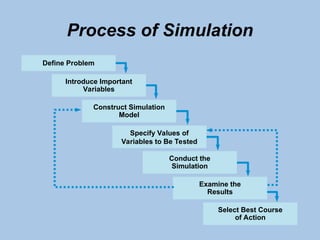
Process of Simulation
Define Problem
Introduce Important
Variables
Construct Simulation
Model
Specify Values of
Variables to Be Tested
Conduct the
Simulation
Examine the
Results
Select Best Course
of Action
Advantages and Disadvantages
of Simulation
 Simulation is useful because
1. It is relatively straightforward and flexible
2. Recent advances in computer software make
simulation models very easy to develop
3. Can be used to analyze large and complex
real-world situations
4. Allows “what-if?” type questions
5. Does not interfere with the real-world system
6. Enables study of interactions between
components
7. Enables time compression
8. Enables the inclusion of real-world
complications
Advantages and Disadvantages
of Simulation
 The main disadvantages of simulation are
1. It is often expensive as it may require a long,
complicated process to develop the model
2. Does not generate optimal solutions, it is a
trial-and-error approach
3. Requires managers to generate all conditions
and constraints of real-world problem
4. Each model is unique and the solutions and
inferences are not usually transferable to
other problems
Monte Carlo Simulation
 When systems contain elements that exhibit
chance in their behavior, the Monte Carlo method
of simulation can be applied
 Some examples are
1. Inventory demand
2. Lead time for inventory
3. Times between machine breakdowns
4. Times between arrivals
5. Service times
6. Times to complete project activities
7. Number of employees absent
Monte Carlo Simulation
 The basis of the Monte Carlo simulation is
experimentation on the probabilistic elements
through random sampling
 It is based on the following five steps
1. Setting up a probability distribution for
important variables
2. Building a cumulative probability distribution
for each variable
3. Establishing an interval of random numbers for
each variable
4. Generating random numbers
5. Actually simulating a series of trials
Harry’s Auto Tire Example
 A popular radial tire accounts for a large portion
of the sales at Harry’s Auto Tire
 Harry wishes to determine a policy for managing
this inventory
 He wants to simulate the daily demand for a
number of days
Step 1: Establishing probability distributions
 One way to establish a probability distribution for
a given variable is to examine historical outcomes
 Managerial estimates based on judgment and
experience can also be used
Harry’s Auto Tire Example
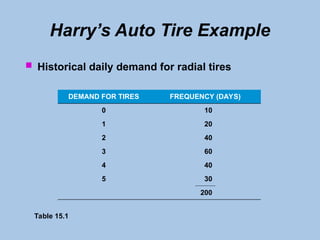
 Historical daily demand for radial tires
DEMAND FOR TIRES FREQUENCY (DAYS)
0 10
1 20
2 40
3 60
4 40
5 30
200
Table 15.1
Harry’s Auto Tire Example
Step 2:
Step 2: Building a cumulative probability distribution
Building a cumulative probability distribution
for each variable
for each variable
 Converting from a regular probability to a
cumulative distribution is an easy job
 A cumulative probability is the probability that a
variable will be less than or equal to a particular
value
 A cumulative distribution lists all of the possible
values and the probabilities
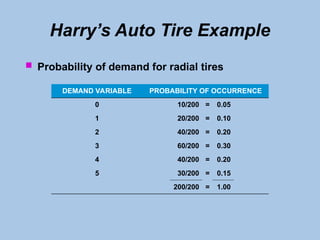
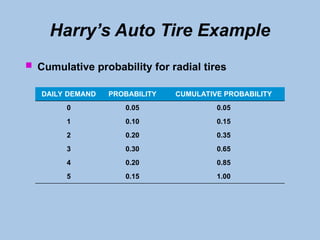
 Tables below show these distributions
Harry’s Auto Tire Example
 Probability of demand for radial tires
DEMAND VARIABLE PROBABILITY OF OCCURRENCE
0 10/200 = 0.05
1 20/200 = 0.10
2 40/200 = 0.20
3 60/200 = 0.30
4 40/200 = 0.20
5 30/200 = 0.15
200/200 = 1.00
Harry’s Auto Tire Example
 Cumulative probability for radial tires
DAILY DEMAND PROBABILITY CUMULATIVE PROBABILITY
0 0.05 0.05
1 0.10 0.15
2 0.20 0.35
3 0.30 0.65
4 0.20 0.85
5 0.15 1.00
Harry’s Auto Tire Example
Step 3: Setting random number intervals
 We assign a set of numbers to represent each
possible value or outcome
 These are random number intervals
random number intervals
 A random number
random number is a series of digits that have
been selected by a totally random process
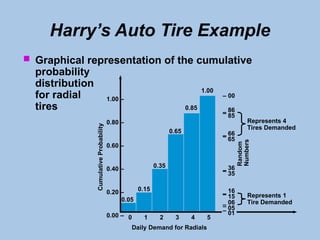
 The range of the random number intervals
corresponds exactly
exactly to the probability of the
outcomes as shown in Figure below
Harry’s Auto Tire Example
 Graphical representation of the cumulative
probability
distribution
for radial
tires
– 00
86
85
66
65
36
35
16
15
06
05
01
–
–
–
–
–
–
–
–
–
–
–
Random
Numbers
Represents 4
Tires Demanded
Represents 1
Tire Demanded
0.05
0.15
0.35
0.65
0.85
1.00
1.00 –
0.80 –
0.60 –
0.40 –
0.20 –
0.00 – 0 1 2 3 4 5
Daily Demand for Radials
Cumulative
Probability
Harry’s Auto Tire Example
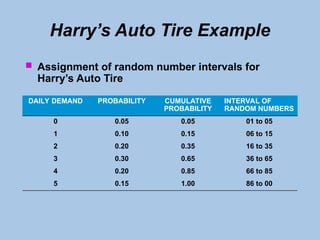
 Assignment of random number intervals for
Harry’s Auto Tire
DAILY DEMAND PROBABILITY CUMULATIVE
PROBABILITY
INTERVAL OF
RANDOM NUMBERS
0 0.05 0.05 01 to 05
1 0.10 0.15 06 to 15
2 0.20 0.35 16 to 35
3 0.30 0.65 36 to 65
4 0.20 0.85 66 to 85
5 0.15 1.00 86 to 00
Harry’s Auto Tire Example
Step 4: Generating random numbers
 Random numbers can be generated in several
ways
 Large problems will use computer program to
generate the needed random numbers
 For small problems, random processes like
roulette wheels or pulling chips from a hat may
be used
 The most common manual method is to use a
random number table
 Because everything
everything is random in a random
number table, we can select numbers from
anywhere in the table to use in the simulation
Harry’s Auto Tire Example
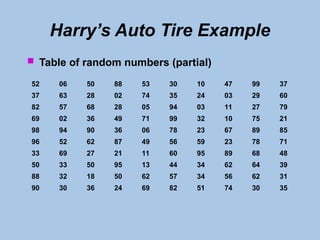
 Table of random numbers (partial)
52 06 50 88 53 30 10 47 99 37
37 63 28 02 74 35 24 03 29 60
82 57 68 28 05 94 03 11 27 79
69 02 36 49 71 99 32 10 75 21
98 94 90 36 06 78 23 67 89 85
96 52 62 87 49 56 59 23 78 71
33 69 27 21 11 60 95 89 68 48
50 33 50 95 13 44 34 62 64 39
88 32 18 50 62 57 34 56 62 31
90 30 36 24 69 82 51 74 30 35
Harry’s Auto Tire Example
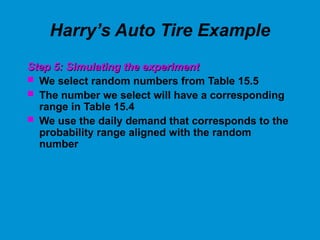
Step 5: Simulating the experiment
 We select random numbers from Table 15.5
 The number we select will have a corresponding
range in Table 15.4
 We use the daily demand that corresponds to the
probability range aligned with the random
number
Harry’s Auto Tire Example
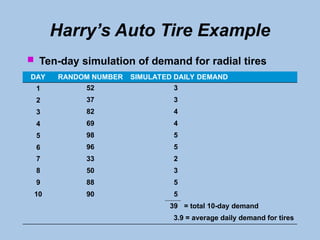
 Ten-day simulation of demand for radial tires
DAY RANDOM NUMBER SIMULATED DAILY DEMAND
1 52 3
2 37 3
3 82 4
4 69 4
5 98 5
6 96 5
7 33 2
8 50 3
9 88 5
10 90 5
39 = total 10-day demand
3.9 = average daily demand for tires
Harry’s Auto Tire Example
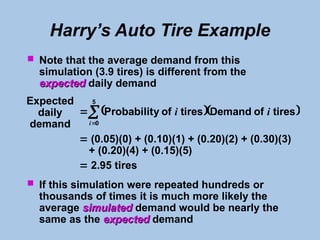
 Note that the average demand from this
simulation (3.9 tires) is different from the
expected
expected daily demand
Expected
daily
demand
  
tires
of
Demand
tires
of
y
Probabilit
5
0
i
i
i



 (0.05)(0) + (0.10)(1) + (0.20)(2) + (0.30)(3)
+ (0.20)(4) + (0.15)(5)
 2.95 tires
 If this simulation were repeated hundreds or
thousands of times it is much more likely the
average simulated
simulated demand would be nearly the
same as the expected
expected demand
Simulation of a Queuing Problem
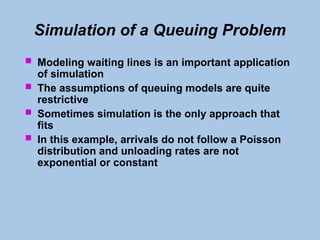
 Modeling waiting lines is an important application
of simulation
 The assumptions of queuing models are quite
restrictive
 Sometimes simulation is the only approach that
fits
 In this example, arrivals do not follow a Poisson
distribution and unloading rates are not
exponential or constant
Port of New Orleans
 Fully loaded barges arrive at night for unloading
 The number of barges each night varies from 0 - 5
 The number of barges vary from day to day
 The supervisor has information which can be
used to create a probability distribution for the
daily unloading rate
 Barges are unloaded first-in, first-out
 Barges must wait for unloading which is
expensive
 The dock superintendent wants to do a simulation
study to enable him to make better staffing
decisions
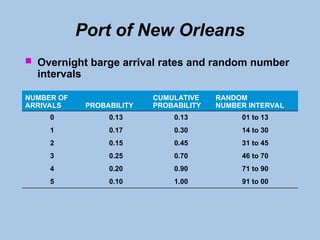
Port of New Orleans
 Overnight barge arrival rates and random number
intervals
NUMBER OF
ARRIVALS PROBABILITY
CUMULATIVE
PROBABILITY
RANDOM
NUMBER INTERVAL
0 0.13 0.13 01 to 13
1 0.17 0.30 14 to 30
2 0.15 0.45 31 to 45
3 0.25 0.70 46 to 70
4 0.20 0.90 71 to 90
5 0.10 1.00 91 to 00
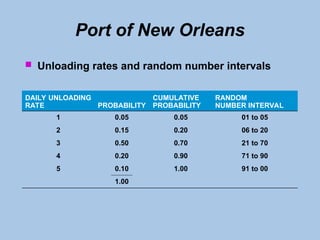
Port of New Orleans
 Unloading rates and random number intervals
DAILY UNLOADING
RATE PROBABILITY
CUMULATIVE
PROBABILITY
RANDOM
NUMBER INTERVAL
1 0.05 0.05 01 to 05
2 0.15 0.20 06 to 20
3 0.50 0.70 21 to 70
4 0.20 0.90 71 to 90
5 0.10 1.00 91 to 00
1.00
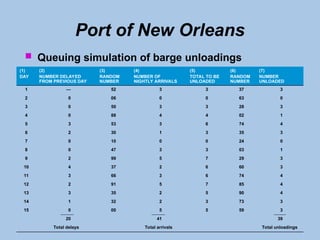
Port of New Orleans
 Queuing simulation of barge unloadings
(1)
DAY
(2)
NUMBER DELAYED
FROM PREVIOUS DAY
(3)
RANDOM
NUMBER
(4)
NUMBER OF
NIGHTLY ARRIVALS
(5)
TOTAL TO BE
UNLOADED
(6)
RANDOM
NUMBER
(7)
NUMBER
UNLOADED
1 — 52 3 3 37 3
2 0 06 0 0 63 0
3 0 50 3 3 28 3
4 0 88 4 4 02 1
5 3 53 3 6 74 4
6 2 30 1 3 35 3
7 0 10 0 0 24 0
8 0 47 3 3 03 1
9 2 99 5 7 29 3
10 4 37 2 6 60 3
11 3 66 3 6 74 4
12 2 91 5 7 85 4
13 3 35 2 5 90 4
14 1 32 2 3 73 3
15 0 00 5 5 59 3
20 41 39
Total delays Total arrivals Total unloadings
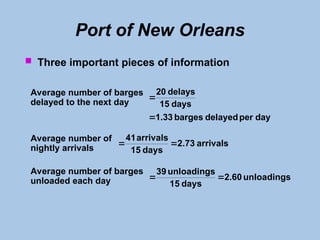
Port of New Orleans
 Three important pieces of information
Average number of barges
delayed to the next day
day
per
delayed
barges
1.33
days
15
delays
20


Average number of
nightly arrivals
arrivals
2.73
days
15
arrivals
41


Average number of barges
unloaded each day unloadings
2.60
days
15
unloadings
39



there is a huge knowledge about internet and

  • 1.
  • 2.
    Learning Objectives 1. Tackea wide variety of problems by simulation 2. Understand the seven steps of conducting a simulation 3. Explain the advantages and disadvantages of simulation 4. Develop random number intervals and use them to generate outcomes After completing this chapter, students will be able to: After completing this chapter, students will be able to:
  • 3.
    Introduction  Simulation Simulation isone of the most widely used quantitative analysis tools  It is used by over half of the largest US corporations in corporate planning  To simulate simulate is to try to duplicate the features, appearance, and characteristics of a real system  We will build a mathematical model mathematical model that comes as close as possible to representing the reality of the system  You can also build physical physical models to test systems
  • 4.
    Introduction  The ideabehind simulation is to imitate a real- world situation mathematically  Study its properties and operating characteristics  Draw conclusions and make action decisions
  • 5.
    Introduction  Using simulation,a manager should 1. Define a problem 2. Introduce the variables associated with the problem 3. Construct a numerical model 4. Set up possible courses of action for testing 5. Run the experiment 6. Consider the results 7. Decide what courses of action to take
  • 6.
    Process of Simulation DefineProblem Introduce Important Variables Construct Simulation Model Specify Values of Variables to Be Tested Conduct the Simulation Examine the Results Select Best Course of Action
  • 7.
    Advantages and Disadvantages ofSimulation  Simulation is useful because 1. It is relatively straightforward and flexible 2. Recent advances in computer software make simulation models very easy to develop 3. Can be used to analyze large and complex real-world situations 4. Allows “what-if?” type questions 5. Does not interfere with the real-world system 6. Enables study of interactions between components 7. Enables time compression 8. Enables the inclusion of real-world complications
  • 8.
    Advantages and Disadvantages ofSimulation  The main disadvantages of simulation are 1. It is often expensive as it may require a long, complicated process to develop the model 2. Does not generate optimal solutions, it is a trial-and-error approach 3. Requires managers to generate all conditions and constraints of real-world problem 4. Each model is unique and the solutions and inferences are not usually transferable to other problems
  • 9.
    Monte Carlo Simulation When systems contain elements that exhibit chance in their behavior, the Monte Carlo method of simulation can be applied  Some examples are 1. Inventory demand 2. Lead time for inventory 3. Times between machine breakdowns 4. Times between arrivals 5. Service times 6. Times to complete project activities 7. Number of employees absent
  • 10.
    Monte Carlo Simulation The basis of the Monte Carlo simulation is experimentation on the probabilistic elements through random sampling  It is based on the following five steps 1. Setting up a probability distribution for important variables 2. Building a cumulative probability distribution for each variable 3. Establishing an interval of random numbers for each variable 4. Generating random numbers 5. Actually simulating a series of trials
  • 11.
    Harry’s Auto TireExample  A popular radial tire accounts for a large portion of the sales at Harry’s Auto Tire  Harry wishes to determine a policy for managing this inventory  He wants to simulate the daily demand for a number of days Step 1: Establishing probability distributions Step 1: Establishing probability distributions  One way to establish a probability distribution for a given variable is to examine historical outcomes  Managerial estimates based on judgment and experience can also be used
  • 12.
    Harry’s Auto TireExample  Historical daily demand for radial tires DEMAND FOR TIRES FREQUENCY (DAYS) 0 10 1 20 2 40 3 60 4 40 5 30 200 Table 15.1
  • 13.
    Harry’s Auto TireExample Step 2: Step 2: Building a cumulative probability distribution Building a cumulative probability distribution for each variable for each variable  Converting from a regular probability to a cumulative distribution is an easy job  A cumulative probability is the probability that a variable will be less than or equal to a particular value  A cumulative distribution lists all of the possible values and the probabilities  Tables below show these distributions
  • 14.
    Harry’s Auto TireExample  Probability of demand for radial tires DEMAND VARIABLE PROBABILITY OF OCCURRENCE 0 10/200 = 0.05 1 20/200 = 0.10 2 40/200 = 0.20 3 60/200 = 0.30 4 40/200 = 0.20 5 30/200 = 0.15 200/200 = 1.00
  • 15.
    Harry’s Auto TireExample  Cumulative probability for radial tires DAILY DEMAND PROBABILITY CUMULATIVE PROBABILITY 0 0.05 0.05 1 0.10 0.15 2 0.20 0.35 3 0.30 0.65 4 0.20 0.85 5 0.15 1.00
  • 16.
    Harry’s Auto TireExample Step 3: Setting random number intervals Step 3: Setting random number intervals  We assign a set of numbers to represent each possible value or outcome  These are random number intervals random number intervals  A random number random number is a series of digits that have been selected by a totally random process  The range of the random number intervals corresponds exactly exactly to the probability of the outcomes as shown in Figure below
  • 17.
    Harry’s Auto TireExample  Graphical representation of the cumulative probability distribution for radial tires – 00 86 85 66 65 36 35 16 15 06 05 01 – – – – – – – – – – – Random Numbers Represents 4 Tires Demanded Represents 1 Tire Demanded 0.05 0.15 0.35 0.65 0.85 1.00 1.00 – 0.80 – 0.60 – 0.40 – 0.20 – 0.00 – 0 1 2 3 4 5 Daily Demand for Radials Cumulative Probability
  • 18.
    Harry’s Auto TireExample  Assignment of random number intervals for Harry’s Auto Tire DAILY DEMAND PROBABILITY CUMULATIVE PROBABILITY INTERVAL OF RANDOM NUMBERS 0 0.05 0.05 01 to 05 1 0.10 0.15 06 to 15 2 0.20 0.35 16 to 35 3 0.30 0.65 36 to 65 4 0.20 0.85 66 to 85 5 0.15 1.00 86 to 00
  • 19.
    Harry’s Auto TireExample Step 4: Generating random numbers Step 4: Generating random numbers  Random numbers can be generated in several ways  Large problems will use computer program to generate the needed random numbers  For small problems, random processes like roulette wheels or pulling chips from a hat may be used  The most common manual method is to use a random number table  Because everything everything is random in a random number table, we can select numbers from anywhere in the table to use in the simulation
  • 20.
    Harry’s Auto TireExample  Table of random numbers (partial) 52 06 50 88 53 30 10 47 99 37 37 63 28 02 74 35 24 03 29 60 82 57 68 28 05 94 03 11 27 79 69 02 36 49 71 99 32 10 75 21 98 94 90 36 06 78 23 67 89 85 96 52 62 87 49 56 59 23 78 71 33 69 27 21 11 60 95 89 68 48 50 33 50 95 13 44 34 62 64 39 88 32 18 50 62 57 34 56 62 31 90 30 36 24 69 82 51 74 30 35
  • 21.
    Harry’s Auto TireExample Step 5: Simulating the experiment Step 5: Simulating the experiment  We select random numbers from Table 15.5  The number we select will have a corresponding range in Table 15.4  We use the daily demand that corresponds to the probability range aligned with the random number
  • 22.
    Harry’s Auto TireExample  Ten-day simulation of demand for radial tires DAY RANDOM NUMBER SIMULATED DAILY DEMAND 1 52 3 2 37 3 3 82 4 4 69 4 5 98 5 6 96 5 7 33 2 8 50 3 9 88 5 10 90 5 39 = total 10-day demand 3.9 = average daily demand for tires
  • 23.
    Harry’s Auto TireExample  Note that the average demand from this simulation (3.9 tires) is different from the expected expected daily demand Expected daily demand    tires of Demand tires of y Probabilit 5 0 i i i     (0.05)(0) + (0.10)(1) + (0.20)(2) + (0.30)(3) + (0.20)(4) + (0.15)(5)  2.95 tires  If this simulation were repeated hundreds or thousands of times it is much more likely the average simulated simulated demand would be nearly the same as the expected expected demand
  • 24.
    Simulation of aQueuing Problem  Modeling waiting lines is an important application of simulation  The assumptions of queuing models are quite restrictive  Sometimes simulation is the only approach that fits  In this example, arrivals do not follow a Poisson distribution and unloading rates are not exponential or constant
  • 25.
    Port of NewOrleans  Fully loaded barges arrive at night for unloading  The number of barges each night varies from 0 - 5  The number of barges vary from day to day  The supervisor has information which can be used to create a probability distribution for the daily unloading rate  Barges are unloaded first-in, first-out  Barges must wait for unloading which is expensive  The dock superintendent wants to do a simulation study to enable him to make better staffing decisions
  • 26.
    Port of NewOrleans  Overnight barge arrival rates and random number intervals NUMBER OF ARRIVALS PROBABILITY CUMULATIVE PROBABILITY RANDOM NUMBER INTERVAL 0 0.13 0.13 01 to 13 1 0.17 0.30 14 to 30 2 0.15 0.45 31 to 45 3 0.25 0.70 46 to 70 4 0.20 0.90 71 to 90 5 0.10 1.00 91 to 00
  • 27.
    Port of NewOrleans  Unloading rates and random number intervals DAILY UNLOADING RATE PROBABILITY CUMULATIVE PROBABILITY RANDOM NUMBER INTERVAL 1 0.05 0.05 01 to 05 2 0.15 0.20 06 to 20 3 0.50 0.70 21 to 70 4 0.20 0.90 71 to 90 5 0.10 1.00 91 to 00 1.00
  • 28.
    Port of NewOrleans  Queuing simulation of barge unloadings (1) DAY (2) NUMBER DELAYED FROM PREVIOUS DAY (3) RANDOM NUMBER (4) NUMBER OF NIGHTLY ARRIVALS (5) TOTAL TO BE UNLOADED (6) RANDOM NUMBER (7) NUMBER UNLOADED 1 — 52 3 3 37 3 2 0 06 0 0 63 0 3 0 50 3 3 28 3 4 0 88 4 4 02 1 5 3 53 3 6 74 4 6 2 30 1 3 35 3 7 0 10 0 0 24 0 8 0 47 3 3 03 1 9 2 99 5 7 29 3 10 4 37 2 6 60 3 11 3 66 3 6 74 4 12 2 91 5 7 85 4 13 3 35 2 5 90 4 14 1 32 2 3 73 3 15 0 00 5 5 59 3 20 41 39 Total delays Total arrivals Total unloadings
  • 29.
    Port of NewOrleans  Three important pieces of information Average number of barges delayed to the next day day per delayed barges 1.33 days 15 delays 20   Average number of nightly arrivals arrivals 2.73 days 15 arrivals 41   Average number of barges unloaded each day unloadings 2.60 days 15 unloadings 39  