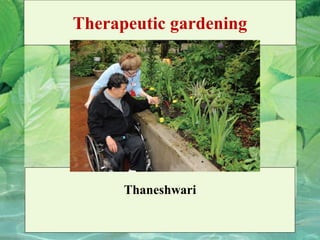
Therapeutic gardening
Thaneshwari
Introduction
• Over the past decade many people have become aware of
the positive effects of human interaction with plants and
gardens.
• Recent surge of interest in this relationship in combination
with a great increase of horticultural activities in treatment
programmes have led to the use of numerous terms for
these programmes and activities such as therapeutic
horticulture, garden therapy, social horticulture and
therapeutic gardening to name a few.
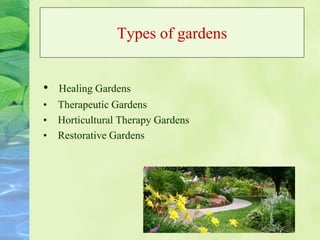
Types of gardens
• Healing Gardens
• Therapeutic Gardens
• Horticultural Therapy Gardens
• Restorative Gardens
Healing Gardens
• Healing gardens are plant dominated environments
including green plants, flowers, water and other aspects of
nature.
• They are generally associated with hospitals and other
healthcare settings.
• They are further divided into specific types of gardens
including therapeutic gardens, horticultural therapy
gardens and restorative gardens.
(AHTA, 2012 )
Therapeutic Gardens
• Designed for use as a component of a treatment program
such as occupational therapy, physical therapy or
horticultural therapy programs.
• Designed to meet the needs of a specific user or
population.
(AHTA, 2012 )
Horticultural Therapy Gardens
• Type of therapeutic garden
• Designed to accommodate client treatment goals
• Support primarily horticultural activities
• A clients themselves are able to take care of plant material
in the garden.
(AHTA, 2012 )
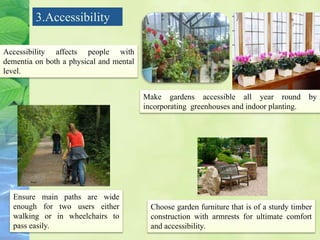
Restorative Gardens
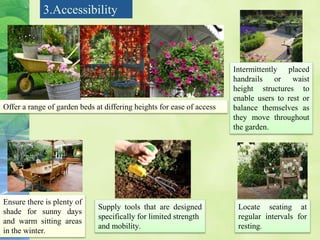
• Public or private garden
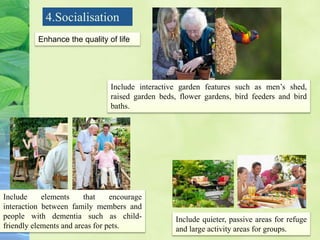
• Not necessarily associated with a healthcare setting.
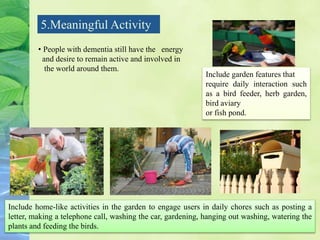
• Employs the restorative value of nature
• The design focuses on the psychological, physical and
social needs of the users.
(AHTA,2012)
History of Horticultural Therapy and
Therapeutic Gardens
• In the 1100’s St. Bernard described the benefits of a hospice
garden at a monastery in Clairvaux, France
• He mentioned the therapeutic benefits of privacy, green
plants, birdsong and fragrance (Kaufman & Warner, 1998).
• In 1812 Dr. Benjamin Rush, published a book “Medical
Inquiries and Observations Upon Diseases of the Mind”
• He stated that “digging in a garden” was one of the activities
that distinguished those male patients who recovered from
their mania from those that did not (Rush, 1812).
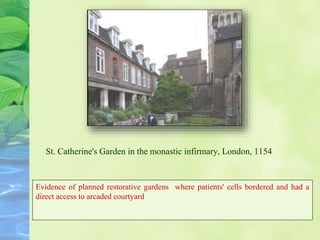
St. Catherine's Garden in the monastic infirmary, London, 1154
Evidence of planned restorative gardens where patients' cells bordered and had a
direct access to arcaded courtyard
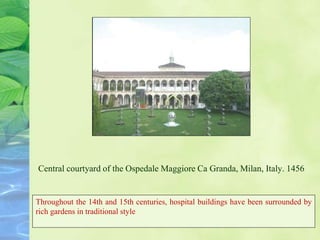
Central courtyard of the Ospedale Maggiore Ca Granda, Milan, Italy. 1456
Throughout the 14th and 15th centuries, hospital buildings have been surrounded by
rich gardens in traditional style
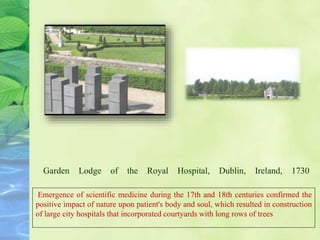
Garden Lodge of the Royal Hospital, Dublin, Ireland, 1730
Emergence of scientific medicine during the 17th and 18th centuries confirmed the
positive impact of nature upon patient's body and soul, which resulted in construction
of large city hospitals that incorporated courtyards with long rows of trees
• In the 1940s veteran hospitals were established by the U.S.
government to care for wounded servicemen (Relf, 2006).
• In 1973 a group of horticultural therapy professionals
established the Council for Therapy and Rehabilitation
through Horticulture (NCTRH)
• In 1988 the organization changed its name to the American
Horticultural Therapy Association (AHTA) (AHTA,2012)
• Friends Asylum for the Insane was the first known example
of psychiatric hospitals using gardening activities, opened
in 1813 in Philadelphia (Friends Hospital, 2005).
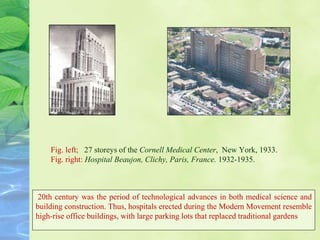
Fig. left; 27 storeys of the Cornell Medical Center, New York, 1933.
Fig. right: Hospital Beaujon, Clichy, Paris, France. 1932-1935.
20th century was the period of technological advances in both medical science and
building construction. Thus, hospitals erected during the Modern Movement resemble
high-rise office buildings, with large parking lots that replaced traditional gardens
Benefits of horticulture therapy and
therapeutic gardens
1.Cognitive Benefits
• Enhance cognitive functioning (Cimprich, 1993; Herzog et al., 1997)
• Improve concentration (Wells, 2000; Taylor et al., 2001)
• Stimulate memory (Namazi & Haynes, 1994).
• Improve goal achievement (Willets & Sperling, 1983).
• Improve attention capacity (Ulrich, 1999; Taylor et al., 2001)
2.Social Benefits
• Improve social integration (Kweon, Sullivan & Wiley, 1998)
• Increase social interaction (Moore, 1989; Margalis et al., 2000).
• Provide for healthier patterns of social functioning (Kuo et al.,1998)
• Improved group cohesiveness (Bunn, 1986)
3.Psychological Benefits
•Improve quality of life (Willets & Sperling, 1983; Waliczek et al., 1996)
•Increase self-esteem (Feenstra et al., 1999; Pothukuchi & Bickes, 2001)
•Improve sense of well-being (Ulrich & Parsons, 1992; Hartig, 2003)
•Reduce stress (Ulrich & Parsons, 1992; Whitehouse et al., 2001; Rodiek, 2002)
•Improve mood (Wichrowski et al., 2005; Whitehouse et al., 2001)
•Decrease anxiety (Mooney & Milstein, 1994)
•Alleviate depression (Mooney & Milstein, 1994; Cooper Marcus & Barnes, 1999)
•Increase sense of control (Relf et al., 1992)
•Improve sense of personal worth (Smith & Aldous, 1994)
•Increase feelings of calm and relaxation (Moore, 1989; Relf et al., 1992)
•Increase sense of stability (Blair et al., 1991; Pothukuchi & Bickes, 2001)
•Improve personal satisfaction (Feenstra et al., 1999; Pothukuchi & Bickes, 2001)
•Increase sense of pride and accomplishment (Matsuo, 1995)
4.Physical Benefits
Improve immune response (Ulrich & Parsons 1992; Ulrich, 1999)
Decrease stress (Rodiek, 2002)
Decrease heart rate (Wichrowski et al; 2005)
Promote physical health (Armstrong, 2000; Rodiek, 2002)
Improve fine and gross motor skills and eye-hand coordination (Moore, 1989)
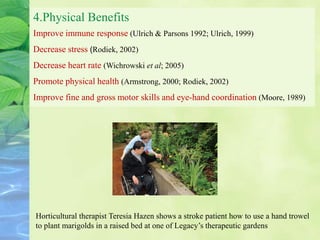
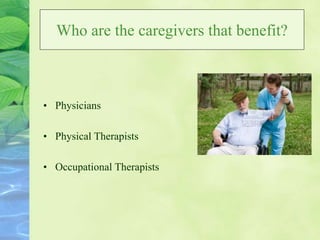
Horticultural therapist Teresia Hazen shows a stroke patient how to use a hand trowel
to plant marigolds in a raised bed at one of Legacy’s therapeutic gardens
Who are the caregivers that benefit?
• Physicians
• Physical Therapists
• Occupational Therapists
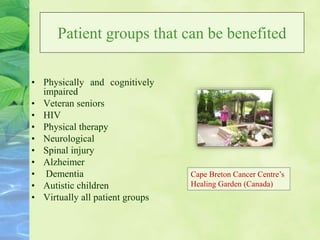
Patient groups that can be benefited
• Physically and cognitively
impaired
• Veteran seniors
• HIV
• Physical therapy
• Neurological
• Spinal injury
• Alzheimer
• Dementia
• Autistic children
• Virtually all patient groups
Cape Breton Cancer Centre’s
Healing Garden (Canada)
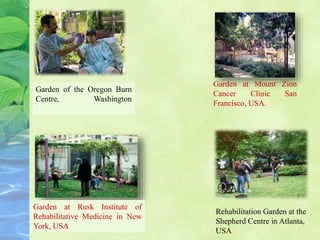
Rehabilitation Garden at the
Shepherd Centre in Atlanta,
USA
Garden at Mount Zion
Cancer Clinic San
Francisco, USA.
Garden at Rusk Institute of
Rehabilitative Medicine in New
York, USA
Garden of the Oregon Burn
Centre, Washington
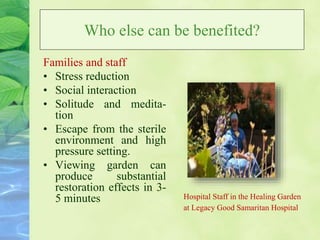
Who else can be benefited?
Families and staff
• Stress reduction
• Social interaction
• Solitude and medita-
tion
• Escape from the sterile
environment and high
pressure setting.
• Viewing garden can
produce substantial
restoration effects in 3-
5 minutes Hospital Staff in the Healing Garden
at Legacy Good Samaritan Hospital
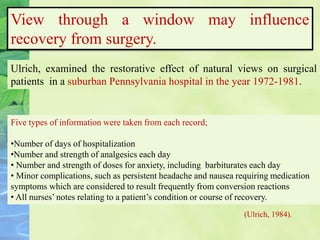
View through a window may influence
recovery from surgery.
(Ulrich, 1984).
Ulrich, examined the restorative effect of natural views on surgical
patients in a suburban Pennsylvania hospital in the year 1972-1981.
Five types of information were taken from each record;
•Number of days of hospitalization
•Number and strength of analgesics each day
• Number and strength of doses for anxiety, including barbiturates each day
• Minor complications, such as persistent headache and nausea requiring medication
symptoms which are considered to result frequently from conversion reactions
• All nurses’ notes relating to a patient’s condition or course of recovery.
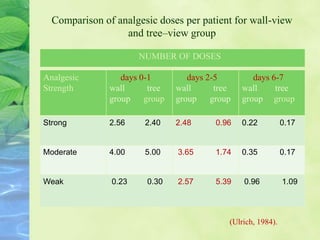
Comparison of analgesic doses per patient for wall-view
and tree–view group
Analgesic
Strength
days 0-1
wall tree
group group
days 2-5
wall tree
group group
days 6-7
wall tree
group group
Strong 2.56 2.40 2.48 0.96 0.22 0.17
Moderate 4.00 5.00 3.65 1.74 0.35 0.17
Weak 0.23 0.30 2.57 5.39 0.96 1.09
NUMBER OF DOSES
(Ulrich, 1984).
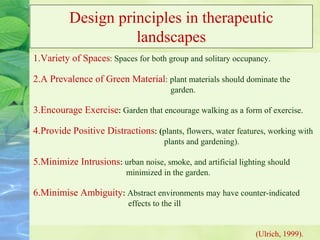
Design principles in therapeutic
landscapes
1.Variety of Spaces: Spaces for both group and solitary occupancy.
2.A Prevalence of Green Material: plant materials should dominate the
garden.
3.Encourage Exercise: Garden that encourage walking as a form of exercise.
4.Provide Positive Distractions: (plants, flowers, water features, working with
plants and gardening).
5.Minimize Intrusions: urban noise, smoke, and artificial lighting should
minimized in the garden.
6.Minimise Ambiguity: Abstract environments may have counter-indicated
effects to the ill
(Ulrich, 1999).
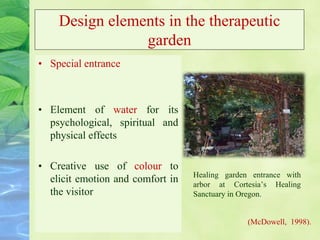
Design elements in the therapeutic
garden
• Special entrance
• Element of water for its
psychological, spiritual and
physical effects
• Creative use of colour to
elicit emotion and comfort in
the visitor
Healing garden entrance with
arbor at Cortesia’s Healing
Sanctuary in Oregon.
(McDowell, 1998).
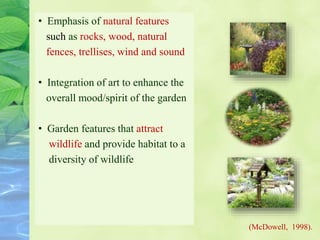
• Emphasis of natural features
such as rocks, wood, natural
fences, trellises, wind and sound
• Integration of art to enhance the
overall mood/spirit of the garden
• Garden features that attract
wildlife and provide habitat to a
diversity of wildlife
(McDowell, 1998).
General design considerations for hospital
outdoor spaces and therapeutic gardens
1. Potentials of the site:
Optimal distribution of the total site area of a hospital
complex should be as follows:
• 30% for the buildings
• 15% for internal communication routes and parking
• 50% for vacant area out of which 10% is reserved for
recreational areas
(Kliska et al, 1961).
2. User groups and their needs:
• Patients
• Employees
• Visitors
3. Types of experiences:
Therapeutic garden should be planned according to following
requirements:
• To create opportunities for movement and exercise
• To offer a choice between social interaction and solitude
• To provide both direct and indirect contacts with nature and
other positive distractions
(Ulrich,1999 )
4. Variety of spaces and their interrelation:
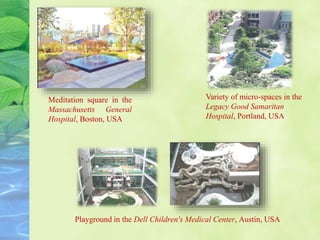
Provide a variety of hospital outdoor micro spaces, targeting
different needs of their users.
• Places for both group and solitary occupancy
• Places in the sunlight or shade
• Places to pause and experience natural surrounding
(Hosking and Haggard, 1999 )
Encourage suitable type of exercise:
• Looped pathways for shorter or longer routes
• Settings for physical therapy
• Playgrounds
• Meandering garden layout for contemplative walking and
jogging trails.
Meditation square in the
Massachusetts General
Hospital, Boston, USA
Playground in the Dell Children's Medical Center, Austin, USA
Variety of micro-spaces in the
Legacy Good Samaritan
Hospital, Portland, USA
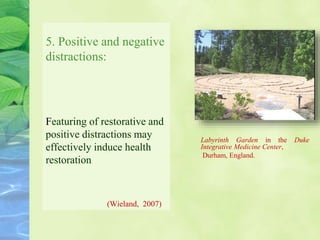
5. Positive and negative
distractions:
Featuring of restorative and
positive distractions may
effectively induce health
restoration
(Wieland, 2007)
Labyrinth Garden in the Duke
Integrative Medicine Center,
Durham, England.
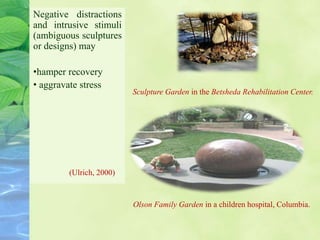
Olson Family Garden in a children hospital, Columbia.
Negative distractions
and intrusive stimuli
(ambiguous sculptures
or designs) may
•hamper recovery
• aggravate stress
(Ulrich, 2000)
Sculpture Garden in the Betsheda Rehabilitation Center.
6.Accessibility, familiarity and security
• Physically secure
• Accessible to people of all ages and abilities
• Familiar and safe: when feeling stressed or depressed, many
users search for environments that seem familiar and safe
• Provision of additional medical support (e.g. oxygen
outlets) may allow their extended use and lead to a higher
degree of comfort
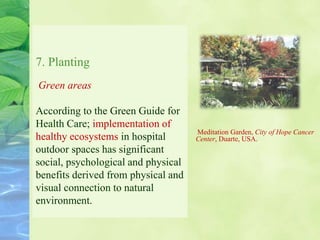
7. Planting
Green areas
According to the Green Guide for
Health Care; implementation of
healthy ecosystems in hospital
outdoor spaces has significant
social, psychological and physical
benefits derived from physical and
visual connection to natural
environment.
Meditation Garden, City of Hope Cancer
Center, Duarte, USA.
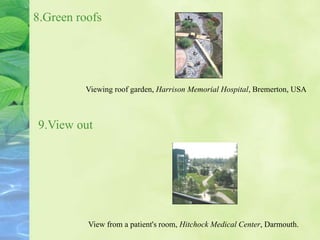
8.Green roofs
Viewing roof garden, Harrison Memorial Hospital, Bremerton, USA
View from a patient's room, Hitchock Medical Center, Darmouth.
9.View out
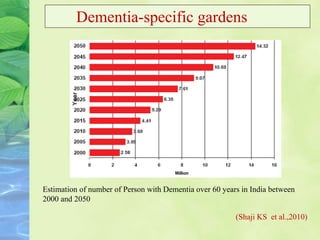
Dementia-specific gardens
Estimation of number of Person with Dementia over 60 years in India between
2000 and 2050
(Shaji KS et al.,2010)
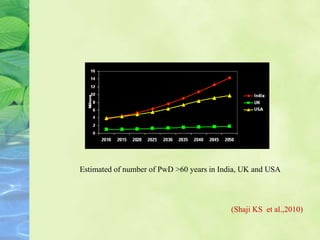
Estimated of number of PwD >60 years in India, UK and USA
(Shaji KS et al.,2010)
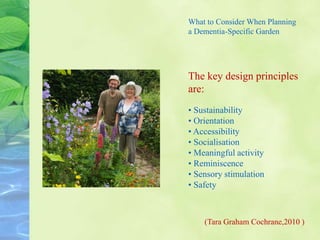
What to Consider When Planning
a Dementia-Specific Garden
The key design principles
are:
• Sustainability
• Orientation
• Accessibility
• Socialisation
• Meaningful activity
• Reminiscence
• Sensory stimulation
• Safety
(Tara Graham Cochrane,2010 )
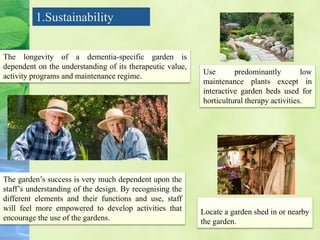
1.Sustainability
The longevity of a dementia-specific garden is
dependent on the understanding of its therapeutic value,
activity programs and maintenance regime.
The garden’s success is very much dependent upon the
staff’s understanding of the design. By recognising the
different elements and their functions and use, staff
will feel more empowered to develop activities that
encourage the use of the gardens.
Use predominantly low
maintenance plants except in
interactive garden beds used for
horticultural therapy activities.
Locate a garden shed in or nearby
the garden.
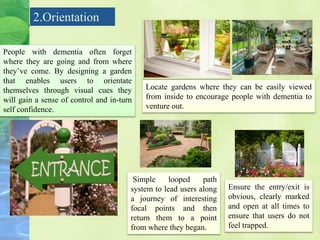
2.Orientation
People with dementia often forget
where they are going and from where
they’ve come. By designing a garden
that enables users to orientate
themselves through visual cues they
will gain a sense of control and in-turn
self confidence.
Locate gardens where they can be easily viewed
from inside to encourage people with dementia to
venture out.
Simple looped path
system to lead users along
a journey of interesting
focal points and then
return them to a point
from where they began.
Ensure the entry/exit is
obvious, clearly marked
and open at all times to
ensure that users do not
feel trapped.
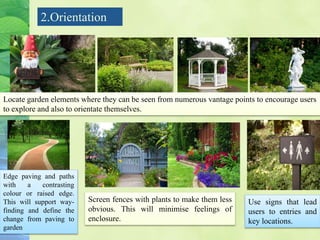
2.Orientation
Locate garden elements where they can be seen from numerous vantage points to encourage users
to explore and also to orientate themselves.
Edge paving and paths
with a contrasting
colour or raised edge.
This will support way-
finding and define the
change from paving to
garden
Screen fences with plants to make them less
obvious. This will minimise feelings of
enclosure.
Use signs that lead
users to entries and
key locations.
3.Accessibility
Accessibility affects people with
dementia on both a physical and mental
level.
Make gardens accessible all year round by
incorporating greenhouses and indoor planting.
Ensure main paths are wide
enough for two users either
walking or in wheelchairs to
pass easily.
Choose garden furniture that is of a sturdy timber
construction with armrests for ultimate comfort
and accessibility.
Offer a range of garden beds at differing heights for ease of access
Intermittently placed
handrails or waist
height structures to
enable users to rest or
balance themselves as
they move throughout
the garden.
Ensure there is plenty of
shade for sunny days
and warm sitting areas
in the winter.
Locate seating at
regular intervals for
resting.
Supply tools that are designed
specifically for limited strength
and mobility.
3.Accessibility
4.Socialisation
Enhance the quality of life
Include interactive garden features such as men’s shed,
raised garden beds, flower gardens, bird feeders and bird
baths.
Include elements that encourage
interaction between family members and
people with dementia such as child-
friendly elements and areas for pets.
Include quieter, passive areas for refuge
and large activity areas for groups.
5.Meaningful Activity
Include home-like activities in the garden to engage users in daily chores such as posting a
letter, making a telephone call, washing the car, gardening, hanging out washing, watering the
plants and feeding the birds.
Include garden features that
require daily interaction such
as a bird feeder, herb garden,
bird aviary
or fish pond.
• People with dementia still have the energy
and desire to remain active and involved in
the world around them.
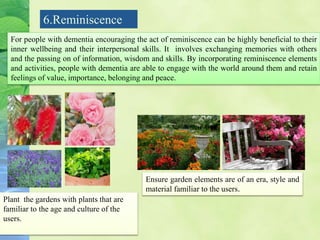
6.Reminiscence
For people with dementia encouraging the act of reminiscence can be highly beneficial to their
inner wellbeing and their interpersonal skills. It involves exchanging memories with others
and the passing on of information, wisdom and skills. By incorporating reminiscence elements
and activities, people with dementia are able to engage with the world around them and retain
feelings of value, importance, belonging and peace.
Plant the gardens with plants that are
familiar to the age and culture of the
users.
Ensure garden elements are of an era, style and
material familiar to the users.
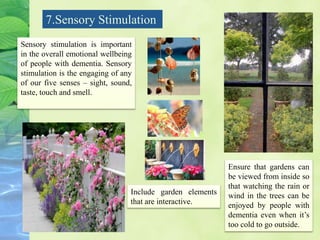
7.Sensory Stimulation
Sensory stimulation is important
in the overall emotional wellbeing
of people with dementia. Sensory
stimulation is the engaging of any
of our five senses – sight, sound,
taste, touch and smell.
Include garden elements
that are interactive.
Ensure that gardens can
be viewed from inside so
that watching the rain or
wind in the trees can be
enjoyed by people with
dementia even when it’s
too cold to go outside.
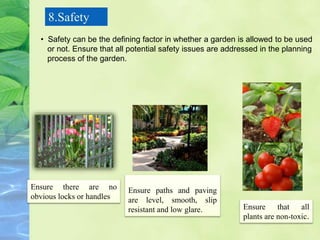
8.Safety
Ensure paths and paving
are level, smooth, slip
resistant and low glare.
Ensure there are no
obvious locks or handles
Ensure that all
plants are non-toxic.
• Safety can be the defining factor in whether a garden is allowed to be used
or not. Ensure that all potential safety issues are addressed in the planning
process of the garden.
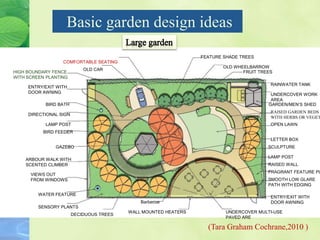
COMFORTABLE SEATING
OLD CAR
ENTRY/EXIT WITH
DOOR AWNING
BIRD BATH
DIRECTIONAL SIGN
LAMP POST
BIRD FEEDER
GAZEBO
ARBOUR WALK WITH
SCENTED CLIMBER
VIEWS OUT
FROM WINDOWS
WATER FEATURE
SENSORY PLANTS
DECIDUOUS TREES
Barbecue
WALL MOUNTED HEATERS UNDERCOVER MULTI-USE
PAVED ARE
ENTRY/EXIT WITH
DOOR AWNING
SMOOTH LOW GLARE
PATH WITH EDGING
FRAGRANT FEATURE PL
RAISED WALL
LAMP POST
SCULPTURE
LETTER BOX
OPEN LAWN
RAISED GARDEN BEDS P
WITH HERBS OR VEGET
GARDEN/MEN’S SHED
UNDERCOVER WORK
AREA
RAINWATER TANK
FRUIT TREES
OLD WHEELBARROW
FEATURE SHADE TREES
Basic garden design ideas
HIGH BOUNDARY FENCE
WITH SCREEN PLANTING
(Tara Graham Cochrane,2010 )
Plants
Enhancing the sense of sound to calm the nerves
Rustle in the wind
• Bamboos
• Magnolia grandiflora
• Peltophorum ferruginium
• Platanus orientalis
• Musa paradisiaca
• Sweet corn
Attract buzzing bees
• Lavendula officinalis
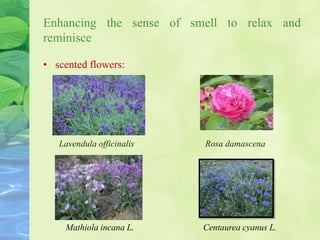
Enhancing the sense of smell to relax and
reminisce
• scented flowers:
lavender
Lavendula officinalis Rosa damascena
Centaurea cyanus L.Mathiola incana L.
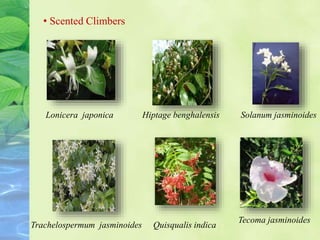
• Scented Climbers
Trachelospermum jasminoides Quisqualis indica
Tecoma jasminoides
Solanum jasminoidesHiptage benghalensisLonicera japonica
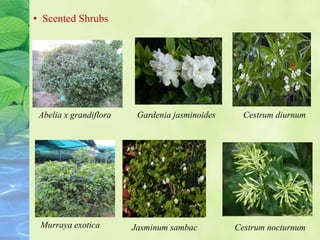
Abelia x grandiflora Gardenia jasminoides
Murraya exotica Jasminum sambac
Cestrum diurnum
Cestrum nocturnum
• Scented Shrubs
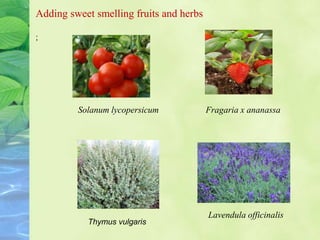
Adding sweet smelling fruits and herbs
;
Thymus vulgaris
Solanum lycopersicum Fragaria x ananassa
Lavendula officinalis
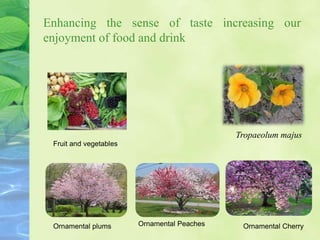
Enhancing the sense of taste increasing our
enjoyment of food and drink
Fruit and vegetables
Tropaeolum majus
Ornamental plums Ornamental Peaches Ornamental Cherry
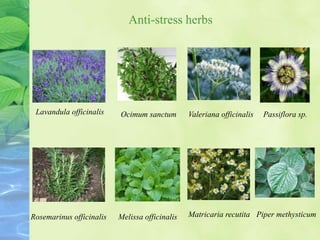
Lavandula officinalis Ocimum sanctum Valeriana officinalis Passiflora sp.
Rosemarinus officinalis Melissa officinalis Matricaria recutita Piper methysticum
Anti-stress herbs
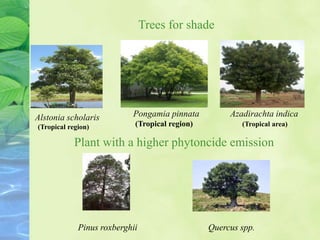
Trees for shade
Alstonia scholaris
(Tropical region)
Pongamia pinnata
(Tropical region)
Azadirachta indica
(Tropical area)
Plant with a higher phytoncide emission
Pinus roxberghii Quercus spp.
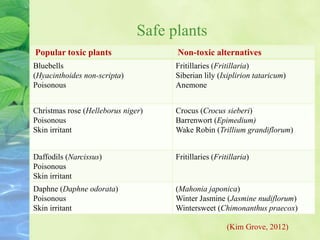
Safe plants
Popular toxic plants Non-toxic alternatives
Bluebells
(Hyacinthoides non-scripta)
Poisonous
Fritillaries (Fritillaria)
Siberian lily (Ixiplirion tataricum)
Anemone
Christmas rose (Helleborus niger)
Poisonous
Skin irritant
Crocus (Crocus sieberi)
Barrenwort (Epimedium)
Wake Robin (Trillium grandiflorum)
Daffodils (Narcissus)
Poisonous
Skin irritant
Fritillaries (Fritillaria)
Daphne (Daphne odorata)
Poisonous
Skin irritant
(Mahonia japonica)
Winter Jasmine (Jasmine nudiflorum)
Wintersweet (Chimonanthus praecox)
(Kim Grove, 2012)
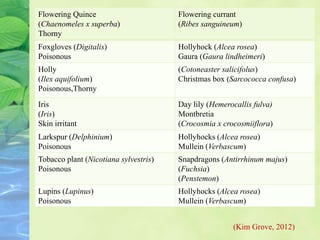
Flowering Quince
(Chaenomeles x superba)
Thorny
Flowering currant
(Ribes sanguineum)
Foxgloves (Digitalis)
Poisonous
Hollyhock (Alcea rosea)
Gaura (Gaura lindheimeri)
Holly
(Ilex aquifolium)
Poisonous,Thorny
(Cotoneaster salicifolus)
Christmas box (Sarcococca confusa)
Iris
(Iris)
Skin irritant
Day lily (Hemerocallis fulva)
Montbretia
(Crocosmia x crocosmiiflora)
Larkspur (Delphinium)
Poisonous
Hollyhocks (Alcea rosea)
Mullein (Verbascum)
Tobacco plant (Nicotiana sylvestris)
Poisonous
Snapdragons (Antirrhinum majus)
(Fuchsia)
(Penstemon)
Lupins (Lupinus)
Poisonous
Hollyhocks (Alcea rosea)
Mullein (Verbascum)
(Kim Grove, 2012)
Therapeutic garden

Therapeutic garden

  • 1.
  • 2.
    Introduction • Over thepast decade many people have become aware of the positive effects of human interaction with plants and gardens. • Recent surge of interest in this relationship in combination with a great increase of horticultural activities in treatment programmes have led to the use of numerous terms for these programmes and activities such as therapeutic horticulture, garden therapy, social horticulture and therapeutic gardening to name a few.
  • 3.
    Types of gardens •Healing Gardens • Therapeutic Gardens • Horticultural Therapy Gardens • Restorative Gardens
  • 4.
    Healing Gardens • Healinggardens are plant dominated environments including green plants, flowers, water and other aspects of nature. • They are generally associated with hospitals and other healthcare settings. • They are further divided into specific types of gardens including therapeutic gardens, horticultural therapy gardens and restorative gardens. (AHTA, 2012 )
  • 5.
    Therapeutic Gardens • Designedfor use as a component of a treatment program such as occupational therapy, physical therapy or horticultural therapy programs. • Designed to meet the needs of a specific user or population. (AHTA, 2012 )
  • 6.
    Horticultural Therapy Gardens •Type of therapeutic garden • Designed to accommodate client treatment goals • Support primarily horticultural activities • A clients themselves are able to take care of plant material in the garden. (AHTA, 2012 )
  • 7.
    Restorative Gardens • Publicor private garden • Not necessarily associated with a healthcare setting. • Employs the restorative value of nature • The design focuses on the psychological, physical and social needs of the users. (AHTA,2012)
  • 8.
    History of HorticulturalTherapy and Therapeutic Gardens • In the 1100’s St. Bernard described the benefits of a hospice garden at a monastery in Clairvaux, France • He mentioned the therapeutic benefits of privacy, green plants, birdsong and fragrance (Kaufman & Warner, 1998). • In 1812 Dr. Benjamin Rush, published a book “Medical Inquiries and Observations Upon Diseases of the Mind” • He stated that “digging in a garden” was one of the activities that distinguished those male patients who recovered from their mania from those that did not (Rush, 1812).
  • 9.
    St. Catherine's Gardenin the monastic infirmary, London, 1154 Evidence of planned restorative gardens where patients' cells bordered and had a direct access to arcaded courtyard
  • 10.
    Central courtyard ofthe Ospedale Maggiore Ca Granda, Milan, Italy. 1456 Throughout the 14th and 15th centuries, hospital buildings have been surrounded by rich gardens in traditional style
  • 11.
    Garden Lodge ofthe Royal Hospital, Dublin, Ireland, 1730 Emergence of scientific medicine during the 17th and 18th centuries confirmed the positive impact of nature upon patient's body and soul, which resulted in construction of large city hospitals that incorporated courtyards with long rows of trees
  • 12.
    • In the1940s veteran hospitals were established by the U.S. government to care for wounded servicemen (Relf, 2006). • In 1973 a group of horticultural therapy professionals established the Council for Therapy and Rehabilitation through Horticulture (NCTRH) • In 1988 the organization changed its name to the American Horticultural Therapy Association (AHTA) (AHTA,2012) • Friends Asylum for the Insane was the first known example of psychiatric hospitals using gardening activities, opened in 1813 in Philadelphia (Friends Hospital, 2005).
  • 13.
    Fig. left; 27storeys of the Cornell Medical Center, New York, 1933. Fig. right: Hospital Beaujon, Clichy, Paris, France. 1932-1935. 20th century was the period of technological advances in both medical science and building construction. Thus, hospitals erected during the Modern Movement resemble high-rise office buildings, with large parking lots that replaced traditional gardens
  • 14.
    Benefits of horticulturetherapy and therapeutic gardens 1.Cognitive Benefits • Enhance cognitive functioning (Cimprich, 1993; Herzog et al., 1997) • Improve concentration (Wells, 2000; Taylor et al., 2001) • Stimulate memory (Namazi & Haynes, 1994). • Improve goal achievement (Willets & Sperling, 1983). • Improve attention capacity (Ulrich, 1999; Taylor et al., 2001) 2.Social Benefits • Improve social integration (Kweon, Sullivan & Wiley, 1998) • Increase social interaction (Moore, 1989; Margalis et al., 2000). • Provide for healthier patterns of social functioning (Kuo et al.,1998) • Improved group cohesiveness (Bunn, 1986)
  • 15.
    3.Psychological Benefits •Improve qualityof life (Willets & Sperling, 1983; Waliczek et al., 1996) •Increase self-esteem (Feenstra et al., 1999; Pothukuchi & Bickes, 2001) •Improve sense of well-being (Ulrich & Parsons, 1992; Hartig, 2003) •Reduce stress (Ulrich & Parsons, 1992; Whitehouse et al., 2001; Rodiek, 2002) •Improve mood (Wichrowski et al., 2005; Whitehouse et al., 2001) •Decrease anxiety (Mooney & Milstein, 1994) •Alleviate depression (Mooney & Milstein, 1994; Cooper Marcus & Barnes, 1999) •Increase sense of control (Relf et al., 1992) •Improve sense of personal worth (Smith & Aldous, 1994) •Increase feelings of calm and relaxation (Moore, 1989; Relf et al., 1992) •Increase sense of stability (Blair et al., 1991; Pothukuchi & Bickes, 2001) •Improve personal satisfaction (Feenstra et al., 1999; Pothukuchi & Bickes, 2001) •Increase sense of pride and accomplishment (Matsuo, 1995)
  • 16.
    4.Physical Benefits Improve immuneresponse (Ulrich & Parsons 1992; Ulrich, 1999) Decrease stress (Rodiek, 2002) Decrease heart rate (Wichrowski et al; 2005) Promote physical health (Armstrong, 2000; Rodiek, 2002) Improve fine and gross motor skills and eye-hand coordination (Moore, 1989) Horticultural therapist Teresia Hazen shows a stroke patient how to use a hand trowel to plant marigolds in a raised bed at one of Legacy’s therapeutic gardens
  • 17.
    Who are thecaregivers that benefit? • Physicians • Physical Therapists • Occupational Therapists
  • 18.
    Patient groups thatcan be benefited • Physically and cognitively impaired • Veteran seniors • HIV • Physical therapy • Neurological • Spinal injury • Alzheimer • Dementia • Autistic children • Virtually all patient groups Cape Breton Cancer Centre’s Healing Garden (Canada)
  • 19.
    Rehabilitation Garden atthe Shepherd Centre in Atlanta, USA Garden at Mount Zion Cancer Clinic San Francisco, USA. Garden at Rusk Institute of Rehabilitative Medicine in New York, USA Garden of the Oregon Burn Centre, Washington
  • 20.
    Who else canbe benefited? Families and staff • Stress reduction • Social interaction • Solitude and medita- tion • Escape from the sterile environment and high pressure setting. • Viewing garden can produce substantial restoration effects in 3- 5 minutes Hospital Staff in the Healing Garden at Legacy Good Samaritan Hospital
  • 21.
    View through awindow may influence recovery from surgery. (Ulrich, 1984). Ulrich, examined the restorative effect of natural views on surgical patients in a suburban Pennsylvania hospital in the year 1972-1981. Five types of information were taken from each record; •Number of days of hospitalization •Number and strength of analgesics each day • Number and strength of doses for anxiety, including barbiturates each day • Minor complications, such as persistent headache and nausea requiring medication symptoms which are considered to result frequently from conversion reactions • All nurses’ notes relating to a patient’s condition or course of recovery.
  • 22.
    Comparison of analgesicdoses per patient for wall-view and tree–view group Analgesic Strength days 0-1 wall tree group group days 2-5 wall tree group group days 6-7 wall tree group group Strong 2.56 2.40 2.48 0.96 0.22 0.17 Moderate 4.00 5.00 3.65 1.74 0.35 0.17 Weak 0.23 0.30 2.57 5.39 0.96 1.09 NUMBER OF DOSES (Ulrich, 1984).
  • 23.
    Design principles intherapeutic landscapes 1.Variety of Spaces: Spaces for both group and solitary occupancy. 2.A Prevalence of Green Material: plant materials should dominate the garden. 3.Encourage Exercise: Garden that encourage walking as a form of exercise. 4.Provide Positive Distractions: (plants, flowers, water features, working with plants and gardening). 5.Minimize Intrusions: urban noise, smoke, and artificial lighting should minimized in the garden. 6.Minimise Ambiguity: Abstract environments may have counter-indicated effects to the ill (Ulrich, 1999).
  • 24.
    Design elements inthe therapeutic garden • Special entrance • Element of water for its psychological, spiritual and physical effects • Creative use of colour to elicit emotion and comfort in the visitor Healing garden entrance with arbor at Cortesia’s Healing Sanctuary in Oregon. (McDowell, 1998).
  • 25.
    • Emphasis ofnatural features such as rocks, wood, natural fences, trellises, wind and sound • Integration of art to enhance the overall mood/spirit of the garden • Garden features that attract wildlife and provide habitat to a diversity of wildlife (McDowell, 1998).
  • 26.
    General design considerationsfor hospital outdoor spaces and therapeutic gardens 1. Potentials of the site: Optimal distribution of the total site area of a hospital complex should be as follows: • 30% for the buildings • 15% for internal communication routes and parking • 50% for vacant area out of which 10% is reserved for recreational areas (Kliska et al, 1961).
  • 27.
    2. User groupsand their needs: • Patients • Employees • Visitors 3. Types of experiences: Therapeutic garden should be planned according to following requirements: • To create opportunities for movement and exercise • To offer a choice between social interaction and solitude • To provide both direct and indirect contacts with nature and other positive distractions (Ulrich,1999 )
  • 28.
    4. Variety ofspaces and their interrelation: Provide a variety of hospital outdoor micro spaces, targeting different needs of their users. • Places for both group and solitary occupancy • Places in the sunlight or shade • Places to pause and experience natural surrounding (Hosking and Haggard, 1999 ) Encourage suitable type of exercise: • Looped pathways for shorter or longer routes • Settings for physical therapy • Playgrounds • Meandering garden layout for contemplative walking and jogging trails.
  • 29.
    Meditation square inthe Massachusetts General Hospital, Boston, USA Playground in the Dell Children's Medical Center, Austin, USA Variety of micro-spaces in the Legacy Good Samaritan Hospital, Portland, USA
  • 30.
    5. Positive andnegative distractions: Featuring of restorative and positive distractions may effectively induce health restoration (Wieland, 2007) Labyrinth Garden in the Duke Integrative Medicine Center, Durham, England.
  • 31.
    Olson Family Gardenin a children hospital, Columbia. Negative distractions and intrusive stimuli (ambiguous sculptures or designs) may •hamper recovery • aggravate stress (Ulrich, 2000) Sculpture Garden in the Betsheda Rehabilitation Center.
  • 32.
    6.Accessibility, familiarity andsecurity • Physically secure • Accessible to people of all ages and abilities • Familiar and safe: when feeling stressed or depressed, many users search for environments that seem familiar and safe • Provision of additional medical support (e.g. oxygen outlets) may allow their extended use and lead to a higher degree of comfort
  • 33.
    7. Planting Green areas Accordingto the Green Guide for Health Care; implementation of healthy ecosystems in hospital outdoor spaces has significant social, psychological and physical benefits derived from physical and visual connection to natural environment. Meditation Garden, City of Hope Cancer Center, Duarte, USA.
  • 34.
    8.Green roofs Viewing roofgarden, Harrison Memorial Hospital, Bremerton, USA View from a patient's room, Hitchock Medical Center, Darmouth. 9.View out
  • 35.
    Dementia-specific gardens Estimation ofnumber of Person with Dementia over 60 years in India between 2000 and 2050 (Shaji KS et al.,2010)
  • 36.
    Estimated of numberof PwD >60 years in India, UK and USA (Shaji KS et al.,2010)
  • 37.
    What to ConsiderWhen Planning a Dementia-Specific Garden The key design principles are: • Sustainability • Orientation • Accessibility • Socialisation • Meaningful activity • Reminiscence • Sensory stimulation • Safety (Tara Graham Cochrane,2010 )
  • 38.
    1.Sustainability The longevity ofa dementia-specific garden is dependent on the understanding of its therapeutic value, activity programs and maintenance regime. The garden’s success is very much dependent upon the staff’s understanding of the design. By recognising the different elements and their functions and use, staff will feel more empowered to develop activities that encourage the use of the gardens. Use predominantly low maintenance plants except in interactive garden beds used for horticultural therapy activities. Locate a garden shed in or nearby the garden.
  • 39.
    2.Orientation People with dementiaoften forget where they are going and from where they’ve come. By designing a garden that enables users to orientate themselves through visual cues they will gain a sense of control and in-turn self confidence. Locate gardens where they can be easily viewed from inside to encourage people with dementia to venture out. Simple looped path system to lead users along a journey of interesting focal points and then return them to a point from where they began. Ensure the entry/exit is obvious, clearly marked and open at all times to ensure that users do not feel trapped.
  • 40.
    2.Orientation Locate garden elementswhere they can be seen from numerous vantage points to encourage users to explore and also to orientate themselves. Edge paving and paths with a contrasting colour or raised edge. This will support way- finding and define the change from paving to garden Screen fences with plants to make them less obvious. This will minimise feelings of enclosure. Use signs that lead users to entries and key locations.
  • 41.
    3.Accessibility Accessibility affects peoplewith dementia on both a physical and mental level. Make gardens accessible all year round by incorporating greenhouses and indoor planting. Ensure main paths are wide enough for two users either walking or in wheelchairs to pass easily. Choose garden furniture that is of a sturdy timber construction with armrests for ultimate comfort and accessibility.
  • 42.
    Offer a rangeof garden beds at differing heights for ease of access Intermittently placed handrails or waist height structures to enable users to rest or balance themselves as they move throughout the garden. Ensure there is plenty of shade for sunny days and warm sitting areas in the winter. Locate seating at regular intervals for resting. Supply tools that are designed specifically for limited strength and mobility. 3.Accessibility
  • 43.
    4.Socialisation Enhance the qualityof life Include interactive garden features such as men’s shed, raised garden beds, flower gardens, bird feeders and bird baths. Include elements that encourage interaction between family members and people with dementia such as child- friendly elements and areas for pets. Include quieter, passive areas for refuge and large activity areas for groups.
  • 44.
    5.Meaningful Activity Include home-likeactivities in the garden to engage users in daily chores such as posting a letter, making a telephone call, washing the car, gardening, hanging out washing, watering the plants and feeding the birds. Include garden features that require daily interaction such as a bird feeder, herb garden, bird aviary or fish pond. • People with dementia still have the energy and desire to remain active and involved in the world around them.
  • 45.
    6.Reminiscence For people withdementia encouraging the act of reminiscence can be highly beneficial to their inner wellbeing and their interpersonal skills. It involves exchanging memories with others and the passing on of information, wisdom and skills. By incorporating reminiscence elements and activities, people with dementia are able to engage with the world around them and retain feelings of value, importance, belonging and peace. Plant the gardens with plants that are familiar to the age and culture of the users. Ensure garden elements are of an era, style and material familiar to the users.
  • 46.
    7.Sensory Stimulation Sensory stimulationis important in the overall emotional wellbeing of people with dementia. Sensory stimulation is the engaging of any of our five senses – sight, sound, taste, touch and smell. Include garden elements that are interactive. Ensure that gardens can be viewed from inside so that watching the rain or wind in the trees can be enjoyed by people with dementia even when it’s too cold to go outside.
  • 47.
    8.Safety Ensure paths andpaving are level, smooth, slip resistant and low glare. Ensure there are no obvious locks or handles Ensure that all plants are non-toxic. • Safety can be the defining factor in whether a garden is allowed to be used or not. Ensure that all potential safety issues are addressed in the planning process of the garden.
  • 48.
    COMFORTABLE SEATING OLD CAR ENTRY/EXITWITH DOOR AWNING BIRD BATH DIRECTIONAL SIGN LAMP POST BIRD FEEDER GAZEBO ARBOUR WALK WITH SCENTED CLIMBER VIEWS OUT FROM WINDOWS WATER FEATURE SENSORY PLANTS DECIDUOUS TREES Barbecue WALL MOUNTED HEATERS UNDERCOVER MULTI-USE PAVED ARE ENTRY/EXIT WITH DOOR AWNING SMOOTH LOW GLARE PATH WITH EDGING FRAGRANT FEATURE PL RAISED WALL LAMP POST SCULPTURE LETTER BOX OPEN LAWN RAISED GARDEN BEDS P WITH HERBS OR VEGET GARDEN/MEN’S SHED UNDERCOVER WORK AREA RAINWATER TANK FRUIT TREES OLD WHEELBARROW FEATURE SHADE TREES Basic garden design ideas HIGH BOUNDARY FENCE WITH SCREEN PLANTING (Tara Graham Cochrane,2010 )
  • 49.
    Plants Enhancing the senseof sound to calm the nerves Rustle in the wind • Bamboos • Magnolia grandiflora • Peltophorum ferruginium • Platanus orientalis • Musa paradisiaca • Sweet corn Attract buzzing bees • Lavendula officinalis
  • 50.
    Enhancing the senseof smell to relax and reminisce • scented flowers: lavender Lavendula officinalis Rosa damascena Centaurea cyanus L.Mathiola incana L.
  • 51.
    • Scented Climbers Trachelospermumjasminoides Quisqualis indica Tecoma jasminoides Solanum jasminoidesHiptage benghalensisLonicera japonica
  • 52.
    Abelia x grandifloraGardenia jasminoides Murraya exotica Jasminum sambac Cestrum diurnum Cestrum nocturnum • Scented Shrubs
  • 53.
    Adding sweet smellingfruits and herbs ; Thymus vulgaris Solanum lycopersicum Fragaria x ananassa Lavendula officinalis
  • 54.
    Enhancing the senseof taste increasing our enjoyment of food and drink Fruit and vegetables Tropaeolum majus Ornamental plums Ornamental Peaches Ornamental Cherry
  • 55.
    Lavandula officinalis Ocimumsanctum Valeriana officinalis Passiflora sp. Rosemarinus officinalis Melissa officinalis Matricaria recutita Piper methysticum Anti-stress herbs
  • 56.
    Trees for shade Alstoniascholaris (Tropical region) Pongamia pinnata (Tropical region) Azadirachta indica (Tropical area) Plant with a higher phytoncide emission Pinus roxberghii Quercus spp.
  • 57.
    Safe plants Popular toxicplants Non-toxic alternatives Bluebells (Hyacinthoides non-scripta) Poisonous Fritillaries (Fritillaria) Siberian lily (Ixiplirion tataricum) Anemone Christmas rose (Helleborus niger) Poisonous Skin irritant Crocus (Crocus sieberi) Barrenwort (Epimedium) Wake Robin (Trillium grandiflorum) Daffodils (Narcissus) Poisonous Skin irritant Fritillaries (Fritillaria) Daphne (Daphne odorata) Poisonous Skin irritant (Mahonia japonica) Winter Jasmine (Jasmine nudiflorum) Wintersweet (Chimonanthus praecox) (Kim Grove, 2012)
  • 58.
    Flowering Quince (Chaenomeles xsuperba) Thorny Flowering currant (Ribes sanguineum) Foxgloves (Digitalis) Poisonous Hollyhock (Alcea rosea) Gaura (Gaura lindheimeri) Holly (Ilex aquifolium) Poisonous,Thorny (Cotoneaster salicifolus) Christmas box (Sarcococca confusa) Iris (Iris) Skin irritant Day lily (Hemerocallis fulva) Montbretia (Crocosmia x crocosmiiflora) Larkspur (Delphinium) Poisonous Hollyhocks (Alcea rosea) Mullein (Verbascum) Tobacco plant (Nicotiana sylvestris) Poisonous Snapdragons (Antirrhinum majus) (Fuchsia) (Penstemon) Lupins (Lupinus) Poisonous Hollyhocks (Alcea rosea) Mullein (Verbascum) (Kim Grove, 2012)