Healing landscapes have long been an important aspect of human life. When people 
fi rst began erecting dwellings, healing places could be found within nature through 
sacred groves, special rocks and caves. In the Western world, monastic communties 
supported infi rmaries that were based in the use of herbs and prayer and almost always 
included a cloistered garden. Modern advances in technology towards healing has 
largely diminished the importance of nature in the healing process and this has been 
one unfortunate result of the “cure over care” phenomena found within many aspects of 
the healthcare fi eld. 
More recently, there has been a growing interest in the healing effects of na-ture. 
The Kaplans and Roger Ulrich have provided much of the literature on how a land-scape 
can be restorative. Providing a sense of fascination as well as a greater extent, 
separating users from distraction (Kaplans, 1998), reducing negative emotions, hold-ing 
a person’s attention, and blocking stressful thoughts (Ulrich, 1981) have all been 
shown to occur in natural landscapes. Ulrich has also shown that patients with views of 
nature have signifi cantly less post-operative stay times, fewer negative comments from 
caregivers, less medication use and experienced fewer minor post-operative complica-tions 
than patients with views of a wall (1984). Researchers have also found that nurs-ing 
home residents with physical or visual access to nature have signifi cantly greater 
caloric intake and exercise than those without (Cohen and Weisman, 1991). 
Based on research by the Kaplans and Ulrich, it could be argued that any gar-den 
is healing. However, to be defi ned as such, a healing garden should give a sense 
of restoration from stress and have other positive infl uences on patients, visitors and 
staff/caregivers. These healing landscapes can be located in or outdoors, but to qualify 
as healing “gardens” they should have real nature such as plants and/or water features 
(Cooper-Marcus and Barnes, 1999). 
Gardens 
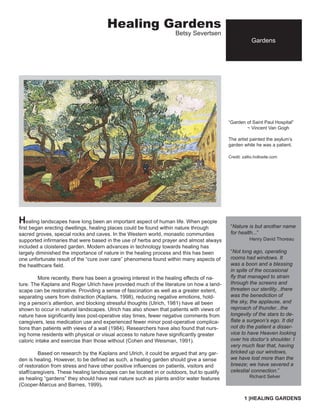
“Garden of Saint Paul Hospital” 
~ Vincent Van Gogh 
The artist painted the asylum’s 
garden while he was a patient. 
Credit: zallio.hollosite.com 
Healing Gardens 
Betsy Severtsen 
“Nature is but another name 
for health...” 
Henry David Thoreau 
“Not long ago, operating 
rooms had windows. It 
was a boon and a blessing 
in spite of the occasional 
fl y that managed to strain 
through the screens and 
threaten our sterility...there 
was the benediction of 
the sky, the applause, and 
reproach of thunder...the 
longevity of the stars to de-fl 
ate a surgeon’s ego. It did 
not do the patient a disser-vice 
to have Heaven looking 
over his doctor’s shoulder. I 
very much fear that, having 
bricked up our windows, 
we have lost more than the 
breeze; we have severed a 
celestial connection.” 
Richard Selver 
1 |HEALING GARDENS
Photos and Plan Credit: 
Cooper Marcus, 2001 
Contexts 
Traditional healing gardens are often found within or adjacent to indoor healthcare set-tings. 
Healing gardens can be found in mental health hospitals, schools and centers 
for the disabled, hospices and nursing homes; however, possibly the most popular 
examples of healing gardens are found within or adjacent to hospitals and Alzheimer’s 
treatment facilities. 
Healing Gardens meant for users that are specifi cally ill or disabled will be useful to 
the extent that these special needs populations are present and able to physically or 
at least visually access these sites. However, even within a healthcare setting, heal-ing 
gardens are often used by a larger population including staff and visitors as well as 
patients and/or residents. 
At a larger scale, some believe that any garden can be a healing garden and that the 
general population can fi nd restorative benefi ts from such spaces, regardless of pnysi-cal 
health needs. Taken at this scale, green spaces with restorative effects should be 
easily accessible by the surrounding population. Seattle’s goal for accessible open 
space is to have 1/4 to 1/2 acre of usable open space within 1/4 to 1/2 mile of every 
resident (City of Seattle Parks and Recreation, 2001). 
“...[Good garden design] 
employs the mind without 
fatigue, tranquilizes yet en-livens 
it and thus gives the 
effect of refreshing rest and 
reinvigoration.” 
Frederick Law Olmsted 
“Design directs perception 
through space. Therapy 
guides healing over time. 
Therapeutic design is the 
guidance of healing through 
space and time.” 
Marni Barnes 
“I only went out for a walk 
and fi nally concluded to stay 
out until sundown, for going 
out, I found, was really go-ing 
in.” 
John Muir 
Case 1: Healing Gardern at Mount Zion Clinical Cancer Center, 
San Francisco, California 
This courtyard garden is bounded by hospital buildings and a commercial property, 
Thankfully roughly half of the garden still receives direct sunlight at noon. Plants were 
chosen to provide blooms throughout the year and to provide a variety of green hues. 
There is a small fountain to screen out noise from a nearby street and many wooden 
benches, tables and moveable chairs. The garden was once a mostly-hardscaped 
courtyard, designed by Tommy Church. An artist-patient at the center provided the idea 
and effort to redesign the space into a more garden-like setting. 
During the design process workshops were held where patients and staff provided sug-gestions 
on the necessary garden elements. There were also a number of tile-making 
workshops where patients added their survival 
stories to tiles with imprints of Asian plant 
specimens used in cancer treatment. These 
tiles made up the wall of the indoor corridor 
that passes by the garden; the tiles are one 
element of permanence next to a constantly 
changing garden. This garden has been quite 
successful with patients, staff and visitors. It 
is a green oasis within the hospital complex 
and gains much of its 
popularity through the 
community process 
that is was created 
from (Cooper Marcus, 
2001). 
2 | HEALING GARDENS
Healing gardens are effective if they foster the following elements: 
Sense of control 
Patients/residents must know a garden exists, be able to fi nd it easily and be able to 
access and use the space in an active or passive way. It should also have areas for 
privacy that are shielded from window views. A variety of types of spaces can aid in 
allowing users to make choices. Feelings of control can also be enhanced by involving 
users in the design of the garden. 
Social support 
Spatially enclosed settings that allow for socializing are often preferred by users. 
Designing for small as well as the occasional large group (associated with hospital 
initiated programs and large extended family visits) is important. However, all consider-ations 
for social support should not deny access to privacy (which undermines patient 
control). 
Physical movment and exercise 
Mild exercise can be encouraged by designs that allow for patient accessibility and in-dependence 
and provide features such as walking loops. For children, areas that allow 
for stress-reducing physical activities and play should be included. 
Access to nature and other positive distractions 
Medicinal and edible plant species and those that engage all of the senses are often a 
good choice for the design’s plant palette, as are plants that encourage wildlife. Poison-ous, 
thorny plants, and those plants that encourage large amounts of unwanted insects 
(i.e. bees) should be avoided, especially in gardens used by children and the psycho-logically 
ill (Cooper Marcus and Barnes, 1999). 
Gardens 
Photo 
Credit: 
1- http:// 
www. 
healingland-scape. 
com/ 
City name 
tag line 
2-http://www. 
eastriding.gov. 
uk/social 
3-http://www.be-van- 
lodge.com 
4-http:// www. 
kuris. com 
(arial 18pt) 
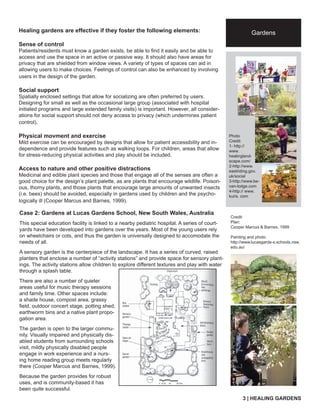
Case 2: Gardens at Lucas Gardens School, New South Wales, Australia 
This special education facility is linked to a nearby pediatric hospital. A series of court-yards 
have been developed into gardens over the years. Most of the young users rely 
on wheelchairs or cots, and thus the garden is universally designed to accomodate the 
needs of all. 
A sensory garden is the centerpiece of the landscape. It has a series of curved, raised 
planters that enclose a number of “activity stations” and provide space for sensory plant-ings. 
The activity stations allow children to explore different textures and play with water 
through a splash table. 
There are also a number of quieter 
areas useful for music therapy sessions 
and family time. Other spaces include: 
a shade house, compost area, grassy 
fi eld, outdoor concert stage, potting shed, 
earthworm bins and a native plant propo-gation 
area. 
The garden is open to the larger commu-nity. 
Visually impaired and physically dis-abled 
students from surrounding schools 
visit, mildly physically disabled people 
engage in work experience and a nurs-ing 
home reading group meets regularly 
there (Cooper Marcus and Barnes, 1999). 
Because the garden provides for robust 
uses, and is community-based it has 
been quite successful. 
Credit: 
Plan: 
Cooper Marcus & Barnes, 1999 
Painting and photo: 
http://www.lucasgarde-s.schools.nsw. 
edu.au/ 
3 | HEALING GARDENS
Aquisition / Implementation Mechanisms 
Many examples of healing gardens were initiated by strong leadership but were imple-mented 
through a strong community process. Exterior spaces of healthcare facilities 
have been overlooked for quite a long time and the budgets alone of these facilities 
often cannot support the creation of a therapeutic landscape. 
Of the case studies I have read, 
most gardens were funded 
through private donations and 
grants, often gained through long 
fundraising drives. Likewise, the 
construction of many of these 
spaces has relied heavily upon 
volunteer input. Many facilities 
have implemented the healing 
garden or gardens slowly by 
converting left-over or underused 
exisiting spaces one at a time. 
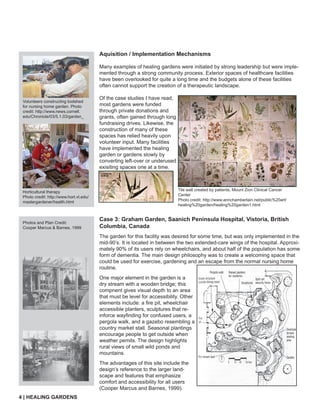
Volunteers constructing toolshed 
for nursing home garden. Photo 
credit: http://www.news.cornell. 
edu/Chronicle/03/5.1.03/garden_ 
Case 3: Graham Garden, Saanich Peninsula Hospital, Vistoria, British 
Columbia, Canada 
The garden for this facility was desired for some time, but was only implemented in the 
mid-90’s. It is located in between the two extended-care wings of the hospital. Approxi-mately 
90% of its users rely on wheelchairs, and about half of the population has some 
form of dementia. The main design philosophy was to create a welcoming space that 
could be used for exercise, gardening and an escape from the normal nursing home 
routine. 
One major element in the garden is a 
dry stream with a wooden bridge; this 
compnent gives visual depth to an area 
that must be level for accessibility. Other 
elements include: a fi re pit, wheelchair 
accessible planters, sculptures that re-inforce 
wayfi nding for confused users, a 
pergola walk, and a gazebo resembling a 
country market stall. Seasonal plantings 
encourage people to get outside when 
weather pemits. The design highlights 
rural views of small wild ponds and 
mountains. 
The advantages of this site include the 
design’s reference to the larger land-scape 
and features that emphasize 
comfort and accessibility for all users 
(Cooper Marcus and Barnes, 1999). 
Horticultural therapy 
Photo credit: http://www.hort.vt.edu/ 
mastergardener/health.html 
Photos and Plan Credit: 
Cooper Marcus & Barnes, 1999 
4 | HEALING GARDENS 
Tile wall created by patients, Mount Zion Clinical Cancer 
Center 
Photo credit: http://www.annchamberlain.net/public%20art/ 
healing%20garden/healing%20garden1.html
Spatial Layout Pattern: 
Healing gardens depending on their accessibility by the general public, could pro-vide 
necessary open space for users 
living 1/4 to 1/2 mile away, the mini-mum 
area from users as specifi ed by 
the City of Seattle. 
Ideally all healthcare, extended-care, 
and disability-focused centers should 
provide some form of a healing 
landscape. Since many ill, disabled 
and elderly users may not be able to 
physically use the space during the 
colder months in Seattle, care should 
be taken in the siting. Integrating in-door 
and visually accessible outdoor 
spaces (that can be physically acces-sible 
in warmer months) is often the 
best choice. Paying attention to the 
location of seating as it relates to the 
elements, especially sun and wind 
within a site is likewise important. 
City name 
tag line 
Gardens 
(arial 18pt) 
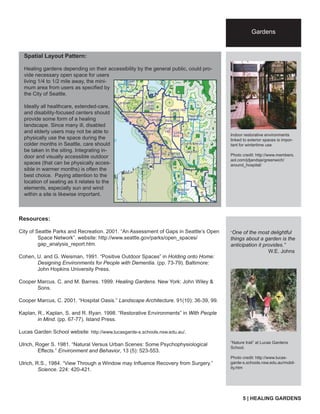
Indoor restorative environments 
linked to exterior spaces is impor-tant 
for wintertime use 
Photo credit: http://www.members. 
aol.com/jdjandsje/greenwich/ 
around_hospital/ 
“One of the most delightful 
things about a garden is the 
anticipation it provides.” 
W.E. Johns 
“Nature trail” at Lucas Gardens 
School. 
Photo credit: http://www.lucas-garde- 
s.schools.nsw.edu.au/mobil-ity. 
htm 
Resources: 
City of Seattle Parks and Recreation. 2001. “An Assessment of Gaps in Seattle’s Open 
Space Network”. website: http://www.seattle.gov/parks/open_spaces/ 
gap_analysis_report.htm. 
Cohen, U. and G. Weisman, 1991. “Positive Outdoor Spaces” in Holding onto Home: 
Designing Environments for People with Dementia. (pp. 73-79). Baltimore: 
John Hopkins University Press. 
Cooper Marcus. C. and M. Barnes. 1999. Healing Gardens. New York: John Wiley & 
Sons. 
Cooper Marcus, C. 2001. “Hospital Oasis.” Landscape Architecture. 91(10): 36-39, 99. 
Kaplan, R., Kaplan, S. and R. Ryan. 1998. “Restorative Environments” in With People 
in Mind. (pp. 67-77). Island Press. 
Lucas Garden School website: http://www.lucasgarde-s.schools.nsw.edu.au/. 
Ulrich, Roger S. 1981. “Natural Versus Urban Scenes: Some Psychophysiological 
Effects.” Environment and Behavior, 13 (5): 523-553. 
Ulrich, R.S., 1984. “View Through a Window may Infl uence Recovery from Surgery.” 
Science. 224: 420-421. 
5 | HEALING GARDENS

Healing Gardens - Restoration Gardens ~ Severtsen

  • 1.
    Healing landscapes havelong been an important aspect of human life. When people fi rst began erecting dwellings, healing places could be found within nature through sacred groves, special rocks and caves. In the Western world, monastic communties supported infi rmaries that were based in the use of herbs and prayer and almost always included a cloistered garden. Modern advances in technology towards healing has largely diminished the importance of nature in the healing process and this has been one unfortunate result of the “cure over care” phenomena found within many aspects of the healthcare fi eld. More recently, there has been a growing interest in the healing effects of na-ture. The Kaplans and Roger Ulrich have provided much of the literature on how a land-scape can be restorative. Providing a sense of fascination as well as a greater extent, separating users from distraction (Kaplans, 1998), reducing negative emotions, hold-ing a person’s attention, and blocking stressful thoughts (Ulrich, 1981) have all been shown to occur in natural landscapes. Ulrich has also shown that patients with views of nature have signifi cantly less post-operative stay times, fewer negative comments from caregivers, less medication use and experienced fewer minor post-operative complica-tions than patients with views of a wall (1984). Researchers have also found that nurs-ing home residents with physical or visual access to nature have signifi cantly greater caloric intake and exercise than those without (Cohen and Weisman, 1991). Based on research by the Kaplans and Ulrich, it could be argued that any gar-den is healing. However, to be defi ned as such, a healing garden should give a sense of restoration from stress and have other positive infl uences on patients, visitors and staff/caregivers. These healing landscapes can be located in or outdoors, but to qualify as healing “gardens” they should have real nature such as plants and/or water features (Cooper-Marcus and Barnes, 1999). Gardens “Garden of Saint Paul Hospital” ~ Vincent Van Gogh The artist painted the asylum’s garden while he was a patient. Credit: zallio.hollosite.com Healing Gardens Betsy Severtsen “Nature is but another name for health...” Henry David Thoreau “Not long ago, operating rooms had windows. It was a boon and a blessing in spite of the occasional fl y that managed to strain through the screens and threaten our sterility...there was the benediction of the sky, the applause, and reproach of thunder...the longevity of the stars to de-fl ate a surgeon’s ego. It did not do the patient a disser-vice to have Heaven looking over his doctor’s shoulder. I very much fear that, having bricked up our windows, we have lost more than the breeze; we have severed a celestial connection.” Richard Selver 1 |HEALING GARDENS
  • 2.
    Photos and PlanCredit: Cooper Marcus, 2001 Contexts Traditional healing gardens are often found within or adjacent to indoor healthcare set-tings. Healing gardens can be found in mental health hospitals, schools and centers for the disabled, hospices and nursing homes; however, possibly the most popular examples of healing gardens are found within or adjacent to hospitals and Alzheimer’s treatment facilities. Healing Gardens meant for users that are specifi cally ill or disabled will be useful to the extent that these special needs populations are present and able to physically or at least visually access these sites. However, even within a healthcare setting, heal-ing gardens are often used by a larger population including staff and visitors as well as patients and/or residents. At a larger scale, some believe that any garden can be a healing garden and that the general population can fi nd restorative benefi ts from such spaces, regardless of pnysi-cal health needs. Taken at this scale, green spaces with restorative effects should be easily accessible by the surrounding population. Seattle’s goal for accessible open space is to have 1/4 to 1/2 acre of usable open space within 1/4 to 1/2 mile of every resident (City of Seattle Parks and Recreation, 2001). “...[Good garden design] employs the mind without fatigue, tranquilizes yet en-livens it and thus gives the effect of refreshing rest and reinvigoration.” Frederick Law Olmsted “Design directs perception through space. Therapy guides healing over time. Therapeutic design is the guidance of healing through space and time.” Marni Barnes “I only went out for a walk and fi nally concluded to stay out until sundown, for going out, I found, was really go-ing in.” John Muir Case 1: Healing Gardern at Mount Zion Clinical Cancer Center, San Francisco, California This courtyard garden is bounded by hospital buildings and a commercial property, Thankfully roughly half of the garden still receives direct sunlight at noon. Plants were chosen to provide blooms throughout the year and to provide a variety of green hues. There is a small fountain to screen out noise from a nearby street and many wooden benches, tables and moveable chairs. The garden was once a mostly-hardscaped courtyard, designed by Tommy Church. An artist-patient at the center provided the idea and effort to redesign the space into a more garden-like setting. During the design process workshops were held where patients and staff provided sug-gestions on the necessary garden elements. There were also a number of tile-making workshops where patients added their survival stories to tiles with imprints of Asian plant specimens used in cancer treatment. These tiles made up the wall of the indoor corridor that passes by the garden; the tiles are one element of permanence next to a constantly changing garden. This garden has been quite successful with patients, staff and visitors. It is a green oasis within the hospital complex and gains much of its popularity through the community process that is was created from (Cooper Marcus, 2001). 2 | HEALING GARDENS
  • 3.
    Healing gardens areeffective if they foster the following elements: Sense of control Patients/residents must know a garden exists, be able to fi nd it easily and be able to access and use the space in an active or passive way. It should also have areas for privacy that are shielded from window views. A variety of types of spaces can aid in allowing users to make choices. Feelings of control can also be enhanced by involving users in the design of the garden. Social support Spatially enclosed settings that allow for socializing are often preferred by users. Designing for small as well as the occasional large group (associated with hospital initiated programs and large extended family visits) is important. However, all consider-ations for social support should not deny access to privacy (which undermines patient control). Physical movment and exercise Mild exercise can be encouraged by designs that allow for patient accessibility and in-dependence and provide features such as walking loops. For children, areas that allow for stress-reducing physical activities and play should be included. Access to nature and other positive distractions Medicinal and edible plant species and those that engage all of the senses are often a good choice for the design’s plant palette, as are plants that encourage wildlife. Poison-ous, thorny plants, and those plants that encourage large amounts of unwanted insects (i.e. bees) should be avoided, especially in gardens used by children and the psycho-logically ill (Cooper Marcus and Barnes, 1999). Gardens Photo Credit: 1- http:// www. healingland-scape. com/ City name tag line 2-http://www. eastriding.gov. uk/social 3-http://www.be-van- lodge.com 4-http:// www. kuris. com (arial 18pt) Case 2: Gardens at Lucas Gardens School, New South Wales, Australia This special education facility is linked to a nearby pediatric hospital. A series of court-yards have been developed into gardens over the years. Most of the young users rely on wheelchairs or cots, and thus the garden is universally designed to accomodate the needs of all. A sensory garden is the centerpiece of the landscape. It has a series of curved, raised planters that enclose a number of “activity stations” and provide space for sensory plant-ings. The activity stations allow children to explore different textures and play with water through a splash table. There are also a number of quieter areas useful for music therapy sessions and family time. Other spaces include: a shade house, compost area, grassy fi eld, outdoor concert stage, potting shed, earthworm bins and a native plant propo-gation area. The garden is open to the larger commu-nity. Visually impaired and physically dis-abled students from surrounding schools visit, mildly physically disabled people engage in work experience and a nurs-ing home reading group meets regularly there (Cooper Marcus and Barnes, 1999). Because the garden provides for robust uses, and is community-based it has been quite successful. Credit: Plan: Cooper Marcus & Barnes, 1999 Painting and photo: http://www.lucasgarde-s.schools.nsw. edu.au/ 3 | HEALING GARDENS
  • 4.
    Aquisition / ImplementationMechanisms Many examples of healing gardens were initiated by strong leadership but were imple-mented through a strong community process. Exterior spaces of healthcare facilities have been overlooked for quite a long time and the budgets alone of these facilities often cannot support the creation of a therapeutic landscape. Of the case studies I have read, most gardens were funded through private donations and grants, often gained through long fundraising drives. Likewise, the construction of many of these spaces has relied heavily upon volunteer input. Many facilities have implemented the healing garden or gardens slowly by converting left-over or underused exisiting spaces one at a time. Volunteers constructing toolshed for nursing home garden. Photo credit: http://www.news.cornell. edu/Chronicle/03/5.1.03/garden_ Case 3: Graham Garden, Saanich Peninsula Hospital, Vistoria, British Columbia, Canada The garden for this facility was desired for some time, but was only implemented in the mid-90’s. It is located in between the two extended-care wings of the hospital. Approxi-mately 90% of its users rely on wheelchairs, and about half of the population has some form of dementia. The main design philosophy was to create a welcoming space that could be used for exercise, gardening and an escape from the normal nursing home routine. One major element in the garden is a dry stream with a wooden bridge; this compnent gives visual depth to an area that must be level for accessibility. Other elements include: a fi re pit, wheelchair accessible planters, sculptures that re-inforce wayfi nding for confused users, a pergola walk, and a gazebo resembling a country market stall. Seasonal plantings encourage people to get outside when weather pemits. The design highlights rural views of small wild ponds and mountains. The advantages of this site include the design’s reference to the larger land-scape and features that emphasize comfort and accessibility for all users (Cooper Marcus and Barnes, 1999). Horticultural therapy Photo credit: http://www.hort.vt.edu/ mastergardener/health.html Photos and Plan Credit: Cooper Marcus & Barnes, 1999 4 | HEALING GARDENS Tile wall created by patients, Mount Zion Clinical Cancer Center Photo credit: http://www.annchamberlain.net/public%20art/ healing%20garden/healing%20garden1.html
  • 5.
    Spatial Layout Pattern: Healing gardens depending on their accessibility by the general public, could pro-vide necessary open space for users living 1/4 to 1/2 mile away, the mini-mum area from users as specifi ed by the City of Seattle. Ideally all healthcare, extended-care, and disability-focused centers should provide some form of a healing landscape. Since many ill, disabled and elderly users may not be able to physically use the space during the colder months in Seattle, care should be taken in the siting. Integrating in-door and visually accessible outdoor spaces (that can be physically acces-sible in warmer months) is often the best choice. Paying attention to the location of seating as it relates to the elements, especially sun and wind within a site is likewise important. City name tag line Gardens (arial 18pt) Indoor restorative environments linked to exterior spaces is impor-tant for wintertime use Photo credit: http://www.members. aol.com/jdjandsje/greenwich/ around_hospital/ “One of the most delightful things about a garden is the anticipation it provides.” W.E. Johns “Nature trail” at Lucas Gardens School. Photo credit: http://www.lucas-garde- s.schools.nsw.edu.au/mobil-ity. htm Resources: City of Seattle Parks and Recreation. 2001. “An Assessment of Gaps in Seattle’s Open Space Network”. website: http://www.seattle.gov/parks/open_spaces/ gap_analysis_report.htm. Cohen, U. and G. Weisman, 1991. “Positive Outdoor Spaces” in Holding onto Home: Designing Environments for People with Dementia. (pp. 73-79). Baltimore: John Hopkins University Press. Cooper Marcus. C. and M. Barnes. 1999. Healing Gardens. New York: John Wiley & Sons. Cooper Marcus, C. 2001. “Hospital Oasis.” Landscape Architecture. 91(10): 36-39, 99. Kaplan, R., Kaplan, S. and R. Ryan. 1998. “Restorative Environments” in With People in Mind. (pp. 67-77). Island Press. Lucas Garden School website: http://www.lucasgarde-s.schools.nsw.edu.au/. Ulrich, Roger S. 1981. “Natural Versus Urban Scenes: Some Psychophysiological Effects.” Environment and Behavior, 13 (5): 523-553. Ulrich, R.S., 1984. “View Through a Window may Infl uence Recovery from Surgery.” Science. 224: 420-421. 5 | HEALING GARDENS