
Outline for Friday, September 18, 2009 Session Confirmation #22284 
Title: 
Rehabilitation in the Garden: Developing the Garden as a Tool to Achieve Functional Therapeutic Outcomes 
Marketing Statement: Tour some urban healing gardens in healthcare and senior living environments and examine how they work and what changes might help improve outcomes. Learn how therapists and activity professionals work and about specific garden elements to support clinical applications and the intended therapeutic outcomes. Summary: Well-designed gardens provide functional, home-like settings for inpatient and outpatient therapies and resident activity programs. The relationship between the physical design of the therapeutic garden and the rehabilitation programming is critical. While designing the garden landscape architect’s need to understand the type of therapy/program goals. The elements included in the therapeutic garden can assist in achieving these therapy and activity goals. Landscape architects will be exposed to medical terminology and the roles of key healthcare personnel, to assist them in designing successful gardens. In addition, different rehabilitation treatments are supported by certain design characteristics and how they are applied in the garden is crucial. Whether a garden is providing and aiding the physical, cognitive or the emotional development, certain equipment, activities and spaces provide for that therapy. Garden elements and accessories needed for individual applications ranging from senior care to acute care will also be explored including convincing research studies. In addition to the clinical focus, the role of plant material with its seasonal changes in the garden and the relationship to the patient’s care will be discussed. How patients interact and are engaged in the outdoor setting can increase or decrease their therapy outcome. Plant material selection also provides areas for education, restoration and social exchange. A well-designed garden will promote four seasons of sensory stimulation. After reviewing and understanding the tools needed for a successful therapeutic garden, the participants will tour three outstanding facilities in the Chicago-land area. The tour will include a continuing care retirement community, a rehabilitation rooftop garden and a senior activity center. Session Type: 
Field Session Learning Objectives: 1. Describe key garden elements and how they promote clinical programming applications for functional therapeutic outcomes in a variety of garden settings: senior living, rehabilitation units, acute care, etc. 2. Outline rehabilitation programming in the garden and aspects of design for four seasons. 3. Compare and contrast the work of PT, OT, SLP, SW, HT, and other therapies in the garden. 
4. Identify and use appropriate medical terminology in design team collaboration. 
5. Given program goals, evaluate three gardens for effective qualities, areas for improvement and missed opportunities.
2 
Outline: I. Benefits of Gardens in Rehabilitation Programs 
A. The environment of care and customer satisfaction 
B. Well designed gardens provide functional, home-like settings for inpatient and outpatient therapies and resident activity programs 
C. Gardens provide for movement, mild exercise and rehabilitation 
D. Provide for a wide range of independent activities for all users 
E. AHTA Therapeutic Garden Characteristics (TGC) 
F. TGC applied to Stenzel Healing Garden 
II. Research studies to promote quality of life and rehabilitation in gardens 
A. Convincing evidence to help the designer educate the rehab team and administrators 
B. Research for senior living 
III. Medical Terminology for the Designer 
A. Learn some of the more common medical and healthcare terms and abbreviations used in design team work 
B. Identify medical terminology used by therapists to describe their program for the garden 
IV. Garden Elements and Functional Patient Activities to Achieve Rehab Goals 
A. The client 
B. The designer 
C. The design team: a collaborative, interdisciplinary approach for quality and effectiveness 
D. Examine key features in the garden and how they support the clinical teams' work with patients 
Residential, homelike 
Plants, plants, and more plants 
Accessibility 
Raising some of the plant material 
Four seasons of sensory stimulation 
Balance deciduous, evergreen, hardscape and plant material 
Nodes, privacy, gathering 
Gathering place 
Ramps, stairs, walking rails, benches 
Walking surfaces 
View out the window 
V. Role of the PT, OT, SLP, HT, RT, NSG in using the gardens for therapies 
A. The rehabilitation team 
B. Scope of goals for each therapy 
C. What are some of the activities that therapists use in the garden and why 
D. How the garden elements help the therapist/client reach intended outcomes 
VII. Goals in Senior Living 
Quality of life 
Feeling of well-being 
Increase or maintain function: physical, cognitive, emotional 
Lifestyle choices for independence
3 
Adaptations for sensory deficits: visual, auditory, tactile, olfactory, gustatory 
Reminiscence and life review activities 
VII Closing 
A. Bibliography for Gardens in Rehabilitation 
B. Evaluation tool for the field experience 
C. Q&A 
Field Experience Description: Board bus to leave McCormick Place at 8:00 AM Arrive at Montgomery Place at 
8:30 AM Educational session- Teresia Hazen 8:30 AM - 9:30AM Tour Montgomery Place from 9:30 - 10:30 AM. Montgomery Place is a Continuing Care Retirement Community that provides a high standard of living and included horticultural therapy as part of the ongoing care of residents. 
Load bus and travel to Schwab Rehabilitation Hospital Arrive and Tour 11:00-11:45AM. Schwab Rehabilitation Hospital utilizes a rooftop garden to provide a unique location for a variety of therapies including horticultural, sensory, and ambulatory. 
Box Lunch delivered- eat lunch 11:45 - 12:45 PM 
Load bus and travel to the Levy Center, Evanston Arrive and Tour the Levy Center 1:45- 2:45PM. The Levy Center is home to the Hulda B. and Maurice L. Rothschild Enabling Garden which is used for therapy classes and special events. 
Load buses at 3:00pm to return to McCormick Place by 4PM 
Presenters: 
Teresia M. Hazen, M.Ed., HTR, QMHP has been with Legacy Health since 1991. LHS is a not-for- profit integrated healthcare network including five hospitals and related services that promotes gardens in healthcare to create supportive environments of care for patients, families, visitors, staff and neighbors. It is the only health care system in the US to offer a horticultural therapy certificate program certified by the American Horticultural Therapy Association (AHTA). Teresia is responsible for pioneering the horticultural therapy program and therapeutic gardens for Legacy’s long-term care and SNF patients. Today, she oversees nine therapeutic gardens and horticultural therapy work through the Rehabilitation Institute of Oregon, Emanuel Children’s Hospital and the Oregon Burn Center. Her training in horticulture, special education, rehabilitation, addiction counseling and gerontology lend credibility to design team work for gardens to meet a wide range of user needs. 
Brian M. Slovacek, is Principal, Healthcare Studio Leader and Project Leader for Hitchock Design Group. Delivering quality design within challenging budgets, Brian is an outstanding advocate for clients’ land resources. This client-centric approach has helped Brian foster long-term relationships throughout his career. As a Project Leader, he has coordinated complex consultant teams, been engaged throughout the design and management process from client contact to construction closeout. This involvement in the design process from concept through construction has made Brian a skilled
4 
landscape architect at both macro-level planning and site-specific scales. A strong believer in continuous education, Brian expanded his knowledge of therapeutic garden design by participating in an intense one-on-one workshop at the Rusk Institute at New York University Hospital. 
Teresia Hazen, MEd, HTR, QMHP 
Legacy Health 
Registered Horticultural Therapist 
Coordinator of Legacy Therapeutic Gardens & HT 
1015 NW 22nd Ave. Suite 529 
Portland, OR 97210 
T 503.413.6507 thazen@lhs.org 
www.legacyhealth.org search “gardens” 
Brian M. Slovacek 
Landscape Architect 
Principal, Healthcare Studio 
Hitchcock Design Group 
221 West Jefferson Avenue 
Naperville, Illinois 60540 T 630.961.1787 
bslovacek@hitchcockdesigngroup.com 
www.hitchcockdesigngroup.com
5 
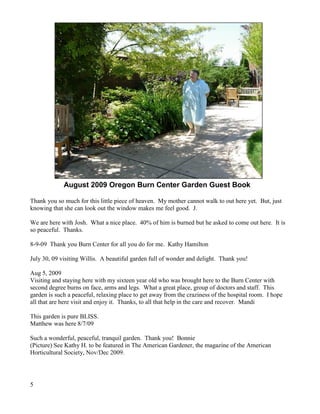
August 2009 Oregon Burn Center Garden Guest Book 
Thank you so much for this little piece of heaven. My mother cannot walk to out here yet. But, just knowing that she can look out the window makes me feel good. J. 
We are here with Josh. What a nice place. 40% of him is burned but he asked to come out here. It is so peaceful. Thanks. 
8-9-09 Thank you Burn Center for all you do for me. Kathy Hamilton 
July 30, 09 visiting Willis. A beautiful garden full of wonder and delight. Thank you! 
Aug 5, 2009 
Visiting and staying here with my sixteen year old who was brought here to the Burn Center with second degree burns on face, arms and legs. What a great place, group of doctors and staff. This garden is such a peaceful, relaxing place to get away from the craziness of the hospital room. I hope all that are here visit and enjoy it. Thanks, to all that help in the care and recover. Mandi 
This garden is pure BLISS. 
Matthew was here 8/7/09 
Such a wonderful, peaceful, tranquil garden. Thank you! Bonnie 
(Picture) See Kathy H. to be featured in The American Gardener, the magazine of the American Horticultural Society, Nov/Dec 2009.
6 
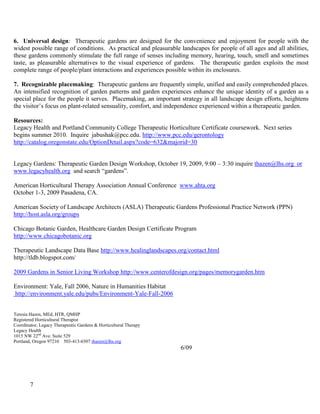
THERAPEUTIC GARDEN CHARACTERISTICS 
(Adapted from American Horticultural Therapy Association Board of Directors, April 30, 1995) 
Therapeutic gardens are featured in national publications and are being built with increasing frequency in health care settings. Among these new gardens, there is a high degree of correlation in physical design and programming intended to improve therapeutic benefits to garden visitors and participants. These identified factors interrelate with a vigorous plant dominated landscape to achieve restorative and horticultural therapy objectives and are likely to be associated with excellence in the design of therapeutic gardens. Some common characteristics are: 
1. Scheduled and programmed activities: A horticultural therapy program guiding and promoting a program of activities and experiences in the garden is ideal. However, even in gardens designed for the passive/independent enjoyment by visitors, special events increasing the number of visits, classes encouraging routine garden tasks, and publicizing activities of all kinds familiarize special populations, facility staff, families of clients or patients, and nearby community residents with the garden. 
2. Features modified to improve accessibility: Garden elements, features and equipment are all selected or modified to provide accessible places, activities and experiences to the greatest extent possible. Each modification to the therapeutic garden environment eases the task of gardening and or enhances the horticultural experience for the visitor/gardener enabling them to see and even to study plants, to touch or smell them, to encounter the luxuriant garden growth in their own way, on their own terms and at their own pace. 
3. Well defined perimeters: Edges of garden spaces and special zones of activities within the garden are often intensified to redirect the attention and the energies of the visitor to the components and displays within the garden. 
4. A profusion of plants and people/plant interactions: Therapeutic gardens introduce individuals to planned, intensive outdoor environments in which the conscious provisions of spaces and places for restoration, horticulture education, therapy, and for social exchanges are organized into legible and verdant, plant-dominated open spaces with simple patterns of paths and workplaces. The garden promotes four seasons of sensory stimulation. 
5. Benign and supportive conditions: Therapeutic gardens provide safe, secure and comfortable settings for people. The avoidance of potentially hazardous chemicals such as herbicides, fertilizers, and insecticides, the provision of shade and other protective structures, the flourishing plants, and the protected and protective nature of the therapeutic garden offer personal comfort and refuge to the garden user.
7 
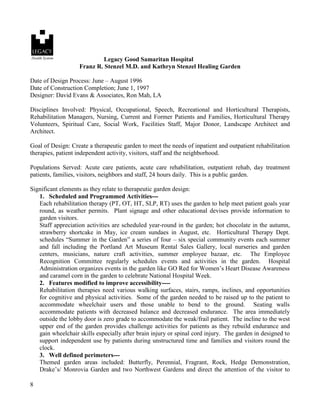
6. Universal design: Therapeutic gardens are designed for the convenience and enjoyment for people with the widest possible range of conditions. As practical and pleasurable landscapes for people of all ages and all abilities, these gardens commonly stimulate the full range of senses including memory, hearing, touch, smell and sometimes taste, as pleasurable alternatives to the visual experience of gardens. The therapeutic garden exploits the most complete range of people/plant interactions and experiences possible within its enclosures. 
7. Recognizable placemaking: Therapeutic gardens are frequently simple, unified and easily comprehended places. An intensified recognition of garden patterns and garden experiences enhance the unique identity of a garden as a special place for the people it serves. Placemaking, an important strategy in all landscape design efforts, heightens the visitor’s focus on plant-related sensuality, comfort, and independence experienced within a therapeutic garden. 
Resources: 
Legacy Health and Portland Community College Therapeutic Horticulture Certificate coursework. Next series begins summer 2010. Inquire jabushak@pcc.edu. http://www.pcc.edu/gerontology 
http://catalog.oregonstate.edu/OptionDetail.aspx?code=632&majorid=30 
Legacy Gardens: Therapeutic Garden Design Workshop, October 19, 2009, 9:00 – 3:30 inquire thazen@lhs.org or www.legacyhealth.org and search “gardens”. 
American Horticultural Therapy Association Annual Conference www.ahta.org 
October 1-3, 2009 Pasadena, CA. 
American Society of Landscape Architects (ASLA) Therapeutic Gardens Professional Practice Network (PPN) http://host.asla.org/groups 
Chicago Botanic Garden, Healthcare Garden Design Certificate Program 
http://www.chicagobotanic.org 
Therapeutic Landscape Data Base http://www.healinglandscapes.org/contact.html 
http://tldb.blogspot.com/ 
2009 Gardens in Senior Living Workshop http://www.centerofdesign.org/pages/memorygarden.htm 
Environment: Yale, Fall 2006, Nature in Humanities Habitat 
http://environment.yale.edu/pubs/Environment-Yale-Fall-2006 
Teresia Hazen, MEd, HTR, QMHP 
Registered Horticultural Therapist 
Coordinator, Legacy Therapeutic Gardens & Horticultural Therapy 
Legacy Health 
1015 NW 22nd Ave. Suite 529 
Portland, Oregon 97210 503-413-6507 thazen@lhs.org 6/09
8 
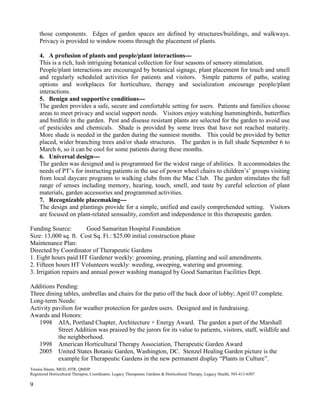
Legacy Good Samaritan Hospital 
Franz R. Stenzel M.D. and Kathryn Stenzel Healing Garden 
Date of Design Process: June – August 1996 
Date of Construction Completion; June 1, 1997 
Designer: David Evans & Associates, Ron Mah, LA 
Disciplines Involved: Physical, Occupational, Speech, Recreational and Horticultural Therapists, Rehabilitation Managers, Nursing, Current and Former Patients and Families, Horticultural Therapy Volunteers, Spiritual Care, Social Work, Facilities Staff, Major Donor, Landscape Architect and Architect. 
Goal of Design: Create a therapeutic garden to meet the needs of inpatient and outpatient rehabilitation therapies, patient independent activity, visitors, staff and the neighborhood. 
Populations Served: Acute care patients, acute care rehabilitation, outpatient rehab, day treatment patients, families, visitors, neighbors and staff, 24 hours daily. This is a public garden. 
Significant elements as they relate to therapeutic garden design: 
1. Scheduled and Programmed Activities--- 
Each rehabilitation therapy (PT, OT, HT, SLP, RT) uses the garden to help meet patient goals year round, as weather permits. Plant signage and other educational devises provide information to garden visitors. 
Staff appreciation activities are scheduled year-round in the garden; hot chocolate in the autumn, strawberry shortcake in May, ice cream sundaes in August, etc. Horticultural Therapy Dept. schedules “Summer in the Garden” a series of four – six special community events each summer and fall including the Portland Art Museum Rental Sales Gallery, local nurseries and garden centers, musicians, nature craft activities, summer employee bazaar, etc. The Employee Recognition Committee regularly schedules events and activities in the garden. Hospital Administration organizes events in the garden like GO Red for Women’s Heart Disease Awareness and caramel corn in the garden to celebrate National Hospital Week. 
2. Features modified to improve accessibility---- 
Rehabilitation therapies need various walking surfaces, stairs, ramps, inclines, and opportunities for cognitive and physical activities. Some of the garden needed to be raised up to the patient to accommodate wheelchair users and those unable to bend to the ground. Seating walls accommodate patients with decreased balance and decreased endurance. The area immediately outside the lobby door is zero grade to accommodate the weak/frail patient. The incline to the west upper end of the garden provides challenge activities for patients as they rebuild endurance and gain wheelchair skills especially after brain injury or spinal cord injury. The garden in designed to support independent use by patients during unstructured time and families and visitors round the clock. 
3. Well defined perimeters--- 
Themed garden areas included: Butterfly, Perennial, Fragrant, Rock, Hedge Demonstration, Drake’s/ Monrovia Garden and two Northwest Gardens and direct the attention of the visitor to
9 
those components. Edges of garden spaces are defined by structures/buildings, and walkways. Privacy is provided to window rooms through the placement of plants. 
4. A profusion of plants and people/plant interactions--- 
This is a rich, lush intriguing botanical collection for four seasons of sensory stimulation. 
People/plant interactions are encouraged by botanical signage, plant placement for touch and smell and regularly scheduled activities for patients and visitors. Simple patterns of paths, seating options and workplaces for horticulture, therapy and socialization encourage people/plant interactions. 
5. Benign and supportive conditions--- 
The garden provides a safe, secure and comfortable setting for users. Patients and families choose areas to meet privacy and social support needs. Visitors enjoy watching hummingbirds, butterflies and birdlife in the garden. Pest and disease resistant plants are selected for the garden to avoid use of pesticides and chemicals. Shade is provided by some trees that have not reached maturity. More shade is needed in the garden during the sunniest months. This could be provided by better placed, wider branching trees and/or shade structures. The garden is in full shade September 6 to March 6, so it can be cool for some patients during these months. 
6. Universal design--- 
The garden was designed and is programmed for the widest range of abilities. It accommodates the needs of PT’s for instructing patients in the use of power wheel chairs to children’s’ groups visiting from local daycare programs to walking clubs from the Mac Club. The garden stimulates the full range of senses including memory, hearing, touch, smell, and taste by careful selection of plant materials, garden accessories and programmed activities. 
7. Recognizable placemaking--- 
The design and plantings provide for a simple, unified and easily comprehended setting. Visitors are focused on plant-related sensuality, comfort and independence in this therapeutic garden. 
Funding Source: Good Samaritan Hospital Foundation 
Size: 13,000 sq. ft. Cost Sq. Ft.: $25.00 initial construction phase 
Maintenance Plan: 
Directed by Coordinator of Therapeutic Gardens 
1. Eight hours paid HT Gardener weekly: grooming, pruning, planting and soil amendments. 
2. Fifteen hours HT Volunteers weekly: weeding, sweeping, watering and grooming. 
3. Irrigation repairs and annual power washing managed by Good Samaritan Facilities Dept. 
Additions Pending: 
Three dining tables, umbrellas and chairs for the patio off the back door of lobby; April 07 complete. 
Long-term Needs: 
Activity pavilion for weather protection for garden users. Designed and in fundraising. 
Awards and Honors: 
1998 AIA, Portland Chapter, Architecture + Energy Award. The garden a part of the Marshall Street Addition was praised by the jurors for its value to patients, visitors, staff, wildlife and the neighborhood. 
1998 American Horticultural Therapy Association, Therapeutic Garden Award 
2005 United States Botanic Garden, Washington, DC. Stenzel Healing Garden picture is the example for Therapeutic Gardens in the new permanent display “Plants in Culture”. 
Teresia Hazen, MED, HTR, QMHP 
Registered Horticultural Therapist, Coordinator, Legacy Therapeutic Gardens & Horticultural Therapy, Legacy Health, 503-413-6507
10 
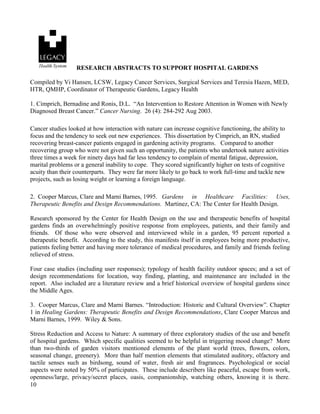
RESEARCH ABSTRACTS TO SUPPORT HOSPITAL GARDENS 
Compiled by Vi Hansen, LCSW, Legacy Cancer Services, Surgical Services and Teresia Hazen, MED, HTR, QMHP, Coordinator of Therapeutic Gardens, Legacy Health 
1. Cimprich, Bernadine and Ronis, D.L. “An Intervention to Restore Attention in Women with Newly Diagnosed Breast Cancer.” Cancer Nursing. 26 (4): 284-292 Aug 2003. 
Cancer studies looked at how interaction with nature can increase cognitive functioning, the ability to focus and the tendency to seek out new experiences. This dissertation by Cimprich, an RN, studied recovering breast-cancer patients engaged in gardening activity programs. Compared to another recovering group who were not given such an opportunity, the patients who undertook nature activities three times a week for ninety days had far less tendency to complain of mental fatigue, depression, marital problems or a general inability to cope. They scored significantly higher on tests of cognitive acuity than their counterparts. They were far more likely to go back to work full-time and tackle new projects, such as losing weight or learning a foreign language. 
2. Cooper Marcus, Clare and Marni Barnes, 1995. Gardens in Healthcare Facilities: Uses, Therapeutic Benefits and Design Recommendations. Martinez, CA: The Center for Health Design. 
Research sponsored by the Center for Health Design on the use and therapeutic benefits of hospital gardens finds an overwhelmingly positive response from employees, patients, and their family and friends. Of those who were observed and interviewed while in a garden, 95 percent reported a therapeutic benefit. According to the study, this manifests itself in employees being more productive, patients feeling better and having more tolerance of medical procedures, and family and friends feeling relieved of stress. 
Four case studies (including user responses); typology of health facility outdoor spaces; and a set of design recommendations for location, way finding, planting, and maintenance are included in the report. Also included are a literature review and a brief historical overview of hospital gardens since the Middle Ages. 
3. Cooper Marcus, Clare and Marni Barnes. “Introduction: Historic and Cultural Overview”. Chapter 1 in Healing Gardens: Therapeutic Benefits and Design Recommendations, Clare Cooper Marcus and Marni Barnes, 1999. Wiley & Sons. 
Stress Reduction and Access to Nature: A summary of three exploratory studies of the use and benefit of hospital gardens. Which specific qualities seemed to be helpful in triggering mood change? More than two-thirds of garden visitors mentioned elements of the plant world (trees, flowers, colors, seasonal change, greenery). More than half mention elements that stimulated auditory, olfactory and tactile senses such as birdsong, sound of water, fresh air and fragrances. Psychological or social aspects were noted by 50% of participates. These include describers like peaceful, escape from work, openness/large, privacy/secret places, oasis, companionship, watching others, knowing it is there.
11 
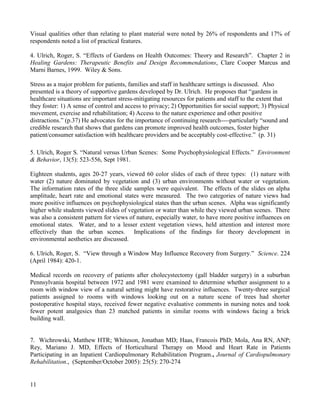
Visual qualities other than relating to plant material were noted by 26% of respondents and 17% of respondents noted a list of practical features. 
4. Ulrich, Roger, S. “Effects of Gardens on Health Outcomes: Theory and Research”. Chapter 2 in Healing Gardens: Therapeutic Benefits and Design Recommendations, Clare Cooper Marcus and Marni Barnes, 1999. Wiley & Sons. 
Stress as a major problem for patients, families and staff in healthcare settings is discussed. Also presented is a theory of supportive gardens developed by Dr. Ulrich. He proposes that “gardens in healthcare situations are important stress-mitigating resources for patients and staff to the extent that they foster: 1) A sense of control and access to privacy; 2) Opportunities for social support; 3) Physical movement, exercise and rehabilitation; 4) Access to the nature experience and other positive distractions.” (p.37) He advocates for the importance of continuing research----particularly “sound and credible research that shows that gardens can promote improved health outcomes, foster higher patient/consumer satisfaction with healthcare providers and be acceptably cost-effective.” (p. 31) 
5. Ulrich, Roger S. “Natural versus Urban Scenes: Some Psychophysiological Effects.” Environment & Behavior, 13(5): 523-556, Sept 1981. 
Eighteen students, ages 20-27 years, viewed 60 color slides of each of three types: (1) nature with water (2) nature dominated by vegetation and (3) urban environments without water or vegetation. The information rates of the three slide samples were equivalent. The effects of the slides on alpha amplitude, heart rate and emotional states were measured. The two categories of nature views had more positive influences on psychophysiological states than the urban scenes. Alpha was significantly higher while students viewed slides of vegetation or water than while they viewed urban scenes. There was also a consistent pattern for views of nature, especially water, to have more positive influences on emotional states. Water, and to a lesser extent vegetation views, held attention and interest more effectively than the urban scenes. Implications of the findings for theory development in environmental aesthetics are discussed. 
6. Ulrich, Roger, S. “View through a Window May Influence Recovery from Surgery.” Science. 224 (April 1984): 420-1. 
Medical records on recovery of patients after cholecystectomy (gall bladder surgery) in a suburban Pennsylvania hospital between 1972 and 1981 were examined to determine whether assignment to a room with window view of a natural setting might have restorative influences. Twenty-three surgical patients assigned to rooms with windows looking out on a nature scene of trees had shorter postoperative hospital stays, received fewer negative evaluative comments in nursing notes and took fewer potent analgesics than 23 matched patients in similar rooms with windows facing a brick building wall. 
7. Wichrowski, Matthew HTR; Whiteson, Jonathan MD; Haas, Francois PhD; Mola, Ana RN, ANP; Rey, Mariano J. MD, Effects of Horticultural Therapy on Mood and Heart Rate in Patients Participating in an Inpatient Cardiopulmonary Rehabilitation Program., Journal of Cardiopulmonary Rehabilitation., (September/October 2005): 25(5): 270-274
12 
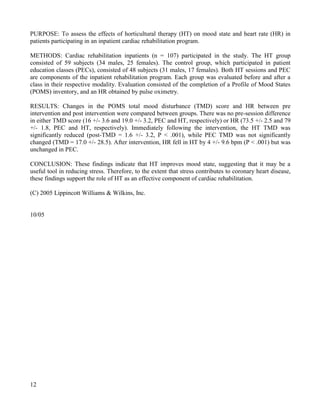
PURPOSE: To assess the effects of horticultural therapy (HT) on mood state and heart rate (HR) in patients participating in an inpatient cardiac rehabilitation program. 
METHODS: Cardiac rehabilitation inpatients (n = 107) participated in the study. The HT group consisted of 59 subjects (34 males, 25 females). The control group, which participated in patient education classes (PECs), consisted of 48 subjects (31 males, 17 females). Both HT sessions and PEC are components of the inpatient rehabilitation program. Each group was evaluated before and after a class in their respective modality. Evaluation consisted of the completion of a Profile of Mood States (POMS) inventory, and an HR obtained by pulse oximetry. 
RESULTS: Changes in the POMS total mood disturbance (TMD) score and HR between pre intervention and post intervention were compared between groups. There was no pre-session difference in either TMD score (16 +/- 3.6 and 19.0 +/- 3.2, PEC and HT, respectively) or HR (73.5 +/- 2.5 and 79 +/- 1.8, PEC and HT, respectively). Immediately following the intervention, the HT TMD was significantly reduced (post-TMD = 1.6 +/- 3.2, P < .001), while PEC TMD was not significantly changed (TMD = 17.0 +/- 28.5). After intervention, HR fell in HT by 4 +/- 9.6 bpm (P < .001) but was unchanged in PEC. 
CONCLUSION: These findings indicate that HT improves mood state, suggesting that it may be a useful tool in reducing stress. Therefore, to the extent that stress contributes to coronary heart disease, these findings support the role of HT as an effective component of cardiac rehabilitation. 
(C) 2005 Lippincott Williams & Wilkins, Inc. 
10/05
13 
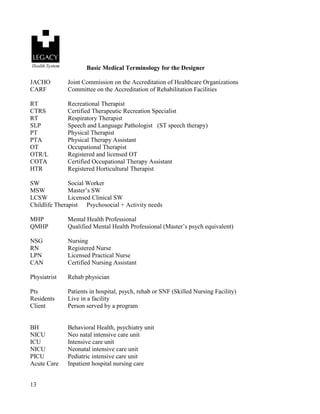
Basic Medical Terminology for the Designer 
JACHO Joint Commission on the Accreditation of Healthcare Organizations 
CARF Committee on the Accreditation of Rehabilitation Facilities 
RT Recreational Therapist 
CTRS Certified Therapeutic Recreation Specialist 
RT Respiratory Therapist 
SLP Speech and Language Pathologist (ST speech therapy) 
PT Physical Therapist 
PTA Physical Therapy Assistant 
OT Occupational Therapist 
OTR/L Registered and licensed OT 
COTA Certified Occupational Therapy Assistant 
HTR Registered Horticultural Therapist 
SW Social Worker 
MSW Master’s SW 
LCSW Licensed Clinical SW 
Childlife Therapist Psychosocial + Activity needs 
MHP Mental Health Professional 
QMHP Qualified Mental Health Professional (Master’s psych equivalent) 
NSG Nursing 
RN Registered Nurse 
LPN Licensed Practical Nurse 
CAN Certified Nursing Assistant 
Physiatrist Rehab physician 
Pts Patients in hospital, psych, rehab or SNF (Skilled Nursing Facility) 
Residents Live in a facility 
Client Person served by a program 
BH Behavioral Health, psychiatry unit 
NICU Neo natal intensive care unit 
ICU Intensive care unit 
NICU Neonatal intensive care unit 
PICU Pediatric intensive care unit 
Acute Care Inpatient hospital nursing care
14 
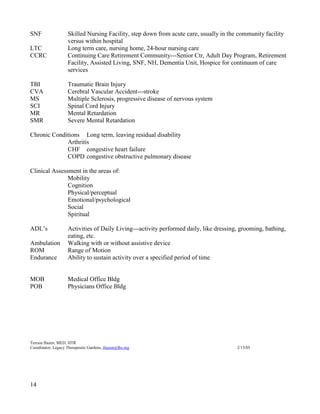
SNF Skilled Nursing Facility, step down from acute care, usually in the community facility versus within hospital 
LTC Long term care, nursing home, 24-hour nursing care 
CCRC Continuing Care Retirement Community---Senior Ctr, Adult Day Program, Retirement Facility, Assisted Living, SNF, NH, Dementia Unit, Hospice for continuum of care services 
TBI Traumatic Brain Injury 
CVA Cerebral Vascular Accident---stroke 
MS Multiple Sclerosis, progressive disease of nervous system 
SCI Spinal Cord Injury 
MR Mental Retardation 
SMR Severe Mental Retardation 
Chronic Conditions Long term, leaving residual disability 
Arthritis 
CHF congestive heart failure 
COPD congestive obstructive pulmonary disease 
Clinical Assessment in the areas of: 
Mobility 
Cognition 
Physical/perceptual 
Emotional/psychological 
Social 
Spiritual 
ADL’s Activities of Daily Living---activity performed daily, like dressing, grooming, bathing, eating, etc. 
Ambulation Walking with or without assistive device 
ROM Range of Motion 
Endurance Ability to sustain activity over a specified period of time 
MOB Medical Office Bldg 
POB Physicians Office Bldg 
Teresia Hazen, MED, HTR 
Coordinator, Legacy Therapeutic Gardens, thazen@lhs.org 2/15/05
15 
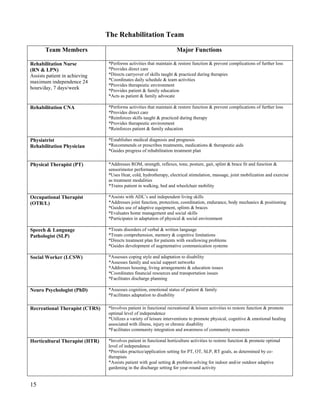
The Rehabilitation Team 
Team Members 
Major Functions 
Rehabilitation Nurse 
(RN & LPN) 
Assists patient in achieving maximum independence 24 hours/day, 7 days/week 
*Performs activities that maintain & restore function & prevent complications of further loss 
*Provides direct care 
*Directs carryover of skills taught & practiced during therapies 
*Coordinates daily schedule & team activities 
*Provides therapeutic environment 
*Provides patient & family education 
*Acts as patient & family advocate 
Rehabilitation CNA 
*Performs activities that maintain & restore function & prevent complications of further loss 
*Provides direct care 
*Reinforces skills taught & practiced during therapy 
*Provides therapeutic environment 
*Reinforces patient & family education 
Physiatrist 
Rehabilitation Physician 
*Establishes medical diagnosis and prognosis 
*Recommends or prescribes treatments, medications & therapeutic aids 
*Guides progress of rehabilitation treatment plan 
Physical Therapist (PT) 
*Addresses ROM, strength, reflexes, tone, posture, gait, splint & brace fit and function & sensorimotor performance 
*Uses Heat, cold, hydrotherapy, electrical stimulation, massage, joint mobilization and exercise as treatment modalities 
*Trains patient in walking, bed and wheelchair mobility 
Occupational Therapist (OTR/L) 
*Assists with ADL’s and independent living skills 
*Addresses joint function, protection, coordination, endurance, body mechanics & positioning 
*Guides use of adaptive equipment, splints & braces 
*Evaluates home management and social skills 
*Participates in adaptation of physical & social environment 
Speech & Language 
Pathologist (SLP) 
*Treats disorders of verbal & written language 
*Treats comprehension, memory & cognitive limitations 
*Directs treatment plan for patients with swallowing problems 
*Guides development of augmentative communication systems 
Social Worker (LCSW) 
*Assesses coping style and adaptation to disability 
*Assesses family and social support networks 
*Addresses housing, living arrangements & education issues 
*Coordinates financial resources and transportation issues 
*Facilitates discharge planning 
Neuro Psychologist (PhD) 
*Assesses cognition, emotional status of patient & family 
*Facilitates adaptation to disability 
Recreational Therapist (CTRS) 
*Involves patient in functional recreational & leisure activities to restore function & promote optimal level of independence 
*Utilizes a variety of leisure interventions to promote physical, cognitive & emotional healing associated with illness, injury or chronic disability 
*Facilitates community integration and awareness of community resources 
Horticultural Therapist (HTR) 
*Involves patient in functional horticulture activities to restore function & promote optimal level of independence 
*Provides practice/application setting for PT, OT, SLP, RT goals, as determined by co- therapists 
*Assists patient with goal setting & problem solving for indoor and/or outdoor adaptive gardening in the discharge setting for year-round activity
16 
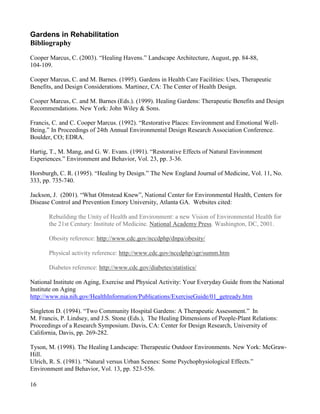
Gardens in Rehabilitation 
Bibliography 
Cooper Marcus, C. (2003). “Healing Havens.” Landscape Architecture, August, pp. 84-88, 
104-109. 
Cooper Marcus, C. and M. Barnes. (1995). Gardens in Health Care Facilities: Uses, Therapeutic Benefits, and Design Considerations. Martinez, CA: The Center of Health Design. 
Cooper Marcus, C. and M. Barnes (Eds.). (1999). Healing Gardens: Therapeutic Benefits and Design Recommendations. New York: John Wiley & Sons. 
Francis, C. and C. Cooper Marcus. (1992). “Restorative Places: Environment and Emotional Well- Being.” In Proceedings of 24th Annual Environmental Design Research Association Conference. Boulder, CO; EDRA. 
Hartig, T., M. Mang, and G. W. Evans. (1991). “Restorative Effects of Natural Environment Experiences.” Environment and Behavior, Vol. 23, pp. 3-36. 
Horsburgh, C. R. (1995). “Healing by Design.” The New England Journal of Medicine, Vol. 11, No. 333, pp. 735-740. 
Jackson, J. (2001). “What Olmstead Knew”, National Center for Environmental Health, Centers for Disease Control and Prevention Emory University, Atlanta GA. Websites cited: 
Rebuilding the Unity of Health and Environment: a new Vision of Environmental Health for the 21st Century: Institute of Medicine. National Academy Press. Washington, DC, 2001. 
Obesity reference: http://www.cdc.gov/nccdphp/dnpa/obesity/ 
Physical activity reference: http://www.cdc.gov/nccdphp/sgr/summ.htm 
Diabetes reference: http://www.cdc.gov/diabetes/statistics/ 
National Institute on Aging, Exercise and Physical Activity: Your Everyday Guide from the National Institute on Aging http://www.nia.nih.gov/HealthInformation/Publications/ExerciseGuide/01_getready.htm 
Singleton D. (1994). “Two Community Hospital Gardens: A Therapeutic Assessment.” In 
M. Francis, P. Lindsey, and J.S. Stone (Eds.), The Healing Dimensions of People-Plant Relations: Proceedings of a Research Symposium. Davis, CA: Center for Design Research, University of California, Davis, pp. 269-282. 
Tyson, M. (1998). The Healing Landscape: Therapeutic Outdoor Environments. New York: McGraw- Hill. 
Ulrich, R. S. (1981). “Natural versus Urban Scenes: Some Psychophysiological Effects.” 
Environment and Behavior, Vol. 13, pp. 523-556.
17 
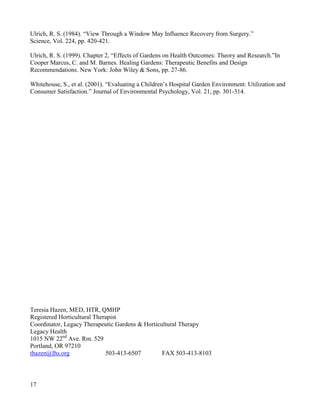
Ulrich, R. S. (1984). “View Through a Window May Influence Recovery from Surgery.” 
Science, Vol. 224, pp. 420-421. 
Ulrich, R. S. (1999). Chapter 2, “Effects of Gardens on Health Outcomes: Theory and Research.”In Cooper Marcus, C. and M. Barnes. Healing Gardens: Therapeutic Benefits and Design Recommendations. New York: John Wiley & Sons, pp. 27-86. 
Whitehouse, S., et al. (2001). “Evaluating a Children’s Hospital Garden Environment: Utilization and Consumer Satisfaction.” Journal of Environmental Psychology, Vol. 21, pp. 301-314. 
Teresia Hazen, MED, HTR, QMHP 
Registered Horticultural Therapist 
Coordinator, Legacy Therapeutic Gardens & Horticultural Therapy 
Legacy Health 
1015 NW 22nd Ave. Rm. 529 
Portland, OR 97210 
thazen@lhs.org 503-413-6507 FAX 503-413-8103

Rehabilitation in the Garden: Developing the Garden as a Tool to Achieve Functional Therapeutic Outcomes

  • 1.
    Outline for Friday,September 18, 2009 Session Confirmation #22284 Title: Rehabilitation in the Garden: Developing the Garden as a Tool to Achieve Functional Therapeutic Outcomes Marketing Statement: Tour some urban healing gardens in healthcare and senior living environments and examine how they work and what changes might help improve outcomes. Learn how therapists and activity professionals work and about specific garden elements to support clinical applications and the intended therapeutic outcomes. Summary: Well-designed gardens provide functional, home-like settings for inpatient and outpatient therapies and resident activity programs. The relationship between the physical design of the therapeutic garden and the rehabilitation programming is critical. While designing the garden landscape architect’s need to understand the type of therapy/program goals. The elements included in the therapeutic garden can assist in achieving these therapy and activity goals. Landscape architects will be exposed to medical terminology and the roles of key healthcare personnel, to assist them in designing successful gardens. In addition, different rehabilitation treatments are supported by certain design characteristics and how they are applied in the garden is crucial. Whether a garden is providing and aiding the physical, cognitive or the emotional development, certain equipment, activities and spaces provide for that therapy. Garden elements and accessories needed for individual applications ranging from senior care to acute care will also be explored including convincing research studies. In addition to the clinical focus, the role of plant material with its seasonal changes in the garden and the relationship to the patient’s care will be discussed. How patients interact and are engaged in the outdoor setting can increase or decrease their therapy outcome. Plant material selection also provides areas for education, restoration and social exchange. A well-designed garden will promote four seasons of sensory stimulation. After reviewing and understanding the tools needed for a successful therapeutic garden, the participants will tour three outstanding facilities in the Chicago-land area. The tour will include a continuing care retirement community, a rehabilitation rooftop garden and a senior activity center. Session Type: Field Session Learning Objectives: 1. Describe key garden elements and how they promote clinical programming applications for functional therapeutic outcomes in a variety of garden settings: senior living, rehabilitation units, acute care, etc. 2. Outline rehabilitation programming in the garden and aspects of design for four seasons. 3. Compare and contrast the work of PT, OT, SLP, SW, HT, and other therapies in the garden. 4. Identify and use appropriate medical terminology in design team collaboration. 5. Given program goals, evaluate three gardens for effective qualities, areas for improvement and missed opportunities.
  • 2.
    2 Outline: I.Benefits of Gardens in Rehabilitation Programs A. The environment of care and customer satisfaction B. Well designed gardens provide functional, home-like settings for inpatient and outpatient therapies and resident activity programs C. Gardens provide for movement, mild exercise and rehabilitation D. Provide for a wide range of independent activities for all users E. AHTA Therapeutic Garden Characteristics (TGC) F. TGC applied to Stenzel Healing Garden II. Research studies to promote quality of life and rehabilitation in gardens A. Convincing evidence to help the designer educate the rehab team and administrators B. Research for senior living III. Medical Terminology for the Designer A. Learn some of the more common medical and healthcare terms and abbreviations used in design team work B. Identify medical terminology used by therapists to describe their program for the garden IV. Garden Elements and Functional Patient Activities to Achieve Rehab Goals A. The client B. The designer C. The design team: a collaborative, interdisciplinary approach for quality and effectiveness D. Examine key features in the garden and how they support the clinical teams' work with patients Residential, homelike Plants, plants, and more plants Accessibility Raising some of the plant material Four seasons of sensory stimulation Balance deciduous, evergreen, hardscape and plant material Nodes, privacy, gathering Gathering place Ramps, stairs, walking rails, benches Walking surfaces View out the window V. Role of the PT, OT, SLP, HT, RT, NSG in using the gardens for therapies A. The rehabilitation team B. Scope of goals for each therapy C. What are some of the activities that therapists use in the garden and why D. How the garden elements help the therapist/client reach intended outcomes VII. Goals in Senior Living Quality of life Feeling of well-being Increase or maintain function: physical, cognitive, emotional Lifestyle choices for independence
  • 3.
    3 Adaptations forsensory deficits: visual, auditory, tactile, olfactory, gustatory Reminiscence and life review activities VII Closing A. Bibliography for Gardens in Rehabilitation B. Evaluation tool for the field experience C. Q&A Field Experience Description: Board bus to leave McCormick Place at 8:00 AM Arrive at Montgomery Place at 8:30 AM Educational session- Teresia Hazen 8:30 AM - 9:30AM Tour Montgomery Place from 9:30 - 10:30 AM. Montgomery Place is a Continuing Care Retirement Community that provides a high standard of living and included horticultural therapy as part of the ongoing care of residents. Load bus and travel to Schwab Rehabilitation Hospital Arrive and Tour 11:00-11:45AM. Schwab Rehabilitation Hospital utilizes a rooftop garden to provide a unique location for a variety of therapies including horticultural, sensory, and ambulatory. Box Lunch delivered- eat lunch 11:45 - 12:45 PM Load bus and travel to the Levy Center, Evanston Arrive and Tour the Levy Center 1:45- 2:45PM. The Levy Center is home to the Hulda B. and Maurice L. Rothschild Enabling Garden which is used for therapy classes and special events. Load buses at 3:00pm to return to McCormick Place by 4PM Presenters: Teresia M. Hazen, M.Ed., HTR, QMHP has been with Legacy Health since 1991. LHS is a not-for- profit integrated healthcare network including five hospitals and related services that promotes gardens in healthcare to create supportive environments of care for patients, families, visitors, staff and neighbors. It is the only health care system in the US to offer a horticultural therapy certificate program certified by the American Horticultural Therapy Association (AHTA). Teresia is responsible for pioneering the horticultural therapy program and therapeutic gardens for Legacy’s long-term care and SNF patients. Today, she oversees nine therapeutic gardens and horticultural therapy work through the Rehabilitation Institute of Oregon, Emanuel Children’s Hospital and the Oregon Burn Center. Her training in horticulture, special education, rehabilitation, addiction counseling and gerontology lend credibility to design team work for gardens to meet a wide range of user needs. Brian M. Slovacek, is Principal, Healthcare Studio Leader and Project Leader for Hitchock Design Group. Delivering quality design within challenging budgets, Brian is an outstanding advocate for clients’ land resources. This client-centric approach has helped Brian foster long-term relationships throughout his career. As a Project Leader, he has coordinated complex consultant teams, been engaged throughout the design and management process from client contact to construction closeout. This involvement in the design process from concept through construction has made Brian a skilled
  • 4.
    4 landscape architectat both macro-level planning and site-specific scales. A strong believer in continuous education, Brian expanded his knowledge of therapeutic garden design by participating in an intense one-on-one workshop at the Rusk Institute at New York University Hospital. Teresia Hazen, MEd, HTR, QMHP Legacy Health Registered Horticultural Therapist Coordinator of Legacy Therapeutic Gardens & HT 1015 NW 22nd Ave. Suite 529 Portland, OR 97210 T 503.413.6507 thazen@lhs.org www.legacyhealth.org search “gardens” Brian M. Slovacek Landscape Architect Principal, Healthcare Studio Hitchcock Design Group 221 West Jefferson Avenue Naperville, Illinois 60540 T 630.961.1787 bslovacek@hitchcockdesigngroup.com www.hitchcockdesigngroup.com
  • 5.
    5 August 2009Oregon Burn Center Garden Guest Book Thank you so much for this little piece of heaven. My mother cannot walk to out here yet. But, just knowing that she can look out the window makes me feel good. J. We are here with Josh. What a nice place. 40% of him is burned but he asked to come out here. It is so peaceful. Thanks. 8-9-09 Thank you Burn Center for all you do for me. Kathy Hamilton July 30, 09 visiting Willis. A beautiful garden full of wonder and delight. Thank you! Aug 5, 2009 Visiting and staying here with my sixteen year old who was brought here to the Burn Center with second degree burns on face, arms and legs. What a great place, group of doctors and staff. This garden is such a peaceful, relaxing place to get away from the craziness of the hospital room. I hope all that are here visit and enjoy it. Thanks, to all that help in the care and recover. Mandi This garden is pure BLISS. Matthew was here 8/7/09 Such a wonderful, peaceful, tranquil garden. Thank you! Bonnie (Picture) See Kathy H. to be featured in The American Gardener, the magazine of the American Horticultural Society, Nov/Dec 2009.
  • 6.
    6 THERAPEUTIC GARDENCHARACTERISTICS (Adapted from American Horticultural Therapy Association Board of Directors, April 30, 1995) Therapeutic gardens are featured in national publications and are being built with increasing frequency in health care settings. Among these new gardens, there is a high degree of correlation in physical design and programming intended to improve therapeutic benefits to garden visitors and participants. These identified factors interrelate with a vigorous plant dominated landscape to achieve restorative and horticultural therapy objectives and are likely to be associated with excellence in the design of therapeutic gardens. Some common characteristics are: 1. Scheduled and programmed activities: A horticultural therapy program guiding and promoting a program of activities and experiences in the garden is ideal. However, even in gardens designed for the passive/independent enjoyment by visitors, special events increasing the number of visits, classes encouraging routine garden tasks, and publicizing activities of all kinds familiarize special populations, facility staff, families of clients or patients, and nearby community residents with the garden. 2. Features modified to improve accessibility: Garden elements, features and equipment are all selected or modified to provide accessible places, activities and experiences to the greatest extent possible. Each modification to the therapeutic garden environment eases the task of gardening and or enhances the horticultural experience for the visitor/gardener enabling them to see and even to study plants, to touch or smell them, to encounter the luxuriant garden growth in their own way, on their own terms and at their own pace. 3. Well defined perimeters: Edges of garden spaces and special zones of activities within the garden are often intensified to redirect the attention and the energies of the visitor to the components and displays within the garden. 4. A profusion of plants and people/plant interactions: Therapeutic gardens introduce individuals to planned, intensive outdoor environments in which the conscious provisions of spaces and places for restoration, horticulture education, therapy, and for social exchanges are organized into legible and verdant, plant-dominated open spaces with simple patterns of paths and workplaces. The garden promotes four seasons of sensory stimulation. 5. Benign and supportive conditions: Therapeutic gardens provide safe, secure and comfortable settings for people. The avoidance of potentially hazardous chemicals such as herbicides, fertilizers, and insecticides, the provision of shade and other protective structures, the flourishing plants, and the protected and protective nature of the therapeutic garden offer personal comfort and refuge to the garden user.
  • 7.
    7 6. Universaldesign: Therapeutic gardens are designed for the convenience and enjoyment for people with the widest possible range of conditions. As practical and pleasurable landscapes for people of all ages and all abilities, these gardens commonly stimulate the full range of senses including memory, hearing, touch, smell and sometimes taste, as pleasurable alternatives to the visual experience of gardens. The therapeutic garden exploits the most complete range of people/plant interactions and experiences possible within its enclosures. 7. Recognizable placemaking: Therapeutic gardens are frequently simple, unified and easily comprehended places. An intensified recognition of garden patterns and garden experiences enhance the unique identity of a garden as a special place for the people it serves. Placemaking, an important strategy in all landscape design efforts, heightens the visitor’s focus on plant-related sensuality, comfort, and independence experienced within a therapeutic garden. Resources: Legacy Health and Portland Community College Therapeutic Horticulture Certificate coursework. Next series begins summer 2010. Inquire jabushak@pcc.edu. http://www.pcc.edu/gerontology http://catalog.oregonstate.edu/OptionDetail.aspx?code=632&majorid=30 Legacy Gardens: Therapeutic Garden Design Workshop, October 19, 2009, 9:00 – 3:30 inquire thazen@lhs.org or www.legacyhealth.org and search “gardens”. American Horticultural Therapy Association Annual Conference www.ahta.org October 1-3, 2009 Pasadena, CA. American Society of Landscape Architects (ASLA) Therapeutic Gardens Professional Practice Network (PPN) http://host.asla.org/groups Chicago Botanic Garden, Healthcare Garden Design Certificate Program http://www.chicagobotanic.org Therapeutic Landscape Data Base http://www.healinglandscapes.org/contact.html http://tldb.blogspot.com/ 2009 Gardens in Senior Living Workshop http://www.centerofdesign.org/pages/memorygarden.htm Environment: Yale, Fall 2006, Nature in Humanities Habitat http://environment.yale.edu/pubs/Environment-Yale-Fall-2006 Teresia Hazen, MEd, HTR, QMHP Registered Horticultural Therapist Coordinator, Legacy Therapeutic Gardens & Horticultural Therapy Legacy Health 1015 NW 22nd Ave. Suite 529 Portland, Oregon 97210 503-413-6507 thazen@lhs.org 6/09
  • 8.
    8 Legacy GoodSamaritan Hospital Franz R. Stenzel M.D. and Kathryn Stenzel Healing Garden Date of Design Process: June – August 1996 Date of Construction Completion; June 1, 1997 Designer: David Evans & Associates, Ron Mah, LA Disciplines Involved: Physical, Occupational, Speech, Recreational and Horticultural Therapists, Rehabilitation Managers, Nursing, Current and Former Patients and Families, Horticultural Therapy Volunteers, Spiritual Care, Social Work, Facilities Staff, Major Donor, Landscape Architect and Architect. Goal of Design: Create a therapeutic garden to meet the needs of inpatient and outpatient rehabilitation therapies, patient independent activity, visitors, staff and the neighborhood. Populations Served: Acute care patients, acute care rehabilitation, outpatient rehab, day treatment patients, families, visitors, neighbors and staff, 24 hours daily. This is a public garden. Significant elements as they relate to therapeutic garden design: 1. Scheduled and Programmed Activities--- Each rehabilitation therapy (PT, OT, HT, SLP, RT) uses the garden to help meet patient goals year round, as weather permits. Plant signage and other educational devises provide information to garden visitors. Staff appreciation activities are scheduled year-round in the garden; hot chocolate in the autumn, strawberry shortcake in May, ice cream sundaes in August, etc. Horticultural Therapy Dept. schedules “Summer in the Garden” a series of four – six special community events each summer and fall including the Portland Art Museum Rental Sales Gallery, local nurseries and garden centers, musicians, nature craft activities, summer employee bazaar, etc. The Employee Recognition Committee regularly schedules events and activities in the garden. Hospital Administration organizes events in the garden like GO Red for Women’s Heart Disease Awareness and caramel corn in the garden to celebrate National Hospital Week. 2. Features modified to improve accessibility---- Rehabilitation therapies need various walking surfaces, stairs, ramps, inclines, and opportunities for cognitive and physical activities. Some of the garden needed to be raised up to the patient to accommodate wheelchair users and those unable to bend to the ground. Seating walls accommodate patients with decreased balance and decreased endurance. The area immediately outside the lobby door is zero grade to accommodate the weak/frail patient. The incline to the west upper end of the garden provides challenge activities for patients as they rebuild endurance and gain wheelchair skills especially after brain injury or spinal cord injury. The garden in designed to support independent use by patients during unstructured time and families and visitors round the clock. 3. Well defined perimeters--- Themed garden areas included: Butterfly, Perennial, Fragrant, Rock, Hedge Demonstration, Drake’s/ Monrovia Garden and two Northwest Gardens and direct the attention of the visitor to
  • 9.
    9 those components.Edges of garden spaces are defined by structures/buildings, and walkways. Privacy is provided to window rooms through the placement of plants. 4. A profusion of plants and people/plant interactions--- This is a rich, lush intriguing botanical collection for four seasons of sensory stimulation. People/plant interactions are encouraged by botanical signage, plant placement for touch and smell and regularly scheduled activities for patients and visitors. Simple patterns of paths, seating options and workplaces for horticulture, therapy and socialization encourage people/plant interactions. 5. Benign and supportive conditions--- The garden provides a safe, secure and comfortable setting for users. Patients and families choose areas to meet privacy and social support needs. Visitors enjoy watching hummingbirds, butterflies and birdlife in the garden. Pest and disease resistant plants are selected for the garden to avoid use of pesticides and chemicals. Shade is provided by some trees that have not reached maturity. More shade is needed in the garden during the sunniest months. This could be provided by better placed, wider branching trees and/or shade structures. The garden is in full shade September 6 to March 6, so it can be cool for some patients during these months. 6. Universal design--- The garden was designed and is programmed for the widest range of abilities. It accommodates the needs of PT’s for instructing patients in the use of power wheel chairs to children’s’ groups visiting from local daycare programs to walking clubs from the Mac Club. The garden stimulates the full range of senses including memory, hearing, touch, smell, and taste by careful selection of plant materials, garden accessories and programmed activities. 7. Recognizable placemaking--- The design and plantings provide for a simple, unified and easily comprehended setting. Visitors are focused on plant-related sensuality, comfort and independence in this therapeutic garden. Funding Source: Good Samaritan Hospital Foundation Size: 13,000 sq. ft. Cost Sq. Ft.: $25.00 initial construction phase Maintenance Plan: Directed by Coordinator of Therapeutic Gardens 1. Eight hours paid HT Gardener weekly: grooming, pruning, planting and soil amendments. 2. Fifteen hours HT Volunteers weekly: weeding, sweeping, watering and grooming. 3. Irrigation repairs and annual power washing managed by Good Samaritan Facilities Dept. Additions Pending: Three dining tables, umbrellas and chairs for the patio off the back door of lobby; April 07 complete. Long-term Needs: Activity pavilion for weather protection for garden users. Designed and in fundraising. Awards and Honors: 1998 AIA, Portland Chapter, Architecture + Energy Award. The garden a part of the Marshall Street Addition was praised by the jurors for its value to patients, visitors, staff, wildlife and the neighborhood. 1998 American Horticultural Therapy Association, Therapeutic Garden Award 2005 United States Botanic Garden, Washington, DC. Stenzel Healing Garden picture is the example for Therapeutic Gardens in the new permanent display “Plants in Culture”. Teresia Hazen, MED, HTR, QMHP Registered Horticultural Therapist, Coordinator, Legacy Therapeutic Gardens & Horticultural Therapy, Legacy Health, 503-413-6507
  • 10.
    10 RESEARCH ABSTRACTSTO SUPPORT HOSPITAL GARDENS Compiled by Vi Hansen, LCSW, Legacy Cancer Services, Surgical Services and Teresia Hazen, MED, HTR, QMHP, Coordinator of Therapeutic Gardens, Legacy Health 1. Cimprich, Bernadine and Ronis, D.L. “An Intervention to Restore Attention in Women with Newly Diagnosed Breast Cancer.” Cancer Nursing. 26 (4): 284-292 Aug 2003. Cancer studies looked at how interaction with nature can increase cognitive functioning, the ability to focus and the tendency to seek out new experiences. This dissertation by Cimprich, an RN, studied recovering breast-cancer patients engaged in gardening activity programs. Compared to another recovering group who were not given such an opportunity, the patients who undertook nature activities three times a week for ninety days had far less tendency to complain of mental fatigue, depression, marital problems or a general inability to cope. They scored significantly higher on tests of cognitive acuity than their counterparts. They were far more likely to go back to work full-time and tackle new projects, such as losing weight or learning a foreign language. 2. Cooper Marcus, Clare and Marni Barnes, 1995. Gardens in Healthcare Facilities: Uses, Therapeutic Benefits and Design Recommendations. Martinez, CA: The Center for Health Design. Research sponsored by the Center for Health Design on the use and therapeutic benefits of hospital gardens finds an overwhelmingly positive response from employees, patients, and their family and friends. Of those who were observed and interviewed while in a garden, 95 percent reported a therapeutic benefit. According to the study, this manifests itself in employees being more productive, patients feeling better and having more tolerance of medical procedures, and family and friends feeling relieved of stress. Four case studies (including user responses); typology of health facility outdoor spaces; and a set of design recommendations for location, way finding, planting, and maintenance are included in the report. Also included are a literature review and a brief historical overview of hospital gardens since the Middle Ages. 3. Cooper Marcus, Clare and Marni Barnes. “Introduction: Historic and Cultural Overview”. Chapter 1 in Healing Gardens: Therapeutic Benefits and Design Recommendations, Clare Cooper Marcus and Marni Barnes, 1999. Wiley & Sons. Stress Reduction and Access to Nature: A summary of three exploratory studies of the use and benefit of hospital gardens. Which specific qualities seemed to be helpful in triggering mood change? More than two-thirds of garden visitors mentioned elements of the plant world (trees, flowers, colors, seasonal change, greenery). More than half mention elements that stimulated auditory, olfactory and tactile senses such as birdsong, sound of water, fresh air and fragrances. Psychological or social aspects were noted by 50% of participates. These include describers like peaceful, escape from work, openness/large, privacy/secret places, oasis, companionship, watching others, knowing it is there.
  • 11.
    11 Visual qualitiesother than relating to plant material were noted by 26% of respondents and 17% of respondents noted a list of practical features. 4. Ulrich, Roger, S. “Effects of Gardens on Health Outcomes: Theory and Research”. Chapter 2 in Healing Gardens: Therapeutic Benefits and Design Recommendations, Clare Cooper Marcus and Marni Barnes, 1999. Wiley & Sons. Stress as a major problem for patients, families and staff in healthcare settings is discussed. Also presented is a theory of supportive gardens developed by Dr. Ulrich. He proposes that “gardens in healthcare situations are important stress-mitigating resources for patients and staff to the extent that they foster: 1) A sense of control and access to privacy; 2) Opportunities for social support; 3) Physical movement, exercise and rehabilitation; 4) Access to the nature experience and other positive distractions.” (p.37) He advocates for the importance of continuing research----particularly “sound and credible research that shows that gardens can promote improved health outcomes, foster higher patient/consumer satisfaction with healthcare providers and be acceptably cost-effective.” (p. 31) 5. Ulrich, Roger S. “Natural versus Urban Scenes: Some Psychophysiological Effects.” Environment & Behavior, 13(5): 523-556, Sept 1981. Eighteen students, ages 20-27 years, viewed 60 color slides of each of three types: (1) nature with water (2) nature dominated by vegetation and (3) urban environments without water or vegetation. The information rates of the three slide samples were equivalent. The effects of the slides on alpha amplitude, heart rate and emotional states were measured. The two categories of nature views had more positive influences on psychophysiological states than the urban scenes. Alpha was significantly higher while students viewed slides of vegetation or water than while they viewed urban scenes. There was also a consistent pattern for views of nature, especially water, to have more positive influences on emotional states. Water, and to a lesser extent vegetation views, held attention and interest more effectively than the urban scenes. Implications of the findings for theory development in environmental aesthetics are discussed. 6. Ulrich, Roger, S. “View through a Window May Influence Recovery from Surgery.” Science. 224 (April 1984): 420-1. Medical records on recovery of patients after cholecystectomy (gall bladder surgery) in a suburban Pennsylvania hospital between 1972 and 1981 were examined to determine whether assignment to a room with window view of a natural setting might have restorative influences. Twenty-three surgical patients assigned to rooms with windows looking out on a nature scene of trees had shorter postoperative hospital stays, received fewer negative evaluative comments in nursing notes and took fewer potent analgesics than 23 matched patients in similar rooms with windows facing a brick building wall. 7. Wichrowski, Matthew HTR; Whiteson, Jonathan MD; Haas, Francois PhD; Mola, Ana RN, ANP; Rey, Mariano J. MD, Effects of Horticultural Therapy on Mood and Heart Rate in Patients Participating in an Inpatient Cardiopulmonary Rehabilitation Program., Journal of Cardiopulmonary Rehabilitation., (September/October 2005): 25(5): 270-274
  • 12.
    12 PURPOSE: Toassess the effects of horticultural therapy (HT) on mood state and heart rate (HR) in patients participating in an inpatient cardiac rehabilitation program. METHODS: Cardiac rehabilitation inpatients (n = 107) participated in the study. The HT group consisted of 59 subjects (34 males, 25 females). The control group, which participated in patient education classes (PECs), consisted of 48 subjects (31 males, 17 females). Both HT sessions and PEC are components of the inpatient rehabilitation program. Each group was evaluated before and after a class in their respective modality. Evaluation consisted of the completion of a Profile of Mood States (POMS) inventory, and an HR obtained by pulse oximetry. RESULTS: Changes in the POMS total mood disturbance (TMD) score and HR between pre intervention and post intervention were compared between groups. There was no pre-session difference in either TMD score (16 +/- 3.6 and 19.0 +/- 3.2, PEC and HT, respectively) or HR (73.5 +/- 2.5 and 79 +/- 1.8, PEC and HT, respectively). Immediately following the intervention, the HT TMD was significantly reduced (post-TMD = 1.6 +/- 3.2, P < .001), while PEC TMD was not significantly changed (TMD = 17.0 +/- 28.5). After intervention, HR fell in HT by 4 +/- 9.6 bpm (P < .001) but was unchanged in PEC. CONCLUSION: These findings indicate that HT improves mood state, suggesting that it may be a useful tool in reducing stress. Therefore, to the extent that stress contributes to coronary heart disease, these findings support the role of HT as an effective component of cardiac rehabilitation. (C) 2005 Lippincott Williams & Wilkins, Inc. 10/05
  • 13.
    13 Basic MedicalTerminology for the Designer JACHO Joint Commission on the Accreditation of Healthcare Organizations CARF Committee on the Accreditation of Rehabilitation Facilities RT Recreational Therapist CTRS Certified Therapeutic Recreation Specialist RT Respiratory Therapist SLP Speech and Language Pathologist (ST speech therapy) PT Physical Therapist PTA Physical Therapy Assistant OT Occupational Therapist OTR/L Registered and licensed OT COTA Certified Occupational Therapy Assistant HTR Registered Horticultural Therapist SW Social Worker MSW Master’s SW LCSW Licensed Clinical SW Childlife Therapist Psychosocial + Activity needs MHP Mental Health Professional QMHP Qualified Mental Health Professional (Master’s psych equivalent) NSG Nursing RN Registered Nurse LPN Licensed Practical Nurse CAN Certified Nursing Assistant Physiatrist Rehab physician Pts Patients in hospital, psych, rehab or SNF (Skilled Nursing Facility) Residents Live in a facility Client Person served by a program BH Behavioral Health, psychiatry unit NICU Neo natal intensive care unit ICU Intensive care unit NICU Neonatal intensive care unit PICU Pediatric intensive care unit Acute Care Inpatient hospital nursing care
  • 14.
    14 SNF SkilledNursing Facility, step down from acute care, usually in the community facility versus within hospital LTC Long term care, nursing home, 24-hour nursing care CCRC Continuing Care Retirement Community---Senior Ctr, Adult Day Program, Retirement Facility, Assisted Living, SNF, NH, Dementia Unit, Hospice for continuum of care services TBI Traumatic Brain Injury CVA Cerebral Vascular Accident---stroke MS Multiple Sclerosis, progressive disease of nervous system SCI Spinal Cord Injury MR Mental Retardation SMR Severe Mental Retardation Chronic Conditions Long term, leaving residual disability Arthritis CHF congestive heart failure COPD congestive obstructive pulmonary disease Clinical Assessment in the areas of: Mobility Cognition Physical/perceptual Emotional/psychological Social Spiritual ADL’s Activities of Daily Living---activity performed daily, like dressing, grooming, bathing, eating, etc. Ambulation Walking with or without assistive device ROM Range of Motion Endurance Ability to sustain activity over a specified period of time MOB Medical Office Bldg POB Physicians Office Bldg Teresia Hazen, MED, HTR Coordinator, Legacy Therapeutic Gardens, thazen@lhs.org 2/15/05
  • 15.
    15 The RehabilitationTeam Team Members Major Functions Rehabilitation Nurse (RN & LPN) Assists patient in achieving maximum independence 24 hours/day, 7 days/week *Performs activities that maintain & restore function & prevent complications of further loss *Provides direct care *Directs carryover of skills taught & practiced during therapies *Coordinates daily schedule & team activities *Provides therapeutic environment *Provides patient & family education *Acts as patient & family advocate Rehabilitation CNA *Performs activities that maintain & restore function & prevent complications of further loss *Provides direct care *Reinforces skills taught & practiced during therapy *Provides therapeutic environment *Reinforces patient & family education Physiatrist Rehabilitation Physician *Establishes medical diagnosis and prognosis *Recommends or prescribes treatments, medications & therapeutic aids *Guides progress of rehabilitation treatment plan Physical Therapist (PT) *Addresses ROM, strength, reflexes, tone, posture, gait, splint & brace fit and function & sensorimotor performance *Uses Heat, cold, hydrotherapy, electrical stimulation, massage, joint mobilization and exercise as treatment modalities *Trains patient in walking, bed and wheelchair mobility Occupational Therapist (OTR/L) *Assists with ADL’s and independent living skills *Addresses joint function, protection, coordination, endurance, body mechanics & positioning *Guides use of adaptive equipment, splints & braces *Evaluates home management and social skills *Participates in adaptation of physical & social environment Speech & Language Pathologist (SLP) *Treats disorders of verbal & written language *Treats comprehension, memory & cognitive limitations *Directs treatment plan for patients with swallowing problems *Guides development of augmentative communication systems Social Worker (LCSW) *Assesses coping style and adaptation to disability *Assesses family and social support networks *Addresses housing, living arrangements & education issues *Coordinates financial resources and transportation issues *Facilitates discharge planning Neuro Psychologist (PhD) *Assesses cognition, emotional status of patient & family *Facilitates adaptation to disability Recreational Therapist (CTRS) *Involves patient in functional recreational & leisure activities to restore function & promote optimal level of independence *Utilizes a variety of leisure interventions to promote physical, cognitive & emotional healing associated with illness, injury or chronic disability *Facilitates community integration and awareness of community resources Horticultural Therapist (HTR) *Involves patient in functional horticulture activities to restore function & promote optimal level of independence *Provides practice/application setting for PT, OT, SLP, RT goals, as determined by co- therapists *Assists patient with goal setting & problem solving for indoor and/or outdoor adaptive gardening in the discharge setting for year-round activity
  • 16.
    16 Gardens inRehabilitation Bibliography Cooper Marcus, C. (2003). “Healing Havens.” Landscape Architecture, August, pp. 84-88, 104-109. Cooper Marcus, C. and M. Barnes. (1995). Gardens in Health Care Facilities: Uses, Therapeutic Benefits, and Design Considerations. Martinez, CA: The Center of Health Design. Cooper Marcus, C. and M. Barnes (Eds.). (1999). Healing Gardens: Therapeutic Benefits and Design Recommendations. New York: John Wiley & Sons. Francis, C. and C. Cooper Marcus. (1992). “Restorative Places: Environment and Emotional Well- Being.” In Proceedings of 24th Annual Environmental Design Research Association Conference. Boulder, CO; EDRA. Hartig, T., M. Mang, and G. W. Evans. (1991). “Restorative Effects of Natural Environment Experiences.” Environment and Behavior, Vol. 23, pp. 3-36. Horsburgh, C. R. (1995). “Healing by Design.” The New England Journal of Medicine, Vol. 11, No. 333, pp. 735-740. Jackson, J. (2001). “What Olmstead Knew”, National Center for Environmental Health, Centers for Disease Control and Prevention Emory University, Atlanta GA. Websites cited: Rebuilding the Unity of Health and Environment: a new Vision of Environmental Health for the 21st Century: Institute of Medicine. National Academy Press. Washington, DC, 2001. Obesity reference: http://www.cdc.gov/nccdphp/dnpa/obesity/ Physical activity reference: http://www.cdc.gov/nccdphp/sgr/summ.htm Diabetes reference: http://www.cdc.gov/diabetes/statistics/ National Institute on Aging, Exercise and Physical Activity: Your Everyday Guide from the National Institute on Aging http://www.nia.nih.gov/HealthInformation/Publications/ExerciseGuide/01_getready.htm Singleton D. (1994). “Two Community Hospital Gardens: A Therapeutic Assessment.” In M. Francis, P. Lindsey, and J.S. Stone (Eds.), The Healing Dimensions of People-Plant Relations: Proceedings of a Research Symposium. Davis, CA: Center for Design Research, University of California, Davis, pp. 269-282. Tyson, M. (1998). The Healing Landscape: Therapeutic Outdoor Environments. New York: McGraw- Hill. Ulrich, R. S. (1981). “Natural versus Urban Scenes: Some Psychophysiological Effects.” Environment and Behavior, Vol. 13, pp. 523-556.
  • 17.
    17 Ulrich, R.S. (1984). “View Through a Window May Influence Recovery from Surgery.” Science, Vol. 224, pp. 420-421. Ulrich, R. S. (1999). Chapter 2, “Effects of Gardens on Health Outcomes: Theory and Research.”In Cooper Marcus, C. and M. Barnes. Healing Gardens: Therapeutic Benefits and Design Recommendations. New York: John Wiley & Sons, pp. 27-86. Whitehouse, S., et al. (2001). “Evaluating a Children’s Hospital Garden Environment: Utilization and Consumer Satisfaction.” Journal of Environmental Psychology, Vol. 21, pp. 301-314. Teresia Hazen, MED, HTR, QMHP Registered Horticultural Therapist Coordinator, Legacy Therapeutic Gardens & Horticultural Therapy Legacy Health 1015 NW 22nd Ave. Rm. 529 Portland, OR 97210 thazen@lhs.org 503-413-6507 FAX 503-413-8103