THEORY OF VIBRATION
SYSTEMS
combination of elements intended to act together
• STATIC (memory less)
• DYNAMIC (with memory)
• LUMPED OR DISCRETE (have finite number of storage elements)
• CONTINUOUS (infinite number of states)
BASIC CONCEPTS
• Model
• Analytical Techniques
• Parameters
• Lumping
• Lumped parameter model
• Distributed Parameter model
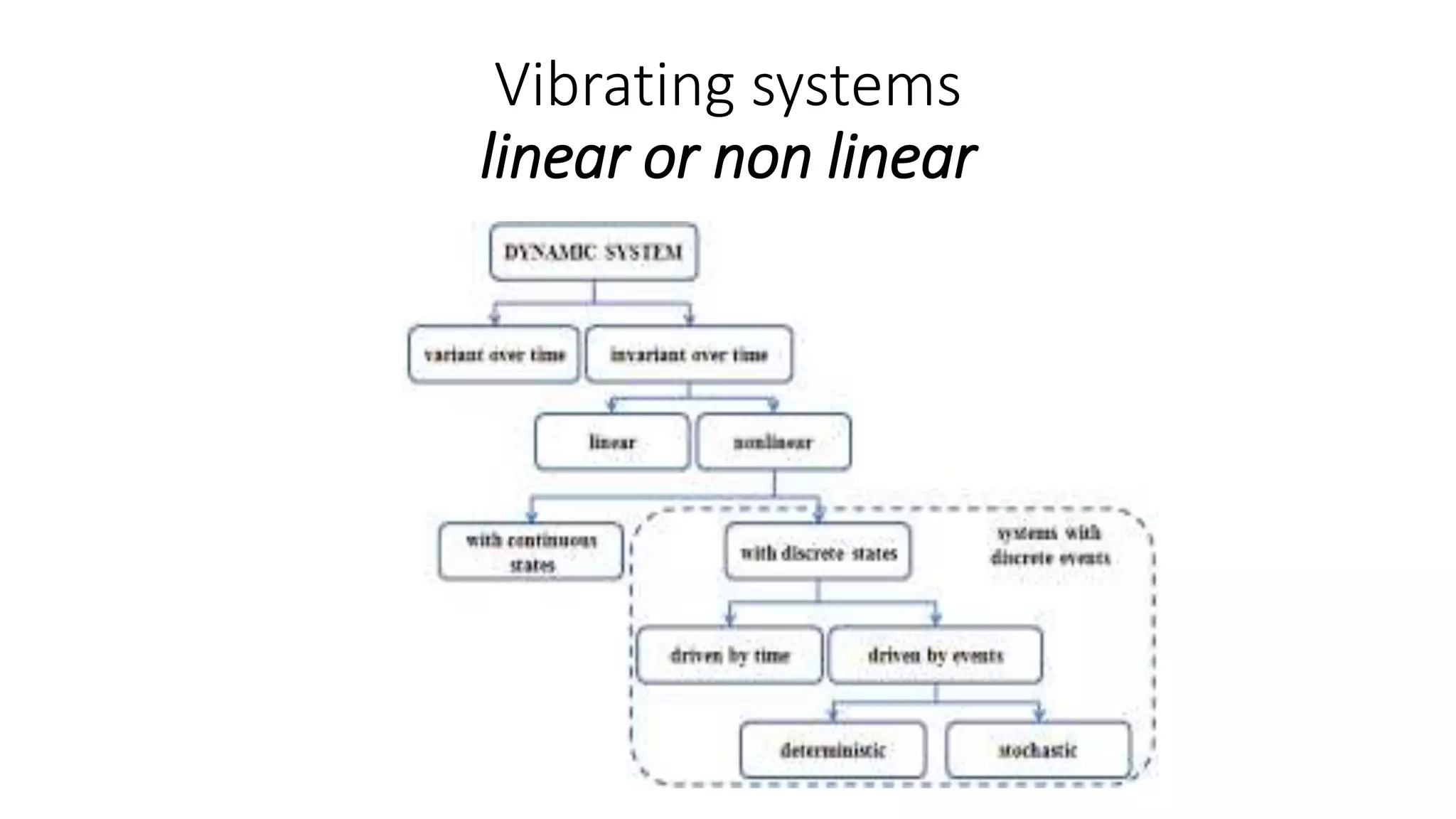
Vibrating systems
linear or non linear
DEGREE OF FREEDOM
DOF defines the number of directions a body can move
• There are six total degrees of freedom. Three correspond to
rotational movement around the x, y, and z axes, commonly termed
pitch, yaw, and roll. The other three correspond to translational
movement along those axes, which can be thought of as moving
forward or backward, moving left or right, and moving up or down.
Forced Vibration: under the influence of excitations
• Forced vibrations occur if a system is continuously driven by an
external agency
• Deterministic : magnitude of force exerting is known
• Random : magnitude of force unknown
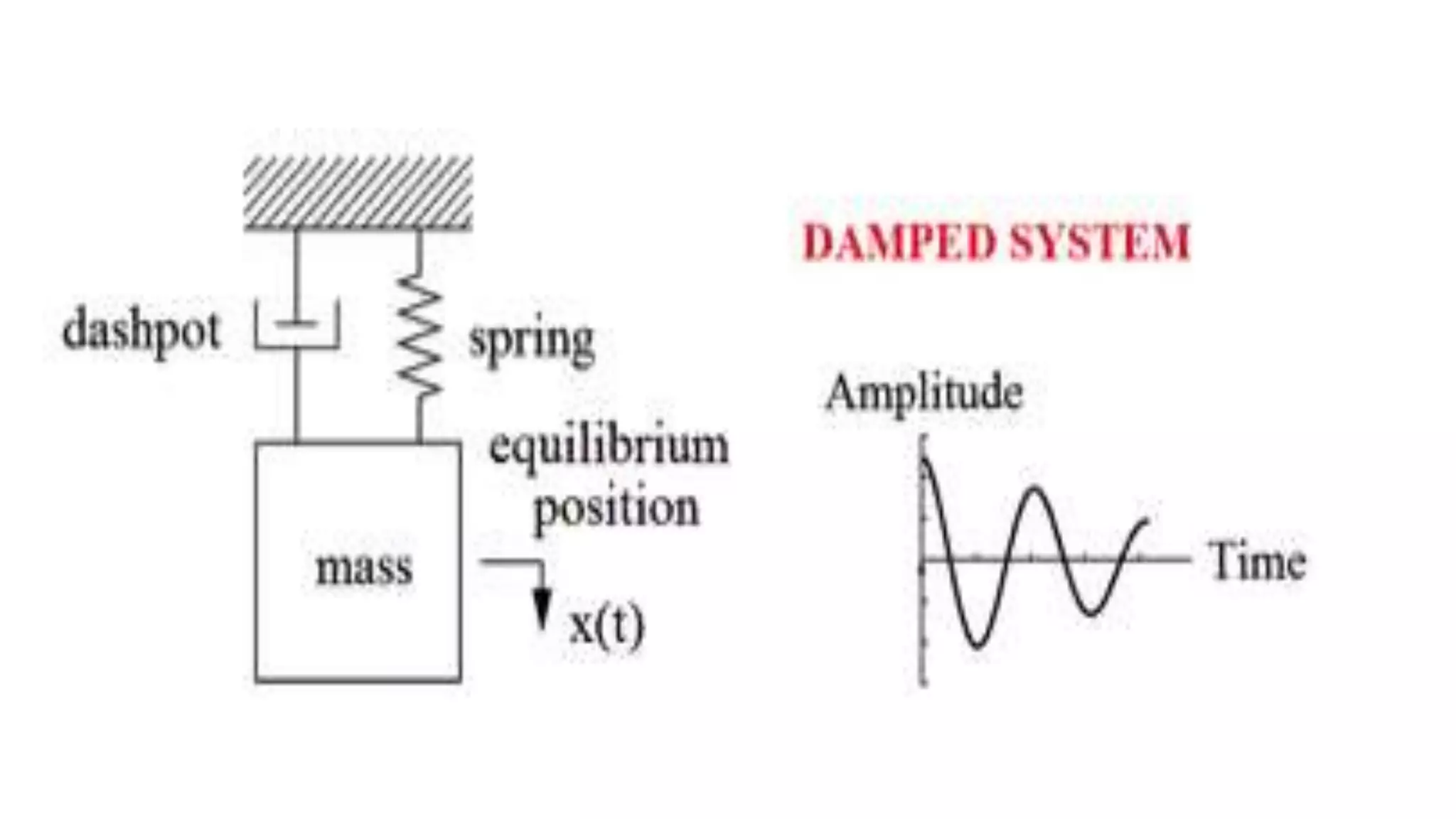
Free vibration is a type of vibration in which a force is applied
once and the structure or part is allowed to vibrate at its
natural frequency. A plucked guitar string is an example of free
vibration. Free vibration occurs when a mechanical system is
set off with an initial input and then allowed to vibrate freely.
THEORY OF VIBRATION.pptx

THEORY OF VIBRATION.pptx

  • 1.
  • 2.
    SYSTEMS combination of elementsintended to act together • STATIC (memory less) • DYNAMIC (with memory) • LUMPED OR DISCRETE (have finite number of storage elements) • CONTINUOUS (infinite number of states)
  • 3.
    BASIC CONCEPTS • Model •Analytical Techniques • Parameters • Lumping • Lumped parameter model • Distributed Parameter model
  • 4.
  • 5.
    DEGREE OF FREEDOM DOFdefines the number of directions a body can move • There are six total degrees of freedom. Three correspond to rotational movement around the x, y, and z axes, commonly termed pitch, yaw, and roll. The other three correspond to translational movement along those axes, which can be thought of as moving forward or backward, moving left or right, and moving up or down.
  • 6.
    Forced Vibration: underthe influence of excitations • Forced vibrations occur if a system is continuously driven by an external agency • Deterministic : magnitude of force exerting is known • Random : magnitude of force unknown
  • 7.
    Free vibration isa type of vibration in which a force is applied once and the structure or part is allowed to vibrate at its natural frequency. A plucked guitar string is an example of free vibration. Free vibration occurs when a mechanical system is set off with an initial input and then allowed to vibrate freely.