Theories of management
MODULE 2
22
LET’S DIG DEEPER:
33
THEORIES OF MANAGEMENT
+ Management theories have evolved from
an emphasis on authority and structure to
a focus on employees.
+ There are still competing theories
regarding what motivates an employee,
but knowing how the theories arrived at
their conclusions can help you with your
own employees.
44
+ What do some of the original
management theorists believe?
+ Different managers - have different
schools of thought
+ Max Weber's theory is bureaucratic
+ Henri Fayol's theory is administrative
+ Elton Mayo's theory is based in human
relations
+ Douglas McGregor's theory is based on
different types of workers
“You may hear or read it on the internet, books, or from any other
sources that there are a lot of theories of management. Some
are old, some are added and new. I am going to give you the list I
read on the internet, however, these are just additional
informations”
55
+ Principles of AdministrativeManagement -
the importance of maintaining a clean
facility to the value of initiative and
teamwork, are the foundation for many of
today’s most successful businesses.
+ Bureaucratic Management - revolve around
the importance of structuring your business
in a hierarchical manner with clear rules and
roles.
+ Theories X and Y - Theory X - employees are
apathetic or dislike their work. Managers who
adhere to Theory X are often authoritarian
and will micromanage everything because
they don’t trust their employees.
IMPORTANT THEORIES FOR MANAGEMENT
+ Theory Y - employees are self-motivated,
responsible, and want to take ownership of
their work. Managers who adhere to Theory Y
include their employees in the decision-
making process and encourage creativity at
all levels.
+ In practice, small businesses tendto operate
on Theory Y while large businessestend to
operate on Theory X.
+ Human Relations Theory - Mayo’s Human
Relations Theory, in which he states that
employees are more motivated by social
factors — like personal attention or being part
of a group — than environmental factors, such
as money and working conditions.
66
+ Classical Management
- is predicated on the
idea that employees
only have physical
needs. Because
employees can satisfy
these physical needs
with money, Classical
Management Theory
focuses solely on the
economics of
organizing workers.
+ As a result, Classical
Management Theory
advocates seven key
principles:
+ Profit maximization
+ Labor specialization
+ Centralized leadership
+ Streamlined operations
+ Emphasis on productivity
+ Single-person or select-
few decision making
+ Priority to the bottom
line
+ Modern Management -
embraces the idea that
people are complex.
Their needs vary over
time, and they possess
a range of talents and
skills that the business
can develop through
on-the-job training
and other programs.
77
Now let’s get to know the theorist,
theirs studies and
recommendations.
88
MAX WEBER - The Theory of Bureaucracy
+ According to him, bureaucracy is the
most efficient form of organization.
+ The organization has a well- defined line
of authority. It has clear rules and
regulations which are strictly followed.
+ Bureaucracy refers to a specialized
system and process of maintaining
uniformity or authority within an
organization.
+ Bureaucratic processes are most
common in Large organizations
Government
99
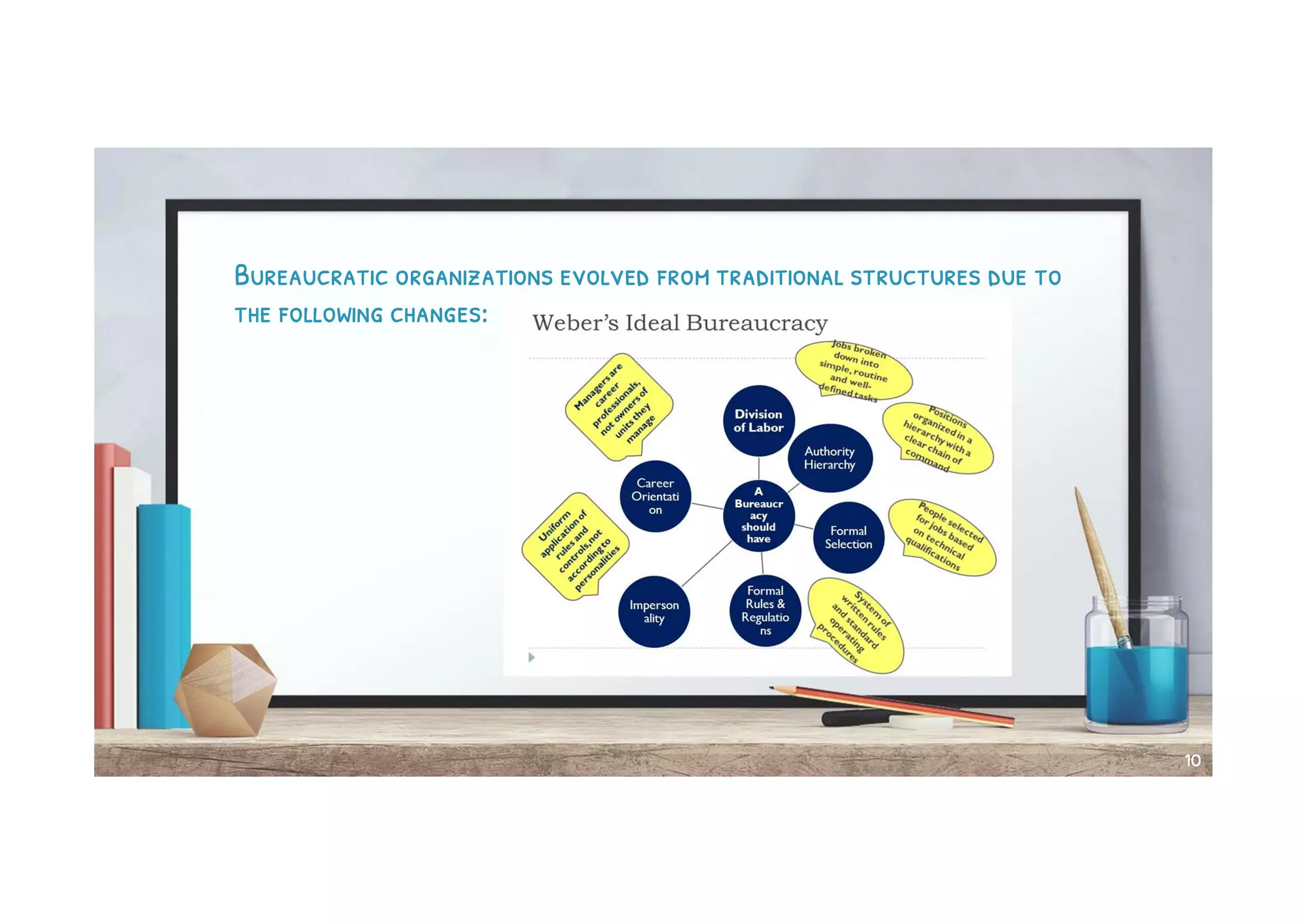
Bureaucratic organizations evolved from traditional structures due to
the following changes:
1010
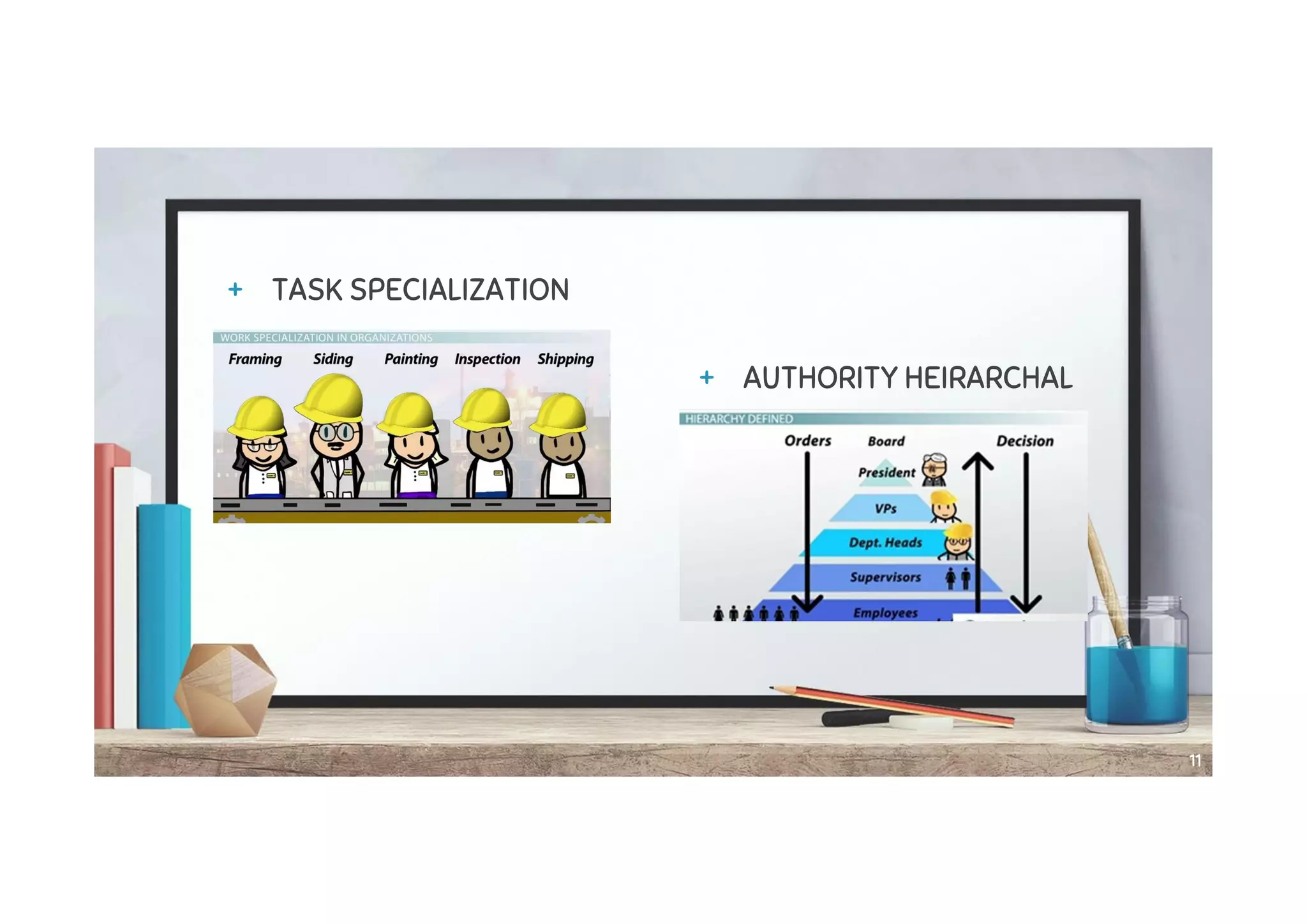
+ TASK SPECIALIZATION
1111
+ AUTHORITY HEIRARCHAL
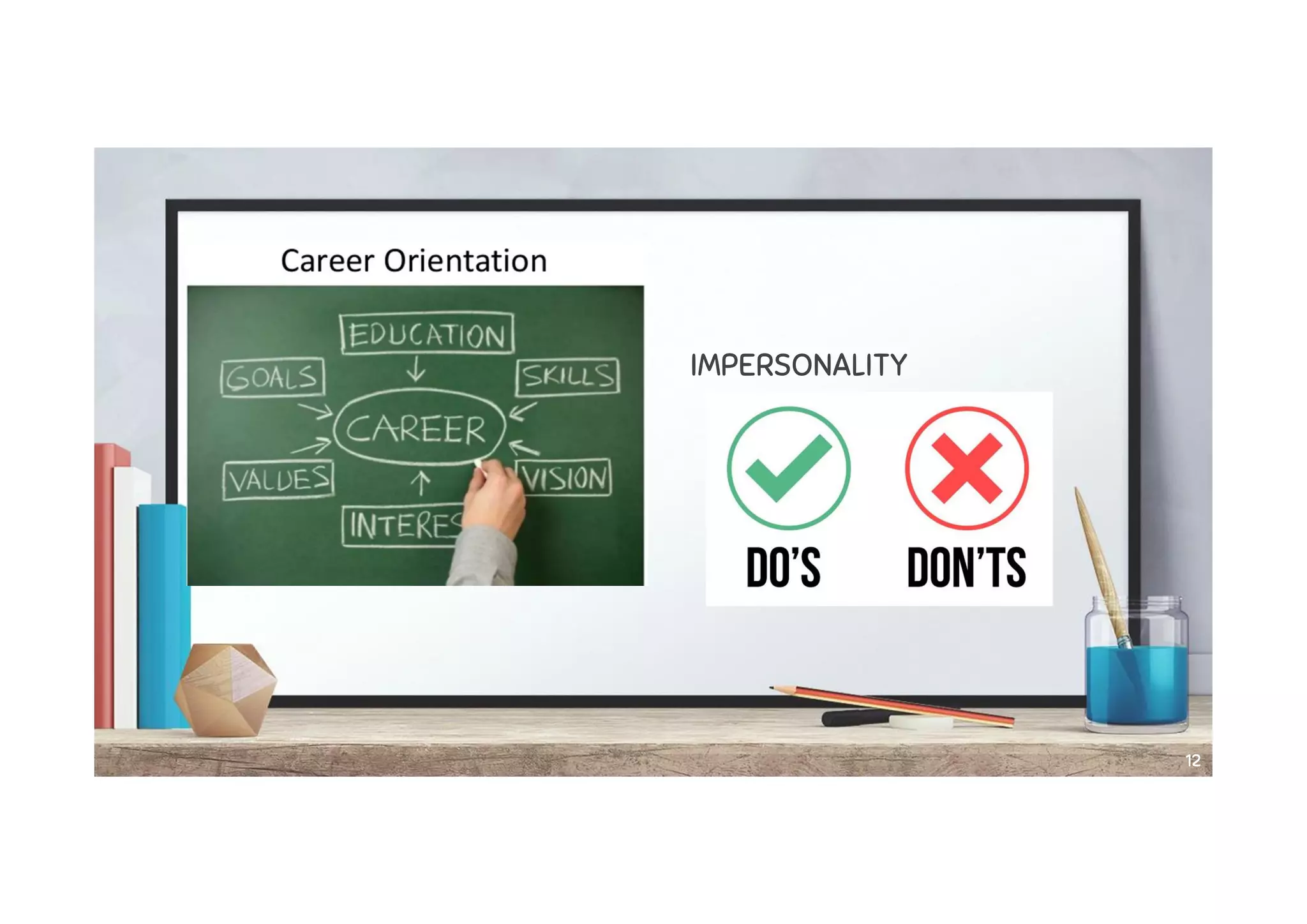
IMPERSONALITY
1212
Job specialization Jobs are divided into simple, routine and fixed category
based on competence and functional specialization.
Authority Hierarchy - Officers are organized in hierarchy in which higher officer
controls lower position holders.
Formal selection - All organizational members are to be selected on the basis
of technical qualifications and competence demonstrated by training,
education or formal examination.
Formal rules and Regulations - To ensure uniformity and to regulate actions of
employees, managers must depend heavily upon formal organizational
rules and regulations. Thus, rules of law lead to impersonality in
interpersonal relations.
Impersonality - Rules and controls are applied uniformly, avoiding involvement
with personalities and preferences of employees. Biasness and
favoritism are not preferred.
Career orientation - Career building opportunity is offered. Promotions and
salary hikes are strictly based on technical competence. They work for a
fixed salaries and pursue their career within the organization.
1313
Criticism of Bureaucratic Organization
is a very rigid type of organization. It
does not give importance to human
relations.
It is suitable for government
organizations.
It is also suitable for organizations
where change is very slow.
1414
14 PRINCIPLES OF MANAGEMENT
1515
1616
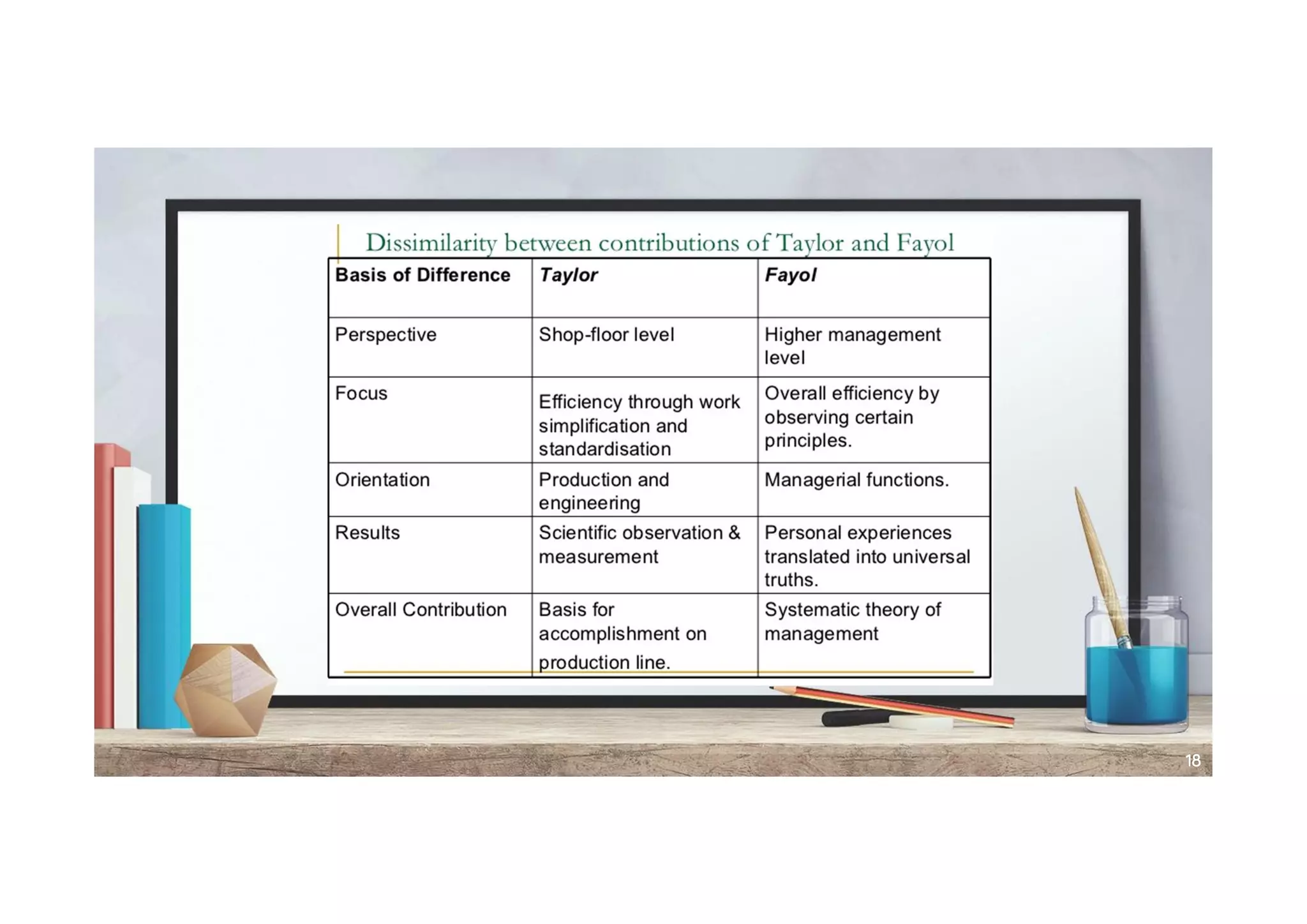
ELTHON MAYO – The behaviour management theory
+ Mayo management theory
states that employees are
motivated far more by
relational factors such as
attention and camaraderie
than by monetary rewards or
environmental factors such as
lighting, humidity, etc.
1717
1818
FREDERICK TAYLOR – The theory of scientific management
+ managers break down larger tasks
into smaller parts.
+ Workers re-motivated to deliver
quality work because they are
financially rewarded based on their
performance. Allocate work
between managers and employees
1919
2020
Thank you for time
and
keep safe always students!

Theories of Management

  • 2.
  • 3.
  • 4.
    THEORIES OF MANAGEMENT +Management theories have evolved from an emphasis on authority and structure to a focus on employees. + There are still competing theories regarding what motivates an employee, but knowing how the theories arrived at their conclusions can help you with your own employees. 44 + What do some of the original management theorists believe? + Different managers - have different schools of thought + Max Weber's theory is bureaucratic + Henri Fayol's theory is administrative + Elton Mayo's theory is based in human relations + Douglas McGregor's theory is based on different types of workers
  • 5.
    “You may hearor read it on the internet, books, or from any other sources that there are a lot of theories of management. Some are old, some are added and new. I am going to give you the list I read on the internet, however, these are just additional informations” 55
  • 6.
    + Principles ofAdministrativeManagement - the importance of maintaining a clean facility to the value of initiative and teamwork, are the foundation for many of today’s most successful businesses. + Bureaucratic Management - revolve around the importance of structuring your business in a hierarchical manner with clear rules and roles. + Theories X and Y - Theory X - employees are apathetic or dislike their work. Managers who adhere to Theory X are often authoritarian and will micromanage everything because they don’t trust their employees. IMPORTANT THEORIES FOR MANAGEMENT + Theory Y - employees are self-motivated, responsible, and want to take ownership of their work. Managers who adhere to Theory Y include their employees in the decision- making process and encourage creativity at all levels. + In practice, small businesses tendto operate on Theory Y while large businessestend to operate on Theory X. + Human Relations Theory - Mayo’s Human Relations Theory, in which he states that employees are more motivated by social factors — like personal attention or being part of a group — than environmental factors, such as money and working conditions. 66
  • 7.
    + Classical Management -is predicated on the idea that employees only have physical needs. Because employees can satisfy these physical needs with money, Classical Management Theory focuses solely on the economics of organizing workers. + As a result, Classical Management Theory advocates seven key principles: + Profit maximization + Labor specialization + Centralized leadership + Streamlined operations + Emphasis on productivity + Single-person or select- few decision making + Priority to the bottom line + Modern Management - embraces the idea that people are complex. Their needs vary over time, and they possess a range of talents and skills that the business can develop through on-the-job training and other programs. 77
  • 8.
    Now let’s getto know the theorist, theirs studies and recommendations. 88
  • 9.
    MAX WEBER -The Theory of Bureaucracy + According to him, bureaucracy is the most efficient form of organization. + The organization has a well- defined line of authority. It has clear rules and regulations which are strictly followed. + Bureaucracy refers to a specialized system and process of maintaining uniformity or authority within an organization. + Bureaucratic processes are most common in Large organizations Government 99
  • 10.
    Bureaucratic organizations evolvedfrom traditional structures due to the following changes: 1010
  • 11.
    + TASK SPECIALIZATION 1111 +AUTHORITY HEIRARCHAL
  • 12.
  • 13.
    Job specialization Jobsare divided into simple, routine and fixed category based on competence and functional specialization. Authority Hierarchy - Officers are organized in hierarchy in which higher officer controls lower position holders. Formal selection - All organizational members are to be selected on the basis of technical qualifications and competence demonstrated by training, education or formal examination. Formal rules and Regulations - To ensure uniformity and to regulate actions of employees, managers must depend heavily upon formal organizational rules and regulations. Thus, rules of law lead to impersonality in interpersonal relations. Impersonality - Rules and controls are applied uniformly, avoiding involvement with personalities and preferences of employees. Biasness and favoritism are not preferred. Career orientation - Career building opportunity is offered. Promotions and salary hikes are strictly based on technical competence. They work for a fixed salaries and pursue their career within the organization. 1313
  • 14.
    Criticism of BureaucraticOrganization is a very rigid type of organization. It does not give importance to human relations. It is suitable for government organizations. It is also suitable for organizations where change is very slow. 1414
  • 15.
    14 PRINCIPLES OFMANAGEMENT 1515
  • 16.
  • 17.
    ELTHON MAYO –The behaviour management theory + Mayo management theory states that employees are motivated far more by relational factors such as attention and camaraderie than by monetary rewards or environmental factors such as lighting, humidity, etc. 1717
  • 18.
  • 19.
    FREDERICK TAYLOR –The theory of scientific management + managers break down larger tasks into smaller parts. + Workers re-motivated to deliver quality work because they are financially rewarded based on their performance. Allocate work between managers and employees 1919
  • 20.
    2020 Thank you fortime and keep safe always students!