AndrewGoodwin’s
There are 5 keyaspectsof musicvideosthatwe the audience shouldlookoutforwhichare:
Thoughtbeats- seeingthe sound
 Firststep- to lookat the musicvideoitself.We musttake intoaccountthe structure of the
songfor e.g. chorus/verses
 Secondly- the voice of the song.The artistvoice isextremelyunique andcanform
identificationortrademarksthatwork well withthe starimage.RolandBarthestheoryof
the Grain of voice canbe relatedtothis.He seesthe singingvoice asan expressive
instrumentandtherefore abletomake associationsof itsown.
 Thirdly- Goodwinalsopointsoutthe artistmode of address.Songscanbe seenasstories
and the artistthe storyteller,makingthe musicvideoatwocommunicationdevice,them
tellingusastory and uslistening.
Narrative andperformance
 Most songsfail to give usthe complete narrative
 We onlytendtoget a gistof the meaningof the songand thentendto make up our own
ideaof what isbeingtold.Goodwinexplainsthatmusicvideosshouldignore common
narrative.Itis importantintheirrole of advertising.Musicvideoshouldcoherent
repeatability.Narrative andperformance workhandinhanditmakesiteasierforthe
audience towatchoverand overwithoutlosinginterests. The artistactingas both narrator
and participanthelpstoincrease the authenticity,howeverthe lipsyncandothermimed
actionsremainsthe heartof the musicvideos.The audienceneedtobelieve thisisreal.
 It helpstomake the song lookmore realisticandalsogivingthe audience aspecial
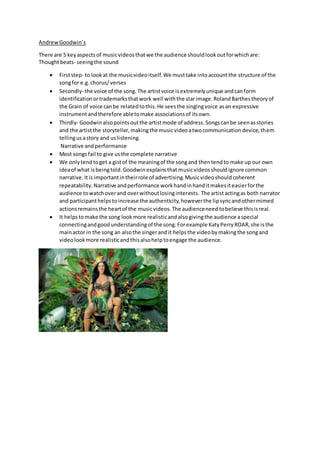
connectingandgoodunderstandingof the song.Forexample KatyPerryROAR,she isthe
mainactor in the song an alsothe singerandit helpsthe videobymakingthe songand
videolookmore realisticandthisalsohelptoengage the audience.
The star image
 The star image isanothervital aspectof musicvideos.Metanarrative whichisa bigstory
that describesthe developmentof the starovertime, ithas an importantpart to playinthe
musicvideoproductionprocess.
 Thishelpstopromote the artist/starsimage inpublicandalsohelpstopromote the video
while creatingapublicreputationforthe artist.
Relationof visualstosong
 There are three waysinwhichmusicvideosworktopromote a song.
 Illustrate- musicvideoscanuse a setof imagesto illustrate the meaningof lyricandgenre,
thisisthe mostcommon.Thisexplainsthe meaningof lyricstotheirsongand the genre.
 Amplify- thisissimilartorepeatability.Meaningsandeffects are manipulatedandconstantly
sownthroughthe videoanddrummedintoourvision.
 Disjuncture- thisiswhere the meaningof the songiscompletelyignored
 He believedthatamusicvideocanpromote a song bythoughthe wayit analysisthe lyrics.
Thisis showninmanymusicvideoswhenacharacter doesexactlywhatthe songsays.For
example whenthe songsaysJUMPJUMP JUMP and on the videothere are characters/actors
actuallyjumping.
Technical aspectsof musicvideo
 Technical aspectsholdthe musicvideotogetherthroughuse of camerawork,movement,
angle,mise-en-scene,editing,soundandspecial effects.
 Speed,cameramovement,editing,cuttingandpostproductionare all formsof use of
camera.
 Lightingthe colourhelpsetthe moodsandemphasise key momentsof the songfordramatic
effect.
 Mise-en-scene,the settingof musicvideosisvital,itneedstolookauthentictoattain
professionalism.
 Beats,musicvideosuse cutsto go withthe beator rhythmmakingthe videomore
entertaining.Thisisvery useful astheycanhelptocreate effective cutsthatgo withthe
rhythmof the songto make the musicvideolookmore entertaining.
Laura Mulvey’s
The male gaze 1975
She believesthatintelevisionaudienceshave to“view”charactersfromthe perspective of a
heterosexual male.
Thisis the conceptof the gaze is one that dealswithhow people anaudience viewsthe people
presented.
For feministsitcanbe thoughtof in 3 ways:
1. How menlookat women
2. How womenlookatthemselves
3. How womenlookateach other
Features:
 The camera lingersonthe curvesof the female body,andaneventwhichoccursto women
are presentedlargelyinthe contextof aman’sreactionto these events.Relegateswoman
to the status of objects.The female viewermustexperience the narrative secondarily,by
identificationwiththe male.
 Alsosome theoristsalsohave noticedthe sexualisingof the femalebodyeveninsituations
where femalessexinesshasnothingtodowithproductbeingadvertise.
Criticisms:
 Some womenenjoybeinglookedat,forexample beautypageants
 The gaze can alsobe directedtowardmembersof the same genderforseveralreasons,
not all of whichare sexual,suchasincomparisonof body image orin clothing.
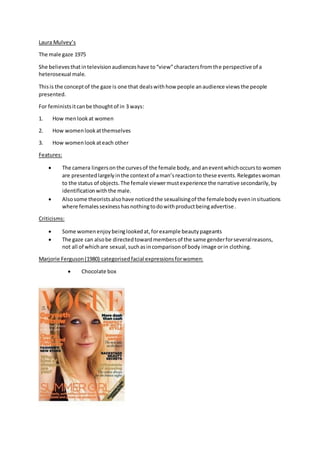
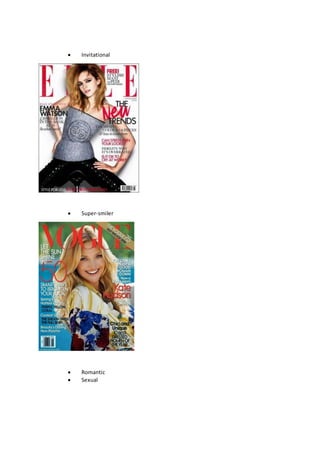
Marjorie Ferguson(1980) categorisedfacial expressionsforwomen:
 Chocolate box
 Invitational
 Super-smiler
 Romantic
 Sexual
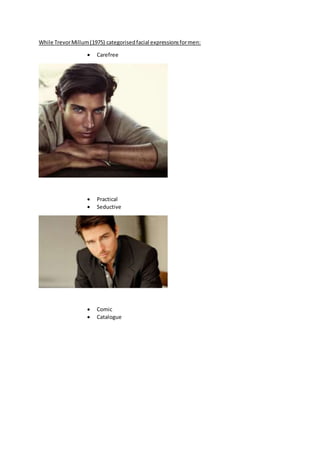
While TrevorMillum(1975) categorisedfacial expressionsformen:
 Carefree
 Practical
 Seductive
 Comic
 Catalogue
The Uses and GratificationModel
An approachto understandingwhyandhow people activelyseekoutspecificmediatosatisfy
specificneeds.UGT isan audience-centredapproachtounderstandingmasscommunication.
Thiscommunicationtheory ispositivisticinitsapproach,basedinthe socio-
psychological communicationtradition,andfocusesoncommunicationatthe massmediascale. The
drivingquestionof UGTis: Whydo people use mediaandwhatdotheyuse themfor?UGT discusses
howusersdeliberatelychoosemediathatwill satisfygivenneedsandallow one toenhance
knowledge,relaxation,social interactions/companionship,diversion,orescape
It assumesthataudience membersare notpassive consumersof media.Rather,the audience has
powerovertheirmediaconsumptionandassumesanactive role ininterpretingandintegrating
mediaintotheirownlives.Unlike othertheoreticalperspectives,UGT holdsthataudiencesare
responsible forchoosingmediatomeettheirdesiresandneedstoachieve gratification. Thistheory
wouldthenimplythatthe mediacompete againstotherinformationsourcesforviewers'
gratification
Researchhasshownthat mediatakeninfor entertainmentpurposes(i.e.,movies,songs,television,
etc.) have a wide range of usesand emotional gratifications,andthatthese are notmutually
exclusivebutcanoverlapwitheachother.
 Mood management:Thisisthe mostprominentlycitedemotional
gratificationof mediause.People prefertomaintainastate of intermediate
arousal;thisisa pleasantmedium.Wheninabad mood,bored,or over-
aroused,people will seekmediaasregulationforordistractionfromtheir
mood.
 Affectivedisposition:Affectivedispositiontheorystatesthatpeople enjoy
"rootingfor"characters depictedasgoodand moral.Usersexperience
gratificationwhengoodthingshappentocharacterswith"good"moralsand
alsowhenbadthingshappento "evil"or"bad"characters.
 Excitationtransfer:Thisuse andgratificationformediapositsthatpeople
like tofeel worriedforcharacterswe perceive as"good,"andthisiseven
more gratifyingif thatcharacter gets"rewarded"insome wayinthe end.
 Sensationseeking:Thisuse andgratificationcanbe understoodwhen
consideringexcitementasitsownreward.
 Modesof reception:"Emotionalinvolvementcorrelateswithothermodesof
reception,especiallywithdiegeticinvolvement(gettingabsorbedinthe
fictional world),socio-involvement(identifyingwithcharacters),andego-
involvement(relatingthe filmtoone'sownlife). ...Emotional involvement
can be helpful forthe pursuitof abroadervarietyof goalsinthe reception
process....It can be concludedthatthe experience of emotionscanbe
functional inanumberof other waysthanjust regulatingemotionsinterms
of affective valenceandarousal."
 Intrinsicmotivation:If the userexperiencesachallenge tohisorhermedia-
relatedskills,butnotto the pointof beingfrustratedoroverwhelmed,then
the gratificationisareward ina feelingof competence thatinspires the user
to continue usingthe mediainquestion.
 Mood adjustment:Usersare gratifiedbyusingmediatoadjusttheirmood
to whateveriscurrentlyhappening.Forinstance,once alreadyprovokedby
an aggressorand promisedachance to retaliate,maleswere foundtoprefer
bad newsovergoodnewsinthat emotionallychargedmoment.
 Gendersocializationof emotions:Thisuse isgratifiedbythe ideathat
womenenjoyfeelingother-directedsadness(empathy,sympathy,andpity)
because ourculture valuesand validateswomen’sfeelingthese; similarly,
teenage coupleslike towatchscary moviessothe male feelsprotectiveand
the female feelsvulnerable.
 Relationshipfunctionsof entertainment:Accordingtothisparticularbranch
of use andgratification,we use entertainmenttoapplylessonstoor escape
fromour real-liferelationships.
 Para-social relationships:Consumersof entertainmentmediasometimesuse
it to gratifya needforsocial connectionbybecomingveryattachedto
characters seeninentertainmentmedia,suchascharactersin a TV show or
newscasters.
 Vicariousexperiences:A relateduse andgratificationforentertainment
mediaisthe ideaof livingthroughthe charactersportrayedandimagining
ourselvesintheirlivesbyadoptingthe characters'perspectives.
 Downwardsocial comparison:Thisuse andgratificationholdsthatwe enjoy
takinginmediathat portrayspeople similarorworse off thanourselves
 Eudaimonicmotivation:Mediaconsumersalsoturntoentertainmentmedia
to searchfor deepermeanings,insights,purpose forlife,findingbeauty,
raisingmorale,experience strongemotions,andunderstandhow others
thinkandfeel.
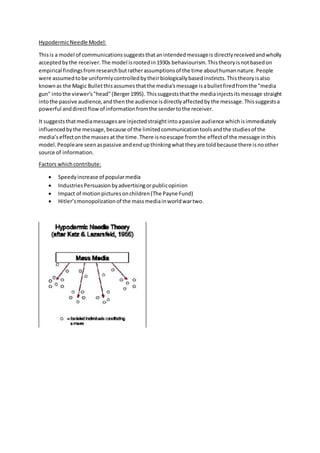
HypodermicNeedle Model:
Thisis a model of communicationssuggeststhatanintendedmessageis directlyreceivedandwholly
acceptedbythe receiver.The model isrootedin1930s behaviourism.Thistheoryisnotbasedon
empirical findingsfromresearchbutratherassumptionsof the time abouthumannature.People
were assumedtobe uniformlycontrolledbytheirbiologicallybasedinstincts.Thistheoryisalso
knownas the Magic Bulletthisassumes thatthe media'smessage isabulletfiredfromthe "media
gun" intothe viewer's"head"(Berger1995). Thissuggeststhatthe mediainjectsitsmessage straight
intothe passive audience,andthenthe audience isdirectlyaffectedbythe message.Thissuggestsa
powerful anddirectflowof informationfromthe sendertothe receiver.
It suggeststhatmediamessagesare injectedstraightintoapassive audience whichisimmediately
influencedbythe message,because of the limitedcommunicationtoolsandthe studiesof the
media’seffectonthe massesat the time.There isnoescape fromthe effectof the message inthis
model.Peopleare seenaspassive andendupthinkingwhattheyare toldbecause there isnoother
source of information.
Factors whichcontribute:
 Speedyincrease of popularmedia
 IndustriesPersuasionbyadvertisingorpublicopinion
 Impact of motionpicturesonchildren(The Payne Fund)
 Hitler’smonopolizationof the massmediainworldwartwo.

Theories

  • 1.
    AndrewGoodwin’s There are 5keyaspectsof musicvideosthatwe the audience shouldlookoutforwhichare: Thoughtbeats- seeingthe sound  Firststep- to lookat the musicvideoitself.We musttake intoaccountthe structure of the songfor e.g. chorus/verses  Secondly- the voice of the song.The artistvoice isextremelyunique andcanform identificationortrademarksthatwork well withthe starimage.RolandBarthestheoryof the Grain of voice canbe relatedtothis.He seesthe singingvoice asan expressive instrumentandtherefore abletomake associationsof itsown.  Thirdly- Goodwinalsopointsoutthe artistmode of address.Songscanbe seenasstories and the artistthe storyteller,makingthe musicvideoatwocommunicationdevice,them tellingusastory and uslistening. Narrative andperformance  Most songsfail to give usthe complete narrative  We onlytendtoget a gistof the meaningof the songand thentendto make up our own ideaof what isbeingtold.Goodwinexplainsthatmusicvideosshouldignore common narrative.Itis importantintheirrole of advertising.Musicvideoshouldcoherent repeatability.Narrative andperformance workhandinhanditmakesiteasierforthe audience towatchoverand overwithoutlosinginterests. The artistactingas both narrator and participanthelpstoincrease the authenticity,howeverthe lipsyncandothermimed actionsremainsthe heartof the musicvideos.The audienceneedtobelieve thisisreal.  It helpstomake the song lookmore realisticandalsogivingthe audience aspecial connectingandgoodunderstandingof the song.Forexample KatyPerryROAR,she isthe mainactor in the song an alsothe singerandit helpsthe videobymakingthe songand videolookmore realisticandthisalsohelptoengage the audience.
  • 2.
    The star image The star image isanothervital aspectof musicvideos.Metanarrative whichisa bigstory that describesthe developmentof the starovertime, ithas an importantpart to playinthe musicvideoproductionprocess.  Thishelpstopromote the artist/starsimage inpublicandalsohelpstopromote the video while creatingapublicreputationforthe artist. Relationof visualstosong  There are three waysinwhichmusicvideosworktopromote a song.  Illustrate- musicvideoscanuse a setof imagesto illustrate the meaningof lyricandgenre, thisisthe mostcommon.Thisexplainsthe meaningof lyricstotheirsongand the genre.  Amplify- thisissimilartorepeatability.Meaningsandeffects are manipulatedandconstantly sownthroughthe videoanddrummedintoourvision.  Disjuncture- thisiswhere the meaningof the songiscompletelyignored  He believedthatamusicvideocanpromote a song bythoughthe wayit analysisthe lyrics. Thisis showninmanymusicvideoswhenacharacter doesexactlywhatthe songsays.For example whenthe songsaysJUMPJUMP JUMP and on the videothere are characters/actors actuallyjumping. Technical aspectsof musicvideo  Technical aspectsholdthe musicvideotogetherthroughuse of camerawork,movement, angle,mise-en-scene,editing,soundandspecial effects.  Speed,cameramovement,editing,cuttingandpostproductionare all formsof use of camera.  Lightingthe colourhelpsetthe moodsandemphasise key momentsof the songfordramatic effect.  Mise-en-scene,the settingof musicvideosisvital,itneedstolookauthentictoattain professionalism.  Beats,musicvideosuse cutsto go withthe beator rhythmmakingthe videomore entertaining.Thisisvery useful astheycanhelptocreate effective cutsthatgo withthe rhythmof the songto make the musicvideolookmore entertaining.
  • 3.
    Laura Mulvey’s The malegaze 1975 She believesthatintelevisionaudienceshave to“view”charactersfromthe perspective of a heterosexual male. Thisis the conceptof the gaze is one that dealswithhow people anaudience viewsthe people presented. For feministsitcanbe thoughtof in 3 ways: 1. How menlookat women 2. How womenlookatthemselves 3. How womenlookateach other Features:  The camera lingersonthe curvesof the female body,andaneventwhichoccursto women are presentedlargelyinthe contextof aman’sreactionto these events.Relegateswoman to the status of objects.The female viewermustexperience the narrative secondarily,by identificationwiththe male.  Alsosome theoristsalsohave noticedthe sexualisingof the femalebodyeveninsituations where femalessexinesshasnothingtodowithproductbeingadvertise. Criticisms:  Some womenenjoybeinglookedat,forexample beautypageants  The gaze can alsobe directedtowardmembersof the same genderforseveralreasons, not all of whichare sexual,suchasincomparisonof body image orin clothing. Marjorie Ferguson(1980) categorisedfacial expressionsforwomen:  Chocolate box
  • 4.
  • 5.
    While TrevorMillum(1975) categorisedfacialexpressionsformen:  Carefree  Practical  Seductive  Comic  Catalogue
  • 6.
    The Uses andGratificationModel An approachto understandingwhyandhow people activelyseekoutspecificmediatosatisfy specificneeds.UGT isan audience-centredapproachtounderstandingmasscommunication. Thiscommunicationtheory ispositivisticinitsapproach,basedinthe socio- psychological communicationtradition,andfocusesoncommunicationatthe massmediascale. The drivingquestionof UGTis: Whydo people use mediaandwhatdotheyuse themfor?UGT discusses howusersdeliberatelychoosemediathatwill satisfygivenneedsandallow one toenhance knowledge,relaxation,social interactions/companionship,diversion,orescape It assumesthataudience membersare notpassive consumersof media.Rather,the audience has powerovertheirmediaconsumptionandassumesanactive role ininterpretingandintegrating mediaintotheirownlives.Unlike othertheoreticalperspectives,UGT holdsthataudiencesare responsible forchoosingmediatomeettheirdesiresandneedstoachieve gratification. Thistheory wouldthenimplythatthe mediacompete againstotherinformationsourcesforviewers' gratification Researchhasshownthat mediatakeninfor entertainmentpurposes(i.e.,movies,songs,television, etc.) have a wide range of usesand emotional gratifications,andthatthese are notmutually exclusivebutcanoverlapwitheachother.  Mood management:Thisisthe mostprominentlycitedemotional gratificationof mediause.People prefertomaintainastate of intermediate arousal;thisisa pleasantmedium.Wheninabad mood,bored,or over- aroused,people will seekmediaasregulationforordistractionfromtheir mood.  Affectivedisposition:Affectivedispositiontheorystatesthatpeople enjoy "rootingfor"characters depictedasgoodand moral.Usersexperience gratificationwhengoodthingshappentocharacterswith"good"moralsand alsowhenbadthingshappento "evil"or"bad"characters.  Excitationtransfer:Thisuse andgratificationformediapositsthatpeople like tofeel worriedforcharacterswe perceive as"good,"andthisiseven more gratifyingif thatcharacter gets"rewarded"insome wayinthe end.  Sensationseeking:Thisuse andgratificationcanbe understoodwhen consideringexcitementasitsownreward.  Modesof reception:"Emotionalinvolvementcorrelateswithothermodesof reception,especiallywithdiegeticinvolvement(gettingabsorbedinthe fictional world),socio-involvement(identifyingwithcharacters),andego- involvement(relatingthe filmtoone'sownlife). ...Emotional involvement can be helpful forthe pursuitof abroadervarietyof goalsinthe reception process....It can be concludedthatthe experience of emotionscanbe functional inanumberof other waysthanjust regulatingemotionsinterms of affective valenceandarousal."  Intrinsicmotivation:If the userexperiencesachallenge tohisorhermedia- relatedskills,butnotto the pointof beingfrustratedoroverwhelmed,then the gratificationisareward ina feelingof competence thatinspires the user to continue usingthe mediainquestion.  Mood adjustment:Usersare gratifiedbyusingmediatoadjusttheirmood to whateveriscurrentlyhappening.Forinstance,once alreadyprovokedby
  • 7.
    an aggressorand promisedachanceto retaliate,maleswere foundtoprefer bad newsovergoodnewsinthat emotionallychargedmoment.  Gendersocializationof emotions:Thisuse isgratifiedbythe ideathat womenenjoyfeelingother-directedsadness(empathy,sympathy,andpity) because ourculture valuesand validateswomen’sfeelingthese; similarly, teenage coupleslike towatchscary moviessothe male feelsprotectiveand the female feelsvulnerable.  Relationshipfunctionsof entertainment:Accordingtothisparticularbranch of use andgratification,we use entertainmenttoapplylessonstoor escape fromour real-liferelationships.  Para-social relationships:Consumersof entertainmentmediasometimesuse it to gratifya needforsocial connectionbybecomingveryattachedto characters seeninentertainmentmedia,suchascharactersin a TV show or newscasters.  Vicariousexperiences:A relateduse andgratificationforentertainment mediaisthe ideaof livingthroughthe charactersportrayedandimagining ourselvesintheirlivesbyadoptingthe characters'perspectives.  Downwardsocial comparison:Thisuse andgratificationholdsthatwe enjoy takinginmediathat portrayspeople similarorworse off thanourselves  Eudaimonicmotivation:Mediaconsumersalsoturntoentertainmentmedia to searchfor deepermeanings,insights,purpose forlife,findingbeauty, raisingmorale,experience strongemotions,andunderstandhow others thinkandfeel.
  • 8.
    HypodermicNeedle Model: Thisis amodel of communicationssuggeststhatanintendedmessageis directlyreceivedandwholly acceptedbythe receiver.The model isrootedin1930s behaviourism.Thistheoryisnotbasedon empirical findingsfromresearchbutratherassumptionsof the time abouthumannature.People were assumedtobe uniformlycontrolledbytheirbiologicallybasedinstincts.Thistheoryisalso knownas the Magic Bulletthisassumes thatthe media'smessage isabulletfiredfromthe "media gun" intothe viewer's"head"(Berger1995). Thissuggeststhatthe mediainjectsitsmessage straight intothe passive audience,andthenthe audience isdirectlyaffectedbythe message.Thissuggestsa powerful anddirectflowof informationfromthe sendertothe receiver. It suggeststhatmediamessagesare injectedstraightintoapassive audience whichisimmediately influencedbythe message,because of the limitedcommunicationtoolsandthe studiesof the media’seffectonthe massesat the time.There isnoescape fromthe effectof the message inthis model.Peopleare seenaspassive andendupthinkingwhattheyare toldbecause there isnoother source of information. Factors whichcontribute:  Speedyincrease of popularmedia  IndustriesPersuasionbyadvertisingorpublicopinion  Impact of motionpicturesonchildren(The Payne Fund)  Hitler’smonopolizationof the massmediainworldwartwo.