Demystifying Equality:
An introduction to Equality &
Diversity
Facilitated by
Equality South West
Introductions
• Name
• Job Title
• What experience have you had of equality and
diversity?
Workshop objectives

• To understand what is meant by equality & diversity
• To understand what is meant by discrimination,
victimisation & harassment
• To understand the different types of discrimination
• To understand the basic legislative requirements
around equality & diversity
• To better understand how equality & diversity
impacts on the work of your organisation
We hope that the session
will be...
•
•
•
•
•

Interactive (no question too daft)
Accessible for all
Jargon free (ish)
Uninterrupted by phones (unless urgent)
Respectful of everyone in the room
Diversity Bingo
• Collect 5 signatures, horizontally, vertically or
diagonally.
• The same person can sign more than once,
but not in the same line.
• You may not sign your own sheet.
• The facilitators may sign it too.
• The first person with 2 complete lines wins.
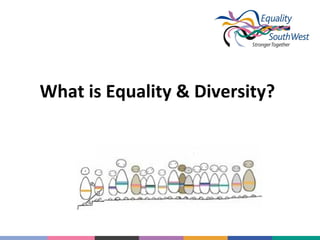
What is Equality & Diversity?
What is Equality?
Equality is...?
a)Treating everyone the same
b)Treating everyone according to their
needs
c)Treating everyone nicely
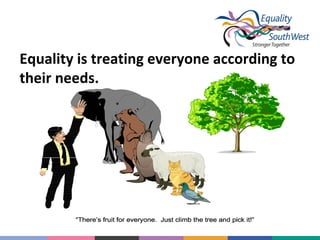
Equality is treating everyone according to
their needs.
9 ‘Protected Characteristics’
•
•
•
•
•
•
•
•
•

Age
Disability
Gender reassignment
Marriage and civil partnership
Pregnancy and maternity
Race
Religion or belief
Sex
Sexual orientation
Real life experiences
A transman talks about his transition
from female to male and his experiences.
You Tube – Stephen Whittle
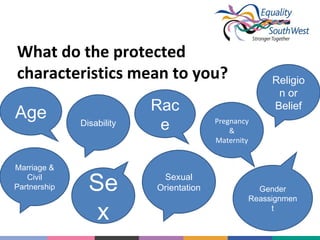
What do the protected
characteristics mean to you?
Age
Marriage &
Civil
Partnership

Disability

Se
x

Rac
e
Sexual
Orientation

Religio
n or
Belief

Pregnancy
&
Maternity

Gender
Reassignmen
t
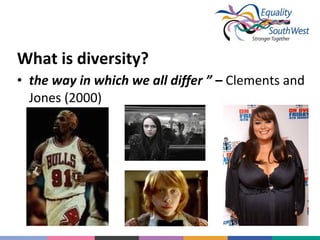
What is diversity?
• the way in which we all differ ” – Clements and
Jones (2000)
Real life experiences
A young woman who is a natural size zero
describes how she was bullied at school and
has had to constantly justify her weight to
others.
You Tube – Sarah Whitehurst
What is Discrimination,
Harassment & Victimisation?
What is discrimination?
“…people being thought of as having different
worth or value, being treated differently or given
fewer opportunities because of their identities”.
(Learner Voice, LSC)
Three types of discrimination:
•Direct
•Indirect
•Institutional
Direct Discrimination
Direct discrimination occurs when you treat
someone less favourably than you treat (or would
treat) another because of a protected
characteristic.
E.g. Refusing to serve a customer because they are
Asian.
Indirect Discrimination
Indirect discrimination occurs when an
organisation has criteria, policies, procedures or
practices which, although they apply to all
employees or service users, have the effect of
disproportionally disadvantaging a particular
group or groups of people.
E.g. Putting in a job advert that a full UK drivers
license and access to a car is essential.
Institutional Discrimination
Institutional discrimination occurs when the
culture, policies, systems and procedures in
an organisation inherently discriminate
against a group or groups of people.
E.g. A garage that only recruits male
mechanics.
Real life experiences
A former self-harmer describes her
experience and why she now wants to help
others to stop.
You Tube – Tyfanny Booker
Harassment
Harassment is “unwanted conduct related to
a relevant protected characteristic, which
has the purpose or effect of violating an
individual’s dignity or creating an
intimidating, hostile, degrading, humiliating
or offensive environment for that
individual”.
E.g. A manager making homophobic jokes in
Victimisation
Victimisation occurs when an employee is
treated badly because they have made,
supported or are suspected to have made or
supported a grievance under The Equality
Act.
E.g. Being ignored by colleagues because you
took a grievance out against your manager
for sexual harassment.
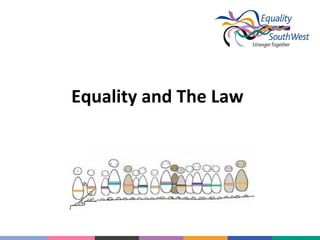
Equality and The Law
Main purposes of The Equality
Act 2010
“To harmonise discrimination law, and to strengthen
the law to support progress on equality".
• Streamlines and combines previous legislation
to make things easier for businesses;
• Provides new measures to fight discrimination
• Extends previous protections to cover 7 equality
‘strands’ plus marriage and civil partnerships,
pregnant women and new mothers.
Headline provisions include
•
•
•
•
•
•
•
•
•
•

New ‘Protected characteristics’
Age discrimination: goods, facilities and services
New definitions of discrimination
Banning pay secrecy clauses
Protections for carers
Positive action
Public Sector Equality Duty
Public procurement
Banning of pre-employment health questionnaires
Stronger protections for disabled people
Public Equality Duty
In the design and delivery of public services
providers must:
• Eliminate discrimination – 9 protected
characteristics
• Advance equality of opportunity between
people who share a protected characteristic
and those who do not
• Foster good relations
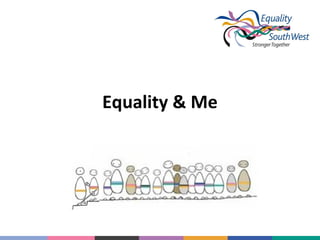
Equality & Me
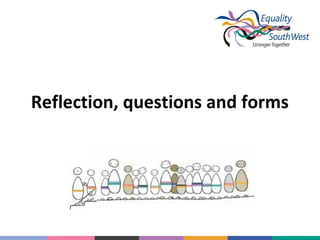
Reflection, questions and forms
Workshop objectives

• To understand what is meant by equality & diversity
• To understand what is meant by discrimination,
victimisation & harassment
• To understand the different types of discrimination
• To understand the basic legislative requirements
around equality & diversity
• To better understand how equality & diversity
impacts on the work of your organisation

Demystifying equality

  • 1.
    Demystifying Equality: An introductionto Equality & Diversity Facilitated by Equality South West
  • 2.
    Introductions • Name • JobTitle • What experience have you had of equality and diversity?
  • 3.
    Workshop objectives • Tounderstand what is meant by equality & diversity • To understand what is meant by discrimination, victimisation & harassment • To understand the different types of discrimination • To understand the basic legislative requirements around equality & diversity • To better understand how equality & diversity impacts on the work of your organisation
  • 4.
    We hope thatthe session will be... • • • • • Interactive (no question too daft) Accessible for all Jargon free (ish) Uninterrupted by phones (unless urgent) Respectful of everyone in the room
  • 5.
    Diversity Bingo • Collect5 signatures, horizontally, vertically or diagonally. • The same person can sign more than once, but not in the same line. • You may not sign your own sheet. • The facilitators may sign it too. • The first person with 2 complete lines wins.
  • 6.
    What is Equality& Diversity?
  • 7.
    What is Equality? Equalityis...? a)Treating everyone the same b)Treating everyone according to their needs c)Treating everyone nicely
  • 8.
    Equality is treatingeveryone according to their needs.
  • 9.
    9 ‘Protected Characteristics’ • • • • • • • • • Age Disability Genderreassignment Marriage and civil partnership Pregnancy and maternity Race Religion or belief Sex Sexual orientation
  • 10.
    Real life experiences Atransman talks about his transition from female to male and his experiences. You Tube – Stephen Whittle
  • 11.
    What do theprotected characteristics mean to you? Age Marriage & Civil Partnership Disability Se x Rac e Sexual Orientation Religio n or Belief Pregnancy & Maternity Gender Reassignmen t
  • 12.
    What is diversity? •the way in which we all differ ” – Clements and Jones (2000)
  • 13.
    Real life experiences Ayoung woman who is a natural size zero describes how she was bullied at school and has had to constantly justify her weight to others. You Tube – Sarah Whitehurst
  • 14.
  • 15.
    What is discrimination? “…peoplebeing thought of as having different worth or value, being treated differently or given fewer opportunities because of their identities”. (Learner Voice, LSC) Three types of discrimination: •Direct •Indirect •Institutional
  • 16.
    Direct Discrimination Direct discriminationoccurs when you treat someone less favourably than you treat (or would treat) another because of a protected characteristic. E.g. Refusing to serve a customer because they are Asian.
  • 17.
    Indirect Discrimination Indirect discriminationoccurs when an organisation has criteria, policies, procedures or practices which, although they apply to all employees or service users, have the effect of disproportionally disadvantaging a particular group or groups of people. E.g. Putting in a job advert that a full UK drivers license and access to a car is essential.
  • 18.
    Institutional Discrimination Institutional discriminationoccurs when the culture, policies, systems and procedures in an organisation inherently discriminate against a group or groups of people. E.g. A garage that only recruits male mechanics.
  • 19.
    Real life experiences Aformer self-harmer describes her experience and why she now wants to help others to stop. You Tube – Tyfanny Booker
  • 20.
    Harassment Harassment is “unwantedconduct related to a relevant protected characteristic, which has the purpose or effect of violating an individual’s dignity or creating an intimidating, hostile, degrading, humiliating or offensive environment for that individual”. E.g. A manager making homophobic jokes in
  • 21.
    Victimisation Victimisation occurs whenan employee is treated badly because they have made, supported or are suspected to have made or supported a grievance under The Equality Act. E.g. Being ignored by colleagues because you took a grievance out against your manager for sexual harassment.
  • 22.
  • 23.
    Main purposes ofThe Equality Act 2010 “To harmonise discrimination law, and to strengthen the law to support progress on equality". • Streamlines and combines previous legislation to make things easier for businesses; • Provides new measures to fight discrimination • Extends previous protections to cover 7 equality ‘strands’ plus marriage and civil partnerships, pregnant women and new mothers.
  • 24.
    Headline provisions include • • • • • • • • • • New‘Protected characteristics’ Age discrimination: goods, facilities and services New definitions of discrimination Banning pay secrecy clauses Protections for carers Positive action Public Sector Equality Duty Public procurement Banning of pre-employment health questionnaires Stronger protections for disabled people
  • 25.
    Public Equality Duty Inthe design and delivery of public services providers must: • Eliminate discrimination – 9 protected characteristics • Advance equality of opportunity between people who share a protected characteristic and those who do not • Foster good relations
  • 26.
  • 27.
  • 28.
    Workshop objectives • Tounderstand what is meant by equality & diversity • To understand what is meant by discrimination, victimisation & harassment • To understand the different types of discrimination • To understand the basic legislative requirements around equality & diversity • To better understand how equality & diversity impacts on the work of your organisation

Editor's Notes

  • #2 Show ESW video using link
  • #4 I hope that by the end of the session we will have achieved these objectives.
  • #5 We realise that for some E&D can be an emotive subject. This session is an opportunity for us to talk through your experiences , thoughts and opinions in a safe place. Nobody has to share any information about themselves that they don’t wish to.
  • #6 You can not ask “which boxes can you tick” or “which of these apply to you”? Q – How did you find that exercise? Opportunity to see how diverse the group is and to show that some differences are visible whilst others are not. Q – How did it feel asking people these questions? Q – Were there some questions that you found more uncomfortable to answer than others? Why do you think this was?
  • #9 Misconception that equality is about treating people the same. Equality is actually about treating people differently and sometimes more favourable to ensure that everyone is a given a fair chance. This picture highlights the different needs of the animals to pick the fruit. E.g. Creating an application pack in font size 12 may be fine for a person without a visual impairment, but for someone with a sight related disability their needs will be different. Q – When we talk about Equality we sometimes talk about the ‘equality strands’ or ‘protected characteristics’ as recognised in law. What do you think these strands may be?
  • #11 Play video clip.
  • #12 Q – How do issues around these protected characteristics affect you in your current role?
  • #14 Play video clip.
  • #17 Q - Can you give more examples of direct discrimination that could occur in your workplace?
  • #18 Q - Can you give more examples of indirect discrimination that may occur in your workplace?
  • #19 ‘The way things are done around here’. Ingrained and hard to challenge & change. Q – can you think of any organisations/ services that have been accused of institutional discrimination in the past?
  • #20 Play video clip.
  • #22 An employee is not protected from victimisation if they have maliciously made or supported an untrue complaint.  There is no longer a need to compare treatment of a complainant with that of a person who has not made or supported a complaint under the Act.