The Wellness Project: 

An Overview
2017 Summer Leadership Institute
Lindsey-Wilson College
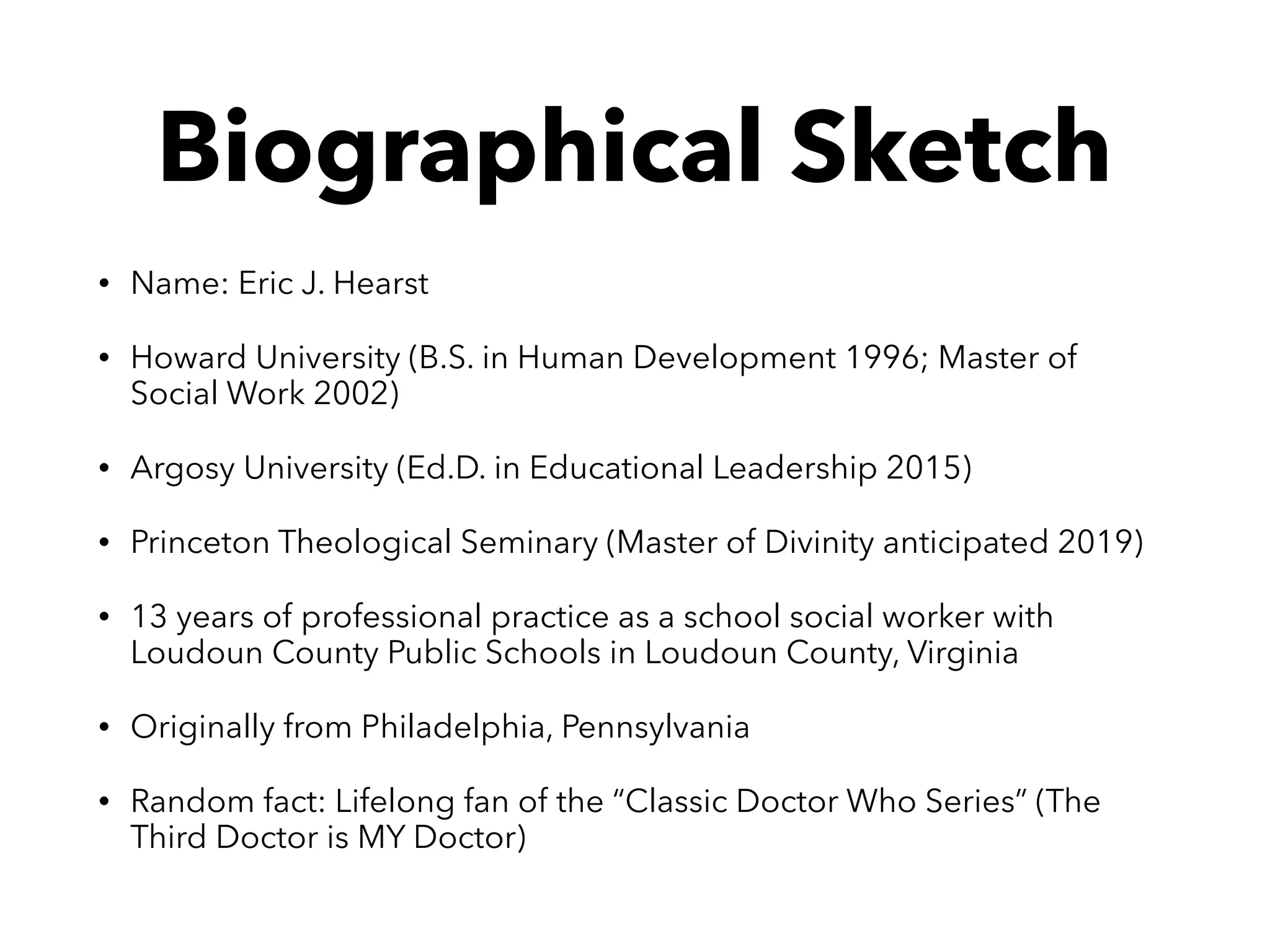
Biographical Sketch
• Name: Eric J. Hearst
• Howard University (B.S. in Human Development 1996; Master of
Social Work 2002)
• Argosy University (Ed.D. in Educational Leadership 2015)
• Princeton Theological Seminary (Master of Divinity anticipated 2019)
• 13 years of professional practice as a school social worker with
Loudoun County Public Schools in Loudoun County, Virginia
• Originally from Philadelphia, Pennsylvania
• Random fact: Lifelong fan of the “Classic Doctor Who Series” (The
Third Doctor is MY Doctor)
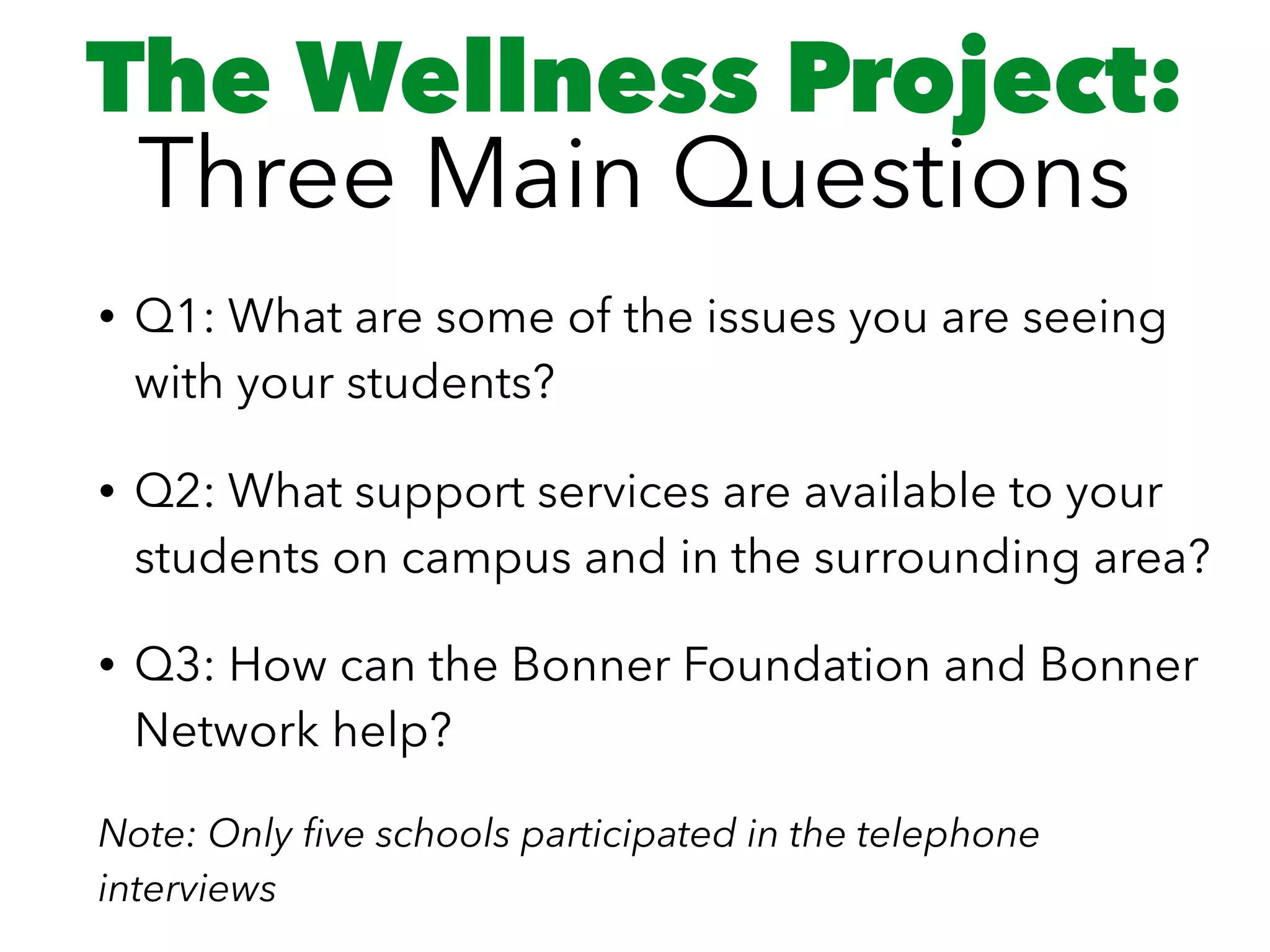
The Wellness Project:

Three Main Questions
• Q1: What are some of the issues you are seeing
with your students?
• Q2: What support services are available to your
students on campus and in the surrounding area?
• Q3: How can the Bonner Foundation and Bonner
Network help?
Note: Only five schools participated in the telephone
interviews
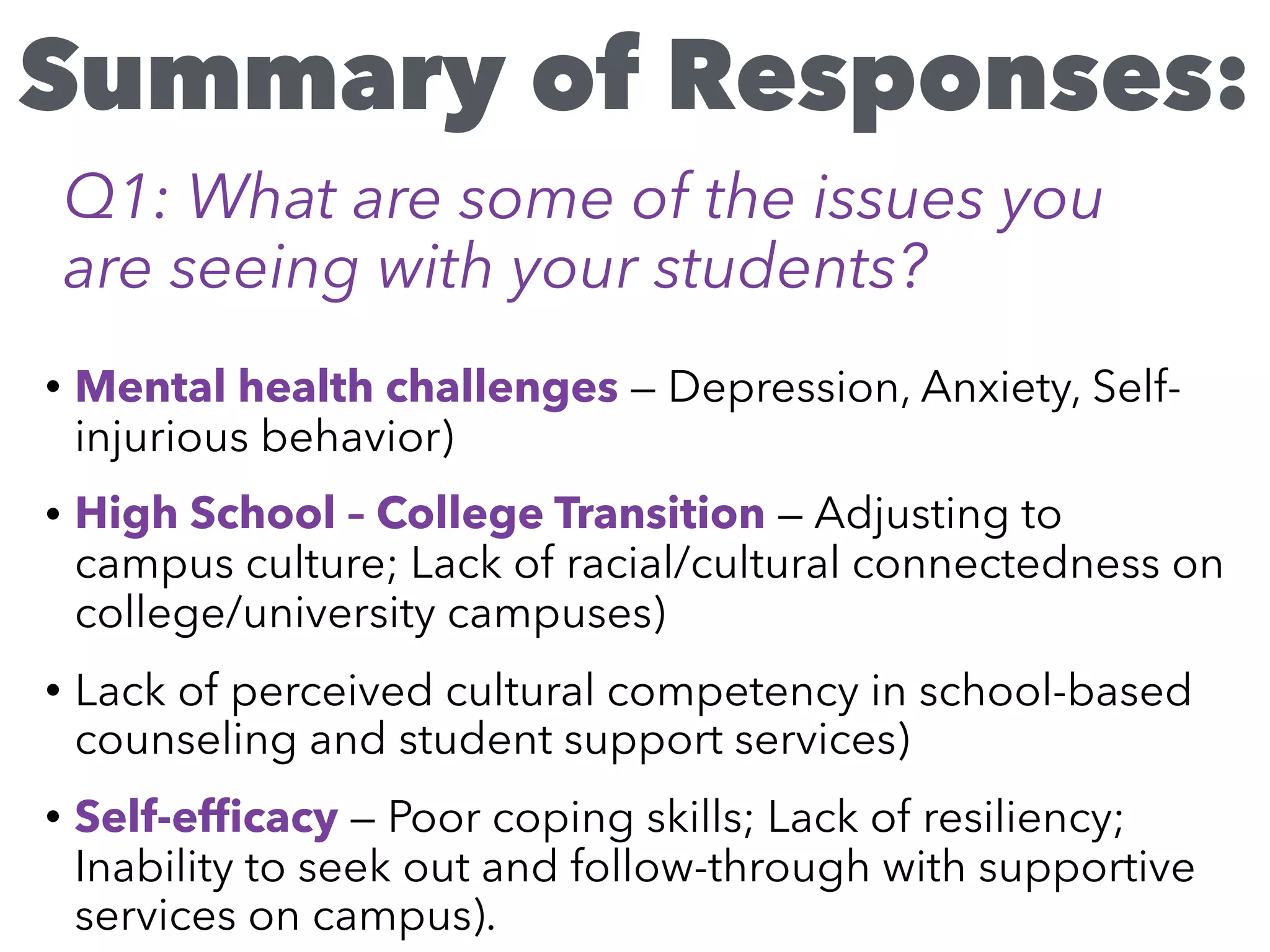
• Mental health challenges — Depression, Anxiety, Self-
injurious behavior)
• High School – College Transition — Adjusting to
campus culture; Lack of racial/cultural connectedness on
college/university campuses)
• Lack of perceived cultural competency in school-based
counseling and student support services)
• Self-efficacy — Poor coping skills; Lack of resiliency;
Inability to seek out and follow-through with supportive
services on campus).
Summary of Responses:
Q1: What are some of the issues you
are seeing with your students?
• Academic skills centers
• Counseling Centers
• Health & Wellness Centers
• Campus Chaplaincies
Summary of Responses:
Q2: What support services are available
to your students on campus and in the
surrounding area?
Challenges in accessing support:
• Lack of health insurance/inability to pay for private
treatment;
• Inability to travel to providers (rural, lack of
transportation, etc.);
• Unwillingness to seek help from campus based
supports;
• Concerns about the lack of cultural/racial competency
in campus based supports)
Summary of Responses:
Q2: What support services are available
to your students on campus and in the
surrounding area?
• Provide trainings — trauma informed care;
Mental health first aid);
• Continuing education — topics including self-
care, boundary settings for students and
enhancing community support for students);
• Identify best practices from within the
Bonner Network — enhancing student
protective factors/minimizing risk factors on
campuses).
Summary of Responses:
Q3: How can the Bonner Foundation
and Bonner Network help?
• Q1: How have you been involved with the Bonner program on your
campus?
• Q2: Think back over all of the years you’ve been involved and tell us
your fondest memory
• Q3: Think back over the past year about the things Bonner did to
promote student wellness in its network. What went particularly
well?
• Q4: What needs improvement?
• Q5: Suppose you could make one change that would make Bonner’s
efforts at promoting student wellness better. What would you do?
• Q6: What can each one of us do to make Bonner’s efforts at
promoting student wellness better?
The Wellness Project:

Focus Group Questions

The Wellness Project

  • 1.
    The Wellness Project:
 An Overview 2017 Summer Leadership Institute Lindsey-Wilson College
  • 2.
    Biographical Sketch • Name:Eric J. Hearst • Howard University (B.S. in Human Development 1996; Master of Social Work 2002) • Argosy University (Ed.D. in Educational Leadership 2015) • Princeton Theological Seminary (Master of Divinity anticipated 2019) • 13 years of professional practice as a school social worker with Loudoun County Public Schools in Loudoun County, Virginia • Originally from Philadelphia, Pennsylvania • Random fact: Lifelong fan of the “Classic Doctor Who Series” (The Third Doctor is MY Doctor)
  • 3.
    The Wellness Project:
 ThreeMain Questions • Q1: What are some of the issues you are seeing with your students? • Q2: What support services are available to your students on campus and in the surrounding area? • Q3: How can the Bonner Foundation and Bonner Network help? Note: Only five schools participated in the telephone interviews
  • 4.
    • Mental healthchallenges — Depression, Anxiety, Self- injurious behavior) • High School – College Transition — Adjusting to campus culture; Lack of racial/cultural connectedness on college/university campuses) • Lack of perceived cultural competency in school-based counseling and student support services) • Self-efficacy — Poor coping skills; Lack of resiliency; Inability to seek out and follow-through with supportive services on campus). Summary of Responses: Q1: What are some of the issues you are seeing with your students?
  • 5.
    • Academic skillscenters • Counseling Centers • Health & Wellness Centers • Campus Chaplaincies Summary of Responses: Q2: What support services are available to your students on campus and in the surrounding area?
  • 6.
    Challenges in accessingsupport: • Lack of health insurance/inability to pay for private treatment; • Inability to travel to providers (rural, lack of transportation, etc.); • Unwillingness to seek help from campus based supports; • Concerns about the lack of cultural/racial competency in campus based supports) Summary of Responses: Q2: What support services are available to your students on campus and in the surrounding area?
  • 7.
    • Provide trainings— trauma informed care; Mental health first aid); • Continuing education — topics including self- care, boundary settings for students and enhancing community support for students); • Identify best practices from within the Bonner Network — enhancing student protective factors/minimizing risk factors on campuses). Summary of Responses: Q3: How can the Bonner Foundation and Bonner Network help?
  • 8.
    • Q1: Howhave you been involved with the Bonner program on your campus? • Q2: Think back over all of the years you’ve been involved and tell us your fondest memory • Q3: Think back over the past year about the things Bonner did to promote student wellness in its network. What went particularly well? • Q4: What needs improvement? • Q5: Suppose you could make one change that would make Bonner’s efforts at promoting student wellness better. What would you do? • Q6: What can each one of us do to make Bonner’s efforts at promoting student wellness better? The Wellness Project:
 Focus Group Questions