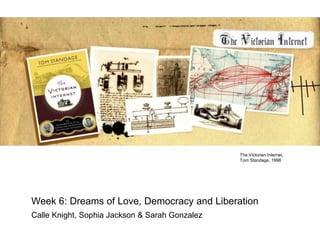
The Victorian Internet,
Tom Standage, 1998

Week 6: Dreams of Love, Democracy and Liberation
Calle Knight, Sophia Jackson & Sarah Gonzalez
Chapter 5: Wiring the World

The Trans-Atlantic Telegraph
•

Largely considered a foolish undertaking

•

Became a collaborative, interdisciplinary effort

•

Atlantic Telegraph Company
–

Three attempts at laying a cable
• August 5th – September 1st 1859

• June 24th – August 2nd 1865
• July 13th 1866
•

Success led to massive hysteria and early technological utopianism
Question to discuss:

How does the excitement around the success of the
Trans-Atlantic Telegraph appear similar or different from
the technological utopianism experienced at the advent
and popularization of the Internet? How would you
suggest we break this cycle of McLuhan-esque thought
that “the medium is the message,” and therefore, what
we communicate falls second to the means by which we
communicate?
Chapter 6: Steam-Powered Messages

“Just as today’s email systems are still plagued by
occasional blackouts and failures, the telegraph
networks of the 1850s were subject to congestion as the
volume of traffic mushroomed, and key network links
within major cities became overloaded.”

(Standage 92)
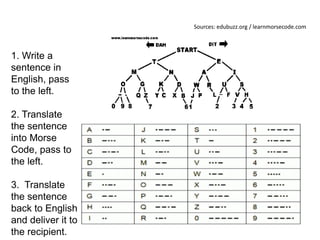
Sources: edubuzz.org / learnmorsecode.com

1. Write a
sentence in
English, pass
to the left.
2. Translate
the sentence
into Morse
Code, pass to
the left.
3. Translate
the sentence
back to English
and deliver it to
the recipient.
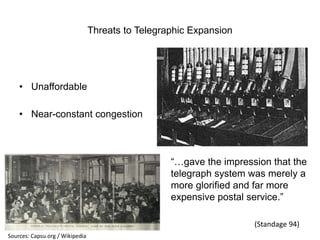
Threats to Telegraphic Expansion

• Unaffordable
• Near-constant congestion

“…gave the impression that the
telegraph system was merely a
more glorified and far more
expensive postal service.”
(Standage 94)
Sources: Capsu.org / Wikipedia
The Victorian Internet Takes Shape

“A patchwork of telegraphic networks, submarine cables,
pneumatic tube systems, and messengers combines to
deliver messages within hours over a vast area of the globe.”

(Standage 101)
Question to discuss:

The late 1860s saw a growth in telegraph technology
industries such as submarine cable manufacturers and the
expansion of transmission centers, as everyone was rushing
to enter into the most profitable new market. How does this
compare to the Dot Com Boom and subsequent Crash of the
1990s and 2000s?
Chapter 8: Love over the Wires

“Despite the strange customs and the often curious lifestyle
of many operators, telegraphy was regarded as an attractive
profession, offering the hope of rapid social advancement and
fueling expansion of the middle class.”

(Standage 143)
The Search for Companionship Through Telegraph Technology

• Operators form the first online community
• As the community grew, the search for a companion or partner
became pervasive

Question to Discuss:

In what ways is the online community of the Nineteenth
Century similar to the online community of the TwentyFirst Century? Like the telegraph operators who used the
technology to date and play games, do people currently
utilize their work time to connect with other workers
through the web?
Question to Discuss

How does meritocracy apply to our capitalist society today?
Chapter 9: War & Peace in the Global Village

News Coverage Over the Victorian Internet
• The telegraph helped report news within hours of it’s
occurrence
• First international news coverage conducted by Reuter
• “Cable nipped misunderstanding leading to war in the bud”
(Standage 159)
– Crimean War
Question to Discuss

As a predecessor of the 24/7 news stations we
experience in the Twenty-First Century, the introduction
of instantaneous global news coverage was
revolutionary in the Nineteenth Century. In what ways
did it positively and negatively affect their society? Does
the constant barrage of news we experience today do
the same for our society?
Chapter 10
Information Overload
Chapter 10: Information Overload
The Telegraph’s Impact on Nineteenth Century Business
• Increased knowledge of the competition accelerated the pace of
business life.
• Telegraph as public utility in Europe
• “Telegraph lives upon commerce. It is the nervous system of the
commercial system.” (Standage 170)
• Telegraphic addresses in Britain
• The Gold Room
Callahan’s Stock Ticker:
“The sound could drive a man suddenly to the verge of insanity
with joy or despair.” (Standage 176)

Question to Discuss
– The Stock Ticker got its name from the constant sound it
makes when it reports the gold prices. Do you think that
the way workers were affected by this ticking sound is the
same way we are addicted to and affected by our devices
and the sounds they make?
Chapter 11: Decline & Fall

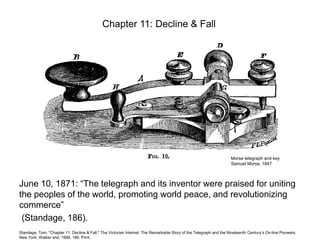
Morse telegraph and key
Samuel Morse, 1847

June 10, 1871: “The telegraph and its inventor were praised for uniting
the peoples of the world, promoting world peace, and revolutionizing
commerce”
(Standage, 186).
Standage, Tom. "Chapter 11: Decline & Fall." The Victorian Internet: The Remarkable Story of the Telegraph and the Nineteenth Centuryʼs On-line Pioneers.
New York: Walker and, 1998. 186. Print.
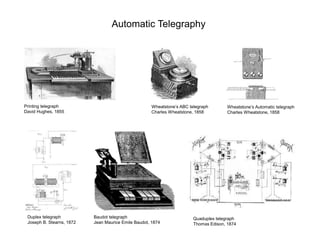
Automatic Telegraphy

Printing telegraph
David Hughes, 1855

Duplex telegraph
Joseph B. Stearns, 1872

Wheatstone’s ABC telegraph
Charles Wheatstone, 1858

Baudot telegraph
Jean Maurice Emile Baudot, 1874

Wheatstone’s Automatic telegraph
Charles Wheatstone, 1858

Quaduplex telegraph
Thomas Edison, 1874
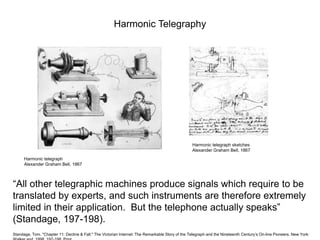
Harmonic Telegraphy

Harmonic telegraph sketches
Alexander Graham Bell, 1867
Harmonic telegraph
Alexander Graham Bell, 1867

“All other telegraphic machines produce signals which require to be
translated by experts, and such instruments are therefore extremely
limited in their application. But the telephone actually speaks”
(Standage, 197-198).
Standage, Tom. "Chapter 11: Decline & Fall." The Victorian Internet: The Remarkable Story of the Telegraph and the Nineteenth Centuryʼs On-line Pioneers. New York:
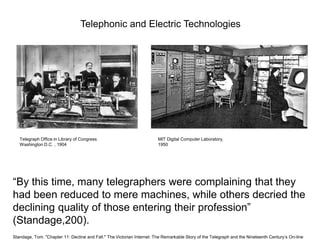
Telephonic and Electric Technologies

Telegraph Office in Library of Congress
Washington D.C. , 1904

MIT Digital Computer Laboratory,
1950

“By this time, many telegraphers were complaining that they
had been reduced to mere machines, while others decried the
declining quality of those entering their profession”
(Standage,200).
Standage, Tom. "Chapter 11: Decline and Fall." The Victorian Internet: The Remarkable Story of the Telegraph and the Nineteenth Centuryʼs On-line
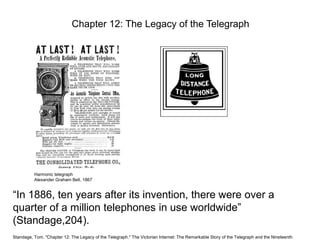
Chapter 12: The Legacy of the Telegraph

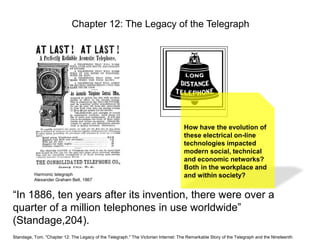
Harmonic telegraph
Alexander Graham Bell, 1867

“In 1886, ten years after its invention, there were over a
quarter of a million telephones in use worldwide”
(Standage,204).
Standage, Tom. "Chapter 12: The Legacy of the Telegraph." The Victorian Internet: The Remarkable Story of the Telegraph and the Nineteenth
Chapter 12: The Legacy of the Telegraph

Harmonic telegraph
Alexander Graham Bell, 1867

How have the evolution of
these electrical on-line
technologies impacted
modern social, technical
and economic networks?
Both in the workplace and
and within society?

“In 1886, ten years after its invention, there were over a
quarter of a million telephones in use worldwide”
(Standage,204).
Standage, Tom. "Chapter 12: The Legacy of the Telegraph." The Victorian Internet: The Remarkable Story of the Telegraph and the Nineteenth
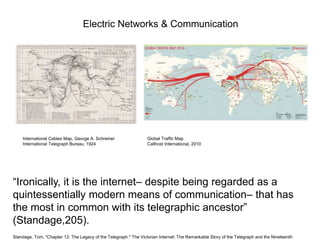
Electric Networks & Communication

International Cables Map, George A. Schreiner
International Telegraph Bureau, 1924

Global Traffic Map
Callhost International, 2010

“Ironically, it is the internet– despite being regarded as a
quintessentially modern means of communication– that has
the most in common with its telegraphic ancestor”
(Standage,205).
Standage, Tom. "Chapter 12: The Legacy of the Telegraph." The Victorian Internet: The Remarkable Story of the Telegraph and the Nineteenth
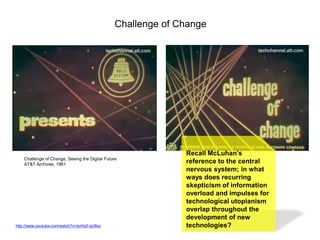
Challenge of Change

Challenge of Change, Seeing the Digital Future
AT&T Archives, 1961

http://www.youtube.com/watch?v=avHo0-qU8xo

Recall McLuhan’s
reference to the central
nervous system; in what
ways does recurring
skepticism of information
overload and impulses for
technological utopianism
overlap throughout the
development of new
technologies?
Stay in the loop!
http://www.slideshare.net/gonzs882/the-victorian-internet

The Victorian Internet

  • 1.
    The Victorian Internet, TomStandage, 1998 Week 6: Dreams of Love, Democracy and Liberation Calle Knight, Sophia Jackson & Sarah Gonzalez
  • 2.
    Chapter 5: Wiringthe World The Trans-Atlantic Telegraph • Largely considered a foolish undertaking • Became a collaborative, interdisciplinary effort • Atlantic Telegraph Company – Three attempts at laying a cable • August 5th – September 1st 1859 • June 24th – August 2nd 1865 • July 13th 1866 • Success led to massive hysteria and early technological utopianism
  • 3.
    Question to discuss: Howdoes the excitement around the success of the Trans-Atlantic Telegraph appear similar or different from the technological utopianism experienced at the advent and popularization of the Internet? How would you suggest we break this cycle of McLuhan-esque thought that “the medium is the message,” and therefore, what we communicate falls second to the means by which we communicate?
  • 4.
    Chapter 6: Steam-PoweredMessages “Just as today’s email systems are still plagued by occasional blackouts and failures, the telegraph networks of the 1850s were subject to congestion as the volume of traffic mushroomed, and key network links within major cities became overloaded.” (Standage 92)
  • 5.
    Sources: edubuzz.org /learnmorsecode.com 1. Write a sentence in English, pass to the left. 2. Translate the sentence into Morse Code, pass to the left. 3. Translate the sentence back to English and deliver it to the recipient.
  • 6.
    Threats to TelegraphicExpansion • Unaffordable • Near-constant congestion “…gave the impression that the telegraph system was merely a more glorified and far more expensive postal service.” (Standage 94) Sources: Capsu.org / Wikipedia
  • 7.
    The Victorian InternetTakes Shape “A patchwork of telegraphic networks, submarine cables, pneumatic tube systems, and messengers combines to deliver messages within hours over a vast area of the globe.” (Standage 101)
  • 8.
    Question to discuss: Thelate 1860s saw a growth in telegraph technology industries such as submarine cable manufacturers and the expansion of transmission centers, as everyone was rushing to enter into the most profitable new market. How does this compare to the Dot Com Boom and subsequent Crash of the 1990s and 2000s?
  • 9.
    Chapter 8: Loveover the Wires “Despite the strange customs and the often curious lifestyle of many operators, telegraphy was regarded as an attractive profession, offering the hope of rapid social advancement and fueling expansion of the middle class.” (Standage 143)
  • 10.
    The Search forCompanionship Through Telegraph Technology • Operators form the first online community • As the community grew, the search for a companion or partner became pervasive Question to Discuss: In what ways is the online community of the Nineteenth Century similar to the online community of the TwentyFirst Century? Like the telegraph operators who used the technology to date and play games, do people currently utilize their work time to connect with other workers through the web?
  • 11.
    Question to Discuss Howdoes meritocracy apply to our capitalist society today?
  • 12.
    Chapter 9: War& Peace in the Global Village News Coverage Over the Victorian Internet • The telegraph helped report news within hours of it’s occurrence • First international news coverage conducted by Reuter • “Cable nipped misunderstanding leading to war in the bud” (Standage 159) – Crimean War
  • 13.
    Question to Discuss Asa predecessor of the 24/7 news stations we experience in the Twenty-First Century, the introduction of instantaneous global news coverage was revolutionary in the Nineteenth Century. In what ways did it positively and negatively affect their society? Does the constant barrage of news we experience today do the same for our society?
  • 14.
  • 15.
    Chapter 10: InformationOverload The Telegraph’s Impact on Nineteenth Century Business • Increased knowledge of the competition accelerated the pace of business life. • Telegraph as public utility in Europe • “Telegraph lives upon commerce. It is the nervous system of the commercial system.” (Standage 170) • Telegraphic addresses in Britain • The Gold Room
  • 16.
    Callahan’s Stock Ticker: “Thesound could drive a man suddenly to the verge of insanity with joy or despair.” (Standage 176) Question to Discuss – The Stock Ticker got its name from the constant sound it makes when it reports the gold prices. Do you think that the way workers were affected by this ticking sound is the same way we are addicted to and affected by our devices and the sounds they make?
  • 17.
    Chapter 11: Decline& Fall Morse telegraph and key Samuel Morse, 1847 June 10, 1871: “The telegraph and its inventor were praised for uniting the peoples of the world, promoting world peace, and revolutionizing commerce” (Standage, 186). Standage, Tom. "Chapter 11: Decline & Fall." The Victorian Internet: The Remarkable Story of the Telegraph and the Nineteenth Centuryʼs On-line Pioneers. New York: Walker and, 1998. 186. Print.
  • 18.
    Automatic Telegraphy Printing telegraph DavidHughes, 1855 Duplex telegraph Joseph B. Stearns, 1872 Wheatstone’s ABC telegraph Charles Wheatstone, 1858 Baudot telegraph Jean Maurice Emile Baudot, 1874 Wheatstone’s Automatic telegraph Charles Wheatstone, 1858 Quaduplex telegraph Thomas Edison, 1874
  • 19.
    Harmonic Telegraphy Harmonic telegraphsketches Alexander Graham Bell, 1867 Harmonic telegraph Alexander Graham Bell, 1867 “All other telegraphic machines produce signals which require to be translated by experts, and such instruments are therefore extremely limited in their application. But the telephone actually speaks” (Standage, 197-198). Standage, Tom. "Chapter 11: Decline & Fall." The Victorian Internet: The Remarkable Story of the Telegraph and the Nineteenth Centuryʼs On-line Pioneers. New York:
  • 20.
    Telephonic and ElectricTechnologies Telegraph Office in Library of Congress Washington D.C. , 1904 MIT Digital Computer Laboratory, 1950 “By this time, many telegraphers were complaining that they had been reduced to mere machines, while others decried the declining quality of those entering their profession” (Standage,200). Standage, Tom. "Chapter 11: Decline and Fall." The Victorian Internet: The Remarkable Story of the Telegraph and the Nineteenth Centuryʼs On-line
  • 21.
    Chapter 12: TheLegacy of the Telegraph Harmonic telegraph Alexander Graham Bell, 1867 “In 1886, ten years after its invention, there were over a quarter of a million telephones in use worldwide” (Standage,204). Standage, Tom. "Chapter 12: The Legacy of the Telegraph." The Victorian Internet: The Remarkable Story of the Telegraph and the Nineteenth
  • 22.
    Chapter 12: TheLegacy of the Telegraph Harmonic telegraph Alexander Graham Bell, 1867 How have the evolution of these electrical on-line technologies impacted modern social, technical and economic networks? Both in the workplace and and within society? “In 1886, ten years after its invention, there were over a quarter of a million telephones in use worldwide” (Standage,204). Standage, Tom. "Chapter 12: The Legacy of the Telegraph." The Victorian Internet: The Remarkable Story of the Telegraph and the Nineteenth
  • 23.
    Electric Networks &Communication International Cables Map, George A. Schreiner International Telegraph Bureau, 1924 Global Traffic Map Callhost International, 2010 “Ironically, it is the internet– despite being regarded as a quintessentially modern means of communication– that has the most in common with its telegraphic ancestor” (Standage,205). Standage, Tom. "Chapter 12: The Legacy of the Telegraph." The Victorian Internet: The Remarkable Story of the Telegraph and the Nineteenth
  • 24.
    Challenge of Change Challengeof Change, Seeing the Digital Future AT&T Archives, 1961 http://www.youtube.com/watch?v=avHo0-qU8xo Recall McLuhan’s reference to the central nervous system; in what ways does recurring skepticism of information overload and impulses for technological utopianism overlap throughout the development of new technologies?
  • 25.
    Stay in theloop! http://www.slideshare.net/gonzs882/the-victorian-internet