The use of administrative data for 
program evaluation 
Emanuela Galasso 
Development Research Group 
The World Bank 
The role of Administrative records and complex surveys in the 
monitoring and evaluation of public policies 
Rio de Janeiro Nov 2014
Using administrative data: the question 
• Administrative data: main objective is monitoring for decision 
making– can trace and describe trends of key inputs and 
outcomes of interest 
• Question: how can it be used for impact evaluations? 
• Complementary to survey data collection 
• For either type of data sources, a pre-requisite for embarking in 
an impact evaluation is to have a clear identification strategy 
• Call for expanding access to administrative data prominent US 
economists
Using administrative data for impact evaluations: the 
potential 
• Size: Universe of the target population 
• Best placed to assess programs targeted to very 
specific groups – to be oversampled in surveys (the 
extreme poor, migrants), or geographic areas 
• By-product of the existing monitoring of the social 
policy: cost 
• time: characterize dynamics of impact 
• Flexibility: can potentially look at different target 
groups, assess new variants
Using administrative data for impact evaluations: the 
cons 
• Data up-to-date? Differential capacity of municipalities 
or agencies in data collection 
• Representativeness? ex.registries of the poor (as 
CadUnico) covers the entire target population? 
• Data quality? Income (imputations), scope for 
over/under reporting (ex. Colombia PMT) 
• Scope: limited set of variables. May be missing key 
outcomes or determinants of pathway of impact(ex. 
noncognitive skills, mental health, parenting practices)
Using administrative data for impact evaluation: the experience of Chile Solidario 
• Non-experimental evaluation: method of regression 
discontinuity design 
• Planned after the program had started 
• Exploited the clear assignment : 
• Eligibility based on proxy means score (CAS). Official cutoff by 
municipality 
• Households invited from the bottom up of the CAS distribution in 
each municipality 
• Program gradually rolled out, 4 cohorts 2002-2005, became law in 
2004
Chile Solidario: objectives and approach 
1. Social inclusion 
• Targeting the extreme poor (and vulnerable): 
bottom 5% CAS. From explicit demand for services 
to identification and invitation 
• Central role of psychosocial wellbeing in social 
policy: 2 years of psychosocial support, local social 
worker
Chile Solidario: objectives and approach 
2. Social protection 
• Short term cash transfer + guaranteed monetary 
transfers 
• Preferential access for social services (demand) 
• Making the supply side available (supply) and 
tailored to the needs of the poorest 
• Beyond access to health and education: multiple 
dimensions and ‘minimum conditions’
Chile Solidario: objectives and approach 
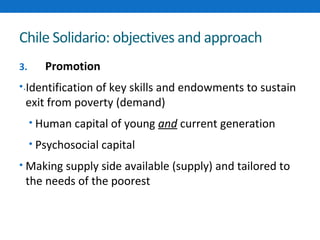
3. Promotion 
•.Identification of key skills and endowments to sustain 
exit from poverty (demand) 
• Human capital of young and current generation 
• Psychosocial capital 
• Making supply side available (supply) and tailored to 
the needs of the poorest
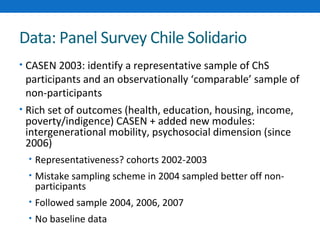
Data: Panel Survey Chile Solidario 
• CASEN 2003: identify a representative sample of ChS 
participants and an observationally ‘comparable’ sample of 
non-participants 
• Rich set of outcomes (health, education, housing, income, 
poverty/indigence) CASEN + added new modules: 
intergenerational mobility, psychosocial dimension (since 
2006) 
• Representativeness? cohorts 2002-2003 
• Mistake sampling scheme in 2004 sampled better off non-participants 
• Followed sample 2004, 2006, 2007 
• No baseline data
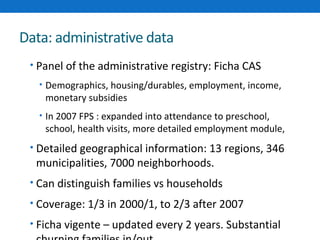
Data: administrative data 
• Panel of the administrative registry: Ficha CAS 
• Demographics, housing/durables, employment, income, 
monetary subsidies 
• In 2007 FPS : expanded into attendance to preschool, 
school, health visits, more detailed employment module, 
• Detailed geographical information: 13 regions, 346 
municipalities, 7000 neighborhoods. 
• Can distinguish families vs households 
• Coverage: 1/3 in 2000/1, to 2/3 after 2007 
• Ficha vigente – updated every 2 years. Substantial 
churning families in/out
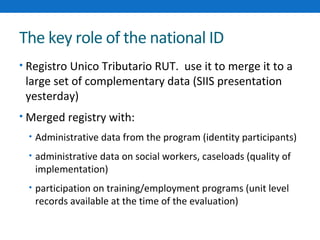
The key role of the national ID 
• Registro Unico Tributario RUT. use it to merge it to a 
large set of complementary data (SIIS presentation 
yesterday) 
• Merged registry with: 
• Administrative data from the program (identity participants) 
• administrative data on social workers, caseloads (quality of 
implementation) 
• participation on training/employment programs (unit level 
records available at the time of the evaluation)
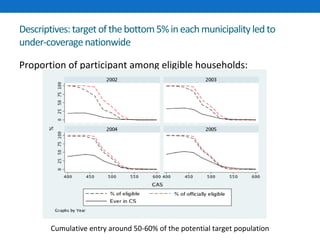
Descriptives: target of the bottom 5% in each municipality led to 
under-coverage nationwide 
Proportion of participant among eligible households: 
Cumulative entry around 50-60% of the potential target population
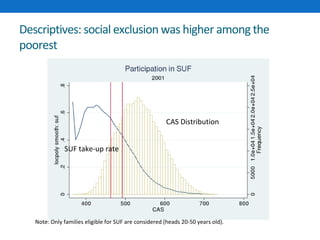
Descriptives: social exclusion was higher among the 
poorest 
CAS Distribution 
SUF take-up rate 
Note: Only families eligible for SUF are considered (heads 20-50 years old).
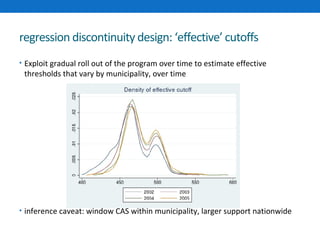
regression discontinuity design: ‘effective’ cutoffs 
• Exploit gradual roll out of the program over time to estimate effective 
thresholds that vary by municipality, over time 
• inference caveat: window CAS within municipality, larger support nationwide
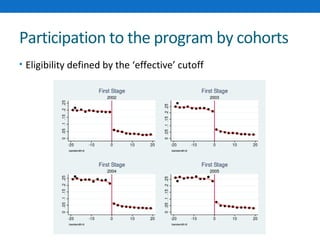
Participation to the program by cohorts 
• Eligibility defined by the ‘effective’ cutoff
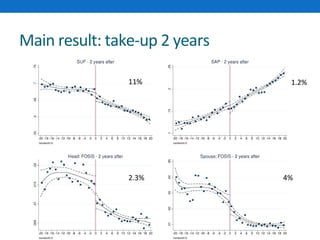
Main result: take-up 2 years 
11% 1.2% 
2.3% 4%
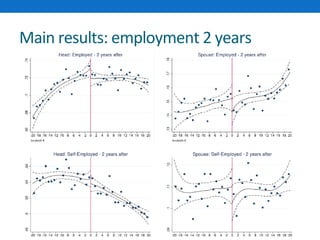
Main results: employment 2 years
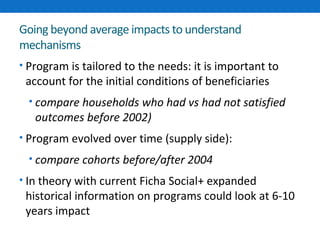
Going beyond average impacts to understand 
mechanisms 
• Program is tailored to the needs: it is important to 
account for the initial conditions of beneficiaries 
• compare households who had vs had not satisfied 
outcomes before 2002) 
• Program evolved over time (supply side): 
• compare cohorts before/after 2004 
• In theory with current Ficha Social+ expanded 
historical information on programs could look at 6-10 
years impact
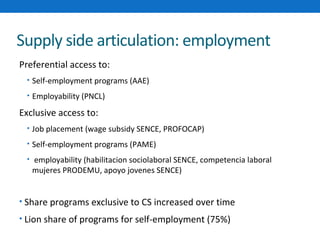
Supply side articulation: employment 
Preferential access to: 
• Self-employment programs (AAE) 
• Employability (PNCL) 
Exclusive access to: 
• Job placement (wage subsidy SENCE, PROFOCAP) 
• Self-employment programs (PAME) 
• employability (habilitacion sociolaboral SENCE, competencia laboral 
mujeres PRODEMU, apoyo jovenes SENCE) 
• Share programs exclusive to CS increased over time 
• Lion share of programs for self-employment (75%)
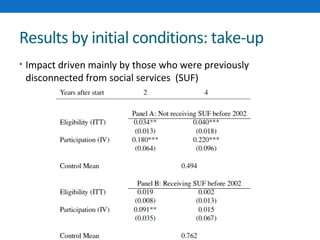
Results by initial conditions: take-up 
• Impact driven mainly by those who were previously 
disconnected from social services (SUF)
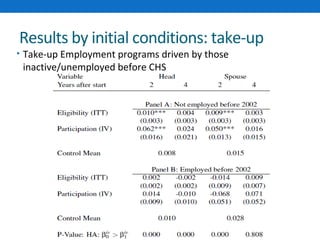
Results by initial conditions: take-up 
• Take-up Employment programs driven by those 
inactive/unemployed before CHS
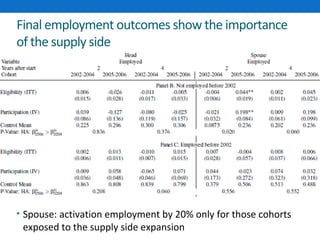
Final employment outcomes show the importance 
of the supply side 
• Spouse: activation employment by 20% only for those cohorts 
exposed to the supply side expansion
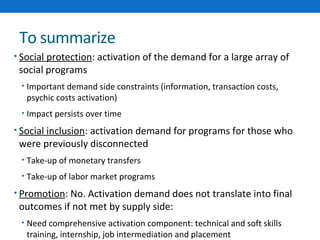
To summarize 
• Social protection: activation of the demand for a large array of 
social programs 
• Important demand side constraints (information, transaction costs, 
psychic costs activation) 
• Impact persists over time 
• Social inclusion: activation demand for programs for those who 
were previously disconnected 
• Take-up of monetary transfers 
• Take-up of labor market programs 
• Promotion: No. Activation demand does not translate into final 
outcomes if not met by supply side: 
• Need comprehensive activation component: technical and soft skills 
training, internship, job intermediation and placement
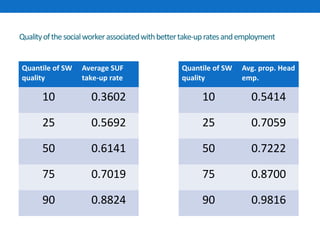
Quality of the social worker associated with better take-up rates and employment 
Quantile of SW 
quality 
Average SUF 
take-up rate 
10 0.3602 
25 0.5692 
50 0.6141 
75 0.7019 
90 0.8824 
Quantile of SW 
quality 
Avg. prop. Head 
emp. 
10 0.5414 
25 0.7059 
50 0.7222 
75 0.8700 
90 0.9816
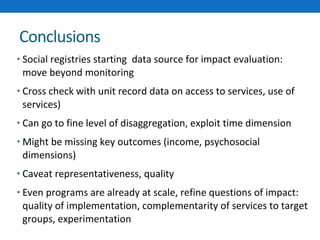
Conclusions 
• Social registries starting data source for impact evaluation: 
move beyond monitoring 
• Cross check with unit record data on access to services, use of 
services) 
• Can go to fine level of disaggregation, exploit time dimension 
• Might be missing key outcomes (income, psychosocial 
dimensions) 
• Caveat representativeness, quality 
• Even programs are already at scale, refine questions of impact: 
quality of implementation, complementarity of services to target 
groups, experimentation

The use of administrative data for program evaluation Rio

  • 1.
    The use ofadministrative data for program evaluation Emanuela Galasso Development Research Group The World Bank The role of Administrative records and complex surveys in the monitoring and evaluation of public policies Rio de Janeiro Nov 2014
  • 2.
    Using administrative data:the question • Administrative data: main objective is monitoring for decision making– can trace and describe trends of key inputs and outcomes of interest • Question: how can it be used for impact evaluations? • Complementary to survey data collection • For either type of data sources, a pre-requisite for embarking in an impact evaluation is to have a clear identification strategy • Call for expanding access to administrative data prominent US economists
  • 3.
    Using administrative datafor impact evaluations: the potential • Size: Universe of the target population • Best placed to assess programs targeted to very specific groups – to be oversampled in surveys (the extreme poor, migrants), or geographic areas • By-product of the existing monitoring of the social policy: cost • time: characterize dynamics of impact • Flexibility: can potentially look at different target groups, assess new variants
  • 4.
    Using administrative datafor impact evaluations: the cons • Data up-to-date? Differential capacity of municipalities or agencies in data collection • Representativeness? ex.registries of the poor (as CadUnico) covers the entire target population? • Data quality? Income (imputations), scope for over/under reporting (ex. Colombia PMT) • Scope: limited set of variables. May be missing key outcomes or determinants of pathway of impact(ex. noncognitive skills, mental health, parenting practices)
  • 5.
    Using administrative datafor impact evaluation: the experience of Chile Solidario • Non-experimental evaluation: method of regression discontinuity design • Planned after the program had started • Exploited the clear assignment : • Eligibility based on proxy means score (CAS). Official cutoff by municipality • Households invited from the bottom up of the CAS distribution in each municipality • Program gradually rolled out, 4 cohorts 2002-2005, became law in 2004
  • 6.
    Chile Solidario: objectivesand approach 1. Social inclusion • Targeting the extreme poor (and vulnerable): bottom 5% CAS. From explicit demand for services to identification and invitation • Central role of psychosocial wellbeing in social policy: 2 years of psychosocial support, local social worker
  • 7.
    Chile Solidario: objectivesand approach 2. Social protection • Short term cash transfer + guaranteed monetary transfers • Preferential access for social services (demand) • Making the supply side available (supply) and tailored to the needs of the poorest • Beyond access to health and education: multiple dimensions and ‘minimum conditions’
  • 8.
    Chile Solidario: objectivesand approach 3. Promotion •.Identification of key skills and endowments to sustain exit from poverty (demand) • Human capital of young and current generation • Psychosocial capital • Making supply side available (supply) and tailored to the needs of the poorest
  • 9.
    Data: Panel SurveyChile Solidario • CASEN 2003: identify a representative sample of ChS participants and an observationally ‘comparable’ sample of non-participants • Rich set of outcomes (health, education, housing, income, poverty/indigence) CASEN + added new modules: intergenerational mobility, psychosocial dimension (since 2006) • Representativeness? cohorts 2002-2003 • Mistake sampling scheme in 2004 sampled better off non-participants • Followed sample 2004, 2006, 2007 • No baseline data
  • 10.
    Data: administrative data • Panel of the administrative registry: Ficha CAS • Demographics, housing/durables, employment, income, monetary subsidies • In 2007 FPS : expanded into attendance to preschool, school, health visits, more detailed employment module, • Detailed geographical information: 13 regions, 346 municipalities, 7000 neighborhoods. • Can distinguish families vs households • Coverage: 1/3 in 2000/1, to 2/3 after 2007 • Ficha vigente – updated every 2 years. Substantial churning families in/out
  • 11.
    The key roleof the national ID • Registro Unico Tributario RUT. use it to merge it to a large set of complementary data (SIIS presentation yesterday) • Merged registry with: • Administrative data from the program (identity participants) • administrative data on social workers, caseloads (quality of implementation) • participation on training/employment programs (unit level records available at the time of the evaluation)
  • 12.
    Descriptives: target ofthe bottom 5% in each municipality led to under-coverage nationwide Proportion of participant among eligible households: Cumulative entry around 50-60% of the potential target population
  • 13.
    Descriptives: social exclusionwas higher among the poorest CAS Distribution SUF take-up rate Note: Only families eligible for SUF are considered (heads 20-50 years old).
  • 14.
    regression discontinuity design:‘effective’ cutoffs • Exploit gradual roll out of the program over time to estimate effective thresholds that vary by municipality, over time • inference caveat: window CAS within municipality, larger support nationwide
  • 15.
    Participation to theprogram by cohorts • Eligibility defined by the ‘effective’ cutoff
  • 16.
    Main result: take-up2 years 11% 1.2% 2.3% 4%
  • 17.
  • 18.
    Going beyond averageimpacts to understand mechanisms • Program is tailored to the needs: it is important to account for the initial conditions of beneficiaries • compare households who had vs had not satisfied outcomes before 2002) • Program evolved over time (supply side): • compare cohorts before/after 2004 • In theory with current Ficha Social+ expanded historical information on programs could look at 6-10 years impact
  • 19.
    Supply side articulation:employment Preferential access to: • Self-employment programs (AAE) • Employability (PNCL) Exclusive access to: • Job placement (wage subsidy SENCE, PROFOCAP) • Self-employment programs (PAME) • employability (habilitacion sociolaboral SENCE, competencia laboral mujeres PRODEMU, apoyo jovenes SENCE) • Share programs exclusive to CS increased over time • Lion share of programs for self-employment (75%)
  • 20.
    Results by initialconditions: take-up • Impact driven mainly by those who were previously disconnected from social services (SUF)
  • 21.
    Results by initialconditions: take-up • Take-up Employment programs driven by those inactive/unemployed before CHS
  • 22.
    Final employment outcomesshow the importance of the supply side • Spouse: activation employment by 20% only for those cohorts exposed to the supply side expansion
  • 23.
    To summarize •Social protection: activation of the demand for a large array of social programs • Important demand side constraints (information, transaction costs, psychic costs activation) • Impact persists over time • Social inclusion: activation demand for programs for those who were previously disconnected • Take-up of monetary transfers • Take-up of labor market programs • Promotion: No. Activation demand does not translate into final outcomes if not met by supply side: • Need comprehensive activation component: technical and soft skills training, internship, job intermediation and placement
  • 24.
    Quality of thesocial worker associated with better take-up rates and employment Quantile of SW quality Average SUF take-up rate 10 0.3602 25 0.5692 50 0.6141 75 0.7019 90 0.8824 Quantile of SW quality Avg. prop. Head emp. 10 0.5414 25 0.7059 50 0.7222 75 0.8700 90 0.9816
  • 25.
    Conclusions • Socialregistries starting data source for impact evaluation: move beyond monitoring • Cross check with unit record data on access to services, use of services) • Can go to fine level of disaggregation, exploit time dimension • Might be missing key outcomes (income, psychosocial dimensions) • Caveat representativeness, quality • Even programs are already at scale, refine questions of impact: quality of implementation, complementarity of services to target groups, experimentation

Editor's Notes

  • #7 <number>
  • #8 <number>
  • #9 <number>
  • #10 <number>
  • #13 <number>
  • #14 Baseline data before the program (CAS) corroborates diagnostic <number>
  • #16 15% takeup of the program by cohort official cutoff could not have been used because they were set at an upper bound of cas in each municipality. Not binding for the earlier cohorts that started from the bottom up of the distribution <number>
  • #17 Sustained after 4 years <number>
  • #18 Not significant on average <number>
  • #19 <number>
  • #20 Have only individual participation about employment programs <number>
  • #21 Cohorts 2002-2006. <number>
  • #24 Need to <number>
  • #26 <number>