Cracking Brazil’s Forest Code: willingness
to comply and the environmental quota
(CRA) market
Prof. Raoni Rajão
* Rajão, R, Pacheco, R, Soares-filho, B et al (under preparation)
Team
Prof. Britaldo Soares Filho
Coordenador do Centro de
Sensoriamento Remoto
Prof. Raoni Rajão
Coordenador do Laboratório
de Gestão de Serviços Ambientais
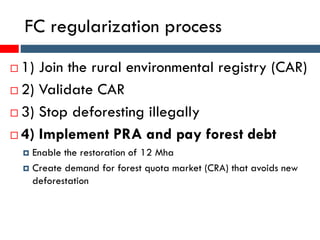
FC regularization process
 1) Join the rural environmental registry (CAR)
 2) Validate CAR
 3) Stop deforesting illegally
 4) Implement PRA and pay forest debt
 Enable the restoration of 12 Mha
 Create demand for forest quota market (CRA) that avoids new
deforestation
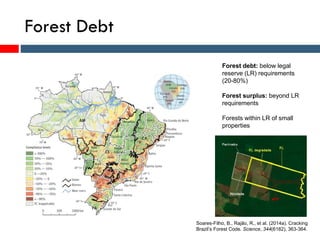
Forest Debt
Forest debt: below legal
reserve (LR) requirements
(20-80%)
Forest surplus: beyond LR
requirements
Forests within LR of small
properties
Soares-Filho, B., Rajão, R., et al. (2014a). Cracking
Brazil’s Forest Code. Science, 344(6182), 363-364.
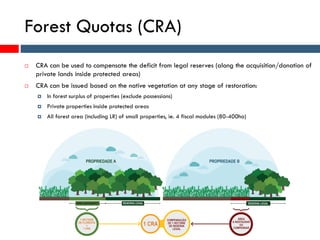
Forest Quotas (CRA)
 CRA can be used to compensate the deficit from legal reserves (along the acquisition/donation of
private lands inside protected areas)
 CRA can be issued based on the native vegetation at any stage of restoration:
 In forest surplus of properties (exclude possessions)
 Private properties inside protected areas
 All forest area (including LR) of small properties, ie. 4 fiscal modules (80-400ha)
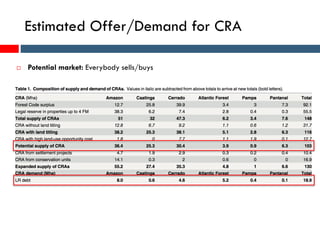
Estimated Offer/Demand for CRA
 Potential market: Everybody sells/buys
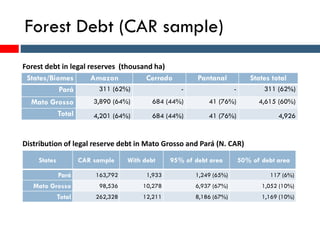
Forest Debt (CAR sample)
States/Biomes Amazon Cerrado Pantanal States total
Pará 311 (62%) - - 311 (62%)
Mato Grosso 3,890 (64%) 684 (44%) 41 (76%) 4,615 (60%)
Total 4,201 (64%) 684 (44%) 41 (76%) 4,926
Forest debt in legal reserves (thousand ha)
Distribution of legal reserve debt in Mato Grosso and Pará (N. CAR)
States CAR sample With debt 95% of debt area 50% of debt area
Pará 163,792 1,933 1,249 (65%) 117 (6%)
Mato Grosso 98,536 10,278 6,937 (67%) 1,052 (10%)
Total 262,328 12,211 8,186 (67%) 1,169 (10%)
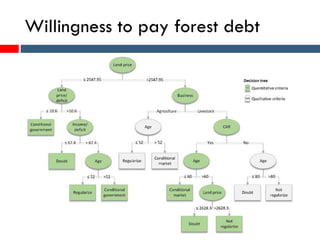
Willingness to pay forest debt
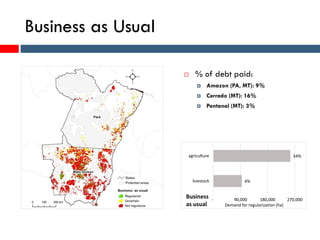
Business as Usual
4%
34%
- 90,000 180,000 270,000
livestock
agriculture
Demand for regularization (ha)
Business
as usual
 % of debt paid:
 Amazon (PA, MT): 9%
 Cerrado (MT): 16%
 Pantanal (MT): 3%
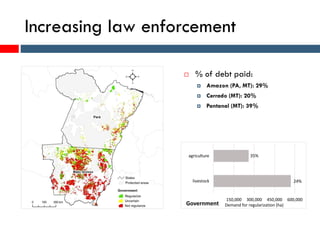
Increasing law enforcement
24%
35%
- 150,000 300,000 450,000 600,000
livestock
agriculture
Demand for regularization (ha)Government
 % of debt paid:
 Amazon (PA, MT): 29%
 Cerrado (MT): 20%
 Pantanal (MT): 39%
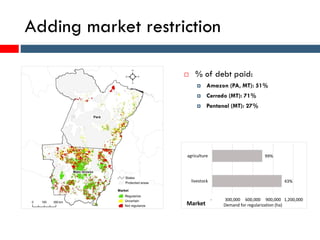
Adding market restriction
43%
99%
- 300,000 600,000 900,000 1,200,000
livestock
agriculture
Demand for regularization (ha)Market
 % of debt paid:
 Amazon (PA, MT): 51%
 Cerrado (MT): 71%
 Pantanal (MT): 27%
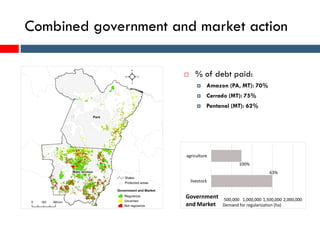
Combined government and market action
63%
100%
- 500,000 1,000,000 1,500,000 2,000,000
livestock
agriculture
Demand for regularization (ha)
Government
and Market
 % of debt paid:
 Amazon (PA, MT): 70%
 Cerrado (MT): 75%
 Pantanal (MT): 62%
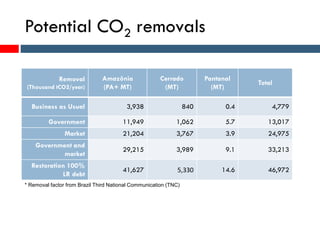
Potential CO2 removals
Removal
(Thousand tCO2/year)
Amazônia
(PA+ MT)
Cerrado
(MT)
Pantanal
(MT)
Total
Business as Usual 3,938 840 0.4 4,779
Government 11,949 1,062 5.7 13,017
Market 21,204 3,767 3.9 24,975
Government and
market
29,215 3,989 9.1 33,213
Restoration 100%
LR debt
41,627 5,330 14.6 46,972
* Removal factor from Brazil Third National Communication (TNC)
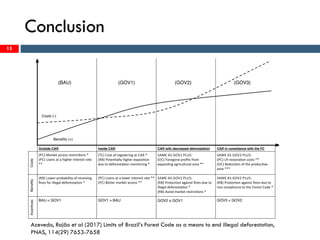
Conclusion
15
Azevedo, Rajão et al (2017) Limits of Brazil’s Forest Code as a means to end illegal deforestation,
PNAS, 114(29) 7653-7658
Conclusion
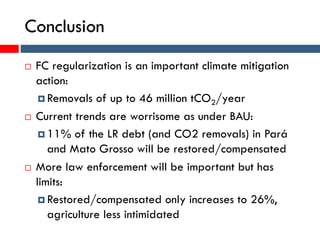
 FC regularization is an important climate mitigation
action:
 Removals of up to 46 million tCO2/year
 Current trends are worrisome as under BAU:
 11% of the LR debt (and CO2 removals) in Pará
and Mato Grosso will be restored/compensated
 More law enforcement will be important but has
limits:
 Restored/compensated only increases to 26%,
agriculture less intimidated
Conclusion
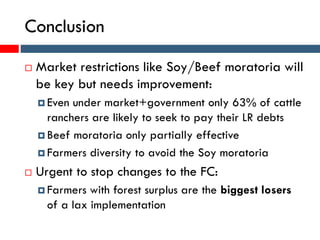
 Market restrictions like Soy/Beef moratoria will
be key but needs improvement:
 Even under market+government only 63% of cattle
ranchers are likely to seek to pay their LR debts
 Beef moratoria only partially effective
 Farmers diversity to avoid the Soy moratoria
 Urgent to stop changes to the FC:
 Farmers with forest surplus are the biggest losers
of a lax implementation
Thanks for your attention
rajao@ufmg.br

"Decifrando o Código Florestal Brasileiro"

  • 1.
    Cracking Brazil’s ForestCode: willingness to comply and the environmental quota (CRA) market Prof. Raoni Rajão * Rajão, R, Pacheco, R, Soares-filho, B et al (under preparation)
  • 2.
    Team Prof. Britaldo SoaresFilho Coordenador do Centro de Sensoriamento Remoto Prof. Raoni Rajão Coordenador do Laboratório de Gestão de Serviços Ambientais
  • 3.
    FC regularization process 1) Join the rural environmental registry (CAR)  2) Validate CAR  3) Stop deforesting illegally  4) Implement PRA and pay forest debt  Enable the restoration of 12 Mha  Create demand for forest quota market (CRA) that avoids new deforestation
  • 4.
    Forest Debt Forest debt:below legal reserve (LR) requirements (20-80%) Forest surplus: beyond LR requirements Forests within LR of small properties Soares-Filho, B., Rajão, R., et al. (2014a). Cracking Brazil’s Forest Code. Science, 344(6182), 363-364.
  • 5.
    Forest Quotas (CRA) CRA can be used to compensate the deficit from legal reserves (along the acquisition/donation of private lands inside protected areas)  CRA can be issued based on the native vegetation at any stage of restoration:  In forest surplus of properties (exclude possessions)  Private properties inside protected areas  All forest area (including LR) of small properties, ie. 4 fiscal modules (80-400ha)
  • 6.
    Estimated Offer/Demand forCRA  Potential market: Everybody sells/buys
  • 7.
    Forest Debt (CARsample) States/Biomes Amazon Cerrado Pantanal States total Pará 311 (62%) - - 311 (62%) Mato Grosso 3,890 (64%) 684 (44%) 41 (76%) 4,615 (60%) Total 4,201 (64%) 684 (44%) 41 (76%) 4,926 Forest debt in legal reserves (thousand ha) Distribution of legal reserve debt in Mato Grosso and Pará (N. CAR) States CAR sample With debt 95% of debt area 50% of debt area Pará 163,792 1,933 1,249 (65%) 117 (6%) Mato Grosso 98,536 10,278 6,937 (67%) 1,052 (10%) Total 262,328 12,211 8,186 (67%) 1,169 (10%)
  • 8.
    Willingness to payforest debt
  • 9.
    Business as Usual 4% 34% -90,000 180,000 270,000 livestock agriculture Demand for regularization (ha) Business as usual  % of debt paid:  Amazon (PA, MT): 9%  Cerrado (MT): 16%  Pantanal (MT): 3%
  • 10.
    Increasing law enforcement 24% 35% -150,000 300,000 450,000 600,000 livestock agriculture Demand for regularization (ha)Government  % of debt paid:  Amazon (PA, MT): 29%  Cerrado (MT): 20%  Pantanal (MT): 39%
  • 11.
    Adding market restriction 43% 99% -300,000 600,000 900,000 1,200,000 livestock agriculture Demand for regularization (ha)Market  % of debt paid:  Amazon (PA, MT): 51%  Cerrado (MT): 71%  Pantanal (MT): 27%
  • 12.
    Combined government andmarket action 63% 100% - 500,000 1,000,000 1,500,000 2,000,000 livestock agriculture Demand for regularization (ha) Government and Market  % of debt paid:  Amazon (PA, MT): 70%  Cerrado (MT): 75%  Pantanal (MT): 62%
  • 13.
    Potential CO2 removals Removal (ThousandtCO2/year) Amazônia (PA+ MT) Cerrado (MT) Pantanal (MT) Total Business as Usual 3,938 840 0.4 4,779 Government 11,949 1,062 5.7 13,017 Market 21,204 3,767 3.9 24,975 Government and market 29,215 3,989 9.1 33,213 Restoration 100% LR debt 41,627 5,330 14.6 46,972 * Removal factor from Brazil Third National Communication (TNC)
  • 14.
    Conclusion 15 Azevedo, Rajão etal (2017) Limits of Brazil’s Forest Code as a means to end illegal deforestation, PNAS, 114(29) 7653-7658
  • 15.
    Conclusion  FC regularizationis an important climate mitigation action:  Removals of up to 46 million tCO2/year  Current trends are worrisome as under BAU:  11% of the LR debt (and CO2 removals) in Pará and Mato Grosso will be restored/compensated  More law enforcement will be important but has limits:  Restored/compensated only increases to 26%, agriculture less intimidated
  • 16.
    Conclusion  Market restrictionslike Soy/Beef moratoria will be key but needs improvement:  Even under market+government only 63% of cattle ranchers are likely to seek to pay their LR debts  Beef moratoria only partially effective  Farmers diversity to avoid the Soy moratoria  Urgent to stop changes to the FC:  Farmers with forest surplus are the biggest losers of a lax implementation
  • 17.
    Thanks for yourattention rajao@ufmg.br