By: Ali D. Ibraheem
BSED-Math
GED 412
• refers to the policies and
procedures designed to equip
prospective teachers with the
knowledge, attitudes, behaviors and
skills they require to perform their
tasks effectively in the classroom,
school and wider community.
Week 1
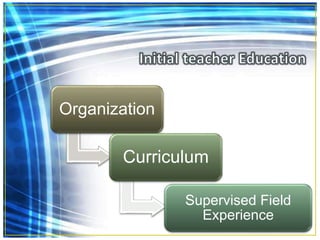
Organization
Curriculum
Supervised Field
Experience
• be spread over time
• be collaborative
• use active learning
• be delivered to groups of teachers
• include periods of practice, coaching, and
follow-up
• promote reflective practice
• encourage experimentation, and
• respond to teachers' needs.
Week 2
• Our thoughts, values, and actions
are somehow shaped by events
and by people with whom we come
in contact. We, in turn, help shape
society –its events, its people, and
its destiny.
• Existential question of a teacher
Why do I teach?, What should I teach?, How
should I teach?, etc.
Philosophies of Education
• Essentialism
• Progressivism
• Perennialism
• Existentialism
• Behaviorism
• The teachers are sent to this world to
accomplish a mission, “to teach”.
• Vocation
• A call
Teacher
Task
entruste
d
Missio
n
A
commitme
nt
Professi
on
• A lifetime journey of exploration,
practice and discovery.
• An aspect of a larger system, since
there is a dynamic and complicated
interplay between the social aspects of
learning and the specific classroom
experiences offered.
Week 3
• Commonly used teaching methods may
include class participation,
demonstration, recitation, memorization,
or combinations of these. The choice of
teaching method or methods to be used
depends largely on the information or
skill that is being taught, and it may also
be influenced by the aptitude and
enthusiasm of the students.
Week 4
• Explaining, or lecturing, is the process of
teaching by giving spoken explanations
of the subject that is to be learned.
Lecturing is often accompanied by
visual aids to help students visualize an
object or problem.
• Demonstrating is the process of
teaching through examples or
experiments. For example, a science
teacher may teach an idea by
performing an experiment for
students. A demonstration may be
used to prove a fact through a
combination of visual evidence and
associated reasoning.
• Collaboration allows students to actively
participate in the learning process by
talking with each other and listening to
other points of view. Collaboration
establishes a personal connection
between students and the topic of study
and it helps students think in a less
personally biased way.
• In this teaching method, students
assume the role of teacher and teach
their peers. Students who teach others
as a group or as individuals must study
and understand a topic well enough to
teach it to their peers. By having
students participate in the teaching
process, they gain self-confidence and
strengthen their speaking and
communication skills.
• A Global teacher should be equipped
with a wide range knowledge of the
various educational systems outside the
country; master skills and competencies
which can address global demands;
and possess attitudes and values that
are acceptable to multicultural
communities.
• From the different educational system of
other countries, we can say that basic
education is compulsory in all these
countries. This is also true about the
Philippines. However, the number of
years in every level; primary or
secondary, for some countries seem to
vary. Kindergarten or pre-school,
although not compulsory, has become
popular in preparing children for the
formal school system.
• Diversity of learners has now become
a local and global concern among
teachers. Diversity has been
recognized as an element that needs
attention. It is a fact that interest in
individual differences and multiple
intelligences added to the impetus of
knowing about multi-cultural education.
• With the global perspective, educational
technologies, and innovative teaching are
imperative in todays time. The unlimited
resource of available technology and its
utilization for innovative teaching promise
challenging experience for prospective teachers.
This lesson cannot sufficiently explore all
possibilities to respond to the challenges,
however, it has clearly underscored that
technology can provide support to teaching in
the resolutions of meaningful problems, act as a
scaffolding to learning, and promotes
The teaching profession--

The teaching profession--

  • 1.
    By: Ali D.Ibraheem BSED-Math GED 412
  • 2.
    • refers tothe policies and procedures designed to equip prospective teachers with the knowledge, attitudes, behaviors and skills they require to perform their tasks effectively in the classroom, school and wider community. Week 1
  • 3.
  • 4.
    • be spreadover time • be collaborative • use active learning • be delivered to groups of teachers • include periods of practice, coaching, and follow-up • promote reflective practice • encourage experimentation, and • respond to teachers' needs. Week 2
  • 5.
    • Our thoughts,values, and actions are somehow shaped by events and by people with whom we come in contact. We, in turn, help shape society –its events, its people, and its destiny.
  • 6.
    • Existential questionof a teacher Why do I teach?, What should I teach?, How should I teach?, etc. Philosophies of Education • Essentialism • Progressivism • Perennialism • Existentialism • Behaviorism
  • 7.
    • The teachersare sent to this world to accomplish a mission, “to teach”. • Vocation • A call Teacher Task entruste d Missio n A commitme nt Professi on
  • 8.
    • A lifetimejourney of exploration, practice and discovery. • An aspect of a larger system, since there is a dynamic and complicated interplay between the social aspects of learning and the specific classroom experiences offered. Week 3
  • 9.
    • Commonly usedteaching methods may include class participation, demonstration, recitation, memorization, or combinations of these. The choice of teaching method or methods to be used depends largely on the information or skill that is being taught, and it may also be influenced by the aptitude and enthusiasm of the students. Week 4
  • 10.
    • Explaining, orlecturing, is the process of teaching by giving spoken explanations of the subject that is to be learned. Lecturing is often accompanied by visual aids to help students visualize an object or problem.
  • 11.
    • Demonstrating isthe process of teaching through examples or experiments. For example, a science teacher may teach an idea by performing an experiment for students. A demonstration may be used to prove a fact through a combination of visual evidence and associated reasoning.
  • 12.
    • Collaboration allowsstudents to actively participate in the learning process by talking with each other and listening to other points of view. Collaboration establishes a personal connection between students and the topic of study and it helps students think in a less personally biased way.
  • 13.
    • In thisteaching method, students assume the role of teacher and teach their peers. Students who teach others as a group or as individuals must study and understand a topic well enough to teach it to their peers. By having students participate in the teaching process, they gain self-confidence and strengthen their speaking and communication skills.
  • 14.
    • A Globalteacher should be equipped with a wide range knowledge of the various educational systems outside the country; master skills and competencies which can address global demands; and possess attitudes and values that are acceptable to multicultural communities.
  • 15.
    • From thedifferent educational system of other countries, we can say that basic education is compulsory in all these countries. This is also true about the Philippines. However, the number of years in every level; primary or secondary, for some countries seem to vary. Kindergarten or pre-school, although not compulsory, has become popular in preparing children for the formal school system.
  • 16.
    • Diversity oflearners has now become a local and global concern among teachers. Diversity has been recognized as an element that needs attention. It is a fact that interest in individual differences and multiple intelligences added to the impetus of knowing about multi-cultural education.
  • 17.
    • With theglobal perspective, educational technologies, and innovative teaching are imperative in todays time. The unlimited resource of available technology and its utilization for innovative teaching promise challenging experience for prospective teachers. This lesson cannot sufficiently explore all possibilities to respond to the challenges, however, it has clearly underscored that technology can provide support to teaching in the resolutions of meaningful problems, act as a scaffolding to learning, and promotes