The structure of newspaper
         editorials
       Adriana Bolívar
Text
• Shaped in social interaction.
• Needs to respond to communicative needs
  that are born and maintained within groups
  and cultures.
• Evaluation has the fundamental role of
  contributing to shape text structure - and may
  serve as a potential indicator of genre.
Editorials
• Their agreed social aim is to evaluate current
  events, and so
• An opinion or recommendation for action is
  obligatory.
Evaluation


The type of information that concerns
the expression of feelings and
opinions.
• In the course of structuring a text, the writer
  makes evaluations which are expressed in
  sentences.
• From a grammatical point of view, in this
  structuring,      the       writer    exchanges
  ideational, textual and interpersonal meanings
  with the reader (Halliday).
• The most important of these is the interpersonal
  because this is concerned with the lexico-
  grammar of mood and modality.
Change
• The most important notion for the study of
  evaluation in written text.
• Changes are taken as signals of interaction
  because they indicate the writer’s evaluations
  about the state of knowledge and the
  evaluations of the reader.
• Main clauses in sentences: where changes in
  mood take place.
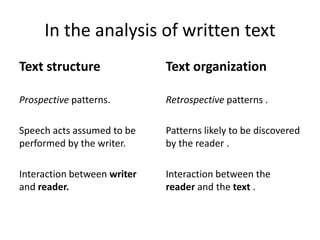
In the analysis of written text
Text structure               Text organization

Prospective patterns.        Retrospective patterns .

Speech acts assumed to be    Patterns likely to be discovered
performed by the writer.     by the reader .

Interaction between writer   Interaction between the
and reader.                  reader and the text .
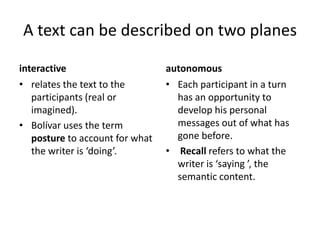
A text can be described on two planes

interactive                      autonomous
• relates the text to the        • Each participant in a turn
   participants (real or           has an opportunity to
   imagined).                      develop his personal
• Bolívar uses the term            messages out of what has
   posture to account for what     gone before.
   the writer is ‘doing’.        • Recall refers to what the
                                   writer is ‘saying ’, the
                                   semantic content.
The model of analysis
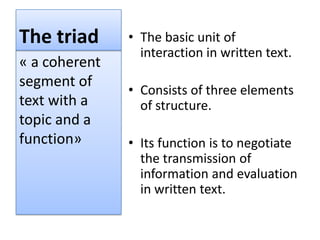
The triad      • The basic unit of
                 interaction in written text.
« a coherent
segment of
               • Consists of three elements
text with a      of structure.
topic and a
function»      • Its function is to negotiate
                 the transmission of
                 information and evaluation
                 in written text.
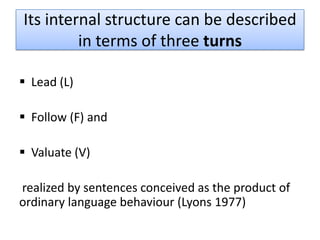
Its internal structure can be described
         in terms of three turns

 Lead (L)

 Follow (F) and

 Valuate (V)

realized by sentences conceived as the product of
ordinary language behaviour (Lyons 1977)
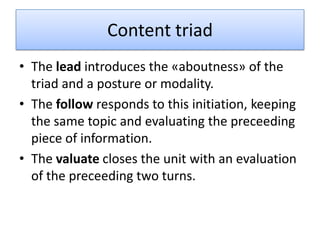
Content triad
• The lead introduces the «aboutness» of the
  triad and a posture or modality.
• The follow responds to this initiation, keeping
  the same topic and evaluating the preceeding
  piece of information.
• The valuate closes the unit with an evaluation
  of the preceeding two turns.
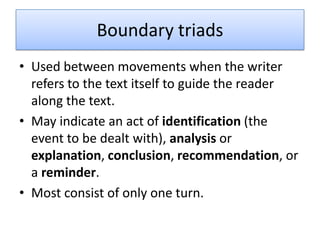
Boundary triads
• Used between movements when the writer
  refers to the text itself to guide the reader
  along the text.
• May indicate an act of identification (the
  event to be dealt with), analysis or
  explanation, conclusion, recommendation, or
  a reminder.
• Most consist of only one turn.
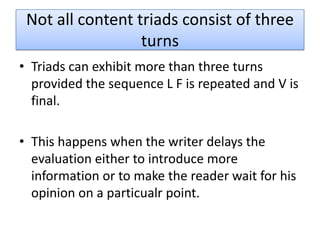
Not all content triads consist of three
                  turns
• Triads can exhibit more than three turns
  provided the sequence L F is repeated and V is
  final.

• This happens when the writer delays the
  evaluation either to introduce more
  information or to make the reader wait for his
  opinion on a particualr point.
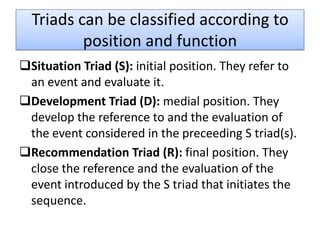
Triads can be classified according to
          position and function
Situation Triad (S): initial position. They refer to
 an event and evaluate it.
Development Triad (D): medial position. They
 develop the reference to and the evaluation of
 the event considered in the preceeding S triad(s).
Recommendation Triad (R): final position. They
 close the reference and the evaluation of the
 event introduced by the S triad that initiates the
 sequence.
Movement
• Triads may combine with other triads to make up
  a unit at a higher rank: a movement (Mv).
• Movement, then, is the second largest unit in the
  model.
• A movement may combine with other
  movements to make up the largest unit at the
  highest rank: the artefact.
• The size of a movement depends on the number
  of triads that relate the text to the world of
  events within the same modal perspective.
Movement types
• Type A: the actual world, a world that is or
  was.
• Type B: the world of possibilities, or the world
  that might be.
• Type C: the world that should be. Constitutes
  a major evaluation that refers back to
  movements A and B.
Turn-change and turn-maintenance in
               triads
• It is necessary to examine the forms used by the writer in
  the L turns: tense selection , modality selection, and lexical
  anticipation.

Informing triad: typically contains a L realized by a sentence in
declarative syntax.

Eliciting triad: initiated by a L in interrogative form. Has the
function of asking a question in order to obtain an answer.

(In editorials, rhetorical questions are used to give information
in evaluative terms or simply to evaluate already given
information).
Tense selection
• Tense selection in the lead indicates the time
  dimension.

• Tense changes can be classified by adverbials
  (last year, this year, etc.) or by discourse
  adjuncts which indicate agreement or
  disagreement (In fact, Indeed, But, However).
Modality selection
• The most common way of indicationg turn-
  change and turn-maintenance in an editorial.
• Through signals such as modal verbs, modal
  adjuncts, special nouns, adjectives, verbs and
  others, the writer indicates his attitude
  towards his own speech.
Lexical anticipation
• Can also serve as a signal for turn-change.
• Expressed by means of a noun, an adjective or
  a prepositional phrase.
• Commits the writer to give new information in
  another turn.
• These signals are typically evaluative.
• Must be distinguished from enumeration,
  which is a category of prediction.
Triads consistently close with Valuates
 Concluders: indicate that a conclusion has
  been reached, with reference to the present
  time
 Prophecies: indicate the assessment of
  probabilities for future developments. They
  are typically realized by verbs that indicate
  futurity.
 Directives: propose or suggest «desirable»
  courses of action.

The structure of newspaper editorials

  • 1.
    The structure ofnewspaper editorials Adriana Bolívar
  • 2.
    Text • Shaped insocial interaction. • Needs to respond to communicative needs that are born and maintained within groups and cultures. • Evaluation has the fundamental role of contributing to shape text structure - and may serve as a potential indicator of genre.
  • 3.
    Editorials • Their agreedsocial aim is to evaluate current events, and so • An opinion or recommendation for action is obligatory.
  • 4.
    Evaluation The type ofinformation that concerns the expression of feelings and opinions.
  • 5.
    • In thecourse of structuring a text, the writer makes evaluations which are expressed in sentences. • From a grammatical point of view, in this structuring, the writer exchanges ideational, textual and interpersonal meanings with the reader (Halliday). • The most important of these is the interpersonal because this is concerned with the lexico- grammar of mood and modality.
  • 6.
    Change • The mostimportant notion for the study of evaluation in written text. • Changes are taken as signals of interaction because they indicate the writer’s evaluations about the state of knowledge and the evaluations of the reader. • Main clauses in sentences: where changes in mood take place.
  • 7.
    In the analysisof written text Text structure Text organization Prospective patterns. Retrospective patterns . Speech acts assumed to be Patterns likely to be discovered performed by the writer. by the reader . Interaction between writer Interaction between the and reader. reader and the text .
  • 8.
    A text canbe described on two planes interactive autonomous • relates the text to the • Each participant in a turn participants (real or has an opportunity to imagined). develop his personal • Bolívar uses the term messages out of what has posture to account for what gone before. the writer is ‘doing’. • Recall refers to what the writer is ‘saying ’, the semantic content.
  • 9.
    The model ofanalysis
  • 10.
    The triad • The basic unit of interaction in written text. « a coherent segment of • Consists of three elements text with a of structure. topic and a function» • Its function is to negotiate the transmission of information and evaluation in written text.
  • 11.
    Its internal structurecan be described in terms of three turns  Lead (L)  Follow (F) and  Valuate (V) realized by sentences conceived as the product of ordinary language behaviour (Lyons 1977)
  • 12.
    Content triad • Thelead introduces the «aboutness» of the triad and a posture or modality. • The follow responds to this initiation, keeping the same topic and evaluating the preceeding piece of information. • The valuate closes the unit with an evaluation of the preceeding two turns.
  • 13.
    Boundary triads • Usedbetween movements when the writer refers to the text itself to guide the reader along the text. • May indicate an act of identification (the event to be dealt with), analysis or explanation, conclusion, recommendation, or a reminder. • Most consist of only one turn.
  • 14.
    Not all contenttriads consist of three turns • Triads can exhibit more than three turns provided the sequence L F is repeated and V is final. • This happens when the writer delays the evaluation either to introduce more information or to make the reader wait for his opinion on a particualr point.
  • 15.
    Triads can beclassified according to position and function Situation Triad (S): initial position. They refer to an event and evaluate it. Development Triad (D): medial position. They develop the reference to and the evaluation of the event considered in the preceeding S triad(s). Recommendation Triad (R): final position. They close the reference and the evaluation of the event introduced by the S triad that initiates the sequence.
  • 16.
    Movement • Triads maycombine with other triads to make up a unit at a higher rank: a movement (Mv). • Movement, then, is the second largest unit in the model. • A movement may combine with other movements to make up the largest unit at the highest rank: the artefact. • The size of a movement depends on the number of triads that relate the text to the world of events within the same modal perspective.
  • 17.
    Movement types • TypeA: the actual world, a world that is or was. • Type B: the world of possibilities, or the world that might be. • Type C: the world that should be. Constitutes a major evaluation that refers back to movements A and B.
  • 18.
    Turn-change and turn-maintenancein triads • It is necessary to examine the forms used by the writer in the L turns: tense selection , modality selection, and lexical anticipation. Informing triad: typically contains a L realized by a sentence in declarative syntax. Eliciting triad: initiated by a L in interrogative form. Has the function of asking a question in order to obtain an answer. (In editorials, rhetorical questions are used to give information in evaluative terms or simply to evaluate already given information).
  • 19.
    Tense selection • Tenseselection in the lead indicates the time dimension. • Tense changes can be classified by adverbials (last year, this year, etc.) or by discourse adjuncts which indicate agreement or disagreement (In fact, Indeed, But, However).
  • 20.
    Modality selection • Themost common way of indicationg turn- change and turn-maintenance in an editorial. • Through signals such as modal verbs, modal adjuncts, special nouns, adjectives, verbs and others, the writer indicates his attitude towards his own speech.
  • 21.
    Lexical anticipation • Canalso serve as a signal for turn-change. • Expressed by means of a noun, an adjective or a prepositional phrase. • Commits the writer to give new information in another turn. • These signals are typically evaluative. • Must be distinguished from enumeration, which is a category of prediction.
  • 22.
    Triads consistently closewith Valuates  Concluders: indicate that a conclusion has been reached, with reference to the present time  Prophecies: indicate the assessment of probabilities for future developments. They are typically realized by verbs that indicate futurity.  Directives: propose or suggest «desirable» courses of action.