International Partnership for Microbicides
Advancing HIV Prevention Options for Women
GNP+ Consultation on NPTs
Thomas Mertenskoetter
5. – 6. July 2010, Amsterdam
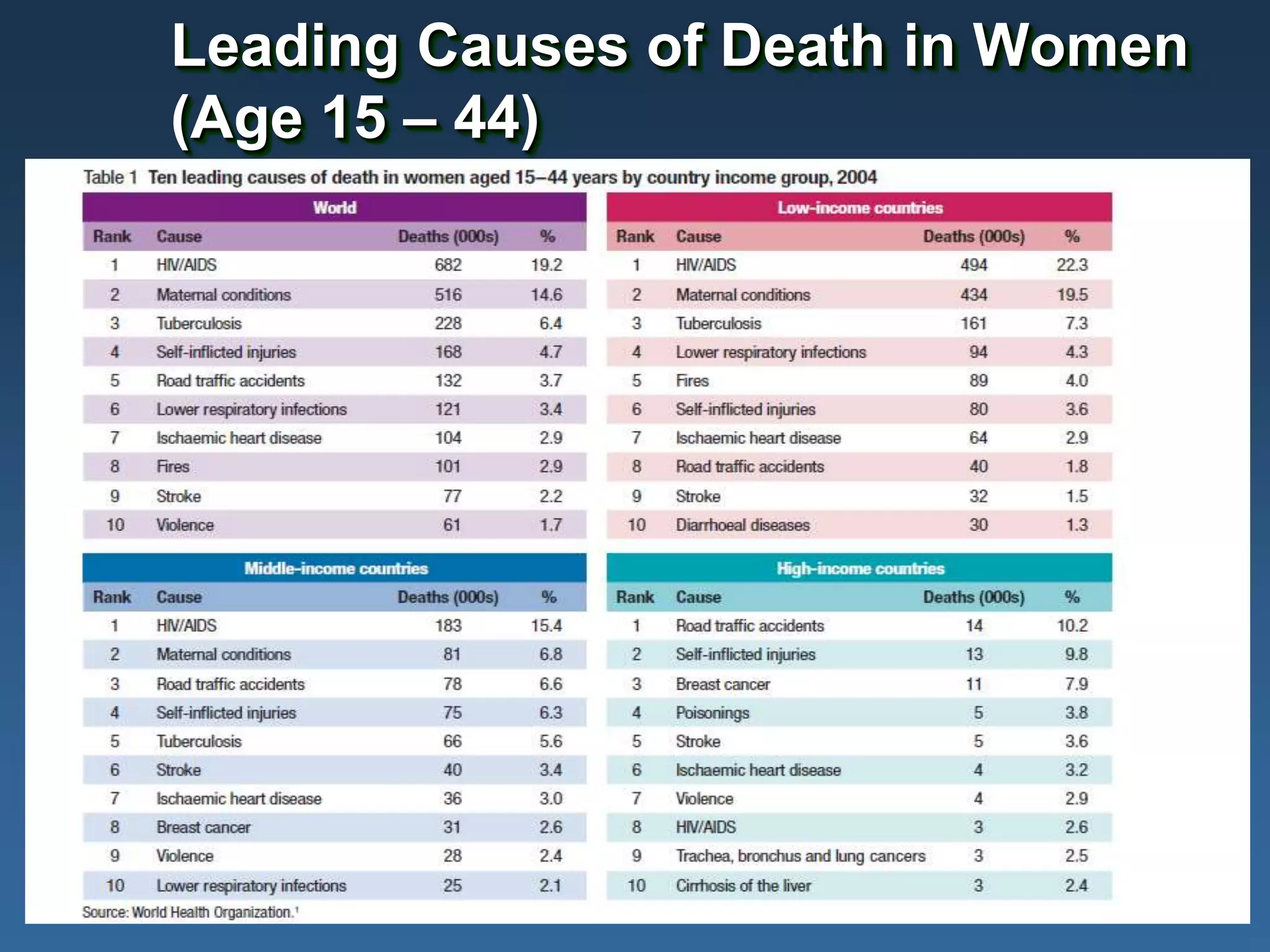
Leading Causes of Death in Women
(Age 15 – 44)
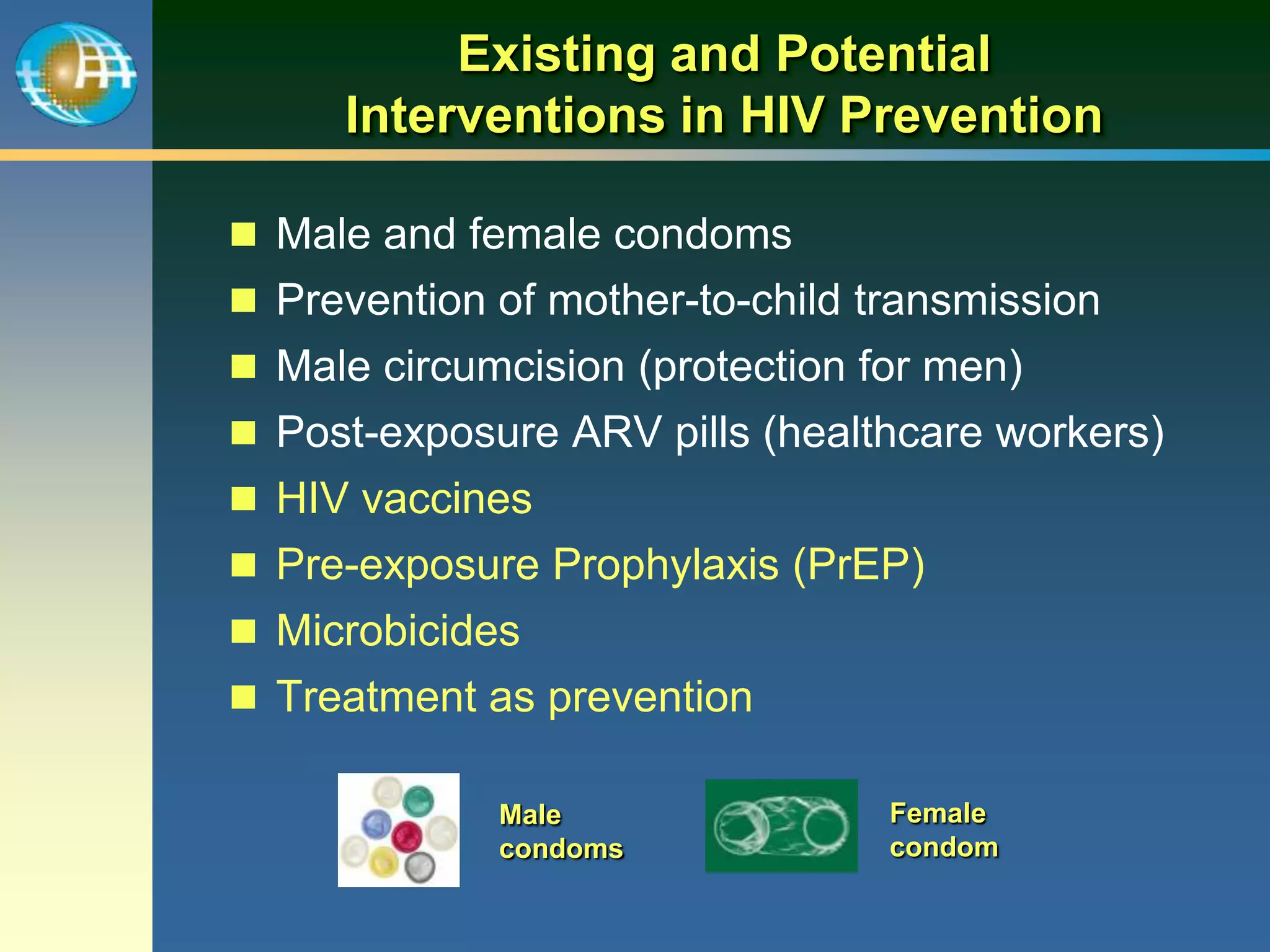
Existing and Potential
Interventions in HIV Prevention
 Male and female condoms
 Prevention of mother-to-child transmission
 Male circumcision (protection for men)
 Post-exposure ARV pills (healthcare workers)
 HIV vaccines
 Pre-exposure Prophylaxis (PrEP)
 Microbicides
 Treatment as prevention
Male
condoms
Female
condom
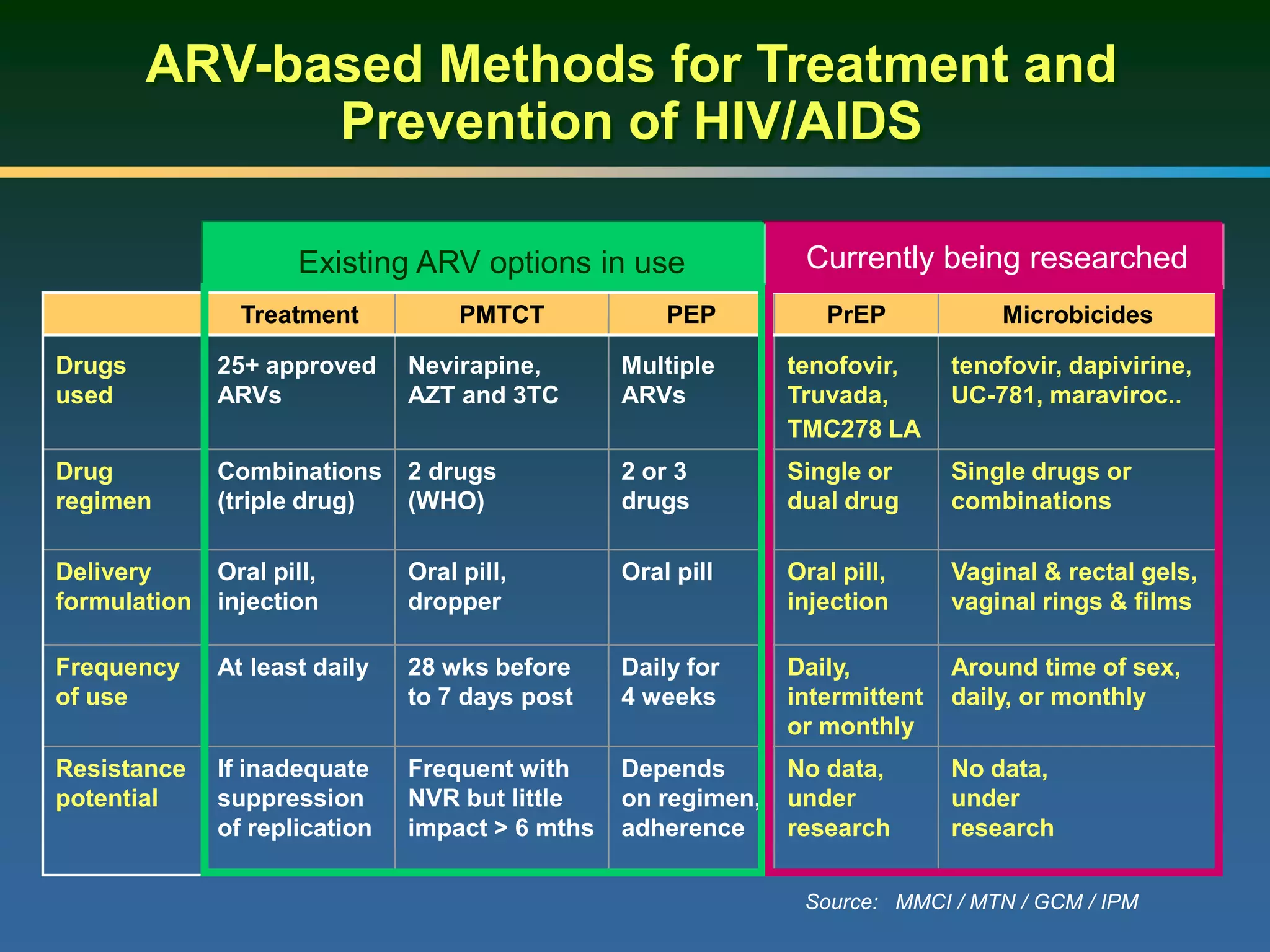
ARV-based Methods for Treatment and
Prevention of HIV/AIDS
Treatment PMTCT PEP PrEP Microbicides
Drugs
used
25+ approved
ARVs
Nevirapine,
AZT and 3TC
Multiple
ARVs
tenofovir,
Truvada,
TMC278 LA
tenofovir, dapivirine,
UC-781, maraviroc..
Drug
regimen
Combinations
(triple drug)
2 drugs
(WHO)
2 or 3
drugs
Single or
dual drug
Single drugs or
combinations
Delivery
formulation
Oral pill,
injection
Oral pill,
dropper
Oral pill Oral pill,
injection
Vaginal & rectal gels,
vaginal rings & films
Frequency
of use
At least daily 28 wks before
to 7 days post
Daily for
4 weeks
Daily,
intermittent
or monthly
Around time of sex,
daily, or monthly
Resistance
potential
If inadequate
suppression
of replication
Frequent with
NVR but little
impact > 6 mths
Depends
on regimen,
adherence
No data,
under
research
No data,
under
research
Existing ARV options in use Currently being researched
Source: MMCI / MTN / GCM / IPM
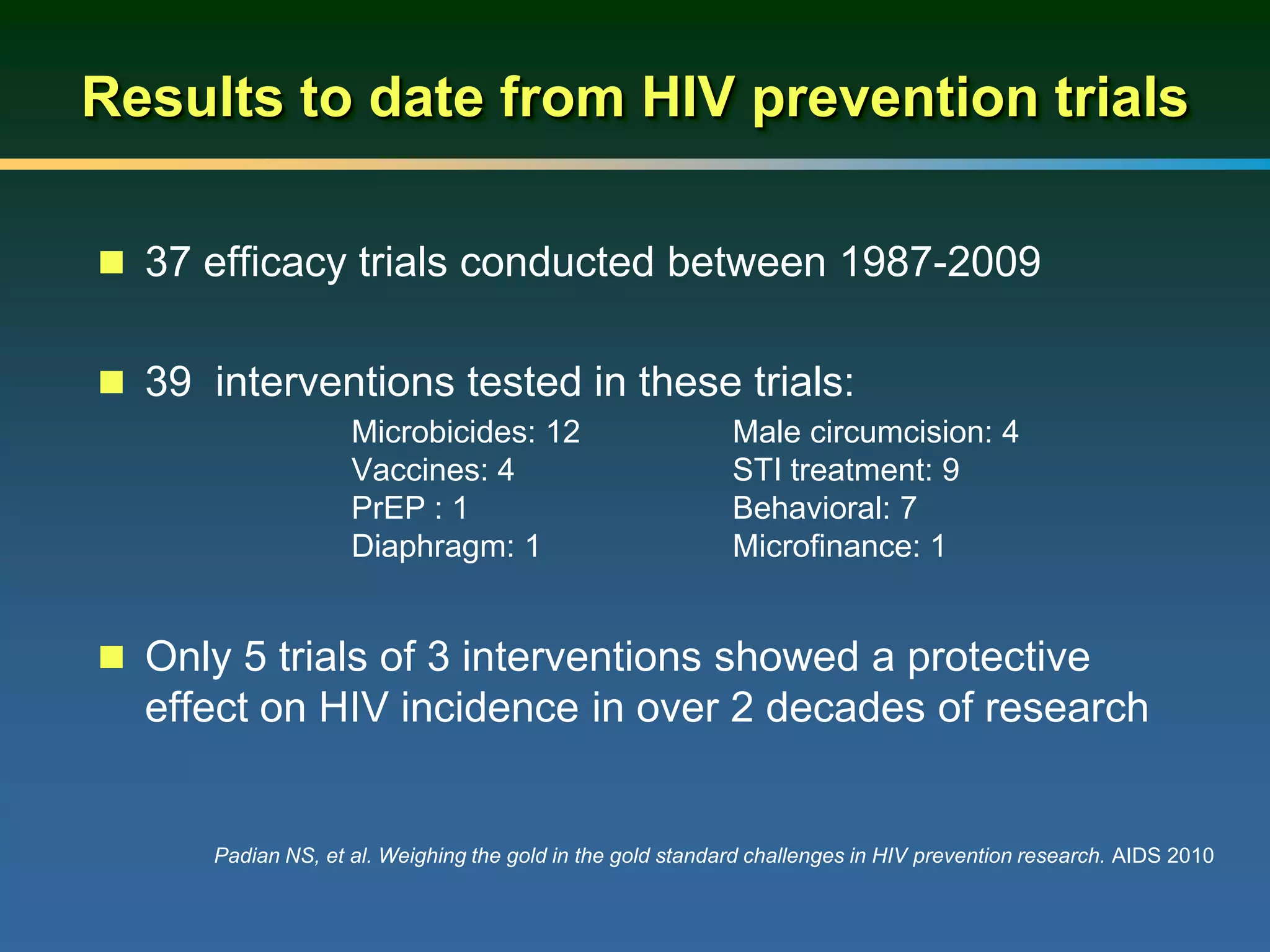
Results to date from HIV prevention trials
 37 efficacy trials conducted between 1987-2009
 39 interventions tested in these trials:
Microbicides: 12 Male circumcision: 4
Vaccines: 4 STI treatment: 9
PrEP : 1 Behavioral: 7
Diaphragm: 1 Microfinance: 1
 Only 5 trials of 3 interventions showed a protective
effect on HIV incidence in over 2 decades of research
Padian NS, et al. Weighing the gold in the gold standard challenges in HIV prevention research. AIDS 2010
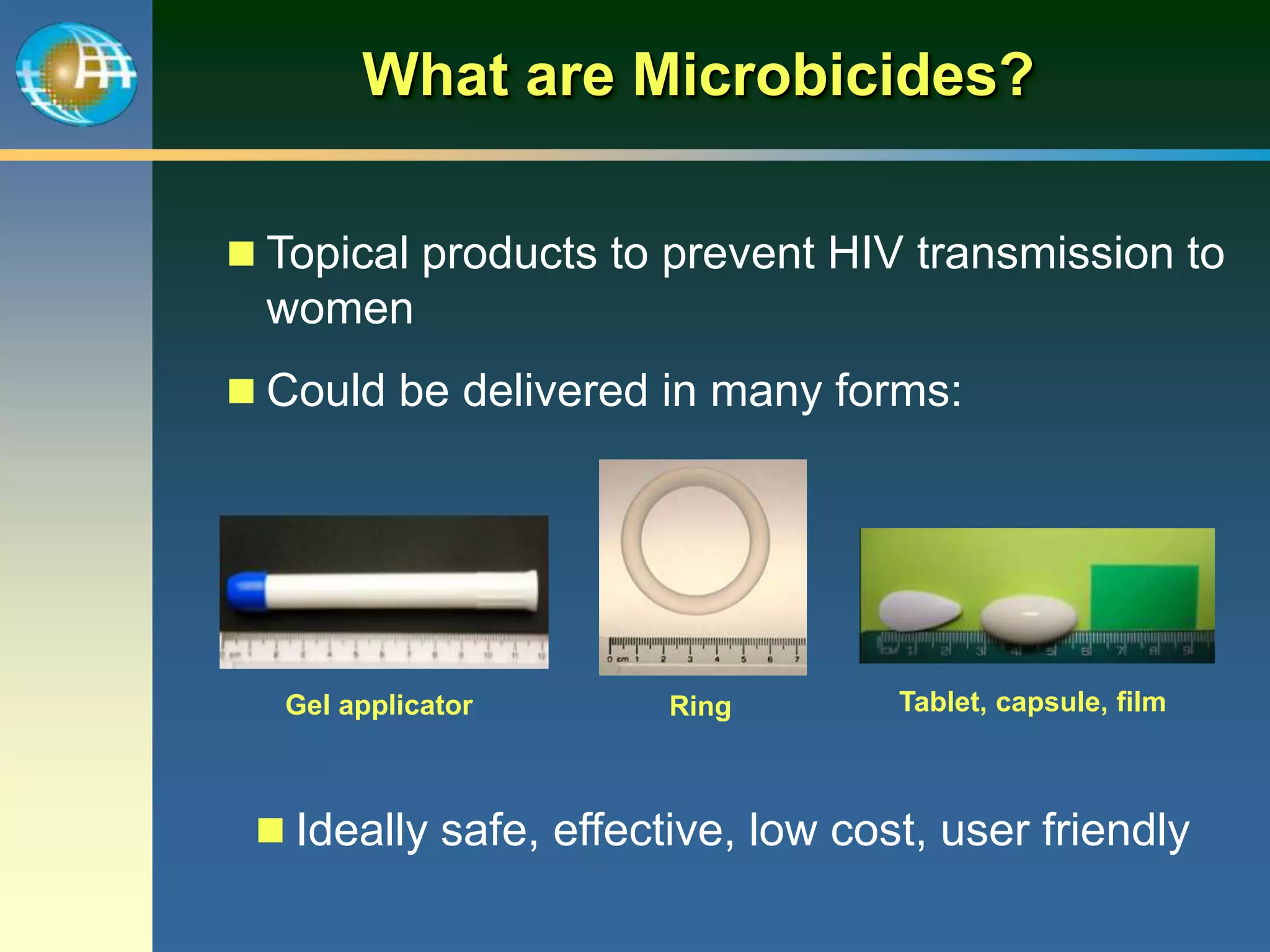
What are Microbicides?
 Topical products to prevent HIV transmission to
women
 Could be delivered in many forms:
 Ideally safe, effective, low cost, user friendly
Gel applicator Ring Tablet, capsule, film
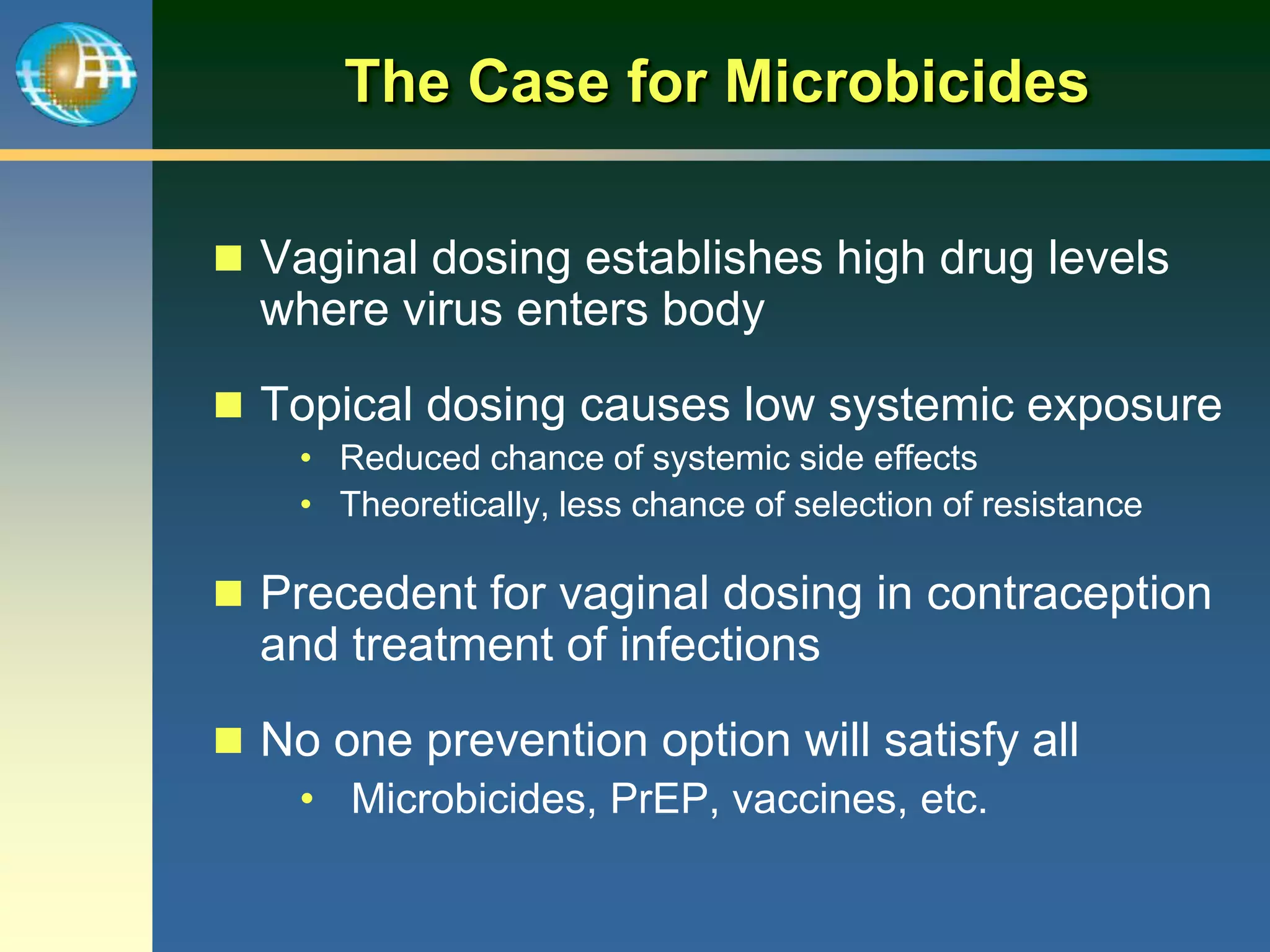
The Case for Microbicides
 Vaginal dosing establishes high drug levels
where virus enters body
 Topical dosing causes low systemic exposure
• Reduced chance of systemic side effects
• Theoretically, less chance of selection of resistance
 Precedent for vaginal dosing in contraception
and treatment of infections
 No one prevention option will satisfy all
• Microbicides, PrEP, vaccines, etc.
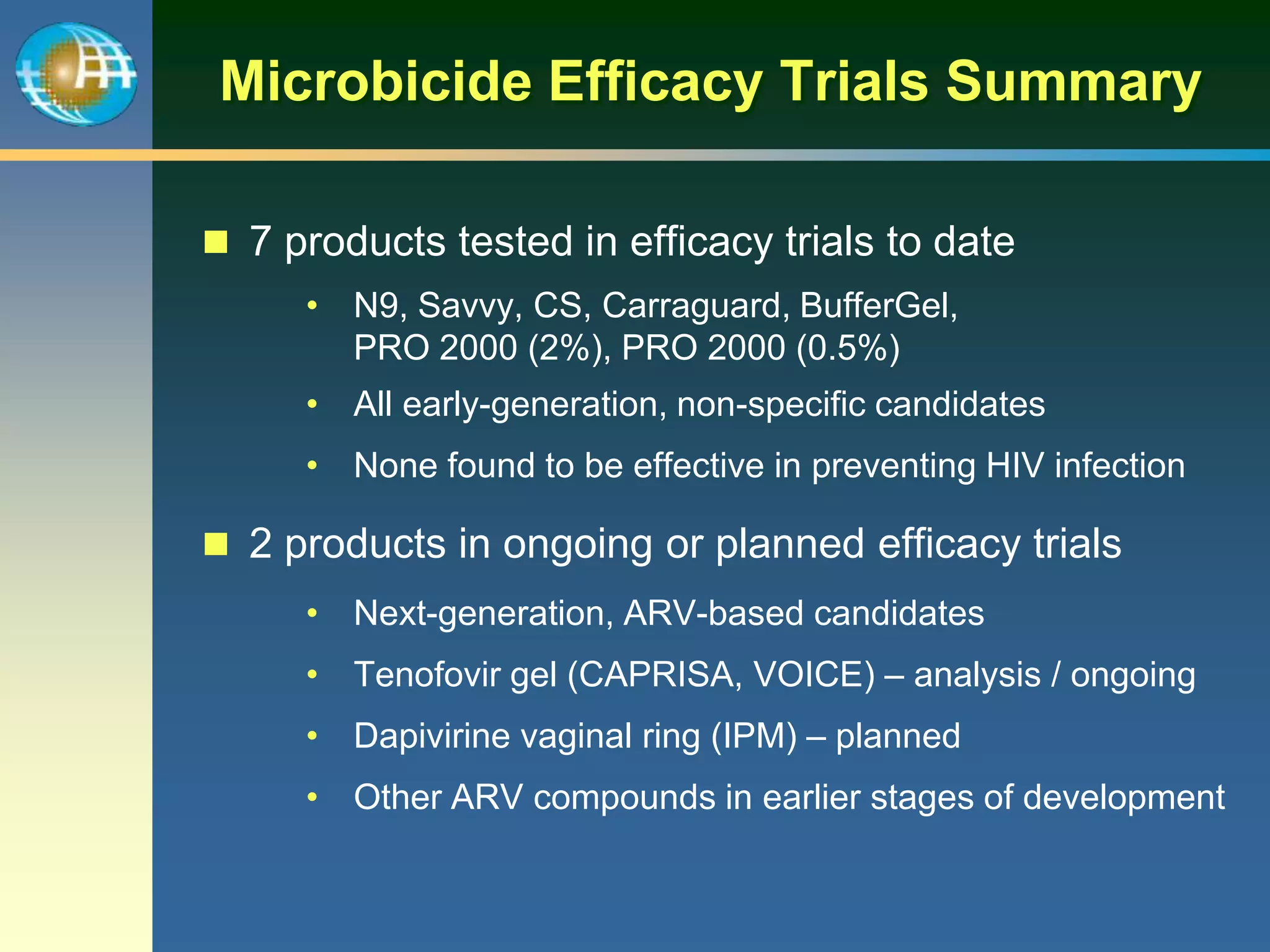
Microbicide Efficacy Trials Summary
 7 products tested in efficacy trials to date
• N9, Savvy, CS, Carraguard, BufferGel,
PRO 2000 (2%), PRO 2000 (0.5%)
• All early-generation, non-specific candidates
• None found to be effective in preventing HIV infection
 2 products in ongoing or planned efficacy trials
• Next-generation, ARV-based candidates
• Tenofovir gel (CAPRISA, VOICE) – analysis / ongoing
• Dapivirine vaginal ring (IPM) – planned
• Other ARV compounds in earlier stages of development
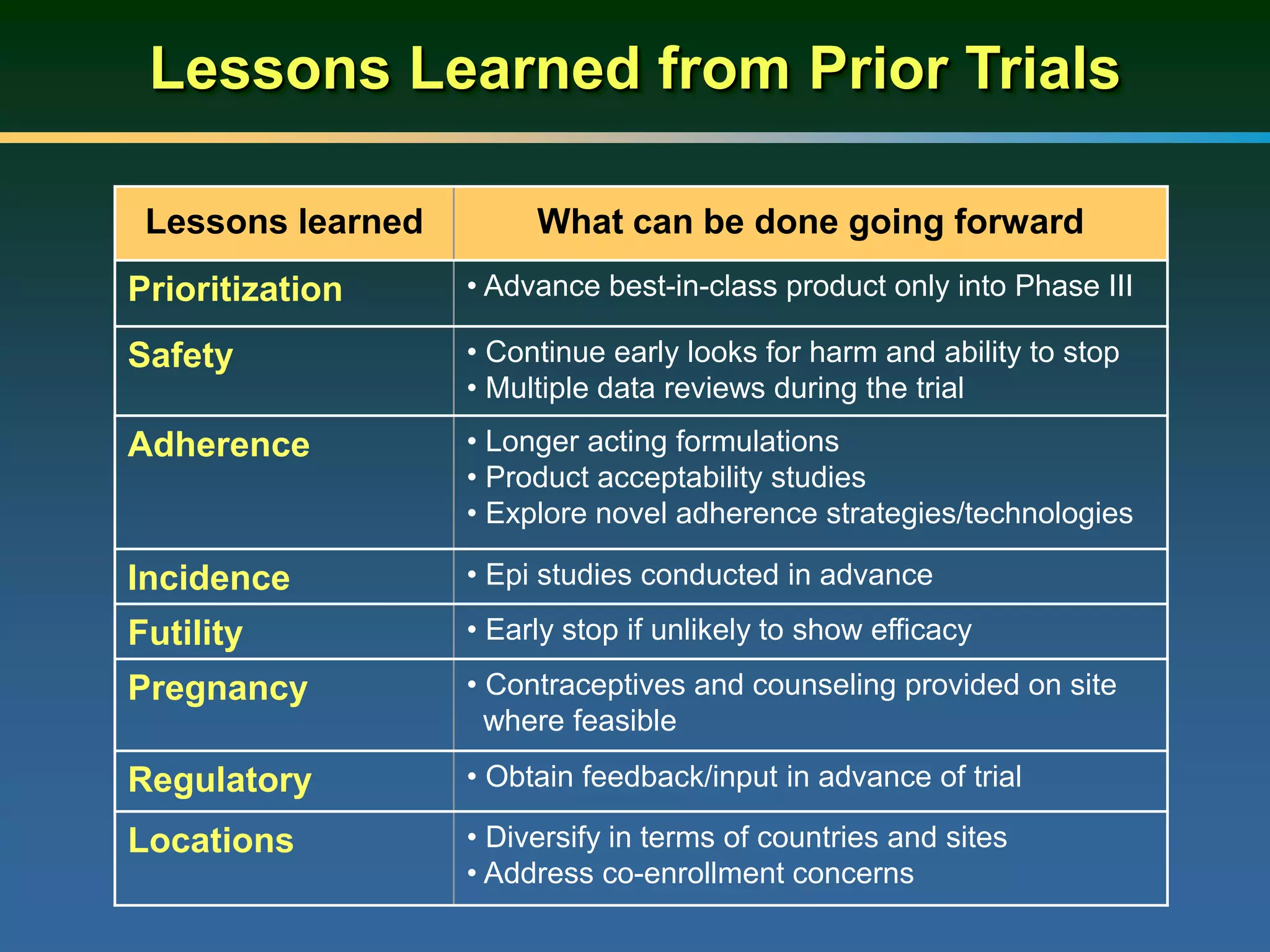
Lessons Learned from Prior Trials
Lessons learned What can be done going forward
Prioritization • Advance best-in-class product only into Phase III
Safety • Continue early looks for harm and ability to stop
• Multiple data reviews during the trial
Adherence • Longer acting formulations
• Product acceptability studies
• Explore novel adherence strategies/technologies
Incidence • Epi studies conducted in advance
Futility • Early stop if unlikely to show efficacy
Pregnancy • Contraceptives and counseling provided on site
where feasible
Regulatory • Obtain feedback/input in advance of trial
Locations • Diversify in terms of countries and sites
• Address co-enrollment concerns
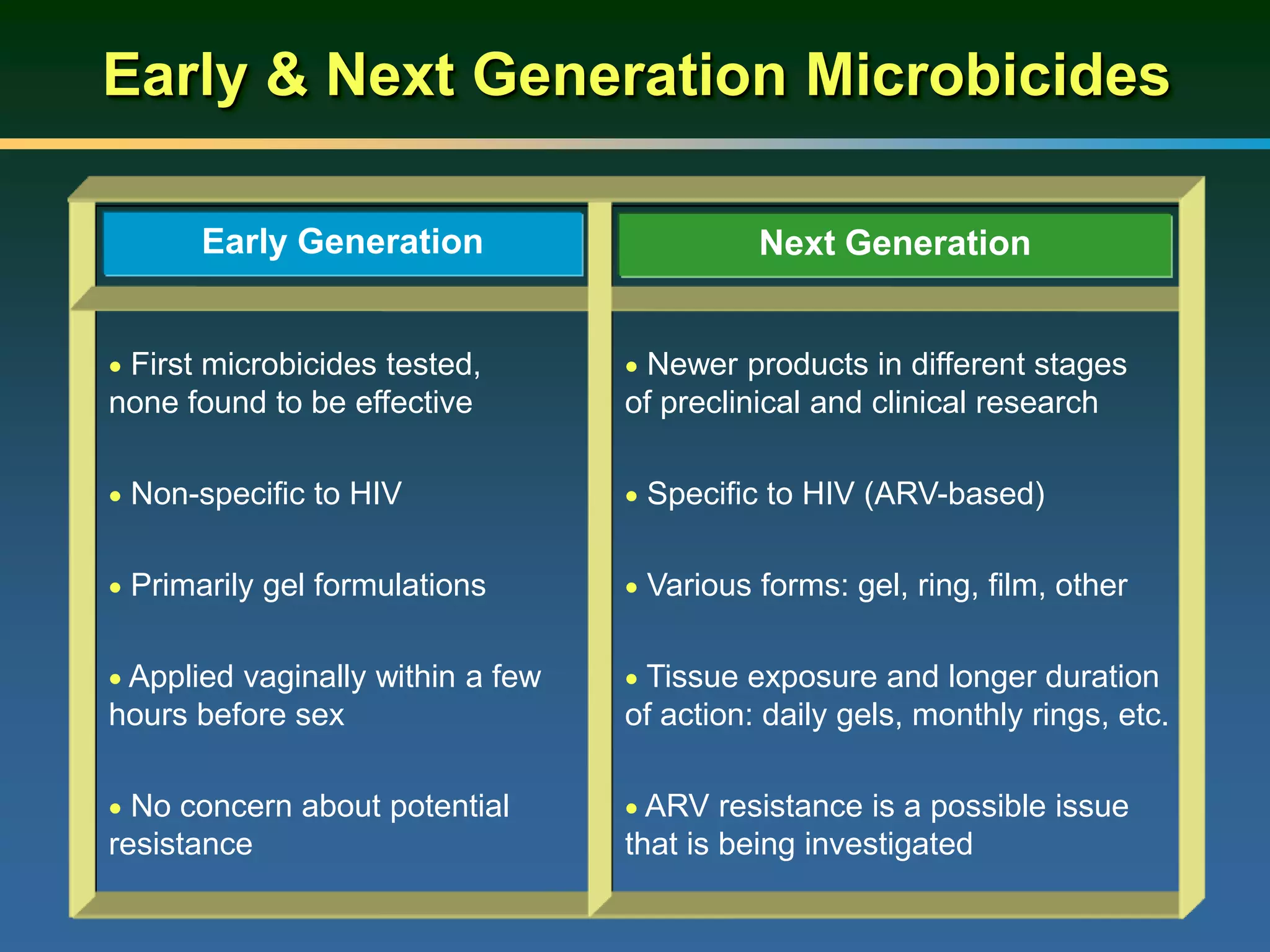
Early & Next Generation Microbicides
 Newer products in different stages
of preclinical and clinical research
 Specific to HIV (ARV-based)
 Various forms: gel, ring, film, other
 Tissue exposure and longer duration
of action: daily gels, monthly rings, etc.
 ARV resistance is a possible issue
that is being investigated
 First microbicides tested,
none found to be effective
 Non-specific to HIV
 Primarily gel formulations
 Applied vaginally within a few
hours before sex
 No concern about potential
resistance
Next GenerationEarly Generation
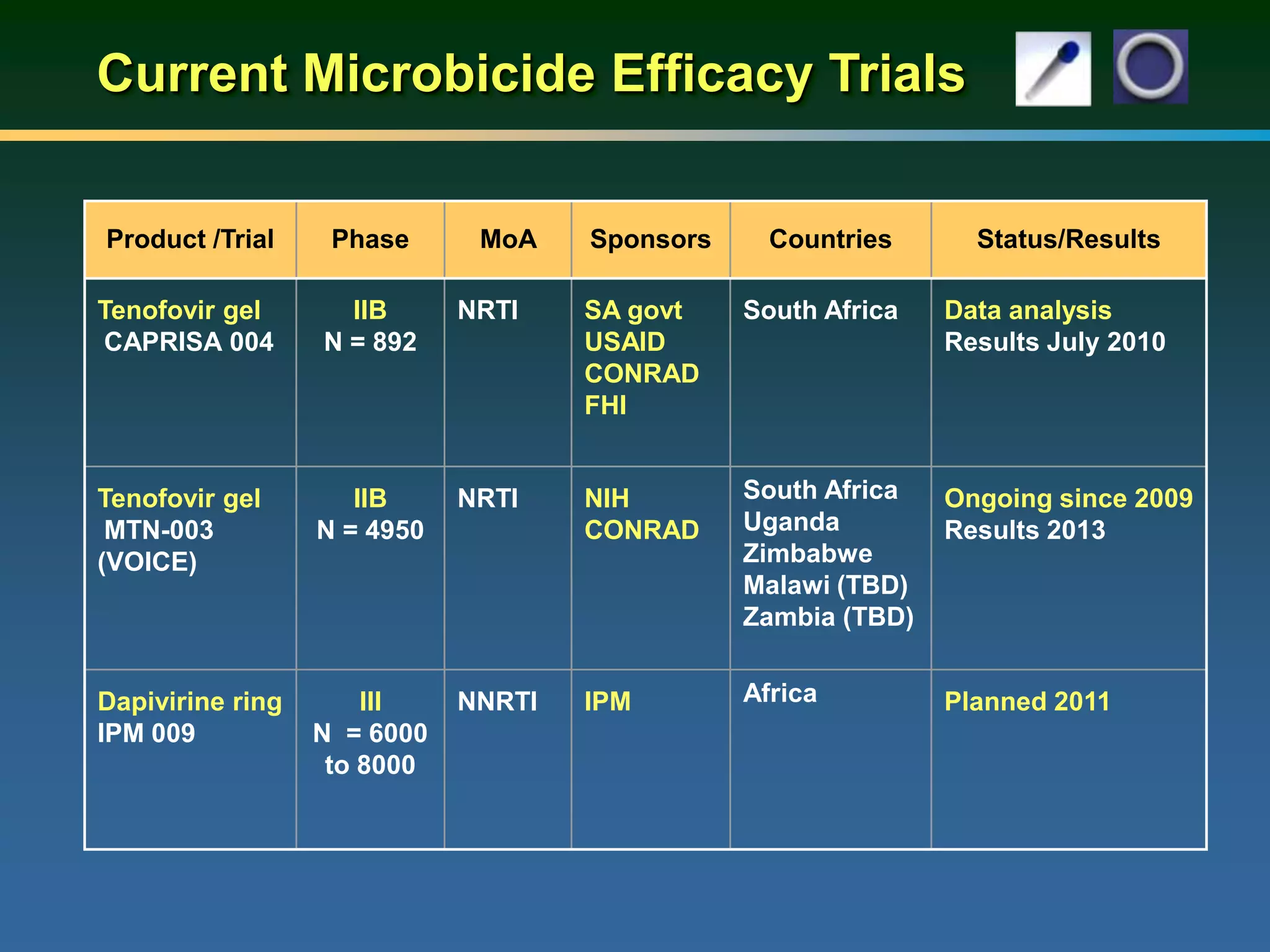
Current Microbicide Efficacy Trials
Product /Trial Phase MoA Sponsors Countries Status/Results
Tenofovir gel
CAPRISA 004
IIB
N = 892
NRTI SA govt
USAID
CONRAD
FHI
South Africa Data analysis
Results July 2010
Tenofovir gel
MTN-003
(VOICE)
IIB
N = 4950
NRTI NIH
CONRAD
South Africa
Uganda
Zimbabwe
Malawi (TBD)
Zambia (TBD)
Ongoing since 2009
Results 2013
Dapivirine ring
IPM 009
III
N = 6000
to 8000
NNRTI IPM Africa Planned 2011
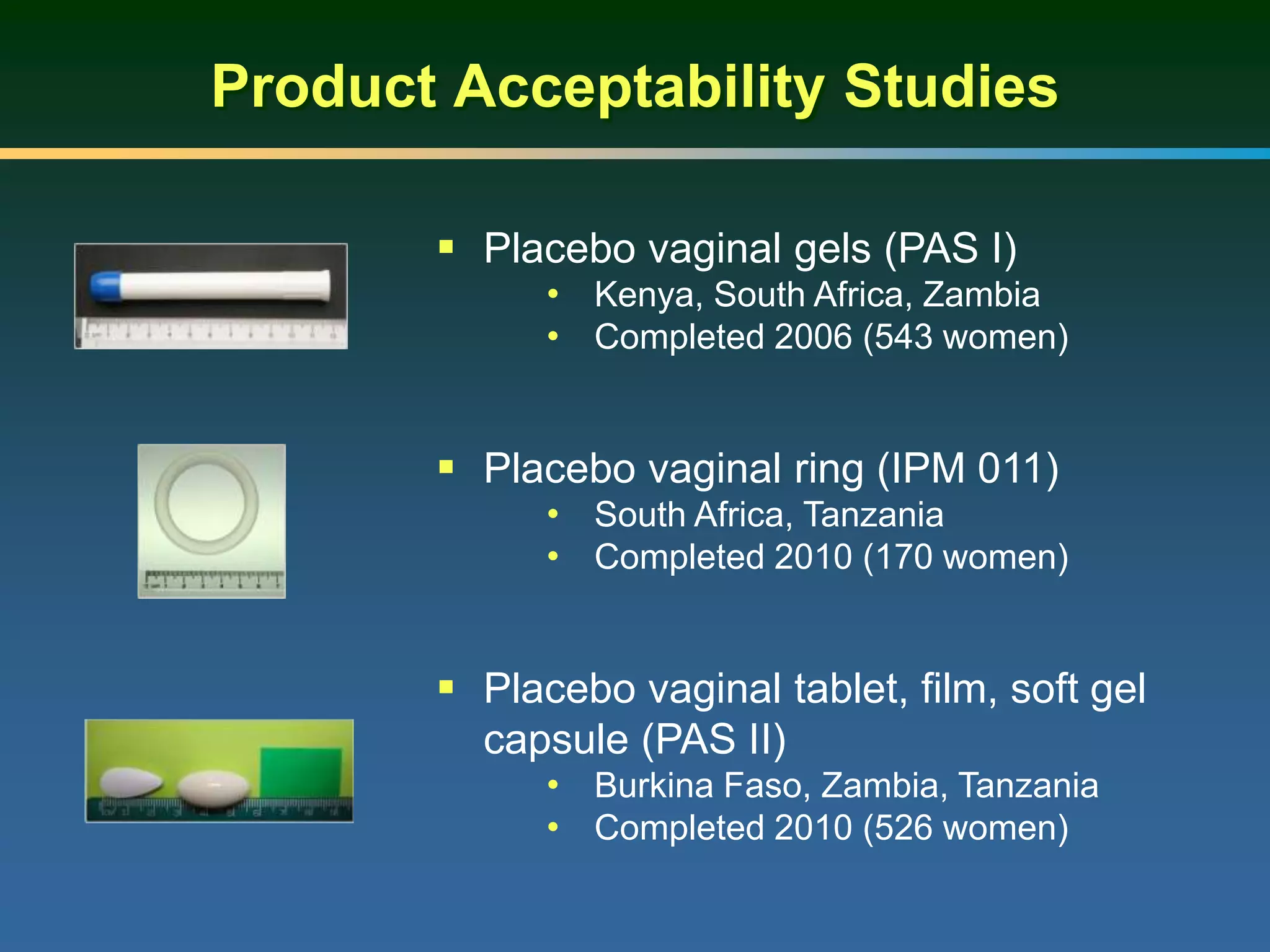
Product Acceptability Studies
 Placebo vaginal gels (PAS I)
• Kenya, South Africa, Zambia
• Completed 2006 (543 women)
 Placebo vaginal ring (IPM 011)
• South Africa, Tanzania
• Completed 2010 (170 women)
 Placebo vaginal tablet, film, soft gel
capsule (PAS II)
• Burkina Faso, Zambia, Tanzania
• Completed 2010 (526 women)
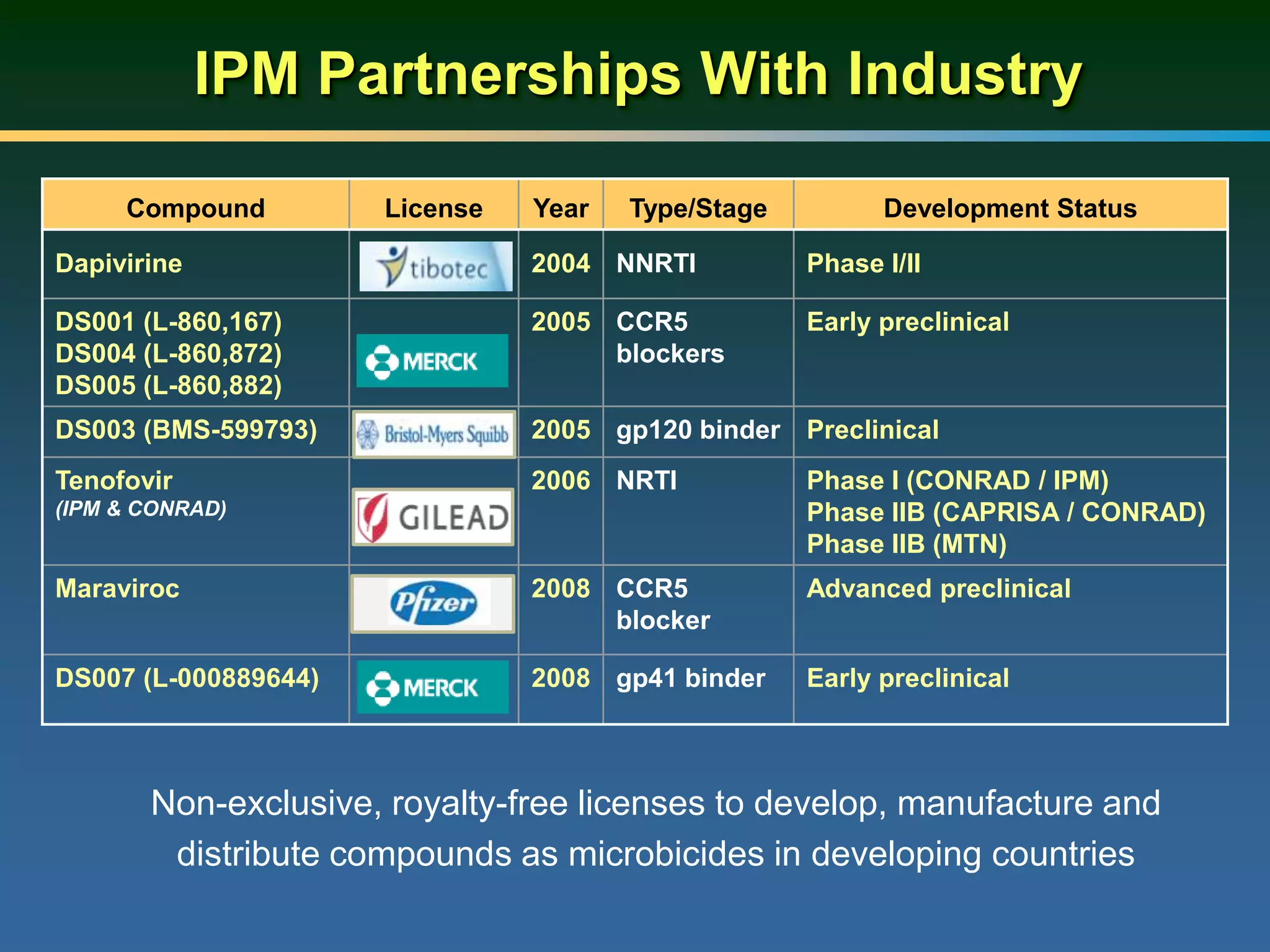
IPM Partnerships With Industry
Non-exclusive, royalty-free licenses to develop, manufacture and
distribute compounds as microbicides in developing countries
Compound License Year Type/Stage Development Status
Dapivirine Tibotec 2004 NNRTI Phase I/II
DS001 (L-860,167)
DS004 (L-860,872)
DS005 (L-860,882)
Merck
2005 CCR5
blockers
Early preclinical
DS003 (BMS-599793) BMS 2005 gp120 binder Preclinical
Tenofovir
(IPM & CONRAD) Gilead
2006 NRTI Phase I (CONRAD / IPM)
Phase IIB (CAPRISA / CONRAD)
Phase IIB (MTN)
Maraviroc Pfizer 2008 CCR5
blocker
Advanced preclinical
DS007 (L-000889644) Merck 2008 gp41 binder Early preclinical
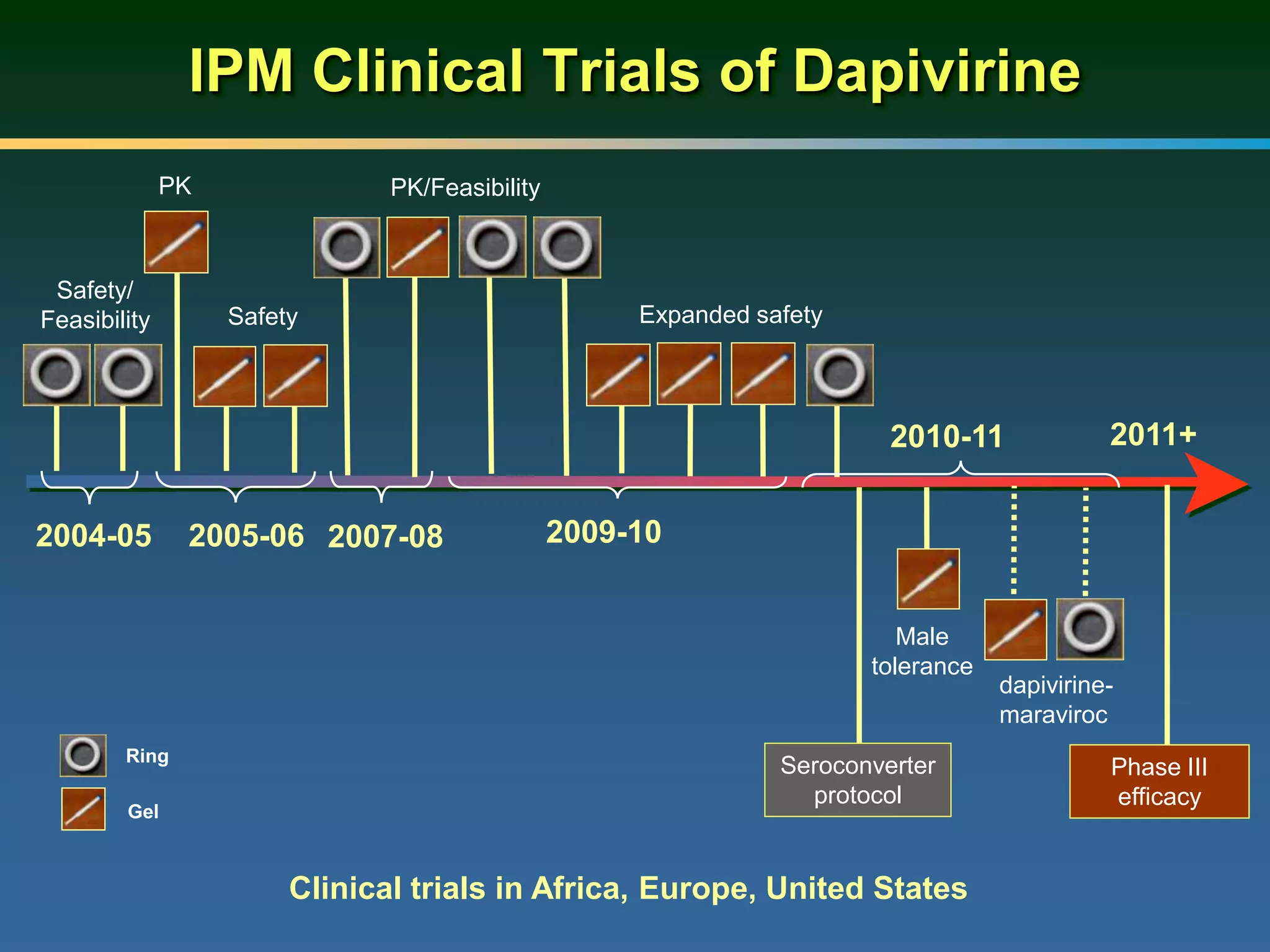
IPM Clinical Trials of Dapivirine
Clinical trials in Africa, Europe, United States
2004-05
Safety/
Feasibility
2007-08
PK
Safety
PK/Feasibility
Male
tolerance
2009-102005-06
Phase III
efficacy
Seroconverter
protocol
2011+
Expanded safety
2010-11
dapivirine-
maraviroc
Ring
Gel
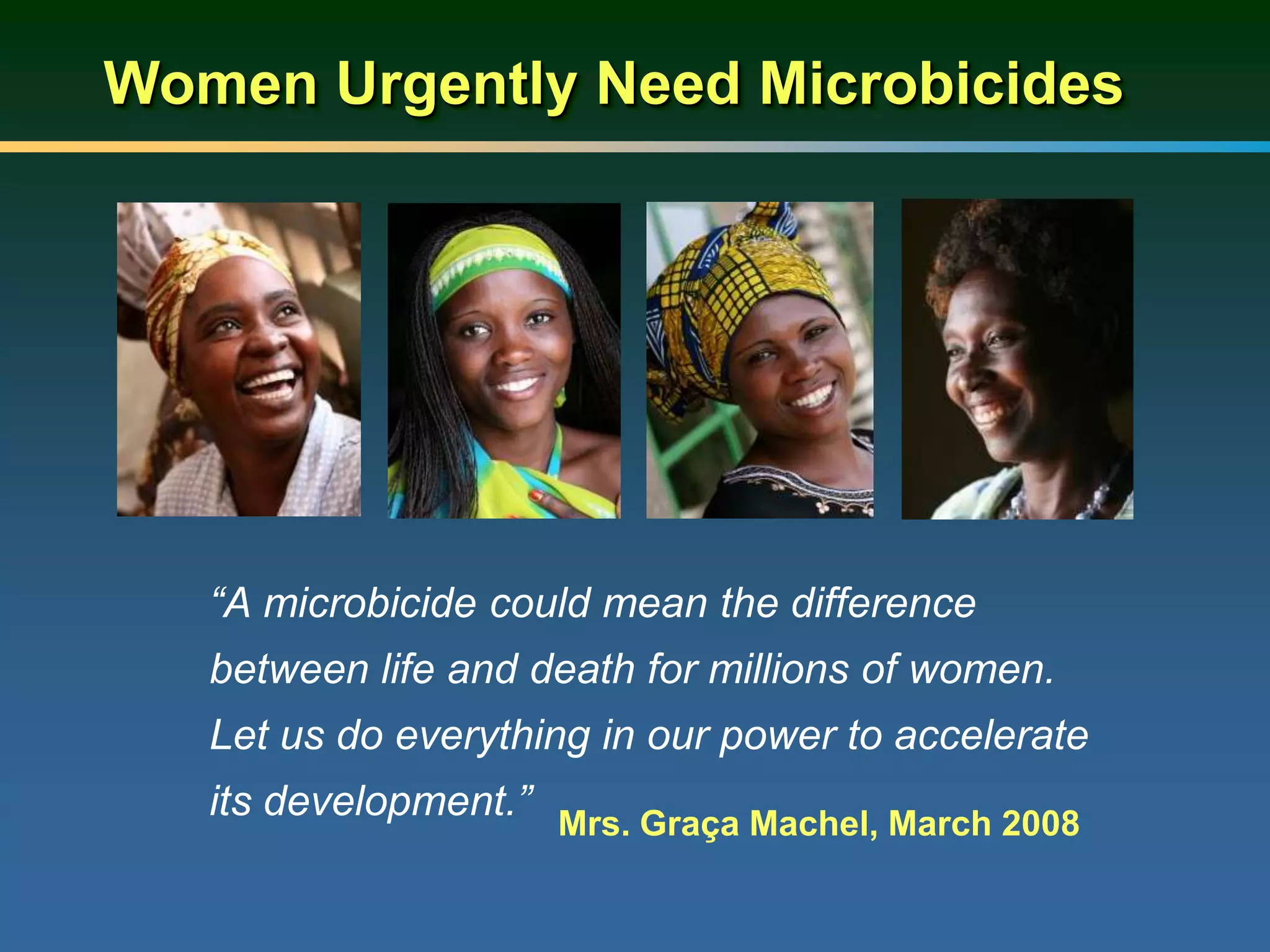
Women Urgently Need Microbicides
“A microbicide could mean the difference
between life and death for millions of women.
Let us do everything in our power to accelerate
its development.” Mrs. Graça Machel, March 2008
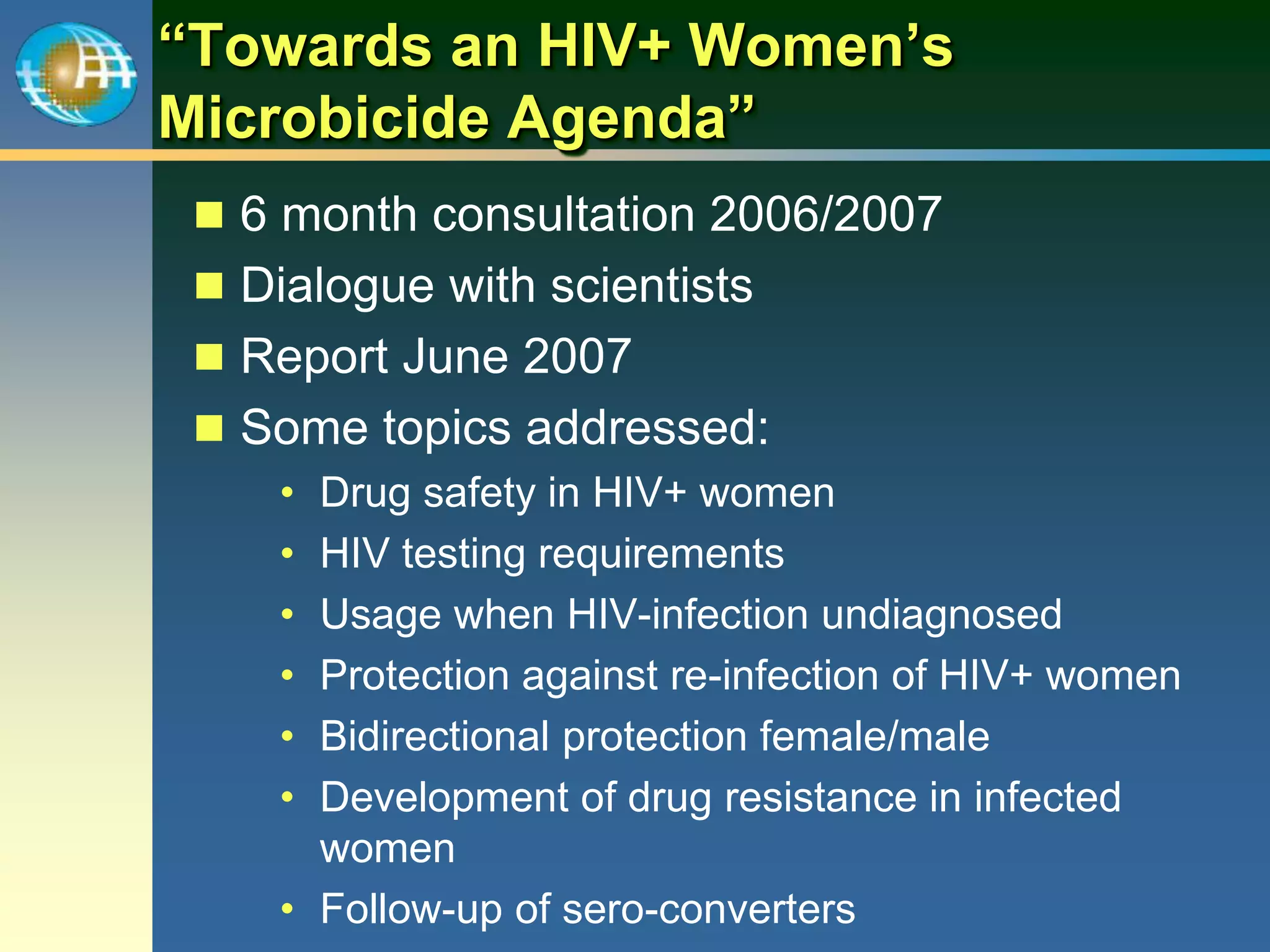
“Towards an HIV+ Women’s
Microbicide Agenda”
 6 month consultation 2006/2007
 Dialogue with scientists
 Report June 2007
 Some topics addressed:
• Drug safety in HIV+ women
• HIV testing requirements
• Usage when HIV-infection undiagnosed
• Protection against re-infection of HIV+ women
• Bidirectional protection female/male
• Development of drug resistance in infected
women
• Follow-up of sero-converters
For discussion
 What updates can be given to the
previously posed questions?
 Where do you think there are opportunities
to engage people living with HIV in the
research process and in advocacy?
Backup
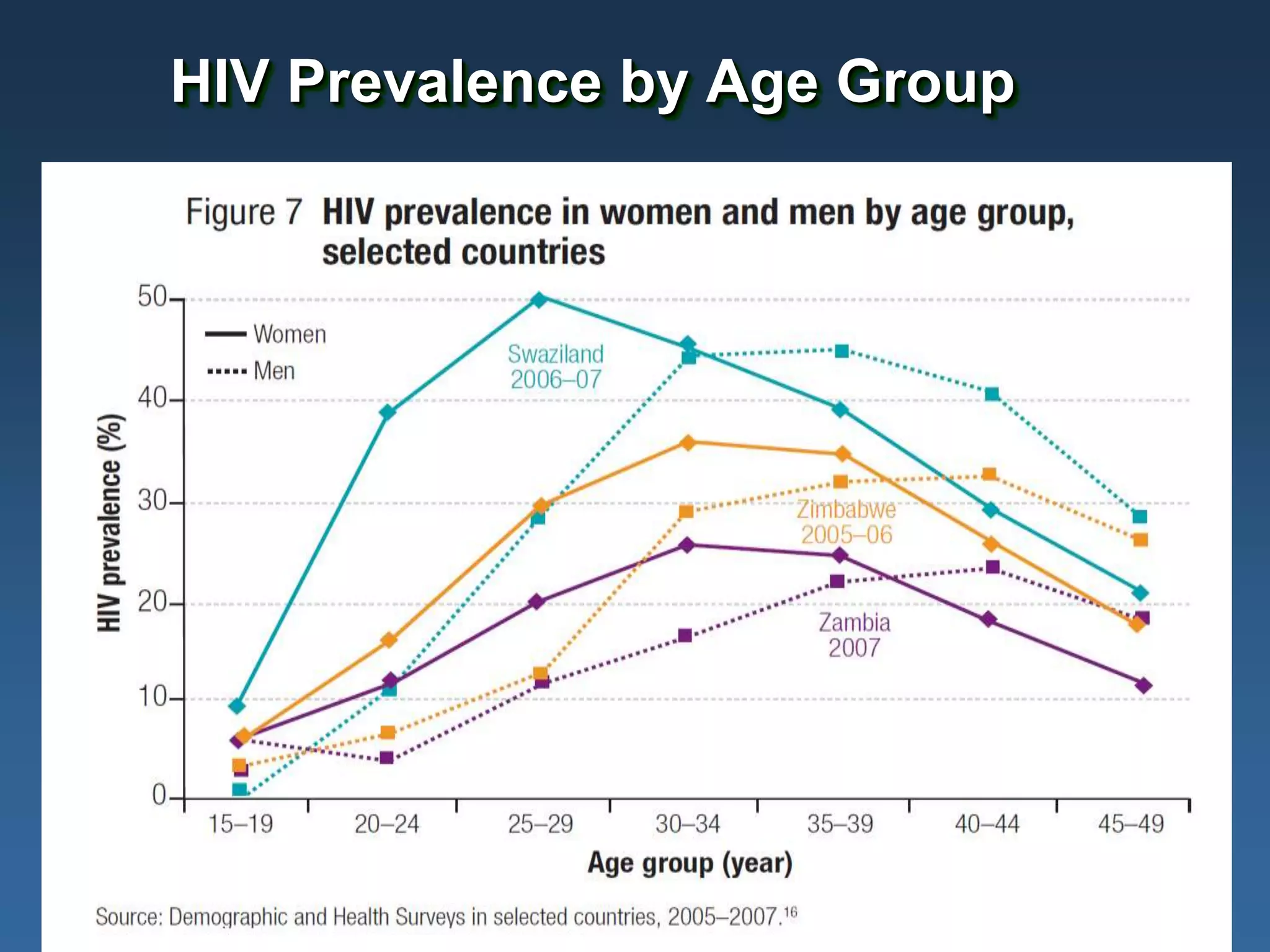
HIV Prevalence by Age Group
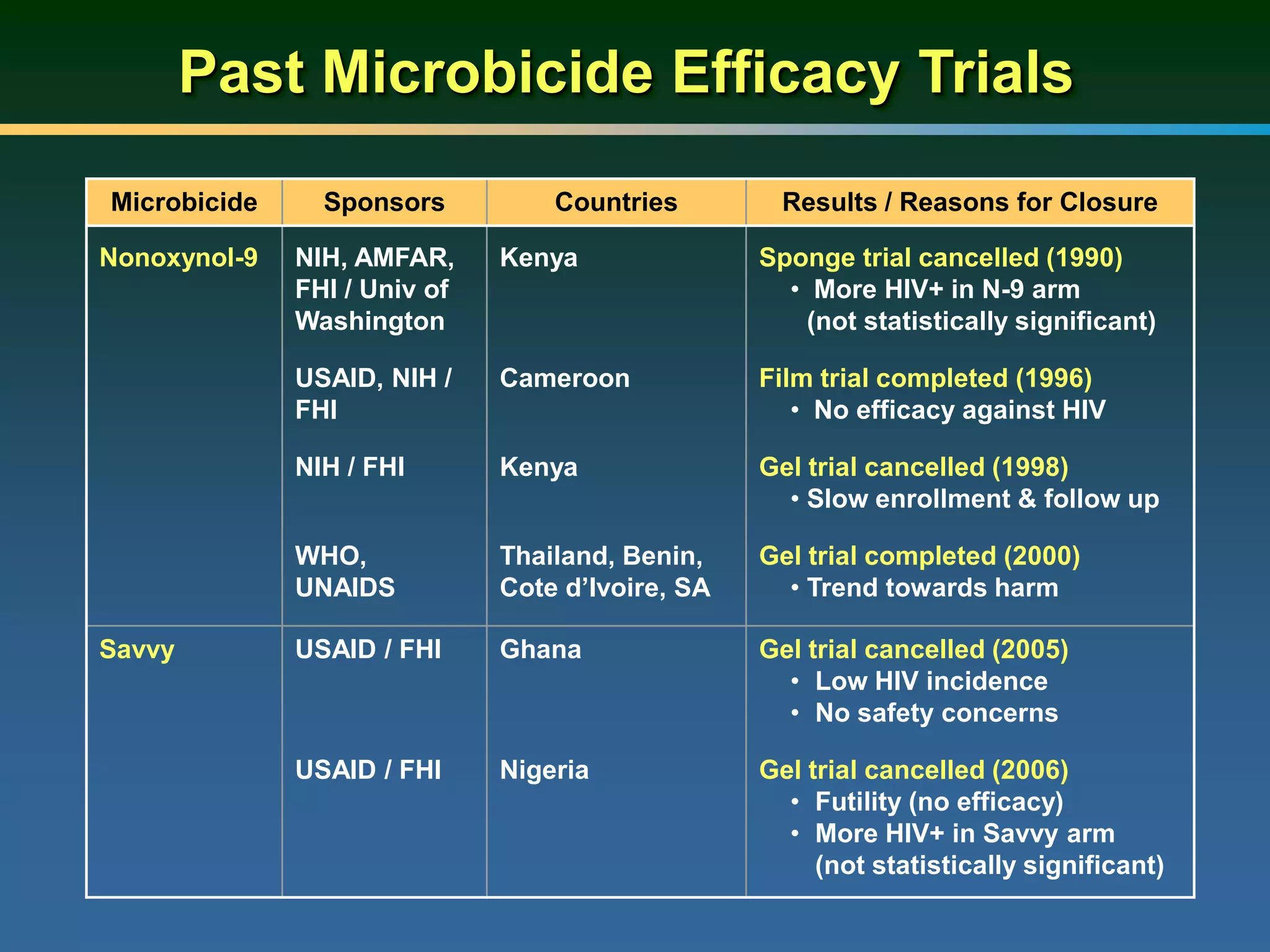
Microbicide Sponsors Countries Results / Reasons for Closure
Nonoxynol-9 NIH, AMFAR,
FHI / Univ of
Washington
USAID, NIH /
FHI
NIH / FHI
WHO,
UNAIDS
Kenya
Cameroon
Kenya
Thailand, Benin,
Cote d’Ivoire, SA
Sponge trial cancelled (1990)
• More HIV+ in N-9 arm
(not statistically significant)
Film trial completed (1996)
• No efficacy against HIV
Gel trial cancelled (1998)
• Slow enrollment & follow up
Gel trial completed (2000)
• Trend towards harm
Savvy USAID / FHI
USAID / FHI
Ghana
Nigeria
Gel trial cancelled (2005)
• Low HIV incidence
• No safety concerns
Gel trial cancelled (2006)
• Futility (no efficacy)
• More HIV+ in Savvy arm
(not statistically significant)
Past Microbicide Efficacy Trials
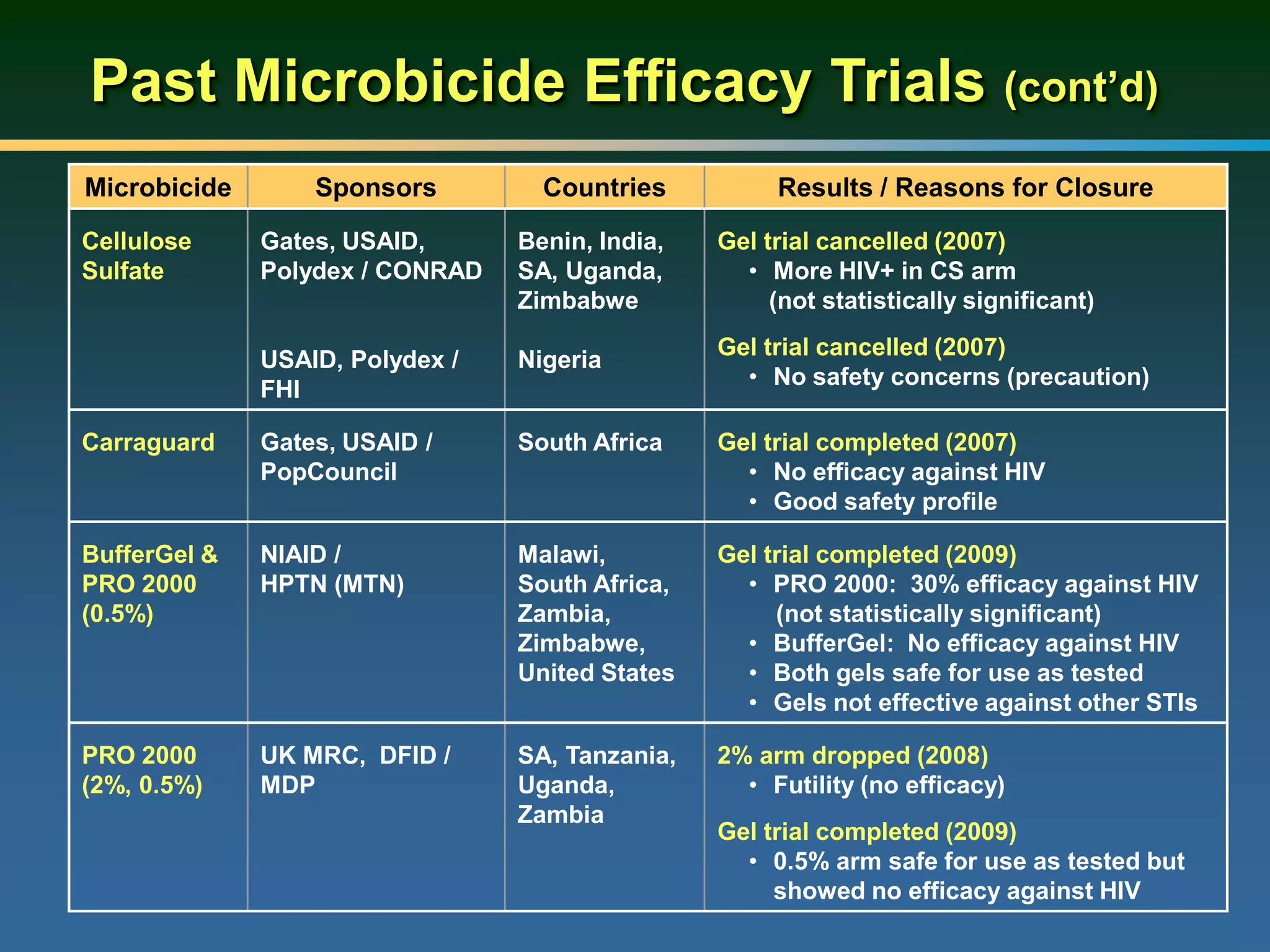
Microbicide Sponsors Countries Results / Reasons for Closure
Cellulose
Sulfate
Gates, USAID,
Polydex / CONRAD
USAID, Polydex /
FHI
Benin, India,
SA, Uganda,
Zimbabwe
Nigeria
Gel trial cancelled (2007)
• More HIV+ in CS arm
(not statistically significant)
Gel trial cancelled (2007)
• No safety concerns (precaution)
Carraguard Gates, USAID /
PopCouncil
South Africa Gel trial completed (2007)
• No efficacy against HIV
• Good safety profile
BufferGel &
PRO 2000
(0.5%)
NIAID /
HPTN (MTN)
Malawi,
South Africa,
Zambia,
Zimbabwe,
United States
Gel trial completed (2009)
• PRO 2000: 30% efficacy against HIV
(not statistically significant)
• BufferGel: No efficacy against HIV
• Both gels safe for use as tested
• Gels not effective against other STIs
PRO 2000
(2%, 0.5%)
UK MRC, DFID /
MDP
SA, Tanzania,
Uganda,
Zambia
2% arm dropped (2008)
• Futility (no efficacy)
Gel trial completed (2009)
• 0.5% arm safe for use as tested but
showed no efficacy against HIV
Past Microbicide Efficacy Trials (cont’d)
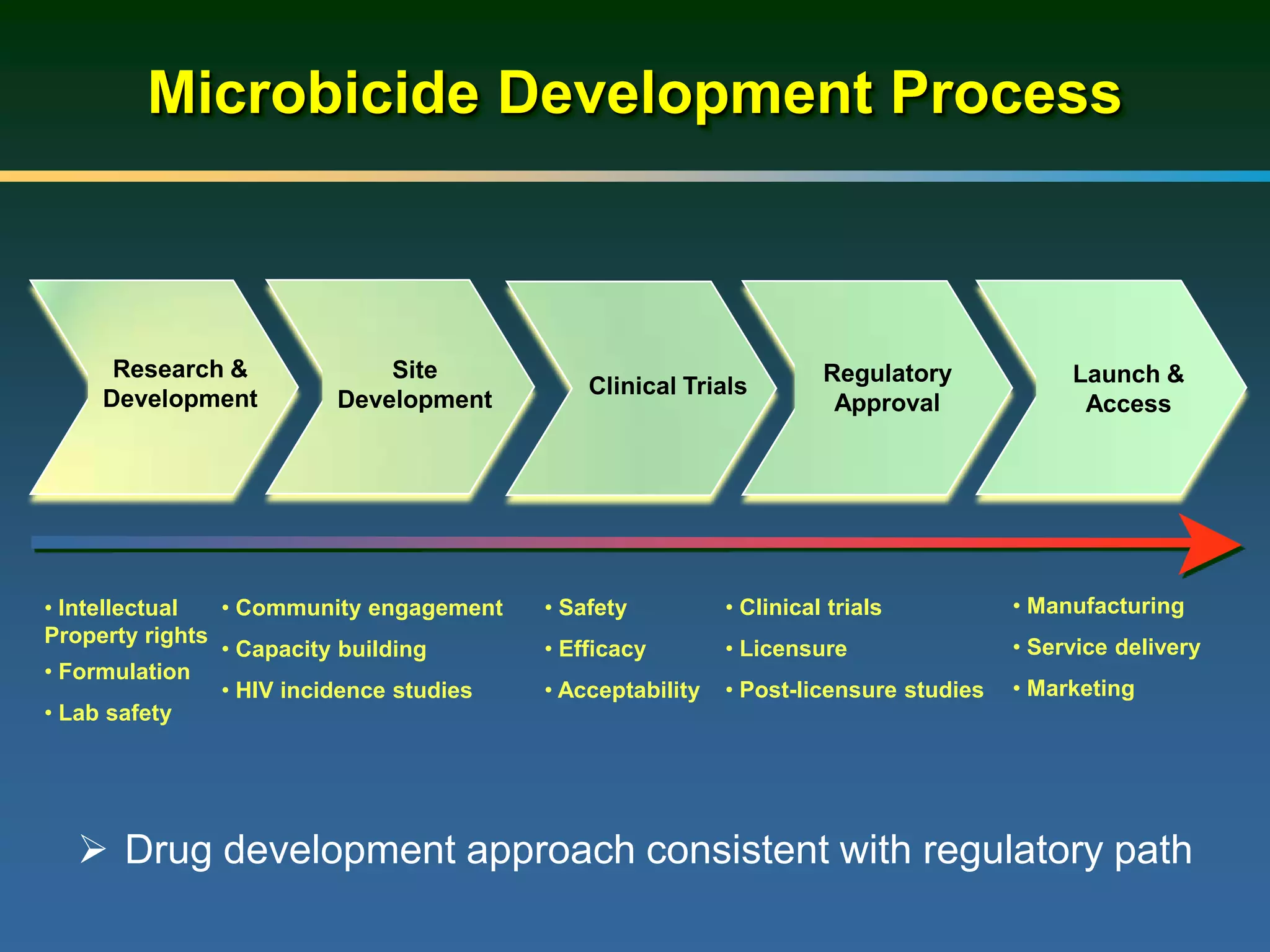
Microbicide Development Process
• Intellectual
Property rights
• Formulation
• Lab safety
• Community engagement
• Capacity building
• HIV incidence studies
• Safety
• Efficacy
• Acceptability
• Clinical trials
• Licensure
• Post-licensure studies
• Manufacturing
• Service delivery
• Marketing
Research &
Development
Site
Development
Clinical Trials
Regulatory
Approval
Launch &
Access
 Drug development approach consistent with regulatory path
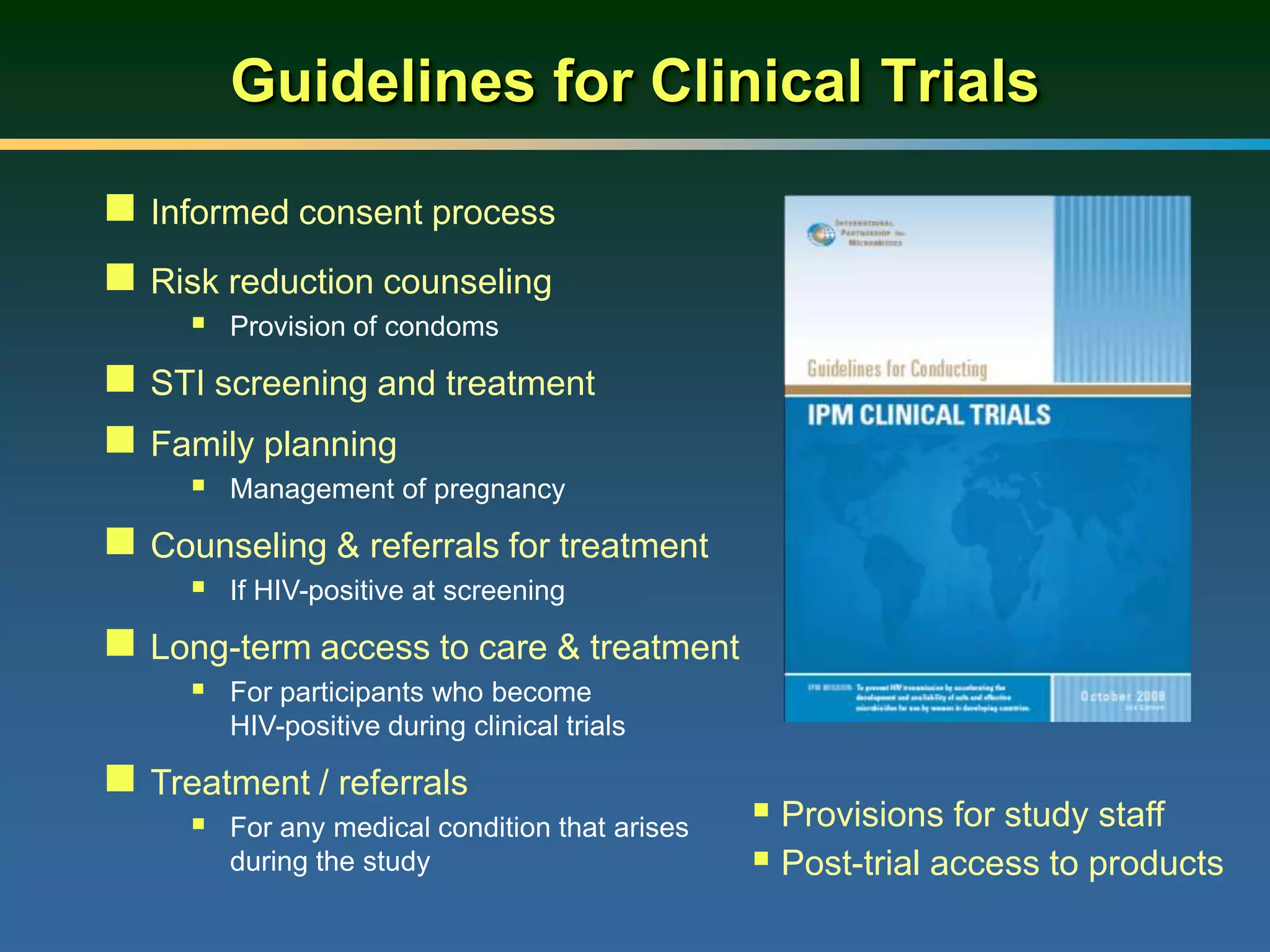
Guidelines for Clinical Trials
 Informed consent process
 Risk reduction counseling
 Provision of condoms
 STI screening and treatment
 Family planning
 Management of pregnancy
 Counseling & referrals for treatment
 If HIV-positive at screening
 Long-term access to care & treatment
 For participants who become
HIV-positive during clinical trials
 Treatment / referrals
 For any medical condition that arises
during the study
 Provisions for study staff
 Post-trial access to products
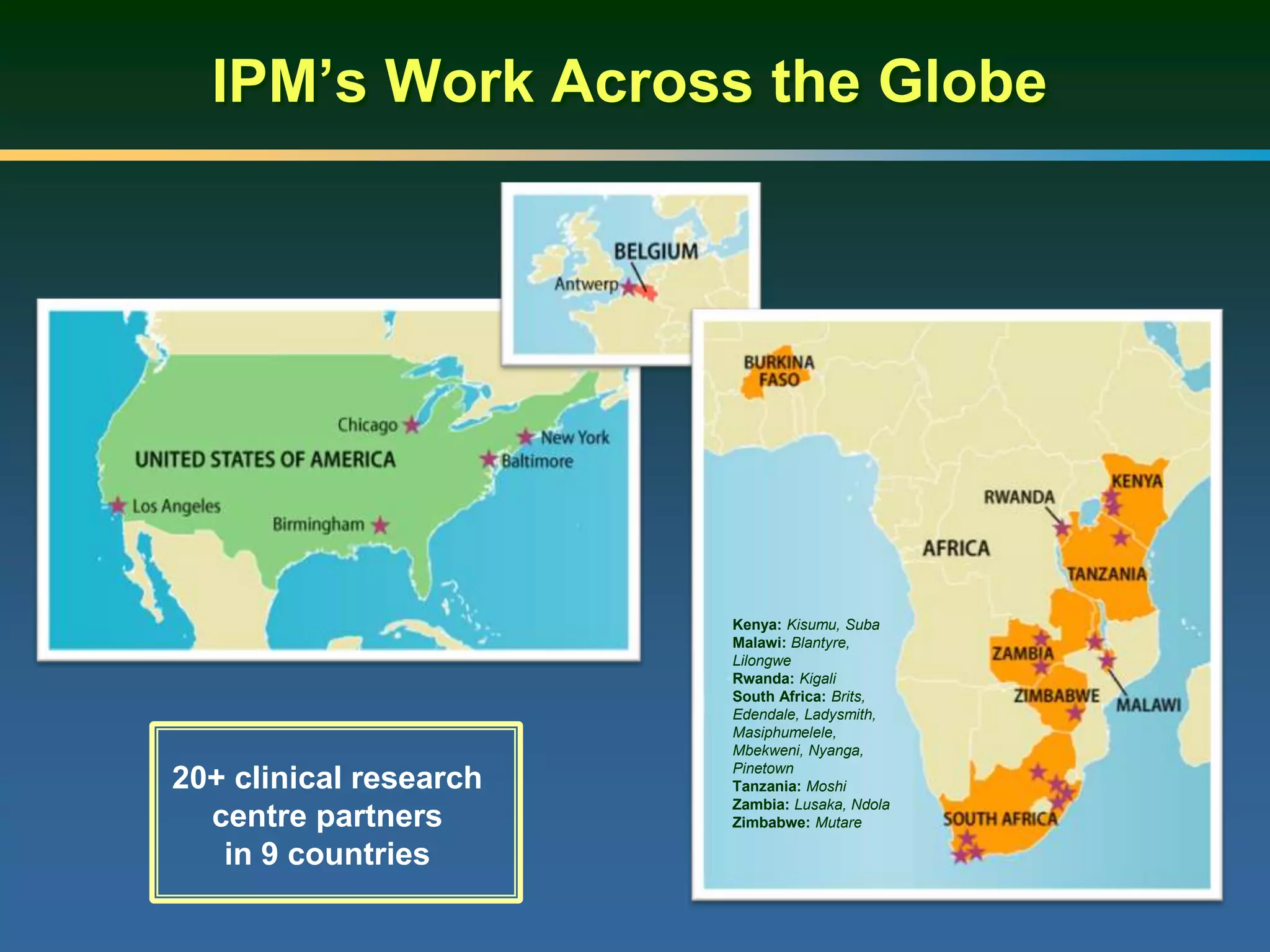
IPM’s Work Across the Globe
20+ clinical research
centre partners
in 9 countries
Kenya: Kisumu, Suba
Malawi: Blantyre,
Lilongwe
Rwanda: Kigali
South Africa: Brits,
Edendale, Ladysmith,
Masiphumelele,
Mbekweni, Nyanga,
Pinetown
Tanzania: Moshi
Zambia: Lusaka, Ndola
Zimbabwe: Mutare
IPM Donors
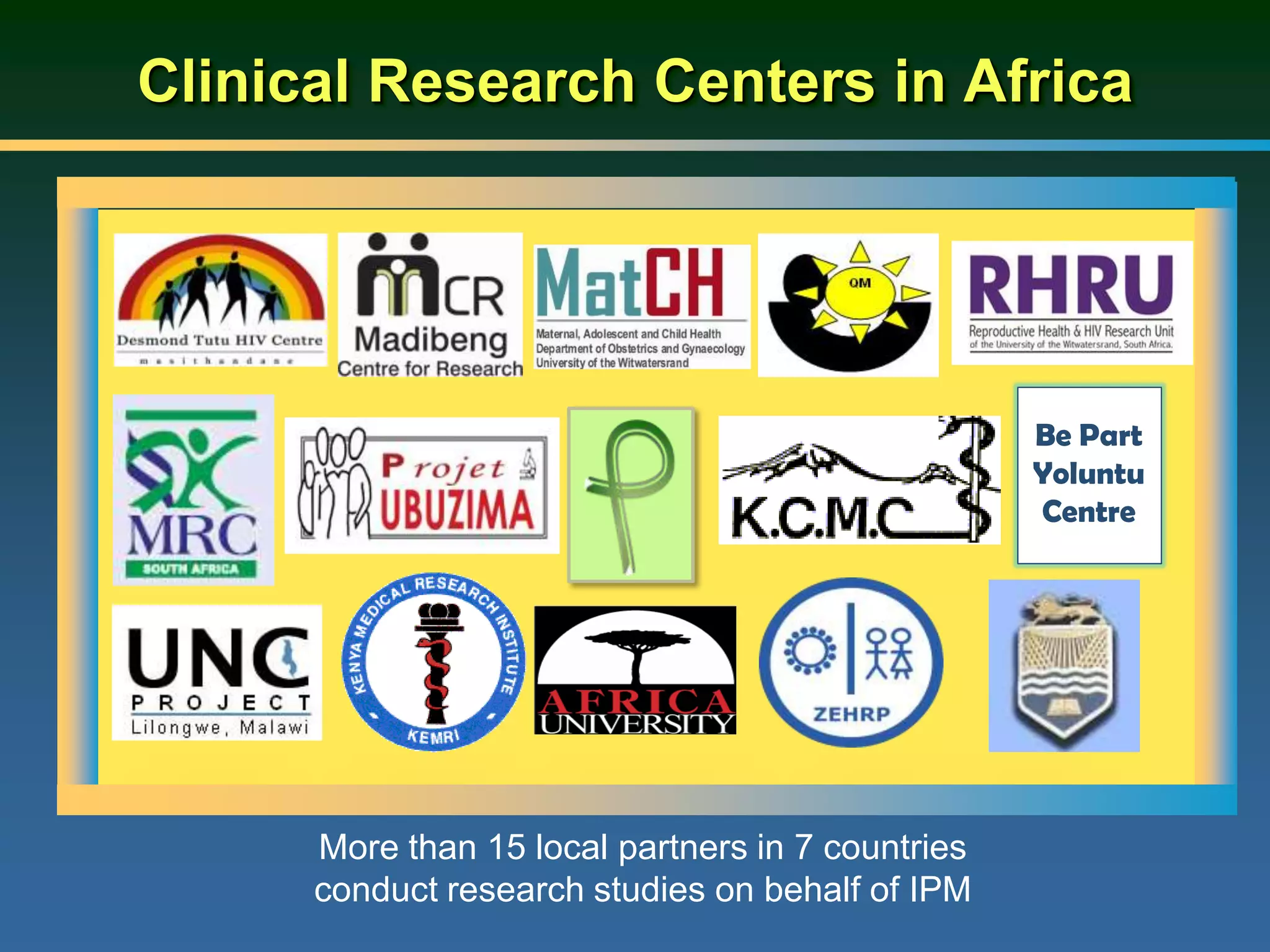
Clinical Research Centers in Africa
More than 15 local partners in 7 countries
conduct research studies on behalf of IPM
Be Part
Yoluntu
Centre
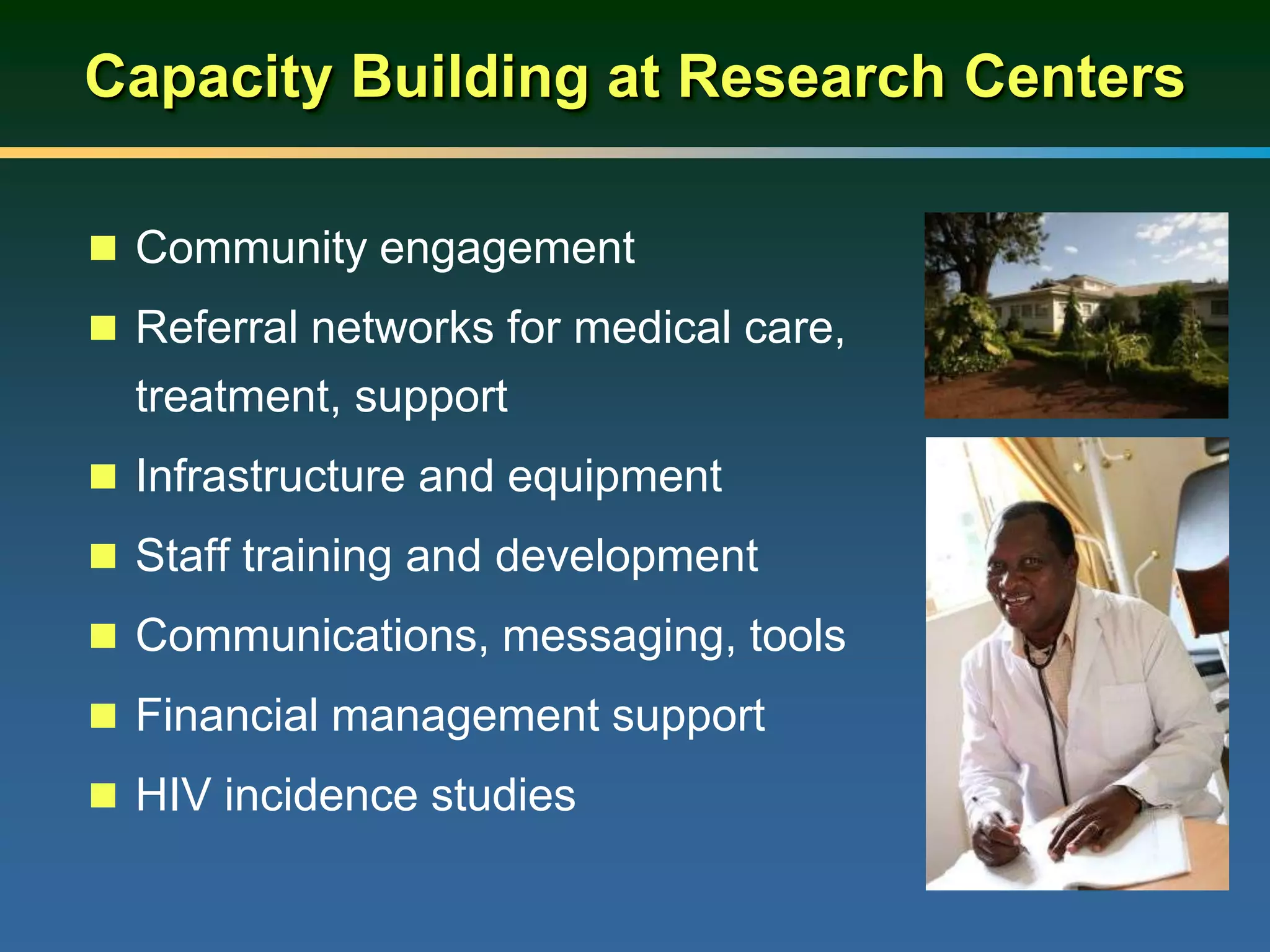
Capacity Building at Research Centers
 Community engagement
 Referral networks for medical care,
treatment, support
 Infrastructure and equipment
 Staff training and development
 Communications, messaging, tools
 Financial management support
 HIV incidence studies

The state of arv based microbicides research, 2010

  • 1.
    International Partnership forMicrobicides Advancing HIV Prevention Options for Women GNP+ Consultation on NPTs Thomas Mertenskoetter 5. – 6. July 2010, Amsterdam
  • 2.
    Leading Causes ofDeath in Women (Age 15 – 44)
  • 3.
    Existing and Potential Interventionsin HIV Prevention  Male and female condoms  Prevention of mother-to-child transmission  Male circumcision (protection for men)  Post-exposure ARV pills (healthcare workers)  HIV vaccines  Pre-exposure Prophylaxis (PrEP)  Microbicides  Treatment as prevention Male condoms Female condom
  • 4.
    ARV-based Methods forTreatment and Prevention of HIV/AIDS Treatment PMTCT PEP PrEP Microbicides Drugs used 25+ approved ARVs Nevirapine, AZT and 3TC Multiple ARVs tenofovir, Truvada, TMC278 LA tenofovir, dapivirine, UC-781, maraviroc.. Drug regimen Combinations (triple drug) 2 drugs (WHO) 2 or 3 drugs Single or dual drug Single drugs or combinations Delivery formulation Oral pill, injection Oral pill, dropper Oral pill Oral pill, injection Vaginal & rectal gels, vaginal rings & films Frequency of use At least daily 28 wks before to 7 days post Daily for 4 weeks Daily, intermittent or monthly Around time of sex, daily, or monthly Resistance potential If inadequate suppression of replication Frequent with NVR but little impact > 6 mths Depends on regimen, adherence No data, under research No data, under research Existing ARV options in use Currently being researched Source: MMCI / MTN / GCM / IPM
  • 5.
    Results to datefrom HIV prevention trials  37 efficacy trials conducted between 1987-2009  39 interventions tested in these trials: Microbicides: 12 Male circumcision: 4 Vaccines: 4 STI treatment: 9 PrEP : 1 Behavioral: 7 Diaphragm: 1 Microfinance: 1  Only 5 trials of 3 interventions showed a protective effect on HIV incidence in over 2 decades of research Padian NS, et al. Weighing the gold in the gold standard challenges in HIV prevention research. AIDS 2010
  • 6.
    What are Microbicides? Topical products to prevent HIV transmission to women  Could be delivered in many forms:  Ideally safe, effective, low cost, user friendly Gel applicator Ring Tablet, capsule, film
  • 7.
    The Case forMicrobicides  Vaginal dosing establishes high drug levels where virus enters body  Topical dosing causes low systemic exposure • Reduced chance of systemic side effects • Theoretically, less chance of selection of resistance  Precedent for vaginal dosing in contraception and treatment of infections  No one prevention option will satisfy all • Microbicides, PrEP, vaccines, etc.
  • 8.
    Microbicide Efficacy TrialsSummary  7 products tested in efficacy trials to date • N9, Savvy, CS, Carraguard, BufferGel, PRO 2000 (2%), PRO 2000 (0.5%) • All early-generation, non-specific candidates • None found to be effective in preventing HIV infection  2 products in ongoing or planned efficacy trials • Next-generation, ARV-based candidates • Tenofovir gel (CAPRISA, VOICE) – analysis / ongoing • Dapivirine vaginal ring (IPM) – planned • Other ARV compounds in earlier stages of development
  • 9.
    Lessons Learned fromPrior Trials Lessons learned What can be done going forward Prioritization • Advance best-in-class product only into Phase III Safety • Continue early looks for harm and ability to stop • Multiple data reviews during the trial Adherence • Longer acting formulations • Product acceptability studies • Explore novel adherence strategies/technologies Incidence • Epi studies conducted in advance Futility • Early stop if unlikely to show efficacy Pregnancy • Contraceptives and counseling provided on site where feasible Regulatory • Obtain feedback/input in advance of trial Locations • Diversify in terms of countries and sites • Address co-enrollment concerns
  • 10.
    Early & NextGeneration Microbicides  Newer products in different stages of preclinical and clinical research  Specific to HIV (ARV-based)  Various forms: gel, ring, film, other  Tissue exposure and longer duration of action: daily gels, monthly rings, etc.  ARV resistance is a possible issue that is being investigated  First microbicides tested, none found to be effective  Non-specific to HIV  Primarily gel formulations  Applied vaginally within a few hours before sex  No concern about potential resistance Next GenerationEarly Generation
  • 11.
    Current Microbicide EfficacyTrials Product /Trial Phase MoA Sponsors Countries Status/Results Tenofovir gel CAPRISA 004 IIB N = 892 NRTI SA govt USAID CONRAD FHI South Africa Data analysis Results July 2010 Tenofovir gel MTN-003 (VOICE) IIB N = 4950 NRTI NIH CONRAD South Africa Uganda Zimbabwe Malawi (TBD) Zambia (TBD) Ongoing since 2009 Results 2013 Dapivirine ring IPM 009 III N = 6000 to 8000 NNRTI IPM Africa Planned 2011
  • 12.
    Product Acceptability Studies Placebo vaginal gels (PAS I) • Kenya, South Africa, Zambia • Completed 2006 (543 women)  Placebo vaginal ring (IPM 011) • South Africa, Tanzania • Completed 2010 (170 women)  Placebo vaginal tablet, film, soft gel capsule (PAS II) • Burkina Faso, Zambia, Tanzania • Completed 2010 (526 women)
  • 13.
    IPM Partnerships WithIndustry Non-exclusive, royalty-free licenses to develop, manufacture and distribute compounds as microbicides in developing countries Compound License Year Type/Stage Development Status Dapivirine Tibotec 2004 NNRTI Phase I/II DS001 (L-860,167) DS004 (L-860,872) DS005 (L-860,882) Merck 2005 CCR5 blockers Early preclinical DS003 (BMS-599793) BMS 2005 gp120 binder Preclinical Tenofovir (IPM & CONRAD) Gilead 2006 NRTI Phase I (CONRAD / IPM) Phase IIB (CAPRISA / CONRAD) Phase IIB (MTN) Maraviroc Pfizer 2008 CCR5 blocker Advanced preclinical DS007 (L-000889644) Merck 2008 gp41 binder Early preclinical
  • 14.
    IPM Clinical Trialsof Dapivirine Clinical trials in Africa, Europe, United States 2004-05 Safety/ Feasibility 2007-08 PK Safety PK/Feasibility Male tolerance 2009-102005-06 Phase III efficacy Seroconverter protocol 2011+ Expanded safety 2010-11 dapivirine- maraviroc Ring Gel
  • 15.
    Women Urgently NeedMicrobicides “A microbicide could mean the difference between life and death for millions of women. Let us do everything in our power to accelerate its development.” Mrs. Graça Machel, March 2008
  • 16.
    “Towards an HIV+Women’s Microbicide Agenda”  6 month consultation 2006/2007  Dialogue with scientists  Report June 2007  Some topics addressed: • Drug safety in HIV+ women • HIV testing requirements • Usage when HIV-infection undiagnosed • Protection against re-infection of HIV+ women • Bidirectional protection female/male • Development of drug resistance in infected women • Follow-up of sero-converters
  • 17.
    For discussion  Whatupdates can be given to the previously posed questions?  Where do you think there are opportunities to engage people living with HIV in the research process and in advocacy?
  • 18.
  • 19.
  • 20.
    Microbicide Sponsors CountriesResults / Reasons for Closure Nonoxynol-9 NIH, AMFAR, FHI / Univ of Washington USAID, NIH / FHI NIH / FHI WHO, UNAIDS Kenya Cameroon Kenya Thailand, Benin, Cote d’Ivoire, SA Sponge trial cancelled (1990) • More HIV+ in N-9 arm (not statistically significant) Film trial completed (1996) • No efficacy against HIV Gel trial cancelled (1998) • Slow enrollment & follow up Gel trial completed (2000) • Trend towards harm Savvy USAID / FHI USAID / FHI Ghana Nigeria Gel trial cancelled (2005) • Low HIV incidence • No safety concerns Gel trial cancelled (2006) • Futility (no efficacy) • More HIV+ in Savvy arm (not statistically significant) Past Microbicide Efficacy Trials
  • 21.
    Microbicide Sponsors CountriesResults / Reasons for Closure Cellulose Sulfate Gates, USAID, Polydex / CONRAD USAID, Polydex / FHI Benin, India, SA, Uganda, Zimbabwe Nigeria Gel trial cancelled (2007) • More HIV+ in CS arm (not statistically significant) Gel trial cancelled (2007) • No safety concerns (precaution) Carraguard Gates, USAID / PopCouncil South Africa Gel trial completed (2007) • No efficacy against HIV • Good safety profile BufferGel & PRO 2000 (0.5%) NIAID / HPTN (MTN) Malawi, South Africa, Zambia, Zimbabwe, United States Gel trial completed (2009) • PRO 2000: 30% efficacy against HIV (not statistically significant) • BufferGel: No efficacy against HIV • Both gels safe for use as tested • Gels not effective against other STIs PRO 2000 (2%, 0.5%) UK MRC, DFID / MDP SA, Tanzania, Uganda, Zambia 2% arm dropped (2008) • Futility (no efficacy) Gel trial completed (2009) • 0.5% arm safe for use as tested but showed no efficacy against HIV Past Microbicide Efficacy Trials (cont’d)
  • 22.
    Microbicide Development Process •Intellectual Property rights • Formulation • Lab safety • Community engagement • Capacity building • HIV incidence studies • Safety • Efficacy • Acceptability • Clinical trials • Licensure • Post-licensure studies • Manufacturing • Service delivery • Marketing Research & Development Site Development Clinical Trials Regulatory Approval Launch & Access  Drug development approach consistent with regulatory path
  • 23.
    Guidelines for ClinicalTrials  Informed consent process  Risk reduction counseling  Provision of condoms  STI screening and treatment  Family planning  Management of pregnancy  Counseling & referrals for treatment  If HIV-positive at screening  Long-term access to care & treatment  For participants who become HIV-positive during clinical trials  Treatment / referrals  For any medical condition that arises during the study  Provisions for study staff  Post-trial access to products
  • 24.
    IPM’s Work Acrossthe Globe 20+ clinical research centre partners in 9 countries Kenya: Kisumu, Suba Malawi: Blantyre, Lilongwe Rwanda: Kigali South Africa: Brits, Edendale, Ladysmith, Masiphumelele, Mbekweni, Nyanga, Pinetown Tanzania: Moshi Zambia: Lusaka, Ndola Zimbabwe: Mutare
  • 25.
  • 26.
    Clinical Research Centersin Africa More than 15 local partners in 7 countries conduct research studies on behalf of IPM Be Part Yoluntu Centre
  • 27.
    Capacity Building atResearch Centers  Community engagement  Referral networks for medical care, treatment, support  Infrastructure and equipment  Staff training and development  Communications, messaging, tools  Financial management support  HIV incidence studies