More Related Content


Similar to Community perspectives on task-shifting/ sharing: a multi-country survey to inform WHO consolidated ARV guidelines


Community perspectives on task-shifting/ sharing: a multi-country survey to inform WHO consolidated ARV guidelines
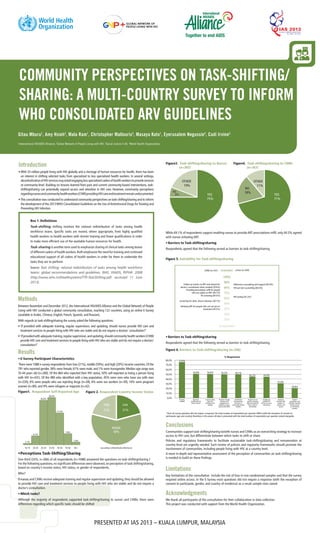
- 1. PRESENTED AT IAS2013 – KUALA LUMPUR, MALAYSIA Introduction • With 33 million people living with HIV globally and a shortage of human resources for health, there has been an interest in shifting selected tasks from specialized to less specialized health workers. In several settings, decentralizationofHIVservicesmayentailengaginglessspecializedcadresofhealthworkerstoprovideservices at community-level. Building on lessons learned from past and current community-based interventions, task- shifting/sharing can potentially expand access and retention in HIV care. However, community perceptions regardingnursesandcommunityhealthworkers(CHW)providingHIVcareandtreatmentremainundocumented. • This consultation was conducted to understand community perspectives on task-shifting/sharing and to inform the development of the 2013WHO Consolidated Guidelines on the Use ofAntiretroviral Drugs forTreating and Preventing HIV Infection. •Perceptions Task-Shifting/Sharing One-third (33%, n=366) of all respondents (n=1088) answered the questions on task-shifting/sharing.1 For the following questions,no significant differences were observed,on perception of task shifting/sharing, based on country’s income status, HIV status, or gender of respondents. Who? If nurses and CHWs receive adequate training and regular supervision and updating,they should be allowed to provide HIV care and treatment services to people living with HIV who are stable and do not require a doctor’s consultation. • Which tasks? Although the majority of respondents supported task-shifting/sharing to nurses and CHWs, there were differences regarding which specific tasks should be shifted Methods Between November and December 2012, the International HIV/AIDSAlliance and the Global Network of People Living with HIV conducted a global community consultation, reaching 122 countries, using an online E-Survey (available inArabic, Chinese, English, French, Spanish, and Russian). With regards to task-shifting/sharing the survey asked the following questions: • ‘If provided with adequate training, regular supervision, and updating, should nurses provide HIV care and treatment services to people living with HIV who are stable and do not require a doctors’ consultation?’ • ‘Ifprovidedwithadequatetraining,regularsupervision,andupdating,shouldcommunityhealthworkers(CHW) provide HIV care and treatment services to people living with HIV who are stable and do not require a doctors’ consultation?’ Results • E-Survey Participant Characteristics There were 1088 e-survey respondents from low (21%), middle (59%), and high (20%) income countries. Of the 791 who reported gender,38% were female,61% were male,and 1% were transgender.Median age range was 35-44 years old (n=280). Of the 864 who reported their HIV status, 50% self-reported as being a person living with HIV (n=431). Of the 489 who identified with a key population, 45% were men who have sex with men (n=220), 6% were people who use injecting drugs (n=28), 6% were sex workers (n=30), 16% were pregnant women (n=80), and 9% were refugees or migrants (n=42). Gitau Mburu1 , Amy Hsieh2 , Mala Ram1 , Christopher Mallouris3 , Masaya Kato1 , Eyerusalem Negussie4 , Cadi Irvine3 1 International HIV/AIDS Alliance; 2 Global Network of People Living with HIV; 3 Social Justice 4 All; 4 World Health Organization COMMUNITY PERSPECTIVES ON TASK-SHIFTING/ SHARING: A MULTI-COUNTRY SURVEY TO INFORM WHO CONSOLIDATED ARV GUIDELINES Box 1. Definitions Task-shifting shifting involves the rational redistribution of tasks among health workforce teams. Specific tasks are moved, where appropriate, from highly qualified health workers to health workers with shorter training and fewer qualifications in order to make more efficient use of the available human resources for health. Task-sharing is another term used to emphasize sharing of clinical tasks among teams of different cadres of health workers.Both emphasize the need for training and continued educational support of all cadres of health workers in order for them to undertake the tasks they are to perform. Source: Task shifting: rational redistribution of tasks among health workforce teams: global recommendations and guidelines. WHO, UNAIDS, PEPFAR. 2008 (http://www.who.int/healthsystems/TTR-TaskShifting.pdf, accessed 11 June 2013). 10-19 20-24 25-34 35-44 45-54 55-56 65+ 1,1% 6,1% 30,0% 30,0% 21,5% 7,6% 1,9% Figure1. Respondent Self-Reported Age Figure 2. Respondent Country Income Status High 21% Middle 58% Low 21% (according to World Bank definitions) Figure3. Task-shifting/sharing to Nurses (n=365) Figure4. Task-shifting/sharing to CHWs (n=367) OTHER 19% NO 6% YES 75% OTHER 11% NO 18% YES 71% Figure 5. Suitability for Task-shifting/sharing 100% 90% 80% 70% 60% 50% 40% 30% 20% AGREEMENT DISAGREEMENT Follow up checks on ART and referral for doctor’s consultation when needed (78.6%) Providing prescription refill for people who are stable on ART. (69.1%) TB screening (64.5%) Screening for other chronic diseases (58.1%) Initiating ART for people who are not yet on treatment (44.5%) Adherence counselling and support (85.9%) HIV pre-test counselling (83.6%) HIV testing (67.2%) nurses (n=356)CHWs (n=351) • Barriers to Task-shifting/sharing Respondents agreed that the following served as barriers to task-shifting/sharing. Figure 6. Barriers to Task-shifting/sharing (n=346) 80,0% 70,0% 60,0% 50,0% 40,0% 30,0% 20,0% 10,0% 0,0% 75,6% 50,9% 50,6% 50,3% 49,7% 45,2% 44,9% 31,0% 20,8% % Responents Training needed Need for certification for those trained Country policy does not facilitate task shifting Need to change policies and regulations to authorize nurses to prescribe ARVs Insufficient remuneration of nurses or community health workers People are not used to receiving ARV prescriptions from nurses or community Inadequate systems for doctor to nurse mentoring Imalance between the number of doctors and nurses Gender preception and relations towards female nurses or community workers 1 Since all survey questions did not require a response, the total number of respondents per question differs (with the exception of consent to participate, age, and country) therefore, in this poster all data is presented with the total number of respondents per question stated alongside. Conclusions Communities support task-shifting/sharing to/with nurses and CHWs as an overarching strategy to increase access to HIV care, but differentiate between which tasks to shift or share. Policies and regulatory frameworks to facilitate sustainable task-shifting/sharing and remuneration at country-level are urgently needed. Such review of policies and regularity frameworks should promote the involvement of communities, including people living with HIV, at a country level. A more in-depth and representative assessment of the perception of communities on task-shifting/sharing is needed to build on these findings. While 69.1% of respondents support enabling nurses to provide ART prescriptions refill, only 44.5% agreed with nurses initiating ART. • Barriers to Task-shifting/sharing Respondents agreed that the following served as barriers to task-shifting/sharing. Limitations Key limitations of the consultation include the risk of bias in non-randomised samples and that the survey required online access. In the E-Survey most questions did not require a response (with the exception of consent to participate, gender, and country of residence) as a result sample sizes varied. Acknowledgments We thank all participants of the consultation for their collaboration in data collection. This project was conducted with support from the World Health Organization.