
HOW BRIGHT IS A STAR?
Luminosity
- is the rate at which a star radiates
energy into space.
Apparent Brightness
- is the rate at which a star's radiated
energy reaches an observer on Earth.
Luminosity
- Measures the Total Energy Output by the
star in Watts
- Distance Independent
Apparent Brightness
- Measures how bright the star appears to be
as seen from a distance.
- Depends on the distance to the star.
Measuring Apparent Brightness
Photometry
- The process of measuring the apparent
brightness of objects.
Two ways to express apparent brightness:
 Stellar Magnitudes
 Absolute Fluxes (energy per second
per area)
Measuring Luminosity
To measure the Luminosity of a star you
need 2 measurements:
 the Apparent Brightness (flux) measured via
photometry, and
 the Distance to the star measured in some way
TEMPERATURE AND COLOR
- Stars are dense hot balls of gas so their
spectra similar to that of a perfect thermal
radiator, which produces a smooth continuous
spectrum.
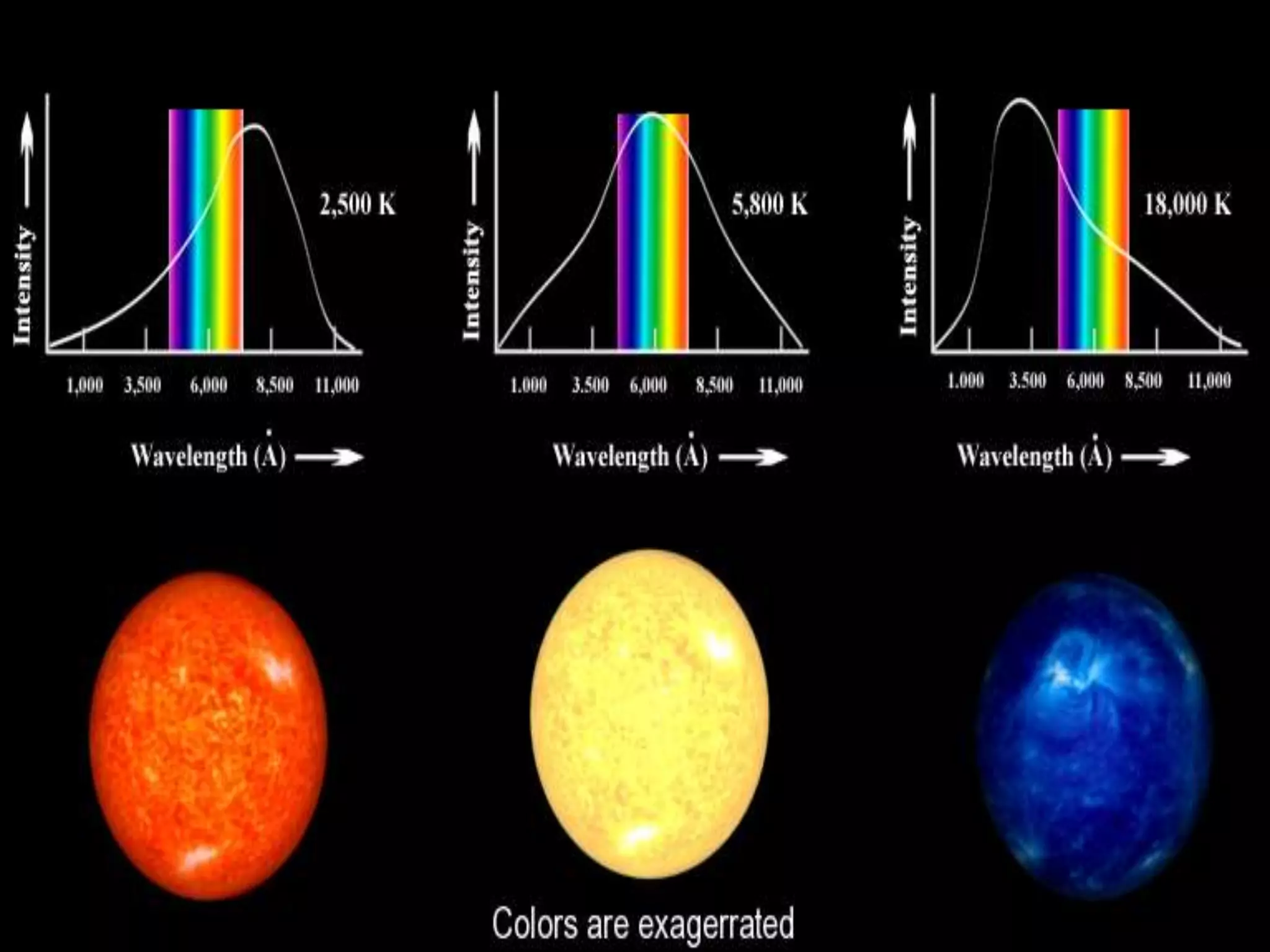
-Therefore, the color of stars depends on
their temperature--hotter stars are bluer and
cooler stars are redder.
- Hot stars have temperatures around
60,000 K while cold stars have temperatures
around 3,000 K.
Ways to measure stars color and
temperature:
 B-V color index
 Wien's Law and Temperature
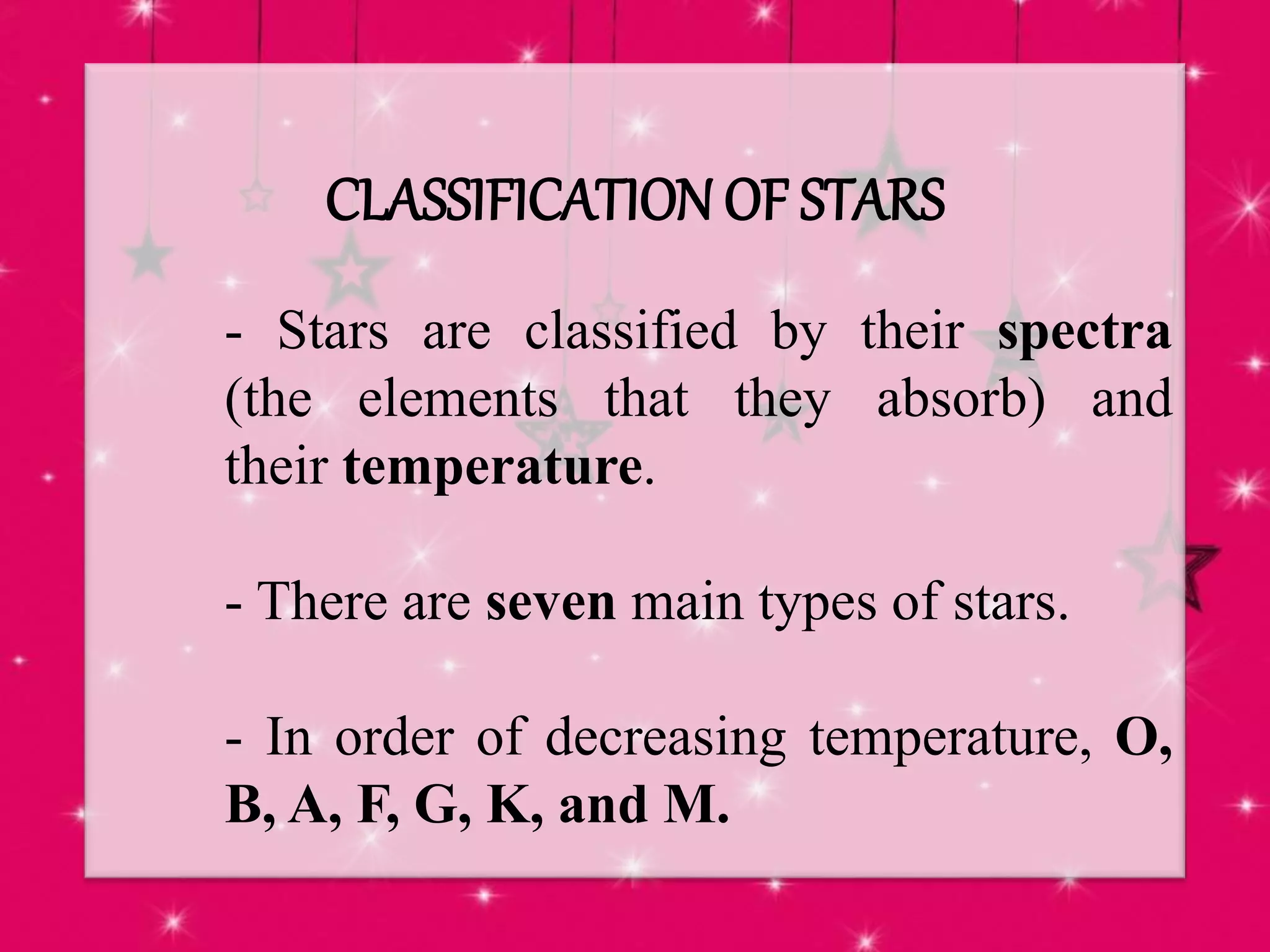
CLASSIFICATION OF STARS
- Stars are classified by their spectra
(the elements that they absorb) and
their temperature.
- There are seven main types of stars.
- In order of decreasing temperature, O,
B, A, F, G, K, and M.
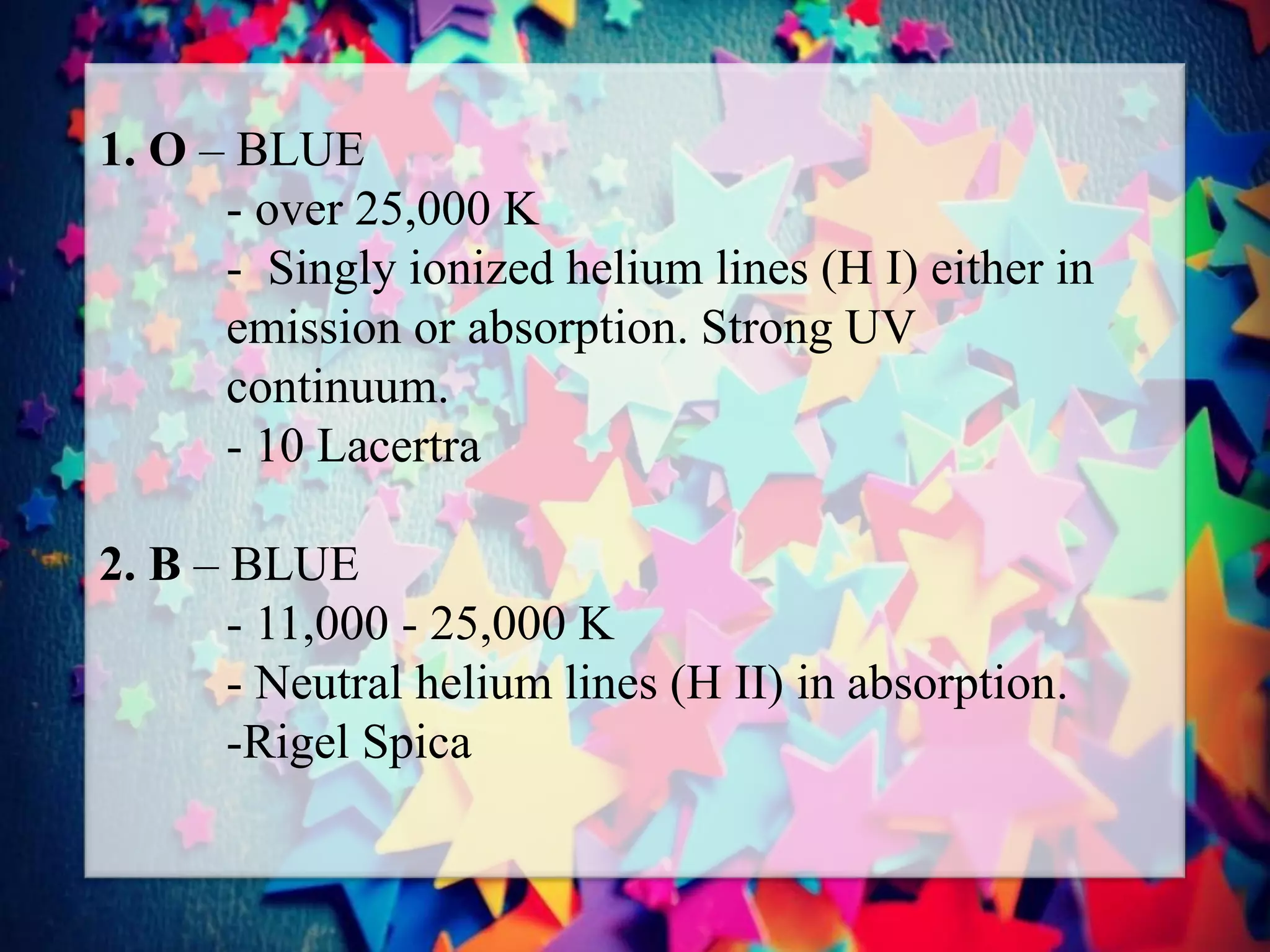
1. O – BLUE
- over 25,000 K
- Singly ionized helium lines (H I) either in
emission or absorption. Strong UV
continuum.
- 10 Lacertra
2. B – BLUE
- 11,000 - 25,000 K
- Neutral helium lines (H II) in absorption.
-Rigel Spica
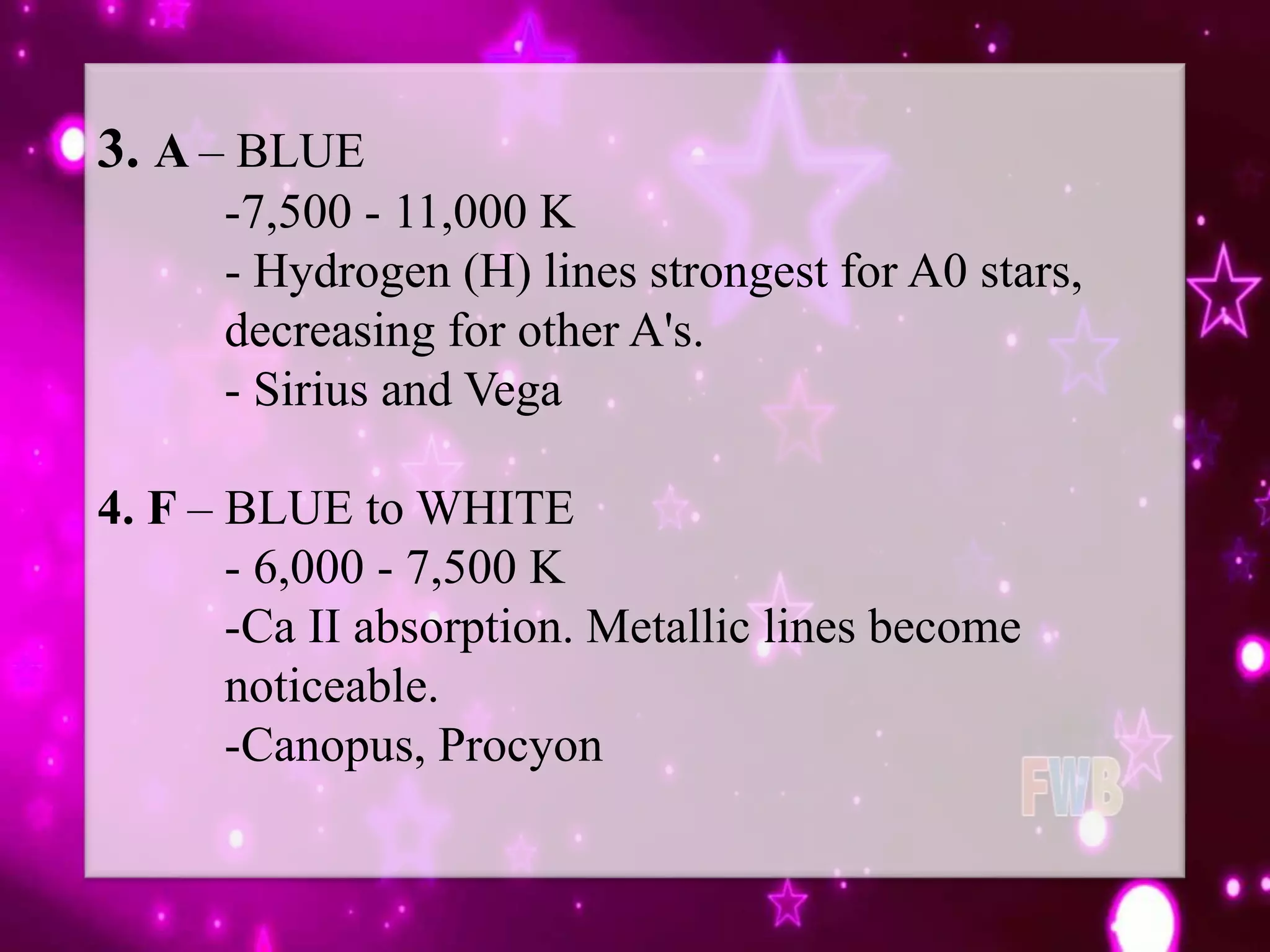
3. A – BLUE
-7,500 - 11,000 K
- Hydrogen (H) lines strongest for A0 stars,
decreasing for other A's.
- Sirius and Vega
4. F – BLUE to WHITE
- 6,000 - 7,500 K
-Ca II absorption. Metallic lines become
noticeable.
-Canopus, Procyon
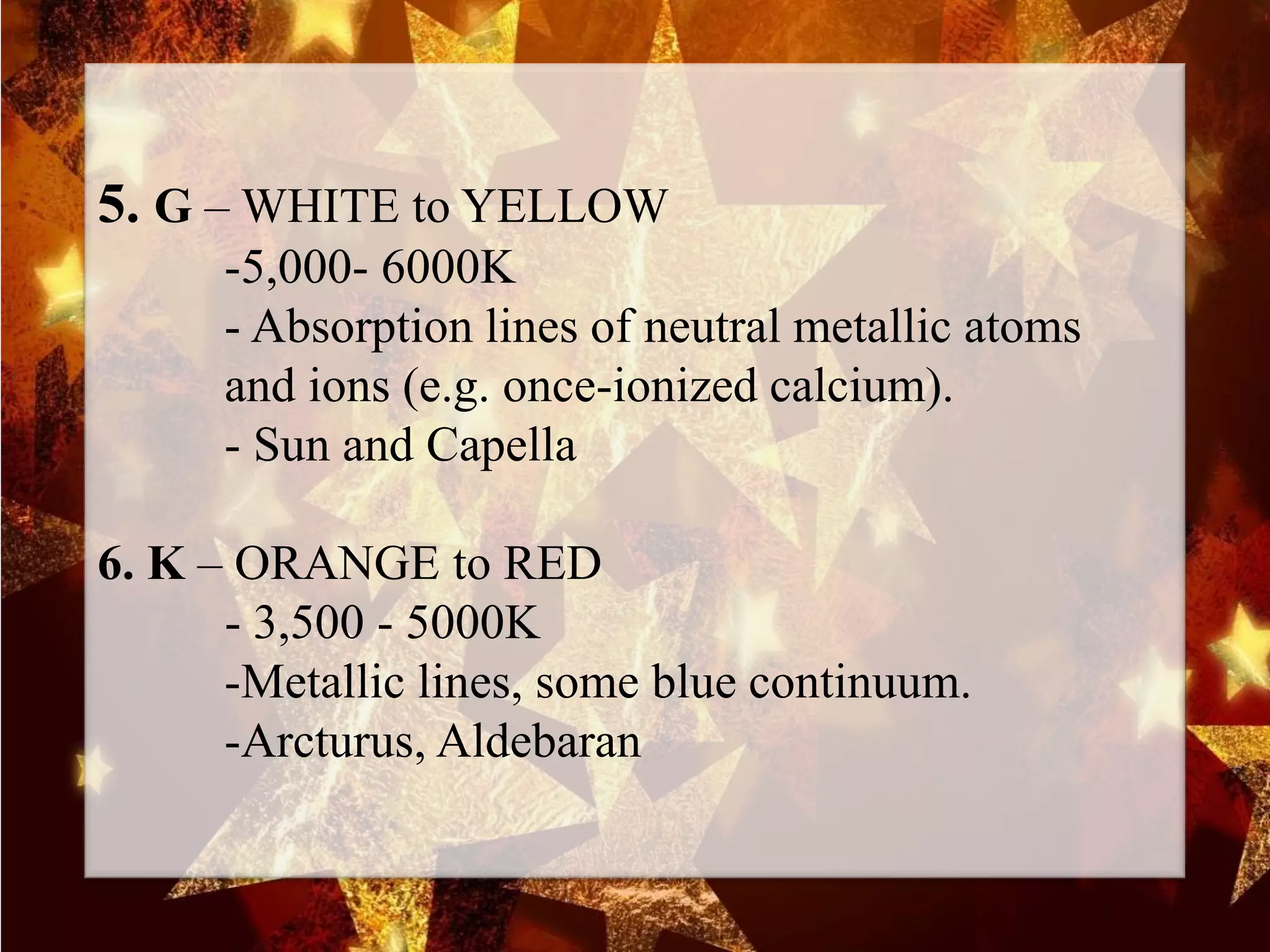
5. G – WHITE to YELLOW
-5,000- 6000K
- Absorption lines of neutral metallic atoms
and ions (e.g. once-ionized calcium).
- Sun and Capella
6. K – ORANGE to RED
- 3,500 - 5000K
-Metallic lines, some blue continuum.
-Arcturus, Aldebaran
7. M – RED
-under 3,500 K
- Some molecular bands of titanium oxide.
- Betelgeuse, Antares
THANK YOU!! 
REFERENCES:
http://www.astronomynotes.com/starprop/s5.htm
http://docs.kde.org/
http://www.enchantedlearning.com/subjects/astronomy/stars/index.shtml
Introduction to Stars, Galaxies, & the Universe
Astronomy 162: Professor Barbara Ryden

Lecture: Stars

  • 2.
    HOW BRIGHT ISA STAR? Luminosity - is the rate at which a star radiates energy into space. Apparent Brightness - is the rate at which a star's radiated energy reaches an observer on Earth.
  • 3.
    Luminosity - Measures theTotal Energy Output by the star in Watts - Distance Independent Apparent Brightness - Measures how bright the star appears to be as seen from a distance. - Depends on the distance to the star.
  • 4.
    Measuring Apparent Brightness Photometry -The process of measuring the apparent brightness of objects. Two ways to express apparent brightness:  Stellar Magnitudes  Absolute Fluxes (energy per second per area)
  • 5.
    Measuring Luminosity To measurethe Luminosity of a star you need 2 measurements:  the Apparent Brightness (flux) measured via photometry, and  the Distance to the star measured in some way
  • 6.
    TEMPERATURE AND COLOR -Stars are dense hot balls of gas so their spectra similar to that of a perfect thermal radiator, which produces a smooth continuous spectrum. -Therefore, the color of stars depends on their temperature--hotter stars are bluer and cooler stars are redder.
  • 7.
    - Hot starshave temperatures around 60,000 K while cold stars have temperatures around 3,000 K. Ways to measure stars color and temperature:  B-V color index  Wien's Law and Temperature
  • 9.
    CLASSIFICATION OF STARS -Stars are classified by their spectra (the elements that they absorb) and their temperature. - There are seven main types of stars. - In order of decreasing temperature, O, B, A, F, G, K, and M.
  • 10.
    1. O –BLUE - over 25,000 K - Singly ionized helium lines (H I) either in emission or absorption. Strong UV continuum. - 10 Lacertra 2. B – BLUE - 11,000 - 25,000 K - Neutral helium lines (H II) in absorption. -Rigel Spica
  • 11.
    3. A –BLUE -7,500 - 11,000 K - Hydrogen (H) lines strongest for A0 stars, decreasing for other A's. - Sirius and Vega 4. F – BLUE to WHITE - 6,000 - 7,500 K -Ca II absorption. Metallic lines become noticeable. -Canopus, Procyon
  • 12.
    5. G –WHITE to YELLOW -5,000- 6000K - Absorption lines of neutral metallic atoms and ions (e.g. once-ionized calcium). - Sun and Capella 6. K – ORANGE to RED - 3,500 - 5000K -Metallic lines, some blue continuum. -Arcturus, Aldebaran
  • 13.
    7. M –RED -under 3,500 K - Some molecular bands of titanium oxide. - Betelgeuse, Antares
  • 14.
  • 15.