MODULE 2 :
THE SENTENCE
S E C T I O N 1 : W O R D O R D E R A N D S E N T E N C E PAT T E R N
• Word order – The way words are arranged in a sentence
• Basic word order- Subject + Predicate .
• Subject – the doer of the action or about whom or what the sentence is- typically a noun or
pronoun denoting person, place or thing.
• Predicate - something about the subject – always includes the verb
• Verb – the action or state of being
• Object – the word or group of words influenced by the verb
• Direct Object- “ what” or “whom” the verb is doing.
• Most English sentences or clauses- SVO pattern
• Eg;
• He bought a car (S-V-O)
• She doesn’t like cats –(S- V- O)
WORD ORDER : INDIRECT
OBJECT
• Direct object : asks “what”
• Indirect object (I) : asks “ to whom/what” or “ for whom/what”
• The indirect object usually comes right before the direct object (O) , except when used with
preposition ‘to’.
• When an indirect object (I) is added to the sentence , the word order depends
• A) on whether the direct and indirect objects are nouns or pronouns
• B) on whether the indirect object is preceded by ‘to’
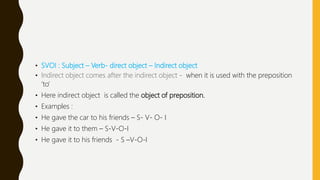
• SVOI : Subject – Verb- direct object – Indirect object
• Indirect object comes after the indirect object - when it is used with the preposition
‘to’
• Here indirect object is called the object of preposition.
• Examples :
• He gave the car to his friends – S- V- O- I
• He gave it to them – S-V-O-I
• He gave it to his friends - S –V-O-I
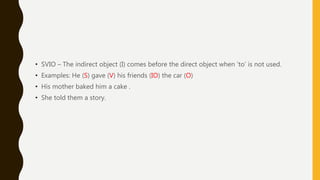
• SVIO – The indirect object (I) comes before the direct object when ‘to’ is not used.
• Examples: He (S) gave (V) his friends (IO) the car (O)
• His mother baked him a cake .
• She told them a story.
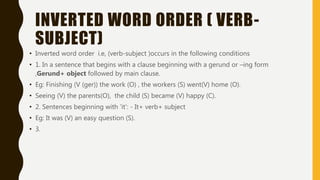
INVERTED WORD ORDER ( VERB-
SUBJECT)
• Inverted word order i.e, (verb-subject )occurs in the following conditions
• 1. In a sentence that begins with a clause beginning with a gerund or –ing form
,Gerund+ object followed by main clause.
• Eg: Finishing (V (ger)) the work (O) , the workers (S) went(V) home (O).
• Seeing (V) the parents(O), the child (S) became (V) happy (C).
• 2. Sentences beginning with ‘it’: - It+ verb+ subject
• Eg: It was (V) an easy question (S).
• 3.
The sentence.pptx
The sentence.pptx
The sentence.pptx

The sentence.pptx

  • 1.
    MODULE 2 : THESENTENCE S E C T I O N 1 : W O R D O R D E R A N D S E N T E N C E PAT T E R N
  • 2.
    • Word order– The way words are arranged in a sentence • Basic word order- Subject + Predicate . • Subject – the doer of the action or about whom or what the sentence is- typically a noun or pronoun denoting person, place or thing. • Predicate - something about the subject – always includes the verb • Verb – the action or state of being • Object – the word or group of words influenced by the verb • Direct Object- “ what” or “whom” the verb is doing.
  • 3.
    • Most Englishsentences or clauses- SVO pattern • Eg; • He bought a car (S-V-O) • She doesn’t like cats –(S- V- O)
  • 4.
    WORD ORDER :INDIRECT OBJECT • Direct object : asks “what” • Indirect object (I) : asks “ to whom/what” or “ for whom/what” • The indirect object usually comes right before the direct object (O) , except when used with preposition ‘to’. • When an indirect object (I) is added to the sentence , the word order depends • A) on whether the direct and indirect objects are nouns or pronouns • B) on whether the indirect object is preceded by ‘to’
  • 5.
    • SVOI :Subject – Verb- direct object – Indirect object • Indirect object comes after the indirect object - when it is used with the preposition ‘to’ • Here indirect object is called the object of preposition. • Examples : • He gave the car to his friends – S- V- O- I • He gave it to them – S-V-O-I • He gave it to his friends - S –V-O-I
  • 6.
    • SVIO –The indirect object (I) comes before the direct object when ‘to’ is not used. • Examples: He (S) gave (V) his friends (IO) the car (O) • His mother baked him a cake . • She told them a story.
  • 7.
    INVERTED WORD ORDER( VERB- SUBJECT) • Inverted word order i.e, (verb-subject )occurs in the following conditions • 1. In a sentence that begins with a clause beginning with a gerund or –ing form ,Gerund+ object followed by main clause. • Eg: Finishing (V (ger)) the work (O) , the workers (S) went(V) home (O). • Seeing (V) the parents(O), the child (S) became (V) happy (C). • 2. Sentences beginning with ‘it’: - It+ verb+ subject • Eg: It was (V) an easy question (S). • 3.