Group Task
The Sense of an Ending
Batch : 2019 - 2021
Julian Barnes
Author
Author’s Introduction
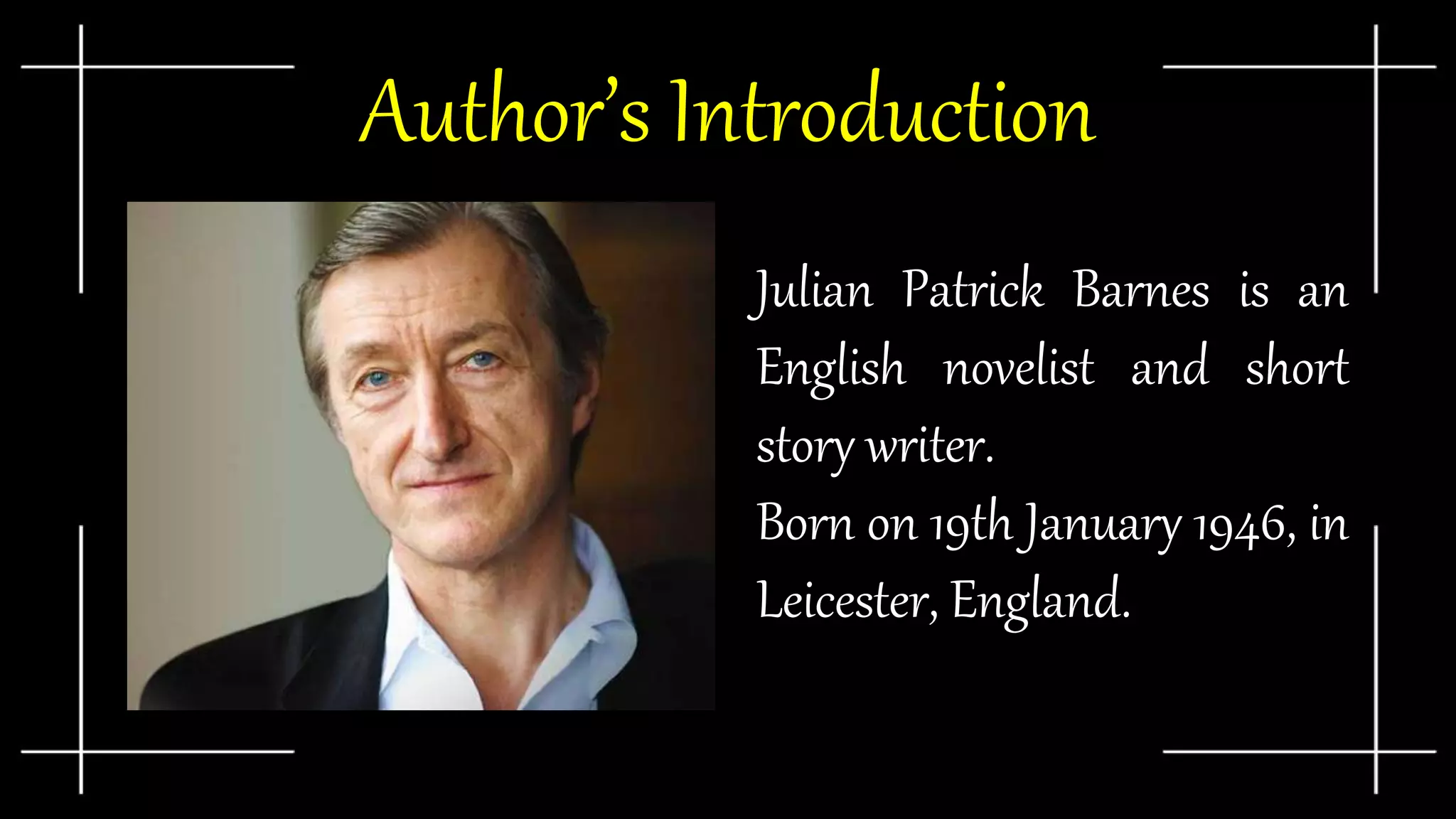
ā— Julian Patrick Barnes is an
English novelist and short
story writer.
ā— Born on 19th January 1946, in
Leicester, England.
Early Life
• Schooling from City of London School and graduated from Magdalene
College, Oxford.
• Worked as a lexicographer for the Oxford English Dictionary
supplement for three years.
• In 1977, Barnes began working as a reviewer and literary editor for the
New Statesman and the New Review.
• From 1979 to 1986 he worked as a television critic, first for the New
Statesman and then for the Observer.
Early Life
• Julian Barnes started out as a journalist before publishing
his first novel, Metroland, in 1980. Since then he has
carved out a reputation as one of contemporary Britain's
most brilliant and sophisticated novelists, often grouped
with Martin Amis and Ian McEwan.
Literary Career
• Julian Barnes has written numerous novels, short stories, and essays. He has also
translated a book by French author Alphonse Daudet and a collection of German
cartoons by Volker Kriegel. His writing has earned him considerable respect as an
author who deals with the themes of history, reality, truth and love.
• Barnes has also written crime fiction novels with pen names Dan Kavanagh and
Edward Pygge.
• His novel The Sense of an Ending received the Man Booker Prize in 2011. Three of his
additional novels were shortlisted for the Man Booker Prize, namely Flaubert's
Parrot, 1984, England, England 1998, and Arthur & George 2005.
Awards and Recognition
• Prix Femina for Talking it All Over (1992)
• Prix Medicis for Flaubert’s Parrot
• The honour of Commandeur de L'Ordre des Arts et des
Lettres (2004)
• Somerset Maugham Award and Geoffrey Faber Memorial
Prize
• Man Booker Prize for The Sense of an Ending (2011)
Notable Works
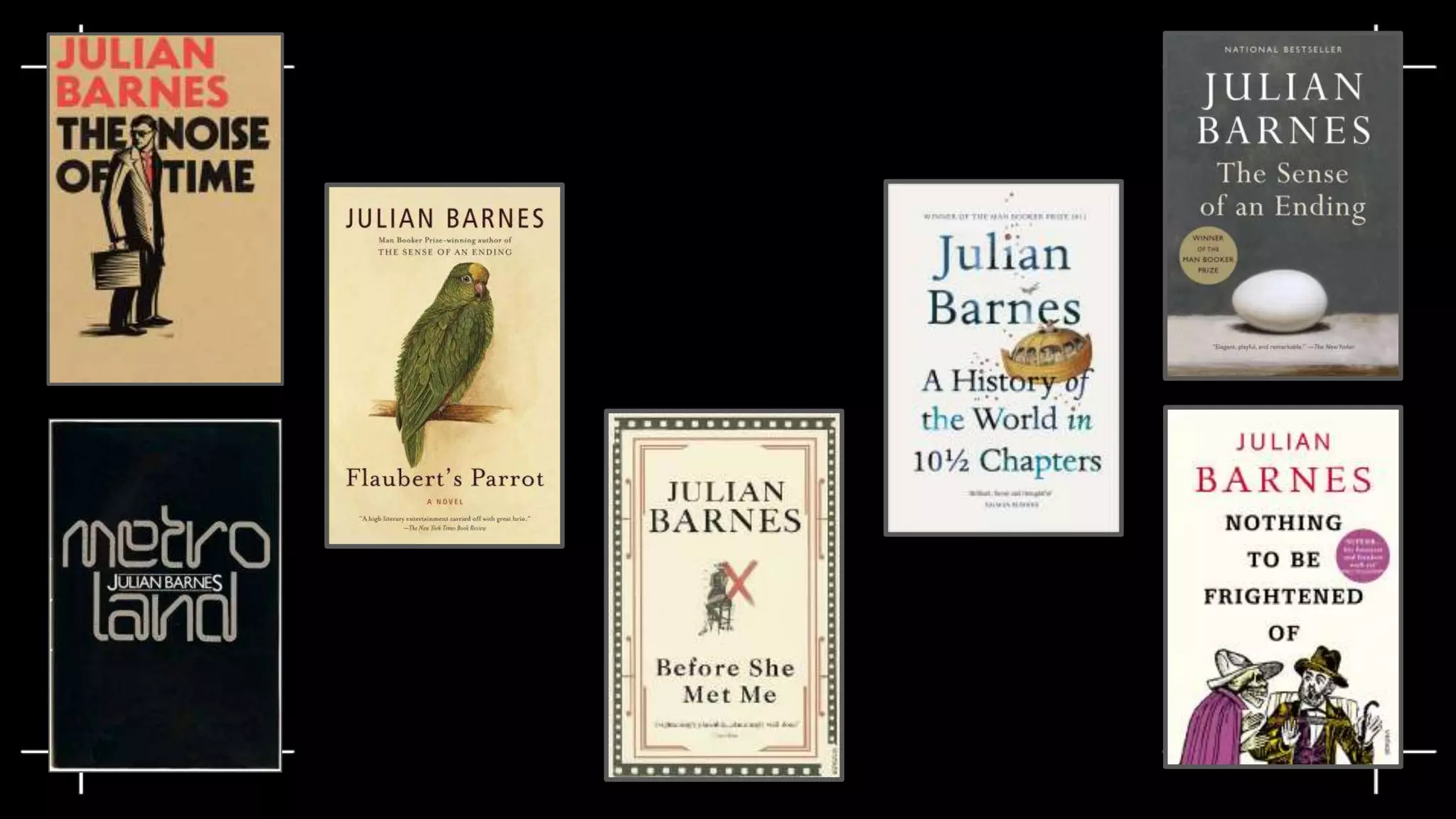
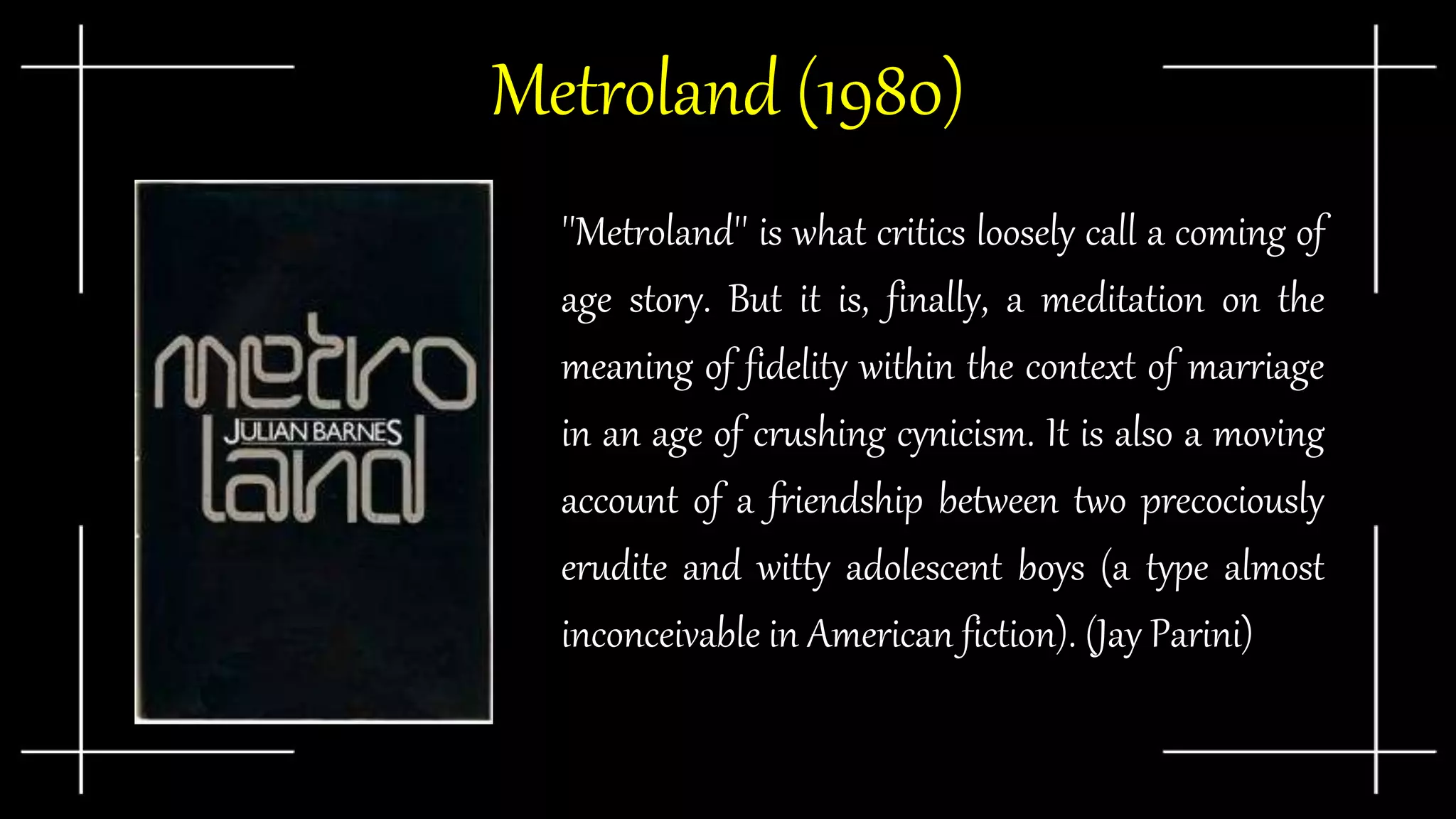
Metroland (1980)
''Metroland'' is what critics loosely call a coming of
age story. But it is, finally, a meditation on the
meaning of fidelity within the context of marriage
in an age of crushing cynicism. It is also a moving
account of a friendship between two precociously
erudite and witty adolescent boys (a type almost
inconceivable in American fiction). (Jay Parini)
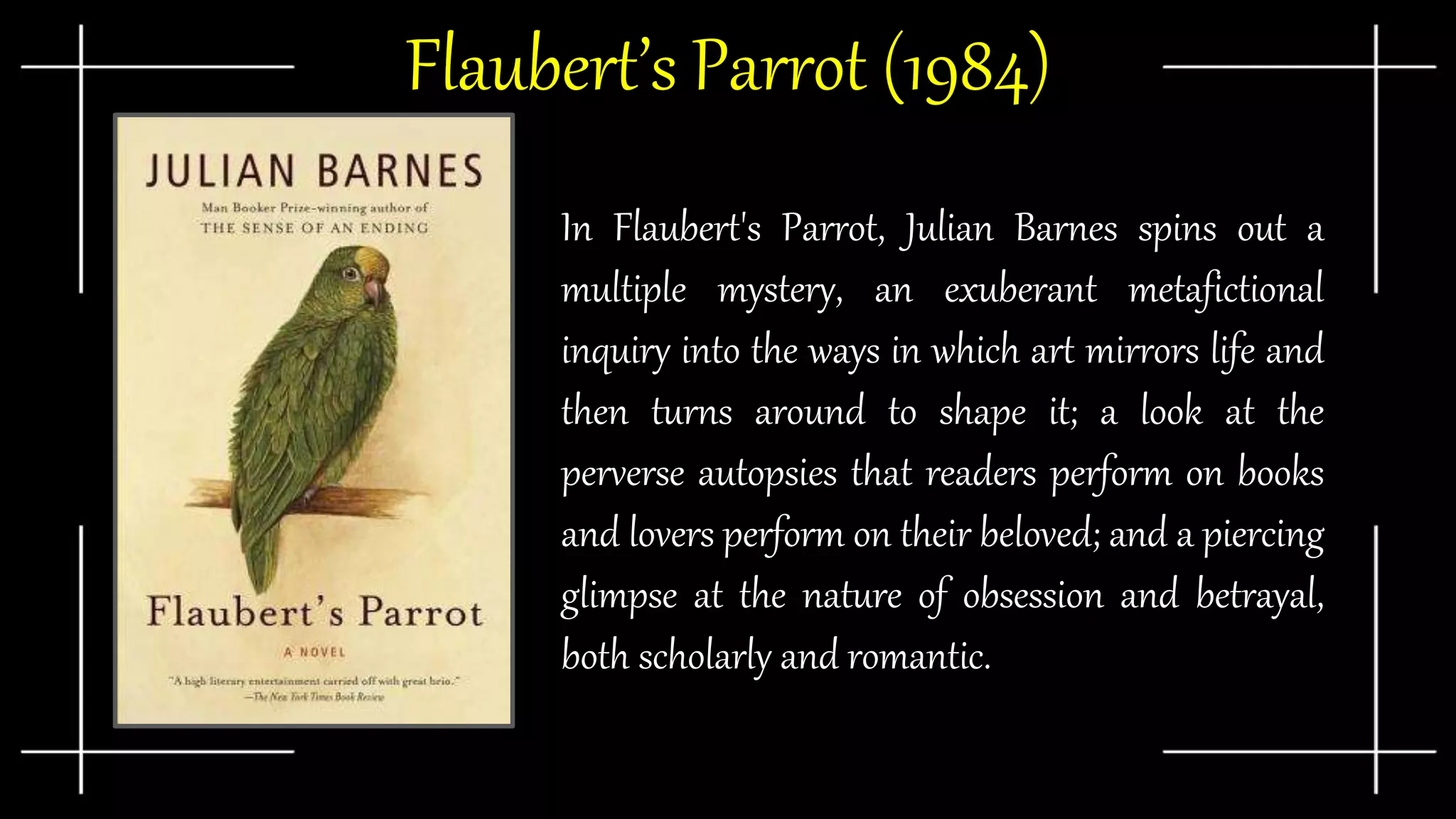
Flaubert’s Parrot (1984)
In Flaubert's Parrot, Julian Barnes spins out a
multiple mystery, an exuberant metafictional
inquiry into the ways in which art mirrors life and
then turns around to shape it; a look at the
perverse autopsies that readers perform on books
and lovers perform on their beloved; and a piercing
glimpse at the nature of obsession and betrayal,
both scholarly and romantic.
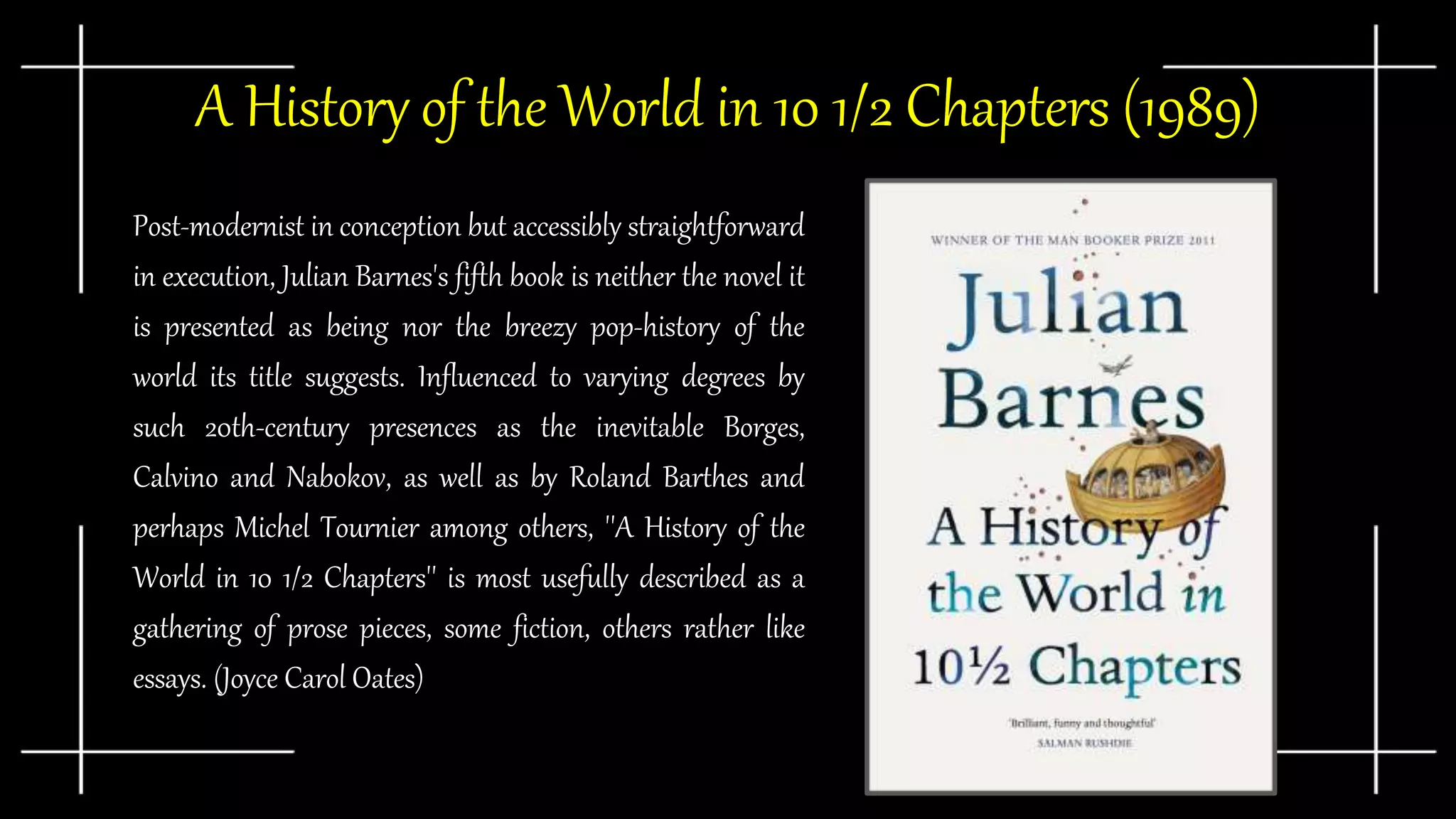
ā— Post-modernist in conception but accessibly straightforward
in execution, Julian Barnes's fifth book is neither the novel it
is presented as being nor the breezy pop-history of the
world its title suggests. Influenced to varying degrees by
such 20th-century presences as the inevitable Borges,
Calvino and Nabokov, as well as by Roland Barthes and
perhaps Michel Tournier among others, ''A History of the
World in 10 1/2 Chapters'' is most usefully described as a
gathering of prose pieces, some fiction, others rather like
essays. (Joyce Carol Oates)
A History of the World in 10 1/2 Chapters (1989)
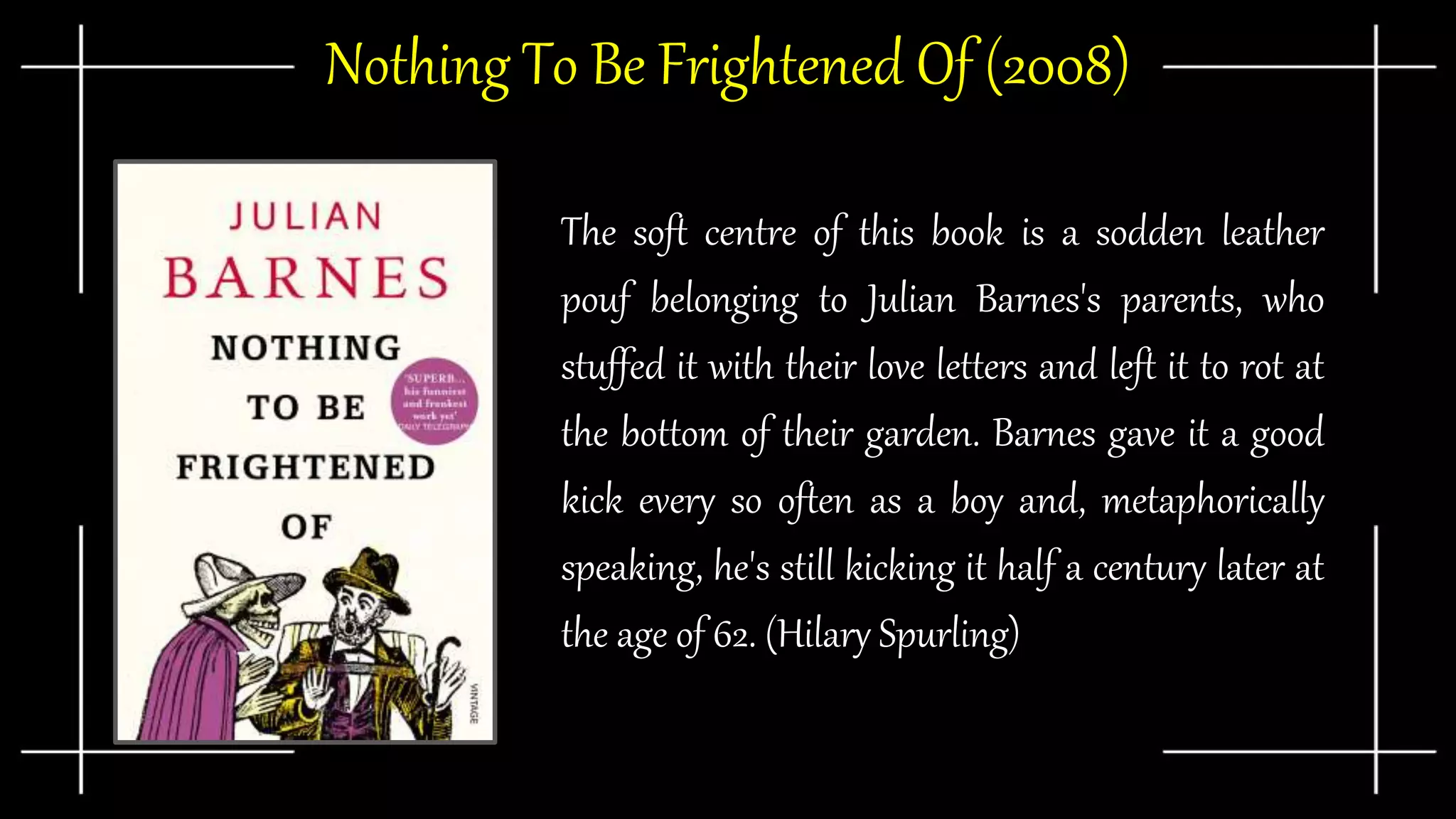
Nothing To Be Frightened Of (2008)
The soft centre of this book is a sodden leather
pouf belonging to Julian Barnes's parents, who
stuffed it with their love letters and left it to rot at
the bottom of their garden. Barnes gave it a good
kick every so often as a boy and, metaphorically
speaking, he's still kicking it half a century later at
the age of 62. (Hilary Spurling)
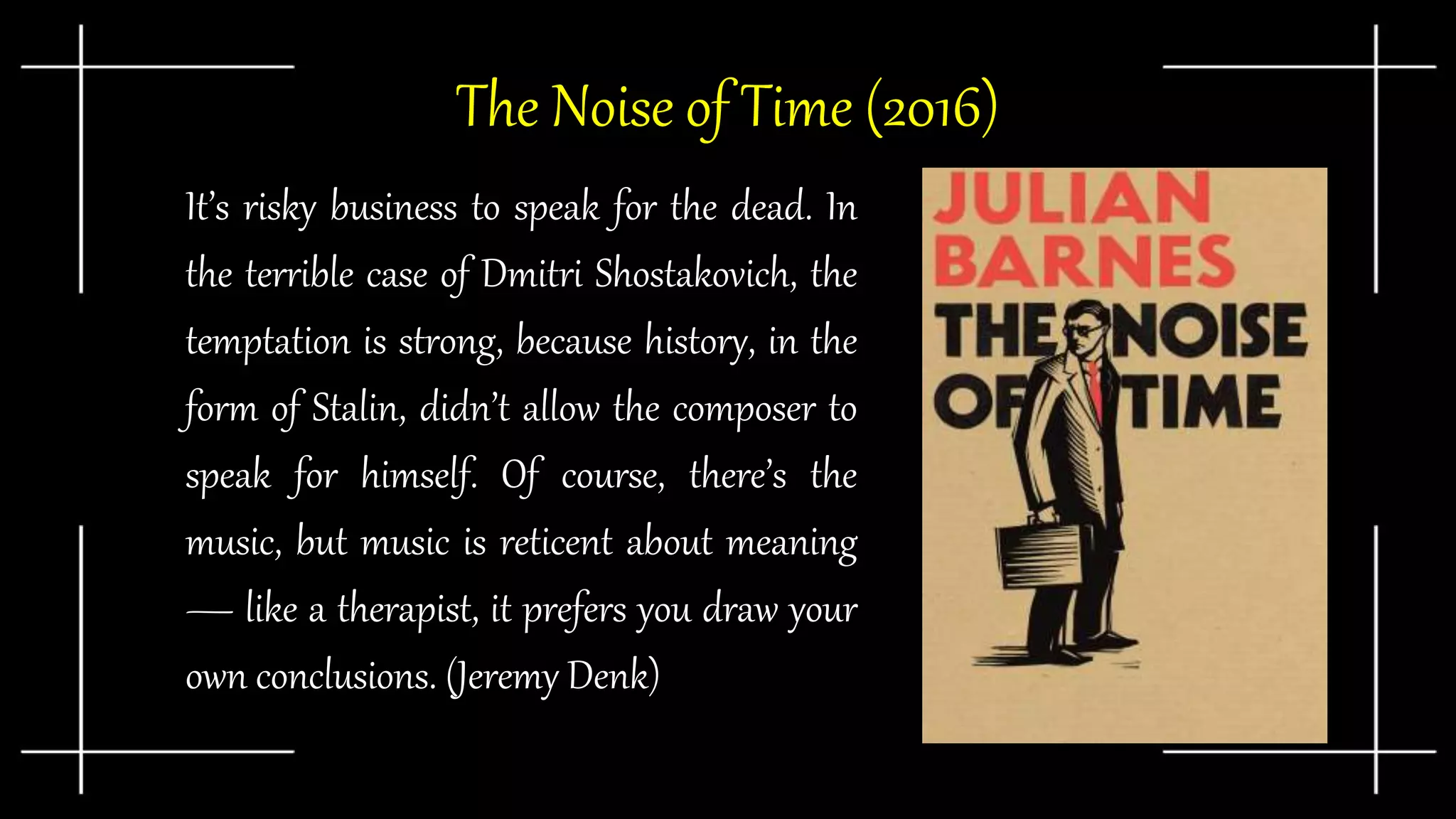
ā— It’s risky business to speak for the dead. In
the terrible case of Dmitri Shostakovich, the
temptation is strong, because history, in the
form of Stalin, didn’t allow the composer to
speak for himself. Of course, there’s the
music, but music is reticent about meaning
— like a therapist, it prefers you draw your
own conclusions. (Jeremy Denk)
The Noise of Time (2016)
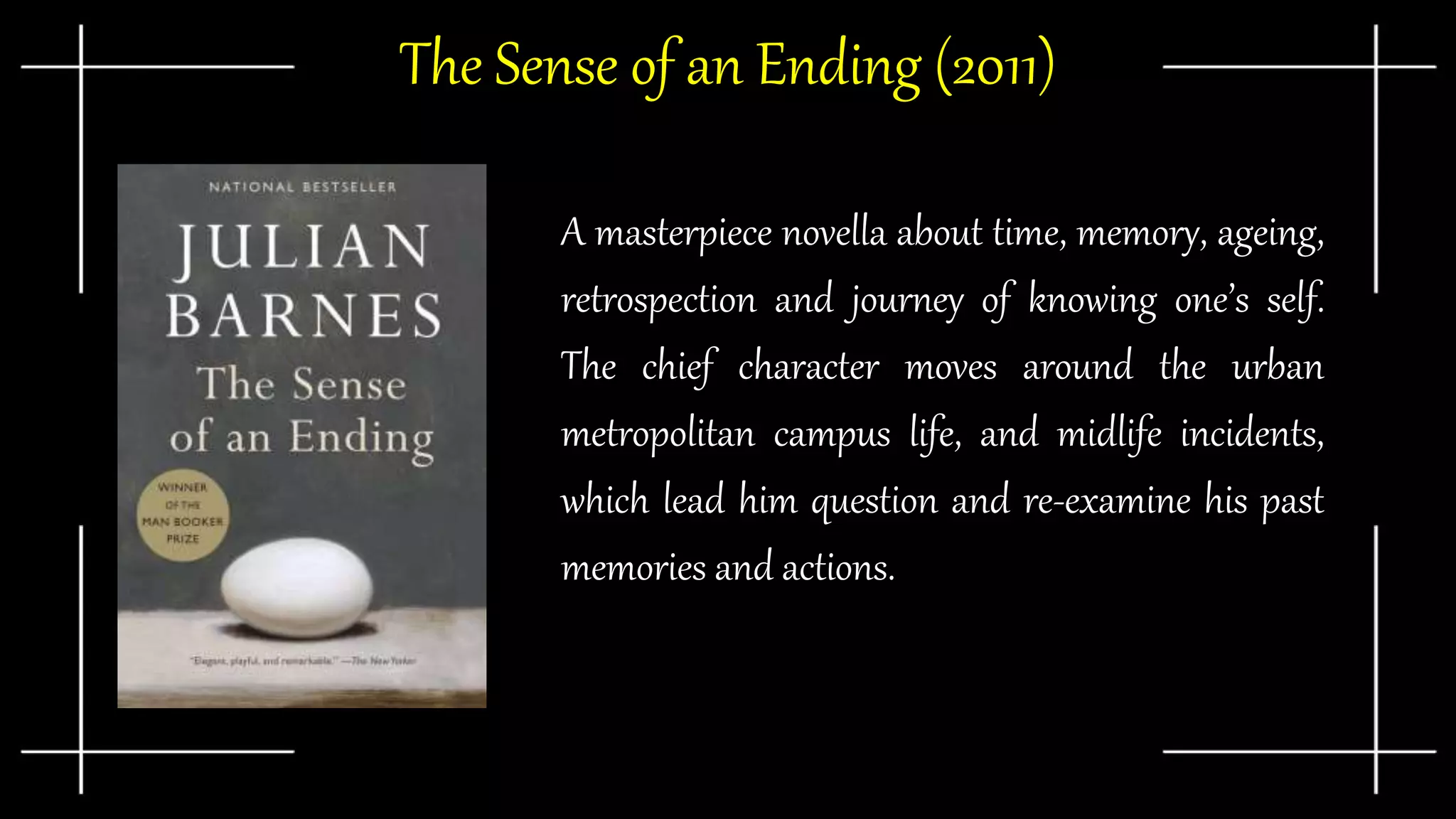
The Sense of an Ending (2011)
A masterpiece novella about time, memory, ageing,
retrospection and journey of knowing one’s self.
The chief character moves around the urban
metropolitan campus life, and midlife incidents,
which lead him question and re-examine his past
memories and actions.
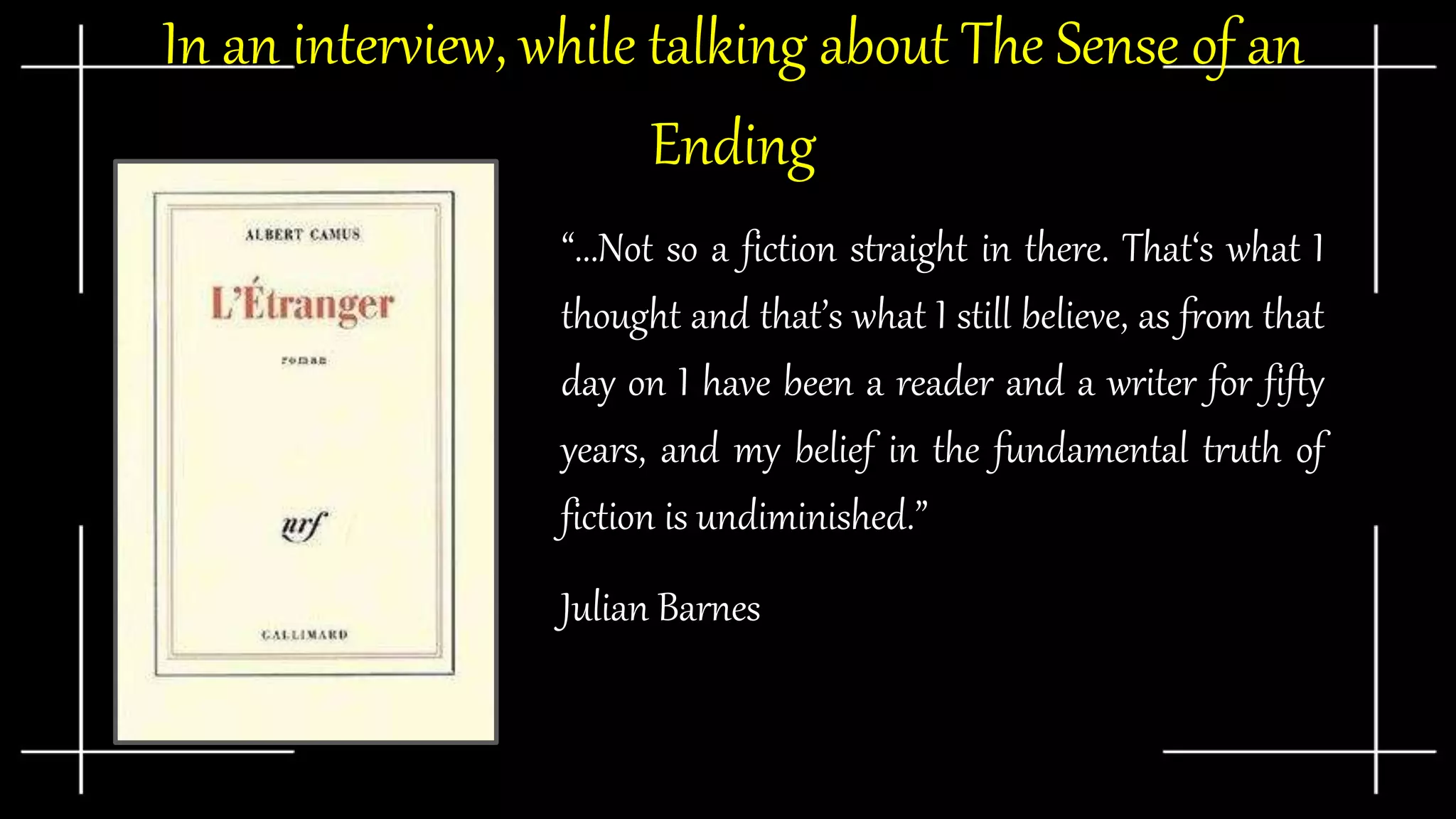
In an interview, while talking about The Sense of an
Ending
ā€œ...Not so a fiction straight in there. Thatā€˜s what I
thought and that’s what I still believe, as from that
day on I have been a reader and a writer for fifty
years, and my belief in the fundamental truth of
fiction is undiminished.ā€
Julian Barnes
Interviews
• ā€œThere are autobiographical novelists who can only write about their
own life, and then on the other hand there are completely objective
novelists who only write about the world as they see it as completely
effaced themselves from the novel. And I’m probably about that
point. So I don't think of the novel as any form of confessional.ā€
Julian Barnes
• Interview: https://www.youtube.com/watch?v=DWv-HjAYXdM
ā€œI think they are interconnected deeply. Flaubert, whom I should
probably quote more than once this evening, Flaubert says that
there is no idea without a form and no form without an idea. By
which, I take it he meant that you can have an idea for a book for
a short story, but until the form is delivered to you in some way
or you discover it, it’s not really the start of the book.ā€
"Writers should have the highest ambition: not just for themselves, but for the form they work in.
Flaubert once rebuked Louise Colet for having the love of art yet lacking 'the religion of art': she
fancied its rituals, the vestments and the incense, but did not finally believe in its revealed truths. I
am a writer for an accumulation of lesser reasons (love of words, fear of death, hope of fame,
delight in creation, distaste for office hours) and for one presiding major reason: because I believe
that the best art tells the most truth about life. Listen to the competing lies: to the tatty rhetoric of
politics, the false promises of religion, the contaminated voices of television and journalism.
Whereas the novel tells the beautiful, shapely lies which enclose hard, exact truth. This is its
paradox, its grandeur, its seductive dangerousness. Two famous deaths have been intermittently
proclaimed for some time now: the death of God and the death of the novel. Both are exaggerated.
And since God was one of the fictional impulse's earliest and finest creations, I'll bet on the novel -
in however mutated a version - to outlast even God."
New Statesman Interview
• Que: In another life what job might you have chosen?
• Ans: I might have made a useful priest – perhaps in rural
France in the 19th century. Looking, listening and seeking
to understand, like a novelist. But I might have been
tempted to take notes in the confessional.
• Q:What was the last book that changed your thinking?
• A:Probably Yanis Varoufakis’s Talking to My Daughter
About the Economy – though my previous
understanding of economics couldn’t exactly be
described as ā€œthinkingā€.
Agnosticism
• In the popular sense, an agnostic is someone who neither
believes nor disbelieves in God, whereas an atheist
disbelieves in God. (William L Rowe)
• In the novel ā€œNothing To Be Frightened Ofā€ he makes a
statement that, ā€œI don’t believe in God but I miss him.ā€
References
• Barnes, Julian. "Julian Barnes at Passa Porta Festival 2013." Interview by Annelies
Beck. YouTube, supiriorso, 2013, www.youtube.com/watch?v=tX0KICSZITA.
• Barnes, Julian. "Talking in the Library Series 2 – Julian Barnes." Interview by Clive
James. YouTube, www.youtube.com/watch?v=abwFi-SrF4w.
• Denk, Jeremy. "ā€˜The Noise of Time,’ by Julian Barnes (Published 2016)." The New
York Times, 9 May 2016, www.nytimes.com/2016/05/15/books/review/the-noise-of-
time-by-julian-barnes.html
• Beck, Annelies. "Het wit tussen de regels." De Standaard, 29 Mar. 2013,
www.standaard.be/cnt/dmf20130328_00521849.
References
• Krist, Gary. "'Before She Met Me' (Published 1986)." The New York Times - Breaking
News, US News, World News and Videos, 28 Dec. 1986,
www.nytimes.com/1986/12/28/books/before-she-met-me.html.
• Oates, Joyce C. "'A History of the World in 10 1/2 Chapters' (Published 1989)." The
New York Times - Breaking News, US News, World News and Videos, 1 Oct. 1989,
www.nytimes.com/1989/10/01/books/a-history-of-the-world-in-10-12-chapters.html.
• Parini, Jay. "'Metroland' (Published 1987)." The New York Times - Breaking News,
US News, World News and Videos, 3 May 1987,
www.nytimes.com/1987/05/03/books/metroland.html.
References
• "Julian Barnes Q&A: ā€œI Might Have Made a Useful Priest, Perhaps in Rural Franceā€." Global Current Affairs, Politics &
Culture, New Statesman, 3 Apr. 2018, www.newstatesman.com/culture/qa/2018/04/julian-barnes-qa-i-might-have-made-
useful-priest-perhaps-rural-france.
• "Julian Barnes: Biography." Julian Barnes: Official Website, www.julianbarnes.com/bio/index.html.
• "Julian Barnes: Flaubert's Parrot." Julian Barnes: Official Website, www.julianbarnes.com/books/flauberts.html.
• "Julian Barnes." Literature, Jonathan Cape Ltd, https://literature.britishcouncil.org/writer/julian-barnes.
• Gary. "'Before She Met Me' (Published 1986)." The New York Times - Breaking News, US News, World News and Videos, 28
Dec. 1986, www.nytimes.com/1986/12/28/books/before-she-met-me.html.
• Oates, Joyce C. "'A History of the World in 10 1/2 Chapters' (Published 1989)." The New York Times - Breaking News, US
News, World News and Videos, 1 Oct. 1989, www.nytimes.com/1989/10/01/books/a-history-of-the-world-in-10-12-
chapters.html.
• Parini, Jay. "'Metroland' (Published 1987)." The New York Times - Breaking News, US News, World News and Videos, 3 May
1987, www.nytimes.com/1987/05/03/books/metroland.html.
References
• Rowe, William L. (1998). "Agnosticism". In Edward Craig
(ed.). Routledge Encyclopedia of Philosophy. Taylor &
Francis. ISBN 978-0-415-07310-3.
• Spurling, Hilary. "Review: Nothing to Be Frightened of by
Julian Barnes." The Guardian, 22 Feb. 2018,
www.theguardian.com/books/2008/mar/02/biography.julian
barnes.
The Sense of an Ending
About the Text
ā— https://youtu.be/6GGadc4N3WQ (2 min)
Work Cited:
Barnes, Julian. The Sense of an Ending. Vintage, 2011.
The Sense of an Ending
Structure
Structure
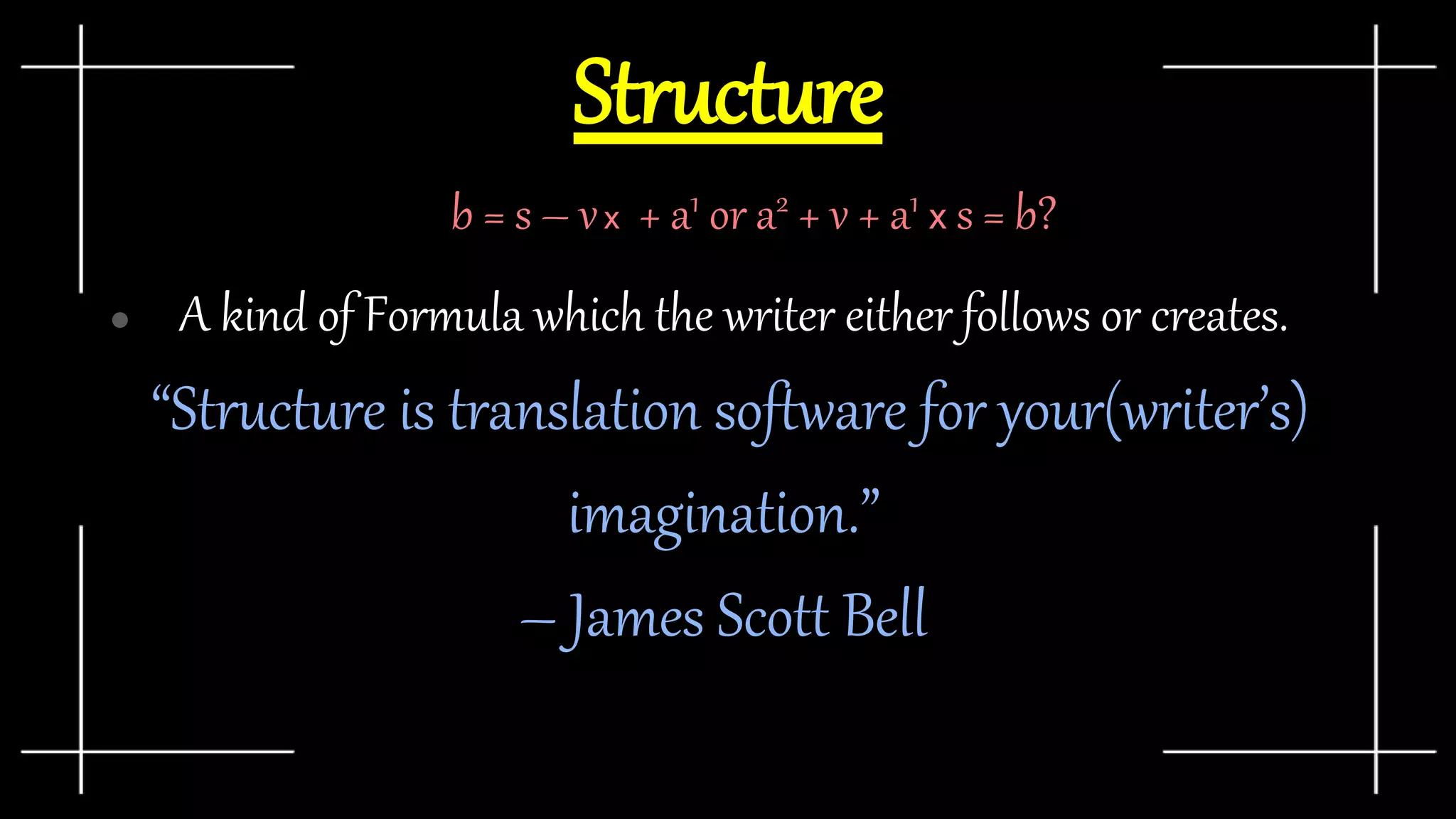
ā— A kind of Formula which the writer either follows or creates.
ā€œStructure is translation software for your(writer’s)
imagination.ā€
– James Scott Bell
b = s – vx + a1 or a2 + v + a1 x s = b?
Importance of Structure
ā€œFiction is supposed … to be entertaining and
narrative, so structures have to be buried a little
bit. If they become foregrounded too much, it
stops being fiction and starts being poetry –
something more concrete and out of time.ā€
- Eleanor Catton
Importance of Structure
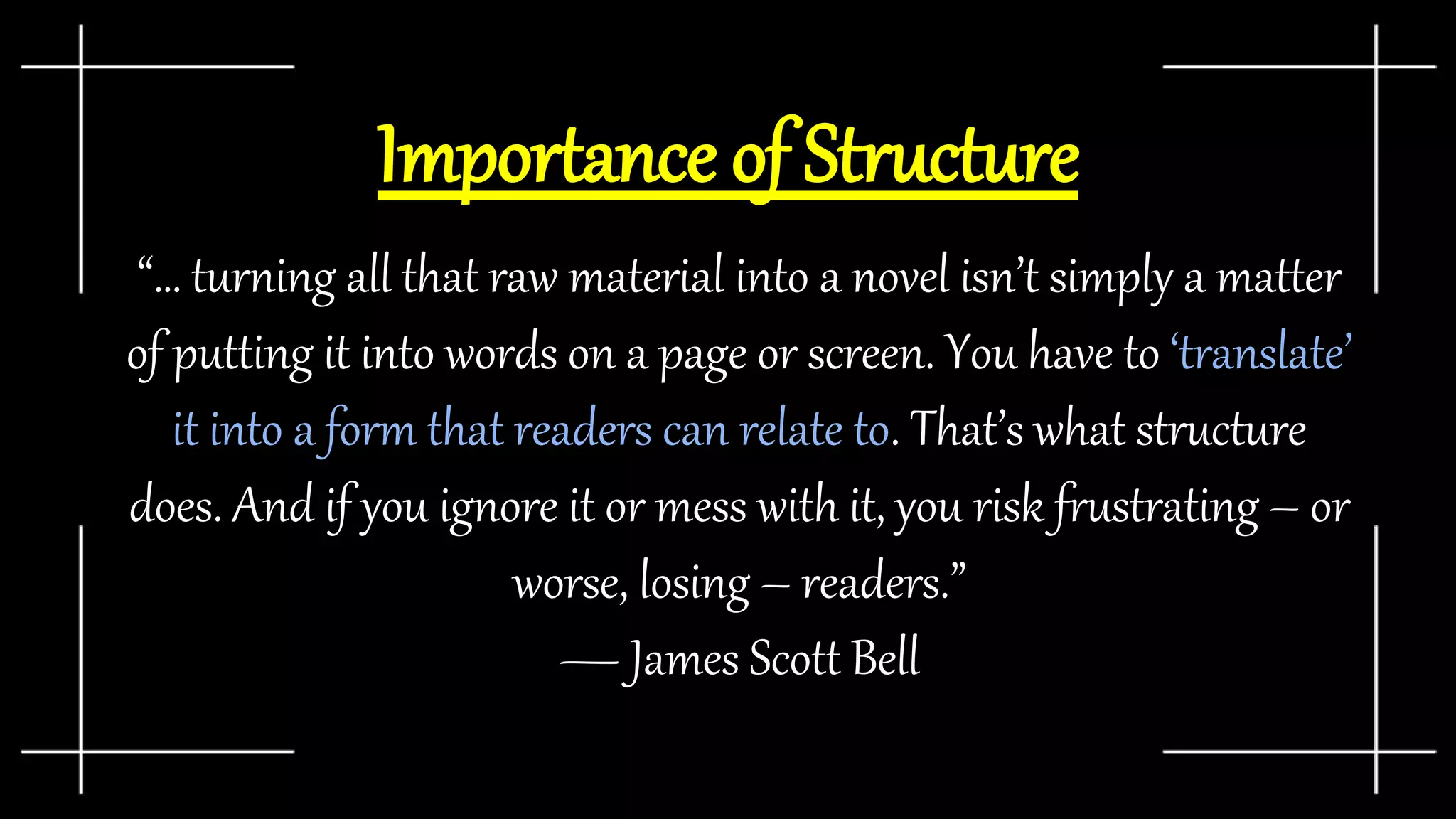
ā€œā€¦ turning all that raw material into a novel isn’t simply a matter
of putting it into words on a page or screen. You have to ā€˜translate’
it into a form that readers can relate to. That’s what structure
does. And if you ignore it or mess with it, you risk frustrating – or
worse, losing – readers.ā€
— James Scott Bell
The Sense of an Ending
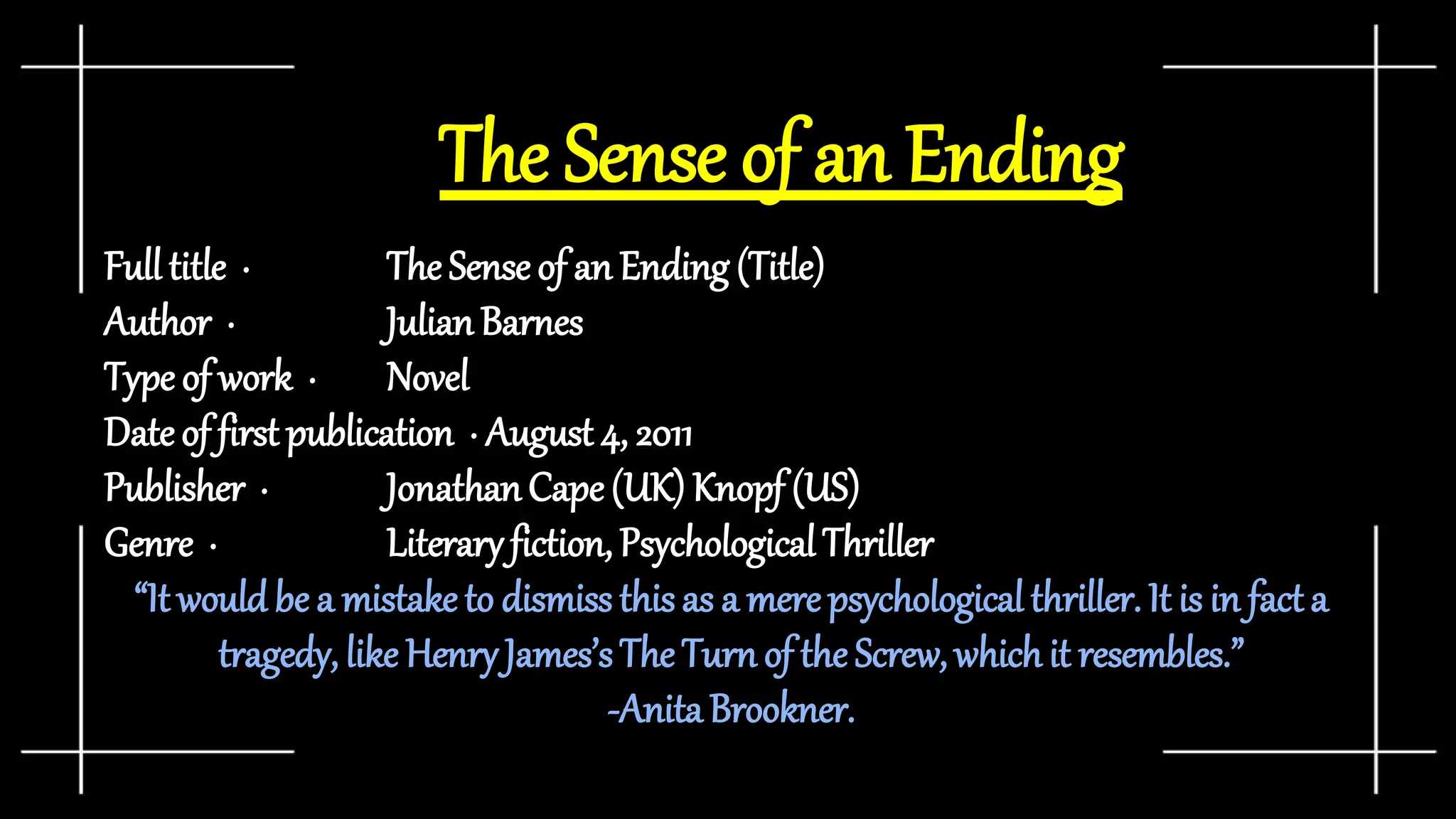
Full title Ā· The Sense of an Ending (Title)
Author Ā· JulianBarnes
Type of work Ā· Novel
Date of first publication Ā· August 4, 2011
Publisher Ā· JonathanCape(UK) Knopf (US)
Genre Ā· Literaryfiction, PsychologicalThriller
ā€œIt would be a mistake to dismiss this as a merepsychological thriller. It is in fact a
tragedy, like HenryJames’sThe Turn of the Screw, whichit resembles.ā€
-AnitaBrookner.
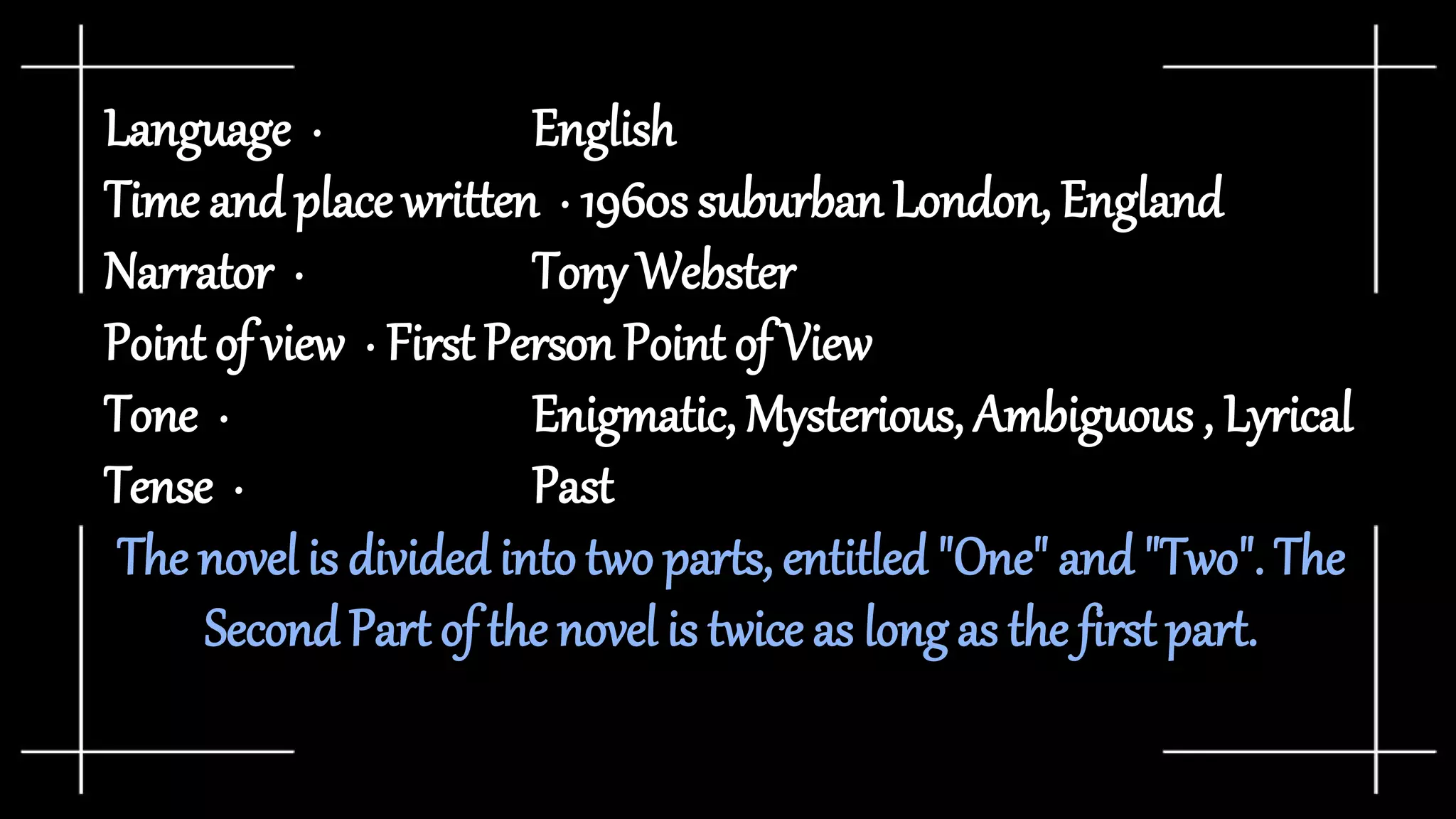
Language Ā· English
Time and place written Ā· 1960s suburban London, England
Narrator Ā· Tony Webster
Point of view Ā· First Person Point of View
Tone Ā· Enigmatic, Mysterious, Ambiguous , Lyrical
Tense Ā· Past
The novel is divided into two parts, entitled "One" and "Two". The
Second Part of the novel is twice as long as the first part.
Barnes’ Writing Style
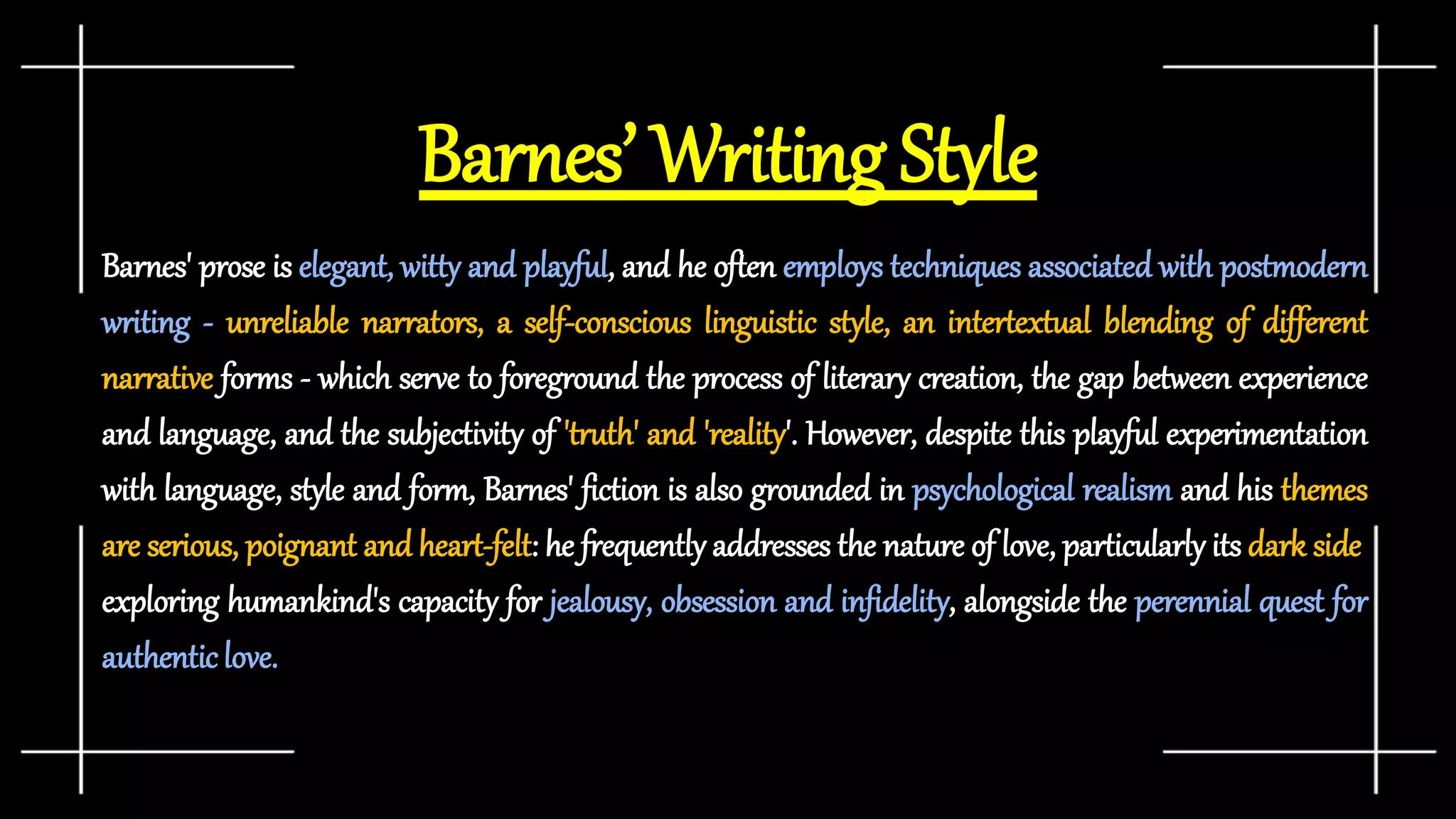
Barnes' prose is elegant, witty and playful, and he often employs techniques associated with postmodern
writing - unreliable narrators, a self-conscious linguistic style, an intertextual blending of different
narrative forms - which serve to foreground the process of literary creation, the gap between experience
and language, and the subjectivity of 'truth' and 'reality'. However, despite this playful experimentation
with language, style and form, Barnes' fiction is also grounded in psychological realism and his themes
are serious, poignant and heart-felt: he frequently addresses the nature of love, particularly its dark side,
exploring humankind's capacity for jealousy, obsession and infidelity, alongside the perennial quest for
authenticlove.
Plot
ā€œActionthatis serious, complete, and of a certainmagnitude…throughpityand fear effecting
the properpurgation [catharsis] of these emotions.ā€
ā€œIt would be injustice to Barnes if we say that the novel is plotless or poorly
constructed plot. It has a beginning, middle and the end. He is able to
pull readers towards climaxand the effectof peripeteia and anagnorisis
leads to the catastrophe – the final revelationof the identity of 40 years
old abnormal Adrianhelps in holding on the plot.ā€
Plot
Exposition DƩnouement
Climax
Exposition DƩnouement
Climax
Major conflict:
Adrian’sSuicide and the
Searchfor the philosophical
reason
Tony’srestlessness
Three school friends get to know the
fourth one, make a group and
promise to remain friends,
Philosophy
Adrian commitssuicide,Philosophy
Websterre-established
contactwithVeronicato re-
evaluatethe past
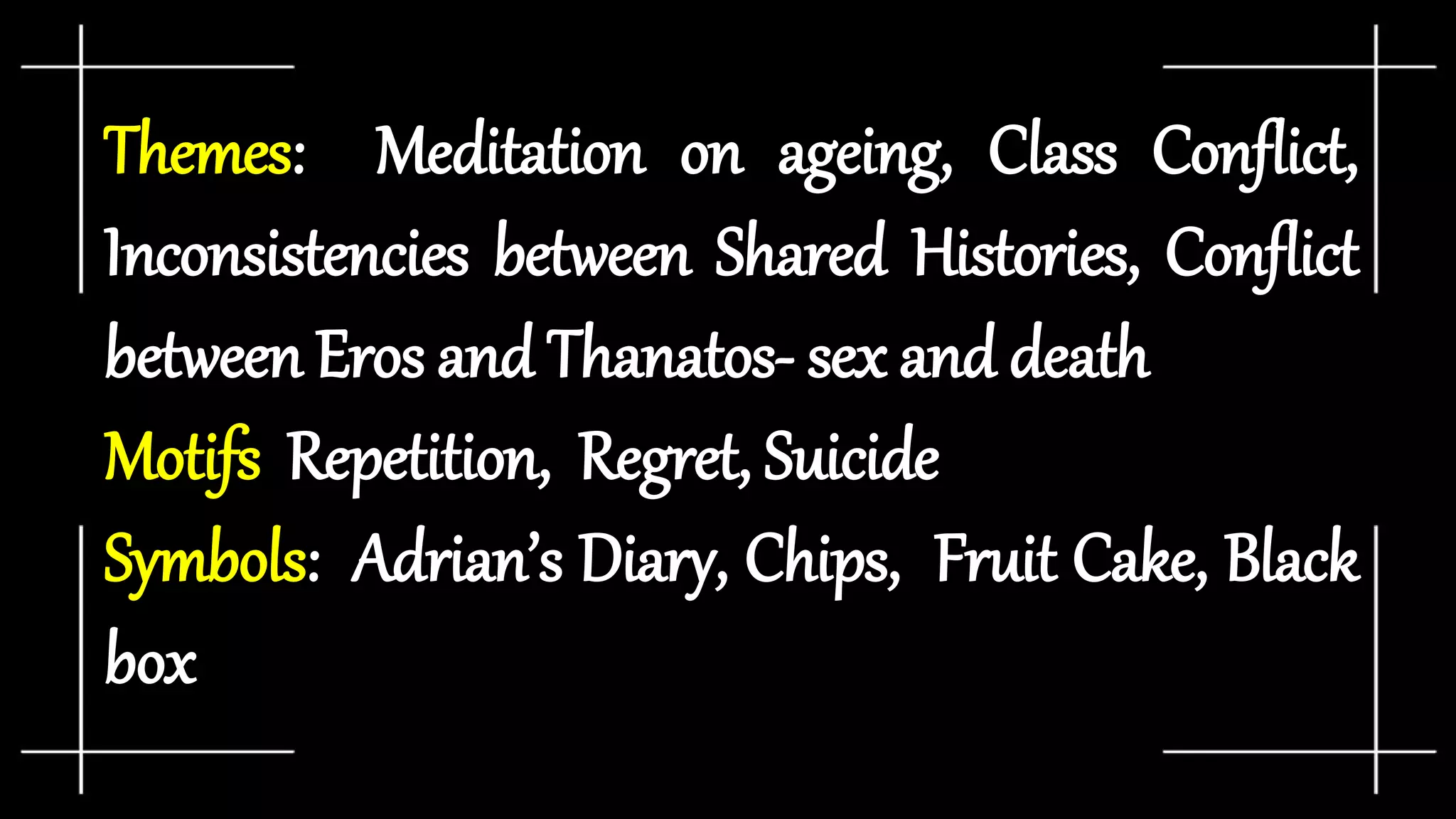
Themes: Meditation on ageing, Class Conflict,
Inconsistencies between Shared Histories, Conflict
between Eros and Thanatos- sex and death
Motifs: Repetition, Regret, Suicide
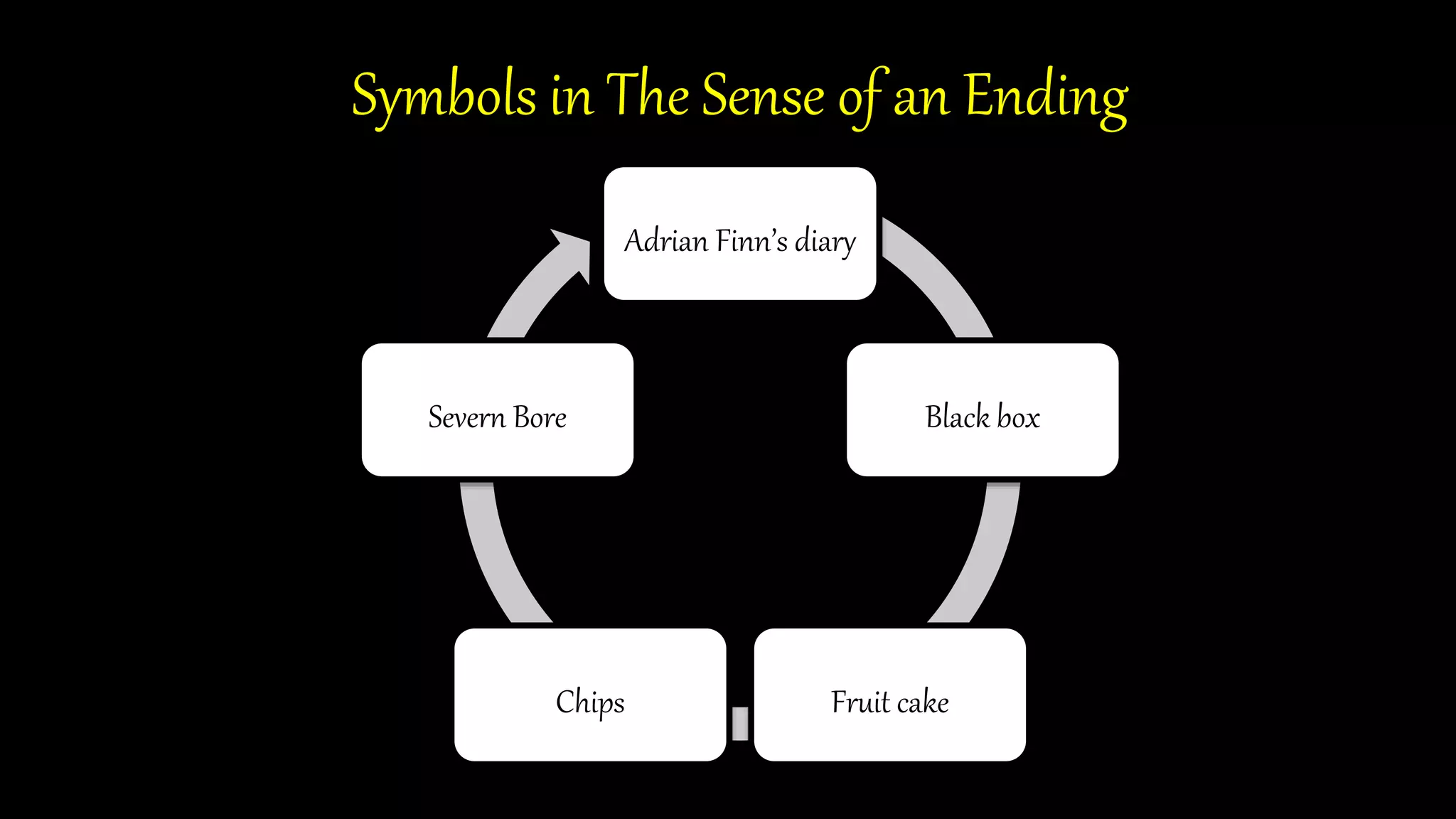
Symbols: Adrian’s Diary, Chips, Fruit Cake, Black
box
Structure
ā— Abrams, Meyer Howard, and Geoffrey Harpham. A glossary of literary terms.
Nelson Education, 2014.
ā— Cuddon, John Anthony. A dictionary of literary terms and literary theory.
John Wiley & Sons, 2012.
ā— Murphy, Daniel. Literary Devices: How To Master Structure. [online] Writer's
Edit. Available at: https://writersedit.com/fiction-writing/literary-
devices/literary-devices-master-structure/ [Accessed 8 April 2021].
Setting
The Sense of an Ending
Setting
ā— A setting is the time and geographical location within a
narrative, either nonfiction or fiction. It is a literary element.
ā— The setting initiates the main backdrop and mood for a story.
ā— Elements of setting may include culture, historical period,
geography, and hour.
Setting and context
ā— Tense: Past, Present
ā— Setting Time: 1960s, Present
ā— Setting Place: Suburban London, England.
Time
Time of the novel is 1960s and The
action take place in London. The time is
diverse as some actions described take
place during Tony's childhood, some
during his adulthood, and some during
when he is over fifty years old.
Historical context
Time of the novel is 1960s, and if we connect with historical context of the
novel than in 1960s, a time of vast cultural change, including movements for
sexual liberation, women's rights, and civil rights even if, as Tony notes, the
sixties only happenedin some parts of his owncountry.
Tony particularly lingers on the changes in gender norms, thinking at one
point about how the young girls he sees in short skirts would never have been
allowed to wear such outfits in the 1960s, nor would near a boys' school like his
own.
Place
Places which is considered in the novel almost all is
in London, some of from his childhood memories,
some places from his adulthood and some places
from present time when he is above fifty.
School in Central London
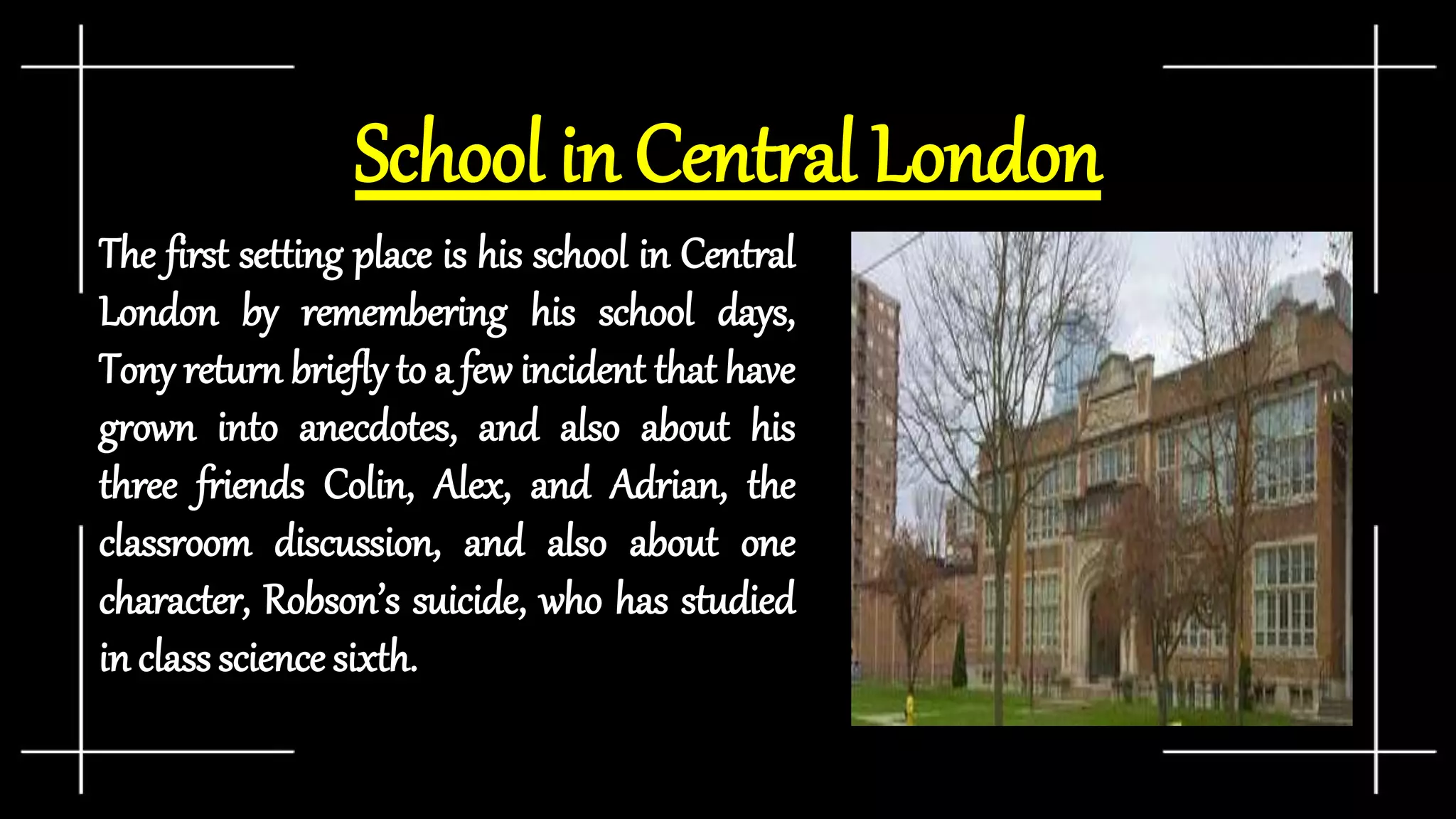
The first setting place is his school in Central
London by remembering his school days,
Tony return briefly to a few incident that have
grown into anecdotes, and also about his
three friends Colin, Alex, and Adrian, the
classroom discussion, and also about one
character, Robson’s suicide, who has studied
in class science sixth.
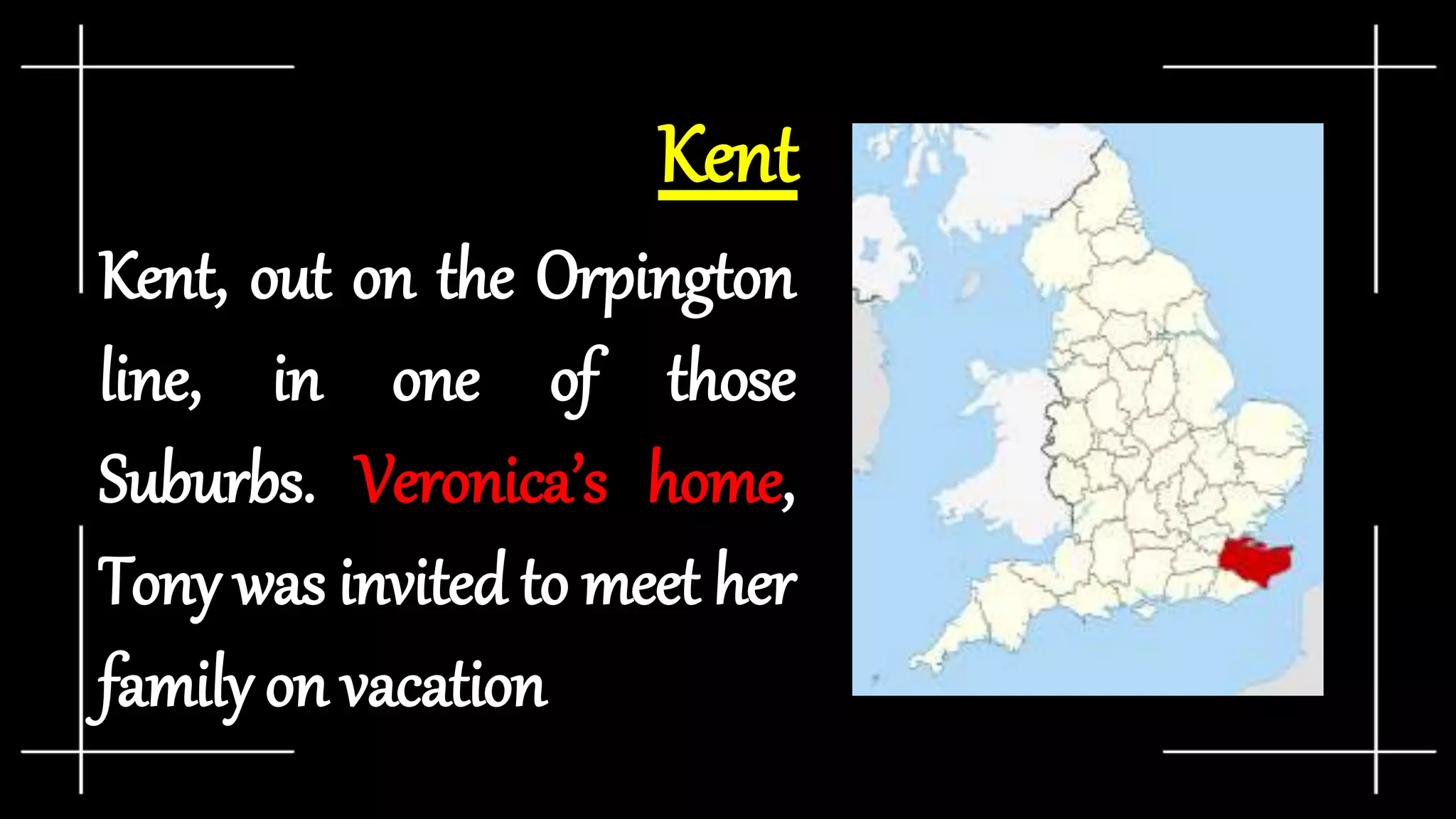
Kent
Kent, out on the Orpington
line, in one of those
Suburbs. Veronica’s home,
Tony was invited to meet her
family on vacation
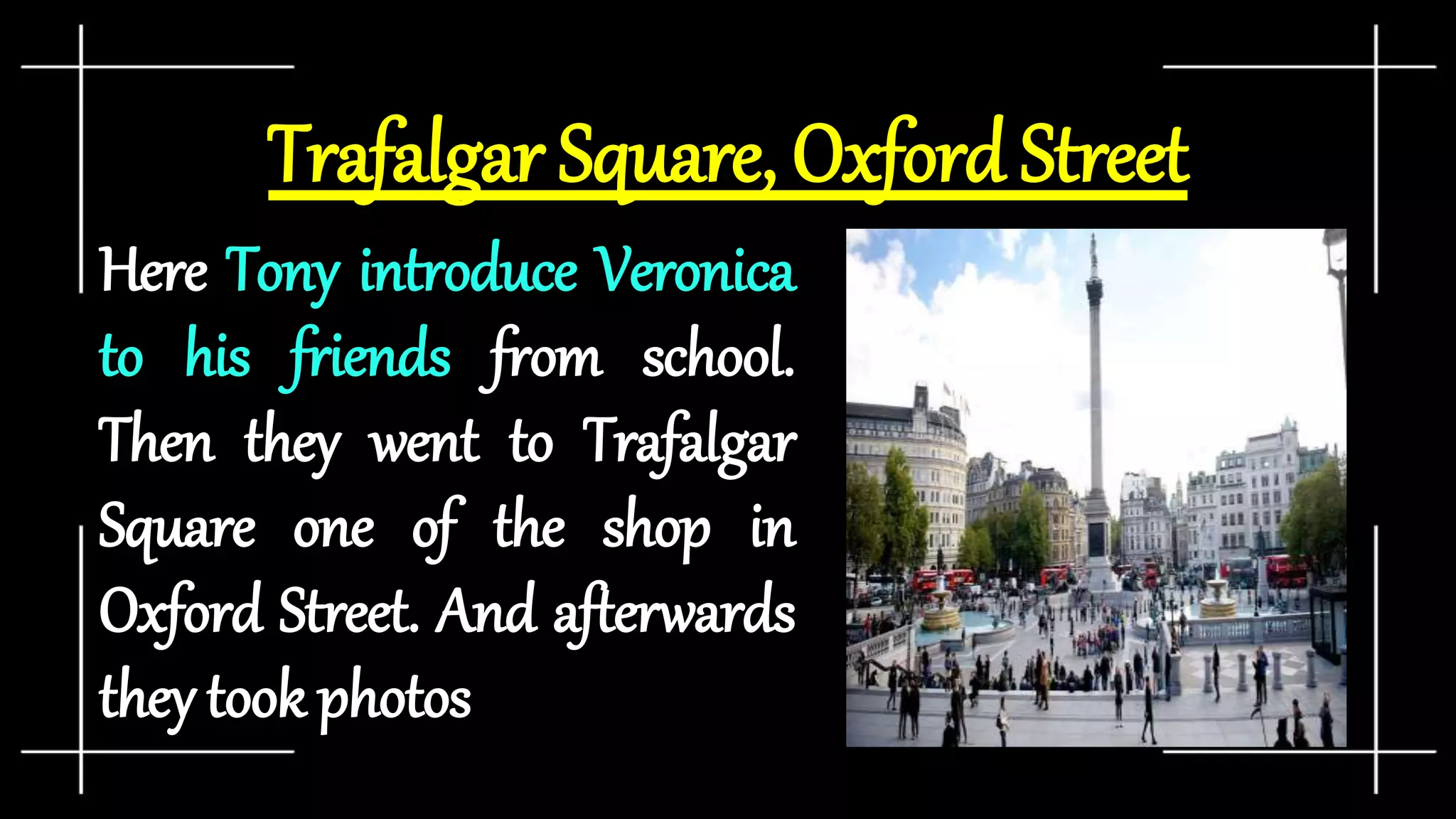
Trafalgar Square, Oxford Street
Here Tony introduce Veronica
to his friends from school.
Then they went to Trafalgar
Square one of the shop in
Oxford Street. And afterwards
they took photos
Severn Bore, Minsterworth
Apart from Bristol, Tony also share his
one of the memory of night at Severn
Bore, the group of them waited on the
riverbank until after midnight and were
eventually rewarded. For an hour or two
they observed the river flowing gently
down to the sea as all rivers do.
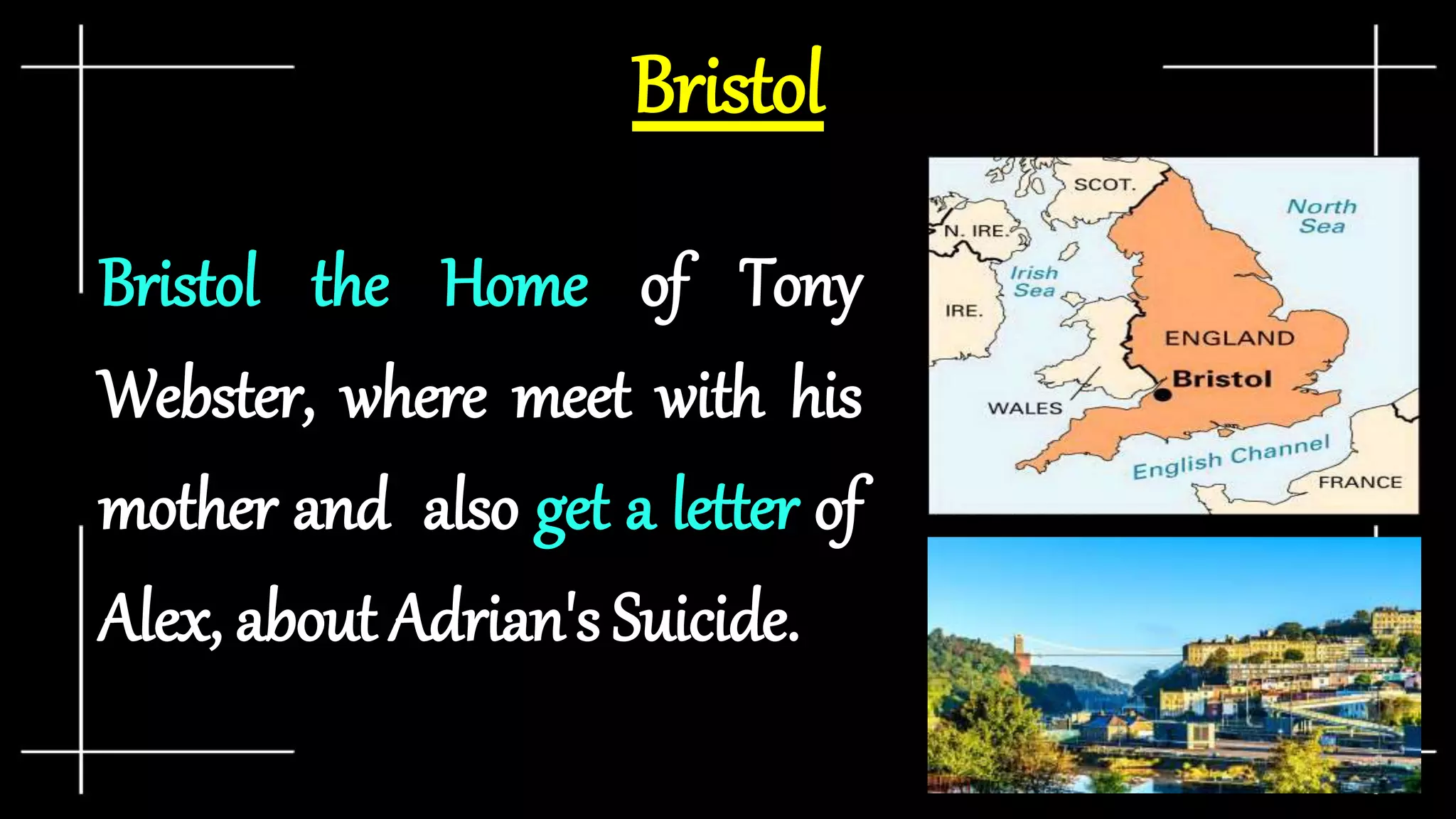
Bristol
Bristol the Home of Tony
Webster, where meet with his
mother and also get a letter of
Alex, about Adrian's Suicide.
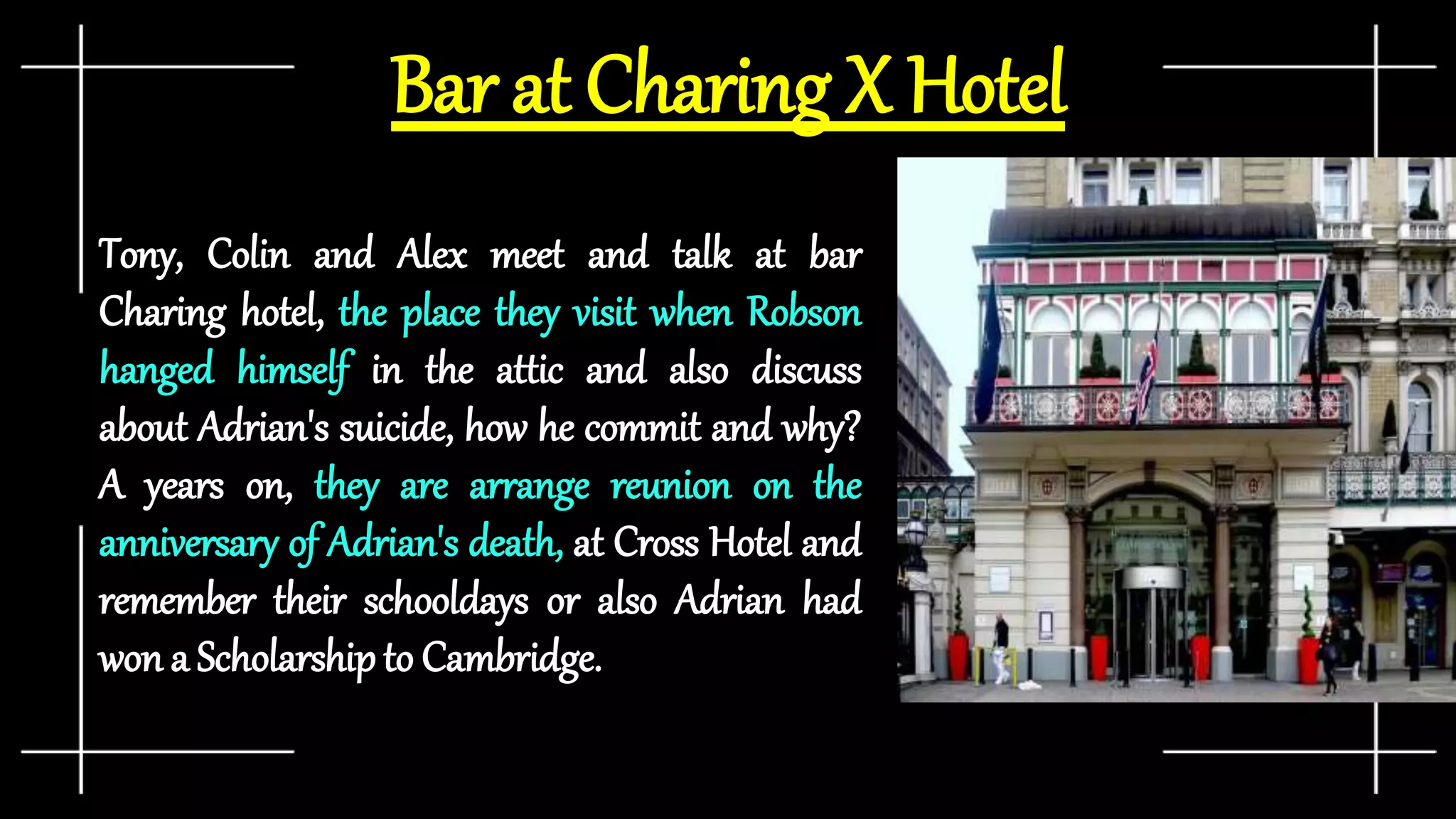
Bar at Charing X Hotel
Tony, Colin and Alex meet and talk at bar
Charing hotel, the place they visit when Robson
hanged himself in the attic and also discuss
about Adrian's suicide, how he commit and why?
A years on, they are arrange reunion on the
anniversary of Adrian's death, at Cross Hotel and
remember their schooldays or also Adrian had
won a Scholarshipto Cambridge.
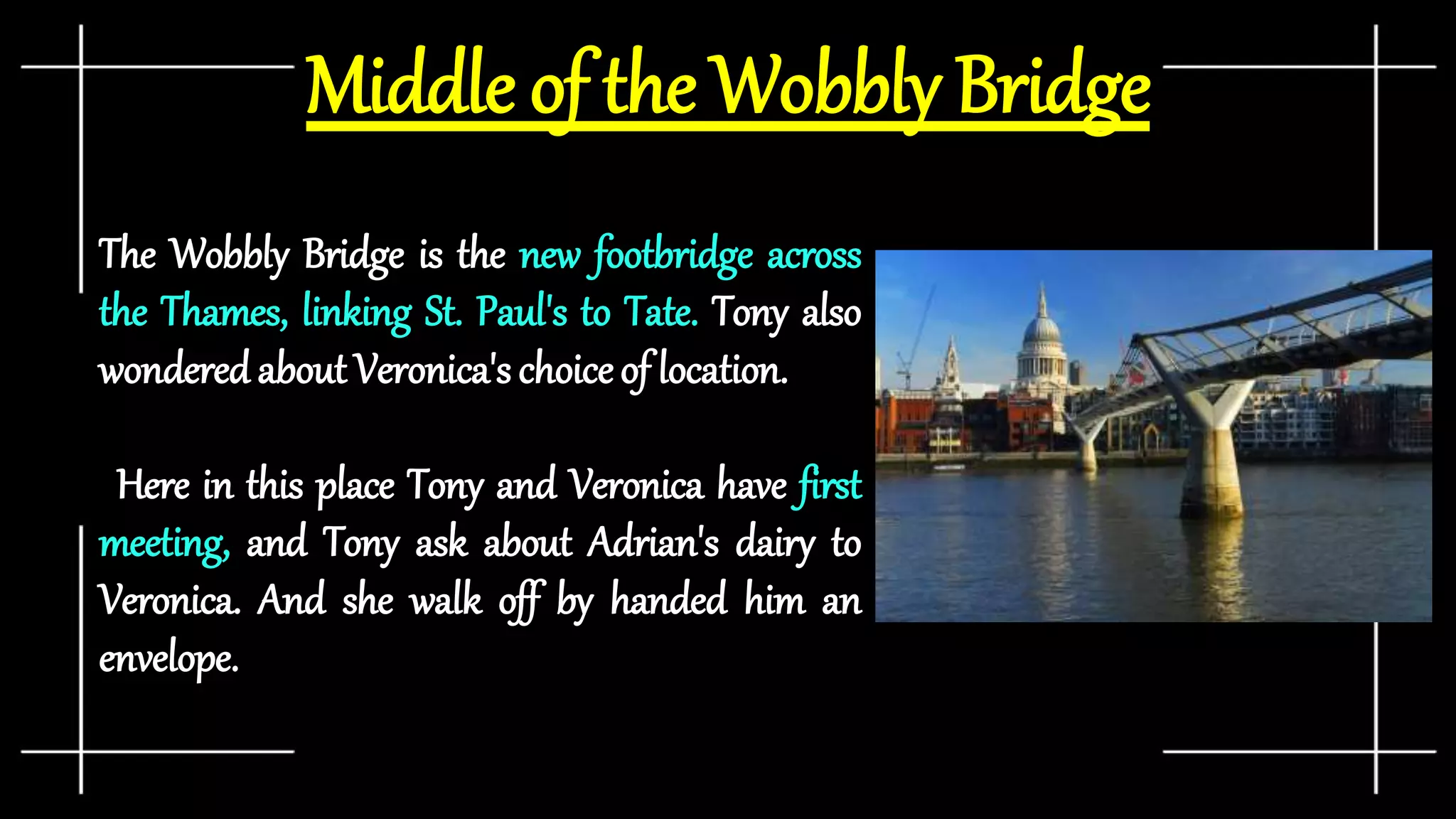
Middle of the Wobbly Bridge
The Wobbly Bridge is the new footbridge across
the Thames, linking St. Paul's to Tate. Tony also
wondered about Veronica's choiceof location.
Here in this place Tony and Veronica have first
meeting, and Tony ask about Adrian's dairy to
Veronica. And she walk off by handed him an
envelope.
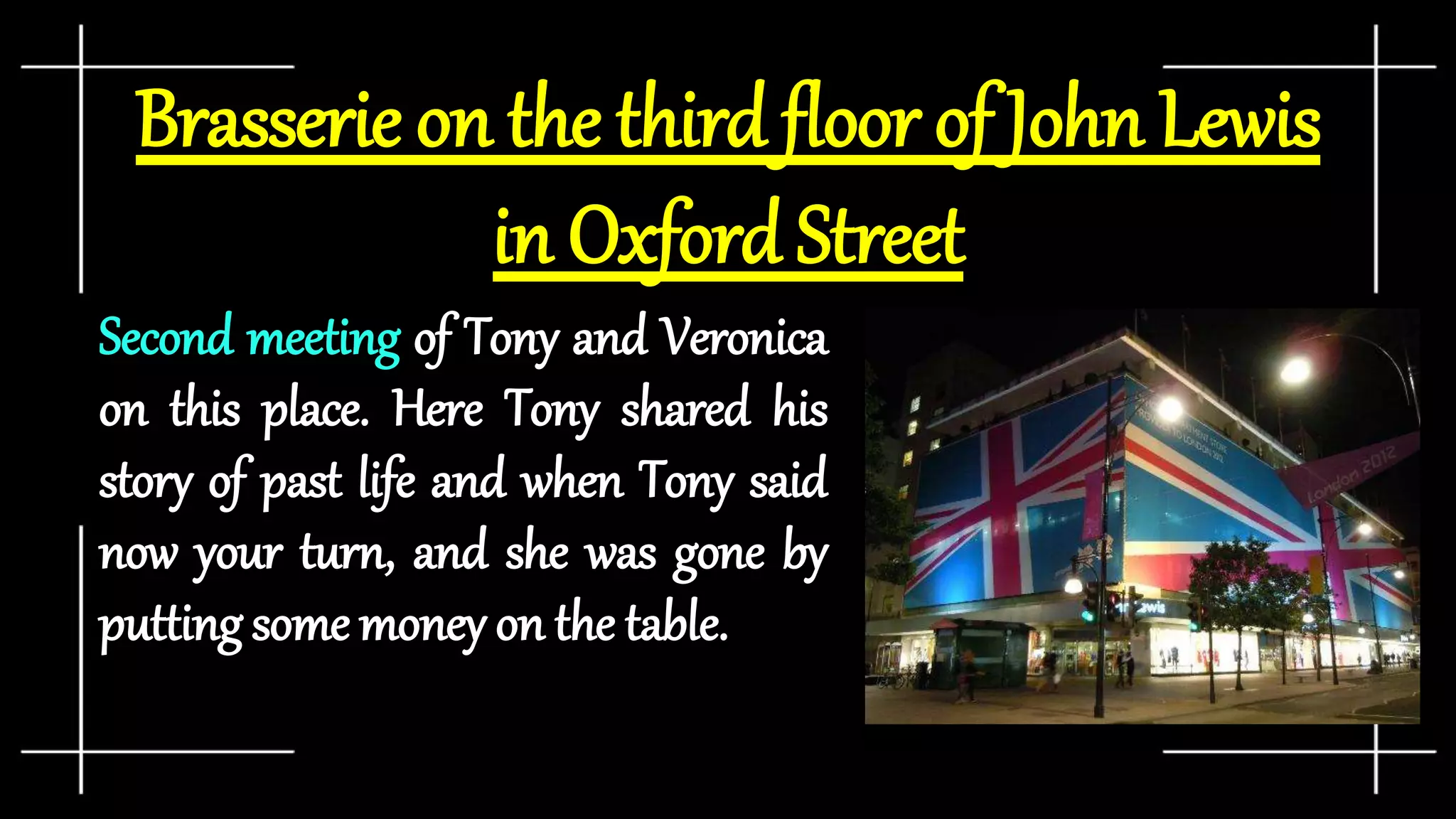
Brasserie on the third floor of John Lewis
in Oxford Street
Second meeting of Tony and Veronica
on this place. Here Tony shared his
story of past life and when Tony said
now your turn, and she was gone by
putting some money on the table.
An unfamiliar Tube Station in North
London
This location is an unknown
part of London, where
Veronica shows a small group
of people
Pub
Here in the Pub, Tony Webster
meets one man Terry and came
to know the reality and also
cleared about his all confusion.
Setting
ā— Barnes, J. (2011). The sense of an ending. New York, NY: Alfred
ā— A. Knopf.
ā— BookBrowse. ā€œThe Sense of an Ending by Julian Barnes: Summary and
Reviews.ā€ BookBrowse.com,
www.bookbrowse.com/reviews/index.cfm/book_number/2638/
ā— Barnes, Julian. ā€œThe Sense of an Ending by Julian Barnes.ā€
PenguinRandomhouse.com, Knopf,
www.penguinrandomhouse.com/books/214847/the-sense-of-an-ending-
by-julian-barnes/.
Characters
The Sense of an Ending
What is character?
• A character is a person, animal, being, creature, or thing in a story.
Writers use characters to perform the actions and speak dialogue, moving
the story along a plot line. A story can have only one character
(protagonist) and still be a complete story. This character’s conflict may be
an inner one (within him/herself), or a conflict with something natural,
such as climbing a mountain. Most stories have multiple characters
interacting, with one of them as the antagonist, causing a conflict for the
protagonist.
Importance of character
Characters are what make stories. Without a character, there is no
story to tell, only a lot of scenery. Many characters in literature,
television series, and movies have a huge impact on people. Some
people like to live their lives through these characters, who appear to
have more exciting lives. Also, these characters may seem so real and
inspirational, that people forget they are fictional.
What is characterization?
• Characterization is a writer’s tool, or ā€œliterary deviceā€ that
occurs any time the author uses details to teach us about a
person. This is used over the course of a story in order to tell
the tale.
Importance of characterization
• Modern storytelling usually emphasizes characterization even more
than classical literature. This is because characterization is a major
tool in the plot-driven narrative. They can quickly connect the
reader to the character, without taking them out of the action.
Plot is not the main point:
character and life are Barnes’ focus.
- Whispering Gums
The black woman
Terry
Indian Woman
40 years Man
T.J. Gunnell
• Tony’s solicitor to whom Tony contavts to obtain Adrian Finn’s diary.
• This solicitor advices to focus on not the situation or character or criminal but on
'intention'.
When Tony talks about solicitors, he also
thinks of Jack, as his solicitor who can help
him.
"I’m sure BrotherJack would have someone he refers to as
ā€œmy solicitor.ā€ In my case it’s the local chap who drew up my will; he
has a small
office above a florist’s and seems perfectly efficient."
- Julian Barnes
-The sense of an Ending
Tony’s interesting argument with T.G.Gunnel
ā€œIs that legal?ā€
ā€œWell, it’s not illegal. It may well be prudent.ā€
We didn’t seem to be getting very far. ā€œLet me get this straight. She ought to
have handed over this document, this diary, to you. You’ve asked for it, and she’s
refusing to give it up.ā€
ā€œFor the present, yes, that is the case.ā€
ā€œCan you give me her address?ā€
ā€œI would have to have her authority to do so.ā€
ā€œThen would you kindly seek that authority?ā€
Have you noticed how, when you talk to someone like a solicitor, after a while
you stop sounding like yourself and end up sounding like them?
-Tony Webster
-The Sense of an Ending
Eleanor Marriott
• Sarah Ford’s solicitor
Robson
• Class science sixth
• Does not appears directly into the novel yet serves the plot significantly
Adjectivesusedfor
• Flower of youth
• His friends were considering him as a vegetable material
HowRobson’scharacteris important?
Commits suicide at the age of sixteen or fifteen.
Helps to understand this novel’s central character – Adrian Finn
Had got his girlfriend pregnant and his girlfriend leaves a letter behind
Robson’s girlfriend
• The invisible character
• Brown spreads rumors that Robson died because his
girlfriend got pregnant.
Brown
• Supplied the rumor of Robson’s suicide and facts related to this act.
• also informs to these friends about the letter of Robson’s girlfriend
Mr.Ford
• Veronica’s father
• Civil servant
Mrs Sarah Ford
•Veronica’s mother
Jack Ford
• Veronica Ford’s brother
• Completed his final year at Cambridge
• Adrian heard about him in magazine article for the first time
• Healthy and sprouting young man
• Tony approaches him many time
Annie
• American traveler (traveler like Tony, as Tony says)
• Tony and Annie became lovers easily and quickly
Outlook and dressing:
• Wore plaid shirts, had grey-green eyes and a friendly manner
ā€œEasy come, easy go, she said, and she meant it.ā€
- Tony Webster for Annie(his girlfriend)
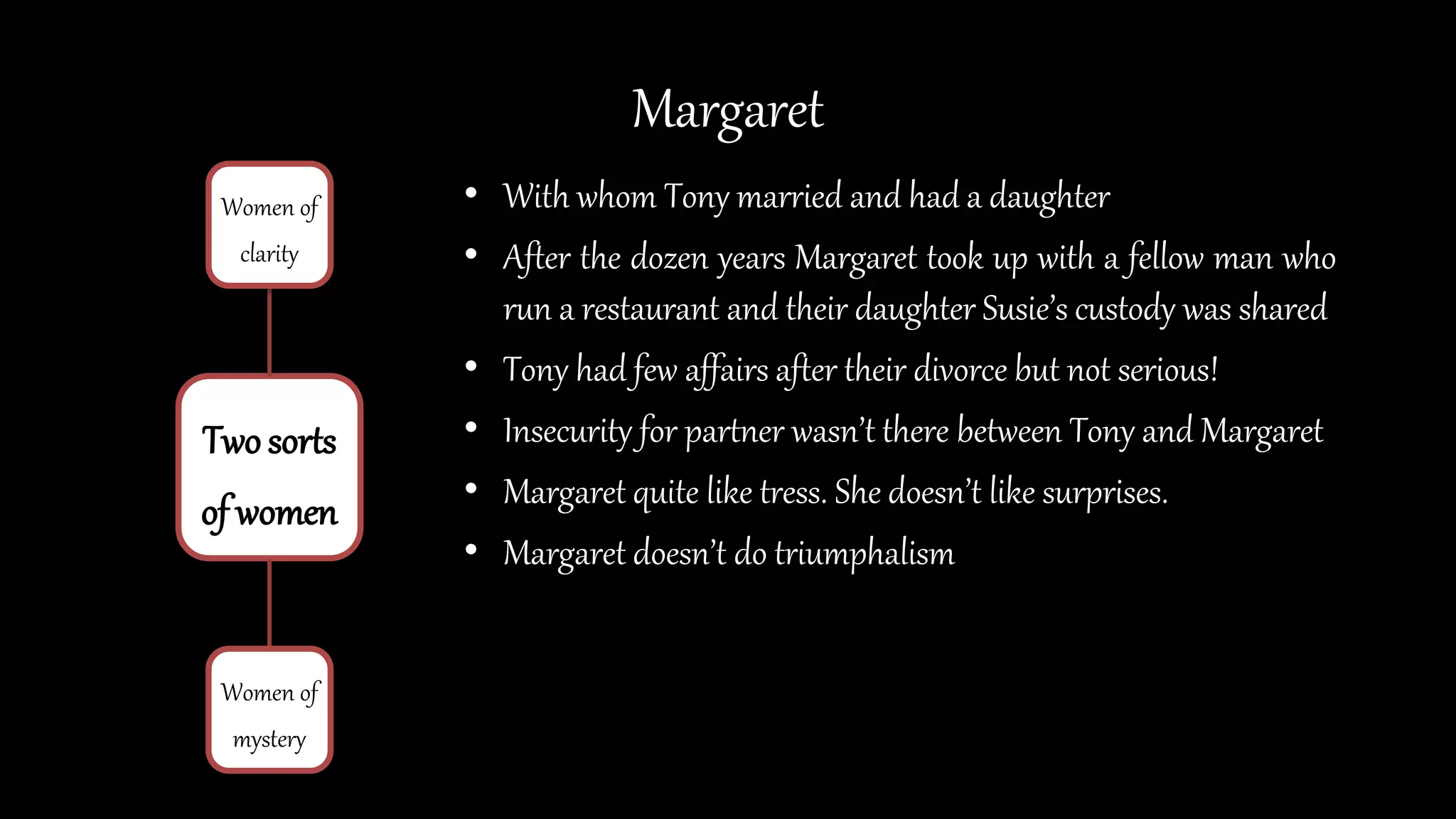
Margaret
• With whom Tony married and had a daughter
• After the dozen years Margaret took up with a fellow man who
run a restaurant and their daughter Susie’s custody was shared
• Tony had few affairs after their divorce but not serious!
• Insecurity for partner wasn’t there between Tony and Margaret
• Margaret quite like tress. She doesn’t like surprises.
• Margaret doesn’t do triumphalism
Two sorts
of women
Women of
clarity
Women of
mystery
(Margaret)
(She is the character who listens, asks pertinent questions, and she understands.)
• Margaret’scommentsuponwomenfor beautifying hair
Margaret used to say that women often made the mistake of keeping their hair in the style they
adopted when they were at their most attractive. They hung long after it became
inappropriate, all because they were afraid of the big cut.
• Tony’s sight cut (abut Annie)
• Margaret as a nice driver who treats car also properly
Susie
• Margaret and Tony’s daughter after three years of their marriage
• After Margaret and Tony’s divorced, Susie’s custody was shared
• Has a husband and two children
(a daughter & a sun- Tony carries their photo with him in his wallet)
• Nickname: Susan
Ken
• Susie’s husband
• doctor
Adrian’s mother
• She comes to meet Adrian, his sister and his father to London.
• When Tony questions Adrian’s mother’s loyalty towards family, he remains silent.
He does not show any disrespect towards her.
Caroline
• Margaret tells story about Caroline
• Had a husband, two small kids
• She didn’t have any suspicions or anything
• Caroline reads girl’s diary and it was full of denunciation
• Gives a supportive hand to read novel’s central need to read Adrian Finn’s diary
Old Joe Hunt
• History professor
• Kind of a professor who enlightens students and brings different, unique and wider angle to look at
the history and students’ classroom discussion with him produces fruitful and healthy definitions of
History
• Asked students to debate the origins of the First World War, specifically, the responsibility of
Archduke Frantz Ferdinand’s assassin for starting the whole thing off.
• Had guided his lethargic pupils through Tudors and Stuarts, Victorians and Edwardians, Rise of
Empire and its subsequent decline.
Phil Dixon
• English professor
• After having the lecture with professor Old Joe Hunt, these friends had double
English period.
• Gives a poem to study in class without the name of poet.
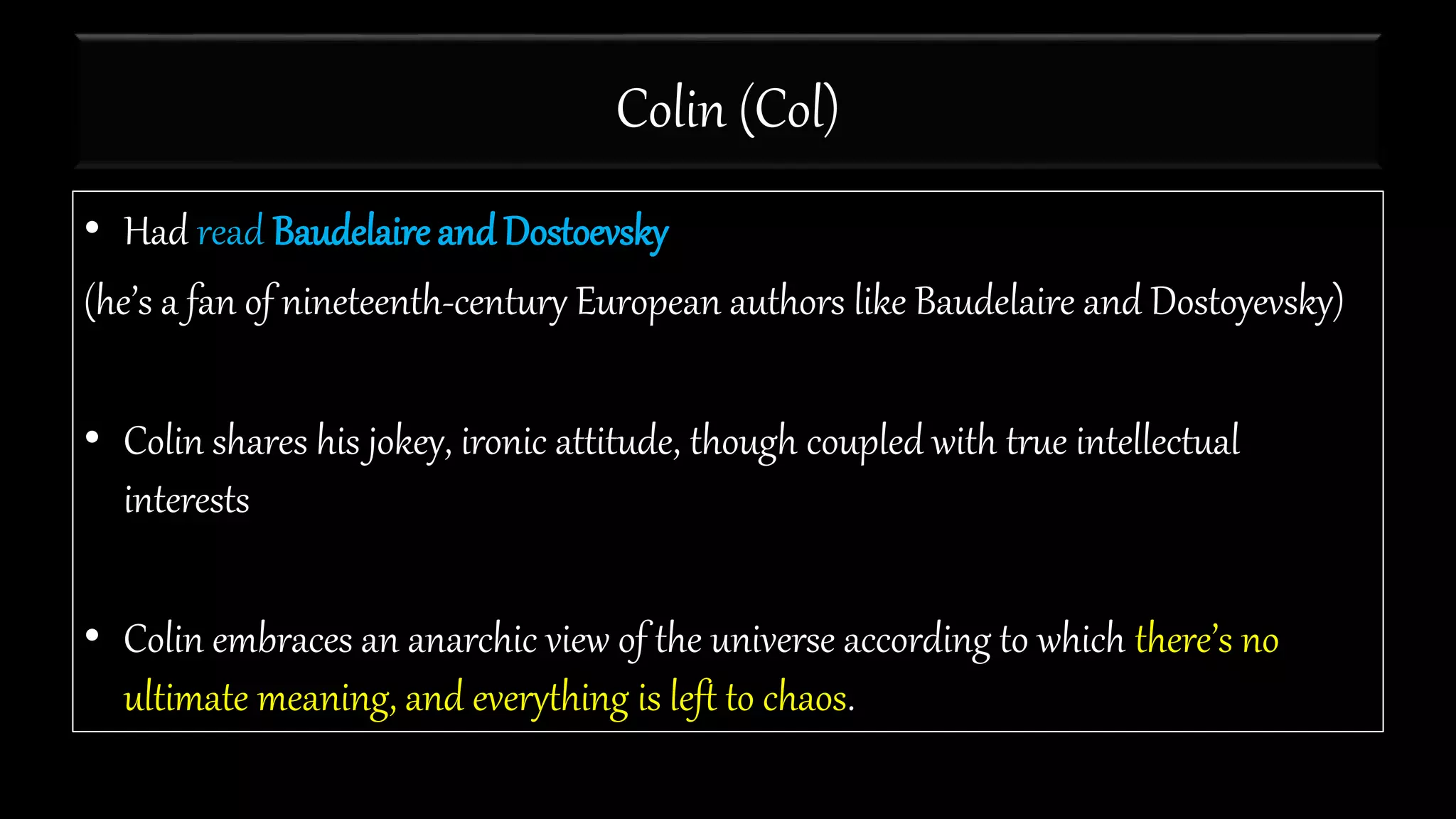
Colin (Col)
• Had read Baudelaire and Dostoevsky
(he’s a fan of nineteenth-century European authors like Baudelaire and Dostoyevsky)
• Colin shares his jokey, ironic attitude, though coupled with true intellectual
interests
• Colin embraces an anarchic view of the universe according to which there’s no
ultimate meaning, and everything is left to chaos.
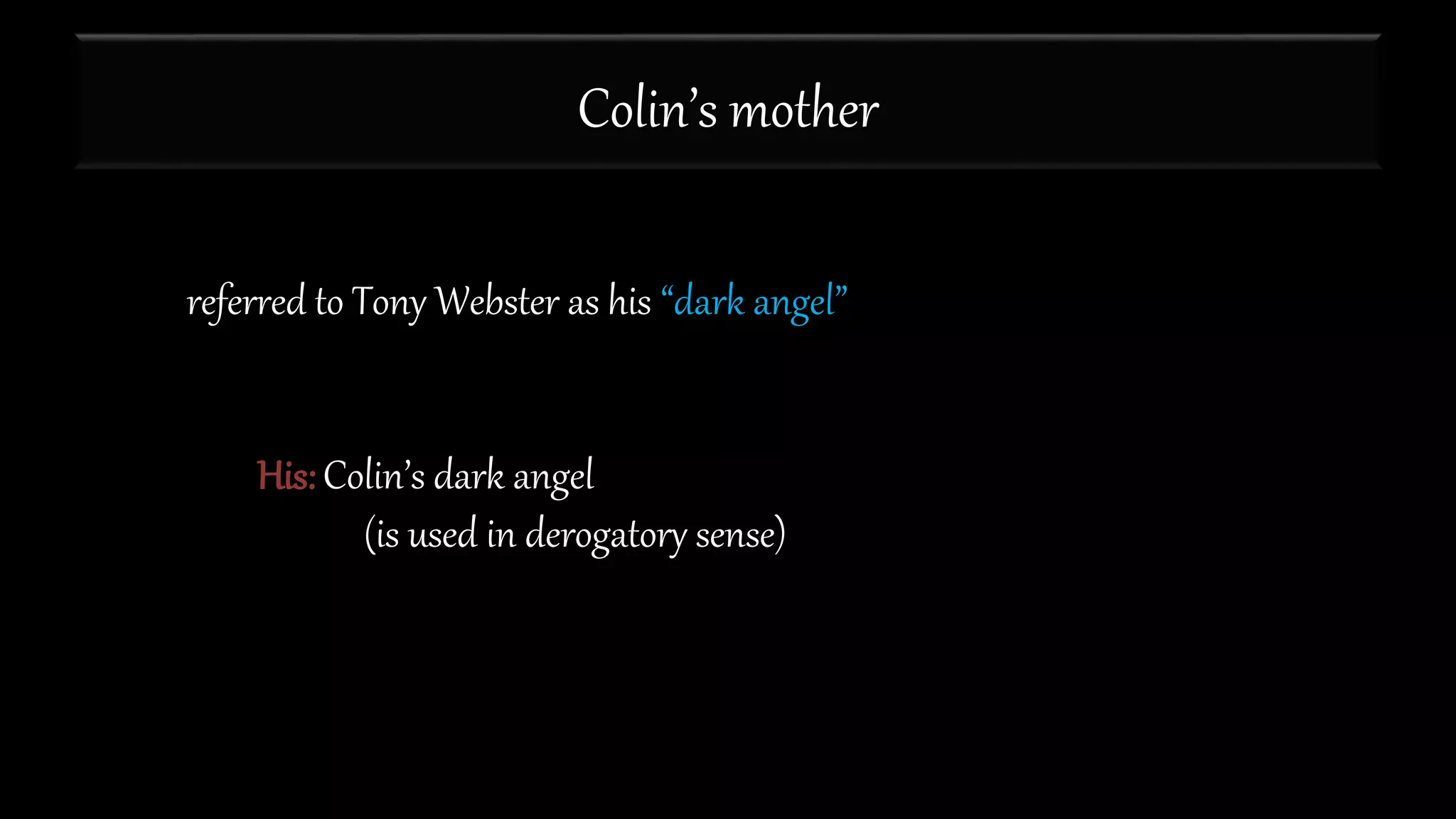
Colin’s mother
referred to Tony Webster as his ā€œdark angelā€
His: Colin’s dark angel
(is used in derogatory sense)
Alex (Alexander)
• Alex is considered the philosopher among them before Adrian joins the group. Had
read Russell and Wittgenstein.
• He shares the details of Adrian’s suicide with Tony, who was traveling around the
United States when it happened.
(here, this it refers to the suicide of Adrian Finn)
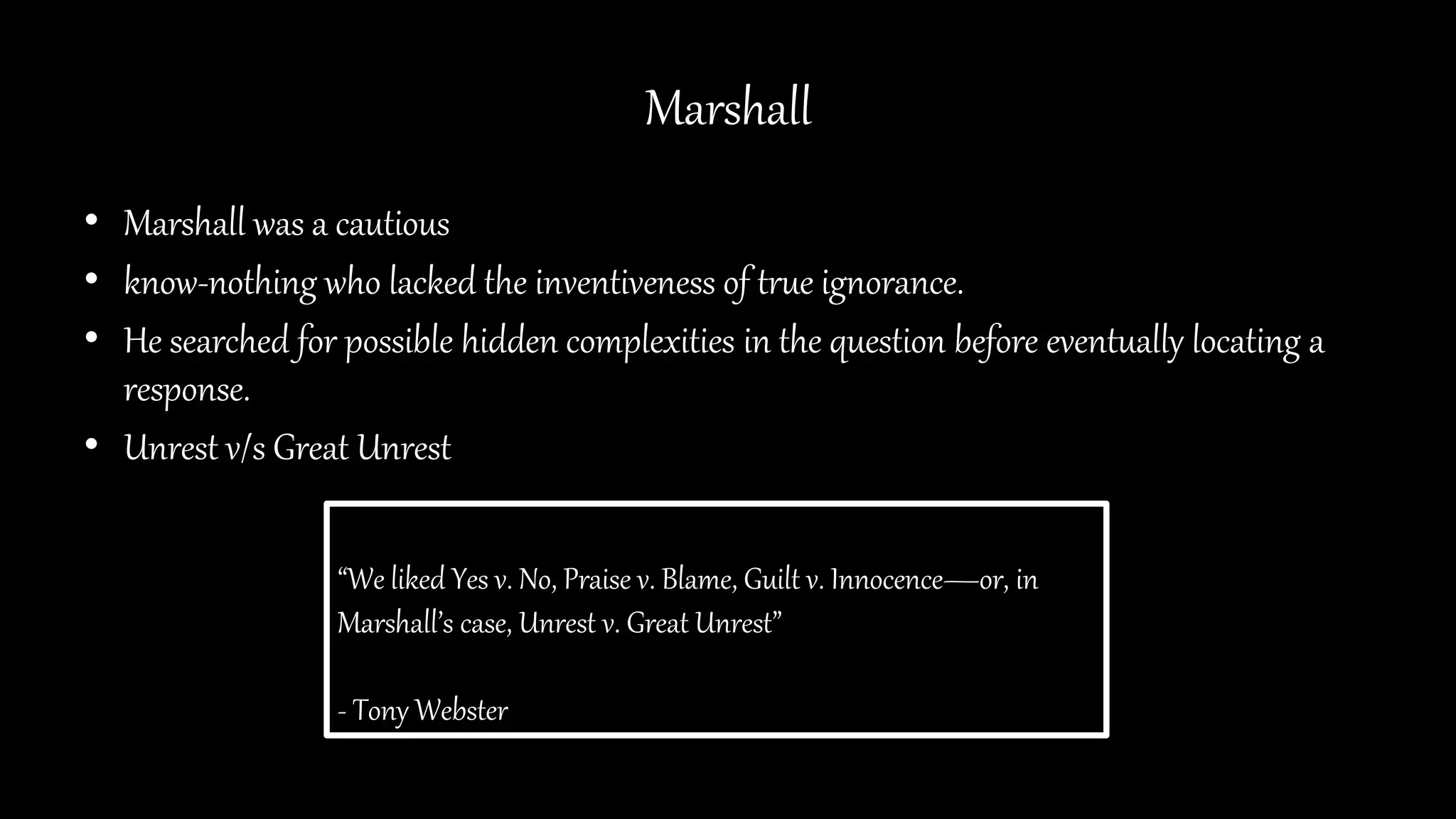
Marshall
• Marshall was a cautious
• know-nothing who lacked the inventiveness of true ignorance.
• He searched for possible hidden complexities in the question before eventually locating a
response.
• Unrest v/s Great Unrest
ā€œWe liked Yes v. No, Praise v. Blame, Guilt v. Innocence—or, in
Marshall’s case, Unrest v. Great Unrestā€
- Tony Webster
Veronica Mary Elizabeth Ford
• Veronica is straightforward, clear, committed and consistent in relationships.
• More realistic and practical character than Ad
Tony himself, in the first part of the novel Tony mentions that
ā€œVeronica wasn’t very different from other girls of that timeā€
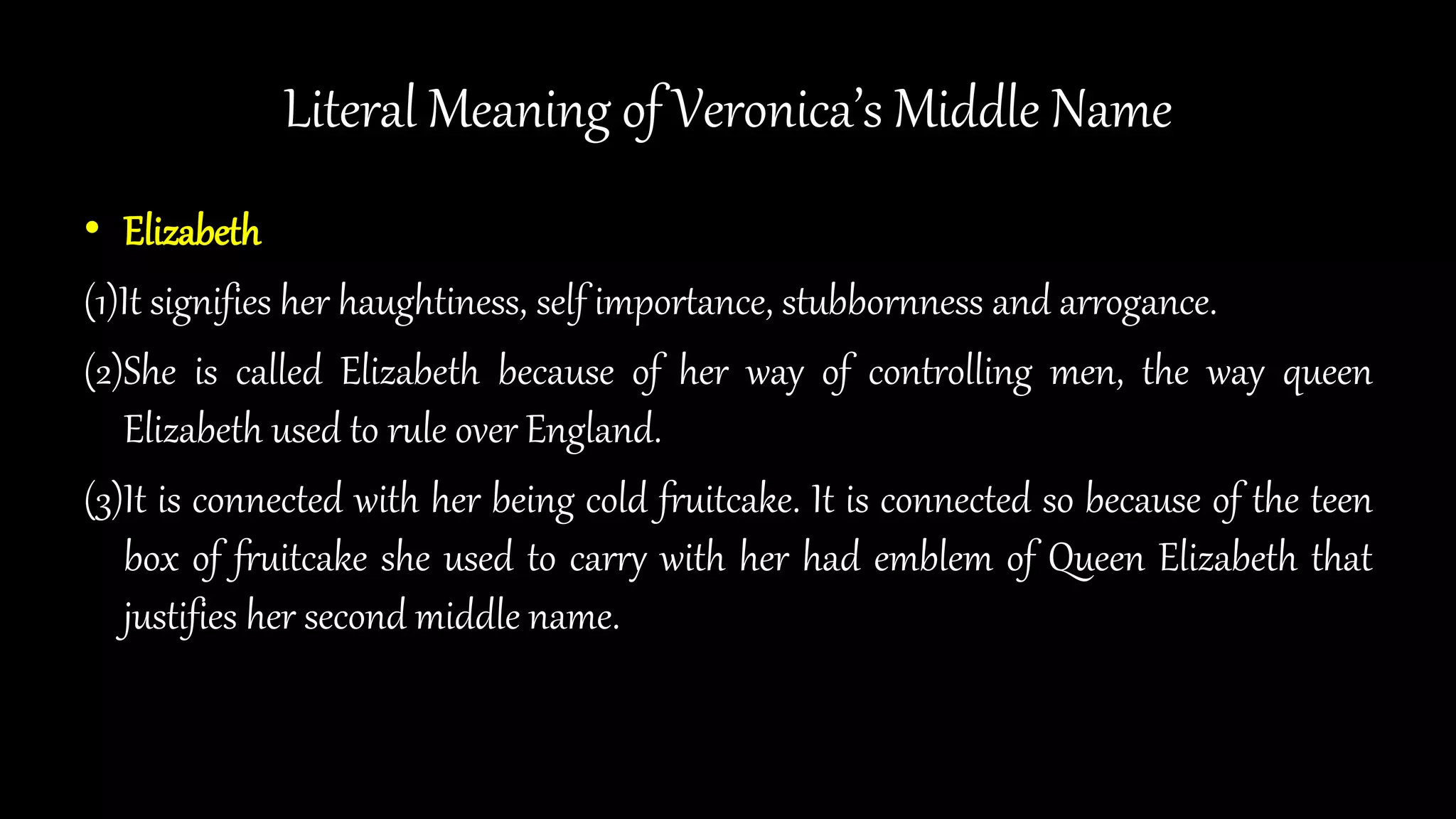
Literal Meaning of Veronica’s Middle Name
• Elizabeth
(1)It signifies her haughtiness, self importance, stubbornness and arrogance.
(2)She is called Elizabeth because of her way of controlling men, the way queen
Elizabeth used to rule over England.
(3)It is connected with her being cold fruitcake. It is connected so because of the teen
box of fruitcake she used to carry with her had emblem of Queen Elizabeth that
justifies her second middle name.
Tony has found the above writers in Veronica's bookshelves.
Hans Eysenck
Johan Huizinga
William Empson
Richard Hoggart
Steven Runciman
Bishop John Robinson
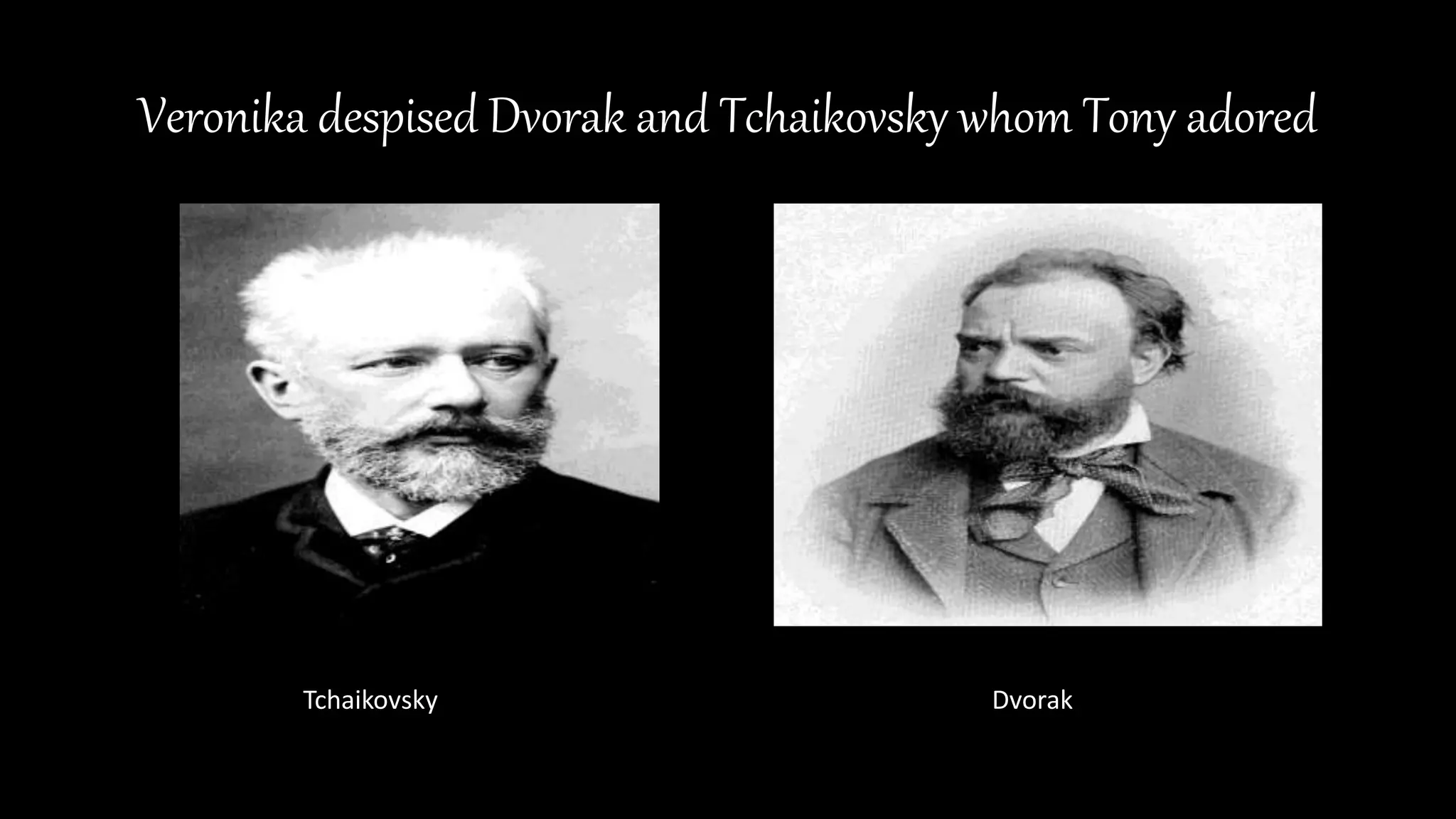
Veronika despised Dvorak and Tchaikovsky whom Tony adored
Tchaikovsky Dvorak
Adrian Finn
• Character who proves the suicide Philosophical
• He is tall and shy boy, a student of philosophy
• He loved his mother and respected his father
ā€œWell, in one sense, I can’t know what it is that I don’t know.
That’s philosophically self-evident.ā€
-Adrian Finn
- The Sense of an Ending
Three friends and Adrian Finn
ā€œAll three friends wanted, We wanted his attention, his approval; we courted him, and
told him our best stories first; we each thought we were—and deserved to be—closest
to him. And though we were making new friends ourselves, we were somehow
persuaded that Adrian wasn’t: that we three were still his nearest intimates, that he
depended on us.ā€
-Tony Webster
- The Sense of an Ending
Can you think of the reasons why Adrian may have committed
Suicide?
• How Adrian’s suicide is different from Robson’s suicide?
• clue to assume
• In any of cases, Adrian would wish to unburden himself and not finding any way out, committed suicide.
ā€œwho oscillatebetweenpleasureand pain, lossand gain,mistakesand reparations
and in due course,come to understandthe dynamicsof Timeand Life.ā€
-The Senseof an Ending
Adrian’s reaction on Robson’s suicide
• Quoted Albert Camus…
ā€œsuicide [is]the only true philosophical question.ā€
Tony Webster
• Tony – The unreliable narrator
1.What is the role of memory in the narration of Tony Webster?
2. How does the tale become the inadequacy of recollection along with the
shortfalls of documents?
3. In what sense Tony is regarded as an unreliable yet honest narrator?
4. What is the connection of accumulation and responsibility with the main
character of the novel?
Tony Webster
• Throughout the narration he constantly foregrounds his suspicions concerning the
reliability of his own memory. However, he has to reckon on the recovery of his own
memories which are caused to be changed by the discovery of historical documents
and which, therefore, constantly frustrate his account.
Tony Webster
• Theoryof damage
This damage is superficially related in the novel’s first part by Tony being
very much in compliance with ā€œthe damage theoryā€.
• Regret v/s remorse
Tony Webster/Anthony Webster
• Do the failures of his memory make him a liar, or an unreliable narrator?
• Does this justify Voltaire who claims that ā€œhistory is a pack of lies we play on the
dead
For Tony, memory becomes…
ā€œa thing of shreds and patchesā€ which resembles the black box of aeroplanes. ā€œIf
nothing goes wrong, the tape erases itself. So if you do crash, it’s obvious why you did;
if you don’t, then the log of your journey is much less clear.ā€
Tony- The Unreliable character
1.What is the role of memory in the narration of Tony Webster?
2. How does the tale become the inadequacy of recollection along with the shortfalls
of documents?
3. In what sense Tony is regarded as an unreliable yet honest narrator?
4. What is the connection of accumulation and responsibility with the main
character of the novel?
Tony Webster
(regret v/s remorse)
In the young days, when Adrian is talking to Tony, he calls him Anthony and
when Veronica tells ā€œyou just don’t get it do you? There She calls him Tonyā€
So at last, we have Anthony who made sense of everything and we have Tony
who didn’t understand anything.
Characters
• ā€œLiterary Terms.ā€ Literary Terms. 1 June 2015. Web. 3 Nov. 2016.
<https://literaryterms.net/>.
• Works Cited
• Abrams, M. H., & Harpham, G. G. (2015). A glossary of literary terms. Boston (Mass.):
Wadsworth Cengage Learning.
• Barnes, Julian. The Sense of an Ending. Vintage, 2017.
• Naz, Salma, and Asad Malik. ā€œAnalysis of the Protagonist's Unreliable Chronicle with
the Misleading Memory but with the Sense of Responsibility in Barnes's Novel The
Sense of an Ending.ā€ International Journal of Research Scholars, vol. 1, no. 1.
Detailed Plot
The Sense of an Ending
The Blurb link- https://youtu.be/KVdTrdt1gRg
Work Cited:
Barnes, Julian. The Sense of an Ending. Vintage,
2011.
Themes
The Sense of an Ending
Major and Minor Themes
1. Conflict between Eros and
Thanatos
2. Inconsistencies between History
and Memory
3. Recovered memories are
traumatic life
4. Existential Philosophical suicide
1. Responsibility
2. Connection and
Reflection
3. An Oedipus Complex
4. Class conflict
Conflict between Eros and Thanatos
ā—ˆ The terms, Eros and Thanatos - Greek
mythology
ā—ˆ In Freud’s book ā€œBeyondthe Pleasure
Principleā€in which he proposes that
ā€œthegoalof alllifeis deathā€
• God of Love and
Desire
Eros
• God of Death
Thanatos
ā—ˆ Adrian speaks up in the English class. He opines that the poem they are reading
is about
ā€œErosand Thanatos … the eroticprinciple,in any case,coming intoconflictwiththe
deathprincipleā€(Barnes6).
ā—ˆ Another incident that reflects the conflict between Eros and Thanatos is the
suicide of Robson. Robson, a student of Science sixth form, commits suicide
after getting his girlfriend pregnant.
ā—ˆ As his sense of morality activates the death instinct and thus he commits
suicide. In the case of Robson,
ā€œThanatoswinsagainā€(Barnes13).
ā—ˆ Relationship of Tony and Veronica indicates his tendency to
satisfy his Eros.
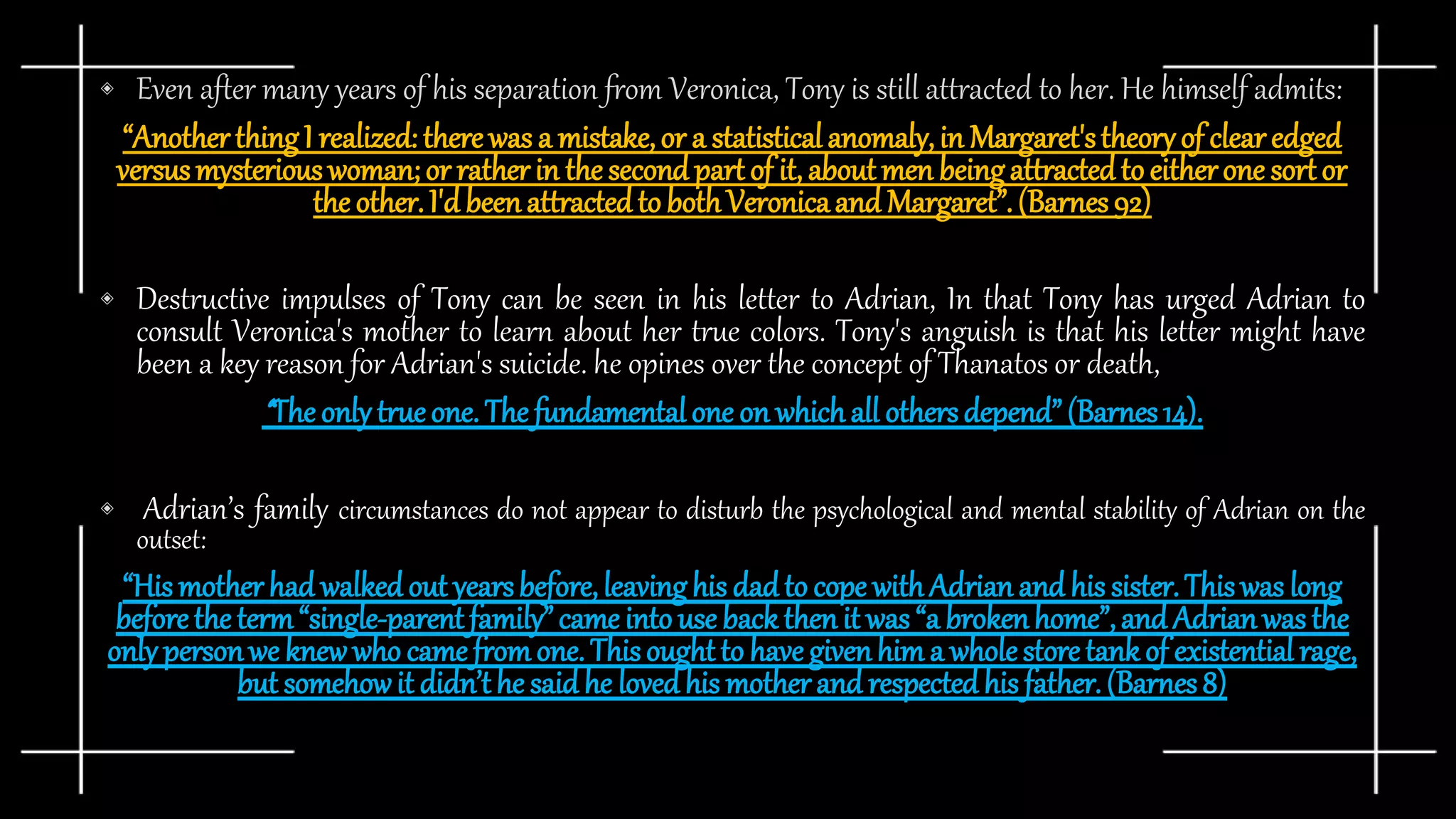
ā—ˆ Even after many years of his separation from Veronica, Tony is still attracted to her. He himself admits:
ā€œAnotherthingI realized: therewas a mistake,or a statisticalanomaly,in Margaret'stheoryof clearedged
versusmysteriouswoman;or ratherin the secondpart of it, aboutmen beingattractedto eitherone sortor
the other.I'd beenattractedto bothVeronicaand Margaretā€.(Barnes92)
ā—ˆ Destructive impulses of Tony can be seen in his letter to Adrian, In that Tony has urged Adrian to
consult Veronica's mother to learn about her true colors. Tony's anguish is that his letter might have
been a key reason for Adrian's suicide. he opines over the concept of Thanatos or death,
ā€œThe only trueone. The fundamentalone on whichall othersdependā€(Barnes14).
ā—ˆ Adrian’s family circumstances do not appear to disturb the psychological and mental stability of Adrian on the
outset:
ā€œHismotherhad walkedout yearsbefore,leavinghis dadto cope withAdrianand his sister.Thiswas long
beforethe termā€œsingle-parentfamilyā€came into use back thenit was ā€œa brokenhomeā€,and Adrianwas the
only personwe knew who came fromone. Thisoughtto have givenhim a wholestoretankof existential rage,
but somehowit didn’t he saidhe lovedhis motherand respectedhis father.(Barnes8)
Inconsistencies between History and Memory
ā—ˆ The novel actively questions the realness of memories.
ā—ˆ Tony’s narrative, making them question the veracity of Tony's
memories. The memory of Tony Webster, Julian Barnes justifies the
universal truth that
ā€˜onecannot knowwhat onedoesnot know’.
ā—ˆ Tony's recollections are centered on his relationship with Adrian and
his ex-girlfriend Veronica Ford. Veronica has asserted that
ā€œYou stilldon’tget it. You neverdid, and youneverwill.So stopeven
tryingā€.
ā—ˆ Veronica assumes the image of a dominant, stoic and cruel girlfriend in ]Tony's
memories.
ā—ˆ Tony's great pain and his memories are nothing but a reflection of his pain and
hurt.
ā—ˆ He is interested in discovering the intricacies of sex more than in understanding
relationships or in analyzing the behavior of his peers:
ā€œthe more you liked a girl, and the better matched youwere, the lessyour chance
of sex, it seemedā€
ā—ˆ This sentence shows kind of malleability of time.
ā—ˆ ā€œWe live in time-it holds us and moulds us-but I’ve never felt I understood it very well. And I’m
not referring to theories about how it bends and doubles back, or may exist elsewhere in parallel
visions. No, I mean ordinary, everyday time, which clocks and watches assure us passes regularly:
tick-tock, click-clock. Is there anything more plausible than a second hand? And yet it takes only
the smallest pleasure or pain to teach us time’s malleability. Some emotions speed it up, others
slow it down; occasionally, it seems to go missing-until the eventual point when it really does go
missing, never to return.ā€ (The Sense of an Ending 3)
ā—ˆ Adrianā€Ÿs understanding of history was this:
ā€œHistory is that certainty produced at the point where the imperfections of memory meet the
inadequacies of documentationā€ (17).
ā—ˆ his shared history with Adrian and Veronica, through few available documents and from blurry
fragments of memory.
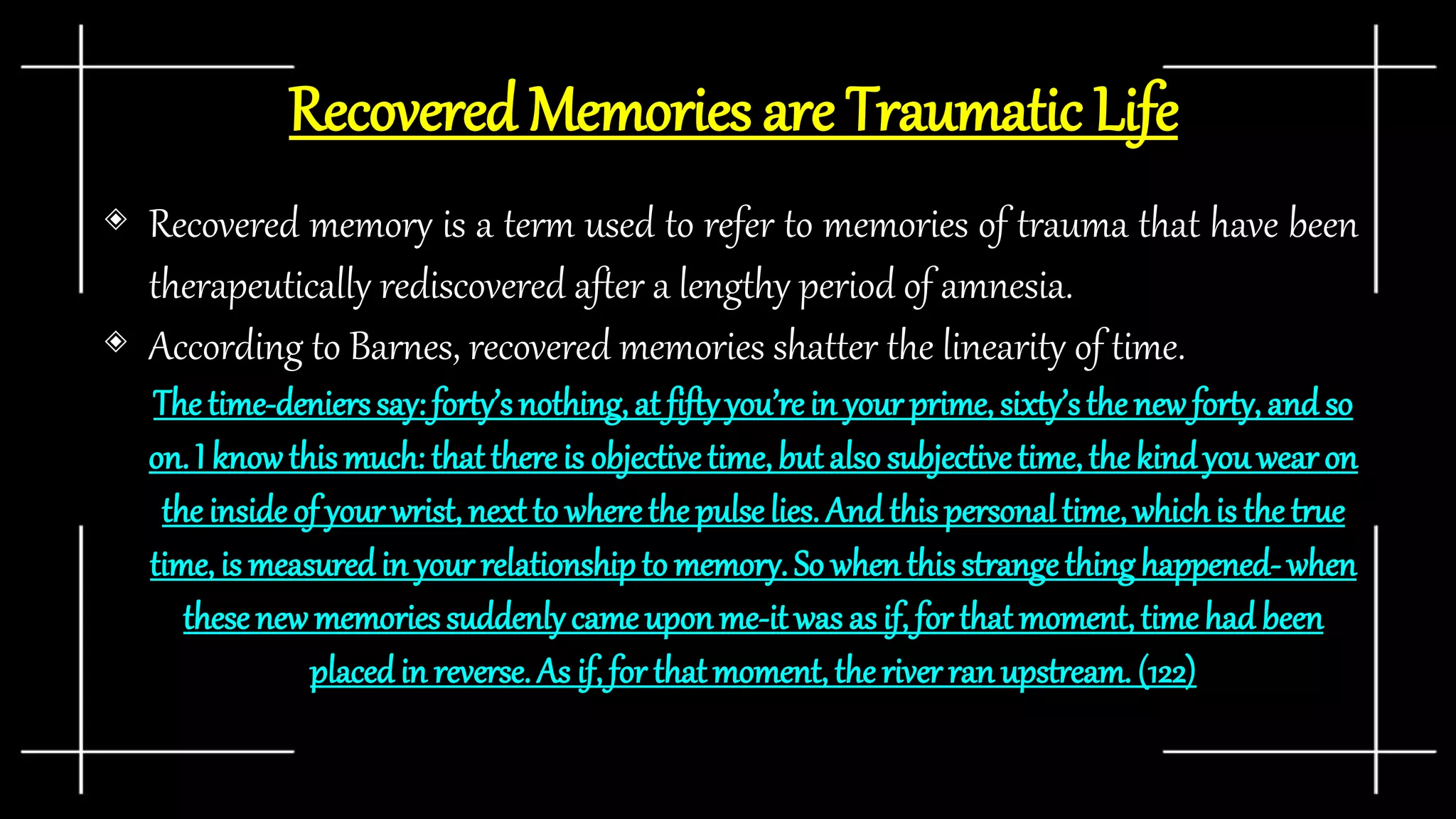
Recovered Memories are Traumatic Life
ā—ˆ Recovered memory is a term used to refer to memories of trauma that have been
therapeutically rediscovered after a lengthy period of amnesia.
ā—ˆ According to Barnes, recovered memories shatter the linearity of time.
The time-denierssay: forty’snothing, at fiftyyou’rein your prime, sixty’sthe newforty, andso
on. I knowthis much: thatthereis objectivetime,but also subjectivetime,the kindyou wearon
the inside of your wrist, nextto wherethe pulselies. And this personaltime, whichis the true
time, is measuredin your relationshipto memory. So when this strangethinghappened-when
thesenew memoriessuddenlycameuponme-it was as if, for that moment,timehad been
placedin reverse. As if, for thatmoment, theriver ran upstream. (122)
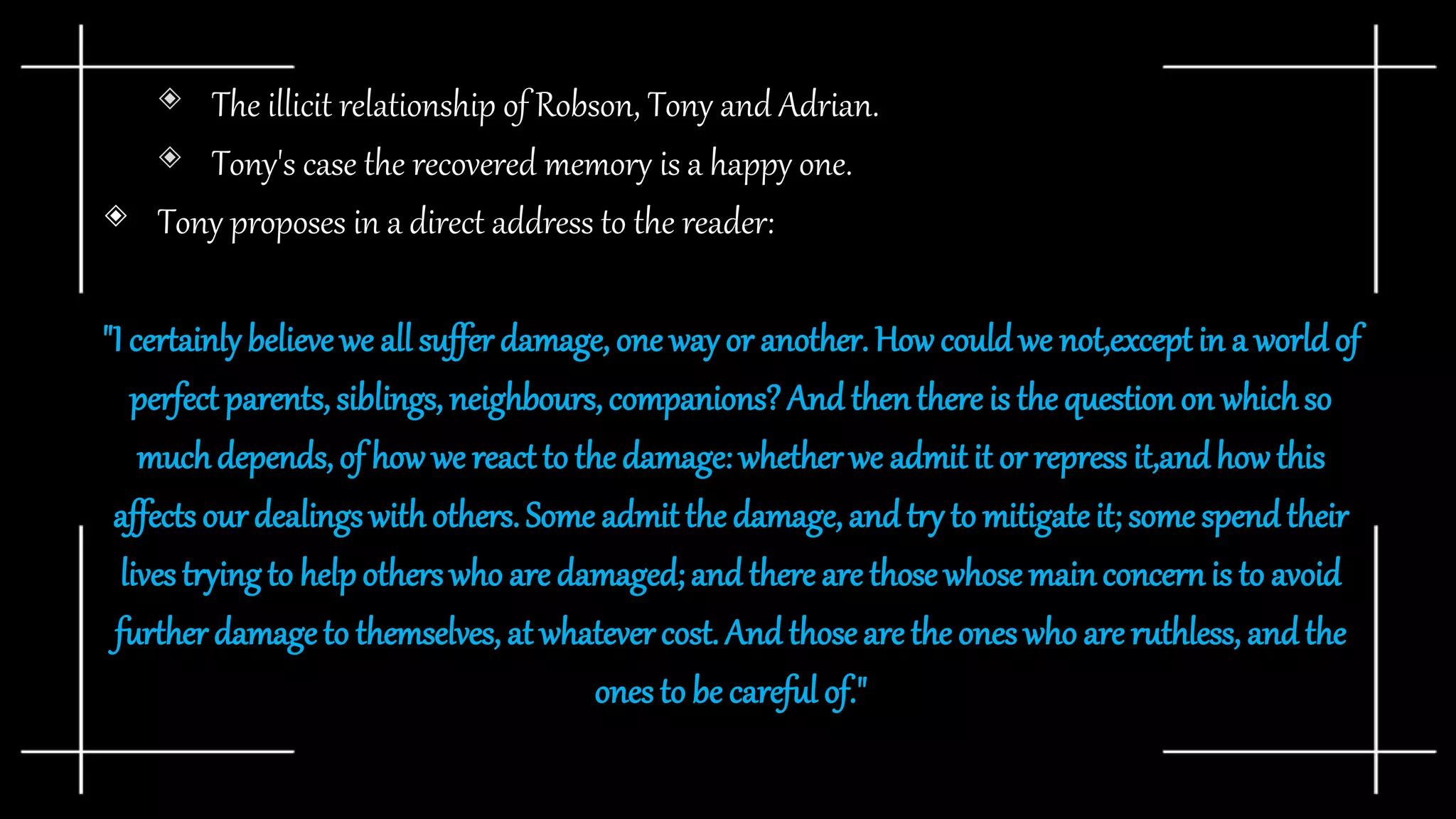
ā—ˆ The illicit relationship of Robson, Tony and Adrian.
ā—ˆ Tony's case the recovered memory is a happy one.
ā—ˆ Tony proposes in a direct address to the reader:
"I certainly believewe all suffer damage, one way or another. How couldwe not,except in a worldof
perfect parents,siblings, neighbours,companions?And thenthere is the questionon whichso
muchdepends,of how we react to the damage: whether we admit it or repress it,andhow this
affects our dealingswith others. Some admit the damage, and try to mitigateit; some spend their
livestryingto helpotherswho are damaged; and there are those whose mainconcernis to avoid
furtherdamageto themselves, at whatever cost. And thoseare the ones who are ruthless, andthe
ones to be careful of."
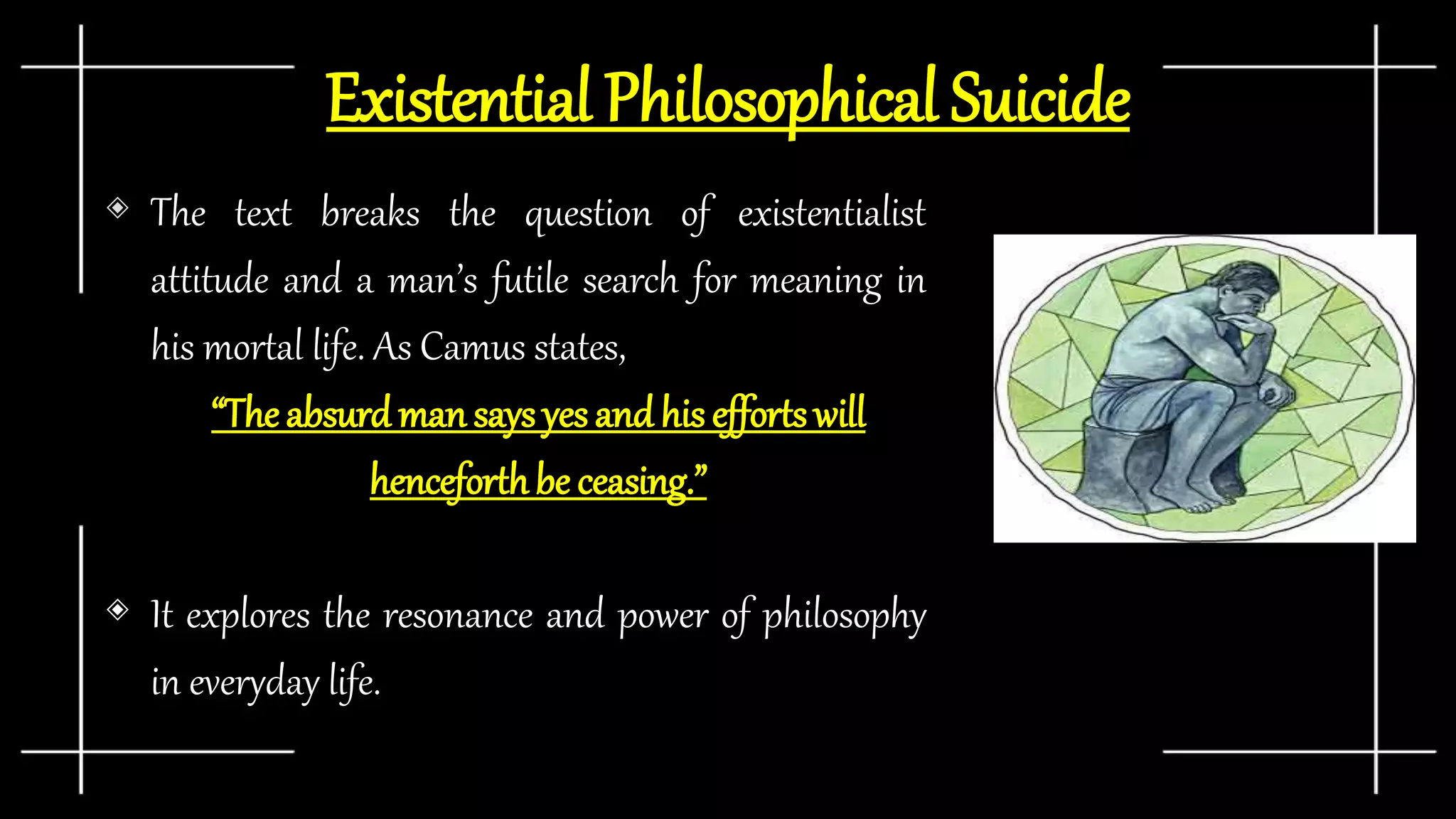
Existential Philosophical Suicide
ā—ˆ The text breaks the question of existentialist
attitude and a man’s futile search for meaning in
his mortal life. As Camus states,
ā€œTheabsurd man says yes and his effortswill
henceforthbe ceasing.ā€
ā—ˆ It explores the resonance and power of philosophy
in everyday life.
ā€œCamussaid thatsuicide wastheonlytruephilosophical question.ā€
ā—ˆ Adrian’s suicide is not as a sophisticated philosophical act.
ā—ˆ Philosophical questions can become a matter of life and death.
Responsibility
ā—ˆTony’s own responsibility for the events surrounding Adrian’s suicide. Tony says
ā€œThequestionof responsibility: whether there’s a chainof it, or whether wedraw
the conceptmore narrowly. I’mall for drawingit narrowly,ā€ [p104]
Says Tony
ā—ˆ It is no surprise he is: throughout the book he comes across as a coward happy
for every excuse. But in the end he is no longer so sure about where to draw the
line:
ā€œI lookedat thechainof responsibility. I saw my initialsthere.ā€[p149]
ā€˜Younger self’ is a reference made to his past while ā€˜older self’ refers to his present
retired age. This shows his conflict between his responsibility and uncertainty.
After analyzing his own situation. Tony regrets:
ā€œMyyounger self hadcome back to shock my older self withwhat the self hadbeen,
or was, or was something beingcapable of beingā€.
ā—ˆ Tony decides to know about the relationship of Adrian and Veronica, Adrian’s
death but Veronica’s answer remains the same
ā€œYoudid get and you will never get itā€
Connections and Reflection
ā—ˆ Adrian’s suicide mirrors Robson’s, who hangs himself after impregnating a
girl. Tony and his friends measure Robson’s death by philosophical and
aesthetic standards and find it lacking:
ā€œRobson’s action had been unphilosophical, self-indulgent and inartistic: in other
words, wrong. His suicide note hadmissed a powerful educative opportunityā€ [p14]
ā—ˆ Adrian’s suicide on the other hand is not ā€˜wrong’ at all because it shows ..
ā€œ.. the superiorityof the intervening act over the unworthypassivityof merely
lettinglife happento you. An implicit criticismof everybody elseā€ [p50]
ā—ˆ Tony is jealous of Adrian’s determination and consistency:
ā€œI don’t envyAdrian's death, but I envyhimfor the clarityof his life.ā€ [p104]
ā—ˆ ā€˜There is great unrest’, which echoes the beginning [p5], where one of the
students answers the teacher’s question ā€˜How would you describe Henry VIII’s
reign’ with ā€˜There was great unrestā€˜. This student is described as ..
ā€œ.. a cautious know-nothingwho lackedinventiveness of true ignorance.ā€
ā—ˆ He is told ā€˜You don’t get it, do you?ā€˜ With the last sentence of the book, the
narrator admits that indeed, he never got it and he never will.
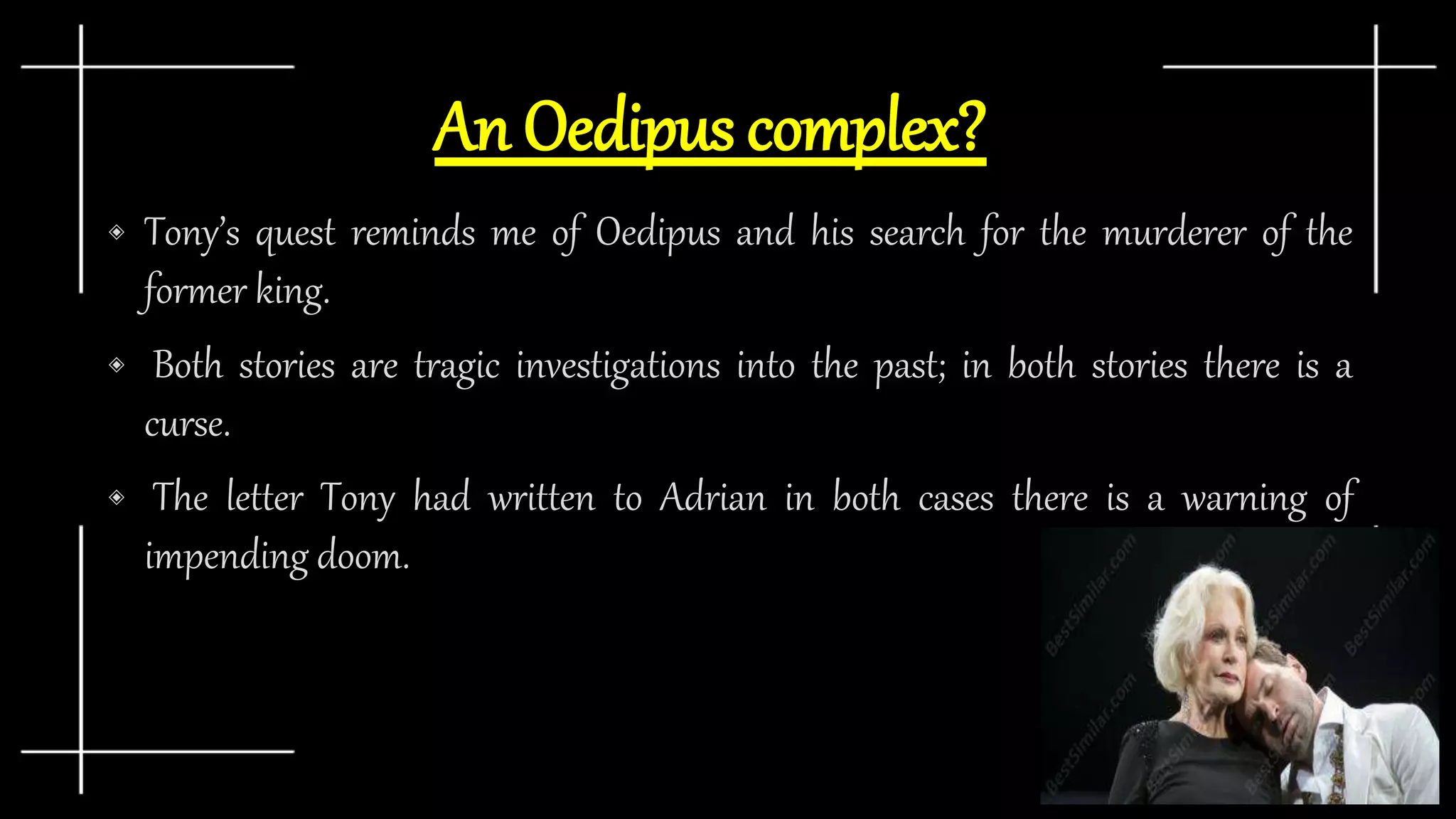
An Oedipus complex?
ā—ˆ Tony’s quest reminds me of Oedipus and his search for the murderer of the
former king.
ā—ˆ Both stories are tragic investigations into the past; in both stories there is a
curse.
ā—ˆ The letter Tony had written to Adrian in both cases there is a warning of
impending doom.
ā—ˆ Here not by the blind seer Tiresias, but by Tony’s ex-wife
[p78]).
ā—ˆ Both stories feature sex with ā€˜the mother’. And even though
Tony is not Adrian’s killer, the outcome of his investigation is
that he becomes aware of his own role in Adrian’s suicide.
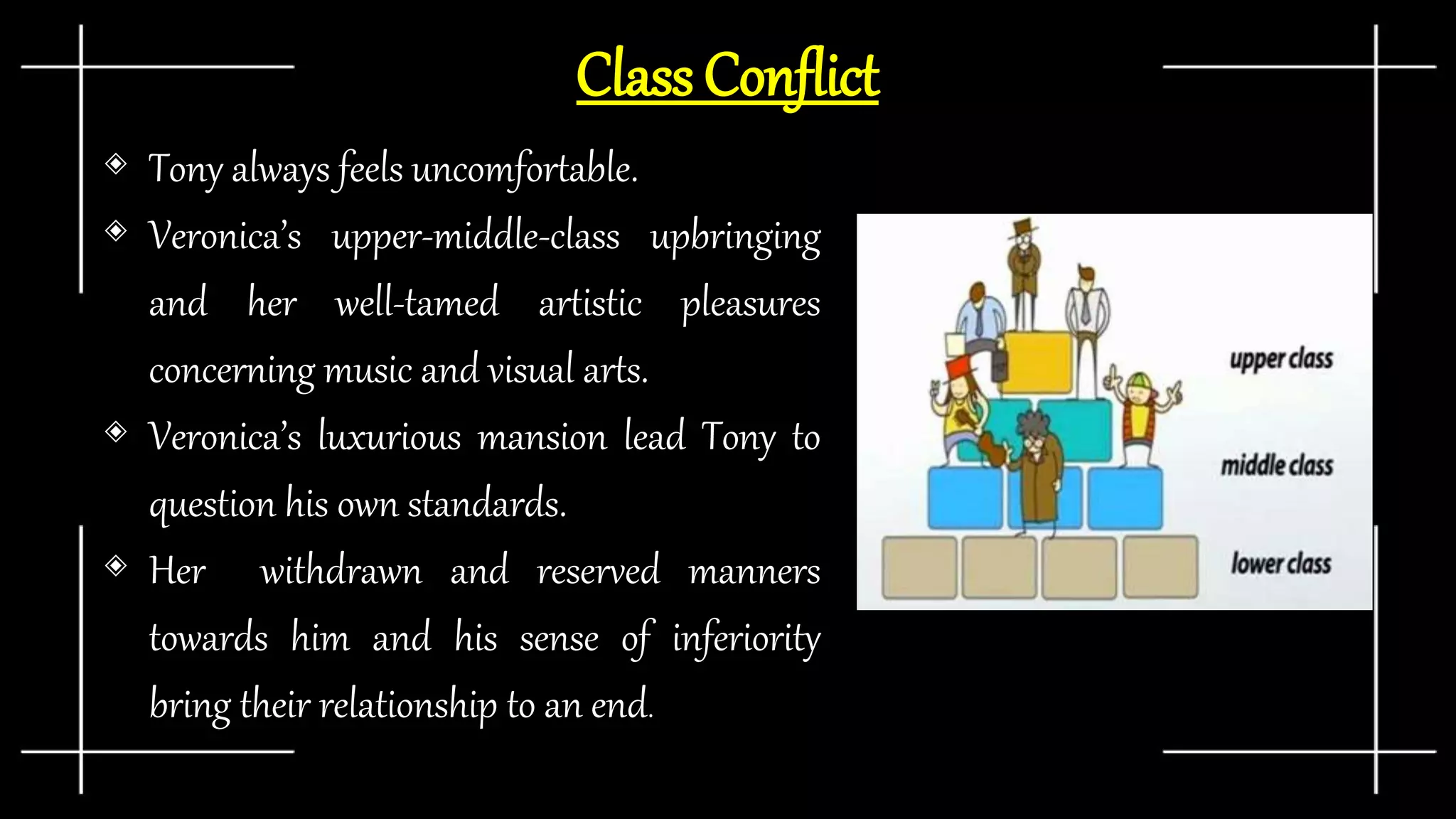
Class Conflict
ā—ˆ Tony always feels uncomfortable.
ā—ˆ Veronica’s upper-middle-class upbringing
and her well-tamed artistic pleasures
concerning music and visual arts.
ā—ˆ Veronica’s luxurious mansion lead Tony to
question his own standards.
ā—ˆ Her withdrawn and reserved manners
towards him and his sense of inferiority
bring their relationship to an end.
Theme
ā— Camus, Albert. The Myth of Sisyphus and Other Essays. New York: Vintage, 1955.
ā— Kothari, Arpit. Deconstruction of the Complex Human Relationships in Julian Barnes’ The
Sense of an Ending. Language in India 1930-2940 Vol. 19:2 No.49042.
ā— Mohan, Aparna. ā€œThe Non-Linearity of Time, Memory and History in Julian Barnes’ the
Sense of an Ending.ā€ Journal of Research in Humanities and Social Science , vol. 6, no. 12
(2018).
ā— Oró-Piqueras, Maricel. Memory Revisited in Julian Barnes's The Sense of an Ending.
Coolabah. 13. 10.1344/co20141387-95.2014.
ā— Pradheep Singh, Xavier. The Interplay between Eros and Thanatos in Julian Barnes’ The
Sense of an Ending. History Research Journal. 5. 222-226. 10.26643/hrj.v5i4.7608.2019.
ā— Wu, W.. ā€œOn the Motif of Death in Julian Barnes’ The Sense of an Ending.ā€ Canadian Social
Science 11 (2015): 87-95.
Symbols
The Sense of an Ending
What is Symbol?
A symbol is any image or thing that stands for something else. It could be as
simple as a letter, which is a symbol for a given sound . Similarly, every word
is a symbol for the idea it represents.
However,
authors don’t usually give us a roadmap to their symbolism, so it can take a lot of
thought to figure out exactly what the symbols in a work of literature stand for
—to interpret them.
Why symbol matters?
Symbols add layers of meaning to a story, poem, or other creative work. They
enable an author to deliver an idea or message within a narrative, a message
on multiple levels.
This way, symbol adds depth.
Metaphor or symbol?
• A metaphor is kind of like a symbol, but it’s usually used briefly whereas a
symbol is usually extended throughout a story or poem
This is a grey area – what if a metaphor is extended across a whole stanza, or a
chapter, but is absent in the rest of the work?
Is it still a metaphor, or is it a symbol?
• Ultimately, it doesn’t matter much at that point. If something is in the grey area
between metaphor and symbol, you can call it either.
How symbols are operating
in ā€˜
The Sense of an Ending’?
Symbols in The Sense of an Ending
Adrian Finn’s diary
Black box
Fruit cake
Chips
Severn Bore
Adrian Finn’s diary
(1)When one writes a diary?
(2)Why would Adrian have written a diary?
(3)What if you get your late fiend’s personal diary in which you are personally
mentioned?
(4)Who might have written this diary? With purpose or of ?
(5)Who might have read?
(6)Who needs to read?
Tony lays down almost mad to gain this diary and readers also.
And at the very last it results into unrest and finally ends with great unrest.
Centrality of diary and it’s significance
• Symbolizes unreliability of memory and it’s inauthenticity
ā€œThe question of accumulation,ā€ Adrian had written. […] Life isn’t just addition and
subtraction. There’s also the accumulation, the multiplication, of loss, of failure.ā€
- Adrian Finn
-Tony Webster reads from Adrian’s diary
-The Sense of an Ending
Black box
What is Black box and for which it stands for?
Black boxes are normally referred to by aviation experts as electronic flight data
recorders. Their role is to keep detailed track of on-flight information, recording all
flight data such as altitude, position and speed as well as all pilot conversations.
The flight data recorder records critical information for investigations should an
aircraft malfunction. They’re designed to work even when pilots are uncontactable and
are off the radar.
Black box as a memory box
• When and how we read our memory in relationship
• How Barnes uses black box as a memory box?
We color past events with new insights.
• But what happens when it get discovered?
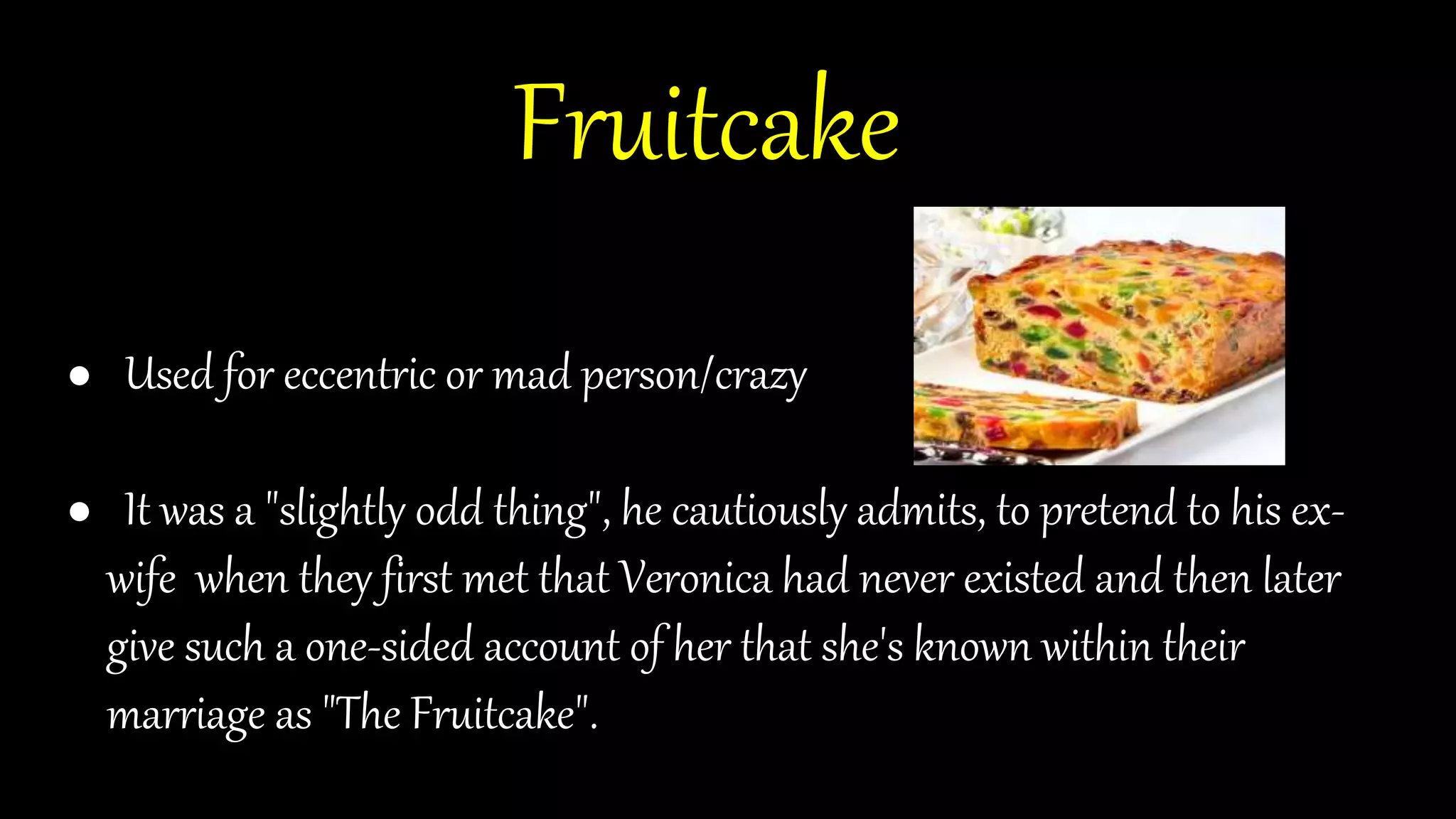
Fruitcake
ā— Symbolically is used for Veronica Ford.
ā— Used for eccentric or mad person/crazy
ā— It was a "slightly odd thing", he cautiously admits, to pretend to his ex-
wife when they first met that Veronica had never existed and then later
give such a one-sided account of her that she's known within their
marriage as "The Fruitcake".
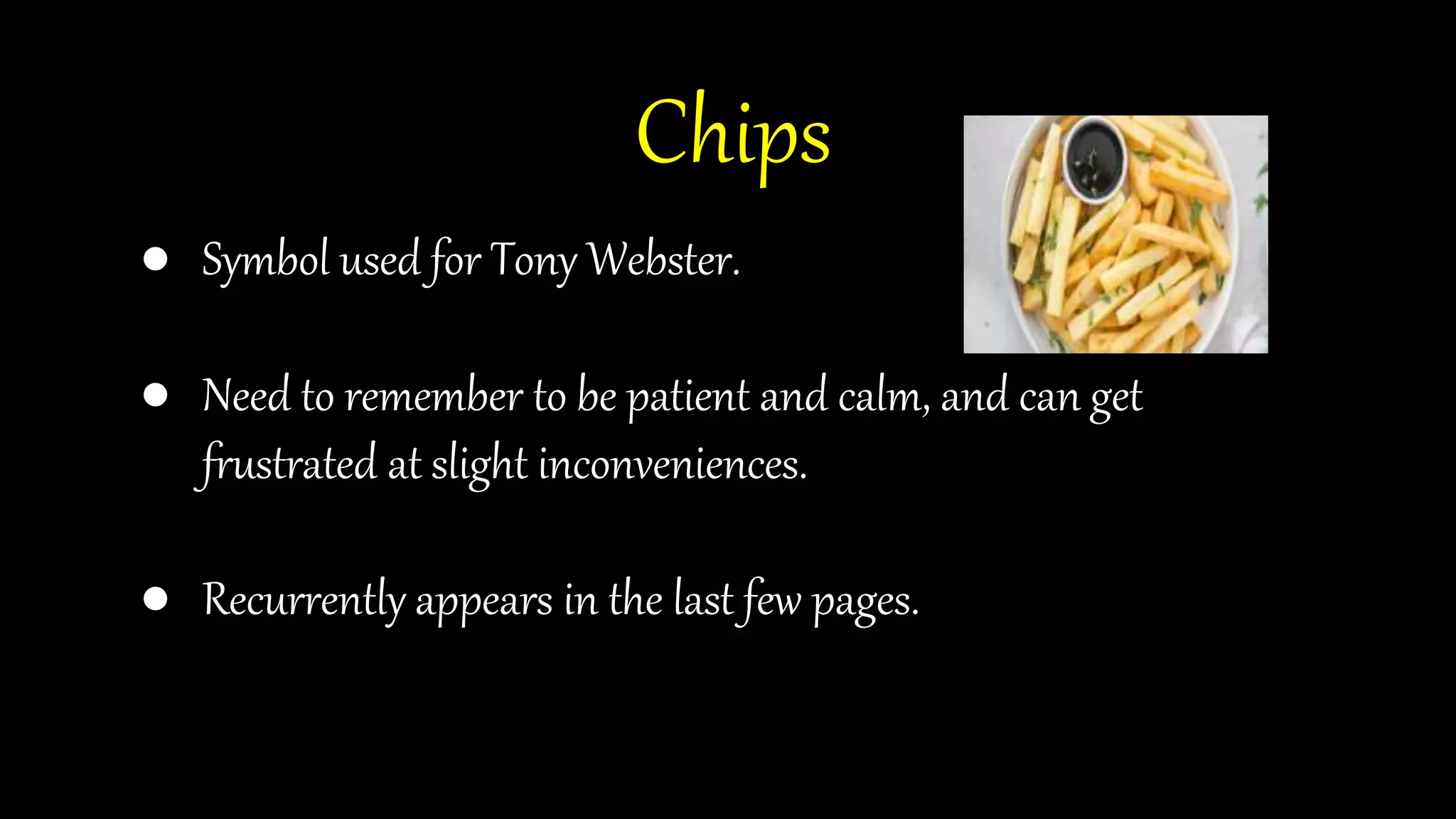
Chips
ā— Symbol used for Tony Webster.
ā— Need to remember to be patient and calm, and can get
frustrated at slight inconveniences.
ā— Recurrently appears in the last few pages.
Severn bore
•A bore is a large wave resulting from
changes in tidal surges: for a moment, the
course of the Seven seems to change
direction as the wave barrels upstream, the
Severn Bore seems to Tony to be just as
stunning and earth shattering
•For a few moments, time itself seems to
reverse course- the law of history, which is
supposed to move in only one direction,
seem no longer to apply
•As The Sense of an Ending implies, however, the Bore is so alluring
precisely because it is an exception to such laws.
•Time does only move in one direction: as much as Tony would like to go
back and change the past, but he cannot, like the Bore, move against
like tide.
•In addition, though, the Severn Bore represents another problem
introduced by the novel at the start: the difference between
remembering and witnessing.
•Abrams, M. H., & Harpham, G. G. (2015). A glossary of literary terms.
Boston (Mass.): Wadsworth Cengage Learning.
•Barnes, Julian. The Sense of an Ending. Vintage, 2017.
•Barnes, J. (2011). The sense of an ending. New York, NY: Alfred A. Knopf.
BookBrowse. ā€œThe Sense of an Ending by Julian Barnes: Symbols and
Objects.ā€ BookBrowse.com,http://www.bookrags.com/studyguide-the-
sense-of-an-ending/symbolsobjects.html
ā€¢ā€œLiterary Terms.ā€ Literary Terms. 1 June 2015. Web. 3 Nov. 2016.
<https://literaryterms.net/>.
Symbols
Title
The Sense of an Ending
Why Title Matters?
•Readers are first introduced with the title of work – it grabs the
attention of the reader
•Title accurately describes the contents of book, and makes people
want to read further.
•Title becomes important to reach to the very skeleton of the book
•Through title, the book ā€˜grows with and within the readers’
ā€˜SENSE’ and ā€˜END’
• ā€œSenseā€ = what we understand, knowledge
• ā€œEndā€ = Death
• Santiago of ā€˜The Old Man and the Sea’ also dreams of lions, his fist-fight of younger days and of
Manolin when he quite feeble and near his end.
ā€œYou get towards the end of life – no, not life itself, but of something else: the end of any likelihood of
change in that life.ā€
Something is ending,
in a sense, that it is changing;
taking new shape;
developing new understanding;
reaching to newer perspective;
some dawning of new understanding – not about the outside world, but that of self – self-revelation.
End
Anthony Webster
is near the ā€˜end’ of
his journey of life
feels nostalgic
about the ā€˜past’
Robson Adrian
Suicide
Eros and Thanatos
Suicide
Eros and Thanatos
ā€œI don’t envy Adrian his
death, but I envy him the
clarity of his life,ā€
Frank Kermode’s ā€˜The Sense of an Ending’
ā€œMen make considerable imaginative investments in coherent patterns which, by
the provision of an end, make possible a satisfying consonance with the origins and with the
Middleā€
- Frank Kermode
• The title of Barnes’ novel, The Sense of an Ending, is intrinsic to the ideas which are presented in the text
• Kermode’s book explores how ā€˜peripeteia’, or an unexpected twist in plot, forces readers to adjust their
expectations. Similarly, it is an unexpected revelation which forces Tony to adjust his reading of the past.
Clearly, Barnes evokes intertextual comparisons with Kermode; however, the title also relates to the plot. Tony’s
personal ā€˜sense of an ending’ is inaccurate, and therefore events in his life which he thought had ā€˜ended’ have
continued without him. Although Tony thinks his memories are truthful, he soon finds out that he is wrong,
and he realises that significant events in his life do not ā€œhave the meanings he has self-servingly ascribed to
themā€ (Holmes, 2015, 27).
ā€œThe stories we tell about ourselves serve as consolatory structure, falsifying origins and ends to the grant order
and meaning to the which has noneā€
-Frank Kermode
Julian Barnes’s ā€˜The Sense of an Ending’
• Barnes’s novel is similarly concerned with how all people, not just writers, construct certain selective
narratives about themselves and their lives—as well as how it’s sometimes only an ending (like Adrian’s
untimely death) that lends a sense of meaning to everything that came before. Barnes’s novel is also full of
literary allusions, apt for a narrator who strove during his school days to be as brilliant and clever as his
friend Adrian: Ted Hughes is explicitly invoked, but there are also a number of unspecified allusions to
poet Philip Larkin (including the lines ā€œwrangle for a ringā€ and ā€œMay you be ordinaryā€).
• The element of aging and time adds more charm to the significance to the title.
ā€œAt young age, there is an overflow of ideas about progress;
In the old age there are those memories to look back onā€
• Holmes argues that ā€œthe two texts ā€˜speak’ to one anotherā€ in the sense that both authors explore the
extent to which ā€œtime-resisting stories… can withstand the ā€˜dialogue between credulity and skepticismā€™ā€
(Holmes, 2015, 27)
ā€˜The Sense of an Ending’
Time Past Memory History Sense End
•Barnes, Julian. The sense of an ending. Random House, 2012.
•Frank, Kermode. "The Sense of an Ending." Studies in the Theory of
Fiction (1967).
•Holmes, F. (2015). Divided Narratives, Unreliable Narrators, and the
Sense of an Ending: Julian Barnes, Frank Kermode, and Ford Madox
Ford. Papers on Language & Literature, 51(7), pp.27–50.
References
ā€˜The Sense of an Ending’
Film Adaptation
2017
Film Expectation
• The Sense of an Ending is a 2017 mystery drama film directed by Ritesh Batra and written
by Nick Payne, based on the 2011 novel of the same name by Julian Barnes. The film stars Jim
Broadbent, Charlotte Rampling, Harriet Walter, Billy Howle, Emily Mortimer and Michelle
Dockery.
• The film had its world premiere at the Palm Springs International Film Festival on 2 January
2017. It was released in the United States on 10 March 2017, by CBS Films and Lionsgate, and
in the United Kingdom on 14 April 2017, by Studio Canal.
Film Expectation
• Classroom discussion on Robson’s suicide and Joe Hunt’s explanation on suicide (Camus
and Nietzsche)
• The exact height of ADRIAN is captured or not?
• How the episode of equation is portrayed in the film?
• ā€œThe other night, I allowed myself another drink, turned on my computer, and called up the
only Veronica in my address book.ā€ – how the film would have portrayed this?
• The moment Tony is confronted with the real ā€˜damaging’ letter.
• Tony’s remorse.
Index
• How much reliable the film is?
• Is it faithful to the text or not?
• Scenes that are exactly captured by the film yet, it is advised not to watch the film for the
clear understanding of the text.
• Frame analysis [Introducing Tony, suicide scene, History]
• What are the major changes in which the director has taken artistic liberty?
• The ending of the Film
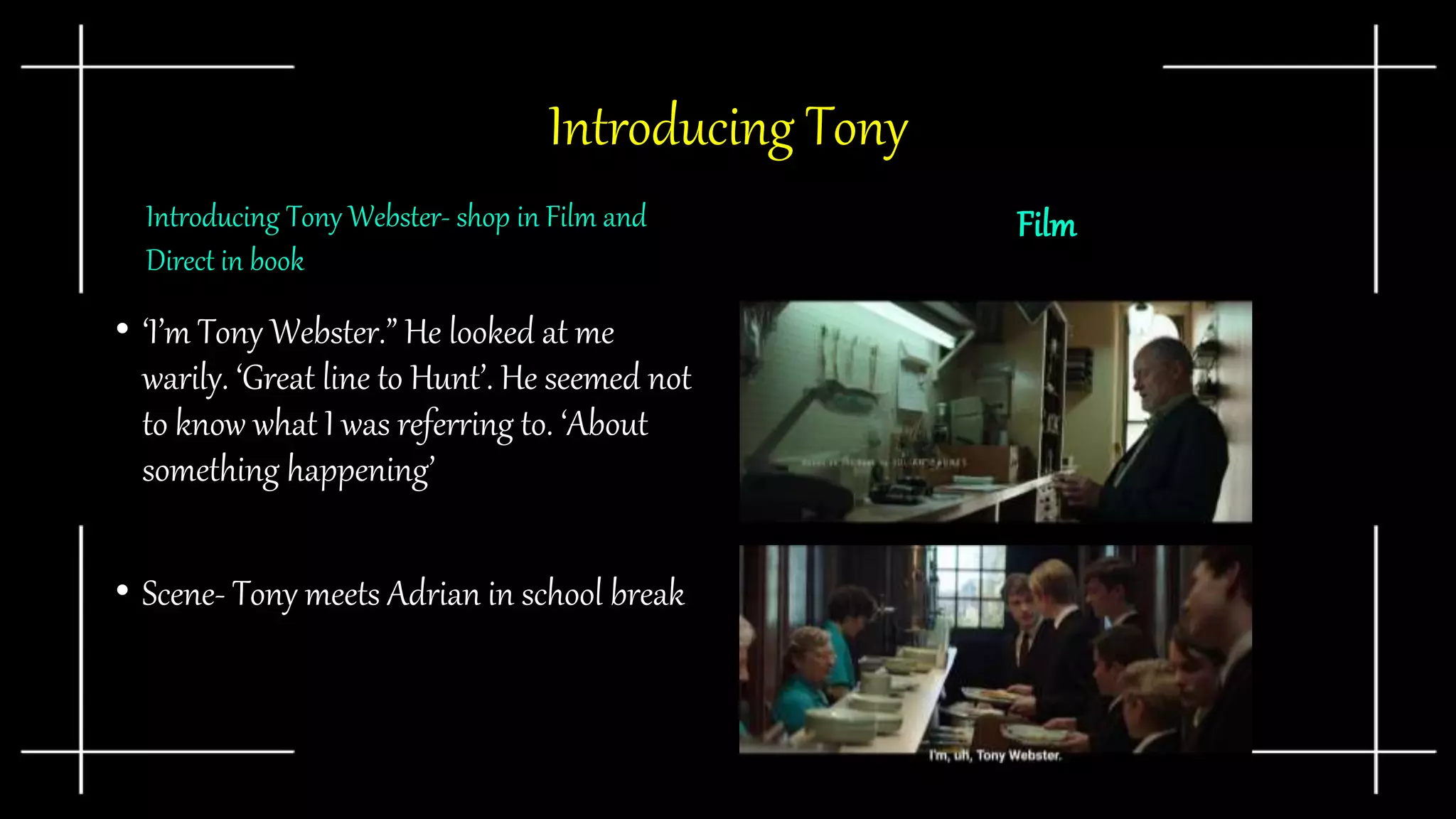
Introducing Tony
Book
• ā€˜I’m Tony Webster.ā€ He looked at me
warily. ā€˜Great line to Hunt’. He seemed not
to know what I was referring to. ā€˜About
something happening’
• Scene- Tony meets Adrian in school break
Film
Introducing Tony Webster- shop in Film and
Direct in book
Discussion of History
Book
• Part 1 begins with the discussion on time,
memory and history.
• ā€œI remember in no particular orderā€¦ā€
• ā€œWe live in timeā€¦ā€
• ā€œHistory is/ isn’t the lies of victorsā€¦ā€
• Adrian’s definition of history
Film
• Duration 36:44 to 38:14
The three friends were assumed to be at the center in the film but the expectation doesn’t meet
Suicide Scene
Book
• ā€˜DO NOT ENTER – CALL POLICE-
ADRIAN’ (49)
• ā€œTragic Death of ā€œPromisingā€ Young Manā€
Film
• ? [53:21 discussion about Adrian’s suicide is not
mentioned]
• Duration – (33:44 – 33:50) (50:50 – 51:21)
SOUL
Book
• ā€œSo for instance if Tonyā€ (86)
• ā€œthere is unrest, there is great unrestā€ (150)
• ā€œ
Film
• ?
• ?
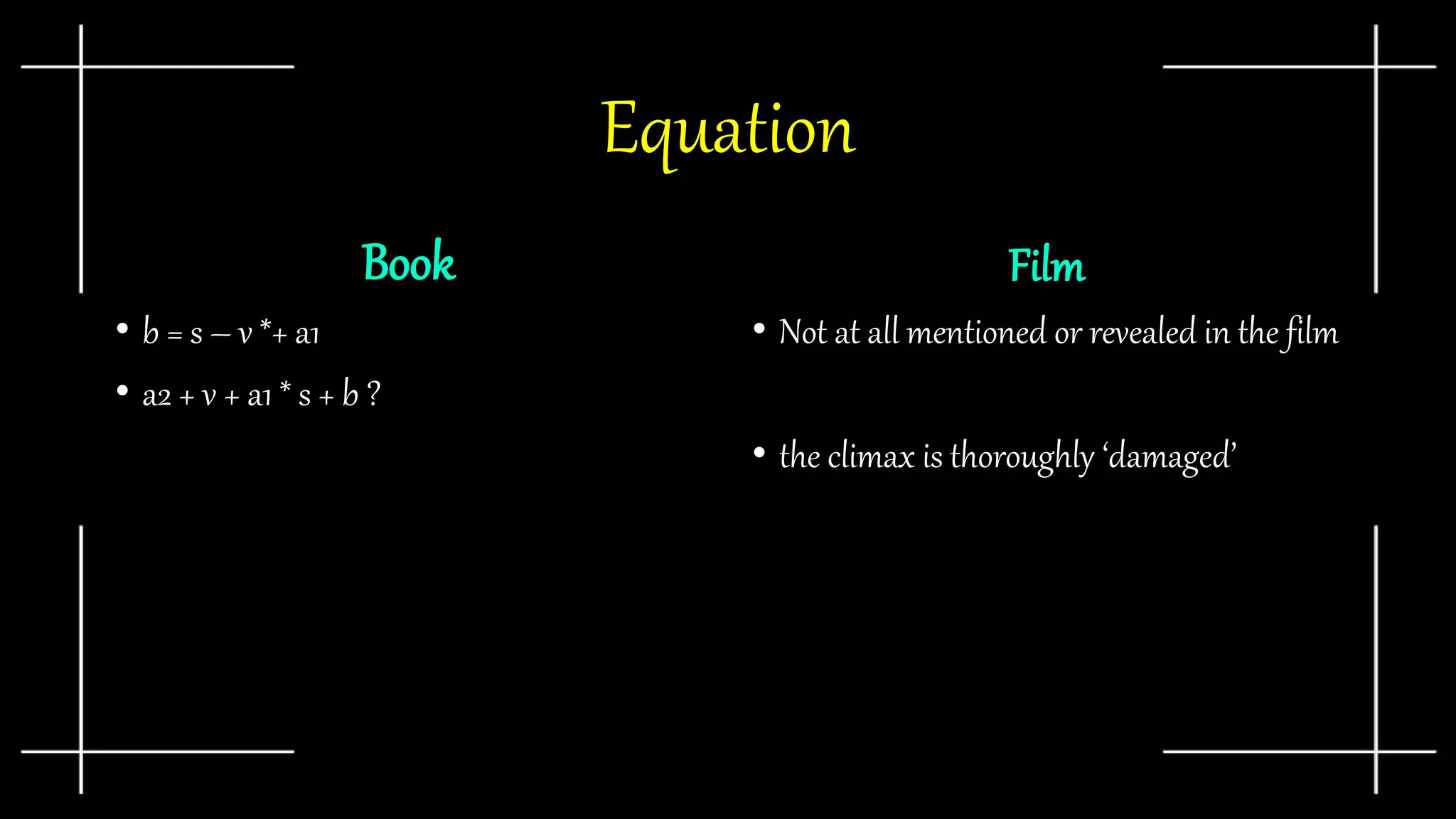
Equation
Book
• b = s – v *+ a1
• a2 + v + a1 * s + b ?
Film
• Not at all mentioned or revealed in the film
• the climax is thoroughly ā€˜damaged’
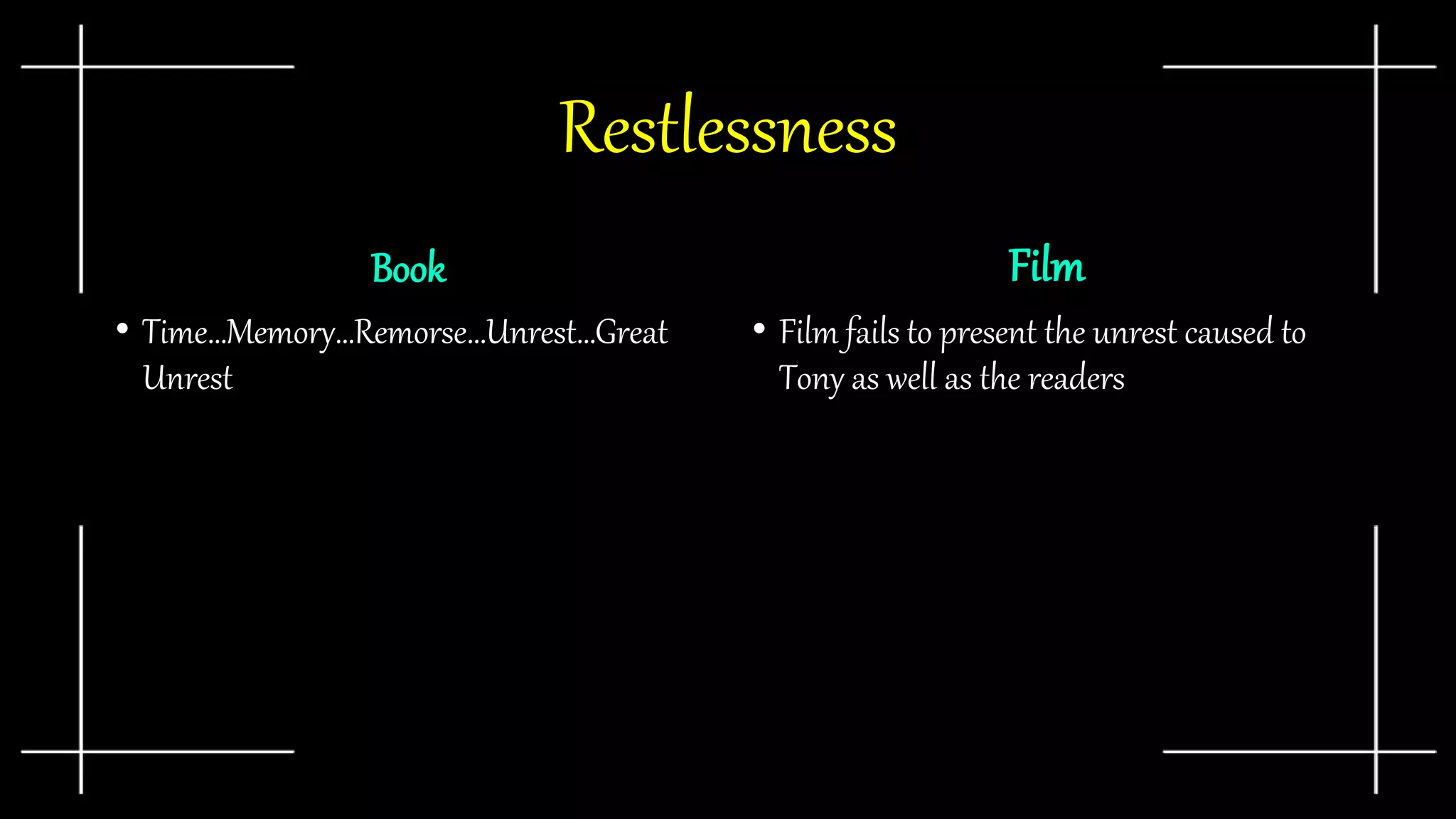
Restlessness
Book
• Time…Memory…Remorse…Unrest…Great
Unrest
Film
• Film fails to present the unrest caused to
Tony as well as the readers
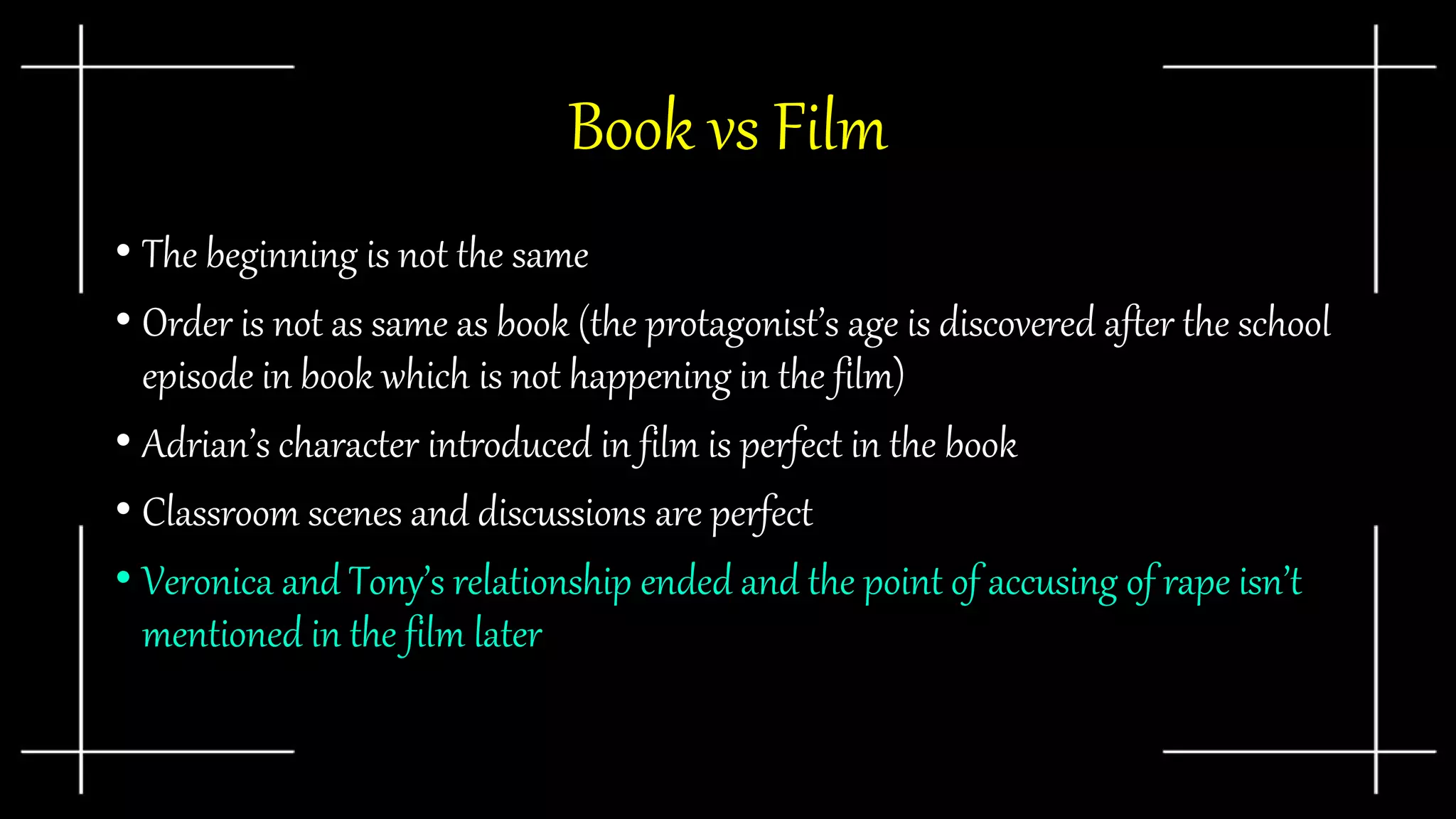
Book vs Film
• The beginning is not the same
• Order is not as same as book (the protagonist’s age is discovered after the school
episode in book which is not happening in the film)
• Adrian’s character introduced in film is perfect in the book
• Classroom scenes and discussions are perfect
• Veronica and Tony’s relationship ended and the point of accusing of rape isn’t
mentioned in the film later
•[01:18:41] Tony pursues Veronica to dance in Film
•Mary is not mentioned in the Film.
•Film destroys the mystery as well as destroys the character of
Adrian which is initially built by the book. The impressions are
less interesting.
•Equation of the book is missing in the Film- the climax is
thoroughly ā€˜damaged’
•The film fails to raise the question of accumulation.
•Fails to uplift the character of Adrian
Learning Outcome
The Sense of an Ending
Learning Outcome
The Sense of an Ending
A novel that shaped a new facet to
my diamond of thinking.
- Rohit Vyas
Time
We live in time – it holds us and moulds us – but I've never felt I
understood it very well. And I'm not referring to theories about how it
blends and doubles back, or may exist elsewhere in parallel version. No,
I mean ordinary, everyday time, which clocks and watches assure us
passes regularly: tick-tock, click-clock. is there anything more plausible
than a second hand? And yet it takes only the smallest pleasure or pain
to teach us time's malleability. Some emotions speed it up, others slow it
down; occasionally it seems to go missing – until the eventual point
when it really does go missing, never to return. (Barnes, 3)
Ti-yi-yi-yime
The time-deniers say: forty’s nothing, at fifty you’re in your prime, sixty’s
the new forty, and so on. I know this much: that there is objective time,
but also subjective time, the kind you wear on the inside of your wrist,
next to where the pulse lies. And this personal time, which is the true
time, is measured in your relationship to memory. (Barnes, 122)
* Barnes’ first pondering over time moved me in such a way that I
relooked the relativist idea of time. I questioned myself that am I living in
the time or in space?
Memory
• The novel has largely captivated the readers with the idea of memory. I
was also one of the readers who flung with the memories and
retrospection that Barnes gives by making Tony a mouthpiece of basic
human predicament about life, death, ageing, love, and regret.
• My perception about memory changed a lot after reading Adrian’s
diary and especially after Tony’s narration of memories.
Space
• Giving space to people is the challenging yet subtle task to perform.
• This leads to my views in having mutual understanding among all the
human relations.
• Tony and Margaret’s marriage and divorce is the only clear narration
in the novel.
• I learnt how vital and significant it is to maintain space and distance.
• I am going to cherish the element of equation of the novel.
Freedom
•How much do I know about freedom? Have I actually ever
practiced it? If yes, then how far ? If no then why not?
•After reading this novel, I’ve re examined all of my past human
relations and found the answer is no.
•I believe that the idea of freedom itself is a relativist one. Neither
it can be completely given nor it can be taken in it’s total.
•All I have to do with freedom is act upon it whenever it is given
to me and let others exercise it when it’s taken by others.
Choices
•The novel still keeps me moving towards the utmost objectivity of
ideas yet forces me to remain subjective about my choices.
•I could have taken the opportunity to express my views but what
stopped me I am still finding. Perhaps it’s my ownself.
•This dilemmatic situation makes me think of myself in more
sadistic way. Yet, I’ve learnt that I must keep working on myself.
•One interesting question I found from the novel is Mid-life crisis.
Knowability
ā€œThe more you learn, the less you fear. ā€˜Learn’ not in the sense of
academic study, but in the practical understanding of life.ā€
(Barnes, 82)
* At certain point, to me, this idea of ā€˜the more you know the less
you fear’ seems very unreliable. This leads me to the question of
knowability and it’s absurd necessity in life.
* Moreover, this quote made my belief in learning more clear that
whatever I’m learning I should keep on going.
Thoughtfulness
• When I was a child, I used to play many mind and memory games like,
chess, jigsaw puzzle, jumbled words, spotting items and so on. . .
• I have always loved to think. Whenever the question of thinking arises,
I, just like Tony, check myself that am I on the right path?
• After reading this novel , my belief in self criticism made more firm
than ever. Now I can tell people that its better to chose to be thoughtful
rather than being a thought-fool.
• The equation part has enabled me to decipher and clarify my own
standing in human relations.
Clarity
•The more I read this novel the more deeper I went
into myself.
•As Tony questions: There had been addition – and
subtraction – in my life, but how much
multiplication? And this gave me a sense of unease, of
unrest. (Barnes, 88)
The Sense of the Beginning
 Every end has the new
beginning.
 My new learning has
begun from this novel.
 I thank myself for
reading this novel.
Thank You
Work Cited:
Barnes, Julian. The Sense of an Ending. Vintage, 2011.
Ruchi Joshi’s Learning Outcome
• I found an excellent abstraction that ā€˜Who has told the story or history even they must
not be represented as liars but as survivors’!
• ā€˜What if I don’t even urge to read Adrian’s diary?’
ā€˜I know that, I know very well that I can never be even the shadow of Adrian but what if I
become Tony?’
• ā€˜What if I’m Tony and not even aware about or don’t want to be aware about?’
• And here it hits me more and more as to which extent I hate the character of Tony
Webster.
• I want to know what I don’t know and my journey is towards to be the honest to
myself that ā€˜I must not know, what I don’t know’!
Kavisha Alagiya’s Learning Outcome
•'Unrest….great unrest’
•"How often do we tell our own life story? How often do we adjust,
embellish, make sly cuts? And the longer life goes on, the fewer
are those around to challenge our account, to remind us that our
life is not our life, merely the story we have told about our life.
Told to others, but—mainly—to ourselves."
•"Life wouldn’t turn out to be like Literature."
• ā€œ...the question of responsibility: whether there’s a chain of it, or
whether we draw the concept more narrowly.ā€
• "I looked at the chain of responsibility.
I saw my initial in there.ā€
• ā€œHistory is that certainty produced at the point where the
imperfections of memory meet the inadequacies of documentation.ā€
"WORDS, WORDS, WORDS"
•"I hope you get so involved that the mutual damage will be permanent.
Compliments of the season to you, and may the acid rain fall on
your joint and anointed heads.ā€
-Tony writing to Adrian and Veronica
ā€¢ā€œEven her own mother warned me against her. If I were you, I’d check
things out with Mum—ask her about damage a long way back. Of
course, you’ll have to do this behind Veronica’s back, because boy is
that girl a control freak.ā€
Dhara Virani’s Learning Outcome
•I have learnt two things, from this text ā€œ The Sense of an Endingā€.
• Dairy writing:
• By writing a dairy it's may become an important or useful in
my life, but I would like to be addition by writing dairy in
digital form or making blog post also, so no one can burnt or
destroy it.
• I will try that not to interfere in others life at any cost, as Tony
interfere in Adrian or Veronica’s life.
Dharti Makwana’s Learning Outcome
•How to account for those actions which I do not feel proud and, more
importantly, how to manage those bad memories as one gets older.
ā€œIf I can’t be sure of the actual events anymore, I can at least be true to the
impressions those facts left.ā€
-Tony Webster
The Sense of an Ending
•The mature age was a phase of mental harmony and quietness in
which I need to sit tight for the end without making a lot of complain
about it.
•When my Eros will stronger than Thanatos at that
moment I have to empower myself to survive rather than
to self-destruction.
•Try to take decisions consciously and rationally, hence I
should not have to regret for those actions.
ā€œYou still don’t get it. You never did, and you never will. So
stop even trying.ā€
- Veronica Ford
- The Sense of an Ending
Research Articles
The Sense of an Ending
List of Articles
10 Selected Articles

The Sense of an Ending - Introductory Presentation

  • 1.
    Group Task The Senseof an Ending Batch : 2019 - 2021
  • 2.
  • 3.
    Author’s Introduction ā— JulianPatrick Barnes is an English novelist and short story writer. ā— Born on 19th January 1946, in Leicester, England.
  • 4.
    Early Life • Schoolingfrom City of London School and graduated from Magdalene College, Oxford. • Worked as a lexicographer for the Oxford English Dictionary supplement for three years. • In 1977, Barnes began working as a reviewer and literary editor for the New Statesman and the New Review. • From 1979 to 1986 he worked as a television critic, first for the New Statesman and then for the Observer.
  • 5.
    Early Life • JulianBarnes started out as a journalist before publishing his first novel, Metroland, in 1980. Since then he has carved out a reputation as one of contemporary Britain's most brilliant and sophisticated novelists, often grouped with Martin Amis and Ian McEwan.
  • 6.
    Literary Career • JulianBarnes has written numerous novels, short stories, and essays. He has also translated a book by French author Alphonse Daudet and a collection of German cartoons by Volker Kriegel. His writing has earned him considerable respect as an author who deals with the themes of history, reality, truth and love. • Barnes has also written crime fiction novels with pen names Dan Kavanagh and Edward Pygge. • His novel The Sense of an Ending received the Man Booker Prize in 2011. Three of his additional novels were shortlisted for the Man Booker Prize, namely Flaubert's Parrot, 1984, England, England 1998, and Arthur & George 2005.
  • 7.
    Awards and Recognition •Prix Femina for Talking it All Over (1992) • Prix Medicis for Flaubert’s Parrot • The honour of Commandeur de L'Ordre des Arts et des Lettres (2004) • Somerset Maugham Award and Geoffrey Faber Memorial Prize • Man Booker Prize for The Sense of an Ending (2011)
  • 8.
  • 9.
    Metroland (1980) ''Metroland'' iswhat critics loosely call a coming of age story. But it is, finally, a meditation on the meaning of fidelity within the context of marriage in an age of crushing cynicism. It is also a moving account of a friendship between two precociously erudite and witty adolescent boys (a type almost inconceivable in American fiction). (Jay Parini)
  • 10.
    Flaubert’s Parrot (1984) InFlaubert's Parrot, Julian Barnes spins out a multiple mystery, an exuberant metafictional inquiry into the ways in which art mirrors life and then turns around to shape it; a look at the perverse autopsies that readers perform on books and lovers perform on their beloved; and a piercing glimpse at the nature of obsession and betrayal, both scholarly and romantic.
  • 11.
    ā— Post-modernist inconception but accessibly straightforward in execution, Julian Barnes's fifth book is neither the novel it is presented as being nor the breezy pop-history of the world its title suggests. Influenced to varying degrees by such 20th-century presences as the inevitable Borges, Calvino and Nabokov, as well as by Roland Barthes and perhaps Michel Tournier among others, ''A History of the World in 10 1/2 Chapters'' is most usefully described as a gathering of prose pieces, some fiction, others rather like essays. (Joyce Carol Oates) A History of the World in 10 1/2 Chapters (1989)
  • 12.
    Nothing To BeFrightened Of (2008) The soft centre of this book is a sodden leather pouf belonging to Julian Barnes's parents, who stuffed it with their love letters and left it to rot at the bottom of their garden. Barnes gave it a good kick every so often as a boy and, metaphorically speaking, he's still kicking it half a century later at the age of 62. (Hilary Spurling)
  • 13.
    ā— It’s riskybusiness to speak for the dead. In the terrible case of Dmitri Shostakovich, the temptation is strong, because history, in the form of Stalin, didn’t allow the composer to speak for himself. Of course, there’s the music, but music is reticent about meaning — like a therapist, it prefers you draw your own conclusions. (Jeremy Denk) The Noise of Time (2016)
  • 14.
    The Sense ofan Ending (2011) A masterpiece novella about time, memory, ageing, retrospection and journey of knowing one’s self. The chief character moves around the urban metropolitan campus life, and midlife incidents, which lead him question and re-examine his past memories and actions.
  • 15.
    In an interview,while talking about The Sense of an Ending ā€œ...Not so a fiction straight in there. Thatā€˜s what I thought and that’s what I still believe, as from that day on I have been a reader and a writer for fifty years, and my belief in the fundamental truth of fiction is undiminished.ā€ Julian Barnes
  • 16.
    Interviews • ā€œThere areautobiographical novelists who can only write about their own life, and then on the other hand there are completely objective novelists who only write about the world as they see it as completely effaced themselves from the novel. And I’m probably about that point. So I don't think of the novel as any form of confessional.ā€ Julian Barnes • Interview: https://www.youtube.com/watch?v=DWv-HjAYXdM
  • 17.
    ā€œI think theyare interconnected deeply. Flaubert, whom I should probably quote more than once this evening, Flaubert says that there is no idea without a form and no form without an idea. By which, I take it he meant that you can have an idea for a book for a short story, but until the form is delivered to you in some way or you discover it, it’s not really the start of the book.ā€
  • 18.
    "Writers should havethe highest ambition: not just for themselves, but for the form they work in. Flaubert once rebuked Louise Colet for having the love of art yet lacking 'the religion of art': she fancied its rituals, the vestments and the incense, but did not finally believe in its revealed truths. I am a writer for an accumulation of lesser reasons (love of words, fear of death, hope of fame, delight in creation, distaste for office hours) and for one presiding major reason: because I believe that the best art tells the most truth about life. Listen to the competing lies: to the tatty rhetoric of politics, the false promises of religion, the contaminated voices of television and journalism. Whereas the novel tells the beautiful, shapely lies which enclose hard, exact truth. This is its paradox, its grandeur, its seductive dangerousness. Two famous deaths have been intermittently proclaimed for some time now: the death of God and the death of the novel. Both are exaggerated. And since God was one of the fictional impulse's earliest and finest creations, I'll bet on the novel - in however mutated a version - to outlast even God."
  • 19.
    New Statesman Interview •Que: In another life what job might you have chosen? • Ans: I might have made a useful priest – perhaps in rural France in the 19th century. Looking, listening and seeking to understand, like a novelist. But I might have been tempted to take notes in the confessional.
  • 20.
    • Q:What wasthe last book that changed your thinking? • A:Probably Yanis Varoufakis’s Talking to My Daughter About the Economy – though my previous understanding of economics couldn’t exactly be described as ā€œthinkingā€.
  • 21.
    Agnosticism • In thepopular sense, an agnostic is someone who neither believes nor disbelieves in God, whereas an atheist disbelieves in God. (William L Rowe) • In the novel ā€œNothing To Be Frightened Ofā€ he makes a statement that, ā€œI don’t believe in God but I miss him.ā€
  • 22.
    References • Barnes, Julian."Julian Barnes at Passa Porta Festival 2013." Interview by Annelies Beck. YouTube, supiriorso, 2013, www.youtube.com/watch?v=tX0KICSZITA. • Barnes, Julian. "Talking in the Library Series 2 – Julian Barnes." Interview by Clive James. YouTube, www.youtube.com/watch?v=abwFi-SrF4w. • Denk, Jeremy. "ā€˜The Noise of Time,’ by Julian Barnes (Published 2016)." The New York Times, 9 May 2016, www.nytimes.com/2016/05/15/books/review/the-noise-of- time-by-julian-barnes.html • Beck, Annelies. "Het wit tussen de regels." De Standaard, 29 Mar. 2013, www.standaard.be/cnt/dmf20130328_00521849.
  • 23.
    References • Krist, Gary."'Before She Met Me' (Published 1986)." The New York Times - Breaking News, US News, World News and Videos, 28 Dec. 1986, www.nytimes.com/1986/12/28/books/before-she-met-me.html. • Oates, Joyce C. "'A History of the World in 10 1/2 Chapters' (Published 1989)." The New York Times - Breaking News, US News, World News and Videos, 1 Oct. 1989, www.nytimes.com/1989/10/01/books/a-history-of-the-world-in-10-12-chapters.html. • Parini, Jay. "'Metroland' (Published 1987)." The New York Times - Breaking News, US News, World News and Videos, 3 May 1987, www.nytimes.com/1987/05/03/books/metroland.html.
  • 24.
    References • "Julian BarnesQ&A: ā€œI Might Have Made a Useful Priest, Perhaps in Rural Franceā€." Global Current Affairs, Politics & Culture, New Statesman, 3 Apr. 2018, www.newstatesman.com/culture/qa/2018/04/julian-barnes-qa-i-might-have-made- useful-priest-perhaps-rural-france. • "Julian Barnes: Biography." Julian Barnes: Official Website, www.julianbarnes.com/bio/index.html. • "Julian Barnes: Flaubert's Parrot." Julian Barnes: Official Website, www.julianbarnes.com/books/flauberts.html. • "Julian Barnes." Literature, Jonathan Cape Ltd, https://literature.britishcouncil.org/writer/julian-barnes. • Gary. "'Before She Met Me' (Published 1986)." The New York Times - Breaking News, US News, World News and Videos, 28 Dec. 1986, www.nytimes.com/1986/12/28/books/before-she-met-me.html. • Oates, Joyce C. "'A History of the World in 10 1/2 Chapters' (Published 1989)." The New York Times - Breaking News, US News, World News and Videos, 1 Oct. 1989, www.nytimes.com/1989/10/01/books/a-history-of-the-world-in-10-12- chapters.html. • Parini, Jay. "'Metroland' (Published 1987)." The New York Times - Breaking News, US News, World News and Videos, 3 May 1987, www.nytimes.com/1987/05/03/books/metroland.html.
  • 25.
    References • Rowe, WilliamL. (1998). "Agnosticism". In Edward Craig (ed.). Routledge Encyclopedia of Philosophy. Taylor & Francis. ISBN 978-0-415-07310-3. • Spurling, Hilary. "Review: Nothing to Be Frightened of by Julian Barnes." The Guardian, 22 Feb. 2018, www.theguardian.com/books/2008/mar/02/biography.julian barnes.
  • 26.
    The Sense ofan Ending About the Text
  • 27.
    ā— https://youtu.be/6GGadc4N3WQ (2min) Work Cited: Barnes, Julian. The Sense of an Ending. Vintage, 2011.
  • 28.
    The Sense ofan Ending Structure
  • 29.
    Structure ā— A kindof Formula which the writer either follows or creates. ā€œStructure is translation software for your(writer’s) imagination.ā€ – James Scott Bell b = s – vx + a1 or a2 + v + a1 x s = b?
  • 30.
    Importance of Structure ā€œFictionis supposed … to be entertaining and narrative, so structures have to be buried a little bit. If they become foregrounded too much, it stops being fiction and starts being poetry – something more concrete and out of time.ā€ - Eleanor Catton
  • 31.
    Importance of Structure ā€œā€¦turning all that raw material into a novel isn’t simply a matter of putting it into words on a page or screen. You have to ā€˜translate’ it into a form that readers can relate to. That’s what structure does. And if you ignore it or mess with it, you risk frustrating – or worse, losing – readers.ā€ — James Scott Bell
  • 32.
    The Sense ofan Ending Full title Ā· The Sense of an Ending (Title) Author Ā· JulianBarnes Type of work Ā· Novel Date of first publication Ā· August 4, 2011 Publisher Ā· JonathanCape(UK) Knopf (US) Genre Ā· Literaryfiction, PsychologicalThriller ā€œIt would be a mistake to dismiss this as a merepsychological thriller. It is in fact a tragedy, like HenryJames’sThe Turn of the Screw, whichit resembles.ā€ -AnitaBrookner.
  • 33.
    Language Ā· English Timeand place written Ā· 1960s suburban London, England Narrator Ā· Tony Webster Point of view Ā· First Person Point of View Tone Ā· Enigmatic, Mysterious, Ambiguous , Lyrical Tense Ā· Past The novel is divided into two parts, entitled "One" and "Two". The Second Part of the novel is twice as long as the first part.
  • 34.
    Barnes’ Writing Style Barnes'prose is elegant, witty and playful, and he often employs techniques associated with postmodern writing - unreliable narrators, a self-conscious linguistic style, an intertextual blending of different narrative forms - which serve to foreground the process of literary creation, the gap between experience and language, and the subjectivity of 'truth' and 'reality'. However, despite this playful experimentation with language, style and form, Barnes' fiction is also grounded in psychological realism and his themes are serious, poignant and heart-felt: he frequently addresses the nature of love, particularly its dark side, exploring humankind's capacity for jealousy, obsession and infidelity, alongside the perennial quest for authenticlove.
  • 35.
    Plot ā€œActionthatis serious, complete,and of a certainmagnitude…throughpityand fear effecting the properpurgation [catharsis] of these emotions.ā€ ā€œIt would be injustice to Barnes if we say that the novel is plotless or poorly constructed plot. It has a beginning, middle and the end. He is able to pull readers towards climaxand the effectof peripeteia and anagnorisis leads to the catastrophe – the final revelationof the identity of 40 years old abnormal Adrianhelps in holding on the plot.ā€
  • 36.
  • 37.
    Exposition DĆ©nouement Climax Major conflict: Adrian’sSuicideand the Searchfor the philosophical reason Tony’srestlessness Three school friends get to know the fourth one, make a group and promise to remain friends, Philosophy Adrian commitssuicide,Philosophy Websterre-established contactwithVeronicato re- evaluatethe past
  • 38.
    Themes: Meditation onageing, Class Conflict, Inconsistencies between Shared Histories, Conflict between Eros and Thanatos- sex and death Motifs: Repetition, Regret, Suicide Symbols: Adrian’s Diary, Chips, Fruit Cake, Black box
  • 39.
    Structure ā— Abrams, MeyerHoward, and Geoffrey Harpham. A glossary of literary terms. Nelson Education, 2014. ā— Cuddon, John Anthony. A dictionary of literary terms and literary theory. John Wiley & Sons, 2012. ā— Murphy, Daniel. Literary Devices: How To Master Structure. [online] Writer's Edit. Available at: https://writersedit.com/fiction-writing/literary- devices/literary-devices-master-structure/ [Accessed 8 April 2021].
  • 40.
  • 41.
    Setting ā— A settingis the time and geographical location within a narrative, either nonfiction or fiction. It is a literary element. ā— The setting initiates the main backdrop and mood for a story. ā— Elements of setting may include culture, historical period, geography, and hour.
  • 42.
    Setting and context ā—Tense: Past, Present ā— Setting Time: 1960s, Present ā— Setting Place: Suburban London, England.
  • 43.
    Time Time of thenovel is 1960s and The action take place in London. The time is diverse as some actions described take place during Tony's childhood, some during his adulthood, and some during when he is over fifty years old.
  • 44.
    Historical context Time ofthe novel is 1960s, and if we connect with historical context of the novel than in 1960s, a time of vast cultural change, including movements for sexual liberation, women's rights, and civil rights even if, as Tony notes, the sixties only happenedin some parts of his owncountry. Tony particularly lingers on the changes in gender norms, thinking at one point about how the young girls he sees in short skirts would never have been allowed to wear such outfits in the 1960s, nor would near a boys' school like his own.
  • 45.
    Place Places which isconsidered in the novel almost all is in London, some of from his childhood memories, some places from his adulthood and some places from present time when he is above fifty.
  • 46.
    School in CentralLondon The first setting place is his school in Central London by remembering his school days, Tony return briefly to a few incident that have grown into anecdotes, and also about his three friends Colin, Alex, and Adrian, the classroom discussion, and also about one character, Robson’s suicide, who has studied in class science sixth.
  • 47.
    Kent Kent, out onthe Orpington line, in one of those Suburbs. Veronica’s home, Tony was invited to meet her family on vacation
  • 48.
    Trafalgar Square, OxfordStreet Here Tony introduce Veronica to his friends from school. Then they went to Trafalgar Square one of the shop in Oxford Street. And afterwards they took photos
  • 49.
    Severn Bore, Minsterworth Apartfrom Bristol, Tony also share his one of the memory of night at Severn Bore, the group of them waited on the riverbank until after midnight and were eventually rewarded. For an hour or two they observed the river flowing gently down to the sea as all rivers do.
  • 50.
    Bristol Bristol the Homeof Tony Webster, where meet with his mother and also get a letter of Alex, about Adrian's Suicide.
  • 51.
    Bar at CharingX Hotel Tony, Colin and Alex meet and talk at bar Charing hotel, the place they visit when Robson hanged himself in the attic and also discuss about Adrian's suicide, how he commit and why? A years on, they are arrange reunion on the anniversary of Adrian's death, at Cross Hotel and remember their schooldays or also Adrian had won a Scholarshipto Cambridge.
  • 52.
    Middle of theWobbly Bridge The Wobbly Bridge is the new footbridge across the Thames, linking St. Paul's to Tate. Tony also wondered about Veronica's choiceof location. Here in this place Tony and Veronica have first meeting, and Tony ask about Adrian's dairy to Veronica. And she walk off by handed him an envelope.
  • 53.
    Brasserie on thethird floor of John Lewis in Oxford Street Second meeting of Tony and Veronica on this place. Here Tony shared his story of past life and when Tony said now your turn, and she was gone by putting some money on the table.
  • 54.
    An unfamiliar TubeStation in North London This location is an unknown part of London, where Veronica shows a small group of people
  • 55.
    Pub Here in thePub, Tony Webster meets one man Terry and came to know the reality and also cleared about his all confusion.
  • 56.
    Setting ā— Barnes, J.(2011). The sense of an ending. New York, NY: Alfred ā— A. Knopf. ā— BookBrowse. ā€œThe Sense of an Ending by Julian Barnes: Summary and Reviews.ā€ BookBrowse.com, www.bookbrowse.com/reviews/index.cfm/book_number/2638/ ā— Barnes, Julian. ā€œThe Sense of an Ending by Julian Barnes.ā€ PenguinRandomhouse.com, Knopf, www.penguinrandomhouse.com/books/214847/the-sense-of-an-ending- by-julian-barnes/.
  • 57.
  • 58.
    What is character? •A character is a person, animal, being, creature, or thing in a story. Writers use characters to perform the actions and speak dialogue, moving the story along a plot line. A story can have only one character (protagonist) and still be a complete story. This character’s conflict may be an inner one (within him/herself), or a conflict with something natural, such as climbing a mountain. Most stories have multiple characters interacting, with one of them as the antagonist, causing a conflict for the protagonist.
  • 59.
    Importance of character Charactersare what make stories. Without a character, there is no story to tell, only a lot of scenery. Many characters in literature, television series, and movies have a huge impact on people. Some people like to live their lives through these characters, who appear to have more exciting lives. Also, these characters may seem so real and inspirational, that people forget they are fictional.
  • 60.
    What is characterization? •Characterization is a writer’s tool, or ā€œliterary deviceā€ that occurs any time the author uses details to teach us about a person. This is used over the course of a story in order to tell the tale.
  • 61.
    Importance of characterization •Modern storytelling usually emphasizes characterization even more than classical literature. This is because characterization is a major tool in the plot-driven narrative. They can quickly connect the reader to the character, without taking them out of the action.
  • 62.
    Plot is notthe main point: character and life are Barnes’ focus. - Whispering Gums
  • 63.
    The black woman Terry IndianWoman 40 years Man
  • 64.
    T.J. Gunnell • Tony’ssolicitor to whom Tony contavts to obtain Adrian Finn’s diary. • This solicitor advices to focus on not the situation or character or criminal but on 'intention'. When Tony talks about solicitors, he also thinks of Jack, as his solicitor who can help him. "I’m sure BrotherJack would have someone he refers to as ā€œmy solicitor.ā€ In my case it’s the local chap who drew up my will; he has a small office above a florist’s and seems perfectly efficient." - Julian Barnes -The sense of an Ending
  • 65.
    Tony’s interesting argumentwith T.G.Gunnel ā€œIs that legal?ā€ ā€œWell, it’s not illegal. It may well be prudent.ā€ We didn’t seem to be getting very far. ā€œLet me get this straight. She ought to have handed over this document, this diary, to you. You’ve asked for it, and she’s refusing to give it up.ā€ ā€œFor the present, yes, that is the case.ā€ ā€œCan you give me her address?ā€ ā€œI would have to have her authority to do so.ā€ ā€œThen would you kindly seek that authority?ā€ Have you noticed how, when you talk to someone like a solicitor, after a while you stop sounding like yourself and end up sounding like them? -Tony Webster -The Sense of an Ending
  • 66.
    Eleanor Marriott • SarahFord’s solicitor
  • 67.
    Robson • Class sciencesixth • Does not appears directly into the novel yet serves the plot significantly Adjectivesusedfor • Flower of youth • His friends were considering him as a vegetable material HowRobson’scharacteris important? Commits suicide at the age of sixteen or fifteen. Helps to understand this novel’s central character – Adrian Finn Had got his girlfriend pregnant and his girlfriend leaves a letter behind
  • 68.
    Robson’s girlfriend • Theinvisible character • Brown spreads rumors that Robson died because his girlfriend got pregnant.
  • 69.
    Brown • Supplied therumor of Robson’s suicide and facts related to this act. • also informs to these friends about the letter of Robson’s girlfriend
  • 70.
  • 71.
  • 72.
    Jack Ford • VeronicaFord’s brother • Completed his final year at Cambridge • Adrian heard about him in magazine article for the first time • Healthy and sprouting young man • Tony approaches him many time
  • 73.
    Annie • American traveler(traveler like Tony, as Tony says) • Tony and Annie became lovers easily and quickly Outlook and dressing: • Wore plaid shirts, had grey-green eyes and a friendly manner ā€œEasy come, easy go, she said, and she meant it.ā€ - Tony Webster for Annie(his girlfriend)
  • 74.
    Margaret • With whomTony married and had a daughter • After the dozen years Margaret took up with a fellow man who run a restaurant and their daughter Susie’s custody was shared • Tony had few affairs after their divorce but not serious! • Insecurity for partner wasn’t there between Tony and Margaret • Margaret quite like tress. She doesn’t like surprises. • Margaret doesn’t do triumphalism Two sorts of women Women of clarity Women of mystery
  • 75.
    (Margaret) (She is thecharacter who listens, asks pertinent questions, and she understands.) • Margaret’scommentsuponwomenfor beautifying hair Margaret used to say that women often made the mistake of keeping their hair in the style they adopted when they were at their most attractive. They hung long after it became inappropriate, all because they were afraid of the big cut. • Tony’s sight cut (abut Annie) • Margaret as a nice driver who treats car also properly
  • 76.
    Susie • Margaret andTony’s daughter after three years of their marriage • After Margaret and Tony’s divorced, Susie’s custody was shared • Has a husband and two children (a daughter & a sun- Tony carries their photo with him in his wallet) • Nickname: Susan
  • 77.
  • 78.
    Adrian’s mother • Shecomes to meet Adrian, his sister and his father to London. • When Tony questions Adrian’s mother’s loyalty towards family, he remains silent. He does not show any disrespect towards her.
  • 79.
    Caroline • Margaret tellsstory about Caroline • Had a husband, two small kids • She didn’t have any suspicions or anything • Caroline reads girl’s diary and it was full of denunciation • Gives a supportive hand to read novel’s central need to read Adrian Finn’s diary
  • 80.
    Old Joe Hunt •History professor • Kind of a professor who enlightens students and brings different, unique and wider angle to look at the history and students’ classroom discussion with him produces fruitful and healthy definitions of History • Asked students to debate the origins of the First World War, specifically, the responsibility of Archduke Frantz Ferdinand’s assassin for starting the whole thing off. • Had guided his lethargic pupils through Tudors and Stuarts, Victorians and Edwardians, Rise of Empire and its subsequent decline.
  • 81.
    Phil Dixon • Englishprofessor • After having the lecture with professor Old Joe Hunt, these friends had double English period. • Gives a poem to study in class without the name of poet.
  • 82.
    Colin (Col) • Hadread Baudelaire and Dostoevsky (he’s a fan of nineteenth-century European authors like Baudelaire and Dostoyevsky) • Colin shares his jokey, ironic attitude, though coupled with true intellectual interests • Colin embraces an anarchic view of the universe according to which there’s no ultimate meaning, and everything is left to chaos.
  • 83.
    Colin’s mother referred toTony Webster as his ā€œdark angelā€ His: Colin’s dark angel (is used in derogatory sense)
  • 84.
    Alex (Alexander) • Alexis considered the philosopher among them before Adrian joins the group. Had read Russell and Wittgenstein. • He shares the details of Adrian’s suicide with Tony, who was traveling around the United States when it happened. (here, this it refers to the suicide of Adrian Finn)
  • 85.
    Marshall • Marshall wasa cautious • know-nothing who lacked the inventiveness of true ignorance. • He searched for possible hidden complexities in the question before eventually locating a response. • Unrest v/s Great Unrest ā€œWe liked Yes v. No, Praise v. Blame, Guilt v. Innocence—or, in Marshall’s case, Unrest v. Great Unrestā€ - Tony Webster
  • 86.
    Veronica Mary ElizabethFord • Veronica is straightforward, clear, committed and consistent in relationships. • More realistic and practical character than Ad Tony himself, in the first part of the novel Tony mentions that ā€œVeronica wasn’t very different from other girls of that timeā€
  • 87.
    Literal Meaning ofVeronica’s Middle Name • Elizabeth (1)It signifies her haughtiness, self importance, stubbornness and arrogance. (2)She is called Elizabeth because of her way of controlling men, the way queen Elizabeth used to rule over England. (3)It is connected with her being cold fruitcake. It is connected so because of the teen box of fruitcake she used to carry with her had emblem of Queen Elizabeth that justifies her second middle name.
  • 88.
    Tony has foundthe above writers in Veronica's bookshelves. Hans Eysenck Johan Huizinga William Empson Richard Hoggart Steven Runciman Bishop John Robinson
  • 89.
    Veronika despised Dvorakand Tchaikovsky whom Tony adored Tchaikovsky Dvorak
  • 90.
    Adrian Finn • Characterwho proves the suicide Philosophical • He is tall and shy boy, a student of philosophy • He loved his mother and respected his father ā€œWell, in one sense, I can’t know what it is that I don’t know. That’s philosophically self-evident.ā€ -Adrian Finn - The Sense of an Ending
  • 91.
    Three friends andAdrian Finn ā€œAll three friends wanted, We wanted his attention, his approval; we courted him, and told him our best stories first; we each thought we were—and deserved to be—closest to him. And though we were making new friends ourselves, we were somehow persuaded that Adrian wasn’t: that we three were still his nearest intimates, that he depended on us.ā€ -Tony Webster - The Sense of an Ending
  • 92.
    Can you thinkof the reasons why Adrian may have committed Suicide? • How Adrian’s suicide is different from Robson’s suicide? • clue to assume • In any of cases, Adrian would wish to unburden himself and not finding any way out, committed suicide. ā€œwho oscillatebetweenpleasureand pain, lossand gain,mistakesand reparations and in due course,come to understandthe dynamicsof Timeand Life.ā€ -The Senseof an Ending
  • 93.
    Adrian’s reaction onRobson’s suicide • Quoted Albert Camus… ā€œsuicide [is]the only true philosophical question.ā€
  • 94.
    Tony Webster • Tony– The unreliable narrator 1.What is the role of memory in the narration of Tony Webster? 2. How does the tale become the inadequacy of recollection along with the shortfalls of documents? 3. In what sense Tony is regarded as an unreliable yet honest narrator? 4. What is the connection of accumulation and responsibility with the main character of the novel?
  • 95.
    Tony Webster • Throughoutthe narration he constantly foregrounds his suspicions concerning the reliability of his own memory. However, he has to reckon on the recovery of his own memories which are caused to be changed by the discovery of historical documents and which, therefore, constantly frustrate his account.
  • 96.
    Tony Webster • Theoryofdamage This damage is superficially related in the novel’s first part by Tony being very much in compliance with ā€œthe damage theoryā€. • Regret v/s remorse
  • 97.
    Tony Webster/Anthony Webster •Do the failures of his memory make him a liar, or an unreliable narrator? • Does this justify Voltaire who claims that ā€œhistory is a pack of lies we play on the dead
  • 98.
    For Tony, memorybecomes… ā€œa thing of shreds and patchesā€ which resembles the black box of aeroplanes. ā€œIf nothing goes wrong, the tape erases itself. So if you do crash, it’s obvious why you did; if you don’t, then the log of your journey is much less clear.ā€
  • 99.
    Tony- The Unreliablecharacter 1.What is the role of memory in the narration of Tony Webster? 2. How does the tale become the inadequacy of recollection along with the shortfalls of documents? 3. In what sense Tony is regarded as an unreliable yet honest narrator? 4. What is the connection of accumulation and responsibility with the main character of the novel?
  • 100.
    Tony Webster (regret v/sremorse) In the young days, when Adrian is talking to Tony, he calls him Anthony and when Veronica tells ā€œyou just don’t get it do you? There She calls him Tonyā€ So at last, we have Anthony who made sense of everything and we have Tony who didn’t understand anything.
  • 101.
    Characters • ā€œLiterary Terms.ā€Literary Terms. 1 June 2015. Web. 3 Nov. 2016. <https://literaryterms.net/>. • Works Cited • Abrams, M. H., & Harpham, G. G. (2015). A glossary of literary terms. Boston (Mass.): Wadsworth Cengage Learning. • Barnes, Julian. The Sense of an Ending. Vintage, 2017. • Naz, Salma, and Asad Malik. ā€œAnalysis of the Protagonist's Unreliable Chronicle with the Misleading Memory but with the Sense of Responsibility in Barnes's Novel The Sense of an Ending.ā€ International Journal of Research Scholars, vol. 1, no. 1.
  • 102.
  • 103.
    The Blurb link-https://youtu.be/KVdTrdt1gRg Work Cited: Barnes, Julian. The Sense of an Ending. Vintage, 2011.
  • 104.
  • 105.
    Major and MinorThemes 1. Conflict between Eros and Thanatos 2. Inconsistencies between History and Memory 3. Recovered memories are traumatic life 4. Existential Philosophical suicide 1. Responsibility 2. Connection and Reflection 3. An Oedipus Complex 4. Class conflict
  • 106.
    Conflict between Erosand Thanatos ā—ˆ The terms, Eros and Thanatos - Greek mythology ā—ˆ In Freud’s book ā€œBeyondthe Pleasure Principleā€in which he proposes that ā€œthegoalof alllifeis deathā€ • God of Love and Desire Eros • God of Death Thanatos
  • 107.
    ā—ˆ Adrian speaksup in the English class. He opines that the poem they are reading is about ā€œErosand Thanatos … the eroticprinciple,in any case,coming intoconflictwiththe deathprincipleā€(Barnes6). ā—ˆ Another incident that reflects the conflict between Eros and Thanatos is the suicide of Robson. Robson, a student of Science sixth form, commits suicide after getting his girlfriend pregnant. ā—ˆ As his sense of morality activates the death instinct and thus he commits suicide. In the case of Robson, ā€œThanatoswinsagainā€(Barnes13). ā—ˆ Relationship of Tony and Veronica indicates his tendency to satisfy his Eros.
  • 108.
    ā—ˆ Even aftermany years of his separation from Veronica, Tony is still attracted to her. He himself admits: ā€œAnotherthingI realized: therewas a mistake,or a statisticalanomaly,in Margaret'stheoryof clearedged versusmysteriouswoman;or ratherin the secondpart of it, aboutmen beingattractedto eitherone sortor the other.I'd beenattractedto bothVeronicaand Margaretā€.(Barnes92) ā—ˆ Destructive impulses of Tony can be seen in his letter to Adrian, In that Tony has urged Adrian to consult Veronica's mother to learn about her true colors. Tony's anguish is that his letter might have been a key reason for Adrian's suicide. he opines over the concept of Thanatos or death, ā€œThe only trueone. The fundamentalone on whichall othersdependā€(Barnes14). ā—ˆ Adrian’s family circumstances do not appear to disturb the psychological and mental stability of Adrian on the outset: ā€œHismotherhad walkedout yearsbefore,leavinghis dadto cope withAdrianand his sister.Thiswas long beforethe termā€œsingle-parentfamilyā€came into use back thenit was ā€œa brokenhomeā€,and Adrianwas the only personwe knew who came fromone. Thisoughtto have givenhim a wholestoretankof existential rage, but somehowit didn’t he saidhe lovedhis motherand respectedhis father.(Barnes8)
  • 109.
    Inconsistencies between Historyand Memory ā—ˆ The novel actively questions the realness of memories. ā—ˆ Tony’s narrative, making them question the veracity of Tony's memories. The memory of Tony Webster, Julian Barnes justifies the universal truth that ā€˜onecannot knowwhat onedoesnot know’. ā—ˆ Tony's recollections are centered on his relationship with Adrian and his ex-girlfriend Veronica Ford. Veronica has asserted that ā€œYou stilldon’tget it. You neverdid, and youneverwill.So stopeven tryingā€.
  • 110.
    ā—ˆ Veronica assumesthe image of a dominant, stoic and cruel girlfriend in ]Tony's memories. ā—ˆ Tony's great pain and his memories are nothing but a reflection of his pain and hurt. ā—ˆ He is interested in discovering the intricacies of sex more than in understanding relationships or in analyzing the behavior of his peers: ā€œthe more you liked a girl, and the better matched youwere, the lessyour chance of sex, it seemedā€ ā—ˆ This sentence shows kind of malleability of time.
  • 111.
    ā—ˆ ā€œWe livein time-it holds us and moulds us-but I’ve never felt I understood it very well. And I’m not referring to theories about how it bends and doubles back, or may exist elsewhere in parallel visions. No, I mean ordinary, everyday time, which clocks and watches assure us passes regularly: tick-tock, click-clock. Is there anything more plausible than a second hand? And yet it takes only the smallest pleasure or pain to teach us time’s malleability. Some emotions speed it up, others slow it down; occasionally, it seems to go missing-until the eventual point when it really does go missing, never to return.ā€ (The Sense of an Ending 3) ā—ˆ Adrianā€Ÿs understanding of history was this: ā€œHistory is that certainty produced at the point where the imperfections of memory meet the inadequacies of documentationā€ (17). ā—ˆ his shared history with Adrian and Veronica, through few available documents and from blurry fragments of memory.
  • 112.
    Recovered Memories areTraumatic Life ā—ˆ Recovered memory is a term used to refer to memories of trauma that have been therapeutically rediscovered after a lengthy period of amnesia. ā—ˆ According to Barnes, recovered memories shatter the linearity of time. The time-denierssay: forty’snothing, at fiftyyou’rein your prime, sixty’sthe newforty, andso on. I knowthis much: thatthereis objectivetime,but also subjectivetime,the kindyou wearon the inside of your wrist, nextto wherethe pulselies. And this personaltime, whichis the true time, is measuredin your relationshipto memory. So when this strangethinghappened-when thesenew memoriessuddenlycameuponme-it was as if, for that moment,timehad been placedin reverse. As if, for thatmoment, theriver ran upstream. (122)
  • 113.
    ā—ˆ The illicitrelationship of Robson, Tony and Adrian. ā—ˆ Tony's case the recovered memory is a happy one. ā—ˆ Tony proposes in a direct address to the reader: "I certainly believewe all suffer damage, one way or another. How couldwe not,except in a worldof perfect parents,siblings, neighbours,companions?And thenthere is the questionon whichso muchdepends,of how we react to the damage: whether we admit it or repress it,andhow this affects our dealingswith others. Some admit the damage, and try to mitigateit; some spend their livestryingto helpotherswho are damaged; and there are those whose mainconcernis to avoid furtherdamageto themselves, at whatever cost. And thoseare the ones who are ruthless, andthe ones to be careful of."
  • 114.
    Existential Philosophical Suicide ā—ˆThe text breaks the question of existentialist attitude and a man’s futile search for meaning in his mortal life. As Camus states, ā€œTheabsurd man says yes and his effortswill henceforthbe ceasing.ā€ ā—ˆ It explores the resonance and power of philosophy in everyday life.
  • 115.
    ā€œCamussaid thatsuicide wastheonlytruephilosophicalquestion.ā€ ā—ˆ Adrian’s suicide is not as a sophisticated philosophical act. ā—ˆ Philosophical questions can become a matter of life and death.
  • 116.
    Responsibility ā—ˆTony’s own responsibilityfor the events surrounding Adrian’s suicide. Tony says ā€œThequestionof responsibility: whether there’s a chainof it, or whether wedraw the conceptmore narrowly. I’mall for drawingit narrowly,ā€ [p104] Says Tony ā—ˆ It is no surprise he is: throughout the book he comes across as a coward happy for every excuse. But in the end he is no longer so sure about where to draw the line: ā€œI lookedat thechainof responsibility. I saw my initialsthere.ā€[p149]
  • 117.
    ā€˜Younger self’ isa reference made to his past while ā€˜older self’ refers to his present retired age. This shows his conflict between his responsibility and uncertainty. After analyzing his own situation. Tony regrets: ā€œMyyounger self hadcome back to shock my older self withwhat the self hadbeen, or was, or was something beingcapable of beingā€. ā—ˆ Tony decides to know about the relationship of Adrian and Veronica, Adrian’s death but Veronica’s answer remains the same ā€œYoudid get and you will never get itā€
  • 118.
    Connections and Reflection ā—ˆAdrian’s suicide mirrors Robson’s, who hangs himself after impregnating a girl. Tony and his friends measure Robson’s death by philosophical and aesthetic standards and find it lacking: ā€œRobson’s action had been unphilosophical, self-indulgent and inartistic: in other words, wrong. His suicide note hadmissed a powerful educative opportunityā€ [p14] ā—ˆ Adrian’s suicide on the other hand is not ā€˜wrong’ at all because it shows .. ā€œ.. the superiorityof the intervening act over the unworthypassivityof merely lettinglife happento you. An implicit criticismof everybody elseā€ [p50]
  • 119.
    ā—ˆ Tony isjealous of Adrian’s determination and consistency: ā€œI don’t envyAdrian's death, but I envyhimfor the clarityof his life.ā€ [p104] ā—ˆ ā€˜There is great unrest’, which echoes the beginning [p5], where one of the students answers the teacher’s question ā€˜How would you describe Henry VIII’s reign’ with ā€˜There was great unrestā€˜. This student is described as .. ā€œ.. a cautious know-nothingwho lackedinventiveness of true ignorance.ā€ ā—ˆ He is told ā€˜You don’t get it, do you?ā€˜ With the last sentence of the book, the narrator admits that indeed, he never got it and he never will.
  • 120.
    An Oedipus complex? ā—ˆTony’s quest reminds me of Oedipus and his search for the murderer of the former king. ā—ˆ Both stories are tragic investigations into the past; in both stories there is a curse. ā—ˆ The letter Tony had written to Adrian in both cases there is a warning of impending doom.
  • 121.
    ā—ˆ Here notby the blind seer Tiresias, but by Tony’s ex-wife [p78]). ā—ˆ Both stories feature sex with ā€˜the mother’. And even though Tony is not Adrian’s killer, the outcome of his investigation is that he becomes aware of his own role in Adrian’s suicide.
  • 122.
    Class Conflict ā—ˆ Tonyalways feels uncomfortable. ā—ˆ Veronica’s upper-middle-class upbringing and her well-tamed artistic pleasures concerning music and visual arts. ā—ˆ Veronica’s luxurious mansion lead Tony to question his own standards. ā—ˆ Her withdrawn and reserved manners towards him and his sense of inferiority bring their relationship to an end.
  • 123.
    Theme ā— Camus, Albert.The Myth of Sisyphus and Other Essays. New York: Vintage, 1955. ā— Kothari, Arpit. Deconstruction of the Complex Human Relationships in Julian Barnes’ The Sense of an Ending. Language in India 1930-2940 Vol. 19:2 No.49042. ā— Mohan, Aparna. ā€œThe Non-Linearity of Time, Memory and History in Julian Barnes’ the Sense of an Ending.ā€ Journal of Research in Humanities and Social Science , vol. 6, no. 12 (2018). ā— Oró-Piqueras, Maricel. Memory Revisited in Julian Barnes's The Sense of an Ending. Coolabah. 13. 10.1344/co20141387-95.2014. ā— Pradheep Singh, Xavier. The Interplay between Eros and Thanatos in Julian Barnes’ The Sense of an Ending. History Research Journal. 5. 222-226. 10.26643/hrj.v5i4.7608.2019. ā— Wu, W.. ā€œOn the Motif of Death in Julian Barnes’ The Sense of an Ending.ā€ Canadian Social Science 11 (2015): 87-95.
  • 124.
  • 125.
    What is Symbol? Asymbol is any image or thing that stands for something else. It could be as simple as a letter, which is a symbol for a given sound . Similarly, every word is a symbol for the idea it represents. However, authors don’t usually give us a roadmap to their symbolism, so it can take a lot of thought to figure out exactly what the symbols in a work of literature stand for —to interpret them.
  • 126.
    Why symbol matters? Symbolsadd layers of meaning to a story, poem, or other creative work. They enable an author to deliver an idea or message within a narrative, a message on multiple levels. This way, symbol adds depth.
  • 127.
    Metaphor or symbol? •A metaphor is kind of like a symbol, but it’s usually used briefly whereas a symbol is usually extended throughout a story or poem This is a grey area – what if a metaphor is extended across a whole stanza, or a chapter, but is absent in the rest of the work? Is it still a metaphor, or is it a symbol? • Ultimately, it doesn’t matter much at that point. If something is in the grey area between metaphor and symbol, you can call it either.
  • 128.
    How symbols areoperating in ā€˜ The Sense of an Ending’?
  • 129.
    Symbols in TheSense of an Ending Adrian Finn’s diary Black box Fruit cake Chips Severn Bore
  • 130.
    Adrian Finn’s diary (1)Whenone writes a diary? (2)Why would Adrian have written a diary? (3)What if you get your late fiend’s personal diary in which you are personally mentioned? (4)Who might have written this diary? With purpose or of ? (5)Who might have read? (6)Who needs to read? Tony lays down almost mad to gain this diary and readers also. And at the very last it results into unrest and finally ends with great unrest.
  • 131.
    Centrality of diaryand it’s significance • Symbolizes unreliability of memory and it’s inauthenticity ā€œThe question of accumulation,ā€ Adrian had written. […] Life isn’t just addition and subtraction. There’s also the accumulation, the multiplication, of loss, of failure.ā€ - Adrian Finn -Tony Webster reads from Adrian’s diary -The Sense of an Ending
  • 132.
    Black box What isBlack box and for which it stands for? Black boxes are normally referred to by aviation experts as electronic flight data recorders. Their role is to keep detailed track of on-flight information, recording all flight data such as altitude, position and speed as well as all pilot conversations. The flight data recorder records critical information for investigations should an aircraft malfunction. They’re designed to work even when pilots are uncontactable and are off the radar.
  • 133.
    Black box asa memory box • When and how we read our memory in relationship • How Barnes uses black box as a memory box? We color past events with new insights. • But what happens when it get discovered?
  • 134.
    Fruitcake ā— Symbolically isused for Veronica Ford. ā— Used for eccentric or mad person/crazy ā— It was a "slightly odd thing", he cautiously admits, to pretend to his ex- wife when they first met that Veronica had never existed and then later give such a one-sided account of her that she's known within their marriage as "The Fruitcake".
  • 135.
    Chips ā— Symbol usedfor Tony Webster. ā— Need to remember to be patient and calm, and can get frustrated at slight inconveniences. ā— Recurrently appears in the last few pages.
  • 136.
    Severn bore •A boreis a large wave resulting from changes in tidal surges: for a moment, the course of the Seven seems to change direction as the wave barrels upstream, the Severn Bore seems to Tony to be just as stunning and earth shattering •For a few moments, time itself seems to reverse course- the law of history, which is supposed to move in only one direction, seem no longer to apply
  • 137.
    •As The Senseof an Ending implies, however, the Bore is so alluring precisely because it is an exception to such laws. •Time does only move in one direction: as much as Tony would like to go back and change the past, but he cannot, like the Bore, move against like tide. •In addition, though, the Severn Bore represents another problem introduced by the novel at the start: the difference between remembering and witnessing.
  • 138.
    •Abrams, M. H.,& Harpham, G. G. (2015). A glossary of literary terms. Boston (Mass.): Wadsworth Cengage Learning. •Barnes, Julian. The Sense of an Ending. Vintage, 2017. •Barnes, J. (2011). The sense of an ending. New York, NY: Alfred A. Knopf. BookBrowse. ā€œThe Sense of an Ending by Julian Barnes: Symbols and Objects.ā€ BookBrowse.com,http://www.bookrags.com/studyguide-the- sense-of-an-ending/symbolsobjects.html ā€¢ā€œLiterary Terms.ā€ Literary Terms. 1 June 2015. Web. 3 Nov. 2016. <https://literaryterms.net/>. Symbols
  • 139.
  • 140.
    Why Title Matters? •Readersare first introduced with the title of work – it grabs the attention of the reader •Title accurately describes the contents of book, and makes people want to read further. •Title becomes important to reach to the very skeleton of the book •Through title, the book ā€˜grows with and within the readers’
  • 141.
    ā€˜SENSE’ and ā€˜END’ ā€¢ā€œSenseā€ = what we understand, knowledge • ā€œEndā€ = Death • Santiago of ā€˜The Old Man and the Sea’ also dreams of lions, his fist-fight of younger days and of Manolin when he quite feeble and near his end. ā€œYou get towards the end of life – no, not life itself, but of something else: the end of any likelihood of change in that life.ā€ Something is ending, in a sense, that it is changing; taking new shape; developing new understanding; reaching to newer perspective; some dawning of new understanding – not about the outside world, but that of self – self-revelation.
  • 142.
    End Anthony Webster is nearthe ā€˜end’ of his journey of life feels nostalgic about the ā€˜past’ Robson Adrian Suicide Eros and Thanatos Suicide Eros and Thanatos ā€œI don’t envy Adrian his death, but I envy him the clarity of his life,ā€
  • 143.
    Frank Kermode’s ā€˜TheSense of an Ending’ ā€œMen make considerable imaginative investments in coherent patterns which, by the provision of an end, make possible a satisfying consonance with the origins and with the Middleā€ - Frank Kermode • The title of Barnes’ novel, The Sense of an Ending, is intrinsic to the ideas which are presented in the text • Kermode’s book explores how ā€˜peripeteia’, or an unexpected twist in plot, forces readers to adjust their expectations. Similarly, it is an unexpected revelation which forces Tony to adjust his reading of the past. Clearly, Barnes evokes intertextual comparisons with Kermode; however, the title also relates to the plot. Tony’s personal ā€˜sense of an ending’ is inaccurate, and therefore events in his life which he thought had ā€˜ended’ have continued without him. Although Tony thinks his memories are truthful, he soon finds out that he is wrong, and he realises that significant events in his life do not ā€œhave the meanings he has self-servingly ascribed to themā€ (Holmes, 2015, 27). ā€œThe stories we tell about ourselves serve as consolatory structure, falsifying origins and ends to the grant order and meaning to the which has noneā€ -Frank Kermode
  • 144.
    Julian Barnes’s ā€˜TheSense of an Ending’ • Barnes’s novel is similarly concerned with how all people, not just writers, construct certain selective narratives about themselves and their lives—as well as how it’s sometimes only an ending (like Adrian’s untimely death) that lends a sense of meaning to everything that came before. Barnes’s novel is also full of literary allusions, apt for a narrator who strove during his school days to be as brilliant and clever as his friend Adrian: Ted Hughes is explicitly invoked, but there are also a number of unspecified allusions to poet Philip Larkin (including the lines ā€œwrangle for a ringā€ and ā€œMay you be ordinaryā€). • The element of aging and time adds more charm to the significance to the title. ā€œAt young age, there is an overflow of ideas about progress; In the old age there are those memories to look back onā€ • Holmes argues that ā€œthe two texts ā€˜speak’ to one anotherā€ in the sense that both authors explore the extent to which ā€œtime-resisting stories… can withstand the ā€˜dialogue between credulity and skepticismā€™ā€ (Holmes, 2015, 27)
  • 145.
    ā€˜The Sense ofan Ending’ Time Past Memory History Sense End
  • 146.
    •Barnes, Julian. Thesense of an ending. Random House, 2012. •Frank, Kermode. "The Sense of an Ending." Studies in the Theory of Fiction (1967). •Holmes, F. (2015). Divided Narratives, Unreliable Narrators, and the Sense of an Ending: Julian Barnes, Frank Kermode, and Ford Madox Ford. Papers on Language & Literature, 51(7), pp.27–50. References
  • 147.
    ā€˜The Sense ofan Ending’ Film Adaptation 2017
  • 148.
    Film Expectation • TheSense of an Ending is a 2017 mystery drama film directed by Ritesh Batra and written by Nick Payne, based on the 2011 novel of the same name by Julian Barnes. The film stars Jim Broadbent, Charlotte Rampling, Harriet Walter, Billy Howle, Emily Mortimer and Michelle Dockery. • The film had its world premiere at the Palm Springs International Film Festival on 2 January 2017. It was released in the United States on 10 March 2017, by CBS Films and Lionsgate, and in the United Kingdom on 14 April 2017, by Studio Canal.
  • 149.
    Film Expectation • Classroomdiscussion on Robson’s suicide and Joe Hunt’s explanation on suicide (Camus and Nietzsche) • The exact height of ADRIAN is captured or not? • How the episode of equation is portrayed in the film? • ā€œThe other night, I allowed myself another drink, turned on my computer, and called up the only Veronica in my address book.ā€ – how the film would have portrayed this? • The moment Tony is confronted with the real ā€˜damaging’ letter. • Tony’s remorse.
  • 150.
    Index • How muchreliable the film is? • Is it faithful to the text or not? • Scenes that are exactly captured by the film yet, it is advised not to watch the film for the clear understanding of the text. • Frame analysis [Introducing Tony, suicide scene, History] • What are the major changes in which the director has taken artistic liberty? • The ending of the Film
  • 151.
    Introducing Tony Book • ā€˜I’mTony Webster.ā€ He looked at me warily. ā€˜Great line to Hunt’. He seemed not to know what I was referring to. ā€˜About something happening’ • Scene- Tony meets Adrian in school break Film Introducing Tony Webster- shop in Film and Direct in book
  • 152.
    Discussion of History Book •Part 1 begins with the discussion on time, memory and history. • ā€œI remember in no particular orderā€¦ā€ • ā€œWe live in timeā€¦ā€ • ā€œHistory is/ isn’t the lies of victorsā€¦ā€ • Adrian’s definition of history Film • Duration 36:44 to 38:14 The three friends were assumed to be at the center in the film but the expectation doesn’t meet
  • 153.
    Suicide Scene Book • ā€˜DONOT ENTER – CALL POLICE- ADRIAN’ (49) • ā€œTragic Death of ā€œPromisingā€ Young Manā€ Film • ? [53:21 discussion about Adrian’s suicide is not mentioned] • Duration – (33:44 – 33:50) (50:50 – 51:21)
  • 154.
    SOUL Book • ā€œSo forinstance if Tonyā€ (86) • ā€œthere is unrest, there is great unrestā€ (150) • ā€œ Film • ? • ?
  • 155.
    Equation Book • b =s – v *+ a1 • a2 + v + a1 * s + b ? Film • Not at all mentioned or revealed in the film • the climax is thoroughly ā€˜damaged’
  • 156.
  • 157.
    Book vs Film •The beginning is not the same • Order is not as same as book (the protagonist’s age is discovered after the school episode in book which is not happening in the film) • Adrian’s character introduced in film is perfect in the book • Classroom scenes and discussions are perfect • Veronica and Tony’s relationship ended and the point of accusing of rape isn’t mentioned in the film later
  • 158.
    •[01:18:41] Tony pursuesVeronica to dance in Film •Mary is not mentioned in the Film. •Film destroys the mystery as well as destroys the character of Adrian which is initially built by the book. The impressions are less interesting. •Equation of the book is missing in the Film- the climax is thoroughly ā€˜damaged’ •The film fails to raise the question of accumulation. •Fails to uplift the character of Adrian
  • 159.
  • 160.
    Learning Outcome The Senseof an Ending A novel that shaped a new facet to my diamond of thinking. - Rohit Vyas
  • 161.
    Time We live intime – it holds us and moulds us – but I've never felt I understood it very well. And I'm not referring to theories about how it blends and doubles back, or may exist elsewhere in parallel version. No, I mean ordinary, everyday time, which clocks and watches assure us passes regularly: tick-tock, click-clock. is there anything more plausible than a second hand? And yet it takes only the smallest pleasure or pain to teach us time's malleability. Some emotions speed it up, others slow it down; occasionally it seems to go missing – until the eventual point when it really does go missing, never to return. (Barnes, 3)
  • 162.
    Ti-yi-yi-yime The time-deniers say:forty’s nothing, at fifty you’re in your prime, sixty’s the new forty, and so on. I know this much: that there is objective time, but also subjective time, the kind you wear on the inside of your wrist, next to where the pulse lies. And this personal time, which is the true time, is measured in your relationship to memory. (Barnes, 122) * Barnes’ first pondering over time moved me in such a way that I relooked the relativist idea of time. I questioned myself that am I living in the time or in space?
  • 163.
    Memory • The novelhas largely captivated the readers with the idea of memory. I was also one of the readers who flung with the memories and retrospection that Barnes gives by making Tony a mouthpiece of basic human predicament about life, death, ageing, love, and regret. • My perception about memory changed a lot after reading Adrian’s diary and especially after Tony’s narration of memories.
  • 164.
    Space • Giving spaceto people is the challenging yet subtle task to perform. • This leads to my views in having mutual understanding among all the human relations. • Tony and Margaret’s marriage and divorce is the only clear narration in the novel. • I learnt how vital and significant it is to maintain space and distance. • I am going to cherish the element of equation of the novel.
  • 165.
    Freedom •How much doI know about freedom? Have I actually ever practiced it? If yes, then how far ? If no then why not? •After reading this novel, I’ve re examined all of my past human relations and found the answer is no. •I believe that the idea of freedom itself is a relativist one. Neither it can be completely given nor it can be taken in it’s total. •All I have to do with freedom is act upon it whenever it is given to me and let others exercise it when it’s taken by others.
  • 166.
    Choices •The novel stillkeeps me moving towards the utmost objectivity of ideas yet forces me to remain subjective about my choices. •I could have taken the opportunity to express my views but what stopped me I am still finding. Perhaps it’s my ownself. •This dilemmatic situation makes me think of myself in more sadistic way. Yet, I’ve learnt that I must keep working on myself. •One interesting question I found from the novel is Mid-life crisis.
  • 167.
    Knowability ā€œThe more youlearn, the less you fear. ā€˜Learn’ not in the sense of academic study, but in the practical understanding of life.ā€ (Barnes, 82) * At certain point, to me, this idea of ā€˜the more you know the less you fear’ seems very unreliable. This leads me to the question of knowability and it’s absurd necessity in life. * Moreover, this quote made my belief in learning more clear that whatever I’m learning I should keep on going.
  • 168.
    Thoughtfulness • When Iwas a child, I used to play many mind and memory games like, chess, jigsaw puzzle, jumbled words, spotting items and so on. . . • I have always loved to think. Whenever the question of thinking arises, I, just like Tony, check myself that am I on the right path? • After reading this novel , my belief in self criticism made more firm than ever. Now I can tell people that its better to chose to be thoughtful rather than being a thought-fool. • The equation part has enabled me to decipher and clarify my own standing in human relations.
  • 169.
    Clarity •The more Iread this novel the more deeper I went into myself. •As Tony questions: There had been addition – and subtraction – in my life, but how much multiplication? And this gave me a sense of unease, of unrest. (Barnes, 88)
  • 170.
    The Sense ofthe Beginning  Every end has the new beginning.  My new learning has begun from this novel.  I thank myself for reading this novel.
  • 171.
    Thank You Work Cited: Barnes,Julian. The Sense of an Ending. Vintage, 2011.
  • 172.
    Ruchi Joshi’s LearningOutcome • I found an excellent abstraction that ā€˜Who has told the story or history even they must not be represented as liars but as survivors’! • ā€˜What if I don’t even urge to read Adrian’s diary?’ ā€˜I know that, I know very well that I can never be even the shadow of Adrian but what if I become Tony?’ • ā€˜What if I’m Tony and not even aware about or don’t want to be aware about?’ • And here it hits me more and more as to which extent I hate the character of Tony Webster. • I want to know what I don’t know and my journey is towards to be the honest to myself that ā€˜I must not know, what I don’t know’!
  • 173.
    Kavisha Alagiya’s LearningOutcome •'Unrest….great unrest’ •"How often do we tell our own life story? How often do we adjust, embellish, make sly cuts? And the longer life goes on, the fewer are those around to challenge our account, to remind us that our life is not our life, merely the story we have told about our life. Told to others, but—mainly—to ourselves." •"Life wouldn’t turn out to be like Literature."
  • 174.
    • ā€œ...the questionof responsibility: whether there’s a chain of it, or whether we draw the concept more narrowly.ā€ • "I looked at the chain of responsibility. I saw my initial in there.ā€ • ā€œHistory is that certainty produced at the point where the imperfections of memory meet the inadequacies of documentation.ā€
  • 175.
    "WORDS, WORDS, WORDS" •"Ihope you get so involved that the mutual damage will be permanent. Compliments of the season to you, and may the acid rain fall on your joint and anointed heads.ā€ -Tony writing to Adrian and Veronica ā€¢ā€œEven her own mother warned me against her. If I were you, I’d check things out with Mum—ask her about damage a long way back. Of course, you’ll have to do this behind Veronica’s back, because boy is that girl a control freak.ā€
  • 176.
    Dhara Virani’s LearningOutcome •I have learnt two things, from this text ā€œ The Sense of an Endingā€. • Dairy writing: • By writing a dairy it's may become an important or useful in my life, but I would like to be addition by writing dairy in digital form or making blog post also, so no one can burnt or destroy it. • I will try that not to interfere in others life at any cost, as Tony interfere in Adrian or Veronica’s life.
  • 177.
    Dharti Makwana’s LearningOutcome •How to account for those actions which I do not feel proud and, more importantly, how to manage those bad memories as one gets older. ā€œIf I can’t be sure of the actual events anymore, I can at least be true to the impressions those facts left.ā€ -Tony Webster The Sense of an Ending •The mature age was a phase of mental harmony and quietness in which I need to sit tight for the end without making a lot of complain about it.
  • 178.
    •When my Eroswill stronger than Thanatos at that moment I have to empower myself to survive rather than to self-destruction. •Try to take decisions consciously and rationally, hence I should not have to regret for those actions. ā€œYou still don’t get it. You never did, and you never will. So stop even trying.ā€ - Veronica Ford - The Sense of an Ending
  • 179.
  • 180.
    List of Articles 10Selected Articles