Jorge Luis Borges


  By: Destiny Hampton
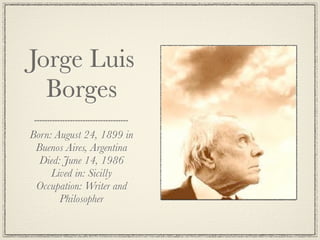
Jorge Luis
  Borges
Born: August 24, 1899 in
 Buenos Aires, Argentina
  Died: June 14, 1986
     Lived in: Sicilly
 Occupation: Writer and
       Philosopher
The Life of...

He was taught both English and
Spanish, and lived in Palermo; a
suburb like area.

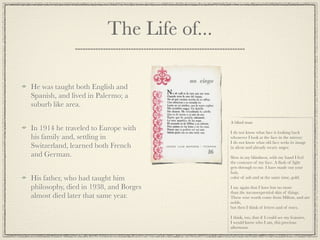
                                          A blind man
In 1914 he traveled to Europe with        I do not know what face is looking back
his family and, settling in               whenever I look at the face in the mirror;
                                          I do not know what old face seeks its image
Switzerland, learned both French          in silent and already weary anger.
and German.                               Slow in my blindness, with my hand I feel
                                          the contours of my face. A flash of light
                                          gets through to me. I have made out your
                                          hair,
His father, who had taught him            color of ash and at the same time, gold.

philosophy, died in 1938, and Borges      I say again that I have lost no more
                                          than the inconsequential skin of things.
almost died later that same year.         These wise words come from Milton, and are
                                          noble,
                                          but then I think of letters and of roses.

                                          I think, too, that if I could see my features,
                                          I would know who I am, this precious
                                          afternoon.
The Life of...(Cont.)

He published his first poem in 1919.


He said that each of his family members
somehow influenced his writings in some way.


He was an introverted child growing up and
spent his time mostly on his own or with his
family members.


Borges was picked on in school because he was
very different and that included being at a
higher intellectual level than the other
students.
People in His Life

              Some important people
              he knew throughout his
              life were: Macedonio
              Fernandez, Aldolfo Bioy
              Casares, Samuel Beckett,
              and Gerado Diego.

              He was married twice.
              First to Elsa Asete de
              Millán in 1967(divorced
              in 1970), Then to Maria
              Kodama two months
              before his death.
His Occupations
“I cannot sleep unless I am surrounded by books.”

  In1937, he was appointed the post of assistant librarian at a small library in Buenos Aires.


  In1946, having opposed Juan Perón in his speeches and non-literary writings, he was removed from his post as
  librarian and offered a job as a chicken inspector.


  In 1955, with Juan Perón overthrown; he was made director of the National Library in Buenos Aires.


  In 1956, he accepted the Chair of English and North American Literature at the University of Buenos Aires.


  In 1963, he toured Europe and England, lecturing on literary topics.


  In 1973, when Juan Perón returns to presidency; he retires from his position as director of the National
Some of His Writings
                                                Fictions (Ficciones) (1944), collection of short stories.
The Fervor of Buenos Aires (Fervor de
Buenos Aires) (1923), Borges's first book
of poetry.                                      The Aleph (El Aleph) (1949), Borges' second
                                                collection of short stories continuing his
                                                exploration of themes of the universal, the
Inquisitions (Inquisiciones) (1925), his first   mystical, immortality, memory, enlightenment, and
book of essays.                                 the idea of infinity.

Universal History of Infamy (Historia           Other Inquisitions (Otras inquisiciones) (1952), collection
universal de la infamia) (1935), his            of Borges' essays dealing with a variety of topics.
first attempt at prose fiction.

                                                Dreamtigers (El Hacedor) (1960), collection of short
The Garden of Forking Paths (El jardín de       prose and poetry considered by Borges himself to
senderos que se bifurcan) (1941),               be his best and most personal work.
collection of eight short stories
dealing with the nature of reality,
time, philosophy, metaphysics,                  Labyrinths (1962), his first book in English, including
language, and literature.                       stories and other writings.
His Awards
       “The mind was dreaming. The world was its dream.”
1961, shares the International Publishers' Formentor Prize ($10,000) with Samuel Beckett.


1963, tours Europe and England, lecturing on literary topics; travels to Colombia and
receives an honorary degree from the University of Los Andes.


1971, becomes an honorary member of both the American Academy and the National
Institute of Arts and Letters; awarded honorary degrees by Columbia University and
Oxford University.


1980, shares Spain's Cervantes Literary Prize with the Spanish poet Gerardo Diego.


1983, awarded the French Legion of Honor.
The Most
 Amazing
   Part
Jorge Luis Borges spent his life
  slowly going blind due to a
     hereditary condition.
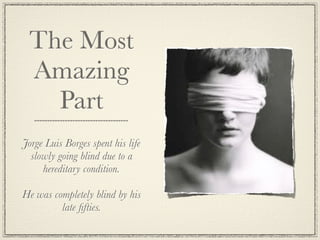
He was completely blind by his
         late fifties.
The End

Jorge luis borges

  • 1.
    Jorge Luis Borges By: Destiny Hampton
  • 2.
    Jorge Luis Borges Born: August 24, 1899 in Buenos Aires, Argentina Died: June 14, 1986 Lived in: Sicilly Occupation: Writer and Philosopher
  • 3.
    The Life of... Hewas taught both English and Spanish, and lived in Palermo; a suburb like area. A blind man In 1914 he traveled to Europe with I do not know what face is looking back his family and, settling in whenever I look at the face in the mirror; I do not know what old face seeks its image Switzerland, learned both French in silent and already weary anger. and German. Slow in my blindness, with my hand I feel the contours of my face. A flash of light gets through to me. I have made out your hair, His father, who had taught him color of ash and at the same time, gold. philosophy, died in 1938, and Borges I say again that I have lost no more than the inconsequential skin of things. almost died later that same year. These wise words come from Milton, and are noble, but then I think of letters and of roses. I think, too, that if I could see my features, I would know who I am, this precious afternoon.
  • 4.
    The Life of...(Cont.) Hepublished his first poem in 1919. He said that each of his family members somehow influenced his writings in some way. He was an introverted child growing up and spent his time mostly on his own or with his family members. Borges was picked on in school because he was very different and that included being at a higher intellectual level than the other students.
  • 5.
    People in HisLife Some important people he knew throughout his life were: Macedonio Fernandez, Aldolfo Bioy Casares, Samuel Beckett, and Gerado Diego. He was married twice. First to Elsa Asete de Millán in 1967(divorced in 1970), Then to Maria Kodama two months before his death.
  • 6.
    His Occupations “I cannotsleep unless I am surrounded by books.” In1937, he was appointed the post of assistant librarian at a small library in Buenos Aires. In1946, having opposed Juan Perón in his speeches and non-literary writings, he was removed from his post as librarian and offered a job as a chicken inspector. In 1955, with Juan Perón overthrown; he was made director of the National Library in Buenos Aires. In 1956, he accepted the Chair of English and North American Literature at the University of Buenos Aires. In 1963, he toured Europe and England, lecturing on literary topics. In 1973, when Juan Perón returns to presidency; he retires from his position as director of the National
  • 7.
    Some of HisWritings Fictions (Ficciones) (1944), collection of short stories. The Fervor of Buenos Aires (Fervor de Buenos Aires) (1923), Borges's first book of poetry. The Aleph (El Aleph) (1949), Borges' second collection of short stories continuing his exploration of themes of the universal, the Inquisitions (Inquisiciones) (1925), his first mystical, immortality, memory, enlightenment, and book of essays. the idea of infinity. Universal History of Infamy (Historia Other Inquisitions (Otras inquisiciones) (1952), collection universal de la infamia) (1935), his of Borges' essays dealing with a variety of topics. first attempt at prose fiction. Dreamtigers (El Hacedor) (1960), collection of short The Garden of Forking Paths (El jardín de prose and poetry considered by Borges himself to senderos que se bifurcan) (1941), be his best and most personal work. collection of eight short stories dealing with the nature of reality, time, philosophy, metaphysics, Labyrinths (1962), his first book in English, including language, and literature. stories and other writings.
  • 8.
    His Awards “The mind was dreaming. The world was its dream.” 1961, shares the International Publishers' Formentor Prize ($10,000) with Samuel Beckett. 1963, tours Europe and England, lecturing on literary topics; travels to Colombia and receives an honorary degree from the University of Los Andes. 1971, becomes an honorary member of both the American Academy and the National Institute of Arts and Letters; awarded honorary degrees by Columbia University and Oxford University. 1980, shares Spain's Cervantes Literary Prize with the Spanish poet Gerardo Diego. 1983, awarded the French Legion of Honor.
  • 9.
    The Most Amazing Part Jorge Luis Borges spent his life slowly going blind due to a hereditary condition. He was completely blind by his late fifties.
  • 10.

Editor's Notes