“The Business of Carbon Sequestration and
Forestation”, Greater Houston Partnership


The Science Behind Terrestrial
   Carbon Sequestration?
                         John Kadyszewski
                         Winrock International
                         Houston, Texas
                         November 3, 2005
How do Ecosystems Sequester
           Carbon?
                                             P            R
                              P
   Photosynthesis (P)
   fixes CO2                          R
                Respiration (R)
                releases CO2


           Photosynthesis exceeds respiration, resulting in
           storage of carbon                                2
©Winrock International 2005
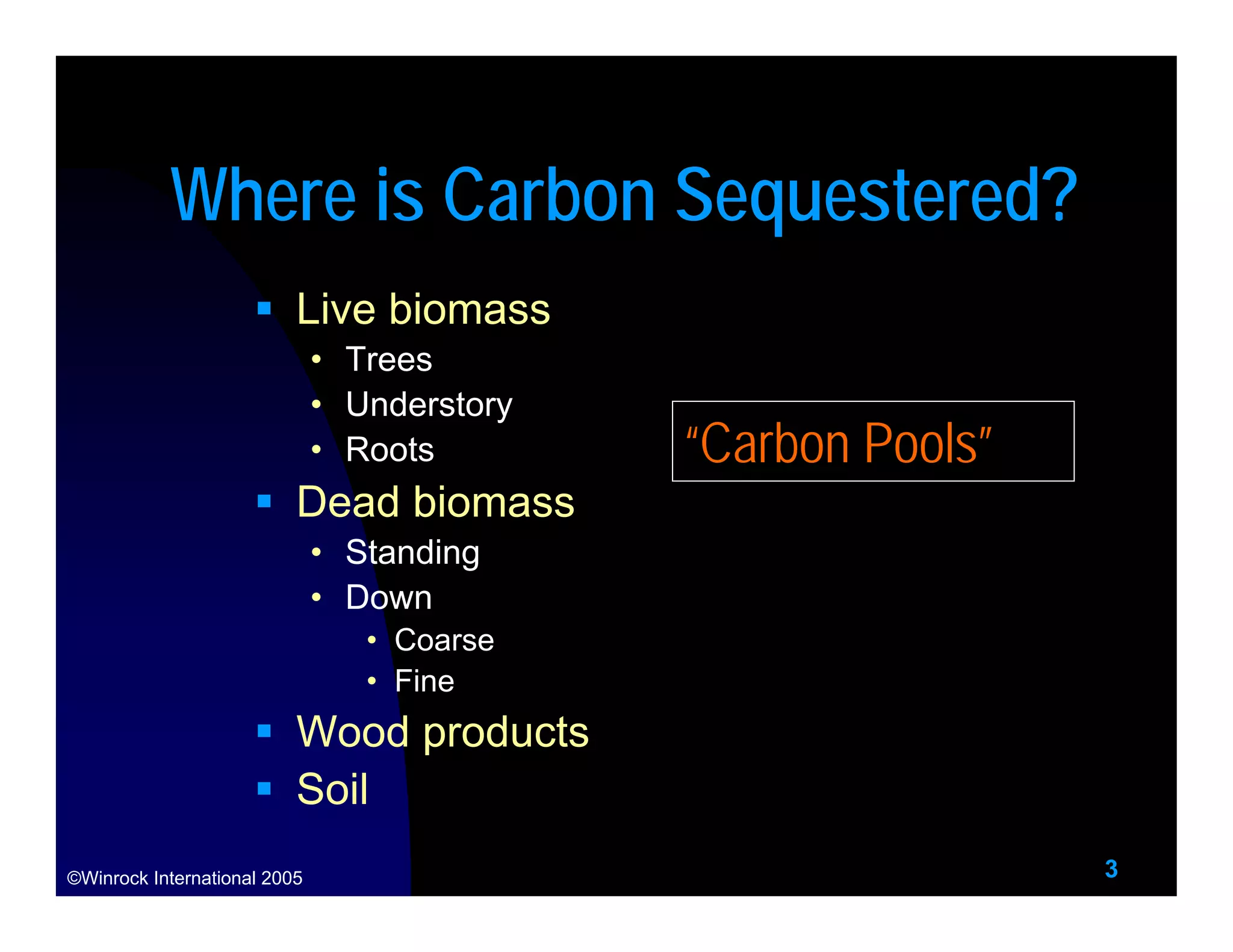
Where is Carbon Sequestered?
                          Live biomass
                              • Trees
                              • Understory
                              • Roots        “Carbon Pools”
                          Dead biomass
                              • Standing
                              • Down
                                 • Coarse
                                 • Fine
                          Wood products
                          Soil
©Winrock International 2005                                   3
At What Rate Does Carbon
           Accumulate?
                                            P         R
                              P
   Photosynthesis (P)
   fixes CO2                       R
                Respiration (R)
                releases CO2


                                    1-5 t C/ha.yr


                                  0.1-0.5 t C/ha.yr
©Winrock International 2005                               4
What is a Terrestrial Carbon
           Sequestration Project?
                          Project-based carbon benefits
                          are the difference between the
                          selected “carbon pools” in the
                          with-project and without-project
                          cases


©Winrock International 2005                                  5
Terrestrial Sequestration Options
                                                   State


         Agricultural Land      Grazing Land               Forest Land        Accessory Data


                Afforestation      Afforestation            Extend Rotation           Risks


                  Change in          Change                 Change Species         Co-Benefits
                   Tillage         Management

                 Grassland          Grassland                   Change
                 Restoration        Restoration               Management

                                                              Conservation


©Winrock International 2005                                                                      6
Afforestation
               Convert agricultural
               or grazing land
               back to forest
                • Return to native
                  forest
                • Convert to forest land
                  for timber production


                                           Source: Tim Pearson, Winrock International

                                                    Mixed Conifers

©Winrock International 2005                                                      7
Afforestation
                                                                              Convert to forest
                                                                              land with fast-
                                                                              growing species


                                                                           Hybrid Poplar
                                                                           28 years old
                                                                           110 feet tall
                                                                           32 in. dbh
                        Source: Jon Johnson, Washington State University
©Winrock International 2005                                                                       8
Growth Rates for Trees
                          Douglas Fir       4 dry t/acre/yr
                                       ~50 year rotation
                          Hybrid Poplar     10 dry t/acre/yr
                                            6-8 year rotation


                                             Source: Jon Johnson
                                             Associate Professor
                                             Washington State University


 9 years diameter growth
©Winrock International 2005                                                9
Conserve Forests
                                                Stop forest
                                                conversion to non-
                                                forest
                                                Longleaf pine (120
                                                year old forest)
                                                • 174 tC/ha
                                                Redwood (150 year
                                                old forest)
                                                • 478 tC/ha


   Source: Tim Pearson, Winrock International

©Winrock International 2005                                          10
Winrock Carbon Measurement #1
                       Classify land area into strata with similar
                       characteristics
                       Collect ground data to determine variability
                       within each strata
                       Insert ground data into Spatial Information
                       Package
                       Set number of permanent plots needed to
                       achieve target level of precision


©Winrock International 2005                                           11
Winrock Carbon Measurement #2
                    Prepare Standard Operating Procedures
                    Recommend frequency of monitoring
                    Devise Quality Assurance/ Quality Control
                    Plan
                    Determine need for compliance monitoring
                    Prepare plan for archiving data


©Winrock International 2005                                     12
Accuracy and Precision
                       Statistical sampling
                       Report results with error bars
                       Trade-off between cost and precision
                        • Expected variability affects number of plots
                        • Fixed and variable costs
                        • Different project classes have different
                          measurement costs


©Winrock International 2005                                              13
Establish Permanent Plots

                              Each plot is
                              permanently
                              marked and
                              georeferenced.


©Winrock International 2005              14
Measure
                              Aboveground
                              Biomass
                              Measure diameter at breast
                              height for all trees within the
                              boundaries of the permanent
                              plot – carbon estimated from
                              regression equations


©Winrock International 2005                                 15
Measuring Understory and Fine
     Litter
                              Use clip plots (60 cm
                              diameter frame) to
                              sample herbaceous
                              vegetation and litter
                              within the permanent
                              plot
                              Collect total fresh
                              weight and dry a sub-
                              sample to calculate
                              dry biomass

©Winrock International 2005                      16
Measuring Dead Wood
                              For standing dead trees
                              estimate biomass using
                              regression equations or
                              volume from detailed
                              measurements
                              Use line intersect
                              method for lying dead
                              wood
                              Sample dead wood for
                              density estimate

©Winrock International 2005                           17
Sampling Soils for
             Organic Carbon                                                   Collect 4 samples,
                                                                              mix well and sieve
                                                                              through 2 mm mesh
                                                                              screen
Expose mineral soil surface
Dig 30 cm x 30 cm pit or take                                                 Air dry (not in direct
soil core                                                                     sun) and send to lab
                                                                              for C analysis


 Photo by André Ferreti


                                                      Photo by Matt Delaney


                                                       Collect one sample
                              Photo by Matt Delaney    for bulk density
©Winrock International 2005                                                                   18
Entergy
                               Cinergy


©Winrock International 2005              19
Reducing Measurement Costs
        Aerial Measurements
Aerial Measurements Using High
     Resolution 3D Imagery


©Winrock International 2005           21
Aerial Sample Plots


©Winrock International 2005   22
Labor Needed for Aerial vs Field Plots
    Step                         M3DADI approach   Conventional field
                                                   approach
    Prepare the plane and               24                   --
    collect imagery
    Processing the imagery or           65                  0.13
    field data†
    Collect and record plot             0.71                3.4
    measurements-time per plot
    Enter data into                     0.25                0.75
    spreadsheets-time per plot
    Estimated total time to
    sample 202 plots*
                                       283                 865

©Winrock International 2005                                             23
Project Issues
                          Baselines
                          Leakage
                          Reversibility (Permanence)
                              • Duration
                              • Risk of Loss
                          Additionality
                          Measurement and Monitoring

©Winrock International 2005                            24
Can these activities make a
        difference?
        Global estimates of the potential amount of land available and potential amount of
        C that could be sequestered and conserved by forest management practices on this
        land between 1995 to 2050.

        Latitudinal               Practice         Area       C sequestered
        belt                                       (Mha)      & conserved (billion tons)
        Boreal                Forestation            95          2.4
        Temperate             Forestation           113         11.8
                              Agroforestry            7           0.7      14
        Tropics               Forestation           67           16.4
                              Agroforestry          63            6.3
                              Regeneration          217    11.5-28.7
                              Slow deforestation    138    10.8-20.8       46-73
              Total                                 700         60-87

          *The amount of C conserved and sequestered here is
          equivalent to 12-15% of the business-as-usual fossil fuel
          emissions over the same time period

                                 From Brown et al. 1996, Second Assessment Report of IPCC; 25
©Winrock International 2005
                                 Kauppi and Sedjo 2000, Third Assessment Report, IPCC
Multiple Additional
        Environmental Benefits
                                                 Co-Benefits


                   Water         Flood Control           Biodiversity       New Income
                                                                             Sources


                    Watershed       Reduced Cost               Endangered       Non-timber
                     Integrity      for Insurance               Species       forest products

                       Water       Reduced Flood               Parks and         Tourism
                       Quality       Damage                    Reserves

                     Reduced          Reduced                   Wetlands          Forest
                     Non-Point        Non-Point                                  Products

                                                                Streams           Water
                                                                                  Supply

                                                               Expanded
©Winrock International 2005
                                                                Habitat                         26
DOE Regional Partnership
  Preliminary results from “Carbon Supply from
  Sequestration Activities on Agriculture and Forest
  Lands for SECARB Partnership”, Winrock
  International, September 2005.
Potential Terrestrial Carbon Supply from
       Afforestation in SECARB Region
           Activity after 40 years           Million t CO2 Million acres

           Crop land afforestation
                  $2.40 per metric ton CO2       5            0.04
                    $10 per metric ton CO2     1128            7.7
                    $20 per metric ton CO2     3881           28.0
           Grazing land afforestation
                  $2.40 per metric ton CO2       0             0
                    $10 per metric ton CO2     3277           24.4
                    $20 per metric ton CO2     3485           27.3
©Winrock International 2005                                                28
Potential C Supply (t Carbon) by
         County for Afforestation after 40 yr
                    Croplands                            Grazing lands


                                t Carbon
                                 < 1,000,000
                                 1,000,001 - 2,000,000
                                 2,000,001 - 3,000,000
                                 3,000,001 - 4,000,000
                                 4,000,001 - 5,000,000
                                 5,000,001 - 6,000,000
                                 6,000,001 - 7,000,000
                                 7,000,001 - 8,000,000
                                 8,000,001 - 9,000,000
                                 > 9,000,001


©Winrock International 2005                                              29
Potential C supply ($/t C) for
         afforestation after 40 yr
                    Croplands                       Grazing lands


                                < $30.00
                                $30.01 - $50.00
                                $50.01 - $70.00
                                $70.01 - $90.00
                                $90.01 - $110.00
                                $110.01 - $130.00
                                $130.01 - $150.00
                                                     Divide $/t C by
                                $150.01 - $170.00    3.67 to get $/t
                                                     CO2
                                $170.01 - $190.00

©Winrock International 2005     > $190.01                              30
Options for Cofiring Biomass
                    Blend biomass with coal on the
                    conveyor belt and feed through the
                    pulverizer– estimated cost $100-
                    200/kw
                      • Limited to < 3% heat from biomass except
                        with cyclone boilers that could blend up to
                        10%
                    Retrofit to add biomass-only injection
                    point – estimated cost $200-300/kw
©Winrock International 2005                                           31
Potential Terrestrial Sequestration
             -- Assuming Heat Rate of 11,000 BTU/kWh and Capacity Factor 80%
             -- Assuming conversion to forest with 20 or 40 year rotations
      Power Biomass Fuel               Land       Change in Carbon
      Output Required                  Required   Stocks

      30 MW               212,000 MT    42,000    20 yrs – 2.1 M tons
                                         acres    40 yrs – 6.3 M tons
      50 MW               353,000 MT    70,600    20 yrs – 3.5 M tons
                                         acres    40 yrs – 10.5 M tons
      80 MW               565,000 MT    113,000   20 yrs – 5.7 M tons
                                         acres    40 yrs – 17.0 M tons


©Winrock International 2005                                              32
Land Requirements
                    ~ 5 million acres available within 50 miles

               Land           Percentage Carbon Sequestration
               Required                  Value at $2/MT CO2
                   42,000        <1%         20 yrs – $7.7 Million
                    acres                    40 yrs – $23.1 Million
                   70,600        ~1.4%       20 yrs – $12.8 Million
                    acres                    40 yrs – $38.5 Million
                  113,000        ~2.3%       20 yrs – $20.9 Million
                   acres                     40 yrs – $62.3Million

©Winrock International 2005                                           33
Carbon Price: Dollars per Hectare -- 40 Years


©Winrock International 2005                        34
Environmental Benefits
                    Carbon benefits
                      • Displace coal -- annual benefit
                      • Stimulate changes in land use that result
                        in higher average carbon stocks
                    Can reduce NOx emissions
                    Biomass usually has no sulfur or
                    mercury
                    Low ash and less particulates

©Winrock International 2005                                         35
Summary
                          Terrestrial carbon sequestration projects
                          can be measured accurately at low cost
                          New aerial methods will reduce costs
                          further
                          Afforestation is the largest option available
                          in the SE region of the US
                          Co-firing biomass fuels with coal could
                          produce significant emission reductions


©Winrock International 2005                                          36
Questions or Comments:

                            John Kadyszewski
                           Winrock International
                          (703) 525-9430,ext 618
                        Jkadyszewski@winrock.org


©Winrock International 2005                        37

The Science Behind Terrestrial Carbon Sequestration

  • 1.
    “The Business ofCarbon Sequestration and Forestation”, Greater Houston Partnership The Science Behind Terrestrial Carbon Sequestration? John Kadyszewski Winrock International Houston, Texas November 3, 2005
  • 2.
    How do EcosystemsSequester Carbon? P R P Photosynthesis (P) fixes CO2 R Respiration (R) releases CO2 Photosynthesis exceeds respiration, resulting in storage of carbon 2 ©Winrock International 2005
  • 3.
    Where is CarbonSequestered? Live biomass • Trees • Understory • Roots “Carbon Pools” Dead biomass • Standing • Down • Coarse • Fine Wood products Soil ©Winrock International 2005 3
  • 4.
    At What RateDoes Carbon Accumulate? P R P Photosynthesis (P) fixes CO2 R Respiration (R) releases CO2 1-5 t C/ha.yr 0.1-0.5 t C/ha.yr ©Winrock International 2005 4
  • 5.
    What is aTerrestrial Carbon Sequestration Project? Project-based carbon benefits are the difference between the selected “carbon pools” in the with-project and without-project cases ©Winrock International 2005 5
  • 6.
    Terrestrial Sequestration Options State Agricultural Land Grazing Land Forest Land Accessory Data Afforestation Afforestation Extend Rotation Risks Change in Change Change Species Co-Benefits Tillage Management Grassland Grassland Change Restoration Restoration Management Conservation ©Winrock International 2005 6
  • 7.
    Afforestation Convert agricultural or grazing land back to forest • Return to native forest • Convert to forest land for timber production Source: Tim Pearson, Winrock International Mixed Conifers ©Winrock International 2005 7
  • 8.
    Afforestation Convert to forest land with fast- growing species Hybrid Poplar 28 years old 110 feet tall 32 in. dbh Source: Jon Johnson, Washington State University ©Winrock International 2005 8
  • 9.
    Growth Rates forTrees Douglas Fir 4 dry t/acre/yr ~50 year rotation Hybrid Poplar 10 dry t/acre/yr 6-8 year rotation Source: Jon Johnson Associate Professor Washington State University 9 years diameter growth ©Winrock International 2005 9
  • 10.
    Conserve Forests Stop forest conversion to non- forest Longleaf pine (120 year old forest) • 174 tC/ha Redwood (150 year old forest) • 478 tC/ha Source: Tim Pearson, Winrock International ©Winrock International 2005 10
  • 11.
    Winrock Carbon Measurement#1 Classify land area into strata with similar characteristics Collect ground data to determine variability within each strata Insert ground data into Spatial Information Package Set number of permanent plots needed to achieve target level of precision ©Winrock International 2005 11
  • 12.
    Winrock Carbon Measurement#2 Prepare Standard Operating Procedures Recommend frequency of monitoring Devise Quality Assurance/ Quality Control Plan Determine need for compliance monitoring Prepare plan for archiving data ©Winrock International 2005 12
  • 13.
    Accuracy and Precision Statistical sampling Report results with error bars Trade-off between cost and precision • Expected variability affects number of plots • Fixed and variable costs • Different project classes have different measurement costs ©Winrock International 2005 13
  • 14.
    Establish Permanent Plots Each plot is permanently marked and georeferenced. ©Winrock International 2005 14
  • 15.
    Measure Aboveground Biomass Measure diameter at breast height for all trees within the boundaries of the permanent plot – carbon estimated from regression equations ©Winrock International 2005 15
  • 16.
    Measuring Understory andFine Litter Use clip plots (60 cm diameter frame) to sample herbaceous vegetation and litter within the permanent plot Collect total fresh weight and dry a sub- sample to calculate dry biomass ©Winrock International 2005 16
  • 17.
    Measuring Dead Wood For standing dead trees estimate biomass using regression equations or volume from detailed measurements Use line intersect method for lying dead wood Sample dead wood for density estimate ©Winrock International 2005 17
  • 18.
    Sampling Soils for Organic Carbon Collect 4 samples, mix well and sieve through 2 mm mesh screen Expose mineral soil surface Dig 30 cm x 30 cm pit or take Air dry (not in direct soil core sun) and send to lab for C analysis Photo by André Ferreti Photo by Matt Delaney Collect one sample Photo by Matt Delaney for bulk density ©Winrock International 2005 18
  • 19.
    Entergy Cinergy ©Winrock International 2005 19
  • 20.
    Reducing Measurement Costs Aerial Measurements
  • 21.
    Aerial Measurements UsingHigh Resolution 3D Imagery ©Winrock International 2005 21
  • 22.
    Aerial Sample Plots ©WinrockInternational 2005 22
  • 23.
    Labor Needed forAerial vs Field Plots Step M3DADI approach Conventional field approach Prepare the plane and 24 -- collect imagery Processing the imagery or 65 0.13 field data† Collect and record plot 0.71 3.4 measurements-time per plot Enter data into 0.25 0.75 spreadsheets-time per plot Estimated total time to sample 202 plots* 283 865 ©Winrock International 2005 23
  • 24.
    Project Issues Baselines Leakage Reversibility (Permanence) • Duration • Risk of Loss Additionality Measurement and Monitoring ©Winrock International 2005 24
  • 25.
    Can these activitiesmake a difference? Global estimates of the potential amount of land available and potential amount of C that could be sequestered and conserved by forest management practices on this land between 1995 to 2050. Latitudinal Practice Area C sequestered belt (Mha) & conserved (billion tons) Boreal Forestation 95 2.4 Temperate Forestation 113 11.8 Agroforestry 7 0.7 14 Tropics Forestation 67 16.4 Agroforestry 63 6.3 Regeneration 217 11.5-28.7 Slow deforestation 138 10.8-20.8 46-73 Total 700 60-87 *The amount of C conserved and sequestered here is equivalent to 12-15% of the business-as-usual fossil fuel emissions over the same time period From Brown et al. 1996, Second Assessment Report of IPCC; 25 ©Winrock International 2005 Kauppi and Sedjo 2000, Third Assessment Report, IPCC
  • 26.
    Multiple Additional Environmental Benefits Co-Benefits Water Flood Control Biodiversity New Income Sources Watershed Reduced Cost Endangered Non-timber Integrity for Insurance Species forest products Water Reduced Flood Parks and Tourism Quality Damage Reserves Reduced Reduced Wetlands Forest Non-Point Non-Point Products Streams Water Supply Expanded ©Winrock International 2005 Habitat 26
  • 27.
    DOE Regional Partnership Preliminary results from “Carbon Supply from Sequestration Activities on Agriculture and Forest Lands for SECARB Partnership”, Winrock International, September 2005.
  • 28.
    Potential Terrestrial CarbonSupply from Afforestation in SECARB Region Activity after 40 years Million t CO2 Million acres Crop land afforestation $2.40 per metric ton CO2 5 0.04 $10 per metric ton CO2 1128 7.7 $20 per metric ton CO2 3881 28.0 Grazing land afforestation $2.40 per metric ton CO2 0 0 $10 per metric ton CO2 3277 24.4 $20 per metric ton CO2 3485 27.3 ©Winrock International 2005 28
  • 29.
    Potential C Supply(t Carbon) by County for Afforestation after 40 yr Croplands Grazing lands t Carbon < 1,000,000 1,000,001 - 2,000,000 2,000,001 - 3,000,000 3,000,001 - 4,000,000 4,000,001 - 5,000,000 5,000,001 - 6,000,000 6,000,001 - 7,000,000 7,000,001 - 8,000,000 8,000,001 - 9,000,000 > 9,000,001 ©Winrock International 2005 29
  • 30.
    Potential C supply($/t C) for afforestation after 40 yr Croplands Grazing lands < $30.00 $30.01 - $50.00 $50.01 - $70.00 $70.01 - $90.00 $90.01 - $110.00 $110.01 - $130.00 $130.01 - $150.00 Divide $/t C by $150.01 - $170.00 3.67 to get $/t CO2 $170.01 - $190.00 ©Winrock International 2005 > $190.01 30
  • 31.
    Options for CofiringBiomass Blend biomass with coal on the conveyor belt and feed through the pulverizer– estimated cost $100- 200/kw • Limited to < 3% heat from biomass except with cyclone boilers that could blend up to 10% Retrofit to add biomass-only injection point – estimated cost $200-300/kw ©Winrock International 2005 31
  • 32.
    Potential Terrestrial Sequestration -- Assuming Heat Rate of 11,000 BTU/kWh and Capacity Factor 80% -- Assuming conversion to forest with 20 or 40 year rotations Power Biomass Fuel Land Change in Carbon Output Required Required Stocks 30 MW 212,000 MT 42,000 20 yrs – 2.1 M tons acres 40 yrs – 6.3 M tons 50 MW 353,000 MT 70,600 20 yrs – 3.5 M tons acres 40 yrs – 10.5 M tons 80 MW 565,000 MT 113,000 20 yrs – 5.7 M tons acres 40 yrs – 17.0 M tons ©Winrock International 2005 32
  • 33.
    Land Requirements ~ 5 million acres available within 50 miles Land Percentage Carbon Sequestration Required Value at $2/MT CO2 42,000 <1% 20 yrs – $7.7 Million acres 40 yrs – $23.1 Million 70,600 ~1.4% 20 yrs – $12.8 Million acres 40 yrs – $38.5 Million 113,000 ~2.3% 20 yrs – $20.9 Million acres 40 yrs – $62.3Million ©Winrock International 2005 33
  • 34.
    Carbon Price: Dollarsper Hectare -- 40 Years ©Winrock International 2005 34
  • 35.
    Environmental Benefits Carbon benefits • Displace coal -- annual benefit • Stimulate changes in land use that result in higher average carbon stocks Can reduce NOx emissions Biomass usually has no sulfur or mercury Low ash and less particulates ©Winrock International 2005 35
  • 36.
    Summary Terrestrial carbon sequestration projects can be measured accurately at low cost New aerial methods will reduce costs further Afforestation is the largest option available in the SE region of the US Co-firing biomass fuels with coal could produce significant emission reductions ©Winrock International 2005 36
  • 37.
    Questions or Comments: John Kadyszewski Winrock International (703) 525-9430,ext 618 Jkadyszewski@winrock.org ©Winrock International 2005 37