Poetry Across Time: Character and voice
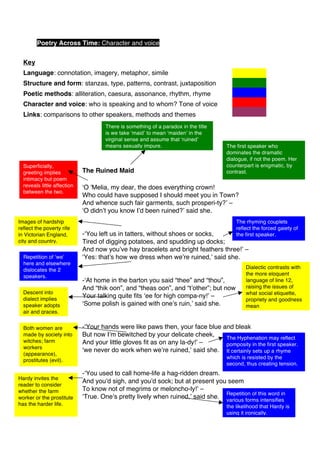
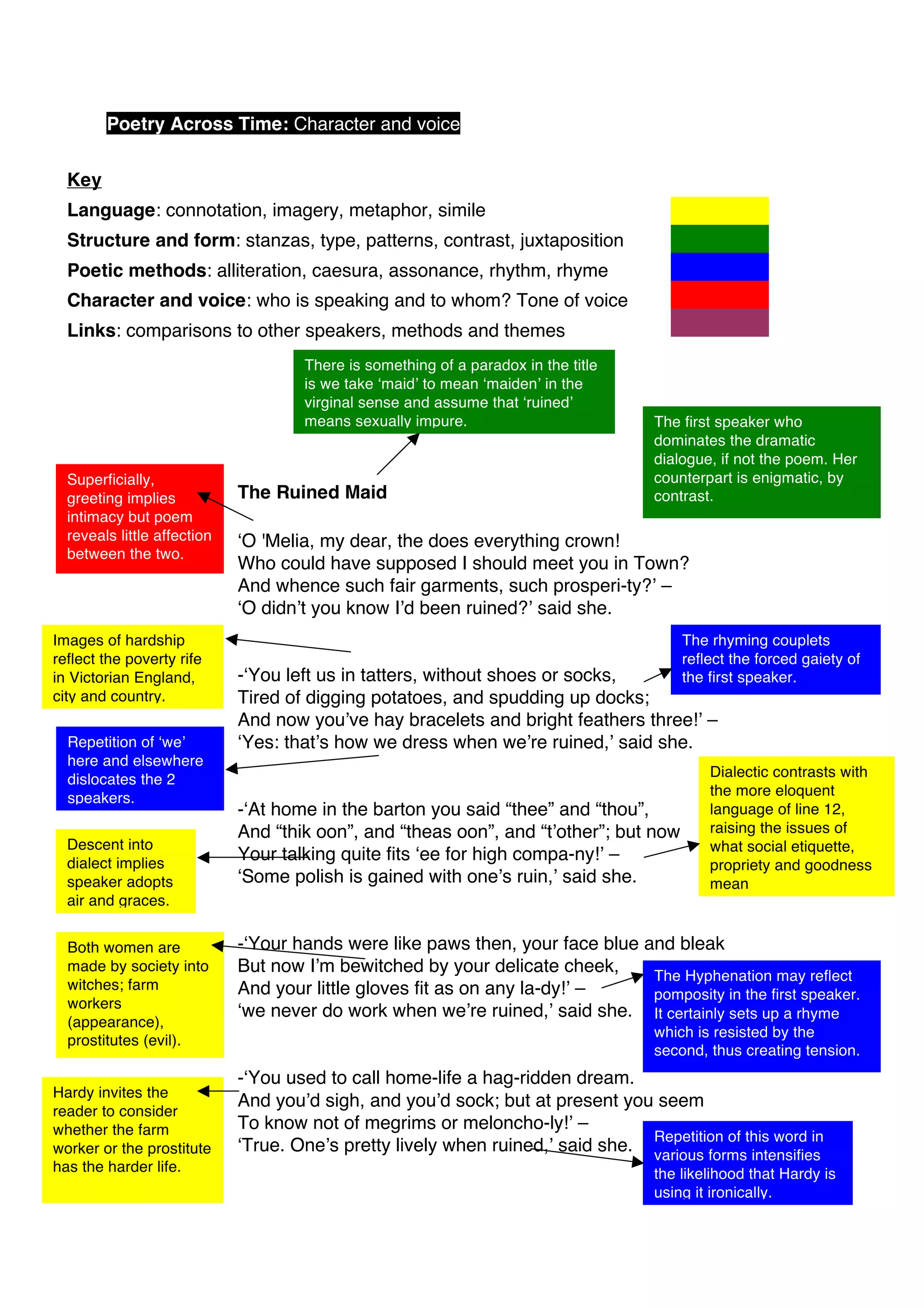
The Ruined Maid
‘O 'Melia, my dear, the does everything crown!
Who could have supposed I should meet you in Town?
And whence such fair garments, such prosperi-ty?’ –
‘O didn’t you know I’d been ruined?’ said she.
-‘You left us in tatters, without shoes or socks,
Tired of digging potatoes, and spudding up docks;
And now you’ve hay bracelets and bright feathers three!’ –
‘Yes: that’s how we dress when we’re ruined,’ said she.
-‘At home in the barton you said “thee” and “thou”,
And “thik oon”, and “theas oon”, and “t’other”; but now
Your talking quite fits ‘ee for high compa-ny!’ –
‘Some polish is gained with one’s ruin,’ said she.
-‘Your hands were like paws then, your face blue and bleak
But now I’m bewitched by your delicate cheek,
And your little gloves fit as on any la-dy!’ –
‘we never do work when we’re ruined,’ said she.
-‘You used to call home-life a hag-ridden dream.
And you’d sigh, and you’d sock; but at present you seem
To know not of megrims or meloncho-ly!’ –
‘True. One’s pretty lively when ruined,’ said she.
Key
Language: connotation, imagery, metaphor, simile
Structure and form: stanzas, type, patterns, contrast, juxtaposition
Poetic methods: alliteration, caesura, assonance, rhythm, rhyme
Character and voice: who is speaking and to whom? Tone of voice
Links: comparisons to other speakers, methods and themes
There is something of a paradox in the title
is we take ‘maid’ to mean ‘maiden’ in the
virginal sense and assume that ‘ruined’
means sexually impure.
Superficially,
greeting implies
intimacy but poem
reveals little affection
between the two.
The first speaker who
dominates the dramatic
dialogue, if not the poem. Her
counterpart is enigmatic, by
contrast.
Images of hardship
reflect the poverty rife
in Victorian England,
city and country.
The rhyming couplets
reflect the forced gaiety of
the first speaker.
Repetition of ‘we’
here and elsewhere
dislocates the 2
speakers.
Dialectic contrasts with
the more eloquent
language of line 12,
raising the issues of
what social etiquette,
propriety and goodness
mean
Descent into
dialect implies
speaker adopts
air and graces.
The Hyphenation may reflect
pomposity in the first speaker.
It certainly sets up a rhyme
which is resisted by the
second, thus creating tension.
Both women are
made by society into
witches; farm
workers
(appearance),
prostitutes (evil).
Repetition of this word in
various forms intensifies
the likelihood that Hardy is
using it ironically.
Hardy invites the
reader to consider
whether the farm
worker or the prostitute
has the harder life.
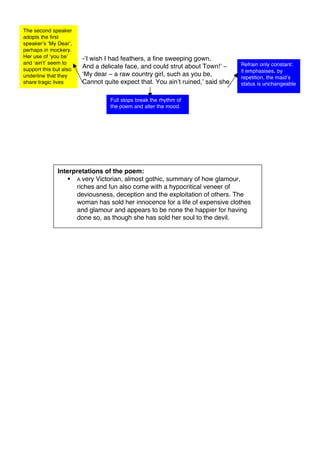
-‘I wish I had feathers, a fine sweeping gown,
And a delicate face, and could strut about Town!’ –
‘My dear – a raw country girl, such as you be,
Cannot quite expect that. You ain’t ruined,’ said she.
Full stops break the rhythm of
the poem and alter the mood.
The second speaker
adopts the first
speaker’s ‘My Dear’,
perhaps in mockery.
Her use of ‘you be’
and ‘ain’t’ seem to
support this but also
underline that they
share tragic lives
Refrain only constant:
it emphasises, by
repetition, the maid’s
status is unchangeable
Interpretations of the poem:
 A very Victorian, almost gothic, summary of how glamour,
riches and fun also come with a hypocritical veneer of
deviousness, deception and the exploitation of others. The
woman has sold her innocence for a life of expensive clothes
and glamour and appears to be none the happier for having
done so, as though she has sold her soul to the devil.

The Ruined Maid

  • 1.
    Poetry Across Time:Character and voice The Ruined Maid ‘O 'Melia, my dear, the does everything crown! Who could have supposed I should meet you in Town? And whence such fair garments, such prosperi-ty?’ – ‘O didn’t you know I’d been ruined?’ said she. -‘You left us in tatters, without shoes or socks, Tired of digging potatoes, and spudding up docks; And now you’ve hay bracelets and bright feathers three!’ – ‘Yes: that’s how we dress when we’re ruined,’ said she. -‘At home in the barton you said “thee” and “thou”, And “thik oon”, and “theas oon”, and “t’other”; but now Your talking quite fits ‘ee for high compa-ny!’ – ‘Some polish is gained with one’s ruin,’ said she. -‘Your hands were like paws then, your face blue and bleak But now I’m bewitched by your delicate cheek, And your little gloves fit as on any la-dy!’ – ‘we never do work when we’re ruined,’ said she. -‘You used to call home-life a hag-ridden dream. And you’d sigh, and you’d sock; but at present you seem To know not of megrims or meloncho-ly!’ – ‘True. One’s pretty lively when ruined,’ said she. Key Language: connotation, imagery, metaphor, simile Structure and form: stanzas, type, patterns, contrast, juxtaposition Poetic methods: alliteration, caesura, assonance, rhythm, rhyme Character and voice: who is speaking and to whom? Tone of voice Links: comparisons to other speakers, methods and themes There is something of a paradox in the title is we take ‘maid’ to mean ‘maiden’ in the virginal sense and assume that ‘ruined’ means sexually impure. Superficially, greeting implies intimacy but poem reveals little affection between the two. The first speaker who dominates the dramatic dialogue, if not the poem. Her counterpart is enigmatic, by contrast. Images of hardship reflect the poverty rife in Victorian England, city and country. The rhyming couplets reflect the forced gaiety of the first speaker. Repetition of ‘we’ here and elsewhere dislocates the 2 speakers. Dialectic contrasts with the more eloquent language of line 12, raising the issues of what social etiquette, propriety and goodness mean Descent into dialect implies speaker adopts air and graces. The Hyphenation may reflect pomposity in the first speaker. It certainly sets up a rhyme which is resisted by the second, thus creating tension. Both women are made by society into witches; farm workers (appearance), prostitutes (evil). Repetition of this word in various forms intensifies the likelihood that Hardy is using it ironically. Hardy invites the reader to consider whether the farm worker or the prostitute has the harder life.
  • 2.
    -‘I wish Ihad feathers, a fine sweeping gown, And a delicate face, and could strut about Town!’ – ‘My dear – a raw country girl, such as you be, Cannot quite expect that. You ain’t ruined,’ said she. Full stops break the rhythm of the poem and alter the mood. The second speaker adopts the first speaker’s ‘My Dear’, perhaps in mockery. Her use of ‘you be’ and ‘ain’t’ seem to support this but also underline that they share tragic lives Refrain only constant: it emphasises, by repetition, the maid’s status is unchangeable Interpretations of the poem:  A very Victorian, almost gothic, summary of how glamour, riches and fun also come with a hypocritical veneer of deviousness, deception and the exploitation of others. The woman has sold her innocence for a life of expensive clothes and glamour and appears to be none the happier for having done so, as though she has sold her soul to the devil.