The Role of New Media in
Knowledge Generation by the
Community
A Case Study of NROER
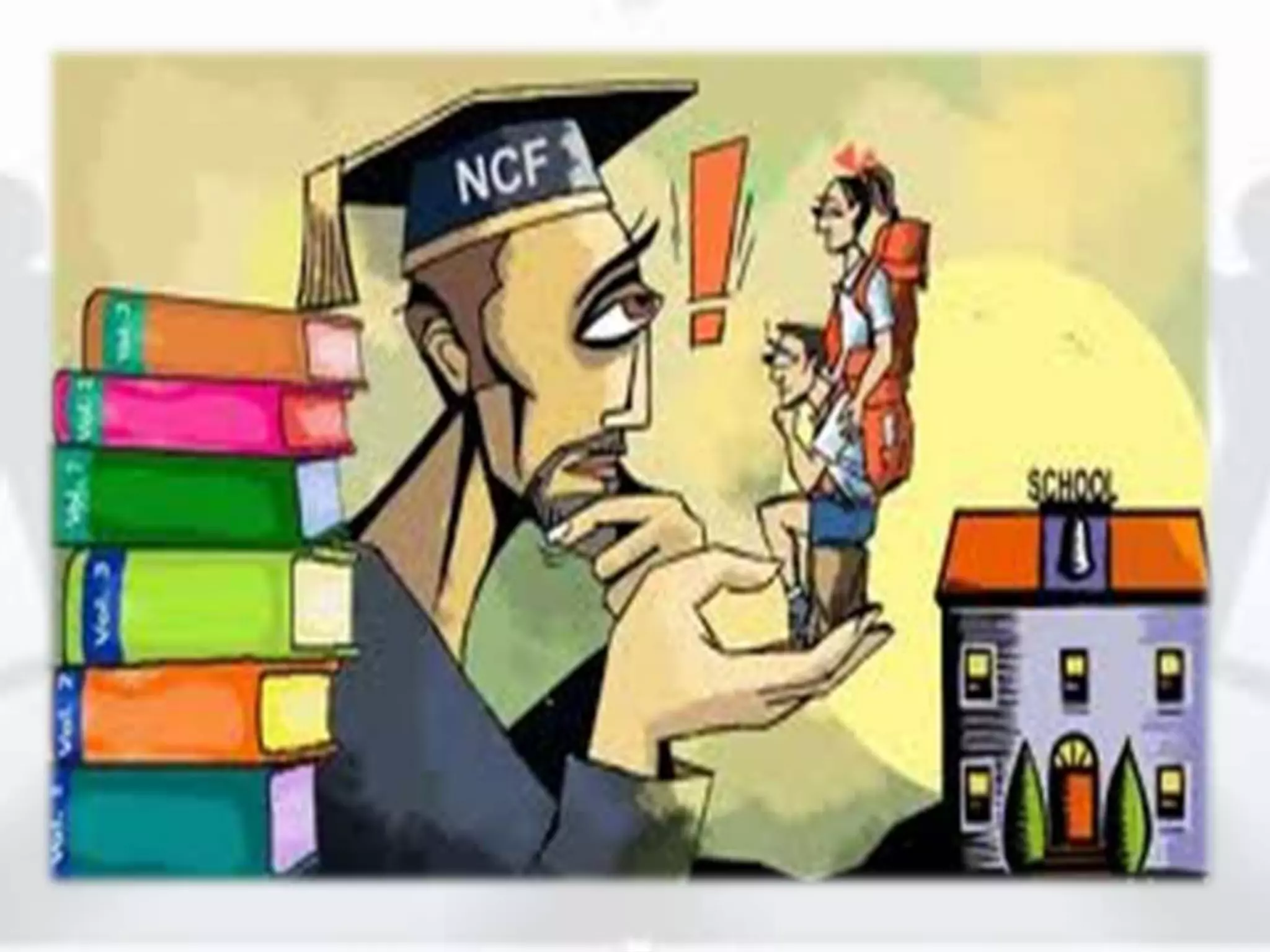
• Connecting knowledge to life outside the school
• Ensuring that learning shifts away from rote methods
• Enriching curriculum so that it goes beyond textbooks
• Making examinations flexible
• Primacy to children’s experiences, their voices and their
participation
• Need for adults to change their perception of children as
passive receivers of knowledge
• Children can be active participants in the construction of knowledge
• Highlights the value of interaction with: environment, peers, older
people to enhance learning
• Learning tasks must be designed to enable children to seek out
knowledge from sites other than textbooks.
• Need therefore to move away from rigid lesson planning to
planning and designing activities that challenge children to think
and try out what they are learning.
New Media as a pedagogical tool
The New Media is not just about new ways/technology of
creating & delivering media messages but it is also a
pedagogical tool to make education system more
efficient.
Collaboration, creation, contextualized resources
Indian education system & New Media
New media can offer solution to various challenges
faced by the India education system
– Enormity of young population
– Inflexibility in the education system
– Multiplicity of language
– Reach and access to education
– Textbook centric education
– Lack of teachers
– Content generation as centralized activity
Government’s initiatives
• National Policy of ICT in school education
• ICT @schools Scheme
• campus –based wireless internet facilities and 24/7 labs
• ICT coverage to all 360 universities and 17, 625 colleges, in a phased manner.
• Intellectual hubs – universities @ Colleges- through networks, e Resources, online
learning, access to global resources, archiving of content, and e learning
management techniques.
• Broadband, wireless, digital subscriber line to create a platform for collaboration
amongst teachers and learners to digitize Indian intellectual content
New Media & OER movement
• The phenomenon of OER is made possible by the widespread use if ICT and open
source technologies.
• Over the last decade , national institutions have embraced the concept of
collaborative teaching and learning practices.
• Most OER initiative in India have focused on increasing the quantum of OER in
higher education.
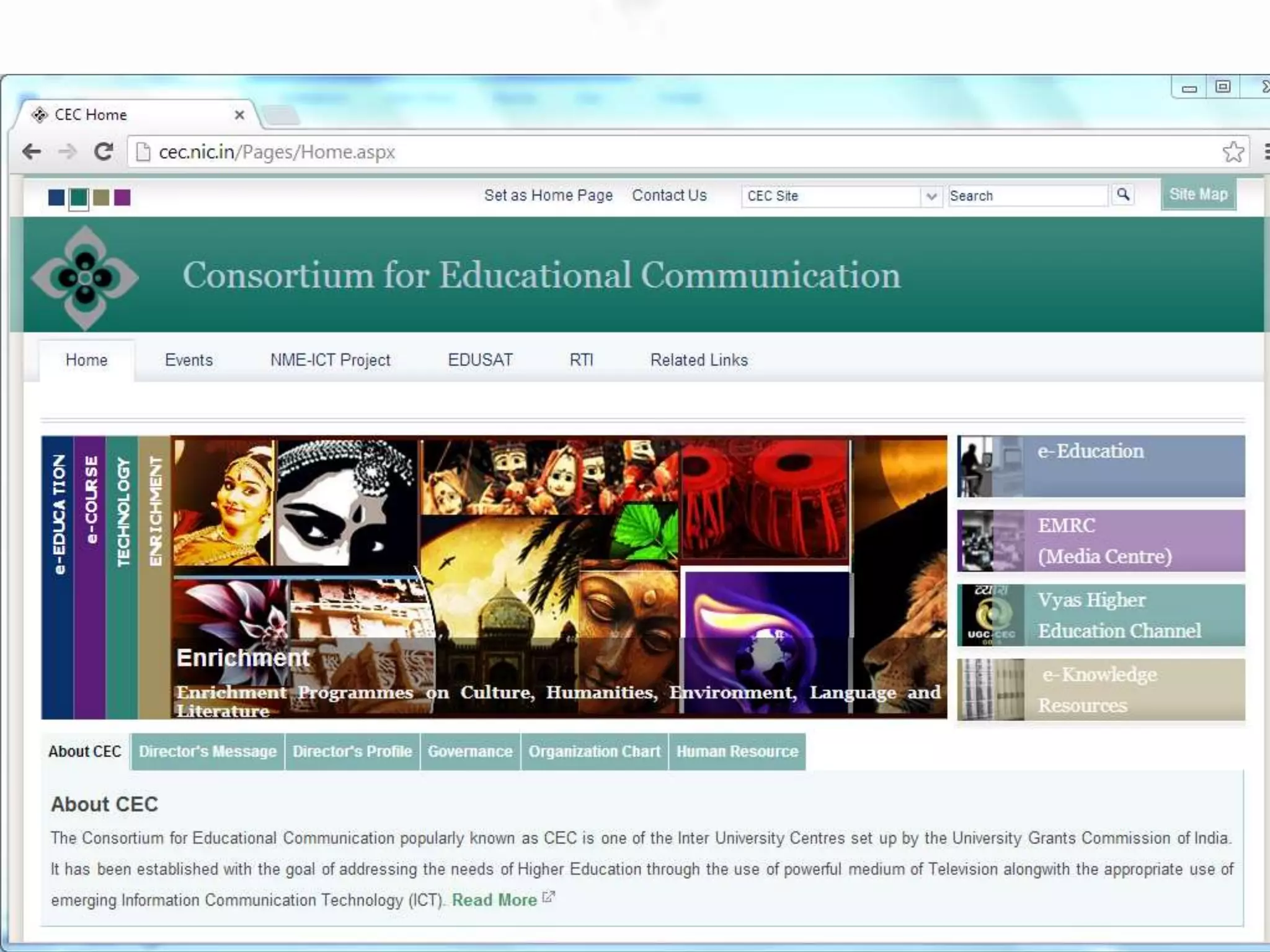
• One of the early venture was CEC an inter-university centre of the UGC
• Other major initiative includes:
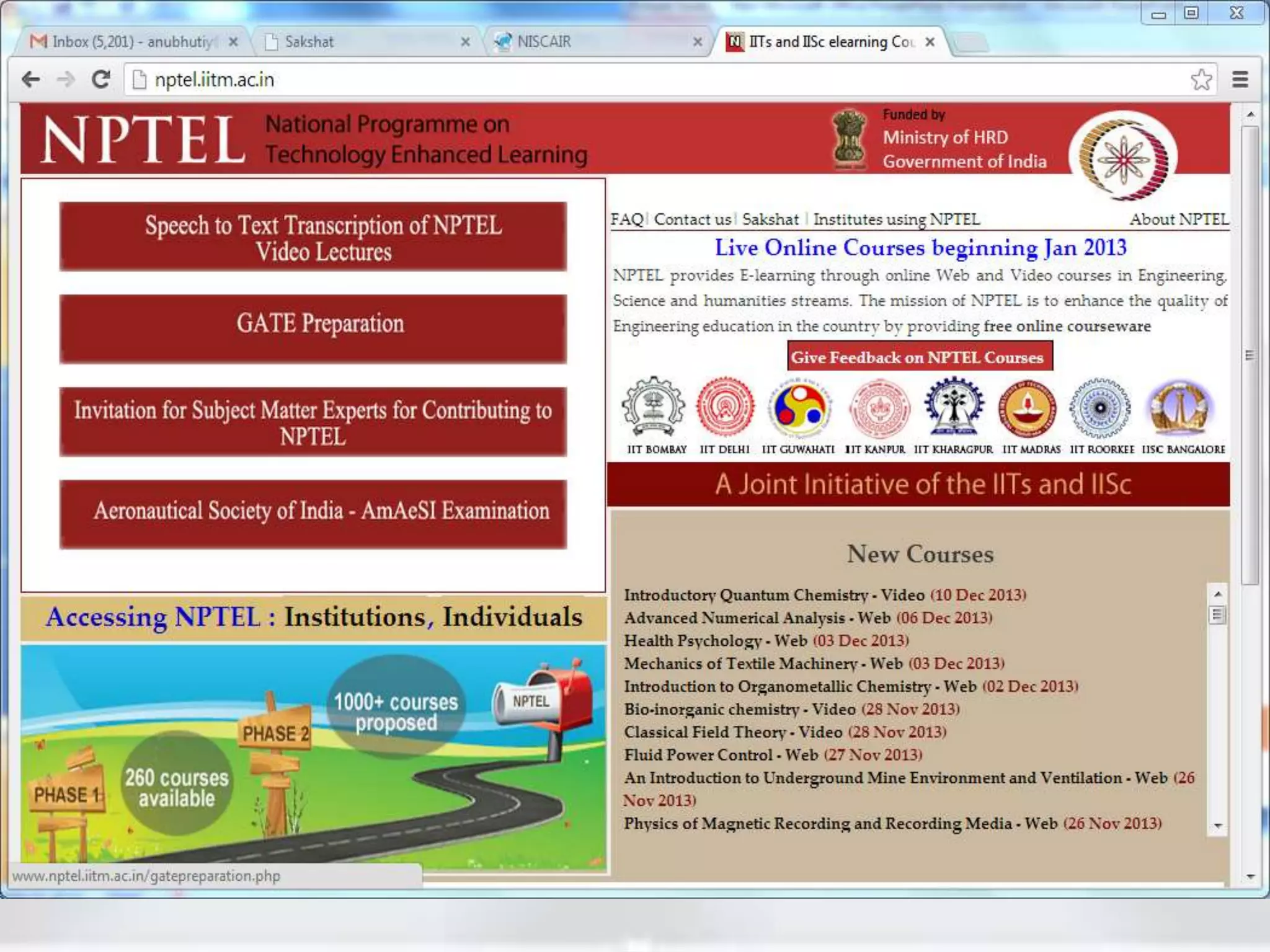
NPTEL
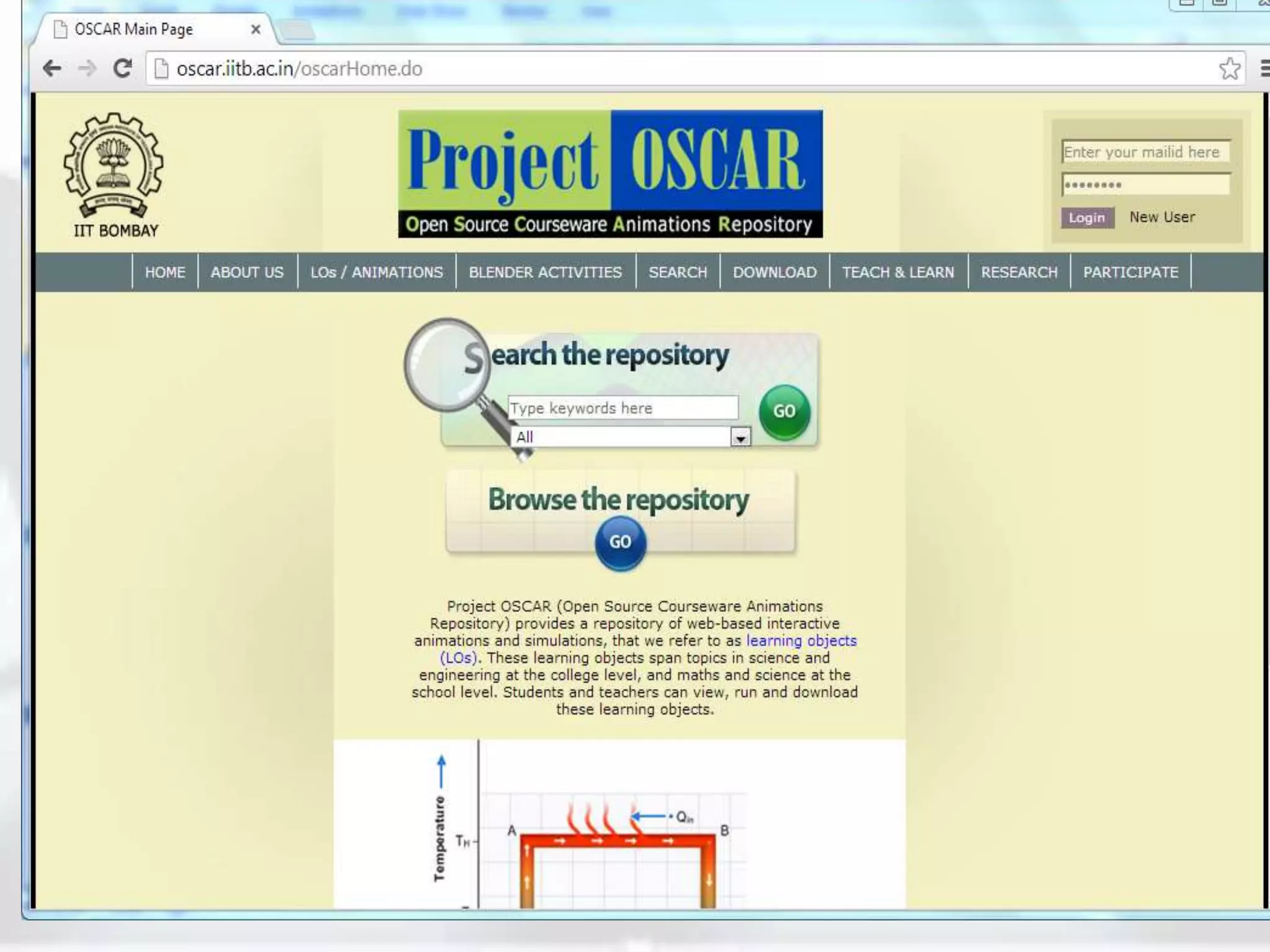
OSCAR
E GYANKOSH
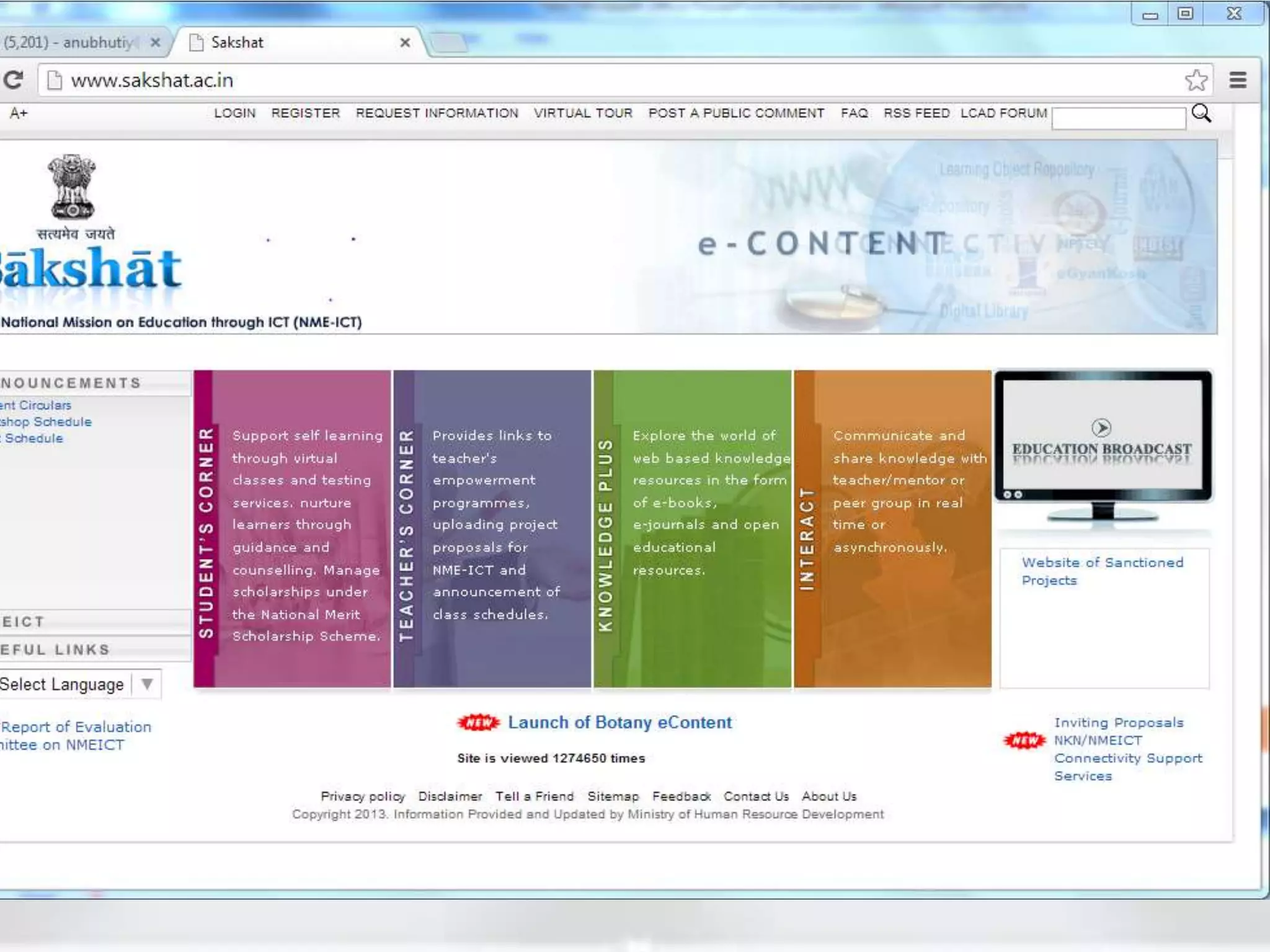
SHAKSHAT
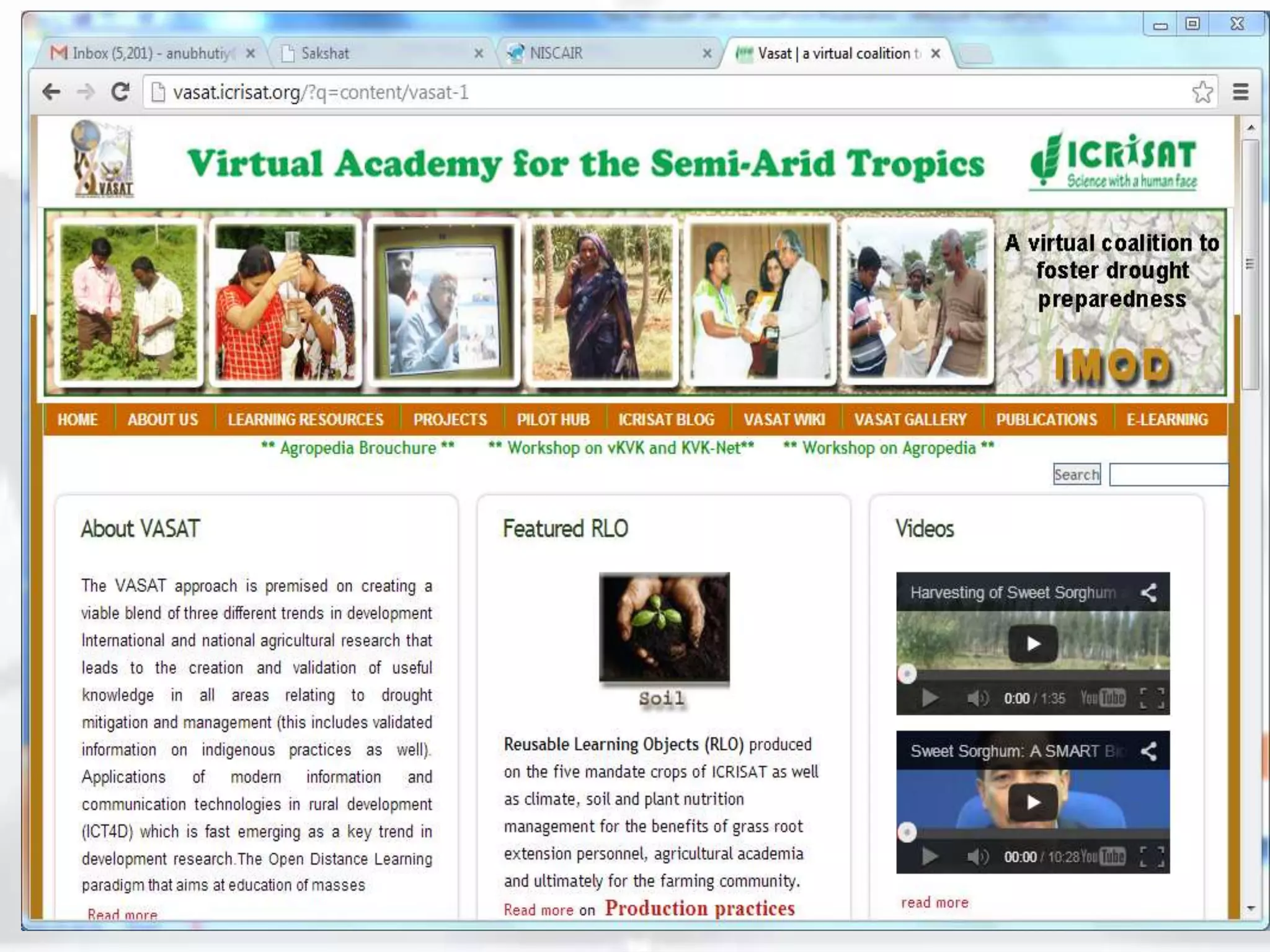
VASAT
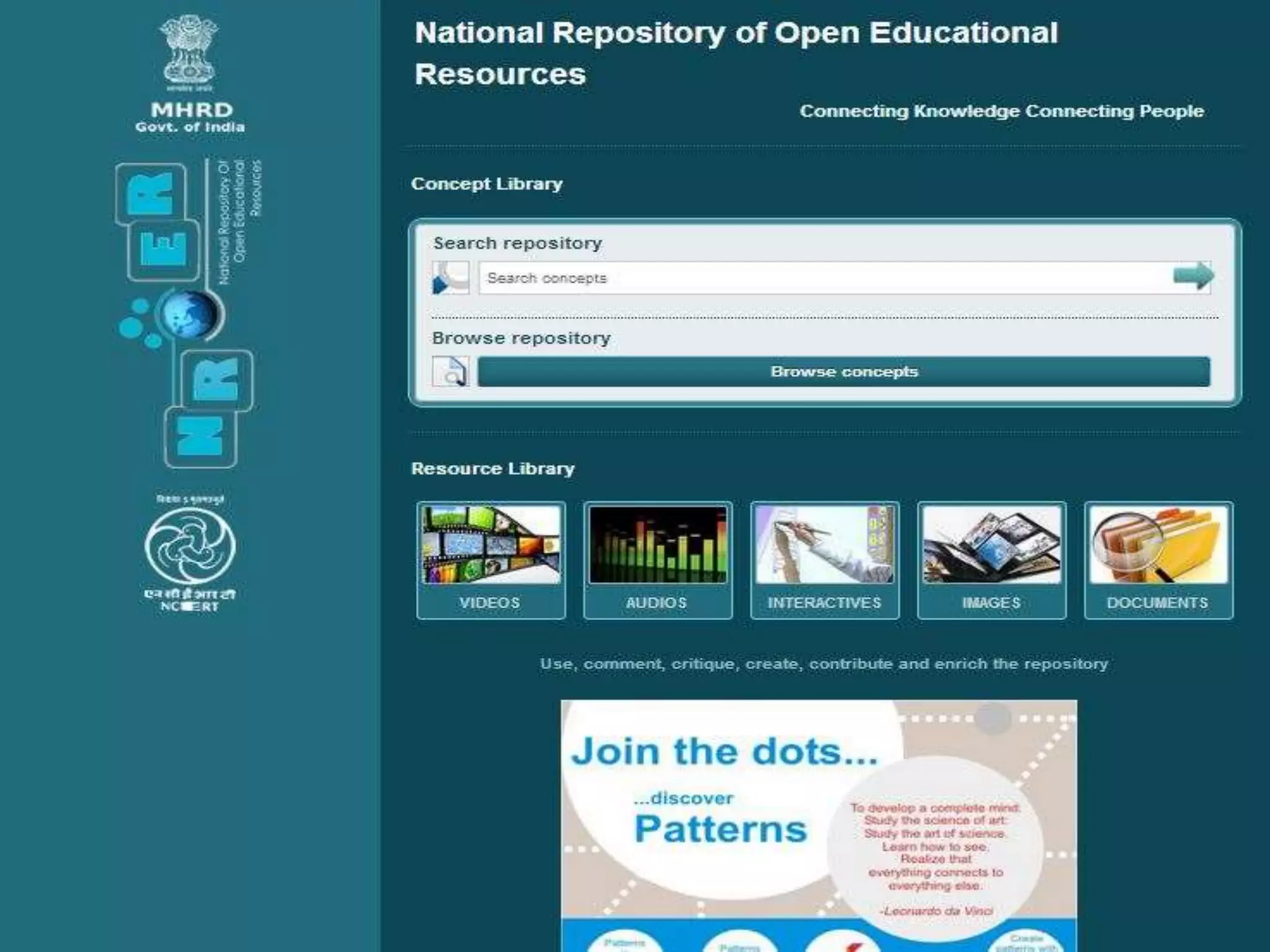
NROER
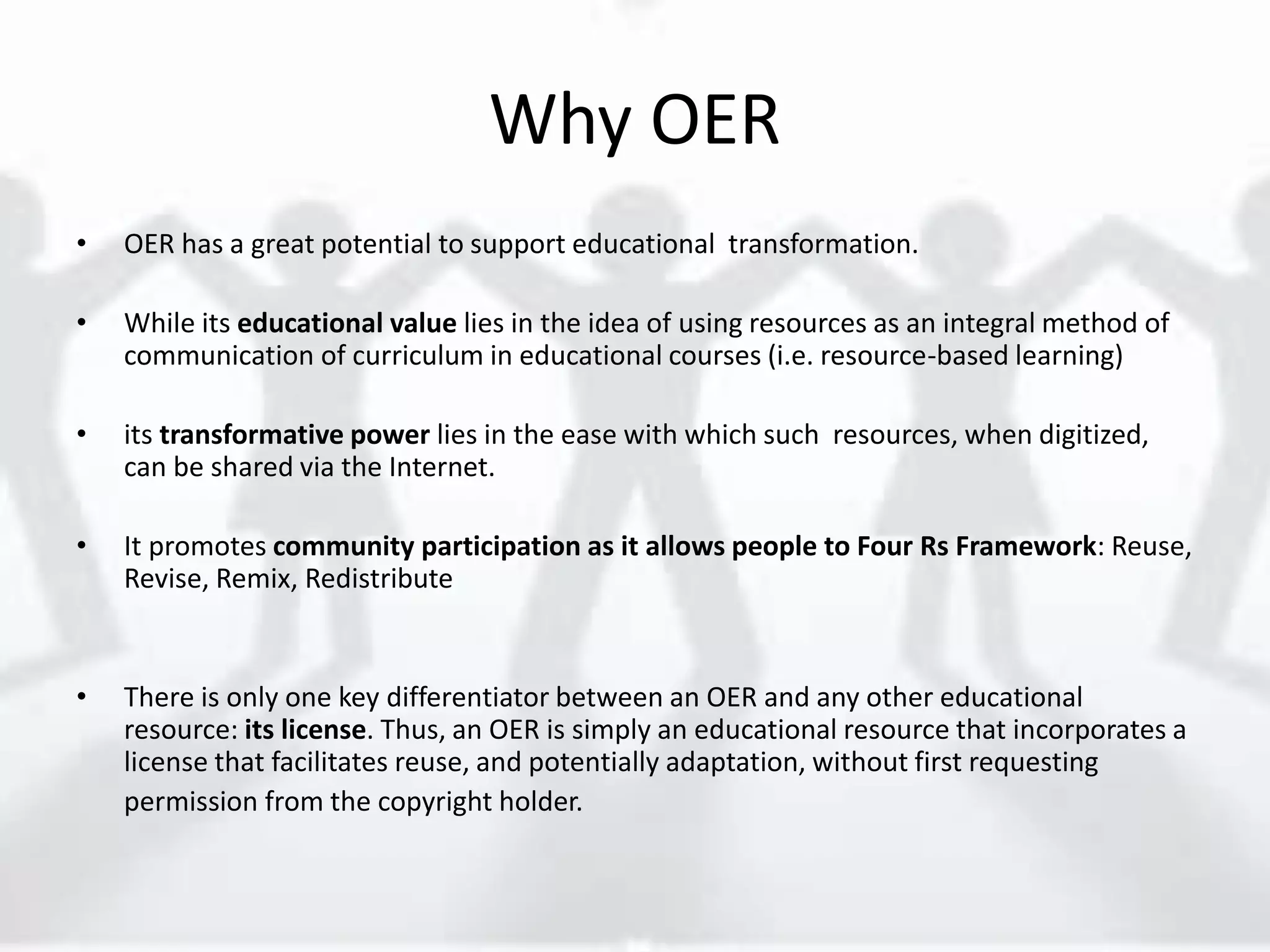
Why OER
• OER has a great potential to support educational transformation.
• While its educational value lies in the idea of using resources as an integral method of
communication of curriculum in educational courses (i.e. resource-based learning)
• its transformative power lies in the ease with which such resources, when digitized,
can be shared via the Internet.
• It promotes community participation as it allows people to Four Rs Framework: Reuse,
Revise, Remix, Redistribute
• There is only one key differentiator between an OER and any other educational
resource: its license. Thus, an OER is simply an educational resource that incorporates a
license that facilitates reuse, and potentially adaptation, without first requesting
permission from the copyright holder.
Background
• National Policy of ICT in School Education
• ICT @Schools
• Development of e content
• Collaborative creation of e content
• Widespread dissemination of e content
• Setting up of state and national level digital repositories
• Development of digital resources as per the National policy on open
standards ( Open and free access to resources developed under any state
funded project)
Connecting Knowledge, Connecting People, Open
education for all
• Interdisciplinary linkages should be encouraged
• Making variety of resources available
• Involving community in creation of content
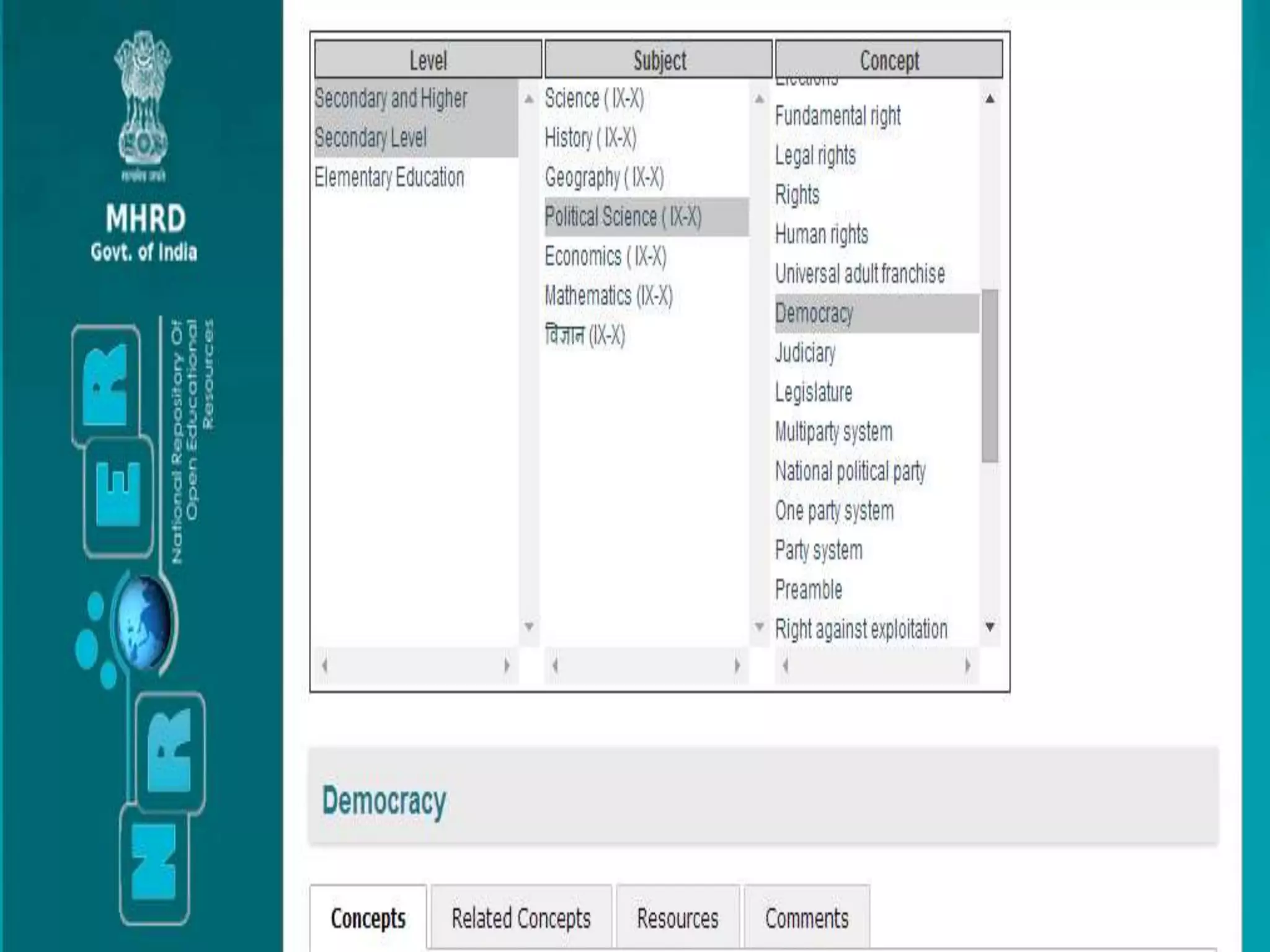
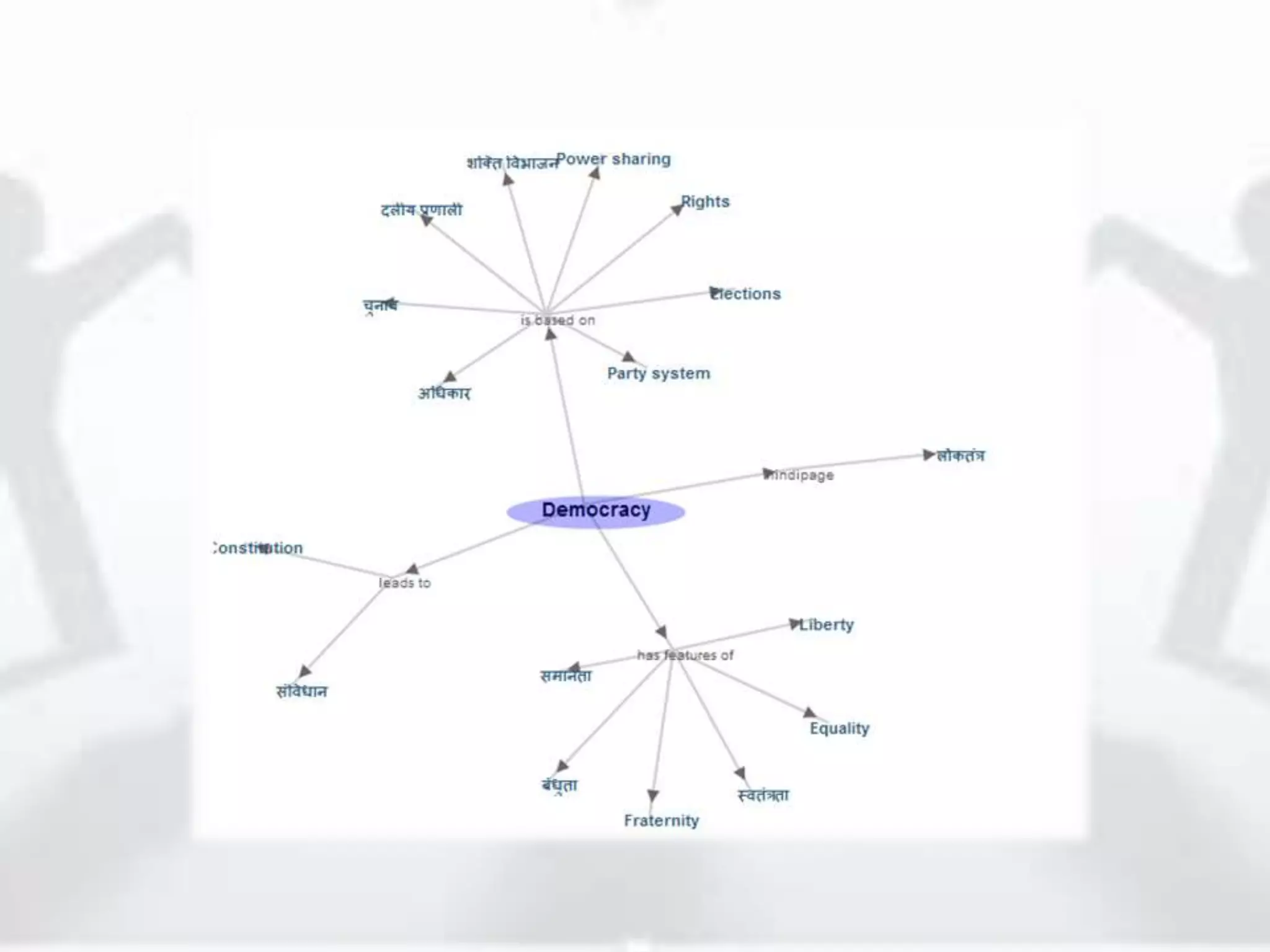
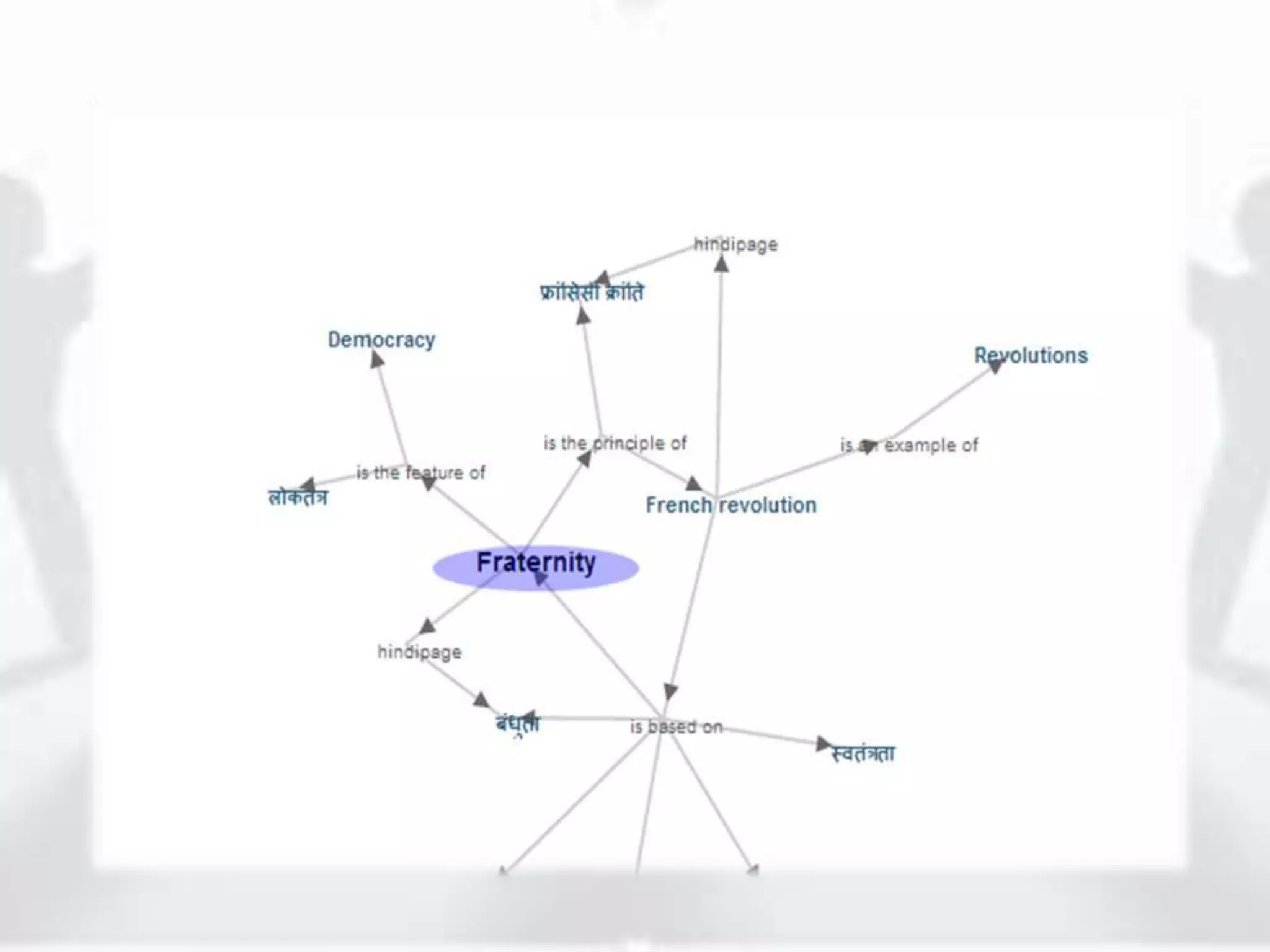
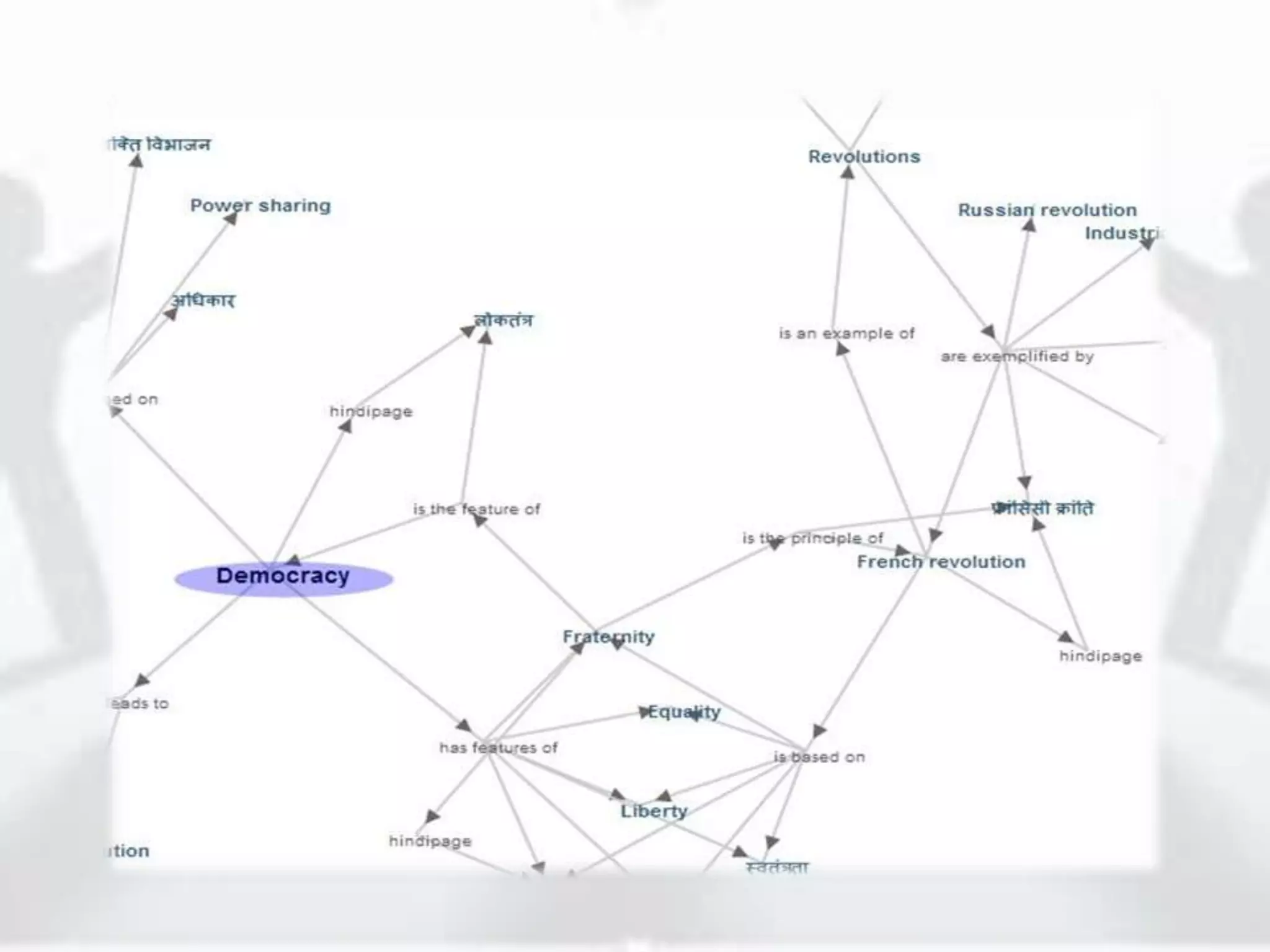
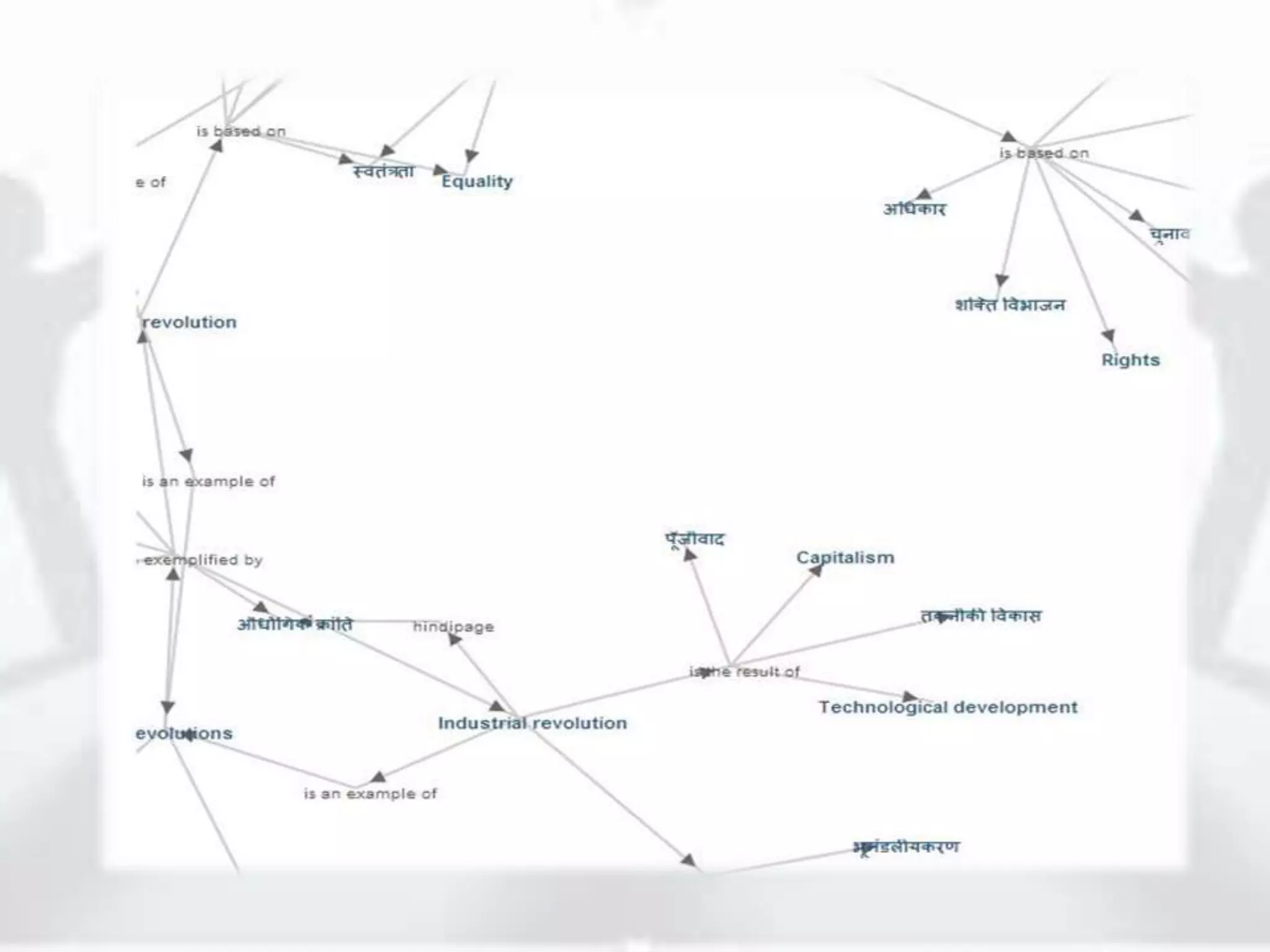
Connecting knowledge
Connecting People
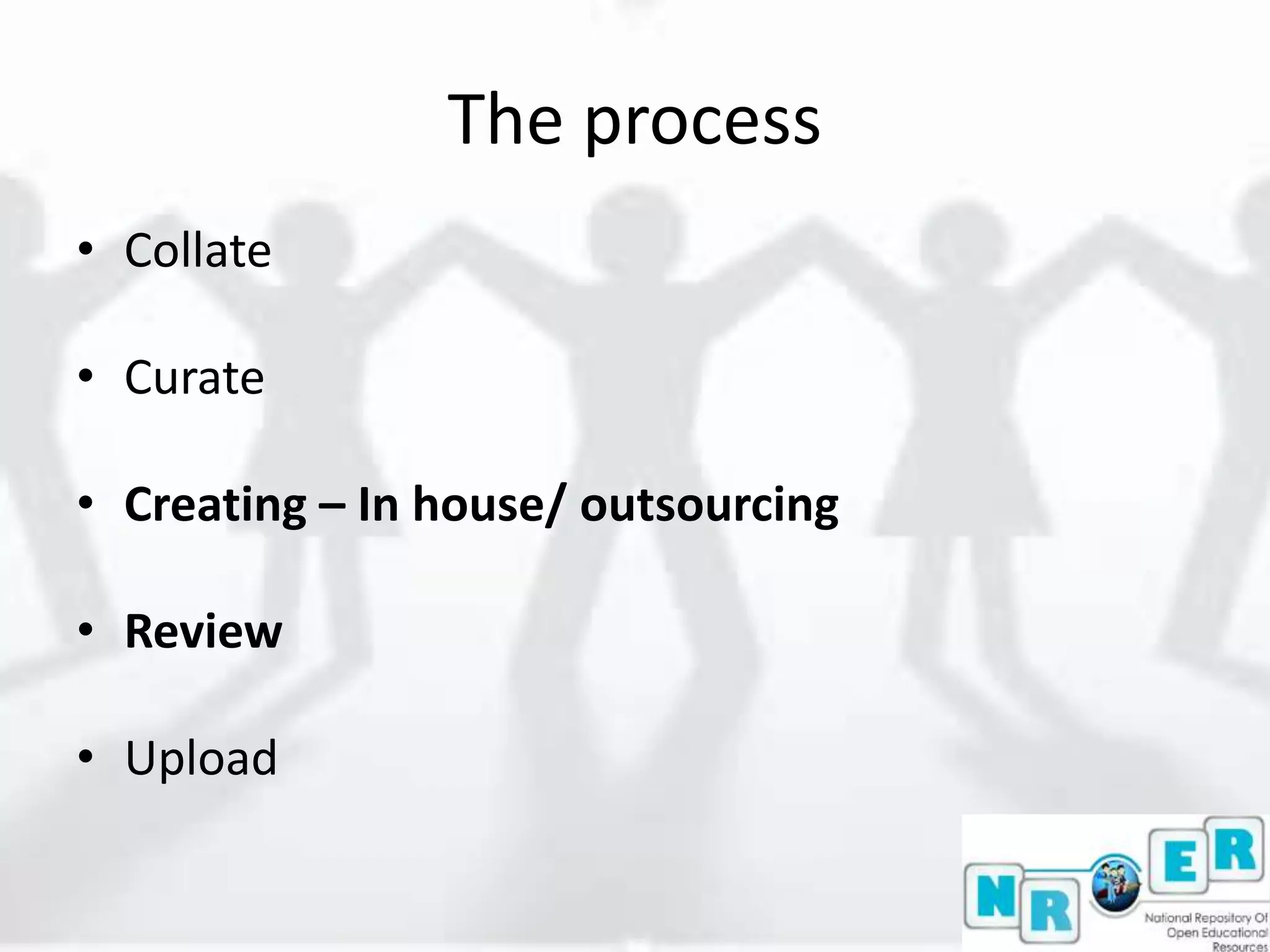
The process
• Collate
• Curate
• Creating – In house/ outsourcing
• Review
• Upload
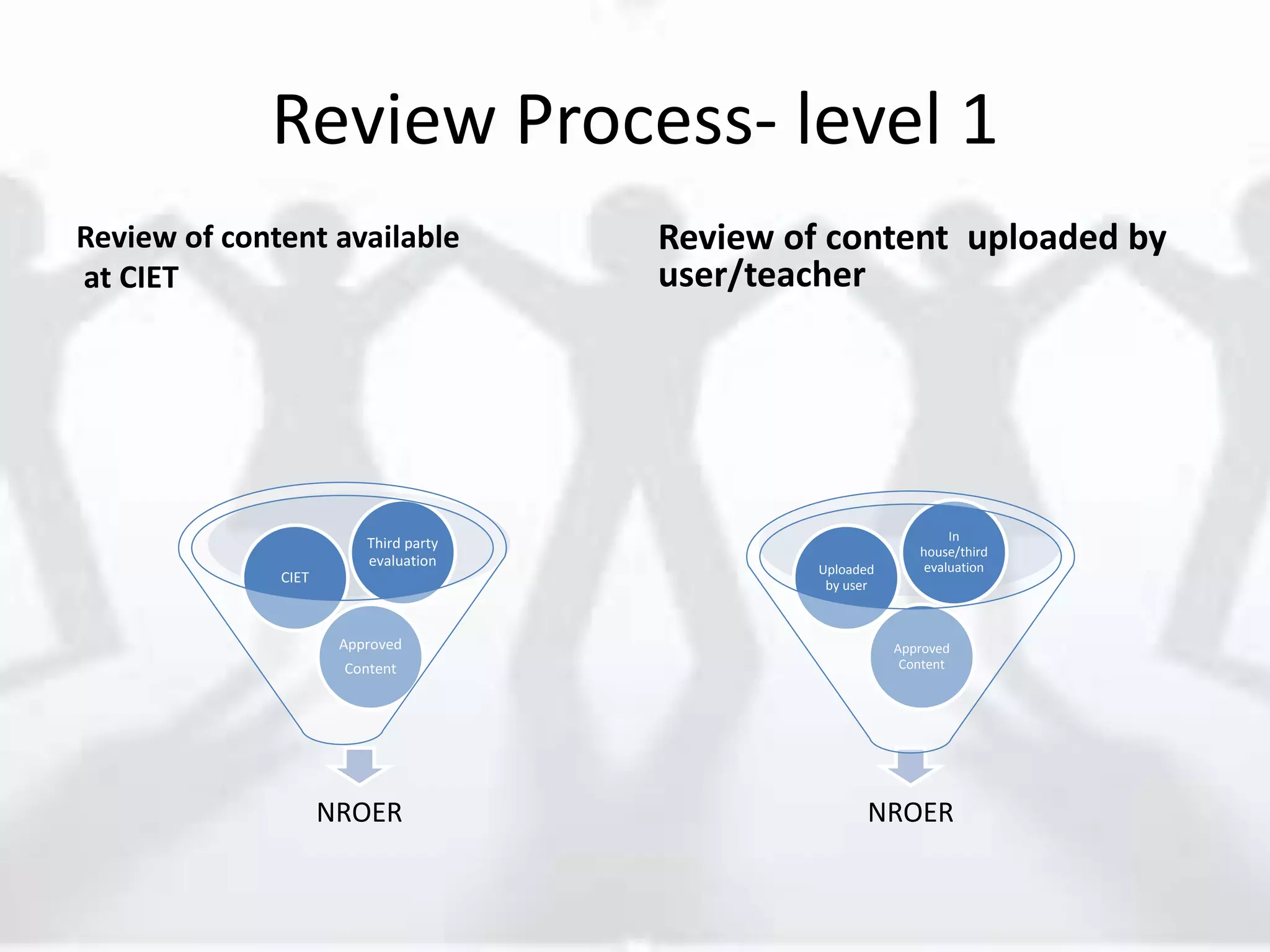
Review Process- level 1
Review of content available
at CIET
NROER
Approved
Content
CIET
Third party
evaluation
Review of content uploaded by
user/teacher
NROER
Approved
Content
Uploaded
by user
In
house/third
evaluation
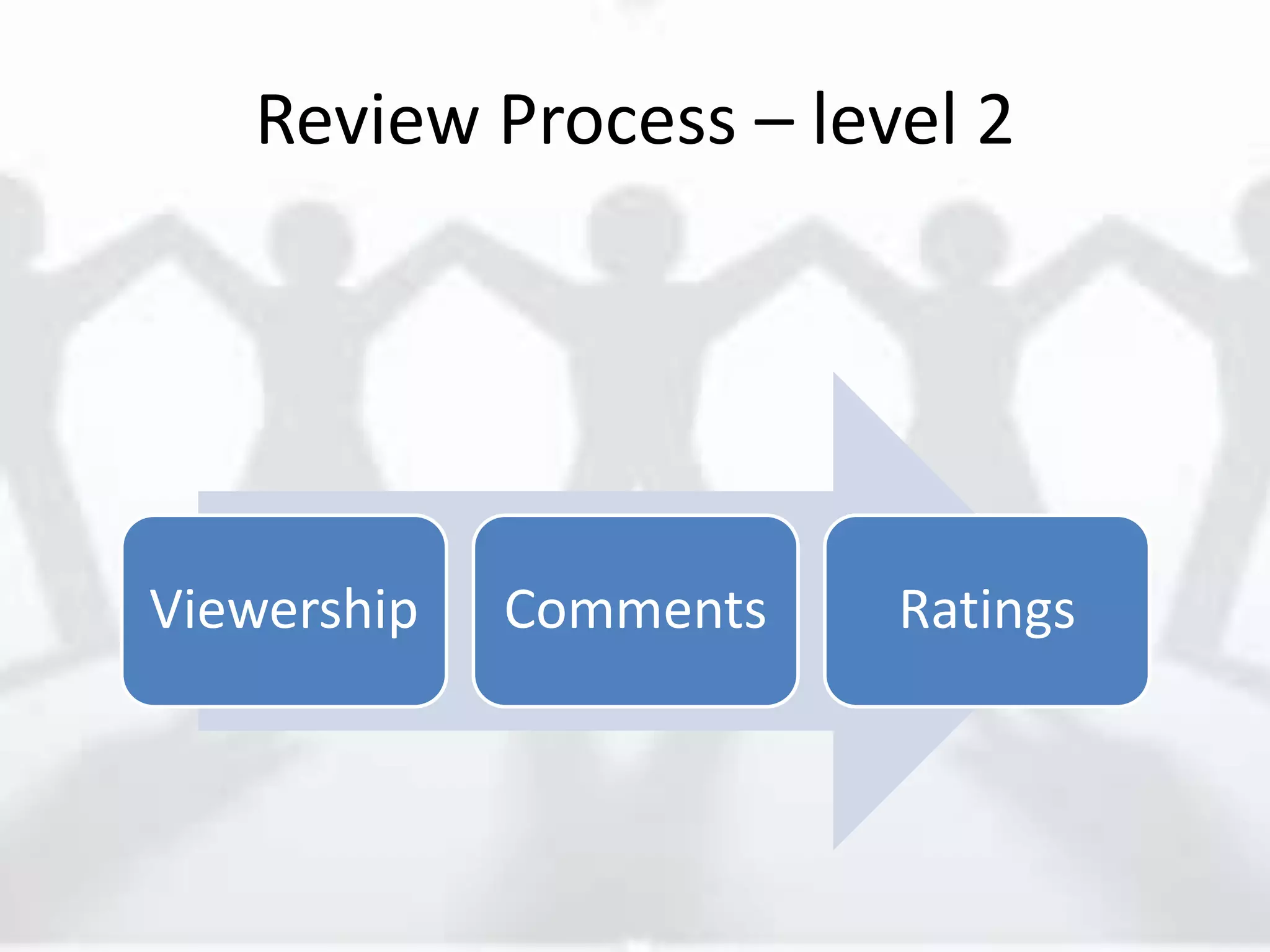
Review Process – level 2
Viewership Comments Ratings
References
• National Policy on Information and Communication Technology on School
Education
• ICT @ School Scheme
• National Curriculum Framework 2005
• Piloting of General Education Quality Analysis/Diagnosis Framework ( GEQAF) in
India
• National Focus Group on Educational Technology- Position Paper
• Nroer.gov.in
• Ictcurriculum.gov.in

The role of new media in knowledge generation

  • 1.
    The Role ofNew Media in Knowledge Generation by the Community A Case Study of NROER
  • 3.
    • Connecting knowledgeto life outside the school • Ensuring that learning shifts away from rote methods • Enriching curriculum so that it goes beyond textbooks • Making examinations flexible • Primacy to children’s experiences, their voices and their participation • Need for adults to change their perception of children as passive receivers of knowledge
  • 4.
    • Children canbe active participants in the construction of knowledge • Highlights the value of interaction with: environment, peers, older people to enhance learning • Learning tasks must be designed to enable children to seek out knowledge from sites other than textbooks. • Need therefore to move away from rigid lesson planning to planning and designing activities that challenge children to think and try out what they are learning.
  • 5.
    New Media asa pedagogical tool The New Media is not just about new ways/technology of creating & delivering media messages but it is also a pedagogical tool to make education system more efficient. Collaboration, creation, contextualized resources
  • 6.
    Indian education system& New Media New media can offer solution to various challenges faced by the India education system – Enormity of young population – Inflexibility in the education system – Multiplicity of language – Reach and access to education – Textbook centric education – Lack of teachers – Content generation as centralized activity
  • 7.
    Government’s initiatives • NationalPolicy of ICT in school education • ICT @schools Scheme • campus –based wireless internet facilities and 24/7 labs • ICT coverage to all 360 universities and 17, 625 colleges, in a phased manner. • Intellectual hubs – universities @ Colleges- through networks, e Resources, online learning, access to global resources, archiving of content, and e learning management techniques. • Broadband, wireless, digital subscriber line to create a platform for collaboration amongst teachers and learners to digitize Indian intellectual content
  • 8.
    New Media &OER movement • The phenomenon of OER is made possible by the widespread use if ICT and open source technologies. • Over the last decade , national institutions have embraced the concept of collaborative teaching and learning practices. • Most OER initiative in India have focused on increasing the quantum of OER in higher education. • One of the early venture was CEC an inter-university centre of the UGC • Other major initiative includes: NPTEL OSCAR E GYANKOSH SHAKSHAT VASAT NROER
  • 9.
    Why OER • OERhas a great potential to support educational transformation. • While its educational value lies in the idea of using resources as an integral method of communication of curriculum in educational courses (i.e. resource-based learning) • its transformative power lies in the ease with which such resources, when digitized, can be shared via the Internet. • It promotes community participation as it allows people to Four Rs Framework: Reuse, Revise, Remix, Redistribute • There is only one key differentiator between an OER and any other educational resource: its license. Thus, an OER is simply an educational resource that incorporates a license that facilitates reuse, and potentially adaptation, without first requesting permission from the copyright holder.
  • 16.
    Background • National Policyof ICT in School Education • ICT @Schools
  • 17.
    • Development ofe content • Collaborative creation of e content • Widespread dissemination of e content • Setting up of state and national level digital repositories • Development of digital resources as per the National policy on open standards ( Open and free access to resources developed under any state funded project)
  • 18.
    Connecting Knowledge, ConnectingPeople, Open education for all • Interdisciplinary linkages should be encouraged • Making variety of resources available • Involving community in creation of content
  • 19.
  • 25.
  • 31.
    The process • Collate •Curate • Creating – In house/ outsourcing • Review • Upload
  • 32.
    Review Process- level1 Review of content available at CIET NROER Approved Content CIET Third party evaluation Review of content uploaded by user/teacher NROER Approved Content Uploaded by user In house/third evaluation
  • 33.
    Review Process –level 2 Viewership Comments Ratings
  • 34.
    References • National Policyon Information and Communication Technology on School Education • ICT @ School Scheme • National Curriculum Framework 2005 • Piloting of General Education Quality Analysis/Diagnosis Framework ( GEQAF) in India • National Focus Group on Educational Technology- Position Paper • Nroer.gov.in • Ictcurriculum.gov.in