CSE-3201
Operating Systems
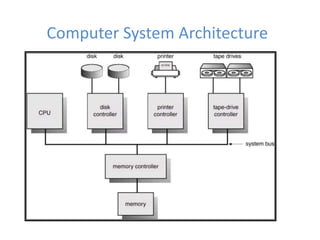
Computer System Architecture
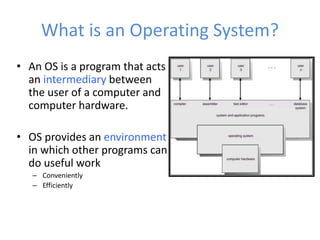
What is an Operating System?
• An OS is a program that acts
an intermediary between
the user of a computer and
computer hardware.
• OS provides an environment
in which other programs can
do useful work
– Conveniently
– Efficiently
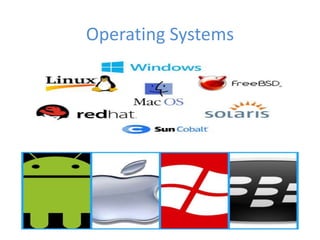
Operating Systems
Goals of an Operating System
• Simplify the execution of user programs
• Use computer hardware efficiently
• Make application software portable and
versatile
• Provide isolation, security and protection
Why should I study Operating
Systems?
– Need to understand interaction between the
hardware and applications
• New applications, new hardware
– Need to understand basic principles in the design
of computer systems
• efficient resource management, security, flexibility
– Increasing need for specialized operating systems
• e.g. embedded operating systems for devices - cell
phones, sensors and controllers
• real-time operating systems – vehicles, aircraft control,
multimedia services
Why should I study Operating
Systems?
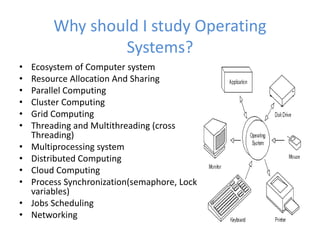
• Ecosystem of Computer system
• Resource Allocation And Sharing
• Parallel Computing
• Cluster Computing
• Grid Computing
• Threading and Multithreading (cross
Threading)
• Multiprocessing system
• Distributed Computing
• Cloud Computing
• Process Synchronization(semaphore, Lock
variables)
• Jobs Scheduling
• Networking
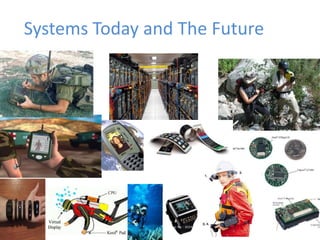
Systems Today and The Future
Principles of Operating Systems -
Lecture 1
9
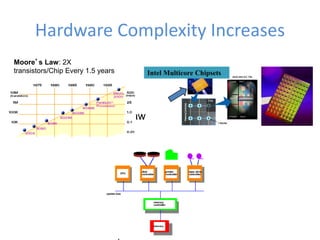
Hardware Complexity Increases
Moore’s Law: 2X
transistors/Chip Every 1.5 years
Moore’s Law
Intel Multicore Chipsets
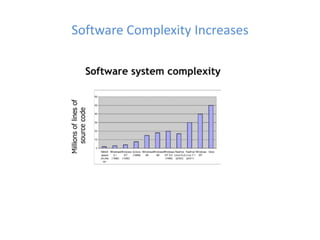
Software Complexity Increases
Operating System Views
• Resource allocator
• to allocate resources (software and hardware) of the
computer system and manage them efficiently.
• Control program
• Controls execution of user programs
– To prevent errors and improper use of the computer
• Control operation of I/O devices.
• Kernel
• Many components running, what to call an OS?
• One definition of OS - one program that runs at all times
– Called kernel
– Everything else: system programs and applications
Parallel Computing Systems
Climate modeling,
earthquake
simulations, genome
analysis, protein
folding, nuclear fusion
research, …..
ILLIAC 2 (UIllinois)
Connection Machine (MIT)
Tianhe-1(China)
K-computer(Japan)
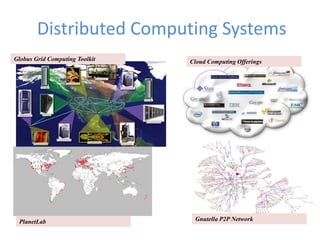
Distributed Computing Systems
Globus Grid Computing Toolkit Cloud Computing Offerings
PlanetLab Gnutella P2P Network
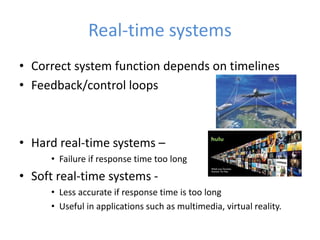
Real-time systems
• Correct system function depends on timelines
• Feedback/control loops
• Hard real-time systems –
• Failure if response time too long
• Soft real-time systems -
• Less accurate if response time is too long
• Useful in applications such as multimedia, virtual reality.
Course outline
• Operating-System Structures
– Operating System Services
– System Calls
– System Programs
– Operating System Structure
Course outline
• Process management:
– Basic Concept
– Process Scheduling
– Operation On process
– Co-operating processes
– Inter Process Communication
– Kernel
Course outline
• Threads
– Basic Concept
– Multi Threading Model
– Threading issues
– Cost and Benefit analysis of thread
Course outline
• CPU scheduling
– Basic concepts
– Scheduling Criteria
– Scheduling algorithm
– Algorithm Evaluation
Course outline
• Process synchronization
‒ Critical section Problem
‒ Synchronization hardware
‒ Semaphores
‒ Classic Problems of synchronization
21
Course outline
• File Systems
– File naming
– File types
– File structure
– File access
22
Course outline
• Virtual Machine & Distributed System
– Building block
– Virtualization and Operating-System Components
– Advantages of Distributed Systems
– Types of Network-Based Operating Systems
– Distributed File System
Text Books
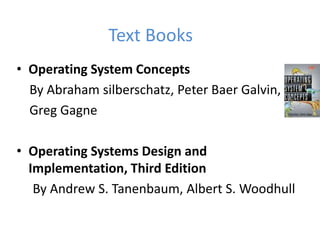
• Operating System Concepts
By Abraham silberschatz, Peter Baer Galvin,
Greg Gagne
• Operating Systems Design and
Implementation, Third Edition
By Andrew S. Tanenbaum, Albert S. Woodhull

1_OS_INTRO.pptx

  • 1.
  • 2.
  • 3.
    What is anOperating System? • An OS is a program that acts an intermediary between the user of a computer and computer hardware. • OS provides an environment in which other programs can do useful work – Conveniently – Efficiently
  • 4.
  • 5.
    Goals of anOperating System • Simplify the execution of user programs • Use computer hardware efficiently • Make application software portable and versatile • Provide isolation, security and protection
  • 6.
    Why should Istudy Operating Systems? – Need to understand interaction between the hardware and applications • New applications, new hardware – Need to understand basic principles in the design of computer systems • efficient resource management, security, flexibility – Increasing need for specialized operating systems • e.g. embedded operating systems for devices - cell phones, sensors and controllers • real-time operating systems – vehicles, aircraft control, multimedia services
  • 7.
    Why should Istudy Operating Systems? • Ecosystem of Computer system • Resource Allocation And Sharing • Parallel Computing • Cluster Computing • Grid Computing • Threading and Multithreading (cross Threading) • Multiprocessing system • Distributed Computing • Cloud Computing • Process Synchronization(semaphore, Lock variables) • Jobs Scheduling • Networking
  • 8.
    Systems Today andThe Future Principles of Operating Systems - Lecture 1 9
  • 9.
    Hardware Complexity Increases Moore’sLaw: 2X transistors/Chip Every 1.5 years Moore’s Law Intel Multicore Chipsets
  • 10.
  • 11.
    Operating System Views •Resource allocator • to allocate resources (software and hardware) of the computer system and manage them efficiently. • Control program • Controls execution of user programs – To prevent errors and improper use of the computer • Control operation of I/O devices. • Kernel • Many components running, what to call an OS? • One definition of OS - one program that runs at all times – Called kernel – Everything else: system programs and applications
  • 12.
    Parallel Computing Systems Climatemodeling, earthquake simulations, genome analysis, protein folding, nuclear fusion research, ….. ILLIAC 2 (UIllinois) Connection Machine (MIT) Tianhe-1(China) K-computer(Japan)
  • 13.
    Distributed Computing Systems GlobusGrid Computing Toolkit Cloud Computing Offerings PlanetLab Gnutella P2P Network
  • 14.
    Real-time systems • Correctsystem function depends on timelines • Feedback/control loops • Hard real-time systems – • Failure if response time too long • Soft real-time systems - • Less accurate if response time is too long • Useful in applications such as multimedia, virtual reality.
  • 15.
    Course outline • Operating-SystemStructures – Operating System Services – System Calls – System Programs – Operating System Structure
  • 16.
    Course outline • Processmanagement: – Basic Concept – Process Scheduling – Operation On process – Co-operating processes – Inter Process Communication – Kernel
  • 17.
    Course outline • Threads –Basic Concept – Multi Threading Model – Threading issues – Cost and Benefit analysis of thread
  • 18.
    Course outline • CPUscheduling – Basic concepts – Scheduling Criteria – Scheduling algorithm – Algorithm Evaluation
  • 19.
    Course outline • Processsynchronization ‒ Critical section Problem ‒ Synchronization hardware ‒ Semaphores ‒ Classic Problems of synchronization
  • 20.
    21 Course outline • FileSystems – File naming – File types – File structure – File access
  • 21.
    22 Course outline • VirtualMachine & Distributed System – Building block – Virtualization and Operating-System Components – Advantages of Distributed Systems – Types of Network-Based Operating Systems – Distributed File System
  • 22.
    Text Books • OperatingSystem Concepts By Abraham silberschatz, Peter Baer Galvin, Greg Gagne • Operating Systems Design and Implementation, Third Edition By Andrew S. Tanenbaum, Albert S. Woodhull