Gonads – primary sex organs
Gonads produce gametes (sex cells) and
secrete hormones
☛ Testes in males
☛ Ovaries in females
☛ Sperm – male gametes
☛ Ova (eggs) – female gametes
Chapter 16: The Reproductive System
02
Chapter 16: The Reproductive System
Male
Reproductive
System
Male
Reproductive
System
Testes
Duct System
☛ Epididymis
☛ Ductus deferens
☛ Urethra
Accessory organs
External genitalia
☛ Seminal vesicle
☛ Prostate gland
☛ Bulbourethral gland
☛ Penis
☛ Scrotum
03
Chapter 16: The Reproductive System
04
Chapter 16: The Reproductive System
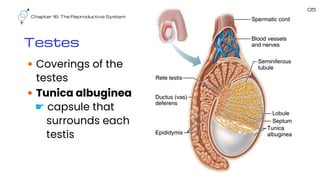
Coverings of the
testes
Tunica albuginea
☛ capsule that
surrounds each
testis
Testes
Testes
05
Chapter 16: The Reproductive System
Coverings of the
testes
Septa
☛ extensions of the
capsule that
extend into the
testis and divide it
into lobules
Testes
Testes
06
Chapter 16: The Reproductive System
Each lobule contains one to four
seminiferous tubules
Sperm travels through the rete
testis to the epididymis
Interstitial cells produce
androgens such as testosterone
☛ Tightly coiled structures
☛ Function as sperm-forming
factories
☛ Empty sperm into the rete
testis
Testes
Testes
07
Chapter 16: The Reproductive System
Comma-shaped, tightly coiled
tube
Found on the superior part of
the testis and along the
posterior lateral side
Functions to mature and store
sperm cells (at least 20 days)
Expels sperm with the
contraction of muscles in the
epididymis walls to the vas
deferens
Epididymis
Epididymis
08
Chapter 16: The Reproductive System
Carries sperm from the
epididymis to the ejaculatory
duct
Passes through the inguinal
canal and over the bladder
Moves sperm by peristalsis
Spermatic cord – ductus
deferens, blood vessels, and
nerves in a connective tissue
sheath
Ductus Deferens
(Vas Deferens)
Ductus Deferens
(Vas Deferens)
09
Chapter 16: The Reproductive System
Ends in the ejaculatory duct
which unites with the urethra
Vasectomy – cutting of the
ductus deferens at the level of
the testes to prevent
transportation of sperm
Ductus Deferens
(Vas Deferens)
Ductus Deferens
(Vas Deferens)
10
Chapter 16: The Reproductive System
Extends from the base of the urinary
bladder to the tip of the penis
Carries both urine and sperm
Sperm enters from the ejaculatory
duct
Urethra
Urethra
Regions of the urethra
☛ Prostatic urethra –surrounded by prostate
☛ Membranous urethra – from prostatic
urethra to penis
☛ Spongy (penile) urethra – runs the length
of the penis
11
Chapter 16: The Reproductive System
Located at the base of the bladder
Produces a thick, yellowish secretion
(60% of semen)
Seminal Vesicles
Seminal Vesicles
Fructose (sugar)
Vitamin C
Prostaglandins
Other substances that nourish
and activate sperm
12
Chapter 16: The Reproductive System
Encircles the upper part of the urethra
Secretes a milky fluid
Prostate Gland
Prostate Gland
Helps to activate sperm
Enters the urethra through
several small ducts
Pea-sized gland inferior to the prostate
Produces a thick, clear mucus
Bulbourethral Glands
Cleanses the urethra of acidic urine
Serves as a lubricant during sexual intercourse
Secreted into the penile urethra
13
Chapter 16: The Reproductive System
Mixture of sperm and accessory gland
secretions
Advantages of accessory gland secretions
Semen
Semen
Fructose provides energy for sperm cells
Alkalinity of semen helps neutralize the acidic
environment of vagina
Semen inhibits bacterial multiplication
Elements of semen enhance sperm motility
14
Chapter 16: The Reproductive System
Scrotum
External Genitalia
External Genitalia
Divided sac of skin outside the abdomen
Maintains testes at 3°C lower than normal body
temperature to protect sperm viability
Penis
Delivers sperm into the female reproductive
tract
Regions of the penis:
☛ Shaft
☛ Glans penis (enlarged tip)
☛ Prepuce (foreskin)
Folded cuff of skin around proximal end
Often removed by circumcision
Internally there are three areas of spongy erectile
tissue around the urethra
15
Chapter 16: The Reproductive System
Production of sperm cells
Begins at puberty and continues
throughout life
Occurs in the seminiferous tubules
Spermatogenesis
Spermatogenesis
16
Chapter 16: The Reproductive System
Spermatogonia (stem cells) undergo rapid mitosis
to produce more stem cells before puberty
Follicle stimulating hormone (FSH) modifies
spermatogonia division
Process of
Spermatogenesis
Process of
Spermatogenesis
One cell produced is a stem cell
The other cell produced becomes a primary
spermatocyte
Primary spermatocytes undergo meiosis
Haploid spermatids are produced
17
Chapter 16: The Reproductive System
Spermiogenesis
Process of
Spermatogenesis
Process of
Spermatogenesis
Late spermatids are produced with distinct
regions
☛ Head – contains DNA covered by the acrosome
☛ Midpiece
☛ Tail
Sperm cells result after maturing of spermatids
Spermatogenesis takes 64 to 72 days
18
Chapter 16: The Reproductive System
The only human flagellated cell
DNA is found in the head
Anatomy of a
Mature Sperm Cell
Anatomy of a
Mature Sperm Cell
19
Chapter 16: The Reproductive System
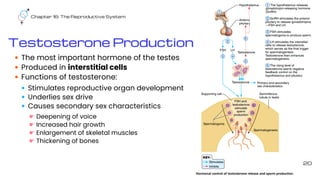
The most important hormone of the testes
Produced in interstitial cells
Functions of testosterone:
Testosterone Production
Stimulates reproductive organ development
Underlies sex drive
Causes secondary sex characteristics
☛ Deepening of voice
☛ Increased hair growth
☛ Enlargement of skeletal muscles
☛ Thickening of bones
20
Chapter 16: The Reproductive System
Present in both sexes, but only
function in females
Mammary Glands
Mammary Glands
Modified sweat glands
Function is to produce milk
Stimulated by sex hormones (mostly
estrogens) to increase in size
21
Chapter 16: The Reproductive System
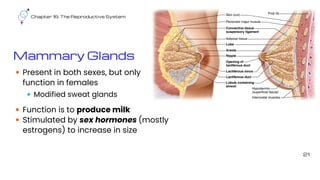
Areola – central pigmented area
Nipple – protruding central area
of areola
Lobes – internal structures that
radiate around nipple
Alveolar glands – clusters of milk
producing glands within lobules
Lactiferous ducts – connect
alveolar glands to nipple
Mammary Glands
Mammary Glands
22
Chapter 16: The Reproductive System
Fertilization
Embryonic
development
Fetal development
Childbirth
Stages of Pregnancy and
Development
Stages of Pregnancy and
Development
23
Chapter 16: The Reproductive System
The oocyte is viable for 12 to 24 hours after
ovulation
Sperm are viable for 12 to 48 hours after
ejaculation
Sperm cells must make their way to the
uterine tube for fertilization to be possible
Fertilization
Fertilization
24
Chapter 16: The Reproductive System
Membrane receptors on an oocyte pulls in
the head of the first sperm cell to make
contact
The membrane of the oocyte does not
permit a second sperm head to enter
The oocyte then undergoes its second
meiotic division
Fertilization occurs when the genetic
material of a sperm combines with that of
an oocyte to form a zygote
Mechanisms of
Fertilization
Mechanisms of
Fertilization
25
Chapter 16: The Reproductive System
First cell of a new individual
The result of the fusion of DNA from
sperm and egg
The zygote begins rapid mitotic cell
divisions
The zygote stage is in the uterine tube,
moving toward the uterus
Zygote
Zygote
Developmental stage from the start of cleavage until the
ninth week
The embryo first undergoes division without growth
The embryo enters the uterus at the 16-cell state
The embryo floats free in the uterus temporarily
Uterine secretions are used for nourishment
Embryo
Embryo
26
Chapter 16: The Reproductive System
Ball-like circle of cells
Begins at about the 100 cell stage
Secretes human chorionic gonadotropin
(hCG) to produce the corpus luteum to
continue producing hormones
Functional areas of the blastocyst
Trophoblast – large fluid-filled sphere
Inner cell mass
Primary germ layers are eventually formed
Blastocyst
Blastocyst
Ectoderm – outside layer
Mesoderm – middle layer
Endoderm – inside layer
The late blastocyst implants in the wall of
the uterus (by day 14)
Trophoblast – large fluid-filled sphere
Inner cell mass
27
Chapter 16: The Reproductive System
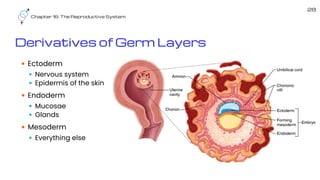
Ectoderm
Derivatives of Germ Layers
Nervous system
Epidermis of the skin
Endoderm
Mucosae
Glands
Mesoderm
Everything else
28
Chapter 16: The Reproductive System
Chorionic villi (projections of the
blastocyst) develop
Development After
Implantation
Development After
Implantation
Cooperate with cells of the uterus to
form the placenta
The embryo is surrounded by the
amnion (a fluid filled sac)
An umbilical cord forms to attach
the embryo to the placenta
29
Chapter 16: The Reproductive System
Forms a barrier between mother and
embryo (blood is not exchanged)
Delivers nutrients and oxygen
Removes waste from embryonic blood
Becomes an endocrine organ
(produces hormones) and takes over
for the corpus luteum
Functions of the
Placenta
Functions of the
Placenta
Estrogen
Progesterone
Other hormones that maintain
pregnancy
30
Chapter 16: The Reproductive System
All organ systems are formed by the
end of the eighth week
Activities of the fetus are growth and
organ specialization
A stage of tremendous growth and
change in appearance
The Fetus (Beginning
of the Ninth Week)
The Fetus (Beginning
of the Ninth Week)
31
Chapter 16: The Reproductive System
Pregnancy – period from conception until birth
Anatomical changes:
The Effects of Pregnancy on
the Mother
The Effects of Pregnancy on
the Mother
Enlargements of the uterus
Accentuated lumbar curvature
Relaxation of the pelvic ligaments
and pubic symphysis due to
production of relaxin
32
Chapter 16: The Reproductive System
Physiological changes:
The Effects of Pregnancy on
the Mother
The Effects of Pregnancy on
the Mother
Gastrointestinal system
☛ Morning sickness is common due to
elevated progesterone
☛ Heartburn is common because of organ
crowding by the fetus
☛ Constipation is caused by declining
motility of the digestive tract
Urinary System
☛ Kidneys have additional burden and
produce more urine
☛ The uterus compresses the bladder
Respiratory System
☛ Nasal mucosa becomes congested and
swollen
☛ Vital capacity and respiratory rate
increase
Cardiovascular system
☛ Body water rises
☛ Blood volume increases by 25 to 40 percent
☛ Blood pressure and pulse increase
☛ Varicose veins are common
33
Chapter 16: The Reproductive System
Labor – the series of events that expel the infant
from the uterus
Initiation of labor:
Childbirth
Childbirth
Estrogen levels rise
Uterine contractions begin
The placenta releases prostaglandins
Oxytocin is released by the pituitary
Combination of these hormones produces
contractions
34
Chapter 16: The Reproductive System
Dilation
Stages of Labor
Stages of Labor
Cervix becomes dilated
Uterine contractions begin and increase
The amnion ruptures
Expulsion
Infant passes through the cervix and vagina
Normal delivery is head first
Placental stage
Delivery of the placenta
35

The Reproductive System_Male.pdf

  • 1.
    Gonads – primarysex organs Gonads produce gametes (sex cells) and secrete hormones ☛ Testes in males ☛ Ovaries in females ☛ Sperm – male gametes ☛ Ova (eggs) – female gametes Chapter 16: The Reproductive System 02
  • 2.
    Chapter 16: TheReproductive System Male Reproductive System Male Reproductive System Testes Duct System ☛ Epididymis ☛ Ductus deferens ☛ Urethra Accessory organs External genitalia ☛ Seminal vesicle ☛ Prostate gland ☛ Bulbourethral gland ☛ Penis ☛ Scrotum 03
  • 3.
    Chapter 16: TheReproductive System 04
  • 4.
    Chapter 16: TheReproductive System Coverings of the testes Tunica albuginea ☛ capsule that surrounds each testis Testes Testes 05
  • 5.
    Chapter 16: TheReproductive System Coverings of the testes Septa ☛ extensions of the capsule that extend into the testis and divide it into lobules Testes Testes 06
  • 6.
    Chapter 16: TheReproductive System Each lobule contains one to four seminiferous tubules Sperm travels through the rete testis to the epididymis Interstitial cells produce androgens such as testosterone ☛ Tightly coiled structures ☛ Function as sperm-forming factories ☛ Empty sperm into the rete testis Testes Testes 07
  • 7.
    Chapter 16: TheReproductive System Comma-shaped, tightly coiled tube Found on the superior part of the testis and along the posterior lateral side Functions to mature and store sperm cells (at least 20 days) Expels sperm with the contraction of muscles in the epididymis walls to the vas deferens Epididymis Epididymis 08
  • 8.
    Chapter 16: TheReproductive System Carries sperm from the epididymis to the ejaculatory duct Passes through the inguinal canal and over the bladder Moves sperm by peristalsis Spermatic cord – ductus deferens, blood vessels, and nerves in a connective tissue sheath Ductus Deferens (Vas Deferens) Ductus Deferens (Vas Deferens) 09
  • 9.
    Chapter 16: TheReproductive System Ends in the ejaculatory duct which unites with the urethra Vasectomy – cutting of the ductus deferens at the level of the testes to prevent transportation of sperm Ductus Deferens (Vas Deferens) Ductus Deferens (Vas Deferens) 10
  • 10.
    Chapter 16: TheReproductive System Extends from the base of the urinary bladder to the tip of the penis Carries both urine and sperm Sperm enters from the ejaculatory duct Urethra Urethra Regions of the urethra ☛ Prostatic urethra –surrounded by prostate ☛ Membranous urethra – from prostatic urethra to penis ☛ Spongy (penile) urethra – runs the length of the penis 11
  • 11.
    Chapter 16: TheReproductive System Located at the base of the bladder Produces a thick, yellowish secretion (60% of semen) Seminal Vesicles Seminal Vesicles Fructose (sugar) Vitamin C Prostaglandins Other substances that nourish and activate sperm 12
  • 12.
    Chapter 16: TheReproductive System Encircles the upper part of the urethra Secretes a milky fluid Prostate Gland Prostate Gland Helps to activate sperm Enters the urethra through several small ducts Pea-sized gland inferior to the prostate Produces a thick, clear mucus Bulbourethral Glands Bulbourethral Glands Cleanses the urethra of acidic urine Serves as a lubricant during sexual intercourse Secreted into the penile urethra 13
  • 13.
    Chapter 16: TheReproductive System Mixture of sperm and accessory gland secretions Advantages of accessory gland secretions Semen Semen Fructose provides energy for sperm cells Alkalinity of semen helps neutralize the acidic environment of vagina Semen inhibits bacterial multiplication Elements of semen enhance sperm motility 14
  • 14.
    Chapter 16: TheReproductive System Scrotum External Genitalia External Genitalia Divided sac of skin outside the abdomen Maintains testes at 3°C lower than normal body temperature to protect sperm viability Penis Delivers sperm into the female reproductive tract Regions of the penis: ☛ Shaft ☛ Glans penis (enlarged tip) ☛ Prepuce (foreskin) Folded cuff of skin around proximal end Often removed by circumcision Internally there are three areas of spongy erectile tissue around the urethra 15
  • 15.
    Chapter 16: TheReproductive System Production of sperm cells Begins at puberty and continues throughout life Occurs in the seminiferous tubules Spermatogenesis Spermatogenesis 16
  • 16.
    Chapter 16: TheReproductive System Spermatogonia (stem cells) undergo rapid mitosis to produce more stem cells before puberty Follicle stimulating hormone (FSH) modifies spermatogonia division Process of Spermatogenesis Process of Spermatogenesis One cell produced is a stem cell The other cell produced becomes a primary spermatocyte Primary spermatocytes undergo meiosis Haploid spermatids are produced 17
  • 17.
    Chapter 16: TheReproductive System Spermiogenesis Process of Spermatogenesis Process of Spermatogenesis Late spermatids are produced with distinct regions ☛ Head – contains DNA covered by the acrosome ☛ Midpiece ☛ Tail Sperm cells result after maturing of spermatids Spermatogenesis takes 64 to 72 days 18
  • 18.
    Chapter 16: TheReproductive System The only human flagellated cell DNA is found in the head Anatomy of a Mature Sperm Cell Anatomy of a Mature Sperm Cell 19
  • 19.
    Chapter 16: TheReproductive System The most important hormone of the testes Produced in interstitial cells Functions of testosterone: Testosterone Production Testosterone Production Stimulates reproductive organ development Underlies sex drive Causes secondary sex characteristics ☛ Deepening of voice ☛ Increased hair growth ☛ Enlargement of skeletal muscles ☛ Thickening of bones 20
  • 20.
    Chapter 16: TheReproductive System Present in both sexes, but only function in females Mammary Glands Mammary Glands Modified sweat glands Function is to produce milk Stimulated by sex hormones (mostly estrogens) to increase in size 21
  • 21.
    Chapter 16: TheReproductive System Areola – central pigmented area Nipple – protruding central area of areola Lobes – internal structures that radiate around nipple Alveolar glands – clusters of milk producing glands within lobules Lactiferous ducts – connect alveolar glands to nipple Mammary Glands Mammary Glands 22
  • 22.
    Chapter 16: TheReproductive System Fertilization Embryonic development Fetal development Childbirth Stages of Pregnancy and Development Stages of Pregnancy and Development 23
  • 23.
    Chapter 16: TheReproductive System The oocyte is viable for 12 to 24 hours after ovulation Sperm are viable for 12 to 48 hours after ejaculation Sperm cells must make their way to the uterine tube for fertilization to be possible Fertilization Fertilization 24
  • 24.
    Chapter 16: TheReproductive System Membrane receptors on an oocyte pulls in the head of the first sperm cell to make contact The membrane of the oocyte does not permit a second sperm head to enter The oocyte then undergoes its second meiotic division Fertilization occurs when the genetic material of a sperm combines with that of an oocyte to form a zygote Mechanisms of Fertilization Mechanisms of Fertilization 25
  • 25.
    Chapter 16: TheReproductive System First cell of a new individual The result of the fusion of DNA from sperm and egg The zygote begins rapid mitotic cell divisions The zygote stage is in the uterine tube, moving toward the uterus Zygote Zygote Developmental stage from the start of cleavage until the ninth week The embryo first undergoes division without growth The embryo enters the uterus at the 16-cell state The embryo floats free in the uterus temporarily Uterine secretions are used for nourishment Embryo Embryo 26
  • 26.
    Chapter 16: TheReproductive System Ball-like circle of cells Begins at about the 100 cell stage Secretes human chorionic gonadotropin (hCG) to produce the corpus luteum to continue producing hormones Functional areas of the blastocyst Trophoblast – large fluid-filled sphere Inner cell mass Primary germ layers are eventually formed Blastocyst Blastocyst Ectoderm – outside layer Mesoderm – middle layer Endoderm – inside layer The late blastocyst implants in the wall of the uterus (by day 14) Trophoblast – large fluid-filled sphere Inner cell mass 27
  • 27.
    Chapter 16: TheReproductive System Ectoderm Derivatives of Germ Layers Derivatives of Germ Layers Nervous system Epidermis of the skin Endoderm Mucosae Glands Mesoderm Everything else 28
  • 28.
    Chapter 16: TheReproductive System Chorionic villi (projections of the blastocyst) develop Development After Implantation Development After Implantation Cooperate with cells of the uterus to form the placenta The embryo is surrounded by the amnion (a fluid filled sac) An umbilical cord forms to attach the embryo to the placenta 29
  • 29.
    Chapter 16: TheReproductive System Forms a barrier between mother and embryo (blood is not exchanged) Delivers nutrients and oxygen Removes waste from embryonic blood Becomes an endocrine organ (produces hormones) and takes over for the corpus luteum Functions of the Placenta Functions of the Placenta Estrogen Progesterone Other hormones that maintain pregnancy 30
  • 30.
    Chapter 16: TheReproductive System All organ systems are formed by the end of the eighth week Activities of the fetus are growth and organ specialization A stage of tremendous growth and change in appearance The Fetus (Beginning of the Ninth Week) The Fetus (Beginning of the Ninth Week) 31
  • 31.
    Chapter 16: TheReproductive System Pregnancy – period from conception until birth Anatomical changes: The Effects of Pregnancy on the Mother The Effects of Pregnancy on the Mother Enlargements of the uterus Accentuated lumbar curvature Relaxation of the pelvic ligaments and pubic symphysis due to production of relaxin 32
  • 32.
    Chapter 16: TheReproductive System Physiological changes: The Effects of Pregnancy on the Mother The Effects of Pregnancy on the Mother Gastrointestinal system ☛ Morning sickness is common due to elevated progesterone ☛ Heartburn is common because of organ crowding by the fetus ☛ Constipation is caused by declining motility of the digestive tract Urinary System ☛ Kidneys have additional burden and produce more urine ☛ The uterus compresses the bladder Respiratory System ☛ Nasal mucosa becomes congested and swollen ☛ Vital capacity and respiratory rate increase Cardiovascular system ☛ Body water rises ☛ Blood volume increases by 25 to 40 percent ☛ Blood pressure and pulse increase ☛ Varicose veins are common 33
  • 33.
    Chapter 16: TheReproductive System Labor – the series of events that expel the infant from the uterus Initiation of labor: Childbirth Childbirth Estrogen levels rise Uterine contractions begin The placenta releases prostaglandins Oxytocin is released by the pituitary Combination of these hormones produces contractions 34
  • 34.
    Chapter 16: TheReproductive System Dilation Stages of Labor Stages of Labor Cervix becomes dilated Uterine contractions begin and increase The amnion ruptures Expulsion Infant passes through the cervix and vagina Normal delivery is head first Placental stage Delivery of the placenta 35