THE
RENAISSANCE
1450-1550 AD
Edited….PPT used with appreciation and thanks to Mrs. Karen Reeves,
Waynesboro, Georgia and Nancy Hester, East View High School
Essential Question:
How did the Renaissance change
art in Western Europe?
Warm-Up Question:
Why did the Renaissance begin in
Italy?
What factors led to the decline of
the Middle Ages & rise of the
Renaissance?
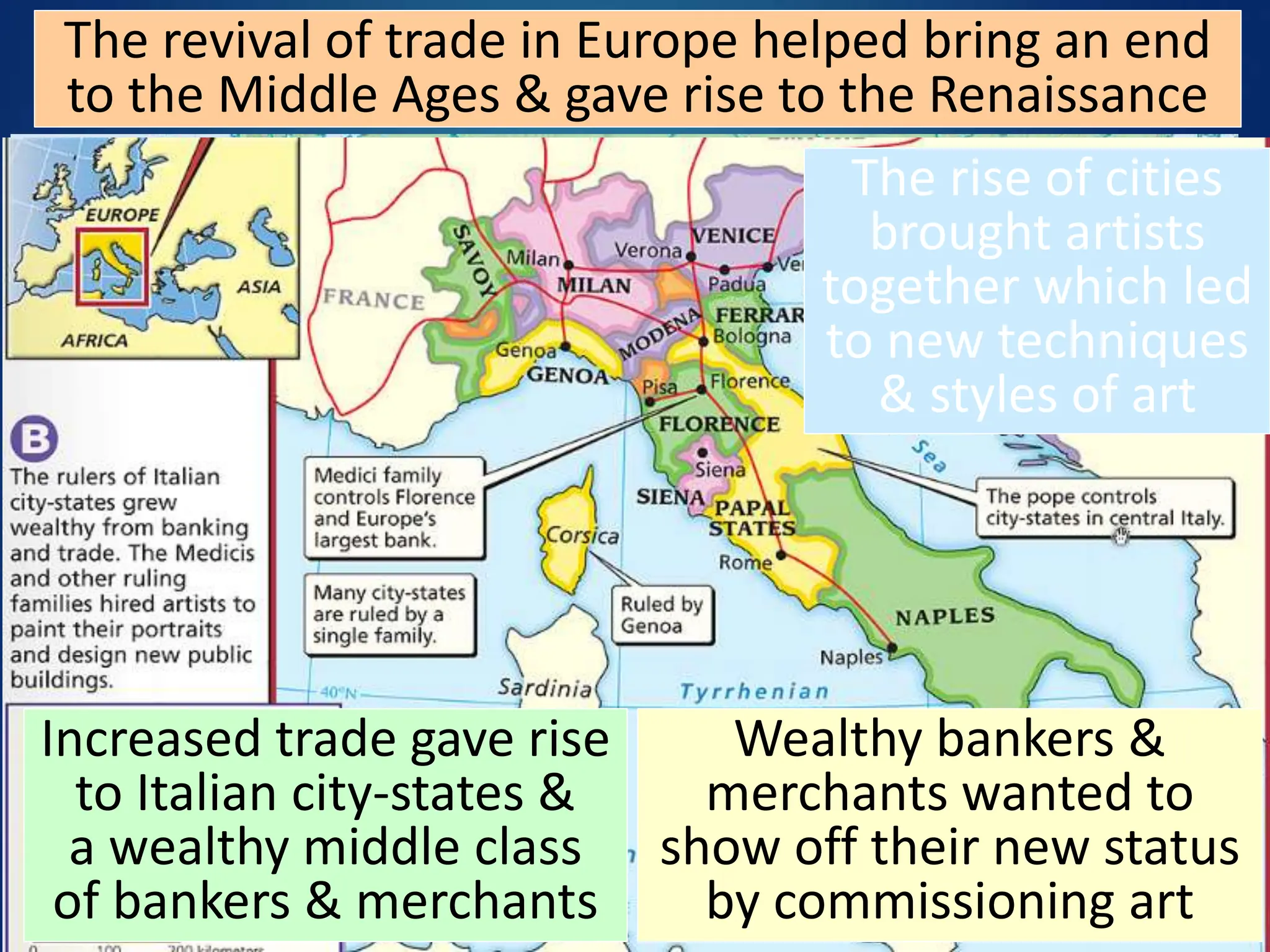
The revival of trade in Europe helped bring an end
to the Middle Ages & gave rise to the Renaissance
Increased trade gave rise
to Italian city-states &
a wealthy middle class
of bankers & merchants
Wealthy bankers &
merchants wanted to
show off their new status
by commissioning art
The rise of cities
brought artists
together which led
to new techniques
& styles of art
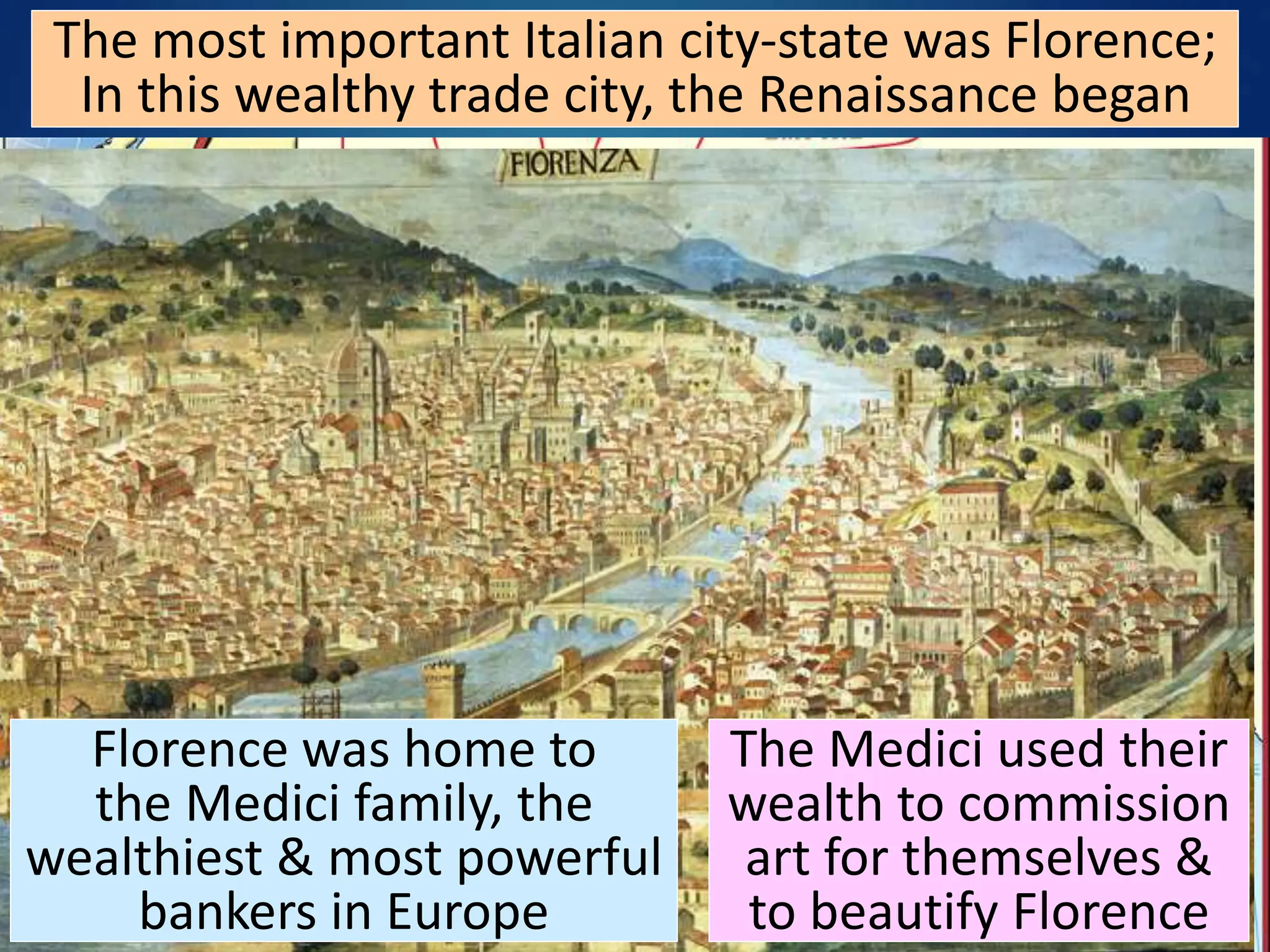
The most important Italian city-state was Florence;
In this wealthy trade city, the Renaissance began
Florence was home to
the Medici family, the
wealthiest & most powerful
bankers in Europe
The Medici used their
wealth to commission
art for themselves &
to beautify Florence
Florence under the Medici
Medici Chapel
The Medici Palace
Cosimo
Lorenzo
Guiliano
Lorenzo de Medici commissioned this painting from
Botticelli of the Medici brothers as the three magi
The Medici paid to build a massive
domed cathedral for Florence
The Medici
New styles & techniques of Renaissance
art
 Realism & emotion
 Classicism: inspiration from Greece & Rome
 Emphasis on individuals & interaction between people
 Geometric
arrangements
 Perspective
 Using light & shadows
Chiaroscuro
Sfumato
The first nude paintings &
sculptures since the Romans
Greek Renaissance
Renaissance
Artists
Donatello
Donatello was the 1st great
sculptor of the Renaissance
Donatello revived the
classical (Greco-Roman)
style of sculpture that were
realistic & could be viewed
from all sides
Donatello’s “David” was
the 1st large, free-standing
human sculpture of the
Renaissance
Michelangelo
Michelangelo was one
of the most famous
Renaissance artists:
He was a painter,
sculptor, architect,
& poet
His sculptures &
paintings showed
realism, detail of
the human body, &
expression to show
personality & emotion
Michelangelo sculptures “Pieta”& “David”
are considered masterpieces
Michelangelo’s
greatest work is
the 130 ft x 44 ft
ceiling of the
Sistine Chapel
which shows
Biblical images
of amazing detail,
power, & beauty
Leonardo da Vinci
Leonardo da Vinci was a
true “Renaissance Man”
He was a painter &
sculptor whose art was
known for incredible
realism & emotion
He was also an inventor
& scientist whose sketches
reveal observations about
human anatomy & new
engineering technology
His “Last Supper” shows Jesus’ last meeting with
the 12 apostles before the crucifixion; the facial
expressions, detail, emotion made it a masterpiece
Leonardo da Vinci’s
greatest masterpiece
was the “Mona Lisa”
which was known for
its emotion & depth
Leonardo’s Inventions
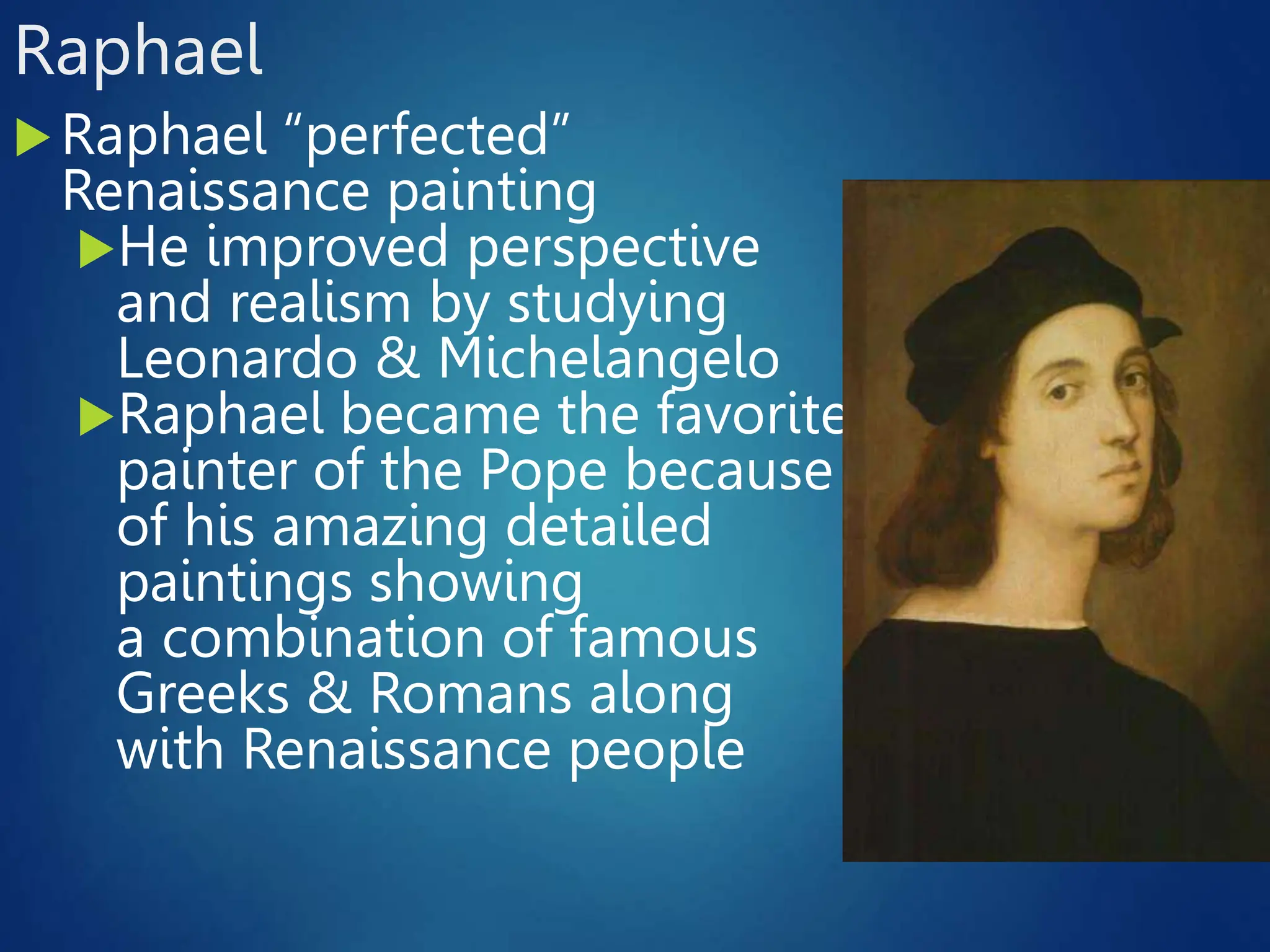
Raphael
Raphael “perfected”
Renaissance painting
He improved perspective
and realism by studying
Leonardo & Michelangelo
Raphael became the favorite
painter of the Pope because
of his amazing detailed
paintings showing
a combination of famous
Greeks & Romans along
with Renaissance people
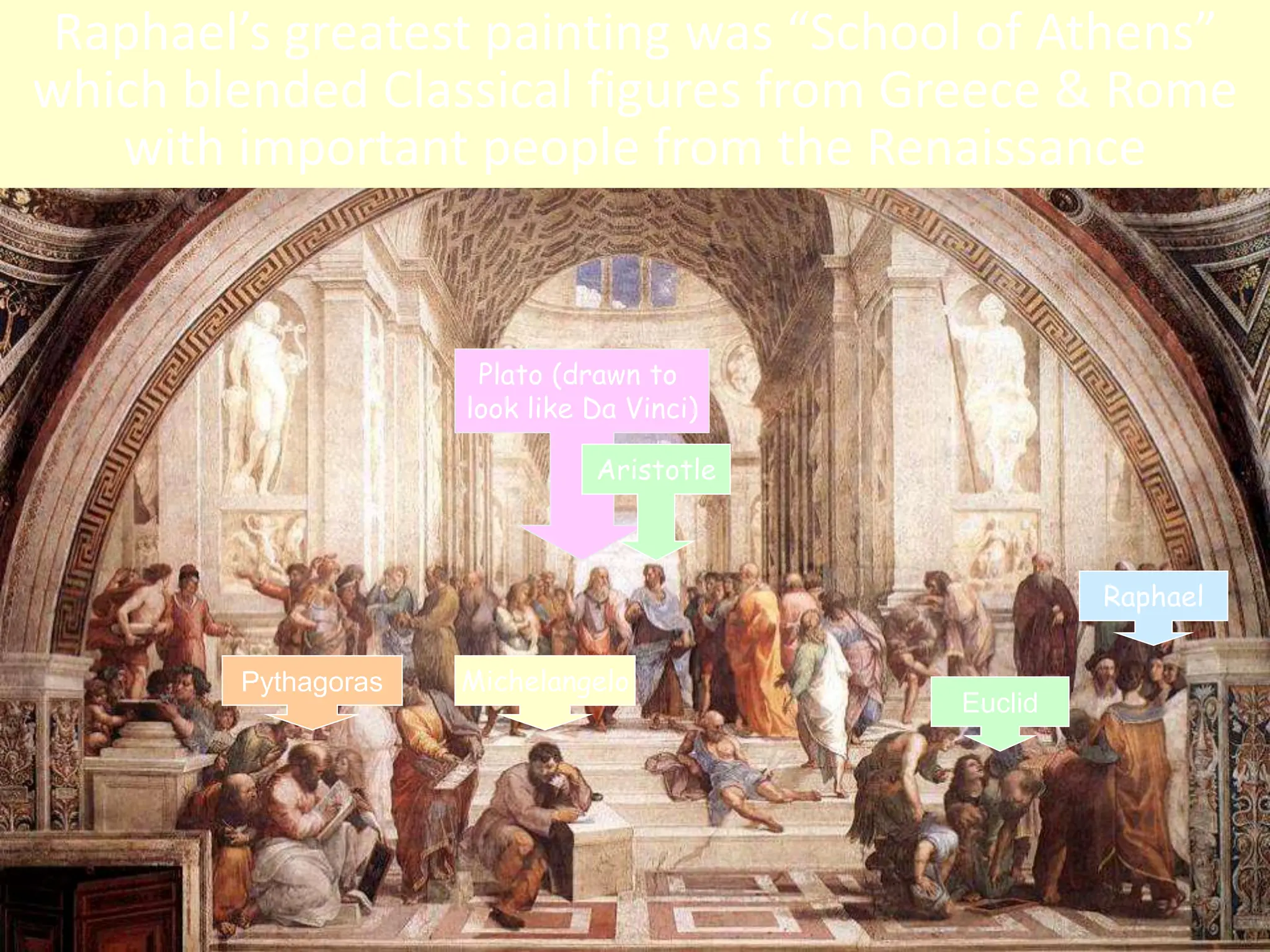
Raphael
Michelangelo
Plato (drawn to
look like Da Vinci)
Aristotle
Pythagoras
Euclid
Raphael’s greatest painting was “School of Athens”
which blended Classical figures from Greece & Rome
with important people from the Renaissance
Raphael’s
“Betrothal
of the Virgin”
Filippo Brunelleschi
Brunelleschi was Florence’s greatest
architect:
He studied the Roman Pantheon when
he built the Cuppolo of Maria del Fiore
cathedral in Florence
The dome inspired modern building
designs
Dome Comparisons
Il Duomo, Florence St. Peter’s, Rome
St. Paul’s, London
US Capital,
Washington, D.C.
The
Northern
Renaissance
The Renaissance spread from Italy as scholars &
merchants from other areas visited Italian city-states
As these ideas spread, this
“Northern Renaissance”
developed its own
characteristics
The Renaissance in
France was most
known for its unique
architecture
The Renaissance in
England was most
known for literature,
especially the plays of
William Shakespeare
Wedding Portrait by Jan Van Eyck
The Renaissance in the Netherlands
was most known for realism in art
Guess if the following
pieces of art (A-J) are:
Renaissance
or
Medieval
A
B
C
D
E
F
G
H
I
J
 HUMANISM

The Renaissance Table Of Information.ppt

  • 1.
    THE RENAISSANCE 1450-1550 AD Edited….PPT usedwith appreciation and thanks to Mrs. Karen Reeves, Waynesboro, Georgia and Nancy Hester, East View High School
  • 2.
    Essential Question: How didthe Renaissance change art in Western Europe? Warm-Up Question: Why did the Renaissance begin in Italy? What factors led to the decline of the Middle Ages & rise of the Renaissance?
  • 3.
    The revival oftrade in Europe helped bring an end to the Middle Ages & gave rise to the Renaissance Increased trade gave rise to Italian city-states & a wealthy middle class of bankers & merchants Wealthy bankers & merchants wanted to show off their new status by commissioning art The rise of cities brought artists together which led to new techniques & styles of art
  • 4.
    The most importantItalian city-state was Florence; In this wealthy trade city, the Renaissance began Florence was home to the Medici family, the wealthiest & most powerful bankers in Europe The Medici used their wealth to commission art for themselves & to beautify Florence
  • 5.
    Florence under theMedici Medici Chapel The Medici Palace Cosimo Lorenzo Guiliano Lorenzo de Medici commissioned this painting from Botticelli of the Medici brothers as the three magi The Medici paid to build a massive domed cathedral for Florence
  • 6.
  • 7.
    New styles &techniques of Renaissance art  Realism & emotion  Classicism: inspiration from Greece & Rome  Emphasis on individuals & interaction between people  Geometric arrangements  Perspective  Using light & shadows Chiaroscuro Sfumato The first nude paintings & sculptures since the Romans Greek Renaissance
  • 8.
  • 9.
    Donatello Donatello was the1st great sculptor of the Renaissance Donatello revived the classical (Greco-Roman) style of sculpture that were realistic & could be viewed from all sides Donatello’s “David” was the 1st large, free-standing human sculpture of the Renaissance
  • 10.
    Michelangelo Michelangelo was one ofthe most famous Renaissance artists: He was a painter, sculptor, architect, & poet His sculptures & paintings showed realism, detail of the human body, & expression to show personality & emotion
  • 11.
    Michelangelo sculptures “Pieta”&“David” are considered masterpieces
  • 12.
    Michelangelo’s greatest work is the130 ft x 44 ft ceiling of the Sistine Chapel which shows Biblical images of amazing detail, power, & beauty
  • 14.
    Leonardo da Vinci Leonardoda Vinci was a true “Renaissance Man” He was a painter & sculptor whose art was known for incredible realism & emotion He was also an inventor & scientist whose sketches reveal observations about human anatomy & new engineering technology
  • 15.
    His “Last Supper”shows Jesus’ last meeting with the 12 apostles before the crucifixion; the facial expressions, detail, emotion made it a masterpiece
  • 16.
    Leonardo da Vinci’s greatestmasterpiece was the “Mona Lisa” which was known for its emotion & depth
  • 17.
  • 19.
    Raphael Raphael “perfected” Renaissance painting Heimproved perspective and realism by studying Leonardo & Michelangelo Raphael became the favorite painter of the Pope because of his amazing detailed paintings showing a combination of famous Greeks & Romans along with Renaissance people
  • 20.
    Raphael Michelangelo Plato (drawn to looklike Da Vinci) Aristotle Pythagoras Euclid Raphael’s greatest painting was “School of Athens” which blended Classical figures from Greece & Rome with important people from the Renaissance
  • 21.
  • 22.
    Filippo Brunelleschi Brunelleschi wasFlorence’s greatest architect: He studied the Roman Pantheon when he built the Cuppolo of Maria del Fiore cathedral in Florence The dome inspired modern building designs
  • 23.
    Dome Comparisons Il Duomo,Florence St. Peter’s, Rome St. Paul’s, London US Capital, Washington, D.C.
  • 24.
  • 25.
    The Renaissance spreadfrom Italy as scholars & merchants from other areas visited Italian city-states As these ideas spread, this “Northern Renaissance” developed its own characteristics
  • 26.
    The Renaissance in Francewas most known for its unique architecture
  • 27.
    The Renaissance in Englandwas most known for literature, especially the plays of William Shakespeare
  • 28.
    Wedding Portrait byJan Van Eyck The Renaissance in the Netherlands was most known for realism in art
  • 29.
    Guess if thefollowing pieces of art (A-J) are: Renaissance or Medieval
  • 30.
  • 31.
  • 32.
  • 33.
  • 34.
  • 35.
  • 36.
  • 37.
  • 38.
  • 39.
  • 40.