International Research Journal of Engineering and Technology (IRJET) e-ISSN: 2395 -0056
Volume: 04 Issue: 05 | June -2017 www.irjet.net p-ISSN: 2395-0072
© 2017, IRJET | Impact Factor value: 5.181 | ISO 9001:2008 Certified Journal | Page 1110
A STUDY ON FRAMEWORK AND EFFECT OF SERVICE QUALITY ON
CUSTOMER SATISFACTION TOWARDS TELECOM NETWORKS IN
TIRUCHIRAPPALLI REGION
Dr. S. Saravanan1 Manigandan K2 and Sathiyagothai B3
1Head of the Department, Anna University, BIT Campus, Trichirappalli.
23Final Year PG Student, Anna University, BIT Campus, Trichirappalli.
---------------------------------------------------------------------------***---------------------------------------------------------------------------------
Abstract: This study examines the effect of Service Quality
towards customer satisfaction in Indian Telecom providers
especially in Trichirappalli region. After the study about
Service quality in literature and various reports, the
problem is identified as Gap in Service quality. Data is
collected through questionnaire to 200 respondents in and
around Trichy region. Chi-Square test is used to test
hypothesis. The result of the study explained the
relationship between service quality and customer
satisfaction. Factor analysis, percentage and gap analysis
is used to find out the result. This paper is an attempt the
service quality and its gap occurred in the Telecom
network provider in Trichy region.
Keywords: Service Quality, Telecom Sector, Customer
Satisfaction and Factors.
1. Introduction
Service quality is defined as “Conformance to
requirements.” (Crosby 1979). "Service quality is a
measure of how well the service delivered matches
customer expectation. Delivering quality service means
conforming to customer expectations on a consistent
basis” (Lewis and Booms 1983). The search for quality is
arguably the most important consumer trend of the
1980s (Rabin 1983) Service quality perceptions results
from a comparison of consumer expectations with actual
service performance (A.Parasuraman et al 1985).service
concern of highest priority to today’s companies is the
impact of service quality on profit and other financial
outcomes of the organisation (Gresing 1994; Rust,
Zahorik, and Keiningham 1995).
Measuring service quality is a challenge because
customer satisfaction is determined by many intangible
factors. Service quality contains many psychological
features (Fitzsimmons, 2006). Quality is a comparison
between expectations and performance (Zeithaml,
1985). A set of key discrepancies or gaps exists
regarding executive perceptions of service quality and
the tasks associated with service delivery to consumers.
These gaps can be major hurdles in attempting to deliver
a service which consumers would perceive as being of
high quality (Parasuraman et al, 1985).
2. Objectives
 To Study the Service Quality and its impact in
Telecom sector’s mobile connection.
 To Measure the Service Quality in Mobile
Network connection.
 To analyze the relationship between
demographic variables and the view of customer
about their perceived services.
 To analyze the relationship between Socio-
economic factors and the service quality
variables.
 To give suggestions to improve Service Quality
in Telecom industry (Mobile connection).
3. Literature Review
A. Parasuraman et al., focused the growing
interest towards Service Quality. The author conducted
an empirical study that evaluated the three formats in
four different sectors. The findings highlight the
importance of considering practical usefulness in
assessing alternative service quality scales.
Prabha Ramsook et al., attempt to extend the
service quality within public services provided by front-
line employees. The author used SERVQUAL instrument
to find the customer expectations. The dimensions which
is used by the front-line employees can be measured.
A. Parasuraman et al., explained in their paper
about the service standards which can be measured in
future research. In that paper the author used
SERVQUAL to measure the service quality standard. The
author discussed C&T’s concerns and then the issues
raised by Teas. Then they concluded the relationship
between service quality and customer satisfaction.
International Research Journal of Engineering and Technology (IRJET) e-ISSN: 2395 -0056
Volume: 04 Issue: 05 | June -2017 www.irjet.net p-ISSN: 2395-0072
© 2017, IRJET | Impact Factor value: 5.181 | ISO 9001:2008 Certified Journal | Page 1111
According to Babu et al., service quality leads the
business performance and paradigm shift for top-most
competitive priorities. The authors tried to meet the
customer perception of service quality with the
customer expectation.
Saowanee Srikanjanarak et al., explained in their
paper about the Value added services and customer
perspective. The author aimed to conceptualize the
service quality model and current market situation. By
using questionnaire the author identified the customer’s
perception on value added services offered by the
service provider.
Malik tried to find out the perceived service
quality using SERVQUAL and the role of perceived value
as a mediating variable in the service sectors in Pakistan.
The author strongly suggested that the customer
perception directly correlate with the satisfaction. The
author suggested the customer satisfaction and the
factors involved in customer evaluation.
A. Parausraman et al., explained about the
service quality and its critique of SERVQUAL’s
difference-score conceptualization. The author
suggested richer diagnostics about service quality. The
authors compared the scores of both perception and
SERVQUAL with the five service quality dimensions.
Siew-Phaik Loke et al., aimed to examine the
impacts of reliability, responsiveness, assurance,
empathy and tangible aspects on customer satisfaction.
The authors used Gap analysis to determine the
perceived importance and satisfaction on each
dimension on service quality.
According to Dr. Muhammad Ehsan Malik et al.,
the author tried to achieve customer satisfaction by
using service quality. Data is collected by the author and
provide the result of the customer perception. The
author concluded that the customer satisfaction and
service quality improve the high market share.
Bindu Narayana et al., explained the measure of
benchmarking on service quality. The author developed
the service quality dimensions with benchmarking
estimation. The performance is measured by the authors
and find out the factor which affects the service quality.
K. Osotimehin et al., examines the customer
perception of service quality in service quality in the
Nigerian Telecommunication Sector. Data is collected
through questionnaire from university students. The
author revealed that the service provider in terms of
prompt service delivery, reliability, improve service,
availability of effective and efficient customer care to
assist customers help in assessing their rate of
satisfaction.
4. Research Methodology
4.1 Research Design: A research design is the
arrangement of conditions for collection and analysis of
data in a manner that aims to combine relevance to the
research purpose with economy in procedure.
4.2 Type Of Study: Descriptive research - surveys and
fact-finding enquiries of different kinds. The research
problem is described by the researcher using
questionnaire and schedule.
4.3 Sampling Design: The sampling design of the study
is convenience sampling.
Sampling Element: Customers of Mobile Networks
Sample Size : 200
Sampling Method : Convenience Sampling
Sample Media : Questionnaire
4.4 Data Collection Methods: The nature of data used
may be primary or secondary. Primary data is the first
hand collection of information. Secondary data is making
use of published or from published sources.
Primary Dara: Primary data are fresh data collected
through survey with the customers of Mobile Networks
through questionnaire.
Secondary Data: Secondary data are collected from
internal source, books and various journals to make a
conceptual framework regarding research problem.
4.5 Questionnaire: SERVQUAL - Questionnaire is the
most popular and widely adopted instrument for
gathering data. A questionnaire is a sheet of papers
consisting questions relating to certain aspects regarding
which the researcher collects the data. The questionnaire
is given to the respondent to be filled up. The success of
survey methods depends on the strength of the
questionnaire use.
5. Analysis and Interpretation
5.1 Reliability: The reliability of these questionnaire is
measured by using SPSS software. It is measured as
Cronbach's Alpha = .806. It is defined in percentage as
80.6%. It is fact that more than 70% is reliable one. So,
the response of the Questionnaire is reliable one.
5.2 Percentage analysis: From the analysis of network
usage by the respondents are given below. 25.5% of the
respondents use Aircel, 38% using Airtel, 15% BSNL,
International Research Journal of Engineering and Technology (IRJET) e-ISSN: 2395 -0056
Volume: 04 Issue: 05 | June -2017 www.irjet.net p-ISSN: 2395-0072
© 2017, IRJET | Impact Factor value: 5.181 | ISO 9001:2008 Certified Journal | Page 1112
6.5% using Docomo, 9% using Idea, 1.5% using Reliance
CDMA/GSM and 4.5% using Reliance-Jio.
Table 1. Percentage Analysis
Network Frequency Percent
Aircel 51 25.5
Airtel 76 38.0
BSNL 30 15.0
Docomo 13 6.5
Idea 18 9.0
Reliance 3 1.5
Reliance-Jio 9 4.5
Total 200 100.0
5.3 Factor analysis: Factor analysis is used to reduce
the dimensions of used variables. From the factor
analysis for this questionnaire, the following result is
obtained.
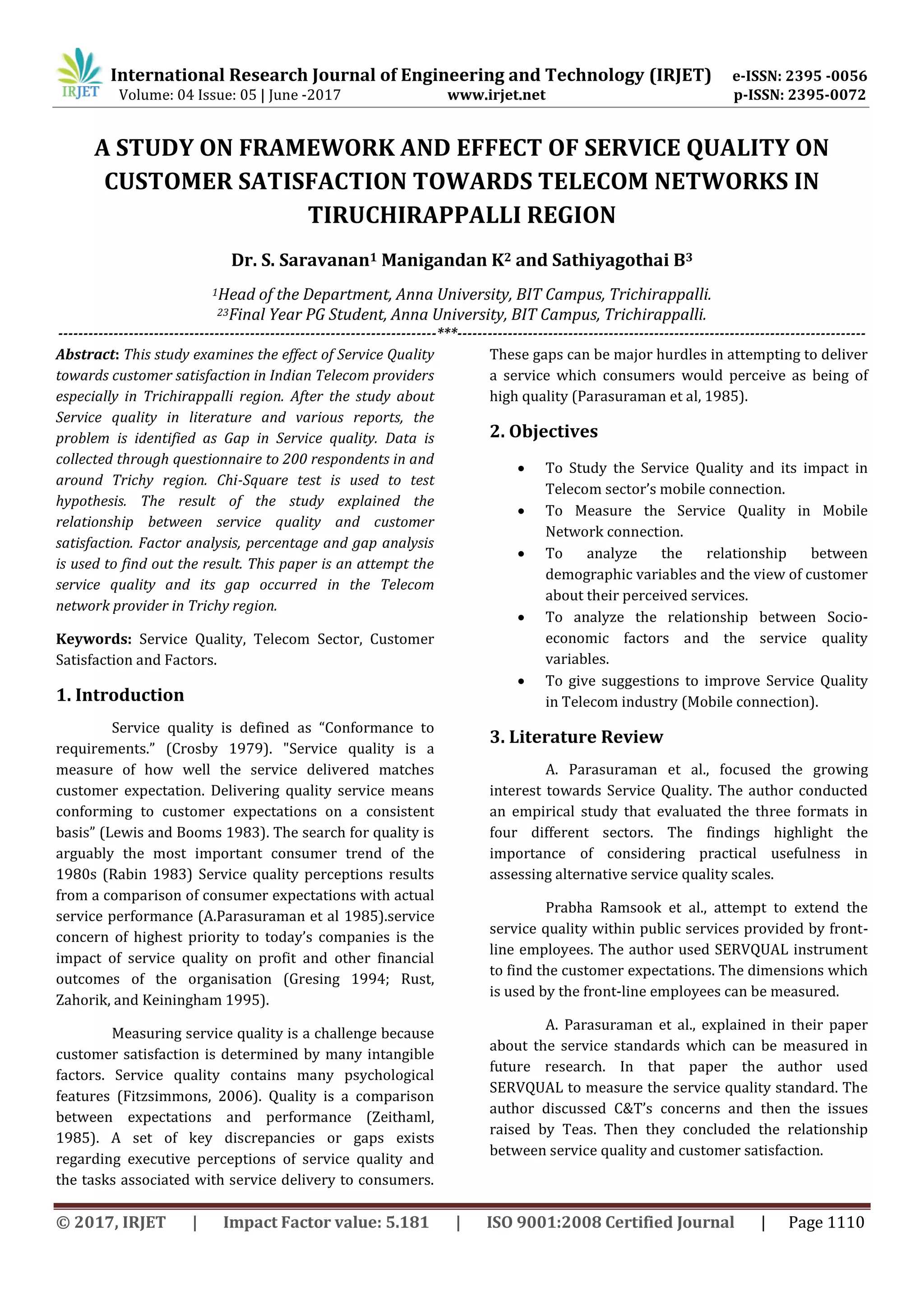
The factor value is determined by the iterations
which we obtained. Rotated component matrix explains
the deduction of variable in order to the sorted value of
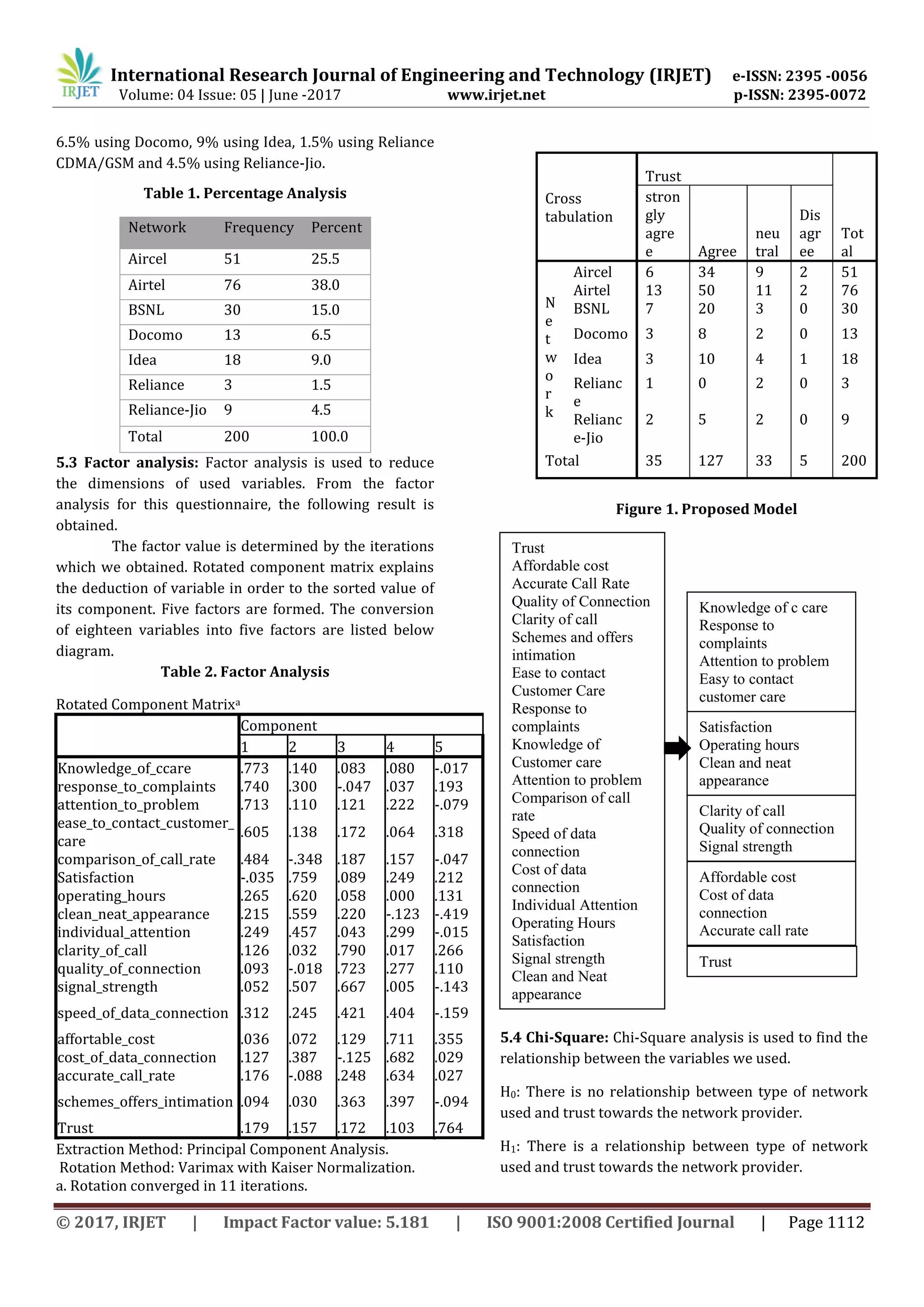
its component. Five factors are formed. The conversion
of eighteen variables into five factors are listed below
diagram.
Table 2. Factor Analysis
Figure 1. Proposed Model
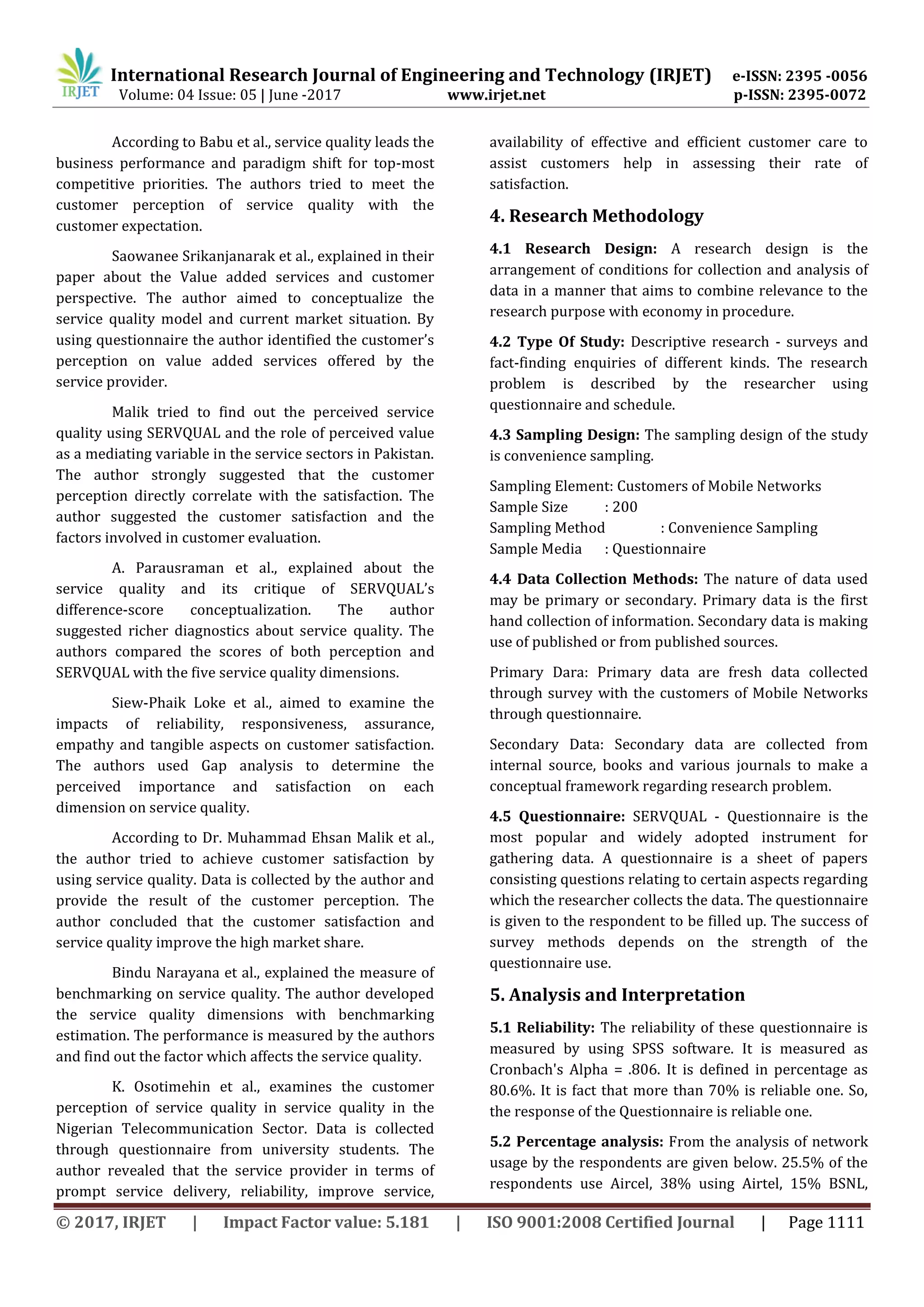
5.4 Chi-Square: Chi-Square analysis is used to find the
relationship between the variables we used.
H0: There is no relationship between type of network
used and trust towards the network provider.
H1: There is a relationship between type of network
used and trust towards the network provider.
Rotated Component Matrixa
Component
1 2 3 4 5
Knowledge_of_ccare .773 .140 .083 .080 -.017
response_to_complaints .740 .300 -.047 .037 .193
attention_to_problem .713 .110 .121 .222 -.079
ease_to_contact_customer_
care
.605 .138 .172 .064 .318
comparison_of_call_rate .484 -.348 .187 .157 -.047
Satisfaction -.035 .759 .089 .249 .212
operating_hours .265 .620 .058 .000 .131
clean_neat_appearance .215 .559 .220 -.123 -.419
individual_attention .249 .457 .043 .299 -.015
clarity_of_call .126 .032 .790 .017 .266
quality_of_connection .093 -.018 .723 .277 .110
signal_strength .052 .507 .667 .005 -.143
speed_of_data_connection .312 .245 .421 .404 -.159
affortable_cost .036 .072 .129 .711 .355
cost_of_data_connection .127 .387 -.125 .682 .029
accurate_call_rate .176 -.088 .248 .634 .027
schemes_offers_intimation .094 .030 .363 .397 -.094
Trust .179 .157 .172 .103 .764
Extraction Method: Principal Component Analysis.
Rotation Method: Varimax with Kaiser Normalization.
a. Rotation converged in 11 iterations.
Cross
tabulation
Trust
Tot
al
stron
gly
agre
e Agree
neu
tral
Dis
agr
ee
N
e
t
w
o
r
k
Aircel 6 34 9 2 51
Airtel 13 50 11 2 76
BSNL 7 20 3 0 30
Docomo 3 8 2 0 13
Idea 3 10 4 1 18
Relianc
e
1 0 2 0 3
Relianc
e-Jio
2 5 2 0 9
Total 35 127 33 5 200
Trust
Affordable cost
Accurate Call Rate
Quality of Connection
Clarity of call
Schemes and offers
intimation
Ease to contact
Customer Care
Response to
complaints
Knowledge of
Customer care
Attention to problem
Comparison of call
rate
Speed of data
connection
Cost of data
connection
Individual Attention
Operating Hours
Satisfaction
Signal strength
Clean and Neat
appearance
Knowledge of c care
Response to
complaints
Attention to problem
Easy to contact
customer care
Satisfaction
Operating hours
Clean and neat
appearance
Clarity of call
Quality of connection
Signal strength
Affordable cost
Cost of data
connection
Accurate call rate
Trust
International Research Journal of Engineering and Technology (IRJET) e-ISSN: 2395 -0056
Volume: 04 Issue: 05 | June -2017 www.irjet.net p-ISSN: 2395-0072
© 2017, IRJET | Impact Factor value: 5.181 | ISO 9001:2008 Certified Journal | Page 1113
Table 3. Chi-Square Test
Calculated Value = 13.287
Degree of freedom = (5-1)*(5-1)
= 4*4
= 16
Tabulated Value = 26.30
Calculated value is less than tabulated value. So
H0 is accepted.
5.5 Satisfaction level: The satisfaction level of the
respondents towards the network provider is given
below table.
Table 4. Percentage Analysis: Satisfaction
S.No Particulars Frequency Percent
1 Highly
satisfied
15 7.5
2 Satisfied 109 54.5
3 Neutral 56 28.0
4 Dissatisfied 15 7.5
5 Highly
dissatisfied
5 2.5
Total 200 100.0
From the satisfaction level of the network
provider, it is found that 7.5% respondents are highly
satisfied, 54.5% of the respondents are satisfied, 28% of
the respondents are neutral, 7.5% of the respondents are
dissatisfied and 2.5% of the respondents are highly
dissatisfied.
5.6 Gap analysis: Gap is mentioned as the lagging of
expected and perceived service. The expectation may be
considered as the respondents are satisfied with the
network. So the gap is found as 38%. This indicates the
low level of Gap in the customer satisfaction towards the
networks.
6. Result and Discussion
From the research, 25.5% of the respondents
use Aircel, 38% using Airtel, 15% BSNL, 6.5% using
Docomo, 9% using Idea, 1.5% using Reliance CDMA/GSM
and 4.5% using Reliance-Jio.
The total of eighteen variables are reduced in
five factor. Service quality in general needs ten factors to
be determined. From the factor analysis it is focused that
only five factors are considered for the telecom sectors
service.
From chi-square analysis it is found that there is
no relationship between type of network used and trust
towards the network provider.
From the satisfaction level of the network
provider, it is found that 7.5% respondents are highly
satisfied, 54.5% of the respondents are satisfied, 28% of
the respondents are neutral, 7.5% of the respondents are
dissatisfied and 2.5% of the respondents are highly
dissatisfied.
Gap analysis is used to find the gap of
satisfaction. The gap is found as 38%.
7. Future Direction
Present research is geographically restricted in
Tiruchirappalli district only. Hence the result cannot be
exploited to other places. One of the biggest limitations
with the paper work is the time factor. The sample size is
small due to insufficient time allotment.
Reference
[1]A. Parasuraman, L. L. (1993). More on Improving
Service Quality Measurement. Journal of
Retailing, 140-147.
[2] A. Parasuraman, V. A. (1994). Alternative Scales for
Measuring Service Quality: A Comparative
Assessment based on Psychometric and
Diagnostic Criteria. Journal of Retailing, 201-
230.
[3] A. Parasuraman, V. A. (1994). Reassessment of
Expectations as a Comparison Standard in
Measuring Service Quality: Implications for
Future Research. Journal of Marketing, 111-124.
[4] Babu, S. H. (2015). Conceptual Evolution of Service
Quality - A Primer. Indian Journal of Applied
Research, 19-21.
[5] Bindu Narayan, C. R. (2006). Scales to measure and
benchmark service quality in Tourism Industry.
Benchmarking: An Internatinal Journal, 469-
493.
[6] Dr. Muhammad Ehsan Malik, M. M. (2012). Impace of
Brand Image, Service Quality and price on
customer satisfaction in Pakistan
Telecommunication Sector. International
Journal of Business and Social Science, 122-129.
International Research Journal of Engineering and Technology (IRJET) e-ISSN: 2395 -0056
Volume: 04 Issue: 05 | June -2017 www.irjet.net p-ISSN: 2395-0072
© 2017, IRJET | Impact Factor value: 5.181 | ISO 9001:2008 Certified Journal | Page 1114
[7] K. Osotimehin, B. A. (2015). Customer Perception of
Service Quality in the Nigerian
Telecommunication sector. Journal of
Economics and Business Research, 144-157.
[8] Malik, S. U. (2012). Customer Satisfaction, Perceived
Service Quality and Mediating Role of Perceived
Value. International Journal of Marketing
Studies, 68-76.
[9] Prabja Ramseook, S. D. (2010). Service Quality in the
Public Service. International Journal of
Management and Marketing Research, 38-50.
[10] Saowanee Srikanjanarak, A. O. (2009). Value added
Services and Service Quality from the
Customer's Perspective: An Empirical
Investigation in Thai Telecommunication
Industry. Asean Marketing Journal , 63-74.
[11] Siew-Phaik Loke, A. A. (2011). Service Quality and
Customer Satisfaction in a Telecommunication
Service Provider. International Conference on
Financial Management and Economics, 24-29.

A Study on Framework and Effect of Service Quality on Customer Satisfaction Towards Telecom Networks in Tiruchirappalli Region

  • 1.
    International Research Journalof Engineering and Technology (IRJET) e-ISSN: 2395 -0056 Volume: 04 Issue: 05 | June -2017 www.irjet.net p-ISSN: 2395-0072 © 2017, IRJET | Impact Factor value: 5.181 | ISO 9001:2008 Certified Journal | Page 1110 A STUDY ON FRAMEWORK AND EFFECT OF SERVICE QUALITY ON CUSTOMER SATISFACTION TOWARDS TELECOM NETWORKS IN TIRUCHIRAPPALLI REGION Dr. S. Saravanan1 Manigandan K2 and Sathiyagothai B3 1Head of the Department, Anna University, BIT Campus, Trichirappalli. 23Final Year PG Student, Anna University, BIT Campus, Trichirappalli. ---------------------------------------------------------------------------***--------------------------------------------------------------------------------- Abstract: This study examines the effect of Service Quality towards customer satisfaction in Indian Telecom providers especially in Trichirappalli region. After the study about Service quality in literature and various reports, the problem is identified as Gap in Service quality. Data is collected through questionnaire to 200 respondents in and around Trichy region. Chi-Square test is used to test hypothesis. The result of the study explained the relationship between service quality and customer satisfaction. Factor analysis, percentage and gap analysis is used to find out the result. This paper is an attempt the service quality and its gap occurred in the Telecom network provider in Trichy region. Keywords: Service Quality, Telecom Sector, Customer Satisfaction and Factors. 1. Introduction Service quality is defined as “Conformance to requirements.” (Crosby 1979). "Service quality is a measure of how well the service delivered matches customer expectation. Delivering quality service means conforming to customer expectations on a consistent basis” (Lewis and Booms 1983). The search for quality is arguably the most important consumer trend of the 1980s (Rabin 1983) Service quality perceptions results from a comparison of consumer expectations with actual service performance (A.Parasuraman et al 1985).service concern of highest priority to today’s companies is the impact of service quality on profit and other financial outcomes of the organisation (Gresing 1994; Rust, Zahorik, and Keiningham 1995). Measuring service quality is a challenge because customer satisfaction is determined by many intangible factors. Service quality contains many psychological features (Fitzsimmons, 2006). Quality is a comparison between expectations and performance (Zeithaml, 1985). A set of key discrepancies or gaps exists regarding executive perceptions of service quality and the tasks associated with service delivery to consumers. These gaps can be major hurdles in attempting to deliver a service which consumers would perceive as being of high quality (Parasuraman et al, 1985). 2. Objectives  To Study the Service Quality and its impact in Telecom sector’s mobile connection.  To Measure the Service Quality in Mobile Network connection.  To analyze the relationship between demographic variables and the view of customer about their perceived services.  To analyze the relationship between Socio- economic factors and the service quality variables.  To give suggestions to improve Service Quality in Telecom industry (Mobile connection). 3. Literature Review A. Parasuraman et al., focused the growing interest towards Service Quality. The author conducted an empirical study that evaluated the three formats in four different sectors. The findings highlight the importance of considering practical usefulness in assessing alternative service quality scales. Prabha Ramsook et al., attempt to extend the service quality within public services provided by front- line employees. The author used SERVQUAL instrument to find the customer expectations. The dimensions which is used by the front-line employees can be measured. A. Parasuraman et al., explained in their paper about the service standards which can be measured in future research. In that paper the author used SERVQUAL to measure the service quality standard. The author discussed C&T’s concerns and then the issues raised by Teas. Then they concluded the relationship between service quality and customer satisfaction.
  • 2.
    International Research Journalof Engineering and Technology (IRJET) e-ISSN: 2395 -0056 Volume: 04 Issue: 05 | June -2017 www.irjet.net p-ISSN: 2395-0072 © 2017, IRJET | Impact Factor value: 5.181 | ISO 9001:2008 Certified Journal | Page 1111 According to Babu et al., service quality leads the business performance and paradigm shift for top-most competitive priorities. The authors tried to meet the customer perception of service quality with the customer expectation. Saowanee Srikanjanarak et al., explained in their paper about the Value added services and customer perspective. The author aimed to conceptualize the service quality model and current market situation. By using questionnaire the author identified the customer’s perception on value added services offered by the service provider. Malik tried to find out the perceived service quality using SERVQUAL and the role of perceived value as a mediating variable in the service sectors in Pakistan. The author strongly suggested that the customer perception directly correlate with the satisfaction. The author suggested the customer satisfaction and the factors involved in customer evaluation. A. Parausraman et al., explained about the service quality and its critique of SERVQUAL’s difference-score conceptualization. The author suggested richer diagnostics about service quality. The authors compared the scores of both perception and SERVQUAL with the five service quality dimensions. Siew-Phaik Loke et al., aimed to examine the impacts of reliability, responsiveness, assurance, empathy and tangible aspects on customer satisfaction. The authors used Gap analysis to determine the perceived importance and satisfaction on each dimension on service quality. According to Dr. Muhammad Ehsan Malik et al., the author tried to achieve customer satisfaction by using service quality. Data is collected by the author and provide the result of the customer perception. The author concluded that the customer satisfaction and service quality improve the high market share. Bindu Narayana et al., explained the measure of benchmarking on service quality. The author developed the service quality dimensions with benchmarking estimation. The performance is measured by the authors and find out the factor which affects the service quality. K. Osotimehin et al., examines the customer perception of service quality in service quality in the Nigerian Telecommunication Sector. Data is collected through questionnaire from university students. The author revealed that the service provider in terms of prompt service delivery, reliability, improve service, availability of effective and efficient customer care to assist customers help in assessing their rate of satisfaction. 4. Research Methodology 4.1 Research Design: A research design is the arrangement of conditions for collection and analysis of data in a manner that aims to combine relevance to the research purpose with economy in procedure. 4.2 Type Of Study: Descriptive research - surveys and fact-finding enquiries of different kinds. The research problem is described by the researcher using questionnaire and schedule. 4.3 Sampling Design: The sampling design of the study is convenience sampling. Sampling Element: Customers of Mobile Networks Sample Size : 200 Sampling Method : Convenience Sampling Sample Media : Questionnaire 4.4 Data Collection Methods: The nature of data used may be primary or secondary. Primary data is the first hand collection of information. Secondary data is making use of published or from published sources. Primary Dara: Primary data are fresh data collected through survey with the customers of Mobile Networks through questionnaire. Secondary Data: Secondary data are collected from internal source, books and various journals to make a conceptual framework regarding research problem. 4.5 Questionnaire: SERVQUAL - Questionnaire is the most popular and widely adopted instrument for gathering data. A questionnaire is a sheet of papers consisting questions relating to certain aspects regarding which the researcher collects the data. The questionnaire is given to the respondent to be filled up. The success of survey methods depends on the strength of the questionnaire use. 5. Analysis and Interpretation 5.1 Reliability: The reliability of these questionnaire is measured by using SPSS software. It is measured as Cronbach's Alpha = .806. It is defined in percentage as 80.6%. It is fact that more than 70% is reliable one. So, the response of the Questionnaire is reliable one. 5.2 Percentage analysis: From the analysis of network usage by the respondents are given below. 25.5% of the respondents use Aircel, 38% using Airtel, 15% BSNL,
  • 3.
    International Research Journalof Engineering and Technology (IRJET) e-ISSN: 2395 -0056 Volume: 04 Issue: 05 | June -2017 www.irjet.net p-ISSN: 2395-0072 © 2017, IRJET | Impact Factor value: 5.181 | ISO 9001:2008 Certified Journal | Page 1112 6.5% using Docomo, 9% using Idea, 1.5% using Reliance CDMA/GSM and 4.5% using Reliance-Jio. Table 1. Percentage Analysis Network Frequency Percent Aircel 51 25.5 Airtel 76 38.0 BSNL 30 15.0 Docomo 13 6.5 Idea 18 9.0 Reliance 3 1.5 Reliance-Jio 9 4.5 Total 200 100.0 5.3 Factor analysis: Factor analysis is used to reduce the dimensions of used variables. From the factor analysis for this questionnaire, the following result is obtained. The factor value is determined by the iterations which we obtained. Rotated component matrix explains the deduction of variable in order to the sorted value of its component. Five factors are formed. The conversion of eighteen variables into five factors are listed below diagram. Table 2. Factor Analysis Figure 1. Proposed Model 5.4 Chi-Square: Chi-Square analysis is used to find the relationship between the variables we used. H0: There is no relationship between type of network used and trust towards the network provider. H1: There is a relationship between type of network used and trust towards the network provider. Rotated Component Matrixa Component 1 2 3 4 5 Knowledge_of_ccare .773 .140 .083 .080 -.017 response_to_complaints .740 .300 -.047 .037 .193 attention_to_problem .713 .110 .121 .222 -.079 ease_to_contact_customer_ care .605 .138 .172 .064 .318 comparison_of_call_rate .484 -.348 .187 .157 -.047 Satisfaction -.035 .759 .089 .249 .212 operating_hours .265 .620 .058 .000 .131 clean_neat_appearance .215 .559 .220 -.123 -.419 individual_attention .249 .457 .043 .299 -.015 clarity_of_call .126 .032 .790 .017 .266 quality_of_connection .093 -.018 .723 .277 .110 signal_strength .052 .507 .667 .005 -.143 speed_of_data_connection .312 .245 .421 .404 -.159 affortable_cost .036 .072 .129 .711 .355 cost_of_data_connection .127 .387 -.125 .682 .029 accurate_call_rate .176 -.088 .248 .634 .027 schemes_offers_intimation .094 .030 .363 .397 -.094 Trust .179 .157 .172 .103 .764 Extraction Method: Principal Component Analysis. Rotation Method: Varimax with Kaiser Normalization. a. Rotation converged in 11 iterations. Cross tabulation Trust Tot al stron gly agre e Agree neu tral Dis agr ee N e t w o r k Aircel 6 34 9 2 51 Airtel 13 50 11 2 76 BSNL 7 20 3 0 30 Docomo 3 8 2 0 13 Idea 3 10 4 1 18 Relianc e 1 0 2 0 3 Relianc e-Jio 2 5 2 0 9 Total 35 127 33 5 200 Trust Affordable cost Accurate Call Rate Quality of Connection Clarity of call Schemes and offers intimation Ease to contact Customer Care Response to complaints Knowledge of Customer care Attention to problem Comparison of call rate Speed of data connection Cost of data connection Individual Attention Operating Hours Satisfaction Signal strength Clean and Neat appearance Knowledge of c care Response to complaints Attention to problem Easy to contact customer care Satisfaction Operating hours Clean and neat appearance Clarity of call Quality of connection Signal strength Affordable cost Cost of data connection Accurate call rate Trust
  • 4.
    International Research Journalof Engineering and Technology (IRJET) e-ISSN: 2395 -0056 Volume: 04 Issue: 05 | June -2017 www.irjet.net p-ISSN: 2395-0072 © 2017, IRJET | Impact Factor value: 5.181 | ISO 9001:2008 Certified Journal | Page 1113 Table 3. Chi-Square Test Calculated Value = 13.287 Degree of freedom = (5-1)*(5-1) = 4*4 = 16 Tabulated Value = 26.30 Calculated value is less than tabulated value. So H0 is accepted. 5.5 Satisfaction level: The satisfaction level of the respondents towards the network provider is given below table. Table 4. Percentage Analysis: Satisfaction S.No Particulars Frequency Percent 1 Highly satisfied 15 7.5 2 Satisfied 109 54.5 3 Neutral 56 28.0 4 Dissatisfied 15 7.5 5 Highly dissatisfied 5 2.5 Total 200 100.0 From the satisfaction level of the network provider, it is found that 7.5% respondents are highly satisfied, 54.5% of the respondents are satisfied, 28% of the respondents are neutral, 7.5% of the respondents are dissatisfied and 2.5% of the respondents are highly dissatisfied. 5.6 Gap analysis: Gap is mentioned as the lagging of expected and perceived service. The expectation may be considered as the respondents are satisfied with the network. So the gap is found as 38%. This indicates the low level of Gap in the customer satisfaction towards the networks. 6. Result and Discussion From the research, 25.5% of the respondents use Aircel, 38% using Airtel, 15% BSNL, 6.5% using Docomo, 9% using Idea, 1.5% using Reliance CDMA/GSM and 4.5% using Reliance-Jio. The total of eighteen variables are reduced in five factor. Service quality in general needs ten factors to be determined. From the factor analysis it is focused that only five factors are considered for the telecom sectors service. From chi-square analysis it is found that there is no relationship between type of network used and trust towards the network provider. From the satisfaction level of the network provider, it is found that 7.5% respondents are highly satisfied, 54.5% of the respondents are satisfied, 28% of the respondents are neutral, 7.5% of the respondents are dissatisfied and 2.5% of the respondents are highly dissatisfied. Gap analysis is used to find the gap of satisfaction. The gap is found as 38%. 7. Future Direction Present research is geographically restricted in Tiruchirappalli district only. Hence the result cannot be exploited to other places. One of the biggest limitations with the paper work is the time factor. The sample size is small due to insufficient time allotment. Reference [1]A. Parasuraman, L. L. (1993). More on Improving Service Quality Measurement. Journal of Retailing, 140-147. [2] A. Parasuraman, V. A. (1994). Alternative Scales for Measuring Service Quality: A Comparative Assessment based on Psychometric and Diagnostic Criteria. Journal of Retailing, 201- 230. [3] A. Parasuraman, V. A. (1994). Reassessment of Expectations as a Comparison Standard in Measuring Service Quality: Implications for Future Research. Journal of Marketing, 111-124. [4] Babu, S. H. (2015). Conceptual Evolution of Service Quality - A Primer. Indian Journal of Applied Research, 19-21. [5] Bindu Narayan, C. R. (2006). Scales to measure and benchmark service quality in Tourism Industry. Benchmarking: An Internatinal Journal, 469- 493. [6] Dr. Muhammad Ehsan Malik, M. M. (2012). Impace of Brand Image, Service Quality and price on customer satisfaction in Pakistan Telecommunication Sector. International Journal of Business and Social Science, 122-129.
  • 5.
    International Research Journalof Engineering and Technology (IRJET) e-ISSN: 2395 -0056 Volume: 04 Issue: 05 | June -2017 www.irjet.net p-ISSN: 2395-0072 © 2017, IRJET | Impact Factor value: 5.181 | ISO 9001:2008 Certified Journal | Page 1114 [7] K. Osotimehin, B. A. (2015). Customer Perception of Service Quality in the Nigerian Telecommunication sector. Journal of Economics and Business Research, 144-157. [8] Malik, S. U. (2012). Customer Satisfaction, Perceived Service Quality and Mediating Role of Perceived Value. International Journal of Marketing Studies, 68-76. [9] Prabja Ramseook, S. D. (2010). Service Quality in the Public Service. International Journal of Management and Marketing Research, 38-50. [10] Saowanee Srikanjanarak, A. O. (2009). Value added Services and Service Quality from the Customer's Perspective: An Empirical Investigation in Thai Telecommunication Industry. Asean Marketing Journal , 63-74. [11] Siew-Phaik Loke, A. A. (2011). Service Quality and Customer Satisfaction in a Telecommunication Service Provider. International Conference on Financial Management and Economics, 24-29.