Managing Your Revenue at RiskVerde Group Capabilities
VERDE TEAMWho We AreStrategic Research Partners:
Pharma Stakeholder ResearchAPPROACH TO LOYALTYTrends:Introduction of customer-centric service models Moving sales team from product selling focus to coordinating value-add experiencesAddressing the business needs of customers for mutual benefitIssues:Continued use of traditional sales force effectiveness, general physician satisfaction metricsTypical studies do not identify specific experiences, frequency of experiences , how to create value added services from the customer’s perspective. The Verde Group has developed 3 key premises around  Pharma Stakeholder research that identify the attributes that make customers satisfied and loyal, but more importantly the experiences that create dissatisfaction and possible defection from the brand.Stakeholder experience is the strongest predictorof behavior
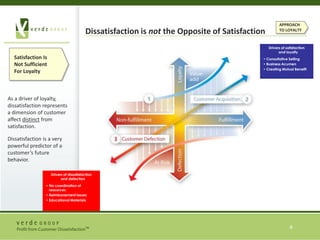
APPROACH TO LOYALTYDissatisfaction is not the Opposite of SatisfactionDrivers of satisfactionand loyaltyConsultative Selling
Business Acumen
Creating Mutual BenefitSatisfaction Is Not Sufficient For Loyalty	As a driver of loyalty, dissatisfaction represents a dimension of customer affect distinct from satisfaction.	Dissatisfaction is a very powerful predictor of a customer’s future behavior.Drivers of dissatisfactionand defectionNo coordination of resources
Reimbursement Issues
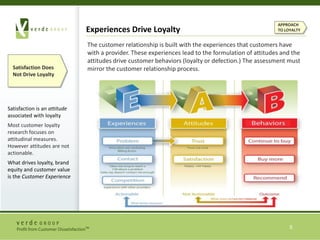
Educational MaterialsAPPROACH TO LOYALTYExperiences Drive LoyaltyThe customer relationship is built with the experiences that customers have with a provider. These experiences lead to the formulation of attitudes and the attitudes drive customer behaviors (loyalty or defection.) The assessment must mirror the customer relationship process. Satisfaction Does Not Drive LoyaltySatisfaction is an attitude associated with loyaltyMost customer loyalty research focuses on attitudinal measures. However attitudes are not actionable.	What drives loyalty, brand equity and customer value is the Customer Experience
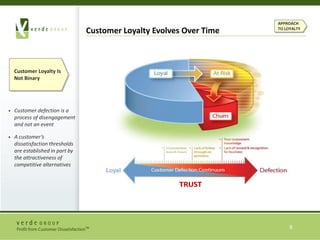
APPROACH TO LOYALTYCustomer Loyalty Evolves Over TimeCustomer Loyalty Is Not BinaryCustomer defection is a process of disengagement and not an event
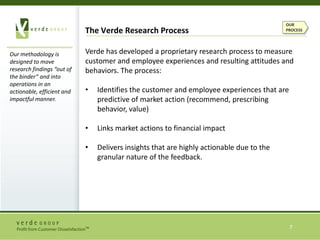
A customer’s dissatisfaction thresholds are established in part by the attractiveness of competitive alternativesOUR PROCESSThe Verde Research ProcessVerde has developed a proprietary research process to measure customer and employee experiences and resulting attitudes and behaviors. The process:Identifies the customer and employee experiences that are predictive of market action (recommend, prescribing behavior, value)
Links market actions to financial impact
Delivers insights that are highly actionable due to the granular nature of the feedback.Our methodology is designed to move research findings “out of the binder” and into operations in an actionable, efficient and impactful manner.
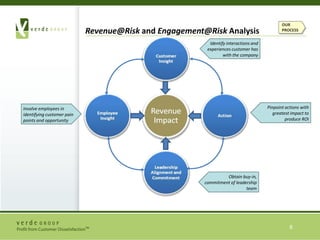
OUR PROCESSRevenue@Risk and Engagement@Risk AnalysisIdentify interactions and experiences customer has with the companyPinpoint actions with greatest impact to produce ROIInvolve employees in identifying customer pain points and opportunityObtain buy-in, commitment of leadership team
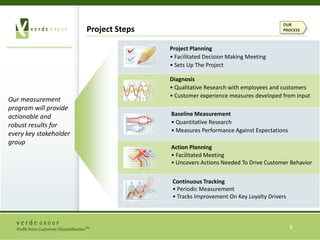
OUR PROCESSProject Steps Project Planning• Facilitated Decision Making Meeting• Sets Up The ProjectDiagnosis• Qualitative Research with employees and customers• Customer experience measures developed from input Our measurement program will provide actionable and robust results for every key stakeholder groupBaseline Measurement• Quantitative Research• Measures Performance Against ExpectationsAction Planning• Facilitated Meeting• Uncovers Actions Needed To Drive Customer BehaviorContinuous Tracking• Periodic Measurement• Tracks Improvement On Key Loyalty Drivers
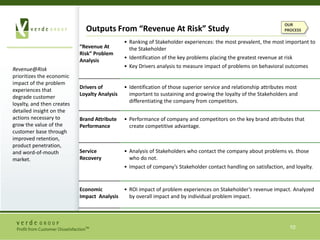
Outputs From “Revenue At Risk” StudyOUR PROCESS	Revenue@Riskprioritizes the economic impact of the problem experiences that degrade customer loyalty, and then creates detailed insight on the actions necessary to grow the value of the customer base through improved retention, product penetration, and word-of-mouth market.
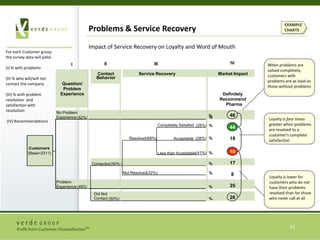
Problems & Service RecoveryEXAMPLE CHARTS Impact of Service Recovery on Loyalty and Word of MouthFor each Customer group the survey data will yield:(I) % with problems (II) % who will/will not contact the company (III) % with problem resolution  and  satisfaction with resolution:  (IV) RecommendationsWhen problems are solved completely, customers with problems are as loyal as those without problemsIVIIIIIIMarket ImpactService RecoveryContactBehaviorQuestion/ProblemExperienceDefinitely RecommendPharmaNo Problem46Loyalty is four times greater when problems are resolved to a customer’s complete satisfaction%Experience%(52%)Completely Satisfied(28%)%4418%(68%)Resolved(28%)AcceptableCustomers10(41%)%Less than Acceptable(Base=2311)17%Contacted(50%)Not Resolved(32%)%Loyalty is lower for customers who do not have their problems resolved than for those who never call at all8Problem25(48%)Experience%Did Not26Contact(50%)%
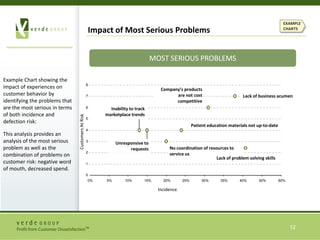
8Company’s products are not cost competitiveLack of business acumen7Inability to track marketplace trends65Patient education materials not up-to-dateCustomers At Risk4Unresponsive to requests3No coordination of resources to service us2100%5%10%15%20%25%30%35%40%50%60%IncidenceEXAMPLE CHARTSImpact of Most Serious Problems MOST SERIOUS PROBLEMSExample Chart showing the impact of experiences on customer behavior by identifying the problems that are the most serious in terms of both incidence and defection risk: This analysis provides an analysis of the most serious problem as well as the combination of problems on customer risk: negative word of mouth, decreased spend. Lack of problem solving skills
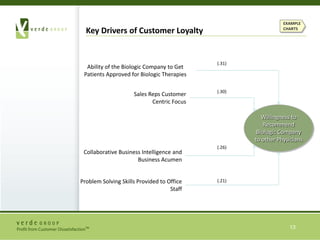
TOTAL PHYSICIANSKEY DRIVERS OF CUSTOMER LOYALTYEXAMPLE CHARTSKey Drivers of Customer Loyalty(.31)Ability of the Biologic Company to Get Patients Approved for Biologic Therapies(.30) Sales Reps Customer Centric Focus Willingness to Recommend Biologic Company to other Physicians(.26)Collaborative Business Intelligence and Business AcumenProblem Solving Skills Provided to Office Staff(.21)
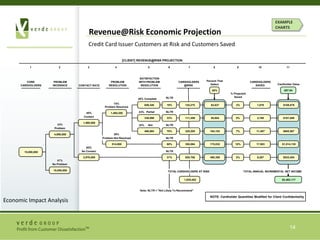
[CLIENT] REVENUE@RISK PROJECTION1289101134567SATISFACTION Percent That CORE CARDHOLDERSCARDHOLDERSPROBLEM PROBLEM WITH PROBLEM Cardholder ValueDefectCARDHOLDERS @RISKSAVEDINCIDENCERESOLUTIONRESOLUTIONCONTACT RATE$57.94 50%% Projected SavedNLTR45%Complete74% 659,340 19% 125,275  62,637 3% 1,879  $108,876 Problem Resolved PartialNLTR23%40% 1,465,200 Contact  336,996 33% 111,209  55,604 5% 2,780  $161,086  1,980,000 33%NotNLTR32%Problem  468,864 70% 328,205  164,102 7% 11,487  $665,567 26% 4,950,000 NLTRProblem Not Resolved 68% 350,064  175,032 10% 17,503  $1,014,135  514,800 60%No ContactNLTR 15,000,000  2,970,000  460,350 31% 920,700 2% 9,207  $533,454 67%No Problem  10,050,000 TOTAL ANNUAL INCREMENTAL NET INCOMETOTAL CARDHOLDERS AT RISK $2,483,117  1,835,452 Note: NLTR = "Not Likely To Recommend"NOTE: Cardholder Quantities Modified for Client ConfidentialityEXAMPLE CHARTS Revenue@Risk Economic ProjectionCredit Card Issuer Customers at Risk and Customers SavedEconomic Impact Analysis
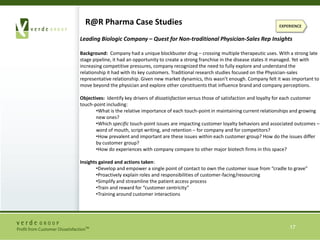
R@R Applications to common Business ObjectivesPhysician/Customer Perception and Satisfaction 		The business objectives we solve for in these types of projects include how experiences drive attitudes and, more importantly, market behavior.  The specific research objectives include: Which Physician/customer experiences (products, services and interactions) generate the highest levels of Physician/customer satisfaction and loyalty?

Verde Group

  • 1.
    Managing Your Revenueat RiskVerde Group Capabilities
  • 2.
    VERDE TEAMWho WeAreStrategic Research Partners:
  • 3.
    Pharma Stakeholder ResearchAPPROACHTO LOYALTYTrends:Introduction of customer-centric service models Moving sales team from product selling focus to coordinating value-add experiencesAddressing the business needs of customers for mutual benefitIssues:Continued use of traditional sales force effectiveness, general physician satisfaction metricsTypical studies do not identify specific experiences, frequency of experiences , how to create value added services from the customer’s perspective. The Verde Group has developed 3 key premises around Pharma Stakeholder research that identify the attributes that make customers satisfied and loyal, but more importantly the experiences that create dissatisfaction and possible defection from the brand.Stakeholder experience is the strongest predictorof behavior
  • 4.
    APPROACH TO LOYALTYDissatisfactionis not the Opposite of SatisfactionDrivers of satisfactionand loyaltyConsultative Selling
  • 5.
  • 6.
    Creating Mutual BenefitSatisfactionIs Not Sufficient For Loyalty As a driver of loyalty, dissatisfaction represents a dimension of customer affect distinct from satisfaction. Dissatisfaction is a very powerful predictor of a customer’s future behavior.Drivers of dissatisfactionand defectionNo coordination of resources
  • 7.
  • 8.
    Educational MaterialsAPPROACH TOLOYALTYExperiences Drive LoyaltyThe customer relationship is built with the experiences that customers have with a provider. These experiences lead to the formulation of attitudes and the attitudes drive customer behaviors (loyalty or defection.) The assessment must mirror the customer relationship process. Satisfaction Does Not Drive LoyaltySatisfaction is an attitude associated with loyaltyMost customer loyalty research focuses on attitudinal measures. However attitudes are not actionable. What drives loyalty, brand equity and customer value is the Customer Experience
  • 9.
    APPROACH TO LOYALTYCustomerLoyalty Evolves Over TimeCustomer Loyalty Is Not BinaryCustomer defection is a process of disengagement and not an event
  • 10.
    A customer’s dissatisfactionthresholds are established in part by the attractiveness of competitive alternativesOUR PROCESSThe Verde Research ProcessVerde has developed a proprietary research process to measure customer and employee experiences and resulting attitudes and behaviors. The process:Identifies the customer and employee experiences that are predictive of market action (recommend, prescribing behavior, value)
  • 11.
    Links market actionsto financial impact
  • 12.
    Delivers insights thatare highly actionable due to the granular nature of the feedback.Our methodology is designed to move research findings “out of the binder” and into operations in an actionable, efficient and impactful manner.
  • 13.
    OUR PROCESSRevenue@Risk andEngagement@Risk AnalysisIdentify interactions and experiences customer has with the companyPinpoint actions with greatest impact to produce ROIInvolve employees in identifying customer pain points and opportunityObtain buy-in, commitment of leadership team
  • 14.
    OUR PROCESSProject StepsProject Planning• Facilitated Decision Making Meeting• Sets Up The ProjectDiagnosis• Qualitative Research with employees and customers• Customer experience measures developed from input Our measurement program will provide actionable and robust results for every key stakeholder groupBaseline Measurement• Quantitative Research• Measures Performance Against ExpectationsAction Planning• Facilitated Meeting• Uncovers Actions Needed To Drive Customer BehaviorContinuous Tracking• Periodic Measurement• Tracks Improvement On Key Loyalty Drivers
  • 15.
    Outputs From “RevenueAt Risk” StudyOUR PROCESS Revenue@Riskprioritizes the economic impact of the problem experiences that degrade customer loyalty, and then creates detailed insight on the actions necessary to grow the value of the customer base through improved retention, product penetration, and word-of-mouth market.
  • 16.
    Problems & ServiceRecoveryEXAMPLE CHARTS Impact of Service Recovery on Loyalty and Word of MouthFor each Customer group the survey data will yield:(I) % with problems (II) % who will/will not contact the company (III) % with problem resolution and satisfaction with resolution: (IV) RecommendationsWhen problems are solved completely, customers with problems are as loyal as those without problemsIVIIIIIIMarket ImpactService RecoveryContactBehaviorQuestion/ProblemExperienceDefinitely RecommendPharmaNo Problem46Loyalty is four times greater when problems are resolved to a customer’s complete satisfaction%Experience%(52%)Completely Satisfied(28%)%4418%(68%)Resolved(28%)AcceptableCustomers10(41%)%Less than Acceptable(Base=2311)17%Contacted(50%)Not Resolved(32%)%Loyalty is lower for customers who do not have their problems resolved than for those who never call at all8Problem25(48%)Experience%Did Not26Contact(50%)%
  • 17.
    8Company’s products arenot cost competitiveLack of business acumen7Inability to track marketplace trends65Patient education materials not up-to-dateCustomers At Risk4Unresponsive to requests3No coordination of resources to service us2100%5%10%15%20%25%30%35%40%50%60%IncidenceEXAMPLE CHARTSImpact of Most Serious Problems MOST SERIOUS PROBLEMSExample Chart showing the impact of experiences on customer behavior by identifying the problems that are the most serious in terms of both incidence and defection risk: This analysis provides an analysis of the most serious problem as well as the combination of problems on customer risk: negative word of mouth, decreased spend. Lack of problem solving skills
  • 18.
    TOTAL PHYSICIANSKEY DRIVERSOF CUSTOMER LOYALTYEXAMPLE CHARTSKey Drivers of Customer Loyalty(.31)Ability of the Biologic Company to Get Patients Approved for Biologic Therapies(.30) Sales Reps Customer Centric Focus Willingness to Recommend Biologic Company to other Physicians(.26)Collaborative Business Intelligence and Business AcumenProblem Solving Skills Provided to Office Staff(.21)
  • 19.
    [CLIENT] REVENUE@RISK PROJECTION1289101134567SATISFACTIONPercent That CORE CARDHOLDERSCARDHOLDERSPROBLEM PROBLEM WITH PROBLEM Cardholder ValueDefectCARDHOLDERS @RISKSAVEDINCIDENCERESOLUTIONRESOLUTIONCONTACT RATE$57.94 50%% Projected SavedNLTR45%Complete74% 659,340 19% 125,275 62,637 3% 1,879 $108,876 Problem Resolved PartialNLTR23%40% 1,465,200 Contact 336,996 33% 111,209 55,604 5% 2,780 $161,086 1,980,000 33%NotNLTR32%Problem 468,864 70% 328,205 164,102 7% 11,487 $665,567 26% 4,950,000 NLTRProblem Not Resolved 68% 350,064 175,032 10% 17,503 $1,014,135 514,800 60%No ContactNLTR 15,000,000 2,970,000 460,350 31% 920,700 2% 9,207 $533,454 67%No Problem 10,050,000 TOTAL ANNUAL INCREMENTAL NET INCOMETOTAL CARDHOLDERS AT RISK $2,483,117 1,835,452 Note: NLTR = "Not Likely To Recommend"NOTE: Cardholder Quantities Modified for Client ConfidentialityEXAMPLE CHARTS Revenue@Risk Economic ProjectionCredit Card Issuer Customers at Risk and Customers SavedEconomic Impact Analysis
  • 20.
    R@R Applications tocommon Business ObjectivesPhysician/Customer Perception and Satisfaction  The business objectives we solve for in these types of projects include how experiences drive attitudes and, more importantly, market behavior. The specific research objectives include: Which Physician/customer experiences (products, services and interactions) generate the highest levels of Physician/customer satisfaction and loyalty?