A / P R O F J A S O N H A R R I S A N D D R P H I L I P PA R YA N
U T S FA C U LT Y O F L AW
BLOCKCHAIN AND DIGITAL ASSETS:
WHAT INSOLVENCY PRACTITIONERS NEED TO KNOW
OUTLINE
1. Overview of blockchain and digital assets
2. What is a blockchain?
3. Bitcoin, cryptocurrencies and crypto tokens
4. Blockchain applications
5. Understanding digital assets
6. Key points for IPs
(c) Jason Harris and Philippa Ryan
OVERVIEW
• A new era of transactions using peer to peer (P2P)
networking
• Operating on blockchains
• Public key crytography
• Operating over the internet
• A new era of disintermediation
• Trustless and anonymous transactions
• Permanent public records
• Secure, peer verified transactions
• A new era of digital storage and transfer of:
• Information, value and rights
(c) Jason Harris and Philippa Ryan
DEVELOPMENT OF BLOCKCHAIN
TECHNOLOGY
• Blockchain 1.0 – digital currency
• Blockchain 2.0 – smart contracts (transactions)
• Blockchain 3.0 – decentralised applications
Melanie Swan, Blockchain: Blueprint for a New Economy, 2015
(c) Jason Harris and Philippa Ryan
BLOCKCHAIN HYPE?
‘think about the blockchain as another class of thing like the Internet - a
comprehensive information technology with tiered technical levels and multiple
classes of applications for any form of asset registry, inventory, and exchange,
including every area of finance, economics, and money; hard assets; and
intangible assets’
Melanie Swan, Institute for Blockchain Studies
‘Every now and then, something comes along that might just change everything.
And this is one of those moments.’
Former ASX CEO Elmer Funke Kupper
Blockchain is ‘the glue that is going to drive a productivity revolution across the
globe on par with what Henry Ford did with the automobile.’
Former IBM IOT division head Paul Brody
(c) Jason Harris and Philippa Ryan
WHAT IS A BLOCKCHAIN?
• Blockchain technology v ‘a blockchain’
• The Bitcoin blockchain
• The Ethereum blockchain
• Sidechains allow separate blockchains to interact
• Blockchain apps (dapps) operate on one ore more blockchains
• Decentralised, distributed ledger technology
• Public blockchains v private (permissioned) blockchains
• Participants on the blockchain are called ‘nodes’
• Each node stores the blockchain
• Off-chain storage also possible as scale increases
• Blockchains need a way for nodes to agree (‘consensus’)
• Different consensus mechanisms exist:
• eg: proof of work; proof of stake; proof of burn etc
(c) Jason Harris and Philippa Ryan
WHAT IS A BLOCKCHAIN?
• Each block contains details of transactions
• Transactions are verified by P2P nodes on the blockchain
network
• Sometimes called ‘miners’ (eg Bitcoin mining)
• Proof of work consensus (completing a hash function)
• Once a (specified) majority of the nodes agree on the
transactions as valid-a new block is created and added to
the existing chain of blocks in chronological order (the
blockchain)
• Once the block is created it is publicly visible:
• Transaction transparency
• Participant anonymity (public key encryption technology)
• Compare single key with multi-sig consent
(c) Jason Harris and Philippa Ryan
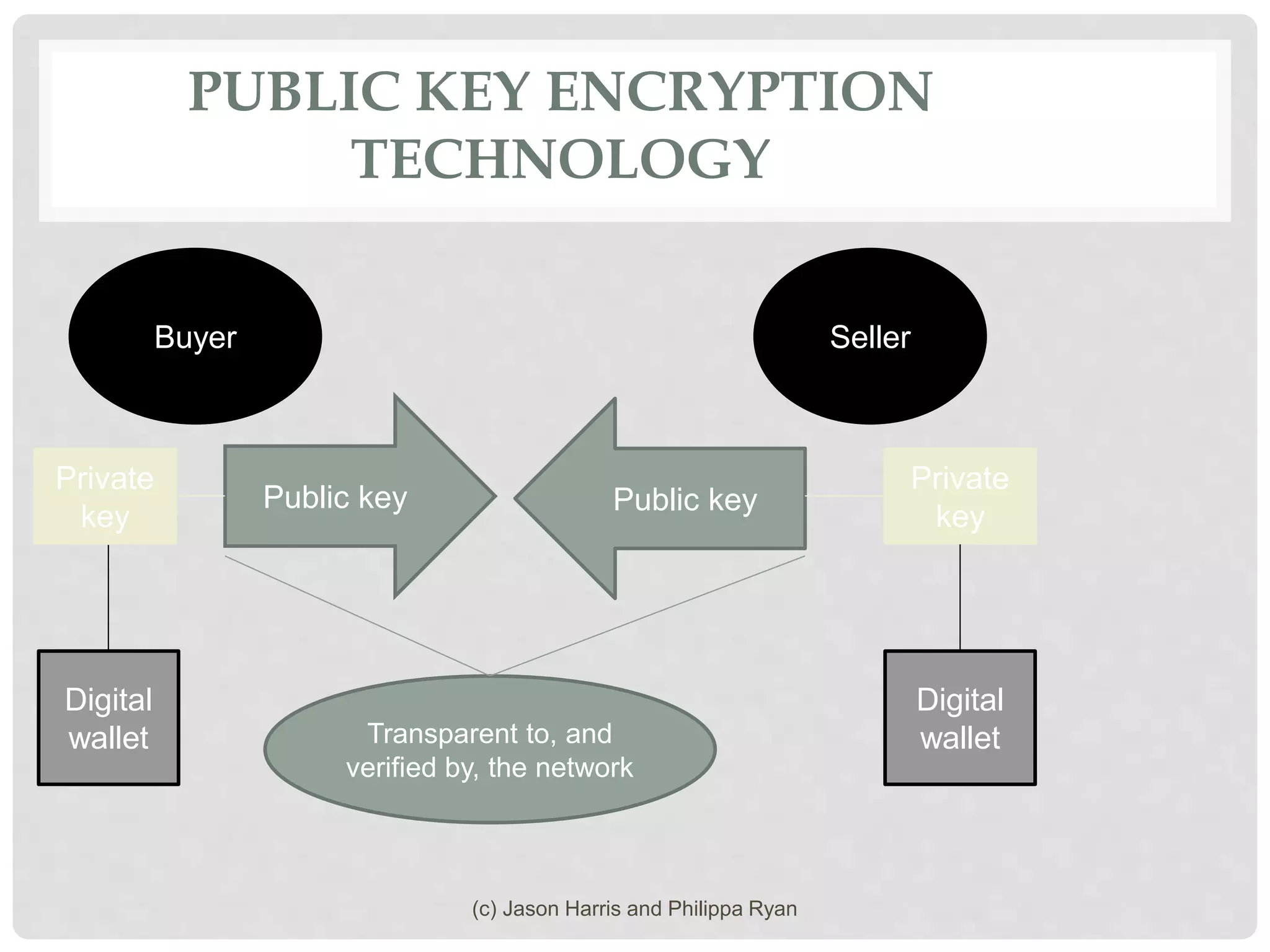
PUBLIC KEY ENCRYPTION
TECHNOLOGY
Public key Public key
Private
key
Private
key
Digital
wallet
Digital
wallet
Buyer Seller
Transparent to, and
verified by, the network
(c) Jason Harris and Philippa Ryan
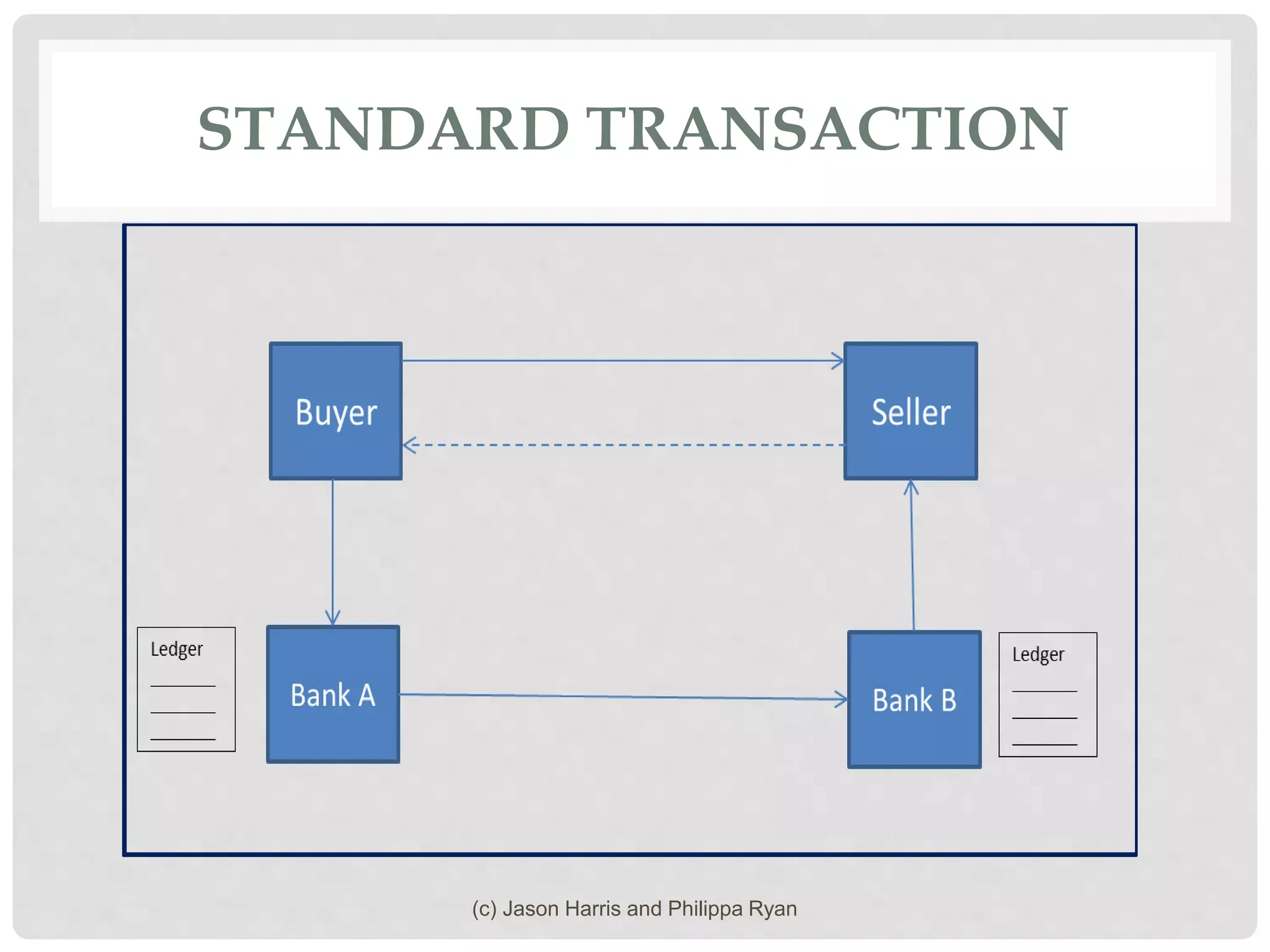
STANDARD TRANSACTION
(c) Jason Harris and Philippa Ryan
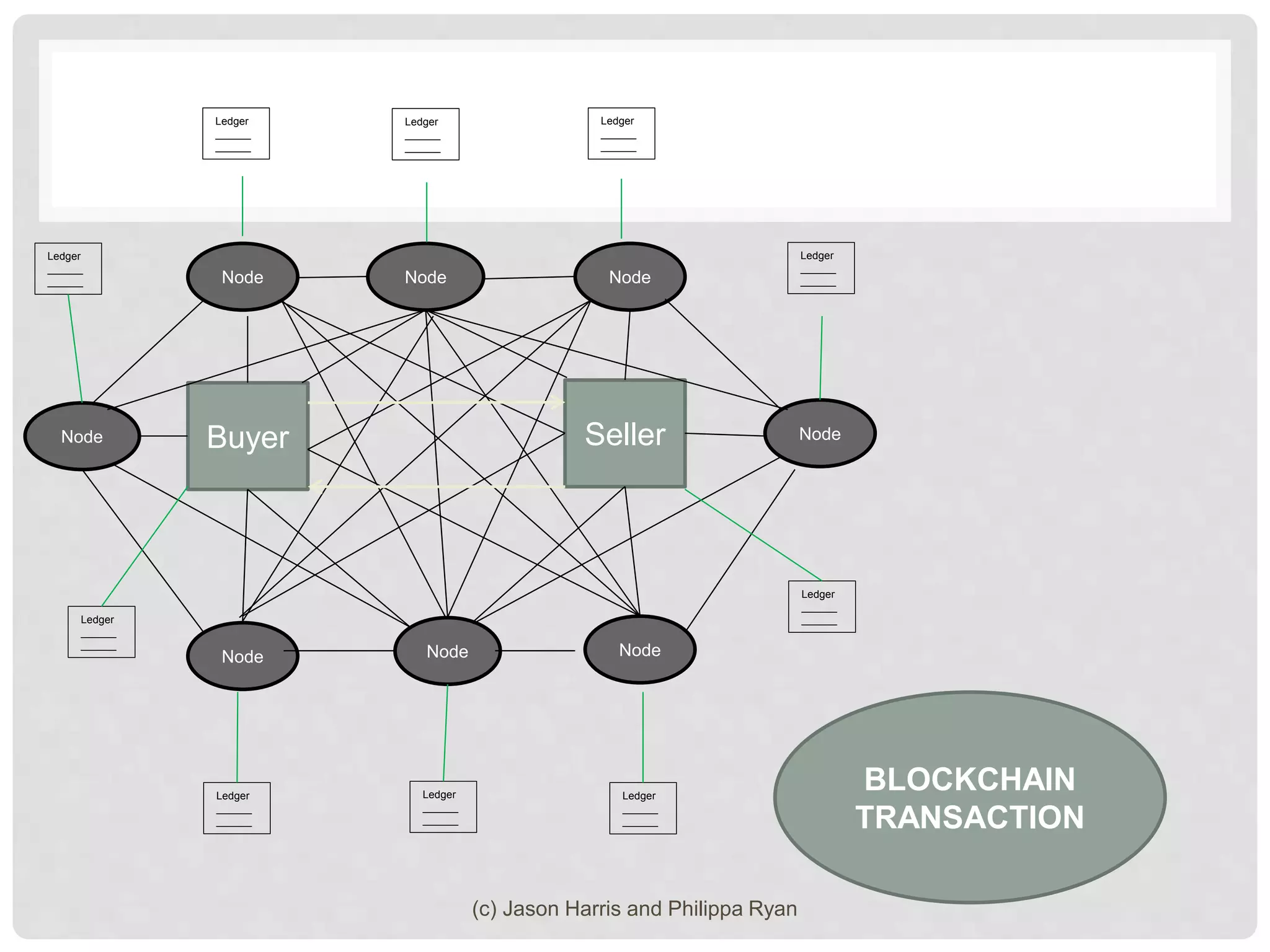
Buyer Seller Node
Node Node Node
NodeNodeNode
Node
Ledger
______
______
Ledger
______
______
Ledger
______
______
Ledger
______
______
Ledger
______
______
Ledger
______
______
Ledger
______
______
Ledger
______
______
Ledger
______
______
Ledger
______
______
BLOCKCHAIN
TRANSACTION
(c) Jason Harris and Philippa Ryan
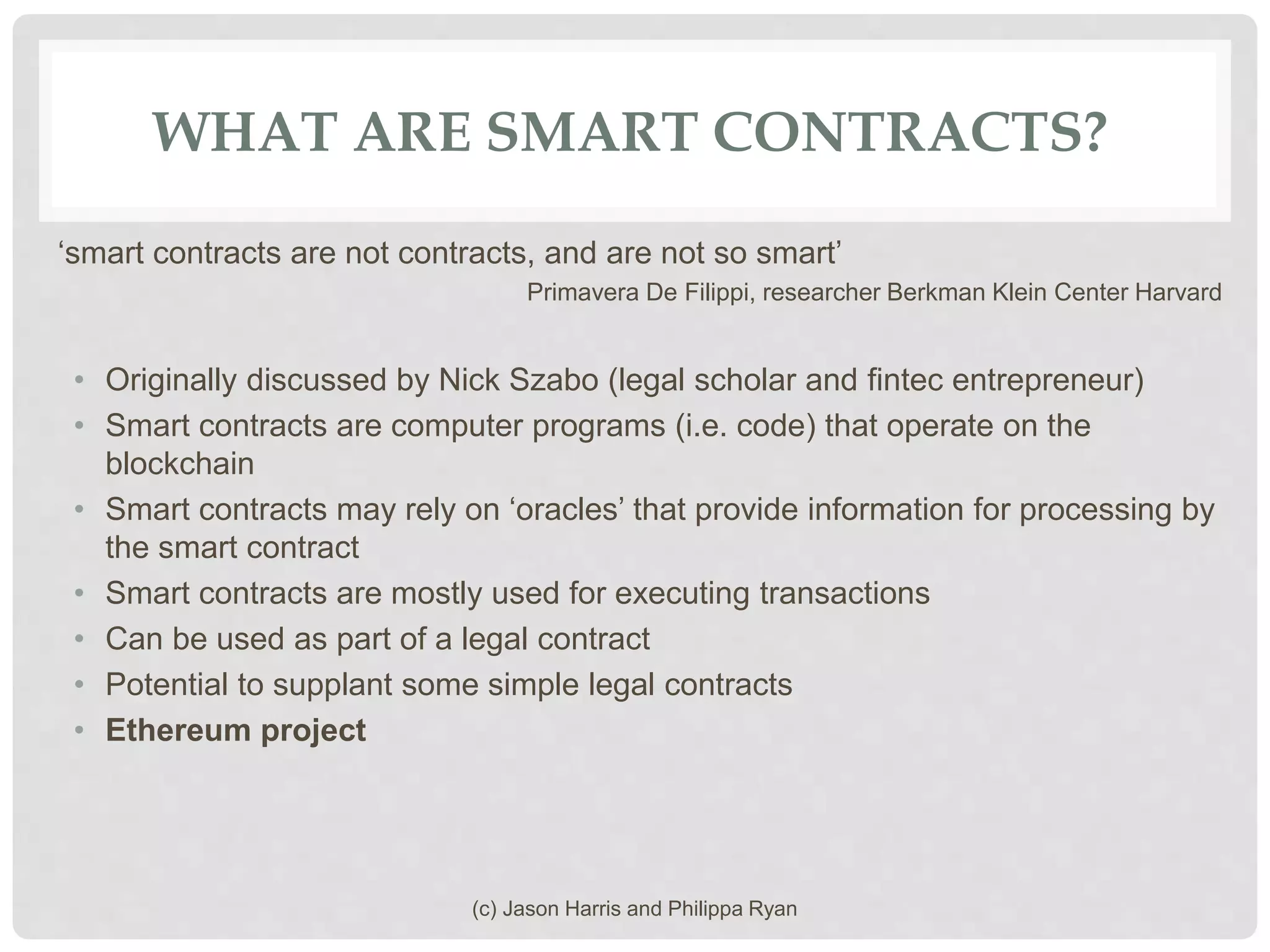
WHAT ARE SMART CONTRACTS?
‘smart contracts are not contracts, and are not so smart’
Primavera De Filippi, researcher Berkman Klein Center Harvard
• Originally discussed by Nick Szabo (legal scholar and fintec entrepreneur)
• Smart contracts are computer programs (i.e. code) that operate on the
blockchain
• Smart contracts may rely on ‘oracles’ that provide information for processing by
the smart contract
• Smart contracts are mostly used for executing transactions
• Can be used as part of a legal contract
• Potential to supplant some simple legal contracts
• Ethereum project
(c) Jason Harris and Philippa Ryan
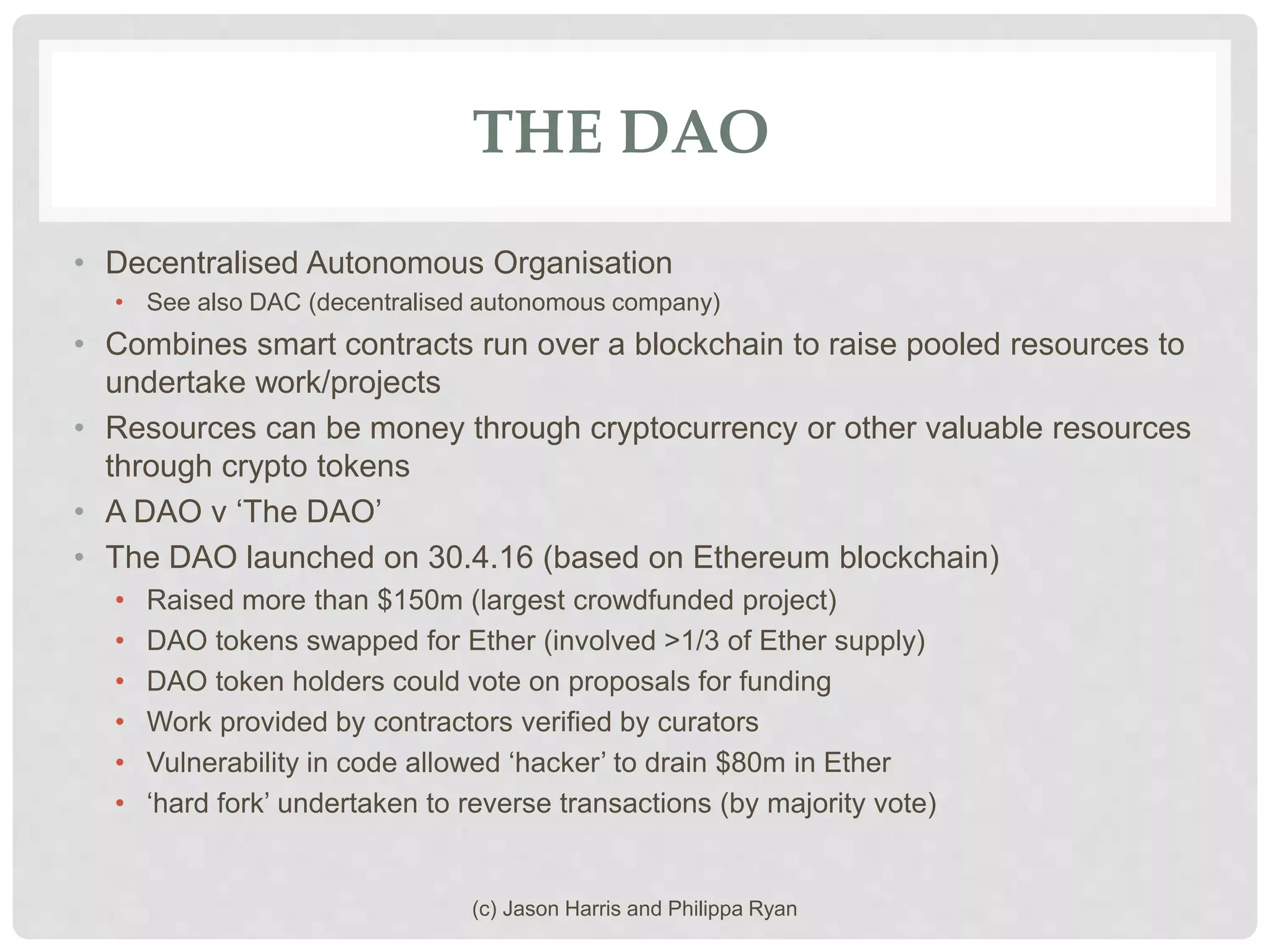
THE DAO
• Decentralised Autonomous Organisation
• See also DAC (decentralised autonomous company)
• Combines smart contracts run over a blockchain to raise pooled resources to
undertake work/projects
• Resources can be money through cryptocurrency or other valuable resources
through crypto tokens
• A DAO v ‘The DAO’
• The DAO launched on 30.4.16 (based on Ethereum blockchain)
• Raised more than $150m (largest crowdfunded project)
• DAO tokens swapped for Ether (involved >1/3 of Ether supply)
• DAO token holders could vote on proposals for funding
• Work provided by contractors verified by curators
• Vulnerability in code allowed ‘hacker’ to drain $80m in Ether
• ‘hard fork’ undertaken to reverse transactions (by majority vote)
(c) Jason Harris and Philippa Ryan
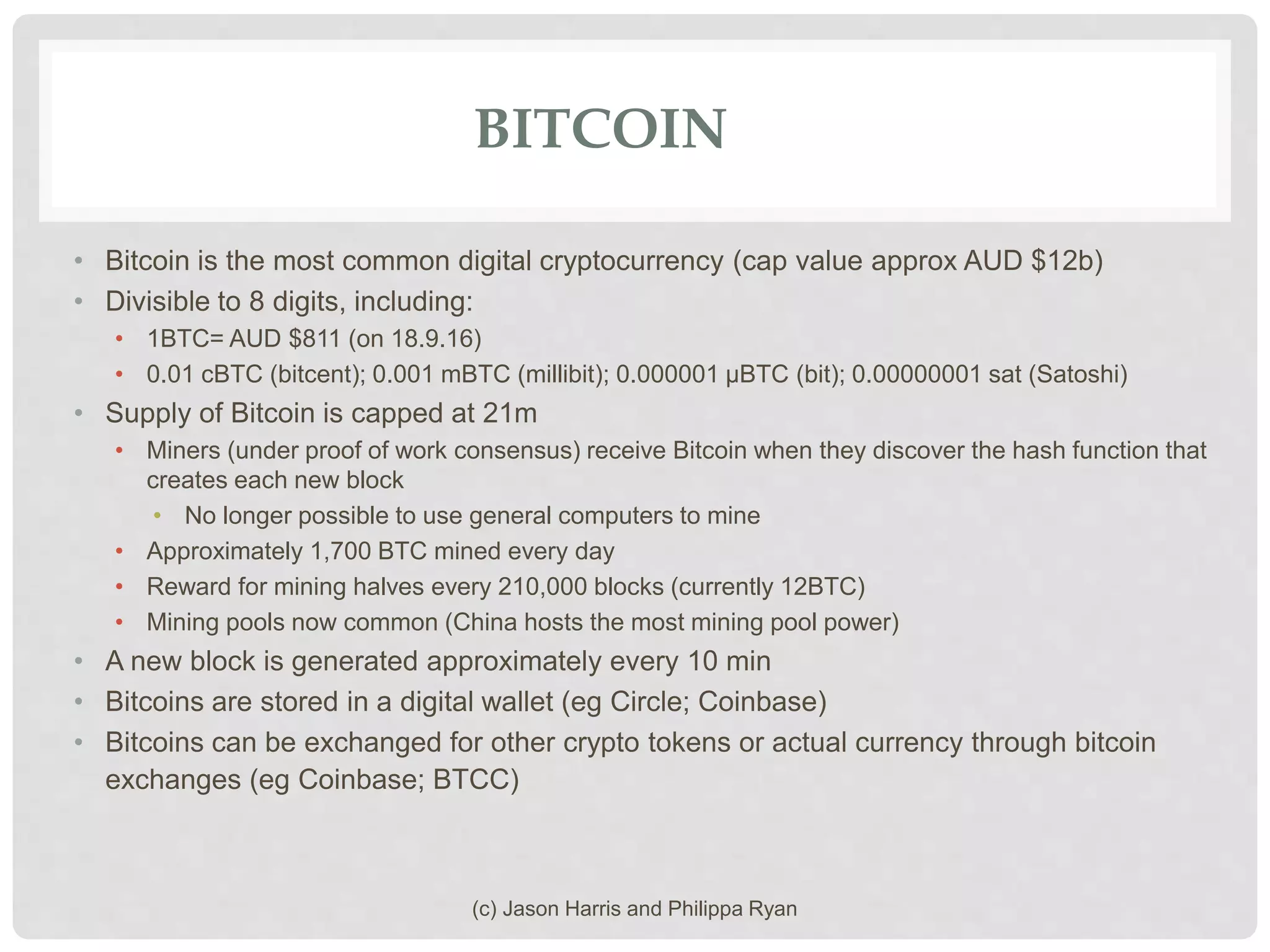
BITCOIN
• Bitcoin is the most common digital cryptocurrency (cap value approx AUD $12b)
• Divisible to 8 digits, including:
• 1BTC= AUD $811 (on 18.9.16)
• 0.01 cBTC (bitcent); 0.001 mBTC (millibit); 0.000001 μBTC (bit); 0.00000001 sat (Satoshi)
• Supply of Bitcoin is capped at 21m
• Miners (under proof of work consensus) receive Bitcoin when they discover the hash function that
creates each new block
• No longer possible to use general computers to mine
• Approximately 1,700 BTC mined every day
• Reward for mining halves every 210,000 blocks (currently 12BTC)
• Mining pools now common (China hosts the most mining pool power)
• A new block is generated approximately every 10 min
• Bitcoins are stored in a digital wallet (eg Circle; Coinbase)
• Bitcoins can be exchanged for other crypto tokens or actual currency through bitcoin
exchanges (eg Coinbase; BTCC)
(c) Jason Harris and Philippa Ryan
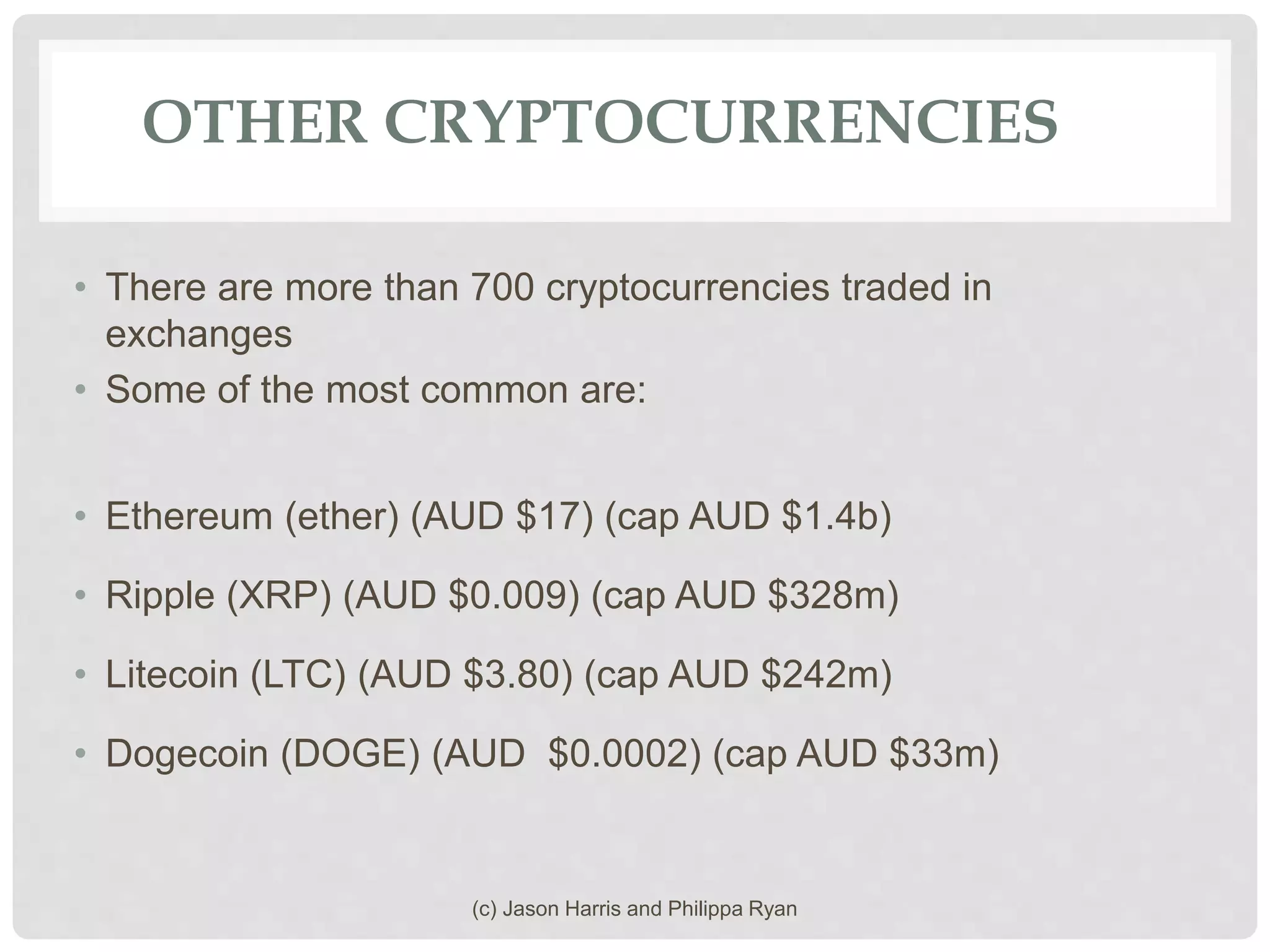
OTHER CRYPTOCURRENCIES
• There are more than 700 cryptocurrencies traded in
exchanges
• Some of the most common are:
• Ethereum (ether) (AUD $17) (cap AUD $1.4b)
• Ripple (XRP) (AUD $0.009) (cap AUD $328m)
• Litecoin (LTC) (AUD $3.80) (cap AUD $242m)
• Dogecoin (DOGE) (AUD $0.0002) (cap AUD $33m)
(c) Jason Harris and Philippa Ryan
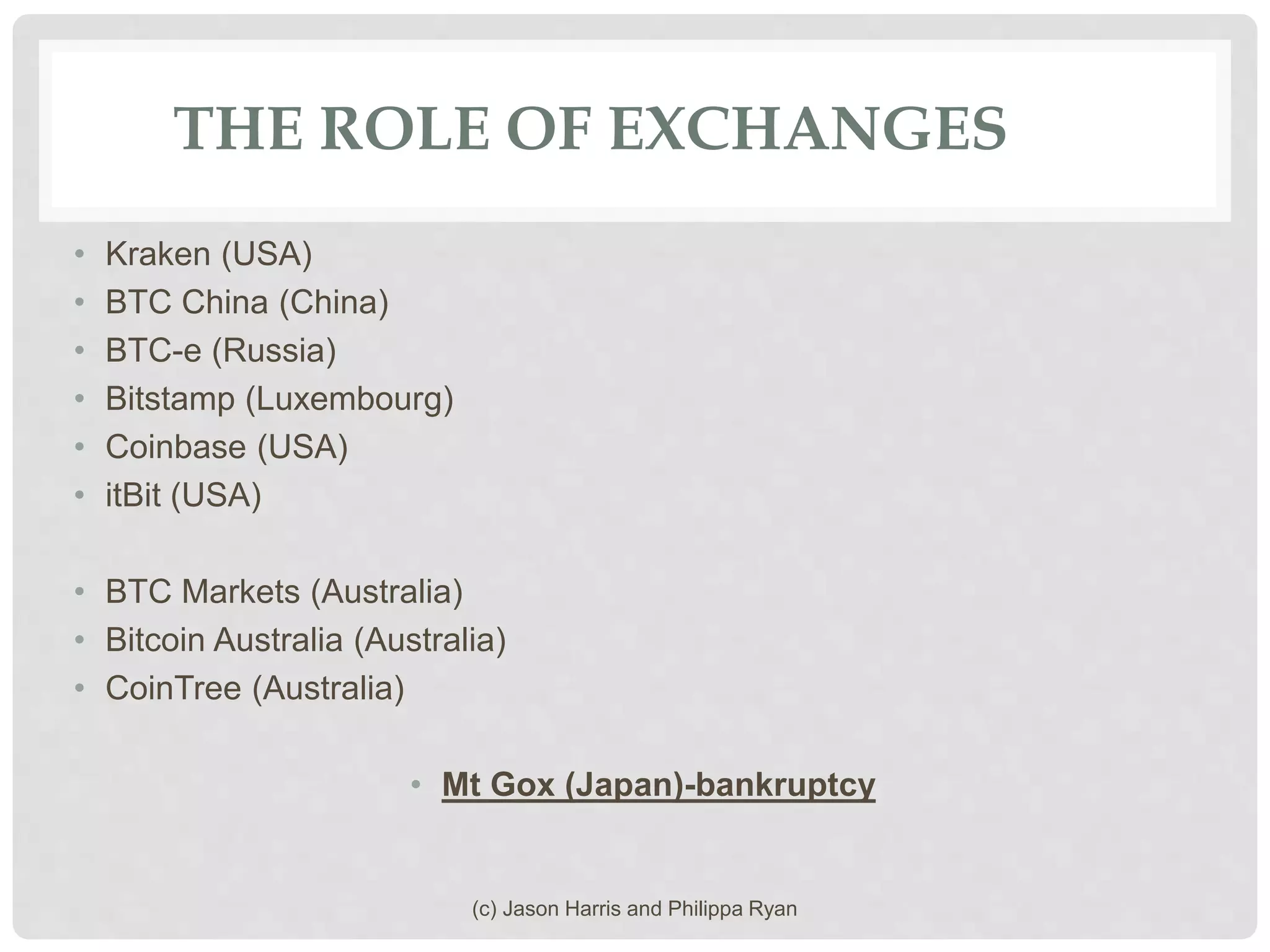
THE ROLE OF EXCHANGES
• Kraken (USA)
• BTC China (China)
• BTC-e (Russia)
• Bitstamp (Luxembourg)
• Coinbase (USA)
• itBit (USA)
• BTC Markets (Australia)
• Bitcoin Australia (Australia)
• CoinTree (Australia)
• Mt Gox (Japan)-bankruptcy
(c) Jason Harris and Philippa Ryan
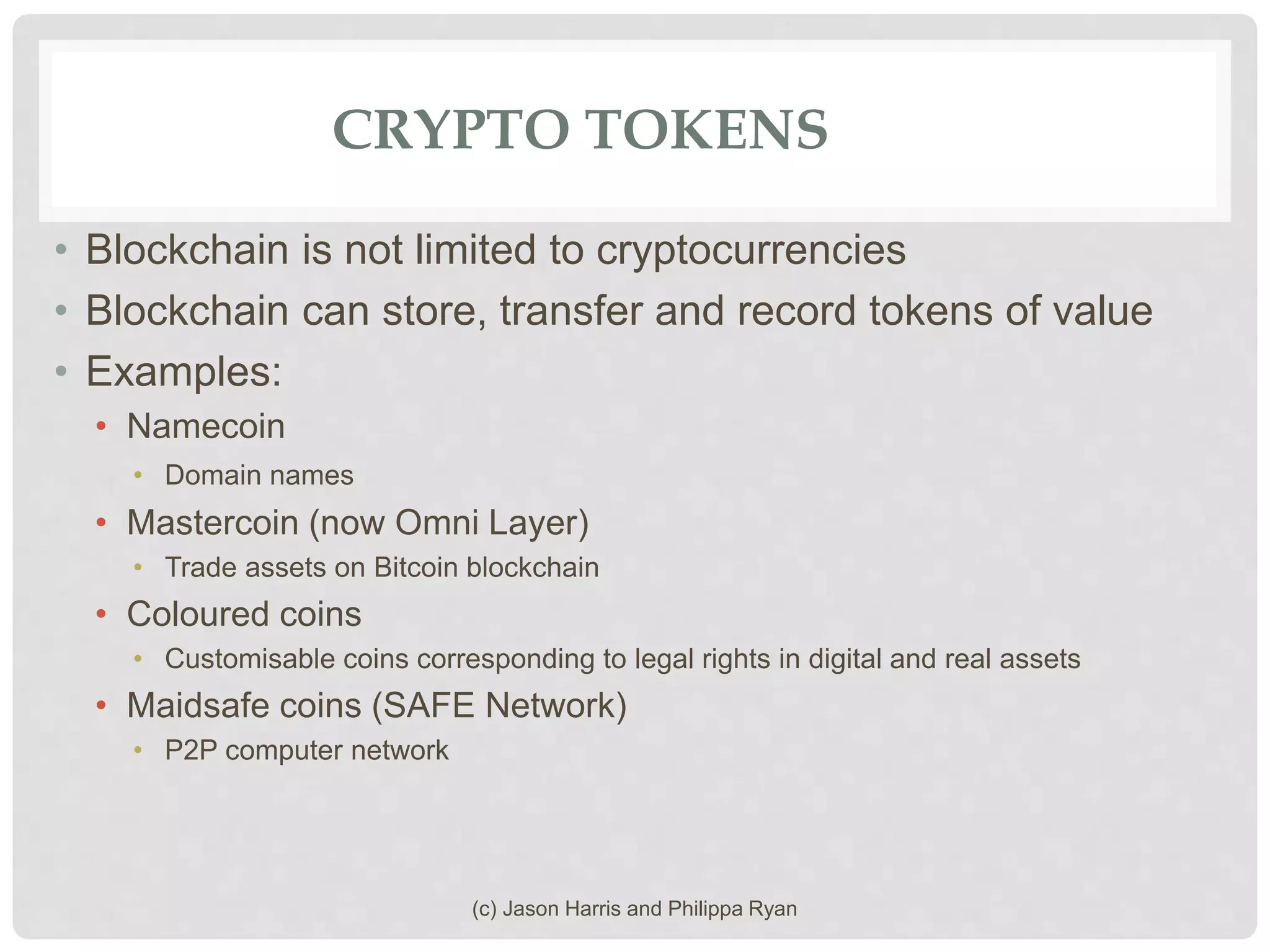
CRYPTO TOKENS
• Blockchain is not limited to cryptocurrencies
• Blockchain can store, transfer and record tokens of value
• Examples:
• Namecoin
• Domain names
• Mastercoin (now Omni Layer)
• Trade assets on Bitcoin blockchain
• Coloured coins
• Customisable coins corresponding to legal rights in digital and real assets
• Maidsafe coins (SAFE Network)
• P2P computer network
(c) Jason Harris and Philippa Ryan
BLOCKCHAIN APPLICATIONS
• Payment systems and money transfers (eg Ripple, SETL, Circle, r3 CEV,
Hyperledger)
• Clearing and settlement facilities
• Asset registry (eg share registry DigitalX)
• Asset wallets (digital wallets)
• Asset exchange
• Crowdfunding (The DAO)
• Digital identity and voting
• Logistics
• IP commercialisation
• Provenance of artwork
• Smart locks
• Smart contract platforms (eg Ethereum) and smart contracts
• Sidechains (eg Blockstream)
• Trade finance
• Internet of things
(c) Jason Harris and Philippa Ryan
UNDERSTANDING DIGITAL ASSETS
• The IoT (Internet of Things)
• Assets that are connected to, and interact with, the internet
• Number of IoT assets in 2016: 6.4b (est: >20b by 2020) (Gartner)
• Blockchain, crypto tokens, smart locks and timestamping, allow the IoT to
generate broader use/monetisation of physical assets
• Low transaction costs of blockchain particularly useful
• Examples:
• Devices that automatically order supplies/repairs
• Private P2P energy trading
• Self-driving cars
• IBM Adept
(c) Jason Harris and Philippa Ryan
KEY POINTS FOR INSOLVENCY PRACTITIONERS
• Looking for digital currencies and digital assets
• RATA, SOA
• Books and records (awareness of blockchain service providers)
• Examinations
• Gathering in and controlling property
• Understanding public keys and private keys (digital wallets)
• On ramps / off ramps
• Multi-sig wallets may provide challenges
• Converting crypto currencies and crypto tokens
• Conversion price volatility (another potential s420A risk?)
• Voidable transactions / recovery proceedings
• New concepts of value, set off and counter claims
• New grounds for challenging rights in assets (digital and physical)
(c) Jason Harris and Philippa Ryan
FURTHER READING
(Introduction)
• William Mougayar, The Business Blockchain, 2016,
Wiley
(More detail)
• Don and Alex Tapscott, Blockchain Revolution, 2016,
Porfolio
• Melanie Swan, Blockchain: Blueprint for a New
Economy, 2015
(c) Jason Harris and Philippa Ryan

Blockchain and digital assets for insolvency practitioners

  • 1.
    A / PR O F J A S O N H A R R I S A N D D R P H I L I P PA R YA N U T S FA C U LT Y O F L AW BLOCKCHAIN AND DIGITAL ASSETS: WHAT INSOLVENCY PRACTITIONERS NEED TO KNOW
  • 2.
    OUTLINE 1. Overview ofblockchain and digital assets 2. What is a blockchain? 3. Bitcoin, cryptocurrencies and crypto tokens 4. Blockchain applications 5. Understanding digital assets 6. Key points for IPs (c) Jason Harris and Philippa Ryan
  • 3.
    OVERVIEW • A newera of transactions using peer to peer (P2P) networking • Operating on blockchains • Public key crytography • Operating over the internet • A new era of disintermediation • Trustless and anonymous transactions • Permanent public records • Secure, peer verified transactions • A new era of digital storage and transfer of: • Information, value and rights (c) Jason Harris and Philippa Ryan
  • 4.
    DEVELOPMENT OF BLOCKCHAIN TECHNOLOGY •Blockchain 1.0 – digital currency • Blockchain 2.0 – smart contracts (transactions) • Blockchain 3.0 – decentralised applications Melanie Swan, Blockchain: Blueprint for a New Economy, 2015 (c) Jason Harris and Philippa Ryan
  • 5.
    BLOCKCHAIN HYPE? ‘think aboutthe blockchain as another class of thing like the Internet - a comprehensive information technology with tiered technical levels and multiple classes of applications for any form of asset registry, inventory, and exchange, including every area of finance, economics, and money; hard assets; and intangible assets’ Melanie Swan, Institute for Blockchain Studies ‘Every now and then, something comes along that might just change everything. And this is one of those moments.’ Former ASX CEO Elmer Funke Kupper Blockchain is ‘the glue that is going to drive a productivity revolution across the globe on par with what Henry Ford did with the automobile.’ Former IBM IOT division head Paul Brody (c) Jason Harris and Philippa Ryan
  • 6.
    WHAT IS ABLOCKCHAIN? • Blockchain technology v ‘a blockchain’ • The Bitcoin blockchain • The Ethereum blockchain • Sidechains allow separate blockchains to interact • Blockchain apps (dapps) operate on one ore more blockchains • Decentralised, distributed ledger technology • Public blockchains v private (permissioned) blockchains • Participants on the blockchain are called ‘nodes’ • Each node stores the blockchain • Off-chain storage also possible as scale increases • Blockchains need a way for nodes to agree (‘consensus’) • Different consensus mechanisms exist: • eg: proof of work; proof of stake; proof of burn etc (c) Jason Harris and Philippa Ryan
  • 7.
    WHAT IS ABLOCKCHAIN? • Each block contains details of transactions • Transactions are verified by P2P nodes on the blockchain network • Sometimes called ‘miners’ (eg Bitcoin mining) • Proof of work consensus (completing a hash function) • Once a (specified) majority of the nodes agree on the transactions as valid-a new block is created and added to the existing chain of blocks in chronological order (the blockchain) • Once the block is created it is publicly visible: • Transaction transparency • Participant anonymity (public key encryption technology) • Compare single key with multi-sig consent (c) Jason Harris and Philippa Ryan
  • 8.
    PUBLIC KEY ENCRYPTION TECHNOLOGY Publickey Public key Private key Private key Digital wallet Digital wallet Buyer Seller Transparent to, and verified by, the network (c) Jason Harris and Philippa Ryan
  • 9.
    STANDARD TRANSACTION (c) JasonHarris and Philippa Ryan
  • 10.
    Buyer Seller Node NodeNode Node NodeNodeNode Node Ledger ______ ______ Ledger ______ ______ Ledger ______ ______ Ledger ______ ______ Ledger ______ ______ Ledger ______ ______ Ledger ______ ______ Ledger ______ ______ Ledger ______ ______ Ledger ______ ______ BLOCKCHAIN TRANSACTION (c) Jason Harris and Philippa Ryan
  • 11.
    WHAT ARE SMARTCONTRACTS? ‘smart contracts are not contracts, and are not so smart’ Primavera De Filippi, researcher Berkman Klein Center Harvard • Originally discussed by Nick Szabo (legal scholar and fintec entrepreneur) • Smart contracts are computer programs (i.e. code) that operate on the blockchain • Smart contracts may rely on ‘oracles’ that provide information for processing by the smart contract • Smart contracts are mostly used for executing transactions • Can be used as part of a legal contract • Potential to supplant some simple legal contracts • Ethereum project (c) Jason Harris and Philippa Ryan
  • 12.
    THE DAO • DecentralisedAutonomous Organisation • See also DAC (decentralised autonomous company) • Combines smart contracts run over a blockchain to raise pooled resources to undertake work/projects • Resources can be money through cryptocurrency or other valuable resources through crypto tokens • A DAO v ‘The DAO’ • The DAO launched on 30.4.16 (based on Ethereum blockchain) • Raised more than $150m (largest crowdfunded project) • DAO tokens swapped for Ether (involved >1/3 of Ether supply) • DAO token holders could vote on proposals for funding • Work provided by contractors verified by curators • Vulnerability in code allowed ‘hacker’ to drain $80m in Ether • ‘hard fork’ undertaken to reverse transactions (by majority vote) (c) Jason Harris and Philippa Ryan
  • 13.
    BITCOIN • Bitcoin isthe most common digital cryptocurrency (cap value approx AUD $12b) • Divisible to 8 digits, including: • 1BTC= AUD $811 (on 18.9.16) • 0.01 cBTC (bitcent); 0.001 mBTC (millibit); 0.000001 μBTC (bit); 0.00000001 sat (Satoshi) • Supply of Bitcoin is capped at 21m • Miners (under proof of work consensus) receive Bitcoin when they discover the hash function that creates each new block • No longer possible to use general computers to mine • Approximately 1,700 BTC mined every day • Reward for mining halves every 210,000 blocks (currently 12BTC) • Mining pools now common (China hosts the most mining pool power) • A new block is generated approximately every 10 min • Bitcoins are stored in a digital wallet (eg Circle; Coinbase) • Bitcoins can be exchanged for other crypto tokens or actual currency through bitcoin exchanges (eg Coinbase; BTCC) (c) Jason Harris and Philippa Ryan
  • 14.
    OTHER CRYPTOCURRENCIES • Thereare more than 700 cryptocurrencies traded in exchanges • Some of the most common are: • Ethereum (ether) (AUD $17) (cap AUD $1.4b) • Ripple (XRP) (AUD $0.009) (cap AUD $328m) • Litecoin (LTC) (AUD $3.80) (cap AUD $242m) • Dogecoin (DOGE) (AUD $0.0002) (cap AUD $33m) (c) Jason Harris and Philippa Ryan
  • 15.
    THE ROLE OFEXCHANGES • Kraken (USA) • BTC China (China) • BTC-e (Russia) • Bitstamp (Luxembourg) • Coinbase (USA) • itBit (USA) • BTC Markets (Australia) • Bitcoin Australia (Australia) • CoinTree (Australia) • Mt Gox (Japan)-bankruptcy (c) Jason Harris and Philippa Ryan
  • 16.
    CRYPTO TOKENS • Blockchainis not limited to cryptocurrencies • Blockchain can store, transfer and record tokens of value • Examples: • Namecoin • Domain names • Mastercoin (now Omni Layer) • Trade assets on Bitcoin blockchain • Coloured coins • Customisable coins corresponding to legal rights in digital and real assets • Maidsafe coins (SAFE Network) • P2P computer network (c) Jason Harris and Philippa Ryan
  • 17.
    BLOCKCHAIN APPLICATIONS • Paymentsystems and money transfers (eg Ripple, SETL, Circle, r3 CEV, Hyperledger) • Clearing and settlement facilities • Asset registry (eg share registry DigitalX) • Asset wallets (digital wallets) • Asset exchange • Crowdfunding (The DAO) • Digital identity and voting • Logistics • IP commercialisation • Provenance of artwork • Smart locks • Smart contract platforms (eg Ethereum) and smart contracts • Sidechains (eg Blockstream) • Trade finance • Internet of things (c) Jason Harris and Philippa Ryan
  • 18.
    UNDERSTANDING DIGITAL ASSETS •The IoT (Internet of Things) • Assets that are connected to, and interact with, the internet • Number of IoT assets in 2016: 6.4b (est: >20b by 2020) (Gartner) • Blockchain, crypto tokens, smart locks and timestamping, allow the IoT to generate broader use/monetisation of physical assets • Low transaction costs of blockchain particularly useful • Examples: • Devices that automatically order supplies/repairs • Private P2P energy trading • Self-driving cars • IBM Adept (c) Jason Harris and Philippa Ryan
  • 19.
    KEY POINTS FORINSOLVENCY PRACTITIONERS • Looking for digital currencies and digital assets • RATA, SOA • Books and records (awareness of blockchain service providers) • Examinations • Gathering in and controlling property • Understanding public keys and private keys (digital wallets) • On ramps / off ramps • Multi-sig wallets may provide challenges • Converting crypto currencies and crypto tokens • Conversion price volatility (another potential s420A risk?) • Voidable transactions / recovery proceedings • New concepts of value, set off and counter claims • New grounds for challenging rights in assets (digital and physical) (c) Jason Harris and Philippa Ryan
  • 20.
    FURTHER READING (Introduction) • WilliamMougayar, The Business Blockchain, 2016, Wiley (More detail) • Don and Alex Tapscott, Blockchain Revolution, 2016, Porfolio • Melanie Swan, Blockchain: Blueprint for a New Economy, 2015 (c) Jason Harris and Philippa Ryan