Private Equity
Overview, Best Practices, and Current Challenges
Mohamed Abdul Hady, CAIA
1
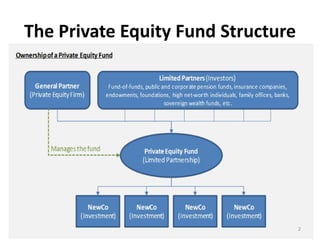
The Private Equity Fund Structure
2
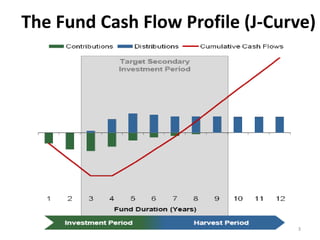
The Fund Cash Flow Profile (J‐Curve)
3
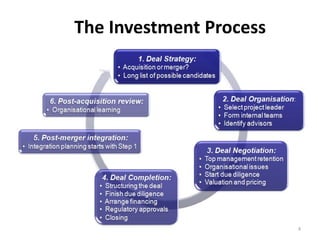
The Investment Process
4
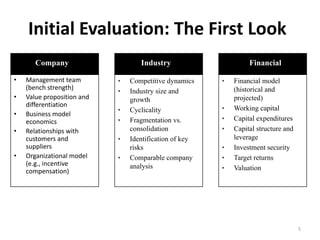
Initial Evaluation: The First Look
Company Industry Financial
• Management team 
(bench strength)
• Value proposition and 
differentiation
• Business model 
economics
• Relationships with 
customers and 
suppliers
• Organizational model 
(e.g., incentive 
compensation) 
• Competitive dynamics
• Industry size and
growth
• Cyclicality
• Fragmentation vs.
consolidation
• Identification of key
risks
• Comparable company
analysis
• Financial model
(historical and
projected)
• Working capital
• Capital expenditures
• Capital structure and
leverage
• Investment security
• Target returns
• Valuation
5
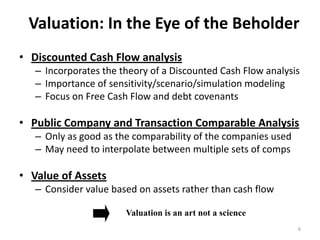
Valuation: In the Eye of the Beholder
• Discounted Cash Flow analysis
– Incorporates the theory of a Discounted Cash Flow analysis
– Importance of sensitivity/scenario/simulation modeling
– Focus on Free Cash Flow and debt covenants 
• Public Company and Transaction Comparable Analysis
– Only as good as the comparability of the companies used
– May need to interpolate between multiple sets of comps
• Value of Assets
– Consider value based on assets rather than cash flow
Valuation is an art not a science
6
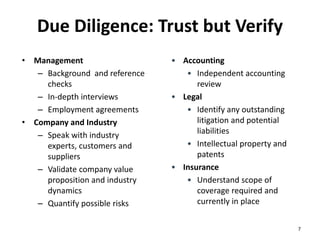
Due Diligence: Trust but Verify
• Management
– Background  and reference 
checks
– In‐depth interviews
– Employment agreements
• Company and Industry
– Speak with industry 
experts, customers and 
suppliers
– Validate company value 
proposition and industry 
dynamics
– Quantify possible risks
• Accounting
• Independent accounting 
review
• Legal
• Identify any outstanding 
litigation and potential 
liabilities
• Intellectual property and 
patents
• Insurance
• Understand scope of 
coverage required and 
currently in place
7
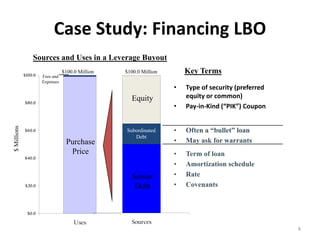
Case Study: Financing LBO
$0.0
$20.0
$40.0
$60.0
$80.0
$100.0
Uses
Sources and Uses in a Leverage Buyout
$Millions
Sources
Purchase
Price
$100.0 Million
Fees and
Expenses
$100.0 Million
Senior
Debt
Equity
Subordinated
Debt
Key Terms
• Type of security (preferred 
equity or common) 
• Pay‐in‐Kind (“PIK”) Coupon 
• Term of loan
• Amortization schedule
• Rate
• Covenants
• Often a “bullet” loan
• May ask for warrants
• Often a “bullet” loan
• May ask for warrants
8
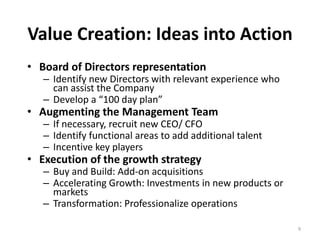
Value Creation: Ideas into Action
• Board of Directors representation
– Identify new Directors with relevant experience who 
can assist the Company 
– Develop a “100 day plan”
• Augmenting the Management Team
– If necessary, recruit new CEO/ CFO
– Identify functional areas to add additional talent
– Incentive key players
• Execution of the growth strategy
– Buy and Build: Add‐on acquisitions
– Accelerating Growth: Investments in new products or 
markets
– Transformation: Professionalize operations
9
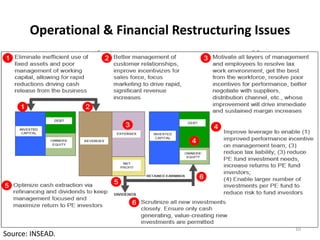
Operational & Financial Restructuring Issues
Source: INSEAD.
10
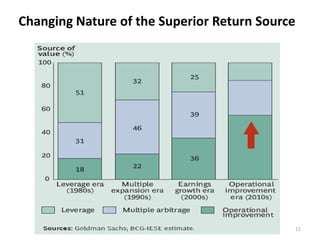
Changing Nature of the Superior Return Source
11
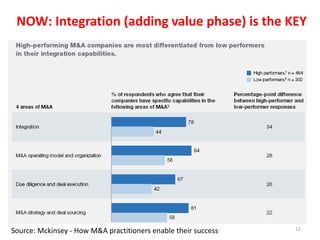
Source: Mckinsey ‐ How M&A practitioners enable their success
NOW: Integration (adding value phase) is the KEY
12
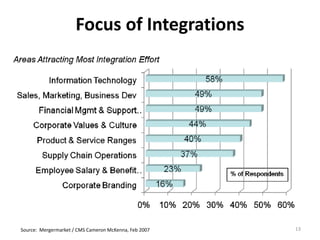
Focus of Integrations
Source:  Mergermarket / CMS Cameron McKenna, Feb 2007 13
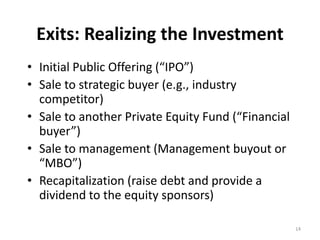
Exits: Realizing the Investment
• Initial Public Offering (“IPO”)
• Sale to strategic buyer (e.g., industry 
competitor)
• Sale to another Private Equity Fund (“Financial 
buyer”)
• Sale to management (Management buyout or 
“MBO”)
• Recapitalization (raise debt and provide a 
dividend to the equity sponsors)
14
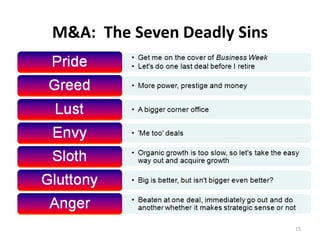
M&A:  The Seven Deadly Sins
15
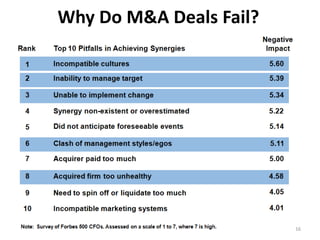
Why Do M&A Deals Fail?
16
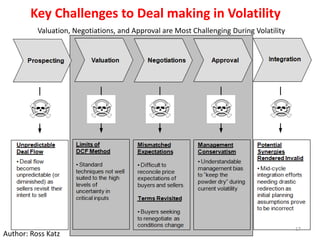
Key Challenges to Deal making in Volatility
Valuation, Negotiations, and Approval are Most Challenging During Volatility
Author: Ross Katz
17
Thank You
Q & A
18

The Presentation